UNCOVERING NORTH CAROLINA’S HIDDEN WAR STORIES BENEATH THE WAVES
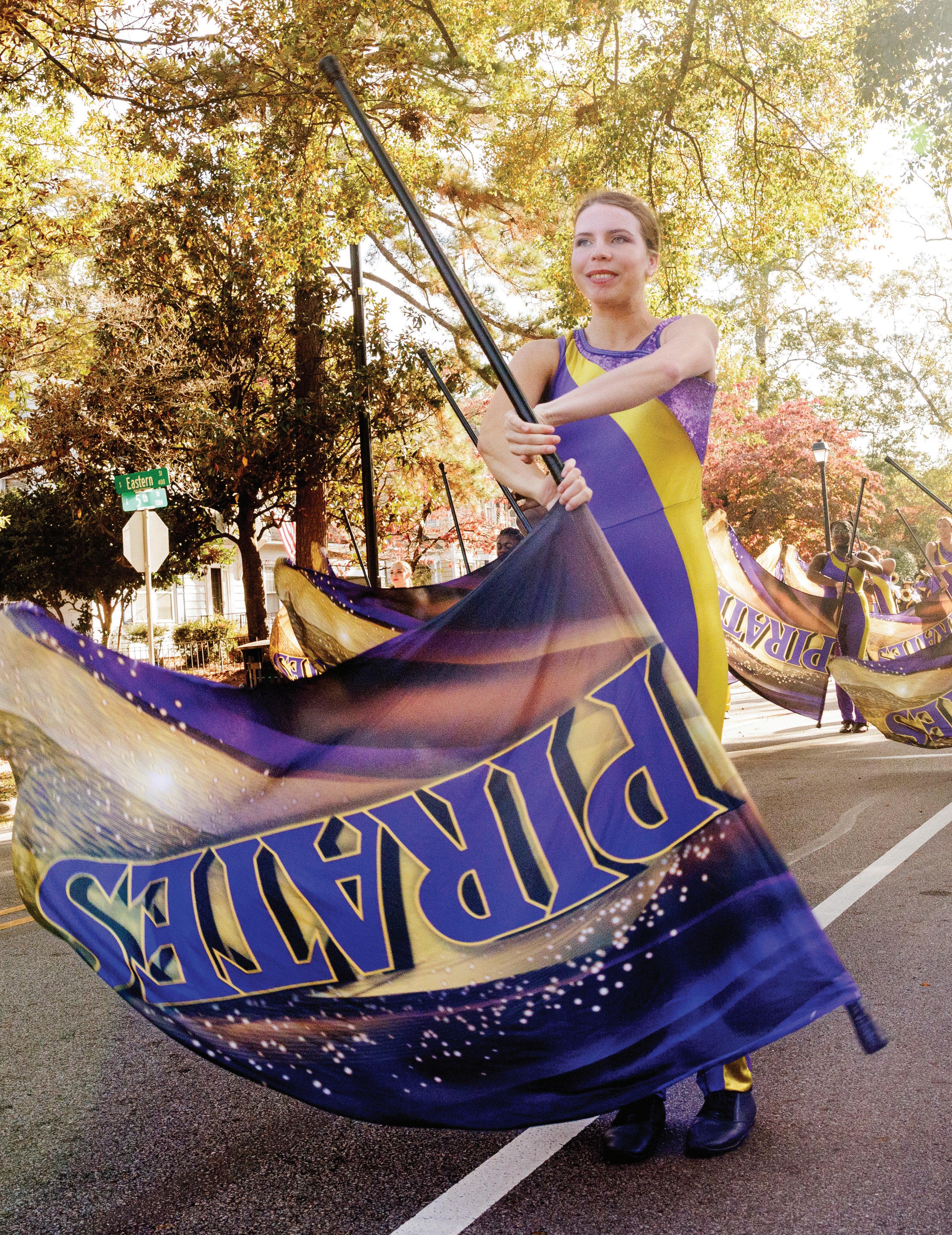
Sewickley, Pennsylvania’s Sydney Hanna, a color guard section leader for the Marching Pirates, participates in the homecoming parade Nov. 8 in Greenville. Later that day, the football Pirates defeated the UNC Charlotte 49ers 48-22 in front of 39,096 fans. (Photo by Steven Mantilla)
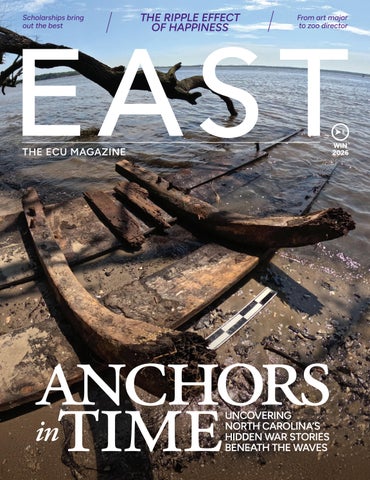
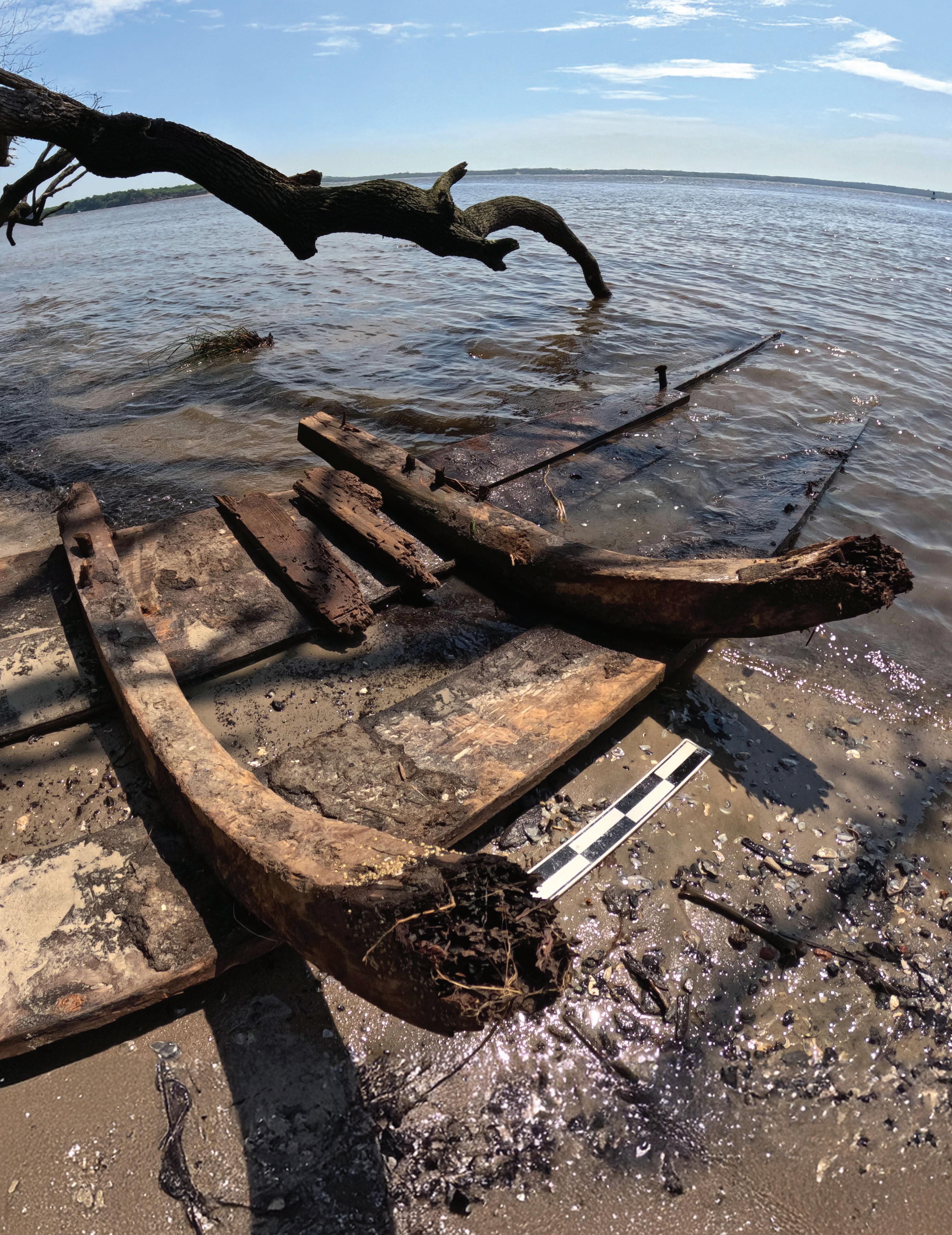
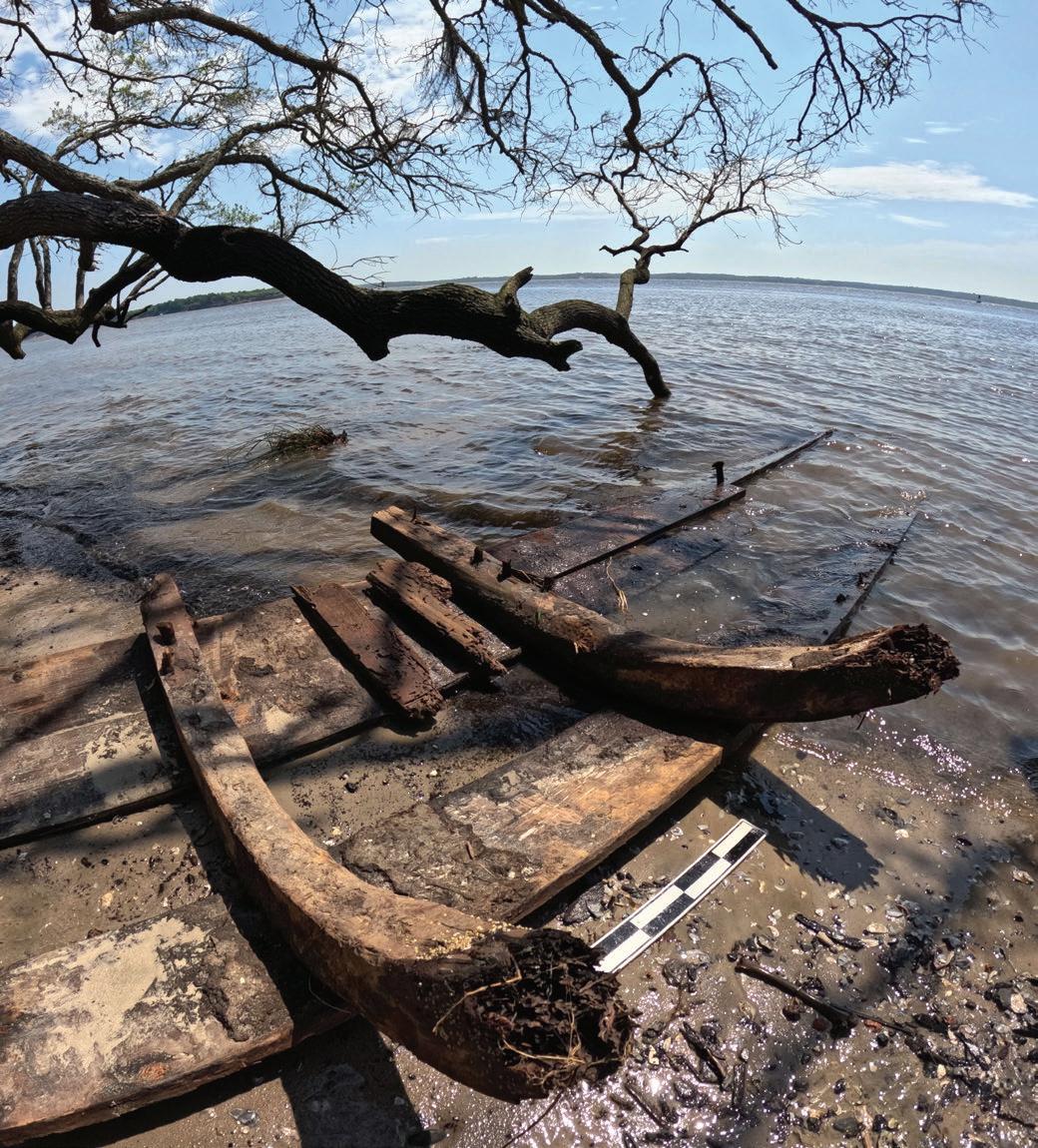
On the cover: A section of what might be La Fortuna sits on the sand in Brunswick Town. (Photo by ECU program in maritime studies)
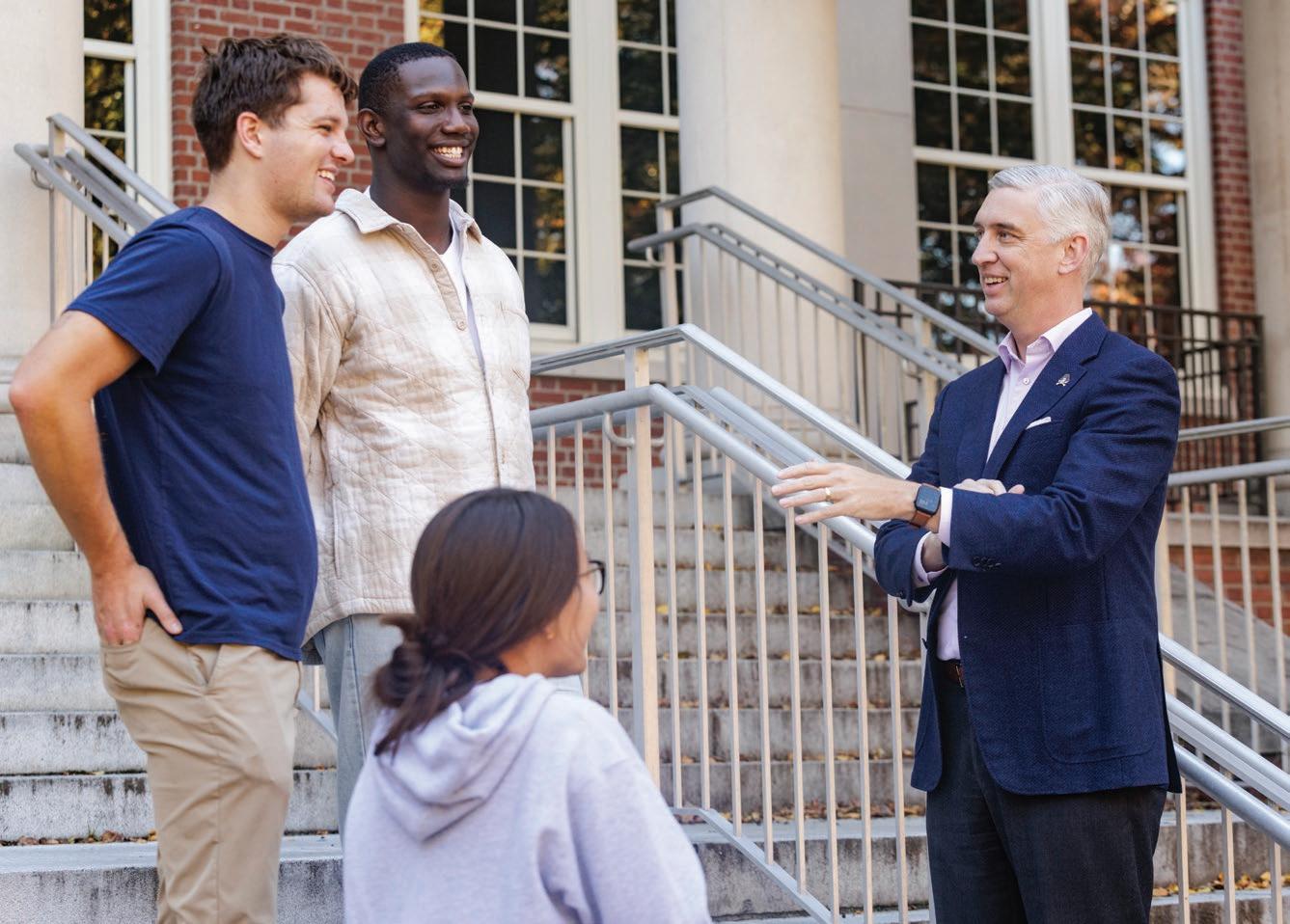
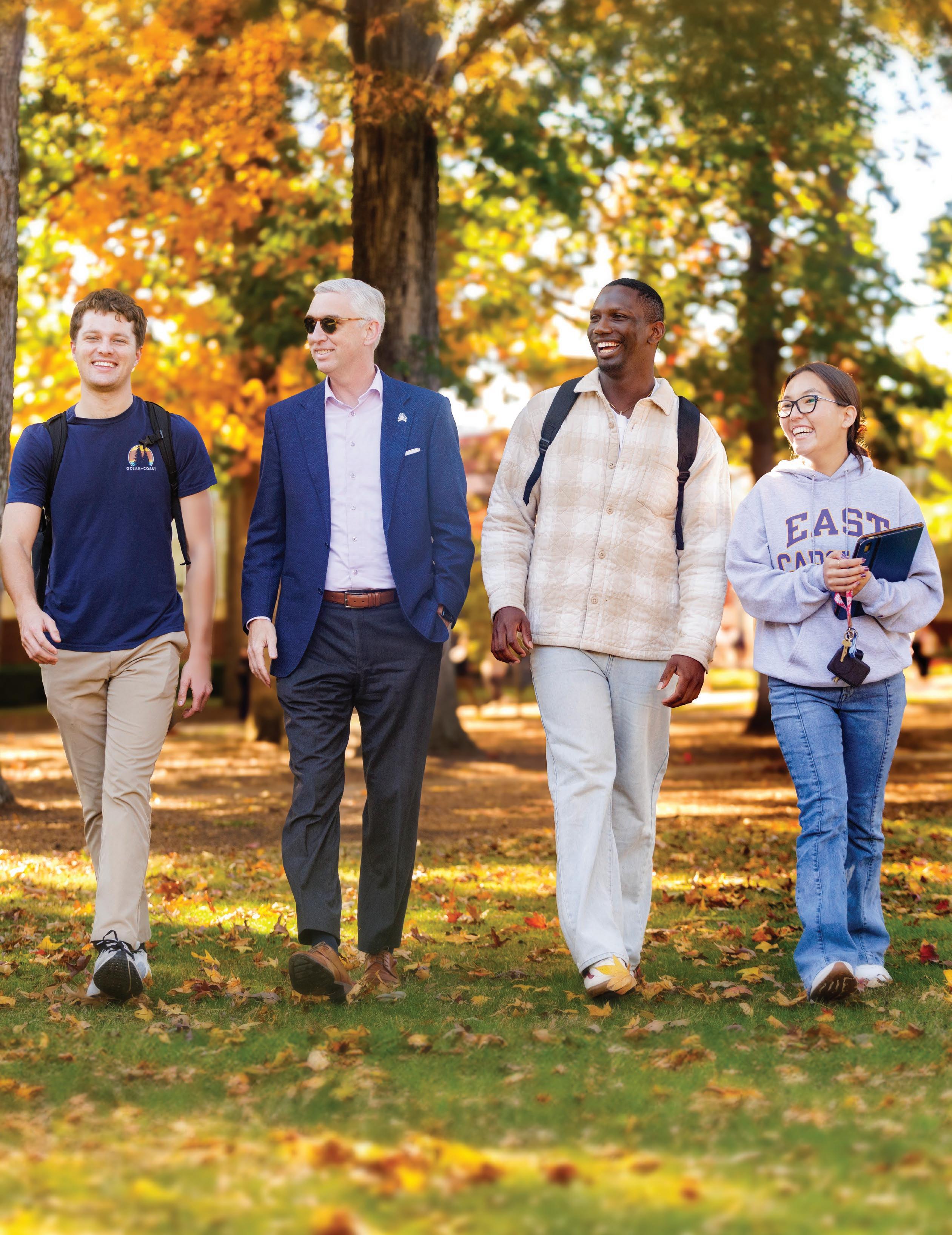
Chancellor Philip Rogers talks with first-year students Dylan Livingston-Keeter, Michael Raye and Caroline Zick. The students are part of the inaugural group of 75 Chancellor’s Scholars enrolled at ECU. Read more about how scholarships programs aim to attract and retain undergraduate students on page 34. (Photo by Steven Mantilla)
18
ECU maritime studies students and faculty uncover North Carolina’s hidden war stories beneath the waves
24 The Ripple Effect Of Happiness
From classrooms to clinics, ECU alumni help others live joyfully.
38 Student Snapshot
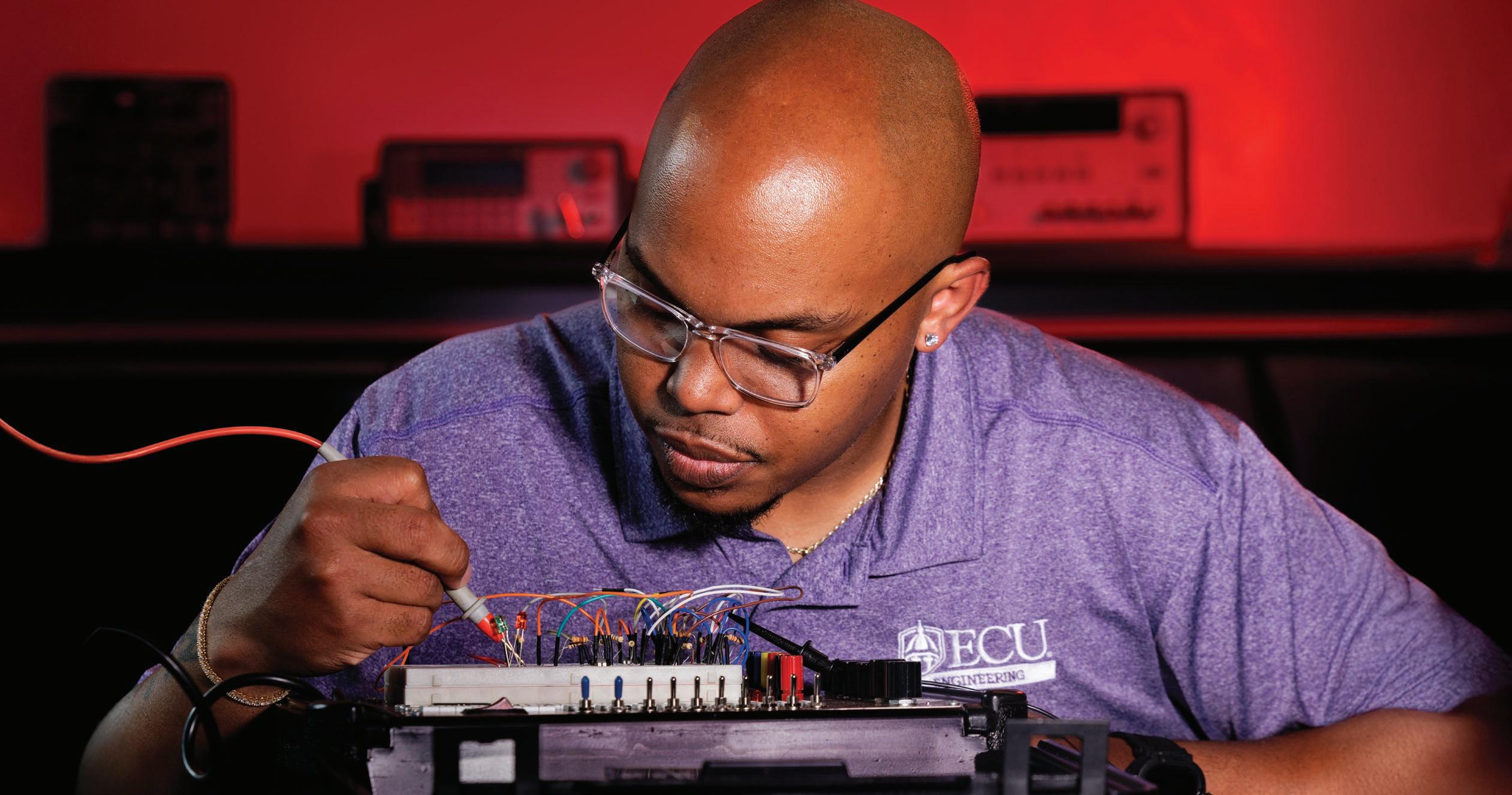
After stops at Krispy Kreme and a radio station, Garret Freeman found a home in ECU’s electrical engineering program.
44 Chasing Greatness
Juliana Viera believed in herself on her way to soccer stardom.
Chancellor Rogers on being proactive for ECU’s future
ECU recently announced a proactive three-year $25 million budget reduction to help the university prepare for shifting enrollment trends nationally and to ensure its program mix meets the changing educational demands of incoming students and industry. Chancellor Philip Rogers explains why these changes — representing about 2% of ECU’s overall budget — are critical and will help prepare the university community for the future.
Why is a $25 million budget adjustment over the next three years necessary?
Nationally, we know there are fewer high school graduates in the coming years. At the same time, those who are graduating and matriculating to universities like ours have new educational demands. We’re at an important moment of inflection. Now is the time to pivot, rededicate resources and ensure ECU is on the right footing for the future. That’s why we’re taking these steps now. While Southern states like North Carolina are in a stronger position than other regions in the country, the number of high school graduates will decline over the next decade. The out-of-state markets we have relied upon will be increasingly competitive. We’re activating new approaches like ECU’s Flight Path, a partnership with Project Kitty Hawk that has grown exponentially since its launch. At the same time, we will reduce expenses in legacy programs that no longer have the demand they once did.
How will this affect faculty and staff?
We hope we can make these changes with as minimal impact to faculty and staff as possible. Of course, there is no denying there will be individual impacts through
specific job losses and changes. These direct impacts are one of the reasons we are taking such care and acting with deep due diligence. While impacts can’t be avoided, our hope is to ensure they are as minimal as possible and when they do occur we act with due humanity and professionalism in thanking our colleagues for their dedicated support of the ECU mission and community.
What does this mean for students?
Enhancing and strengthening the student experience is our north star through all of this work. As we look at investments, we are putting money into programs that are in demand and will ensure students are prepared to enter the changing workforce. As part of this, we are also reevaluating degree programs with low enrollment and are actively engaged in reviewing the academic portfolio. Our collaborative research enterprise remains vibrant; our faculty set a record for grant proposals, and handson student participation in research continues to be an institutional hallmark at ECU.
What role can alumni play as ECU navigates these challenges?
Alumni are essential partners. Sharing success stories helps us recruit students, mentoring builds career pathways and philanthropy fills critical gaps. ECU has always thrived because of its community spirit, and now is the time for Pirates everywhere to lean in. ECU’s academic brand is on the rise, our programs have a high return on investment, and we are an R1 institution with a focus on improving the lives of our citizens and advancing our communities.
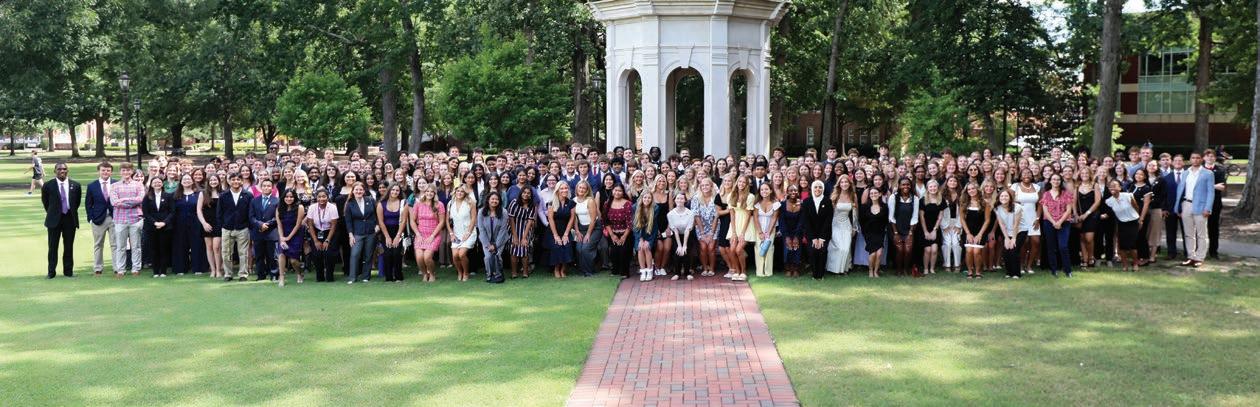
Members of ECU’s fall 2025 graduating class gather on
Read more at news ecu edu/category/graduate-profiles/
the Mall, including Mackenzie Long (elementary education), Andrew DiCuirci (computer science/Air Force ROTC), Jesse Rodriguez (university studies), and Belinda Lashea (doctorate in nursing science)
(Photo by Steven Mantilla)
In This Issue
Honors College celebrates 15 years Grants expand dental care across NC
ECU to cut six programs, seek new stewardship for museum amid budget cuts
East Carolina University will eliminate six academic programs, combine two colleges and seek new stewardship for the Country Doctor Museum in Bailey as part of a broader plan to reduce costs by $25 million over the next three years.
The cuts reflect financial pressures facing universities nationwide as the number of traditional college-age students declines and federal funding grows more volatile. Chancellor Philip Rogers said ECU must prepare for this “accelerated amount of change” by reorganizing now.
The following programs will be phased out due to low enrollment: the B.A. in African and African American Studies, the B.A. in economics (the B.S. in economics will continue); the B.S. in geographic information science and technology; the B.A. in theatre arts (the BFA in theatre arts will continue); and the master’s degrees in biomedical engineering and mechanical engineering. Current students will be able to finish their degrees.
Christopher Buddo, provost and vice chancellor for academic affairs, said the six programs were identified through a review of the bottom 10% of offerings in productivity measures such as enrollment, credit hours and degrees awarded. Each program had fewer than 20 graduates from 2020–24. “We need to understand that there are savings that go beyond dollars,” Buddo said. “Each of these programs requires an investment of faculty time to coordinate and oversee, along with advising time.”
Other program closures were already underway, including master’s degrees in international studies, art education and physical education.
In October, Rogers announced plans to merge the College of Health and Human Performance and College of Allied Health Sciences. Nicole Bromfield, dean of the College of Health and Human Performance, will lead the new college.
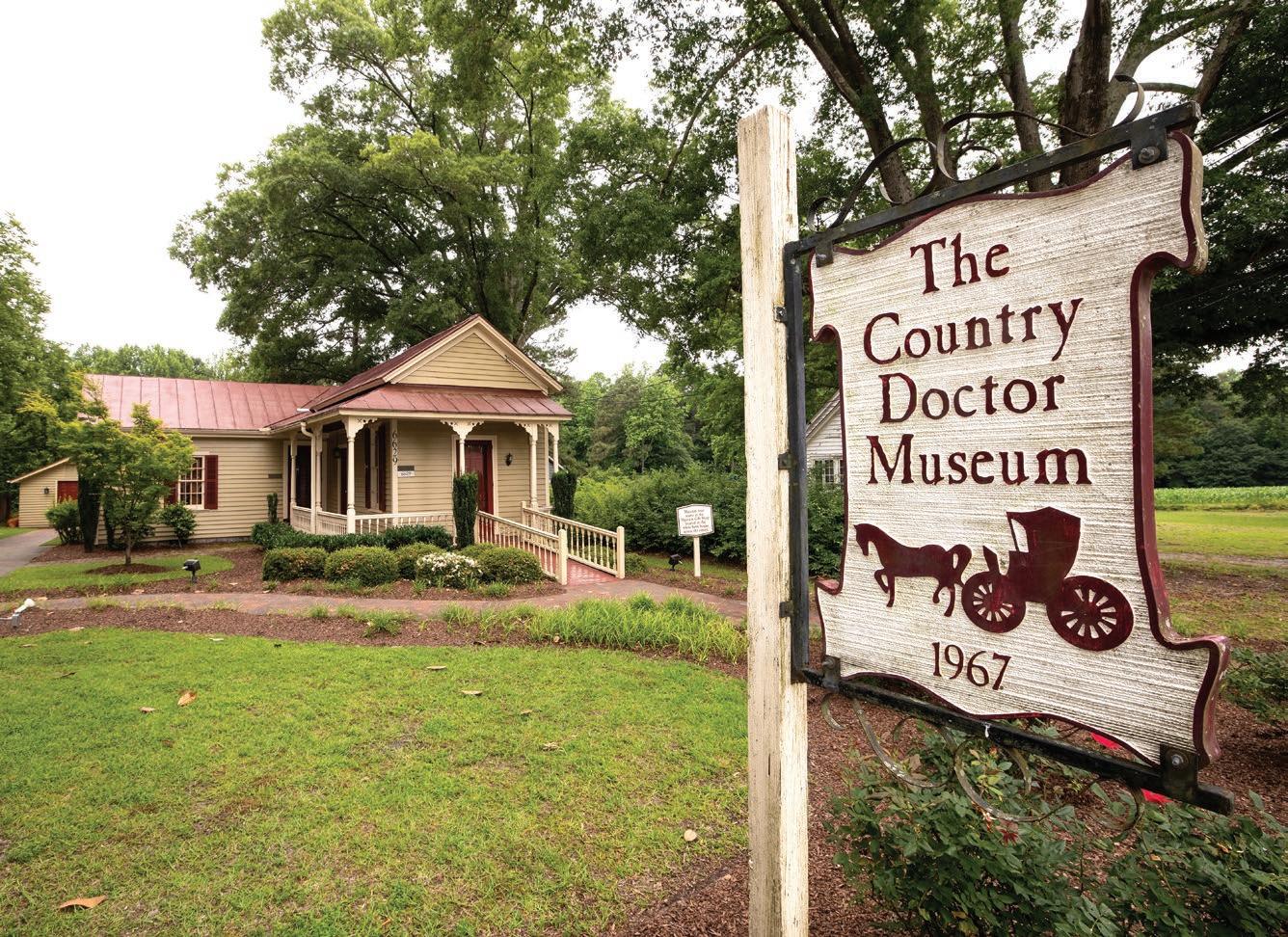
The university is also preparing to relinquish stewardship of the Country Doctor Museum, which it has funded since 2002. The museum, established in 1967, houses more than 4,100 artifacts and employs five staff members. Its annual operating budget is about $200,000, while admission and gift shop sales generate only $20,000.
Beth Ketterman, director of ECU’s Laupus Health Sciences Library, which manages the museum, said the library must absorb its share of the $25 million cut. “So we are budgeted for the museum to be funded through the fiscal year,” she told the Spring Hope Enterprise in September.
“Around July 1 of next year, that’s when things are going to be tricky.”
ECU officials say they intend to gift the museum — land, collections and facilities — to another organization.
– ECU News Services
ECU is looking for partners to take over the Country Doctor Museum in Bailey as part of the university’s plan to cut spending. (Photo by Rhett Butler)
Geology and geography unite as new department
If you’ve ever wondered whether a program was in geology or geography, you won’t have to anymore. This spring, the Department of Geography, Planning and Environment and the Department of Geological Sciences merged to form the Department of Earth, Environment and Planning in the Thomas Harriot College of Arts and Sciences.
Dean Allison Danell said the nearly two-year process was guided by a focus on student success and community impact. “From the outset, they recognized a shared priority: putting our environment and communities first while creating a welcoming space for learners to engage, contribute and grow,” she said.
Jeff Popke, professor and former chair of geography, planning and environment, now leads the new department. He emphasized the advantages of bringing disciplines together. “We gain the
breadth across all of our various areas of expertise,” he said. “It provides greater opportunity for faculty to work together … to address problems and challenges that have a real impact in eastern North Carolina.”
Eric Horsman, associate professor and former interim chair of geological sciences, added that the merger has already sparked new collaborations. “Everyone will benefit because our work is inherently interdisciplinary and we’re actively fostering those ties,” he said.
Students will see the benefits in programs such as the rapidly growing bachelor’s degree in environmental studies, as well as expanded research and careerreadiness opportunities.
Alumna and current graduate student Giuliana Roccisano said, “With the way the climate crisis and both geology and geography fields are evolving, bringing faculty together can make interdisciplinary collaboration more accessible for students.”
– Lacey Gray
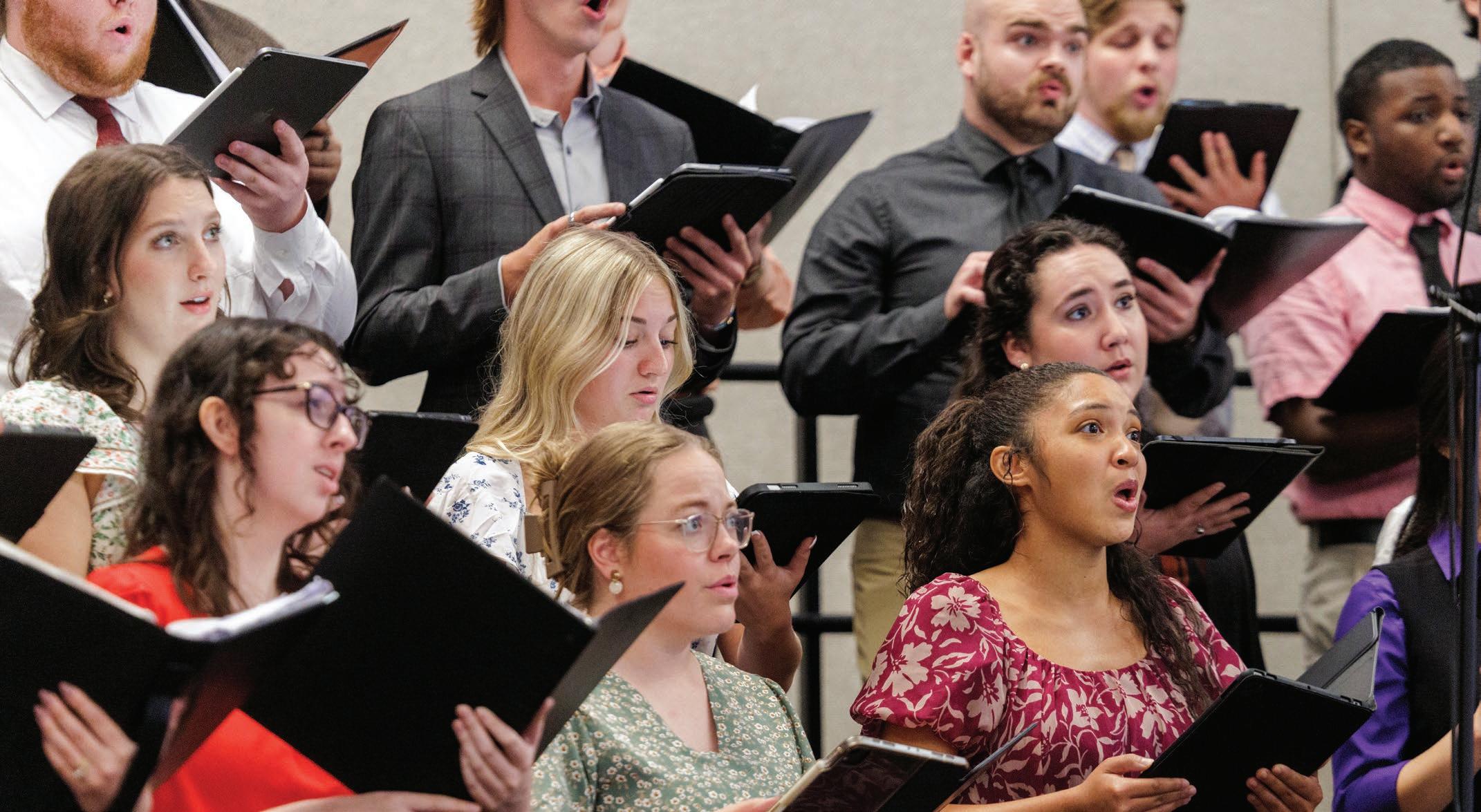
The ECU Chamber Singers perform at the annual University Day on Sept. 4. The award-winning group was fresh off its summer performance at the International Chamber Choir Competition Marktoberdorf in Germany, where they earned third place for mixed choirs. The group is about 30 singers strong, mostly music majors. During the June 6-10 festival and competition, they performed pieces in two rounds of competition and in multiple concerts with other choirs from Latvia, Indonesia, Mexico and elsewhere. (Photo by Steven Mantilla)
Jeff Popke will chair the new Department of Earth, Environment and Planning.
ECU joins statewide effort to grow ag-tech innovation
As part of a coalition of North Carolina research institutions, ECU is helping connect farming communities across 42 counties with cutting-edge agricultural technologies. The effort is outlined in a new report from the Climate-Responsive Opportunities in Plant Science project, a statewide partnership led by N.C. A&T State University.
The coalition — which consists of ECU, Duke, N.C. State, UNC-Chapel Hill, Wake Forest, RTI International and the N.C. Biotechnology Center in addition to N.C. A&T — aims to boost productivity, sustainability and regional economies by focusing on small, mid-sized and specialty crop farms.
The report highlights five opportunities: accelerating adoption of research-backed tools, speeding innovation, expanding market access, improving communication within the agriculture community and building a skilled agricultural workforce.
Angela Lamson, ECU professor and senior fellow in the Office of Innovation and Engagement, serves as the university’s lead. “We are focused on research and innovation that matters most to growers while also strengthening the current and future agricultural workforce,” she said.
North Carolina is home to more than 180 ag-tech companies, yet more than 70% of its 42,000 farms are in rural areas, with half under 50 acres. These farms often struggle to access new technologies and larger markets. CROPS calls for
ECU timeline
closer collaboration, such as pairing farmers with developers to test innovations in real-world conditions.
“This initiative is a smart investment in North Carolina’s future,” said Sharon Paynter, ECU’s chief innovation and engagement officer. “By connecting farmers with research and innovation, we’re unlocking new economic potential across the state.”
The CROPS project is supported by the National Science Foundation through a Regional Innovation Engines planning award.
– Kim Tilghman
years ago years ago
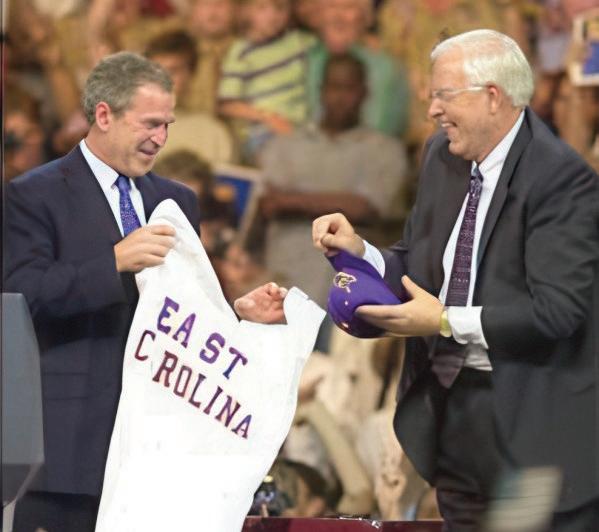
Bush speaks at Minges
Approximately 9,000 people crowded into Minges Coliseum on April 12, 2001, to hear President George W. Bush, the first sitting president to visit campus. During his speech, he promoted his plans to increase spending on education and push through a trillion-dollar tax cut. In addition to the crowd in Minges, thousands more listened as the event was broadcast over speakers in DowdyFicklen Stadium. While at ECU, Bush also reported China had released 24 crew members of a U.S. Navy spy plane who had been held captive for 11 days.
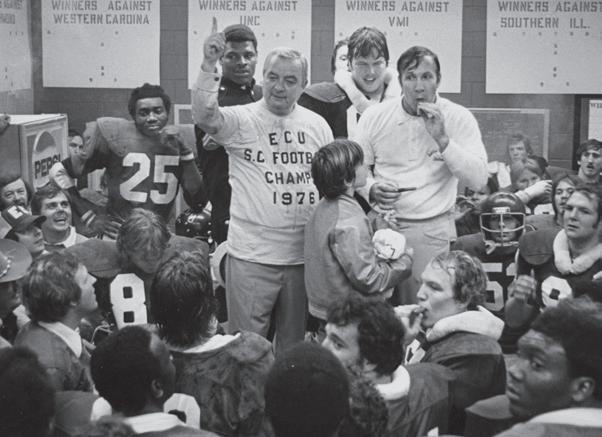
ECU leaves Southern Conference
Looking to raise the profile of the Pirate football team, ECU trustees voted April 6, 1976, to leave the Southern Conference and expand Ficklen Stadium to 35,000 seats. The moves would allow ECU “to pursue an upgrading of our scheduling to include more of the bigger schools as well as help us schedule some of these schools on a home-and-home basis,” said Chancellor Leo Jenkins, according to the April 8, 1976, issue of The Fountainhead. As an independent, ECU would win the 1978 Independence Bowl, host national power Miami in 1981 and achieve a No. 20 ranking in the final 1983 AP football poll.
ECU is part of an organization working to boost agricultural technologies. (File photo)
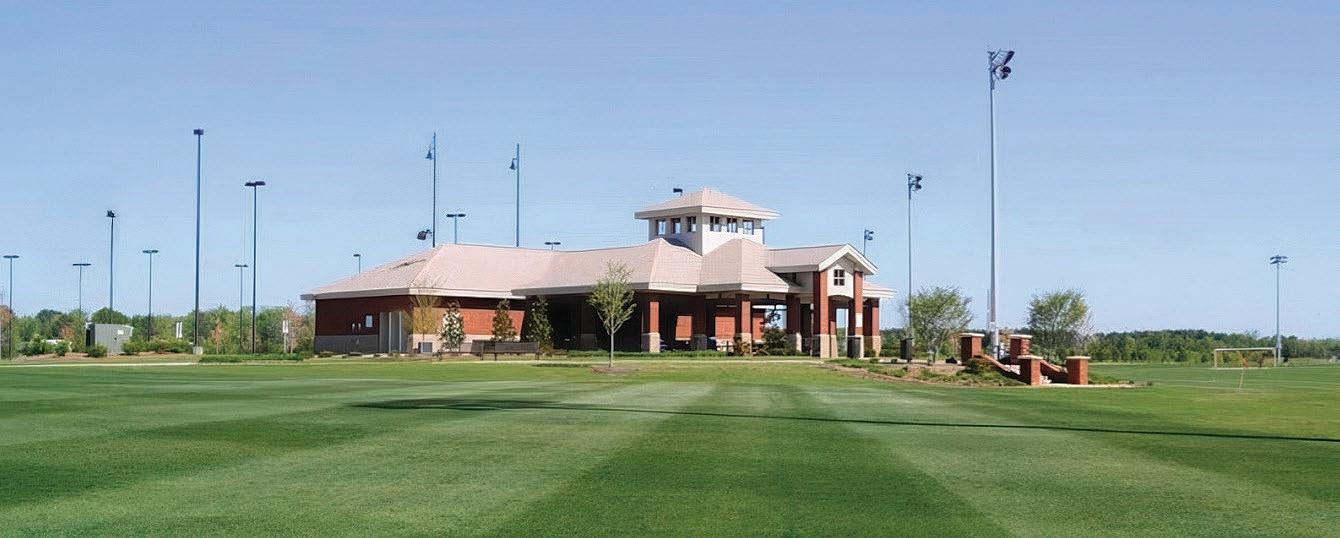
Greenville leases North Recreational Complex for sports tourism push
Greenville is taking over ECU’s North Recreational Complex, a sprawling 129-acre facility about 10 minutes east of campus on U.S. 264, following approval of a long-term lease. It’s part of a coordinated plan by the city to expand sports tournament capacity, attract visitors and deepen community partnerships with ECU.
ECU trustees approved the lease in August, agreeing to grant Greenville operational control for 50 years, with an option to renew further. The Greenville City Council approved the deal in September. Under the agreement, the city makes a $3 million up-front payment to ECU, followed by annual lease payments that decline over time: $300,000 per year for years 1–10; $250,000 for years 11–20; and $150,000 annually for years 21–50.
City officials say the partnership builds on earlier studies of regional sports facility demand and tourism. Greenville sees the complex as a venue that can host large weekend tournaments, drawing athletes and
visitors who spend locally on lodging, dining and other services. Plans call for adding baseball and softball fields to complement the site’s eight multipurpose rectangular fields — potentially expanding the complex to a dozen or more fields capable of hosting multisport regional events.
“The big benefit is the economic impact that weekend tournaments can bring to a community,” said Andrew Schmidt ’90, president and CEO of Visit Greenville NC and president of the N.C. Sports Association board.
For ECU, the arrangement offers financial and strategic gains. The lease proceeds will be funneled into improving recreational infrastructure, including support for the Blount Recreational Sports Complex off Charles Boulevard. The university also anticipates the agreement will boost its visibility and strengthen its role in regional athletics.
– ECU News Services
years ago
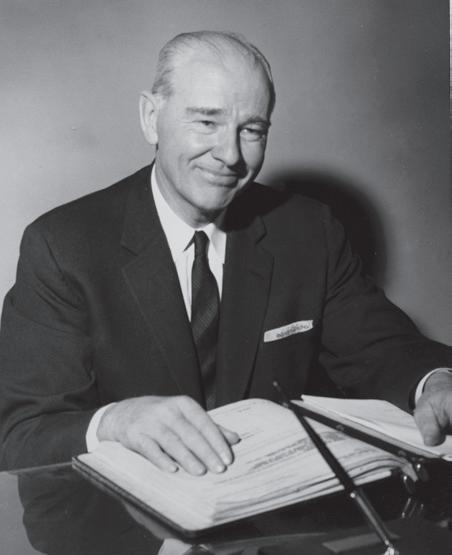
From ECTC to ECC
Since becoming college president in 1947, John Messick had campaigned to rename East Carolina Teachers College to reflect its enrollment growth and broader mission beyond teacher training — expanding programs in liberal arts, sciences and other fields.
The state Legislature approved East Carolina College as the school’s new name on April 6, 1951, and it became official Sept. 1, 1951. The change marked the start of a major push toward eventually becoming a university.
years ago
In 1926, a five-day trip to Washington, D.C., was front-page news in The Teco Echo. The March 30, 1926, edition chronicles a journey of 64 students, family, faculty and staff, alumni and a dozen Greenville High School seniors to the nation’s capital. The multi-leg journey began with a train trip to Norfolk, Virginia, followed by a boat trip to Baltimore and presumably another train ride to D.C. The group took in shows, saw the sights, met with legislators, visited Annapolis and Mount Vernon, and more. “Some thrilled most over their first sight of the ocean,” according to the article.
The city of Greenville is taking over operation of the ECU North Recreational Complex. (File photo)
ECU Honors College celebrates 15 years
Students enrolled in the first Honors College class would barely recognize the college as it is today. Celebrating 15 years of operation since its inception in 2010, the college has seen myriad changes, including growing from admitting 100 students to 250 every fall and the E.C. Scholars program being named the Brinkley-Lane Scholars program.
“Being a Brinkley-Lane Scholar has meant everything to me,” says freshman Drew Crumpler. “As an out-of-state student, I was so worried about not knowing anyone and struggling to make friends, but as soon as I arrived on campus, I could see that I had a family and support network that truly cared.”
The college has also fostered leadership, from the creation of the Honors College Student Council in 2017 to four additional groups today — the Brinkley-Lane Scholars Roundtable, Makers Art Residency, Honors Ambassadors and CREWS Mentors.
“Being able to serve such a dynamic and eager community is such a privilege, and I look forward to connecting with new students every day,” says Skylar Thurston, a communication major and president of the Honors College Student Council.
Students are also able to get involved in more opportunities, including travel experiences funded by the college for research presentations, study abroad and experiential learning.
The program has fully enmeshed itself into the ECU community over the last 15 years with Honors College students winning the Aman Pirate Challenge and creating campuswide initiatives such as Pirate Swap.
One thing has remained the same: the dedication to student success.
“Our donors are a driving force behind everything we do,” says Todd Fraley, Honors College dean. “Their generosity transforms possibility into reality by opening doors for our students to explore research, leadership and high-impact experiences that truly define the ECU educational journey.”
– Kristen Martin
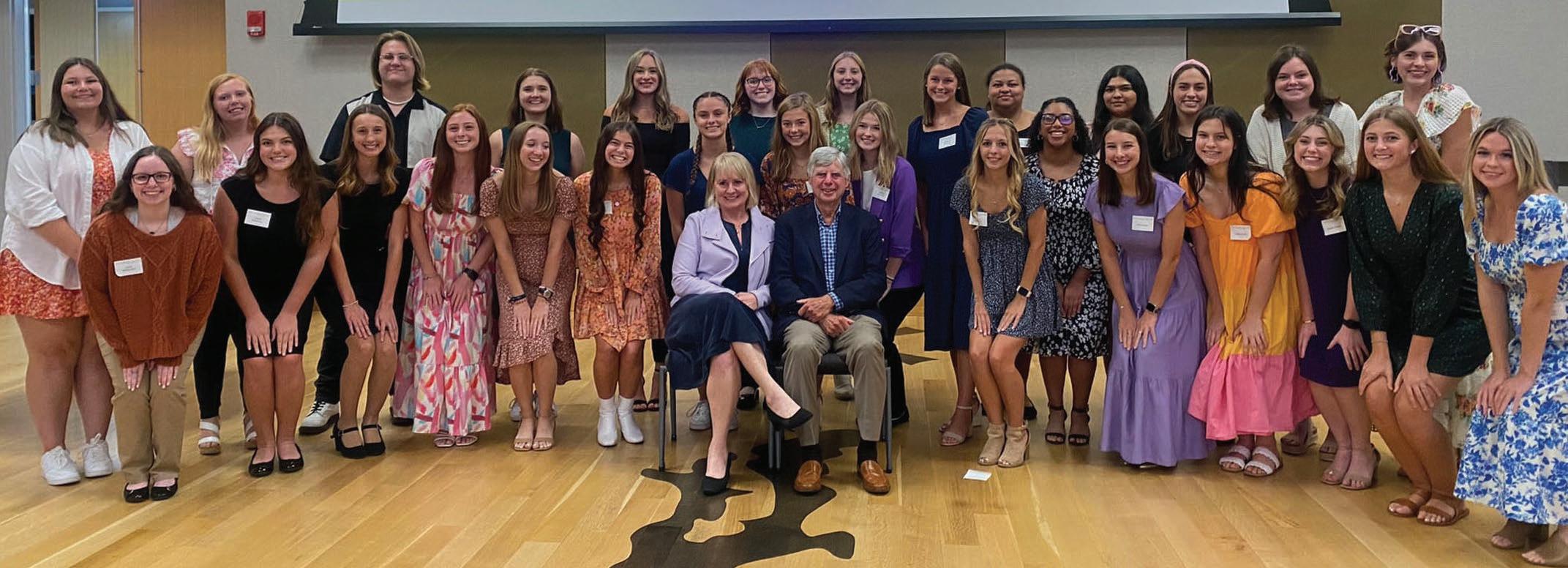
The Honors College brought in the first class of Honors College Fellows, a new scholarship level providing $15,000 in funding over four years for 250 students. This is the 15th class of Honors College students to step onto ECU’s campus. (Photo by Kristen Martin)
Military alumni honored
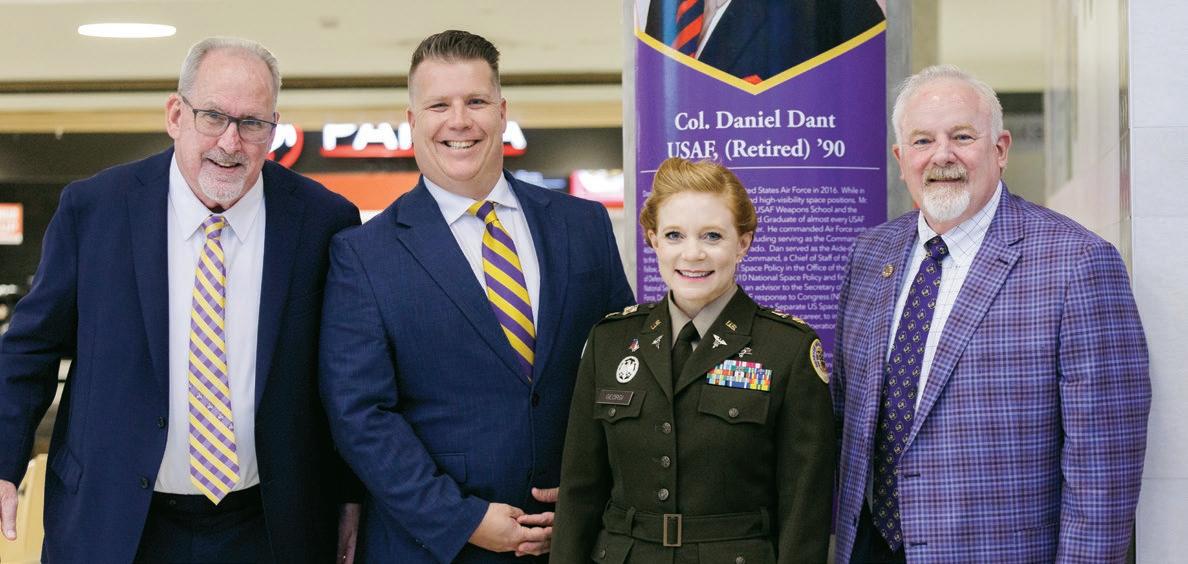
ECU honored four alumni — retired Air Force Col. Daniel Dant, Army Maj. Jessica Georgi, retired Air Force Lt. Col. Jeremy Gore and retired Air Force Col. Rick Jones — for their service during the Distinguished Military Service Society ceremony Sept. 26.
Dant ’90 is a space and cyber professional. He retired from the Air Force in 2016 as the director of strategy and programming in the Office of the Under Secretary of Defense for Acquisition, Technology and Logistics. Dant helped establish an ECU alumni group for ROTC Detachment 600 and an annual scholarship.
Georgi ’20 earned a master’s degree in health informatics. She serves as the director of the Health Information Management Division at the Fort Belvoir Hospital as well as deputy patient administration consultant to the Army surgeon general. Georgi is an active member of the D.C. Metro Chapter of the ECU Alumni Association.
Gore ’02 earned his bachelor’s degree in history before entering the U.S. Air Force, where he served for 21 years as an intercontinental ballistic missile operator. He held numerous leadership positions within Air Force Global Strike Command and the
Pentagon. Gore was a 2018 ECU 40 Under Forty awardee and remains active in the ECU Pirate Club.
Jones ’79 is one of the Air Force’s most decorated logistics officials. He commissioned through the ROTC, earning a bachelor’s degree in marketing. He retired in 2007 as the chief of the Combat Aircraft Division, Directorate of Logistics, Headquarters Air Combat Command at Langley Air Force Base. Jones served as a Defense Department contractor from 2008 to 2020.
To learn more about the DMSS, visit the ECU Alumni Association.
– Patricia Earnhardt Tyndall
Research aiming for eco-friendly marine paint
Marine vessels and industrial facilities that struggle with the buildup of algae, barnacles and sludge are the target of a research project at ECU to develop environmentally friendly coatings.
Robert Hughes, an associate professor of chemistry, has received $720,000 from NCInnovation, the state-funded organization aimed at boosting university research, to move his research from the lab into the field – or water, as the case may be.
“Biofouling is an ongoing challenge for commercial and recreational boaters that is costly and requires frequent maintenance and reduces boating performance,” Hughes said. “Some of the most effective solutions against biofouling are currently being phased out because they also have negative environmental impacts.”
By reducing drag and improving cleanliness, coatings like the ones Hughes is developing can help vessels operate more efficiently and minimize environmental impact. Industrial users may also benefit from coatings that require less maintenance and fewer harsh chemicals.
Over the next two years, Hughes will use the grant funds to advance the technology that will support the development, evaluation and commercial readiness of environmentally friendly marine and industrial paint. These products will reduce biofouling
and chemical buildup and help vessels and coastal industries operate more efficiently while protecting workers and aquatic ecosystems.
“One of the things I love about eastern N.C. is our ease of access to recreational boating,” Hughes said. “This project could benefit the industry and the people of eastern NC.”
– Lacey Gray
ECU alumni retired Air Force Col. Rick Jones, retired Air Force Lt. Col. Jeremy Gore, Army Maj. Jessica Georgi and retired Air Force Col. Daniel Dant were inducted into ECU’s Distinguished Military Service Society. (Photo by Steven Mantilla)
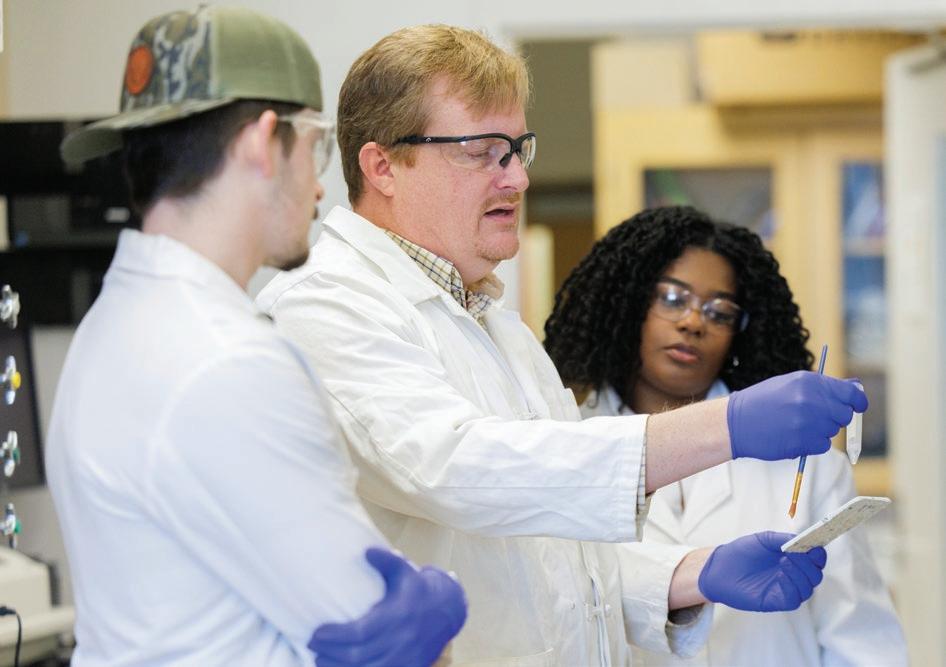
Robert Hughes works with students Jake Wilson and Tori Cole to develop environmentally friendly marine and industrial coatings with support from a $720,000 grant. (Photo by Steven Mantilla)
From Wall Street Journal/College Pulse 2026 Best Colleges rankings released Sept. 29, 2025:
From U.S. News & World Report’s 2026 Best Colleges rankings released Sept. 23, 2025: for social mobility among NC universities (private and public)
1 in NC in 2026 Best Colleges
Best Value public institution in North Carolina on social mobility among North Carolina’s public institutions
public in NC for student experiences and best salaries
The rankings focus on how well colleges prepare students for financial success, according to methodology developed and executed by the Wall Street Journal, College Pulse and Statista. The rankings also consider graduation rate, diversity and learning environments based on a survey of about 120,000 students and recent alumni.
ECU is one of two UNC System schools ranked best for undergraduate entrepreneurship Top 2
ECU finished fourth in the UNC System for Top Public (National) Schools
In the Best for Veterans ECU finished fourth among UNC System schools
Grants expand dental care and access across NC
The ECU School of Dental Medicine is expanding access to care in western North Carolina and for young children statewide through two recent grants.
A three-year, $593,000 award from Dogwood Health Trust is strengthening ECU’s community service-learning centers in Sylva and Spruce Pine, which together care for about 3,000 patients each year. The grant provides more than $85,000 in patient care funds and $425,000 in salary support for clinical staff and a new practice management coordinator. The investment will help reduce barriers for uninsured patients while making salaries more competitive for dental staff in rural regions.
“There is a shortage of dentists in western North Carolina, and this directly affects the well-being of many residents,” said Channah VanRegenmorter, program officer at Dogwood Health Trust. “This investment will help more people gain access to oral health care while also expanding the workforce.”
Dean Greg Chadwick said the support helps address pay disparities that make it difficult to recruit and retain staff. The patient care funds could allow nearly 170 additional patients to receive services they otherwise could not afford.
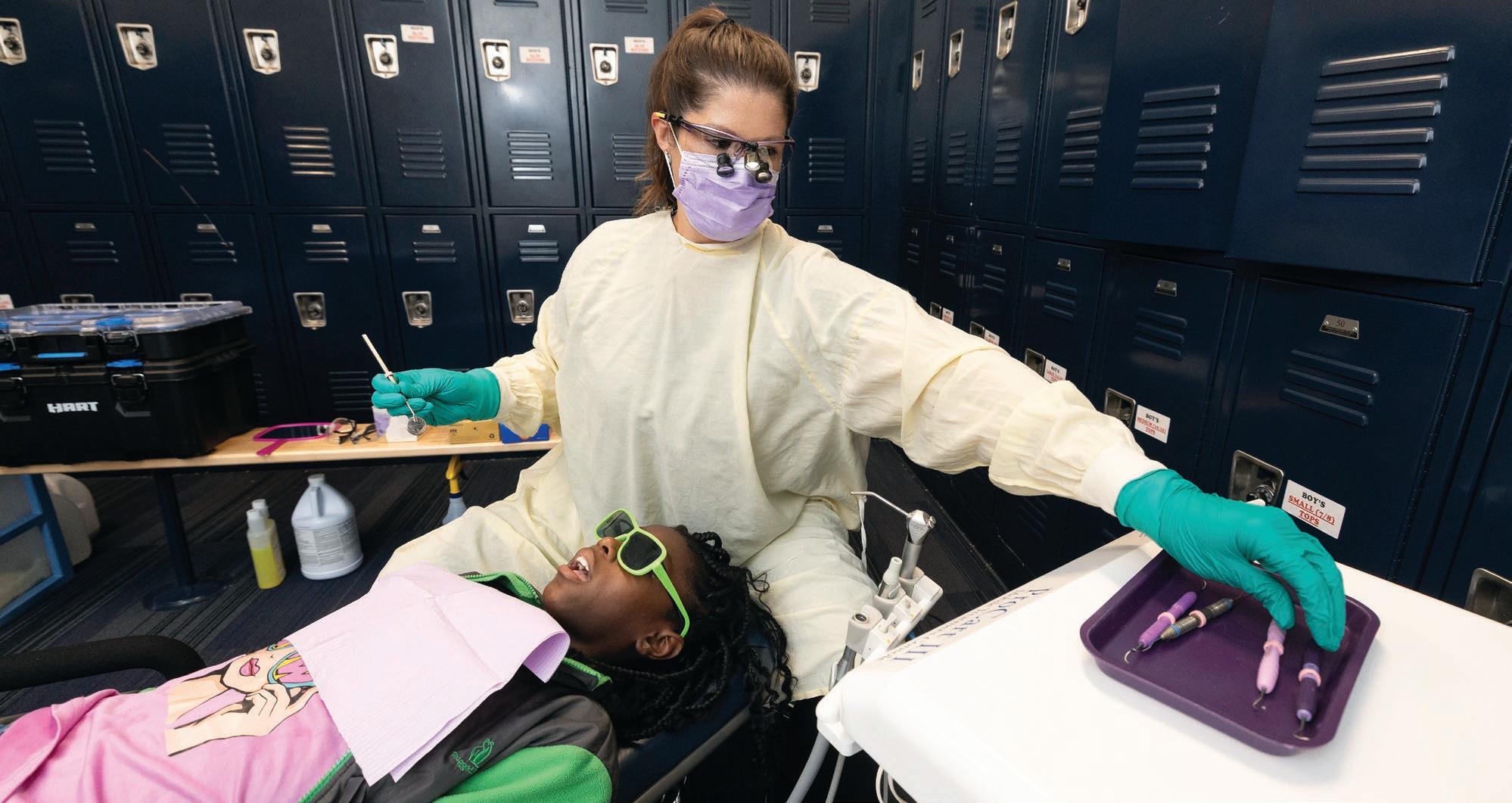
Meanwhile, a $204,000 grant from the BlueCross BlueShield of North Carolina Foundation is expanding ECU’s School-Based Oral Health Prevention Programs to pre-K and Head Start students. The program, launched in 2019 in Bertie County and expanded to Jones County in
2023, places ECU dental hygienists in schools to provide preventive care and education.
“With nearly 20% of North Carolina kindergarteners already experiencing untreated cavities, it’s crucial to reach children and families well before they enter school,” said ECU hygienist Rachel Stewart.
Since 2019, the program has provided more than 22,000 procedures to 1,500 children across 11 sites. The new funding will allow ECU to expand into more than 80 Head Start centers across the Carolinas, beginning in areas where school-based clinics already exist.
Trenton Elementary principal Joseph Noble praised the program’s impact. “Many of our students would not receive any dental care without them. They get first-class dental care without leaving the school’s building.”
Together, the grants strengthen ECU’s dual mission: improving health outcomes for underserved communities and preparing the next generation of oral health professionals.
– Spaine Stephens
Trenton Elementary School student
Shy’Zuri Brown waits in a dental chair while hygienist Rachel Stewart prepares to check her teeth.
(Photo by Rhett Butler)
Discovery
Driving student success and regional impact
At the Coastal Studies Institute in Wanchese, students, faculty and community partners work side by side studying water quality, fisheries and the dynamic processes that shape the North Carolina coast.
“ECU’s coastal enterprise connects research with purpose,” said Reide Corbett, executive director of the institute. “It’s about discovery that serves North Carolina. Our researchers, students and partners are using science to address real problems for coastal communities.”
Equipped with vessels, field equipment and access to partnerships such as Jennette’s Pier — where ECU operates a dedicated research hut — students collect data, collaborate with scientists and work alongside local stakeholders. Through the Semester at the Coast and other programs, undergraduates and graduate students engage in research and community internships that address coastal challenges firsthand.
For example, last summer, Matthew Sirianni and Alex K. Manda, faculty members in the Department of Earth, Environment and Planning, led nine undergraduates from universities across the United States through a research program exploring saltwater intrusion along the coast, which affects crops and changes ecosystems.
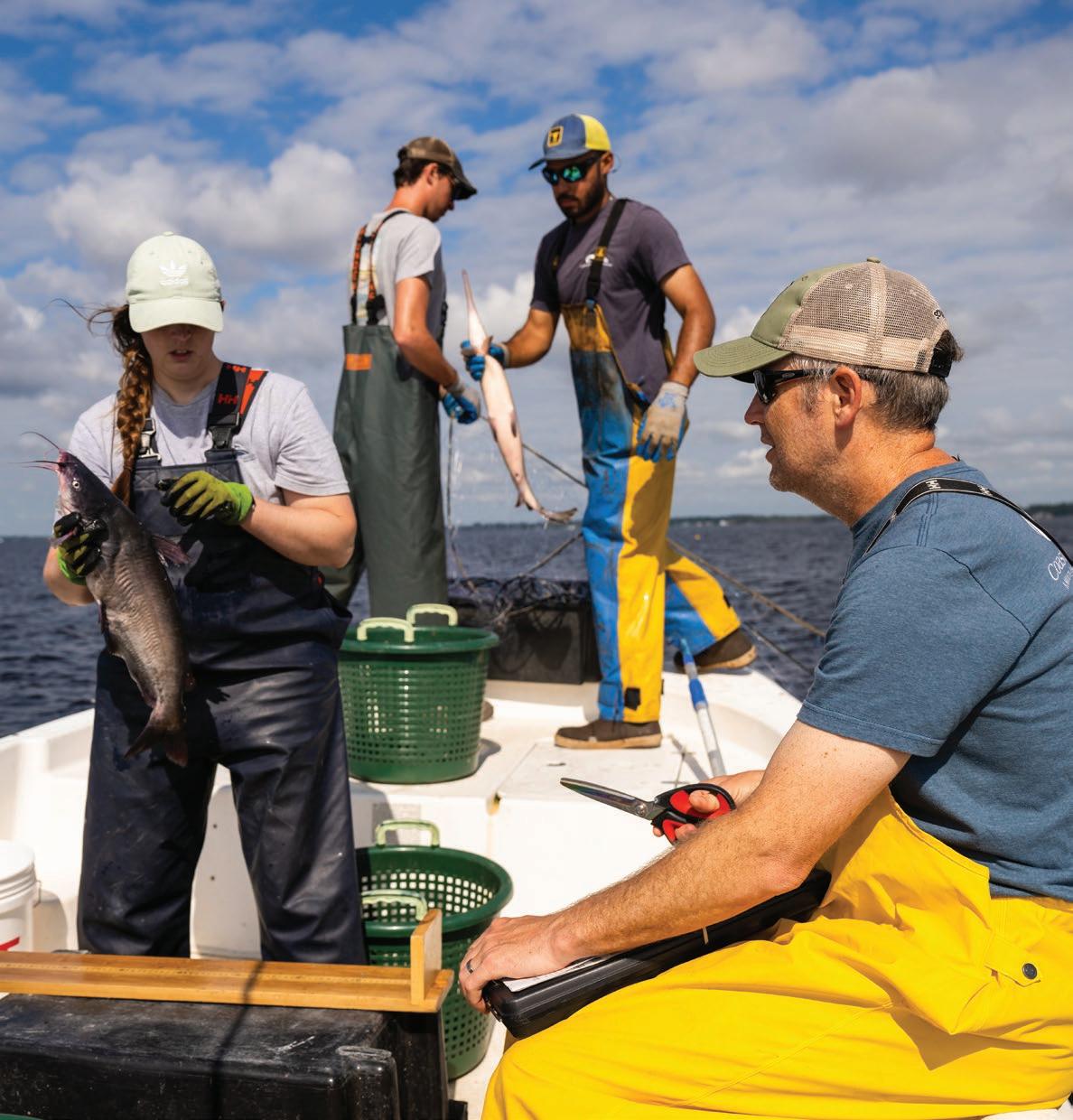
Another example: Jim Morley, a biologist in the Thomas Harriot College of Arts and Sciences, and his research team study how changing coastal conditions influence fish populations and habitat. His research, funded by $437,000 in state and private grants, supports the sustainable growth of North Carolina’s fisheries and aquaculture industries — helping to preserve the state’s long tradition of working on the water while creating new economic opportunities.
ECU investigations, research and creative activity benefiting the region and beyond
Corbett said the hands-on nature of ECU’s coastal research enterprise allows students to break out of the theoretical and into the practical, inspiring the next generation to contribute to scientific discovery and support the state’s coastal and environmental future.
Across the coastal plain, ECU scientists are leading studies on wetlands, submerged aquatic vegetation and shoreline change — key components of water quality and coastal resilience. Faculty and students are mapping marsh loss, monitoring nutrient flows and examining how vegetation buffers communities from flooding and erosion. The knowledge and lessons learned can be applied in coastal environments around the globe.
“We offer students a chance to build careers rooted in purpose,” Corbett said. “The coast is more than a place — it’s part of who we are at ECU. Our researchers and students are in the field, on the water and in communities every day, applying science to protect livelihoods and ensure a sustainable future for the region we call home.”
– Jules Norwood
From left, Cambria Miller, Andrew McMains and Rahdiaz Delvillar sample blue catfish on the Albemarle Sound in 2024. They are graduate students of Jim Morley, foreground, a biology professor who’s studying the impact the invasive fish is having on native species. (Photo by John McCord)
Study isolates target for hypertension treatment
Researchers at the Brody School of Medicine at ECU have identified a receptor in the human brain that could lead to more effective treatments for high blood pressure.
The receptor is B1R, which plays a significant role in inflammation, pain signaling and immune response. B1R has garnered attention in recent years due to its involvement in various diseases, including neuropathic pain, cardiovascular disorders and cancer — and now, potentially, hypertension — and is emerging as a potential therapeutic target for drug development.
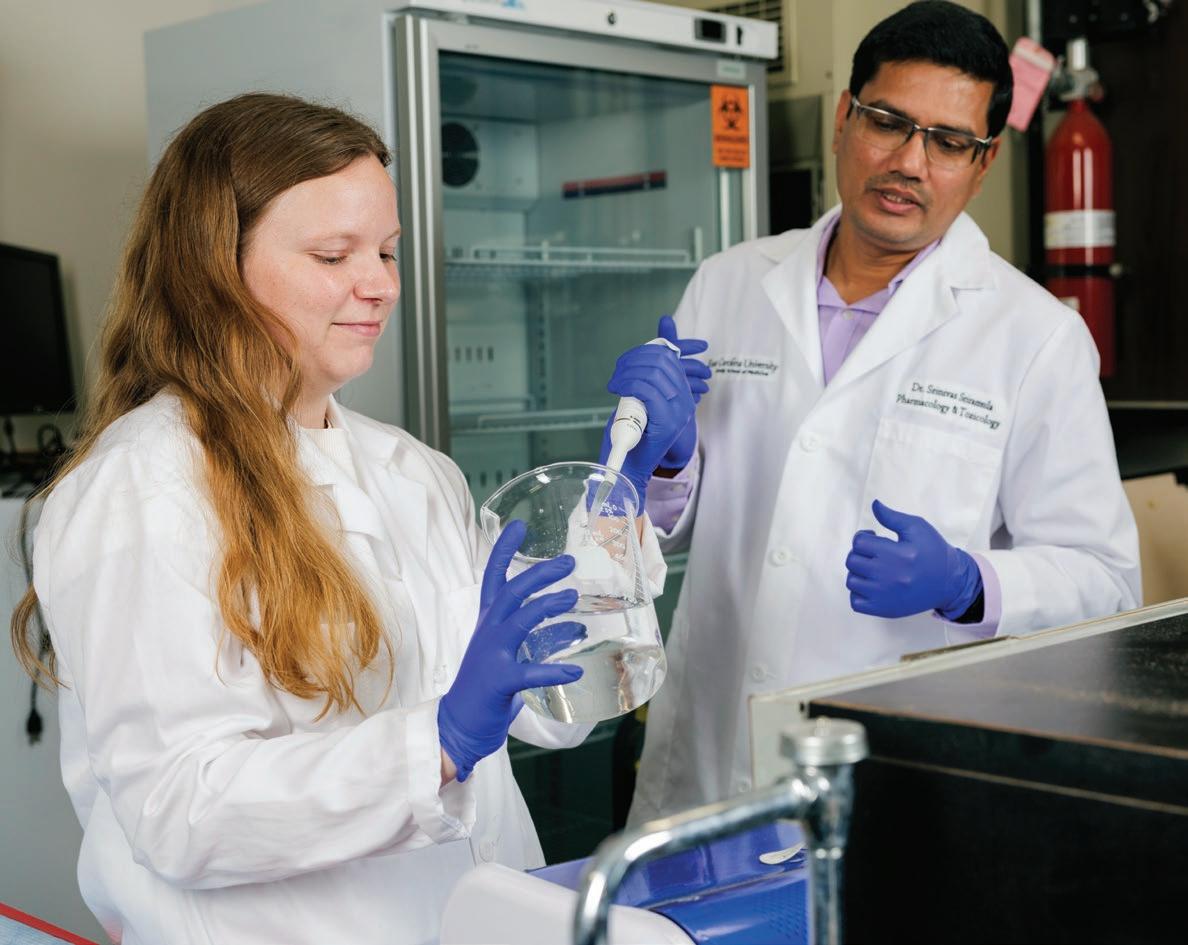
“We’ve uncovered a new pathway that we can potentially target to better control this widespread and dangerous condition,” said Srinivas Sriramula, an associate professor of pharmacology and toxicology whose lab led the study. “It validates years of research effort and collaboration among different laboratories.”
The team published its study, “Targeting Kinin B1R Attenuates Hypertension Through AT1R-Dependent Mechanisms,” in August in Circulation Research, the journal of the American Heart Association. The study was funded by a five-year, $1.8 million grant from the National Heart, Lung and Blood Institute.
Heart disease is the leading cause of death in the U.S., according to the federal Centers for Disease Control and Prevention. Stroke is No. 4, and high blood pressure, or hypertension, is a leading risk factor for both. In North Carolina, more than 1 in 3 adults have it, and not all cases respond adequately to lifestyle changes and medication.
Sympathoexcitation, or the activation or stimulation of the sympathetic nervous system, which is responsible for the body’s “fight or flight” response, can lead to increased heart rate and blood pressure. It has been associated with increased B1R activation in the brain.
The lab previously identified a relationship between angiotensin II stimulation and B1R expression. The angiotensin II hormone plays a role in regulating blood pressure by constricting blood vessels and increasing blood volume.
So the research team went to work figuring out how B1R might be modulated in an overactive nervous system, contributing to high blood pressure. They blocked B1R from expressing itself in laboratory models and, in so doing, reduced high blood pressure and associated inflammation. They then studied postmortem brains from hypertensive human patients and found B1R was overexpressed.
“We discovered for the first time that the kinin B1 receptor interacts with the angiotensin II type 1 receptor, which is a major target for current antihypertensive drugs,” Sriramula said. “This interaction opens up the possibility that B1R could serve as a new therapeutic target.”
Doctoral student Drew Theobald and Riley Bessetti ’25 are the first and second authors of the paper.
“People take medications but still don’t reach healthy blood pressure levels. Finding new pathways that drive hypertension could offer insights to new targets to help those patients achieve better control,” Theobald said.
Other study authors are Karen Litwa of the Brody School of Medicine, Yumei Feng at the University of Rochester Medical Center in New York and Eric Lazartigues at the Louisiana State University Health Sciences Center in New Orleans.
– Bobby Ampezzan
Doctoral student Drew Theobald and Srinivas Sriramula, an associate professor of pharmacology and toxicology, are studying the receptor B1R. (Photo by Steven Mantilla)
Focus
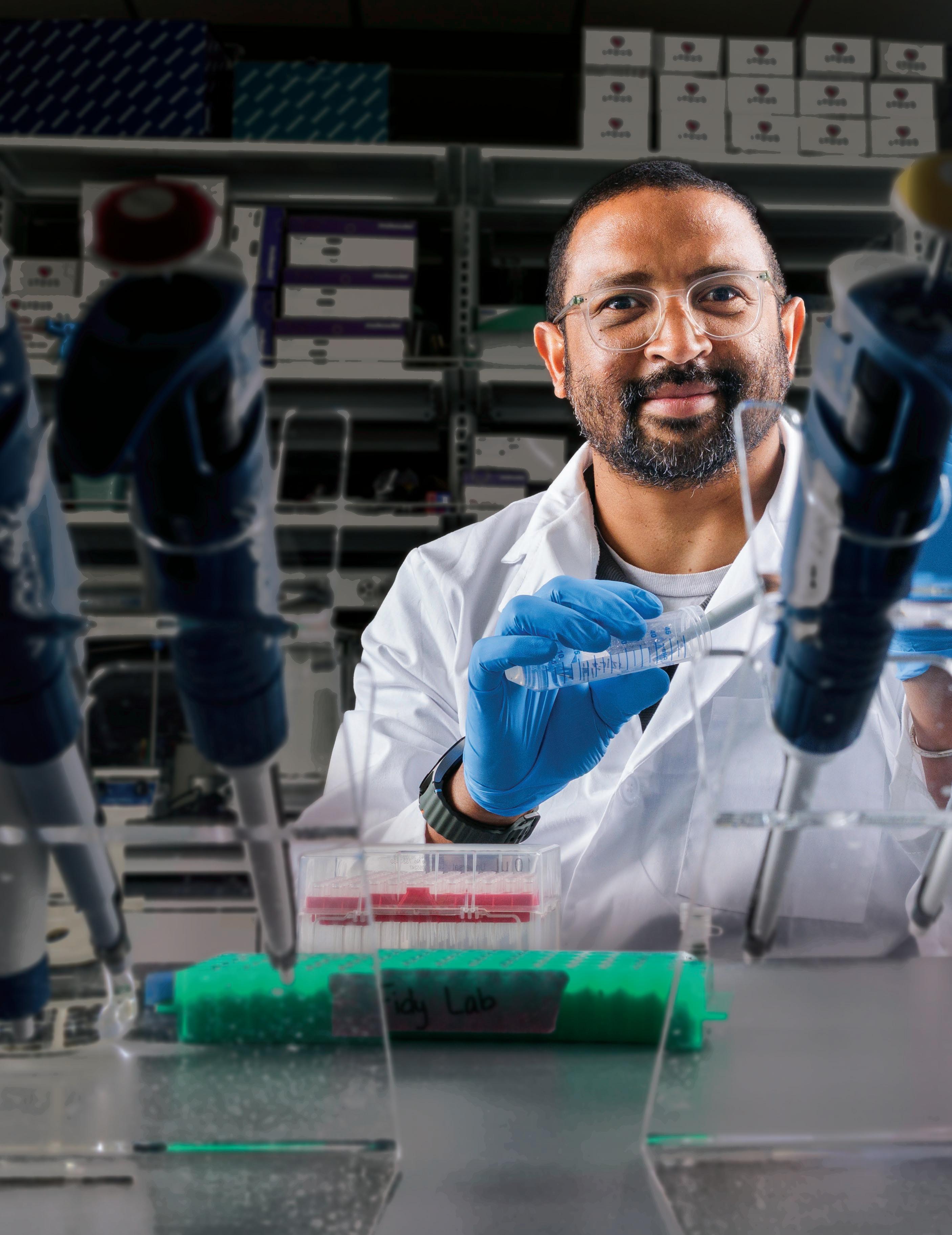
Fidisoa Rasambainarivo
Thomas Harriot College of Arts and Sciences
Assistant professor
When Fidisoa “Fidy” Rasambainarivo learned he had been named one of only five winners worldwide of the Maxwell-Hanrahan Foundation Award in Field Biology, he was humbled.
He said the award, which included a $100,000 cash prize, was something he didn’t even apply for.
Instead of using the money for himself, Rasambainarivo, who joined ECU’s Department of Biology in 2023, is giving it all away — half to ECU and half to Mahaliana, a research lab he co-founded in his native Madagascar. At ECU, his $50,000 gift created the One Health Research Fund, which will support faculty, students and international research collaborations.
Rasambainarivo’s work focuses on the places where humans, wildlife and domestic animals meet — and where diseases can spread among them. Much of his research takes place in Madagascar, where he studies lemurs, wild carnivores and the role of cats and dogs in transmitting parasites such as toxoplasmosis. He also investigates zoonotic diseases in eastern North Carolina, with the goal of informing conservation and public health.
Equally important to him is sharing those discoveries with students. He mentors undergraduate, master’s and doctoral researchers at ECU and hopes his gift will open doors for student exchanges between Greenville and Madagascar. “I hope students will see how we are connected to the environment. How our actions, both at the individual level and at the societal level, may impact the environment and our own health,” he said.
For Rasambainarivo, who grew up loving the wildlife of Madagascar, the award is about more than recognition. “My intention with this gift and award is to take students there but also bring students and scientists from Madagascar to North Carolina to increase the exchange and experiences of both of the worlds I live in and now call home.”
– Lacey Gray
FACULTY NEWS
Chancellor Philip G. Rogers was elected to the American Council on Education board of directors during the group’s meeting July 9. His term began Oct. 1. Before becoming ECU chancellor in 2021, Rogers was senior vice president for learning and engagement at ACE, where he guided institutions navigating complex challenges facing the global higher education landscape and advocated for institutions across the higher ed sector.
Megan Inman was named the Medical Library Association’s 2025 recipient of the Louise Darling Award for Distinguished Achievement in Collection Development in the Health Sciences. An associate professor, Inman has been a faculty member at Laupus Library since 2008 and leads the library’s Collection Services Department. She was presented the award during the MLA virtual business meeting and awards ceremony in May.
Karin Zipf, a professor of history, has received a National Humanities Center Fellowship for the 2025-26 academic year. The center, in the Research Triangle Park, is one of the most prestigious independent research institutes in the world and the only one dedicated exclusively to the humanities. As a fellow, Zipf will live in the Raleigh area and receive assistance from the center’s team of librarians to complete work on her book, Field Ghosts: The Vanishing American Farmworker and the New Slavery. It traces a historical arc of labor, agriculture, race, immigration and immigration reform.
David Carraway, an information and cybersecurity teaching instructor in the ECU Department of Technology Systems, has been named to the 2025 Certified Ethical Hacker Hall of Fame. The International Council of E-Commerce Consultants announced the recognition in its annual industry report. Carraway was among 100 inductees. The International Council of E-Commerce Consultants is the world’s largest cybersecurity technical certification body, according to its website. An ECU alumnus, Carraway has been teaching for nearly two years as part of ECU’s acclaimed information and cybersecurity program.
Kitt Lavoie is the new director of the ECU School of Theatre and Dance. He previously led the acting and musical theatre BFA programs at the Dobbins Conservatory of Theatre & Dance at Southeast Missouri State University. He has guest lectured at Yale University, Pace University, Penn State University and others, and he holds an adjunct appointment at The Norwegian Actors College in Oslo, Norway. He’s a graduate of Fordham University in New York with a bachelor’s degree in political science and holds a master’s in directing from The Actors Studio Drama School at New School University in New York.
ECU MARITIME STUDIES STUDENTS AND FACULTY UNCOVER NORTH CAROLINA’S HIDDEN WAR STORIES BENEATH THE WAVES
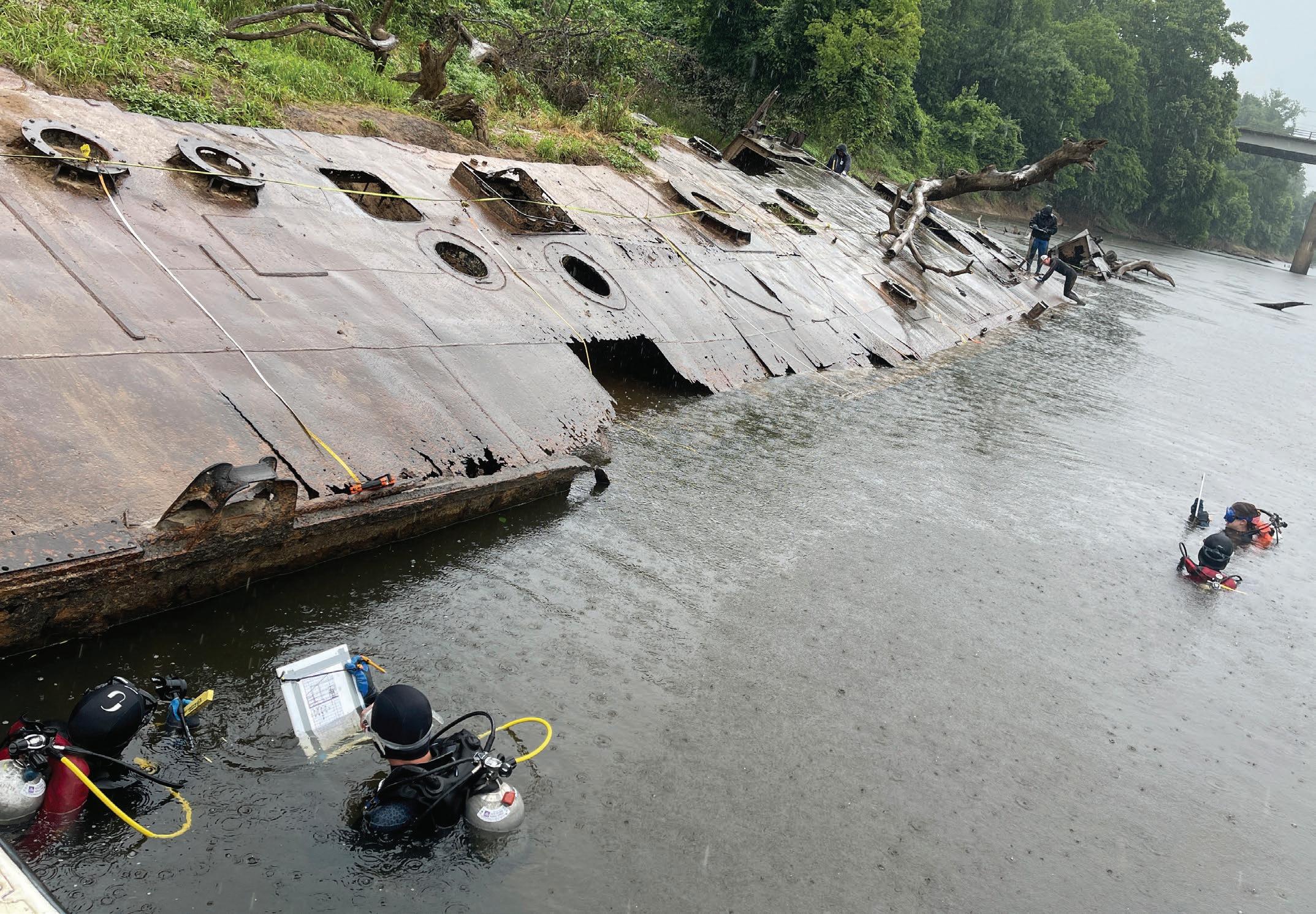
Ian Shoemaker records the port side of PC-1084. (Photo by Nathan Richards/ ECU Program in Maritime Studies)
STORY BY DOUG BOYD
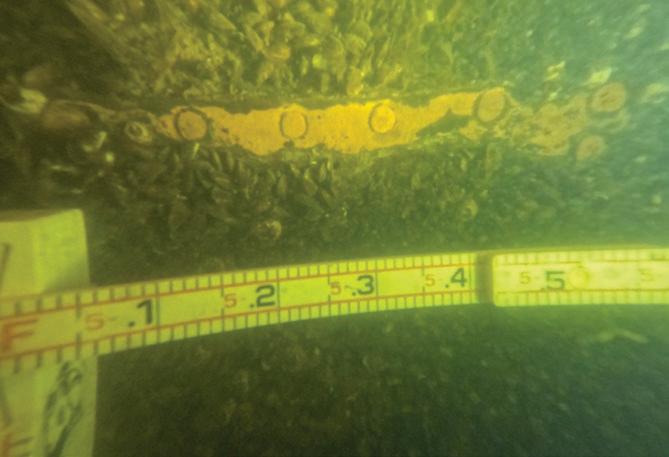
It was just luck last summer — the right people in the right place at the right time — that the skeleton of what might be a privateer that blew itself to pieces during one of history’s most interestingly named wars let itself be found on the Cape Fear River in Brunswick Town.
East Carolina University maritime studies graduate student Cory van Hees tells how it happened.
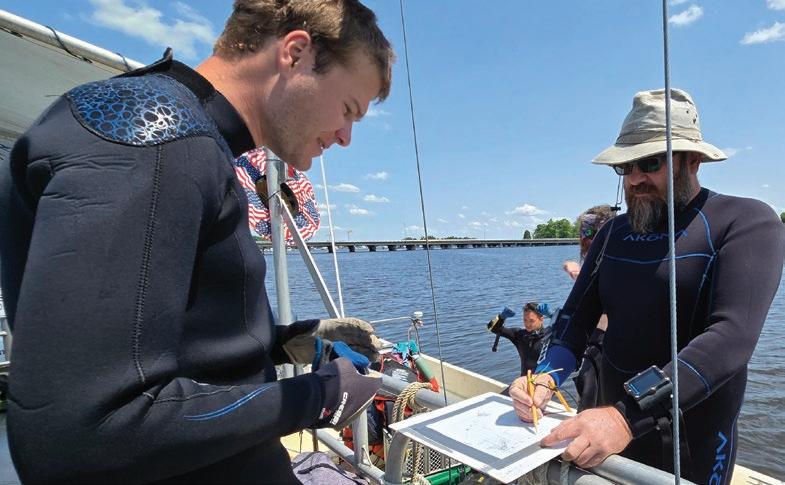
“My dive buddy, Evan Olinger, and I were taking width measurements of Wharf Four to help delineate the site,” he says. The visibility is consistently pretty low in the Cape Fear; as a result, Olinger got disoriented, so they switched roles. Van Hees got disoriented, too, but spotted something.
“I came across several wooden frames barely sticking out of the clay mud with evidence of planking just barely visible on the surface,” he says. He wasn’t sure what it was, but he knew whom to ask. “Later that day, Dr. Jason Raupp was able to confirm this was a wreck, which may be La Fortuna. It was kind of overwhelming and a little emotional feeling once it set in.”
The group was working during a summer field school at Brunswick Town/Fort Anderson Historic Site, where ECU faculty, staff and students have uncovered numerous buildings and artifacts over the years. The field schools are part of the program in maritime studies.
But La Fortuna wasn’t the only former warship to get attention last summer. ECU maritime studies experts and students also worked at two other better-known sites, USS Patrol Craft 1084 in the Cape Fear River near Fayetteville and the USS Picket in the Tar River in Washington.
The Spanish Privateer and the War of Jenkins’ Ear
For nearly half a century, ECU’s program in maritime studies has uncovered forgotten links to centuries of conflict, commerce and innovation. This summer’s discovery of what might be La Fortuna grabbed headlines across the country.
A Spanish privateer, it exploded and sank while attacking the colonial port of Brunswick in 1748. The ship’s demise was part of a little-known but colorfully named conflict — the War of Jenkins’ Ear — a mid-18th-century struggle between Britain and Spain that spilled into the Carolinas and evolved into King George’s War.
Named for a British sea captain who allegedly lost his ear to Spanish forces, the war marked an era of privateers and raids up and down the Atlantic coast. When La Fortuna arrived at Brunswick Town with a Spanish raiding party, local militia, led by Capt. William Dry, fought back. In the chaos, the ship caught fire and blew up — killing its captain and crew and ending the invasion. Booty recovered from the wreck helped finance the building of St. Philip’s Church in Brunswick and St. James Church in Wilmington, officials say.
ECU’s team, led by Jason Raupp, an assistant professor, and research archaeologist Jeremy Borrelli, uncovered the timbers that tests revealed to be made of Mexican and/or Monterey cypress, woods native to Spain’s Central American colonies. The discovery, combined with the site’s location and nearby cannon finds, suggests the wreck is La Fortuna.
“La Fortuna connects North Carolina to a global story of empire, privateering and early warfare,” Borelli told McClatchy News.
Brunswick Town was a pre-Revolutionary port on the Cape Fear River that British troops destroyed in 1776, according to the N.C. Division of State Historic Sites and Properties. The ECU group uncovered three other shipwrecks at Brunswick Town. One may have been
A large section of the possible La Fortuna shipwreck sits on the beach. (Photo by ECU Program in Maritime Studies)
used for land reclamation; another could be a colonial flatboat — a watercraft historically used to transport people and goods between the port and nearby plantations; and the fourth remains unidentified. The team also found wharves, a historic causeway and artifacts tied to colonial life and trade.
To protect La Fortuna’s remains from erosion, the team recovered more than 40 timbers for conservation at the N.C. Office of State Archaeology’s Queen Anne’s Revenge Conservation Lab in Greenville. There, specialists will stabilize and study the wood before attempting to reconstruct the ship’s structure.
The subchaser that came home to die
One of the last known World War II subchasers, PC-1084 patrolled the East Coast from New York to Cuba. Built by George Lawley & Sons in Neponset, Massachusetts, it was launched on Halloween 1942, according to a history compiled by the Fayetteville Area Transportation and Local History Museum. Patrol craft escorted convoys, hunted and destroyed submarines, sank small craft and shot down airplanes, among other duties.
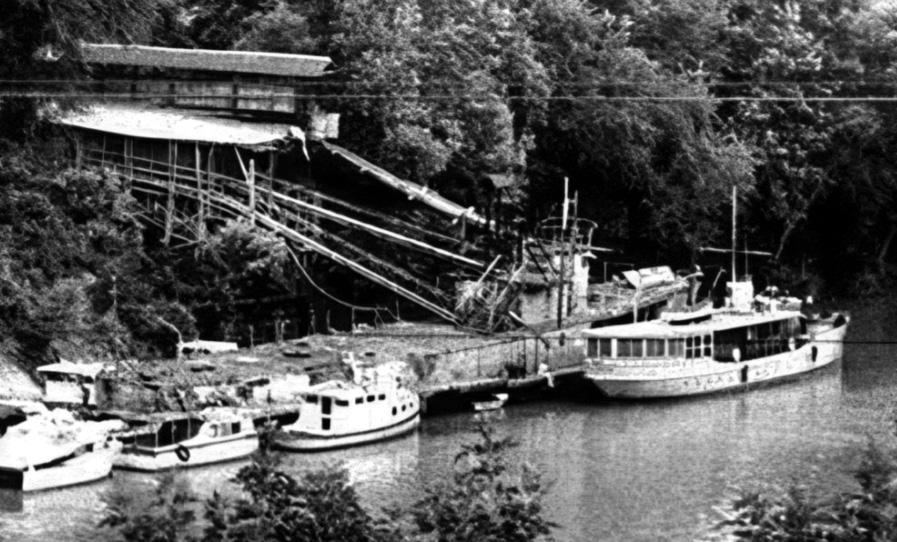
After the war, hundreds of similar vessels were sold off as surplus. Records suggest Fayetteville businessman Richard Minges, a local Pepsi bottler, bought the 1084 in 1947 to use as a floating dock. Later accounts say it was tied up near a dance hall along the river at Breece’s Landing, serving as a mooring for a pleasure yacht that may or may not have existed.
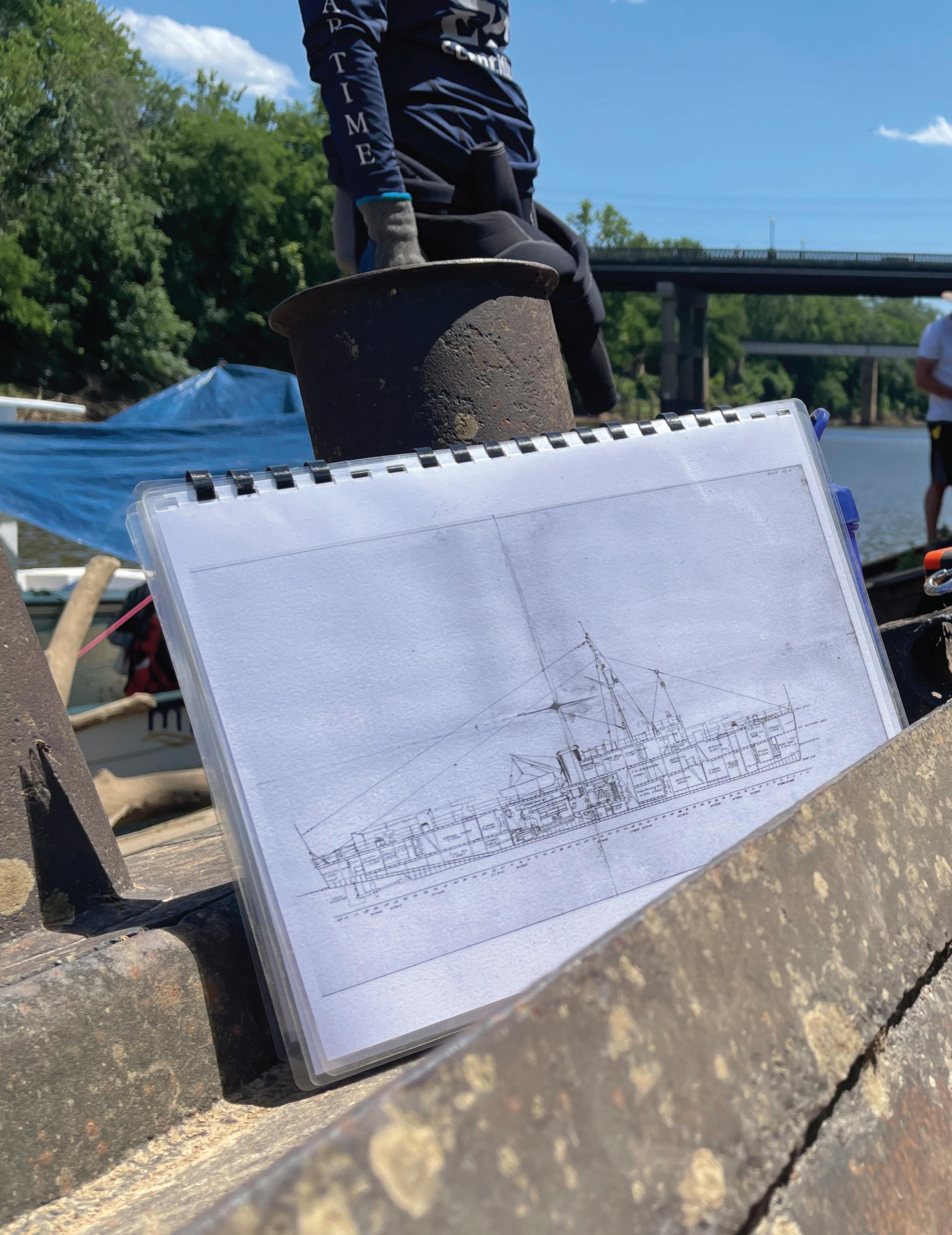
Archaeologists record the starboard side of the remaining structure of PC-1084. (Photo by Nathan Richards/ECU Program in Maritime Studies) Below, the PC-1084 is used as a floating dock decades ago. (Archival photo)
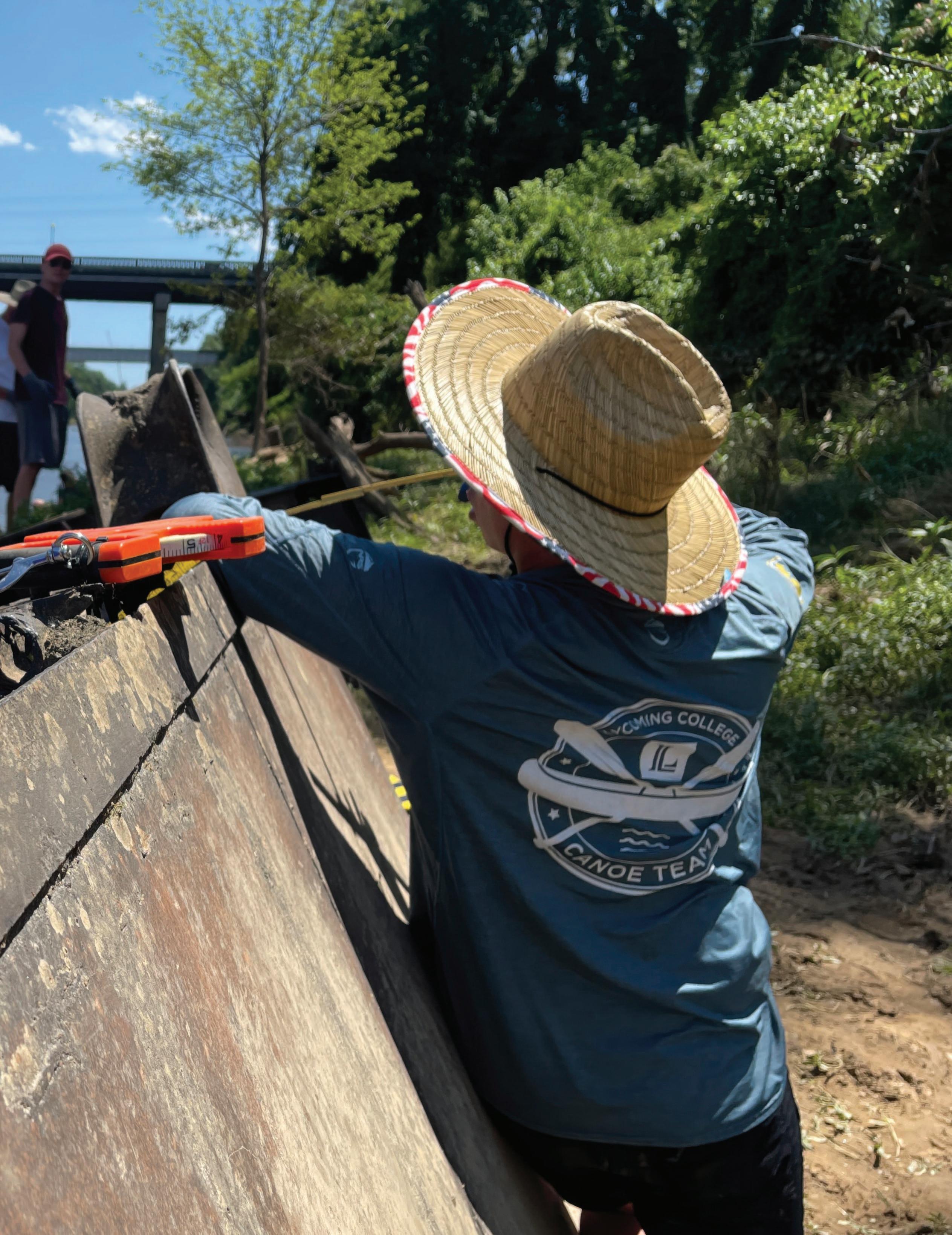
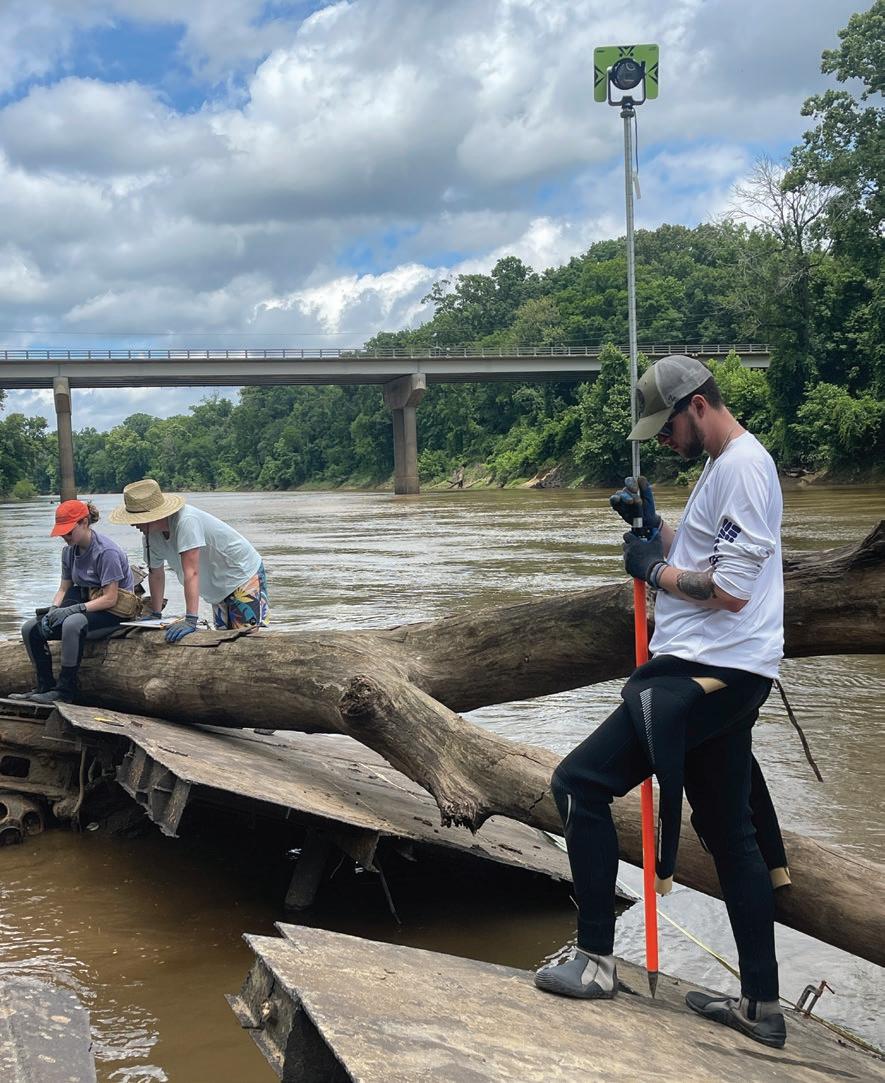
Ethan Whiten (foreground) uses a total station prism to assist in the digital recording of PC-1084. In the distance, Krysta Rogers and Ian Shoemaker record deck structure around a fallen tree.
(Photo by Nathan Richards/ECU Program in Maritime Studies)
ABOUT ECU’S PROGRAM IN
Founded in 1981, East Carolina University’s program in maritime studies is one of the nation’s leading graduate programs in underwater archaeology. Based in the Department of History, the program combines coursework in historical research, field techniques and artifact conservation. Students and faculty have investigated hundreds of shipwrecks along the East Coast and around the world, from pirate ships to World War II submarines.
Learn more: maritimestudies.ecu.edu
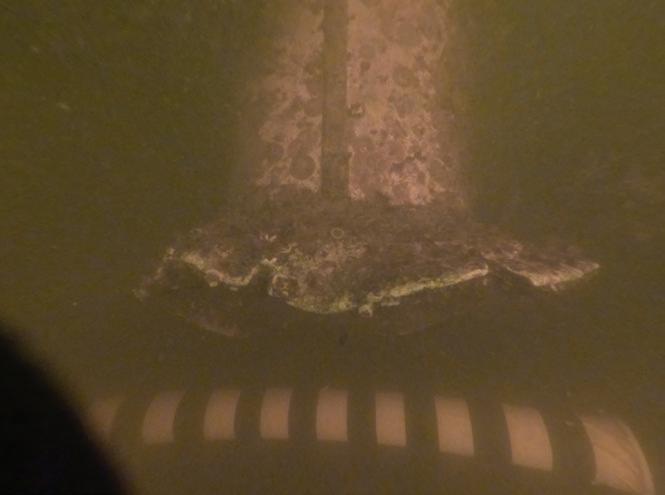
Eventually, a hole appeared in the stern, the hull filled with water and the boat started listing. Local historian Bruce Daws told The Fayetteville Observer hypotheses for the origins of the hole ranged from a still exploding inside the boat to salvage hunters cutting it to look for scrap. No one knows for sure. Though the water is murky, students can explore the vessel and identify and visually scale gun placements, superstructures and other identifying features that have long since been removed from the ship.
It’s visible to motorists crossing the Cape Fear River on the Grove Street bridge.
“Ships like this often just fade away — tied up and forgotten. They weren’t built to last, and yet they’ve become fragile time capsules of World War II history,” Nathan Richards, distinguished professor of history in the Thomas Harriot College of Arts and Sciences, told McClatchy News.
Graduate student Harley Drange is now piecing together the ship’s postwar life as part of his master’s thesis project, tracing its transformation from a subchaser to a relic of industrial reuse.
“Being able to set foot on the PC-1084, it’s not what you might call one of the sexy ships. It wasn’t one of the aircraft carriers, battleships — one of those big-name ships everybody loves — but it was the working ship. It really was the backbone of the U.S. Navy during the world wars. Without these ships, the convoys were at risk.”
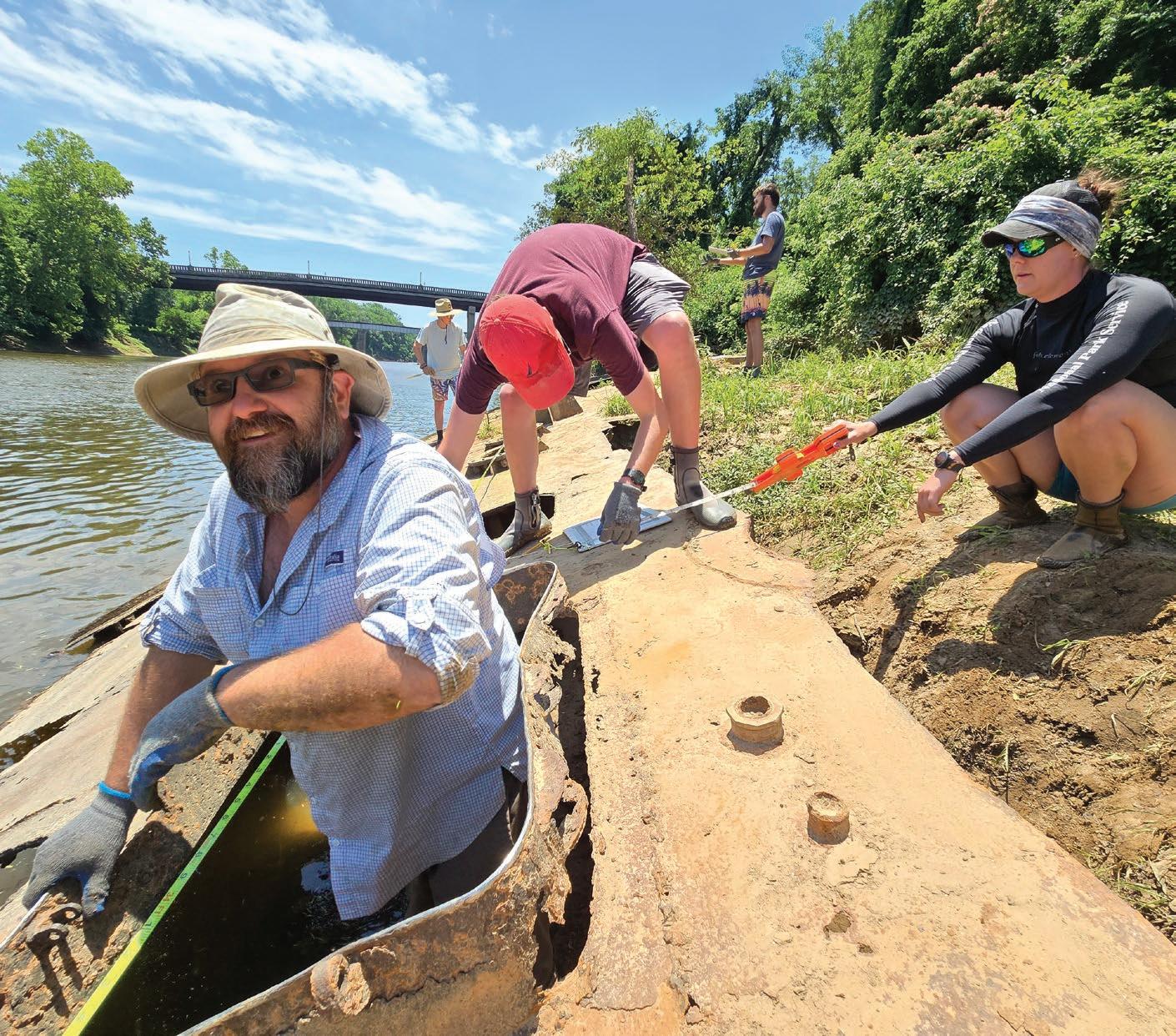
Meanwhile, ECU researchers are documenting its rapid decay. “We saw bulkheads collapsing, decking subsiding, even steel plating folding back like a can,” Richards says. “It’s changing before our eyes.”
A Civil War gunboat emerges
Farther east, ECU students at another field school found themselves face-to-face with a ghost from the Civil War — the USS Picket, a 130-foot Union gunboat that exploded and sank in 1862 near Washington, North Carolina.
The Picket began as the Winslow, an iron-hulled New York canal barge built in 1845. As the Civil War erupted, forces on each side raced to turn civilian craft into warships. Wrapping the barge in a wooden gunboat hull was an unusual approach. Graduate student Rebecca Kelley, who is documenting the Picket’s design for her master’s thesis, said only a few vessels were ever built this way, and the Picket is the only one left to study.
In the 1960s, Gordon Watts, who worked for the state at the time and later became an ECU faculty member, was involved in the first work at the site, which for decades has
Graduate student
Harley Drange enters the water to record the Picket. (Photo by Rebecca Kelley/ECU)
At top, in situ yellow metal sheathing and sheathing tacks on the starboard stern outer hull planks of the Picket. Above, an internal view of an in situ stern hawse pipe on the starboard of the Picket. (Photos by Krysta Rogers/ECU)
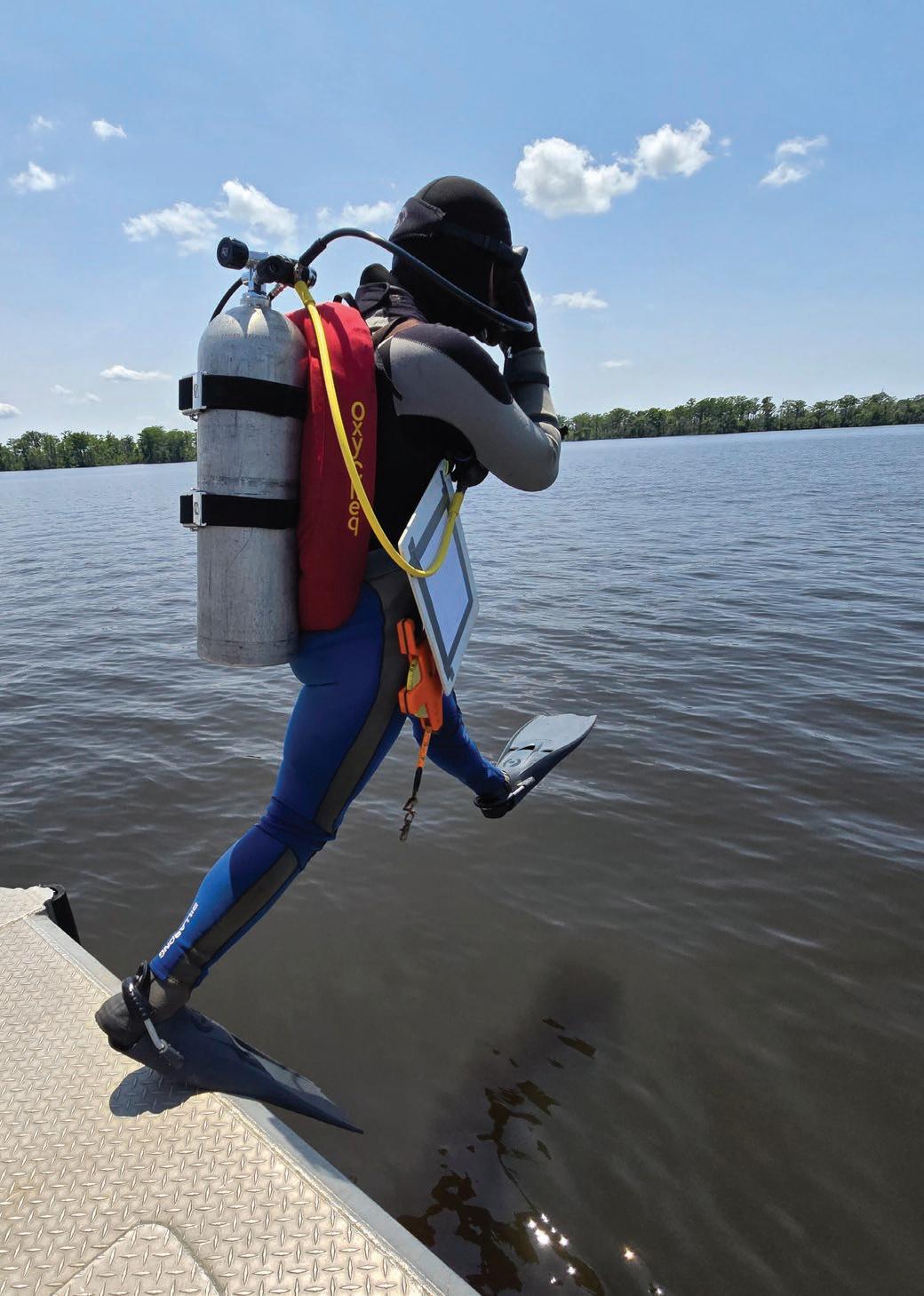
been a training site for diving, water safety and how to dive on a black water site, where you might have 2 inches of visibility.
From then until recently, the wreck lay buried in the Tar River mud near the old U.S. 17 bridge. But changes in the river’s current have scoured away nearly 7 feet of sediment, revealing parts of the ship unseen since the war. What divers found astonished them: a “ship within a ship,” built in haste during the Union’s desperate drive to expand its fleet.
Allyson Ropp, a doctoral student at ECU, first dived on Picket when she was a master’s student. She was with the group this summer helping guide new divers.
“When I remember diving on it 10 years ago, there was, like, nothing exposed. Maybe some of the framing was sticking out, and so going back this past summer what stood out was how much was exposed. You could fit inside the shipwreck and you had maybe 2 or 3 extra feet of timbers sticking out above you. It shows how much sediment is able to move up and down the rivers.”
The Picket’s last battle was a dramatic one. Serving as a flagship in Union operations along North Carolina’s coast, it fired one cannon during a Confederate attack before a violent explosion — perhaps from its boiler or powder magazine — tore it apart, killing 19 crew members.
Drange, a Californian who’s been diving for only a year, got his first experience in black water diving on Picket. “It’s a little ominous where parts of the ship just appear right in front of you, but it was definitely a great learning experience,” he said. “You can definitely tell toward the stern where the iron hull met the wooden hull. And it was one of the areas we actually
focused on quite a bit, trying to figure out how the two hulls were connected.”
Richards said as many as 40 wrecks might lay in the mud between the old and new U.S. 17 bridges.
Telling their stories before it’s too late
Whether buried in the Tar, beached along the Cape Fear or just a few remaining timbers near the sandy coast, these shipwrecks share one thing in common: They’re disappearing fast. Each discovery adds another layer to understanding how war, commerce and human ambition have shaped North Carolina.
“There’s about 5,000 wrecks that have been documented wrecking in North Carolina waters, stretching all the way from the Graveyard of the Atlantic all the way to the mountains,” Ropp says.
“Jason Raupp and I were talking about doing a project on a wreck up on the French Broad River (in western North Carolina), and who would ever think there’s a wreck in the French Broad River?
“We kind of forget what’s under the water unless it’s really big and exciting. But all of those wrecks have stories that connect us to our history and are important and can show us something about how we as North Carolinians use the water, how past people used the water and why we are connected to the water and care about it.”
– Lacey Gray contributed to this story.
From left, Nathan Richards, Liam O’Brien and Allyson Ropp take measurements on PC-1084 on the Cape Fear River near Fayetteville. (Photo by ECU Program in Maritime Studies)
ripple effect
From classrooms to clinics, ECU alumni help others live joyfully
In the ‘70’s, the king of Bhutan — a remote nation between India and China in the Himalayas — coined “gross domestic happiness” to measure the health of its society. Instead of gross domestic product, leaders put people first, balancing happiness, well-being and the preservation of Bhutan’s unique culture with sustainable economic growth.
Despite steep challenges, leaders haven’t wavered in protecting the country’s culture — and happiness — creating a ripple effect through generations.
At East Carolina University, a culture of kindness connects students, faculty, staff and alumni, positively influencing others and communities. Some have overcome obstacles or made bold career moves to fulfill their dreams. From teaching, coaching and health care to business and art, ECU’s impact can be felt leagues away from Greenville.
Read more on the work they do to create happiness in their lives and the lives of others.
Eureka moment
By Crystal Baity
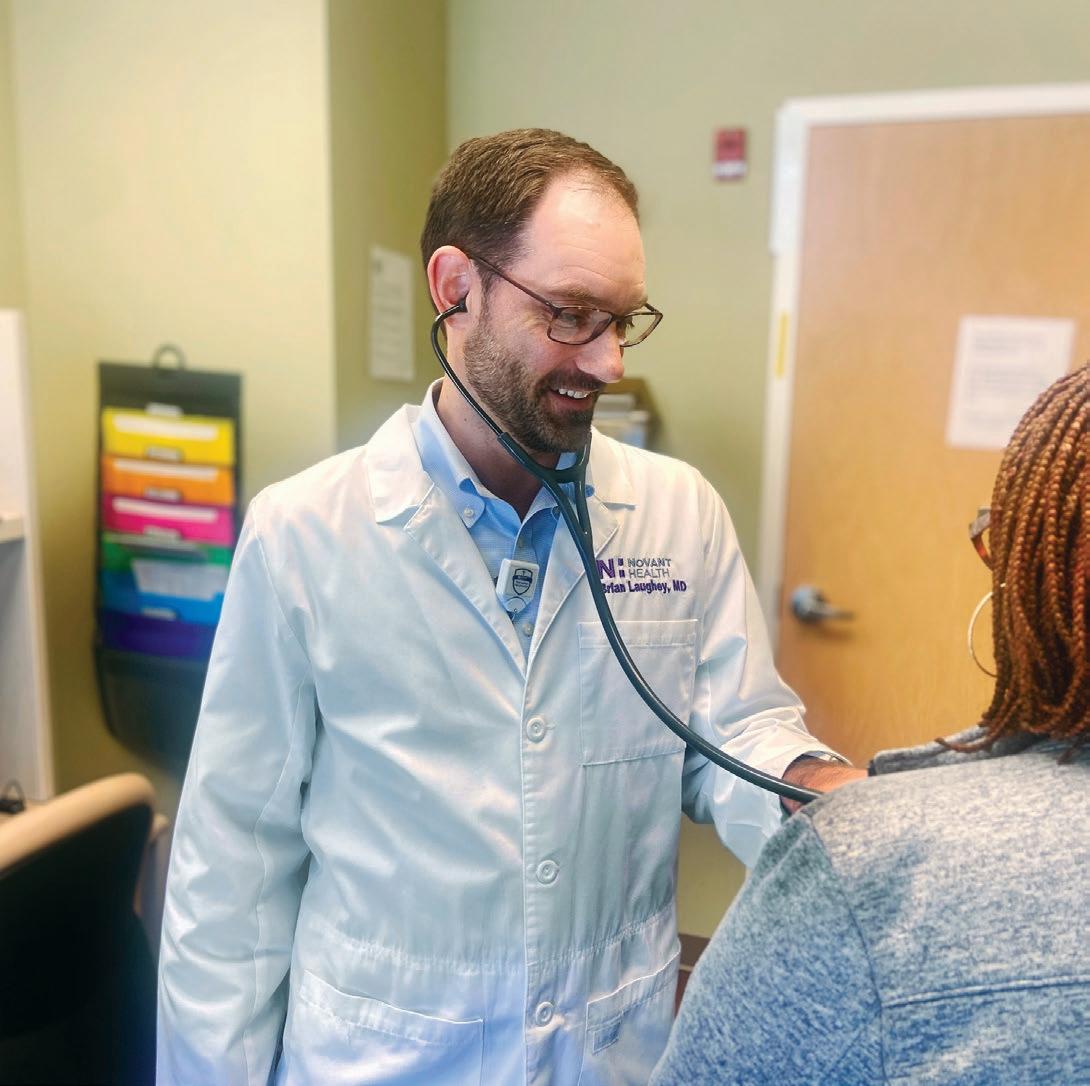
Dr. Brian Laughey first earned a bachelor’s degree in business and worked in plumbing sales for several years before deciding to make a bold career shift. His eureka moment came after he had a minor medical procedure.
What he liked most about business and sales — the customer service aspect — could be applied in health care.
The decision meant he would move back in with his parents, complete biology and chemistry prerequisites, and become a certified nursing assistant before he was accepted to ECU’s Brody School of Medicine. After graduating in 2017, Laughey spent several more years completing his residency and fellowship.
Laughey, who is board-certified in internal medicine and cardiovascular disease, works for Novant Health in Winston-Salem, his hometown since elementary school.
“Becoming a cardiologist has been the realization of a lifelong dream, and that journey alone has brought me a great deal of happiness and pride,” he says. “But ultimately, my focus is on the patients. Creating happiness for others — whether through treatment, reassurance or simply being present — is, I believe, an essential part of being an effective physician. It’s not just about treating disease; it’s about caring for people.”
He interacts with more than 20 patients a day in his busy cardiology practice.
“Many of the conditions I treat are not only complex but also deeply impactful on patients’ quality of life. Because of this, I often see patients regularly, which allows meaningful relationships to develop over time,” he says. “Using my training and expertise to help people heal and improve brings me tremendous fulfillment. There’s a deep sense of joy in knowing that I can make a real difference in someone’s life.”
He says helping others is at the heart of medical practice.
“Patients come to me with concerns — sometimes very serious ones — and they’re looking for answers, for hope and for a path forward,” Laughey says. “Through careful evaluation and treatment, I’m often able to help them feel better, regain function and enjoy a higher quality of life. Seeing patients return to the activities they love, or simply feel more at ease in their daily lives, is incredibly rewarding.”
“Creating happiness for others — whether through treatment, reassurance or simply being present — is, I believe, an essential part of being an effective physician. It’s not just about treating disease; it’s about caring for people.”
Brian Laughey cardiologist, Novant Health
Opening a ‘magic door’
By Crystal Baity and Jessica VanderKolk
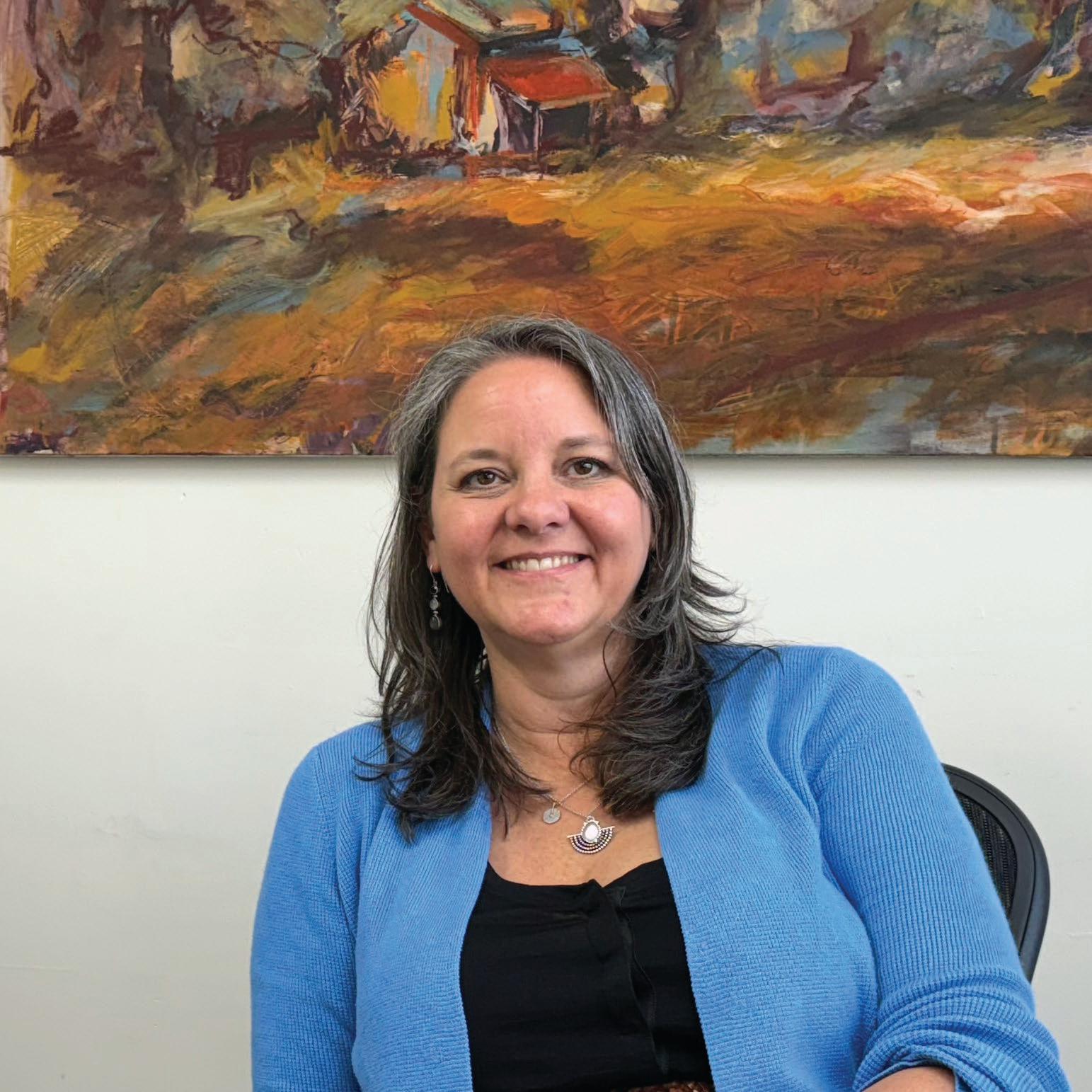
Giving people an opportunity to literally stick their hands in mud is just one way that Adrienne Dellinger fosters the transformative power of art.
Dellinger is executive director of Clayworks, a Charlotte nonprofit dedicated to ceramic education and advancing art through on- and off-site programs. She started as a volunteer after earning a Bachelor of Fine Arts in ceramics from ECU in 1994.
Clayworks is a hub of community connection, Dellinger says.
“We provide the tools, space and instruction, but the magic comes from people — the nervous beginner who fires their first piece, the longtime artist experimenting with a new technique, the teenager who discovers a talent and a voice. Being part of those moments — and building the systems that make them happy — is endlessly rewarding.”
One of Clayworks’ community outreach programs is called Culture Blocks, in the Hickory Grove Library on the city’s east side. A participant who first attended classes alone eventually brought her children and her father, who has late-stage dementia.
“She told us: ‘Your staff always makes us feel welcome. We are treated with kindness, compassion and respect. The most heartbreaking part of my father’s disease has been to know that anyone he
“In today’s world, people crave spaces where they can slow down, connect with others and express themselves authentically. At Clayworks, when you enter, we call it the ‘magic door’; you can enter the studio and be with like-minded people all with a similar creative goal.”
Adrienne Dellinger executive director, Clayworks
meets now will never know or see the incredible work he did for families, families with disabilities and those suffering in his community. They will only know his deficits. This reality has fostered a deep gratitude for community initiatives and individuals who serve disabled populations. It is so important for my dad to have access to opportunities to be creative, feel safe and do what he can. … You have helped open a closed door and keep the lights on for my dad. I will always be full of gratitude for the gift of sitting at a table with my dad and my daughter and having ‘muddy fun.’”
Art is a pathway to community, belonging and well-being, Dellinger says.
“In today’s world, people crave spaces where they can slow down, connect with others and express themselves authentically. At Clayworks, when you enter, we call it the ‘magic door’; you can enter the studio and be with like-minded people all with a similar creative goal,” she says. “I get to be part of building that space, where happiness isn’t just a fleeting feeling, but a lasting impact that strengthens lives and communities. For me, there’s nothing more fulfilling than seeing joy ripple outward from a single creative act.”
Celebrating wins
By Ronnie Woodward
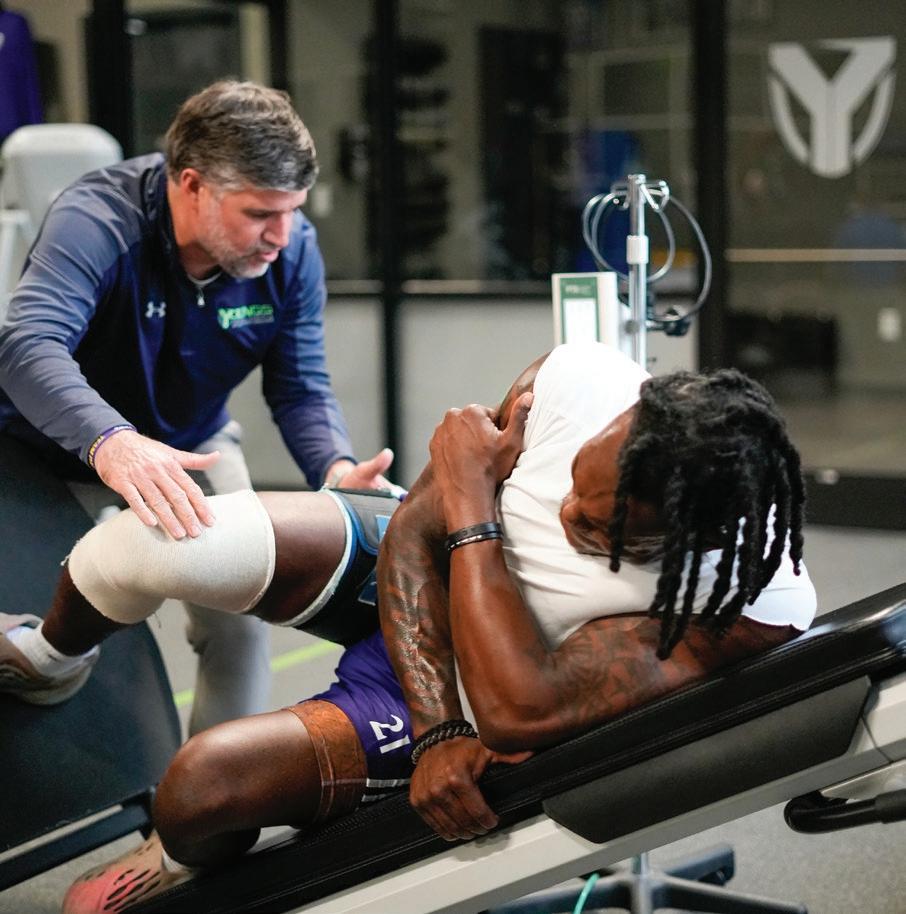
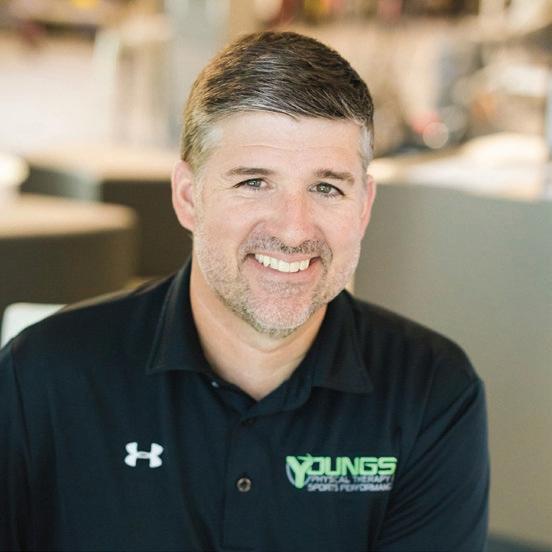
Kevin Youngs, co-founder and CEO of Youngs Physical Therapy and Sports Performance, is a two-time ECU alumnus with a Bachelor of Science in exercise and sport science in 1998 and master’s in physical therapy in 2004. He has provided physical therapy services for Pirate athletes since 2007.
Celebration is a pillar of the rewarding, positive interactions experienced at Youngs Physical Therapy and Sports Performance, either in the Greenville or Morehead City location.
“We are very intentional about celebrating each other’s wins,” Youngs says.
“If one of our staff members gains an achievement, we are going to celebrate that.
“Letting them know we care about them and that I’m going to do everything I can to support them, push them, motivate them to get back. I know they are going to achieve happiness by getting them back to a greater level than before they were injured.”
Kevin Youngs co-founder and CEO, Youngs Physical Therapy and Sports Performance
Every week, we have opportunities to celebrate each other during our full staff meeting. So many of our patients love showing their progress through our social media accounts. Celebrating each other and our patients contributes to our company’s positive culture.”
The work isn’t easy. Local and ECU athletes are often referred to Youngs because they have suffered a major injury and face a personalized, lengthy rehabilitation plan.
It’s a low point for many athletes. Some have no previous exposure to physical therapy. That is when staff members at Youngs amplify their ability to support.
It is also why celebrating an athlete who has made a full recovery is important to Youngs, his wife, Jennifer ’00, and staff.
“When they get back to the court or back to the field, we go and watch them play,” Youngs says. “When you meet with them after the game hugging them, arm on the shoulder, taking pictures and smiling, those athletes appreciate it so much. Those are opportunities to celebrate the advancements in the rehab process that our providers can share with their patients.”
Youngs added that having a positive mindset is key to happiness.
“Our mindset impacts so many things we do,” Youngs says. “It impacts our mood. When I have a patient come in who is frustrated and down and in pain, it may not be about that shoulder that day. It’s about, ‘How can I make them smile?’ and change their mood to have more of a positive mindset about a pain or ache they are dealing with. … Coming alongside them and letting them know we care about them and that I’m going to do everything I can to support them, push them, motivate them to get back. I know they are going to achieve happiness by getting them back to a greater level than before they were injured.”
As for Youngs, quality time with family and close friends brings him joy.
“Even more specific, it’s intentional time with my family at the river,” he says.
Setting new goals
By Ronnie Woodward
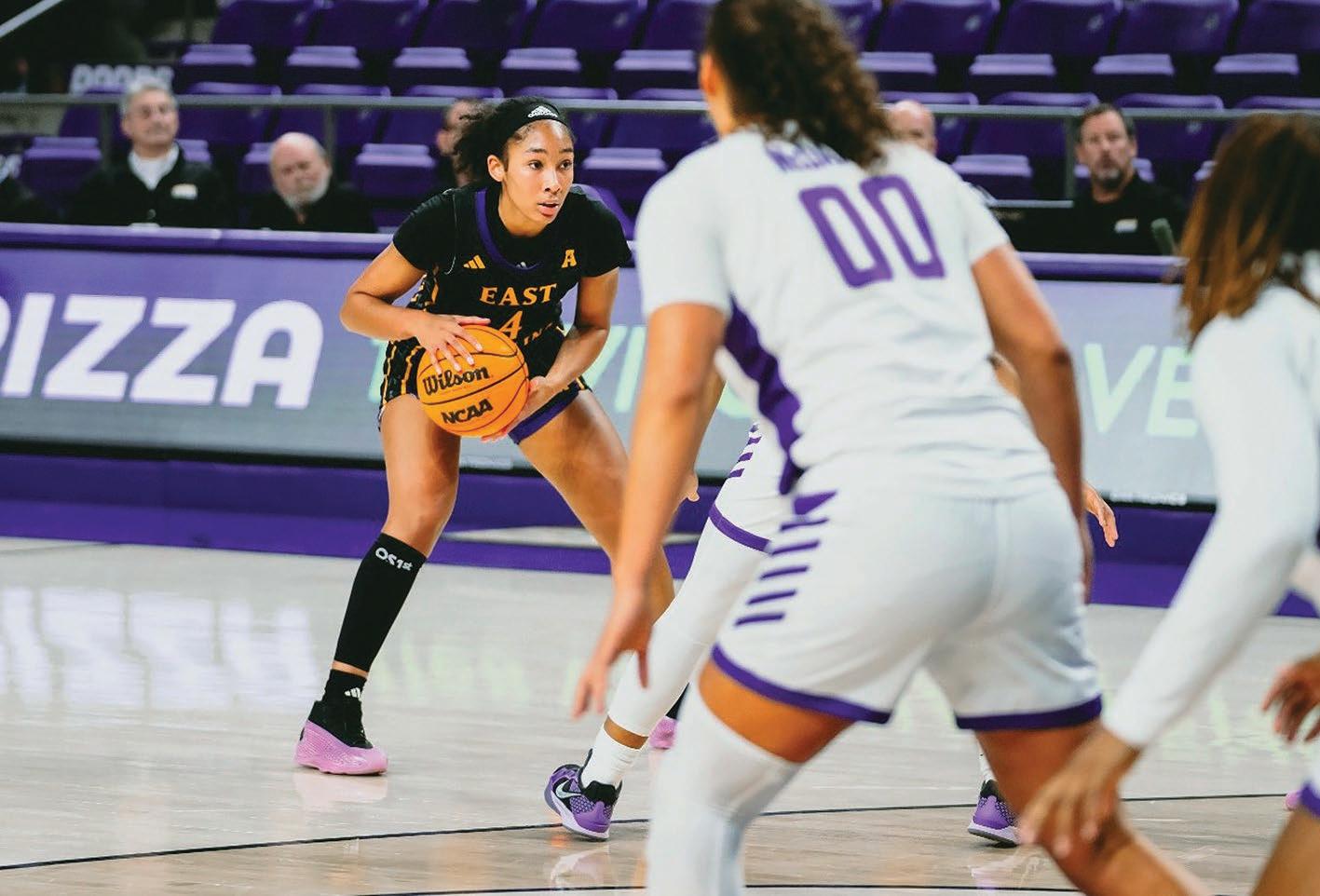
The list of major injuries Synia Johnson faced as an East Carolina women’s basketball player included a broken nose, fractured leg and concussion.
Those injuries, combined with the loss of her father, brought unexpected challenges to Johnson’s athletic aspirations from when she began her ECU career in 2020 amid heightened uncertainty of the COVID-19 pandemic. Five years later, she joined the Pirates’ support staff as director of recruiting and assistant to director of operations for women’s basketball, while continuing in the ECU MBA program. Johnson could have played one more season after injuries limited her availability the last two years, but she is happy with her decision and has grown comfortable in the role.
“Your dreams and your vision can change as you experience different things and go through different things in life,” says Johnson, a Waldorf, Maryland, native who was a three-time team captain from 2020-25. “I wasn’t ready to leave this yet. I love (head) coach Kim (McNeill) and love this environment and this place. Continuing to grow, in a different aspect from player to coach, it was a no-brainer.”
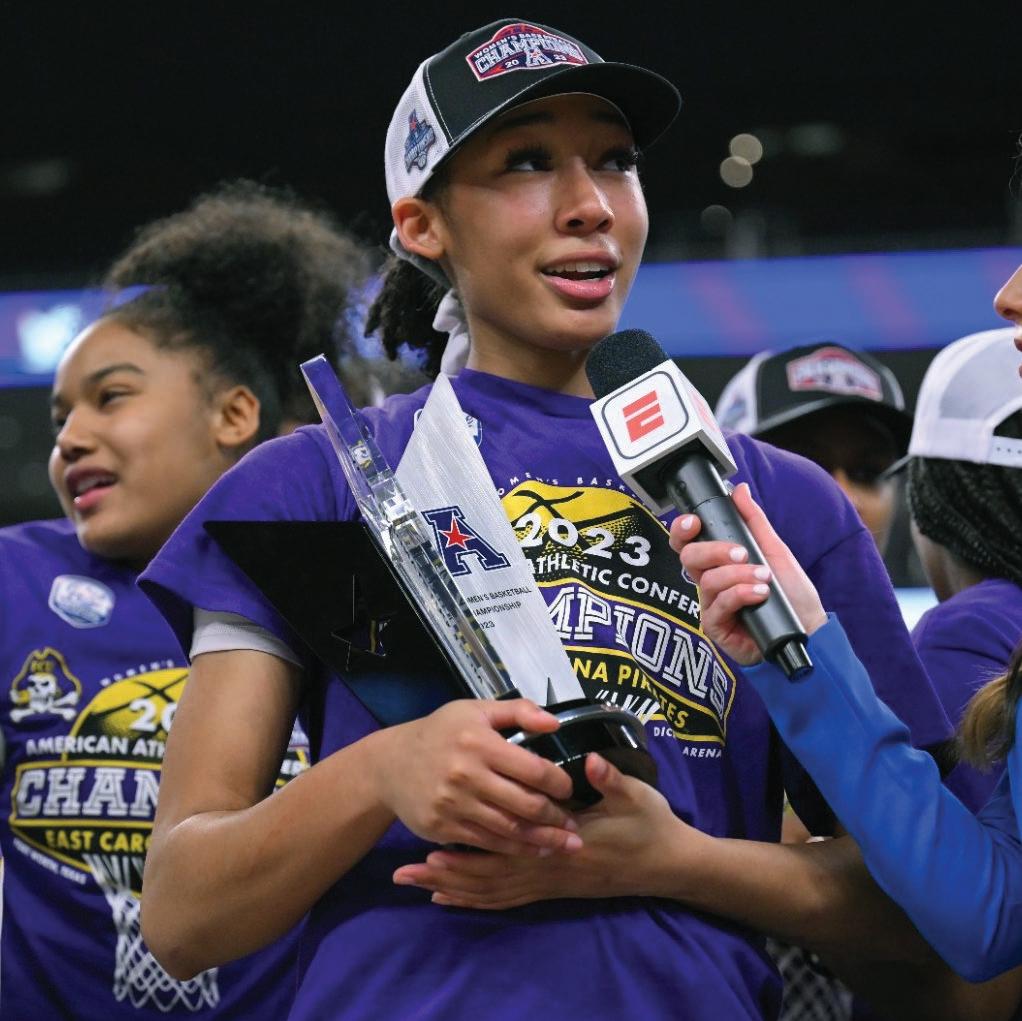
Johnson’s father, Keith, died of cancer during Synia’s sophomore year. The Pirates also experienced losing seasons during that time, in 2020-21 and 2021-22. But they rebounded by winning the American tournament championship in 2023, reaching the NCAA tournament for the third time in school history. Johnson was the 2023 American tournament most outstanding player.
“You can get a defeated feeling, but I knew why I chose this school and that kept me going,” Johnson says. “I believed in this place, the coaching staff, our team. When we won that championship, knowing how much of the adversity you pushed through, it made the winning feel that much better. It was surreal. It was blood, sweat and tears, and my advice is to continue to push. That wall that you think is there, you can break the wall down.”
Johnson’s impact is multi-layered. She accumulated a 3.91 GPA as an undergraduate student, earning a degree in management information systems, and in June was named the
“When we won that championship, knowing how much of the adversity you pushed through, it made the winning feel that much better. It was surreal. It was blood, sweat and tears, and my advice is to continue to push. That wall that you think is there, you can break the wall down.”
Synia Johnson 3-time captain, ECU Women’s Basketball
American Conference’s women’s basketball Scholar Athlete of the Year. She became the first ECU women’s basketball player to win the award.
“Just as serious as I took basketball, the classroom part is just as serious,” she says. “As coach Kim always tells us that one day the basketball stops bouncing. You need to have something to lean back on or other areas in your life. … There is a plethora of resources here that ECU gives in order to succeed.”
On campus
By Crystal Baity
Students in Derek Maher’s religious studies Buddhism class that will be offered this spring learn that mindfulness started as an integral part of Buddhist meditation practice. A related, proven therapeutic — mindfulness-based stress reduction — helps relieve anxiety and improve balance in one’s life.
“MBSR is a therapeutic approach that has been abstracted from its religious context. They’re both about getting into a happier place or a less anxious place,” Maher says. “I think cultivating your own happiness and contentment through this and other practices that one might do creates a more peaceful atmosphere around yourself. We all want to spend more time with that colleague or family member who is content and happy. We often choose our friends that way.”
Similarly, meditation provides a range of benefits for mental and physical health.
“You recognize the value of being happy and content, and then you take the steps to cultivate that, and then that eventually becomes your natural disposition. And it attracts other people to you. And before long, other people are moved by the ripple,” Maher says.
Research shows that student well-being and mental health are connected to academic success, says LaNika Wright, associate vice chancellor for student well-being and dean of students at ECU.
“We know that it’s not just anecdotal; it’s real life,” she says. “We care about student health and well-being and making sure that their wellness is a priority.”
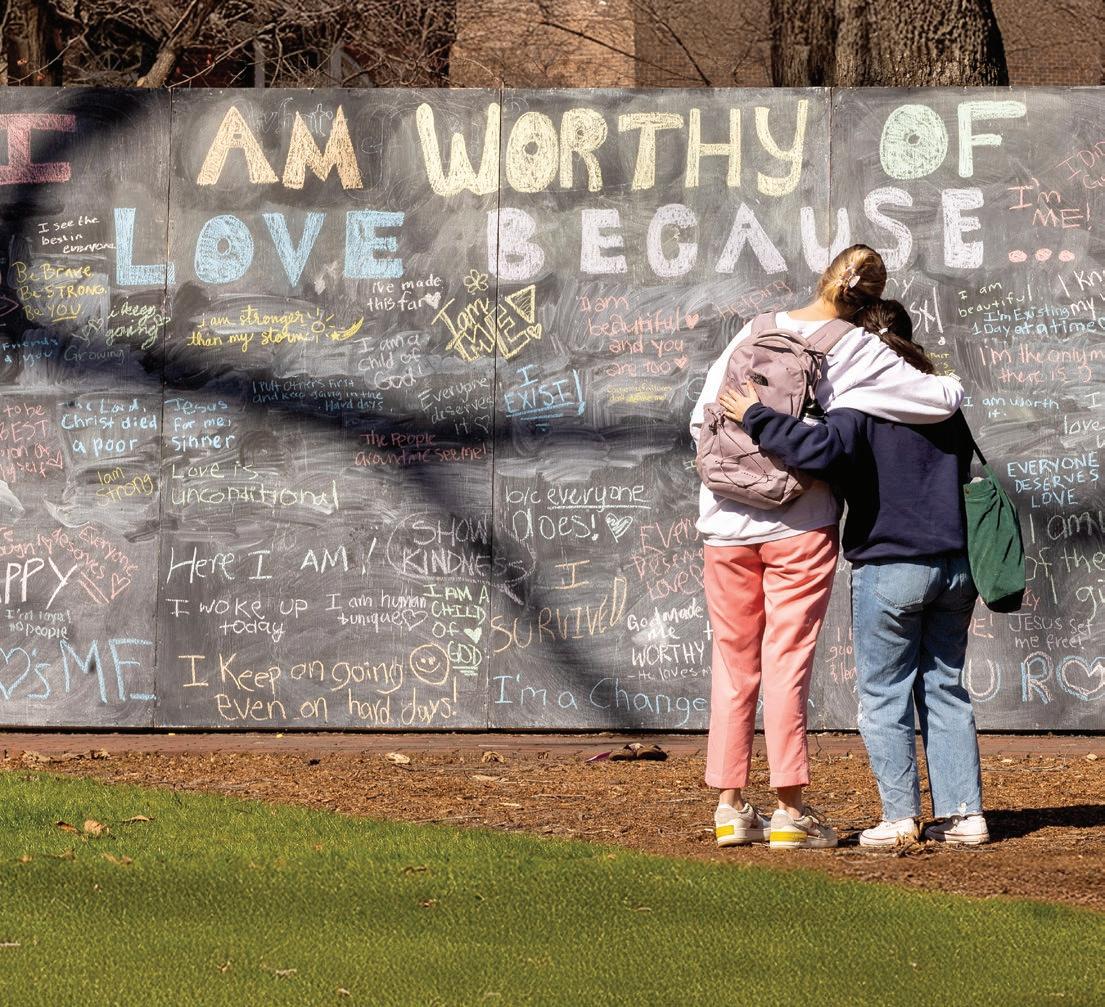
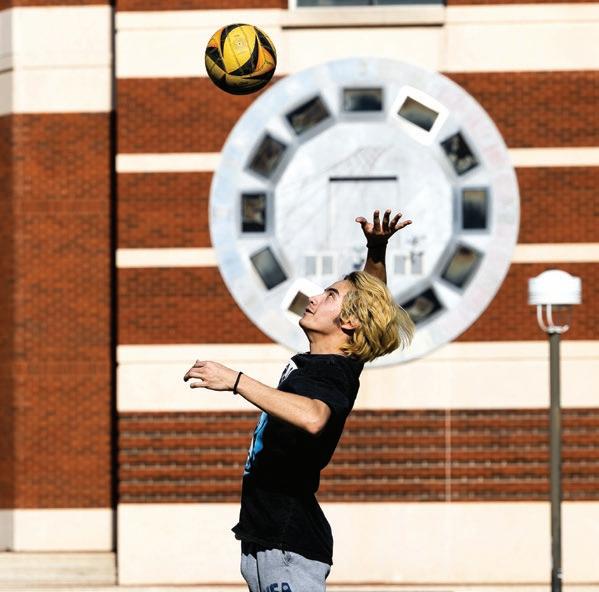
Campus recreation and wellness programs, club sports and intramurals promote community and belonging. Counseling services and outreach programs including You Matter and Are U OK Day foster connections and caring.
Experiential learning helps students discover what they love — or don’t like — on their path to graduation.
“Once you find your purpose and you feel like you’re really making a difference, then you go out and make that difference. And you’re looking to bring other people along with you,” Wright says.
As former director of ECU Student Health Services, Wright precepted the current director, C. LaShae’ Wilson, 15 years ago when she was a nurse practitioner student. “She realized that college health was where she wanted to be,” Wright says. “Now she’s helping other students be healthy.”
Another resource for students is ECU’s Financial Wellness Hub, one of the first programs offered in the UNC System. Director Kevin Sutton, two graduate assistants and seven undergraduate interns work with hundreds of students in the transition to financial autonomy each year. They discuss spending and saving habits, setting goals, strategies for dayto-day financial management as well as credit cards, credit debt and credit scores.
Sutton recommends a weekly budget check-in — not just for students but also for employees, alumni, retirees — whatever the lifespan.
“If you check your transactions every week, you’re more likely to see something going wrong or catch a fraudulent charge,” he says. “Money can be stressful for a lot of people. If we’re talking about happiness, it’s the absence of stress, right? These are the things that someone can do to help remove stress associated with money.”
Finding purpose leads to success
By Patricia Earnhardt Tyndall
Kelly King ’70 and Bob Barnhill ’70 have spent their careers in banking and construction passionately focused on a fundamental idea guaranteed in the Declaration of Independence — the inalienable right to pursue happiness.
Throughout their careers, and now in retirement, the friends from their days at ECU engage with others as often as possible to share lessons they learned that helped them lead happy and successful lives.
“What I do all seems to line up around a central theme for me right now, and that is really around trying to help people figure out how to be successful and happy. Because what I found is that most people that are successful aren’t really happy,” King says. “Bob and I both like using the word happiness because people immediately know what you’re talking about. But we also talk a lot about how we define happiness as a deeper sense of well-being, a sense of enrichment, a sense of fulfillment and a sense that your life matters.”
King moved from a tobacco farm to ECU, where he was determined to be successful, with farm life in the past. He graduated as the top student in the School of Business and began a 50-year career in banking with BB&T (now Truist). When he retired as CEO in 2022, Truist was the sixth largest bank in the country.
Barnhill earned a business administration degree and entered the contracting and construction industry. He became president of his family-owned Barnhill Contracting Company in 1987. Now retired, he serves as chairman of the board. The company works in commercial building, site development, asphalt paving and asphalt manufacturing. Much of North Carolina’s highways and infrastructure is well-known for being “Barnhill built.”
“When I turned my attention to real happiness, it’s interesting. I was more successful in the business than I probably ever was.”
Kelly King ’70 former CEO, Truist (retired)
Lesson one in the pursuit of happiness is being clear about one’s purpose. King and Barnhill believe that being guided by what their faith calls them to do allowed each of them to more deeply understand their purpose and values.
“Having a happy, content workplace is the number one criterion to having a successful workplace,” Barnhill said. “Everybody’s got to do the job, but there’s no reason you can’t do it and be happy doing it.”
Bob Barnhill ’70 former president, Barnhill Contracting Company (retired)
“A lot is being written about finding your purpose in life. We’ve worked with our employees on knowing themselves first. And that helps,” Barnhill says. “I think that’s number one. Once you know yourself, then you’re much more likely to know what your purpose is.”
With one’s purpose in mind, the next step is to find a career or company aligned with similar purpose and values.
“I got up every day thinking I had the honor and the pleasure of being able to go to work,” King says. “When I turned my attention to real happiness, it’s interesting. I was more successful in the business than I probably ever was.”
Both men believe they have led by focusing on growing their people and their communities to help make the world better.
“Having a happy, content workplace is the number one criterion to having a successful workplace,” Barnhill says. “Everybody’s got to do the job, but there’s no reason you can’t do it and be happy doing it.”
Kelly King
Bob Barnhill
Creating lightbulb moments
By Crystal Baity and Kristen Martin
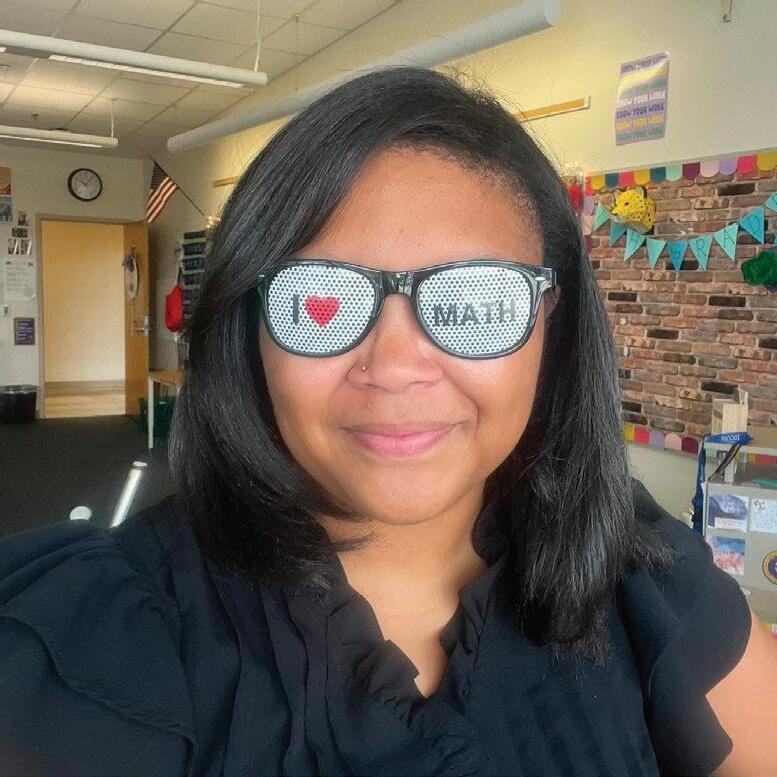
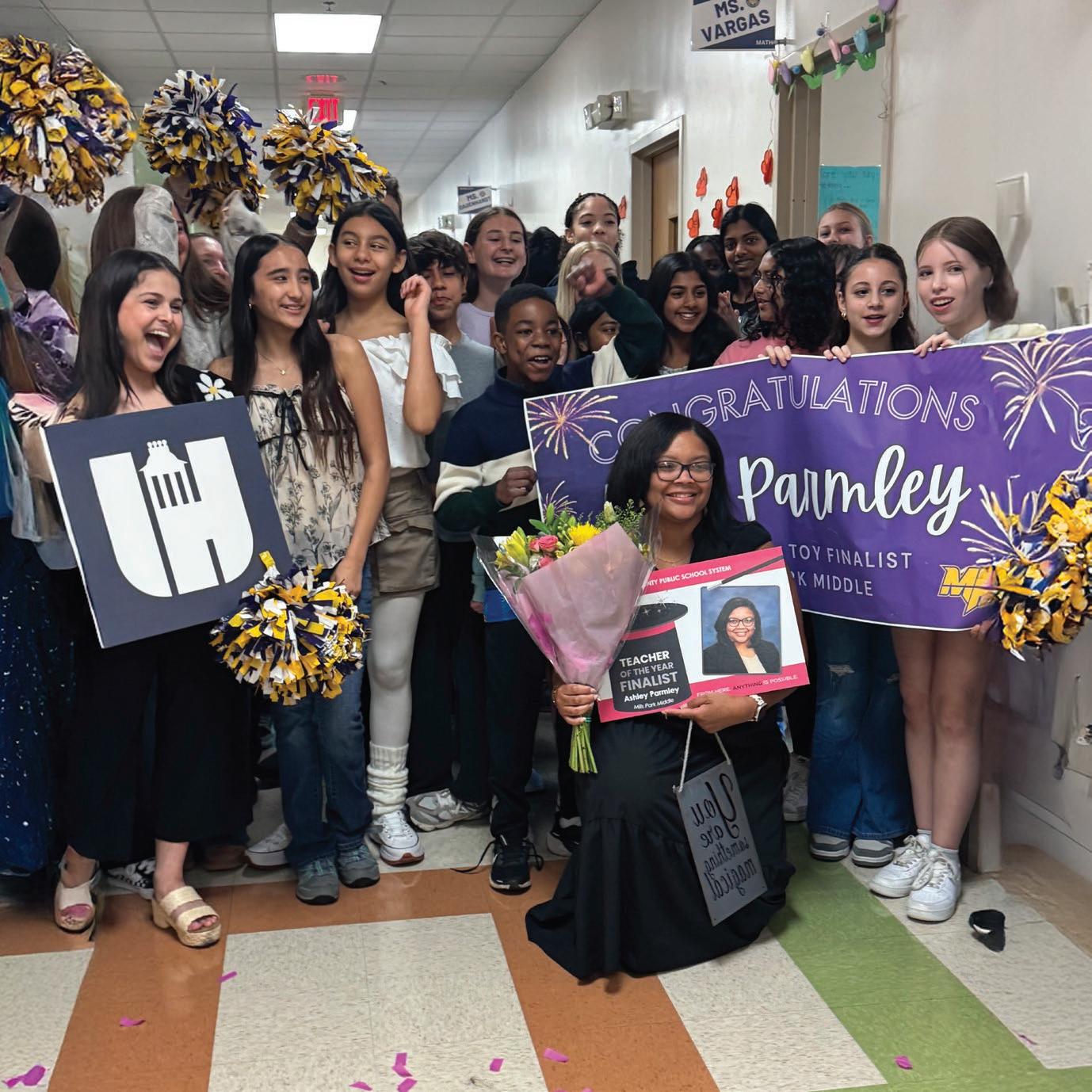
It’s those lightbulb moments — when a concept finally clicks — that seventh-grade math teacher Ashley Parmley ’20 loves to see.
That’s when students leave her classroom smiling because they finally understand something that once frustrated them.
“I work hard to make math feel approachable and even fun, and seeing students laugh, engage and encourage each other shows me that effort pays off,” she says. “I’ve seen students who once doubted themselves start taking risks, asking questions and helping their peers. Knowing that my energy and intentionality can turn math class from a source of stress into a place of curiosity and confidence is what makes my work so meaningful.”
Parmley believes learning should be a positive, empowering experience.
“When my students feel happy and supported, they are more willing to try new things and grow — and that makes teaching meaningful,” she says. “Their joy fuels my own, reminding me that the effort I put into building relationships, a welcoming classroom and planning engaging lessons truly matters. Seeing students leave my class feeling more confident than when they walked in is one of the best parts of my job.”
She says she grows alongside her students at Mills Park Middle School in Cary.
“When my students feel happy and supported, they are more willing to try new things and grow — and that makes teaching meaningful.”
Ashley Parmley ’20 seventh-grade math teacher, Mills Park Middle School
“Every day brings something new, and I enjoy the creativity of designing lessons that keep students engaged,” she says. “Most of all, teaching connects me to a community and gives me a sense of purpose knowing that the work we do together truly matters.”
Parmley earned a bachelor’s degree in middle grades education with a concentration in science and math at ECU. Last year, she was a Teacher of the Year semi-finalist in the Wake County Public School System.
WHAT’S YOUR ECU
There is that place at ECU you see when you close your eyes — the seat from where you cheer for the Pirates, a favorite study nook in the Joyner stacks or your spot to gather with friends near the Cupola. That happy place evokes good memories. Pirates from across campus and around the country shared reflections about their favorite happy places on campus.
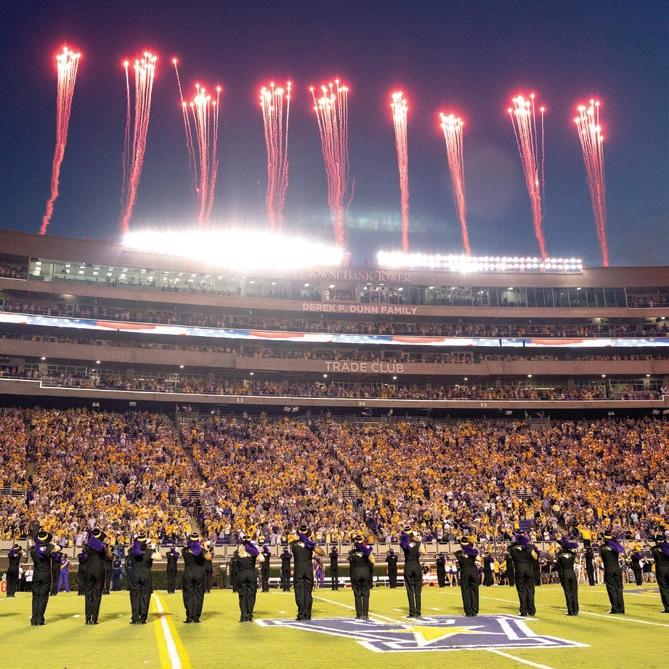
Dowdy-Ficklen Stadium
Dowdy-Ficklen ranks as the top happy place for Pirates. Georgia Childs ’93 ’95 says, “There is no better energy and spirit than game day in Dowdy-Ficklen Stadium!” For ECU staff member Nicole Stokes, the stadium was the place she met, got engaged to and, in 2017, married Matt Stokes ’05.
The Mall
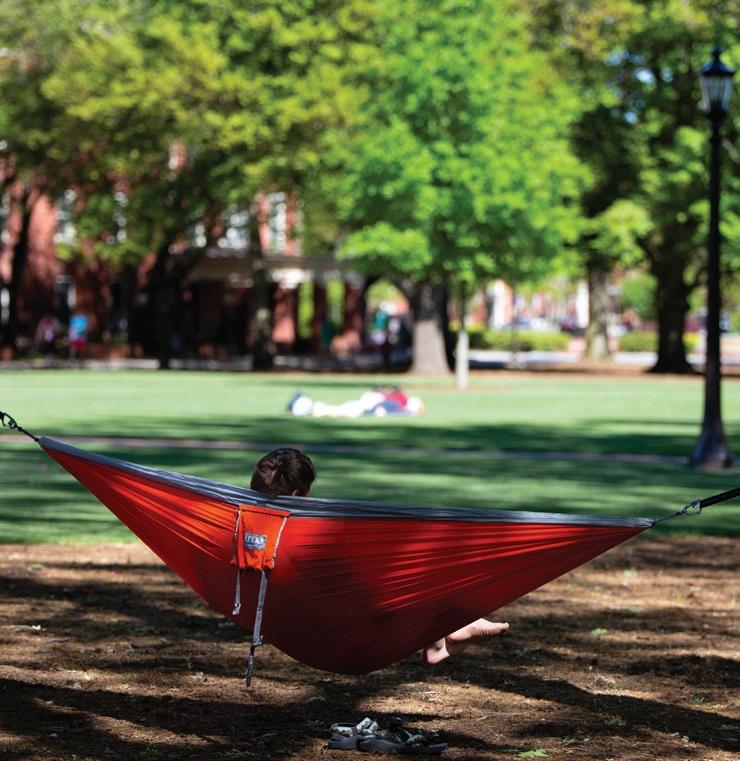
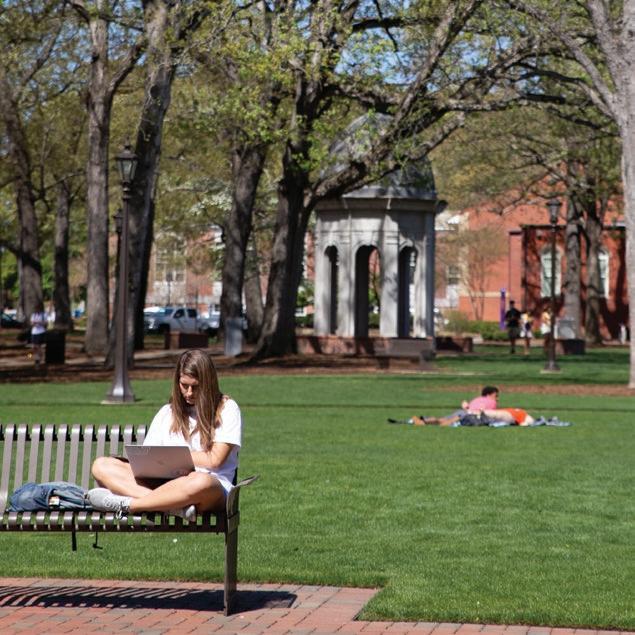
The Mall is at the heart of Main Campus and home to ECU’s most iconic symbol — the Cupola. It’s a favorite for all seasons. The grassy lawn and shady spots provide respite and community. Students gather for events, to have study sessions in the sunshine or to relax with friends.
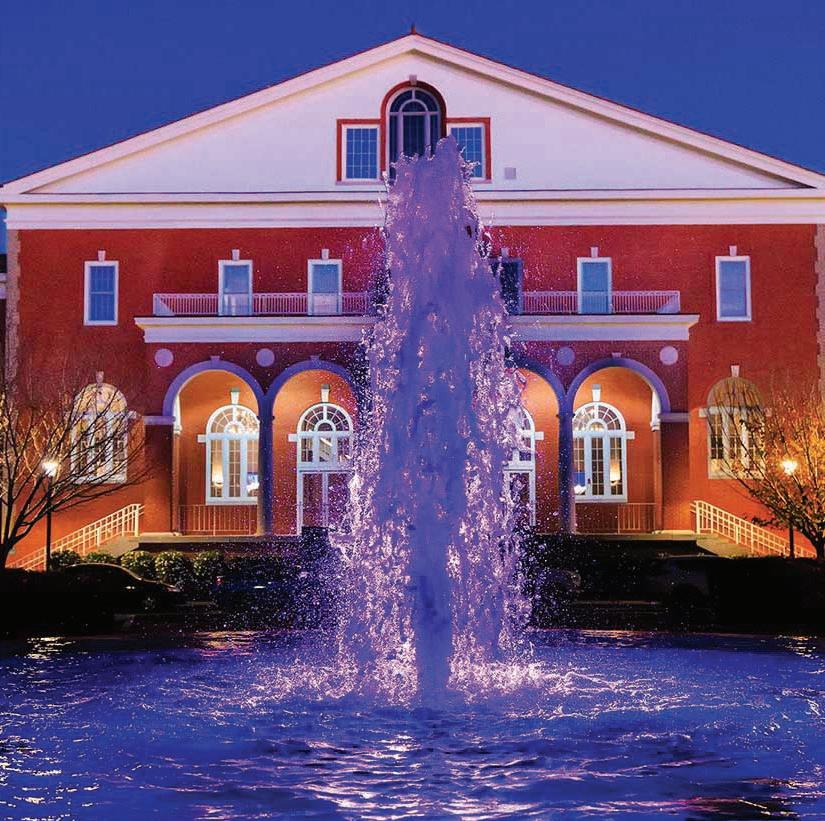
Trustees Fountain
A favorite backdrop for graduate photographs and one of ECU’s most iconic symbols, the Trustees Fountain is a focal point of Main Campus. Originally built in 1932, it was rededicated during ECU’s centennial celebrations in 2009.
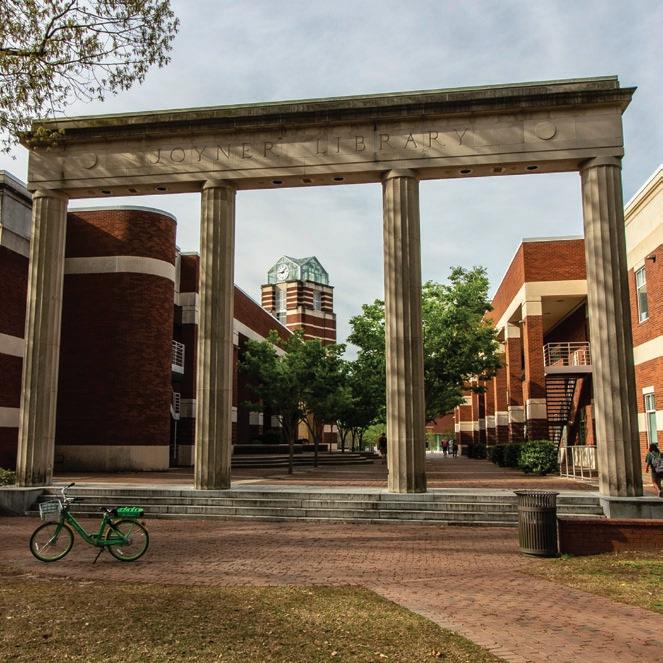
Joyner Library Sonic Pillars
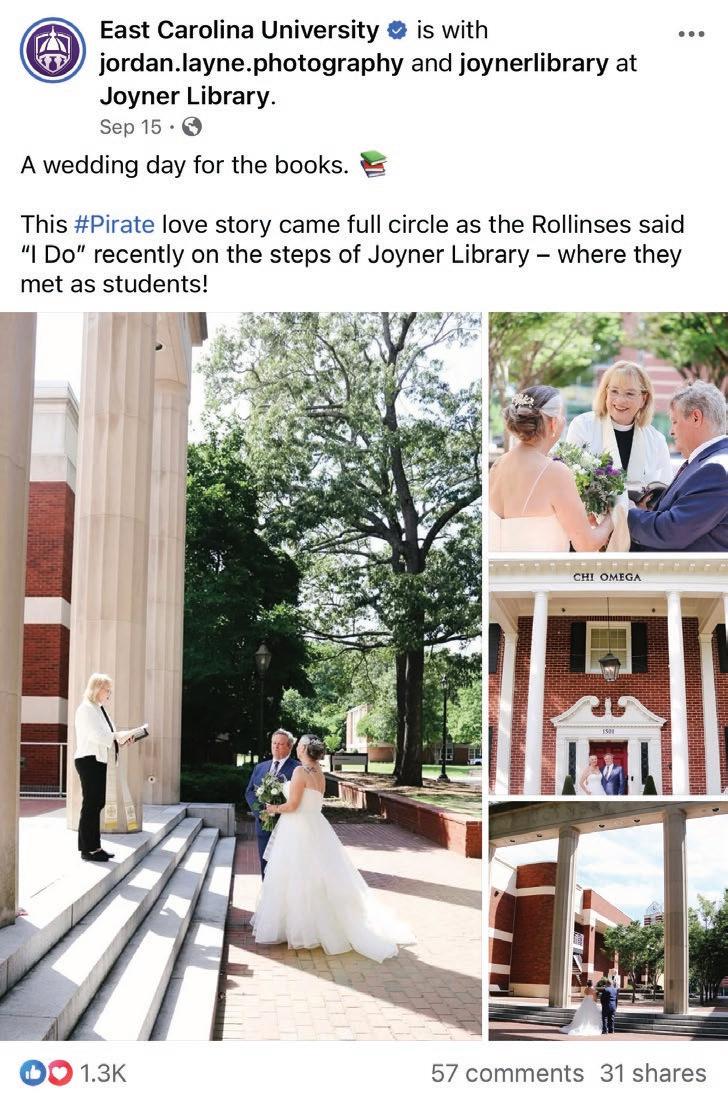
Music rings out with every step under the Joyner Library sonic pillars. The columns were once the entrance to the library and now serve as the entryway to the Sonic Plaza. It is a happy place for many Pirates, especially Bonnie Brockwell Brown ’78 and Mike Rollins, who married at the steps in September.
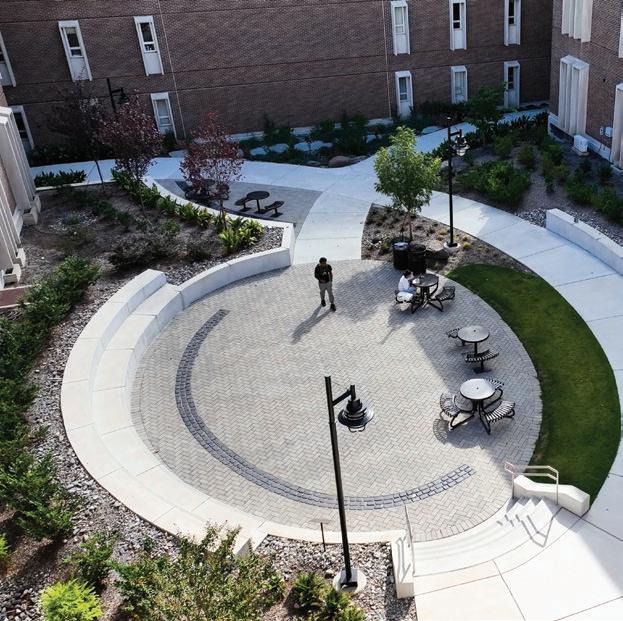
Brewster Courtyard
The stone walls and green space of the Brewster courtyard provide a respite for students, faculty and staff. “My happy place is the courtyard in the middle of Brewster. It’s so peaceful and it’s nice on a breezy day,” says junior Jenna Crawford.
STORY BY PATRICIA EARNHARDT
WE WANT THEM TO BE
SCHOLARSHIP PROGRAMS AIM TO ATTRACT AND RETAIN UNDERGRADUATE STUDENTS
Undergraduate scholarship programs are integral to fulfilling East Carolina University’s mission priority of student success Campus leaders say new scholarships are critical to the university’s efforts to prepare for a nationally competitive enrollment landscape . Toward that end, the Chancellor’s Scholars Initiative launched in 2024 to create scholarships to strengthen recruitment and retention
Seventy-five students entered ECU in August as the inaugural group of Chancellor’s Scholars University leadership aims to enroll 300 highly driven students over the next four years as part of the new initiative
“Scholarship fundraising will fuel the university’s effort to recruit and retain gifted and great students, who we want to be Pirates,” Chancellor Philip Rogers said “This ambitious initiative allows ECU to be laser-focused on student success and bolsters our ability to recruit exceptional, qualified students from across the country ”
Dylan Livingston-Keeter of Morehead City chose ECU because of the Chancellor’s Scholars Initiative
“I was accepted into every school I applied to, and it really came down to where I could go and have the least amount of financial burden,” he said “Thanks to programs like the Chancellor’s Scholars (Initiative), I am able to focus on becoming the best music teacher I can without worrying about my finances as much ”
The program entices in-state students to choose ECU Qualified students are eligible to receive $10,000 in tuition and fees over four years Chancellor’s Scholars have access to an exceptional learning experience, opportunities to engage in leadership skill building, and access to a residential community alongside their fellow scholars Similarly, newly created Voyagers scholarships aim to recruit 20 out-of-state students to campus
Chancellor Philip Rogers walks with first-year students Alysa Mayberry, Dylan Livingston-Keeter, Michael Raye and Caroline Zick. The students are part of the inaugural group of 75 Chancellor’s Scholars enrolled at ECU.
(Photo by Steven Mantilla)
WE HAVE THE BEST ALUMNI IN THE WORLD WHO KNOW AND ARE PASSIONATE ABOUT THE REAL VALUE OF AN ECU EDUCATION. THEIR SELFLESSNESS IN PROVIDING THE SAME OPPORTUNITY TO OTHERS IS EXAMPLE NO. 1 OF WHAT THIS INSTITUTION IS ALL ABOUT.”
Allen Guidry associate provost for learner operations
The new scholarship initiative is a point of pride shared by members of ECU’s Board of Visitors, who are charged with promoting ECU with the N.C. General Assembly, Council of State, business entities, community leaders and citizens throughout North Carolina.
“ECU needs enrollment, and offering this (scholarship) as part of acceptance is equally important as to whom we are offering them. I have two recent acceptance letters for students in our house, and it matters when a student sees a scholarship,” said Toby Thomas ’98, chair of the ECU Board of Visitors.
Thomas sees an essential correlation between student success and scholarship.
“In the short term, a scholarship eases financial pressure. More so, it tells the student they are valued and the work they have done has earned them something — a tangible reward,” he said.
The new program relies on a strategic fundraising effort to endow Chancellor’s Scholars awards. An endowed scholarship is created with a $62,500 gift. Endowments allow the scholarships to be provided in perpetuity. Donors can also support the effort through one-time scholarship gifts of $10,000 or by supporting annual giving, which create scholarships by combining donations.
“We would not be close to being able to provide this opportunity if it weren’t for our incredible Pirates who have committed their resources to make this happen,” said Allen Guidry, associate provost for learner operations. “We have the best alumni in the world who know and are passionate about the real value of an ECU education. Their selflessness in providing the same opportunity to others is example No. 1 of what this institution is all about.”
The Chancellor’s Scholars Initiative is also designed to meet UNC System performance metrics, which directly impact state funding and help ensure the university’s long-term sustainability and growth.
“One of the key factors that prospective students are looking at is cost of attendance. This initiative allows us to make ourselves much more competitive in that space,” Guidry said. “We know we provide an exceptional learning experience for learners of a wide range of academic backgrounds and have done so for over 100 years. This scholarship initiative will introduce that extraordinary academic environment to many more new Pirate scholars.”
SCHOLARSHIP AWARDS BRING TOP UNDERGRADUATE STUDENTS TO ECU
Access Scholars Program
The Access Scholars program provides scholarships to students who demonstrate academic potential and financial need Through the scholarship program, students are provided a $5,000 renewable annual scholarship to assist with tuition, fees and books
Students engage in lecture series, special dinners, experiential learning and study-abroad opportunities
Since the program began in 2006, it has provided scholarships for 378 students
Brinkley-Lane Scholars Program
Brinkley-Lane Scholars is the most prestigious undergraduate award program offered at ECU Recipients receive a fully funded education, covering the cost of tuition, fees, room and board for in-state and out-of-state students and unique high-impact experiences, as well as the ability to explore the world with a $5,000 studyabroad stipend Scholars benefit from access to an array of leadership opportunities, research with award-winning faculty and a robust alumni network
Maynard family gift strengthens College of Education scholarship program
A multimillion-dollar commitment from the Maynard family has enhanced the James and Connie Maynard Scholars program in the College of Education and establishes the award as one of the leading scholarships for training educators in North Carolina. The new investment increases the scholarship award from a $26,000 four-year scholarship to $40,000.
James ’65 and Connie ’62 Maynard established the Maynard Scholars program in 2006. In the 20 years since, the Maynard family and Maynard Family Foundation have funded more than 200 scholarships for students chosen as Maynard Scholars. The 2025 cohort includes 15 students, all from North Carolina.
Maynard is the co-founder of the Golden Corral Corporation and founder of Investors Management Corp., Golden Corral’s parent company.
“Connie, Easter (their daughter) and I feel there is nothing more beneficial to young people than becoming well educated. This can only happen with well-prepared, dedicated teachers,” James Maynard said.
The COE is the top producer of educators in eastern North Carolina, serving traditional and non-traditional students. Continuing to serve as the leader in educator preparation and graduating the best teachers is a message Dean André Green shares and heard clearly from Easter Maynard, director of the Maynard Family Foundation.
“Their mission, like mine, is to leave things better than they found them. They have always supported the college with scholarships, but this gift is on another level, truly investing in the future of eastern North Carolina,” Green said.
Green said the investment allows the college to offer more and larger scholarships in the program, making ECU more attractive and on par with other state institutions.
“Our goal is to raise $2 million in scholarships to help aspiring teachers enter the profession with little to no student debt,” Green said.
Life-changing journey
Dionna Manning, executive director of student engagement, student success, scholarship and development in the COE, leads the Maynard program and is a witness to the educational journey of each scholar.
“Watching these college students grow in confidence, leadership and professionalism throughout our program is truly amazing,” Manning said. “The Maynards’ unwavering and continued support of this program inspires me to pour into these students and create opportunities they may have never imagined possible.”
Through the Maynard program, freshman Maynard Scholar Zacchaeus Jones, of Kinston is following his passion to become a middle school math or science teacher.
“Beyond the financial help, the Maynard Scholarship is an investment in my future as a middle grades mathematics teacher,” Jones said. “It empowers me to give back by returning to my hometown to teach, where qualified teachers are needed most. It also means I have a strong support system at ECU. Knowing I’m not doing this journey alone makes a huge difference.”
– Kristen Martin contributed to this story.
James Maynard, seated right, and his daughter, Easter Maynard, seated left, are surrounded by the James and Connie Maynard Scholars during a 2023 visit to the College of Education. (Contributed photo)
STUDENT SNAPSHOT
Garret Freeman
Hometown: Rocky Mount, North Carolina
Class: Senior
Major: Electrical engineering
Career goals: To become an engineering manager or executive manager
Garret Freeman never gave up on college — though he admits he had his opportunities. But after working everywhere from Krispy Kreme to a radio station, he came to ECU with a passion to become an engineer.
“The ECU engineering program, I feel like it’s one of those things where it gave me an opportunity,” he said.
“Sometimes you’re a person who just wants a chance.”
Freeman has made the most of that chance, earning multiple scholarships and serving as president of two student organizations. Since his high school graduation in 2012, he had considered
everything from biology to IT until an advisor at Pitt Community College noticed his high math scores and suggested ECU engineering.
“I had never thought in the beginning that engineering was where I would end up,” Freeman said. “It was kind of like a roller coaster.”
For his senior capstone project, Freeman is teaming with fellow senior engineering students to help the city of Greenville with a new hoist system for its New Year’s Eve Emerald Drop celebration.
“Being able to see your hard work pay off, and then especially with something like this, being able to see other people enjoy it, that’s amazing,” he said.
Freeman said the ECU engineering community of faculty, staff and students make the program special.
“It’s invaluable how great this engineering program is,” he said. “It’s a hidden gem, and the bigger light we can shine on it, that’s what it’s all about, just letting people know we’re here and we have a lot of great talent and smart people that are in this program.” – Ken Buday
ARTS EVENTS Calendar
ON CAMPUS
Brian Hare, a professor of evolutionary anthropology, psychology and neuroscience and a core member of the Center for Cognitive Neuroscience at Duke University, will deliver the spring Voyages of Discovery program. Hare is the author of several books, including The Genius of Dogs, Puppy Kindergarten and Survival of the
ON STAGE
Friendliest: Understanding Our Origins and Rediscovering Our Common Humanity, an international bestseller, winner of the Smart Book of the Year for 2022 and the topic of his presentation at ECU. Feb. 5 at 7 p.m. in the Main Campus Student Center Ballroom.
Tickets are available at ecu.edu/voyages.
Hailing from North Carolina’s Appalachian and Piedmont regions, the Steep Canyon Rangers are known for their traditional bluegrass roots and ability to blend various influences. During their career, they’ve released 14 studio albums, won a Grammy for Best Bluegrass Album in 2013, collaborated with actor and banjoist Steve Martin, been inducted into the North Carolina Music Hall of Fame and performed on some of music’s biggest stages. Joining them will be bluegrass visionaries Hank, Pattie and the Current — Hank Smith and ECU alumna Pattie Hopkins Kinlaw’s innovative twist on traditional bluegrass music — a soulful brew flavored with classical, Motown, jazz and pop influences. Joined by Billie Feather on guitar and Stevie Martinez on bass, this dynamic group is performing in support of their sixth album, Paper Lanterns Jan. 17
One of the most famous choirs in the world, the Vienna Boys Choir is also one of the oldest: Boys have been singing at Vienna’s Imperial Chapel since at least 1296. Today, the former imperial ensemble is a private, nonprofit organization with a
primary and grammar school for 330 boys and girls between the ages of 6 and 19 with a focus on choral music and singing. The Vienna Boys Choir’s education, listed by UNESCO as cultural heritage, is open to all, regardless of origin, sex, nationality or religion. Feb. 26
As a girl, Cyrille Aimée would climb out of her bedroom window at night to mingle with the players performing at the Django Reinhardt Festival in her hometown of Samois-sur-Seine in the Dominican Republic, igniting a lifelong passion for jazz. Since then, she’s performed and recorded with Roy Hargrove and stole the show in front of the notoriously hard-to-please crowd at the Harlem Apollo. And her version of “Marry Me a Little” was nominated for a 2019 Grammy Award. On April 11, she joins the ECU Jazz Ensemble as part of the Billy Taylor Jazz Festival to bring her mix of jazz, pop and the irrepressible dance rhythms of the Caribbean to Wright Auditorium. It promises to be more intimate and accessible than anything Aimée has done before.
S. RUDOLPH ALEXANDER PERFORMING ARTS SERIES
Contributed photo
Photo by Lukas Beck
Photo by Viktor Hlavatovic
Contributed photo
ECU/LOESSIN PLAYHOUSE
Experience Shakespeare’s Twelfth Night like never before. Set in the vibrant world of New Orleans, this classic tale of love, mistaken identities and hilarious misadventures is brought to life with the rich culture and lively spirit of the Big Easy. With the soulful sounds of New Orleans jazz, colorful costumes and dynamic performances, this production promises to be a feast for the senses. Feb. 18-21 at 7:30 p.m. and Feb. 22 at 2 p.m.
Experience a magical production as Once Upon a Dance reimagines your favorite fairy tales through captivating choreography. ECU faculty, students and guest artists created a spellbinding performance that will transport you to a world of wonder and fantasy. March 27 at 7:30 p.m. and March 29 at 2 p.m.
Galileo is the captivating story of the Italian astronomer, physicist and engineer written by celebrated playwright Bertolt Brecht and translated by Charles Laughton. Set during the dawn of the Age of Reason, it follows Galileo as he enlightens his students with the revolutionary idea that the Earth orbits the sun. His bold declaration that the moon and Jupiter reflect the sun’s light catches the attention of the Catholic Church, leading to his summons to the Vatican.
Abandoned by his friends and with his appeal to the pope intercepted by the inquisitor, Galileo is forced to recant. Yet, even in prison, he continues his groundbreaking work. April 22-26 at 7:30 p.m. and April 27 at 2 p.m.
Performances are in McGinnis Theatre. Tickets are available at tickets.ecu.edu or by calling 252-328-6829.
MUSIC
The ECU Symphonic Wind Ensemble and Jazz Ensemble perform on Feb. 6 at 7 p.m. in Wright Auditorium. Free and open to the public.
ECU’s Four Seasons Chamber Music Festival presents Discovery on Jan. 16 at 7:30 p.m. at A.J. Fletcher Recital Hall and Jan. 18 at 3 p.m. at Hayes Barton United Methodist Church in Raleigh. On March 20, they perform Remembrance at 7:30 p.m. at A.J. Fletcher and March 22 at Hayes Barton. On May 1, they present Vitality at 7:30 p.m. at A.J. Fletcher and May 3 at 3 p.m. at Hayes Barton.
The North Carolina NewMusic Initiative presents Premiere Performances composed and performed by students March 5 at 7:30 p.m. at A.J. Fletcher Recital Hall. Free and open to the public.
EXHIBITS
The Materials Topics Symposium Exhibition is on view Jan. 8-30
The Scholastic Art Awards Exhibition is Feb. 6-21. From April 2 to April 10, the Spring 2025 BFA Senior Exhibition will be on view, the Graphic Design Senior Exhibition is April 16-24 and the Illustration Senior Exhibition is April 30-May 8
Exhibits are at the Wellington B. Gray Gallery inside the Jenkins Fine Arts Center. For information, call 252-328-6665 or visit art.ecu.edu/artonline/gray-gallery.
ARTS EVENTS
The ECU Collegiate Choir performs April 17 at A.J. Fletcher Recital Hall, the ECU Chamber Singers perform Feb. 28 at St. James United Methodist Church, and The Chamber Singers, University Chorale and Concert Choir perform their Choral Fest on April 27 at St. Paul’s Episcopal Church. All performances are at 7:30 p.m. and are free and open to the public.
The ECU Symphony Orchestra is in concert on Feb. 14, March 21 and April 18. Performances are at 7:30 p.m. in A.J. Fletcher Recital Hall and are free and open to the public.
Jazz performances comprise the ECU Thelonius Monk Combo on April 6, the ECU Jazz Ensemble B on April 8 and the ECU Billy Taylor Combo on April 9. All are at 7:30 p.m. in the Fletcher Music Room in A.J. Fletcher Recital Hall. On April 10, the Billy Taylor Jazz Festival Gala will be at 7 p.m. in Wright Auditorium.
For information about these and other musical performances, call 252-328-6851 or visit music.ecu.edu. Livestreams are available at youtube.com/ecuschoolofmusiclive.
Contributed photo
PIRATE NATION
CURIOSITY LEADS DENNISH TO MEMORABLE FANATICS GAMES EXPERIENCE
competition, which was scheduled for four days later. With little time to train, he and his brother went to a local elementary school and practiced the events. His WWE entrance was perfected in the hallway of his hotel room the night before the competition.
“I felt like I could do everything minus a couple of events, and they dropped the lowest two scores,” he said. “At the same time, it’s people from all over, and you don’t know anything about your competition from the fans as well as what the professional athletes can do. You don’t have to be great at one thing; you just have to be good at all of them”
Matt Dennish ’08 became intrigued by the Fanatics Games out of curiosity. His curiosity landed him bragging rights, a negotiation with Tom Brady and Kevin Hart and $250,000.
Dennish, a former member of ECU’s cross country and track and field teams and a physical education teacher in Red Lion, Pennsylvania, finished in third place at the Fanatics Games last summer. The competition, held at Fanatics Fest in New York City, allowed 50 lucky fans to compete with 50 athletes and celebrities in a multi-event skills showdown for $2 million in prizes, including $1 million for first place, a Ferrari for second place and a rare LeBron James rookie card for third along with bragging rights.
“Being a big Philadelphia sports fan, I follow (Fanatics founder) Michael Rubin on Instagram,” Dennish said. “The catch was the prizes, and I was intrigued. I’ve done random athletic feats in my life and felt like I had a pretty good shot. I noticed the date of the event, submitted a video and decided to see what happens.”
On Father’s Day, Dennish was with his family when he received a phone call from Rubin inviting him to the
The skills challenge included the WWE entrance contest, baseball pitching, hockey slapshot, football passing, basketball shooting, an Ultimate Fighting Challenge striking contest, a soccer goal-scoring shootout and a golf accuracy contest using a simulator. Dennish, who was one of the first participants in the three-day competition, tallied the highest score of all 100 competitors in the baseball pitching accuracy contest.
At the end of the competition, Dennish trailed only Brady, who won the contest, and UFC star Justin Gaethje. He met both backstage before an awards ceremony and photo shoot.
“Tom asked me some questions about what I did, what events went well and if I was a card collector,” Dennish said. “When we went on stage, he made the offer to buy the card for $250,000. Kevin Hart stepped in to negotiate and Brady agreed to include a signed jersey and card as part of the deal.”
With the Fanatics Games completed and some unexpected gifts from Brady finding a place in his home, it still doesn’t seem real to Dennish.
“I still look back and I’m like, ‘How did I just end up doing that?’” he said. “I did it to challenge myself and have a little fun. But after talking with other competitors, we were all excited to be there. I think it exceeded their (Fanatics) expectations, how the event turned out.“
Dennish looks forward to the possibility of competing in the next Fanatics games.
– Steven Grandy
Matt Dennish ’08 (Contributed photo)
Diane Villa ’85 walks on the wild side — literally.
The fine arts graduate serves as the interim director of the North Carolina Zoo in Asheboro, home to 1,700 animals — from the addra gazelle to the zebra.
“Every day at the North Carolina Zoo is wildly different, and I am always discovering something new to learn,” Villa said. “My deep connection to the natural world has always been central to who I am, and finding a career that marries creativity and a passion for nature has been a dream.”
Villa has worked at the zoo in various roles for 31 years. Her bachelor’s in studio art/painting provided a foundation for her roles as the zoo’s art director, curator of design and then director of communications and marketing.
“My degree in painting taught me a visual vocabulary and cultivated my eye for aesthetics,” she said. “I’ve used my fine arts background in many ways. Marketing and design are perhaps the most obvious, but I’ve also used these skills while designing spaces for people that are immersive, engaging and memorable. Painting is a visual narrative — and I still tell stories, but in other ways and means now.”
Her vision shows in the zoo’s Watani Grasslands Reserve, for which she designed the habitat interpretation for visitors. The reserve received the Significant Achievement in Exhibits award in 2009 from the Association of Zoos and Aquariums.
The reserve includes Villa’s favorite zoo animal, a 51-year-old African bull elephant named C’sar.
“He represents all the care we give our animals,” she said. “He is old and mostly blind now, but he knows his
ART AND ANIMALS
way around and even does yoga to remain flexible. Our care teams go to extraordinary measures to ensure he is engaged and active, plus he has four female African elephants who adore him. Looking out across the Watani Grasslands and seeing the elephant herd is the closest thing to being on safari in Africa. It truly is an impressive 40-acre natural habitat.”
Villa is focused on the scheduled summer opening of the 12.5-acre Asia Continent exhibit, the zoo’s first major expansion in more than 30 years. It will give residents one more reason to visit.
“From getting face-to-face with chimpanzees to seeing critically endangered American red wolves, the range of encounters you can have at the North Carolina Zoo can’t be beat. And it’s meaningful,” Villa said. “Your visit supports our wildlife conservation mission. We do the work to protect endangered animals and save wild places both here and across the globe.
“Every year I delight in watching young children see a giraffe or other iconic animal for the first time. I remember when I was a child what an impact seeing these marvelous animals had on me and how it influenced my daily choices as an adult. Animals and wild places need our help. We are all stewards of the planet, and a visit to the zoo helps put that in perspective.”
– Ken Buday
Diane Villa mixes her passion for art with animals as interim director of the North Carolina Zoo. (Photos by the North Carolina Zoo)
PIRATE SPIRIT
Chasing greatness
Since arriving at ECU, Juliana Viera has established herself as a dominant force on the pitch.
Last year, she played a key role in ECU’s championship run in the 2024 American Athletic Conference Tournament, scoring the decisive penalty kick in the shootout victory over South Florida in the semifinals.
“I remember that since preseason, we were saying, ‘This is the year. This is ring season,’” Viera said. “We held each other accountable, held ourselves to high standards. That mindset led us to the championship.”
And last summer, Viera played for her home country, Uruguay, at Copa América Femenina, during their historic run to the semifinals, where they lost to Brazil.
“I don’t think you can put it into words. It’s huge. You’re representing
your country doing the sport you love. It’s the highest honor,” she said. “There’s still room to grow, but at 23 years old, playing in Copa America against top players, it’s a realization of your potential. Mentally, it unlocks a belief in yourself.”
It’s all part of the journey for Viera. “When I came to the United States, I knew I wanted to play in Division I, but since my English wasn’t good enough, I had to go to the NAIA first. I told my coaches, ‘Hey, I’m gonna be here for a year, and then I want to go to NCAA Division I.’ They asked, ‘Are you sure?’ And I said, ‘Yes, I am. I’m confident,’” she said. “I finished the season, and ECU contacted me. They had my major and a good soccer program, so why not give it a chance? So I said yes.”
She describes her drive to improve as machine-like, and encourages others to strive for their dreams, too.
IT’S ALL ABOUT MENTAL PREPARATION, TRUSTING YOURSELF AND COMMITTING FULLY TO YOUR DECISIONS.
“Trust yourself in everything you do. In high school, when teachers asked about my plans, I said, ‘I’m going to the U.S., I’ll study there, play soccer and become a professional.’ It’s all about mental preparation, trusting yourself and committing fully to your decisions.”
– Alondra Martinez
Juliana Viera
Photo by ECU Athletics
5 minutes with TARA DOWER ’16
By Patricia Earnhardt Tyndall
Position: Professional athlete
Degree: B.S., sports studies, minor in child development
Resides: Durango, Colorado
Briefly describe your job:
I run ultramarathons for a living and spend most of my time on trails. It wasn’t always easy. The trails did cause me anxiety and emotional distress that came out of nowhere. As I kept going back to the trails and logged thousands of miles all over the country, it’s become a safe place for me. It’s really incredible that I can do that as a career. My goal with trails is to try to set the overall fastest known time (FKT).
What led you into this career?
I never had a dream career. I generally just wanted to be happy with whatever I did. I’m lucky to have found ultra running. I tried to through-hike the Appalachian Trail in 2017 but made it 80 miles and suffered a panic attack and stopped. In 2019, I hiked the Appalachian Trail in five months and 10 days. Everything really took off, and I started trying to set records on trails.
What are some highlights of your career so far?
I set a course record for the Javelina Jundred 100-miler in October, finishing as the first-place woman, seventh overall with a personal record finish in 13 hours, 31 minutes and 18 seconds. In September, I set the overall Vermont Long Trail supported FKT, completing the 272-mile trail in three days, 18 hours and 29 minutes.
In 2024, I set a FKT on the Appalachian Trail (40d, 18h, and 6m); finished first overall in the Umstead 100 Ultramarathon in 2024 (14h, 58m, 21s); and set a FKT on North Carolina’s Mountains-to-Sea Trail in 2020 (29d, 8h, 48m).
Who at ECU, or in your field, influenced you most?
David Batts, because he was my advisor. I had a biblical archaeology professor who saw potential in me. The fact that somebody recognized my potential for archaeology inspired me and encouraged me to be better.
I was incredibly inspired by women in the FKT and ultramarathon world. They really inspired me to go after my goals. My hope is that I can turn around and inspire the next generation.
We want to hear stories from alumni about how their experiences at ECU shaped them today and how they pass those lessons to others. Send us an email at easteditor@ecu.edu
PURPLE PASSION
GOLD STANDARD
Hometown: Greensboro, North Carolina
Major: Biology and chemistry
Career goal: Attending medical school to become a plastic surgeon
Scholarship: Eastern Carolina Vocational Center Scholarship
Hannah Lewis
What do you like most about your major?
I enjoy being a biology and chemistry major because it provides the opportunity to think conceptually about the bonds and interactions that form the foundation of our world. Chemistry connects to every aspect of our lives, from the molecular foundation of common biological processes to the chemical makeup of materials we rely on daily. I find it exciting to explore how abstract chemical principles translate into realworld applications and engage in new discoveries that shape our understanding of the natural world.
What does receiving a scholarship mean to you?
Receiving this scholarship eases the financial pressures of college and allows me to devote my full attention to learning and researching in my field. Beyond the practical support, it also represents an investment in my educational and personal potential, contributing a vote of confidence in my academic journey. That encouragement motivates me to work harder and to pursue opportunities that will help me grow both as a student and as a future professional.
Why should alumni support scholarships?
Alumni support for scholarships is vital because it creates opportunities for future generations of ECU students who may otherwise face barriers to higher education. By giving back, alumni not only strengthen the academic community at ECU but also foster a continuing cycle of support and achievement. Their generosity allows students to focus on their studies, pursue research and develop into leaders and professionals who will continue to contribute positively to society.
About the Eastern Carolina Vocational Center
The Eastern Carolina Vocational Center seeks to help individuals with disabilities achieve a higher quality of life through vocational purpose by connecting them with employment and educational opportunities. The agency is the largest employment organization for people with disabilities in eastern North Carolina, identifying and placing individuals in more than 150 jobs annually. The ECVC scholarship endowment provides full tuition for a student with disabilities, as defined by the Americans with Disabilities Act, who is attending a university or vocational pathway. To be eligible for the ECVC Endowed Scholarship, applicants must be registered with ECU’s Department for Disability Support Services and live in eastern North Carolina.
give.ecu.edu
CENTER FOR MEDICAL EDUCATION GAINS GOLDEN SUPPORT
The vision for the state-of-the-art technology in the Center for Medical Education at East Carolina University’s Brody School of Medicine came into better focus thanks to a $1 million investment from the Golden LEAF Foundation.
Construction of the state-funded, seven-story, 195,000-square-foot building is underway and expected to be complete in 2027.
“By investing in the Brody School of Medicine, Golden LEAF is advancing the future of health care for the region we both serve,” Chancellor Philip Rogers said. “Their support helps ensure a state-of-the-art learning environment is available for future medical students.”
Rogers said the support is a continuation of the foundation’s longtime partnership and shared vision with the university.
“To fulfill our missional work of regional transformation, we need exceptional partners. We need people to walk alongside us to drive positive change in the lives of the people that we serve,” Rogers said. Golden LEAF’s support of our mission has led to a long-standing partnership with real, impactful and tangible outcomes at ECU and in the region.”
The award is the first million-dollar philanthropic investment — in partnership with the ECU Health Foundation — for the medical school expansion. The funding will outfit the building’s learning studio with 360-degree screens and the software to run the whitebox simulation room.
Dr. Michael Waldrum, dean of the medical school and CEO of ECU Health, said the Golden LEAF award will help the medical school continue to build on its reputation for producing physicians who are prepared to provide health care in rural North Carolina.
“Healthy rural communities need access to excellent physicians, and no one does that better than ECU,” Waldrum said. “By providing for advanced medical simulation and classroom technology in our new Center for Medical Education, Golden LEAF is underlining an important aim — that this collective project be not just an expansion of physical space but an educational leap toward addressing the needs of our students, our region and rural North Carolina.”
– Patricia Earnhardt Tyndall and Bobby Ampezzan
The East Carolina University Alumni Association will welcome hundreds of runners to Greenville for the Pirate 10 Miler and 4 Miler road race March 28. The inaugural event brought more than 800 runners to campus and the streets of Greenville. A portion of each registration supports ECUAA’s scholarship fund. (Photo by Dan Hunt)
In Memoriam
ALUMNI
1950s
Cecilia C. Austin ’54 ’84 of Elizabeth City, N.C., on July 8, 2025.
Clarence E. Brown ’56 of Yorktown, Va., on Aug. 21, 2025.
Edward L. Cavenaugh ’51 of Greenville, N.C., on June 23, 2025.
Letty B. Deloatch ’58 of Eagle River, Alaska, on July 17, 2025.
Nancy W. Lewis ’58 of Davis, N.C., on May 9, 2025.
Charlie C. Narron Jr. ’57 ’58 of Mars Hill, N.C., on May 16, 2025.
Patsy O’Leary ’59 of Greenville, N.C., on May 14, 2025.
Marvin Little ’56 of Greenville, N.C., on Aug. 11, 2025.
Josephine H. “Dee” Long ’58 ’77 of Farmville, Va., on Aug. 17, 2025.
Minnie T. Patton ’56 of Boise, Idaho, on Sept. 12, 2025.
Gene A. Russell ’54 of Nashville, Tenn., on May 26, 2025.
Barbara G. Simmons ’54 of Raleigh, N.C., on July 3, 2025.
Walter M. Swing ’59 of Fayetteville, N.C., on July 3, 2025.
Albert L. Vaughan ’59 of Kitty Hawk, N.C., on June 25, 2025.
Miriam Wall ’54 of Greensboro, N.C., on Aug. 23, 2025.
Evelyn T. Winfield ’56 of Kinston, N.C., on Sept. 14, 2025.
1960s
Elizabeth Bryant Allen ’64 of Greenville, N.C., on May 28, 2025.
William J. Baggett ’69 of Wrightsville Beach, N.C., on July 14, 2025.
Estelle F. Baker ’64 of Mount Olive, N.C., on May 15, 2025.
Patricia Bellar ’63 of Hickory, N.C., on July 14, 2025.
John O. Benson ’69 of Salvo, N.C., on Aug. 28, 2025.
Nora M. Bowman ’66 of Benson, N.C., on July 15, 2025.
Brenda L. Caldwell ’69 of Winterville, N.C., on May 26, 2025.
James H. Carter ’63 of Raleigh, N.C., on July 21, 2025.
Jacob M. Catoe ’66 of Fredericksburg, Va., on May 20, 2025.
Jean L. Cherry ’59 of Greenville, N.C., on Aug. 13, 2025.
Lauren K. Daddona ’67 of Collegeville, Pa., on July 1, 2025.
Tucker D. Daniel ’65 ’66 of Durham, N.C., on Sept. 16, 2025.
Robert G. Everhart Jr. of Swansboro, N.C., on Aug. 1, 2025.
W. Charles Paradee Jr. ’61 of Smyrna, Del., on Aug. 11, 2025.
Karen W. Dunn ’65 of Raleigh, N.C., on April 22, 2025.
Frank L. Eagles ’69 of Wilson, N.C., on Aug. 19, 2025.
Frank D. Freeman ’60 of Woodbridge, Va., on May 4, 2025.
Priscilla Jo Garner ’66 of Virginia Beach, Va., on May 3, 2025.
Horace T. Gill ’62 of Raleigh, N.C., on May 2, 2025.
Kim E. Griffin ’60 of Castalia, N.C., on May 20, 2025.
William T. Hall ’69 of Fayetteville, N.C., on Aug. 25, 2025.
William R. Hamilton Jr. ’67 of Beaufort, N.C., on May 12, 2025.
Alice O. Hattem ’63 ’66 ’68 of Williamston, N.C., on April 5, 2025.
Betty W. Hooks ’68 ’70 of Greenville, N.C., on Aug. 26, 2025.
Linda R. Howard ’61 of Seven Springs, N.C., on Aug. 21, 2025.
Walter E. Humphrey ’67 of Broad Creek, N.C., on Sept. 18, 2025.
Richard E. Jenkins Jr. ’64 of Onley, Va., on Aug. 18, 2025.
Lawrence Keen ’65 of Newark, Del., on Aug. 12, 2025.
Betty C. Kindt ’53 of Jefferson City, Tenn., on Dec. 17, 2024.
Carlton W. “Buddy” King III ’69 of New Castle, Del., on June 8, 2025.
John T. Lamb Jr. ’69 of Plymouth, N.C., on June 19, 2025.
Charles F. Lewis ’62 ’70 of Clinton, N.C., on April 27, 2025.
Judith E. Moore ’64 ’68 of Suffolk, Va., on July 20, 2025.
Carol Ann Nelson ’66 ’89 of Wilmington, N.C., on June 10, 2025.
Charlotte C. Peacock ’67 of Farmington, N.M., on April 16, 2025.
Sandra D. Peed ’67 of Raleigh, N.C., on June 12, 2025.
Diane P. Preddy ’66 of Stokesdale, N.C., on Sept. 7, 2025.
Ellen B. Schoettle ’65 of Edenton, N.C., on June 27, 2025.
Barbara M. Turner ’60 ’77 of Wilmington, N.C., on May 11, 2025.
Doris Wallace ’66 of Greenville, N.C., on Aug. 28, 2025.
Nell B. Wheeler ’64 of Wilson, N.C., on Aug. 10, 2025.
Shera T. Wheeler ’66 of Como, N.C., on May 24, 2025.
Earl C. Wilson ’67 of Macon, Ga., on June 14, 2025.
1970s
Richard D. Bennett ’78 of Rocky Mount, N.C., on June 22, 2025.
Thomas H. Bland ’71 ’99 of Burke, Va., on July 12, 2025.
James A. Bobbitt Jr. ’74 of Tarboro, N.C., on May 28, 2025.
John Borders Jr. ’76 of Sandusky, Ohio, on Sept. 16, 2025.
Sandra L. Brewer ’73 of Sumter, S.C., on April 17, 2025.
Judith T. Cheshire ’71 ’72 of Washington, N.C., on May 29, 2025.
Sharon Clayton ’72 of Greenville, N.C., on Aug. 9, 2025.
Rodger M. Cooke ’75 of Rio Verde, Ariz., on Aug. 30, 2025.
Michael Cooney ’71 of Cedar Point, N.C., on May 9, 2025.
Edward G. Dunn ’74 of Harlem, Ga., on July 26, 2025.
Martha T. Edwards ’75 of Southern Shores, N.C., on July 21, 2025.
James E. Farmer ’78 of Murfreesboro, N.C., on May 21, 2025.
Peggy K. Fowler ’70 of Kinston, N.C., on June 2, 2025.
Robert B. Gregory ’74 of Scotland Neck, N.C., on April 19, 2025.
David W. Hepler ’76 of Wallace, N.C., on Sept. 3, 2025.
Paula B. Hightower ’73 of Spring Hope, N.C., on July 7, 2025.
Jacqueline S. Hobbs ’70 of Hertford, N.C., on May 11, 2025.
Debra Hooper ’72 of Wilmington, N.C., on April 28, 2025.
Jacqueline S. Hobbs ’70 of Hertford, N.C., on May 15, 2025.
Cynthia D. Jones ’75 of Spindale, N.C., on June 14, 2025.
Kyung H. Kim ’72 of Clifton, Va., on May 11, 2025.
Marilyn W. Kimbro ’81 of Wilmington, N.C., on July 6, 2025.
Patricia H. Knowles ’70 of Maysville, N.C., on June 20, 2025.
Ray P. Koontz ’66 of High Point, N.C., on Sept. 15, 2025.
Willie D. “Dan” Kornegay III ’73 ’85 of Goldsboro, N.C., on July 23, 2025.
Donald L. Leggett ’75 of Evergreen, N.C., on April 29, 2025.
Marvin Medlin ’74 of Nags Head, N.C., on May 11, 2025.
David E. “Rick” Minshew ’79 of Williamston, N.C., on June 22, 2025.
Donald “Molly” Mollenhauer ’72 of Barhamsville, Va., on June 15, 2025.
Robert C. Moore ’73 of Greenville, N.C., on April 19, 2025.
Robert P. Robertas ’72 of Greenville, N.C., on Aug. 13, 2025.
Myra J. Robertson ’70 ’81 of Roanoke Rapids, N.C., on May 2, 2025.
Harry N. Russos ’74 ’76 of Raleigh, N.C., on June 26, 2025.
Anne D. Sanders ’71 of Elizabeth City, N.C., on May 25, 2025.
Belinda Scanlon ’73 of Watch Hill, R.I., on May 10, 2025.
Robert A. Schlick ’70 of Charlotte, N.C., on June 23, 2025.
Richard G. Sauls ’73 ’78 ’81 of Fremont, N.C., on June 7, 2025.
Ralph Donald Skinner ’73 ’77 ’80 of Greenville, N.C., on Aug. 19, 2025.
Charles B. Smith ’73 of Greenville, N.C., on Sept. 14, 2025.
William A. Strickland ’73 of Washington, N.C., on May 4, 2025.
Michael W. Sutton ’77 of Winterville, N.C., on June 12, 2025.
Donald A. Trausneck ’73 of Woodlawn, Va., on July 16, 2025.
Douglas Van Trexler ’71 of Gold Hill, N.C., on Aug. 6, 2025.
Mike VanLandingham ’73 ’74 of Williamston, N.C., on July 18, 2025.
James C. Walker ’70 of Washington, N.C., on Aug. 5, 2025.
Michael E. Wall ’76 of The Woodlands, Texas, on April 15, 2025.
George H. Whitaker ’77 of Sanford, N.C., on June 8, 2025.
1980s
Mary Lou Baker ’83 of Jacksonville, N.C., on Aug. 1, 2025.
Bill Beddingfield Jr. ’89 of Spring Hope, N.C., on June 21, 2025.
Laura A. Bixler ’89 of Scottsdale, Ariz., on May 21, 2025.
Martha B. Davis ’83 of Kingsport, Tenn., on July 2, 2025.
Dianna Rae Foreman ’82 of Dana, N.C., on June 29, 2025.
Betty W. Frazier ’78 ’81 of Wake Forest, N.C., on May 27, 2025.
Phyllis S. Hayes ’82 ’12 of Roanoke Rapids, N.C., on July 10, 2025.
Barry M. Hite ’89 of Midlothian, Va., on May 16, 2025.
Ed Hobby ’84 of Winterville, N.C., on Sept. 13, 2025.
Pamela D. Hollingsworth ’80 ’84 of Greenville, N.C., on Aug. 24, 2025.
John L. Hood ’86 of Charlotte, N.C., on April 25, 2025.
Patricia G. Johnson ’82 of Durham, N.C., on April 16, 2025.
Theodore S. Kaniuka ’81 ’86 ’97 of Leland, N.C., on July 26, 2025.
Russell Krainiak ’80 of Washington, N.C., on Sept. 12, 2025.
Thomas M. Lowery ’86 of Salisbury, N.C., on July 13, 2025.
Ernest Madison Jr. ’81 of Newport News, Va., on July 6, 2025.
Richard Milliken ’80 of Greensboro, N.C., on Sept. 16, 2025.
Maurice L. Peele Jr. of Spring Lake, N.C., on June 10, 2025.
Richard A. Sasser III ’87 of Kenly, N.C., on June 26, 2025.
Lorraine G. Shinn ’82 of Greenville, N.C., on May 23, 2025.
Mollie Stancil ’87 of Winterville, N.C., on July 10, 2025
Lauren M. Thompson ’83 of Carrollton, Va., on Aug. 7, 2025.
Diane Turnley ’86 of Georgetown, S.C., on July 23, 2025.
Peggy P. Waters ’85 of Washington, N.C., on June 5, 2025.
Jack Weathersby ’83 of Bethel, N.C., on Sept. 16, 2025.
Janet H. Whitfield ’81 of Mount Olive, N.C., on May 31, 2025.
1990s
Brad S. Alleman ’96 of Monroe, N.C., on May 10, 2025.
Melissa R. Burrell ’95 of Winterville, N.C., on May 24, 2025.
Louise R. Cox ’90 of Greenville, N.C., on April 28, 2025.
Michael E. Dupree ’91 of Burlington, N.C., on May 14, 2025.
Brian D. Fulton ’99 of Wilmington, N.C., on June 13, 2025.
Angela F. Hayes ’93 of Graham, N.C., on April 29, 2025.
Brent M. McIntyre ’98 of Wilmington, N.C., on June 3, 2025.
Steve Menninger ’94 of Washington, N.C., on May 27, 2025.
Thomas Overstreet ’94 of Greenville, N.C., on June 28, 2025. J. West Paul Jr. ’92 ’92 of Winterville, N.C., on July 31, 2025.
Todd Rakotz ’96 of Vineland, N.J., on May 10, 2025.
Tammi C. Rushing ’95 of Bessemer City, N.C., on April 25, 2025.
Dale D. Sanders ’91 ’93 of Havelock, N.C., on June 10, 2025.
John Shirtz ’95 of Cary, N.C., on Sept. 12, 2025.
Sylvia J. Thomas ’92 of Charlotte, N.C., on Sept. 11, 2025.
Timothy C. Weaver ’97 of Jacksonville, N.C., on July 26, 2025.
Roger B. Wooten ’95 ’00 of Raleigh, N.C., on July 29, 2025.
Linda F. Worthington ’92 of Myrtle Beach, S.C., on Sept. 2, 2025.
2000s
Connie H. Deaver ’02 of Deep Run, N.C., on July 14, 2025.
David A. Howell ’08 of Wilson, N.C., on June 14, 2025.
Donnell G. Landen ’18 of Washington, N.C., on April 24, 2025.
Frederick S. Roberts ’08 of Elkton, Fla., on Aug. 28, 2025.
Natalie S. Shirley ’05 ’12 of Ayden, N.C., on April 27, 2025.
Jackie K. Taylor ’01 of Goldsboro, N.C., on Aug. 31, 2025.
Olin C. Wilkinson III ’07 ’08 ’15 of Winterville, N.C., on July 24, 2025.
2010s
April Massengill ’10 of Fayetteville, N.C., on May 11, 2025.
2020s
Justin D. Bossian ’24 of Apex, N.C. on May 18, 2025.
Paul J. Hayes ’20 of Reidsville, N.C., on June 28, 2025.
Chandon Hickerson ’20 of Vacherie, La., on April 28, 2025.
Jose S. Utia ’23 of Greenville, N.C., on July 20, 2025.
FACULTY/STAFF
George Bissinger (physics) of Greenville, N.C., on April 22, 2025.
Byron Burlingham (medicine) of Manhattan, Kan., on May 18, 2025
Henry Doskey Jr. (music) of Greenville, N.C., on May 11, 2025.
Shel Downes (rehabilitation counseling) of Burlington, N.C., on Aug. 28, 2025.
Doug Finestone (psychiatry) of Greenville, N.C., on Sept. 5, 2025.
Andie Harrelle (OSRR) of Greenville, N.C., on Aug. 8, 2025.
Danny Hines ’69 (accounting) of Greenville, N.C., on Aug. 22, 2025.
Jim Kleckley (business) of Greenville, N.C., on June 26, 2025.
Phyllis West (housekeeping) of Greenville, N.C., on Aug. 28, 2025.
Former Chancellor Richard Eakin, who led ECU from 1987 to 2001, died June 2, 2025. His 14 years at the helm of ECU were some of the school’s most productive: The student body grew by nearly a third, to 18,000 students, ECU’s research accomplishments were recognized in its Carnegie classification as a doctoral/ research institution, and the School of Medicine was named after the Brody family, major benefactors to the university. Eakin also led the establishment of the EC Scholars Program, now the Brinkley-Lane Scholars Program, ECU’s most prestigious undergraduate scholarship. His administration oversaw the construction of the new Student Recreation Center, a major renovation of Joyner Library and the construction of the Sonic Plaza outside the library. In 2020, the recreation center was renamed the Richard R. and JoAnn M. Eakin Student Recreation Center. After stepping down as chancellor, Eakin served ECU as the founding dean of the Honors College.
Troy W. Pate Jr. ’58 of Goldsboro, N.C., died April 25, 2025. He was a former ECU trustee who chaired the board from 1975-1983. He was a veteran of the U.S. Navy and president of the Seymour Support Council in Goldsboro, a group that helped keep Seymour Johnson Air Force Base off the federal base closure list. He spent his career in banking, retiring in 1993 as chairman and CEO of East Coast Savings Bank. He was a 1982 Alumni Association Distinguished Service Award recipient and an ardent supporter of establishing a medical school at ECU.
Robert R. Sawyer ’59 ’60 of Greenville, N.C., died Aug. 17, 2025. In 1957 and 1959, Sawyer was the NAIA champion in the backstroke and was named an All-American in 1959. In 1961, Sawyer returned to Grimsley High School in his hometown of Greensboro, where his swimming teams won 16 consecutive conference championships and 15 straight state titles. He also coached track, cross country and junior varsity football. He was a charter member of the ECU Sports Hall of Fame, inducted in 1974, and he came up with the idea of the Educators Hall of Fame at ECU, saying teachers deserved the same recognition as athletes.
Former Pirate pitcher Trey Yesavage made headlines during the Major League Baseball playoffs and World Series, setting a Series rookie record with 12 strikeouts in Game 5, a 6-1 victory over the Dodgers, and becoming the youngest pitcher (22) to achieve 10 or more strikeouts in a World Series game He did all this while enrolled at ECU, taking classes online Another former Pirate pitcher, Jeff Hoffman (inset), also pitched for the Blue Jays, recording an ERA of 1 80 over five innings, with three hits and one earned run allowed After the series, Yesavage returned to Greenville to lead the “purple-gold” chant at DowdyFicklen Stadium at the homecoming game Nov 8
(Photos by Toronto Blue Jays)
CONNECT
WINTER 2026 VOLUME 24, NUMBER 1 East is produced by East Carolina University
Managing Editor
Doug Boyd ’99
Art Director
Mike Litwin ’01
Photographers
Rhett Butler, Steven Mantilla
Contributing Writers
Bobby Ampezzan, Crystal Baity ’24, Ken Buday ’89, Steven Grandy, Lacey Gray, Kristen Martin ’15 ’24, Jules Norwood ’24, Alondra Martinez, Spaine Stephens, Kim Tilghman, Patricia Earnhardt Tyndall, Ronnie Woodward ’08
Contributing Photographers
Lukas Beck, ECU program in maritime studies, Viktor Hlavatovic, Dan Hunt, Rebecca Kelley, Kristen Martin, Nathan Richards, North Carolina Zoo, Krysta Rogers
To start or stop a subscription or to let us know about a change of address, please contact Advancement Services at advancementservices@ecu.edu or 252-328-GIVE (4483).
Send letters to the editor to: easteditor@ecu.edu or East magazine 1206 Charles Blvd. Mail Stop 108 Greenville, NC 27858-4353
32,766 copies of this public document were printed at a cost of $32,840.00 or $1.00 per copy.
1206 Charles Blvd.
Mail stop 108 Greenville, NC 27858-4353
11.17.25
From left to right, musical theatre major Carlie Shaner, musical theatre and educational theatre major Renee Maher and musical theatre major Naya Baker perform during a Nov 17 dress rehearsal for Legally Blonde: The Musical The show went on Nov 19-23 in McGinnis Theatre (Photo by Steven Mantilla)