Winter 2025
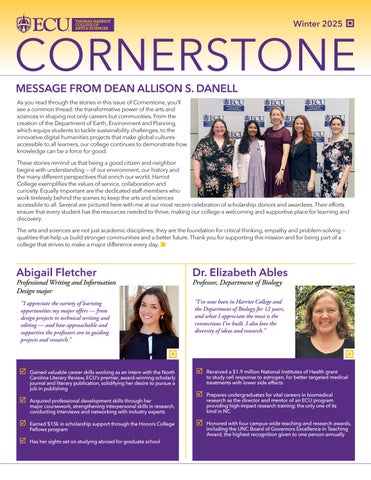
CORNERSTONE MESSAGE FROM DEAN ALLISON S. DANELL As you read through the stories in this issue of Cornerstone, you’ll see a common thread: the transformative power of the arts and sciences in shaping not only careers but communities. From the creation of the Department of Earth, Environment and Planning, which equips students to tackle sustainability challenges, to the innovative digital humanities projects that make global cultures accessible to all learners, our college continues to demonstrate how knowledge can be a force for good. These stories remind us that being a good citizen and neighbor begins with understanding — of our environment, our history and the many different perspectives that enrich our world. Harriot College exemplifies the values of service, collaboration and curiosity. Equally important are the dedicated staff members who work tirelessly behind the scenes to keep the arts and sciences accessible to all. Several are pictured here with me at our most recent celebration of scholarship donors and awardees. Their efforts ensure that every student has the resources needed to thrive, making our college a welcoming and supportive place for learning and discovery. The arts and sciences are not just academic disciplines; they are the foundation for critical thinking, empathy and problem-solving — qualities that help us build stronger communities and a better future. Thank you for supporting this mission and for being part of a college that strives to make a major difference every day.
Abigail Fletcher
Professional Writing and Information Design major
Dr. Elizabeth Ables Professor, Department of Biology
“I appreciate the variety of learning opportunities my major offers — from design projects to technical writing and editing — and how approachable and supportive the professors are in guiding projects and research.”
“I’ve now been in Harriot College and the Department of Biology for 12 years, and what I appreciate the most is the connections I’ve built. I also love the diversity of ideas and research.”
R Gained valuable career skills working as an intern with the North
R Received a $1.9 million National Institutes of Health grant
Carolina Literary Review, ECU’s premier, award-winning scholarly journal and literary publication, solidifying her desire to pursue a job in publishing
to study cell response to estrogen, for better targeted medical treatments with lower side effects
R Prepares undergraduates for vital careers in biomedical
major coursework, strengthening interpersonal skills in research, conducting interviews and networking with industry experts
research as the director and mentor of an ECU program providing high-impact research training; the only one of its kind in NC
R Earned $15k in scholarship support through the Honors College
R Honored with four campus-wide teaching and research awards,
R Acquired professional development skills through her
Fellows program
R Has her sights set on studying abroad for graduate school
including the UNC Board of Governors Excellence in Teaching Award, the highest recognition given to one person annually
FOSTERING STUDENT LEADERSHIP Acquiring Skills through Digital Humanities Projects
Seeing historic locations with one’s own eyes, hearing sounds of a bustling city, feeling cobblestone walkways underfoot, and smelling and tasting delicacies from a foreign culture are experiences that last a lifetime. Digital humanities The Buenos Aires Museum seeks to create a bridge between the past, present and future of the city. (Contributed photos) is a revolutionary step in the way students Student roles included an artifact compilation manager, artifact experience classes, encompassing all the senses and allowing curators, written caption coaches, audio caption coaches, a students to collaborate and work together to create a project that production manager and a mapping expert. Locations visited goes beyond print media. included numerous museums, a political building, a café, an opera house, a cemetery and an artist’s gallery, among others. Mikaela Trank played a significant role in the creation of a digital humanities geo-map of Buenos Aires, Argentina, after a study “My favorite location was probably Teatro Colón — a large theater abroad trip in 2024. She acquired leadership, technology and that took more than 20 years to build,” said Trank, who served as accessibility skills through the project. Now, she is using the the mapping expert, programming all the data into the ArcGIS digital map to impart knowledge to the next generation, sharing software used to develop the digital map. “It was stunning.” its content with approximately 200 fifth- through eighth-grade students whom she teaches Spanish to at Saint Peter Catholic An important part of the project was to make the digital map, School in Greenville. containing 14 locations, accessible to all individuals. “Everyone has the right to learn, no “Everyone has the right to learn, matter what,” Trank said. “If you have a no matter what” disability, it should never prohibit – Trank you from learning, ECU graduate student growing as a person or learning about a culture that you have an interest in.” “Building a community of learners and people who care about access to information in the digital world is incredibly important,” educational technology support technician Lily Johnson said. “Now, Mikaela gets to present and share geo-mapping with her students. It is education for the future generation.” Levi Altstaedter said the mapping projects have become a staple of her study abroad programs. She hopes to continue them if resources allow, even though they may evolve. “This was a wonderful program,” Trank said. “I’m so glad to have been a part of it. I would love to see more people do geo-maps in the future.” ECU student, Sarah Chambers, stands under an art exhibit of umbrellas called the Solar de French.
“To take a map of this beautiful place that I was able to visit and bring it back to share with my students so they can see these sites from a different perspective — and not just a Google search — was super important,” said Trank, a 2025 ECU alumnus now seeking her master’s degree in Hispanic studies. The “Digital Humanities Buenos Aires Project” evolved from previous digital humanities mapping activities led by Dr. Laura Levi Altstaedter, associate professor in the Department of Foreign Languages and Literatures. “We wanted all the students to have a key role in sharing responsibility,” said Levi Altstaedter, who was able to support the students’ work through a Truist, formerly BB&T, Active Learning and Leadership Development grant.
2
The Xul Solar museum features the work of artist Oscar Agustín Alejandro Schulz Solari.
Consider supporting Thomas Harriot College of Arts and Sciences by making a donation online at ec
MARITIME ARCHAEOLOGIST NAMED DISTINGUISHED PROFESSOR Boosting ECU’s Mission
Dr. Nathan Richards, professor in the Department of History and the Program in Maritime Studies, was named Harriot College distinguished professor at the college’s annual convocation. “I was in a state of shock about it for days,” Richards said. “This wasn’t something I thought would ever happen to me.” The designation of distinguished professor is the highest honor within the college. It is conferred upon a professor whose career exemplifies a commitment to and a love for knowledge and academic life as demonstrated by outstanding teaching and advising, research and creative productivity, and professional service. Dean Danell said she was inspired and impressed by Richards’ long and storied career. “Nathan’s nomination package offered a compelling view of just how prolific his work has been, positioning him as a leader in maritime archaeology. Colleagues supporting his nomination categorized him as an ‘ideal faculty member, serving his discipline, department, program, community and university.’ This kind of praise is indeed beautifully aligned with the teaching, research and service missions of ECU,” she said. Richards began working at ECU in 2003 after moving to the United States from Australia. He has impacted hundreds of high-caliber students, particularly through summer field schools in maritime history and underwater archaeology. In addition, he teaches courses in management of coastal cultural resources, history and theory of maritime archaeology, and advanced methods and research methodology in maritime archaeology.
Beyond teaching, Richards has advised 50 master’s students — the most by one person in the program’s history — and he frequently coauthors books and articles with students. His research covers the gamut from 19th and 20th century maritime history, battlefield archaeology, ship conservation, coastal infrastructure and cultural heritage management. His most Dr. Nathan Richards, professor notable contributions are on shipwrecks, in the Department of History and the Program in Maritime for which he is internationally Studies, is a Harriot College recognized. Additionally, he has distinguished professor. supported maritime studies research at (Photo by Rhett Butler) ECU with 25 externally funded grants totaling more than $1 million. One of Richards’ colleagues wrote in a letter of support, “I remain inspired and motivated by Dr. Richards’ compassionate leadership, committed professorship and mentorship, exemplary scholarship and dedicated service, as he is a model for us all.”
Richards sits inside a partially submerged vessel as ECU maritime studies graduate student Liam O’Brien and integrated coastal sciences doctoral student Allyson Ropp measure and take notes. (Photo by Rebecca Kelley)
DEPARTMENT OF EARTH, ENVIRONMENT AND PLANNING Prioritizing Student Success, Communities, Sustainability In spring 2025, ECU Chancellor Philip Rogers approved a request to merge two departments within Harriot College. The Department of Geography, Planning and Environment and the Department of Geological Sciences are now the Department of Earth, Environment and Planning (DEEP). The department will continue to emphasize the importance of students’ skills, hands-on research and career-readiness, all while addressing challenges that have an impact in eastern North Carolina. “We are grateful for the strong support of Harriot College throughout this journey, and we look forward to building on our strengths to support the college’s and university’s missions,” said Dr. Jeff Popke, professor and chair of DEEP. “The merger has a lot of potential — bringing faculty together who can make interdisciplinary collaboration more accessible for students,” said Giuliana Roccisano, a 2023 ECU alumna now pursuing her Master of Science in geology. One of the many benefits of the merger includes a new Bachelor of Science in environmental studies, a rapidly growing major built on the complementary nature of departmental disciplines. Students will also continue to acquire skills needed to be successful, including undergraduate research and mentoring opportunities. Samuel McCormack, a senior pursuing a Bachelor of Science in community and regional planning and a Bachelor of Science
in geography, said, “The students are enthusiastic to bring meaningful change to eastern North Carolina, and innovative research that prepares communities for our ever-evolving landscape.”
Samuel McCormack and other Department of Earth, Environment and Planning students volunteer in the community, including cleaning up the gardens at Alice Keene Park. (Contributed photo)
“I am immensely proud of the time, thought and care our faculty devoted to developing this new unit,” said Dean Danell. “Change is not always easy, but it is essential to our progress. What hasn’t changed is that faculty and staff have remained steadfast in their commitment to student success. What’s new is the exciting and innovative environment they have created — one focused on something vital to us all — the future of our planet.” To explore ways you can continue to support the department, student success and scholarships, contact Director of Alumni Relations and Outreach, Ashley Harzog, at clelanda18@ecu.edu. Giuliana Roccisano explored the landscape of Puerto Rico during a spring summit offered through the department. (Contributed photo)
u.edu/give. Stay in touch with Harriot College by phone at 252-328-6249 or email at thcas@ecu.edu.
3
Nonprofit U.S. Postage
PAID
1002 Bate Building Mail Stop 511 East Carolina University® Greenville, NC 27858-4353
Permit #110 Greenville, NC
ALUMNI SPOTLIGHT
Joseph Kaloko, BA in Chemistry and BS in Biochemistry ’03, MS in Chemistry ’05 At any opportunity, Joseph Kaloko praises ECU, Greenville and North Carolina, and he is excited to share the journey that led him here. The son of immigrant parents from Sierra Leone, Kaloko settled in Virginia, tested into the 11th grade and graduated from high school all by the age of 15. His family dreamt of him becoming a doctor, and a friend in Virginia who attended ECU and saw Kaloko’s potential, encouraged him to visit ECU for a campus tour. One cold December, after a shift at his job at a TGI Friday’s, Kaloko drove through the night to arrive in Greenville in the wee hours of the morning. After his campus tour and some initial reflection, he applied to ECU and the rest, so to speak, is history. During his first semester organic chemistry course, Kaloko realized he preferred the research side of his studies and ultimately decided to pursue advanced studies in science instead of medicine. This allowed Kaloko to use biotechnology and pharma research and discovery to work on lifesaving medicines. The mentors he worked with in the Department of Chemistry helped Kaloko develop valuable research and career skills. He participated in high-impact practices as an undergraduate research and teaching assistant, specifically learning how to make molecules and test them on different disease targets in the lab. The summer before graduating, he also served as an intern at DSM Pharmaceuticals. Kaloko said his experiences with the chemistry department prepared him for graduate school and beyond.
“I continue to use the skills I learned at ECU in my everyday life,” he said. This is evident in Kaloko’s current position as director and head of chemical development at Revagenix, Inc., a biotechnology company in San Francisco that develops antibiotics to combat antimicrobial resistance. In this role, Kaloko uses his knowledge of chemical elements and past scientific experiences combining molecules to develop active ingredients in drug compounds. He also focuses on the purity of the drug and the safety of administration. The ingredients he is responsible for making are directly linked to helping make patients better. “I enjoy my work,” he said. “But most importantly, I am contributing to making the world a healthier and better place.” This fall, Kaloko joined Harriot College’s Dean’s Avancement Council, where he will continue to advocate for ECU, Harriot College and the Department of Chemistry. He serves as a mentor to students who can pursue the same path in research, development or manufacturing of pharmaceuticals in North Carolina’s Research Triangle Park or Biopharma Crescent. “I am a proud ECU Pirate™, and the university and Greenville will always hold a very special place in my heart,” Kaloko said.
Visit our website at https://thcas.ecu.edu Printed on recycled paper. 2,000 copies of this public document were printed at a cost of $1,553.99 or $0.77 per copy.