PROGRAM: Symphonic PFunk: Celebrating The Music of Parliment Funkadelic

Page 1


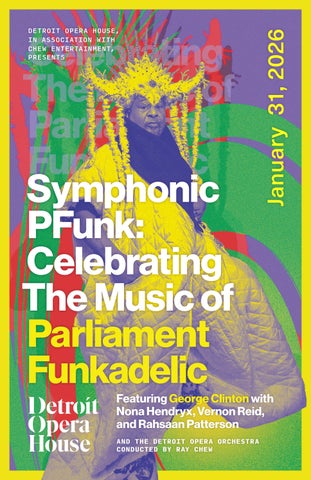
DETROIT OPERA HOUSE, IN ASSOCIATION WITH CHEW ENTERTAINMENT, PRESENTS

Symphonic PFunk: Celebrating The Music of Parliament Funkadelic

January 31, 2026

Featuring George Clinton with Nona Hendryx, Vernon Reid, and Rahsaan Patterson

AND THE DETROIT OPERA ORCHESTRA CONDUCTED BY RAY CHEW

DETROIT OPERA HOUSE IN ASSOCIATION WITH CHEW ENTERTAINMENT PRESENTS:

RAY CHEW | MUSIC DIRECTOR/CONDUCTOR/PRODUCER

VIVIAN SCOTT CHEW | PRODUCER/CREATIVE DIRECTOR

CHARLIE WADE | PRODUCER

Parliament Funkadelic Musicians

DANNY BEDROSIAN

BENZEL COWAN

LIGE CURRY

GABE GONZALEZ

MICHAEL HAMPTON

MICHAEL “CLIP” PAYNE

GARRETT SHIDER

GREG THOMAS

Parliament Funkadelic Singers

SHEILA BRODY AMUKA

PAUL HILL

TONYSHA NELSON

BRANDI SCOTT

Production

SHONDA CLINTON

JASON DRENNON

BARRY EPPERSON

Chew Entertainment

TERYN CHAMBERLAIN | PROJECT MANAGER

JAYNELL GRAYSON | PRODUCTION MANAGER

NICK JUZDAN | VISUALS

SPECIAL THANK YOU TO BARBARELLA BISHOP CROFT, ARCHIE IVY, TOYA HANKINS, NJIA KAI SHAMBLORD, ASYA SHEIN, DRAKE PHIFER

VISIT DETROITOPERA.ORG FOR ADDITIONAL CREW AND STAFF.

GEORGE CLINTON

Recording both as Parliament and Funkadelic, George Clinton revolutionized R&B during the ’70s, twisting soul music into funk by adding influences from several late-’60s acid heroes: Jimi Hendrix, Frank Zappa, and Sly Stone. The Parliament/Funkadelic machine ruled Black music during the ’70s, capturing over 40 R&B hit singles (including three number ones) and recording three platinum albums.

Born in Kannapolis, NC, on July 22, 1941, Clinton became interested in Doowop while living in New Jersey during the early ’50s. Basing his group on Frankie Lymon & the Teenagers, Clinton formed The Parliaments in 1955, rehearsing in the back room of a Plainfield barbershop where he straightened hair. The Parliaments released only two singles during the next ten years, but frequent trips to Detroit during the mid-’60s—where Clinton began working as a songwriter and producer—eventually paid off their investment.

The Parliaments finally had a hit with the 1967 single “(I Wanna) Testify” for the Detroit-based Revilot Records, but the label ran into trouble and Clinton refused to record any new material. Instead of waiting for a settlement, Clinton decided to record the same band under a new name: Funkadelic. Founded in 1968, the group began life as a smoke screen, claiming as its only members the Parliaments’ backing but in truth including Clinton and the rest of the former Parliaments lineup. Revilot folded not long after, with the label’s existing contracts sold to Atlantic; Clinton, however, decided to abandon the Parliaments name rather than record for the major label.

By 1970, George Clinton had regained the rights to The Parliaments name: he then signed the entire Funkadelic lineup to Invictus Records as Parliament . The group released one album—1970’s Osmium—and scored a number 30 hit, “The Breakdown,” on the R&B charts in 1971. With Funkadelic firing on all cylinders, however, Clinton decided to discontinue Parliament (the name, not the band) for the time being.

Inspired by Motownʼs assembly line of sound, George Clinton gradually put together a collective of over 50 musicians and recorded the ensemble during the ’70s both as Parliament and Funkadelic. While Funkadelic pursued band-format psychedelic rock, Parliament engaged in a funk free-for-all,

blending influences from the godfathers (James Brown and Sly Stone) with freaky costumes and themes inspired by ’60s acid culture and science fiction. From its 1970 inception until Clinton’s dissolving of Parliament in 1980, Clinton hit the R&B Top Ten several times but truly excelled in two other areas: largeselling, effective album statements and the most dazzling, extravagant live show in the business. In an era when Philly soul continued the slick sounds of establishment-approved R&B, Parliament/Funkadelic scared off more white listeners than it courted. (Ironically, today Clinton’s audiences are a cross-cultural mix of music lovers from 8 to 80.)

1978-79 was the most successful year in Parliament/Funkadelic history: Parliament hit the charts first with “Flash Light,” P-Funk’s first R&B number one. “Aqua Boogie” would hit number one as well late in the year, but Funkadelic’s title track to “One Nation Under a Groove” spent six weeks at the top spot on the R&B charts during the summer. The album, which reflected a growing consistency in styles between Parliament and Funkadelic, became the first Funkadelic LP to reach platinum (the same year that Parliament’s “Funkentelechy Vs. the Placebo Syndrome” did the same). In 1979, Funkadelic’s “(Not Just) Knee Deep” hit number one as well, and its album (“Uncle Jam Wants You”) also reached platinum status.

During 1980, Clinton began to be weighed down by legal difficulties arising from PolyGram’s acquisition of Parliament’s label, Casablanca. Jettisoning both the Parliament and Funkadelic names (but not the musicians), Clinton began his solo career with 1982’s “Computer Games.” Several months later, Clinton’s “Atomic Dog” hit number one on the R&B charts; it stayed at the top spot for four weeks, but only managed number 101 on the pop charts. Clinton stayed on Capitol for three more years, releasing three studio albums and frequently charting singles in the R&B Top 40.

Clinton and many former Parliament/Funkadelic members continued to tour and record throughout the ’80s as the P-Funk All Stars, but the decade’s disdain of everything to do with the ’70s—especially the sound of disco—resulted in critical and commercial neglect for the world’s biggest funk band, one which in part had spawned dance music.

During much of the three-year period from 1986 to 1989, Clinton became embroiled in legal difficulties (resulting from the myriad royalty problems latent during the ’70s with recordings of over 40 musicians for four labels under three names). Also problematic during the latter half of the ’80s was Clinton’s disintegrating reputation as a true forefather of rock; by the end of the decade, however, a generation of rappers reared on P-Funk were beginning to name-check him.

The early ’90s saw the rise of funk-inspired rap (courtesy of Digital Underground, Dr. Dre, and Warren G.) and funk rock (Primus and Red Hot Chili Peppers) that re-established the status of Clinton & co. as one of the most important forces in the recent history of black music. Clinton’s music became the soundtrack for the rap movement, as artists from MC Hammer, to LL Cool J to Snoop Doggy Dogg depended heavily on the infectious groove of Clinton productions as the foundation of their recordings.

Along with the renewed notoriety and respect, Clinton’s visibility and presence became familiar to a wider audience thanks to appearances in movies The Night Before, House Party, PCU, and Good Burger, hosting the HBO original series Cosmic Slop, and doing commercials for Apple computers, Nike, and Rio Mp3 players. Clinton also composed the theme songs for popular TV programs The Tracey Ullman Show and The PJs

Clinton has received a Grammy, a Dove (gospel), and MTV music video awards, and has been recognized by BMI, the NAACP Image Awards, and Motown Alumni Association for lifetime achievement. Clinton’s Parliament/ Funkadelic was inducted into the Rock and Roll Hall of Fame in 1997.

Over the course of Clinton’s illustrious career and success as a producer/ writer/performer, perhaps his greatest achievement stemmed from his relentless dedication to funk as a musical form. Funk as a musical style had been around for what seems like forever, deeply rooted in the music traditions of New Orleans and the Blues of the Deep South. Following the lead—and commercial success—of James Brown and Sly Stone, Clinton took Funk to new heights, blending elements of Jazz, Rock, Pop, Classical, and even Gospel into his productions, eventually developing a unique and easily identifiable style affectionately called “P-Funk.” Clinton’s inspiration, dedication, and determination resulted in the elevation of “funk” music to complete recognition and acceptance as a true genre in and of itself.

On February 16, 2012 George Clinton added to his list of accomplishments an Honorary Doctorate of Music from the renowned Berklee College of Music. Website: georgeclinton.com

RAY CHEW

Music director, composer, and producer Ray Chew’s artistic impact reaches across some of the world’s most recognized landmark specials, television series, and live events. A staple in the music industry whose credits also include producing and composing. Ray’s achievements in 2025 included being at the helm of TVs highest rated variety series and live entertainment specials including season 35 of ABC's Dancing with the Stars, and the 99th annual Macy’s Thanksgiving Parade. In 2026, Chew looks forward to returning to Carnegie Hall for “A Night of Inspiration,” both coproduced with his wife/business partner Vivian Scott Chew. Ray's previous credits include the 65th Primetime Emmy Awards, the Grammy Awards, the 2008 Democratic National Convention, Barack Obama’s Inaugural Neighborhood Ball, NAACP Image Awards, Miss Universe, Miss USA, Miss America the BET Awards, and It’s Showtime at the Apollo. Ray’s countless live performances for award-winning musical events with the world's most popular artists, including Alicia Keys, Justin Bieber, Halle Bailey, Aretha Franklin, and Prince paved the way for generations of live musicians. Ray will soon be releasing his next album project, aptly titled “My Journey.” Ray is equally as committed to his legacy in philanthropy through both the Power 2 Inspire Foundation and fundraising efforts in partnership with the American Federation of Musicians. For more information, visit power2inspire.org Instagram: @raychewlive TikTok: @raychewlive

NONA HENDRYX

Nona Hendryx is a multidisciplinary artist with 25 studio albums and featured on many more. Nona was a founding member of Labelle one third of the music trio who made the hit song “Lady Marmalade” and notably known for her work as a solo artist exploring cutting edge, experimental musical genres. She’s a Grammy nominee and the first recipient of the Joe’s Pub Vanguard Residency Award and an Ambassador for Artistry in Music for Berklee College of Music, Boston. Nona is a 2023 Open Society Foundation, Ford Foundation, and Mellon Foundation Grant Recipient supporting the Nonaverse and her Dream Machine Experience, presented at Lincoln Center June, 2024. Nona creates, develops, and presents music-driven storytelling AI/AR/VR immersive experiences. Website: nonahendryx.com

RAHSAAN PATTERSON

R&B goddess Chaka Khan has sung his praises. He has been co-billed with Earth Wind & Fire, Frankie Beverly & Maze, George Duke, and Fantasia. His songs have been recorded by Brandy, Tevin Campbell , and Shanice & Jody Watley to name a few. He has collaborated with many of the greatest female voices of his generation including Faith Evans, Ledisi, Lalah Hathaway, and Rachelle Ferrell. Authenticity has always been at the forefront of Rahsaan Patterson’s artistry. One need only look at the personal interactions he shares with his fans on social media to understand the deep connections he has forged with them throughout the years. From his eponymously titled debut in 1997 to his latest studio albums, Heroes & Gods (2019) and it’s dancefloor offspring Heroes & Gods 2.0 (reimagined) (2021), Rahsaan’s adventurous musical palette, which fuses the worlds of R&B, funk, jazz, gospel, and electronica, has continuously kept his fans on the edge of their seats. The handsome, charismatic, witty, and introspective singer/songwriter is in his 40th year of being in the entertainment industry. It has been some journey since he first landed in the national spotlight at age 10 alongside Fergie and Mario Lopez on the Disney show Kids Incorporated. One of the things that has endeared Rahsaan to critics and fans alike is his instantly recognizable voice that in its most natural state is flawless. His wideranging honey-toned and velvety smooth vocals, coupled with his unrivaled agility and his superb songwriting craftsmanship make him a standout in an era of here today-gone tomorrow artists. Website: rahsaan.com/site

VERNON REID

If you’ve followed the beats of his half-century career, you’ll know Vernon Reid as an artist who paints in every color. Depending on the era you dive into and the album on your turntable, you’ll find the New York polymath pinballing between jazz, metal, punk, funk, electronica, and hip-hop, cutting heads with collaborators as eclectic as Mick Jagger and Public Enemy, endlessly shedding his skin yet always speaking his truth. Globally celebrated as a giant of electric guitar (he was recently hailed by Rolling Stone amongst the top 50 players of all-time), Reid’s Grammy Award-winning records with alt-rock trailblazers, Living Colour, still sound as fresh and fierce as when Cult Of Personality

hijacked the Billboard chart in the late-’80s. But to take the pulse of the zeitgeist as he sees it—and hear his fearless musicality in microcosm— you need only drop the needle on his acclaimed new solo album, Hoodoo Telemetry, released October 3, 2025 on Artone/The Players Club Records. It’s true: Reid never took the path of least resistance. Born in London on August 22, 1958, to music-loving parents of the Windrush generation, within a year the family had upped and moved to New York City. He remembers the seismic shift of hearing The Beatles on The Ed Sullivan Show in 1964 and the moment a guitar called to him. “I heard Carlos Santana’s ‛Black Magic Woman’ and it entranced me.”

Just as influential were the local musicians on his block (new track “Meditation On The Last Time I Saw Arthur Rhames” salutes the “otherworldly” multi-instrumentalist from Eternity, who coached his young neighbour but died of AIDS in 1989).

By his early twenties, and already playing with rare maturity, Reid left an early thumbprint on The Decoding Society, the avant-jazz outfit helmed by charismatic, genre-crossing Texan drummer Ronald Shannon Jackson. Even then, it was obvious Reid would need other outlets to capture all the ideas ricocheting around his brain. In 1985, he released Smash & Scatteration alongside jazz talisman Bill Frisell and co-founded the Black Rock Coalition with Village Voice writer and lifelong friend Greg Tate, demanding an end to racial glass ceilings in the music business. “There was still a bunch of dudes smoking cigars,” he reflects, “in a room that you’re not allowed to go into.”

Living Colour was formulating around the same time, and Reid’s bestknown band burst into bloom on a New York live circuit that was more fluid than ever before or since. “We had an ecology of clubs to play at, from CBGBs to the Cat Club and the Ritz,” he recalls of the first steps of a solidified lineup featuring Corey Glover (vocals), Muzz Skillings (bass), and Will Calhoun (drums).

Seizing his opportunity, Reid threw everything on his mental jukebox at Living Colour ’s deathless debut, 1988’s Vivid. Sailing to #6 on the US Billboard chart—and ultimately double-platinum status—Vivid proved adventurous music could still sell by the ton. Alongside Living Colour’s six albums and counting, Reid has worn a thousand different hats since those breakout years, whether producing Grammy-nominated albums for the likes of Salif Keita, composing hit movie scores or lending his guitar skills to a who’s who including Janet Jackson, B.B. King, Tracy Chapman, and Mariah Carey. Instagram: @vurnt22

Orchestra

Detroit Federation of Musicians, Local #5, of the American Federation of Musicians

VIOLIN I

Daniel Stachyra*

Interim Concertmaster

Yuri Popowycz*

Acting Asst. Concertmaster

Beth Kirton*

Molly Hughes*

Anna Bittar-Weller*

Mallory Tabb

Courtney Lubin

David Ormai

VIOLIN II

Jenny Wan*

Acting Principal

Velda Kelly*

Solveig Geenen*

Bryan Johnston*

Valissa Willwerth

Jennifer Berg

VIOLA

John Madison* Principal

Scott Stefanko*

Chloé Thominet*

Jacqueline Hanson*

CELLO

Megan Yip

Acting Principal

Alon Hayut

Andrew McIntosh

Robert Reed

BASS

Derek Weller* Principal

Clark Suttle*

HARP

Juan Riveros* Principal

FLUTE

Dennis Carter II

Acting Principal

Alexander Day

OBOE

Eli Stefanacci* Principal

Mark Doerr*

CLARINET

Georg Klaas Acting Principal

J.William King*

BASSOON

Daniel Fendrick* Principal

SAXOPHONE

James Hughes Alto 1

Marcus Elliot Alto 2

Christopher Collins Tenor 1

Keith Kaminski

Tenor 2

Andrew Bishop

Baritone

HORN

Mary Beth Orr

Acting Principal

Natalie Sweasy*

TRUMPET

Ric Wolkins

Acting Principal

Elijah Leonard*

Derek Lockhart

Ross Turner

TROMBONE

Jordan Dove* Principal Chris Glassman

TIMPANI

Eric Stoss* Principal PERCUSSION

* Detroit Opera Core Orchestra Member

John Dorsey* Principal

Administration & Staff

LEADERSHIP

Patty Isacson Sabee, President & CEO

Yuval Sharon, Barbara Walkowski Artistic Director

Roberto Kalb, Music Director

Daniel T. Brinker, General Manager, Detroit Opera House & Parking Center

Shawn Rieschl Johnson, Chief Programming & Production Officer

Jon Teeuwissen, Artistic Advisor for Dance

Samantha Teter, Chief Marketing Officer

Ataul Usman, Senior Director of Human Resources

ADMINISTRATION

William Austin, Executive Assistant

ARTISTIC DEPARTMENT

Nathalie Doucet, Head of Music & Director of Detroit Opera Resident Artist Program

Elizabeth Anderson, Artistic Administrator

DANCE

Kim Smith, Dance Administrator

DETROIT OPERA YOUTH CHORUS

Twannette Nash, Chorus Administrator

Jane Arvidson Panikkar, Preparatory Chorus Conductor

Rebecca O-G Eaddy, Principal Chorus Conductor

Maria Cimarelli, Preparatory Chorus Accompanist

Joseph Jackson, Principal Chorus Accompanist

DEVELOPMENT

Juliano Bitonti Stewart, Director of Development

Chelsea S. Kotula, Director of Institutional Giving

Katrina Fasulo, Director, Individual Giving & Donor Engagement

Angela Nelson-Heesch, Director, Data Analytics & Operations

Valentino Peacock, Manager of Data & Operations

Demetrius Shields, Manager of Individual Giving

Stephani Davis, Development Coordinator

EDUCATION

Branden Hood, Director of Education

Alaina Brown, Program Coordinator: Education & Community Programs

Eliza Beutler, Program Administrator

FACILITIES

Vanessa Boyd, Facilities Manager

Juan Benavides, Building Engineer

Kevie Crumb, Facilities & Event Technician

FINANCE

Kimberley Burgess, Accountant

Rita Winters, Accountant

HUMAN RESOURCES

Denver Harvey, Human Resources Coordinator

MARKETING/COMMUNICATIONS

Leah Hill, Director of Marketing

Anna Herscher, Lead Graphic Designer

Jennifer Melick, Communications & Media Relations Manager

Deirdre Michael, Website Administrator

Austin Richey, Digital Media Manager & Storyteller

Arthur White, Director of Community & Audience Engagement Position is supported by the John S. and James L. Knight Foundation

MUSIC

DEPARTMENT

Katherine Kozak, Chorus Director & Music Administrator

Molly Hughes, Orchestra Personnel Manager

Jean Posekany, Orchestra Librarian

PRODUCTION

Elizabeth Anderson, Production Coordinator

Kathleen Bennett, Production Finance Administrator

Jeff Beyersdorf, Technical Director

Eden Cope, Assistant Technical Director

Brian Dambacher, Production Manager

Monika Essen, Property Master

Suzanne Hanna, Costume Director

Kaila Madison, Technical Assistant

Brodrick Whittley, Assistant Technical Director

COSTUMES

Michaela Tanksley, Wardrobe Supervisor

Patricia Sova Jr., First Hand

Mary Ellen Shuffett, Fitting Assistant

Eileen Thorna , Tailor

Maureen Abele, Paul Moran, Lupe Vazquez, Stitchers

WIGS & MAKEUP

Erika Broderdorf, Wig & Makeup Crew Coordinator

STAGE CREW

John Kinsora, Head Carpenter

Jerome Bowie, Head Electrician

Pat McGee, Head Propertyman

Chris Baker, Head of Sound

Pat Tobin, Head Flyman

Dee Dorsey, Surtitle Operator

Mary Ellen Shuffett, Head of Wardrobe

IATSE Local #38 Stage Crew

IATSE Local #786 Wardrobe

SAFETY AND SECURITY

Rock Monroe, Director of Safety & Security

Lieutenant Lorraine Monroe

Sergeant Demetrius Newbold

Officer Gary Cabean

Officer A.M. Hightower

Officer Michelle Johnson

Officer Terrence Hunter

Officer Khalil Nalis

TICKETING & BOX OFFICE

Amy Brown, Director of Ticketing and Booking

Stephanie Stoiko, Box Office Manager

Evan Carr, System Administrator

Alex Robinson, Box Office Associate

Chris Simpson, Box Office Associate

Ellen Smith, Group Sales Associate

VENUE OPERATIONS

Alexis Means, Director of Operations & Patron Experiences

Holly Clement, Senior Manager of Events & Rentals

Jennifer George-Consiglio, Manager of Venue Operations

Michael Hauser, Curator of History & Architecture

Kathie Booth, Volunteer Coordinator

USHERS

Max Aghili, Christine Berryman, Ellen Bishop, Kathie Booth, Lori Burkhardt, Randall Davis, Erin Doakes, Suzanne Erbes, Pamela Fergusson, Sue Hargrave, Myrna Mazure, Ennis Mcgee, Steven McReynolds, Heddie O’Connor, Bill Ried, Kim Ried, Edna Rubin, Ida Vance, Sheryl Weinan-Yee

IN CASE OF EMERGENCY

Please observe the lighted exit signs located throughout the theater. In the event of an emergency, remain calm and walk, do not run, to the nearest exit. Ushers and security personnel are trained to assist. An emergency medical technician (EMT) is on-site during most events. Contact an usher or staff member if you need medical assistance.

GUEST SERVICES:

Vincent Lobby and Broadway Lounge

There are a variety of amenities for your comfort and use located in both guest services locations. Wheelchairs, booster seats*, earplugs, assisted listening devices, feminine hygiene products, basic first aid items, and more are complimentary and available for your convenience. Coat check is also available. The Vincent Lobby is located on the Madison Street side of the building and the Broadway Lounge is located on the Broadway Street side of the building.

*Limited quantity

PHOTOGRAPHY, RECORDING, AND CELL PHONE USE

Photography and/or recording during any performance is strictly prohibited. Photographs taken in the lobby areas, before or after a performance, and during intermission are welcome. As a courtesy to all guests, please turn off all electronic devices and refrain from use during the performance.

RESTROOMS

Women’s restrooms are located off the Ford Lobby (Broadway Street entrance) and down the stairs, and on third floor (Madison Street entrance). Men’s restrooms are located under the Grand Staircase and on the third floor (Broadway Street side). There are two sets of elevators or stairs available to access all third-floor restrooms. All third-floor restrooms are wheelchair accessible (women’s restroom, press 3R in the elevator). There are single-use unisex wheelchair accessible restrooms on the first floor of the Broadway Street side of the building and the Madison Street side of the building. There is also a wheelchair accessible women’s restroom on the Broadway Street side of the building.

NO SMOKING

The Detroit Opera House is a non-smoking facility. This includes e-cigarettes, vapes, and other “smokeless” products.

USHERS

Ushers are stationed throughout the building to assist patrons as needed. Please direct questions, concerns, and feedback to them during your visit. Enjoy volunteering? Please go to guest services or the Detroit Opera website, DetroitOpera.org/support/volunteer, for information on becoming a volunteer.

LOST AND FOUND

During the performance, lost and found is located in guest services. Unclaimed items are logged and taken to the Safety and Security office after each performance. To inquire about a misplaced or lost item, please call 313.961.3500. Items left over 30 days will be discarded or donated.

RECORDING IN PROGRESS

Entry and presence on the event premises constitute your consent to be photographed, filmed, and/or otherwise recorded, and to the release, publication, exhibition, or reproduction of any and all recorded media for any purpose whatsoever in perpetuity in connection with Detroit Opera and its initiatives. By entering the event premises, you waive and release any claims you may have related to the use of recorded media of you at the event.

Turn static files into dynamic content formats.

Create a flipbook
Issuu converts static files into: digital portfolios, online yearbooks, online catalogs, digital photo albums and more. Sign up and create your flipbook.