(ebook pdf) organizational behaviour understanding managing 10th - Quickly download the ebook to exp

Page 1


(eBook PDF) Organizational Behaviour Understanding Managing 10th download

https://ebookluna.com/product/ebook-pdf-organizational-behaviourunderstanding-managing-10th/

ORGANIZATIONAL BEHAVIOUR

UNDERSTANDING AND MANAGING LIFE AT WORK GARY JOHNS ALAN M. SAKS

● YOU BE THE MANAGER

Are Attitudes?

Is Job Satisfaction?

What Determines Job Satisfaction?

Discrepancy 137 Fairness 138 Disposition 140 ● GLOBAL FOCUS

The Importance of Fairness Universal Across Cultures?

Mood and Emotion 141 Some Key Contributors to Job Satisfaction 143

of Job Satisfaction

Absence from Work 144 Turnover 145 Performance 147 Organizational Citizenship Behaviour 148

Contributors to Organizational Commitment 150 Consequences of Organizational Commitment 150 Changes in the Workplace and Employee Commitment 151

● THE MANAGER’S NOTEBOOK

Characteristics of Motivation 160 Extrinsic and Intrinsic Motivation 161 Motivation and Performance 162 The Motivation–Performance Relationship 164

Theories of Work Motivation

Maslow’s Hierarchy of Needs 165 Alderfer’s ERG Theory 166 McClelland’s Theory of Needs 167 Research Support for Need

Expectancy Theory 171 Research Support for Expectancy Theory 173 Managerial Implications of Expectancy Theory 173 Equity Theory 174 Research Support for Equity Theory 175 Managerial Implications of Equity Theory 175 Goal Setting Theory 176

Group Identification and Intergroup Bias 464 Interdependence 465 Differences in Power, Status, and Culture 465 Ambiguity 466 Scarce Resources 466

Avoiding 468 Accommodating 468 Competing 468 Compromise 468 Collaborating 469

Conflict with Negotiation

Distributive Negotiation Tactics 470 Integrative Negotiation Tactics 471 Third-Party Involvement 473

474 Stress 474 Stress Reactions 475

and Stress 475

in Organizational Life

Executive and Managerial Stressors 476 Operative-Level Stressors 477 Boundary Role Stressors, Burnout, and Emotional Labour 478 The Job Demands–Resources Model and Work Engagement 479 Some General Stressors 480

● RESEARCH FOCUS Get Smarty Pants

● YOU BE THE MANAGER Bullying at Veterans Affairs 483 Reactions to Organizational Stress

Behavioural Reactions to Stress 485 Psychological Reactions to Stress 487 Physiological Reactions to Stress 488

Organizational Strategies for Managing Stress 488 Job Redesign 488 “Family-Friendly” Human Resource Policies 489 Stress Management Programs 489

● APPLIED FOCUS

Vancity Offers Family-Friendly Policies 490 Work–Life Balance, Fitness, and Wellness Programs 491

● THE MANAGER’S NOTEBOOK

The External Environment of Organizations

Organizations as Open Systems 503 Components of the External Environment 503 Environmental Uncertainty 505 Resource Dependence 507

Vertical Division of Labour 510 Horizontal Division of Labour 511 Departmentation 512 Basic Methods of Coordinating Divided Labour 516 Other Methods of Coordination 517

Span of Control 518 Flat versus Tall 519 Formalization 519 Centralization 520 Complexity 521 Size and Structure 521

● APPLIED FOCUS

Ambidextrous Organization 524

● YOU BE THE MANAGER Zappos New Organizational Structure

Network and Virtual Organizations 526 The Modular Organization 527 Other Forms of Strategic Response 528

● THE MANAGER’S NOTEBOOK

● Integrative Case: Ken Private Limited: Digitization Project

Chapter 1:

● positive organizational behavior

● Chapter-Opening Vignette: Vega

● Research Focus box: Collective Organization Engagement

● Applied Focus box: Mental Health at Wellington County

● Case Study: Argamassa Construction Materials

Chapter 2:

● Chapter-Opening Vignette: Naheed Nenshi

● Research Focus box: Personality and Adaptive Performance

● Case Study: Roaring Dragon Hotel

Chapter 3:

● LGBT stereotypes

● Chapter-Opening Vignette: RBC

● Applied Focus box: Police Anti-Bias Training

● Case Study: LGBTA at TD Bank

Chapter 4:

● cultural distance and cultural intelligence

● Chapter-Opening Vignette: Facebook

● You be the Manager box: Carlsberg Group

Chapter 5:

● expanded coverage of self-determination theory (e.g., autonomy support)

● Chapter-Opening Vignette: DevFacto Technologies

● Research Focus box: Challenging Goals and Business Unit Performance

● Ethical Focus box: The Dark Side of Goal Setting

● Case Study: Kyle Evans at Ruffian Apparel: Staffing a Retail Establishment

Chapter 6:

● flexible work arrangements

● Updated Chapter-Opening Vignette: EllisDon

● Research Focus box: Improving the “Line-of-Sight” in Pay-for-Performance Programs

● You Be the Manager: Retention Bonuses at SNC-Lavalin

● Case Study: Dr. Jack Perry

Chapter 7:

● Research Focus box: Supporting Teamwork on the Mission to Mars

● Applied Focus box: Virtual Teams at Save the Children

● Case Study: Levi Strauss & Co.’s Flirtation with Teams

Chapter 8:

● person-group (PG) fit

● Chapter-Opening Vignette: Kicking Horse Coffee

● Research Focus box: The Discriminatory Gap in University Mentoring

● Case Study: The Wonderful World of Human Resources at Disney

Chapter 9:

● role congruity theory

● Chapter-Opening Vignette: Sergio Marchionne (Fiat Chrysler Automobiles)

● Research Focus box: Narcissism and Leadership

● Research Focus box: Empowering Leadership and Newcomer Creativity

● You Be the Manager: Leadership at the CBC

● Case Study: Radio Station WEAA: Leading in a Challenging Situation

Chapter 10:

● enterprise social media

● Chapter-Opening Vignette: Toronto Sick Kids Hospital

● You Be the Manager: Communicating Diversity and Inclusion at Ryder

● Research Focus box: Red Sneakers Effect

Chapter 11:

● crowdsourcing

● evidence-based management

● big data

● Applied Focus box: Target Decision Errors

● Applied Focus box: Crowdsourcing

● Case Study: The Admissions Dilemma

Chapter 12:

● effects of extreme performance pressure on ethical lapses

● Research Focus box: Are you more moral in morning?

● Case Study: To Tell the Truth

Chapter 13:

● Chapter-opening Vignette: Orange France

● Research Focus box: Get Smarty Pants

● Applied Focus box: Vancity family-friendly

Chapter 14:

● Holacracy organizational structure

● Chapter-Opening Vignette: McDonald’s

● You be the Manager: Zappos

● Case Study: Chris Peterson at DSS Consulting

Chapter 15:

● Chapter-Opening Vignette: Microsoft’s Struggle

● You Be the Manager: Transforming 3M culture

● Applied Focus box: Guests Help Hotels Innovate

● Case Study: ION Consulting: The MP^2 Training Program

We have updated many other areas throughout the text with the most current and recent research from the practising management literature, academic literature, and the popular and business press. We have also replaced the content of many of the features and added new ones. In total, the tenth edition contains 11 new chapter-opening vignettes, 19 new “Focus” boxes, and 6 new “You Be the Manager” features. These features have been carefully chosen to represent current and exciting examples of organizational behaviour. Of those examples that we have retained from the ninth edition, many have been substantially updated.

In addition to new and updated content, the tenth edition includes several new exhibits. For example, Chapter 4 includes new data on what contributes to employee job satisfaction (Exhibit 4.7); Chapter 6 includes an exhibit showing the contingency factors to consider for the motivational practices discussed in the chapter (Exhibit 6.9); Chapter 9 includes a model of leadership styles, situational factors, and leader effectiveness (Exhibit 9.10); and Chapter 12 includes new data on observed ethical misconduct (Exhibit 12.6).

Finally, in the end-of-chapter material, there are thirteen new case studies, three new case incidents, and two new experiential exercises.

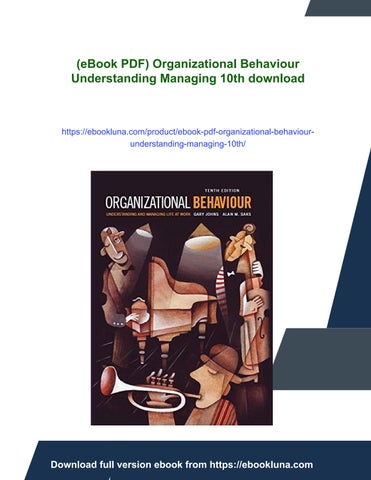
ABOUT THE COVER

The cover of the tenth edition of Organizational Behaviour: Understanding and Managing Life at Work, along with the pictures throughout the text, features musicians from a performing jazz band. What does a jazz band have to do with organizational behaviour? A great deal! Jazz has been used as a metaphor for organizations and organizational behaviour for many years.

In 1998, the journal Organizational Science published a special issue on jazz improvisation as a metaphor for organizations (vol. 9, no. 5), a result of a symposium called “Jazz as a Metaphor for Organizing in the Twenty-First Century” that was held at the 1995 Academy of Management Conference in Vancouver, British Columbia. The idea was to think about the twenty-first-century organization in the context of the jazz metaphor for organizing. The jazz metaphor has also been adopted by some organizations. In its 1996 annual report, the LEGO Corporation featured its topmanagement team as a jazz ensemble, with the CEO playing the saxophone—the CEO wanted to highlight the importance of improvisation at all levels of management.

Organizations and organizational behaviour are like jazz in many ways. Jazz involves improvisation, innovation, and flexibility, all of which are important attributes of individuals and groups in organizations as well as organizations themselves. Organizations and the people in them must be flexible and capable of innovation and improvisation to survive and adapt to change. Innovation and flexibility are especially important for contemporary organizations.

In his book Leadership Jazz, Max De Pree argues that leadership in organizations is like a jazz band: “Jazz-band leaders must choose the music, find the right musicians, and perform—in public. But the effect of the performance depends on so many things—the environment, the volunteers playing in the band, the need for everybody to perform as individuals and as a group, the absolute dependence of the leader on the members of the band, the need of the leader for the followers to play well. What a summary of an organization!”

Finally, as noted by Mary Jo Hatch, one of the chairs of the jazz symposium, the characteristics that are associated with the twenty-first-century organization are very similar to those of a jazz band: It is flexible, adaptable, and responsive to the environment, and it has loose boundaries and minimal hierarchy. Organizational behaviour is very much like a jazz band—individuals working together in the spirit of innovation, improvisation, and inspiration.

GENERAL CONTENT AND WRITING STYLE

Organizational Behaviour, Tenth Edition, is comprehensive—the material is authoritative and up to date and reflects current research and practical concerns. Both traditional subjects (such as expectancy theory) and newer topics (like workplace spirituality, positive organizational behaviour, cyberbullying, whistle-blowing, servant leadership, virtual teams, collective efficacy, emotional intelligence, creative deviance, and crowdsourcing) are addressed. Balanced treatment is provided to micro topics (covered in the earlier chapters) and macro topics (covered in the later chapters).

Although Organizational Behaviour is comprehensive, we have avoided the temptation to include too many concepts, theories, and ideas. Rather than composing a long laundry list of marginally related concepts, each chapter is organized in interlocked topics. The topics are actively interrelated and are treated in enough detail to ensure understanding. Special attention has been devoted to the flow and sequencing of the topics.

team characteristics and group effectiveness can be found in Chapter 7. Coverage of group decision making is included in Chapter 11. Pedagogical backup for the teamwork theme includes a chapter-opening vignette, “You Be the Manager” feature, “Research Focus” feature, “Applied Focus” feature, a case study, a case incident, and an experiential exercise (all in Chapter 7).

Many organizations continue to undergo major change and transformation. Interrelated topics involving organizational change such as reengineering and the use of technology continue to receive detailed coverage and are the focus of another theme highlighted in this edition. Coverage of organizational change can be found in Chapter 15. The role of technology in communication and decision making can be found in Chapters 10 and 11, where computermediated communication and enterprise social media are covered. Other relevant topics include telecommuting (Chapter 6) as well as sections on virtual, modular, and ambidextrous organizational structures (Chapter 14). Several passages portray the use and abuse of advanced technology, such as the discussion of cyberloafing in Chapter 10. Pedagogical backup for the change theme includes two chapter-opening vignettes (Chapters 14 and 15), three “You Be the Manager” features (Chapters 8, 14, and 15), an experiential exercise (Chapter 10), a case incident (Chapter 15), a case study (Chapter 15), and the Integrative Case.

Finally, the tenth edition of Organizational Behaviour reflects the continuing issue of ethics in organizations. The major formal coverage of ethics is included in Chapter 12 along with a discussion of power and politics. In addition, coverage of ethical leadership can be found in Chapter 9. Pedagogical support for the ethics theme can be found in a chapter-opening vignette and the “You Be the Manager” feature in Chapter 12, and several “Ethical Focus” features (Chapters 3, 5, 6, 8, and 12). Case studies are particularly good vehicles for examining the complexity surrounding ethical issues, and the case incidents in Chapters 9 and 12 and the case studies in Chapters 10 and 12 deal with explicit ethical dilemmas. One of the experiential exercises in Chapter 9 deals with ethical leadership.

PEDAGOGICAL FEATURES

The tenth edition’s pedagogical features are designed to complement, supplement, and reinforce the textual material. More specifically, they are designed to promote self-awareness, critical thinking, and an appreciation of how the subject matter applies in actual organizations. The tenth edition of Organizational Behaviour includes all of the features found in the previous edition, including three different kinds of cases (case studies, case incidents, and a new integrative case), four types of “Focus” boxes (“Applied Focus,” “Research Focus,” “Ethical Focus,” and “Global Focus”), “You Be the Manager” features, experiential exercises, and “On-the-Job Challenge” questions, which can be found at the end of each chapter, along with discussion questions for each chapter and integrative discussion questions.

● All chapters begin with an Opening Vignette chosen to stimulate interest in the chapter’s subject matter. All of these vignettes concern real people in real organizations. Each vignette is carefully analyzed at several points in the chapter to illustrate the ideas under consideration. For example, Chapter 3 begins with a discussion of diversity at RBC, and Chapter 12 describes sexual harassment at the RCMP. The tenth edition of Organizational Behaviour includes eleven new vignettes and an updated one.

● Each chapter opens with Learning Objectives to help focus the student’s attention on the chapter’s subject matter. The Learning Objectives also appear within the chapter, in the margin, beside content relevant to each objective.

● In each chapter, students encounter a “You Be the Manager” feature that invites them to stop and reflect on the relevance of the material they are studying to a real problem in a real organization. Venues range from the Toronto Transit Commission (Chapter 1) and Calgary International Airport (Chapter 2) to Zappos’ new holacracy organization structure (Chapter 14). Problems range from improving customer service (Chapter 1), managing diversity (Chapter 3), and changing an organization’s culture (Chapter 8), to bullying at work (Chapter 13). At the end of each chapter, “The Manager’s Notebook” offers some observations about the problem and reveals what the organization actually did or should do. The tenth edition of Organizational Behaviour includes six new “You Be the Manager” features.

näköiseksi. Pasiensi oli onnellisesti päättynyt. Tyytyväisenä kokosi hän kortit pöydältä ja kiiruhti isänsä konttooriin.

Katse etsi suurta maailmankarttaa, maapallo jalustallaan ja kartta sen yläpuolella täyttivät kokonaisen seinän ja iltapäivän valossa näytti se olevan pilkutettu täyteen punasia ja sinisiä merkkiä.

Hän kääntyi yhä enempi sitä tarkastamaan, — hän asetti sormensa sille ja seurasi erästä viivoilla merkittyä laivankulku linjaa, samalla kääntäen maapalloa.

"Kulkeekohan se Chinquasin tai Valparaison kautta, Ulf?" kysyi hän ajatuksissaan, kun veli astui ovesta.

"Mitä, kuka? — Ai, kapteeni Witt ja Clio". —

"Eikö niiden pitäisi jo olla perillä? Eikö ole tullut sähkösanomaa?… Koeta urkkia sitä isältä, Ulf", sanoi hän tuttavallisesti veljeensä kääntyen. "Mutta elä vaan sano, että minä olen kysynyt sitä."

"Witillä on aina ollut onni mukanaan — paitsi rakkaudessa", virkkoi veli poikamaisesti, ja meni taas ulos ovesta.

"Roskaa! — Rakkautta… Hui, hai. Mitä hän tietäisi."

Hän heittäysi konttoorituoliin, ja unisena yönvalvonnasta jäi siihen istumaan.

Villiintynyt kärpänen lenteli ympäri huonetta. Yhä suristen törmäsi se napsahtaen ruutua vasten tai rapisi se ylhäällä katon kipsirappauksessa.

"… Sinä tiedät, — mutta ei sanaakaan tästä, Anne!

"Niin, piiloittele ja narraa heitä tupakallasi, niin paljon kuin vaan voit", sanoi hän hyvästellessään ovessa.

V.

"Kaivodeksi häntä kutsutaan, näkkiä, joka vetää puoleensa, — se tai hän. Mustasilmäinen, mustatukkainen, tummaihoinen, — hän ja sukunsa, — sysienpoltosta metsässä ennen Ulfvungija", — luki Margrethe vanhasta kirjan kannesta Anne Weums'in luona, — hän oli hiipinyt silityshuoneeseen iltahetkeksi. "Se on jonkinlainen vanha kansan- tai sankarilaulu", selitteli matami.

Margrethen mielestä kaikui se niin ihmeelliseltä, niinkuin jokin, joka olisi voinut tapahtua puolihämärässä, kauvan, kauvan sitten.

Tuo, joka poltti sysiä, ja veti kuin näkki puoleensa "kaivovedessä" ja oli niin mustaihoinen, — yhä selvemmin ja selvemmin oli se Niils Bjelke.

Tuntui kuin olisi hänessäkin jotain, joka veti puoleensa!

Sanat tykyttivät hänen veressään, — tykyttivät niin että tuntui kuin tukahuttaisi se hengityksen. Ja kerran alotettuaan, täytyi hänen lukea ne yhä uudelleen ja uudelleen ja seurata niitä loppuun saakka. Ilman loppusointuja kuin ne olivat, oli hän kuitenkin seurannut sitä rytmiä, jossa ne olivat lausuttavat, — jännittävät ja houkuttelevat kuin unessa…

kävelyretki ja sensijaan sinä mietiskelet maailman luomista ja lyöt nurmikkoa…

"Kaikki on niin surullista!" — valitteli hän. "Kotona hiipii Bolette ympäri äänetönnä kuin muuri, — ei ajattele muuta kuin tuota luutnanttia. Hän jää pitkiksi ajoiksi seisomaan ajatuksiinsa, kampa hiuksissa, kuin suolapatsas. Ja voitko ajatella, että kun aamulla pisti päähäni tervehtiä häntä sotamiehen tavalla, alkoi hän ääneen itkeä. Minä en todellakaan tiedä onko hän onnellinen vaiko onneton. —

"Ja varma on, että hän pelkää niin kovin isää, — että isä ei suostu, että hän ottaisi Stenvigin! Mutta isä ei voi sitä kieltää, kunhan Stenvig vaan oikein koittaa."

"Hm, sitä ei niinkään tiedä", virkkoi Niils katkerasti. "Sinun isäsi voi kyllä olla oikeassa. Ajan kuluessa ehkä rakkauskin haihtuu, ja sitten on hän vaan köyhä rouva Stenvig parka!"

Margrethe pysähtyi ja silmänsä säkenöivät:

"En askeltakaan, en askeltakaan tule edemmäksi sinun kanssasi.

Jos maailma on sellainen, en minä viitsi elää siinä. Hyvästi, Niils Bjelke!" — huusi hän kiihoittuneena ja kääntyi pois.

"Mutta Margrethe… Mutta Margrethe"… Hän seurasi häntä kiireesti. "Elä toki ymmärrä väärin sitä, minkä katkeruudessa sanoin. Se oli vaan vaahto, joka virtasi yli reunojen… Minulla on ollut niin paljon vastoinkäymisiä, katsos, — olen ollut niin yksin. Enkä milloinkaan ole ajatellut itselläni olevan muuta ystävää kuin sinut."

Margrethe katseli poispäin ja käveli edelleen niinkuin ei haluaisi sovintoa.

"Mustasilmäinen, mustatukkainen, tummaihoinen sysienpoltosta metsässä ennen Ulfvungija", muistui äkkiä Margrethen mieleen.

Jäädyttävän kylmä tunne valtasi hänet, eikä hän voinut kuin varkain katsoa Niilsiin.

Tuntui että ratkaiseva käänne oli tulossa…

Hän, tuo musta mies, jonka hän tiesi olevan niin lähellä itseään, hän oli vieras — petolintu, joka leijailisi vaanivin silmin hänen kotinsa ympäri, laskeutuakseen sinne alas ja joka jo veressään tunsi mahdottomaksi yhdistyä ja sitoutua hänen isänsä taloon.

Semmoinen oli asia.

Hänen silmänsä vilkasivat kerran toisensa perästä hänen tahtomattaan Niilsiin. Ne hakivat apua…

Oli yhä enempi ja enempi asioita, jotka hän tahtoisi sanotuiksi.

Suurella vaivalla hillitsi hän itsensä ja koetti sanoa hiljaa ja matalalla äänellä:

"Ajattele sitä, että isäni kautta sinä voit saada koko elämäntyösi suoritetuksi."

"Korkeaksipa hinnan korotat", sanoi Niils hymyillen. "Mutta et kuitenkaan onneksi kaikkein korkeimmaksi", sanoi Niils lämpimästi katsoen häneen.

"Kaiken, Niils, mitä aijot", jatkoi hän melkein rukoillen.

Niils katseli häntä kauvan ääneti, mutta kääntyi äkisti pois:

"Se on vaan se, että minun pitäisi luopua jo kynnyksellä omasta itsestäni"…

Jotain erikoista oli nyt tullut heidän väliinsä.

Sanat tulivat katkonaisina, kumpasenkin ajatellessa omaansa samaa asiaa.

Hän tunsi olevansa voimakas, — tunsi voivansa voittaen nostaa morsiamensa satulaan.

Margrethe, jolla pohjana aina oli iloisuutensa, unohti tulevaisuuden ja kaiken…

— Niils se oli, jonka hän näki kaikkialla kesäillan hämärtäessä —, Niils, joka iloisesti tervehtäen kääntyi yhä ja yhä uudelleen häntä kohti, hänen seisoessaan puutarha-aidan vieressä ja katsoessaan Niilsin ja hänen mustan varjonsa jälkeen, joka katosi alas kaupunkiin sen kimmeltäviä ruutuja vasten…

"Kaivovedeksi häntä kutsutaan, näkkiä, joka vetää puoleensa, — se tai hän. Mustasilmäinen, mustatukkainen, tummaihoinen, — hän ja hänen sukunsa", —

Se tykytti hänen suonissaan koko illan, kunnes se sulautui uneksi.

Turn static files into dynamic content formats.

Create a flipbook
Issuu converts static files into: digital portfolios, online yearbooks, online catalogs, digital photo albums and more. Sign up and create your flipbook.
(ebook pdf) organizational behaviour understanding managing 10th - Quickly download the ebook to exp by darrelbaldyga5443 - Issuu