Milano-Cortina2026

Milano-Cortina2026
The year’s major test for the broadcast industry’s latest technological innovations is just around the corner: the Milano–Cortina 2026 Winter Olympic Games (6–22 February). An event unparalleled in scale and reach, with dozens of competitions taking place simultaneously and a truly global audience.
This magnitude is unlike that of any other sporting competition. As Yiannis Exarchos, CEO of Olympic Broadcast Services (OBS), recently reminded us, while a football World Cup may feature two or four matches per day, the Olympic Games can bring together as many as 27 simultaneous competitions.
With more than 6,000 broadcasters on site and over 6,000 hours of content produced, the scale of operations pushes state-of-the-art technology to its limits. In this context, the International Broadcast Centre (IBC) continues to play a central role, although the growing adoption of cloud technologies and remote workflows is steadily
Editor in chief
Javier de Martín editor@tmbroadcast.com
Creative Direction
Daniel Esparza press@tmbroadcast.com
Editorial Staff
Bárbara Ausín
Carlos Serrano
reducing its physical footprint: the Milano IBC will be around 25% smaller than its counterpart in Beijing.
That said, while remote operations continue to gain ground, the IBC and on-site presence remain essential. In fact, as Yiannis Exarchos himself points out, they are one of the great attractions of the Games. Broadcasters want —and need—to be close to their athletes: “It’s part of the beauty of the Games.”
With this in mind, we are launching a special coverage dedicated to the Winter Olympic Games. In this issue, we present the first instalment: an overview of the main innovations and the key challenges of this edition.
We hope this feature conveys to you—just as it did to us while writing it—the Olympic spirit of self-improvement and the constant pursuit of human limits… including from a technological perspective.
Key account manager
Patricia Pérez ppt@tmbroadcast.com
Administration
Laura de Diego administration@tmbroadcast.com Published in Spain ISSN: 2659-5966
TM Broadcast International #149 January 2026
TM Broadcast International is a magazine published by Daró Media Group SL Centro Empresarial Tartessos Calle Pollensa 2, oficina 14 28290 Las Rozas (Madrid), Spain Phone +34 91 640 46 43
20 SPECIAL
The Olympic Games as a global laboratory: technology, storytelling and the OBS vision for Milano-Cortina 2026
Yiannis Exarchos, CEO of OBS and Executive Director of Olympic Channel Services, outlines the key technological innovations of this year’s edition and the strategy behind them
30 SHOWS
ISE 2026: In search of a new standard
ISE 2026 is set to open its doors from February 3 to 6, bringing together the global AV and systems integration community. Under the theme “Push Beyond”, this year’s edition invites professionals to move past established boundaries



The reinvention of television
The FAST (Free Ad-Supported Streaming Television) environment is booming, and all studies and analyses anticipate that it will continue to grow. This evolution demonstrates television’s ability to reinvent itself
Panasonic AG-CX370 Versatility
A new release of successful equipment, it comes to offer us something more than a mere update, catering perfectly to the needs and demands of the market and current customers thanks to its extraordinary versatility of use

BBC Group and YouTube have announced a new partnership, focused on investments in new programming. This collaboration aims to showcase more BBC moments on YouTube, and upskilling the next generation of future creators and producers from across the UK, as the BBC has claimed in a statement.
Additionally, the new programming of BBC iPlayer and BBC Sounds will launch at the same time.
The BBC will expand its YouTube activities, focusing on four areas:
› UK children and young adults – with the launch of new targeted channels including Deepwatch (w/t), featuring new and existing BBC documentaries and seven new children’s channel including The Epic Facts channel featuring content from CBBC’s Operation Ouch, Horrible Histories, Horrible Science and Deadly 60
› Promote BBC programme brands – especially for those people that don’t go to the BBC often.
› News – by providing news that cuts through the noise with new global channels, real-time live story streams and story formats.
› Global fandoms – through a deeper connection with fans and partnerships with brands, partners and creators.
BBC and YouTube will also support the government’s Creative Industries Sector Plan, building on BBC Studio’s TalentWorks and BBC Creator Lab and YouTube’s Launchpad, Accelerators and Masterclass series. This partnership looks forward to investing in the next generation of creators across the length and breadth of the UK, and upskilling and partnering with creators and established TV producers who want to create and commission digital-first content.
Led by the National Film and Television School (NFTS), 150 media professionals will be invited to develop their YouTube skills with a series of workshops and events. A training programme will be hosted online
and at BBC hubs in Salford, Birmingham, Glasgow, Newcastle, Belfast and Cardiff.
Tim Davie, BBC Director-General explains: “It’s essential that everyone gets value from the BBC, and this groundbreaking partnership will help us connect with audiences in new ways. We’re building from a strong start and this takes us to the next level, with bold homegrown content in formats audiences want on YouTube and an unprecedented training programme to upskill the next generation of YouTube creators from across the UK. Importantly, this partnership also allows new audiences different routes into BBC services like BBC iPlayer and Sounds”.
Pedro Pina, VP EMEA YouTube, adds: “We are delighted to partner with the BBC to redefine the boundaries of digital storytelling. This partnership translates the BBC’s worldclass content for a digital-first audience, ensuring its cultural impact reaches a younger, more global audience. Beyond the content, our first-of-its-kind training programme represents a deep investment in the UK’s creative pipeline designed to empower the next generation of British talent to lead the global creator economy. In doing so, we are not just telling the stories of today; we are building the stage for the storytellers of tomorrow”.
To apply to the training programme visit the web
Vertical formats, designed for mobile-first content consumption, are beginning to gain traction in the broadcast industry. Several recent announcements support this emerging trend: Disney’s decision to introduce vertical content on its platform in the United States, and NBC Sports’ adoption of an on-device AI solution, developed together with Nippon TV and FOR-A, capable of generating real-time sports streaming in a 9:16 format with automatic cropping and intelligent player tracking, optimised for smartphones. Netflix has now joined this growing list.
Netflix expansion into vertical formats was unveiled during its live Q4 2025 Earnings Interview. Spencer Wong, VP of Finance and Capital Markets, co-CEOs Ted Sarandos and Greg Peters and CFO Spence Newman shared some “forward-looking

statements” and answered questions from the analyst community.
When the conversation led to the technology area, Peters revealed that the company is “evolving our mobile UI”. Before ending the interview, one last question from the community helped to explore deeper Netflix’s vision of this new format: “We’ve actually been testing vertical video features for some time, about six months or so, and we’ve had a vertical video feed in the mobile experience that’s been available for several months. So that feed is filled with clips of Netflix shows and movies”, answered Peters. “So just as you’ve seen us do with the new TV UI, we’re working on a new mobile UI that will better serve the expansion of our business over the decade to come. We’re going to roll this out later in 2026. […] So don’t worry, we got more vertical video coming for you”.
Additionally, the company unveiled other news for this year, such as the addition of two more live operation centers, one in the UK and the other in Asia, major investment in sales and go-to-market capabilities, among others. However, one of their big priorities, is the new cloud-based TV games: “It’s an exciting launch for us. We’re still in the early stages of this rollout”.
The team also jump into the content are, remarking the new license deal with Sony “ that
includes the first of its kind global pay one movie deal”, a new slate of licensed titles from Paramount “which is going to bring a lot of new series and television shows that Netflix has never had around the world”, and the execution of more live events outside the U.S., “including World Baseball Classic in Japan”.
Disney+
In the case of The Walt Disney Company’s streaming service, the announcement was made at the Sixth Annual Global Tech & Data Showcase, during CES 2026 in Las Vegas.
The company revealed that 2026 will be the year they will bring vertical video to its platform, but only for users in the U.S.
NBC
On the other hand, NBC is enhancing this format for its sport contents. NBC Sports will use viztrick AiDi – the new AI solution developed by Nippon TV – during coveerage of several live events.
AiDi is designed to deliver real-time player tracking, face tagging, object recognition, 2.5D telestration, auto-score graphics, and motion data analytics— without internet connectivity. Automatic 9:16 cropping with auto-tracking using intuitive operation looks forward to enabling incremental streaming business for mobile phones.
Telefe has recently launched Telefe Studios, a new global business unit conceived as a creative and end-to-end production hub with a clear international focus.
According to the company, Telefe Studios has been created to develop projects across multiple genres and formats, tailored to new consumption dynamics and aligned with the standards of leading global players.
Based in Buenos Aires (Argentina), Telefe Studios will
promote co-production models and strategic partnerships with studios, platforms, broadcasters and brands, adapting to the specific needs of each project and each market, the company has highlighted via social media.
The new unit will be led by Telefe CEO Darío Turovelzky, and will also include Mercedes Feü, who will oversee Acquisitions, Distribution, International Business and Production Services. Iván Stoessel will head the Content Development division.

The Academy of Motion Picture Arts and Sciences and YouTube signed a multi-year deal that will give YouTube the exclusive global rights to the Oscars. This will begin in 2029 with the 101st Oscars ceremony and running through 2033, as the Academy has claimed in a statement.
The Oscars, including red carpet coverage, behind-the-scenes content, Governors Ball access, and more, will be available live and for free to viewers around the world on YouTube, and to YouTube TV subscribers in the United States. YouTube will try to help make the Oscars accessible to the Academy’s global audience through features such as closed captioning and audio tracks available in multiple languages.
The partnership will also include worldwide access for film fans to other Academy events and programs exclusively on the Oscars YouTube channel. This will include the Governors Awards, the Oscars Nominations Announcement, the Oscars Nominees Luncheon, the Student Academy Awards, the Scientific and Technical Awards, Academy member and filmmaker interviews, film education programs, podcasts, and more.
In addition, the Google Arts & Culture initiative will help provide digital access to select Academy Museum exhibitions and programs and help to digitize components of the Academy

Collection—the largest filmrelated collection in the world, with more than 52 million items.
“We are thrilled to enter into a multifaceted global partnership with YouTube to be the future home of the Oscars and our yearround Academy programming”, affirm Academy CEO Bill Kramer and Academy President Lynette Howell Taylor. “The Academy is an international organization, and this partnership will allow us to expand access to the work of the Academy to the largest worldwide audience possible — which will be beneficial for our Academy members and the film community. This collaboration will leverage YouTube’s vast reach and infuse the Oscars and other Academy programming with innovative opportunities for engagement while honoring our legacy. We will be able to
celebrate cinema, inspire new generations of filmmakers and provide access to our film history on an unprecedented global scale”.
“The Oscars are one of our essential cultural institutions, honoring excellence in storytelling and artistry”, adds Neal Mohan, CEO, YouTube.
“Partnering with the Academy to bring this celebration of art and entertainment to viewers all over the world will inspire a new generation of creativity and film lovers while staying true to the Oscars’ storied legacy”.
The Academy’s domestic partnership for the Oscars will continue with Disney ABC through the 100th Oscars in 2028, as will the international partnership for the Oscars with Disney’s Buena Vista International.
FIFA and Tiktok have announced a new partnership for the FIFA World Cup 2026. The app will become FIFA’s first-ever Preferred Platform, allowing it to offer coverage, including increased original content, as FIFA has claimed in a statement.
This first-of-its-kind Preferred Platform agreement builds on the tie-up between FIFA and TikTok for the FIFA Women’s World Cup 2023.
Running until the end of 2026, the partnership also unlocks opportunities for official FIFA World Cup 2026 Media Partners on TikTok, including the ability to live-stream parts of matches, post more curated clips and access special content produced by FIFA for TikTok. Broadcasters will also be able to monetise their FIFA World Cup coverage through TikTok’s premium advertising solutions. Finally, TikTok will implement anti-piracy policies that support and protect FIFA’s intellectual property.
“FIFA’s goal is to share the exhilaration of the FIFA World Cup 2026 with as many fans as possible, and we can’t think of a better way to further that mission during the biggest event in sports history than to have TikTok as the tournament’s first Preferred Platform”, explains FIFA Secretary General Mattias Grafström.
“This is an innovative and creative collaboration that will connect more fans across the globe to the FIFA World Cup in unprecedented ways, bringing them behind the curtain and closer to the action than ever before. As football grows and evolves – uniting an increasing number of people – so should the way it is shared and promoted”.
The partnership will be anchored by TikTok’s immersive FIFA World Cup 2026 hub, powered by TikTok GamePlan, designed with the intention of bringing the 48-team tournament to life alongside match ticket and

viewing information, as well as participation incentives like custom stickers, filters and gamification features.
For the first time, FIFA and TikTok will build a creator programme that will provide a select group of global TikTok creators with access to behind-the-scenes moments – such as press conferences and training sessions – and in the process give fans perspectives on the FIFA World Cup experience on TikTok. Additionally, a wide group of creators will receive the opportunity to use and co-create FIFA archival footage.
“Football has experienced explosive global growth on TikTok over the past few years, and as FIFA’s first-ever Preferred Platform we’re excited for fans to experience the FIFA World Cup 2026 beyond the 90 minutes, with exclusive content and unprecedented creator access”, affirms James Stafford, Global Head of Content, TikTok.
“TikTok GamePlan turns fandom into measurable business results for our sports partners, with fans being 42% more likely to tune in to live matches after watching sports content on TikTok. We’re reaching the next generation of football fans – particularly younger and female audiences – and converting that passion into real tune-in and engagement at unprecedented scale”.
ITV has agreed a new deal with Six Nations Rugby to air major rugby competitions free-to-air until 2029, with a minimum of 124 fixtures in the next four years. ITV and STV will be the exclusive free-to-air home of the Nations Championship for fans in the UK, for its first two editions, in 2026 and 2028, as it has claimed in a statement.
ITV Sport will broadcast the new Nations Championship in 2026, Men’s Summer Nations Series, as teams prepare for Rugby World Cup Warm 2027, the Nations Championships in 2028, and Men’s July Internationals and Men’s Autumn Nations Series 2029.
All home games for England, Scotland and Wales will be produced by ITV Sport Production as part of ITV Studios.
The Nations Championship; international rugby’s new competitive cross hemisphere
tournament features the twelve strongest nations in the sport and stars the best players in the world, all competing to win rugby’s newest silverware and titles.
The tournament debu ts in July 2026, having been created by Six Nations Rugby and SANZAAR, to transform the July and November international rugby windows into a single competitive tournament, every two years.
Additionally, the statement partnership with ITV aims to secure significant investment to fuel rugby in the nations competing in the Nations Championship over the next four years, as well as cementing the UK’s free-to-air access to international rugby.
The Nations Championship joins ITV coverage of the Guinness Six Nations, following the UK broadcaster agreeing a new long term partnership last year,

that sees ten fixtures from the Championship, including every England fixture, live and free-to-air on ITV every year, for the next four years.
ITV and PREM Rugby have also agreed an extension to their long-standing free-to-air broadcast partnership, with a new two-year deal.
Niall Sloane, ITV Director of Sport, shares: “This is a landmark deal for ITV Sport in securing the future of free-to-air rugby coverage for a UK audience. With a minimum of 124 international matches in the coming four years, we look forward to showcasing the very best of global rugby to enable the game to grow”.
Commenting on the confirmation that ITV will become the home of the Nations Championship in the UK, Tom Harrison, CEO of Six Nations Rugby, adds: “This is more than a new partnership with ITV; it is a statement of intent for the future of rugby. Every major moment from the Six Nations and Nations Championship will be available, Free-to-Air, for the next four years, giving fans unprecedented access to the best of international rugby. Coupled with significant investment in the sport, from ITV, the game has never been in a stronger position”.
“The new tournament format has injected competitive meaning into every single fixture across the July and November
international rugby windows. It is not only compelling for fans but massively enhances the commercial landscape the sport is operating in, and we are seeing this translate into significant partnerships in rugby’s most important territories”. “Securing Free-To-Air coverage for the new tournament is testament to the strength of its format and reflects the anticipation for its debut. The Nations Championship now has
an incredible opportunity to establish itself as a fundamental part of the global calendar for years to come”.
Brendan Morris, CEO of SANZAAR, concludes: “The Nations Championship is a game changer for the entire sport. The new competitive format has injected more meaning into every single fixture across the July and November
international rugby windows, and we are seeing the strength of the new format translate into commercial success in rugby’s most important territories. The partnership with ITV is incredibly significant and exciting for the players and fans, as we look ahead to the start of the tournament this July, on the road towards the first ever Finals Weekend hosted in London in November”.
Cellhire will provide over 6,000 secure IoT and data connections for the Winter Olympics in Italy (February 6-22) and the Winter Paralympics (Italy, March 6-15). Its objective is to enable broadcast and report live at any time during the games, as it has claimed in a statement.
The company will focus on trying to provide global media and broadcasters with large data bundles, mobile hotspots, smartphones and other added telecom services. Additionally, for athletes, organisers and sponsors, it will also offer bespoke voice and data bundles.
Cellhire’s team will be on the ground at the games to provide technical support throughout the event, and help to ensure clients’ data and voice operations run with no interruption – through network switching if required.

Cellhire UK Managing Director, Matt Bennett, affirms: “Our secure IoT and mobile data connectivity solutions will help to protect user privacy while mitigating risks to user data”.
“Cellhire’s track record for tier one connectivity in the global sports and entertainment fields speak for itself. We have provided many tens of thousands of solutions for Olympic, Paralympic and Winter Olympic Games,
FIFA World Cups, UEFA Euro Finals, Rugby World Cup Finals, Commonwealth Games and the Tour de France”.
He concludes: “This connectivity enables the world’s leading media to live-broadcast to their audiences without interruption. That’s thanks not only to our technical capabilities but also to the close partnerships we have with numerous mobile network providers around the world”.

France Télévisions has announced that it will launch a new sports channel for the upcoming Milan-Cortina Winter Olympic Games 2026. For the coverage of the competition, which will take place from February 6 to 22, 2026 and marks its 25th edition, the French outlet has stated that it will offer a comprehensive system, as shared in a press release.
The new channel will be available 24 hours a day on the france.tv platform. To expand its coverage, the official free-to-air broadcaster of the Olympic Games adds 15 hours of live broadcasting daily as well as the deployment of teams close to the athletes in order to try to showcase their achievements.
For this Italian edition, the events will take place in 8 locations:
› Milan: opening ceremony, figure skating, short track, speed skating, ice hockey.
› Cortina d’Ampezzo: women’s alpine skiing, bobsleigh, luge, skeleton, curling.
› Bormio: men’s alpine skiing and ski mountaineering (new). Antholz: biathlon.
› Livigno: freestyle skiing and snowboarding.
› Predazzo: ski jumping and Nordic combined.
› Tesero: cross-country skiing and Nordic combined.
› Verona: closing ceremony.
On the occasion of the Winter Games, France Télévisions is launching its new digital sports channel, which will be dedicated 24 hours a day to sports programming. In addition to linear broadcasting, it will air live Games events and exclusive content outside of regular broadcast hours every day.
Starting February 4 for the start of the curling competition and
throughout the Olympic Games, the channel will be hosted by Alizé Lim, Rivenzi, Club Poneeey, Pauline Bouic, Inès Hirigoyen, and Maxine Eouzan.
Additionally, ‘francetv sport’ will allow viewers to interact live with journalists and commentators through a chat called ‘the live zone.’
This channel will also offer, during the same period, other events like the Six Nations Tournament and the Coupe de France, and it will remain available until 2030.
Located in the heart of the city of Milan, in the international media center, the France Télévisions team will be the central anchor point of the editorial system.
In order to compensate for the distances between Milan and the event venues, four mini-studios will be set up on the green screen at the main competition sites. Invited journalists and athletes will be able to meet virtually with Laurent Luyat on the main set.
Editorial coordination and the production of all live shows and broadcasts will be carried out from a control room installed at France Télévisions’ headquarters in Paris.
Likewise, for the opening and closing ceremonies of the Milan-Cortina Games, France Télévisions also shared that it will deploy a large-scale setup.
On Friday, February 6, Matthieu Lartot, accompanied by Nathalie Péchalat, Alexandre Boyon, and Raphaële Schapira, correspondent in Rome for France Télévisions, will be present live from the San Siro stadium in Milan, while journalists and commentators will be mobilized from different Olympic venues.
The closing ceremony, for its part, will take place in Verona on Sunday, February 22.
Contents
France 2, France 3, and France 4 will include:
› 15 hours of live broadcasting per day, from 10:00 AM to 12:00 AM.
› Live continuity will be provided on set by Cécile Grès, Matthieu Lartot, Olivia Leray, Fabien Lévêque, and Laurent Luyat.
› The magazine ‘Club JO’: Every night to close the day, Laurent Luyat will return, along with journalists and consultants, to review the day’s events and welcome French athletes and Olympic medalists
› On all channels of the international network ‘La 1ère’: resumption of live broadcasts.
› Franceinfo (channel 16) will provide daily news on the Olympic Games.
› Ceremonies and competitions will be available in native UHD HDR on France 2 UHD.
› Immersive Dolby Atmos sound in 3D. Additionally, people with hearing impairments will have the option to increase the volume of commentary relative to the atmosphere.
Riedel Communications, in cooperation with the German Basketball Federation (DBB) and the German Sport University Cologne (DSHS), deployed its RefCam for the first time in Germany’s 2. BasketballBundesliga. As part of a scientific research project, the headmounted camera technology was implemented on Dec. 28, 2025, during the game between EPG Baskets Koblenz and Bozic Estriche Knights Kirchheim in Koblenz, as the company has claimed in a statement.
This research initiative aims to develop a comprehensive training concept to improve decision-making skills among basketball referees.
Riedel’s RefCam is a compact, head-mounted camera that captures game situations from the referee’s point of view. Designed for both live broadcast applications and recording-only scenarios, three RefCam Record units were deployed in Koblenz for local recording only.
“Working with scientific partners is essential to advancing officiating standards”, affirms Carsten Straube, B and C Squad Referee Manager, DBB. “Innovative technology projects like RefCam can play a key role in quality assurance while also
providing fresh insights for referee education and training.”
As part of a research initiative funded by the Federal Institute of Sport Science, the study focuses on evaluating a video-based training program for referee decision-making. Footage captured with RefCam adds new perspectives from real game situations to existing methods and is being incorporated into the ongoing development of training materials.
“Highly dynamic game situations are difficult to capture from the referee’s perspective using conventional cameras”. explains Dr. Johannes Meyer, Research Associate, DSHS. “RefCam enables us to record and analyze precisely these sequences with a high degree of realism”.
Jacqueline Voss, Executive Director of Strategy and Innovation at Riedel Communications, adds: “This exciting project demonstrates that our RefCam is not only suited for immersive perspectives in live environments but can also deliver valuable insights for analysis and research. We are delighted that our technology can support both sports science research and referee development in German basketball”.


Rakuten TV has announced through its B2B brand, Rakuten TV Enterprise, a new partnership with ID5, an identity provider for digital advertising. This collaboration aims to enhance addressability and measurement across Rakuten TV’s Connected TV (CTV) inventory, as the platform has claimed in a statement.
Through this partnership, ID5 IDs will be integrated into Rakuten TV’s CTV inventory, with
the objective of opening new opportunities for advertisers to reach audiences and measure performance while maintaining privacy-safe identity management. Additionally, by partnering with ID5, Rakuten TV Enterprise can now focus on helping advertisers track campaign performance across different devices and activate richer audience segments.
ID5’s adaptive privacy-first technology is designed with the intention of providing a stable, unified identity layer across all CTV device types. It captures user preferences while looking forward to enhancing data protection and transparency.
“As advertisers increasingly look to CTV for both scale and
precision, addressability has become critical”, explains Stuart Keith, VP, Global Ad Strategy & Partnerships at Rakuten TV Enterprise. “Our partnership with ID5 enhances addressability across our inventory in a privacyfirst and scalable way, enabling advertisers to more effectively reach and measure audiences.”
“FAST and AVOD are rapidly becoming central to how brands access scale in CTV”, notes Morwenna Beales, VP, Publisher Development at ID5. “By working with ID5, Rakuten TV is giving advertisers greater confidence in reaching and measuring audiences across premium streaming environments, helping drive stronger, more consistent results in CTV”.
Sands China Ltd. Entertainment has partnered with Solotech to deliver a large-scale LED installation at The Venetian Macao (China) built entirely from ROE Visual’s Topaz 2.6 panels. Covering 500 square meters (5381sqft) more than 2,000 LED panels and over 70 million pixels, the display was created for the return of the NBA China Games, as Roe has claimed in a statement.
The return of NBA China Games represents a major milestone. With the league absent from China for nearly six years, the 2025 return carries significant symbolic and commercial importance—not only for the NBA, but also for its partners working to reintroduce professional basketball to this market.
The goal of the project was to create an LED display suspended above the basketball court that could deliver both functional and visually stunning content — including live game stats, player profiles, instant replays, sponsor content, and immersive show visuals. But for Sands China, the investment extends beyond a single event—they needed a solution they could
permanently own, redeploy, and reconfigure across their portfolio of venues and special events.
Sands China entrusted Solotech as the supplier for The Venetian Macao, who provided the equipment and project-management logistics for it.
During the evaluation process, Sands China and Solotech traveled to ROE Visual’s headquarters in Shenzhen to tour the demo space and manufacturing facility, where they saw Topaz firsthand.
ROE Visual’s Topaz 2.6 was originally engineered for the AV rental market. Its platform is designed to provide visual performance, modular freedom, and long-term dependability. With its curving and modular flexibility, it enables designers to move beyond traditional flat LED walls and build dynamic, custom configurations tailored to each installation.
The original scope called for a conventional jumbotron-style display, focused primarily on exterior-facing screens for the audience. However, following creative direction and discussions from the NBA Legends Celebrity Game in 2024, Sands China Entertainment Department Management expanded the concept to a dual-surface configuration with both interior- and exterior-facing LED screens — increasing the total display area by nearly 60%.
This setup looks forward to ensuring that audiences from every vantage point — courtside, sideline, and upper tiers — can experience clear, dynamic visuals.
Solotech and ROE Visual adapted, navigating technical and logistical challenges, to deliver the expanded solution without compromising quality, timeline, or performance. ROE forethought to stock LEDs from the initial binning, which guaranteed a perfect color match for the expanded second order. From initial PO placement to production, the turnaround was just three months with scope expansion only allowing one month, after which Solotech and Sands China immediately transitioned into installation to meet the demanding event schedule.
“ROE and Solotech really pulled out all the stops on delivery, even as our scope expanded late in the project. Their factory position and onsite support gave us the assurance and backing we needed for the NBA’s return— both to Sands China Properties
and to China”, explains Cormac Veale, Technical Director at Sands China.
In addition to the tight production timeline, the team had to overcome technical challenges. Designing a dual-surface LED structure that met NBA-regulated height requirements demanded both engineering creativity and precision. Although the interior and exterior displays were hung on independent truss systems, custom corner solutions had to be fabricated to support the precise, parallel geometry. Equally critical was the development of a detailed load-distribution strategy that could safely support both LED surfaces while preserving the required 12-meter clearance above the court.
These solutions were installed exclusively for the two NBA China Games held on October 10 and 12, 2025, and were engineered collaboratively by Project Lead Technical Director Cormac Veale, Technical Engineering Craig Burridge, and Technical Head of Video Neal Watkins.

Grass Valley has announced that Asharq News, the multi-platform Arabic news service owned by the Saudi Research & Media Group (SRMG), has expanded its cloud-based disaster recovery capabilities with the deployment of Grass Valley’s AMPP based Playout X and Framelight X solutions. The move aims to mark a step forward in Asharq’s strategy to try to strength operational resilience through scalable, software-defined broadcast solutions, as Grass Valley has claimed in a statement.
Launched in 2020, Asharq News delivers 24/7 news and business coverage for decision-makers, entrepreneurs, and young professionals across the MENA region. Through its content collaboration with Bloomberg Media, “Asharq Business with Bloomberg”, a multi-platform business news service, provides audiences access to Bloomberg’s global financial reporting network.
The news broadcaster has transitioned from a traditional monolithic playout system to a cloud-native disaster recovery (DR) architecture powered entirely by Grass Valley’s AMPP Agile Media Processing Platform. Asharq initially launched DR channels for its History and Discovery services in June 2025 and followed with a third for its flagship News service in October 2025.
“Our vision is to operate with the highest level of reliability and flexibility across our entire media ecosystem”, shares Omran Abdallah, CTO of Asharq News. “Grass Valley’s Playout X solution allows us to ensure business continuity from anywhere in the world, without the dependency on traditional hardware infrastructure. The SaaS model simplifies management and provides the scalability we need to grow with confidence”.
The solution is provided by Grass Valley as a fully hosted offering
combining Playout X services and Framelight X services powered by AMPP, with the underlying cloud-hosted compute, allowing Asharq to manage its disaster recovery as a single, predictable monthly SaaS expense without the complexity of personally managing cloud infrastructure. The OPEX-driven model is designed to eliminate the need for capital-intensive hardware investments.
“Asharq News has been a pioneer in adopting cloud-native broadcast operations in the region”, explains Hany Bartela, VP of Sales for MEA at Grass Valley. “Their continued investment in AMPP demonstrates the real-world advantages of software-defined workflows – from disaster recovery to full-time operations –that scale effortlessly to meet evolving demands”.
The deployment combines Playout X for flexible, cloud-native channel playout and Framelight X for media asset management.

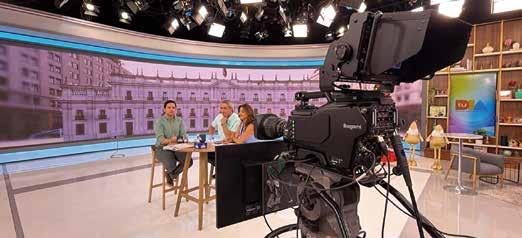
Secuoya Chile has invested in Ikegami UHK-X600 and UHL-X40 broadcast cameras as the core of a major upgrade to the facilities at its headquarters in the Providencia district of Santiago City. The cameras were supplied by Santiago-based Intervideo, as Ikegami has claimed in a statement.
Secuoya Chile provides outsourcing facilities to all operational areas of the Canal 13 television network and offers support to other production service providers and TV networks. It has 11 studios, seven TV control rooms and a fleet of production vehicles. It is part of the Madrid-based media Secuoya Studios group. The group’s primary focus is on generating programs for Spain, LATAM countries, and Hispanic markets in the USA.
“The project marked a turning point for us, consolidating a strategic technological modernization at Canal 13”, comments Alejo Fraile, director of Secuoya Chile. “The implementation of Ikegami UHK-X600 cameras provides enhanced image quality, operational stability and workflow efficiency. The cameras were chosen following a rigorous technical selection process. The project’s success was built on close collaboration between Secuoya Chile, Canal 13 and Ikegami/Intervideo, establishing a replicable standard that positions Secuoya as a key
partner for future technological transformations in Chile”.
“We are very pleased to have won this important project which followed a strict technical and very competitive tender process”, adds Carlos Contreras, director of Intervideo. “I want to express my deepest gratitude to Ikegami for their unwavering trust and support which reaffirm a relationship that celebrates Intervideo’s 44th year of operation in Chile. The inclusion of Ikegami systems in this upgrade marks a significant step for Secuoya Chile and Canal 13 towards world-class operation”.
Designed for broadcast-quality video production and live television applications, Ikegami UHK-X600 Full-HD cameras are built to withstand the rigors of OB and EFP as well as studio operation. The UHK-X600 has a low vertical profile, weighs just over 11 pounds and can be pedestal-mounted, tripod-mounted or operated over the shoulder. It accepts
a wide range of B4 lenses and supports chromatic aberration correction, vignetting correction, ramping compensation and remote control of back-focus (when also supported by the lens). At the front end are three 2/3-inch oversampling UHD CMOS sensors providing 2000 TV lines resolution in 4K, minimal aliasing and 2000 lux sensitivity at F10 (60p).
The camera’s global shutter imagers minimize artifacts when televising LED screen walls or flash/strobe-illuminated stage environments. Standard features include full support for Hybrid Log Gamma HDR imagery plus the ability to choose between BT.2020 and BT.709 chroma spaces. A software key is available which enables the UHK-X600 to output 2160p complete with full UHD processing. HFR shooting at to double real-time in 4K or up to eightfold real-time in HD is possible as an option for applications such as capturing fast motion in sport or stage events.

TheOlympic Games asaglobal laboratory: technology, storytellingandthe OBSvisionfor Milano-Cortina 2026


Yiannis Exarchos, CEO of OBS and Executive Director of Olympic Channel Services, outlines the key technological innovations of this year’s edition and the strategy behind them
By Daniel Esparza
The Olympic Games have long stood as one of the most powerful global sporting events, capable of uniting audiences across continents, cultures and generations. For the broadcast industry, however, they represent something more: a unique large-scale laboratory where innovation is tested under extreme conditions, often years before new technologies become mainstream across the wider media ecosystem. This role has become even more pronounced since the creation of Olympic Broadcast Services (OBS), which replaced the traditional host broadcaster model after the Sydney 2000 Games. The shift marked a fundamental change in how Olympic broadcasting is conceived and delivered. Rather than reinventing production and technology every four years,
the Olympic movement gained a permanent host broadcaster with a long-term technological roadmap, able to evolve across multiple editions of the Games.
“We are not tech narcissists”
Despite the sheer scale of innovation involved, and the fact that OBS is a highly technological organisation, technology itself is never the starting point. “We should never forget, and I constantly remind both my team and myself, that this is not about technology. This is about telling the stories of the most important athletes in the world, and about conveying the values and emotions generated by their performances,” said Yiannis Exarchos, CEO of OBS and Executive Director of Olympic Channel
Services, during a media roundtable attended by TM BROADCAST.
That philosophy underpins everything OBS does. “Technology, and especially emerging technologies, is a huge enabler of that, but the Olympic Games are not about showcasing technology for its own sake. We are not tech narcissists”.
Instead, OBS frames its use of technology around what Yiannis Exarchos calls the “three Es”: enablement, engagement and efficiency. “Enablement means being able to do things that were simply not possible in the past. Engagement is about making the storytelling and coverage of the Games more exciting and more compelling. And efficiency is about making the Games more sustainable, easier to operate, and less wasteful”.
When it comes to formats, Exarchos pointed out that, with the exception of 8K, which will be reserved for the opening ceremony and a small number of selected events, virtually every existing format is supported. The native production format will be 4K HDR, from which all other versions can be derived. From a logistical standpoint, geographical distribution remains the main challenge.
“Some mountain venues initially lacked sufficient connectivity”
The first element to highlight is the opening ceremony, which, as Yiannis Exarchos pointed out, “is, in itself, the result of innovation.” The geographical dispersion of the Games across northern Italy has fundamentally shaped its conception. “Moving from one venue
to another is not always easy, and it was therefore essential to ensure that athletes, organisers, the organising committee and the IOC all had the opportunity to feel part of the opening ceremony.”
This ambition is made possible by the technological backbone of the event, and particularly by the
connectivity established between venues. “The opening ceremony will take place simultaneously across four locations, actually five if we include Milan itself. We see this as a clear example of how technology can create excitement and a genuine sense of participation, not just allowing people to watch, but to truly feel involved.”
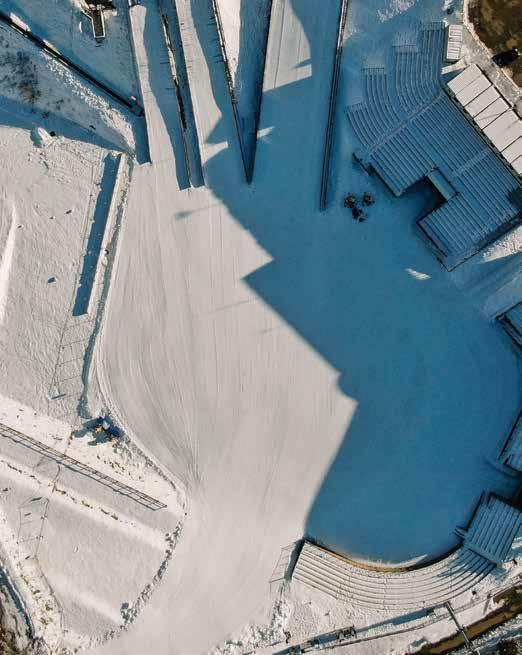
From a logistical standpoint, geographical distribution remains the main challenge. “Some mountain venues initially lacked sufficient connectivity, but Telecom Italia has been instrumental in addressing that.” While the split of Alpine events across two geographically distant areas is not a major issue for OBS, it does introduce complexities for rights-holding broadcasters. “Broadcasters traditionally operate Alpine sports from a single hub,” Exarchos noted.
Some innovations will be immediately visible on screen. One of the most striking examples is the extensive use of first-person-view drones. “Drones are not new in sports broadcasting, OBS first used them back in 2014,” Exarchos noted, “but we are now working with a new generation of technology that allows for extremely safe operations, flying very close to the action and offering viewers a sense of being
After the introduction of 360-degree replays in Paris, Milano-Cortina will go further by combining those movements with stroboscopic effects and data overlays part of the competition.” The result, he said, is a fundamentally different viewing experience. “Across many sports, audiences will see images that simply did not exist before.”

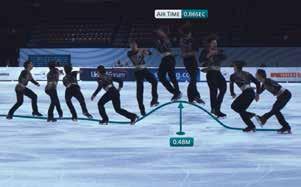
Another major step forward builds on the rapid development of artificial intelligence. After the introduction of 360-degree replays in Paris, Milano-Cortina will go further by combining those movements with stroboscopic effects and data overlays. “This creates a more complete narrative,” Exarchos explained. “It explains the sport more clearly, makes it easier to understand, and highlights the athletes’ efforts even more effectively.”
The third example relates to curling, a sport that has traditionally been difficult for casual viewers to fully grasp. Here, technology becomes a tool for education as much as for entertainment. “For many years, we have been trying to find a way to help viewers truly understand what is happening in curling. There is often a perception that it is simply a stone gliding across the ice, when in reality it is an extremely technical sport,” he said.
In this case, artificial intelligence becomes a key tool. “Thanks to AI, we can now visualise data in real time alongside the competition. Viewers will see not only the position

of the stone, but also its rotation, as well as the sweeping frequency of the team members. This allows audiences to better appreciate the technique and complexity involved.”
Innovation is not driven solely by technology, but also by the scale and diversity of the Olympic audience. “ The Olympic Games represent the biggest opportunity for many sports to reach a truly global audience, often dozens or even hundreds of times larger than in other competitions,” Exarchos pointed out.
“That reality places enormous responsibility on the host broadcaster. We therefore need to make these sports understandable quickly and intuitively for a general audience.”
The challenge extends beyond linear television. Through Olympic Channel Services, OBS is responsible for the IOC’s digital operations during the Games, including the olympics.com platform.
In Paris, it became the most visited digital sports platform in the world during the event.
While many innovations capture attention on screen, some of the most
significant transformations happen behind the scenes. Efficiency has become a central pillar of OBS’s strategy, driven by the need to manage ever-growing scale while reducing environmental impact. In this context, virtual OB vans have played a key role.
“Traditional TV remains extremely important, but consumption habits have evolved, and today content is consumed across many different platforms, each with its own requirements”

testing
“This is a major engineering breakthrough that allows us to move away from traditional large outside broadcast trucks. In many venues, we will use alternative production models based on IP technologies, as part of our full transition towards IP-based workflows. The result is significant savings: we will use roughly half the compound space, consume far less electricity, and reduce installation times considerably.”

Yiannis Exarchos, CEO of OBS and Executive Director of
Services
The impact is measurable. The International Broadcast Centre (IBC) for MilanoCortina will be around 25% smaller than the IBC in Beijing, with power consumption reduced by 33%. “Looking further ahead, for Los Angeles we are planning an IBC that will be essentially half the size of the one in Rio,
while producing more than twice the amount of content.”
Does this trajectory suggest that the IBC could eventually disappear as cloud-based production continues to expand?
Exarchos was cautious. “If we want to be realistic, I do not think we can currently predict a future in which the IBC disappears completely and everything becomes fully remote or virtualised. We need to recognise the physical realities of the Olympic Games.”
“In many venues, we will use alternative production models based on IP technologies, as part of our full transition towards IP-based workflows”
Those realities are closely tied to the human dimension of the event.
“In Milano-Cortina alone, we will have around 6,000 broadcasters on site,” he explained. “The reason is simple: many of them want and need to be
For the first time, the IOC will produce the official Olympic film in-house. The project will be led by Olympic Channel Services and will adopt a distinctly cinematic approach to the Games close to their athletes, and that is entirely legitimate. What we want to avoid is forcing people to travel to do work that could just as well be done from the other side of the world.”
For Exarchos, the IBC remains an essential part of the Olympic experience. “The complete disappearance of the IBC or studios in the host city is neither realistic nor desirable. It is part of the beauty of the Games.”
This is why remote production is conceived as an enabler rather than a replacement. In MilanoCortina, cloud-based workflows will reach an unprecedented level of adoption. “65% of signals will be transmitted via
the cloud. When we first started working with Alibaba, we anticipated that adoption would reach around 25% by Milan. Instead, we are already at 65%. This is partly because broadcasters clearly see the benefits, and partly because the pandemic accelerated the adoption of new workflows.”
Cloud-based master control and remote production workflows are all part of this shift. “This allows for large-scale signal distribution and content delivery. In Milano-Cortina, we will produce more than 6,000 hours of content, and this infrastructure enables broadcasters to receive that content directly at their home base”.
As familiarity with these workflows increases,
OBS is also expanding what broadcasters can do remotely. “We provide them with the tools to receive signals anywhere in the world and to perform operations that, in some cases, they are not even able to do yet within their own facilities.”
Yet the scale of the IBC remains extraordinary. One figure illustrates its continued relevance.
“In Milan, the connectivity leaving the IBC during the Games will represent around 70% of the total internet capacity of the entire city of Milan. From a single building, we will generate traffic equivalent to most of the city’s normal usage. That capacity would allow you to download a full 4K feature film in half a second.”
The poster image of the Olympic Film | Olympic Channel Services

Automated, AI-driven highlight generation will also play a key role. “This is particularly valuable for an event of the scale of the Olympic Games, as it allows each broadcaster to customise highlights by country, sport, athlete, duration, and even advertising integration.” The impact of this approach is already evident. “In Paris alone, this system generated around 100,000 different short-form highlight clips,” he recalled. “Anyone in the industry understands what that would have required in terms of human effort.”
Milano-Cortina will mark another milestone. “We will deploy this technology for the first time at the Winter Games. It is also the same technology underpinning the IOC initiative that allows Olympic athletes to access highlights of their own performances, a major breakthrough that we have already begun delivering at scale.”
OBS will introduce Olympic GPT, an AI-powered assistant designed to answer fans’ questions about the Games using verified Olympic data
The scale of this transformation becomes even clearer when looking at overall content volumes. Of the 6,000 hours of content generated at the Winter Games, the competitions themselves account for roughly 1,000 hours. “The additional volume is driven by the need to deliver a wide diversity of content formats,” he explained. “Traditional television remains extremely important, but consumption habits have evolved, and today content is consumed across many different platforms, each with its own requirements.”
This shift has profound implications for broadcasters. “We therefore need to enable broadcasters to use short-form content, behind-the-scenes material,
virtual reality experiences and other formats across multiple platforms. This explains both the scale of production and why it would simply not be possible without the support of technology,” concluded.
Another milestone for Milano-Cortina is that, for the first time, the IOC will produce the official Olympic film in-house. The project will be led by Olympic Channel Services and will adopt a distinctly cinematic approach to the Games.
“We felt it would be a missed opportunity for Italy, one of the great pillars of film history, not to have an official Olympic film”, Yiannis Exarchos explained. “We are therefore very proud to be working with Chiara Messineo, a renowned Italian documentary filmmaker who has collaborated with major platforms such as Netflix and CNN, and who also worked on the Stanley Tucci series.”
“Together, we are producing a film that will offer a compelling and intimate look at the Games, seen through the eyes of both the athletes and the people who make the Games happen.”
For Milano-Cortina, OBS will introduce Olympic GPT, an AI-powered assistant designed to answer fans’ questions about the Games using verified Olympic data. “What makes it special is that it does not rely on random sourcing from the internet, which often contains inaccuracies or biased information. Instead, it is designed to deliver accurate, verified and unbiased Olympic-related information.”
“We are very excited about this development. Testing has shown that the system can handle very high levels of traffic, and while no AI system is ever perfect, the performance so far has been extremely strong. It is a first step, and we will see how it evolves, but we believe it offers real value.”

› The IBC will be around 25% smaller than the IBC in Beijing
› Power consumption will be reduced by 33%
› Around 6,000 broadcasters will be on site
› 65% of signals will be transmitted via the cloud
› More than 6,000 hours of content will be produced, with the competitions themselves accounting for roughly 1,000 hours

ISE 2026 is set to open its doors from February 3 to 6, bringing together the global AV and systems integration community. Under the theme “Push Beyond”, this year’s edition invites professionals to move past established boundaries
By Bárbara Ausín

With anticipation building at the Fira de Barcelona, Gran Via, ISE 2026 is set to open its doors from February 3rd to 6th, promising a showcase of innovations, talks, and surprises. This year’s theme, “Push Beyond”, aims to challenge visitors to leave the ordinary behind and embrace a new standard of excellence.
The 2025 edition welcomed 85,351 visitors from 168 countries—a 15.5% increase over the previous year—and featured 1,605 exhibitors across 92,000 m² of exhibition space. For 2026, Mike Blackman, Managing Director of Integrated Systems Events, expects similar or even greater success. ISE 2026 will host over 1,000 exhibitors, including 323 first-timers, in a space exceeding 101,000 m²— both figures surpassing last year’s records. While the final attendance will be confirmed after the event, Blackman remains optimistic: current registrations suggest the previous record of visitors will be surpassed, with
“today's snapshot is a year-on-year increase of more than 7%,” as he confirmed in a briefing weeks before the Fira’s doors opened, in which
TM BROADCAST took part.
Current registrations suggest the previous record of 85,531 visitors will be surpassed With the objective of hosting more exhibitors and immersive experiences, the show has expanded into East Access. Attendees will explore the latest advancements across seven dedicated zones: Audio, Broadcast AV, Digital Signage & DooH, Lighting & Staging, Multi-Technology, Residential & Smart Building, Unified Communications & Education Technology.
This year introduces Spark, a new showcase event dedicated to cross-vertical creative connectivity. Structured around four high-impact tracks
(Broadcast, Live Events, Gaming, and Marketing & Design), it aims to debut as an European hub where creative professionals assemble around tech, tools and platforms to unlock sharper experience design, compelling storytelling, and improved audience engagement.
In addition to this new feature, successful events from previous editions will be returning to ISE 2026:
› Innovation Park: Coming back “bigger and bolder” after its 2025 debut, it will feature new exhibitors, a Pitching Stage, a Matchmaking Area that will host networking events in the afternoons, and an exclusive Investor Forum on the first day to discuss industry trends.
› EdTech Congress will run alongside ISE, taking place on 4–5 February 2026 at the Palau de Congressos, Barcelona. The 2-day event, co-hosted by ISE, EduTech Cluster & Fira de Barcelona, will focus on AI and delve into its ability to effectively enhance education processes and environments.
› ISE Connected Classroom: In collaboration with Logitech, the 120 sqm space will be organized into four interactive zones. These areas will provide opportunities for learning and hands-on demonstrations in areas such as hybrid teaching, AI, VR/AR, and gaming.
› ISE Hackathon: Over a 48-hour period, 60 selected students from 17 different universities will collaborate with industry experts to develop practical solutions. These ideas will then be presented at the Innovation Park Stage.
› ISE Donation Room: Run with Fira de Barcelona and La Nau, the event will donate items including furniture, AV equipment or décor to local social organisations.
This year, the program introduces a more flexible schedule, allowing attendees to take a deep dive into key industry topics in focused, intensive
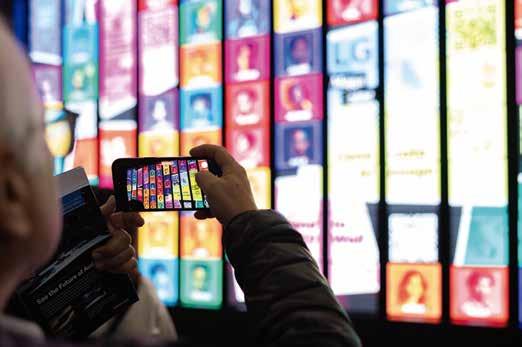
sessions, while still leaving ample time to experience the innovation and energy of the show floor.
The four-day event will present six Summits around major vertical market sectors: Education, Smart Building, Digital Signage, Control Rooms, CyberSecurity, and Broadcast AV. The Cybersecurity Summit is new to the programme this year. Chaired by Pere Ferrer i Sastre, former Director General of the Mossos d'Esquadra, it will tackle the growing challenges
in the AV sector, with a special emphasis on the increasing interconnection of AV systems with critical infrastructure.
In addition, ISE 2026 will host Megatrends Sessions — six in-depth 90-minute explorations covering AI, Cybersecurity, Robotics, Smart Spaces, Sustainability, and TradeScape — designed to challenge convention and spark discussion. The event will also include two Business Forums: the European Latin American AV Forum (ILAF) and the Investor Forum.
Attendees will explore the latest advancements across seven dedicated zones: Audio, Broadcast AV, Digital Signage & DooH, Lighting & Staging, Multi-Technology, Residential & Smart Building, Unified Communications & Education Technology
Complementing these is ISE’s largest-ever free content programme, featuring sessions in Spanish to enhance accessibility and reach a broader audience.
On the other hand, Citywide Experiences ISE will also sponsor two major events in Barcelona: the Casa Batlló Projection Mapping and the Llum BCN 26 Lights Art Festival. This year introduces Spark, a new showcase event dedicated to cross-vertical creative connectivity
To complete this schedule, ISE has secured Sol Rashidi and Matt Clark as Keynote Speakers. Rashidi, the world’s first Chief AI Officer for enterprises, will deliver the headline keynote, sharing insights at the intersection of AI, technology, and business strategy. Her session, entitled ‘The AI Reality Check: What It Takes to Scale and the Future of Leadership’, will delve into bridging innovation with real business impact.
On the other hand, Clark will explore how hidden systems are translated into immersive physical experiences. His session ‘Hidden Order: Building a Performanceled Mapping at Casa Batlló, from Concept to Implementation’ will offer a behind-the-scenes look at the façade mapping commissioned and produced by Casa Batlló in collaboration with UVA, scheduled for 31 January and 1 February.
Finally, to wrap each journey, the city’s night sky will come alive with synchronized drone shows featuring 600 drones. Executed by LANG AG, live musicians, an opera performance, and digital artists will offer a multisensorial experience for both attendees and Barcelona residents on the South Access Welcome Screen.
Setting the stage for ISE 2026
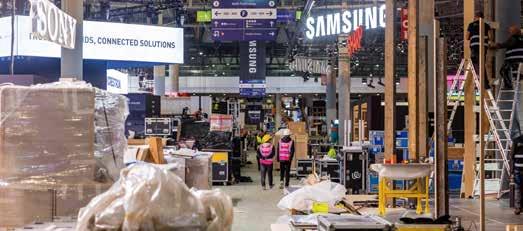
To help you navigate the exhibition, the TM BROADCAST editorial team has curated a selection of attending companies, organized by thematic areas, which have particularly caught our attention.
Editorial note: The thematic grouping below is intended as a practical editorial guide, as many of the companies featured operate across multiple technology areas.
Audio technologies remain one of the key pillars at ISE, with manufacturers focusing on immersive sound, system efficiency, and workflow integration.
EM Acoustics (Booth: Level 0 — 7H350) will debut two new cardioid subwoofers, the CS15 and CS18, each requiring a single amplifier channel. Alongside the new cardioid subwoofers, the company will highlight its complete Reference Series,
completed with the R4, R5, R6, R8, R10, and R12 models.
KV2 Audio (Booths: Level 0 — 7K880 / Audio Demo Rooms E6) will present a demo room experience in collaboration with Hologramica, integrating its patented 3D Holonet technology powered by Panasonic. The company will showcase applications of its latest solutions for hospitality, retail spaces, houses of worship, live event venues, and nightclubs, including the EX28 full-range active loudspeaker, the ESD Cube, and the SL412 wide-dispersion system.
Telos Alliance (Booth: Level 0 — 4H550) will focus on audio and production technologies designed for television and live-production professionals worldwide. Among its technologies are the Jünger Audio flexAI platform, the Telos Infinity VIP Virtual Intercom Platform,
and the Telos Alliance Studio Essentials, including Telos VX Duo, Axia Altus SE, and the Telos Zephyr Connect SE AoIP audio gateway.
Yamaha (Booth: Level 0 — 3F100) will show the latest innovations of its Commercial Installation Solutions ecosystem, including new audio networking, processing, amplification, and control products. The company will also showcase the updated ProVisionaire software suite, automated Voice Lift setup technology, Sound xR technology, the Rivage PM series digital mixing systems, and the latest versions of its MixKey, Nuendo, SpectraLayers, and WaveLab applications.
TOA Electronics
Europe (Hall 7, Booth 7D600) will highlight its latest audio innovations, led by the EMEA launch of the CX-1000 Series, an IP-based PA and intercom system
designed for scalable communication, emergency announcements, and modern building infrastructures.
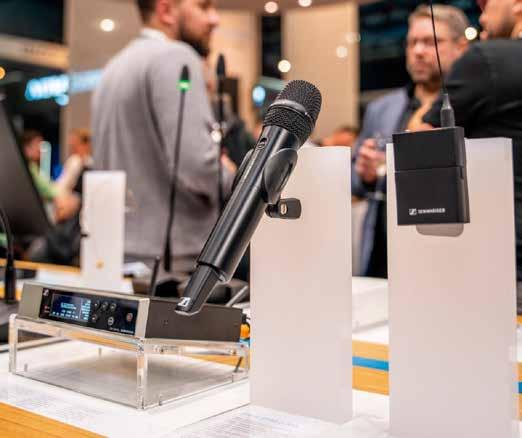
Sennheiser (Booths: Level 0 — 3B500 / 3B700) will present a newly designed dual booth space built around its brands Sennheiser, Neumann. Berlin, AMBEO, and Merging Technologies, as well as its partner SoundBase. The company will officially launch its new cloud-based platform DeviceHub, showcase upcoming facilities at the Spectera Lab, demo the app of its new partner SoundBase, and dedicate an immersive studio area controlled by Neumann.
ISE 2026 will host Megatrends Sessions — six in-depth 90-minute explorations covering AI, Cybersecurity, Robotics, Smart Spaces, Sustainability, and TradeScape
Soundware Media (Hall 4, Stand 4M530) will make its debut at ISE 2026 as an official distributor, bringing together leading professional audio brands including PMC, Beyerdynamic, RTW, and DAD (NTP Technology) under a single point of contact. The company will present a partner-driven distribution model focused on competitive pricing, streamlined logistics, and close pre- and post-sales support, while offering visitors immersive listening experiences and direct access to its team to explore new collaboration opportunities.
In the broadcast and live production arena, softwaredefined infrastructures, IP workflows, and scalability will be central themes. Disguise (Booth: Level 0 — 4P500) will showcase its latest innovations and solutions, including GX 3+, aimed at live, locationbased experiences and stadiums, alongside demos
and activations across live events, sport, and immersive experiences.
Clear-Com (Stand 4P700) will demonstrate its new 4-channel HelixNet beltpack, expanding the HelixNet intercom family with enhanced multichannel communication, improved usability, and compatibility with Arcadia Central Station and existing HelixNet systems for complex production environments.
Grass Valley (Booth: Level 0 — 4Q900) will present its vision for flexible system design, illustrating how smart production setups can become reusable assets rather than one-off solutions. The company will also highlight how the economics of scaling production are evolving, allowing broadcast AV teams to grow capabilities in line with actual needs instead of overbuilding infrastructure.
Kiloview (Booth: Level 0 — 4M800) will present its new IP media management solution, covering connection,
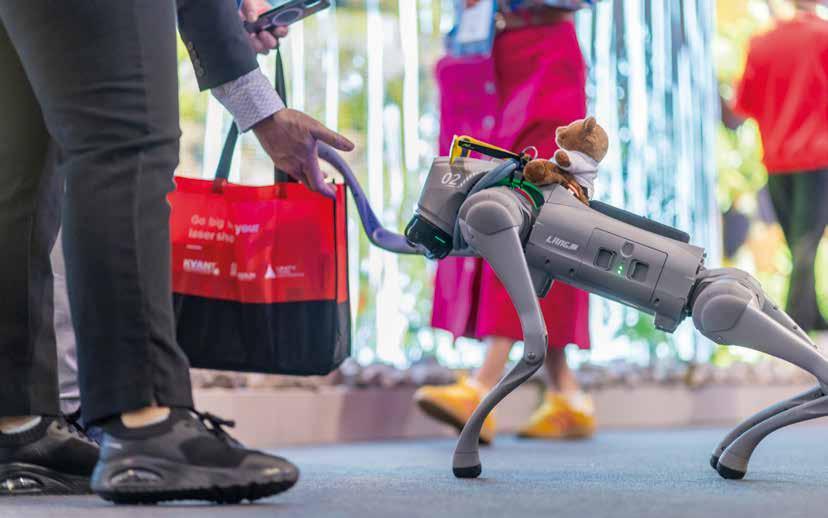
control, management, and transmission. The company will also bring its fully integrated AV-over-IP ecosystem, including the Cradle Series RF02 and the FXC-A8800 Compute Card.
LiveU (Booths: Level 0 — 4G500) will focus on how its IP-video EcoSystem enables broadcasters, producers, and content creators to streamline and automate workflows to deliver live coverage. The latest product launches — LU900Q, LiveU Nexus, and LiveU Schedule — will be available for firsthand demonstrations. In parallel, its subsidiary Actus Digital
will showcase advances in intelligent media monitoring.
Arkona Technologies (Booth: Level 0 — 5K800) will demonstrate how its software-defined media infrastructure extends beyond traditional broadcast environments. At the show, the company will present a range of case studies and its full product range, including BLADE//runner and manifold CLOUD.
Lawo (Booth: Level 0 — 5H700) will showcase its scalable mc² mixing console range, alongside the HOME
Platform and HOME Apps ecosystem, delivering both audio and video processing across decentralized and centralized production environments.
AI-driven tools and graphics solutions will also have a strong presence. Emergent (Booth: ROE Booth – Level 0 — 3C500) will unveil two new AI-powered products designed to simplify and accelerate broadcast graphics, virtual production, and data-driven content creation: Pulsar VS and Nova GFX.
ENCO (Booth: Level 0 — EA780) will introduce enTranslate Mobile, a solution designed to empower BYOD accessibility and multilingual inclusivity. The platform provides direct access to multilingual captions and translations during live events via QR codes, with ENCO’s Language Selector offering a list of available languages.
Display and projection technologies will be another major focus at ISE. Epson (Booth: Level 0 — 3J100) will reveal a new 4K projector with advanced cooling and connectivity, alongside a new range of professional projector lenses, an ultra-short-throw interactive projector, and “Infinity,” a multisensorial installation developed by creative director Luca Rapis of One Thousand.
Panasonic (Booth: Level 0 — 3J500) will introduce its VMQ85 Series of 4K LCD projectors to European audiences for the first time. The VMQ85 will take
centre stage alongside solutions for conferencing, education, large-scale display, and digital signage. The company will also present the 3-Chip DLP PT-RQ45K projector, delivering 40,000 lumens and equipped with Advanced PCB Coating.
Alfalite (Booths: Level 0 — 4Q300 / 4Q400) will present its latest innovations across two stands. One will focus on LED technology developed by Alfalite, with emphasis on high-resolution solutions, operational stability, and visual consistency. The other will showcase UHD Finepix MATIX AlfaCOB
technology for control room environments in defense, security, and broadcast.
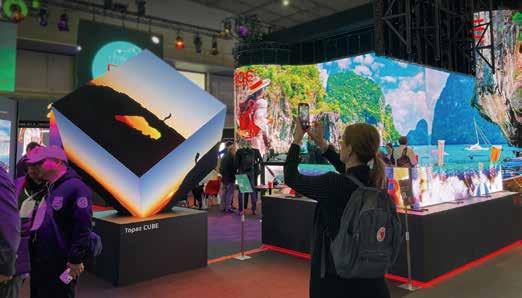
ROE Visual (Hall 3, Stand 3C500) will showcase its latest LED innovations, led by the debut of Vanish AIR, a next-generation transparent LED platform offering a lightweight design, high brightness, and enhanced creative freedom for touring, live events, and fixed installations. The company will also introduce its new AV Integration line, featuring the Denali and Coral LED series, engineered specifically for permanent installations and focused on image quality, robustness, and installerfriendly mechanics.
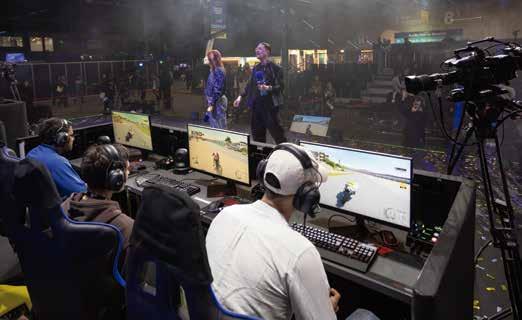
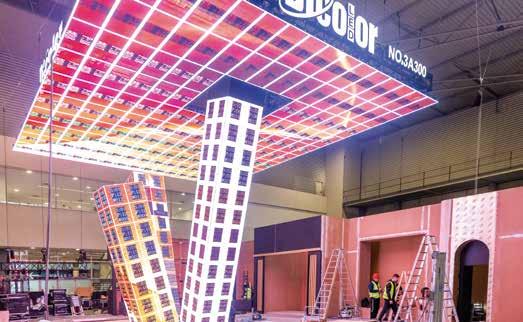
Infiled (Booth: Level 0 — 3B900) will introduce, for the first time, the Tech Boulevard, an immersive walk-through showcasing its proprietary LED technologies, including ColdLED, ArmorLED, SolidSkin, CBSF, and INFINITE Colors. The company will also unveil a new range of LED display solutions and host sessions exploring the AV ecosystem.
ViewSonic (Booth: Level 0 — 2R350) will present two scenario-based showcases to demonstrate its complete Pro AV ecosystem: the Future Large Venue and the Future Meeting Room.
& DooH
In the digital signage and DooH space, AJA (Booth: Level 0 — 4P400) will exhibit recent innovations including the Dante-12GAM and SMPTE ST 2110-30
SDI Audio Embedder/ Disembedder, alongside tools for managing advanced color formats such as ColorBox, KonaIP25, IP25-R, Bridge Live 12G-4, and UDC-4K.
Spinetix (Booth: Level 0 — 4S400) will bring its complete digital signage solution to the show, offering live demos in collaboration with Q-SYS and Bluefin. The company will highlight its DSaaS platform and SpinetiX APIs for integrating and managing digital signage hardware and cloud solutions.
To wrap each journey, the city’s night sky will come alive with synchronized drone shows featuring 600 drones
Shuttle (Hall 4, Stand 4B280) will showcase its latest compact hardware solutions for digital signage and POS, with a strong focus on AI-accelerated mini-PCs designed to handle complex content, multi-display environments, and demanding professional applications within energy-efficient form factors.
PPDS (Booth: Level 0 — 3N500) will unveil its latest range of solutions for the broadcast industry and, as part of an AI-themed Philips stand, introduce its first AI-ready digital signage displays, guestroom TVs, and LED form factors, alongside its new “Picture This” concept.
Lighting and staging solutions will also play a central role. Fluge Audiovisuales (Booth: Level 0 — 6E700) will design its stand around LED screens, truss structures, and an audiovisual tunnel with double-sided LED screens. The company will also highlight LYNTRA, its proprietary software developed with Light Notes Studio.
Follow-Me (Booth: Level 0 — 6P900) will offer live demonstrations of manual and auto-tracking solutions designed to integrate with lighting consoles, video, sound, and automation systems across productions of all sizes.
Infrastructure,
System control, processing, and visualization technologies will be addressed by several vendors. Dexo (Booth: Level 0 — 5F500) will showcase its latest multi-display and real-time visualization technologies for demanding AV environments and missioncritical operations, including the DXN6000 modular video wall controller, DVP824 processors, DNET-VoE SDVoE, and multiviewers.
Crestron (Hall 3, Stand 3H300) will showcase its latest professional AV and systems integration innovations, focusing on AI-powered audio and video, platform-native conferencing, intelligent automation, and new enhancements across both commercial and residential environments.
Matrox (Booth: Level 0 — 5E390) will present its fully integrated AV-over-IP ecosystem, centred on Mura DVW, which unites Maevex, ConvertIP, ConductIP, Avio 2, and Vion. New enhancements include live
preview, EDID management, audio decoding, and OEM customisation.
tvONE and Green Hippo (Booth: Level 0 — 5D300) will showcase the entire pixel stack, from playback and switching to processing, pixel mapping, and control, while also highlighting integrated workflows developed jointly with Matrox Video.
VIOSO (Booth: Level 0 — 5K400) will attend the event with a focus on software for projector auto-alignment and LED calibration, including the launch of VIOSO 7, alongside media playback servers such as Exaplay 3 and a full services portfolio for integration partners.
In the residential and smart building segment, Blustream (Booth: Level 0 — 2F550) will share its latest product launches, including 8K AV-over-IP and sharing technology, new standards of Dante integration, multi-channel matrix amplifiers, and smart power management.
MAG Theatron (Booth: Level 0 — 2F300) will feature two distinct zones: a private demonstration cinema developed with AV Concept Products and LCAVI, and a dedicated exhibition area highlighting the Avalon Ultimate Screen Walla Array and the debut of the Avalon Sur speakers.
Zion Technology (Booth: Level 0 — 2A150) will present new solutions in large-format televisions designed for luxury residences, premium hotels, and high-end AV projects, including MicroLED screens, customised Smart TV solutions, turnkey projects, and new ZION OS integrations.
In unified communications and education technology, Netgear (Booth: Level 0 — 2U240) will introduce two new IP switches in its M4350 series and showcase the latest version of the Netgear Engage Controller with offline provisioning.
Pleneo (Booth: Level 0 — 2R500), the recently launched company built by Xilica, will exhibit its solutions designed to enable rooms to behave and be managed as a single system. At the core of the platform is Room OS, combined with cloud-based orchestration and anchored by RoomHub.
Utelogy (Booth: Level 0 — 2W800) will showcase platform advancements including Configuration in the Cloud, Cloud-to-Cloud integration, and Webhook Integration for real-time alerts.
Finally, outside the traditional exhibition halls, Instronic (Booth: Level +1 — Upper Walkway to Hall 8.1) will transform a walkway inside the venue into an immersive digital experience. “Breathe” will premiere at the event, combining architecture, light, sound, and digital media as a single integrated system.

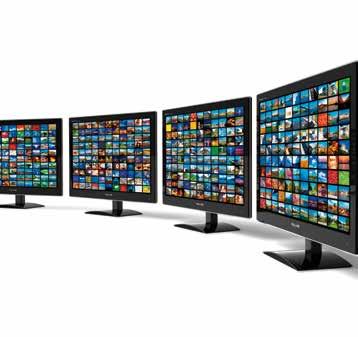
The FAST (Free Ad-Supported Streaming Television) environment is booming, and all studies and analyses anticipate that it will continue to grow. This evolution demonstrates television’s ability to reinvent itself
By Carlos Medina, Audiovisual Technology Advisor
Charles Darwin (1809–1882), the English naturalist, published the first edition of his work On the Origin of Species by Means of Natural Selection, or the Preservation of Favoured Races in the Struggle for Life in 1859. In its sixth edition, published in 1872, the title was changed to a shorter version, now widely known by all of us: On the Origin of Species.
And what is the relationship between Darwin’s theory and FAST channels, the main subject of this article? Primarily, that FAST channels serve as an example of how television, since its beginnings, has shared the key principles outlined in On the Origin of Species, with the sole purpose of surviving within the audiovisual industry ecosystem:
› Variation: Throughout its relatively short history, television has made “genetic” modifications in order to endure over time.
› Struggle for existence: Under the premise that resources are limited (technology, financing,
talent, etc.), television competes with other disciplines within the audiovisual ecosystem: radio, cinema, video, the internet, smartphones, and more.
› Natural selection: Television, through successes and failures over the course of its development, forges a “better” version of itself at each moment in its history.
› Adaptation and speciation: Significant changes give rise to a constantly “new” television at different moments or cycles, enabling its survival over time.
› Common ancestor: Everything that is considered television today still retains the principles and criteria of what gave rise to the television medium. Television therefore has its own “evolutionary tree”.
Today, we talk about FAST TV channels, but we have clearly arrived here through the constant adaptation and survival of this
invention, technology, or means of communication: from the first moving images achieved in the 1920s, to streaming, FAST channels, and today’s interactive television; including the first public broadcast (John Logie Baird in 1925), the first mechanical television in 1926, regular transmissions in London (BBC in 1936), electronic and colour television (USA: NTSC standard in 1954), cable TV (CNN, the first 24-hour news channel in 1980), satellite TV (Canada’s Anik A1 satellite, one of the first commercial communications satellites for television, in 1972),

the digitisation of television (Digital Terrestrial Television – DTT – in Europe, United Kingdom, in 1998), and Smart TVs (from 1994 onwards, with the first globally commercial Smart TVs—LG and Samsung—launched in 2007).
So, what is a FAST TV channel? Quite simply, it is the evolutionary result of traditional television adapting not only in terms of technology, but also in the type of content it programs, its business model and funding, in relation to viewer habits and trends, and, above all, adapting to a globalised
online world dominated by major corporate players that own large consumption, leisure, and entertainment platforms.
The FAST (Free Ad-Supported Streaming Television) environment consists of live, free (non-subscription) internet television channels that operate in the same way as traditional TV
FAST stands for Free Ad-Supported Streaming Television. In other words, these are live, free
(non-subscription) internet television channels that operate like traditional TV. This means that content programming is fixed and linear, decided by the platform itself (rather than by the end user or viewer, as in on-demand content), and includes advertising revenue as its funding model.
FAST channels are also known by the acronym FVOD (Free Video on Demand). This designation, which is somewhat more confusing, brings them closer to Video on Demand platforms, but with different access models, monetisation strategies, and types of content.


It is confusing because Video on Demand implies that the end user can access specific content (within an on-demand catalogue) at any time they choose—something that does not happen with FAST channels, where programming is linear, more in line with what we already know from traditional television.
FAST channels are also different from the content platforms launched by traditional broadcasters themselves, where users choose what to watch and when to watch it, such as RTVE Play (TVE Spain), Infinity (Mediaset Spain), Atresplayer (Atresmedia Spain), Globoplay (Globo Brazil), Paramount+ (CBS, USA), Peacock (NBC, USA), MYTF1 (TF1, France), among others.
Therefore, FAST channels represent traditional thematic digital television updated for a market in which technology and users drive the trend toward internet-based television. For the broadcast sector, this implies the emergence of a new distribution
channel at a lower cost than DTT; the generation of brand safety, which allows brands to be protected within the advertising environment through greater audience segmentation based on thematic content; and the ability to obtain more accurate and precise end-user data (audience data or audience metrics).
quite broad, with a strong predominance of thematic content under different labels: films, TV series, children’s programming, documentaries, news, sports genres, music, lifestyle, entertainment, and more, whether international, national, or local in scope.
including agreements with third-party services such as Google TV.
Finally, the relationship between the end user and the FAST platform enables greater loyalty between the two, generating longer viewing times and, therefore, higher retention and audience stickiness around this type of content.
With regard to the type of content programmed by a FAST channel, it is FAST represents traditional thematic digital television updated for a market in which technology and the user set the trend, with a clear focus on internet-based television
This specialisation of FAST channels, together with their availability across multiple devices and platforms, has driven their success and expansion: Smart TVs (which come with pre-installed applications such as Pluto TV, Tubi, or Samsung TV Plus); streaming devices such as Roku, Amazon Fire Stick, and Apple TV; as well as mobile devices, computers, and tablets.
The list of FAST channels continues to grow and become more widely recognised:
› PLUTO TV (Paramount Global, formerly ViacomCBS): more than 250 linear channels, available in the United States, Europe, Latin America, and beyond,
› RAKUTEN TV, owned by the Japanese conglomerate Rakuten Group, Inc., primarily known for its e-commerce platform and digital services. It operates in more than 40 countries across Europe and Asia. The service was initially launched in Spain as Wuaki.tv and acquired by Rakuten in 2012. It offers more than 500 channels, approximately 100 of which are owned and operated by Rakuten TV.
› THE ROKU CHANNEL, owned by Roku, Inc., a US company best known for its streaming devices (set-top boxes and TVs with Roku built in).
› TUBI (Fox Corporation): very popular in the United States, with more than 250 channels.
› FREEVEE (Amazon): originally launched as IMDb Freedive, later renamed IMDb TV, and rebranded as Freevee in April 2022. From 2025 onwards, its independent
brand was retired and all channels and content were integrated into Prime Video under the “Watch for Free” section with ads (no Prime subscription required). It offers more than 750 channels, around 50 of which are managed directly by Amazon.
› XUMO PLAY, owned by Comcast Corporation, one of the largest telecommunications and media companies in the United States. It offers more than 200 channels.
› PLEX, owned by Plex, Inc., an independent US company initially known for its media server software, offering around 200 channels globally.
› SLING FREESTREAM, owned by Sling TV L.L.C., a division of DISH Network / EchoStar Corporation in the United States. It offers more than 600 channels as of 2025.
› VIX, owned by TelevisaUnivision, the world’s largest Spanish-language media group. It offers more than
100 linear programming channels and has agreements with external partners such as Amazon Freevee.
› WAIPU.TV, operated by Exaring AG, a German technology company in which Freenet AG is the main shareholder. It offers more than 300 channels, including around 70 optional paid channels.
› RLAXX: originally German, Rlaxx TV GmbH has since been acquired by ZEASN Technology Private Ltd., integrating the service into its global portfolio alongside platforms such as Foxxum. It offers more than 100 channels across various content categories.
› SPORTSTRIBAL TV, owned by SportsTribal, a private technology startup focused on sports streaming.
› VIRGIN TV, the result of Virgin Media and O2 (Virgin Media O2) in the UK, includes a collection of FAST channels within its offering, with new additions and
partnerships with providers such as Pluto TV, Rakuten TV, and Stingray, among others.
› VIZIO WATCHFREE+, owned by hardware manufacturer Vizio, offers more than 300 free live TV channels accessible without subscription, integrated into Vizio televisions and its mobile app.
› SAMSUNG TV PLUS, one of the largest FAST platforms worldwide, is integrated directly into Samsung TVs and other compatible devices. Its approximately 3,500 channels include free, ad-supported linear programming (news, sports, entertainment, films, series, children’s content, lifestyle, languages). Availability varies by country depending on market and licensing agreements.
› LG CHANNELS, integrated into LG Electronics Smart TVs, is accessible from the webOS home screen and via the LG remote control. Globally, it offers more

than 4,000 channels in markets where the service is available, through agreements with multiple content providers.
› MiTV+, available on Xiaomi Smart TVs, offers 240 linear channels.
One trend we are observing is that online content creators and influencers are increasingly viewing FAST channels as a new window for reaching their audiences. One example is Curiosity Now, available on Samsung TV Plus. In addition, traditional streaming (VOD) platforms are also adopting the FAST model—for example, within Prime Video—while some traditional DTT channels are migrating to online distribution via FAST (such as Paramount Network, which has closed its DTT service and now continues via Pluto TV).
One trend we are observing is that online content creators and influencers are looking to FAST channels as a new window for reaching their followers
By country, the audiovisual FAST market is currently dominated by the United States, the United Kingdom, Germany, and Italy. Spain is Europe’s leader in FAST consumption, with around 35% of online adults watching FAST each month. FAST market revenues in Spain are expected to nearly double in the coming years, rising from around $32 million in 2025 to approximately $65 million by 2030 (source: Omdia, Informa TechTarget, Content London 2025).
Spain has experienced a very strong increase since the launch of FAST channels in 2022, becoming Europe’s FAST consumption leader in less than three years (by 2025). The user profile within a very specific socio-economic context has driven this expansion: a strong tradition of consuming free (adsupported) content and linear viewing habits typical of traditional television (known in English as “turn on and see” or “switch on and see”).
In the rest of the world, the FAST market is growing at a more moderate pace due to the specific economic, social, and industrial characteristics of each audiovisual market, although South Korea, Japan, and India stand out. In China, the market is still young and emerging,
dominated by VOD and streaming platforms such as iQIYI, Tencent Video / WeTV, Youku, and Bilibili. Interestingly, China Global Television Network (CGTN), part of China Media Group (CMG), has launched three specialised FAST channels—CGTN Global Biz, China Travel, and Discovering China—aimed at international audiences and distributed via global FAST platforms. This shows that Chinese media companies are beginning to adopt FAST formats for international audiences.
From a technological point of view, FAST channels represent the natural integration of traditional television into the internet environment, driven by the sales and penetration of Smart TVs
All studies and analyses conducted to date confirm continued growth in FAST channels in the coming years (sources: Omdia,
FAST TV Market & Spain Focus; Nielsen / Gracenote Data Hub, FAST Momentum Continues and Beyond Nostalgia: Tracking FAST Channel Evolution and the Opportunities for Platforms and Advertisers; Rakuten TV, Unlocking New Audiences; Kantar, Media Reactions 2025).
From a technological perspective, FAST channels represent the natural integration of traditional television into the internet environment, driven by Smart TV sales. FAST channels are IP-based linear TV channels, using
unicast distribution (one sender transmitting data to one specific receiver). The most commonly used input video formats are MXF, ProRes, XDCAM, and high-quality MP4, sourced from VOD libraries, live feeds, or scheduled 24/7 playlists.
H.264/AVC and AAC-LC are the main standards used for encoding and transcoding FAST channel content at 720p and/or 1080p. In terms of streaming protocols, HLS (HTTP Live Streaming) is the most widely used due to its universal compatibility

and adaptive bitrate (ABR) capabilities. Advertising insertion is based on the SSAI (Server-Side Ad Insertion) model, with VAST (Video Ad Serving Template) and OpenRTB (Open Real-Time Bidding) as the predominant protocols.
Twenty-five years elapsed between the first edition of Charles Darwin’s well-known text (1859) and the origins of television (Paul Nipkow’s disc in 1884). Applying the premises outlined by Darwin within his field of research allows us to observe and analyse what television represents today.
By country, the audiovisual FAST market is currently dominated by the United States, the United Kingdom, Germany, and Italy. Spain is Europe’s leader in FAST consumption
Television is the engine of the audiovisual industry due to its global content production capacity (both in volume and diversity), its ability to generate employment (direct and indirect), its industrial structure, its constant
technological innovation, and, of course, its reach and presence in every country, connecting with all types of audiences and users.
The lion, bear, wolf, and elephant are kings of the land ecosystem; the great white shark, blue whale, and orca rule the seas; and in the air, species such as the peregrine falcon, the harpy eagle, and the Andean condor dominate.
Television is the queen of the audiovisual ecosystem, and FAST channels demonstrate its ability to reinvent itself.

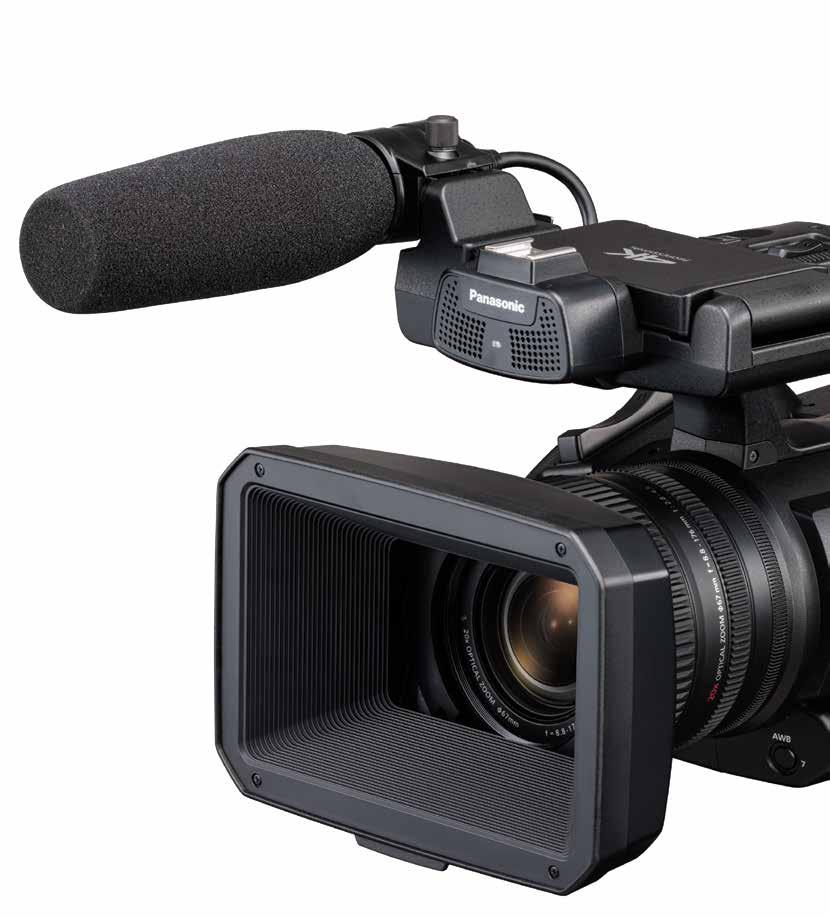
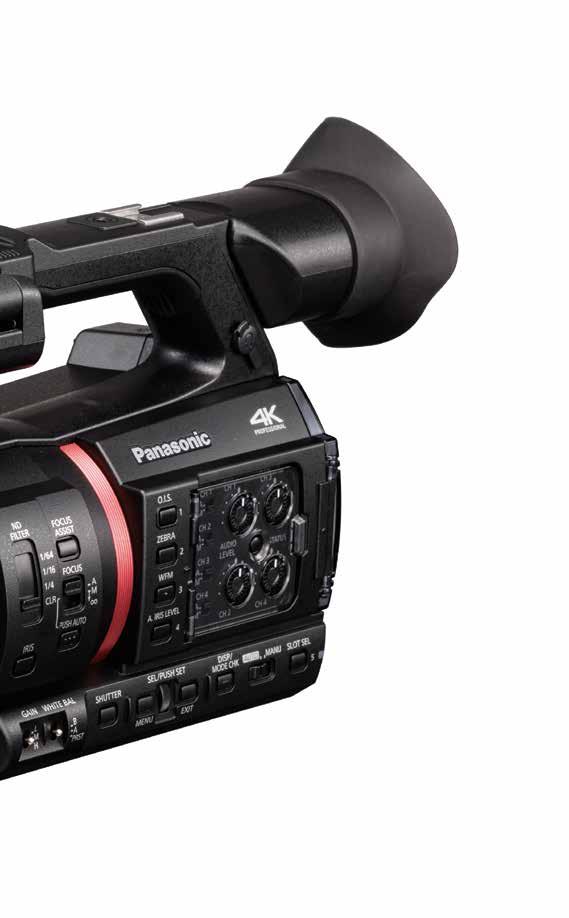
A new release of successful equipment, it comes to offer us something more than a mere update, catering perfectly to the needs and demands of the market and current customers thanks to its extraordinary versatility of use
By Luis Pavia
It has now been 6 years since the launch of its predecessor, our well-known ‘350’, a camera conceived at the time mainly as ENG equipment, which over time has strengthened its position as a proven tool in the broadcast environment.
But there is no doubt that during all this time the broadcasting market has clearly migrated: in general, we can say that traditional broadcasts maintain their audience, while most of the growth occurs in consumption through platforms and on-demand through IP networks.
The camera significantly improves its usability as a studio camera, or as a live camera in multi-camera environments for traditional settings
And it also seems unequivocal that today most of the creation of content -from capture and production to dissemination- must be as immediate and economical as possible in order to maintain the profitability for all players involved.
Thinking of this new scenario as a field of action, this is the reason why Panasonic has upgraded its model to become the AG-CX370, putting in our hands a particularly versatile tool, capable of adapting to this new way of creating content.
Let's keep in mind that ‘versatility’ is the ability of easily adapting to various functions or situations. Throughout this lab test we will see why we have chosen this term as a worthy depiction for our headline.
Understanding that for most of our readers this
type of handheld/semishoulder cameras for production and capture is very well known and common, this time we will shorten our traditional preamble describing the equipment subject of analysis and describe what is new with no further ado. What we will do, as usual, is go beyond the headlines and the mere enumeration of features, delving into what this all means for both producers and operators, and even for end customers.
Now, the camera: we anticipate that the truth is that it features interesting improvements, although initially its physical appearance, being very similar to the previous model, could make us think otherwise. Usability has been significantly improved, but without giving up the essence of the original concept. And we leave for last our reflection on
the convenience of updating to the new model, although the impatient reader can skip straight to the end if they want...
Starting with the major similarities, in terms of optics and sensor there are no physical differences, although they do exist at processing level. Let's explain: the fixed lens maintains an identical configuration, with a 20x optical zoom and equivalent focal lengths (according to the original data) from 24.5 to 490 mm, with conventional 4-step
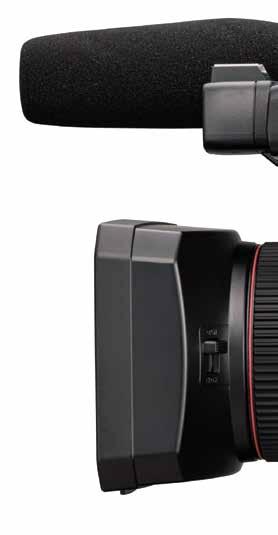
ND filter (0, 1/4, 1/16 and 1/64, or 0, 2, 4 and 8 diaphragm steps) and three independent rings for focus, zoom and iris.
We also have a configurable digital extender, and a 5-axis electronic optical stabilizer that supports different types of configuration to provide the best results depending on the different circumstances. The digital extender can be configured so that it does not exceed certain thresholds in order to make a potential loss of quality imperceptible,
in ranges of up to 24x in UHD (588 mm) or 32x in HD (equivalent to focal lengths of 588 and 784 mm). Or allow multiplier factors of x2, y x5 and up to x10, but then with noticeable loss in resolution.
The sensor also remains the same: 1 inch in size, with just over 15 million effective pixels. Here, the novelty lies in processing, significantly more powerful, which now allows us to make much more precise and detailed color adjustments by controlling up to 16 independent axes.
This results in a much more precise treatment and color adjustment. And on this we already announce more benefits.
Physically, the rest of the body is also quite similar, maintaining the ergonomics and ease of use, with the usual controls in the expected places and a good array of buttons that are customizable and easily recognizable to the touch so you don't have to look away from the viewfinder or screen. This feature has always been a deciding factor for most operators.
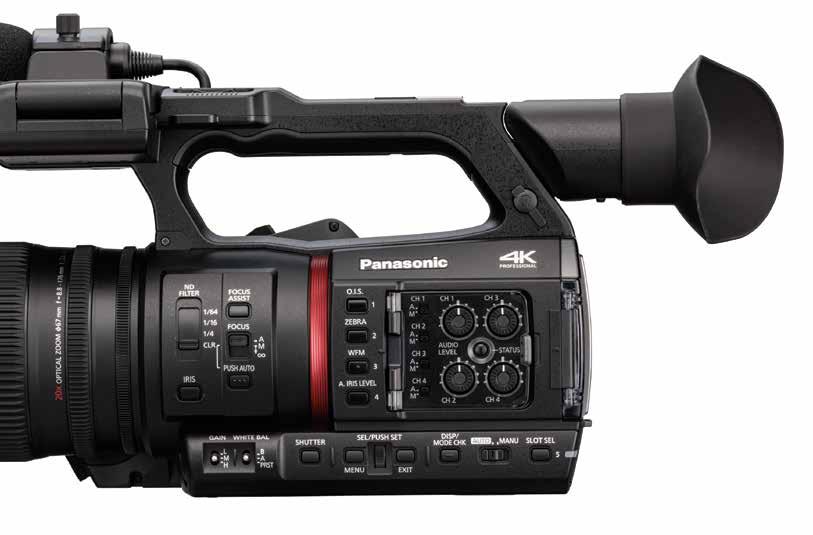
The 3.2" screen with 1.62 million pixels and a highresolution OLED viewfinder featuring 2.36 million dots complete the part related to optics and visualization.
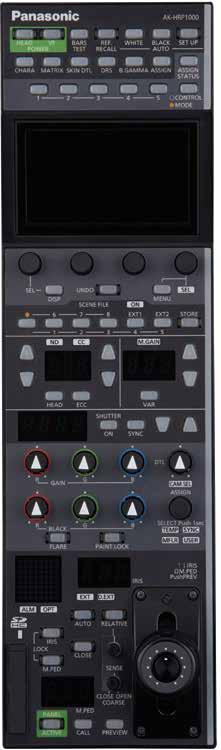
It still features a very similar size (approximately 31 x 18 x 17.5 cm), and a weight of around 2.3 kg under working conditions, that is, with battery, cards, etc.
Before turning on the camera, we already noticed appealing differences. For example, in addition to the HDMI output we have a 12G SDI output. We will later find that both are functional simultaneously. It also comes with additional BNC connectors for timecode and Genlock. This way, the camera significantly improves its usability as a studio camera, or as a live camera in multi-camera environments for traditional settings. It is precisely this quality, together with the precision in color adjustment, which will make the result of camera pairing in these environments simple and accurate. With regards to pairing, we insist that there is still much more...
Back to our multi-camera environment, it is possible to go much further as we also have an Ethernet port and an integrated NDI HX2
license at no additional cost. Thanks to them, it is possible to make live productions through IP while providing excellent performance.
In this way, contributions can be made in different types of environments: either through an NDI-compatible mixer in the installation itself -such as Panasonic's Kairos- or through a virtual production in the cloud. Always bear in mind that while using the NDI HX2 protocol it will not be possible to record on camera, stream or use 4K outputs, according to Panasonic's own specifications.
And to round off the issue on IP connectivity, in addition to the usual RTSP, RTMP and RTMPS protocols, nowadays the SRT protocol -also available- is a must. For those less familiar with these cryptic acronyms, just a brief reference to the most significant ones, as connectivity features are one of the strengths of this unit.
NDI is a proprietary protocol that seeks high data transfer with minimum latency in the transmission
of AV signals based on controlled environments such as private networks, where there is the possibility of managing and controlling data flows by network administrators.
The purpose of RTSP is to control the transmission, and not the content itself, which travels on a separate layer under RTP/ RTCP protocol. Useful for commanding the sending/ stopping of data flows from remote positions.
RTMP and RTMPS are streaming protocols for the transport of AV signals through public networks and designed to handle the synchronization and loss of data through these public networks, in order to allow reproduction in certain software players, the latter being an extension of the former that features data encryption.
Last, SRT is an interesting advance, as it is also a transport protocol through public networks, it is open source and offers secure performance and controlled latency through these unpredictable networks,
supporting both ‘caller’ and ‘listener’ configurations.
They all together make up a set of protocols that turns our camera not only into an excellent on-site capture and recording tool, but also into a highly operational one when it comes to making hybrid contributions in real time or with low latency, either by means SDI 12G or through different protocols on IP networks.
Our camera is highly operational when making hybrid contributions in real time or with low latency, either through SDI 12G or through different protocols on IP networks
In addition to, of course, uploading files to servers through FTP protocols. This functionality has long been used by most broadcasters to ingest, for instance, news content on their servers from remote locations.
But let's not lose sight of the fact that it is a camera, so a top priority here must
be image quality. In that sense, it meets all our expectations, offering a high image quality and a generous dynamic range. We cannot positively say if it is the same one or even somewhat better than that of its predecessor, as we have not been able to compare the two of them face to face.
The controls and handling are nearly identical, and any operator familiar with the previous model will be using this one without hardly noticing any differences.
But there are more areas where we perceive a significant improvement, such as audio. Not because it is of better quality, as it keeps the LPCM recording at 24 bits, but because we now have independent direct inputs for all four channels, in addition to the built-in microphone. The first two channels with the traditional XLR connectors, the first in the micro bracket and the second in the back of the body; and channels three and four through a 3.5 mm TRS stereo mini-jack connector.
And while this mini-jack connector is not our favorite choice as a high-level professional tool, it is true that at present multiple pieces of ultra-light equipment are used and it has therefore already become the de facto standard, especially in light wireless microphony. Thanks to this direct possibility, we got rid of the bulky adapters and of the resulting weight and discomfort associated with them.
is the selector for assigning inputs to channels in the event of intending to use, for example, the integrated stereo microphone.
In this sense, and despite the apparent limitation of not being able to change the setup of inputs through the menu while recording is in progress, it seems to us that it makes perfect sense to do it this way, thus prioritizing direct and effective access to volume control, which is much more likely to have to be tweaked in the middle of any recording.
Above all, because we must start from the best possible image quality, and then distribute through the necessary connectivity in each case. And our CX370 undoubtedly offers this.
Of course, there is support for HLG (Hybrid Log Gamma) for HDR recordings, as well as a menu system through which to configure a myriad of parameters. This is especially important if we want our productions to have our personal "touch".
In short, it is a renewal of a model with proven reliability and results, which adds significant improvements in connectivity for IP and streaming productions
To close the audio section, on the side of the body we find the four direct volume controls, with their four independent auto/manual selectors per channel. However, what has disappeared from the side panel and we must now manage through the menu
What is really handy is the new status button in the middle of the audio panel, which allows the full-screen viewfinder to display all the settings and input level indicators for channels 1 and 2, and by means of a second press, the settings for channels 3 and 4.
When recording, remember that this is the essential, consolidated operation and the original raison d 'être of cameras and in no way do we want to regard it as something marginal.
Among these parameters -to name just a few- we find the different looks, user profiles, configuration of recording formats, genlock configuration, activation and control of the facial tracking system to maintain accurate focus. Let's consider that with UHD resolution and a telephoto lens capable of approaching 500 mm, an open diaphragm means a minimum depth of field of the order of centimeters at distances of meters.
In this case, the precise autofocus and the ability of facial recognition and automatic tracking will
make any operator's life easier, thus allowing our protagonist to move within the frame while maintaining the peace of mind of not losing focus.
We have a variety of codecs and data rates to meet the different recording needs. For example, we have different combinations of 4:2:0, 4:2:2 and HEVC, with long-GOP and intraframe up to 10 bits, at 25p and 50p (also 30 and 60 in other time base configurations) with data rates from 50 Mbps (in HD) up to 400 Mbps (in UHD).
Even in HD there are interlaced formats so as to maintain compatibility with large numbers of broadcasting equipment currently in use. This feature, which certain ranges of cameras have been gradually missing, will be decisive in certain environments and a critical factor in some installations.
The files are recorded in MOV containers for AVC and HEVC, AVCHD and P2 MXF, on SDXC media or on microP2 cards. Featuring two slots that allow parallel
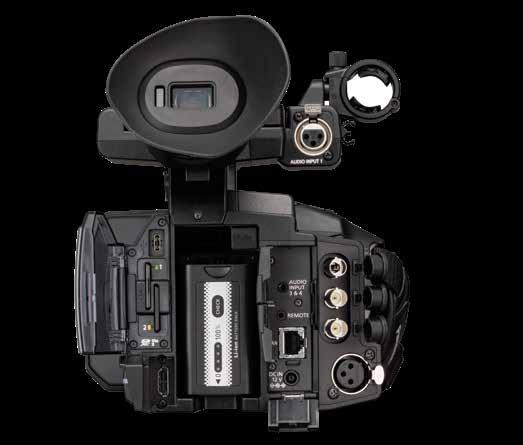
recording in different formats or relay recording, microP2 is required for the most demanding formats, thanks to its higher sustained data rate. Let's keep in mind that, at maximum quality and data rates, 13 minutes of video can take up around 1 Gb of space.
We have two USB ports -one of them Type A 2.0- on the upper left side to connect a Wi-Fi adapter or a mobile phone for tethering, and a Type C 3.2 to connect a computer and use it to dump content directly. The latter USB port is also used for service functions, according to the manual.
Not being oblivious to the concept of a traditional camera, and back again
to the ease of integration into a multi-camera environment, one of the possibilities that we found especially interesting and which makes that "something else" we have mentioned on a couple of occasions, is using the Ethernet connectivity to connect an ROP (Remote Operation Panel).
Specifically, we had the opportunity to test the camera with the AK-HRP1000. The great benefit it brings is having complete control of studio color, which together with its image quality in capture and detailed settings in 16 axes will allow us to match cameras as if it were a conventional studio camera.
It is true that manufacturers normally use their configuration so that cameras show a very well-balanced response directly in factory settings. But when you have to match cameras from very different types or manufacturers, being able to rely on these aids is almost essential.
In addition to doing it in such an efficient and smooth way that a dedicated panel allows on a set of values through a menu, the remote panel itself allows you to connect an SD card to save/restore and replicate configurations between different cameras.
In the case of the specific model of this ROP, we have the ease of being able to power it via PoE+, that is, the same Ethernet cable is capable of supplying power (on the condition that the switch provides it, naturally).
Approaching now the end of this article, we would like to mention a feature that we have not had the opportunity to try because we heard about it when we had already returned the
unit that Panasonic kindly let us use at a time of high demand.
This is the automatic functionality that the camera seems to have to label the content as "vertical" if it is shot with the camera in that position, so that certain editing platforms (such as DaVinci Resolve) will be able to recognize the rotation and treat the material as 9:16 vertical (instead of 16:9 horizontal) without the need for any further treatment to generate content in that particular orientation.
In summary, this is a revamped version of a model with proven reliability and results, which adds significant improvements in connectivity for IP and streaming productions, including an NDI HX2 license and SRT protocol, genlock and time code, with 20x optics featuring 5-axis stabilization and autofocus with facial tracking, 4 audio channels, support for V-Log and HLG curves for HDR content creation in 10-bit UHD formats and simultaneous outputs
Should I change my CX350 for the new AG-CX370?
And finally closing this time, the question that surely haunts many heads: should I change my CX350 for the new AG-CX370? Well, we have unequivocal arguments for both possibilities, and this is ‘only’ determined by our workflow and the needs of our customers. Just to frame the issue, let's think about connectivity for multi-camera productions, streaming possibilities, multi-channel audio, and contributions to remote productions.
If our activity is that of an operator who works alone recording content for subsequent editing, such as corporate, documentaries, feature reports or independent productions, and (still...) we do not need any of the above now or in the near future, our old
in 12G SDI and HDMI, and allows remote control through IP/LAN.
By the way, V-Log curves come from the VariCam family and its renowned logarithmic color gamut, making it possible to share the same LUTs as in Panasonic's cinema orientation cameras.
In short, a camera that is extremely versatile and one that feels just as good either an independent pìece of
equipment for ENG, or integrated into a live production or multicamera events, or even when doing remote production through IP or generating a streaming to cover a live cast from a remote location. Once again, we must stress the point: versatility is the best definition we have found for this camera.
One of the possibilities that we found especially interesting is to use Ethernet connectivity to connect a ROP (Remote Operation Panel)
350 will continue to be a good source of satisfaction, as we can further keep increasing the return for the investment for a little longer.
But if we are about to be, or we are already directly involved in any of these aspects and everything related to the IP world, it is undoubtedly now the time to take the leap, knowing that we will retain all the excellent qualities of image, operation and ergonomics, and gain in connectivity and versatility to face that future that is already with us.
We finish this article with thanks to Panasonic Spain and its technical and human team for the facilities for the undertaking of this laboratory test and leave you with a thought to reflect on: who can afford today to be outside the IP world...?