Cycle magazine February/March 26 LITE

Page 1


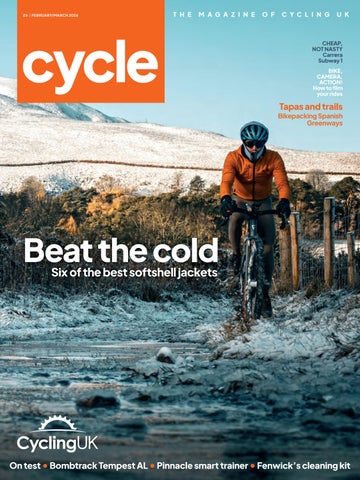
Beat the cold

Six of the best softshell jackets

Bikepacking Spanish Greenways CHEAP,

Tapas and trails

Cycling UK: Parklands, Railton Road, Guildford, GU2 9JX

E: cycling@cyclinguk.org

W: cyclinguk.org

T: 01483 238301

Cycle promotes the work of Cycling UK. Cycle’s circulation is approx. 51,000. Cycling UK is one of the UK’s largest cycling membership organisations, with approx. 70,500 members and affiliates.

Chief Executive: Sarah Mitchell. Cyclists’ Touring Club, a Company Limited by Guarantee, registered in England No 25185, registered as a charity in England and Wales Charity No 1147607 and in Scotland No SC042541.

Registered office: Parklands, Railton Road, Guildford, GU2 9JX.

Cycle magazine:

Editor: Dan Joyce

E: editor@cyclinguk.org

Designer: Christina Richmond

Advertising: Amelia Marshall

T: 0203 198 3092

E: amelia.marshall@ jamespembrokemedia.co.uk

Publisher: James Houston. Cycle is published six times per year on behalf of Cycling UK by James Pembroke Media: Ground Floor, Riverside North, Walcot Yard, Bath, BA1 5BG. T: 01225 337 777

Cycle is copyright Cycling UK, James Pembroke Media, and individual contributors. Reproduction in whole or in part without permission from Cycling UK and James Pembroke Media is forbidden. Views expressed in the magazine are those of the individual contributors and do not necessarily reflect those of the editor or the policies of Cycling UK. Advertising bookings are subject to availability, the terms and conditions of James Pembroke Media, and final approval by Cycling UK.

From the editor

Wainwright’s famous maxim that “There’s no such thing as bad weather, only unsuitable clothing” rang a little hollow. I was riding uphill through a blizzard: 40mph wind, a ‘feels like’ temperature of –7ºC, and snow filling the sky like static on the dead channel of an analogue TV.

“That looks awful,” read the WhatsApp from a riding buddy in response to the pictures I sent him. It wasn’t. The weather was certainly bad but I didn’t have a bad time. It was exhilarating. There was little danger as it was a traffic-free cycle trail. My mountain bike’s tyres (9psi) were finding traction in the snow. I wasn’t cold or wet as I had suitable clothing, including the Altura jacket on page 58.

A more useful maxim might be: “There’s rarely such thing as a bad ride, unless you’re wearing unsuitable clothing.” In Finland, children still cycle to school when it’s snowy and –17ºC and lower. (Google it. It made me feel less polar explorer, more bloke on a bike.)

Winter’s bigger problems for cyclists aren’t meteorological; you can always sit out a cold snap in the UK anyway. They’re rooted in human behaviour. Careless drivers slewing cars in conditions they’re unprepared for. Impatient drivers peering through portholes in frosted windscreens. (One such drove so close to me a few years ago that my right pedal scratched his passenger door.) Heavy lorries damaging tarmac so frost-cracking occurs, leading to potholes.

QUICK RELEASES

04 Freewheeling

Bits and pieces from the bike world

07 This is Cycling UK

A new road safety strategy; Cycling UK’s Board of Trustees; financial advice for members; fundraising challenges for 2026; Cycling UK’s Winter Raffle; and more

TOUR & EXPLORE

18 Questing time

Exploring Britain, one BCQ checkpoint at a time

24 Weekender

Mountain biking on the uplands of Exmoor

26 Tapas and trails

IN THE FRAME

43 Gear

Components and accessories tested

48 Shop window Previews of new products

50 Bombtrack Tempest AL

An all-road bike for all sorts of adventures

52 Carrera Subway 1

Find out if £350 will buy you a proper bike

56 Softshell jackets

Six of the best warm and windproof jackets

OVER TO YOU

61 Letters

Your feedback on Cycle and cycling

65 Profile

Printed by: Acorn Web Offset Ltd, Loscoe Close, Normanton Industrial Estate, Normanton, WF6 1TW T: 01924 220633

I’ve had one scarily deep pothole encounter already this winter. Luckily while riding a bike with huge tyres (60−622 Schwalbe Big Apples). The bike bucked but rolled through – just. Take care out there.

A five-day break on Spanish Greenways

FEATURES

32 Bike, camera, action!

How to record your rides by phone and action camera

40 Filling you in: potholes

What to do after you ride into one

Three of the 100 Women in Cycling 2025

68 Q&A

Your technical, health and legal questions answered

70 Bike finder

Which belt-drive, mixteframe bikepacking bike?

73 Travellers’ tales

Cycling UK members’ ride reports

Founded in 1878

Cover photo: Josh Reid avoiding the ice on a track in the Pentland Hills. By Markus Stitz

Great rides

Questing time

Stuck at home during lockdown, Sarah Cook discovered the British Cycle Quest. She decided to visit its 402 checkpoints in one continuous line

In early March 2020, I returned from a curtailed tour of Colombia to a face-masked and handsanitised Britain. A week later the country, and soon the world, went into lockdown. My first days were spent idly on the sofa. I searched online for a better sleeping bag, tent and water filter. Then – even though international adventuring was clearly off the agenda – I began looking for ideas on where I might travel next. That was when I came across the British Cycle Quest.

“The what?” my friends have asked, even long-term Cycling UK members. The British Cycle Quest, or BCQ, is a unique, domestic cycling challenge. There are 402 checkpoints to visit throughout England, Wales, Scotland and many of the surrounding islands. At each one, a place of interest that you might otherwise pedal past, you’ll find the answer to a clue. There are certificates and medals you can earn by completing checkpoint questions but there’s no time limit. The only rule is that you must arrive by bicycle.

As I explored the BCQ map of multicoloured checkpoint pins, an unexpected question popped into my head: “I wonder how it would be to visit all 402 checkpoints in one continuous cycling line?” There is doubtless a mathematical way to determine the shortest and most efficient route between 402 points but it’s beyond me. I decided to use my love of a linear route and my ‘let’s see how it goes’ approach to touring for a UK-based, post-Covid adventure.

A logical place to start was the most northerly area with BCQ points: the Shetland Islands. I’d then cycle south to Lizard Point in Cornwall, the most southerly point of mainland Britain. I would roughly follow the Sustrans JOGLE route, meandering about to visit as many checkpoints en route as I had the time and energy for.

Post-Covid touring

As the first lockdown was lifting in July 2020, I arrived in Lerwick, Shetland, on a grey and drizzly morning. Getting

“Questing around Shetland, I hunted down war and whaling memorials, Sullom Voe oil terminal, magical sandy beaches, lighthouses”

there involved long, face-masked and near-deserted train and ferry journeys. Reality struck. Not a single café was open for the cyclist’s breakfast fry-up that I had imagined as I looked over the squat, grey town while the ferry docked. The best I could find was a warm, soggy pastry and a machinedispensed coffee from Lerwick Co-op. I ate breakfast huddled under the shop canopy, sheltered from the wind and drizzle but sadly not from the midges. A Google search for campsites or B&Bs revealed that everything this far north would remain closed for the foreseeable future. Fortunately, wild camping is allowed in Scotland. I’d have nowhere warm and dry to shelter from bad weather, no handy power sockets, no bacon baps, no hot showers and definitely no comfy sofas to relax and eat cake on. But I could continue – and it did stop raining. I set off to find my first checkpoint and answer its question. I spent a week questing around Shetland Mainland, from north to south and east to west. I hunted down war and whaling memorials, Sullom Voe oil terminal, magical sandy beaches, lighthouses. Cemetery walls were great wind protectors. The island’s abundant public toilets were all open for washing (myself and clothes) and water supplies.

Below: Creating shade by the Lancaster Canal at Carnforth

Bike, camera,action!

Filming rides lets you relive and share your experiences. Journalist and photographer Steve Thomas explains how to make videos with the phone you already own

Making videos on mobile devices has become part of everyday life –cycling included. Modern phones and action cameras can capture great footage, making it easy to start your own YouTube channel or share memories with friends, family and followers on social media.

Before hitting the red button, it’s worth asking yourself why you’re doing it. What are you trying to achieve? You don’t want to compromise your ride or tour only to create something that’s barely

watchable. Consider, too, how much time you want to put into the project. A snappy Instagram Reel for family viewing is much easier to make than a 15−minute YouTube video of your LEJOG trip, which will need time, thought and editing work. Having a justification and a story for any video is important, even if it will only be a minute long. Yet it’s something that’s often overlooked. While it’s best to decide a plan in advance, things may fall into place

when you’re out on the road. You can even figure it out when editing, so that the clips come together in an interesting format.

“Having a justification and a story for any video is important, even if it will only be a minute long”

Few people watch videos with long, single takes, unless they’re of something dramatic like point-ofview footage of an epic mountain bike descent. Short clips lasting 5−10 seconds and edited together neatly are preferred. Vary scenes and camera angles, and add non-cycling clips to longer videos. These

Steve Thomas, except for author boxouts

could be a close-up pan shot of the sweet treats in a café, an epic stormy sky, sheep frolicking in a field or simply your muddy shoes.

Video settings

It’s not essential to shoot video in 4K resolution (UHD). Many TV broadcasters and leading YouTubers use 1080p (HD). The file sizes are smaller than with 4K, which makes processing, editing and backing up a lot easier. While 4K does offer a crisper and more detailed look, the vast majority of videos are viewed on small screens, not on big 4K monitors.

Social media platforms are optimised for 1080p. For vertical

A tripod – even a Gorillapod much smaller than this – is essential to film yourself. For more advice on touring videos, visit cyclinguk.org/filming

videos (portrait format) I’d suggest shooting in 1080p in any case. For horizontal videos (landscape format) of well-lit scenes, 1080p phone footage is still usually good enough, even for YouTube. If you’re shooting something that’s important, dimly lit or employs a stabilised camera, your video may benefit from being 4K.

The same resolution numbers on different devices don’t mean the video quality will be the same. Phones and action cameras have small sensors and can’t produce the same quality 1080p or 4K footage as a highend mirrorless camera. When phones and action cameras are stabilised, the frame is often clipped into.

Most digital platforms are optimised for 30 frames per second (fps). This frame rate is common for news and sports broadcasting, while 24 or 25fps is associated with movies. A low frame rate allows for more motion blur when combined with a slow shutter speed (see below). Higher frame rates, such as 120fps, can be used for slow motion later.

I prefer to shoot in 24fps although, when viewed on a phone screen, the differences in fps aren’t obvious. Shutter speed is more important when it comes to motion blur.

To add more motion blur in daylight, you’ll need a variable neutral

Steve Thomas

Journalist and photographer

I’ve been using Insta360 cameras for years now, and they are my go-to for capturing POVs and on-bike selfie shots. There is a learning curve with them, but in my opinion their versatility outstrips regular action cameras.

I also own Canon DSLRs and Fuji mirrorless cameras, which are kept for regular photography. My two older DJI drones are almost never used. For cycling videos, I prefer the simplicity of my iPhone 12 Mini and an Insta360 X4 Air (insta360.com), editing the footage on the phone. For sound, I use a small Røde VideoMic, a Boya wired lavalier mic and an Ulanzi wireless mic. For self-filming, a small tripod (such as a Gorillapod) is best. To trigger the shutter, I use a tiny and very cheap Bluetooth remote.

Lessons I’ve learned along the way include:

• Always carry a small lens cloth and clean your lens before shooting.

• Use the main, rear phone camera wherever possible as it’s usually better quality.

• Avoid digital zoom as it mostly crops into the frame, which lowers the resolution.

• Soft evening and morning light, with the sun behind or to the side, is best. Try to avoid very dark and low light scenes; phones (and action cams) struggle here.

• For off-bike shots, get your breath first and stay steady, with the phone in both hands for horizontal video. Use the screen grid overlay to keep things level, and work with the photographer’s rule of thirds if you can. Look for leading lines, such as trails and roads, to draw the viewer in.

• If you stop and set up shots, capture a few different clips. Review them before moving on.

• While many people capture on-bike shots holding a camera, I don’t recommend it.

Video chat
Photos:

Filling you in: potholes

It’s peak pothole season, with dangerous craters pitting roads across the UK. Nadia Kerr of Fletchers Solicitors explains what you can do when you spot or, worse still, are knocked off by one

For drivers a pothole is an irritation: a jolt through the suspension and an expensive visit to the garage. For cyclists, it can be life changing. A deep or badly positioned pothole can throw a rider from their bike, causing broken bones, head injuries and, in the most tragic cases, death. Damage to bikes, clothing and equipment is often the least of it.

Potholes form when water seeps into cracks in the road surface and freezes, expanding and breaking the tarmac apart, and leaving a hole when the ice melts. The more this repeats, the faster roads deteriorate. Add heavier vehicles and overstretched maintenance budgets, and it’s no surprise that many cyclists feel the road is literally crumbling beneath their wheels. The good news? Cyclists are not powerless and Cycling UK members are not alone.

Reporting potholes really matters

One of the most effective things cyclists can do is also one of the simplest: report

dangerous defects when you see them. Local authorities are responsible for maintaining roads that are ‘maintainable at public expense’, but they are not expected to keep every road perfect at all times. Instead, the law is based on ‘reasonableness’. Councils rely on inspection regimes and public reports to identify hazards and to decide what needs fixing soonest. When you report a pothole:

• It’s far more likely to be repaired, potentially preventing someone else being injured.

• You help councils target limited resources where they are most needed.

• You create a record of knowledge, which can be crucial if someone later makes a claim.

Cycling UK’s Fill That Hole tool (fillthathole. org.uk) is one of the easiest ways to report a defect. It automatically sends a report to the relevant highway authority. Some councils still resist third-party reports, but persistence pays off – and direct reports via council websites or phone lines also count.

Pothole crash checklist

As soon as practical after the incident:

• Take photos and measure the width, length and depth. Use a horizontal straight edge and a tape measure where possible. Note down the measurements.

• Obtain witness details. Ideally there will be a witness to the incident but also think of anyone who might help in providing evidence about how long the pothole had been there – for example, people living nearby.

• Note down exactly where the defect is situated by reference to a house number, business address or lamppost number.

• If there is any CCTV covering the scene, try to obtain the footage by contacting whoever operates the camera.

• Seek medical attention.

When reporting, be specific. Use clear language such as ‘deep and hazardous pothole – dangerous for cyclists’ or ‘defect located in the typical cycling line’. If you’re willing to leave your contact details, you may also be able to help as a witness if someone else is injured there later.

When potholes cause crashes

If you’re unlucky enough to come off your bike because of a pothole, what you do next can make a huge difference. First, make sure you are safe, seeking medical attention if required. If you go to hospital or see your GP, be clear about how the injury happened. Specify that it was due to a pothole, not ‘a fall from a bike’.

Evidence is critical. Councils will often deny responsibility by saying the defect wasn’t big enough, hadn’t been there long enough or had already been inspected. Clear, accurate evidence helps counter this.

That’s where Cycle SOS and the team at Fletchers Solicitors come in. As a Cycling UK member, you have access to specialist cycling solicitors who understand pothole claims and know what evidence matters. Early advice can prevent simple mistakes and ensure key details aren’t lost.

Cycling UK has a video guide on the website explaining what to do after a highway defect incident. It’s worth watching before you need it. See cyclinguk.org/cycling-collision

The casualty’s perspective

One Cycling UK member from Cheshire knows firsthand how important evidence and determination can be. While riding along a residential road, he hit a series of potholes hidden in the riding line and was thrown from his bike. He suffered physical injuries and ongoing psychological effects. His bike was damaged and his confidence took a knock.

“I just remember hitting what looked like a puddle and being launched forward,” he says. “It all happened so fast.”

The local council initially denied any responsibility, stating that the road was inspected every three months and that no actionable defects had been recorded. They also claimed they had received no previous reports.

However, with support from Cycle SOS and specialist cycling lawyers at Fletchers Solicitors, the member was able to challenge this. A local resident confirmed that multiple online reports about the potholes had been submitted in the weeks before the incident

but had gone unanswered. A post-accident inspection later identified a defect at the scene, which was repaired shortly afterwards. After persistence and detailed evidence gathering, the case settled for over £22,000.

The solicitor’s view

Those who deal with pothole claims regularly see the same patterns repeated.

Road conditions in many areas have deteriorated significantly. Ironically, as surfaces worsen, it can become harder to win claims because expectations of what is ‘normal’ fall. Councils often rely on their inspection policies as a defence, even when defects are clearly dangerous.

Stronger cases tend to share three things:

1. Clear, measured photos of the defect.

2. Accurate details of the location and direction of travel.

3. Evidence that the council knew – or should have known – about the hazard.

Claims can take time, and early denials are common. But persistence matters. With specialist support, many cyclists do succeed – and without having legal fees deducted from their compensation.

You can make a difference

Potholes should not be an accepted part of cycling. Reporting defects helps protect others. Gathering evidence protects you. And your Cycling UK membership means you’re never facing the process alone.

If you spot a dangerous pothole: report it. If one causes an incident: get help early. And if you ever need it, Cycle SOS is there to back you up. The legal advice is free. Visit cyclinguk. org/incident-line or call 0330 107 1789.

Potholes are an even bigger problem for small wheels or narrow tyres
Dan Joyce & Nadia Kerr
Here’s a long-term road defect I reported. After the final photo, I got a reply saying it would be repaired. Persistence pays off!

01

Hiplok Urban D £49.99

Can’t justify the cost of one of the grinder-resistant locks we tested?

Hiplok’s new Urban D is a £50 Gold Sold Secure lock with a frame mount. See cyclinguk.org/hiplok for your 20% discount. hiplok.com

04

BBB CoreCap AL Valve

£24.99+

A newcomer to the Prestareplacement market for tubeless users, CoreCap swaps the core for a sprung valve that allows better airflow and that works with Schrader pumps. bbbcycling.com

02

Surly Straggler

Frameset £899

Surly’s venerable steel all-rounder, the Straggler, has been updated with thru-axle dropouts, bigger tyre clearances (up to 50−622), more frame mounts and flat-mount brake fittings. surlybikes.com

05

Vee T-Monster

32×2.4in tyre £125

Want them or not, 32in off-road tyres are coming. As a fan of 30in-diameter rubber (29×3in), I get the idea – at least for taller riders and possibly XC racing. This one’s 61−686 and 1.6kg (!). veetires.com

Save money

Don’t forget your exclusive member savings, with up to 50% off cycling products and services. Visit cyclinguk.org/ member-benefits

06

03

Tailfin HyrdoMount £20

Tailfin’s strap-on HyrdoMount lets you mount additional bottle cages or smaller cargo cages to your bike’s top, seat and down tubes. It fits tubes from 22−90mm diameter. tailfin.cc

Restrap Utility Hip Pack £105.99

This 6−litre, waterproof hip pack doubles as a bar bag, enabling you to keep valuables at hand in all bikepacking situations. See cyclinguk.org/ restrap for your 10% discount. restrap.com

07

Apidura Packable

Backpack (13L) £49

Handy for bikepackers and tourers stocking up on food, this 110g, waterproof backpack scrunches down to the size of your fist and comes with a strap to attach it to a bike frame. apidura.com

Softshell jackets

Until spring finally arrives, you’ll likely want a warm and windproof jacket for every ride. Dan Joyce and Emma Silversides test six

Softshell jackets are stretchy windcheaters for athletic riding in colder conditions. Unlike a hardshell waterproof jacket, which can usually be worn over normal clothing, softshells are bike-specific kit designed to be layered over nothing much bulkier than a long-sleeved vest. Softshells work well for gravel riding and mountain biking but are primarily aimed at year-round roadies such as club riders, training cyclists and mileeating audaxers – cyclists who would find a hardshell waterproof too hot and too flappy. As such they have a jerseystyle tailored fit, along with a high neck, long sleeves that won’t expose skin in a drop-bar crouch, and a longer back (ditto). Standard features include elasticated pockets and reflective details to catch car headlights.

Softshells are made from thermal fabrics rather than swishy, sibilant nylon. Most suit conditions from around 0−10ºC, although the functional range will depend on the warmth of your baselayer, what your temperature tolerances are like and so on. All softshells are breathable and windproof.

Rain resistance varies from vaguely showerproof – typically from a DWR (durable, water-repellent) coating – to genuinely waterproof, with a hydrostatic head rating of 10,000mm or more. Moisture can still get through nominally waterproof fabrics as they’re not impermeable and may have untaped seams. This isn’t a big problem, however. These jackets are intended to keep you comfortable, not completely dry.

Most softshells are designed for 0−10ºC. This ride was sub-zero

What to look for

Fit and sizing

As with all clothing, manufacturer sizing varies. Try before you buy if you can. To put the reviews into context: Emma typically wears UK 12 (size M), while Dan (37in/94cm chest) is usually borderline between S and M. Because of the tailored fit, unisex softshells aren’t really a thing.

Weather protection

Effective windproofing is more important than insulation for cycling, but a fleecy-faced inner fabric will add some warmth and help prevent hypothermia when you’re fixing a puncture. A pocketable rain jacket is worth carrying if the softshell isn’t itself waterproof.

Visibility

Some brands have a Henry Ford approach to cycling gear for roadies, but brighter colours clearly stand out better in off-season UK conditions. At night, reflectivity is all that really matters.

Pockets

You’re unlikely to wear a cycling jersey underneath a softshell, so traditional rear pockets are useful for snacks and spare layers. A zipped pocket is invaluable for a phone, especially off road.

Care

Softshells can usually be machine washed at 30ºC. Don’t use conditioner if the jacket has a microporous membrane as it will block the pores and stop the fabric breathing. Don’t iron or tumble dry unless the label says you can. You can reproof DWR coatings; PFC- and PFAS-free treatments are available.

Left: Dan on the Cinder Track, by Dave Leaming

Van Rysel Women’s Winter Road Cycling

Jacket Endurance

£69.99 decathlon.co.uk

For me, this was the best-fitting jersey: a snug, road-specific cut with a spot-on body and sleeve length. The jacket has handled cold temperatures and chilly winds well. The DWR is on a par with the other two jackets; it won’t handle a prolonged shower. The snug fit makes getting a waterproof on easy.

Endura Women’s Windchill Jacket II

£99.99, endurasport.com

While the sleeve and body length are good, this jacket is baggy at the waist and upper arms for my body shape –not something I like for road riding. On the other hand, this helps ventilation when the temperature builds up, and extra layers will fit under it more easily. Since it wasn’t a great road cut for me, I used it for touring, commuting and off-road riding. This is where it has shone.

Gorewear Tempest Windstopper Jacket Womens

£144.99 gorewear.com

This is by far the most striking jacket; it drew comments on group rides for this reason. The fit was good, although I’d have liked a couple more centimetres at the sleeves. The rear drop could be longer and closer fitting, too. Despite the three rear pockets being spacious, access on the go is not easy as they are quite high up.

It offers lots of storage, though two of the side pockets are very narrow. The mesh pockets are great for a waterproof. There are two zipped pockets, too. There is an extendable rear drop. It’s not waterproof, so it only protects you from mud if you don’t have mudguards. It can be buttoned up out of the way, but doing so just led to a sweaty lower back. Options: women’s XS-XL (M tested), burgundy only; men’s S-XXL, black/caramel, black, sage green or red/black).

The best fit for me. The storage capacity is impressive, if a little restrictive. I love the subtle design but would like a brighter option

Underarm zips add extra ventilation, and I really liked the practical, zipped front pocket. I’ve enjoyed using it in temperatures from 2°C to 8°C. It fends off cold winds and road splash, but anything more than a squally shower penetrates the fabric on the arms and shortly afterwards the rear. Options: women’s XS-XXL (M tested) in black, aubergine, bramble, bright yellow, deep teal or pacific blue; men’s S-XXXL in black, yellow, pomegranate or rust red.

The fourth (zipped) pocket is handier.

This jacket was the cosiest in the coldest weather. The high collar shares the same fleece lining as the main body of the jacket. Protection from wind and cold air is excellent. When the mercury rose, I needed to unzip it. The shell resists road spray and very light rain, but nothing more.

Worth considering if you like looser-fitting jackets and want something that works well across a range of disciplines

Options: women’s XXS-XL (M tested) in neon yellow, lab red, black, fireball or lab grey; men’s S-XXXL (C3 Windstopper Thermo) in black, yellow/black or fireball/black.

A good choice for riders with shorter bodies and limbs. It offers excellent protection in very cold weather, plus outstanding visibility

Profiles

100 Women in Cycling

Cycling UK’s 2025 list of inspiring women cyclists was launched in December last year. Rebecca Armstrong spoke to three of the winners

IT’S STILL, sadly, the case that far fewer women cycle than men, with threequarters of cycling trips in the UK made by men. This means that women are missing out on the many benefits of cycling.

With women under-represented at all levels of cycling, Cycling UK’s 100 Women in Cycling award highlights some of the women who are doing amazing things to promote cycling to all kinds of audiences. Here are three of the winners of the 2025 awards.

DARCEY THEOBALD

Current U10 Welsh Circuit Champion

At just 10 years old, Darcey is our youngest winner this year – and she’s already a champion sportswoman. She competes in triathlons, cyclocross, mountain biking and circuit races, and she has a string of medals to her name. But what really makes her special is how much she loves it. She might not always come first, but she always has a smile on her face after even the toughest of races.

She got her first pedal bike on her third birthday because, she says, “I became too fast on my balance bike.”

She also joined Wrexham Cycling Club. She says that cycling “makes me feel strong and happy, like I can do anything. I love being outside and racing with my friends.”

During lockdown, when Darcey was just four years old, she and her family decided they would ride their bikes every day. “We ended up cycling 1,000 miles in 121 days and raised more than £3,000 for local charities.”

Darcey says she is very excited to be among our 100 Women in Cycling; it makes her feel like people believe in her even though she’s only 10. “I hope it shows other girls that they can be part of cycling too,” she adds.

Who else is on the list?

Above: aged four, she rode 1,000 miles in 121 days

Her cycling inspiration is Aisling Charlesworth, who was one of our 100 Women in 2023. “She always cheers me on in my Wrexham Cycling Club. I also look up to the girls and women I see racing. We are lucky to have female coaches in my MTB club, One Planet, and in Wrexham Cycling Club.”

Every year, our 100 Women in Cycling awards celebrate just some of the fantastic achievements and contributions women make to the world of cycling. With far fewer women cycling than men, we believe in the adage ‘you can’t be it if you can’t see it’.

Darcey’s advice for any women and girls out there who want to start cycling is simple. “Give it a go!” she says. “You don’t have to be the fastest, you just have to enjoy it. Riding with friends makes it even better. Everyone encourages you and cheers you on every time you learn something new.” cyclinguk.org/darcey-theobald

and girls out there who want to start she says. “You don’t have to be the Riding with friends makes it even and cheers you on every time you cyclinguk.org/darcey-theobald

This list shines a light on the women who are doing it, showing others they can do it too, whether that’s aspiring young sportswomen or having the courage to make the first step towards learning to ride a bike. Our 100 Women are breaking down barriers for everyone. You can read more about this year’s winners at cyclinguk.org/100Women.

Top left: Darcey wins the Welsh under-10 circuit race in Aberystwyth.

Travellers’ tales

The HG Wells fan club

Where: South-East England

Who: Phil Beed

When: November 2025

Cheaper Sunday room rates at Premier Inn were the incentive to extend our regular Portsmouth CTC club ride. We could go further afield and add some cultural exploration.

From Portsmouth we headed through Iping village, where the Invisible Man sought refuge. Then to Hindhead and past the Devil’s Punch Bowl. We descended on the old A3, which is now a cycle track going over the road tunnel. With the Hog’s Back behind us, we picked up the Basingstoke Canal towpath to Woking.

clock on the ceiling, as well as a dummy of the Invisible Man in clothes and bandages.

The Wey Navigation took us into London, where we had a 20km ride on quiet back streets, riverside paths and through two royal parks to reach our hotel in Wandsworth. We passed through Putney, where The War of the Worlds narrator meets the Artilleryman; it’s also a location in Wells’s cycling novel, Wheels of Chance (see cyclinguk.org/ wheels-of-chance).

The following morning we retraced our steps. Getting out of London was easier than expected on a Monday morning. In daylight this time, we saw deer in Richmond Park and riverside sights we had missed in the dark of the previous evening. The canal towpaths were quieter on a weekday and we made good progress back to Woking

Exploring mine craft

Where: Mid Wales

Who: Peter Haskett

When: Summer 2025

We pushed open a heavy metal gate, revealing a long, black tunnel. As we entered, all we could hear was the splashing of our feet and the constant dripping of water. Head torches on, we walked in for 50 metres or so. And there it was in all its decaying glory: one of only two surviving underground waterwheels in the UK.

Share your story

We’d love to hear your Travellers’ tales! Email: editor@ cyclinguk.org

In the town centre we passed under a seven-metre Martian tripod sculpture; Woking is where The War of the Worlds begins. There was also a statue of HG Wells and a monument of the alien cylinder. The pub we visited for lunch had a Time Machine

There we took a short detour to Horsell Common and the site of the Martian landing in the Sandpits. The area is largely unchanged since 1895, and you could see why Wells picked this spot. Our gathering of cyclists was not unlike the curious spectators in the story.

We arrived home after dark, having had two days of riding and culture.

Our three-day family bikepacking trip began on a warm day in Machynlleth with a climb into the hills. We puffed and pushed up small lanes and forest tracks, before descending into Artists Valley and reaching the mine midafternoon. After exploring that, a friendly local told us of a lovely spot for a dip in the river. Feeling refreshed, we cruised down towards Borth, reaching our campsite in time for tea. We were treated to a beautiful sunset. The next day would bring a long climb back up into the mountains. But for the time being we were content to enjoy the last of the sunshine and settle down in the tent, listening to the cries of oystercatchers and curlew across the water.

Turn static files into dynamic content formats.

Create a flipbook
Issuu converts static files into: digital portfolios, online yearbooks, online catalogs, digital photo albums and more. Sign up and create your flipbook.