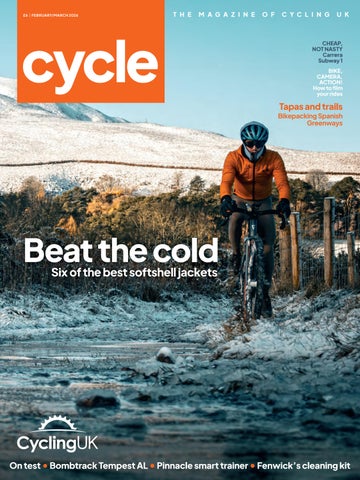

Beat the cold
Six of the best softshell jackets

Bikepacking Spanish Greenways CHEAP,
Tapas and trails


Cycling UK: Parklands, Railton Road, Guildford, GU2 9JX
E: cycling@cyclinguk.org
W: cyclinguk.org
T: 01483 238301
Cycle promotes the work of Cycling UK. Cycle’s circulation is approx. 51,000. Cycling UK is one of the UK’s largest cycling membership organisations, with approx. 70,500 members and affiliates.
Chief Executive: Sarah Mitchell. Cyclists’ Touring Club, a Company Limited by Guarantee, registered in England No 25185, registered as a charity in England and Wales Charity No 1147607 and in Scotland No SC042541.
Registered office: Parklands, Railton Road, Guildford, GU2 9JX.
Cycle magazine:
Editor: Dan Joyce
E: editor@cyclinguk.org
Designer: Christina Richmond
Advertising: Amelia Marshall
T: 0203 198 3092
E: amelia.marshall@ jamespembrokemedia.co.uk
Publisher: James Houston. Cycle is published six times per year on behalf of Cycling UK by James Pembroke Media: Ground Floor, Riverside North, Walcot Yard, Bath, BA1 5BG. T: 01225 337 777
Cycle is copyright Cycling UK, James Pembroke Media, and individual contributors. Reproduction in whole or in part without permission from Cycling UK and James Pembroke Media is forbidden. Views expressed in the magazine are those of the individual contributors and do not necessarily reflect those of the editor or the policies of Cycling UK. Advertising bookings are subject to availability, the terms and conditions of James Pembroke Media, and final approval by Cycling UK.

From the editor
Wainwright’s famous maxim that “There’s no such thing as bad weather, only unsuitable clothing” rang a little hollow. I was riding uphill through a blizzard: 40mph wind, a ‘feels like’ temperature of –7ºC, and snow filling the sky like static on the dead channel of an analogue TV.
“That looks awful,” read the WhatsApp from a riding buddy in response to the pictures I sent him. It wasn’t. The weather was certainly bad but I didn’t have a bad time. It was exhilarating. There was little danger as it was a traffic-free cycle trail. My mountain bike’s tyres (9psi) were finding traction in the snow. I wasn’t cold or wet as I had suitable clothing, including the Altura jacket on page 58.
A more useful maxim might be: “There’s rarely such thing as a bad ride, unless you’re wearing unsuitable clothing.” In Finland, children still cycle to school when it’s snowy and –17ºC and lower. (Google it. It made me feel less polar explorer, more bloke on a bike.)
Winter’s bigger problems for cyclists aren’t meteorological; you can always sit out a cold snap in the UK anyway. They’re rooted in human behaviour. Careless drivers slewing cars in conditions they’re unprepared for. Impatient drivers peering through portholes in frosted windscreens. (One such drove so close to me a few years ago that my right pedal scratched his passenger door.) Heavy lorries damaging tarmac so frost-cracking occurs, leading to potholes.

QUICK RELEASES
04 Freewheeling
Bits and pieces from the bike world
07 This is Cycling UK
A new road safety strategy; Cycling UK’s Board of Trustees; financial advice for members; fundraising challenges for 2026; Cycling UK’s Winter Raffle; and more
TOUR & EXPLORE
18 Questing time
Exploring Britain, one BCQ checkpoint at a time
24 Weekender
Mountain biking on the uplands of Exmoor
26 Tapas and trails
IN THE FRAME
43 Gear
Components and accessories tested
48 Shop window Previews of new products
50 Bombtrack Tempest AL
An all-road bike for all sorts of adventures
52 Carrera Subway 1
Find out if £350 will buy you a proper bike
56 Softshell jackets
Six of the best warm and windproof jackets
OVER TO YOU
61 Letters
Your feedback on Cycle and cycling
65 Profile

Printed by: Acorn Web Offset Ltd, Loscoe Close, Normanton Industrial Estate, Normanton, WF6 1TW T: 01924 220633
I’ve had one scarily deep pothole encounter already this winter. Luckily while riding a bike with huge tyres (60−622 Schwalbe Big Apples). The bike bucked but rolled through – just. Take care out there.
DAN JOYCE Editor
A five-day break on Spanish Greenways
FEATURES
32 Bike, camera, action!
How to record your rides by phone and action camera
40 Filling you in: potholes
What to do after you ride into one
Three of the 100 Women in Cycling 2025
68 Q&A
Your technical, health and legal questions answered
70 Bike finder
Which belt-drive, mixteframe bikepacking bike?
73 Travellers’ tales
Cycling UK members’ ride reports
Founded in 1878
Cover photo: Josh Reid avoiding the ice on a track in the Pentland Hills. By Markus Stitz


Watch this


VELO DE VILLE FOLDY
This German folder won a Design and Innovation Award 2025. It’s available unpowered (from £1,569 and 13kg) and electric-assist (from £2,619 and 17kg). Both fold to 110×61.5×39.9cm. With a 1,055mm wheelbase, 55−305 tyres and a trail figure of 61mm, it should be a stable-handling small wheeler. velo-de-ville.com/en
As part of its YouTube channel, Going Long Adventures, Cycling Weekly has ridden and filmed some of Cycling UK’s long-distance routes. Traws Eryri (bit.ly/cyclingweekly-eryri) and Royal Chilterns Way (bit.ly/cyclingweekly-chilterns) have already been uploaded. Both feel rather ‘head down on a gravel bike’ but it’s interesting to see a different perspective on these classic routes, and there are some nice scenic shots.
Find a local group near you and enjoy a ride this weekend: cyclinguk.org/ group-listing
Freewheeling

A short tour around the wonderful world of cycling


Jenny Graham
Women’s round-the-world cycling record holder (unsupported). Adventure cyclist and 100 Women in Cycling 2018 award winner
Which of your bikes is your favourite? Has to be Little Pig, my round-the-world-adventure buddy.
What do you always take with you when cycling? Snacks! Who mends your punctures? Me. But there is a position opening if anyone else would like to?
Why do you cycle? A variety of reasons: fun, adventure, transport, convenience, fitness, social.
Jenny’s record ride in 2018, see: cyclinguk. org/tags/jennygraham week? week.


How far do you ride each No idea! I probably go for about five rides a


Jenny’s book, Coffee First, Then the World (ISBN 9781399401043) is £10.99
It’s raining: bike, public transport or car? Oooh, I mean I live in the Highlands of Scotland, so if we didn’t ride in the rain we’d never ride. So I’ll say bike. Lycra or normal clothes? Both. I wear Lycra shorts mountain biking and woolly jumpers on the road. Just do your thing; don’t worry about looking like a biker. If you had £100 to spend on cycling, what would you buy?
bike

Singular Cycles
After two decades of selling adventure bikes and mountain bikes as framesets only, Singular Cycles is now offering off-the-peg complete bike builds with Hope wheels. The Gryphon (pictured), a dropbar steel 29er with 11−speed Shimano GRX 600/SLX costs £2,550 – as does the Peregrine, a steel off-road explorer with 11−speed Shimano GRX, and the Swift, a 29×3−compatible steel hardtail with 12−speed XT/SLX. The Kite, a titanium gravel bike with a 3D-printed Ti fork and 12−speed Shimano GRX 820, is £4,750. We plan to review one of the bikes later in the year. singularcycles.com
Freewheeling
My very favourite tool is a Dynaplug; it’s about £50. I’d love some nice Mudhugger guards for winter, then I’d spend the change on lunch. What’s your favourite cycle journey? One with friends, heading into the mountains. What single thing would most improve matters for UK cyclists? Mindset – a shift from ‘us versus them’ to ‘we’re all traffic’. The biggest barrier isn’t infrastructure or weather, it’s the idea that roads belong to one group more than another. If we reframed the road as a shared space rather than a battleground, behaviour would instantly soften.
Ruben Cutler
Your ride
Most four-year-olds are still just getting the hang of pedal cycling but last year my son Ruben rode 17km in 2 hours 23 minutes, writes Hannah Cutler. He learned to ride his bike over the 2024 Christmas period. Then in the summer he cycled the Kent coastal path from Margate to Reculver with his father.


was about curiosity and determination. Along the way he stopped was doing OK. By the end, he crossed the finish line grinning from
Ruben isn’t an avid cyclist. However, he loves sports, challenges and pushing himself. The ride wasn’t about speed; it was about curiosity and determination. Along the way he stopped for snacks and water, enjoyed the scenery, and assured us that he was doing OK. By the end, he crossed the finish line grinning from ear to ear, exhausted but triumphant.
Ruben’s adventure shows that cycling isn’t about the distance

being the fastest or training all the time. Sometimes,
Ruben’s adventure shows that cycling isn’t about the distance alone but the attitude. Cycling doesn’t have to be about being the fastest or training all the time. Sometimes, it’s about setting a goal, taking it step by step, and loving every minute of the ride.

Bespoked London
The UK’s handmade bike show moves from Manchester to London for 2026, taking place in Peckham from 24−26 April. There will be more than 70 exhibitors


displaying distinctive bikes, components and accessories, as well as talks, film and rides. Advance tickets cost £18 (plus £1.25 booking fee) for the day or £28 (ditto) for the whole weekend. bespoked.cc

Quick releases Cycling news and views from around the UK
CAMPAIGNS

Road safety reboot
On 7 January, the UK government published a road safety strategy to reduce the number of people killed or seriously injured on Britain’s roads, with a target to reduce that number by 65% by 2035, writes Duncan Dollimore. I say Britain because, although Scotland has a separate road safety framework and Wales is developing a road safety partnership plan, many aspects of the strategy apply across Great Britain – but not Northern Ireland.
Another strategy. More targets. It’s easy to be cynical of government announcements, but this one really does matter. We’ve had ambitious targets to reduce casualties before, and between 1997 and 2010 they fell by nearly 50%. Of course, things don’t happen just because you have targets
“Inherent in the strategy is the recognition that we need to reduce vehicle speeds”
and strategies, but they tend to move things up the political agenda. We haven’t had a strategy for 10 years or casualty reduction targets for 15, and in that period 22 European countries made more progress than Britain in cutting casualty numbers.
For many years, Cycling UK has been pushing for casualty reduction targets, a new road safety strategy and many of the proposals outlined in the new plan. Some of those proposals involve consultations on the details, and we’ll share more on those in the coming weeks. But the proposals for new vehicle-safety technologies (which are mandatory in the EU but not GB), tougher penalties for certain motoring offences, and new licence requirements and testing for younger and older drivers, all reflect our policy asks. There’s also a clear statement that the whole strategy reflects the internationally accredited ‘safe systems’ approach, a key component of which is safer speeds. So inherent in the strategy is the recognition that we need to reduce vehicle speeds.
The strategy isn’t perfect. There are things missing that should be there, including on Highway Code promotion (see ‘A missing piece for safer streets’, right). But the government just made road safety more of a priority than it has been for a decade. cyclinguk.org/road-safety-strategy

A missing piece for safer streets
This road safety strategy is a huge step forward. It includes lots of measures that you’ve helped campaign for over many years. But there’s one thing that’s missing: there’s no plan for Highway Code promotion – even though the majority of people still aren’t aware of the new rules from 2022. Important updates like minimum distances for passing cyclists and rules on who has right of way at junctions aren’t being followed, simply because people don’t know about them. With 2026 marking four years since the changes, it’s time to fix that.
Will you send a quick message to your MP and ask them to press the government to finally communicate the new rules properly to the public? Visit the website to contact your MP now: bit.ly/cyclingukmissing-piece-safety
Left: Morever. Right: Robert Spanring
Quick releases COMMUNITY
01
Camera focus in Wales
Reports that GoSafe, the Wales road safety partnership, would no longer process video submissions of driving offences from cyclists inspired many members to contact the Campaigns team. In December we met with the Head of GoSafe, Chief Inspector Morgan, who confirmed that video submissions, including of close passes, were still welcome. The key point, he said, was to fill out the supportingstatement box properly. You can’t just rely on the video; you need to explain what happened. This enables the police to process your submission. cyclinguk.org/closepass-footage

Pre-school winners

JOIN CTC NORTH YORKSHIRE on 28 March for a spring 100km audax from Wigginton, near York, that visits the Fountains Abbey estate. Places are limited to the first 100 riders to register. Entry costs £6. cyclinguk.org/ fountains-abbey-audax
02
All Ireland cycling conference
Last November saw the first ever All Ireland Cycle Campaigners’ conference. Jointly organised by Cycling UK and The Irish Cycling Campaign, the event was hosted by the local cycle campaign. Speakers from Northern Ireland shared the realities of campaigning in Northern Ireland’s highly centralised system, while others showcased creative grassroots work. cyclinguk.org/acrossborders
03
VIE Velo’s vision
At Novar Nursery in Glasgow, Play Together on Pedals funding has helped replace bikes that were no longer safe or suitable, and supported staff training so cycling sessions could run regularly. When nursery staff started looking for solutions, they first asked about staff training. That enquiry led them to Cycling UK’s Play Together on Pedals programme and the Cycle Access Fund grants available through it. This provided new bikes and helped the staff gain the skills and confidence needed to make cycling part of everyday nursery life. cyclinguk.org/project/play-pedals
Edinburgh-based Cycling UK affiliate VIE Velo is inviting cyclists to get back in the saddle this spring by joining their social rides on 7 and 22 March. The club enables visually impaired and sighted cyclists to share the joy of riding tandems together. New cyclists – both stokers or pilots – are welcome, but should contact VIE Velo beforehand to discuss their needs and experience. VIE Velo rides depart Edinburgh’s Saughton Park at 9:30am. They’re free to attend. www.vievelo.org

Quick releases
CHARITY NEWS
Liz & Nadia get on Board
Thank you to everyone who took part in the 2025 trustee election process. We’re delighted to welcome Liz Dobson as a newly elected trustee to the 2026–28 Board. We’re also pleased to confirm the re-election of existing trustee Nadia Kerr.
Nadia brings a lifelong love of cycling and a strong professional background to her continued role on the Board. Having cycled since childhood, Nadia has never been far from her bike and now rides more than 10,000km most years, enjoying road, off-road and indoor cycling alike.
Trained as a personal injury solicitor, Nadia’s career has been driven by a passion for supporting injured and vulnerable riders. Reflecting on her reelection, she said that being a Cycling UK trustee brings her “enormous pride and satisfaction,” working alongside people who are deeply committed to the charity’s mission.
Now three years into her trusteeship, Nadia continues to play a key role in supporting and constructively challenging the leadership team as Cycling UK delivers and evolves its current strategy.
Liz Dobson joins the Board with cycling truly part of her daily life. From


childhood freedom on bikes to touring in the UK and overseas, weekend club rides and business travel by bike, cycling has always been central to how Liz gets around. One of her proudest achievements was successfully campaigning for the Dorking–Westcott off-road active travel route in Surrey, completing a missing link in the National Cycle Network.
Alongside her cycling advocacy, Liz brings more than 20 years’ experience at senior management and board level. Her career spans technology and data consultancy, followed by a decade in non-profit leadership with local Citizens Advice and NHS health data registries. She offers strong strategic vision combined with practical operational delivery, particularly in technology, data and governance.
“I’m really pleased to be joining the Board at such an important moment for cycling,” Liz said. “I’ve seen how cycling can transform everyday life, and I’m looking forward to bringing my experience to help Cycling UK stay resilient, relevant and ambitious for what comes next.”
The next call for applications to become a trustee will be published in the June/July issue.


Our next adventure
Cycling UK’s Adventure Series inspires thousands of riders each year with routes that promote wellbeing and support local communities. Following the success of Royal Chilterns Way, we’re planning a new route for 2026 – location firmly under wraps. But we need your help: this February we’re launching a fundraising appeal to support its creation.
“As soon as riders finish one route, they ask what’s next,” says Ross Adams, Cycling UK’s Adventure Series Manager. “By supporting this appeal, you can help create another unforgettable cycling adventure. Please donate, get involved and help shape what comes next.” cyclinguk.org/ adventure-series

Sign up for Gift Aid
As a member, you can make your support go even further at no extra cost to you. Through Gift Aid we can claim back from HMRC 25p for every £1 of your membership subscription. If all members signed up for Gift Aid, we’d raise an extra £700,000 per year to make cycling safer and more accessible for all. Gift Aid is quick, easy and free to set up. cyclinguk.org/gift-aid

Liz Dobson
Nadia Kerr


Free financial consultation
Cycling UK members can now access a free consultation with a qualified M&G financial adviser, who will provide you with a personal recommendation at no cost. You’ll only pay a fee if you choose to proceed with their advice.
Like Cycling UK, M&G has a long history. It has roots stretching back over 175 years through its Prudential brand, which was established in 1848. Today, M&G Advice, part of M&G, focuses on supporting everyday people to make the most of their money with clear, practical guidance.
Your money matters
M&G’s long-standing commitment to helping individuals achieve their financial goals aligns with Cycling UK’s mission to support its community. The right advice can make a big difference to your finances, whether you want to talk about pensions, retirement planning, estate matters, maximising use of tax allowances, or savings and investments, an experienced adviser will provide clear, judgement-free guidance with no upfront commitment.
The advice recommendations M&G makes are from a carefully selected range of products and funds. This is known as


restricted advice. Using a focused and controlled approach allows each adviser to develop an in-depth knowledge of the products, so they can confidently and safely recommend a solution that’s right.
Book your call with M&G
To book your call, just go to the M&G member benefit page on the Cycling UK website, follow the link and submit your details. You will then be contacted to arrange your free consultation. M&G will also be running financial education seminars exclusively for Cycling UK members; keep an eye out online for dates. cyclinguk.org/mg-advice
‘M&G Advice’ and ‘M&G Advice Service’ are trading names of M&G Advice Partners Limited which is registered in England and Wales. Registered office at 10 Fenchurch Avenue, London EC3M 5AG. Registered number 5739054. Authorised and regulated by the Financial Conduct Authority.

Protect your bike with Bikmo
Potholes are more than just a nuisance; they’re a major cause of wheel and frame damage. While Cycling UK membership provides vital liability cover, it doesn’t typically pay for your bike’s repairs after a solo run-in with a crater. Bikmo’s cycle insurance fills this gap with comprehensive accidental damage protection options. Whether a pothole buckles your rim or snaps your fork, you won’t be left out of pocket. Members enjoy an exclusive 10% discount, plus ‘returning home’ cover if your ride ends early. cyclinguk.org/memberbenefits/bikmo

Saddle up and skedaddle
Cycling UK members can now enjoy even bigger savings on unforgettable cycling holidays. Get £100 off all Cycling UK routes –including Rebellion Way, King Alfred’s Way, Traws Eryri and Wolf Way – PLUS half-price bike hire on any holiday in the UK, Spain or Italy. That means more flexibility and more value, whether you’re bringing your own bike or hiring one. This offer is only valid if you book during the first quarter of 2026 (by 31 March). cyclinguk. org/member-benefits/ saddle-skedaddle

Quick releases

Challenge yourself in 2026
If you’re looking for a new adventure this year, Cycling UK’s fundraising challenge events offer the perfect excuse to set a goal, try something new and make a real difference along the way. From cycling adventures to running, trekking and adrenaline-fuelled experiences, there’s a challenge to suit every ambition and ability.
“Our challenge events are about more than ticking something off a bucket list,” says Cycling UK Head of Fundraising Rebecca Millburn. “They bring people together, build confidence and ensure that every mile, step or leap taken helps support Cycling UK’s work and the positive impact cycling can have on lives and communities.”
There’s a wide range of cycling challenges. Ride between two iconic cities on the London to Amsterdam Cycle, an achievable multi-day

adventure packed with unforgettable scenery. Or take on one of the popular (and often soldout) Chase the Sun rides, cycling from sunrise to sunset and discovering just how far a single day can take you.

Prefer to run? Our running challenges include the Brighton Marathon 2026, the Edinburgh Marathon and the Pairs Half Marathon. For something different, the Run Alton Towers Half adds a touch of theme-park magic to race day.
If walking is more your pace, our trekking challenges deliver big rewards. Enjoy coastal scenery on the Jurassic Coast Weekend, or test yourself on the Yorkshire Three Peaks Weekend, tackling three famous summits in one rewarding challenge.
Looking for something bold? Our adrenaline and obstacle events include a heart-pounding bungee jump and a fun, inflatable obstacle course, which is perfect for individuals or teams. Whatever you choose, every pound you raise helps Cycling UK create happier, healthier and greener lives through cycling. You’ll also be fully supported with fundraising advice, resources and encouragement. Sign up now and turn your next adventure into real impact. cyclinguk.org/fundraising-challenges

York Rally moves to Driffield
The 2026 York Cycle Rally takes place from 12-14 June at a new location: Driffield Showground. Venue difficulties with York’s Knavesmire, the event’s home since 1945 and where it ran for many years as the CTC York Rally, made the move unavoidable. The new location offers good facilities for campers, including secure cycle parking and e-bike charging, as well as superb riding on the lanes of the Yorkshire Wolds. As usual there’ll be a busy trade show and cycle jumble throughout the weekend. Parking and entry are free, and campsite bookings are open now. yorkcyclefestival.co.uk
Cycling UK at Holyrood
On 10 February we’re inviting MSPs and experts to the Scottish Parliament to discuss the health benefits of cycling and examine what we can do to get more women pedalling in Scotland. Featuring speakers from Public Health Scotland and Edinburgh Napier University, as well as Inverness Bicycle Mayor Emily Williams, the event will remind politicians of the crucial role cycling can play in boosting our health and wellbeing. We hope it will lead to more MSPs championing long-term investment in better cycle routes.
Left: Discover Adventure
Ltd.
Right: Peter Eland

Quick releases
1st prize
WINTER RAFFLE


Win big in our Winter Raffle
Our Winter Raffle is live, giving you the chance to scoop great cycling prizes such as a £2,000 UK cycling holiday and £1,000 spending money, or a brand-new bike worth £899. Every ticket you buy also helps create a healthier, happier and greener UK by supporting our cycling projects and advocacy. Here are the prizes you could win:


2nd prize: Vitus bike of your choice – hybrid, mountain bike or gravel bike – worth up to £899
3rd prize: 3 × Gtechniq Ultimate Bike Care kits, each worth £140
4th prize: Ortlieb Velocity Rucksack, Cyber range, worth £120
5th prize: 10 × £50 cash prizes
2nd prize 3rd prize
Thanks to everyone who helped raise over £15,000 in our Summer Raffle. This is supporting our charitable work, including campaigning for safer cycling.


4th prize

1st prize: Saddle Skedaddle UK group cycling holiday worth £2,000, plus £1,000 cash for your adventure


6th prize: 3 × bike-gear bundles (D-lock and mini pump), each worth £50
7th prize: 5 × Royal Chilterns Way & Marcher Castles Way guidebooks, worth £38 for the pair
This isn’t like the National Lottery; there are no roll-overs and all prizes will be won. Last summer’s raffle winner, Angie Kinghorn, was made up with her first prize. “A huge thank you for the e-bike I won,” she said. “As a keen cyclist, I’m thrilled to explore the countryside and town with this amazing bike. Buying a raffle ticket was my


6th prize


5th prize
How to play


Scan the QR code to play
way of supporting Cycling UK. I never expected to be so lucky.”
Tickets are £2 each. By taking part in this raffle and encouraging your friends and family to join in, you’ll help support our vital charitable and campaigning work. If you’d like to support us but don’t want to play the raffle, you can donate via the website: cyclinguk.org/donate
Enter online at cyclinguk.org/ winter-raffle-26 and pay by debit or credit card. Entries must be made by 11:59pm on 15 February 2026. Your raffle ticket numbers will be emailed to you. The draw will take place on 20 February 2026. Winners will be notified by email or telephone within a working week. Full terms and conditions can be found at cyclinguk. org/raffle-terms. If you have difficulty entering online, please call us on 01483 238301 so we can assist you. To take part in the raffle, you must be at least 18 and live in England, Scotland or Wales. Please gamble responsibly (for details, see gambleaware.org).


Great rides
Questing time

Stuck at home during lockdown, Sarah Cook discovered the British Cycle Quest. She decided to visit its 402 checkpoints in one continuous line


In early March 2020, I returned from a curtailed tour of Colombia to a face-masked and handsanitised Britain. A week later the country, and soon the world, went into lockdown. My first days were spent idly on the sofa. I searched online for a better sleeping bag, tent and water filter. Then – even though international adventuring was clearly off the agenda – I began looking for ideas on where I might travel next. That was when I came across the British Cycle Quest.
“The what?” my friends have asked, even long-term Cycling UK members. The British Cycle Quest, or BCQ, is a unique, domestic cycling challenge. There are 402 checkpoints to visit throughout England, Wales, Scotland and many of the surrounding islands. At each one, a place of interest that you might otherwise pedal past, you’ll find the answer to a clue. There are certificates and medals you can earn by completing checkpoint questions but there’s no time limit. The only rule is that you must arrive by bicycle.
As I explored the BCQ map of multicoloured checkpoint pins, an unexpected question popped into my head: “I wonder how it would be to visit all 402 checkpoints in one continuous cycling line?” There is doubtless a mathematical way to determine the shortest and most efficient route between 402 points but it’s beyond me. I decided to use my love of a linear route and my ‘let’s see how it goes’ approach to touring for a UK-based, post-Covid adventure.
A logical place to start was the most northerly area with BCQ points: the Shetland Islands. I’d then cycle south to Lizard Point in Cornwall, the most southerly point of mainland Britain. I would roughly follow the Sustrans JOGLE route, meandering about to visit as many checkpoints en route as I had the time and energy for.
Post-Covid touring
As the first lockdown was lifting in July 2020, I arrived in Lerwick, Shetland, on a grey and drizzly morning. Getting
“Questing around Shetland, I hunted down war and whaling memorials, Sullom Voe oil terminal, magical sandy beaches, lighthouses”

there involved long, face-masked and near-deserted train and ferry journeys. Reality struck. Not a single café was open for the cyclist’s breakfast fry-up that I had imagined as I looked over the squat, grey town while the ferry docked. The best I could find was a warm, soggy pastry and a machinedispensed coffee from Lerwick Co-op. I ate breakfast huddled under the shop canopy, sheltered from the wind and drizzle but sadly not from the midges. A Google search for campsites or B&Bs revealed that everything this far north would remain closed for the foreseeable future. Fortunately, wild camping is allowed in Scotland. I’d have nowhere warm and dry to shelter from bad weather, no handy power sockets, no bacon baps, no hot showers and definitely no comfy sofas to relax and eat cake on. But I could continue – and it did stop raining. I set off to find my first checkpoint and answer its question. I spent a week questing around Shetland Mainland, from north to south and east to west. I hunted down war and whaling memorials, Sullom Voe oil terminal, magical sandy beaches, lighthouses. Cemetery walls were great wind protectors. The island’s abundant public toilets were all open for washing (myself and clothes) and water supplies.

Below: Creating shade by the Lancaster Canal at Carnforth
Fact file
Questing time
Distance: 7,006km (4,353 miles) so far.
Route strategy: I start with the BCQ online map and Question Book, then mark checkpoints onto the paper Ultimate UK Cycle Route Planner Map (walkwheelcycletrust.org. uk). This gives me an idea of how checkpoints and mapped cycle routes will link up. Google Maps helps me locate campsites. Finally, I use Komoot to plan each day’s ride.
Favourite destinations so far: The Italian Chapel, Orkney, for its history and human story. Parkgate, Wirral, for childhood memories of visits to my grandparents. Trinity Bridge, Crowland, Lincolnshire, for novelty value. Ashdown Forest, East Sussex, for glorious off-road riding.
Toughest BCQ rides so far: Boscastle, Cornwall, for steep hills and a day of thunderstorms. Heckington Windmill, Lincolnshire, for little route choice and bonkers traffic. Beachy Head – a steep ascent and ferocious side wind with a fully loaded bicycle. Bike used: Surly Disc Trucker in full touring/camping setup. Navigation: Ultimate UK Cycle Route Planner Map for an overview. Komoot routes saved onto my Wahoo Elemnt Roam for day-to-day navigation. Pages from an AA Road Atlas, with the checkpoints marked, as a backup.
I’m glad I have… Wahoo Elemnt Roam. A paper copy of the BCQ Question Book. I wish I’d known… The enormity of the continuous cycling line idea and how uncompromising I would become about sticking to it!

Challenges & checkpoints
Try a fundraising challenge, then visit nearby BCQ points – see p14

from bottom photo: Off-road trails across Ashdown Forest. West Cowes on the Isle of Wight, where Sarah managed six checkpoints in three days. Overlooking London from the Royal Observatory, Greenwich

And the honesty cake-fridges were well stocked.
Boats and bicycles are the best travel combination, and the ferries were all running. On the Orkney Islands, I visited standing stones, prehistoric settlements, fascinating features remaining from WWII, and the Old Man of Hoy. I learned the sad story of Betty Corrigall, who died by suicide.
Meandering south
Back on the Scottish mainland, I went to look at John o’ Groats to say I’d been there. Then I pedalled to Dunnet Head, the most northerly point of mainland Britain. Exhilarated, I stood shrouded in cloud, feeling the void in front of me. The base of the lighthouse was barely visible, while seabirds shrieked and wheeled in and out of sight. Turning around, I imagined the kilometres of cycling ahead of me, stretching away southwards.
The coast road was crawling with campervanners doing the North Coast 500, so I diverted through Strathnaver, which was empty.
Meandering from east to west and east again, I answered BCQ questions at battlefields, Rob Roy’s grave and monuments to notable figures I had never heard of. I had planned to head to the Western Isles but the year was marching on. While camped beside Loch Ness, I realised that if I continued with my ‘let’s see what happens’ plan, I would still be riding in December. I then did some proper planning and took a more direct route from Glasgow to the border. In England, I collected BCQ points at an RSPB sanctuary, the Liver Building, a planned village, a mariner’s beacon, waterwheels and a cliff railway. By the time I reached Exeter, the days were short, the nights were cool and the weather was mixed. I took a few rest days at my daughter’s home to hide from Storm Alex, before a loop round the north side of Dartmoor and a final few days to collect the checkpoints on the south coast of Cornwall. I reached Lizard Point in mid October after pedalling 3,188km in almost three months. In completing my north-to-south linear route, I’d ticked off 51 checkpoints. I took the train back to Exeter from Penzance. With 351 places still to visit, this BCQ project was going to take a while!
An intermittent journey
Nearly a year later, in September 2021, I returned to Penzance by train to pick up where I left off. I explored the north coast of Cornwall, Devon and Somerset, visiting BCQ checkpoints in those three counties. Never again would I have to push my bike up a steep, narrow, sunken Devon lane! At Taunton, I paused again. The world was starting to return to preCovid accessibility. I was able to fulfil my touring adventure plans for Europe and then South America. But the BCQ Continuous Cycling Line project was still on the back burner. In April 2024, I was back at Taunton station. First I had to head northwards to visit the Somerset 03 checkpoint, which I hadn’t been able to find in
Clockwise

2020 on my north-south ride. The database and map of clues and locations is maintained by Cycling UK volunteers, and checkpoints and clues can change slightly. (Always check the website for the most up-to-date information for the checkpoints you plan to visit.) Checkpoint located this time, I then meandered about completing Somerset and Dorset, passing a chalk giant, visiting a hilltop monument and a clifftop globe. Then I crossed the Solent to the Isle of Wight.
“I could see geographical puzzlement in the faces of those making friendly enquiries about where I’d come from and where I was going”
Six checkpoints in three days on a circumnavigation of the Isle of Wight felt very efficient. A twocheckpoint day is satisfying, and a three-checkpoint day is exciting. My average checkpoint rate overall is just under one per riding day, but there are often days travelling between points with no questing. I needed to get a move on for a date in Lincolnshire, so had to take a direct route there. En route, I hit a record four-checkpoint day crossing Greater London.
In July and August, I explored East Anglia. I visited all the checkpoints in Cambridgeshire, Norfolk, Suffolk and Essex, looking for unusualshaped postboxes, village name signs, cathedrals, a three-legged bridge, windmills, more statues of local celebrities, and a scene from a famous painting.
I could see geographical puzzlement in the faces of those making friendly enquiries about where I’ d come from and where I was going. My route was certainly convoluted and
I could always have got to wherever I was by a much more direct route than the one I’d taken. Eventually I pressed my fully loaded touring bike through the tourist hordes at Greenwich on a sunny Sunday afternoon to visit my final Greater London checkpoint. Afterwards I pedalled to Waterloo Station, where my BCQ journey paused again.
Five years and counting
As I live a nomadic life, with no fixed abode, Waterloo Station was going to be an accessible point from wherever I happened to be when I was ready to continue. In May 2025, I negotiated my way past the taxis and buses to exit Waterloo Station and ride south-east into Kent. Cycling infrastructure in London is among the best I have seen in the capital cities I have pedalled through: segregated cycle lanes, cycle traffic lights, signposted routes and so on. It certainly felt safer than the busy rural roads in Kent that I sometimes couldn’t avoid.
I answered BCQ questions about a mosaic frieze, a medieval jousting post, fancy railings and a public water fountain. The traffic-free cycleway around the Kent coast was a joy to pedal, and I hunted down the coastguard cottages in Ramsgate and Sandgate where my grandfather had been stationed and my mother spent her teens.
My BCQ journey had to pause at Folkestone for a few weeks. Then I returned to visit the East Sussex checkpoints, reaching the summits of
An ABC of BCQ
It’s easy to get started. Wherever you live in England, Scotland or Wales, there will be a BCQ checkpoint relatively near to you.
A Visit the interactive map of multicoloured pin markers at cyclinguk.org/britishcycle-quest. Choose a point on the map and find the location name, unique BCQ number, OS grid reference, latitude and longitude, and the question.
B Check out the Question Book. Download this for off-line access or print out a paper copy. Be sure to keep your Question Book up to date from the website.
C Plan your route. The only rule is that you should cycle there. At the checkpoint, hunt down the target and find the answer. Record your answer or take a photo.
D To claim a checkpoint, you must submit your answer for verification by the wonderful volunteer BCQ administrators. If you want to get competitive, you can join the questers’ league tables.
E Collect more checkpoints. Visit points near to home on day rides, points en route to another tour, make a tour of checkpoints in a certain area, or have a fixed-base holiday and ride day loops to tick off a whole area.
F Only 36 people have completed the British Cycle Quest since 2003, but many more are in various stages of their BCQ journey. Happy questing!
Beachy Head and Ditchling Beacon, and enjoying glorious off-road riding across Ashdown Forest. At Redhill Station, I temporarily halted again.
As I write, in October 2025, my ‘tyres-on-tarmac’ line is 7,006km long. I have so far logged 139 checkpoints in 146 riding days but have spent many more days on the road, allowing for rest days, rain days and sightseeing days. I’ve camped almost every night.
I don’t know if I will ever complete the British Cycle Quest or my plan to do so in one continuous line; there are so many places in the world I want to ride my bike. But already I have visited interesting places and glorious parts of the UK that I would never otherwise have seen.


Weekender
Exmoor explorer
Stay overnight in Porlock and finish a mountain bike ride on moorland trails with a dip in the sea and a cream tea. Max Darkins is your guide
Exmoor National Park covers an area of 700 square kilometres, with 71% in Somerset and the remaining 29% in Devon. With around 700km of bridleways and many more unclassified tracks and permissive bridleways, there are plenty of trails to keep you entertained here.
This route starts by heading south, up onto Doverhay Down. It then uses one of the permissive bridleways to link you to Ley Hill, where you join Granny’s Ride. This fun and challenging singletrack trail drops you steeply down the first of the many steep-sided combes around these parts into the heart of Horner Wood. If you thought the descent inappropriately named, just wait until you attempt the tough push back up the other side!
The ancient oak trees here add an eerie ambience to this quiet nature reserve. Both flora and fauna flourish, and you could easily spend some time exploring and playing in the babbling river here. Next comes the big climb to the highest point in Exmoor: Dunkery Beacon, which sits at more than 500 metres. Big views out across wild and expansive moorland, and even over the Severn Estuary to Wales, reward your efforts.
In autumn you will be further treated with bright yellow gorse, while July and August have vibrant purple heather. It’s also a good place to spot wild ponies and deer roaming the open moor. There is, of course, also a great


downhill section from here. You descend the open moor on a wide and rocky trail, and with no real hidden surprises you can enjoy a clear run. At the bottom, a cruise back along the foot of the moors leads you to Horner, where the pull of a cream tea may delay proceedings for a while.
The second loop takes you west of Porlock, climbing to just over 400 metres this time, to Hawkcombe
“Dunkery Beacon sits at more than 500 metres. Big views out across wild and expansive moorland, and even over the Severn Estuary to Wales, reward your efforts”
Head, where you turn and head back down to Porlock. This track is a classic, starting with a flowing trail across the open moorland before it drops into the dark, wooded valley, splashing through streams and bumping over rocks and roots as you go. You could stay along the valley floor all the way back into Porlock. Alternatively, if you have the energy, follow the route for one last ‘little’ climb and finish with a flourish, before plopping back to Porlock for a well-earned pint.
The upland moorland area provides some majestic views but starting at sea level you do have to work pretty hard to get yourself up to the top. The journey back down rewards you with some exhilarating riding, and the double-bubble shape of the route enables it to be tackled as two rides if required.
The descent from Dunkery Hill is worth the climb

Exmoor explorer


MAX DARKINS
Guidebook writer and Royal Chilterns Way route designer
Route name: Exmoor explorer Start/finish: Porlock village central car park (off the B3225 road to Porlock Weir). Nearest train station is Minehead (11km/7 miles away), the end of a seasonal heritage line that starts at Bishop’s Lydeard (9.5km/6 miles from Taunton) Ride length: 36.4km Climbing: 1,300m Bike type: This is mountain bike territory – ideally a full-suspension model. Electric assistance is helpful, too Ride level: Best for experienced off-road riders. Due to the steep hills, a high level of fitness (or an e-bike) is recommended GPX file: cyclinguk.org/ weekender-exmoor-explorer
Summary
A hilly route with some steep, challenging trails. The hills make this physically demanding too, but it can easily be split into two rides.
Porlock village
01
This small village provides plenty of facilities for visitors, with nice venues to eat and drink, ranging from friendly pubs, such as the Ship Inn, to artisan cafés and a quirky delicatessen (The Big Cheese). It even has a campsite in the village itself. There is no bike shop, however, so come prepared. The main car park and village can be very busy at peak times, but Horner village makes a great alternative start location, with a large car park, toilets, a farm shop and a nice tea shop.
02 Horner Wood
This is the largest area of ancient oak woodland in Britain. We
descend its steep-sided valleys to cross Horner Water. The protected National Nature Reserve, owned by the National Trust, is home to a variety of wildlife and plant life, including 15 of the UK’s 17 species of bat, many interesting and rare birds, and more than 330 types of lichen.
03 Dunkery Beacon
This is the highest natural point in Somerset (519m). It provides great views across the moors and over the Severn Estuary to Wales. The cairn at the top of this hill has been visited by humans since the Bronze Age and contains several burial mounds. It’s exposed up here so be prepared. After you’ve enjoyed the view, there is a great descent waiting for you.
04 Hawkcombe Woods
A lovely woodland of Special Scientific Interest. It’s just over 100 hectares in area,
and it’s home to important and rare flora and fauna. Take note that the route crosses over itself here. Make sure not to ride up Shillet Wood Combe, as that is definitely best enjoyed with gravity on your side. Be aware that, at the very end near Porlock, the trail forks: left is a very rocky track down to Porlock; right takes you to Hawkcombe for an easier and less technical end to the day.
05
Porlock Weir (and beach)
This pebble beach may not be ideal for sunbathing but the coastline is dramatic where the steep wooded hillside plunges down to the sea. Bridleway access to the beach makes it a good place to cycle out to, so you can enjoy a cooling plunge at the end of the ride and then admire the lovely little harbour. This has a good café and a pub, as well as a venue selling fresh local oysters.


Great rides
Tapas and trails

Seeking
an escape from Scotland’s autumn rain, Markus Stitz and his partner Louise spent five days bikepacking on Spanish Greenways
The scent of pine trees filled the warm air as our tyres scrunched over a dusty gravel track. The mountains of the Sierra Espuña towered above, the highest peak 1,583m. It was hard to imagine that this was once nothing but barren desert.
Ecologist Ricardo Codorníu started reforesting the area in 1889, the same year Scotland’s iconic Forth Bridge was completed. His efforts earned him the title ‘apostle of the tree’, and they provided us with a very pleasant second day of cycling in Murcia.
While we had originally planned this trip for June, I was more than happy that we had postponed our journey to the end of September. On the night we arrived, it was still hot and muggy. Two days into our trip, the air had cooled down significantly, signalling the start of autumn in Spain. We both agreed that the conditions for cycling were close to perfect.
Travelling light
Our five-day trip started from Cartagena and took us on gravel paths, quiet roads, Vías Verdes (Greenways) and singletrack paths to the holy city of Caravaca de la Cruz, then on to Murcia. For me, it was a short break before running my last event in the UK, the Dunoon Dirt Dash, and then heading off on a monthly work visit to the US and Canada.


My partner Louise, currently on a sabbatical from her work at the Norwegian University of Life Sciences, joined me for this credit-card bikepacking trip. We both needed time off after a busy summer –and from a September that had been very wet in Scotland.
“This was cycling heaven, a traffic-free track with smooth gravel for 15km”
I wasn’t sure what to expect, but there were good reasons to visit: an extensive network of former railway lines that would form the backbone of our journey; the opportunity to visit one of only five holy cities in the world; and the ability to order food well after 8pm. We were not disappointed.
Day one started with an early breakfast at our hotel in Cartagena, followed by a quick bike assembly session and the usual realisation that, even with only one piece of checked luggage between us, we had packed too much. We had rooms, dinner and breakfast booked in advance, and with temperatures like a hot Scottish summer, we didn’t need to carry much. Half our stuff stayed behind in the hotel as we set off.
Day one: terrain hilly, battery flat With 1,300m of climbing packed into 86km, the first day was also by far the hardest, with the longest
climb right at the end. About halfway through the day we joined the Campo de Cartagena Greenway, one of many in the region. This was cycling heaven, a traffic-free track with smooth gravel for about 15km. On the edge of the Greenway, we spotted lots of chupaeros. These small snails, found in orchards and fennel fields, are commonly used in the cuisine of the region of Murcia, although harvesting them in the wild is banned.
I had the suspicion that the first day would be a bit too much for Louise’s e-bike. And as we rolled into Totana, our last big town for the day, the battery was down to 3%. Thankfully, Louise and I can easily swap bikes. Shortly after we left the town boundary, I found myself reminded of my singlespeed trip around the world. This time I had gears but was pedalling 400m uphill on a heavy bike with no motor assistance. Later than anticipated, we rolled into our accommodation just as it got dark. We were delighted to find a wonderfully decorated room in the Mirador de Aledo Hotel, nestled in beautiful countryside, with a view towards the mountains of the Sierra Espuña. Even better, this wasn’t like Scotland where ordering
Opposite page, clockwise from top left: Gravel track near Las Palas. Arroyo de Burete viaduct on the Vías Verdes del Noroeste. Sierra Espuña Regional Park. The holy city of Caravaca de la Cruz


dinner after 8pm can sometimes be a real challenge, especially in the off-season. Arriving at our table at 9pm, we were the first guests. As well as seafood and a lovely bottle of Spanish white wine, we had a chat with the owner, our cook for the night.
Day two: pine-clad mountains
Day two took us on a tour of the Sierra Espuña Regional Park. With rain forecast, we packed our waterproofs. Our day’s 1,130m of climbing was stretched over 52km, but our initial fears that we would run out of battery again were not realised. Travelling without luggage meant less work for Louise’s bike, and we arrived back at our hotel with plenty of juice left. Out of the five days on the bike, this was my favourite. After an initial climb on tarmac roads, we hit the gravel at around nine kilometres. From there on we had the tracks to ourselves. The visitor centre, halfway through the ride, was perfect to learn
more about the park and enjoy our lunch. After a second short section on tarmac, we were alone on the trails again. Another welcome difference from cycling in Scotland was the attitude of Spanish drivers. Every time a car passed, the driver gave us plenty of space.
We were sad to leave our hotel behind on day three but were equally excited to visit Caravaca de la Cruz. The holy city, with its skyline dominated by the Basilica of Vera Cruz, houses the Cross of Caravaca. It’s a relic that, according to Christian tradition, is believed to be a fragment of the True Cross. That’s not the only cultural asset which makes the city world famous. The celebration of Horses of Wine, now listed as an Intangible Cultural Heritage of Humanity by UNESCO, takes place each year in May. It culminates in a race, where elaborately dressed horses are run uphill by four men who must hold on throughout.
Day three: history and culture
Our route on day three mostly followed the signposts between Totana and Caravaca de la Cruz, which connects the ends of the Campo de Cartagena and Noroeste Greenways. At first we cycled through the same stunning pine woods we much admired on day two. But it was the last section, about 10km from the finish in the holy city, that really blew us away.
Fact file Tapas and trails
Distance: 434km in total, including shorter day trips.
Route: From Cartagena to Aledo, with a day trip through the Sierra Espuña. From there to Caravaca de la Cruz, over the Vía Verde to Murcia, and a final day cycling to Cartagena and exploring two loops in the Carrascoy y El Valle Regional Park around Murcia.

Above: Cerro Espuña Left: Basílica de la Vera Cruz in the holy city of Caravaca de la Cruz
Conditions: Pleasantly warm weather with dry trails, not too dusty.
Bikes used: Markus: Kinesis Tripster AT with Schwalbe G-One Overland tyres and Exposure lights. Louise: Lapierre Traveller e-bike (hired). Both equipped with bags from the Carradice Adventure Range (Overland panniers, Odyssey saddlebag, Cambrian and Bowland bar bags).
Maps/guides: Routes were provided by the Region of Murcia tourist board as GPX files. We used Komoot to alter them where needed.
I’m glad I had: Fresh tyres on the bike, as some of the gravel sections were rough. And I loved my Coros Dura bike computer with solar changing; it still had 50% charge after five days of riding.
Next time I would…Bring a drinking bladder instead of bottles. While it wasn’t that hot, drinking water is not as readily available as in Scotland.
Further info: Route on Komoot: bit.ly/tapas-trailsmarkus-stitz
Region of Murcia website: bit.ly/turismo-murcia-english
The Osados Bike Tours: theosados.com/en/ cycling-tours/

After riding on a mixture of nice gravel tracks and some quieter roads, we found ourselves in a steep-sided gorge. The river in the gorge hadn’t dried up – a novelty on the trip so far – and it was incredibly beautiful. Above us towered Cueva Negra, the Black Cave, the site of the discovery of the Heidelberg Man (Homo heidelbergensis), who appears to be the direct precursor of the Neanderthals. I didn’t realise its significance in the moment but found out later when reading more about the place.
The riding from here was a bit surreal. The champagne colour of the fields matched that of the smooth gravel tracks that took us to the city boundary of Caravaca de la Cruz, while green forests loomed in the background. Walking the quiet streets of the beautiful town and enjoying another fabulous meal was the perfect end to another great day.
Day four: freewheeling downhill
On our fourth day we were accompanied by José, a local guide from The Osados. Our route would be longer than 100km, so Louise wasn’t sure if she’d once again end up without assistance, but our initial fears were groundless. We rode mainly downhill towards Murcia on the Noroeste Greenway.


José knew all the good food stops along the route. After a few kilometres we rolled into our first café, followed by a stop at a bakery and a late lunch in a tapas restaurant. Again, the landscape felt dreamlike: white, chalky terraced cliffs, intersected by the former railway line. The closer we got to Murcia, the greener our surroundings became.
José left us at the hotel, and our bikes found a final resting place for the night in a proper bike garage, which could easily hold up to 20 bikes. After a sunrise loop in the Carrascoy y El Valle Regional Park, I was curious why José suggested another round trip instead of closing the loop by cycling to Cartagena.
“Another welcome difference from cycling in Scotland was the attitude of the drivers”
Day five: trails to rails
We scoped out a route from Murcia to Cartagena and
Getting there
Environmentally friendly: Edinburgh to Cartagena can be done by train: Edinburgh to London King’s Cross by LNER, St Pancras International to Lille by Eurostar, and onward by TGV and other trains through France and Spain to Cartagena. The journey takes just over a day. Not environmentally friendly: The closest airport is Alicante. There are frequent flight connections to most major British airports. Bike charges: Jet2 £40, Ryanair £60.
Public transport from the airport: Direct coach/ bus from Alicante–Elche Airport to Cartagena. Or airport bus to Alicante and then a Renfe train to Cartagena. The direct bus from Alicante Airport to Murcia (operated by ALSA) takes about 55 minutes.
took the train back to our hotel. In comparison to the four days we had just spent in the saddle, the 75km route to the train station was quite boring. It reminded me of a previous trip to Spain, where cycling along the coast turned out to be much less attractive than in the mountains further inland.
Our train fare back to Murcia was only €6, and we had still spent a good day cycling in the sun. While Louise enjoyed the view from the pool on the rooftop of the hotel, I added another loop on the bike in the Carrascoy y El Valle Regional Park to enjoy the sunset.
José picked up Louise’s e-bike and gave us a lift back to the airport. He left us with the words ‘Mi casa, su casa’ – my house is your house. And Louise and I agreed that this surely wasn’t the last time we’d be bikepacking here.
Clockwise from left: Cueva Negra, by the Río Quípar, where the Heidelberg Man was discovered. Climbing out of the city of Murcia on Carretera Puerto del Garruchal. Vía Verde del Noroeste between Cehegin and Bullas

Bike, camera,action!
Filming rides lets you relive and share your experiences. Journalist and photographer Steve Thomas explains how to make videos with the phone you already own

Making videos on mobile devices has become part of everyday life –cycling included. Modern phones and action cameras can capture great footage, making it easy to start your own YouTube channel or share memories with friends, family and followers on social media.
Before hitting the red button, it’s worth asking yourself why you’re doing it. What are you trying to achieve? You don’t want to compromise your ride or tour only to create something that’s barely


watchable. Consider, too, how much time you want to put into the project. A snappy Instagram Reel for family viewing is much easier to make than a 15−minute YouTube video of your LEJOG trip, which will need time, thought and editing work. Having a justification and a story for any video is important, even if it will only be a minute long. Yet it’s something that’s often overlooked. While it’s best to decide a plan in advance, things may fall into place
when you’re out on the road. You can even figure it out when editing, so that the clips come together in an interesting format.
“Having a justification and a story for any video is important, even if it will only be a minute long”
Few people watch videos with long, single takes, unless they’re of something dramatic like point-ofview footage of an epic mountain bike descent. Short clips lasting 5−10 seconds and edited together neatly are preferred. Vary scenes and camera angles, and add non-cycling clips to longer videos. These

Steve Thomas, except for author boxouts
could be a close-up pan shot of the sweet treats in a café, an epic stormy sky, sheep frolicking in a field or simply your muddy shoes.
Video settings
It’s not essential to shoot video in 4K resolution (UHD). Many TV broadcasters and leading YouTubers use 1080p (HD). The file sizes are smaller than with 4K, which makes processing, editing and backing up a lot easier. While 4K does offer a crisper and more detailed look, the vast majority of videos are viewed on small screens, not on big 4K monitors.
Social media platforms are optimised for 1080p. For vertical
A tripod – even a Gorillapod much smaller than this – is essential to film yourself. For more advice on touring videos, visit cyclinguk.org/filming


videos (portrait format) I’d suggest shooting in 1080p in any case. For horizontal videos (landscape format) of well-lit scenes, 1080p phone footage is still usually good enough, even for YouTube. If you’re shooting something that’s important, dimly lit or employs a stabilised camera, your video may benefit from being 4K.
The same resolution numbers on different devices don’t mean the video quality will be the same. Phones and action cameras have small sensors and can’t produce the same quality 1080p or 4K footage as a highend mirrorless camera. When phones and action cameras are stabilised, the frame is often clipped into.
Most digital platforms are optimised for 30 frames per second (fps). This frame rate is common for news and sports broadcasting, while 24 or 25fps is associated with movies. A low frame rate allows for more motion blur when combined with a slow shutter speed (see below). Higher frame rates, such as 120fps, can be used for slow motion later.
I prefer to shoot in 24fps although, when viewed on a phone screen, the differences in fps aren’t obvious. Shutter speed is more important when it comes to motion blur.
To add more motion blur in daylight, you’ll need a variable neutral

Steve Thomas


Journalist and photographer


I’ve been using Insta360 cameras for years now, and they are my go-to for capturing POVs and on-bike selfie shots. There is a learning curve with them, but in my opinion their versatility outstrips regular action cameras.


I also own Canon DSLRs and Fuji mirrorless cameras, which are kept for regular photography. My two older DJI drones are almost never used. For cycling videos, I prefer the simplicity of my iPhone 12 Mini and an Insta360 X4 Air (insta360.com), editing the footage on the phone. For sound, I use a small Røde VideoMic, a Boya wired lavalier mic and an Ulanzi wireless mic. For self-filming, a small tripod (such as a Gorillapod) is best. To trigger the shutter, I use a tiny and very cheap Bluetooth remote.


Lessons I’ve learned along the way include:
• Always carry a small lens cloth and clean your lens before shooting.
• Use the main, rear phone camera wherever possible as it’s usually better quality.
• Avoid digital zoom as it mostly crops into the frame, which lowers the resolution.
• Soft evening and morning light, with the sun behind or to the side, is best. Try to avoid very dark and low light scenes; phones (and action cams) struggle here.

• For off-bike shots, get your breath first and stay steady, with the phone in both hands for horizontal video. Use the screen grid overlay to keep things level, and work with the photographer’s rule of thirds if you can. Look for leading lines, such as trails and roads, to draw the viewer in.
• If you stop and set up shots, capture a few different clips. Review them before moving on.
• While many people capture on-bike shots holding a camera, I don’t recommend it.
Video chat
Photos:


density filter (VND) to reduce the light entering the camera, thus allowing for a slower shutter speed. A good budget VND option for phones is a clip-on like the Zomei 37mm ND Circular Filter ND2−ND400 (zomei. com), which can be found on online shopping sites. But for most cycling footage, I find clip-on filters too fiddly.
Camera apps & settings
The camera apps pre-installed on phones work reasonably well, and
Susanna Thornton
Brompton tourer
• GoPro Hero 9 Black, with ball mount
• 15cm tripod (unbranded)
• Adobe Premiere Pro
• Epidemic Sound
I started making videos because non-cycling family, friends and colleagues thought that what I do is hard and that I must be brave.
“I’m not,” I’d splutter. “Cycling is a joy! And it’s not hard. Not the way I do it.” But they didn’t believe me. So I bought a camera and started to make films.
Before I set off each time, I have a shot list in mind, aiming for a good variety of close-ups and wide shots and so on, to tell the story of the ride. On the road, I actively look for things to convey the character of a place, and what it’s like to be there - gulls following a tractor, leaves thrashing in a March gale, wild grass lit by low sun. Filming a ride makes me look harder. It’s interesting.
I shoot with a GoPro action camera. I tried adding a selfie stick and sound recorder, but it was more stuff to carry around and think about, so I went back to just my GoPro.


When I first started, I concentrated on visuals. These days I’m trying to use natural sound better too, to convey how lovely it is to pedal through a hubbub of voices and cathedral bells, or past summer hedgerows

alive with birdsong. I plan my adventures carefully, but if I do get in a pickle - held up by the odd puncture, lost or just tired - I often forget to film. The trick is to try to keep shooting even then; it makes the story more interesting and relatable.
My films are also for me. When I can’t get out, I watch my own films to relive the rides and smile. youtube.com/@ susannathornton
There are lots of mounting options for action cameras, not just helmets


“The key thing is to go to the camera/ video settings and select the frame rate and resolution first. Avoid HDR for moving subjects”
are quicker and easier to use than the dedicated but better camera apps such as Filmic Pro, Moment Camera and Blackmagic Camera.
Although I use auto settings for impromptu shots, the key thing is to go to the camera/video settings and select the frame rate and resolution first. Avoid HDR mode for moving subjects. Use ‘most compatible (file) format’. Set a high bit rate. Turn on stabilisation if your camera has the option. And turn on ‘lock camera’ to avoid any orientation shift if you move the device.
On the camera screen, I turn off auto white balance and select it manually (about 5600K in bright daylight) to avoid colour temperature shifts. Tap the screen to bring up the focus and exposure lock. I dial exposure down to around -3 to avoid blown-out highlights.
With dedicated camera apps, you do have far more manual control. The controls take time to master and set up, so I only use them for on-foot shooting and when I have time. Simple is sometimes best.
Video chat


Sound matters
Sound is just as important as the video footage – apart from for Instagram Reels and TikTok shorts, which many watch with the sound off. For these, I generally choose an appropriate classic tune from Instagram when posting.
If you’ll be shooting and talking while riding, wind noise will be an issue. Although you can buy small wind muffs for your phone’s microphone, you’re better off using an external lavalier mic that clips to clothing. For off-bike shots, a small shotgun mic that attaches to the phone works well.
I haven’t had great results on the bike with cheaper wireless mics; the best are the options from DJI (dji. com/uk/mic) and Røde (rode.com/ en-gb). If you’re on a tighter budget, Boyamic wireless mics are worth a look (boyamic.com).
Editing


There are plenty of decent, free mobile editing apps. For verticalformat video, I use the Instagram Edits app. For everything else I use the Adobe Premier app – the free version, which is available on both on iOS and Android. It’s very powerful and easy to use.


“If you’ll be shooting and talking while riding, wind noise will be an issue”
When editing, the key thing is to try to use numerous short clips rather than one long take. Start with something bold, then add variation as you get into your story. Think about sound before you do this. If you’re going to do a voiceover, add this in at the end.
It’s important to match your shot frame rate to the same rate when exporting the edit. For horizontalformat videos, I export at the highest bit rate and resolution available
While Police Scotland doesn’t have a dashcam portal, England and Wales do. See cyclinguk. org/close-pass-footage


David Brennan Commuting cyclist
• DJI Osmo Action 6 (helmet camera)
• Insta360 X5 360 degree camera (bike mounted)
• Amazear Protective Cage for X5 camera
• Insta360 Studio (editing software)
• VLC Media Player
I run a standard-format helmet camera, along with a 360−degree camera attached to my bike’s seatpost just under the saddle. The helmet camera provides footage of what I see, and the rear 360-degree camera provides footage that I can adjust after a ride to provide the most appropriate view. Sometimes that is rear footage; sometimes it’s forward-facing footage that provides some perspective on how close a pass is to me.
I did try mounting my 360 camera on a selfie stick on the back of the bike as this provided excellent views looking forward. Unfortunately, I discovered that this setup didn’t last long on Glasgow’s potholed roads.
In the past I posted many incidents online to highlight the issues I faced on my commute. Now, with many other cyclists posting footage, I mainly focus on reporting serious incidents to the police. Unfortunately, there is no online reporting system in Scotland: the police need to visit you to see any footage before they will consider charging a driver. Thus, I only report the most serious incidents due to the significant time required for each report.
My cameras aren’t cheap, but because I ride all year round and in all conditions, I want cameras that are able to provide good-quality footage in low light. If you can afford the top-tier cameras, video quality in low light has improved significantly over the last couple of years. I now find that my setup can often pick out car registrations using only my bike lights on completely unlit roads.
bsky.app/profile/magnatom.bsky.social
Video chat
Backups
Getting footage off your phone and backing up files is vital, as is deleting files from editing apps when you’re done. I usually AirDrop files to my MacBook laptop and then back up that to a regular external drive. When I’m out and about, I use a physically small, 500GB SanDisk SSD (sandisk. com), which is hooked up to the phone via an Apple camera dongle. The phone needs to be powered by either a powerbank or mains electric to run the SSD. I prefer this setup, but cloud backups are an option if you have enough cloud storage and a good internet connection.
Learn as you go
Phones and action cameras can seem overwhelmingly technical when you start recording video for the first time. The trick, as with many things, is to learn by doing. Pick up your phone or action camera and start experimenting. The more you do it, the more you’ll learn about settings, workarounds, lighting and so on. While
Video chat
Joshua Gill
Bikepacker and Cycling UK Media Relations Manager
• GoPro Hero 12 (previously used a Hero 8)
• Google Pixel 6a
• Occasionally, I use a mirrorless camera (Sony Alpha ZV-E10) depending on the weather, route and length of the trip. Often, I use it to show the process of getting ready for an adventure at home
• GoPro chest mount
• Fidlock PINCLIP action-cam mount
• Mini Gorillapod tripod
• Filmora editing software
Videographers and YouTubers often buy gear to meet a specific style. Whether it’s a video blog, POV film or more of a documentary, they are ultimately aiming to make filming easier and


your first attempts will not be perfect, you’ll soon find out that you can easily make satisfying short cycling films on the fly – with only the tools you already have at hand.
Once you get comfortable with the basic process, there are some great resources for learning more online –
more intuitive for their visual look.
The main reason I record my bikepacking trips is to immortalise the experience. To capture forever what it felt like to slowly climb a mountain, ride a technical trail or manoeuvre through torrential rain and mud. With that in mind, I aimed to build a setup that limited the amount of time I thought about shots or scenes so that I could enjoy the adventure and be more in the present. I landed on a point-ofview style of filming, using a small GoPro, a chest mount and the Fidlock system to quickly remove the camera should I need to.

At this point, it’s almost second nature to press record when I see a dramatic view or a challenge
mostly in the form of YouTube channels. I recommend the following:
• Primal Video: youtube.com/@ PrimalVideo/videos
• Content Creators: bit.ly/youtube-ccmobile-filming
• iPhoneographers: bit.ly/ iphoneographers-videos

coming up. Each time I aim for a 15−30 second clip to make editing more manageable, and I’ve been fortunate to capture some great stuff on film. While it’s been a bit of learning curve, I couldn’t be
more grateful to have a visual catalogue of some of my best memories. To be able to look back and recognise how far you’ve come is something very special. I love being able to see the sum of my passion for cycling whenever I want, and to be able to share that with others.
youtube.com/@GillJoshua
Steve’s minimalist kit: iPhone
12 Mini, power bank, SanDisk SSD, camera dongle, cables and a USB-C drive


Filling you in: potholes


It’s peak pothole season, with dangerous craters pitting roads across the UK. Nadia Kerr of Fletchers Solicitors explains what you can do when you spot or, worse still, are knocked off by one
For drivers a pothole is an irritation: a jolt through the suspension and an expensive visit to the garage. For cyclists, it can be life changing. A deep or badly positioned pothole can throw a rider from their bike, causing broken bones, head injuries and, in the most tragic cases, death. Damage to bikes, clothing and equipment is often the least of it.
Potholes form when water seeps into cracks in the road surface and freezes, expanding and breaking the tarmac apart, and leaving a hole when the ice melts. The more this repeats, the faster roads deteriorate. Add heavier vehicles and overstretched maintenance budgets, and it’s no surprise that many cyclists feel the road is literally crumbling beneath their wheels. The good news? Cyclists are not powerless and Cycling UK members are not alone.
Reporting potholes really matters
One of the most effective things cyclists can do is also one of the simplest: report
dangerous defects when you see them. Local authorities are responsible for maintaining roads that are ‘maintainable at public expense’, but they are not expected to keep every road perfect at all times. Instead, the law is based on ‘reasonableness’. Councils rely on inspection regimes and public reports to identify hazards and to decide what needs fixing soonest. When you report a pothole:
• It’s far more likely to be repaired, potentially preventing someone else being injured.
• You help councils target limited resources where they are most needed.
• You create a record of knowledge, which can be crucial if someone later makes a claim.
Cycling UK’s Fill That Hole tool (fillthathole. org.uk) is one of the easiest ways to report a defect. It automatically sends a report to the relevant highway authority. Some councils still resist third-party reports, but persistence pays off – and direct reports via council websites or phone lines also count.
Pothole crash checklist
As soon as practical after the incident:
• Take photos and measure the width, length and depth. Use a horizontal straight edge and a tape measure where possible. Note down the measurements.
• Obtain witness details. Ideally there will be a witness to the incident but also think of anyone who might help in providing evidence about how long the pothole had been there – for example, people living nearby.
• Note down exactly where the defect is situated by reference to a house number, business address or lamppost number.
• If there is any CCTV covering the scene, try to obtain the footage by contacting whoever operates the camera.
• Seek medical attention.
When reporting, be specific. Use clear language such as ‘deep and hazardous pothole – dangerous for cyclists’ or ‘defect located in the typical cycling line’. If you’re willing to leave your contact details, you may also be able to help as a witness if someone else is injured there later.
When potholes cause crashes
If you’re unlucky enough to come off your bike because of a pothole, what you do next can make a huge difference. First, make sure you are safe, seeking medical attention if required. If you go to hospital or see your GP, be clear about how the injury happened. Specify that it was due to a pothole, not ‘a fall from a bike’.
Evidence is critical. Councils will often deny responsibility by saying the defect wasn’t big enough, hadn’t been there long enough or had already been inspected. Clear, accurate evidence helps counter this.
That’s where Cycle SOS and the team at Fletchers Solicitors come in. As a Cycling UK member, you have access to specialist cycling solicitors who understand pothole claims and know what evidence matters. Early advice can prevent simple mistakes and ensure key details aren’t lost.
Cycling UK has a video guide on the website explaining what to do after a highway defect incident. It’s worth watching before you need it. See cyclinguk.org/cycling-collision
The casualty’s perspective
One Cycling UK member from Cheshire knows firsthand how important evidence and determination can be. While riding along a residential road, he hit a series of potholes hidden in the riding line and was thrown from his bike. He suffered physical injuries and ongoing psychological effects. His bike was damaged and his confidence took a knock.
“I just remember hitting what looked like a puddle and being launched forward,” he says. “It all happened so fast.”
The local council initially denied any responsibility, stating that the road was inspected every three months and that no actionable defects had been recorded. They also claimed they had received no previous reports.
However, with support from Cycle SOS and specialist cycling lawyers at Fletchers Solicitors, the member was able to challenge this. A local resident confirmed that multiple online reports about the potholes had been submitted in the weeks before the incident


but had gone unanswered. A post-accident inspection later identified a defect at the scene, which was repaired shortly afterwards. After persistence and detailed evidence gathering, the case settled for over £22,000.
The solicitor’s view
Those who deal with pothole claims regularly see the same patterns repeated.
Road conditions in many areas have deteriorated significantly. Ironically, as surfaces worsen, it can become harder to win claims because expectations of what is ‘normal’ fall. Councils often rely on their inspection policies as a defence, even when defects are clearly dangerous.
Stronger cases tend to share three things:
1. Clear, measured photos of the defect.
2. Accurate details of the location and direction of travel.
3. Evidence that the council knew – or should have known – about the hazard.
Claims can take time, and early denials are common. But persistence matters. With specialist support, many cyclists do succeed – and without having legal fees deducted from their compensation.
You can make a difference
Potholes should not be an accepted part of cycling. Reporting defects helps protect others. Gathering evidence protects you. And your Cycling UK membership means you’re never facing the process alone.
If you spot a dangerous pothole: report it. If one causes an incident: get help early. And if you ever need it, Cycle SOS is there to back you up. The legal advice is free. Visit cyclinguk. org/incident-line or call 0330 107 1789.


Potholes are an even bigger problem for small wheels or narrow tyres
Dan Joyce & Nadia Kerr
Here’s a long-term road defect I reported. After the final photo, I got a reply saying it would be repaired. Persistence pays off!

In the frame
Bikes, components, kit and media reviewed by journalists and staff


HC Turbo Trainer


VAN RYSEL INTERACTIVE TURBO TRAINER D100 £229.99
Reduced to £179.99 at time of writing, this looks fine for casual use. Power measuring is accurate only to +/-5%, with a max gradient of 6% and max power of 600W. decathlon.co.uk

Indoor trainers are an ideal way to maintain or build cycling fitness when you can’t ride outside. They’re also mind-numbingly boring. Smart trainers enable you to pedal through the more motivating, virtual worlds of Zwift, Rouvy and so on. While they all used to be expensive, Evans’s ownbrand £700 trainer is now just £210. It’s compatible with 130/135mm QRs and 142/148mm thru-axles, and Shimano-HG-spline cassettes with 8−12 sprockets. To run the software, you’ll need a phone, tablet or computer. A bigger screen makes
Verdict
At £210, the Pinnacle HC Turbo Trainer is one of the best-value direct-drive smart trainers available. Hard-core racers will want better trainer stability and more precise metrics (notably cadence), but for fitness-focused virtual riding, it’s all you need.
for easier viewing. (I just positioned my iPhone right in front of my face by mounting it on a Joby Gorillapod fixed to a workstand.) You’ll also need an internet connection and a subscription to your preferred virtual training platform.
The Pinnacle HC (‘hors categorie’) is a direct-drive trainer. Your bike goes on rear wheel off, with its cassette (or a spare) fitted to the trainer’s freehub. There are four wheel-size settings to balance the trainer’s axle height with your front wheel’s: 600A, 650C, 26in MTB/700C and 650B/29in MTB. The trainer doesn’t have heightadjustable feet for stabilisation and there’s no front-wheel support. Getting started is as simple as turning on the trainer and opening the app for Zwift (or whatever). The app will find the trainer and connect to it, usually via Bluetooth. Windows users may need to connect via ANT+.

WAHOO KICKR CORE 2 SMART TRAINER £499.99
The least expensive Wahoo Kickr has +/– 2% accuracy, a max power rating of 1,800W and built-in wi-fi. It simulates climbs of up to 16% and descents of up to 10%. uk.wahoofitness.com
The Pinnacle HC measures power to a claimed accuracy of +/– 2%, and it’s pleasantly quiet in use. Power, in Watts per kilo, determines how fast you virtually ride. Max output supported is 2,500W, and it will simulate inclines of up to 20%. The power data I got was consistent and it corresponded with indoor trainers I’ve used at the gym. By contrast, cadence numbers were erratic. Dan Joyce
In the frame Gear
Effective, environmentally friendly cleaners and chain lube +

Complete Cleaning Kit
As I surveyed my newly pristine cycle, having just cleaned it using the contents of Fenwick’s Complete Cleaning Kit, I had to ask myself: “How can stuff this effective be biodegradable?”
And yet even the Foaming Chain Cleaner is just that, ticking the most important of several boxes on my stringent bike-cleaningproduct requirements checklist. Others include ease of application, effectiveness at shifting dirt and ‘rinsability’ – how much time and effort it takes to rinse the grey water off. This is no small thing; one product aimed at motorcycles I have tried resists rinsing every bit as effectively as it lifts dirt. No such problem with either the chain cleaner or the Bike Cleaner, both of which rinsed off quickly using the moderate outpouring of a hand-pumped pressure washer. The kit also contains a 95ml refill bottle of concentrated Bike Cleaner.
Enough to make one litre at readyto-use strength, it can also be used neat on chains and cassettes, presumably once you’ve run out of the foaming stuff. A brush, sponge and bottle of chain lube complete the kit, the latter formulated to repel water and suitable for all weather conditions. The sponge is rough, full of large holes and shaped to envelope the chain. The Gear Cleaning Brush has long bristles to really get stuck into the less savoury areas of the transmission.
Pressing the nozzle of the chain cleaner, a long stream of shaving-foam-density cleaner issued forth. After pulling the chain through the sponge and working the brush between the sprockets, I flushed the two with water, expecting a marginally less oily pair of components. I was instead pleasantly surprised to see them emerge near spotless.
Following the Bike Cleaner
Other options


REHOOK REVIVE 6-IN-1
BIKE CARE KIT £20
Eco-friendly cleaning kit available online only. rehook.bike


MUC-OFF 8-IN-1
BIKE CLEANING KIT £50
Brushes, sponges and bike wash in a handy tub. muc-off.com
Verdict
Super-effective bike and chain cleaning products presented in one convenient package. All parts of the kit are available individually as needed; the brush and sponge should last a season or two.
instructions to the letter obtained much the same result on the bike itself. It even restored the rear tyre’s skinwall sidewalls to near-new appearance. With such a hard act to follow, the chain lube would have had its work cut out to impress, but it seemed to work just fine. Richard Hallett

In the frame Gear
Lightweight trousers for fair-weather riding. The sale price of £55 is more realistic
Other options


DFYRS TYRANT TRAIL TROUSER
£99.99

No women’s-specific option, but a great fit regardless. Zipped pockets and a ratchet buckle make these a go-to favourite. Durable fabric holds up to rough trail conditions. dfyrs.com


Trail Trousers Womens
– NOT
– LACK


Lightweight off-road kit that doesn’t sacrifice too much in the way of durability or protection is something I’m always on the lookout for. These trousers didn’t really meet my criteria, even though the price has been slashed. (The original RRP was £179.)
around somewhat – especially if you habitually leave your phone and other accoutrements in the pocket. There are belt loops for further cinching if that’s your thing, but on a leisure off-road ride this wasn’t for me. I don’t want to have to use a belt with trail trousers.


WINCH AND PLUMMET MTB PRO PANTS
£84.99
A looser fit, but water repellency makes these a great choice for damp rides without the ‘boil in the bag’ feel of waterproof options. winchandplummet.co.uk
In terms of comfort, dhb has done a great job. The four-way stretch in the fabric feels natural, and I never felt restricted, even on gravel climbs where I was shifting around a lot. Being a slightly loose fit, there was plenty of room for kneepads on MTB rides. I was less keen on the pockets: the open pockets are anxiety inducing even on smooth rides, and the set-back design of the single, zipped side pocket leaves your phone, keys and multitool rattling around, bouncing in the stretch fabric. I found myself reaching for a bumbag instead. Featuring an elasticated waistband and single button clasp, these lack the adjustability of many similarly priced trousers, and they sit a little low on the hips. On jumpier MTB rides, they do shift
I also felt a little let down by the weather protection and toughness. These trousers are clearly designed for fair-weather riding and didn’t hold up to winter muck. They dry quickly once wet, but during a couple of soggy laps they soaked through fast. When it comes to durability, they’re fine for wide tracks but I’ve noticed some slight tugs on the fabric from tighter singletrack.
Jaz Morse
Verdict
These trousers are best suited to summer MTB, dry gravel rides and general outdoor use. They do their job well when conditions are right, but if you regularly ride rough, wet trails, you’ll probably want something tougher and more weatherproof.


01
Hiplok Urban D £49.99
Can’t justify the cost of one of the grinder-resistant locks we tested?
Hiplok’s new Urban D is a £50 Gold Sold Secure lock with a frame mount. See cyclinguk.org/hiplok for your 20% discount. hiplok.com

04
BBB CoreCap AL Valve
£24.99+
A newcomer to the Prestareplacement market for tubeless users, CoreCap swaps the core for a sprung valve that allows better airflow and that works with Schrader pumps. bbbcycling.com


02
Surly Straggler
Frameset £899
Surly’s venerable steel all-rounder, the Straggler, has been updated with thru-axle dropouts, bigger tyre clearances (up to 50−622), more frame mounts and flat-mount brake fittings. surlybikes.com
05

Vee T-Monster
32×2.4in tyre £125
Want them or not, 32in off-road tyres are coming. As a fan of 30in-diameter rubber (29×3in), I get the idea – at least for taller riders and possibly XC racing. This one’s 61−686 and 1.6kg (!). veetires.com


Save money


Don’t forget your exclusive member savings, with up to 50% off cycling products and services. Visit cyclinguk.org/ member-benefits

06

03
Tailfin HyrdoMount £20


Tailfin’s strap-on HyrdoMount lets you mount additional bottle cages or smaller cargo cages to your bike’s top, seat and down tubes. It fits tubes from 22−90mm diameter. tailfin.cc


Restrap Utility Hip Pack £105.99
This 6−litre, waterproof hip pack doubles as a bar bag, enabling you to keep valuables at hand in all bikepacking situations. See cyclinguk.org/ restrap for your 10% discount. restrap.com

07
Apidura Packable
Backpack (13L) £49
Handy for bikepackers and tourers stocking up on food, this 110g, waterproof backpack scrunches down to the size of your fist and comes with a strap to attach it to a bike frame. apidura.com


In the frame Bike test

Bombtrack Tempest AL
A good-looking all-road bike that’s ready for a variety of cycling adventures. Simon Withers put it through its paces
Bombtrack pitches its Tempest AL as an all-road bike for long days in the saddle, fast commutes and weekend escapes. I think the German company’s marketing team has got it just about right.
It’s at the racier end for a bike with touring and gravel ambitions. The geometry isn’t that stretched out, but this is a machine that covers a lot of bases – and it does so well.
Frame and fork
It’s a great-looking, two-tone frameset (‘desert rust’, apparently) that pairs a chunky-ish aluminium frame with a full-carbon fork. All the familiar features are there: large down tube, flattish top tube and dropped, slimline seatstays.
More unusual is the T47 bottom bracket shell, a large-diameter, threaded standard that will accommodate bottom brackets with a wide range of different diameter

brakes accompanied by a Tiagra compact chainset and front and rear derailleurs. It all works very well.
The 27in bottom gear is low enough for gravel, credit-card touring and all my local hills, some of which are pretty steep. You’d need lower gears for loaded touring, of course. On my former commute, 16 miles each way, largely along the Bristol-Bath bike path, the Bombtrack was an absolute treat. The drivetrain is virtually silent when you’re pedalling; when you’re freewheeling you’re accompanied by the sound of buzzing insects, thankfully not chainsaw loud.
Top left: A smart frameset with decent clearances and fittings for equipment
Top right: The 11−34 cassette gives a low bottom gear by road-bike standards

spindles. You can buy the Tempest AL as a frameset, which would allow you to fit one of your favourites.
The frame has two pairs of bottle bosses, fittings (and clearance) for front and rear mudguards, and for a front rack. There are no upper mounts for a rear rack. While you could fit a seatpost clamp with integral eyelets to overcome this, I’d prefer to have seen a full set of rack mounts. The fork is internally routed for hub dynamo wiring, which is an added bonus for fast touring, long audaxes and more.
Bombtrack says the maximum tyre clearance is 35mm. I’d happily go a above that, especially at the front, and I reckon that up to 40mm might fit at the rear. The rims are wide enough for tyres that wide.
Components
The 10−speed setup is a combination of Shimano GRX and Tiagra, with GRX levers and hydraulic disc
The 30mm Schwalbe One TLE (tubeless easy) tyres are a good call, rolling efficiently and smoothly on tarmac. They also cope with the sort of light gravel and towpaths on which I do much of my riding; the Sustrans Two Tunnels route and Kennet and Avon Canal towpath are both within a few miles. It’s good to see that both the rims and tyres are tubeless ready, making it easier and cheaper to dispense with tubes if you choose to go down that route.
But even running tubes, the tyres, which plump up to 32mm on these rims, contribute to a comfortable ride. A 32mm width is my go-to for day-to-day riding, offering enough air volume for comfort but without being overly weighty.
Ride
Super smooth, super silent and pretty lively (but that’s enough about
Tech spec
Bombtrack Tempest AL
Price: £2,550.
Sizes: S, M (tested), L.
Weight: 10.3kg/23.4lb (without pedals).
Frame & fork: 6061−T6 double-butted aluminium, stealth mudguard mounts, 68mm T47 BB shell, two pairs of bottle bosses. Seido Banjo full-carbon, tapered-steerer fork with low-rider rack mounts and internal hub dynamo cable routing.
Wheels: 30−622 Schwalbe
One TLE tyres, Seido Sinus i21 tubeless ready rims, 28×2 Pillar PSRTB2016 triplebutted spokes, Seido Tau sealed hubs.
Transmission: Shimano Tiagra 50−34 chainset, Seido T47 Pro external bottom bracket for 24mm spindle, KMC X10 chain, Shimano CS-HG500 10−speed 11−34 cassette. Shimano GRX 2×10 shifters, Shimano Tiagra derailleurs. 20 ratios, 27−122in. Braking: Shimano GRX hydraulic disc brakes, Shimano SM-RT66 180mm front and 160mm rear rotors.
Steering & seating: Bombtrack Command bar tape, 31.8mm Seido Tackle Road bar with 2° flare, 95mm × 7º Seido Scatter aluminium stem, Seido Yew aluminium 27.2 x 350mm seatpost. Bombtrack Prime clamp.


me…), the Bombtrack excels on tarmac, with enough road-bike-like handling for fast commutes and brisk training rides.
It climbs well, both in and out of the saddle. It’s not touring-bike heavy, and the gearing and braking are both first rate, which helps on both climbs and descents. It descends quickly and surely.
The braking is as controlled and powerful as you’d expect from goodquality hydraulic discs. The front brake’s power is boosted further by a 180mm rotor.
While aluminium may not be everybody’s first choice for long rides, frames built from it can be stiff and strong, not just light. The Bombtrack comes with a healthy 120kg limit (although the wheels are restricted to 110kg). Get out of the saddle, which even I do occasionally, and the stiffness and efficiency of the Tempest’s frameset come to the fore.
As for the contact points: I’m a big fan of shorter saddles and got on very well with the Seido, although I might pick a longer saddle for extended touring for the facility to move around more. I particularly like the Seido bar and Bombtrack tape pairing, which helps with front-end comfort. The rubbery tape is thick, plush and grippy, and the the slightly ovalised bar is gently swept back so you’re not stretched out. I’d have preferred a bit more flare than the 2° it delivers, for the extra control that would offer on poorer surfaces.

Above: The unusually shaped Seido drop bar is comfortable, and (hurrah!) the cables and hoses don’t run through the headset


DOLAN GXA ALUMINIUM DISC GRAVEL BIKE £1,899.98
Available with Shimano GRX in either 1×12 or 2×12 configurations, the GXA comes in five sizes, and you can choose from loads of kit and colour options. dolan-bikes.com


KINESIS G2 £1,700


The British company’s aluminium adventurer comes with SRAM Apex, Novatec wheels and Schwalbe tyres. kinesisbikes.co.uk
Verdict
If you’re looking for a single bike to encompass fast commuting, year-round training, light touring and big days out, the Bombtrack Tempest AL is well worth considering. I think it looks great, and it rides equally well. Braking and gearing are very good, you can add mudguards for off-season use and group riding, and the rims and tyres are both tubeless ready.
In fact, the only real criticism I have about the Bombtrack Tempest AL is the price. While it looks smart and has a nice ride, I feel it’s somewhat expensive for what you’re getting.
Photos: S imon Withers and Nige
Edwards
In the frame Bike test
Carrera Subway 1
How much do you have to spend to get a proper bike these days? Less than £350, Dan Joyce concludes, if you shop at Halfords
Even entry-level hybrids aren’t cheap these days. From big-name brands, they start at around £500. Many would-be cyclists won’t or can’t pay that much. Hence the market for bicycle-shaped objects that are swiftly abandoned.
While the best option on a tight budget is to buy secondhand (see cyclinguk.org/buy-secondhand), there are some sub-£500 new bikes worth considering, mostly from the likes of Decathlon and Halfords. This £345 Carrera Subway 1 is an urban mountain bike: a hybrid with an MTBstyle frame, fittings for essential equipment and chunky street tyres.
Frame and fork
Carrera Subways have been around for years; I tested one in the Oct/ Nov 2004 issue. They now have 650B (ISO 584) wheels rather than 26in (559) but haven’t otherwise changed much in terms of frame geometry or design. They remain noughties aluminium hardtails with steel forks.
And that’s fine. The Subway frameset is a versatile chassis. It has the rack and mudguard fittings you need for commuting or recreational riding, and it takes tyres that are wide enough for comfort and control on bad roads and better-quality tracks.
It’s good to see a rigid steel fork. Suspension forks at this price tend

to use basic coil springs with no rebound damping (like pogo sticks) and minimal adjustability (preload only). A rigid fork is lighter, tracks predictably and won’t flex or bob.
The only small downside to the frame is how closely it sticks to its cross-country MTB roots. As a casual cyclist’s runaround, it would benefit from a taller head tube to give a more upright and relaxed riding position. A bottom bracket 2−3cm lower, meanwhile, would make it easier to get a foot down at the lights.
Components
Equipment first: there isn’t any. This is unfortunate because, when you buy mudguards, a rack and lights separately, you’ll spend more overall than if the bike came fitted with them. If you can stretch to £485, the Subway All-Weather Edition does have mudguards, as well as better brakes and gears. Otherwise, budget for some SKS Bluemels (around £30).
The drivetrain is 2×8 Shimano Tourney, which shifts reliably if not crisply. Its 11−34 Megarange cassette gives a usefully lower bottom gear than the 11−28 of many cheap bikes. There’s a big jump between second gear and first, but it’s not a problem.
The 46−30 Prowheel chainset is too large. There’s no need for a 46/11 gear (114in) on a bike like this.
Other options


ELOPS CITY BIKE 120
LOW FRAME £249.99
A town bike with mudguards, rack, kickstand and sidewall-dynamo lighting. V-brakes are fine, 6−speed derailleur gearing a bit clunky. decathlon.co.uk


6KU FIXIE & SINGLESPEED BIKE – BARCELONA £399
This hi-ten steel singlespeed has 46/16 gearing and a legal complement of brakes. Only takes narrow tyres, and mudguards will be a bodge. bricklanebikes.co.uk


A 40−26 chainset, which is available from Prowheel, would give a more practical range and necessitate fewer front shifts. While there are arguments – simplicity and cost –for a single chainring for urban use, a wide-range double makes the Subway 1 more versatile. Longer, hillier rides, with or without luggage, are more manageable.
Wide street tyres are a defining feature of urban MTBs. The Subway’s measure 52mm. With the lower pressures this airspace allows, bump and vibration absorption is better. There’s also more grip on gravel.
The wheels have a sensible number of spokes and arrived true. Given that this is a bike that will likely be parked around town, Allen-bolted wheel skewers would be a security upgrade over quick-releases.
Single-piston cable disc brakes are par for the course. The issue with them for beginners, compared to the hydraulics fitted to the Subway 2 (£390), is not so much that they lack power but that they need adjusting for pad wear to maintain the performance they do have.
Ride
The Subway 1 has the stable handling its oldish-school MTB origins dictate. Wide tyres and relatively high-trail steering cope well with unseen


In the frame
Tech spec
Carrera Subway 1
Price: £345.
Sizes: S, M (tested), L, XL
Weight: 14.7kg (as pictured, including pedals).
Frame & fork: Aluminium alloy with 135mm QR dropouts, 68mm threaded BB and fittings for two bottles, rear rack and mudguard. Hi-ten steel fork with 1 1/8in steerer, 100mm QR dropouts and fittings for mudguard and rack.

potholes and ironwork, and make steep descents less nerve jangling.
OK if maintained. Flared grips aid comfort
The Kenda Komfort tyres roll OK for cheap rubber. If you want tougher ones to more or less eliminate the risk of punctures, Continental Contact Plus City tyres are available in a more suitable width (55−584) than Schwalbe’s Marathon Plus (40−584).
The riding position demands some forward lean, which will be second nature to experienced cyclists but may put too much weight on the hands for beginners. A cheap fix (ideally by Halfords) would be a handlebar with more rise or a more steeply angled stem. The contact points are all right, although anyone planning longer rides would benefit from the alternative grip provided by a pair of bar ends.
Verdict
Other than its lack of equipment, there’s little to dislike about the Subway 1. It’s a simple, sturdy hybrid with wide tyres. You could sensibly use it for a wide variety of riding – not just for urban transportation but also non-technical tracks, countryside exploring, even bikepacking or light touring. That versatility makes it one of the better beginner’s bikes at this price.
Speaking of which: don’t forget Cycling UK members get 7% off bikes at Halfords (cyclinguk. org/halfords). At £320.85, that’s a £25 saving you can put towards those all-important mudguards.
Wheels: 48−584 Kenda Komfort tyres, 584×18 mm double-wall alloy rims, 32×3 spokes, unbranded QR hubs. Transmission: Wellgo alloy pedals, 170mm Prowheel chainset with 46−30 chainrings, sealed-bearing square-taper bottom bracket, KMC Z Narrow chain, Shimano HG-31 11−34 8−speed freewheel. Shimano ST-EF500 shifters, Shimano Tourney FD-FY710 front derailleur, Shimano Tourney RD-TX800 rear derailleur. 16 ratios, 24−114in. Braking: Shimano ST-EF500 levers, Tektro M280 cable disc callipers, 160mm rotors. Steering & seating: Carrera comfort grips, 640×25.4mm alloy handlebar (10mm rise), 60mm x 7º alloy stem, 1 1/8in semi-integrated headset. 154mm-wide memory foam saddle, 350×31.6mm alloy seatpost, Allen-bolt seat clamp.
Equipment: none.
halfords.com


Softshell jackets
Until spring finally arrives, you’ll likely want a warm and windproof jacket for every ride. Dan Joyce and Emma Silversides test six
Softshell jackets are stretchy windcheaters for athletic riding in colder conditions. Unlike a hardshell waterproof jacket, which can usually be worn over normal clothing, softshells are bike-specific kit designed to be layered over nothing much bulkier than a long-sleeved vest. Softshells work well for gravel riding and mountain biking but are primarily aimed at year-round roadies such as club riders, training cyclists and mileeating audaxers – cyclists who would find a hardshell waterproof too hot and too flappy. As such they have a jerseystyle tailored fit, along with a high neck, long sleeves that won’t expose skin in a drop-bar crouch, and a longer back (ditto). Standard features include elasticated pockets and reflective details to catch car headlights.
Softshells are made from thermal fabrics rather than swishy, sibilant nylon. Most suit conditions from around 0−10ºC, although the functional range will depend on the warmth of your baselayer, what your temperature tolerances are like and so on. All softshells are breathable and windproof.
Rain resistance varies from vaguely showerproof – typically from a DWR (durable, water-repellent) coating – to genuinely waterproof, with a hydrostatic head rating of 10,000mm or more. Moisture can still get through nominally waterproof fabrics as they’re not impermeable and may have untaped seams. This isn’t a big problem, however. These jackets are intended to keep you comfortable, not completely dry.
Most softshells are designed for 0−10ºC. This ride was sub-zero
What to look for
Fit and sizing
As with all clothing, manufacturer sizing varies. Try before you buy if you can. To put the reviews into context: Emma typically wears UK 12 (size M), while Dan (37in/94cm chest) is usually borderline between S and M. Because of the tailored fit, unisex softshells aren’t really a thing.
Weather protection
Effective windproofing is more important than insulation for cycling, but a fleecy-faced inner fabric will add some warmth and help prevent hypothermia when you’re fixing a puncture. A pocketable rain jacket is worth carrying if the softshell isn’t itself waterproof.
Visibility
Some brands have a Henry Ford approach to cycling gear for roadies, but brighter colours clearly stand out better in off-season UK conditions. At night, reflectivity is all that really matters.
Pockets
You’re unlikely to wear a cycling jersey underneath a softshell, so traditional rear pockets are useful for snacks and spare layers. A zipped pocket is invaluable for a phone, especially off road.
Care
Softshells can usually be machine washed at 30ºC. Don’t use conditioner if the jacket has a microporous membrane as it will block the pores and stop the fabric breathing. Don’t iron or tumble dry unless the label says you can. You can reproof DWR coatings; PFC- and PFAS-free treatments are available.
Left: Dan on the Cinder Track, by Dave Leaming


Van Rysel Women’s Winter Road Cycling
Jacket Endurance
£69.99 decathlon.co.uk
For me, this was the best-fitting jersey: a snug, road-specific cut with a spot-on body and sleeve length. The jacket has handled cold temperatures and chilly winds well. The DWR is on a par with the other two jackets; it won’t handle a prolonged shower. The snug fit makes getting a waterproof on easy.


Endura Women’s Windchill Jacket II


£99.99, endurasport.com
While the sleeve and body length are good, this jacket is baggy at the waist and upper arms for my body shape –not something I like for road riding. On the other hand, this helps ventilation when the temperature builds up, and extra layers will fit under it more easily. Since it wasn’t a great road cut for me, I used it for touring, commuting and off-road riding. This is where it has shone.


Gorewear Tempest Windstopper Jacket Womens
£144.99 gorewear.com
This is by far the most striking jacket; it drew comments on group rides for this reason. The fit was good, although I’d have liked a couple more centimetres at the sleeves. The rear drop could be longer and closer fitting, too. Despite the three rear pockets being spacious, access on the go is not easy as they are quite high up.


It offers lots of storage, though two of the side pockets are very narrow. The mesh pockets are great for a waterproof. There are two zipped pockets, too. There is an extendable rear drop. It’s not waterproof, so it only protects you from mud if you don’t have mudguards. It can be buttoned up out of the way, but doing so just led to a sweaty lower back. Options: women’s XS-XL (M tested), burgundy only; men’s S-XXL, black/caramel, black, sage green or red/black).
The best fit for me. The storage capacity is impressive, if a little restrictive. I love the subtle design but would like a brighter option


Underarm zips add extra ventilation, and I really liked the practical, zipped front pocket. I’ve enjoyed using it in temperatures from 2°C to 8°C. It fends off cold winds and road splash, but anything more than a squally shower penetrates the fabric on the arms and shortly afterwards the rear. Options: women’s XS-XXL (M tested) in black, aubergine, bramble, bright yellow, deep teal or pacific blue; men’s S-XXXL in black, yellow, pomegranate or rust red.


The fourth (zipped) pocket is handier.


This jacket was the cosiest in the coldest weather. The high collar shares the same fleece lining as the main body of the jacket. Protection from wind and cold air is excellent. When the mercury rose, I needed to unzip it. The shell resists road spray and very light rain, but nothing more.

Worth considering if you like looser-fitting jackets and want something that works well across a range of disciplines
Options: women’s XXS-XL (M tested) in neon yellow, lab red, black, fireball or lab grey; men’s S-XXXL (C3 Windstopper Thermo) in black, yellow/black or fireball/black.
A good choice for riders with shorter bodies and limbs. It offers excellent protection in very cold weather, plus outstanding visibility
In the frame Group


Lusso Perform Winter Jacket 2.0
£170, lusso.bike


Altura Endurance Men’s Softshell
Waterproof Jacket
£145, altura.co.uk


Rapha Men’s Core Winter Jacket
£150, rapha.cc


Reduced to £119.99 at the time of writing, this 2.0 version is an update of what is still sold as the Perform Winter Jacket 2023. The stretch fabric is waterproof as well as breathable, with ratings of 10k and 15k respectively. While the seams aren’t sealed, I never got properly wet.
Size M fitted me well, aside from being very slightly short at the front. At the rear, the dropped tail is long enough to cover your bum. The neck is high and fleece lined – lovely. There are three elasticated rear pockets, plus one zipped. Options: men’s S-XXXL (M tested), orange only; women’s (2023 version only) XS-XL. For me, this was the best-fitting jacket, and it offered the best balance between warmth, rain resistance and breathability
Verdict
Emma’s verdict: Performance is similar across all three jackets, with Gorewear’s Tempest edging out the other two in the coldest conditions. My advice would be to consider exactly what kind of fit you want and what the primary use of the jacket will be. Both the Gorewear and Van Rysel work brilliantly for traditional road
Altura’s jacket is described as semifitted. There’s less stretch in the fabric and it has a looser cut – too loose for me. Size S was so baggy I could’ve worn a CamelBak underneath.


However, it keeps out cold wind and rain exceptionally well; it has taped seams and is rated 15k/10k for waterproofness and breathability. I wore this over just a base layer in a blizzard. I’m not a fan of ninja-black for road use but this jacket is highly reflective at night. There are two elasticated pockets and one zipped. Options: men’s S-XXXL (S tested), black only. No women’s version.
Baggy cut is out of place on a road bike but it works well as a deep-winter jacket for mountain biking. Sometimes it was too warm
riding, while Endura’s might appeal to those looking for a relaxed-fitting jacket to wear for a variety of rides.
Dan’s verdict: The three men’s jackets are quite different. Rapha’s is a traditional jersey-style windproof that does a good job on cold, dry days. Just remember to put a rain jacket in your pocket. The Altura


Reduced to £105 in navy and earth tones at time of writing, it remained £150 in black. It’s a thermal jacket that keeps you warm but not necessarily dry. While its front uses windblocking fabric with a DWR coating, that won’t deal with much more than road spray. The fit is tailored. Size M fitted me well – apart from the sleeves, which were too long. The Rapha armband is reflective and there are small reflective details. It has three rear pockets and a small zipped pocket.
Options: men’s XS-XXL (M tested) in paprika, forest green, navy, black, orange, dark khaki; women’s XS-XXL (similar colour options).
An effective windproof that’s durably made but that, given the lack of rain resistance, feels pricy
Endurance has a weirdly baggy cut for road use but works well off road, especially in atrocious conditions. Lusso’s jacket, meanwhile, ticks all the boxes for offseason riding, offering good rain and wind resistance, warmth, decent visibility and a snug but non-restrictive fit. If you can get it for £120, it’s the obvious winner.


Musical note
Following on from the Bike Finder piece in the Dec 25/Jan 26 issue: here’s a photo of how I carry my trombone on a bike. I’ve used my Xtracycle for carrying my trombone to rehearsals for a while. It’s stable, easy to load up and allows me to carry the case plus a music bag and other gear. The Xtracycle is longer than a normal bike, but it can be stored vertically by standing it up on the rear frame. A similar midtail or longtail cargo bike would also work well.
The Mundo AirPannier looks interesting, but I’d be concerned about the stability of carrying a vertically loaded hard-case, especially in windy conditions. Carrying the trombone in a rucksack gig-bag is also an option, but there’s more risk of damaging the instrument this way. Steven Hammer
Anthony Bearon wrote to say that he transports his trombone in a BOB Yak trailer, while Roos Eisma suggested a trombone gig-bag.
There will be a group test of cargo trailers in the next issue, and we’ll be reviewing longtail e-cargo bikes later in the year. You can carry all sorts of things by bike if you have the means and mindset. My list includes a filing cabinet and a sideboard by trailer, and a cat and two guinea pigs (simultaneously) by Brompton. What interesting cargo have you carried? Let me know.

WIN AN ORTLIEB SEATPACK WORTH £115


THE LETTER OF THE MONTH wins a 7.5−litre Ortlieb Seat-Pack QR, courtesy of Lyon Cycle. We tested the 13L size (A/M 24), saying it was: “Very well designed and made, and typically Ortlieb tough and waterproof.” It’s stable in use and is compatible with a dropper post. For more about Ortlieb products, visit uk.ortlieb.com. And don’t forget that, as a Cycling UK member, you get a 10% discount on Ortlieb products bought online. See cyclinguk.org/ortlieb for details.


The key to security


Guy Kesteven’s review of grinderresistant locks was interesting. Clearly some are up to it. If the lock cannot be cut through, then security depends on what the bike is fastened to. I suspect that the typical Sheffield stand would be easier to cut than these locks, and the wheel-holders that still abound can be cut with bolt croppers. The stands at my local supermarket are fastened down with just four bolts. Seconds with a long enough spanner to shear off the bolt heads is all that is needed. I always fasten my bike to the join of two stands, on the basis that a bike and two stands is too unwieldy to steal easily. It’s only a Gold lock, but I want one that will secure wheel and frame. It seems a pity to spend money on getting a light bike, then having to carry around a heavy lock to keep it secure.


Cycling, whether with an electric or non-electric bike, is wonderful at any age, and you are never too old! I am 73 and cycle almost every day of the year on my trusty Dawes 201.
Apart from the joy and the feeling of freedom, it is brilliant for the arthritis in my knees. My GP advised many years ago that cycling is a really good way of keeping arthritis at bay as it strengthens the muscles around the joints. It works and is enjoyable, too! Best not to fall off, but it happens.
I live by the Malvern Hills so there are plenty of uphills and lovely views. Further afield, the Lake Vyrnwy/Bala loop is strongly recommended; it’s a wonderful ride. Keep riding, Grandma! Sarah Gardner
John Heathcote
Vive la différence
My 25−year Cycling UK membership badge arrived last year. The Dec/ Jan edition of Cycle reassured me that all those subs were well spent: Rob Ainsley’s fantastic feature on cheap places to stay while touring; and sage advice on what bike to buy if you need to carry a trombone around. Long may you answer the questions other magazines wouldn’t even think to ask.
Jack Thurston
Cycling with Grandma
Well done to Grandma (Keeping up with Grandma, Oct/Nov issue).

It’s in the bag
I read Fiona MacLeod’s woes with taking her Brompton on a bus (Letters, Oct/Nov issue) – a very annoying situation. Just to let her know, and anyone else that has ever faced this issue or who fears this could happen: pack an Ikea Dimpa bag! It’s the ultimate, unlikely
LETTER OF THE MONTH
Over to you

travel companion for a Brompton. The Swedish have excelled themselves. It rolls up nice and small and yet a Brompton can fit entirely inside it, all zipped up. It’s definitely your friend if you want to travel on Eurostar.
Phil Morgan
EASY RIDERS
I love to read about the achievements of other members, although they all seem to be under the age of 50. I am 72 and disabled. I have been cycling on and off for 60 years. I now have to resort to a e-bike and still can’t cycle more than about 30 miles in a whole day. So how about routes for my kind of people, including start and finish points, B&Bs en route and so on?
Les Halford
We aim to have mix of ride articles in Cycle. In the Aug/Sep issue, for example, Susanna Thornton wrote about a 30-mile bike/bus/rail tour with her then 88-year-old father. In the Oct/Nov issue, Sam Cooke wrote about a Netherlands tour with his disabled father, who rides an electric-assist trike. But do get in touch if you ever think we’re slipping on diversity.

Get in touch Letters are edited for space and clarity. The editor reads and automatically acknowledges all letters but publishes only a selection. Please include your membership number. Write to: Cycle Letters, Cycling UK, Parklands, Railton Rd, Guildford, GU2 9JX or email editor@cyclinguk.org.
GRASSROOTS CAMPAIGNING
Is Tynedale (Northumberland) the best place to cycle in England and, if not, how could we make it so? That’s a question that a group of friends and campaigners asked ourselves before developing an ambitious cycling strategy for this rural area in the North-East. We have worked with representatives from over 20 organisations, including Cycling UK, Northumberland County Council and Active Travel England to design a bold new plan.
The Tynedale Cycling Strategy 2025-2030 aims to: highlight existing cycling activity; improve collaboration and resource sharing among delivery partners; build an evidence base for future activities and joint funding bids; address challenges and barriers to cycling developments; secure public sector support; and inform decision-making. Anyone interested can contact me at tynedalecycling@gmail.com.
Toby Price

Taxing problem
I seem to remember reading that road tax was abolished in 1937. Apparently no one has told our local Post Office!
Helen Hubbard
Cycling UK forum
Get immediate feedback from other members at forum.cyclinguk.org.
Here’s an abridged extract from a recent thread: cyclinguk.org/forum-winterfootwear
WINTER FOOTWEAR FOR PLAIN PEDALS
arnsider: Pain in my right knee has forced me to change my SPD pedals to plain ones and I have opted for Wellgo B087U.
Now, what to wear?
fatmac: I ride with lightweight walking boots, have done for years.
ANTONISH: My partner bought some riding boots from Decathlon. Waterproof and hard wearing.
deeferdonk: I would recommend Five Ten Sleuth DLX mountain bike flat shoes. They’re what I wear year round. pjclinch: If you otherwise miss being
clipped in, you might try some alternative to pedals that have more float and thus constrain knees less, e.g. Time ATACs.
Nearholmer: I don’t like boots for cycling, so use waterproof socks if it looks as if the going will be wet – the Sealskinz ones that come well up the calf.
v_perjorative: I’ve found DexShell socks to be massively superior to SealSkinz.
mattsccm: A local chap who does huge mileage adopts the traditional farmlabourer and road-worker footwear: wellies. Year in, year out.
arnsider: Thanks for the replies. I have had the Wellgo flat pedals on for around 150 miles. The Decathlon NH100 Mid boot is both warm and comfy and doesn’t slip on the pedals. Knee pain due to twisting is now a thing of the past, and I feel much safer stopping and starting.
PHOTO OF THE MONTH


Profiles
100 Women in Cycling
Cycling UK’s 2025 list of inspiring women cyclists was launched in December last year. Rebecca Armstrong spoke to three of the winners
IT’S STILL, sadly, the case that far fewer women cycle than men, with threequarters of cycling trips in the UK made by men. This means that women are missing out on the many benefits of cycling.
With women under-represented at all levels of cycling, Cycling UK’s 100 Women in Cycling award highlights some of the women who are doing amazing things to promote cycling to all kinds of audiences. Here are three of the winners of the 2025 awards.
DARCEY THEOBALD
Current U10 Welsh Circuit Champion
At just 10 years old, Darcey is our youngest winner this year – and she’s already a champion sportswoman. She competes in triathlons, cyclocross, mountain biking and circuit races, and she has a string of medals to her name. But what really makes her special is how much she loves it. She might not always come first, but she always has a smile on her face after even the toughest of races.
She got her first pedal bike on her third birthday because, she says, “I became too fast on my balance bike.”


She also joined Wrexham Cycling Club. She says that cycling “makes me feel strong and happy, like I can do anything. I love being outside and racing with my friends.”
During lockdown, when Darcey was just four years old, she and her family decided they would ride their bikes every day. “We ended up cycling 1,000 miles in 121 days and raised more than £3,000 for local charities.”
Darcey says she is very excited to be among our 100 Women in Cycling; it makes her feel like people believe in her even though she’s only 10. “I hope it shows other girls that they can be part of cycling too,” she adds.


Who else is on the list?
Above: aged four, she rode 1,000 miles in 121 days


Her cycling inspiration is Aisling Charlesworth, who was one of our 100 Women in 2023. “She always cheers me on in my Wrexham Cycling Club. I also look up to the girls and women I see racing. We are lucky to have female coaches in my MTB club, One Planet, and in Wrexham Cycling Club.”


Every year, our 100 Women in Cycling awards celebrate just some of the fantastic achievements and contributions women make to the world of cycling. With far fewer women cycling than men, we believe in the adage ‘you can’t be it if you can’t see it’.
Darcey’s advice for any women and girls out there who want to start cycling is simple. “Give it a go!” she says. “You don’t have to be the fastest, you just have to enjoy it. Riding with friends makes it even better. Everyone encourages you and cheers you on every time you learn something new.” cyclinguk.org/darcey-theobald
and girls out there who want to start she says. “You don’t have to be the Riding with friends makes it even and cheers you on every time you cyclinguk.org/darcey-theobald

This list shines a light on the women who are doing it, showing others they can do it too, whether that’s aspiring young sportswomen or having the courage to make the first step towards learning to ride a bike. Our 100 Women are breaking down barriers for everyone. You can read more about this year’s winners at cyclinguk.org/100Women.
Top left: Darcey wins the Welsh under-10 circuit race in Aberystwyth.
Over to you
CHARLOTTE WARD
Charity leader transforming lives in African communities
As Director of Re-Cycle, a charity based in Colchester that repurposes old bikes and sends them to rural communities in Africa, Charlotte has been changing lives for more than a decade.


leadership Re-Cycle has expanded bikes


She joined the organisation because she wanted to make a difference: “I wanted to be part of something that made an impactful and meaningful change to people’s lives.” Under her leadership Re-Cycle has expanded its reach, sending more than 160,000 bikes to Africa, “to help transform hundreds of thousands of people’s lives”.


changing opportunities.


Charlotte recognises the


Charlotte describes cycling as “a tool for good”. Cycles provide “opportunities that enable people to have access to education, food and water, and employment”. They also drive gender equality: bikes are a vital means of transport that helps ensure that women and girls can access schools and jobs, providing life-


Charlotte recognises the importance of safety when it comes to encouraging more women and girls to cycle, but she also highlights “access, confidence and culture”. She advises: “Women and girls need to feel safe while cycling, therefore joining a club or liaising with their school to see how they can support will help.” Why is this important? “Cycling provides a great sense of freedom and has very positive effect on your physical and mental
to encouraging more women and “access, confidence and culture”. provides wellbeing.”


When asked what being a winner of this year’s 100

Refugee bike mechanic
Robina first came to London’s Bike Project – a charity which collects secondhand bikes, refurbishes them and donates them to refugees and people seeking asylum in the UK –when she was in need of her own bike. At the time she was seeking asylum and so was unable to work; she was living on just £35 per week.
Women in Cycling means to her, Charlotte says: “I am very honoured and humbled to be one of Cycling UK’s 100 Women in Cycling for 2025. It’s a great privilege to be recognised for the work that myself and everyone at the charity does to empower lives through bicycles. Thank you for the opportunity to tell our story and show how the work of the charity changes lives.” She goes on to say: “I am inspired by the cyclists that have achieved success through adversity. Biniam Girmay is someone who is truly inspirational for myself and millions of African people, and his success shows that dreams can and do come true.” cyclinguk.org/charlotte-ward
better when I ride. I feel happier.”
Robina has become an advocate and volunteer for the Bike Project. She has volunteered as a mechanic, fixing bikes for other refugees. She has supported the charity by sharing her story at events, in videos and in the press to help raise awareness of the issues refugees face in accessing cycling and more generally.

She had never learned to ride a Power Programme to discover how.


access the many benefits that project gave her “happiness, She adds that she was and anxiety before started cycling. I feel
She had never learned to ride a bike, so she joined the charity’s Pedal Power Programme to discover how. She quickly learned to ride and to access the many benefits that cycling brings. She says the project gave her “happiness, confidence and freedom”. She adds that she was suffering from depression and anxiety before learning to ride: “Then I started cycling. I feel


To her, cycling means “happiness, good health conditions and saving money with confidence”. Her advice to other women and girls is:


good health conditions and saving to other women and girls is: be healthy and to be more riding with your friends and must go riding just cyclinguk.org/ robina-ijaz

“If you want to your life to be healthy and to be more confident, go cycling. Go riding with your friends and family or alone. But you must go riding just for you!” cyclinguk.org/ robina-ijaz


Re-Cycle has sent more than 160,000 bikes to Africa, where they transform lives
Robina on a refurbished Pashley Mailstar
to Africa, “to help transform


Q&A
Your technical, health and legal queries answered by Cycle’s experts

QI recently had a full knee replacement. What are the chances of being able to return to cycling as I did in the past, when I would do 20-40 mile bike rides, including some decent climbs. Can I expect a full recovery or will I have to accept some form of compromise?
James Nicholson
You are asking the right person, James, as I had a new hip last year and am happily back to riding 100km audaxes. The answer, as you might expect, is: “It depends!”
Assuming you are otherwise healthy and didn’t lose too much strength while waiting for surgery, you should be able to build up your fitness again quite quickly. If your operation has been a success and you have made a good recovery, you should be in less pain and have better function than you did before surgery.
Following the guidance of your postoperative team, and gradually increasing your activity levels, you should be able to get on your bike again by around the 12 weeks mark. (You need to be able to bend the knee past 90 degrees to pedal unless you have, for example, a swing crank; see highpath.co.uk.)
If you have had complications after surgery or have other health issues, you’ll need to be more careful. Try a static bike or an e-bike as a stepping stone to road cycling. Working on muscle strength off the bike will also help.
Take it steadily and don’t overdo the distance or the steepness at first. But there is no reason why you shouldn’t be back to hill climbs and enjoying your rides again soon.
Dr Kate Brodie
QCan cracks develop on a rear titanium stay adjacent to the rear wheel skewer clamp due to excessive over-tightening of it? I’d done less than 200km when I saw it.
Robert Bialek
This needs a picture. Has the frame done 200km from new? Is there definitely a crack or cracks? If so, is it
in the rear end, next to the skewer, or in the stay itself? The last is unlikely; titanium can crack if inexpertly manipulated or poorly prepared for welding but any such defect would likely take longer than 200km to develop. A crack might form in the stay if it has been worked, perhaps to make a tyre-clearance indent. While cast or machined dropouts
Q The rivets that attached my bike’s mudguard stay have broken off. It’s the bracket underneath the front mudguard. Can you suggest a better solution than tape? Jim77, on the Cycling UK Forum
A pair of suitably-sized pop rivets inserted from underneath the guard, with washers under their heads to spread the load, will do the job nicely. Richard Hallett
QI was fitting a new tyre but was unable to reuse the tube as the valve was blocked with sealant. I tried to remove the valve core but couldn’t so I used a new tube. Any suggestions for removing the stuck valve? cooper_coleraine, on the Cycling UK Forum
Get medieval on the valve core with a pair of pliers or tiny spanner. Check beforehand that the valve has a removable core, then find a way to hold the stem while so doing. Hold it in a vice; the thread on a threaded valve stem is expendable as the thin stem nut serves no useful purpose if you’re using innertubes. Richard Hallett
can be vulnerable to abuse, a robust plate-style dropout is unlikely to crack due to over-tightening of the skewer – although if the dropout is misaligned it will be pulled temporarily into alignment by the skewer’s clamping force, setting up potentially damaging stress. If you’re worried, get the frame checked by a professional. Richard Hallett
Meet

QI was recently knocked off my bike by a driver joining a roundabout I was on. Police and ambulance were called; I was discharged from hospital with bad bruising. A PC later sent me an email saying that the police were not pursuing the matter, and giving me the name and address of the driver in case I wanted to pursue a civil action. It seems to me that the driver was clearly in the wrong and was driving dangerously. I’m surprised that the police have chosen not to prosecute him. Is this normal?
Nicholas Dennis
This sort of reply from the police is surprisingly common, unfortunately, and we have cases where cyclists have suffered fairly serious injuries and still the police failed to prosecute the offender. One thing to be aware of is that you do not need to have a criminal prosecution against the offender to be able to pursue a compensation claim. Having the name and address of the driver is good. This is information you should always try to get at the scene.
The police often require an application to them for this information if you don’t have it, and they also charge for providing it. This can often delay claims. Do be aware that you can complain to the police about their decision not to prosecute the offender but don’t delay with this.
Remember that, as a Cycling UK member, you get legal support and representation in compensation claims. Just phone the Incident Line on 0330 107 1789.
Nadia Kerr


QI plan to buy a Pashley Roadfinder X and want low gears on it (around 18in bottom). I was going to fit a 36−22 MTB chainset and 11−34 cassette, but Pashley says this won’t work. Is it possible get a 36−22 road chainset? I’m not sure if I can use a triple using Shimano 105 brake levers with mechanical disc brakes.
Andy Goll


The Roadfinder X has a heavily indented right-hand chainstay designed to provide clearance for the 40t single chainset specified in each of the complete bike’s three component group options, which is why other chainsets may not work.
The plain, non-X Roadfinder will accept 45mm wide tyres and a double road chainset but is not optimised for an MTB chainset. That will have wider axle formatting and a chainline offset some 2.5mm to the outside compared to a road chainset, but you may achieve acceptable performance with a little finagling. If you can find old Shimano 105 triple dualcontrol levers, they will work with road cable pull mechanical disc callipers. How about non-indexed dual-control shifting? I reviewed the Growtac Equal Control Levers last issue.
Richard Hallett
Get in touch Email your technical, health or legal questions to editor@cyclinguk.org or write to Cycle Q&A, Cycling UK, Parklands, Railton Road, Guildford, GU2 9JX. Please include your membership number. Cycle cannot answer unpublished queries. Note: Cycling UK has an advice line for members’ personal injury claims, t: 0330 107 1789.
Dr Kate Brodie Retired GP HEALTH
Richard Hallett Cycle’s technical editor TECHNICAL
Nadia Kerr Partner & serious injury solicitor, Fletchers Solicitors LEGAL
Bikefinder
Which bike should I buy? Ask us at cyclinguk.org/bikefinder
BELT-DRIVE BIKEPACKING BIKE

For: Henriette Harmse, age 53, from Great Chesterford. Bike needs: bikepacking/touring bike, primarily for dirt roads and off road. I considered e-bikes but they’re heavy for any hike-a-bike and make it more difficult to take trains and planes. Must have: Belt drive. Low gears. Suitable for my 163cm height. Step-through or mid-step frame. Front and rear racks. Comfort handlebar. Mudguards. Lights. Puncture-resistant tyres. Must not have: Derailleurs and chain. Budget: £5,000 but could be flexible
HANNAH COLLINGRIDGE
This is quite a specific request so I feel the best way forward is a custom build, especially considering the step-through frame that you want. Thorn’s Nomad Mk3 (from £3,300, thorncycles.co.uk) is available as a step-through and looks a good place to start for a capable bikepacking bike.
It can be built up with a Gates belt drive – CDX would be the best choice here for toughness. A Rohloff hub on the back would then take care of the low gearing requirements. The frame also has myriad fastening points for guards, racks, panniers, lights and anything else you may want to carry. A custom build would also cover choice of handlebar and riding position.
You can put various sizes of wheel in this frame. The larger you go, the narrower the tyre has to be, so I’d suggest 650B ; tyres up 2.35in wide will fit in that diameter. That would leave plenty of choice for tubed or tubeless tyres, with a range of treads depending on the terrain. The extra volume compared to 700×40C tyres would also help with cushioning off road on a laden bike. You can opt for a dynamo hub if required.
This is not going to be a lightweight build but it will be tough. It will come with cable discs by default. Upgrading to hydraulic brakes would add cost and stopping power, although cable brakes can be more easily maintained in the middle of nowhere.
Thorn Nomad Mk3
£3,300+


Stanforth Pamira Rohloff with Gates Belt
£5,200+

DAN JOYCE
Gearing is the big issue here. Most hub gears won’t yield low enough ratios for you. Even a nominally widerange hub like Shimano’s Alfine 11 will only give a bottom gear of around 27 inches, assuming you’re using 27.5in wheels and a belt-ring that’s at least 1.9 times the size of the sprocket – something Shimano recommends. To get a genuinely low gear (under 20in), you’ll want a bike with a 14−speed Rohloff Speedhub or a Pinion P1.12 or P1.18 bottom bracket gearbox; they’re 12−speed and 18−speed respectively.
You can buy off-the-peg bikes with these gears, but I can’t think of any that meet your other requirements: belt-drive compatible; not too heavy; low- or mid-step frame; off-road ready. So I agree with Hannah that you’re looking at a custom or semi-custom build, where you’re tweaking an existing model.

For the Pinion option, the Sonder Broken Road Ti Pinion (from £4,249, alpkit.com) is almost what you’re after, once equipped with a suitable rigid fork and an alternative flat bar (see cyclinguk.org/alt-bars). The stumbling block is the step-through frame, built for the smaller (27.5in, ISO 584) wheels that would suit your height. Such a frame is not a stock option, so you’d need a fully custom build – something Sonder offers (alpkit.com/pages/sonder-custom-titanium-frames).
The Rohloff option is more straightforward. The Stanforth Pamira Rohloff with Gates Belt (from £5,200, stanforthbikes.co.uk) is basically the bike you’ve described, right down to the comfort bar and puncture resistant Schwalbe Marathon Plus MTB tyres. It can be built with the step-over frame that you want, along with dynamo lighting, racks and mudguards. It won’t be light as such, but it’ll be lighter than a comparable e-bike.


King Alfred’s singlespeed Way
Where: South-East
England
Who: Ben Waterfall
When: September 2025
The 2025 Singlespeed UK Championships were held at Queen Elizabeth Country Park in Hampshire. I had entered but wanted to find a way to improve my travel/activity ratio. Conveniently, the venue was on the route of King Alfred’s Way so I settled on the idea of doing both.
My apprehension about riding the route on a singlespeed loaded with camping gear was diminished by chat in the route’s Facebook group. I planned two days of riding each way, which meant I only needed two overnight stops while travelling.
Want more routes?
cyclinguk.org/ routes
I joined King Alfred’s Way on the Ridgeway near Swindon, and later saw Green Woodpeckers in Reading. I detoured via Odiham Castle
to spend a night camping in the beer garden of the Fox & Goose at Greywell. The pitch was free with the evening meal I ordered at the bar. The second day, riding through the heaths and commons, was my favourite, with great singletrack and views. I was proud to ride onto the event site at the end of the day.
Singlespeed UK was exactly as I expected: fun, friendly and a bit daft. Without the luggage, my bike felt suddenly sprightly. The course in Queen Elizabeth Country Park was all rideable, with steady climbs and spirited descents. The slippery chalk trails were a novelty that kept my attention.
With post-race tired legs, Butser Hill was my longest push of the trip but I was soon rolling again. My last night was spent in the luxury of the Salisbury Camping and Caravanning Club site. On my last day I made sure to stay on the correct side of the flags on the military ranges. Later I spotted chalk white horses.
The experience of singlespeed bikepacking on my Stooge Mk4 29er (32/20 gearing) was surprisingly great. I’ll do it again.
Hebridean e-biking
Where: Western Isles, Scotland
Who: Sarah Johnson
When: September 2025
Last autumn I had a wonderful time riding the Hebridean Way on Bluebell, my electric G Line Brompton. After a train trip from Chester to Oban, there was a five-hour ferry journey.
I rode over the causeway to Vatersay to get to the start of the route, but missed the sign for the ferry terminal at Loch Baghasdail and pedalled around the whole of Barra. I caught the next ferry. By this time The Politician pub of Whisky Galore fame on Eriskay was open.
A combination of weight, wind gusts and hills drained the battery on two days of my trip. The long road to Stornoway, although not officially part of the route, was essential for the return ferry. It was relentless, with a strong headwind and rain stinging my face.
I met many kind people. Four cyclists invited me to a film screening, and Julia, a lady I spoke to one breakfast, drove me from Ullapool to Inverness, saving me from cycling 37 miles on the A835.

Ben made a short video of his trip. Watch it at: bit.ly/KAW-singlespeed
Travellers’ tales

The HG Wells fan club
Where: South-East England
Who: Phil Beed
When: November 2025
Cheaper Sunday room rates at Premier Inn were the incentive to extend our regular Portsmouth CTC club ride. We could go further afield and add some cultural exploration.
From Portsmouth we headed through Iping village, where the Invisible Man sought refuge. Then to Hindhead and past the Devil’s Punch Bowl. We descended on the old A3, which is now a cycle track going over the road tunnel. With the Hog’s Back behind us, we picked up the Basingstoke Canal towpath to Woking.
clock on the ceiling, as well as a dummy of the Invisible Man in clothes and bandages.
The Wey Navigation took us into London, where we had a 20km ride on quiet back streets, riverside paths and through two royal parks to reach our hotel in Wandsworth. We passed through Putney, where The War of the Worlds narrator meets the Artilleryman; it’s also a location in Wells’s cycling novel, Wheels of Chance (see cyclinguk.org/ wheels-of-chance).
The following morning we retraced our steps. Getting out of London was easier than expected on a Monday morning. In daylight this time, we saw deer in Richmond Park and riverside sights we had missed in the dark of the previous evening. The canal towpaths were quieter on a weekday and we made good progress back to Woking

Exploring mine craft
Where: Mid Wales
Who: Peter Haskett
When: Summer 2025
We pushed open a heavy metal gate, revealing a long, black tunnel. As we entered, all we could hear was the splashing of our feet and the constant dripping of water. Head torches on, we walked in for 50 metres or so. And there it was in all its decaying glory: one of only two surviving underground waterwheels in the UK.
Share your story
We’d love to hear your Travellers’ tales! Email: editor@ cyclinguk.org
In the town centre we passed under a seven-metre Martian tripod sculpture; Woking is where The War of the Worlds begins. There was also a statue of HG Wells and a monument of the alien cylinder. The pub we visited for lunch had a Time Machine
There we took a short detour to Horsell Common and the site of the Martian landing in the Sandpits. The area is largely unchanged since 1895, and you could see why Wells picked this spot. Our gathering of cyclists was not unlike the curious spectators in the story.
We arrived home after dark, having had two days of riding and culture.

Our three-day family bikepacking trip began on a warm day in Machynlleth with a climb into the hills. We puffed and pushed up small lanes and forest tracks, before descending into Artists Valley and reaching the mine midafternoon. After exploring that, a friendly local told us of a lovely spot for a dip in the river. Feeling refreshed, we cruised down towards Borth, reaching our campsite in time for tea. We were treated to a beautiful sunset. The next day would bring a long climb back up into the mountains. But for the time being we were content to enjoy the last of the sunshine and settle down in the tent, listening to the cries of oystercatchers and curlew across the water.

