













WILL CHAPPELL Citizen Editor
Staff, patients, elected officials and community members gathered on October 23, for a ribbon cutting ceremony and open house celebrating the July reopening of the dialysis center at Tillamook’s Adventist Hospital.
The new center, named the Tillamook Kidney Center, is being managed by Dialysis Centers Inc. (DCI), a Nashville-based nonprofit, and at the ceremony, Adventist Health Tillamook President Eric Swanson praised the community support that had made the reopening possible.
“Today represents what’s possible when a community refuses to settle for less than the best,” a visibly emotional Swanson said at the ceremony. “This is a perfect example
See DIALYSIS, Page A3

WILL CHAPPELL Citizen Editor
Work on two bridges on Miami-Foley Road, built to replace culverts that failed during a 2023 storm, was completed last week and the road is again operating normally.
After the 2023 storm, two temporary bridges allowed traffic to continue flowing while the Oregon Department of Transportation completed the $3.3-million, state and federally funded project.
Problems emerged at the two culverts in a 2015 storm, when the culverts carrying Crystal and Dry Creeks under Miami-Foley were initially damaged, leading county public works personnel to begin plans to upgrade the culverts to bridges. Designs for both bridges had been completed by 2023, when the Miami River rose four feet in one day during a December


WILL CHAPPELL Citizen Editor
Tillamook county commissioners discussed strategies to address gaps in the county’s budget at a work session on October 6, based on a report evaluating ideas advanced by the county’s budget committee last year. Discussion largely centered on ways to increase the impact of restricted transient lodging tax (TLT) dollars, by awarding them to various departments, allowing a commensurate reduction in their reliance on general fund dollars. Commissioners also discussed trimming costs by continuing to delay hiring new positions and several other potential strategies, while signaling their lack of interest in pursuing tax or fee increases that would impact county residents, except as a last resort.
Conversations around the county’s tenuous budget situation kicked in to high gear last summer after the spring approval of a habitat conservation plan for western Oregon state forests cut the county’s timber revenues substantially. Along with statutorily limited increases to property taxes, that revenue cut created a projected deficit of to $2 million to $3.6 million in each of the five fiscal years starting in 2025, which began in July 2024.
In special meetings of the budget committee last summer and fall, suggestions for cutting expenses and generating new revenues were brainstormed, including raising the county’s TLT, instituting utility fees on electric bills and shortening employee work weeks. Consultants from Tiberius Solutions have since been working to evaluate the feasibility and impact of those ideas, generating a report on which the commissioners’ discussion was based.
The meeting began with Debra Jacob from the Tillamook County Treasurer’s Office giving a detailed update on the county’s current financial position.
Jacob detailed how commissioners and the budget committee had plugged the hole in last year’s bud -
Garibaldi’s city council declined to approve a new employee handbook at their meeting on October 20, due to councilors’ unease with a proposed shift to a 32-hour work week for employees.
A confrontation also erupted during the meeting’s public comment period, when ex-Mayor Tim Hall accused City Manager Jake Boone of lying to city council when applying for the position, a claim that Boone vociferously denied. The employee handbook update was brought forward by Boone, who said that he had relied on a template provided by Citycounty Insurance Services to which he had added Garibaldi specific policies. Big changes proposed in the





WILL
Stitched together in the 1930s from a series of logging roads and paths to give fire crews access to the forest during the Tillamook Burn, Oregon Highway 6 uses a far from ideal alignment.
Every year, maintenance workers from the Oregon Department of Transportation battle against at least five different areas that slide between mileposts 33 and 36, spending upward of $100,000 in a Sisyphean struggle to keep the road open.
“It’s really because of the underlying geology,” said Rory “Tony” Robinson, a senior geotechnical designer with the Oregon Department of Transportation. “The rock is weak, and we have these just tremendously large, unstable areas that we don’t have any control over. The road is where the road is, and unfortunately, we inherited it this way, so we just have to deal with it.”
Robinson and ODOT
Region 2 Public Information Officer Mindy McCart recently sat down with the Headlight Herald to discuss the underlying geologic situation in the area impacted by slides and possible solutions.
Robinson is part of a team that monitors more than 1,200 slides in ODOT’s region two, which comprises western Oregon counties from the border with Washington south to Lane County. The team uses satellite images and aerial radar, as well as in-ground instruments to monitor movement at the sites.
In the section of road on Highway 6 just on the east side of the crest of the coast range in Washington County, McCart said that geotechnical problems emerged as soon as the road was built in the 1930s. Through the years, multiple projects have been undertaken to try to improve the issue, including the installation of a drainage tunnel in the 1960s and two soldier walls in the 2010s. But still, the slope moves.
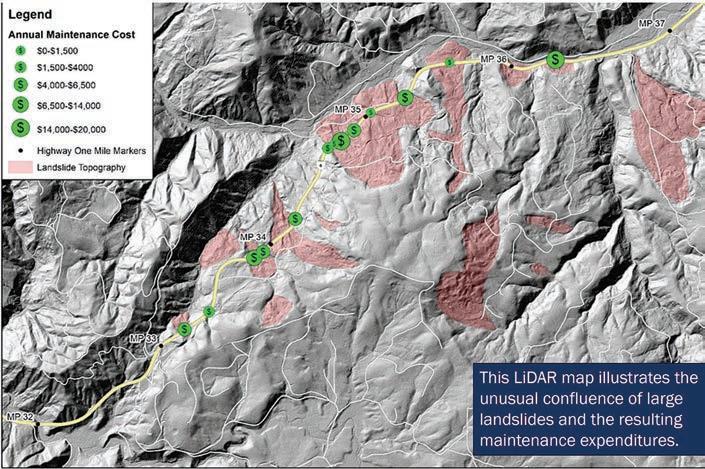
A map of the slides in the area shared by Robinson showed five distinct areas that experience sliding on the hill, including one mega-slide with two lobes, one of which is causing the issues at milepost 34.8.
This summer, ODOT crews overlaid new asphalt at the spot as well as in other areas on the slope that needed it and they will continue to monitor the roadway daily as winter weather begins.
As part of his job, Robinson also works up potential solutions to the problems, and for the slide at 34.8 he has put forward three possibilities. One is a soldier wall tied in to rock beneath that would buttress the road’s current alignment, with a projected cost around $20 million, another is moving the road slightly upslope, so it does not sit on the edge of the slide, estimated to cost between
$6 and $10 million, and the third is to excavate the highway to remove sawdust fill used in its construction and replace it with upgraded fill material, projected to cost $9 to $15 million.
Several problems attend any potential repairs, including the fact that any solution could be rendered moot by increased movement in the underlying slide and that there are at least four other spots in the three-mile stretch facing similar issues.
Fixing the problems at all the sites would cost upwards of $100 million, Robinson estimated, raising the prospect that rebuilding the road with a new alignment avoiding the problematic slope altogether, which Robinson estimated would carry a similar nine-figure price tag, might be a more costeffective solution.
“It’s a balancing point, because at some point, the maintenance costs to keep the road open become a
drain,” Robinson said, “but at some point, when you’re looking at hundreds of millions of dollars to realign a road, well actually, the maintenance costs aren’t that bad, unless there’s a political will to do it.”
There, the discussion leaves the purview of ODOT officials and moves to state legislators, who would have to instruct the agency to investigate an alternate alignment.
As Tillamook County leaders and residents hope
WILL CHAPPELL
EDITOR
CITIZEN
After setting priorities at a recent retreat, Wheeler’s city council discussed next
steps forward on a variety of issues, principal among them traffic calming, at their meeting on October 21. It was also announced

that council had extended an offer to a candidate for the open city manager position following an executive session the day before and that work on the section



Routine screenings are one of the best tools we have for early detection of breast cancer. This includes self-exams and mammograms! Scheduling your annual wellness exam could be one of the most important actions you take this year.
While breast cancer is often thought of as a women’s health issue, it affects people of all genders. That’s why it’s essential for everyone to be aware of their bodies and recognize changes early. Early detection saves lives.
Do you have questions about how to perform a breast self-exam? Or want to learn more about risk factors for breast cancer and screening recommendations such as mammograms? Your provider is here to help. Give us a call today to learn more about your breast health.

of Salmonberry Trail in the town is set to begin in November.
Priorities for council action were set at a recent retreat and divided among councilors who will spearhead next steps.
Council’s biggest priority, assigned to Mayor Denise Donohue for further action, is finding ways to slow drivers in the city.
Donohue showed footage of erratic, aggressive driving behavior in town, including drivers passing other cars in the downtown core and careening around corners. Donohue also shared a video of a local girl who was almost run over last summer and experienced serious trauma in the incident. Donohue said that the unsafe driving behaviors were not limited to tourists and logging trucks, and that locals also need to slow down.
Past attempts to discuss the issue with the Oregon Department of Transportation (ODOT) and Manzanita Police, with whom the city contracts for law enforcement services, have been unproductive, Donohue said, adding that she felt the agencies needed to step it up. Donohue asked Interim City Manager Pax
Broeder to set up a meeting with ODOT to discuss possible solutions to the problem as a first step.
A field representative from Representative Cyrus Javadi’s office chimed in and said that he would brief Javadi on the issue and recommend he get involved to help facilitate better communications with ODOT.
The second priority, also assigned to Donohue, was supporting local events, with Donohue saying that the first such event was an upcoming Halloween event in the city’s waterfront park, and that planning for a kayak festival is in progress.
Councilor Doug Honeycutt discussed fees for the city’s boat ramp, saying that he wanted to ensure the revenues covered the ramp’s operating expenses, which Broeder assured him they did.
Donohue said that making the city hall ADA compliant and accessible to all residents was another ongoing priority and that the city would continue looking for grants to support work to achieve the goal.
Short-term rentals (STR), which are currently not allowed in the city’s R1 residential zone, were also a topic of interest for the
for that next step, they will have to contend with the fact that other situations where slides endanger highways abound up and down the coast range, though Robinson said that Highway 6’s problem is particularly bad.
“The coast range in Oregon has very, very bad rock, and different spots suffer from this problem,” Robinson said. “This one is truly unique because of the strange confluence of landslides right at the crest.”
council. Honeycutt said that owing to concerns about the city’s budget, he believed it is time for the city to reevaluate their position on STRs and potentially allow them to help increase transient lodging tax revenues. Honeycutt said he would like to hear input from residents before moving forward on any plan.
Councilor Mary Leverette then discussed the possible formation of an urban renewal district, which would direct a portion of tax dollars to improving economic viability through upgrades to businesses and infrastructure. Forming such a district is an intensive process and will begin with feasibility studies, Leverette said, and projects for all funds raised must be identified prior to the district being approved. Finally, Leverette said that the council had identified better familiarizing themselves with the city’s charter as a priority and requested training on the document from the League of Oregon Cities. Leverette said that this would present a good opportunity to evaluate the document and consider updating it, though any changes would need voter approval.

As part of an ongoing update to the city’s forest management plan, Nehalem’s city council heard a presentation about ways to enhance and protect the city’s drinking water, which is sourced in cityowned forestland, at their October 14 meeting.
Mark Mclaughlin, Conservation Director from the North Coast Land Conservancy (NCLC), discussed how the city could transition its forest management priorities from revenue generation to water conservation, the benefits of do -
ing so and the ways NCLC could support them in the process.
McLaughlin started by giving a brief overview of NCLC, which helps protect and manage 15,000 acres of land on the cost between Astoria and Lincoln City. They have achieved this by acquiring land, working with private landowners to acquire conservation easements and partnering with public entities to acquire land. Many of those public land purchases were completed by cities acquiring the watersheds that provide their drinking water. In Nehalem, the city already owns 90% of the
watershed that provides the city’s drinking water, comprising 380 of a total 872 acres of forest land owned by the city. In the past that land has been managed for economic productivity, with revenues helping to support various projects, including funding construction of city hall, completed in 2013.
McLaughlin said that this was excellent news for the city’s ability to conserve the watershed and that NCLC could still potentially provide help to acquire the 10% of the watershed around Anderson Creek that the city doesn’t own. Additionally,
NCLC offers a stewardship program to help manage lands under conservation and helps cities to contract with foresters focused on water conservation to develop forest management plans.
In developing those plans, McLaughlin said that top priorities were creating a forest with a diverse species of mostly big, old trees. McLaughlin said that is because larger trees help to increase water retention, as downed trees help slow water and increase groundwater absorption and standing trees capture fog in a way that younger stands do not.
McLaughlin said that managing a forest for these priorities did not mean eliminating its economic potential, just deprioritizing it. For Nehalem, this could mean ceasing or restricting harvest in source water areas or limiting harvest to commercial thinning, while allowing other areas to continue prioritizing timber production.
McLaughlin said that the city could also limit or eliminate the use of chemical pesticides in the drinking water to ensure water quality, and that the forest areas providing source areas had very steep slopes, posing a high risk for
landslides and runoff from commercial activities.
The city does not currently have a source water protection plan, but Oregon’s Department of Environmental Quality (DEQ) has completed a source water risk evaluation for the city.
McLaughlin said that the city could apply for a $70,000 grant from the DEQ to develop a protection plan and that NCLC wanted to work with city to move forward in that process and to help find a forester who could develop a forest management plan accounting for source water protection.
get, which came in closer to $2.5 million after timber revenues came in lower than projected, by using American Rescue Plan Act funds to backfill $700,000 in funding for completed projects and accounting for $1.9 million in funds allocated for unfilled staff positions.
For this year’s budget, commissioners plugged the projected hole with a $1.2-million transfer from the county’s revenue stabilization fund, and a $1-million transfer from the Parks Department, which they reimbursed with an award of restricted TLT dollars. Those dollars can only be used for projects or operations with a substantial use by tourists, a requirement which all Parks Department projects meet.
Jacob discussed the county’s staffing situation, saying that of 134 budgeted positions, on average, only 120 were filled, accounting for just $16.5 million of $18.4 million budgeted for compensation. Personnel are budgeted to account for 71% of the county’s budget, with the remainder going to materials and services, insurance, software and a small portion to capital outlays.
Jacob then reviewed the county’s revenue stabilization fund, which has been drawn on five times in the last 17 years, including last year, and has a current balance around $2 million, with another draw of $1.2 million planned for next year’s budget.
The county’s ending fund balance sits around 10.9% of overall revenues, compared to a recommended 15%, according to Jacobs, and is projected to decrease by $1.1 million in this fiscal year to $3.08 million by July 2026.
Absent action, decreases will continue in future fiscal years by around $2 million annually due to the county’s cash flow gap, putting the fund balance below zero in July 2027. The balance functions to cover the county’s operating expenses between the beginning of the fiscal year and the arrival of property tax payments in the fall and would rebound above insolvency briefly, before hitting what contracted financial analyst Mike Gleason called “crunch time” in April 2028.
Gleason, who has been helping the county with financial planning since last year, said that at that point the county would have to start borrowing from its general reserve fund, which he estimated would cover cash flow gaps for an additional five to six years.
Tillamook County Chief Administrative Officer Rachel Hagerty then broke down the results of the Tiberius Solutions analysis of 30 revenuegeneration, and 21 cost-reduction strategies proposed by county leaders last year. The evaluation was based on six factors including solutions’ impact, ease of implementation and political viability.
The top five revenuegenerating ideas were a public service charge, systems development charge, vacant housing fee, vehicle registration fee and local option levy to support the sheriff’s department.
A public service charge could be implemented to pay for a county service specified by the commissioners and collected through residents’ electric bills with the Tillamook Peoples’ Utility District. Such a charge would generate an estimated $1.9 million annually.
Systems development charges are one-time fees charged to new construction projects to account for past improvements to utility systems for which existing users paid and would
Health Authority last fall. That process stretched on through the end of 2024 and into the first half of 2025, as patients continued multi-hour commutes on treacherous winter roads.
of how vision, partnership and perseverance can change lives right here where we are.”
Tillamook’s old dialysis clinic, operated by U.S. Renal Care (USRC), announced that it would be closing its doors in January 2024, due to a lack of profitability at the center, leaving patients who rely on the thrice-weekly treatments to travel to Forest Grove, Lincoln City or Astoria for care.
Swanson and the team at Adventist quickly sprang into action after the announcement, and learned about DCI, whose leaders immediately expressed interest in reopening a center in the same space previously occupied by USRC.
After learning that it would not be possible to operate under the license previously issued to USRC, DCI began the permitting process with the Oregon
Elected officials representing Tillamook County, including State Senator Suzanne Weber and State Representative Cyrus Javadi, as well as members of Oregon’s federal congressional delegation, kept pressure on the agency and operating permits were secured early this summer, allowing the center to open in July.
At the ceremony, Swanson welcomed the crowd and thanked the teams at Adventist and DCI for their hard work on the project, and Weber, Javadi and other lawmakers for their support.
Swanson also thanked Mike, a dialysis patient, and his wife Sharon for their persistence in advocating for themselves and the center’s other patients throughout the process, noting that Sharon had helped him understand how impacted patients’
generate an estimated $1 million annually.
A vacant housing fee is a new concept, Hagerty said, and would be applied to residences that failed to meet an occupancy minimum, and while specifics would need to be developed, it could generate around $100,000 annually.
Adding vehicle registration fees on top of current state fees is in the commissioners’ purview and could generate a projected $680,000 annually.
Two other potential strategies, a utility permit fee to cover the cost of permitting work in the right of way and generating $50,000 annually and a solid waste and recycling franchise fee, paid by private utility companies for the benefit of using the private right of way and exclusive franchise rights, were also included in the analysis.
On the cost-cutting front, the top five solutions were making long-term plans to increase financial efficiency, deferring capital expenses, delaying filling open positions, freezing salaries and furlough days for employees.
Long-term planning work is already ongoing under Tiberius, with a further report expected in December, which Hagerty said will help the county move into the final phase of financial planning.
Hagerty said that report will recommend a new property manager position at the county to focus on developing county properties to increase revenue, evaluate day use fees and manage the county’s foreclosed property program. It will also include a recommendation to add a code officer position to enforce existing ordinances and help keep them up to date.
Hagerty then discussed county’s use of TLT revenues, saying that the Tillamook Coast Visitors Association (TCVA), which receives $2 million from the county annually for destination management services, is close to completing a prioritized list of projects across the county that qualify for
family members were by the closure. Swanson said that the reopening had restored time and dignity to the couple and other patients.
“Patients can now receive their care right here at home, surrounded by familiar faces, their family and friends, and all of their support networks,” Swanson said. “It’s about restoring time, energy and dignity in peoples’ lives.”
Tillamook County Commissioner Mary Faith Bell then spoke, sharing the story of a friend from a nonprofit board who had been forced to resign after being diagnosed with end stage renal disease and needing to travel for dialysis treatments, and who recently passed away.
Javadi then spoke about his and Weber’s efforts to ensure that another community would not face the same situation by passing a bill that would allow recently closed centers to reopen under new management with existing licenses.
the funds, which will be brought to commissioners and incorporated in the county’s strategic plan.
Finally, Hagerty discussed staff recommendations based on the report, saying that they recommended quarterly budget committee meetings after timber harvest revenues arrived and monthly updates to commissioners from the county leadership team; not pursuing a sheriff’s levy; having a discussion about the county’s fee philosophy and whether it was appropriate to use fees to generate revenue; and continuing parks department transfers to the general fund offset by TLT awards.
Regarding cost-cutting proposals, Hagerty said that staff was recommending continuing to defer maintenance while developing a plan to address select needs as funds become available. Part of that process would include exploring options to finance deferred maintenance as well as the purchase of the ex-BLM building on Third Street, which the county recently entered a purchase agreement on.
Hagerty said that she also recommended the board discuss the $400,000 facilities grant program administered by TCVA and consider crafting a new policy for spending TLT funds, as the current policy is not followed.
Hagerty also recommended that the county create a fund watch to more closely monitor the revenues and expenses of various county funds with issues on the horizon, like the general fund.
Creating additional financial policies, which Hagerty said the county currently lacks, was also recommended, as was requiring departments to seek board approval before exceeding their budgets.
Hagerty wrapped up
After a brief break, commissioners then began discussing the proposals, first taking the temperature of the county’s department leaders who were assembled at the meeting.
All were in favor of creating management expectations around budgeting, including a defined communication strategy, holding meetings for quarterly and monthly reporting, developing a fee philosophy and beginning to address capital maintenance as possible. Also receiving support were the property manager position, an updated TLT policy, a fund watch, and a full audit of the county’s services and budget. Commissioners then discussed possible new fees and tax increases, with all saying that they were not sold on the public service charge on electric bills and were opposed to a vehicle registration fee. Contrastingly, all said that they were in favor of moving forward with the proposed utility permit and solid waste and recycling franchise fees.
Hagerty asked commissioners how they would feel about again asking voters to approve an increase to the county’s TLT, after a measure seeking approval in this May’s election fell short by just 12 votes. Commissioner Mary Faith Bell said that she wanted to wait to see how State Representative Cyrus Javadi’s attempts to change restrictions on the fee at the state level went before taking such an action, and Commissioner Paul Fournier agree. Regarding TCVA’s management of the facilities grant, Commissioner Erin Skaar said that she thought there was value in having the organization manage the program and
Bell proposed that a working group should be formed to evaluate the county’s relationship with TCVA going forward considering the recent changes to the county’s understanding of permissible uses of the restricted funds, to wit, the parks department support and reciprocal general fund transfers. Bell said that she wanted to involve TCVA staff and board members in any discussion and work towards a new arrangement by the time the organization’s agreement with the county ends in June 2027. Commissioners then discussed the prospects for expanding the use of TLT dollars to pay for permissible costs in various departments currently covered by the general fund. All said that they were interested in working with the Tillamook County Fair Board to explore the possibility of awarding TLT revenue to the fair to cover some portion of their expenses to be matched by a return transfer to the general fund.
Skaar said that she was interested in looking at upping the reciprocal transfers between the parks department and general fund, noting that all their fee revenues could theoretically be transferred to the general fund.
Bell said that she wasn’t opposed to exploring the idea but wanted to be sure that the parks department would not be shortchanged in any such scenario.
Fournier said that he was in favor of both the potential of a fair transfer, as well as increasing transfers with the parks department and looking for other novel opportunities to use TLT, such as paying for sheriff’s deputies’ overtime during the fair as the county did this year.
Fournier also said that further developing the county’s tourist facilities to expand revenue should be a priority and that using visitor dollars should be the path forward over imposing new fees on

Finally, DCI Senior Operations Director Sharon














Nehalem


Nehalem Bay


United Methodist Church 36050 10th Street, Nehalem, OR (503) 368-5612


Pastor Celeste Deveney + Sunday service 11 a.m.
Food Pantry





Wednesday






March - October 2 p.m. to 6 p.m.




Open Friday, Saturday & Monday 10 a.m. to 2 p.m.


Chief Executive/Operations: Joe Warren



November - February noon to 4 p.m.
Nehalem Senior Lunches


Tuesday & Thursday served at noon email: nbumcnsl2020@gmail.com


To feature your spiritual organization on this panel:




Contact Katherine at (503) 842-7535, headlightads@countrymedia.net


Serving North Tillamook County since 1996


Deadline: FRIDAYS at Noon for Advertising, News, Letters, Classifieds, Legals/Public Notices, Obituaries

Editor: Will Chappell, email headlighteditor@countrymedia.net
Advertising: Katherine Mace, email headlightads@countrymedia.net Office Manager: Patty Archambault, email classifieds@orcoastnews.com
Classifieds & Legals/Public Notices: Due by Noon on Fridays the week of publication, send Classifieds to classifieds@orcoastnews.com, send Legals/Public notices to legals@orcoastnews.com, or call 503-842-7535 for more information.
Graphic Design: Steph Baumgart Office Phone: 503-842-7535 Website: northcoastcitizen.com
The North Coast Citizen (15503909) is published biweekly by Country Media, Inc. 1906 Second Street, P.O. Box 444, Tillamook, OR 97141 SUBSCRIPTION RATES
$60.00 annually in-county; $72.00 annually out-of-county. $50.00 for online only. Periodicals Postage paid at Tillamook, OR. POSTMASTER
Send address changes to P.O. Box 444, Tillamook, OR 97141
Member Oregon Newspaper Publishers Association (ONPA) © 2025 by the North Coast Citizen. All rights reserved. LETTER POLICY
The Citizen welcomes letters that express readers’ opinions on current topics. Letters may be submitted by email only, no longer than 300 words, and must be signed and include the writer’s full name, address (including city) and telephone number for verification of the writer’s identity. We will print the writer’s name and town of residence only. Letters without the requisite identifying information will not be published. Letters are published in the order received and may be edited for length, grammar, spelling, punctuation or clarity. We do not publish group emails, open letters, form letters, third-party letters, letters attacking private individuals or businesses, or letters containing advertising. Deadline for letters is noon Fridays.
The date of publication will depend on space. Obituaries
The North Coast Citizen has several options for submitting obituaries.
• Basic Obituary: Includes the person’s name, age, town of residency, and information about any funeral services. No cost.
• Custom Obituary: You choose the length and wording of the announcement. The cost is $100 for the first 200 words, $75 for each additional 200 words. Includes a small photo at no additional cost.
• Premium Obituary: Often used by families who wish to include multiple photos with a longer announcement, or who wish to run a thank-you. Cost varies based on the length of the announcement.
All obituary announcements are placed on the North Coast Citizen website at no cost.


WILL CHAPPELL
CITIZEN EDITOR
Tillamook, Manzanita
and Cloverdale each saw crowds of more than 100 gather on October 16, for “No Kings” rallies protesting the administration and policies of President
Donald Trump, according to organizers. According to Don Backman, a member of Indivisible Tillamook, the group that organized the protests, more than 800 people participated in Tillamook, an uptick of several hundred from the group’s last
protest in June, showing growth in discontent with Trump.
“We are excited at how the movement is growing,” Backman said. “Tillamook County residents are very concerned at the harm the Trump administration is causing. Authoritarian
overreach is a term that means dictatorship, plain and simple.”
The protests were part of a nationwide day of action that saw similar demonstrations across the country.
In addition to the 800 people who lined Highway
101 on the bridge over Hoquarton Slough and as it separates coming into Tillamook from the north, Backman said that organizers had counted more than 750 participants at a protest on Highway 101 in Manzanita and 106 in Cloverdale. In Tillamook, some protesters donned costumes, including an inflatable chicken suit, mimicking protesters at the Immigrations and Custom Enforcement facility in Portland that has become a flashpoint in the national debate over immigration in recent weeks.
WILL CHAPPELL
CITIZEN EDITOR
Leaders from county departments, the Tillamook County Sheriff’s Office, Tillamook Peoples’ Utility District, emergency volunteer groups and others gathered for a winter preparedness meeting at the Tillamook 9-1-1 Dispatch Center on October 20. At the meeting, convened by the Tillamook Bay Flood Improvement District, and led by Tillamook County Emergency Preparedness Coordinator Randy Thorpe, attendees were given a seasonal weather outlook and discussed available resources and their plans for responding to emergent situations.
The meeting started with
Council
From Page A1
handbook update were a decrease in the number of vacation hours employees can accrue from 250 to 200, the addition of Christmas Eve and Columbus/Indigenous Peoples’ Day as paid holidays, and the reduction in hours in the work week.
Boone said that there was a shift occurring in the public and private sectors to a 32-hour work week and that with the city already at risk of losing staff to larger municipalities, they could either choose to be an early mover on the change and be more attractive as an employer or wait and lose staff.
“The issue is this change is coming, and we can be ahead of it or behind it,” Boone said.
Boone explained that the change did not require council approval, as it constituted
Tom Schuldt, a meteorologist from the Portland office of the National Weather Service giving a presentation on the winter outlook.
Schuldt explained that to create long-term projections for seasonal weather, meteorologists look at the ocean temperature in the equatorial pacific. They judge temperatures against the 30-year average to determine whether the pacific is in a so-called El Nino cycle where temperatures are half a degree Celsius or more above average, La Nina cycle, where they are below average, or around average, which meteorologists term ENSO neutral. From there, forecasters compare past years in which the pacific experienced the same equatorial
staff management, a duty of the city manager, and said that the change had already been implemented. Boone continued that the council’s approval was only needed for the vacation accrual and paid holiday changes as they impact the city’s budget.
Councilors Linda Bade, Norman Shattuck and Cheryl Gierga were skeptical of the plan, and when Mayor Katie Findling sought a motion for its approval, none was forthcoming. Gierga said that she felt the issue needed more review before she would vote for its passage. Again, Boone explained that the work-week question was under his purview and Councilor Sandy Tyrer made a motion to approve the handbook, though it failed, with Bade, Shattuck and Gierga voting nay, while Tyrer and Findling voted yes. During the public comment period of the meeting, tempers flared when Hall rose to attack Boone’s conduct during the applica-
conditions and look for years that match the most closely with weather trends in the current year to develop a weather projection in comparison to annual averages.
Currently, a La Nina advisory is in effect, which Schuldt said typically means a stronger polar jet stream will drive cold air from the Gulf of Alaska into Oregon and Washington, leading to cooler and wetter than average conditions.
Schuldt cautioned that long-term models were significantly less accurate than forecasts, only offering probabilities of different outcomes as related to average, rather than specifics about given storms or systems.
Given those constraints,
tion process, which occurred in summer 2024, after Hall resigned from council in August 2023, as well as Boone’s performance since.
Hall alleged Boone had misled city leaders by claiming 13 years of relevant experience in city leadership on his resume, which included ten years on city council in Cottage Grove, a volunteer position. Hall contended that Boone had not met minimum requirements for the position and that the city had suffered because of his inexperience as Boone arbitrarily recommended raising water rates, ignored the city’s codes and demonstrated that he could not be trusted, and demanded Boone resign immediately.
Boone strenuously denied Hall’s accusations, saying that volunteer experience was supposed to be included on the application.
Boone said that he had been transparent about his time as city councilor in Cottage Grove, noting that he felt the perspective he had gained as an elected official had made
Schuldt said that he and other forecasters expected that there would be slightly lower temperatures than average between the months of December and March, while precipitation was expected to be higher in December and January before models suggest a return to more average precipitation in February and March. If above average rainfall occurs, Schuldt said that he expected drought conditions would be gone from the coast by the spring.
Schuldt again cautioned that these projections should be taken with a grain of salt, saying that since 1954, years with a La Nina cycle have seen below average precipitation more often than above. Schuldt also said
him an attractive candidate. Boone also said that he had met the city requirement of a minimum of three years of experience in municipal budgeting and finance, labor relations and writing and administering grants with his paid, three-year tenure
that while snowpack in the coast range was “boom or bust” in La Nina years, there was a higher probability that the coast would see a big snow event this winter.
Schuldt also mentioned the coming King Tides in November and December as an occasion with an increased possibility of coastal flooding.
After Schuldt’s presentation, Tilda Jones from the Tillamook Bay Flood Improvement District gave an update on that group’s work.
The biggest project completed in the past year was the installation of a new floodgate on the east side of Hadley Road in conjunction with the City of Tillamook, designed to decrease flooding at
as Cottage Grove’s assistant city manager.
Boone pointed out that Hall had not been involved in his hiring process and accused him of creating the scenario from whole cloth.
Hall tried to respond, but having used his allot-
that road’s intersection with Highway 101. The next phase of that project, currently ongoing, is adding additional drainage to the parking lot next to the soccer field by Papa Murphy’s.
Jeff Gilbert, west region manager for Oregon’s Office of Resiliency Management then briefly ran through the resources his agency can provide to various jurisdictions in an emergency event. Gilbert specified that aid from the office had to be routed through Thorpe and the county’s office of emergency management and said that the office could offer portable warming centers, food and water, assessments for individuals and families in need of help, heating and genera -
ted time for comment, was asked by Boone to desist. The back-and-forth devolved into a squabbling match before the meeting was adjourned, at which point the pair asked for the other’s lawyer’s contact information.
Since 2017, a group of committed citizens in Pacific City have been working on a plan to preserve the unique history of the city’s dory fleet with the construction of a heritage center.
A nonprofit entity to support the project has been formed with a board selected, land for the center was secured in 2022 and at a recent town hall meeting, project leaders said that they were shifting focus to fundraising.
“This is an important part of history for the state of Oregon, the county and beyond and locally,” said Dorymen’s Heritage Association Board President Dave Larkins, “it can’t get lost, it can’t.”
At the town hall meeting, Larkins’s wife Linda, treasurer of the board, project engineer Bob Grummel and project manager Brook Olsen updated interested citizens on the project’s progress.
Linda spoke first, giving a brief history of the work that has already occurred. Linda said that the project had been the brainchild of Paul Hanneman, who spent more than 50 years collecting information and writing about the dory fleet. In 2017, when work on the project started in earnest, Linda said that the first step was setting forward a one-page narrative with the vision for the heritage center. That was followed by a feasibility study, completed in 2021, which determined that the project was worth pursuing.
The group then created a master interpretative plan for the museum including how it would look and what would be in its collections with assistance from Alchemy Design from Portland and crafted a mission

statement.
Early work was supported by and done under the auspices of the Pacific City Dorymen’s Association, with additional support coming from a $75,000 grant from Tillamook County in 2020, but the group has since formed a separate, registered nonprofit to manage the project.
A major step forward came in 2022, when Tillamook County’s board of commissioners reached out to project leaders and offered a potential home for the center on a property adjacent to the Kiawanda Community Center. The county had purchased the property, known as the
Jensen property, in 2021 for $2.875 million in transient lodging tax dollars, with an eye towards creating a park to encourage visitors to the area to spread beyond Cape Kiwanda. Details on a land lease with the county are still being finalized, but the Larkins and Olsen said they expect it to have a 100-year term and nominal annual payment.
“I don’t think we’d be here if it wasn’t for that,” Linda said, “it was an anchor, it gave us legitimacy.”
Grummel then discussed the vision for the museum, saying that the next step in the process was to raise the money to fully design the
facility. Early plans, including schematic designs and renderings, have been worked up and a strong vision for the collection has emerged. Grummel said that the facility would not just be a place to store boats, but one where stories were told and work occurred on craft in an active workshop with learning opportunities.
Planned exhibit topics include the history of the dory fleet and Oregon’s maritime industry, the future of the dory, the catch of the dory fleet, indigenous people in the area and Paul Hanneman, a state legislator
heavily involved in passing Oregon’s beach and bottle bills who also built dory boats.
Grummel said the center will feature historic dory boats, the last gill boat to ply the Nestucca River, a trove of photographs and film archives, fishing gear, interpretative talks, and boat building and restoration.
Finally, Olsen discussed the team’s vision for the center and next steps.
Olsen said that as one of just three off-beach fishing fleets in the world, the uniqueness of the dory fleet to Pacific City deserved celebration and preservation, and that the team believed it would be an important addition to the community. “It’s going to be another piece of the puzzle to what makes Pacific City pretty amazing,” Olsen said.
Olsen said that numbers from the feasibility study showed that the museum would be economically viable and that she believed there was a path forward to finance the museum, which has an estimated budget of around $10 million.
The project recently received a grant from the Oregon Cultural Trust and joined the organization, and the team is now focused on increasing public awareness, recently launching a website for the project at dorycenter.org, as well as social media pages. Olsen said that as part of that push, the team will also be approaching potential funders to raise $500,000, which would unlock a matching grant and allow for an architect to be hired.
Olsen said that in the long run, the nonprofit would probably set up an endowment for the museum and that the team has already met with Senator Suzanne Weber and representatives of Congresswoman Suzanne Bonamici and Senator Ron Wyden.
SHAWN LEHR FOR THE CITIZEN
A long-envisioned project to add a transmission line and substation to serve Tillamook Peoples’ Utility District customers in Oceanside is nearing completion, with pole placement complete and work well underway on the substation.
The project will shorten the length of power outages in the community, as the existing distribution line that follows Highway 131 will no longer be the sole source of power, increase the quality of electricity reaching users and decrease power loss during transmission.
“Eventually, just running long distribution lines and having that voltage loss is not the way to go,” said Tillamook Peoples’ Utility District General Manager Todd Simmons. “You build up the transmission line, you get no voltage loss, you have the substation, then you’ve got the backup feeds and that’s the way you build the system.”
The need for eventual system expansion to supplement Oceanside’s service was identified by TPUD staff as early as the 1960s, but the project moved to the front burner in 2015.
Currently, Netarts and Oceanside are served by a
distribution line, meaning that when an issue occurs at any point, all customers beyond that point are without power until TPUD crews can repair the problem. Additionally, Simmons said that the length of the line meant that three to four households’ worth of power are lost during transmission and that power arriving for users near the end of the line might be suboptimal, comparing it to attaching a power tool to a long extension cord.
The new, 115-kilovolt transmission line will address both those problems, by providing no-loss transmission to the Oceanside substation and giving users a secondary route for power delivery in cases where one of the lines goes down.
Work on the new transmission line began earlier this year, and 70 poles have been installed along its course, starting at the substation on First Street east of Highway 101 in downtown Tillamook. From there, the line follows the Port of Tillamook Bay’s railroad tracks north to Goodspeed Road, where it turns west to cross Highway 101, continuing along Goodspeed before turning south briefly and west again across the Southern Flow Corridor before crossing Mount Maxwell to the substation near Oceanside’s water treatment plant.


Along the route, TPUD had to coordinate with 30 landowners, ranging from timber companies to dairy farmers, to secure easements for property and determine the most convenient route for landowners, before going through the complex permitting process for a project passing through ecologically sensitive habitats in different land-use zones.
Originally estimated at $10 million, the project’s budget came in at $22 million after inflation and
material cost increases in the intervening years. The project is being financed by a low-interest loan from the Rural Electric Service, part of the United States Department of Agriculture, which will be repaid over 30 years and will be accounted for by a 2% increase in rates, already factored into planned annual increases.
Rope to pull conductive line between the poles has been strung along the entire route, and Simmons said that crews should finish stringing conductive line
in the next couple weeks. Installation of equipment at the substation is expected to be complete by February. At that point, all that will remain to complete the project is connecting it to the Tillamook substation, a job that will take three days, but which must first receive approval from PacifiCorp. The company owns one of the two transmission lines that bring power to the substation and while it currently arrives at the westerly most bay, TPUD hopes to relocate it to the

middle bay to allow the new Oceanside transmission line to use its current bay.
In addition to allowing a smoother routing for the Oceanside transmission line, this would also facilitate easier switching between the Bonneville Power Administration line in the easterly most bay and the PacifiCorp line, which services north Tillamook County and experiences frequent outages.
Simmons said he is hopeful that PacifiCorp’s leaders will approve the project, for which TPUD is covering half the cost while Bonneville and PacifiCorp foot 25% apiece, but that if they do not by next summer, TPUD will move forward with connecting the Oceanside line to the central bay.
Once the project is complete, outages in Oceanside and Netarts will no longer be communitywide, as TPUD will be able to isolate problems between switches along distribution lines, shut off power between those affected and restore power to the rest of the area by the alternate line while repairs progress.
“It’s not going to eliminate outages, there’s still going to be trees on lines,” said Simmons, “but their outages are going to be shorter because we can reroute power.”