



Cornell closed Cornell’s Ithaca and AgriTech campuses closed for 24 hours due to a major winter storm on



At a Jan. 21 meeting, President Michael Kotlikof said the University’s budget
By ZEINAB FARAJ and ATTICUS JOHNSON Sun Features Editor and Sun Senior Writer
Jan. 22 — President Michael Kotlikoff addressed the Faculty Senate explaining Cornell’s recent settlement with the Trump administration, and commented on budgetary concerns, a new Code of Conduct and the United Nations Special Rapporteurs’ letter during a Wednesday afternoon meeting.
The meeting, which had over 150 attendees via Zoom and in person, fea tured an address by Kotlikoff, followed by a question-and-answer period with professors across departments. This address was not a regularly scheduled meeting, according to the Faculty Senate’s website.
Cornell’s Settlement and Agricultural Grants
Kotlikoff told faculty that the grants fro zen by the Trump administration, amounting to more than $250 million, were unlocked and that the $30 million in agricultural grants was the University’s idea, rather than the federal government’s.
Describing the funding freeze and sub sequent negotiations, Kotlikoff stated that he was “not pleased with the situation.”
“What we were facing was real inde pendent damage to faculty, to faculty

is still on “razor’s edge”
[Glickman] articulated — but I’m also not in a position, as president of the University, where we can say, ‘We’re going to take a political stand against an administration,’” Kotlikoff said.
Specifically on the agricultural grants, Kotlikoff said they were “frankly, [the University’s] suggestion,” because the University “knew that [the Trump administration] was trying to inflict some monetary pain, and the bigger the number, the bigger the headline.”
While half of the $60 million Cornell agreed to pay the federal government will go to the U.S. Treasury, the other half will be administered by Cornell for projects that will “have an impact on farming communities,” Provost Kavita Bala said.
More specifically, Bala said in response to a question by Prof. Todd Schmit, applied economics, that Vice Provost for Research Gary Koretzky would administer the process, along with an external advisory board. The deans of the College of Agriculture and Life Sciences and the Veterinary College will run the external advisory board, which will also include farmers from across the country.
34% Te increase in voluntary contributions to the Ithaca City School District will occur over the next fve years
By VALENCIA MASSARO Sun Staff Writer
Jan. 26 — Cornell will increase financial contributions to the Ithaca City School District by 34% over the next five years, starting with a $50,000 increase in the 2025-2026 academic year, as announced at an ICSD school board meeting on Jan. 13.
Cornell will contribute $700,000 to the school district this year, an increase from their planned $650,000 contribution. There will then be a $50,000 per year increase for the first three years, with smaller increases continuing until 2031, when the increase will reach $874,000.
Cornell’s voluntary contributions to ICSD are in lieu of property taxes. As Cornell is a not-for-profit corporation, the University is exempt from property taxes, which would have supported the school district. Therefore, Cornell voluntarily provides funding to the school district, as ICSD relies on local property taxes for around 75% of its operating budget. Cornell’s history of these volun-
tary contributions to the district dates back to 1975.
ICSD Superintendent Luvelle Brown announced the increase at the Jan. 13 school board meeting,
stating that while “nowhere near what we were asking for initially,” the increase was appreciated, especially considering “the external and internal pressures [the University is] facing right now.”
Cornell’s increased contribution comes after the University’s statement released in June 2025 on “profound financial challenges” following federal funding frozen in April 2025, and a subsequent November settlement with the Trump administration to restore the funding, in which Cornell agreed to pay $30 million to the federal government and invest $30 million into agricultural research.
This increase follows a long-time advocacy effort, spearheaded by the Make Cornell Pay Campaign and the Ithaca Teachers Association. These efforts call for increased funding from Cornell, as the ICSD is currently facing declining teacher retention, with only 57% of teachers tenured compared to 85% in 2015.


Conversation Hour 4:30 - 5:30 p.m., KG42 Klarman Hall
Friday
Club 5 - 6 p.m., Goldwin Smith Hall 236 Book Meeting: The Seven Husbands of Evelyn Hugo 6 - 7 p.m., Goldwin Smith Hall 236 BreakFree Callbacks
6 - 8 p.m., Appel Commons 303
By SUN PHOTOGRAPHY DEPARTMENT

By ATTICUS JOHNSON Sun Senior Writer
Jan. 24 — Former Cornell Ph.D. student Momodou Taal fled the country in March 2025 after his lawyers were sent an email requesting that he turn himself in to Immigration and Customs Enforcement — nearly a week after Taal sued the Trump administration. On Friday, he was detained by British police at London Heathrow Airport for six hours, according to posts from Taal on X.
Taal wrote that he was questioned immediately after landing in the United Kingdom, and that questions focused on his personal history during the six-hour-long detainment, in a post on X. He also wrote that police confiscated his phone and laptop and took his DNA.
Under Schedule 7 of the Terrorism Act 2000, British police can question anyone whom they
believe is involved in the “current, emerging and future terrorist activity,” at ports of entry, according to the Counter Terrorism Policing website.
Taal was suspended by the University in September 2024 for helping to organize the pro-Palestinian encampment, and was later suspended in September 2025 for participating in a disruption of a Statler Hall career fair. In March 2025, his lawyers were told that Taal was to surrender himself to Immigration and Customs Enforcement. However, Taal has never been formally charged with any crime.
He voluntarily left the country amid a lawsuit against the Trump administration, writing in a statement that he had “lost faith that a favourable ruling from the courts would guarantee my personal safety and ability to express my beliefs.”
During his detainment in the UK, authorities asked about
“his childhood, mosque, Islamic preachers, and friends,” and if he
“[The detainment] stinks of British complicity in American intelligence operations and human rights abuses.”
Momodou Taal
had ever “read Karl Marx,” Taal wrote in a post on X on Friday.
The detainment comes amid reports that a group of United Nations Special Rapporteurs sent a letter to Cornell and four other universities expressing concern over human rights violations in October.
Specifically, the letter singles out Taal and Amandla ThomasJohnson, another Cornell gradu-
ate student who left the country in April 2025 after his visa was revoked, as examples of “individuals who have faced violations of their rights to liberty, due process, freedom of expression, peaceful assembly, religion, and access to justice,” that the University would need to detail how it wwould protect.
The detainment “stinks of British complicity in American intelligence operations and human rights abuses — and not for the first time,” Taal wrote in the X post. “Powerful institutions on both sides of the Atlantic that support genocide do not want their dirty linen aired in public. … Did the Americans ask authorities in the UK — the submissive partner in the so-called ‘special relationship’ — to stop and interrogate me?”

By RAJORSHI CHATTERJEE, EVERETT CHAMBALA and ZEINAB FARAJ Sun Contributor, Sun Staff Writer and Sun Features Editor
Jan. 23 — The Student Assembly addressed email technical issues from the Fall 2025 Undergraduate Referendum and held a public comment during their first meeting of the semester on Thursday. While no undergraduate students spoke during the public comment period, members of the Assembly voiced their opinions about the Student Code of Conduct to representatives of the Graduate and Professional Student Assembly, who were in attendance at the meeting.
Undergraduate student voters overwhelmingly voted yes on two referendum questions that proposed an independent University disciplinary system from Cornell’s administration and supporting the reinstatement of a campus-wide code of conduct on Dec. 17.
The Assembly’s discussions focused on students’ discontent regarding University enforcement of the code of conduct and the difficulties of students accessing the referendum in their Cornell emails. An issue with OpaVote, a voting platform used to administer the referendum, caused the email to end up in some student’s spam folders.
“I’m not confident that your report won’t go to a garbage can in Vice President Lombardi’s office.”
Max Ehrlich ’26
Members of the Assembly hoped that the public comment would focus on issues with the ballot and start discourse surrounding the referendum, but members of the body pointed out that the meeting was only advertised on the Assembly’s Instagram, which has 710 followers while the current undergraduate student population is 16,128 students.
Admir Cekic ’26, first-generation college students representative, expressed discontent by alleging the Assembly’s lack of outreach to students for the public comment session.
“We should all be ashamed of ourselves,” Cekic said. “We are saying that [this meeting] is a public comment when no one heard about it. We could have easily sent an email to the entire student body so we can make it [the voting process] better in the future.”
GPSA president and graduate student Nicholas Brennan and Jennifer Michael, senior director of student experience in the College of Architecture, Art and Planning, introduced themselves as members of the University’s Code and Procedures Review Committee and gave a presentation.
Brennan explained that they would be taking notes throughout the meeting with the aim to “ensure that [students’] voices are heard and your suggestions are brought back to the committee for consideration.”
At the start of the meeting, representatives and attendees were shown a 11-minute long video that provided a description of the Code and its procedures.
The video was met with mixed reactions from representatives, with Cekic describing it as “a propaganda piece” due to what he saw as its inaccuracy in representing the disciplinary process for students. Cekic also critiqued its claim that most Code cases are
resolved through the Alternative Dispute Resolution, mentioning a significant increase in punishments including suspensions, non-contact orders and privilege restrictions.
Students then began to voice their concerns, including Hayden Spector ’26, students with disabilities representative, who criticized the disciplinary process’ ineffectiveness in resolving many cases, while describing the process as something which can be “very, very scary for somebody” due to the lack of perceived support.
Several members of the Assembly also expressed distrust in the administration regarding its ability to listen to and represent students.
“Frankly, I’m discouraged,” Max Ehrlich ’26, industrial and labor relations representative, said. “I’m not confident that [the University is] going to listen to you. I’m not confident that your report won’t go to a garbage can in Vice President Lombardi’s office, or if he does give it to President [Michael] Kotlikoff, I’m quite confident that it will go to a garbage can in his office.”
Kotlikoff was required by the Student Assembly Charter to approve or reject the referendum by Jan. 17 but has not responded thus far.
Other Assembly members, including Undergraduate Representative Eeshaan Chaudhuri ’27 and Minority Representative Kennedy Young ’28 communicated their desire for a more diverse representation of the student body when it comes to making these policies.
Chaudhuri expressed that the Code and Procedures Review Committee’s outreach was “important” despite his belief that the Assembly was
“The current Code of Conduct harms the Cornell culture and student life here.”
Admir Cekic ’26
not a “fair sample” of the student population, citing a need for more community outreach events. Young supported the idea and emphasized a focus on random selection of students to eliminate biases, proposing a jury-duty style of selecting members for events.
Members of the Assembly hoped to speed up the process of reforming the Code, with Chaudhuri criticizing its slow revision process, given that the University has not responded to the December referendum.
Cekic expressed a desire for a complete overhaul of the Code, citing a need to represent Cornell’s founding values more accurately, a sentiment shared by many other representatives.
“I think the current code of conduct harms the Cornell culture and student life here,” Cekic said. “It needs to be changed to more accurately reflect Cornell’s values as Cornell’s founding values of being a progressive democratic institution.”
By VARSHA BHARGAVA Sun News Editor
Jan. 22 — The University has renamed the engineering college to the David A. Duffield College of Engineering, following a historic donation pledge from its namesake, according to the Cornell Chronicle. At $371.5 million, David Duffield’s ’62 MBA ’64 pledge is the largest single gift in University history.
Duffield’s pledge will be divided between three initiatives at the engineering college — $250 million will establish the Duffield Legacy Fund to aid the college’s strategic operations, $71.5 million will start the Duffield Launch Fund to advance and renovate the college and $50 million will go toward promoting “educational excellence,” according to the Chronicle.
After Duffield’s graduation from the University, he founded six enterprise companies, including PeopleSoft, which Cornell uses to manage its student services, admissions data, faculty and alumni relationships, and Workday, Cornell’s interface for human resources and workforce management. He currently
chairs his most recently founded company, Ridgeline. Duffield’s net worth is currently valued at $11 billion, according to Forbes.
Duffield is also one of only two founding company CEOs in the United States to have led two businesses to an initial public offering value of $1 billion or higher, according to the Chronicle.
In 2018, Duffield was the first recipient of the Cornell Engineering Distinguished Alumnus Award, and was named Cornell Entrepreneur of the Year in 1996.
Duffield’s $371.5 million pledge adds to a list of gifts he has given to the University over time, including his $100 million commitment to the University in March 2025, funding the expansion of Duffield Hall which was first built in 2004 after Duffield provided major funding for the facility.
Totalling $550 million in overall giving to Cornell, Duffield is among the University’s alltime donors, according to the Chronicle.
Varsha Bhargava can be reached at vbhargava@cornellsun.com.
Continued from page 1
In an interview with Tompkins Weekly, Nicholas Pemberton, a teacher in the ICSD, spoke about how salaries contribute to this retention problem.
“I live in Owego because I can’t afford to live in Ithaca, and that says a lot,” Pemberton said. “I’ve watched co-workers leave throughout the years and move to another school district and make $8,000 or $10,000 more, and all they have to do is leave Ithaca. They didn’t get any extra education, they haven’t worked any longer — it’s just that they left Ithaca.”
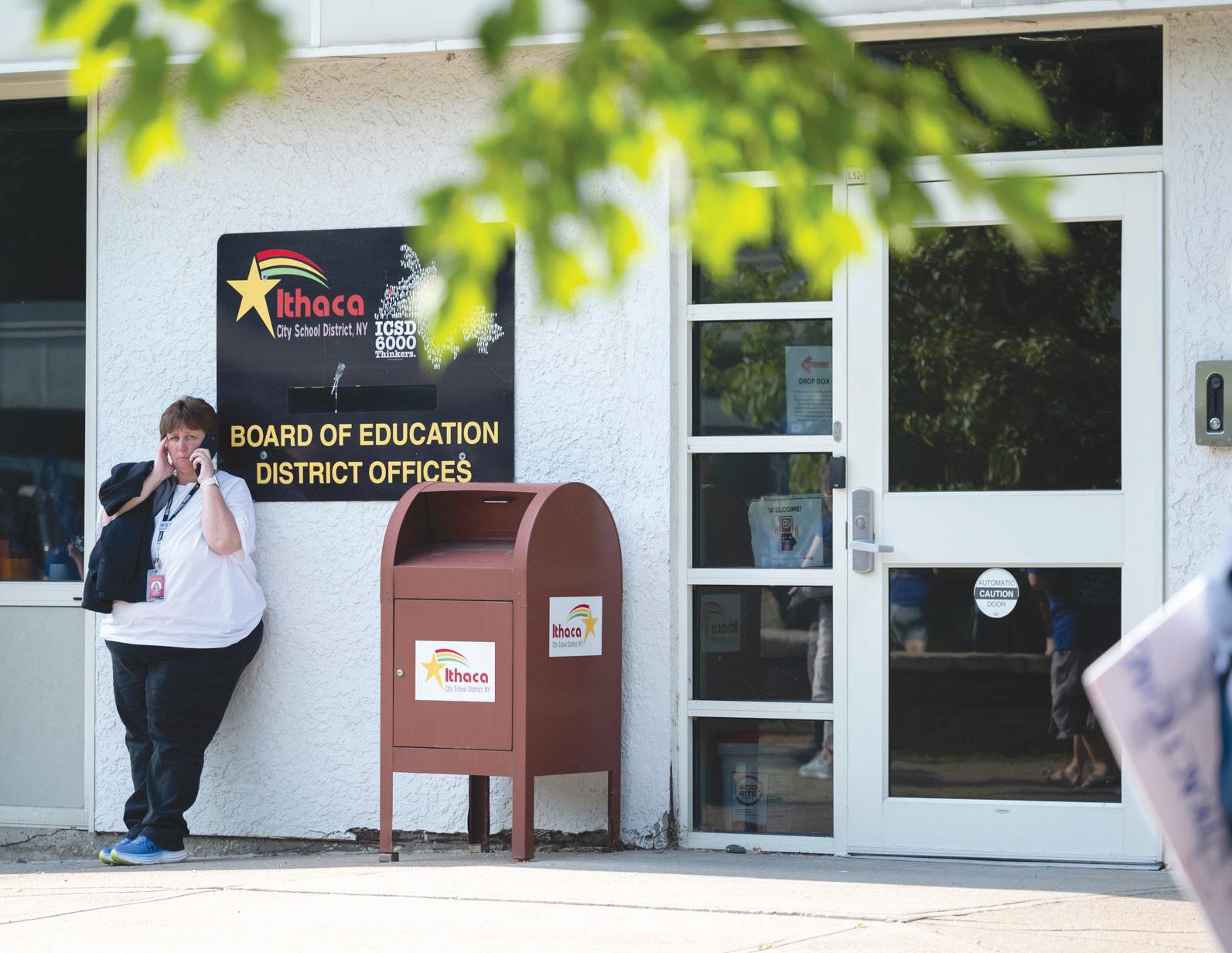
Over 100 teachers rallied outside of the ICSD offices in September to demand a better contract which partly aimed to improve teacher retention.
agreement with ICSD in 2021 promised an annual contribution of $500,000 until 2026. But in 2023, the University increased its annual contribution to $650,000, set to remain in place until 2031. Now, the 2026 agreement has increased this contribution to nearly $900,000 by 2031.
Jennifer Tavares, director of Cornell’s Office of Community Relations, addressed the increase in an email to The Sun.
“This adjustment, along with our continued in-kind support and educational collaborations, underscores our resolve to partner with the district to strengthen educational outcomes for local students and families,” Tavares wrote.
Rajorshi Chatterjee, Everett Chambala and Zeinab Faraj can be reached at rc978@cornell.edu, echambala@cornellsun.com and zfaraj@cornellsun.com.
Many advocates claim that Cornell is not doing enough, suggesting that the University’s current contribution is less than their tax burden would be if they were not exempt. Ithaca Teachers’ Association estimates that if Cornell were to pay property taxes, the university would owe $33 million to the City of Ithaca annually and $46 million to ICSD. Some advocates, such as former ICSD board member Jill Tripp, have urged Cornell to contribute up to $10 million annually.
Many compare Cornell to similar institutions such as Princeton, which contributed $2.75 million to its local school district in 2023. Similarly, Brown contributed $30.2 million in the 2025 fiscal year to the City of Providence, directly supporting economic growth, K-12 education and medical care for residents.
University officials have been responsive to the push for more funds. This is the second time the University has revisited the matter. The University’s initial
Beyond the monetary increase, the agreement also brings collaboration and community building between ICSD and Cornell. A new Cornell-ICSD Advisory Committee, with Cornell faculty and staff and ICSD teachers and administrators, will meet quarterly to assess existing and new programs. One of these is a dual-credit program, starting in the Fall of 2026, where Ithaca High School students can earn college credits at an affordable rate, from Cornell and ICSD faculty.
Aside from this agreement, Cornell has also invested resources in early childhood education programs to attempt to address the child care scarcity in Tompkins County. The University has additionally supported research collaborations between ICSD, such as the Cornell Brooks School of Public Policy’s assessment of ICSD’s future building and infrastructure needs based on local enrollment projections.
JULIA SENZON ’26
Editor in Chief
ERIC HAN ’26
Associate Editor
SOPHIA DASSER ’28
Opinion Editor
SOPHIA TORRES ’26
Advertising Manager
SYDNEY LEVINTON ’27
Arts & Culture Editor
JAMES PALM ’27
Assistant Arts & Culture Editor
JENNA LEDLEY ’27
Assistant Arts & Culture Editor
MELISSA MOON ’28
Assistant Arts & Culture Editor
SOPHIA ROMANOV IMBER ’28
Assistant Arts & Culture Editor
KAITLYN BELL ’28
Lifestyle Editor
MAIA MEHRING ’27
Lifestyle Editor
KARLIE MCGANN ’27
Photography Editor
MATTHEW KORNICZKY ’28
Assistant Photography Editor
STEPHAN MENASCHE ’28
Assistant Photography Editor
MIRELLA BERKOWITZ ’27
Video Editor
JADE DUBUCHE ’27
Multimedia Editor
HANNIA AREVALO ’27
Graphics Editor
HUNTER PETMECKY ’28
Layout Editor
RENA GEULA ’28
Layout Editor
CHRISTOPHER WALKER ’26
Games Editor
ALLISON HECHT ’26
Newsletter Editor
DOROTHY FRANCE-MILLER ’27
Managing Editor
MATTHEW KIVIAT ’27
Assistant Managing Editor
VERA SUN ’27
Business Manager
ALEX LIEW ’27
Human Resources Manager
BENJAMIN LEYNSE ’27
News Editor
VARSHA BHARGAVA ’27
News Editor
ISABELLA HANSON ’27
News Editor
CEREESE QUSBA ’27
News Editor
REEM NASRALLAH ’28
Assistant News Editor
ANGELINA TANG ’28
Assistant News Editor
KATE TURK ’27
Assistant News Editor
GABRIEL MUÑOZ ’26
City Editor
JANE HAVILAND ’28
Features Editor
ZEINAB FARAJ ’28
Features Editor
JEREMIAH JUNG ’28
Assistant News Editor
KAITLIN CHUNG ’26
Science Editor
MARISSA GAUT ’27
Science Editor
ALEXIS ROGERS ’28
Sports Editor
MATTHEW LEONARD ’28
Assistant Sports Editor
SIMRAN LABORE ’27
Weather Editor
Te Committee on the Future of the American University is a group of 18 faculty appointed by the provost to explore how the university can evolve to best serve future generations while pursuing its core mission of education, scholarship, public impact, and community engagement. Tey welcome ideas and feedback at fau@cornell.edu.
As with much of the work of the Provost’s Committee on the Future of the American University, it is helpful to situate the current moment within a broader historical context. Central to the federal administration’s critique of universities is the suggestion that the longstanding implicit arrangement between the federal government and universities, with its associated responsibilities and obligations, is no longer serving the public interest. Many of the fissures in this relationship did not emerge suddenly this past year but rather developed over a much longer period. As a result, they require careful consideration as to how they were formed, what they mean and how universities might work to address them.
While formal university-government relations date back to the 18th century, the contours of the modern relationship began to take shape in earnest in the mid-to-late 19th century, the era when Cornell was established as a land-grant institution. But it was not until the first half of the 20th century that the federal government intensified its financial support for universities, recognizing their capacity as powerful engines for addressing national priorities, such as defense and public health, in addition to promoting social mobility and economic progress. This was accomplished through dramatic increases in federal funding for research, as well as legislation that laid the foundation for tax-exemption, accreditation and federal tuition aid.
It was in this period that an implicit arrangement emerged between universities and the federal government. However, over the last several decades this arrangement has been taken for granted, and the mutual expectations are rarely explicitly stated or clearly understood. If we are to reimagine healthy university-govern-
Liam Harney J.D. '26 is an Opinion Columnist and a law student at Cornell Law School. His column Objection! discusses contemporary legal and political issues through a critical lens. He has interned at the Louisiana Capital Assistance Center in New Orleans and at the Legal Aid Society’s Criminal Appeals Division in New York City. He can be reached at ldh55@cornell.edu.
Renee Good was killed by President Trump’s Immigration and Customs Enforcement agents in Minneapolis on January 7th. The administration’s response is as predictable as it is disgusting: lie, smear and escalate. To Trump and to too many of his waning supporters, blue states and blue cities are the enemy within. The harassment and detention of American citizens who, according to the administration, have the wrong-colored skin, the wrong accent or the wrong political beliefs, is acceptable to them.
The pretext that operation ‘Metro Surge’ is about immigration enforcement collapses when one looks at what ICE is doing in Minnesota. Non-white citizens live in fear as 3,000 federal agents in masks prowl the streets to pounce on black and brown people. ICE has even exhibited a pattern of detaining Native Americans, which would be ironic if it weren’t so stupidly cruel.
This is not a bug in the system. For white nationalists like Stephen Miller, inducing fear through violence amongst undesirables is as attractive a prospect as the mass deportation of undocumented immigrants. If you cop an attitude while being treated like a criminal by the federal government for no good reason (a very American reaction), they’ll simply beat you up, or kill you. Good luck filing a complaint, by the way. They’re wearing masks to hide their identities. In case you’ve been asleep for the past year, it’s past time to wake up and smell the crackdown.
In the face of such naked overreach, what can be done? One way to fight back against federal tyranny is for states to hold federal agents accountable for their illegal actions. Ours is a nation of dual sovereignty. That means that the federal government and every state government has the right to enforce the law within its territory. The FBI has blocked Minnesota prosecutors from participating in their investigation of the shooting. Attorney General Pam Bondi will not pursue justice for Renee Good. She’s too focused on prosecuting Good’s widow and protecting pedophiles. But that can’t stop Minnesota prosecutors from bringing charges.
MAGA’s molten core picked their side years ago. They believe in the “iron laws” of the world; the combat boot, the hot barrel of a gun pointed at ‘illegal aliens’ (i.e. anyone darker than them) and ‘domestic terrorists’ (i.e. anyone left of them). We’ve seen their ilk before. Justice demands a trial for the killing of Renee Good. We know the U.S. government can’t provide it. So Minnesota must.
Vice President J.D. Vance claims federal agents have absolute immunity. Shame on him for lying, even if he walked it back later. U.S. law indicates that any case against Mr. Ross would be removable to federal court. A Federal District Court judge, likely in Minnesota, would then become the referee between Mr. Ross’s defense team and the Minnesota District Attorney’s prosecution team.
Regardless of what the federal government might find convenient, federal agents are not above the law. Furthermore, judicial opinions indicate that a federal agent, even one acting in their official capacity, may still be prosecuted by a state when they “employ means which they cannot honestly consider reasonable [or] otherwise act out of malice or with some criminal intent.”
The video indicates that Ross acted with malice when he killed Ms. Good. But if prosecutors were concerned about proving malice, he could also be charged with crimes such as manslaughter. These other charges might allow prosecutors to secure a conviction by convincing jurors that Ross acted with culpable negligence. This would free them from the higher burden of proving that Ross had a specific intent to murder Ms. Good. Under Vance’s twisted logic, anyone wearing an ICE uniform could shoot a peaceful protester for sport and still be unprosecutable.
ment relations for the future, we must first articulate the key features of the current model, and to what extent the mutual expectations are being met today or remain appropriate for the future.
What are universities expected to deliver to the public in return for federal support? University obligations begin with deep and broad expertise. Universities are expected to make research outputs publicly available and help drive innovative solutions to complex societal issues and national priorities. But the obligations go well beyond research. Universities are also expected to mold educated citizens who can think critically, bring leadership across varied public and private settings and be productive members of a democratic society. Moreover, this education and preparation is expected to be accessible to all, adding personal and societal value through specialized workforce preparation, ideally resulting in social mobility and economic progress. Especially for land-grant institutions like Cornell, there is a mandate to “put knowledge to work” – that is, to directly engage with the public to improve the well-being of families, communities and organizations, such as the efforts of the Cornell Cooperative Extension. The work of universities is constantly evolving to meet the needs of the times.
Universities, too, have expectations of the federal government. First, and perhaps foremost, is freedom from interference on academic matters, as secured by the First Amendment. Independence from government control and intervention into what universities teach, study and discover is sacrosanct and has been a central feature of the modern university.
To continue reading, please visit www.cornellsun.com.
The killing was caught from multiple angles on camera. Show it to a Minnesota grand jury and see what they think. I know what I saw, from multiple angles: a cop who felt disrespected and angry, not afraid for his life. I know what I heard: a federal agent calling a U.S. citizen a “fucking bitch” seconds after shooting her in the head through the side window of her car. That’s not immigration enforcement. That’s murder.
Some who saw the video (and more who have not) may believe that the ICE agent, Jonathan Ross, had a reasonable fear for his life under the totality of the circumstances, especially if they tend to trust authority. Thankfully, thousands of years of human social development have refined a mechanism for the peaceful resolution of such a divisive and serious topic in the community.
It’s called a trial, and it was developed so that the pressure of community and vigilante justice could credibly be defused with promises of due process. Minnesota and the federal government have a moral and legal responsibility to thoroughly investigate this killing and to not pre-judge it. Of course, the federal government will not investigate this killing.
They called Renee Good a domestic terrorist while her body was still warm. The Trump apparatus knew whose side they were on before they had to consider something as secondary as a video of what actually happened. Because truth is subordinate to power. At least, that’s what they believe. Trump’s FBI, Trump’s Department of Justice, they are compromised. They cannot be trusted to perform an actual investigation.
Thankfully, Vance’s proclamations have no legal force. It’s simply not up to the President, Pam Bondi or Greg Bovino to decide whether this was a justified killing. The dual system of federal and state governments that together comprise the United States makes the criminality of the shooting a proper question for a jury of Mr. Ross’ peers, the residents of Minnesota and Minneapolis. ICE agents beware: the President has no power to pardon state offenses. And there is no statute of limitations for crimes that result in death.
Addendum: As this article was being edited, federal agents killed another U.S. citizen in Minnesota. His name was Alex Pretti. The administration justified this killing by pointing out Alex was concealed-carrying a firearm, implying baselessly that he threatened federal agents. Obviously such an anti Second-Amendment argument coming from the right is hypocritical. Their concern is not logical consistency, but power. Make no mistake: those who defend this are civically compromised. We must by now realize there is no state oppression they won’t defend, so long as it's done by the right gunman. Any person involved in this shooting and the subsequent coverup must be impeached, investigated and criminally charged.
This administration clearly erred by underestimating the love and community that Minnesotans share. They could never have predicted their ideological enemies would be willing to risk their own lives to help their neighbors stay safe. They thought liberals and leftists were virtue signaling cowards, who would be broken by the threat of state terror. But Minnesotans aren’t scared. They’re angry.
I have no doubt that the People will continue to fight for their inalienable rights, and the rights of their neighbors, with a righteous anger that the likes of Stephen Miller couldn’t begin to comprehend.
Lali Tobin MPA '27 is an Opinion Columnist and a master's student at the Jeb E. Brooks School of Public Policy. Her monthly column, Te Tobin Times, explores public policy and politics through diferent lenses. She hopes to engage readers in hearing how politics is the most discussed topic in the media and why it is important to stay on top of current issues. She also hopes to tackle current social trends that can be connected through public policy. She can be reached at ltobin@cornellsun.com.
Cornell opens its doors each year with the same empowering message: Welcome to a top-tier university. It’s a proud stamp that echoes during campus tours, in brochures and through countless acceptance letters. Students soak it in almost instantly — prestige is in the air here. However, what often goes unspoken are the hidden costs tied to that reputation: the stress, the burnout and the quiet transformation of self that occurs when excellence feels mandatory rather than a personal choice.
Burnout is perhaps the most glaring symptom of this trend. Many Cornell students discuss the relentless academic stress as though it’s simply part of being driven, not a system we actively foster together. One student’s blog captured this reality with striking honesty: “Cornell students are high achievers, and we naturally end up taking on more and more. … We overcommit, pile on responsibilities, and eventually hit the wall: burnout.” Another

thought from the same blog is even more relatable: “We even romanticize it. We glorify exhaustion, burning out, and overloading ourselves.”
A 2021 article in the Cornell Daily Sun highlighted the burnout crisis during an uninterrupted semester, with one student saying it felt like being “on autopilot, with a sluggish brain.” Another pointed out the overwhelming surge of prelims, leaving little time to prepare adequately. Even as circumstances worsen, the mindset remains unchanged: push through, keep excelling and continually prove you’re worthy of that ID card.
What’s often hidden beneath prestige is how swiftly it can undermine self-worth. Students who enter as stars find themselves in a sea of other high achievers. This transition can be unsettling. In an April 2022 article from The Cornell Sun, one student remarked, “Being in a competitive environment makes you want to measure yourself against others. … This type of setting motivates me to excel, but often at the cost of my mental well-being.” Another student added, “Being around so many bright individuals makes it easy to feel like I’m never enough.”
These feelings are not unique. They belong to a familiar emotional landscape in which a tiny city of over 20,000 students feel the same; no matter the season, no matter the holiday, no matter the company.
This pressure isn't just internal. Cornell's own Student Wellbeing Surveys have revealed troubling trends. A 2020 report — still widely referenced — indicated that nearly 48% of
students surveyed experienced “moderate or serious psychological distress.” A follow-up by The Sun in 2022, found that 42% of undergraduates had "struggled to function for at least a week due to depression, stress, or anxiety."
Prestige also tends to limit authenticity. Students often select activities not out of enjoyment or curiosity, but because they convey competence, ambition or leadership. Clubs become strategic game plans and networking opportunities rather than a time to hang out. Conversations lean towards transactional. The once-cherished freedom to explore in an immerse education to learn more about oneself is often overshadowed by the urge to optimize.
I couldn’t help but wonder, can there be a version of an Ivy League education that doesn’t sacrifice authenticity and mental health? I believe that prestige should lift students up, not push them into a never-ending quest for perfection that robs students of enjoying their experience. If an excellent education is what we strive for, it should also mean taking care of the community that is a part of it.
Recognizing these challenges doesn’t undermine Cornell's strengths; instead, it paves the way for a more genuine conversation about what it means to be part of a prestigious institution. Prestige can indeed be inspirational, fostering opportunity and pride. However, it can also distort the student experience in ways that are easily overlooked and hard to acknowledge. Is there a way to be prestigious in both school and health?
What is the “appropriate way” to teach? Is it without recognition of the struggles and backgrounds that different students come from? Is it achieved by censorship and silencing? By exclusion in the name of inclusion? The irony is that these provisions inherently do not allow the University to freely do those things. Repeatedly, we see the University and the government say they want to do something, while actively doing the opposite.
thrive in school.
Zara Cheek '28 is an Opinion Columnist and a student in the School of Industrial and Labor Relations. Her fortnightly column, Big Red, White and You, focuses on the intersection of campus issues, diversity and American politics. She can be reached at zcheek@cornellsun.com.
When Cornell came to an agreement with the federal government to buy back their funding, we also sold them the right to decide who on our campus gets protected. In exchange for the restoration of frozen research funding, the University has accepted a set of rules that redefine what discrimination looks like on campus and treat long-standing equity efforts as threats rather than support systems.
The Department of Justice insists that it is not dictating academic life, yet the restrictions placed on race-conscious programs, hiring practices, student support initiatives and even the language used to describe student experiences make that claim impossible to believe. The bottom line is that the federal government has created a definition of discrimination that penalizes efforts to address racial inequality. In signing this agreement, Cornell has contradicted itself. While we profess to celebrate diversity and academic freedom, we now operate under policies that directly attack both.
While President Kotlikoff claims to want to “secure and protect our own independence as a private institution … [and] protect our faculty and their academic freedom and free inquiry, which is fundamental to our excellence and our ability to teach students in an appropriate way and to create new knowledge,” Cornell agrees to extreme oversight through admissions data provision, conducting climate surveys and regular certification as part of the deal.
Things that are now viewed as discriminatory include “raced based scholarships or programs … Preferential Hiring or Promotion Practices … [and] Access to Facilities or Resources Based on Race or Ethnicity.” The memo also prohibits the use of proxies for protected characteristics that include but are not limited to “Geographic or Institutional Targeting … [or] Overcoming Obstacles Narratives/Diversity Statements.” Finally, the document outlines practices that constitute “unlawful segregation,” such as “Race-Based Training Sessions … Segregation in Facilities or Resources … [and] Implicit Segregation Through Program Eligibility.” All of these things have proved to be essential in creating an equitable campus environment for all students and faculty. It is no accident that the aforementioned policies target programs that were created to make higher education more accessible to students of diverse backgrounds.
For most of American history, race determined who had access to education, safety, housing and political rights. After emancipation, Black students were forced into schools that were deliberately underfunded and segregated. Redlining and exclusion from the GI Bill kept families of color from building the generational wealth that pays for tutors, enrichment programs and college. Even after Brown v. The Board of Education of Topeka, many areas resisted integration for decades. The effects of these laws and practices are still evident.
The fact that Cornell was never explicitly racially segregated does not exclude us from the role we — as a leading institution of higher education — should play in shaping America. Because of America’s harrowing history of dehumanization, discrimination and exclusion, the advent of race-conscious scholarships, community programs, cultural centers and support networks were never about giving unfair advantages. There have always been attempts to repair the damage created by laws and institutions that worked for generations to restrict who could
Stripping away those tools in the name of neutrality ignores how uneven the starting conditions have always been. To think that hundreds of years of work to promote diversity and make Cornell as inclusive as possible could be undone in one memo is heartbreaking and horrific. Just last year, Cornell was awarded the Higher Education Excellence in Diversity Award, but now we risk falling to the elitist and discriminatory tendencies of our current government.
The provisions outlined from the DOJ have already impacted organizations run by women and minorities at other schools. Last December, the University of Alabama suspended two student magazines, one with a largely female student readership and the other with a largely Black student readership. The magazines faced suspension because they appeared to exclude other racial and gender groups, even though the editors of both magazines maintained that the organizations have always been open to anyone of any identity on campus and, as magazines, should have been protected under the First Amendment. While Alabama obviously differs from Cornell, it might be a glimpse of what’s to come. Identity-based student groups are platforms to express those parts of ourselves and to take that away when restricting race-based organizations isn’t inclusion, it’s colorblindness.
You may be asking what the issue with colorblindness is. While the belief generally stands that ‘not seeing color’ is a way of equality, it’s actually just a means of avoiding accountability. Equity has always required intention. It has always required acknowledging the weight of history. And it has always required structures that extend a hand to those who were never meant to be included in the first place. Equity is what separates maintenance of systemic racism from restructuring the systems that feed it — and that’s exactly what these programs offer. Cornell cannot afford to hide behind the language of neutrality while the ground shifts under our feet.
The DOJ’s provisions leave schools to choose between funding and values. Cornell chose funding. The lip-service that our administration has served us is not what their actions say and we cannot sit back and trust their judgement. If we give up the tools that helped build a more representative campus, we risk becoming the kind of institution history warns us about: one that protects its image more fiercely than its people.

By TANIA HAO Sun Staff Writer
For Prof. Charles Trautmann Ph.D. ’83, psychology, the journey from an engineering education to research on childhood development has been anything but linear. Trautmann draws on his “interdisciplinary” background to study the impact of early experiences on attitudes and behavior towards the natural environment in adulthood.
Before joining the psychology department, Trautmann earned a Ph.D. in Civil Engineering from Cornell, directed a soil research lab and spent twenty-six years as the director of the Sciencenter, a local children’s science museum.
During his time at the Sciencenter, Trautmann developed an interest in education and early childhood development. At the same time, climate change and environmental issues were becoming increasingly salient in public discourse. For Trautmann, whose family fostered his love for the outdoors from an early age through camping trips and Boy Scouts, this became a source of academic curiosity.
“I got very interested in [climate change] from an educational standpoint, and that led me towards psychology,” Trautmann said. “How do people learn about science? How do they learn about the environment? Why do they do the things that they do?”
After retiring from the Sciencenter in 2017, Trautmann earned a fellowship to spend a year studying child development at the Rachel Carson Center in Germany, where he began to formulate a method to examine how experiences in early childhood can affect a person’s
environmental behavior in adulthood.
By understanding the activities in childhood that can encourage positive environmental behavior in adults, Trautmann hopes to combat climate change and protect the environment.
“If we find out that [things like] nature camps or forest preschools influenced them as adults, then we could say, ‘OK, those things are important. Let's do more of those,’” Trautmann said. “Look for the factors in early childhood that might influence people as adults, and then figure out how to do more of the things that work.”
“How do people learn about science? How do they learn about the environment? Why do they do the things that they do?”
Prof. Charles Trautmann
Early in the research process, Trautmann discovered that existing methods to study the factors that shape behavior were insufficient to answer his questions. Longitudinal studies, which track individuals from birth into adulthood, require decades to yield results, whereas retrospective studies, which survey adults on their past experiences, rely on unreliable memories.
“If you do it longitudinally … that takes me thirty years, and I don't have that much time,” Trautmann said. “Another way to do it is retrospectively, so we could interview people

Adult attitudes | Prof. Charles Trautmann Ph.D. '83, psychology, researches the link between early childhood experiences impact adult perspectives on climate change.
that are adults and ask them, ‘what were your experiences during preschool, during those first five years of life?’ Nobody can remember that, so that doesn’t work.”
To address these limitations, Trautmann created a novel method that he calls the “Folded Longitudinal” approach. The method surveys parents of adult participants about their children’s behavior in early childhood — including where they grew up, what kind of activities they did, and where they went on vacations — to understand what early childhood factors can contribute to later environmental behavior.
At the same time, the method assesses each adult participant’s carbon footprint, or individual impact on the environment. This is
done using a novel index called the “Personal Climate Profile,” developed by Trautmann and a team of Cornell undergraduates, according to Trautmann’s interview with The Sun.
Consisting of eight questions, the PCP considers a person’s number of children, home energy use, air transportation, ground transportation and eating habits — the five most important contributors to an individual’s carbon footprint, according to Trautmann.
To continue reading this article, please visit www.cornellsun.com.
Tania Hao can be reached at thao@cornellsun.com.
By NICHOLAS STEIN Sun Staff Writer
Ithaca is in the midst of a major winter storm. With over a foot of snow forecasted, the city could face its biggest two-day snowfall since February 2021.
With icy road conditions, the potential for power outages and a large amount of snow to come, The Sun compiled some safety guidelines for handling winter storms like this.
Winter Weather Alerts
The National Weather Service uses a watch, warning and advisory system to categorize hazardous weather events.
A watch is issued when the risk of hazardous weather has “increased significantly,” but details are still uncertain. An advisory is issued when weather conditions may cause “significant inconvenience,” and could threaten life or property if precautions are not taken. A warning, the
highest level alert, is issued when there is an immediate threat to life or property.
In all cases, a warning or advisory signals that the conditions it advertises are imminent, either currently occurring or expected within the next 36 hours.
As a part of its system, NWS offers a suite of winter weather products, or alerts, on its website to warn of impending snow, sleet or ice in affected areas. It issues three levels of winter storm alerts.
A winter storm watch indicates that conditions are favorable for a winter storm event within the next 24 to 72 hours. Depending on how the forecast evolves, NWS will either cancel the watch if confidence in a storm decreases, or upgrade the watch to a warning or advisory as winter weather nears.
A winter weather advisory is issued when minor to moderate amounts of snow, sleet or ice cause “significant incon-

venience” and could threaten life or property if caution is not exercised.
A winter storm warning advertises a winter storm event causing a significant threat to life or property.
NWS also issues warnings for other types of winter weather, such as lake effect snow, ice storms, and blizzards. These alerts are defined on the NWS site.
A watch may not always precede a warning or advisory if conditions change quickly. Issuance criteria varies across the country and scales with how well-equipped an area is to deal with winter weather. The NWS Forecast Office in Binghamton states warning criteria in Ithaca is greater than seven inches of snow or one half inch of ice.
Before
NWS outlines a checklist of things to prepare before a winter storm strikes. When planning for a storm, the primary focus should be “loss of heat, power, and telephone service and a shortage of supplies,” according to NWS.
Recommended supplies include a flashlight, batteries, food that does not require refrigeration or cooking, extra prescription medicine, first-aid supplies and an emergency source of heat such as a space heater.
Residents should also check smoke detectors, carbon monoxide detectors and fire extinguishers, as alternative heat sources carry a greater risk of fire. People who own generators, which are used as a backup source of electricity if the power goes out, should review safety guidelines and never operate a generator in an enclosed space.
Travel is discouraged during winter storms, but people who must travel should make sure their cars are fully winterized,
their gas tanks are close to full and that they are carrying a winter survival kit.
Pets should be brought inside before the storm hits. People with outdoor livestock should prepare for the extra attention they will need during the storm.
During the Storm
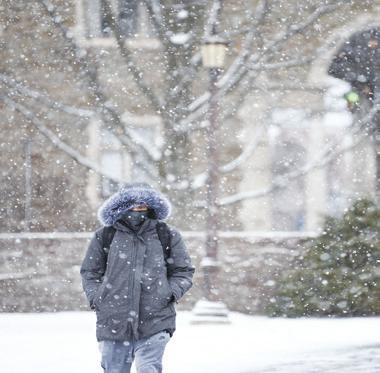
The Federal Emergency Management Agency recommends staying inside during the peak of the storm. People who need to go outside must prepare for the cold with layers that “cover as much skin as possible,” including a hat, a face covering, gloves and waterproof boots.
Ice may not be immediately visible — FEMA states that “slow, short, shuffling steps” minimize fall risk. Shoveling snow carries hidden health risks, including slipping and overexertion; the best shoveling practices include taking frequent breaks, pushing instead of lifting and doing warm-up exercises.
Hydration is important during winter storms, as cold air is dry. The Massachusetts General Hospital recommends avoiding heavily caffeinated or alcoholic drinks as they can further exacerbate dehydration.
NWS advises against driving during winter storms, but if necessary, drivers should slow down on the road, inform someone of their destination and route, bring a winter kit, fully charge their cell phone and read up on what to do if their car begins to skid.
To continue reading this article, please visit www.cornellsun.com.
Nicholas Stein can be reached at ns967@cornell.edu.
By Julia Choi
Julia Choi is a freshman in the Brooks School of Public Policy. She can be reached a jc3767@cornell.edu.
Among the many student jobs offered across Cornell, Residential Advisors play one of the most important roles on campus. Despite the undeniable benefits, including a single room and a stipend, the positions come with significant responsibilities, where they are expected to be more than just a student. From managing daily dorm life to supporting the residents outside of dorms, Cornell’s 200 RAs hold one of the most demanding jobs on campus.
To better understand the typical week on the job, I had the opportunity to interview a RA on North Campus.
With an initial interest in the position because of the community it provided, she went through a long application process. Like most student jobs, she answered a few essay questions and was invited for an interview with two Residential Housing Directors around late November to early December. While the procedure itself did not seem too tedious, most of the challenges began after the job was offered.
Although the weekly schedule varied, she appeared to have a never-ending bundle of tasks on top of her own school assignments. For example, on Wednesdays, she has her mandatory RA meetings, where she meets with her Residence Hall Director and the rest of the RA team. For about an hour and a half, they would go over on-call schedules and policy procedures to prepare for anything that may come up. Additionally, she helped organize Ice Cream Wednesdays alongside the other RAs, a weekly event where residents are able to come together to have ice cream from the Dairy Bar.
On Thursdays, she hosts her two community hours, similar to office hours, where residents can come to her to relieve their concerns or ask for advice, including academic guidance. On other days, she is often busy with planning for her monthly programs. Although these events seem simple and quick to organize, they require careful planning, as these events are intended to be used as a platform for students to engage with their peers and build a community within a large campus.
Despite the amount of work
that goes into organizing the events, participation is not always guaranteed. Even on Tik Tok there are videos of RA events who have no attendees, highlighting the importance of organizing an activity that corresponds to the interests of the residents. To ensure this, she takes various steps. For instance, she mentioned how she first thinks of what she would enjoy hosting and then connects that to her residential community’s needs, whether that is providing snacks or organizing an outdoor activity. After coming up with the idea, she then submits a pre-program planning form where she details her activity, how it contributes to the community and what the budget may be.
On one of the days of a given week, RAs are expected to be on-call, which means they hold
a 13-hour shift on the weekday or 24-hour shift on the weekend where students can reach them for any emergencies in the middle of the night. This is one of the more difficult aspects of the job, as this means that a student could call for help at 3:34 a.m.
The RA I interviewed said that the most difficult part of this is when she gets a “call that’s pretty intense with a student who has something going on that’s pretty serious.” She finds this especially hard because there is not much she can do beyond connecting the student with the right resources.
During my dorm orientation I still remember how my RAs would clearly emphasize the use of on-call RAs only for emergencies, such as getting into the dorm, and not to use for other miscellaneous purposes. This is because there have been incidents where students would call them just for unnecessary reasons, like trying to work the printer.
To continue reading this article, please visit www.cornellsun.com.



By Selina Chen
Selina Chen is a sophomore in the College of Arts and Sciences. She can be reached at sc3543@cornell.edu.
Even on these chilly days, my sweet tooth is no match for the cold comfort of ice cream, arguably a yearround dessert. At home, I was never really one to want dessert; I felt fulfilled enough by those delicious home-cooked meals. But trying Cornell Dairy for the first time changed the game for me. Ever since, I’ve developed an unhealthy addiction to sweet treats, especially after a terrible exam or a bad day.
Now, I’m no ice cream connoisseur, but I thought I would take it upon myself to rank some of the Cornell Dairy flavors I’ve tried across campus. Without further ado …
1. Dragon Day Cookies and Cream
The reigning champion has to be my beloved mint chocolate, otherwise known as Dragon Day Cookies and Cream. Maybe I’m biased, as I am a mint chip fanatic through and through, but nothing is comparable to the refreshing flavor bomb of mint and chocolate. It’s subtle, not too sweet and beautifully silky. I don’t want to hear anyone say that it tastes like toothpaste.

My runner-up is a popular favorite among all. You can’t go wrong with Cookie Dough: it’s sweet, buttery and vanilla-y, with the perfect ratio of ice cream to small chocolate chips. Topped with sprinkles, it is absolute perfection.
3. Cascadilla Cookies and Cream
Similar to Cookie Dough, Cookies and Cream follows close behind with a stronger blast of vanilla and crunch. In my opinion, it is slightly less tasty than cookie dough because there is already too much sweetness from the first spoonful.
4. Clock Tower Pumpkin (Seasonal)
Initially, I didn’t think I would enjoy Clock Tower Pumpkin based off of the name. I had never tried pumpkin ice cream before, but I fell in love at first bite. The sweetness balances the earthiness of the pumpkin in every spoonful. It is richer and creamier than plain vanilla, with a hint of cinnamon to imitate the warm-hug feeling of fall.
5. Big Red Bear Tracks
Not the best, but not the worst. I would only perform the laborious activity of
scooping this flavor if my top four weren’t available. I would describe Bear Tracks as a cookies and cream dupe with an original twist — a vanilla base with brownie pieces and a caramel swirl. The chunks are much too large for my liking, and tend to overpower the overall flavor, but it is still rather enjoyable
6. Traditional Vanilla
In sixth place is the ice cream of all ice creams — light, milky Vanilla. Again, you can’t go wrong, but there’s nothing particularly special about it. I’m aware that some people, like my dad, refuse to touch a flavor other than vanilla, and I cannot understand why.
7. Slippery Slope Strawberry
As you would guess, Slippery Slope Strawberry tastes like strawberry. It’s dependable, like a slightly outgrown sweater you have had for years and therefore feel obligated to like (because there is no apparent reason not to). When I was younger, strawberry used to be much higher on the list, but gradually fell out of favor after expanding my tastes. Some will call me crazy, but I’m a changed woman now.
8. Caramel Three Chimes
I have been a loud hater of caramel since I learned how to pronounce the word. It is unpleasantly sweet and sticky and overstays its welcome in your throat. The only bearable part of Caramel Three Chimes is the vanilla base, but even that becomes diluted in caramel craziness.
9. Chocolate Gorges
I’ve noticed that chocolate is a real point of contention; some would die for it, and others would die before ordering it. I don’t have a strong distaste for chocolate in general, but as an ice cream, it is simply a flavor I would never reach for. Too rich. Too thick. A terrible sensory experience.
10. Bavarian Raspberry
If I had to choose my least favorite kind of ice cream, it would be any fruit-inspired flavor. I would happily make an exception to my no-berry rule for Slippery Slope Strawberry, but I prefer even the richness of chocolate over a random fruit like raspberry. Fruit and ice cream is a simply unsettling combination. 0/10.
11. Honorable Mention: Holiday Merrymint
A throwback to the holiday season, Cornell stocked “Holiday Merrymint” across dining halls throughout December to give us an early taste of Christmas cheer. With its vanilla base and festive little sprinkles, the flavor leans minty with a crunch. It proved to be my ultimate favorite, so naturally, it earned an honorary mention.
Alas, take my rankings with a grain of salt — or sugar — except for the first one. Dragon Day Cookies and Cream isn’t a recommendation. It’s a plea. It always clears out within 20 minutes for a reason! Whatever you choose, even if it’s not Dragon Day Cookies and Cream, Cornell Dairy is sure to bring a warm smile to our cold, cold hearts this winter season.
Continued from page 1
Bala said that “anyone in our community can apply for grants,” which will then be decided by a faculty committee who will consider the impact and innovation of the grant. She added that the grant applications would be available in early February.
Student Code of Conduct
Prof. Chris Schaffer, engineering, questioned Kotlikoff about what Schaffer called a “capricious” process of changing the Student Code of Conduct.
Schaffer asked Kotlikoff if he “would be willing to disband” the Code and Procedures Review Committee, which is currently reviewing the Student Code of Conduct, and instead install a committee similar to the one that produced the controversial Expressive Activity Policy, which restricts protests from noon to 1 p.m. in front of Day Hall.
Kotlikoff, who earlier in the meeting said he was “extraordinarily pleased that we have had demonstrations in front of my office, in front of Day Hall from 12 to 1,” told Schaffer that he “couldn’t commit” to such a change.
In regards to upcoming changes to the Student Code of Conduct, Prof. Richard Bensel, government, asked Kotlikoff if he knew about the Campus Code Committee, which was previously chaired by Bensel. The Campus Code Committee comprises faculty, undergraduate students, graduate students and employees and is also charged with maintaining the Code. Kotlikoff told Bensel that he was “completely unaware” of that committee.
“I’m also not in a position, as president of the University, to say, ‘We’re going to take a political stand against this administration.’”
President Michael Kotlikoff
Kotlikoff said that the Code and Procedures Review Committee appointed by Vice President of Student and Campus Life Ryan Lombardi would ultimately decide the language of the new Code, not the Campus Code Committee. He added that the new Code would be available “by the end of the semester, and I think you’ll see it’s incremental, not revolutionary.”
In December, students voted overwhelmingly for a referendum that, if accepted by Kotlikoff, would make disciplinary proceedings independent from the University administration again. While Kotlikoff was required by the Student Assembly Charter to approve or reject the referendum by Jan. 17, he has yet to respond.
When Senior Research Associate William Katt asked if Cornell would still suffer “from austerity measures” after the settlement, Kotlikoff said that “we really have grown at a rate that is not sustainable,” specifying legal fees, and loans and tuition not being able to cover growing expenses. “We really are at a razor’s edge in terms of our budget.”
“I think we escaped a bullet on the Pell Grants here, but I think that’ll be attacked in the future as well,” Kotlikoff said in reference to the Trump administration’s proposal to cut Pell Grant funding. The proposed cuts were shot down by Congress earlier this week.
U.N. Special Rapporteurs Letter Kotlikoff had a lengthy exchange with Prof. Sandra Babcock, law, regarding a letter five United Nations Special Rapporteurs sent to the University in October, along with four other universities.
The letter expresses concern over the treatment of Momodou Taal, the international Ph.D. student who sued the Trump administration last spring, and graduate student Amandla Thomas-Johnson, who fled the country after he was notified that his immigration status had been terminated by the federal government. Specifically, the letter requested a response from Cornell detailing how the University would safeguard the rights of pro-Palestinian protestors like Taal and Thomas-Johnson, including their right to assembly and free expression.
“I am very sorry that we lost two graduate students from the university,” Kotlikoff said to Babcock. “The enforcement issues from the federal government were not actions from the University.”
“[We] took no action against those two individuals that suppressed their ability to articulate their support for individuals in Gaza,” he added. “What we did was take action against individuals who had violated the rights of others.”
He said the University would “certainly” respond to the Oct. 14 U.N. Special Rapporteurs letter.
By CORAL PLATT Sun Staff Writer
Jan. 21 — The University announced guidelines regarding emergency preparedness and plans to “reassess campus security measures, protocols, and infrastructure,” in a Wednesday statement sent by top administrators to the Cornell community.
The statement outlined three guidelines regarding emergency action, sheltering-in-place and an active threat to life framework. It also urged the community to “review instructions” regarding emergency procedures at Cornell.
The announcement comes after a shooting at Brown University that killed two students on Dec. 13 and the Dec. 16 shooting that killed Nuno Loureiro, a professor at the Massachusetts Institute of Technology.
“Additionally, we are working with Brown and our Ivy League partners to understand and learn from recent events and to implement best practices,” the statement read. “In the coming months, we will be conducting an additional safety assessment of areas of our Ithaca campus to consider additions to
our campus security procedures and technology.”
The statement explained that the Division of Public Safety would work to “plan, train, and coordinate responses to potential emergencies,” and noted several resources for the community, including CornellALERT which issues email, voice and text to mobile numbers in the event of an emergency.
“These outreach programs are available for the full campus community, including student groups and clubs, departments and units, and individuals, and offer a valuable way to improve your emergency readiness and personal safety,” the statement read.
The University also urged the community to reach out to the Cornell Public Safety Communications Center, use the Rave Guardian app or call 911 in the event of an emergency.
“We value an open, accessible Ithaca campus environment and must balance that culture with tools that enhance our public safety teams’ ability to respond quickly and effectively to protect the Cornell community during emergencies,” the statement read.
By VARSHA BHARGAVA and CORAL PLATT Sun News Editor and Sun Staff Writer
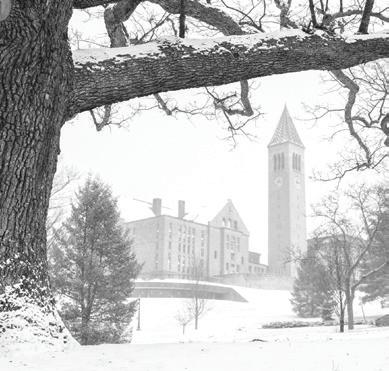
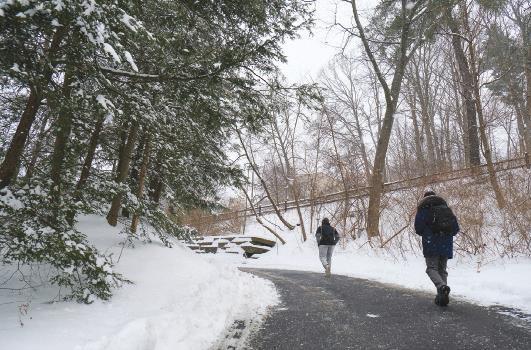
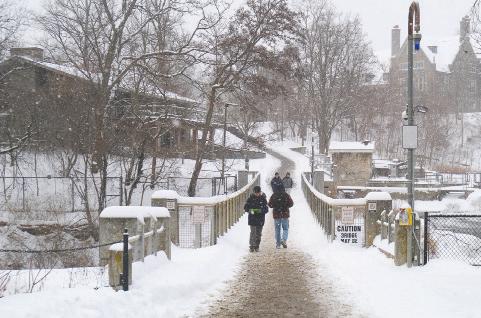
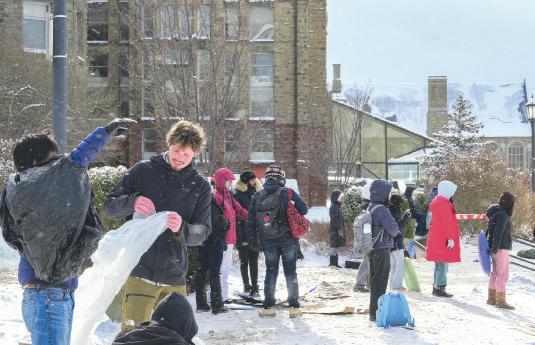
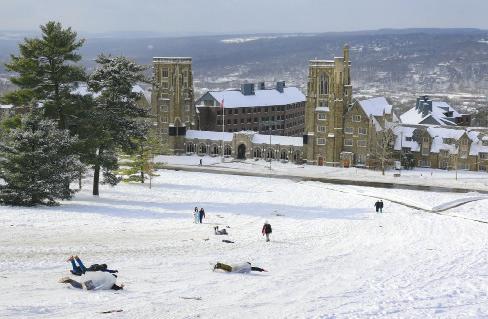
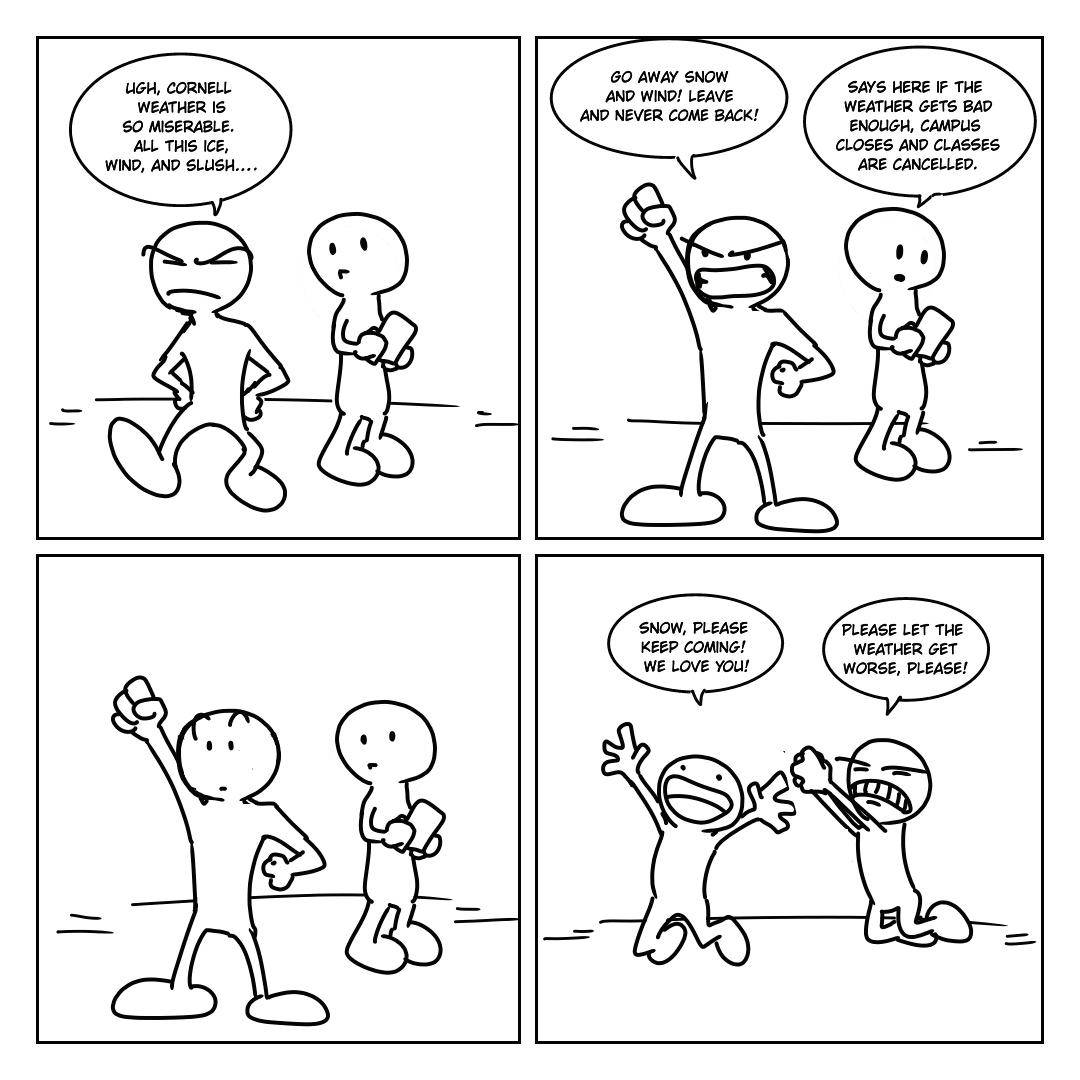
Jan. 26 — Cornell’s Ithaca and AgriTech campuses reopened at noon on Monday, Jan. 26 after closing at noon on Sunday, Jan. 25 due to a major winter storm, according to the University’s Office of Emergency Management.
“Classes, exams, events, and activities scheduled to begin after noon [on Jan. 26] will be held as planned,” OEM’s statement read.
The message was also shared via an early morning CornellALERT on. Jan 26, which emails all Cornell students, staff and faculty in the case of emergency or hazardous weather, and calls or texts all phone numbers registered with the service.
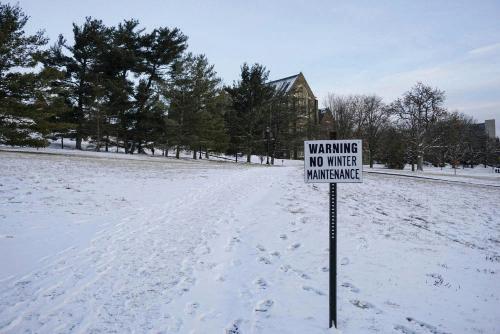
The OEM warned that crews were still working on clearing roadways, parking lots and sidewalks, so they may have been “slippery,” in the statement. Staff were expected to make a “reasonable effort” to come to campus, according to OEM, but to use their “best judgment” in deciding whether they could safely travel to campus.
This announcement confirmed the University’s Saturday, Jan. 24 decision, which closed Cornell’s Ithaca and AgriTech campuses beginning at noon on Sunday, Jan. 25 and announced that campuses “will potentially” reopen at noon on Jan. 26, pending a Monday morning confirmation.
The announcement also provided resources for information on the other Student and Campus Life services and TCAT bus operating status.
Some campus dining operations were closed due to the weather, according to SCL. SCL recommended students check the Cornell Dining Now page for updates on specific locations.
TCAT delayed its Monday services until 10 a.m. due to “poor road conditions.” A list of its routes was published on its website, and TCAT recommended riders check the Bus Tracker or MyStop app for information on specific routes.
Surrounding universities also adjusted their class schedules for the storm. Ithaca College held all classes virtually until 11 a.m. on Jan. 26. Syracuse University canceled all of its in-person classes for the day, holding them remotely instead.
The Ithaca City School District also adjusted its schedule for the week, canceling all classes for its schools in advance due to the inclement weather.
On Jan. 24, the National Weather Service declared a winter storm warning in effect until 7 p.m. on Jan. 26, warning that “hazardous conditions could impact the Monday [Jan. 26] morning and evening commutes.” At the time of the announcement, there were currently no active NWS hazardous weather alerts for Ithaca.
In preparation for the storm, Gov. Kathy Hochul declared a state of emergency across New York, which allowed officials to distribute resources and aid more efficiently during the storm. Hochul also stated that “all state employees will work remotely on Monday [Jan. 26], and encouraged other employers to do the same,” according to CBS News.
The City of Ithaca also declared a state of emergency, closing city facilities on Jan. 26.
The University rarely declares snow days, only breaking its decades-long abstinence in 2017 during Winter Storm Stella which laid over a foot of snow on Ithaca and closed campus for 28 hours.
at vbhargava@cornellsun.com and cplatt@cornellsun.com.
By Christopher Walker and Tavan

by Christopher Walker


By AUSTIN CURTIS Sun Staff Writer
Nov. 23 — A Canadian freshman has netted herself a place on the women’s tennis team.
Dylan Gelber, a Montreal native, walked on to the team as the only newcomer on a squad full of veterans — no classmates, no established cohort — a first-year stepping into a Division I lineup with eight other older “sisters.”
The change has been a different but pleasurable experience.
“It’s been good,” said Gelber. “I’m the only freshman, everyone’s looking after me, [they are] almost like my older sisters.”
Gelber is a biological sciences major in the College of Agriculture and Life Sciences on a pre-med track, balancing labs with travel days, chemistry with conditioning and all of it in a foreign country.
Gelber Growing Up
Gelber didn’t grow up in a traditional school-sports environment. Canada doesn’t have high school tennis, and she spent those years competing on the international junior circuit.The International Tennis Federation (ITF) pathway sent her across North America and beyond.
In addition to her home country, she played tournaments in the U.S., Mexico and the Dominican Republic, developing her game and gaining traveling experience.
She says the sport rewards her in many ways.
“The thing I enjoy the most about tennis is definitely competing and how tactical matches are.” Gelber said. “I love problem solving throughout the match and figuring out my opponents’ strengths and weaknesses.”
She started playing tennis at four years old. When the time came to choose a college, she cast a wide net — from schools with stronger athletics, to schools with heavier academics in wildly different locations.
But she felt there was a place for her far above Cayuga’s waters.
“I ultimately chose Cornell because I felt the most at home during my official visit, especially with the girls on the team,” Gelber said. “Additionally, I felt it was the perfect distance from where I live. I felt like I could grow as an athlete, student and most importantly as a person throughout my time here which helped me make my decision.”
Finding Her Footing
That comfort paid off quickly as she smoothly transitioned to U.S. college tennis.
Gelber noted that the Canadianto-American tennis change wasn’t major aside from quirky NCAA rules like no-ad scoring. She quickly embraced the biggest change of all: college tennis is a team sport.
“Everyone supports each other,” she said. “In juniors’ [tennis], it is all individual, but in college, it’s a team. It’s nice to have people looking out for you, and they want you to succeed as much as you want them to succeed.”
But perhaps no one has been more impressed with her transition than the person tasked with guiding her through it: head coach Spencer
Furman, whose arrival came amid early-season turmoil.
The women’s tennis program opened the fall with uncertainty. Former head coach Katie Zordani left for another opportunity just as the season got underway. Assistant coach Wade Ward held the group together until Furman, originally the assistant coach on the men’s side, stepped in to lead the team.
While the coaching staff shifted around her, Gelber stayed steady. Furman said she’s been a great fit for the team.
“She’s very mature for her age,” Furman said. “She’s so young but already a leader on the team. She’s one of the hardest workers I’ve ever been around. As great [as] a player she is, she’s even a better person.”
He didn’t expect the freshman to adapt this fast, but his expectations were exceeded.
“Normally, you see a learning curve with freshmen coming into college tennis, but with Dylan there’s been no learning curve,” Furman said. “She has adjusted fabulously.”
What stood out most, Furman said, was her professionalism: the way she carries herself in practice, in matches, and in tough moments. And in those moments, one quality shines brightest.
“Her competitiveness. I always know she’ll fight until the last point.”
A Moment of Perseverance and Grit
Furman likes to point to one match that captured everything about Gelber’s arrival.
It unfolded in October at the Ivy League Invitational at Harvard, when Gelber played a singles match. She was already dealing with a sore shoulder and nagging blisters when things got worse: she fell and tore open her knee.
“It was a crazy match,” Gelber said. “I hit a shot, and after the point, I felt something weird. I looked down to gushing [blood] and it wouldn’t stop bleeding. I couldn’t really grip my racket because when I put pressure, it hurt a lot.”
Under NCAA rules, play must stop if an athlete is bleeding. The player gets 15 minutes to clean the wound and stop the bleeding; fail, and the match ends in a retirement.
The referee was ready to default her.
But she patched up quickly enough to finish — and won, 6–3, 6–2, over her opponent from Brown.
In addition to the bleeding and shoulder pain — and even a broken nail — she simply refused to quit.
“I just powered through,” she said.
Furman still can’t quite believe it.
“She was fighting until the end. Nothing fazes her.”
Looking Ahead
Gelber’s eyes are already on April, when Ivy play intensifies.
In the Ivy League, each team faces the others in a round-robin; the squad with the best record wins the title. Ties are shared, though tiebreakers determine which program earns the conference’s automatic NCAA Tournament berth.
To continue reading, please visit www.cornellsun.com.
By JANE HAVILAND Sun Features Editor
Dec. 8 Thaddeus Lucentini ’29, an ROTC officer cadet and student in the College of Arts and Sciences, died in his home in Shelburne Falls, Massachusetts on Oct. 13. Lucentini, who was known as ‘Thad’ by his close friends and Thaddeus by his parents and family, is remembered for his curiosity and palpable happiness.
“He was a very sociable kid. He loved to make friends,” Eric Lucentini, Lucentini’s father said in an interview with The Sun.
He was a loving son to his parents, Eric and Sandra Lucentini, who “were so happy to have him home that weekend,” recalling the University’s fall break, and the weekend Lucentini died while at home for break.
“He was a very sociable kid. He loved to make friends. He felt like Cornell could be the best of both worlds.”
Eric Lucentini
Lucentini was accepted to Cornell on a 4-year ROTC scholarship. Lucentini was intending to major in history. While at Cornell, he was taking courses on the history of Iran, as well as Arabic with his roommate, Ezekiel Ehrenberg ’29, according to his parents, Eric and Sandra Lucentini.
Ehrenberg told The Sun that he organized a vigil in honor of Lucentini in the weeks following his death.
“He had a different level of intelligence about him that I think a lot of people, especially myself were drawn to,” Ehrenberg said in an interview with The Sun.
Prior to attending Cornell, Lucentini attended St. Paul’s School in Concord, New Hampshire, and was a member of the orchestra and multiple athletic teams, including alpine skiing, rowing and cross country. Additionally, he wrote for the school newspaper and co-chaired the F1 club. In his senior year, he was selected for the leadership position of House Prefect — a residential leader — at the fully residential boarding school.
“Thad had a rare blend of curiosity and enthusiasm,” Kyle Gump, a close friend of Lucentini’s from high school, wrote in a statement to The Sun. “He built model planes and trains in his room, could explain F1 car engineering in perfect detail, and threw himself fully into anything he took on.”
Lucentini’s parents, Eric and Sandra Lucentini, recollected their son’s many interests, emphasizing his passion and talent for music. He began playing the violin in the first grade at the age of 6. Growing up, Lucentini played in many orchestras, including the youth wing Symphony Orchestra.
Orlando Pandolfi, head of the Arts Program at St. Paul’s School, remembered Lucentini as a stellar student and was happy to see that he had chosen to enroll and join the orchestra as a violinist. Pandolfi was a present mentor for Lucentini during his years at St. Paul’s.
“Thad basically checked off all the boxes to be a great asset to [St. Paul’s],” Pandolfi said.
Lucentini continued playing the violin when he got to Cornell, “occasionally pulling out his violin in his dorm room,” Eric Lucentini said.
“Right before he died, he told me he was going to go to the music building at Cornell, and try to post a note to see if anybody wanted to play with him,” Sandra Lucentini recalled.
Lucentini was interested and involved in several other activities as well and “saw himself as a well-rounded kid who was into a lot of different things,” Eric Lucentini said. One special interest of Lucentini’s was the military.
Lucentini ultimately chose to attend Cornell after juggling a decision between the University’s ROTC program and an offer from The United States Military Academy at West Point.
Lucentini chose Cornell because “He felt like Cornell could be the best of both worlds,” said Eric Lucentini. He had already experienced a “fairly controlled environment” at St. Pauls, according to Eric Lucentini — he wanted more of a “traditional college experience” while being involved in military practices with the ROTC program.
Beyond academics and athletics, Lucentini had a part time job at his local supermarket during high school where he worked diligently and to give it his all. According to his parents, Lucentini had never
“He had a different level of intelligence about him that I think a lot of people, especially myself were drawn to.”
Ezekiel Ehrenberg ’29
once showed up late for the job, and always had a smile on his face while working.
“He enjoyed being connected to the real world and feeling like he was participating in the economy,” said Eric Lucentini.
Lucentini had many aspirations, one being to travel the world alongside his closest friends according to Sandra Lucentini. One of Lucentini’s friends, Andrew Carroll, with whom he had traveled with in high school wrote in a statement to The Sun that they “always had a blast on these trips and promised to visit every continent before [they] turned 30.”
Family, friends, his dog, Mimi and mentors of Lucentini’s will remember him for being a witty, friendly, helpful, interested and overall, happy person.
Memorials have taken place in Lucentini’s hometown, as well as at St. Paul’s school, to honor his life. In lieu of flowers, donations may be made to the Massachusetts Boys & Girls State Foundation in his honor by request of Eric and Sandra Lucentini.
The curious, cheerful and well-rounded friend, son, musician and athlete will be missed by many.
“He was into different things; sports was one of them, music was Jane Haviland can be reached at jhaviland@cornellsun.com.


By JANE MCNALLY Sun Hockey Editor
Dec. 22 — Scanning the surface at Lynah Rink, there will be a brigade of white helmets as far as the eye can see — that is, until your eyes reach the goaltender’s crease.
The beginning of hockey season means a lot of things, but for the men’s hockey goaltenders, it’s practically Christmas. New shipments of equipment pour in, including the usual pads and blockers and sticks. But a goaltender’s outfit is not complete without perhaps the most special, personalized cherry on top: a mask.
“I feel like when you’re on the ice, you’re kind of expressing yourself by the mask,” said freshman goaltender Alexis Cournoyer. “If you have a pretty cool mask, you know, [if] you look good, you play good.”
Between the four Cornell goaltenders, no two masks look the same. Each helmet showcases bits and pieces of their personalities, a privilege that belongs only to goaltenders.
Cornell has long utilized Vice Design — a Columbus, Ohio based designer specializing in hockey goaltender masks. Before the season begins, each goaltender is put into contact with the designer, where they are able to send mockup designs or a list of features they want placed on the mask.
For some, like freshman goaltender Erick Roest, it’s an opportunity to practice their art skills. Roest says he enjoys designing his masks on his iPad, sending over his vision to Vice Designs, who then brings it to life.
For others, mask designing is less of a creative outlet.
“I’m horrible at putting it together. I send them pictures, [being] like, ‘draw it up,’” said senior goaltender Remington Keopple. “And every time it comes back, I’m like, ‘Yeah, looks good to me.’”
But the final product, no matter how many sketches or designs it takes, is always worth it.
Alexis Cournoyer
Cournoyer has not been in Ithaca for long, but he pays tribute to Ithaca and Cornell hockey history on his mask. The right side of the helmet features Ithaca Falls, located just off of Cornell’s campus. That blends into the chin of the mask, with Cournoyer’s “30” encircled by two Cornell emblems.
The left side of the mask, Cournoyer says, is his “favorite part.” Standing tall is the iconic McGraw Tower, and leaning over it is legendary goaltender Ken Dryden ’69. Some of the most famous photos taken of Dryden are the ones featuring his signature pose, standing alone in the crease as he often didn’t face boatloads of action on the loaded Montréal Canadiens teams of the 1970s.
For Cournoyer, a French Canadian hailing from Trois-Rivières, Québec, and a fifth-round draft pick of the Canadiens, it was the perfect touch.
Atop the helmet is the signature — and intimi-
dating — Cornell bear. Claiming prime real estate just above the white cage protecting Cournoyer’s face, he hypothesized that the bear is there to “to scare the shooters in front of me.”
“Big Red” text sits just above the bear, before you reach the back of Cournoyer’s helmet — it’s the part that is least visible to the public eye, but carries the most sentimental weight.
Silhouettes of Cournoyer’s family — his dad, mom, mom, himself, his younger sister and stepmother — are sketched standing on the Lynah Rink ice, below two banners signifying Cornell’s two national championships in 1967 and 1970. But hanging largest between the two is a banner with “27” and “Gagne,” memorializing Cournoyer’s longtime friend, Emile Gagne, who died in a car accident two years ago.
“I always had him on the back of my mask,” Cournoyer, who also commemorated Gagne on his customized mask last season. “So he’s always with me on the ice.”
Erick Roest
After designs were swapped back and forth between Vice Designs and Roest, the first-year’s mask features two Cornell logos — one being the official University emblem, and the other the former C Bear Logo — with bear claws scratching through them.
Like Cournoyer, Roest had his number “40” drawn on the chin, with “Cornell” and “Big Red” sandwiching it, and a large Cornell “C” sitting on the top of the helmet. Roest’s mask is not complete without the bricks sketched all throughout, a nod to Roest’s favorite NHL goaltender, Sergei Bobrovsky, who does the same thing with his helmets.
The back of Roest’s helmet is adorned with personal touches — jumping out straight away is a cartoon rooster, a play on Roest’s nickname, “Roester.” That sits below bold, black lettering reading, “unleash the beast.”
“[It’s] just something I pride myself on, just kind of bringing that to the rink every day, kind of a mentality,” Roest says.
Behind Roest’s mantra and his rooster is a sketching of the Lethbridge Viaduct (or High Level Bridge), a railway trestle bridge in Roest’s hometown of Lethbridge, Alberta. The bridge is both the largest railway structure in Canada and the largest railway trestle bridge in the world.
Justin Katz
Though Katz is a sophomore, he opted to reuse the same mask he designed for his freshman year for the 2025-2026 season. Similar to Roest’s, two clawed Cornell emblems frame the white cage, though Katz is the only goaltender to feature his last name on the chin of his mask in lieu of his number.
Around the mask, subtle bear paw prints outline the bold logos, with the C Bear Logo sitting large above the white cage of the helmet. It’s also worth noting that Katz is the only goaltender using a dangler, which is a plastic neck and throat protector that attaches to the base of the helmet.
“My goalie coach Marco [Raimondo], his career got ended because he broke his jaw twice. So I’ve always worn it, just [to] make sure that doesn’t happen to me,” Katz said.
The back of Katz’s helmet includes a handful of personal touches — just above his number “37” and to the right of a Canadian flag (Katz hails from Montréal, Québec) are three paw prints with the name of Katz’s three dogs inside: Rosie, Izzy and Koby.
He also has an emblem for his goaltending coach, Raimondo Goaltending, whom Katz works with in the offseason back in Québec.
“[He is] my mentor. I’ve been working with him for a long time, so I think putting his logo on there is the least I can do,” Katz said.
Remington Keopple
The eldest goaltender of the four is not picky when it comes to his masks.
“I think it looks cool. Definitely brings the whole setup together,” Keopple said. “Other than that… my helmet’s not gonna make more saves, so I’m not too worried about it.”
Keopple’s mask has a red base, a bit brighter than his counterparts in net. On the left side, a black and white sketch of McGraw Tower stands tall, with subtle paw prints and Cornell “C” crests bordering it. Opposite the clock tower is the large C Bear Logo, while the chin features Keopple’s number and “Big Red” surrounding it.
A white streak with ‘Cornell’ atop the mask leads to the back of Keopple’s helmet, perhaps the part that steals the show. The senior pays homage to his family by including the initials of his mother, father and sister, and includes a Bible verse from Thessalonians 3:10: “thou who is unwilling to work shall not eat,” a phrase Keopple coined from the gym he works out at in his home state of Wisconsin.
But the largest design of them all is a cartoon sketching of Dwight Schrute from “The Office,” particularly the episode where Schrute makes fun of Andy Bernard, a proud Cornell graduate in the show. Keopple had very few urgent requests for his mask, but saluting his favorite show was one of them.
At the end of the day, the helmet doesn’t impact a goaltender’s game directly. As Keopple said, no extra pucks will be stopped because of a good-looking helmet, and Cournoyer’s theory of ‘scared’ forwards is likely moot.
But the mask, and all that the goaltender gets to do with it, is a unique aspect of the position in hockey that is already the most individualistic. It allows the goaltender to revere the things it is closest to, like family or mentors or trainers, or showcase even a touch of their personality, like their favorite TV show.
To continue reading this article, please visit www. cornellsun.com.
Jane McNally can be reached at jmcnally@cornellsun.
MATT RENTEZALES ARTS & CULTURE WRITER
With one of the most intense winter storms in recent history underway, Cornell students and community members alike find themselves forced to stay inside to escape the brutal conditions outdoors. On the bright side, some of the finest installments in cinematic history perfectly capture the oppressive power winter weather holds. If you’re looking for a perfect way to spend your time indoors, watch one (or more) of these wintry masterpieces.
The Holdovers (2023)
At a New England boarding school, a small handful of students are forced to stay on campus over Christmas break while being supervised by a difficult instructor played by Paul Giamatti. The Holdovers explores the difficulty isolation poses for its main characters, but ultimately presents a hopeful view that we can find unlikely connections and growth in even the most unwanted situations. Full of witty dialogue and ’70s charm, The Holdovers stands as a modern classic that is easily worth your time. Plus, the film features a performance from Darby Lee-Stack ’28, one of Cornell’s very own students.
The Shining (1980)
Stanley Kubrick’s horror masterpiece follows a family’s experiences at the Overlook Hotel after patriarch Jack Torrance (Jack Nicholson) is hired as winter caretaker. As mysterious forces inside the hotel begin to affect Jack’s sanity, his wife Wendy (Shelley Duvall) and son Danny must fight to survive. With career-defining performances from Nicholson and Duvall and expert cinematography throughout, The Shining brilliantly portrays the effects of cabin fever taken to its extreme.
Without giving much away, I’m Thinking of Ending Things centers on a woman’s thoughts as she travels with her boyfriend to meet his parents for the first time. Though this seems like a standard premise fit for a rom-com or drama, the film works as a gripping psychological thriller in which the main character (played by Jessie Buckley) explores complex questions of identity, time and culture. Buckley, Jesse Plemons, Toni Collete and David Thewlis deliver unsettling yet beautiful performances. I will warn that the film is likely to disappoint many viewers. Writer and director Charlie Kaufman has been behind some of cinema’s most surreal and divisive films, and I’m Thinking of Ending Things is no different.
Fargo (1996)
Written by the Coen brothers and directed by Joel Coen, Fargo is a brilliant crime thriller with dark comedic writing. The film follows a man’s plot to have his wife kidnapped so he can steal a large portion of the ransom money from his father-inlaw. When Police Chief Marge Gunderson ( Frances McDormand) begins to investigate the kidnapping, however, the plan starts to unravel. Boasting a talented ensemble cast and characters with fun Midwestern accents, Fargo is a winter classic like no other.
Groundhog Day (1993)
Does it ever feel like you’re living the same day over and over again? In Groundhog Day, newscaster Phil Connors (Bill Murray) gets trapped in the small town of Punxsutawney, Pennsylvania, during a blizzard. To his horror, he becomes trapped in a time loop, experiencing the same day in Punxsutawney
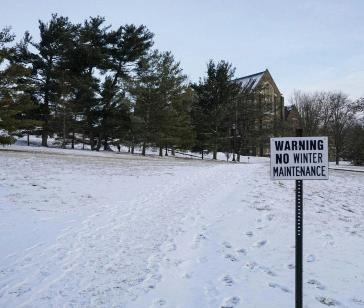
no matter what he does. Murray and co-star Andie MacDowell deliver charming performances that make Groundhog Day a comforting classic comedy.
The Thing (1982)
In John Carpenter’s cult classic, a team of American researchers in Antarctica encounters a creature capable of shapeshifting into its victims. Faced with this horrifying discovery, the researchers must determine which among them isn’t what they seem and kill the creature once and for all. The Thing features incredible practical effects that still hold up today. With a brilliant atmosphere of paranoia and confinement, The Thing makes for a brilliantly horrifying pick on a day of heavy snow.
LUSINE BOYADZHYAN ARTS & CULTURE WRITER
It is with great sadness that the fashion world mourns the loss of the founder of one of the most universally recognized fashion houses: Valentino Garavani.
There is a longstanding belief amongst the critics of the internet that you can always tell when a designer truly understood and cared about the women they were designing for. Valentino, out of many of the famous names of the fashion world, most certainly did. He once stated, “I know what women want. They want to be beautiful.” His designs, pure expressions of an artistic and cultured education, have always drawn the eyes and patronage of many famous women who each desired to get the chance at wearing a Valentino.
Valentino did not become a designer by accident. He chose early on to study fashion and French while he was in college at École des Beaux Arts and the Chambre Syndicale de la Couture Parisienne, where his professional career began. Even before then, a young Valentino Garavani had strict ideas of aestheticism. A story from his childhood recounts how he once began to cry when his mother attempted to make him wear a bow tie which he believed would disrupt the composition of his outfit. Long before fashion became his formal study and work, Valentino already had his mind on the appeal of couture.
After college, Valentino went on to work under designer Jean Dessès. Over his seven years there, Valentino pursued his own projects and designs. Valentino’s career flourished from celebrity endorsement, especially from collaborating with the film industry. His designs for Monica Vitti in the film La Notte, and Elizabeth Taylor’s dress for the opening night of Spartacus in 1961 drew wide attention to his work. Even into his old age he was well known for his celebrity friendships, such as his with Anne Hathaway. Very notably, he was the
designer behind Jackie Kennedy’s dress at her wedding to Aristotle Onassis. Valentino was pragmatic; he understood that working with the film industry would help him to grow his popularity and audience. Valentino even shot one of his summer collections on the set of Fellini’s film 8½. He understood that the exposure he would get from his film collaborations was incomparable to any sort of fashion show or editorial mention.
Valentino had what people describe as an authentic Italian flair. However, Valentino also understood the art of contrast and standing out even when it came to his own heritage. In 1967, with the debut of the “No Color” collection, he set a huge contrast between his work and the work of other Italian designers, such as Emilio Pucci, who at the time focused on bold and bright colors that instantly garnered attention. This collection even won Valentino the Neiman Marcus Award.
Valentino became an icon of the fashion industry from then on. His signature design was an experimentation of layering fabrics and materials to create a cultured and sophisticated look with a timeless silhouette. He wasn’t seeking to create clothes that would be revealing in a crass way, which made his clothes so appealing. He kept his collections ladylike, so that even when the dresses were very short there was an elegance to them. His signature raised waistline contributed greatly to this. Valentino did not try to destroy the pillars of haute couture, instead he developed his own ideas around what looks should walk down the runway, taking what was already an accepted style in fashion and contributing his own artistic flair.
Though Valentino became famous once for his “No Color” collection, many people know him today for his signature color of “Valentino Red.” The color, in fact, is also interwoven with Valentino Garavani’s love of culture and art. On a visit from Barcelona he was greatly inspired by the interiors of the cathedrals he saw there. In short, the birth of “Valentino Red” came from — just like many other things Valentino
— a love of aestheticism.
Valentino opened his first store in 1960 in Milan and spent decades honing his craft. In 1998, he sold his fashion house, but remained on as the creative director until his retirement in 2007. It took a while for someone to take his place, a credit to how impactful and creative his design abilities were. Him remaining on as creative director was not just about maintaining control over the brand; everyone understood that he was irreplaceable in his work.
Valentino was not just a designer, he was an embodiment of the Italian-aesthetic culture and of 20th-century fashion itself. Taking influence from a huge breadth of designers from France and even from Spanish architecture, Valentino crafted an image that was all his own. He understood elegance and class better than anyone; he was a lover of aestheticism and he truly knew that dressing women required a certain refinement. That is why he was the favorite designer of so many celebrities and socialites for many years. Valentino remains not just as a brand name on popular accessories, but also as a symbol of what attention to detail and a constant drive towards a cultivation of culture and class can produce.

By JANE LOCKE Arts & Culture Writer
Many of your favorites probably didn’t make the cut. Thursday, Jan. 22 marked the end of aggressive campaigning by studios for Oscar nominations, as nominees across all 24 categories were announced. Now, the real work begins: convincing the Academy that your pick should win this long and famous race for cinematic glory. Fans and studios have a similar job during the awards season in Hollywood — rooting for favorites and groaning when the opposition wins. With the nominees released, it’s necessary to take time to prepare for the future competition and also reflect on those left in the dust.
The Oscars have always left people disappointed. Whether it be the ones who lost or winners wishing for more than they have received, there are those kept out of the hallowed spotlight a little golden trophy brings. However, some filmmakers and performers never make it to the ceremony at all. This year, some of the biggest names of 2025 will not have the opportunity to walk the red carpet.
Ariana Grande was nominated for Best Supporting Actress in 2025 after
an extremely successful theater run for Wicked , which grossed over $700 million worldwide. Though she ultimately lost the award to Zoe Saldaña, many looked to Wicked: For Good as Grande’s second chance at the honor. The sequel that returns audiences to a darker Oz is largely meant to be Glinda’s movie, with the color scheme shifting from primarily green to pink hues. Despite a more emotional performance by Grande, the nomination for Best Supporting Actress eluded her in 2026 — to the anger of many fans.
Grande was not the only snubbed member of Wicked: For Good . Though its predecessor earned a whopping 10 Oscar nominations and brought home two, Wicked: For Good failed to be nominated for anything, even the widely expected nomination for Costume Design, which Paul Tazewell secured the previous year. It seems that though the sequel was much beloved, earning around $500 million at the box office, the critics in the Academy just couldn’t cheer for that contender.
Many other notable individual performances of the year were left off of the 2026 nomination list. After Dwayne “The Rock” Johnson delivered what was considered a moving portrayal of wrestler Mark Kerr in The Smashing Machine , generating a 70% critic score and a 74%
audience score on Rotten Tomatoes, his name was thrown into the ring as an Oscar consideration. Jennifer Lawrence, too, was described as having given an interpretation of a mother in crisis that “demands instant Oscar attention,” according to Vanity Fair. Yet, both of these powerhouses were dismissed by the Academy, leading to another aspect of the 2026 Oscar nominations: the surprises.
The trailer for Song Sung Blue looked, admittedly, underwhelming. A movie about a Neil Diamond tribute band that was clearly attempting to cash in on the recent boom of music biopics, Song Sung Blue flopped in theaters, bringing in only $49 million dollars. Despite this, Kate Hudson somehow secured a Best Actress nomination for playing singer Claire Sardina, creating one of the most shocking upsets in the 2026 Oscar nomination pool.
Another nominee that managed to squeeze its way into the field was F1 This fast-paced sports drama about a grizzled racecar driver teaming up with a fresh and popular youngster was actually enjoyable in theaters. With impressive sound, terrific music and an electrifying story, F1 was the perfect summer film, and audiences clearly loved it, as it brought in over $630 million dollars. However, F1 never seemed to be serious
competition for an Oscar nomination — until it snatched up one of the 10 coveted Best Picture spots. Though the Academy used to only offer five spots for the Best Picture category, the field was widened to 10 in 2009, leading to more space for underdogs to press their way through. Unfortunately, it is unlikely for F1 to win the Best Picture trophy against films such as Marty Supreme , One Battle After Another , Sinners and Frankenstein , but the honor of a nomination might be reward enough.
The 98th Oscars will be held on March 15, and for these next two months, debate will rage on over who should prevail. Each of us has an opinion and a beloved actor, actress or film, but it is ultimately the Academy that decides — on the nominations and the winners. This fact causes many movies that are well-loved and even acclaimed by general audiences, such as Wicked: For Good or the new adaptation of Superman , to be cast aside for films and performances more to the Academy’s taste. Though this divide may always remain, this awards season still holds a special place in movie-lovers’ hearts, as we cause an uproar over snubs and cheer on the little guys we didn’t expect to make it this far.
On Thursday, Jan. 22, the nominations for the 98th Oscars were announced, and we have opinions. Here are picks and predictions from some of our Arts and Culture editors and staff.
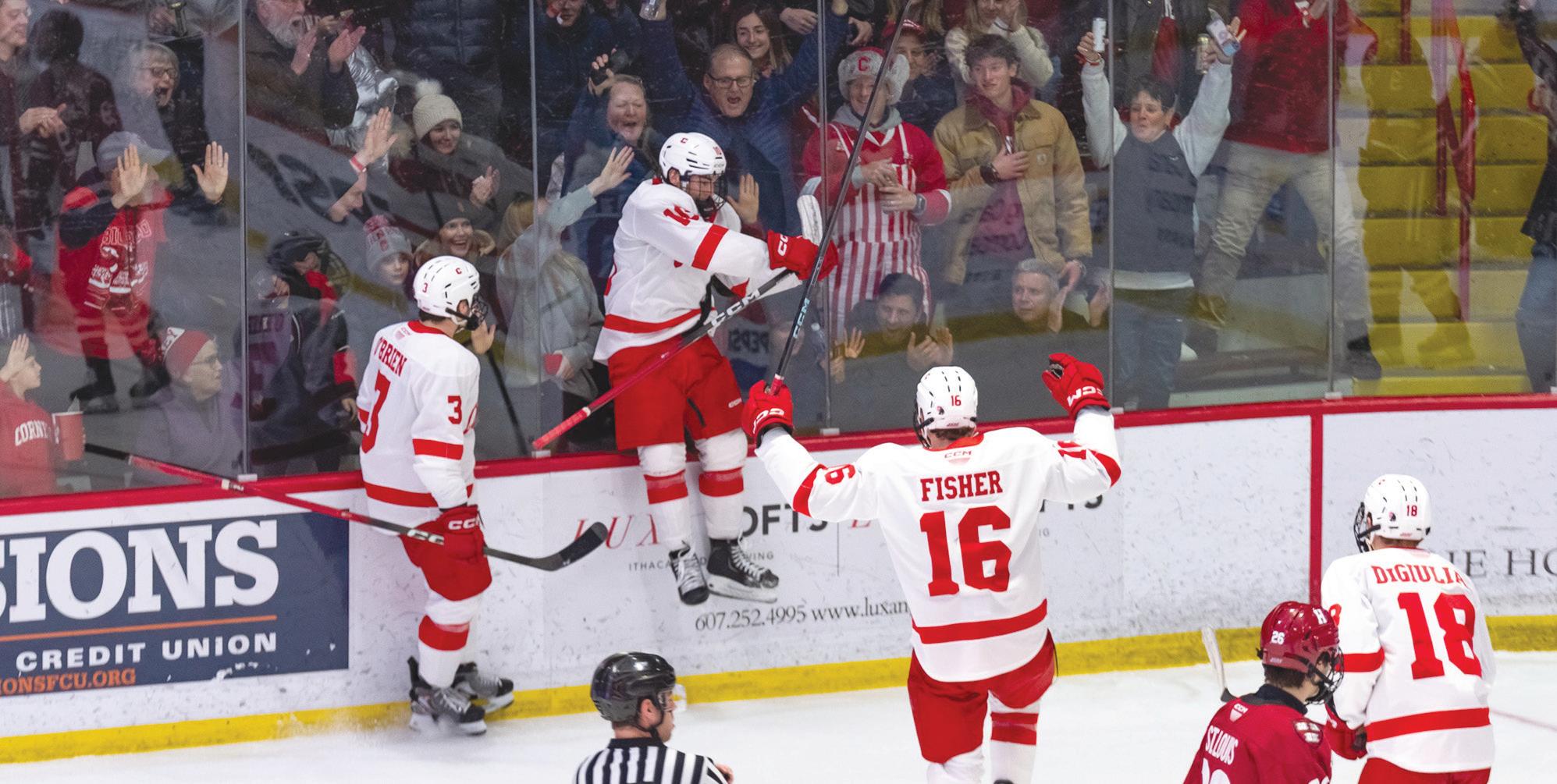
By JANE McNALLY Sun Senior Editor
Seconds before junior forward Jonathan Castagna scored in the third period of Saturday’s game against Harvard, he was willing himself to stay calm.
“[It was] just a regular two-onone,” Castagna said. “[I] just tried to stay calm and slow it down a little and take what was given.”
When his wrist shot found the back of the net, all he could do was scream. More than 4,267 fans jumped to their feet at Lynah Rink as Castagna was swarmed by teammates.
He dropped his shoulders a little, too.
“Obviously, everyone’s dream is to score a goal in the Harvard game,” Castagna said, “so it was nice to finally get to do that at home.”
Castagna’s goal was one of four used to give Cornell a 4-1 win over its Ivy League archrival. The Red potted three of those in the second period — including two in just 26 seconds — to secure a series sweep against the Crimson.
“That’s as close to 120 minutes of our identity [and] how we want to play that we’ve seen this year,” said head coach Casey Jones ’90.
The victory also caps off a weekend sweep, with the Red collecting five of a possible six points against a pair of the top teams in the ECAC.
“It was a full 60 minutes from us, which we obviously needed because they’re no pushover,” Castagna said. “That’s a pretty good team out there. So the fact that we were able to sustain that pressure the whole game, it felt like it was a really good game for us.”
Freshman goaltender Alexis Cournoyer allowed a relatively late goal that ended his shutout bid, but was sharp in all three periods and stopped 17 of 18 shots to earn the win. He was one of a few freshmen who stood out in Saturday’s high-in-
tensity contest, paired with freshman forward Aiden Long’s two-point performance.
The first-years excelled thanks to upperclassmen leadership, which provided them with proper preparation.
“The complete opposite of what you would probably imagine,” Castagna said when asked what he and his fellow upperclassmen leaders told the team before the game. “Just trying to keep everybody loose and [remind them] it’s just another day in the office for us, right? It’s a big game, but you can’t go into it gripping your stick too tight, or it’s not going to go the way you wanted it to. So I thought we did a good job being loose and playing our game right from the start.”
With the Lynah Rink air carrying
Continuing his impressive weekend, junior forward Jake Kraft got the Red on the board 11:27 into the period. Given time and space up close to Charette, Kraft roofed it over the goaltender to break the stalemate.
23 seconds later, it was 2-0. A hard shot on net by junior forward Jonathan Castagna generated a juicy rebound that junior defenseman George Fegaras jumped on, burying the puck glove side to double the Red’s lead.
Cornell added to its lead with just 1:05 to go in the second — freshman forward Aiden Long got in on the fun with a shot that just trickled through the legs of Charette, making it a 3-0 game and capping off an explosive second period.
“Obviously, everyone’s dream is to score a goal in the Harvard game, so it was nice to finally get to do that at home.”
Junior forward Jonathan Castagna
a potent fishy smell from the onset of puck drop, the first period was played relatively even between the two squads. Shots on goal read 9-9 after 20 minutes of play, with Cournoyer looking sharp to start after allowing a goal on the first shot he saw the night prior.
Time eventually expired on the first period with the game scoreless, though not before junior forward Luke Devlin was whistled for interference with 34 seconds left.
Cornell (14-5-0, 9-3-0 ECAC) kick-started the middle frame by finishing off the penalty kill, and then the Red got to work. Harvard (11-81, 9-4-0 ECAC) mustered just three shots on goal in period two, while Cornell out-attempted the Crimson 27-6.
And once the Red got one, offense kept coming.
“For me, it was more the fact that we had that second period going where we got momentum, and it was shift after shift after shift. We just kept coming,” Jones said. “So it was good to see us get some reward from that, and get a chance to put a team away.”
The Crimson came out with a bit more edge in the third period, attempting a handful of shots on an eventful first shift, but Cornell mustered a handful of blocks that kept Harvard off the scoreboard.
Harvard later hit the post with a shot, and the Crimson’s hard work was rewarded with a goal a few minutes after that. Mick Thompson — Harvard’s leader in points — converted to cut the deficit to two goals with 6:57 to play.
Thompson and the rest of his team did not have much time to celebrate — just 47 seconds after Harvard’s
strike, Castagna came streaking down the wing. Any Harvard momentum was quickly squashed when his shot beat Charette.
“You know, you talk about big games, like [Madison Square Garden]. And honestly, for me, [this] game is right up there,” Castagna said. “The crowd and the noise and the smell of fish.”
Now a 4-1 game with 6:10 to play, Cornell clamped down on defense. The Crimson pulled Charette for the extra skater and appeared the cut the deficit to 4-2 with a couple of minutes left, but a successful coach’s challenge for offsides scrubbed the strike off the board.
The Red held on from there, and the final horn sounded as an over-capacity crowd erupted in cheers.
“Never gets old,” Jones said about the atmosphere. “Never gets old.”
The win caps off Cornell’s eightgame homestand, with the Red emerging victorious in seven of those. Cornell will now embark on a daunting slate of games away from Lynah Rink, as seven of its next eight contests are on the road.
“I was disappointed,” Jones said about the schedule. “That late in the season, where there’s gonna be a lot of games that you’re not home for for a large part of it, I’ve just never seen it. Especially with the fan base we have for this league.”
Next up, Cornell will head east to take on Yale and Brown in New England next Friday and Saturday. Puck drop for both games is slated for 7 p.m., and all action will stream live on ESPN+.
“There is a difference [between] playing on the road versus playing at home,” Castagna said. “But we try not to pay too much attention to that. … It’s just keep doing what we’re doing, because it’s working.”
Jane McNally can be reached at jmcnally@ cornellsun.com.