Cornell condemned U.N. Special Rapporteurs raised concerns over human rights violations for international students at Cornell. | Page 10
Transfer thoughts Richard Ballad ’27 discusses his experience as an Ithaca College transfer.
Page 9
Funding farming Digital agriculture at Cornell may receive part of the settlement funding.
Page 8
Ganedago Hall Relocates 46 Residents Following Main Pipe Break, Flooding
By ANJELINA GONZALEZ Sun Senior Writer
Jan. 16 — Cornell Energy Management and Control Systems and the Division of Public Safety responded to a sprinkler main pipe that discharged in the 2-3 stairwell of Ganedago Hall that displaced 46 residents on Thursday evening, according to a Housing and Residential Life email obtained by The Sun.
HRL staff relocated students in rooms ending in one to 31 from all levels of the dormitory building on Thursday night due to “minor water infiltration,” the email stated.
“SCL Facilities and Building Care teams have been in the community for several hours working to extract the water and assess the repairs needed,” the email stated. “Housing and Residential Life staff members have also been on site assisting residents impacted (rooms ending in -01 to -31) relocate for the night.”
The cause of the discharged sprinkler main pipe was not identified in the email to students.
The 46 displaced residents were “relocated to other buildings on campus” according to a Friday afternoon follow up email sent to the residents of Ganedago Hall.
Sanika Saraf ’28 is one of the residents required to relocate as a result of the water damage. After spending Thursday night at Statler Hotel, Saraf was informed that she would be staying at Carl Becker Hall for the next six weeks.
“They told me that I have until next Friday to move all of my stuff out of the room, and that I have to unpack my room, put it in boxes and they’ll help me move my stuff to Becker,” Saraf said. “But I’m the one that has to move myself out.”
Saraf told The Sun that she was on campus early for sorority recruitment when she noticed the water entering her suite. When she entered her room, she found her carpet and hamper completely drenched with water.
Saraf said that since she does not have all her belongings
moved to Becker, she felt that she was “basically homeless.”
“I really can’t move out [of Ganedago Hall], so I’m in this weird state where I’m homeless until I move all of my things to Becker which is really just inconvenient,” Saraf said.
“It appears the university was running a surprise swim test verification but forgot we were on break,” said Ganedago Hall resident, Thomas Riveros ‘27, in a written response to The Sun when asked about his reaction to the flooding event. “I assume the make-up exam is scheduled for next month.”
The Friday update email to residents also detailed that the side entrance and stairwell closest to Robert Purcell Community Center in Ganedago Hall are closed until assessments and repairs are completed.
Residents that remain in the building will receive
“Throughout this process, our priority is to ensure that the Ganedago community stays connected and strong. Because we recognize the vital role that community plays, all reassigned residents will keep their card access to Ganedago (in addition to their new residence hall) for the duration of the repairs,” the Friday afternoon email reads.
Residents seeking support were encouraged by a University spokesperson to reach out to Elliot Hickey, the Gan dag : Hall Residential Hall Director and Jie Zhao, the Assistant Director of Student Behavior & Support.
Anjelina Gonzalez can be reached at agonzalez@cornellsun.com.
Over $2 Billion Sent to Cornell in 2025 From Qatar Te University received over $3 billion from diferent foreign nations in 2025, ranking second among U.S. colleges
By ZEINAB FARAJ Sun Features Editor
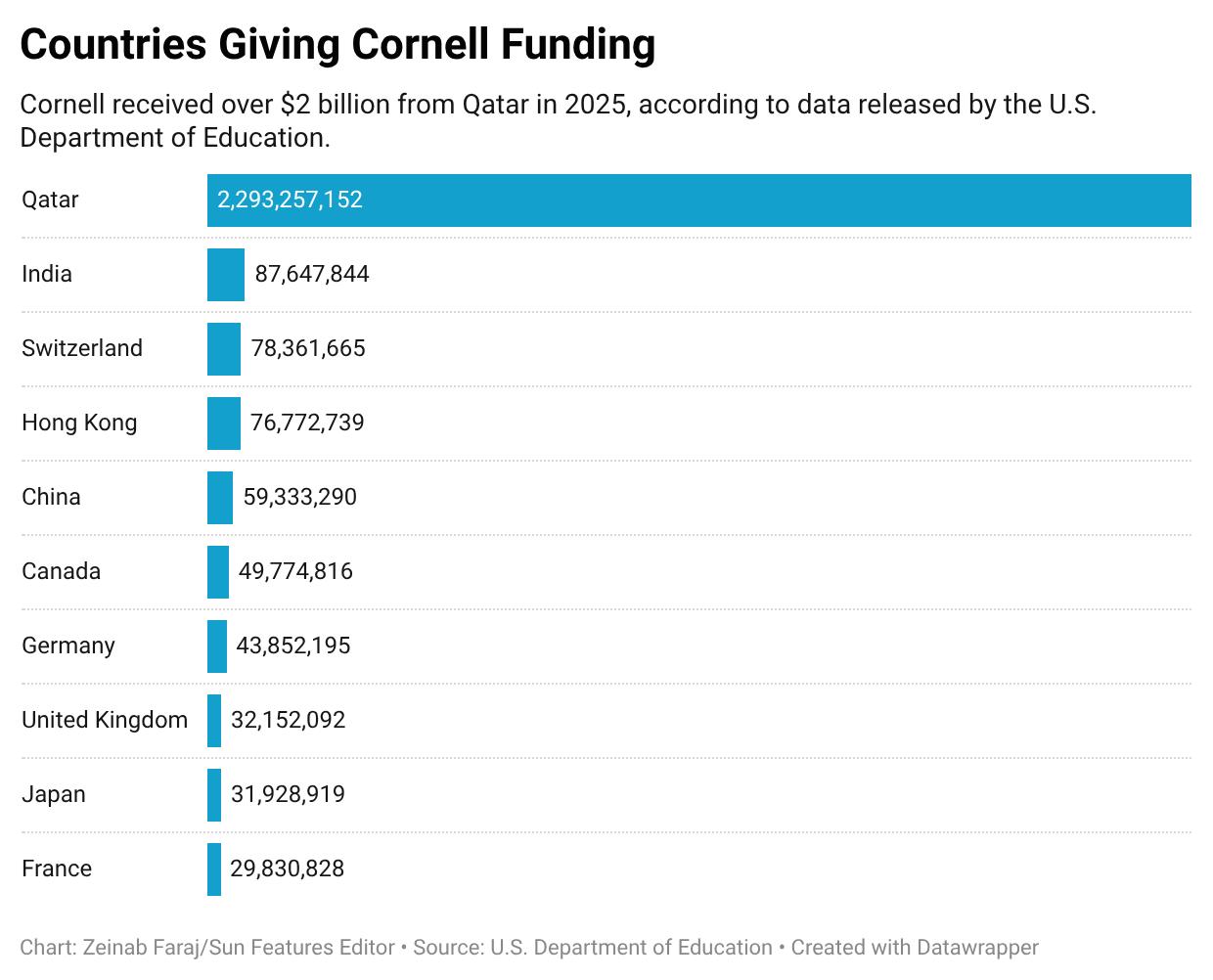
Jan. 20 — Cornell received over $3 billion from foreign nations in 2025, with sources in Qatar granting the most in gifts and contracts, according to data released by the U.S. Department of Education on Jan. 2. The University ranked second overall among 527 institutions that received foreign funds.
Section 117 of the Higher Education Act, passed in 1965, requires U.S. colleges and universities receiving federal financial assistance to biannually disclose any gifts, contracts or other forms of aid from foreign sources valued at $250,000 or more in a calendar year to the ED.
A gift between the University and a foreign country is defined as “financial support” given to the University in the form of cash, marketable securities, tangible assets or consumable commodities. These forms of payment made up a little over 11% of the foreign funds. A contract is defined as an agreement for the “acquisition by purchase, lease or barter of property or services” given by the foreign source for “for the direct benefit or use of either of the parties,” according to Cornell Law.
Qatar is the largest source of funds to U.S. colleges at $6.6 billion. The country granted Cornell the most money of the universities at $2.29 billion. According to the released data,
Cornell had 1,711 different transactions with foreign nations in 2025.
India, Switzerland and Hong Kong were the next biggest donors, each granting over $75 million to the University. Harvard, the only other university receiving more foreign funds than Cornell, received most of its funds from England and Switzerland.
The University does have a campus in Qatar, Weill Cornell Medicine at Qatar, which a University spokesperson told The Sun receives funding to help “operate” the campus.
“Budgeted funding for the medical school in Qatar has averaged approximately $156 million per year from 2012 to 2025, totaling $2.2 billion,” a University spokesperson told The Sun. “Virtually all funding remains in Qatar for Weill Cornell Medicine-Qatar school operations.”
The $156 million of the annual budgeted funding for the Qatar campus would make up 6.8% of the reported $2.29 billion granted in 2025. However, the University did not clarify whether the budget for Weill Cornell Medicine-Qatar comes from Qatar’s $2.29 billion of contracts and gifts.
The transactions are divided into contracts, restricted contracts, gifts and restricted gifts given to the University. 88.5% of the overall transactions were contracts valued at $1.5 billion. Contracts are managed by the Global Operations office.
To continue reading this article, please visit www.cornellsun.com.
Zeinab Faraj can be reached at zfaraj@ cornellsun.com
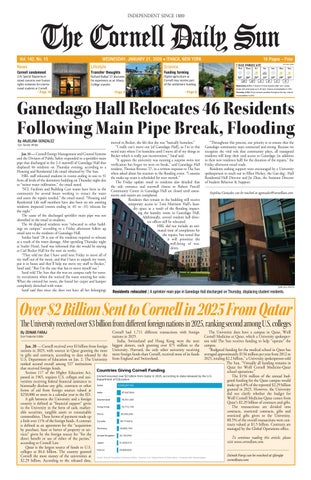
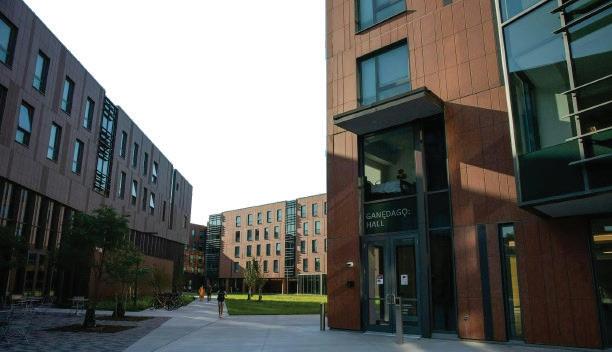
Residents relocated | A sprinkler main pipe in Ganedago Hall discharged on Thursday, displacing student residents.
Payment Request Support (Virtual Office Hour)
1 - 2 p.m., Virtual Event
Neurodiversity Dialogues: The Importance of Service Animals
3 - 4 p.m., Virtual Event
Improving Grades Session With Nora Ali 5:30 - 6:30 p.m., Virtual Event
West Campus Winter Book Read: Yellowface by R. F. Kuang Discussion
7 - 8 p.m., G32 Becker House
First Session of Socially Just Leadership Development
7:15 - 8:15 p.m., Room 125 Bethe HP Apartment
Projects & Participation Kick-off Spring 2026
7:30 p.m. to 9 p.m., Kiplinger Theatre, Schwartz Center for the Performing Arts
MAC January Social: Paint & Sip!
4:30 - 6:30 p.m., 100 Mann Library
Eating Well Trivia Pop-Up
5 - 7 p.m., Becker Dining Hall
Free ZUMBA 6:30 - 7:15 p.m., Multipurpose Room, Noyes Community Recreation Center
As Cornell settled into winter break, Sun photographers carried their cameras around the world to capture some winter views.
By SUN PHOTOGRAPHY DEPARTMENT
CHOW | Adelaide Chow ’29 photographed skyscrapers in Hudson Yards, New York City.
MENASCHE | Stephan Menasche ’28 captured a rally in support of Iranian protesters at Lafayette Square in Washington, D.C.
XI | Timmy Xi ’26 composed a shot of Not for Radio performing at Kings Theatre in New York CIty.
PARK | Annie Park ’29 captured a New York City restaurant celebrating New Year’s Eve.
ROMANOV IMBER | Sophia Romanov Imber ’28 photographed a group of Buddhist monks during a Walk for Peace in North Carolina.
ZHANG | Audrey Zhang ’29 ventured to the Detian Waterfall at the Vietnamese border.
Annie Park / Sun Staf Photographer Photo
Timmy Xi / Sun Staf Photographer
Sophia Romanov Imber / Sun Arts Editor
Adelaide Chow / Sun Staf Photographer
Audrey Zhang / Sun Staf Photographer
Stephan Menasche / Sun Assistant Photography Editor
ELLISON | Nathan Ellison ’28 snapped a photo of a snowy landscape in Vermont.
XI | Timmy Xi ’26 captured a sunny day at Mont Tremblant resort in Quebec, Canada.
Nathan Ellison / Sun Staf Photographer
G rady Millones / Sun Staf Photographer
‘Embodied
Te Very Best of Our Cornell Community’: Prof. Dawn Schrader Dies
By ZEINAB FARAJ Sun Features Editor
Jan. 14 — Prof. Dawn Schrader, communication, died on Jan. 6 according to a Friday afternoon email sent by Chair of the Department of Communication, Prof. Lee Humphreys, communication, to the communication community.
Schrader taught six different courses during her time at Cornell and was involved in research about new media and technologies impacting judgement and intellectual development. She published 35 research papers according to Google Scholar, one of which was cited 228 times in other work.
“As a beloved faculty member in the Communication Department, Professor Schrader touched countless lives through her extraordinary dedication to teaching and mentoring,” Humphreys wrote in an email statement. “Her sudden loss leaves a tragic void in our department and in the hearts of all who knew her.”
Schrader received her master degree from The Ohio State University and attended Harvard for her Doctorate of Education. In 2018, she served as a faculty fellow for Court Kay Bauer Hall.
She also completed a three-year term as chair of the Moral Development and Education Special Interest Group of the American Educational Research Association, during which she led organizational efforts and an international
annual conference in Philadelphia.
Schrader was also a member of the advisory board for International Expressions of Kindness: Multimedia Showcase. The initiative aims to recognize and promote acts of kindness.
“Her ability to connect with others was her superpower,” said Lisa Nishii, senior vice provost for enrollment management and undergraduate education in a Cornell Chronicle article. “Her insights were especially poignant during and following the COVID-19 pandemic. Dawn left an indelible mark on many and will be deeply missed.”
Individuals can have a diverse range of feelings, needs and reactions when facing loss. This information about Grief and Loss may be helpful to you or a friend.
The Ithaca-based crisisline can be reached at 607-272-1616, and the 988 Suicide & Crisis Lifeline is available throughout the U.S. Additional support resources are listed at mentalhealth.cornell.edu.
Students in need of professional support can email Student Support and Advocacy Services at studentsupport@cornell.edu or call Counseling and Psychological Services at 607-255-5155. Employees can call the Faculty and Staff Assistance Program at 607-255-2673.
To continue reading this article, please visit www.cornellsun.com.
Zeinab Faraj can be reached at zfaraj@cornellsun.com.
Financial Aid Lawsuit Against the University Must Proceed
By ATTICUS JOHNSON Sun Senior Writer
Jan. 20 — A federal judge ruled on Jan. 12 that an antitrust lawsuit filed four years ago against Cornell and 16 other elite colleges and universities must proceed to trial. The lawsuit alleges that the schools conspired to reduce financial aid and favor wealthy students.
The suit also alleges that Cornell, through a now-defunct organization of 30 elite universities known as the 568 Presidents’ Group, conspired to reduce financial aid in violation of the Sherman Antitrust Act. The 1890 act prohibits monopolies by restricting collusion that might limit competition.
Specifically, the plaintiffs argue that Cornell and other universities worked together to ensure that financial aid pricing was similar between institutions. Because similar pricing of aid across universities was less than what the aid would have been without collaboration, the plaintiffs argue, the 538 Presidents’ Group ultimately favored wealthy students by increasing the overall cost of attendance.
The 568 Presidents’ Group was named after Section 568 of the Improving America’s Schools Act of 1994. The section was an exemption to the Sherman Antitrust Act that allowed need-blind institutions to collaborate on financial aid principles to ensure
financial aid was similar among universities. The group disbanded in 2022 after its namesake section expired, and amid the filing of this suit alleging misuse.
However, the plaintiffs, a group of alumni from the 17 elite universities, allege that the universities listed in the suit are not protected under Section 568 because they did not behave in a way that was truly need-blind.
Judge Matthew Kennelly of Illinois ruled there was sufficient evidence for juries to “reasonably find” the universities illegally coordinated to proceed with a trial, and rejected the universities’ arguments to end the case before a trial.
For a jury to find coordination, they would have to decide that universities worked together as a cartel, with the express purpose of eliminating competition on financial aid.
“We have compelling evidence that these elite schools perpetrated a twenty-year conspiracy to harm their own students by colluding in violation of the antitrust laws to reduce financial aid,” Eric Cramer, a lawyer for the plaintiffs, said in a statement after the decision was released.
To continue reading this article, please visit www.cornellsun.com.
Decline in Graduate Student Enrollment Raises Concerns From CGSU, GPSA
By ZEINAB FARAJ Sun Features Editor
Jan. 15 — The number of graduate students at Cornell declined by 142 and the number of first-year graduate students decreased by 209 from 2024 to 2025, according to data released by Cornell Institutional Research and Planning on Oct. 21.
According to the resolution, this training seeks While the University’s graduate student enrollment remains above COVID-19 levels, the year-to-year drop in graduate student enrollment raised several concerns from the Cornell Graduate Student Union, an organization advocating for the rights of graduate students and Graduate and Professional Student Assembly, a student-led governing body that represents graduate students and professional students.
A representative from CGSU wrote in an email statement to The Sun that the decline is “not surprising.”
“Cornell’s administration has never prioritized the lives and working conditions of its employees, including graduate workers,” wrote the CGSU representative. “Instead, Cornell’s administration has repeatedly shown us that it is willing to compromise on its educational mission and implement layoffs and hiring freezes under the guise of austerity.”
University administrators have released several guidelines related to financial austerity, including statements in Summer 2025 regarding staff cuts and hiring restrictions as well as steps to preserve the University’s financial stability following federal funding cuts.
“Urgent action is necessary, both to reduce costs immediately and to correct our course over time — achieving an institutional structure that enables us to balance our budgets over the long term,” the administrators wrote in an Aug. 22 statement about the University’s financial future.
Eight out of 11 of Cornell’s colleges have experienced a decline in the enrollment of first-year graduate students. According to the data, the College of Arts and Sciences had the biggest loss in enrollment at 106 followed by the College of Engineering which lost 99 first-year graduate students.
The CGSU representative also explained in an email statement to The Sun that the loss in CAS graduate students could be related to the University’s decision to cut nearly $11 million in the college’s budget in a Sept. 17 internal meeting, as confirmed to The Sun by several CAS department chairs present at the meeting.
In a statement sent to The Sun from GPSA President Nicholas Brennan which was attributed to GPSA leadership also pointed out that changes to the “funding landscape” as well as concerns surrounding visa requirements for international students were both “certainly key” causes behind the decline.
Historically, H1-B visas, a non-immigrant status awarded based on exceptional talent and merit in different fields like research, project development, helped attract international students to the U.S.
However, recent changes to the H-1B visa that force employers to pay up to $100,000 when they sponsor an H-1B petitioner have raised concerns given that the University typically covers the cost of sponsoring students.
“The University won’t take a set position on the payment of the fee, in the sense that, if it is legally required, of course it will be paid, but we won’t say there’s a new policy on bringing H-1Bs in or not, or who pays the fee,” Wendy Wolford, vice provost of international affairs previously told The Sun in December.
“This is in addition to concerns about the feasibility of obtaining domestic jobs post-graduation and the increased risk in travelling to the United States for international students,” Brennan and other GPSA leadership wrote to The Sun. “These factors contribute to an atmosphere that is uninviting to our international community members.”
Dean of the Graduate School and Vice Provost for Graduate Education Thomas Lewis described in an email statement to The Sun that “reductions in federal funding” have had profound effects on the University and noted that some graduate programs have made “strategic cuts” to admissions in response.
Lewis also explained that despite the University’s agreement with the federal government to restore over $250 million funds, there are still “continued threats” to the University’s indirect cost agreements, grant programs and federal agencies that partner with the University.
“Admissions decisions are generally made by graduate fields, in collaboration with the Graduate School and academic colleges, on the basis of advising capacity, funding sources, and the need to support current students,” Lewis wrote.
Cuts to research have impacted graduate student enrollment across several fields — most notably, science, technology, engineering and math fields lost 148 graduate students and the humanities lost 33 graduate students, with foreign languages, literatures and linguistics accounting for 57.5% of the loss.
Brennan and GPSA leadership also stated that they were “very concerned” about the increasing workload placed on graduate students as the University continues to accept larger undergraduate classes.
“Graduate students are the blood of the university: we perform research, teach classes, enroll in courses ourselves, and maintain a constant yearround presence on campus and in the broader Ithaca community,” GPSA wrote to The Sun. “Cuttingedge research and teaching are our products and, left uncorrected, a smaller workforce is problematic for the university’s core mission.”
CGSU echoed similar concerns in their statement to The Sun, stating that “graduate workers” provide “essential services” to the University.
To continue reading this article, please visit www. cornellsun.com.
Student Referendum on Disciplinary Process Passes Despite Ballot Box Issues
By BENJAMIN LEYNSE Sun News Editor
Dec. 17 — Nearly 3,000 undergraduate students voted “Yes” on two referendum questions that sought to make Cornell’s disciplinary system independent from the University administration and to reinstate a campus-wide code of conduct, according to results released by the Office of the Assemblies on Monday.
Undergraduate student voters overwhelmingly voted in favor of the two measures on the ballot.
3,079 of 3,292 ballots cast, which was 93.5 percent of the votes, supported ballot issue one, making Cornell’s judicial system independent. 2,976 of 3,245 ballots cast, which was 91.7 percent of votes, supported ballot issue two, reestablishing the campus-wide code of conduct.
The success of the referendum came amid several issues occurring with the voting process itself, including reports that the electronic ballot sent to all undergraduate students was sent to the spam folder of emails due to an authentication error.
Currently, the conduct of undergraduate students is governed by the Student Code of Conduct and the Office of Student Conduct and Community Standards which were implemented in 2021 after the University overhauled its judicial system.
Prior to 2021, the University used the Campus Code of Conduct — which applied to all members of Cornell’s community — and the independent Office of the Judicial Administrator. Both of these systems were dismantled when the University switched the authority and administration of the Code from the University Assembly, to Ryan Lombardi, vice president of student and campus life.
The results reflected a roughly 20 percent voter turnout among undergraduate students, which is a noticeable decrease compared to the last University referendum held in spring of 2024, which saw a 46.8 percent turnout. In the spring 2024 referendum, a majority of student voters voted for the University to support a permanent ceasefire in Gaza and if the University should divest from various weapons manufacturers.
Former President Martha Pollack ended up rejecting the spring 2024 student referendum in May 2024, explaining that it was not the proper role of the University to make a statement about such a “complex political issue.”
According to former Chair of the Student Assembly’s Office of Ethics and referendum co-sponsor Sophia Arnold ’26, the low turnout was the result of several compounding reasons which limited student awareness. First among them was when the referendum was held.
“It can’t be understated how … limiting, holding the referendum starting on finals is,” Arnold
said.
Another challenge Arnold said was that the promotional email that the Student Assembly charter requires to be sent out prior to voting, was sent to the wrong set of email addresses.
“It meant that students weren’t even informed that there was going to be a referendum on December 12 until the morning of,” Arnold said.
Arnold also claimed that an issue with the authentication for the voting platform OpaVote, led the email containing the ballot to end up in the majority of student’s spam folders.
In a text statement to The Sun Student Assembly President Zora deRham ‘27 confirmed that an issue with OpaVote had occurred.
“The tech issue with OpaVote was completely unexpected and hasn’t happened at least in the last 3 years of memory between SA and the OA.” deRham wrote. “The OA has been communicating with the Assembly about the answers they got from IT and OpaVote, but nothing was able to be done to reverse the issue itself.”
OpaVote is a platform used by the Office of Assemblies to send mass emails to students to facilitate voting. An analysis of the meta data in OpaVote’s Friday email that announced the link to vote, shows that the message failed to meet Cornell’s authentication requirements.
Following threats of harm made using spoofed Cornell emails, the University accelerated a program this Fall to apply stricter standards for mass email communications. As of Nov. 10, a Cornell IT information page states administrators connected to email addresses that do not meet authentication standards will “receive a direct email notification letting them know what steps to take to avoid an interruption in their ability to deliver email.”
It is unclear who would be responsible for ensuring that the OpaVote email meets Cornell’s authentication requirements. However the Student Assembly Charter states that the Office of the Assemblies is responsible for distributing ballots via email to all undergraduate students, how and when to vote, the referendum question and any pro or con statements submitted.
When asked for a comment about the OpaVote email issues, Director of the Office of the Assemblies Jessica Withers, forwarded an email to The Sun that she sent to Student Assembly members addressing issues about the referendum process on Monday.
“I am reaching out to you to apologize for an Office of the Assemblies’ error that complicated the voting period,” Withers wrote. “I know this mistake has made the Student Assembly the target of claims of voter repression, and for that I am very sorry.”
To continue reading this article, please visit www.cornellsun.com.
The Corne¬ Daily Sun
Independent Since 1880
143rd Editorial Board
JULIA SENZON ’26
Editor in Chief
ERIC HAN ’26
Associate Editor
SOPHIA DASSER ’28
Opinion Editor
SOPHIA TORRES ’26
Advertising Manager
SYDNEY LEVINTON ’27
Arts & Culture Editor
JAMES PALM ’27
Assistant Arts & Culture Editor
JENNA LEDLEY ’27
Assistant Arts & Culture Editor
MELISSA MOON ’28
Assistant Arts & Culture Editor
SOPHIA ROMANOV IMBER ’28
Assistant Arts & Culture Editor
KAITLYN BELL ’28
Lifestyle Editor
MAIA MEHRING ’27
Lifestyle Editor
KARLIE MCGANN ’27
Photography Editor
MATTHEW KORNICZKY ’28
Assistant Photography Editor
STEPHAN MENASCHE ’28
Assistant Photography Editor
MIRELLA BERKOWITZ ’27
Video Editor
JADE DUBUCHE ’27
Multimedia Editor
HANNIA AREVALO ’27
Graphics Editor
HUNTER PETMECKY ’28
Layout Editor
RENA GEULA ’28
Layout Editor
CHRISTOPHER WALKER ’26
Games Editor
ALLISON HECHT ’26
Newsletter Editor
Natalia Butler
DOROTHY FRANCE-MILLER ’27
Managing Editor
MATTHEW KIVIAT ’27
Assistant Managing Editor
VERA SUN ’27
Business Manager
ALEX LIEW ’27
Human Resources Manager
BENJAMIN LEYNSE ’27
News Editor
VARSHA BHARGAVA ’27 News Editor
ISABELLA HANSON ’27 News Editor
CEREESE QUSBA ’27 News Editor
REEM NASRALLAH ’28
Assistant News Editor
ANGELINA TANG ’28
Assistant News Editor
KATE TURK ’27
Assistant News Editor
GABRIEL MUÑOZ ’26 City Editor
JANE HAVILAND ’28 Features Editor
ZEINAB FARAJ ’28
Features Editor
JEREMIAH JUNG ’28
Assistant News Editor
KAITLIN CHUNG ’26
Science Editor
MARISSA GAUT ’27
Science Editor
ALEXIS ROGERS ’28
Sports Editor
MATTHEW LEONARD ’28
Assistant Sports Editor
SIMRAN LABORE ’27
Weather Editor
Natalia Butler is an Opinion Columnist and a M.S./Ph.D. student in Cornell's Department of Natural Resources and the Environment. Her monthly column, Beyond Ivory Towers, explores the role of academics in the face of the climate and biodiversity crisis. She can be reached at nbutler@cornellsun.com.
Fall Funding Frenzy
Waking up to the crunch of ice and metal, the all too familiar sound of snowplows signals the winter season is here to stay. With the beckoning of a new semester, it feels an appropriate time to reflect on the fall semester’s funding frenzy from which academics are still recovering.
From September to November marks a marathon season of grant writing involving not only professors but graduate and undergraduate students, in addition to a host of research staff. Grants are crucial to research institutions for funding research materials, staff, graduate student costs, as well as the university. While Cornell does have a sizable endowment, which is currently valued at $11.8 billion, research is primarily supported by grants. A whopping 64% indirect cost rate (on the Ithaca campus) is applied to any research grant that Cornell receives which supports administrative staff and maintenance.
The grant cycle is typically two to three years with applicants often left in limbo depending on the ebbs and flows of the federal processes in charge of rewarding grants. Events such as recent federal shutdowns have a great impact on researchers' ability to conduct their work and plan for future projects including the hiring of graduate students. While Cornell has made a settlement with the federal government to release funds, there still exists a cloud of uncertainty within academic institutions regarding funding. I myself am left wondering if the grant I am applying for today might be dissolved tomorrow. Grants that have yet to be slashed are worded carefully and spun new tales of economic value as opposed to mitigating the effects of climate change. Additionally, the recent change in policy for incoming PhD graduate students requires five years of confirmed funding, which does not align with the typical grant cycle. The NSF GRFP, an
Eric Han
Eric Han '26 is the Associate Editor of the 143rd Editorial Board and a philosophy student in the College of Arts and Sciences. His monthly column, Campus Dialectic, reviews recent Sun op-eds to speculate on cultural and political issues. He can be reached at ehan@cornellsun.com.
Campus Dialectic
In May 1941, Kurt Vonnegut was an opinion columnist for The Sun. Under Well All Right, a column he shared with others, he wrote, “Sometimes it isn’t as easy as it might seem, this business of discovering the real news in the news, for there are all kinds of devices to submerge it.”
What an apt sentiment for the Internet Age. My new column, Campus Dialectic, will not teach you how to find the “real news” in the news. But it will show you where I see it.
When I joined The Sun, I thought that I would find truth in the lens of a camera. I started as a camera operator and video editor, hoping to learn the visceral trade of disfiguring temporal bodies. My inexperience led me to pursue the truth through a more familiar medium: prose. Later my freshman year, I began writing film and music reviews and soon became one co-editor of the arts and culture department. My first column, Elfbar Ideology, was an exercise in cultural criticism that dealt
Kira Walter
important grant for many graduate students, recently slashed the number of students to be awarded by 50%. This marks an all time lowest acceptance rate in fifteen years. As a graduate student who applied during the previous NSF GRFP grant cycle, I along with my fellow graduate students felt the panic of the most stable funding source being shaken to its core. When the most reliable funding sources to support graduate students are no longer available and TA slots are becoming more competitive than ever, the pressure on graduate students is insurmountable. It feels as though scholars are in an endless loop of grant writing with no end date in sight.
When I initially entered academia, I was ready to dive into the work but was abruptly stalled by the minefield of grant writing. It is ironic that we as scholars, who are so passionate and dedicated to our craft, must spend an inordinate amount of blood, sweat, and tears writing grants rather than focusing on our research. Not to mention the mystery that is the peer review process for awarding grants. This long standing tradition coveted by academics is actually an inconsistent process and a poor indicator of future grant productivity. A qualitative study in 2021 determined that scholars would be open to a grant lottery system in conjunction with a peer review process just to shake things up. Other methods of reducing inefficiencies in the research process might include streamlining the grant process and making grant calls more specific to a research group’s subject of expertise.
Despite the draconian times facing academia, scholars can unite in the fact that grant writing sucks and takes away precious time that could be spent conducting research.
To continue reading, please visit www.cornellsun.com.
with my generation’s tendency to sacrifice for others over themselves. I thank Elf for showing me that valuable work can be done in the opinion department, where Campus Dialectic will call home.
I wonder if Vonnegut, who would go on to assume my same title of associate editor, appreciated the privilege to read every opinion that the campus community brought to The Sun during his tenure. I feel a special responsibility to put today’s opinions in conversation, to pull them deeper into the eye of the zeitgeist. It’s apt, then, that this new column will, by design, review recent Sun op-eds to speculate on cultural and political issues. It will be dialectical by many notable accounts, from the Platonic to the Aristotelian and Hegelian. It will engender dialogue, critique the art of rhetoric and agitate ideas as to provoke their latent dynamism. In the spirit of a naive Vonnegut, yet a haunted witness of the horrors at Dresden, it will locate the real news.
Kira Walter '26 is an Opinion Columnist and former Lifestyle Editor. Her column Onion Teory addresses unsustainable aspects of modern systems from a Western Buddhist perspective, with an emphasis on neurodivergent narratives and spiritual reckonings. She can be reached at kwalter@cornellsun.com.
From the Trespasser’s Perspective: Welcoming Right to Roam in Ithaca
Amotion for a regular Tuesday morning: I’m detained by the Ithaca Police Department for allegedly trespassing on Carl Sagan’s observatory. Not the deckedout, weekly star-viewing Fuertes facility on North, widely commercialized by Cornell, but the decaying plot on the Stewart Avenue Historical Bridge — unbeknownst to the public.
I was jogging, albeit a bit manically, about some limerent hyperfixation, when I passed in understanding that the property, much like Rockledge or any cliffhanger estate, would have intrepid views of Ithaca Falls. I didn’t use a second brain cell when I hopped the fence to scope it out. A short 20 minutes later, cue the patriotic lights, melodramatic sirens, two boys in blue coaxing me off of “private property.”
This is modern American trespassing. The penalty, if caught as a 20-year old college student, is a hardly insufferable 30-minute interrogation: “What’s your affiliation with Carl Sagan?” As coincidence had it, Nov. 9 of ’24 would’ve been the astronomer’s 90th birthday. I was passively accused of committing some related act of protest, until the conversation ended: “Do you have any motivation towards self-harm?” I denied, and was consequently released.
Some are less fortunate than I was on the Sagan anniversary. I hate to celebrate the day by desecrating his land with my personal presence and getting away clean. But under other circumstances, a simple trespass according to New York State Penal Law would’ve cost a bare minimum of $250 or a 15-day staycation in jail. That’s right, folks — you get two weeks in the can for pursuing waterfront scenery. Then, of course, my access to public land is the last priority.
It's no secret that despite a reputation for national parks and transcendental legends, the great American landscape is commoditized, available to those who can afford ownership in the right places. While Europe, Scandinavia and other commonwealth countries adopt right to roam laws, serving public good first and private interest second, tables in the States are turned. Our constitution makes private property absolute, with a legal culture that perpetuates exclusion and class hierarchies.
Ithaca is no exception. Rigid, extreme and often arbitrary trespassing designations deprive residents of space to indulge the outdoors. Acres of forested land and abandoned lots have become inaccessible in accordance with the law. While penalties for wandering
don’t seem to influence everyone, they develop a general attitude of fear that discourages travel off the beaten path.
Perhaps the most obvious local instance of this trend is the Cayuga Lake disparity: although the watershed is a public resource, private railroads surrounding it prevent lake access around the shoreline. To enjoy a proclaimed free resource, most Ithacans have to commute to access points like Stewart Park, East Shore, Allan Treman or Steamboat Landing.
The Ithaca Central Railroad outlines the right base of Cayuga: owned by Watco, it facilitates freight transport, with the Cargill Salt Mine in Lansing as a leading customer. Trespassing in a railroad zone is a class B misdemeanor, supplemented with a $500 fine or 3 months jail-time to boot. Like many vague private local claims, it’s a low-enforcement zone with little to no history of conviction or punishment. Still, the threat of suffering losses keeps the lines largely empty. Between train activity and a private home blockade along the waterfront, the promise of a free lake is compromised.
Active vehicles operating along lakeside tracks introduce a key point in the discussion of increased property access: How does danger play a role in trespassing? Even in “right to roam” countries, construction/industrial zones impose understandable restrictions on wandering to prevent foreseeable harm. Norway, Sweden, Iceland and numerous other nations emphasize that any structure is protected and requires permission from a landowner. Ruins and historic sites are often stabilized for safety, but walls otherwise create immediate boundaries. Land development thus complicates roaming jurisdictions as areas are defined by heavy machinery, chemical compounds and other hazards.
Notorious for constant construction projects, many of Ithaca’s “no trespassing” signs decorate areas under renovation. It’s easy to dodge bulldozers or stay clear of cranes, but issues arise with duration of construction and parameters of the site. Two keen examples of conflict between roamers and private development companies are Gun Hill and the Morse Chain/Emerson Power Transmission Plant. Both are Ithaca landmarks, present since around the 19th century and located by trafficked woodland areas. Both are currently being transformed into housing infrastructure by teams and town budgeting.
To continue reading, please visit www.cornellsun.com.
RECAP | Student Code of Conduct
Students for a Democratic Cornell Guest Room
Students for a Democratic Cornell is a campaign fghting to hold the University accountable to the concessions it made to students after the 1969 Willard Straight Hall Takeover in the face of repression on campus. Tey are demanding a return to the Campus Code of Conduct and the restoration of Cornell's independent judicial system. Tey can be reached at studentsforademocraticcornell@gmail.com.
Tis article was published on Dec. 14, 2025.
Cornellstudents are about to vote on the most important governance question since 1969: Who should control our judicial system: the Cornell community or the central administration?
It’s a question we should have been able to answer years ago. But we were never given the chance. In 2020, the administration quietly rewrote the Student Code of Conduct, dismantled the shared governance and independent judicial system students fought for in the Willard Straight Hall takeover and placed ultimate disciplinary authority in administrative hands.
And now, Vice President for Student and Campus Life Ryan Lombardi is attempting to do it again.
While Lombardi and Dean Marla Love would like us all to believe their current unilateral overhaul of the Student Code of Conduct is routine, it’s not. Te Code itself forbids unilateral administrative revisions. Under its procedures, any proposed change must be reviewed by a committee made up of student leaders.
Administrators are not specifed as required members.
Yet V.P. Lombardi convened a committee dominated by administrators with a few cherry-picked students sprinkled in — a departure from the Code’s standards for shared governance.
Te 2020 Code Takeover
Tis pattern is not new. Disenfranchising students to dismantle Cornell’s judicial system began in 2020, when then-President Martha Pollack used the Student Assembly to wrench control of the Code away from us in the frst place. In 2019, Pollack asked the University Assembly to revise the Code, stating that our judicial process was outdated and updates were needed to better serve students. At the time, the U.A. had full control over the Code.
Tat fall, the administration proposed its own draft
Tis
On March 10, 2025, I was arrested for walking out of a panel of Israeli and American war crim- inals. On March 19, I was notifed of “interim action” and “temporary restrictions” against me under the Student Code of Conduct.
For many Cornell students, the Code is nebulous. Perhaps you’ve heard about student protestors being suspended, evicted or deported under the Code, but it’s an overly-complicated bureaucratic process that remains hidden behind the walls of Day Hall.
Many Cornell students also know that in 1969, Black students took over Willard Straight Hall. What you may not know is that one of the key demands they won was the creation of a Campus Code of Conduct, in response to the administration’s overly harsh pun- ishment of Black students.
After the Pathways to “Peace” event last semester, I received what Cornell previously has described as a “non-academic suspension.” However, by the time my case came to Liang’s desk, she refused to use the term, likely due to bad publicity. I was allowed to continue
What Admin Doesn’t Want You To Know About the Referendum
Code of Conduct, which was ultimately rejected by the U.A. Negotiations over the revisions stalled. By Spring 2020, it appeared as though the U.A. and Pollack had reached an impasse, putting the administration in a bind: Tey desperately wanted to overhaul Cornell’s judicial system, but they couldn’t do so without the U.A. on board.
Ten came Student Assembly’s Resolution 65: Pollack’s magnum opus.
Te Student Assembly received Resolution 65 — “Ofce of the Student Advocate Observations and Recommendations on Community Life” — two hours before its April 23, 2020, meeting. Debate was short — lasting approximately fve minutes. Te resolution was presented as “adding a student voice; restorative justice; [and] including diversity and inclusion training for disciplinary issues.” It passed near-unanimously.
Conveniently (for Pollack), however, Resolution 65 contained a previously unseen Code Procedures draft.
Two weeks after it passed, Pollack rejected the U.A.’s Code proposal and wrote that “because the Code is almost entirely directed towards students … the work of our duly elected student government should be seriously considered.”
Te draft of the Code attached to Resolution 65 was near-identical to what was approved by the Board of Trustees in December 2020 and is in place today. And more concerningly, it was also virtually identical to the administration’s own draft that had been rejected by the U.A. earlier that year.
How convenient.
Pollack then proposed that the U.A. authorize the creation of a Code drafted by the University. Te U.A. agreed. By Fall 2020, Pollack had a fnal draft — one crafted by central administration that gave untouchable administrators total control over student conduct.
Te new Code was sold to the Student Assembly as one that would better protect students. Te choice to weaponize students was deliberate. Faculty and staf know better than to trust our administration when they want to make sweeping changes. Students, however, are less aware of the administration’s goal of clawing back the power that was conceded to students in 1969.
Te New Code of Conduct
Having fraudulently manufactured the consent of the student body through the Student Assembly, the campus’s
protests and pushback against the new draft went ignored.
Te new Code of Conduct stood — a fnal betrayal of the agreement signed by the University in 1969.
Te new Code dismantled the Ofce of the Judicial Administrator and stripped it of its independence from administration and created the Ofce of Student Conduct and Community Standards in its place.
Revising the Code in 2020 gave the administration what they wanted all along: a means to punish whoever they see ft.
Today, Cornell’s top administrators have control over every aspect of the disciplinary process. Tey are often the complainant against students. Tose students can then be temporarily suspended upon that complaint, and the average time between that and their case being resolved is 246 days — long enough to pressure students into accepting sanctions they would otherwise never agree to, rather than risk extending delays that jeopardize enrollment.
Sound familiar? In any U.S. courtroom, coercive delay is checked by the Sixth Amendment — a protection (among many others) that students do not have when OSCCS controls the timeline. And despite OSCCS referring cases to CUPD, every student protestor taken to court in the last two years has had all charges dismissed.
What We Had Before
Shared governance came from students’ demand for a judicial system independent of our administration. In 1969, the Cornell administration was suspending students who protested against the Vietnam War. Students understood that allowing administrators to unilaterally control student conduct was a violation of students’ rights.
But 51 years have passed since then, and our central administration has slowly taken back the power they once vested in us. Administrators only allow the Student Assembly to exist to placate us. Dean Marla Love has boldly admitted none of us have a real say: “Te assemblies have the opportunity to submit resolutions with Code revisions, so everyone in this campus community gets the opportunity to participate. Anything that passes … will come to this review committee.”
Our right to shape our judicial system is not equivalent to the right to politely request that the central administration consider our suggestions.
To continue reading, visit www.cornellsun.com.
Take Back the Code of Conduct
my academic progress, but was essentially constrained to my dorm room anytime I was not in class.
Tere exists an appeals process for temporary restrictions, which involves fling a written request to the Vice President for Student and Campus Life, cur- rently Ryan Lombardi. Given that Lombardi has not once accepted an appeal, my RCC advised me that it would be a waste of time to even write a request.
My process to reach an Alternate Resolution stretched unnecessarily from March 19 until May 5 — almost 50 days — and this was OSCCS in hyperspeed. Students who are temporarily suspended have waited an average of 264 days for their cases to be resolved through a hearing.
In addition to pursuing disciplinary action against me through OSCCS, Cornell also took me to court. On April 9, I appeared at the Ithaca City Court on charges of disorderly conduct. Tis was adjourned in contemplation of dismissal, and they are now fully dismissed. It’s not just me — every single student protestor who’s ever been brought to court by Cornell over the past two years has had their charges fully dismissed.
On Aug. 26, Ryan Lombardi announced a “formal review process” to revise the Code during the 2025- 26 academic year, with the changes taking efect by next fall. In this statement and in his remarks to the Student Assembly, Lombardi repeatedly emphasized his desire to hear and respond to student suggestions during this process.
Te Cornell community has already made clear that we believe the Code, as it stands, is undemocratic and disproportionate in its targeting of political activists. As Lombardi spoke, over 100 students turned their backs on him and President Kotlikof
I’m here to propose concrete changes.
While my experience was one of the faster pro- test-related resolutions, I strongly believe that strict time limits on the procedure and communication requirements are necessary. OSCCS staf who exercise control over your entire life and wellbeing as a student should not be able to ignore your emails for days or weeks on end, requiring multiple follow-ups from multiple parties to receive a simple response.
Te appeal process, as it currently exists, is a com- plete farce. When administrators charge you with a violation, administrators enact the punishment, and administrators hear your appeal — they are serving as judge, jury and executioner. Under the Code, appeals of temporary suspensions can only be granted by the V.P. of SCL. Conveniently, the Code Procedures already provide for a Hearing and Review Board of students, faculty and staf, meaning the ability to review and grant appeals could easily be transferred over to them. In fact, this is how appeals used to work, prior to the administration’s theft of the Code in 2020.
Overall, we must separate OSCCS from the admin- istration. One example of the dishonest dealings under the current Code procedures is that the chair of the supposedly autonomous Hearing and Review Board is appointed by the director of OSCCS. How can someone be trusted to run an independent hearing process if they are appointed by the same person who is charged with imposing the discipline in question?
Tis year, Cornell celebrates the 100th anniversary of Willard Straight Hall, calling it a space where “voic- es are amplifed” and noting that the 1969 takeover “became a catalyst for profound change to ensure Cornell upholds its founding commitment to ‘any person.’”
Ironic that this same year, Cornell is stripping away the last vestiges of a democratic campus Code, a key legacy of the takeover. From the silencing of pro-Palestinian students to international students’ fear of deportation to Cornell’s $60 million payout to the Trump administration, our campus democracy is under unprecedented threat.
Tis Friday, you have the opportunity to vote on two propositions — whether Cornell’s judicial system should be independent of the University’s administra- tion and whether Cornell should return to a community-wide Campus Code of Conduct. Tis is a chance to show our administrators that the Cornell community supports justice and due process, not corruption and repression.
I urge you to vote yes.
Adriana Vink '27 is an Opinion Columnist and a student in Cornell's School of Industrial and Labor Relations. Her fortnightly column One Day Longer takes aim at campus politics, international relations and labor exploitation. She can be reached at avink@cornellsun.com.
article was published on Dec. 11, 2025.
Adriana Vink One Day Longer
Digital Agriculture at Cornell May Receive Part of $30 Million in Settlement Funding
By ANGELINA TANG Sun Assistant News Editor
Cornell’s rapidly growing digital agriculture efforts, which focus on incorporating technology in agricultural management, could expand further with funding from a potential portion of the University’s $30 million federal settlement.
Part of the $60 million settlement with the Trump administration, which was reached on Nov. 7, is a $30 million investment into agricultural research over the next three years. Though it is still unclear how funds will be distributed, the settlement gives potential hints as to where Cornell may see investment.
“Cornell shall invest the sum of Thirty Million Dollars ($30,000,000) … in research programs that will directly benefit U.S. farmers through lower costs of production and enhanced efficiency,” the settlement reads, “including but not limited to programs that incorporate [artificial intelligence] and robotics, such as Digital Agriculture and Future Farming Technologies.”
Digital agriculture is the use of technology and data in agriculture. It often refers to the use of data from previous farm yields to help farms run more efficiently. Future farming technologies refers to novel technologies used in agriculture, such as AI.
The settlement’s explicit reference to digital agriculture piqued the interest of researchers, including Prof. Julio Giordano, animal science, who researches technological applications in dairy farming and serves as associate director of the Cornell Institute of Digital Agriculture.
“My interpretation of the settlement is that the funding is supposed to be for digital agriculture at Cornell,” Giordano said. “I'm really hopeful
that this investment is directed toward improving our existing infrastructure for digital agriculture research.”
Giordano also said that digital agriculture is a time-relevant topic of study with growing importance as farms seek “a sustainable future for food production.”
Cornell has a variety of programs related to research and education surrounding digital agriculture, which involve everyone from undergraduate students to faculty. The Sun spoke to some digital agriculture researchers to better understand what Cornell’s settlement funds may potentially affect.
Fostering Collaboration: The Cornell Institute of Digital Agriculture
CIDA is a collaborative group of faculty and students from across departments and colleges who conduct research and outreach in digital agriculture, or are interested in doing so. The organization fosters partnership in research, particularly between people of differing expertise, and helps projects obtain funding.
“I'm really hopeful that this investment is directed toward improving our existing infrastructure for digital agriculture research.”
Prof. Julio Giordano
According to Giordano, what makes CIDA “unique” is its cross-disciplinary nature. CIDA’s Research Innovation Fund provides seed grants to projects with cross-college collaborators.
“Two people [and] at least the two [principal investigators], have to be from different colleges and different expertise,” Giordano said. “That's part of our core strategy to foster cross-disciplinary collaborations.”
Seed grants are granted to budding projects early in development, helping them bring in additional grants from federal agencies and industry down the line. CIDA’s seed grants have already been successful in attracting “hundreds of millions of dollars,” Giordano said. CIDA’s website currently lists 58 projects as seed grant recipients.
In addition to attracting research funding, CIDA holds an annual workshop, annual hackathon and monthly seminar series. CIDA also supports research for students through a summer stipend program for digital agriculture-related projects.
Giordano encourages undergraduates and graduate students to get involved, saying, “students are the future.” One way that students start engaging with digital agriculture is through the course ALS 1110: “Introduction to Digital Agriculture.”
Engaging Students: ALS 1110: “Introduction to Digital Agriculture”
A two-credit, fall semester course that began in 2022, ALS 1110 exposes students to digital agriculture through lectures and field trips to local farms.
To continue reading this article, please visit www. cornellsun.com.
Cornell’s Medical School Applications Dip Amid National Decline, But Lead Ivy League
By ZEINAB FARAJ Sun Features Editor
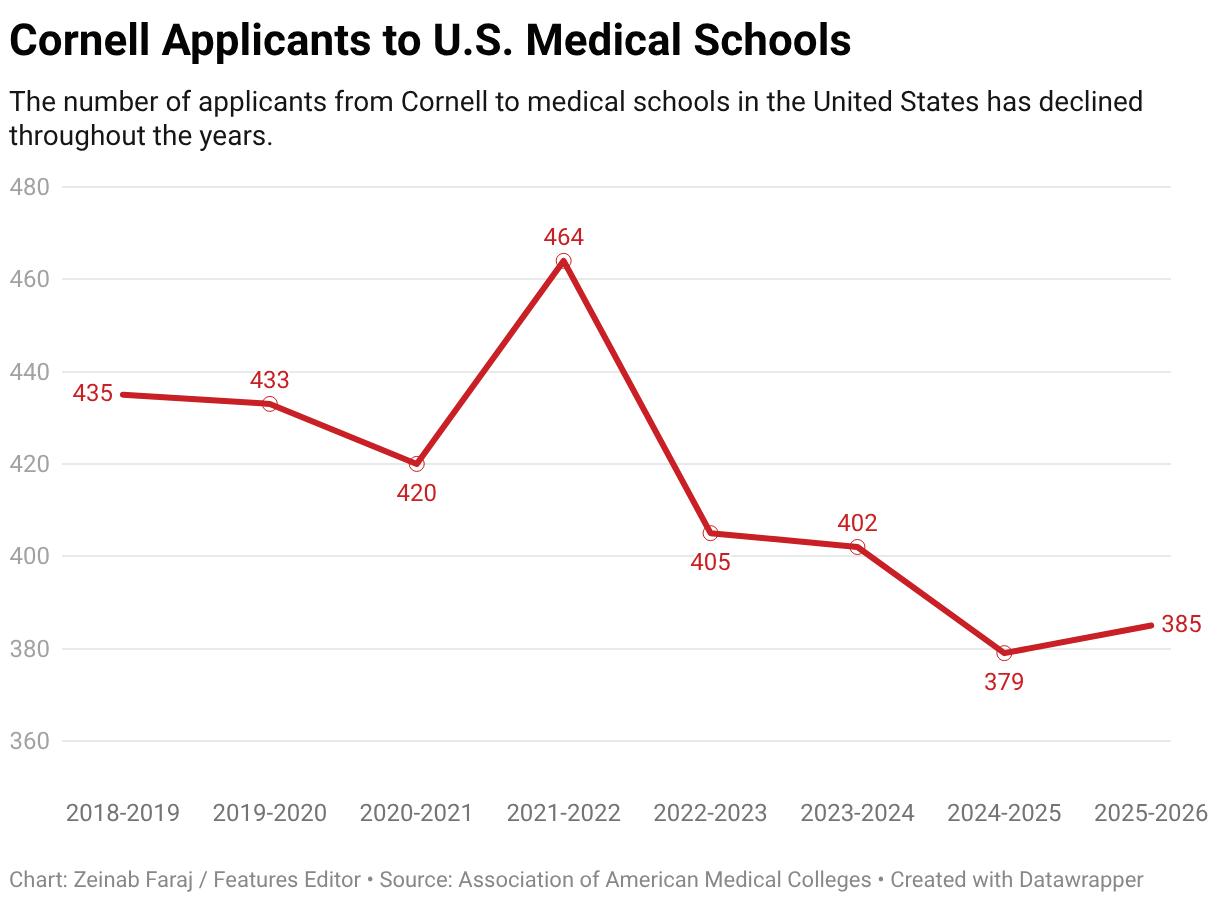
Cornell has had fewer students applying to U.S. Doctor of Medicine programs, consistent with the decline in the national average, according to data released by the Association of American Medical Colleges.
According to the data, the national average of applications to M.D. programs in the U.S. peaked in 2021-2022 with 62,443 applications. Since then, the number has dropped, with a low of 51,946 in 2024-2025, before experiencing a slight rebound in 2025-2026.
Cornell’s applications have experienced a similar decline and rebound over the past few years — 464 applications submitted in 2021-2022 was the most in the last eight years with that number dropping to a low of 379 in 2024-2025.
Cornell ranked 28th among undergraduate institutions in the number of applicants to U.S. M.D. programs during the 2025–2026
cycle, with 385 applicants, according to the data released by the AAMC. The University also has the highest number of applicants among the Ivy League.
The Sun spoke to members of the pre-medical community at Cornell to understand the decline and some of the factors associated with it.
Srijita Kommaraju ’28 is a global and public health sciences major in the College of Human Ecology and is the secretary and risk management officer of Phi Delta Epsilon, a pre-medical fraternity at Cornell. She described that being pre-med can be an “overwhelming” experience given all of the classes and extracurricular activities students are expected to be involved in.
To apply to medical school, applicants are expected to take a series of biology, chemistry, math, physics and social science courses which include at least two introductory biology classes, general and organic chemistry,
physics one and two and biochemistry.
In addition to academic demands and maintaining a strong grade point average, prospective applicants to medical schools are expected to participate in extracurricular activities which can range from volunteering, research and medical career experiences.
Kommaraju said that one of the potential reasons for the drop in applicants could be students deciding to take gap years before medical school. She said that since the COVID19 pandemic, gap years have become more widespread.
“People want to have more medical experiences, research experience or improve their GPAs before making the commitment to medical school,” Kommaraju said. “Gap years are becoming more and more normalized because people and medical schools value experiences as medical school admissions are becoming more competitive.”
Saanya Agarwal ’27, who studies global and public health sciences and is president of Phi Delta Epsilon, plans to take a gap year following graduation. She explained that she knew many people decide to continue pursuing a medical profession they picked up during their gap year.
“I know some students who have taken a gap year and decided that the job they were working was more rewarding and a better fit for them than medical school,” Agarwal said.
Kommaraju also stated that at Cornell, the pre-medical classes are very difficult, which could cause the applicants to pick other healthcare adjacent jobs including nurse practitioners or physician assistants. She said that for her, joining Phi Delta Epsilon has been “transformative” for her experience as a pre-medical student because of the support system and networking opportunities that are
"built in” to the fraternity.
“Knowing people in my classes and being able to study and laugh with people who have similar career goals as me has been a great part of my experience in [Phi Delta Epsilon],” Kommaraju said. “It has been really beneficial to me in navigating my pre-med journey.”
Another potential issue she described was residence, or the intensive three to seven year training that doctors complete after medical school, typically in a hospital setting. Agarwal explained that as programs are shrinking, the number of spots available for residents is decreasing too, causing some hesitation to commit to medical school.
“Gap years are becoming more and more normalized because people and medical schools value experiences.”
Srijita Kommaraju '28
“Medical school in my opinion is an emotional and financial commitment," Agarwal said. “I think that one of the issues could be keeping potential doctors interested if after four years of medical school they also have to compete for a spot at a residency program.”
Shreekanya Mitra ’27, a nutritional sciences major in the College of Human Ecology and vice president of programming for Phi Delta Epsilon, explained that the rising cost of medical school could be contributing to the decrease in applicants.
To continue reading this article, please visit www.cornellsun.com.
Zeinab Faraj can be reached at zfaraj@ cornellsun.com.
Angelina Tang can be reached at atang@ cornellsun.com.
Funding farming | Isabel Téllez '28 with Atlantrees Co-Founder Udi Landau, conducting agricultural research at the high-tech avocado farm Atlantrees in Montargil, Portugal.
PHOTO COURTESY OF ISABEL TÉLLEZ '28
The Corne¬ Daily Sun
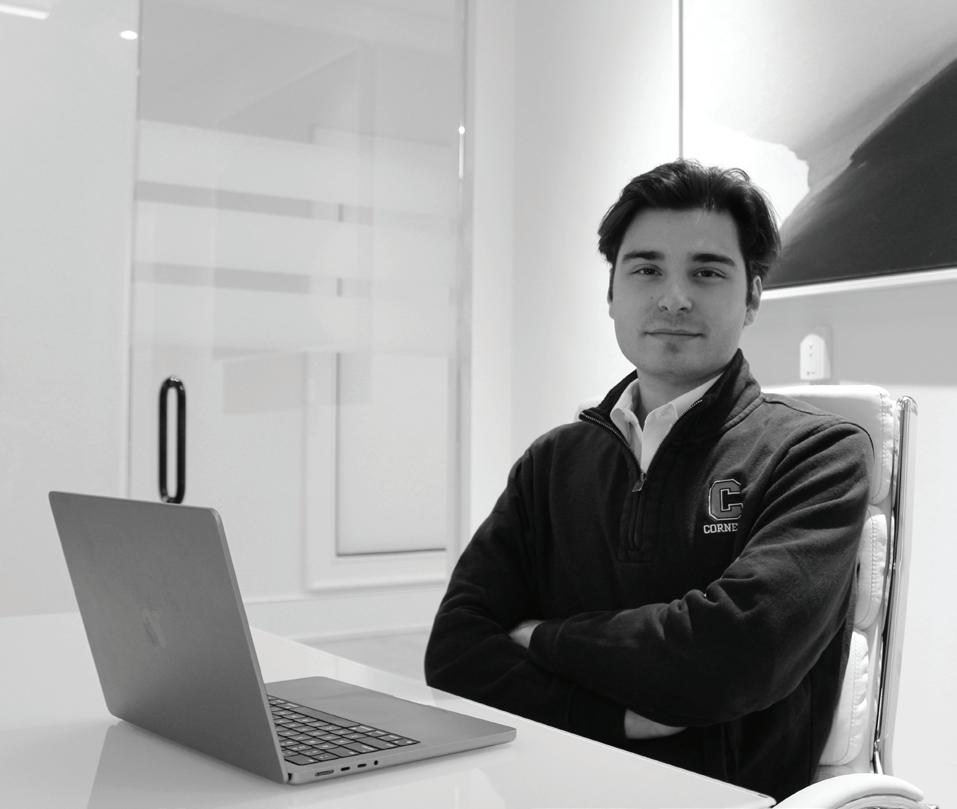
From Both Sides of the Hill: My Transfer Experience
By Richard Ballard
Richard Ballard is a junior in the College of Agriculture and Life Sciences. He can be reached at rpb233@cornell.edu.
From the communal balcony of my Terrace dorm, I would sit and stare at the city skyline of Ithaca: the view of Cayuga Lake, Cornell’s campus, luxury high-rise buildings and everything else that felt so distant from my life at Ithaca College. As an admitted Transfer Option student, I entered my collegiate career with more questions than answers — where to go, what to do and how to best prepare to apply to one of my dream schools. Ithaca College felt like a good choice, since I lived relatively close by and could partake in a more semi-conjoined four-year experience.
In the back of my mind, though, the possibility that I wouldn’t be accepted loomed large. The Transfer Option process was confusing from the start. It was first described as guaranteed upon fulfilling all of the requirements, later clarified as not. There were other speculations, such as the chances of receiving a Transfer Option decision being slimmer than receiving an acceptance decision, as well as that because Cornell’s contract colleges receive state funding, a certain number of New York State students must be accepted — who make up the bulk of Transfer Option awardees.
Taking a step back, Cornell’s acceptance rate for all transfers matriculating in Fall 2024 was just a little over 9%. Comparatively, this is higher than Cornell’s standard acceptance rate, but I had the fear that if I couldn’t get accepted the first time, the second attempt would be challenging too. It didn’t matter if I already knew Ithaca, had rode on the TCAT or had gotten a headstart on my Ithacalves; a statistic is a statistic, and for transfers, there’s a need to prove oneself twice. Cornell was so close yet so far away.
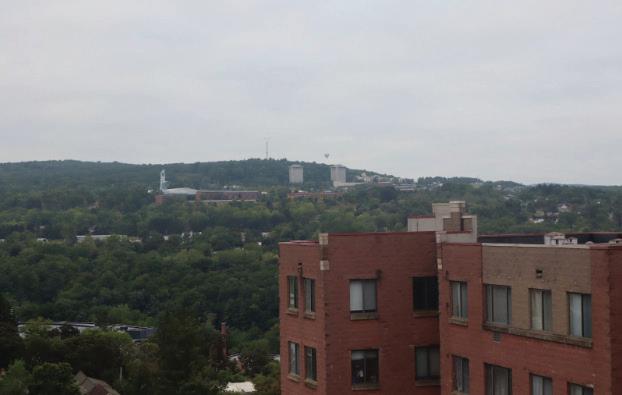
As a junior in my Collegetown apartment, I now have the obverse view. I see Ithaca College’s “Towers,” athletic center and dorm and see that I spent my freshman year of college wondering if I’d ever make it to East Hill. After the fact, I had realized that there isn’t much connection between the two schools aside from being in the same town, having shared cooperative offices such as ROTC and an exchange program where Ithaca College students can take up to one Cornell course a semester. And I’ve always been surprised as to how little my Cornell friends knew about an institution so close to where they live.
IC’s community leans heavily toward the arts, anchored by the Roy H. Park School of Communications and a strong music program. They have some notable alumni in media such as Bob Iger, a previous chief executive officer for the Walt Disney Company, and David Muir, an ABC News anchor you may have seen
facilitate the 2024 Presidential Debate. A contrast between the two schools is that within Cornell, virtually every major is strong. As a Biology major at Ithaca College fulfilling CALS prerequisites, I certainly noticed a deficiency compared to the departments that were given more attention. Of course, there’s a very big difference here, with Cornell’s endowment approaching $11 billion.
And, if you’re curious, I certainly noticed a perception gap from my time at both schools. At IC, I would overhear a lot of people speculating about Cornell, especially during orientation week. There was a noticeable level of cognizance surrounding Cornell. One friend’s communications professor had compared his own department to Cornell’s in a lecture. Oftentimes, the redirection of attention was unavoidable — most TCAT routes going to Lansing (Target and Ithaca Mall area) go right through the middle of Cornell’s campus, such as Route 30. But how often does the average Cornellian take a visit to South Hill?
On the contrary, Ithaca College barely registers for Cornell students, at least from my experience. Cornell’s global reputation can make students inward-focused. Although there is mutual awareness, it isn’t equal. There is insularity within the university — with requirements such as an unlimited meal plan and a two-year on-campus residential requirement, as well as the luxury of a plentifully stocked bookstore, there isn’t much need (or reason) to willingly explore the city of Ithaca beyond Cornell’s campus and Collegetown derivative. Perhaps this is why I and so many other people only saw a vignette of Cornell.
The same thought of localism could be painted for Ithaca College, as it has a three-year on-campus living expectation. But Cornell’s prestige is impossible to ignore and it shapes how IC students see themselves in Ithaca. Cornell has a reputation for being competitive in nature; IC can feel overshadowed at times. The question arises of how this disconnect could be resolved, or, to take it one step further, if people from either school even want this. Or will the only associations be limited to shared location, dating apps, farmer’s markets and Trader Joe’s?
Cornell Dining at Home: Homemade Campus Classics
By Krista Faith Gonzalez
Krista Faith Gonzalez is a senior in the College of Agriculture and Life Sciences. She can be reached at kfg33@cornell.edu.
Have you ever felt overwhelmed in the Ithaca Wine and Spirits store? With many wine choices to choose from, you still pick up the same Wine & Butter flavor. Understanding the basic tastes can help you determine what wines you enjoy the most and would likely purchase in a store. This previous semester I took VIEN 1102: Introduction to Wines and Vines, a class offered at Cornell where students learn about the history of wine, winery practices, wine flavor chemistry and everyone’s favorite part: tasting wine to determine wine quality. Before taking this class, I had no prior knowledge about wine tasting, and I didn’t really know what wine to order at restaurants. In class, we explored the importance of describing wine’s taste. I often used the five basic tastes to describe each one: sweet, sour, salty, bitter and umami. Since taking this course in the fall, I kept track of my favorite red and white wines we tasted in class and this is my guide to what you should try. If you love sweet wines, you are in luck. The first five wines are perfect to pair with dessert or when you’re craving something sweet. We’re kicking the list off with one of the sweetest wines on this list; it tastes like honey, vanilla and banana.
1. Dublin Scuppernong
The Dublin Scuppernong is made from a grapevine called Vitis rotundifolia, which produces muscadine, a South American (bronze and purple) grape. Often, the wine color is slightly darker yellow due to the grape juice color. Since this wine is so sweet, pair it with a berry tart to balance the taste.
2. Tramin Gewürztraminer
If sweet tastes aren’t your thing, this wine is less sweet and still enjoyable. Tramin Gewürztraminer has a floral aroma with a buttery aftertaste and is a dessert wine, a rich wine usually served after dinner. Made from the Gewurztraminer grape, planted in the mountains of France and Germany, it has an intense aroma of lychee and rose. I would recommend this wine if you enjoy floral wines that aren’t too acidic on the first sip.
3. Fox Run Vineyards Traminette Finger Lakes
If you love floral wines, this might become one of your favorites. The Fox Run Vineyards Traminette Finger Lakes wine is very light and smooth with a hint of citrus. In my opinion this wine is a great option to share with friends — it’s a light wine that anyone could enjoy. Compared to more overwhelming and strong wines, I think this wine is usually a safe bet. It’s made from Traminette grapes that carry floral and spicy properties. It’s a cross of Gewürztraminer and the French-American hybrid Joannes Seyve 23.416.
The Riesling Ice Wine from Wagner Vineyards, FLX NYS, 2022 is a sweeter wine that tastes like peach, honey and apricot. Despite it being made from frozen grapes, the wine is still very fresh. Ice Wines are a dessert wine produced from grapes that are frozen on the vine; it’s often more expensive in a smaller volume due to receiving less juice from the frozen grapes. If you have a sweet tooth, this is definitely the wine for you.
5. Tyrell’s Hunter Valley, Australia, 2023
Tyrell’s Hunter Valley wine is the perfect amount of tart and has a crisp, refreshing taste and a fruity aroma. This dry wine has flavors of ripe apples and zesty lemon with a smooth aftertaste. This wine is perfect when you’re in the mood for something fresh and a bit sour. Give this one a try to put your taste buds to work.
Have you ever gone to a restaurant and didn’t know what wine to order? Been there too, these wines are great go-to orders when you’re with friends. If you enjoy cooking, these wines could be great to pair with food. All these white wines are enjoyable to drink for any occasion, and they won’t make you feel like you need to spit them out!
6. Chardonnay, Lakewood Vineyards, FLX NYS, 2023
The Chardonnay, Lakewood Vineyards, FLX NYS, 2023, has a fruity aroma with green apple and peach properties. It’s a bit sour at first, but it has a buttery aftertaste. It tastes smooth but still fresh; it’s a great choice to pair with creamy foods. The white Chardonnay grape is grown in France, in the regions of Burgundy and Chablis.
7. Santa Julia, Argentina, 2023
For all the Chardonnay fan favorites, here is another from Santa Julia, Argentina, 2023. Its flavor properties include green apple and a smoky aroma. It tastes citrusy at first, but has a fresh lemon and a smoky aftertaste. Pair it with cheese and beef.
8. Blanc de Blanc, Fox Run Vineyards, FLX NYS, 2024
The last Chardonnay is a Champagne made only with Chardonnay grapes. Blanc de Blanc, Fox Run Vineyards, FLX NYS, 2024, has a lemon-citrus flavor. It’s very smooth and light, with refreshing bubbles like sparkling water. Give this one a try if you are tired of flat wines and want something sparkling!
9. Sauvignon Blanc, Martin Ray, Sonoma, CA, 2023
The Sauvignon Blanc, Martin Ray, Sonoma, CA, 2023 has a fruity aroma of green apple and lemon zest with a hint of mint. Sauvignon blanc is a white wine produced in regions of France, New Zealand, and California. The thin grape grows on vigorous vines and does not rot due to its growth on the vine being in tight clusters. It tastes a bit tart, and the consistency is similar to water; therefore, it isn’t a dry wine. It has a buttery aftertaste, which is my favorite part. If you’re looking for a clean and crisp wine, I would recommend giving this a try. Pair this wine with a salad or seafood!
10. Rosé Malbec Susana Balbo, Argentina 2021
A classic go-to wine is Rosé Malbec Susana Balbo, Argentina 2021. It’s known for its light pink color and its floral and fruity properties. Made from red grapes, but the juice is pressed off the skins early, resulting in a short maceration. This gives a light pink color and a floral, fruity aroma. This is one of my favorite wines to get when I can’t make a decision right on the spot. It feels light, with flavors of strawberry and rose petals; it has a buttery aftertaste. If you haven’t tried this wine yet, you won’t be disappointed!
Next time you’re in the wine selection, give these wines a try! You can have most of these on their own or paired with food. Explore new varieties of wine to figure out what you like and don’t like. There is a wide range of wines from all regions, as I mentioned above, everyone has a different experience with how they taste each one. So, the only way to determine which one is your favorite is to try a good number of different wines. If there is one takeaway from this article, it should be that buying wine shouldn’t be intimidating.
RICHARD BALLARD / SUN STAFF WRITER
RACHEL EISENHART / SUN STAFF PHOTOGRAPHER
KRISTA FAITH GONZALEZ / SUN CONTRIBUTOR
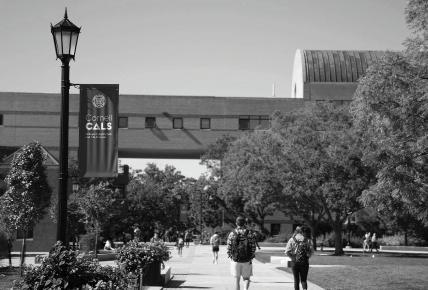
Cornell Announces New CALS School
By VARSHA BHARGAVA Sun News Editor
Dec. 16 — Cornell announced the creation of the Ashley School of Global Development and the Environment, a new school within the College of Agriculture and Life Sciences, in an article published by the Cornell Chronicle on Tuesday.
Stephen B. Ashley ’62, MBA ’64, the school’s namesake, gifted CALS an endowment of $55 million, which will go toward establishing the new school. Ashley’s endowment is the largest that CALS has received.
The new school will merge two existing CALS departments — the Department of Global Development and the Department of Natural Resources and the Environment. Focusing on environmental problem-solving, the school will instruct across the disciplines of ecological science, social innovation and community engagement, according to its new website.
“This investment to create the Ashley School is both timely and visionary, allowing us to bring together the expertise in agricultural, life, environmental and social sciences that underpin environmental and human well-being locally and globally,” President Michael Kotlikoff said in the Cornell Chronicle article.
600 undergraduate students, 140 graduate students and 107 faculty members will make up the Ashley School. The school will support the environment and sustainability undergraduate major, the global development undergraduate major, five undergraduate minors, four master’s degree programs and two Ph.D. degrees, according to the Chronicle.
Students currently enrolled in the existing programs will not be affected by the establishment of the new school, according to the Chronicle.
Prof. Richard Stedman, natural resources and the environment, was announced interim head of the Ashley School after teaching in the natural resources department and serving as the department’s chair.
Professors in CALS’ global development and natural resources departments were named interim section heads for the school. Prof. Parfait Eloundou-Enyegue, global development, will be interim section head of the Global Development section, and Prof. Rebecca Schneider, natural resources and the environment, will be interim section head of the Natural Resources section.
“[Ashley’s] vision will allow us to leverage research, teaching and extension to address many of the world’s greatest challenges — personifying our land-grant mission.”
Prof. Benjamin Houlton
CALS intends to add 10 new faculty members to the school, three of which will specialize in agricultural, development and environmental economics, according to the Dean of CALS, Prof. Benjamin Houlton, ecology and evolutionary biology and global development.
“[Ashley’s] vision will allow us to leverage research, teaching and extension to address many of the world’s greatest challenges — personifying our land-grant mission,” Houlton said in the Cornell Chronicle.
The endower, Ashley, holds a long history with Cornell. He earned a bachelor’s degree and master’s degree from Cornell, and served on the Cornell Board of Trustees for 16 years. For 10 years, he served as co-chair for Cornell’s Far Above capital campaign, which raised $6.3 billion for the University. In 2016, he received the University’s Frank H.T. Rhodes Exemplary Alumni Service Award, which the University called “the university’s highest award for alumni service.”
Ashley said that his family holds a “strong, multigenerational relationship” with Cornell, and that he met his wife through the university.
“I am delighted to be able to support this initiative, which has been so thoughtfully framed and structured,” Ashley said in the Chronicle article. “I appreciate how it creates even stronger collaborations between agriculture, environmental science, economics and research to positively impact communities.”
at vbhargava@cornellsun.com.
U.N. Concerned Over Alleged Cornell Human Rights Violations
Te violations focus on international student rights
By BENJAMIN LEYNSE Sun News Editor
Jan. 16 — Cornell was among five universities to receive a letter from United Nations Special Rapporteurs on Oct. 14 raising “serious concern” over alleged human rights violations against international students on campus.
The letters, released to the public 60 days later, were also sent to Columbia, Georgetown, Tufts and Minnesota State University by five U.N. Special Rapporteurs — which are each independent human rights experts appointed by the U.N. Human Rights Council that investigate and report on human rights issues in the international community.
In their message to President Michael Kotlikoff, the Special Rapporteurs highlighted Momodou Taal, the international Ph.D. student who sued the Trump Administration last spring, and graduate student Amandla Thomas-Johnson. Both Taal and ThomasJohnson were pro-Palestininan activists and international students at Cornell who fled the country over deportation concerns.
“While we do not prejudge the accuracy of these allegations, we express our serious concern over the reported human rights violations against Mr. Taal and Mr. Thomas-Johnson” the letter reads.
Taal was an F-1 visa holder and first made national news when he sued the Trump administration in March 2025 for allegedly violating his First and Fifth Amendment rights. The suit claimed that the implementation of two Trump executive orders targeted pro-Palestinian speech and dampened dissent, including his own. Soon after he launched the suit, the British and Gambian dual citizen was told to surrender himself to Immigration and Customs Enforcement custody.
Thomas-Johnson was prompted to flee the country in April 2025 after a friend tipped him off that authorities were looking for his whereabouts. His immigration status was revoked one month later.
Both Taal and Thomas-Johnson were previously suspended for their role in the September 2024 Statler Hall protest, during which over 100 pro-Palestine protesters disrupted a career fair featuring defense contractors Boeing and L3Harris.
The letter comes amid international students’ feelings of unease and outlines several areas of concern including freedom of expression, assembly and the right to education and emphasizes the role of universities in contribut-
ing to these issues.
“The structural changes at universities to systematically repress expressions of solidarity with Palestine has created a climate of fear and intimidation.” the letter reads. “Students report self-censoring political expression, and particularly international students are withdrawing from activism due to deportation fears.”
The Special Rapporteurs also raised concerns that disciplinary action taken against protesting students have an outsized effect on their academic progression. Such punishment violates the rights to education found in the Universal Declaration of Human Rights and the International Covenant on Economic, Social and Cultural Rights, the letter states.
This inquiry began after two law clinics at the University of Chicago, filed a complaint with several Special Rapporteurs on June 11, alerting them to the cases of Taal, Thomas-Johnson and six other students from other universities.
Anji Parrin, director of the University of Chicago Law School’s Global Human Rights Clinic, one of the clinics involved, explained that typically U.N. Special Rapporteurs field complaints or allegations made to them, evaluate the case’s credibility, and then, if valid, send the party of interest a letter outlining the claims made against them.
In a statement to The Sun, Parrin said she was pleased that the Special Rapporteur’s letter “affirmed” her clinic’s concerns and called the Oct. 14 letters, “ a devastating picture” of human rights being violated.
When asked why she included the two cases of Cornell students in her clinic’s initial complaint, she focused on the University’s response to protests.
“For the students and faculty at Cornell, we were concerned primarily with violations of freedoms of assembly, expression, and association including the disciplinary actions taken by the University against students exercising their freedoms of assembly, expression, and association, as well as the revocation of the visa of Mr. Taal,” Parrin wrote.
Undergraduate students overwhelmingly passed a referendum on Dec. 15, that called on Cornell to make its disciplinary system independent from the University administration among other changes.
To continue reading this article, please visit www.cornellsun.com.
at bleynse@cor-
Cayuga Medical Center Nurses Approve Union Representation
By ZEINAB FARAJ Sun Features Editor
Jan. 15 — In an overwhelming 82% vote, registered nurses at Cayuga Medical Center won union representation on Thursday afternoon, according to a Communications Workers of American Union press release.
The victory comes amid a surge in labor organizations surrounding healthcare workers safety and patient concerns. In New York City, nearly 15,000 nurses participated in a strike, demanding adequate staffing and increased pay. The strike impacted some of New York City’s leading medical institutions including Mount Sinai Hospital.
“We’ve been delivering quality patient care for years while feeling unsupported and burnt out, and I’m excited to see what we can do with our union behind us,” said Shane Snyder, an in-patient wound registered nurse in the CWA press release. “We are tenacious, we are strong, and we are ready to start bargaining our contract.”
CWA is a U.S. labor union representing over 700,000 workers in public and private sectors and has approximately 1,200 local unions. Cayuga United-CWA is one of those local unions and is composed of 350 registered nurses at Cayuga Medical Center.
Cayuga United-CWA is fighting for safe staffing levels to support lower patient to nurse ratios and bar-
gaining for a union contract. With union representation secured, the union plans to begin negotiations regarding their concerns.
“We are laying the groundwork for the generations of nurses to come after us, and we’re already hearing from other medical professionals inspired to join us,” said Morgan Downing, a cardiac catheterization RN in the press release. “I am so excited to have my seat at the table alongside my fellow nurses to start bargaining for our first contract.”
The nurses have spent the last ten years attempting to unionize and represent five weeks of organization since the union went public on Dec. 3.
CWA District 1 Vice President Dennis Trainor, who represents 145,000 workers in New York, New Jersey, New England and eastern Canada, reflected on the outcome of the “overwhelming victory” of the Thursday election in the press release, which he said stands as a “shining example” of the collective efforts of healthcare professionals working together.
“CMC nurses have overwhelmingly and repeatedly voiced their urgent desire for a union contract and it is time for management to join us at the bargaining table and get to work improving conditions for nurses and their patients,” Trainor said.
Benjamin Leynse can be reached
nellsun.com.
Arising Ashley | The College of Agriculture and Life Sciences is set to create a new school, the Ashley School of Global Development and the Environment.
Varsha Bhargava can be reached
Business Owner Barry Wolfert ’88 Launches Campaign to Flip Deep-Red Georgia House District
By ATTICUS JOHNSON Sun Senior Writer
Jan. 14 — Barry Wolfert ’88 said he felt the “immediate effects” when President Donald Trump’s “One Big Beautiful Bill,” which allowed healthcare subsidies to expire, was passed in July 2025. That’s when he decided to run for Congress.
“The upcoming expiration of Affordable Care Act subsidies are a huge component, because it’s expensive to be insured … if I’m struggling, there’s got to be a ton of other people that are going to be struggling a lot worse than I am,” Wolfert said.
“What I hope to do when I get to Congress is to focus on these key issues of trying to find solutions that will bring some more balance to the way this country taxes people and finances itself.”
Barry
Wolfert
’88
Hailing from Marietta, Georgia, Wolfert is running in the safely Republican 11th District, which backed Trump by 23 percent in the 2024 general election. The last Democrat to win a general election in such a red district was now-former Rep. Kendra Horn (D-O.K.), who won a 25 percent Trump district in 2018.
Wolfert stated that his campaign priorities are focused on affordability — from student loans to healthcare and grocery costs — because those issues are the ones “affecting real people every single day,” including himself.
“What I hope to do when I get to Congress is to focus on these key issues of trying to find solutions that will bring some more balance to the way this country taxes people and finances itself,” Wolfert said. “We have the money, we just don’t have the right priorities.”
Wolfert stated that if elected he could support a version of Medicare for All, a proposed single-payer healthcare system that would provide the U.S. with universal and government funded healthcare. At the same time, he also wanted to maintain a freedom to choose private healthcare.
“The guy doesn’t show up, literally. A gentleman came up to me with a piece of paper and asked, ‘are you here for the event later with the congressman? It’s been cancelled.’
After ten years in Congress, I don’t see any return on our investment.”
Barry Wolfert ’88
Wolfert graduated from the Nolan School of Hotel Administration in 1988, and described his time as “a challenge,” because Cornell was such a large school compared to the small, private high school he attended. He is currently a realtor, and founded a north Atlanta-based real estate team under the global Keller Williams real estate company.
Though originally from Pomona, New York, Wolfert moved to Georgia to work at the Ritz Carlton Company, where he says he
“fell in love with Atlanta.” After a brief stint in Washington, D.C., Wolfert returned to the Atlanta area where he has lived for 32 years.
Wolfert told The Sun the five-term incumbent, Rep. Barry Loudermilk (R-G.A.), had not done “anything of significance” that impacted Georgia’s 11th district, “or frankly, much else.”
He added that he had previously attempted to attend one of Loudermilk’s events, specifically, a Dec. 13 roundtable discussion featuring the representative. Wolfert discovered that the event was cancelled and Loudermilk was a “no-show.”
“The guy doesn’t show up, literally,” Wolfert said. “A gentleman came up to me with a piece of paper and asked, ‘are you here for the event later with the congressman? It’s been cancelled.’ After ten years in Congress, I don’t see any return on our investment.”
Loudermilk did not immediately respond to a request for comment from The Sun.
A self-described political moderate,
Wolfert said that his campaign is not “about adding to my resume,” as he said he would not have run if not for the expiration of Affordable Care Act subsidies.
Wolfert also described a tense 1980s Cornell campus when he was a student, fraught over the issue of divestment from South Africa. He explained that witnessing the “shanty towns” protestors set up as encampments on the arts quad were his “first exposure to what a movement was all about.”
And, though Wolfert believes the Trump administration’s decision to freeze funding for Cornell was “crazy,” he also said that he “was disappointed that universities did not join together to fight this,” in reference to Cornell and other major universities’ decision to reach a settlement with the Trump administration on Nov. 7.
To continue reading, please visit www. cornellsun.com.
Paul Passarelli ’27 Creates Platform to ‘Streamline’ Recruitment
By ZEINAB FARAJ Sun Features Editor
Jan. 14 — After going through the new member education process for two different pre-professional organizations his freshman year, Paul Passarelli ’27 said he was very “intrigued” by the recruitment process and how it was managed.
Passarelli, who hails from Boca Raton, Florida, said by the fall of his sophomore year, he was so interested in recruitment, that he ran and was elected Vice President of Recruitment for Phi Gamma Nu, a business fraternity at Cornell.
“I remember they shared the Google Drive and templates for recruitment and my jaw just dropped and I was thinking there is no way this is how they actually do it,” Passarelli said. “Most clubs like my fraternity, run recruitment by piecing together dozens of Google Forms and Google Sheets which ultimately makes it very difficult for the student volunteers to run the process.”
Passarelli also told The Sun that he felt the previous method was not a good way to get a “clear picture” of candidates when going through recruitment rounds. Both “frustrated and inspired” by his own experiences, Passarelli developed a potential solution to make recruitment a less time consuming process.
“Built to Be Customized”: Developing Delibity
Passarelli started designing a platform to help streamline recruitment in the spring of 2025. He noted that the development of Delibity also coincided with his decision to become an information science major.
“I get to go to class and learn things about databases or improving user experience and then go straight to the platform and implement them,” Passarelli said.
Passarelli’s goal with the program is to save the students who run recruitment time since it can be “a time-consuming process.” He explained that the platform is a play on the word “deliberations,” where organizations decide which new members to admit.
During development of Debility, Passarelli worked with several organizations at Cornell, the University of Pennsylvania and the University of Michigan to understand
how different groups managed club recruitment.
While building the platform, Passarelli explained that his goal was to streamline the recruitment process rather than “reinvent” it. Clubs and organizations that use the platform have the flexibility to create applications directly on Delibity or upload existing ones from Google Forms.
The platform also contains an interview feature which allows interviewers to assign overall scores and take notes on candidates. Coffee chats and other event attendance can also be tracked into comprehensive candidate profiles for clubs to review when selecting new members.
All of the information on an applicant can be generated into a PowerPoint-style slide which Passarelli pointed out could help review prospective new members more efficiently and clearly during the deliberations process.
“Psychologically when you see all the information and effort a candidate puts into joining a club all in one place it helps increase fairness and transparency during when clubs are doing their deliberations,” Passarelli said.
Delibity also automates tasks such as pairing members for coffee-chats and sending out emails to applicants. Passarelli explained that Delibity was “built to be customized” so pre-professional groups, Greek life and other types of clubs could utilize the platform.
Arnav Chinchankar ’26 met Passarelli through Phi Gamma Nu and was the previous president of the fraternity. In an email statement to The Sun, he described Passarelli as “very receptive” to changes to the platform as it was adapted for Phi Gamma Nu’s recruitment process. Chinchankar noted that Passarelli’s flexibility has made the software user-friendly for anyone to use.
“Before Delibity, [Phi Gamma Nu] had to manage and compile several different forms, spreadsheets and presentations,” Chinchankar wrote to The Sun. “Delibity brings everything together in one intuitive platform, so I would definitely recommend it to other student groups.”
To continue reading, please visit www.cornellsun.com.
Zeinab Faraj can be reached at zfaraj@cornellsun.com.
Atticus Johnson can be reached at ajohnson@ cornellsun.com
Developing Delibity | Paul Passarelli ’27 created Delibity to help student groups with recruitment.
PHOTO COURTESY OF PAUL PASSARELLI ’27
Passarelli’s platform | Delibity allows recruiters to get a snapshot picture of their applicants.
PHOTO COURTESY OF PAUL PASSARELLI ’27
Congressional campaign | Barry Wolfert ’88 is hoping to flip Georgia’s 11th District from red to blue.
PHOTO COURTESY OF BARRY WOLFERT ‘88
Historic Men’s Soccer Awards
Left Unrewarded for a Decade
By ZEINAB FARAJ Sun Features Editor
Jan. 18 — Several men’s soccer program awards went unrecognized for nearly a decade following a coaching transition, according to a former player who founded one of those awards, Peter Pakeman ’84.
The awards, some with history dating back 75 years, are given to honor the leadership, ability and improvement of student-athletes on the team and to recognize the legacy of former members of the program.
“Coach Smith completely avoided me. He told me in a voice mail memo that he had no idea about the awards.”
Peter Pakeman ’88
Among them are the Nicky Bawlf Memorial Award, given across multiple sports to a senior who has contributed the most to the program, and is named for Nicholas Bawlf, a former coach and Cornell Hall of Fame Inductee and the Charles Berman Award, named for Charles Berman ’49, a former AllAmerican and the namesake of the men’s soccer team’s current home field. In addition, the Clive Beckford ’59 Most Valuable Player award is given to the MVP of the team based on the opinion of the other players.
The Berman and Beckford awards were last given to a men’s soccer player in 2015, according to public Cornell Athletics articles. The Bawlf award has continued to be given out among other sports at Cornell, including men’s hockey.
“It has been really disappointing to watch these awards disappear,” Pakeman said. “The legacy of the men’s soccer program deserves to be preserved.”
According to Pakeman, who established the Versatility, Impact and Performance award in 2012 under the assistance of former Athletic Director Andy Noel, to “give back” to the men’s soccer program. Pakeman told The Sun that for three years, the award presentation went “smoothly” right until the arrival of current head coach John Smith.
“It has been really disappointing to watch these awards disappear.”
Peter Pakeman ’88
“When Coach Smith came onboard all of the other legacy awards and my award were dismantled and disappeared,” Pakeman said. “I was never notified by the University directly that they were going to discontinue the presentation of the awards.”
The last announcement on the Cornell Athletics website about Pakeman’s VIP award was made on May 12, 2015. Since then, there is no online public record from Cornell Athletic of any awards being given out to players. According to the Cornell Athletics article, six other awards were given out to players on the team, including the historic Berman, Bawlf and Beckford awards.
Pakeman estimated that roughly “20 to 30 players” missed out on the chance to earn an award. He also explained that the presentation of the awards was a “funded agreement and payment plan”
between him and Cornell Athletics.
Pakeman stated that he contributed to the program monetarily by purchasing 15 to 20 physical crystal awards and plaques for the players — which he stated were not physically awarded to student-athletes. Pakeman also said that he attempted to contact head men’s soccer coach John Smith “countless times” over the years to understand what happened to the awards.
“Coach Smith completely avoided me,” Pakeman said. “He told me in a voice mail memo that he had no idea about the awards.”
Pakeman noted that Noel, who instituted the VIP award, held his position while Smith was head coach, fuelling his “doubt” that Smith did not know about the award. He contacted the University in 2022 to check on the award and told The Sun that the University said “no one qualified for his award” so it was not given out.
When asked about what prompted the stop of the awards, a University spokesperson did not directly comment on the situation.
“When concerns regarding certain legacy awards in men’s soccer were advanced, the department determined the issue resulted from an onboarding oversight in which coaching staff were not fully aware of the historical award process.”
University Spokesperson
“When concerns regarding certain legacy awards in men’s soccer were advanced, the department determined the issue resulted from an onboarding oversight in which coaching staff were not fully aware of the historical award process,” a University spokesperson wrote. “The Pakeman Award has been reinstituted and was presented this past fall. Other historical awards will be reinstated over the next year.”
The VIP award was last awarded to former forward Alioune Ka ’25 in April 2025.
Smith and current Cornell Athletics Director Nicki Moore did not immediately respond to a request for comment from The Sun.
A University spokesperson also affirmed Cornell Athletics’ commitment to its student athletes and preserving tradition.
“As always, our focus remains on responsible stewardship of program traditions, on supporting our student-athletes with integrity and care, and on supporting their developmental and competitive excellence,” a University spokesperson wrote to The Sun.
John Bayne ’88, president of the Cornell Men’s Soccer Alumni Committee, did not provide a comment on the situation. He stated that he would not “comment on an issue” that a “single alumni has.” Bayne also stated that the Committee fully supports Coach Smith.
To continue reading this article, please visit cornellsun.com.
Athletic, Academic: Meet Safety Brayon Crawford
By MATTHEW LEONARD Sun Assistant Sports Editor
Dec. 30 — Junior safety Brayon Crawford starts his days with early mornings on Schoellkopf Field and late nights in the library. Graduating early would be an exceptional accomplishment for any student — when it comes to a student who is also balancing being a double-major and a Division I football player, this achievement becomes remarkable.
Growing up in the small town of Jeannette, Pennsylvania, the importance of football was always important to Crawford and his family. His older brother, Quinton, introduced him to football at six years old. Crawford explained that his connection to the game is exactly what led to his love for it.
“Where I’m from, everybody plays football,” Crawford said. “It’s just what you do. My family, everybody around me and a lot of older role models in my life. It’s always been football.”
Besides playing football, academics have also always been a top priority for Crawford, even in high school. As a first-generation student, Crawford told The Sun that he takes “pride” in his academic performance.
“I’ve always been taught that the biggest elevator of social class and economic prosperity is education,” Crawford said. “None of my family went to college. I’m a first-generation [college student], so I’ve always taken pride in my academics since I started school.”
Crawford’s work ethic throughout high school would not go unnoticed. An offer to play football at Cornell presented him with the opportunity to continue his story on the highest academic and athletic level.
Once at Cornell, Crawford would continue to demonstrate just how dedicated he is to his goals on the field and in the classroom. While playing for the Red, he enrolled in the College of Agriculture and Life Sciences, and double-majored in environmental sustainability and information science. Though the journey was one that was difficult to achieve, he never let it sway him from his goals.
“I’ve struggled in the classroom and on the field, but I never let it put me down,” Crawford said. “I always kept the greatest purpose in mind. That was just putting my family in a better situation. So I’ve just worked hard towards that.”
Throughout his football career at Cornell, Crawford secured 23 total tackles, two tackles for losses, and two pass break ups in 14 games played for the Red.
This past season, he played a key role in the Red’s strong defensive stand against No. 22/25 Harvard, an FCS powerhouse. He provided stellar pass protection, making it difficult for his opponent to operate
its pass-heavy offense. He would finish the game having secured four total tackles.
Crawford will walk across the graduation stage at the end of the academic year, officially closing this chapter of his life. Though his time at Cornell will have been much shorter than most students, the memories he gained will remain close to him.
“Friends on and off the field are relationships that I’ll carry for the rest of my life,” Crawford said when asked about his favorite memories at Cornell. “I’m highly appreciative of everybody I met along the way, that helped me to get to this point. I’ll never forget that.”
While Crawford’s journey at Cornell is coming to an end, his football career is only getting started. He still holds three years of eligibility to play college football, and wants to take full advantage of that. His extended eligibility stems from being a medical redshirt during his freshman year, redshirting this past season, and a third year of eligibility awaiting final approval.
Crawford has recently announced that he will enter the transfer portal to see where his football journey will take him after he graduates from Cornell. He is ranked as a three-star recruit and top 50 recruit in his position nationally. This ranking makes him one of the best available safeties in the entire transfer portal.
“I’m coming in as a guy with game experience, and I have a high level of knowledge for the game,” Crawford said. “I’m a very smart player on and off the field, so I think that’s a great selling point that I have.”
A profound understanding of the game is necessary when adapting to a new program and football system. According to Crawford, his understanding of the game and drive to succeed are qualities he will bring to his new team.
“I think what a school is going to gain for me is a guy that wants to win and is going to help the team achieve their goals whatever way that I can,” Crawford said. Throughout his collegiate career, Crawford believes he has proven that he is a dedicated player and does not let adversity stop him from achieving his goals. Crawford told The Sun that whatever coach gets him on their roster will be obtaining a team-first player that is ready to compete and put the work in.
“I have a lot of football under my belt, I have a lot of football left to play,” Crawford said. “I’m excited to go somewhere to compete, further my education, and help a team win.”
Rewriting the Playbook is a recurring series covering the unique stories that have continued to shape Cornell’s football program. It is produced by Matthew Leonard.
Matthew Leonard can be reached at mleonard@cornellsun.com.
Zeinab Faraj can be reached at zfaraj@ cornellsun.
Amazing athlete | Junior safety Brayon Crawford has now entered the transfer portal as a Cornell graduate.
COURTESY OF CORNELL ATHLETICS
Pen Densham on Pursuing Creativity
SOPHIA ROMANOV IMBER ASSISTANT ARTS & CULTURE EDITOR
The director yells, “Cut!” A crowd forms around one object, and you step closer to see what’s happening. The sea parts, and you find a camera. Everyone is trying to get closer to the small screen. That, Pen Densham explains, is the magic of the camera. “You put one up, and people come to see what’s going on,” he said. Densham got his first camera when he was 11 years old. After the early passing of his mother and a difficult childhood, Densham found magic in images. He said, “[I] was always looking to try and do something with [cameras], because they seemed magical. They seemed like I should do something special with them.” Densham left school at 15, and at 19, he left England, his home, to find better film opportunities in Canada. This move wasn’t without its challenges. Densham described feeling unsuccessful in England with no future in film. Fortunately, he found a culture focused on supporting and cultivating creativity in Canada and soon started his own film company, Insight Productions, with his colleague at 22. In my hourand-a-half-long interview with director, writer and photographer Pen Densham, we discussed the value of support, the different faces of success and how to trust yourself.
Densham has received two Oscar nominations for his films Life Times Nine and Don’t Mess with Bill. In 1977, he and his colleague John Watson received the Silver Jubilee Medal from Queen Elizabeth II for their arts contributions to Canada. But, Densham explained, there
is an uncertainty to creativity. “I think success is sold to people as a motorboat … [but] success is a sailboat. You hit the island once in a while, and then you go out in the doldrums or you sink and have to build the damn thing again. And I’ve sunk many times, and I have many scripts that didn’t get made,” Densham said. While awards are beneficial for recognizing a film’s greatness, they are often subjective and do not determine the true value of a creative work. Success, as Densham put it, is not a one-way road. It often includes curves, roadblocks and even full stops. And that is why support is so significant.
One of Densham’s most notable films, Robin Hood: Prince of Thieves, was close to never being made. After having his son with his wife and embarking on the great endeavor of raising a child, Densham wanted to create a film with values that support a child’s growth. Robin Hood, starring Kevin Costner, follows a boy’s journey as he realizes his flaws and works toward self-actualization. The script was rejected by three studios, and Densham was ready to ditch the idea when his assistant expressed support for the project, encouraging him to continue, which he thankfully did. “I don’t think we can judge what we create as we create it,” Densham added. We are often our greatest critics, and external support can pull back the imposter syndrome curtain and reveal great potential. Yet, it’s also important to protect your projects.
Densham began writing the script for Moll Flanders, starring Robin Wright and Morgan Freeman, after Robin Hood He came up with the last lines of the script, a moving scene between a mother and the child she left at birth, before he
started writing. However, he refused to tell his work partners about the script because he knew they’d be discouraging, stating that the story wasn’t “commercial.” Densham said, “I got more films made by letting my instincts take me to places to create, as opposed to writing for the studios.” Searching for profitability can plague creativity in film studios as they try to invest in what they know will sell. Thankfully, Densham protected the Moll Flanders script and directed the movie in ’96. Densham has continued directing and writing films with The Last Full Measure in 2019, but he has also stepped into photography. Within a studio system, he is locked into their production lines in order to get films made, which he compared to working for the Pentagon — “full of bureaucracy.” Densham explained that he is “emancipated by photography,” and it started with the simple question: Why are you holding the camera still every time you take a photo? With the unfortunately simple answer: “Because I was told to.” Photography, like any field, has its own limiting norms; the standard is in focus and clear pictures for the most objective capture of reality and life, and anything outside of this is “experimental.” The title of Densham’s nature photography book captures the essence of his style. Qualia: a philosophical term for the subjective aspects of the conscious experience; what it is like to experience or what cannot be described objectively. “I suddenly found that I could sculpt things out of certain images. … Shaking a camera at a tree makes a tree look like it’s full of energy, bursting with life and dancing with vibrance,” he said. He explained that it was hard at first to step away from
AYSW? | Winter Watches
you’ve ever had the misfortune of asking me whether I’ve seen a particular movie, regardless of its popularity, you’d know to expect a “no.” After countless times disappointing my friends by being utterly clueless about the world of cinema, I resolved to watch more movies in 2026. What better way to honor my Los Angeles roots? I went to high school across from the Disney Animations building, damn it! So, this past winter break, I put my Netflix subscription to use. My Letterboxd saw a record increase in activity of five (five!) new films, whose reviews I’ll keep as non-spoilery as possible.
Hamnet
Starting with the movie that left me sobbing in the theater: Hamnet. I went into the theater completely blind to the plot. As an English major, I was excited to watch a movie about Shakespeare, and as a Normal People fan, I was looking forward to seeing Paul Mescal on the big screen. I was not expecting a completely gut-wrenching story about motherhood, loss, grief and redemptive creativity. It was far from your typical Shakespeare — in fact, Shakespeare’s name is only said once — and all the better for it. Jessie Buckley’s performance as Agnes Shakespeare deserves every accolade in the book, and then some. Hamnet was absolutely gorgeous, but it’s the kind of movie you need recharge time before rewatching, lest you be emotionally destroyed.
People We Meet on Vacation
From the discourse I’ve seen online, people have major gripes with this movie for deviating from the plot of the book. As someone who hasn’t read the book, I had no such reservations. Emily Bader was absolutely magnetic as Poppy; I want her entire wardrobe, her personality and also her makeup routine. The move itself was your typical rom-com, silly and fun and
more enjoyable if you don’t take it too seriously. I feel as though we’re in a great drought of good rom-coms (Anyone But You was an utter disgrace to my eyes), and this scratched the itch perfectly.
Red Riding Hood
Ever since The Housemaid came out, I’ve been craving Amanda Seyfried on my screen. Unfortunately, I dislike Sydney Sweeney as an actress too much to go see The Housemaid, so I opted instead for a movie with a whopping 10% on Rotten Tomatoes, Red Riding Hood (2011), starring Seyfried. It may be that I’m easily entertained, but I think the reviews are a little too harsh. It was moody and aesthetically pleasing, if a bit cliche. Was it a profound, award-worthy work of cinema? No, certainly not. But was it an adequate movie to put on in the background while I worked on a painting? Yes, it was.
Wake Up Dead Man: A Knives Out Mystery
Now, I’m not religious, but I did spend around nine years of my life attending Catholic school, so this movie evoked some emotional reactions for me. While undeniably comedic, Wake Up Dead Man was also deeply profound, cutting through the fallacious pomp and superiority of the church to get to the heart of what religion is supposed to be founded on — empathy and love for our fellow humans. I like the Knives Out franchise, but the ensemble cast fell very flat for me in this one. I struggled to believe any of them had motivation to commit the movie’s central murder, which is kind of the whole point of a murder mystery. Still, I thought it was a strong addition to the franchise, although nothing tops the first Knives Out
Apollo 13
If your father is anything like mine, he always wants to watch some random old movie, usually one you’ve never heard of. This time, it was Apollo 13, which he said, and I quote, “is history, not just a movie.” Unlike his last movie pick, Tremors, I thought Apollo 13 was incredible. It was well-paced, balanced moments of humor and emotion and built tension beautifully even
the rules of photography, but once he
did, he saw the beautiful images he could create. His inspiration was largely his daughter’s photography; she borrowed his cameras at 14, and he was astonished by what she captured. Photography often aims to grasp some objective reality, but, as Densham has demonstrated, it can also capture qualia. His vibrant images with a great sense of movement speak more to the energy of a moment rather than trying to get the “perfect picture.” This is a part of creative exploration and trusting yourself and your art. There is a great uncertainty in the pursuit of creative paths. Densham’s words of advice as he reflected on his career resonate for anyone at the start of something new: “My errors of omission have cost me far more than my errors of commission … the things that you don’t do because you’re trying not to be difficult, or you’re trying to not put yourself in a challenging place, are the things you’ll regret.”
though I knew the outcome already. Every time I thought the climax had passed, the movie took it one step further. In other words, I thought Apollo 13 did absolutely everything right. I was glued to the TV the entire time, hanging on every word, which I’m sure provided my father some sense of gratification. 10 out of 10, would watch again.
I recognize that this miscellany of movies doesn’t include the ones most cinephiles would recommend, but at least I’m trying! Besides, you’ll never get a scathing review from someone whose favorite movies are Tinker Bell’s Secret of the Wings and Monty Python and the Holy Grail. With the semester picking up, I doubt I’ll have much time to indulge until our next break, but I’m sticking to my New Year’s Resolution. Next time you see me, I’ll have watched The Godfather Probably.
‘Are You Still Watching?’ is a column spotlighting what the Cornell community has been streaming. It runs every Wednesday.
I am, by nobody’s standards, a movie person. If
Melissa Moon is a sophomore in the College of Arts and Sciences. She can be reached at mmoon@cornellsun.com.
Sophia Romanov Imber is a sophomore in the College of Arts and Sciences. She can be reached at sromanovimber@cornellsun.com.
COURTESY OF PEN DENSHAM
MELISSA MOON ASSISTANT ARTS & CULTURE EDITOR
ARTS & CULTURE
Reviewing People We Meet on Vacation
By EMILY FEDEROVITCH Arts & Culture Contributor
Searching for a movie full of whimsy, spontaneity and the best kind of messy love? Look no further than the new cinematic adaptation of Emily Henry’s bestselling novel People We Meet on Vacation, directed by Brett Haley. Soaring to Netflix’s most-watched movie of the week within days of its Jan. 9 release, the film follows the story of Poppy (Emily Bader) and Alex (Tom Blyth), who unexpectedly become friends while carpooling home from college to Linfield, Ohio. The two seem like polar opposites at first. Where Poppy’s character is brimming with life, Alex seems significantly more reserved, finding solace in running and his homebody lifestyle. Nonetheless, after a carpool gone awry and an overnight motel stop, Alex discovers he might share Poppy’s love of traveling. When Alex goes through a tough breakup a year later, he and Poppy go camping and create a new friendship tradition: annual, week-long summer trips. The film switches between vivid flashbacks to these summer trips and snippets of the present. Viewers learn that present-day Poppy and Alex have had some sort of falling out as they both hesitantly reunite at Alex’s brother’s wedding. I found the storyline as adorable as it is engaging. Although the pacing feels rushed at times with the movie trying to cover 12 years in two hours, Haley and Henry do an excellent job keeping their
audience curious as they weave in and out of the present. Poppy’s character brings an undeniable energy to the film, keeping Alex (and us) intrigued. I equally enjoyed watching “Vacation Alex” emerge, from skinny dipping with random campers to the fan-favorite dance scene. In my opinion, the fantastic New Orleans fake-honeymoon dance between Alex and Poppy truly captures the essence of the movie — a little bit about letting go and a little bit about holding on. Though People We Meet on Vacation fits the rom-com genre, it also speaks to the experience of coming of age, as Alex and Poppy wrestle with sacrifice and loneliness in both their relationship and their personal lives. Beyond the cute characters, it was impossible not to fall in love with the cast themselves. Bader and Blyth both embody their characters; I never even paused to question an acting choice, which comes as high praise from a theater alum who has criticized her fair share of bad romance movies.
Admittedly, like any good romance, the film is chock-full of clichés and classic tropes. Some of those, I loved. For example, Alex caring for a sickly Poppy instead of flying to Norway? Yes, please! Sarah’s role, however, does not land as well. As Alex and Poppy grow closer, Alex’s on-and-off girlfriend, Sarah, remains a huge wedge between them, as does Poppy’s string of semi-casual lovers. That tension explodes off the screen in their final vacation flashback, in which
Alex and Poppy go on a “double date” vacation with their significant others. During their trip, however, Poppy’s pregnancy scare brings her and Alex to a dramatic almost-kiss moment (another common rom-com trope). In response, Alex proposes to his long-term girlfriend. This, to me, felt a little forced. I can only assume his reaction represents a desire to flee from his feelings for Poppy; the lack of clarity about Alex’s actual motives, however, struck me as poorly executed. Furthermore, that element of emotional cheating, though used as a plot device, dimmed Alex’s likeability in my eyes. Nonetheless, Alex’s rain-soaked love confession to Poppy is reason enough to forgive him. It is always refreshing to see emotionally vulnerable, mature and self-aware men on the screen, and Alex certainly fulfilled that role. Plus, as far as forgiving Alex goes, it can’t hurt casting an actor as pretty as Tom Blyth!
Clicking pause on the cliché talk, I want to address my main criticism: Why did the two ultimately settle down in Linfield, Ohio? After their reconciliation and shared love confession at the wedding, the two ultimately break it off again when Poppy refuses to make plans for the future. When she arrives back to her empty home, though, she comes to the realization that Alex has been her home all along. The idea of having a person as home? I love it! Home is where the heart is, and this movie captures that beautifully. The fact that she then returns to Linfield, Ohio, and they
begin a life there together? Not a fan. I understand the intended symbolism, and Poppy sprinting across town to catch Alex on his run captured the audience’s heart, but I hate the message. Alex previously wanted to study in London, and Poppy clearly disliked Linfield for her past traumatic experiences in the town. Why would they settle down there? Why not travel to London and start a life in England instead? Further, People We Meet on Vacation, whether for a touching reason or not, ends with another woman settling down because of a man’s disapproval. What sort of message does that send to young women looking for love?
Despite questioning the ending, I thought that People We Meet on Vacation checked all the boxes for a cute, dramatic, fun-filled romcom. While I do believe there was space for improvement in terms of pacing in depth, the characters and plot made the movie worth a watch in my books. I giggled my way through Alex and Poppy’s interactions and vacation shenanigans and was left with that feel-good glow, and isn’t that what romcoms are really about? For all the romantic girls looking for a new “book” boyfriend and the boys looking for a little whimsy in life, I highly recommend giving People We Meet on Vacation a watch.
Emily Federovitch is a freshman in the College of Arts and Sciences. She can be reached at eaf258@ cornell.edu.
An Incredibly Confusing Whodunit
but that seems to be the point.
By KATHERINE WINTON Arts & Culture Writer
Spoiler Warning: The article contains details from the plot of 6:40 to Montreal.
I am, by no means, a spontaneous reader. When I go into a bookstore, I am a woman on a mission, already set on the book with which I will be leaving. However, once in a while, I’ll spontaneously grab a book and discover that it greatly exceeds my expectations. So, when I walked into Barnes & Noble late last semester and saw 6:40 to Montreal, a new Agatha Christie-type thriller, on the small table dedicated to the bookstore’s monthly picks, I decided to venture outside of my comfort zone. Eva Jurczyk’s 6:40 to Montreal details the story of a writer on a train that breaks down during a snowstorm. A fellow passenger’s quiet death in his seat throws the rest of the cabin into turmoil, accusations and murder. The story takes place over the course of one day (with the exception of the final chapter), following the writer, Agatha and a friend-turned-enemy, Cyanne, who believes Agatha’s bestselling novel was written about her, as well as five other passengers.
Agatha, the narrator of the story, is a woman whose creativity seems to be limited to her onehit-wonder novel. Even then, Cyanne believes the novel plagiarized her life. Agatha’s cancer diagnosis left her feeling utterly hopeless and depressed, which spiraled into her inability to care for her young son or love her sweet husband. She is an intensely unlikeable narrator,
On the other hand, I don’t understand why Cyanne was made to be such an unlikeable character. Although she had certainly done bad things in her past, the basis for the audience’s dislike for her is supposed to be her “crazy” claims that Agatha’s book was about her. Despite this, Agatha later implies that Cyanne’s claims actually are true, completely ruining the foundation for Cyanne’s character. While this could be written off as a way to develop Agatha’s mentally ill personality, it still felt like the author went into 6:40 to Montreal with one vision for Cyanne only to change it 100 pages later.
From the beginning of the book, I was drawn into the narrator’s voice. Her tendency toward introspection rather than dialogue was captivating and intensely literary. I enjoy a good character-focused novel, so I was excited by how much detail Jurczyk put into each character. My intrigue, however, soon faded. The initial murder was strange and impersonal, leaving no clear immediate threat to the passengers. The following incidents stemmed from the passengers’ distrust towards one another after the initial murder, bearing little to no relation to the first perpetrator.
Nearly 300 pages into the book, I still couldn’t figure out who committed the initial murder (or why). There was no obvious reason why any of the train’s passengers would be culprits, but given the isolated setting of the story, there didn’t seem to be any other suspects. Jurczyk threw in random information throughout the story to ensure the audience couldn’t rule out any character (except for the college student
who spent most of the novel deathly ill and immobile). I appreciated that this mystery was intentionally difficult to solve, unlike many other predictable thriller novels, but this also led to many loose ends in the plot.
In the last few chapters, Jurczyk threw in a plot twist — the murderer, despite seeming to have little importance to the story, was Agatha’s husband, eager to give his wife some excitement in an attempt to cure her existential depression. This plot point, though it was the main reveal, felt massively underdeveloped. One of the big “clues” that helped Agatha solve the mystery left me with more questions than answers. That being said, I thought that Agatha’s slightly euphoric reaction to realizing her husband was a murderer (and that one passenger’s death would allow her husband to escape suspicion) nicely tied into the reveal that Agatha’s book really was about Cyanne. Jurczyk did well in slowly developing a psychopathic character.
In the end, the book’s main redeeming quality was the author’s voice — the prose felt elevated in the same way Sally Rooney’s novels do — just without any of the other main hallmarks of a good novel. The voice lent well to developing the characters, even if the plot wasn’t as well thought out. I likely will not go back to Jurczyk’s other books, and I struggle to understand why Barnes & Noble specifically promoted 6:40 to Montreal . If the premise interests you, I’d recommend sticking to the book’s interest, Agatha Christie’s tried-and-true train murder mystery Murder on the Orient Express
Katherine Winton is a freshman in the College of Arts and Sciences. She can be reached at kwinton@cornellsun.com.
Men’s Hockey Loses 4-1 to Quinnipiac
No. 13 Cornell couldn’t hold off the top-10 Bobcats
By JANE McNALLY Sun Senior Editor
Morale was high as No. 13 men’s hockey took a 1-0 deficit to a top-10 Quinnipiac squad into the locker room after 40 minutes of play on Saturday.
Firing off a couple of prime scoring opportunities as the second period came to an end, it seemed that the third period could finally be where the Red broke through.
It ended up being quite the opposite — Quinnipiac flexed its offensive-minded muscles in the final 20 minutes, potting three goals in the final 20 minutes and icing a 4-1 loss for Cornell. The result ends Cornell’s six-game win streak and is just the second win for the Bobcats in Ithaca since November 2018.
“We didn’t play great in the third period and got exposed,” said head coach Casey Jones ’90. “I thought as skilled as they are and committed they are, they even did the little things better than us for the most part tonight.”
Quinnipiac (18-4-2, 10-20 ECAC), already up to 18 wins, looked strong on both sides of the puck against the Red (12-5-0, 7-3-0 ECAC) and was aided by a 20-save performance from goaltender Matej Marinov.
“[Quinnipiac] might be the best team we’ve seen so far this year,” Jones said. “They were consistent in the way they played. … I actually thought we had some self-inflicted wounds in the third period.”
Despite a strong start from freshman goaltender Alexis Cournoyer — making his first back-to-back starts in a single weekend since Nov. 21-22 — the Bobcats would get on the board 11:12 into the period after a fast start between both teams.
Unlike the goal Cournoyer surren-
dered on Friday against Princeton, Quinnipiac’s opening tally was not caused by any rebound or second chance, but an articulate play off the faceoff — Quinnipiac center Chris Pelosi won the draw back to Aaron Schwartz, wristing it by the Cornell netminder, who missed the puck as it deflected last-second off the stick of Andon Cerbone.
Quinnipiac’s lone first-period goal would be all that graced the scoresheet, not just through 20 minutes, but through 40 minutes, too. The second period was much stronger for Cornell, outshooting Quinnipiac 9-6 and earning more high-danger scoring chances.
“It was a one-goal game going into the third period,” Jones said. “I thought they might have had the benefit in the first. I thought we might have had the benefit in the second. I thought it was one of those games where it was right there for the taking.”
But when Ethan Wyttenbach came streaking in and buried a shot on a breakaway just 2:20 into the period, it broke a dam for the nation’s second-best offense (averaging 4.1 goals per game) entering Saturday.
Down 2-0, the wind seemed to be sucked out of the Red’s sails.
“I thought we looked a little bit
“We didn’t play great in the third period and got exposed. I thought as skilled ... and committed they are, they even did the little things better than us for the most part tonight.”
Head coach Casey Jones ’90
But in the way of a tying goal for the Red stood the Bobcats’ 6-foot junior netminder from Slovakia, Marinov. Quinnipiac head coach Rand Pecknold had most recently been rotating his two goaltenders, playing fellow junior Dylan Silverstein on Fridays and starting Marinov on Saturdays.
The formula has proven successful for the Bobcats, riding a five-game winning streak since kick-starting the goaltending tandem. Marinov appeared sharp on Saturday, making multiple eye-catching stops, including a masterful one on freshman forward Reegan Hiscock in the waning seconds of period two.
And although Cornell entered the third period in search of the game-tying goal, the Bobcats just kept coming.
young, and made some mistakes in the third period,” Jones said. “We didn’t hold our composure and didn’t play the game the right way.”
Quinnipiac kept jumping on pucks, forcing turnovers and hemming Cornell in its defensive zone. And just two minutes after Whyttenbach’s tally, Ethan Groenewold made it a 3-0 game on a hard wrist shot.
From there, Cornell’s youth began to show. Though the Red has been aided by the contributions of its younger players, tensions began to boil as Cornell faced one of its largest deficits of the year.
“I thought our unforced turnovers [were] a big difference in the game for me. I thought we turned a lot of pucks over tonight that we haven’t done,” Jones said. “We’ve
been getting away with some stuff, maybe, but I thought they were a good team, and if you don’t manage the game properly, they’re going to explode like they did tonight in the third period.”
There was no showing more evident of that than junior defenseman George Fegaras’ elbowing penalty at 11:06 of the third period. Serving his 12th minor penalty of the year, Fegaras watched as Tyler Borgula deflected a sharp-angle shot past Cournoyer on the short side, making it a 4-0 game.
“They just keep pushing the puck, they just keep coming at you with speed,” Jones said. “I thought we played a little bit into their hands.”
Junior forward Luke Devlin made it 4-1 when he buried a loose puck in Marinov’s crease with 2:33 remaining, but it would be too little, too late for Cornell, falling on Lynah Rink ice for the first time in 20252026.
There will be little time for Cornell to dwell on the setback. No. 10 Dartmouth (second place in the ECAC and five points ahead of Cornell) and Harvard (fifth place in the ECAC but tied with Cornell in points) will make the trip to Ithaca next weekend in what will be two more imperative games with massive seeding implications.
“We’ll watch the tape. We’ll get better from this, and it’ll be a good lesson learned,” Jones said. “We’ll take it that way right now. We’re just going to try to get better.”
Cornell takes on Dartmouth and Harvard next Friday and Saturday night, respectively, at Lynah Rink. Puck drop for both games is slated for 7 p.m., and all action will stream live on ESPN+.
Jane McNally can be reached at jmcnally@ cornellsun.com.
Penalties Doom Women’s Hockey At Yale
By ELI FASTIFF Sun Senior Editor
NEW HAVEN, C.T.
— Less than 24 hours after picking up a second straight win for the first time since Nov. 1, contentious calls, ill-timed penalties and an opponent with momentum combined to deal No. 10 women’s hockey a 3-1 loss to No. 13 Yale.
“You’re going to get calls against you when you are on the road,” said head coach Doug Derraugh ’91. “[We] just have to be smarter.”
A night after committing five penalties in a 3-1 win over Brown, the Red’s (127-2, 8-5-1 ECAC) penalty parade resumed, and Cornell quickly found itself in a 2-0 hole.
Junior forward Delaney Fleming was whistled for tripping six minutes in, and midway through her shift in the penalty box, senior defender Grace Dwyer
joined her after committing a pair of penalties. Cornell’s penalty kill managed to deny Yale (16-7-0, 11-5-0 ECAC) during the five-on-three advantage, but could only hold off the Bulldogs for the first 2:24 of Dwyer’s penalty time.
“It’s a tough line,” said Dwyer, who racked up eight penalty minutes during the weekend. “We try to be aggressive and physical as a team, [we] just have to stay disciplined.”
Less than a minute after Yale’s first power-play goal, the Bulldogs earned another opportunity when sophomore forward Lindzi Avar was called for roughing. This time, it only took 35 seconds for Yale’s third-in-thenation power play to solve junior goaltender Annelies Bergmann.
The four penalties, which all came within a six-minute span, were controversial on the Cornell bench.
“I wouldn’t say that I agreed with some of those calls early on,” Derraugh said. “But we have got to be more disciplined.”
Suddenly trailing by a pair of goals, the Red responded. Cornell’s previously dormant forecheck began to hem the Bulldogs in their defensive zone, and with 3:15 remaining in the period, the Red earned its first power play of the afternoon.
While Cornell couldn’t convert with the extra skater, Dwyer’s slapshot beat Yale netminder Samson Frey to halve the Bulldog lead. Junior defender Beatrice Perron-Roy picked up the assist thanks to a slick drop pass — her 10th point of the season.
Cornell entered the locker room trailing, but optimistic. Despite committing four penalties, the Red outshot the Bulldogs 16-13 and had limited Yale’s five-on-five chances.
“The goal late in the first period, I thought it was a big one for us,” Derraugh said. “I thought that helped us carry some momentum into the next period.”
Cornell opened the second period well, sending a shot off the crossbar two minutes into the frame, but failed to capitalize. After that close call, the ice began to tilt in Yale’s direction.
The Bulldogs continued their assault on Bergmann throughout the frame — the second was the only period in which Cornell was outshot — and Yale found a third goal with under five minutes remaining before the second intermission.
The final stanza was filled with opportunities for Cornell, but the stingy Yale defense continued to stymie the Red offense.
Cornell’s power play got three chances to try to bring the deficit to one — and each skater-advantage looked
more lethal than the last — but a sixth Red penalty with under six minutes left in the contest curtailed its final special teams opportunity.
The frustrating loss ended with pushing and shoving between the two teams, and a season-high seventh penalty on Cornell.
The Red won’t have much time to rest after the weekend split, a rematch with No. 4 Penn State — who defeated Cornell 1-0 on Dec. 30 in an evenly matched battle that came down to a late major penalty call — is set for 6 p.m. Tuesday at Lynah Rink.
Despite the loss to Yale, Dwyer is excited for round two with Penn State.
“From here on out, it’s kind of like playoff hockey,” Dwyer said. “It’s the best time of the year.”
Eli Fastiff can be reached at efastiff@cornellsun.com.