
COMPASS MAGAZINE VANCOUVER ISLAND | Issue 58 | SPRING 2026 | Sonder

Page 1


Brandy Purcell 6 8 26 14

6 8 10 14 22 26

We Are Art K'omoks Fusion Festival Kealy Donaldson

Food for Thought Sasquatch Pizza Riders Pizza

The Fossil Huntress

Horseshoe Crabs

The Fossil Huntress

Artist Feature

Francis Horne Sr. Kealy Donaldson

Off the Beaten Path Squatch Watch 2026! Kealy Donaldson

Wellness Artist

BranSquatch Ceramics

ISSUE 58

SPRING 2026

Sonder

Sonder is defined as that moment when you realize that everyone around you has an internal life as rich and as conflicted as yours. ~ Seth Godin

Society has changed through the course of time. When communities were smaller, made up of neighbours and family members, they generally greeted each other and welcomed you into their shops and homes. People would look you right in the eye and have unbiased conversations. Today, this friendliness has morphed into a much quieter approach for most. While society has changed and perhaps we are more in tuned with adversities from others, do you welcome people as you walk by them? Or is it head down and keep walking? Me – I’m a bit more optimistic and still believe that I should acknowledge people and say ‘Hi’. I will typically say hello to passers by and sometimes I receive a greeting in response, and sometimes I do not.

I often think “are they having a bad day” or “that’s not very nice, not to respond”. The reality is everyone has their own ‘stuff’ happening – relationships, work, finances, health, responsibilities; the good with the bad. I can’t place my expectations on others and do take a step back to acknowledge that everyone’s choice(s) is different.
This reflection is one with understanding; not everyone needs to acknowledge your presence but we do need to acknowledge that everyone is processing and living through their own lives, their own way, every day. Try to make room for this and don’t let it ruin your day! Enjoy the day for you!

Gilakas’la, Emote, Marsii ~

KEALY DONALDSON

Publisher Compass Magazine

PUBLISHER

Kealy Donaldson

DESIGN + LAYOUT

Jessie Stones

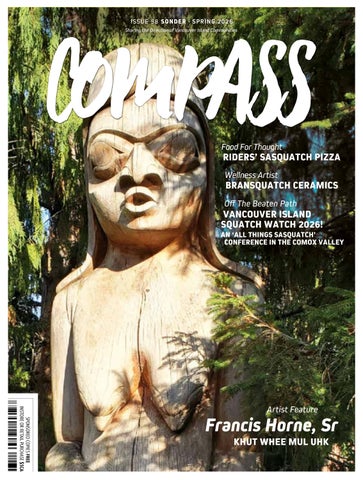
COVER Francis Horne, Sr.

To Advertise or Subscribe

Kealy: 250.203.1880

In-store purchase: $5

Back Issues: $10

Annual Subscription: $50/6 issues

CONTRIBUTORS

Kealy Donaldson

Cameron Ezzy

Fossil Huntress Blog ©

Dana Mahon

Jen Olsen

Brandy Purcell

Tom Sewid

Spirits of the West Coast Gallery

Michael Tymchuk

THE COMPASS MAGAZINE is produced on Vancouver Island, printed on the West Coast of British Columbia, and published on Vancouver Island paper by:

Kiki’s Communications Inc. ISSN# 2369-8063 2100 Park Road Campbell River, BC V9W 4P7

250.203.1880

www.compassmagazine.ca compassmagazine@ourmail.com

We acknowledge the financial support of the Government of Canada.

We are Art

K'OMOKS FUSION FESTIVAL 2026 AT FILBERG HERITAGE LODGE + PARK

Kealy Donaldson

K'omoks Fusion Fest 2026 is set to be hosted at the beautiful heritage grounds of Filberg Park & Lodge in K'omoks, BC. This 3-Day event will set precedence on Vancouver Island, hosting 100+ Indigenous Masters, Artists, Artisans and Makers on the weekend of September 25-27!

This will be the 4th Annual K'omoks Festival, which has solidified as an anchor event for Queneesh Indigenous Community Society (QICS). Through these three days, First Nation and Canadian Indigenous Artists, Artisans and Makers will be showcasing their works of traditional art, pop-fusion art and incredible musical performances! Traditional Indigenous Art workshops will be presented in the Masters’ Circle - cedar weaving, traditional medicines, traditional edibles, wool weaving, carving stylings, painting and more. Traditional foods, ‘mumkwa?əm’, will be sampled and sold: salmon, bannock, berry jams, ooligan oil, bison meat, local seafood and other Indigenous food offerings.

For more information please visit: www.queneeshsociety.ca | f @QueneeshSociety

Queneesh is calling All First Nation/Metis/Inuit Artists, Artisans and Makers to apply to be a VENDOR in the largest Indigenous Artisan Festival on Central Vancouver Island! Outdoor booths will host up to 100 Indigenous Artists and Artisans, all featuring traditional First Nation and Pop-Fusion Art, Artisan pieces and Handmade items. This vending opportunity will open in mid April with applications being released online at www.queneeshsociety.ca. Applications are due by June 1st and acceptance notifications will start later in June through till July 15th. The event will run rain or shine.

Compass Magazine Vancouver Island’s Masters’ Circle 10+ Indigenous Masters for the 3 day event; the attending Masters will be working on current works (demonstrations) as well as vending their collectible pieces. Masters will also be facilitating workshops throughout the festival; there will be complimentary dedicated workshops for attending Vendors and added workshops available for public registration.

The Workshop Circle These daily workshops will be presented to highlight traditional learning and share skilled knowledge of our West Coast First Nation's and Indigenous peoples. Multiple workshops are proposed through the 3-day festival timeline. Each Master will be sharing their artistic niche and deliver skills-based lessons.

The Festival Stage An All Indigenous line-up of musical talent will adorn the Filberg Park throughout the weekend! Rumoured so far to be in the mix of musicians are The James Vickers Blues Band, Greg Wells, and Kristie Lane Sinclair. Eight key musical performances will take place along with local First Nation's youth performing traditional dance, singing & drumming.

mumkwa?əm, Sliammon for ‘Eating’ will also be highlighted on site, along with offerings of traditional Medicines and local edibles. A mix of samples and purchased items will be available, locally made and delicious! Traditional offerings are a key highlight that attendees will literally "eat up" with gaining knowledge and recipes.

Queneesh Indigenous Community Society looks forward to hosting the 4th Annual K’omoks Festival, now known as K’omoks Fusion Fest, and invites you to the historic Filberg Lodge and Park property on September 25-26-27 this fall!

To get a taste of the festival, on Friday June 26th, QICS will be partnering with PULSE Community Gatherings, a presentation of CV Arts, in downtown Courtenay, starting at 5 pm.

PULSE is a free, community event! The main K’omoks Fusion Fest tickets for the September event will go on sale in June. Weekend passes and individual day passes will be available!

Leonard Williams weaving techniques

Food for Thought

THE SASQUATCH BY RIDERS PIZZA, CUMBERLAND

The "Sasquatch" pizza at Riders Pizza was created in our first year of operations in response to an expected desire from our customers for a "meat lovers'" answer. One of the drivers for all pizza creations at Riders is that "less is more". Having tried other meat lovers' from other pizzerias, with so much meat that the crust below couldn't even rise from the weight of the toppings, the goal was to ensure that the amount of toppings were held in check, but so that the diner could get an appreciation for each of the toppings. Hence the very symmetrical construction of the Sasquatch! Each pizza has a slice of bacon, 5 - 6 pieces of pepperoni, and some spicy sausage on each slice.

As with all our pizzas, we believe that people taste food twice; first with their eyes, then with their palate, so all our pizzas are designed to be visually appealing as well as taste great. As to the seasonings supporting the toppings, the intention was to have a meat lovers' pizza "with attitude". A chipotle infused tomato sauce base, plenty of fresh sliced garlic, some provolone for creaminess, and jalapenos added after baking allowing for their easy removal, rounded out the construction of what continues to be one of our most popular pizzas almost 15 years later.

The Fossil Huntress

LIVING FOSSILS: MASTERS OF MASS EXTINCTION EVENTS

The Fossil Huntress

Horseshoe crabs are marine and brackish water arthropods of the order Xiphosura: A slowly evolving, conservative taxa.

Much like (slow) Water Striders (Aquarius remigis), (relatively sluggish) Coelacanth (Latimeria chalumnae) and (the current winner on really slow evolution) Elephant Sharks (Callorhinchus milii), these fellows have a long history in the fossil record with very few anatomical changes.

But slow change provides loads of great information. It makes our new friend, Yunnanolimulus luoingensis, an especially interesting and excellent reference point for how this group evolved.

We can examine their genome today and make comparisons all the way back to the Middle Triassic (with this new find) and other specimens from further back in the Ordovician — 445 million years ago.

These living fossils have survived all five mass extinction events. They are generalists who can live in shallow or deep water and will eat almost anything they can find on the seafloor.

The oldest horseshoe crab fossil, Lunataspis aurora, is found in outcrops in Manitoba. Charmingly, the name means crescent moon shield of the dawn. It was palaeontologist Dave Rudkin and team who chose that romantic name. Finding them as fossils is quite remarkable as their shells are made of protein which does not mineralized like typical fossils.

Even so, the evolution of their exoskeleton is well-documented by fossils, but appendage and soft-tissue preservation are extremely rare.

A new study analyzes details of the appendage and soft-tissue preservation in Yunnanolimulus luoingensis, a Middle Triassic (ca. 244 million years old) horseshoe crab from Yunnan Province, SW China. The remarkable anatomical preservation includes the chelicerae, five pairs of walking appendages, opisthosomal appendages with book gills, muscles, and fine setae permits comparison with extant horseshoe crabs.

The close anatomical similarity between the Middle Triassic horseshoe crabs and their recent analogues documents

anatomical conservatism for over 240 million years, suggesting persistence of lifestyle.

The occurrence of Carcinoscorpius-type claspers on the first and second walking legs in male individuals of Y. luoingensis tells us that simple chelate claspers in males are plesiomorphic for horseshoe crabs, and the bulbous claspers in Tachypleus and Limulus are derived.

As an aside, if you hadn't seen an elephant shark before and were shown a photo, you would likely say, "that's no freaking shark." You would be wrong, of course, but it would be a very clever observation.

Callorhinchus milii look nothing like our Great White friends and they are not true sharks at all. Rather, they are ghost sharks that belong to the subclass Holocephali (chimaera) group lovingly known as ratfish. They diverged from the shark lineage about 400 million years ago.

If you have a moment, do a search for Callorhinchus milii. The odd-looking fellow with the ironic name, kallos, which means beautiful in Greek, sports black blotches on a pale silver elon gate body. And their special feature? It is the fishy equivalent of business in the front, party in the back, with a dangling trunk-like projection at the tip of their snout and well-devel oped rectal glands near the tail.

As another small point of interest with regards to horseshoe crabs, John McAllister collected several of these while working on his MSc to see if they had microstructures similar to trilo bites (they do) and whether their cuticles were likewise calci fied. He found no real calcification in their cuticles, in fact, he had a rather frustrating time getting anything measurable to dissolve in acid in his hunt for trace elements.

to helping you nd the perfect watercraft, powersports vehicle, or power equipment tailored to your lifestyle.

Likewise, when looking at oxygen isotopes (16/18) to get a handle on water salinity and temperature, his contacts at the University of Waterloo had tons of fun getting anything at all to analyze. It made for some interesting findings. Sadly, for a number of reasons, he abandoned the work, but you can read his very interesting thesis here:

dr.library.brocku.ca/handle/10464/1959

Ref: Hu, Shixue & Zhang, Qiyue & Feldmann, Rodney & Benton, Michael & Schweitzer, Carrie & Huang, Jinyuan & Wen, Wen & Zhou, Changyong & Xie, Tao & Lü, Tao & Hong, Shuigen. (2017). Exceptional appendage and soft-tissue preservation in a Middle Triassic horseshoe crab from SW China. Scientific Reports. 7. 10.1038/s41598-017-13319-x.

fossilhuntress.blogspot.com

2026 Grizzly EPS XT-R

Ocean Chronicles

SASQUATCH ON VANCOUVER ISLAND

Most people don’t realize that Vancouver Island not only has a reputation as having a lot of Sasquatch encounter reports, but it also has the highest amount of Sasquatch creations in art in the world. If one opens their eyes and investigates, they will understand that there’s so many wood creations of Sasquatch, that Vancouver Island resembles King Kong Island from the movies with all his effigies carved on the island he inhabited.

The North Island has the most due to the Kwakwaka’wakw and Laichwiltach First Nations having vast amounts of carvings of what they call Dzoonakwa, The Wild Woman of the Woods, their Sasquatch. This is their highest ranked crest and one can see many memorial poles in graveyards

and welcoming poles inside and outside their ceremonial Bighouses with Dzoonakwa carved in red cedar.

One can recognize Dzoonakwa with her sleepy eyes, puckered up lips and pendulous breasts. On memorial poles in Alert Bay and Campbell River, she has her arms outstretched signifying that the memorial pole depicts that the Chief it was carved for, his power and wealth could be felt around the world.

Then there’s every Chief and family from the many Tribes that make up the two First Nations that have what they call Gildas, The Box of Treasure. These are the symbolic boxes containing their crests, songs and legends. Every Chief has the

© Tom Sewid

Dzoonakwa crest and a mask or two with fur regalia that will come to life in dance and song at their Potlatch ceremonies. The dance and song tell of one of their ancestors encounters with a Sasquatch.

Duncan, known as The City of Totems, has three poles with the depiction of Sasquatch carved on them. There’s a massive Kwakwaka’wakw pole with a Thunderbird atop right in the downtown area. Aside from this, museums in Victoria, Campbell River, Alert Bay and even the Comox Tourism Information Center, all have masks and other traditional carvings or depictions of Dzoonakwa/Sasquatch. Sooke and Quadra Island have the famous driftwood Sasquatch carvings.

Throughout Vancouver Island numerous art galleries and private collections abound with native and non-native wood creations of Sasquatch. The island is world renowned for native artists carving their sacred Dzoonakwa masks to be sold. Kwakwaka’wakw and Laichwiltach First Nation artists have private collectors and galleries around the world seeking to purchase their wood creations of Dzoonakwa/Sasquatch in masks and totem poles.

Tim Alfred Kwakwaka’wakw Artist, Port Hardy

Copper was precious to Vancouver Island native Tribes for thousands of years and they even had specialists in metallurgy. In modern times, many wood artists diversified into making traditional native art in metal. Some of the great First Nations artists are well known for their Dzoonakwa/Sasquatch creations in metal.

Joe Wilson Bracelets

Kwakwaka’wakw Artist, Alert Bay

If one is interested in seeing native art depicting Sasquatch and wants to learn more, it’s a must to journey to Alert Bay and visit a community with the highest amount of Dzoonakwa/ Sasquatch art on earth. Memorial totem poles, welcoming poles and one can see Dzoonakwa/Sasquatch masks and regalia in the U’mista cultural Center. During summer months the Namgis Tribe showcases their masks and regalia performed for visitors at their ceremonial Bighouse in the shadow of the world’s largest totem pole.

To learn more about Dzoonakwa and the Kwakwaka’wakw culture visit www.umista.ca

Vancouver Island has many depictions in wood, metal sculptures and paintings of Sasquatch that are also non-native design. Sayward has two amazing creations of Sasquatch. Contact www. saywardfutures.ca to find out about the sasquatch carved in a living cedar tree and the late John Duncan’s metal loggers totem pole with a wood ape at the bottom next to the Cable House Café. A famous dinner made from recycled giant welded logging cable that made it into Ripley’s Believe It Or Not.

Exploring Vancouver Island seeing all the creations depicting Sasquatch and how all the First Nations Tribes have names, beliefs, perspectives and a deep cultural tie to Sasquatch you will understand why some refer to our island as Ape Island.

Sasquatch Island - www.sasquatchisland.com - is a First Nations company that has been offering Sasquatch expeditions since the early 1990’s with a success rate of putting 24 people on Sasquatch to say they too have seen one. In 2019 they conducted the first ever commercial sasquatch 12 passenger boat expedition at night with forward looking infra-red equipment (FLIR).

Sasquatch has been part of the First Nations Tribes culture of Vancouver Island for thousands of years. To see a part of what our island has to offer in regard to seeing and experiencing Sasquatch culture, Vancouver Island is the Sasquatch center of the world.

tom.sewid@gmail.com

FEATURE ARTIST Francis HORNE Sr

Khut Whee Mul Uhk

Our art retells our ancestors’ stories about our connection to the land that we have respectfully lived on for thousands of years.
Francis Horne Sr Coast Salish
FRANCIS

Kealy Donaldson

Francis Horne Sr. was born in Washington State to a Lummi father and Tsawout First Nation mother, and was raised in the Cowichan Valley on Vancouver Island, British Columbia. Horne Sr. is a prolific and self-taught carver who has been active since the 1970s. His works can be found in many public and private collections, including the City of Totems collection in Duncan, BC, the Burke Museum, the Penn Museum, and the Autry National Center.

Horne has dedicated his life to preserving the stories of his ancestors through his art. Largely self-taught, he also learned from esteemed mentors, including Chief Simon Charlie, a renowned artist. Artistry runs deep in his family — his legacy lives on through his daughter, Simone Diamond, an accomplished Coast Salish artist in her own right, along with two of his three sons. They recently welcomed new grandchildren into their lives!

“Through all the work that I’ve produced, after many years of studying and admiring the art pieces of the past, I built my career with the high end galleries in Vancouver. The international market followed this trend

“Horne is on the global scale now for collectors. Horne notes while reminiscent of his early years, pounding the pavement. “My brother Doug LaFortune and I had dreams of becoming well known Indigenous Artist. Simon Charlie always taught us to be humble and it reflects today. It is the Coast Salish Long House teachings that lead my journey: to always be KIND and to always be HONOURABLE. Artwork can reach so many and be

so impactful – Kindness is power and Spirit is love” Horne states as he reflects on his traditional teachings and body of work.

Horne’s work is celebrated worldwide for its precision and depth, from monumental house poles to masks of distinction. In 1986–87, he carved five poles for the City of Duncan, BC, and earned him an invitation to Singapore to demonstrate totem pole carving. “I’ve been carving for 56 years now. I am very fortunate to still be carving every day; no illness or ailments, no arthritis. Carving regularly keeps me inspired and connected to the artistry of wood sculpture, with nature and legends, as I continue to learn, by staying focused and keeping within the boundaries of Northwest Indigenous Art. Horne is currently working Tsonoqua sculpture.

Brenda, Horne’s esteemed wife, plays such an important role in their journey together. “I met Brenda over 20 years ago. She had so many questions about my art; if I had documented it? Did I have a portfolio? I was just focused on creating and selling at that time. She has done an immense amount of work on the administrative side of our business. With all her diligence, she is primarily responsible for the positive outcome from our recent copyright court case. Now, we are back working as Spiritual Advisors through hospital visits for indigenous patients, and others, sharing healing through Spirit. We have traveled throughout North America helping to steer others on their own healing journey,” states Horne.

“My own healing journey started at 21 years old; I was left with some valuable teachings from a respected Elder, which came tome at a time in my life when I really needed guidance. It was one of the most important moments in my life. I discovered the power of the water and it turned my life around. It changed me forever. Water is life - knowledge, intelligence, the love of the Mother Earth. We must protect water at all costs” he expresses passionately “I would love to speak on a global platform to share my knowledge on water”. When asked where their favourite place is and why, both Horne and Brenda answer ‘any waterfall we can find’ as that is where they started their healing journey together; taking time to sit with the Great Spirit and receive knowledge that comes with the process of being present.

When asked about his inspiration behind the ‘Sasquatch’ and ‘Tsonoqua’ images, Horne tells a story of a beautiful find, riverside. “Brenda and I were out walking the trail along a creek by Harrison Hot Springs. We took a moment to pause and bask in the beauty of our surroundings. Right there in the sand, as the creek was significantly low, was a large footprint – the largest we had ever seen.” They believe they found a Sasquatch footprint and took pictures of the print and documented it. They both started to pay immediate attention to their surroundings, recognizing the stories that Horne’s Elders use to tell of these large creatures. This experience is the inspiration behind Horne’s version of ‘Sasquatch’ in his Coast Salish style.

This image became the focus of a copyright infringement lawsuit that took three years to work through, with the support of Native Northwest, one of Horne’s artwork representatives. Native Northwest stated in a release last November 2025: “We are excited to share that we have won the copyright infringement lawsuit filed on behalf of Indigenous artist Dr. Francis Horne Sr. after his original Sasquatch T-shirt design was copied and sold without permission in Harrison Hot Springs, BC.

Canada’s Federal Court has confirmed that the original Sasquatch design was taken, reproduced, and sold knowingly without consent. This ruling comes after a grueling three year undertaking to seek justice for Francis and his wife Brenda. Indigenous art theft is a serious problem, yet there are currently no special laws to prevent fraudulent Indigenous art from being created or sold in Canada.

It is our hope that this judgement will provide legal precedent against Indigenous art theft and appropriation to put us one step closer to stopping Indigenous art theft.

Thank you to our network of artists, partners, and friends for their support throughout this process. Most of all, we want to acknowledge Francis for his courage and resolve in standing up against Indigenous art theft. We will continue to be vocal advocates for Indigenous artists and authentic Indigenous art.”

Many Indigenous Artist have faced copyright issues of their work and little precedence had been set in the Canadian Courts until this case had its outcome. Horne notes to all who may be facing a similar issue “many artists don’t realize that our artwork is protected through law and one of the most important things is to keep journal of your work, photographs, a documented portfolio. We truly won this lawsuit because of Brenda’s solid documentation of my artwork.” When the Horne’s discovered the infringement, in that moment, they warned the gift shop owner regarding the circumstances but the owner chose to ignore the discussion. “ We raise our hands to Native Northwest for all their support. Larry and Gabe Garfinkle, Owners of Native Northwest, supported our claim and we worked as one through this copyright infringement. Seastone IP Lawyers worked very hard and the outcome was positive but Brenda and I don’t feel it isn’t a WIN per se.” All the funds that were awarded were donated to protect the rights of Indigenous Art Infringement cases; half of the proceeds went to the University of Fraser Valley (UFV) as Horne had been a Carving Instructor there earlier in his life and holds an Honourary Doctorate. The other half went to the University of Victoria. Native Northwest also contributed to UFV, on their own accord. It is clear that this outcome set a huge precedent in Federal Court for Indigenous Artists throughout Canada.

“I’ve learned to detach from my work over the years; but some of my favourite creations have been the series of elaborate

Crying/Tear masks. These masks focused on important themes such as the Environment, Killer Whales, Bears.” Horne reflects nostalgically. The Frog Mask is an incredible example of Horne’s eye for detail. The abalone inlay was all done by Brenda. The Frog Mask is carved as one complete piece. “I also completed a White Raven Mask representing two spirited people. The dynamics of our culture have been inclusive from the start of time. The Grizzly Bear represents the plight of the Grizzly Bear. It is my reaction to the many write ups in the media about Grizzly Bear killings in the early 1990’s” he shares, “three dimensional is my favourite to carve. Simon Charlie told us ‘what’s in the wood is already there, your hands are only the helpers’.” The fine detail from Horne’s hands is absolutely incredible and shows why his work is in such high demand. Currently, Horne is in the process of completing a 5’ x 4’ Bear Mask and working on the next Tsonoqua pole.

Specializing in large-scale house poles, masks, and limited edition prints, Horne’s artistry reflects the rich traditions of his Coast Salish heritage. Now based in the Fraser Valley, he continues to create monumental works while serving as a spiritual advisor and healer, carrying forward a legacy of cultural pride and connection to the land.

You can connect with Horne Sr. when he presents at the upcoming ‘Squatch Watch Vancouver Island 2026’ Conference in the Comox Valley this coming May. Horne will be presenting at the Conference and hosting a special Fireside Presentation for an Artists’ Dialogue on his Art Journey. kikiscommunications.com/ squatch-watch-v-i-2026

Follow Francis Horne Sr. on Instagram and Youtube and visit nativenorthwest.ca/sasquatch-francis-horne-sr for his Coast Salish take on the elusive Sasquatch.

Weeping Frog Mask
© Francis Horne Sr.

Walking in their Footsteps

TSONOQUA / DZUNUKWA: THE MEANING BEHIND THE LEGEND

Spirits of the West Coast Gallery

Tsonoqua (also spelled Dzunukwa, Tsonokwa, or Dzunuk'wa) is the "Wild Woman of the Woods" in Kwakwaka'wakw and Nuu-chah-nulth mythology. She is a feared, giantess, often depicted as a, black, hairy, and, nocturnal, creature who steals children in a basket. Despite her terrifying nature, she is also seen as a powerful bringer of wealth, and, good fortune, and plays a vital role in potlatch ceremonies.

Spirit of the West Coast Gallery in the Comox Valley hosts many local First Nations’ pieces representing this creature, and has an explanation of who and why this creature is believed to be.

Tsonoqua and First Nations

The Wild Woman of the Woods is part of a large family of giants. She is known to roam the forests in search of children who have

Gilbert Dawson Dzunukwa Mask available at Spirits of the West Coast Gallery

disobediently wandered too far from the village into the woods. It is told that she steals the children, covers their eyes with pitch, puts them inside a basket that she carries on her back, and takes them back to her home where she eats them. However, she is considered very clumsy and dim-witted, so the children are usually able to outsmart her. This terrifying figure is seen as a deterrent for anyone venturing too far away from their village.

In addition to being a threatening figure, the Wild Woman also has great powers and is considered a bringer of good fortune. If you manage to trick her, she will bring you great wealth. For some, she is in possession of great knowledge, with powerful abilities to change her shape and size, and carry a basin of water that could turn the ugly beautiful and revive the dead.

The Wild Woman is seen in some ceremonial dances wearing a traditional Dzunuk’wa mask. She is often portrayed as a narcoleptic creature, stumbling around the fire in the wrong direction only to fall into a heap, asleep on the ground. Others help her to her seat, only for her to fall asleep again.

Native Art - The Wild Woman of the Woods Symbol

She is identified by her black hairy body, pendulous breasts, recessed eyes, hollow cheeks, and bushy unkempt hair. She walks with a shuffle, her back hunched over. She is usually depicted with pursed lips to make her signature cry "Huuu! Huuu!".

Spirits of the West Coast Native Art Gallery sells masks and other works inspired by the Wild Man of the Woods symbol.

More than a Superstition

"Through my cultural sojourn, I learned the Tsonukwa was more than a mythical creature that stole children and ate them. She was a symbol of feminine grace, strength, wealth and mystery. For example, she was the symbol of our Kwaguł "Unity Feast Dish," new chiefs put her mask on their face to symbolize their step into leadership, chiefs walked through their village wearing the mask to announce a potlatch, and the deepest meaning, the Tsonukwa represents the feminine spirit of the forest, her cave being the womb where wealthy is born. Rather than simply taking children, stealing children, during a rite of passage ritual, she places the child in her basket and this makes space for the adolescent (young adult) to emerge. There is much to learn about feminine psychology by studying Tsonukwa myths."

Off the Beaten Path

SQUATCH WATCH VANCOUVER ISLAND 2026: A SASQUATCH CONFERENCE FOR ALL THINGS SASQUATCH!

Come and listen to some of the most credited specialists talk about all things Sasquatch!

The Vancouver Island Squatch Watch 3-Day Conference, at the Florence Filberg Centre in the Comox Valley, will host multiple presenters, a Sasquatch-themed Vendors Market & a Gala Dinner with Keynote Speaker. If you’re curious about the elusive Sasquatch or are already a ‘BELIEVER’, mark your calendar and get your tickets to attend! Here are some of the highlighted special speakers who will be hosting presentations and community dialogues.

Tom Sewid, Sasquatch Island

"North American Indians and Canadian First Nations referred to North American as Turtle Island because it looks like a turtle. I call North America ‘Sasquatch Island’ because many Indigenous Tribes have a name, stories, and art or dances about Sasquatch. Even to this day, people from every corner of North America have sighting accounts, stories and names for the large hair-covered creatures known as Sasquatch." Sewid will share his personal Sasquatch accounts along with First Nation legends.

Francis Horne Sr. Indigenous Artist and Environmentalist

An astute environmentalist, Horne Sr. has experienced and developed his own image of Sasquatch. From a sandy creekside bed, Horne discovered a massive footprint and documented his findings in collaboration with his traditional teachings in Tsonoqua. Through Horne’s licensing agreement with Native Northwest, his iconic Sasquatch image has become renown for its iconic look and style. Recently, along side Native Northwest, Horne Sr. fought a long, three year court battle regarding copyright infringement and theft of intellectual property. He won this lawsuit and will be sharing some of the hurdles he experienced with Indigenous art theft. Horne will be presenting on his own findings and traditional beliefs at the Conference with a second presentation of a Fireside Dialogue for Artists.

Dave Scot, Spaced Out Radio

A professional journalist and paranormal experiencer, Dave started Spaced Out Radio in November 2014 after working 10 years in mainstream radio. Since its inception, SOR has grown into a weekly broadcast reaching over 177,000 listeners on a nightly basis at 12 am EST. Follow Dave on Twitter @spacedoutradio.

Thomas Steenburg, The Bukwus Crew

Remember 95% of information about Sasquatch on the internet is B.S.- The Bukwus Crew are part of the other 5%! The Bukwus Crew is a group of Sasquatch researchers and enthusiasts from British Columbia, Canada. Join Thomas for his presentation on the group’s research and investigation of Sasquatch over the decades. He encourages new researchers to keep a healthy skepticism, and an honest outlook, in spite of the pitfalls of the internet! We Believe!

Terrance N. James, PhD, Biographer, “Sasquatch Discovered”

Sasquatch Discovered is the biography of Dr. John Bindernagel, Canada’s foremost Sasquatch/Bigfoot investigator. His intense childhood curiosity about the natural world, with a particular interest in ornithology, led to his involvement as a Junior Naturalist and his teacher dubbing him “the scientist” for his in-class contributions. By high-school, he was practicing good curatorial habits as he collected specimens for the museum he created in the family home.

While in university, Bindernagel was intrigued by the story of an “ape-man” in British Columbia. During his time in Africa, he became familiar with the great apes and hypothesized the Sasquatch as North America’s great ape. On return to Canada, he chose to live in the Comox Valley, on Vancouver Island, B.C., and closer to the west coast rain forests– prime Sasquatch habitat. Here he aimed to study and pursue research on this elusive animal. Terry James will share his story of friendship and biographical overview of Dr. John Bindernagle’s encounters.

Squatch Watch Vancouver Island 2026 Conference opens Friday night, May 22, with a Sasquatch Market, Opening Ceremony, 1st Presenter, Concession w Aunty's Deadly Seafood Chowder and Bannock. Saturday, May 23, continues with a morning Presenter, Community Dialogue session and an afternoon Presentation, Squatch Market, Concession with a Gala Dinner & Keynote Speaker! Sunday, May 24, the final day continues to host the Squatch Market and final Presenters, Concession and Closing Ceremony! Additional presenters to be announced along with the Key Note Speaker.

TICKETS ON SALE NOW!

Come join in the sharing of all things Sasquatch!

Conference 3-Day Tickets, Single Daily Tickets, Gala Dinner Tickets and Vending Space are available at eventbrite.ca Squatch Watch Vancouver Island 2026.

Presented by Kiki’s Communications Inc. in partnership with Queneesh Indigenous Community Society (partial proceeds to QICS).

kikiscommunications.com/squatch-watch-v-i-2026

compassmagazine@ourmail.com

Sound Advice

ONE MINUTE A DAY: HOW A 128HZ TUNING FORK CAN RESTORE YOUR HEALTH AND RAISE YOUR ENERGY

Have you ever heard someone talking about raising your vibration or increasing your frequency and wondered what that actually could mean to you?

Or, how and where would I start?

This can be very confusing when thinking of our physical, mental, emotional and spiritual essence as they all combine to create our own unique frequency.

Please stay with me here for a moment while I attempt to give you some examples of how complex this can be before providing you with a simple exercise that will directly increase your health and well being and raise your energy. Frequency!

We are all highly complex creatures!

Our brains create frequencies which vary from 0.5 Hz in a deep sleep to over 40 Hz when perception is heightened.

Our hearts create frequencies ranging from approximately 7.83 Hz which is the same frequency as the Schumann resonance to approximately 14Hz. Our hearts' resonance frequency has been measured up to 10 feet away from the body(Dr Joe Dispenza) and is considered to be the most dynamic factor in creating our overall unique frequency.

Every organ has its own unique signature frequency and you as a whole vibrate differently depending on how hydrated you are, your stress levels, diet, and your immediate surroundings.

Combine this with what we constantly repeat to ourselves in silence and you get your unique frequency.

Thanks for hanging in there with me!

It is in my opinion and my own personal experience that using a 128Hz Otto tuning fork restores your health and well-being and will raise your frequency! Your energy!

"Otto" is short for Osteophonic, or sound on bone. Many EMR's (emergency medical responders) carry this tool to detect fractures. 128Hz boosts/spikes Nitric oxide by stimulating the inside lining of our blood cell on a micro cellular level. NO, nitric oxide is one of the smallest molecules found in nature and is directly related to health and well being. Nitric oxide increases blood flow by dilating blood cells which directly results in a healthier heart.

It also balances our autonomic nervous system, attacks and kills viruses and unwanted bacteria while reducing pain, lessening the effects of migraines, headaches and much more. This lowers stress levels and moves us away from the fight or flight mode and into a peaceful and resting state of being.

Healing

When we combine physical practices which make us FEEL good and mental beliefs which give us FAITH our unique frequency as a whole increases. It is now widely accepted that if we regenerate almost every part of our body over time, we can create healthier cells immediately by using a 128Hz Otto tuning fork. The body remembers this frequency and when done regularly. Like in a daily practice the body starts to release nitric oxide in rhythmic patterns throughout the day.

This tool has also had incredible success in being used to balance and align our chakras. When paired with a 136.1hz(aum) Otto tuning fork it creates a binaural beat which is brainwave entrainment. This helps to reduce anxiety and moves the brainwave frequency towards a more relaxed resonance.

Part of my morning routine is to activate the 128Hz Otto tuning fork and place it on my sternum. I do this only three times allowing it to vibrate until it naturally stops vibrating each time.

That's it!

It takes about 1 minute of my day to actively improve my health and well being.

*** If you have any electrical devices in you such as a pace maker please consult your physician before applying any vibrating instruments to your body.

It is recommended to remove hearing aids too.

Also do not use it if you have any broken bones as it vibrates your bones and will result in pain. A lot of pain!

I have been using this tuning fork with clients in their recoveries after surgery and accidents to improve their recoveries.

By placing the tuning fork directly to the affected area you can localize the benefits as well as promote health and well being.

In closing, raising your frequency comes down to constantly repeating little steps which lead you in the direction of health and well being.

Private healing sessions are available to assist you with your recovery from an accident or surgery, along with chakra alignment and space clearing.

Individual and small group vibrational journeys/sound healing are also available.

Match Energy, Frequency and Vibrations, with Positivity, Intention and Mindfulness. Vibrational Therapy/Sound Baths. Heal yourself!

Meridian Vibrational Therapy meridianvibrationaltherapy@ gmail.com Cameron Ezzy · 250 792 5605

Wellness Artist

WILD CLAY AND WILDER LEGENDS: THE SASQUATCH SPIRIT OF BRANSQUATCH CERAMICS

On a quiet stretch of land in Black Creek on Vancouver Island, creativity thrives in a studio surrounded by towering trees and the whisper of the coastal forest. Here, artist Brandy, the creative force behind BranSquatch Ceramics, transforms clay into whimsical, nature-inspired pieces—many of them featuring the legendary Sasquatch. Her work blends storytelling, wilderness, and imagination, capturing a uniquely West Coast sense of mystery.

For Brandy, art is not simply a profession or hobby, it's a constant inner calling.

From day to day, she describes her inspiration as something internal, a driving force that pushes her to create regardless of the medium. She jokes that she's been called a "Jill of all trades," and her artistic journey proves it. Mixed media painting, driftwood sculpture through a collaboration with Alex at Drifted Creations (a small big foot named Parston)

and her enduring passion for ceramics all form part of her creative life.

Nature plays an equally powerful role in shaping her work. The lines etched into cedar bark, rocky beaches along the coast, and dramatic clouds rolling over the ocean often find their way into her designs. Working alongside her partner Darren has also amplified the creative energy in the studio.

"Having Darren a part of BranSquatch ups the creativity level," she says. "We feed off each other and really go outside the box. From glazes to new vessels, it's always something new and exciting."

A Sasquatch Story That Started in the Woods

While Sasquatch has long been part of Pacific Northwest folklore, Brandy's fascination with the elusive creature is deeply personal. "I am obsessed with Sasquatch," she admits

with a laugh. "Maybe because I'm more scared after my experience."

Her story dates back to a camping trip in 2007 at Forbush Lake, beyond Comox Lake. She was camping with friends and two dogs when, in the middle of the night, an unfamiliar sound echoed down the mountainside. Growing up with a father who hunted and spending her childhood in the woods, Brandy was used to recognizing animal movement. But this was different.

Something large was descending the hillside slow, deliberate steps that seemed to thump through the ground as it got closer. The dogs in the tent went completely still.

Then the sound stopped.

Moments later came a scream unlike anything she had heard before, a chilling mix of a banshee shriek and a roaring lion. The sound struck with the force of standing near the speakers at a Metallica concert.

Whatever it was moved through the campsite and down to the lake. For hours afterward, the group listened as it lifted rocks and hurled them into the water, one by one, the splashes echoing across the dark lake. Eventually the sounds faded farther away, still punctuated by large rocks hitting the water. "That's the short version," Brandy says. "The smell, the sounds—everything about it brings me right back to that moment. It was awful."

She hasn't camped since.

But the experience left its mark, turning Sasquatch from folklore into a creative muse that now appears in many of her ceramic designs.

A Studio in the Forest

The BranSquatch Ceramics studio sits on eight acres in Black Creek, surrounded by forest on all sides. High up windows frame views of trees and greenery, making the space feel immersed in nature. By day, the setting is calm and grounding. At night, it can feel a little more mysterious. "It's calm in the day and spooky at night," Brandy jokes. "I hope I don't see a Bigfoot peeking in."

The studio is a hub of experimentation where Brandy and Darren spend hours crafting mugs, garden pieces, and playful creations that reflect their personality. Among their most beloved designs are quirky toilet planter watering stake; small ceramic pieces that help water plants while adding a humorous touch to any planter. "They're so cute and functional for your planter," she says.

Sasquatch, Ravens, and Ever-Changing Style

When asked about her favourite piece of her own work, Brandy doesn't point to a single item. "My favourite pieces are always the ones with Sasquatch of course—or ravens," she says. Her style is constantly evolving, and as it does, so do the pieces she feels most connected to. Since Darren joined her in the ceramics process, the duo has been experimenting with new forms and ideas, bringing fresh energy to their creations. Together, they continue to expand what BranSquatch Ceramics can become.

Creating Experiences, Not Just Art

The next chapter of BranSquatch Ceramics goes beyond finished pieces and into experiences. Brandy and Darren have begun hosting monthly pottery workshops, inviting visitors to step into their forest studio and try their hand at working with clay. They are also developing glamping accommodations on the property. Each stay will include a pottery class, giving guests the chance to immerse themselves in creativity while surrounded by the rainforest.

One of their newest additions is a bath hut currently under construction—an open-front soaking space designed to feel as though you're bathing right in the forest. "You'll feel like you're in the rainforest soaking away after making trinket dishes all day," Brandy says.

The Island That Inspires It All

Like many artists on Vancouver Island, Brandy draws constant inspiration from the landscapes around her. Daily walks through Seal Bay provide quiet moments for "forest bathing," while summer adventures take her higher into the mountains. Weekends are often spent exploring waterfalls, ocean coves, and winding rivers. Closer to home, the Oyster River potholes have become a favourite hangout spot. "There are so many beautiful places here," she says.

And perhaps it's no coincidence that a land rich in misty forests and rugged coastlines continues to fuel stories of Sasquatch. Whether real or imagined, the legendary creature has found a lasting home in Brandy's work— shaping the playful, mysterious spirit behind BranSquatch Ceramics, where clay, creativity, and a touch of wilderness legend come together.

Connect with BranSquatch Ceramics via Facebook + Instagram or email direct at info@bransquatch.com

bransquatch.com

Shift Happens

THE BODY IS A BIOGRAPHY: WHAT WE INHERIT, WHAT WE HEAL

The word sonder describes the moment you realize that every single human being you pass has a life just as vivid, complex, layered, and real as your own.

What if we didn't just apply that awareness to strangers on the street? What if we applied it to women's bodies? What if the body isn't something to fix, punish, or control... but something to understand and revere? Because every woman's body tells a story. Not just hers. But her mother's. And her grandmother's. And her mother before that.

Before we took our first breath, we were being shaped. By the environment of the womb. By our mother's nervous system. By what she was living through while carrying us. What was happening in her life? Was she stressed, overworked, under pressure, in survival mode? Did she feel safe?

Science now shows us that stress hormones cross the placenta. That a mother's nervous system directly impacts a baby's developing nervous system. That epigenetics, how our genes are expressed, is influenced by environment, trauma, nourishment, and safety.

We don't just inherit eye colour or bone structure. We inherit patterns. We inherit survival strategies. We inherit relationships with food. We inherit feast-or-famine histories. We inherit stress responses. We inherit ways of coping.

And then we grow up in a culture that shames the very body that adapted for us to survive.

Obesity, food addiction, nervous system dysregulation... these are rarely personal failures. They're not about laziness or lack of willpower. Often, they are intelligent adaptations to stress, scarcity, and overwhelm. The body isn't betraying us. It's protecting us in the only ways it knows how.

When we judge another woman's body, we forget her story. We forget her lineage. We forget that she may be carrying stress patterns that began long before she was even born. And when we judge our own bodies, we disconnect from compassion.

Shame is one of the densest emotional states we can experience. It shuts us down. It collapses us inward. It convinces us that we are the problem. But healing doesn't begin in shame. It begins in understanding. And often, it begins with remembering the humanity of our mothers.

Our mothers were once daughters. They were once young women navigating their own lives, pressures, and wounds. They did the best they could with what they had... emotionally, financially, culturally. To heal our relationship with our bodies often means softening toward the women who came before us. It means asking: What was she carrying? What did she not get? What did she survive?

The body we live in today may be holding patterns that are older than us. But here's the thing...and this matters: while we inherit patterns, we are not destined to repeat them. The nervous system is adaptable. The body can change. Gene expression can shift.

When a woman learns to regulate her nervous system, she isn't just changing her own life - she's interrupting a lineage. When she chooses nourishment over punishment, she's rewriting a story.

Maybe sonder isn't just about realizing strangers have full, complex lives. Maybe it's about realizing that every body you see including your own, carries a history.

So the next time you feel the urge to judge another woman's body, pause. But what if she's carrying three generations of survival? The next time you look in the mirror, pause again. What if your body isn't something to fight... but something asking to be deeply understood and loved?

The body is a biography. And healing begins the moment we choose to read it with compassion... and write a new chapter.

Author photo © Salt & Sage Photography

Stay Well

WE’RE NOT AS IMPORTANT AS WE THINK WE ARE: HOW DETACHING FROM OTHERS’ STORIES CAN ACTUALLY ENHANCE OUR SENSE OF PEACE AND WELL-BEING
Dana Mahon

The Buddha taught that attachment is one of the root causes of suffering. You need not be a practicing Buddhist to subscribe to this concept; it simply makes sense on a very logical level.

See, the more attached we become to people, relationships, outcomes, material possessions, the greater the chance of us suffering when something doesn’t go the way we had hoped. When we lose these things, the suffering can be immense.

We can also become attached to our role in someone else’s story, and therefore place greater expectations on them, consciously or otherwise. We forget that people’s lives and journeys, despite feeling deeply connected to ours, are still theirs, and we are merely playing a role, and furthermore it likely isn’t as important a role as we think it is.

It may be impactful yes, even pivotal or life changing in moments, but guess what…? It is still a role, and because everyone is moving through the “same” human experience, we must remember we are merely a background character, even when we feel like we are the best, or best supporting actor.

We are more the same than we are different.

Relating, sharing, connecting, exchanging, recognizing, and even at times commiserating, although ideally not that often or for too long, can help us see that not only is this human experience not that unique, it is actually similar across all of humanity.

When we start to recognize that we are all moving through these lifetimes experiencing similar emotions, ups, downs, grief, joy, pain, love, and fear, we start to move differently. We witness more and attach less; we empathize more and judge less, perhaps we even learn to expect less. If we knew someone’s role in our life was just that, a role, we might take the pressure off of them a bit, we might extend more grace or compassion. On the flipside, if we knew we are merely a role in someone else’s life, we may act with more humility, with more of an observer’s lens than that of the director, critiquer, or manager.

Whether you relate to other people or not, whether you’re interested in their story or not, and whatever your role in another’s story may be, understanding that we are all here having the same albeit varying degrees of the human experience, can be helpful.

© Richie Chan

We recognize that life events are “simply” part of our journey, and that everyone has a journey, perhaps more similar to yours than you realize.

Sure, each of us has a million-and-one thoughts, and thus emotions and experiences that stem from these thoughts, and we all have unique-to-us genetic make-ups, histories and stories. But, much deeper than all of that, is one common denominator, we are all human, moving through the human experience, alone but also together, and, collectively but also individually. Confused? Stay with me.

See, our Egos cause us to think we are much more important in someone’s story than we in fact are.

Once we recognize that our personal world, while seemingly at the centre of the Universe (wink), is simply among billions of other worlds, some of with which we collide or intersect, and that we are all susceptible, vulnerable and privileged to this human experience, we are more capable of zooming out and realizing, everyone has a story, and we can witness it, contribute to and even be part of it in deep ways, but it is still theirs. Understanding this can be a healthy dose of awareness and detachment that can serve us in the highest of ways.

At the end of the day, all humans want are the simple things, peace, well-being and happiness, in other words to not suffer.

We can become enmeshed in the story, especially when intimate relationships develop. This can be with a partner, close friend, or family member, but it can apply to anyone. We may even have a brief exchange with a stranger and be deeply affected or impacted by it, why? Because we have created a story within their story which often involves an overinflated sense of our importance; in other words, our role in their lives.

This can create judgment, projection, skewed perspectives, and attachment. Not to say we shouldn’t love as much as we can, which ultimately means loss and grief. But understanding that there is greater well-being and peace when we remember that each person who comes in and out of our lives, as well as the lives we come in and out of, are a microcosmic reflection of a much bigger picture, one to which we can bear witness instead of attach.

www.danamahon.com

Turn static files into dynamic content formats.

Create a flipbook
COMPASS MAGAZINE VANCOUVER ISLAND | Issue 58 | SPRING 2026 | Sonder by Compass Magazine Vancouver Island - Issuu