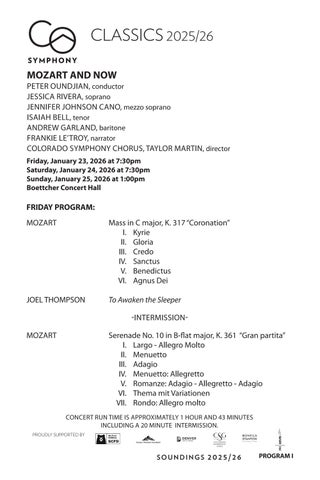
JOEL THOMPSON To Awaken the Sleeper -INTERMISSION-
MOZART
Serenade No. 10 in B-flat major, K. 361 “Gran partita”
I. Largo - Allegro Molto
II. Menuetto
III. Adagio
IV. Menuetto: Allegretto
V. Romanze: Adagio - Allegretto - Adagio
VI. Thema mit Variationen
VII. Rondo: Allegro molto
CONCERT RUN TIME IS APPROXIMATELY 1 HOUR AND 43 MINUTES INCLUDING A 20 MINUTE INTERMISSION.
PROUDLY SUPPORTED BY
CLASSICS 2025/26
SATURDAY PROGRAM:
JOHN ADAMS Frenzy
MOZART
Symphony No. 35 in D major, K. 385 “Haffner”
I. Allegro con spirito
II. Andante
III. Menuetto
IV. Presto -INTERMISSION-
GABRIELA LENA FRANK Conquest Requiem
I. Introit: Cuicatl de Malinche
II. Judex ergo cum sedebit
III. Dies irae: Cuicatl de Martin
IV. Recordare, Jesu pie
V. Rex tremendae: El Aullido de Malinche
VI. Confutatis maledictis
VII. In Paradisum
CONCERT RUN TIME IS APPROXIMATELY 1 HOUR AND 34 MINUTES INCLUDING A 20 MINUTE INTERMISSION.
PROUDLY SUPPORTED BY
CLASSICS 2025/26
SUNDAY PROGRAM:
MOZART
MOZART
MOZART
Symphony No. 35 in D major, K. 385 “Haffner”
I. Allegro con spirito
II. Andante
III. Menuetto
IV. Presto
Mass in C major, K. 317 “Coronation”
I. Kyrie
II. Gloria
III. Credo
IV. Sanctus
V. Benedictus
VI. Agnus Dei
-INTERMISSION-
Serenade No. 10 in B-flat major, K. 361 “Gran partita”
I. Largo - Allegro Molto
II. Menuetto
III. Adagio
IV. Menuetto: Allegretto
V. Romanze: Adagio - Allegretto - Adagio
VI. Thema mit Variationen
VII. Rondo: Allegro molto
CONCERT RUN TIME IS APPROXIMATELY 1 HOUR AND 45 MINUTES INCLUDING A 20 MINUTE INTERMISSION.
BIOGRAPHIES
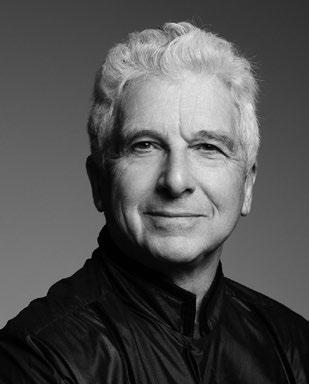
PETER OUNDJIAN, conductor
Peter Oundjian is a dynamic presence in the conducting world with an international career leading preeminent orchestras in many of the world’s major musical centers, from New York and Seattle to Amsterdam and Berlin.
He is currently Music Director of the Colorado Symphony, where he served previously as Principal Conductor. He is also Music Director of the Colorado Music Festival (CMF), where he has continued to program and conduct concerts that delight audiences with beloved masterpieces alongside music written by living composers. Over the course of his 14-year tenure as Music Director of the Toronto Symphony Orchestra, which concluded in 2018, he reinvigorated the orchestra with acclaimed innovative programming, artistic collaborations, extensive audience growth, national and international tours and several outstanding recordings, including Vaughan Williams’ Orchestral Works, which garnered a Grammy nomination and a Juno Award. Under his leadership, the Symphony underwent a transformation that significantly strengthened its presence in the world.
From 2012-2018, Oundjian served as Music Director of the Royal Scottish National Orchestra, where he led the RSNO on several international tours, including North America, China, and a European festival tour with performances at the Bregenz Festival, the Dresden Festival as well as in Innsbruck, Bergamo, Ljubljana, and others. His final appearance with the orchestra as their Music Director was at the 2018 BBC Proms where he conducted Britten’s epic War Requiem.
Oundjian was Principal Guest Conductor and Artistic Advisor of the Detroit Symphony Orchestra from 2005 to 2008 and Artistic Director of the Caramoor International Music Festival in New York from 1997 to 2007. He was also the Music Director of the Amsterdam Sinfonietta from 1998-2002. Throughout his conducting career, Oundjian has appeared as guest conductor with the country’s leading orchestras, including Philadelphia Orchestra, Boston, Chicago, Pittsburgh, Atlanta and San Francisco Symphonies, among others.
In addition to his conducting duties in Colorado, during the 2024/25 season Oundjian leads subscription weeks with the Sarasota Orchestra, the Rochester Philharmonic Orchestra, the Seattle Symphony, and the Atlanta Symphony Orchestra.
Oundjian has been a visiting professor at Yale University’s School of Music since 1981, and has received honorary doctorates from the San Francisco Conservatory of Music and The Royal Conservatory of Music in Toronto.
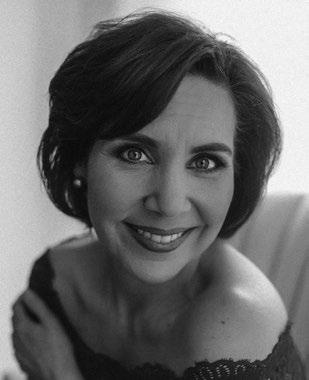
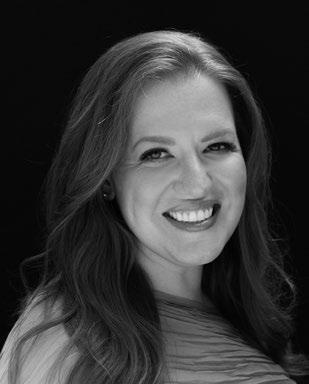
JESSICA RIVERA, soprano
The intelligence, dimension and spirituality with which Jessica Rivera infuses her performances on great international concert and opera stages has garnered unique artistic collaborations with many of today’s most celebrated composers, including John Adams, Osvaldo Golijov, Gabriela Lena Frank, Jonathan Leshnoff, Nico Muhly, and Paola Prestini, and has brought her together with such esteemed conductors as Sir Simon Rattle, Esa-Pekka Salonen, Robert Spano, and Michael Tilson Thomas. Rivera has lent her voice to world premieres of Adams’ A Flowering Tree, Frank’s Conquest Requiem, Golijov’s Ainadamar (GRAMMY®) The Adulteress and The Right of Your Senses, and Spano’s Hölderlin Lieder. Ms. Rivera serves on the vocal faculty at Miami University in Oxford, OH. jessicarivera.com
JENNIFER JOHNSON CANO, mezzo soprano
Jennifer Johnson Cano undertakes a balance of orchestral, opera and chamber music performances each season. She has collaborated with the Cleveland and Philadelphia Orchestras, Los Angeles and New York Philharmonics, Pittsburgh, Chicago and Atlanta Symphonies and appeared in more than 100 performances at the Metropolitan Opera, most recently as Nicklausse, Emilia, Hansel, and Meg Page. As Virginia Woolf in The Hours with the Philadelphia Orchestra, Opera News deemed her “a matchless interpreter of contemporary opera.” As Offred in Poul Ruders’ The Handmaid’s Tale, she was lauded by the Times as “towering…restless, powerful, profound, she is as formidable as this astonishingly demanding role deserves.”
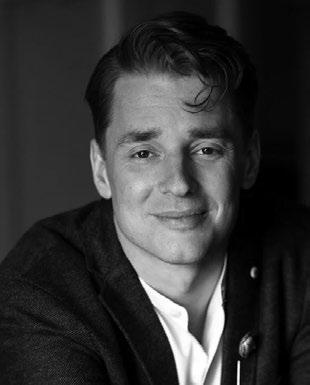
Isaiah BELL, tenor
Tenor Isaiah Bell first distinguished himself as an interpreter of Handel, Britten, and Bach’s Evangelists (Lincoln Center, Edinburgh Festival, Aldeburgh Festival, Toronto Symphony), and has further found an artistic home in new work and re-interpretations of classics. He has created lead roles in the world premieres of Hadrian (Canadian Opera Company), La Reine-garçon (Opéra de Montréal, Canadian Opera Company), and La beauté du monde (Opéra de Montréal). This season includes concert engagements with the Calgary Philharmonic Orchestra, the Indianapolis Symphony, Toronto Mendelssohn Choir, and Ottawa Choral Society. He also recently sang his first Peter Quint in Britten’s The Turn of the Screw with Pacific Opera Victoria, and joined Opéra de Montréal as Števa in Jenůfa.
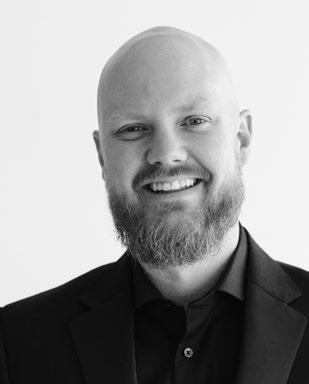
ANDREW GARLAND, baritone
Widely recognized for his interpretation of American song, Andrew Garland has performed recitals at Carnegie Hall, NYFOS, Ravinia, Cleveland Art Song Festival, and venues in Italy, Croatia, Greece, and Turkey. His recording of Gabriela Frank’s Conquest Requiem with Jessica Rivera was recently released on Naxos. He has also premiered works by William Bolcom, Jake Heggie, Tom Cipullo, Lee Hoiby, and many others. He has performed with the Boston POPS, Atlanta Symphony, Boston Baroque, Handel and Haydn, at the Kennedy Center, Lincoln Center, Seattle Opera, New York City Opera, Opera Philadelphia, Cincinnati Opera, Florida Grand Opera, Minnesota Opera, Opera Colorado, and many others. Garland is a mentor with Bel Canto Boot Camp, tonebase.com, and teaches at the University of Colorado, Boulder.
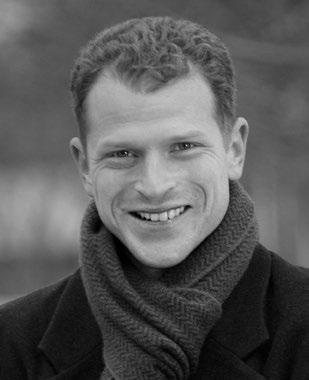
TAYLOR MARTIN, chorus director and conductor, Colorado Symphony Chorus
Taylor Martin is the Director and Conductor of the Colorado Symphony Chorus and Artistic Director of ELUS Vocal Ensemble. In 2019 Taylor made his debut with the Colorado Symphony conducting their staged version of Handel’s Messiah, titled Messiah: Awakening. Now in his tenth season with the Colorado Symphony Chorus, he has frequently taken the podium during the holiday season for productions of A Colorado Christmas and Messiah. Taylor has prepared the Chorus for productions with the Colorado Symphony, New York Philharmonic, Philadelphia Orchestra, and Dallas Symphony, and he recently conducted a concert tour of Austria featuring works for chorus and organ, leading Anton Bruckner’s Te Deum with the Salzburg Domorchester. Known for his musical versatility, Taylor has prepared choruses for Wu-Tang Clan’s RZA, Al Green, and Josh Groban, among other critically acclaimed artists. Now in his eighth season with ELUS Vocal Ensemble, Taylor has led performances of great a cappella repertoire through imaginative programming of new music and major works, such as David Lang’s the little match girl passion and Gabriel Fauré’s Requiem to considerable acclaim.
MARY LOUISE BURKE, associate director, Colorado Symphony Chorus
Mary Louise Burke is in her 32nd season with the Colorado Symphony Chorus. In addition to assisting Founding Director and Conductor Laureate Duain Wolfe for many years, she has also prepared the chorus for various Colorado Symphony pops concerts and special projects, including Too Hot to Handel. She is the Creative Director of the Symphony’s annual A Colorado Christmas concert and the Stage Director for this season’s performances of Handel’s Messiah. In the summer of 2022, she conducted the Symphony chorus on a concert tour of Austria. She was the Associate Director of the Colorado Children’s Chorale for many years, participating in hundreds of concerts and dozens of the Chorale’s regional, national and international tours. She was also Vocal Director of the Children’s Chorale, where she provided specialized vocal coaching and opera preparation. With an expertise in vocal technique, Burke frequently leads seminars in vocal and choral techniques for area church and community choirs. She is the Vocal Advisor at Montview Presbyterian Church and sings regularly at Holy Family Church, Denver. She has a Doctorate in Voice Performance and Pedagogy from the University of Colorado.
COLORADO SYMPHONY CHORUS
The Colorado Symphony’s 2025/26 Season marks the 42nd year of the Colorado Symphony Chorus. Founded in 1984 by Duain Wolfe, our chorus has earned a reputation as one of the finest symphonic choruses in the United States. This outstanding chorus of volunteers joins the Colorado Symphony for numerous concerts each year, performing the great Masterworks, as well as pops concerts, movies and special projects, all to repeated critical acclaim. Additionally, the Chorus has been featured annually at the Bravo!Vail Music Festival, performing with the New York Philharmonic, Philadelphia Orchestra or Dallas Symphony Orchestra, under the direction of notable conductors Yannick Nézet-Séguin, Jaap van Zweden, Alan Gilbert, Fabio Luisi, Hans Graf, as well as 25 years with the Aspen Music Festival. In 2009, in celebration of the 25th anniversary of the chorus, Duain Wolfe conducted the chorus on a concert tour of Europe, presenting the Verdi REQUIEM in Budapest, Vienna, Litomysl and Prague; in 2016 the chorus returned to Europe for concerts in Paris, Strasbourg and Munich featuring the Fauré Requiem. In the summer of 2022, the Chorus toured Austria, performing to great acclaim in Vienna, Graz and Salzburg.
BIOGRAPHIES
COLORADO SYMPHONY CHORUS
Taylor Martin, Director and Conductor
Mary Louise Burke, Associate Director and Conductor
Jared Joseph, Assistant Conductor
David Rosen, Chorus Manager
Barbara Porter, Associate Manager
Duain Wolfe, Founding Director and Conductor Laureate
Hsiao-Ling Lin and ShaoChun Tsai, Pianists
Eric Israelson, Chorus Manager Emeritus
SOPRANO
Lori Ascani
Brianna Bettis
Jude Blum
Emily Burr
Denelda Causey
Ruth Coberly
Suzanne Collins
Angie Collums
Kerry Cote
Claudia Dakkouri
April Day
Meredith Duffy
Lisa Fultz
Amy Gallegos
Andria Gaskill
Jenifer Gile
Lori Gill
Susan Graber
Stacey Haslam
Elizabeth HedrickCollins
Erin Hittle
Elizabeth Hott
Angie Hupp
Kaitlyn Jones
Lauren Kennedy
Meghan Kinnischtzke
Leanne Lang
Dana Linder
Cathy Look
Rebecca Machusko
Anne Maupin
Shannon McAleb
Erin Montigne
Wendy Moraskie
Jackie Oldham
Jean O’Nan
Kim Pflug
Julie Plouffe
Barb Porter
Lori Ropa
Roberta Sladovnik
Syd Timme
Sue von Roedern
Marcia Walker
Alison Wall
Karen Wuertz
Cara Young
Joan Zisler
ALTO
Priscilla Adams
Liz Arthur
Brenda Berganza
Mary Boyle Thayer
Charlotte Braud-Kern
Isabel Cavosie
Jayne Conrad
Martha Cox
Debbie Davies
Barb Deck
Michelle Fronzaglia
Sharon Gayley
Daniela Golden
Gabriella Groom
Sheri Haxton
Kaia Hoopes
Olivia Isaac
Brandy Jackson
Christine Kaminske
Annette Kim
Annie Kolstad
Andrea LeBaron
Carole London
Joanna Maltzahn
Jenae Martinez
Susan McWaters
Anna Nelson
Kristen Nordenholz
Christine Nyholm
Jill Parsons
Syder Peltier
Jennifer Pringle
Donneve Rae
Kathi Rudolph
Wendy Schnell
Melanie Stevenson
Clara Tiggelaar
Kim Trubetskoy
Pat Virtue
Beth York
TENOR
Jordan Antonio
Gary Babcock
Jim Carlson
Dusty Davies
Nicholas Dietrich
Jack Dinkel
John Gale
Frank Gordon
David Hodel
Sami Ibrahim
Ken Kolm
Sean Lund-Brown
Andy Marner
Tom Milligan
Richard Moraskie
Garvis Muesing
Tim Nicholas
David Rosen
Andrew Seamans
Evan Secrist
Jerry Sims
P.J. Stohlmann
Daniel Thompson
Hannis Thompson
Max Witherspoon
Kenneth Zimmerman
BASS
John Adams
Grant Carlton
Bob Friedlander
Chris Grossman
Nic Hammerberg
Doug Hesse
David Highbaugh
Leonard Hunt
Terry Jackson
Tom Jirak
Jared Joseph
Matthew KerstenGray
Nalin Mehta
Matthew Molberg
Greg Morrison
Gene Nuccio
John Phillips
Ben Pilcher
Tom Potter
Jacob Pullen
Ken Quarles
Joshua Richards
Adam Scoville
Russ Skillings
Matthew Smedberg
Riley Somo
Matt Steele
Tom Virtue
Marc Whittington
Lu Wu
Jeffrey Zax
PROGRAM NOTES
WOLFGANG AMADEUS MOZART (1756-1791)
Mass in C major, K. 317, “Coronation”
COMPOSITION & PREMIERE OF WORK:
Wolfgang Amadeus Mozart was born on January 27, 1756 in Salzburg, and died on December 5, 1791 in Vienna. He composed his “Coronation” Mass in Salzburg during the first months of 1779; the manuscript is dated March 23, 1779. The work was written for the pilgrimage church of Maria Plain near Salzburg, and performed there on the fifth Sunday after Pentecost in 1779, though it may have been first heard on Easter that year (March 24) at the Salzburg Cathedral.
CSA LAST PERFORMANCES:
November 21-23, 2003, with Patrick Summers conducting.
INSTRUMENTATION:
The score calls for two oboes, bassoon, two horns, two trumpets, three trombones, timpani, organ and strings without violas.
DURATION:
About 24 minutes.
At a place just north of Salzburg known as Maria Plain occurred in 1751 a miracle — a vision of the Virgin Mary, crowned, appeared to the faithful in the small village’s church. Word of the miraculous apparition spread quickly, the hillside was soon filled with an entire complex of religious shrines, and Maria Plain became an important pilgrimage site, a practice encouraged for spiritual (and commercial) reasons by the annual observance of the event on the fifth Sunday of Pentecost. Maria Anna (Nannerl) Mozart, Wolfgang’s older sister, is known to have been among the pilgrims. Soon after Wolfgang returned in mid-January 1779 from his sad and frustrating tour to Mannheim and Paris, having both failed to secure a regular position and suffered the death of his mother, who accompanied him as chaperone, he agreed to write a grand Mass for that year’s observance of the Maria Plain miracle of the Crowned Virgin — the “Coronation” celebration.
Since the Mass would be heard not only in Maria Plain but also in Salzburg, Mozart had to work under the restraints imposed by Archbishop Colloredo for all liturgical music in the local cathedral — no elaborate polyphony, no overlapping of successive text phrases in different voices, no more than one solo aria, and — above all — brevity. (Empress Maria Theresia also favored short masses at her court in Vienna.) The “Coronation” Mass is perhaps Mozart’s most brilliant example in this missa brevis genre. Though Colloredo liked compact Mass settings, he had no objection to continuing the Salzburg tradition of employing a large orchestra, chorus and group of soloists to make a grand show of his ecclesiastical rites. Wrote Eric Blom, “Mass sung at high festivals was as dressy and flashy at Salzburg as the production of a new opera in Vienna. At the Cathedral the archbishop’s bodyguard attended with helmets and halberds, the vestments of clergy and choir were as splendid as the dresses of the fashionable ladies in the congregation, and the music was as ostentatious as was compatible with devotion — in fact, according to the ideas of other times, a good deal more so. The chancel was packed with singers and on four galleries that circled half-way around the pillars supporting the dome were perched the orchestral musicians.” Especially prominent in the orchestral complement for these lavish Salzburg services were the brass instruments; pairs of trumpets and horns and a trio of trombones are called for in the “Coronation” Mass. Curiously, violas were proscribed from the Salzburg services of the time for some now-forgotten dogmatic reason, so there are string parts in this work only for violins and cello/bass.
PROGRAM NOTES
The jubilant “Coronation” Mass mixes elements of the grand Baroque settings of the ancient texts with the newer melodic and harmonic styles of the Classical era. The two sections of the closing Agnus Dei, for example, are a soprano aria so close to the contemporary operatic manner that Mozart resurrected its melody seven years later as “Dove sono” for The Marriage of Figaro, and a full-throated choral rendition of the words “Dona nobis pacem” buoyed by busy Baroque figurations and a bouncing, Handelian bass line. As was typical of Mozart’s works of these years, the “Coronation” Mass shows several of the stylistic influences that he so thoroughly absorbed and so eloquently transmuted — the pompous ceremonial gestures of the early 18th century; the melodic sweetness of J.C. Bach and Italian opera; the orchestral richness of the Mannheim and Paris schools. “But,” added Alfred Einstein, “he never forgot ‘expression.’” It is exactly this marriage of technical mastery and depth of feeling that has allowed the “Coronation” Mass to be gladly heard more than two centuries after its creation while other 18th-century examples of the genre — by Fux, Hasse, Eberlin, Michael Haydn — are long forgotten.
KYRIE
Kyrie eleison.
Lord, have mercy. Christe eleison. Christ, have mercy. Kyrie eleison. Lord, have mercy.
GLORIA
Gloria in excelsis Deo, Glory to God in the highest, et in terra pax hominibus and on earth peace to men bonae voluntatis. of good will.
Laudamus te, benedicimus te, We praise you, we bless you, adoramus te, glorificamus te. we worship you, we glorify you. Gratias agimus tibi propter We give you thanks magnam gloriam tuam. for your great glory.
Domine Deus, Rex coelestis , Lord God, heavenly King, Deus pater omnipotens. God the Father almighty.
Domine Fili unigenite
The only-begotten Son, Jesu Christe, Lord Jesus Christ, Domine Deus, Agnus Dei, Lord God, Lamb of God, Filius Patris, Son of the Father, qui tollis peccata mundi: you take away the sin of the world: miserere nobis; have mercy on us; qui tollis peccata mundi: you take away the sin of the world: suscipe deprecationem nostram; receive our prayer; qui sedes ad dexteram Patris: you are seated at the right hand of the Father: miserere nobis. have mercy on us.
Quoniam tu solus sanctus, For you alone are the Holy One, tu solus Dominus, you alone are the Lord, tu solus altissimus, you alone are the Most High, Jesu Christe, Jesus Christ, cum sancto spiritu, with the Holy Spirit, in gloria Dei Patris. Amen. in the glory of God the Father. Amen.
PROGRAM NOTES
Credo in unum Deum,
CREDO
We believe in one God, Patrem omnipotentem, the Father, the Almighty, factorem coeli et terrae, maker of heaven and earth, visibilium omnium et invisibilium. of all that is, seen and unseen.
Credo in unum Dominum, We believe in one Lord, Jesum Christum, Jesus Christ, Filium Dei unigenitum, the only Son of God, et ex patre natum eternally begotten ante omnia saecula. of the Father.
Deum de Deo, lumen de lumine, God from God, Light from Light, Deum verum de Deo vero. true God from true God, Genitum, non factum, begotten, not made, consubstantialem Patri, of one Being with the Father. Per quem omnia facta sunt. Through him all things were made.
Qui propter nos homines et For us men and propter nostram salutem for our salvation descendit de coelis: he came down from heaven: et incarnatus est de Spiritu by the power of the Holy Spirit Sancto ex Maria virgine, he became incarnate from the Virgin Mary, et homo factus est. and was made man.
Crucifixus etiam pro nobis, For our sake he was crucified sub Pontio Pilato passus, under Pontius Pilate; he suffered death et sepultus est. and was buried.
Et resurrexit tertia die On the third day he rose again secundum scripturas; in accordance with the Scriptures; et ascendit in coelum sedet and ascended into heaven and is seated ad dexteram Patris. at the right hand of the Father.
Et iterum venturus est cum gloria He will come again in glory judicare vivos et mortuos, to judge the living and the dead, cujus regni non erit finis. and his kingdom will have no end.
Credo in Spiritum Sanctum, We believe in the Holy Spirit, Dominum et vivificantem, the Lord, the giver of life, qui ex Patre Filioque procedit. who proceeds from the Father and the Son. Qui cum Patre et Filio simul With the Father and the Son adoratur et conglorificatur. he is worshipped and glorified.
Qui locutus est per Prophetas. He has spoken through the Prophets. Credo unum sanctam catholicam et We believe in one holy catholic and apostolicam ecclesiam. apostolic Church. Confiteor unum baptisma in We acknowledge one baptism for the remissionem peccatorum. forgiveness of sins. Et expecto resurrectionem We look for the resurrection of the mortuorum, et vitam dead, and the life venturi seculi. Amen. of the world to come. Amen.
SANCTUS
Sanctus, sanctus, sanctus Dominus, Holy, holy, holy Lord, Deus Sabaoth, God of power and might, pleni sunt coeli et terra gloria tuae heaven and earth are full of your glory. Osanna in excelsis. Hosanna in the highest.
BENEDICTUS
Benedictus qui venit
Blessed is he who comes in nomine Domini. in the name of the Lord. Osanna in excelsis. Hosanna in the highest.
AGNUS DEI
Agnus Dei, Lamb of God, qui tollis peccata mundi: you take away the sins of the world: miserere nobis. have mercy on us.
Agnus Dei, Lamb of God, qui tollis peccata mundi: you take away the sins of the world: miserere nobis. have mercy on us.
Agnus Dei, Lamb of God, qui tollis peccata mundi: you take away the sins of the world: dona nobis pacem. grant us peace. PROGRAM NOTES
PROGRAM NOTES
JOEL THOMPSON (BORN 1988)
To Awaken the Sleeper for Narrator and Orchestra
COMPOSITION & PREMIERE OF WORK:
Joel Thompson was born on December 17, 1988 in the Bahamas. He composed To Awaken the Sleeper in 2021. The work was premiered on August 5, 2021 at the Colorado Music Festival in Boulder, conducted by Peter Oundjian with Dr. Eddie S. Glaude, Jr. as narrator.
CSA LAST PERFORMANCE:
This is the premiere performance by the orchestra.
INSTRUMENTATION:
The score calls for woodwinds in pairs, four horns, two trumpets, two trombones, tuba, timpani, percussion, organ and strings.
DURATION:
About 16 minutes.
Joel Thompson, who was born in the Bahamas in 1988 and moved with his family to Houston when he was ten and then to Atlanta, discovered classical music from his parents’ record collection as a youngster. He also developed an interest in medicine and took classes in both disciplines when he entered Emory University, but eventually settled on music as his major and completed a Bachelor of Arts and a master’s degree in choral conducting at Emory. Thompson was also a 2017 post-graduate fellow in Arizona State University’s Ensemble Lab/Projecting All Voices Initiative and a Composition Fellow at that year’s Aspen Music Festival and School, where he studied with Grammy Award-winning composers Stephen Hartke and Christopher Theofanidis; he is currently completing a doctorate in composition at Yale with Theofanidis.
Thompson first focused his career on conducting and education, serving as Director of Choral Studies at Andrew College in Cuthbert, Georgia from 2013 to 2015 and teaching at Holy Innocents’ Episcopal School in Atlanta for the following three years, but he has increasingly turned to creative work. His compositions, many of which reveal an acute social awareness and often include voices, have been commissioned by, among others, the New York Philharmonic, Atlanta Symphony Orchestra, Aspen Music Festival, Los Angeles Master Chorale, San Francisco Gay Men’s Chorus, Kansas City Symphony and Sphinx Organization, and performed by orchestras, ensembles and choruses across the country. He has served as Composer-inResidence for the New Haven Symphony and is also an alumnus of the Metropolitan Opera/ Lincoln Center Theater New Works commissioning program, established to foster leading talents in the field. In 2022, Thompson began a five-year residency with Houston Grand Opera, which commissioned an operatic adaptation of author and illustrator Ezra Jack Keats’ Caldecott Medal-winning The Snowy Day, one of the first mainstream children’s books to feature a Black protagonist; the opera was performed by the company in February 2025. Thompson’s honors include a Sphinx Medal of Excellence, Aspen Music Festival’s Hermitage Prize, and an American Prize for Choral Composition and an Emmy for his Seven Last Words of the Unarmed (2014), each of whose movements is set to the final words of an unarmed Black man before he was killed by police or authority figures.
Thompson’s To Awaken the Sleeper was composed in 2021 on a joint commission from a large group orchestras across America and in London led by the Colorado Music Festival and conductor Peter Oundjian, who premiered the work in Boulder on August 5, 2021. The narrator was Dr. Eddie S. Glaude, Jr., author of the best-selling 2020 book Begin Again: James Baldwin’s
America and Its Urgent Lessons For Our Own; Dr. Glaude advised Thompson in choosing the passages from Baldwin’s writings for the composition.
Of To Awaken the Sleper, Thompson wrote, “The insightful and prophetic words of James Baldwin have always been a source of solace for me, and never more so than during the last few years as the country has been forced to grapple with its identity. When commissioned to write a piece for Peter Oundjian and the Colorado Music Festival, it felt like the perfect opportunity to amplify his words. James Baldwin sought to bear witness to the country that birthed him and hated him, a country that murdered his friends (Evers, King, X) for speaking out against injustice. Despite the pain of those wounds, it is evident that, although Baldwin didn’t hesitate to hold our deeply flawed society to account, his words were rooted in an impossible love of this country. Though they were written decades ago, his words still ring true. Today, Baldwin asks us to look in the mirror and reckon with what we see. He asks us to examine the nature of power and its dependence on human will and desire. He asks us to go to ‘the unprotected’ among us in order to examine our supposed love for justice. I like to think that if he were to re-word his proposal today, he would include the immigrant, the refugee, the trans person, those without bodily autonomy under the law, and those suffering in the thrall of poverty. Baldwin acknowledges all the messiness and failure and genocide and death that has brought us to this point and he asks us to build a new world where we truly value and support each other in all of our differences. It is in that spirit that the piece was born and I hope that same spirit can continue to move each of us toward a more perfect union.”
“So be it! So be it. We cannot awaken [the] sleeper, and God knows we have tried. We must do what we can do, and fortify and save each other.... We know that democracy does not mean the coercion of all into a deadly — and, finally, wicked — mediocrity but the liberty for all to aspire to the best that is in us, or that has ever been….”
“Well, if one really wishes to know how justice is administered in a country, one does not question the policemen, the lawyers, the judges, or the protected members of the middle class. One goes to the unprotected — those, precisely, who need the law’s protection most! — and listen to their testimony….”
“Ask any Mexican, any Puerto Rican, any Black man, any poor person — ask the wretched how they fare in the halls of justice, and then you will know whether or not it has any love for justice, or any concept of it….”
“Ask the wretched how they fare in the halls of justice, and then you will know whether or not [this country] has any love for justice, or any concept of it. It is certain, in any case, that ignorance, allied with power, is the most ferocious enemy justice can have….”
“Power, which can have no morality in itself, is yet dependent on human energy, on the wills and desires of human beings. When power translates itself into tyranny, it means that the principles on which that power depended, and which were its justification, are bankrupt. When this happens, and it is happening now, power can only be defended by thugs and mediocrities — and seas of blood….”
“The representatives of the status quo are sickened and divided, and dread looking into the eyes of their young; while the excluded begin to realize, having endured everything, that they can endure everything. They do not know the precise shape of the future, but they know that the future belongs to them. They realize this — paradoxically — by the failure of the moral energy of
their oppressors and begin, almost instinctively, to forge a new morality, to create the principles on which a new world will be built….”
“We are living in a world in which everybody and everything is interdependent. It is not white, this world. It is not Black either. The future of this world depends on everyone in this room. And that future depends on to what extent and by what means we liberate ourselves from a vocabulary which now cannot bear the weight of reality….”
— Quotes from James Baldwin’s works
An Open Letter to My Sister, Miss Angela Davis [1970], No Name in the Street [1972], and James Baldwin’s National Press Club Speech, December 10, 1986 are used with permission from the James Baldwin Estate.
WOLFGANG AMADEUS MOZART (1756-1791)
Serenade No. 10 for Ten Winds in B-flat major, K. 361, “Gran Partita”
COMPOSITION & PREMIERE OF WORK:
The Serenade for Ten Winds was probably composed in 1783-1784. It may have been performed on March 23, 1784 at the Burgtheater in Vienna on a concert organized by clarinetist Anton Stadler. The score calls for pairs of oboes, clarinets, basset horns and bassoons, four horns and double bass.
CSA LAST PERFORMANCE:
July 25, 2012, with Scott O’Neil conducting.
INSTRUMENTATION:
The score calls for pairs of oboes, clarinets, basset horns and bassoons, four horns and double bass.
DURATION:
About 43 minutes.
The date of composition of the B-flat Serenade (K. 361) is the subject of on-going debate. Ludwig Köchel, in his pioneering chronological catalog of Mozart’s works published in 1862, assigned the Serenade to 1780 according to a date on the manuscript that was later shown to have been altered by an unknown hand. (Nor was the familiar sobriquet “Gran Partita” at the head of the manuscript written by Mozart.) In his 1937 revision of Köchel’s catalog, Alfred Einstein changed the date to 1781 because he read the final, smudged character on the manuscript as a “1.” That speculation seemed to be substantiated by Alan Tyson’s exhaustive study in the 1980s of the watermarks of Mozart’s manuscript paper. (Hermann Abert’s 1924 biography of Mozart suggested, apparently incorrectly, that the composer used the Serenade as the entertainment music for his own wedding reception, on August 4, 1782.) However, extensive subsequent research by Daniel N. Leeson (including a 168-page monograph on K. 361 published in 2009) has led to late 1783 and/or early 1784 now being widely accepted as the time of the work’s origin. On the basis of stylistic, biographical and historical evidence, Leeson argued that the Serenade was commissioned by Anton Stadler, clarinetist in the court orchestra and a fellow Freemason for whom Mozart later wrote the “Kegelstatt” Trio (K. 498), Clarinet Quintet (K. 581) and Clarinet Concerto (K. 622), for his concert at Vienna’s Burgtheater on March 23, 1784. Of that event, the only time this magnificent music was known to have been performed during Mozart’s lifetime, playwright Johann Friedrich Schink wrote, “I have heard a piece for wind instruments
by Herr Mozart today. Magnificent! It employed thirteen instruments and at every instrument a master. The effect was grand and magnificent beyond description.” Listeners’ response, unaffected by the scholarly sparring over the work’s date, has not varied since.
The burnished sonority of the B-flat Wind Serenade, scored for pairs of oboes, clarinets, basset horns (Mozart’s first use of the new alto clarinet) and bassoons, four horns and double bass (some later editions allowed the substitution of a contrabassoon, though Mozart specified the string instrument in preference to the then-fledgling double-reed instrument), is one of the most ingratiating to be found anywhere in the ensemble literature. “No master ever handled a large body of wind players with such wondrous results,” wrote John N. Burk. Concertante elements — the contrasting of solo instruments (or, here, pairs of like instruments) with the full ensemble — bring a kaleidoscopic range of timbral colors to the work’s seven movements. The Serenade opens with a stately slow introduction that prefaces a full sonata-form movement. The second and fourth movements are minuets, the first city-graceful, the second country-rustic. As befits the expansive nature of the work (the longest chamber composition in Mozart’s output, rivaled only by the Clarinet Quintet, K. 581), both minuets are supplied with not one but two trios. Enfolded between these movements is the transcendent Adagio, which drew from Alfred Einstein some of the most rapturous words in his classic 1945 study of Mozart: “a Notturno a scene from Romeo and Juliet, under starry skies, a scene in which longing, grief and love are wrung like a distillation from the beating hearts of the lovers.” The fifth movement is a Romanze with a center section of quick motion and unsettled mood. The Theme and Variations is a reworking of the finale of the C major Flute Quartet (K. 285b) of 1778. A sparkling Rondo — what the Germans would call a Kehraus, literally a “sweeping out” at the end of a social evening — concludes this wonderful and richly varied masterwork.
JOHN ADAMS (BORN 1947)
Frenzy: A Short Symphony
COMPOSITION & PREMIERE OF WORK:
John Adams was born on February 15, 1947 in Worcester, Massachusetts. Frenzy: A Short Symphony was composed in 2023, and premiered on March 3, 2024 at the Barbican in London by the London Symphony Orchestra, conducted by Sir Simon Rattle.
CSA LAST PERFORMANCE:
This is the premiere performance by the orchestra.
INSTRUMENTATION:
The score calls for piccolo, three flutes, two oboes, English horn, E-flat clarinet, two clarinets, bass clarinet, two bassoons, contrabassoon, four horns, three trumpets, three trombones, tuba, timpani, percussion, celesta, two harps and strings.
DURATION:
About 18 minutes.
John Adams is one of today’s most acclaimed composers. Audiences have responded enthusiastically to his music, and he enjoys a success not seen by an American composer since the zenith of Aaron Copland’s career: a recent survey of major orchestras conducted by the League of American Orchestras found John Adams to be the most frequently performed living American composer; he won five Grammy Awards between 1989 and 2004; he received the University of Louisville’s prestigious Grawemeyer Award in 1995 for his Violin Concerto; in 1997, he was elected to the American Academy of Arts and Letters, and named “Composer
of the Year” by Musical America magazine; he was made a Chevalier dans l’Ordre des Arts et des Lettres by the French Ministry of Culture; in 2003, he received the Pulitzer Prize for On the Transmigration of Souls, written for the New York Philharmonic in commemoration of the first anniversary of the World Trade Center attacks; from 2003 to 2007, Adams held the Richard and Barbara Debs Composer’s Chair at Carnegie Hall, and since 2009 has he been Creative Chair with the LA Philharmonic; in 2004, he was awarded the Centennial Medal of Harvard University’s Graduate School of Arts and Sciences “for contributions to society,” and in 2019 became the first American composer to receive the Erasmus Prize “for notable contributions to European culture, society and social science”; he has been granted honorary doctorates from the Royal Academy of Music (London), Juilliard School, and Cambridge, Harvard, Yale and Northwestern universities, honorary membership in Phi Beta Kappa, and the California Governor’s Award for Lifetime Achievement in the Arts; in June 2023, the Library of Congress announced that it was acquiring Adams’ manuscripts and papers for its Music Division, which also holds the papers of Leonard Bernstein, Aaron Copland, George and Ira Gershwin, Martha Graham, Charles Mingus, Neil Simon and other distinguished American artists. Adams wrote that Frenzy: A Short Symphony, premiered on March 3, 2024 by the London Symphony Orchestra under the direction of Sir Simon Rattle, to whom the score is dedicated, is “a one-movement symphony that, in the course of its twenty minutes, encompasses a variegated yet unified symphonic structure. Its title notwithstanding, the piece is generally buoyant and extrovert and postpones its real frenetic energy to the concluding moments. “What makes Frenzy unique in comparison to my other works is its focus, almost to the point of obsession, on the development and transformation of small, vivid motives that continue to resurface in various guises throughout the piece. This kind of classic development treatment of motivic ideas differs from the gradual ‘change-viarepetition’ technique in my earlier, minimalist-influenced works. In fact, once completed, Frenzy revealed itself, much to the surprise of its composer, as a melding of the two approaches toward musical form. On the one hand, its rhythmic event horizon is still essentially pulse-driven while on the other its melodic world is about shapeshifting and the ‘spinning out’ of ideas.
“The opening bars present two contrasting gestures: a punctuated tattoo in the winds and brass and an urgent, muscular theme in the upper strings. Both these ideas reappear throughout the piece, always transformed in one way or another and yet always identifiable. “In place of a ‘slow movement,’ the music’s surface simply quiets down; density and forcefulness yield to feelings of lightness and transparency. The pulse is still there, now carried along by a congenial interplay among the two harps and celesta while the strings limn a lyrical melody that floats above them.
“The final section is indeed frenetic, with hard-driven, choppy string figures, tsunami-like waves of brass and madly scurrying woodwinds, all of which come together to earn the piece its title.”
PROGRAM NOTES
WOLFGANG AMADEUS MOZART (1756-1791)
Symphony No. 35 in D major, K. 385, “Haffner”
COMPOSITION & PREMIERE OF WORK:
Wolfgang Amadeus Mozart was born on January 27, 1756 in Salzburg, and died on December 5, 1791 in Vienna. He wrote his “Haffner” Symphony during two weeks in July and August 1782, in Vienna. It was first performed privately, in Salzburg in early August, and heard in public at the composer’s concert of March 23, 1783 at the Burgtheater in Vienna.
CSA LAST PERFORMANCE:
January 26, 2018, with Christopher Dragon conducting.
INSTRUMENTATION:
The score calls for pairs of woodwinds, horns and trumpets, timpani and strings.
DURATION:
About 18 minutes.
By the summer of 1782, Mozart had been living as a free-lance composer and pianist in Vienna for a full year and was making some headway in his career and his personal life. Though he had more than a drop of the roustabout in his blood, he was preparing to undertake a marriage in August with Constanze Weber, his second choice after Constanze’s sister, Aloysia, became unavailable. His music was becoming known, and a steady stream of commissions was coming his way. Through his concerts, for which he wrote his own concertos, he was gaining a sound reputation as a splendid pianist. In July, he was finishing The Abduction from the Seraglio and getting the production on the boards, as well as working on the C minor Serenade (K. 388). At the end of the month, an urgent letter arrived from his father, Leopold, in Salzburg, which told Wolfgang that the Salzburg Burgomaster [mayor] Siegmund Haffner was being elevated to the nobility and would not think of celebrating such an important occasion without a grand party highlighted by a new composition from that distinguished son of Salzburg, the young Mozart off seeking his fortune in Vienna. The Burgomaster knew what he was ordering — Mozart had provided the splendid “Haffner” Serenade (K. 250) for the wedding of Siegmund’s daughter, Elizabeth, in 1776. Mozart was reluctant to accept the proposal because of his crowded schedule, but he realized that a request from such an important person was not to be taken lightly, so he agreed. Over the next two weeks, the six movements of the commissioned work — another serenade — were sent to Salzburg. The last movement to be completed was an introductory march that was posted on August 1st, only three days before his marriage to Constanze. Early the following year, Mozart was organizing a concert and needed a new symphony for the program. He recalled the second serenade he had composed for Burgomaster Haffner, and wrote to his father asking him to send a copy of the work. The opening march (K. 408, No. 2) and a second minuet (perhaps K. 409) were not needed and were jettisoned to produce the four-movement “Haffner” Symphony that has always borne the name of its patron.
The majestic Allegro, excellently suited to the grand occasion for which it was conceived, contains only a single theme rather than the contrasting melodies usually found in similar movements. The intimate Andante, a sonatina (sonata form without development section) in Mozart’s most elegant style, presents a charming contrast to the extroverted bustle of the first movement. The following Menuetto treads a stately strain, with a central trio that bears some resemblance to an air from Mozart’s opera La Finta Giardiniera, composed for the Munich carnival season of 1775. The finale is a rollicking sonata-rondo indebted in spirit and form to the music of Mozart’s dear friend Joseph Haydn.
PROGRAM NOTES
GABRIELA LENA
FRANK (BORN 1972)
Conquest Requiem for Soprano, Baritone, Chorus and Orchestra
COMPOSITION & PREMIERE OF WORK:
Gabriela Lena Frank was born on September 26, 1972 in Berkeley, California. She composed Conquest Requiem in 2017. It was premiered on May 5, 2017 by the Houston Symphony Orchestra, conducted by Andrés Orozco-Estrada.
CSA LAST PERFORMANCE:
This is the premiere performance by the orchestra.
INSTRUMENTATION:
The score calls for piccolo, three flutes, three oboes, English horn, three clarinets, bass clarinet, three bassoons, two horns, two trumpets, two trombones, tuba, timpani, percussion, harp, piano and strings.
DURATION:
About 38 minutes.
The fact that Gabriela Lena Frank was born in 1972 in Berkeley, California of Peruvian heritage forms the foundation of her creative personality, which draws together musical qualities from both North and Latin America. Frank, gifted as a composer, pianist, teacher and speaker, earned her bachelor’s and master’s degrees at Rice University in Houston and her doctorate at the University of Michigan; her principal teachers have included William Albright, Leslie Bassett, William Bolcom and Samuel Jones in composition, and Jeanne Kierman Fischer and Logan Skelton in piano. As a pianist, Frank has recorded the complete solo piano and violin/piano compositions of her teacher, Pulitzer Prize-winning composer Leslie Bassett. Frank said of her improbable career, “I firmly believe that only in the United States could a Peruvian-ChineseJewish-Lithuanian girl born with significant hearing loss in a hippie town successfully create a life writing string quartets and symphonies.”
The compositions of Gabriela Lena Frank incorporate elements of Latino/Latin American mythology, archeology, art, poetry and folk music into traditional Classical forms in works for orchestra, chamber ensembles, piano, chorus and vocal solo. San Diego Opera premiered her first opera, The Last Dream of Frida and Diego, with a libretto by Pulitzer Prize-winning playwright Nilo Cruz, in 2022; it is staged at both the Metropolitan Opera and Chicago Lyric Opera in spring 2026. Among her many commissions are those from the orchestras of Cleveland, Detroit, New York, Philadelphia, Albany, Utah, St. Paul and Seattle, National Endowment for the Arts, Van Cliburn International Piano Competition, ASCAP, Carnegie Hall and National Public Radio. Her many honors include the inaugural Sackler Music Composition Prize of the University of Connecticut in 2002 and the 25th Anniversary Heinz Prize in Arts and Humanity in 2020 (for her work “weaving Latin American influences into classical constructs and breaking gender, disability and cultural barriers in classical music composition”); in 2025 she was elected to the American Academy of Arts and Letters. Frank also received the 2009 Latin Grammy Award for Best Classical Music Composition (Inca Dances) and Grammy nominations for Best Classical Crossover Album as one of the composers who contributed to Yo-Yo Ma’s Silk Road Ensemble 2011 CD Off the Map and as pianist for the 2012 CD titled Hilos on the Naxos label devoted to her works.
Frank is also an educator and climate activist, and has held residencies at UC/Berkeley, University of Missouri-St. Louis, Peabody Conservatory, UCLA, Rice University, Vanderbilt University, USC and the Composers’ Forum at Vermont’s Bennington College, and is a frequent guest at schools and festivals in North America and throughout Latin America. In 2017, she founded the Gabriela
Lena Frank Creative Academy of Music, a non-profit training institution that offers emerging composers short-term retreats at her farms in California. She has volunteered extensively in hospitals and prisons, with her current focus on developing the music program at Anderson Valley High School, a rural California public school of modest means with a large Latino population. Born with a moderate-to-profound neurosensory hearing loss, Frank served as the keynote speaker at the national convention of the Association of Late-Deafened Adults in September 2005 in Salt Lake City. Gabriela Lena Frank is included in recent scholarly books on women in Latin America concert music, been the subject of PBS documentaries, and was named among the Washington Post’s 2017 list of the “35 Most Significant Women Composers in History.” “Much has been written,” Frank said as background to her Conquest Requiem, “of the violent meeting of the Old and New Worlds that produced the Americas — North, Central and South — known to the world today. Over the centuries since, key figures have emerged — conquistadores Cristoforo Colombo, Hernán Cortés, and Francisco Pizarro; chroniclers Bernal Díaz del Castillo, the native Garcilaso de la Vega, and the Dominican friar Bartolomé de las Casas — as especially emblematic of the cataclysm that was the Conquest. These men and countless others bore witness and, oftentimes, great responsibility for the death and destruction of entire societies while simultaneously having a hand in the birth of new mestizo (mixed-race) civilizations.
“Against such grand historical strokes, the stories of ordinary people are easily swept away but for the efforts of creative imagination, employed here in the Conquest Requiem. This piece is inspired by the true story of Malinche, a Nahua woman from the Gulf Coast of Mexico who was given to the Spaniards as a young slave. Malinche’s ever-evolving prowess as an interpreter of her native Nahuatl, various Mayan dialects, and Spanish elevated her position such that she would convert to Christianity and become mistress to Cortés during his war against the Aztecs. She would later give birth to their son Martín, one of the first mestizos of the New World.
“While Malinche has been conflated with Aztec legends, she has been variously viewed as feminist hero who saved countless lives, treacherous villain who facilitated genocide, conflicted victim of forces beyond her control, or symbolic mother of the new mestizo people.
“In the Conquest Requiem, Malinche’s story is the linchpin for the juxtaposition of traditional liturgical verses from the Latin Mass for the Dead against Nahua poetry as chronicled from the mouths of fallen indigenous princes. Newly composed Spanish words from [Pulitzer Prizewinning] playwright/poet Nilo Cruz round out the text.”
Nahuatl texts [Nos. 1, 3, 7] attributed to Nezahualcoyotl (b. 1402), translated by Gabriela Lena Frank
I. Introit: Cuicatl de Malinche (Song of Malinche)
Choir
Requiem aeternam dona eis, Domine. Eternal rest give unto them, O Lord.
Soprano (Spanish)
Tenochtitlan, mi ciudad, Tenochtitlan, my city, ¿te habré maldecido? have I put a curse on you?
Soprano
De los tantos nombres
Of all the names que me han dando, I’ve been given,
PROGRAM NOTES
solo un nombre me quedan: only one name remains with me. La Malinche, La Malinche, por traicionar a mi pueblo. for betraying my people.
Soprano
Tenochtitlan, mi ciudad, Tenochtitlan, my city, habré entregado tu tierra have I handed over your land por amar al enemigo? for loving the enemy?
Choir
Lux perpetua luceat eis. Let perpetual light shine upon them.
Soprano (Nahuatl)
Ah ca no chichic teopoulhqui Will sorrow and pain be the fate of the tenahuac ye nican? people of the true land?
Choir
Kyrie eleison. Lord, have mercy upon us. Christe eleison. Christ, have mercy upon us. Kyrie eleison. Lord, have mercy upon us.
Soprano (Spanish) Lloro. I cry.
II. Judex ergo cum sedebit
Choir
Judex ergo cum sedebit
When therefore the Judge takes His Seat quidquid latet apparebit, whatever is hidden will reveal itself, nil inultum remanebit. nothing will remain unavenged.
Quis denique Martia primus
Whoever fashioned first the bow, arcus volucresque sagittas and flight of arrows, swift, secure, ignivit et edidit iras, launched anger on the air and made mortes stabilivit amaras. the bitterness of death more sure.
Ingemisco tamquam reus. I groan like a guilty man.
Qui spicula cudit
Who tempered spearheads in usus, for their work, conflavit in incude funus. he breathed upon the anvil death.
Culpa rubet vultus meus.
Guilt reddens my face.
Lamne tenuavit et ictus. He hammered out the slender blade.
Ingemisco!
I groan!
Baritone
Supplicanti parce, Deus. Spare a supplicant, O God.
III. Dies Irae: Cuicatl de Martín (Song of Martín)
Choir
Dies irae, Day of wrath, dies illa solvet saeclum in favilla. that day will dissolve the earth in ashes. Quantus tremor est futurus What dread there will be quando judex est venturus when the Judge shall come cuncta stricte discussurus. to judge all things strictly.
Mors stupebit et natura
Death and Nature shall be astonished Cum resurget creatura When all creation rises again Judicanti responsura. To answer to the Judge.
Baritone (Nahuatl)
Ya neli cococ ye otimalihuico Anguish comes to life in motloc, monahuac, in Ipalnemohua Next to you, Endower of all life.
Choir
Yyao, yyahue
Nit layocoya nicnotlamati
Yyao, yyahue
Baritone
I am mourning alongside xochitica ihuan cuicatica flowers, the songs niquilnamiqui in tepilhuan I am remembering the in oyaque yehuan … nobles who have died …
Poco a poco sin un horizonte, Bit by bit without a horizon, voy conociendo el mundo. I get to know the world. Yo soy Martín Cortes, I am Martín Cortes, el primer mestizo, the first mestizo, hijo de La Malinche, la traidora, son of La Malinche, the traitor, y Hernán.el impostor. and Hernán, the deceiver. (Nahuatl) Oc ceppa nozaloloz? Do I as a frieze even exist?
Choir
Quid sum miser tunc dicturus, What then shall I say, wretch that I am,
Baritone
Quen quinequi noyollo, How is your heart known,
Choir
quem patronum rogaturus, what advocate entreat to speak for me,
PROGRAM NOTES
Baritone
Ipalnemohuani? Endower of all life?
Choir
cum vix Justus sit securus? when even the just may hardly be sure?
IV. Recordare, Jesu pie
Choir
Recordare, Jesu pie, Remember, blessed Jesus, quod sum causa tuae viae. that I am the cause of Thy pilgrimage. Ne me perdas illa die. Do not forsake me on that day.
V. Rex Tremendae: El aullido de Malinche (The Howl of Malinche)
Soprano (Spanish)
¡Si solo pudiera cegar mis ojos! If only I could blind my eyes! Yo, la Malinche, I, La Malinche, he sido testigo del rapto, have witnessed the rape, del robo de mi tierra. The theft of my land. ¡Tenochtitlan, mi ciudad! Tenochtitlan, my city!
¡Si solo pudiera retraer mis pasos! If only I could retract my steps! En barcos, se llevan el oro, In vessels, the bandits take the gold y dejan atras un remolino … and leave behind a whirlwind …
Choir
Rex tremendae … King of awful …
Soprano … de humo … … of smoke …
Choir … majestatis ,… … majesty …
Soprano … y ceniza. … and ash.
Choir
… qui salvandos salva gratis, … who freely savest the redeemed, Salva me, fons pietatis. save me, O fount of goodness.
Soprano (Spanish)
¡Venid a escuchar el silencio! Come hear the silence! ¿Cómo pueden mirar a su Díos Who can gaze at their God despues de ver esta tierra after seeing this land arada por la traición? plowed by treason?
Confutatis maledictis
VI. Confutatis maledictis
Choir
When the accursed have been thwarted flammis acribus addictis, and given over to the bitter flames, voca me cum benedictis. call me with the blessed.
Baritone
Oro supplex et acclinis. I pray in supplication on my knees.
VII. In Paradisum: Benedicion de Malinche y Martín
Baritone, Soprano (Spanish)
Sagrados son los que vienen
Blessed are those who come a ver sus muertos. to see their dead.
Choir
In paradisum deducant
May the angels lead thee te angeli. into paradise.
Soprano
Vienen con la lluvia, They arrive with the rain, con los labios heridos with their lips wounded por el nombre del enemigo. by the name of the enemy.
Baritone (Nahuatl)
Tel ca chalchihuitl no xamani, Even jade splits, no teocuitlatl in tlapani. and gold breaks.