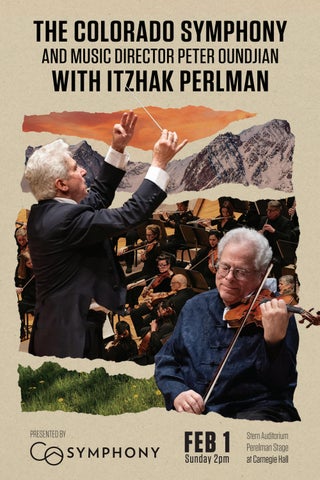
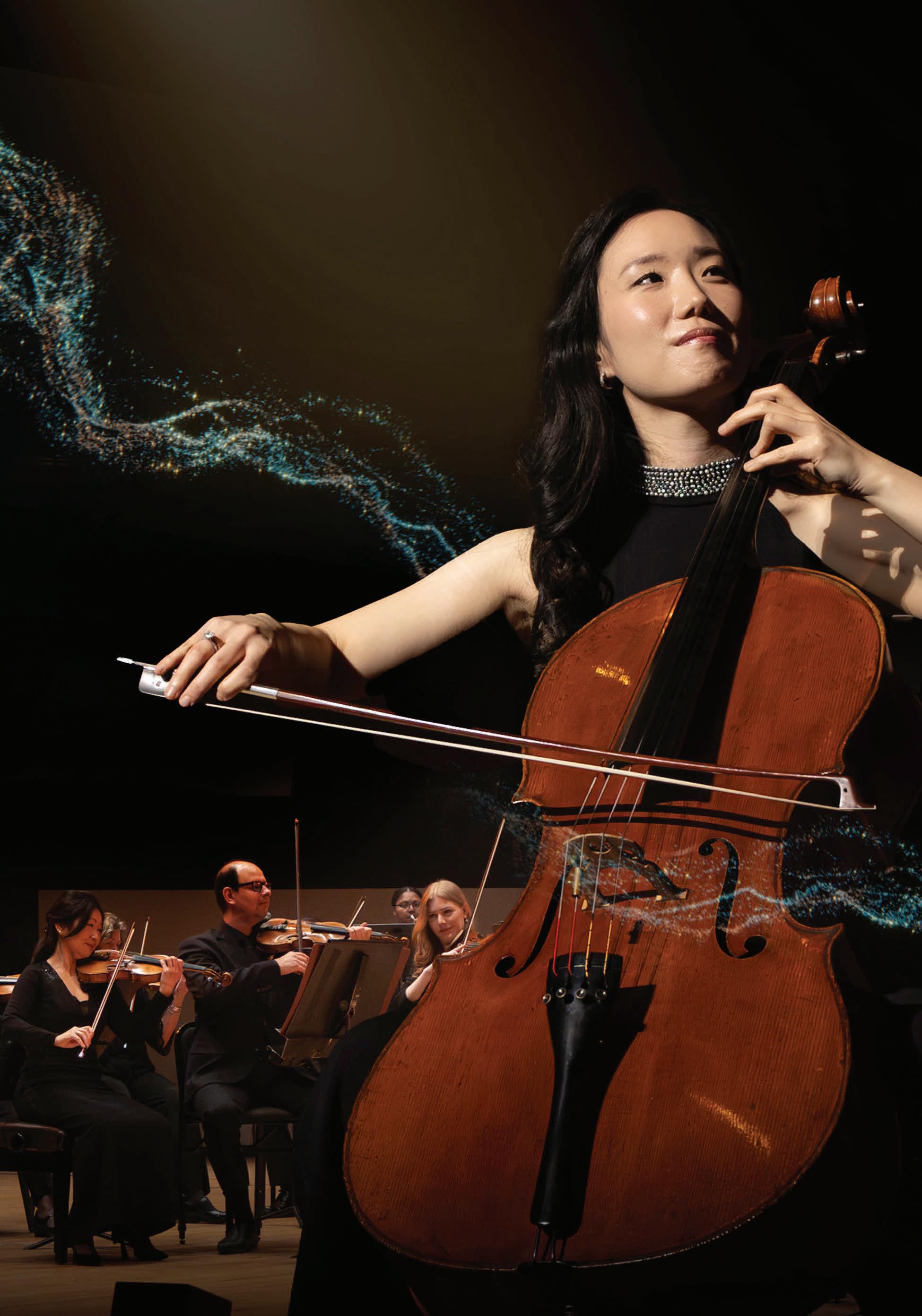
FEB 1 Sunday 2pm Stern Auditorium Perelman Stage at Carnegie Hall
WELCOME
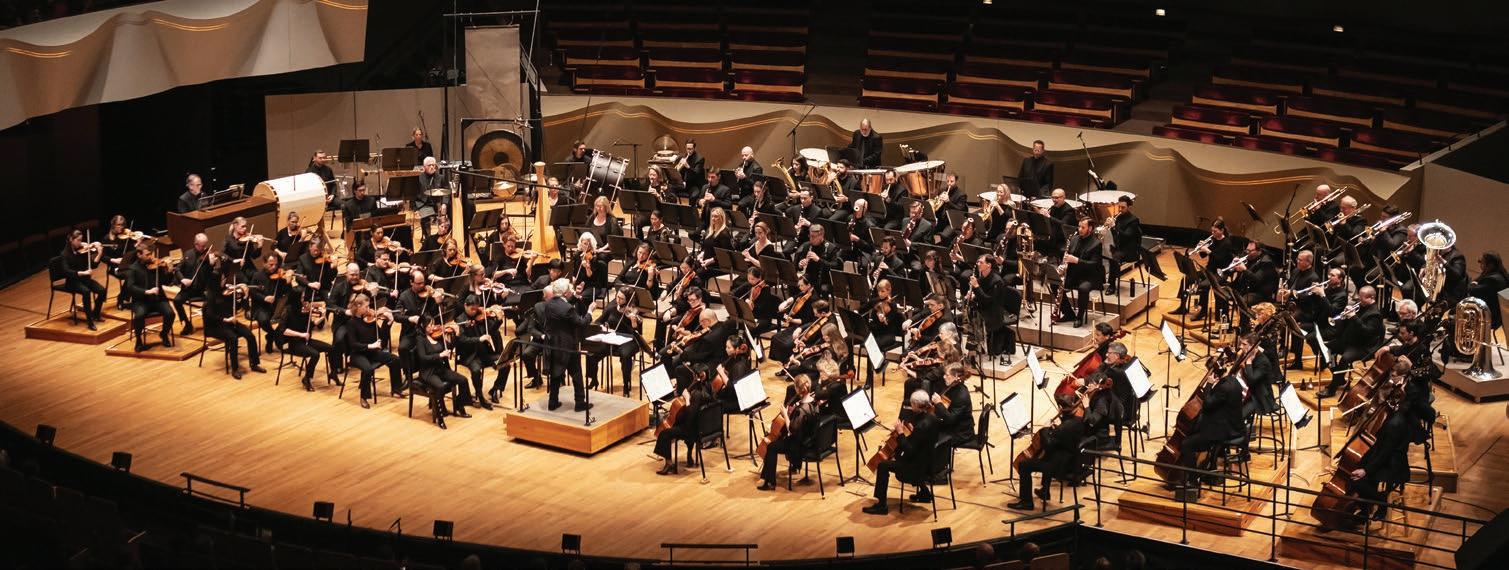
Welcome to this remarkable afternoon with the Colorado Symphony at Carnegie Hall. Bringing an orchestra to a stage like this begins with a belief: that live symphonic music still matters deeply, and that it has a unique role to play in a rapidly changing world. This performance reflects a shared conviction among our Board, musicians, donors, and community that music remains one of humanity’s most powerful ways to connect, to reflect, and to imagine what is possible together.
Welcome, and thank you for joining us for this extraordinary afternoon with the Colorado Symphony at Carnegie Hall. It is an honor to bring our orchestra to one of the world’s most storied stages, a place where artistry, history, and aspiration converge.
As we navigate an era shaped by extraordinary technological advancement, one truth continues to guide my thinking: machines don’t hear the music. Artificial intelligence can analyze patterns, generate sound, and simulate countless tasks, but it cannot feel the humanity that lives within a bow stroke, a breath, or the shared silence before a phrase begins. Music is one of the last fully human languages, and its ability to inspire empathy, imagination, and joy has never been more essential.
The role of a Board is to steward an institution not only for today, but for the future. Supporting moments like this, investing in artistic excellence, and ensuring the long-term vitality of live symphonic music are central to that responsibility. This afternoon is the result of sustained commitment, generosity, and trust across our community, and I am deeply grateful to everyone who made it possible.
The Colorado Symphony exists to inspire and unite humanity through music. I hope today’s performance reminds us why that mission matters, here in New York and far beyond this hall. Thank you for being part of this meaningful moment.
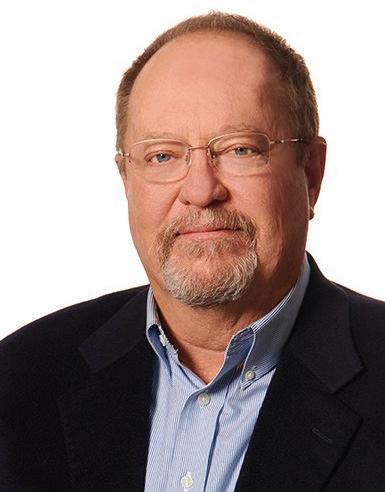
John Street Board Chair Colorado Symphony Association
This performance reflects a period of renewed focus and artistic momentum for our orchestra. Over recent seasons, our musicians have approached their work with exceptional discipline, curiosity, and commitment, earning the trust of artists, audiences, and partners alike. Through unmatched artistry and a spirit of bold creativity, they continue to expand what live symphonic music can mean for those who experience it. Today is a celebration of that collective effort and the excellence and collaboration they bring to the stage.
It has been 50 years since the Colorado Symphony last performed in New York. Returning now underscores how the orchestra has evolved and the clarity of direction guiding us forward. Alongside our two sold-out performances at Radio City Music Hall with Gregory Alan Isakov, today’s concert honors Itzhak Perlman and his enduring mentorship and friendship with our Music Director, Peter Oundjian. Together, these performances reflect an organization confident in its ability to connect tradition and innovation, and to serve diverse audiences through live symphonic music.
It is a privilege to bring the music of the Colorado Symphony to New York and to share it with you today. We are grateful to our musicians, our partners, and our community for making this moment possible, and we thank you for being part of an experience that connects people across Colorado and beyond.
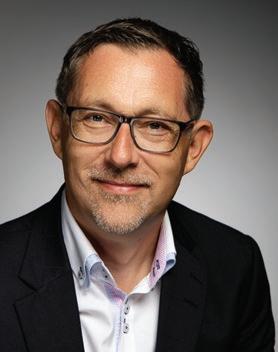
Daniel Wachter President & CEO Colorado Symphony Association
VIOLIN
Yumi Hwang-Williams Concertmaster
Mary Rossick Kern and Jerome H. Kern Concertmaster Chair
Claude Sim Associate Concertmaster
Jory Lane
Assistant Concertmaster
Dmitri Pogorelov
Fixed 4th Chair/First Merle Chambers Chair
Kate Arndt
Principal Second
Allegra Wermuth
Assistant Principal Second
Alessandra Jennings Flanagan
Fixed 3rd Chair/Second
Sohyun Ahn
Larisa Fesmire
Thomas Hanulik
John Hilton
Anne-Marie Hoffman
Myroslava IvanchenkoBartels
Dorian Kincaid
Karen Kinzie
Yon Joo Lee
Yu-Chen Lin
Susan Paik
Paul Primus
Megan Prokes
Delcho Tenev
Annamaria Vasmatzidis
Bradley Watson
Tena White
Wenting Yuan
VIOLA
Basil Vendryes
Principal
Catherine Beeson
Assistant Principal
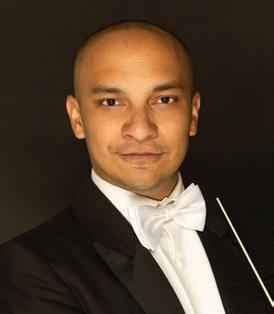
CHRISTOPHER DRAGON RESIDENT CONDUCTOR PHOTO: SIAN RICHARDS
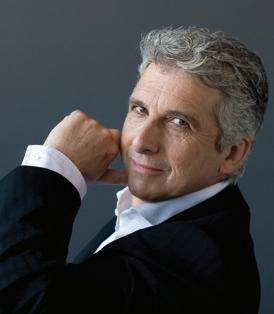
PETER OUNDJIAN MUSIC DIRECTOR
Mary Cowell
Fixed 3rd Chair
Sumin Cheong
Marsha Holmes
Helen McDermott
Summer Rhodes
Kelly Shanafelt
Phillip Stevens
CELLO
Seoyoen Min Principal
Fred & Margaret Hoeppner Chair
Chloe Hong
Assistant Principal
Judith McIntyre Galecki
Fixed 3rd Chair
Dakota Cotugno
Danielle Guideri
Thomas Heinrich
Eugene Kim
Matthew Switzer
Paul van der Sloot
Annamarie Wellems
BASS
Steve Metcalf
Principal
Nicholas Recuber
Assistant Principal
Jesse Fischer
Jeremy Kincaid
Owen Levine
August Ramos
Mary Reed
FLUTE
Brook Ferguson
Principal Flute
Catherine Peterson
2nd / Assistant Principal
Tom & Noëy Congdon
Chair
Julie Duncan Thornton
PICCOLO
Julie Duncan Thornton
OBOE
Peter Cooper Principal
Irene & David Abosch Chair
Jordan Pyle*
2nd / Assistant Principal
Jason Lichtenwalter
ENGLISH HORN
Jason Lichtenwalter
CLARINET
Jason Shafer
Principal
Abby Raymond
2nd / Assistant Principal
Nicholas Davies
E-FLAT CLARINET
Abby Raymond
BASS CLARINET
Nicholas Davies
BASSOON
Quincey Trojanowski, Principal
Tristan Rennie
2nd / Assistant Principal
Roger Soren
CONTRABASSOON
Roger Soren
HORN
Michael Thornton
Principal
Kolio Plachkov
3rd / Associate Principal
Matthew Eckenhoff
Patrick Hodge
Assistant
Johanna Yarbrough
TRUMPET
Justin Bartels
Principal
Philip Hembree
2nd / Associate
Steve Kilburn
Leslie Scarpino
TROMBONE
John Sipher Principal
Paul Naslund 2nd / Associate Principal
Gregory Harper
BASS TROMBONE
Gregory Harper
Principal
TUBA
Stephen Dombrowski Principal
HARP
Courtney Hershey Bress
Principal
Kathryn Harms
TIMPANI
Steve Hearn
Acting Principal
PERCUSSION
John Kinzie Principal Friend of the Colorado Symphony Chair
Daniel Morris*
Michael Tetreault
Michael Van Wirt
PIANO
Hsiao-Ling Lin
CELESTA
Natalia Sim
ORCHESTRA LIBRARIAN
Lyle Wong
* = One year replacement
Custom Allen
Digital-Pipe Organ provided by MervineMusic, LLC.
From Mentorship To Friendship
The long-time bond between Peter Oundjian and Itzhak Perlman brings intrigue to the Colorado Symphony’s upcoming performance at Carnegie Hall in New York City.
By Nick Dobreff
This story begins with a single sound, one so beautiful and so tender that it changed the course of an aspiring musician’s life. When Peter Oundjian was just twelve years old growing up in South London, his father took him to hear a young violinist who was already being hailed as a sensation: Itzhak Perlman. That evening, sitting spellbound in the hall, Peter heard music unlike anything he’d ever imagined, and felt, perhaps for the first time, the full power of a truly transcendent performance.
PHOTOS: AMANDA TIPTON
“The sound of the first phrase of the Franck Sonata still rings in my ears decades later,” Oundjian recalls. “I had never heard anything so tender and personal coming out of a violin.”
That evening, the music changed him, and so did the musician. Backstage, the young Oundjian watched Perlman greet every audience member warmly, telling every young musician he met to “practice a lot.” Oundjian took those words to heart – he practiced a lot.
Seven years later, at nineteen, Oundjian was preparing to audition for Juilliard. Days before flying to New York, he called an acquaintance in London — someone who wouldn’t hesitate to criticize his playing — and asked if he could play through his audition repertoire for him.
“I have a much better idea,” the acquaintance replied. “Come over to my house right now. You can play for Itzhak Perlman.”
Oundjian could hardly believe it. But that night, he found himself playing for the same man whose music had inspired him as a boy. Oundjian walked away after 45 minutes, feeling that Perlman had transformed his bow arm and thrust his technique forward in a way he didn’t know was possible. Not only did the star violinist offer words of encouragement, he handed Oundjian his personal phone number, saying, “Call me when you get to New York if you have any problems.” Oundjian was gobsmacked.
“And boy, did I have problems,” Oundjian says with a smile.
Perlman remembers the encounter and the “obviously very talented” young violinist. “What impressed me about him was, first of all,” Perlman said, “he was a very nice fellow. “That always makes a difference to me.”
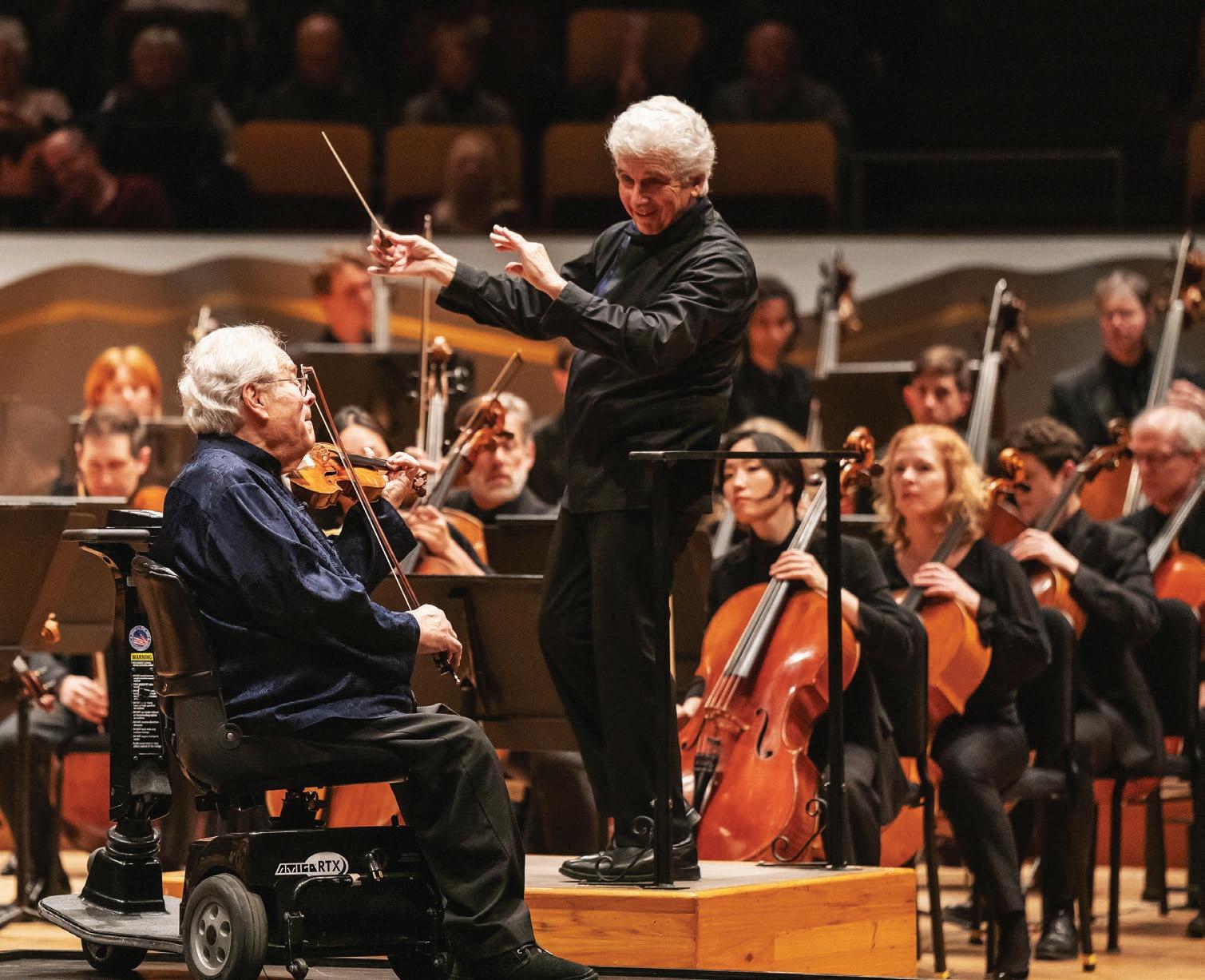
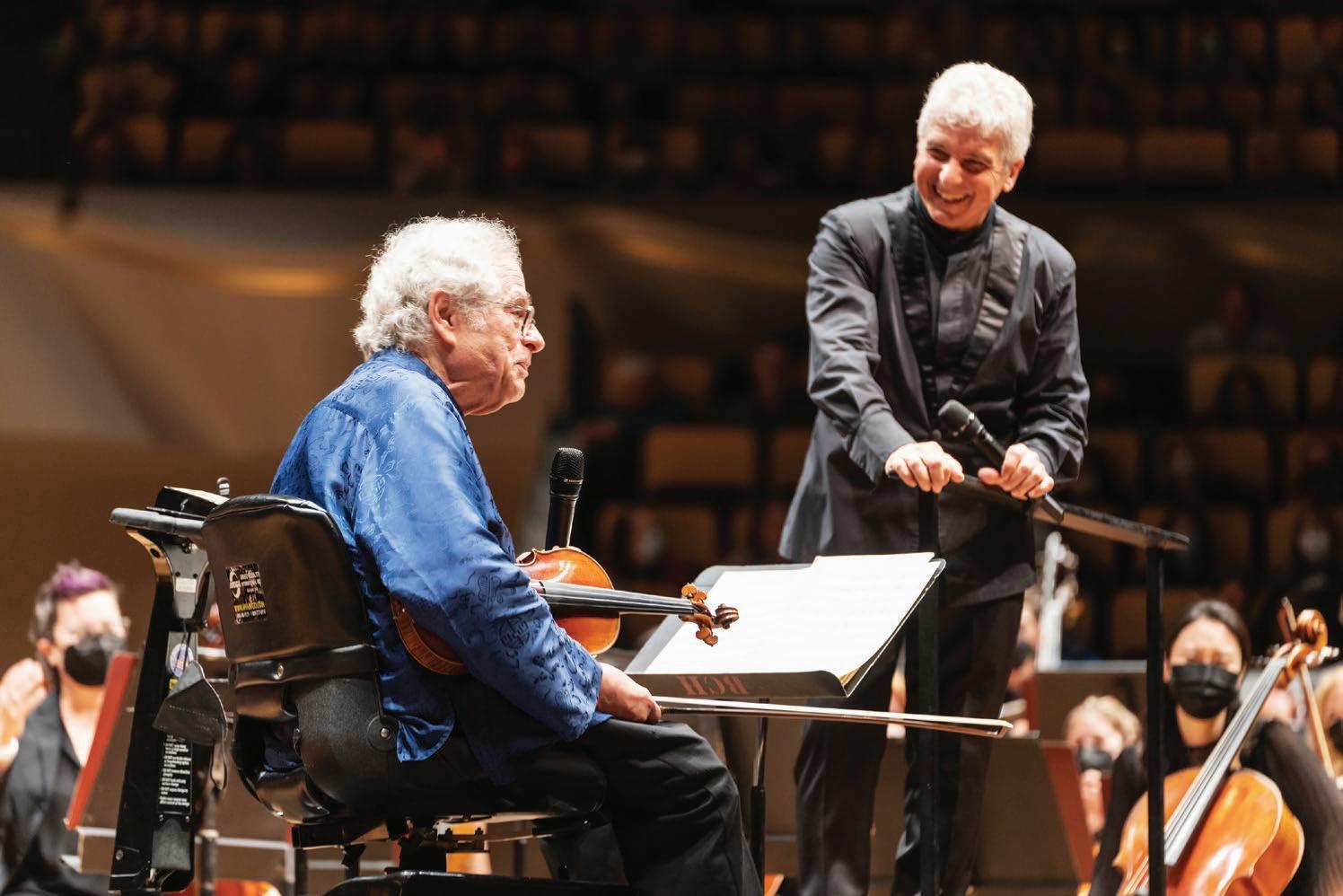
Oundjian and Perlman at Boettcher Concert Hall on January 18, 2025.
After three years studying with Ivan Galamian, Oundjian was invited to study with Perlman at Brooklyn College. There, he came to know Perlman not just as a genius of the violin but as a brilliant teacher — and a brilliant prankster too.
One day, during a lesson on the Brahms concerto, Oundjian was wrestling with a famously tricky passage of three-note chords. Perlman grabbed Oundjian’s violin, picked up his own bow, and produced the most horrendous, scratchy sound Oundjian had ever heard. He sat in stunned silence. A furious Perlman hurled his bow across the room.
Oundjian froze. Then Perlman turned suddenly remorseful, and said, “Oh no, my Tourte. Can you get it and see if I’ve broken it?”
Terrified he’d somehow been the cause of this disaster, Oundjian crept to the back of the room to retrieve the bow, only to hear Perlman laughing. The bow, it turned out, was made of fiberglass, not his priceless François Tourte bow — just the kind of prank Perlman is known for. It was not only a lesson in humility but a reminder that having a sense of humor is as essential as music itself — a point Perlman takes very seriously.
But when Perlman’s bow meets the string, there are no more jokes; his playing remains transcendent, not just technically flawless but full of warmth, humanity, and soul.
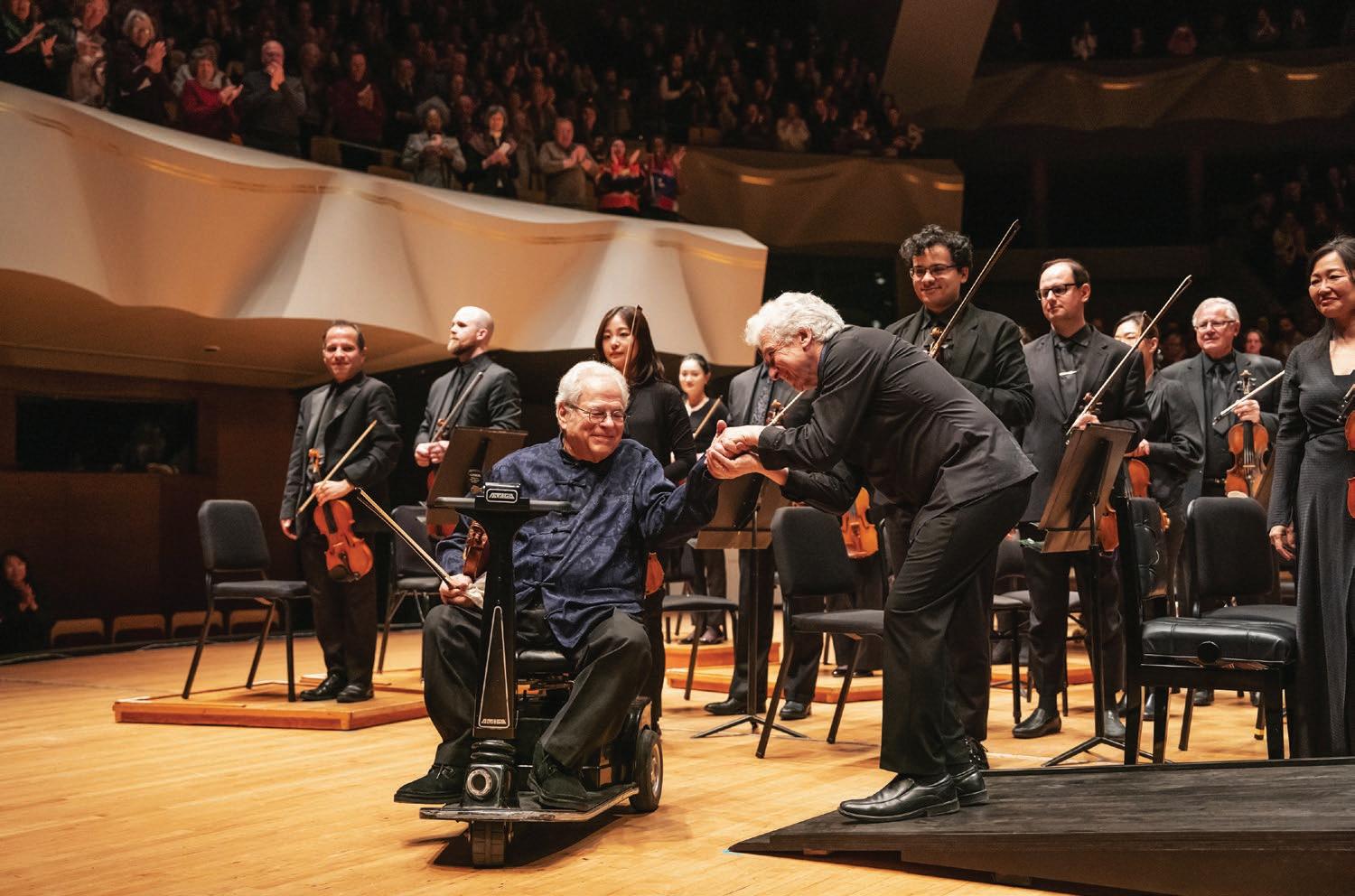
Itzhak Perlman performs with the Colorado Symphony and Peter Oundjian on September 10, 2022 at Boettcher Concert Hall.
“When Itzhak Perlman enters the stage nowadays, there is always a standing ovation,” Oundjian says. “And yet, I look at him and see the most modest reaction you could imagine, full of genuine gratitude. He has a unique way of making us all love what we do and feel that it is a privilege to be a musician.”
For many years, Oundjian relished that privilege in his own decorated career as a violinist, serving as the first violinist of the world-renowned Tokyo String Quartet, recording extensively, and performing on the world’s greatest stages. But in his late thirties, his performing career was cut short by a neurological condition called focal dystonia, which made it impossible to continue playing at the highest level.
“It was devastating at the time,” Oundjian admits. “But what pulled me through and guided me to find another path back into music is all I had learned — not only about music, but about humanity — from people like Itzhak. I knew I couldn’t leave it behind.”
So he turned to conducting, channeling everything he had learned from his teachers, colleagues, and mentors into a new chapter of his musical life. Over the years, he became a sought-after conductor, leading major orchestras across the world, and today serves as the music director of the Colorado Symphony where he continues to share the inspiration and generosity he first encountered in that South London recital hall, when he heard Perlman play the violin.
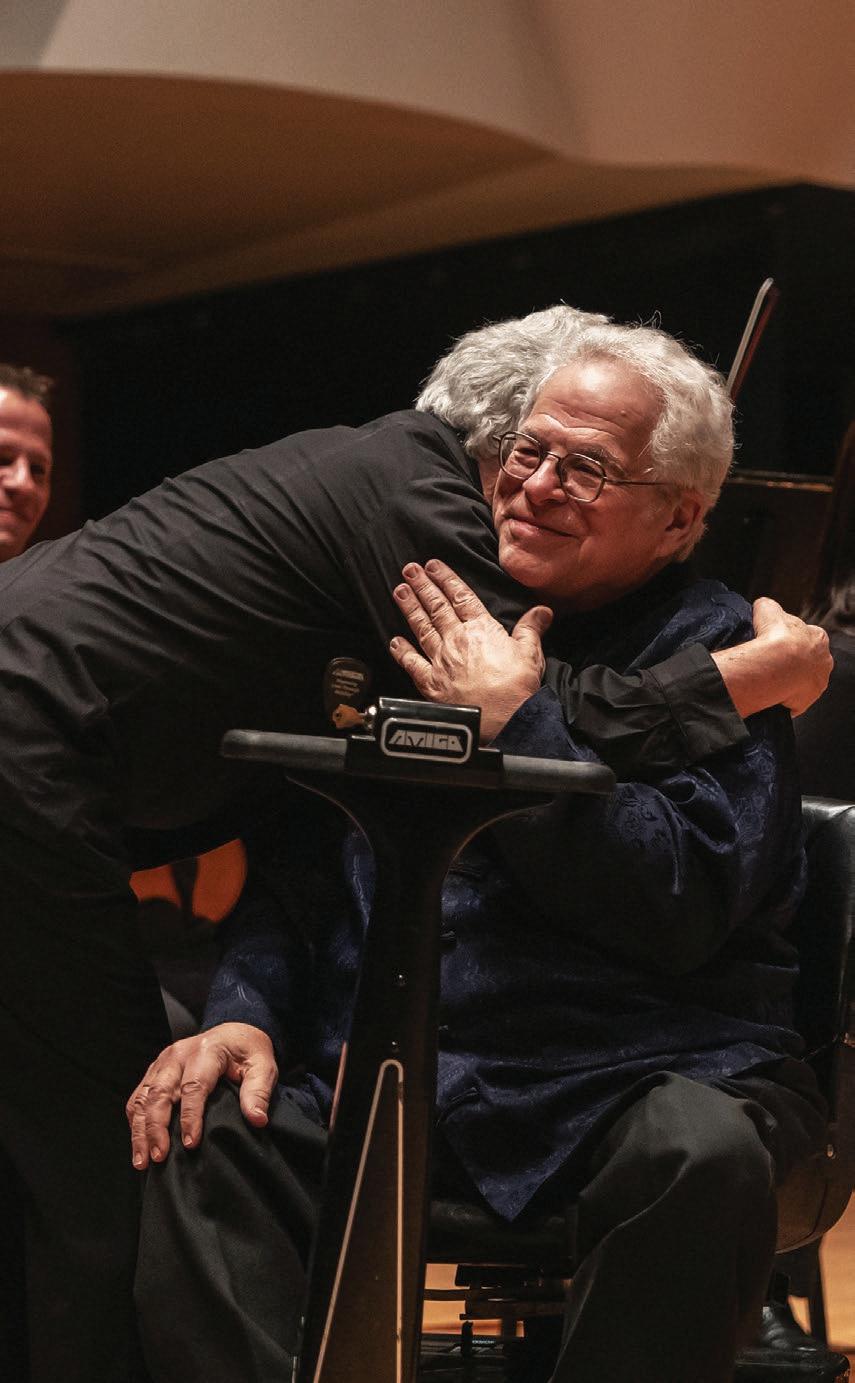
Perlman and Oundjian at Boettcher Concert Hall on January 18, 2025.
“He is an extraordinary person on many, many levels. I can’t believe what he gives to all of us. To be on the stage with him is just a thrill.”
— Peter Oundjian
For Oundjian and countless others who have had the good fortune to study with or perform alongside Itzhak Perlman, that privilege is bound up in something deeper than music alone.
“Itzhak invites us all to be part of the magic of the musical experience,” Oundjian says. “Whether we are players or listeners, the level of dedication he has always had to mentorship, to teaching us not only about musical values but how to care for others, is itself a huge inspiration.”
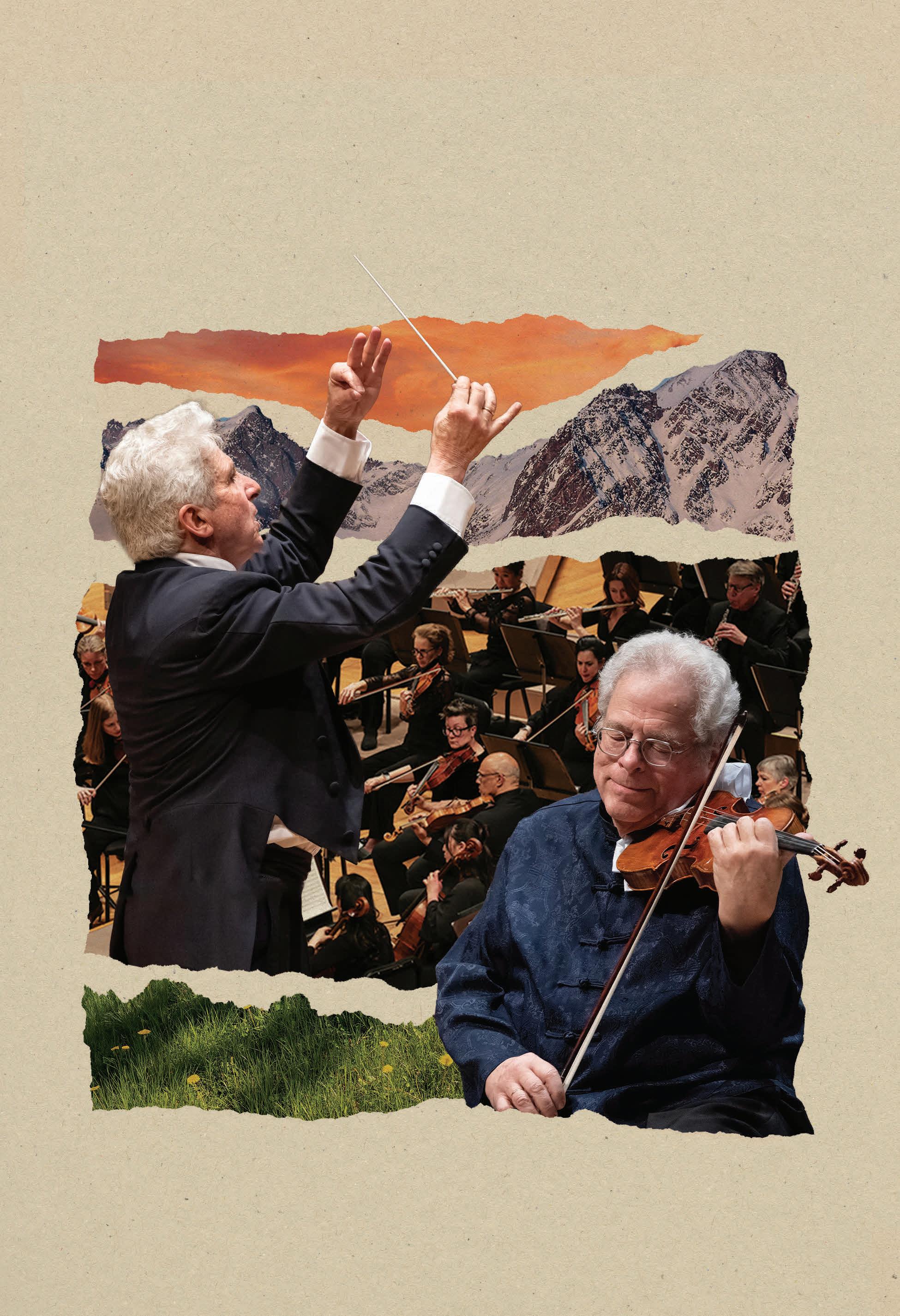
That lifelong bond between student and mentor, violinist and conductor, will come full circle as Oundjian and Perlman reunite on one of the world’s most iconic stages. On Feburary 1, 2026, the Colorado Symphony travels to New York for a thrilling performance at Carnegie Hall, joined by Perlman himself in a program that celebrates his extraordinary legacy and his deep artistic partnership with Oundjian.
Perlman, who turned 80 in August 2025, will perform works that have become synonymous with his artistry — including the poignant theme from Schindler’s List, Dvořák’s Romance in F minor, and selections by Fritz Kreisler and Carlos Gardel. Conducted by Oundjian, the evening will also feature the New York debut of John Adams’ Frenzy and Mussorgsky’s Pictures at an Exhibition, spotlighting the power and brilliance of the Colorado Symphony.
“To collaborate with Itzhak Perlman is always a profound joy, both musically and personally,” says Oundjian. “In fact, every time I share the stage with Itzhak, it is a reminder that the best teachers don’t just show you how to play. They show you how to love what you do, and how to pass that love on to others. Sharing the stage with him at Carnegie Hall, with this orchestra, will be one of the most meaningful moments of my career.”
Decades after that first recital, Peter Oundjian still carries with him the memory of that tender, personal sound of the violin and the quiet generosity of the man who made it. It’s a relationship built not just on music but on kindness, humor, and a shared belief in the transformative power of art.
“He is an extraordinary person on many, many levels,” Oundjian said. “I can’t believe what he gives to all of us. To be on the stage with him is just a thrill.”
CARNEGIE HALL FEBRUARY 1, 2026
ITZHAK PERLMAN WITH THE COLORADO SYMPHONY
PETER OUNDJIAN, conductor
Sunday, February 1, 2026 at 2:00pm
Carnegie Hall (Stern Auditorium / Perelman Stage)
ADAMS Frenzy: A Short Symphony
New York premiere
DVOŘÁK Romance for Violin and Orchestra in F minor, Op. 11 (B. 39)
KREISLER Three Selections for Violin and Orchestra
Liebesfreud
Schön Rosmarin
Tambourin Chinois
WILLIAMS Theme from Schindler’s List for Violin and Orchestra
GARDEL Tango, Por una Cabeza for Violin and Orchestra
— INTERMISSION —
MUSSORGSKY Pictures at an Exhibition
arr. RAVEL
Promenade — The Gnome
Promenade — The Old Castle
Promenade — Tuileries
Bydlo
Promenade — Ballet of the Chicks in Their Shells
Samuel Goldenberg and Schmuyle
The Marketplace at Limoges —
Catacombs, Roman Tombs — Cum Mortuis in Lingua Mortua
The Hut on Fowl’s Legs —
The Great Gate of Kiev
CONCERT RUN TIME IS APPROXIMATELY 1 HOUR AND 50 MINUTES INCLUDING A 20 MINUTE INTERMISSION.
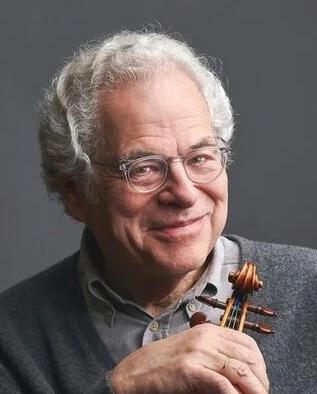
ITZHAK PERLMAN, violin
Undeniably the reigning virtuoso of the violin, Itzhak Perlman enjoys superstar status rarely afforded a classical musician. Beloved for his charm and humanity as well as his talent, he is treasured by audiences throughout the world who respond not only to his remarkable artistry but also to his irrepressible joy for making music.
Having performed with every major orchestra and at concert halls around the globe, Mr. Perlman was granted a Presidential Medal of Freedom –the Nation’s highest civilian honor – by President Obama in 2015, a National Medal of Arts by President Clinton in 2000 and a Medal of Liberty by President Reagan in 1986. Mr. Perlman has been honored with 16 GRAMMY® Awards, four Emmy Awards, a Kennedy Center Honor, a Grammy Lifetime Achievement Award and a Genesis Prize.
In the 2025/26 season, Itzhak Perlman celebrates his 80th birthday with a range of special programs across the United States. He marks the 30th anniversary of his iconic PBS special In the Fiddler’s House with performances in New York, Boston, Philadelphia, Dallas, Santa Barbara and Davis, joined by klezmer stars Hankus Netsky, Andy Statman and members of the Klezmer Conservatory Band. Orchestral highlights include Cinema Serenade programs with the Cleveland Orchestra, Louisville Orchestra and Colorado Springs Philharmonic, a play/conduct program with the San Francisco Symphony and a special appearance with the Colorado Symphony at Carnegie Hall. Perlman also continues touring An Evening with Itzhak Perlman, a multimedia program featuring stories and performance highlights from his life, and gives recitals with longtime collaborator Rohan De Silva in San Francisco, Baltimore, Austin, Palm Desert and Stony Brook.
Mr. Perlman has delighted audiences through his frequent appearances on the conductor’s podium. He has performed as conductor with the New York Philharmonic, Chicago Symphony, Philadelphia Orchestra, Boston Symphony, National Symphony, San Francisco Symphony, Los Angeles Philharmonic and the symphony orchestras of Dallas, Houston, Pittsburgh, Seattle, Montreal and Toronto as well as at the Ravinia and Tanglewood festivals. He was Music Advisor of the St. Louis Symphony from 2002 to 2004 where he made regular conducting appearances, Principal Guest Conductor of the Detroit Symphony from 2001 to 2005 and Artistic Partner of the Houston Symphony from 2021-2024. Internationally, Mr. Perlman has conducted the Berlin Philharmonic, Royal Concertgebouw Orchestra, London Philharmonic, English Chamber Orchestra and the Israel Philharmonic.
Further to his engagements as violinist and conductor, Mr. Perlman is increasingly making more appearances as a speaker. Recent speaking engagements include appearances in Texas at Lamar University, South Dakota with the John Vucurevich Foundation, Washington D.C. for the Marriott Foundation and New York in conversations with Alan Alda at the 92nd Street Y and Alec Baldwin at New York University.
Mr. Perlman’s recordings can be found on the Deutsche Grammophon, Warner/EMI, Sony Classical, London/ Decca, Erato/Elektra International Classics and Telarc labels. For more information on Itzhak Perlman, visit www.itzhakperlman.com. Management for Itzhak Perlman: Primo Artists, New York, NY. www.primoartists.com
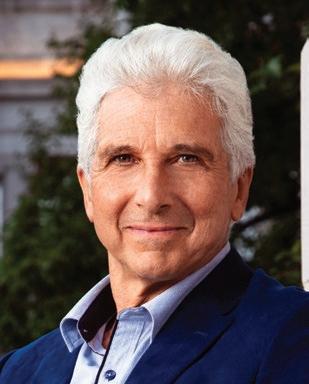
PETER OUNDJIAN, conductor
Peter Oundjian is a dynamic presence in the conducting world with an international career leading preeminent orchestras in many of the world’s major musical centers, from New York and Seattle to Amsterdam and Berlin.
He is currently Music Director of the Colorado Symphony, where he served previously as Principal Conductor. He is also Music Director of the Colorado Music Festival (CMF), where he has continued to program and conduct concerts that delight audiences with beloved masterpieces alongside music written by living composers. Over the course of his 14-year tenure as Music Director of the Toronto Symphony Orchestra, which concluded in 2018, he reinvigorated the orchestra with acclaimed innovative programming, artistic collaborations, extensive audience growth, national and international tours and several outstanding recordings, including Vaughan Williams’ Orchestral Works, which garnered a Grammy nomination and a Juno Award. Under his leadership, the Symphony underwent a transformation that significantly strengthened its presence in the world.
From 2012-2018, Oundjian served as Music Director of the Royal Scottish National Orchestra, where he led the RSNO on several international tours, including North America, China, and a European festival tour with performances at the Bregenz Festival, the Dresden Festival as well as in Innsbruck, Bergamo, Ljubljana, and others. His final appearance with the orchestra as their Music Director was at the 2018 BBC Proms where he conducted Britten’s epic War Requiem.
Oundjian was Principal Guest Conductor and Artistic Advisor of the Detroit Symphony Orchestra from 2005 to 2008 and Artistic Director of the Caramoor International Music Festival in New York from 1997 to 2007. He was also the Music Director of the Amsterdam Sinfonietta from 1998-2002. Throughout his conducting career, Oundjian has appeared as guest conductor with the country’s leading orchestras, including Philadelphia Orchestra, Boston, Chicago, Pittsburgh, Atlanta and San Francisco Symphonies, among others.
In addition to his conducting duties in Colorado, during the 2024/25 season Oundjian leads subscription weeks with the Sarasota Orchestra, the Rochester Philharmonic Orchestra, the Seattle Symphony, and the Atlanta Symphony Orchestra.
Oundjian has been a visiting professor at Yale University’s School of Music since 1981, and has received honorary doctorates from the San Francisco Conservatory of Music and The Royal Conservatory of Music in Toronto.
COLORADO SYMPHONY
One of the leading orchestras in the United States, the Colorado Symphony Association is a notfor-profit 501(c)(3) organization performing more than 150 concerts annually at Boettcher Concert Hall in downtown Denver and across Colorado. Led by Peter Oundjian as its Music Director as of the 2025/26 season, the Colorado Symphony is home to eighty full-time musicians representing more than a dozen nations and regularly welcomes the world’s most celebrated artists from across musical genres. The orchestra celebrated its Centennial during the 2023/24 concert season and now serves more than 340,000 people each year through live performances at Boettcher Concert Hall, Red Rocks Park & Amphitheatre, and other venues throughout Colorado’s Front Range.
Boettcher Concert Hall, which opened in 1978, was the first in-the-round symphonic venue built in the United States. In November 2025, voters passed the Vibrant Denver Bond, which allocates $20 million to a future renovation of the concert hall. The renovation will be the first since the hall was constructed nearly 50 years ago and once completed, will ensure Boettcher Concert Hall lasts for generations to come.
Guided by a vision to inspire and unite humanity through live symphonic music, the Colorado Symphony is a living heartbeat of the state — expressing its beauty, creativity, vitality, and inclusive spirit. Through unmatched artistry and bold innovation, the Symphony inspires Colorado and audiences everywhere while expanding access, fostering education, and creating lasting memories through meaningful personal connections.
Recognized as an incubator of innovation, creativity, and excellence, the Colorado Symphony listens to and learns from its diverse communities, musicians, and staff; composes and creates with curiosity and versatility; and leads with empathy, collaboration, and responsible stewardship. The Symphony continually expands its reach through in-person and virtual education programs, community partnerships, and programming that celebrates achievement, honors diverse voices, and infuses joy on and off the stage.
The Colorado Symphony partners with leading musical artists, cultural organizations, corporations, foundations, educators, sports teams, and individuals to connect people, uplift communities, and inspire everyone to feel part of something greater.
The Colorado Symphony performs An Alpine Symphony at Boettcher Concert Hall as the finale to their Centennial Season in May 2023.
JOHN ADAMS (B. 1947)
Frenzy: A Short Symphony
COMPOSITION & PREMIERE OF WORK:
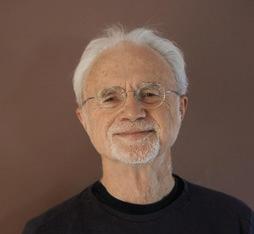
John Adams was born on February 15, 1947 in Worcester, Massachusetts. Frenzy: A Short Symphony was composed in 2023, and premiered on March 3, 2024 at the Barbican in London by the London Symphony Orchestra, conducted by Sir Simon Rattle.
INSTRUMENTATION:
piccolo, three flutes, two oboes, English horn, E-flat clarinet, two clarinets, bass clarinet, two bassoons, contrabassoon, four horns, three trumpets, three trombones, tuba, timpani, percussion, celesta, two harps and strings.
DURATION:
About 18 minutes.
John Adams is one of today’s most acclaimed composers. Audiences have responded enthusiastically to his music, and he enjoys a success not seen by an American composer since the zenith of Aaron Copland’s career: a recent survey of major orchestras conducted by the League of American Orchestras found John Adams to be the most frequently performed living American composer; he won five Grammy Awards between 1989 and 2004; he received the University of Louisville’s prestigious Grawemeyer Award in 1995 for his Violin Concerto; in 1997, he was elected to the American Academy of Arts and Letters, and named “Composer of the Year” by Musical America magazine; he was made a Chevalier dans l’Ordre des Arts et des Lettres by the French Ministry of Culture; in 2003, he received the Pulitzer Prize for On the Transmigration of Souls, written for the New York Philharmonic in commemoration of the first anniversary of the World Trade Center attacks; from 2003 to 2007, Adams held the Richard and Barbara Debs Composer’s Chair at Carnegie Hall, and since 2009 has he been Creative Chair with the LA Philharmonic; in 2004, he was awarded the Centennial Medal of Harvard University’s Graduate School of Arts and Sciences “for contributions to society,” and in 2019 became the first American composer to receive the Erasmus Prize “for notable contributions to European culture, society and social science”; he has been granted honorary doctorates from the Royal Academy of Music (London), Juilliard School, and Cambridge, Harvard, Yale and Northwestern universities, honorary membership in Phi Beta Kappa, and the California Governor’s Award for Lifetime Achievement in the Arts; in June 2023, the Library of Congress announced that it was acquiring Adams’ manuscripts and papers for its Music Division, which also holds the papers of Leonard Bernstein, Aaron Copland, George and Ira Gershwin, Martha Graham, Charles Mingus, Neil Simon and other distinguished American artists.
Adams wrote that Frenzy: A Short Symphony, premiered on March 3, 2024 by the London Symphony Orchestra under the direction of Sir Simon Rattle, to whom the score is dedicated, is “a one-movement symphony that, in the course of its twenty minutes, encompasses a variegated yet unified symphonic structure. Its title notwithstanding, the piece is generally buoyant and extrovert and postpones its real frenetic energy to the concluding moments.
“What makes Frenzy unique in comparison to my other works is its focus, almost to the point of obsession, on the development and transformation of small, vivid motives that continue to resurface in various guises throughout the piece. This kind of classic development treatment of motivic ideas differs from the gradual ‘change-via-repetition’ technique in my earlier, minimalistinfluenced works. In fact, once completed, Frenzy revealed itself, much to the surprise of its composer, as a melding of the two approaches toward musical form. On the one hand, its rhythmic event horizon is still essentially pulse-driven while on the other its melodic world is about shapeshifting and the ‘spinning out’ of ideas.
“The opening bars present two contrasting gestures: a punctuated tattoo in the winds and brass and an urgent, muscular theme in the upper strings. Both these ideas reappear throughout the piece, always transformed in one way or another and yet always identifiable.
“In place of a ‘slow movement,’ the music’s surface simply quiets down; density and forcefulness yield to feelings of lightness and transparency. The pulse is still there, now carried along by a congenial interplay among the two harps and celesta while the strings limn a lyrical melody that floats above them.
“The final section is indeed frenetic, with hard-driven, choppy string figures, tsunami-like waves of brass and madly scurrying woodwinds, all of which come together to earn the piece its title.”
ANTONÍN DVOŘÁK (1841-1904)
Romance for Violin and Orchestra in F minor, Op. 11
COMPOSITION & PREMIERE OF WORK:
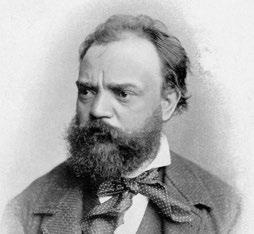
Antonín Dvořák was born September 8, 1841 in Nelahozeves, Bohemia, and died May 1, 1904 in Prague. The Romance for Violin was arranged in 1879 from the F minor String Quartet of 1873.
INSTRUMENTATION:
The score calls for pairs of woodwinds, two horns and strings.
DURATION: About 13 minutes.
Early in 1873, the 32-year-old Antonín Dvořák had his opera King and Charcoal Burner accepted for performance by Prague’s Provisional Theater. After a few rehearsals, however, the Theater’s staff reconsidered its decision, and returned the score to the young composer as “unperformable.” (Dvořák later gave tacit agreement to this judgment by extensively revising the heavily Wagner-influenced score in 1881 and again in 1887.) The Provisional Theater’s rejection tempered the delight Dvořák had gained from the successful premiere of his cantata Hymnus during the spring, and caused him to undertake a wholesale reevaluation of his existing works. So extensive was his 1873 pruning of his juvenilia that he later kidded about “always having enough paper to build a fire.” Some of his frustration of those months following the rejection of King and Charcoal Burner was poured into a String Quartet in F minor that was apparently intended to have an autobiographical significance, similar to that of Smetana’s Quartet No. 1 in E minor, “From My Life,” composed three years later. Indeed, Dvořák may have conceived his
piece for a chamber music society founded in Prague the preceding spring whose pianist was Smetana himself. Unfortunately, the society did not care for the Quartet, and the score lay in the composer’s desk unpublished and unperformed for six years.
In 1879, after Dvořák had become associated with the Berlin publisher Simrock through the advocacy of Brahms and the critic Eduard Hanslick, he returned to the early F minor Quartet and adapted from its slow movement the Romance for Solo Violin and Small Orchestra. Simrock issued the piece that same year as Dvořák’s Opus 11. (The complete Quartet was not published until 1929.) The Romance is a sweetly melancholy nocturne, filled with tender emotions. Following an ethereal introduction high in the strings, the solo violin sings the work’s soulful principal melody above a simple, rocking background. The center of the piece comprises a soaring violin theme, a gently swaying motive for the woodwinds in waltz rhythm, and a strongly marked section for the string choir. The soloist recalls the thoughtful mood of the opening before turning from the expressive key of F minor to the brighter tonality of F major to bring the Romance to a contented close.
FRITZ KREISLER (1875-1962)
Three Selections for Violin and Orchestra
COMPOSITION & PREMIERE OF WORK:
Fritz Kreisler was born on February 2, 1875, in Vienna, and died on January 29, 1962, in New York. Schön Rosmarin (“Beautiful Rosemary”), Liebesfreud (“Love’s Joy”) and Tambourin Chinois (“Chinese Drum”) were published in 1910.
INSTRUMENTATION: The score calls for
DURATION: About 12 minutes.
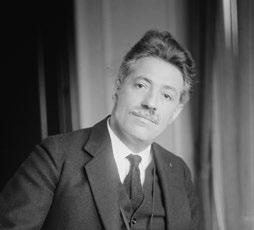
Fritz Kreisler — “unanimously considered among his colleagues to be the greatest violinist of the 20th century,” wrote critic Harold Schonberg in The New York Times on January 30, 1962, the day after Kreisler died — was admitted to the Vienna Conservatory when he was seven, gave his first performance at nine, and won a Gold Medal when he was ten. He then transferred to the Paris Conservatoire, where, at age twelve, he won the school’s Gold Medal over forty other competitors, all of whom were at least ten years his senior. In 1888-1889, Kreisler successfully toured the United States but then virtually abandoned music for several years, studying medicine in Vienna and art in Rome and Paris, and serving as an officer in the Austrian army. He again took up the violin in 1896 and failed to win an audition to become a member of the Vienna Philharmonic, but quickly established himself as a soloist, making his formal reappearance in Berlin in March 1899. He returned to America in 1900 and gave his London debut in 1901, creating a sensation at every performance. At the outbreak of World War I, Kreisler rejoined his former regiment but he was wounded soon thereafter and discharged from service. In November 1914, he moved to the United States, where he had been appearing regularly for a decade. He gave concerts in America to raise funds for Austrian war relief, but anti-German sentiment ran so high after America’s entry into the war that he had to temporarily withdraw
from public life. He resumed his concert career in New York in October 1919, then returned to Europe. In 1938, following the annexation of Austria by the Nazis, Kreisler settled in the United States for good; he became an American citizen in 1943. Despite being injured in a traffic accident in 1941, he continued concertizing to immense acclaim through the 1949-1950 season. He died in New York in 1962.
In addition to being one of the 20th-century’s undisputed masters of the violin, Fritz Kreisler also composed a string quartet, a violin concerto and two operettas (Apple Blossoms and Sissy), but he is most fondly remembered for his many short compositions and arrangements for violin, many of which bear the endearing stamp of the Gemütlichkeit of his native Vienna. Schön Rosmarin (“Beautiful Rosemary”) and Liebesfreud (“Love’s Joy”) are waltzes in the traditional manner. In contrast, the virtuosic Tambourin Chinois (“Chinese Drum”), with its pentatonic main theme and its lilting middle section that sounds like nothing so much as a Cuban tango, evokes a most pleasing exoticism.
JOHN WILLIAMS (B. 1932)
Theme from Schindler’s List
COMPOSITION & PREMIERE OF WORK:
John Williams was born on February 8, 1932 in Flushing, New York. He composed the soundtrack for Schindler’s List in 1993.
INSTRUMENTATION:
The score calls for piccolo, three flutes, oboe, English horn, three clarinets, bass clarinet, two bassoons, horn, percussion, harp, celesta and strings.
DURATION: About 4 minutes.
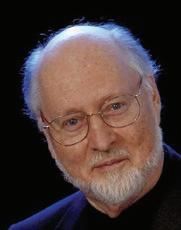
John Williams, perhaps the most successful and widely known of all Hollywood composers, has written the music and served as music director for well over a hundred films, including Star Wars, Jaws, E.T. (The Extra-Terrestrial), Close Encounters of the Third Kind, Superman, Raiders of the Lost Ark, The River, The Witches of Eastwick, Home Alone and Schindler’s List He has 52 Academy Award nominations (the most of any living person and second only to Walt Disney) and won five Oscars, 25 Grammys, four Golden Globes and three Emmys, as well as numerous gold and platinum records. In 1993, Williams composed the score for Steven Spielberg’s searing screen drama Schindler’s List, starring Liam Neeson, Ben Kingsley and Ralph Fiennes. The film, the most acclaimed movie of the year, won for Williams an Oscar for his music and for Spielberg his first Academy Award as director. The composer wrote, “The film’s ennobling story, set in the midst of the great tragedy of the Holocaust, offered an opportunity to create not only dramatic music, but also themes that reflected the more tender and nostalgic aspects of Jewish life during those turbulent years.
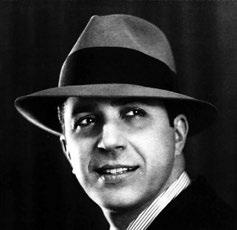
CARLOS GARDEL (1890-1935)
Tango, Por una Cabeza (“By a Head”)
COMPOSITION & PREMIERE OF WORK:
Carlos Gardel was born on December 11, 1890 in Toulouse, France, and died on June 24, 1935 in Medellín, Colombia. Por una Cabeza was composed in 1935.
INSTRUMENTATION:
The score calls for three flutes, three oboes, English horn, three clarinets, bass clarinet, three bassoons, contrabassoon, four horns, timpani, percussion, celesta, two harps and strings.
DURATION: About 4 minutes.
Carlos Gardel helped bring the Argentine tango to the world. Gardel may have been born in Uruguay or in France, in 1890; his mother was from Toulouse, and his father might have been a Uruguayan army colonel. Whatever his background, Gardel had arrived in Buenos Aires by 1893, and he emerged as a popular café and carnival singer while still a teenager. He went on to record nearly 900 songs, many of them his own, create sensations in Paris, Madrid and Barcelona, and appear in some twenty films during the 1930s, including Hollywood’s Tango Bar and The Big Broadcast of 1936. His popularity in Argentina was unprecedented, and his funeral in Buenos Aires after he was killed in a plane accident on the way to perform in Medellín, Colombia in June 1935 was the biggest that city had ever seen. The title of Gardel’s Por una Cabeza (1935), with lyrics by Alfredo Le Pera about a compulsive gambler comparing his addiction to the race-track and his irresistible attraction to woman, refers to winning a race “by a head.”
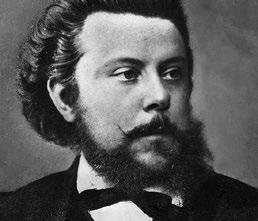
MODEST MUSSORGSKY (1839-1881)
Pictures at an Exhibition TRANSCRIBED FOR ORCHESTRA BY MAURICE RAVEL (1875-1937)
COMPOSITION & PREMIERE OF WORK:
Modest Mussorgsky was born on March 21, 1839 in Karevo, Pskov District, Russia, and died on March 28, 1881 in St. Petersburg. Maurice Ravel was born on March 7, 1875 in Ciboure, France, and died on December 28, 1937 in Paris. Mussorgsky composed Pictures at an Exhibition for solo piano in June 1874. Ravel transcribed the work for orchestra early in 1923 on a commission from the conductor Sergei Koussevitzky, who premiered the work in Paris on May 3, 1923.
INSTRUMENTATION:
The score calls for piccolo, three flutes, three oboes, English horn, two clarinets, bass clarinet, two bassoons, contrabassoon, E-flat alto saxophone, four horns, three trumpets, three trombones, tuba, timpani, percussion, celesta, two harps and strings.
DURATION:
About 36 minutes.
In the years around 1850, with the spirit of nationalism sweeping through Europe, several young Russian artists banded together to rid their native art of foreign influences in order to establish a distinctive character for their works. At the front of this movement was a group of composers known as “The Five” (and in Russia as “The Mighty Handful”), whose members included Mussorgsky, Rimsky-Korsakov, Borodin, César Cui and Mily Balakirev. Among the
allies The Five found in other fields was the artist and architect Victor Hartmann, with whom Mussorgsky became close personal friends. Hartmann’s premature death at 39 stunned the composer and the entire Russian artistic community. The noted critic Vladimir Stassov organized a memorial exhibit of Hartmann’s work in February 1874, and it was under the inspiration of that showing of his late friend’s works that Mussorgsky conceived his Pictures at an Exhibition for piano. Maurice Ravel made his masterful orchestration of the score for Sergei Koussevitzky’s Paris concerts in 1923.
Promenade. According to Stassov, this recurring section depicts Mussorgsky “roving through the exhibition, now leisurely, now briskly, and, at times sadly, thinking of his friend.” The Gnome. Hartmann’s drawing is for a fantastic wooden nutcracker representing a gnome who gives off savage shrieks while he waddles about. Promenade — The Old Castle. A troubadour sings a doleful lament before a foreboding, ruined ancient fortress. Promenade — Tuileries. Hartmann’s picture shows a corner of the famous Parisian garden filled with nursemaids and their youthful charges. Bydlo. Hartmann’s painting depicts a rugged wagon drawn by oxen. The peasant driver sings a plaintive melody (solo tuba) heard first from afar, then close-by, before the cart passes away into the distance. Promenade — Ballet of the Chicks in Their Shells. Hartmann’s costume design for the 1871 fantasy ballet Trilby shows dancers enclosed in enormous egg shells. Samuel Goldenberg and Schmuyle was inspired by a pair of pictures depicting two residents of the Warsaw ghetto, one rich and pompous (a weighty unison for strings and winds), the other poor and complaining (muted trumpet). Mussorgsky based both themes on incantations he had heard on visits to Jewish synagogues. The Marketplace at Limoges. A lively sketch of a bustling market. Catacombs, Roman Tombs. Cum Mortuis in Lingua Mortua. Hartmann’s drawing shows him being led by a guide with a lantern through cavernous underground tombs. The movement’s second section, titled “With the Dead in a Dead Language,” is a mysterious transformation of the Promenade theme. The Hut on Fowl’s Legs. Hartmann’s sketch is a design for an elaborate clock suggested by Baba Yaga, the fearsome witch of Russian folklore who flies through the air. Mussorgsky’s music suggests a wild, midnight ride. The Great Gate of Kiev was inspired by Hartmann’s plan for a gateway for the city of Kiev in the massive old Russian style crowned with a cupola in the shape of a Slavic warrior’s helmet. The majestic music suggests both the imposing bulk of the edifice (never built, incidentally) and a brilliant procession passing through its arches.
Program Notes ©2025 Dr. Richard E. Rodda
A 21st-Century Symphony
After 50 years, the Colorado Symphony returns to the Big Apple as a cutting-edge orchestra with a bold artistic identity.
By Nick Dobreff
When you think of symphonic music, what do you see? What do you hear? Does your mind wander to faded images of legendary composers in weathered textbooks? Do you recall a favorite symphony or concerto, something intertwined with a powerful memory or emotion? Or are you transported into your favorite concert venue, immersed in the lights, the atmosphere, the living sound of an orchestra in full bloom?
For centuries, live symphonic music was the world’s most powerful shared artistic experience. Before the age of recorded sound, hearing a great work like Beethoven’s Ninth Symphony even once could shape a lifetime. That scarcity created an insatiable appetite for orchestral music, drawing audiences to the concert hall generation after generation.
But the 20th century ushered in new musical forms — jazz, rock and roll, country, hip hop, electronica — and unprecedented accessibility. Music moved from concert halls into homes, cars, headphones, and eventually smartphones, where any song is available at the touch of a button. With this explosion of access has come enormous competition for ears, attention, and cultural relevance.
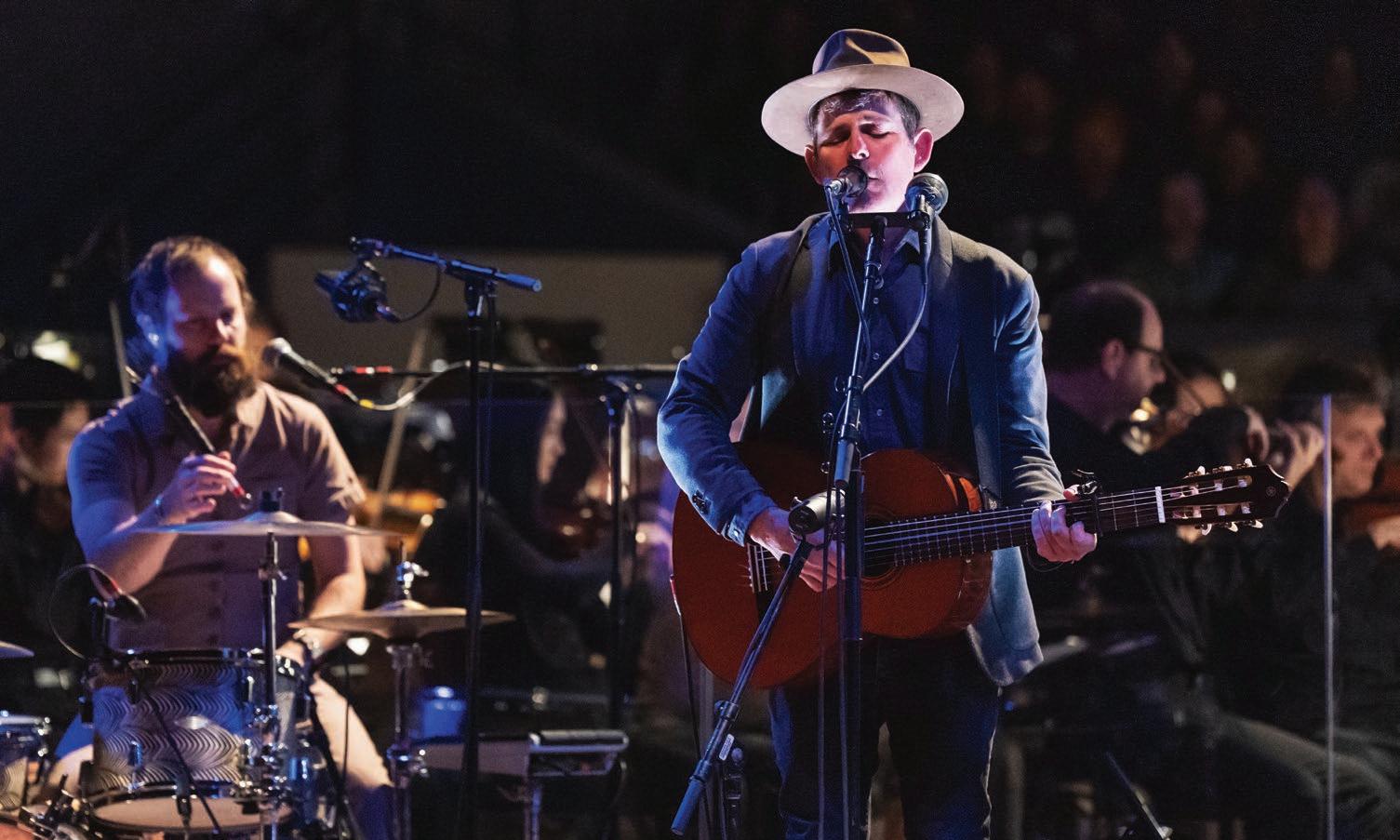
Gregory Alan Isakov with the Colorado Symphony at Boettcher Concert Hall on April 18, 2025.
So what is the role of symphonic music in the 21st century? How does one of humanity’s oldest musical traditions remain vibrant in an ever-changing world?
This is the question that every orchestra must answer and one the Colorado Symphony has been boldly redefining. Our vision guides us: We inspire and unite humanity through live symphonic music, connecting communities across Colorado and beyond. That “beyond” now includes New York City, where our orchestra takes the stage this season for two sold-out performances with Gregory Alan Isakov at Radio City Music Hall and a landmark sold-out appearance alongside Itzhak Perlman at Carnegie Hall.
These historic concerts are the natural culmination of a multi-decade-long transformation, one rooted in innovating and re-imagining what a 21st-century orchestra can be.
Collaborations That Open Doors
The Symphony’s journey into genre-blending innovation began gradually. In 1992, the orchestra performed alongside rock icons The Moody Blues at the breathtaking Red Rocks Park & Amphitheatre in Morrison, Colorado, just outside of Denver’s city limits. However, such partnerships did not manifest regularly until nearly two decades later when, in 2012, the Colorado Symphony joined GRAMMY®-nominated Indie folk-rock group DeVotchKa for a pair of performances at Boettcher Concert Hall and Red Rocks.
For the Colorado Symphony, this collaboration was an opportunity to perform with a group of local, world-class musicians while also coming face-to-face with thousands of music lovers who may never have seen a live symphonic orchestra before. And for DeVotchKa, collaborating with the Colorado Symphony added lush new layers to their songs, creating a concert experience that felt familiar and yet completely original.
The performance was hailed as “transcendent,” by The Denver Post and a new path emerged.
It accelerated in 2016 when the Colorado Symphony and Colorado Symphony Chorus joined The Flaming Lips for a psychedelic, confetti-filled, sold-out performance of their hit album, The Soft Bulletin, at Red Rocks — a collaboration so successful that it was later released as a recording.
That same year, the Colorado Symphony joined forces with Gregory Alan Isakov on an album that has become a cult favorite and led to several performances together in the years since, culminating in January’s collaboration at Radio City Music Hall.
These collaborations were bold. To some, they seemed improbable. But for audiences, they were joyful revelations. And they changed everything.
A Growing, Transforming Audience
Since 2012, the Colorado Symphony has steadily expanded and diversified its audience. The average age of patrons at Boettcher Concert Hall has dropped from 69 to 49
during that time. When including Red Rocks, the average dips into the early 40s — an extraordinary shift for any orchestra in America.
“What we do at Red Rocks is we’re giving many audience members their initial exposure to what live symphonic music can be,” said Anthony Pierce, Chief Artistic Officer for the Colorado Symphony. “It’s a long process to get anybody to be your fan and it doesn’t happen overnight. We have to chip away at that gradually and it starts with education and outreach in our community. We have the largest and most diverse audience in our history and the numbers prove that. But our greatest challenge as an institution is ensuring there is demand for live symphonic traditional classical music in the future, and that’s what we’re committed to.”
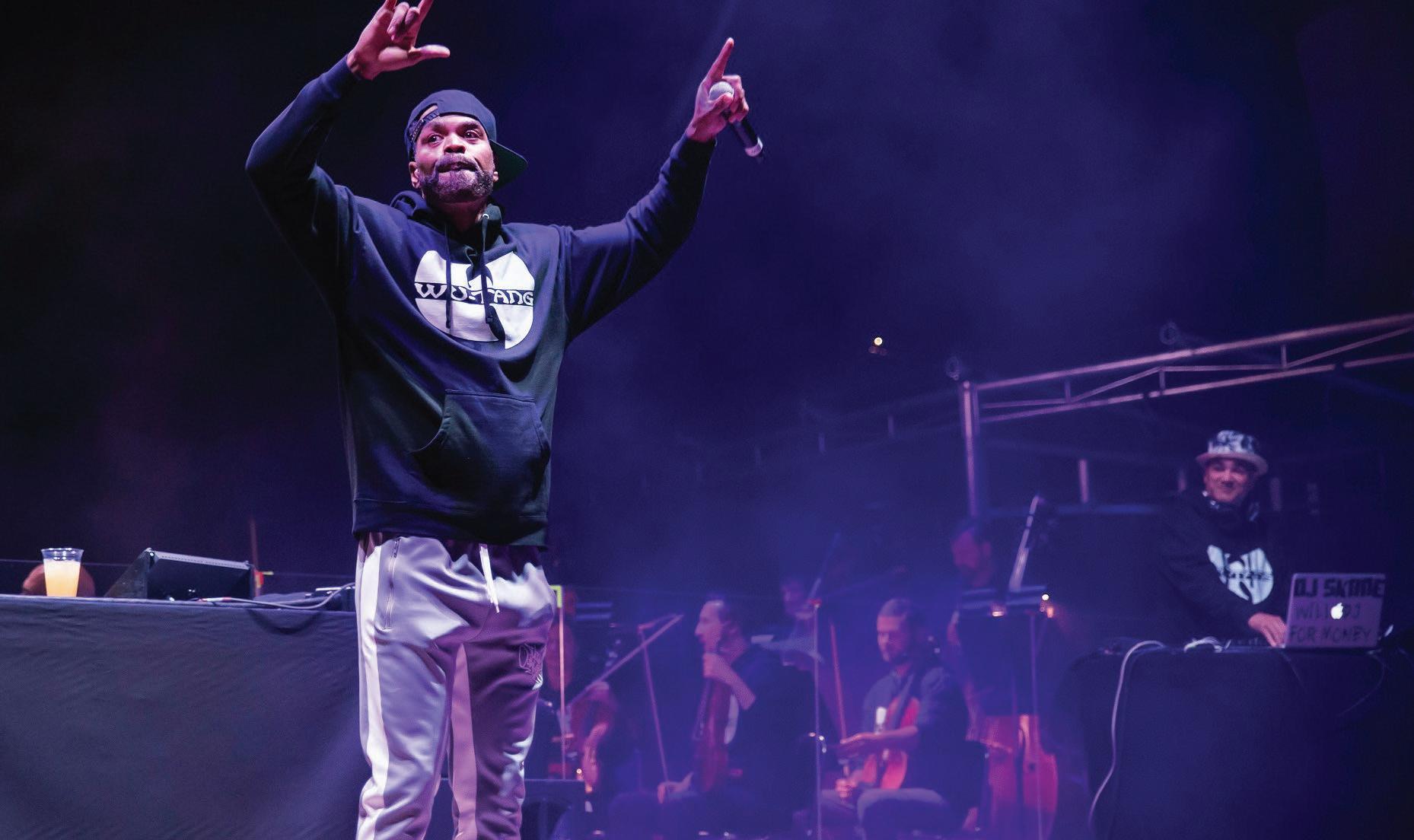
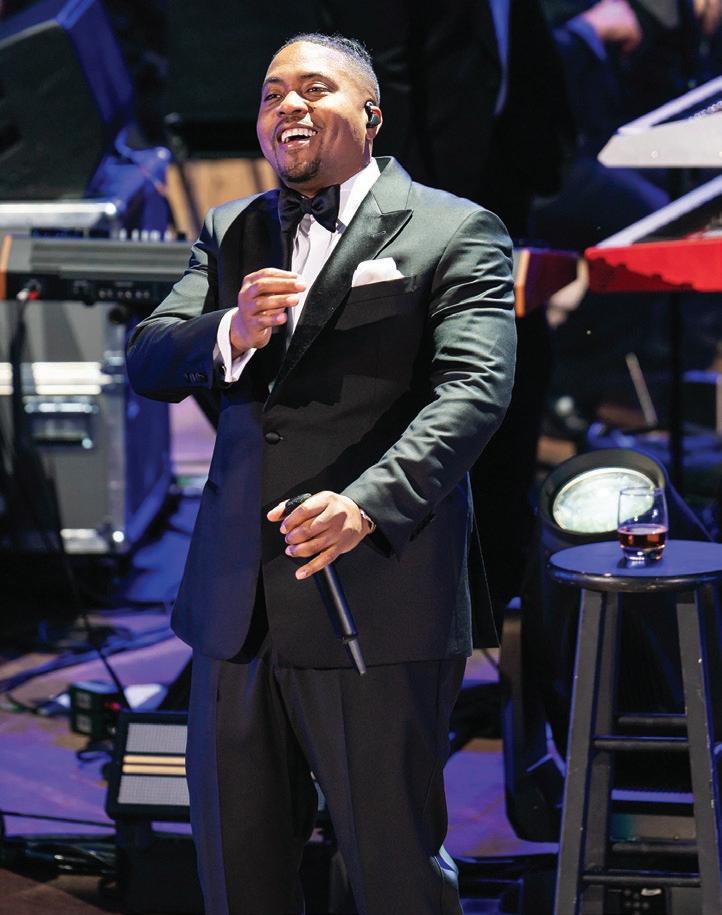
Red Rocks became an essential part of this strategy, with genre-defying performances featuring some of today’s biggest names in music. Since 2012, over 30 artists have performed alongside the Colorado Symphony at the iconic venue, including OneRepublic, The Flaming Lips, Wu-Tang Clan, Ingrid Michaelson, Nathaniel Rateliff, Nas, Amos Lee, Sara McLachlan, and, critically, Gregory Alan Isakov. These types of performances — the outside-the-classical-music-box-type shows — are not only delivering vital revenue for this nonprofit orchestra, but also solidifying that future audience which is vital to the future of symphonic music in Colorado and across the country.
“We’ve been working to consciously build a reputation as an orchestra where a nonsymphonic artist has their great first experience with an orchestra,” said Resident Conductor Christopher Dragon “When you find the right formula and connection, it just creates something uniquely beautiful. You can’t recreate that experience anywhere else.”
Wu-Tang Clan with the Colorado Symphony at Red Rocks on August 13, 2021.
Artists themselves have been transformed by these experiences:
“I never thought I’d feel anything like that,” Gregory Alan Isakov remarked after his first collaboration with the orchestra.
These collaborations are not novelties. They are expressions of a creative ethos: experimenting, evolving, and seeking meaningful artistic impact.
Innovation Meets Tradition
The Colorado Symphony’s commitment to innovation has never come at the expense of its classical foundation. The orchestra has increased its volume of Classics programming while adding Movies at the Symphony, new commissions, outdoor fullorchestra performances of masterworks, and cross-genre creative projects.
“There’s no question we are one of the busiest orchestras in the country right now,” said Pierce. “We haven’t reduced our volume of purely classical content or sacrificed our core mission as curators of symphonic music. We’ve just diversified. We are still committed to our core classical content — that’s our greatest priority — but we have to do things that ensure there is a future audience for symphonic music. We’ll never stop playing Beethoven. But a symphonic ensemble can do many things well.”
Traditional repertoire remains at the heart of the institution’s identity, grounded in excellence, discipline, and stewardship. This dual commitment — innovation and mastery — has shaped the Symphony into one of the busiest orchestras in the country, performing more than 150 concerts annually.
From Colorado to Carnegie Hall
All of this leads to this season’s defining milestone: The Colorado Symphony’s first performances in New York in more than 50 years.
The orchestra’s last appearance in the city traces back to March 11, 1974 when the ensemble, then known as the Denver Symphony, performed at Carnegie Hall under the direction of Brian Priestman with pianist John Ogdon on a program that featured works by Cherubini, Richard Rodney Bennett, Shostakovich, and Dvořák — an ambitious statement from a young orchestra eager to announce itself on the national stage.
More than half a century later, we return transformed.
Nas with the Colorado Symphony at Red Rocks on June 30, 2024.
This tour reflects how far our musicians, our organization, and our community have come.”
— Daniel Wachter President & CEO
Colorado Symphony Association
Two sold-out nights with Gregory Alan Isakov at Radio City Music Hall. A historic sold-out performance with Itzhak Perlman celebrating his 80th birthday season at Carnegie Hall.
“This tour reflects how far our musicians, our organization, and our community have come,” says President & CEO Daniel Wachter. “We return to New York shaped by artistic momentum, deep partnership, and a clear sense of purpose. Sharing our music on stages like these is both a privilege and a responsibility.”
“This pairing of concerts — one rooted in contemporary songwriting, the other steeped in the classical tradition — speaks to who we are,” said Music Director Peter Oundjian. “We embrace a broad spectrum of musical voices, and we believe deeply in the power of collaboration to create something timeless. Performing at Carnegie Hall and Radio City Music Hall in the same weekend is not just a milestone for our orchestra, it’s a statement about the future of orchestral music in America.”
For the Colorado Symphony, it is a reintroduction, reflecting a modern orchestra with a bold artistic identity, defined not only by what we perform, but by how we connect, collaborate, and innovate.
These engagements affirm the orchestra’s growing national reputation as a creative, agile ensemble that artists trust and audiences embrace.
The Orchestra of Tomorrow
As the Colorado Symphony looks ahead, the mission is clear: to inspire and unite humanity through live symphonic music, connecting communities across Colorado and beyond.
New collaborations, expanded intentional access, and imaginative programming are already underway. Each one enhances our community impact and brings new patrons closer to the orchestra.
“What orchestras do in their communities is evolving,” Pierce says. “And we’re ahead of the curve. We’re creating lasting impressions that will matter 10, 20, 50 years from now.”
From Red Rocks to Boettcher Concert Hall, from Colorado communities to New York’s most iconic stages, the Colorado Symphony stands at the cutting edge of the future of the American orchestra.
From the best of the past to the edge of tomorrow, the Colorado Symphony is at the forefront of a symphonic evolution, imagining groundbreaking concepts that inspire new generations of music lovers while creating lasting memories through the power of live symphonic music. ■