
The Future Business District
October 2021
Anne Green, Rebecca Riley, Alex Smith, Ben Brittain, Hannes Read
With contributions on provocation pieces on megatrends from:
Abigail Taylor
Alice Pugh
Georgina Hunt
Liam O’Farrell
Magda Cepeda Zorrilla
Ros McDermott
Verity Parkin
The research team worked closely with the Future Business District Project Team and wider executive at Colmore BID as well as the independent Advisory Panel established to support the Study.
Future Business District Steering Group
Mike Best, Chair
Nicola Fleet-Milne
Cllr Sir Albert Bore
Cllr Brigid Jones
Alan Bain
Alex Tross
Kevin Johnson, Future Business District Project Director (Urban Communications)
Michele Wilby, Chief Executive, Colmore Business District
Jonathan Bryce, Operations Manager, Colmore Business District
Chris Brown, Communications Manager, Colmore Business District
Katy Paddock, Events Manager, Colmore Business District
Advisory Panel
Alex Bishop (Chair)
Joe Barratt
Anita Bhalla
Joel Blake
Andrew Carter
Simon Delahunty-Forrest
Nigel Driffield
Rosie Ginday
John Griffiths
Adam Hawksbee
Martin Prince-Parrott
Rory Sutherland
Supporters: Centre for Cities, Greater Birmingham Chambers of Commerce
The West Midlands Regional Economic Development Institute and the City-Region Economic Development Institute Funded by UKRI
FOREWORD
Mike Best, Chair, Steering Group and Kevin Johnson, Project Director
We started thinking about the impact of the pandemic on the business district just weeks into the first lockdown in 2020. The hollowing out of our city centres, switching to remote working and online shopping, not only reduced office occupancy but had a devastating impact on retail, culture and hospitality as well as transport.
Many policymakers, business leaders and commentators turned their attention to the future of work, offices and high streets. But there was little focus on the organisms of business districts, the places where offices co-locate with the supporting infrastructure of transport connections, business networking, conferencing, hotels, retail, hospitality and cultural attractions, public realm and green spaces all in close proximity to town halls. These mature ecosystems of large corporates, SMEs and independent businesses have historically thrived by and from each other.
The business district was facing an existential crisis.
For Colmore Business District, this was particularly acute as the historic heart of a thriving BPFS sector. The area has revived with new investors and occupiers of Grade-A office developments, the refurbishment of many older buildings and an explosion of food and drink offers.
It was clear COVID-19 would have a ‘supercharging’ impact on several underlying developments. Technology and automation, sustainability and inclusivity were not trends ushered in by the pandemic, but it accelerated them and reshaped attitudes and values.
We believed the business case for cities – and their commercial districts – would need to be refreshed and restated, countering claims that ‘the office is dead’ whilst acknowledging new ways of working have become embedded.
The two questions we set - about the long-term impact of COVID-19 and keeping business districts successful as part of the wider city centre - needed a deep dive. But we wanted to co-produce the work rather than simply issue a contract.
It was also important to work closely with public partners, our fellow city centre BIDs and other stakeholders.
We were delighted to engage City-REDI | WMREDI at the University of Birmingham, supported by UKRI, working with the Office of Data Analytics at the WMCA to deliver the research programme. They worked alongside Colmore BID’s Steering Group and Project Team, our independent Advisory Panel and partners in shaping the research and providing us with the insight to develop the vision and emerging propositions for the Future Business District.
Our thanks to the team and their commitment to real partnership working.
The resulting document we have produced as Colmore BID, The Space Between, builds on the research in this report and provides the basis for us to curate the Future Business District.
SUMMARY
Context
Prior to the onset of the Covid-19 pandemic Birmingham enjoyed a period of sustained economic growth. Birmingham city centre was transformed physically and economically, with a thriving business, professional and financial services (BPFS) sector driving high levels of business tourism, alongside vibrant hospitality and retail sectors.
In March 2020 the instruction to work from home and the shutdown of hospitality and retail in the first national lockdown brought rapid and radical change to city centre business districts. Since then the economy and society has seen phases of opening up, closing down and opening up once again. Individuals and firms have had to respond in real time to a developing health and economic situation. Cities have overcome pandemics and shocks before, but the recent period has no recent precedent.
The ‘Future Business District’ Study
As part of its response to the radical changes being experienced, the Colmore Business District (Colmore BID) established the Future Business District Study to inform long-term recovery from the Covid-19 pandemic and offer policy directions on best practice for central business districts across the UK. It commissioned a team from City-REDI (University of Birmingham) and the West Midlands Combined Authority to deliver a research programme, supported by an independent Advisory Panel and a range of partners.
The project focused on prospects for Birmingham’s city centre business district in the medium- and longer-term, addressing two questions:
1. What is the likely long-term impact of the Covid-19 pandemic on city centre business districts?
2. How can we ensure they remain successful as places to attract businesses and people and contribute to vibrant city centres?
An initial research phase involved an evidence and data review; workshops on ‘megatrends’; and a call for evidence. A subsequent engagement phase involved in-depth interviews with 21 businesses and stakeholders; Advisory Panel meetings to help develop future scenarios; facilitated discussions on future infrastructure, place and urban experience; supplementary individual meetings; and engagement with a broader community panel on working patterns and broader use of cities and city centres.
Historical and geographical perspectives
Pandemics in history have had social, economic and political impacts and have spurred developments in medicine. Cities have survived and re-emerged in a relatively strong position in the wake of these pandemics. Contemporary economic geographers argue that the ‘agglomeration advantages’ of cities are likely to remain even given the existence of alternatives to face-to-face working for many office workers because of the importance of proximity in collaborative knowledge creation (especially in finance and business services, high tech and media clusters) and due to shortcomings in the extent to which video-conferencing can replicate for in-person interaction. The dense urban labour markets of large cities, and their associated friendship networks and other amenities, are attractive to many highly educated young people.
The longer the disruption of the Covid-19 pandemic lasts, the greater the likelihood that some shifts in activity associated with the initial response to lockdown result in more radical, permanent shifts.
Trends shaping the future business districts
From the research and engagement phases the following key trends were apparent:
1) Digital transformation of the workplace and tech disruption will continue to impact on business models and where and how work is done.
2) Hybrid working is here to stay for many (not all) – two-three days working in the office and threetwo days working from home (or elsewhere), especially in sectors such as business, professional and financial services, driven by broader ‘life’ considerations as well as ‘work’ ones.
3) Access to talent is ever more critical and there is an increased demand for skills and jobs that emphasise human interaction - networking, problem solving, collaboration, selling, creating and innovating.
4) Future business districts will need to be even more focused around connections and culture – a place to connect, interact and collaborate and to enjoy urban experiences.
5) Safety – on transport, in public spaces and at offices – has risen up the agenda considerably. Meanwhile, encouraging commuters back onto public transport system – that feel safe and meets the needs of new working patterns – is a major challenge.
6) Demand for recognising social value, climate change and inclusivity among consumers and employees will continue to rise.
Future Scenarios
Four scenarios were developed that analysed possible outcomes based on changes in employment in the city centre and in footfall associated with culture, hospitality and retail.
The preferred vision Is one which sees increasing employment in the city centre and increasing culture, hospitality and retail footfall. It would avoid the business district becoming a ghost town or being solely focussed on work. This would encourage workers in the BPFS sector to return to the city centre not solely for work but for the wider benefits of city life. This requires a diverse offer to meet the needs of office workers operating on a hybrid working model, alongside the needs of consumers of cultural, retail, entertainment and leisure activities. It also requires action to positively address inequalities and lack of inclusion and mitigate against spatial and economic overheating.
Themes for action
The key findings from the interviews, and reflections on them, were distilled into one overarching theme and six further themes around which policy-makers, researchers, central and local government, as well as wider business partners and other stakeholders, can join together.
The Space Between – This overarching theme highlights how a high-quality public realm, plus hospitality and retail venues, together with green and open spaces, make the city centre attractive to businesses and individuals, and support well-being. The ‘space between’ is the hidden, unrecognised space utilised on an ongoing basis - including transport, public realm, green space, cultural/ entertainment space - which is essential to the growth, performance and activity of the ‘space within’ businesses. It provides opportunities for workers, residents and visitors to relax, connect and recharge.
1) Connections and Culture - A place to meet remains the big idea behind successful cities and their central business districts; office workers and consumers are likely to be driven back into city centres by the need to connect with others via networking and socialising. More collaboration and meeting spaces and leisure/cultural experiences will be needed to keep people returning to the city to connect and exchange.
2) Agile and Flexible – There is considerable appetite amongst office workers for more flexible and hybrid working Workspaces and employees are becoming more agile, so the business environment needs to support this trend
3) Colmore Collaborates – The prominence of hybrid working in the short- to- medium-term is likely to have a significant impact on how floor space demands will evolve and how workers interact with the office as a social space, calling for different types of space and placing prominence on the ‘office as a destination’ and on exploiting opportunities for growing collaborative workspaces to be utilised by more users.
4) On the Move – There is an opportunity to re-shape an integrated transport system, with greater reliance on active travel modes and the evolution of public transport to accommodate the changing needs of the day-time and night-time economies.
5) Safe and Sound - The priority people attach to safety on transport, in offices and in public places has grown, the future business district will need to meet rising expectations.
6) Open to All – The emphasis is on opening and enhancing the city centre business district to more businesses and more people, and to harness green and open spaces, so resonating with concerns about climate issues, inclusivity and well-being.
Recommendations
Businesses need to:
• Understand the impact their business decisions have on place and how their offices interact with the space they are in and make this an active part of business case development and corporate social responsibility activities.
• Work with local businesses to help stimulate demand for their services, ideally through a focus on employee benefits, career development, networking and training.
• Lobby and invest in better transport, safety and external space development in order to create an environment workers and visitors want to come back to - or visit for the first time.
The public sector needs to:
• Encourage the development of a city with green space, open places and a high-quality public realm that promotes well-being through providing safe spaces for people to come together, as well as venues to enjoy leisure and participate in culture.
• Rethink transport in light of the Covid-19 pandemic and work with transport operators and businesses to design systems that promote worker return and engagement with the city.
• Promote the city, dispel negative images and attract new investments, visitors and workers which complement and fit with the focus of the city centre BIDs.
There is a greater need than was formerly the case for a flexible BID model that can be a city curator that promotes and accelerates:
• Being the place for hybrid working: Supporting businesses to adapt to a hybrid working model and its implications. This entails backing both core BPFS businesses in the district but also taking account of the spillover effects on retail, hospitality and accommodation services
• Being the centre of experience for employees: Developing the experience portfolio of the city centre business district – attract former city centre workers back and engaging a new diverse workforce with the enjoyment of interaction and experience of place and activities
Being the place to network and grow: Developing networks and communities – with a focus on recruitment, training, career development and opportunities for innovation for a diverse workforce in a hybrid world.
1. INTRODUCTION
Context
Prior to the Covid-19 pandemic the UK, the West Midlands and Birmingham enjoyed a period of sustained economic growth, with employment rates reaching historically high levels. Birmingham city centre was transformed physically and economically – with a thriving business, professional and financial services (BPFS) sector driving high levels of business tourism, alongside a vibrant retail and hospitality sector.
Circumstances changed in the first quarter of 2020 with the onset of the Covid-19 pandemic. On 26 March 2020 national lockdown measures were put in place, with an instruction to those who could do so to work from home. June and July 2020 saw a re-opening first of schools and non-essential shops, followed by a re-opening of other shops, pubs and restaurants. In August 2020 an ‘Eat Out to Help Out’ scheme was introduced to provide a boost for the latter. Late September 2020 marked a return to ‘work from home’ advice to those able to do so and the introduction of a curfew for the hospitality sector. In mid-October 2020 a tiered-system for local lockdowns was introduced, prior to a four-week second national lockdown across England from early November 2020. In December 2020 the local tiered system was in force with restrictions varying across tiers, followed by the imposition of a third national lockdown from 6 January 2021. From early 2021 the national vaccination programme was rolled out at pace. Spring 2021 saw a phased reopening from the third national lockdown, with schools reopening in March, non-essential shops in April along with outdoor opening of hospitality venues. Further easing of restrictions followed in May with a final lifting of restrictions in mid-July 2021. At the time of writing from August 2021 daily confirmed coronavirus cases are rising once again.
The timeline outlined above is important for three reasons. First it outlines the dynamism of the situation over the period since March 2020. Secondly, it hints at the variable impacts of the Covid-19 pandemic by sector1 – with the retail and hospitality sectors particularly hard hit (and amongst some of the largest recipients of furlough and other government support) while many office-based workers in the business, professional and financial services (BPFS) sector were able to perform their roles working from home. Thirdly, it provides the context for individuals’ and firms’ responses to the developing health and economic situation. This period is a time like no other, with no recent precedent.
The instruction to work from home where possible and the shutdown of hospitality and retail brought rapid and radical change to city centre business districts typically characterised by office workers and the hospitality and other services that support them. As part of its response to the radical changes experienced, the Colmore Business Improvement District (BID), which was set up in 2009 to project manage improvements and the provision of services to the business quarter of Birmingham, established ‘The Future Business District’ Study to inform long-term recovery from the Covid-19 pandemic and offer policy directions on best practice for central business districts across the UK. It commissioned a team from City-REDI at the University of Birmingham and the West Midlands Combined Authority (WMCA) on.to deliver the research programme. In particular, the project focused on prospects for Birmingham’s city centre business district in the medium- and longer-term. The project has been a collaborative endeavour, with Colmore BID leading and shaping the project
1 WMREDI (2021). The State of the Region, WMCA. https://www.birmingham.ac.uk/documents/college-socialsciences/business/research/city-redi/2021/state-of-the-region.pdf
throughout, with the input of an Advisory Panel2 commenting on emerging findings and possible responses. The research and engagement elements of the work presented here are taken forward in a response developed by the Colmore BID.
As well as WMCA, the Future Business District project was quickly backed by Birmingham City Council. The Greater Birmingham and Solihull Local Enterprise Partnership (GBSLEP) and the other four city centre BIDS – Jewellery Quarter, Retail, Southside and Westside - supported the Study. Commercial support came from Balfour Beatty and MEPC with additional input from Centre for Cities and the Greater Birmingham Chambers of Commerce.
Research questions
This research addresses two key questions:
1. What is the likely long-term impact of the Covid-19 pandemic on city centre business districts?
2. How can we ensure they remain successful as places to attract businesses and people and contribute to vibrant city centres?
Addressing these research questions involved analysis of data and trends relating to the future uses and functions of city centres and city centre business districts, an evidence review, primary research with local/regional stakeholders, and engagement with industrial strategies and economic recovery plans at local, regional and national scales (as outlined further in the Methodology section below).
The research has a specific focus on business, professional and financial services (BPFS) workplace communities and interdependencies with creative, digital, retail, leisure/hospitality and cultural sectors which play a key role in the successful functioning of city centres; (hence it does not attempt to cover the full breadth of the workforce in all sectors and all locations). It has sought to learn from previous experience of city centre responses to depressions, conflicts, pandemics, and major technological and behavioural changes. However, its main focus is on the present and the future (especially the period to 2030), with particular emphasis on the changing nature of work, the expectations of ‘Generation Z’ (i.e. the cohort of people born after 1997 who have grown up with technology who are now entering the workforce) and the future uses and functions of city centre business districts In so doing it engages with related agendas on technological change and digitalisation, climate change, sustainability and green issues, city living and well-being.
Methods
The research reported here had two main phases: research and engagement.
The first research phase draws on five main components:
1. A review of the academic and policy literature relating to cities’ responses to shocks, economic trends, business developments and changing working patterns and associated implications.
2. A series of provocation pieces were written on topics encompassing future business models, future mobilities, health and well-being, hybrid workplaces and the future of work, adjusting business models and operations, attitudes and values, changing functions and functioning of places, local living, generational attitudes, and learning from previous crises.
3. Seven workshops held in February 2021 bringing together stakeholders from the West Midlands to discuss ‘megatrends’ – focusing on mobilities, health, hybrid workplaces and the future of work,
2 Comprising industry professionals, analysts and public sector stakeholders, all of whom had an acute insight into the Birmingham area and wider cities trends as result of either firms operating within Birmingham or public sector policy work.
business models and operations, attitudes and values, changing functions and functioning of places, and business districts.3
4. Compilation and analyses of secondary data sources to provide information on the impact of the pandemic on Birmingham city centre and the wider local area and to underpin the development of scenarios for discussion in the engagement phase of the research.
5. A Call for Evidence (see Annex A) on developments over the last 12 months and likely changes over the next 10 years, with a particular emphasis on hybrid working, changing office space requirements, doing business and transport implications. It also invited ideas on how city centre business districts should prepare for the future. The call was open to anyone with relevant expertise and was live from late January to early March 2021.
The second engagement phase, conducted in close collaboration with Colmore BID, involved consultation with stakeholders to provoke debate and invited wider contributions. It drew on the findings from, and also contributed to, the research phase. It had five main components:
1. Expert in-depth interviews with 21 businesses (both large firms and smaller enterprises across the Colmore BID area and wider city centre) and stakeholders (see Annex B for a list of questions) in the period from April to June 2021. Key topics addressed included hybrid working, (office) space requirements, (changing ways of) doing business, transport, place, and social, economic and environmental issues.
2. Three meetings with the Advisory Panel in the period from March to June 2021 to provide feedback on findings and help develop scenarios as the basis for discussions about likely and preferred possible futures and how to facilitate desirable and mitigate undesirable outcomes. (A fourth workshop to discuss the response to findings was held in early September 2021.)
3. Three follow-up workshops, facilitated and conducted in collaboration with Colmore BID in May and June 2021 to discuss scenarios and policy actions in more detail. These workshops were attended by selected invited interviewees and other stakeholders able to offer particular insights on ‘future infrastructure’ , ‘future place’ and ‘future urban experience’ .
4. Supplementary individual meetings with stakeholders with an interest and viewpoints to feed into the research. (These meetings took place between May and July 2021.)
5. Two separate engagement exercises, in early April 2021, with a broader panel of West Midlands residents participating in a Transport for West Midlands (TFWM) community panel, in which we sought views on working patterns and jobs and broader use of cities and city centres.
Structure of the report
Section 2 of the report presents an evidence review drawing on the academic and grey literature and material in the provocation pieces outlined above. This section sets the broad context for the study, along with section 3 which outlines broad findings from discussions in the megatrends workshops. Section 4 presents an analysis of selected secondary data, focusing on Birmingham city centre and the wider city area and West Midlands.
Section 5 presents findings from the various consultations with businesses and stakeholders and incorporates material from deliberations with the Advisory Panel and views proffered in the initial call for evidence, while section 6 presents key headlines from an analysis of citizens’ views about changing working patterns and the future use of city centres from the Transport for West Midlands (TfWM)
3 We acknowledge UKRI for providing funding for research on ‘Megatrends and cities – understanding the future and its impact on three West Midlands’ cities’ which funded Megatrends Workshops and also partfunded production of ‘Provocation Pieces’ which are drawn on in this report. We also acknowledge the role of Future Agenda with whom we worked in developing and implementing the Workshops.
community panel Section 7 describes four scenarios outlining possible futures and which helped both prompt and further develop the future vision for the business district. Section 8 presents conclusions and recommendations.
2. EVIDENCE REVIEW
Introduction
This section outlines key themes from the extant evidence of relevance to the Future Business District. Types of evidence drawn upon include the academic and grey literature – including sources highlighted in the initial call for evidence. The section also draws on evidence presented in the provocations prepared in the period from January to March 2021 (see section 3).
The topics covered include macro level considerations, such as the role of cities and changes in the urban system – with reference to lessons from history and the role of agglomeration economies; technological change and implications for business models, employment and jobs; the rise of hybrid working and its wider implications, including for the use of offices; and aspects of health, well-being, design of the built environment and future mobility.
Changing cities: macro- and micro-geographic scales
It is instructive to consider the Future Business District in the context of wider historical and prospective urban trends. A distinction is made here between macro trends relating to the function of cities in international, national and sub-national urban systems and micro trends relating to the internal structure of cities. Both macro and micro trends are pertinent to the Future Business District.
Lessons from history4
There is a tendency at moments of crisis to see events as ‘unprecedented’, with economic models tending to pay insufficient attention to history and geography.5 Yet societies have quite considerable previous experience of pandemics and of severe economic crises.
The Black Death of the fourteenth century was a defining event of medieval Europe and is associated with the breakdown of feudalism.6 The ‘population shock’ resulting from 75-150 million deaths left a new world in its wake,7 with long-term impacts on urban development and population growth, and structural changes in national economies owing to major labour shortages. In England in the late 16th and early 17th centuries residents lived in the shadow of the plague and it has been estimated that in the years between 1606 and 1610 when Shakespeare wrote some of his greatest plays, London playhouses were not likely to have been open for more than a total of nine months.8
Around one hundred years ago the Spanish Flu of 1918-20 led to mandatory closures of schools, bars and restaurants, and libertarian protestors decried public health orders to wear face masks as “big government” overreach.9 Premature relaxation of measures led to subsequent waves which far outstripped the first in their intensity.10 It is estimated that this pandemic claimed the lives of 50-100 million people. In general, death rates were higher in cities than in rural areas, and were highest in
4 This section draws in part on material from O’Farrell L. (2021) Urban responses to pandemics and economic shocks in historical perspective, Provocation Paper, City-REDI, University of Birmingham.
5 Garretsen, H. and Martin, R. (2010) ‘Rethinking (New) Economic Geography models: taking geography and history more seriously’, Spatial Economic Analysis, 5(2), 127-160.
6 Cantor, N. F. (2001) In the wake of the plague: the Black Death and the world it made. New York: Free Press.
7 Jedwab, R., Johnson, N. D. and Koyama, M. (2020) Pandemics and cities: evidence from the Black Death and the long-run. Washington, D.C.: George Washington University.
8 Greenblatt, S. (2020) ‘What Shakespeare actually wrote about the plague’, The New Yorker. 7th May.
9 Hauser, C. (2020) ‘The mask slackers of 1918’, The New York Times, 3rd August.
10 Wheelock, D. (2020) ‘What can we learn from the Spanish Flu pandemic of 1918-19 for COVID-19?’, Federal Reserve Bank of St. Louis, 1st June.
deprived areas, so exacerbating inequalities.11 The social disruption of the pandemic undermined trust and constrained future economic growth.12
Medical science has progressed immensely since these examples from history. Severe acute respiratory syndrome (SARS) was the first deadly infectious disease of the 21st century. It started in China in November 2002 and by August 2003 it had spread to 29 countries, with a cumulative total of 8,422 cases and over 900 deaths. East Asian countries with dense urban populations were amongst those worst affected. One such was Hong Kong. Analysis of the impact of SARS in Hong Kong shows that while there was a negative shock on the demand, with local consumption and travel and tourism affected in the short-run, initial alarmist reports of the extent of the impact were not borne out and when the outbreak was brought under control the economy rebounded rapidly.13 The H1N114 pandemic (“swine flu”) pandemic, starting in Mexico in April 2009 was more wide-reaching, infecting over 10% of the global population. Estimates of the death toll varied from 20,000 to over 500,000. Much of the concern regarding this pandemic was its impact on formerly healthy young people.15
Pandemics in history have had social, economic and political impacts and have spurred developments in medicine. Cities have survived and re-emerged in a relatively strong position in the wake of these pandemics. So, why is this the case and what are the implications for the Covid-19 pandemic, especially given the wider availability of alternatives for face-to-face work and shopping?
Agglomeration economies and macro-geographies
The key feature of central business districts in major cities in wider metropolitan areas is that they provide advantages of agglomeration economies. Leading economic geographers have highlighted the critical mass in cities of talent and assets and the consequent buzz, the potential for exchange of ideas/ innovation in urban centres,16 and the associated growth in employment in business, financial and professional services, together with technology-rich activities However, the proximity that is important in harnessing agglomeration advantages became a ‘friction’ with the onset of the Covid-19 pandemic as many office workers with workplaces in the centre of the largest cities worked from home.
17
Yet the same economic geographers who highlight the important role of agglomeration economies counter against this friction leading to a widespread change in macro-geographies in the longer-term. They argue that the Covid-19 pandemic is unlikely to alter the winner-take-all economic geography and spatial inequality of the global city system in a significant way.18 After all, the conversion of office work to remote work from employees’ homes, and the mass substitution of information and communications technologies for physical movement, so enabling a widespread shift in population and employment from big cities to towns and semi-rural settlements, did not occur with the
11 Riley, R. (2020) ‘A Review of the Impacts of the 1918 Spanish Flu Pandemic’, City-REDI blog, 25th June.
12 Aassve, A., Alfani, G., Gandolfi, F. and Le Mogile, M. (2020) ‘Pandemics and social capital: from the Spanish flu of 1918-19 to COVID-19’, Vox EU Centre for Economic Policy Research, 12th March.
13 Siu, A. and Wong, Y. C. R. (2006) ‘Economic impact of SARS: the case of Hong Kong’, Asian Economic Papers, 3(1), pp.62-83.
14 The same strain as caused the Spanish Flu.
15 Huremovic, D. (2019) ‘Brief History of Pandemics (Pandemics Throughout History)’, Psychiatry of Pandemics 16, pp. 7-35.
16 Storper, M. and Venables, A.J. (2004) ‘Buzz: Face-To-Face Contact and the Urban Economy’, Journal of Economic Geography 4(4), pp. 351-370.
17 Nathan, M. (2020). The city and the virus. https://maxnathan.medium.com/the-city-and-thevirusdb8f4a68e404
18 Florida R., Rodriguez-Pose A., Storper M. (2021) ‘Cities in a post-COVID world’, Urban Studies, DOI: 10.1177/00420980211018072
widespread adoption of the internet.19 They argue that the agglomeration advantages of cities are likely to remain both because of the importance of proximity in collaborative knowledge creation20 (especially in finance, high tech and media clusters),21 and because of shortcomings in the extent to which video-conferencing can replicate for in-person interaction.22 Young educated people, in particular, have been attracted to the dense urban labour markets of the largest cities,23 and their associated friendship markets and other amenities, often choosing to live in central areas.24 However, the longer the Covid-19 pandemic lasts, the greater the likelihood that some of the shifts in activity associated with the initial response to lockdown result in more radical permanent shifts.25
Changing functions of places and urban micro-geographies
While the consensus amongst leading economic geographers is that the largest cities are likely to retain their pre-eminence in the urban system, there is acknowledgement that their functions could change. Their role as meeting places, including for cultural activities, is likely to become more important, while their prior roles as office hubs and shopping centres may be somewhat diluted.26 These trends have implications for the built environment (as discussed below).
Covid-19 has contracted the psychology of space, making the local increasingly important – especially during lockdowns,27 leading some people to reassess what they want from a place. In the immediate aftermath of lockdown, ‘Zoomshock’28 resulted in a substantial amount of economic activity shifting away from traditional ‘workplaces’ to ‘residences’ in suburbs and more accessible areas outside cities. Trends in the housing market suggest that larger residences with gardens in attractive areas are at a premium, with some workers trading off longer for less frequent commutes to the workplace.29
Within urban areas, an increase in local living is consistent with growing interest in concepts of ‘complete neighbourhoods’/ ’20-minute neighbourhoods’/ ‘15-minute cities’ (explored in places such as Portland Oregon, Paris and Melbourne), based on principles of proximity, diversity, density and ubiquity, with neighbourhoods fulfilling functions of living, working, supplying, caring, learning and enjoying.3031 Greater local living associated with these concepts has implications for mobility, with shorter journeys, creating more opportunity for walking and cycling and reducing dependence on cars.
19 Couclelis, H. (2020) ‘There will be no Post-Covid city’, Environment and Planning B: Urban Analytics and City Science 47(7), pp. 1121-1123.
20 Crescenzi, R., Nathan, M., and Rodríguez-Pose, A. (2016) ‘Do inventors talk to strangers? On proximity and collaborative knowledge creation’, Research Policy 45(1), pp. 177–194.
21 Florida, R. (2020) Cities and the COVID-19 Crisis, Centre for Cities.
22 Spicer, A. (2020) ‘Finding endless video calls exhausting? You’re not alone’, The Conversation
23 Moos, M. (2016) ‘From gentrification to youthification? The increasing importance of young age in delineating high-density living’, Urban Studies 53(14), pp. 2903–2920.
24 Cortright, J. (2020) Youth movement: Accelerating America’s urban renaissance. City Observatory, 14 June. Available at: https://cityobser vatory.org/youthmovement/
25 Nathan, M. and Overman, H. (2020) ‘Will coronavirus cause a big city exodus?’, Environment and Planning B: Urban Analytics and City Science 47(9), pp. 1537-1542.
26 Florida R. et al. (2021) op cit.
27 Hunt, G. (2021) Local Living, Provocation Paper, City-REDI, University of Birmingham.
28 De Fraja G., Matheson J. and Rockey J. (2020) ‘Zoomshock: The Geography and Local Labour Market Consequences of Working from Home’, Covid Economics, Issue 64, 13 January 2021, 1-41.
29 Cheshire, P. and Hilber, C. (2020) COVID-19: Crashing the Economy so what will it do for the housing market? Centre for Economic Performance, London School of Economics.
30 Green, A. and Riley, R. (2021) ‘Implications for places of remote working’ in Wheatley, D., Hardill, I. and Buglass, S. (ed.) Handbook of Research on Remote Work and Worker Well-Being in the Post Covid-19 Era, IGI Global, pp. 161-180.
31 Moreno, C., Allam, Z., Chabaud, D., Gall, C. and Pratlong, F. (2021) ‘Introducing the “15-Minute City”: Sustainability, Resilience and Place Identity in Future Post-Pandemic Cities’, Smart Cities 4(1), 93-111.
As well as being environmentally beneficial, active travel brings physical and mental health benefits (discussed below).
Technological change
Changing business models32
Increasing levels of digitalisation and automation associated with ongoing technological change are perhaps foremost amongst key trends underlying changing business models. The Covid-19 pandemic has led to a rapid acceleration of these trends. As a result, businesses have become increasingly vulnerable to advanced cyber-attacks, which represent one of the biggest risks to business operations 33 Technological advancement and the inherent interconnectivity and transparency of smart cities enhances their vulnerability.34 Disruptive technologies, such as AI, augmented reality, virtual reality, sensors and blockchain, drive such changes while also generating new products and services.35
Other ‘megatrends’ impacting on business models are environmental sustainability, which has now become a necessity for firms, and growing prominence of ethical considerations, marked by a sustained shift to ethical buying habits. ‘Generation Z’ (i.e. the cohort of people born after 1997 who have grown up with technology who are now entering the workforce) place particular emphasis on employers adopting an ethical corporate social responsibility strategy and mainstreaming equality, diversity, and inclusion practices.36 Contrasting tastes of different generations impact on consumption. Whilst six in ten Millennials agreed that they would choose a brand because it supports a cause they believe in, only one in three Baby Boomers said the same 37
The shift to online and experiential retail
Given the importance of city centres and urban high streets for shopping, the shift to online retail is of particular relevance to the future of city centres. The move to online retail was well-established before the Covid-19 pandemic with the number of physical stores in decline while the number of distribution centres increasing. The British Retail Consortium38 and Retail Economics39 both pointed to a continuation of a significant transfer from in-person retail to online retail, but this trend has accelerated as a result of the pandemic. Midway through 2020 footfall in retail centres remained
32 This section draws in part on material from Pugh, A. (2021) Changing Business Models, Provocation Paper, City-REDI, University of Birmingham.
33 Airmic (2020) Top risks and megatrends 2020 Airmic annual survey report, https://www.airmic.com/system/files/technical-documents/Airmic-Survey-Report-top-risks-and-megatrends2020_0.pdf
34 Roke Manor Research (2020) Cyber resilience and the UK’s evolving Smart City ecosystem https://www.roke.co.uk/media/f13bv4mi/insights-2020-summer-cyber-resilience-and-the-uks-evolving-smartcities-pdf.pdf
35 EY (2018) What’s after what’s next? The upside of disruption Megatrends shaping 2018 and beyond https://assets.ey.com/content/dam/ey-sites/ey-com/en_gl/topics/megatrends/ey-megatrends-finalonscreen.pdf
36 Francis, T. and Hoefel, F. (2018) ‘True Gen’: Generation Z and its implications for companies. São Paulo: McKinsey & Company.
37 Deloitte (2020) Shifting Sands: The Changing Consumer Landscape. https://www2.deloitte.com/content/dam/Deloitte/uk/Documents/consumer-business/deloitte-uk-shiftingsands-changing-consumer-landscape.pdf
38 British Retail Consortium (2019) A vision for the UK retail industry https://brc.org.uk/media/601330/avision-for-the-uk-retail-industry.pdf
39 Retail Economics (2019) The Digital Tipping Point: 2019 Retail Report, Retail Economics, Womble Bond Dickinson.
significantly reduced and store closures had increased by 25% since 2019.40 Property managers and developers are looking to reposition urban shopping centres to reduce their retail space and repurpose vacant units into homes, hotels and workspaces.41
Commentators expect that this shift to online is structural, with consumers continuing to favour online retail in product categories where they can get more competitive prices and greater variety online. Concurrently the trend towards experiential retail is expected to gather pace, with showrooms for customers to try out products before buying them online. 42 Competing with online retail by creating an experience blurs the line between leisure and retail.43 Creating a destination entices younger consumers, dubbed the ‘Instagram generation’, who want to be able to document their experiences.4445 Primark in Birmingham city centre now provides additional in-person services such as a beauty studio, and a Disney themed café 46 Covid-19 has also accelerated the desire for experiences, with many people beginning to place more value on experiences than goods.
Retailers and other businesses have an opportunity to cater towards the demand of an ageing population in the UK (i.e. the growth of the ‘grey pound’).47 Older people are more likely to spend and hold a significant amount of wealth. People aged 55-70 years make up around 23% of the UK’s population and are able to take part in online shopping as much as other demographic groups, as 71% of baby boomers in the UK have a smartphone.4849
There has also been a shift to increased spending in local independent retailers.50 This trend could see a growth in local, independent businesses that bring high streets a unique retail offering to counter generic online shopping and out-of-town retail parks. Local high streets that are authentic, human and unique are likely to fare better with Generation Z consumers, who are committed to environmental protection and supporting local industry 51
40 Jahshan, E. (2020) ‘14,000 shops have shut down so far in 2020, a +25% increase on 2019’, Retail Gazette, 28th September. Available at: https://www.retailgazette.co.uk/blog/2020/09/14000-shops-have-shut-down-sofar-in-2020-a-25-increase-on-2019/.
41 Clarence-Smith, L. (2021) ‘Hammerson’s vacant shops to be given change of use’, The Times, 6 August.
42 KPMG (2021) The Future of Towns and Cities post Covid-19, https://home.kpmg/uk/en/home/insights/2021/01/future-of-towns-and-cities-post-covid-19.html
43 Litherland, E. (2021) ‘Experience is Everything’, blog.yorksj.ac.uk, https://blog.yorksj.ac.uk/ellieglobalfashionconsumers/2021/01/12/experience-is-everything/
44 Buni, J. (2019) ‘For the High Street to Survive, Retailers Must Put Customer Experience First’, Retailgazette.co.uk https://www.retailgazette.co.uk/blog/2019/04/comment-high-street-survive-retailersmust-put-customer-experience-first/
45 Nicholas, B. (2019) ‘Can Experiential Save the High Street?’, Campaignlive.co.uk https://www.campaignlive.co.uk/article/experiential-save-high-street/1667575
46 See https://stores.primark.com/united-kingdom/birmingham/38-high-street/primark-cafe-with-disney
47 MacGinnis, G. (2020) ‘Why No Products for Older People?’, Innovateuk.blog.gov.uk, https://innovateuk.blog.gov.uk/2020/11/10/why-no-products-for-older-people/
48 Baines, A. (2019) ‘Getting to Know the Baby Boomers: Their Presence in the Online Retail Sector’, Walnutunlimited.com, https://www.walnutunlimited.com/getting-to-know-baby-boomers-their-presence-inthe-online-retail-sector/
49 Kelion, L. (2017) ‘Smartphone Sales Boom with Over-55s’, https://www.bbc.co.uk/news/technology41319684
50 Savills (2020) The initial impact of Covid-19 on the retail and leisure market. London: Savills.
51 Hunt, G. (2021) op cit.
Implications for employers and jobs
The technological and other changes outlined above have implications for the types of jobs available and for skills required.52 Sales and clerical roles in business sectors are particularly vulnerable to automation.53 In the medium-term, there are particular concerns about a shortfall in basic digital skills.54 Employees with a range of social, emotional, analytical, interpretative and digital skills are likely to be best placed to adapt to changing job requirements,55 so pointing to a trend towards increasing labour market inequalities.
To retain and attract the skilled workers they require, employers need to pay cognisance to the preferences and motivations of different generations in the workforce. Despite growing with technology, those in Generation Z are less enthusiastic about remote digital working than is often assumed. 56 Returning to physical workplaces and creating opportunities for social interaction in the office and the wider business district and city centre is in line with their preferences for collaboration and active engagement at work. Even more than ‘Millennials’ (born between 1981 and 1996) they are likely to favour job hopping than building a career in a single organisation. Those in ‘Generation X’ (born between 1965 and 1980) tend to value greater autonomy and work-life balance to a greater extent than the ‘Baby Boomers’ (born between World War II and 1964), who value a more structured environment. These varied preferences pose challenges for employers and also point towards benefits of hybrid working (discussed below) to cater for desires for collaboration, autonomy and work-life balance.
More generally, the uncertain and precarious nature of work has led to an increasing amount of instability for younger people who are starting careers. Providing secure jobs at Real Living Wage rates (£9.50/hour outside London or £10.85/hour inside London) helps increase motivation and retention rates for employees. Providing a commitment to Living Hours where staff are provided a minimum number of hours each week further improves job stability and leads to improvements in the health of employees.57 People who tend to work in retail, hospitality, and leisure sectors, such as younger people, women, and those from more deprived areas have significant amounts to gain from working with employers who guarantee a Real Living Wage with Living Hours.58 The importance of good worklife balance is important for all sectors, as the burnout associated with excessive working has led to around half of employees becoming less career-focused following the Covid-19 pandemic.59
52 For further discussion see Taylor, A. (2021) The Future of Work and Training: A provocation for the West Midlands, Provocation Paper, City-REDI, University of Birmingham.
53 Kanders, K., Djumalieva, J. Sleeman, C. and Orlik, J. (2020). Mapping Career Causeways: Supporting workers at risk https://www.nesta.org.uk/report/mapping-career-causeways-supporting-workers-risk/
54 McKinsey (2019) UK Skills Mismatch in 2030, Industrial Strategy Council. https://industrialstrategycouncil.org/sites/default/files/UK%20Skills%20Mismatch%202030%20%20Research%20Paper.pdf
55 Lyons, H., Green, A. and Taylor, A. (2020) Rising to the UK’s Skills Challenges, Industrial Strategy Council. https://industrialstrategycouncil.org/rising-uks-skills-challenges
56 For further discussion see O’Farrell L. (2021) Boomers versus Zoomers? Exploring the myths and reality of how generations think, Provocation Paper, City-REDI, University of Birmingham.
57 For further discussion see Read H. (2021) The ‘New Normal’ and ‘Building Back Better’: Changing City Centre Business Districts, Provocation Paper, City-REDI, University of Birmingham.
58 Living Wage Foundation (2019) Living Hours: Providing Security of Hours Alongside a Real Living Wage https://www.livingwage.org.uk/sites/default/files/Living%20Hours%20Final%20Report%20110619_1.pdf
59 Aviva (2021). Number of UK Workers Planning Career Changes Rises. https://www.aviva.com/newsroom/news-releases/2021/04/number-of-uk-workers-planning-career-changesas-a-result-of-pandemic-rises/
Remote and hybrid working
The shock of the Covid-19 pandemic precipitated short-term changes in how, where and whether people worked in the short-term. The key question for the Future Business District in the mediumterm is the extent to which, and for whom, these various changes ‘stick’ and presage a paradigm shift in ways of working, and in turn what this means for the future office and wider business environment. There are other implications – including for mobility, well-being and the urban realm (these are considered in more detail in subsequent sections)
Trends in remote working
An increase in remote working has been evident for several decades, but despite claims about teleworking presaging the ‘death of distance’60, the pace of change has been gradual in the UK until the Covid-19 pandemic: 1.5% of people in employment were working mainly from home in 1981 rising to 4.7% in 2019. This marks a slow detachment of workers from conventional ‘spatially fixed’ workplaces. The first Covid-19 lockdown changed this picture: in April 2020 over 43% of workers nationally were working from home, up from just under 6% in early 2020.61
Not all jobs/ tasks are conducive to being executed remotely. In contrast to ‘anywhere jobs’,62 where the highly qualified (and more highly paid)63 in professional and technical roles, and workers in administrative occupations, are over-represented, there are high-touch public facing roles in the caring and hospitality sectors, as well as in construction, infrastructure, manufacturing sectors and many maintenance tasks that cannot be can be done remotely.
While remote working is applicable for detailed and asynchronous tasks and those involving limited responsibility, it is less well-suited for onboarding new colleagues, organising new projects and developing new collaborations, where face-to-face contact helps build social networks and social capital, corporate behaviours and trust-based relationships. This suggests (even without taking account of practical considerations such as whether workers have a suitable base from which to work remotely) that for many jobs previously undertaken in central business district offices, future working patterns will be ‘hybrid’ – working partly in an office and partly remotely. The ‘forced experiment’ has shown it is possible for many to work effectively and productively remotely (at least for some of the time), with some reaping benefits of work-life balance.64
Evidence shows that a substantial majority of employees who worked at home during lockdown want to continue working at home in some capacity in the future.65 Preliminary analysis of findings of 3,140 responses (two-thirds of whom were females and 72% who were in non-managerial/supervisory positions) from a UK-wide survey of office workers working from home during the Covid-19 pandemic show that the main reasons for wanting to continue working from home were not having the hassle or expense of travelling to work (cited by 88% and 75% of respondents, respectively) and that working
60 Cairncross, F. (1997). The Death of Distance: How the Communications Revolution Will Change Our Lives Harvard Business School.
61 Felstead, A. and Reuschke, D. (2020) Homeworking in the UK: before and during the 2020 lockdown. Wales Institute of Social and Economic Research.
62 Kakkad, J., Palmou, C., Britto, D. and Browne, J. (2021) Anywhere Jobs: Reshaping the Geography of Work, Tony Blair Institute for Global Change, London. https://institute.global/policy/anywhere-jobs-reshapinggeography-work
63 Rodriguez, J. (2020) Covid-19 and the Welsh economy: working from home, Wales Fiscal Analysis, Cardiff University.
64 London First, EY (2021) Renew London: Hybrid Working. https://www.londonfirst.co.uk/sites/default/files/documents/2021-06/EYFutureOfWork.pdf
65 Felstead A. and Reuschke D. (2020) op cit.
from home gives more flexibility (mentioned by 71% of respondents).66 This desire amongst a substantial number of employees to continue working from home (at least to some extent) is in tandem with intentions of approximately three-quarters of employers to increase remote working from home following the Covid-19 pandemic,67 indicating that new working conventions have become socially accepted Indeed, a YouGov survey for the BBC in September 202168 showed that 79% of senior business leaders and 70% of the general public surveyed considered that it was unlikely that people would return to the office at the same rate as before the pandemic.
Implications: the rise of hybrid working
The swift acceleration and extensiveness of the take-up of digital tools during the ‘forced experiment’ of digital working has shown it is possible for many to work effectively and productively remotely (at least for some of the time), so reaping benefits of work-life balance in many instances.69. This experience will undoubtedly have an important legacy for people and places. The key question is what form that legacy will take. At the time of writing in late summer 2021 it is probably too early to say, but it seems reasonable to assume that for many jobs previously undertaken in central business district offices, future working patterns will be ‘hybrid’ – working partly in an office and partly remotely. A survey of 321 senior representatives of businesses across the UK indicated that 93% of firms planned to adopt hybrid working models, citing employee preference (and here it is notable that a survey of office workers working from home found that 78% stated a preference for working in the office two days per week or less70) and well-being as key drivers. Three-quarters expected to have such models underway by the end of 2021.71 The successful implementation of hybrid working models requires good management as workers and businesses adapt.
72
Evidence suggests that working from home does not necessarily have large negative impacts on productivity albeit the picture varies by sector. Results from a working at home experiment in 2013 amongst call centre employees at a Chinese travel agency, revealed a 13% performance increase amongst those working from home.73 But those selected to take part in this experiment had home environments conducive to home working Conversely, data from the ONS Business Insights and Conditions Survey suggests that permanent remote working is associated with a perceived decrease in productivity albeit there are variations by sector.74 What seems clear from a review of the evidence is that the advantages and disadvantages of home-based/ remote working intersect with social
66 Taylor, P., Scholarios, D. and Howcroft, D. (2021) Covid-19 and Working from Home Survey: Preliminary Findings http://www.stuc.org.uk/files/Policy/Research-papers/WFH_Preliminary%20Findings.pdf
67 Institute of Directors (2020) Home-working here to stay, new IoD figures suggest, 5 October https://www.iod.com/news/news/articles/Home-working-here-to-stay-new-IoD-figures-suggest
68 Jones, L. and Wearn, R. (2021) Most workers do not expect full-time office return, survey says, BBC, 16 September. https://www.bbc.co.uk/news/business-58559179
69 London First, EY (2021) Renew London: Hybrid Working. https://www.londonfirst.co.uk/sites/default/files/documents/2021-06/EYFutureOfWork.pdf
70 Taylor, P. et al. (2021) op cit.
71 CBI Economics (2021) The revolution of work: A survey of the world of work post-COVID-19. https://www.cbi.org.uk/media/7029/12680_cbi-economics_nexus_report_web.pdf
72 Bajorek, Z. (2021) Why ‘i-deals’ may not be idyllic for managing hybrid work, Institute for Employment Studies. 23 August. https://www.employment-studies.co.uk/news/why-%E2%80%98i-deals%E2%80%99-maynot-be-idyllic-managing-hybrid-work
73 Bloom, N. (2020) ‘Stanford research provides a snapshot of a new working from home economy’, Stanford News, 29 June.
74 Haskel, J. (2021) ‘What is the future of working from home?’, Economics Observatory.
experiences and life circumstances.75 Analysis from 20 countries shows that more than a fifth of the workforce could work remotely three to five days a week as effectively as they could if working from an office, a proportion considerably greater than before the onset of the Covid-19 pandemic.76
But what is possible is not necessarily desirable or achievable in practice. Virtual interaction is not a full substitute for all face-to-face interaction where it is easier to pick up visual cues using facial expressions and body language, which also help in developing trust-based relationships. In particular, subtle and serendipitous exchanges (so-called ‘water cooler’ moments) cannot be replicated in online meetings,77 which tend to accentuate interaction with colleagues and others with whom there are pre-existing strong ties, rather than enabling mobilisation of the ‘strength of weak ties’78 shown in the socio-economic literature to foster new opportunities. An analysis of data on virtual interaction of over 61,000 Microsoft employees in the first six months of 2020 showed that remote working across the firm caused the collaboration of network of workers to become more static and siloed. The fact that asynchronous communication increased while synchronous communication decreased suggests that the acquisition of sharing of new information is more difficult in a virtual context.79 So, while virtual interaction may be a reasonable substitute for small meetings with known individuals with whom a worker has a pre-existing relationship, it is more limited where individual relationships are weaker, for integrating new colleagues and building new business relationships with partners and clients (activities which become more important as time elapses) and for other collaborative and creative activities where tacit knowledge is at a premium.80 Aside from the business advantages of face-to-face interaction in an office environment, there is also evidence from workers that they miss social interaction in the workplace.81
It appears likely on the basis of available evidence that working from home will fall relative to the levels seen during the Covid-19 pandemic in the UK, but that it will be more common than before the pandemic, with most firms expecting and allowing workers to work from home two days out of five.82 These trends suggest that the hybrid working of the future will incorporate a combination of lifestyle choices, new working norms and the potential for reduced costs amongst employers. Ceteris paribus this will lead to a decrease in demand for retail, hospitality and cleaning services in city centre business districts83 (i.e. the types of jobs that traditionally employ young people and those with lower qualifications).
75 Reuschke, D. and Ekinsmyth, C. (2021) ‘New spatialities of work in the city’, Urban Studies 58(11), pp. 2177–2187.
76 Lund, S., Madgavkar, A., Manyika, J and Smit, S. (2020). What’s next for remote work: An analysis of 2,000 tasks, 800 jobs, and nine countries. McKinsey & Company [Online]: https://www.mckinsey.com/featuredinsights/future-of-work/whats-next-for-remote-work-an-analysis-of-2000-tasks-800-jobs-and-nine-countries
77 Duranton, G., and Puga, D. (2020) ‘The economics of urban density’, The Journal of Economic Perspectives, 34(3), pp. 3–26. doi:10.1257/jep.34.3
78 Granovetter, M.S. (1973) ‘The strength of weak ties’, American Journal of Sociology, 78(6): pp. 1360-1380.
79 Yang, L., Holtz, D., Jaffe, S., Suri, S., Weston, J., Joyce, C., Shah, N., Sherman, K., Hecht, B. and Teevan, J. (2021) ‘The effects of remote work on collaboration among information workers’, Nature Human Behaviour. https://doi.org/10.1038/s41562-021-01196-4
80 Florida, R. et al. (2021) op cit.
81 Taylor, P. et al. (2021) op cit.
82 Haskel, J. (2021) op cit
83 Arup, Gerald Eve, LSE (2021) The Economic Future of the Central Activity Zone (CAZ) Phase 2 Final Report: Scenario development, model findings and policy recommendations, Report to the Greater London Authority. https://www.london.gov.uk/sites/default/files/caz_economic_future_phase_2_report.pdf
How offices are used
Prior to the Covid-19 pandemic commercial property sector trends pointed towards enhanced emphasis on health and safety issues, space for activity-based working, flexibility and improved space utilisation. Sustainability, smart buildings and developments in the digital workplace were already reshaping the nature of offices. The Covid-19 crisis seems likely to accentuate pre-existing trends so that in future the primary use of the office will be as a multifunctional, flexible hub for meaningful interaction (i.e. connecting, collaborating, brainstorming and socialising with colleagues and customers), rather than a mono-purpose ‘get-things done’ place.84
Office design is changing to accommodate the new balance of functions, with collaboration, creativity and culture taking precedence. These trends culminate in a ‘flight to quality’ in office space 85
Health, well-being, mobility and the built environment
The economy, society, health, well-being and urban form are all interconnected. The pandemic has accentuated pressure for more health-oriented urban design. This is a feature of previous health scares: “we design and inhabit physical space [that] has been a primary defence against epidemics” 86 An example is the movement that emerged in the 19th century that sought changes in bathroom design after the cholera outbreak in London.87 The result was changes in the design of internal spaces of housing and where there were causes of disease spread 88 The Covid-19 pandemic has been a health crisis first and foremost. There are remarkable similarities with the number of cases, deaths, and economic impacts resulting from Covid-19; and economic deprivation, pre-pandemic life expectancy, and social inequalities.89 Hence, it is imperative that the future city centre plays a leading role in improving health and wellbeing outcomes for its citizens and users.
It is reasonable to expect that the city centre ecosystem and its built environment will be substantially affected by the accelerated trends caused by the Covid-19 pandemic. With a greater demand for green spaces, more active travel, fewer retail outlets and greater opportunity for conversion to alternative uses such as housing, the city centre is likely to change substantially. These changes, unlike changes to collaboration workspaces within buildings, will be visible to all that interact with the city centre.
Promoting health, well-being and sustainable growth
The National Design Guide,90 published by the Ministry of Housing, Communities and Local Government (MHCLG), is part of a wider appetite in government to develop a revised approach to planning and urban design. Alongside the National Planning Policy Framework, it underscores the thought in government that creating high quality buildings and places is a crucial part of what urban development and the planning process should achieve. The policy is packaged with the National Design Guide, and the National Model Design Code and Guidance Notes for Design Codes, which detail
84 Arup (2020) Future of offices: in a post-pandemic world, Arup.
85 Arup (2021) the https://www.london.gov.uk/sites/default/files/future_ of_the_central_activities_zone.pdf
86 Budds, D. (2020) Design in the age of pandemics available at: Curbed website: https://www.curbed.com/2020/3/17/21178962/design-pandemics-coronavirus-quarantine
87 Berk, B. (2020), Life after COVID-19: How interior design will change, https://bobbyberk.com/life-after-covid19-how-interior-design-will-change/
88 Tomes, N. (1999) The gospel of germs: Men, women, and the microbe in American life, Harvard University Press, Cambridge, MA.
89 Bambra, C., Riordan, R., Ford, J. and Matthews, F., (2020) ‘The COVID-19 Pandemic and Health Inequalities’, Journal of Epidemiology and Community Health 74, 964-968.
90 MHCLG (2021) National Design Code, https://assets.publishing.service.gov.uk/government/uploads/system/uploads/attachment_data/file/962113/ National_design_guide.pdf
how well-designed places can be beautiful, healthy, greener, and more enduring, with practical examples and support for relevant bodies to develop concise and sustainable localised design codes.
The desire for more green spaces and the fusion of the natural and urban realm, with greater inclusivity and democratisation of place, alongside a more beautiful and interactive environment, were mentioned in consultations with businesses and stakeholders (discussed later).
Repurposing shops to homes
The UK is experiencing a substantial housing crisis. The ratio of homes to households is tighter in the UK than most peer European countries (0.99 compared to the European average of 1.12) 91 As a result of this reduced availability, the UK is suffering a housing affordability crisis. Average house prices in the UK rose by 378% between 1970 and 2015 compared with 94% in the OECD.92 Comparatively, there are too many shops. Analysis suggests that the UK currently has 158 million square feet of vacant retail space, which translates to nearly 13% of retail units, with some UK regions experiencing a 17% surplus of retail spaces.93 The trend in online shopping (outlined above) has fuelled this, but this trend has been substantially accelerated as a result of Covid-19, with 33% of all retail shopping done online in 2020. If this trend, or a similar share of online sales continues, vacant retail units will become an even more familiar appearance across the city centre. Trends suggest that the space retail requires will be condensed post the Covid-19 pandemic
Converting these vacant units into attractive homes that enhance the urban environment and provide housing to people will be a positive way to ensure the city centre remains relevant. Create Streets, in their Permitting Beauty94 report, advocate for councils and neighbourhood forums to make use of the government’s new Model National Design Code. This Design Code could be embedded in local policy through additional planning documents or in local plans.
Fluid and flexible modifications of neighbourhood streetscapes: the tactical urbanism trend Aria Group95 architects have proposed a re-designed approach to the streetscape that enables scalable solutions to the pandemic, with fluid and flexible modifications of a neighbourhood streetscape. The designs allow restaurants and bars to stay open whilst maintaining safety and hygiene measures. They suggest that shop fronts are likely to include operable designs which incorporate larger windows for ventilation and street markers for queuing. The need for social distancing may stay beyond legal mandates, with restaurant seating providing different shade options and solar-powered heat/light, within 1m+ floor markings. There is scope for these modifications to remain in place following the Covid-19 pandemic and for greater fluidity and flexibility in urban streetscapes generally.
These types of initiatives are part of a more general global trend towards ‘tactical urbanism’: “an approach to neighbourhood building and activation using short-term, low-cost, and scalable interventions and policies”.96 Tactical urbanism offers three key opportunities: it is a tool for low-cost prototyping, envisioning a different future and reducing inequalities in access to shaping city space
91 Create Streets (2021) Permitting Beauty, https://www.createstreets.com/wpcontent/uploads/2021/03/Permitting-beauty_online.pdf
92 OECD (2021) Housing Prices, https://data.oecd.org/price/housing-prices.htm
93 Savills analysis, found in Create Streets (2021) op cit.
94 Create Streets (2021) op cit.
95 Aria Group (2020) Pandemic Design: A New City Streetscape, https://www.ariainc.com/pandemic-design-forretail-and-hospitality/
96 Lydon, M. and Garcia, A. (2015) Tactical urbanism, Island Press, Washington.
through increasing inclusivity. It is appealing for future business districts/ city centres in the it can be utilised at a range of scales, from the individual, to groups and organisations and local government.97
Creative fusion of the natural and built urban environment
As a result of previous pandemics there has historically been a revival in merging green spaces with the urban realm. English thinker, Ebenezer Howard98 proposed and later developed a Garden City that sought to address the welfare of industrial city residents that were suffering the negative consequences of large urban and industrialised cities. Similarly, the French modernist architecturbanist Le Corbusier proposed a tower-in-the-park skyscraper as a way of offsetting some of the problems with urbanisation. Currently, there is increasing recognition of the importance of urban greenspace as a resource for health.99
Extreme weather patterns arising from climate change point to more frequent substantial bouts of rain, threatening the city’s vitality with street flooding. There are currently durable concepts of urbanism that fuse the natural environment with the urban one, that propose practical and readily available solutions to the increasing desire for green spaces in the built-environment. As the examples of street furniture below illustrate, there are various ways of greening the urban environment. There is also scope to use smart technology here, as in the case of solar powered irrigation and an app for a living pillar, converting a street lamp in to something that successfully introduces biodiversity in urban places.
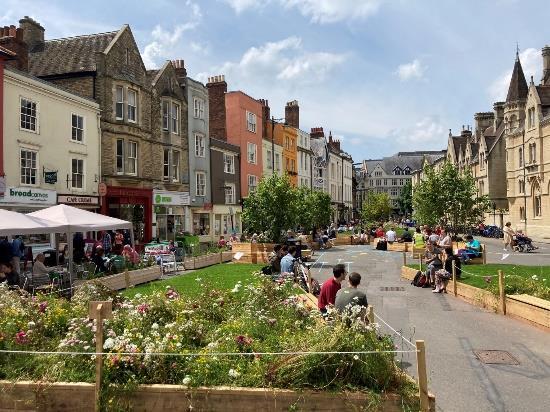
Reclaiming the street from the car to the pedestrian, and placing greenery and planters with seating and hospitality spill-over facilities (in Oxford)
Mobility: public and active transport
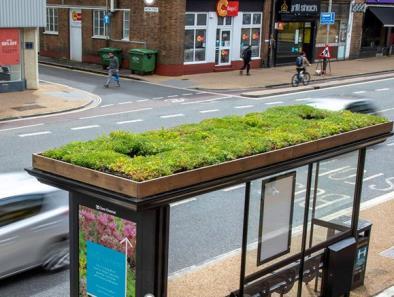
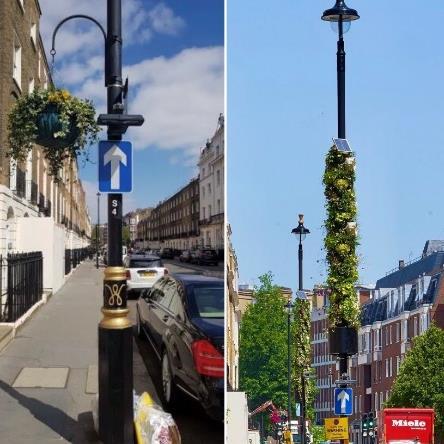
‘Bee bus stops’, with a ‘living roof’, which are topped with a mix of wildflowers and sedum plants, to support biodiversity100
It is essential to rethink the design of transport to improve the wellbeing of people, while providing access to important activities. It is notable here that during the Covid-19 pandemic, government restrictions to travel disproportionately affected more vulnerable people.
97 For further discussion see Parkin, V. (2021) Tactical urbanism: a global trend key to ‘building back better’ across West Midlands cities following COVID-19? Provocation Paper, City-REDI, University of Birmingham.
98 Howard, E. (1898) To-Morrow: A peaceful path to real reform/garden cities of tomorrow, Swan Sonnenschein, London
99 For further discussion see McDermott, R. (2021) Health and Urban Greenspace Post Covid, Provocation Paper, City-REDI, University of Birmingham.
100 https://www.leicestermercury.co.uk/news/leicester-news/bee-friendly-bus-stops-topped-5462984
101 https://www.scotscape.co.uk/projects/living-pillars-southend-sea-council
Living pillars – smart technology and greenery101
Lockdowns during the Covid-19 pandemic led to a reduction in traffic congestion, improved air quality and growth in walking and cycling due to the lockdown restrictions. Longer-term, besides their health benefits, walking and cycling can have positive effects on the central business districts. Evaluations conducted prior to the Covid-19 pandemic pointed to economic and social value from pedestrianisation.102 However, when considering active transport, there is still an imperative to take account of the requirements for people with disabilities. Investing in infrastructure that encourages greater walking and cycling needs to consider the requirements of people with disabilities to encourage greater accessibility for self-sustained transport.
Alongside the promotion of more local travel, the future business district/ city centre requires people travelling in from the suburbs and further afield.103 Crowded peak time transport may not instil confidence in commuting following a pandemic. Spreading out peak times by offering flexible tickets, and requiring masks to be mandatory at peak times, are practical opportunities to instil confidence in the use of public transport in the future.104 The aftermath of the Covid-19 pandemic, new ways of working and changes in attitudes in principle provide an opportunity to integrate public and other forms of transport to improve mobility. Models with state or municipal control can be best placed to pull together the integrated transport system with fully devolved funding.105
102 Living Streets (2018) The Pedestrian Pound–The business case for better streets and places https://www.livingstreets.org.uk/media/3890/pedestrian-pound-2018.pdf
103 For further discussion see Cepeda-Zorrilla, M. (2021) Adapting to Future Mobilities, Provocation Paper, CityREDI, University of Birmingham.
104 Gkiotsalitis, K. and Cats, O. (2020) ‘Public transport planning adaption under the COVID-19 pandemic crisis: literature review of research needs and directions’, Transport Reviews 41(3), 374-392.
105 Gutierrez, A., Miravet, D. and Domenech, A. (2020) ‘COVID-19 and urban public transport services: emerging challenges and research agenda’, Cities and Health, DOI:10.1080/23748834.2020.1804291
3. MEGATRENDS WORKSHOPS
Overview
A megatrend is a major movement, pattern or trend emerging that has a transformative impact on business, economy, society, cultures and personal lives. Examples include technological developments, the move to Net Zero and demographic changes such as population ageing.
This section outlines the findings from seven virtual workshops held in February 2021 bringing together stakeholders and academics from the West Midlands to discuss megatrends Each workshop lasted 90 minutes and involved around 20-23 participants. Each workshop explored a particular topic – (1) mobilities, (2) health and well-being, (3) hybrid workplaces and the future of work, (4) business models and operations, (5) attitudes and values, (6) changing functions and functioning of places, (7) business districts.
The workshops proceeded using the same format and were facilitated by Future Agenda:106
1. Workshop attendees were asked to post digitally their initial views on the biggest shift looking ahead to 2030 relating to the workshop topic. Concurrently, other attendees could then provide support for particular views by registering a ‘like’ for a particular comment.
2. The workshop facilitator selected comments from the composite list of views and invited individuals who proposed the view to explain why they considered the shift important, so stimulating wider discussion.
3. A member of the research team presented twelve pre-prepared trends pointing the way towards possible future scenarios for 2030. It was noted that these did not encompass all possible trends, but they highlighted a range of possible futures.
4. A virtual poll was conducted with workshop participants asked to identify which five of these twelve trends (plus any other key trends identified from the first stage of the workshop and receiving substantial support) would have the greatest possible impact in the UK to 2030. As votes were posted the trends were ranked in order of those receiving the most support.
5. There was a short discussion on the results of the poll, with the facilitator inviting advocates of particular trends to indicate why they considered that trend was important and then inviting wider comments and observations on the trends emerging as having the greatest possible impact.
6. A virtual poll was conducted was conducted with workshop participants asked to identify which three of the trends used as the basis of the poll in step 4 above would see most innovation happening in the period to 2030. As votes were posted the trends were ranked in order of those receiving the most support.
7. There was a short discussion on the results of the poll – and in most instances it was noted that the same trends were not necessarily identified for innovation (in step 6) as for impact (in step 4).
8. Participants were divided into four breakout groups and were asked to select one of the top threefive trends from the ‘innovation’ poll in step 6 and then discuss their manifestation over the next 10 years in comparison with the current situation, prior to exploring specific implications for the West Midlands (noting down key points on a template).
9. A brief report back in plenary from each of the breakout discussions, with an opportunity for quick questions and comments.
10. Participants were invited to post a word or phrase capturing the key future insight from the discussion pertaining to the topic of the workshop and then invited to explain their selection.
106 A think tank and advisory firm with expertise in foresight programmes – see https://www.futureagenda.org/about/
Key impacts and innovations identified at each workshop
This section of the report presents the top three key impacts and innovations identified at each thematic workshop.
Adapting to future mobilities
Areas of impact:
• Networking Hubs - City centres become networking hubs – many professional workers in private services work from home for at least 3 days per week and only come to city centres for those aspects of work that involve networking
• 15-minute City - The 15-minute city and increased urban living drives a more ‘urban village’ environment, where people work and live locally. Services move to be nearer clients and travel is reduced and more considered.
• Reduced Rush Hour Peaks - Smaller Public Transport Fleets with changing working patterns there is reduced demand for public transport at peak rush hours. A wider temporal spread in use means that a smaller fleet of more flexible public transport vehicles can cope with demand
Areas of innovation:
• Rapid electronic vehicle adoption – This has implications for a greener and cleaner environment (and noting the West Midlands is a leader in electronic vehicle technologies).
• Autonomous vehicles – Enabling more efficient use of the network (while acknowledging that public confidence in autonomy needs to improve).
• Networking Hubs - City centres become networking hubs – many professional workers in private services work from home for at least 3 days per week and only come to city centres for those aspects of work that involve networking
The fact that ‘Networking Hubs’ is in both the list of areas of impact and the list of areas of innovation underscores the importance of cities, and particularly city centres, as meeting places for social interaction and networking, while acknowledging the challenges this poses for a transport system to enable such activities.
Improving health and well-being
Areas of impact:
• Active Ageing Populations - More people are living longer. The NHS Long Term Plan Community Teams model helps many to stay active and mentally resilient, remain independent at home for longer. The expense of comorbidity on the health system is deferred.
• Mental Health Escalation - COVID-19 leaves a lasting scar on the mental health of millions, with self-reported anxiety rates rising. Women, those in social housing, frontline workers, and BAME communities report a disproportionate impact.
• Prevention and Wellness - More advanced, personalised diagnostics align with growing societal and political pressure to drive the much called for shift to proactive prevention in preference to expensive cure of disease.
Areas of innovation:
• Big tech in health – Led by Amazon, big tech will disrupt healthcare, reinvent some core elements and unify fragmented systems. All of the ‘big 5’ are investing heavily in major ‘special’ projects focused on the radical transformation of healthcare.
• Prevention and Wellness - More advanced, personalised diagnostics align with growing societal and political pressure to drive the much called for shift to proactive prevention in preference to expensive cure of disease.
• AI and NHS - Predictive analytics drive health and wellbeing assessment, treatment and insurance. The ability of second-generation AI to deal with unstructured data delivers major improvements in diagnosis and treatment for the NHS.
Discussion at this workshop highlighted the importance placed on ‘Prevention and Wellness’, which appears as both a key area of impact and innovation. This suggests that health and well-being are key considerations for the future business district.
Hybrid workplaces and the future of work
Areas of impact:
• The Office as a Networking Space - The function of the office changes as it becomes a space for social interaction, collaboration and co-creation. On their days in the office, workers relish mixing work and leisure – with local hospitality and shopping centres benefitting.
• Digitalisation of Working - Ubiquitous workplace automation hands over repetitive and dangerous jobs to robots. AI provides information to workers to help them perform tasks but also monitors their performance, so creating a surveillance workplace.
• Working Longer - For many people retirement at age 65 is not feasible economically. Few workers can fund a 30-year retirement with a 40-year career. Neither can societies. ‘Career breaks’ offer opportunities for (re)training and recharging of batteries
Areas of innovation:
• Projects not Jobs – Many see the future organisation as increasingly flexible, permeable, flat and virtual. Companies shift from being employers and become the bodies that create or coordinate projects that an increasingly freelance population delivers.
• Employment Independent of Geography - ’Fixed workplaces’ and ‘daily commutes’ are consigned to history. Many service sector workers can work from anywhere and some, but not all, businesses recruit from a global labour pool, so overcoming local skills shortages.
• Digitalisation of working - Ubiquitous workplace automation hands over repetitive and dangerous jobs to robots. AI provides information to workers to help them perform tasks but also monitors their performance, so creating a surveillance workplace.
The ‘Digitalisation of working’ emerges as a key area of innovation and impact, underlining its importance for hybrid working and its implications for changes in where work is performed.
Adjusting business models and operations
Areas of impact:
• Bye-bye to the 9 to 5 – Covid-19 accelerates the homeworking trend for individuals in professional services - an option that many business leaders support, as it decreases costs through reductions in office space and running and maintenance expense.
• Resource Scarcity - Over the next 30 years, finite energy resources such as coal and oil will be less economic to extract. Businesses switch to solar and wind renewable energy resources while, simultaneously, significantly reducing consumption.
• Cyber Vulnerability - We are progressively vulnerable to cyber-attacks. As technology is ubiquitous and easier to access through the back door and human password errors multiply, hackers increasingly target SMEs, large companies and public systems
Areas of innovation:
• Resource Scarcity - Over the next 30 years, finite energy resources such as coal and oil will be less economic to extract. Businesses switch to solar and wind renewable energy resources while, simultaneously, significantly reducing consumption
• Cyber Vulnerability - We are progressively vulnerable to cyber-attacks. As technology is ubiquitous and easier to access through the back door and human password errors multiply, hackers increasingly target SMEs, large companies and public systems
• Experiential and experimental retail - Bricks-and-mortar retail seek to provide more interactive venues, with tailored, immersive experiences to engage, excite and educate customers. Sometimes seeding digital purchases is the aim.
Prominent here in terms of impact and innovation are concerns about resource scarcity, which link to wider environmental concerns and the move to Net Zero. Likewise, the onus placed on cyber vulnerability highlights the threats posed by greater reliance on digital technologies. The move to experiential retail, identified as a key area of innovation, resonates with the ‘Urban Experience Economy’ which emerged as a primary trend in the Business District workshop.
New attitudes, behaviours and values
Areas of impact:
• Work Re-imagined and Non-Work - As work intersperses with leisure time, the working day and working week, the nature of employment and unemployment and how they are viewed in society also changes. Zoomers and Millennials ‘job-hop’ regularly.
• Cities for People not Cars - Changes to accommodate social-distancing in cities (such as ‘pop-up’ bike lanes and the widening of pavements) provide evidence of how urban space could be if the environment and people are prioritised over cars. Momentum is sustained.
• Polarised Workers - Knowledge workers gain more advantages as digital skills, networking, problem solving and information handling are valued. Higher wages and more flexibility seed greater division in the workplace, so creating a new ‘occupational-ism’.
Areas of innovation:
• Climate Change adaption – Climate change has moved towards the top of the policy and popular agenda. People pay cognisance to climate considerations in the decisions they make.
• Cities for People not Cars - Changes to accommodate social-distancing in cities (such as ‘pop-up’ bike lanes and the widening of pavements) provide evidence of how urban space could be if the environment and people are prioritised over cars. Momentum is sustained.
• Work Re-imagined and Non-Work - As work intersperses with leisure time, the working day and working week, the nature of employment and unemployment and how they are viewed in society also changes. Zoomers and Millennials ‘job-hop’ regularly.
Two trends appear in the ‘top three’ on both impact and innovation. The precedence attributed to ‘Cities for People not Cars’ marks a desire for people-friendly urban environments. ‘Work Re-imagined and Non-Work’ points to changes in the organisation of work and also to the how younger people, in particular, desire and are prepared to act to obtain flexibility to fit work and non-work activities together in ways that suit them.
Changing functions and functioning of places
Areas of impact:
• Hybrid Working - Many office workers returned to city centres but only 2-3 days per week. When in the city the focus is on the physical and social as well as the digital – connecting with colleagues, customers and wider networking.
• The Rise of Neighbourhood Centres - Sustained working near home makes local neighbourhood centres the ‘go-to’ destination for shared hubs, shopping, socialising and light industry. Urban planning is focused on more active development of ‘15-minute cities’
• Differentiated Places - Second tier cities seek new roles so that they have an offering distinct from those of the largest cities and rural towns. They think more about ‘place attractiveness’ and their function within the urban and regional system
Areas of innovation:
• Hybrid Working - Many office workers returned to city centres but only 2-3 days per week. When in the city the focus is on the physical and social as well as the digital – connecting with colleagues, customers and wider networking.
• Urban Experience Economy - The ‘experience economy’ becomes more important everywhere, but especially in city centres, They become focus of consumption for those living elsewhere but coming into the cities for cultural events and large social gatherings.
• Proactive Placemaking - Cities target placemaking: a multi-faceted approach to the planning, design and management of spaces. It capitalises on local community assets and inspiration to create spaces that promote people's health, happiness and well-being
Hybrid working is the top ranked trend on impact and innovation highlighting its potential to change the geography of places and how they function. The need to think more about place attractiveness and the role of proactive placemaking also emerge strongly and were key topics in consultations with businesses and stakeholders (see section 5).
Business districts
Areas of impact:
• Hybrid Working - Many office workers returned to city centres but only 2-3 days per week. When in the city the focus is on the physical and social as well as the digital – connecting with colleagues, customers and wider networking
• Re-imagining the office – To retain high quality city centre office, but with a reduced headcount, there is increased facility sharing. But businesses still value retention of their own identity. New approaches amplify innovation potential and use space more efficiently.
• The Urban Experience Economy - The potential for ‘connecting’, ‘experiencing’ and ‘cultural consumption’ comes into greater focus. City centre businesses embrace promotion of these developments to help increase footfall and the central city ecosystem.
Areas of innovation:
• Re-imagining the office – To retain high quality city centre office, but with a reduced headcount, there is increased facility sharing. But businesses still value retention of their own identity. New approaches amplify innovation potential and use space more efficiently.
• The Urban Experience Economy - The potential for ‘connecting’, ‘experiencing’ and ‘cultural consumption’ comes into greater focus. City centre businesses embrace promotion of these developments to help increase footfall and the central city ecosystem.
• Hybrid Working - Many office workers returned to city centres but only 2-3 days per week. When in the city the focus is on the physical and social as well as the digital – connecting with colleagues, customers and wider networking.
In this instance the same three themes are identified as primary areas of impact and innovation. The rise of hybrid working and changes in the use of office space also emerged in the evidence review. Hybrid working also emerged as the top ranked trend on impact and innovation in the Changing Functions and Functioning of Places workshop. The shift to an urban experience economy features prominently in the scenarios in Section 7.
Cross-cutting themes
As is apparent from the commentary above, common themes emerged across the workshop discussions. These are summarised in Figure 3.1.
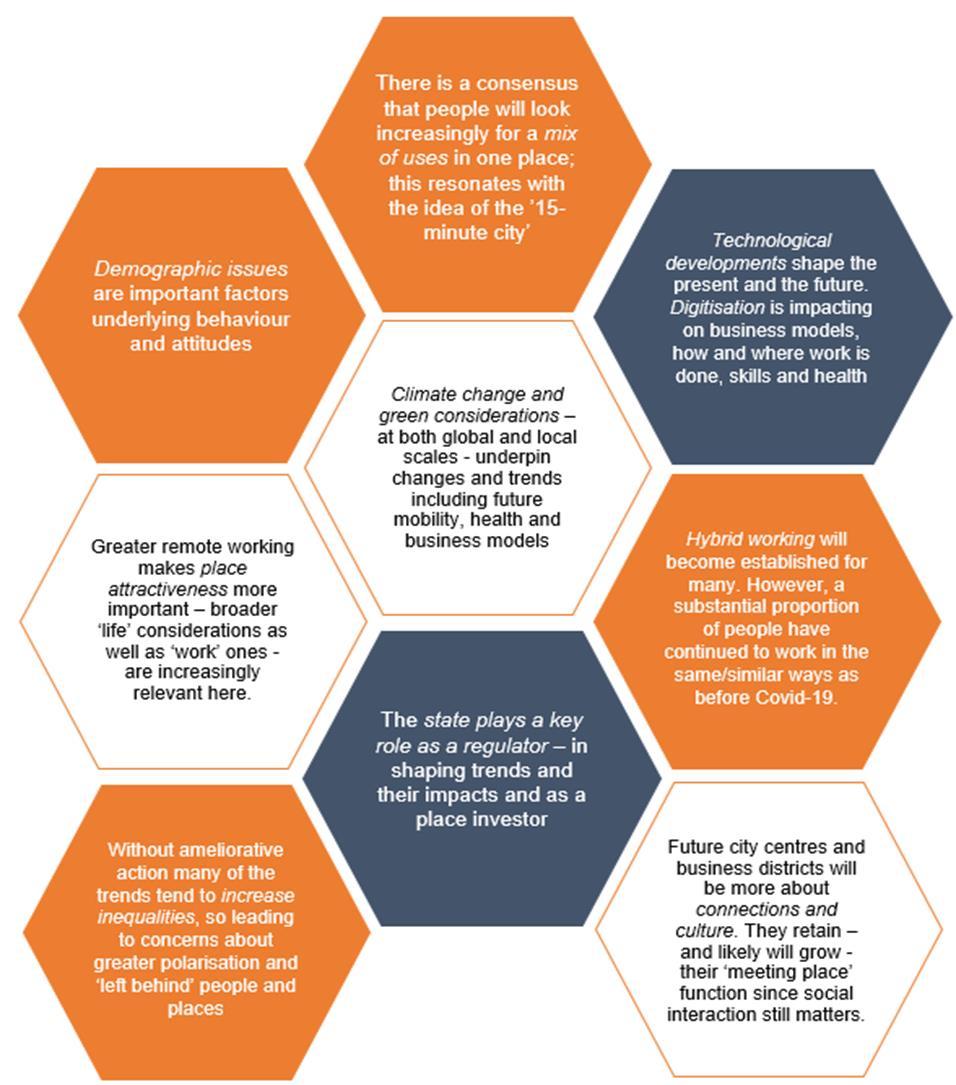
These include the role of technological change and digitisation in shaping current and future business models and in determining how and where work is done. Allied to this, hybrid working has become established and will continue for some – particularly in the BPFS sector, albeit social interaction for some business functions still matters, suggesting that future cities and city centre business districts need to retain their ‘meeting place’ function. It is important to note that this is not an appropriate or viable way of working for in all occupations and sectors. Greater reliance on remote working means that ‘geography of life’ become relatively more important alongside ‘geography of work’ in individuals’ locational decision-making. This means place attractiveness has enhanced significance. It also means that people will look increasingly for a mix of uses in one place. This latter point also ties in with broader concerns about environmental concerns and health and well-being issues.
Across the seven workshops there was general agreement that demographic factors and cohort effects are important in understanding values and attitudes. But it was also acknowledged that without ameliorative actions polarisation between and within sub-groups of the population would
Figure 3.1: Cross-cutting themes from Megatrends workshops
increase so exacerbating existing inequalities. The state has an important role to play here, both as a regulator and as an investor in place.
The key issues emerging from the Megatrends workshops and cross-cutting themes identified above constellate in a series of interconnected opportunities and threats, which resonated in the engagement phase of the study and in the development of scenarios for the future city centre business district.
The opportunities include the following:
• Green issues, sustainability and health – a nexus of the increased demand for green space, a growing appreciation of the health and wellbeing and the advantages of exercise spurring a modal shift in travel to walking and cycling, heightened awareness of sustainability issues and an associated attraction to local and ethical suppliers of goods and services.
• Appeal of the ‘playground’ – the Covid-19 pandemic lockdowns have led to pent up demand and spend capacity amongst some social groups, which together with the pre-existing trend towards an increased/combined experiential retail and leisure offer and an appetite to come together for social gatherings, events and cultural experiences highlight a role for the city centre as a ‘playground’.
• Business models and technology – a nexus of trends subsuming the acceleration of business model adaptation and technology adoption, reconfiguring of mind-sets and growth in capacity to take advantage of opportunities for innovation, digitalisation offering new and alternative options for activities and engagement, in turn enabling a geographical expansion of the skills base available to business, and the changing balance of reshoring, offshoring and north-shoring
• Place – a hybrid model of agile and flexible working across city centre offices and remote locations implies a need to understand how new ways of working may be best serviced through a blend of physical and digital infrastructure, and calls for the internal office environment to be re-imagined with opportunities for greater mixing of the private and public realm in city centre business districts. There are Birmingham-specific opportunities here around place attractiveness, connectivity and opportunities for commuting given its transport network and central location.
The threats include:
• The capacity of individuals, businesses and society to take advantage of opportunities – a nexus of factors including the mental health impact of the Covid-19 pandemic preventing (re)-engagement, fear of going out (to varying extents), a lack of skills and take up of digital and technology leading to some people getting left behind, leading some businesses to bypass the local labour market and seek skills elsewhere, resulting in growing inequality and reduced social mobility.
• Place – where there is a reduction in economic activity in city centres the challenge of servicing lower footfall, the loss of some hospitality and retail businesses and challenges of recruiting staff to those that remain where staff have been furloughed and moved to other sectors, coupled with withdrawal of some public transport services due to reduced demand, and Increased segregation of place
4. SECONDARY DATA ANALYSIS
Introduction
Scope of the analysis
The data analysis set out below explores selected trends in footfall, public transport patronage, crime, business demography, consumer spending, housing developments and affordability, and location of new developments It provides a picture of the challenges faced by the city centre business district in Birmingham.
The focus of the analysis is on the central urban centre of Birmingham. The boundaries in Figure 4.1 have been drawn with reference to the outer ring road and encompass the city’s core entertainment and central retail districts as well as the business district. Birmingham City Council’s Our Future City Plan – Central Birmingham 2040107 (outlined further in the next sub-section), published in January 2021, defines central Birmingham as the Middle Ring Road, but acknowledges that the central core has expanded over the past decade.
Figure 4.1: Map of Birmingham within the West Midlands metropolitan area with the city centre highlighted
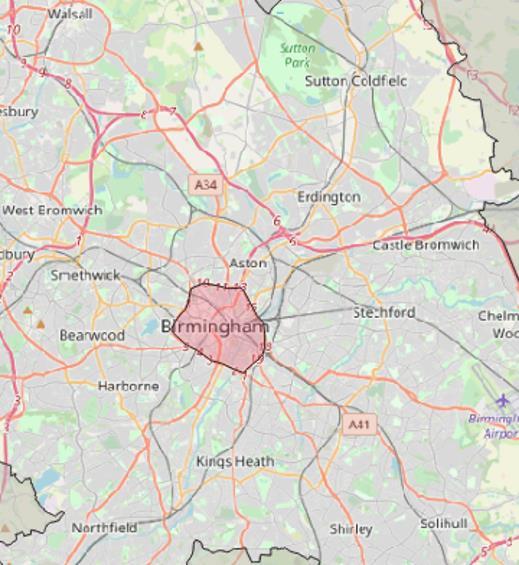
Figure 4.2 zooms in and shows the boundaries of the BIDs in central Birmingham.
107 Birmingham City Council (2021) Our Future City Plan - : Central Birmingham 2040, Birmingham City Council. https://www.birmingham.gov.uk/ourfuturecityplan
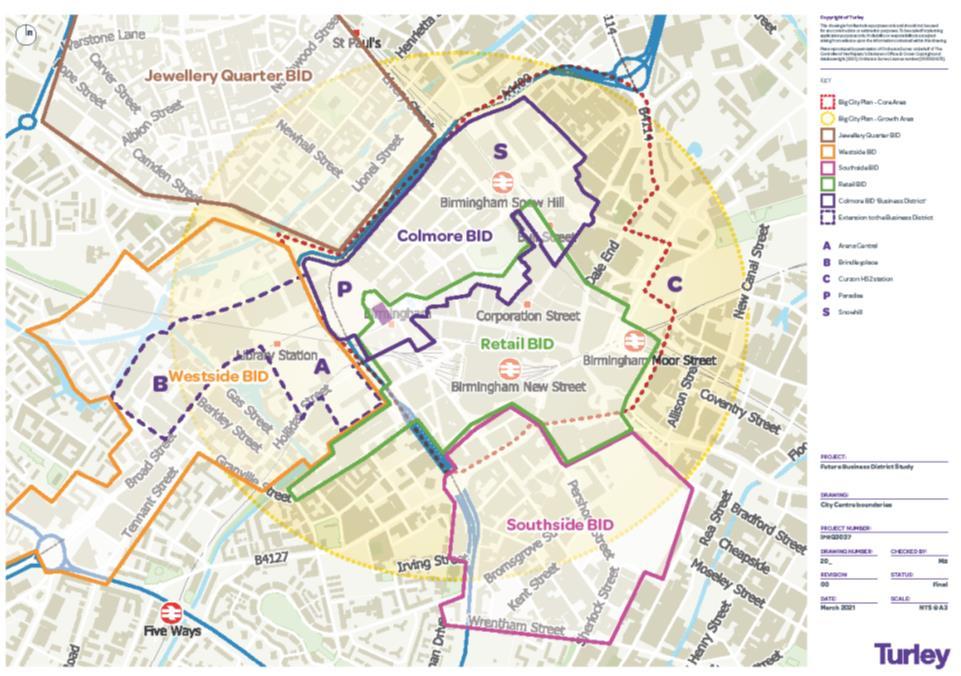
Our Future City Plan – Central Birmingham 2040
The 2040 vision describes Birmingham as a ‘city of centres’, with a collection of centres of activity that have organically evolved over centuries. It notes that there is potential for other areas to grow and evolve and become attractive as places to locate new homes and employment space. Central to the vision is the desire to help these quarters grow their distinct offerings. It sees these quarters as having their own specialisms, character, and uniqueness that offer a range of amenities for local living and working, with walkable amenities, cycling and public transport access.
The vision identifies four goals to support the ‘city of centres’:
1) Establish Central Birmingham as an integrated collection of vibrant, distinct and liveable neighbourhoods with services and amenities to ensure that residents can meet their daily needs within walking and cycling distances.
2) Support residential development at densities that make local services and public transport viable.
3) Promote mixed use developments providing employment, open spaces, leisure and social infrastructure within walking, cycling and public transport environments.
4) Ensure that communities have the resources, skills and support to build resilience within their areas.
To achieve these goals, it identifies several actions. These are:
• connecting centres as destinations, by ensuring the quarters that have clusters of activities are connected to each other;
• establishing a network of 15-minute neighbourhoods, ensuring that amenities and services are available to encourage local living;
Figure 4.2: Map of the BID areas in central Birmingham
• creating diverse and affordable homes, through strengthening planning policy and diversifying the housing market offer; and
• overhauling local highway infrastructure so it is more people-focused, including improvements to residential streets, to encourage walking and cycling.
An additional core strategic ambition of the Future City Plan is to stimulate growth in the city centre. It identifies six goals to help stimulate such growth:
1) Meet our city growth needs for provision of a range and diversity of affordable housing, healthcare, jobs, skills and opportunities for all in our community.
2) Ensure that the social, environmental and economic benefits of development and growth make a positive difference for everyone.
3) Strengthen our global position as an attractive place for inward investment and first-choice location for a range of companies to be based here.
4) Ensure opportunities for a robust, flexible and diverse range of industries to thrive, focused on green technology, digital innovation, culture and other growth areas to provide economic resilience and new employment opportunities.
5) Take a zero-carbon approach to development working towards circular economy principles.
6) Maximise the benefits of our unique qualities of diversity and identity, heritage, heroes, leisure, arts and culture to boost our visitor economy
The Plan underscores that it will work together with a range of partners including Business Improvement Districts (BIDs) and traders’ associations to identify area based or thematic proposals and actions. This provides an opportunity for Colmore BID and the other BIDs to help shape further work on the Future City Plan.
The overarching strategic vision of the Future City Plan aligns well with the Future Business District research, identifying the need for a more effective integrated transport system that serves communities and identifying the need for green spaces that are accessible to residents. The importance of place-making and place-maintenance are shared ambitions that BIDs across the city centre can effectively support.
Key trends
Footfall
In the immediate aftermath of the first national lockdown, city centre patronage fell across the West Midlands , but the distribution was extremely uneven. The fall between February 2020 and April 2020 was precipitous in Birmingham (79%), but more muted in centres such as Smethwick (41%) and Willenhall (21%). This demonstrates the greater resilience of more local centres. Since April 2021 the recovery has been stronger in those urban centres which suffered most initially, but remain below pre-pandemic levels.
Public transport patronage
Rail patronage, which grew steadily in the years prior to the pandemic, was hit very hard by the first lockdown but was substantially higher in July 2021 than it was a year earlier. Figure 4.3 shows patronage by major railway stations in Birmingham from April 2020 to July 2021; (the data are sourced from ‘taps’ at ticket barriers) 108 However, this count data does not provide insights into shifts in the types of journeys people are taking.
108 Pre-pandemic data is based on manual counts at stations, so making direct comparison difficult.
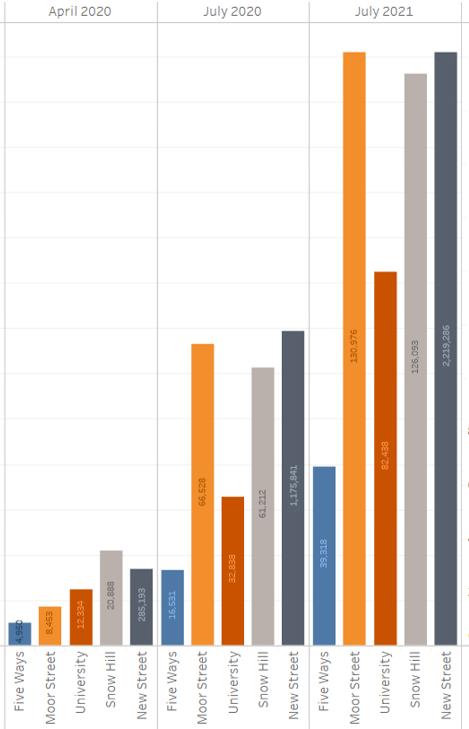
Bus patronage in the West Midlands (see Figure 4.4), already in decline for years, was badly hit by the initial lockdown and by May and Jun 2021 was at levels slightly above those of September and October 2020. Patronage levels remain below those of 2019 (for both full price tickets [shown in orange] and concessionary tickets [shown in blue]), with implications for service viability and frequency.
Figure 4.3: Total railway station usage for key stations in Birmingham
4.4: Bus patronage in the West Midlands, 2019-2021 (TfWM data)
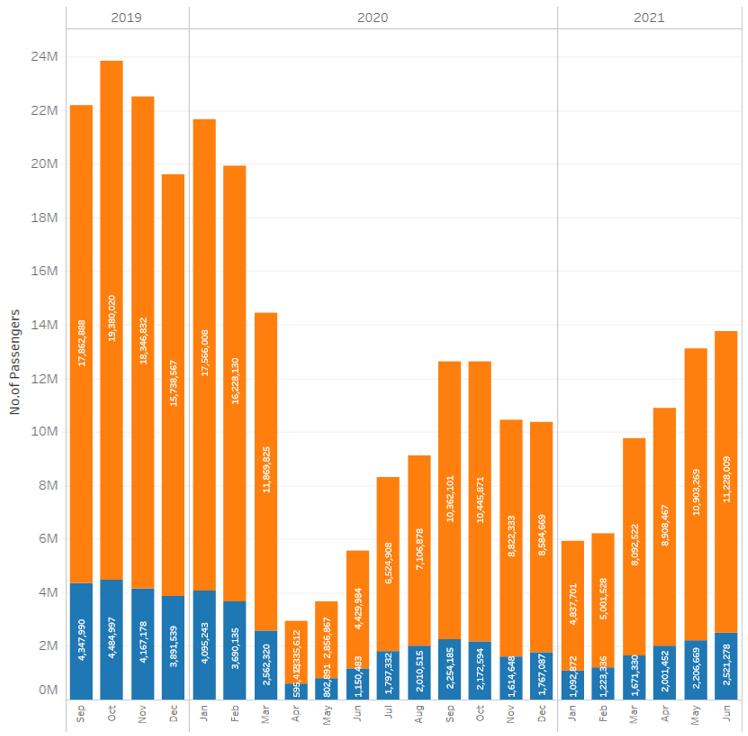
Crime
Since March 2020 crime levels in Birmingham city centre are lower than they were pre-pandemic. In Figure 4.5 the pattern of lower crime levels coinciding with national lockdowns is apparent. No such reduction in crime levels during the Covid-19 pandemic (shown in red) from the period prior to the Covid-19 pandemic (shown in blue) is evident across the West Midlands as a whole.
4.5: Total reported monthly crimes – West Midlands and Birmingham city centre
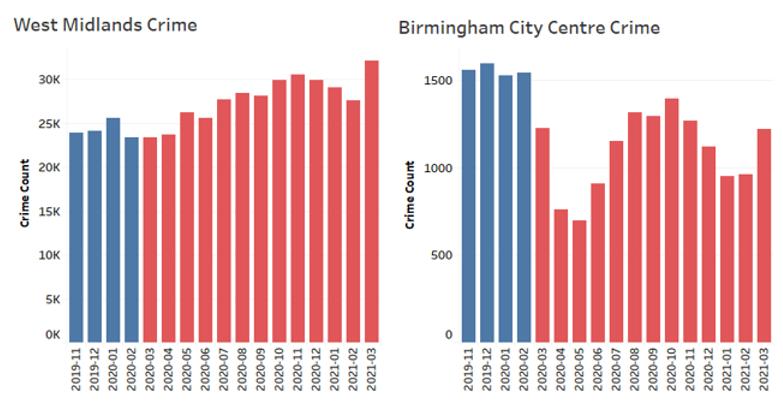
Figure
Figure
Business demography
Companies House records make it possible to obtain the postcode locations of all registered firms by Standard Industrial Classification, more clearly showing the footprint that different sectors of the economy have in the urban core.
Building on this foundation, business intelligence company Red Flag Alerts ranks all registered firms by their level of risk and likelihood of going under. This rating is based on factors such as the firm’s length of operation, payment history, legal notices, revenue, and liquidity. Firms denoted ‘amber’ or ‘one red flag’ are considered as having a possible but not inevitable prospect for going under, which makes data on these firms important for understanding possible interventions to improve outcomes as well as near-term employment risks.
Figures 4.6 and 4.7 show at risk firms across the West Midlands metropolitan area in two sectors hard hit by the Covid-19 pandemic: arts, entertainment and recreation, and food services and accommodation, respectively, across the West Midlands metropolitan area. The depth of shading on the map indicates how many jobs may be at risk, giving a sense of how employment risk in different industries is distributed across the region and in Birmingham city centre
For Birmingham firms at the ‘amber’ or ‘one red flag’ risk level account for 71,577 jobs in food services and accommodation, so giving a sense of the medium-term employment risk. However, in this sector the figures for Birmingham are dominated by a small number of very large firms of international standing and a ‘headquartering’ effect in how data are coded may mean that the true number of jobs is lower than the figure implies. Moreover, it is important to note that only a fraction of firms with this risk rating are likely to go out of business within any given time period, meaning that true job losses are likely to be a fraction of the figures presented. For Birmingham firms at the ‘amber’ or ‘one red flag’ risk level in the wholesale and retail sector account for 47,268 jobs. Adopting a narrower definition of ‘one and two red flags’ for firms at risk of going under, 8,029 jobs in retail and hospitality and 2,093 jobs in the arts, entertainment and recreation sector are at risk.
Figure 4.6: Arts, Entertainment, and Recreation firms rated ‘amber’ or ‘one red flag.’ (Darker shading: more employment in these firms)
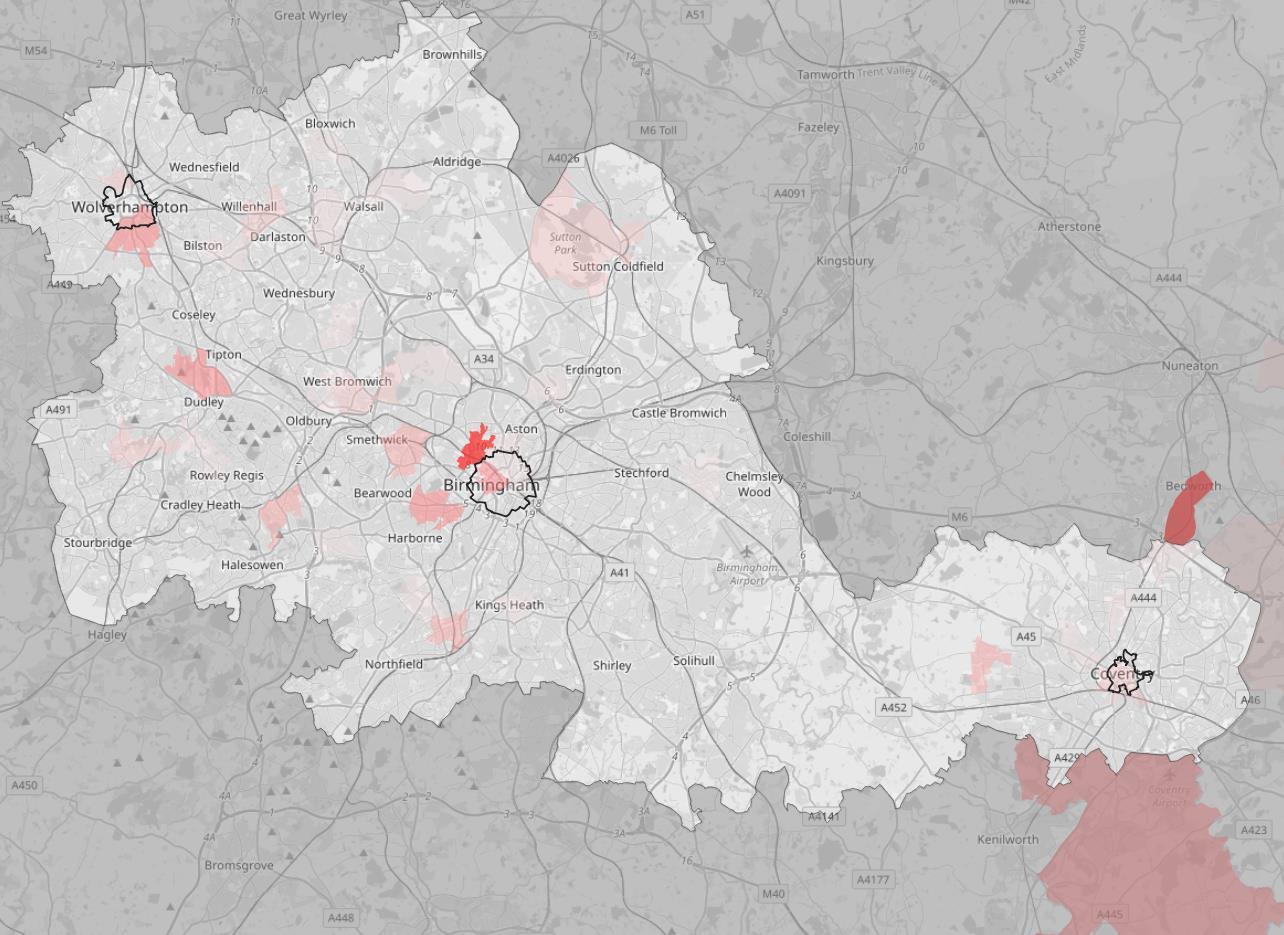
Figure 4.7: Food services and accommodation firms rated ‘amber’ or ‘one red flag.’ (Darker shading: more employment in these firms)
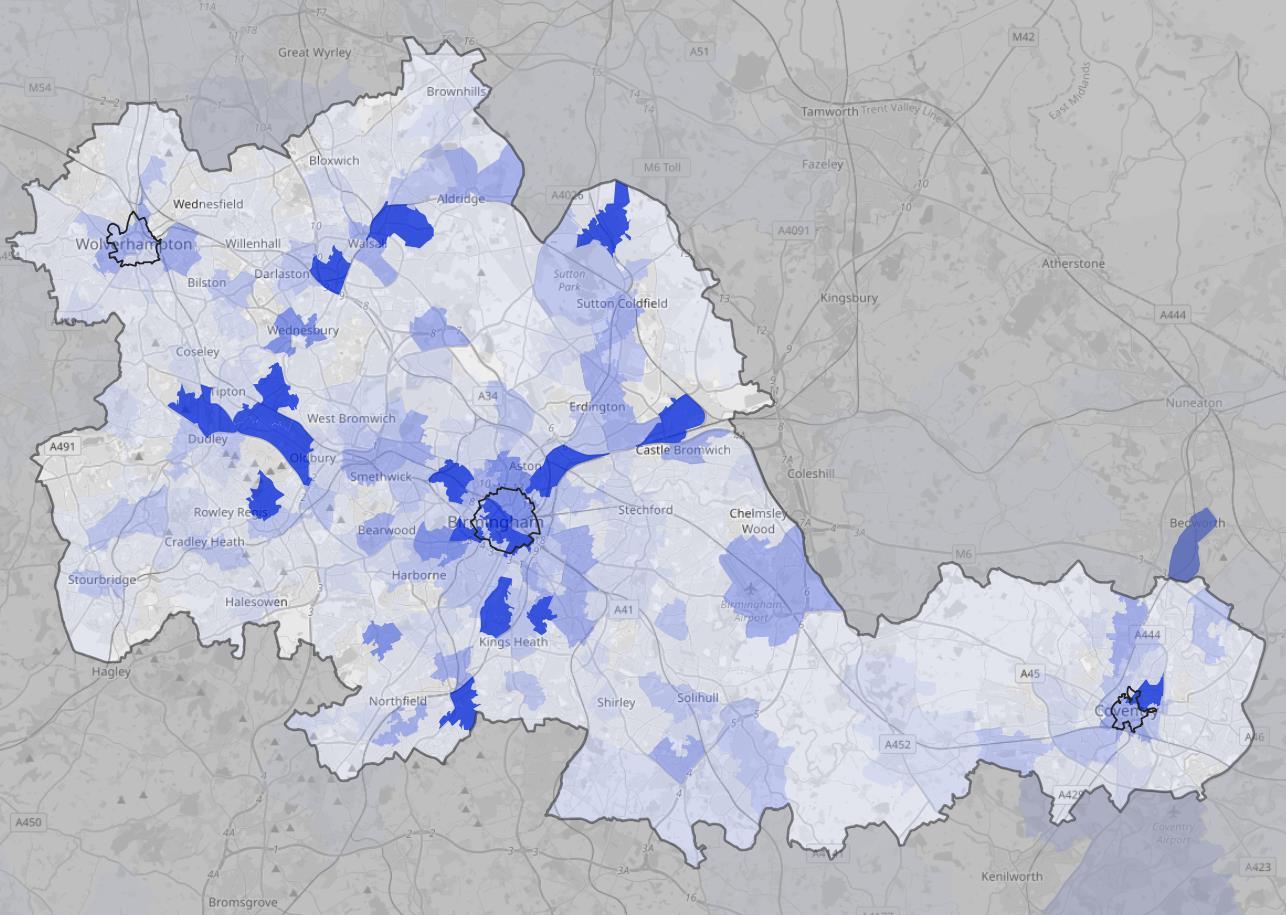
Consumer spending
Monthly UK consumer spending figures (see Figure 4.8) show the depth of decline in hospitality and leisure spending in the period from April to June 2020, with some recovery later in summer 2020 prior to a further decline in autumn and winter 2020/21. There has been marked recovery subsequently but by early summer 2021 hospitality and leisure spending remained below 2019 levels. Overall consumer spending declined markedly during the first national lockdown in 2020 and following recovery to levels similar to those experience in 2019 by summer 2020, expenditure declined again in the first quarter of 2021 (coinciding with the third national lockdown). However, by June 2021 it had exceeded 2019 levels. Expenditure on household items has consistently remained above 2019 levels since summer 2020, reflecting more time spent at home for many people.
Figure 4.8: UK-wide percentage change in consumer spending by category and GfK's metrics for personal financial outlook and climate for major purchases
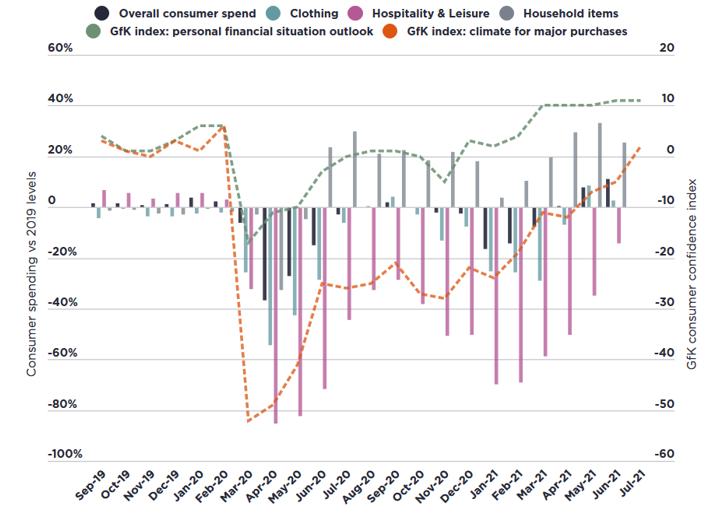
The personal financial situation outlook became more positive as the third national lockdown eased and in spring and summer 2021 has remained relatively stable at a level higher than immediately prior to the Covid-19 pandemic. The trend in the climate for major purchases saw a much greater dip with the onset of the Covid-19 pandemic but has been rising steadily in positive territory since spring 2021.
Housing developments and affordability
ONS data on historical rents show that since 2015, there has been a 3.2% drop in the weekly rent on social housing in the West Midlands, compared to a 0.5% decline in England as a whole. This likely reflects UK Government policy to converge social rents in local authority and housing association properties, and the later commitment in the 2015 budget which implemented 1% annual rent reductions in subsequent years. ONS statistics show that while the waiting lists for access to social housing are significant in size, the problem has not worsened in recent years.
Data from HM Land Registry on price paid for individual house sales makes it possible to analyse house prices in small geographical areas. Figure 4.9 displays median house prices by postcode for Birmingham based on a three-year average up to July 2021.
Figure 4.9: Birmingham house prices by postcode (according to UK Land Registry data), three-year average to July 2020 (Darker shading: higher median house prices; Lighter shading: lower median house prices
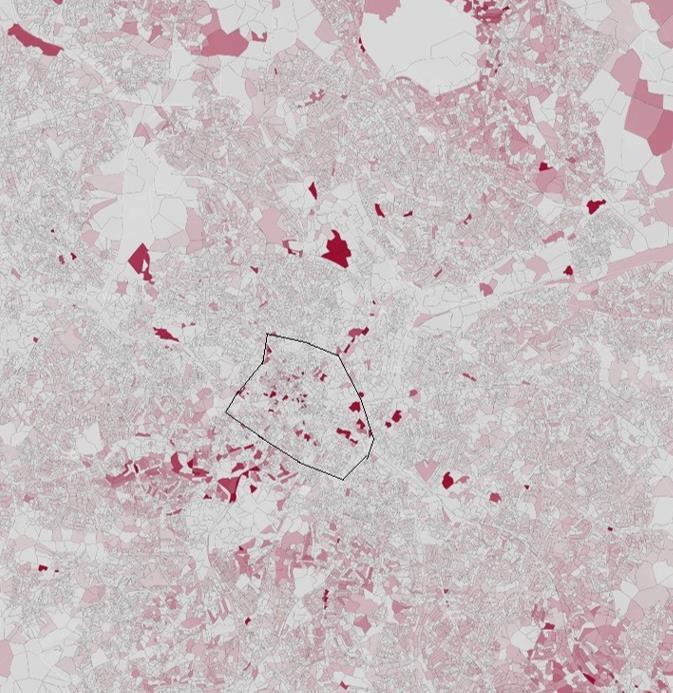
Investment activity in the private housing market during the first lockdown was at approximately 50% of the 5-year average but returned to a level of around 80% in September and October 2020. Since then house prices have increased in a sellers’ (as opposed to a buyers’ market), driven by sales in more affluent areas. Mainstream residential capital value forecasts (2021-2025) by Savills indicate faster price rises on residential property in the West Midlands than the UK average, but with forecast values still lower than that average. This likely reflects the role of London in the UK housing market, which has higher prices but slower increases, on the national average.
Trends in rents and house prices are important not only for current affordability but because economic growth following the Covid-19 pandemic puts pressure on prices, with different effects on different generations and social classes.
Other developments in the property market
In the office market demand for prime office space seems more resilient.109 A range of a range of innovative, high quality, well designed space is coming on stream. For example, Three Snowhill offers health and wellbeing services, Brindley Place and the new Paradise development offer event, community and leisure spaces and the 26 floor 103 Colmore Row will be a ‘destination’ development with top floor bars and restaurants offering panoramic views.110 Commentators have highlighted a
109 ‘Property Market and Covid’ investment report compiled by the WMCA Investment and Commercial Activities Director on 4th December 2020, with additional new data from Zoopla and Savills reflecting the updated situation.
110 Savills (2020) City Centre Comeback https://www.savills.co.uk/research_articles/229130/308994-0
substantial appetite in the market for new real estate investments, driven by historically low interest rates and as companies expand their headcount and seek additional office space as the economy continues to develop following Covid-19 lockdowns.111 Birmingham could also gain from a trend towards increasing demand for super prime offices – notably new accommodation offering high levels of flexibility and close proximity to major transport hubs.112
Elsewhere in the property market the shift to online retailing has resulted in a shift in demand from retail to distribution space.
Across the property market there is growing interest in net zero construction, with investments in reducing carbon emissions and procuring green energy.
Location of developments
Figure 4.10 shows the distribution of housing and employment sites in the planning system in central Birmingham and the surrounding area. Particularly notable are the great concentration of housing developments in the west of the city (particularly around the Jewellery Quarter), and large number of new small and medium-sized employment developments in areas immediately outside the city centre. (Note that as the data includes only employment site developments of over 0.4 hectares it greatly understates the total.)
111 Savills (2021) Market in Minutes: UK Commercial. https://www.savills.co.uk/research_articles/229130/315616-0
112 Property Week, June 2021.
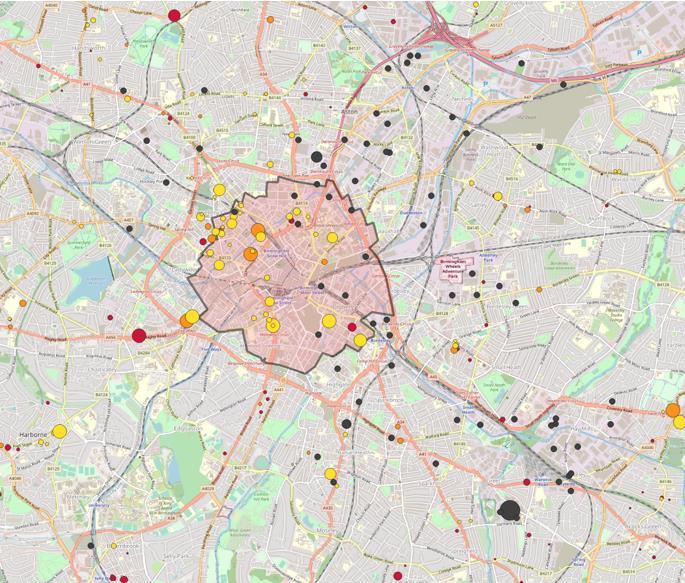

Conclusion
Of the selected trends before and during the Covid-19 pandemic surveyed in this section particularly notable are the displacement of both footfall and consequently crime out of the city centre, the shock to patronage and partial recovery experienced by the public transport system, and the continued rise in house prices despite the subdued level of economic activity. While house price rises may be expected to persist over the medium-term, the extent to which the distribution of economic activity and demand for services shifts away from city centres and city centre business districts remains an open question.
At the centre of this uncertainty in Birmingham are the Colmore and neighbouring BIDs. Hybrid working has implications for demand for services in the city centre. This means that the attractiveness of the office environment and wider city centre offer is important to bring people into the city centre. The BIDs and their partners have a crucial role in developing a vision for the future city centre business district and to play in shaping, developing and implementing action plans to facilitate achievement of this vision and mitigating negative consequences of prevailing trends.
Figure 4.10: Birmingham housing and employment sites
5. CONSULTATIONS WITH BUSINESSES AND STAKEHOLDERS
Introduction
This section of the report presents the findings from four sets of information gathering and consultation exercises.
First, there was a ‘Call for Evidence’ which was live from late January to early March 2021 and sought responses to two key questions: (1) What is the likely long-term impact of the Covid-19 pandemic on city centre business districts? (2) How can we ensure they remain successful as places to attract businesses and people and contribute to vibrant city centres? Supplementary questions (see Annex A) gave respondents the opportunity to provide more granular detail on how developments over the last twelve months had changed city centre business districts for the long-term; other developments expected to lead to changes in city centre business districts, and how city centre business districts, and their interactions with neighbouring areas, might look different in 2031 in comparison with 2021. There were 18 responses to the ‘Call for Evidence’. In addition to these submissions, various other pieces of literature were submitted.
Second, expert in-depth interviews were conducted with 21 businesses (both large firms and smaller enterprises across the Colmore BID area and wider city centre) and stakeholders (see Annex B for a list of questions used to guide the interviews) in the period from April to June 2021. Key topics addressed included hybrid working, (office) space requirements, (changing ways of) doing business, transport, place, and social, economic and environmental issues. These semi-structured interviews were conducted virtually and were recorded (with the permission of respondents).
Third, three follow-up workshops were organised in collaboration with Colmore BID and were attended by selected invited interviewees and other stakeholders to discuss specific topics in more detail and possible interventions to address key challenges and shape desirable futures. The workshops focused on ‘future infrastructure’ – covering issues of accessibility and connectivity; ‘future place’ – encompassing social, environmental, well-being and place-making issues; and ‘future urban experience’ – embracing prospects for hospitality, retail, culture and live events.
Fourth, meetings of the Advisory Panel were held in the period between late March and June 2021, with a fourth in early September 2021 to reflect on overall findings. Members of the Advisory Panel commented on emerging findings and scenarios developed; (these scenarios are outlined in section 7) Key points emerging from discussion at these meetings are included within the commentary on the themes identified in the Call for Evidence and from the in-depth interviews with businesses and stakeholders and the follow-up workshop discussions (as applicable). Throughout the course of the research Advisory Panel members helped to shape the direction of the study and to identify key policy interventions to mitigate undesirable developments and facilitate desirable change.
Call for evidence: emerging themes
Five key themes emerged from the call for evidence: (1) working from home; (2) changes to the office; (3) the accelerated decline of retail; (4) implications for transport; and (5) relevance of the BID model. Themes 1-4 have clear resonance with topics and trends covered in the Evidence Review in section 2, while theme 5 relates to the specific context of the study (albeit it is of wider relevance beyond Birmingham).
Working from home for at least part of the time
The broad consensus emerging was that working from home would continue to be a significant feature of firm operations for the immediate future (note that respondents submitted their views during a
period of lockdown in England in early 2021), with Westside BID calling it a ”phenomenon that will be difficult to reverse in the short-term” . In the longer-term, a hybrid model of different styles of working – encompassing flexible working patterns involving part home and part office-based working was expected. One feature of such an arrangement might be multi-firm shared office spaces. There was some recognition that this move to hybrid working would be employer-led and be variable by sector, with some businesses preferring a more traditional pre Covid-19 way of working – particularly for businesses with a significant proportion of apprentices. There was concern that younger staff had not benefited from on-site learning that comes with a physical presence. Additionally, the appetite for a permanent and full-time work from home dynamic may be limited Commercial property agents KWB cite changes in YouGov polling which say that the number of people wanting to work from home some of the time has more than doubled, with staff wanting to work from home occasionally but not all of the time.113 This makes a hybrid ‘3-day a week in the office model’ perhaps the most likely sustainable future model.
The accelerated change, bought on by increased use of digital technology, may mean that many activities, such as routine administration, can be conducted anywhere - even globally. By contrast, other non-routine knowledge-based activities are likely to remain reliant on having an office-based presence. This increases the premium on offices in city-centre locations.
Changes to the office
Responders, most notably commercial property specialist Savills, commented that one of the major consequences of working from home will be the way floorspace is to be used in the future:
“Rather than having an efficiently delivered office which has typically focussed on desk and meeting room space, there is likely to be a drive towards greater amenity and break out spaces for staff. The well-being of staff will be ever more important and the emphasis on spaces that ensure people can work in a less formal environment that supports innovation and creativity will be key. The emphasis in future office space seeking to reduce disconnection and alienation that currently pervades for some people.” 114
Whilst office space will continue to be in strong demand, the expectation was that traditional desk and meeting space layouts will be scrapped in favour of greater amenity and break out spaces for staff. There was acknowledgement that hybrid working model will mean that office space has to be more flexible in its use and offer something more than a base for staff and clients. Due to accelerated technological change and the prominence of home-working for regular activities that can be conducted at home, physical office locations will become more attuned to client-focused needs, whether that be events, presentations and/or face-to-face meetings.
The accelerated decline of retail
In his submission, Professor Neil Lee of the London School of Economics commented that crises tend to accelerate ongoing trends. 115 The decline of the high street and the relevance of retail to core city functions has not escaped this crisis. The consensus from the submissions was that the retail sector and the high street will continue to struggle as a relevant feature of city and town-centre functions. Nevertheless, larger city centres will still serve as important locations for flagships stores; however, with the closure of the John Lewis store in Grand Central, Birmingham, this should not be considered a given for the city.
113 KWB (2021) Submission to Call for Evidence on ‘The Future Business District’.
114 Savills (2021) Submission to Call for Evidence on ‘The Future Business District’.
115 Lee, N. (2021) Submission to Call for Evidence on ‘The Future Business District’, LSE.
The decline of retail in city centres will mean they will have an increased focus of higher value-added knowledge-based activities and increasingly serve leisure functions. This aligns with the emerging idea that city-centres will evolve form a transactional site for work and to a more physically engaging leisure-led sense of place. According to Professor Neil Lee, city centres will “become less like markets and more like playgrounds” - reflecting consumer needs for entertainment rather than shopping per se
The decline of five days per week office-based working will have major ramifications for feeder services, such as retail and hospitality. Westside BID cited feeder economy actors such as cleaners and independent service providers across sectors, as well as taxi drivers and public transport, as most likely to be impacted.
Implications for transport
From submissions to the Call for Evidence there were comments on locally-specific transport trends that will impact the role and dynamic of the city centre. First, the Clean Air Zone (CAZ) was cited several times as a policy with immediate impacts. At the time of the Call for Evidence, the implementation of the CAZ was due to coincide with the lifting of lockdown measures in summer 2021 and there was a concern that it would deter visitors from the city centre, especially those still cautious of using regional public transport to travel there. It was also cited as incurring additional delivery costs to businesses. There are also concerns firms and the self-employed (especially in activities such as maintenance and construction) about measures, such as the CAZ and Low Traffic Zones (LFZs), resulting from the climate emergency.
Mitigation of the CAZ’s impacts is likely to be achieved by better and more integrated public transport. In the short- and medium-term, the ongoing extension of the Metro tram network was cited as an additional disruptor, but with added positive impacts when operational. Construction was noted as being disruptive for businesses. Overall, it was broadly agreed that extension of the tram network was a major a positive asset for the city – with the hope cited by Westside BID (and others) that the operating times meet consumer and business need.
The need for a multi-modal and integrated transport system that can support the free-flow of people across the city was noted. Within the city core the trend toward cycling and walking is likely to only grow and is likely to be a positive feature of multi-modal transport system. The submission from planning consultancy Turley, which operates within the business district, indicated that the benefit of measures such as the CAZ are well documented, including:
“ the freeing up of space currently used for car parking to other uses, improved air quality and health benefits from increased walking and cycling, and limiting productive time lost through traffic congestion.” 116
Relevance of the BID model and the future role of the BID
Submissions to the Call for Evidence suggested that the current BID model, tailored to place-based dynamics and sector-specific prevalence, needs to be responsive to ongoing changes over the medium- and longer-term. The market needs to be flexible to adapt to ongoing substantial changes in consumer and firm behaviour. Likewise, the BID model, which as an innovation that is responsive to market practices, can succeed only if it acts in both a proactive and reactive fashion to emerging trends.
116 Turley (2021) Submission to Call for Evidence on ‘The Future Business District’.
With greater emphasis on hybrid working and entertainment-led city centre cores, with a greater role of mixed-use and residential developments, better communication between BID areas and a more aligned strategy emerged from the Call for Evidence as a beneficial and positive step forward.
In their discussions Advisory Panel members recognised that the trend to hybrid working and a changing city centre economic ecosystem means the BID has to reflect and adapt its role. This means the supporting vision therefore may have to be amended. There are important choices to be made here. This issue of choice is illustrated by the (pre Covid-19) case of the City of London: where a deliberate choice was made to acknowledge and support key sectoral strengths in the business, professional and financial services sector in developing a vibrant week-day economy, alongside the inherent trade-off of a quieter weekend.
This suggests that the BID (and partners) need to develop a vision on the future role of Birmingham’s central business district. An important part of this vision could involve creating a valve or mechanism to hedge against and respond to the negative consequences of any evolving future business district scenario which may occur. This underscores the need for a capacity to be reactive, within the boundaries of an established vision of the desired future – taking account of social and environmental as well as economic factors - and the strategy to achieve this.
Consultation with businesses and stakeholders
The interviews with businesses and stakeholders were designed to gather an insight in to the strength of appetite for a hybrid working model, how this will change the way firms use their office space, operate and do business. Additionally, the interviews sought to gauge how trends in business models would affect public and private transport usage. The importance of place and its relevance to attracting new investment and consumers was investigated also The Advisory Panel also deliberated on these (and other) themes and their insights are incorporated here
The key findings from the interviews, and reflections on them, are distilled here into seven ‘Future City Trends themes’ designed to give a structure and a set of accessible findings that can cut-across sectors and geographies. The audience for this framework is policy-makers, researchers, central and local government as well as wider business partners and stakeholders. The overarching theme is ‘The Space Between’ and the six underpinning pillars are: (1) Connections and Culture; (2) Agile and Flexible; (3) Colmore Collaborates; (4) On the Move; (5) Safe and Sound; and (6) Open to All A substantive and detailed narrative of the findings under the overarching theme and each of the pillars is presented. This narrative is supported by examples and quotes from the interviews presented in boxes. The themes discussed are also of relevance to the discussion of the BID model above.
The Space Between
Headline: Across the engagement phase of the project open spaces, green spaces, place-making and place-maintenance were highlighted consistently as important features of the future city and how Birmingham can achieve its future aims for growth, inward investment and inclusivity – appealing to businesses, workers and visitors.
• Places to walk, stop, relax, connect and recharge are important
• High quality public realm, cafes, bars and independent/ quirky shops enhance attractiveness.
• There is an opportunity to create more mobile participatory events in spaces, rather than being attached to assets fixed in location.
• There are opportunities for greater cross-sector collaboration to enable the burgeoning social enterprise sector in Birmingham to take advantage of existing and new open spaces.
Reflecting on the findings from the research and the engagement exercise, ‘The Space Between’ was coined as a key overarching theme to capture what is important in making the business district and the wider city centre attractive to businesses, workers, visitors and residents. ‘The Space Between’ describes the areas used to move, connect and recharge - including transport hubs and routes, open and green places, cultural and hospitality spots - which are essential to supporting business within the workplace.
Advisory Panel insights
Open spaces: “Space is an issue. The open spaces that have emerged cafes and other outlets have opened up have been welcomed and people want them to stay and grow.”
Multiple uses for otherwise forgotten spaces: “The ‘space between’ the buildings, the pavements and the roads and the public spaces can be thought of as a thinking, networking and safe space.”
Corporate social responsibility: “Green spaces and corporate social responsibility have a strong relationship and firms should be encouraged to develop, invest and open green and public spaces to all.”
Curating the ‘space between’: “Balancing business, culture and green/open places alongside a transformation of retail, residential and transport use - will determine Colmore’s future.”
Connections and Culture
Headline: Historically, successful big cities and their central business districts have been places to meet. Office workers and consumers are likely to be driven back into city centres by the need to connect with others via networking and socialising. This will need to be fostered and nurtured by recreating a sense of place and belonging for city residents, workers and businesses. Thus, there is a need to develop a vision that can promote and enhance the opportunities that Birmingham offers. Reshaping Birmingham as an ‘experience’ destination offers one way of achieving this as people become more confident to network and socialise
• The success of ensuring Birmingham is an inclusive place will depend on how accessible different parts of the city centre is to various demographic groups visiting the city and to residents.
• Leisure and cultural experiences are important in encouraging people to return to the city centre again and again.
• Birmingham needs a vision that encompasses its assets and opportunities, diffusing negative perceptions, both locally, nationally and internationally.
• Whilst place-making is important to drive investment alongside a sustained return to the citycentre, so is place-maintenance, whereby current assets, streets and parks, plazas and greenspaces are successfully fostered, curated and nurtured.
Interviewee insights
Returning to the city centre: “The quality of the public realm is increasingly important, with greater emphasis on open space and fresh air. This has to be about more than sandwich bars.”
The city as a destination’ : “Greater attraction for evening economy/hospitality/leisure will help the city centre become a destination, in addition to high quality work space. This means there is an opportunity for Colmore BID to drive public realm improvements to make a really good quality place to be for the public, which will be attractive to workers coming into the centre too.”
Building on existing assets: Birmingham has an opportunity to build on its heritage, culture and diversity. “You can have a pretty cool lifestyle in Birmingham if they get it right. It’s got everything apart from a beach.”
Fragmented visions: “Everyone has mucked in across the public and private sectors, but it has been really messy. So, in the West Midlands there are sector recovery plans, the BIDs are thinking about recovery, the local authorities are thinking about place, and the region is thinking about the future of work, the three cities are working individually. There is a fragmented intervention approach from central government – with the Towns Fund, Community Renewal Funds, Levelling Up Funds.”
Agile and Flexible
Headline: The interviews revealed considerable appetite for hybrid working. Working from anywhere has become a standard practice for many businesses and occupations. Flexible and hybrid working is the new norm for the foreseeable future. It brings issues and challenges for businesses for to tackle but is a trend that needs to be embraced, supported and facilitated. It is likely that terms and conditions of employment will become more multi-dimensional, as part of a trend towards democratisation in some firms. Flexibility also creates opportunity for growth in the business, professional and financial services sector where constraints were emerging before the Covid-19 pandemic.
• Flexible working is likely to be employer led but with considerable employee demand.
• It brings considerable challenges and issues that firms will have to tackle and resolve, this includes employee mental health, equality and career development impacts
• The trend towards flexible working is not new but is accelerating. Fighting against it is unlikely to yield any benefits; rather it needs to be embraced, supported and facilitated.
• It is difficult to predict exactly how more generalised hybrid working will play out in practice. There is scope for collaboration by the BID across firms as they implement hybrid working practices as if several large firms adopted a ‘Friday working from home’ or ‘early leave’ policy this would have implications for the wider ecosystem with substantial consequences for the functioning of the city centre and wider city.
• Flexibility in the labour market and a hybrid mode of working will create the opportunity for growth and is likely to yield additional investment, which could lead to the expansion of the business, professional and financial services sector.
Interviewee insights
Firm preparations: Business are currently preparing to return to the office with a substantially reduced workforce presence and in a phased manner, with the workforce split across locations. The ‘shape’ of this hybrid working model will be employee-led rather than directed upon them by the senior leadership, at least for the short-term. The expectation is that it will be 2-3 days working in the office (in most instances)
Agile and flexible is not new: “We were already ‘agile’ and ‘flexible’, like a lot of firms in the city centre - but Covid has brought a step change in this.”
The office will retain a role: An extension of agile and flexible working and implementation of conditions of employment does not translate into a binary choice between having an office and not having an office. Rather it is about managing the flexibility and fluidity that exists in between two binary choices. Staff do not have to be present to be productive. However, for some people being
in an office work environment is important – in part because they do not have suitable alternative space or because of mental health issues.
Future opportunities: “It’s actually likely that more businesses will come to the city as some existing organisations downsize.” “Developers have not seen a let up in enquiries – although some organisations want to take less space.”
Colmore Collaborates
Headline: Hybrid working is a model that is here to stay in some form for a significant period. Its prominence in the short- to- medium-term is likely to have a significant impact on how floor space demands will continue to change and how workers interact with the office as a space. It brings opportunities to exploit the need for collaborative workspaces to be accessed by a variety of users.
• The majority of firms in the BPFS sector, are arranging to operate a hybrid working model, with workers splitting time between the office and home.
• Remote working is a trend that was already occurring in this sector leading to changes in traditional forms of office space use, but has been accelerated by the pandemic.
• The need for team collaboration, human interaction and junior staff training is likely to be a driver for a greater physical presence in the office.
• Back office and administrative staff are likely to make a more permanent shift to remote working than those workers for whom collaboration and client working is an important part of their role.
Interviewee insights
Hybrid working is here to stay: “Hybrid working is definitely here for the long-term – although some (mainly younger) workers without suitable ‘work at home’ accommodation will be in the office more.”
Smart working: “Our organisation is launching a ‘smart work’ solution in June – with working patterns and arrangements being decided with the line manager. This is a result of learning from the pandemic, the use of technology, workers’ views and requirements and commercial benefits.”
The office as a ‘social space’: “The office will become a ‘social space’. It will be a place to think and challenge; not to do what you can do at home.”.
Office design: Offices will be designed to be client-focused networking spaces that enable knowledge exchange, training, innovation and creativity in the workplace.
Team collaboration: “Home working doesn’t have the benefits of working collaboratively and inperson. It’s not the same going through a project for a client on teams or zooms and we will be returning to that collaboration more and more soon.”
On the Move
Headline: As central Birmingham transitions into a more cultural- and entertainment-focused city centre, public transport must evolve with it in order to accommodate changing needs, particularly the night-time economy, alongside ensuring that workers and visitors are able to access and participate fully in the day-time economy
• A permanent hybrid working model will require public transport to adapt to different loadings and times of journeys, and associated implications for service provision and ticketing.
• The current transport infrastructure is a barrier to social and entertainment activities being accessible to a wider group of people from wider areas across the city-region.
• Those interviewed frequently cited the need for transport to adapt to new ways of working but adaption faces substantial cost issues, whether that is ticketing or seasonal passes.
• Developing an integrated multimodal transport system is an important way to increase accessibility to the city-centre boosting hospitality, jobs and productivity. The pricing and ticketing system applied is crucial also.
Interviewee insights
Mass Transit: “Mass transit will continue, but more varied methods of transport will be used in future, and this needs to be fully integrated.”
Supporting the wider cultural offer: “We really need reliable public transport for people to make full use of the city centre cultural offer.”
Agile and flexible transport: “Transport is a big barrier at the moment – mentally and physically, and it is likely that people will become more flexible about when they travel with some starting and finishing earlier/later; this means a smoothing out of the peak. This means there is a need for smaller, more frequent, cleaner and more reliable train services.”
The rise of electric scooters: “The Smithfield masterplan looks to align with low carbon and sustainable transport aims, so an increase in personal transport, but electrified, could be on the way, and this means, possibly, electric scooters, electric cars (in addition to walking). Electric scooters can be low cost alternative to cars, but also less effort than cycling, and appeal to younger people more.”
Safe and Sound
Headline: Place-making must not negate the significant role that safety has in enhancing a sense of place. In order to enhance inclusivity by attracting residents to the city centre from across different demographic groups and areas, it needs to feel and be perceived as safe. Crucially, a more attractive place that is also safer will be better able to entice investment. Perceptions around safety – in the city and on public transport - were consistently mentioned across the interviews, very often unprompted, showing its importance.
• The need to move toward greater cultural consumption is also creating a need to broaden accessibility to a wider part of Birmingham’s community, bringing in people into the BID and city centre area, so that they see it as a safe place for them
• A busier and livelier city centre makes places safer by increased footfall: ‘eyes on the street’ enhance safety.
• There is tension between the demand for open spaces and places that are safe at night time.
• There needs to be a detailed review of what could be done to encourage people in to the city centre whilst making places safer.
Interviewee insights
Safety attracts investors: “Safety and security, they are really important, especially for inward investors and we have come a long way on this, but there is more to do.”
Safety in numbers: “It feels safer when people are around, so part of having a safe night time is to have more evening leisure and hospitality activities”
Increasing home ownership: “If people live in the centre with their own homes, they tend to look after the area better and have a stake in the area. If there are more residents who have their own homes, then the area is more likely to feel safer.”
Appealing to different generations: “City centres are likely to be attractive to an older population wanting services and facilities close by, but attractiveness for families is more difficult; this requires great schools, great parks, feeling safe, etc.”
Open to all
Headline: The aftermath of the Covid-19 pandemic offers an opportunity to open up more parts of the city centre – including businesses – to more people. Birmingham city centre suffers from a relative lack of green spaces. This conflicts with high and rising demand for green and open spaces, resonating with concerns about climate issues and the role of nature in fostering positive well-being.
• Many communities across the city feel the city centre is not a place for them and do not feel comfortable engaging with the area or experiences therein. This means that there is a lack of diversity in the labour market, particularly from the wider city-region.
• The relative lack of green and open spaces acts as a block to residents experiencing he city centre. A more interactive and place-focused city centre would help stimulate footfall and more visits.
• Enhancing the public-realm will have the added benefit of increasing the inclusivity of the Colmore area.
Interviewee insights
Green space: “Green space is absolutely vital; [the] ability to escape into theatre, live events and others, [is] so important that we will make time in the future. So [this] needs to be at the forefront.”
Attractive space: The BID’s role should emphasise improving space to attract visitors and investment: “[There is a] definite role of BID areas in the future as places to come together for talent - but [there is a] need to make the space attractive ”
HS2 can be a catalyst to enhancing place attractiveness: “[The] CBD still a critical part and the workplace will still be critical - but creating a safer, more sustainable attractive city centre and CBD is critical, and there is an appetite and hunger for it. If we lose the cafes, bars and theatres it will be harder. HS2 and the Commonwealth Games will help and gives us reason to grow the city centre.”
Thematic workshops
The three thematic workshops held in May and June 2021 enabled more in-depth discussion on salient trends that had emerged from the evidence review, the workshops examining megatrends, and the interviews with businesses and other stakeholders. Attendees included professionals and other specialists on the topics addressed in each workshop. For example, transport planners and operators took part in the ‘future infrastructure’ workshop – covering issues of accessibility and connectivity; planning specialists joined the ‘future place’ workshop to discuss social, environmental, well-being and place-making issues; and hospitality business owners in the BID area and representatives from the entertainment and leisure sectors participated in the ‘future urban experience’ workshop to discuss prospects for hospitality, retail, culture and live events
At the workshops participants were presented with a summary of emerging themes from the evidence outlined above, together with drafts of the scenarios presenting alternative possible futures for the city centre (outlined in section 7) based on different combinations of trends of: (1) increasing / decreasing employment in the city centre – driven by demand for social contact / networking, training and career development; (2) increasing / decreasing footfall associated with cultural, other entertainment, hospitality and retain experiences. Discussion focused on the challenges of these trends and associated scenarios and how they might be mitigated, as well as the opportunities they posed.
Key discussion points emerging from each of the workshops are outlined below. They are illustrated with quotes. The commentaries reveal that although the workshops addressed different themes there is some similarity in the issues discussed.
Future
infrastructure
This workshop focused on issues associated with transport, digital infrastructure and housing.
Birmingham needs a multi-modal integrated transport system:
• Despite the extension of the Midland Metro, Birmingham’s public transport network is fragmented and is insufficiently connected to Birmingham’s suburbs and surrounding areas to drive substantial productivity growth and extend the labour market offer to firms.
• A city centre that evolves to become a place of ‘entertainment and play’ will require a functioning and connected transport system that operates beyond traditional working patterns. Peak demand may occur at times previously considered unconventional, especially if the importance of the night-time economy increases.
• The need for sustainable transport will be increasingly prominent in most future scenarios, driven in part by the climate crisis and the need for more sustainable modes of transport. In Birmingham the Clean Air Zone is likely to substantially discourage the most polluting vehicles from entering the zone, disproportionately effecting taxi drivers that service the night time economy and lowincome Birmingham residents that do not have the means to purchase new vehicles.
Illustrative examples of the supporting social and entertainment, as well as employment, activities and of public transport as part of a multi-modal system linking the city centre with surrounding areas
Workshop participant insights
Poor connections to surrounding areas: “There is a criticality of public transport needing to support social and entertainment activities. I live in [town beyond the main metropolitan area] and the last trains are fairly early or very slow which leads to looking at other places to go than Birmingham or car-based travel, plus it's costly.”
A multi-modal transport system: “There is a greater need for modal-system of transport that results from greater public transport use in a ‘playground scenario’ where entertainment and culture become more important. If car usage is reduced in the city centre how do people from other UK locations get to a city centre location where events are hosted?”
A transport network that services the night-time economy: “The night-time economy plays a vital role in the wider city centre economy, but it is poorly serviced by public transport – what is required is demand driven public transport, such as book a bus option, like those already provided by Arriva in Liverpool.”
A greener city centre that is better adapted to cycling, pedestrians and e-scooters will help drive a renaissance in retail and hospitality:
• The city centre is characterised by a relative lack of environmental justice; access to green spaces is quite poor, exacerbating inequalities and limiting climate-friendly leisure.
• With outdoor eating and drinking increasingly being used by consumers, there needs to be a greater amount of space available for this and the Council and the BID should help facilitate this. This means giving pedestrian priority space , with paving design to highlight spill out boundaries, tree-planting, increasing lighting, and well-designed and unifying modular design of seating and canopy areas, for use by hospitality businesses.
• A city centre with a growing physical footprint also needs to become ‘smaller’ by making different parts of the city centre more easily accessible via the metro, walking (so aiding wellbeing and an expanded e-scooter and e-bike programme.
• There is a need to tackle pollution and climate change which can be supported via blending the urban and green environment, through green walls, green roofs, a city-centre tree-planting programme and new city parks.
Illustrative examples and evidence of the importance of adapting the city centre for green spaces, cycling and e-scooters
Workshop participant insights
A green Birmingham: “As in 1920s, after the pandemic then, there were a lot of new parks created, which will happen again, through the need to combat climate change and leisure demands. Creating a city of nature is an option which we could move to, but what does that mean? Does it mean green walls, green roofs and more parks, which would be good?”
Poor environmental justice: “The city centre has a substantial lack of environmental justice - access to green spaces is poor, and on the whole surrounding suburbs, such as Ladywood, are deprived; how do people with dementia access green spaces and how can we make the city centre more equitable?”
Walking and e-scooters: “Walking across the city centre is good for health and can increase wellbeing and making areas of the city centre more accessible, via e-scooters and the metro, will only be a good thing”.
City centre residential developments need to meet developer needs for profitability and worthwhile returns but developments need to meet the needs of the climate crisis, fostering a sense of place and architectural beauty:
• Generally, current housing developments in Birmingham city centre are mostly private rented and buy-to-let, aimed at a limited market of young professionals.
• Developments are currently out of reach for many Birmingham residents and the availability of affordable housing in the city centre remains a persistent problem.
• There is a need to diversify the market offer beyond the typical ‘one bed room apartment’, to attract young families, postgraduates and a more diversified age group.
• Supporting a multi-generational housing offer that is more blended to city-centre living can provide immediate consumers for the hospitality and retail ecosystem.
• A diversified market offer could also increase the build out rate (i.e. the rate of fully permitted new homes on the largest sites in areas of high housing demand).117
• This needs to be balanced against developer needs; the greater the offer from housing units, including green space, ground-space gyms, security, more sustainable energy usage and others, the greater the cost to developers and consumers.
Illustrative examples and evidence of the importance of diversifying the housing market in Birmingham and meeting demands of investors
Workshop participant insights
A place people want to live: “You want to create an environment where people want to live, work and play. The city needs a magnetic effect that comes from assets such as the Hippodrome, the Symphony Hall and others, but this needs to be balanced with green spaces.”
Meeting investor demands: “How the blend of housing is delivered in the city centre is worth reflecting on. The challenge is trying to find a model where developers and investors can derive a return that they see as worthwhile whilst not driving out smaller developers and investors. It’s really tricky. How to reach demand and affordable housing too within that context is important, so we need to think about it in a different way – support multi-generational living that is more blended with city-centre living.”
Future place
This workshop focused on issues associated with social, environmental, well-being and place-making issues, with a particular emphasis on issues surrounding inequality and equitable access to city centre assets. A key concept emerging in discussion was the ‘curation of place’ and the BID’s role in this.
City centre residential and commercial developments need to be more considerate of their impact on place and should make greater efforts to foster a greater sense of inclusivity:
• City centre residential development trends risk creating the same mistakes of the 1960s, with a city centre populated with unsightly and unsustainable tower blocks.
• Many developments do not foster a sense of inclusivity, instead creating courtyards for private use or restricting access to amenities.
• The expansion of the city centre creates the challenge of getting the right mix of affordable housing.
• There is a real benefit for mixed-use developments that blend residential, commercial, public green space, and retail units.
Illustrative examples and evidence of the importance of place-making in newer developments
Workshop participant insights
A growing city centre: “Colmore BID runs up to Paradise and beyond. The city centre is expanding, round Eastside Locks, meaning it is almost doubling. The challenge is getting right mixed of housing despite inflated land values, with developers pushing 1-2 bed apartments.”
117 Letwin, O. (2018) ‘Independent Review of Build Out: Final Report, Cm 9720, Ministry of Housing, Communities and Local Government, https://assets.publishing.service.gov.uk/government/uploads/system/uploads/attachment_data/file/752124/ Letwin_review_web_version.pdf
Blended developments: “The environment and the setting is so important in the Rea Valley development. It is key for attracting people: bring the good things of the suburbs in to the city centre.”
Inclusive developments: “Too many developments turn their back on the streets and provide private courtyards, that aren’t inclusive to people – developments should include restaurants, cafes, retail units and others. They need to be looking outward to the street-level.”
Hybrid working is likely to develop further but for some functions the pull of the office will be strong:
• Firms will adapt office space to changing demands from workers, such as increased sofas, spill-out areas and more communal spaces for meetings.
• In the short-term workers’ presence in the office is likely to be driven by demands for face-to-face meetings and collaboration as a hybrid working model develops.
• Junior members of staff have lost out the most from remote working due to lack of mentoring, socialising and better embeddedness in the team.
• Remote working has empowered some women with childcare and other responsibilities; this needs to be considered as firms develop new models of what work is done in offices.
Illustrative examples and evidence of the hybrid model of working and its effects
Workshop participant insights
Coming together: “Human beings are best when sitting with other human beings.“’
The benefits and limits of technology: “Efficiency in tools and technology will ensure some productivity gains for firms, and a reduction in commuting long distances for minor meetings, but there will still be a cultural demand for in-face meetings, particularly with team colleagues.”
Reducing inequalities: “We need to take the opportunity to change working life for a lot of people – there are a lot of advantages to the hybrid model, including diversity and inclusion, empowerment of women and many others. There is the risk of a two-tier workforce, with those present in the office and those more virtually engaged.”
Younger people and firm sustainability: “Junior members of teams have faced a lot of challenges from working remotely – they want face-to-face exposure and want to progress and learn on the job beyond a virtual experience. One of the biggest risks to firm sustainability is not looking after younger people.”
In the context of the increasing importance of place the role of the BID could be redefined as a curator of the urban and physical environment:
• Place is a vital component of making the city attractive to investors, developers, firms, retailers and consumers.
• The BID is going to have to adapt to changing trends and a post-pandemic world. Its role could be adapted to foster a better sense of place, ensuring the environment is attractive and inclusive to all – encompassing catering to business needs, greening the urban environment and measures to reduce anti-social behaviour and enhance public safety:
Workshop participant insight
A revised role for the BID: “The big role of what the BID could do is around how the city could be curated; maintaining place and creating a real positive transient space to be experienced.”
Future urban experience
This workshop focused primarily on future prospects for retail, hospitality, culture and live events in the context of changes in the nature and geography of cultural consumption and participatory events. It included deliberations on place-based divisions and sector specialisms within city-centre locations (and beyond) Discussion emphasised the importance of city centre working as a fundamental driver of consumer demand in hospitality – whether for breakfast, lunch-time meetings and/or after work drinks.
Cultural activities and the way they are consumed are changing, with more participatory events:
• There is an ongoing shift away from venue-based entertainment and cultural consumption. Instead cultural consumption is now being driven by participatory events and is more mobile, with a growing emphasis on outdoor events and families.
• There are ongoing inequalities in cultural consumption and participation in leisure activities.
• The cultural experience in the city centre should be experienced and seen as a city-wide endeavour.
Illustrative examples and evidence on the shift in cultural consumption, the need for a city-wide approach to culture and its embedded inequalities
Workshop participant insights
Participatory cultural consumption: “Cultural and creative organisations are shifting the way they’re working to more participatory events … which ties in to the social engagement aspect of things.”
Cultural consumption and inequality: “Cultural consumption is unequal with the most privileged accessing culture. … “You have to acknowledge that there are going to be winners from the pandemic and have more expenditure and the city needs to accommodate all.”
Birmingham - a city of culture: “Not everyone wants to experience culture within the boundary of a BID area, whereas some may want to experience it in Westside or other areas of the city centre. It cannot be looked at in isolation. ”
Currently BID areas have distinct sectoral strengths but the shifts in the economy challenges this model through a more mixed office-based work and experience economy and the geographical spread of sectors in different boundaries:
• Birmingham City Council is driving a model of a ‘City of Centres’ for its ‘Our Future City Plan’ - with districts in the city centre encouraged to grow their own specialisms.
• Assigning specialisms to specific bounded areas risks overlooking the areas ‘in-between’ and driving competition in city centre districts.
Illustrative examples and evidence on the role of distinct districts in Birmingham city centre
Workshop participant insights
A ‘City of Centres’: “One of the 6 themes in Our Future City Plan is the idea of a ‘City of Centres’whereby different districts and neighbourhoods grow their identities with their own specialisms and offer - that also support and connect with each other too; this also fits into the ’15-minute neighbourhood’ concept. So, the Jewellery Quarter is one ‘centre’, Southside, Colmore, Digbeth, etc are other centres.”
Mixed Sector Districts: “Westside is thought of as predominantly hospitality focused, but we have a lot of corporate members - but with very little retail offer we have little to offer to get greater numbers. The office staff, or lack off office staff, have had a huge impact on the breakfast, lunch and dinner offering from hospitality.”
Competition: “Reducing the city centre to specialisms and sections is undesirable – what if parts of the city centre want to specialise in the same thing, then you have the parts of the city competing with each other? There will be ‘spaces in between’ that are missed with specialism. Diversifying one BID area to attract theatres or other things may have an effect on jobs, or assets in the wider city centre, like the Hippodrome.”
One risk to driving visitor numbers and growing the hospitality sector via events and participatory cultural consumption is negative perceptions of Birmingham; a lack of pride from local residents and negative perceptions of Birmingham is likely to be a persistent constraint:
• There is a huge lack of awareness, local, nationally and internationally, of Birmingham being a cultural and tourism destination, with significant assets, such as the world-class Symphony Hall and the Hippodrome.
• Birmingham residents can be self-deprecating about themselves and the city, and lack the pride to shout about the city.
• Outdated perceptions of the city could have a negative impact.
Illustrative examples and evidence on how negative perceptions can harm growth
Workshop participant insights
Residents need to play their part: “Visiting friends and family is going to drive that pent-up demand initially; however, there seems to be a lack of pride in the city - people don’t shout about themselves enough. There is a real lack of awareness as a cultural and tourism destination, but the Commonwealth Games will help us amplify the various offerings across the city.”
‘Ghost Town’: “The real risk for Birmingham is that it is chased to a ‘ghost town’ scenario [see section 7 for further details] – given the external outdated perception of Birmingham and turn off people from visiting.”
6. CITIZENS’ VIEWS
Introduction
To supplement the secondary data analysis and the consultations with businesses and stakeholders we engaged with a sample of self-selected adult residents from different gender, age, ethnic and socio-economic groups across the West Midlands metropolitan area (i.e. seven local authorities including Birmingham) who participate in a Transport for West Midlands community panel. Over two weeks covering the Easter period in April 2021,118 we asked questions on two topics: first, working patterns and jobs; and secondly, the broader use of cities and city centres. Some of the trends highlighted in the megatrends workshops (outlined in section 3) were also tested with the panel.
The key findings from the survey are outlined below. Overall, the findings highlight issues and concerns similar to those raised in the wider research, albeit with a somewhat greater focus on safety and crime than was raised in the megatrends workshops and in consultations with businesses. Amongst those surveyed there was considerable uncertainty about the future use of the city; although many were missing the atmosphere of city centres many others were happy to be away from crowds and the commute. (It should be noted here that the survey took place at the end of a three-month national lockdown and when a slow opening up of the economy was beginning.)
Key findings
Employment, commuting, working patterns and the location of jobs
Around two-thirds of panel respondents were in employment prior to the pandemic, but this share had decreased by 3 percentage points by April 2021.
Pre-pandemic their main mode of travelling to work was bus (38%), but 78% combined walking with other modes, such as bus, train, metro, taxi, cycle and car. In April 2021 69% of respondents were working from home some or all of the time as a result of the pandemic. At the time of the survey the top concerns respondents (whether working from home or their pre-pandemic usual place of work) had about travelling to the workplace were travel costs/ fare prices, cleanliness and Covid safety, overcrowding and traffic, and safety and security concerns. (While some attitudes may have changed in the light of later experience, these concerns are crucial for understanding some of the challenges cities face and how perceptions are likely to shape individuals’ behaviour going forward.)
We asked those in work about their current working behaviour vis-à-vis before the pandemic. 16% of respondents had seen their working hours increase, rising to 18% if they worked in the city centre before the pandemic. 1 in 7 had started a new job, 7% were furloughed, and 2% had lost their job.
Four in five working respondents expected the future of work to be characterised by a blend of working at home and at the workplace. They saw the benefits of such an arrangement being better work-life balance, flexible working hours, no commute - so saving money and time, less distractions and more productivity, and more time with family and friends. Hence the results indicate that not only is working from home seen long-term as an option but it was desired. Moreover, it was being directly implemented by employers. The flexibility, productivity gains, lack of commute and overcrowded trains, and the time saved for more home-based activities, were key for this positive perception. Many respondents hoped that companies would be flexible and continue to allow working from home, to enable better work-life balance.
118 Mustard Research (2021) Keep WM Moving Megatrends Report. Report commissioned by the WMCA.
Respondents were concerned about the return to the workplace and what that entailed, especially full buses at busy peak times, and a possible surge in people wanting to be out and about. Many had also changed shopping habits and indicated that they were unlikely to go back to previous patterns. People are missing the city, and the opportunity to visit places, shop and meet friends. Some missed the commute and the variety of the city. Despite the concerns expressed by many respondents, people expected to come back to the city centre once hospitality, retail and leisure had reopened. Suggestions for encouraging a return to the city centre included improved/cheaper travel options, alleviating crowding on public transport and addressing safety and anti-social behaviour concerns.
Respondents were asked to rank the likelihood of various megatrends discussed in the megatrends workshops becoming a reality on a scale of 1-10 (with 1 being least likely and 10 being most likely). In terms of the future scenarios (depicted in Figure 6.1 below) the vast majority of respondents saw the future of cities to be as ‘networking hubs’ with hybrid working, involving working from home twothree days per week, becoming the norm Likewise, the majority expected a shift from conventional ‘9-5’ working hours. Those respondents who worked in the city centre prior to the pandemic were the strongest advocates of these opinions. The views on the ’15-minute city’ (i.e. the idea that most service necessities are with a 15-minute reach by foot or bike) were more mixed and seen as less likely, but most respondents expected city centres to focus on the ‘experience economy’, with a focus on culture, festivals, shopping and greater use of cafes for meetings. Co-working arrangements in suburbs and villages were seen as less likely. The ‘Climate change and living locally’ megatrend received a mixed reception, while the emergence of ‘new workplaces’ involving co-working arrangements in suburbs, smaller towns and villages obtained minority support
Figure 6.1: Likelihood of selected megatrends becoming a reality ranked by highest ratings (7-10)
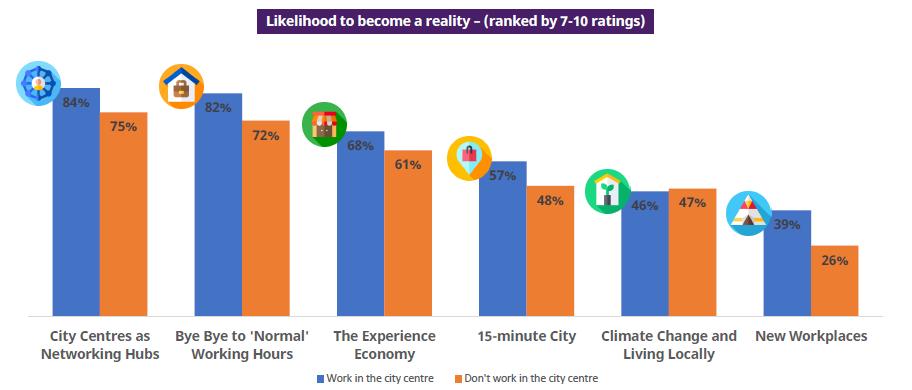
Use of city centres
In terms of broader use of city centres, of the panel respondents 88% had visited Birmingham, 35% Wolverhampton and 30% Coventry prior to the pandemic. 56% visited city centres weekly and one in four went weekly for shopping, for socialising or visiting friends/family. Entertainment visits happened less frequently, every 2 to 3 months, but just under 50% were visiting for the cinema, theatre or concerts, or going to a local attraction such as a museum. Nine out of ten respondents said that their behaviour had changed during the pandemic: they were shopping online more, staying local or going out less. 86% had shopped differently - including staying local, buying online and going out less.
Respondents highlighted avoiding crowds, saving money, supporting local businesses and convenience as positive outcomes of their changed behaviour. However, the responses indicated that
some missed the experience of going into a city centre for shopping, particularly as part of a bigger socialising experience. With the planned easing of national lockdown restrictions at the time of the survey, whereas more than half of respondents expected to go into the city centre for work less than before the pandemic, the majority expected socialising or entertainment to be done at least as much as before. They reported that they would use a range of information sources to find out about new things happening in the city centre, with council and local websites most frequently referenced. In terms of what would be most effective in encouraging them back into city centres, 68% stated events of interest, 51% more green spaces and 47% an increased police presence on streets and 42% increased police on transport. Around 40% of respondents mentioned more pedestrianisation, new restaurants and improved shopping as making city centres more attractive. This highlights concerns regarding overcrowding and anti-social behaviour.
Again, respondents were asked to rank the likelihood of various megatrends discussed in the megatrends workshops becoming a reality on a scale of 1-10 (with 1 being least likely and 10 being most likely). The concept of ‘Cities for People not Cars’ was considered likely to become a reality amongst half of respondents. Many respondents wanted to see more green spaces, pedestrianised areas and more events of interest in the city centre as people return to socialising and attending events that they’ve missed throughout the pandemic.
Overall, the results suggest that residents were keen to get back to some normality where they can enjoy socialising with friends and family, explore attractions in the city centre and attend events. This indicates that keeping residents up-to-date with events in the city via council and local websites, together with a stronger social media presence, is key to bringing people back to the city centre.
On the basis of the results it seems likely that many residents will continue shopping online as they have been during the pandemic due to convenience, coupled with concerns around congestion and safety when returning to the city centre. Support for local retailers in residential areas may also continue at levels higher than the pre-Covid norm.
Together the results on employment, working patterns and wider use of city centres provide endorsement of the need for city centres to pursue an experience led strategy both for workers and visitors to ensure vibrant futures.
7. FUTURE SCENARIOS
Introduction
The context for the development of scenarios for future city centres is outlined in Figure 7.1119 which summarises the short-, medium- and long-term challenges facing cities and city centres as they appeared in autumn 2020.
Figure 7 1: City centre challenges in the short-, medium and long-term
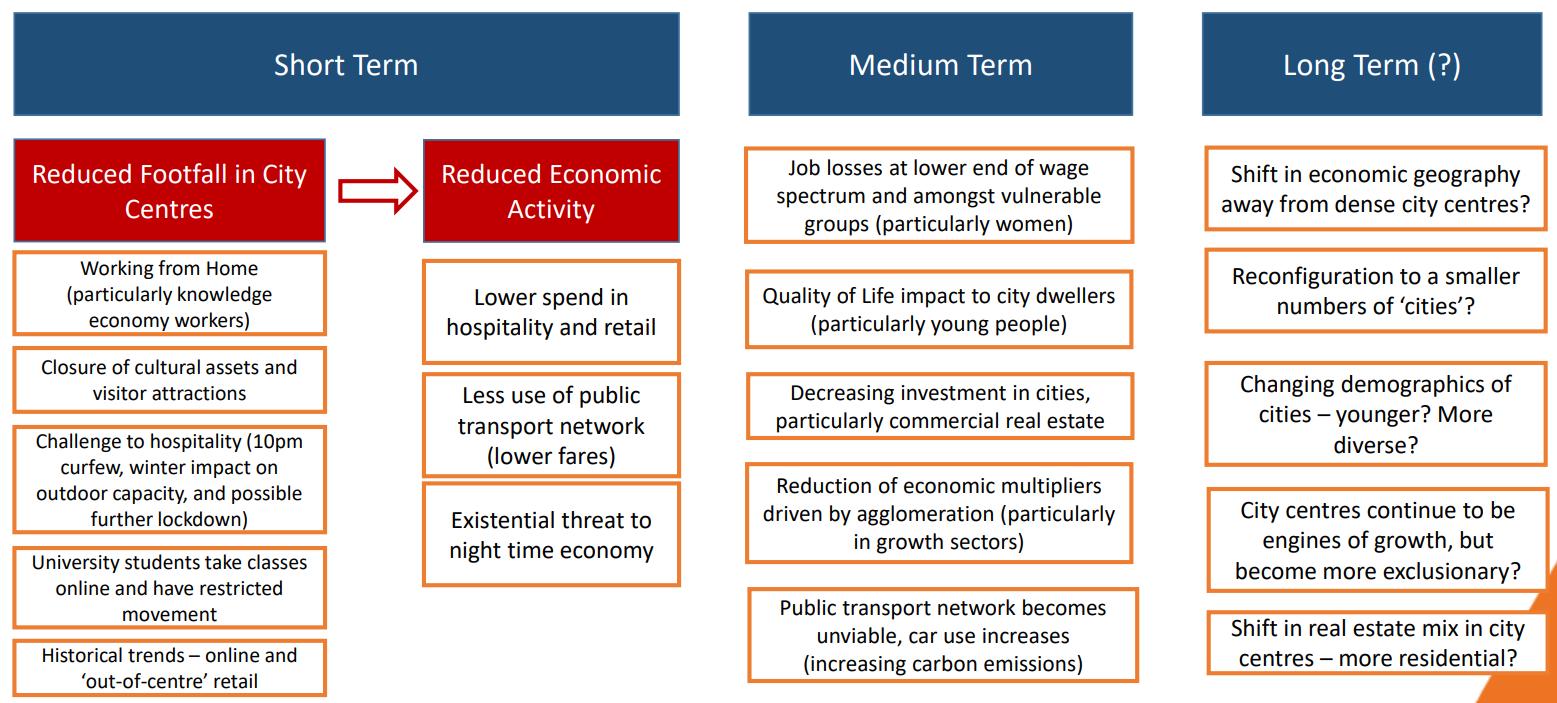
The short-term challenges of reduced footfall in city centres from many BPFS and other office-based workers and students working virtually and the closure of visitor attractions and restrictions on opening in the hospitality sector resulted in reduced economic activity. This meant reduced hospitality and retail spend, a particular challenge to the night-time economy and reduced usage of public transport. Possible medium-term challenges surround the viability of the public transport network, job losses amongst low-paid workers, decreasing investment in cities, weakening of positive economic multipliers and a reduced quality of life for young people in cities. In the longer-term there are questions about shifts in the geography of economic activity away from city centres such that they become more residential and that what growth exists in city centres becomes more exclusionary.
Scenario development
To prompt discussion of possible futures we developed four scenarios occupying the four quadrants yielded by opposing trends on two axes (see Figure 7.2):
• horizontal axis – measuring change in employment in the city centre - with decreasing employment as a consequence of home/remote flexible working contrasting with increasing employment in the city centre resulting from a growth in demand for networking, career development, training and social contact
• vertical axis – measuring footfall associated with culture, hospitality and retail in the city centre –with decreasing footfall emanating from prolonged fear, social distancing and shortcomings in Covid-19 vaccines contrasting with increasing footfall associated with demand for social contact and a desire for city centre experiences in the context of a successful vaccination programme
119 This figure is taken from slides and resources compiled by the WMCA for meetings in October and November 2020 with the Chief Executives of Birmingham, Wolverhampton, and Coventry Councils alongside officers from the West Midlands Combined Authority and West Midlands Growth Company.
7.2: Four scenarios for the future city centre
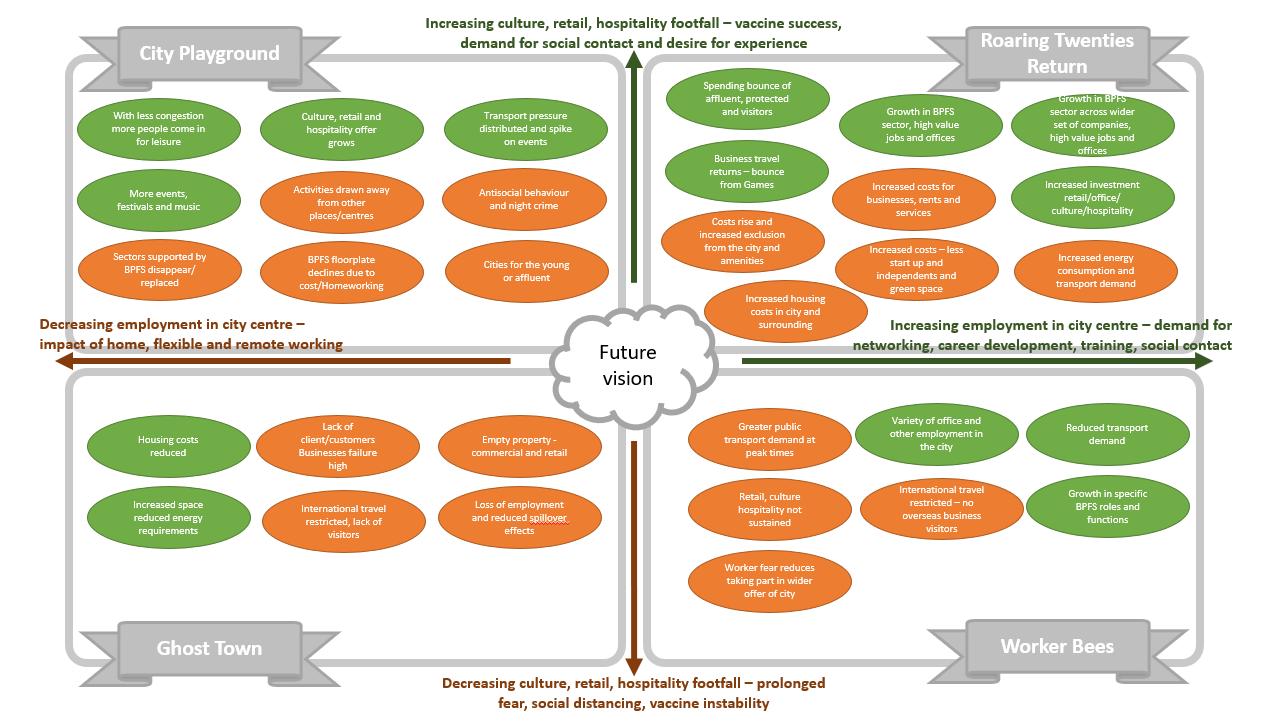
Figure
The four scenarios were each given a name capturing their main features:
• Ghost Town: characterised by decreasing employment in the city centre and decreasing culture, hospitality and retail footfall
• Roaring Twenties Return: characterised by increasing employment in the city centre and increasing culture, hospitality and retail footfall
• City Playground: characterised by decreasing employment in the city centre and increasing culture, hospitality and retail footfall
• Worker Bees: characterised by increasing employment in the city centre and decreasing culture, hospitality and retail footfall
Economic modelling
Key features of each scenario are described in the next sub-section.
We gauged the impact of the different economic scenarios using two different models. One is CityREDI’s in-house Socio-Economic Impact Model (SEIM-UK).120 This input-output model takes account of the interdependencies between different sectors of the economy at the West Midlands metropolitan area scale 121 The other is an economic model from Oxford Economics122 run at the Birmingham local authority scale. This latter model enables the specific scenarios to be compared with a baseline scenario. The model scenario was run for a ten-year period: 2021-2030.123
For each model we examined the four scenarios across the two axes of: (1) economic output in services and industry; and (2) output in accommodation, trade, food services, arts, entertainment and recreation. We adopted the following assumptions for illustrative purposes to capture trends associated with different broad directions of travel implied by each scenario:
• Ghost Town: assumes a 20% reduction in output (Gross Value Added) for manufacturing, construction, transport, utilities, real estate, and professional services, and a 50% drop in wholesale and retail trade, accommodation, food services, arts, and entertainment.
• Roaring Twenties Return: assumes the reverse of ‘Ghost Town’: increasing by 20% in the former sectors and doubling in the latter.
• City Playground: assumes the 20% drop in manufacturing, construction, transport, and professional services, but a contrasting doubled output in wholesale and retail trade, accommodation, food services, arts, and entertainment.
• Worker Bees: assumes the reverse of ‘City Playground’, this scenario envisages a 50% drop in trade, accommodation, food services, arts, and entertainment. However manufacturing and professional services output grows by 20%.
Once the overall effects of each scenario were derived from the modelling work, we sought to understand some of the geodemographic consequences are distributed. Experian uses customer-level intelligence to classify different types of consumers. The result is unique MOSAIC profiles which can be spatially mapped, with information on age, household income, family structure, property tenure, and consumer spending patterns. We selected the following groups as of particular interest in this
120 See https://www.birmingham.ac.uk/schools/business/research/research-projects/city-redi/socioeconomic-impact-model-for-the-uk.aspx
121 The seven local authorities that together make up the West Midlands Metropolitan area.
122 The Oxford Economics model (2021) is funded by the West Midlands Combined Authority, the Midlands Engine and Midlands Connect.
123 Tables and Figures are output automatically for the period to 2040.
analysis because they are represented across large swathes of the West Midlands metropolitan area and are affected very differently by the four scenarios:
• Vintage Value: retired singles, often living in council and housing association flats on a limited pension income.
• Transient Renters: young singles and home-sharers, renting low-cost homes for the short term.
• Aspiring Homemakers: younger households settling down in affordable semi-detached homes with young children.
• City Prosperity: young city dwellers earning high incomes and living in high value rented accommodation in central locations.
Commentaries on the results from the economic modelling exercise are included in the descriptions of the four scenarios below.
Key features of the scenarios
From Figure 7.2 it is clear that each of the four scenarios has positive features (illustrated in green) and negative features (illustrated in orange). This suggests that none of the four scenarios presents an ideal future vision (as explored in section 8) but rather that there are trade-offs between them.
Ghost Town
This is the bleakest of the four scenarios and highlights the extremes of the city losing its core purpose. Decline in BPFS and other employment in the city centre has negative spill-over effects on the retail and hospitality sectors, leading to a domino effect of decline. The resulting rate of business failures is high and employment, output and footfall shrink.
This scenario has played out historically where places – such as core cities or manufacturing townshave seen their major function disappear and have struggled to restructure successfully. Decline creates long term structural changes in the face of industrial decline. There are consequent impacts on investment, property and the viability of the transport infrastructure. Housing becomes more affordable - albeit residents may become ‘trapped in place’. Some empty spaces may provide new opportunities for leisure and recreation but this requires investment
Birmingham city centre has a relatively broad business base but the BPFS sector and the public sector are important providers of employment. In the BPFS sector it is possible for many workers to work remotely and their absence presents a risk to other sectors in the city centre reliant on their custom.
The output from the Oxford Economics model at the Birmingham scale depicts a bleak outlook for this scenario. It shows slight overall population growth accompanied by a significant decline in the working-age population, and high levels of net out-migration resulting in Birmingham forgoing the inbuilt advantages of its youthful population. Loss of high-productivity employment results in GVA per worker decreasing despite much higher unemployment, which approaches 14%. Key trends relative to the baseline are:
• A population increase of 2.1% (and of -0.6% for the population aged 16-64) between 2021 and 2030, compared to a baseline growth of 4.2% and 2.1% respectively.
• GVA per worker would increase by 10.3%, compared to a baseline scenario of 11.3%.
• Total GVA would contract by -1.9% compared to the baseline growth of 19.6%.
• The change in economic output would be accompanied by a net out-migration of 77,700.
Figure 7.3 shows sustained high ILO unemployment at around double the rate of the baseline forecast 124 Figure 7.4 shows that employment losses across most sectors are greater than in the baseline forecast, notably so in manufacturing, the wholesale & retail trade and accommodation and food services.
Figure 7 3: Changes in the ILO unemployment rate in the ‘Ghost Town’ scenario – Birmingham
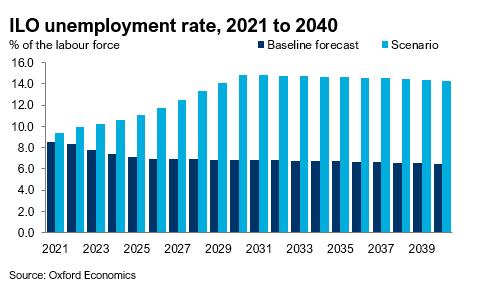
7 4: Changes in employment in the ‘Ghost Town’ scenario – Birmingham
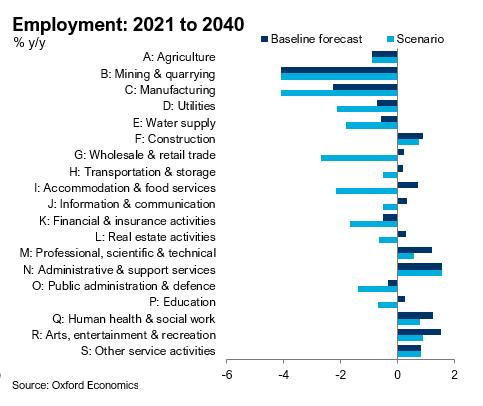
Economic modelling at the West Midlands metropolitan area scale shows an output reduction in all sectors but with hospitality, entertainment and the retail sector hardest hit (see Figure 7.5).
124 The ILO (International Labour Organisation) defines unemployed people as being those without a job, who have been actively seeking work in the past four weeks and are available to start work in the next two weeks; and those out of work, who have found a job and are waiting to start it in the next two weeks.
Figure
Figure 7 5: Projected changes to GVA by sector in the ‘Ghost Town’ scenario – West Midlands metropolitan area
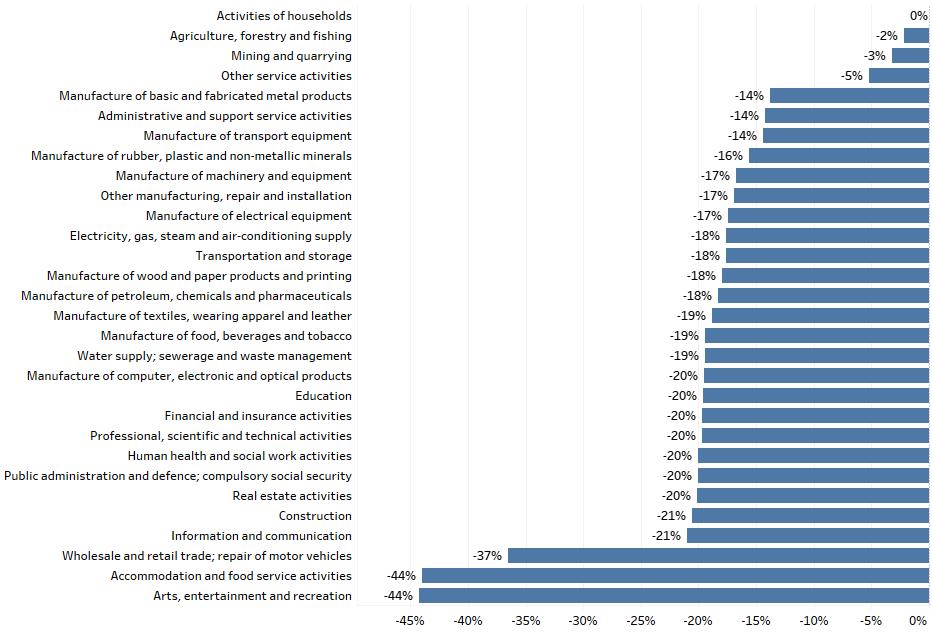
Source: SEIM-UK.
Sub-groups of the population – as captured by the selected Experian MOSAIC profiles - are differentially impacted (see Figure 7.6):
Housing: A less attractive urban core would take some heat out of the housing market, which may relieve pressure on those low-income renters who still have steady employment, as well as new families looking to buy, though reducing the gains accrued by existing homeowners.
Crime: A hit to economic prosperity and financial security is likely to worsen crime
Transport: Reduced intra-regional travel could damage cohesion. Lower demand on public transport could threaten viability of many services leading to a general decline in service frequency. Lower demand on the road network would improve journey time reliability for both bus and car.
Businesses: This scenario of protracted decline across most sectors of the economy is likely to push many businesses to the precipice.
Migration: As the city centre becomes less attractive, there may be knock-on effects for graduate retention, sapping further life from the economy as those who are able to move away
Public services: Health service infrastructure is likely to become more pivotal than ever, both as a source of employment and to mitigate the rise in chronic ill health likely to be exacerbated by a loss of high-quality jobs and social activities.
Figure 7 6: Social and spatial impact of the ‘Ghost Town’ scenario
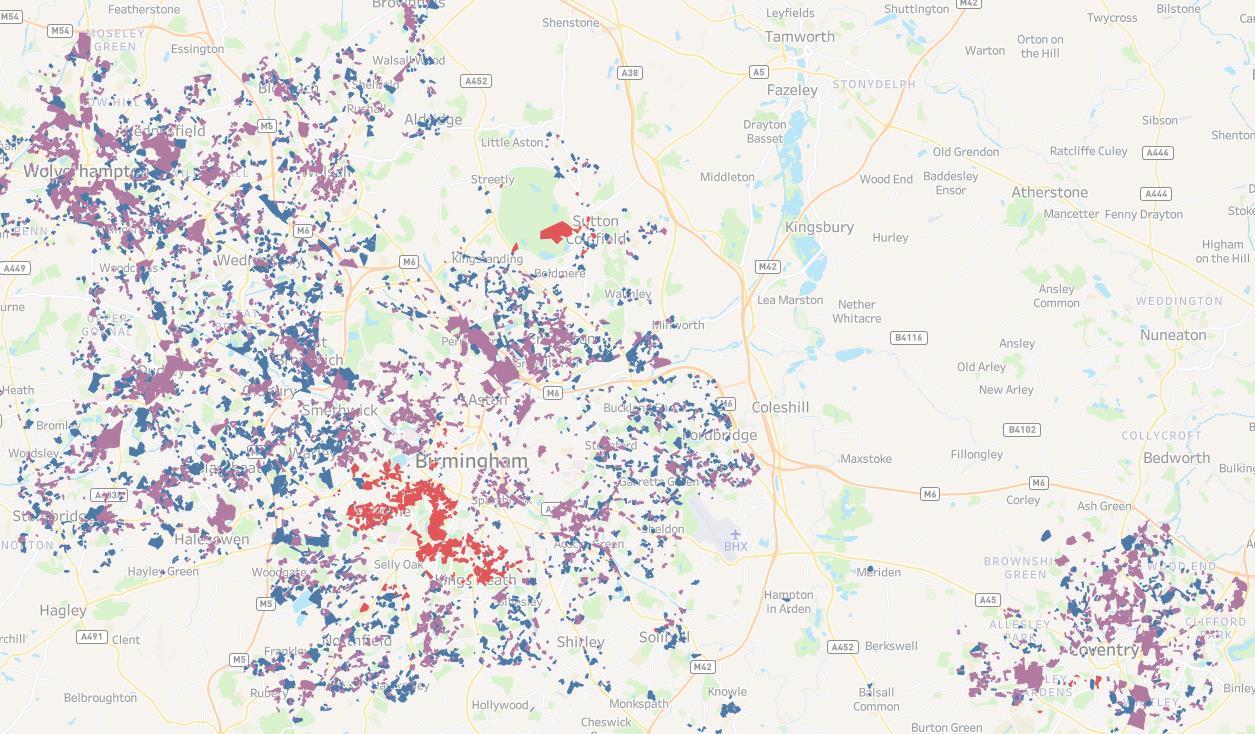
• Renters on a low fixed income (‘Transient Renters’, shown in purple and ‘Vintage Value’ shown in blue) may be to some extent shielded from the adverse impacts of economic decline, as less attractive city centres lead to relatively lower house prices and lower pressures on rent.
• High-income renters (‘City Prosperity’, shown in red) concentrated in southern Birmingham, stand to lose out on opportunities as the centre declines, putting the city at a weaker competitive position relative to other cities and regions.
• Well-off suburbanites may weather the decline well, particularly if they are able to take advantage in the growth of remote working as city centre opportunities fall away.
Roaring Twenties Return
This scenario highlights the extreme of recovery, with robust growth in entertainment and leisure activities in the city centre, alongside growth in the wider economy led by the BPFS sector with high value jobs, construction, and advanced manufacturing. In contrast to previous economic downturns, the Covid-19 pandemic has driven reductions in leisure spend with the constraints of social distancing measures and increases in saving. In this scenario abolition of social distancing and other constraints leads to an explosion of social interaction, including a return of business and international travel.
However, as indicated in Figure 7.2, this is a twin track recovery, with more affluent and older people driving spending, while poorer, younger and some BAME groups who have borne the brunt of the economic impact of the Covid-19 pandemic are excluded as they face rising challenges of affordability – for housing and general living costs. This creates division and exacerbates inequalities already present. It is notable that developments in the 1920s (coined the ‘Roaring Twenties’) was one trigger for the subsequent 1930s crash and social unrest.
Greater division will make access to city centre jobs and services harder for residents of poorer neighbourhoods geographically adjacent to the city centre. Economic growth may also lead to pressures on the environment and the transport system.
The output from the Oxford Economics model at the Birmingham scale shows burgeoning population growth and net migration into Birmingham, owing to its optimistic projection of strong growth across
both leisure and recreation as well as across manufacturing and services more generally. It is noteworthy that even strong near-term growth in manufacturing does not prevent an eventual decline from automation. Actual productivity per worker would be slightly lower than the baseline scenario, due to the higher employment including low-productivity occupations and sectors. Key trends relative to the baseline are:
• A population increase of 15.8% (and of 16.6% aged 16-64) between 2021 and 2030, compared to a baseline growth of 4.2% and 2.1% respectively.
• GVA per worker would increase by 7.8%, compared to a baseline scenario of 11.3%.
• Total GVA would grow by 61.5% compared to the baseline of 19.6%.
• The change in economic output would be accompanied by an increase in net migration into Birmingham of 112,800.
Figure 7.7 shows the ILO unemployment below the baseline forecast. Figure 7.8 shows more positive employment trends across sectors than in the baseline forecast, most notably in the wholesale & retail trade, accommodation & food services and arts, entertainment & recreation.
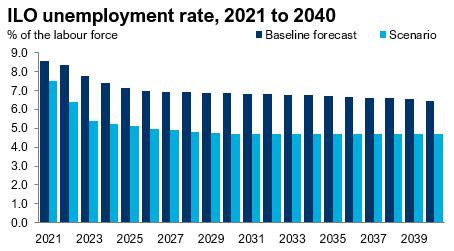
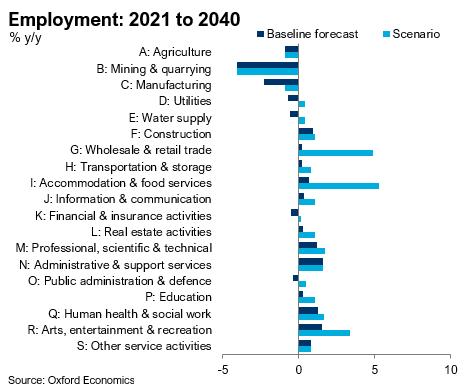
Figure 7 7: Changes in the ILO unemployment rate in the ‘Roaring Twenties Return’ scenario – Birmingham
Figure 7.8: Changes in employment in the ‘Roaring Twenties Return’ scenario – Birmingham
Economic modelling at the West Midlands metropolitan area scale shows output growth in all sectors but most notably in entertainment, hospitality and retail, with the BPFS sector also experiencing output growth (see Figure 7.9).
Figure 7.9: Projected changes to GVA by sector in the ‘Roaring Twenties Return’ scenario - – West Midlands metropolitan area
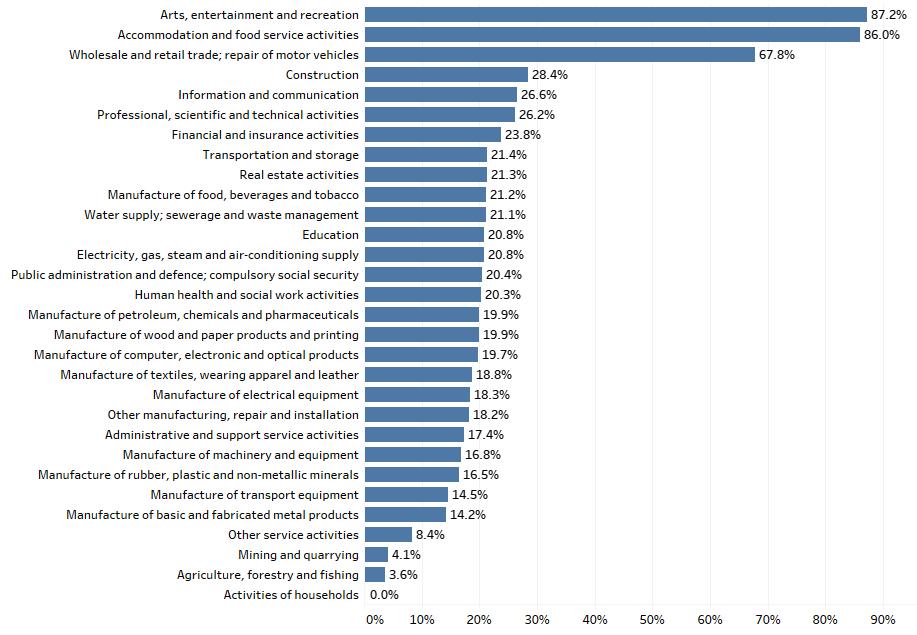
Source: SEIM-UK.
While many sub-groups of the population benefit under this scenario, ‘Transient Renters’ may not (see Figure 7.10):
Housing: ‘Transient renters’ tend to live in areas currently with more affordable housing. Rising house prices will also affect young couples moving out of the urban core to start families, and may exacerbate the net loss of this demographic to surrounding areas so challenging attempts to build more diverse communities in urban centres
Crime: More activity will likely lead to more crime, especially in city centres. However, a mitigating factor here is that with both employment and leisure uses strong in this scenario, there are likely to be more ‘eyes on the street’ throughout the day and night, which may enhance safety in main urban thoroughfares.
Transport: With the economic recovery strong and broad-based, the night economy will take up capacity on the transport network in the evening, spreading demand and improving overall capacity utilisation. This will make future network expansion, particularly rail and metro, more financially viable, and help bus patronage recover sufficiently to protect the viability of routes. Use of private cars may increase.
Businesses: The economic climate is conducive for the growth of existing firms and new entrants. How and where the benefits of growth are distributed will be complicated by hybrid working practices. Eventually, the negative externalities associated with rising housing costs, increasing crime and pressures on the transport network may become a bottleneck to further growth.
Migration: A lively and varied city centre offering may draw a larger number of students and retain more after graduation, helping to supply a more skilled workforce to the growing economy. A stronger and more prosperous urban core may encourage young families to look to settle closer to the city than they otherwise would.
Figure 7 10: Social and spatial impact of the ‘Roaring Twenties Return’ scenario
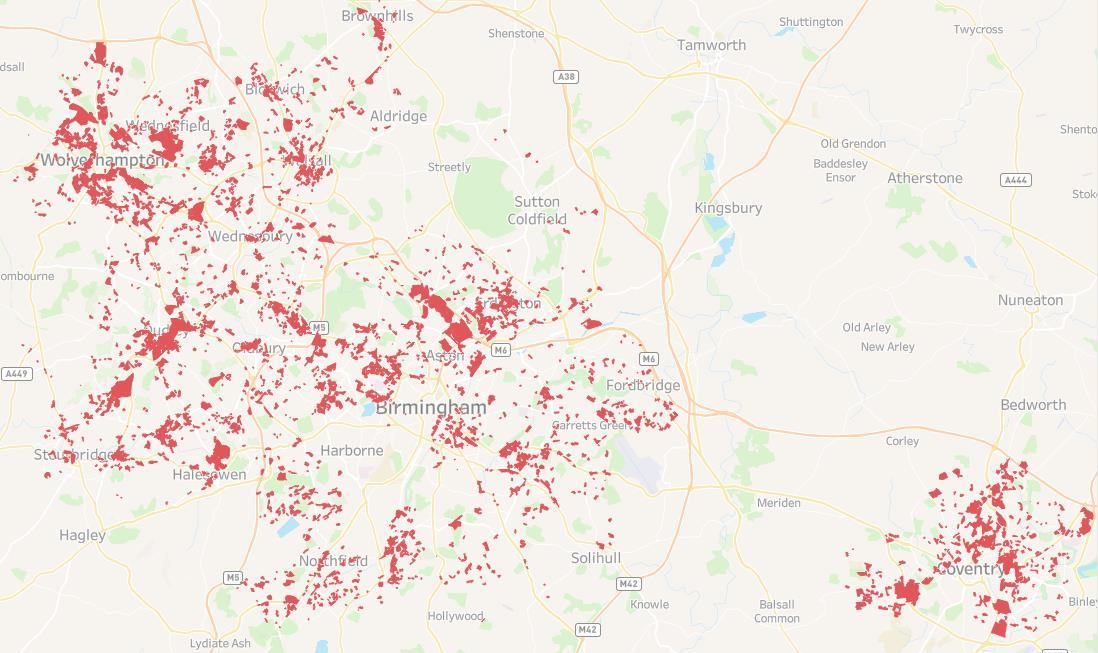
• ‘Transient renters’, mapped above in red, face strong upward pressures on rent in this scenario of economic growth and rising house prices. However, they also have more economic opportunities than ever before. The question of working conditions and wages vis-à-vis living costs is particularly salient for this group.
City Playground
This scenario highlights the extremes of the city becoming a place for entertainment and leisure experiences of all kinds, with a growth in the festivals and events offer increasing visitor footfall Decreasing employment in other sectors in the city centre and neighbouring areas leaves it with arts, culture, entertainment and shopping as the main focus. At its extreme this scenario is played out in places like Blackpool, London’s West End and Las Vegas where the pre-eminent function is the visitor economy - especially as other sectors hollow out over time.
Birmingham’s city centre visitor economy was driven by business visitors, with a thriving national and international conference circuit, prior to the Covid-19 pandemic. This is reflected in the food, shopping and entertainment offer in the city centre. Decreasing employment in the BPFS sector in the city centre business district, along with a decline in post pandemic international travel associated with some substitution by digitalisation and concerns over environmental impact of travel could jeopardise Birmingham’s current offer. The ‘City Playground’ scenario implies a reorientation of the culture and entertainment offer to appeal to a wider base and growth of a popular offer.
This scenario may make urban living attractive to many young people albeit those seeking well-paid professional jobs may find them lacking. Growth of the entertainment offer may create tensions between some residents and visitors, especially with increased crime and antisocial behaviour.
The output from the Oxford Economics model at the Birmingham scale shows a high level of population growth and migration, as strong growth in leisure and recreation offsets the steep decline in manufacturing employment. As these sectors employ a large number of workers, the projected unemployment in this scenario (see Figure 7.11) is as optimistic as in the Roaring Twenties Return scenario. However, that there is an eventual fall in arts and entertainment employment even in this scenario (see Figure 7.12), as the impact of automation in services and growth in online sales makes itself felt.
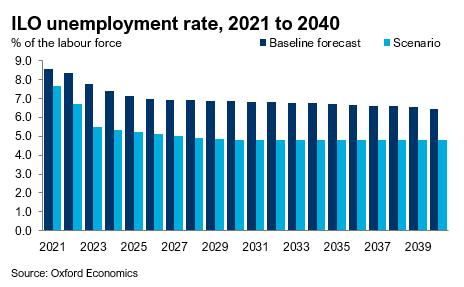
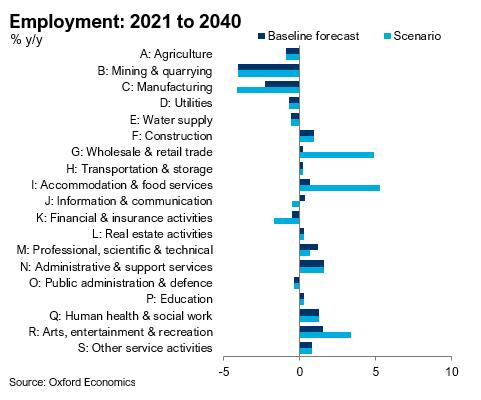
Actual productivity per worker would be significantly lower than the baseline scenario, due to the employment growth being dominated by low-productivity occupations and sectors. Key trends relative to the baseline are:
Figure 7.11: Changes in the ILO unemployment rate in the ‘City Playground’ scenario – Birmingham
Figure 7 12: Changes in employment in the ‘City Playground’ scenario – Birmingham
• A population increase of 12.9% (and of 13.1% aged 16-64) between 2021 and 2030, compared to a baseline growth of 4.2% and 2.1% respectively.
• GVA per worker would increase by 3.1%, compared to a baseline scenario of 11.3%.
• Total GVA would grow by 42.5% compared to the baseline of 19.6%.
• The change in economic output would be accompanied by an increase in net migration of 104,900.
Economic modelling at the West Midlands metropolitan area scale shows strong output growth in entertainment, hospitality and retail sectors, some output growth in construction, relative stability or some decrease in output across BPFS sub-sectors and a decline in manufacturing output (see Figure 7.13).
Figure 7 13: Projected changes to GVA by sector in the ‘City Playground’ scenario – West Midlands metropolitan area
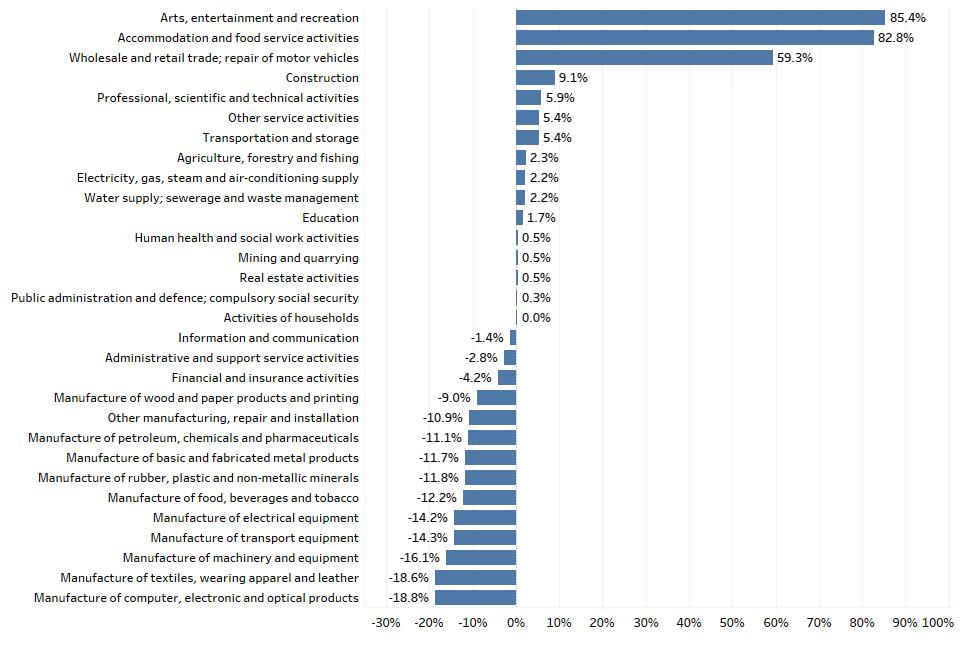
Source: SEIM-UK.
‘Transient renters’ stand to benefit in this scenario; while ‘Aspiring homemakers’ are hard hit (see Figure 7.14):
Figure 7 14: Social and spatial impact of the ‘City Playground’ scenario
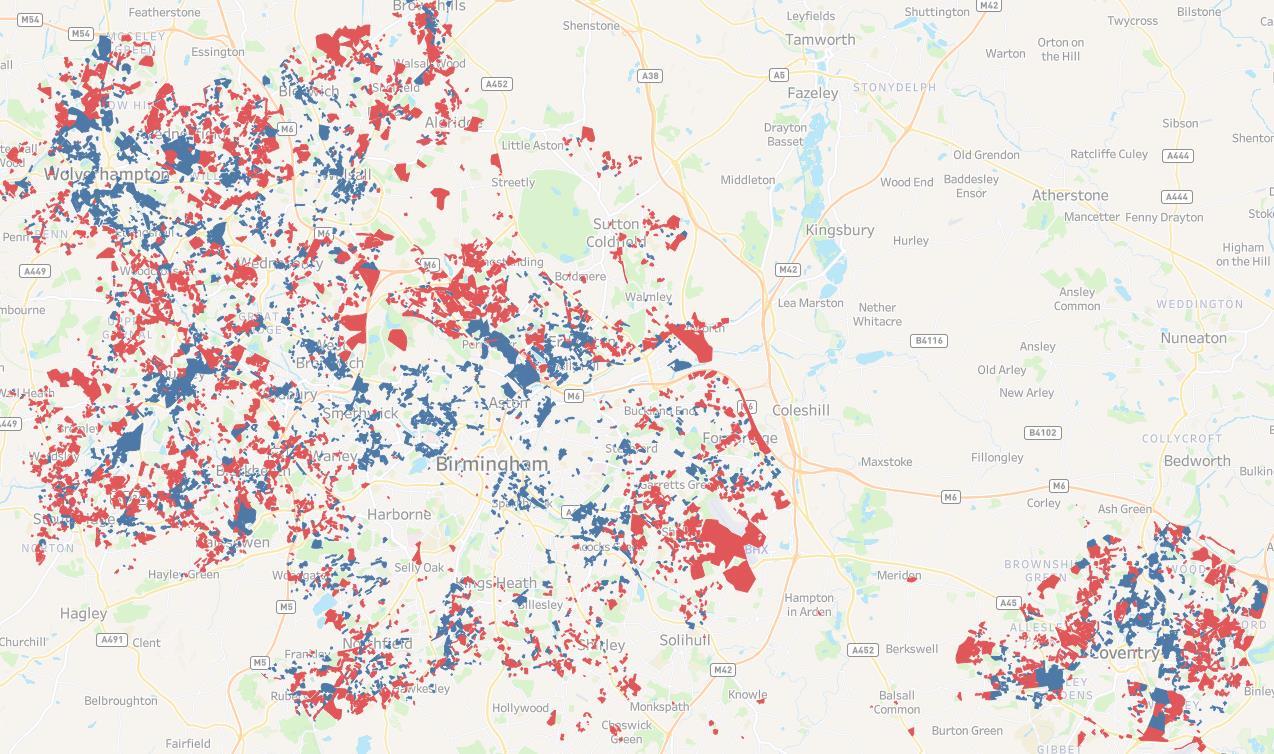
• ‘Transient Renters’ (shown in blue) are attracted to city centres.
• ‘Aspiring Homemakers’ (shown in red) forsake the main urban centres, seeking out attractive environments in the suburbs and beyond.
Housing: The types of economic activity likely to flourish in this scenario are more likely to support renters and young people than aspiring families. This may mean a greater turnover and potentially a loss of identity and character in some areas with transient populations. For those who are still able to find good employment, modest house prices will increase options for getting on the housing ladder.
Crime: There is a risk of greater crime, particularly assault and anti-social behaviour, with more people out late at night and potentially less activity in the early evenings marking the transition to the evening and night time economy.
Transport: Significant peak pressure would be taken off the transport network compare with the situation prior to the Covid-19 pandemic in this scenario. Depending on the precise nature of the entertainment and leisure offer, weaker morning demand and stronger evening demand, would lead to a flattening the usual demand curve. Given fewer city centre offer jobs and more remote working, the network might be better able to meet demand and roads would be less congested at peak times.
Businesses: As this scenario envisages a decline in manufacturing output and employment, we may expect the network of manufacturing suppliers to be pruned and simplified. A more limited manufacturing offer making it more difficult to attract new major firms to the region. The very strong and enticing city centre offer created by the thriving arts and entertainment sectors mean stronger growth in traditionally low-paid sectors, with only modest growth (if any) in better-paid service jobs.
Migration: The vibrant urban core may attract university students, but without a strong employment offer Birmingham and the West Midlands will lose more graduates to other regions. Remote working – without a substantial hybrid element - will weaken ties to the city.
Worker Bees
This scenario is one of robust employment growth in manufacturing and services, but a decline in retail and hospitality, resulting in a city centre that is lively during the day and relatively dead at night, with most social activity taking place closer to home. As such it highlights the extreme of the city shifting to being a place of work. Demand for public transport remains mostly concentrated in the peak times associated with journeys to and from the workplace.
Residential areas - in the suburbs and beyond – become sites for entertainment and hospitality, with local retailers competing with online offerings. This was a common pattern in the 1970s, when most leisure time was spent in the local community. Prior to the Covid-19 pandemic Birmingham had a thriving suburban offer based on local, diverse communities, including Sparkhill, Moseley and other centres that attract local residents.
In this scenario the city centre hospitality offer is geared to domestic city centre workers, with international travel remaining subdued. Hybrid working could elongate the weekend lull for many city centres unless employment in the city centre expands and workers spread their days in the office over the working week.
A positive aspect of this scenario is the variety of employment in the city centre and wider area, including good quality jobs.
The output from the Oxford Economics model at the Birmingham scale shows muted population growth, with some loss of residents to negative net migration, owing to its projection of weak growth in both leisure and recreation, which strong growth in manufacturing and other service sectors, while more productive, are not able to offset (see Figure 7.16). In addition to this forgone growth, unemployment increases steeply, approaching 10% and remains high (see Figure 7.15). Productivity per worker would increase markedly, due to loss of employment in less productive sectors. Key trends relative to the baseline are:
• A population increase of 3.3% (and of -1.0% aged 16-64) between 2021 and 2030, compared to a baseline growth of 4.2% and 2.1% respectively.
• GVA per worker would increase by 14.6%, compared to a baseline scenario of 11.3%.
• Total GVA would grow by 13.3% compared to the baseline of 19.6%.
• The change in economic output would be accompanied by a net out-migration of 11,300.
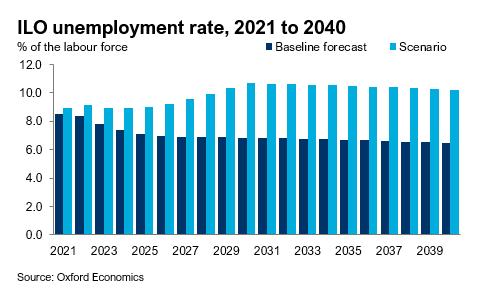
Figure 7 15: Changes in the ILO unemployment rate in the ‘Worker Bees’ scenario – Birmingham
Figure 7 16: Changes in employment in the ‘Worker Bees’ scenario – Birmingham
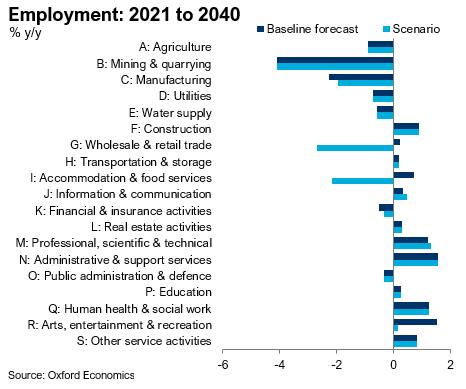
Economic modelling at the West Midlands metropolitan area scale shows strong output growth in manufacturing and more modest output growth in most of the BPFS sector. Large output reductions are confined to the entertainment, hospitality and retail sectors (see Figure 7.17).
Figure 7 17: Projected changes to GVA by sector in the ‘Worker Bees’ scenario - – West Midlands metropolitan area
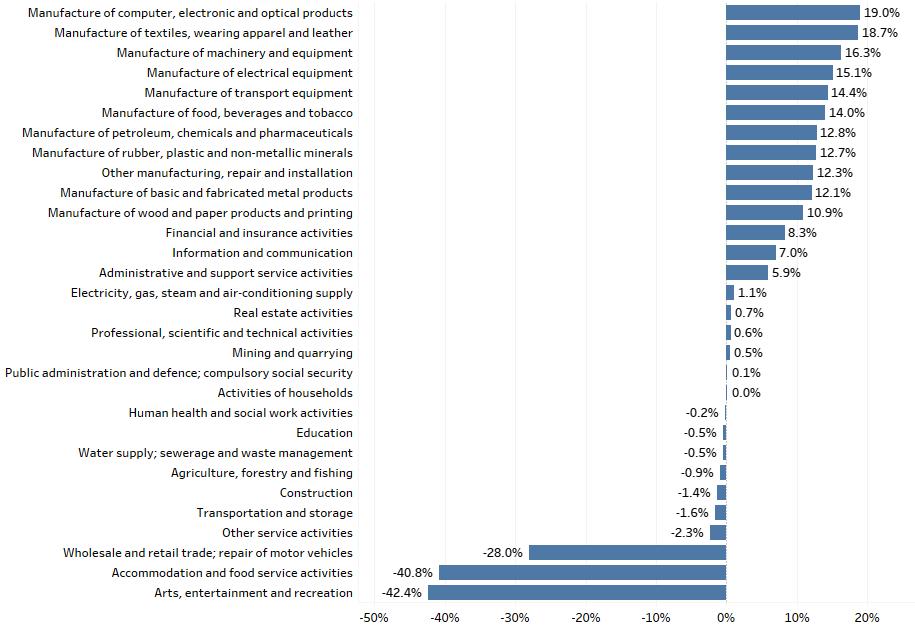
Source: SEIM-UK.
The ‘Worker Bees’ scenario is one of opportunity for those people who have embarked on their careers. The drawbridge pulled up for younger people, with a shortage of entry-level positions and a less attractive city centre meaning less recreation and social life there. ‘Transient renters’ stand to lose in this scenario (see Figure 7.18)
Figure 7.18: Social and spatial impact of the ‘Worker Bees’ scenario
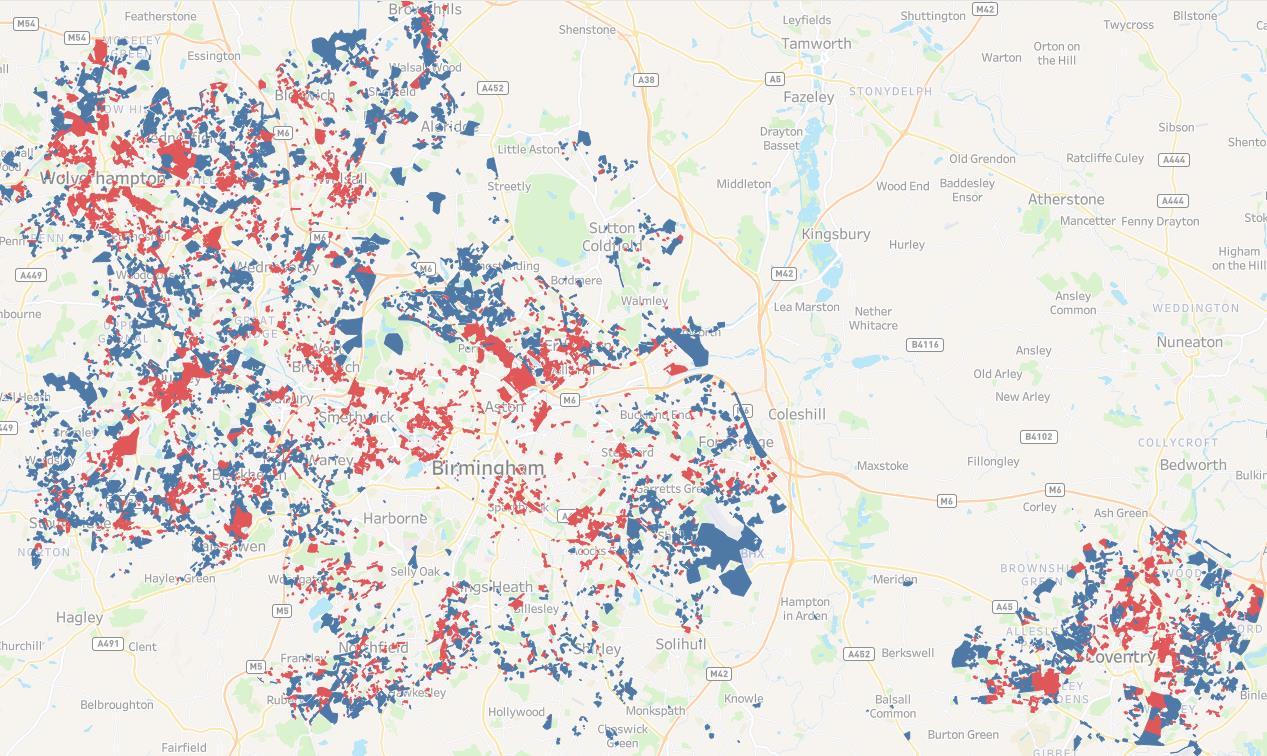
• In an obverse pattern to the ‘City Playground’ scenario, ‘Transient renters’ (shown in red) stand to lose in this situation, and aspiring homemakers (shown in blue) in suburban areas and other non-urban attractive environments gain.
Housing: Pressure on the housing supply is likely to be felt most in more prosperous areas, both within the city and beyond, given the possibility of less frequent longer-distance commutes becoming more viable for those with city centre workplaces working on a hybrid model.
Crime: In this scenario, as the sharp drop off in footfall in the evenings means less ‘eyes on the street’ and greater vulnerability for those who are out late at night, such as shift workers.
Transport: The existing morning and afternoon peaks would be amplified, particularly in the early evening when there is little reason to stay around after work. This would result in an inefficient allocation of capacity on the network, and difficultly accommodating demand at peak times –especially if more businesses are attracted into the city centre.
Businesses: Robust manufacturing output in this scenario will safeguard areas dependent on manufacturing for employment, and make for an excellent diversified supply chain supporting existing firms as well as emerging sectors such as low carbon. The BPFS sector and services relating to scientific and technical work may prosper, especially in areas with close ties to universities and manufacturing. Businesses dependent on the wider city centre entertainment and leisure offer will suffer.
Migration: Migration and associated residential location outcomes will depend heavily on how hybrid working operates in practice. The extent to which Birmingham can retain young skilled workers will depend on the relative attractiveness of work and leisure offers in main competitor cities.
8. CONCLUSIONS AND RECOMMENDATIONS
Introduction
This section sets out key conclusions and recommendations from the research and engagement phases of the project.
It provides a platform for the reporting phase of the Study and the development of Colmore BID’s response, working with fellow city centre BIDs, Birmingham City Council and other partners to ensure that the city centre business district can remain successful as a place to attract businesses and people and contribute to a vibrant city centre
Conclusions
Likely future trends
After previous historical crises when large cities have suffered, the agglomeration economies they offer have helped them to recover. As noted in section 2, the consensus amongst economic geographers is that large cities will retain a pre-eminent position in the urban system. But their functions could change, with the likelihood of more permanent shifts occurring increasing with the length of the Covid-19 pandemic and associated restrictions on previously ‘normal’ activity. Successful cities will adapt and capitalise on these trends as well as mitigate negative impacts.
From the research and engagement phases of there is a reasonable amount of evidence and opinion to suggest the following six trends are likely to shape the future city centre business district:
1) Digital transformation of the workplace and tech disruption will continue to impact on business models and where and how work is done.
2) Hybrid working is here to stay for many (not all) – two-three days working in the office and threetwo days working from home (or elsewhere), especially in sectors such as BPFS, driven by broader ‘life’ considerations as well as ‘work’ ones.
3) Access to talent is ever more critical and there is an increased demand for skills and jobs that emphasise the human interaction - networking, problem solving, collaboration, selling, creating and innovating.
4) Future business districts will need to be even more focused around connections and culture – a place to connect, interact and collaborate and to enjoy urban experiences.
5) Safety – on transport, in public spaces and at offices – has risen up the agenda considerably. Meanwhile, encouraging commuters back onto public transport system – that feel safe and meets the needs of new working patterns – is a major challenge.
6) Demand for recognising social value, climate change and inclusivity among consumers and employees will continue to rise.
Where do we want to be?
All four scenarios outlined in section 7 have a heterogeneous impact: no scenario describes a uniformly positive or negative picture. Together, they point to the need to re-imagine the city centre around strong collaboration across the service sector, including being open to greater shared office space, and preserving and building on the city’s diverse leisure and entertainment offer. At the same time negative externalities of growth, such as rising house prices, crime, and environmental impact, need to be managed imaginatively.
Birmingham was performing well as a city and had seen strong growth prior to the Covid-19 pandemic With the onset of the pandemic the city centre took on features of the Ghost Town scenario (see Figure 8.1) due to lack of office workers entering the city and the closure of all the other arts,
entertainment and leisure opportunities. Many businesses in the BPFS sector remained strong. They were able to adopt a remote working operating model with many workers based at home.
The general consensus emerging from consideration of the evidence gathered during the research phase and deliberations during the engagement phase of the project is that of a position on the axis between the Roaring Twenties Return and the City Playground scenarios (as outlined in Figure 8.1). This implies encouraging workers in the BPFS sector to return to the city centre – even if only for a few days per week given the hold of hybrid working - not solely for work but for wider benefits of city life. This would help increase culture, retail and hospitality footfall. Moreover, opening and diversifying the city centre offers opportunity for an increase in the number and range of workers, businesses and visitors in the area. Given the constraints on opportunities for physical growth of the city centre except at the margins, this means extracting greater value from existing assets in the area, with a role here for active curation of those assets
This preferred vision requires a diverse offer to meet the needs of office workers operating on a hybrid working model, alongside the needs of consumers of cultural, retail, entertainment and leisure activities. It implies a need for spaces where people can gather safely to connect. It suggests a need for reciprocal and integrated promotion of this vision across the city centre, the wider city and beyond.
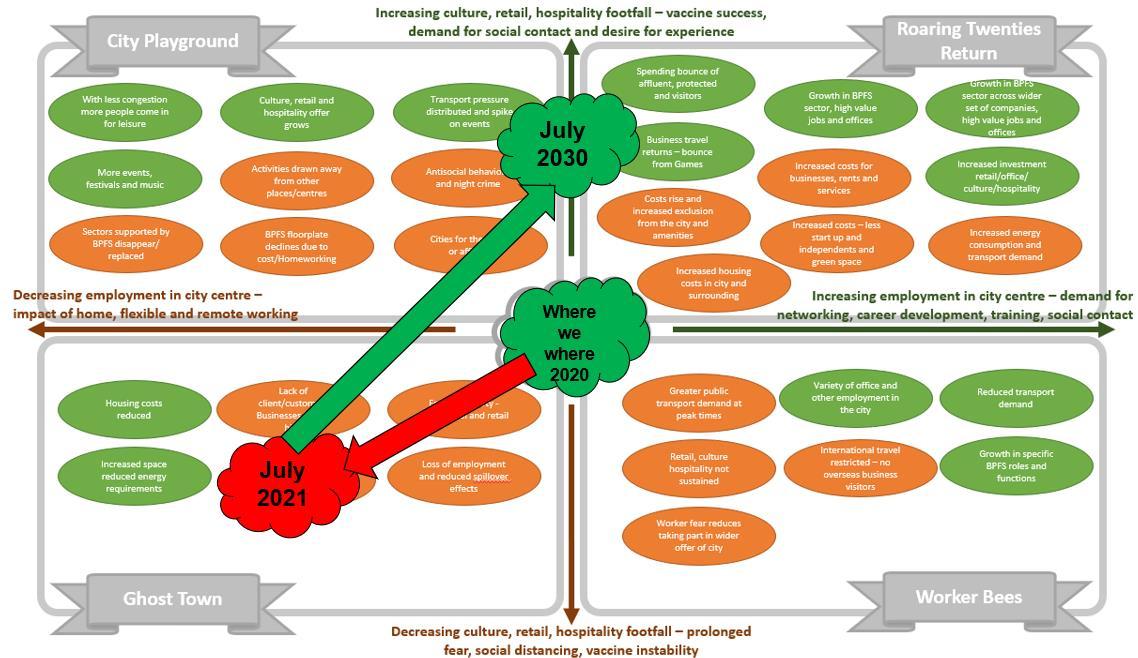
Figure 8.1: Desired future vision
Recommendations
Businesses and the public sector need to work together to facilitate buy in and act to realise this vision, with city centre BIDs also playing a prominent role
Businesses need to:
• Understand the impact their business decisions have on place and how their offices interact with the space they are in and make this an active part of business case development and CSR activities.
• Work with local businesses to help stimulate demand for their services, ideally through a focus on employee benefits, career development, networking and training
• Lobby and invest in better transport, safety and external space development in order to create an environment workers and visitors want to come back to - or visit for the first time.
The public sector needs to:
• Encourage the development of a city with green space, open places and a high-quality public realm that promotes well-being through providing safe spaces for people to come together, as well as venues to enjoy leisure and participate in culture.
• Rethink transport in light of the Covid-19 pandemic and work with transport operators and businesses to design systems that promote worker return and engagement with the city.
• Promote the city, dispel negative images and attract new investments, visitors and workers which complement and fit with the focus of the city centre BIDs.
There is a greater need than formerly was the case for a flexible BID model that can be a city curator that promotes and accelerates:
• Being the place for hybrid working: Supporting businesses to adapt to a hybrid working model and its implications. This entails backing both core BPFS businesses in the district but also taking account of the spillover effects on retail, hospitality and accommodation services.
• Being the centre of experience for employees: Developing the experience portfolio of the city centre business district – attract former city centre workers back and engaging a new diverse workforce with the enjoyment of interaction and experience of place and activities
• Being the place to network and grow: Developing networks and communities – with a focus on recruitment, training, career development and opportunities for innovation for a diverse workforce in a hybrid world
This points to three key influencing activities for city centre BIDs:
• Work across BIDs to develop shared complementary approaches and strategies to attract people back to the city centre, especially focusing on the experiential – whilst growing a differentiated and unique offer. This implies collaboration rather than competition.
• Campaign and support the development of greener, open spaces in the business district and wider city centre
• Support and promote safety to boost public transport use for work and other visits to the city centre.
ANNEX A. CALL FOR EVIDENCE
Business District Seeks Evidence for Future Study
• Colmore Business District launches Call for Evidence in its The Future Business District
• Open Call requests evidence from anyone with knowledge, expertise or experience on central business districts
• Call asks how should those responsible for planning, investing in and developing, managing and using central business districts prepare for the future?
Colmore Business District (Colmore BID) is today (26th January 2021) launching a Call for Evidence as part of The Future Business District, a unique study to inform its response to long term recovery from the Covid-19 pandemic and to offer policy directions on best practice for central business districts across the UK.
The Call is being announced on the same day that Birmingham City Council launches consultation on its ‘Our Future City Plan: Central Birmingham 2040, Shaping our City Together.’ Colmore BID will feed the results of its Study into the local authority plan which is set to replace the Big City Plan, the current blueprint for Central Birmingham to 2031.
Evidence is sought from anyone with relevant knowledge, expertise or experience – including business owners, leaders and managers of all sizes, professionals, investors, property developers, business support and economic development organisations, trade and professional bodies, policy analysts, academics, residents and civil society organisations.
The Call for Evidence highlights five broad questions:
1. How have developments over the last twelve months (especially in relation to the Covid-19 pandemic) changed city centre business districts for the long term? How have businesses, professionals and other users responded in ways which will last beyond the restrictions of the pandemic?
2. What other developments will change city centre business districts and the way you, your organisation or sector accesses and utilises them over the next 5-10 years?
3. How do you expect things to change and why:
a) in the next 3 years?
b) in the next 5-10 years?
4. In what ways should city centre business districts be different in 2031 compared with 2021, and how should they relate to and interact with the rest of the city centre?
5. How should those responsible for planning, investing in and developing, managing and using city centre business districts prepare for the future?
Respondents are asked to submit their evidence (as a Word or PDF document) to: info@futurebusinessdistrict.co.uk by Monday 1st March 2021.
ANNEX B. QUESTIONS USED TO GUIDE EXPERT INTERVIEWS WITH BUSINESSES AND STAKEHOLDERS
Introduction
Thank you for taking part in the Future Business District Study.
This a unique study that has been established to inform long term recovery from the Covid-19 pandemic and offer policy directions on best practice for central business districts across the UK. We want to build on key themes and issues which emerged during the first phase of our research by exploring some of them in more detail with you.
Where requested, your response can be anonymised in our resulting reports.
1. Hybrid working.
In general terms there appears to be a consensus that firms and organisations in and around Colmore Business District will return with a hybrid model – involving some continuation of home working or working from a space closer to home and a partial return to the office.
A. Is this what you envisage for your organisation and your employees?
B. If so, what balance (days/%) do you anticipate between:
a. Home
b. Workspace nearer home
c. City centre office?
C. Do you anticipate this hybrid pattern will last:
a. 3-6 months
b. 6-12 months
c. or no return to previous pattern of all/mostly city centre working?
2. Space requirements.
Many people are considering using their office space differently. Beyond a temporary period during a return to the office do you:
A. Plan to change the use of floorspace, for example less desks and more meeting/collaboration spaces?
B. Make some space and/or services available to third parties/public (e g. café, community drop in, training, desks for associates/supplier firms, incubation/pop up)?
C. Expect to reduce city centre occupation levels at the next opportunity (e g. reduce total square footage at next lease review)?
D. Expect to maintain existing space occupation and utilisation?
3. Doing Business.
The forced lockdowns have made us all work in new ways. What new methods of working will you take forward out of the lockdowns?
A. Will you continue to use Zoom, Teams etc. for some meetings and events even after all restrictions are lifted?
B. Will you be taking forward new technological advances and/or changes to your business model as a result of or inspired by your experiences of the last 15 months? (If yes, discuss further what these advances/ changes are.)
C. Will you be investing in new skills based on recent experiences or a changing market following lockdowns? (If yes, what are these new skills? How will you access them?)
D. Is the pull of the business district – with its concentration of firms and talent and its range of services – as strong as it was, or do you envisage more emphasis on local and distributed networks (e.g. the 15-minute city)?
4. Transport.
Public transport use has dramatically reduced during the pandemic and there are concerns that it will take a long time to return to previous levels.
A. Do you anticipate your employees may not return to previous public transport modes?
B. Are there certain modes of transport that are likely to be more or less attractive to returning city centre employees?
C. What impact do you anticipate from the introduction of the Clean Air Zone – e g. an increase in public transport use?
D. What impact do you expect from new transport options (such as expanding Metro, e-scooters etc.)?
E. Do you anticipate that active travel (e.g. walking and cycling) will now play a bigger role among your employees and colleagues?
F. What would encourage your colleagues and peers back to the city centre using public or active transport (e.g. campaigns/better information, incentives and discounts, new ticketing/pricing schemes).
G. For colleagues who do return to the office (at any frequency), do you anticipate your organisation will operate a more flexible working day (e.g. not expect people to be at the desk at 0900)?
5. Place.
Birmingham is constantly striving to become a more attractive place and it is anticipated the business district and city centre will need to offer even more, at more times, to its users in the medium term…
A. What aspects of the business district and city centre are you and colleagues looking forward to most (e.g. cafes/bars/restaurants; shops; personal/care/health services; working with/meeting others; arts/culture/entertainment venues and activities, open/green spaces)?
B. What else do you think will become more important to you and colleagues to keep you returning to the business district/city centre on a frequent basis (e.g. better transport options; better internet connectivity; more leisure options; more independent food and retail options; more public/open/green spaces)
C. City centre living could increase and there is debate about converting some office buildings to residential use. Do you believe having more homes in the business district and city centre would be good for the area and will it prove an attractive option?
D. COVID-19, as well as other issues, has placed increased emphasis on safety – both in terms of public health as well as crime and anti-social behaviour. To what extent are you concerned by safety in the business district and what impact, if any, will this have on your return – and that of colleagues – to the area?
6. Social, Economic and Environmental.
The pandemic and preparation for the return have provided an opportunity for some to consider how the business district and the way we work can affect other aspects of the economy and society. To what extent are some of these issues on your mind in respect of your organisation and the business district:
A. Supporting efforts to reduce climate change, operate more sustainably and contribute to cleaner air?
B. Develop a more diverse and inclusive workforce, reflecting the area you work in and the markets you serve?
C. Make the business district and city centre more welcoming and more attractive to local citizens, for work and leisure?
D. Develop new ways to maintain and enhance the well-being of employees as well as the wider community?