Future-Business-District-October-2021

Page 1


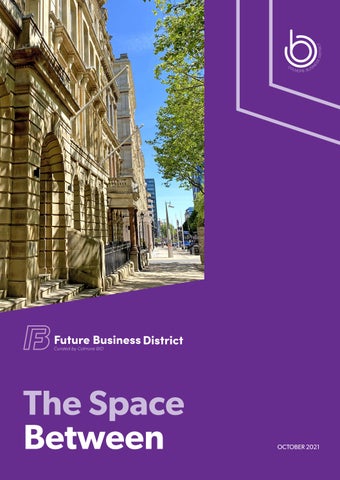
The Space Between

Foreword

NICOLA FLEET-MILNE, CHAIR, COLMORE BID

This report is the result of a nine-month study into the impact of COVID-19 and how to ensure the business district remains successful in attracting businesses and people into the city centre.

It is not the final word on curating the Future Business District. It’s just the start of the next phase for Colmore Business District.

Our response – The Space Between – sets a direction and establishes the drivers and pillars on which to develop a business district fit for the future. In this document, we share the approach and ideas that have emerged from our deep dive.

But they are ideas. We need your help – to verify them, improve them and deliver them.

Colmore Business District has an amazing platform with the investments made into connectivity, placemaking, safety, hospitality and community building during our three BID terms. But the business district will need more active curation; to harness hybrid and to open, diversify and grow the area as people work more flexibly.

I want to thank the team at City-REDI | WMREDI, supported by UKRI, and the Office of Data Analytics at the West Midlands Combined Authority for delivering the research programme.

Thanks also to the project team at Colmore BID, steered steadily by Mike Best. An independent Advisory Panel, chaired by the wonderful Alex Bishop, meant we had a diverse range of expertise on tap.

Our partners not only invested in the project but have continued to help shape the direction and output

Most importantly, though, my final note of thanks goes to the hundreds of people who took part in the research, from responding to our Call for Evidence to participating in Zoom workshops.

ABOUT COLMORE BID

Colmore Business District is a business improvement district (BID) established to project manage improvements and services to the business quarter of Birmingham.

A BID is a defined geographical area within which local businesses collaborate to invest in projects, services and initiatives which improve the environment in which they work.

Colmore BID is principally financed through a 1.5% levy on the rateable value paid by a business.

The BID company is a not-for profit and democratically elected company.

Established 12 years ago it was the UK’s first predominantly office-led BID. Today, encompassing over 700 businesses and 35,000 employees, it forms part of a mosaic of five city centre BIDs working closely with the city council and other partners.

Executive Summary

The Future Business District Study was established to answer two questions: Working with partners, we will develop an Action Plan to deliver our vision of The Space Between Propositions include:

1

2

What is the likely long-term impact of the COVID-19 pandemic on city centre business districts?

How can we ensure they remain successful as places to attract businesses and people and contribute to vibrant city centres?

After a nine-month deep dive by City-REDI | WMREDI at the University of Birmingham, our response – The Space Between – sets a direction and establishes the drivers and pillars on which to refresh the business district and make it fit for the future.

The Future Business District will need more active curation; to harness hybrid and to open, diversify and grow the area as people work more flexibly.

OUR VISION

Colmore Business District will continue to thrive by curating The Space Between that gives Colmore life and makes it attractive to businesses, professionals and visitors.

The Space Between describes the areas used to move, connect and recharge – including transport hubs and routes, open and green places, cultural and hospitality spots – which are essential to supporting business within the workplace.

The Future Business District will be built on six pillars:

The Future Business District has three drivers:

n ‘Curator General’ – new, lead role for the city centre, targeting and welcoming new entrants; acting as creative director, commissioning events and festivals and shaping public realm and green spaces

n Colmore Works –dedicated landing space for start-ups, independent retail, food, culture operators and social enterprises

n On the Ground – open up underutilised ground floor spaces in buildings to support cultural, community and skills development.

Introduction

MIKE BEST, CHAIR, STEERING GROUP

KEVIN JOHNSON, PROJECT DIRECTOR

We started thinking about the impact of the pandemic on the business district just weeks into the first lockdown in 2020. The hollowing out of our city centres, switching to remote working and online shopping, not only reduced office occupancy but had a devastating impact on retail, culture and hospitality as well as transport.

As the pandemic continued, through its waves and tiers, where to work became a matter of choice for many office-based employees. Productivity increased in some sectors of the economy with the business, professional and financial services (BPFS) sector remaining Birmingham’s economic powerhouse. This new way of working suited many lifestyles and personal circumstances whilst commuting time was often re-directed to open spaces, exercise and family time.

The downsides of this forced experiment were becoming clear too. Supervision and mentoring, informal teamwork and professional development are more challenging on Teams. The agglomeration advantages of cities and their business districts are not replicated in the cloud or on virtual platforms. Serendipity and happenstance do not present themselves in the corridor or coffee shop of a Zoom meeting.

Perhaps most fundamentally, the human spirit craves and enjoys the company of other people. Highly skilled, creative and innovative workers particularly thrive on face-to-face interaction.

Attention turned to the future of work, offices and high streets. But there was little focus on the organisms of business districts, the places where offices co-locate with the supporting infrastructure of transport connections, business networking, conferencing, hotels, retail, hospitality and cultural attractions, public realm and green spaces all in close proximity to town halls. These mature ecosystems of large corporates, SMEs and independent businesses have historically thrived by and from each other.

The business district was facing an existential crisis.

For Colmore Business District, this is particularly acute as the historic heart of a thriving BPFS sector. The area has revived with new investors and occupiers of Grade-A office developments, the refurbishment of many older buildings and an explosion of food and drink offers.

It was clear COVID-19 would have a ‘supercharging’ impact on several underlying developments. Technology and automation, sustainability and inclusivity were not trends ushered in by COVID-19, but the virus accelerated them and re-prioritised attitudes and values.

We believed the business case for cities – and their commercial districts – would need to be refreshed with a deeper understanding of behaviours and needs, new ways of working and more investment.

Returning people to city centres and attracting more businesses, professionals and visitors to our business district should not be an instruction or request but a compelling proposition.

This Study aimed to support policies being developed by public bodies, such as Birmingham City Council’s Our Future City Plan and economic recovery strategies led by WMCA and GBSLEP. We maintained focus on the medium term, not the immediate impact of restrictions imposed and eased over the last 18 months.

We believe this report, rooted in research, provides the basis for an attractive Future Business District shaped by The Space Between

Vision

We believe Colmore Business District will continue to thrive, but it will need more active curation.

Hybrid is here, so let’s harness it and make Birmingham the home of hybrid. As some people work from city centre offices on fewer days a week, we will take the opportunity to open, diversify and grow the area.

Working with partners, we will:

Deliver an unrivalled urban experience across the city centre combining retail, leisure and culture, featuring more independents, and continue to grow our café culture.

Harness hybrid to make Birmingham the best city from which to work flexibly and optimise the use of workspaces to make it more inclusive with more active ground floors and imaginative residential developments. 1 2 3 4

Invest in high quality public realm and green spaces to support wellbeing and sustainability.

Make it safer and more convenient to come into the city centre and move around.

The Future Business District will be built on six pillars:

CONNECTIONS AND CULTURE

The place to connect. Meeting people and exchanging ideas remains the great advantage of cities and their central business districts. To attract people back and keep them returning, we’ll develop an even stronger leisure offer and more cultural experiences.

AGILE AND FLEXIBLE

Harness Hybrid – the best of both worlds. We will optimise office space and create a flexible business district for an agile workforce.

COLMORE COLLABORATES ON THE MOVE

Greater co-operation is needed between landlords, investors, occupiers and public agencies to anticipate changing needs and exploit opportunities.

Reaching and moving round the city centre needs a more integrated and demand responsive transport network, promoting active travel and placing less pressure on peak time journeys.

SAFE AND SOUND

The priority people attach to safety and wellbeing on transport, in public places and at offices has risen rapidly. We must meet raised expectations.

OPEN TO ALL

Returning from COVID-19 is a unique opportunity to open up the business district to more people –to make it feel an inclusive place for everyone. 1 2 3 4 5 6

Research

Our focus was Colmore BID’s area plus part of Westside BID which, taken together, acts as Birmingham’s central or commercial business district. This zone does not operate in isolation from the rest of the city centre, so the research strove to understand this matrix of interdependencies and movements.

We worked closely with City-REDI | WMREDI to deliver the research programme:

n Partnering with WMCA on a series of ‘Megatrends’ workshops

n Working with Transport for West Midlands on a citizen survey

n Literature Review

n Data Analysis

n Call for Evidence

n One-to-one interviews

n Workshops.

The project team maintained a programme of stakeholder engagement and worked closely with Partners.

We established an independent Advisory Panel to offer input and feedback chaired by Alex Bishop, co-head of Shoosmiths’ Birmingham office.

The research findings can be found in a separate report published by City-REDI | WMREDI. It identified the following six themes:

1 2 3 4 5 6

Digital transformation of the workplace and technology disruption will continue to impact on business models.

Hybrid working is here to stay for many (not all) two-three days working in the office and three-two days working from home.

Access to talent is ever more critical and there is increased demand for ‘soft’ skills and jobs that rely on human interaction.

Future business districts will need to be even more focused around connections and culture as the place to meet and enjoy urban experiences.

Safety on transport, in public spaces and at offices has risen up the agenda.

Demand for recognising social value, climate change and inclusivity among consumers and employees will continue to grow.

City-REDI | WMREDI set out a series of recommendations which we have developed through this report.

Actions

PILLARS

CONNECTIONS AND CULTURE

The place to connect. Meeting people and exchanging ideas remains the great advantage of cities and their central business districts. To attract people back and keep them returning, we’ll develop an even stronger leisure offer and more cultural experiences.

AGILE AND FLEXIBLE

Harness Hybrid – the best of both worlds. We will optimise office space and create a flexible business district for an agile workforce.

Greater co-operation is needed between landlords, investors, occupiers and public agencies to anticipate changing needs and exploit opportunities.

COLMORE COLLABORATES ON THE MOVE SAFE AND SOUND

Reaching and moving around the city centre needs a more integrated and demand responsive transport network, promoting active travel and placing less pressure on peak-time journeys.

The priority people attach to safety and wellbeing on transport, in public places and at offices has risen rapidly. We must meet raised expectations.

OPEN TO ALL

Returning from COVID-19 is a unique opportunity to open up the business district to more people – to make it feel an inclusive place for everyone.

CURATE COLLABORATE CONNECT

PROPOSITIONS

CURATOR GENERAL

New lead role for the city centre, targeting and welcoming new entrants; acting as creative director, commissioning events and festivals and shaping public realm and green spaces

COLMORE WORKS

Our flexible workspace solution for freelancers, social enterprises and SMEs

CULTURAL ENTERPRISE ZONE

Designated area for artists and creative businesses to find affordable space to work, develop and reach new markets

DESTINATION OFFICE

Showcase leading edge workspaces with organised tours of best in class office facilities

BIRMINGHAM 2022 COMMONWEALTH GAMES

From Festival to legacy in the city centre

NETWORK RENEWAL – YOU’RE NOT ON MUTE!

Dedicated series of networking opportunities to re-connect in Colmore

COLMORE HUB

Information exchange to improve future estate planning and sharing of workspaces COLMORE CONCIERGE

Shared support services for SMEs and flexible workers in the city centre

COLMORE 18:7

Shaping a district offer that serves professionals, residents and visitors across daytime, evenings and weekends

INVEST IN COLMORE

Pro-active campaign working with partners to target new investors and occupiers, opening and diversifying the district

BUILD BACK LUNCH

Promote the proper lunch – emphasise the opportunity to sit down, connect and embrace Colmore’s hospitality offer

CARLESS COLMORE

Promote efforts to reduce use of private cars in the district

MOBILITY HUBS

Dedicated places to easily change mode and use micro-transit options

ON THE GROUND

Open up underutilised ground floor spaces in buildings for cultural, community and training use, spilling into public realm to expand café culture

NETWORK AND GROW

Support career development, training, recruitment and networking activity which can be most effective in the business district

PEAK SPREADING

Work with BCC and TfWM to understand travel demand and influence choices and reduce peak load

SMARTER BUILDINGS

Promote best practice on ventilation, sanitation and hygiene

WOMEN’S NIGHT SAFETY CHARTER

Programme of pledges aimed at making women feel safer at night

PURPLE FLAG

ATCM accreditation scheme with standards, management processes and good practice aimed at nighttime economy

SWIFTER

Support more integrated ticketing

OPEN SPACES

Respond to growing demand for open and green spaces along with high quality public realm through enhanced placemaking and place management with emphasis on nature and culture

OPEN HOUSE

Programme of activities to attract people into city centre and experience diverse offer

ESG SHOWCASE

Foster collaborations between businesses around diversity & inclusion, wellbeing and sustainability

DIRECTORY OF SAFE SPACES

Guide to safe spaces working away from home and office

INDIES IN

Target and attract new, small, independent retail, food and cultural offers that will shape identity and attract visitors

SAFE TRAVELS

Campaigns to use public transport and encourage safe travel –a city centre with more emphasis on hospitality and culture will need an even more attractive, connected and flexible transport system

WELLBEING

Support and celebrate development of mental health and wellbeing programmes for people working in business district

Re-energise Snow Hill development plans

WELCOME TO EVERYONE

Consider needs of future residents beyond new developments and promote district as a family-friendly environment

AMBASSADORS

Build on our network of ambassadors, welcoming more people and making them feel safe

Summer in the Square in Victoria Square, a collaboration between Colmore BID, Retail BID and Birmingham City Council

SNOW HILL AT SPEED
Pictured above:

Partners

Supporters: Centre for Cities and Greater Birmingham Chambers of Commerce

Advisory Panel:

Alex Bishop, Shoosmiths (chair)

Joe Barratt, The Teenage Market

Anita Bhalla OBE DL, B:Music

Andrew Carter, Centre for Cities

Joel Blake OBE, GFA Exchange

Simon Delahunty-Forrest, Birmingham City Council

Professor Nigel Driffield FAcSS FRSA, Warwick Business School

Rosie Ginday MBE, Miss Macaroon

John Griffiths, Opus Land

Adam Hawksbee, West Midlands Combined Authority

Martin Prince-Parrott FRSA RIBA, SUB\URBAN WORKSHOP

Rory Sutherland, Ogilvy

Steering Group Chair: Mike Best, Turley Colmore BID Chief Executive Officer: Michele Wilby

Project Director: Kevin Johnson, Urban Communications

What Next?

We want to hear your thoughts about our vision and the pillars and actions we have outlined.

We would like to work with you to make the business district fit for the future.

We will also seek to share what we have discovered with colleagues in other cities and learn from them about how to take forward the best ideas.

You can find more details on Future Business District, including all reports: www.futurebusinessdistrict.co.uk

For more information on the Study, please contact: Kevin Johnson, Project Director info@futurebusinessdistrict.co.uk

For press and media enquiries, please contact: Chris Brown

Email: chris.brown@colmorebid.co.uk

For more information on Colmore BID: www.colmorebusinessdistrict.com

Turn static files into dynamic content formats.
Create a flipbook
Issuu converts static files into: digital portfolios, online yearbooks, online catalogs, digital photo albums and more. Sign up and create your flipbook.
Future-Business-District-October-2021 by Colmore Life - Issuu