COMMENTS
by Tim Keeler
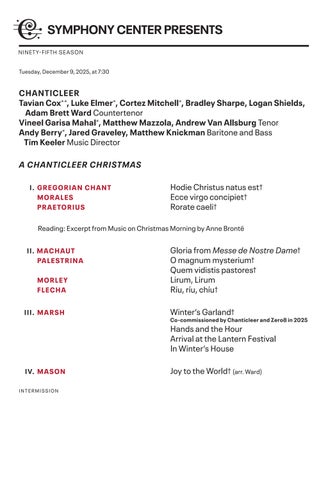
A Chanticleer Christmas always begins with a chant procession by candlelight. Singing these centuries-old tunes immediately conjures a world of medieval cathedrals and ancient mystery. This year’s chant selection, “Hodie Christus natus est,” is an antiphon traditionally sung at evening masses on Christmas Day. According to legend, Gregorian chants are attributed to Pope Gregory I (590–604), who is said to have received the melodies from divine inspiration.
Cristóbal de Morales captures the mystery of Christmas in his setting of “Ecce virgo concipiet.” The prophetic text for this motet comes from the book of Isaiah and may be familiar to many due to Handel’s joyful setting in his Messiah. Morales, however, captures the awe and wonder of the virgin birth with haunting melodies and intimate harmonies. Morales was born in Seville, Spain, around the year 1500. He trained as a chorister and organist, eventually becoming the maestro de capilla at the Ávila Cathedral in 1526. He then moved to the papal choir in Rome before returning to Spain for the remainder of his career. Morales was one of the finest composers of his generation and could be considered the first true successor, in terms of compositional skill, to Josquin des Prez.
“Rorate caeli” is the 104th and final work—and the only motet—in Michael Praetorius’s 1611 printed collection of Latin mass movements, Missodia Sionia. Its singular nature and primacy of place surely mark it as important in the composer’s eyes. Praetorius sets the Advent text with quick contrapuntal shifts and Italian concertato style moments featuring fewer voices and a thinner texture. These techniques are reminiscent of other late-Renaissance composers, such as Heinrich Schütz or Claudio Monteverdi. As a German Lutheran, Praetorius devoted the largest part of his enormous compositional output to settings of Protestant hymns (including the famous “Lo, how a rose e’er blooming”). His works for the Latin liturgy, however, are just as compelling.
Guillaume de Machaut’s Messe de Nostre Dame can be considered the first large-scale musical work in the Western canon and is often one of
the first pieces mentioned in a music history course. His “Gloria” showcases medieval compositional techniques, including double leading tone cadences and a brilliant hocket during the “Amen” in which the melody is passed back and forth from one voice to another. We perform this movement with our best guess at medieval French Latin and some improvisational moments inspired by medieval ornamentation. Be on the lookout for our complete recording of Machaut’s Messe, along with some of his secular chansons, to be released in 2026.
The year 2025 marks the 500th anniversary of Giovanni Pierluigi da Palestrina’s birth. We are excited to mark this occasion with his settings of “O magnum mysterium” and “Quem vidistis,” which are actually two parts of the same motet first published in his Liber primus motettorum in 1569. They feature full harmonies, frequent imitation, scalar melodic motion, and a conservative awareness of the text that highlights the inherent drama without relying on sharp changes to the overall texture. These features make Palestrina’s music easily understood and immediately pleasing to the ear, perhaps proving why he remains one of the most recognizable and celebrated names in early music 500 years after his birth.
We conclude our exploration of early music with two non-liturgical Christmas works. “Lirum, Lirum” is a Christmas madrigal from the master of the madrigal himself, Thomas Morley. Morley defined the English version of what was, until his time, an Italian genre. His madrigals are musically light and airy. His texts, too, often display a sense of frivolity. In this Christmas madrigal, instead of the typical “fa, la, la,” Morley uses the nonsense word lirum.
“Ríu, ríu, chíu” is a Spanish villancico by the Catalan composer Mateo Flecha el Viejo Villancicos are often spirited and dancelike, featuring frequent rhythmic interplay between duple and triple meter. They consist of a series of verses (coplas) sandwiched between a recurring refrain (estribillo). “Ríu, ríu, chíu” is likely the only villancico that has maintained its widespread popularity from the 1500s—even the Monkees
recorded a version of it for television back in 1967. In Spanish, ríu is a nonsense syllable. In Catalan, it means “river.”
Two Christmases ago, we performed “In Winter’s House” by contemporary British composer Joanna Marsh. It immediately became an ensemble favorite. Marsh’s cinematic harmonies bring the secular poetry of Jane Draycott to life in a very visceral way. The music and poetry capture a feeling of childlike wonder and excitement for the season. Although originally written for the British choral ensemble Tenebrae, the piece fits Chanticleer’s ranges beautifully, capturing both the depth of our basses and the strength of our countertenors. Based on the success of this work, we, along with the Stockholm-based choir Zero8, commissioned Joanna Marsh to compose two companion pieces, “Hands and the Hour” and “Arrival at the Lantern Festival,” for our 2025 Christmas season. Marsh commissioned Draycott to write two new poems for these works. Together, the three pieces comprise a new winter choral song cycle titled Winter’s Garland. We are excited to bring these two brand-new works to life for you today.
We conclude the first half of our program with Adam Brett Ward’s arrangement of “Joy to the World.” The 2025–26 season is Adam’s twentieth year as a countertenor in Chanticleer. He has marked his extraordinary tenure with extreme levels of musicianship, vocal beauty, and consistency. Anyone in his presence, or anyone hearing his stunning arrangement of “Joy to the World,” will feel his talent, passion, and joy for the work we do.
“This Endris Night” is a setting of a fifteenthcentury English carol text by the contemporary Canadian composer Sarah Quartel. While written in 2019, Quartel’s melody feels timeless. It will surely be a Christmas favorite for years to come. A prolific and celebrated choral composer, Sarah Quartel has been commissioned by the American Choral Directors Association, the National Children’s Chorus of the United States of America, and New Dublin Voices, among others. She has been exclusively published by Oxford University Press since 2018.
Franz Biebl’s “Ave Maria” has become synonymous with Chanticleer. Every Christmas season, we look forward to sharing this gem with our audiences around the country. Biebl’s setting is actually a version of the “Angelus,” a Catholic devotional prayer, which tells the story of the annunciation and incarnation. The TTBB arrangement we sing in these concerts, as well as two other editions for SATB chorus, are published by Hinshaw Music as part of the Chanticleer Choral Series.
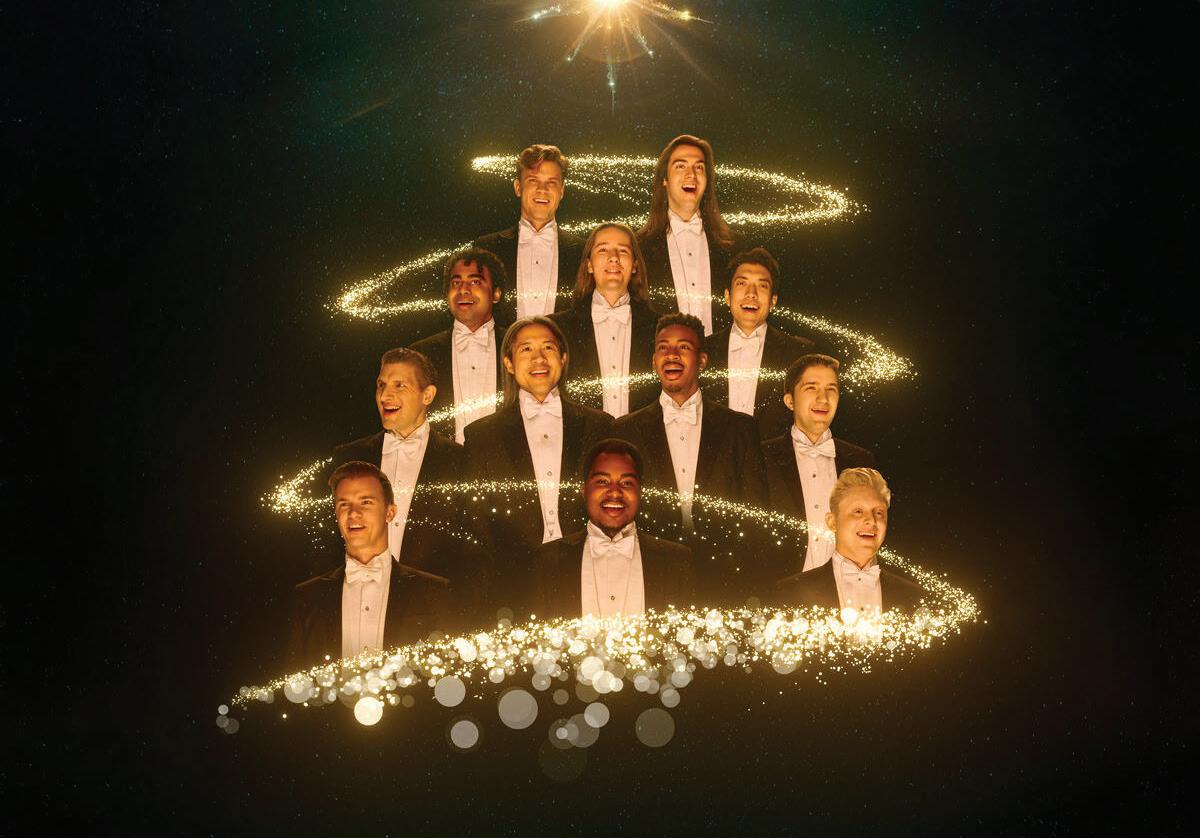
The remainder of our Christmas program features a collection of contemporary Christmas songs, some well-known and some brand-new, and all of which have just been recorded on our new Christmas album, Joy to the World. Five of the pieces were arranged by current members of the ensemble: “Once in Royal David’s City” and “Good King Wenceslas/Little Girl Blue” by bass-baritone Jared Graveley, “Ding-Dong! Merrily on High” by countertenor Adam Brett Ward, and “And the Trees Do Moan” and “I Wonder as I Wander” by Music Director Tim Keeler. Steven Sametz’s winning arrangement of “Angelus ad virginem” in his “A Christmas Fanfare” fills the room with joy, while Amanda Taylor, of the jazz vocal group säje, turns “O Come, All Ye Faithful” into an intimate invitation.
Finally, A Chanticleer Christmas always concludes with a “Christmas Spiritual Medley” arranged by our music director emeritus, Joseph H. Jennings. In 2014 Jennings was the first recipient of Chorus America’s Brazeal Wayne Dennard Award, acknowledging his contribution to the African American choral tradition. His twenty-five-year tenure with Chanticleer as singer and music director transformed the group, and his gospel and spiritual arrangements became part of Chanticleer’s identity. We are honored to maintain and continue that legacy today.
GREGORIAN CHANT
Hodie Christus natus est
Hodie Christus natus est; hodie Salvator apparuit. Hodie in terra canunt angeli, laetantur archangeli. Hodie, exsultant justi, dicentes, “Gloria in excelsis Deo, alleluja!”
CRISTÓBAL DE MORALES
Born ca. 1500; Seville, Spain
Died September–October 1553; Marchena, Spain
Ecce virgo concipiet
Ecce virgo concipiet et pariet filium, et vocabitur nomen eius Admirabilis, Deus Fortis.
Super solium David et super regnum eius sedebit in aeternum, et vocabitur nomen eius Admirabilis, Deus Fortis.
Today, Christ is born; today, the Savior has appeared. Today, the angels sing on Earth, the archangels rejoice. Today, good people exult, saying, “Glory to God in the highest, alleluia!”
Behold, a virgin shall conceive and bear a son, and His name shall be Wonderful, Mighty God.
Over the throne of David and over His kingdom He will reign for eternity, and His name shall be Wonderful, Mighty God.
Text: Isaiah 7:14; Isaiah 9:6, 7
MICHAEL PRAETORIUS
Born ca. February 15, 1571; Creuzburg an der Werra, near Eisenach, Germany
Died February 15, 1621; Wolfenbüttel, Germany
Rorate caeli
Rorate, caeli, desuper, et nubes pluant justum; aperiatur terra, et germinet Salvatorem.
Caeli enarrant gloriam Dei, et opera manuum ejus annunciat firmamentum.
Gloria Patri, et Filio, et Spiritui Sancto. Sicut erat in principio, Et nunc, et semper, et in saecula saeculorum. Amen.
Drop down, ye heavens, from above, and let the clouds rain justice; let the Earth be opened, and let the Savior spring forth.
The heavens declare the glory of God, and the work of His hands is proclaimed by the firmament.
Glory be to the Father, and to the Son, and to the Holy Ghost. As it was in the beginning, and now, and always, and forever and ever. Amen.
Text: Isaiah 45:8, Psalm 19:1
Excerpt from Music on Christmas Morning by Anne Brontë
Music I love—but never strain could kindle raptures so divine, so grief assuage, so conquer pain, and rouse this pensive heart of mine— as that we hear on Christmas morn upon the wintry breezes borne.
Though Darkness still her empire keep and hours must pass, ere morning break; from troubled dreams, or slumbers deep, that music kindly bids us wake: it calls us, with an angel’s voice, to wake, and worship, and rejoice.
GUILLAUME DE MACHAUT
Born ca. 1300; Reims, France
Died April 13, 1377; Reims, France
Gloria from Messe de Nostre Dame
Gloria in excelsis Deo, et in terra pax hominibus bonae voluntatis! Laudamus te. Benedicimus te. Adoramus te. Glorificamus te.
Gratias agimus tibi propter magnam gloriam tuam.
Domine Deus, Rex caelestis, Deus Pater omnipotens.
Domine Filius unigenite, Jesu Christe.
Domine Deus, Agnus Dei, Filius Patris. Qui tollis peccata mundi, miserere nobis.
Qui tollis peccata mundi, suscipe deprecationem nostram. Qui sedes ad dexteram Patris, miserere nobis.
Quoniam tu solus Sanctus. Tu solus Dominus. Tu solus altissimus, Jesu Christe. Cum Sancto Spiritu, in gloria Dei Patris. Amen.
Glory to God in the highest, and on Earth peace to people of goodwill! We praise Thee. We bless Thee. We adore Thee. We glorify Thee. We give thanks to Thee for Thy great glory.
Lord God, King of heaven, God the Father almighty.
Lord, the only begotten Son, Jesus Christ. Lord God, Lamb of God, Son of the Father. Thou who takes away the sins of the world, have mercy on us.
Thou who takes away the sins of the world, receive our prayers.
Thou who sits at the right hand of the Father, have mercy on us.
Thou only art holy. Thou only art the Lord. Thou only art the most high, Jesus Christ. With the Holy Spirit, in the glory of God the Father. Amen.
GIOVANNI PIERLUIGI DA PALESTRINA
Born December 17, 1525; Palestrina, Italy
Died February 2, 1594; Rome, Italy
O magnum mysterium
O magnum mysterium et admirabile sacramentum, ut animalia viderent Dominum natum jacentem in praesepio.
Natum vidimus et choros angelorum collaudantes Dominum. Alleluia!
Quem vidistis pastores
Quem vidistis, pastores, dicite; annuntiate nobis, in terris quis apparuit?
Natum vidimus et choros angelorum collaudantes Dominum, Alleluia.
THOMAS MORLEY
Born ca. 1557; Norwich, England
Died October 1602; London, England
Lirum, Lirum
O great mystery and wondrous sacrament, that animals should see the newborn Lord lying in the manger.
We saw the newborn and the choir of angels praising the Lord. Alleluia!
Who have you seen, shepherds, tell us; announce to us, who has appeared on Earth?
We saw the newborn and the choir of angels, praising the Lord, Alleluia.
You that wont to my pipes sound, daintily to tread your ground, shepherds, leave your pasture sweet. Lirum, lirum, lirum. Here met together in winter weather, hand in hand uniting, the Holy Child come greet. Lirum, lirum, lirum, lirum, lirum, lirum, lirum. Lo triumphing brave comes He, all in pomp and majesty, monarch of the world and King, lirum, lirum, lirum. Let whoso list Him, dare to resist Him, we our voice uniting, His praise shall ever sing. Lirum, lirum, lirum, lirum, lirum, lirum, lirum.
MATEO FLECHA EL VIEJO
Born ca. 1481; Prades, Kingdom of Aragon (now Spain)
Died ca. 1553; Poblet, Spain
Ríu, ríu, chíu
Ríu, ríu, chíu, la guarda ribera; Dios guardo el lobo de nuestra cordera.
El lobo rabioso la quiso morder, mas Dios poderoso la supo defender; quisola hazer que no pudiese pecar, ni aún original esta virgen no tuviera.
Este qu’es nascido es el gran Monarca, Christo patriarca de carne vestido. Hanos redimido con se hazer chiquito; aunqu’era infinito finito se hiziera.
Muchas profecías lo han profetizado, y aún en nuestros días lo hemos alcançado. A Dios humanado vemos en el suelo, y al hombre nel cielo porque él le quisiera.
JOANNA MARSH
Born 1970; Newcastle-upon-Tyne, England
Winter’s Garland
Hands and the Hour
Twilight, and no one’s raised a hand to close the shutters yet. We have one hour, this lamplit hall between arrivals and departures, between the day and nighttime, nighttime and the day.
Bright illumination all along our street, the body’s heat draws inwards like a tent lit up, like the warm low rays of sun, between the day and nighttime, nighttime and the day.
(Please turn the page quietly.)
Riu, riu, chiu, the riverside guardian; God has kept the wolf from our precious lamb.
The rabid wolf had tried to bite our Lady’s neck, but Almighty God knew to defend her; God made her that she could have no sin; even Adam’s sin could not touch this virgin.
The newly born Child is our mighty Monarch, Christ, patriarchal in flesh incarnate. Through His humble birth, He has redeemed us; He who was infinite has become finite.
Many prophecies have foretold it, and now in our days, we have seen it. We have seen God as human on earth, And man in heaven because He loved us.
Light lingers in the parks and squares, small papers swirling there like leaves; not leaves but birds, not birds but hands, between the day and nighttime, nighttime and the day.
On the cusp of dark the evening star appears hope’s matchlight flaring, while below we cup our hands around the glowing candle flame of home. (Between the day and nighttime, nighttime and the day).
So many hands, small wingspans hovering above the low fields of our fires. Now winter is the glinting world, summer the life to come between the day and night-time, night-time and the day.
Arrival at the Lantern Festival
And will there also be feasting?
Yes, in the orchards—night’s berries, glowing and gleaming; resilient embers— oranges and apricots grown from the seeds, free for the picking.
And will there be music?
Yes, even our clothes will be singing, and the owl, and the mistle thrush, and the lamplighter’s whistling tune with your name on, high in the trees.
And will there be stories?
Yes, evergreen tales of birds made of gold and of silver that fly in the dark overhead like hope on the wing.
And will there be innocence?
Yes, and pure adoration, and gifts: a lantern for everyone to light the hard-to-find path marked only by faint constellations of fireflies.
And will there be peace?
Yes, for a good while, like daybreak in woods after snowfall, the lanterns still glowing like faithful promises, our vow to return year after year.
In Winter’s House
In winter’s house there’s a room that’s pale and still as mist in a field while outside in the street every gate’s shut firm, every face as cold as steel.
In winter’s house there’s a bed that is spread with frost and feathers, that gleams in the half light like rain in a disused yard or a pearl in a choked-up stream.
In winter’s house there’s a child asleep in a dream of light that grows out of the dark, a flame you can hold in your hand like a flower or a torch on the street.
In winter’s house there’s a tale that’s told of a great chandelier in a garden, of fire that catches and travels for miles, of all gates and windows wide open.
In winter’s house there’s a flame being dreamt by a child in the night in the small quiet house at the turn in the lane where the darkness gives way to light.
Text: Jane Draycott
LOWELL MASON
Born January 8, 1792; Medfield, Massachusetts
Died August 11, 1872; Orange, New Jersey
Joy to the World
(Arranged by Adam Brett Ward)
Joy to the world! The Lord is come! Let earth receive her King; let every heart prepare Him room, and heaven and nature sing, and heaven, and heaven, and nature sing.
Joy to the world! The Savior reigns! Let men their songs employ while fields and floods, rocks, hills, and plains repeat the sounding joy, repeat, repeat the sounding joy.
He rules the world with truth and grace and makes the nations prove the glories of His righteousness, and wonders of His love, and wonders, wonders, of His love.
SARAH QUARTEL
Born 1982; Chatham-Kent, Ontario, Canada
This Endris Night
This endris night I saw a sight, a star as bright as day, and ever among, a maiden sung, “Lully, by by, lullay.”
This lovely lady sat and sang, and to her child did say, “My son, my brother, father dear, why liest thou thus in hay? My sweetest bird, ‘tis thus required, Though thou be King veray, but nevertheless I will not cease to sing, ‘By by, lullay.’”
(Please turn the page quietly.)
The child then spake whilst she did sing, and to his mother did say, “Yea, I am known as heaven-King, in crib though I be laid. For angels bright down on me light; thou knowest ‘tis no nay. And for that sight thou may delight to sing, ‘By by, lullay.’”
“Now, sweet son, since it is so, that all is at Thy will, I pray Thee grant to me a boon, if it be right and skill. That child or man, who will or can, be merry on my day, to bliss them bring, and I shall sing, ‘Lully, by by, lullay.’”
FRANZ BIEBL
Born September 1, 1906; Pursruck, Germany
Died October 2, 2001; Munich, Germany
Ave Maria
Angelus Domini nuntiavit Mariae et concepit de Spiritu sancto.
Ave Maria, gratia plena, Dominus tecum; benedicta tu in mulieribus, et benedictus fructus ventris tui Jesus.
Maria dixit: “Ecce ancilla Domini; fiat mihi secundum verbum tuum.”
Et verbum caro factum est et habitavit in nobis.
Sancta Maria, Mater Dei, ora pro nobis peccatoribus. Sancta Maria, ora pro nobis nunc et in hora mortis nostrae. Amen.
The angel of the Lord made his annunciation to Mary, and she conceived by the Holy Spirit.
Hail Mary, full of grace, the Lord is with you; blessed are you among women, and blessed is the fruit of your womb, Jesus.
Mary said, “Behold the servant of the Lord; let it be unto me according to Your word.”
And the Word was made flesh and dwelt among us.
Holy Mary, Mother of God, pray for us sinners. Holy Mary, pray for us now and at the hour or our death. Amen.
HENRY GAUNTLETT
Born July 9, 1805; Wellington, England
Died February 21, 1876; London, England
Once in Royal David’s City (Arranged by Jared Graveley)
Once in royal David’s city stood a lowly cattle shed, where a mother laid her baby in a manger for his bed: Mary was that mother mild, Jesus Christ her little child.
He came down to Earth from heaven, who is God and Lord of all, and His shelter was a stable, and His cradle was a stall: with the poor, and mean, and lowly lived on Earth our Savior Holy.
And our eyes at last shall see Him through His own redeeming love, for that child so dear and gentle is our Lord in heav’n above: and He leads His children on to the place where He is gone.
Not in that poor lowly stable, with the oxen standing by, we shall see Him, but in heaven, set at God’s right hand on high: where like stars His children crowned all in white shall wait around.
JOHN JACOB NILES
Born April 28, 1892; Louisville, Kentucky
Died March 1, 1980; Lexington, Kentucky
I Wonder as I Wander (Arranged by Tim Keeler)
I wonder as I wander out under the sky, how Jesus the Savior did come for to die for poor ord’n’ry people like you and like I. I wonder as I wander out under the sky.
When Mary birthed Jesus ‘twas in a cow’s stall, with wise men, and farmers, and shepherds and all. But high from God’s heaven a star’s light did fall, and the promise of the ages it then did recall.
If Jesus had wanted for any mean thing, a star in the sky, or a bird on the wing, or all of God’s angels in heav’n for to sing, He surely could have had it, for He was the King.
STEVEN SAMETZ
Born 1954; Westport, Connecticut
A Christmas Fanfare (Angelus ad virginem)
The angel came to Mary meek, secretly into her chamber, hailed her there with Aves sweet, calming her fear of danger:
“Hail be thou full of maidenly grace, heaven’s light shall shine upon your face.”
“For you shall bear the Son of all mankind, the King, the Savior of the world; for you shall bring the light divine, the Savior of the world!”
(Please turn the page quietly.)
Softly to him answered she, the gentle maiden then: “How can then these tidings be for I know nought of men?” Gabriel then said to Mary bright: “Fear thee not—in God is all aright.”
“For you shall bear the Son of all mankind, the King, the Savior of the world; for you shall bring the light divine, the Savior of the world!”
When the maiden understood what these words did presage, bringing peace, and love, and good through the heavenly message: “To thee shall I give my consent; to the Lord my mind and will assent.”
“For I shall bear the Child of all mankind, the King, the Savior of the world; to me is granted light divine, the Savior of the world!”
Maiden, Mother, let us sing: “Borne for us a Savior!” Let the world in gladness ring out our songs to praise her! She, the chosen of the Lord above, bears the Prince of Peace through God’s own love.
For she shall bear the Son of all mankind, the King, the Savior of the world; for she shall bring the light divine, the Savior of the world.
Sing nowell, for us is borne today the Savior borne of Mary!
TRADITIONAL ENGLISH RICHARD RODGERS
Born June 28, 1902; Arvene, New York
Died December 30, 1979; New York City
Good King Wenceslas/Little Girl Blue (Arranged by Jared Graveley)
Good King Wenceslas looked out on the Feast of Stephen, when the snow lay round about, deep, and crisp, and even.
Brightly shone the moon that night, though the frost was cruel, when a poor man came in sight, gathering winter fuel.
Sit there and count your fingers; what can you do?
Poor girl, you’re through; sit there, count your little fingers, unhappy little girl blue.
Sit there, count the raindrops falling on you. It’s time you knew all you can ever count on are the raindrops that fall on little girl blue.
In his master’s steps he trod where the snow lay dinted. Heat was in the very sod, which the saint had printed. Therefore, Christian friends, be sure, wealth or rank possessing; ye, who now will bless the poor shall yourselves find blessing.
TRADITIONAL FRENCH
Ding-Dong! Merrily on High (Arranged by Adam Brett Ward)
Ding-dong! Merrily on high in heav’n the bells are ringing. Ding-dong! Verily the sky is riv’n with angel singing, Gloria, hosanna in excelsis!
E’en so here below, below, let steeple bells be swungen; and i-o, i-o, i-o, by priest and people be sungen, Gloria, hosanna in excelsis!
Pray ye dutifully prime, your matin chime, ye ringers. May ye beautifully rime, your evetime song, ye singers, Gloria, hosanna in excelsis!
TRADITIONAL APPALACHIAN
And the Trees Do Moan (Arranged
In the valley of Judea, cold and wint’ry blown, Christ was born one frosty morning, and the trees do moan.
Darkened skies and men a-stumbling; high above them shone one bright star a-moving eastward, where the trees do moan.
Herod and the ruling Romans stately sat upon the throne; sent the soldiers out a-looking, and the trees do moan, and the trees do moan.
by Tim Keeler)
Mary took her little baby, set out all alone; down in Egypt land they tarried, where the trees do moan.
Jesus then became a carpenter, worked with wood and stone; nails He drove and crossarms fashioned, and the trees do moan.
There, one day, while in the forest black, one tree He picked for His own, a Christmas tree, an evergreen one, and the trees do moan, and the trees do moan.
JOHN FRANCIS WADE
Born January 1, 1711; England Died August 16, 1786; Douai, France