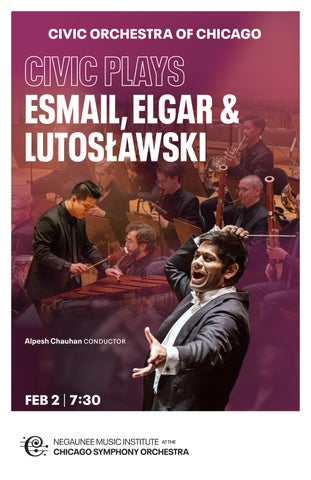
CIVIC PLAYS ESMAIL, ELGAR & LUTOSŁAWSKI
FEB 2 | 7:30
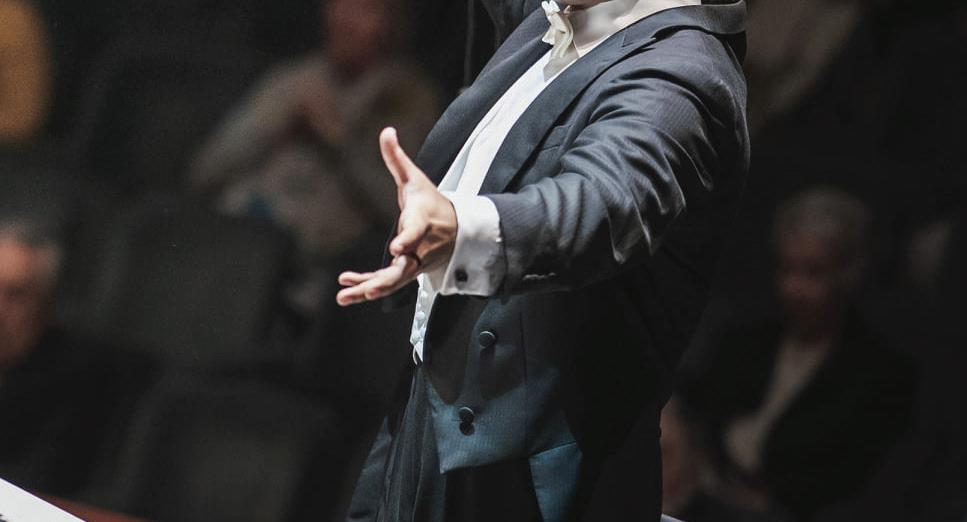
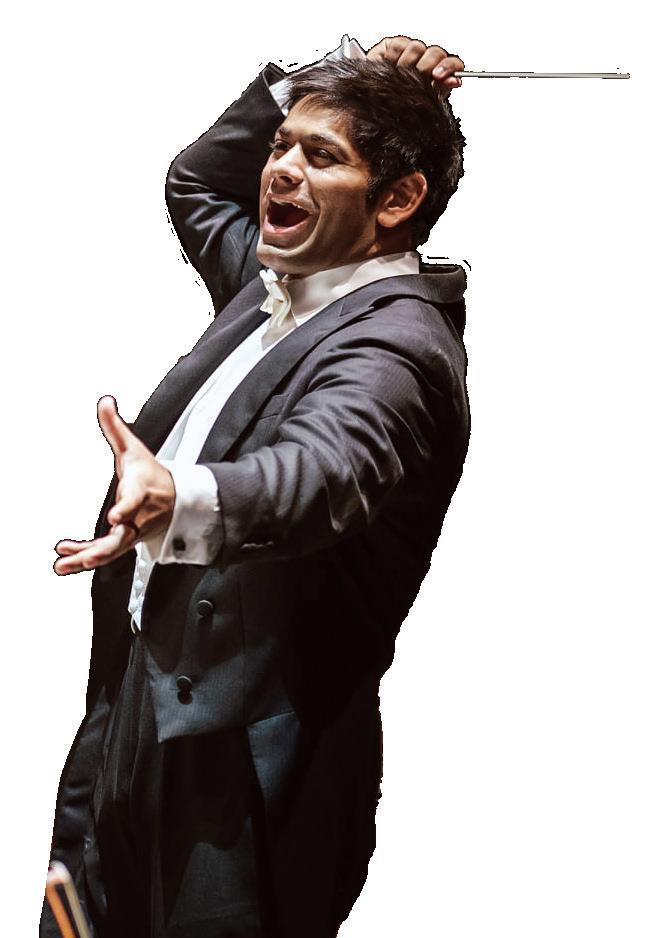
Alpesh Chauhan conductor
The 2025–26 Civic Orchestra season is generously sponsored by Lori Julian for the Julian Family Foundation, which also provides major funding for the Civic Fellowship program.
ONE HUNDRED SEVENTH SEASON
CIVIC ORCHESTRA OF CHICAGO
KEN-DAVID MASUR Principal Conductor
The Robert Kohl and Clark Pellett Principal Conductor Chair
Monday, February 2, 2026, at 7:30
Alpesh Chauhan Conductor
ESMAIL Black Iris
ELGAR In the South (Alassio), Op. 50
INTERMISSION
LUTOSŁAWSKI Concerto for Orchestra Intrada
Capriccio, Notturno, and Arioso Passacaglia, Toccata, and Chorale
The 2025–26 Civic Orchestra season is generously sponsored by Lori Julian for the Julian Family Foundation, which also provides major funding for the Civic Fellowship program.
The Civic Orchestra of Chicago acknowledges support from the Illinois Arts Council.
COMMENTS
REENA ESMAIL
Born February 11, 1983; Chicago, Illinois
Black Iris
COMPOSED 2017
FIRST PERFORMANCE
March 11, 2018; Wentz Auditorium, Naperville, Illinois. Chicago Sinfonietta, Mei-Ann Chen conducting
INSTRUMENTATION
2 flutes and piccolo, 2 oboes and english horn, 2 clarinets, 2 bassoons, 4 horns, 2 trumpets, 3 trombones, tuba, timpani, bass drum, triangle, snare drum, cymbals, glockenspiel, vibraphone, orchestral chimes, marimba, celesta, harp, piano, strings
APPROXIMATE PERFORMANCE TIME
13 minutes
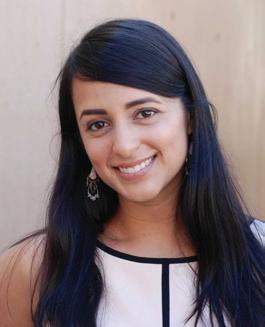
Indian American composer Reena Esmail works between the worlds of Indian and Western classical music, bringing communities together through the creation of equitable musical spaces.
Esmail’s life and music were profiled on season 3 of PBS’s Great Performances series, “Now Hear This,” as well as on the Metropolitan Museum of Art’s podcast Frame of Mind.
Esmail divides her attention evenly between orchestral, chamber, and choral work. She has written
above: Reena Esmail, photo courtesy of the artist
commissions for ensembles including the Los Angeles Master Chorale, Seattle Symphony, Baltimore Symphony Orchestra, and Kronos Quartet, and her music has been featured on multiple Grammy-nominated albums, including The Singing Guitar by Conspirare, Bruits by Imani Winds, and Healing Modes by Brooklyn Rider. Many of her choral works are published by Oxford University Press.
Esmail was the Los Angeles Master Chorale’s 2020–25 Swan Family artist-in-residence and was Seattle Symphony’s 2020–21 composer-inresidence. She has been in residence with the Tanglewood Music Center and Spoleto Festival. She holds awards and fellowships from the United States Artists, the S&R Foundation, American Academy of Arts and Letters, and the Kennedy Center.
Esmail holds degrees in composition from the Juilliard School and the Yale School of Music. Her primary teachers have included Susan Botti, Aaron Jay Kernis, Christopher Theofanidis, Christopher Rouse, and Samuel Adler. She received a Fulbright-Nehru grant to study Hindustani music in India. Her doctoral thesis, titled “Finding Common Ground: Uniting Practices in Hindustani and Western Art
Musicians,” explores the methods and challenges of the collaborative process between Hindustani musicians and Western composers.
Esmail is currently an artistic director of Shastra, a non-profit organization that promotes cross-cultural music connecting music traditions of India and the West.
Reena Esmail on Black Iris
MeToo bears the title of the social movement that has been exploding across our country during the time I was writing this piece. The movement, created by Tarana Burke as a way to provide safe spaces for young women of color, has grown into a movement that has allowed so many women to speak out, contextualize one another’s experiences, and begin to heal.
I always get asked why there aren’t more women composers. This piece is one response—of many hundreds of responses—to that question. So many of us decide to become composers when we are young women because we fall deeply in love with individual pieces of music. We listen to them incessantly, we memorize every note of them, we live our lives through the lens of that music. And then, at some point, for some of us, as we engage with that music, something devastating happens to us—often by the very person who has introduced
us to that music. We hate ourselves, we blame ourselves, we bury it deep within our psyche—until we hear that piece of music again. It could be at a concert, it could be in a theory class, it could be on the radio. We are powerless to fend off that tidal wave of sensory memory. The very music we once loved becomes a trigger that slowly destroys our love for our art. Of course, I’m speaking about myself, but I’m also speaking about so many other women I know. That experience is what this piece is about.
I was so filled with rage while I was writing this work. The rage of seeing the injustices that plagued even the strongest, most powerful women among us, the rage of having to relive the worst moments of my own life over and over again, every time I checked Facebook or turned on the news. The rage that, as women, some of the strongest bonds we share are forged from the most devastating and corrosive experiences.
Every day, even as my rage simmers, I have to ask: what is the endgame here? What does a healthy society look like? And how can we put systems in place that truly allow men to address these underlying issues, so that we can create stronger bonds with one another and build stronger communities with higher standards of accountability to each other? I look forward to imagining and creating that world together.
—reenaesmail.com
COMMENTS
EDWARD ELGAR
Born June 2, 1857; Broadheath, near Worcester, England
Died February 23, 1934; Worcester, England
In the South (Alassio), Op. 50
COMPOSED
1903–04
FIRST PERFORMANCE
March 16, 1904; London. The composer conducting
INSTRUMENTATION
3 flutes and piccolo, 2 oboes and english horn, 2 clarinets and bass clarinet, 2 bassoons and contrabassoon, 4 horns, 3 trumpets, 3 trombones, tuba, timpani, bass drum, cymbals, snare drum, triangle, glockenspiel, 2 harps, strings
APPROXIMATE PERFORMANCE TIME
22 minutes
Elgar had gone to Italy in December 1903 not to escape the damp and cold of an English winter, but to regain his strength and inspiration after the exhausting work of finishing The Apostles and to begin his first symphony. He failed on all counts. Several days into their stay in Alassio, his wife Alice wrote in her diary, “Still cold and grey and windy—E. and A. much depressed at these conditions and wondering if they will not pack up and go home. E. feeling no inspiration for writing.” Edward himself wrote to his dear friend Alfred Jaeger (immortalized in the magnificent and moving
“Nimrod” music in the Enigma Variations): “This visit has been, is, artistically a complete failure, and I can do nothing. The symphony will not be written in this sunny (?) land.”
But the essence of Italian life affected Elgar, despite the cold and the gales and swarms of mosquitoes as annoying as the tourist crowds. In Alassio, he began a concert overture, in place of the promised symphony, that is perhaps his sunniest and most energized work. It depicts the Italian holiday that largely eluded him, and it is music that Elgar never would have written at home in England, for even a dispiriting stay in Italy offered glimpses of life’s greatest pleasures. In his manuscript, he wrote this passage from Tennyson’s The Daisy:
What hours were thine and mine
In lands of palm and southern pine
In lands of palm, of orange blossom
Of olive, aloe, and maise and vine
And from Byron’s Childe Harold: . . . a land
Which was the mightiest in its old command
And is the loveliest . . .
Wherein were cast . . . . . . the men of Rome!
Thou art the garden of the world.
Although Elgar called In the South a concert overture, it’s really a tone poem—his largest orchestral movement at the time—of weighty dimensions and electric colors. Elgar may have sidestepped that term to avoid comparison with the new tone poems by Richard Strauss (at the time of the premiere, he asked that the program notes not mention Strauss’s name), for much about Elgar’s overture recalls the style, substance, and sheer orchestral splendor of Strauss. These two composers were kindred spirits in many ways, and their artistic outlooks were never more closely aligned than in the early years of the twentieth century. When Strauss heard a performance of Elgar’s The Dream of Gerontius in 1902, he proposed a toast to “the first English progressivist, Meister Edward Elgar” and remained Elgar’s friend for life. In the South begins with a rapid unfurling of a large orchestral chord, very like the opening of Strauss’s Don Juan (which Elgar admired), followed by the kind of dancing horns Strauss had already made famous.
The precise idea for In the South came to Elgar during an afternoon stroll near Alassio. “I was by the side of an old Roman way. A peasant stood by an old ruin, and in a flash it all came to me—the conflict of armies in that very spot long ago, where now I stood—the contrast of the ruin and the shepherd.” In a letter to Percy Pitt, who wrote the program
note for the premiere, Elgar marked his initial theme “Joy of Life (wine and macaroni),” but, in fact, it’s an idea he had sketched several years before, depicting Dan, a friend’s bulldog, “triumphant (after a fight).” (Dan is officially memorialized in the eleventh of the Enigma Variations, when he falls into the river Wye, paddles upstream, and reaches the shore with a victorious bark.) The rest of In the South, however, leaves England far behind, beginning with the reflective shepherd’s music that soon follows, with, as the composer told Pitt, “romance creeping into the picture.” Elgar lingers in this relaxed and genial mood for some time until the music moves into a forceful and determined passage marked grandioso. There, he writes two more lines from Tennyson into his manuscript:
What Roman strength Turbia show’d In ruin, by the mountain road.
Here, and in the uncharacteristically dissonant pages that follow, Elgar recalls “the strife and wars, the ‘drums and tramplings’ of a later time.” This gives way to a delicate canto populare, first sung by the solo viola—an unidentified popular song that Elgar eventually confessed he had written himself. He later turned this lovely music into a real song, taking words from a poem by Shelley, “An Ariette for Music” (he begins at the line, “As the moon’s soft splendour”). With this little song,
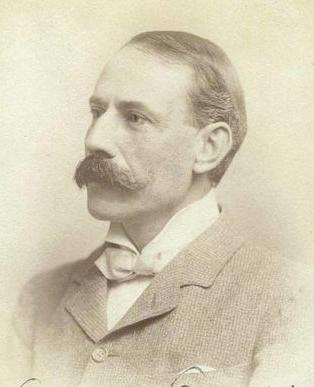
opposite page: Edward Elgar, portrait, ca. 1904, Russell & Sons Photographers, London, England
COMMENTS
titled “In Moonlight,” Elgar returns to the shores of the Mediterranean, for it was there, on the curving coast not far from Alassio, that Shelley spent the last months of his short life. When Henry James made his pilgrimage to Shelley’s house, he wrote, “I can fancy
WITOLD LUTOSŁAWSKI
Born January 25, 1913; Warsaw, Poland
Died February 7, 1994; Warsaw, Poland
Concerto for Orchestra
COMPOSED
1950–54
FIRST PERFORMANCE
November 26, 1954; Warsaw, Poland
INSTRUMENTATION
3 flutes with 2 piccolos, 3 oboes with english horn, 3 clarinets with bass clarinet, 3 bassoons with contrabassoon, 4 horns, 4 trumpets, 4 trombones, tuba, timpani, snare drum, side drums, tenor drum, bass drum, cymbals, tam-tam, tambourine, xylophone, bells, celesta, 2 harps, piano, strings
APPROXIMATE PERFORMANCE TIME
30 minutes
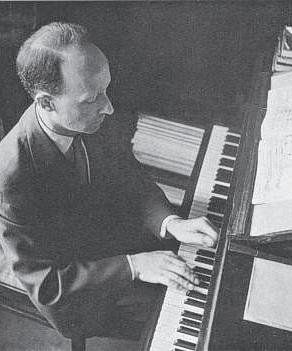
Witold Lutosławski’s was the first important concerto for orchestra composed in the shadow of Bartók’s great work, but that appears to have inspired rather than intimidated him—Bartók served as
a great lyric poet sitting on the terrace of a warm evening and feeling very far from England.” Elgar’s own final pages say the same thing, in music of warmly melodic and life-loving exuberance.
—Phillip Huscher
a touchstone, a reminder of what could be done within a certain style and with a specific aim. For Lutosławski, as for Bartók, the concerto for orchestra was intended as a reflection of the unprecedented virtuosity of the modern orchestra. The hallmarks of Bartók’s masterwork are here as well—the arch form of the first movement; the broad chorale of the last; a certain similarity of gesture, tone, and language that’s easy to hear, although less simple to pinpoint in the score—and yet Lutosławski’s score is entirely his own. (Lutosławski’s Musique funèbre, written four years later, was dedicated to Bartók’s memory.) Still another composer links Bartók’s and Lutosławski’s concertos. In the fourth movement of his work, Bartók parodies the battle music from Dmitri Shostakovich’s Leningrad Symphony. In the toccata section of his finale, Lutosławski inscribes Shostakovich’s well-known musical
monogram—DSCH, or D, E-flat, C, B-natural, as translated into musical notation. But the references are quite different. Bartók intended a sly comment about artistic merit. For Lutosławski, Shostakovich represented a major composer responding through his music to a political crisis—a concern he understood only too well. In 1948 Lutosławski’s First Symphony was banned by the Polish government; the music written during the next years, culminating in this Concerto for Orchestra, was his response. In 1988 Lutosławski talked with Allan Kozinn of the New York Times about this period:
The government stopped interfering with our musical life very early, probably because they decided that music is not an offensive art. It’s not semantic. It doesn’t carry meaning in the same way literature, poetry, theater, and film do. So they are not interested in it. I have never felt any pressure to write a certain way. But after my First Symphony, I realized that I was writing in a style that was not leading me anywhere. So I decided to begin again—to work from scratch on my sound language. Obviously, I could not immediately begin writing concert works, so I wrote functional music—children’s music, easy piano pieces, and small-ensemble works. I did it with pleasure, because Poland was devastated after the war, and this educational music was necessary.
opposite page: Witold Lutosławski, ca. 1952–53
Eventually, I developed a style that combined functional music with elements of folk music, and occasionally with nontonal counterpoints and harmonies.
The Concerto for Orchestra was the climax of this nationalistic, folk-based music—a work that not only spoke to politically defeated people at the time, but also continues to touch musicians of many lands today. Shortly after writing the concerto, Lutosławski changed his sound language again. In 1960 he heard part of a radio broadcast of John Cage’s Piano Concerto, a work that leaves much to chance and is, therefore, different at every performance. Lutosławski remembered that “those few minutes were to change my life decisively. It was a strange moment . . . I suddenly realized that I could compose music differently from that of my past. . . .”
And so the rest of his career, including the Third Symphony commissioned by the Chicago Symphony Orchestra, was spent exploring and perfecting this new language, one that is based on the juxtaposition of ad-lib passages with strictly controlled music.
In an interview given in 1973, Lutosławski expressed surprise at the continuing interest in his early Concerto for Orchestra, calling it “the only serious piece among the folk-inspired works” of the period immediately following the war. On another occasion, he said, “I wrote as I was able, since I
could not yet write as I wished.” His dismissive attitude recalls Bartók, who kept reassigning opus numbers to his scores, each time excluding the earliest works that no longer pleased him.
In this respect, the concertos for orchestra by Bartók and Lutosławski differ. Bartók’s came very late in his career—it is, technically, the last music he finished, although the Third Piano Concerto was nearly complete at his death—and found him at the summit, commanding the language in a way that only years of work and understanding make possible. Lutosławski’s early Concerto for Orchestra in no way suggests the direction his music would take.
Borrowing Bartók’s favored arch form, the first movement begins and ends with imitative writing set against repeated F-sharps—pounding drums in the beginning, the tinkling celesta at the end. (Structurally, the movement is most closely modeled on the opening of Bartók’s Music for Strings, Percussion, and Celesta.)
Midway, the music reaches several big, engulfing climaxes, punctuated by screaming brass. At least two themes are based on Polish folk songs, although Lutosławski, unlike Bartók, treats them like raw material rather than cultural artifacts.
The middle movement captures something of Bartók’s famous Night Music, although for Lutosławski night is a time of furtive activity rather than mysterious calm. Again, the form is symmetrical, with quickly moving music for strings and winds framing a slower section for brass. This central Arioso, sung first by the trumpets, brings the movement to a terrifying climax. From there, the music flickers and dies—the final bars are a duet for tenor drum and bass drum, ppp.
The harps and double basses quietly launch the finale, eventually stating the passacaglia theme (based on a folk song) that will serve as the foundation for fifteen variations, all carefully dovetailed and growing in intensity and activity until the last, which recedes into silence. Lutosławski then launches a powerful, bustling toccata. The music finally dissolves to reveal a solemn chorale intoned by the winds—the ghost of Bartók again (the resemblance to the chorale in the second movement of Bartók’s Concerto for Orchestra is clearly intentional)—before the music turns lively and sweeps to its conclusion.
—Phillip Huscher
Phillip Huscher is the program annotator for the Chicago Symphony Orchestra.
PROFILES
Alpesh Chauhan Conductor
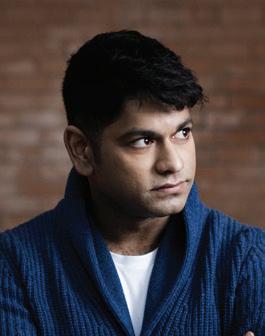
British conductor Alpesh Chauhan is principal guest conductor of the Düsseldorf Symphony Orchestra, music director of Birmingham Opera Company, and principal conductor and musical advisor for the National Youth Orchestra of Great Britain.
He works regularly with the City of Birmingham Symphony, Hallé Orchestra, Adelaide Symphony, Oslo Philharmonic, and the Antwerp, Stavanger, Vancouver, and Detroit symphony orchestras.
Recent highlights include appearances with the Los Angeles Philharmonic, National Symphony, Toronto Symphony, Philharmonia, BBC Symphony, Accademia Nazionale di Santa Cecilia, RAI Torino, and London Philharmonic. Chauhan regularly collaborates with esteemed soloists, including Karen Cargill, Sir Stephen Hough, Hilary Hahn, Johannes Moser, Pablo Ferrández, Benjamin Grosvenor, Pavel Kolesnikov, Simone Lamsma, and Simon Höfele.
Following his debut in 2015, he was appointed principal conductor of the Filarmonica Arturo Toscanini in Parma, a position he held until 2020.
As music director of the Birmingham Opera Company, Chauhan champions a unique approach to bringing opera to the wider community of
Birmingham, following his mentorship by the company’s founder, the late Sir Graham Vick.
Alpesh Chauhan is widely renowned for his interpretations of late romantic and twentieth-century music. Repertoire highlights of the season include Mahler’s Das Lied von der Erde and Bruckner’s late symphonies, coinciding with the composer’s anniversary year.
An advocate of music education for young people, Chauhan is a patron of Young Sounds UK, a charity supporting talented young people from disadvantaged backgrounds on their musical journeys. He has collaborated with ensembles including the National Youth Orchestra of Scotland and symphony orchestras of the UK conservatoires. He was the conductor of the 2015 BBC Ten Pieces film, which brought the world of classical music into secondary schools across the United Kingdom and received a distinguished BAFTA Award.
Born in Birmingham, Alpesh Chauhan studied cello at the Royal Northern College of Music in Manchester before continuing at the RNCM to pursue the prestigious master’s conducting course. He was appointed an Officer of the Order of the British Empire in the 2022 New Year’s Honors of Queen Elizabeth II for Services to the Arts and was conferred an Honorary Fellow of the RNCM in 2024. In 2022 he received the conductor award from the Italian National Association of Music Critics for Best Conductor.
PHOTO BY BENJAMIN EALOVEGA
Civic Orchestra of Chicago
The Civic Orchestra of Chicago is a training program of the Chicago Symphony Orchestra’s Negaunee Music Institute that prepares young professionals for careers in orchestral music. It was founded during the 1919–20 season by Frederick Stock, the CSO’s second music director, as the Civic Music Student Orchestra, and for over a century, its members have gone on to secure positions in orchestras across the world, including over 160 Civic players who have joined the CSO. Each season, Civic members are given numerous performance opportunities and participate in rigorous orchestral training with its principal conductor, Ken-David Masur, distinguished guest conductors, and a faculty of coaches consisting of CSO members. Civic Orchestra musicians develop as exceptional orchestral players and engaged artists, cultivating their ability to succeed in the rapidly evolving music world.
The Civic Orchestra serves the community through its commitment to present free or low-cost concerts of the highest quality at Symphony
Center and in venues across Greater Chicago, including annual concerts at the South Shore Cultural Center and Fourth Presbyterian Church. The Civic Orchestra also performs at the annual Crain-Maling Foundation CSO Young Artists Competition and Chicago Youth in Music Festival. Many Civic concerts can be heard locally on WFMT (98.7 FM), in addition to concert clips and smaller ensemble performances available on CSOtv and YouTube. Civic musicians expand their creative, professional, and artistic boundaries and reach diverse audiences through educational performances at Chicago public schools and a series of chamber concerts at various locations throughout the city.
To further expand its musician training, the Civic Orchestra launched the Civic Fellowship program in the 2013–14 season. Each year, up to twelve Civic members are designated as Civic Fellows and participate in intensive leadership training designed to build and diversify their creative and professional skills. The program’s curriculum has four modules: artistic planning, music education, social justice, and project management. A gift to the Civic Orchestra of Chicago supports the rigorous training that members receive throughout the season, which includes coaching from musicians of the Chicago Symphony Orchestra and world-class conductors. Your gift today ensures that the Chicago Symphony Orchestra Association will continue to enrich, inspire, and transform lives through music.
Civic Orchestra of Chicago
Ken-David Masur Principal Conductor
The Robert Kohl and Clark Pellett Principal Conductor Chair
VIOLINS
Alba Layana Izurieta
Tricia Park
Kimberly Bill+ Natalie Boberg
Carlos Chacon
Morgan Chan
Jenny Choi*
Kaylin Chung
Naomi Folwick
Pavlo Kyryliuk
June Lee
Oliver Leitner
Mona Mierxiati
Mia Smith
Abigail Yoon
Hobart Shi
Ebedit Fonseca
Maria Paula Bernal
Adam Davis
Alyssa Goh
Charles Hamilton
Evan Harper
Hojung Christina Lee
Lara Madden Hughes
Nelson Mendoza+ Matthew Musachio
Sean Qin
Justine Jing Xin Teo*
Lorena Uquillas
VIOLAS
Darren Carter
Sava Velkoff*
Lucie Boyd
Eugene Chin
Jacob Davis
August DuBeau
Elena Galentas
Roslyn Green+ Matthew Nowlan**
Yat Chun Justin Pou
Teddy Schenkman+
Mason Spencer*
CELLOS
David Caplan
Nick Reeves
Krystian Chiu
Grant Estes
Miquel Fuentes
J Holzen*
Henry Lin
Buianto Lkhasaranov
Ashley Ryoo
Andrew Shinn
BASSES
Jonathon Piccolo
Albert Daschle
Walker Dean
Bennett Norris
Jared Prokop
Tony Sanfilippo Jr.
Alexander Wallack
Hanna Wilson-Smith
FLUTES
Cierra Hall
Daniel Fletcher
Isabel Evernham
PICCOLOS
Isabel Evernham
Cierra Hall
OBOES
Orlando Salazar*
Will Stevens
Guillermo Ulloa
ENGLISH HORN
Guillermo Ulloa
CLARINETS
Henry Lazzaro
Max Reese
Daniel Spielman
BASS CLARINET
Daniel Spielman
BASSOONS
Jason Huang
William George
Hannah Dickerson
Civic Orchestra Fellow **NMI Arts Administration Fellow +Civic Orchestra Alum
CONTRABASSOON
Hannah Dickerson
HORNS
Eden Stargardt*
Erin Harrigan
Micah Northam
Layan Atieh
Emmett Conway
TRUMPETS
Sean-David Whitworth
Abner Wong
Hamed Barbarji*
Maria Merlo
TROMBONES
Dustin Nguyen
Arlo Hollander
Ellie Abbott
BASS TROMBONE
Timothy Warner
TUBA
Chrisjovan Masso
TIMPANI
Kyle Scully
PERCUSSION
Alex Chao
Adriana Harrison
Amy Lee
Cameron Marquez*
Tae McLoughlin
HARPS
Kari Novilla*
Zora Evangeline Dickson
PIANO
Daniel Szefer
CELESTA
Daniel Szefer
Wenlin Cheng
LIBRARIAN
Andrew Wunrow
NEGAUNEE MUSIC INSTITUTE AT THE CSO
The Negaunee Music Institute connects people to the extraordinary musical resources of the Chicago Symphony Orchestra. Institute programs educate audiences, train young musicians, and serve diverse communities across Chicago and around the world.
Current Negaunee Music Institute programs include an extensive series of CSO School and Family Concerts and open rehearsals; more than seventy-five in-depth school partnerships; online learning resources; the Civic Orchestra of Chicago, a prestigious ensemble for earlycareer musicians; intensive training and performance opportunities for youth, including the Percussion Scholarship Program, Chicago Youth in Music Festival, Crain-Maling Foundation CSO Young Artists Competition, and Young Composers Initiative; social impact initiatives, such as collaborations with Chicago Refugee Coalition and Notes for Peace for families who have lost loved ones to gun violence; and music education activities during CSO domestic and international tours.
the board of the negaunee music institute
Leslie Burns Chair
Steve Shebik Vice Chair
John Aalbregtse
David Arch
James Borkman
Jacqui Cheng
Ricardo Cifuentes
Richard Colburn
Charles Emmons
Judy Feldman
Toni-Marie Montgomery
Rumi Morales
Mimi Murley
Margo Oberman
Gerald Pauling
Kate Protextor Drehkoff
Harper Reed
Melissa Root
Amanda Sonneborn
Eugene Stark
Dan Sullivan
Paul Watford
Ex Officio Members
Jeff Alexander
Jonathan McCormick
Vanessa Moss
negaunee music institute administration
Jonathan McCormick Managing Director
Katy Clusen Associate Director, CSO for Kids
Katherine Eaton Coordinator, School Partnerships
Carol Kelleher Assistant, CSO for Kids
Anna Perkins Orchestra Manager, Civic Orchestra of Chicago
Zhiqian Wu Operations Coordinator, Civic Orchestra of Chicago
Rachael Cohen Program Manager
Charles Jones Program Assistant
Kevin Gupana Associate Director, Education & Community Engagement Giving
Frances Atkins Director of Publications and Institutional Content
Kristin Tobin Designer & Print Production Manager
Petya Kaltchev Editor
civic orchestra artistic leadership
Ken-David Masur Principal Conductor
The Robert Kohl and Clark Pellett Principal Conductor Chair
Coaches from the Chicago Symphony Orchestra
Robert Chen Concertmaster
The Louis C. Sudler Chair, endowed by an anonymous benefactor
Baird Dodge Principal Second Violin
Teng Li Principal Viola
The Paul Hindemith Principal Viola Chair
Brant Taylor Cello
The Ann Blickensderfer and Roger Blickensderfer Chair
Alexander Horton Assistant Principal Bass
William Welter Principal Oboe
Stephen Williamson Principal Clarinet
Keith Buncke Principal Bassoon
William Buchman Assistant Principal Bassoon
Mark Almond Principal Horn
Esteban Batallán Principal Trumpet
The Adolph Herseth Principal Trumpet Chair, endowed by an anonymous benefactor
Michael Mulcahy Trombone
Charles Vernon Bass Trombone
Gene Pokorny Principal Tuba
The Arnold Jacobs Principal Tuba Chair, endowed by Christine Querfeld
David Herbert Principal Timpani
The Clinton Family Fund Chair
Cynthia Yeh Principal Percussion
Justin Vibbard Principal Librarian
CIVIC ORCHESTRA OF CHICAGO SCHOLARSHIPS
Members of the Civic Orchestra receive an annual stipend to offset some of their living expenses during their training. The following donors have generously helped to support these stipends for the 2025–26 season.
Ten Civic members participate in the Civic Fellowship program, a rigorous artistic and professional development curriculum that supplements their membership in the full orchestra. Major funding for this program is generously provided by Lori Julian for the Julian Family Foundation
Nancy Abshire
Darren Carter, viola
Dr. & Mrs. Bernard H. Adelson Fund
Elena Galentas, viola
Robert & Isabelle Bass Foundation, Inc.
Timothy Warner, bass trombone
Rosalind Britton^ Ashley Ryoo, cello
Leslie and John Burns**
Matthew Nowlan, viola
Robert and Joanne Crown Fund
Alyssa Goh, violin
John Heo, violin
Pavlo Kyryliuk, violin
Buianto Lkhasaranov, cello
Matthew Musachio, violin
Mr.† & Mrs.† David Donovan
Chrisjovan Masso, tuba
Charles and Carol Emmons^
Will Stevens, oboe
Mr. & Mrs. David S. Fox^ Daniel Fletcher, flute
Paul † and Ellen Gignilliat
Naomi Powers, violin
Joseph and Madeleine Glossberg
Adam Davis, violin
Richard and Alice Godfrey
Ben Koenig, violin
Jennifer Amler Goldstein Fund, in memory of Thomas M. Goldstein
Alex Chao, percussion
Chester Gougis and Shelley Ochab
Tony Sanfilippo, Jr., bass
Mary Green
Walker Dean, bass
Jane Redmond Haliday Chair
Mona Mierxiati, violin
Lori Julian for the Julian Family Foundation
David Caplan, cello
Orlando Salazar,* oboe
Lester B. Knight Trust
Tricia Park, violin
Jonathon Piccolo, bass
Brandon Xu, cello
Shun-Ming Yang, cello
The League of the Chicago Symphony Orchestra
Kari Novilla,* harp
Leslie Fund, Inc.
Cameron Marquez,* percussion
Phil Lumpkin and William Tedford
Mason Spencer,* viola
Glenn Madeja and Janet Steidl
Erin Harrigan, horn
Maval Foundation
Arlo Hollander, trombone
Dustin Nguyen, trombone
Sean-David Whitworth, trumpet
Judy and Scott McCue and the Fry Foundation
Cierra Hall, flute
Leo and Catherine † Miserendino
Sava Velkoff,* viola
Ms. Susan Norvich
Yulia Watanabe-Price, violin
Margo and Mike Oberman
Hamed Barbarji,* trumpet
Julian Oettinger and Gail Waits, in memory of R. Lee Waits
Kyle Scully, timpani
Bruce Oltman and Bonnie McGrath†^
Alexander Wallack, bass
Earl† and Sandra Rusnak
Ebedit Fonseca, violin
Barbara and Barre Seid Foundation
Emmett Conway, horn
Micah Northam, horn
The George L. Shields Foundation, Inc.
Yat Chun Justin Pou, viola
Guillermo Ulloa, oboe
Abigail Yoon, violin
Dr. & Mrs. R. J. Solaro ^
Lara Madden Hughes, violin
David W. and Lucille G. Stotter Chair
Mia Smith, violin
Ruth Miner Swislow Charitable Fund
Rose Haselhorst, violin
Ms. Liisa Thomas and Mr. Stephen Pratt
Nick Reeves, cello
Peter and Ksenia Turula
Abner Wong, trumpet
Lois and James Vrhel
Endowment Fund
Albert Daschle, double bass
Paul and Lisa Wiggin
Layan Atieh, horn
Eden Stargardt,* horn
Marylou Witz
Justine Jing Xin Teo,* violin
Women’s Board of the Chicago Symphony Orchestra Association
Elizabeth Kapitaniuk, clarinet
Anonymous J Holzen,* cello
Anonymous^
Carlos Chacon, violin
Anonymous^
Hojung Christina Lee, violin
Anonymous^
Judy Huang, viola