Sustainable, Equitable, and Resilient Food, Nutrition, and Income Security in Manicaland (Buhera and Mutare) and Masvingo (Chivi and Zaka).
Manicaland Buhera & Mutare Rural
Masvingo Chivi & Zaka
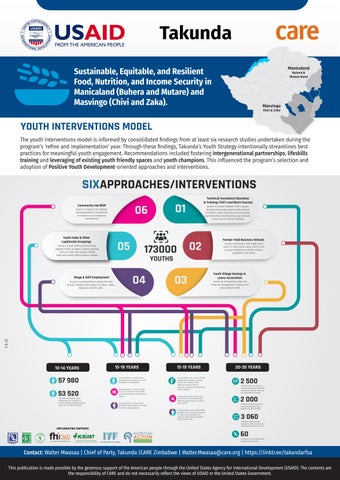
YOUTH INTERVENTIONS MODEL The youth interventions model is informed by consolidated findings from at least six research studies undertaken during the program’s ‘refine and implementation’ year. Through these findings, Takunda’s Youth Strategy intentionally streamlines best practices for meaningful youth engagement. Recommendations included fostering intergenerational partnerships, lifeskills training and leveraging of existing youth friendly spaces and youth champions. This influenced the program’s selection and adoption of Positive Youth Development-oriented approaches and interventions.
SIXAPPROACHES/INTERVENTIONS Access to support for ideation and generation of competitive innovations and innovation competitions.
Youth Hubs & Other Legitimate Groupings Access to goal setting and visioning oppportunities as peers in group settings such as: hubs, care groups, health clubs and farmer field business schools.
Wage & Self-Employment
02
173000 YOUTHS
04
Access to market-relevant TVET courses through three entry points: centre-based enrolment, skills outreach and community apprenticeships facilitated by local artisans. Short-courses will be available.
03
Farmer Field Business Schools Access to attractive and viable entry points in agricultural value chains such as goat,indigenous & broiler chicken, vegetables and maize
Youth Village Savings & Loans Association Access to entrepreneurship and financial management training and group-based credit.
E & OE
Access to employability training inclusive of youth friendly information on labour rights, migration and life skills.
05
Technical Vocational Education & Training (TVET) and Short Courses
01
06
Community-led NRM
10-14 YEARS
15-19 YEARS
57 980
Young women, in school, will be encouraged to participate in Youth Innovation & Competitions.
53 520
Young women, in school, will have access to community based NRM with opportunities to conduct social audits.
+100 000 adolescents will be enrolled into the ‘Passport to Success’ training program and gain access to an array of life skills.
IMPLEMENTING PARTNERS
Young women, in school, will be enrolled in the ‘Passport to Success’ life skills training program.
15-19 YEARS
20-35 YEARS
Young women, out of school, will be enrolled into Vocational Training Centers and guided by their respective location, level of education, technical orientation and market demand.
2 500
Young women, out of school, will have access to community based NRM with opportunities to conduct social audits.
2 000
Young women, out of school, will be enrolled in the ‘Passport to Success’ life skills training program and access to short courses delivered through youth hubs.
Students will have access to courses delivered by local TVET institutions and their fees will be supported by Takunda.
Students will have access to mentorship opportunities delivered by local artisans.
3 060
Students will be trained through a ‘skills outreach’ and have access to short courses.
% 60
A majority of the students are expected to be female.
Bulawayo Projects Centre
Contact: Walter Mwasaa | Chief of Party, Takunda |CARE Zimbabwe | Walter.Mwasaa@care.org | https://linktr.ee/takundarfsa This publication is made possible by the generous support of the American people through the United States Agency for International Development (USAID). The contents are the responsibility of CARE and do not necessarily reflect the views of USAID or the United States Government.