USAID Takunda - FY2022 Stories

Page 1


Takunda

Sustainable, Equitable, and Resilient Food, Nutrition, and Income Security in Manicaland (Buhera and Mutare) and Masvingo (Chivi and Zaka).

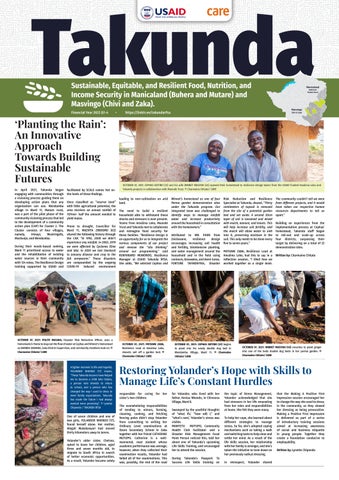
‘Planting the Rain’: An Innovative Approach Towards Building Sustainable Futures

In April 2021, Takunda began engaging with communities through a visioning process guiding them on developing action plans that any organization can use. Wendumba village in Ward 11, Mutare rural, was a part of the pilot phase of the community visioning process that led to the development of a community action plan (CAP) for Cluster 2. The Cluster consists of four villages, namely, Irimayi, Musiringofa, Mushunje, and Wendumba.

During their needs-based ranking, Ward 11 prioritized access to water and the rehabilitation of existing water sources in their community with 124 votes. The Resilience Design training supported by USAID and

facilitated by SCALE comes hot on the heels of these findings.

Once classified as “reserve land’’ with little agricultural potential, the area receives an annual rainfall of 107mm- half the amount needed to yield maize.

Prone to drought, Councillor for Ward 11, MAZVITA ZINDOMO (63) shared the following history through the CAP, “In 1992, 2008 we didn’t experience any rainfall. In 2002, 2019 we were affected by Cyclones Eline and Idai. In 2020 we lost livestock to January disease and crop to the fall armyworm.” These disasters are compounded by the ongoing COVID-19 induced environment

look

leading to non-cultivation on arid land.

The need to build a resilient household able to withstand these shocks and stressors is ever present. Teams from Amalima Loko, Muonde Trust and Takunda met to collaborate and reimagine food security for these families. “Resilience Design is an opportunity for us to integrate the various components of our project and remove the ‘’silo thinking’’ around our programming,” said RUNYARARO MUNONDO, Resilience Manager at USAID Takunda RFSA. She adds, “We selected Cephas and

Winnet’s homestead as one of four Perma garden demonstration sites under the Takunda program. Our integrated team was challenged to identify ways to manage rainfall water and increase productivity around the household in consultation with the homeowners.”

Attributed to MR. PHIRI from Zvishavane, resilience design encourages increasing soil health and fertility, biointensive planting, and water management around the household and in the field using contours, bioswales, and demi-lunes.

FORTUNE TAFIRENYIKA, Disaster

Risk Reduction and Resilience Specialist at Takunda, shared, “Thirty centimeters of topsoil is removed from the site of a potential garden bed and set aside. A second 30cm layer of soil is loosened and mixed with mulch, manure, and leaves. This will help increase soil fertility, and the mulch will allow water to sink into it, preserving moisture in the soil. This only needs to be done every five to seven years.”

PATISIWE ZABA, Resilience Lead at Amalima Loko, had this to say in a reflection session, “I liked how we worked together as a single team.

©

A lighter moment in life and hopeful, YOLANDER NHENDO (17) shares, “These Takunda lessons have helped me to become a child who listens, a person who intends to return to school, and a person who has changed the way I used to dress to meet family expectations. Takunda has made the future I had always wanted more promising”. © Lynette Chipendo / TAKUNDA RFSA

One of seven children and one of two girls, YOLANDER NHENDO (17), found herself alone. Her mother, Abigail Mukakanyari had moved thirty kilometers away to Jerera.

Yolander’s older sister, Chelsea, opted to leave her children, aged three and seven months old, to migrate to South Africa in search of better economic opportunities. As a result, Yolander became solely

OCTOBER 07, 2021: PATISIWE ZABA, Resilience Lead at Amalima Loko, shovels soil off a garden bed. ©

CARE

The community couldn’t tell we were from different projects, and it would have taken our respective human resources departments to tell us apart.”

Building on experiences from the implementation process at Cephas’ homestead, Takunda staff began to roll-out and scale-up across four districts, surpassing their target by delivering on a total of 22 demonstration sites.

Restoring Yolander’s Hope with Skills to Manage Life’s Constant Hurdles

responsible for caring for her sister’s two children.

The overwhelming responsibilities of tending to minors, farming, cleaning, cooking, and fetching fencing poles didn’t stop Yolander from committing to writing her Ordinary Level examinations at Dzoro Secondary School in Zaka together with her friend CATHERINE MUTUPO. Catherine is a wellmannered, neat student whose academic performance was average; however, when they collected their examination results, Yolander had failed all of her examinations. This was, possibly, the end of the road

for Yolander, who lived with her father, Kenias Nhendo, in Chinoona Village, Ward 8.

Swamped by the youthful thoughts of “what ifs,’ “how will I,” and “what’s next,’ Yolander’s stress was visible.

MANYETU MUTUPO, Community Health Club Facilitator and a Disaster Risk Management Focal Point Person noticed this, told her about one of Takunda’s upcoming Life Skills Training, and encouraged her to attend the session.

During Takunda’s Passport To Success Life Skills training on

the topic of Stress Management, Yolander acknowledged that she had stressors in her life emanating from her roles and responsibilities at home. She felt they were many.

To help her cope, she learned about different strategies to manage stress. So far, she’s adopted coping mechanisms such as taking a walk and switching tasks to help clear and settle her mind. As a result of the life skills session, her relationship with her family is stronger, and she’s taken the initiative to tone down on her previously radical dressing.

In retrospect, Yolander shared

that the Making A Positive First Impression session encouraged her to change the way she used to dress; in the community, as they viewed her dressing as being provocative. Making a Positive First Impression is delivered as part of a series of introductory training sessions aimed at increasing awareness of social and business etiquette in young people. Together they create a foundation conducive to employability.

OCTOBER 07, 2021: CEPHAS DZITIRO (41) and his wife WINNET MASIYAH (45) opened their homestead to resilience design teams from the USAID funded Amalima Loko and Takunda projects in collaboration with Muonde Trust. © Charmaine Chitate/ CARE
OCTOBER 07, 2021: CEPHAS DZITIRO (41) begins to plant into his newly double dug bed in Wendumba Village, Ward 11. © Charmaine Chitate/ CARE
OCTOBER 07, 2021: WINNET MASIYAH (45) crouches to plant ginger into one of the beds double dug beds in her perma garden. © Charmaine Chitate/ CARE
OCTOBER 07, 2021: POLITE MASARA, Disaster Risk Reduction Officer, uses a homemade A-frame to map out the flow of water at Cephas and Winnet’s homestead as BARBRA SIBANDA, Zaka District Supervisor, and community members
on.
Charmaine Chitate/ CARE
Charmaine Chitate/
Manicaland Buhera & Mutare Rural
Masvingo Chivi & Zaka

Takunda’s community visioning facilitation model: A lesson learned for all!

Over five days, the community visioning process was activated and implemented at Matsakanure Business Centre from September 27 – October 1, 2021. Community members from Ward 24 undertook the process with facilitation from ZVITSVA KUDYAIGERE and SAMUEL MVUKWE. Previously, the two community-based facilitators attended a training of trainers’ workshop held at Masasa Business Centre together with Wards 22, 23,24, and 25.

The two facilitated the selection of a documentation team solely responsible for consolidating a Community Action Plan. Using skills enhanced through a Takunda workshop, the documentation team

and their facilitators produced their first draft of the plan. The secretary will develop a final draft and prepare it for endorsement by local leadership.

“We own this CAP. We worked hard to make it,” ZVITSVA KUDYAIGERE shared, speaking to the ownership of his community’s CAP.

The successful training platforms was characterized by the attendance of members of different socio groups namely, the elderly in the fifty years and above for both men and women, thirty-six to forty-nine years for both men and women, the young men and young women in the eighteen to thirty-five years category, pregnant and lactating

women as well as the young who dropped out of school for various reasons. A total of twenty-nine participants comprising fourteen men and fifteen women attended all five training days.

“We dropped out of school for various reasons, but Takunda’s vocational training support is giving us hope for a second chance,” a participant from a Young Women Group shared.

They indicated they are geared to take vocational courses such as computers, Sewing, hair dress, and Peanut butter making to become self-reliant.

How Mable is Creatively Applying the Four-star Diet to Fulfill her Family’s Needs

Growing up, 32-year-old MABLE

CHIKAMU aspired to be a driver or mechanic; however, the death of her parents took a significant toll on her future career. Shaken by her loss, she has been driven into taking hold of her life choices throughout her life. To no surprise, Mable was nominated to lead a group of nine pregnant women in a village under Chief Marange.

Married with five children of her own, the youngest aged two years, Mable felt an urge to ensure her children’s dietary needs by providing diverse and nutritious food. As a mother, this goal moved her to join a Care Group. In Care Groups, facilitators refer to dietary diversity as the four-star diet, meaning a balanced diet from four food groups: starches, animal-sourced protein, plant source protein, and fruits and vegetables. She has been walking the talk since her first day of training and has noticed a healthy change in her children.

Through the Care Group, Mable mastered the art of preparing a healthy diet using locally available foods. In the past, she prepared plain or sour porridge for her family in the morning. This has since changed. After the practical cooking demonstration from Takunda’s

USAID-funded program, she extended the four-star diet to her husband’s brother. He has a chronic illness severely affecting his health and, at the time, had lost hope in life. “When my brother-in-law came to visit, I started applying the lessons I learned from the Takunda facilitators on combining different foods for nutritional value. I even made porridge with pumpkin leaves for him, and he said he liked it”, she says, highlighting how her patient appreciates some of the recipes.

For breakfast, she prepares tea with pumpkin or squashes (mapudzi). For lunch and supper, she would alternate the relish between the cheap and locally available crickets, mopane worms, fish, beans, cowpeas, and pumpkin leaves, as he was selective about the food he ate. She went the extra mile to start rearing chickens, Guineafowls, and turkeys to provide to complement the locally available animal protein food group. She has grown beans and cowpeas, which she is confident will take her through to the next season in a bid to protect her family from malnutrition.

In addition, she is producing cash crops like sugarcane to increase her access to nutritious diets and paying for school fees. Her husband also

Inclusion of Young Mothers in the Community Visioning Process

Participation of the 10 to 14 young mothers in the cv process is yet to be improved. It has been highlighted that these cases are there but gathered that the group is a bit secluded from community gatherings. One case was encountered in Irimayi village, Ward 11, where Takunda staff had to conduct a home visit to give one identified young mother a chance to speak out about her aspirations. The young mother, aged 14 and having conceived at 12 years, indicated that her wish was to go back to secondary school so that she could fend for her child in the future. Her parents also wished for her to go back to school as they were prepared to take care of their grandchild. However, she could not attend the community visioning process in public for fear of being discriminated against and segregated by the community.

centre during the community visioning broader feedback meeting on 17 September 2021.

To compensate for the inability to hold large gatherings, the community visioning team adapted to the training of cv facilitators to undertake a community-led visioning process in ward 28, where eight facilitators were trained on how to facilitate the community visioning process. A one-day theoretical training was conducted for the eight facilitators. After that they then conducted their own 5- day community-led cv process, which was backstopped on day three, where the subgroup consolidation processes were being undertaken. Takunda

sustainable as the communities are empowered to conduct their cv processes beyond the Takunda. This is supported by the inserted section from the facilitators’ report below. The facilitators are thankful for being trained and leading the community visioning process in Ward 28, Mafurere, and Muzama clusters.

As we advance, the district will continue to employ a variety of community engagement techniques and provide communities the opportunity to conduct their community visioning processes to improve the ability of communities to plan for their sustainable projects. Below is a section of the well-outlined area

testifies how the four-star recipes have helped his brother recover “Everything has changed from him struggling to wake up and eat, to cooking his meals—something he loves doing.” Her husband also enjoys the creative recipes, which he said are now part of the family meals, and hopes to complement this by joining the Men’s Forum, where health issues are discussed.

Reaping her membership benefits, Mable encourages all pregnant and lactating women to join Care Groups. Through Tatapudza* Care Group, lactating women promote good infant and young child feeding practices. This is just one of many interventions Takunda delivers that Mable is participating in. She’s also joined a Farmer Field Business School, resilience designs, and is encouraging other Care Group members to participate in other interventions to sustain their group. Their village is subject to erratic rainfall patterns and high temperatures leading to chronic food shortages.

*Not the real names. Names withheld due to ethical considerations.

Upon conducting a sensitization meeting with local leadership in ward 21, Cluster 2, the village head MR. MAMBWERE indicated that young mothers aged 10 to 14 years are there but are not easy to mobilize to attend the community engagement processes. This has been attributed mainly to the fact that it may become a police case other than just a community engagement program if they do attend. The same village head used the community visioning engagement platforms to advocate for the end of child marriages. “It is mandatory for all families who receive/ welcome a new daughterin-law at any given time to inform the village head, where the village head will after that confirm the age of the daughter in law. If found to be a child, the daughter-in-law shall be sent back to her family by the village head. Anyone who does not comply shall be summoned to the local court”, said Village head Mambwere at Mambwere business

staff supported by providing all community visioning materials required.

The community-led community visioning process was a significant success as the facilitators could carry out their wellbeing analysis and community visioning processes. Their community action plan has since been one of the best with well-outlined activity plans. During the five days, all subgroups were well represented as there was the inclusion of all subgroups. Minimal challenges were met and were dealt with at their level as facilitators.

Therefore, working with community visioning facilitators can be

of the community action plan developed by the cap writers in this cluster.

In that section, the action plans give the vocational skills project specifications, which have given hope to the youths in that village.

Seventeen-year-old NACLARE GANDA, who participated in the community visioning process in Ward 28, hopeful access to vocational skills such as computers, driving, etc., will help empower most youths within her community. She is also grateful as she has since started on focused activities that will see her pass her O levels.

Inclusion of young mothers in the community visioning process. © Calorine Madanzi/ CARE
OCTOBER 2021: ZVITSVA KUDYAIGERE (Kneeling with a baby) and Samiel Mvukwe (Standing in white shirt) posing for a photo with other community action plan Writers shortly after completing their Community Action Plan draft in Matsakanure, Ward 24 in Buhera. © Joshua Bhuza / TAKUNDA RFSA

Taking Pride and Lessons from every turn

Harvesting of Good Fortune

Zimbabwe witnessed a deluge of young people and artisans emigrating to neighboring countries in search of employment. PRIDE MUSINDO (29), the firstborn of four siblings, is no exception. He felt that as the man of the house, he needed to bear the responsibility of caring for others. Pride lost his mother in 2001 when he was pursuing his Grade three studies and was only eight years old. His father emigrated to South Africa, leaving him and his siblings in the care of their aunt, Anna Mutingwende (55). An enterprising woman in her own right, being a member of a village and savings loan association, running a profitable confectionary business in her community, she quickly becomes the source of inspiration for her nephew.

In Hlanga Village, just 30 kilometers from Chivi Growth Point, Pride now lives with his grandfather and extended family in Ward 10 of Cluster A. With his progression from high school, passing six ordinary-level subjects, including mathematics, Pride envisioned himself gainfully employed and thus pursued a short course in Behavioral Change Awareness and Merchandising. In a country with an increasing unemployment rate, Pride’s disappointment lingered as employment opportunities were lacking, forcing him to emigrate to

South Africa illegally in 2013. Pride’s hope of securing an office job in South Africa soon disappeared as the only opportunities accessible to him included working as a laborer on construction sites. Disappointed though undefeated, Pride used these opportunities to learn brick molding, a skill that would soon turn profitable for him. In May 2022, after a nine-year stay and frustrated by the social and civil unrest targeted toward non-nationals, Pride made his way home following the South African government’s added position on illegal migrants and exemption permits. An undaunted visionary, Pride invested in brick molding equipment to kickstart his business, and also in baking equipment to build on baking skills learned under Anna’s tutorage.

Mastering the craft only marked the first step towards applying Pride’s merchandising skills and realizing a new dream: running a profitable business. To prepare for his future success, Pride joined Budiriro, a village savings and lending association (VSLA), where Anna is a member, hoping to increase his

group fund development, Pride ventured into doughnut making, complemented by a brick molding business. Selling at US$1 for four doughnuts, Pride makes an average of US$60-70 per month from his doughnuts and uses the profit to buy cement for his brick molding business, and seeds back into the savings group. He secured regular business for his doughnuts from two business owners at Hlanga and Chidyamakono business centers, 3km and 5km from his homestead, respectively, delivering weekly and as the market demands. Informed by a market research process, acknowledging few competitors, he noted a demand for cement bricks as the area begins to modernize its buildings; however, this line of work earns him a meager US$20-30 as he charges US$3 labor per 50kg of cement.

income streams. Budiriro, loosely translated as success in English, has nineteen members, and its primary income is earned through selling confectionaries such as bread, buns, and doughnuts.

Using the savings earned in South Africa and guided by his peer group members trained in

Noting this challenge, at the next meeting, Pride hopes to access a loan and use the proceeds to scale up his doughnut-making business and move his brick molding business from his homestead to Chivi Growth Point, where it is financially viable. The Growth Point is of particular interest to him as it grants access to his agemates and provides opportunities for him to train his peers.

Learn how Wikrafu is Building Climate Resilience at His Homestead in Buhera.

Demand for food is increasing in Zimbabwe, but production from both commercial and small holder farmer has not kept the pace with the growing demand. Changing climate patterns, high demand for water, and a growing population are all factors that significantly strain the Zimbabwean food supply. The challenge is worse in rural areas, as 70 percent of production is from small holder farmers. CARE, and its partners in a USAID-funded program called Takunda, seek to address small holder productivity challenges through an enhanced soil and water conservation intervention calledresilience designs. The pilot face of the intervent was launched during the 2021-22 rainfall season.

Wickrafu Mapfumo is a forty-eightyear staunch member of the Johane Masowe Apostolic Sect, a religious group, with his three wives and nine children from Ndongwe village in ward 15 of Buhera. He was selected by his community members as one of the five farmers to pilot the resilience design approach program. The five farmers underwent resilience design (RD) training through the Takunda project and set aside land for resilience design

sites at their homesteads. Wickrafu, with the assistance of his wives, dug three dead-level contour ridges and set a 0.02-hectare permagarden. The contours were very helpful as they harvested water that sustained their pumpkins, cowpeas, and pigeon pea crops planted on the water harvesting contours. In October 2021, the family, who are already tomato growers, planted 2613 plants of tomatoes of the Newton variety. In the previous years, Wikrafu would just plant his crop in isolation without any water harvesting structures, but due to the resilience design training he received, he incorporated some of the resilience design approach structures, which are the dead level contours that assisted in the continued presence moisture for his tomato crop without requiring much irrigation. For the basal dressing, they relied on well-decomposed manure, and mulching was done using tree leaves.. When tomatoes were at the fruit formation stage, Wickrafu had this to say to one of the Takunda officers, “I am proud of our work, and as a resilience design farmer, you are always learning and discovering new things; you are exploring, and it is very humbling

because you are always learning from mistakes.”

The harvest time was from February to early April 2022, and the tomato yields were incredible. They harvested over 200 buckets (20litre containers), realizing over one thousand united states dollars in sales. They managed to source a market sixty kilometers away from their homestead in Nerutanga village. As a way of sharing responsibilities in their farming business, Wikrafu’s two wives went for three-week camping at a churchmate homestead as the customers were buying from this central point. One of Wickrafu’s wives narrates, “If you are from a polygamous family, you must work hard to contribute to the happiness, food security, and income of your family.”

With the proceeds the family bought farm tools and inputs including , a wheelbarrow, and a 200metre polypipe for irrigation as they use a treadle pump. The rest of the money was used to buy the family’s food and clothing. Wickrafu managed to plant a second crop of 2614 tomatoes in April 2022, and the family is

expecting a bumper harvest. Wickrafu’s first wife, Vaida Mhenzi (36 years old), specializes in the perma-garden. She says, “I managed to follow the four resilience design principles in water conservation namely; slow, spread,sink and save, and now I am getting a good harvest and sharing with the other people.”

Vaida, together with her sister-wives, managed to construct seven doubledug beds as well as the construction of three half moons that assisted in the recharge of the shallow wells that were in their garden. Through the assistance of these structures, water became readily available for watering their permagarden.

She planted okra, carrots, beans, covo, and rape in the perma-garden. She indicated that by introducing a multi-cropping system, she diversified her household diet, and a four-star diet is always on the table. The family planted 55 pawpaw trees in December 2021, and despite the prolonged dry spell, the trees remained green due to water collected by the half-moons.

Fifty-nine-year-old LUCIA ZINDIMO lives in Musiringofa Village in ward
Written by: Juliet Madhuku & Joshua Bhuza
DECEMBER 2021: One of Lucia Zindimo’s bioswales and crops during the developmental stages in Musiringofa village, Ward 11 in Mutare district. © Lawrence Nyagwande/ TAKUNDA RFSA
PRIDE sits on a wall that is under construction. The owner of the construction site bought bricks from Pride. © Ethel Dube/ CARE
PRIDE MUSINDO (29) leans on a tree while standing in front of a construction site using bricks he molded and sold to the stand owner. © Ethel Dube/ CARE
PRIDE MUSINDO (29) holds a halfsold tray of doughnuts he made. © Ethel Dube/ CARE
PRIDE (29), wearing an orange shirt, at a village savings and loan meeting. © Ethel Dube/ CARE 2022

How a Monthly $5 Investment Led One Household to

Diversify Income Sources

“I want my life to show progress like a graph, progressing from selling clothes, expanding my business to including poultry, piggery until I park a car here,” as PHILOMINA RONGEDZAI (46) points at a cool shade made by a mulberry tree at her homestead. A

the same fate for her daughters. “I attended the Takunda Community Visioning (CV) process at Mhiti Business Centre in November 2021 and learned the River code.”

The River Code is an illustrative short

mother of four children, three girls and a boy, she used to earn a living from securing casual work, mainly weeding neighbors’ farms for two to three days. The labor only earned her a bucket of maize (17.5kg) worth, equivalent to five United States Dollars. Undertaking hard labor was new to Philomina as she came from a more comfortable background before she married OSMOND CHARUMBIRA (53). “My father worked and would provide food every month and paid school fees in full yearly.”

Philomina remembers, “One time I failed to raise exam fees for my son, PRIDE RONGEDZAI, when he was 16 (turning 22 on 19/08/2022) to sit for crucial Ordinary level exams.” In turn, Philomina humbly sought assistance, “I had to ask my aunt for help to pay exam fees for my son.” Not one to be left behind, she did not want

skit depicting how different people internalize the process of getting help to cross a river. Some need to be carried, others need to be hand-held, and others need to be shown how to cross, while there are those that fear

and simply don’t attempt. Philomina says she is one of those that learned how to cross, while there are some members in her community that did not even attempt. The process resulted in the development of a Community Action Plan (CAP). One

money through VSLA, but Osmond, my husband, had reservations, “We had tried this before with another donor, and we were made to contribute towards the purchase of butter-making machines. We were swindled out of the little that we had by some of the members. So, when I heard that my wife wanted to be part of the VSLA, I was reminded of this experience,” said a cautious Osmond. Convinced that VSLA would improve the quality of life, Philomina joined Tichafara VSLA behind Osmond’s back, “Some of the things I did without telling my husband, Osmond.” When Osmond started to see the returns from his wife’s membership in VSLA, he started to be supportive.

Manyetu: A Man on a Mission to Break Stereotypical

Growing up in Chivamba, Ward 28, MANYETU MUTUPO (49) met and married BEAUTY MUTSVANGWA (48) in 1992, moving shortly after to Chinoona Village, in the same Ward and district, Zaka. In 1993, the young couple welcomed their first of six children. Manyetu and Beauty practice peasant farming on one hectare of land and own six cows, ten goats, 13 sheep, and several chickens. The couple also runs a grinding mill at their homestead to complement this.

pits, and tippy taps, and pot rakes.

of the activities they chose in their action plan was participation in VSLAs (savings groups).

As a resident of Nyambi village, Philomina always wanted to save

Transforming Lives, One Young Person at a Time

vocational courses on topics such as Building, Hotel, and Catering, as well as Clothing and Technology. The students, comprising forty-three (43) females and thirty-two (32) males, underwent a hammer and grill theory during the first three months with practicals. The most fundamental thing is that the young people will be assisted to get a six-month industrial attachment before graduating.

Upon joining, Philomina’s initial loan was $60 USD which she invested in a business where she purchased clothing for reselling worth $40 USD. She used the remaining $20 USD for transportation to and from Harare. As a result, she earned $130 USD from the sale of these new clothes. She made another round of orders worth $100 USD and earned $250 USD, part of which was used to repay her loan with interest back to her VSLA group. Philomina is determined and motivated to venture into more diversified and profitable incomegenerating activities, resonating with her dream of seeing her life as a rising graph. She has set her eyes on investing her income in dried fish, poultry, shop, and eventually piggery. All of which will build towards reaching her long-term dream of owning a car in the near future.

A member and a preacher of the African Apostolic Church, Manyetu is on a motivating mission. “The community views the Apostolic Sect as resistant to Health and WASH interventions. My drive is to see a change from this view, whereby the rest of the community will view us as people who are receptive to adopting the promoted WASH behaviors under Takunda,” Manyetu shares.

The journey for Manyetu’s household began during a community visioning process where the communities drafted their visions and aspirations. Later, Manyetu was selected to represent Chinoona Village as Community Health Club Facilitator, where he underwent training in Community Health Club Approach facilitated by Takunda, a USAIDfunded program, in March 2022.

Before Takunda, Manyetu and the community of Chinoona Village faced many challenges, including access to information and knowledge on the importance of health and hygiene issues. The entire village did not have a standard latrine or hand washing facilities. This led to increased open defecation in the village, and proper hand washing was not practiced.

In addition, a high donor dependency on latrine construction meant the village, a community of 26 households, has been slow to adopt positive health and hygiene practices because they don’t have hygiene facilities like toilets, rubbish

As a CHC facilitator, Manyetu ensures that the community’s aspirations for addressing these challenges are fulfilled through participating in Participatory Health and Hygiene Education (PHHE) sessions. These sessions are essential as recommended health and hygiene practices are likely to contribute to disease prevention in the community through proper hand washing, knowledge, and hygiene enabling facilities. The community supports this through resource mobilization such as human capital, finance, and material resources. The goal is for the community to be self-reliant and resistant to shocks and stressors.

Manyetu has contributed to change in his community. He’s been instrumental in establishing and implementing the CHC through weekly PHHE sessions and other project interventions. The community wanted to reduce donor dependency, so they established Village Savings and Loan Association (VSLA) working groups that supported the construction and repair of household latrines. This has led to improved knowledge of recommended health and hygiene practices. As a result, a total of 16 latrines have been achieved. Of the 16 latrines, 14 were repaired, two were newly constructed, four lined pits, two pits were dug, and six households are digging their pits. Now people are washing their hands. Proper latrines have been constructed, with 16 households accessing safe sanitation. One toilet even has a sewer.

Empowered by Takunda through training, Manyetu has contributed to the ongoing transformation in his community. Cleanliness is now the order of the day, with community members practicing hand washing hands at all critical times.

APRIL, 6, 2022: PHILOMINA RONGEDZAI (46) proudly stands inside her house, “Takunda yauya, ndakakwanisa kutenga ma bag 5 esemende ndikawedzera kukudza imba yangu
nekuwedzera imwe room kuti aite matatu” after joining Takunda, I managed to buy 5 bags of cement which helped me to extend my house and to add another room to make them three rooms using.
Philomena used proceeds from her income generating activity. ©Sydney Saungweme/ CARE 2022
APRIL, 6, 2022: PHILOMINA RONGEDZAI (46) poses for a group photograph with members of her family. © Emmanuel Mazangwa/ TAKUNDA RFSA
APRIL, 6, 2022: OSMOND CHARUMBIRA (53), Philomina’s husband, showcasing a section of the house his wife developed using proceeds from the VSLA. © Emmanuel Mazangwa/ TAKUNDA RFSA
July 4, 2022: Self-motivated Mutupo Munyetu demonstrating on the proper use of handwashing facility to his visitor at his household in Chinoona Village. © Mercy Jamba/ CARE
July 4, 2022: Tinofara Community Health Club proudly celebrating the completion of the 16th latrine in their village. © Mercy Jamba/ CARE 2022

Community Focal Point Persons (CFPP) become Agents of Transformation

In Ward 15, Buhera district, Takunda conducted a Training of Trainers (TOT) on Gender-Sensitive Climate Vulnerability & Capacity Analysis (GCVCA). Upon completion of the three-day course, the community focal point persons completed two assignments: cascading the training in their clusters and carrying out collective activities as a community as informed by Ward 15’s Disaster Risk Management (DRM) plan developed during the training.

Netsai Zera (48), a mother of three from Sengejira Village and a graduate of the training, met over 50 men and women, including the youth, and successfully cascaded what she learned. Empowered and mentored by Netsai, the community prioritized the maintenance of the Sengejira-Ndongwe road, which is a four-kilometer stretch. Road maintenance included cutting and clearing vegetation on both sides to ensure good visibility, cleaning the road drainage systems, and patching holes. These changes inspired an overwhelming response from all community members, including

May, 17, 2022: At Magamba Vocational Training Centre, at least 43 out of 75 are girls from Buhera, “Women and girls are less at risk of abuse when they have the skills to earn a living,” the councilor for Ward 7 endorsed. 300 young people from Buhera, Chivi, Mutare Rural and Zaka were part of the first cohort students of Takunda’s TVET program. © Charmaine Chitate / CARE

Passport to Success – A Springboard to Improved Life Skills and Entrepreneurship

In its second year of implementation, Takunda, a USAID-funded development program in Zimbabwe, launched the Passport to Success (PTS) training for young men and women with the overarching goal of strengthening personal competencies as well as developing skills necessary for an entrepreneurial mindset, and fostering leadership, innovation, and creative thinking for sustainable livelihoods. The training included sessions on stress management, coping with failure for entrepreneurs, managing conflicts, and decisionmaking for entrepreneurs, among others, to capacitate and enable them to identify and face daunting challenges.

In May 2022, a group of 17 youths, aged between 20 and 29 of Ward 15 in Buhera, underwent PTS Training. The PTS training tool kit, according to James Masimba (Takunda Youth Officer), contained 15 modules that support personal development, the conception of business ideas, and the strengthening of capacities to enhance sustainability. Edmore Mugutso (23), a PTS participant shared, “I am happy with this training targeting us, the youths. It is indeed a step in the right direction in molding well-mannered youths and opening space for youth. Now we can air our views and concerns, ensuring we always have a seat at the table”. Shortly after the training, self-

selection among the youth occurred as they thought of engaging in Income-generating activities. Twelve youths (eight young women and four young men) from the group teamed up and formed an indigenous chicken production project named Mavambo, meaning “the beginning” in English. Using the knowledge gained from the training, they formed a committee and developed a constitution. The department of Agricultural Technical and Extension Services (Agritex) helped them with broiler production pamphlets in order for them to learn good husbandry practices. One of the youths’ parents offered fowl runs to the group, stating, “I encourage the youths, especially women, not to be limited by cultural expectations of what they can or cannot do.” The group started the project with 24 birds after each member contributed two roadrunners. Parents supported this initiative and Mrs. Charega, a parent of one group member, said, “We are happy for Takunda’s initiative. This will help reduce substance abuse, early pregnancies, burglary, and stock theft in our area”

With good poultry husbandry notes and assistance from Agritex, the youth successfully raised their road runners to the point of sale. Afterwards, they sold the chickens at US$8 each, which earned them a total amount of US$192. Due to the intense competition around indigenous chickens, the group decided to shift to broiler production, which is

even those not a part of Takunda’s programming.

Communities took part in the collective work by offering resources, including labor and materials. The construction activities went as far as Maregerere, a central point for three villages: Sundirai, Kwarire, and Dzenga. Netsai said, “If you change one individual’s mindset, it will repeat itself within the community.” This motivated them to continue working and moving forward with the construction of the Maregerere Bridge.

The communities surrounding the bridge faced transportation challenges, as cars could not cross over to Kwarire and Dzenga villages. Without a bridge, buses ply that route, forcing villagers to take longer routes. Children are very vulnerable to drowning during the rainy season as they cannot cross the flooded river on their way to school.

Dr. Chiduku, a veterinary doctor from the area willing to assist but with no opportunity, donated 200 bags

... continued from Page 4

One of the most significant added values of Takunda’s technical vocational education and training program is that it extends opportunities for decent work to include entrepreneurship, discipline, teamwork, and leadership skills. Combined, these skills are packaged to encourage students to start their own businesses and continue to grow professionally.

In March 2022, Takunda invited young people between the age between 15 and 29 to apply for enrolment for technical vocational and education training. The overwhelming turnout led to an interview process where seventy-five young people from

of cement and promised to source other materials from the diasporas. He said, “I believe in social services… I would like to deliver programs that would enhance the lives of my community”. The communities now work three days a week, and the village head, Mr. Sundirai, in his late 80s, said, “I feel that my presence as an old man motivates the young to work hard and construct what has been historically a broken bridge, and this will help to join the three communities.”

extremely poor households with basic education (even without ordinary level passes) were shortlisted. The young people will graduate with opportunities for personal entrepreneurship and employability as young people.

The training is expected to bring about many successful scenarios like financial independence, the ability to run a business, and attending to life’s day-to-day needs like caring for growing children. One lady, who has enrolled in a Building course, narrates, “I have big plans.” She intends to build a mansion for herself and graduate from her current pole and dagga house.

Abigail Nyirenda, a Business

The village head also indicated, “Once the bridge is completed in November , our work will benefit the whole community and open an opportunity for other works like the construction of a dip tank and a clinic.” Netsai adds, “Takunda has given us a grounding empathy. It helped us to see the reality and look beyond our narrow interest. We are now agents of community transformation”.

Development Officer at Takunda responsible for the enrolment of the young people at the district level, shared, “When young women and girls are given the tools to succeed, they utilize them. Not only to lift themselves but to support and strengthen their families and communities.” The councilor for Ward 7 supported this statement during the send-off to Magamba of the young people by saying, “Women and girls are less at risk of abuse when they have the skills to earn a living.”

lucrative in their area as it has quick returns. After their profit and loss account calculations, as advised by Agritex, their production cost for 30 broilers amounted to US$125. They will sell the chickens at US$7 and gain a profit of US$85 for the batch.

As a group, their long-term plan is to produce a batch of broiler chicks after every four weeks. A group member, Bibian Mawire (25), said, “We are in the right direction, and I hope the chickens will help us raise enough funds to sponsor each group member with a small start-up kit to start operating independently and fulfill our vision.”

In a bid to diversify, the group is planning to start saving money in October 2022 through a youth savings and loans association. They hope to use the savings to invest in their dreams and aspirations.

19, 2022:

AUGUST 05, 2022: Villagers from Sengejira take a short break during construction of a masonry strip across section of Sengejira-Ndongwe road. The masonry strip will connect three villages, Kwarire, Sundirai, and Dzenga, and will reduce hazards such as children drowning on their way to school. © Joshua Bhuza / TAKUNDA RFSA
© Joshua Bhuza / TAKUNDA RFSA
AUGUST 05, 2022: Sengejira-Ndongwe road maintenance works that included cutting and clearing vegetation on both sides of the road to ensure good visibility, cleaning of road drainage systems to reduce the accumulation of water in the road as patching of holes. © Joshua Bhuza / RFSA
SEPTEMBER 19, 2022: NYASHA KASEKE (22), a member of the Mavambo group poses for a photograph showing healthy chicks at 2 weeks of age. The chickens will be ready for market at 6 weeks of age, and they already have a ready market at Madzivire Secondary School. © James Masimba/ TAKUNDA RFSA
SEPTEMBER
James Masimba, a Youth Officer at Takunda, crouches with far right together with some members of Mavambo Poultry Project. The group intends to diversify and start a Youth Saving and Lending Association. © Joshua Bhuza/ TAKUNDA RFSA

SEPTEMBER

Celebrating Inclusive Spaces for Youth Participation.

Participating at the International Youth Day Commemorations (IYD) was an eye opener and exciting moment for EDWIN MWEDZI (24) and his colleagues from Marange Vocational Training Centre as they showcased some of their handmade products and interacted with other young entrepreneurs. “It is my first time to be part of an event like this one. I am so excited to see how people admire the cake we baked and the uniforms we made. It is very nice seeing people buying food from us,” said Edwin.

Takunda joined its implementing partners and Government departments commemorating International Youth Day on the 31st of August 2022 in Ward 24 of Mutare

“I want to buy myself nice clothes and take of my siblings,” These are the Marvelous Mazikana’s wishes as she narrates her reasons for undertaking the clothing technology course at Marange Vocational Training Centre.

For Marvellous, Takunda has brought her closer to achieving her dreams through the TVET program. Being the firstborn in a family of six, she feels the need to her help mother look after the siblings. Marvellous (aged 22) was born with Kyphosis and has a heart challenge.

She attended her primary school at the local school in Ward 4 of Mutare. She did her ordinary level up to form 3. FUNGISAI DITIMA, Marvelous’ mother shared, “The secondary school is far; as a person living with Kyphosis, she could not keep pace with other children from the village, often would face the trip from school alone, and at times boys would torment her on her way.” Fearing

District. International Youth Day was designated by the United Nations in 1999 and is observed annually on August 12th. It is an opportunity for Governments, development partners, and communities to draw attention to youth issues worldwide.

This year the commemorations were held under the theme, Intergenerational Solidarity: Creating a World for All Ages. In the Mutare district, Takunda supported 75 (40 males & 35 Females) young people by engaging Marange Vocational Training Centre for skills training in hotel and catering, clothing technology, and building courses.

Participants for the IYD event were drawn from three courses to

for her daughter’s life, Marvellous’ mother pulled her out of school.

Marvellous completed her three months of center-based training on Clothing Technology at Marange VTC.

She is proud to be able to design school uniforms, work suits, and dresses. Her target markets are local schools and the people from her village. The opportunity to be part of the few participants also gave her a sense of belonging, according to her mother.

acquired and hospitality she got from the training center, she has had an opportunity to feel part of the community and identify herself with her peers. She always looked down upon herself when left out of community programs,” said a happy mother.

expose the students to the market and interact with other young entrepreneurs.

Present also were local artisans from other projects, young farmers showcasing crop and livestock products (sorghum, millet, groundnuts, fodder bales, rabbits, and poultry), and microfinance institutions. Youth from Takunda displayed garments they constructed, such as school uniforms and freshlybaked and cooked food. It gave speeches amplifying the awareness of societal and economic barriers to

women of her age to take up vocational skills as a way of bridging the income gap at the household level. “To my colleagues, specifically the young girls and women here present, I strongly encourage you not to always look up to men but also start your own business and bring some money to the table. You can only do this by acquiring vocational skills,” said Talent. Other implementing partners in the district, such as Plan International, Youth Alive, and Zimbabwe Fostering Agribusiness for Resilient Markets Activity (FARM), participated in the

Fostering women’s participation in public spaces

Thirty-three-year-old DOROTHY MARIVASA lives in Mamutse village under Chief Bota in Ward 29 Zaka district. The last born in a family of 11, Dorothy was spoilt by her parents as they provided everything she wanted and needed more than they ever did for her siblings. She cherished the memories of her upbringing as she as they clashed with the reality of marriage in a patriarchal society.

Dorothy met and married Christopher from Dekeza village in 2007. Together they have four children, the eldest being fourteen years of age. As the couple is not formally employed, they rely on horticulture and casual jobs such as brick molding & preparing other people’s fields to earn a living. This has led to their waking time being consumed with daily tasks to make ends meet. The transition into becoming Christopher’s wife was a difficult experience for Dorothy.

It was not her place to voice her concerns but to take instructions from her husband without question. It wasn’t her place to discuss some of the challenges they face as a household, let alone advise him on the best decision to make for their family, as it always led to frustration.

The onus was on Dorothy to tend to the household chores, including fetching water, as Christopher did not believe it was his place to assist with around the household as he had a wife and children to do so.

“His tone was always harsh when he spoke to the children and I,” confides Dorothy and adds she was not allowed to participate in community meetings, as the husband felt it was the men’s job to plan for their

women and children.

With the advent of the Takunda project, Christopher attended a meeting where a team from Takunda was sensitizing the community on male champion training and group registrations. Christopher decided to follow through on what he learned and joined a men’s fora group led by a peer. Dorothy said, “Joining the men’s fora meetings transformed him. Everything changed, and we started planning as a family.”

Cheerful, Dorothy is grateful for the peace and happiness in her family. Christopher now actively and openly discusses their financial issues with her and the children. Sometimes, he fetches water and helps her wash the dishes, a job which was previously done by Dorothy and the children. Christopher said, “My family did not believe it during the first days when they saw me doing dishes and fetching water; to them, it was a joke.” Now they are used to it. Dorothy had this to say about her household vision “I want us to succeed as a family through Takunda and for my family to remain united.”

Christopher has gone on to encourage Dorothy to attend community meetings. His support led to her joining a village savings and loans association in her village and provided her with the initial capital.

This has boosted her confidence to participate in public spaces, where she is now a lead mother mentoring pregnant and lactating young women from her village in a care group.

disability inclusion, Persons Living With Disability (PLWD) form part of

In the 24 wards of Mutare, Takunda Project targets the chronically vulnerable youth aged between 15

02, 2022: A proud moment for a newly trained Gender Champion from Ward 7 in Buhera as he poses for a picture following a Care Group Training held at Sikireta Business Center. © Emmanuel Mazangwa/ TAKUNDA RFSA
TAKUNDATAKUNDA
Takunda’s primary target group in TVET programming.
Marvellous Mazikanwa, a participant living with disability, is happy to be part of the Clothing Technology class at Marange VTC supported by Takunda. © Addmore Moyo/ TAKUNDA RFSA
August 11, 2022: Understanding gender roles and responsibilities is key to addressing issues of time poverty. At St. John Primary School in Ward 10, Buhera, during a Social Action and Analysis training, participants worked in groups to identify gender roles and responsibilities. © Alexander Sakara/ TAKUNDA RFSA
August 3, 2022: As the Nutrition and Health Officer at Takunda’s Zaka office, Chisichawo Mutendadzamera, addresses members of the Ward Food and Nutrition Security Committees for Wards 20 and 21, during an orientation meeting. He shared, “It is important to utilize various approaches in addressing malnutrition challenges facing our communities. Together we will play a huge role in addressing this issue.” © Gamuchirai Pazvakavambwa/ TAKUNDA RFSA

Transforming Lives, One Young Person at a Time

Empowering Women Through Sustainable Farming Practices

In 2012, SIPHATHISIWE SIBANDAGODHINI (49) and her husband relocated to his home village in Ward 14, Zaka, from Gokwe.

Seven hundred kilometers from the home she knew in Sikhobokhobo (Nkayi), Siphathisiwe found herself alone and overwhelmed with five sons to raise as her husband decided to migrate to South Africa in search of better opportunities. Opting to farm to fend for her children, she found it would be a little more challenging to do than in her rural home, “This area is prone to low rainfall and, sometimes, we can’t even get water to drink. At times, my family and I fail to harvest our crops because our soil lacks nutrients, and I cannot access seed or fertilizer,” a frustrated Siphathisiwe says. As a result, she has to walk at least 7km to the nearest water source as there are no boreholes near her homestead.

Access to water is only one of the challenges the Godhini family faces, “On the rare occasions that we harvest our crop, we do not have market spaces where I can sell my produce.” Siphathiswe’s challenges are echoed by many women in both Manicaland and Masvingo provinces. Determined to change the fate of her family’s livelihood, Siphathisiwe joined a workshop to harness ways to increase agricultural productivity.

Motivated, Siphathisiwe says, “I learned how to create dead level contours, and on its edges, I planted different crops. In my permagarden, I learnt how to double dig and plant crops with higher nutritional value like spinach, green pepper, covo, and rape. I now know how to use a combination of fruit trees and a halfmoon to maintain moisture in the soil. The training encouraged me to build a toilet, and I installed a tippy tap just outside it.”

Today, she walks purposefully through her maize field, slowing down briefly to inspect the maize one stalk. Pleased with the progress her maize crop has made, Siphathisiwe makes her way towards the permagarden, “After applying what I learned, I am confident that we will harvest more than we ever expected because the contours collected water and the plants harnessed the moisture brought by the water.

I hope I will continue to farm this land because it has contributed to improving my family’s livelihood.”

Siphathisiwe walks into her permagarden, characterized by a fence made from a repurposed mosquito net her husband sent from South Africa. She picks up a yellow metal dish and begins to pick tomatoes, “I added more dead level

contours, increased the number of doubles dug beds, and added beans to increase nutritional meal options for my family.”

This has impacted Siphathisiwe’s day-to-day life, “It has created more time for me to attend to other household tasks and participate at community meetings. I used to irrigate my garden every three days, and now I only do so once a week. This is because my family and I mulched our garden beds and installed sheds to slow down the impact of heat on our crops.”

With the free time added to her schedule, Siphathisiwe has committed to diversifying her sources of income, “I can sell the maize and vegetables from my garden. I have chickens, goats, and breed cattle. The income generated from projects contributes to my children’s education.” She encourages other women like her to adopt and incorporate the same resilience design systems and ensure the improvement of their livelihoods.

DECEMBER, 2021: SIPHATHISIWE SIBANDA-GODHINI (49) a farmer in Zaka, shovels soil out of a dead level contour she will use to harness water. © Godfrey Muvhuti/ Takunda RFSA.

DECEMBER, 2021: SIPHATHISIWE (49), a farmer in Zaka, stands next to the deadline level contour she created. Two months later, her maize stalks have grown, the pumpkin leaves are providing shade and the soil has visibly retained moisture. © Godfrey Muvhuti/ Takunda RFSA.
MARCH 02, 2022: SIPHATHISIWE SIBANDA-GODHINI (49) a farmer based in Ward 14, Zaka holds a metal dish filled with producetomatoes and green pepper- harvested from her permagarden. © Godfrey Muvhuti/ Takunda RFSA.
Alice Mupfukura holding pumpkins from her double dug beds in her permagarden. The amount of organic manure applied to the double-dug beds has improved the quantity and quality of pumpkins. © Kudakwashe Murambadoro/ TAKUNDA RFSA
SEPTEMBER 01, 2022: “I am very proud that I can now make clothes for my son. I no longer have costs of going to town to buy him clothes. After graduation I look forward to making and selling uniforms locally,” says Brenda Nyambawaro a student at
September 23, 2022: Students from a clothing technology class at Nemauko Community Hall threading a sewing machine. “I would like to thank Takunda for giving (me) this lifetime opportunity,” one student shared during the training.” © Martin Chauke/ TAKUNDA RFSA
June 14, 2022: Village Health Workers participating during Active Screening Training at Siyawareva Clinic (Ward 24). The VHWs are being capacitated on active screening which will assist in the early identification, referral and treatment of acute malnutrition cases. © Chisichawo Mutendadzamera/ TAKUNDA RFSA
A 23-year-old Brendon Chimwaza, is a brick and block laying student at Marange vocational during class practice at Marange VTC. © Nyasha Mhlanga/ CARE
Nutrition screening during Supplementary Feeding Program distribution, Sibongile Kapfumvuti taking her child mid upper arm circumference (MUAC) to access the nutrition status of the child. © Lorraine Marange / Takunda RFSA
Mutsamvu FFBS members threshing pearl millet after Post Harvest Handling (PHH) training session in ward 17. The training aim to reduce harvest and post harvest losses on farm produce for the FFBS participants. © Evans Mangoro/ Takunda RFSA

Turn static files into dynamic content formats.

Create a flipbook
Issuu converts static files into: digital portfolios, online yearbooks, online catalogs, digital photo albums and more. Sign up and create your flipbook.