ECONOMICS | THE EURO AND THE DOLLAR
FROM STRENGTH TO STRENGTH Will the strong euro strangle Europe’s economic recovery asks Katinka Barysch.
30 • the Parliament magazine
E
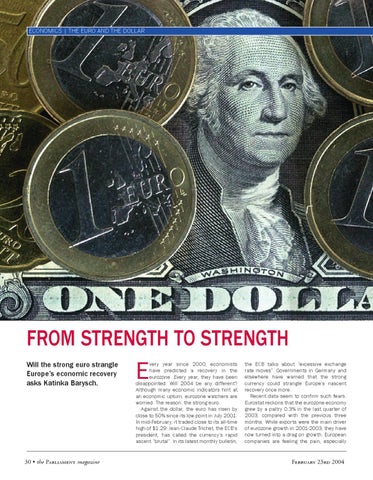
very year since 2000, economists have predicted a recovery in the eurozone. Every year, they have been disappointed. Will 2004 be any different? Although many economic indicators hint at an economic upturn, eurozone watchers are worried. The reason: the strong euro. Against the dollar, the euro has risen by close to 50% since its low point in July 2001. In mid-February, it traded close to its all-time high of $1.29. Jean-Claude Trichet, the ECB’s president, has called the currency’s rapid ascent “brutal”. In its latest monthly bulletin,
the ECB talks about “excessive exchange rate moves”. Governments in Germany and elsewhere have warned that the strong currency could strangle Europe’s nascent recovery once more. Recent data seem to confirm such fears. Eurostat reckons that the eurozone economy grew by a paltry 0.3% in the last quarter of 2003, compared with the previous three months. While exports were the main driver of eurozone growth in 2001-2003, they have now turned into a drag on growth. European companies are feeling the pain, especially
February 23rd 2004
As the euro rises, EU exporters lose competitiveness in overseas markets. But few dare to raise their prices for fear of losing market shares.
the smaller ones that cannot afford to insure themselves against currency swings. As the euro rises, EU exporters lose competitiveness in overseas markets. But few dare to raise their prices for fear of losing market shares. The resulting squeeze in profit margins means less cash for expansion, investment and workers’ paycheques. At the same time, the rising euro makes it easier for companies from the US, Asia and elsewhere to sell their goods within the eurozone. So European companies get squeezed both at home and abroad. This is why economists reckon that a 10% hike in the euro’s trade-weighted exchange rate dampens eurozone GDP growth by up to 1.5 percentage points over the following year or two.
February 23rd 2004
Our currency, your problem No wonder, then, that Europe is concerned about its currency. Alas, few people outside the eurozone share this concern. Policymakers from the US and Asia expressed their sympathy with the Europeans at their G7 meeting in Boca Raton (US) in early February. But the markets clearly did not believe that official concerns about “excess volatility” (of the dollar against the euro) and “lack of flexibility” (of the Asian currencies) was backed by the will to do anything about it. The US has long watched the external value of its currency with an attitude of “benign neglect”. As Richard Nixon’s treasury secretary, John Connally, famously remarked in 1971: “The dollar is our currency, but it is your problem.” The main reason behind the currency conundrum is the US’ massive ‘twin-deficit’ in its fiscal and external accounts. The budget deficit is well above what would be allowed under the EU’s stability and growth pact while the current-account deficit is expected to reach $600 billion or more this year. To finance the current-account deficit, the US needs to attract $50 billion each month. As foreign investors become less willing to cough up the cash, dollar assets need to get cheaper to keep them attractive. To close the current-account deficit, America would have to bring its consumption in line with its savings. But both consumers and the federal government are on a spending spree, financed by cheap money from abroad. Higher interest rates and a tighter budget would be needed to reign in domestic demand—both are extremely unlikely in an election year. Meanwhile, the Asian countries have kept their currencies pegged firmly to the plunging dollar, with the result that Europe has born the brunt of the greenbacks continued slide. China fears that currency instability could wreak havoc with its fragile financial sector. And China, like Japan, loves the effect their cheap currencies have on growth and employment.
European calls for “burden sharing” during this long-overdue global adjustment are unlikely to be heeded. This is worrying since the adjustment is far from over. According to Deutsche Bank economists, the dollar may have to fall as low as $1.80 to the euro over the next four years to reduce the US currentaccount deficit to a sustainable level. It seems that Europe will have to live with a strong euro for some time to come. But this does not mean that the eurozone economy cannot and will not recover. There are several reasons to be cheerful: • Most of the adjustment in the euro-dollar rate has already taken place. Even if the dollar fell to $1.50 by year end, this would ‘only’ push up the euro by another 14%, much less than the 50% rise it has already digested. • A stronger euro means cheaper inputs for European manufacturers and cheaper goods for European consumers. This may give a much-need boost to eurozone consumption. • The euro’s exchange rate is not actually that important. Eurozone countries trade mainly with each other. • The strength of the global economy is at least as important for Europe’s export success as the value of the euro. Economists at Goldman Sachs think that a rapid US-led recovery can cancel out the negative impact of the rising euro. Nevertheless, the strong euro makes it less likely that Europe’s recovery will be exportled. Domestic demand will be all the more important. However, the dearth of domestic demand, in particular consumption, is exactly what has held the eurozone back since 2000. Any further rise in the euro will therefore strengthen the voices of those calling for a policy-induced stimulus through lower interest rates and more budget spending. Katinka Barysch is Chief Economist at the Centre for European Reform
the Parliament magazine • 31