What the Dutch elections mean for the Netherlands and for Europe
by Armida van Rij and Sander Tordoir, 5 November 2025
Last week, the Dutch electorate voted for the third time in five years. After just 11 months of governing, the highly unstable coalition government which included the far-right Freedom Party (PVV) and populist Farmers Party (BBB) collapsed, marking the end of a cabinet which despite its huge electoral mandate, achieved very little.
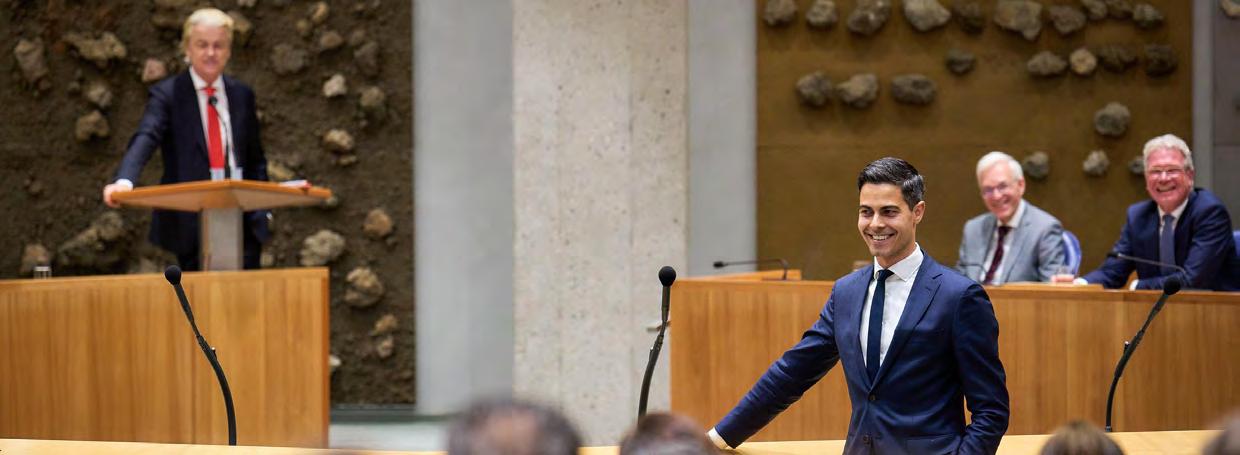
The campaign period was marked by instances of far-right political violence in The Hague and Amsterdam, bringing to the fore the grim mood in Dutch politics. And yet, despite this backdrop, Rob Jetten, with his cheerful smile and ‘we can do it’ slogan – taken directly from Obama’s 2008 campaign –led his social-liberal D66 party to significant electoral gains.
Both D66 and the PVV won 26 out of the 150 seats in the Dutch parliament, becoming the biggest parties by seat numbers. The results put Jetten on course to try to form a four-party centrist coalition. While this will not be easy, such a government would arrive at a pivotal moment: Europe needs a functional, outward-looking Netherlands to loosen chokeholds on its internal growth, anchor Europe’s industrial and security strategy, and defend Dutch interests that ultimately rely on deeper European integration.
In this insight, CER analysts Armida van Rij and Sander Tordoir decipher what the election results mean for The Netherlands and Europe more broadly.
The far-right’s staying power in the Dutch political landscape
by Armida van Rij
Dutch parliamentary elections have never had such a close result. The losses for the PVV, coupled with the success of D66 and the Christian Democrats (CDA), could easily be seen as a victory for the centre over the far-right, and a setback for populism in the Netherlands.
But this could not be further from the truth. While the PVV lost seats, it achieved its second-best electoral performance ever. At the same time, the far-right vote splintered. There were big wins for JA21, a PVVlight party with equally extreme ideas but presenting themselves as more palatable to the electorate and other parties: 30 per cent of PVV voters in 2023 switched to JA21. Support also increased for the far-right Forum for Democracy (FvD). Taken together, these two parties account for the PVV’s losses, and overall the far-right bloc has gained an extra seat.
The far-right combined now has 42 seats in the Dutch parliament, representing more than a quarter of the votes. In 2021, it had only 28 seats or 19 per cent. Looking back further, the trendline is one of steady growth of support. At the same time, D66’s 26 seats also make it the smallest ‘winner’ of any election ever – over 80 per cent of the electorate did not vote for this party.
There are reasons for this trend which are specific to the Netherlands. The hike in support for the PVV between the 2021 election and 2023 was due to the centre-right VVD party leader stating that she would no longer exclude the PVV from coalitions; thus PVV votes would no longer be effectively spoiled. Yet during this year’s campaign, all the other large parties excluded working with Wilders, which led to some voters turning instead to JA21.
Staying power of the far-right’s influence on policy Policy-wise, the lasting power of the far-right is here to stay. In the two years since the 2023 election, and during the campaign period, far-right ideas and policies have been adopted by all centrist parties: even the Greens/Labour (GL/PvdA) now openly use PVV language to refer to an ‘asylum problem’ in the Netherlands.
Many parties have ruled out the PVV as a coalition partner, but this was primarily done to safeguard the mechanics of government and policy-making, rather than to prevent PVV policies from being implemented. Having seen Wilders bring down both the governments that he was part of, other parties now consider him too unreliable to enter into coalition with.
It is clear there is no cordon sanitaire around far-right parties in the Netherlands. The VVD went into government with the PVV. In parliament, the VVD has not only voted for motions proposed by other parties from the far-right bloc, but also co-sponsored them. Most recently, the VVD supported a ban on Antifa proposed by the FvD, while party leader Dylan Yeşilgöz has worked together with JA21 on parliamentary motions. While the pre-emptive exclusion of the PVV from government by other political parties weakened Wilders’ appeal in this election, as he would not be able to govern, his and other farright parties retain influence over policy.
Not only will more far-right MPs take up their seats in parliament than ever before, but it will also be a parliament made up of a record high number of political parties whose manifesto included policy proposals contrary to the rule of law, according to the Netherlands Bar Association. In fact, out of the only
three parties whose entire manifesto met the minimum standards for rule of law and sound democratic governance, two are insignificant political forces due to their size (Volt and the Animal Party), and the third lost a fifth of its seats (GL/PvDA).
Instead, one of the worst offenders, JA21, is trying to actively position itself as a possible coalition partner. Here too, the overall trendline is one of declined support for political parties who advance and support the rule of law in the Netherlands and in international contexts.
D66, the big winners, tried to appeal to more conservative voters in rhetoric and positioning: the hallmark of its campaign was featuring the Dutch flag whenever possible – usually a tool of the right. Most strikingly, the party changed course and now supports the externalisation of asylum procedures to outside the EU – a policy condemned by human rights organisations. In these elections, 35 per cent of its votes came from those who had previously voted for right-wing and far-right parties, including the VVD (11 per cent) and the PVV (7 per cent). How they will keep these voters happy with policy, beyond political symbols, is unclear – and D66 may face difficult choices about who to enter into government with.
Uncertain future for centrists
Perhaps the real lesson from the Dutch election is to not allow the campaign to be hijacked by any single far-right talking point: this time, the centre parties were able to profile themselves on other major policy issues. During this campaign, the key themes were housing, healthcare, immigration and to a lesser extent the rule of law and security – yet despite the gravity of these issues, Jetten captured the electorate with a hopeful campaign. The contrast with the 2023 campaign was clear, when Wilders managed to dominate by exclusively focusing on immigration.
Despite the clear numerical case for a broad coalition comprising D66, VVD, GL/PvdA and the CDA, which would also give the government a majority in the Upper Chamber, it will be difficult for D66 to form a government. VVD party leader Yeşilgöz campaigned on wanting a right-wing government, and vowed not to enter into a coalition with GL/PvdA. Given the right-wing electorate, she may try and force D66’s hand to include JA21 in negotiations for a potential government, which would put pressure on D66 to make significant compromises.
The Dutch election matters for Europe’s strategic autonomy
by Sander Tordoir
After two years of shambolic governance in which the Dutch disappeared from the European scene, this week’s election result provides a narrow pathway to a government that can help strengthen Europe’s strategic autonomy.
Under the previous government, the Netherlands was all but absent in Europe, where it usually punches above its weight. When it did engage, it mostly obstructed: fighting in vain against €150 billion in EU loans for rearmament, even as Trump threatened to abandon European security, or pushing to keep fiscal rules tight to thwart Friedrich Merz in Germany, alienating its closest ally. The Netherlands, one of the world’s most trade-oriented economies, can ill afford another drifting government, as the US and China unpick the global trading order. Neither can the EU.
Yet Jetten must still persuade the centre-right VVD to govern with a centre-left party rather than pursue an option which includes the far-right JA21. Jetten will need to prove quickly that a competent, centrist government can deliver, at home and for Europe.
The Netherlands is now the eurozone’s biggest economy outside the ‘big four’, with GDP approaching half of Italy’s and a thriving tech sector led by ASML, NXP, Adyen and Booking. Good Dutch policy could strengthen that sector and lift Europe’s anaemic productivity growth. Brussels and Berlin could use Dutch help to fix the EU’s broken capital and fragmented services markets – sectors in which the Netherlands leads, especially since Brexit.
The Netherlands finds itself at the heart of Europe’s strategic anxieties – over technology, rearmament and open markets. The Hague has just put extra oversight on Nexperia to protect critical semiconductor technology from leaking to China, prompting Beijing to threaten export controls on chips that would shut down swathes of European industry, including car factories. The Netherlands will continue to face strategic dilemmas on semiconductors amid the Sino-American tech rivalry, which will persist even if a Trump–Xi trade deal brings a temporary détente. The Dutch could, for example, consider loosening export restrictions on ASML machines going to China, ratcheted up in 2019 and 2022, as Washington dithers on its own controls and allows Nvidia to sell some AI chips to China again.
It makes little sense to disadvantage one of Europe’s most important firms for a policy America no longer believes in. The Dutch could also ask China for something in return, such as allowing Europe to stockpile rare-earth materials that Beijing keeps scarce and that an ‘America-first’ Washington will surely not share. The US would probably put pressure the Netherlands not to pursue such a course, but Europe should at least try, and that requires the carrot of Dutch semiconductor technology.
The Dutch must also keep investing in their semiconductor machinery cluster so that Europe maintains strength in the global technology sector. The government is rightly putting €2.5 billion into energy, education and housing infrastructure around this industry, but without any European money. If the Dutch give in to the anti-immigration and anti-university sentiment on the populist right, the sector will lack the engineers it needs. A Netherlands that engages in Europe could possibly even secure EU money for its semiconductor strategy – a fair request given how important it is for Europe’s strategic autonomy.
The Netherlands is a key pillar of European rearmament. France, the UK and Italy lack the fiscal space to fund a big expansion of defence spending, while for countries like Spain the Russian threat feels remote. Alongside Germany, Poland and the Nordic countries, the Netherlands can anchor Europe’s defence effort. With public debt at only 43 per cent of GDP, it has the most fiscal room outside Germany to invest in its military. As a single-market-minded country, the Netherlands can also push to strengthen Europe’s defence-industrial base, resisting a buy-German or buy-French logic and promoting joint procurement to avoid costly small-scale production.
A constructive Dutch government has often been a bridge-builder in the EU. The Dutch balance France’s push for strategic autonomy with the frugal, open-market tendency of Northern Europe. Even when a few years ago the Netherlands led the obstructionist ‘Hanseatic League’, a coalition of EU countries opposed to fiscal integration, it helped to structure coalitions and shape Franco-German bargains. When Angela Merkel and Emmanuel Macron forced through the €800 billion post-pandemic fund in 2020, Prime Minister Mark Rutte won rule-of-law conditionality as the price of agreement.
Rutte once imagined the Netherlands as Europe’s New York City, evoking a vision of a prosperous hub for high-tech engineering, software and services. The country still has that potential, and with it, the ability to strengthen Europe’s single market, economic security and rearmament.
But realising that vision requires honesty: about the need for skilled immigration and investment in universities and science; and about the costs of sustaining the European market and security on which Dutch prosperity depends. The looming fight over modernising the post-2027 EU budget will be the new government’s first test.
Armida van Rij is a senior research fellow and Sander Tordoir is chief economist at the Centre for European Reform.