Generic investing strategies tend to produce average outcomes. Our team shares more than a century’s worth of uncommon perspectives, from portfolio construction to estate planning strategies, so your wealth is treated like it should be.
Experience an atypical level of thinking. Schedule your discovery session today.

A new exhibition at the Art Museums explores the creation, circulation and lasting impact of one of America’s most powerful founding documents. Drafted 250 years ago, the Declaration of Independence was seen by some as a bold step toward freedom and by others as an act of treason. After its adoption on July 4, 1776, the challenge became spreading the word, as news traveled quickly through printed broadsides, newspapers and public proclamations. By July 25, the Declaration was being read aloud in Williamsburg, accompanied by cannon fire and celebration, as its message continued to travel across the colonies and beyond.
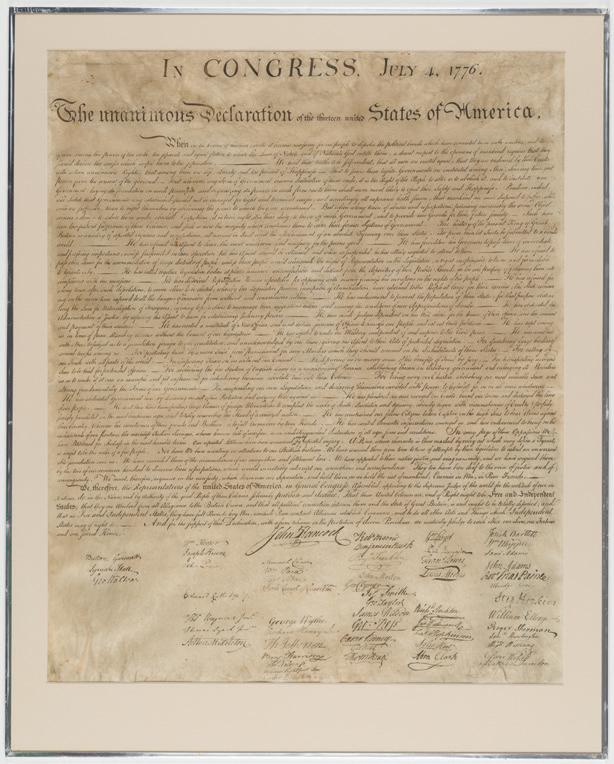
As the nation approached its 50th anniversary, renewed interest led to the creation of commemorative printings, including William J. Stone’s engraved parchment, now the most widely recognized version today. In addition to the Foundation’s rare Stone printing, a copy of the July 20, 1776 Virginia Gazette, and notable 19th-century editions of the founding document are on view revealing how the Declaration became an enduring symbol of the nation.
This exhibition, made possible through the generosity of James Boswell and Christopher Caracci, will be on view in the Ruth P. and Joseph R. Lasser Gallery.

The Colin G. and Nancy N. Campbell Archaeology Center opens By Paul Aron
15 2026 CALENDAR
All of the July 4 activities and beyond
18 PHILANTHROPY AT WORK
A history of giving defines Colonial Williamsburg By Ben Swenson
23 AT THE MUSEUMS
26 GOVERNOR HENRY
Both loved and hated, Patrick Henry divided Virginians during his first term as governor By Paul Aron
30 CHRONICLES OF THE COLLECTION
William Stone created the declaration most know
Conrad Mercer Hall, Chair, Norfolk, Va.
Carly Fiorina, CEO, Mason Neck, Va.
Kendrick F. Ashton Jr., Arlington, Va.
Frank Batten Jr., Norfolk, Va.
Geoff Bennett, Fairfax, Va.
Catharine Broderick, Lake Wales, Fla.
William Casperson, Scottsdale, Ariz.
40 PAINTING HISTORY
John Trumbull got a helping hand from Thomas Jefferson
By Richard Brookhiser
50 WHEN THE DECLARATION WAS NEWS
Passing the Declaration of Independence was one thing, spreading it across the new nation was another
By Emily Sneff
56 THE BATTLE OF GWYNN’S ISLAND
Virginians finally faced off with Lord Dunmore in a decisive battle
By Michael Cecere
65 GARDEN-TO-TABLE: PEACHES
By Angela Taormina
70 VIRGINIA AS A COMMONWEALTH
Delegates meeting in Williamsburg decided Virginia was to be a commonwealth, but what does that mean?
By Pete Van Vleet
72 DECLARATION SIGNERS
A look at what Thomas Jefferson and Thomas Nelson Jr. brought to the declaration
By Paul Aron
76 DEFINING THE DECLARATION
Not everyone was celebrating the signing of the Declaration of Independence
By Paul Aron
82 BOOKS
CREATIVE DIRECTOR
Katie Roy
DESIGNERS
Katherine Jordan Lauren Metzger
PHOTOGRAPHER
Brian Newson
Mark A. Coblitz, Wayne, Pa.
Ted Decker, Atlanta, Ga.
Walter B. Edgar, Columbia, S.C.
Neil M. Gorsuch, Washington, D.C.
Joseph P. Gromacki, Chicago, Ill.
Antonia Hernandez, Pasadena, Calif.
Walfrido J. Martinez, New York, N.Y.
Leslie A. Miller, Philadelphia, Pa.
Steven L. Miller, Houston, Texas
Joseph W. Montgomery, Williamsburg, Va.
Steve Netzley, Carlsbad, Calif.
Wendy O’Neill, Longboat Key, Fla.
Walter S. Robertson III, Richmond, Va.
Gerald L. Shaheen, Scottsdale, Ariz.
Larry W. Sonsini, Palo Alto, Calif.
Sheldon M. Stone, Los Angeles, Calif.
Y. Ping Sun, Houston, Texas
Hon. John Charles Thomas, Richmond, Va.
Graves Tompkins, New York, N.Y.
Jeffrey B. Trammell, Washington, D.C.
Alex Wallace, New York, N.Y.
CHAIRS EMERITI
Thurston R. Moore, Richmond, Va.
Richard G. Tilghman, Richmond, Va.
Henry C. Wolf, Williamsburg, Va.
TREND & TRADITION
EDITOR-IN-CHIEF
Catherine Whittenburg
EDITORIAL MANAGER
Pete Van Vleet
CONTRIBUTING EDITORS
Paul Aron, Ronald L. Hurst, Eve Otmar, Rachel West
COPY EDITORS
Christopher Calnan, Amy Watson, Melanie Wynne
MEDIA COLLECTIONS
Tracey Gulden, Jenna Simpson, Brendan Sostak
RESEARCH
Erin Lopater, Marianne Martin, Douglas Mayo
PUBLICATIONS COORDINATOR
Grenda Greene
DONORS Please address all donor correspondence, address changes and requests for our current financial statement to: Signe Foerster, The Colonial Williamsburg Foundation, P.O. Box 1776, Williamsburg, VA 23187-1776 or email sfoerster@cwf.org, telephone 888-293-1776.
Donations support the programs and preservation efforts of The Colonial Williamsburg Foundation, a not-for-profit, tax-exempt corporation organized under the laws of the Commonwealth of Virginia, with principal offices in Williamsburg, Virginia.
Address changes & subscription questions: gifts@cwf.org or 888-293-1776
Editorial inquiries: editor@cwf.org
Advertising: magazineadsales@cwf.org
Trend & Tradition: The Magazine of Colonial Williamsburg (ISSN 2470-198X) is published quarterly in winter, spring, summer and autumn by the not-for-profit Colonial Williamsburg Foundation, 301 First Street, Williamsburg, VA 23185. A one-year subscription is available to Foundation donors of $50 a year or more, of which $14 is reserved for a subscription. Periodical postage paid at Williamsburg, VA, and additional mailing offices. POSTMASTER: Send address changes to Trend & Tradition: The Magazine of Colonial Williamsburg, Attn: Signe Foerster, P.O. Box 1776, Williamsburg, VA 23187-1776. © 2026 The Colonial Williamsburg Foundation. All rights reserved.
NOTE Advertising in Trend & Tradition does not imply endorsement of products or services by The Colonial Williamsburg Foundation.
America’s semiquincentennial is both a celebration and a season of civic renewal
“ We hold these truths to be self-evident, that all men are created equal, that they are endowed by their Creator with certain unalienable Rights.”
With these words, a quiet Virginian set America on a bold course that changed the world. For 250 years, the Declaration of Independence has inspired struggles across the globe and within our own country in the name of freedom and human rights. America’s founding is a complex story of courage, aspiration and deeply held principles and that story begins in Virginia, which paved the way for independence. Today, as our nation commemorates its semiquincentennial, Virginia is taking the lead again with Williamsburg at the heart of the story, as it was two and a half centuries ago.
As I write this, we are preparing to welcome guests by the tens of thousands for the most spectacular Independence Day in Colonial Williamsburg’s 100-year history, which we are proud to also have broadcast live across the country. Millions of Americans will join the celebration when PBS airs our evening program of inspiring music, poetry and other performances a partnership with the Virginia American Revolution 250 Commission (VA250) in all 50 states. CSPAN will also air the program, which PBS will continue streaming online after July 4, extending the power of this special place to even more audiences. This, truly, is a historic moment for Colonial Williamsburg, Virginia and the United States, and we will remember it always.
Yet America’s semiquincentennial is more than one extraordinary day. It is more, even, than a historic year. At its core, the semiquincentennial is a movement that Colonial Williamsburg and VA250, of which I serve as honorary national chair, have had the honor of spearheading. For the last several years, these two organizations have been leading a national movement to honor our nation’s 250th anniversary not only with celebration but also as a season of civic renewal. This milestone has arrived at a time when many of our fellow citizens distrust our nation’s most fundamental institutions. Many know little of our nation’s history;
unsurprisingly, they likewise question the relevance of our democratic form of government to their own lives. This is why we are so committed to sharing a complete history of how the United States came into being and to joining with our countrymen and women to reflect on what it means to be an American today.
But why Colonial Williamsburg for that matter, why Virginia? We are not, after all, the only former colony with a rich Revolutionary history. But it was here in the largest, wealthiest and most populous of the colonies where America’s founding principles were forged in the crucible of intense discussion and debate. In the years preceding revolution, Virginia’s leaders became increasingly prominent in the independence movement calling in 1773, for instance, on all of the colonies to unite in “common cause” to share information through committees of correspondence and coordinate their responses to Britain’s tightening grip. Patrick Henry gave his earthshaking “Liberty or Death” speech in Richmond in 1775, persuading his fellow Virginians to raise a militia in the colony’s defense. The following year, Virginia’s leaders truly took the helm with a historic act that led to the Declaration of Independence.
On May 15, 1776, an elected body known as the Fifth Virginia Convention voted in Williamsburg not only to dissolve Virginia’s connection with Britain but also to propose that Congress declare independence for all 13 colonies. Richard Henry Lee of Virginia made the proposal the following month at the Second Continental Congress, which swiftly appointed a committee that charged Thomas Jefferson with drafting the declaration.
This past spring, Colonial Williamsburg commemorated the 250th anniversary of the Fifth Virginia Convention with one of our most innovative programs ever. Thousands poured into the east end of Duke of Gloucester Street on May 15 and
16 for Flame of Revolution, a unique blend of live and multimedia outdoor performances, which was previewed hours earlier on NBC’s “Today” show. We had the good fortune of hosting “Today” on the morning of May 15 when the show broadcast its entire third hour live from Palace Green. A special collaboration with our region’s destination marketing organization, Visit Williamsburg, as well as the City of Williamsburg and other partners, the show introduced millions of viewers to Williamsburg’s central role in America’s founding along with many of the fascinating and fun things to do while visiting the colonial capital city. Important as it was to share Williamsburg’s history and attractions with this large audience, it was just as gratifying to witness the excitement and pride of our local community, which came out in force to welcome the show and cheer the participants.

nation’s earliest Black churches at the African Baptist Meeting House and Burial Ground site. Our partnership with the Historic First Baptist Church of Williamsburg, the congregation that built and worshipped in the original structure on this site, has yielded profound discoveries, including the church’s original foundation and 63 adjacent burials of men, women and children. In collaboration with First Baptist and the descendant community, we have permanently marked these ancestral graves and recently raised the frame of the church reconstruction. We look forward to opening this important site in time for First Baptist’s 250th anniversary this October.
Carly Fiorina
If you saw the broadcast and I hope you did it was likely not the first time you have observed the Foundation on the national stage. As we have deepened our research and strengthened our partnerships ahead of America’s 250th anniversary, the national media have taken notice. In April, The Wall Street Journal published an extensive feature examining Colonial Williamsburg’s evolving interpretation of history over the past century. In May, USA Today highlighted the opening of the Colin G. and Nancy N. Campbell Archaeology Center, which is transforming how guests engage with the history literally uncovered from these grounds. Southern Living soon followed with a feature on the restoration of the Governor’s Palace gardens, which we are returning to the original vision of Arthur Shurcliff, landscape architect of Colonial Williamsburg’s original restoration.
Some of the most compelling coverage has focused on the work still before us to broaden and deepen our understanding of Williamsburg’s founding generation. As Trend & Tradition readers know well, the rediscovery and restoration of the Williamsburg Bray School the nation’s oldest surviving school building dedicated to the education of enslaved and free Black children has fundamentally reshaped our understanding of the complex intersections of race, religion and slavery in 18th-century Virginia. Now fully restored and open to the public, this remarkable structure enables us to share a richer, more nuanced history, one that continues to evolve through ongoing research.
At the same time, we are reconstructing one of the
National news stories on the Bray School and African Baptist Meeting House have inspired people across the country. Some have shared that they traveled here specifically to encounter these histories in person. Their responses affirm the intense power of history to connect, move and deepen our understanding of ourselves. It is an important reminder for all of us for if we do not know who and where we have been, how can we know who we are, much less where we are headed?
There are yet more historic milestones ahead in the second half of 2026. On Oct. 7, we will welcome the Virginia General Assembly for a commemorative session honoring its first regular meeting in Williamsburg 250 years ago after independence was declared. And we will commemorate the centennial of Colonial Williamsburg’s own founding with special programming in October and a grand celebration on the weekend of Nov. 14, complete with dazzling fireworks.
As July 4 draws close, we remember how we arrived at this important moment that is, through the generosity of our wonderful donors. Together, we are sharing the story of a fledgling nation and its aspirations to realize the vision that our Founders bestowed 250 years ago. I look forward to continuing our work together on behalf of the nation and in service to Colonial Williamsburg’s enduring mission: “That the future may learn from the past.”
Sincerely,
Carly Fiorina CEO
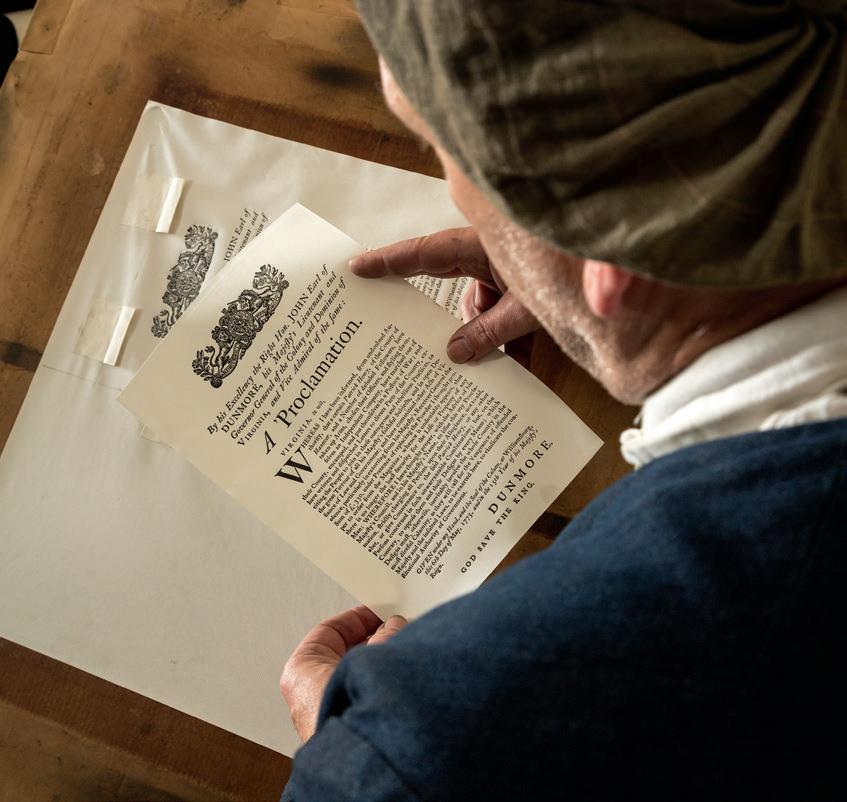
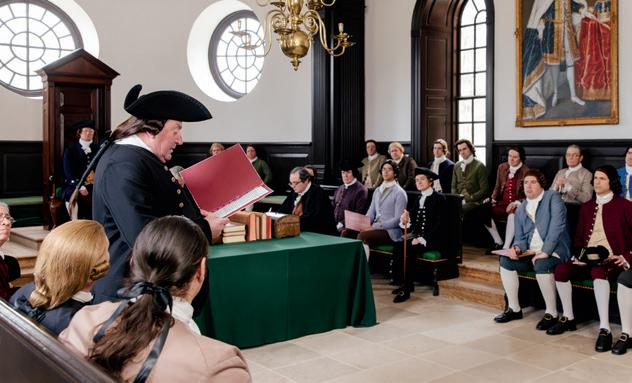
Delve into the documents and events that led to the Revolution. colonialwilliamsburg.org/independence
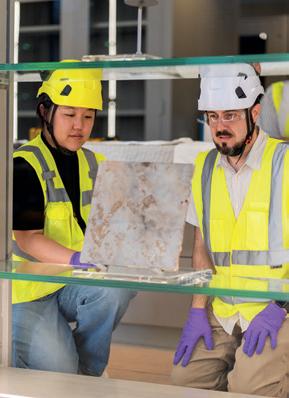
Get a close look at the objects on display in the new Wall of Wonder at the Colin G. and Nancy N. Campbell Archaeology Center colonialwilliamsburg.org/ wallofwonder
Explore Virginia’s path to independence through its five Revolutionary conventions
colonialwilliamsburg.org/ conventions
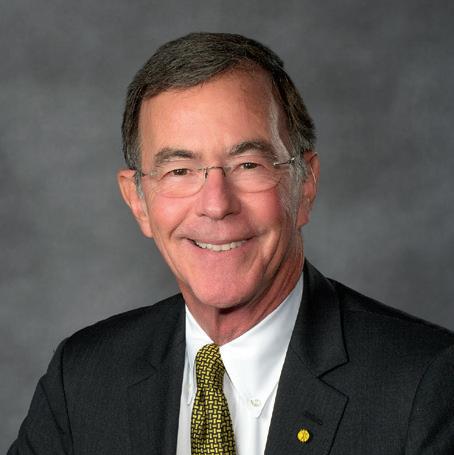
John A. Luke Jr., a longtime member of the Colonial Williamsburg board of trustees, passed away in March.
A passionate supporter of Colonial Williamsburg with keen interests in U.S. history and preservation, Luke joined the board in June 2013 and served on numerous committees during his tenure. He chaired the development committee from 2018 to 2020 and the audit committee from 2020 until his death.
Luke was a veteran leader in the global packaging industry and retired as chairman of WestRock. Previously, he served as chairman and CEO of MeadWestvaco, where he worked for more than 30 years. He began his corporate career at Procter & Gamble, having earlier served as an officer in the U.S. Air Force. He was awarded a Bronze Star for meritorious service.
Throughout his career, he served on many educational, community and corporate boards. These included, in addition to Colonial Wil-

liamsburg, the Virginia Museum of Fine Arts, the Community Foundation of Richmond, the American Enterprise Institute and Virginia Commonwealth University.
Carly Fiorina, who is the CEO of The Colonial Williamsburg Foundation, served alongside Luke on the board for nearly a decade, described him as a kind and unassuming leader who truly cared about the welfare of others.
“John not only was an incredibly accomplished executive, he was calm, kind and gracious as well,” Fiorina said.
His years of faithful service on Colonial Williamsburg’s board, she said, reflected his deep belief in the importance of the institution, of which he spoke often. “John was a strong believer in the power of history and the importance of preserving the evidence of our past. We will miss his wisdom and his friendship very much and are grateful for the enduring friendship of his wife, Kathleen, and their family.”

The Colonial Williamsburg Bookstore is more than shelves and spines—it’s a treasure trove of early American life. Whether you’re searching for historical fiction, beautifully bound classics, or a unique gift steeped in early American charm, you’ll find it here. Take a piece of the past home with you—one page, one story at a time. Visit the Bookstore at 440 WEST DUKE OF GLOUCESTER STREET, WILLIAMSBURG, VA 23185
EXPLORE COLONIAL SITES AND HISTORY . PEEK BEHIND THE SCENES . PURSUE AND PLAN
The
new archaeology center reveals how and why archaeologists work
by PAUL ARON
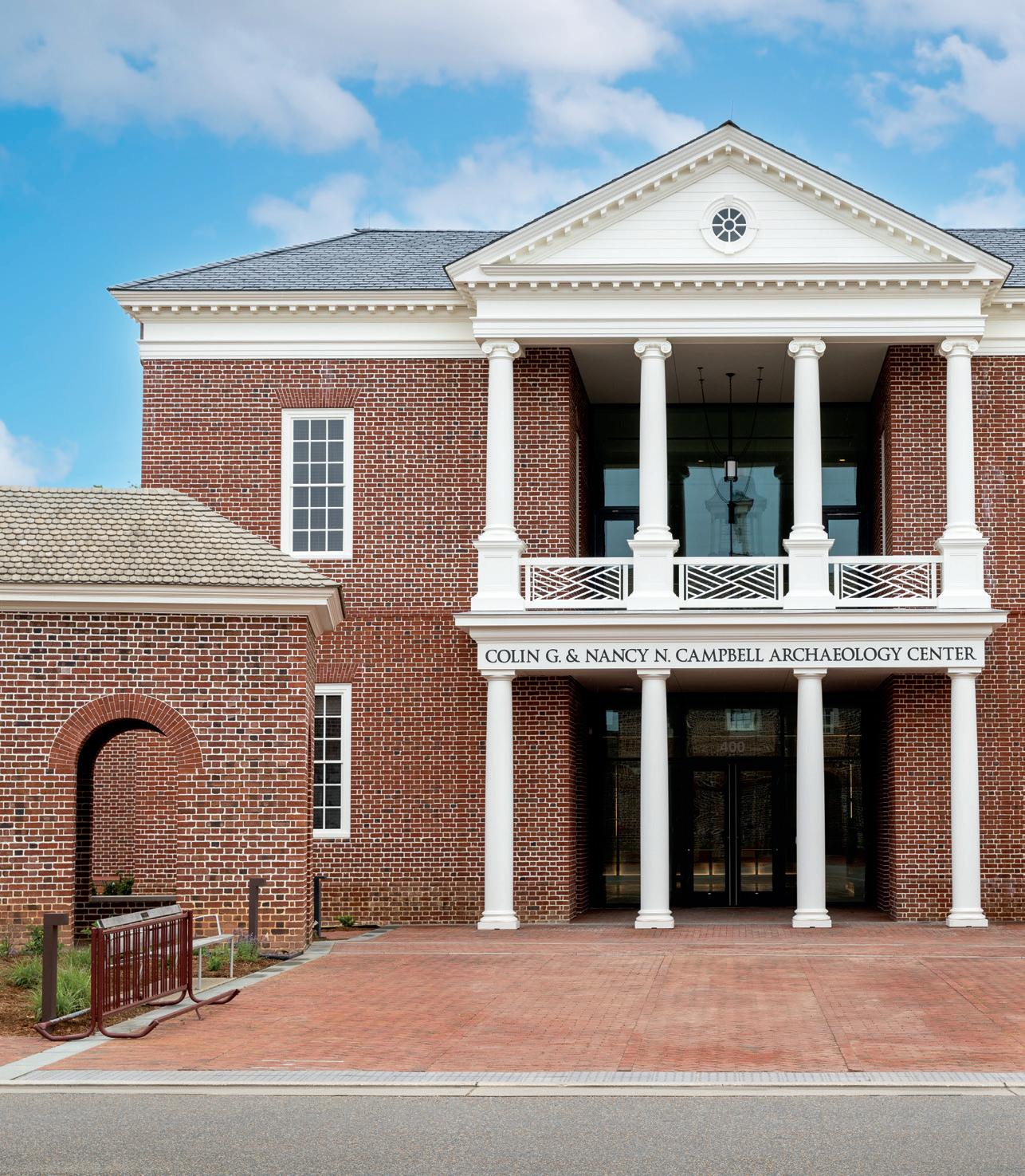
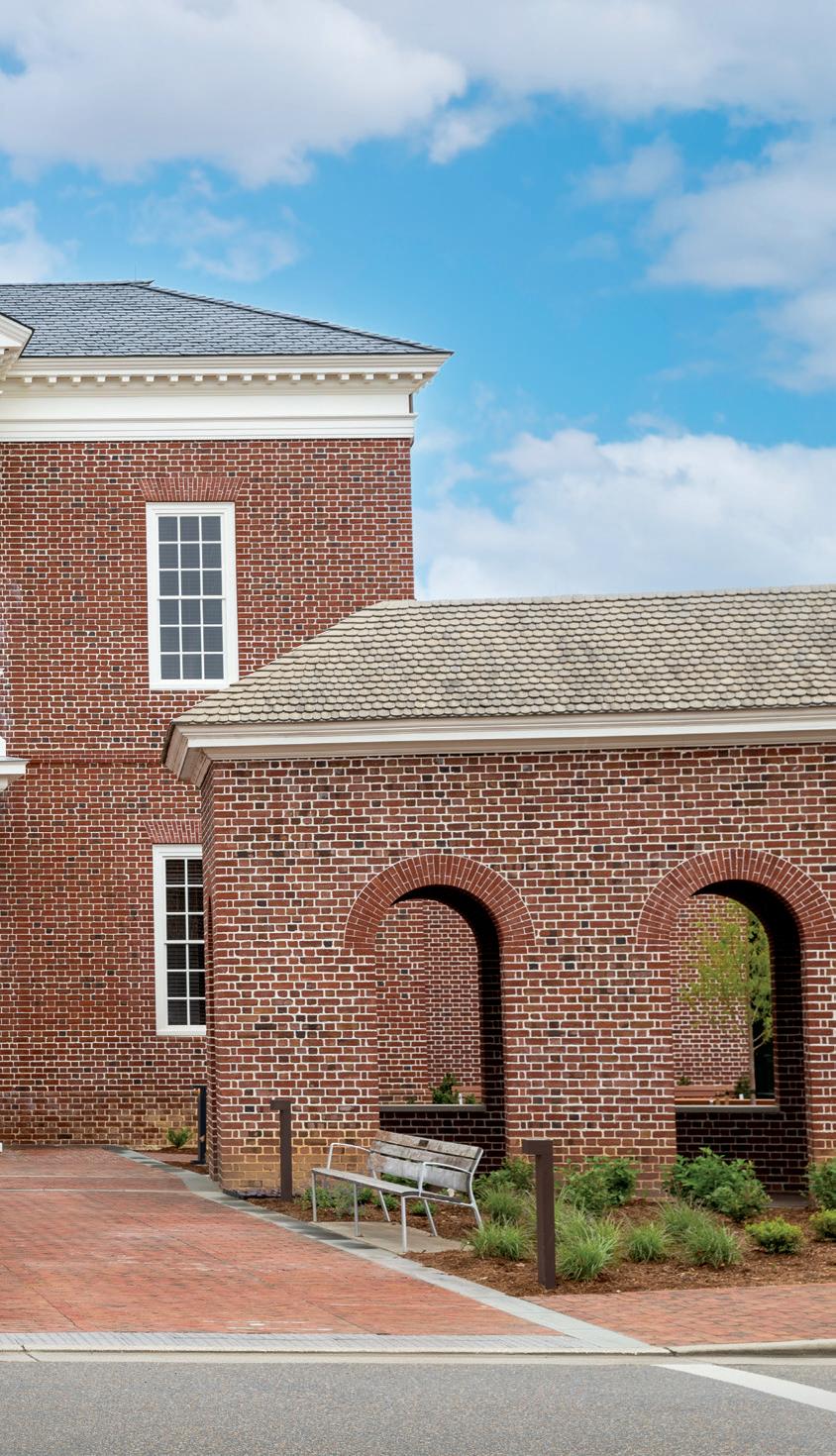
Some organizations have laboratories for archaeologists. Some have space for storing archaeological artifacts. And some can sometimes exhibit those artifacts. With the April opening of the Colin G. and Nancy N. Campbell Archaeology Center, Colonial Williamsburg has combined those three functions into a single 40,000-square-foot building.
“We do not know of an analogue,” said Jack Gary, the Foundation’s vice president of archaeology and historic landscapes. “This is a unique space.”
Uptat iunto...min pliqui duntiam volupta turibus ma dolore, ut occatiae prenda voloris provitaspe idellorum quibus aut abori doluptat arum enitiate et molore cus dunti dolorum ex etur, qui aute reraerero venihit.
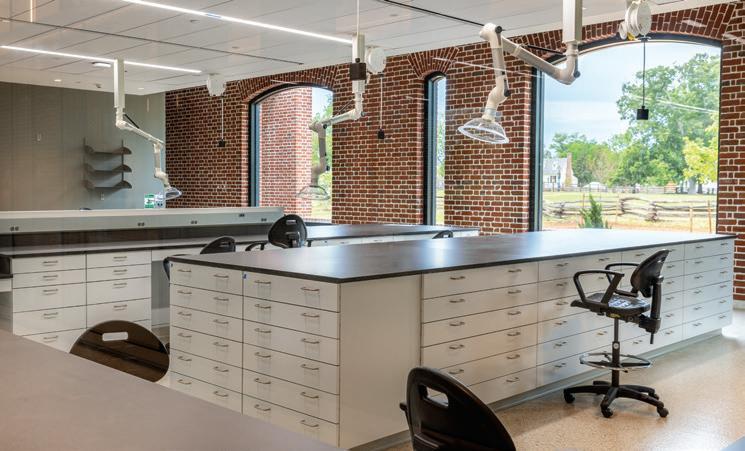
The center’s state-of-the art laboratories will include the new digital Everette and Catherine P. Byrd X-Ray system in the Helen Zadarlik and Bruce Sogoloff Conservation Lab that enables archaeologists to examine every piece of iron. For instance, looking beneath a large chunk of rust, they’re quickly able to identify a screw that once connected parts of a musket. There’s also the Gary Y. and Debra S. Asano Flotation Lab where archaeolo -
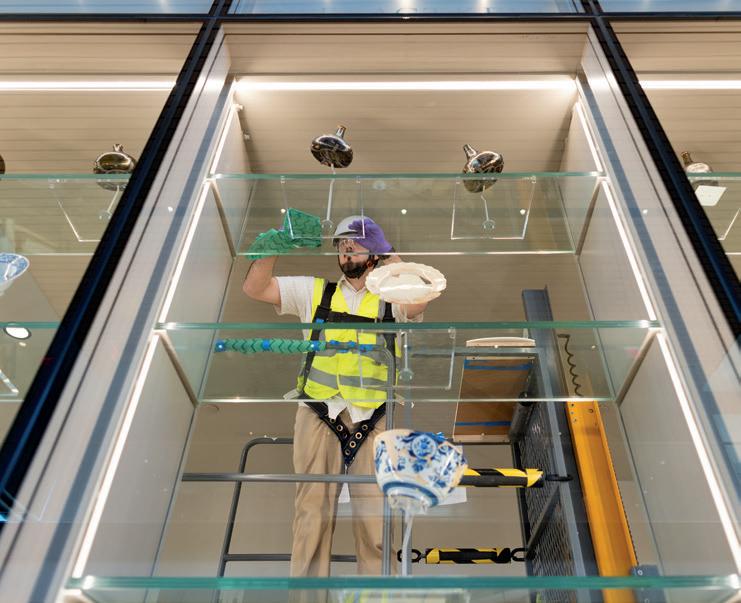
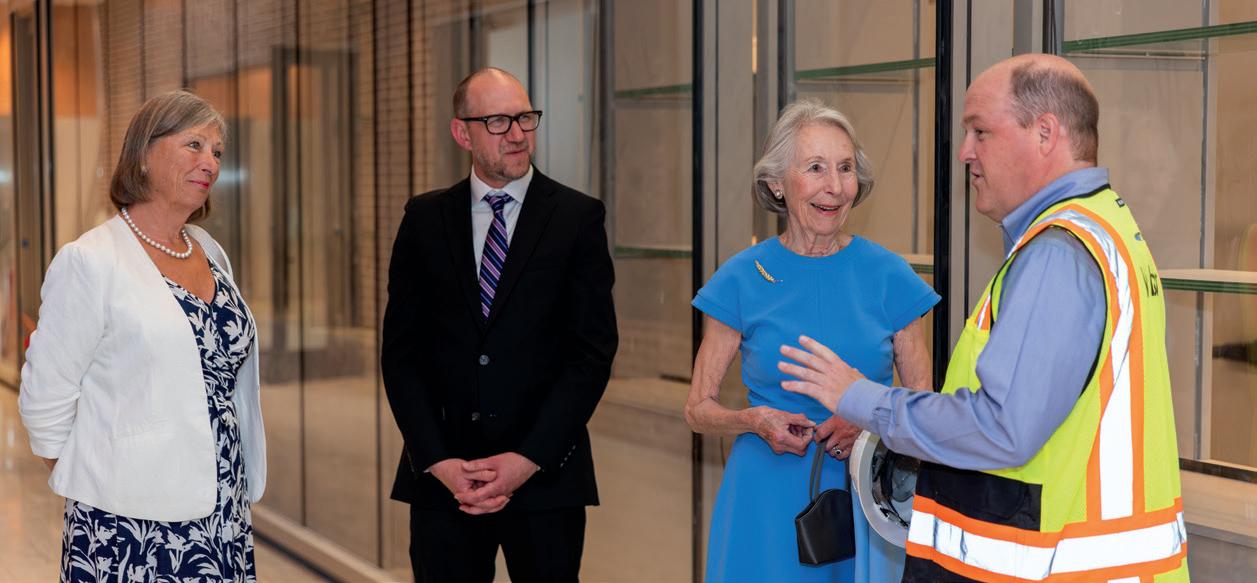
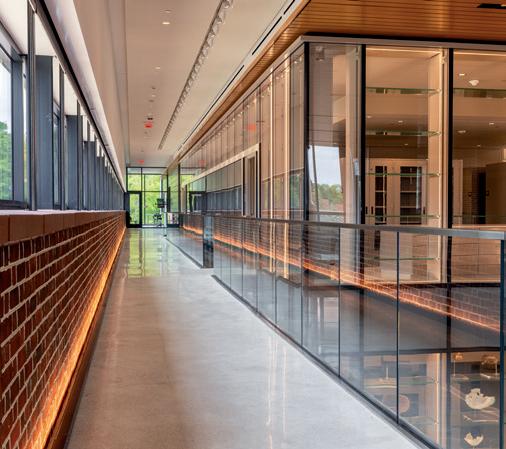
(Opposite page, clockwise from top left) John Wagoner, senior museum mount maker, installs objects in the Wall of Wonder. The foundations of a late 17th- or early 18th-century home are visible under a glass floor. Jacomien Mars (far left), whose late husband was the lead donor for the Campbell Archaeology Center, attended the opening with (left to right) Jack Gary, vice president of archaeology and historic landscapes; Nancy Campbell; and Matt Webster, vice president of historic preservation. The R. Kirk Lubbes Identification Lab is one of the laboratories in the center. The Pamela J. and James D. Penny Skybridge runs alongside the second floor of the keep.
gists can use light fraction (micromesh) screens to separate dirt from tiny artifacts and botanical remains that would fall through larger screens.
This kind of technology is appropriate for an organization that’s been a leader in historical archaeology the field of archaeology that studies eras for which written documents are available since the 1950s.
Visitors have often been able to witness excavations in progress, with archaeologists willing and able to explain what’s going on. The archaeology center offers more ways to engage visitors.
One of the immediately striking elements of the building is the Wall of Wonder. Visitors entering the building encounter a two-story-high display of more than 80 artifacts.
“The Wall of Wonder is a ‘wow’ moment,” Gary said. “It’s the proverbial jewel box. These artifacts tell the story of what makes a city.”
Behind the wall is the central collections room, known as the Margaret and Conrad M. Hall Family Artifact Keep. Parts of the collection are displayed not only in the Wall of Wonder but also in changing exhibitions on other sides of the Keep. These will feature, for example, artifacts from taverns or from educational institutions like the Wren Building at William & Mary or the Williamsburg Bray School, which in the 18th century educated enslaved and free Black children. Some of the changing exhibitions will be co-curated with community mem-
“These artifacts tell the story of what makes a city.”
— Jack Gary
bers, such as descendants of the Historic First Baptist Church or school groups.
One exhibition displays artifacts from Martin’s Hundred, a 17th-century English settlement at the site of Carter’s Grove. Those artifacts have not been displayed since a museum there closed in 2003.
Videos on four large screens explain what archaeology is and why and how it’s conducted. One exhibition includes an actual archaeological site: the brick foundation of a late 17th-century or early 18th-century home discovered while the center was being built. The entire foundation of the north wall of that home is on display under a 40-foot-long glass floor.
“We can say to guests, you are standing on an archaeological site,” Gary said.
Visitors are also able to witness laboratory work, which is as important as fieldwork but usually less visible. For example, video monitors can reveal the results of X-rays, allowing visitors and archaeologists to see them simultaneously. Another space lets visitors get hands-on experience in a lab.
“Guests get to see us excavate,” Gary said. “But before the center was built, most didn’t get to see what happens behind the scenes. We are pulling back the curtain.”
The Cynthia and Robert Milligan Teaching Lab will get plenty of use, with programs for guests who arrive for a visit as well as those for community members and for students.
Along with the expanded Art Museums of Colonial Williamsburg across Nassau Street, the archaeology center offers a new way for visitors to understand the Historic Area. “If you have seen the center, you have seen artifacts that are the evidence for what you will see in the Historic Area,” said Gary. “And if you come to the center after visiting the Historic Area, you will better understand how the Historic Area came to be.”
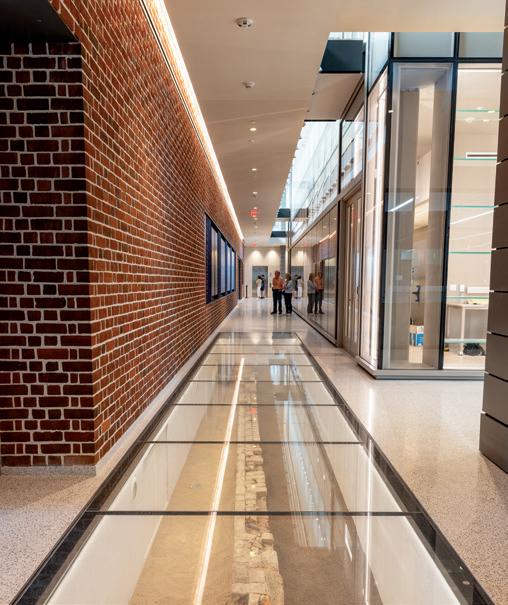
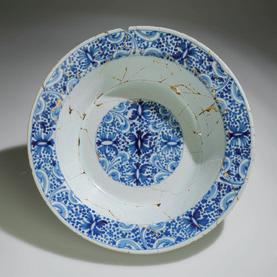
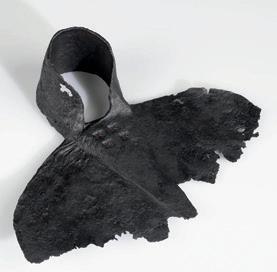
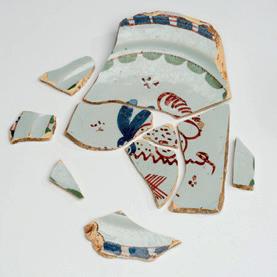
The Colin G. and Nancy N. Campbell Archaeology Center’s Wall of Wonder displays more than 80 archaeological artifacts, each with a story to tell. Some speak to particular times and places while others tell stories that span the globe. Some shed light on the powerful and wealthy. Others connect today’s viewers with the men and women whose lives and labor built the foundations of the nation.
“Objects are wondrous because they are the hard bits of history that linger into the present, where they provide knowledge to those of us willing to tease the evidence from the ground,” said Senior Curator for Archaeology Sean Devlin.
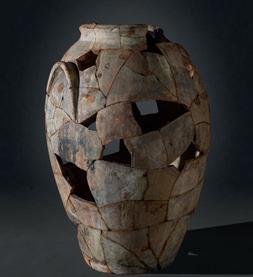
This truly massive oil jar was produced in the Tuscan region of Italy in the 18th century and traveled the globe before it was discarded near the Chiswell-Bucktrout House site. Global products were common in Williamsburg.
This tin-glazed earthenware basin, circa 1760, was excavated from the Thomas Everard House site. Virginia Royal Gov. Robert Dinwiddie was an investor in the Delftfield Pottery of Scotland where it was produced.
This mid-18th-century broad hoe was recovered from the site of Anthony Hay’s house and cabinetmaking shop. While seemingly humble, the hoe and other agricultural tools like it were essential to the tobacco economy on which much of Virginia’s wealth and society were built.
This vibrantly colored, tin-glazed earthenware plate was made in Bristol, England, in the early 18th century and was recovered below the archaeology center’s foundations. It illustrates the web of transatlantic connections the residents of Williamsburg had.
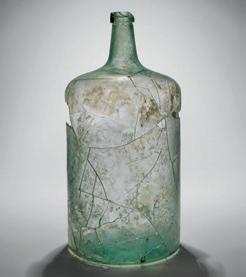
This massive glass carboy was found in the storage rooms of the Public Hospital amongst the rubble of a June 7, 1885, fire that created Williamsburg’s own miniature Pompeii. The carboy and a host of other objects were discovered, broken and burned, just where they were left that night.
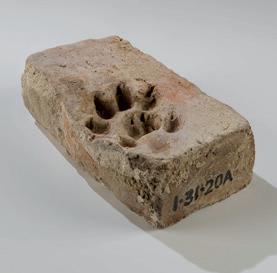
Recovered from excavations at the Governor’s Palace site, this brick features the paw print of a dog. The animal left the impression when the brick was set out to dry before it was fired in a kiln. Archaeology can unearth even the tiniest moments of life.
1776 the Musical
June 25-July 5 | Various times | Kimball Theatre
This production of 1776 comes to life for America’s 250th independence anniversary. Performed at the intimate Kimball Theatre, the Tony Award–winning musical brings audiences inside the debates, humor and humanity of the Continental Congress as the Founders struggle to declare independence.
Great American Dance Party with Good Shot Judy
July 2 | 7 p.m. | Palace Green
The holiday weekend kicks off with music, dancing and patriotic spirit at the Great American Dance Party on Palace Green. Featuring high-energy swing and jazz from Good Shot Judy and guest performers, this lively celebration invites guests of all ages to dance under the stars.
Alison Brown Concert
July 3 | 6 p.m. | Merchants Square
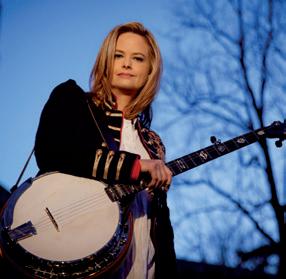
An evening of extraordinary musicianship with the Alison Brown Quintet takes the stage in Merchants Square for a free outdoor concert. Led by Grammy Award–winning banjoist Alison Brown, the quintet blends bluegrass, jazz and contemporary instrumental music.
Morning Reading of the Declaration of Independence
July 4 | 9:30 a.m. | Capitol
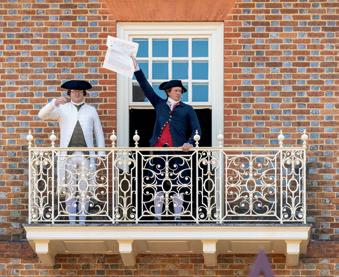
Begin the day with the words that started a new nation. Gather outside the Capitol as Thomas Jefferson reads the Declaration of Independence, 250 years after it was written.
Williamsburg Declares
July 4 | Noon | Raleigh Tavern
An exploration of Williamsburg’s vital role in the run-up to the writing of the Declaration of Independence.
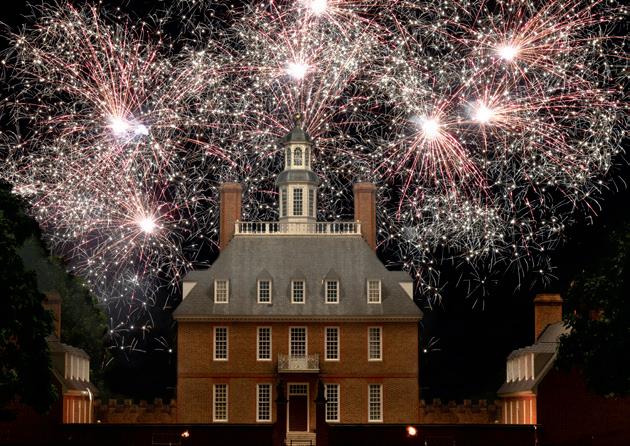
America Made in Virginia: 250 Years Together
July 4 | 8 p.m. | Market Square
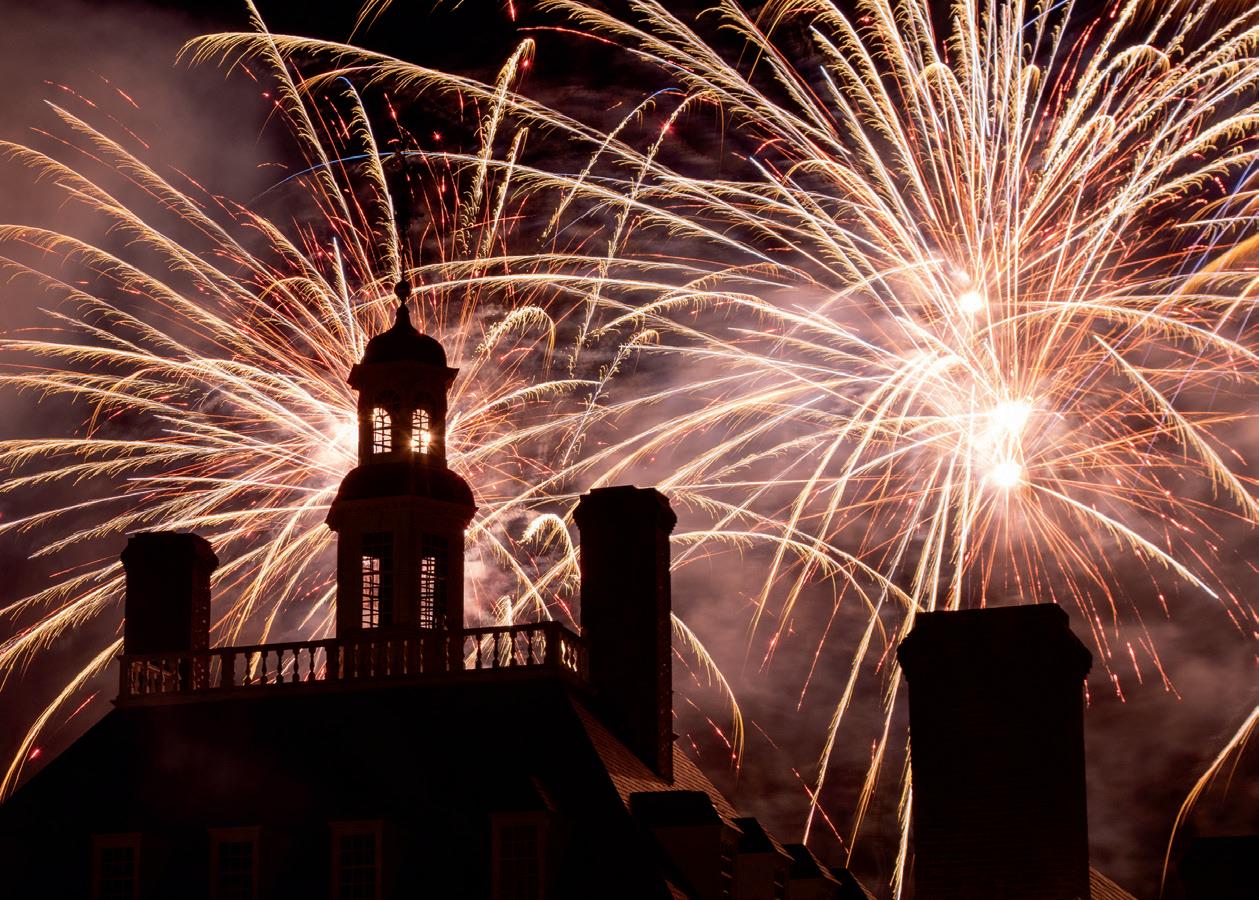
A two-hour live event and telecast in partnership with VA250. The evening begins with performances including music from singer-songwriter Judy Collins, a poetry reading from the Honorable John Charles Thomas, music from the United States Air Force Heritage of America Band and much more. The evening ends with a dazzling drone show and the Lights of Freedom fireworks extravaganza.
For more information on 2026 programs and events, please visit colonialwilliamsburg .org/2026
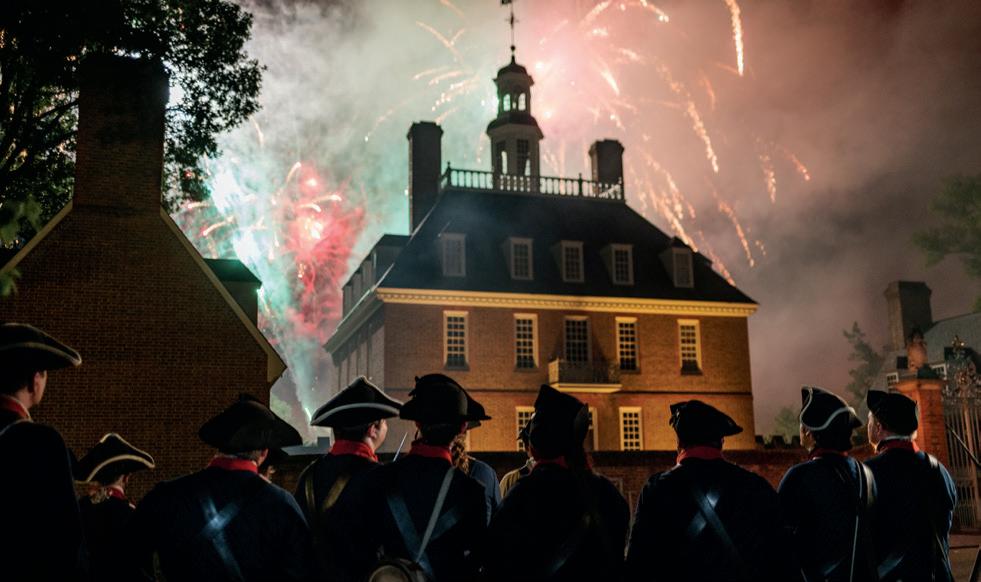
African Baptist Meeting House and Burial Ground Dedication
Oct. 9
Join the Let Freedom Ring Foundation, the Historic First Baptist Church of Williamsburg and The Colonial Williamsburg Foundation to commemorate the reconstruction of the African Baptist Meeting House at the site of the original location of the First Baptist Church, one of the earliest African American congregations in the United States.
Colonial Williamsburg Letters from the Archives
Oct. 9, 16, 23, 30
Explore 100 years of The Colonial Williamsburg Foundation through archival letters and correspondence read by Colonial Williamsburg Nation Builders and historical interpreters and special guests.
For 2026 in 2026: “New Republic, New Worlds” Conference
Oct. 23-24
Colonial Williamsburg, the Omohundro Institute and William & Mary host the final of five annual conferences spotlighting emerging research, connecting a diverse public to scholars and research, and convening significant conversations about how and why understanding the early-American past is especially meaningful today.
100th Anniversary Celebration of Colonial Williamsburg
Nov. 14
The Colonial Williamsburg Foundation commemorates its centennial on Palace Green with a stirring evening of resplendent fireworks, the timeless cadence of the Colonial Williamsburg Fifes & Drums, and more. This grand celebration honors a century of preserving the American story while igniting inspiration for generations yet to come.
For more information on 2026 programs and events, please visit colonialwilliamsburg .org/2026
Colonial Williamsburg 100th Anniversary Event America’s 250th Anniversary Event

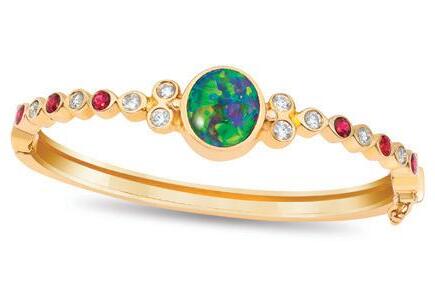
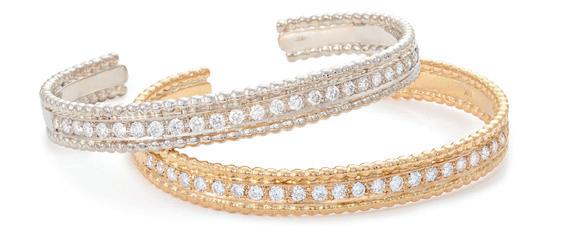

The time is now. Discover Reggie’s cuff and bangle bracelets. Handcrafted in 18K gold. Jewels for a lifetime. Totally timely. Truly timeless. For details, email info@thepreciousgems.com
Merchants Square, Williamsburg • 757-220-1115 • 800-644-8077 • Mon - Sat 10am - 5:30pm, Sun by appointment. thepreciousgems.com • Like us on Facebook

By Ben Swenson
Often when people reflect on the history of Williamsburg, they think about the Revolutionary past of the city a meeting place of great thinkers and patriotic zeal that culminated in a radical experiment in self-governance. The story of The Colonial Williamsburg Foundation itself is one of patriotic passion and radical experimentation.
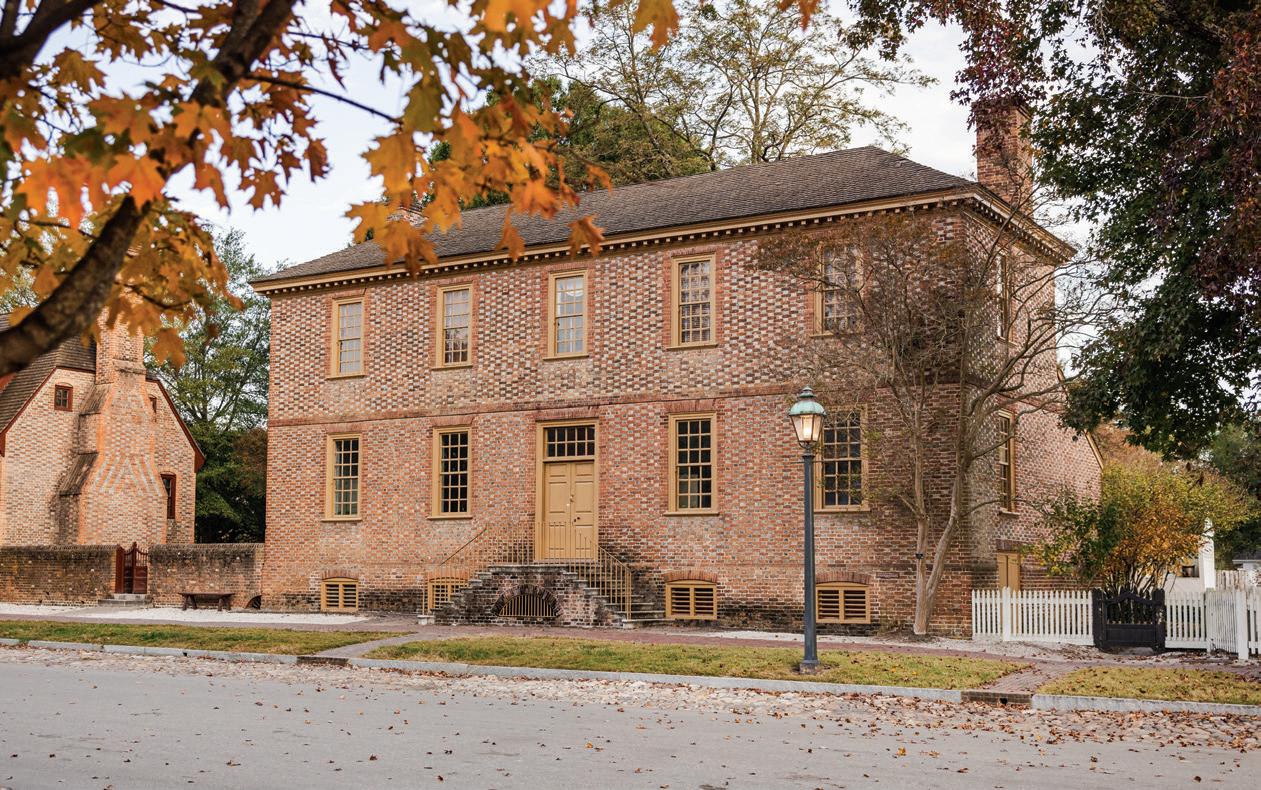
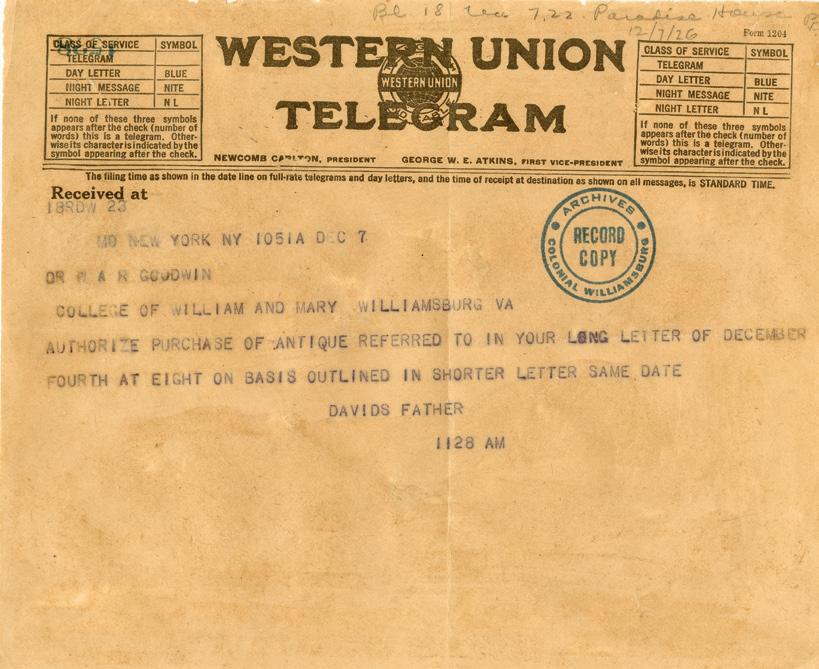
In 1926, John D. Rockefeller Jr. telegraphed the rector of Bruton Parish Church, the Rev. Dr. W.A.R. Goodwin, to “AUTHORIZE PURCHASE OF ANTIQUE.” This veiled communication turned out to be instruction for Goodwin to pur-
chase what is now known as the Ludwell-Paradise House. What followed, thanks to Rockefeller’s largesse, was an unprecedented effort: the rebirth of an entire town.
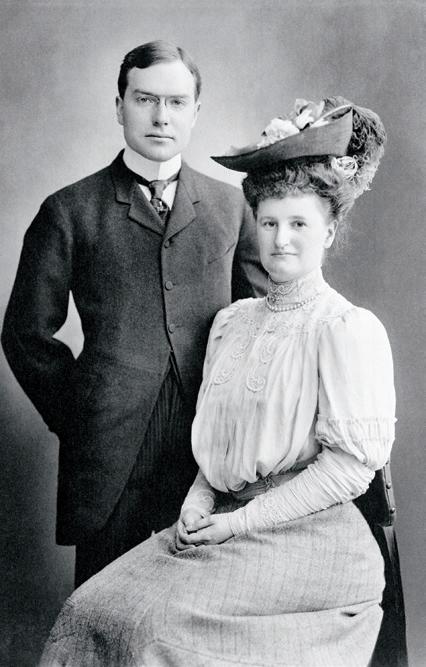
Rockefeller told the late Princeton University historian Thomas J. Wertenbaker that he was unsure of the ultimate scope of the project. “In Williamsburg,” Rockefeller said, “I saw an opportunity to restore, if not an entire colonial town, at least complete areas.”
The generosity of Abby Aldrich Rockefeller, Rockefeller’s wife, also proved transformative. Art, she said, “enriches the spiritual life ... makes one more sane and sympathetic, more observant and
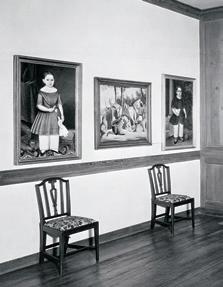
(Above) Abby Aldrich Rockefeller’s folk art collection first went on display in Williamsburg in the Ludwell-Paradise House. (Opposite) The authorization to purchase the Ludwell-Paradise House on Duke of Gloucester Street was given in a Western Union telegram sent in 1926. John D. Rockefeller Jr. and his wife, Abby Aldrich Rockefeller, provided the the original investment needed to bring Colonial Williamsburg to life.
understanding, regardless of whatever age it springs from, whatever subjects it represents.”
Her fondness for collecting folk art became the bedrock for the oldest collection of its kind in the nation. The Abby Aldrich Rockefeller Folk Art Museum began with 420 pieces from her personal collection. The museum, together with the adjacent DeWitt Wallace Decorative Arts Museum, establishes the Art Museums of Colonial Williamsburg as one of the world’s leading collections of American art and antiques.
Rockefeller’s initial purchase and subsequent gifts sustained Colonial Williamsburg for decades, creating an institution so
notable that generations of Americans have stepped up to ensure his legacy lives on. Rockefeller provided a model that encouraged donors to be part of something monumental. He helped cultivate a sense that all individuals can change the course of American history.
“Colonial Williamsburg has always been supported by philanthropy,” said Kenneth Wolfe, senior philanthropic advisor and a Colonial Williamsburg employee of 40 years. “The first 50 years, it was Rockefeller, and then that transitioned to broad public support for the second 50. Even though we’ve had that transition, it’s doing the same thing making a major difference.”
The Colonial Williamsburg Foundation is a private not-for-profit that receives no government funding for its operations. Donor support is therefore critical critical to the Foundation’s success, funding approximately 70% of mission activities annually. As of the end of March 2026, supporters had given $550 million of a $600 million goal in Colonial Williamsburg’s campaign. Those gifts touch every part of the guest experience.
The Historic Area’s 89
original buildings and hundreds more that have been reconstructed create an authentic town on the cusp of revolution. Behind that moving historic vista, however, stands an array of endless tasks.
“Unrestricted gifts to the Colonial Williamsburg Fund are critical to our mission and used as needs arise across the Foundation,” said Colonial Williamsburg’s Chief Development Officer Sani Silvennoinen. “They provide much-needed flexibility where they can have the most impact. We named our fundraising campaign as a nod to the history of this physical place, but the people coming together for a common purpose is just as powerful.”
That collective effort has allowed The Colonial Williamsburg Foundation not only to authentically construct the Historic Area but also to grow beyond the idea of simply a physical space. Much of the allure of the Historic Area stems from the sense of time travel, and setting such a scene relies on getting the details right.
Guests encounter, for example, animals that were common in the 18th century but have all but disappeared from modern pastures: The Rare Breeds program strengthens lin-
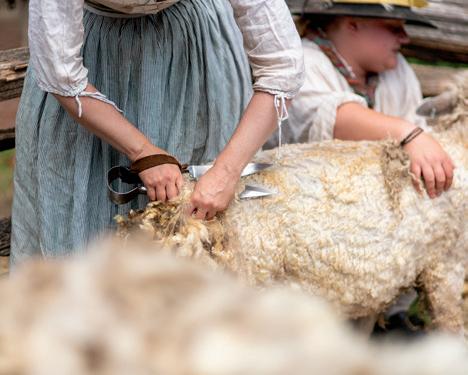
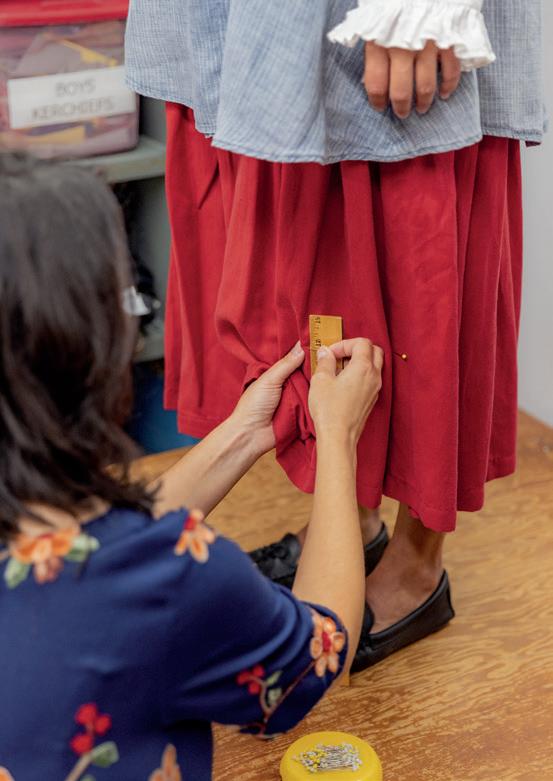
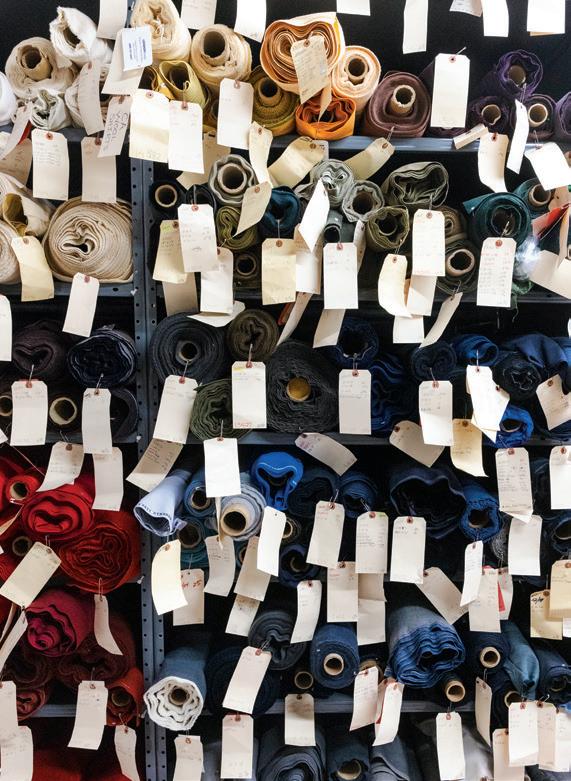
Donor support makes many of the activities, events and experiences at Colonial Williamsburg possible. (Above) In a display of 18th-century techniques, a Coach & Livestock apprentice shears sheep outside the weaver’s shop. (Opposite, clockwise from top left) A research historian is fitted for garments at Historical Clothing and Dress, which houses bolts of cloth for outfitting interpreters in the Historic Area.
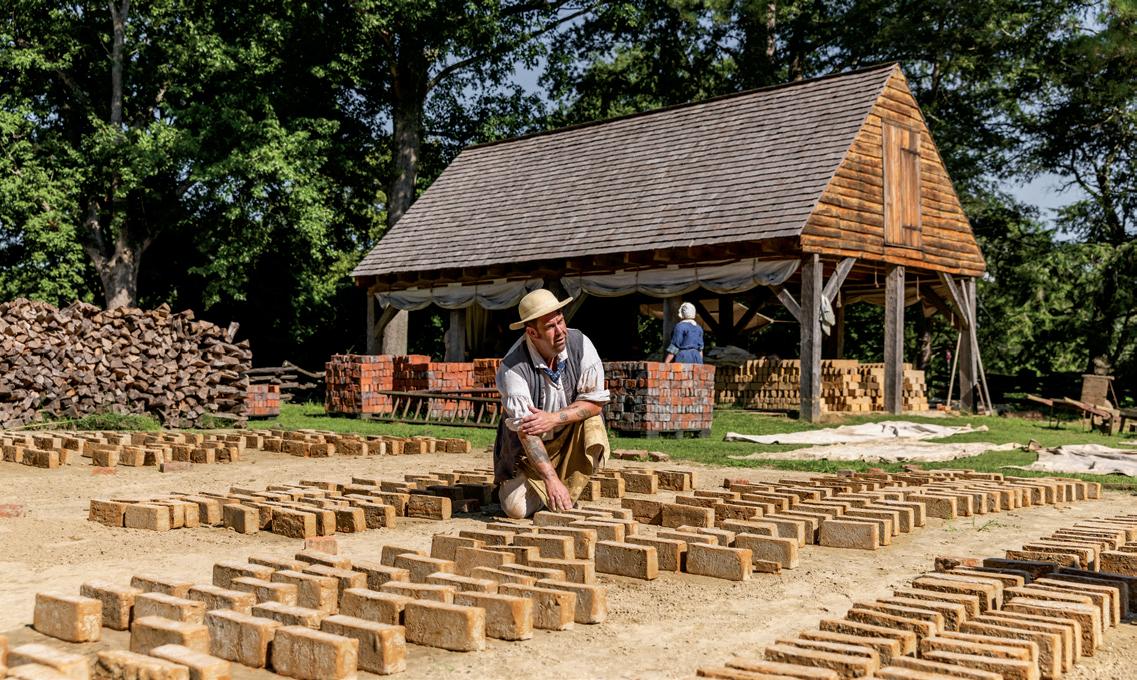
Master Brickmaker Joshua Graml lays bricks to dry in the summer sun.
eages such as the Cleveland Bay horse and Leicester Longwool sheep. The landscape of Colonial Williamsburg’s Historic Area, with painstakingly tended gardens, heirloom trees and historical footpaths, is a vital part of the historic panorama. And exhibitions at the museums provide context to better understand the past. Donors support all these endeavors and more.
But it is the people who provide the Historic Area with a dynamic element that guests find so appealing. Philanthropy supports the nuts and bolts of historic interpretation clothing hundreds of employees with authentic attire at Historical Clothing and Dress, for instance, and reviving lost trades such as brickmaking.
Supporters also help
increase the scale of historical understanding. While early interpretation centered on well-known historical figures, Colonial Williamsburg has expanded to incorporate the wide range of voices that contributed to the making of the modern American nation, including Black and Indigenous history, along with women’s and religious programming.
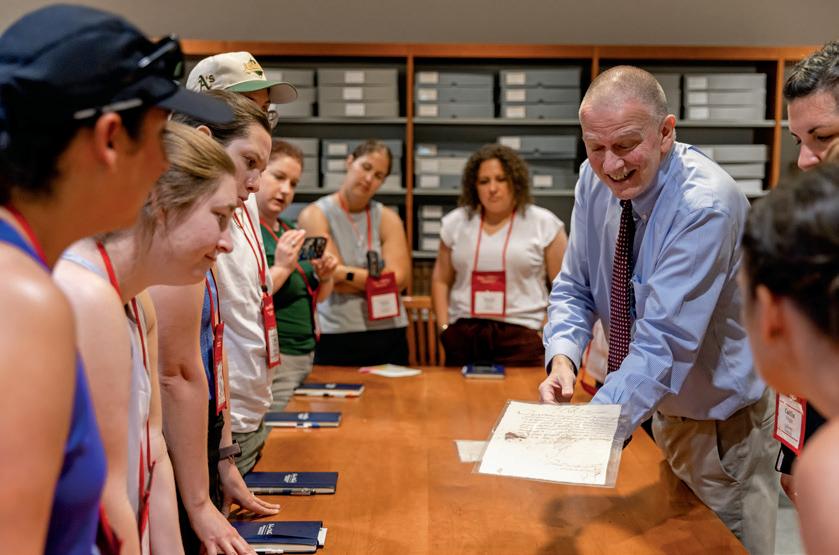
These compelling stories are not limited to those who visit the Historic Area. The Bob and Marion Wilson Teacher Institute, which opened in 1990 and bears the names of its cofounders, has been bringing educators from around the nation to experience Colonial Williamsburg and take that hands-on history back to the classroom. Each year, dozens of educators attend the onsite summer session on donor-funded scholarships.
Colonial Williamsburg’s leadership in historical interpretation is more important now than ever. In countless school divisions, curriculum designers are deemphasizing history and civics in favor of English and STEM instruction. Student achievement in social studies is stagnant or declining. A 2022 nationwide U.S. history exam conducted by the National Assessment of Educational Progress indicated that eighth graders’ scores have declined by 5 points since 2018 and 9 points since 2014.
“There is a crisis of history and civics education in this country,” said Mia Nagawiecki, Colonial Williamsburg’s Royce R. and Kathryn M. Baker Vice President of Education Strategy and Civic Engagement. “There is not a solution forthcoming out of the for-profit sector. The solution will come out of
As part of the Bob and Marion Wilson Teacher Institute, a group of educators get a behind-the-scenes tour of the John D. Rockefeller Jr. Library from Associate Librarian Doug Mayo.
the nonprofit sector.”
Other cultural shifts reflect the many changing ways that people engage with public history, and gifts help Colonial Williamsburg meet those needs. For example, the donor-funded Colin G. and Nancy N. Campbell Archaeology Center is a state-ofthe-art facility that allows guests to watch as archaeologists work.
A century after this ambitious public history project began, two things are clear: Colonial Williamsburg is a success, and there is still so much more work to be done. But with a solid foundation of philanthropic support, the future shines as brightly as the fires of revolution kindled in Williamsburg 250 years ago.
“Everything we want to do to expand the mission going forward is dependent on philanthropy,” Wolfe said.
As a supporter of The Colonial Williamsburg Foundation, you are part of a 100-year legacy of advancing history education and preservation. A century ago, John D. Rockefeller Jr. moved forward with a bold vision to establish the Foundation and become its
first philanthropist. Now, your generosity carries that legacy forward for the next generation.
To contribute, visit colonialwilliamsburg.org/ TT. For more information on how to support the educational mission, email campaign@cwf.org
The Great Seal of the United States
PHOTOGRAPHY BY JASON COPES
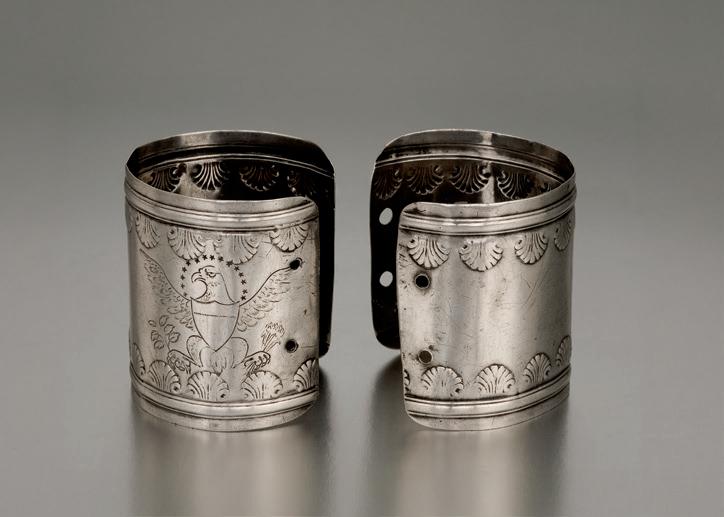
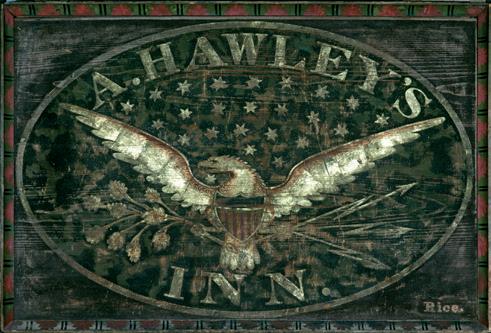
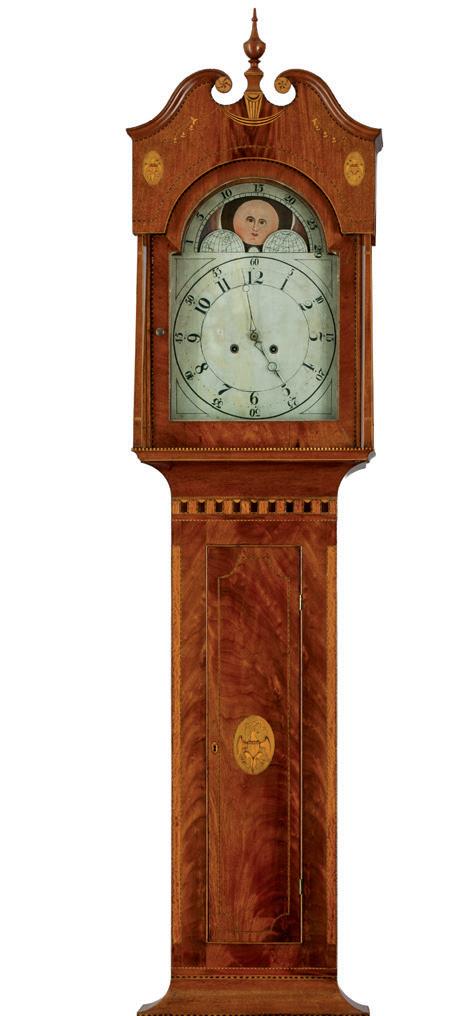
On display at the Art Museums of Colonial Williamsburg are (clockwise from top left) silver wristbands, a sign for an inn and a tall case clock, all featuring variations of the Great Seal of the United States.
In June 1782, the Second Continental Congress adopted the Great Seal of the United States. Charles Thomson, the secretary of the congress, and William Barton, who had studied heraldry, designed it. A bald eagle holding 13 arrows and an olive branch dominates the seal. The imagery quickly came to represent the new nation and appeared on all types of objects both official and personal. On the seal, the eagle’s head is turned toward the olive branch, symbolizing a preference for peace. In that vein, the government used it on goods made to commemorate treaties and pacts made with Indigenous peoples.
The government used silver jewelry and badges to seal alliances with Indigenous peoples. Pennsylvania silversmith Joseph Richardson Jr. produced large quantities of silver for trade with American Indians.
An armband, on display at the Art Museums of Colonial Williamsburg, was worn around the upper arm and secured with leather ties. It features the eagle with arrows and an olive branch surrounded by 15 stars. Made in the late 18th century, it split at some point and was remade into a pair of wristbands now on view in Silver from Modest to Majestic
A more personal use of the symbol can be found on an imposing clock on view in Keeping Time: Tall Case Clocks
Standing nearly 9 feet high, it was made in the central valley of Virginia at the beginning of the 19th century. It was originally owned by Capt. Jacob Lincoln and probably kept at his farm in Rockingham County near Harrisonburg. All exposed surfaces of the piece are covered with veneer and inlaid decorations including not only an eagle on the case door but also two more on the hood.
One of the larger, more impressive pieces featuring an eagle in the museums is the A. Hawley’s Inn sign on view in Sidewalks to Rooftops. William Rice gained a reputation as one of the Connecticut Valley’s foremost sign painters, with demand for his work extending from Hartford to southern Massachusetts. His sign created for the inn in Massachusetts features his signature chained lion on one side and the eagle on the other complete with arrows, olive branch, shield and a shower of stars.
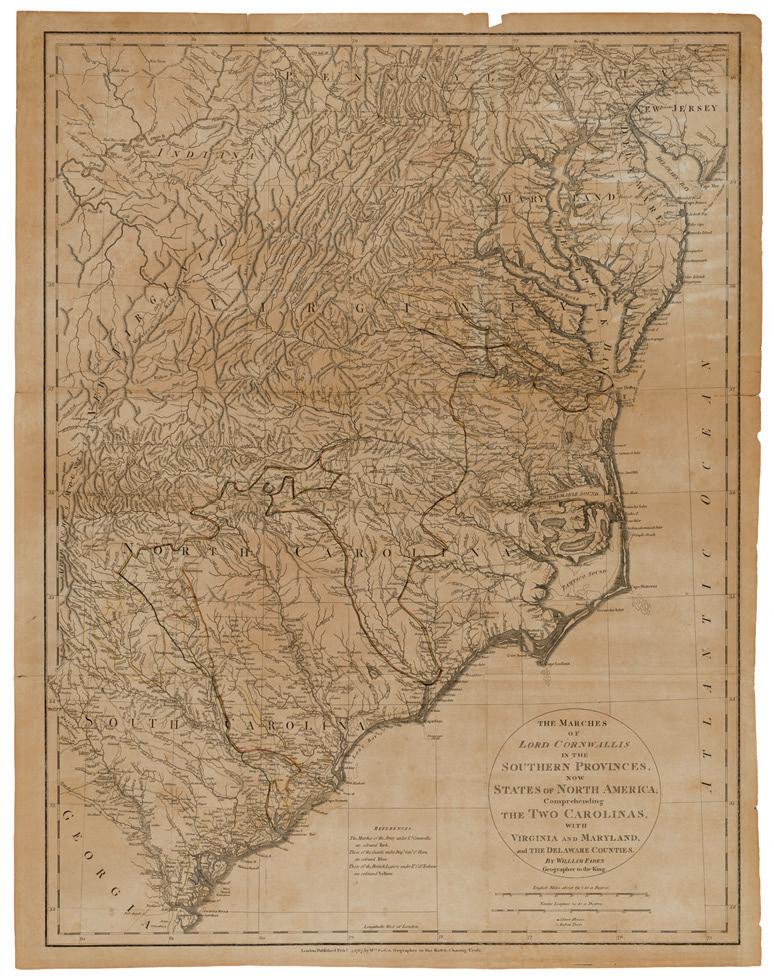
This well-preserved 1787 map, titled “The Marches of Lord Cornwallis in the Southern Provinces, Now States of North America...,” is just over 2 feet high. Using color coding, it traces the routes of British forces through Virginia and the Carolinas under Gen. Charles Cornwallis, Brig. Gen. Charles O’Hara and Lt. Col. Banastre Tarleton. Cornwallis’ movements reflect the war’s shifting focus southward where, despite early successes, he ultimately surrendered to American and French forces at Yorktown in 1781.
The map was created for Tarleton’s 1787 publication, A His-
tory of the Campaigns of 1780 and 1781, in the Southern Provinces of North America, which he used partly to excuse his failures at the Battle of Cowpens. The 1781 South Carolina engagement had been one of Britain’s worst defeats of the war. In his book, Tarleton both acknowledged American bravery and shifted blame for the loss onto the conduct of his own troops.
“The Marches of Lord Cornwallis …” was the recent gift of Bruce Grissom. Following conservation, it will appear in a future exhibition at the Art Museums of Colonial Williamsburg.

A charitable gift annuity provides you with income for life and tax savings, while also making a meaningful gift to The Colonial Williamsburg Foundation. Gift annuities can be funded with cash or securities, and a $10,000 minimum gift produces the returns shown here. What better way to make history for generations to come? Contact the Office of Gift Planning at 1-888-293-1776 or legacy@cwf.org today or reply with the attached card to get started.

BY PAUL ARON
hat happens when a radical rabblerouser takes charge of the government? Virginians found out after June 29, 1776, the day the Fifth Virginia Convention elected Patrick Henry as the first governor of the newly independent commonwealth.
The newly passed Virginia Constitution limited Henry to a single year in office, and delegates weary of living under a king severely curtailed the governor’s powers. Despite those limits, the more conservative gentry were apprehensive. One planter, Landon Carter, actually rejoiced upon hearing, shortly after
Henry took office, that the governor had died calling it “particularly favourable by the hand of Providence.” In fact, Henry was alive but not well, having contracted malaria.
John Page, who had administered the oath of office on July 6, worried that Henry might die and that if so “the Country will be without any head every Thing must be in Confusion.”
Henry gradually recovered at Scotchtown, his home in Hanover County. In September, he returned to Williamsburg and the Governor’s Palace, only to face the daunting challenges of a fledgling nation.
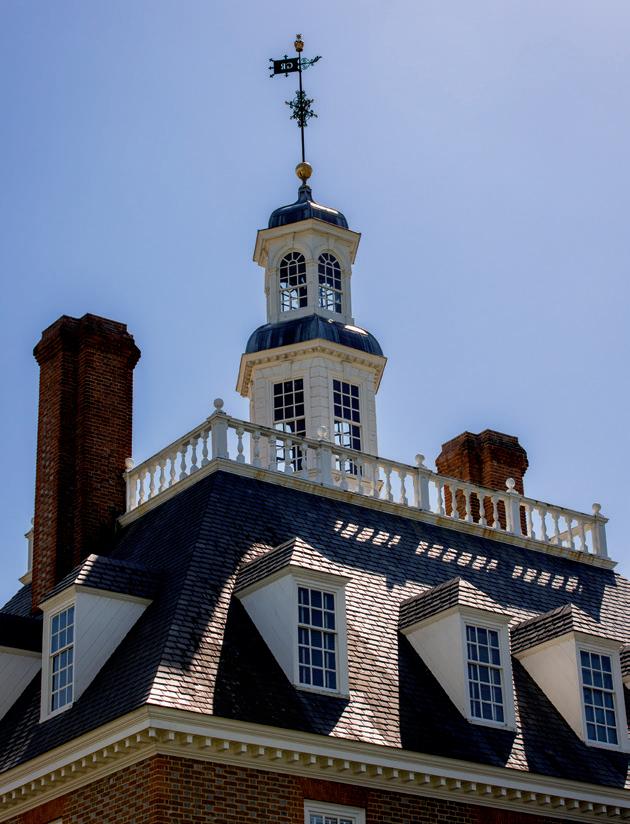
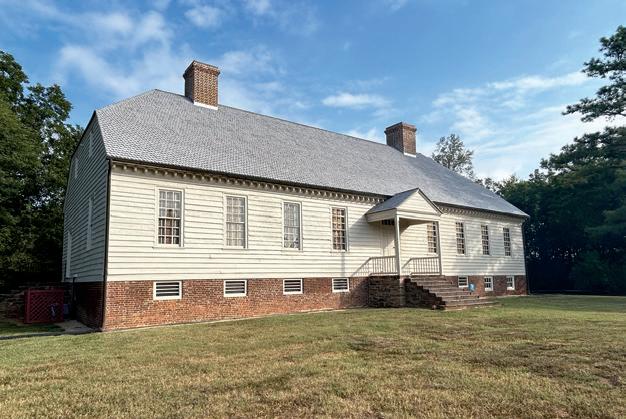
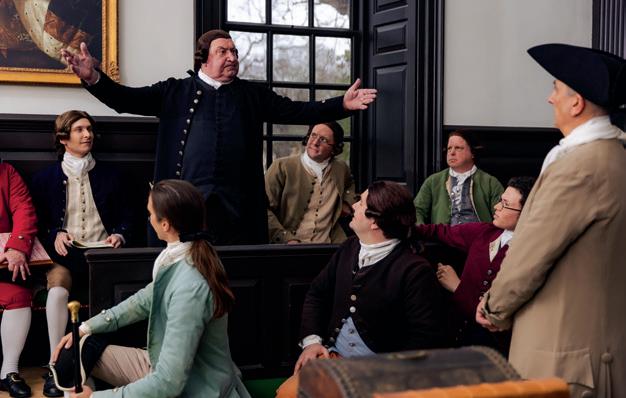
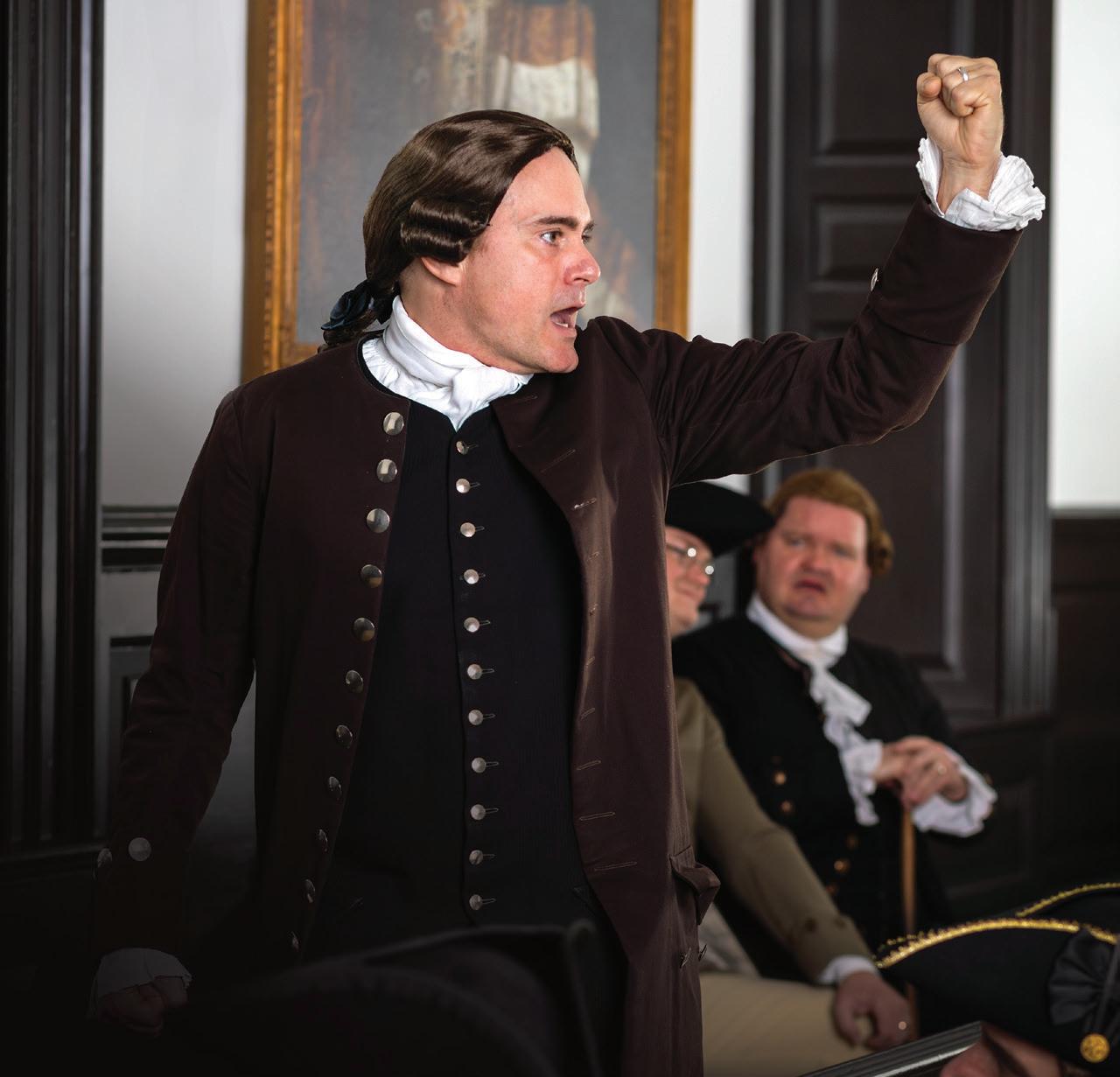
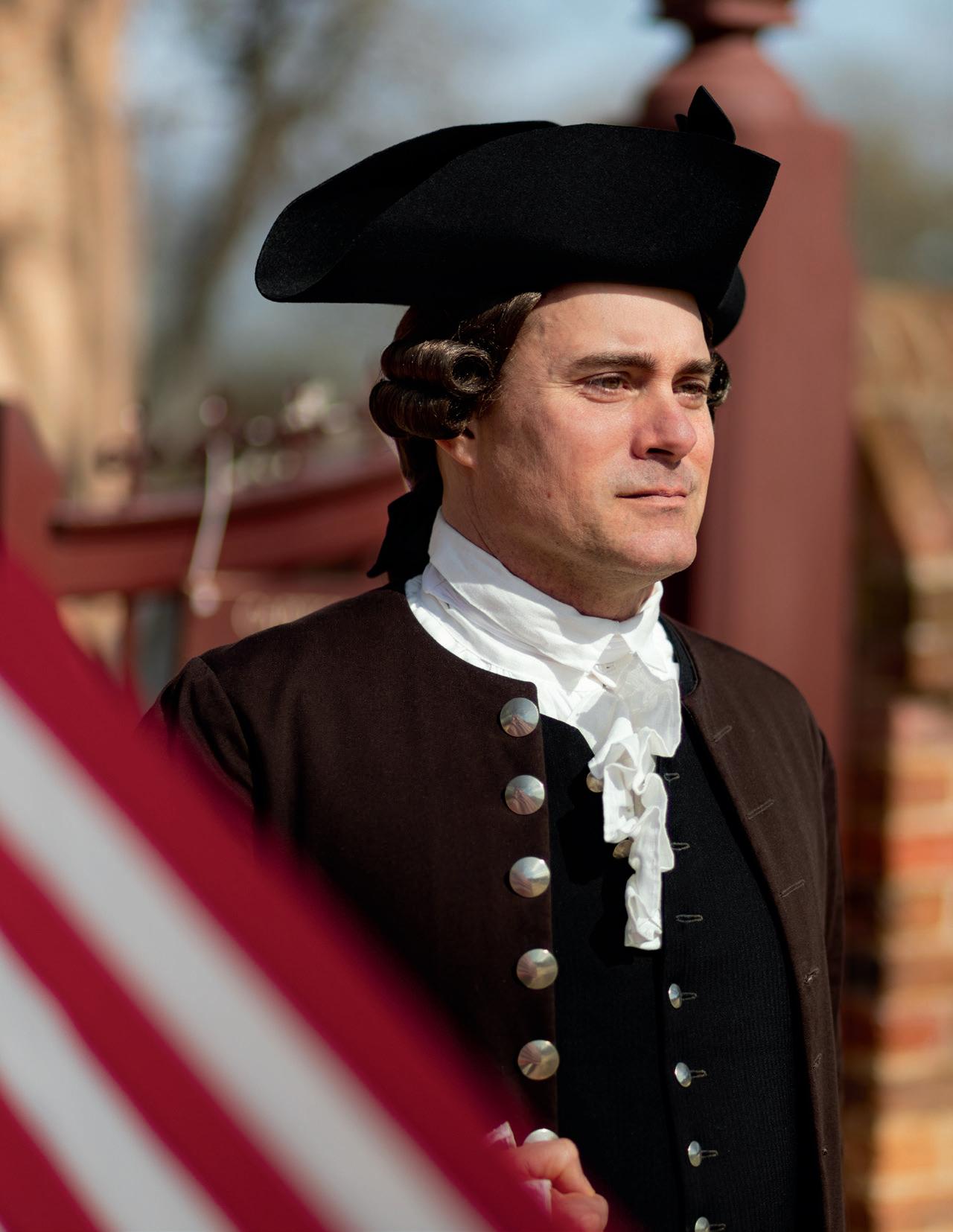
(Clockwise from left) The first two governors of the commonwealth of Virginia, Patrick Henry and Thomas Jefferson, lived in the Governor’s Palace in Williamsburg. After being elected governor, Henry recovered from malaria at his home in Hanover County. Nation Builder Richard Schumann portrayed Henry giving a speech to the House of Burgesses.
Richard Schumann, who has portrayed Henry for Colonial Williamsburg since 1995, said that he makes sure to depict Henry’s frustrations as governor, too, “I’m frequently grumpy and cantankerous, owing to the sheer aggravation which comes with the job.” Like Henry, Schumann dresses in black with a scarlet cloak. “I have to uphold the dignity of the office so that these eastern aristocrats will take me seriously,” he explained.
Nat Lasley, who like Schumann is a
member of the Foundation’s corps of Nation Builders, has generally played a younger Henry but has already portrayed him at his inauguration. “He has the weight of the world on his shoulders,” Lasley said. “He has no executive experience and he pulls it off.”
Henry was indeed an effective leader. He backed Lt. Gen. George Rogers Clark (the brother of William Clark of Lewis and Clark fame) in challenging British control of the west and reinforcing Virginia’s territorial claims against other states. Clark’s
campaign also deterred some Indigenous nations from siding with the British.
Henry cultivated an alliance with Baptist clergy, granting more religious freedom and securing their support for the Revolution. The mutual respect was evident early in his term. On Aug. 12, 1776, Baptist ministers and delegates praised Henry for his “constant attachment to the glorious cause of liberty, and the rights of conscience.” Henry responded the next day, expressing his happiness “that those religious distinctions which formerly produced some heats are now forgotten.”
Because each colony was an independent nation, (before the Constitution created the current federal government), as governor Henry also handled foreign affairs. He established diplomatic relations with French and Spanish colonies before the United States itself did.
Henry was reelected twice, serving until June 1, 1779, and then serving again from 1784 to 1786.
The governor’s greatest challenge, unsurprisingly, was the war. Frustrated by the limited authority Virginia’s constitution granted the governor, Henry asked for and received from the House of Delegates special wartime powers. These included the power to erect fortifications, barracks and military hospitals; to apprehend traitors; and to suppress domestic insurrections. The irony was unmistakable. This was the same Patrick Henry who had railed against the tyranny of the British king and who would later oppose the new U.S. Constitution on the grounds that it concentrated too much power in the federal government.
Thomas Jefferson was among those alarmed by Henry’s expanded authority. Years later, Jefferson wrote that in 1776, “our circumstances being much distressed,
“What we have to do I think,” Jefferson said, “is devoutly to pray for his death.”
it was proposed in the House of Delegates to create a dictator, invested with every power legislative, executive, and judiciary, civil and military, of life and of death, over our persons and over our properties.”
Though they were once allies, Jefferson’s dislike of Henry predated the latter’s governorship and outlasted it. When the two clashed over efforts to revise Virginia’s constitution, Jefferson wrote James Madison that, while Henry lived, the constitution could not be improved. “What we have to do I think,” Jefferson said, “is devoutly to pray for his death.”
Henry’s relationship with George Washington could not have been more different. The governor worked closely with the general, sending money, troops and supplies for the war effort. Their bond deepened during what became known as the Conway Cabal a plot by certain officers, including Gen. Thomas Conway, to replace Washington as commander in chief. In February 1778, Henry received a letter from Philadelphia physician Benjamin Rush attempting to enlist the governor’s support for the plot. Henry promptly forwarded the letter to Washington with a note reading, “I am sorry there should be one man who counts himself my Friend, who is not yours.”
Washington was already aware of the officers’ scheme, but he nonetheless valued Henry’s loyalty. Years later, he offered Henry the position of secretary of state, but Henry declined, citing poor health and strained finances.
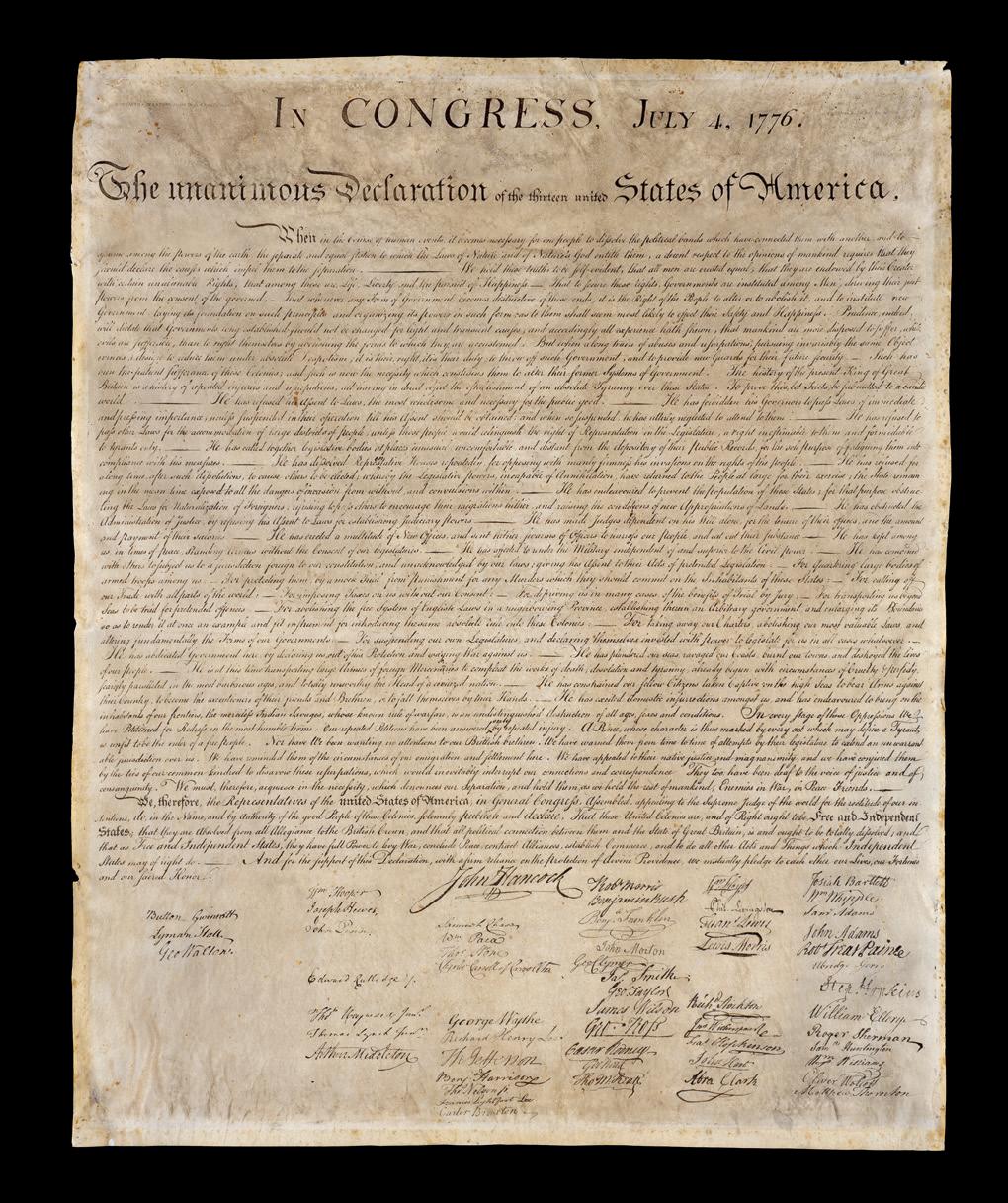
MAKER William Stone
DATE 1823
DIMENSIONS 31¹⁄₂ inches x 26³⁄₈ inches
PLACE Washington
MEDIUM Parchment, printed from a copperplate
BY PAUL ARON PHOTOGRAPHY BY JASON COPES
After adopting the Declaration of Independence on July 4, 1776, the Continental Congress directed John Dunlap, its official printer, to set the words to type. Copies were then sent to every state as well as to the commanders of the Continental troops. Congress also ordered that the declaration be engrossed, which means formally written by hand. The person who copied the famous words was probably Timothy Matlack, an assistant to the secretary of the Congress, who was known for his penmanship. It is this engrossed copy that 56 delegates to Congress signed.
An earlier draft of the declaration in Thomas Jefferson’s hand still exists. It has been preserved at the Library of Congress.
Over the years, the unrolling and rerolling of the engrossed copy took a toll on the document. By 1817, Richard Rush, who was the acting secretary of state, referred to those effects as the “hand of time.”
Three years later and aware of the damage done, Secretary of State John Quincy Adams commissioned engraver William J. Stone to create an exact copy of the engrossed declaration. Stone meticulously copied the original onto a copperplate, which he completed in 1823. The State Department used that copper printing plate, to print 200 copies on vellum. Those prints were considered official copies for government use and were sent to each of the still-living signers: Thomas Jefferson, John Adams and Charles Carroll of Maryland. Copies were also sent to former President James Madison, as well as various officials, branches and departments of the government. Governors of each state and territory also received copies, as did some colleges and universities and the Marquis de Lafayette.
About 50 parchment printings of Stone’s Declaration of Independence still exist, one of which belongs to Colonial Williamsburg. Some paper copies also still exist, probably proofs that Stone printed. The Stone copperplate is held by the National Archives in Washington.
The original engrossed copy was further damaged because of extensive exposure to light when it hung on a wall near a window from 1841 to
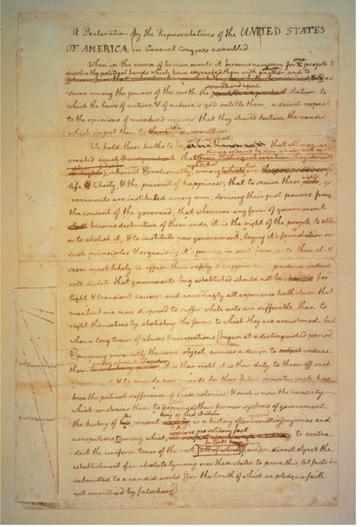
The document that Congress adopted on July 4, 1776, has been lost, but an earlier draft in Jefferson’s handwriting has been preserved and is at the Library of Congress.
Over
the years, the unrolling and rerolling of the engrossed copy took a toll on the document.
The engrossed version
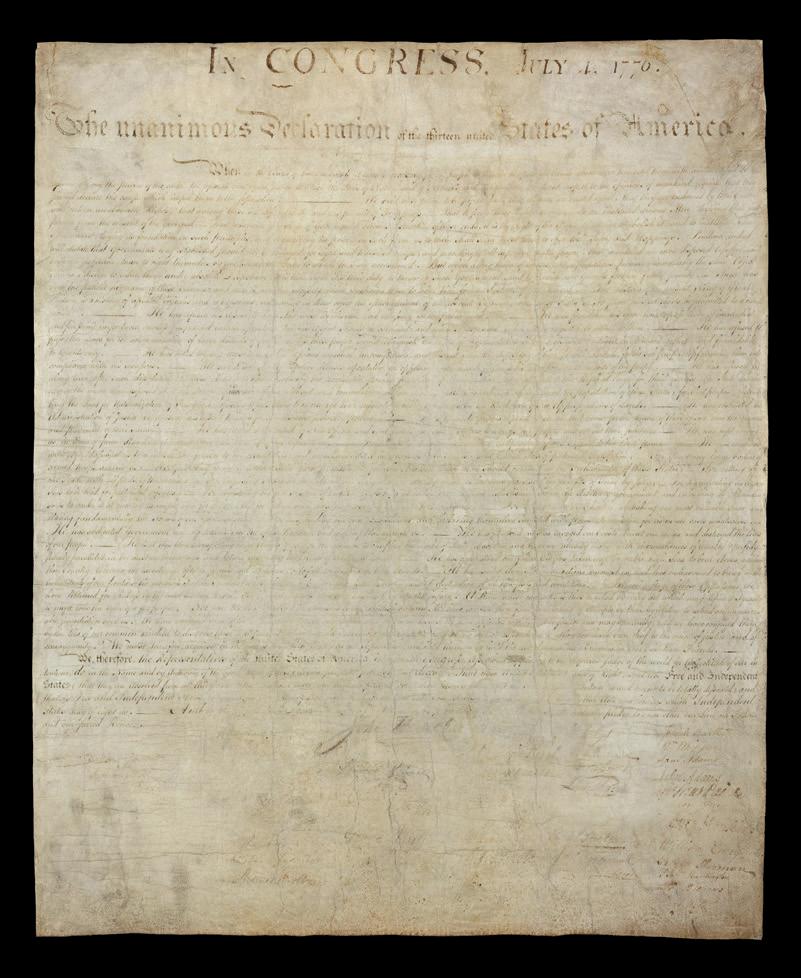
1876. Stone’s image is the one most Americans know, rather than the now largely illegible original.
“We are thrilled to have this important piece of American history in our collection and to be able to share it with our guests as we celebrate the 250th anniversary of the declaration and our nation’s founding,” said Doug Mayo, associate librarian at Colonial Williamsburg’s John D. Rockefeller Jr. Library. “We hope it will encourage people to reflect upon the ideals of the founding generation and the nation those ideals created.”


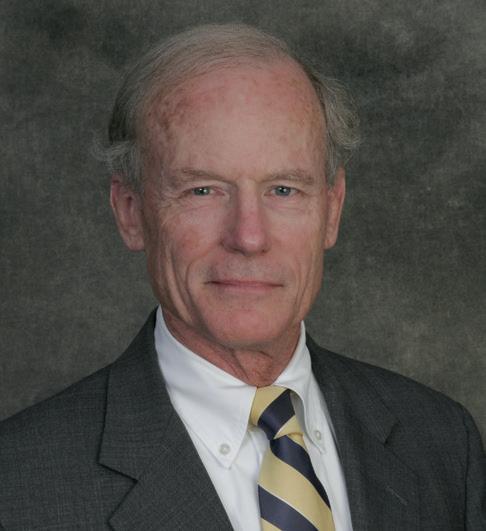
Gromacki, O’Neill, Tompkins join Board of Trustees
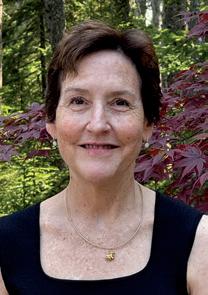
Carly Fiorina has been named the new CEO of The Colonial Williamsburg Foundation, with Conrad M. Hall succeeding her as chair of the board of trustees.
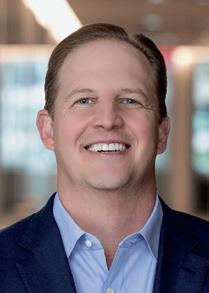
Joining the board as new trustees are Joseph P. Gromacki, Wendy O’Neill and Graves Tompkins. Gromacki and O’Neill became trustees in November 2025, followed by Tompkins, whose nomination was approved during the board’s April meeting.
Fiorina and Hall have a long history of working together on the board, and both offered strong praise
for each other’s leadership and vision.
“Conrad and I both joined the Colonial Williamsburg Board of Trustees in 2017,” Fiorina said. “Over the intervening years, his vision was instrumental in centering The Colonial Williamsburg Foundation in our national conversation about history and civic engagement. America’s 250th anniversary is now upon us, and I look forward to working with Conrad to expand the Foundation’s educational impact to many millions more people in the months and years to come."
“Carly brings decades of experi-
ence leading international corporations, advising government agencies and helping nonprofit organizations,” Hall said. “It has been an honor to work with her as a fellow trustee, and we are fortunate that she readily agreed to serve as CEO. As a leader, she brings unmatched energy, creativity and knowledge to this role and is the right person to lead the Foundation into our second century.”
Fiorina served on the Colonial Williamsburg Board of Trustees for nearly a decade. She was elected chair in 2020 and helped Colonial

Williamsburg’s leadership team weather the COVID-19 pandemic, invest in internationally recognized projects like the Williamsburg Bray School and the African Baptist Meeting House and Burial Ground, and secure an A+ credit rating from S&P Global Ratings.
Fiorina is the national honorary chair of VA250. She is the former chair and CEO of Hewlett-Packard and was the first woman to lead a Fortune 50 company. During her tenure as chair and CEO, HewlettPackard became the largest technology company in the world. She has also advised the Department of Defense, the CIA, the Department of State and the Department of Homeland Security. She founded Carly Fiorina Enterprises to bring her expertise to private sector teams and the Unlocking Potential Foundation to allow those in the social sector to benefit from her experience. She is the author of three best-selling books on leadership for general audiences.
Fiorina replaced Cliff Feet, who had been the Foundation’s president and CEO since 2020 and retired in April.
“The board is grateful for Cliff’s tireless service to the Foundation,” said Fiorina. “He has made a profound impact on the long-term trajectory of the institution which will benefit future generations. The board and I look forward to continuing the Foundation’s important and consequential work, particularly as we prepare for centennial celebrations.”
“Leading the Foundation has been the honor of a lifetime,” said Fleet. “We have made enormous progress over the past few years thanks
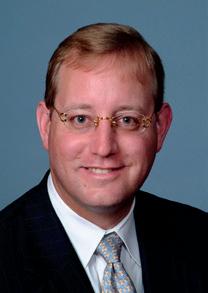
to the dedication of an extremely gifted leadership team, talented staff, a devoted board of trustees and the heartwarming generosity of donors. I know the Foundation’s positive momentum will continue as it approaches its centennial celebration later this year and into its second century.”
Hall served in the U.S. Army from 1966 to 1968 and then in the Army Reserve. He joined Landmark Communications Inc. in 1969 as a summer intern and remained with the company and its affiliates until his retirement in 2009. His career consisted of assignments in finance, operations and general management in publishing, targeted media and broadcasting. In 1981 he joined the Landmark corporate staff, and he became executive vice president and chief financial officer in 1985.
In 1989, he was appointed president and CEO of Trader Publishing Company, which was renamed Dominion Enterprises in 2005. Dominion grew rapidly and became a leading media and marketing information services company serving the employment, automotive, real estate, marine, recreation and
industrial markets.
The appointment of Gromacki, O’Neill and Tompkins expands the board’s membership to 28.
“Colonial Williamsburg has a highly talented and dedicated board of trustees, and Joseph Gromacki, Wendy O’Neill and Graves Tompkins bring valuable new perspectives to our work,” Hall said. “Together with Carly Fiorina’s leadership through her vast expertise in business and nonprofit work, the Foundation is now beginning its second century with the strongest CEO leadership and strongest board in its 100year history.”
Gromacki is a senior partner at the law firm of Jenner & Block LLP, which specializes in global corporate and transactional practices, and he serves on the firm’s governing committee.
O’Neill has more than two decades of experience working with international and domestic nonprofit organizations.
Tompkins is an advisory director at General Atlantic and has served in various roles throughout his career to scale and diversify the company’s global activities.
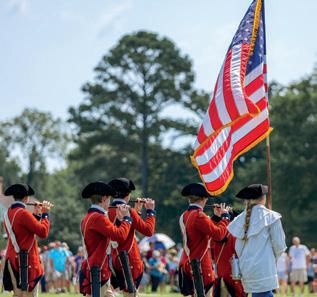
PBS and the Virginia American Revolution 250 Commission, or VA250 are producing America Made in Virginia: 250 Years
Together, a live filming set in the Historic Area premiering July 4.
Timed for the nation’s semiquincentennial, the special airs on PBS, PBS.org and the PBS app.
America Made in Virginia blends live performance, music, historic interpretation and large-scale visual spectacle. The two-hour broadcast celebrates the ideas, people and defining moments that gave rise to the United States.
“As we mark 250 years of American independence, there is no more fitting place to celebrate than Colonial Williamsburg, where the founding ideas that shaped our nation first took hold,” said Sylvia Bugg, chief programming executive at PBS. “This special brings that history to life in a way that honors the past while resonating with audiences today. We’re
proud to partner with VA250 to continue our long-standing tradition of live programming in celebration of America’s birthday.”
“This exciting partnership is grounded in shared values: educating every American, engaging with every community and inspiring a season of civic renewal that energizes and unifies us,” said Carly Fiorina, who is national honorary chair of VA250 as well as CEO of Colonial Williamsburg. “As the birthplace of our nation, Virginia belongs to every American. As we come together on July 4, 2026, to celebrate 250 years of independence, it is Virginia’s honor to welcome America home.”
Rooted in Virginia’s central role in the nation’s founding, America Made in Virginia underscores the enduring impact of the commonwealth in shaping the United States. Designed as both a celebration and a unifying national moment, the broadcast invites audiences to reflect on the
past, engage in the present and see themselves reflected in America’s continuing story.
Established by the Virginia General Assembly in 2020, VA250 serves to commemorate the 250th anniversary of the American Revolution, the Revolutionary War and U.S. independence in the Commonwealth of Virginia.
About 50 works from the Abby Aldrich Rockefeller Folk Art Museum are on display in an exhibition at the Museum of Modern Art (MoMA) in New York.
American Folk Art: Revisiting the Collection of Abby Aldrich Rockefeller opened in June and runs through Aug. 9.
Rockefeller was one of MoMA’s three founders. The folk art she collected is integral to the museum’s early history when folk art was positioned as an important antecedent to modernism.
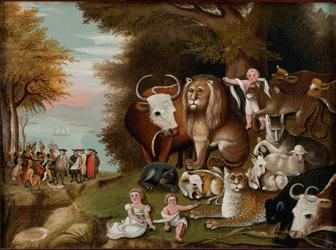
The works from the Art Museums of Colonial Williamsburg include Edward Hicks’ The Peaceable Kingdom. There are both decorative and functional objects, all made by craftspeople and others who had no formal artistic training. The works range from painted portraits and illustrated birth certificates to weather vanes, wooden toys, theorem paintings and mourning pictures.
The works are presented in dialogue with selected paintings and sculptures in MoMA’s collection by modern artists who were inspired by or championed American folk art.
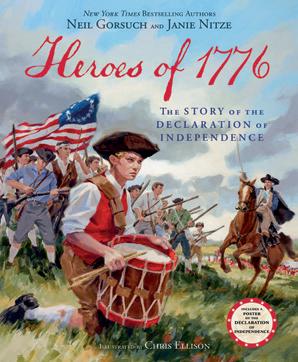
U.S. Supreme Court Justice and Colonial Williamsburg trustee Neil Gorsuch has written Heroes of 1776: The Story of the Declaration of Independence, a children’s book published in May.
The illustrated book includes stories of iconic figures like Thomas Jefferson, George Washington, Benjamin Franklin and Paul Revere as well as lesser-known Revolutionaries like John Hart, who signed the Declaration of Independence and was forced to escape British troops through snowy forests. The book also includes some facts likely to surprise readers, such as that a woman’s name Mary Katharine Goddard appeared on the first
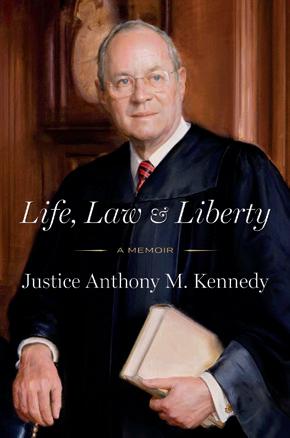
Anthony M. Kennedy, who served on the U.S. Supreme Court and Colonial Williamsburg’s board of trustees, has authored a memoir, Life, Law & Liberty
The book, which was published by Simon & Schuster, has received rave reviews. The Wall Street Journal wrote: “Life, Law & Liberty tells the remarkable story of a truly unique life” and is “full of affection and with some truly astonishing stories.” The New York Times said the book was “studded with candid reflections and sharp observations.” And The New York Review of Books called the book “surprisingly revealing,” noting Kennedy “recounts the decisions he made
printed version of the declaration that publicly listed the signers’ names.
“We wanted to share the human stories behind the document that changed everything the Declaration of Independence,” Gorsuch said. “Behind the bold words were real people, with dreams, fears and families. So many brave yet often forgotten men, women and children gave their hearts and sometimes their lives to the cause of independence. I hope children and families will be inspired as they step into the lives of those who helped build our nation.”
The book was co-authored by Janie Nitze, illustrated by Chris Ellison and published by HarperCollins.
on the Court through a distinctly personal lens, including his struggles and second thoughts.”
When Kennedy retired from the Foundation’s board in 2021, Colonial Williamsburg presented him with its highest honor, the Williamsburg Award. Carly Fiorina, the board’s chair at the time, said: “Justice Kennedy has shaped the destiny of The Colonial Williamsburg Foundation. More than this, he has shaped the destiny of our nation. And in the process, he has shown us what true character and leadership look like. We are grateful beyond measure for his work, for his example and for his friendship. He is nonpareil.”
A Modern History story in the Spring 2026 issue incorrectly stated the size of a new greenhouse. The structure will consist of two 30-foot-wide greenhouses with a 16-foot corridor between them.
The original was worn at his 1789 inauguration
George Washington knew well that what he wore mattered, especially as he prepared to take the oath of office as president of the United States in April 1789 in New York City. A now tattered, faded and buttonless brown coat in Mount Vernon’s collection had long been rumored to be the one he wore for that momentous occasion. Colonial Williamsburg’s Master Tailor Mark Hutter collaborated with Mount Vernon’s curator Amanda Isaac and historical costumer Kathrin Breitt Brown to confirm the rumor and reproduce the surviving coat.
Alas, there are no contemporary paintings of Washington’s inauguration. His own letters and a few descriptions written by eyewitnesses give some details. For instance, Washington chose a simple wool suit, not a military uniform or the silks of a monarch. He also insisted it be of American-made cloth. The messages were clear: First, he was a citizen statesman. Second, the new nation was growing competitive industries.
Hutter’s collaboration with Mount Vernon started in 2023 when he began studying the surviving coat.
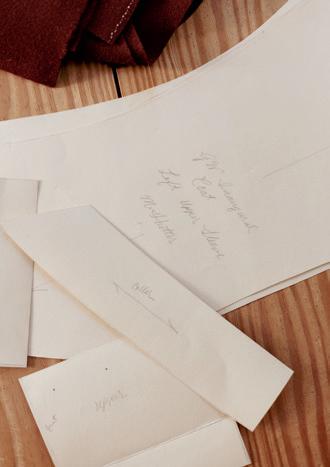
Hutter, Isaac and Breitt Brown studied the physical object and primary sources and created a detailed timeline of the purchase of cloth from the Hartford Woolen Manufactory in Connecticut. They found that the chosen color, once known as London brown, had been patriotically renamed Congress brown. Washington’s correspondence records difficulty in getting the fab -
ric to Virginia. The material and 20 buttons arrived at Mount Vernon on or about April 3. Washington quickly ordered six more buttons to be kept in New York where they would await his arrival for the inauguration.
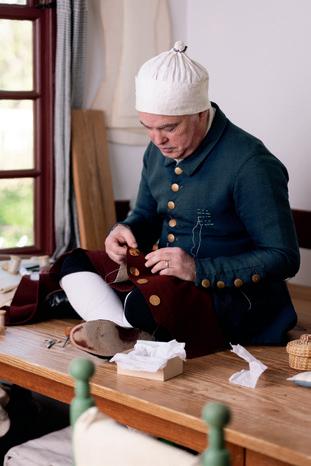
At Mount Vernon, indentured Irish tailor Caven Bowe had only a few days to make a new suit for the new president. His hurried work is detectable under investigation. The six buttons on the cuffs, for example, were added after the garment was finished,
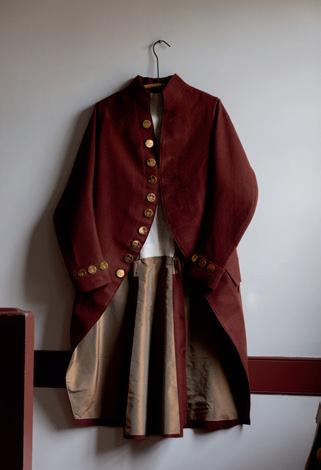
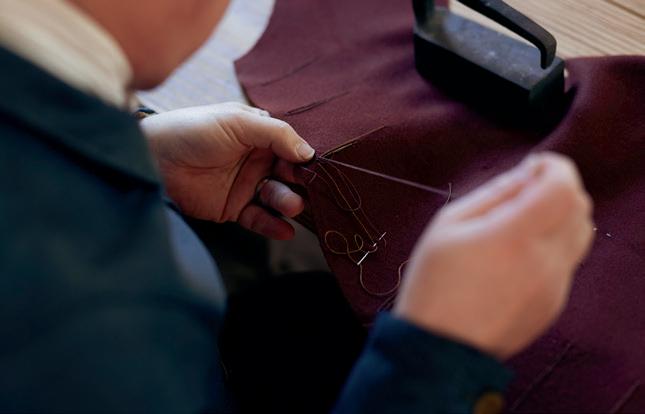
probably in New York, possibly by another hand.
Once the team concluded that the extant coat is the coat from the inaugural suit, Mount Vernon’s administration requested that Hutter produce a replica, carefully copying the original where possible and reconstructing areas that were lost.
Like Washington, Hutter had to start with the right materials. Pendleton Woolen Mills, headquartered in Portland, Oregon, produces an Americanmade fabric of similar quality and color. By coincidence, Mary Lang Bishop, whose family operates Pendleton, is a Mount Vernon viceregent. She made a generous donation of Pendleton’s wool flannel for the project. Engraved gilt buttons, based on 1789 inaugural souvenir buttons, were made by Colonial Williamsburg’s Master Engraver Lynn
Zelesnikar and Journeywoman Silversmith Christina Strum.
Like much of Colonial Williamsburg’s work, this project was collaborative and public. Said Hutter: “Working with Mount Vernon colleagues, we were able to find the scattered pieces that tell the tale of an extraordinary artifact. Working with other trades here, we have been able to literally stitch them back together. Working in front of a public allows us to share the story and involve guests.”
Some guests were able to help with the project. “I’ve let folks pin pieces, and one young boy cut the sleeve lining,” Hutter said.
The replica coat will be exhibited in Mount Vernon’s newly redesigned education center, allowing visitors to better envision Washington at the birth of the nation while also protecting the original.
Florida: Registration #CH10673. A COPY OF THE FOUNDATION’S OFFICIAL REGISTRATION AND FINANCIAL INFORMATION MAY BE OBTAINED FROM THE DIVISION OF CONSUMER SERVICES BY CALLING TOLL-FREE 1-800-HELP-FLA WITHIN THE STATE. REGISTRATION DOES NOT IMPLY ENDORSEMENT, APPROVAL, OR RECOMMENDATION BY THE STATE. Maryland: THE FOUNDATION’S CURRENT FINANCIAL STATEMENT IS AVAILABLE ON REQUEST AT THE ADDRESS LISTED ABOVE. FOR THE COST OF COPIES AND POSTAGE. DOCUMENTS AND INFORMATION SUBMITTED ARE AVAILABLE FROM THE SECRETARY OF STATE, STATE HOUSE, ANNAPOLIS, MD 21401 New Jersey: INFORMATION FILED WITH THE ATTORNEY GENERAL CONCERNING THIS CHARITABLE SOLICITATION MAY BE OBTAINED FROM THE ATTORNEY GENERAL OF THE STATE OF NEW JERSEY BY CALLING (973) 504-6215. REGISTRATION WITH THE ATTORNEY GENERAL DOES NOT IMPLY ENDORSEMENT. Pennsylvania: THE OFFICIAL REGISTRATION AND FINANCIAL INFORMATION OF THE COLONIAL WILLIAMSBURG FOUNDATION MAY BE OBTAINED FROM THE PENNSYLVANIA DEPARTMENT OF STATE BY CALLING TOLL FREE WITHIN PENNSYLVANIA 1-800-732-0999. REGISTRATION DOES NOT IMPLY ENDORSEMENT. Virginia: A FINANCIAL STATEMENT IS AVAILABLE FROM THE STATE DIVISION OF CONSUMER AFFAIRS IN THE DEPARTMENT OF AGRICULTURE AND CONSUMER SERVICES UPON REQUEST. Washington: ADDITIONAL FINANCIAL DISCLOSURE INFORMATION MAY BE OBTAINED FROM THE CHARITIES DIVISION, OFFICE OF THE SECRETARY OF STATE, OLYMPIA, WASHINGTON, BY CALLING 1-800-332-4483. West Virginia: WEST VIRGINIA RESIDENTS MAY OBTAIN A SUMMARY OF THE REGISTRATION AND FINANCIAL DOCUMENTS FROM THE SECRETARY OF STATE, SOLICITATION LICENSING BRANCH, AT 1-800-830-4989, STATE CAPITOL, CHARLESTON, WEST VIRGINIA 25305. REGISTRATION DOES NOT IMPLY ENDORSEMENT.
California: Not yet able to issue charitable gift annuities.
New York: Upon request, a copy of the latest annual report may be obtained from the address listed above for the foundation or from the Charities Bureau, Department of Law, Attorney General of New York, 120 Broadway, New York, NY 10271.
North Carolina: Financial information about the foundation and a copy of its license are available from the State
Solicitation Licensing Branch at (919) 807-2214. The license is not an endorsement by the state.
Oklahoma: A charitable gift annuity is not regulated by the Oklahoma Insurance Department and is not protected by a guaranty association affiliated with the Oklahoma Insurance Department. South Dakota: Charitable gift annuities are not regulated by and are not under the jurisdiction of the South Dakota Division of Insurance.
The Foundation does not issue charitable gift annuities in Alabama, Arkansas, Hawaii, and Washington. In California — we are not yet able to issue charitable gift annuities.
CHALLENGE YOUR PERCEPTIONS . DISCOVER FOOD FRESH FROM THE GARDEN . GET TO THE ART OF IT
John Trumbull tried capturing the essence of the new nation
by RICHARD BROOKHISER
J(Previous spread)
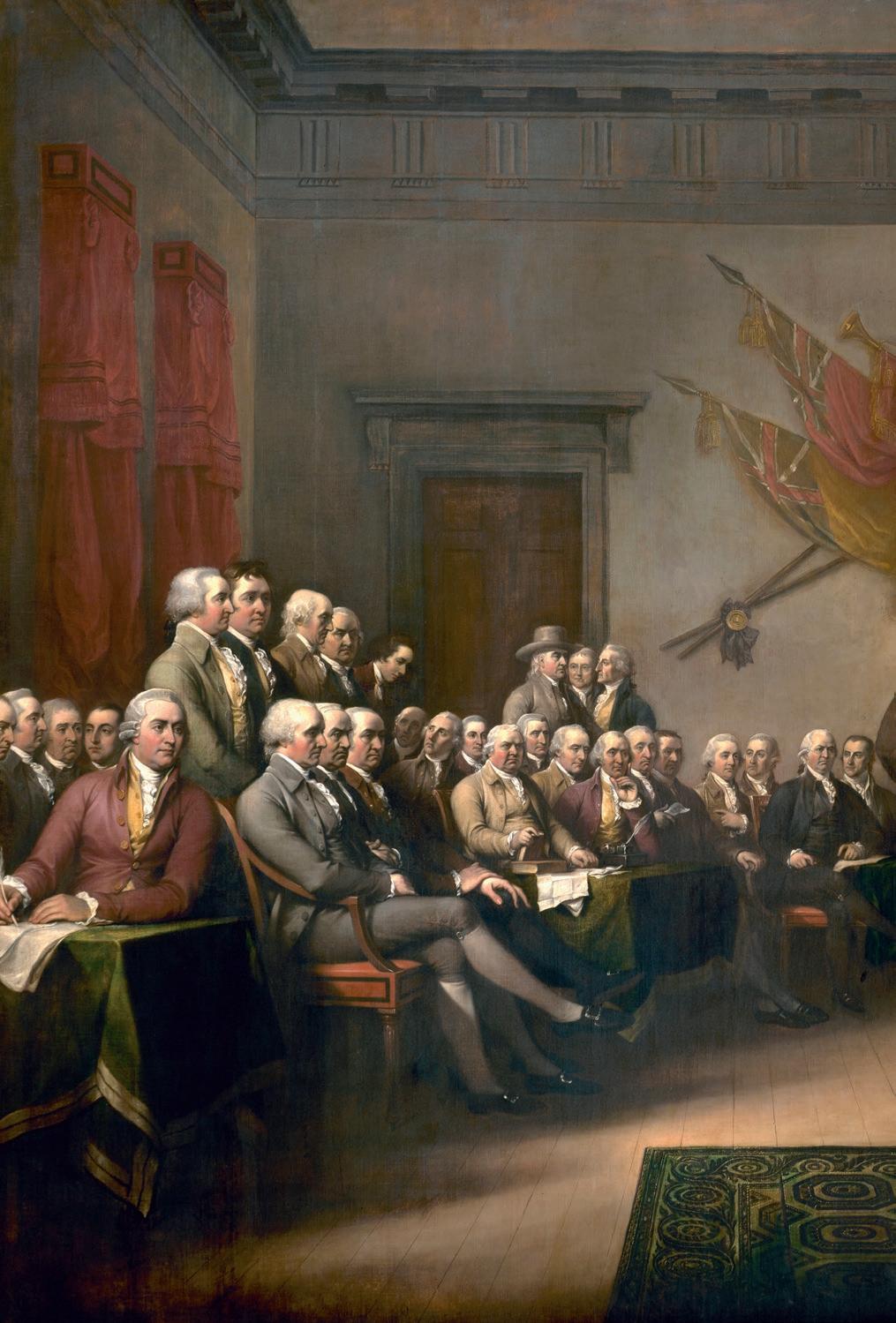
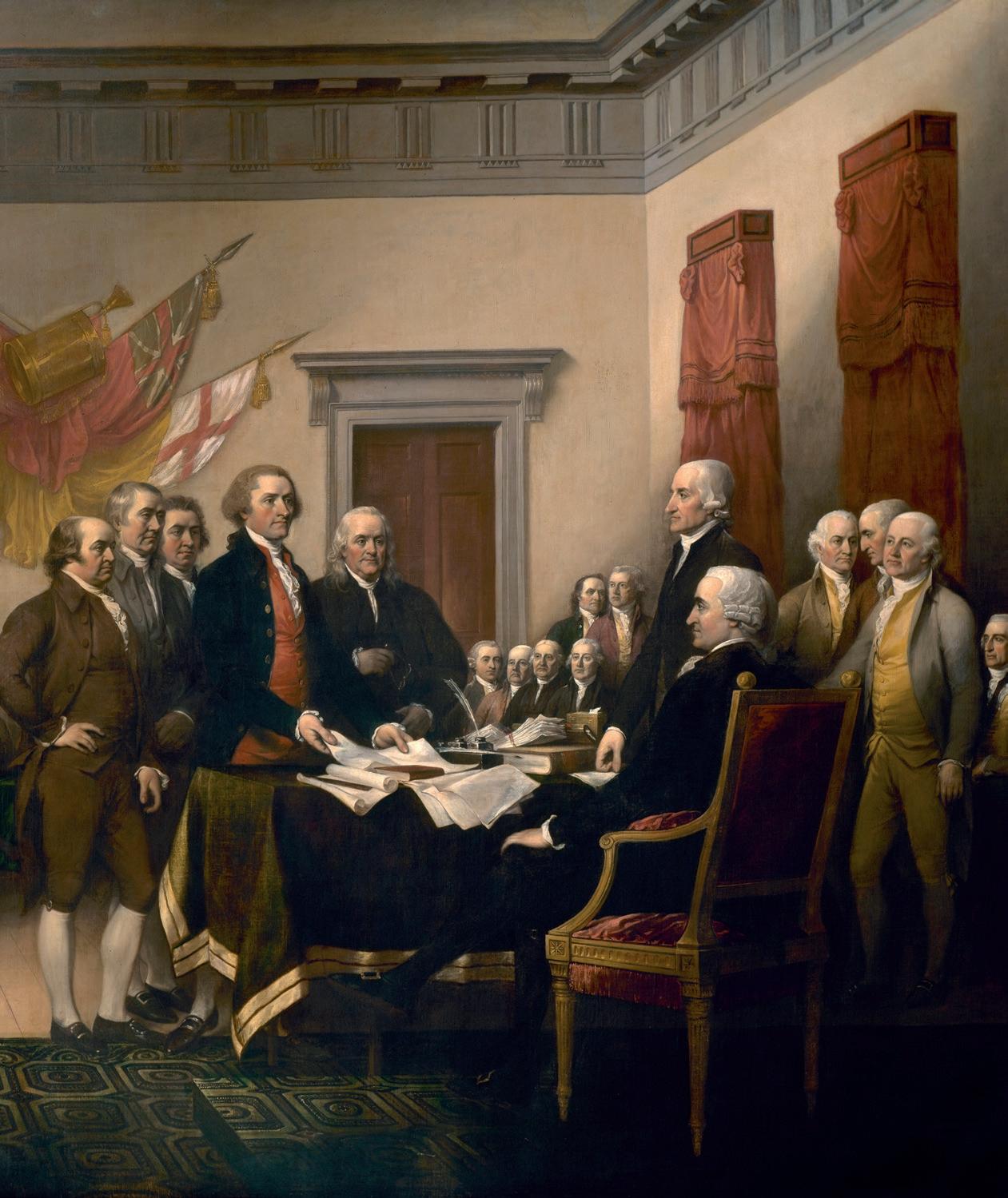
John Trumbull’s masterpiece Declaration of Independence hangs in the rotunda of the Capitol. (Below) Trumbull was “riveted” and “absorbed” by the detail in the work of John Singleton Copley as seen in this family portrait Copley painted in the 1770s.
ohn Trumbull’s magisterial painting Declaration of Independence was hung in the rotunda of the Capitol in November 1826. The declaration itself was 50 years and 4 months old when the painting was installed. Trumbull had worked on it for almost as long — 40 years — a process that involved Thomas Jefferson, the document’s draftsman.
John Trumbull was born in 1756 in Lebanon, Connecticut. He wanted to be an artist from his boyhood. His older sisters, Faith and Mary, were taught painting and embroidery, like other young ladies in 18th-century England and its colonies. In his memoirs Trumbull recalled his youthful efforts to copy their work: “For several years the nicely sanded floors” of the family parlor “were constantly scrawled with my rude attempts at drawing.”
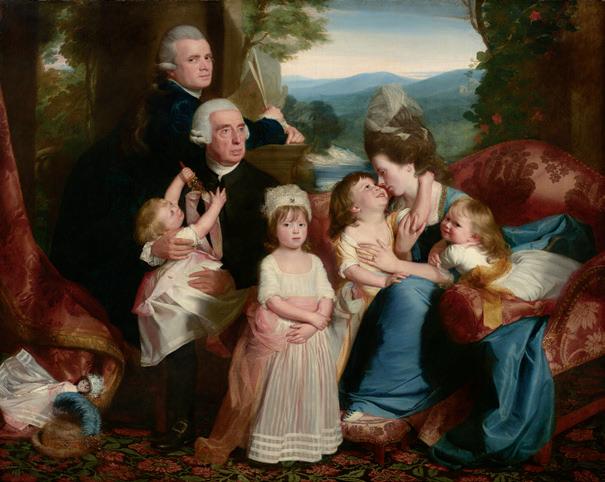
Trumbull was 15 when he first met a real painter. He had been sent to Harvard, his father’s alma mater, and nearby Boston was the home of John Singleton Copley. The painter had won a transatlantic reputation with his portraits of wealthy merchants and their families. Copley’s canvases showed three-dimensional spaces, realistically lit, in which the fabrics of the sitters’ outfits were so carefully rendered one could almost stroke them. Trumbull was dazzled: Copley’s paintings “riveted, absorbed my attention.”
Trumbull’s father was not dazzled. Jonathan Trumbull Sr. had been governor of Connecticut since 1769. He wanted his son to take up some practical profession, business or the law. John argued that, like the artists of ancient Athens, as a painter he could honor his homeland and be honored by it. Jonathan Sr. answered with a crushing one-liner “Connecticut is not Athens.”
Family disagreements soon paled beside the outbreak of the American Revolution. After the battles of Lexington and Concord in April 1775, Gov. Trumbull declared that Connecticut would defend its rights “to the last extremity.”
John joined the Continental army, rising to the rank of colonel. He served in New England and New York, on the fringe of the Battle of Bunker Hill, and in the thick of the Battle of Quaker Hill outside Newport, Rhode Island. He was shot at and saw men killed and dismembered.
Thanks to his abilities and his father’s connections, he served on the staffs of Gen. George Washington and Horatio Gates. He also met Benjamin Franklin, John Adams, the Marquis de Lafayette and John Hancock. What Trumbull called the “moral storm” of the Revolution plunged him into politics and war. He never lost his artistic vocation, however. Copley, a loyalist, had moved to England, leaving no one in America who could inspire or teach him. If Trumbull wanted to progress as a painter, he would have to go to England too.
Late 18th-century London had an Academy of the Arts sponsored by King George III and several excellent painters, including Benjamin West. The Pennsylvania-born West moved to London in 1763 and was the king’s official history painter. Still, he always remained hospitable to aspiring Americans and in the early 1780s accepted Trumbull as one of his students.
West’s most famous canvas, The Death of General Wolfe, had inaugurated a revolution in painting historical scenes. In it, West depicts British Gen. James Wolfe dying on the field at the moment of victory, surrounded by grieving officers.
Contemporary art critics argued that painters should show historical figures, even modern ones, in plain classical garb so as not to distract from the nobility of their deeds. West went in the other direction, presenting his subjects in the uniforms they actually wore as colorful and
detailed as he could paint them. West’s realism drew viewers in, putting them there, where history was being made.
Trumbull absorbed the lesson and pushed it farther. He was determined to paint, not a single scene, but a series of pictures that would tell the story of the American Revolution.
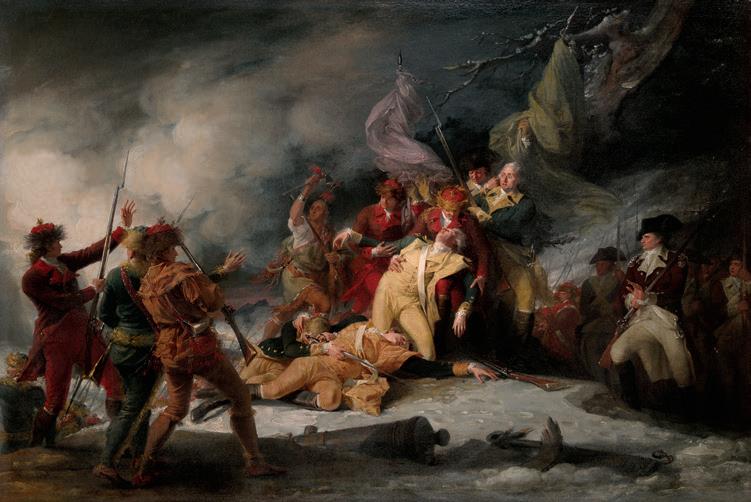
Over the fall, winter and spring of 178586, he painted two scenes, The Death of General Warren at the Battle of Bunker’s Hill, June 17, 1775 and The Death of General Montgomery in the Attack on Quebec, December 31, 1775. They are blockbusters, full of movement, drama and death.
Abigail Adams, who saw the Bunker Hill painting when her husband was minister to Great Britain, wrote that “in looking at it my whole frame contracted, my Blood Shiverd and I felt a faintness at my Heart.” Now his project took a different turn, thanks to an invitation from Thomas Jefferson.
Trumbull set out to not only depict scenes from the Revolutionary War but also fill them with drama and action, which is evident in his painting The Death of General Montgomery in the Attack on Quebec, December 31, 1775.
Richard Brookhiser is a journalist, historian and biographer. His titles include Glorious Lessons: John Trumbull, Painter of the American Revolution
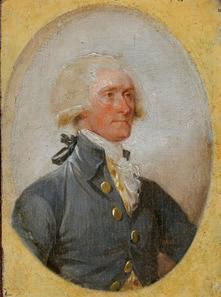
Trumbull and Thomas Jefferson were close friends, with the future president inviting the artist to stay with him in Paris. While in France, Trumbull painted Jefferson’s portrait, which he used again in his Declaration of Independence.
Born in 1743, Jefferson had served Virginia as congressman and governor. His most striking performances had been rhetorical: a 1774 tract, A Summary View of the Rights of British North America, and the Declaration of Independence. Jefferson had a gift for packing enormous implications into clear phrases, both musical and compact. He was simultaneously a philosopher and an artist.
Jefferson embraced the visual arts as well. He had already begun work on his mountaintop aerie, Monticello. Sent by Congress to France in 1784, he would study Roman ruins in Provence. He met Trumbull on a side trip to London. Always on the lookout for younger protégés, Jefferson found in the man from Connecticut a patriot and an artist.
Jefferson invited Trumbull to stay with him in Paris. Trumbull, eager to see the artworks and artists there, agreed, arriving at Jefferson’s rented mansion in the Chaillot neighborhood in the summer of 1786.
Jefferson suggested that Trumbull’s next subject in his Revolutionary series be political an image of the Continental Congress and the Declaration of Independence. It would mark the moment of independence and show the representatives of the American people who had made it happen (including, prominently, Jefferson himself).
We don’t know what Jefferson and Trumbull said to each other as they discussed the painting, but we have what they drew for each other. On a sheet of paper, now held at the Yale University Art Gallery, Jefferson sketched a floor plan of the room in the Pennsylvania State House where Congress had approved and
signed the document. Below Jefferson’s sketch Trumbull drew his first outline of the scene faceless figures representing the drafting committee, the president of Congress receiving their handiwork, and other congressmen arrayed on either side of them.
The painting Trumbull finished hangs, with its companions in his Revolutionary series, at Yale. It is small 2 feet tall by 3 feet wide. In the foreground slightly right of center stand the members of the drafting committee: Adams; Roger Sherman; Robert Livingston; Jefferson, who holds the declaration; and Franklin. Hancock, president of Congress, sits at his desk, angled toward them so that viewers of the painting are not looking at his back. The other members of Congress sit and stand. A few are talking to each other, but the great majority are, like the viewer, paying attention to the occasion.
Trumbull does not show any of the words on Jefferson’s paper. But the painting imparts important things about the nation these men were creating. Although there is a war going on battle trophies hang on the wall behind them everyone is in civilian clothes. This will not be a military state.
Many of the signers were wealthy when Charles Carroll of Maryland affixed his name, someone is said to have joked, “There go a few millions” but none were noble. Royalty and aristocracy have been jettisoned. All of the men are calm. No one declaims or poses. They are pledging their lives, fortunes and sacred honor, and they are doing it deliberately.
Trumbull labored to get the faces right.
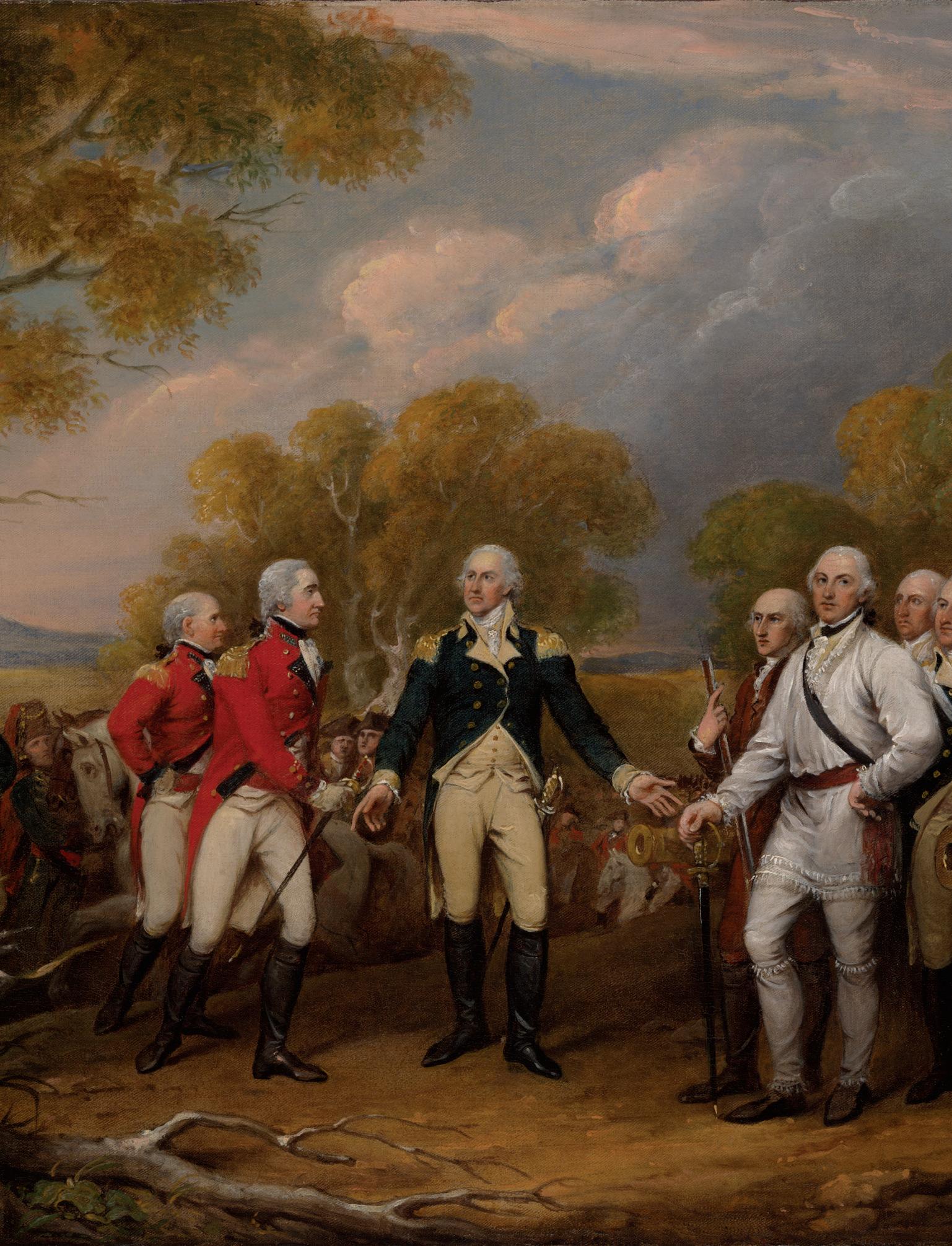
He painted Adams and Jefferson in Europe, and then, after returning to the United States in 1789, he traveled the East Coast collecting likenesses. If a signer had died, he copied an existing picture or painted a son. By 1793, he had finished his Declaration and worked on four more Revolutionary scenes two battles (Trenton, Princeton) and two British surrenders (Saratoga, Yorktown).
Then came a halt a long one. Trumbull hoped the new federal government would pay him to complete his project, but it had other financial priorities. He tried offering a subscription for the purchase of engraved prints a common way artists then monetized their work but that fizzled.
Current events the beginnings of the French Revolution and of the first American two-party system made the American Revolution old news. One of the casualties of American politicking was Trumbull’s friendship with Jefferson. Trumbull became a Federalist, the party of those who supported President Washington’s domestic and foreign agendas. Jefferson, even though he served as Washington’s secretary of state, became the leader of the opposition Republicans. It got personal: At one dinner Trumbull saw Jefferson “smiling and nodding” as a young Virginia Republican assailed him and his Yankee forebears.
Trumbull abandoned painting for six years. He tried his hand at business and at diplomacy. When he took up his brush again in 1800, he supported himself by painting portraits, in both England and America.
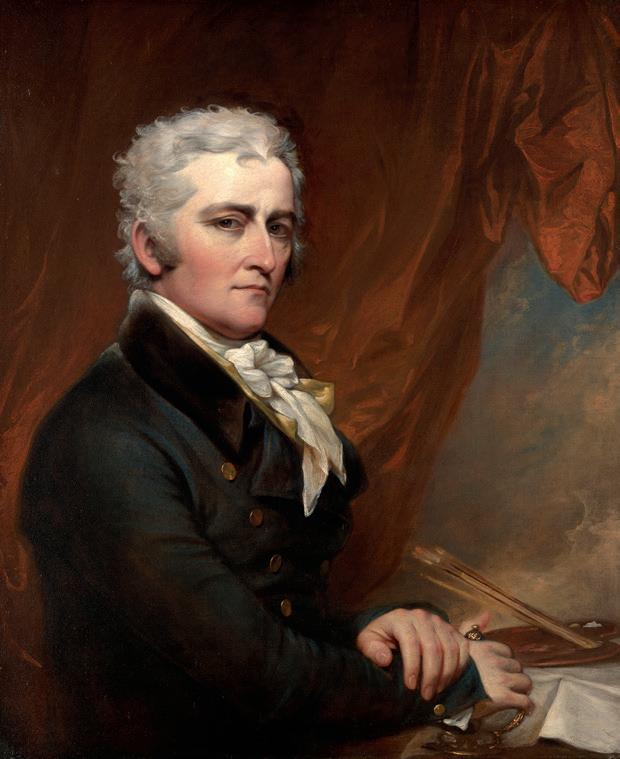
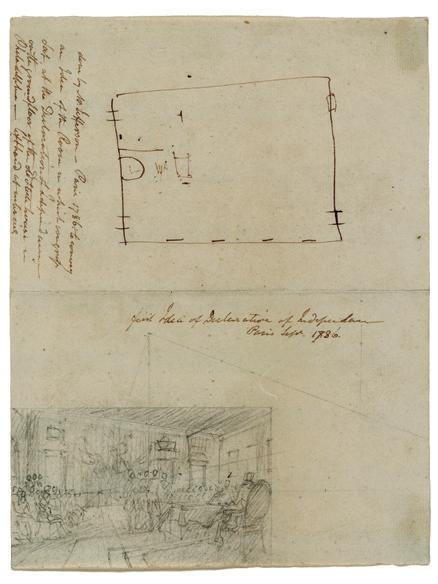
painted his self-portrait while he lived in London, where he was acting secretary to special envoy John Jay. (Left) Jefferson encouraged Trumbull to paint the signing of the Declaration of Independence and drew for him the layout of the room in Philadelphia where it was signed. Trumbull then sketched an idea of the future painting below Jefferson’s notes.
JOHN TRUMBALL
“FOR HIS MERIT AS A PAINTER I CAN QUOTE HIGHER AUTHORITIES, AND ASSURE YOU THAT ON THE CONTINENT OF EUROPE, WHEN I WAS THERE, HE WAS CONSIDERED AS SUPERIOR TO [BENJAMIN] WEST."
Thomas Jefferson
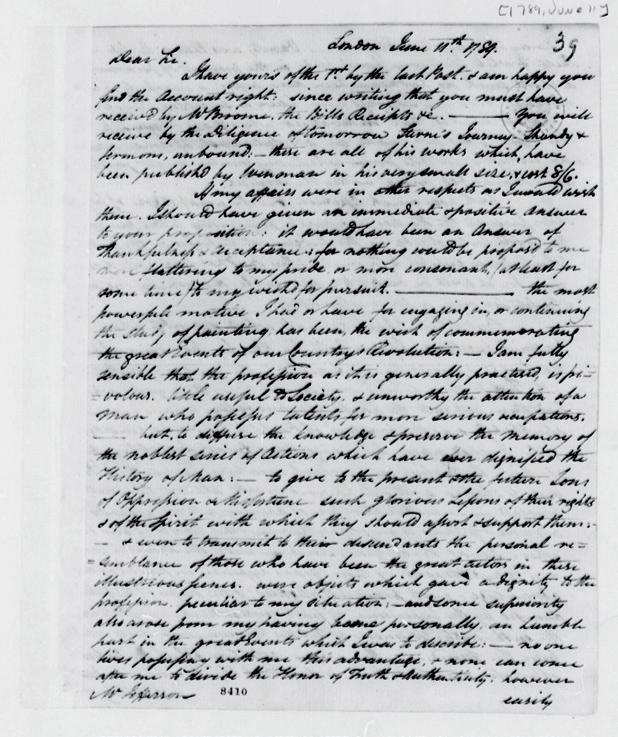
(Above) In 1816, after having applied to decorate the newly rebuilt Capitol, Trumbull wrote to Jefferson asking if he could lobby Congress on his behalf. (Opposite) Congress commissioned Trumbull to paint four paintings for the rotunda. The last of them was General George Washington Resigning His Commission, which Trumbull started in 1822 and completed in 1824.
Back to the Canvas
America and England went to war once more in June 1812. The peace that came two and a half years later restored the status quo ante, although America did have to rebuild much of Washington. After two decades of distraction, Trumbull saw an opportunity to complete his longneglected series.
The prewar Capitol had consisted of two wings joined by a walkway. When rebuilt, the wings would be linked by a domed rotunda. Trumbull applied to decorate it. Friends in Congress lobbied for him, and he turned for additional support
to two of his subjects, former Presidents Adams and Jefferson. Adams, now in his 80s, wrote a feisty letter full of praise, but no help. But his long-lost friend Jefferson came through.
Trumbull’s reaching out touched a chord in the Virginian’s memory. “We learn, as we grow old,” Jefferson wrote, “to value early friendships, because the new-made do not fit us so closely.” Then he got down to business, graciously.
Trumbull thought he needed Jefferson’s backing. “No, my dear Sir, your own reputation, your talent known to all, is a patronage with all.”
Jefferson nevertheless added his own recommendation, writing Virginia Sen. James Barbour that he could “bear witness of my own knowledge to [Trumbull’s] high degree of worth as a man. For his merit as a painter I can quote higher
authorities, and assure you that on the continent of Europe, when I was there, he was considered as superior to West.”
Congress commissioned Trumbull to paint four canvases, each 12 feet by 18 feet. (Anything smaller would have been swallowed in the immensity of the rotunda.) He finished the new Declaration first, in September 1818, and exhibited it throughout the northeast. Adams saw it when it was shown in Boston; Jefferson, though, at Monticello never got the chance. It was joined in the rotunda by Trumbull’s surrenders at Saratoga and Yorktown and by a new composition showing Washington returning his commission as commander in chief to Congress at war’s end in December 1783.
Critics then and since have slighted the
rotunda paintings, for Trumbull by his 60s had lost his finer skills: His drawing is blocky, his coloring dulled. But he never lost his sense of design and narrative, and that is what comes through in large works displayed in vast public spaces.
The men who make history die, like all men. Adams and Jefferson passed together on the July 4, 1826 (Trumbull lingered until 1843). If we want to meet them, we must turn to history, which exists mostly in words their own, and those of historians. But art can tell the story too.
John Trumbull, with Jefferson’s help, captured one of Jefferson’s, and America’s, greatest creations, and Trumbull’s own creation hangs in the Capitol for all to see.
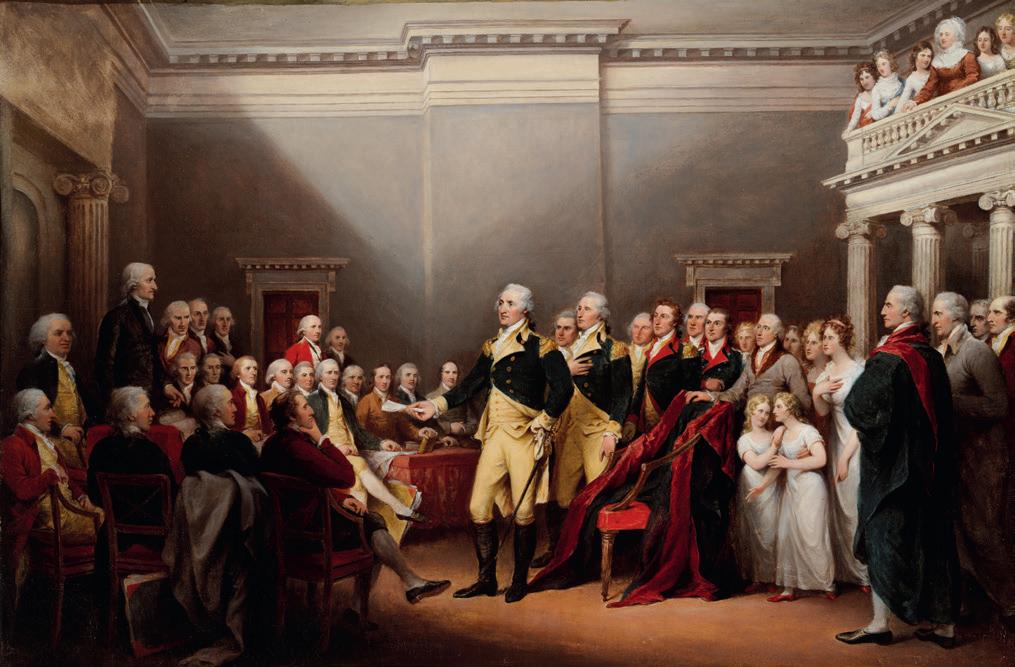
“The
Matt Webster Vice President, Historic Preservation
The CW Fund – Celebrating 50 Years give.colonialwilliamsburg.org/donate Donate Today
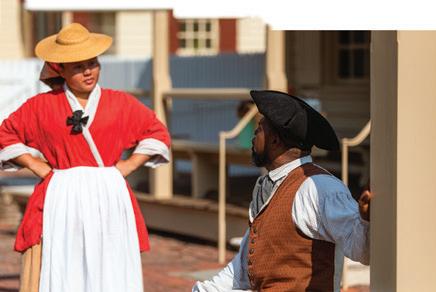
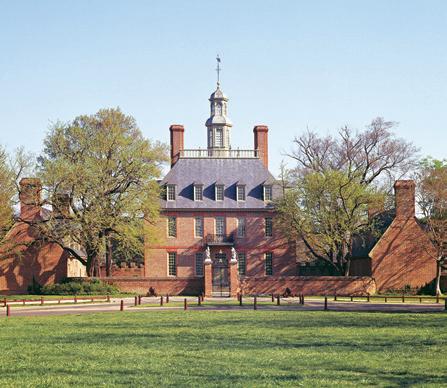
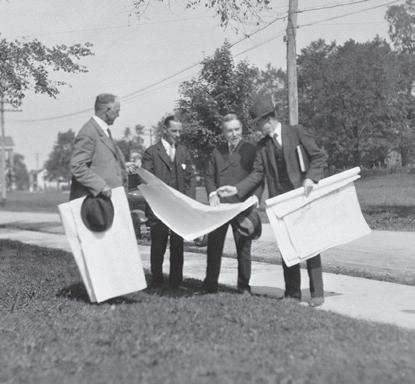
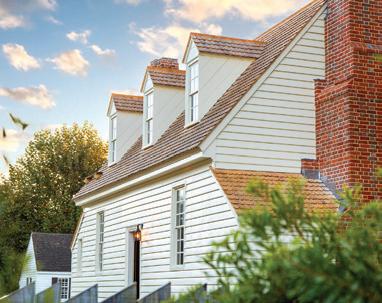

Step into the story at The Colonial Williamsburg Foundation.
This immersive program invites students to explore the Historic Area, meet skilled tradespeople, and uncover how history is researched, interpreted, and brought to life.
Through engaging, hands-on experiences, students learn the art of historical interpretation from firstperson storytelling to evidence-based analysis, building critical thinking skills and a deeper connection to early American life.
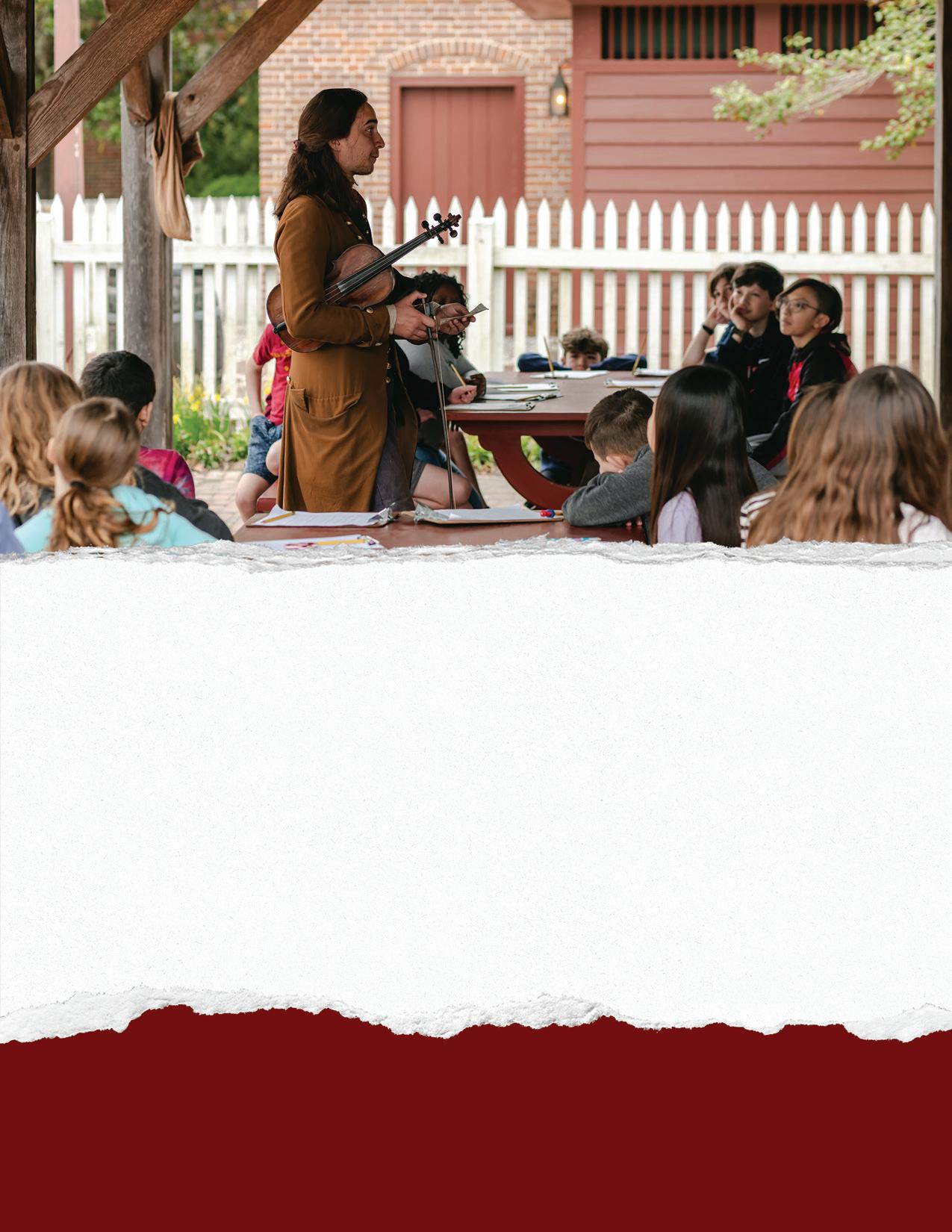
More than a field trip, it’s a behind-the-scenes look at how the past is discovered, understood, and shared, made possible through the generosity of donors who help bring these meaningful learning experiences to life.
From our teachers:
“The person from the past was so amazing. The way he was able to talk to the kids was amazing and tied it to their project. I love how it was two parts, the in-character and then the person behind it, because this showed the kids an amazing example of what their end goal should be, and then they learned from him how to do it.”
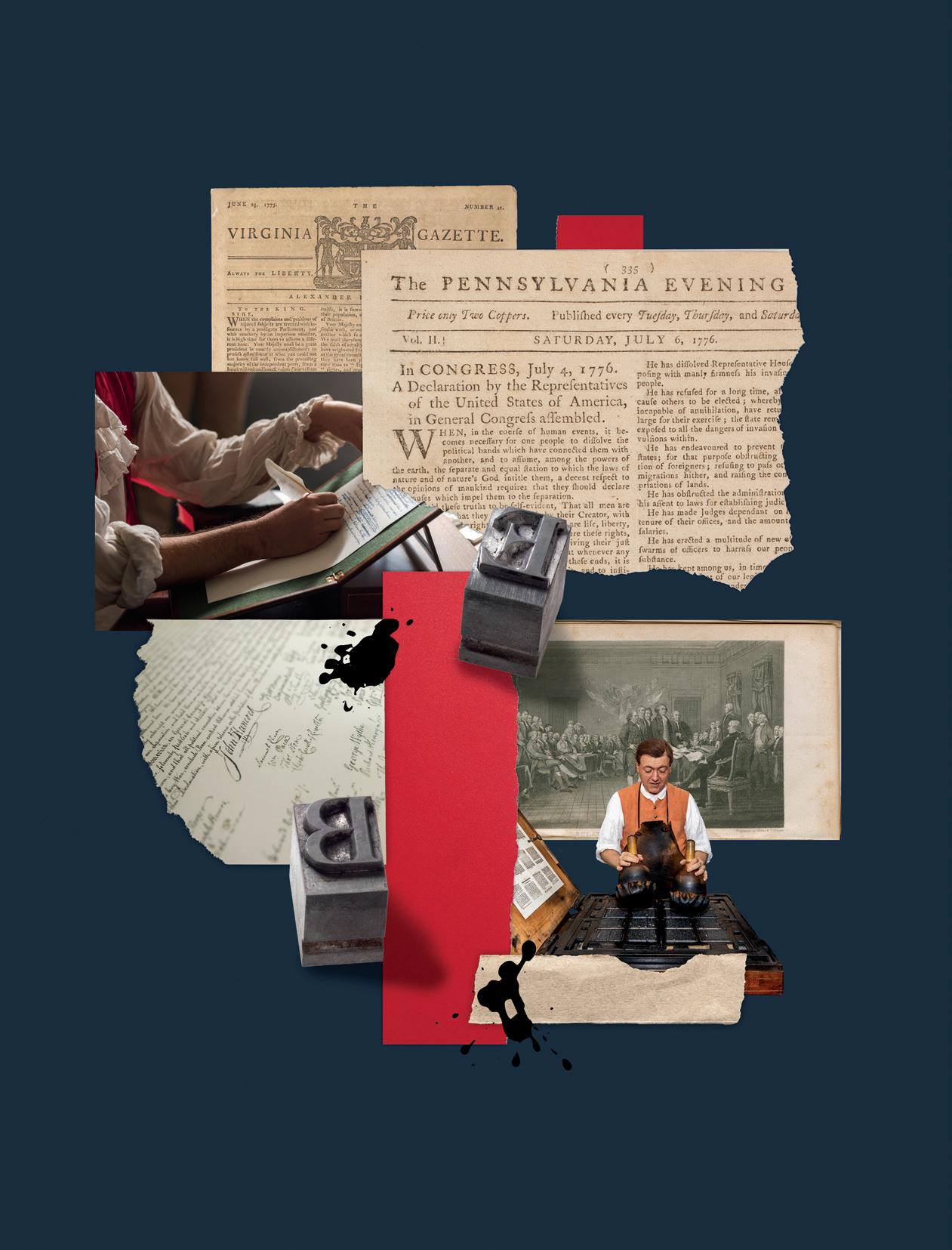
By EMILY SNEFF
On July 2, 1776, news of independence began to spread.
On that day, the Second Continental Congress in Philadelphia approved the June 7 resolution proposed by Virginia’s Richard Henry Lee. The resolution stated that the 13 colonies stretching from New Hampshire to Georgia were independent states free from British control.
Philadelphia printer Benjamin Towne published the result of the vote in his Pennsylvania Evening Post. A man traveling from Philadelphia to Fredericksburg, Virginia, shared the notice in the Evening Post with the postmaster, who promptly wrote to Williamsburg about it. On July 12, Alexander Purdie printed in his Virginia Gazette the postmaster’s account, stating: “Evening Post of the 2d instant, which mentions that the Hon. the Continental Congress had that day declared the United Colonies free and independent states.”
The Declaration of Independence soon followed suit. Its first printing was in
Philadelphia on the night of July 4. Copies reached Williamsburg two weeks later. That day, July 18, was a Thursday, and Purdie published his weekly Virginia Gazette on Fridays. His paper, like all newspapers then, was laid out one character at a time, a laborious, time-consuming task, and most of his July 19 issue was certainly already set. By the time Purdie received a copy of the declaration at his printing office on Duke of Gloucester Street, he had little time and little space in his layout to work with. Anxious to get at least some of the declaration to his customers, Purdie opted to print an extract rather than the full text.
The Declaration of Independence appeared in every active newspaper in the United States in the summer of 1776, but Purdie was the only printer who published an extract with a promise to his readers that the “full length ” declaration would be in the following week’s issue. His strategy speaks to a media landscape of once-a-week publications, long travel times for information, wartime paper
In spring 1776 Alexander Purdie marked the Virginia Convention's resolutions about independence by removing the royal coat of arms from the masthead of his Virginia Gazette and replacing it with the words “ THIRTEEN UNITED COLONIES .”
shortages and the tedious work of setting the type by hand.
Purdie’s wasn’t the only Virginia Gazette in Williamsburg. John Dixon and William Hunter Jr. also printed a Virginia Gazette; theirs, though, came out on Saturdays. Purdie must have anticipated that Dixon and Hunter would print the full declaration on July 20 since they had more time to prepare.
Whereas many Americans today are most familiar with the inspirational phrases in the declaration’s opening sentences “all men are created equal,” “Life, Liberty and the pursuit of Happiness,” and so on Purdie focused on the concluding paragraphs. On the second page of the July 19 issue, Purdie first introduced the declaration: “Abstract from the minutes of the General Congress, of Thursday the 4th instant, declaring the United Colonies free and independent states.” He summarized the “first part ” of the declaration as a “recapitulation of injuries.” He then printed the final three paragraphs of the text, as well as John
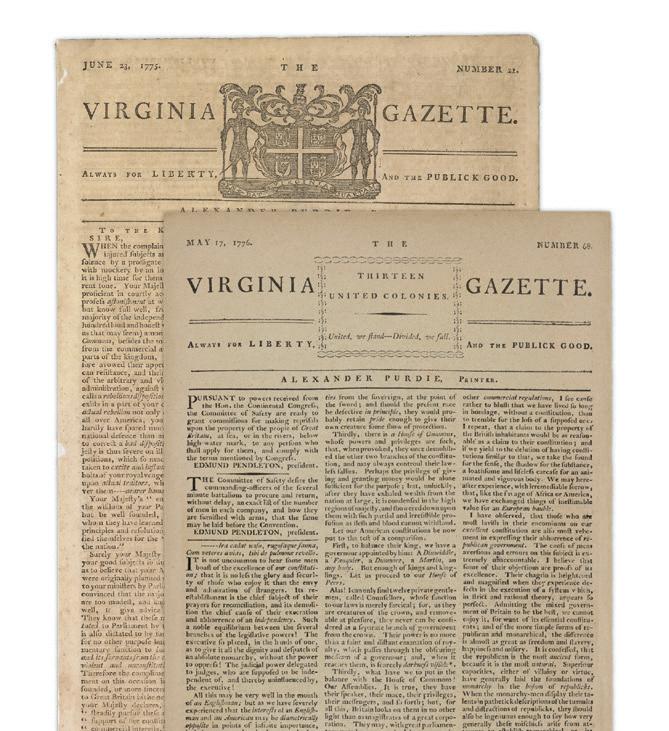
Hancock’s printed signature as president of the Continental Congress.
Printers in London would use this same strategy weeks later to both shorten the length of the declaration and, in the process, delegitimize the list of grievances about King George III as simply repeating the Continental Congress’ earlier complaints. Purdie’s reasoning was very different. He was a fervent supporter of independence. In May 1776, after the Virginia Convention passed the resolutions that resulted in the Declaration of Independence, Articles of Confederation and Model Treaty, Purdie removed the royal coat of arms of Virginia from the masthead of his newspaper and inserted a new design: “THIRTEEN UNITED COLONIES” and “United, we stand Divided, we fall.” Clearly, Purdie celebrated independence he just did not have the room to print the full declaration.
Purdie’s decision to highlight the conclusion of the Declaration of Independence made sense in the context of 1776. The final sentences marked the essential transition from dependent British colonies to the independent United States of America. That was the breaking news that people in Williamsburg needed to know. So instead of reading “We hold these truths to be self-evident,” they read “these United Colonies are, and of Right ought to be Free and Independent States; that they are Absolved from all Allegiance to the British Crown, and that all political connection between them and the State of Great Britain, is and ought to be totally dissolved.”
Purdie’s source may have been one of John Dunlap’s broadsides, the postersized sheets printed by order of the Continental Congress on the night of July 4. Dunlap was the official printer to the Congress. Another possibility is Dunlap’s Pennsylvania Packet, his weekly newspaper. Dunlap featured
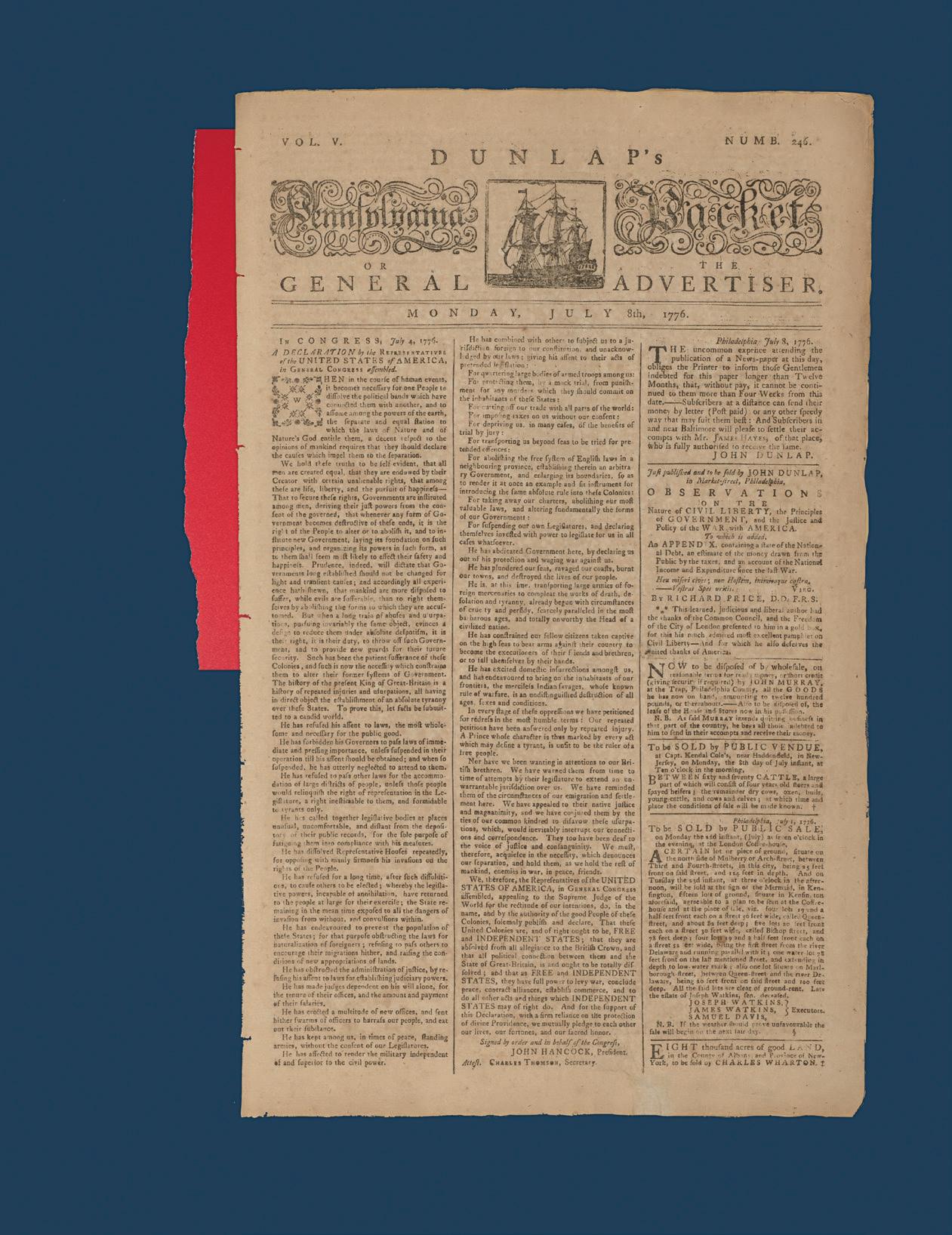
The July 8, 1776, edition
Pennsylvania
printed the Declaration of Independence on its front page.
the declaration on the front page of the July 8 issue and also included a notice that “THIS DAY, at Twelve o’clock, the DECLARATION of INDEPENDENCE, will be PROCLAIMED at the STATEHOUSE” in Philadelphia. This statement was reprinted in Purdie’s Virginia Gazette on July 19 just before the extract from the declaration.
The next day, July 20, Dixon and Hunter printed the full Declaration of Independence on the second page of their Virginia Gazette. That same day irrespective of the printers’ work already in progress the privy council in Williamsburg ordered the printers in town to publish the declaration in their respective Virginia Gazette s. Purdie printed the council’s instructions on the front page of his newspaper on July 26, followed by the full declaration, which looks as though Purdie printed the declaration because of the council’s order. But, of course, he had already told his readers to expect the full declaration to be in that week’s issue. On July 27, having already fulfilled the council’s order, Dixon and Hunter included a reminder to their readers that “The Declaration of Independence may be seen at full length in our gazette of the 20th instant.”
The privy council’s July 20 order also called for the sheriff of each county in the commonwealth to proclaim the Dec-
laration of Independence at the county courthouse. The timing of these public readings depended on how long it took for both the council’s instructions and copies of the declaration to reach the different counties. The first reading was, logically, in Williamsburg, on July 25. As described in Purdie’s Virginia Gazette, the declaration was “solemnly proclaimed at the Capitol, the Courthouse, and the Palace, amidst the acclamations of the people, accompanied by firing of cannon and musketry, the several regiments of continental troops having been paraded on that solemnity.” The account in Dixon and Hunter’s newspaper similarly noted “universal applause, under a discharge of cannon, firing of small arms, illuminations in the evening.”
The celebration in Williamsburg mirrored other communities’ reactions to the news of independence. In town after town in Virginia and elsewhere, crowds gathered to hear and respond to the declaration. As reported by Dixon and Hunter, “near 1000 people” were present for the reading at the Henrico County courthouse in Richmond on Aug. 5. The “satisfaction visible in every countenance” was evidence of the people’s “determination to support” the declaration “with their lives and fortunes,” echoing the final phrase of the text.

THE DECLARATION WAS “SOLEMNLY PROCLAIMED AT THE CAPITOL, THE COURTHOUSE, AND THE PALACE.”
The numbers of people who read the Declaration of Independence in newspapers or listened as it was read aloud at public gatherings are lost to history, and limited accounts survive that speak to that experience of learning about the declaration for the first time. Nevertheless, despite claims of “universal” praise for independence, many people were not feeling particularly celebratory in the summer of 1776. Some Virginians wanted to remain loyal to the king, including Anglican ministers who were struggling with the Virginia Convention’s decision to alter the Book of Common Prayer by replacing prayers for the king and his family with prayers for the magistrates of the commonwealth.
The public readings also could have reached people who were in custody including recaptured enslaved people as well as women, servants, enslaved laborers and others whose rights were conscripted, and it is fair to consider how they might have wondered what impact the declaration would have on them.
Within the Virginia Gazette s, the declaration shared the same pages as accounts from Gwynn’s Island, where Lord Dunmore had abandoned many sick and dying men, women and children who had tried to escape slavery only to perish from the neglect of the person who had promised freedom if they would join the British. The activities of Lord Dunmore and “his piratical crew ” took up two full columns in Purdie’s Virginia Gazette on July 19 when he could spare only half a column for his excerpt from the declaration.
When the Declaration of Independence was news, it needed to be communicated to the people. In Colonial Williamsburg’s Historic Area, it is easy to imagine the walk from the Capitol to the printing offices in the pivotal summer
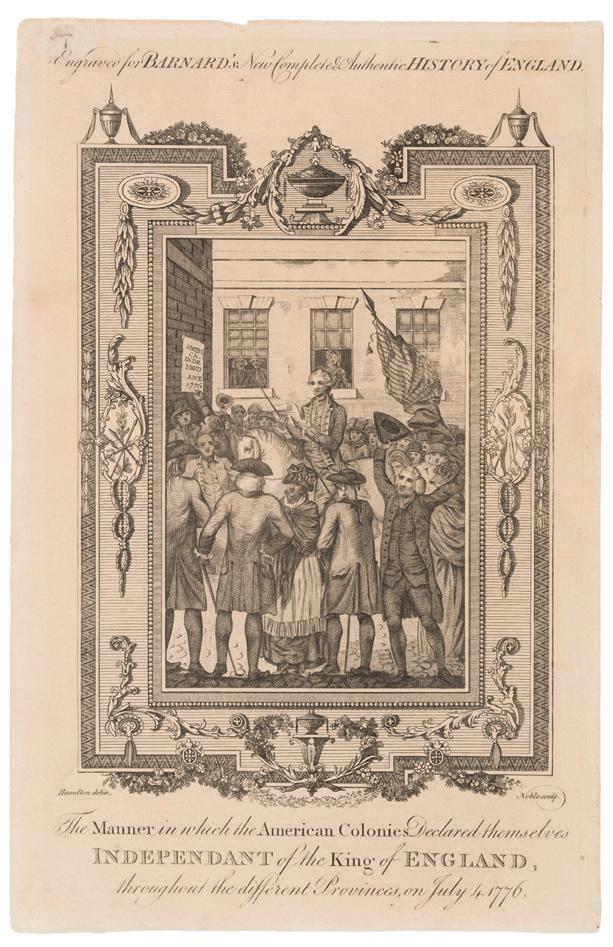
of 1776. Anyone taking that walk today can consider the connection between the decisions made by men in positions of political power and the printed broadsides and newspapers that communicated those decisions to the public. Consider too what it meant to people in Williamsburg when they first learned the news in midJuly 1776 before anyone knew if the independent United States would survive the summer, let alone 250 years.

THE ROYAL GOVERNOR HOPED GWYNN’S ISLAND WOULD PROVIDE REFUGE. IT DID NOT.
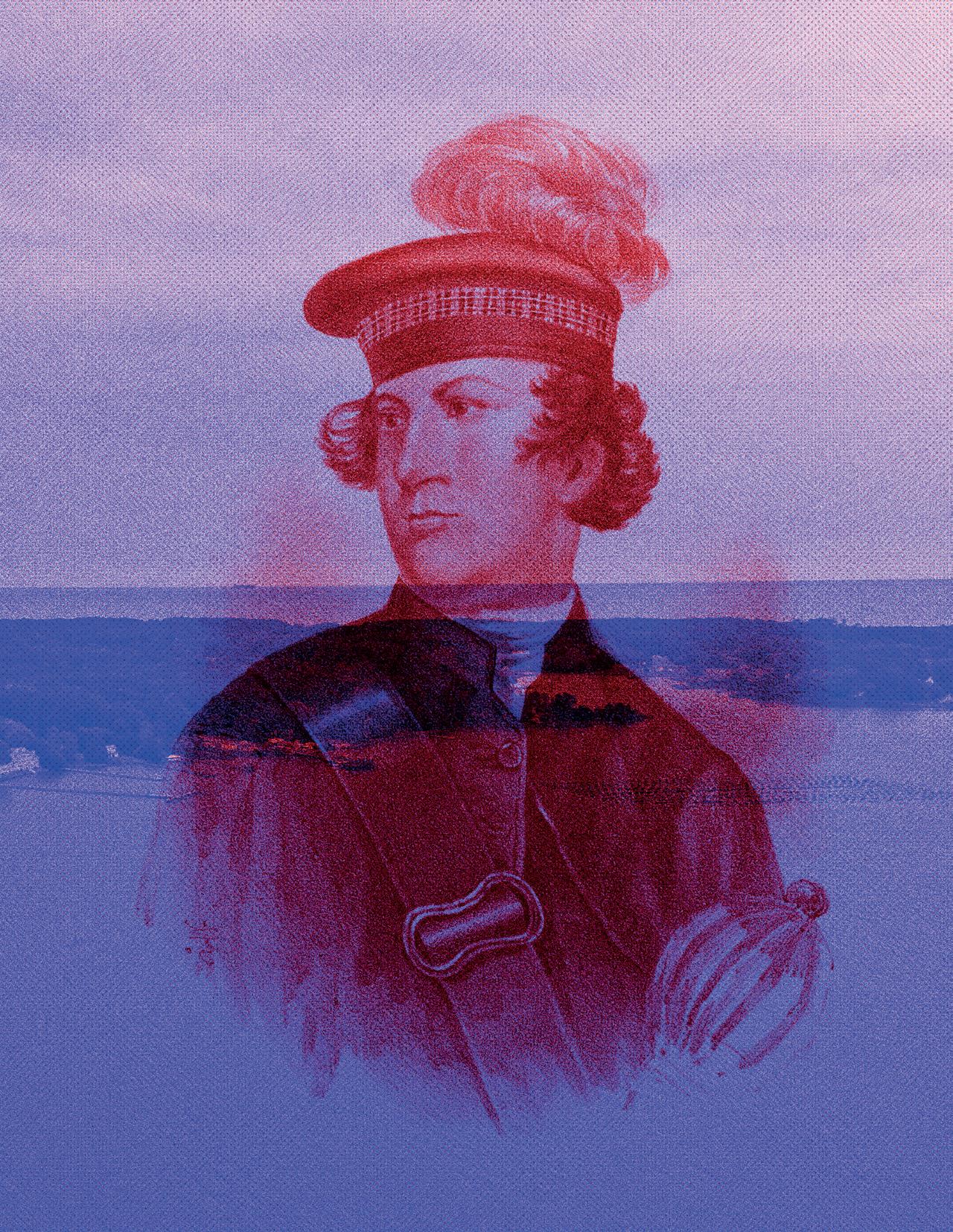
BY MICHAEL CECERE

Atremendous sense of relief swept over Virginia’s royal governor, John Murray, the Fourth Earl of Dunmore, when his flotilla of nearly 100 ships sailed within sight of Gwynn’s Island 250 years ago, in late May 1776. The flat, liver-shaped island just off Virginia’s mainland in the Chesapeake Bay was supposed to offer his beleaguered force a place to rest. Instead it would be his last foothold in Virginia.
Dunmore’s force consisted of three warships, hundreds of British soldiers and sailors, scores of white loyalists and their families, and several hundred Black refugees who had fled their enslavement the previous November.
This crew had spent the last five months crammed aboard vessels anchored off the ruins of Norfolk and on a slender neck of land outside Portsmouth. It had been a miserable and deadly winter. Illness had ravaged their numbers to the point, Dunmore informed London, that, were it not for his loyalty to the Crown, “no earthly consideration could induce me to continue in this wretched State….”
Dunmore’s tribulations had begun a year earlier. In April 1775, British sailors under his direction seized hundreds of pounds of gunpowder from the powder magazine in Williamsburg. Six weeks of turmoil ensued, culminating with him fleeing the capital and seeking refuge aboard a British warship in the York River.
Dunmore sailed to Norfolk and settled aboard a ship dubbed the Dunmore. Determined to restore royal authority in the colony, he sent landing parties to seize weapons and gunpowder. An attempt to burn Hampton at the end of October, however, was repulsed by Virginian troops, marking the first battle of the Revolutionary War in Virginia.
Three weeks later his British regulars routed the Princess Anne militia in a skirmish at Kemp’s Landing. Flushed with confidence, Dunmore issued a proclamation declaring martial law in the colony and offering freedom to any enslaved man of a rebel who fought for him. Hundreds answered Dunmore’s call, and he labeled them his Ethiopian troops.
Although Dunmore didn’t have the numbers to attack Williamsburg, he felt sure he could maintain a base of operation in loyalist-leaning Norfolk. However, a crushing defeat at Great Bridge on Dec. 9, 1775, forced Dunmore to retreat to a flotilla anchored in the Elizabeth River.
By February, disease ran so rampant among Dunmore’s floating town he had to secure a narrow neck of land adjacent to Portsmouth to allow the sick to recover ashore. Coupled with the lack of support from Britain, Dunmore could do little but raid Virginia’s shoreline for provisions. His frustration turned to alarm when, in May, reports reached him that rebel cannon were en route to bombard his encampment and ships.
GWYNN’S ISLAND
At the same time, Dunmore was advised that all of his Black troops, the bulk of his infantry, needed to be inoculated for smallpox. Inoculation would incapacitate them for nearly a month, diminishing Dunmore’s force to the point that there would be little chance of repelling an attack.
Refusing to abandon Virginia, Dunmore sailed his flotilla to Gwynn’s Island at the mouth of the Piankatank River, anchoring there on May 27. Dunmore had been told this roughly mile-wide, 4-mile-long stretch had adequate water and livestock and, perhaps most importantly, would be easy to defend.
Dunmore had fewer than 200 men fit to fight, and a significant portion of them were British marines only temporarily detached from their ships. This small force began building camps and earthworks, the most important being on a strip of land less than 200 yards from the mainland. Dunmore predicted their work, in addition to their naval firepower, “will secure us from any Insult from our Enemy.”
Virginia’s leaders in Williamsburg rushed troops toward Gwynn’s Island. Capt. Thomas Posey of the 7th Virginia Regiment was one of the first officers to arrive, and by the start of June hundreds of armed Virginians lined the opposite shore, facing off
A detail of the Fry-Jefferson map of Virginia shows Gwynn’s Island off the coast of Gloucester County. It is now part of Mathews County, which was formed in 1791.
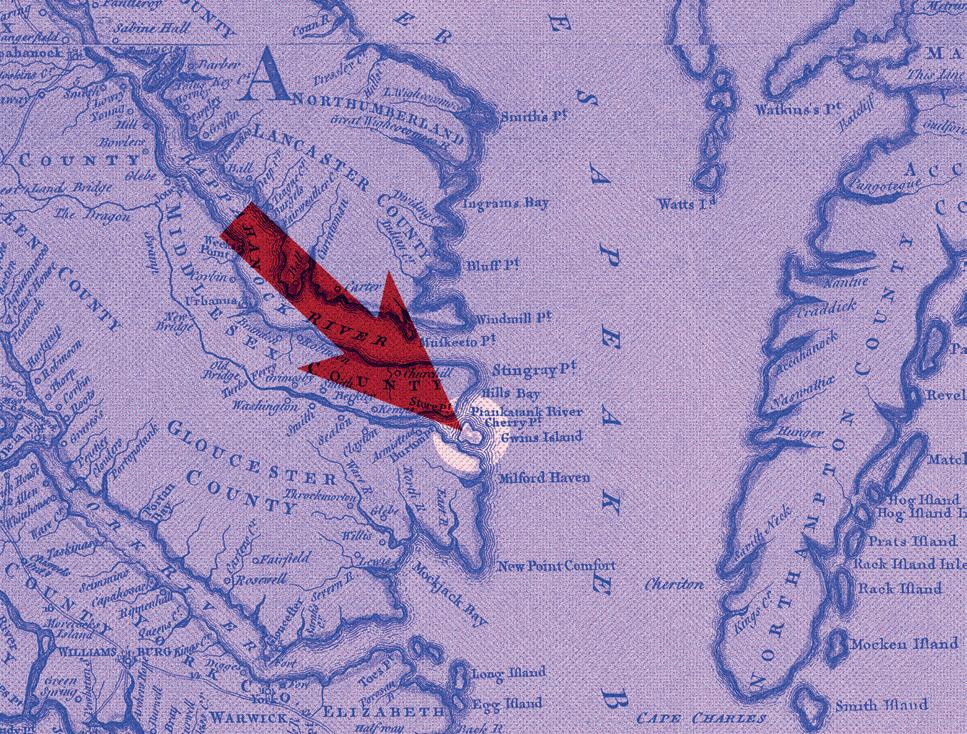
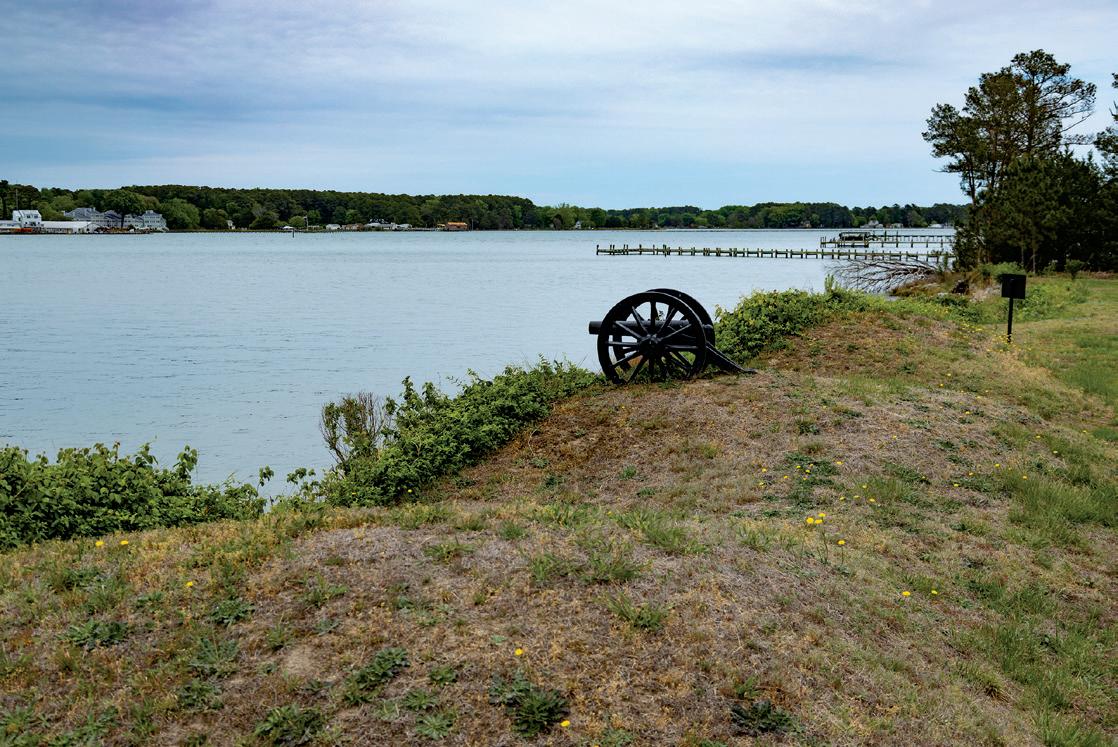
with Dunmore’s small force. Both sides strengthened their earthworks over the course of June, occasionally inflicting casualties on each other in sharp skirmishes. Several small vessels, called “tenders,” armed with a few small cannons and swivel guns, guarded the narrow channel that separated the two sides.
Although Dunmore and his force seemed secure from attack, they had no defense from disease. Scores of enslaved men and women and over 100 loyalists from Maryland joined Dunmore in June, but their arrival was offset by widespread illness and death. Dunmore reported that, “I have done every thing in my power to get the better of [this fever] but...all our efforts have hitherto proved ineffectual.”
By late June, he informed London that “Fever...has proved very Malignant...and has carried off an incredible Number of our People, especially the Blacks, had it not been for this horrid disorder, I am Satisfied I should have had two thousand Blacks, with whom I should have had no doubt of penetrating into the heart of the Colony.”
Dunmore’s losses were observed by his opponents on the mainland. “A Great Mortality among the Enemy, some white and black, are discovered floating every day,” reported Gen. Andrew Lewis.
Across the water on the mainland, hundreds of Virginian regulars and militia worked
to complete several earthworks and artillery platforms and move 18- and 9-pound cannons. They finished on July 8 and the following morning Lewis ordered them to cut embrasures, or gaps, in the earthworks so that the cannons could open fire. He described the patriot attack that followed to Richard Henry Lee:
At eight ‘OClock, the Fleet lay in a Range that suited our Purpose. We instantly opened our Ambrasures which to that Moment were a secret to the Enemy. The Dunmore lay near and very fair, when she was saluted by our eighteen Pounders, our other Battery of five Guns was opened on them at the same Time. Their Amasement and Confusion was beyond Description. The Dunmore waited to fire only five Guns. She slipt both her cables and was towed off by three Boats, both Batteries playing on her all the Time of the Retreat. She is prodigiously shattered, her [Cabin] tore to Pieces & several Men Killed. The Shot that missed her could not fail taking Place in some of the other Vessels....The whole Fleet were in Confusion and moved to a safer Distance. We are told all the armed Vessels and several others lost Men.
Lord Dunmore was aboard the Dunmore and described the attack in a letter to Lord George Germain, who was Britain’s secretary of state to the American colonies, confirming much of Lewis’ account:
We were so near one of their Batteries...that they Struck the Ship every Shott. I got our raw and weak Crew to fire a few Shott at them, but I soon perceived that our Six Pounders made no impression on their Batteries, our Boatswain being killed and several of the People Wounded, I found it impracticable to make them stand any longer to their Guns, we were therefore obliged to cut our Cable.
The Virginians also took aim at Dunmore’s encampment, knocking down tents and creating confusion. The patriot onslaught lasted nearly two hours and resumed again in the early afternoon for several more hours.
Given the amount of ordnance fired, casualties were relatively light, though several sailors were killed and wounded, including the boatswain aboard the Dunmore. However, it is not clear if any troops or civilians on the island were killed or wounded in the attack.



Details of the Battle of Gwynn’s Island were reported in the July 20, 1776, edition of the Virginia Gazette. The report goes into detail about the poor condition of many of the British forces who were left behind, including Black soldiers who had succumbed to disease.
The patriots suffered just one casualty, a Frenchman, Capt. Dohicky Arundel, who was killed when his experimental wooden mortar exploded upon its first and only shot. Although the patriot attack sparked panic among Dunmore’s force, the Virginians were not able to cross and exploit the situation until the next morning.
When the sun rose on July 10, the bulk of Dunmore’s force had fled to ships anchored off the island.
Undeterred, Lt. Col. Alexander McClannahan of the 7th Virginia led 200 troops across the water in canoes. One observer recalled: “They [had] removed all their tents except one, their cannon except one, and all their stores. There were three tenders in the haven, which attempted to prevent our passage. Their works were still manned as if they meant to dispute their ground, but as soon as our soldiers putt off in a few canoes, they retreated precipitately to their ships. The tenders fell into our hands.”
Posey crossed to the island with McClannahan and noted in his diary that “no fighting ensued except a few shot. By one oclock the whole of the enemy had evacuated and embarked.”
Posey then added he was shocked by the state of those who were left behind:
I cannot help observing that I never saw more distress in my life, than what I found among some of the poor deluded Negroes which they could not take time, or did not chuse to carry off with them, they being sick. Those that I saw, some were dying, and many calling out for help; and throughout the whole Island we found them strew’d about, many of them torn to pieces by wild beasts – great numbers of the bodies having never been buried.
A similar account was printed in Alexander Purdie’s Virginia Gazette in mid-July:
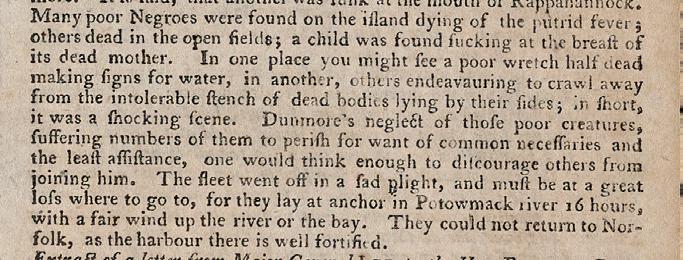
On our arrival, we found the enemy had evacuated the place with the greatest precipitation, and were struck with horror at the number of dead bodies, in a state of putrefaction, strewed all the way from their battery to Cherry point, about two miles in length, without a shovelful of earth upon them; others gasping for life.... By the small-pox, and other malignant disorders which have raged on board the fleet for many months past, it is clear they have lost since their arrival at Gwynn’s island, near 500 souls. I myself counted 130 graves (or rather holes, loosely covered over with earth) close together, many of them large enough to hold a corporal’s guard.... Many were burnt alive in brush huts, which, in their confusion, had got on fire. In short, such a scene of misery, distress, and cruelty my eyes never beheld.
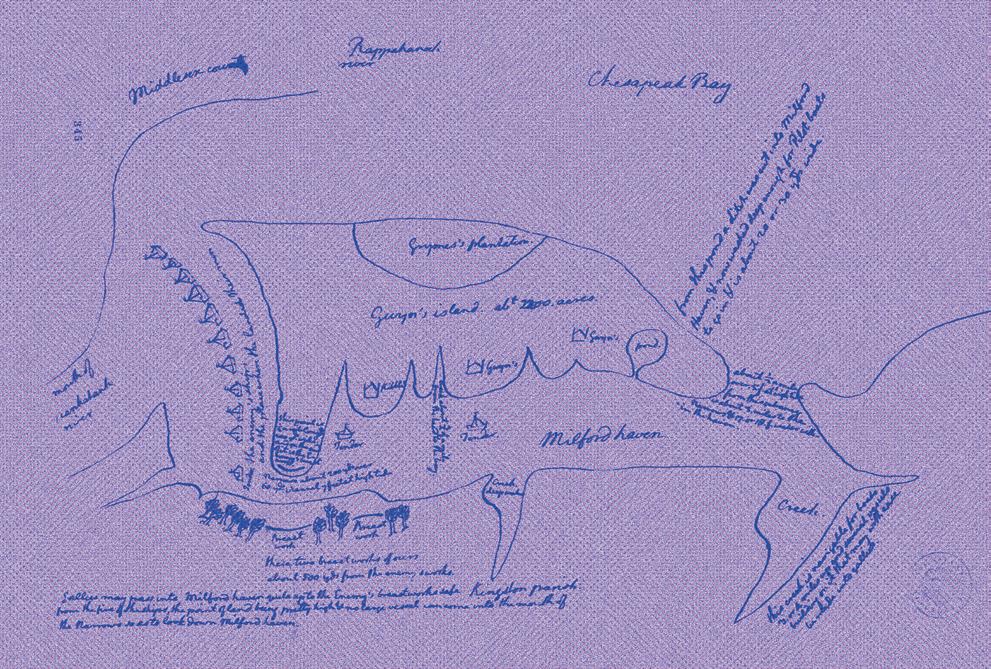
Dunmore’s flotilla sailed up the bay to the Potomac River and anchored near St. George’s Island. He was unsure how he could remain in Virginia, telling Lord Germain in London:
I know not where we can go with our present force to make a Harbour of any tolerable safety, for we no sooner appear off the Land, than Signals are made from it, when the Coast is covered with Men, and if we come to an Anchor within Cannon Shott of either Shore, Guns are immediately brought to bear upon us, which is not in the power of the Ships to dislodge, as the Sholes will not permit them to get near enough.
Disease made the decision for him. Acknowledging that “there was not a ship in the fleet that did not throw one, two, three, or more dead overboard every night,” Dunmore set sail for New York to rendezvous with an enormous British invasion force that had recently arrived. However, once there, he was denied a military commission and left for England never again to return to Virginia.
The remaining members of the Ethiopian Regiment were eventually added to a corps of Black pioneers. They retained their freedom but not their weapons and served the British army as laborers. After the war, many fled elsewhere, including Canada, while others were seized and returned to their enslavers.
The departure of Lord Dunmore from Gwynn’s Island, and ultimately Virginia, enabled the Old Dominion to send its remaining troops north to reinforce Gen. George Washington. These regiments played a vital role in winning the battles of Trenton and Princeton, thus boosting American morale at a critical moment in the war.
Thomas Jefferson drew this sketch of Gwynn’s Island, detailing the positions of British and Virginia forces as well as the surrounding area.
Cecere is a retired history teacher who resides in Williamsburg. He is the author of 25 books including March to Independence: The American Revolution in the Southern Colonies, 1775-1776.
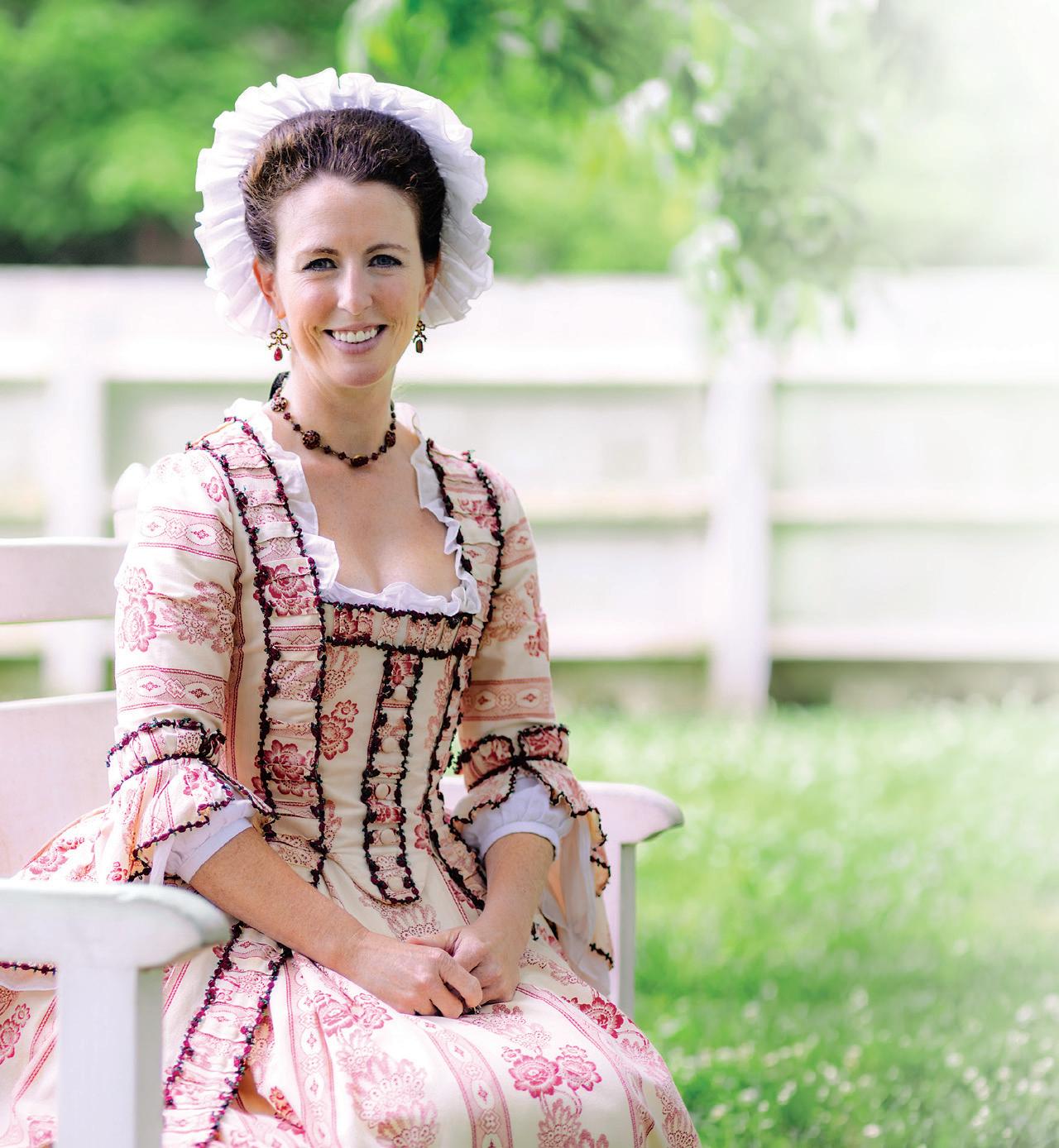
In celebration of the nation’s 250th and The Colonial Williamsburg Foundation’s 100th anniversaries, we encourage you to make a gift that will impact future generations by designating the Foundation as a beneficiary in your Will. Friends who share this information with us for the first time will receive a commemorative challenge coin that honors 100 years of the Foundation. To learn more, please contact the Office of Gift Planning at 1-888-293-1776 or legacy@cwf.org

A traditional summertime treat that can be enjoyed many ways
BY ANGELA TAORMINA
PHOTOGRAPHY BY
BRIAN NEWSON

Choose a variety
PLANTING
Plant trees in full sun (6-8 hours) in well-drained and fertile soil.
TIP
Most peach trees are self-pollinating, but having another peach tree of a different variety will increase fruit set.
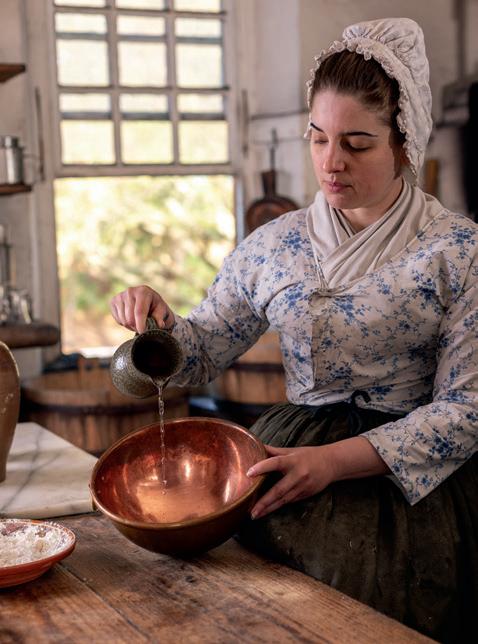
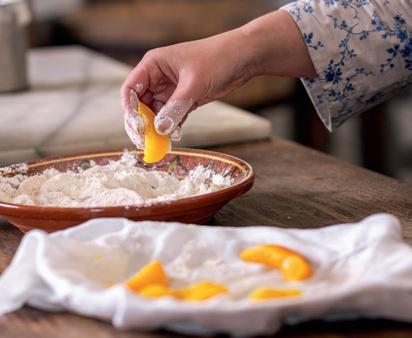
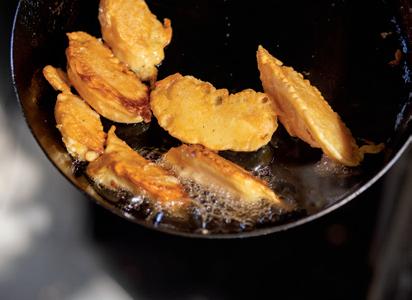
THE EARLIEST ENGLISH settlers who landed in Virginia may have been surprised to find the familiar downy peach flourishing in their new home and a staple of the Indigenous diet.
Spanish explorers had carried peach seeds from Europe to Mexico and Florida in the 16th century, and peaches thrived throughout the Americas. A member of the rose family, the peach is thought to have been domesticated in China. From there it made its way along the Silk Road to Rome in the 1st century by way of Persia and Armenia.
Offering hospitable conditions, many Virginia gardens from modest to grand included peach trees that fed both people and hogs. Virginia Gazette s from 1736 to
1780 included 380 advertisements for fruit trees, 244 of which mentioned peaches.
John Custis included peach trees in his extensive garden, importing varieties from England through his correspondence with naturalist Peter Collinson. Records indicate that between 1736 and 1743 Custis cultivated three English varieties: Catherine, nutmeg and double blossom. It is possible that Custis received, in addition to seeds, scion stock from England since techniques for grafting tender shoots onto established rootstocks had been well established.
A high-status garden such as Custis’ would have used the espalier method, a practice for training fruit
trees to grow horizontally against a fence that maximizes growing space while adding aesthetic organization to the garden.
A ripe, nectar-filled fruit eaten out of hand was and is a longawaited summer joy. But keep in mind that ripe peaches bruise easily and will last only a few days even if refrigerated. Eighteenth-century kitchens had many methods for preserving peaches, including jams, pickling with mustard, drying sugared slices or simply boiling in simple syrup and then spiking with brandy. In addition, using peaches and their pits to flavor spirits has a long history.
Abbey Shoaf, journeyman supervisor for Historic Foodways,
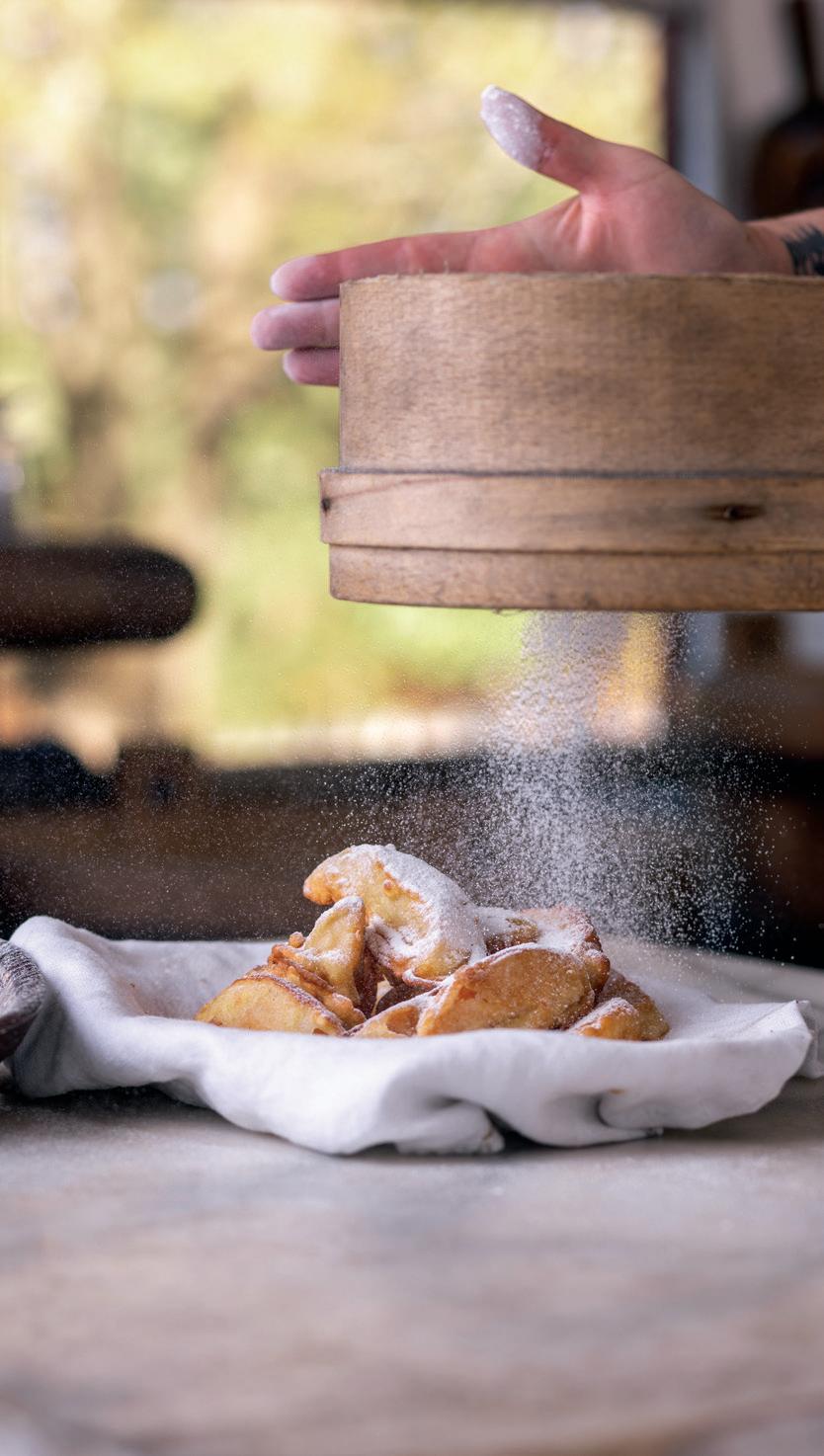
Adapted from The French Family Cook by Joseph Menon (London, 1793), originally published as La Cuisinière Bourgeoise (Paris, 1746)
SERVES 4-6
3–4 ripe peaches, peeled, pitted and sliced (or one 30-ounce can peaches, drained) brandy or sherry for soaking (optional)
2 cups all-purpose flour, divided 2 eggs
1 cup white wine
1/4 –1/2 cup granulated sugar spices (e.g., cinnamon, nutmeg, allspice, ginger) to taste lard or canola oil for frying granulated or confectioners’ sugar (optional)
1. In a medium bowl, soak the peach slices in brandy or sherry for 20 –30 minutes, if using. Remove the peach slices from the liquid and pat dry on paper towels.
2. Spread 3/4 cup flour onto a dinner plate and dredge the peach slices in the flour. Let them rest in the flour while making the batter.
3. In a large bowl, whisk together the eggs, white wine, sugar to taste and spices. Add the remaining flour to the wine mixture by spoonfuls, mixing lightly after each addition, until the batter becomes the texture of a thick pancake batter. Do not overmix.
4. In a sauté pan over high heat, heat an inch of lard or oil until a bit of batter dropped into it bubbles and crackles. Reduce the heat to medium.
5. Using tongs or a fork, drop or dip the floured peach slices one by one into the batter, coating fully, and then carefully place in the hot oil. Do not crowd the pan. Fry, flipping once, until crisp and golden brown, 2–3 minutes per side.
6. Remove the fried slices using a slotted spoon or strainer ladle and drain on paper towels.
7. Allow the fritters to rest briefly; if desired, sprinkle sugar over fritters while still warm and serve.

shared a peach recipe that can be prepared with ripe peaches or canned fruit in the offseason. This recipe also works well with other seasonal fruits such as apples, oranges and strawberries.
WILLIAMSBURG INN EXECUTIVE Chef Julianne Gutierrez decided to tread the fine line between sweet and savory in a refreshing chilled soup she developed to showcase the versatility of the summer treat. As with the
fritters, this recipe can be made year-round by taking advantage of a preservation technology unavailable in the 18th century frozen fruit.
Harder to find, white-fleshed peaches are the darling of many chefs, but Chef Gutierrez prefers the more common yellow-fleshed cultivars, which she finds sweeter. She also suggests seeking out the distinctive flattened variety known as donut peaches.
SERVES 6
4 cups peeled and chopped ripe peaches (frozen peaches can be substituted)
½ cup chopped English cucumber
½ cup dried apricots (rehydrated briefly with hot water and squeezed dry)
1 13.5-ounce can coconut milk
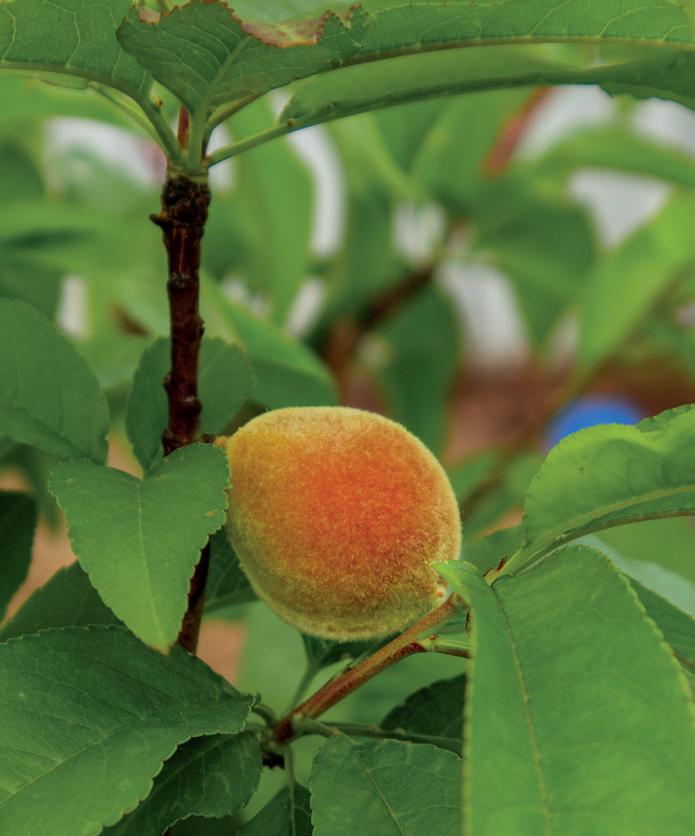
3 sprigs thyme, stripped
3 leaves mint
½ cup white balsamic vinegar
2 tablespoons honey
1 tablespoon extra-virgin olive oil
For garnish finely diced cucumber candied ginger goat cheese crumbles
1. In a large bowl, combine all ingredients and allow to marinate in the refrigerator for about 2 hours.
2. Transfer to a blender or food processor and blend until smooth.
3. Transfer to a storage container and chill thoroughly (overnight if possible).
4. Serve chilled garnished with diced cucumber, candied ginger and crumbled goat cheese.
Angela Taormina is a freelance editor living in Norge, Virginia.
By PETE VAN VLEET
elegates to the Fifth Virginia Convention made it clear when they separated from Britain: Now that Virginia was no longer a colony, it was a commonwealth.
George Mason sprinkled the word throughout Virginia’s first constitution. Most of the other colonies called themselves states. In 1776, only Pennsylvania and Virginia decided to be commonwealths, with Massachusetts joining the club in 1780 and Kentucky in 1792.
“The word ‘commonwealth,’” said Brent Tarter, historian and retired senior editor for the Library of Virginia, “signified a government of the whole body politic without a king and for the benefit of the common weal, or common good.”
For Virginia, the decision to call itself a commonwealth flowed from the 1776 Virginia Declaration of Rights: “That all men are by nature equally free and independent and have certain inherent rights, of which, when they enter into a state of society, they cannot, by any compact,
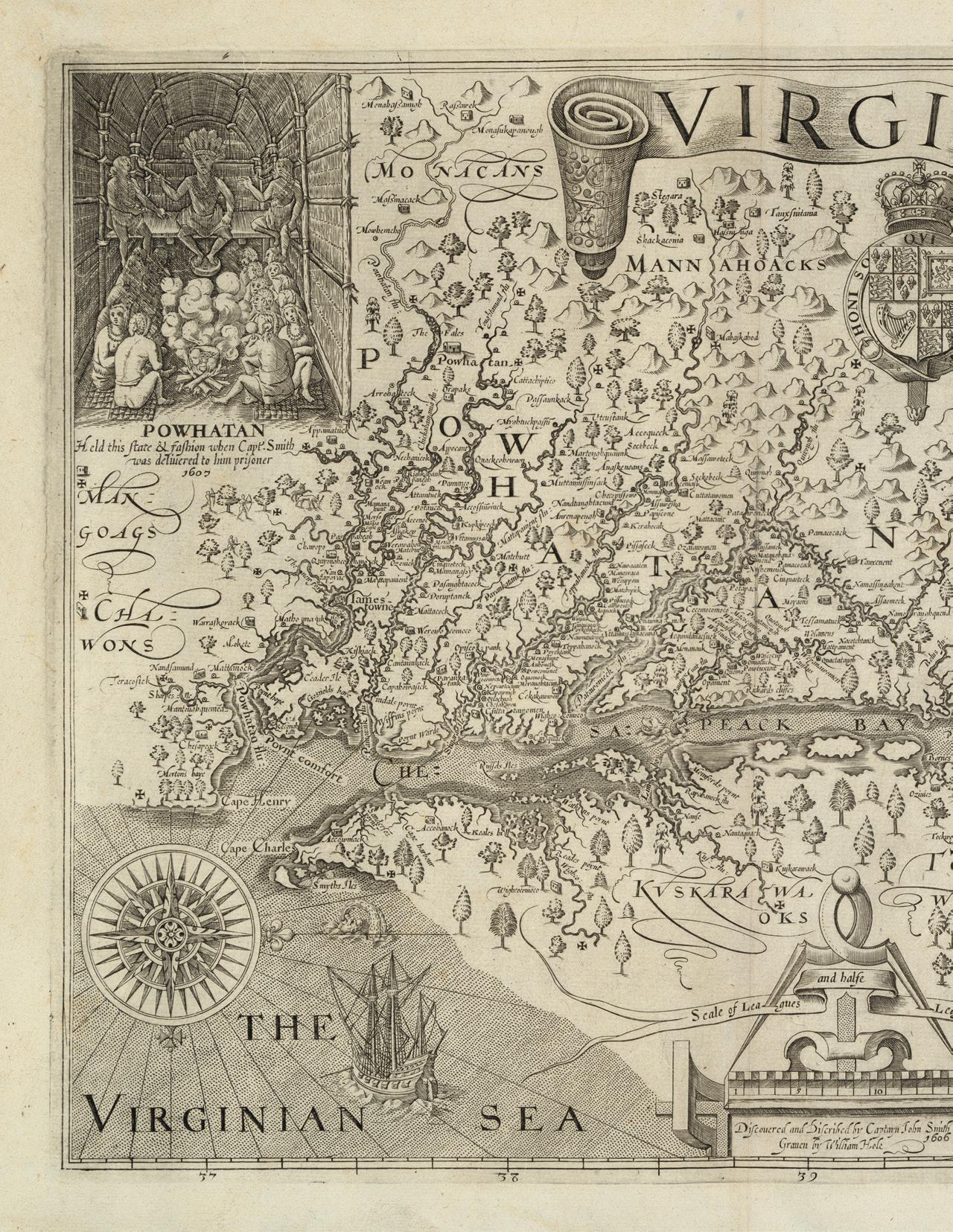
deprive or divest their posterity.”
While Virginia was the first in the U.S. to call itself a commonwealth, it did not invent the term.
‘Commonwealth’ emerged in the English language partly as a way to translate the Latin term Res Publica, which literally means ‘public (or common) wealth’ but in Latin came to refer to the Roman body politic,” said Mitch Brown, assistant professor of classical studies at William & Mary.
Brown said the word “commonwealth” became a common way to translate the Latin phrase and would have been the go-to term for the Founders, who were themselves students of the classics.
“I imagine the classically inclined Virginia Founding Fathers, such as George Wythe and Thomas Jefferson, still closely associated the term ‘commonwealth’ with the Latin term for republic and preferred that term as promotors of republicanism in the New World,” he said.
The Founders could have also been following more recent precedent set in
England a few generations before them.
“The delegates in Williamsburg may have had in mind Oliver Cromwell’s Puritan Commonwealth that had governed England without a king from 1649 to 1660,” Tarter said. “They may also have selected the word as accurately descriptive or even looked back to the time of the founding of the colony when the word was widely understood to mean a lawful, righteous government that protected the legitimate rights of all parties.”
A.E. Dick Howard, a former University of Virginia law professor, put it succinctly: “A commonwealth is a state in which supreme authority is vested in the people.”
However, that authority, as well as laws and rights, do not change based on what Virginia calls itself. “As a matter of federal constitutional law, it makes no difference whether a state chooses to call itself a state or a commonwealth,” Howard said. “States, whatever their designation, have the same status in the federal union.”
Still, as Jefferson himself noted, there’s a bit of panache in being a commonwealth.
“The term ‘commonwealth’ distinguish[es] the stile of the three great members of our union (Massachusets, Pennsylvania, & Virginia) from that of the smaller ones, which call themselves ‘states,’” Jefferson wrote to Wythe in 1791.
Virginia had a chance to change from a commonwealth to a state. In 1968 Gov. Mills Godwin Jr. appointed a Commission on Constitutional Revision to propose replacing the 1902 constitution. Howard was the executive director of that commission, which reviewed the history of
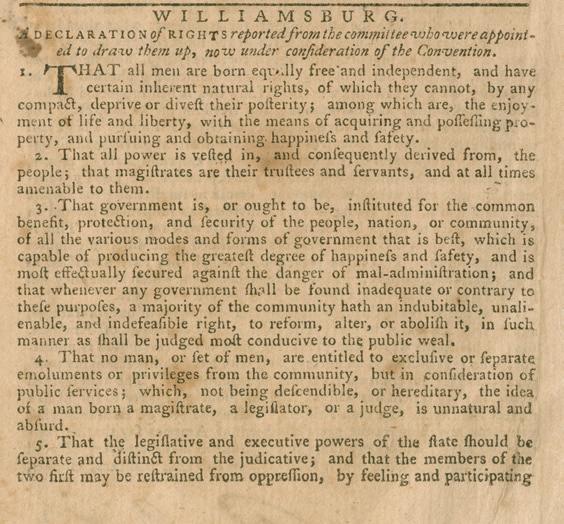
Virginia’s constitutions and the political theory underlining them.
“I specifically recommended that Virginia should retain its use of ‘commonwealth’ rather than ‘state,’” he said. “In my judgment, constitutional history supported this conclusion. But there was a more profound reason for recognizing Virginia as a commonwealth. A central question in constitutional design is the question: Who belongs? Who is considered to be part of the political community? Virginia’s 1776 Declaration of Rights points to inclusiveness to a broad conception of the political community.
“I doubt if the average person spends much time thinking about why Virginia is a commonwealth,” Howard said. “But I, for one, am glad we have chosen the path that we have. It is a proud tradition.”
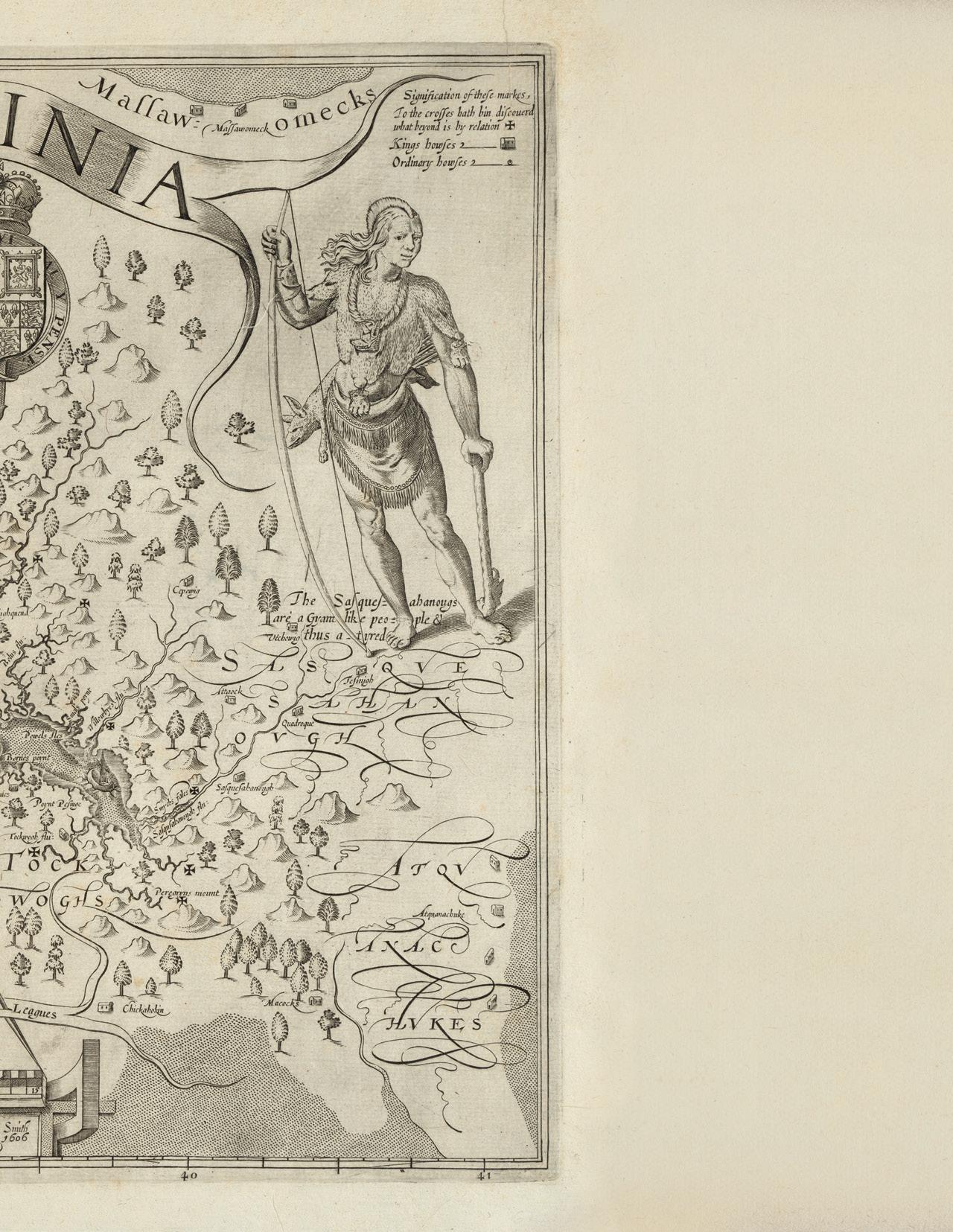
(Above) The decision to label Virginia a commonwealth as opposed to a state flowed from the ideals expressed in the 1776 Virginia Declaration of Rights. (Underlay) Capt. John Smith’s 1606 map of Virginia was the first detailed depiction of the Chesapeake region and was in use for several decades after being published.

THOMAS JEFFERSON
“An expression of the american mind”
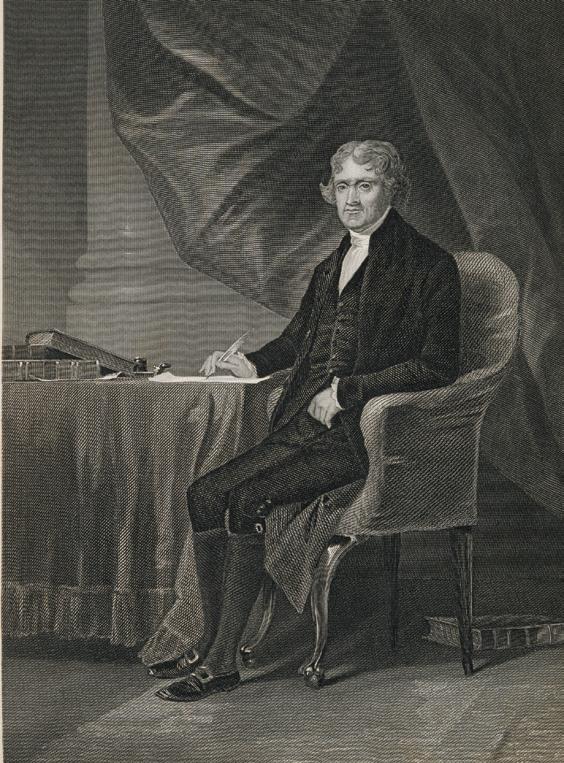
IT TOOK THOMAS Jefferson just a day or two to write the words that would change the course of history. Clearly, he did not start from scratch.
As he sat down in Philadelphia to write the Declaration of Independence, Jefferson probably had a copy
of Virginia’s Declaration of Rights. That document was drafted by George Mason for the Fifth Virginia Convention, which adopted it in Williamsburg on June 12, 1776.
The similarities between the two declarations are striking.
Mason’s draft opened with, “That all men are born equally free and independent, and have certain inherent natural rights, of which they cannot, by any compact, deprive or divest their posterity; among which are the enjoyment of life and liberty, with the means of acquiring and possessing property, and pursuing and obtaining happiness and safety.”
By comparison, Jefferson’s rough draft stated, “That all men are created equal and independant, that from that equal creation they derive rights inherent & inalienable, among which are the preservation of life & liberty, & the pursuit of happiness.”
Jefferson also drew from some of his own previous writings, including his 1774 Summary View of the Rights of British America. He also sourced the writings of 17th-century English writers such as John Milton, Algernon Sidney and, above all, John Locke. Jefferson may also have been inspired by Scottish philosophers. Jefferson readily admitted that he “did not consider it as
any part of my charge to invent new ideas altogether.” His purpose, he explained in an 1825 letter to Henry Lee, was “not to find out new principles, or new arguments, never before thought of . . . but to place before mankind . . . terms so plain and firm, as to command their assent.”
Some of the Declaration of Independence’s words belonged to other members of Congress.
Jefferson’s rough draft declared, “We hold these truths to be sacred & undeniable.” Benjamin Franklin, with whom Jefferson shared the draft, amended the descriptor of those truths to “self-evident.” The Continental Congress made 86 changes and cut about a quarter of Jefferson’s text, including passages denouncing the slave trade.
Jefferson found the editing process agonizing. Franklin tried to console him by telling him a story about a hatter who wrote copy for a sign advertising his store and then watched his friends edit it down to just his name and a picture of a hat. But Jefferson was ultimately and rightly proud of the declaration. Its words did “command assent” because they were, as he wrote Lee, “an expression of the american mind.” They included what Walter Isaacson calls the greatest sentence ever written: “We hold these truths to be self-evident, that all men are created equal, that they are endowed by their Creator with certain unalienable Rights, that among these are Life, Liberty and the pursuit of Happiness.”
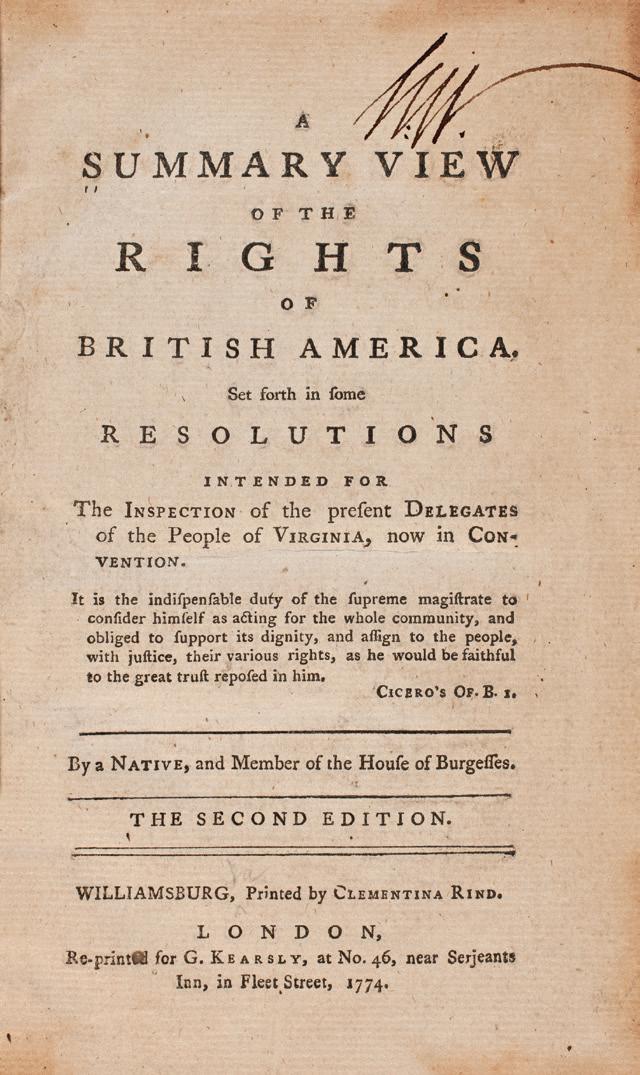
In 1774,

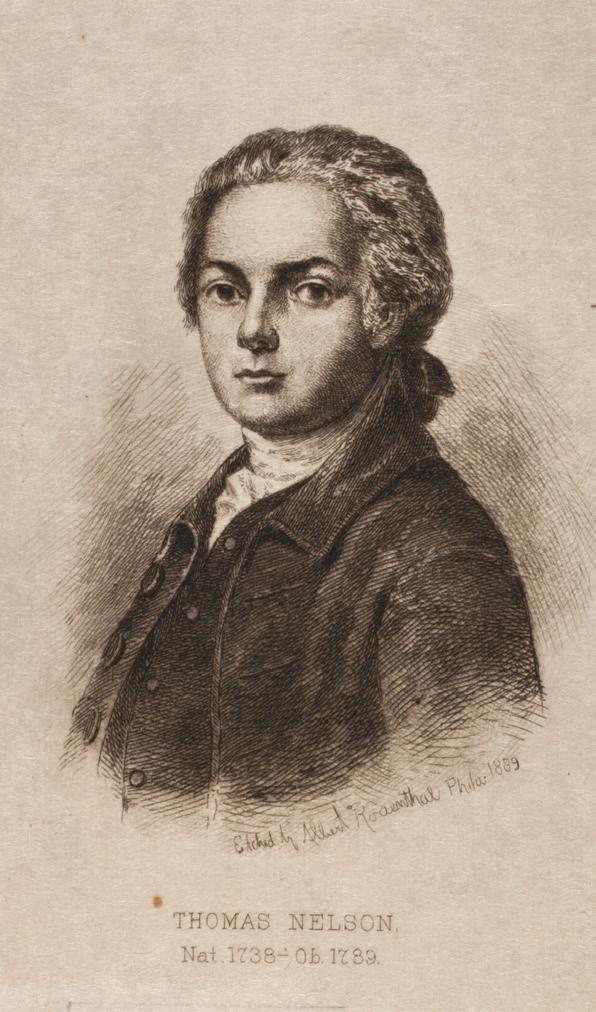
“He had no fears of his own”
THOMAS NELSON JR. was not only a member of the Continental Congress that adopted the Declaration of Independence but also of the Virginia Convention that met in Williamsburg and voted to instruct its delegates in Philadelphia to introduce a motion for independence.
It was Nelson who introduced the motion in Williamsburg, and it was Nelson who carried those instructions from Williamsburg to Philadelphia where Virginia’s Richard Henry Lee then introduced the motion for independence.
Nelson was a strong advocate for independence in the House of Burgesses, to which he was elected in 1774. He continued to advocate for independence during the Fifth Virginia Convention, writing to a fellow delegate, “Since our conversation, yesterday, my thoughts have been sorely employed on the great question, whether independence ought, or ought not, to be immediately declared? Having weighed the arguments on both sides, I am clearly of the opinion that we must, as we value the liberties of America, or even her existence, without a moment’s delay, declare for independence.”
Nelson’s letter concluded “that the spirit of the people, (except a very few in these lower parts, whose little blood has been sucked out by mosquitoes,) cry out for this declaration.” The original of this letter has been lost, but Nelson’s biographer Emory G.
Evans suspected Nelson wrote it to Patrick Henry.
According to Edmund Randolph, who was at the convention, Nelson “affected nothing of oratory, except what ardent feelings might inspire, and characteristic of himself, he had no fears of his own with which to temporize.” He “passed over” others’ concerns about whether Americans could enlist foreign aid and whether they were militarily prepared and “pressed a declaration of independence upon what, with him, were incontrovertible grounds; that we were oppressed; had humbly supplicated redress of grievances, which had been refused with insult; and to return from the battle against the sovereign with the cordiality of subjects was absurd.”
Unlike most of his fellow signers, Nelson served in the military during the Revolution. He continued to do so after he was elected governor of Virginia in 1781, succeeding Jefferson. He used his own considerable funds (he was born into a wealthy Yorktown family) to support the war effort. During the siege of Yorktown, he commanded 3,000 Virginia militia.
According to an oft-told but unproven story, when Gen. George Washington met with his officers during the Battle of Yorktown, Nelson suggested they aim at a large house in town that he suspected British general Lord Cornwallis was using as his headquarters. That house was Nelson’s own. It was damaged during the siege but still stands.
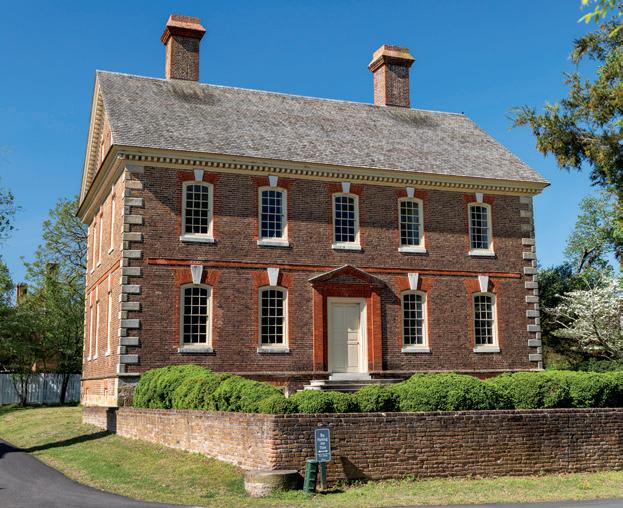
During the siege of Yorktown, he commanded 3,000 Virginia militia.
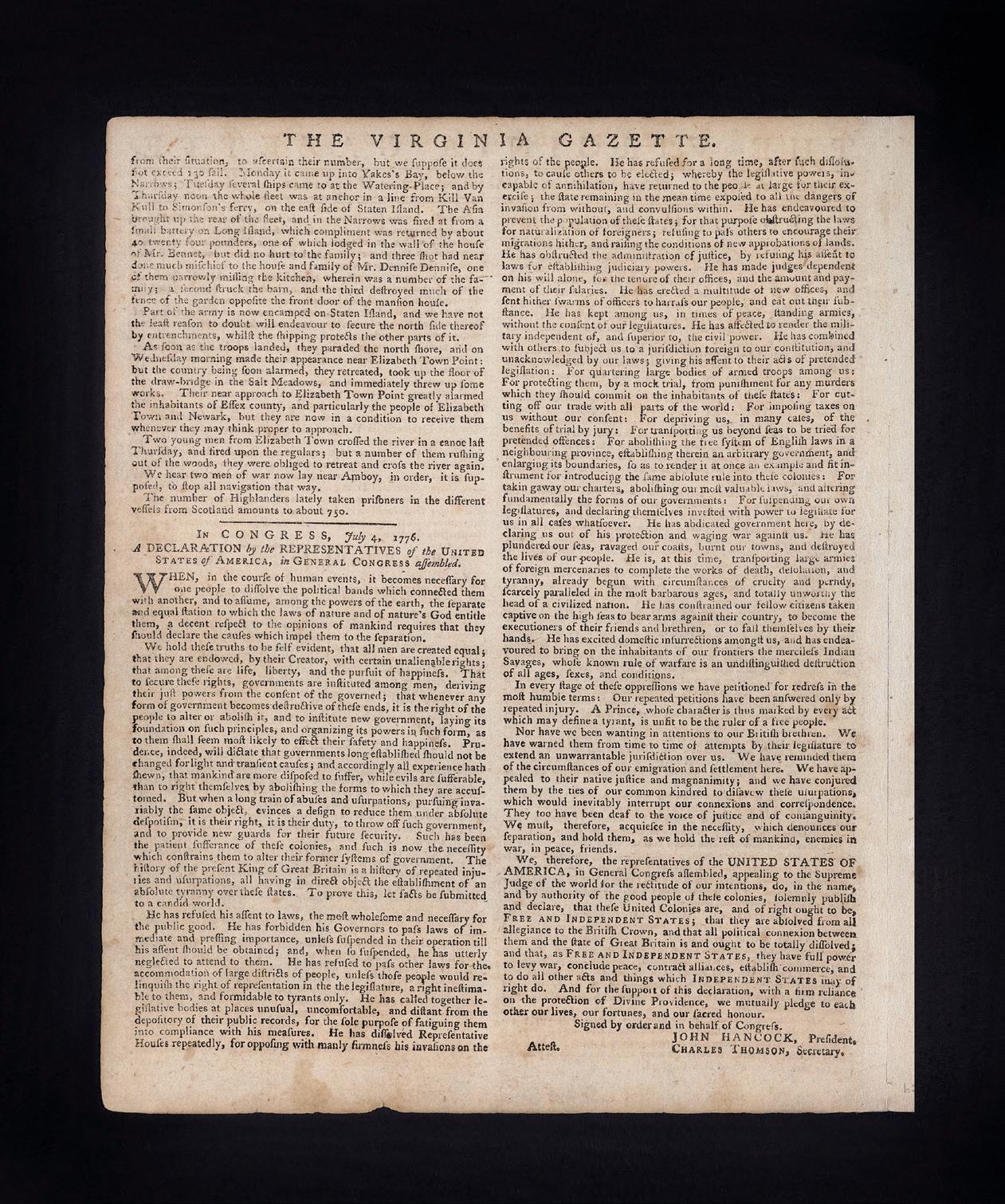
by PAUL ARON
Three weeks after the Continental Congress voted to declare independence, the Declaration of Independence was printed in The Virginia Gazette. The July 26, 1776, issue also reported that the document had been read aloud the day before at the Capitol, the Courthouse and the Governor’s Palace “amidst the acclamations of the people.”
Acclamations did not come from all the people, however. Enslaved and Indigenous people in and around Williamsburg surely had mixed reactions to the declaration. No single person could encompass all those reactions or what the declaration meant to enslaved and Indigenous people. But it is possible to glimpse what it meant to some individuals, including the two profiled below.
Some enslaved people hoped the promise of the Declaration of Independence might someday apply to them, and some therefore considered joining the patriots’ fight. At first, George Washington rejected the idea of allowing Black men in the Continental army. Eventually, he reversed his position, partly because recruitment was a major problem. Perhaps, too, it was a step in the evolution of his thinking that eventually led him to free, in his will, all those enslaved under his name.
Exactly how many Black men served on the patriot side is uncertain. It was probably around 5,000, some of whom played a key role in capturing strategic positions in Yorktown. One enslaved man named James acted as a double agent, pretending to spy for the British while actually working closely with the Marquis de Lafayette. He later gained his freedom and took the surname Lafayette.
Stephen Seals has portrayed James
Harry Washington, along with 16 others enslaved at Mount Vernon, took the opportunity to join the British.
for 10 years as a Colonial Williamsburg Nation Builder. Seals noted that, though documents portraying the thoughts of enslaved people about the declaration are rarer than those of whites, some documents do exist, as well as other evidence. For example, Lemuel Haynes, a Black preacher in Massachusetts, wrote an essay called “Liberty Further Extended” in which he pointed out the contradictions between slavery and the declaration’s words about equality. “His words from 1776 have helped me better understand the thoughts of people at the time through their own words,” Seals said.
1775 proclamation by Lord Dunmore. In that proclamation, Virginia’s last royal governor offered freedom to those enslaved by rebels and willing to fight with the British.
Harry Washington, who had once been enslaved to George Washington, settled in Sierra Leone, on the west coast of Africa. This map appeared in the February 1757 Universal Magazine.
Many more Black men joined the British. Estimates range from 20,000 to 100,000. For many of them, the document that promised liberty was not the Declaration of Independence but the November
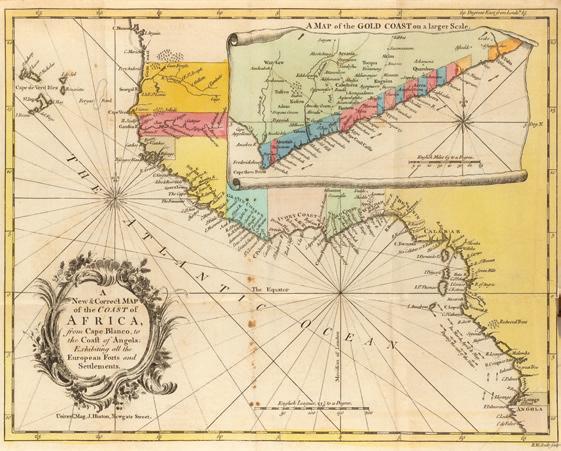
Among those who acted on Dunmore’s proclamation was Harry Washington. He was born near the Gambia River in West Africa around 1740 and in America enslaved to George Washington. Harry Washington worked draining the Great Dismal Swamp, where George Washington hoped to establish a rice plantation, and then took care of the horses at Mount Vernon.
In the summer of 1776, soon after independence was declared, one of Dunmore’s ships sailed up the Potomac. Harry Washington, along with 16 others enslaved at Mount Vernon, took the opportunity to join the British. He ultimately became a corporal in the Royal Artillery and fought in various battles in the Carolina lowcountry. When the British Gen. George Cornwallis decided to move his troops to Virginia, he left behind in Charleston a garrison that included Washington.
Washington was fortunate to be left behind. At Yorktown, with supplies running out, Cornwallis ordered formerly enslaved people out of the British camp. Most were captured and returned to their former enslavers.
Washington boarded a ship in Charleston and landed in New York. George Washington was intent on reclaiming those who had escaped, but in 1783 Harry
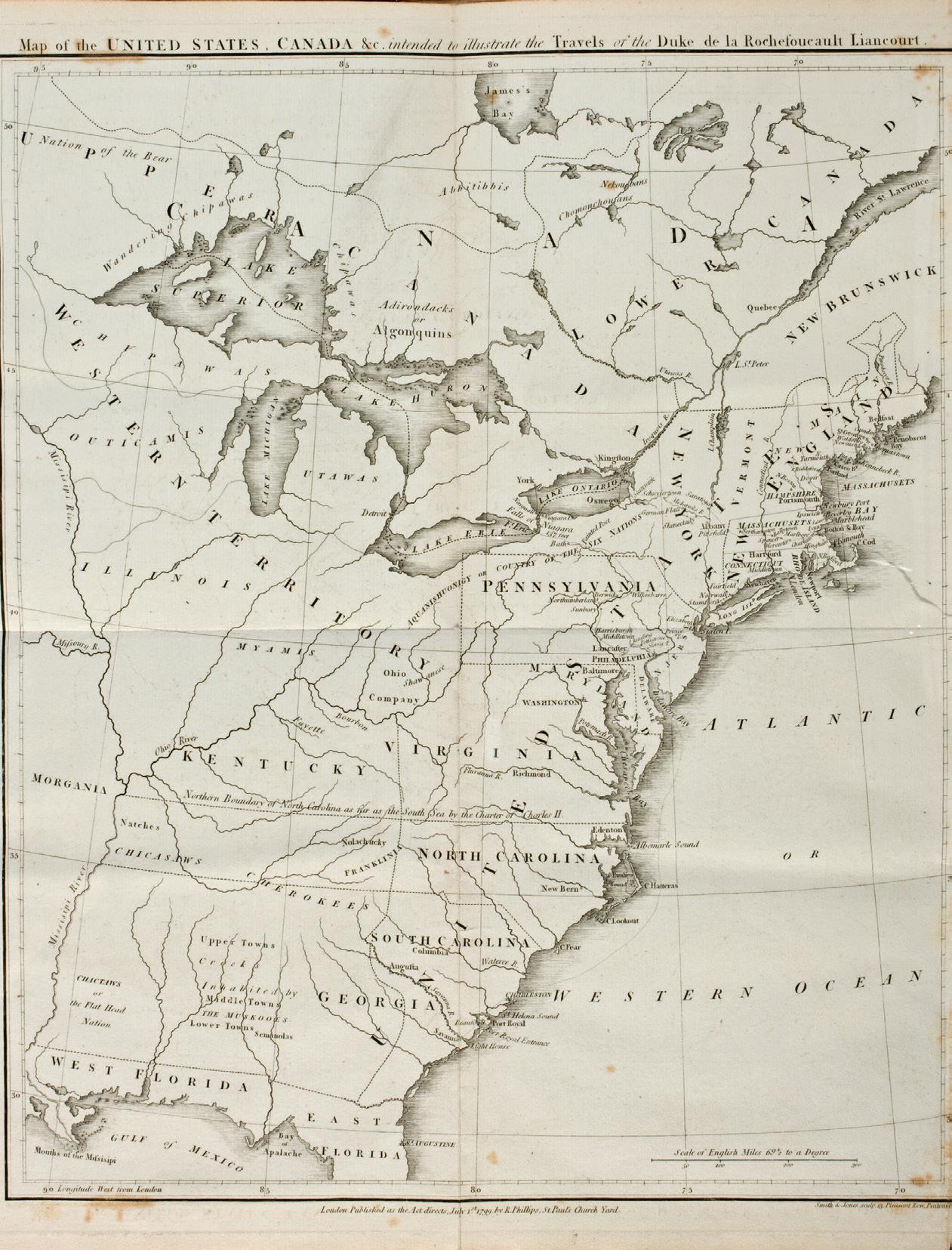
A 1799 map illustrating the travels of the Duke de la
shows the states as well as the territories of Indigenous nations.
Some of the students, after they left the Brafferton, acted as diplomats and translators.
Washington managed to board another ship, one bound for Britain’s Nova Scotia. In 1792 he joined yet another exodus, this time to Sierra Leone, on the west coast of Africa, perhaps 100 miles from where he had been born.
In 1800, some of the Sierra Leone colonists declared independence from Britain. Harry, like George before him, joined the rebels. The British quelled that rebellion and hanged some of the rebels. Others, including Washington, were banished from the colony. When and where he died is unknown, but it was as a free man.
When America declared its independence, Indigenous nations were torn as to how best to protect their own independence. Many allied with the British. Some remained neutral, and others hoped to negotiate boundaries with the Americans. Both the British and the Americans sometimes alienated potential allies, the British by failing to provide supplies and the Americans by raids that killed Indigenous people regardless of their political allegiance.
During one hand-to-hand clash in August 1776, a Cherokee warrior tried to surrender to an American soldier. “Brother, enough,” the Cherokee said. The soldier replied, “You never will have enough, while you are alive,” and then killed him.
Henry Bawbee, the English name of a son of Wyandot chief Odinghquanooron, personified the shifting allegiances of many Indigenous people. In 1775, Lord Dunmore negotiated a treaty with vari-
ous Indigenous nations. As a sign of his good faith, Odinghquanooron sent his teenage son to study at William & Mary’s Brafferton school in Williamsburg.
The school’s mission was to teach Indigenous boys English culture and Christianity. Bawbee studied mathematics and literature, attended services at Bruton Parish Church and dressed like the English. Many Indigenous people balked at sending their children, but some agreed because of a mixture of incentives and coercion. Some of the students, after they left the Brafferton, acted as diplomats and translators.
In 1778, Virginia officials sent Bawbee as an emissary to Indigenous tribes in the Ohio Country, but once there he discovered that his father had allied with the British. Still, he gathered military intelligence for the patriots, including a map of the British-held Fort Detroit that eventually reached George Washington. But the Americans thought he was working for the British and arrested him. Before his trial, Bawbee escaped, rejoined his father and disappeared from the historical record.
“In Bawbee’s life, we see how the promise of independence could feel distant or even contradictory,” said Jamie Helmick, Colonial Williamsburg’s manager of historical interpretation and the American Indian Initiative. “His shifting allegiances were not indecision but a necessary response to a world where Indigenous nations were working to protect their people, their land and their sovereignty, often in the face of choices imposed by others.”
Summer comes alive in Colonial Williamsburg’s Merchants Square, where every stroll is filled with vibrant shops, open-air dining, and moments worth savoring. From refreshing drinks on sunny patios to one-of-a-kind
Blue Talon Bistro
Brick & Vine
Campus Shop
The Carousel
Children’s Boutique
The Cheese Shop
Danforth Pewter
DoG Street Pub
Eleva Coffee Lounge
Ember
Everything Williamsburg
Restaurant & Bar
Kimball Theatre
lululemon athletica
Mellow Mushroom
Pizza Bakers
Monkee’s of Williamsburg
Precarious Beer Project
The Precious Gem
R. Bryant Ltd.
R. P. Wallace & Sons
General Store
Scotland House Ltd.
Three Cabanas: A Lilly
Pulitzer Signature Store
The Williamsburg Winery
Tasting Room & Wine Bar
Walkabout Outfitter
Wythe Candy & Gourmet Shop
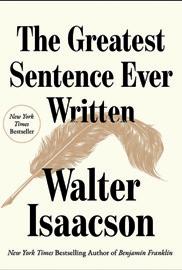
The Greatest Sentence Ever Written BY
WALTER ISAACSON
Simon & Schuster
In this brief book, Walter Isaacson offers a close reading of the words and concepts in the second sentence of the Declaration of Independence:
“We hold these truths to be self-evident, that all men are created equal, that they are endowed by their Creator with certain unalienable Rights, that among these are Life, Liberty and the pursuit of Happiness.” For example, he examines why Benjamin Franklin might have changed Thomas Jefferson’s original draft description of “truths” to “self-evident” instead of “sacred and undeniable.”
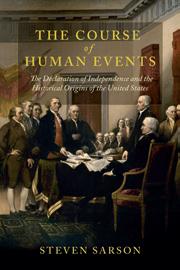
The Course of Human Events: The Declaration of Independence and the Historical Origins of the United States BY STEVEN SARSON
University of Virginia Press
Steven Sarson uses the opening phrase in the Declaration “When in the Course of human events” to emphasize that the ideas that followed about equality and natural rights were not a revolutionary break from the past. Rather, he suggests, they flowed from how Jefferson and his co-authors understood history. That explains, Sarson says, why they didn’t believe the declaration’s promises applied fully to women and poor men and why they didn’t apply at all to Indigenous Americans and enslaved people.
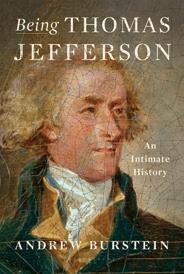
Being Thomas Jefferson: An Intimate History
BY ANDREW BURSTEIN
Bloomsbury
Andrew Burstein analyzes Jefferson’s emotional life. The focus includes not only romantic relationships but also his friends, mentors and even enemies. In particular, Burstein pays more attention than previous scholars to Jefferson’s friendship with the Marquis de Condorcet, an antislavery thinker Jefferson knew during his years in France. Jefferson is certainly a challenging subject for an intimate history because he guarded his privacy.
Remembering Jefferson: Who He Was, Who We Are BY MARY E. STUCKEY
University Press of Kansas
Mary Stuckey is less interested in Jefferson himself than in how he has been memorialized in monuments, invoked by later presidents and portrayed in popular culture as well as in children’s literature. For President Franklin Roosevelt, Jefferson was a man who used the government to protect people from the elite while Ronald Reagan’s Jefferson was a critic of federal power. “He was so complicated and multilayered,” Stuckey writes, “that he can be purposed to suit a variety of agendas.”
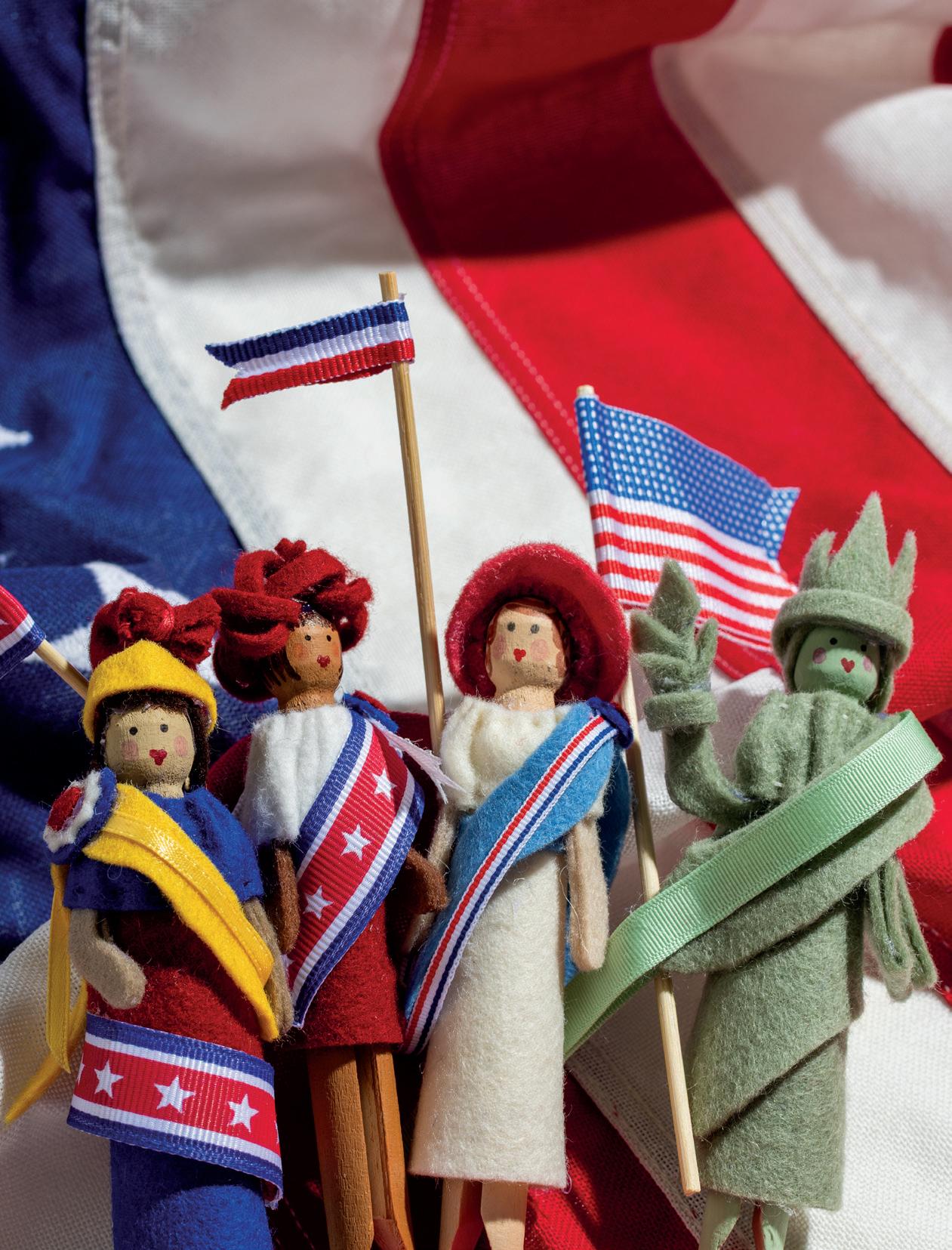
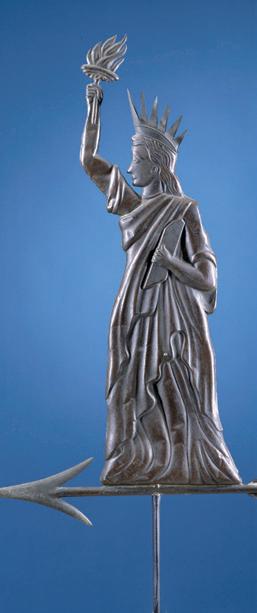
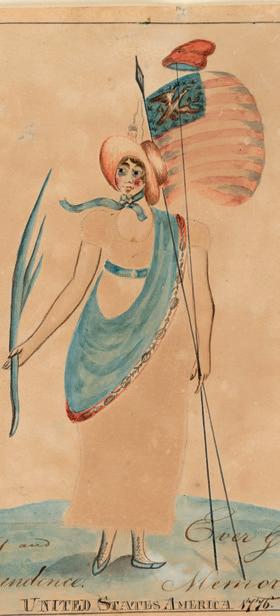
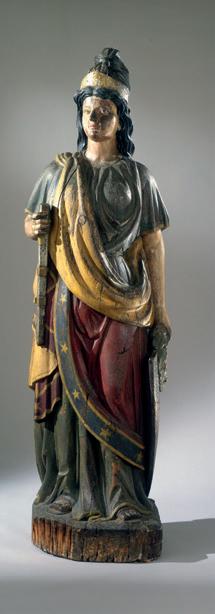
Lady Liberty has long been a symbol of America and its promise of freedom.
As early as the 16th century, Europeans started using the image of a woman as a personification of the Americas. In the 17th century, she was known first as Columbina before becoming Lady Columbia.
By the Revolutionary War, colonial Americans had adopted the image, changing it from a native woman to one that looked more like them. She remained a popular symbol until the Statue of Liberty arrived in New York in 1886 and usurped her as a symbol for the country.
The Art Museums of Colonial Williamsburg has a number of Lady Liberty images, including on a weather vane, in a watercolor and as a wood carving. These three pieces inspired three of the clothespin dolls. The fourth, imagined by a museum manager, inspires crafters to create their own Lady Liberty dolls.
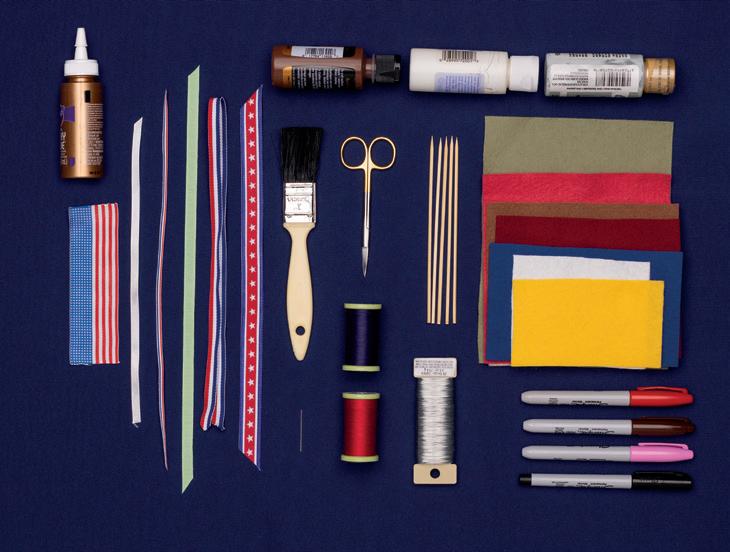
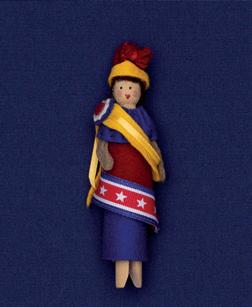
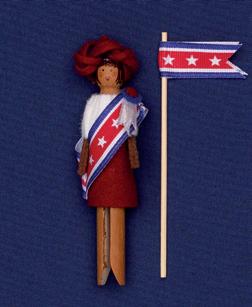
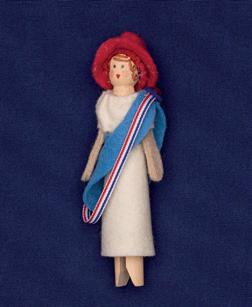
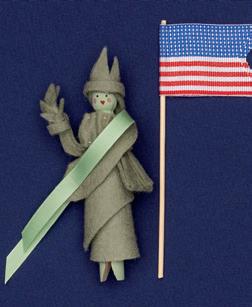
STEP 1
Choose a Lady Liberty doll. Paint the clothespin the color of the doll.
STEP 2
Using the template, cut the relevant pieces from the felt. The skirts and felt sash are simple forms and need no explanation. Use the guidelines below for the others.
∙ For the arms, cut four pieces and glue together two for each arm. To form a bend in the arm, place a piece of wire between the two pieces of felt before gluing.
∙ For the blouse, cut one piece and gather the top and bottom edges with running stitches.
∙ For the red liberty cap, cut two pieces and stitch them together leaving the lower edge open; make the red tassel by cutting two long strips of felt, folding them in half and wrapping thread around the folded end of the bundle. Stitch the tassel to the top of the cap. For the crown, cut two pieces and stitch together along the dotted line.
∙ For the hat, cut three strips 3 inches long, braid them and stitch together to form a circle.
∙ For the bonnet, cut one piece, stitch around the edge with a running stitch and gather to fit the doll’s head. For the bonnet brim, cut one piece and glue to bonnet.
∙ For the sage green liberty cap, cut three liberty caps plus a short narrow strip and piece together.
STEP 3
Assemble the doll by gluing on the pieces in the order listed below. A sash should be glued together at its ends. Skip any irrelevant pieces.
1st-Long or short skirt
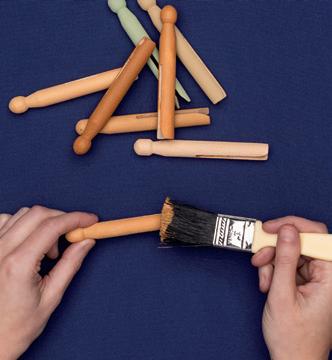

2nd-Overskirt
3rd-Arms and blouse
4th-Sash
STEP 4
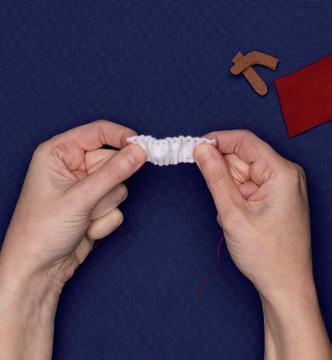
STEP 5
Accessorize: Cut a ribbon to the proper length for a ribbon sash, drape over the doll and glue the ends together. To create a flag, use scissors to cut a skewer to size, and glue on bits of felt and ribbon. Use felt to create Liberty’s torch and book. 1 4 2 3
Using the markers, draw on the hair and face, and then glue on the headpiece.
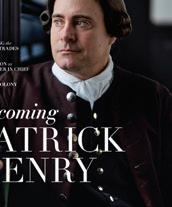

E
Across
by Ben Swenson
1. Blinds' parts
6. "Othello" villan
ACROSS
10. Tiny matter
1. Blinds’ parts
14. Late statesman Powell
6. “Othello” villian
10. Tiny matter
15. Lose footing
14. Late statesman Powell
16. Greek cheese
15. Lose footing
16. Greek cheese
52. A motto for 250 years and counting ... or a description of the answer to the starred clues
58. Protective covering
17. "___ of Two Cities"
18. Source of frustration
17. “ of Two Cities”
19. Voice malady
18. Source of frustration
19. Voice malady
20. *Dolley and James Madison, on September 15, 1794
23. To be human?
23. To be human?
24. University official
60. Brainstorm
61. Biblical pariah
62. Rideshare option
63. Maize
20. *Dolley and James Madison, on September 15, 1794
64. School paper
65. Mexican dough
66. Kind of prof. or DA
67. Some sports car features
24. University official
25. Be in the red
25. Be in the red
28. Salon jobs
31. Rope fiber
28. Salon jobs
33. Deduce
31. Rope fiber
35. Year in Brazil
33. Deduce
36. Horse abode
37. Mexican state below Arizona
35. Year in Brazil
36. Horse abode
38. Units of force
40. Takes over territory
41. Tooth type
DOWN
1. Picket line crosser
2. Tolkien trilogy, to fans
3. Jai
4. Spanish squiggles
5. Scornful look
6. Library ID
7. Magic lamp rubber
8. Redhead
37. Mexican state below Arizona
42. Is prostrate
38. Units of force
43. Chemical suffix
44. Campfire remains
45. Relinquish
41. Tooth type
46. Picnic pests
42. Is prostrate
47. New prefix
48. Spectral glow
50. Nada
43. Chemical suffix
9. “La Boheme” or “Carmen”
10. Bushy hairdo
40. Takes over territory
63. Maize
11. *Colonial power source for heavy loads
by Ben Swenson
27. Eliminates
28. French dance
29. Distress
64. School paper
12. Extra periods: abbr.
65. Mexican dough
13. Atlas page
21. Esoteric
66. Kind of prof. or DA
22. Liver go-with 26. “You joking!”
44. Campfire remains
45. Relinquish
46. Picnic pests
47. New prefix
30. *Brick homes for wellto-do colonial Americans on main streets in Boston, New York and Philadelphia
67. Some sports car features
32. Hosp. sections
36. Ornamental tree
37. Cause for a blessing
39. 5-5, e.g.
11. *Colonial power source for heavy loads
40. Help
42. They’re followed
12. Extra periods: abbr.
45. Tenets
13. Atlas page
21. Esoteric
46. H.S. exam
49. Central New York city
34. Opposite of SSW
22. Liver go-with
51. Speck in the ocean
53. Infamous Roman emperor
40. Help
54. Desire
55. Lhasa
42. They're followed
56. Kind of tide
45. Tenets
57. Prohibition proponents
46. H.S. exam
58. Vessel
59. Honest president, informally
49. Central New York city
51. Speck in the ocean
53. Infamous Roman emperor
48. Spectral glow
50. Nada
Each line of this 18th-century wordplay puzzle offers a clue to a single answer of up to three words. Can you solve it? Email your answer to puzzles@cwf.org for a chance to win a copy of That the Future May Learn From the Past: The First 100 Years of Colonial Williamsburg
52. A motto for 250 years and counting ... or a description of the answer to the starred clues
58. Protective covering
60. Brainstorm
61. Biblical pariah
62. Rideshare option
1. Picket line crosser 2. Tolkien trilogy, to fans
Jai ___ 4. Spanish squiggles 5. Scornful look 6. Library ID 7. Magic lamp rubber
26. "You ___ joking!" 27. Eliminates 28. French dance 29. Distress
As we ring the bells for anniversaries this year, Let’s recall a record that helped both of them appear. A sketch that could have easily been lost, but au contraire, The New York man who found it knew at once that he should care: Old and – holy mackerel! – showing DoG Street in its prime, The whats and wheres of Williamsburg that vanished over time. What you see today is an expansive, faithful site, Thanks in part to turns of fate that brought this plat to light.
54. Desire
55. Lhasa ___
30. *Brick homes for wellto-do Colonial Americans on mains streets in Boston, New York and Philadelphia 32. Hosp. sections 34. Opposite of SSW 36. Ornamental tree
37. Cause for a blessing 39. 5-5, e.g.
56. Kind of tide
57. Prohibition proponents
58. Vessel
59. Honest president, informally
Check the autumn issue for the answer to the enigma. Answers to this issue’s crossword are on the next page.
Congratulations to winner Maria Rodriguez of Fort Worth, Texas, whose entry was chosen from a pool of correct answers to the puzzle in the Spring issue. She received a grand union flag.
Want to play, too? Here are the rules: NO PURCHASE NECESSARY. A PURCHASE WILL NOT INCREASE YOUR CHANCES OF WINNING. Sweepstakes ends 08/05/26
For entry and official rules with complete eligibility, prize description, odds disclosure and other details, visit www.colonialwilliamsburg.org/trend-and-tradition-prizerules. Sponsored by The Colonial Williamsburg Foundation. Void where prohibited.
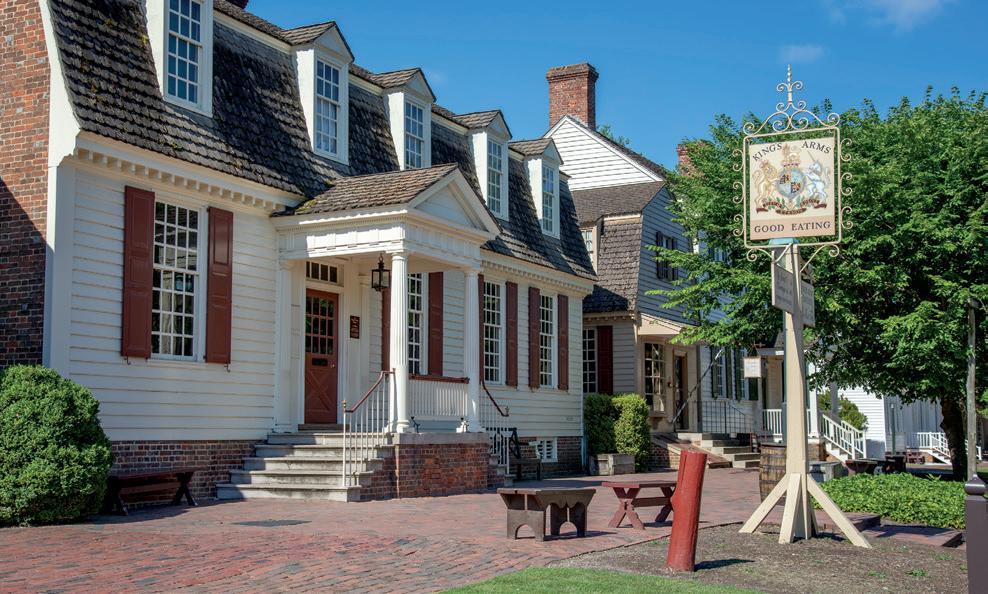

Sarah Jones took this photo while visiting Williamsburg from her home near Culpeper, Virginia. She says she is inspired by the moments “where only the people in historic dress are in the shot...in my mind envisioning what it would look like back then.”
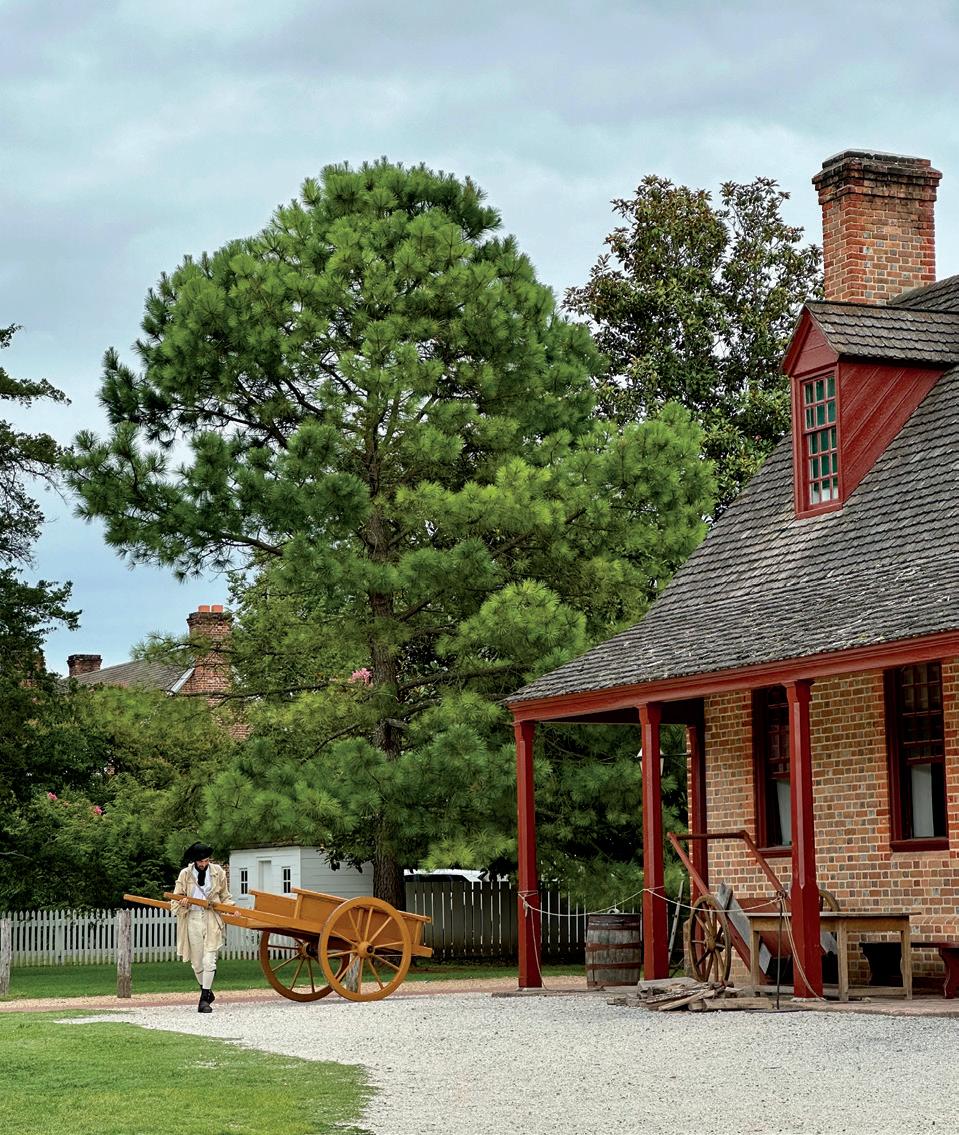
THANK YOU TO EVERYONE WHO SUBMITTED PHOTOS. PLEASE KEEP THEM COMING! Send your favorite Colonial Williamsburg photo a .jpg or .tif that is at least 300 dpi at 5"×7", please to partingshot@cwf.org. Tell us why you love the image, and we may choose it for “Parting Shot” in an upcoming issue. Don’t forget to include your hometown.