
![]()


di by Federica Clemente
Care lettrici e cari lettori, c’è un momento, nella vita di ogni progetto editoriale, in cui il cambiamento è una naturale evoluzione, un passo avanti. Per questo oggi Carnet Verona e Carnet Gardasee diventano Carnet Magazine.
Carnet è nato a Verona nel 2003 e a Verona resta il suo cuore pulsante. Le storie di questa città, i suoi volti, i suoi eventi continuano a essere il nostro punto di partenza. Ma, così come negli anni ci siamo spinti verso il Lago di Garda – prima sulla sponda veronese, poi anche su quella bresciana – oggi scegliamo di VIVERE. SCOPRIRE.
CONOSCERE. il territorio che ci circonda senza confini geografici, senza classificazioni rigide. Perché le radici non servono a restare fermi: servono a trarre nutrimento per andare lontano.
Carnet Magazine mantiene così intatta la natura da cui proviene: la curiosità, la passione per la cultura, il gusto per la scoperta, l’attenzione ai dettagli e alle persone. L’orizzonte si allarga per accogliere nuove storie, nuovi luoghi, nuove contaminazioni, restando fedeli allo stesso modo di guardare il mondo: con profondità, cura e spirito critico.
Carnet Magazine fa parte di un progetto più ampio: Carnet Group, media company, che raccoglie al suo interno anche Carnet Impresa, rivista dedicata al mondo aziendale e del lavoro. Magazine non è una perdita di identità, è la scelta di non mettere confini alla conoscenza, di non limitare il racconto a una mappa, di lasciare che le idee viaggino libere. Continueremo a raccontare ciò che ci appassiona, ciò che merita attenzione, ciò che rende unico il nostro territorio, proprio nel mese in cui Verona ha i riflettori di tutto il mondo puntati sulla sua Arena grazie alle Olimpiadi invernali.
Buona lettura!
Dear readers,
There comes a time in the life of every editorial project when change is a natural evolution, a step forward. That is why today Carnet Verona and Carnet Gardasee are becoming Carnet Magazine.
Carnet was founded in Verona in 2003, and Verona remains its beating heart. The stories of this city, its faces, and its events continue to be our starting point. But, just as over the years we have moved towards Lake Garda—first on the Verona side, then also on the Brescia side—today we choose to LIVE. DISCOVER. LEARN. about the territory around us without geographical boundaries, without rigid classifications. Because roots are not meant to keep us still: they are meant to nourish us so we can go far.
Carnet Magazine thus keeps intact the nature from which it originates: curiosity, passion for culture, a taste for discovery, attention to detail and people. The horizon widens to welcome new stories, new places, new cross-pollinations, while remaining faithful to the same way of looking at the world: with depth, care, and a critical spirit.
Carnet Magazine is part of a larger project: Carnet Group, media company, which also includes Carnet Impresa, a journal dedicated to the world of business and work. Magazine is not a loss of identity, it is the choice not to set boundaries on knowledge, not to limit the story to a map, to let ideas travel freely.
We will continue to tell the stories we care about, what deserves attention, what makes our region unique, in the very month when Verona has the world's spotlight on its Arena thanks to the Winter Olympics.
Happy reading!
Elia Viviani e la fiamma a Verona
Elia Viviani and the flame in Verona
Casa Verona:
Casa Verona:
Ristori Baroque
L'8 marzo con "Le ragazze di Barbiana” 8 march with ‘Le ragazze di Barbiana’
Il benessere sulle rive del Lago di Garda Wellness on the shores of Lake Garda 35 Le Corti Venete, un anno di novità Le Corti Venete, a year of new developments Carnet sport/ sport 38 Quando correre diventa comunità When running becomes a community
Azzurri emergenti a Milano Cortina 2026
Italy's Rising Winter Sports Talents ahead of Milano Cortina 2026
Carnet per bambini/ for children
43 FabLabKIDS, il luogo del pensiero creativo FabLabKIDS, a space for creative thinking
Carnet Magazine
Carnet Verona
Registrazione Tribunale di Verona nr. 1573 del 9/12/2003
Nr. Iscrizione ROC 21254
Questo periodo è associato all’Unione Stampa Periodica Italiana
Edito da Edyto Srl
Via Cefalonia, 3 – Marano di Valpolicella (VR)
Carnet Magazine N. 156–febbraio/marzo 2026
Editori
Nicolò Ballarini
Alberto Cetti
Direttore responsabile
Giancarla Gallo
Hanno collaborato
Giorgia Castagna
Agnese Ceschi
Miriam Cetti
Federica Clemente
Andrea Molinari
Georgia Passuello
Ilaria Savoia
Marta Tarasconi
Identità grafica e impaginazione
Ilenia Cauchioli
Carnet cultura/ culture
47 Agron Hoti: la superficie e la libertà Agron Hoti: surface and freedom
50 Sanremo con Carlo Conti e Laura Pausini Sanremo with Carlo Conti and Laura Pausini
52 Il filo di Arianna. Trame di vita al femminile Il filo di Arianna. Trame di vita al femminile
Carnet benessere/ wellness
54 Quando donare diventa un atto d’amore When donating becomes a gesture of care
Carnet sostenibilità/ sustainability
57 RAEE, cosa sono e come si differenziano WEEE: what they are and how they differ
59 L'esperto risponde The expert answers
Stampa Grafiche Marchesini
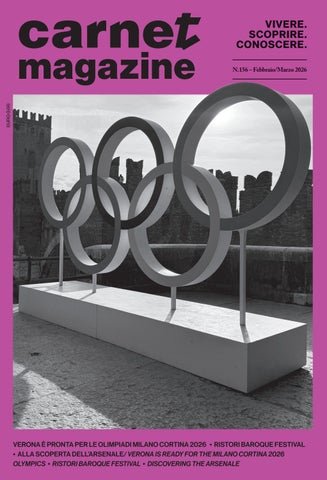
Via Lungo Bussè, 884 – Angiari (VR) Contatti redazione@carnetgroup.it info@carnetgroup.it commerciale@carnetgroup.it In copertina: I 5 Cerchi Olimpici sull'alzaia del Ponte di Castelvecchio
61 Alla scoperta di: l’Arsenale austriaco di Verona Discovering: the austrian Arsenal in Verona
64 In scena On stage
67 Orizzonti sostenibili: il co-living Sustainable horizons: co-living
70 Un salto nel cinema A jump into cinema
73 Pagina dopo pagina Page after page
76 Arte in giro Art around VIVERE.
79 Gli eventi di febbraio e marzo February and March events


di by Andrea Molinari
La cerimonia di chiusura delle Olimpiadi è sempre il momento più silenzioso, anche quando è spettacolare. È l’istante in cui il rumore delle gare si spegne e resta solo ciò che davvero conta: le persone, le storie, le emozioni sedimentate nel tempo dei Giochi. Se la cerimonia di apertura promette, quella di chiusura ricorda. È un rito di passaggio, un saluto che non celebra la vittoria ma l’esperienza condivisa, ciò che resta quando le medaglie sono già state assegnate. Non è un caso che, a partire dai Giochi di Melbourne del 1956, gli atleti abbiano iniziato a sfilare insieme, senza bandiere e senza divisioni nazionali. Fu un gesto semplice ma rivoluzionario: rinunciare all’ordine competitivo nel momento finale per affermare che lo spirito olimpico vive soprattutto nell’incontro. Da allora, la chiusura è diventata il luogo
della mescolanza, dell’umanità che emerge dopo la tensione. A Nagano 1998 dominava la spiritualità, a Vancouver 2010 il calore popolare, a Torino 2006 una dimensione quasi domestica, capace di avvicinare pubblico e atleti. Milano Cortina 2026 raccoglie questa tradizione e la reinterpreta scegliendo Verona, e l’Arena in particolare, come teatro dell’ultimo atto. L'anfiteatro non è soltanto uno spazio scenico, ma un simbolo di continuità: un luogo che ha attraversato secoli di storia, accogliendo riti collettivi, spettacoli, momenti di passaggio. Qui la chiusura olimpica trova una collocazione naturale, perché parla la stessa lingua del tempo lungo, quello che stratifica memoria, arte e identità. Il tema scelto, “Beauty in Action”, sintetizza l’idea di una bellezza che non è immobile né celebrativa, ma viva
In the city

e in movimento. È la bellezza del gesto atletico, ma anche quella del corpo che danza, della musica che accompagna, dell’arte che interpreta. Non a caso tra i protagonisti ci sarà Roberto Bolle.
Nella cerimonia di chiusura lo sport smette di essere misurazione e diventa racconto. Non ci sono cronometri, ma immagini. Non record, ma simboli. È un linguaggio universale che parla anche a chi non ha seguito una singola gara. Storicamente, molte cerimonie di chiusura hanno lasciato segni più profondi delle aperture. Perché è più facile sorprendere quando non si deve impressionare, ma congedare. È il momento del passaggio di testimone, del ringraziamento, della consapevolezza che qualcosa di irripetibile si è appena concluso. Milano Cortina ha scelto di non alzare la voce, ma di affidarsi alla forza evocativa di un luogo e alla capacità italiana di unire cultura, spettacolo e misura. Il 22 febbraio 2026, l’Arena di Verona diventerà il punto in cui le Olimpiadi Invernali si trasformano in memoria.
Gli atleti, liberi da tensioni e aspettative, saluteranno il pubblico in un clima che tradizionalmente è più intimo, più umano. Le bandiere si abbasseranno, la fiamma si spegnerà, ma non sarà una fine netta: come accade sempre nelle migliori cerimonie di chiusura, sarà una consegna al futuro, un ponte verso i prossimi
Giochi. Per Verona sarà una notte destinata a entrare nella sua lunga storia di palcoscenico universale, capace ancora una volta di parlare al mondo. Per le Olimpiadi, sarà un finale coerente con il loro significato più profondo: ricordare che lo sport, prima ancora di essere competizione, è relazione. Quando le luci si attenuano e

il silenzio torna a riempire lo spazio, ciò che resta non è lo spettacolo, ma la sensazione di aver condiviso qualcosa di più grande del singolo evento. È questa, da sempre, la vera eredità olimpica.
The final ritual that turns the Games into history.
The closing ceremony of the Olympics is always the quietest moment, even when it is spectacular. It is the moment when the noise of the competitions dies down and only what really matters remains: the people, the stories, the emotions that have settled over the course of the Games. If the opening ceremony promises, the closing ceremony remembers. It is a rite of passage, a farewell that celebrates not victory but shared experience, what remains when the medals have already been awarded.
It is no coincidence that, starting with the 1956 Games in Melbourne, athletes began to parade together, without flags and without national divisions. It was a simple but revolutionary gesture: renouncing competitive order in the final moment to affirm that the Olympic spirit lives above all in human encounter. Since then, the closing ceremony has become a place of mixing, of humanity emerging after tension. In Nagano in 1998, spirituality dominated; in Vancouver in 2010, popular enthusiasm; in Turin in 2006, an almost domestic dimension, capable of bringing the public and athletes closer together.
Milan-Cortina 2026 takes up this tradition and reinterprets it by choosing Verona, and the Arena in particular, as the setting for the final act. The amphitheatre

is not only a stage, but a symbol of continuity: a place that has gone through centuries of history, hosting collective rituals, shows and moments of transition. Here, the Olympic closing ceremony finds a natural home, because it speaks the same language of long time, the language that layers memory, art and identity. The chosen theme, “Beauty in Action”, summarises the idea of beauty that is neither static nor celebratory, but alive and in motion. It is the beauty of athletic gesture, but also that of the dancing body, the accompanying music and the interpreting art. It is no coincidence that Roberto Bolle will be among the protagonists.
In the closing ceremony, sport ceases to be about measurement and becomes a story. There are no stopwatches, but images. No records, but symbols. It is a universal language that speaks even to those who have not followed a single competition. Historically, many closing ceremonies have left a deeper mark than the opening ceremonies. Because it is easier to surprise when you do not have to impress, but to take leave. It is a time for passing the baton, for giving thanks, for the awareness that something unrepeatable has just come to an
end. Milan-Cortina has chosen not to raise its voice, but to rely on the evocative power of a place and the italian ability to balance culture, spectacle and restraint, entertainment and moderation.
On 22 February 2026, the Arena di Verona will become the place where the Winter Olympics are transformed into memory.
The athletes, free from tension and expectations, will greet the public in an atmosphere that is traditionally more intimate, more human. The flags will be lowered, the flame will be extinguished, but it will not be a clear-cut ending: as always happens in the best closing ceremonies, it will be a handover to the future, a bridge to the next Games. For Verona, it will be a night destined to enter its long history as a universal stage, once again capable of speaking to the world. For the Olympics, it will be a finale consistent with their deepest meaning: to remember that sport, even before being competition, is relationship. When the lights dim and silence returns to fill the space, what remains is not the spectacle, but the feeling of having shared something greater than the individual event. This has always been the true Olympic legacy.
di by Andrea Molinari


La fiamma olimpica è passata da Verona in una giornata che resterà nella memoria della città. Tra le vie del centro, davanti a centinaia di persone, Elia Viviani ha portato la torcia dei Giochi Invernali di Milano Cortina 2026, chiudendo idealmente un cerchio che dura da una vita. Un passaggio carico di simboli, reso
ancora più potente dal luogo e dal gesto che lo ha preceduto: la sua fiamma si è accesa grazie al passaggio della torcia portata dalla moglie Elena Cecchini, anche lei ciclista, sotto il balcone di Giulietta. Sport, amore e identità si sono intrecciati in pochi metri, trasformando un rituale olimpico in un racconto profondamente personale.

Viviani, nato a Isola della Scala nel 1989, è uno dei volti più rappresentativi dello sport veronese degli ultimi anni. Campione olimpico, mondiale, portabandiera a Tokyo 2020, ha salutato il ciclismo agonistico lo scorso ottobre vincendo l’ultimo oro della sua carriera in Cile, scegliendo di chiudere al top delle sue potenzialità. A pochi mesi dal ritiro, il ruolo di tedoforo a Verona è arrivato come un’ultima, preziosa tessera di un mosaico olimpico già ricchissimo.
Quando hai saputo che saresti stato tedoforo a Verona, qual è stata la prima reazione?
È stato uno di quei ruoli che mi mancavano. Le Olimpiadi del 2006 le ho vissute da bambino, oggi invece è arrivata nel momento giusto. Dopo le tante medaglie alle Olimpiadi e l’onore di essere stato portabandiera, questa era un’altra casellina da riempire. Farlo a Verona, nella mia città, ha reso tutto ancora più emozionante.
Come funziona la scelta dei tedofori? È una decisione improvvisa?
No, in realtà ci si propone mesi prima. Ricevi una mail, spieghi perché vorresti farlo, quali valori dello sport senti di rappresentare. Poi aspetti. Fino a poche settimane prima non c’è nulla di certo. Quando è arrivata la conferma via mail e ho saputo che sarebbe stato a Verona, è stato bellissimo.
Hai detto che tenevi molto a questo ruolo. Perché?
Perché chiude il mio cerchio olimpico. Ho vinto oro, argento e bronzo rispettivamente a Rio, Parigi e Tokyo, ho fatto il portabandiera e ora anche la torcia. Praticamente non mi manca più nulla legato ai Cinque Cerchi (ride, ndr).
Ti sei ritirato da poco, vincendo l’ultimo oro. La bici ti manca?
No, e credo sia proprio perché ho chiuso al top. Ho smesso col sorriso, esultando. È stata una scelta pensata, serena. Vado ancora in bici, ma quando voglio io. Lo sento come un momento solo mio e me lo godo ancora. Diciamo che non ho smesso la mia carriera con la nausea per bici, tutt’altro.
Oggi come vive Elia Viviani il post-carriera?
Sono rimasto nello sport. Vivo a Monaco da anni, lavoro con la Federazione come manager delle nazionali e collaboro con Ducati per lo sviluppo delle biciclette. È un modo per restituire qualcosa e restare nell’ambiente.
C’è un valore dello sport che senti più tuo, oggi più che mai?
Portare la fiamma olimpica significa portare lo sport tra la gente. Vorrei che fosse visto non solo come agonismo, ma come scuola di vita, salute, equilibrio. Lo sport è per tutti, non solo per chi vince. Quello che mi piacerebbe far passare alla gente è che è importantissimo per tutti, dai bambini agli adulti fino agli anziani. A volte ho paura che lo sport sia visto, soprattutto il ciclismo, come solo una fatica. Se non vai forte è meglio smettere... E invece è proprio il contrario, io prendo la bici e vado perché sto bene e mi fa stare bene in tutti i sensi. L’ho capito subito dopo aver smesso perché in questi mesi non mi manca l’agonismo, ma a volte fare qualcosa per il mio benessere fisico e mentale sì.
The honor of carrying the Olympic flame in his hometown.
The Olympic flame passed through Verona on a day that will remain in the city's memory. In the streets of the city center, in front of hundreds of people, Elia Viviani carried the torch for the 2026 Milan-Cortina Winter Games, ideally closing a circle that has lasted a lifetime. It was a symbolic moment, made even
more powerful by the location and the gesture that preceded it: his flame was lit thanks to the torch carried by his wife Elena Cecchini, also a cyclist, under Juliet's balcony. Sport, love, and identity intertwined in a few meters, transforming an Olympic ritual into a deeply personal story.
Viviani, born in Isola della Scala in 1989, is one of the most representative faces of Veronese sport in recent years. Olympic and world champion, flag bearer at Tokyo 2020, he bid farewell to competitive cycling last October, winning the last gold medal of his career in Chile and choosing to end his career at the peak of his potential. A few months after his retirement, the role of torchbearer in Verona came as a final, precious piece in an already rich Olympic mosaic.
When you found out you would be a torchbearer in Verona, what was your first reaction?
It was one of those roles I was missing. I experienced the 2006 Olympics as a child, but today it came at the right time. After winning many medals at the Olympics and having the honor of being the flag bearer, this was another box to tick. Doing it in Verona, my hometown, made it even more exciting.
How does the selection of torchbearers work? Is it a sudden decision?
No, actually, you apply months in advance. You receive an email, explain why you would like to do it, what values of sport you feel you represent. Then you wait. Until a few weeks before, nothing is

certain. When the confirmation arrived by email and I knew it would be in Verona, it was wonderful. You said you cared a lot about this role. Why? Because it closes my Olympic circle. I won gold, silver, and bronze in Rio, Paris, and Tokyo, respectively, I was the flag bearer, and now I'm also the torchbearer. Basically, there's nothing left for me to do related to the Five Rings (laughs, ed.).
You recently retired after winning your last gold medal. Do you miss cycling?
No, and I think it's because I ended on a high note. I quit with a smile, celebrating. It was a thoughtful, peaceful decision. I still ride my bike, but only when I want to. I feel like it's my own special time, and I still enjoy it. Let's just say that I didn't end my career sick of cycling, far from it.
How is Elia Viviani enjoying his post-career life?
I've stayed in sport. I've been living in Monaco for years, working with the Federation as manager of the national teams and collaborating with Ducati on bicycle development. It's a way of giving something back and staying in the environment.
Is there a value of sport that you feel is more important to you now than ever before?
Carrying the Olympic flame means bringing sport to the people. I would like it to be seen not only as competition, but as a school of life, health, and balance. Sport is for everyone, not just for those who win. What I would like to convey to people is that it is very important for everyone, from children to adults to the elderly. Sometimes I worry that sport, especially cycling, is seen as nothing but hard work. If you're not fast, it's better to quit... But it's actually the opposite. I get on my bike and ride because it makes me feel good in every way. I realized this immediately after I quit because, in recent months, I don't miss the competition, but sometimes I do miss doing something for my physical and mental well-being.


di by Ilaria Savoia
Inaugurata lo scorso 29 novembre presso la palazzina 20 dell’Arsenale di Verona (di cui parliamo anche nella rubrica Alla scoperta di), Casa Verona offre un esempio valido di rigenerazione urbana di uno spazio oggi restituito alla sua comunità.
Una riqualificazione che ha rimesso a disposizione un luogo nuovo in vista dell’appuntamento dei Giochi Olimpici e Paralimpici Invernali dal 6 al 22 febbraio e dal 6 al 15 marzo 2026.
Un luogo accogliente dove cultura, sport e comunità si muovono in sinergia. Lo spazio di 500 metri quadri ha infatti diverse funzioni: dall’iniziale centro in attesa dei Giochi ad un vero e proprio “Live Site” per viverli grazie alla proiezione di tutte le competizioni in diretta e il supporto di approfondimenti tecnici ed intrattenimento.
Una “Sport & Culture Clubhouse” dove lo spirito olimpico diviene protagonista ma che non si fermerà solo come progetto temporaneo: Casa Verona resterà infatti parte integrante con il tessuto sociale della città. Il suo ruolo è e sarà quello di creare un ambiente inclusivo e di incontro tra sport, cultura e comunità,

un autentico punto di ritrovo e riferimento per i cittadini; un luogo di aggregazione dove l’incontro diviene prioritario.
Interessante a riguardo il parallelismo con la storia dello spazio dove nasce: l’Arsenale di Verona, luogo emblema per secoli di guerre e strategie militari che ora diviene simbolo di pace ed incontro tra popoli, esattamente ciò che i Giochi Olimpici vogliono comunicare.
Le attività di Casa Verona si sono avviate già dallo scorso novembre e proseguiranno fino al weekend del 15 marzo 2026 dividendosi tra talk, mostre, laboratori,
installazioni, spettacoli, spazi interattivi, maxi-wall e percorsi coinvolgenti per il pubblico.
Tra gli eventi più significativi fino ad oggi ci sono stati incontri letterari e talk con testimonianze ed icone sportive come la leggenda dell’atletica Sara Simeoni che ha presentato la sua autobiografia “Una vita” in alto e “Verso la fiamma” con l’icona dello sci mondiale Deborah Compagnoni, che ha presentato l’ autobiografia “Una ragazza” di montagna dove racconta il suo percorso umano e sportivo. Infine il talk “Le Staffette d’Oro” con i campioni dello sci da fondo Silvio Fauner, ultimo
frazionista a Lillehammer 1994 e Fulvio Valbusa, primo frazionista a Torino 2006.
Spazio anche per incontri cinematografici come per la proiezione del docufilm “Una squadra” con i tennisti Adriano Panatta e Paolo Bertolucci e il regista e produttore cinematografico Domenico Procacci.
Fedele ai temi dell’incontro tra popoli e spirito di pace Casa Verona si è fatta portavoce anche di valori universali. Ne è un esempio l’incontro dal titolo “Tregua Olimpica- Il contributo dello sport alla pace”, tenuto lo scorso 18 gennaio, il giorno del viaggio della Fiamma Olimpica a Verona. Un incontro tra il tedoforo palestinese Aziz Abu Sarah e il tedoforo israeliano Maoz Inon, già protagonisti dell’abbraccio durante l’Arena di Pace 2024 alla presenza di Papa Francesco.
Casa Verona diventa occasione di riflessione e confronto per i Giochi Olimpici e non solo, un esempio di sport, cultura e comunità per tutti.
Vi terremo aggiornati sul nostro sito con i prossimi eventi.
Casa Verona: sports, culture, and community.
Inaugurated on November 29 in building 20 of the Arsenale Di Verona, Casa Verona offers a valid example of urban regeneration of a space that has now been returned to its community (which we also discussed in the column Alla scoperta di). This redevelopment has made a new venue available in time for the Winter Olympic and Paralympic Games, which will take place from February 6 to
22 and March 6 to 15, 2026.
A welcoming place where culture, sport, and community work in synergy. The 500-square-meter space has several functions: from an initial center awaiting the Games to a real “Live Site” where they can be experienced thanks to the live screening of all competitions and the support of technical insights and entertainment.
A “Sport & Culture Clubhouse” where the Olympic spirit takes center stage, but which will not be just a temporary project: Casa Verona will remain an integral part of the city's social fabric. Its role is and will be to create an inclusive environment and a meeting place for sport, culture, and community, a genuine gathering place and reference point for citizens; a place where people can come together and where meeting others becomes a priority.
An interesting parallel can be drawn with the history of the space where it was created: the Arsenale di Verona, a place that for centuries was emblematic of war and military strategy and has now become a symbol of peace and encounter between peoples, exactly what the Olympic Games want to communicate.
Casa Verona's activities began last November and will continue until the weekend of March 15, 2026, featuring talks, exhibitions, workshops, installations, shows, interactive spaces, maxi-walls, and engaging experiences for the public. Among the most significant events to date have been literary meetings and talks with testimonials and sporting icons such as athletics legend Sara Simeoni, who presented her autobiography “Una vita in alto” (A Life at the Top), and “Verso la fiamma” (Towards the Flame) with world skiing icon Deborah Compagnoni, who presented her autobiography “Una ragazza di montagna” (A Mountain
Girl), in which she recounts her personal and sporting journey.
Finally, there was the talk “Le Staffette d'Oro” (The Golden Relay Runners) with cross-country skiing champions Silvio Fauner, the last relay runner in Lillehammer in 1994, and Fulvio Valbusa, the first relay runner in Turin in 2006. There was also space for film screenings, such as the documentary “Una squadra” (A Team) with tennis players Adriano Panatta and Paolo Bertolucci and film director and producer Domenico Procacci.
True to the themes of encounter between peoples and the spirit of peace, Casa Verona has also become a spokesperson for universal values. An example of this is the meeting entitled “Olympic Truce - The contribution of sport to peace”, held on January 18, the day of the Olympic Torch's journey to Verona. A meeting between Palestinian torchbearer Aziz Abu Sarah and Israeli torchbearer Maoz Inon, who had already embraced during the Arena di Pace 2024 in the presence of Pope Francis. Casa Verona becomes an opportunity for reflection and discussion on the Olympic Games and beyond, an example of sport, culture, and community for all. We will keep you updated on our website with upcoming events.

di by Miriam Cetti ph Vincent Pontet/Théâtre des Champs-Elysées
C’è spirito sportivo nell’aria: con febbraio le Olimpiadi sono ufficialmente iniziate e Verona si prepara ad accogliere la cerimonia di chiusura e successivamente di apertura delle Paraolimpiadi nell’anfiteatro che tutto il mondo ci invidia, l’Arena. Proprio in quei giorni andrà in scena un’opera che ci trasporterà direttamente nei giochi antichi, per vivere quello spirito anche attraverso la musica e la cultura. Dal 23 febbraio, infatti, al Teatro Ristori è in programma L’Olimpiade di Vivaldi, un’opera che guarda all’antica Grecia e ai suoi giochi sacri, ma allo stesso tempo parla

anche con sorprendente attualità di competizione, identità e valori umani, trovando così nella nostra città una sede ideale.

L’Olimpiade, uno dei titoli più affascinanti del teatro musicale del Settecento, è un dramma musicale in tre atti nato dall’incontro tra il celebre librettista Pietro Metastasio e Antonio Vivaldi che la compose nel 1734 per il Teatro Sant’Angelo di Venezia.
Trama dell’opera
L’opera è ambientata nell’antica Olimpia, durante i giochi olimpici, e intreccia gare atletiche e conflitti sentimentali in un delicato equilibrio tra amicizia, amore e onore. Il re Clistene ha stabilito che la figlia Aristea andrà in
sposa al vincitore delle prove. Licida, innamorato della principessa ma impossibilitato a partecipare alla competizione chiede all’amico Megacle, atleta valoroso, di gareggiare al suo posto. Megacle accetta per lealtà, pur amando anche lui Aristea, che ricambia i suoi sentimenti.
Megacle vince i giochi ma, fedele alla promessa fatta, rifiuta il premio, portando la vicenda a complicarsi: emergono sospetti, gelosie e trame nascoste.
Il nodo drammatico si stringe quando Licida, scoperto e accusato di tradimento, viene condannato a morte. Ma alla fine la verità viene alla luce: Licida si rivela essere di sangue reale e l’ordine viene ristabilito. Gli amori trovano finalmente una soluzione equilibrata e la giustizia prevale senza spargimento di sangue.
Con L’Olimpiade, Vivaldi trasforma l’agonismo sportivo in metafora morale: la vera vittoria non è solo atletica, ma riguarda la fedeltà, l’amicizia e il rispetto delle regole.
L’allestimento parigino a Verona
Fondazione Arena sposta i suoi complessi artistici e tecnici eccezionalmente al Teatro Ristori per mettere in scena quest’opera, negli ultimi anni poco rappresentata e quasi sconosciuta al grande pubblico, e rivivere così i sentimenti e l’entusiasmo che la competizione sportiva per eccellenza porta con sé.
Ecco che lunedì 23 febbraio, mercoledì 25 febbraio, venerdì 27 febbraio e domenica 1 marzo potremo assistere a L’Olimpiade di Vivaldi nell’acclamato e avvincente allestimento parigino del Théâtre des Champs Elysées, con un’anteprima speciale il 21 febbraio su invito.
Inoltre giovedì 19 febbraio,

lo scrittore e critico musicale Alberto Mattioli terrà un incontro di approfondimento sull'opera L'Olimpiade di Vivaldi nella Sala Veranda dell'Accademia Filarmonica.
I virtuosismi, i tormenti, gli scambi di persona e colpi di scena che risuonano nella città di Olimpia sono rivisti dal regista Emmanuel Daumas che sceglie l’ambientazione di una palestra, ricostruita nella scenografia di Alban Ho Van. Sicuramente è un’occasione unica per riscoprire una perla del Barocco con un
cast d’eccezione, per la prima volta a Verona e vivere così appieno la cultura olimpica.
Fondazione Arena brings the myth of the games to the Teatro Ristori
There is a sporting spirit in the air. February marks the official start of the Olympics, and Verona is preparing to host the closing ceremony and then the opening ceremony of the Paralympics Games in the amphitheatre that is the
envy of the world, the Arena.
During those days, an opera will be staged that will transport us directly to the ancient games, allowing us to experience that spirit through music and culture. From 23 February, the Teatro Ristori will stage Vivaldi's “L'Olimpiade”, an opera that draws on ancient Greece and its sacred games, but at the same time speaks with surprising relevance about competition, identity and human values, thus finding an ideal home in our city.
L'Olimpiade, one of the most fascinating titles in 18th-century musical theatre, is a musical drama in three acts born from the encounter between the famous librettist Pietro Metastasio and Antonio Vivaldi, who composed it in 1734 for the Teatro Sant'Angelo in Venice.
of the opera
The opera is set in ancient Olympia during the Olympic Games and intertwines athletic competitions and romantic conflicts in a delicate balance between friendship, love and honour. King Clistene has decreed that his daughter Aristea will marry the winner of the trials. Licida, who is in love with the princess but unable to participate in the competition, asks his friend Megacle, a valiant athlete, to compete in his place. Megacle accepts out of loyalty, even though he also loves Aristea, who reciprocates his feelings.
Megacle wins the games but, remaining faithful to his promise, refuses the prize, complicating the story: suspicions, jealousies and hidden plots emerge.
The dramatic knot tightens when Licida, discovered and accused of treason, is sentenced to death. But in the end, the truth comes to light: Licida is revealed to be of royal blood and order is restored. Love finally finds a balanced solution and justice prevails without bloodshed.

With L'Olimpiade, Vivaldi transforms sporting competition into a moral metaphor: true victory is not only athletic, but also concerns loyalty, friendship and respect for the rules.
The Fondazione Arena is moving its artistic and technical teams to the Teatro Ristori to stage this opera, which has been rarely performed in recent years and is largely unknown to wider audiences, thus reviving the feelings and enthusiasm that the sporting competition par excellence brings with it.
On Monday 23 February, Wednesday 25 February, Friday 27 February and Sunday 1 March, we will be able to see Vivaldi's L'Olimpiade in the acclaimed and
compelling Parisian production by the Théâtre des Champs Elysées, with a special preview on 21 February by invitation only.
In addition, on Thursday 19 February, writer and music critic Alberto Mattioli will hold an indepth discussion on Vivaldi's opera L'Olimpiade in the Veranda Room of the Philharmonic Academy.
The virtuosity, torments, mistaken identities and twists and turns that resonate in the city of Olympia are revisited by director Emmanuel Daumas, who chooses the setting of a gym, reconstructed in Alban Ho Van's set design.
This is undoubtedly a unique opportunity to rediscover a Baroque gem with an exceptional cast, for the first time in Verona, and thus fully experience Olympic culture.

in collaborazione con Teatro Ristori in collaboration with Teatro Ristori
L’arrivo della primavera segna il ritorno anche del Ristori Baroque Festival, rassegna a firma del M° Alberto Martini dedicata ai linguaggi e ai contrasti del barocco europeo in programma dal 3 al 29 marzo al Teatro Ristori. Il titolo dell’edizione
Contrasti – L’età degli estremi traccia un percorso sonoro che attraverserà l’Europa musicale tra la tarda età barocca e l’Empfindsamkeit, quel fermento sentimentale ed emozionale che plasmò la metà del Seicento e lo scorcio del Settecento: una musica che parla ancora oggi con sorprendente immediatezza. Il Festival di quest’anno riunisce i più prestigiosi e riconosciuti artisti provenienti da tutta Europa e giovani già con una sfavillante carriera internazionale. L’apertura è affidata il 3 marzo a Il Pomo d’Oro, orchestra barocca su strumenti storicamente informati, protagonista di molte e pluripremiate incisioni discografiche, guidata da Francesco Corti al clavicembalo (intervista completa nelle pagine
sucessive), con un programma che restituisce tutta la tensione emotiva e il fermento espressivo caratteristici dell’epoca. Il 9 marzo sarà la volta della Akademie für Alte Musik Berlin, impegnata in L’Offerta Musicale di Johann Sebastian Bach una delle sue opere più rappresentative, che dialoga con le raffinate opere dei suoi figli. L’11 marzo il Ristori Baroque Festival accoglierà Avi Avital, vera star internazionale con progetti trasversali che uniscono la musica barocca a quella POP, con un itinerario musicale che
mette a confronto due grandi scuole del barocco italiano, quella di Venezia e quella napoletana, tra virtuosismo e teatralità. Il 13 marzo protagonista sarà il violoncello di Ettore Pagano, vincitore del Premio Abbiati 2025 come miglior solista dell’anno, impegnato nelle Suite per violoncello solo di Johann Sebastian Bach, in una lettura intensa e di grande maturità interpretativa. Il 19 marzo riflettori puntati su Lucie Horsch al flauto dolce, protagonista, tra le varie, del Concerto dello scorso Natale ad Assisi, con

l’Orchestra Sinfonica Nazionale
della RAI e Thomas Dunford al liuto, insieme in Dialoghi, un programma che esalta il confronto timbrico e la libertà espressiva della musica barocca. Il 24 marzo tornerà al Ristori il progetto Frau Musika con Andrea Marcon sul podio e Chouchane Siranossian al violino solista, per l’esecuzione delle celeberrime Quattro Stagioni e di altri concerti per violino tratti da Il Cimento dell’Armonia e dell’Inventione, opera VIII di Antonio Vivaldi. Il 27 marzo l’ensemble Concerto Italiano con Rinaldo Alessandrini proporrà Variations on Variations, una personale elaborazione delle Variazioni Goldberg di Bach, che ne mette in luce nuove prospettive espressive. La chiusura del Festival, il 29 marzo, spetterà all’Ensemble Brezza, formazione composta da giovani musicisti pluripremiati cresciuti alla Schola Cantorum Basiliensis, con il programma Cuadratura che racchiude la musica del XVII e XVIII secolo.
FESTIVAL: THE TRI -
UMPH OF BAROQUE
MUSIC
In March, the greatest performers will be at the Teatro Ristori.
The arrival of spring also marks the return of the Ristori Baroque Festival, an event organised by Maestro Alberto Martini dedicated to the languages and tensions of European Baroque, scheduled from 3 to 29 March at the Teatro Ristori. The title of this edition, Contrasts - The Age of Extremes, traces a musical journey through Europe between the late Baroque period and Empfindsamkeit, the sentimental and emotional ferment

that shaped the mid-17th and late 18th centuries: music that still speaks with surprising immediacy today. This year's Festival brings together the most prestigious and renowned artists from all over Europe and young musicians who already have are internationally acclaimed. The opening on 3 March will be entrusted to Il Pomo d'Oro, a baroque orchestra playing historically informed instruments, protagonist of many award-winning recordings, led by Francesco Corti on the harpsichord (full interview on the following pages), with a programme that restores all the emotional tension and expressive ferment characteristic of the period. On 9 March, it will be the turn of the Akademie für Alte Musik Berlin, performing Johann Sebastian Bach's L'Offerta Musicale, one of his most representative works, which dialogues with the refined works of his sons. On 11 March, the Ristori Baroque Festival will welcome Avi Avital, a true international star with crossgenre projects that bridge Baroque and pop music, with a musical itinerary that compares two great schools of Italian baroque, that of Venice and that of Naples, between virtuosity and theatricality. On 13 March, the spotlight will be on Ettore Pagano's cello, winner
of the 2025 Abbiati Prize for best soloist of the year, performing Johann Sebastian Bach's Suites for solo cello in an intense and highly mature interpretation. On 19 March, the spotlight will be on Lucie Horsch on the recorder, who starred in last Christmas's concert in Assisi with the RAI National Symphony Orchestra and Thomas Dunford on the lute, together in Dialoghi, a programme that highlights the timbral contrast and expressive freedom of Baroque music. On 24 March, the Frau Musika project will return to the Ristori with Andrea Marcon on the podium and Chouchane Siranossian on solo violin, for a performance of the famous Four Seasons and other violin concertos from Il Cimento dell'Armonia e dell'Inventione, Opus VIII by Antonio Vivaldi. On 27 March, the Concerto Italiano ensemble with Rinaldo Alessandrini will present Variations on Variations, a personal elaboration of Bach's Goldberg Variations, highlighting new expressive perspectives. The Festival will conclude on 29 March on 29 March with the Ensemble Brezza, a group of award-winning young musicians trained at the Schola Cantorum Basiliensis, with the programme Cuadratura, which encompasses music spanning the 17th and 18th centuries.


di by Ilaria Savoia

Dall’3 al 29 marzo 2026 avrà luogo la quarta edizione del Ristori Baroque Festival al Teatro Ristori di Verona curata dal direttore artistico M° Alberto Martini. Il primo concerto sarà quello dell’ensemble Il Pomo d’Oro, distinto negli anni per la sua eccellenza nella musica antica.
Abbiamo intervistato Francesco Corti, clavicembalo
e direttore d’orchestra dell’ensemble dal 2018.
Francesco Corti, oggi direttore e clavicembalo solista del prestigioso ensemble il Pomo d’Oro. Come nasce e si sviluppa la sua carriera? Sono nato in una famiglia di musicisti e ho iniziato sin da bambino, prima al pianoforte, poi al violoncello, poi all’organo, infine il clavicembalo. Da

clavicembalista ho iniziato a suonare con alcuni dei gruppi più importanti europei di musica antica e da lì i primi ruoli da direttore; negli ultimi anni questo ruolo si è spostato verso l’opera, oggi alterno progetti con strumenti antichi ad altri più moderni. Il 2018 è l’inizio della mia direzione per Il Pomo d’Oro, oltre a loro per la musica antica ho lavorato con l’Akademie
für Alte Musik Berlin e l’orchestra di Friburgo.
Quali sono stati i progetti di maggior rilievo eseguiti con Il Pomo d’Oro?
Il primo progetto grosso con Il Pomo d’Oro è stato Orlando di Handel, la prima volta che dirigevo un’opera intera in concerto e tra l’altro al Ristori. Da lì abbiamo fatto molte opere in concerto; come Jephtha di Handel; progetti che sono il cuore dell’attività di Il Pomo d’Oro e che permettono di affrontare questi grandi capolavori in una forma più leggera dalla produzione scenica e portarli in sale prestigiose. Il Pomo d’Oro poi è anche un gruppo che collabora con cantanti famosi per progetti vocali, come Joyce DiDonato e Michael Spyres. Quest’anno ci sarà una tournée del Giulio Cesare di Handel.
Al Ristori Baroque Festival, vi esibirete con L’età degli estremi, può raccontarci quali sono gli elementi distintivi del concerto?
Il progetto si concentra sul cambio generazionale tra Johann Sebastian Bach e i suoi figli, in particolare Carl Philipp Emanuel Bach. Si tratta di uno stile nuovo che è durato per circa una quindicina di anni a Berlino. Una rottura con la musica del tardo barocco, uno stile imprevedibile, dove le forme restano classiche ma portate fino all’estremo; una musica energetica e violenta alternata a momenti più languidi.
In contrasto il programma presenta due pagine classiche di Bach: il concerto in re minore per clavicembalo, e poi Il quinto brandeburghese, primo concerto per tastiera con un primo movimento di grande cadenza per clavicembalo solo. Una partitura bizzarra per l’epoca che

traccia un legame con la musica della generazione successiva.
Il Ristori Baroque Festival vede in rassegna artisti molto giovani. Da questo punto di vista qual è la sua opinione riguardo il futuro della musica antica?
Nella musica barocca e nei Festival c’è una generazione di giovani-adulti da tutto il mondo con un livello tecnico-musicale alto. Questo attira un pubblico giovane, basti pensare all’uso dei social oggi da parte dei musicisti, c’è molta coscienza che la musica deve essere comunicata. Noto poi che c’è un approccio meno categorico nei confronti dell’industria musicale, oggi c’è molta più fusione e fluidità tra generi, con musicisti che passano per ambiti molto diversi e che arrivano a un pubblico giovane anche per questo. Quello di cui c’è bisogno oggi in un mondo così flessibile è di non rimanere incastrati in una certa categoria.
Early music at the Ristori Baroque Festival
From 3 to 29 March 2026, the fourth edition of the Ristori Baroque Festival will take place at the Teatro Ristori in Verona, curated by artistic director Maestro Alberto Martini. The first concert will be given by the ensemble Il Pomo d'Oro, which has distinguished itself over the years for its excellence in ancient music. We interviewed Francesco Corti, harpsichordist and conductor of the ensemble since 2018.
Francesco Corti, today conductor and harpsichord soloist of the prestigious ensemble Il Pomo d'Oro. How did your career begin and develop?
I was born into a family of musicians and started playing as a child, first the piano, then the cello, then the organ, and Scoprire.
In the city
finally the harpsichord. As a harpsichordist, I began playing with some of Europe's most important early music ensembles, and from there I took on my first conducting roles. In recent years, this role has shifted towards opera, and today I alternate between projects with early instruments and more modern ones.
2018 marked the beginning of my conducting career with Il Pomo d'Oro. In addition to them, I have worked with the Akademie für Alte Musik Berlin and the Freiburg Orchestra in the field of early music.
What have been the most significant projects you have undertaken with Il Pomo d'Oro?
The first major project with Pomo d'Oro was Handel's Orlando, the first time I conducted an entire opera in concert, and at the Ristori, no less. From there, we did many operas in concert, such as Handel's Jephtha, projects that are at the heart of Pomo d'Oro's activity and allow us to tackle these great masterpieces in a lighter alternative to full stage productions and bring them to prestigious venues. Pomo d'Oro also collaborates with famous singers on vocal projects, such as Joyce DiDonato and Michael Spyres. This year there will be a tour of Handel's Giulio Cesare.
At the Ristori Baroque Festival, you will be performing L'età degli estremi. Can you tell us what the distinctive features of the concert are?
The project focuses on the generational change between Johann Sebastian Bach and his sons, particularly Carl Philipp Emanuel Bach. It is a new style that lasted for about fifteen years in Berlin. A break with late Baroque music, an unpredictable style, where the forms remain classical but are taken to the extreme; energetic and violent music alternating

with more languid moments. In contrast, the programme presents two classical pieces by Bach: the concerto in D minor for harpsichord, and then the Fifth Brandenburg Concerto, the first concerto for keyboard with a first movement of great cadence for solo Francesco Corti (ph Leonardo Casalini)
harpsichord. A bizarre score for the time, which traces a link with the music of the next generation.
The Ristori Baroque Festival features very young artists. From this point of view, what is your opinion on the future of early music?
In Baroque music and festivals, there is a generation of young adults from all over the world with a high technical and musical level. This has helped attract a younger audience. Just think of the use of social media by musicians today; there is a great awareness that music must be communicated. I also notice that there is a less rigid, category-driven approach to the music industry.
Today, there is much more fusion and fluidity between genres, with musicians moving between very different fields and reaching a young audience for this reason too. What is needed today in such a flexible world is not to remain confined to a single category.

di by Agnese Ceschi
Franciscus, il rivoluzionario, l’estremista, l’innamorato della vita. Franciscus, il folle che parlava agli uccelli. Qual è la portata del suo messaggio oggi? Ce lo racconta Simone Cristicchi, cantautore e attore, che porta in scena uno spettacolo cantato dedicato al celebra santo al Teatro Nuovo dal 10 al 15 febbraio.
Come è nato uno spettacolo dedicato a San Francesco d’Assisi?
Dopo aver dedicato tanto tempo e progetti alla memoria, mi sono addentrato in questo universo pressoché sconfinato, infinito, della filosofia del pensiero umano e della spiritualità.
Mi sono chiesto, in questo frangente, a cosa servono i maestri. In questa società moderna sembra che abbiamo tutto a disposizione per vivere felicemente, ma ci dimentichiamo che sono esistite delle persone straordinarie i cui insegnamenti ci indicano delle strade, delle vie di saggezza con cui affrontare la nostra esperienza umana. Uno di questi è San Francesco d’Assisi.
Che cosa ci può insegnare oggi San Francesco?
Questo non è uno spettacolo che vuole raccontare la storiella del folle che parlava agli uccelli, ma è un modo per rendere San Francesco attuale nelle sue istanze, con il suo pensiero, con la sua scelta di vita così radicale. Ecco che allora lo spettacolo diventa molto


attuale, diventa un Francesco che cammina in mezzo a noi, nelle nostre città, nelle nostre metropoli e che con il suo esempio probabilmente riesce ancora oggi ad affascinarci. Io credo che la cosa che lo rende così amato da tutti ancora oggi è che una parte di noi esseri umani vorrebbe tanto essere come lui.
Qual è il messaggio veramente rivoluzionario di Francesco?
Secondo me è il senso della responsabilità individuale. Francesco cambia il mondo nel momento in cui trasforma se stesso e le sue convinzioni. Lui nasce in una famiglia benestante, è figlio di un ricco mercante, si fa povero e si fa vicino agli ultimi. È un uomo principalmente d’azione, che agisce nella realtà. Qualsiasi nostra azione, qualsiasi pensiero e qualsiasi scelta che operiamo nella nostra quotidianità influenza il mondo. Nel bene e nel male.
In questo spettacolo c’è anche una contropartita, simbolo dei detrattori di Francesco, che è il personaggio di Cencio…
La figura di Cencio è un po’ il Bastian Contrario, è colui che diffida, che lo prende in giro, che smonta tutte le sue piccole rivoluzioni. È quello che oggi potrebbe essere l’hater. Allo stesso tempo incarna tutti quei dubbi che sorgono sulla vita di un personaggio così estremo. Quando Francesco abbandona la sua famiglia, il suo benessere, il lavoro viene trattato all’inizio come un matto.
La musica: in che modo si inserisce all’interno di questo spettacolo?
La musica in questo spettacolo è protagonista per metà. Ci sono otto nuove canzoni scritte appositamente per lo spettacolo, come fosse un’opera. Poi ci sono le musiche arrangiate, prodotte e scritte da Tony Canto, con cui ho lavorato sulla scelta dei suoni e delle ambientazioni.
Sono sonorità che richiamano il mondo orientale: musica turca, armena, siriana.
Questo perché Francesco era un uomo ecumenico, che abbracciava il mondo, e ha avuto anche un’esperienza in Oriente.
Hai fatto scelte molto precise negli ultimi tempi, dedicandoti oltre alla musica anche al teatro. Cosa ti ha spinto?
Un evento preciso mi ha lasciato una scintilla a 16 anni: vedere Gigi Proietti a teatro. Tre ore di spettacolo che facevano ridere, piangere, vivere tutte le emozioni. Con esso anche lo spettacolo Il Vajont di Marco Paolini. Da lì è nato il mio modo di fare teatro civile, che ho arricchito con la musica.
Perché dovremmo venire a teatro a vedere Franciscus?
È lo spettacolo più completo che ho fatto, dove ho curato regia e sono attore in scena. Ma soprattutto è uno spettacolo che dà un senso di leggerezza e di speranza. E oggi ce n’è davvero bisogno.


The life of the famous saint, teacher of life at the Teatro Nuovo.
Franciscus, the revolutionary, the extremist, the lover of life. Franciscus, the madman who spoke to birds. What is the significance of his message today? Simone Cristicchi, singer-songwriter and actor, tells us all about it in a musical show dedicated to the famous saint at the Teatro Nuovo from 10 to 15 February.
How did the idea for a show on St Francis of Assisi come about?
After devoting a lot of time and projects to memory, I delved into this almost boundless, infinite universe of human thought and spirituality.
I asked myself, at this juncture, what role masters play. In this modern society, it seems that we have everything we need to live happily, but we forget that there have been extraordinary people whose teachings show us paths of wisdom with which to face our human experience. One of these is St Francis of Assisi.
What can St Francis teach us today?
This is not a show that wants to tell the story of the madman who talked to birds, but it is a way to make St Francis relevant today in his message, with his thinking, with his radical choice of life.
This is where the show becomes very relevant, portraying a Francis who walks among us, in our cities, in our metropolises, and who, with his example, probably continues to fascinate us today.
I believe that what makes him so loved by everyone today is that part of us human beings would very much like to be like him.
What is Francis' truly revolutionary message?
In my opinion, it is a sense of individual responsibility. Francis changes the world when he transforms himself and his beliefs. He is born into a wealthy family, the son of a rich merchant, but he becomes poor and close to the least among us. He is primarily a man of action, who acts in reality. Every action, every thought and every choice we make in our daily lives influences the world. For better or for worse.
In this show, there is also a counterpart, symbolising Francis' detractors, which is the character of Cencio...
Cencio is a bit of a contrarian, someone who is suspicious, who mocks him, who dismantles all his small revolutions.
He is what today might be called a hater. At the


same time, he embodies all the doubts that arise about the life of such an extreme character. When Francis abandons his family, his wealth and his work, he is initially treated as a madman.
The music: how does it fit into this show?
Music plays a central role in the show. There are eight new songs written specifically for the show, almost like an opera. Then there is the music arranged, produced and written by Tony Canto, with whom I worked on the choice of sounds and settings.
These are sounds that evoke the Eastern world: Turkish, Armenian and Syrian music.
This is because Francesco was an ecumenical figure who embraced the world and also had experience in the East.
You have made some very specific choices recently, dedicating yourself not only to music but also to theatre. What led you in this direction?
A specific event sparked something in me when I was 16: seeing Gigi Proietti at the theatre. Three hours of entertainment that made me laugh, cry and experience all kinds of emotions.
Then there was Marco Paolini's show Il Vajont. That's where my approach to civil theatre came from, which I have enriched with music.
Why should we come to the theatre to see Franciscus?
It is the most complete show I have ever done, where I am both the director and an actor on stage. But above all, it is a show that gives a sense of lightness and hope. And today we really need that.
di by Giorgia Castagna

Torna a Verona con il suo appuntamento biennale dal 4 al 7 febbraio Fieragricola. Giunta alla sua 117ª la fiera dell'agricoltura si riconferma un momento importante per approfondire sostenibilità, agroecologia, economia circolare, protezione del suolo, delle risorse, dell'ambiente e della natura ma non solo. Questa edizione infatti parlerà "Full Innovation" ponendo l'attenzione su digitalizzazione e tecnologia, coprendo meccanica agricola, zootecnia, colture specializzate e agroenergie, come piattaforma per innovazione e business internazionale. L’innovazione in campo agricolo infatti è tra le leve più determinanti per il prossimo futuro. Fieragricola intende sostenere tale innovazione con un’area dedicata
a tutte le soluzioni innovative, tecnologiche e digitali volte a migliorare l’attività del settore in termini di resa, sostenibilità ambientale, efficienza tecnica e qualità. L'esposizione pone poi l’accento su agricoltura e energia, un binomio vincente
già sviluppato nelle precedenti edizioni, chiamate a rispondere, assieme all’agricoltura, alle grandi sfide del ventunesimo secolo: nutrire una popolazione in costante aumento e salvaguardare il pianeta, l’ambiente, le risorse idriche, il paesaggio.

120 anni di storia
Nasce a Verona nel 1898 la prima edizione di Fieragricola con l’obiettivo di sostenere il progresso dell’agricoltura italiana, allora in piena trasformazione, attraverso una mostra-mercato dedicata a bestiame, sementi e attrezzature. Tra gli anni ‘30 e ‘50 la fiera si sviluppa e si struttura sempre più diventando punto di riferimento per la meccanizzazione agricola e per l’allevamento attirando un numero sempre maggiore di operatori professionali. Negli anni ‘60 con il boom economico il salone firma il suo consolidamento a livello nazionale per aprirsi al mondo europeo nel decennio a seguire. Nel corso del 1990 diventa un appuntamento internazionale che richiama espositori e visitatori da tutta Europa e da altri continenti, rendendola una delle fiere agricole più longeve e riconosciute al mondo.
La manifestazione si estende con nuove aree dedicate a energie rinnovabili, agricoltura di precisione e sistemi informatizzati: correva l'anno 2000. Negli anni a seguire l’accento rimane su tecnologia e sostenibilità arrivando al 2004 quando la 106ª segna l’ultima annuale della storia di Fieragricola. La rassegna veronese diventa quindi biennale presentando tutto ciò che serve a produrre nei settori di meccanica, zootecnia e servizi, ponendo una grande attenzione alle innovazioni dei singoli comparti. Ma arriviamo poi al 2016 quando la fiera diventa un hub che riunisce tutta la filiera: meccanica, zootecnia, agroenergia, servizi digitali e soluzioni per un’agricoltura moderna.
Fieragricola taglia il traguardo dei 120 anni nel 2018 sempre
fedele al ruolo di fautrice dell’innovazione nel settore primario. Il format è sempre più trasversale e prosegue lo sviluppo internazionale consolidando le iniziative targate Fieragricola organizzate in Marocco ed Egitto mentre il 2018 vede il debutto del brand in Brasile e l’annuncio di un nuovo progetto in Cina l’anno seguente. Arriviamo così a questo ultimo ventennio che vede una Fieragricola puntare sempre più su innovazione, digitalizzazione e internazionalità per affrontare in prima fila le nuove sfide del settore.
First held in Verona in 1898.
Fieragricola returns to Verona for its biennial event from 4 to 7 February. Now in its 117th edition, the agricultural fair is once again an important opportunity to explore sustainability, agroecology, the circular economy, and the protection of soil, resources, the environment and nature, but that's not all.
This edition focuses on “Full Innovation”, placing emphasis


on digitalisation and technology, covering agricultural mechanics, animal husbandry, specialised crops and agro-energy, serving as a platform for innovation and international business.
Innovation in agriculture is one of the one of the key drivers for the immediate future. Fieragricola intends to support this innovation with an area dedicated to all innovative, technological and digital solutions aimed at improving the sector's performance in terms of yield, environmental sustainability, technical efficiency and quality. The exhibition also focuses on agriculture and energy, a winning combination already developed in previous editions, called upon to respond, together with agriculture, to the great challenges of the 21st century: feeding a constantly growing population and safeguarding the planet, the environment, water resources and the landscape.
The first edition of Fieragricola was held in Verona in 1898 with the aim of supporting the progress of Italian agriculture, then in the midst of transformation, through an exhibition-market dedicated to livestock, seeds and equipment. Between the 1930s and 1950s, the fair developed and
became increasingly structured, becoming a benchmark for agricultural mechanisation and livestock breeding, attracting an ever-increasing number industry professionals. In the 1960s, with the economic boom, the exhibition consolidated its position at national level and opened up to the European world in the following decade.
During 1990, it became an international event that attracted exhibitors and visitors from all over Europe and other continents, making it one of the longestrunning and most recognised agricultural fairs in the world.
The event expanded with new areas dedicated to renewable energy, precision farming and digital systems in 2000. In the
following years, the focus remained on technology and sustainability, until 2004, when the 106th edition marked the last annual event in the history of Fieragricola. The Verona exhibition then became a biennial event, presenting everything needed for production in the mechanical, animal husbandry and services sectors, with a strong focus on innovations in individual sectors. But then we come to 2016, when the fair became a hub bringing together the entire supply chain: mechanics, animal husbandry, agro-energy, digital services and solutions for modern agriculture.
Fieragricola reached the milestone of 120 years in 2018, remaining faithful to its role as a promoter of innovation in the primary sector. The format is increasingly cross-cutting and continues its international development, consolidating the Fieragricola initiatives organised in Morocco and Egypt, while 2018 saw the brand's debut in Brazil and the announcement of a new project in China the following year.
This brings us to the last twenty years, which have seen Fieragricola increasingly focus on innovation, digitalisation and internationalisation in order to be at the forefront of the new challenges facing the sector.

di by Giorgia Castagna
In occasione della Festa della Donna vogliamo ricordare la figura di don Lorenzo Milani. Arrivato nel 1954 nel piccolo paese di Barbiana quasi in punizione per le sue idee troppo progressiste, realizzò invece il fulcro di un’esperienza educativa che sarà di esempio per un cambiamento epocale: far studiare le femmine al pari dei maschi dando loro strumenti concreti per una parità sostanziale non solo formale. Per farlo abbiamo parlato con il regista Antonio Palazzo che con il Centro Universitario Teatrale - CUT "La stanza" di Brescia ha portato in scena uno spettacolo itinerante, tratto dal libro "Le ragazze di Barbiana. La scuola al femminile di don Milani" scritto da Sandra Passerotti, in cui viene raccontata la storia di alcune bambine che, grazie a don Lorenzo Milani, riuscirono ad avere un'esperienza educativa. Negli anni
Cinquanta, far studiare le femmine, soprattutto le figlie di contadini, era generalmente considerato poco meno che inutile. Eppure Don Milani riuscì a costruire, in quello sparuto gruppo di case contadine, una delle esperienze educative più travolgenti, durature e rivoluzionarie dei tempi moderni, che aveva protagoniste anche le bambine diventate allieve del Priore.
Da dove nasce l’idea di portare in scena un'opera così particolare attraverso un libro fatto di storie? Lo spettacolo è nato quasi per caso, dalla richiesta di poter realizzare un lavoro teatrale tratto dal libro di Sandra Passerotti. Confrontandomi con Maria Candida Toaldo, direttrice artistica del CUT – Centro Universitario Teatrale di Brescia, che mi ha raccontato la sua esperienza di visita ai luoghi di don Milani, alla scuola di

Barbiana, e di come fosse stata accompagnata nel percorso dal racconto diretto di chi aveva vissuto quell’esperienza, abbiamo deciso che lo spettacolo potesse diventare un viaggio di scoperta. Uno spettacolo che non vuole essere esaustivo, ma che consenta al pubblico di portare a casa anche solo un piccolo frammento di don Milani e dei suoi insegnamenti. Una figura che non compare mai direttamente in scena, ma che è sempre presente, evocata nei racconti narrati dalle attrici.
Quali difficoltà ha trovato?
La difficoltà maggiore è stata quella di dare corpo ai frammenti di ricordi raccolti da Sandra nel suo libro. Il lavoro approfondito svolto dall’autrice, attraverso le interviste a chi aveva conosciuto personalmente don Milani o ai familiari che avevano ascoltato quei racconti, mi ha però aiutato nel lavoro di drammaturgia, volto a collegare queste schegge di memoria. Ogni monologo indaga uno specifico aspetto, un tema, così da creare — nel loro insieme — un collage dell’esperienza di Barbiana, della condizione delle donne nel nostro Paese negli anni Cinquanta e Sessanta e del loro percorso di emancipazione e di accesso all’istruzione e alla formazione. Uno spettacolo che non è esaustivo, e pertanto non “fisso”, ma potenzialmente mutevole, proprio come la nostra memoria, che a volte apre spiragli inaspettati.
Quale messaggio sente di lasciare attraverso questo spettacolo?
Non mi sento di lanciare un messaggio preciso. Penso che il teatro sia il luogo in cui ogni spettatore sia libero di assistere ed elaborare ciò a cui ha assistito secondo la propria sensibilità. Non un semplice uditore, ma protagonista di un rito collettivo, in cui l’attore e il regista non si arrogano la presunzione di salire su un pulpito, ma diventano semplici strumenti per trasmettere un testo, delle parole, delle storie. Se proprio devo, lascio un messaggio di ringraziamento. In primis a Sandra e al lavoro da lei svolto, a chi ha avuto la cortesia


di condividere i propri ricordi e un grazie alle attrici che, nonostante lo sforzo richiesto per ogni singola replica, si donano sempre generosamente.
Dove sarà possibile vedervi prossimamente?
Siamo stati ospiti dell’Istituto Comprensivo di Bosco Chiesanuova lo scorso mese su invito del dirigente scolastico Alessio Perpolli ed ora è in fase di definizione una prossima data presso un Istituto Comprensivo di Verona.
Attrici (in ordine alfabetico): Eliana Bigatti, Chiara Fontana Pegorer, Giorgia Gaccione, Ilaria Marini, Gaia Mariotti, Silvia Pace, Valeria Polcini, Marta Zugni
8 MARCH WITH ‘LE RAGAZZE DI BARBIANA’
Interview with director Antonio Palazzo.
On Women's Day, we wish to reflect on the figure of Don Lorenzo Milani. Arriving in the small village of Barbiana in 1954, almost effectively as a punishment for his overly progressive ideas, he instead created the centrepiece of an educational experience that would serve as an example for an epoch-making change: educating girls on equal terms with boys, giving them concrete tools for substantial, not just formal, equality. To do so, we spoke with director Antonio Palazzo, who, together with the Centro Universitario Teatrale - CUT “La stanza” in Brescia, staged a travelling show based on the book 'Le ragazze di Barbiana. La scuola al femminile di don Milani' (The Girls of Barbiana. Don Milani's School for Girls) written by Sandra Passerotti, which tells the story of a group of girls who, thanks to Don Lorenzo Milani, a priest sent to the small hamlet of Barbiana as punishment for his overly progressive ideas, were able to receive an education. In the 1950s, educating girls, especially the daughters of farmers, was largely considered pointless. Yet Don Milani managed to build, in that small cluster of rural homes, one of the most

overwhelming, lasting and revolutionary educational experiences of modern times, which also featured the girls who became the Prior's pupils.
How did the idea of staging such a work come about?
The show came about almost by chance, from a request to create a theatrical work based on Sandra Passerotti's book. After talking to Maria Candida Toaldo, artistic director of CUT – Centro Universitario Teatrale di Brescia (Brescia University Theatre Centre), who told me about her experience visiting Don Milani's places, the school in Barbiana, and how she was accompanied on her journey by the direct account of those who had lived through that experience, we decided that the show could become a journey of discovery. A show that does not seek to be exhaustive, but which allows the audience to take

home even just a small fragment of Don Milani and his teachings. A figure who never appears directly on stage, but who is always present, evoked in the stories narrated by the actresses.
What difficulties did you encounter?
The greatest difficulty was giving substance to the fragments of memories collected by Sandra in her book. However, the in-depth work carried out by the author, through interviews with those who had personally known Don Milani or with family members who had heard those stories, helped me in my dramaturgical work, aimed at weaving these fragments of memory together. Each monologue explores a specific aspect, a theme, so that together they create a mosaic of the Barbiana experience, the condition of women in our country in the 1950s and 1960s, and their path to emancipation and access to education and training. It is a show that is not exhaustive, and therefore not “fixed”, but potentially changeable, just like our memory, which sometimes opens up unexpected glimpses.
I don't feel like sending a specific message. I think that the theatre is a place where every spectator is free to watch and process what they have seen according to their own sensibility. Not just a listener, but a protagonist in a collective ritual, in which the actor and director do not presume to climb onto a pulpit, but become simple instruments for transmitting a text, words and stories. If I really must, I would like to leave a message of thanks. First and foremost to Sandra and the work she has done, to those who have been kind enough to share their memories, and thanks to the actresses who, despite the effort required for each performance, always give themselves generously.
We were guests at the Bosco Chiesanuova Comprehensive School last month at the invitation of headmaster Alessio Perpolli, and we are now finalising a date for a performance at a comprehensive school in Verona.

Il Lago di Garda in ogni stagione si veste di nuove sfumature regalando emozioni e attimi da ricordare, come quelli che si possono vivere al Quellenhof Luxury Resort Lazise 5*, un luogo di benessere e tranquillità.
Su 2.000 m² dedicati al benessere, ogni dettaglio è pensato per il relax più autentico, dopo una passeggiata, una corsa, un tour in bici: piscine panoramiche riscaldate, saune profumate, eleganti aree relax con vista lago e una raffinata zona adults only per momenti di assoluta quiete. Anche le famiglie trovano spazi dedicati, ideali per condividere attimi di puro piacere in un contesto armonioso. La cucina del Quellenhof Lazise


esalta gli ingredienti di stagione che vengono accompagnati da vini accuratamente selezionati. Le esclusive offerte Day Spa permettono anche agli ospiti esterni di immergersi nell’universo Quellenhof: un’idea perfetta per concedersi una pausa rigenerante o per sorprendere chi si ama con un’esperienza di puro relax.
Quellenhof Luxury Resort Lazise
Famiglia Dorfer
Via del Terminon 19
37017 Lazise, Lago di Garda, Italia
Tel: +39 045 8531000 www.quellenhof-lazise.it info@quellenhof-lazise.it Codice CIN: IT023043A1GPFDIWTJ


Le Corti Venete continua a evolversi, introducendo nei prossimi mesi novità, format e attività che rendono la visita sempre più interessante e attuale.
Tra queste, l’apertura del nuovo store Legami, il più grande di Verona. Un ambiente curato nei dettagli, colorato e immediato, dove trovare oggetti per l’organizzazione quotidiana, idee regalo, cancelleria, accessori tech e piccole soluzioni smart che rendono pratico e leggero il vivere di tutti i giorni.
Il programma eventi del centro coinvolge proposte pensate per arricchire l’esperienza di chi lo frequenta con appuntamenti dedicati a diverse fasce d’età. Tra queste, un weekend dedicato ai personaggi Skifidol Italian Brainrot che
saranno presenti al centro per ballare, fare foto e divertirsi insieme e una serie di laboratori creativi per bambini e ragazzi con attività pratiche e creative.
In primavera arriva il Green Mobility Weekend, dedicato alla mobilità sostenibile. Test drive di auto elettriche, percorsi dedicati alle biciclette, prove di e-bike e momenti informativi offriranno l’occasione di conoscere da vicino soluzioni alternative per gli spostamenti quotidiani.
Durante l’anno tornano anche i mercatini tematici come il mercatino primaverile “Spring Bloom Market” a Pasqua, il mercatino artigianale autunnale e il mercatino di Natale.
In autunno il programma si arricchisce con un evento dedicato al vino: degustazioni di cantine selezionate, dialogo

con esperti del settore e focus sulle etichette più pregiate del territorio. Si aggiunge inoltre l’evento Skipass, appuntamento legato al mondo dello sci e dello snowboard, con attività e iniziative dedicate agli sport invernali. Accanto agli eventi, Le Corti Venete sviluppa progetti con impatto sociale concreto. In collaborazione con la Caritas Verona, il centro sostiene il progetto Buseta & Boton che favorisce relazioni di vicinanza, scambio generazionale e inclusione sociale attraverso momenti informali e attività comunitarie nei luoghi del quotidiano. Il progetto nasce per rispondere a una realtà diffusa nel comune di San Martino


GIFT CARD PER SAN VALENTINO
Se acquisti una Gift Card da 70€, riceverai 20€ in omaggio.
7 e 8 FEBBRAIO

Vieni a incontrare i personaggi più famosi del web e a scambiare le loro card.
21 e 22 FEBBRAIO
A febbraio a Le Corti Venete ci sono due momenti da segnare in calendario: un’occasione per fare un regalo speciale per San Valentino e un weekend per incontrare i personaggi di Italian Brainrot, fare foto insieme e scambiare card.
Buon Albergo, dove molte persone anziane vivono sole. Gli incontri organizzati al centro diventano così un’occasione concreta per vedersi, stringere nuove relazioni, giocare insieme e trascorrere tempo di qualità in un ambiente accogliente.
Le Corti Venete conferma così una programmazione contemporanea, orientata a eventi, nuove aperture, collaborazione con il territorio e progetti che generano valore per la comunità.
Events, new openings and spaces to discover.
Le Corti Venete continues to evolve, introducing new features, formats and activities over the coming months that will make visits even more interesting and relevant.
These include the opening of the new Legami store, the largest in Verona. A colourful and welcoming environment with attention to detail, where you can find items for everyday organisation, gift ideas, stationery, tech accessories and small smart solutions that make everyday life practical and easy.
The centre's events programme includes activities designed to enrich the experience of those who visit it, with events dedicated to different age groups. These include a weekend dedicated to the Skifidol

Italian Brainrot characters, who will be at the centre to dance, take photos and have fun together, and a series of creative workshops for children and teenagers with practical and creative activities.
Spring will see the arrival of Green Mobility Weekend, dedicated to sustainable mobility. Test drives of electric cars, dedicated cycle routes, e-bike trials and information sessions will offer the opportunity to learn about alternative solutions for everyday travel.
Themed markets also return throughout the year, such as the Spring Bloom Market at Easter, the autumn craft market and the Christmas market.
In autumn, the programme is enriched with an event dedicated to wine: tastings from selected

wineries, discussions with industry experts and a focus on the region's finest labels. There is also the Skipass event, linked to the world of skiing and snowboarding, with activities and initiatives dedicated to winter sports.
Alongside these events, Le Corti Venete develops projects with a concrete social impact. In collaboration with Caritas Verona, the centre supports the Buseta & Boton project, which promotes close relationships, intergenerational exchange and social inclusion through informal gatherings and community activities in everyday settings. The project was created in response to a widespread reality in the municipality of San Martino Buon Albergo, where many elderly people live alone. The meetings organised at the centre thus become a concrete opportunity to meet, forge new relationships, play together and spend quality time in a welcoming environment.
Le Corti Venete thus confirms its contemporary programming, focused on events, new openings, collaboration with the local area and projects that generate value for the community.
di by Andrea Molinari

AVerona c’è un modo nuovo di incontrarsi che non passa da locali o associazioni tradizionali, ma da un paio di scarpe da running. Si chiama Verona Run Club ed è diventato, nel giro di pochi mesi, uno spazio di aggregazione spontaneo soprattutto per universitari e giovani lavoratori. Un’idea semplice, ma capace di intercettare un bisogno reale: stare insieme.
Dietro al progetto c’è Lorenzo Fruci, che racconta come tutto sia nato senza un vero piano: «Ho iniziato a correre tra settembre e ottobre 2024, poi sui social ho cominciato a vedere questi run club in altre città. A un certo punto ho pensato: perché non farlo anche a Verona?». L’idea resta nel cassetto fino a gennaio 2025, quando Lorenzo apre una pagina Instagram dedicata quasi per gioco.
Da lì, il passaggio dai social alla strada è rapido. Il primo incontro arriva a marzo, la sera prima in monopattino Lorenzo perlustra il centro per trovare il tragitto migliore per fare 5 chilometri. Poche persone, perlopiù amici: «Eravamo una dozzina, qualcuno lo conoscevo, altri no. Ma già dopo la corsa, seduti al bar, ho capito che c’era

qualcosa di più». Non solo chilometri macinati, ma conversazioni, nuove conoscenze, relazioni che nascono in modo naturale. Nel giro di poche settimane i numeri crescono. Alla quarta corsa si presentano in cinquanta: «Mi sono trovato davanti a persone che non sapevano nemmeno chi fossi, e che aspettavano indicazioni. Ho avuto una certa ansia, ma è stato bellissimo. Sono arrivate anche persone da Brescia e Mantova». Da lì in poi il Verona Run Club diventa un appuntamento fisso, capace di attirare anche chi non si era mai avvicinato alla corsa. Il segreto, secondo Lorenzo, è l’assenza di barriere: «Non siamo un gruppo di allenamento. Non ci sono livelli, tabelle o prestazioni da
dimostrare. Vedi una locandina, vieni, corri al tuo ritmo e poi resti a bere qualcosa. Un format semplice che, a luglio, arriva a coinvolgere quasi novanta persone in un’unica uscita».
I social hanno aiutato, ma non spiegano tutto: «Instagram dà visibilità, ma poi conta il passaparola. Le persone vengono, si trovano bene e tornano». Anche le collaborazioni con brand locali e nazionali, Under Armour tra le altre, sono nate così, mantenendo sempre l’identità informale del progetto.
Oggi il Verona Run Club è soprattutto questo: un pretesto per creare comunità: «La corsa è uno sport solitario – ammette Lorenzo Fruci – ma noi l’abbiamo trasformata in qualcosa di sociale». In una città che spesso cerca nuovi spazi di incontro, a volte basta partire insieme, senza sapere esattamente dove si arriverà.
Verona Run Club, the race that brings together the city's young people.
In Verona, there is a new way to meet people that does not involve traditional venues or associations, but rather a pair of running shoes. It is called Verona Run Club and, in just a few months, it has become a spontaneous meeting place, especially for university students and young workers. It is a simple idea, but one that meets a real need: to be together.
Behind the project is Lorenzo Fruci, who explains how it all started without a real plan: “I started running between September and October 2024, then I began to see these running clubs in other cities on social media. At a certain point, I thought: why not do it in Verona too?”. The idea remained on the back burner until January 2025, when Lorenzo opened an Instagram page almost as a joke.
From there, the transition from social media to the street was quick. The first meeting took place in March.

The night before, Lorenzo explored the city centre on his scooter to find the best route for a 5-kilometre run. There were only a few people, mostly friends: 'There were about a dozen of us, some I knew, others I didn't. But after the run, sitting in the bar, I realised there was something more.' Not just kilometres covered, but conversations, new acquaintances, relationships that arise naturally. Within a few weeks, the numbers grew. Fifty people turned up for the fourth run: “I found myself in front of people who didn't even know who I was, waiting for instructions. I felt a certain amount of anxiety, but it was wonderful. People even came from Brescia and Mantua”.
From then on, the Verona Run Club became a regular event, attracting even those who had never tried running before. According to Lorenzo, the secret is the absence of barriers: 'We're not a training group.
There are no levels, tables or performances to prove. You see a poster, you come, you run at your own pace and then you stay for a drink. It's a simple format that, in July, attracted almost ninety people to a single outing."
Social media helped, but it doesn't explain everything: ‘Instagram gives visibility, but then word of mouth counts. People come, enjoy themselves and come back.’ Collaborations with local and national brands, including Under Armour, also came about in this way, while maintaining the informal identity of the project.
Today, the Verona Run Club is above all this: an excuse to create community: ‘Running is a solitary sport,’ admits Lorenzo Fruci, ‘but we have turned it into something social.’ In a city that is often looking for new meeting places, sometimes it is enough to set off together, without knowing exactly where you will end up.

di by Ilaria Savoia

Manca poco all’inizio delle Olimpiadi invernali Milano Cortina 2026, con l’inizio delle gare il 4 febbraio e la Cerimonia di Apertura il 6 febbraio allo stadio San Siro di Milano. Per poi concludere con la Cerimonia di Chiusura il 22 febbraio nella suggestiva Arena di Verona.
L’Italia ritorna Paese Ospitante e protagonista insieme ai suoi atleti azzurri. Tanti i nomi di
rilievo, a cominciare dai suoi portabandiera: Arianna Fontana (short track), Federico Pellegrino (sci di fondo), Federica Brignone (sci alpino) e Amos Mosaner (curling).
Per la 25° edizione dei Giochi Invernali Olimpici l’Italia punta ad almeno 200 atleti nelle definite e non ancora definite convocazioni, alcuni dei quali già meritevoli di importanti traguardi. Chi sono quindi i nomi italiani

pronti ad emergere in questi Giochi?
Si inizia con Flora Tabanelli, classe 2007, vincitrice di due ori nello sci freestyle durante i Giochi Olimpici Giovanili Invernali di Gangwon 2024. Successo proseguito anche nel circuito maggiore grazie al 2° e 3° posto in Coppa del Mondo conquistati nel big air a Beijing e Tignes. Il 2025 è l’anno dei successi e delle cadute con il titolo di campionessa del mondo big air e il successivo infortunio al ginocchio lo scorso novembre. Cosa che non ha fatto demordere la giovane stella del freeski che ha seguito un duro programma riabilitativo in vista delle future qualificazioni a cinque cerchi.
A seguire il fratello di Flora, Miro Tabanelli, classe 2004, che condivide con la sorella la passione per il big air iniziando a vincere a livello giovanile il bronzo ai Mondiali Juniores 2021. Dal 2023 si muove nel circuito maggiore di sci freestyle con il 50° posto nella classifica di Coppa del Mondo e la vittoria del 2° posto a Copper Mountain in big air. Nel 2025 ottiene doppio trionfo ad Aspen ai Winter X Games e in Coppa del Mondo a Tignes.
C’è poi Ian Matteoli, classe 2005 e giovane promessa dello snowboard, primo ad essere riuscito a concludere un frontside 2160, un salto che prevede ben sei rotazioni in aria. Attivo già dal 2019 nel circuito internazionale ha dovuto fermarsi a causa di un infortunio nel 2023, evento che non ha impedito alla giovane promessa di tornare sulla tavola per la stagione 2024-2025 ottenendo due volte il 2° posto sul podio di Coppa del mondo a Beijing e a Klagenfurt.
Segue per la categoria dello sci alpino Giorgia Collomb, classe 2006 che agli scorsi Giochi Olimpici Giovanili di Gangwon 2024 ha ottenuto un oro in slalom gigante, un argento nella combinata ed un bronzo nello slalom speciale. Nel 2025 ha ottenuto il titolo di campionessa mondiale di Junior nello slalom gigante a Tarvisio e l’oro nella prova a squadre nei Campionati Mondiali Senior
di Saalbach. Nata e cresciuta a La Thuile, località a cui è legata la stessa Brignone, suo idolo e mentore, Giorgia sogna un uguale futuro di successo, e chi lo sa se sarà durante queste Olimpiadi Invernali. Infine Anna Pezzetta, classe 2007, che nel pattinaggio di figura ha raggiunto traguardi come la vittoria nel singolo femminile all’icechallenge di Graz in Austria, l’argento all’ EYOF in FriuliVenezia Giulia nel 2023 e nel 2024 con il quinto posto al Lombardia Trophy. Successi proseguiti anche nel 2025 con il titolo di campionessa senior ai campionati italiani di pattinaggio a Varese e la medaglia di bronzo con la squadra italiana al World Team Trophy di Tokyo. Sul ghiaccio dai suoi cinque anni la giovane si prepara alla prossima competizione olimpionica.
TALENTS AHEAD OF MILANO
CORTINA 2026.
Who are the country's most promising young athletes?
The Milan-Cortina 2026 Winter Olympics are just around the corner, with competitions starting on 4 February and the Opening Ceremony on 6 February at the San Siro Stadium in Milan. The Games will conclude with the Closing Ceremony on 22 February in the evocative Arena di Verona. Italy returns as host country and protagonist

alongside its athletes. There are many prominent names, starting with its flag bearers: Arianna Fontana (short track), Federico Pellegrino (crosscountry skiing), Federica Brignone (alpine skiing) and Amos Mosaner (curling).
For the 25th edition of the Winter Olympic Games, Italy is aiming for at least 200 athletes in the confirmed and as yet unconfirmed selections, some of whom have already achieved significant milestones. So who are the Italian names set to emerge in these Games?
We start with Flora Tabanelli, born in 2007, winner of two gold medals in freestyle skiing during the 2024 Winter Youth Olympic Games in Gangwon. Her success continued in the major circuit thanks to her 2nd and 3rd place finishes in the World Cup in big air in Beijing and Tignes. 2025 was a year of successes and setbacks, with the title of big air world champion and a subsequent knee injury last November. This did not deter the young freeski star, who followed a tough rehabilitation programme


in preparation for future Olympic qualifiers.
Next up is Flora's brother, Miro Tabanelli, born in 2004, who shares his sister's passion for big air, starting to win at youth level with bronze at the 2021 Junior World Championships. Since 2023, he has been competing in the major freestyle skiing circuit, finishing 50th in the World Cup rankings and winning 2nd place at Copper Mountain in big air. In 2025, he achieved double triumph in Aspen at the Winter X Games and in the World Cup in Tignes.
Then there is Ian Matteoli, born in 2005 and a promising young snowboarder, the first to successfully complete a frontside 2160, a jump involving six rotations in the air. Active on the international circuit since 2019, he had to take a break due to injury in 2023, but this did not prevent the promising youngster from returning to the board for the 2024-2025 season, finishing second twice on the World Cup podium in Beijing and Klagenfurt.
Next up in the alpine skiing category is Giorgia Collomb, born in 2006, who won gold in giant slalom, silver in combined and bronze in special slalom at the 2024 Youth Olympic Games in Gangwon. In 2025, she won the Junior World Championship title in giant slalom in Tarvisio and gold in the team event at the Senior World Championships in Saalbach. Born and raised in La Thuile, a town with which Brignone, her idol and mentor, has close ties, Giorgia dreams of a similarly successful future, and who knows if it will be during these Winter Olympics.
Finally, Anna Pezzetta, born in 2007, has achieved successes in figure skating such as victory in the women's singles at the Ice Challenge in Graz, Austria, silver at the EYOF in Friuli-Venezia Giulia in 2023 and fifth place at the Lombardia Trophy in 2024.
Her successes continued in 2025 with the senior championship title at the Italian skating championships in Varese and a bronze medal with the Italian team at the World Team Trophy in Tokyo. On the ice since the age of five, the youngster is preparing for the next Olympic competition.
di by Federica Clemente

AVerona è nato un nuovo atelier… scientifico. Proprio così: FabLabKIDS è un progetto che nasce all’interno di Verona FabLab con uno sguardo nuovo sull’infanzia. Qui, negli spazi in Galtarossa di Verona 311, l’obiettivo è quello di creare percorsi educativi innovativi, integrando
arte, scienza e tecnologia con l’approccio STEAM. Ma scopriamone di più con Elisa Oppici, coordinatrice del progetto FabLabKIDS, e Giorgia Bissoli, presidente di Verona FabLab.
Qual è l’idea di infanzia alla base di questo progetto? Per FabLabKIDS esiste

un’infanzia competente, curiosa, capace di pensiero critico e creativo fin dai primi anni. Bambine e bambini che imparano facendo, sbagliando, riprovando, facendo domande e trovando le risposte.
L’atelier è per noi il luogo del pensiero creativo: uno spazio sicuro, non giudicante, dove ognuno può apprendere con i propri tempi e le proprie modalità, coltivare interessi, scoprire predisposizioni e farle crescere.
Quali sono le attività di cui si occupa FabLabKIDS?
Progettiamo e realizziamo percorsi STEAM per bambine e bambini dai 3 ai 14 anni. Lavoriamo nelle scuole, negli eventi cittadini e nel nostro atelier, proponendo percorsi di sperimentazione scientifica, tinkering, coding unplugged, making, elettronica creativa, storytelling tecnologico

e attività creative.
Accanto ai laboratori per bambini organizziamo formazione per insegnanti e momenti dedicati alle famiglie, perché crediamo che l’educazione sia un processo condiviso. Le nostre attività nascono sempre dall’osservazione, dall’indagine e dalla progettazione in itinere: non pacchetti chiusi, ma esperienze vive che si trasformano insieme ai bambini.
Cosa vi aspettate di lasciare alle bambine e ai bambini che partecipano ai vostri laboratori?
Ci auguriamo di lasciare molto più di un oggetto costruito, il focus del nostro lavoro è completamente spostato sul processo di apprendimento
e non sul prodotto finale. Vorremmo che i bambini portassero con sé la fiducia nelle proprie idee, il coraggio di provare, la gioia di scoprire e la consapevolezza che l’errore non è un fallimento, ma una risorsa. Speriamo di accendere scintille: curiosità, passioni, domande che continuano anche fuori dall’atelier. E soprattutto la sensazione di essere visti, ascoltati e valorizzati per ciò che sono.
Che ruolo hanno l’errore e la sperimentazione nei vostri laboratori?
L’errore è una risorsa fondamentale. Nei nostri laboratori non esiste il “giusto” o lo “sbagliato”, ma ciò che funziona, ciò che non funziona

ancora e ciò che può essere migliorato. Sperimentare significa provare, osservare, riflettere e riprovare. Questo approccio aiuta i bambini a sviluppare pensiero critico, resilienza e fiducia nelle proprie capacità. L’errore diventa così un alleato dell’apprendimento, non qualcosa da evitare o correggere in fretta.
Com’è nato questo progetto?
Che tipo di formazione avete e perché avete intrapreso questa strada?
FabLabKIDS è un nuovo progetto che nasce dall’esperienza decennale di Verona FabLab nel campo della formazione e dall’incontro tra educazione, tecnologia e creatività. Personalmente arriviamo da un percorso educativo e formativo diverso, una farmacista con dottorato in bioscienze e una neuroscienziata con specializzazione in tecnologie educative. Quando ci siamo incontrate abbiamo subito riconosciuto di condividere la stessa visione: un’idea di infanzia competente, curiosa e piena di possibilità, un’infanzia che troppo spesso viene sottovalutata e che invece ha solo bisogno di spazi e fiducia per esprimersi. A un certo punto è diventato chiaro che mancava uno spazio pensato davvero per l’infanzia, dove le STEAM non fossero “da grandi” ma strumenti per esplorare il mondo in modo naturale. Abbiamo scelto questa strada perché crediamo profondamente che il futuro si costruisca dando ai bambini tempo, spazio e fiducia. FabLabKIDS è il modo che abbiamo scelto per farlo, ogni giorno, insieme a loro.
Intervista completa sul nostro sito!
A science workshop for children aged 3 to 14.
Anew science workshop has opened in Verona. That's right: FabLabKIDS is a project created within Verona FabLab with a new perspective on childhood. Here, in the premises at Galtarossa 311 in Verona, the aim is to create innovative educational programmes, integrating art, science and technology with the STEAM approach. Let's find out more with Elisa Oppici, coordinator of the FabLabKIDS project, and Giorgia Bissoli, President of Verona FabLab.
What is the idea of childhood behind this project?
For FabLabKIDS, childhood is a time of competence and curiosity, capable of critical and creative thinking from an early age. Children learn by doing, making mistakes, trying again, asking questions and finding answers. For us, the workshop is a place for creative thinking: a safe, nonjudgmental space where everyone can learn at their own pace and in their own way, cultivate interests, discover aptitudes and develop them.
What activities does FabLabKIDS offer?
We design and implement STEAM courses for children aged 3 to 14. We work in schools, at city events and in our studio, offering courses in scientific experimentation, tinkering, unplugged coding, making, creative electronics, technological storytelling and creative activities. Alongside workshops for children, we organise training for teachers and events for families,
because we believe that education is a shared process. Our activities always arise from observation, investigation and ongoing planning: they are not closed packages, but living experiences that transform together with the children.
What do you hope to leave with the children who participate in your workshops?
We hope to leave them with much more than a constructed
object; the focus of our work is entirely on the learning process and not on the final product. We want children to take away confidence in their own ideas, the courage to try, the joy of discovery and the awareness that mistakes are not failures but resources.
We hope to spark curiosity, passion and questions that continue outside the workshop. Above all, we hope to give them the feeling of being seen, listened to and valued for who they are.
What role do mistakes and experimentation play in your workshops?
Mistakes are a fundamental resource. In our workshops, there is no “right” or “wrong”, but only what works, what does not work yet and what can be improved.
Experimenting means trying, observing, reflecting and trying again. This approach helps children develop critical thinking, resilience and confidence in their abilities.
Mistakes thus become an ally in learning, not something to be avoided or quickly corrected.
How did this project come about? What kind of training do you have and why did you choose this path?
FabLabKIDS is a new project that stems from Verona FabLab's ten years of experience in the field of training and the convergence
of education, technology and creativity. Personally, we come from different educational and training backgrounds: one of us is a pharmacist with a PhD in biosciences and the other is a neuroscientist specialising in educational technologies. When we met, we immediately recognised that we shared the same vision: an idea of childhood that is competent, curious and full of possibilities, a childhood that is too often underestimated

and which instead only needs space and trust to express itself.
At a certain point, it became clear that there was a lack of a space truly designed for children, where STEAM was not “for grown-ups” but a tool for exploring the world in a natural way. We chose this path because we deeply believe that the future is built by giving children time, space and trust. FabLabKIDS is the way we have chosen to do this, every day, together with them.
Full interview on our website!
For children


che ha dipinto la tela più grande al mondo.
di by Agnese Ceschi
Agron Hoti è un uomo, un artista libero. Di origine albanese, con base a Verona ormai da più di 20 anni, Hoti dipinge tele di dimensioni enormi e lo ha fatto perfino all’interno dell’Arena di Verona durante il lockdown. La sua arte nasce dal cuore e si esprime attraverso il gesto, il movimento, la musica e il silenzio. Nelle sue opere racconta la sua storia, ma anche il suo personale concetto di arte, all’insegna della libertà oltre ogni confine fisico e mentale.
L’arte è nelle sue vene fin da bambino, da quando viveva nel difficile contesto dell’Albania del comunismo?
Io non ho mai fatto altro nella vita, ho sempre fatto questo mestiere fin da bambino. Da quindici anni in su ho

fatto mostre importanti con professionisti, anche nel periodo del comunismo, anche se i presupposti per fare l’artista lì erano diversi. Era un’arte molto canalizzata, non potevi fare quello che volevi. Poi è caduto il muro di Berlino e tanti albanesi sono scappati per trovare un futuro migliore. Io sono stato tra questi e così sono approdato ad Atene, in Grecia: per quasi dieci anni, mi sono occupato di icone bizantine, lavorando come restauratore di sculture.
E poi è approdato a Verona… Sono arrivato nel 2000. Verona è una delle cose belle che mi siano capitate. Ho trovato da una parte una bella città, straripante di arte e di antichità, dall’altra però un muro dal punto di vista artistico, che andava scavalcato. All’inizio
non è stato facile: ero un artista straniero che arrivava qua e cominciava a creare. Però a Verona ho trovato la tranquillità. È diventata la mia casa. Oggi sono qui nel 2026 con una bella galleria d’arte (in Corso Cavour, ndr.) inaugurata da Philippe Daverio, ho uno studio d’arte e tanti progetti internazionali.
Lei ha dipinto perfino in Arena nel 2020…
Nel 2020 arriva il lockdown, il buio totale. Io ho cercato, con i miei colori, di risvegliare il mondo, di ricordare che la vita non finiva, dipingendo una tela di 400 metri quadri in Arena, che per me rimarrà sempre nel cuore come l’evento più bello. La vita è lunga, ma non penso di rivivere un’emozione così.
Nel 2024 è tornato a Tirana, dove tutto è cominciato ed ha dipinto Everflow…
Nel 2024 ho fatto un’altra pazzia: ho realizzato l’opera più grande del mondo, 7.600 metri quadri all'interno dello Stadio. A Tirana ho dedicato un’opera a un fiume albanese, l’ultimo fiume in Europa salvato dalle dighe. Per un anno ho realizzato l’opera più grande del mondo grazie anche all’aiuto della mia famiglia, in particolare di mio figlio Lorenc, che mi affianca e supporta ogni giorno.
Il prossimo progetto?
Ora sono davanti a una sfida planetaria. A Dubai realizzerò un’opera lunga 10 chilometri e larga 10 metri, che avrà un significato molto forte:

collaborazione, assenza di confini, un messaggio per un mondo che sta vivendo un periodo difficile. L’opera sarà installata nel deserto per sei anni su una struttura in alluminio sollevata da terra di quasi un metro.
Cos’è per lei l’arte?
L’arte per me è la mia aria, il mio respiro. Penso solo a fare cose belle e ad aiutare le persone, condividendo queste mie emozioni. In Albania facevamo fatica anche solo a capire cosa c’era fuori. Quando sono arrivato in Italia ho cominciato ad andare alle mostre e ho scoperto l’arte contemporanea dentro di me. Mi sono buttato sull’astrattismo totale perché ho trovato la superficie e la libertà. Un giorno ho scoperto che tutti mi chiamavano “Pollock”. Non sapevo nemmeno chi fosse! Poi, quando ho avuto il mio primo computer, ho digitato “Jackson Pollock” e ho detto: “Quanto mi assomiglia questo tipo!”.
Cosa vede per il futuro?
Io vivo di arte. Quando finisco un progetto, ne ho già in mente un altro. La mia forza è non conoscere limiti. I veri artisti sono quelli che rompono le regole, non quelli che le seguono.
Meet the artist who painted the world's largest canvas
Agron Hoti is a man, a free artist. Of Albanian origin, based in Verona for over 20 years, Hoti paints enormous canvases and even created one inside the Verona Arena during lockdown. His art comes from the heart and is expressed

through gesture, movement, music and silence. Through his works, he tells his story, as well as his personal vision of art, in the name of freedom beyond all physical and mental boundaries.
Has art been in your veins since childhood, growing up in the difficult in the difficult context of communist Albania?
I have never done anything else in my life, this is the only work I have done since I was a child.From the age of fifteen, I have held important exhibitions with professionals, even during the communist period, although the conditions for being an artist there were different. Art was strictly controlled, you couldn't do what you wanted. After the fall of the Berlin Wall many Albanians fled to find a better future. I was among them and so I ended up in Athens, Greece: for almost ten years, I worked on Byzantine icons, working as a sculpture restorer.
And then you ended up in Verona...
I arrived in 2000. Verona is one of the best things that has ever happened to me. On the one hand, I found a beautiful city, overflowing with art and antiquities, but on the other, I encountered an artistic barrier, which had to be overcome.
It wasn't easy at first: I was a foreign artist who arrived here and started creating. But in Verona, I found peace. It became my home. Today, in 2026, I have a beautiful art gallery (in Corso Cavour, ed.) inaugurated by Philippe Daverio, an art studio and many international projects.
You even painted in the Arena in 2020...
In 2020, lockdown arrived, total darkness. I tried, with my colours, to reawaken the world, to remind people that life was not over, by painting a 400-squaremetre canvas in the Arena, which will always remain in my heart as the most beautiful event. Life is long, but I don't think I will ever experience such an emotion again.
In 2024, he returned to Tirana, where it all began, and painted Everflow...
In 2024, I did something crazy once again: I created the largest work of art in the world, 7,600 square metres inside the stadium. In Tirana, I dedicated a work to an Albanian river, the last river in Europe saved from dams. For an entire year, I worked on the largest artwork in the world, thanks also to the help of my family, especially my son Lorenc, who stands by my side and supports me every day.
What's your next project?
I am now facing a global challenge. In Dubai, I will create a work that is 10 kilometres long and 10 metres wide, which will have a very strong meaning: collaboration, absence of borders, a message for a world that is going through a difficult period. The work will be installed in the desert for six years on an aluminium structure raised almost one metre above the ground.
What is art for you?
Art for me is my air, my breath. I only think about doing beautiful things and helping people, by sharing my emotions. In Albania, we struggled even to understand what was out there. When I arrived in Italy, I started going to exhibitions and discovered contemporary art inside myself. I threw myself into total abstraction because I found surface and freedom. One day I discovered that everyone was calling me “Pollock”. I didn't even know who he was! Then, when I got my first computer, I typed in “Jackson Pollock” and said, “How much this guy looks like me!”.
What do you see for the future?
I live for art. When I finish a project, I already have another one in mind. My strength is not knowing any limits. True artists are those who break the rules, not those who follow them.

di by Georgia Passuello

Èiniziato il conto alla rovescia per l’evento musicale più atteso dell’anno: il Festival di Sanremo 2026, in programma dal 24 al 28 febbraio al Teatro Ariston di Sanremo. Sotto la direzione artistica e la conduzione di Carlo Conti che lo presenta così: «Sarà un’edizione molto varia con brani rock, commistioni con il genere latino, il rap, il pop classico, le ballate, il cantautorato, la leggerezza intelligente e l’ironia. C’è di tutto. Un mix che supera la varietà dello scorso anno».
Un Festival che sulla carta dovrebbe essere l’ultimo per Carlo Conti (fermandosi così a quota 5 conduzioni complessive) ma che, come abbiamo visto nel corso di questi anni, tutto potrebbe cambiare a seconda degli ascolti complessivi. Il conduttore toscano però non sarà solo: ogni sera al suo fianco ci sarà la cantante italiana più conosciuta al mondo, Laura Pausini, che con grande gioia ritorna a Sanremo dove è nata artisticamente nel 1993.
Una edizione che omaggerà tre personaggi, tre icone scomparse nel 2025. Pippo Baudo che rivoluzionò la kermesse negli anni ‘90 portandola di nuovo in auge, la straordinaria ed unica Ornella Vanoni ed il Maestro compositore ed arrangiatore Beppe Vessicchio, amato da tutte le generazioni.
Come avrete ben capito, si preannuncia una settimana ricca di sorprese, ritorni eccellenti, duetti inediti e nuove generazioni pronte a farsi notare sul palco più ambito della canzone italiana.
Andiamo con ordine, ecco i big in gara: Tommaso Paradiso, Chiello, Serena Brancale, Fulminacci, Ditonellapiaga, Fedez e Masini, Leo Gassmann, Sayf, Arisa, Tredici Pietro, Sal Da Vinci, Samurai Jay, Malika Ayane, Luché, Raf, Bambole di Pezza, Ermal Meta, Nayt, Elettra Lamborghini, Michele Bravi, J-Ax, Enrico Nigiotti, Maria Antonietta E Colombre, Francesco Renga, Mara Sattei, LDA e Aka7ven, Dargen D'Amico, Levante, Eddie Brock,Patty Pravo.
Passiamo agli ospiti annunciati.
Nella prima serata ci sarà Olly. Come da tradizione il vincitore della scorsa edizione, calcherà per primo il palco sanremese mentre una delle più grandi novità di questa edizione riguarda la presenza di Max Pezzali non sul palco dell’Ariston ma sulla nave da crociera
Olly (ufficio stampa La Tarma)


attraccata al porto. Per il quinto anno consecutivo, si porta la musica oltre il teatro e sull’acqua con cinque serate tematiche interamente dedicate al cantautore icona degli anni ‘90. “Max Forever- The Party Boat” sarà sicuramente uno dei momenti più attesi della settimana.
Ad aprire la serata PrimaFestival con le giovani conduttrici provenienti dal mondo della radiofonia italiana: Carolina Rey, Ema Stokholma e Manola Moslehi. Le tre essendo state scelte direttamente da Carlo Conti ed essendo differenti e complementari tra loro, sono state immediatamente soprannominate le Charlie’s Angels.
Nicola Savino invece è stato ufficialmente scelto come conduttore del DopoFestival; la trasmissione attesissima dai nottambuli che commenta ogni serata della kermesse con interviste, analisi e momenti di spettacolo. Ad affiancare Savino, che lo presenterà per la quarta volta, ci sarà l’attrice comica dei The Jackal, Aurora Leone, il comico Federico Basso ed il maestro e compositore Enrico Cremonesi.
In conclusione altra novità in arrivo: il 7 ed il 14 marzo ci saranno due puntate speciali in prima serata su Rai Uno, condotte da Carlo Conti intitolate Sanremo Top. Un format inventato negli anni 90 da Pippo Baudo che metterà in primo piano il gradimento delle canzoni sanremesi post festival.
From 24 to 28 February, the 76th edition at the Ariston.
The countdown has begun for the most eagerly awaited musical event of the year: the 2026 Sanremo Festival, scheduled from 24 to 28 February at the Ariston Theatre in Sanremo. Under the artistic direction and hosting by Carlo Conti, who presents it as follows: “It will be a very varied edition with rock songs, Latin influences, rap, classic pop, ballads, singer-songwriters,
intelligent lightness and irony. There's something for everyone. A mix that surpasses last year's variety”.
On paper, this should be Carlo Conti's last Festival (bringing his total number of appearances to five), but as we have seen over the years, everything could change depending on the overall ratings. However, the Tuscan presenter will not be alone: every evening he will be joined by the world's most famous Italian singer, Laura Pausini, who is delighted to return to Sanremo, where she made her artistic debut in 1993.
This edition will pay tribute to three personalities, three icons who passed away in 2025: Pippo Baudo, who revolutionised the festival in the 1990s, bringing it back to prominence; the extraordinary and unique Ornella Vanoni; and the maestro composer and arranger Beppe Vessicchio, loved by all generations.
As you can imagine, it promises to be a week full of surprises, excellent comebacks, unprecedented duets and new generations ready to make their mark on the most coveted stage in Italian music.
Let's move on to the announced guests. Olly will be there on the first night. As per tradition, the winner of last year's edition will be the first to take to the stage in Sanremo, while one of the biggest changes this year is the presence of Max Pezzali, not on the Ariston stage but on a cruise ship docked at the port. For the fifth consecutive year, music will be taken beyond the theatre and onto the water with five themed evenings entirely dedicated to the iconic singer-songwriter of the 1990s. 'Max Forever - The Party Boat' will certainly be one of the most eagerly awaited moments of the week.
The PrimaFestival evening will be opened by young presenters from the world of Italian radio: Carolina Rey, Ema Stokholma and Manola Moslehi. The three were chosen directly by Carlo Conti and, being different and complementary to each other, were immediately nicknamed Charlie's Angels.
Finally, there is more news on the way: on 7 and 14 March, there will be two special primetime episodes on Rai Uno, hosted by Carlo Conti and entitled Sanremo Top. This format was invented in the 1990s by Pippo Baudo and will focus on the popularity of the Sanremo songs after the festival.

di by Miriam Cetti

All’interno dei suggestivi spazi di Palazzo Scarpa, sede di Banco BPM, fino al 29 maggio è visitabile la mostra “Il filo di Arianna. Trame di vita al femminile”, un percorso espositivo che invita a riflettere sulla complessità e la ricchezza dell’universo femminile, mettendone in luce il ruolo fondamentale nella società di ieri e di oggi.
L’esposizione presenta 25 opere, 20 dipinti e 5 sculture, provenienti dalla Collezione d’arte Banco BPM, che nel loro insieme ci restituiscono un’immagine sfaccettata della donna, colta nelle sue molteplici espressioni.
Il riferimento del titolo al mito di Arianna non è casuale: come il celebre filo permise a Teseo di ritrovare la via d’uscita dal labirinto dopo aver sconfitto il Minotauro, così il filo rosso che attraversa fisicamente e concettualmente la mostra diventa metafora di emancipazione e ci accompagna fuori dal labirinto degli stereotipi di genere, ancora oggi persistenti, per restituire alla donna una piena dignità, finalmente libera, consapevole e protagonista della propria storia. Le opere esposte sono presentate da poesie e testi letterari in un itinerario in cui quel filo rosso, visibile sul pavimento, ci conduce

attraverso sei sezioni tematiche che indagano i vari aspetti dell’esperienza femminile: il ritratto, il corpo, la maternità, il lavoro, le storie (reali o leggendarie) e la creatività.
Nelle prime sezioni la donna appare come musa e soggetto ispiratore, raccontata dallo sguardo maschile di grandi artisti come Casorati, Trentini, Biancini. Proseguendo, la narrazione cambia gradualmente: emergono opere che parlano di identità e coraggio come le donne ritratte da Bolognini o da Pellegrini, fino ad arrivare all’ultima sezione, dove la donna diventa autrice e protagonista del proprio linguaggio espressivo. Qui la creatività femminile si afferma attraverso forme che spaziano dalla pittura figurativa all’astrazione, fino a sperimentazioni ibride e contemporanee, come possiamo ammirare nelle opere di Elena Fozzer e delle altre artiste presenti. Il filo di Arianna si configura così «come un vero e proprio percorso di emancipazione verso la parità di genere – come sottolinea Diana Vaccaro, responsabile Patrimonio Artistico e Archivio storico Banco BPM. – Più che una mostra, è un progetto che racconta il percorso delle donne».
An artistic journey between identity and emancipation.
Until May 29, the evocative spaces of Palazzo Scarpa, headquarters of Banco BPM, host the exhibition “Ariadne's Thread. Women's Life Stories,” an exhibition that invites visitors to reflect on the complexity and richness of the female universe, highlighting its fundamental role in society yesterday and today.
The exhibition presents 25 works, 20 paintings and 5 sculptures, from the Banco BPM Art Collection, which together give us a multifaceted image of women, captured in their many expressions.
The reference in the title to the myth of Ariadne is no coincidence: just as the famous thread allowed Theseus to find his way out of the labyrinth after defeating the Minotaur, so the red thread that physically and conceptually runs through the exhibition becomes a metaphor for emancipation and leads us out of the labyrinth of gender stereotypes, which still persist today, to restore women's full dignity, finally free, aware, and protagonists of their own history.
The works on display are presented alongside poems and literary texts in an itinerary in which a red thread, visible on the floor, leads us through six thematic sections that explore various aspects of the female experience: portraiture, the body, motherhood, work, stories (real or legendary), and creativity.
In the first sections, women appear as muses and sources of inspiration, portrayed through the male gaze of great artists such as Casorati, Trentini, and Biancini. As we continue, the narrative gradually changes: works emerge that speak of identity and courage, such as the women portrayed by Bolognini or Pellegrini, until we reach the last section, where women become authors and protagonists of their own expressive language. Here, female creativity asserts itself through forms ranging from figurative painting to abstraction, to hybrid and contemporary experiments, as we can admire in the works of Elena Fozzer and the other artists featured.
Il filo di Arianna thus takes shape “as a true path of emancipation towards gender equality,” as Diana Vaccaro, head of Artistic Heritage and Historical Archives at Banco BPM, points out. “More than an exhibition, it is a project that tells the story of women's journey.”

di by Giorgia Castagna

L’immane tragedia del 31 dicembre a CransMontana ha reso palese l'importanza cruciale della donazione di organi e in particolare tessuti, soprattutto cute per ustionati, spingendo molti a rinnovare il loro impegno come donatori, evidenziando poi come, in momenti di dolore emergono la generosità e la necessità di atti civili.
Tra questi la firma in Comune per la donazione è fondamentale per salvare vite e supportare la ricerca, specialmente in casi
di ustioni gravi come quelle viste in Svizzera riaccendendo così anche l'attenzione sulla sanità e la ricerca scientifica.
La disponibilità a donare organi e tessuti è un grande atto d’amore e una scelta di solidarietà che ogni anno salvano la vita di migliaia di persone solo in Italia.
Nel corso del 2024 il sistema dei trapianti italiano ha raggiunto livelli storici, confermandosi tra i più avanzati in Europa. La Rete Nazionale Trapianti ha registrato 2.110 donazioni di organi +2,7%
rispetto al 2023 e 4.692 trapianti eseguiti +5,1%, un record assoluto. Hanno inoltre espresso la propria volontà con 60% consenso e 40% dissenso oltre 21 milioni di cittadini, segno di crescente consapevolezza civile. Nei primi mesi del 2025 sono stati effettuati più di 1.100 trapianti, con liste d'attesa stabili intorno agli 8.200 pazienti (dati forniti dal Centro nazionale trapianti/Istituto superiore di sanità). Il rene resta l'organo più trapiantato, seguito da fegato, cuore e polmone. Sono diversi i modi per donare: si può scegliere di donare un organo o un tessuto sia quando si è ancora in vita sia dopo la morte. Si può donare ad un famigliare o conoscente o c’è anche la “donazione samaritana” quando la donazione di rene viene fatta in favore di pazienti con i quali non si ha alcun legame parentale o affettivo. Qualunque sia la modalità scelta, la donazione di un tessuto o di un organo è per legge un atto volontario, consapevole, gratuito e anonimo. Parlando poi di tessuto, sarebbero oltre 15 mila centimetri quadrati di cute, solo nelle prime settimane, quelli messi a disposizione dei
chirurghi per coprire e guarire le ferite degli 11 pazienti italiani ustionati nel rogo del locale Le Constellation. A donarli la Banca dei tessuti milanese ma questi centri di eccellenza si trovano dislocati principalmente all'interno delle grandi strutture ospedaliere e centri di ricerca, con eccellenze in regioni come il Veneto, Lombardia, Piemonte e Liguria. Proprio a Verona sotto la direzione del dottor Giorgio Gandini e della responsabile la dottoressa Aurora Vassanelli, troviamo la sede della Banca dei Tessuti del Veneto che si occupa per l’appunto di raccogliere, lavorare, conservare e distribuire tessuti umani (cardiaci, vascolari, osso-tendinei, pelle, ecc.) per trapianti, servendo diverse regioni e promuovendo ricerca, con l'obiettivo di migliorare la salute e ridurre l'uso di protesi artificiali, trasformando le donazioni in risorse vitali per i pazienti. Da qui ci è stato riferito che attualmente l’ospedale milanese riesce a soddisfare la necessità di tessuto per la guarigione dei pazienti ma che tutte le banche di tessuto italiane, comprese la veronese, si sono messe a disposizione. I grandi centri di eccellenza rendono quindi l'Italia un punto di riferimento internazionale e noi orgogliosi di questo.
A branch of the Tissue Bank in Verona.
The terrible tragedy of 31 December in CransMontana highlighted the crucial importance of organ donation and, in particular, tissue donation, especially skin for burn victims, prompting many to renew their commitment as

donors and demonstrating how, in times of pain, generosity and the need for civic action emerge.
Among these, signing up to donate at the Town Hall is essential to save lives and support research, especially in cases of severe burns such as those seen in Switzerland, thus also reigniting attention on healthcare and scientific research.
The willingness to donate organs and tissues is a great act of love and a choice of solidarity
that saves the lives of thousands of people every year in Italy alone.
During 2024, the Italian transplant system reached historic levels, confirming its position as one of the most advanced in Europe.
The National Transplant Network recorded 2,110 organ donations, up 2.7% compared to 2023, and 4,692 transplants performed, up 5.1%, an all-time record. In addition, more than 21 million citizens expressed their

wishes, with 60% consent and 40% dissent, a sign of growing public awareness. In the first few months of 2025, more than 1,100 transplants were performed, with waiting lists stable at around 8,200 patients (data provided by the National Transplant Centre/ Higher Institute of Health).
The kidney remains the most transplanted organ, followed by the liver, heart and lung. There are several ways to donate: you can choose to donate an organ or tissue either while you are still alive or after your death. You can donate to a family member or acquaintance, or there is also “Samaritan donation”, where a kidney is donated to patients with whom you have no family or emotional ties. Whichever method you choose, the donation of tissue or organs is, by law, a voluntary, informed, free and anonymous act. Speaking of tissue, in the first few weeks alone, over 15,000 square centimetres of skin were made available to surgeons to cover and heal the wounds of the 11 Italian

patients burned in the fire at the “Le Constellation” nightclub. These were donated by the Milanese “Tissue Bank”, but these centres of excellence are mainly located within large hospitals and research centres, with centres of excellence in regions such as Veneto, Lombardy, Piedmont and Liguria. Verona is home to the Veneto Tissue Bank, under the direction of Dr Giorgio Gandini and Dr Aurora Vassanelli, which is responsible for collecting, processing, storing and distributing human tissue (cardiac, vascular, bone-tendon, skin, etc.)
for transplants, serving various regions and promoting research, with the aim of improving health and reducing the use of artificial prostheses, transforming donations into vital resources for patients.
We have been informed that the Milanese hospital is currently able to meet the need for tissue for patient recovery, but that all Italian tissue banks, including the one in Verona, have made themselves available. These major centres of excellence therefore make Italy an international benchmark, and we are proud of this.

in collaborazione con in collaboration with AMIA Verona
Ce ne sono di molto grandi ma anche di piccolissimi. I primi vengono tendenzialmente smaltiti correttamente, per effetto delle loro dimensioni. Qualche criticità, invece, c’è sui secondi che spesso finiscono erroneamente nel bidone del secco-residuo. Stiamo parlando dei Raee, Rifiuti di Apparecchiature Elettriche ed Elettroniche. Si tratta di tutti quegli oggetti alimentati da corrente elettrica o batterie

che, una volta rotti o semplicemente vecchi e non più preformanti, devono essere smaltiti correttamente. Come sempre, la prima parola è prevenzione: in questo ambito, il consiglio infatti è di riparare quando possibile e conveniente, anziché pensare a gettare e ricomprare come prima soluzione. Quando però la sostituzione è necessaria, fondamentale diventa un corretto smaltimento. Si tratta infatti di apparecchi, dai frigoriferi alle televisioni, dagli smartphone agli asciugacapelli, che al loro interno possono avere non solo componenti preziosi, come il rame e l’alluminio, che è un peccato perdere, ma anche elementi nocivi, come piombo o mercurio, che è decisamente pericoloso disperdere nell’ambiente. E le quantità di materiale in circolo sono decisamente ingenti: a livello cittadino, nel 2024, sono state raccolte quasi 700 tonnellate (696,466), di cui oltre 500 (505,596) nei Centri di Raccolta di AMIA. I RAEE sono suddivisi in cinque categorie principali che spaziano da freddo e clima a schermi e sorgenti luminose e telecomunicazioni. Tutte, comunque,

vanno conferite all’isola ecologica o all’Ecomobile, presente in tutti i quartieri e il cui calendario può essere controllato su www.amiavr.it. Se si tratta di oggetti particolarmente voluminosi, è possibile prenotare il ritiro gratuito e a domicilio chiamando il numero verde di AMIA 800 904 363 dal lunedì al venerdì dalle 8 alle 20 e il sabato dalle 8 alle 13. Per sensibilizzare su questo tema, l’ufficio Scuole ed Educazione Ambientale di AMIA è già al lavoro con un’offerta formativa ad hoc avviata in queste prime settimane dell’anno con 20 istituti scolastici della città dove sono stati distribuiti appositi bidoni per la raccolta dei Raee non ingombranti. Il progetto raggiunge circa 3700 alunni e tutte le loro famiglie e si concretizza anche in iniziative aperte a tutta la cittadinanza. Per saperne di più, controlla la pagina Instagram di AMIA.
Why it is important to sort electronic waste.
Some are very large, while others are very small. The former tend to be disposed of correctly, due to their size. However, there are some issues with the latter, which often end up incorrectly in the dry waste bin. We are talking about WEEE, Waste Electrical and Electronic Equipment. This includes all objects powered by electricity or batteries which, once broken or simply old and no longer working properly, must be disposed of correctly. As always, the


first word is prevention: in this area, the advice is to repair when possible and convenient, rather than thinking about throwing away and buying new as the first solution. However, when replacement is necessary, proper disposal becomes essential. These are appliances, from refrigerators to televisions, from smartphones to hair dryers, which may contain not only valuable components, such as copper and aluminum, which would be a shame to lose, but also harmful elements, such as lead or mercury, which are definitely dangerous to release into the environment.
And the quantities of material in circulation are certainly huge: at city level, in 2024, almost 700 tons (696,466) were collected, of which over 500,000 (505,596) were collected at AMIA collection centers. WEEE is divided into five main categories ranging from cooling and climate control to screens and light sources, and telecommunications. All of these, however, must be taken to the recycling center or the Ecomobile, which is present in all neighborhoods and whose schedule can be checked at www.amiavr. it. For particularly bulky items, you can book a free home collection by calling the AMIA toll-free number 800 904 363 from Monday to Friday from 8 a.m. to 8 p.m. and on Saturdays from 8 a.m. to 1 p.m.
To raise awareness of this issue, AMIA's Schools and Environmental Education office is already working on a special educational program launched in the first few weeks of the year with 20 schools in the city, where special bins for the collection of nonbulky WEEE have been distributed. The project reaches around 3,700 pupils and all their families and also includes initiatives open to the entire community. To find out more, check out AMIA's Instagram page.
In alcune zone della città vedo che ci sono nuovi cassonetti ad accesso controllato. In Borgo Milano, dove abito io, invece, ci sono ancora i vecchi bidoni aperti: saranno cambiati o la città rimarrà con diverse modalità di raccolta?
Il cambio di modalità di raccolta differenziata sta gradualmente interessando tutta la città e sarà dunque attivato anche in Borgo Milano. Il nuovo sistema combinato tra cassonetti ad accesso controllato, apribili con tessera e app AMIA, per umido e secco residuo, e raccolta porta a porta per carta/cartone e plastica/metalli ha l’obiettivo di traghettare Verona oltre la soglia del 65% di differenziata, sotto la quale si trova a dover pagare la sovratassa imposta dalla Regione. Avviato nel 2020 a San Michele Extra, il cambio è proseguito dal 2024 con Settima e Sesta circoscrizione. Nei mesi scorsi è stato attivato in Quinta circoscrizione. Tra febbraio e marzo approderà anche in Quarta. I riflettori si accenderanno poi in Terza circoscrizione, per passare infine in Seconda entro il 2027. Uniche differenze rilevanti saranno in centro storico dove le utenze domestiche avranno solo cassonetti ad accesso controllato mentre per le utenze non domestiche è previsto un servizio dedicato e a domicilio.
Di volta in volta selezioneremo la domanda più interessante e un esperto di Amia risponderà. Continuate a fare domande sul nostro profilo instagram, tante sorprese in arrivo per chi partecipa!

In some areas of the city, I see that there are new bins with controlled access. In Borgo Milano, where I live, however, there are still the old open bins: will they be changed, or will the city continue with different collection methods?
The change in waste sorting methods is gradually affecting the entire city and will therefore also be implemented in Borgo Milano. The new combined system of controlled-access bins, which can be opened with a card and the AMIA app, for wet and dry waste, and door-to-door collection for paper/cardboard and plastic/metals, aims to take Verona beyond the 65% recycling threshold, below which it is subject to a surcharge imposed by the Region. Launched in 2020 in San Michele Extra, the change continued in 2024 with the Seventh and Sixth districts. In recent months, it has been activated in the Fifth district. Between February and March, it will also arrive in the Fourth district. The spotlight will then turn to the Third district, before finally moving on to the Second by 2027. The only significant differences will be in the historic center, where domestic users will only have access to controlled-access bins, while non-domestic users will have a dedicated home collection service.
From time to time we will select the most interesting question and an expert from Amia will answer. Keep asking questions on our instagram profile, lots of surprises coming up for those who participate!


di by Miriam Cetti
Nel cuore del quartiere di Borgo Trento, in prossimità del centro della città di Verona, protetto da un’ansa del fiume Adige, sorge un complesso che rappresenta uno degli esempi più alti di architettura militare ottocentesca, capace di fondere la logica bellica con un’estetica profondamente radicata nell’identità veronese.
Più che una semplice caserma o un deposito d’armi, rappresenta un capitolo importante della storia della nostra città.
Sì… questa volta vi porto con me alla scoperta dell’Arsenale austriaco di Verona Francesco Giuseppe I.
Le origini
Fu costruito tra il 1854 e il 1861durante la dominazione austriaca, in cui si compirono vari interventi nella città, come
la costruzione di Castel San Pietro e la Provianda di Santa Marta, per consolidare Verona come fulcro del Quadrilatero difensivo austriaco.
È uno dei più grandiosi complessi militari dell’epoca: un’area di ben 6,9 ettari delimitata da un recinto rettangolare, in cui una strada rettilinea lo collegava a sud con il ponte di Castelvecchio e a nord con la strada per Trento. Il suo interno era pianificato come una vera e propria "città nella città” con strade, piazzali, corti ed ampi spazi verdi che dividevano i nove edifici, stilisticamente omogenei tra loro, per un insieme ordinato, funzionale e rigoroso.
Al centro del lato meridionale domina il padiglione principale, destinato al comando, mentre gli altri otto corpi ospitavano
magazzini, depositi per carri, armi leggere, scorte, officine e laboratori di fabbri, carpentieri e sellai.
Il suo stile in armonio con il paesaggio e la sua storia Sebbene progettato dal Genio Militare austriaco, l'Arsenale non fu concepito come un corpo estraneo, ma come un omaggio alla tradizione cittadina. Lo stile adottato è il cosiddetto Rundbogenstyl (stile dell'arco a tutto sesto), che recupera elementi del Romanico veronese. Ecco che nelle facciate l’uso alternato del mattone rosso e della pietra di tufo, le finestre bifore separate da esili colonne e le arcate pensili che coronano i sottotetti non sono semplici vezzi decorativi. Si tratta di un omaggio stilistico e cromatico alle grandi opere scaligere, come Castelvecchio e la basilica di San Zeno, che crea un’armonia visiva che attenua la severità della funzione militare.
Armonia che ritroviamo non solo in rapporto ai monumenti veronesi, ma anche con il paesaggio circostante: il complesso è perfettamente in equilibrio con le colline retrostanti, l’ansa dell’Adige e inserito nel contesto naturale
della “Campagnola”, un'area allora coltivata ad orti e frutteti.
La collocazione dell’Arsenale ha sicuramente contribuito a valorizzare lo sviluppo di quest’area che in seguito è diventata uno dei quartieri più importanti di Verona, abitato dalla borghesia cittadina.
L’Arsenale in età moderna
Dopo il dominio austriaco, il complesso divenne deposito del Demanio Militare italiano.
Nel Novecento subì i bombardamenti del 1945 e venne fortemente ridimensionato per lo sviluppo del quartiere Borgo Trento, come la realizzazione di viale della Repubblica e la conversione di un fabbricato nella chiesa di San Francesco d'Assisi su progetto di Libero Cecchini.
Dal 1995 è proprietà del Comune che ha creato il parco pubblico, e negli spazi interni ospita occasionalmente mercatini, mostre e attività culturali, in attesa di una riqualificazione definitiva che trasformi l'ex fortezza in un polo culturale aperto alla città.
Curiosità:
La vasca nel parco dell'Arsenale deriva dalla Scuola Militare di

Nuoto asburgica costruita nel 1864, dove si addestravano i soldati. Unica struttura superstite del complesso originario, nel 2011 è stata recuperata come scenografico specchio d’acqua di pochi centimetri, diventando così un’oasi di svago.
Military architecture in harmony with the city
In the heart of the Borgo Trento district, near the center of the city of Verona, protected by a bend in the Adige River, stands a complex that is one of the finest examples of 19thcentury military architecture, capable of blending military logic with an aesthetic deeply rooted in the Verona's identity.
More than just a barracks or an arms depot, it represents an important chapter in the history of our city.
Yes... this time I'm taking you with me to discover the Austrian Arsenal of Verona Francesco Giuseppe I.
Origins
It was built between 1854 and 1861 during Austrian rule, when various projects were carried out in the city, such as the construction of Castel San Pietro and the Provianda di Santa Marta, to consolidate Verona as the center of the Austrian defensive quadrilateral.
It is one of the most grandiose military complexes of the era: an area of 6.9 hectares enclosed by a rectangular fence, with a straight road connecting it to the Castelvecchio bridge to the south and the road to Trento to the north. Its interior was designed as a
veritable ‘city within a city’ with streets, squares, courtyards, and large green spaces dividing the nine buildings, which were stylistically homogeneous, creating an orderly, functional, and rigorous whole. The main pavilion, intended for command, dominates the center of the southern side, while the other eight buildings housed warehouses, depots for carts, light weapons, supplies, workshops, and laboratories for blacksmiths, carpenters, and saddlers.
Its style in harmony with the landscape and its history
Although designed by the Austrian Military Engineering Corps, the Arsenal was not conceived as a foreign body, but as a tribute to the city's tradition. The style adopted is the so-called Rundbogenstyl (round arch style), which recovers elements of Veronese Romanesque architecture. The alternating use of red brick and tuff stone on the facades, the mullioned windows separated by slender columns, and the hanging arches crowning the attics are not mere decorative flourishes. They are a stylistic and chromatic homage to the great works of the Scaligeri family, such as Castelvecchio and the Basilica of San Zeno, creating a visual harmony that softens the

severity of the military function. This harmony is found not only in relation to Verona's monuments, but also with the surrounding landscape: the complex is perfectly balanced with the hills behind it, the bend of the Adige River, and the natural setting of the “Campagnola,” an area that was then cultivated with vegetable gardens and orchards.
The location of the Arsenal certainly contributed to the development of this area, which later became one of the most important districts of Verona, inhabited by the city's bourgeoisie.
The Arsenal in the modern era

After Austrian rule, the complex became a warehouse for the Italian Military Property Agency. In the 20th century, it was bombed in 1945 and greatly reduced in size due to the development of the Borgo Trento district, including the construction of Viale della Repubblica and the conversion of a building into the church of St. Francis of Assisi, designed by Libero Cecchini. Since 1995, it has been owned by the municipality, which has created a public park, and the interior spaces occasionally host markets, exhibitions, and cultural activities, pending a definitive redevelopment that will transform the former fortress into a cultural center open to the city.
Interesting fact:
The pool in the Arsenale park dates back to the Habsburg Military Swimming School built in 1864, where soldiers were trained. The only surviving structure of the original complex, in 2011 it was restored as a scenic pool of a few centimeters, thus becoming an oasis of leisure.
di by Federica Clemente
Selezionare gli spettacoli in scena nei mesi di febbraio e marzo in città non è semplice: le proposte sono numerose e tutte di grande interesse. Che vi appassioni il teatro classico o contemporaneo, quello per famiglie, la stand up comedy, il teatro danza o la danza in generale, il consiglio è di leggere questa selezione ma anche di curiosare tra le diverse rassegne cittadine: dal Grande Teatro al Divertiamoci a teatro, dalle Serate d’autore e di danza al Teatro Ristori all’Altro Teatro e L’Altro Teatro/ City, che ospitano le compagnie professioniste veronesi, fino alle proposte di Fucina Culturale Machiavelli, Casa Shakespeare, Teatro Scientifico/Teatro Laboratorio e Fondazione Aida. L’offerta è ampia e capace di soddisfare davvero tutti i gusti. Cominciamo allora con
la nostra selezione. In ordine cronologico presentiamo tre spettacoli di prosa, uno dedicato alle famiglie e uno di danza. Ad aprire il percorso è Come nei giorni migliori, in scena giovedì 26 febbraio al Teatro Camploy per L’Altro Teatro. Scritto da Diego Pleuteri, diretto da Leonardo Lidi e interpretato da Alessandro Bandini e Alfonso De Vreese (produzione Teatro Stabile di Torino – Teatro Nazionale), lo spettacolo porta in scena due uomini, o meglio due figure, A e B, impegnate in un’indagine sul significato dell’amore. Non conta chi siano, ma ciò che li lega: l’umanità condivisa, i gesti quotidiani, le parole che feriscono e quelle che sanno salvare. Lidi definisce il teatro come un atto di fiducia: «La creatività non cresce se il terreno è arido –serve coraggio, visione, fiducia nell’altro». E come nel teatro, anche nell’amore è necessario lo stesso slancio di coraggio e fiducia nell’incontro con l’altro. Dal tema della coppia si passa a quello dell’identità femminile con Freevola, in scena sabato 7 marzo al Teatro Fucina Culturale Machiavelli. Il testo, scritto e interpretato da Lucia Raffaella Mariani, riflette – e soprattutto induce a riflettere – sull’essere


donna: «Essere donna è come essere due dentro un corpo. Quella che esiste e quella che si guarda esistere, la sorvegliante e la sorvegliata, il soggetto e l’oggetto di me stessa, non solo degli altri, di me stessa. La voce della sorvegliante sussurra: “Devi piacere a tutti, soprattutto ai maschi etero e coi soldi. Devi essere ammirata, piacevole, piacente. Devi piacere! Stai attenta che ti sorveglio, perché se piacerai agli altri sarai felice. Sii bella, sii simpatica, sii brillante, occupa poco spazio, sorridi, profumati, dalla, o almeno falla annusare, conquista, non ti stancare, conquista! Vedrai che ti ameranno!”. E la sorvegliata non sa se è d’accordo. Sente, come tutti, che vuole essere felice e amata». Un’estremizzazione della necessità di piacere che rispecchia con forza la società contemporanea.
Dal 17 al 20 marzo il Teatro Nuovo ospita, all’interno della rassegna Divertiamoci a Teatro, Le nostre donne di Eric Assous, con Luca Bizzarri, Enzo Paci e Antonio Zavatteri, per la regia di Alberto Giusta. In scena tre uomini, amici di lunga data, che si ritrovano per il consueto appuntamento di poker, destinato però a non iniziare mai. La serata si trasforma infatti in una discussione
accesa, capace di mettere a rischio un’amicizia consolidata. Le donne del titolo, pur non comparendo mai in scena, sono le vere protagoniste dello spettacolo: è intorno all’universo femminile che nascono tutti i conflitti. Ne deriva una riflessione leggera ma al tempo stesso dissacrante e spietata sul ribaltamento dei ruoli.
Spazio poi al teatro per famiglie: venerdì 27 marzo va in scena, in anteprima, la nuova produzione della compagnia veronese Bam!Bam!Teatro, che presenta Via Pál, tratto dal romanzo I ragazzi di Via Pál di Molnár, all’interno della rassegna L’Altro Teatro/City al Camploy. Lo spettacolo, scritto da Lorenzo Bassotto, affronta temi come il coraggio, l’amicizia e il tradimento, affiancati da una riflessione più profonda sulle conseguenze delle proprie scelte e sull’importanza di decidere da che parte stare, chi essere. Temi che rendono questa storia particolarmente vicina ai ragazzi di oggi.
A chiudere la selezione è la danza: martedì 31 marzo, al Teatro Ristori, per la rassegna dedicata, va in scena Bayadère, il regno delle ombre del Nuovo Balletto di Toscana, con la coreografia di Michele Di Stefano. Uno spettacolo di danza pura in cui realtà e aldilà si intrecciano, e le ombre del titolo sembrano sospese, quasi congelate nella loro condizione, attraverso movimenti ritualistici. «Il mio interesse – spiega Di Stefano –è rivolto proprio al potenziale compositivo che questa scena contiene, non per replicarla ma per scatenare tutta la sua forza dinamica e anche per restituire all’allucinazione di Solor la sua

vera natura psichedelica». E con questo non resta che augurarvi: buon teatro!
A selection of shows on stage in February-March.
Selecting shows staged in the city during February and March is no easy task: there are numerous offerings, all of great interest. Whether you are passionate about classical or contemporary theater, family theater, stand-up comedy, dance theater, or dance in general, we recommend reading this selection and also browsing through the various city festivals: from the Grande Teatro to Divertiamoci a teatro, from Serate d'autore e di danza at the Teatro Ristori to the Altro Teatro and L'Altro Teatro/ City, which host professional companies from Verona, to the offerings of Fucina Culturale Machiavelli, Casa Shakespeare, Teatro Scientifico/Teatro Laboratorio, and Fondazione Aida. The selection is wide and truly able to satisfy all tastes.
So let's start with our selection. In chronological order, we present three plays, one dedicated to families and one dance performance. The
first is Come nei giorni migliori (Like in the Best Days), staged on Thursday, February 26, at the Teatro Camploy for L'Altro Teatro. Written by Diego Pleuteri, directed by Leonardo Lidi, and starring Alessandro Bandini and Alfonso De Vreese (produced by Teatro Stabile di Torino – Teatro Nazionale), the play features two men, or rather two figures, A and B, engaged in an investigation into the meaning of love. It does not matter who they are, but what binds them: their shared humanity, everyday gestures, words that hurt and words that can save. Lidi defines theater as an act of trust: “Creativity does not grow if the soil is barren— it takes courage, vision, and trust in others.” And as in theater, love also requires the same courage and trust in encountering others.
From the theme of the couple, we move on to that of female identity with Freevola, on stage Saturday, March 7, at the Teatro Fucina Culturale Machiavelli. The text, written and performed by Lucia Raffaella Mariani, reflects—and above all, prompts reflection—on being a woman: "Being a woman is like being two inside one body. The one who exists and the one who watches herself exist, the watcher and the watched, the subject and object of myself, not only of others, but of myself.
The supervisor's voice whispers: "You have to be liked by everyone, especially straight men with money. You have to be admired, pleasant, attractive. You have to be liked! Be careful, I'm watching you, because if others like you, you'll be happy. Be beautiful, be nice, be brilliant, take up little space, smile, wear perfume, give it away, or at least let them smell it, conquer, don't get tired, conquer! You'll see that they'll love you!" And the one being watched doesn't know if
she agrees. She feels, like everyone else, that she wants to be happy and loved. An extreme version of the need to please that strongly reflects contemporary society.
From March 17 to 20, the Teatro Nuovo hosts, as part of the Divertiamoci a Teatro festival, Le nostre donne by Eric Assous, with Luca Bizzarri, Enzo Paci, and Antonio Zavatteri, directed by Alberto Giusta. On stage are three men, long-time friends, who meet for their usual poker game, which is destined never to begin. The evening turns into a heated discussion, capable of jeopardizing a longstanding friendship. The women of the title, although never appearing on stage, are the real protagonists of the show: it is around the female universe that all the conflicts arise. The result is a lighthearted yet irreverent and ruthless reflection on the reversal of roles.
Then it's time for family theater: on Friday, March 27, the new production by the Veronabased company Bam!Bam!Teatro will premiere Via Pál, based on Molnár's novel The Paul Street Boys, as part of the L'Altro Teatro/
City al Camploy festival. The show, written by Lorenzo Bassotto, tackles themes such as courage, friendship, and betrayal, accompanied by a deeper reflection on the consequences of one's choices and the importance of deciding which side to take and who to be. These themes make this story particularly relevant to today's young people.
The selection closes with dance: on Tuesday, March 31, at the Teatro Ristori, Bayadère, il regno delle ombre (Bayadère, the kingdom of shadows) by the Nuovo Balletto di Toscana, choreographed by Michele Di Stefano, will be staged as part of the dedicated festival. A pure dance performance in which reality and the afterlife intertwine, and the shadows of the title seem suspended, almost frozen in their condition, through ritualistic movements. “My interest,” explains Di Stefano, “is focused precisely on the compositional potential that this scene contains, not to replicate it but to unleash all its dynamic force and also to restore Solor's hallucination to its true psychedelic nature.”
And with that, all that remains is to wish you: enjoy the theater!


di by Marta Tarasconi
La montagna italiana affronta da anni una sfida silenziosa ma profonda: lo spopolamento. Piccoli paesi, una volta vivaci, rischiano di svuotarsi, lasciando dietro di sé case vuote, negozi chiusi e tradizioni a rischio di scomparire. Molte vallate trentine, ma non solo, hanno visto progressivamente diminuire il numero di residenti, in particolare tra i giovani, che spesso si trasferiscono in città per motivi di studio o lavoro. Questo fenomeno non solo impoverisce il tessuto sociale, ma mette a rischio anche l’economia locale e il patrimonio culturale. Tuttavia, in alcune zone del Trentino, stanno nascendo diversi progetti che cercano di invertire questa tendenza, coniugando sostenibilità, socialità e innovazione. Uno degli esempi più concreti è il progetto di
co-living a Luserna, piccolo centro montano noto per la sua identità linguistica e culturale. Il co-living nasce dall’idea di vivere, lavorare e dormire nello stesso luogo, in una prospettiva che unisce dimensioni private e collettive. Gli spazi abitativi privati convivono con aree
comuni dedicate al lavoro, al tempo libero e alla socialità.
Più che un modello residenziale, il co-living rappresenta una vera filosofia di vita. Gli abitanti si impegnano a creare comunità, partecipando a progetti locali e attività di volontariato, contribuendo così

Le rubriche.
al rafforzamento del tessuto sociale del paese. Questa forma di “coabitazione collaborativa” permette di contrastare l’isolamento tipico dei piccoli centri montani, favorendo relazioni significative e una maggiore inclusione sociale. Il progetto di Luserna si inserisce in un contesto più ampio di sperimentazioni simili in altre comunità trentine, dove la volontà di non rassegnarsi al declino del territorio si traduce in iniziative concrete. La sostenibilità qui non è solo ambientale, ma anche sociale ed economica. Ridurre il consumo energetico grazie a spazi comuni efficienti, incentivare forme
di economia locale e circolare, rafforzare i legami tra residenti e con la comunità storica: tutti elementi che trasformano il co-living in uno strumento concreto di resilienza montana. Gli spazi condivisi, infatti, favoriscono un utilizzo più consapevole delle risorse e riducono l’impatto ambientale, grazie alla condivisione di energia, attrezzature e servizi. Allo stesso tempo, le aree comuni stimolano la collaborazione tra gli abitanti, permettendo la nascita di attività culturali, artigianali e ricreative che altrimenti non troverebbero spazio in contesti con pochi residenti.

Questo modello risponde anche alle nuove esigenze lavorative: con la diffusione dello smart working, sempre più persone possono svolgere la propria attività da remoto, senza rinunciare alla qualità della vita. Vivere in montagna, immersi nella natura, diventa non solo possibile, ma persino vantaggioso, favorendo un equilibrio tra lavoro e benessere psicofisico.
Progetti come quello di Luserna dimostrano che la montagna può reinventarsi senza perdere la propria identità. L’innovazione si unisce alla tradizione, la sostenibilità diventa occasione di sviluppo e la comunità torna a essere protagonista della propria rinascita. La sfida culturale è chiara: trasformare il rischio di spopolamento in un’opportunità per ripensare il nostro rapporto con il territorio, valorizzando l’ambiente e le relazioni tra le persone.
In questo senso, il co-living non è solo un esperimento abitativo, ma una dichiarazione d’amore per la montagna. È la prova che, anche nei luoghi più remoti, è possibile creare nuovi legami, sostenere

l’economia locale, preservare il patrimonio culturale e vivere in armonia con l’ambiente.
New solutions for mountain communities
IFor years, Italian mountains have been facing a silent but profound challenge: depopulation. Small villages, once lively, are at risk of becoming deserted, leaving behind empty houses, closed shops and traditions in danger of disappearing. Many valleys in Trentino, but not only there, have seen a gradual decline in the number of residents, particularly among young people, who often move to the city for study or work. This phenomenon not only impoverishes the social fabric, but also puts the local economy and cultural heritage at risk.
However, in some areas of Trentino, various projects are emerging that seek to reverse this trend by combining sustainability, sociality and innovation. One of the most concrete examples is the coliving project in Luserna, a small mountain town known for its linguistic and cultural identity. Coliving stems from the idea of living, working and sleeping in the same place, in a perspective that combines private and collective dimensions.
Private living spaces coexist with common areas dedicated to work, leisure and socialising. More than a residential model, coliving represents a true philosophy of life. Residents are committed to creating communities by participating in local projects and volunteer activities, thus contributing to the strengthening of the social fabric of the village. This form of “collaborative cohabitation” combats the isolation typical of

small mountain villages, promoting meaningful relationships and greater social inclusion.
The Luserna project is part of a wider context of similar experiments in other communities in Trentino, where the desire not to resign oneself to the decline of the area is translated into concrete initiatives. Sustainability here is not only environmental, but also social and economic. Reducing energy consumption through efficient shared spaces, encouraging forms of local and circular economy, strengthening ties between residents and the historic community: all elements that transform co-living into a concrete tool for mountain resilience.
Shared spaces encourage a more conscious use of resources and reduce environmental impact by sharing energy, equipment and services. At the same time, common areas stimulate collaboration between residents, allowing for the creation of cultural, craft and recreational activities that would otherwise not be possible in contexts with few residents.
This model also responds to new working needs: with the spread

of smart working, more and more people can carry out their activities remotely without sacrificing their quality of life. Living in the mountains, surrounded by nature, becomes not only possible but even advantageous, promoting a balance between work and mental and physical well-being.
Projects such as the one in Luserna demonstrate that the mountains can reinvent themselves without losing their identity.
Innovation is combined with tradition, sustainability becomes an opportunity for development, and the community once again takes centre stage in its own rebirth. The cultural challenge is clear: to transform the risk of depopulation into an opportunity to rethink our relationship with the land, enhancing the environment and relationships between people.
In this sense, co-living is not just a housing experiment, but a declaration of love for the mountains. It is proof that, even in the most remote places, it is possible to create new bonds, support the local economy, preserve cultural heritage and live in harmony with the environment.
a cura di curated by Believe Film Festival

Uscita
Hamnet - Nel nome del figlio
Il film, che ha ricevuto 6 candidature ai Golden Globes, racconta la storia mai rivelata e la perdita che ha ispirato la creazione del capolavoro senza tempo di Shakespeare, Amleto, narrata dal punto di vista della moglie del grande poeta inglese, Agnes. Quando la morte prematura del giovane Hamnet colpisce la famiglia, il dolore spinge Agnes a confrontarsi con la perdita. È attraverso il suo sguardo sensibile e penetrante che assistiamo alla frattura che si apre nella famiglia, al tentativo di rimettere insieme i frammenti di una vita devastata, e che permetterà a Shakespeare di utilizzare la tragedia personale come fonte d’ispirazione per la composizione di uno dei suoi capolavori letterari.
Hamnet - In the Name of the Son
The film, which received six Golden Globe nominations, tells the untold story and loss that inspired Shakespeare's timeless masterpiece Hamlet, narrated from the perspective of the great English poet's wife, Agnes. When the premature death of young Hamnet strikes the family, grief drives Agnes to confront her loss. It is through her sensitive and penetrating gaze that we witness the rift that opens up in the family, the attempt to piece together the fragments of a devastated life, and which will allow Shakespeare to use personal tragedy as a source of inspiration for the composition of one of his literary masterpieces..

Regia / director: Emerald Fennell
Durata /length: 136’
Interpreti / starring: Jacob Elordi, Margot
Robbie, Hong Chau, Alison Oliver
Uscita in sala / release: 19 febbraio 2026

Interpreti / starring: Janel Tsai, Ma Shihyuan, Nina Yeh, Brando Huang, Alvin Lin Bill Skarsgård, Dacre Montgomery, Colman Domingo, Al Pacino
Uscita in sala / release: 19 febbraio 2026
Un’audace e originale reinterpretazione di una delle più grandi storie d’amore della letteratura, tratta dal romanzo di Emily Brontë. Ambientato tra le fredde, selvagge e malinconiche brughiere dello Yorkshire, il film segue l’intenso legame tra Heathcliff, orfano dal passato misterioso, e Catherine Earnshaw, ribelle erede del maniero di famiglia. Fin da giovani, i due crescono animati da un sentimento viscerale, magnetico e inarrestabile, che sfida le convenzioni sociali e l’ostilità di chi li circonda. La loro passione, però, non è destinata a trovare pace: ciò che nasce come un amore assoluto si trasforma gradualmente in un’ossessione che divora tutto, generando gelosie, vendette e tradimenti capaci di segnare le loro vite in modo indelebile.
Tratto da una storia vera avvenuta l’8 febbraio 1977 a Indianapolis, il lungometraggio ha come protagonista Anthony Kiritsis, che prese in ostaggio Richard O. Hall, presidente di una banca locale, perché, secondo Anthony, Richard aveva dissuaso tutti i potenziali investitori affinché la banca potesse impadronirsi di un suo terreno. Hall viene sequestrato nella casa del rapitore, con un fucile collegato a un “dead man’s wire”, un cavo teso dal grilletto al collo dell’ostaggio che, se sfiorato, lo ucciderebbe all’istante. Le richieste di Tony sono chiare: 5 milioni di dollari, immunità e, soprattutto, scuse personali… Richard cederà alle insolite richieste o sarà rilasciato da Anthony, pressato dalla polizia, dai media locali e dall’intera nazione?
A bold and original reinterpretation of one of literature's greatest love stories, based on the novel by Emily Brontë. Set in the cold, wild, and melancholic moors of Yorkshire, the film follows the intense bond between Heathcliff, an orphan with a mysterious past, and Catherine Earnshaw, the rebellious heiress to the family manor. From a young age, the two grow up driven by a visceral, magnetic, and unstoppable feeling that defies social conventions and the hostility of those around them. Their passion, however, is not destined to find peace: what begins as absolute love gradually turns into an all-consuming obsession, generating jealousy, revenge, and betrayal that leave an indelible mark on their lives.
Based on a true story that took place on February 8, 1977, in Indianapolis, the film stars Anthony Kiritsis, who took Richard O. Hall, president of a local bank, hostage because, according to Anthony, Richard had dissuaded all potential investors so that the bank could take possession of his land. Hall is held captive in the kidnapper's house, with a rifle connected to a “dead man's wire,” a cable stretched from the trigger to the hostage's neck that, if touched, would kill him instantly.
Tony's demands are clear: $5 million, immunity, and, above all, a personal apology... Will Richard give in to these unusual demands, or will he be released by Anthony, under pressure from the police, the local media, and the entire nation?

Regia / director: Sara Brigo, Michela Rainaldi
Durata /length: 10’
Interpreti / starring: Titania Bracaglia, Flavia Di Stante, Samuele Perciballi, Giulia Corbisiero, Valentino Junior Raponi
Disponibile su/ available on: believeplay.tv

Inquadrando il QR code verrete rimandati direttamente al sito believeplay.tv per vedere il cortometraggio. È necessaria la registrazione gratuita.

Il cortometraggio ha come protagonisti cinque giovani, Elia, Giada, Camilla, Mattia e Martina, che trascorrono un pomeriggio come tanti giocando ai Quattro Cantoni. La spensieratezza si interrompe quando qualcuno dice: «È solo un gioco». Una frase semplice, ma che apre una crepa. Da lì, una presenza invisibile sembra risvegliarsi e inserirsi nella partita. Ogni scatto e ogni scambio di posto diventano un passaggio dentro i ricordi degli altri: momenti di felicità intensa, paure mai dette, fragilità che nessuno aveva mostrato.
Le registe Michela Rainaldi e Sara Brigo scelgono i Quattro Cantoni come metafora perfetta: un gioco che rivela perché chi resta al centro è esposto, vulnerabile, osservato con uno sguardo più profondo e intimo. Attraverso questo spazio sospeso, il film mostra come ognuno conviva con lati luminosi e zone d’ombra, ricordandoci quanto sia facile ferire e quanto poco conosciamo davvero chi abbiamo davanti: le parole, suggerisce il corto, possono lasciare segni più profondi della violenza. Il montaggio, costruito su frammenti e passaggi emotivi, accompagna lo spettatore nell’esperienza interiore dei ragazzi, trasformando il gioco in un viaggio condiviso. Vincitore del Premio Speciale ADCOM all’ottava edizione del Believe Film Festival, Il gioco dei ricordi invita a guardare gli altri con maggiore delicatezza e a riconoscere la ricchezza, spesso nascosta, delle emozioni che ciascuno porta con sé.
The short film features five young people, Elia, Giada, Camilla, Mattia, and Martina, who spend an afternoon like any other playing Quattro Cantoni. Their carefree mood is interrupted when someone says, “It's just a game.” A simple phrase, but one that opens a crack. From there, an invisible presence seems to awaken and join the game. Every move and every exchange of places becomes a passage into the memories of others: moments of intense happiness, unspoken fears, fragilities that no one had ever shown.
Directors Michela Rainaldi and Sara Brigo choose Four Corners as the perfect metaphor: a game that reveals why those who remain in the center are exposed, vulnerable, observed with a deeper and more intimate gaze. Through this suspended space, the film shows how everyone lives with bright sides and dark areas, reminding us how easy it is to hurt and how little we really know about those in front of us: words, the short film suggests, can leave deeper marks than violence. The editing, built on fragments and emotional passages, accompanies the viewer in the inner experience of the young people, transforming the game into a shared journey. Winner of the ADCOM Special Prize at the eighth edition of the Believe Film Festival, Il gioco dei ricordi invites us to look at others with greater sensitivity and to recognize the often hidden richness of the emotions that each person carries within them.
a cura di by Anna Malgarise, Biblioteche del Comune di Verona
In occasione del coinvolgimento della Città di Verona nel più grande evento mondiale degli sport invernali, le Olimpiadi Milano-Cortina 2026, proponiamo due saggi che ci offrono riflessioni preziose sull’interazione tra sport, politica ed economia e sulla tutela delle nostre montagne, colpite dall’impatto delle infrastrutture sportive e dei progetti speculativi. Per i più piccoli, una bellissima storia degli amati Mumin alle prese con spericolate gare di sci e, per tutti, uno splendido libro di divulgazione sulla neve.

Quando l’importante è vincere. Politica ed economia alle Olimpiadi
“L’importante non è vincere ma partecipare”: la celebre massima di de Coubertin mal si adatta alla realtà delle Olimpiadi contemporanee. Per gli atleti, i Giochi olimpici significano migliaia di ore di allenamento, magari a rischio per la propria salute; per le città, spendere somme colossali per costruire infrastrutture che raramente trovano successivo utilizzo; per le imprese, investire cifre in costante crescita per sponsorizzare le competizioni in paesi che non sempre rispettano i diritti fondamentali. Nonostante ciò, non è svanito il fascino dell'oro olimpico. Un saggio utile per esplorare le complesse interazioni tra politica, economia e sport attraverso il prisma delle Olimpiadi.
When winning is what matters. Politics and economics at the Olympics
“The important thing is not to win but to take part”: de Coubertin's famous maxim is ill-suited to the reality of the modern Olympics. For athletes, the Olympic Games mean thousands of hours of training, sometimes at risk to their health; for cities, spending colossal sums to build infrastructure that is rarely used afterwards; for companies, investing ever-increasing amounts to sponsor competitions in countries that do not always respect fundamental rights. Despite this, the appeal of Olympic gold has not faded. A useful essay exploring the complex interactions between politics, economics, and sport through the prism of the Olympics.

Sulle Alpi non esistono più vette inviolate. Ogni anno, di pari passo con la scomparsa della neve, aumentano gli impianti di risalita in quota e non si arrestano i disegni speculativi – dalla spinosa questione delle Cime Bianche sotto il Cervino agli impianti per le Olimpiadi invernali di Milano-Cortina 2026. Anche la cultura alpinistica, un tempo attenta a definire dei limiti per garantire il proprio futuro, sta accettando una sempre maggiore spettacolarizzazione e una competizione senza più vincoli. Contro questa deriva, nel 2022 da parte del CAI è nata la proposta di scegliere una cima, il Monveso di Forzo, e dichiararla ‘sacra’, con l’impegno di non salirla e non calpestarne più la vetta.

Dal genio creativo della grande scrittrice e illustratrice finlandese Tove Jansson, una storia perfetta che proponiamo a 80 anni dalla prima storia degli amatissimi troll della famiglia Mumin e della loro casa nella Valle, luogo di accoglienza e unione. Arriva la neve nella Valle dei Mumin, decisi ad abbandonare la tradizione troppo noiosa del letargo. Ma ecco il signor Brio, innamorato dell’inverno che tempra e rinvigorisce, fanatico della forma fisica e della competizione, che all’improvviso trascina tutti nelle sue spericolate gare di sci e fa perdere la testa a Mimla e Grugnina. Come se il freddo non bastasse a complicare la vita, Mumin deve vedersela ora con le follie dello sport.
There are no longer any untouched peaks in the Alps. Every year, as the snow melts away, the number of ski lifts at high altitudes increases and speculative projects continue unabated—from the thorny issue of the Cime Bianche below the Matterhorn to the facilities for the 2026 Winter Olympics in MilanCortina. Even mountaineering culture, once careful to set limits to ensure its future, is accepting ever greater spectacularization and competition without constraints. Against this trend, in 2022 the CAI (Italian Alpine Club) proposed choosing a peak, Monveso di Forzo, and declaring it ‘sacred’, with a commitment not to climb it or set foot on its summit.
From the creative genius of the great Finnish writer and illustrator Tove Jansson, comes a perfect storyoffered 80 years after the first tale of the beloved the first story of the beloved Moomin family of trolls and their home in the Valley, a place of welcome and unity. Snow arrives in the Moomin Valley, determined to abandon the boring tradition of hibernation. But then along comes Mr. Brio, who loves the winter that tempers and invigorates, a fanatic of physical fitness and competition, who suddenly drags everyone into his reckless ski races and makes Mimla and Grugnina lose their minds. As if the cold weren't enough to complicate life, Moomin now has to deal with the madness of sport.

Nevario. The shapes of snow
Dagli 11 anni
Tutti i libri sono disponibili nel Catalogo delle Biblioteche del Comune di Verona al link: www.abv.comune.verona.it


Bianca, lieve, elegante, cristallina. È la neve, il candido manto che copre la terra e abita l’immaginazione di grandi e bambini. In alcune zone della terra nessuno l’ha mai vista. In altre aree geografiche, a Nord, hanno perfino oltre 50 parole per definirla in tutte le sue varie forme, consistenze e temperature. Come fenomeno atmosferico è oggetto degli studi scientifici della nivologia, come candido fiocco o bianca coltre ispira musiche, immagini e racconti. La neve offre possibilità di sport, è importante per determinate attività economiche, è fondamentale per le sorgenti naturali d’acqua e per il riposo invernale del terreno. La neve può anche essere pericolosa per la forza che assume in valanghe e bufere. Di tutto questo e di molto altro parla questo affascinante libro illustrato di divulgazione, adatto per tutte le età, realizzato con gli esperti del Centro Valanghe di Arabba: una ricchissima fonte di informazioni scientifiche, curiosità, storie e termini che riguardano la neve e i cristalli che la formano. Incontrando arte e fiabe, cinema, pittura e musica, con Nevario scivoliamo leggeri nel perfetto equilibrio tra scienza e poesia, tra l’impalpabile leggerezza dei fiocchi, la forza di valanghe e bufere, e l’assoluta immobilità di ciò che il manto nevoso rende eterno. Il testo di Sarah Zambello è piacevole e brillante, facile da comprendere anche nelle pagine più rigorosamente scientifiche. Le illustrazioni di Susy Zanella sono tutte eleganti ed affascinanti, precise nei dettagli sulle pagine più tecniche, evocative e comunicative nella pagine più discorsive di narrazione.
White, light, elegant, crystalline. It is snow, the white blanket that covers the earth and inhabits the imagination of adults and children alike. In some parts of the world, no one has ever seen it. In other geographical areas, in the North, people even have over 50 words to describe it in all its various forms, textures, and temperatures. As an atmospheric phenomenon, it is the subject of scientific studies in snow science, while as a white flake or blanket, it inspires music, images, and stories. Snow offers opportunities for sports, is important for certain economic activities, and is essential for natural water sources and for the winter rest of the soil. Snow can also be dangerous due to the force it takes on in avalanches and blizzards. All this and much more is covered in this fascinating illustrated book, suitable for all ages, created with the experts of the Arabba Avalanche Center: a rich source of scientific information, curiosities, stories, and terms related to snow and the crystals that form it. Combining art and fairy tales, cinema, painting, and music, Nevario glides lightly between science and poetry, between the intangible lightness of snowflakes, the force of avalanches and blizzards, and the absolute immobility of what the snow cover makes eternal. Sarah Zambello's text is enjoyable and brilliant, easy to understand even in the most rigorously scientific pages. Susy Zanella's illustrations are all elegant and charming, precise in detail on the more technical pages, evocative and communicative on the more discursive narrative pages.
a cura di by Agnese Ceschi
Dal 14 marzo 2026 al 19 luglio 2026
From March 14, 2026, to July 19, 2026 Ferrara, Palazzo dei Diamanti

The Andy Warhol Foundation for the Visual Arts Inc., by SIAE 2025 | Andy Warhol: Ladies and Gentlemen (Wilhelmina Ross), 1975. Pittsburgh, The Andy Warhol Museum, Founding Collection, Contribution The Andy Warhol Foundation for the Visual Arts, Inc., 1998.1.167
Andy Warhol. Ladies
Questa non è solo una mostra su Warhol, ma una riedizione della trasgressiva esposizione che Warhol in persona aveva presentato in Italia, “Ladies and Gentleman”, in cui l’artista aveva per la prima volta eletto a protagonisti del proprio lavoro anonime drag queen afro-americane e portoricane, piuttosto che icone della società dello spettacolo come Marilyn Monroe e Liz Taylor sulle quali si era concentrato fino a quel momento, spostando l’attenzione sull’individuo e sulla sua identità. La mostra propone una eccezionale selezione di oltre 150 ritratti, tra acrilici, disegni, serigrafie e Polaroid, provenienti da importanti musei e collezioni, europei e americani.
Warhol.
This is not just an exhibition about Warhol, but a re-edition of the transgressive exhibition that Warhol himself presented in Italy, “Ladies and Gentlemen,” in which the artist had for the first time chosen anonymous African-American and Puerto Rican drag queens as the protagonists of his work, rather than icons of show business such as Marilyn Monroe and Liz Taylor, on whom he had focused until then, shifting his attention to the individual and his or her identity.
The exhibition offers an exceptional selection of over 150 portraits, including acrylics, drawings, silkscreen prints, and Polaroids, from important European and American museums and collections.
Dal 6 marzo al 29 settembre 2026
From March 6 to September 29, 2026
Venezia, Palazzo Ducale

Etruschi e Veneti. Acque, culti e santuari
Mari, fiumi, laghi e sorgenti erano i luoghi di costruzione prediletti per il culto delle acque nel mondo etrusco e in quello veneto antico. Il progetto espositivo riunisce reperti archeologici di straordinario valore. In questa originale mostra si parte dal percorso dedicato agli Etruschi dove i visitatori potranno scoprire i santuari dei porti tirrenici, proseguendo con i santuari delle acque sananti. L’itinerario della mostra prosegue quindi nel territorio dei Veneti antichi: San Pietro in Montagnon, l’attuale Montegrotto, il santuario di Este dedicato a Reitia, la dea del fiume. Tappa conclusiva del percorso è il santuario lagunare di Altino.
Etruscans and Veneti. Waters, cults, and sanctuaries
Seas, rivers, lakes, and springs were the preferred locations for the worship of water in the Etruscan and ancient Venetian worlds. The exhibition brings together archaeological finds of extraordinary value. This original exhibition begins with a section dedicated to the Etruscans, where visitors can discover the sanctuaries of the Tyrrhenian ports, continuing with the sanctuaries of healing waters. The exhibition itinerary then continues in the territory of the ancient Veneti: San Pietro in Montagnon, now Montegrotto, and the sanctuary of Este dedicated to Reitia, the goddess of the river. The final stop on the itinerary is the lagoon sanctuary of Altino.
Dal 3 febbraio al 14 giugno 2026
From February 3 to June 14, 2026
Milano, Palazzo Reale

Pinacoteca di Brera, Milano / MiC | Silvestro Lega, Un dopo pranzo (Il pergolato), 1868, olio su tela, 75x93,5 cm. Pinacoteca di Brera, Milano
Una grande retrospettiva dedicata al movimento che rivoluzionò la pittura italiana dell’Ottocento. Con oltre cento opere esposte, il progetto espositivo rappresenta una nuova e più approfondita lettura dell’esaltante esperienza dei Macchiaioli. Attraverso nove sezioni, il percorso ricostruisce la breve ma intensa esperienza dei Macchiaioli, raccontando l’esperimento “nazionale”, o il progetto risorgimentale di pittori colti (Silvestro Lega, Giovanni Fattori, Vincenzo Cabianca, Odoardo Borrani, Telemaco Signorini, Giuseppe Abbati e Raffaello Sernesi) che combatterono con passione per cambiare la società attraverso la loro arte, in un momento storico favorevole come fu quello dell’unificazione italiana.
A major retrospective dedicated to the movement that revolutionized nineteenth-century Italian painting. With over one hundred works on display, the exhibition offers a new and more in-depth interpretation of the exciting experience of the Macchiaioli. Through nine sections, the exhibition reconstructs the brief but intense experience of the Macchiaioli, recounting the ‘national’ experiment, or the Risorgimento project of cultured painters (Silvestro Lega, Giovanni Fattori, Vincenzo Cabianca, Odoardo Borrani, Telemaco Signorini, Giuseppe Abbati, and Raffaello Sernesi) who fought passionately to change society through their art, at a favorable historical moment such as that of Italian unification.


Fino a domenica 8 febbraio 2026
Camera di Commercio di Verona arte
Sport e montagna tra tradizione e innovazione. Cortina d’Ampezzo. Le due Olimpiadi. www.vr.camcom.it
Fino a domenica 15 marzo 2026
Castello del Buonconsiglio arte L’inverno nell’arte. Paesaggi, allegorie e vita quotidiana www.buonconsiglio.it
Fino a domenica 22 marzo 2026 Mart arte
Sport. Le sfide del corpo www.mart.tn.it
Fino a venerdì 29 maggio 2026
Palazzo Scarpa arte
Il filo di Arianna. Trame di vita al femminile gruppo.bancobpm.it/magazine/eventi/ cultura/e-cultura-verona-2025/
fino a domenica 20 settembre 2026
Galleria d'Arte Moderna Achille Forti - Palazzo della Ragione arte
CONTEMPORANEO NON-STOP. Il respiro della natura | TERRA gam.comune.verona.it
Fino a domenica 10 gennaio 2027
Museo di Castelvecchio arte
Sguardi su Verona: Bernardo
Bellotto e la pittura del Sei e Settecento nelle sale di Castelvecchio museodicastelvecchio.comune.verona.it
domenica 1 febbraio 2026
16:30
Teatro Fucina Machiavelli per bambini
Fucina dei Piccoli
Moby Dick www.fucinaculturalemachiavelli.com
domenica 1 febbraio 2026
19:10
Malga Campolevà Una notte di luna piena nel cuore degli alti pascoli www.altalessinia.com
domenica 1 febbraio 2026 16:30
Teatro Stimate teatro Biancaneve. Non aprite quella porta! www.fondazioneaida.it
lunedì 2 febbraio 2026 21:00
Teatro Nuovo danza
Giselle www.teatrostabileverona.it
Concerto Italiano e Rinaldo Alessandrini
giovedì 5 febbraio 2026
20:45
Teatro Camploy teatro - L'Altro Teatro Morte accidentale di un anarchico - Lodo Guenzi www.spettacoloverona.it
sabato 7 febbraio 2026
21:00
Teatro Fucina Machiavelli teatro Trash test www.fucinaculturalemachiavelli.com
sabato 7 febbraio 2026 15:30
Teatro Filarmonico musica-Arena Young DiVERDIamoci www.arena.it
sabato 7 febbraio 2026
20:30
Teatro Ristori teatro - Jazz Richard Bona www.teatroristori.org
sabato 7 febbraio 2026
21:00
Teatro Nuovo musica
Disco Mania live www.teatrostabileverona.it
domenica 8 febbraio 2026
16:30
Teatro Scientifico per bambini Nena www.teatroscientifico.com
domenica 8 febbraio 2026
16:30
Teatro Stimate per bambini
Circo Miranda www.fondazioneaida.it
domenica 8 febbraio 2026
9:30
Lazise sport
Lazise Love Run www.laziseloverun.it
martedì 10 febbraio 2026 20:45 nercoledì 11 febraio 2026 20:45
giovedì 12 febbraio 2026 20:45
venerdì 13 febbraio 2026 20:45 sabato 14 febbraio 2026 20:45 domenica 15 febbraio 2026
16:00
Teatro Nuovo teatro - Grande Teatro Franciscus il folle che parlava agli uccelli www.teatrostabileverona.it
mercoledì 11 febbraio 2026
20:30
Teatro Ristori teatro-Danza
Equilibrio Dinamico – Capitolo XV: (La) Horde / Jill Crovisier www.teatroristori.org
venerdì 13 febbraio 2026
20:45
Teatro Camploy teatro - L'Altro Teatro/City Romeo and Juliet casashakespeare.it
domenica 15 febbraio 2026
18:00
Teatro Fucina Machiavelli presentazione Greco in Giallo www.fucinaculturalemachiavelli.com
domenica 15 febbraio 2026 16:00
Teatro DIM teatro
Le mille bolle incantate www.fondazioneaida.it
martedì 17 febbraio 2026
venerdì 20 febbraio 2026
21:00
Teatro Nuovo teatro -Divertiamoci a teatro
Le Fuggitive www.teatrostabileverona.it
giovedì 19 febbraio 2026
20:45
Teatro Camploy
teatro - L'Altro Teatro
Machina Mater - Laura Moro www.spettacoloverona.it
venerdì 20 febbraio 2026 18:00
Teatro Filarmonico Musica e Cinema The Cutting Edge www.arena.it/teatro-filarmonico
domenica 22 febbraio 2026
11:00
Teatro Fucina Machiavelli musica - Un'ora di musica Integrale dei Quartetti di Beethoven Quartetti 59 n. 1 e op. 18 n. 2 www.fucinaculturalemachiavelli.com
domenica 22 febbraio 2026
21:00
Teatro Nuovo teatro
I Panpers – Terapia di coppia www.teatrostabileverona.it
lunedì 23 febbraio 2026 19:00
mercoledi 25 febbraio 2026 19:00
venerdì 27 febbraio 20:00
domenica 1 marzo 15:30
Teatro Ristori opera L'Olimpiade www.arena.it/teatro-filarmonico
martedì 24 febbraio 2026 20:45
mercoledì 25 febbraio 2026 20:45
giovedì 26 febbraio 2026 20:45
venerdì 27 febbraio 2026 20:45
sabato 28 febbraio 2026 20:45
domenica 29 febbraio 16:00
Teatro Nuovo teatro Grande Teatro
Mirandolina www.teatrostabileverona.it
giovedì 26 febbraio 2026
20:45
Teatro Camploy
teatro - L'Altro Teatro Come nei giorni migliori www.spettacoloverona.it
venerdì 27 febbraio 2026 20:45
Teatro Camploy teatro - L'Altro Teatro/City Molto rumore per nulla www.shiftingpoint.com
sabato 28 febbraio 2026
19:00
Teatro Fucina Machiavelli musica - Händel with care Händel e l’opera www.fucinaculturalemachiavelli.com
sabato 28 febbraio 2026 15:30
Teatro Filarmonico musica - Arena Young Concerto dei giovani Solisti del Conservatorio E. F. Dall’Abaco con l'Orchestra di Fondazione Arena di Verona www.arena.it/teatro-filarmonico
domenica 1 marzo 2026 16:30
Teatro Fucina Machiavelli musica - Händel with care Il grande viaggio del piccolo Händel www.fucinaculturalemachiavelli.com
domenica 1 marzo 2026
Sala Maffeiana musica - Musei in Musica Brahms | Liebeslieder Walzer completi www.arena.it
martedì 3 marzo 2026
venerdì 6 marzo 2026
21:00
Teatro Nuovo
teatro - Divertiamoci a teatro Rumori fuori scena www.teatrostabileverona.it
martedì 3 marzo 2026 19:15
Malga Campegno escursione - Moonlight Lessinia
Al Chiaror di luna sui crinali di passo Malera e Malga San Giorgio www.altalessinia.com
martedì 3 marzo 2026
20:30
Teatro Ristori musica
Ristori Baroque Festival Il Pomo d’Oro e Francesco Corti, Maestro di concerto al clavicembalo – L’età degli estremi www.teatroristori.org
giovedì 5 marzo 2026
20:30
Teatro Ristori danza
La morte e la fanciulla www.teatroristori.org
giovedì 5 marzo 2026
20:45
Teatro Camploy
teatro - L'Altro Teatro
Mio Eroe - Giuliana Musso www.spettacoloverona.it
sabato 7 marzo 2026
21:00
Teatro Fucina Machiavelli teatro Freevola www.fucinaculturalemachiavelli.com
sabato 7 marzo 2026 15:30
Teatro Filarmonico musica - Arena Young Mignolina www.arena.it
sabato 7 marzo 2026 20:30 domenica 8 marzo 2026 20:30
Teatro Ristori teatro - Serate d'autore Paolo Fresu in “Kind of Miles” www.teatroristori.org
domenica 8 marzo 2026
16:00
Teatro DIM - teatro
Storie incartate per principesse ribelli www.fondazioneaida.it
domenica 8 marzo 2026 17:00
Teatro Nuovo teatro Paolo Ruffini – Il Babysitter www.teatrostabileverona.it
lunedì 9 marzo 2026 20:30
Teatro Ristori musica
Ristori Baroque Festival Akademie für Alte Musik – L’Offerta Musicale www.teatroristori.org
mercoledì 11 marzo 2026 20:30
Teatro Ristori musica
Ristori Baroque Festival
Avi Avital & Friends – Tra Venezia e Napoli www.teatroristori.org
Vivere.
da giovedì 12 a domenica 15 marzo 2026
Teatro Fucina Culturale Machiavelli Festival Festival del Giornalismo di Verona
Il tema scelto per il 2026, “Un mondo in fiamme”, racconta senza sconti il tempo che stiamo attraversando: un presente attraversato da conflitti, crisi ambientali, trasformazioni tecnologiche e profonde tensioni sociali. In occasione dell’ottantesimo anniversario del primo voto delle donne in Italia, un’attenzione particolare sarà riservata al ruolo delle donne nella società contemporanea. Il Festival porterà al centro del dibattito il giornalismo e il suo ruolo, intrecciandolo con temi cruciali come l’intelligenza artificiale, la geopolitica internazionale, l’ambiente, le migrazioni e i nuovi linguaggi dell’informazione. www.festivaldelgiornalismodiverona.it

giovedì 12 marzo 2026
20;45
Teatro Camploy teatro - L'Altro Teatro Asteroide Marco D'Agostin www.spettacoloverona.it
venerdì 13 marzo 2026
20:30
Teatro Ristori Musica Ristori Baroque Festival
Johann Sebastian Bach: Suite per violoncello solo www.teatroristori.org
sabato 14 marzo 2026
20:30
Teatro Ristori teatro - Jazz Steve Gadd Organ trio www.teatroristori.org
sabato 14 marzo 2026
17:00 e 21:00
Teatro Nuovo musical Aladin – Il Musical www.teatrostabileverona.it
domenica 15 marzo 2026
17:00
Teatro Ristori per bambini - Per le famiglie Trunkerumpampumpera www.teatroristori.org
domenica 15 marzo 2026
16:30
Teatro Stimate per bambini
I quattro musicanti di Brema www.fondazioneaida.it
domenica 15 marzo 2026
16:30
Teatro Scientifico per bambini
Cuor di smeraldo www.teatroscientifico.com
martedì 17 marzo 2026
venerdì 20 marzo 2026 21:00
Teatro Nuovo teatro - Divertiamoci a teatro
Le nostre donne www.teatrostabileverona.it
giovedì 19 marzo 2026
20:30
Teatro Ristori musica
Ristori Baroque Festival Dialoghi www.teatroristori.org
sabato 21 marzo 2026
21:00
Teatro Nuovo musica
Davide Van De Sfroos & Folkestra 2026 www.teatrostabileverona.it
sabato 21 marzo 2026 18:00
Teatro Filarmonico cinema - Musica e Cinema Shakespeare in Love www.arena.it
domenica 22 marzo 2026 16:15
Fattoria Didattica La Genovesa per bambini - Teatro in Fattoria Arcipelago / costellazioni www.bambamteatro.com
domenica 22 marzo 2026
11:00
Teatro Fucina Machiavelli musica - Un'ora di musica Integrale dei Quartetti di Beethoven Quartetti op. 18 n. 5 e op. 74 www.fucinaculturalemachiavelli.com
domenica 22 marzo 2026
15:30
Teatro Filarmonico opera Falstaff www.arena.it
domenica 22 marzo 2026
21:00
Teatro Nuovo
teatro
Nuzzo Di Biase – Totalmente incompatibili www.teatrostabileverona.it
da martedì 24 marzo 2026 a domenica 29 marzo 2026
mar - sab 20:45, dom 16:00
Teatro Nuovo teatro - Grande Teatro November www.teatrostabileverona.it
martedì 24 marzo 2026
20:30
Teatro Ristori
Musica
Ristori Baroque Festival Il cimento dell’armonia e dell’invenzione opera VIII www.teatroristori.org
mercoledì 25 marzo 2026
20:45
Teatro Camploy teatro - L'Altro Teatro/City Io, Dante e la vacca www.ippogrifoproduzioni.com
mercoledì 25 marzo 2026 19:00
Teatro Filarmonico opera Falstaff www.arena.it
venerdì 27 marzo 2026
20:30
Teatro Ristori Musica
Ristori Baroque Festival Variations on Variations www.teatroristori.org
venerdì 27 marzo 2026
20:45
Teatro Camploy teatro - L'Altro Teatro/City Via Pal bambamteatro.allyou.net
venerdì 27 marzo 2026 20:00 domenica 29 marzo 2026 15:30
Teatro Filarmonico opera Falstaff www.arena.it
domenica 29 marzo 2026
16:00
Teatro DIM - teatro Famiglia Don Chisciotte www.fondazioneaida.it
domenica 29 marzo 2026
16:30
Teatro Stimate per bambini Pinocchio www.fondazioneaida.it
domenica 29 marzo 2026
20:30
Teatro Ristori Musica
Ristori Baroque Festival Cuadratura www.teatroristori.org
martedì 31 marzo 2026 20:30
Teatro Ristori teatro - Danza Bayadère, il regno delle ombre www.teatroristori.org
martedì 31 marzo 2026 21:00
Teatro Nuovo teatro Uccio De Santis – Scusi, per Hollywood? www.teatrostabileverona.it

Valgatara – Head office Via del Lavoro 18, 37020 Valgatara di Valpolicella Verona VR tel. +39 045 6800525 info@ballarini-interni.com

Rovereto – Showroom
Via Varini 50, 38060 Marco di Rovereto Trento TN tel. +39 0464 943220 info@ballarini-interni.com
FB @BallariniInterni IG @ballarini_interni