PREMIUM BRANDS CLOSES $688 MILLION USD ACQUISITION
Premium Brands Holdings Corp. has announced it has closed its roughly $688 million USD acquisition of a United States-based protein supplier.
Vancouver-based Premium Brands says the total purchase price for Stampede Culinary Partners Inc. included $512.5 million USD in cash, $150 million USD in shares, plus capital adjustments and a cash reimbursement.
When it announced the deal on December 10, Premium Brands said the acquisition would help further its efforts to grow its branded and customized cooked protein initiatives in the U.S.
Stampede started about three decades ago as a butcher operation in Chicago supplying meat to restaurants and has since expanded into sous vide options as well as plant-based proteins and vegetables.
The company says it supplies over 40,000 restaurants and over 60,000 retail stores across North America.
Premium Brands owns numerous specialty food manufacturing businesses such as Piller's deli meats, Harvest sausages and Italia Salami Co. Ltd. as well as food distribution businesses.
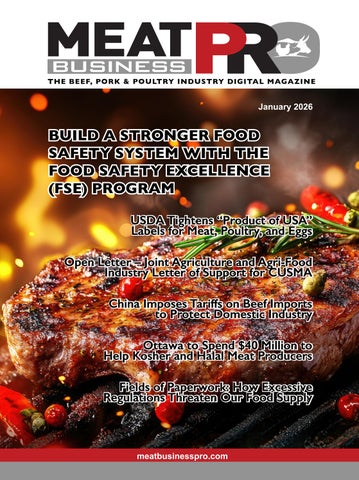
BUILD A STRONGER FOOD SAFETY SYSTEM WITH THE FOOD SAFETY EXCELLENCE (FSE) PROGRAM
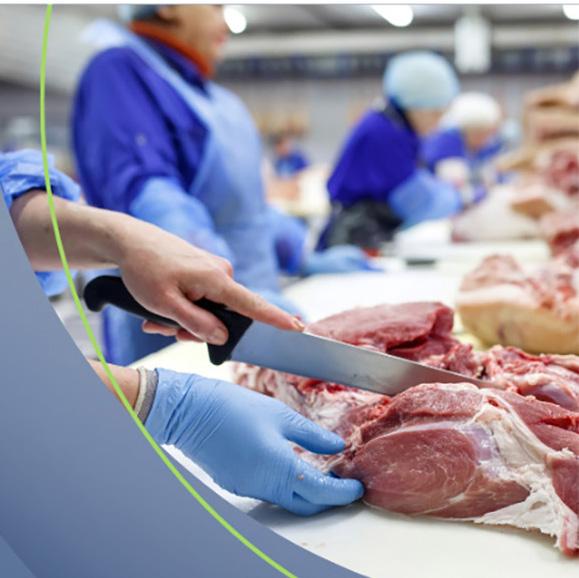
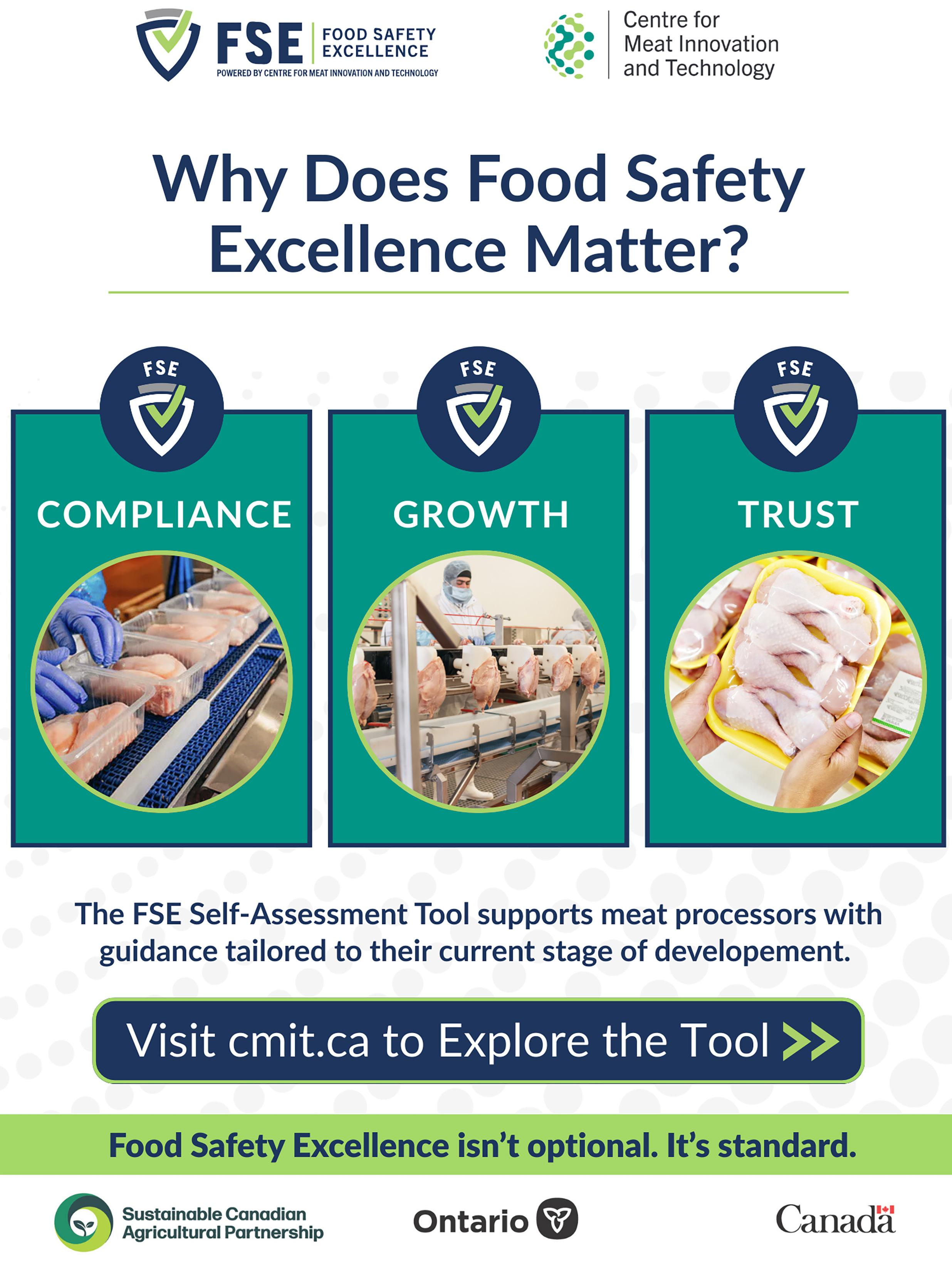
In Canada’s meat processing industry, strong food safety systems aren’t just a requirement, they’re a foundation for credibility and consumer trust. The new Food Safety Excellence (FSE) Program, powered by the Centre for Meat Innovation & Technology (CMIT), was created to support meat processors on their path to continuous improvement.
The FSE Program offers a free survey tool, along with resources and training opportunities designed to support processors as they strengthen and modernize their food safety systems.
WHAT IS THE FSE TOOL?
The FSE Tool is a quick, anonymous online survey designed to help meat processors understand where their food safety system stands today and receive a recommended next step aligned with their current operation.
The survey is completed online by the person responsible for food safety at the facility and typically takes less than five minutes to complete. The questions are simple and straightforward, using a mix of multiplechoice and yes/no questions that ask about current food safety systems in place.
Once completed, the online survey provides a single recommended next step aligned with your current operation.
Whether you’re a new processor building a food safety system from the ground up or an established operation looking to upgrade and/or modernize, the FSE Tool can help.
THROUGH THE FSE PROGRAM, PROCESSORS CAN:
* Complete a 4-minute, anonymous online survey with no obligation
* Explore Implementation Support opportunities — provincially licensed meat plants in Ontario may apply for up to $30,000 in support
* Access CMIT food safety expertise to help interpret survey results
* Be considered for a Food Safety Excellence Program case study, highlighting real-world application and leadership in food safety
IMPLEMENTATION SUPPORT OPPORTUNITIES FOR ONTARIO PROCESSORS
Provincially licensed processors in Ontario can receive up to $30,000 in Implementation Support to help modernize food safety and traceability systems (paid directly to third-party vendors). This support can assist processors in assessing food safety risks, strengthening capacity to adopt protection and assurance systems, supporting employee training, and enhancing public trust as businesses grow.
To apply for this support, complete the Expression of Interest Form today.
TRAINING AND LEARNING
The FSE Program also includes a variety of free educational and training resources for meat processors, including:
* LEARNING MODULES
Modules that guide processors through key food safety topics, including the value of food safety systems and the most common food safety frameworks in North America.
* TOOLS AND TEMPLATES
Free downloadable reference documents and templates to support improvements in food safety, record keeping, and implementation.
* ONLINE WEBINARS
Free one-hour webinars, as well as NSF-led virtual training sessions that include an exam and certificate. Topics include HACCP Level 1 and 2, Principles of Internal Auditing, Paperless Forms, Sanitation Practices, and more.
The Food Safety Excellence Program is designed for Canadian meat processors at every stage of growth. It provides a practical survey tool, along with learning and training resources, to help strengthen food safety systems and meet evolving market expectations. By investing in food safety today, processors can position their businesses for long-term success provincially, nationally and internationally. Strong food safety systems not only protect consumers, they also reinforce credibility and build trust.
CLICK HERE TO EXPLORE THE FOOD SAFETY EXCELLENCE PROGRAM TODAY
Food Safety Excellence tools and resources have been developed through funding provided by the Sustainable Canadian Agricultural Partnership (Sustainable CAP), a five-year, federal-provincial-territorial initiative.
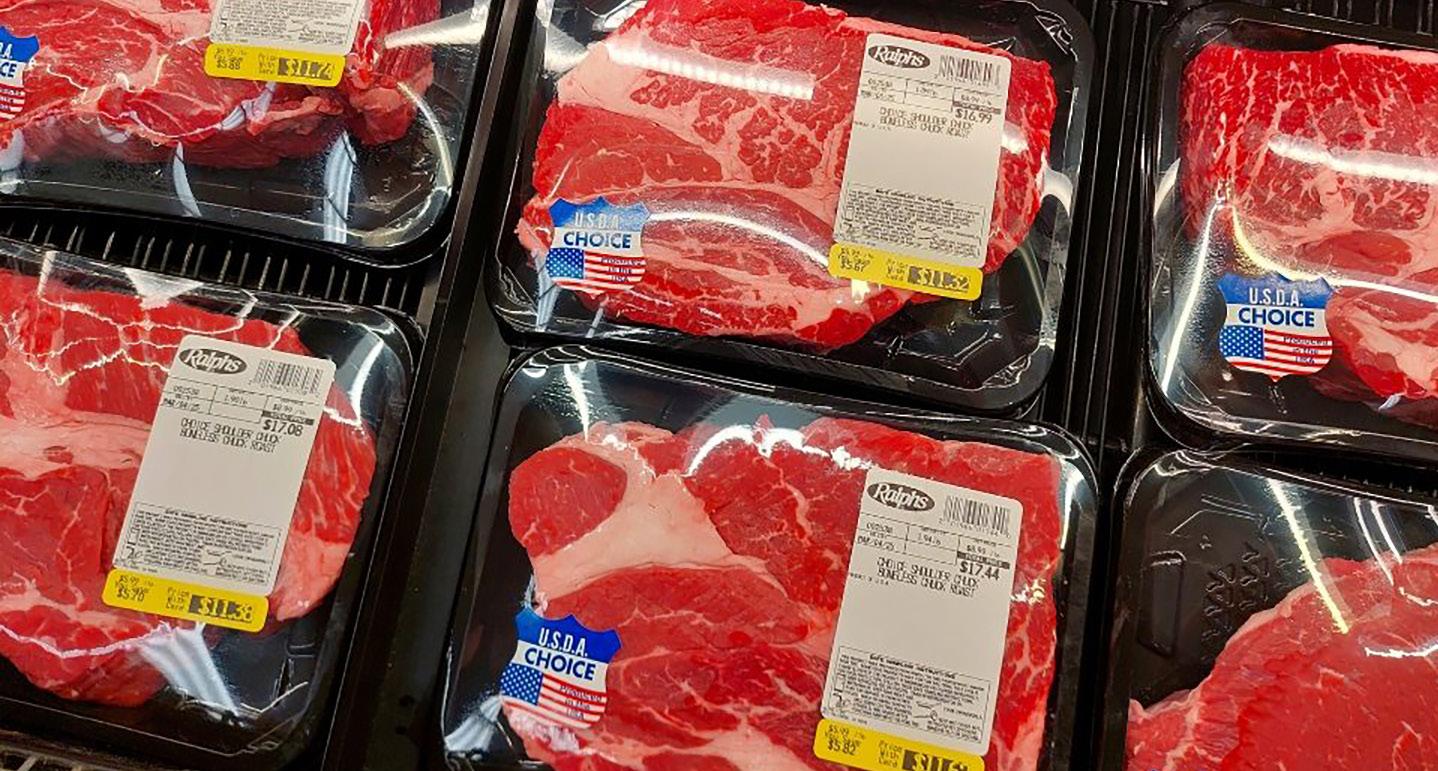
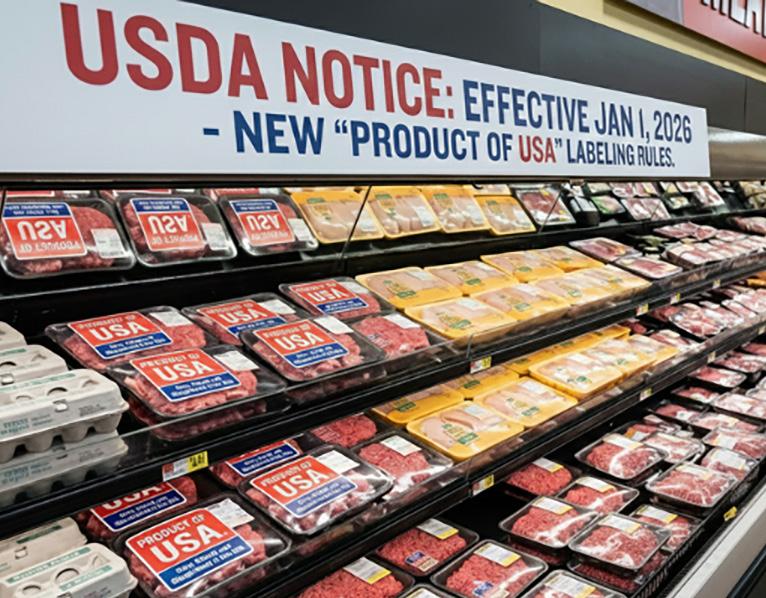
USDA TIGHTENS “PRODUCT OF USA” LABELS FOR MEAT, POULTRY, AND EGGS
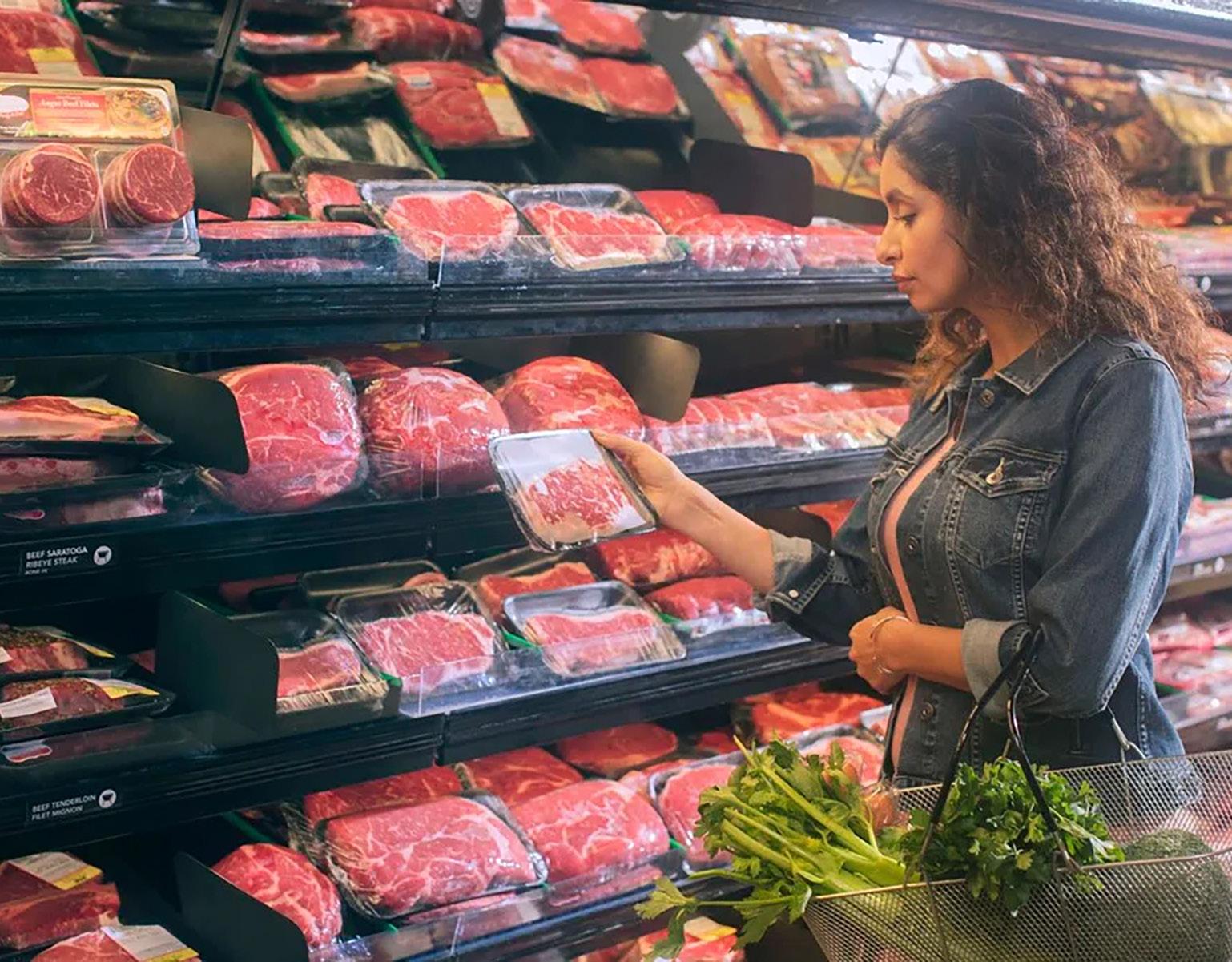
The U.S. Department of Agriculture (USDA) has finalized a rule that redefines when meat, poultry, and egg products may carry a “Product of USA” or “Made in the USA” label. While recent headlines suggest a sweeping change to America’s food system, the rule is far more targeted—and more legally significant—than much of the coverage implies.
Effective January 1, 2026, the USDA will allow these U.S. origin claims only when animals are born, raised, slaughtered, and processed entirely in the United States. For food brands, importers, and processors, the rule is not about banning imports, but about compliance, documentation, and the regulatory risk tied to voluntary labeling claims.
WHAT THE USDA CHANGED IN ITS “PRODUCT OF USA” RULE
The USDA, through its Food Safety and Inspection Service (FSIS), has tightened the definition of “Product of USA” and “Made in the USA” when used on meat, poultry, and egg products.
Under the final rule, companies may only use these claims if every stage of production occurs in the United States, including:
• Birth of the animal
• Raising of the animal
• Slaughter
• Processing
Previously, products made from imported animals could still carry a “Product of USA” label if they were processed domestically. USDA concluded that this practice conflicted with consumer expectations and allowed labeling that many shoppers found misleading.
“Under USDA’s final rule, ‘Product of USA’ means the animal was born, raised, slaughtered, and processed entirely in the United States—not merely processed domestically.”
WHEN DOES THE NEW USDA “PRODUCT OF USA” DEFINITION TAKE EFFECT?
The rule becomes enforceable on January 1, 2026. This delayed effective date gives companies time to evaluate supply chains, reassess labeling strategies, and implement record-keeping systems needed to support U.S. origin claims. Despite some reporting suggesting an imminent change, there is no immediate labeling requirement or enforcement action tied to this rule.
DOES THE USDA RULE REINSTATE MANDATORY COUNTRY-OF-ORIGIN LABELING (COOL)?
No. This rule does not reinstate mandatory Country-ofOrigin Labeling (COOL) for meat or poultry.
Mandatory COOL for certain meats was repealed in 2015 after World Trade Organization disputes involving Canada and Mexico. The current rule is limited to voluntary origin claims only. Companies are not required to label products with country-of-origin information, but if they choose to make a U.S. origin claim, it must meet the new definition.
WHAT MOST COVERAGE GETS WRONG ABOUT THE USDA LABELING CHANGE
1. This Is a Labeling Standard, Not an Import Restriction
The rule does not restrict imports or limit foreignsourced meat, poultry, or eggs from being sold in the United States. It regulates only the use of specific U.S. origin language on labels.
2. Documentation and Traceability Will Drive Enforcement
FSIS enforcement will focus on whether companies can substantiate their claims. Businesses using “Product of USA” should expect scrutiny of sourcing records, supplychain traceability, and internal controls supporting the label language.
3. The Rule Forces Strategic Decisions About U.S. Origin Marketing
Some companies may choose to remove U.S. origin claims entirely rather than restructure sourcing or assume additional compliance obligations. For others, maintaining the label may be a valuable branding decision that justifies increased documentation and oversight.
WHAT FOOD AND BEVERAGE COMPANIES SHOULD EXPECT BEFORE 2026
1. Greater Scrutiny of Voluntary Origin and Sourcing Claims
This rule aligns with a broader regulatory trend toward closer review of voluntary labeling statements, particularly those that influence consumer perception about origin, quality, or production practices.
2. More Conservative Label Language and Internal Review
Companies may adopt narrower, more qualified label language or implement more robust pre-market review processes to reduce enforcement risk.
While this rule applies only to USDA-regulated foods, similar consumer-expectation issues arise under FDA oversight. This approach mirrors broader federal scrutiny of food labeling, including FDA enforcement trends affecting nutrition, origin, and marketing statements.
4.Why the “Product of USA” Rule Matters from a Regulatory Risk Perspective
From a compliance standpoint, the rule reinforces a key principle: voluntary claims are still regulated claims. Once a company chooses to make an origin statement, it must be truthful, substantiated, and consistent with how regulators believe consumers interpret that language.
At Juris Law Group, we regularly advise food and beverage companies on labeling strategy, claim substantiation, and regulatory exposure under both USDA and FDA frameworks. The revised “Product of USA” definition is a reminder that labeling decisions carry legal consequences beyond marketing considerations.
USDA “PRODUCT OF USA” LABELING RULE – FAQS
1. Can imported meat still be sold in the U.S.?
Yes. Imported meat, poultry, and eggs may still be sold legally. The rule only affects whether those products can be labeled “Product of USA.”
2. Are companies required to change labels now?
No. The rule takes effect January 1, 2026, and applies only if a company chooses to use a U.S. origin claim.
3. Does this apply to restaurants or food service?
The rule primarily applies to retail labeling, though misleading origin statements in food service settings may raise separate consumer-protection issues.
4. Will this affect pricing or supply chains?
USDA has not indicated that the rule will affect pricing or availability. Any changes would stem from individual business decisions, not the regulation itself.
5. Which agency enforces the rule?
USDA’s Food Safety and Inspection Service (FSIS) oversees enforcement and documentation requirements for covered products.
KEY TAKEAWAY
The USDA’s revised “Product of USA” rule does not overhaul food labeling or restrict imports. Instead, it narrows who can make a powerful origin claim and raises the compliance bar for those who do. Companies relying on U.S. origin labeling should begin reviewing sourcing, documentation, and label strategy well ahead of the 2026 enforcement date.
Article courtesy of Juris Law Group - https:// jurislawgroup.com/
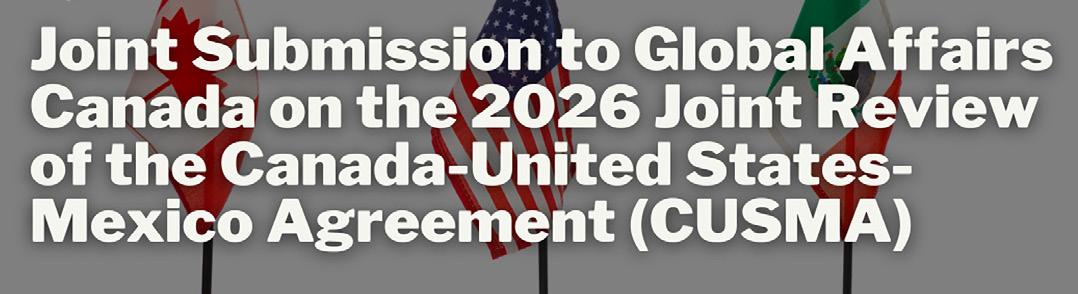
OPEN LETTER – JOINT AGRICULTURE AND AGRI-FOOD INDUSTRY LETTER OF SUPPORT FOR CUSMA
In early December, a group of 98 agriculture and agrifood sector leaders who support the Canada-United States-Mexico Agreement (CUSMA), submitted the following open letter to the Canadian government in support a tariff-free integrated North American agriculture trading market.
Dear Prime Minister Carney and Ministers,
On behalf of leaders in Canada’s agriculture and agri-food sector, we write to echo the recent correspondence from our U.S. counterparts and express our strong support for the full 16-year renewal of the Canada-United States-Mexico Agreement (CUSMA). Our organizations represent a broad spectrum of agriculture and agri-food industries—including farmers, ranchers, processors, and agribusinesses, to name a few. These stakeholders have greatly benefited from the seamless economic integration across North America made possible by the provisions of the CUSMA agreement.
CUSMA has been instrumental in fostering a stable, integrated North American agricultural market. It has enabled Canadian farmers, ranchers, processors, and exporters to thrive through predictable access to our most important trading partners. As a result, trade between all three countries under CUSMA has led to the tripling of the value of North American agriculture and agrifood trade between 2005 and 2023, totaling approximately $400 billion CAD ($285 billion USD).
The agreement’s provisions—particularly those related to sanitary and phytosanitary (SPS) measures, biotechnology, technical barriers to trade, and dispute settlement—have provided the predictability and stability, regulatory clarity as well as science-based frameworks necessary for innovation, investment, and growth. That is why we are calling on governments to maintain the agreement’s SPS provisions, which have improved transparency and ensured science-based treatment of agricultural products—protecting plant and animal health. The continuation of science-based regulatory cooperation is critical to ensuring timely access to agricultural innovations. We also fully support the Chapter 31 dispute settlement provisions in the Agreement which provide a mechanism for resolving barriers that otherwise disrupt market stability and growth.
https://www.beaconmetals.com
Agricultural Alliance of New Brunswick
Agricultural Producers Association of Saskatchewan
Alberta Beef Producers
Alberta Cattle Feeders’ Association
Alberta Federation of Agriculture
Alberta Milk
Alberta Pork
Animal Nutrition Association of Canada
Aquaculture Association of Nova Scotia
Association des Aquaculteurs du Québec
Association of Equipment Manufacturers
Atlantic Canada Fish Farmers Association
Beef Farmers of Ontario
BC Agriculture Council
BC Dairy Association
BC Fruit Growers Association
BC Greenhouse Growers Association
BC Pork
BC Salmon Farmers Association
BC Shellfish Growers Association
British Columbia Cattlemen’s Association
Canadian Aquaculture Industry Alliance
Canadian Association of Bovine Veterinarians
Canadian Beekeepers Federation
Canadian Bison Association
Canadian Cattle Association
Canadian Federation of Agriculture
Canadian Hatching Egg Producers
Canadian Honey Council
Canadian Livestock Transporters’ Alliance
Canadian Meat Council
Canadian Nursery Landscape Association
Canadian Ornamental Horticulture Alliance
Canadian Potato Council
Canadian Pork Council
Canadian Poultry & Egg Processors
Canadian Produce Marketing Association
Canadian Seed Growers’ Association
Canadian Sheep Federation
Canadian Sugar Beet Producers Association
Canadian Veal Association
Chicken Farmers of Canada
Dairy Farmers of Canada
Dairy Farmers of Manitoba
Dairy Farmers of New Brunswick
Dairy Farmers of Newfoundland and Labrador
Dairy Farmers of Nova Scotia
Dairy Farmers of Ontario
Dairy Farmers of Prince Edward Island
Deans Council – Agriculture, Food and Veterinary
MedicineEgg Farmers of Canada
Equestrian Canada
Fertilizer Canada
Foreign Agricultural Resource Management Services
(F.A.R.M.S.)
Flowers Canada Growers
Food and Beverage Canada
Food, Health & Consumer Products of Canada
Fruit and Vegetable Growers of Canada
Holland Marsh Growers Association
Horticulture Nova Scotia
Keystone Agricultural Producers
Les Éleveurs de Porcs de Québec
Les Producteurs de bovins du Québec
Les Producteurs de lait du Québec
Manitoba Beef Producers
Manitoba Pork
Mushrooms Canada
National Cattle Feeders’ Association
National Circle for Indigenous Agriculture & Food
National Sheep Network
New Brunswick Cattle Producers
Newfoundland Aquaculture Industry Association
Newfoundland and Labrador Federation of Agriculture
Nova Scotia Cattle Producers
Nova Scotia Federation of Agriculture
Nova Scotia Fruit Growers Association
Ontario Aquaculture Association
Ontario Federation of Agriculture
Ontario Fruit and Vegetable Growers Association
Ontario Greenhouse Vegetable Growers
Ontario Pork
Ontario Produce Marketing Association
PEI Aquaculture Alliance
PEI Cattle Producers
PEI Federation of Agriculture
PEI Hog Marketing Board
PEI Potato Board
NB Pork
Pork Nova Scotia
Quebec Produce Marketing Association
Quebec Vert
Restaurants Canada
Saskatchewan Cattle Association
SaskMilk
Sask Pork
Spirits Canada
Turkey Farmers of Canada
Union des producteurs agricoles
TYSON TO CLOSE NEBRASKA PLANT AND CUT SHIFTS AT ANOTHER
By Molly Ashford, Harvest Public Media
The announcement that Tyson would shutter a massive beef processing plant in Nebraska was the first such closure in more than a decade. Beef processors are running at lower capacity, as the U.S. cattle herd size is the smallest it's been since the 1950s.
When Tyson Foods announced it would close a beef processing facility in Lexington, Nebraska, and scale back to one shift at a facility in Amarillo, Texas, the company said the move was necessary to “right size” its beef business.
In total, the closure and cutbacks will eliminate about 7% to 9% of total beef processing capacity nationwide.
But David Anderson, a livestock economist at Texas A&M university, doesn’t anticipate that it will have a large impact on the prices producers get for their cattle or how much consumers pay for beef at the grocery store.
“Typically, when a plant closes, what we expect is lower cattle prices and higher beef prices, because we’ve lost this capacity,” he said. “But at the same time, we’ve got so much excess capacity already that that may not happen. It’s not like the closing has created a constraint on packing.”
The closure and cutbacks come amid significant economic issues for meatpackers. In 2025, the U.S. recorded its smallest beef cattle herd in more than 70 years, and meatpackers are losing money as they operate well below capacity.
According to Sterling Marketing, which releases weekly reports on beef industry trends, beef cattle processors were operating at 81.5% of capacity in the week ending on December 6. The Lexington plant was operating at less than that, with about 75% of its daily capacity, according to a report from Drovers Magazine.
What This Means for Beef Prices and One Small Town
Anderson said cattle is a “cyclical industry.” Very rarely, he said, are the different segments of the industry — cow-calf producers, feedlots, meatpackers and retailers — making money at the same time.
“When we get to very low numbers of cattle, we have very high prices,” he said. “The cow-calf producers and ranchers do well, that’s their turn to make a profit. And typically, feeders and packers lose money. And then, if we went back just a couple of years, we had very low cattle prices. Meatpackers did extremely well, but cowcalf ranchers were losing money.”
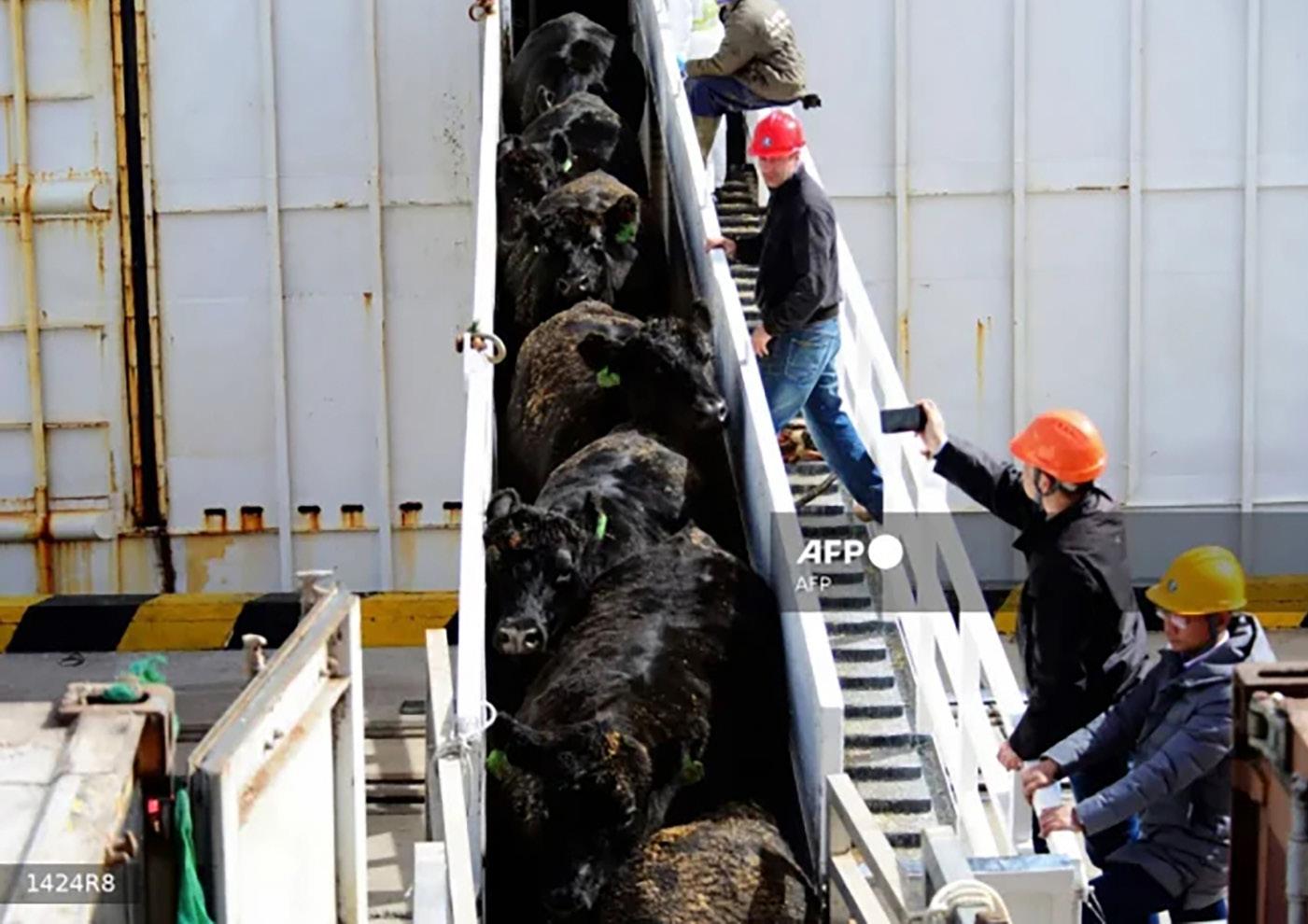
Cattle herds in the U.S. have been shrinking in recent years for a variety of reasons. Widespread drought conditions in recent years have reduced the availability of grazing land and increased feed costs. The New World Screwworm, a parasite impacting livestock, led to the U.S. closing its southern border in May to live animal imports, including cattle. Some beef processing plants relied on cattle imported from Mexico to fill their facilities.
Efforts to grow the herd are ongoing, Anderson said, but there will be a long lag. Anderson said a heifer calf born last spring would have her first calf in the spring of 2027. The calf would get to its finished weight at a feedlot near the end of 2029.
“Biology puts this really long-time lag on how fast you can respond to high prices,” he said.
A COMMUNITY PREPARES FOR POPULATION DECLINE
The Lexington plant employs more than 3,200 people, all of whom will lose their jobs when the plant closes on January 20. In Amarillo, the cuts will eliminate more than 1,700 jobs.
Amarillo is better suited than Lexington to absorb the job losses. The city is home to more than 200,000 people; Lexington’s population sits just above 10,500. Amarillo also has other major employers and industries in the area. Most of the economic development around Lexington has centered around the Tyson plant.
“It’s so difficult to replace an employer of that magnitude,” Anderson said. “I mean, that’s led to a huge amount of economic activity in a rural county, in growth, in population and in other businesses. So the rippling effect of this is pretty terrible.”
Feedlots located near the Lexington plant are likely to feel some strain from the closure. Craig Uden, who partially owns a feedlot about 8 miles outside of Lexington, said increased transportation costs are the “biggest challenge” for him and others in the area.
“It’s been a challenge to figure out how we’re going to deal with freight,” Uden said in a webinar hosted by the Nebraska Center for Agricultural Profitability. “It’s gonna cost us probably about $20 on average to move these cattle to any other major [packing plant].”
Tyson’s presence in Lexington has also created something of a multicultural hub in the middle of small-town America. Between 1990, when the plant began operating, and 2000, the city’s population nearly doubled, according to census data.
That rapid growth also meant demographic change. Data from the 2023 American Community Survey estimated that about 41% of Lexington’s population was born outside of the U.S., and about 60% identified as Hispanic. Most of the immigrant population hails from Latin America, while about 17% is from Africa.
Jennifer Norton, the city’s library director, said they “have the world in Lexington, Nebraska.” She worries that the Tyson closure could mean a significant population decline – and along with it, a loss of identity.
“There is going to be a very large exodus of the immigrant population, just because there won’t be jobs right here in town,” she said.
Lexington residents and state officials are hopeful, though not necessarily optimistic, that the massive plant can be repurposed or taken over by another beef processor. When Tyson closed a beef processing plant in Norfolk, Nebraska, in 2006, the company stripped the plant bare so it could not be used for the same purpose. It remains empty.
Tyson did not respond to a request for comment on its plans for the Lexington building.
Article courtesy of KCUR (NPR in Kansas City) - https:// www.kcur.org/
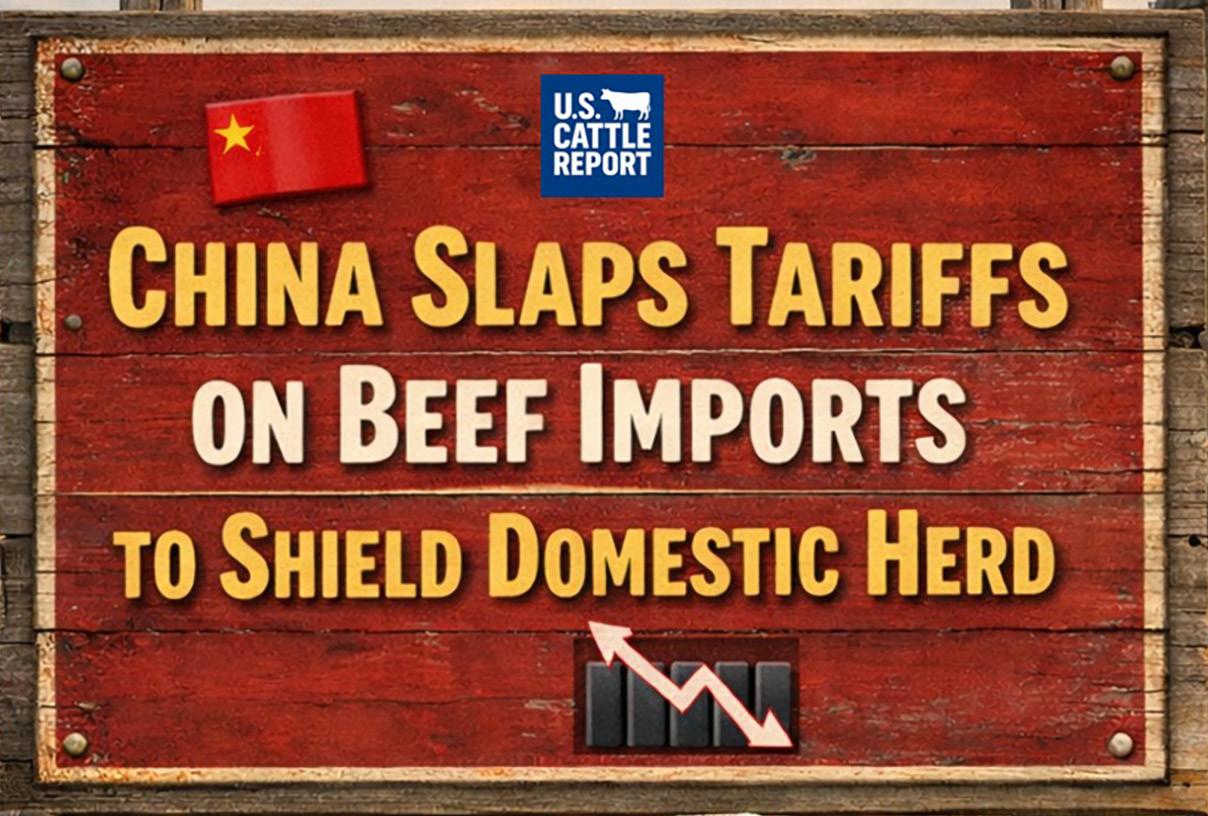
CHINA IMPOSES TARIFFS ON BEEF IMPORTS TO PROTECT DOMESTIC INDUSTRY
By Daphne Zhang, Ella Cao and Liz Lee, Reuters
China will impose an added 55% tariff on beef imports that exceed quota levels from key supplier countries including Brazil, Australia and the U.S. in a move to protect a domestic cattle industry slowly emerging from oversupply.
China's commerce ministry said the total import quota for 2026 for countries covered under its new "safeguard measures" is 2.7 million metric tons, roughly in line with the record 2.87 million tons it imported overall in 2024.
The new annual quota levels are set below import levels for the first 11 months of 2025 for top supplier Brazil as well as for Australia.
"The increase in the amount of imported beef has seriously damaged China's domestic industry," the ministry said in announcing the measure following an investigation launched last December.
The measure takes effect on January 1 for three years, with the total quota increasing annually.
Beef imports to China fell 0.3% in the first 11 months of this year to 2.59 million tons.
Chinese beef imports will decline in 2026 as a result of the measures, said Hongzhi Xu, senior analyst at Beijing Orient Agribusiness Consultants.
"China's beef-cattle farming is not competitive compared with countries such as Brazil and Argentina. This cannot be reversed in the short term through technological advancements or institutional reforms," Xu said.
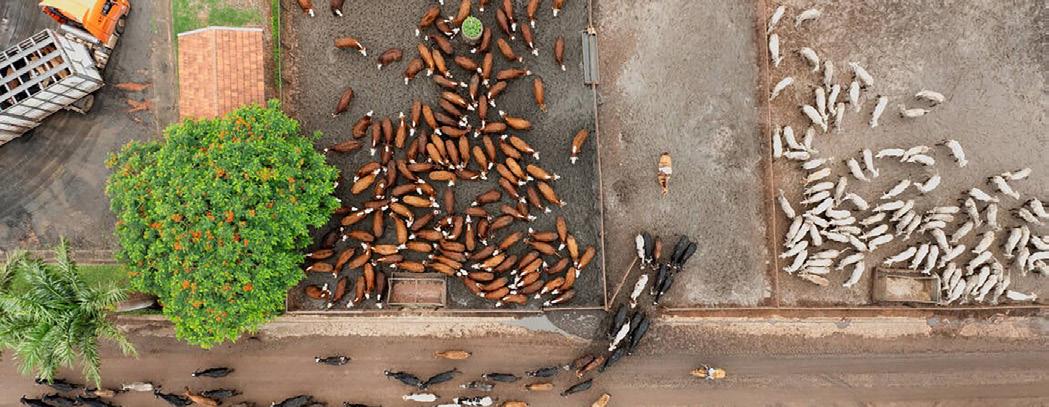
In 2024, China imported 1.34 million tons of beef from Brazil, 594,567 tons from Argentina, 243,662 tons from Uruguay, 216,050 tons from Australia, 150,514 tons from New Zealand, and 138,112 tons from the U.S.
In the first 11 months of this year, Brazil shipped 1.33 million tons of beef to China, according to Chinese customs data, well above the quota levels set under Beijing's new measures.
Also this year, Australian shipments to China have surged, gaining share at the expense of U.S. beef after Beijing in March allowed permits to expire at hundreds of American meat plants and as President Donald Trump unleashed a tit-for-tat tariff war. U.S. shipments stood at just 55,172 tons through November.
Australian beef exports to China stood at 294,957 tons in the first 11 months of 2025.
China's move comes as a global beef shortage pushes up prices in many parts of the world, including to record highs in the U.S.
Responding to Beijing's announcement, Mark Thomas, chair of the Western Beef Association in Australia, said: "There's plenty of other countries that will take our product."
Luis Rua, secretary at Brazil's agriculture ministry, said there is no reason "to panic", telling Reuters that the government can negotiate "compensatory measures" with China to offset the impact of the new tariffs.
In a telephone interview, Rua also mentioned Brazil's ability to redirect beef exports to other countries.
Brazilian industry groups, on the other hand, expressed concern.
In 2025, Chinese imports of Brazilian beef totalled approximately 1.7 million tons, equivalent to some 48% of the volume exported by Brazil overall, said beef lobby Abiec in a statement.
"Given this scenario, adjustments will become necessary throughout the entire supply chain, from production to export, to avoid broader impacts," Abiec noted.
Brazil's other beef lobby Abrafrigo said the potential impact of China's safeguard measures could mean a loss of up to $3 billion in export revenue for Brazil in 2026.
This year, Brazil's total beef export revenues are estimated at $18 billion, Abrafrigo said.
DOMESTIC PROTECTION
China made its announcement following two extensions of its beef import probe, which officials say does not target any particular country.
The tariffs will help curb the decline in China's breeding cow inventory and buy time for domestic beef enterprises to make adjustments and upgrades, said Zengyong Zhu, a research fellow of the Institute of Animal Science of the Chinese Academy of Agricultural Sciences.
Beijing has stepped up policy support for the beef sector this year and said in late November that cattle farming had been profitable for seven consecutive months.
OTTAWA TO SPEND $40 MILLION TO HELP KOSHER AND HALAL MEAT PRODUCERS
By Joel Ceausu, The Canadian Jewish News (CJN)
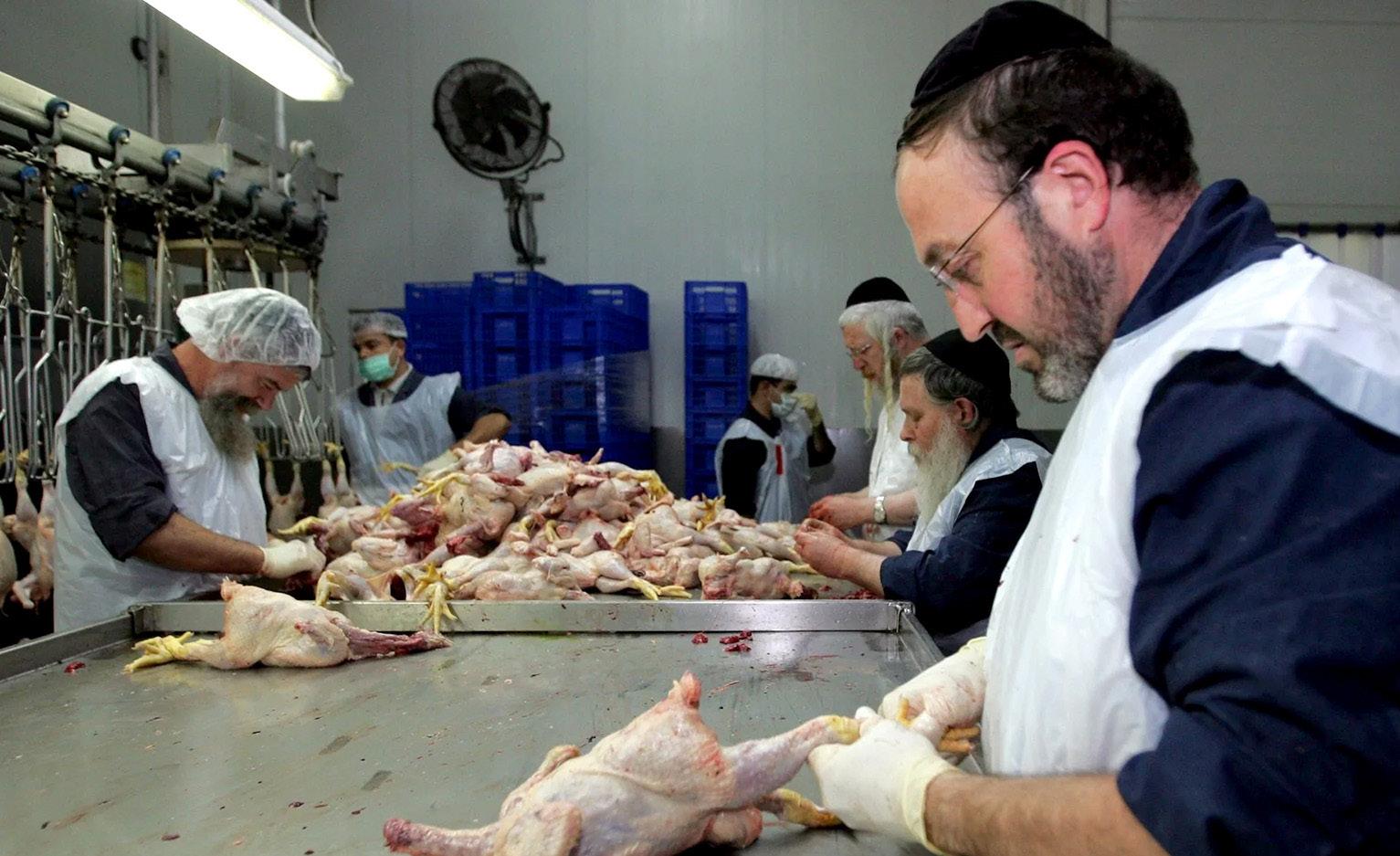
Ottawa is spending $40 million over six years “to support the resilience and productivity” of Canada’s kosher and halal red meat (beef and veal) sector, helping address unique challenges of kosher and halal slaughter under Jewish and Islamic dietary laws.
The funding was a small mention on page 273, in a table in the federal Budget 2025 under “Health, Immigration, Culture and Communities expenditures: Supports for Kosher and Halal practices in Red Meat Production” via Agriculture and Agri-Food Canada (AAFC) and the Canadian Food Inspection Agency (CFIA).
That includes new and existing funding commitments to AAFC and the CFIA through 2029-2030 to help licensed kosher and halal meat producers comply with the 2019 Safe Food for Canadians Regulations.
The CFIA will also receive new learning materials, digital tools, and guidance for staff and abattoirs, plus funding equivalent to six full-time employees overseeing kosher and halal slaughter inspection.
A total of $29 million is allocated to AAFC for the new Kosher and Halal Investment, AgriAssurance, and AgriMarketing programs. The largest portion, $25 million, supports slaughter establishments with quality assurance systems, efficiency improvements, new technology and equipment, and promotion of international trade in Canadian kosher and halal meat. Financing is offered over two fiscal years (2025–2027).
It’s unclear if the programs will have any real effect on Canada’s kosher meat supply, and while AAFC says it is finalizing funding agreements, only one project is approved to date: Beretta Farms Ltd. (This includes about $179,000 to introduce traditional halal slaughter techniques at its Alberta operations, along with enhanced stunning methods.)
The programs follow the CFIA’s 2019 regulations mandating specific tests to confirm animals were unconscious after ritual slaughter without pre-slaughter stunning, including absence of rhythmic breathing and corneal reflex. These rules increased costs, slowed production by several minutes per animal, and reduced efficiency to the point that some license holders shuttered their kosher meat operations, including one large packer north of Montreal that processed more than 1,000 cattle weekly.
Canada’s largest kosher meat distributor, Mehadrin, together with Shefa Meats, the Kashruth Council of Canada (COR) and MK Kosher (MK), went to Federal Court to stop CFIA enforcement of the guidelines. They argued the rules had a devastating impact on Canada’s kosher meat supply, depriving Canadian Jews of an important religious precept, and were unreasonable or beyond CFIA authority, as well as discriminatory and infringing Charter rights.
Judge Guy Régimbald agreed, granting an injunction in July 2024 halting enforcement of certain unconsciousness indicators until final resolution of the issues. Other 2019 regulations remain enforceable, including requirements that animals be unconscious before hoisting in ritual and non-ritual slaughter
Sidney Nemes, whose family operated Montreal’s J & R Kosher Meat and Delicatessen for half a century before its closure in 2023, and who now advises industry players, told The CJN the market is constrained by large producers, with many abattoirs tied to bigger processors.
“Canada does not have a rich source of kosher producers,” he said, noting that fewer operators opt to include kosher slaughter. While he said the programs can help and he has worked with some companies considering grants, particularly in Ontario, “it doesn’t seem to have attracted wide interest.”
The CJN asked Montreal-based MK Kosher whether the programs were a community ask of government and if the grants were sufficient to help producers offset new costs but received no response. COR managing director Richard Rabkin told The CJN he was not familiar with any producers applying for the grants and did not know much about the program.
Asked about the new funding, Mount Royal MP Anthony Housefather said it stemmed from discussions last year, telling The CJN, “One solution was to help provide those slaughterhouses doing kosher slaughter adapt their facilities to remain profitable, even with the longer time frame required on each animal slaughtered, which meant more lines were needed. At least some of these monies are towards helping adapt facilities.”
Contributions are generally capped at $2 million, covering up to 50 per cent of project costs. The AgriMarketing program includes an additional $2 million to boost kosher and halal red meat export and market development, and AAFC will raise its maximum contribution to 70 per cent for projects targeting markets such as Bangladesh, Malaysia, Pakistan and Sri Lanka, or for businesses more than 50 per cent owned or led by an “underrepresented and marginalized group,” including Indigenous Peoples, women, 2SLGBTQI+, visible minorities, and persons with disabilities.
Montreal-based Mehadrin procures and distributes about three-quarters of the kosher meat from Canadian licensed slaughterhouses, with Toronto-based Shefa Meats picking up the balance. Court documents show Mehadrin also imports kosher beef from Mexico and Argentina and exports 30 to 40 per cent of its beef to the United States.
The CJN asked Mehadrin’s CEO, Chaim Moskovits, if they had occasion to access grants within the new program. “It only applies to those who are doing the physical slaughtering,” he said. “We think it may be a good idea and I know a few people trying to access the project, but it’s too early to know so we really can’t answer anything much yet.”
A similar view was expressed by Premier Kosher, known for its large kosher poultry business outside Hamilton, Ont. “We recently ramped up our red meat operations,” plant manager Sebastian Gedja told The CJN, though the company does not operate its own slaughtering facilities. On other aspects of the government programs and CFIA guidelines, he said, “we still need to do some more research on how this will affect producers as it’s difficult to adhere to all these regulatory requirements. So, while it’s definitely of interest, it’s too early to comment.”
Article courtesy of The Canadian Jewish News (CJN)https://thecjn.ca/
PARKER RANCH – THE FIFTH LARGEST INDEPENDENTLY OWNED RANCH IN THE U.S.
By Deborah Wilson
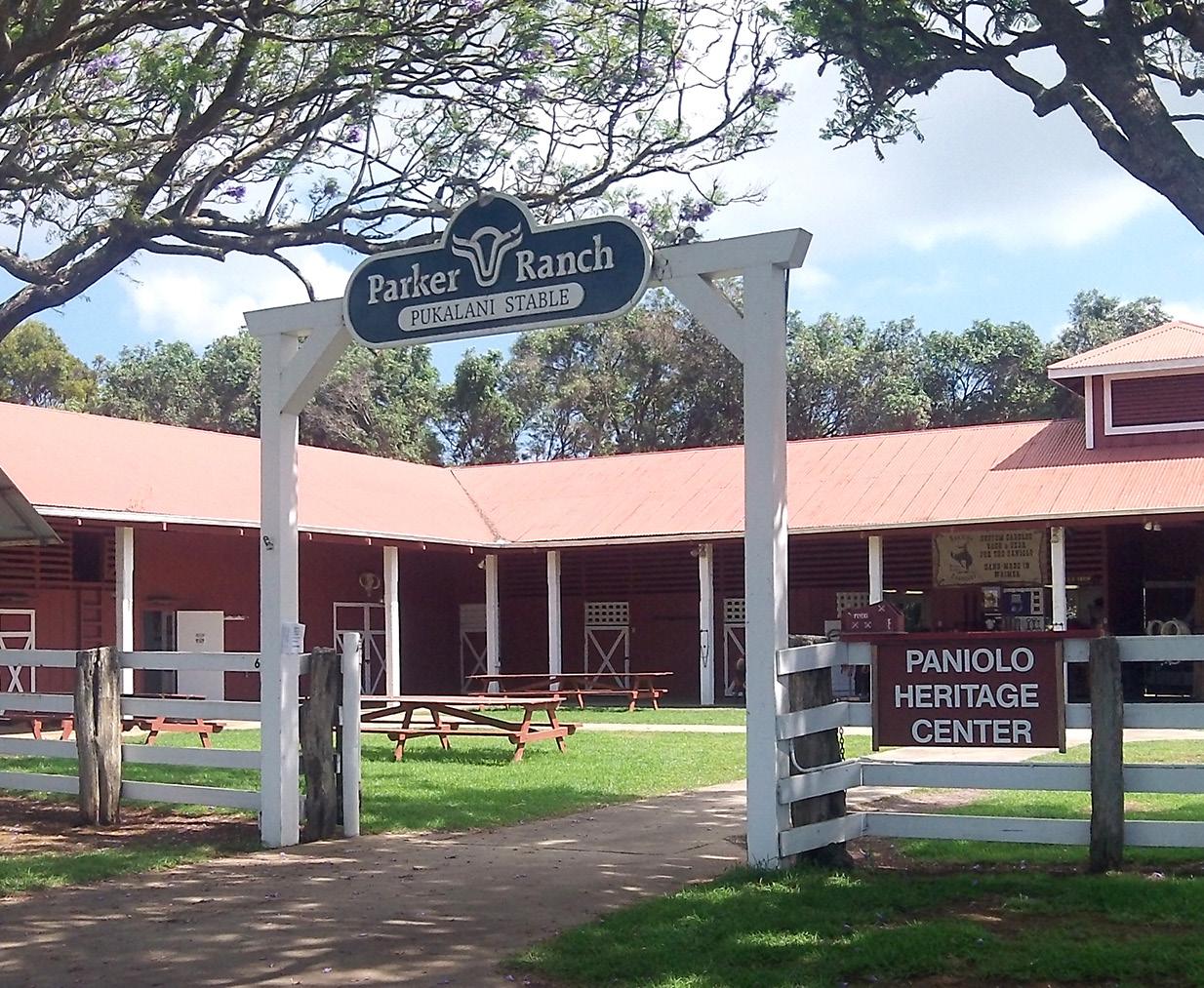
My husband and I recently visited Parker Ranch with our granddaughters, who are AG Business students in Alberta. The ranch is located on the largest of the Hawaiian Islands, Hawaii, which the state takes its name from. The ranch was founded in 1847 by John Palmer Parker, a sailor from Newton, Massachusetts. He chose to stay on the island which was a stopover for fresh water and meat for many sailing ships at that time.
John Parker Palmer married Chiefess Kipikane, the granddaughter of King Kamehameha I, and together they purchased the first two acres of land for the sum of $10.
Parker Ranch has been in cattle ranching for more than 175 years. At one time, when it was owned by Richard Smart who was a descendant of John Palmer Parker and Kipikane, it was the largest independently owned ranch in the United Sates encompassing over 500,000 acres. Today, it is still a cattle ranch running 10,000 mother cows, as well as breeding quarter horses, operating on 130,000 acres - 100,000 are fee simple and the remaining acres are held under various land leases.
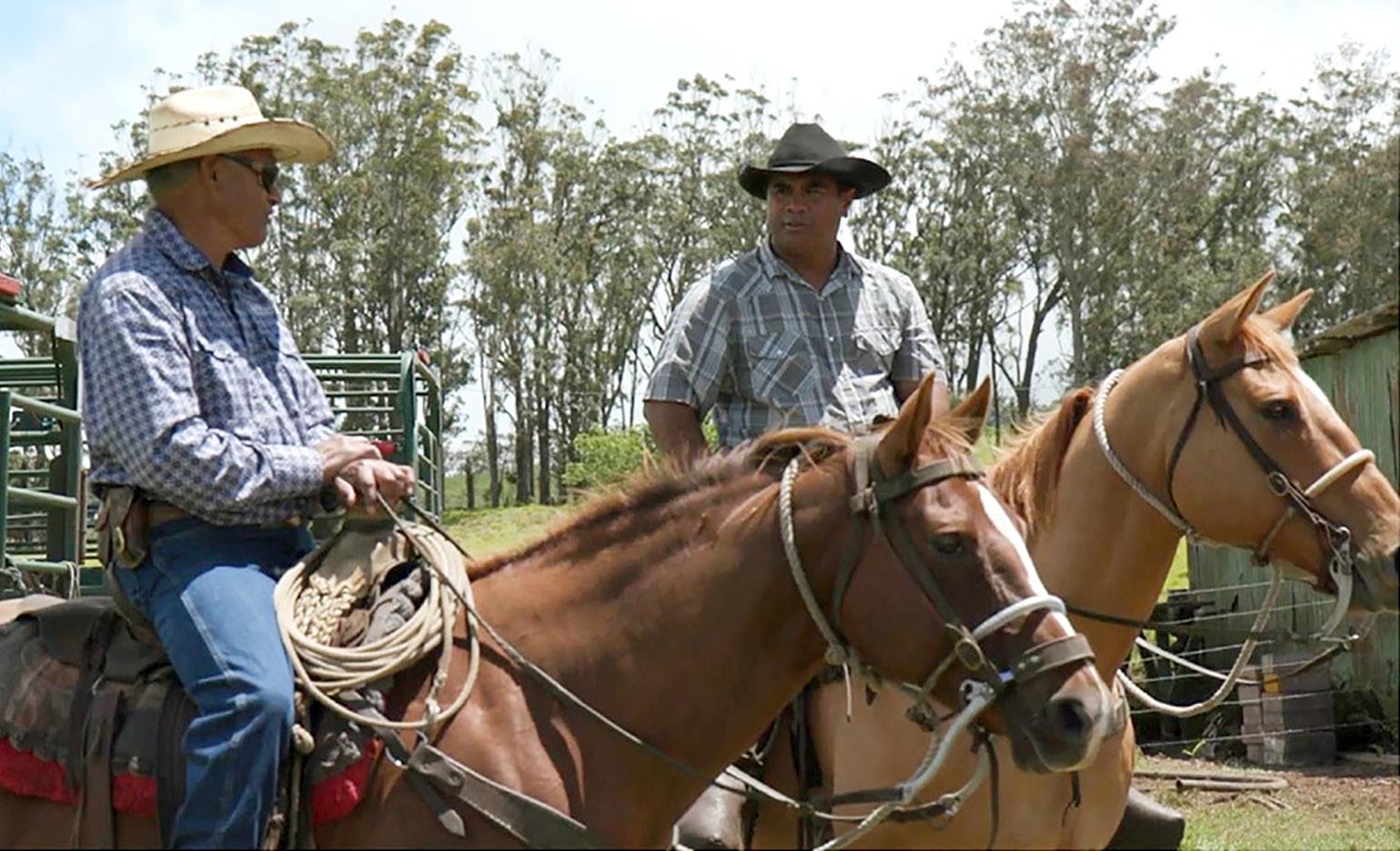
Today the ranch employs 16 paniolos (Hawaiian cowboys) and another 16 employees who provide support functions for the ranching operation such as fencing, welding, vehicle repair, maintenance, finance and administrative support. Prime grazing lands are at higher elevations, far from the roads and highways. It is not always possible to see the main herd of predominantly Angus cows, with a Charolais herd of 800 mother cows, that provides Charolais bulls to use on the Angus cows. This breeding program provides excellent calves that do extremely well in feedlots on the mainland.
Fifty years ago, the cattle on the island were mostly Brangus, Hereford and some Longhorn, known for their hardiness and adaptability. About 40 years ago Charolais cattle from Canadian genetics were introduced to the island by Bill Wilson of Charwil Ranch Ltd. In 1984, a group of live Charolais females and one bull, as well as 600 embryos were purchased by SC Ranch, managed by Walter Slater and owned by Dutch Schumann. Parker Ranch purchased its first Charolais bulls in 1987 from SC Ranch and went on to purchase a group of 30 Charolais cows from Bill Wilson in 1992.
From there the crossbreeding program developed with Parker Ranch gradually switching from Brangus and Hereford to Angus for the main cowherd and increasing the Charolais herd to 800 mother cows. Many cattle producers in Hawaii utilize artificial insemination, importing semen from the mainland U.S., creating the quality cattle and beef they have today.
The Ranch exports two-thirds of its calves to the U.S. mainland for finishing and processing to be marketed at retail locations in the Western U.S. The other onethird of the calf crop remains on the ranch for breeding stock or to be processed and marketed in local retail locations. Parker Ranch’s Paniolo Cattle Company grass-fed beef is in all 23 Safeway locations state-wide. The Parker Ranch Black Label beef is available at the commissaries located on the four military bases on Oahu as well as Hawaii Whole Foods Markets. Waimea is the hometown of the ranch, not too far from the resorts and beaches the Islands are known for, so of course Parker Ranch beef is sold at the Waimea butcher shop.
Today the ranch is owned and operated by the Parker Ranch Foundation Trust and its beneficiaries are the community hospital, Parker School Trust Corp., and the Hawai’i Preparatory Academy as well as the Richard Smart Fund of the Hawai’i Community Foundation.
Left to right - Aleesa Morrison, Bill Wilson, Tessa Morrison
FIELDS OF PAPERWORK: HOW EXCESSIVE REGULATIONS THREATEN OUR FOOD SUPPLY
What happens when nearly seven in ten farmers tell the next generation not to run a business? Canada’s food supply chain faces a crisis. Excessive red tape is driving agri-business owners out of a critical Canadian industry, and if governments don’t act, the ripple effects will hit every Canadian plate.
Red tape slows the economy, drains business productivity, and dampens growth especially for small businesses. Canadian enterprises face $51.1 billion in compliance costs annually, with nearly $18 billion due to red tape. Agriculture is among the most heavily regulated sectors, but most operations are independent businesses that rarely have the luxury of dedicated compliance teams. This leaves small operators bearing the brunt of the burden.
Every January, the Canadian Federation of Independent Business (CFIB) uses Red Tape Awareness Week to shine a spotlight on the crushing regulatory burden facing small businesses. This year, CFIB is shining a light on agriculture with a new snapshot that reveals just how severe the problem has become for Canadian farmers.
For years, farmers and food processors have warned that the regulatory burden that comes along with running their agri-business is unsustainable. Today, those warnings have turned into alarm bells. CFIB data shows 90% of agri-businesses worry about the future of Canadian agriculture due to the regulatory burden. These numbers showcase a concerning trend for Canadian food security and rural economic vitality.
This isn't just a business challenge; it’s a threat to Canada’s food security and economy. If Canadian farmers and producers walk away from the industry because of overwhelming regulations, who will grow our food? Losing farms to red tape would shrink domestic production, raise prices, and increase reliance on imports at a time of fragile global supply chains.
Red tape isn’t just an inconvenience; it’s a major barrier to success for Canada’s agri-businesses. CFIB members report that excessive paperwork and overregulation lead to stress in their everyday life (95%), stifle productivity and growth (90%), and undermine competitiveness (70%). One agri-business in Ontario expressed their frustration, “Our business is at the size it is due to the fact that government policies and regulations make it unpalatable to want to expand and even to run a small business.” When compliance becomes a full-time job, innovation, expansion, and productivity take a back seat.
Agri-businesses have to deal with red tape from every level of government creating a maze of overlapping and conflicting rules. Many report that regulators are frequently unresponsive, and many rules feel disconnected from real-world farming. One Prince Edward Island member received quicker answers on their compliance questions from the US Food and Drug Administration than the Canadian Food Inspection Agency.
The good news is that solutions exist, but it takes political leadership. Governments can take action to cut red tape and ease the regulatory burden on independent agri-businesses. For example, all levels of government can measure and report the total regulatory burden on an annual basis. This transparency helps identify where rules pile up and ensures accountability. Also, adopting a “2 for 1” rule where with every new regulation introduced, governments must remove two outdated or unnecessary ones would help keep regulations lean, intentional, and relevant.
Reducing red tape is critical to ensuring our Canadian farmers are around for generations to come. In the face of an incredibly uncertain economy, paired with the burden of tariffs and climate changes, it is now critical for meaningful change for agri-businesses to be on the menu for all levels of government.
is a Policy Analyst for the Canadian Federation of Independent Business (CFIB). CFIB is Canada’s largest association of small and medium-sized businesses with 100,000 members (5,200 agri-business members) across every industry and region. CFIB is dedicated to increasing business owners’ chances of success by driving policy change at all levels of government, providing expert advice and tools, and negotiating exclusive savings. Learn more at cfib.ca.