The right of Helen Grimes to be identified as the author of this work has been asserted in accordance with the Copyright, Designs and Patents Act 1988.
All rights reserved. No part of this publication may be reproduced, stored in a retrieval system or transmitted in any form, or by any means, without the prior written permission of the author, nor be otherwise circulated in any form of binding or cover other than that in which it is published and without a similar condition being imposed on the subsequent purchaser.
Every effort has been made to ensure that all the information in this book is accurate. However, due to differing conditions, tools and individual skills, the publisher cannot be responsible for any injuries, losses and other damages that may result from the use of the information in this book.
First published 2026 by: Bustle & Sew Station House West Cranmore Shepton Mallet BA4 4QP
www.bustleandsew.com
WelcometotheFebruaryMagazine
February sits at a quiet crossroads here in the Somerset countryside. The days are lengthening, yet the land still rests. The fields are pale with frost, the hedgerows are bare but now filled with early birdsong, while the promise of spring is still held tightly beneath the soil. It is a month of patience, of noticing small changes, and of finding beauty in what endures.
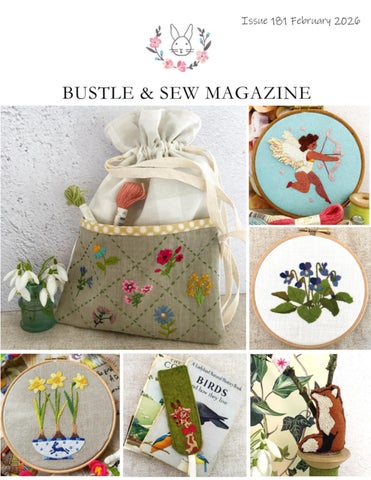
In this issue, our projects celebrate February’s gentle mix of romance, practicality, and quiet creativity. Leading the way is a charming Cupid hoop, perfect for the month of love, but timeless enough to enjoy long after Valentine’s Day has passed. Then there’s the springtime flowers drawstring bag flowers stitched onto a drawstring bag. This, I think, is a satisfying project that combines beauty and usefulness. Inspired by winter-to-spring blooms, these floral motifs bring softness and colour to an everyday essential, making it ideal for storing sewing tools, carrying small finds, or gifting to someone special. There are four more projects too, as well as seasonal recipes, a look at the history of the embroidery hoop and the British Land Amy in WW2.
I do hope you’ll enjoy this issue and the March edition will be published on Thursday 26 February, in four weeks time. Until then…
Very best wishes
February
Though it’s less than six weeks since the winter solstice just before Christmas (and how long ago does that seem now?!) by the the first day of February we are enjoying almost an extra hour of daylight between sunrise and sunset. In the city, on colder days, there are pink evening skies, and by the time the street lamps come on commuters have already begun their evening journeys home.
For many farmers, February is a quiet time, a time for repairing fences and machinery and taking a little time for themselves before the growing season begins anew. For the rest of us, who have less contact with the land, it seems a season when nature itself is marking time, deep in slumber while winter does its worst. But already the earliest signs of spring can be seen. There are drifts of snowdrops across woodlands, gardens and roadside verges. Also known as Candlemas bells,
colonies of these snow-white blooms can appear almost overnight in both wild and cultivated places. They were probably first introduced to Britain into churchyards and monastery gardens from more southerly parts of Europe.
In country lanes, especially here in the milder southwest of England, hedgerow plants are beginning to awake. Cow parsley is sprouting the fresh green rosettes that will eventually develop in May into a froth of white blooms, commonly known as “Queen Anne’s Lace” along the waysides. In damp, sheltered places swathes of lesser celandines catch the first warmth of the pale February sun, while in hedgerows, the pale green spires of the arum lily thrust their way through the decaying leaves of autumn.
In woodlands too, as you walk over last year’s leaf-litter and crackling dead twigs, you will become aware of a different atmosphere. At your feet you’ll see new shoots beginning to emerge as the woodland floor becomes alive again. Especially in the late afternoons there seems to be an urgency in the calling of woodland birds. As the breeding season approaches, mates must be found and territories established before the new generation is hatched into the kinder days of spring.
“The shortest day has passed, and whatever nastiness of weather we may look forward to in January and February, at least we notice that the days are getting longer. Minute by minute they lengthen out.
It takes some weeks before we become aware of the change. It is imperceptible even as the growth of a child, as you watch it day by day, until the moment comes when with a start of delighted surprise we realize that we can stay out of doors in a twilight lasting for another quarter of a precious hour.”
Llewely Powys (1884-1939) from The Twelve Months, 1936
TheApproachofSpring: Hellebores
Hellebores are the most beautiful winter and early spring flowers, displaying their subtly shaded and speckled nectar-holding petals in shades of white, green, ruby, or pink at a time when we are most desperate for some spring colour in our gardens.
. Thanks to their long flowering period, these perennials last deep into spring and they thrive in shadier settings. Not only are hellebores wonderful to look at but they are also rich with symbolic meaning with numerous references in folklore and mythology.
By the time most gardens are reduced to skeletal stems and wet soil, hellebores are already growing strongly. Their nodding blooms push through frosthardened ground in shades of chalk white, inky purple, green washed with rose, and near-black velvet, bringing colour, structure, and life to the garden when it is most needed.
Once dismissed as old-fashioned or even sinister, hellebores have undergone a renaissance. Today they are among the most sought-after perennials in temperate gardens, prized for their durability, subtle beauty, and astonishingly long flowering season.
Available in both evergreen and herbaceous varieties, hellebores feature displays of foliage that are simply
stunning and range in colour from dark green to more vibrant lime green. Emerging from this foliage, shoots in either burgundy or green emerge to prop up the attractive blossoms of the hellebore plant. The blossoms typically feature five petal-like sepals and a centre of nectaries, which are essentially modified petals that store the plant’s nectar.
Hellebore plants are quite compact and are typically 12-18” tall, though there are a few varieties that can grow to an impressive 3 feet tall. Hellebores are selfseeding perennials, which means that each year they’ll return to brighten your winter garden with even more lovely blooms.
A (very) Little Look at the Women’s Land Army of WW2
Land Girls Pruning at East Malling by Evelyn Dunbar (1944)
In last month’s magazine we looked at the life and work of the only paid female war artist of the second world war, Evelyn Dunbar. She is remembered best for her depiction of the work of the Women’s Land Army - the Land Girls - and so thought that this month it would be interesting to take a look at this, often forgotten, aspect of war work.
The Women’s Land Army (WLA) was not glamorous, rarely celebrated during the war itself, and often overlooked in the years since. Yet its story is one of transformation—of women, of class boundaries, and of Britain’s relationship with food, labour, and gender.
By spring 1938 the prospect of another world war was becoming very real, and a Women’s Branch of the Ministry of Agriculture was established with Lady Denman in charge. The plans were top-secret and she began to develop a skeleton organisation for a future Women’s Land Army. On 15 April 1939 The Times reported that it had been decided to form a Women’s Land Army, “the members of which would be ready to take up farm work as a full time occupation in time of war.”
When Britain went to war in September 1939, the nation prepared for blackouts, ration books, and air raids. What few anticipated was that one of the most visible symbols of wartime resilience would not be a soldier in uniform, but a young woman in muddy boots, corduroy breeches, and a felt hat—milking cows at dawn, harvesting wheat by hand, and quite literally keeping the country alive.
Britain entered the Second World War heavily dependent on imported food. Around 70 percent of the nation’s food supply was imported by sea, leaving the country dangerously vulnerable to German U-boat attacks. Almost overnight, feeding the population became a matter of national survival.
At the same time, hundreds of thousands of male agricultural workers enlisted or were conscripted into the armed forces. Farms were left short-handed, just as production needed to increase dramatically. The solution was radical, and for its time, quietly revolutionary: women would replace men on the land.
Although the Women’s Land Army had existed briefly during the First World War, it was revived in June 1939, as planned by Lady Dunbar and the Ministry of Agriculture even before war was formally declared. This time, its role would be far larger and far more demanding.
By the time war was declared in September 1939, 1,000 trained Land Army volunteers already had been placed on farms, many where they had received their training. Just over six months later there were 6,000 Land Girls in employment, and by the following year the total number had more than doubled to 13,000.
Over the following months and years this expansion continued both in numbers and in the range of work undertaken. By the summer of 1943 girls were joining at an average rate of a thousand a week, and by August 1944 membership peaked at just over 81,000.
The romantic image of rosy-cheeked girls skipping through golden fields bears little resemblance to the reality of Land Army life. Working days were long, often 10 to 12 hours, and the physical labour was relentless. Tasks included ploughing, harvesting, milking, lambing, ditch-digging, hedge-laying, and mucking out stalls. Much of it was done by hand, in all weather, with minimal mechanisation.
The Women’s Timber Corps, a sub-branch of the WLA, was established in April 1942 under the Home Timber Production Department, Ministry of Supply. By the end of July 1943 when recruitment was closed over 6,000 girls (1,500 of whom were working in Scotland) were employed in the WTC.
The work largely comprised felling trees, working in sawmills or travelling all over the country often in remote parts on their own armed with pots of paint to select and mark suitable trees for felling and specifically those that might be used for telegraph poles. The work of these Lumber-Jills or pole-cats as they were known, contributed significantly to increasing Britain’s supply of domestic timber. Amazingly, by the end of the war, more than 80,000 women had served in the Women’s Land Army. They came from every corner of British society. Many were
“although I
The largest employers of Land Girls in the Second World War were the County War Agricultural Executive Committees who organised gangs to work locally. By November 1943 26,000 were working chiefly in gangs and for most, threshing was the main task from September to April. The chief demand however was for milkers, tractor drivers and general farm workers.
The increasing wartime mechanisation necessitated by the shortage of labour meant that women were required to take on jobs that had once been thought beyond their capabilities. While a small number of Land Girls in the First World War had driven tractors, the idea of girls operating such modern machinery in the Second World War remained quite revolutionary and newsworthy. Specialist tractor driving units were created due to the increasing demand for greater food production and the need to save shipping space. Dimmed headlights would be fixed so that relays of drivers could work all day and through the night.
The Land Army uniform—green jumper, brown corduroy breeches, knee-length socks, and sturdy boots—became iconic. For many women, it was the first time they had worn trousers in public, and the effect was quietly transformative. Uniforms erased some of the visible markers of class and background. A vicar’s daughter and a factory worker could look identical in the fields. While class distinctions certainly didn’t disappear, the shared hardship forged bonds that would have been unthinkable in pre-war Britain.
Land Girls often had little time, money or perhaps, more importantly, little energy for leisure time activities. The editor of The Times pointed out, in April 1943, that Land Girls were “not living a communal life like the ATS or the WAAF, and furthermore they have so far been denied the use of the NAAFI and other canteens established in many rural districts for the benefit of men and women in the services”. Land Girls in hostels fared better, given that it was easier for the officers to organise entertainment for the girls when they were all together in one place. By January 1944 nearly 600 WLA Clubs existed. Government grants were available for the purchase of equipment, games, a wireless set and gramophone. Clubs were also organised in district representatives’ houses or schoolrooms, where Land Girls met weekly or monthly. Sadly however, not everyone welcomed women onto the land. Some farmers were sceptical, openly hostile, or dismissive, doubting women’s strength or stamina. Others resented being told whom they must employ. Early Land Girls often faced condescension, impossible expectations, or outright refusal to train them properly. But attitudes changed as the war wore on and women proved themselves - lifting heavy sacks, working through illness, mastering skilled tasks—respect grew. Many farmers came to rely deeply on their Land Girls, and lifelong friendships were formed. By 1943, the Women’s Land Army was no longer an experiment. It was essential. Land Army service gave women a level of independence that many had never known. They earned their own wages, lived away from family, and developed practical skills traditionally reserved for men. They learned to manage livestock, machinery, and land— responsibilities that demanded confidence and competence. Despite their contribution, Land Girls were rarely treated as veterans. They did not receive medals after the war. There were no victory parades for them. When demobilisation came, many were simply told to return home or “find something suitable” now that men were back. It took decades for official recognition to arrive.
In 2008—more than 60 years after the war ended—the British government finally awarded surviving members of the Women’s Land Army a commemorative medal. Many recipients were in their late eighties or nineties.
Photographs from the ceremonies show elderly women standing proudly, medals pinned to jackets that no longer fit quite as neatly as uniforms once did. The applause was emotional—and long overdue.
TheReturning Light…
February is a resting month for the land. The fields around our house lie fallow, any livestock still outdoors cluster together for warmth, and woodland paths are carpeted with damp leaves slowly returning to the soil. Without the distraction of dense foliage, the countryside’s structure becomes more visible: the shapes of a dry-stone wall, the skeletal elegance of oak trees, the curves of the rolling hills in the distance. Although this is the shortest month, February can sometimes feel like the longest month of the year. The festive sparkle has faded, spring still feels far away, and our bodies often crave warmth, comfort, and a little extra care.
In February our village takes on a cosy, inward-looking feel. Smoke curls from chimneys, the windows of our local pub glow invitingly in the early dusk, and the village shop and church feel like vital hubs of warmth and conversation. The heritage railway that runs past our garden is closed for the winter as indeed are our own shepherd’s huts and so, with fewer visitors, there’s a sense of everyday life unfolding at its natural pace - dog walkers greeting one another on muddy paths, gardeners planning ahead, and windowsills holding the first pots of bulbs. There’s comfort in the routines of winter: Sunday roasts, muddy boots by the door, and evenings spent indoors as darkness falls early.
February food is all about comfort and warmth. Although the days are growing longer, as the old saying goes: “as
the days lengthen, the cold strengthens.” Root vegetables are the main players, since carrots, parsnips, swede, turnips, and beetroot are all at their best at this time of year. These vegetables are naturally sweet and full of fibre, making them ideal for soups, stews, and oven roasts.
Brassicas are another winter hero. Think cabbage, cauliflower, kale, Brussels sprouts, and sprouting broccoli. These greens are rich in vitamins and minerals and add freshness and bite to winter meals. Thinly sliced cabbage works beautifully in slaws and stir-fries, while kale and sprouts shine when roasted with olive oil and a sprinkle of sea salt. Leeks and onions are also plentiful in February and form the backbone of countless comforting dishes. Their gentle sweetness deepens when slow-cooked, making them perfect for pies, gratins, and soups. Try experimenting with spices and herbs to keep flavours interesting. Cumin, smoked paprika, nutmeg, and thyme pair beautifully with winter produce and can transform simple ingredients into something special.
Finally, treat February as a quiet, restorative pause before spring. Slow down, cook simply, and take care of yourself properly. And while we wait for the brighter days are ahead, there’s a lot of pleasure to be found in embracing the comfort and calm of winter food, one warming meal at a time.
Method
SpicedRoot
VegetableSoup
● 2 tbsp olive oil
● 2 onions, finely chopped
● 2 sweet potatoes, chopped
● 2 carrots, chopped
● 2 parsnips, chopped
● 1 red chilli, roughly chopped
● 1 tbsp ground cumin
● 75g dried green lentils
● 1.3l vegetable stock
● 425ml milk
● 100g Greek yogurt
● 1 tbsp coriander leaves, chopped
● Heat the olive oil in a large pan. Add the onions and fry for 5 mins until softened. Tip in the remaining vegetables and cook for another 5 mins, adding the chilli and cumin for final 2 mins.
● Add the lentils and stock to the pan. Bring to the boil, then lower heat and simmer for 25 mins until vegetables are tender and lentils are soft. Blitz until smooth with the milk and a little extra water or stock, if necessary. Season, then reheat until piping hot.
● Ladle into bowls and serve with a dollop of Greek yogurt and a sprinkle of chopped coriander.
From “To the Lighthouse,” 1927 by Virginia Woolf. Editor’s note: hopefully things have changed somewhat in the last nearly hundred years!
WeirdandWonderful….VictorianFishScale Embroidery
Fish scale embroidery flourished primarily in the second half of the nineteenth century, especially in coastal communities and among households where economy and creativity went hand in hand. Popular women’s magazines and domestic manuals of the period—ever eager to promote “useful amusements”—offered instructions for turning fish scales into decorative trims, purses, picture frames, and even evening accessories.
The appeal was multifold. Fish scales were free, plentiful, and possessed a natural pearlescence that echoed the era’s fascination with shimmer: mother-of-pearl buttons, beetle-wing embroidery, and metallic threads were all in vogue. In an age before plastics and synthetic sequins, fish scales provided a glistening alternative that felt both exotic and respectable. The fish scales usually came from carp, goldfish or perch, as their scales were regarded as the most iridescent. Fish scale embroidery was worked on silk, satin or velvet ground cloth and the scales were used to imitate flower petals, bird feathers and butterfly wings.
Before use, the scales were washed thoroughly, often soaked in water with vinegar or lime juice, to remove oils and odour. Once clean, they were dried flat and sorted by size. Some makers pierced a small hole near the
narrow end of each scale with a heated needle or awl, while others stitched directly through the scale using fine, sharp needles.
Fish scale embroidery is deceptively simple in structure. The scales are typically layered like roof shingles or feathers, stitched from the bottom upward so that each row overlaps the last. This created a flexible, armoured surface that rippled with movement. It appeared most frequently on small luxury items such as evening bags, belts, slippers, and decorative panels. Reticules trimmed with scales sparkled subtly under candlelight, while picture frames adorned with embroidery and scales blurred the line between needlework and mixed-media art.
Because the craft was unusual, finished pieces often became conversation starters. Owning such an item signalled not just taste, but cleverness—proof that the maker could elevate the ordinary into the extraordinary.
By the early 20th century, fish scale embroidery faded from fashion. Industrially produced sequins and beads were cheaper and easier to use, and changing tastes favoured sleeker, less ornate surfaces. The technique survived mainly in museum collections and the pages of antique needlework books.