



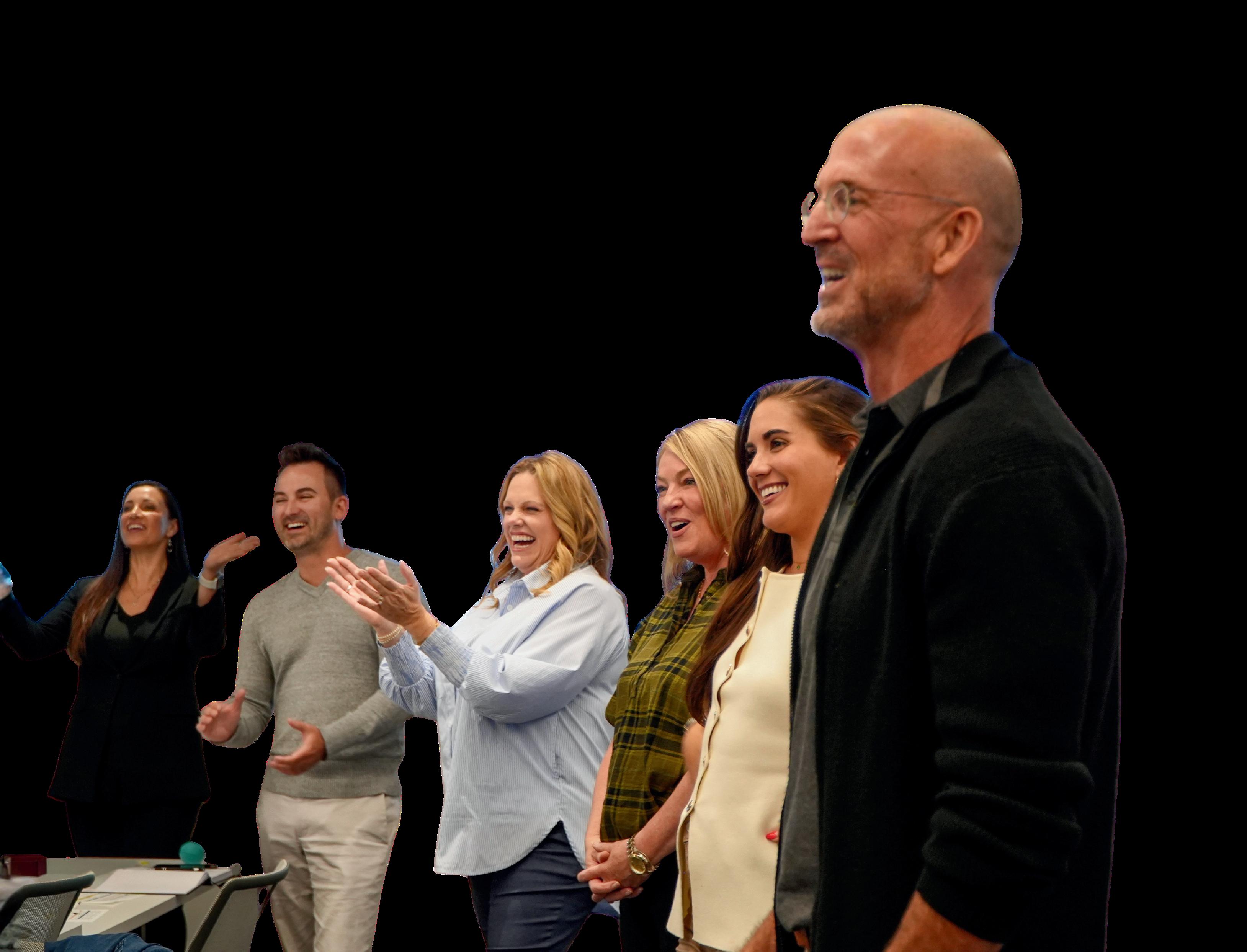
Driven by your goals. Delivered by our experts.
“They left with more confidence than I have seen with any other training program; not only in our products but within themselves.”
John Nippler, EVP at Acclaro Medical on their AI in Sales program

Executive
Book your consultation call today, and start building a custom training solution to develop your team’s growth
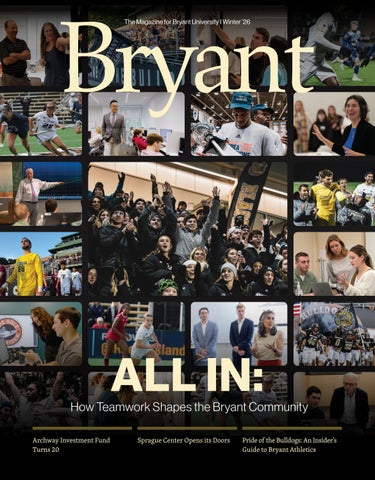
18 Pride of the Bulldogs
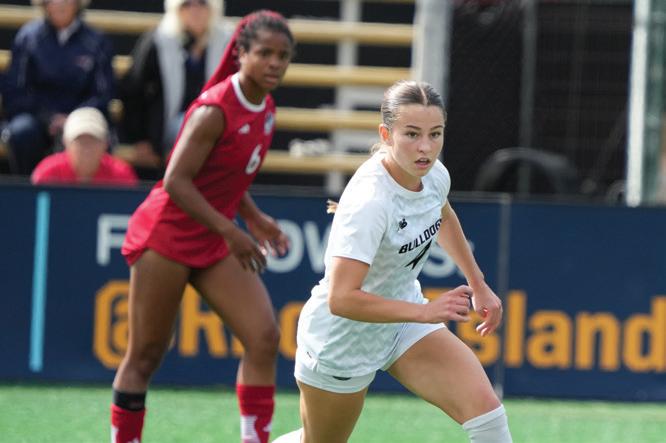
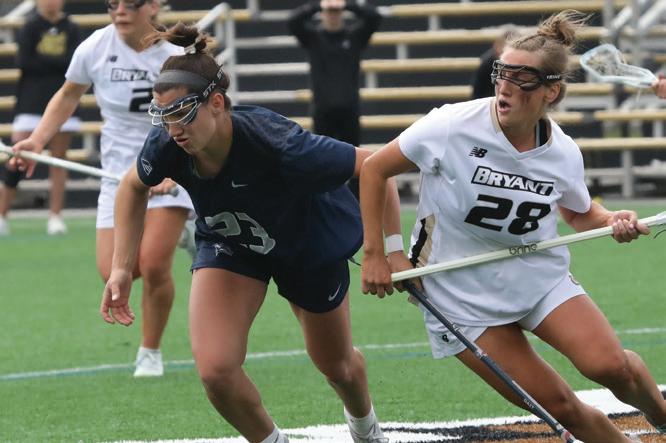
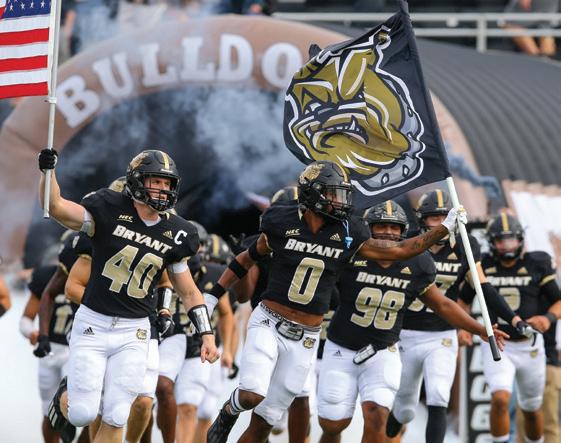
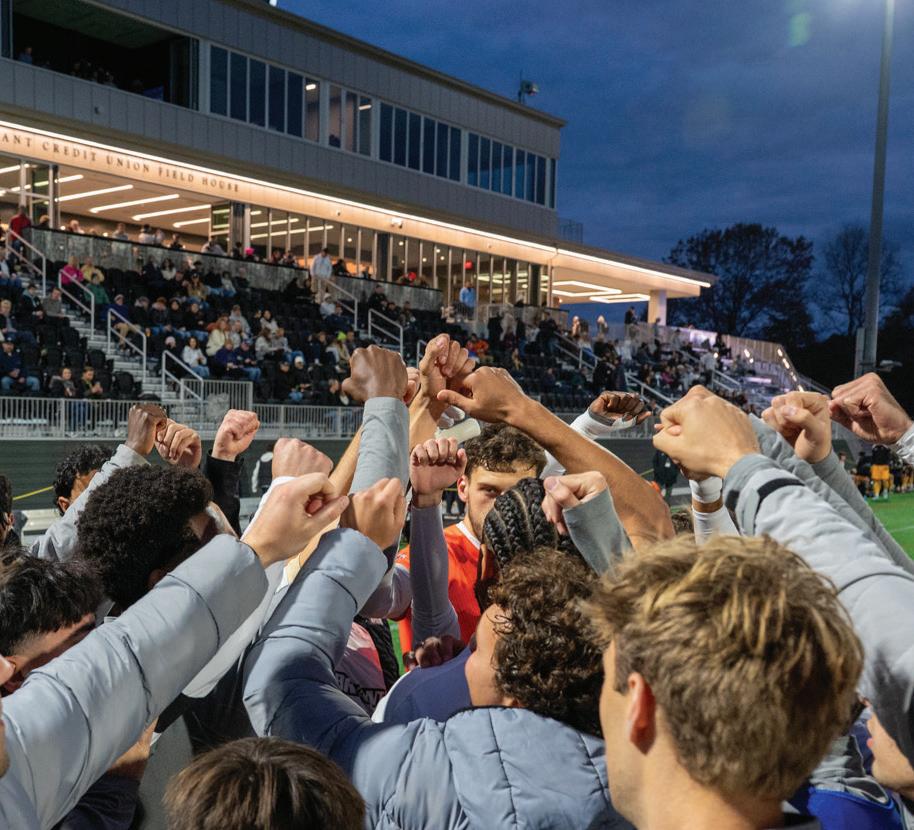
Championship wins, new programs and facilities, and a community that bleeds Black and Gold: It’s a great time to be a Bulldog.
BY BOB CURLEY
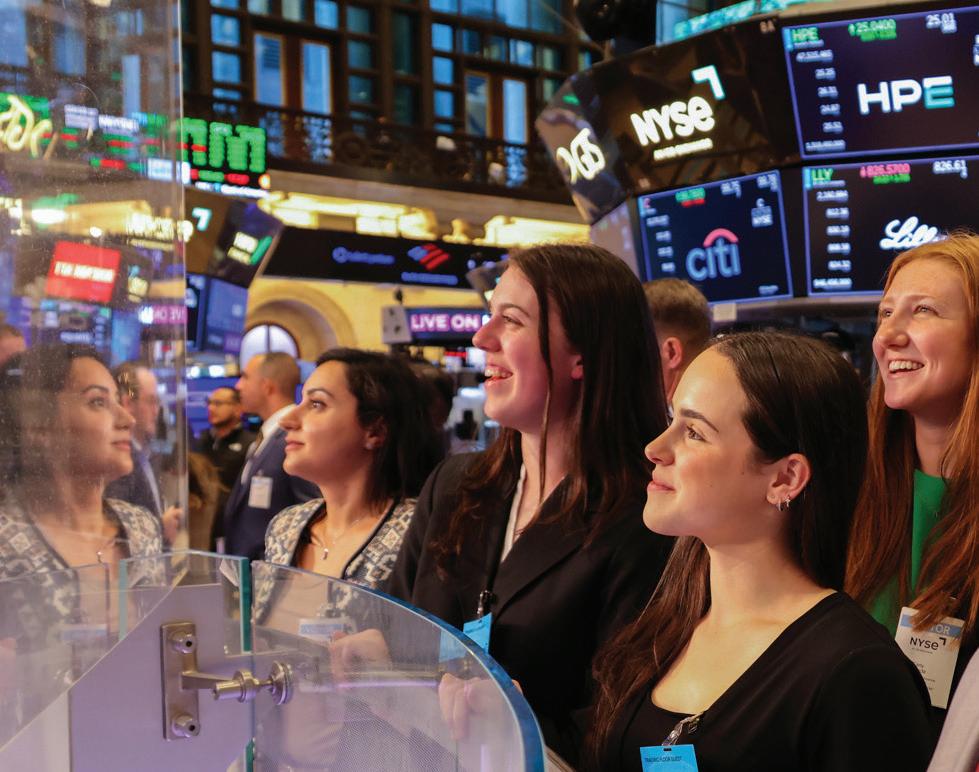
Twenty years in, the Archway Investment Fund continues to forge finance industry leaders that give back to future generations.
BY STEPHEN KOSTRZEWA
How Bryant ensures its student-athletes are among the most academically successful in the nation through a university-wide support system.
BY STEPHEN KOSTRZEWA

Managing
Creative Direction & Design
Nieves-Ferrer
University Photographer
Bryant Editorial Advisory Group
Inge-Lise Ameer, Ed.D., Vice President of Student Affairs and Dean of Students
Michelle L. Cloutier, ’05MBA, Vice President for Enrollment Management
Chuck LoCurto, MBA, Vice President for Information Services and Chief Information Officer
Donna Ng, MBA, Vice President of Business Affairs and Chief Financial Officer
Chris Lehman, MBA, Vice President for Human Resources and Chief Human Resources Officer
Rupendra Paliwal, Ph.D., Provost and Chief Academic Officer
Bill Smith, J.D., Vice President of Athletics and Recreation
Edinaldo Tebaldi, Ph.D., Vice President for Strategy and Institutional Effectiveness and Interim Head of Marketing and Communications
David Wegrzyn ’86, P’23, M.Ed., Vice President for University Advancement
Bryant magazine is produced twiceannually by the Office of University Marketing and Communications. Questions, comments, or stories to share? Reach the editor at cnilsson@bryant.edu.
For more news from Bryant, visit news.bryant.edu. To give back to Bryant, visit Bryant.edu/giving.
Follow us on social media: @BryantUniversity
1150 Douglas Pike Smithfield, RI, 02917 Bryant.edu
COVER ARTISTS:
Dear Reader,
As we settle into 2026, I am pleased to reconnect with the Bryant community through the pages of Bryant magazine. This issue invites us to reflect on some of the remarkable achievements of the past year and to look ahead with purpose and passion.
At the heart of this issue is a theme woven throughout our culture: working together, collaboration, and partnership, best summarized as teamwork. It was due to strong teamwork that we welcomed the Class of 2029, the largest incoming class in Bryant’s history. This milestone was not the result of a singular effort, but of a campus-wide long-term commitment to academic excellence, innovation, and student success.
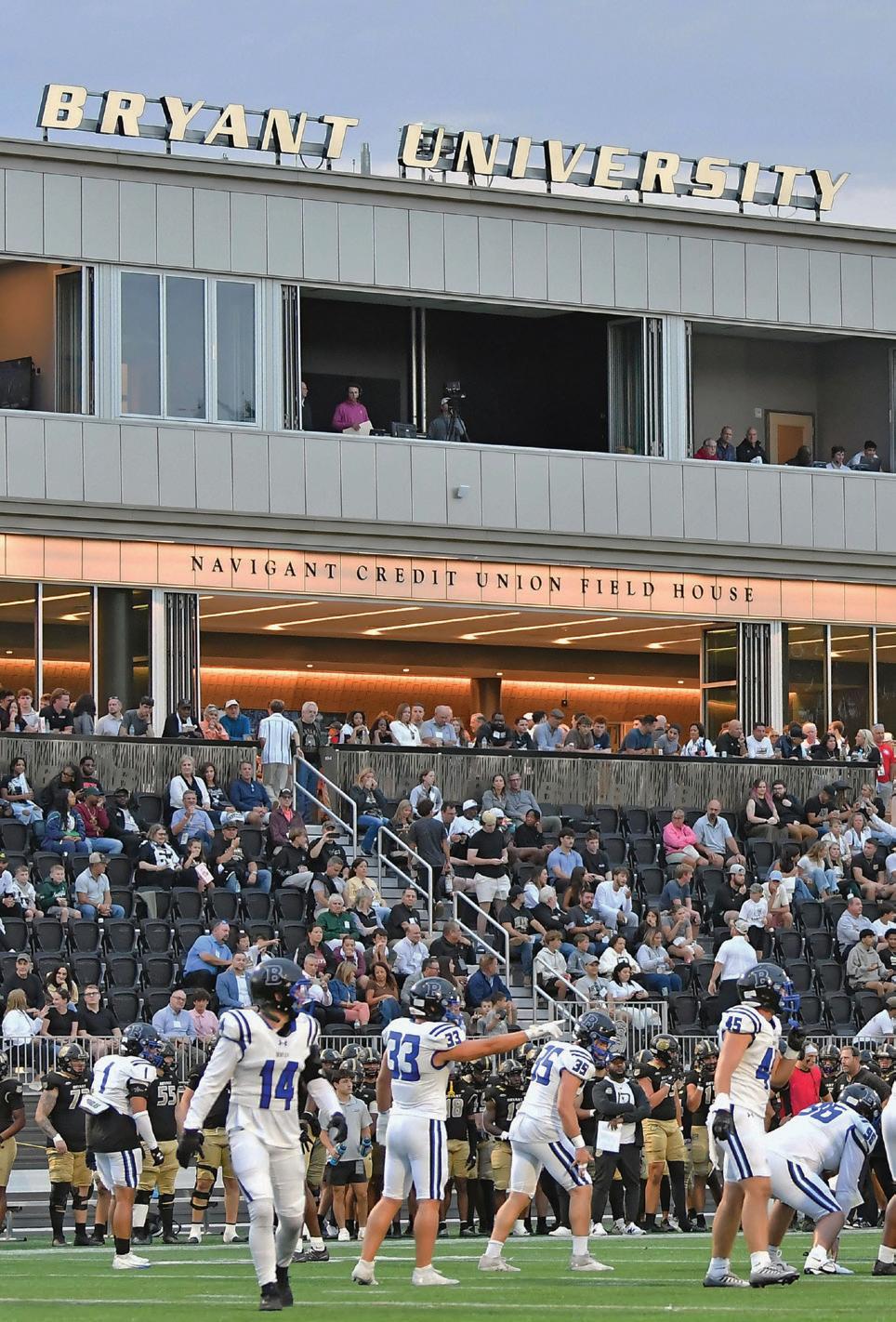
Teamwork also made our recent capital projects possible, including the Navigant Credit Union Field House. Brought to life through a partnership with Navigant Credit Union (page 20), this state-of-the-art facility is already central to athletic excellence, community engagement, and a vibrant campus experience.
It stands as a powerful example of what we can achieve when we work alongside industry leaders who share our values.
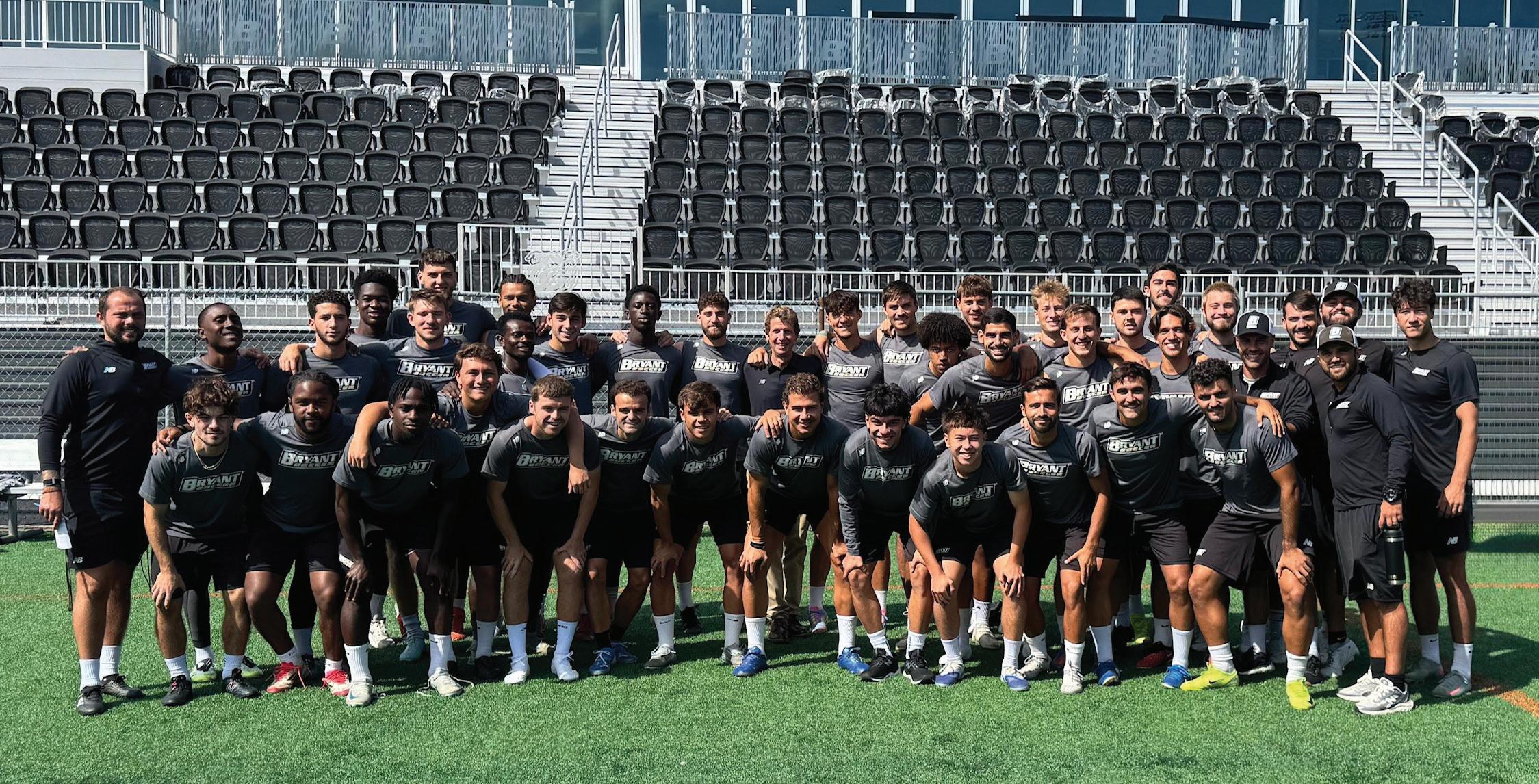
Our athletic programs continue to demonstrate the power of unity. Last fall, our men’s soccer team made history with a record-breaking season, capturing the spirit of Bulldog pride and the determination of our studentathletes (page 21). Their success, and the success of Bryant athletics more broadly, exemplifies resilience, discipline, and the strength of collective ambition and teamwork.
Across campus, collaboration continues to fuel progress. From foundational courses to advanced application in business, the arts, and health sciences, we are integrating artificial intelligence throughout our curriculum. Faculty, staff, and students are pushing boundaries in classrooms, labs, and centers (page 8), and our Global Advisory Council (page 45) and growing network of corporate partners are expanding opportunities for students and amplifying our impact far beyond Smithfield.
We know these successes are deeply interconnected. They reflect our culture of cooperation and a staunch belief in what we can accomplish together. Every achievement is the result of many hands, many minds, and a shared commitment to student success and a strong future for the university.
Readers, you are a vital part of the Bryant community. Your mentorship, advocacy, and generosity continue to shape the Bryant experience for students and propel us forward. We are proud to count you among our most valued partners.
Looking toward our future, I am filled with optimism. Thank you for being part of this journey, and for all the ways you continue to support and uplift Bryant University. I hope this issue brings with it a sense of pride and excitement for all that lies ahead.
With Heartfelt Thanks,
Ross Gittell, Ph.D. President
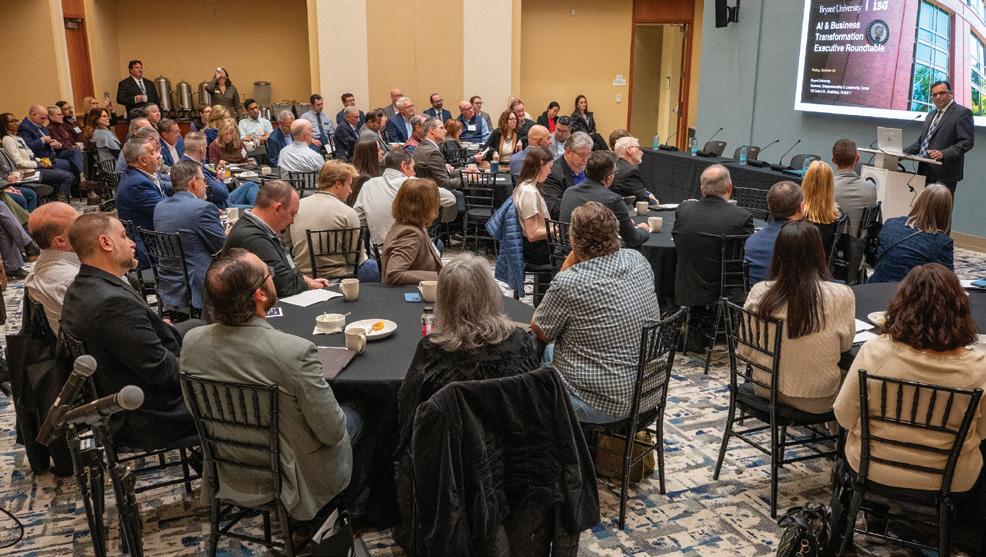
In partnership with ISG, Bryant convened leading faculty and industry experts for a dynamic conversation on artificial intelligence, from emerging workforce trends to balancing human ingenuity with AI assistance. news.bryant.edu/ai-roundtable
What’s ahead for global markets in 2026? Bryant economists Allison Kaminaga, Ph.D., and Liam Rice ’17 share their perspectives as the world navigates persistent inflation, ongoing trade tensions, and a cooling labor market. news.bryant.edu/2026-predictions
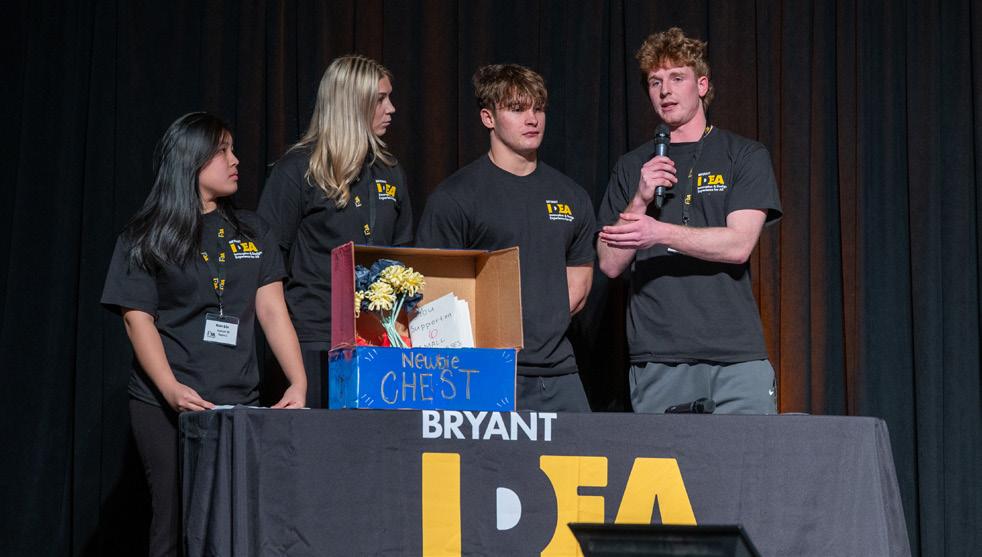
Dig into the largest-ever Innovation and Design Experience for All (IDEA) program, a three-day bootcamp for first-year and transfer students that sets the design thinking foundation they’ll apply throughout their Bryant education. news.bryant.edu/idea-2026

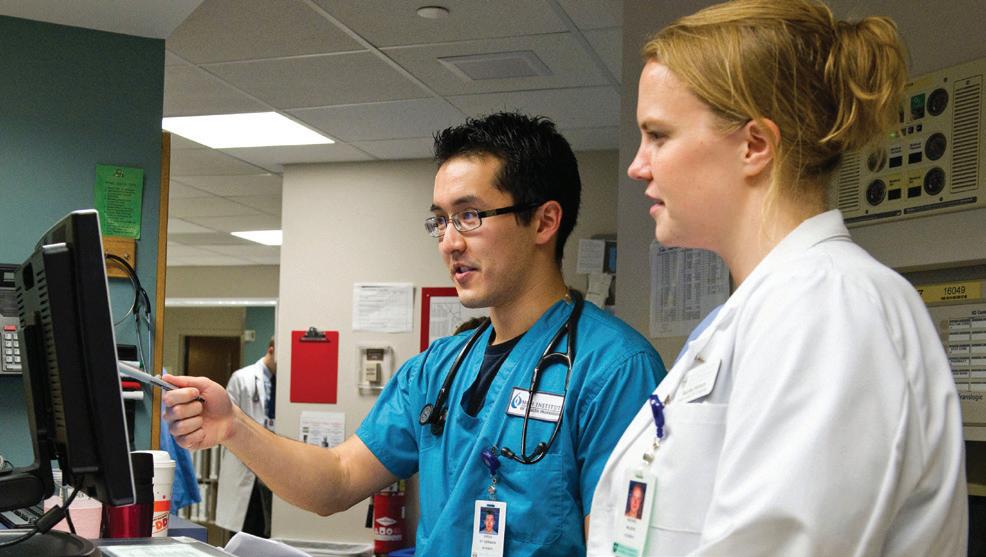
Bryant University’s School of Health and Behavioral Sciences has announced a bold new partnership with the MGH Institute of Health Professions, creating direct-admission pathways into high-demand clinical and health graduate programs. Learn how this collaboration will strengthen the regional workforce and redefine readiness for tomorrow’s healthcare leaders. news.bryant.edu/shbs-mgh-partnership
Read the latest on Bryant News, which features daily coverage of the Bulldog community including faculty research, student profiles, alumni stories, major announcements, and more.
What do you think of Bryant magazine? Share your thoughts in a brief survey.

For Bryant students, the 2025 Walk Down Wall Street mixed a stroll through New York’s Financial District with a big step toward their future. After taking obligatory Charging Bull statue selfies, the 50 students toured the offices of global asset management company Lord Abbett and met with members of Bryant’s Wall Street Council. A panel of Bryant alumni in the finance industry including Mike Hebert ’98, Lord Abbett’s managing director and head of global fund finance, offered invaluable career advice. “I was happy to have a conversation with Hebert about
starting my career in public accounting,” recalls Aaron A. Prata ’27, an Accounting major. “He began his career at the same firm where I will be interning this summer, which made me feel confident.”
A group of seniors also attended the closing bell ringing at the New York Stock Exchange. “Standing on the trading floor, learning about the building’s history, and witnessing the closing bell in person was surreal,” says Finance student Sam Banoud ’25. “It made the energy and legacy of Wall Street feel real and alive.”
—Bob Curley

“Standing on the trading floor, learning about the building’s history, and witnessing the closing bell in person was surreal. It made the energy and legacy of Wall Street feel real and alive.”
—SAM BANOUD ’25
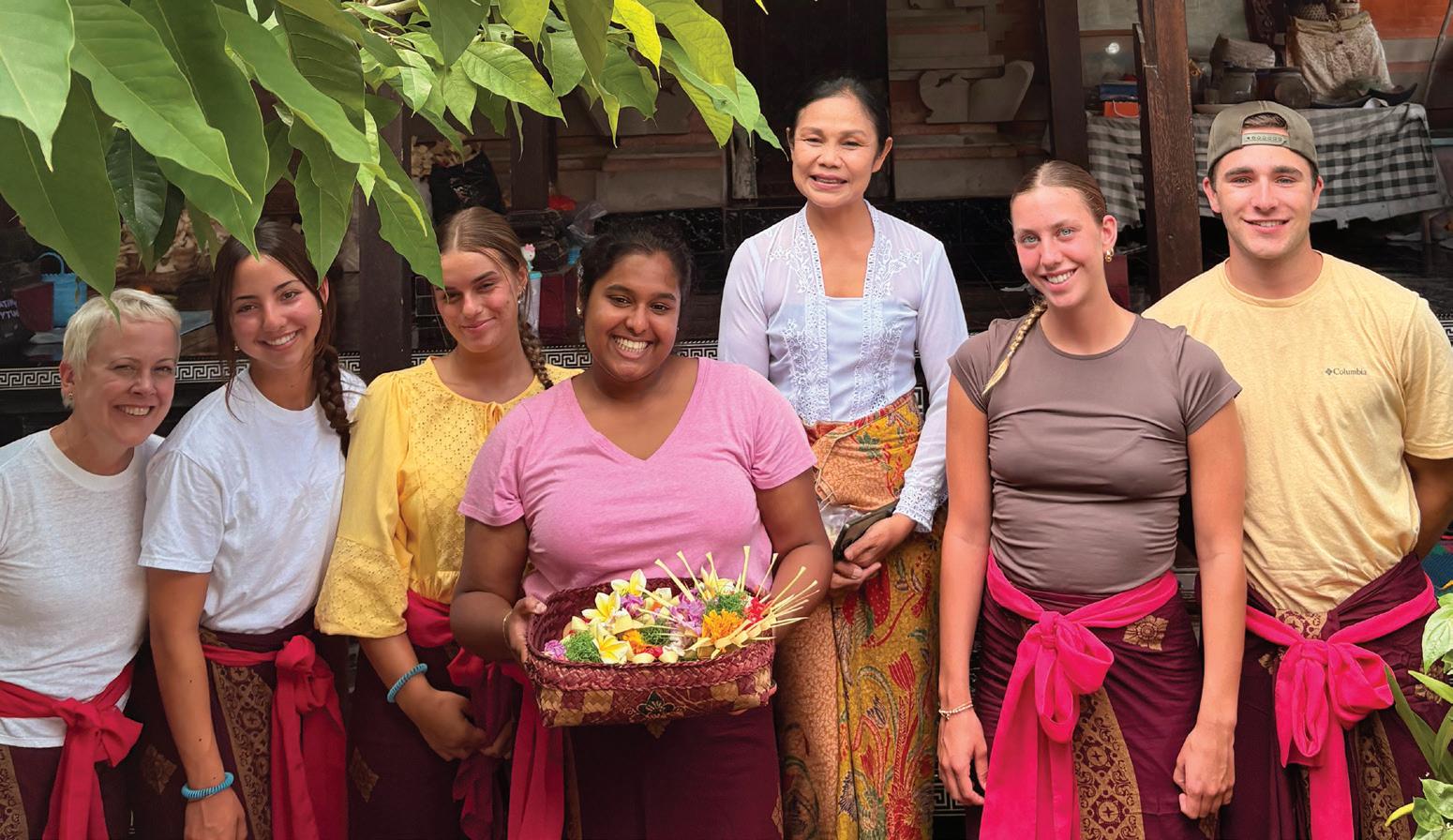
Donning her snorkeling gear, Arielle Feinstein ’27 submerged her face into the clear, calm water off the coast of Bali, Indonesia, to observe the artificial reef resting on the sea floor. Constructed of steel, the submerged structures, which mimic natural reefs, support marine biodiversity and aid in restoring the area’s devastated reefs and fisheries.
“I could have stayed for hours,” reflects the Financial Services major on the tour, where she learned about the work of BioRock — a non-governmental organization (NGO) that rebuilds coral reefs.
Feinstein was one of five students who traveled to Bali as part of their “Impact Core Global Capstone” course — the final requirement in Bryant’s general education curriculum. Led by College of Arts and Sciences Associate Dean Denise Horn, Ph.D., and in
coordination with the Bali Institute, Feinstein’s class spent three weeks immersed in Balinese culture, learning about social entrepreneurship.
Paired with five Balinese students from a local university, the undergrads also worked in groups to identify issues within the local community and come up with social businesses that addressed their topic.
“We went to several social businesses and nonprofits, so students could get a taste of the broad work being done in Bali,” says Horn. “We focused mostly on agricultural development, sustainability issues, and poverty alleviation.”
Feinstein’s group, which included Data Science major Will Arnold ’26, addressed water insecurity.
“While we were in Bali, we used bottled water for everything, so we looked into why that’s the case, where
the water comes from, and issues with the water supply,” Arnold says.
Learning that agricultural runoff and overtourism have contributed to contaminated water and high bottled water prices, they turned their focus to underserved communities that often cannot afford to purchase bottled water and are at the highest risk of contracting waterborne diseases. The group conceptualized a rainwater harvesting product for upper- and middle-class residents with the incentive that, for every product purchased, an additional harvester would be donated to someone in need.
“I learned a lot about different aspects of business: What goes into them, how funding is secured, and proper marketing,” says Feinstein, adding that the project’s issue breakdown process is a skill she plans on using moving forward.
For Arnold, the most rewarding part was presenting their idea to community workers and NGOs.
“To live, eat, and breathe a topic that was not my major was cool because I was able to build up skills and apply what I've learned,” he says.

Fidelity internships, and a new co-op program, launch careers for Bryant students.
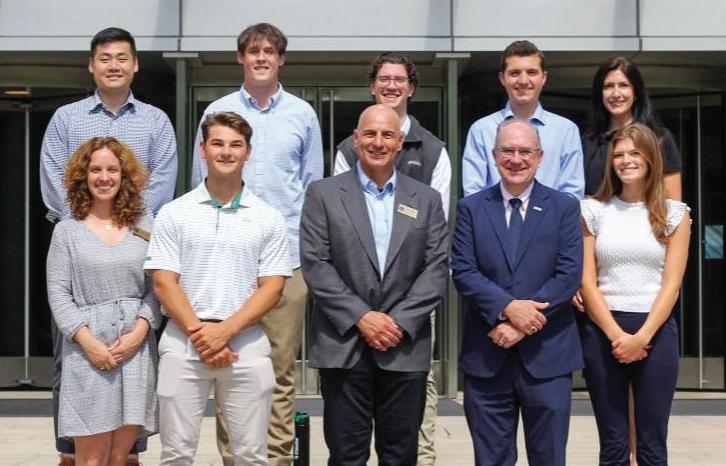
Fidelity Investments is the single largest employer of Bryant University graduates, and many of the alums who work at the $32-billion financial services company get their start there with an internship — often at Fidelity’s corporate office next door to Bryant’s Business Entrepreneurship Leadership Center, which Fidelity gifted to the university in 2023. This past summer, Fidelity interns Nick Logan ’26, Drew Mahoney ’25, ’26MBA, Grace Driscoll ’26, Tyler Jarvis ’26, and Michael DiBenedetto ’25, ’26MBA worked on projects ranging from data analysis to research — developing solutions and presenting their findings to the company’s leadership.
Mahoney, for example, assisted Fidelity’s Rewards Visa Signature credit card team in creating internal documentation, supporting project management, analyzing customer feedback, and reviewing the program’s profit-and-loss sheet.
“When I started, I knew very little about the credit card space, but now I have both a strong understanding of the product and the competitive landscape, as well as the ability to think like a leader in the industry,” says Mahoney, who extended his Fidelity internship through the fall and currently works part-time at the company while pursuing his MBA.
“It’s been a significant step forward in my career,” he says.
For Driscoll, the internship led to a full-time position as a customer relations advocate (CRA), which she will begin after graduation.
“I assisted clients with account maintenance and guided them through Fidelity’s online tools, as well as working closely with clients by answering inbound calls covering a range of topics, including investment products and account servicing,” she says.
All of the interns also worked on a capstone project. Driscoll focused on
improving the onboarding process for CRAs, and Fidelity adopted some of her group’s recommendations. The experience helped her to improve her presentation skills and build meaningful connections through mentorship and collaboration. She’s now working as a Fidelity Student Ambassador at Bryant while finishing her coursework.
Beginning this academic year, students may also apply for a new co-op program with paid, full-time positions at Fidelity in two six-month cycles.
“This extended experience allows students to take on greater responsibilities at Fidelity, including managing projects to completion,” says Todd Alessandri, Ph.D., dean of Bryant’s College of Business. “This provides more value to Fidelity and an enhanced learning experience for students.”
—BC
Bryant University’s commitment to experiential education was broadened last year with a new policy that expands tuition-paid, for-credit internships beyond the academic year and into the summer and winter months.
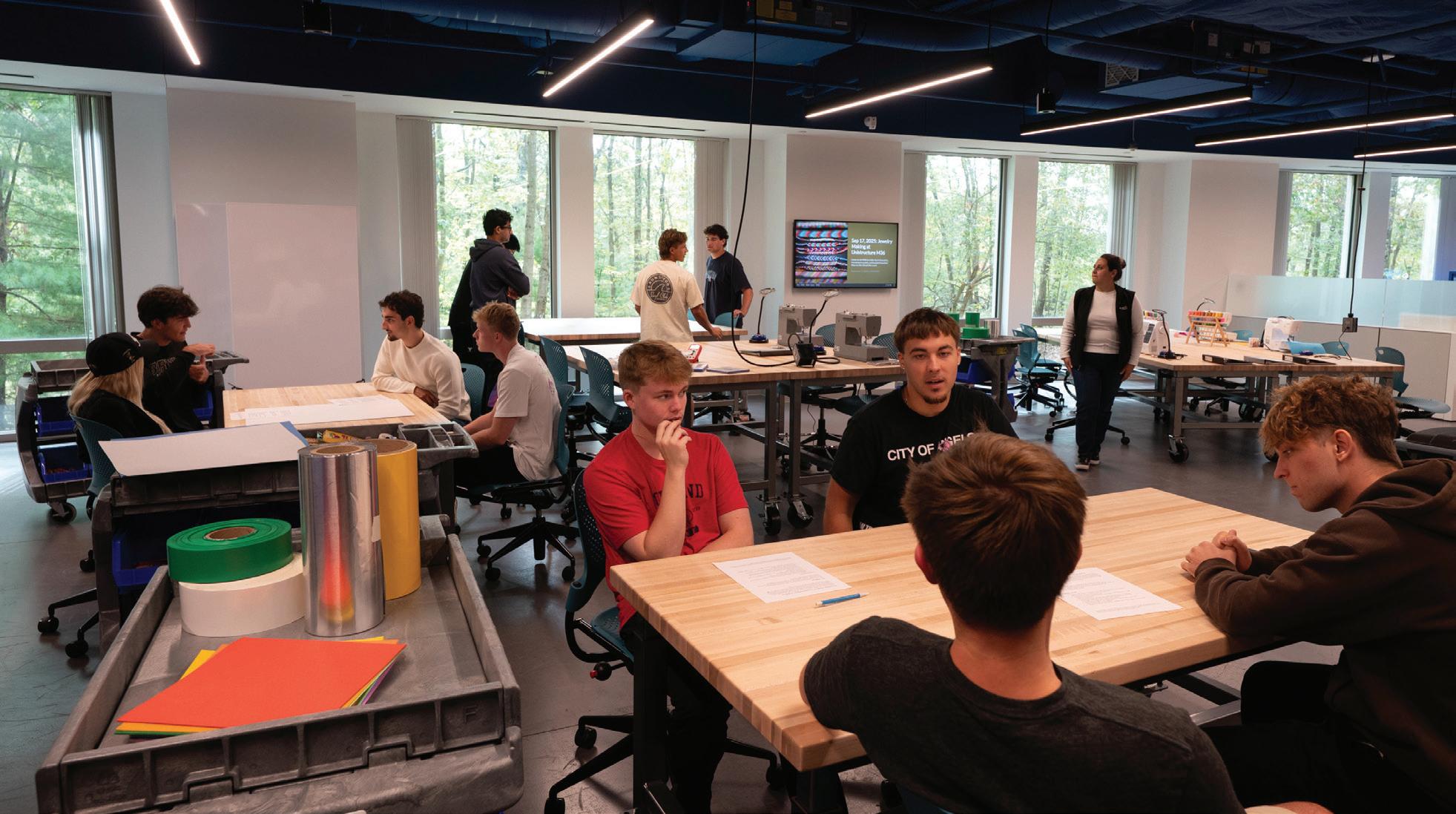
Bryant’s new Sprague Center for Entrepreneurship and Design Thinking has the tools and supports to help students and the broader Bryant community develop new products and businesses, from concept to launch.
Located in the Business Entrepreneurship Leadership Center (BELC) and supported by a gift from Trustee Kim Anderson ’22H and the Sprague family, the Sprague Center’s many features include offices for student entrepreneurs, mentors, and corporate and community partners; classrooms; private incubator offices; co-working spaces; and a roomy Makerspace equipped with 3D printers, a laser cutter, digital cameras, electronic kits, sewing machines, and prototyping materials.
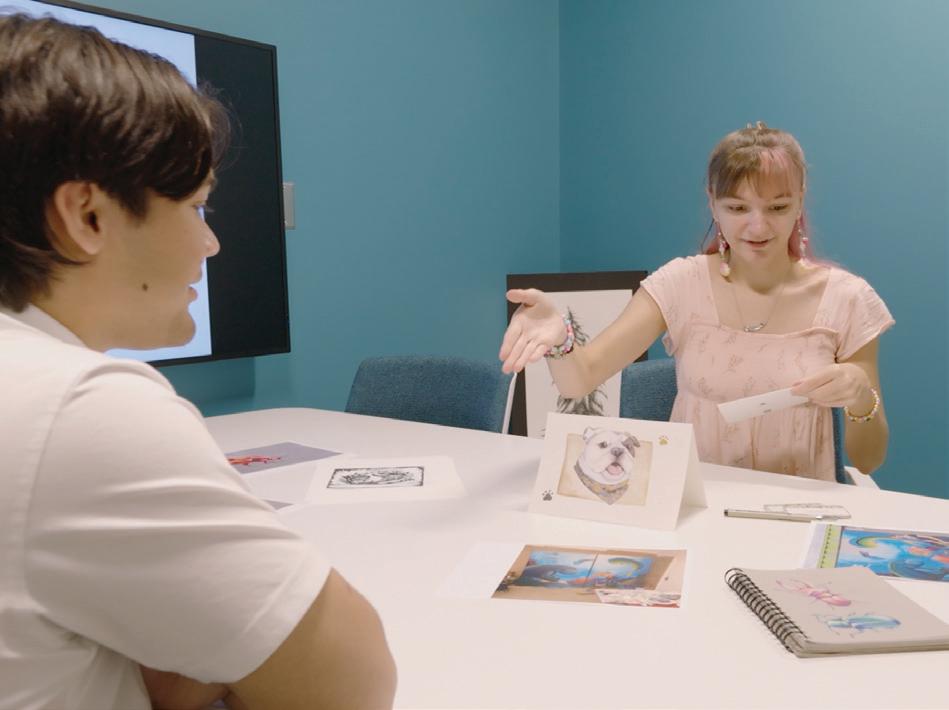
“Designed to be inclusive, adaptable, and forward-looking, the Makerspace empowers the Bryant community to experiment, collaborate, and bring bold ideas to life,” says Sprague Center Director Kristie DeJesus. “In this space, curiosity is encouraged, risk-taking is embraced, and ideas are nurtured.”
Start-up leaders, corporate and social entrepreneurs, and heads of family businesses can all find support services in the Sprague Center, including hands-on workshops, pitch events, and speaker sessions.
Mentorship is available from faculty and regional business owners. Bryant student entrepreneurs also have offices in the Sprague Center and provide in-person peer guidance while managing their own ventures.
“Having a space within the center has been nothing short of a dream come true,” says Vicky Sousa ’27, ’28MBA who, along with Liam Dubeau ’26, ’27MBA, owns the branding and website design company Duso Digital. “The office allows us to interact and collaborate with other student businesses and has proved useful for consultations and meetings. Letting our creativity and brand identity flow throughout the room has been the cherry on top.”
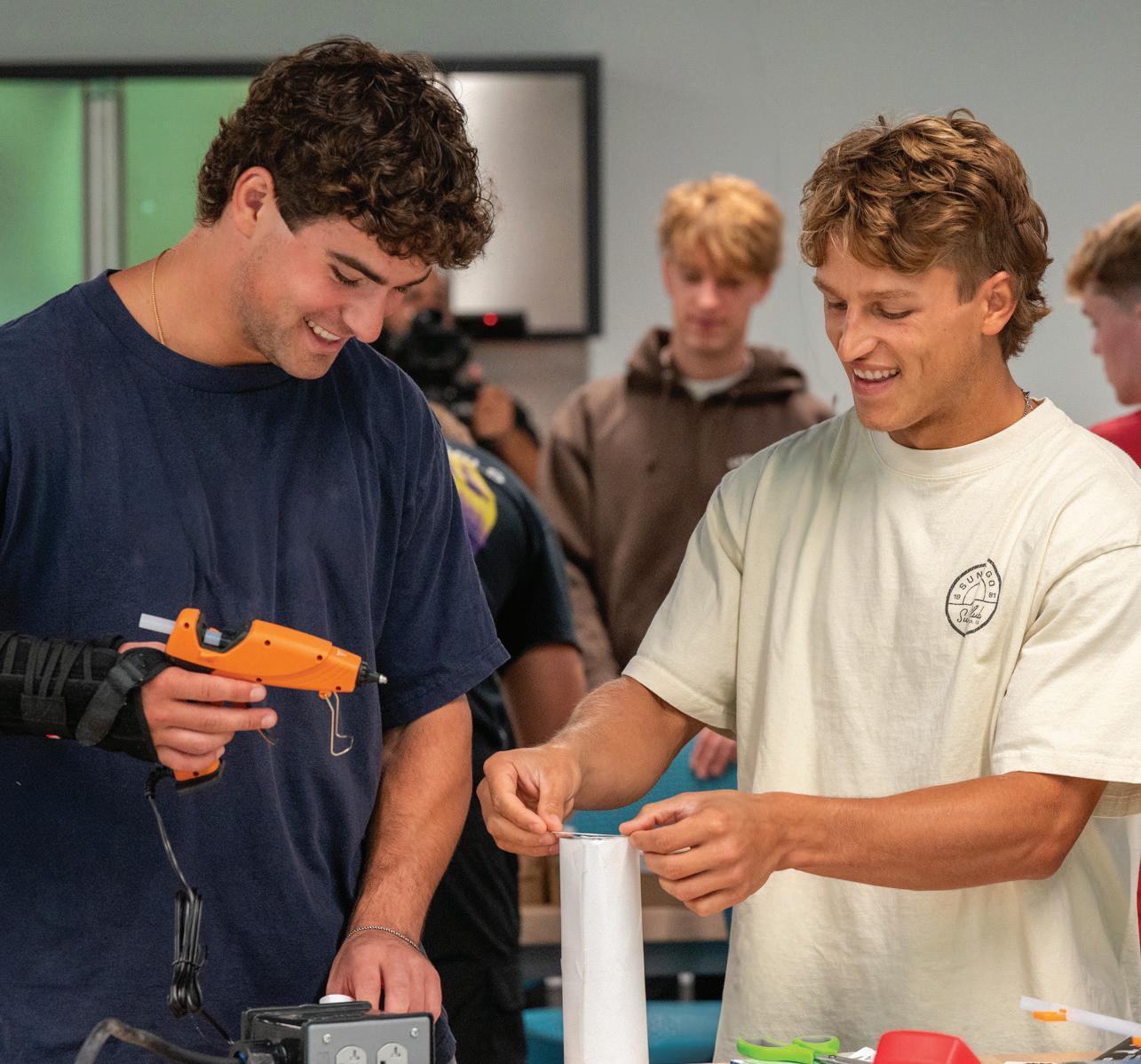
There are also four inaugural members of the Sprague Center’s FOUNDERS (Fellowship for Office Use, Networking, Development, Entrepreneurship, Representation, and Support) program — Vincent Emery ’26; Chase Whitman ’27, Sam Lower ’26, and Sean Nelson ’27 — who play a vital role within the center, says DeJesus.
“The FOUNDERS have been entrusted with more than just office space,” she says. “Vincent, Chase, Sam, and Sean are culture-setters and visible examples of what is possible in this center. Their presence, participation, and energy will shape how students, faculty, staff, and community partners engage with this transformative new resource.”

Vincent Emery ’26
Co-founder and COO of The Lil’ Rhody Coffee Company
“At Bryant, you have people you can vent to, professors to give you advice, and access to capital. The center brings all those assets and support systems into one space. You have awesome people here in many areas of study that historically have not started companies, so my hope is that more than just Entrepreneurship majors use the center.”

Chase Whitman ’27
Co-founder of Chip’s Sunflower Seeds
“I already have a product and production. Showing how I got here can serve as inspiration for those who come into the center on the edge of starting their own business. I've been through the rough patches they might face.”
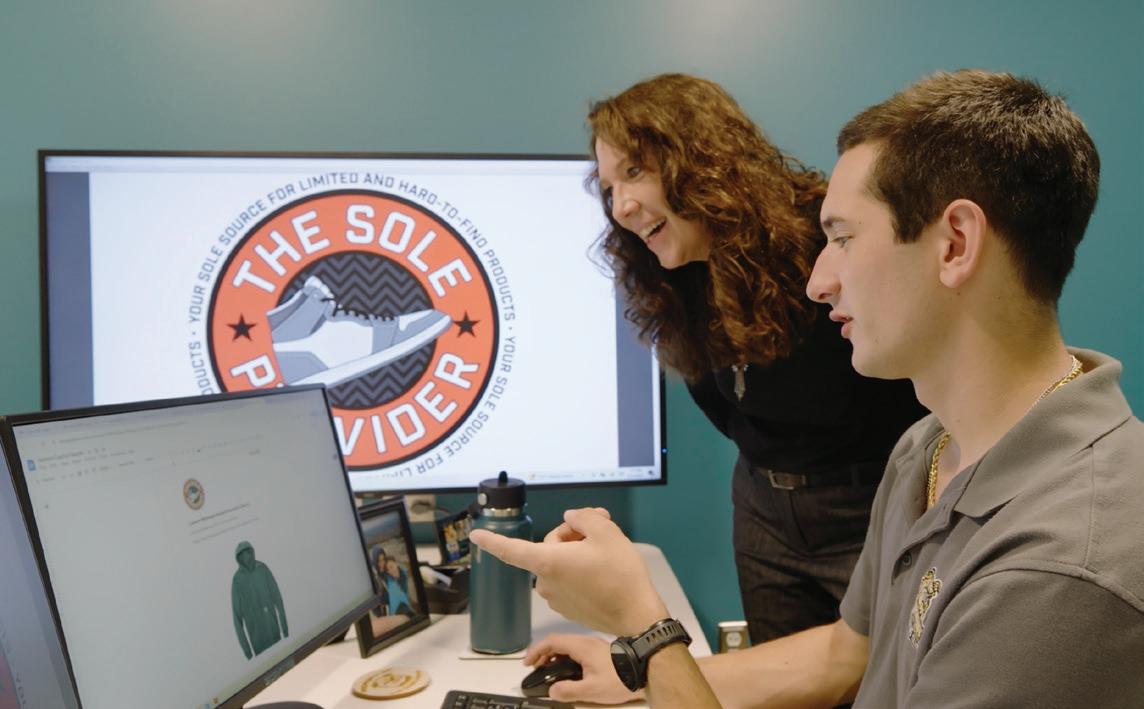
Sean Nelson ’27
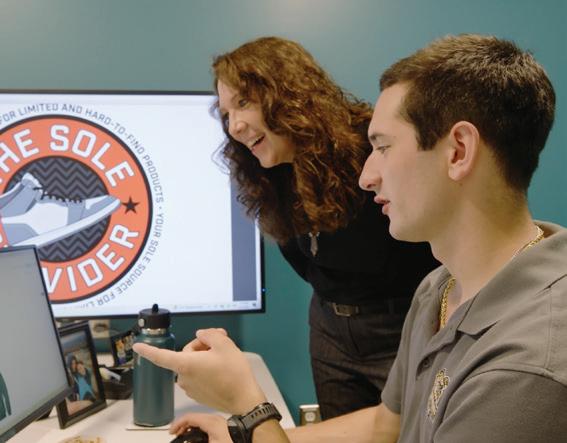
Founder of The Sole Provider, a footwear and designer clothing company
“The center gives me the opportunity to be a mentor to other entrepreneurs, meet with clients, house inventory, create invoices, and build an on-campus presence. Two of my goals this semester are to increase my marketing and create versatile mock-ups and prototypes, which the Makerspace can accommodate.”

Sam Lower ’26
Founder of The Paw’s Post jewelry company
“I want the center to be a collaborative space, to see new people coming in, show them my idea, and spark their interest in taking the next step.”
A
flipped model challenges students to think critically, collaborate, and leverage generative tools.
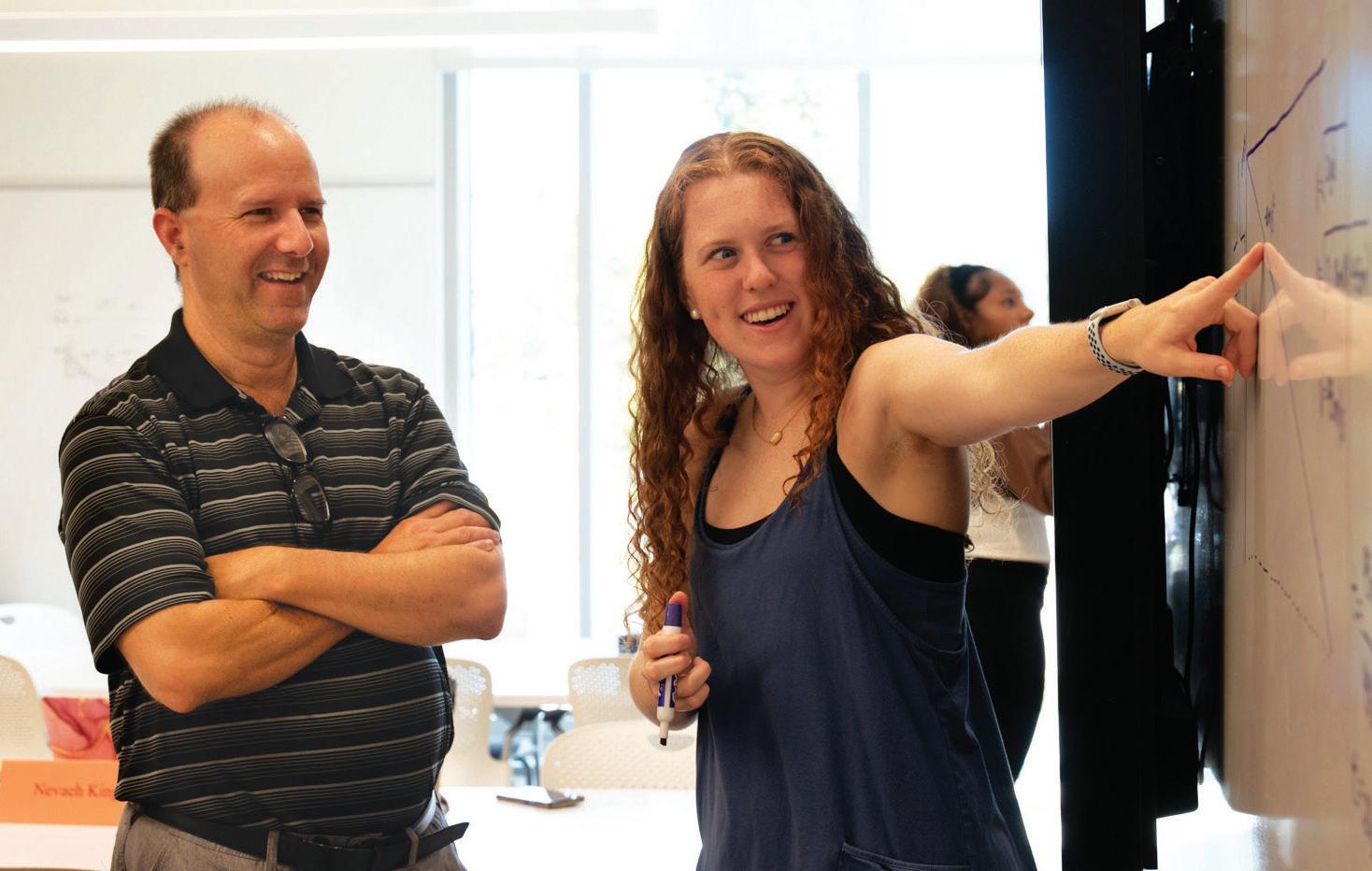
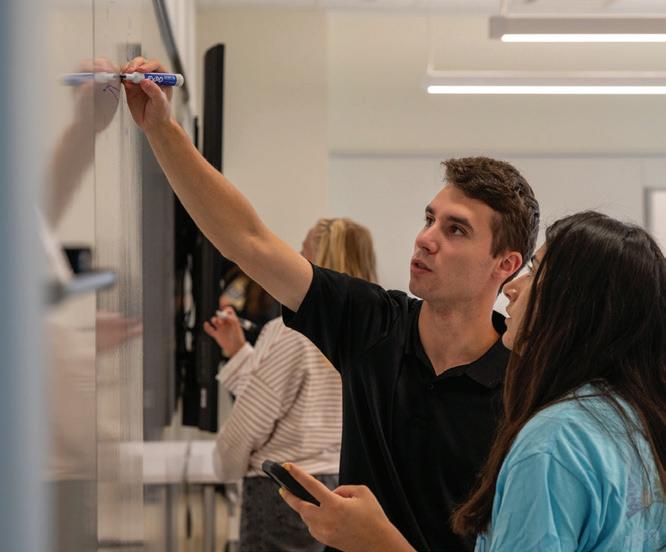
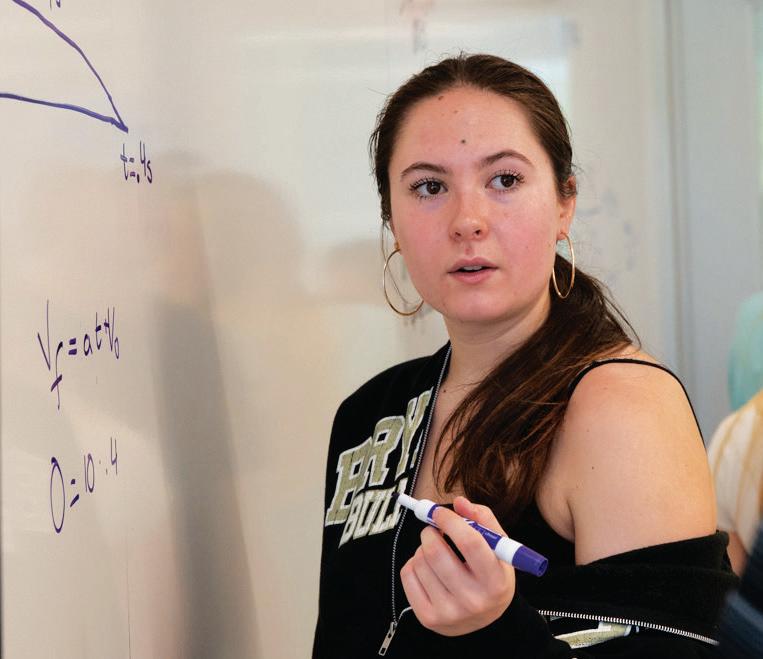
It’s an early morning in Room 236 of the Quinlan/Brown Academic Innovation Center and classmates Brandyn Durand ’26, Olivia Morrill ’27, and Lily Kimball ’27 are discussing velocity, kinetic energy, and the values they’re solving for in their physics problem. Together, they draw visuals on a whiteboard, talk through what they do and do not understand, and snap pictures of their answers, which they will submit online for class credit.
The questions they’re answering would traditionally be completed for homework, but Biological and Biomedical Sciences Professor Brian Blais, Ph.D., has implemented a flipped classroom model where students take the course’s lectures outside of class and ‘homework’ is worked on when students meet.
Having taught Bryant’s introductory physics course for the past 25
years, Blais has previously made small changes to its content and structure, but the rise of artificial intelligence has prompted him to think about content delivery.
“In this age of AI, it is too easy for students who experience some level of discomfort with the challenging task of learning a new subject to lean on the technology to solve problems for them,” says Blais. “Because AI is so accessible, one has to ask what the role of education is, what the role of teachers should be, and how can students effectively face challenges.”
Out of class, students watch recorded lectures at their own pace — whether that means rewinding to grasp a particular concept or playing at 2x speed because they’re confident in the topic. During this time, Blais encourages them to use a range of tools, including AI, to help explain
ideas, create tutorials, and generate practice problems.
For Biology major Bethany Marsella ’27, the course’s format was surprising at first, but she has since found it beneficial.
“It’s helpful because he’s here when you’re working through problems and can help you figure things out in the moment,” says Marsella, noting that if her work is heading in the wrong direction, it can easily be fixed, and the mistakes explained.
That real-time feedback is exactly what Blais aimed for.
The resulting class, he adds, is also more active: students discuss, debate, map out solutions, ask questions, and work with more autonomy. Blais even recalls a stand-out moment when he arrived at class five minutes early and found nearly all the undergrads at the whiteboards working.
“That level of independence and direction is completely different than in my previous versions of this class,” he says. “I can't imagine going back to it now.”
Beau Shugarts ’25 is a storyteller at heart. “I've always wanted to find more ways to get the ideas in my head out to the world in a tangible form,” he notes.
The Communication major is already taking steps to achieve this dream, aided by “The Art of Storytelling” course he took last spring. Through the class, Shugarts participated in the Monte-Carlo Television Festival’s inaugural Tell Me a Story pitch contest — winning first place and securing a one-year contract to develop his “30 Days Offline” tv show concept with Emmy and Peabody award-winning producer Tom Jennings.
The global competition was open to creators ages 18 to 30, and 13 finalists, including Shugarts and four other Bryant undergrads — Malachi Steele ’25, Nidya Merisier ’27, Jack Brzenk ’28, and Nicholas Alvarado ’26 — were selected to present their pitches in Monaco.
Shugarts’ TV show concept dives into the lives of several people each episode as they go about their time without the internet for 30 days.
“My inspiration came from a few different experiences. During a class I took with Associate Professor of Communication and Language Studies Kristen Berkos, Ph.D., I did a five-day ‘phone fast’ assignment, and before Bryant, I briefly attended the Air Force Academy Preparatory School and experienced what it was like to bond with my peers without a phone or internet access,” he says.
As a Gen Zer, Shugarts notes that digital natives have little concept of life before the internet.
“We can study all the history we want, but we never got the opportunity to live it, and now we can by watching as people step up to the challenge of living life offline and become role models,” he says.
The development opportunity was made possible through a recommendation from Bryant Board of Trustees member
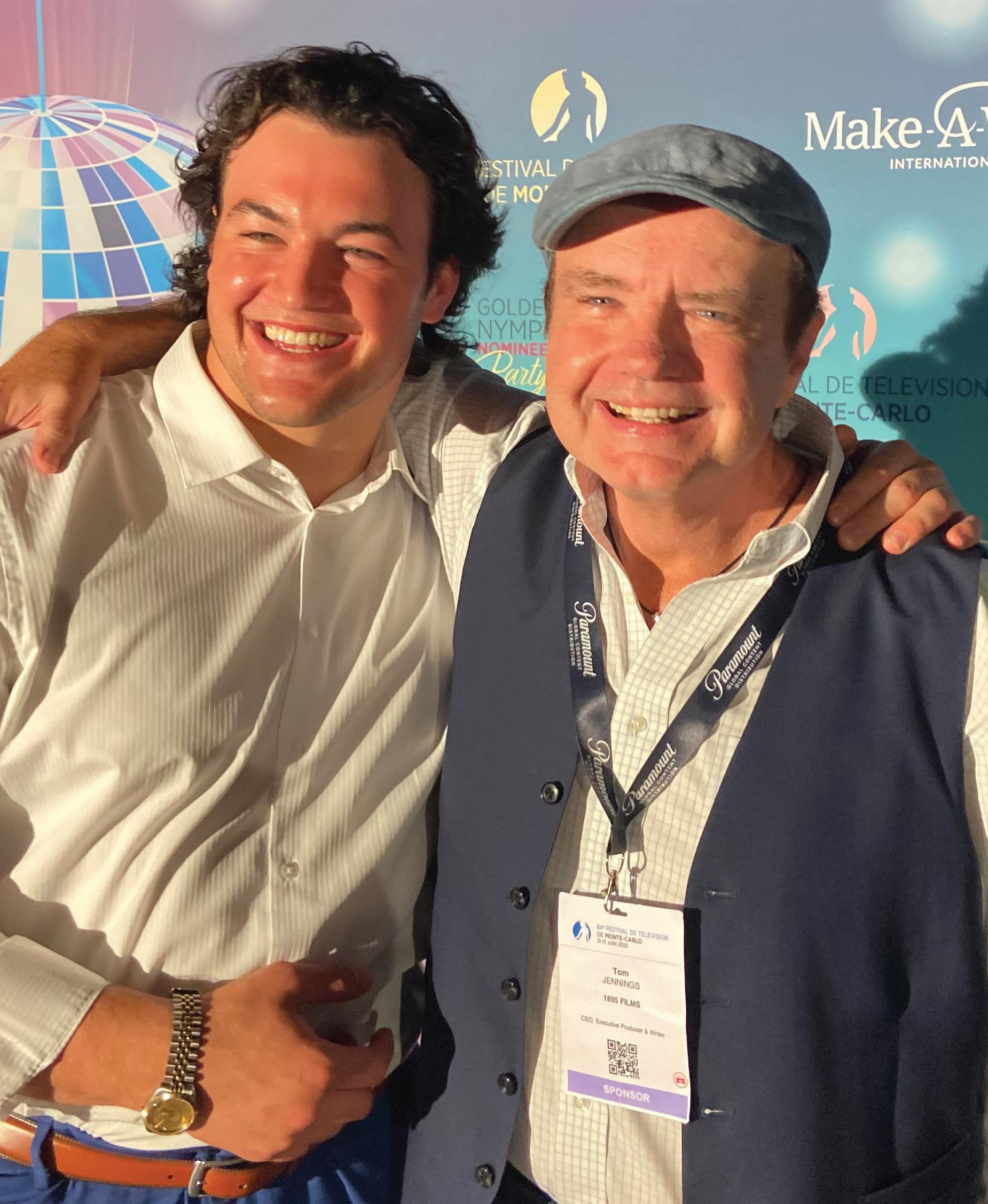
Beau Shugarts ’25 and Emmy and Peabody award-winning producer Tom Jennings.
Frank Stasiowski ’75MBA, which prompted the creation of the storytelling course. Here, Veronica McComb, Ph.D., prepared students for the pitch contest by teaching them about storytelling theory, technique, and history.
Since his win, Shugarts has been working alongside Jennings and his team to develop a pitch deck and sizzle reel for his concept. Once finalized, Shugarts will repitch the show to executives at interested networks and streaming services.
“There’s a lot of potential energy right now,” says Shugarts, who graduated from Bryant in December and will walk with the Class of 2026. “I never want to fast-forward through life, but I am excited to look back on this experience one year from now; I'm hoping to turn this opportunity into something that goes beyond a year.”
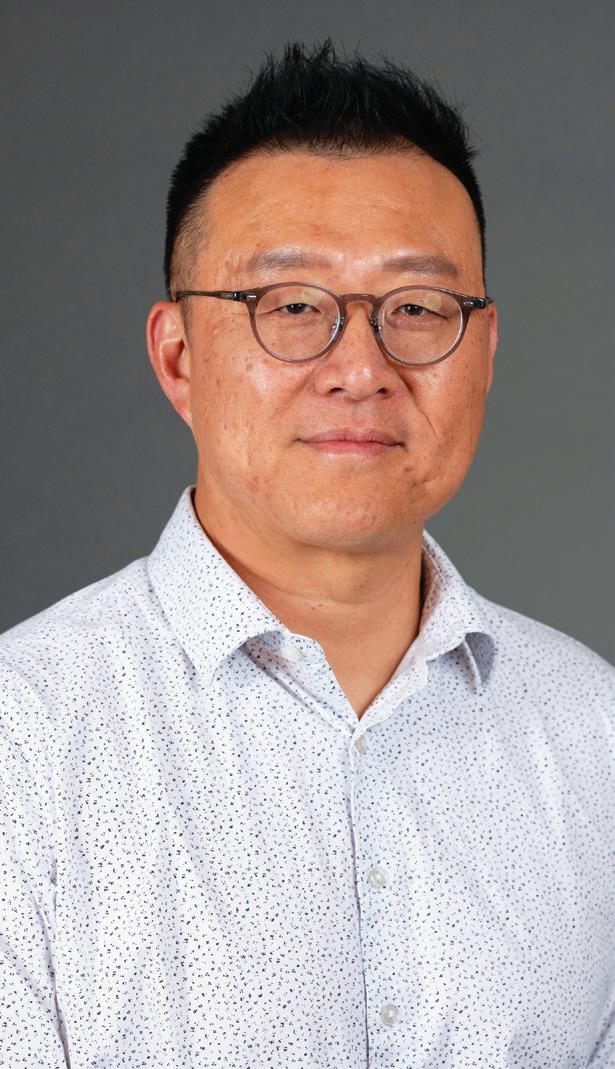
There’s a sly look in the eye of Bryant University Professor of Marketing Sukki Yoon, Ph.D. — fitting for a master of allusion and an expert in shaping messages in ways that make an impact.
“The things we think of as choices aren’t necessarily choices, or at least those choices are manipulated in subtle ways,” he notes.
As a marketing behavior researcher and self-described “experimentalist,” Yoon’s work borrows from a host of disciplines, ranging from psychology to economics.
“We look at the things that are sometimes seen as unquantifiable and we try to quantify them,” he says. “We try to get inside people’s heads.”
Yoon’s own studies focus on the fundamental questions of consumer/
audience behavior: why and how people react to marketing in the ways that they do. One of his focuses is message framing and “priming” — how slight tweaks in the way you position a message can influence its audience.
“Incredibly small changes can make big differences,” says Yoon. “There's something magical about it.”
It’s a seemingly simple concept, Yoon notes, but its effects are far reaching. Like how the speed at which we listen to advertising affects how we process it (the faster an ad, the more we focus on price; the slower it is, the more we focus on quality). Or how seeing the logo of a favorite sports team can affect one’s own athletic performance.
The insights this work generates, he notes, are becoming increasingly valuable as we embrace artificial intelligence. The age of Don Draper may be replaced by the rise of cognitive machines, but those machines need to make the leap to understanding human behavior.
As editor-in-chief of the Journal of Current Issues and Research in Advertising, a forum for thoughtfully examining and debating the role advertising plays in society, Yoon looks for academic rigor in the journal’s submissions and for real-world relevance. But that’s not all.
“I’m looking for novelty,” he notes. “It is good and important to find support for something that’s widely believed or known, but I’m looking for something new.”
Yoon also hosts a podcast offering bite-sized encapsulations of each issue’s articles. Its title, “Curious and Interesting,” could double as the mission statement for his work.
“I think every article should be entertaining,” he says.
The more we learn, Yoon states, the more fascinating the world becomes. “I can see the manipulations happening, but often the only real difference is that I am aware that I am being manipulated,” Yoon admits. “I fall for many of the same things as everyone else.”
In the end, he reflects, that’s not always a bad thing. “Disney World is a fantasy; we all know that. But doesn’t it still make you smile?” he asks.
There are also opportunities to put priming to good use and promote pro-social change, another one of Yoon’s preoccupations. A recent project he contributed to, for example, found that using photos of baby animals helped to promote pro-conservation messages. Another suggested that placing googly eyes on irregular-looking fruits and vegetables can shape buyer intentions and potentially help eliminate food waste.
“You need to wield the magic wand responsibly,” Yoon notes.
Of course, he allows, the seeming absurdity of the “googly eyes” concept was an enticement as well.
“It helps,” Yoon states, “to have a sense of humor about your work.”
—Stephen Kostrzewa

Scholarly breakthroughs from Bryant’s thought leaders in 2025.
Reimagining Baseball as Spectacle: Trustee Professor of Management Michael Roberto, D.B.A., co-authored a WDI Publishing case study with former student, Jonathan Huntley ’21, on the Savannah Bananas, a barnstorming baseball team that reinvented the sport as entertainment. The case study found the franchise outperformed Major League clubs in digital engagement by prioritizing fan-centric experiences, offering lessons for legacy institutions on revitalizing traditional industries through bold innovation.
Majors, Double Majors, and the Earnings Premium: In The American Economist, Vice President of Institutional Effectiveness and Strategy Edinaldo Tebaldi, Ph.D., and President Ross Gittell, Ph.D., alongside a University of New Hampshire colleague, analyzed 13 years of U.S. wage data. The study revealed how certain majors, and double-major combinations, enhance longterm earnings.
Strength Training and Mental Health: In the Journal of Clinical Medicine, Associate Professor of Biological and Biomedical Sciences and Exercise and Movement Science Program Coordinator Jason Sawyer, Ph.D., and colleagues tested a six-week resistance training program for college-aged women. Participants reported fewer depressive symptoms, suggesting structured strength training could serve as a valuable complement to mental health support for young adults.
VR as a Business Classroom Tool: Professor of Information Systems and Analytics Suhong Li, Ph.D., co-authored a study in the Information Systems Education Journal on virtual reality deployment across three universities. The research found VR boosts engagement in public speaking, visualization, and field trips, though success depends on training, infrastructure, and support.
AI Chatbots Across Campus Communities: In the Journal of Computer Information Systems, Assistant Professor of Information Systems and Analytics ML Tlachac, Ph.D., and Bryant co-authors Allison Papini, Terri Hasseler, Ph.D., Suhong Li, Ph.D., David Gannon, and Philip Lombardi examined how students, faculty, and staff use AI chatbots. Students were most likely to experiment, while faculty expressed caution. The team argues that tailored literacy programs are essential for responsible adoption.
Agent-Based Modeling in Actuarial Science: Professor of Mathematics Rick Gorvett, Ph.D., highlights agent-based modeling (ABM) in the Casualty Actuarial Society E-Forum as a new tool for actuaries. By simulating micro-level interactions to reveal macro patterns, ABM helps quantify risk and evaluate strategies across insurance and policy scenarios.
Modeling Better Treatments for Amblyopia: Research by Biological and Biomedical Sciences Professor Brian Blais, Ph.D., which used computational models of neural plasticity to evaluate treatments for amblyopia, a leading cause of childhood vision loss, was presented at the 2025 Association for Research in Vision and Ophthalmology Annual Meeting. His simulations predict that binocular therapies — especially those using dichoptic masks and contrast disparities — can outperform traditional patching and penalization approaches.
Responsible Analytics in Health Care: Assistant Professor of Information Systems and Analytics Geri Louise Dimas, Ph.D., co-authored a framework in the Journal of Forensic Nursing for applying analytics to combat human trafficking. The paper

—Casey Nilsson
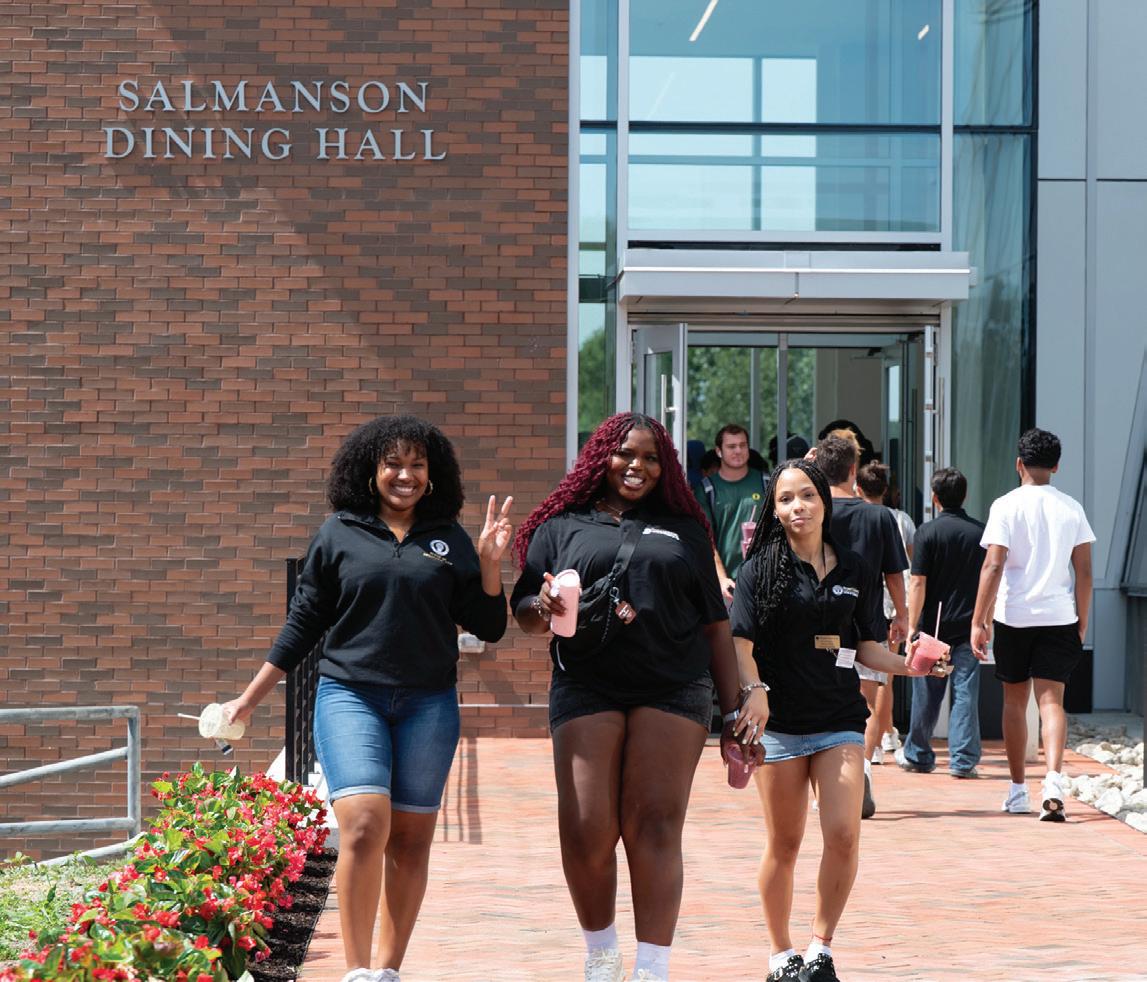
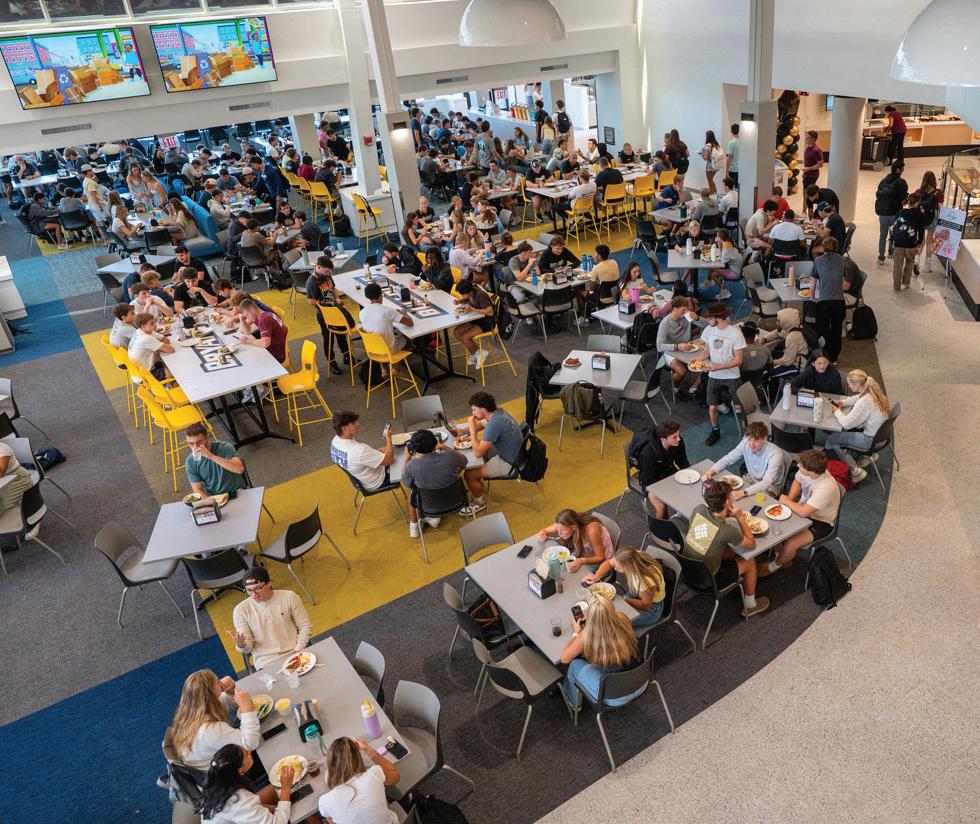
Bryant University’s newly renovated Salmanson Dining Hall is more than a place to eat; it’s a reimagined campus hub designed to spark connection.
"From my first year on campus, there have been so many changes," says Brian Inger '26, "but I have to say, the Salmo renovation is the best one yet."
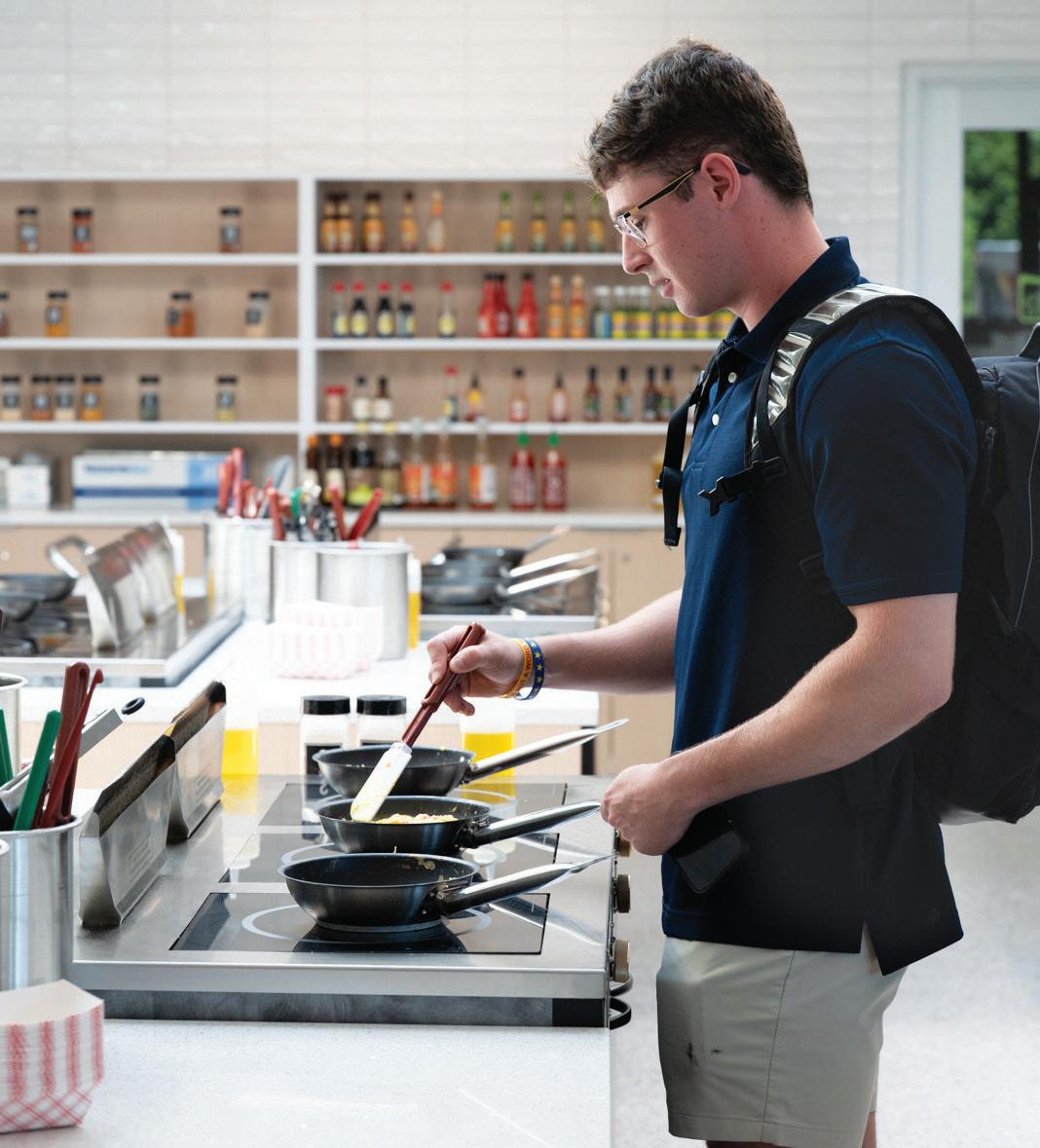
Upgraded food stations expand global offerings, accommodate diverse dietary needs, and emphasize freshness and choice, while an open, airy layout encourages movement and mingling. A variety of seating zones — from communal tables to quieter corners — reflect the many ways that students actually use the space: for studying, meeting friends, or grabbing a quick bite before class or practice. Natural light, an updated design, and enhanced accessibility features signify Salmo’s role as a hub of student life.
The renovation supports Bryant’s broader commitment to student experience, well-being, and community, recognizing that some of the most meaningful moments on campus happen not in classrooms, but around a shared meal.

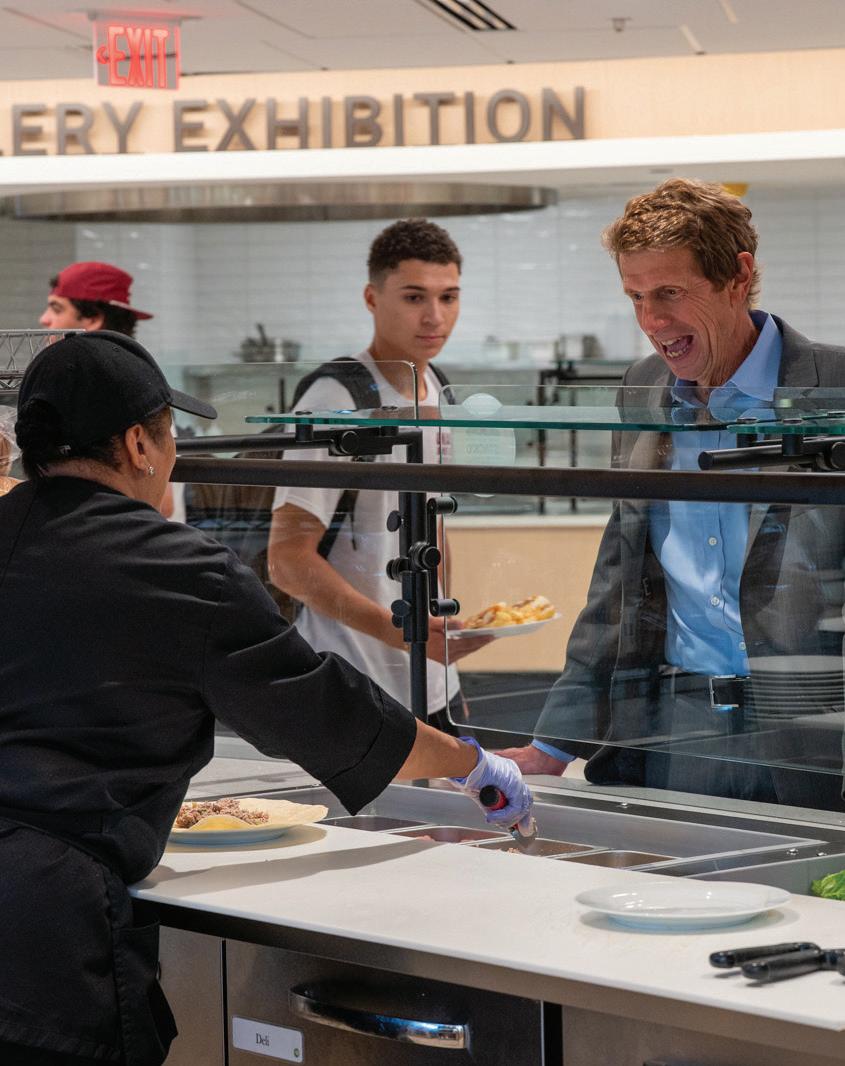
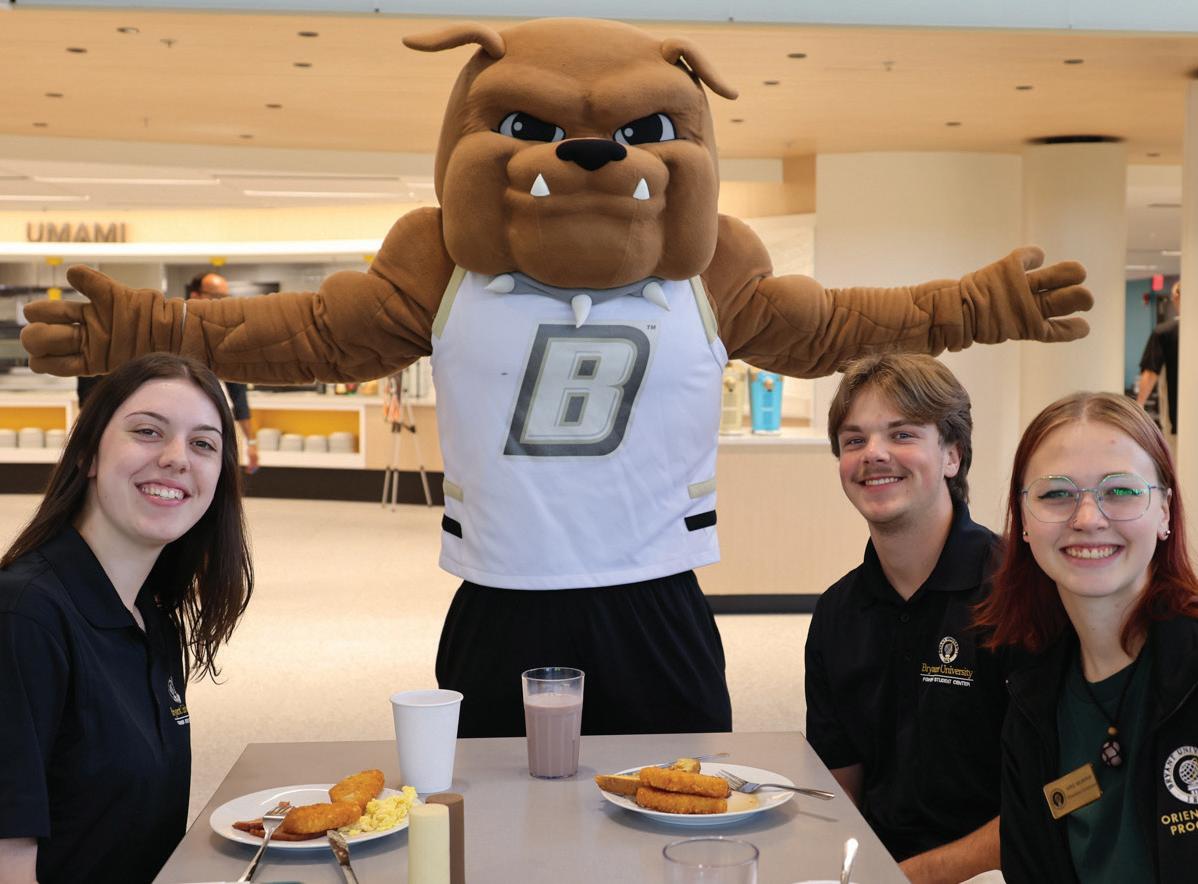
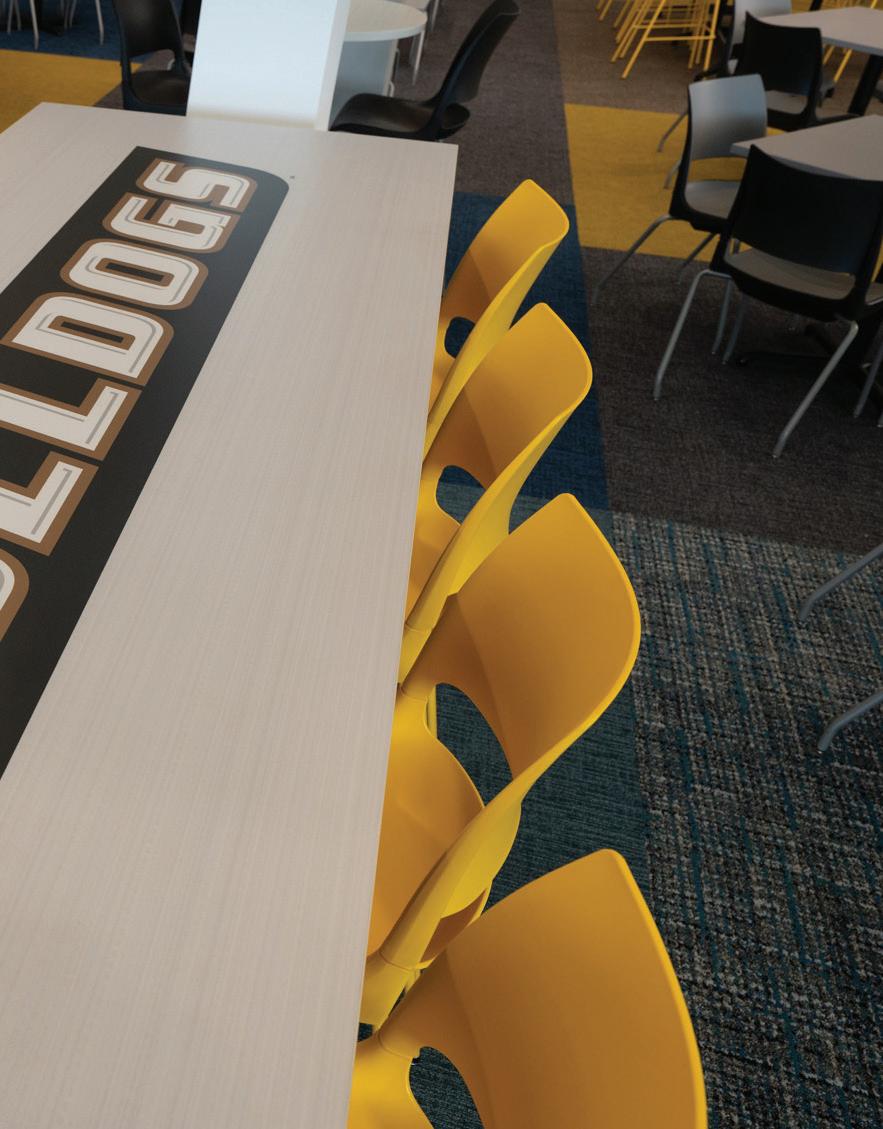
“One of the most important values that we have at Bryant is community,” says Inge-Lise Ameer, Ed.D., Bryant’s vice president of student affairs and dean of students. “We want Salmanson to be a lively, wonderful place where students can relax between classes, feel really welcome, and enjoy some excellent food together.”
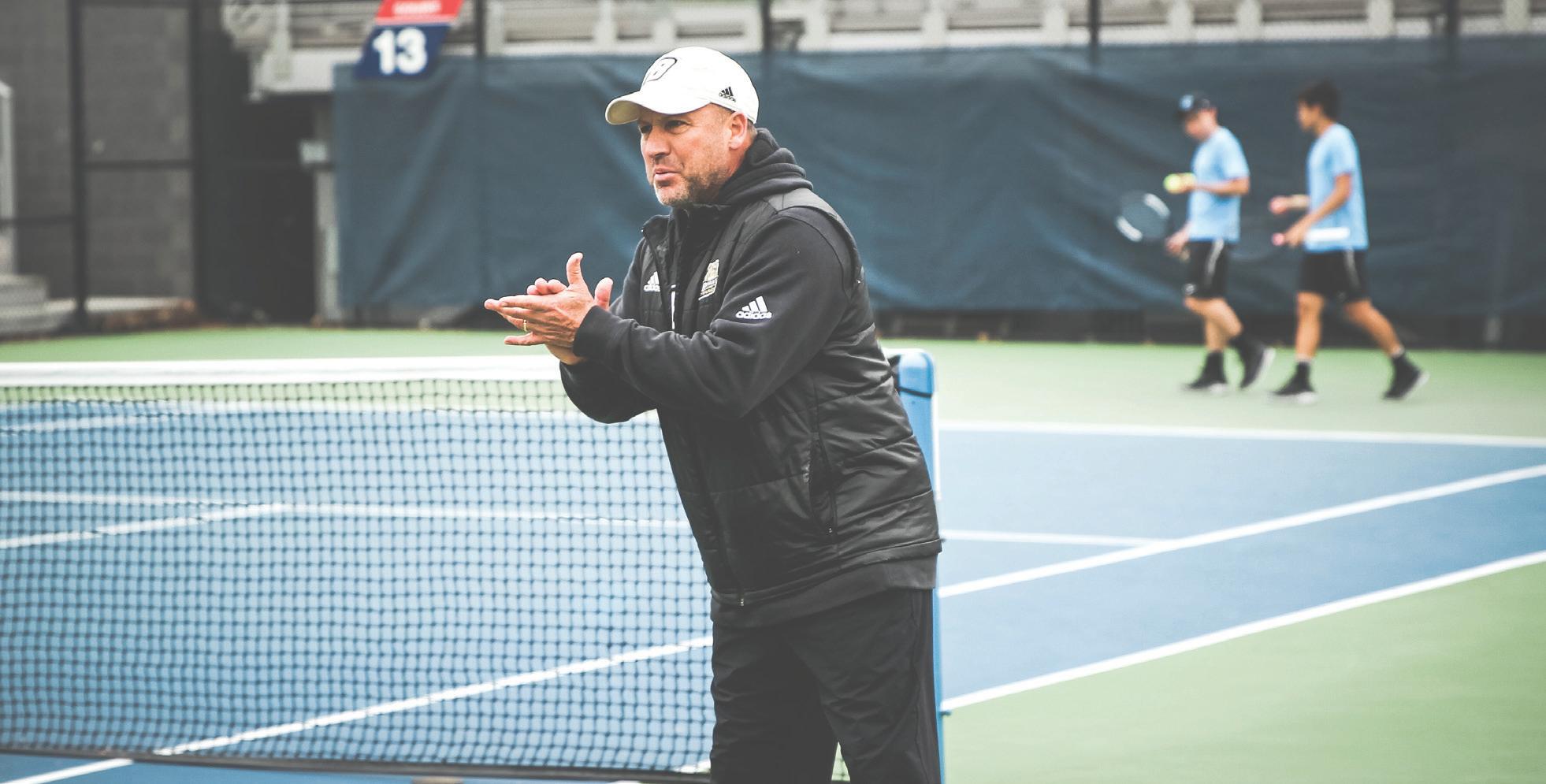
Athletics Hall of Famer Ron Gendron returns for an encore as men’s tennis head coach.
Men’s tennis Head Coach Ron Gendron, newly elected to the Bryant Athletics Hall of Fame, has earned the right to rest on his laurels. During his first 20-year tenure at Bryant, Gendron led the team to seven championships and helped guide a pair of players to careers on the ATP Tour.
“I had a tremendous run,” says Gendron, but when his daughter graduated college, he decided to take a step back. “I thought I could ease out of coaching and enjoy the last few years I had in me. I had a nice three years coaching at Nichols College and retired, essentially.”
Restlessness, however, soon overcame retirement, and he returned to the team this past fall.
“I love the individual nature of tennis. I love competing,” says Gendron, who in addition to coaching still plays in USTA-sanctioned leagues.
Gendron is not shy about shouting pointed advice to his players during practice. He expects them to be the smartest guys on the court and lets them know when they’re not meeting that standard.
“It’s a sport where you can be selective academically, because the best tennis player is a problem solver; it’s very rare to have a great player who’s not a great student,” he says. The numbers back him up: Last year, Bryant’s men’s tennis team had a 100-percent Graduation Success Rate as scored by the NCAA.
Gendron arrived at Bryant in 2001 as an assistant coach for the women’s tennis team, led then as now by Barbara Cilli, his onetime teammate on the Providence College tennis team.
The experience, recalls Gendron, provided him with a new perspective on the sport. “It gave me a certain passion for college athletics that maybe I hadn't had as a player.” After a few years of assistant coaching, he was hired as the men’s tennis head coach in 2005.
Gendron says he’s honored to be one of the five standout coaches and athletes in the 2025 Bryant Athletics Hall of Fame class, alongside former men’s lacrosse head coach Mike Pressler, former baseball head coach Steve Owens, former women’s basketball head coach Mary Burke, and former women’s lacrosse head coach Jill Batcheller.
But that doesn’t mean he’s done either. “I’m happy to be coaching for as long as I can do it. I feel like I still can help young men,” says Gendron, who continues to build on his record of success. Bryant qualified four doubles teams and two singles teams for October’s ITA Regional Championship, and two singles players made it to the tournament semifinals.
“That’s a highlight of my career. It’s not every day you can upset two Ivy League teams (Yale and Dartmouth), never mind the number one seed (Yale),” he says. “I see some great things in our near future.”
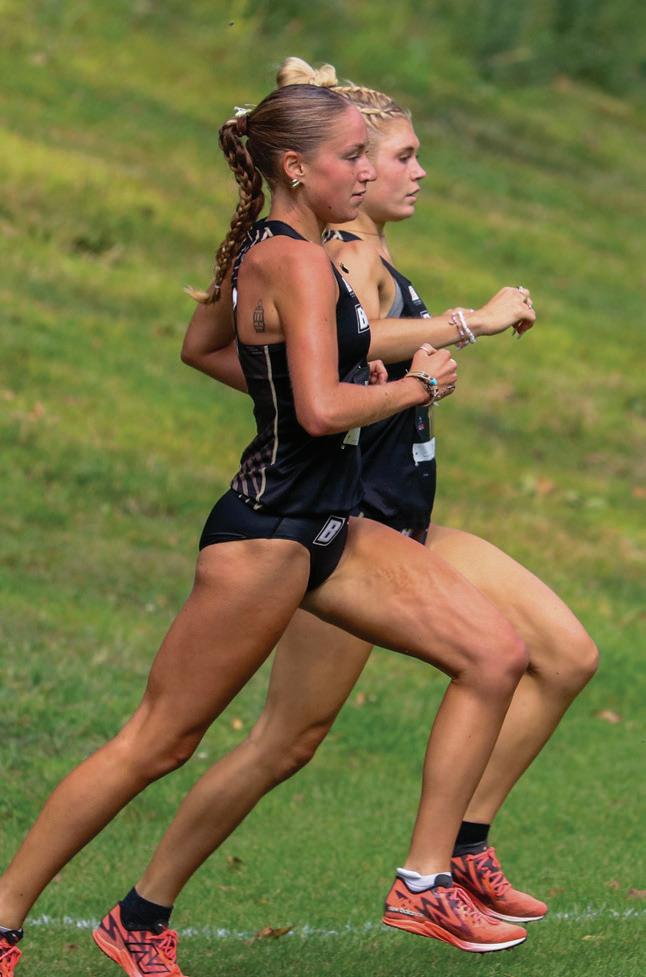
Back home in Leeds, England, Jasmine Trott ’26 would watch the coverage of the NCAA Track and Field Championships and marvel at the runners. “I dreamed about being one of them,” she admits. “They were some of the best in the world.”
Her quest to compete at that highest level took her to the United States and the Bryant University track and field team, where she met Chloe Whiting ’26, a Randolph, New Jersey, native with her own ambitions.
“I wanted to win a lot of medals,” Whiting says with a smile.
Together, the duo would have the season of their lives last year and become the first women in Bryant’s Division I program history to qualify for the NCAA Track and Field Championships.
But before all that, the two became fast friends, roommates, and very nearly inseparable. It turns out they even share a birthday. They’re both Capricorns, Whiting notes: hard-working, loyal — and committed to achieving big goals.
They challenged each other, spurring one another to new records and victories. “You run faster when you run alongside someone who’s pushing you,” Whiting reflects.
They’re the fiercest competitors you’ll find on the track, Trott admits, and when they’re racing each other, no quarter is given. But that quickly falls away when the heat ends.
“Without each other, neither of us would have made it as far as we have,” says Whiting.
Supported by a Bryant team that has grown by leaps and bounds over their time at the university and with each other as their driving force, the pair spent the 2024-25 season outrunning even their own sense of possibility. “It felt like we were breaking a personal record every meet,” reflects Trott.
In the wake of team victories, new personal bests, shattered program records and, yes, medals, the pair traveled to Jacksonville, Florida, for the championships and represented Bryant on the national stage — Trott in the 10K and Whiting in the 5K.
But they’re not done yet. “When you’ve done something like this once, you can do it again,” says Trott. “And now you can aim even higher.”
So far, they’re bringing that vision to life. At the 2025 Shawn M. Nassaney XC Invitational the pair blew away the competition in the 5K — and crossed the finish line together. It was just their first success in a cross country season where they were both named first-team All-Conference.
When Trott capped the semester by winning the 5K at the America East Championship — on her way to becoming the first Bulldog to compete at the NCAA XC Championships — Whiting was right behind her, both in the race and in support of her friend.
From the field to the office, meet four student-athlete alums who turned their passion for sports into athleticsrelated careers:
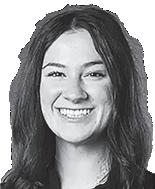
Alysa Wright Sargent ’23
A Health Sciences major and former women’s volleyball player, Wright Sargent is now an assistant coach for the University of New Hampshire’s women’s volleyball team. She played a key role in coaching the team to the 2024 America East Championship and in its first NCAA Tournament bid since 2016.

Michael Ricci ’92, P’29
Ricci, a Finance graduate and former men’s cross country and track and field athlete, is the founder and CEO of D3 Multisport, a premier triathlon coaching organization, and Athlete Within. Ricci was recognized as the United States Olympic Committee Coach of the Year in 2013.

Laura Scinto ’89
Graduating with Business Administration and Management degrees, Scinto helped lead Bryant’s women’s basketball team to three NCAA Tournaments and scored over 1,000 career points. She now serves as assistant athletic director for compliance at the University of Bridgeport.
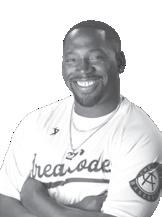
Jordan Brown ’13
While earning his degree in Marketing, Brown set nine school football records. Today, he serves as the strategic partnership lead for Stack Sports’ Student Sports division, which operates premier high school competitions including Elite 11 and Area Code Baseball. To read more about Brown’s career, visit news.bryant.edu/ jordanbrown
Every day is a great day to be a Bulldog, but there’s never been a better time to be a fan of Bryant’s athletics teams. Read on for stories about Bryant’s standout programs, along with some tips on how fans can get in the game and show out with Bulldog Pride.
BY BOB CURLEY
PHOTOGRAPHY BY PAMELA MURRAY AND BRYANT ATHLETICS
Bryant’s teams are making a name for themselves on the national sports scene, and the university’s new, $40 million Navigant Credit Union Field House matches those on-field ambitions.
Adjacent to David M. ’85 and Terry Beirne Stadium, home of Bryant’s football, soccer, and lacrosse teams, the 43,000-square-foot field house includes 1,000 seats for spectators; enhanced concession and ticketing areas; professional-grade press boxes; new training, recovery, and wellness facilities; state-of-the-art locker rooms; and a high-tech media strategy room. The Black & Gold Club lounge provides food and drink service for club members and guests as well as incredible views of the field.
“This investment in both athletics and student and alumni experience strengthens Bryant’s position as a destination of choice for student-athletes and provides an extraordinary new venue for Bulldog fans,” says Bryant University President Ross Gittell, Ph.D.
The opening of the field house gives Beirne Stadium a more complete fan experience, adds Bill Smith, J.D., Bryant’s vice president of athletics and recreation.
“With chairback seating on both sides of the stadium, fans have easy access to restrooms, concessions, a beer garden, the team shop, a kids zone, and, most importantly, a great venue to cheer on the Bulldogs,” he says.
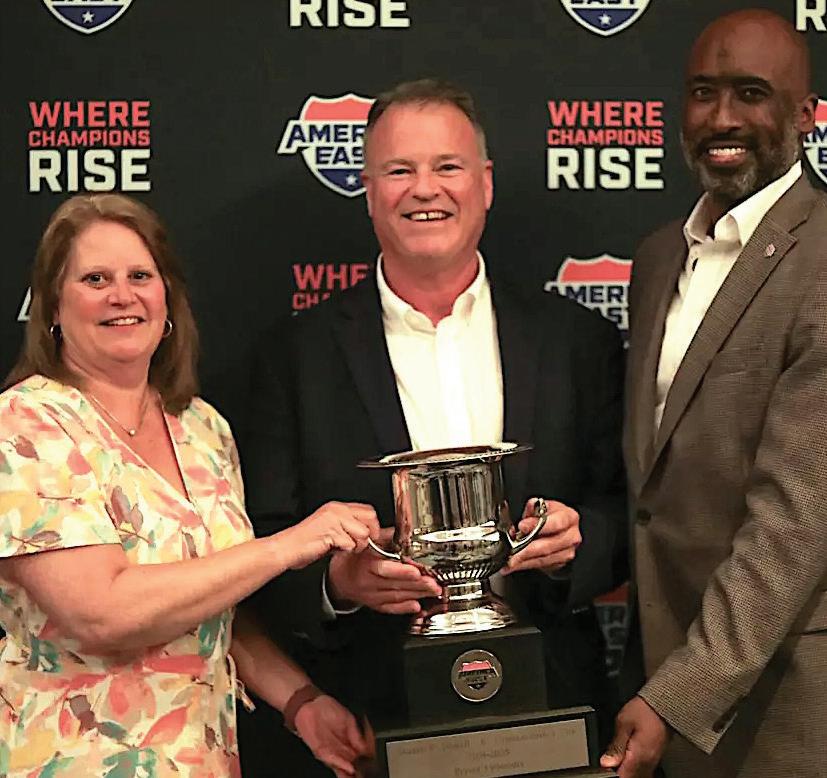
The Stuart P. Haskell, Jr. Commissioner’s Cup honors the toprated athletic program in the America East Conference. Bryant snared the honor after just three years in the conference, showing that “we’re getting our coaches and student-athletes the resources they need to be successful in all our sport programs,” says Bryant Vice President of Athletics and Recreation Bill Smith, J.D.
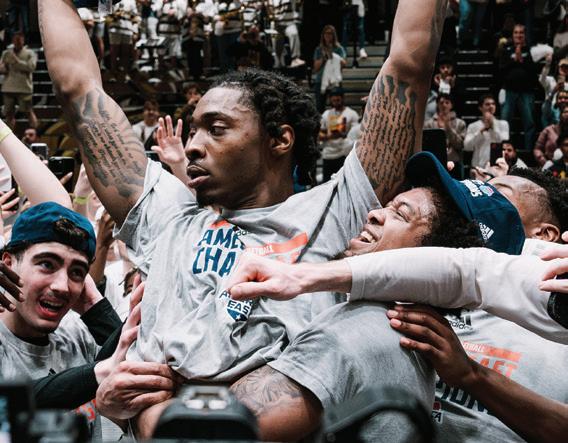
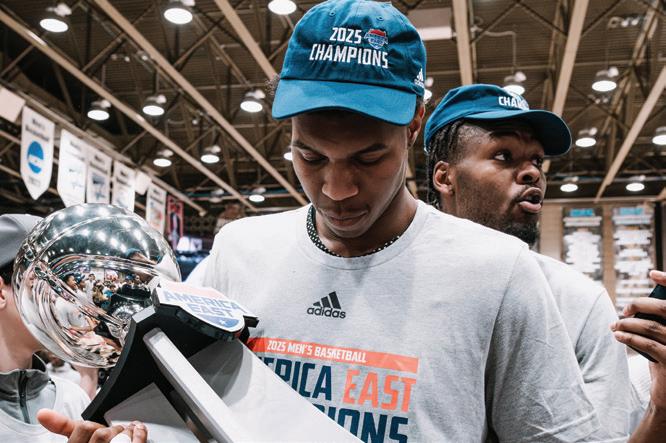
“Thirteen of our programs in the America East Conference finished in the top four last year,” he says, noting that Bryant won the men’s basketball regular season and tournament championship and had six runner-up finishes (men’s soccer, women’s swimming and diving, men’s and women’s lacrosse, baseball, and softball).
“The America East is such a competitive conference in every sport, and Bryant’s success is a true testament to the commitment, dedication, and hard work that all of our student-athletes and coaches put in throughout the year,” says Smith.
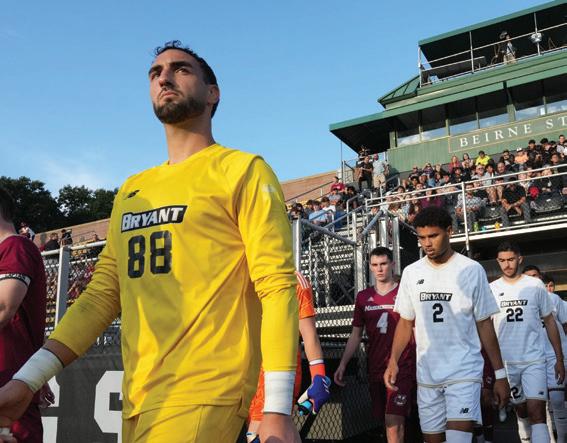
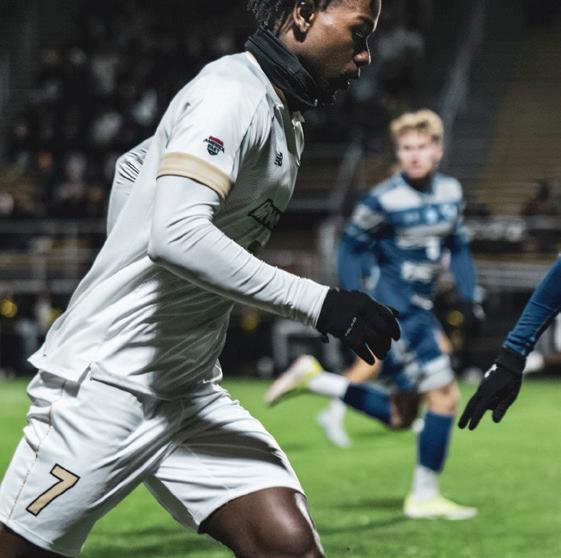
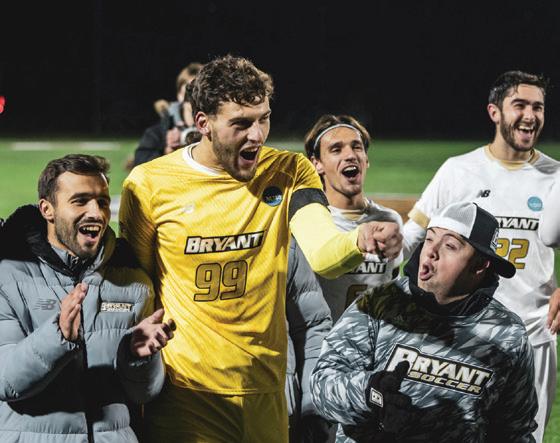
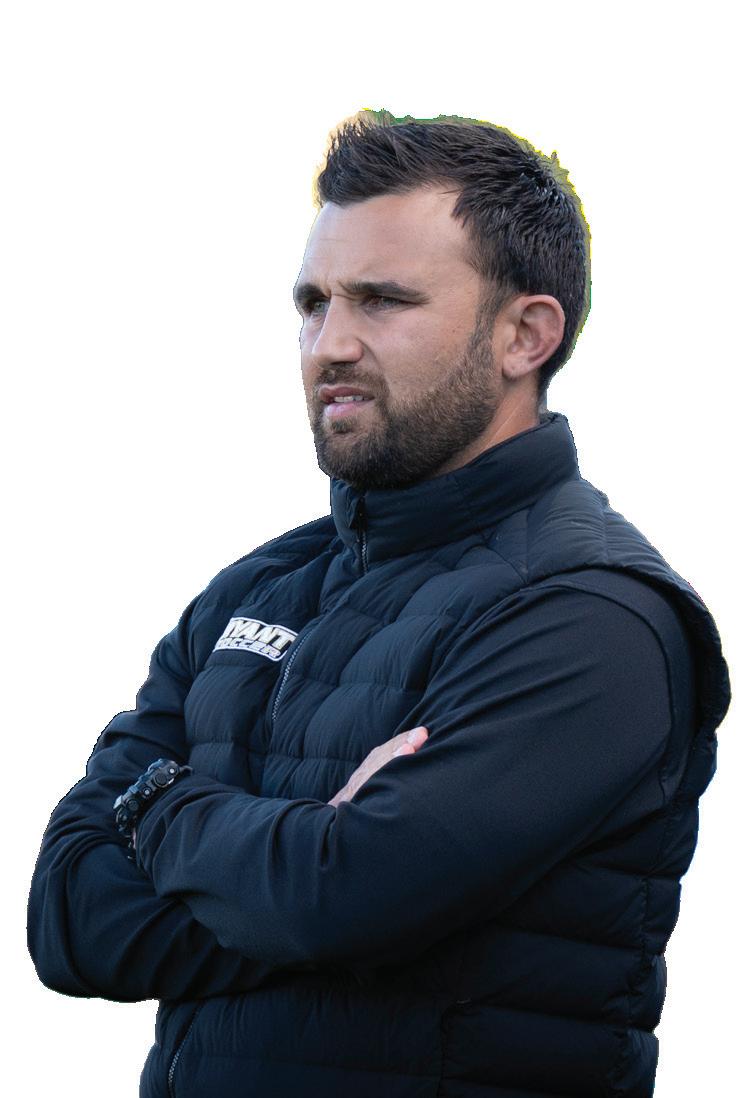
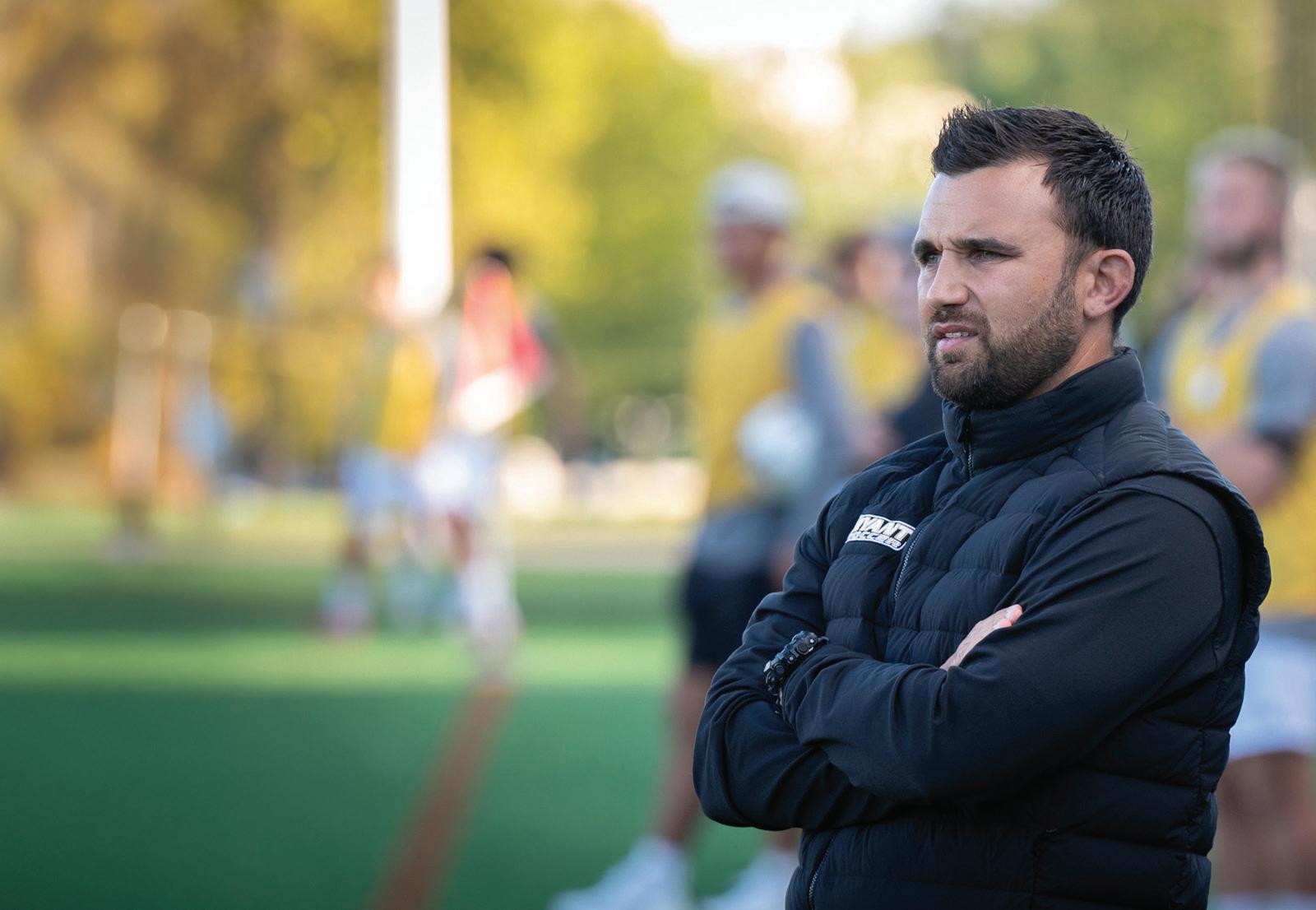
Men’s soccer made Bulldog history this fall and took their place among the best in the nation. The squad rose to number two in the national rankings on the strength of the 15-game unbeaten streak that opened the season, fueled by strong offensive performances from multiple players and, as in past seasons, one of the stingiest defenses in the country.
The Bulldogs finished as runners-up in the conference and earned an at-large bid into the national NCAA Tournament. There, they recorded their first-ever playoff victory and made it all the way to the sweet 16 round, falling to Saint Louis in a penalty kick shootout at Beirne Stadium.
Good coaches always defer credit for success to their players, but there’s no denying that the team’s rise to the elite ranks of NCAA Division I play directly coincided with the hiring of Head Coach Ruben Resendes in 2023.
Resendes had an immediate impact on what had been a middling program: his first season at Bryant resulted in a 16-2-2 record, a league championship, and the team’s first trip to the NCAA Tournament.
If 2024 was something of a rebuilding year, the 2025 team was primed to make the deepest postseason run in the program’s history. “Over the last three seasons, we’ve built one of the premier Division I programs in the country,” says Resendes, who noted they had thousands of fans packing Beirne Stadium in support of the team all year. “This season’s success shows just how far we’ve come.
“We’ll be back, stronger and hungrier,” Resendes vows. “This is only the beginning.”

The world’s biggest sporting event is coming to North America, and Bryant will be part of the action. The university has been selected for inclusion in the FIFA World Cup 26™ base camp brochure — a curated collection of pro-level training grounds for teams participating in the games, which will be held June 11 to July 19, 2026, with matches in the U.S., Canada, and Mexico. Nearby Foxboro, Massachusetts, will host seven matches in the global soccer tournament, including a quarterfinal tilt on July 9. To learn more about FIFA World Cup 26™ at Bryant, visit news.bryant.edu/fifa
Every Bryant student knows that you walk through the Archway at Commencement and not a minute sooner — but Bulldogs have several gameday rituals for players and fans as well:
The Pregame: Starting four hours before kickoff, the parking lots near Beirne Stadium sprout canopies, grills, and cornhole games as the Bryant community enjoys a tailgate party. Cheerleaders, a performance by the university band, parents
wearing pins with photos of players, and friendly rivalries among fans of the home and visiting teams are all part of the experience.
The Stroll: About two-and-a-half hours before games, Bryant football players walk as a team from the university’s Unistructure to Beirne Stadium. Family, friends, and fellow students line the route to offer high-fives and words of encouragement.
The Chime: Wins are announced by ringing the plaza’s victory bell.
The “Fit”: Black, white, and gold are the obvious fashion choices for gameday but the drip is monochromatic for men’s basketball home games when a “white out” or “black out” is declared, with fans presenting a unified front in support of their teams.
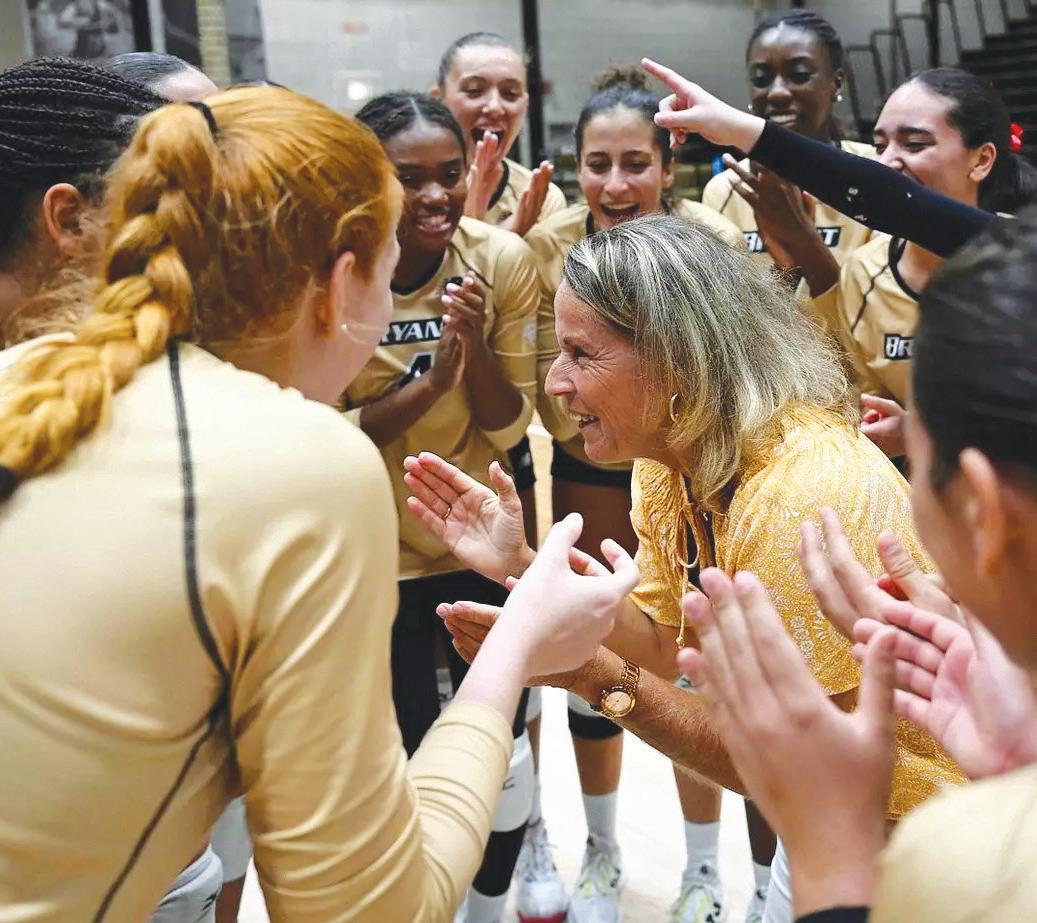
Bryant women’s volleyball celebrated its 50th anniversary in 2025. For 30 of those years, the team has been led by Theresa Garlacy, who collected her 600th career win in 2024.
“I can teach somebody volleyball; I can't teach them to be a good human and a good teammate,” says Garlacy, who led the team to an America East regular season co-championship and an NCAA Tournament appearance this year. “I’ll do this as long as I have good women that want to learn and work hard. If they want to be in the gym with me, I want to be in the gym with them.”
A 2018 run to the NCAA Championship Tournament and a three-year undefeated streak in conference play in the early 2020s are among the team highlights that were celebrated at an anniversary event held in November. The commemoration included current and former team members, coaches, and supporters, including Bryant Athletics Hall of Famer Lorraine Hudak, the team’s founding coach.
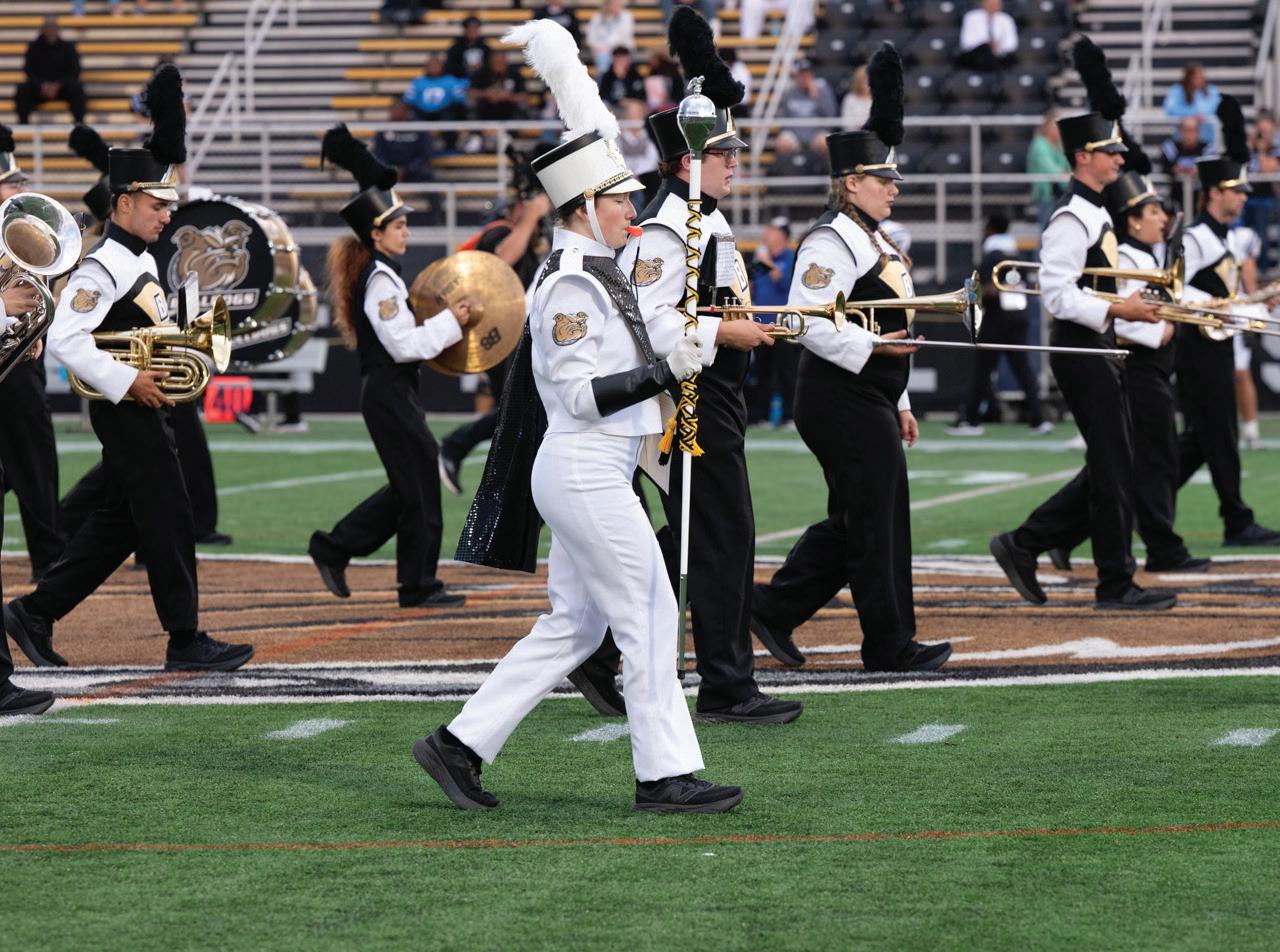
On the March
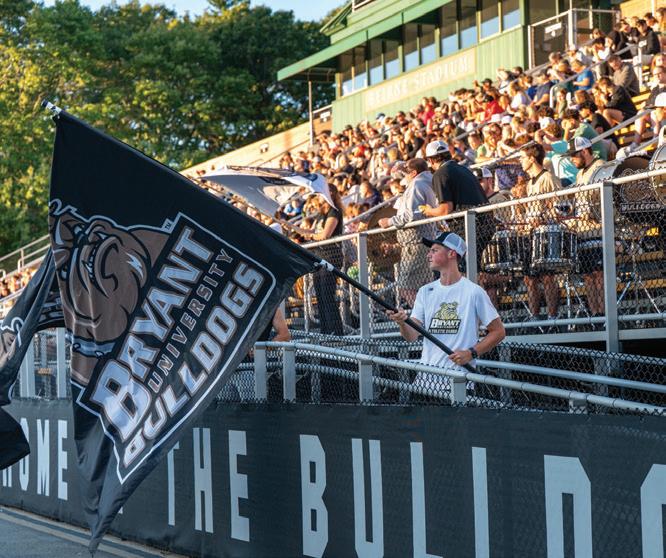
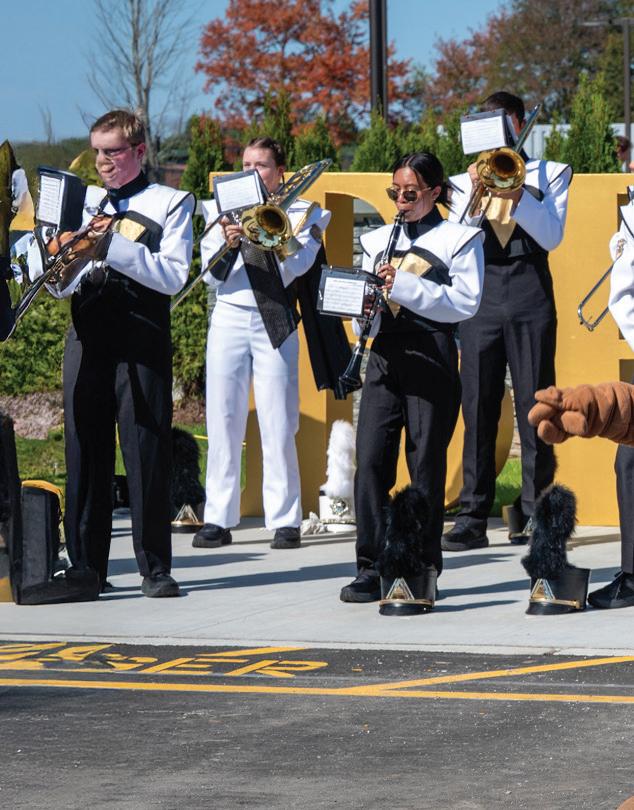
The Bryant Pep Band, already loud and proud in its support of the university’s athletic teams, is stepping up its presence both on and off the field: The modestly composed band of the past is steadily progressing toward becoming a full-scale marching band.
As a warmup, the band began performing simple marches in Beirne Stadium during games this past football season and added choreography to some of the 100-plus songs in its ever-growing catalog.
The band and Bryant’s dance and cheer squads — which took second place in the 2024 National Cheerleaders Association and National Dance Association competition – harmonize closely with each other to fuel Bulldog spirit. The university’s coaches also work with band leaders on how to use music to boost the home team and get into the heads of opponents.
Collectively, their performances help to bring out the best in players and fans — a collaboration that’s much
appreciated as the musicians regularly share fist-bumps with the student-athletes on the sidelines.
“Playing in front of the crowd and hearing their cheers makes the music sound even better,” says band trumpeter Andrew Helm ’27.
New coach. New system. Even loftier goals. That’s the scenario for a Bulldogs’ men’s basketball team coming off an incredible year.
Last season, the Bulldogs soared to a 20-11 record, won the America East Conference title, and earned a March Madness bid under former Head Coach Phil Martelli Jr. After Martelli departed to pursue other coaching opportunities, Bryant brought in Jamion Christian to lead the team.
“I feel like I’m coming in as a stabilizing force,” says Christian, whose previous college head coaching stops included Mount St. Mary’s University, Siena College, and George Washington University. “My job is to take this baton and move it forward.”
Christian’s belief that size and success go hand in hand on the basketball court has helped guide his approach to team construction.
“Martelli's team was one of the biggest in the America East Conference; our team this year is even bigger,” he says, noting that having taller players allows the Bulldogs to “post up everybody and play with a lot of versatility,” similar to the system he used coaching Pallacanestro Trieste to a Serie A2 Championship in Italy’s top professional league.
Student-athletes are important teammates in Bryant’s Exercise and Movement Science program, which prepares students for careers in fitness, athletics, and healthcare. In addition to participating in internships in the program’s lab, athletes take part in research like studies that explore differences among body composition assessment methods and compare power output in leg movements.
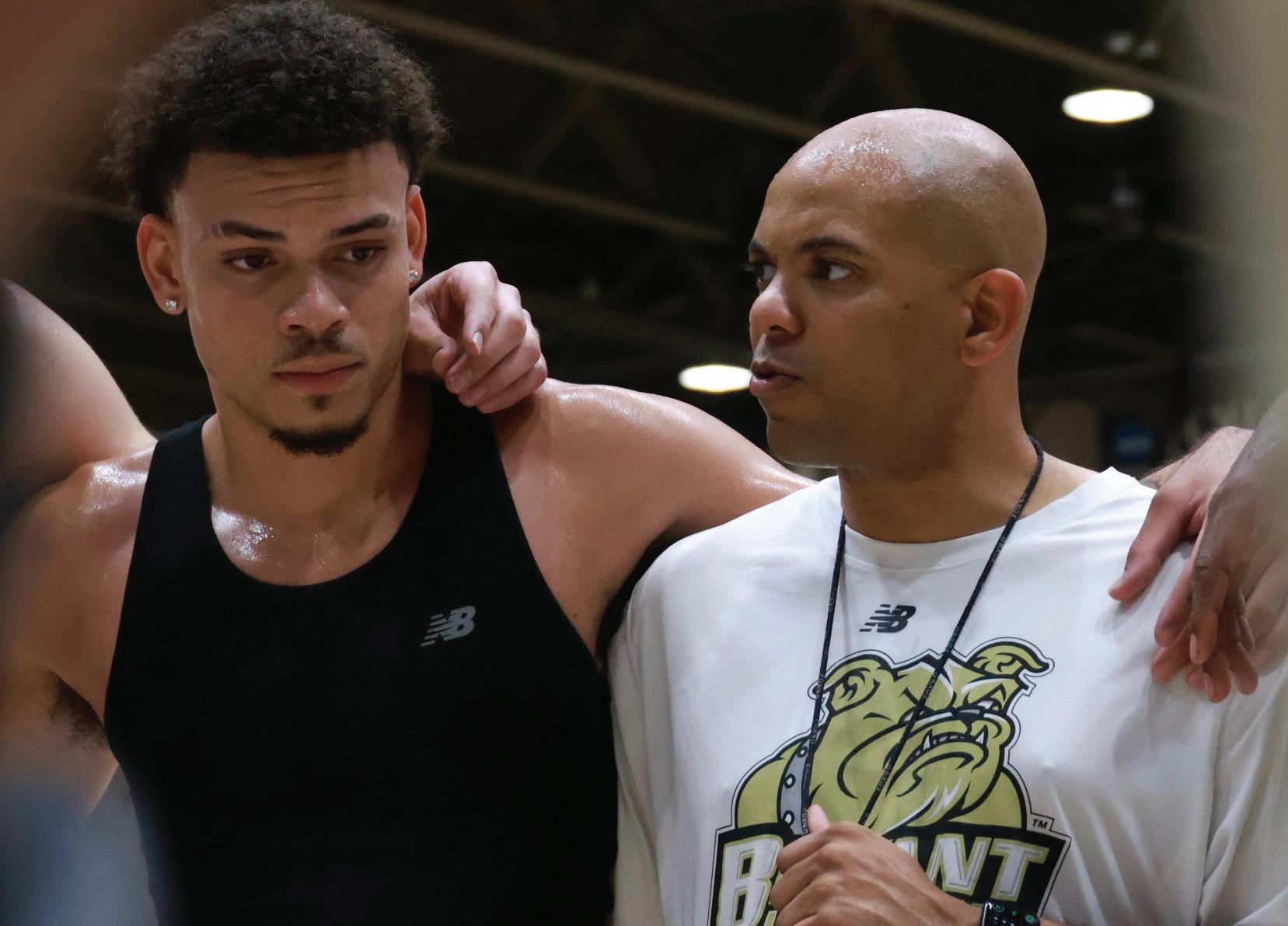
In addition to physical attributes, Christian has focused on work ethic in shaping his first roster at Bryant, looking for athletes “with the heart and soul to be connected to something bigger than themselves, where they're going to constantly come here and want to earn their standing on our team, to accept both mistakes and successes as opportunities to learn.
“I’m really pleased with what we’re building,” Christian says.
“Our researchers gain high-quality data that advance understanding in areas such as performance testing and human physiology, while athletes receive personalized information that includes measures of aerobic capacity, body composition, strength, and power,” says Program Coordinator and Associate Professor of Biological and Biomedical Sciences Jason Sawyer, Ph.D.
Bryant’s alma mater song, with its shoutouts to Roger Williams and brave Narragansett warriors, dates back to 1863. Its game day fight song, though, is much more current: It was performed for the first time by the pep band during a Midnight Madness basketball game in 2016. The next time you attend a game, sing along with Bryant’s short-butsweet rallying cry and help fire up the team!
Verse: Bry-ant Bull-dogs, fight Black and Gold! Iron-clad strong, we stand brave and bold. Fight, fight Bull-dogs, we cheer for Thee. Lead us, oh Bull-dogs, to vic-to-ry!
Listen to the song!
Cheer section:
Verse:
Bry-ant Bull-dogs, fight Black and Gold!
Iron-clad strong, we stand brave and bold. Fight, fight Bull-dogs, we cheer for Thee. Lead us, oh Bull-dogs, to vic-to-ry!
Cheer: “FIGHT!”
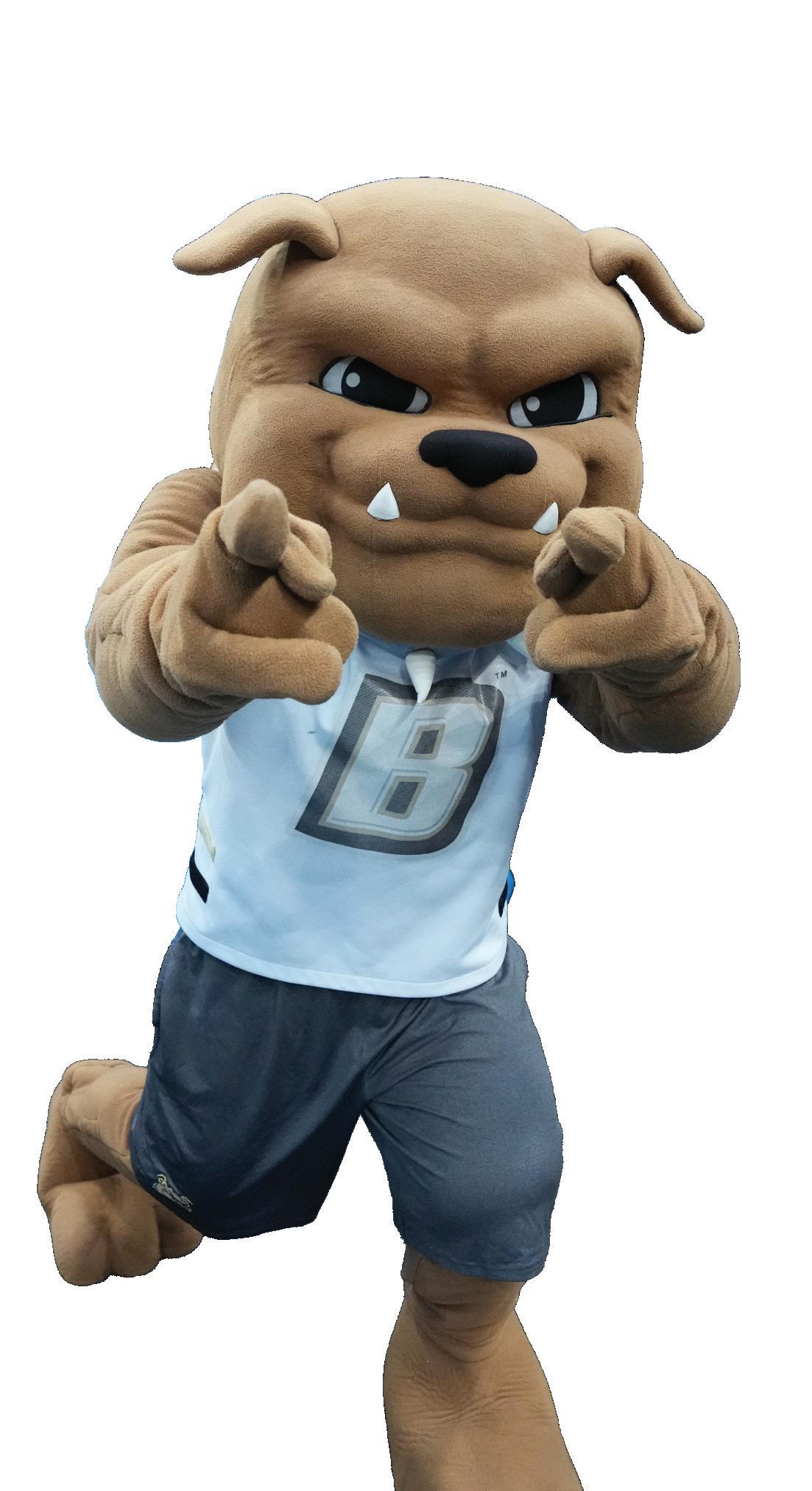
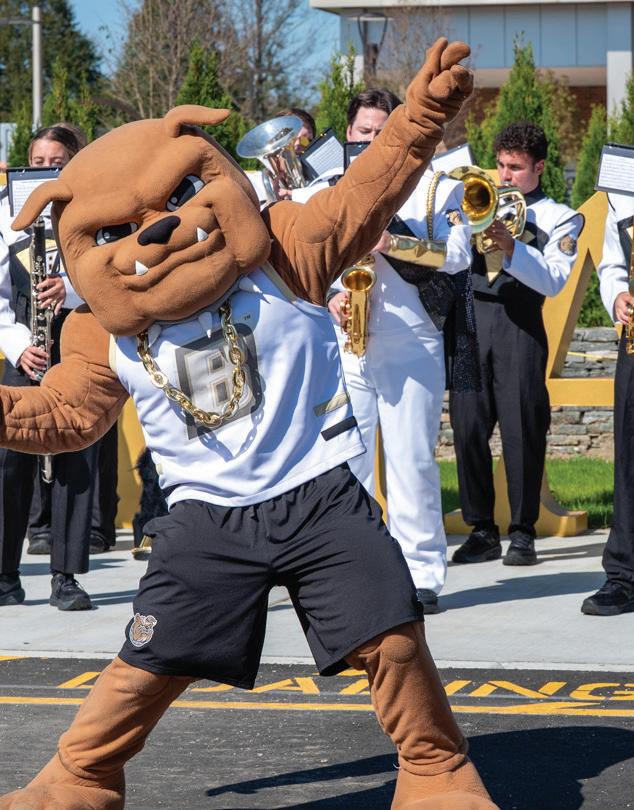
Tupper is a pooch of few words, but we got one of the humans who plays Bryant’s costumed canine mascot to (anonymously) share some stories about life inside the spiked collar.
Becoming Tupper: “I always joked about how fun being a mascot would be and, in my junior year, my roommate who’s in the band texted me and said they needed a Tupper for today's game and would I do it? I pounced at the opportunity.”
Tupper Debut: “I got to the game and there were no shorts for Tupper. I just wore the head, the jersey, and the chains. It looked like Tupper was in a bathing suit. I went up to President Gittell to shake his hand, and he said, ‘Tupper, where are your pants?’ I’m not supposed to talk, but I had to tell him.”
Manifesting Tupper: “There's no real training. I just try to be as dramatic and goofy as possible. The more reaction I get, the more fun people have.”
“On hot days it’s like a sauna, but for cold games I’m perfectly comfortable inside. I can see out of the eyes, but I have no peripheral vision, which is why I need a handler to guide me. I struggle with doorways, because the helmet is about a half a foot taller than my head.”
Best Day Ever: “The little kids love Tupper. Well, half the kids love him; the other half are terrified. But it’s all about the faces that light up when they see Tupper and want to get high-fived — they really think you’re a walking dog.”
Learn about some of the university’s top players from 50 years of NCAA competition as Bryant Athletics enjoys a new golden era of success.
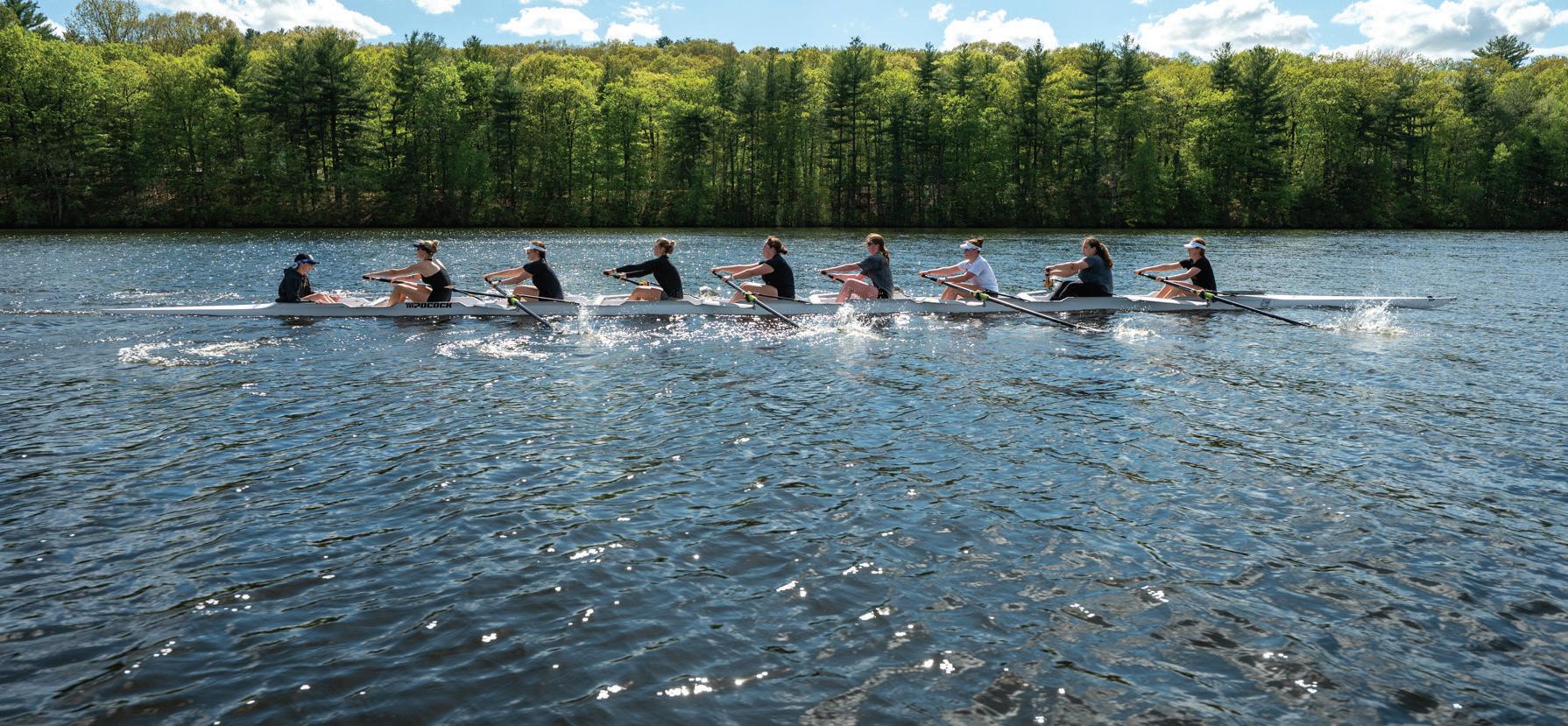
A new member of the Coastal Athletic Association conference, Bryant’s NCAA Division I women’s rowing team (seen here practicing in Smithfield’s Stillwater Reservoir) is coming off a season where women’s crew earned a bronze medal at the Dad Vail Championships and had its best finish ever at the famous Head of the Charles Regatta in Boston.
It’s a big step forward for a team that rose from club-level competition just three years ago (Bryant offers more than 50 club sports options overall). Pictured from the 2024-25 team are (L-R) Coxswain Brooke Hammond ’26, Mollie Lytje ’26, Sarah Oakes ’27, Addison Morin ’26, Olivia Manuel ’26, Bridget Moore ’26, Erin Prouty ’26, Jordan Grady ’25, and Calla Puccetti ’25.
Most students get a final exam at the end of the semester. Bryant Professional in Residence Christian Fauria’s class headed to the Super Bowl.
Fauria, a former NFL tight end who won two Super Bowl rings with the New England Patriots, leveraged his professional connections to fulfill the promise of his “Advanced Sports Broadcasting: Road to Radio Row” course, which is part of Bryant’s new Sport Industries, Media, and Promotion major.
With support from funds raised through Bryant Giving Day, students in Fauria’s class went to Santa Clara, California, during the run-up to Super Bowl LX to broadcast a live show from Radio Row, where thousands of journalists, broadcasters, and podcasters added to the hype of the NFL championship game.
The experiential learning opportunity gave the students the chance to meet and interview current and former NFL players as well as make connections in the broadcasting field.
“We took them into the heart of the industry,” says Fauria, who has worked in broadcasting since retiring from the NFL.
In the two decades since Moneyball spotlighted the importance of analytics in baseball, every team has sought a statistical edge. Now, Bryant has gained a key advantage.
Last season, the Bryant baseball team invested in Trackman, a scouting platform that uses AI, SD Doppler radar, and high-performance cameras to collect detailed data on pitching and hitting and deliver metrics like spin rate, launch angle, and pitch and exit velocity that help improve performance at the plate and on the mound.
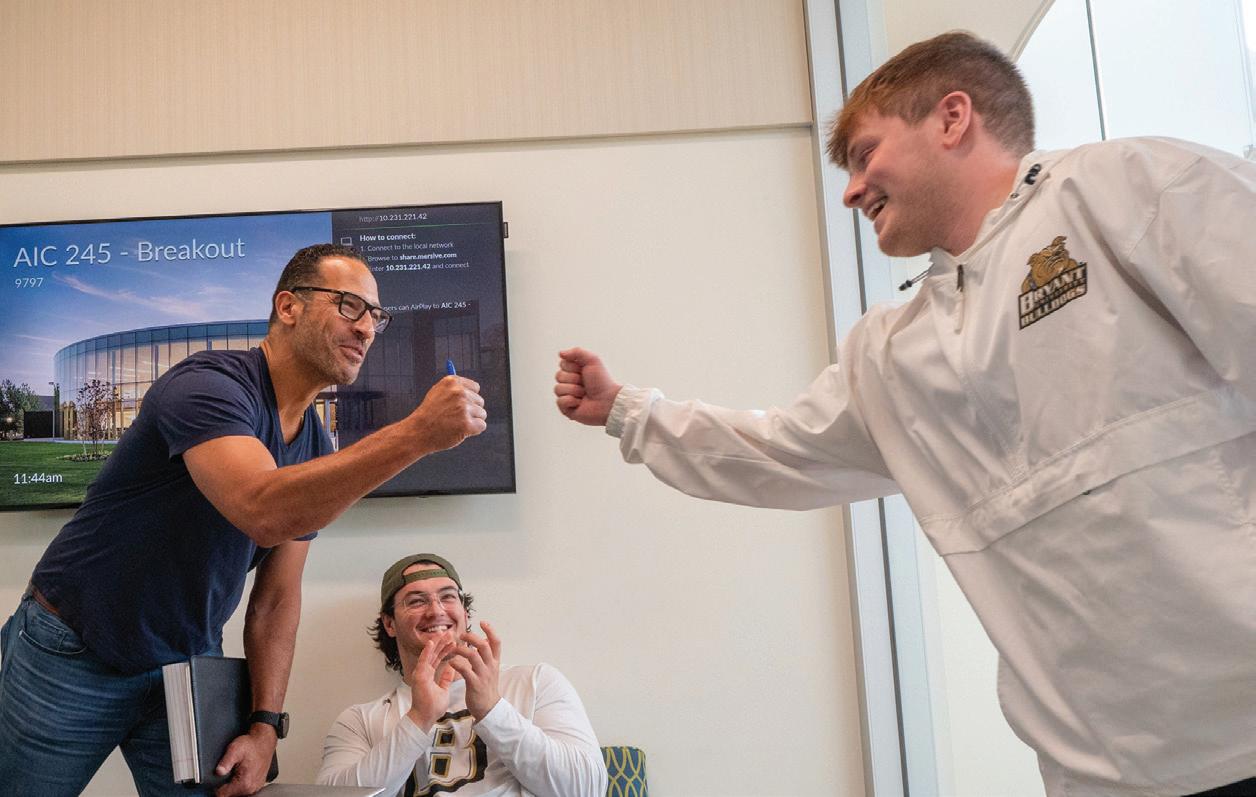
The February 2026 trip was the culmination of a semester's worth of work, including creating several other student-produced radio shows. The broadcast from the Super Bowl, Fauria says, taught invaluable skills — like adapting on the fly when things (inevitably) go wrong.
“You're going to lose your internet signal, or someone will completely blow up your schedule, and you're going to have to fake it because you’re live and can’t take breaks,” Fauria says.
By the end of Super Bowl week, however, his students felt like champs.
“We were part of the media landscape,” Fauria says. “They got a real-time experience that is unique, personalized, and rare.”
To read a rundown of “Road to Radio Row,” visit news.bryant.edu/superbowl.
Ironclad Tupper II, the living embodiment of Bulldog Pride since 2018, barked a final farewell at halftime of a Bryant men’s basketball game in December before trotting off into retirement. The search for a successor (the future Tupper III) is currently underway.
“We can see where guys hit balls well and where they don’t,” says Will Kaufman, the team’s hitting coach. Pitchers are able to observe the speed and motion of their pitches and make adjustments on things like grip and release point.
The university’s coaches use Trackman metrics to design pitching strategies and guide swing decisions for hitters, and the benefits for players go beyond college, Kaufman says.
“Some major league teams are drafting guys just based on their analytics,” he notes.



Two decades after its launch, the Archway Investment Fund continues to forge finance industry leaders ready to meet the market — and give back to future generations.
BY STEPHEN KOSTRZEWA
INTERIOR PHOTOGRAPHY BY MICHAEL SALERNO AND PAMELA MURRAY


Amid the roar of information in Bryant University’s new Financial Markets Center (FMC), an initiation is about to commence. As the security analysts for the Equity Fund division of the $4 million Archway Investment Fund pass by the giant stock ticker at the center’s door, they enter a place familiar to them through classes and workshops, but now imbued with new meaning, and new responsibility.
In one corner of the room, a screen tuned to CNBC lays out the financial issues of the day. In another, a display offers up-tothe-minute performance stats for the Dow Jones and Nasdaq.
At the center, dual-monitor workstations and Bloomberg Terminals blink real-time news, data, and analytics.
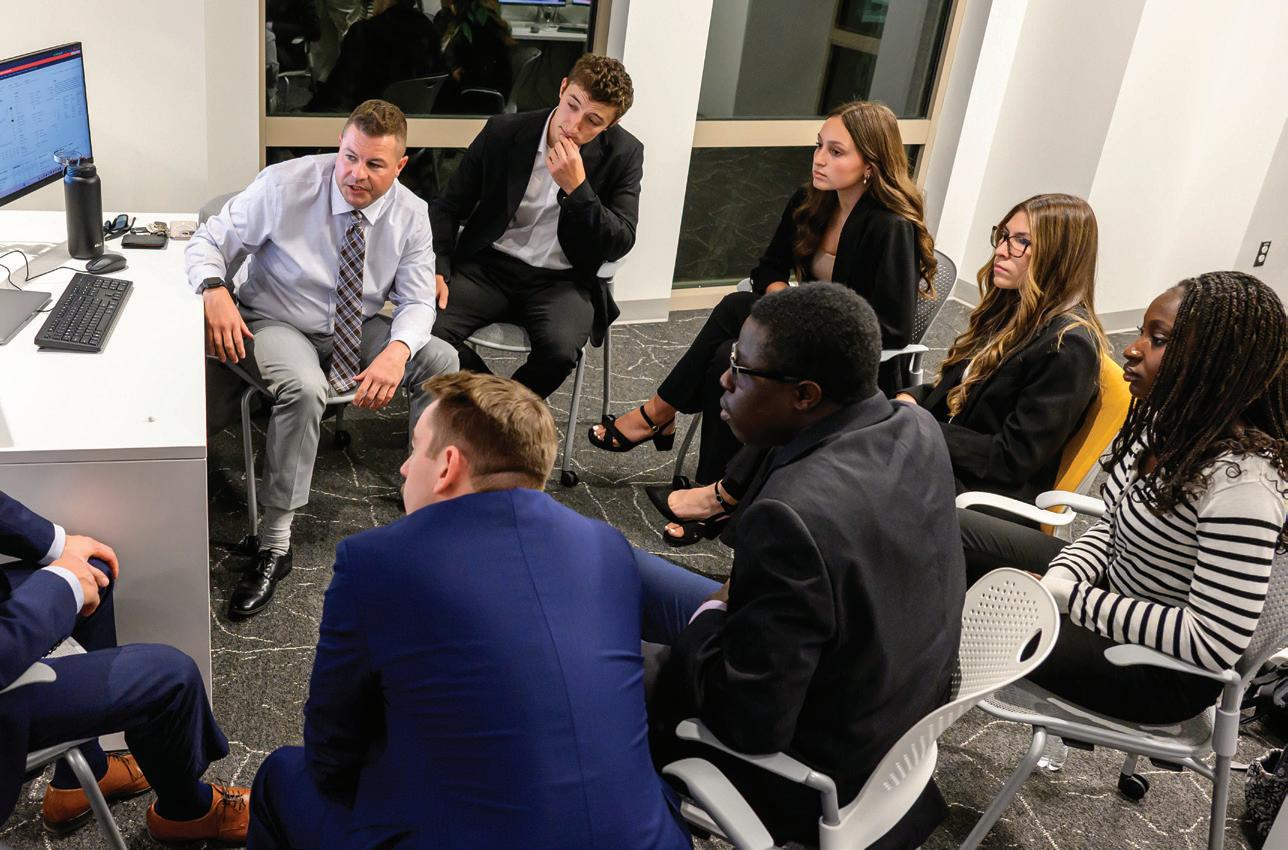
But the students’ most valuable sources of information are sitting in front of them. Every semester, the portfolio managers (PMs) for the student-managed fund meet
in special session with the analysts who are preparing to take it over. It’s both a guided tour of the systems they’ll use and the bestowing of a serious duty.
The PMs for the fund’s sector teams, each devoted to a different area of the market, begin to teach the next generation. In the back of the room, the Communication Services team huddles in a circle around Joseph Tallman ’25.
As Tallman navigates the systems with a practiced ease, he walks the analysts through the shortcuts, quirks, and vagaries of the tools they’ll be using to monitor global trends and markets, conduct research on stocks, and develop investment strategies that will guide their trades.
“You should always be aware of the conventional wisdom,” he adds, “but, ultimately, it comes down to you to make the final call.”
Since its founding in 2005, the student leaders of the Archway Investment Fund — Bryant juniors and seniors representing a variety of majors and selected from a competitive pool for the two-course capstone sequence — have had a fiduciary duty, says Kevin Maloney, Ph.D., professor and chair of the Finance department and director of the fund: “a responsibility to the students who came before them, and to everyone who comes after.”
Over the last 20 years, the portfolio has grown from a $200,000 initial investment provided by the university to, at its latest valuation, $4 million. And the students' real-world experience grew alongside it, says Sarkisian Chair in Financial Services Peter Nigro, Ph.D., who helped build the fund alongside Professor of Finance David Louton, Ph.D., who retired from Bryant in 2024.
“We had a bunch of students that wanted to go to Wall Street, but, at that point, whoever heard of Bryant?” says Nigro. “So, the idea was, let's give these kids some real-world experience while they're in school and give them an edge up on kids coming out of places like Harvard.”
But the early 2000s was a nascent time for student-managed funds, he explains, and the concept had seen mixed success. “We talked with some faculty members from other colleges who were on their second student-managed fund because, in the first one, the students basically lost all the money,” Nigro says.
The differentiating factor for Archway, Louton and Nigro decided, would be that it was closely tied to Bryant’s Finance curriculum.
From the very start, Bryant alumni and industry leaders played a key role in fleshing out the fund, as did students Kristen D. (Stein) Goldberg ’05, Noah S. Ahmed ’05, and Peter S. Corvi ’05. This working group, led by Louton and Nigro with assistance from Professor of Finance Hakkan Saraglou, Ph.D., found support for an Archway course taught by Louton and an equity fund that would buy and trade a diverse portfolio of stocks. Early purchases would include a mix of big names like Honeywell, Apple Inc., and McDonald’s, and lesser-known companies such as Irish airline Ryanair and energy firm Piedmont Lithium Limited.
They had the money; now they needed the students to manage it. “There was a lot of excitement from the very start,” remembers Nigro. “It was very competitive to get in.”
Archway hopefuls were judged — and are still judged, 20 years later — on grades and acumen, but also on passion and a willingness to go the extra mile.
“To get the most out of this class, each student has to contribute his or her share of work, even if that means exerting more time and effort than for the average class,” wrote Louton in an early investment report.
“Let’s give them an edge up on kids coming out of places like Harvard.”
out the best in all of us,” says Patel.
The Archway students were also eager to test one another. Patel vividly remembers a fellow classmate mercilessly grilling him during a stock pitch.
Tarang Patel ’07, one of the members of the fund’s first full class, can’t help but laugh when he thinks back to his time with Archway.
“Wow, what a risk they took, giving all that money to bunch of students,” Patel, now vice president of corporate development for the technology company Acquia, chuckles.
There was a lot of buzz around the class, and a bit of prestige, he recalls. But with that stature came responsibility. “I think it brought
“Of course, I did the exact same thing to him when he pitched,” he admits with glee.
But that heated atmosphere also helped to forge lifelong bonds; the same rival would later go on to become a groomsman at Patel’s wedding.
In the early days of the program, it felt like everyone was under a lot of scrutiny and still had something to prove, Patel says.
It wasn’t always smooth sailing those first years — the financial crisis of 2008 hit early in the fund’s run, for instance — but the fund quickly established itself and, buoyed by success, received additional funding from the university.
Patel recalls when his cohort gave their final presentation to the Bryant Board of Trustees.
“I remember showing them two of the slides in our deck,” he says. “In the first one, we showed a picture of a pontoon boat, and I told them that’s where the fund is now.
Then I showed them a picture of a speedboat and said, ‘That’s where we’re going to be.’” >>
not just about numbers, but about how capital allocation affects the world,” she explains.
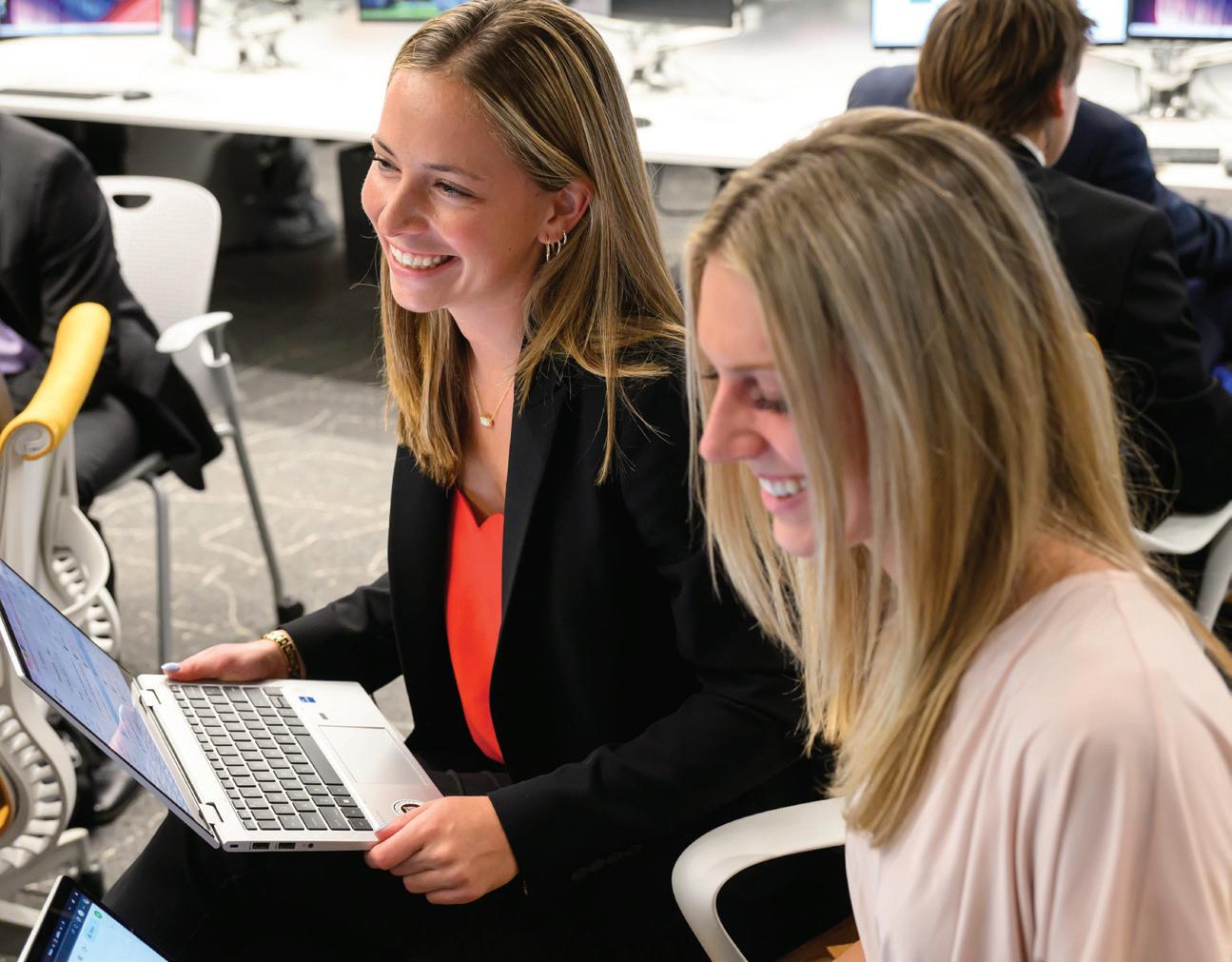
mance. Recent Archway alum Rosemary McIlroy ’25, now a risk management associate at Citizens, characterizes the Archway experience as a trial by fire. “We had so many late nights in the Financial Markets Center just doing research and trying to make decisions about where we were going to invest,” she says. “We all were good at different things, and we had to learn to work together and rely on each other.”
After ten successful years under Louton, Professor of Finance Asli Ascioglu, Ph.D., took over the fund in 2015, growing it exponentially.
“For the first couple weeks I tried to teach the course by the book — then I threw the book out the window,” Ascioglu, the director of Bryant’s Financial Markets Center, admits with a laugh.
“We created our own textbook every day.”
Ascioglu also incorporated environmental, social, and governance (ESG) factors into the investment process, which are used alongside traditional financial ratios and fundamental analysis when evaluating the potential returns and risk of stocks.
“Our job is to prepare students for the realities of modern portfolio management and to help them understand that finance is
During this time, Maloney was hired to introduce a new fixed income portfolio into the Archway program, funded by two cash infusions of $250,000, one from the university, the other from the Equity Fund.
The fund most recently incorporated a Digital Innovation Fund, pioneered by Nigro, that immerses students in the emerging technological trends that are fundamentally changing the financial services industry. Its holdings include digital banking, lending, and investing platform SoFi Technologies, PayPal, and fintech and homeownership services firm Rocket Companies.
“We saw it coming early on,” says Nigro. “We knew we had to look forward.”
But the fund has also stayed true to its guiding principles — and to its focus on high perfor-
That emphasis on teamwork faced no stronger test than the COVID-19 pandemic, which both Ascioglu and Maloney consider to be one of the fund’s finest hours. That semester, the portfolio managers went on spring break and, from their family homes and vacation destinations, watched the markets collapse in a matter of days.
“We all went off script,” says Maloney, who became Archway director in 2024. “I told them, ‘According to the syllabus, we’re supposed to be talking about X, today, right? Well, we’re going to pivot and talk about how to navigate during times of crisis.’”
The students, and their portfolio, persevered. “One thing we have learned is to trust our students, and that they have always risen to that trust,” reflects Ascioglu.
Year by year, class by class, Archway alumni have outpaced their peers in finance, securing positions with storied firms like Goldman Sachs, JPMorgan Chase & Co, Fidelity Investments, and others.
“I think one of the things we’ve learned is how to out-grit the competition,” reflects McIlroy. “In

things.”
At one of the day’s panels, Patel, alongside other Archway grads, offers advice to current students about finding their way in the financial services industry.
“We have picked some winners, and we have picked some losers, but we have always learned,” wrote founding Archway Investment Fund
Professor David Louton, Ph.D., in an early fund report. Some picks, however, stand out above the rest. Here are Archway’s top five purchases by percentage gains:
Apple Inc. (NASDAQ: AAPL) +678%
31 my first Archway class, I remember the professor telling us that if you want to be able to compete, you have to show that you can outwork the Ivy kids — and seeing how well so many Archway grads have done, I think the program’s helped ingrain that in all of us.”
The TJX Companies (NYSE: TJX) +210%
Even with their success, the Archway graduates never forget where they came from. They’ve forged a powerful subset of Bryant’s finance network and they regularly return to campus for opportunities to engage with students, including this fall’s Financial Services Forum, a Bryant tradition as old as the Archway Investment Fund.
“This is one of my favorite days of the year,” Nigro declares in this year’s opening remarks, “because I get to see so many of my old students who have gone on to big
Later on, faculty, students, and alumni pack the Financial Markets Center for a reception to celebrate the program’s anniversary — paired with a mentoring session. More than two dozen Archway program alumni help guide the next generation of Archway students as they prepare to transition from life as a student to their professional career.
Almost immediately, a student comes up to Patel and asks for advice. Patel’s eyes light up as he takes in his resume. “Wow, a sophomore — you’re starting early,” he tells the Archway hopeful.
For Patel, who was there for the fund’s humble beginning, there is a feeling of awe in seeing how far Archway has come. There’s
Nvidia Corporation (NASDAQ: NVDA) +247%
Alphabet Inc. (NASDAQ: GOOG) +260%
KLA Corporation (NASDAQ: KLAC) +271%
also a sense of pride in knowing he played a part in its success. “I saw the speedboat today,” he reflects.

At many Division I institutions across the country, athletes slip through the cracks off the field. Bryant’s student-athletes, however, are among the most academically gifted in the nation, thanks to a support system and culture that’s bigger than the scoreboard.
BY STEPHEN KOSTRZEWA PHOTOGRAPHY BY PAMELA MURRAY
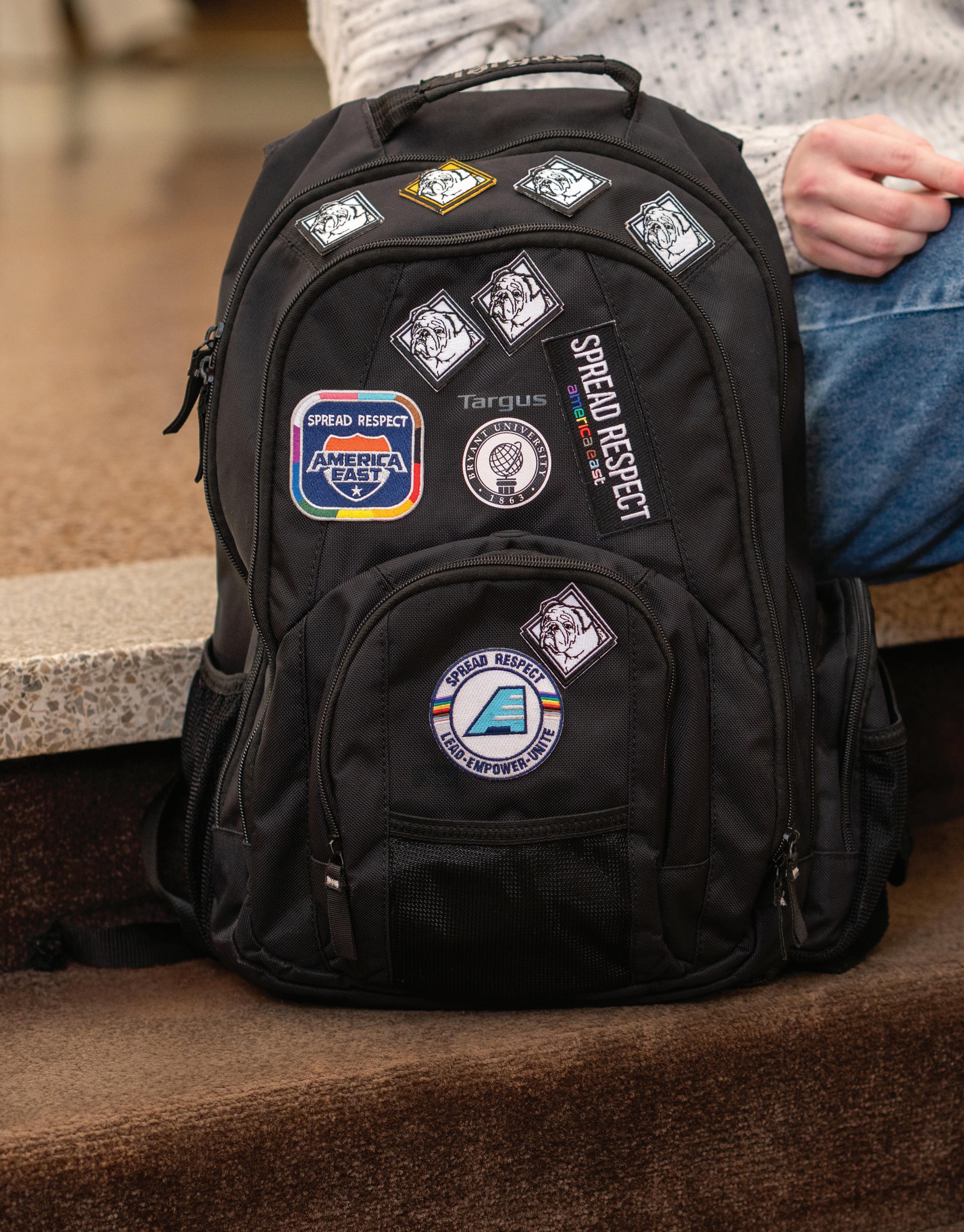
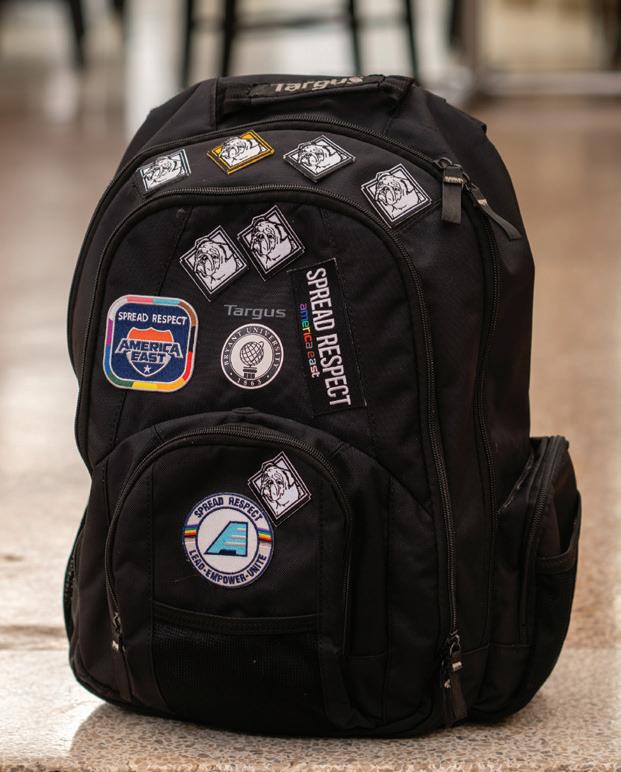
As Hannah Cochran ’25 travels across campus, she carries a Bryant backpack that tells her story: one covered with America East conference emblems and the Bulldog patches awarded to student-athletes for strong academic performance.
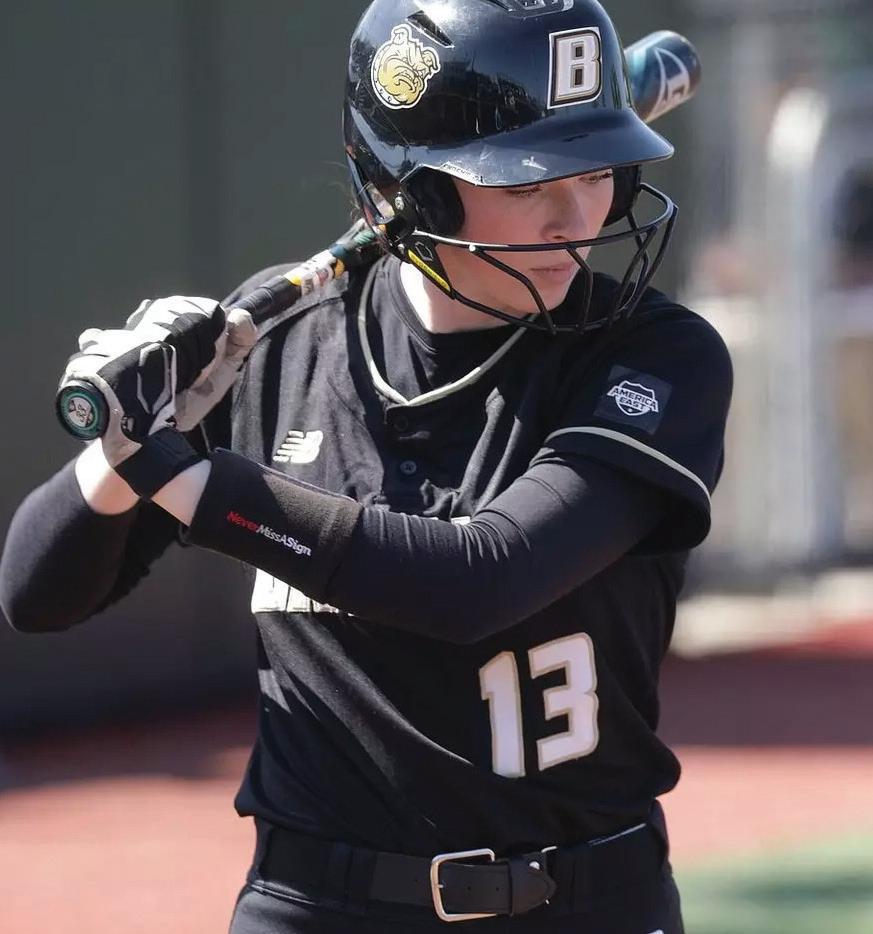
On the softball diamond, Cochran’s teammates could always count on her. In 2024, the utility fielder tallied the second-most single-season Runs Batted In in program history. In 2025, she hit a three-run home run in the America East Championship game.
She’s an academic standout as well. Through her internship with Bryant’s Office of Student-Athlete Academic Services, the Actuarial Mathematics major — a regular on the Dean’s List who tutors through Bryant’s Academic Center for Excellence (ACE) — helps with office logistics, supports
staff, and meets one-on-one with student-athletes to plan their academic paths.
Softball has been part of Cochran’s life since she was nine years old. Playing sports has helped her make lifelong friends and unforgettable memories, and she credits the skills she's learned as a student-athlete — like drive, coachability, and the ability to manage hard work — with helping her in securing the fulltime underwriting job at OdysseyRe, which she started in December after graduating a semester early.
But being a student-athlete hasn’t always been easy. Keeping up grades, maintaining friendships, preparing for post-grad life, and giving their all in competition can be exhausting.
It’s not always the work itself that gets to you, she says; sometimes it’s the stress.
“There was an adjustment
period my first year, and I definitely had some breakdowns,” Cochran admits. “I was like, ‘Oh my God, I'm not going to be good at softball, and I'm not going to be good at school, either.’”
But she found support from ACE’s tutors, her teammates, and Lauren Chapman, Bryant’s director of student-athlete academic services, who has been a confidante ever since Cochran first visited the university.
They aided her with subject matter, yes, but also leant a supportive ear — and helped her to realize that she could rise to the challenge.
Cochran isn’t alone in her experience, or her achievements. Bryant recently enjoyed its best academic semester for student-athletes on record. Four hundred and five Bulldogs were named to the America East Academic Honor Roll, and nearly
60 percent of students made the Commissioner’s Honor Roll. The overall student-athlete term GPA was a record 3.43 — even higher than that of non-student-athletes. The university’s graduation success rate of 96 percent is six points higher than the national average; its academic progress rate is among the best in the country.
At Bryant, says Vice President of Athletics and Recreation Bill Smith, J.D., success isn’t measured by championships; it’s scored on changed lives. To make that kind of difference requires dozens of professionals working across fields from academic support to sport psychology — and a community committed to each other.
Smith has ushered in an era of growth and success for Bryant Athletics. The university currently fields 25 Division I teams and recently captured its first America East Commissioner's Cup, awarded annually to the most successful school in conference competition.
Achieving those results took a massive expansion of facilities and personnel. But Smith is proudest of how close-knit the community has remained. “Our goal is to be ahead of the competition every way we can — in athletics, in academics, and in wellbeing,” he says. “I think that’s one of the things that makes us different; we treat our student-athletes as whole people.”
Playing sports teaches teamwork, perseverance, grit, and integrity, Smith states, but it
also opens students up to a world of possibilities. If they can push themselves to new heights in competition, he says, they can also discover what they’re capable of as scholars, as citizens, and as people.
“That’s one of the most important things an athletics program can give to students: it can inspire them to grow,” he says.
and world find a restaurant that reminds them of home.
King also shares her experience with students to help them navigate the mental health challenges that can accompany the demands of being a Division I student-athlete. “When I played and went to school, having anxiety was not something that was discussed. Your teammates and your coach told you to get over it and move on.”
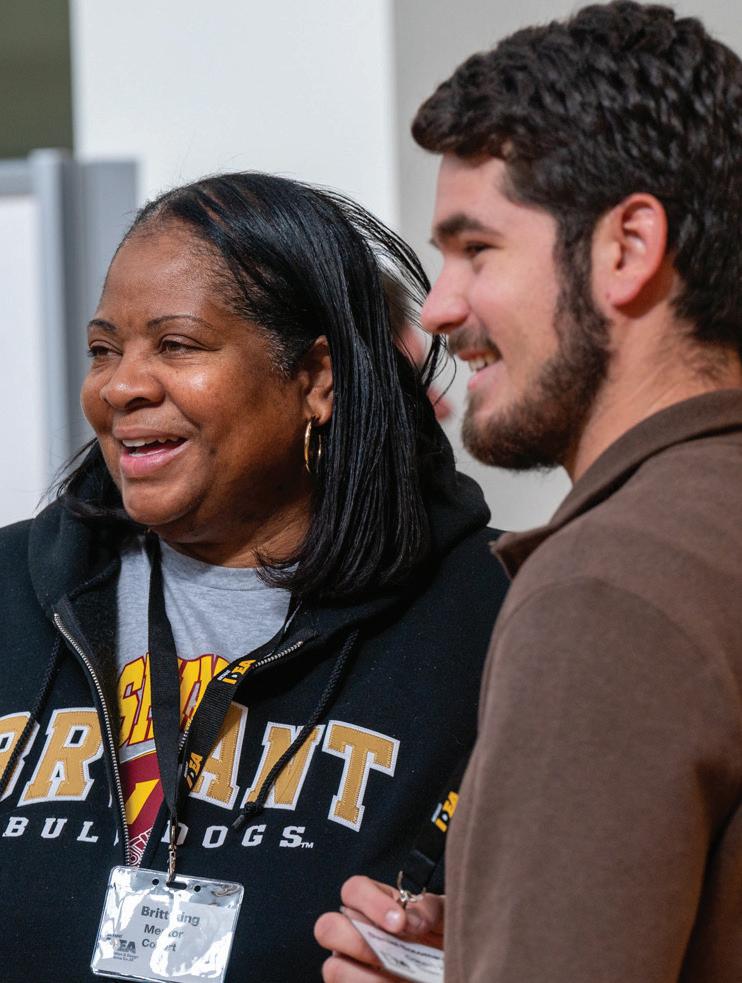
When Britt King describes herself as a former student-athlete, she’s being modest. The star forward for the Providence College women’s basketball team left the program with numerous Big East honors and was a KODAK District I All-American.
Now, as Bryant’s Assistant Athletic Director for Student-Athlete Development and Engagement, King plans events and workshops for student-athletes, covering everything from personal finance to good sleeping habits, and serves on numerous committees dedicated to supporting the young people on Bryant’s teams.
Mostly, though, she builds relationships. Sometimes with teams and coaches, during practices and team meetings. But the most important are one-on-one with Bryant students.
Often, these sessions are about resources and opportunities or encouraging student-athletes to think beyond their sport and discover the passion that will guide their lives. Other times, it’s as simple as helping students from other parts of the country
It’s the culture that needs to change and adjust to the current student-athlete experience, she states firmly.
That’s why, one evening in Bryant’s Heidi and Walter Stepan Grand Hall, King introduces nearly 200 Bulldogs to Ivy Watts, a former All-American track and field athlete, to discuss the mental health challenges that student-athletes face.
Watts opens the session with a simple game of four corners and asks students to move to different spots in the hall based on how they answer the following question: How often have you felt stress as a student-athlete? >>
Most students gather in the “Sometimes” station, with a smaller but still significant number at “Often.” No one stands in the “Never” area.
That’s normal, Watts assures them. Student-athletes today juggle intensive training, academics, new friendships, NCAA issues like the transfer portal and name, image, likeness (NIL), and the pressures of being front and center in the age of social media — all while competing at the highest levels.
Over an hour, Watts helps the group uncover the roots of their stress and develop constructive coping strategies. One of the most important, Watts says, is relying on your community.
“You are not alone,” she reminds them.
Student-athletes face the same issues as other students, Lockwood says, plus a host of additional stressors. And because of their busy schedules, they are always “on,” he adds, which can lead to burnout and other issues, even injuries.
“We are whole people,” he declares. “And that means respecting all the different parts of who we are.”
joined on this team by academic support staff whose sole role is to help student-athletes achieve their highest potential in the classroom.
Lauren Chapman’s office in the Academic Center for Excellence
That message, Bryant’s Bulldogs come to realize, is true in more ways than they could imagine. There’s always someone they can turn to, including their peers, coaches, and professional counselors committed to their well-being.
It’s more important than ever that student-athletes find a sense of balance, says Bryant Sport Psychology Counselor David Lockwood, M.Ed, MSW, LICSW. A recent NCAA study found that student-athlete mental health concerns post-COVID-19 pandemic are 1.5 to two times higher than before.
From one-on-one counseling to mindfulness sessions and team workshops, Lockwood and fellow Bryant Sport Psychology Counselor Kaitlyn Hall, MA, LMHC, who played lacrosse and field hockey in college, respectively, teach techniques like visualization and stress management, assist with injury recovery, and work with individual athletes and whole teams to improve focus, motivation, and team dynamics. They also help students find ways to honor who they are beyond athletics.
By working closely with groups throughout all of Bryant’s athletics programs, including coaches, trainers, and strength staff, they ensure that student-athletes’ mental health is treated as seriously as their physical readiness, and that Bryant Athletics has a healthy and sustainable culture, not just a focus on winning games.
Things work best, both Hall and Lockwood agree, when everyone is part of the team.
Bryant’s coaches, trainers, and mental health professionals are
is busy all day. Chapman and her team in the student athlete advising office aid students in planning their academic futures — but appointments often include stories from home, campus updates, and even tours through a student’s favorite Instagram posts.
For Chapman, who played golf at the Division I level, building trust is essential. “My first semester of college was awful academically,” she says. “But I got help. My coaches and advisor never gave up on me. They wanted me to succeed, and they made sure I had the tools to do it.”
Bryant’s student-athletes are smart, driven, and supportive of each other, she notes. They form study groups quickly and often
show up to watch teammates’ presentations — even if they’re not classmates. Her job is to help them chart, and sometimes clear, a path to success, whether by directing them to tutoring or working with faculty to reschedule tests that conflict with away games. Academic staff even travel with teams at times.
Her work is also about helping student-athletes adjust to a whole new ball game. Chapman’s teams go beyond the catalog and the lesson plan by teaching things like study skills and time management as well.
“We’re committed to helping them achieve everything they’re capable of,” she says.
No one has taken that ethos to heart more than Bryant’s student-athletes, themselves. Some of the strongest support they receive is from their peers.
As co-chairs of the Bryant Student-Athlete Advisory Council, made up of representatives from all of Bryant’s athletics teams, volleyball player London Hunt ’26 and swimmer Aidan Trenery ’26 provide a voice for
the student-athlete community. Together, they lead important discussions about school and NCAA policy, gather feedback, and share information that other members of the council bring back to their respective squads.
In short, they look out for their teammates because they know their teammates would do the same. From the on-thespot tutoring he’s received from an older teammate while on the road to when a fellow swimmer reaches out with a sympathetic ear at a low moment, Trenery says he’s never felt alone.
There's always tough moments in sports, Hunt admits, even on a team like hers that enjoys regular success. “We've had rough stretches of games. We've had teammates who've left the team, but there’s always someone there to help us work through it.
“It makes you want to play better, but you also just feel better knowing that you’re part of something bigger than yourself,” she reflects.
When Trenery and Hunt, both seniors, look back on their time
as student-athletes, their favorite stories are filled with moments when their friends came out to support them. But other Bryant figures find their way into these tales too, from Lockwood’s advice that helped the swim team stay on target to Hunt’s visits with Chapman to the conversations they both now have with Bill Smith about the future of Bryant Athletics.
For Hunt, one moment stands above the rest: “The first time I came to visit Bryant from Texas, Britt King told my mom, ‘Don’t worry; we’ll take care of her,’” she says with a smile. That simple reassurance, Hunt says, made a world of difference for an incoming student who was preparing to travel across the country to live and learn in a new place.
But that’s just what happens at Bryant, the pair reflect. “It’s about Bulldogs helping Bulldogs,” observes Trenery. “It just comes naturally here.”

High-tech Psychology Research Center was designed for immersive learning.
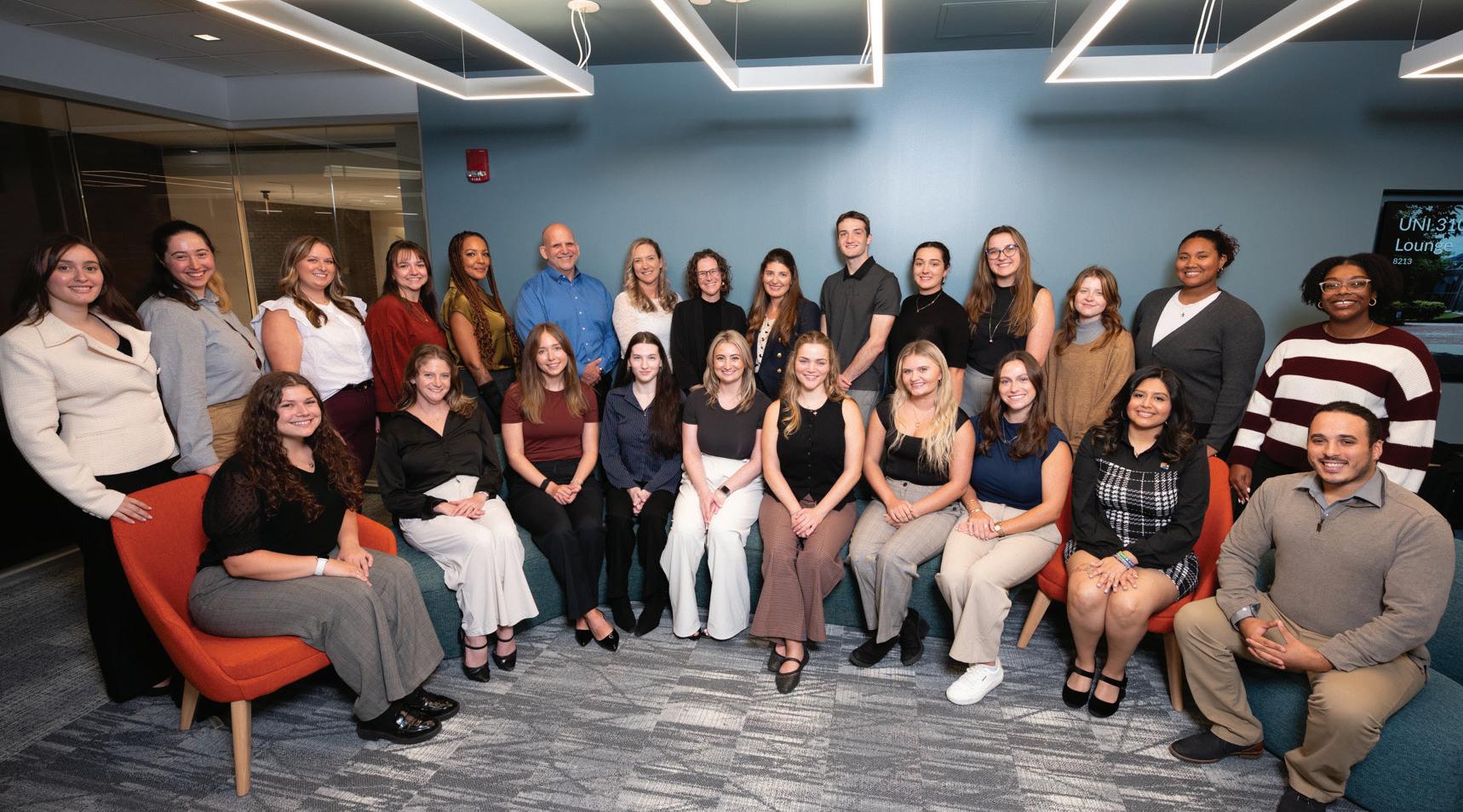
Bryant University’s new state-of-theart Psychology Research Center opened this past fall, just in time to welcome the institution’s inaugural Doctor of Clinical Psychology (Psy.D.) cohort. Designed for use by both undergraduate and doctoral students, the 3,440-square-foot facility, located within the university’s Unistructure, houses labs that span psychology’s disciplines, including developmental, cognitive, physiological, social, and clinical psychology.
Walking into the center, which was supported by a $1.5 million federal appropriation secured by United States Senator Jack Reed ’10H, visitors find themselves in a reception/waiting room where student researchers greet study participants and community outreach events are held. Adjacent is the Child Development Lab Suite, which
can be configured either as a classroom or a child play space for observational research; the suite also has a room fitted with a reversible opaque window and sophisticated audio-visual educational equipment to assist researchers.
“Instructors can observe participants’ role play, interaction, or exercise in real time, while providing feedback to the student researcher,” explains Joseph Trunzo, Ph.D., Psychology professor and associate director of the School of Health and Behavioral Sciences.
Beyond the Child Development Lab Suite is the Observation Roleplay Suite, with its central classroom and eight small role-playing rooms set up with audio-visual recording tools. The nearby Psychophysiology and Cognitive Lab is fitted with software used to measure a variety of psychophysiological responses.
The latter space, which features a break room and wellness center, is also home to Assistant Psychology Professor Melanie Maimon Ph.D.’s BIAS Lab, which focuses on testing interventions seeking to alleviate discrimination.
This center, combined with faculty expertise, is preparing students to become skilled, compassionate psychologists who can meet rising community needs as the country tackles a national behavioral health crisis and sweeping provider shortages.
“We aim to be leaders at the forefront of emerging healthcare trends,” says Christina Tortolani, Ph.D., the director of the Psy.D. program and associate professor.
Before his name appeared on James Beard Award lists, and before he launched star-studded restaurants around the globe, Ken Oringer ’87 was a Bryant student with a calling he couldn’t ignore.
“Every ounce of my blood was pulling me in the direction” of becoming a chef, he says.
Still, his parents insisted he learn how a company works before stepping into a kitchen. “At the end of the day, it made sense,” he says. “I wanted to understand every aspect of running my business.”
After graduating Bryant and attending culinary school, Oringer trained in top New York kitchens before joining the team at Providence’s Al Forno. In 1997, he launched his first restaurant in Boston: Clio (now Uni), a Japanese izakaya tapas bar that earned him The James Beard Foundation’s Best Chef – Northeast Award in 2001.
What followed was a string of celebrated concepts: Spanish tapas restaurant Toro, Italian enoteca Coppa, global eatery Little Donkey, and Faccia a Faccia, which serves coastal Italian cuisine.
Oringer’s newest ventures are close to his heart: Chitarra Pastaria, led by people on the autism spectrum; and a glutenfree cookbook co-written with his daughter, Verveine, that inspired the Verveine Bakery, which opened in Cambridge in 2024.
Here, Oringer reflects on the lessons that have guided a career of constant invention and re-invention:
“That’s something some people are born with — their foot on the gas pedal. Some people are more cautious. Everyone is different. My brain works a lot differently. I can’t stand being bored. If I’m bored with one concept, I can bounce to another, then come back to it.”
“You have to go through challenges and not let anything phase you. S*** happens every day, and you just have to look at it, problem solve, lean on your teams, and move forward. If you create the culture where everyone is working together, you solve things day by day. And before you know it, you’ve built something.”
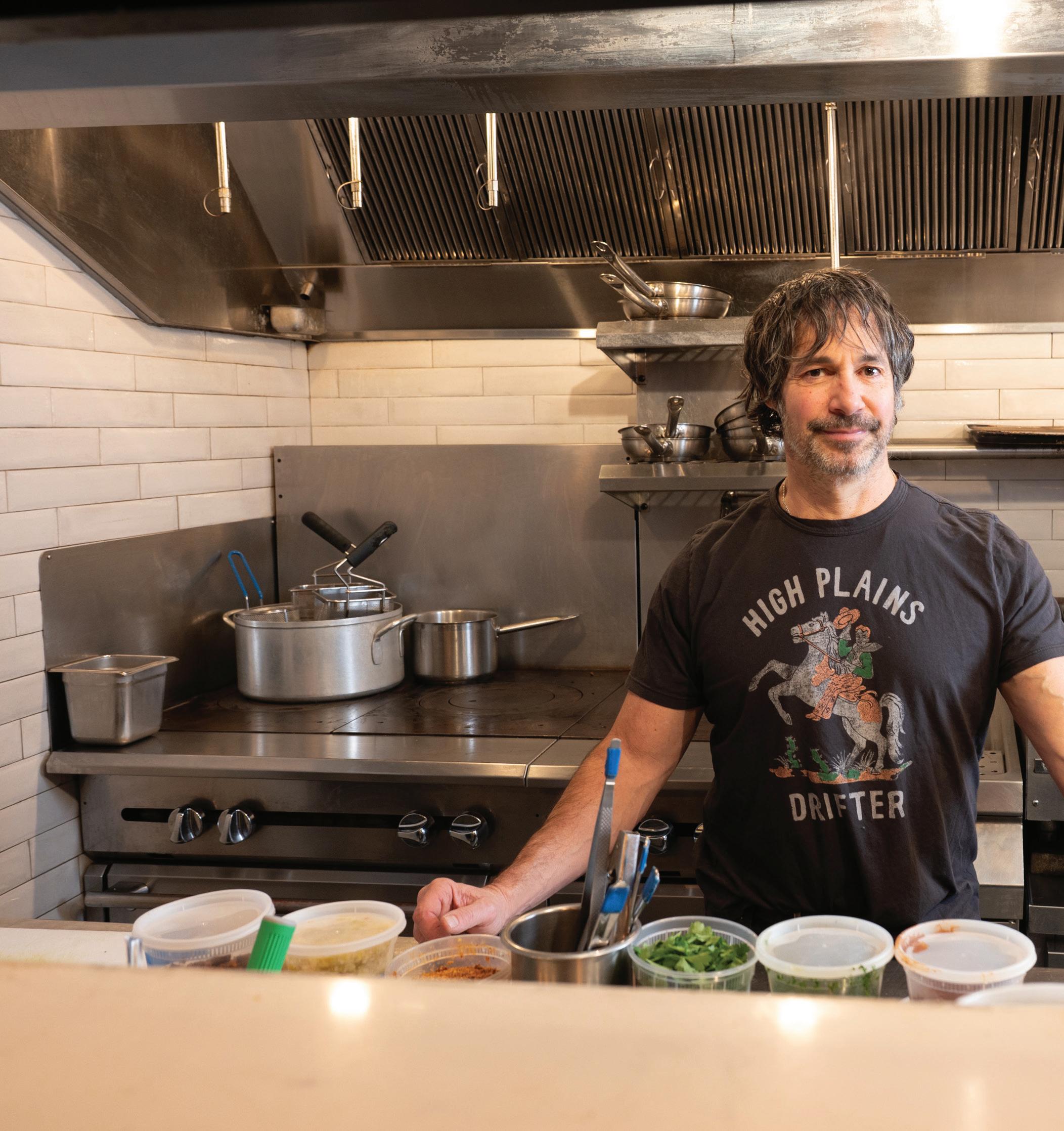
“Even when I was at Bryant, a lot of my friends would joke around — ‘What, is Ken just going to be cooking things?’ But very few people get to experience following their passion every day. If you have that passion, it can bring you to a level you could never imagine. The drive will keep you going.”
Photograph by Pamela Murray
“So many people think of so many reasons not to go for it. A Bryant education means you have a good head on your shoulders. That means you’re already prepared to handle the challenges. Just go for it.”
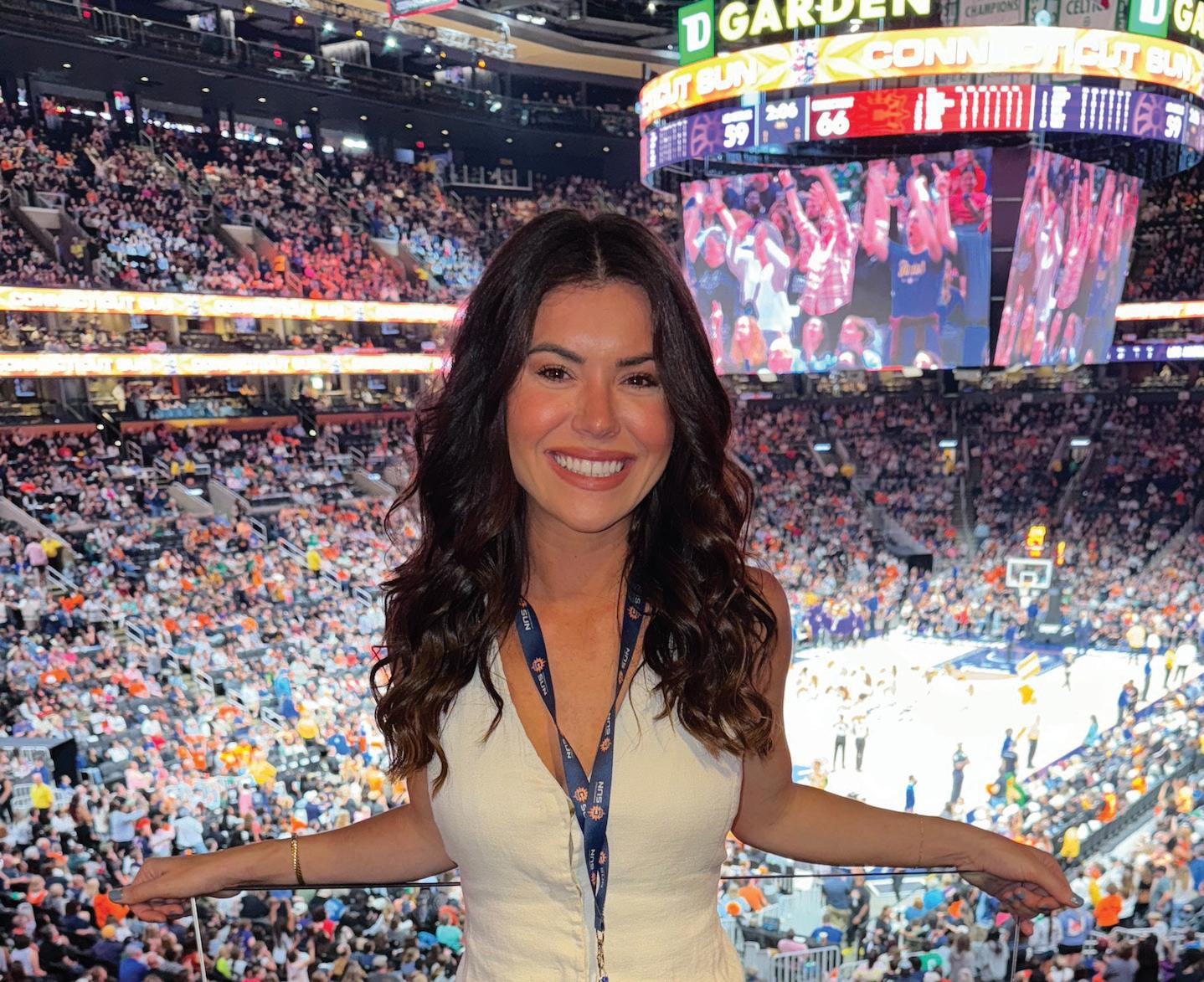
Kirsty Beauchais ’17 helps the Connecticut Sun and the WNBA create partnerships that matter.
Last season, the Connecticut Sun sold out the nearly 20,000-seat T.D. Garden — home arena of the Boston Celtics — for the second time, an impressive achievement for both the WNBA team and a league growing by leaps and bounds.
Kirsty (Beauchesne) Beauchais ’17, the Sun’s director of partnerships, was equally impressed by the people who filled the seats. “Over half of those fans were women and young girls and many of them had never attended a game in their lives,” she says.
Beauchais, it turns out, has a lot in common with them. “I didn’t have a background in basketball at all when I started with the Sun — besides following a few women’s college teams and cheering for the team at Bryant,” she admits with a smile. “But I'm passionate about
everything the WNBA stands for.”
Her job, she says, centers on helping the league grow and spread its message of empowerment by finding partners who can help amplify that message. “Partnering with the WNBA is making a statement,” says Beauchais, who notes that sport and brand partnerships have always been a powerful driver of equality.
Beauchais says Bryant provided her with a valuable perspective on how businesses can play a role in changing the world.
“Professors like Lori Coakley and Mike Roberto showed me that brands can help make a difference as much as politicians or influencers or anyone else can — and they're doing it with billions of dollars behind them,” she says.
In her role with the Sun, Beauchais works with both local partners and major brands including TD Bank, Xfinity, and Walgreens on initiatives and activations ranging from signage to musical festivals to larger campaigns. “I sit down with them on a regular basis and discuss what their business goals currently are, the work they’re doing in the community, what their marketing focus is, what their alignment is with the WNBA, and how they’re looking to deepen their impact with our fans,” she says.
The WNBA’s new fans want to connect with sports in new ways, suggests Beauchais. “They don't just want highlight reels,” she says. “They're watching just as much for tunnel fits and the brands the players support, and the little snippets of their personality everywhere else. Players are culture-drivers and fans listen when they use their voice.”
That multi-level connection appeals to brands who see an untapped market. But deep pockets aren’t enough to be part of the game. “I'm the first line of defense for ensuring that brands are a good fit for the Connecticut Sun and the WNBA,” Beauchais notes.
One of her favorite recent initiatives was the “Said Out Loud” campaign, organized in partnership with Walgreens, in which the Sun’s players shared their experiences regarding mental and physical well-being. “The campaign gave them a platform and let them share their stories and connect with our fans on important issues impacting women’s healthcare — and Walgreens helped us to tell that story,” notes Beauchais.
“We’re building the league, and we want to do it the right way,” she says firmly. “We’re putting the important things first.”
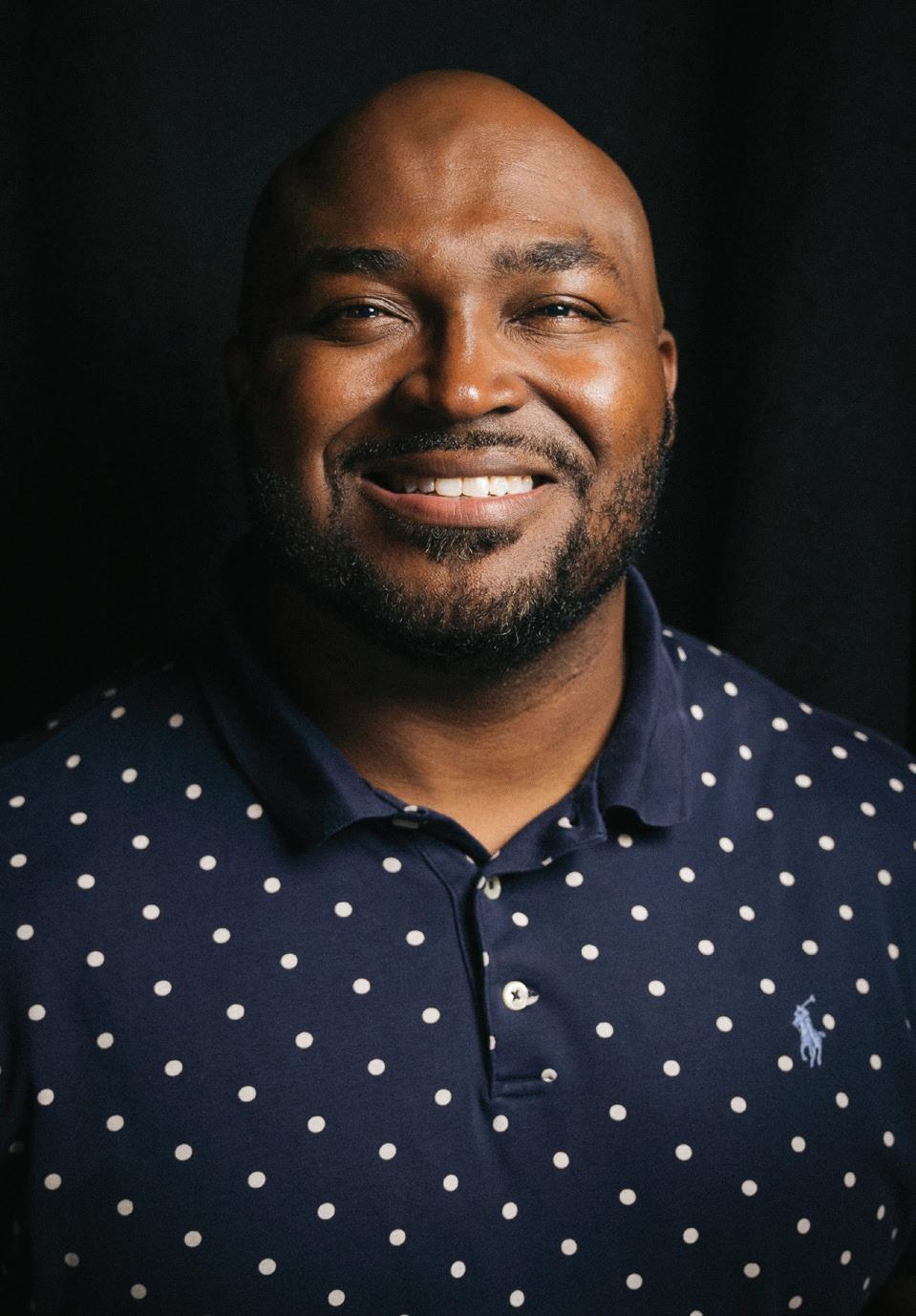
Lindsey Gamble ’10 shares insights on how companies can leverage influencer partnerships.
Lindsey Gamble ’10 lives and breathes the creator economy — a system where individuals make money by developing and delivering content to audiences digitally. A consultant, speaker, and creator whose weekly newsletter, which curates news, trends, and updates about creators, influencer marketing, and social media, has also amassed more than 10,000 subscribers. Gamble has earned recognition from LinkedIn as a top voice and from Business Insider as a marketing expert to know.
“For me, it's always been about providing value to whoever's reading my content and helping them in a way that isn’t gimmicky,” says Gamble, a Communication alum and member of Bryant’s College of Arts and Sciences Advisory Board. “I take a lot of pride in being able to take what's going on and translate it in a way that's practical.”
In today’s marketing space, influencers have become a powerful force, he notes.
“It's all human led,” says Gamble. “We connect with people as individuals as opposed to entities, and that's the power around it.”
More people are working their 9-to-5 job and creating content for social media on the side than ever before, explains Gamble, whether it's to make extra money or fill either a personal or professional need. Some companies, he adds, are even creating advocacy programs that encourage employees to be creators on the company’s behalf because individuals are seen as more trustworthy than corporations.
Based on emerging trends, Gamble believes that artificial intelligence is going to democratize the industry since there are so many accessible tools available to assist people in becoming creators. He also points to an interesting dynamic at play between the creator economy and mainstream media/ pop culture.
“YouTube is the number-one TV streaming service in the U.S., which is incredible, and it's mostly user-generated content. Hollywood is looking at creators on these platforms as talent and is making deals with them to license their content as part of their library,” Gamble says.
But there are positives and pitfalls for brands to think about when considering deals with creators, he suggests.
When you have someone speak on your behalf, you're handing your brand over, Gamble says. While a collaborator might have the perfect messaging and the ideal content at that moment, brands could suffer down the road if the creator they partnered with gets in trouble or says something controversial.
Instead of trying to partner with anyone and everyone, companies should build lasting relationships, says Gamble.
“Determine how to go beyond the deliverable, get to know that person, have them baked into your brand, and work with them beyond content,” Gamble advises.

Marta Steer ’06’s sense of adventure has led her across continents, up mountains, and, in 2025, to the top of Forbes Women Poland’s women in business list.
Born in Poland and raised in the United States from age four, Steer selected Bryant because the university’s global reach, and the scholarship that made attending possible, gave her the runway she needed to hone her vision for her future. After testing international waters through a study abroad trip to Germany, Steer graduated from Bryant and went on to earn her MBA at the University of Minnesota and the University of Warsaw before going on to consulting work in the Middle East.
“If you are looking to work for a multinational, getting exposure in more
competitive markets makes a big difference,” she says. “It shapes your ability to run an organization across different cultures and languages.”
Steer went on to work in project management for a global procurement company, then transitioned to a role with InfoSys when her daughter — who is following in her mother’s footsteps and studying business in college — was young. For the last decade, she’s worked at Marsh McLennan, rising in the ranks to now lead the firm’s European business support services arm.
Steer’s career path has always been driven by motion, and she encourages young professionals to jump when provided the opportunity. “You need to take risks. Say yes to different opportunities.
Sometimes you’ll discover what’s for you and what’s not,” she says. “Education can’t stop when you leave your university, especially now with everything changing so quickly. Be flexible and adaptable. Keep learning.”
In her current role as a managing director at Marsh McLennan, Steer partners with universities on embedded, project-based learning experiences where students collaborate directly with industry. “About 70 percent of their ideas actually get implemented,” she notes. “We learn a lot from them, and they learn a lot from us.”
Steer also gives back to Bryant by serving as a member of the university’s Global Advisory Council, which is charged with elevating the university’s profile and expanding opportunities for students on an international scale.
Her appetite for challenge extends beyond her career. Steer and her husband recently completed a trekking expedition in Nepal — “hard work, but beautiful,” she says — which mirrors her approach to professional growth: always pushing into new terrain and staying adaptable.
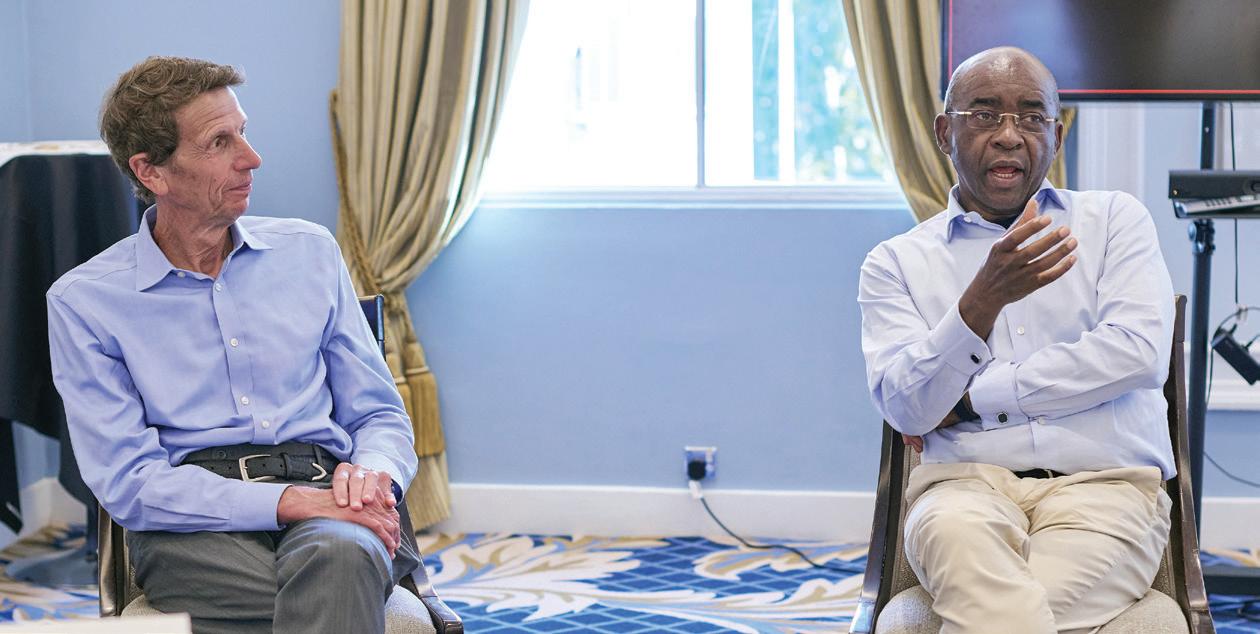
Bryant University President Ross Gittell, Ph.D., and Global Advisory Council member Strive Masiyiwa P’17, founder and executive chairman of Econet Group and co-founder of the Higherlife Foundation.
Photo credit: Photographer London LDT
When Bryant University’s Global Advisory Council (GAC) met for the first time last summer in London, prominent alumni, parents, and university partners from more than 18 countries converged around a shared priority: accelerating Bryant’s global visibility and strengthening pathways to success for international students. The discussion highlighted no shortage of opportunity: With rising global demand for business education, entrepreneurship, and applied AI skills, council members affirmed that Bryant is positioned to compete, and lead, on a larger stage.
Join fellow Bulldogs at these Bryant events, on campus and beyond:
19
Women’s Summit®
Celebrating its 29th year, the Women’s Summit®, presented by Bryant University, continues its tradition of empowering women to excel professionally, personally, and financially.
MAY 1
Healthcare Summit
Join the School of Health and Behavioral Sciences for its annual summit. This year’s theme will focus on public health.
MAY 14–16
The graduate ceremony is scheduled for May 14; the undergraduate ceremony is scheduled for May 16.
22
The annual tournament, held at Newport Country Club, has raised more than $2.5 million in scholarships for Bryant students since 2004.
Learn more at alumni.bryant.edu
The beat is fast and furious for Grammy award-winning music producer Ethan Hayes ’23.
It’s fitting that Ethan Hayes ’23 missed the 2024 Grammy Awards show, where his work on Chris Brown's 11:11 (Deluxe) helped secure the Best R&B Album statue.
“I didn’t realize how early you had to register for a ticket,” the music producer — who goes by “Haze” and whose work has gone platinum 12 times — admits sheepishly.
It was a poetic moment for an artist all-in on the hustle, not the applause.
Hayes’ impressive musical career began humbly. Building off childhood piano lessons and YouTube tutorials, he taught himself how to create the foundations, or “beats,” for songs by writing an initial melody and then digitally layering in other instruments like drums, pianos, guitars, and synthesizers.
“I picked it up really quickly and had a knack for it,” he recalls. “I fell in love with the art of it. It was like painting a picture, just in a different medium.”
Hayes started off casually by posting tracks to Instagram and platforms like BeatStars, but when COVID-19 hit during his first year at Bryant, he doubled down on creating.
He also began building a network. “I’d find an artist I liked and reach out to every single producer they’d ever worked with,” he remembers. Slowly but surely, he made a name for himself in the R&B and hip-hop communities, a reputation that eventually led to platinum records, “song of the summer” hits, and his first Grammy nod.
At Bryant, Hayes lived a sort of double-life as a regular student and a multi-platinum-awarded producer. His education was similarly split, taking courses in Entrepreneurship while learning how to navigate the music industry.
“It was cool seeing how my real-life takeaways were matching the concepts I was studying,” he notes. “I have a pretty unique and unconventional career, but with the business education I received at Bryant I feel very wellequipped.”
Hayes has since moved to Los Angeles, and artists are now reaching out to him. Today, much of his work is done in person, collaborating with hitmakers from around the world.
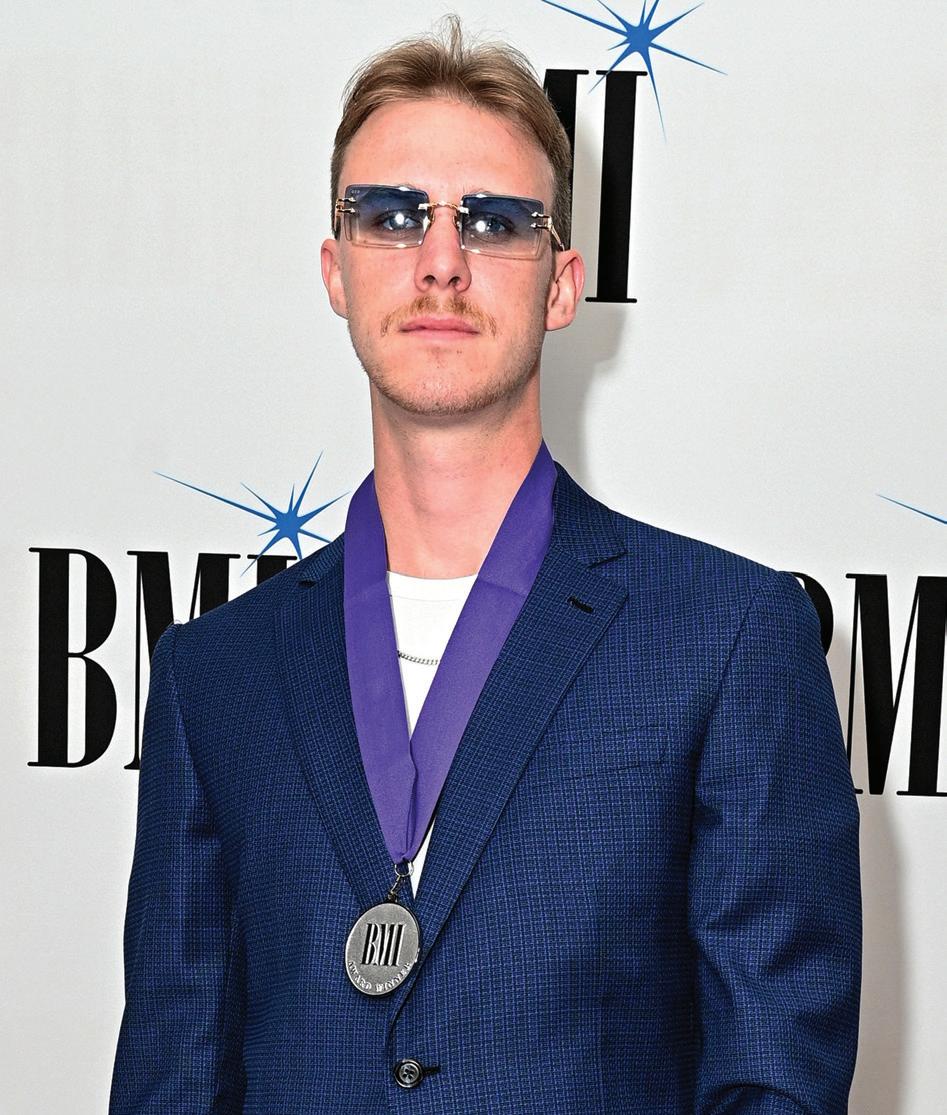
The shift, Hayes says, has required him to learn a new set of skills. “It's about knowing when to really make sure your ideas get executed and when to hang back and let other people's ideas shine,” he reflects. “You need to know when to take over the room, and when to sit back.”
Despite the change in circumstances, though, Hayes still has the industrious mindset that’s taken him so far. “I've seen a lot of people that I know struggle with music changing from a hobby to something you create to pay your bills,” he notes. “But I’m still in love with this. I love the process; I love seeing my ideas come to life.”
That doesn’t mean there isn’t still room for evolution, Hayes stresses. “I’m incredibly grateful to be able to say that I've reached the very top levels of what I do. But I don’t want to stay stuck in the same place,” he says.
Hayes is now focused on expanding his horizons by exploring other genres and sounds — and continuing the hustle.
“My mindset is that reaching the goalposts you set for yourself — whether it’s a Grammy or anything else — should never leave you feeling too satisfied,” Hayes says. “I’m always moving my goals forward, and I'm always onto the next ladder to climb.”
Kathleen Everson ’18 helps clients and athletes build resilience.

A therapy room may be Kathleen Everson’s primary location for meeting clients, but the licensed psychologist and director of performance psychology also finds herself on athletic courts and fields teaching kids mental skills that help them excel in sports.
“Recently, for basketball, I had a team practice visualization together on the court,” says Everson, a member of Bryant’s Class of 2018 who majored in Applied Psychology. “Visualization uses the same parts of the brain that are used when you're doing the behavior, so you can get more reps in mentally without having the physical component.”
Everson’s work as a psychologist and director of performance psychology at North Coast Psychological Services in New York has two components: the clinical aspect, where she specializes in obsessive-compulsive disorder, anxiety, and anxiety-related disorders, and provides cognitive behavior therapy (CBT) and exposure and response prevention therapy; and the performance-focused
aspect, where she conducts mental skills trainings, either one-on-one in her office or through workshops with teams, coaches, and parents.
“I love working with athletes because they always do their homework. Whenever you ask them to try, they do it because they're willing to do anything to improve their performance,” Everson says, noting that areas of concern may include health (sleep, hydration, nutrition), social (pressure from coaches or parents, comparing themselves to others), or personal (perfectionism, negative self-talk) issues.
“One of the most rewarding things is seeing the skills pay off. For instance,
when they come in and tell me, ‘I had a great game last night,’ or even if they didn’t, that they aren’t feeling as upset or anxious about it,” she says.
While at Bryant, Everson was a member of the women’s basketball team — serving as captain her senior year — and volunteered with the university’s Special Olympics chapter all four years.
A summer research opportunity with Psychology Professor and Department Chair Heather Lacey, Ph.D., that looked at how risk impacts decision making, and the chance to shadow a local neuropsychologist, arranged by another Bryant professor, prepared her for grad school, she says.
In addition to her day job, Everson teaches a performance psychology course at St. John's University, where she earned her master’s and doctoral degrees. She is also writing a book chapter for trainees and early career psychologists on how and when to use cognitive restructuring — a method used for improving mental health by changing the way we think — in a CBT model.
“It’s great to see people getting better, enjoying their life more, and having success,” Everson says.
Have an update for the Bryant community? Share your successes and submit a Class Note.
As director of Bryant University’s School of Health and Behavioral Sciences, Kirsten Hokeness, Ph.D., is immersed in the evolving world of healthcare — from emerging trends and industry demands to innovative learning opportunities. Her goal? To prepare students with the critical thinking skills and interdisciplinary knowledge needed to make meaningful contributions in their fields.
Below, Hokeness shares her insights on the future of healthcare and how Bryant is positioning students to lead with impact:
“Seventy percent of providers and 80 percent of payers have an AI strategy in place or in development and are moving from broad-based exploration to targeted implementation, according to a study from Bain & Company and KLAS Research. While AI poses significant challenges, it provides great opportunities for solving problems from an operations standpoint, such as enhancing diagnostics and getting treatments faster. However, delicate integration is paramount: we must think about patient privacy, data privacy, ethics, and people's lives being at stake.
Ultimately, innovation must be matched by the necessity of careful implementation, which is why every student graduating from our School of Health and Behavioral Sciences must take at least one course in AI.”
“We're focused on how Bryant can be a facilitator for workforce development within healthcare and help alleviate issues such as access to care, workforce shortages, affordability, and equity. In the clinical realm, the Physician Assistant Studies and Doctorate in Clinical Psychology programs provide clinical facing professionals to address local and nationwide shortages. Meanwhile, our Health Informatics and AI program allows graduate students to apply their desire to be in the healthcare space through data-driven roles.”
“Adding business acumen to students’ classical training in health and behavioral sciences is important because it allows them to talk across those silos. Often, you've got business folks on one side and scientists and clinicians on another — and they don't understand each other. That's a barrier to solutions, so it’s important that we create a workforce that has the capacity to understand and communicate effectively about challenges so that they can drive innovation effectively.”
“Trust in science is declining at a rapid pace. Scientific literacy is an essential skill and gives students tools to succeed in areas beyond scientific discipline (think: analyzing data, questioning assumptions, evaluating evidence, thinking critically). It's important to enhance scientific literacy so society can make evidence-based decisions on health-related issues, the environment, and technology, which impact all of us. Alternately, for folks in healthcare, it's important to understand why there are hesitations in trusting science and how to communicate effectively with patients.”
At Bryant University, every gift to the Bryant Fund is an investment in possibility. Your support fuels discovery, growth, and resilience— empowering students to overcome challenges, seize new opportunities, and sharpen their skills through hands-on experiences. Together, we can address emerging needs and create pathways that prepare students to shape bright, ambitious futures.
Make your gift today and help elevate what’s possible for Bryant’s students.
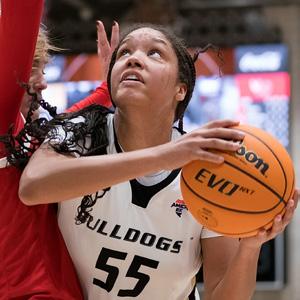

Where It’s Needed the Most Scholarships & Financial Aid Academic & Teaching Excellence
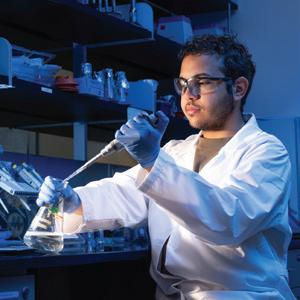

1150 Douglas Pike