FOCUS TOPICS ORTHOPAEDICS OBESITY/DIABETES AUGUST 2015 / $5
Serving a 24 County Area, Including Birmingham, Huntsville, Montgomery & Tuscaloosa
On Rounds Fleisig’s Biomechanics Lab Helps Athletes Stay in the Game What do Major League Baseball, youth gymnastics, and Hollywood digital effects have in common? They all intersect in a field known as biomechanics - a specialty that didn’t even exist in its current form only a generation ago. ... page 3
Verapamil May Reverse Type 1 Diabetes Adult patients needed for UAB clinical trial UAB researchers have found a way to reverse type 1 diabetes in animal models. Now they need adults aged 19 to 45 years diagnosed with type 1 diabetes to participate in the clinical trial. “They must have been diagnosed within three months of starting the trial with us,” says Anath Shalev, MD, director of the UAB Comprehensive Diabetes Center and principal investigator of the trial ... page 9 Follow us on Twitter, Facebook and LinkedIn
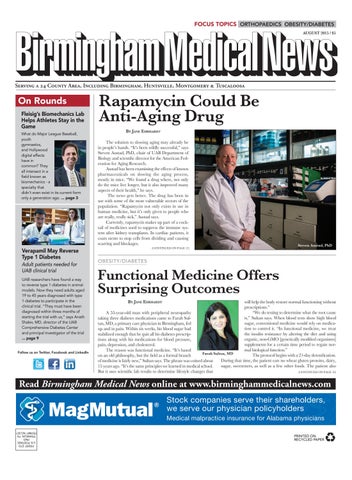
Rapamycin Could Be Anti-Aging Drug By Jane Ehrhardt
The solution to slowing aging may already be in people’s hands. “It’s been wildly successful,” says Steven Austad, PhD, chair of UAB Department of Biology and scientific director for the American Federation for Aging Research. Austad has been examining the effects of known pharmaceuticals on slowing the aging process, mostly in mice. “We found a drug where, not only do the mice live longer, but it also improved many aspects of their health,” he says. The news gets better. The drug has been in use with some of the most vulnerable sectors of the population. “Rapamycin not only exists in use in human medicine, but it’s only given to people who are really, really sick,” Austad says. Currently, rapamycin makes up part of a cocktail of medicines used to suppress the immune system after kidney transplants. In cardiac patients, it coats stents to stop cells from dividing and causing scarring and blockages. (CONTINUED ON PAGE 12)
Steven Austad, PhD
OBESITY/DIABETES
Functional Medicine Offers Surprising Outcomes will help the body restore normal functioning without prescriptions.” “We do testing to determine what the root cause A 55-year-old man with peripheral neuropathy is,” Sultan says. When blood tests show high blood taking three diabetes medications came to Farah Sulsugar, conventional medicine would rely on medicatan, MD, a primary care physician in Birmingham, fed tion to control it. “In functional medicine, we treat up and in pain. Within six weeks, his blood sugar had the insulin resistance by altering the diet and using stabilized enough that he quit all his diabetes prescriporganic, non-GMO [genetically modified organisms] tions along with his medications for blood pressure, supplements for a certain time period to regain norpain, depression, and cholesterol. mal biological function.” The reason was functional medicine. “It’s based Farah Sulton, MD The protocol begins with a 21-day detoxification. on an old philosophy, but the field as a formal branch During that time, the patient eats no wheat gluten proteins, dairy, of medicine is fairly new,” Sultan says. The phrase was coined about sugar, sweeteners, as well as a few other foods. The patient also 15 years ago. “It’s the same principles we learned in medical school. But it uses scientific lab results to determine lifestyle changes that (CONTINUED ON PAGE 10) By Jane Ehrhardt
Read Birmingham Medical News online at www.birminghammedicalnews.com
PRINTED ON RECYCLED PAPER
PRSRT STD U.S. POSTAGE PAID FRANKLIN, TN PERMIT NO.357
Is your practice technology
HIPAA & HITECH compliant?
medical
The right medical IT COMPANY
IT’s not a story
You know that IT company? The one you’ve dreamed of. Or used to have. Reliable. Available. Knows their stuff inside and out and how to tell you all about it so you easily understand. AT KEEP IT SIMPLE, WE ARE THAT COMPANY. We’re experts who have hired experts, so you get an IT guy who’s capable, precise, thorough and knows that communicating with our clients is as important as connecting the right wires. With us, you’ll get the superior IT service you need to keep up with the intense, high-volume workload of a successful practice. We provide you with simple technology systems to keep your office working efficiently with precision. Keep IT Simple works with over 250 medical practices in Alabama. We provide service and support, along with selling equipment and software, in order to create complete IT solutions. Our affordable pricing, excellent service, support, and knowledge keep our clients coming back.
KEEP IT SIMPLE.
IT IS WHO WE ARE. IT IS WHAT WE DO.
we help you with – • Desktop/Server Configuration, Service & Support • Data/Internet/Network Configuration, Security & Management • Integration of Multiple Hardware & Software Systems • iPad/iPhone/Tablet/Smartphone Configuration & Support • EMR/EHR Experience, Service & Support • Onsite Local IT Service & Support • HIPAA HITECH Compliance • Secure Remote Access & Monitoring • Anti-Virus, Anti-Spyware, Anti-Spam Solutions • Firewall, VPN & Email Encryption Services • Onsite/Offsite Data Backup Protection • Web Design, Hosting & Cloud Services • Remote IT Service & Support
www.keepITsimpleIT.com
877-407-7888 2 • AUGUST 2015
Birmingham Medical News
HEALTHCARE SPOTLIGHT
Fleisig’s Biomechanics Lab Helps Athletes Stay in the Game By daLe Short
What do Major League Baseball, youth gymnastics, and Hollywood digital effects have in common? They all intersect in a field known as biomechanics - a specialty that didn’t even exist in its current form only a generation ago. Glenn Fleisig, PhD, research director of the American Sports Medicine Institute, remembers being a senior in engineering at the Massachusetts Institute of Technology in 1983 and telling a professor that he’d like to combine his engineering career with his love of sports, particularly baseball. The professor laughed and said, ‘there aren’t any jobs in biomechanics.’ But Fleisig chose a senior project on the biomechanics of a golf swing, and a year later did an internship at the Olympics Training Center in Colorado. The lab director there concurred that there were no jobs in the field, but introduced Fleisig to an up-and-coming physician named James Andrews who envisioned creating a sports medicine center. “We were a good match and liked each other,” Fleisig says, “but Dr. Andrews said he wasn’t quite ready to create his own center yet.” Two years later Fleisig received a phone call to his home in Tappan, New York, saying Andrews was establishing the American Sports Medicine Institute in Birmingham. The Institute offered Fleisig a job, and he’s been there ever since. “When I was in high school, I was good at science and math,” Fleisig says. “And I loved playing and watching sports. But I didn’t know there was a field named biomechanics or that I’d ever be fortunate enough to combine engineering with my love of sports.” Today Fleisig’s work centers on sports injuries and ways to prevent them, with a special concentration on baseball pitchers. The latest computer technology plays a major role. “In the 1980s, we were one of a very few labs that put little silver markers on athletes and used high-speed cameras to track their motions.” Over the next two decades, large film production companies invested a great deal of money in refining this type of technology for special-effects purposes, minutely tracking actors’ movements through sensors and transforming them into superheroes or alien beings. And the new tech breakthroughs were adapted by biomechanical researchers as well. Sports injuries fall into two categories. One is the acute, as when an athlete falls and buckles a knee. The other is known
is one that requires ‘Tommy John’ surgery, named for the 1970s pitcher who was first diagnosed with the injury and whose surgery led to a successful recovery. The medical term is ulnar collateral ligament reconstruction. A recent survey by Fleisig and colleagues found that 15 percent of current minor league pitchers and 29 percent of major league pitchers have had the surgery. Major League Baseball created a task force with Fleisig and Andrews to study the problem. “We decided that Tommy John surgery was not just a major league problem, but was related to minor league and amateur athletes as well,” Fleisig says. “In the early 1990s baseball surgeries at our medical practice were all adults, but now many high school athletes are coming in for surgery. Glenn Fleisig, PhD “Society has changed. Kids used to play baseball for a few as repetitive - an injury that’s self-inflicted months, then football, then basketball, and from performing the same motion again much of it in an unstructured setting. But and again over a period of years. now more kids are playing a single sport The traumatic ones are hard to study in a structured way year-round, not only and hard to prevent, so the majority of inbaseball pitching but other sports such as juries ASMI deals with are the repetitive soccer and gymnastics, and the result is an stress variety. Today, injuries to pitchers increase in overuse injuries.” are about half elbow and half shoulder. An One important outgrowth of the task elbow ailment that’s been in the news lately force is an initiative known as Pitch Smart,
aimed at helping players and coaches avoid overuse injuries and foster long, healthy careers for youth pitchers.” The biggest factor, Fleisig says, is “pitch-count limits--how many pitches are too many, how much is enough.” An even newer technology is helping shed light on such questions. “The next generation is arriving now,” Fleisig says. “The current technology has been mostly inside the lab, but now outdoor motion capture systems are being developed. Instead of bringing a pitcher to a lab, you can bring the lab to spring training.” The next breakthrough will be smarter cameras that can recognize joints and body parts without requiring the traditional markers. “That can really open things up, letting us capture in-game data rather than simulated lab data,” Fleisig says. Perhaps the best summation of Fleisig’s career thus far is found on his email signature, in a quote from physician Albert Schweitzer: “Success is not the key to happiness. Happiness is the key to success. If you love what you are doing, you will be successful.” “What I love most about what I’m doing,” Fleisig says, is “helping people play sports and have fun doing it, both for top level professional athletes and for the kid down the street.”
We’re not a national chain or a big corporation. We are an Alabama-based company. Every day our Comfort Care team makes a difference in the lives of those we serve.
We are Comfort Care. We help you home.
Birmingham Medical News
AUGUST 2015 • 3
ORTHOPAEDICS
ENT Associates of Alabama, P.C. Welcomes Dr. Angela Blount Dr. Blount is Board Certified and practices general adult and pediatric ENT with special interests in sinus/allergy disease, endoscopic sinus surgery, pediatric ENT, and thyroid surgery.
Morton Goldfarb, M.D., F.A.C.S. John Poynor, M.D., F.A.C.S. Stephen Favrot, M.D., F.A.C.S. Jack Aland, M.D., F.A.C.S. Sheldon Black, M.D., F.A.C.S.
Peyton Colvin, M.D., F.A.C.S. L. Clark Simpson, M.D., F.A.C.S. Howard Goldberg, M.D., F.A.C.S. E. Scott Elledge, M.D., F.A.C.S. Jonathan Levine, M.D., F.A.C.S.
Alice Morgan, M.D., Ph.D., F.A.A.O.A. Bruce Morgan, M.D., Ph.D. David Walters, M.D. Angela Blount, M.D.
At ENT Associates of Alabama, we care for ALL of your ear, nose and throat needs. We specialize in all ages from infants to geriatrics and all of our doctors are board certified and dedicated to providing exemplary care. • surgery of ear, nose & throat • head and neck cancer surgery • facial plastic & reconstructive surgery • upper respiratory infections • flu • allergies • voice restoration
• Botox • fillers • robotic surgery • in-office balloon sinuplasty • hearing aids & much more!
7 LOCATIONS TO SERVE YOU: St. Vincent’s • Trinity • Jasper • Cullman Shelby • Gardendale • The Northside Clinic (Pell City)
Call 1-888-ENT-5020 for your appointment today www.entalabama.com
4 • AUGUST 2015
Birmingham Medical News
Biologics
Treating damaged joints with the body’s own stem cells By Laura Freeman
“Heal thyself” is taking on a whole new meaning now that biologic therapies are rapidly emerging to treat a wide range of conditions. In orthopedics, the surgeons of Birmingham’s Andrews Sports Medicine and Orthopaedic Center are among the more experienced trailblazers, testing and developing biologic therapies. Lyle Cain, MD, and Jeff Dugas, MD, are particularly interested in how biologics Lyle Cain, MD focus the body’s healing potential to rebuild cartilage and connective tissue in damaged and arthritic knees, shoulders and other joints. “We started several years ago with platelet rich plasma (PRP) to Jeff Dugas, MD treat ligament injuries and arthritis. The past two years, our primary area of investigation has been using autologous stem cells from the patient’s bone marrow to treat or slow the progression of osteoarthritis in the knee and to improve healing in revision rotator cuff surgery,” Cain said. “We’ve completed between 250 and 300 bone marrow aspirate, or BMA procedures. We still have to compile the data before evaluating it. However, from what I’ve seen so far in early follow-ups and at the one-year mark, I’m enthusiastic about how well patients are responding. Anecdotally, I’ve seen patients in their 50s who were walking with a cane return to running. A rare few patients— very few—haven’t reported a noticeable improvement. However, most tell me they have less pain and better function since the procedure.” Dugas said most of his patients are telling him the same thing. “We originally were aiming this toward younger patients to help them postpone the need for a knee replacement, but I’m seeing even older patients with more advanced osteoarthritis improving more than might be expected,” Dugas said. “Some wanted to avoid knee replacement surgery and decided to try the stem cell option instead. Most seem to be doing much better, and experiencing less pain.” Stem cells can reproduce and differentiate, becoming cartilage, bone or other cells as needed. They also release growth factors and other cell signaling molecules that attract the body’s other healing chemicals to the site. These capabilities make them especially helpful in rotator cuff revision surgeries. “Rotator cuff revisions have a very
high failure rate because there simply isn’t enough tissue left to properly attach the structures or help with healing,” Cain said. “When we inject stem cells at the site, they start growing new cells to strengthen the attachment and to attract growth factors, anti-inflammatories and other biochemical support to accelerate healing. “A French study did a 10-year follow up that found 89 percent of revision rotator cuff surgeries with stem cell injections were still intact compared to only 40 percent of the same number of patients who did not receive the injections. That’s quite a difference in the long-term outcome,” Cain said. Dugas said, “Since the stem cells come from the patient’s own marrow and not a donor’s, the procedure fits within FDA guidelines. This reduces risk, and you don’t have the concern about triggering antibodies that might be a problem if the patient needs a transplant in the future.” At this point, aside from the limited number of orthopedic surgeons with experience in performing the procedure, the primary limitation to access is financial, since the new treatment isn’t covered by insurance. “We’ve been talking with major health insurers and they are interested in seeing more data,” Cain said. “One of our primary goals is gathering solid evidence of outcomes. We want to learn who is and isn’t likely to benefit, the most effective techniques and what we can expect long term. In other areas of the country, outof-pocket costs can be many times what we charge. We want to make biologic therapies as affordable as possible for patients, not only for their benefit, but also so we can do more procedures so we could gather enough data to be meaningful. We’re seeking answers we can rely on to advise our patients, and insurers can rely on to evaluate covering the procedure. BPA biologic therapy itself is simpler than the term “bone marrow,” might suggest. Rather than the more painful harvesting process used during the early days of bone marrow transplantation, the orthopedic version draws marrow from a more accessible site in the pelvis. Patients generally say they experience little, if any, pain. “We harvest the bone marrow in an operating room so we can have an anesthesiologist to provide light anesthesia and sedation. It gives us a sterile working area where we have everything we might need immediately at hand,” Dugas said. “Using a specially designed kit, we draw off about 60 CCs of marrow, and then a centrifuge spins it down and separates the stem cells, so we have about 6 CCs to inject where it is needed.” (CONTINUED ON PAGE 22)
IF VALUE-BASED REIMBURSEMENT IS THE NEW NORM, SHOULDN’T VALUE-BASED LEGAL SERVICES BE TOO?
PHONE NUMBER
8 0 0 -7 6 2 -2 4 2 6
WEB ADDRESS
www.balch.com
Alabama
Fl o r i d a
Georgia
Mississippi
Wa s h i n g t o n , D C
No representation is made that the quality of legal services to be performed is greater than the quality of legal services performed by other lawyers.
Balch_BhamMedNews_FullPG_Healthcare_Value-Based.indd 1
Birmingham Medical News
6/19/15 9:06 AM
AUGUST 2015 • 5
ORTHOPAEDICS
Reverse Total Shoulder Arthroplasty By Laura Freeman
In many patients, a conventional total shoulder replacement does an excellent job in restoring function and reducing or eliminating the pain that makes everyday activity a misery. But what about patients with orthopedic complications that make a successful outcome an iffy proposition? Specifically, what do you suggest when a 67-year old with severe degenerative arthritis and chronic rotator cuff problems comes to you with a shoulder that is too painful to move? What do you do when an 18-yearold trauma patient comes in with shoulder bones so broken they can never be put together again? This is when a 180 degree turnaround in approach could make all the difference— a reverse total shoulder arthroplasty. “Reversing the mechanics of the system takes the responsibility off the rotator cuff,” Jason Cobb, MD, of Alabama Orthopedic Surgeons said. “The socket is on the arm side and the ball is on the scapula side. It’s Jason Cobb, designed for more stabilMD ity, and biomechanically
it relies on the deltoid muscle rather than the rotator cuff.” Cobb became interested in the reverse shoulder option in 2003 when he was training in trauma and performed several of the procedures shortly after it was approved by the FDA. The procedure was introduced in Europe in the 1980s and was building a track record for success in cases that were difficult to correct with conventional surgery. “It was a good alternative when there were major shoulder injuries or severe deterioration from arthritis,” Cobb said. “The design has continued to evolve and improve. The system we have now is more streamlined, with better components and precision tools. “In non-trauma cases, the reverse total shoulder procedure is most commonly used when there is both arthritic deterioration in the ball and socket joint, and rotator cuff tears involving at least two tendons. These tears allow increasing micro-motion, which accelerates wear in the shoulder joint as arthropathy symptoms become worse. “What I particularly like about the reverse procedure is that in addition to helping patients achieve good pain control, it gives them an excellent range of shoulder motion—at least 105 to 110 degrees, and 120 to 130 degrees is common,” Cobb said.
We don’t just treat the pain, we treat the patient.
“Compare that to other procedures where anything over 90 degrees is considered acceptable.” Because of the positive results, indications for choosing the reverse procedure are becoming broader. With the rotator cuff essentially retired from use, another advantage is that the procedure eliminates the risk of shoulder failure from a future rotator cuff injury, reducing the odds that a revision surgery might be needed. Among orthopedic surgeons, there has been a growing interest in performing the procedure, although there is a learning curve. “Primarily, it’s a matter of learning the right placement, so there is no risk of impingement,” Cobb said. “The exposure is similar, but the incision is smaller, usually 10 to 12 centimeters or possibly less. We push the muscles out of the way to work. Patients receive a multimodal cocktail to control pain, and preop and postop antibiotics to reduce the risk of infection. In most cases, we usually see a phenomenal recovery, with only an overnight hospital stay. The patient goes home the next day with a sling.” Passive motion begins right away, with light outpatient rehab sessions weekly and training in follow-up exercises the patient does at home as they regain strength, full function and range of motion.
“We’ve had great results with reverse total shoulder arthroplasty. Patients usually experience immediate relief and excellent stability. There’s a lower failure rate; lower than a standard total shoulder replacement, and much lower than hemiarthroplasties,” Cobb said. “When working with a patient who might have impaired healing—someone who smokes, or a diabetic, for example— the reverse shoulder procedure may be a good option to consider, particularly in trauma situations where a bone fragment may not heal properly.” The shoulder is one of the hardest working joints in the body. Good function is necessary to the work of everyday living. The shoulder is also the joint with the widest range of motion, and this mobility puts it at risk of wear and injury. According to the American Academy of Orthopedic Surgeons, about 53,000 shoulder replacements are performed in the US every year. The increase in the number of replacements since the introduction of the reverse procedure is attributed in part to being able to help more difficult cases and in part to an aging population whose shoulders have more years of wear. “As time goes on, I think we’ll be seeing the reverse total shoulder procedure used more often,” Cobb said.
With any surgery, there are so many factors that cause pain—which means there is no single answer for treating it. That’s why we at Brookwood Medical Center and Anesthesia Services of Birmingham work together to provide comprehensive, multimodal perioperative pain control by treating pain at the source. Through delivery of traditional pain medications in conjunction with anti-inflammatories, neuropathic pain medications and regional anesthesia, we’re dedicated to seeing patients have less pain, faster recoveries and better outcomes. Because everyone deserves to get well soon.
bwmc.com • anesbhm.com
6 • AUGUST 2015
Birmingham Medical News
ORTHOPAEDICS
Why a Sports Physical Should Take More than 10 Minutes By CINDY SANDERS
Frequently viewed by parents and young athletes as more annoyance than necessity, it’s easy for the sports physical to devolve into automatic answers to a list of questions, a quick check of vital signs and then out the door with a signed permission slip for another year of organized activity. But it doesn’t have to be … and really shouldn’t be … this way, stressed Chris Koutures, MD, FAAP, a board certified pediatrician and sports medicine specialist who sits on the American Academy of Pediatrics (AAP) Council on Sports Dr. Chris Medicine & Fitness. Koutures Instead, he continued, providers should look at the sports physical as a prime opportunity to address important issues with children, teens and parents. “There are a host of things we can look at … both sports specific and medically in general,” he said. “Every opportunity we get to sit down with a family is a chance to educate … whether with a sports physical or routine physical.”
Addressing Common Questions & Concerns Pediatric sports medicine specialist Chis Koutures, MD, FAAP, shared insights and advice on several common questions and concerns parents might have regarding their active offspring.
How Much is Too Much?
“The minimum the American Academy of Pediatrics recommends is one day off a week from organized activity,” Koutures said. Furthermore, he continued, there are additional time limits on adult-directed activity that should be considered. “If you take the age of a child, that’s the number of hours of organized activity they should not exceed in a week,” he said of recommendations based on new data. Therefore, a 12-year-old shouldn’t participate in more than 12 hours of organized sports and practices in a week. However, Koutures stressed, this time limit doesn’t apply to additional free play with friends.
Overuse
“I think we’re seeing more overuse injuries,” Koutures said. In part, he thinks the increase is due to more children becoming one-sport athletes, which leads to repetitive motion. He added that when a child plays a number of sports, different muscle groups are engaged, and children mentally learn different movement patterns. While physicians might not be able to change a child’s activity preferences, they can help mitigate overuse injuries through evaluation and education. “With my throwing athletes, I look at the shoulder range of motion. There are great studies
that show if we can make sure they have appropriate follow through, we can reduce the risk of injury,” he pointed out.
Hydration & Nutrition
Koutures noted the AAP released a statement on sports drinks several years ago. “The belief is that for most times, water is sufficient,” he said. Koutures added that a sports drink might be appropriate when exercising for over an hour, particularly if it is hot and humid, or right after an activity to replace salt and sugar. “We like to think of hydration as being a full time job,” he continued, noting proper hydration doesn’t occur during the small window of practice or playing. Instead, children should be drinking water regularly to prepare for … and recover from … activity. He also tells young athletes to look at their urine to gauge their level of hydration. “If it’s really dark, that’s a sign of dehydration,” Koutures reminds them. As for pre-activity nutrition, he said that somewhat depends on the child, time of day and personal preference or tolerance. Recognizing some kids really can’t eat much shortly before competition, he suggested trying fruit because of the liquids and quick energy it provides. “The most important meal of the day isn’t breakfast, lunch or dinner,” he continued, “It’s what you eat right after you exercise. Getting some sort of protein mixed with carbohydrates in that first half hour after you exercise is essential for recovery.” Koutures added chocolate milk has a great protein-to-carb balance. Greek yogurt and peanut butter are also good options.
(CONTINUED ON PAGE 12)
Birmingham Medical News
AUGUST 2015 • 7
Neurorehabilitation Therapy Helps Patients Move ‘BIG’ By Ann B. DeBellis
People with Parkinson’s disease who are participating in a high-intensity, high-frequency rehabilitation program at HealthSouth Lakeshore Rehabilitation Hospital are seeing results from their efforts. The therapy, called LSVT BIG, is a derivative of the Lee Silverman Voice Therapy used by speech therapists and promotes high-amplitude movements in people with Parkinson’s disease. Physical Therapist Sonya L. Pearson, PT, DPT, says the protocol was developed specifically to address the unique movement impairments for those patients. “BIG is a neurorehabilitation approach for people with Parkinson’s disease as well as other neurological disorders,” Pearson says. “It uses a new set of exercises, but the philosophy is based on physical therapy as a whole. For example, if you have knee replacement, we do strengthening exercises for the leg and we may work with the knee joint, the ankle joint and the hip joint. BIG exercises are whole body multidirectional exercises. You are moving your whole body in multiple directions. You may have leg extension or trunk rotation, hip flexion or hip extension along with shoulder and elbow extension. There are a lot of movements at one time.”
Physical Therapist Sonya Pearson works with a patient using the LSVT BIG therapy at HealthSouth Lakeshore Rehabilitation Hospital.
The basic principles of LSVT BIG include high effort, progressive movements, continuous activity, and are directly aimed at increasing the amplitude of movement during everyday activities. “The delivery of this innovative physical therapy is a hallmark feature of LSVT BIG,” Pearson says. The program schedule includes 16 individual therapy sessions delivered four days a week over four continuous weeks. “Dur-
ing a typical one-hour LSVT BIG session, participants perform repetitious exercises which include whole body movements, functional component tasks and BIG walking trials,” Pearson says. “In addition to the high frequency of delivery, participants perform LSVT BIG carryover exercises and practice one to two times a day at home during the course of their treatment. This high level of intensity and frequency assists
Ty Thomas, MD Chad Austin, MD Alex Pisaturo, MD Brian Thoma, MD
We do. Leg pain is one of the most common complaints we see. It can be mechanical, referred, radicular, neuropathic, and or vascular. Leg pain is usually a manifestation of an underlying chronic disease, which if not identified and treated, can result in serious complications. Leg pain can be quite difficult to diagnose and is often a mixed bag of neuropathic and vascular pathology. We specialize in diagnosing complicated leg pain and have excellent treatment options available to return function and quality to patients’ lives.
8 • AUGUST 2015
205-332-3160 Bamapain.com
Birmingham Medical News
(CONTINUED ON PAGE 10)
Wade Martin, MD Audra Eason, MD Arrtie Pisaturo, MD
Alabama’s Comprehensive Pain Specialists
Who Treats Leg Pain?
Referrals... Made Simple.
in increasing the amplitude and speed of movement in their everyday lives.” Pearson says that the goal of BIG is to increase the size of movement. “The primary manifestations of Parkinson’s disease include bradykinesia, or slowness of movement, and hypokinesia which is decreased amplitude or range of movement,” she says. “Individuals with Parkinson’s often report that they move slower, have greater difficulty getting dressed, write smaller and often are asked to ‘speak up,’ all of which can be attributed to the effects of bradykinesia and hypokinesia.” The therapy focuses on increasing the size of movements so they are bigger. “When you have bigger movements, they typically translate to faster movements. We don’t want you to be fast so you can qualify for the Olympics, we want you to be fast so you can be functional,” Pearson says. “If it takes you a minute and a half to walk 20 feet to the bathroom, that’s not very functional when you have to go. So we want to have bigger movements so it’s faster also. Bigger and faster movements typically give you better balance as well.” Another unique feature of BIG is that the therapist does the exercises with the patients. “I’m modeling for them so there are fewer verbal cues given. The reason for that is
• Opiate & non-Opiate Medical Management • Cervical, Thoracic, & Lumbar Epidurals • Selective Nerve Root Blocks • Provocative Discography • Radiofrequency Ablation • Spinal Cord Stimulator Trials & Implants • Peripheral Nerve Blocks • SIJ Injections • Facet Injections & Medial Branch Blocks
Montclair Campus 860 Montclair Rd, Suite 955 Birmingham, AL 35213
Bessemer Campus 727 Memorial Drive Bessemer, AL 35022
OBESITY/DIABETES
Verapamil May Reverse Type 1 Diabetes Adult patients needed for UAB clinical trial
The clinical trial is testing the efficacy of the common UAB researchers have blood pressure drug found a way to reverse type verapamil to lower 1 diabetes in animal models. TXNIP levels in the Now they need adults aged 19 beta cells of the panto 45 years diagnosed with type creas. High blood 1 diabetes to participate in the sugar causes the clinical trial. “They must have body to overproduce been diagnosed within three the TXNIP protein months of starting the trial with which kills off the us,” says Anath Shalev, MD, beta cells that condirector of the UAB Compretrol blood sugar by hensive Diabetes Center and producing insulin. principal investigator of the UAB scientrial. Anath Shalev, MD (right) looks on while Guanlan Xu, PhD works in the lab. tists discovered that 12 people have joined verapamil, which is the trial since January. UAB clinicians have seen were initially misdialso prescribed for migraines and irregular needs 40 more. “We have continuous reagnosed as type 2. “I knew that happened heartbeat, can lower TXNIP in beta cells cruitment but because of the three-month from time to time, but I didn’t know it hapto the point where diabetes no longer exdiagnosis window, it’s a challenge to find pened so frequently,” Shalev says. ists. It even eradicated the disease in mouse suitable participants,” Shalev says. Shalev actively encourages physicians models with established diabetes and blood The biggest surprise with the trial so to send newly diagnosed adult patients who sugars above 300 milligrams per deciliter. far has been the numerous misdiagnoses fit the trial’s parameters to the Center for “There is currently no treatment of adults with type 2 diabetes who actually further testing. “We do the testing anyway available that targets diabetes in this way,” suffer from type 1. “In the old days, type 1 as part of the screening, so now their paShalev says. “This addresses the main unwas called juvenile diabetes, so there’s still tients can know for sure,” she says. derlying cause of the disease — beta cell this misconception that type 1 only affects As part of the clinical trial, participants loss.” kids or young people, and that’s not true,” will also receive an insulin pump and a con“Currently, we can prescribe exterShalev says. tinuous glucose monitoring system. “These nal insulin and other medications to lower Around 50 percent of the adults the devices can get expensive,” Shalev says, addblood sugar, but we have no way to stop ing that physicians should not be concerned the destruction of beta cells, and the disabout losing their patients to the Center. ease continues to get worse,” says Fernando “We depend on the physician to continue Ovalle, MD, Director of the UAB Multidisthe ongoing care of the participants.” ciplinary Comprehensive Diabetes Clinic. By Jane Ehrhardt
WELCOMES
K
Ovalle, who helped develop the trial and will oversee its clinical aspects, says “if verapamil works in humans, it would be a truly revolutionary development.” Funded by a three-year, $2.1 million grant from the JDRF– the largest nonprofit focused on type 1 diabetes research — the trial will likely be accepting participants through next summer. While enrolled in the trial, patients will be randomized to receive verapamil or a placebo for one year while continuing with their insulin pump therapy. “This trial is based on a well-known blood pressure medication that has been used for more than 30 years and is unlikely to have any severe side effects,” Shalev says. She adds that it has been given to those without high blood pressure without any ill effects. “This study is also backed by a lot of strong mechanistic data in different mouse models and human islets, and we already know the mechanisms by which verapamil acts,” she says. Unlike many other type 1 clinical trials, this one does not include any immunosuppressive or immune modulatory medications. Despite an earlier insinuation by a TV media outlet, UAB’s verapamil trial is going strong. “It’s just going a little slower than we wish it were,” Shalev says. “We’re trying to build awareness. If you get a patient who has diabetes and doesn’t present as the classical type 2, think of type 1 diabetes. And tell them about the trial.”
Kassouf
Compliance Plus
Kassouf & Co introduces Compliance Plus — a comprehensive HIPAA readiness, management, and documentation solution. COMPLIANCE PLUS is much more than just an online HIPAA program. Compliance Plus connects our staff and resources with your staff, creating a collaborative portal to successfully implement a customized and ongoing HIPAA compliance program.
grady MADDOX, MD
COMPLIANCE PLUS is a partnership between your practice and our team of healthcare experts. This is not a do-it-yourself solution. We guide you through the HIPAA compliance process, providing the necessary documentation, analysis and training.
ORTHOPEDIC SURGEON WITH
ORTHOSPORTS ASSOCIATES
specializing in
HAND & UPPER
extremity surgery OSE SurgEry CEntEr
52 Medical Park Dr. East • Suite 401 • Birmingham, AL 35235 • OSEsurg.com • 205.838.3888
THROUGH COMPLIANCE PLUS YOU RECEIVE: • HIPAA project & task management • On-site IT annual risk assessment • Policy & procedure assessment • Access to the Kassouf Policy Library • Compliance risk management
• Initial on-site HIPAA training • Ongoing web-based HIPAA training • Monthly security updates to staff • Centralized document repository • Ongoing “security officer” support
COMPLIANCE PLUS is our commitment to be there when you need us — supporting you and your practice.
Kas s ouf C E R T I F I E D
P U B L I C
Co A C C O U N T A N T S
2208 University Boulevard | Birmingham, AL 35233 | 205-443-2500 | complianceplus.kassouf.com Birmingham Medical News
AUGUST 2015 • 9
OBESITY/DIABETES
Functional Medicine Offers Surprising Outcomes, continued from page 1 takes a proprietary blend of supplements shown to help detoxify the liver and seal the tight junctions (TJs) between the cells that line the intestine. “Because when you have a leaky — or permeable — gut, then small food particles and other foreign bodies can directly enter the blood stream and cause inflammation and incitement of the immune system,” Sultan says. Once the TJs are repaired, the body can better absorb nutrients. “The person may have been eating healthy foods but not have been able to absorb good nutrients if have they have a leaky gut,” Sultan says. Labs are done throughout the detox, which allow medications to be adjusted. For instance, the diabetic man came off one of his medications within a week. After the detox, additional tests help the physician pinpoint specific dietary guidelines needed by the patient. Epigenetic testing looks for single nucleotide polymorphisms (SNPs) within the MTHFR gene that control B12, folate and metabolism. “The SNPs tell us what’s going on in the genes, and the food sensitivities tell us how the immune system reacts,” Sultan says. “Then I combine those tests to make recommendations for my patient on what foods to eat every day, in moderation, or to avoid. Most people have some form of SNP going on.” The food sensitivity testing is not the same as allergy testing, which is based on immediate hypersensitivity. “If you’re al-
lergic to eggs, then you immediately break out in hives,” Sultan says. “But if you have a sensitivity, then maybe you get a little achy or have a headache or some inflammation in the gut.” The diabetic man was put on an antiinflammatory diet based on whole foods (no refined sugar, sweeteners or processed foods), fresh, plant-based foods and grassfed organic meat with no antibiotics or hormones. “He also lost his craving for sugar because we balanced his hormones, like thyroid, insulin, cortisol, sex hormones, and also vitamin D — that’s now designated as a hormone,” Sultan says. Another patient with a chronic condition sought out Sultan after finding no relief through traditional channels. She was a 42-year-old woman with psoriasis on her scalp and legs. “She had been to dermatologists and taken light therapy and psoralen, and had seen no improvement,” Sultan says. Using the functional medicine approach, the woman’s scalp cleared up completely, though she was still left with a few spots on her legs. “But she was able to wear shorts for the first time in six years,” Sultan says. “She learned that her health started in her gut and that the body is like an onion that you peel away one layer at a time to find the root cause.” The functional medicine portion of Sultan’s practice is growing steadily. Opened 18 months ago, she currently has about 100 pa-
tients following the protocol and gains about five more each month. About 30 percent are seeking relief for chronic conditions. The other 70 percent are seeking a permanent weight loss solution. Only about five percent have fallen out, despite the radical change required in their
diet and exercise routines. “They want to do what it takes to feel better. We see that difference in the labs from when they start and then 12 weeks down the road,” Sultan says. “And when you stick with it, it works.”
Neurorehabilitation, continued from page 8 that we don’t want to inundate their nervous systems because patients with Parkinson’s can have slower cognitive processing time and it’s a lot to take in. It would be like someone giving you 20 directions at one time, and it’s just hard for them to respond,” Pearson says. “Also, we want fewer verbal cues so they will be internally calibrated, meaning they can cue themselves as to what BIG movement, or normal movement, feels like.” When patients are asked to lift their arms big – meaning shoulder level – they may feel like their arms are up to shoulder level at 90 degrees but they may be only 45 or 60 degrees. “It is not until I place their arms at 90 degrees or they see themselves in the mirror that they realize they are not at 90. When we get them to 90, they often feel the movement is too big,” Pearson says. “So we tell patients that if it doesn’t feel too big, it’s not big enough. Initially it is going to feel awkward because they’ve learned that small feels normal to them.” Pearson is one of only four therapists in Birmingham who are certified in LSVT
BIG, and she understands the commitment that is required of these patients who participate in the therapy. A two-year study showed that people who continued to do their exercises every day after completing the four weeks of treatment maintained the gains they had achieved and also had slowed the progression of the symptoms of Parkinson’s disease. “It does take a lot of commitment to get yourself here four days a week and also to do the exercises each day at home, but the benefits are substantial. It’s a big bang for your buck,” she says. “Individuals often report an overall increase in confidence with gait and balance, and they verbalize and demonstrate less of a fear of falling. In addition, they may report that standing up and sitting down has improved and that they are experiencing fewer falls. I think BIG also helps to promote accountability and keeps people motivated, because you see quick results to the work. Unfortunately, there’s no magic pill to help you achieve these goals. You just have to put forth the effort.”
CAHABA HEIGHTS CRESTLINE PARK GREYSTONE HOMEWOOD HOOVER INVERNESS THE NARROWS OAK MOUNTAIN VESTAVIA
Brookwood Primary Care is an extension of our physician family, with convenient locations all over town, backed by all the resources of Brookwood Medical Center.
Now book your appointment online at BirminghamDocAppts.com, or call 205-877-2726.
10 • AUGUST 2015
Birmingham Medical News
Hold that Friend Request Legal Traps in a Post-Facebook Work Environment by
Ashley Hattaway and Sharonda Childs
Many well-meaning managers engage with employees on social media websites, and doing so provides a host of benefits: stronger relationships between employees and management; a sense of collegiality; instant updates on employees’ life changes. However, accessing employees’ social media pages could expose the employer to legal liability. Employers, and their management teams, would be wise to consider how knowledge gleaned from employees’ social media accounts could shape future litigation.
Social Media Exposes Us to Unprecedented Amounts of Information
The extent of social media use today is unprecedented. According to the Pew Research Center’s Social Networking Fact Sheet, as of January 2014, 74% of adults use social networking sites. The workplace is no different. A 2013 Proskauer study, Social Media in the Workplace Around the World 3.0, revealed that approximately 90% of companies use social media for business purposes. Moreover, 70% of employers reported taking disciplinary action against employees for misuse of social media. Not
surprisingly, as many as 80% of employers now have social media policies, and more than half of businesses reported that they had updated their social media policies in the last year. Employers who have yet to update social media policies would be wise to do so, and it is important to keep the following considerations in mind when making changes.
What You Need to Know About Social Media Information and the Law
According to another 2013 survey, Social Media Statistics for 2013, 25% of Facebook users do not bother with privacy settings. So, employers are almost guaran-
teed to learn potentially protected information about employees simply by becoming a Facebook friend. While some of that knowledge may be to an employer’s benefit, much of it can present legal traps, including discrimination claims, retaliation claims, or claims under the National Labor Relations Act. For instance, if an employer declines to hire someone after having looked at the individual’s Facebook page, which likely contains a birthdate and a picture demonstrating race and/or sex, an employer may have opened itself up to an age, race, or sex discrimination claim. In particular, the National Labor Relations Board, the government agency re-
sponsible for enforcing the National Labor Relations Act, has been very active on the social media front. While the Labor Board and the Act it enforces have long been associated with unionized workforces, the Board has been vigorously pursuing complaints by employees in non-unionized workplaces as well. Section 7 of the NLRA gives employees the right to choose to engage in union activities and “protected concerted activity.” “Protected concerted activity” is activity involving two or more employees with the purpose of effecting changes in “terms and conditions of employment.” So, as long as two or more employees are involved in activity that purports to affect their terms and conditions of employment (such as discussions of wages and benefits with other employees), that activity is protected. The Labor Board has been clear that this protection of “concerted activity” extends to social media activity. For example, on March 31, 2015, the Board upheld a decision by an Administrative Law Judge that an employee’s uncouth Facebook posts constituted protected activity for which he could not be discharged. In this case, the employer terminated the employee for posting a Facebook message calling his supervisor a “nasty mother f---r” and stating “f--k his mother and his
Birmingham Medical News
(CONTINUED ON PAGE 20)
AUGUST 2015 • 11
Rapamycin Could Be Anti-Aging Drug, continued from page 1 “Aging is the number one cause of death,” Austad says. “All the top causes of death increase by dozens, even hundreds, of folds when you get older. So getting older is a key feature of all these diseases.” Therefore Austad is seeking to treat the underlying cause of aging to delay the onset and progression of all these diseases at the same time. So far, research on mice shows that rapamycin prevents or delays some types of cancer and heart aging, enhances resistance to pneumonia, reduces anxiety and depression, and slows normal brain aging, all while delaying the onset of Alzheimer’s disease. “Then we thought about how this drug is used now to suppress the immune system,” Austad says. “So maybe it affects all these diseases, which is good, but what if the first time you get the flu, you die. That’s a big problem.” So they gave mice the drug and then introduced the bacteria that produces pneumonia. “The mice with the rapamycin actually did better than those without,” Austad says. The rapamycin-dosed mice that were introduced to the flu did not fare any better or worse than their drug-free
e dish
atur Our sign
s n e e r G N Pork
counterparts. That put the immune-deficiency fears to rest. In fact, rapamycin actually proved to boost the efficacy of flu vaccinations if given in advance of the injection. “Every year, you get your flu vaccine, and what they don’t tell you, is that the vaccine is much less likely to provide impact on the elderly because it relies on the immune system responding to the vaccine,” Austad says. Researchers gave one group of mice rapamycin, along with a control group that did not receive rapamycin, and then injected a flu virus in both groups. 80 percent of mice without the drug died. No mice died who had been given rapamycin. Despite the drug being widely used now in humans, Austad says it is not ready to be prescribed for anti-aging purposes. “We have not even found the best dosage in mice, and we need to test it in other animals to look for side effects,” he says. With such potent benefits, pharmaceutical companies are forging ahead with their own trials. But they tweak the cheap, generic version enough to lock in new patent rights. One study done with humans by Novartis has already found the same
food for the
soOpuenl 7 Days a Week
11-8
205-591-1409
215 41st street south - 35222 Catering caitlin@sawsbbq.com
BREAKING NEWS!
Introducing our new look
Stay tuned for more news from Pulmonary Associates of the Southeast, PC Birmingham | Chelsea | Oneonta www.pulmonarydocs.com | 205-802-2000 OR 1-866-877-LUNG
12 • AUGUST 2015
Birmingham Medical News
overall benefits. Other drugs are also testing well for anti-aging properties, though none can measure up to rapamycin so far. Rapamycin increases longevity 10 to 25 percent. Female mice gained a slightly greater effect than males. “That was totally unexpected,” Austad says. “We don’t think about giving medicines to women or men based on their sex. But if men could stay alive as long as women, and women could stay as healthy as men, we’d both be better off.” In another drug, acarbose, usually prescribed for type 2 diabetes, male mice lived 22 percent longer with females only faring better by five percent. “Nobody understands that at all,” Austad says. The confusion is not surprising considering that gender as a factor in animal testing is relatively new. The National Institutes for Health did not require both sexes in testing until last year. Up to then, the studies were done almost exclusively on males. The rationale was that the hormonal fluctuations from the female reproductive cycles would create too many variables. Newer to the anti-aging testing arena, acarbose lags far behind rapamycin in studies. Varied-dosage testing could reveal far greater effectiveness in the future, but that takes time. A drug called metformin, also used to treat type 2 diabetes, has not been nearly as effective in mice, but does have a long history of human use. “So it’s not as big of an effect on aging, but it’s unlikely to have side effects,” Austad says. A natural substance used in Native American medicine and derived from the creosote bush, called nordihydroguaiaretic acid or NDGA, has potential, but only for males. Austad expects clinical trials on rapamycin with humans to begin within two to three years. “The exciting point is that we have all these results,” he says. “It’s not pie in the sky. It’s in our future.”
Sports Physical, continued from page 7
Koutures, who is based in Anaheim Hills, Calif., is co-author of “Pediatric Sports Medicine: Essentials for Office Evaluation” and served as medical team physician for USA Volleyball and Table Tennis at the 2008 Beijing Summer Olympics. He pointed out providers have the opportunity to not only identify and fix current problems but to delve deeper to discover and address underlying issues that could prevent or reduce the impact of future injuries or illness. “One thing that pediatricians and primary care providers do so well is anticipatory guidance,” he said. Koutures said there are a host of reasons families rely on retail clinics for a sports physical ranging from convenience to cost to the drop-in nature of such facilities. However, he pointed out, seeing your regular provider has a value-added proposition that shouldn’t be ignored. “If we do our job right, we are providing such a higher level of care,” he said. “If you have a relationship with that family, you can look at past history. We can see a history of asthma. We can look at a growth scale and see if there’s been a tremendous amount of growth. We can see immunization records,” Koutures enumerated. He added the long checklist of issues, ailments and conditions on sports medicine forms makes it easy to simply answer ‘no, no, no’ to everything. However, those answers aren’t always accurate … whether by accident, oversight, or fear of being sidelined. “You look at the sheet, and it says ‘no history of asthma.’ Really? There was an episode two years ago,” Koutures outlined an example of the benefit of going to a provider who knows a child’s history. “If you know the child has asthma, they can actually have a better sports experience because you are addressing and controlling the issue.” He added, “Having that background knowledge is one more checkpoint to making sure we’re giving the best care we can.” As important as it is to use the time to educate young athletes and their families about issues ranging from nutrition and hydration to concussion and overuse, Koutures said a sports physical is also a great time to listen. Particularly with older adolescents where part of the appointment is without the parent, Koutures said it’s a great time to open dialogue about alcohol, drugs and supplements and to allow kids to ask questions. “We need to take the time to educate ourselves,” he added of hearing a patient’s thoughts and concerns. Listening, he continued, also plays an important role in an area where he believes providers could do a better job – assessing and addressing mental health issues. “It’s a silent epidemic,” Koutures noted of the number of adolescents feeling overwhelmed, anxious or depressed. “If you get that one time a year to sit down with a family and address these things, you can make a big impact,” Koutures concluded of the sports physical. But, he added, “That’s not going to happen in 10 minutes.”
Providing Stroke Survivors a ‘Beacon of Hope’
Bcenter and Global Stroke Resource Serve Worldwide Support Function By JULIE PARKER
At an early spring Bcenter Hive of Hope support group meeting at the Winter Park Civic Center in Central Florida, cheers erupted when “Ana,” a formerly wheelchair-confined stroke survivor in her forties, made an entrance with her caregiver father, using only a cane to join more than 40 fellow survivors and their caregivers. “I was moved to tears,” said Nancy DeVault, a community healthcare advocate from Winter Garden. “The whole room applauded her; it was incredible!” Stroke survivor Valerie Greene established Bcenter as a simple website in 2010, knitted with tidbits of information she believed would be helpful to fellow recovering stroke victims. “I was starving for snippets of support,” she recalled. “It wasn’t easy to find.” (See companion article on page 7, “The Rock Star of Stroke.”) Bcenter provides stroke survivors and their caregivers with treatment resources, hope and direction. Its mission: to educate, empower and light the path to recovery.
Valerie Greene, (l), with “Ana,” (center) at Hive of Hope meeting.
“With Bcenter, and now Global Stroke Resource, Valerie helps doctors answer the question, ‘now what?’ that stroke survivors often ask when they’re released from the hospital,” said DeVault. “Physi-
cians understand that stroke patients need continual support. Bcenter is a valuable tool for physicians to know about and, in turn, share with their patients.” Greene named the resource center
to embrace the symbolism of a bee, the metaphoric pillar of recovery. Bees aren’t designed to fly, noted Greene, but they do, therefore reinforcing how a belief in recovery from a stroke starts with the belief that you can and will recover, despite the odds. In May, Greene launched a more user-friendly, interactive website that may be easily translated into any language and viewed on any device. Described as a “GPS for stroke survivors,” the website’s easy navigation provides three primary functions: Resources: B-well includes an outline of 20 conventional and holistic therapy choices, such as hyperbaric oxygen, stem cell and speech therapy. Hope: B-empowered provides motivational resources, including survivor testimonials, educational videos and uplifting books. Direction: B-connected offers interactive access to experts and the opportunity to participate in forums. “My story has been somewhat supernatural,” admitted Greene, who suffered a (CONTINUED ON PAGE 16)
Less waiting where it matters most – our emergency room. In a medical emergency, every minute matters. So, at Trinity Medical Center, you’ll find faster care in the emergency room. We work diligently to have you initially seen by a medical professional* in 30 minutes – or less. And, with a team of dedicated medical specialists, we can provide a lot more care, if you need it.
The 30-Minutes-Or-Less E.R. Service Pledge – at Trinity Medical Center. *Medical professionals may include physicians, physician assistants and nurse practitioners.
86370_TRIN_Q1ER30_10x6_38c.indd 1
TrinityMedicalOnline.com
Birmingham Medical News
AUGUST 2015 • PM 13 7/24/15 12:38
The Rock Star of Stroke Valerie Greene Emerged From Devastated Stroke Victim to Global Outreach Advocate for Stroke Recovery By JuLIe ParKer
SPORTS MEDICINE FOR ATHLETES … AND FOR THE REST OF US. OUR NON-OPERATIVE SPORTS MEDICINE PHYSICIANS
Emily B. Casey, M.D.
Ricardo E. Colberg, M.D.
José O. Ortega, M.D.
Cherie B. Miner, M.D.
OUR ORTHOPAEDIC SURGEONS
James R. Andrews, M.D.
E. Lyle Cain, Jr., M.D.
Andrew M. Cordover, M.D.
Jeffrey C. Davis, M.D.
Jeffrey R. Dugas, M.D
Benton A. Emblom, M.D.
James A Flanagan, Jr., M.D.
Samuel R. Goldstein, M.D.
Wayne McGough, Jr., M.D.
Kathleen E. McKeon, M.D.
Steven R. Nichols, M.D.
Norman E. Waldrop, III, M.D
SPECIALTIES Foot & Ankle • General Orthopaedics • Hand & Wrist Hip • Joint Replacement • Spine & Neck • Sports Medicine Non-Operative Sports Medicine for Adults & Children Birmingham
805 St. Vincent’s Dr, Ste 100 Birmingham AL 35205
Hoover
201 Doug Baker Blvd Hoover AL 35242
Pelham
3143 Pelham Pkwy Pelham AL 35124
Gardendale
2217 Decatur Hwy, Ste 101 Gardendale AL 35071
205.939.3699
AndrewsSportsMedicine.com
14 • AUGUST 2015
Birmingham Medical News
On June 10, 1996, only weeks before the U.S. Food & Drug Administration (FDA) approved tissue plasminogen activator (tPA) as what remains the only approved management for ischemic strokes and myocardial infarction, Florida native Valerie Greene suffered a massive stroke that left her, as she described it, “mangled up in a wheelchair.” Greene was only 31, a healthy and successful entrepreneur with a busy social calendar and a flourishing financial planning practice that she’d established three years earlier in Orlando. Not long after the FDA approval of tPA, Greene participated in a press conference in Tallahassee, Fla., comparing two stroke victims: one who benefitted from tPA administration immediately following a stroke, and one whose stroke preceded the approval date. “The gentleman I was paired with talked about how he played golf the next week,” recalled Greene, a former Olympic-caliber swimmer who ran the 100-yard-dash in less than 11 seconds. “There I was, unable to function. It was the hardest moment to bear. It was shocking to me the difference.” Because she suffered a massive brain stem stroke preceded by a TIA only a few months prior, both sides of her body were severely affected, leaving her unable to move from the neck down, powerless to speak, and with permanent hearing loss in her right ear. “I was lying in a hospital bed, paralyzed, couldn’t talk, and was drooling,” she recalled. “I was told I may not live because I’d had a stroke in the worst area in the brain to be attacked, with the main artery totally occluded. Imagine a highway funneling into one lane ... the flow is significantly interrupted.” Instead of accepting a dismal fate, Greene worked diligently to recover from the physical – and often-undiscussed emotional and mental – effects of the stroke. She focused on understanding stroke’s causes and symptoms, and grew a quiet determination to help others on their journey to recovery. “There’s nothing like walking in someone’s shoes,” she emphasized. “I remember what it was like to have no one to talk to.” Over time, Greene recovered most functions, though she still walks with a limp, has hearing loss, and speaks with a
TODAY
slight deficiency. Yet she’s transformed her life from stroke victim to global stroke advocate. For many years, she was a spokesperson for the American Stroke Association (ASA), and continues to give motivational talks across the United States. “When I walk into a room, it’s astounding to see the reaction,” said Greene. With movie star looks, she’s often referenced to as the Rock Star of Stroke. “They’ve seen my picture in the wheelchair, and they’ve seen my picture as I am now, but when they see I’m for real, it’s very powerful. They see the light inside of me. I’m a vessel, a messenger of hope. I can’t take credit for that. It’s God working through me. It transcends the human spirit to never give up. Encouragement … is greatly underrated.” Greene doesn’t fret over activities she can no longer enjoy, such as playing the guitar since the age of seven. “I tried for years to relearn the guitar with the opposite hand and it was too frustrating,” she said. “I finally gave it away.” She also doesn’t stew over the inability to balance her checkbook. “I don’t get hung up on those things and whine, or say woe is me,” she said. “Now I say thank God I could do all those things! I’m resolved that I’ve moved into a different level of life. If you always look in your rear view mirror, you’ll never see where you’re going. So many times in life, people try to get back to where they used to be or thought they were. Perhaps there’s something better behind the next door?” A significant part of her life revolves around Bcenter, an organization of support for stroke survivors and caregivers she founded that has evolved into Global Stroke Resource, a registered 501(c) (3) nonprofit organization supported by the medical community and devoted to bringing hope to stroke survivors worldwide. (See companion article, “Providing Stroke Survivors a ‘Beacon of Hope.’”) These days, Greene has a different sort of busy social calendar. She starts mornings by scrolling emails, stopping (CONTINUED ON PAGE 16)
A Word to the Wise OIG Cues Areas of Interest with Recent Alert, Guidance By CIndy SanderS
A word to the wise should be sufficient. In recent weeks, the Office of the Inspector General has released a fraud alert on physician compensation arrangements and updated guidance for healthcare governing boards. Michelle B. Marsh, partner at nationally ranked healthcare firm Waller Lansden Dortch & Davis, said all such communiqués from the OIG deserve special attention. Marsh, who is the practice leader for Waller’s Healthcare Compliance & Operations group, said the June 9 alert reiterated the need to make sure physicians are being paid only for work they are actually doing and at a rate that reflects fair market value. Red flags, Marsh noted, include “paying physicians as medical directors when they didn’t really provide the services, or when services weren’t necessary, or where payment was not related to the value of their services but to the volume of referrals.” She continued, Michelle “Not that this is breaking Marsh news … these arrangements were always wrong.” However, Marsh added, the difference is that the OIG has previously appeared to focus most of their attention on the non-physician partner in these cases. It hasn’t been unusual, for example, for a lab company incorrectly paying a physician to be the target of an OIG fraud investigation. This latest alert highlights the agency’s willingness also to go after the physician. “Physicians should keep in mind it’s a violation of anti-kickback laws to receive a payment for referrals, as well as to make a payment for referrals, so it’s both the payer and the recipient,” Marsh said. “Both sides of a transaction subject to kickback scrutiny are at risk … not just one side. The alert shows nobody is getting a free pass.” Inappropriate arrangements extend past the major red flags, Marsh added, of other, more subtle infractions. The June alert noted the agency “recently reached settlements with 12 individual physicians who entered into questionable medical directorship and office staff arrangements.” Continuing with the example of a physician-lab agreement, Marsh said it is perfectly appropriate for the lab company to have someone at a physician office to draw or pick up samples. However, that lab employee cannot answer phones at the practice or provide general office work at no charge to the physician. When an
affiliated healthcare entity pays salaries for the physician’s front office staff, the OIG said it relieves that physician of the financial burden they would normally incur and therefore constitutes improper remuneration to the physician. If deemed guilty of committing fraud, both the physician and affiliated health entity are subject to possible civil, criminal and administrative sanctions. However, Marsh added, “The other thing the OIG highlighted in that fraud alert is the resources the OIG and others are making available to help with compliance.” Marsh said the OIG does a good job of providing compliance education on this and other issues through their site at oig. hhs.gov. Specific to this issue, the fraud alert directed physicians to their “Compliance Program Guidance for Individual and Small Group Physician Practices,” which is available at oig.hhs.gov/authorities/docs/physician.pdf. Finally, Marsh underscored the need to document actions in any type of compensation arrangement. A physician and partner could be found guilty of fraud despite appropriate compensation if actions performed were not supported by written data. “The rule in healthcare is if it wasn’t documented, it wasn’t done,” stated Marsh. “It’s important to accurately document any arrangement and then act in accordance. You can appear to be crossing the line if you don’t document … even if the services were provided.” The OIG released another piece of news earlier this spring providing updated guidance for healthcare governing boards on compliance oversight. “If you’re accepting a board position, we would certainly recommend you look at this guidance and that you are comfortable with all the responsibilities,” Marsh said of her firm’s advice. It’s a mistake, she explained, to think of a board appointment as an honorary title rather than as an executive leadership position. “In particular,” she continued of the guidance document, “it discusses the expectations that the board be involved in identifying and monitoring risk areas and that the board is expected to pull together many different functions within the organization including quality, compliance, audits, legal and human resources. “It’s clear the OIG’s expectations for the board is that it is responsible for making sure all the pieces come together and that the compliance program, as a whole, addresses those risk areas at an appropriate level for the organization. Ultimately, the compliance of the organization all rolls up to the board,” Marsh concluded.
We care...and we give back We care... • We treat clients with the utmost respect • We are committed to great community service • We help those less fortunate • We always try to do the “right thing” • We want to leave the communities we serve better than we found them
We give back... • We give our time and financial resources to help those less fortunate • We provide exceptional and professional IT services to our clients • We encourage our employees to support the communities they live in • We support our military
Healthcare IT Can Be Ri • Birmingham American Heart Wear a Helmet... Association Office
We give to...
• Tuscaloosa Habitat for Humanity • St. Jude’s Hospital
And Have A Technology Partner Wi
• Marine Toys for Tots Foundation • Birmingham’s ProjectFor Homeless Connect
19 Years, We Have Been That Partner.
• Wounded Warrior Project We have taken a leading role in HIPAA/HITECH • The First Tee
awareness and IT security preparedness.
• East Tennessee Children’s Hospital
We monitor our clients’ IT systems around the clock
• Birmingham March ofand Dimes officeengineers perform scheduled only senior maintenance and upgrades. We don’t outsource anything.
Integrated Solutions, a division of IT 4 the provide data Planet, is a SERVICE drivenWe company. Weprotection solutions, utilizingtoa numerous wide range of products and techoffer professional IT services nologies, instead medical clients in the Birmingham area. of Aswhat is simply our branded offering. a result, we are the premier IT provider in the Birmingham area. Our clients would say our We build disaster plans and fail-over responsiveness, our people, our professionalism systems for data, connectivity and and our problem solving skills exceptional evenare cooling. We test real world scenarios, and our strategic advantages overso we know they will work when it counts. our competition. We care and we give back...that is a priority We are partners with Medical Incorporated to bring state-of-theand the “right” thing to do!
art backup power systems that run for
hours current (and days) If you are not happy with your IT instead of just minprovider and would like toutes. get an assessment of your current situation, give us a call… We strive for economy wherever possible that would be the “right” thing to do.
and integrity above everything, because that matters most of all.
Let us become your trusted practice partner. a division of:
www.it4theplanet.com 205-314-3444 Your Healthcare Technology Partner
www.ntgrated.com 205-314-3444
it4theplanet.com
wear a helmet 2.indd 1
Birmingham Medical News
AUGUST 2015 • 15
Providing Stroke Survivors a ‘Beacon of Hope’ continued from page 13
Subscribe to Online Birmingham Medical News Free! www.birminghammedicalnews.com
brain stem stroke June 10, 1996. “In hindsight, I believe I was sent as a messenger to help the suffering of my fellow survivors. I’ve been in that valley and know the depths of despair. It’s a gift and an honor to help another person. It’s what drives me every morning. It’s so important for survivors to have someone lead them who’s been through this experience.” Greene recalled having “an uneasy time” after being released from the hospital after her stroke. When she asked her doctor about recovery and rehabilitation, he didn’t have much to offer. “Physicians know our support system is phenomenal,” said Greene. “As their leader, I address the real gritty day-to-day challenges to the human spirit, and provide encouragement and empowerment. They learn their life isn’t over.” Greene is quick to tell stroke survivors the candid truth: “Yes, it’s tough. Yes, there are bad days. But we’ll get to the other side. I’m living proof, and so are many others. We’re in this together.” Greene noted that national statistics show a spike in strokes in younger adults, especially women under 40. “It’s scary how many more young people are having strokes,” she said. “When I had mine at the age of 31, it was unusual. These days, not so much. That’s why I focus on stroke prevention. I wouldn’t have had a second stroke six months later if I’d known what I do today.” For example, the South is also known as the Stroke Belt for its fried and sticky foods.
Join Our TEAM Seeking Registered Nurses Join our team of highly motivated and enthusiastic professionals at HealthSouth Lakeshore Rehabilitation Hospital. We are currently hiring registered nurses (7 p.m.-7 a.m. shift) with 3 to 5 years of experience. • $2,500 sign-on bonus (limited time only) • Competitive wage and benefits package • Continuing education opportunities • Tuition reimbursement plans As a national leader in rehabilitation, HealthSouth is dedicated to being the best, and being the best means hiring the best. The HealthSouth team is united in making a real difference in patients’ lives by offering a higher level of care to those we serve. Apply online at healthsouthlakeshorerehab.com or call 205 868-2324.
A Higher Level of Care®
The Joint Commission Disease-Specific Care Certification in Stroke Rehabilitation
3800 Ridgeway Drive • Birmingham, AL 35209 205 868-2000 healthsouthlakeshorerehab.com ©2015 HealthSouth Corporation 1127184
Joseph Khoury, MD Michael Conklin, MD J. Scott Doyle, MD Associate Associate Associate Professor Professor Professor Medical Director Chief,Pediatric Gait and Motion Orthopedics Analysis Lab
Shawn Gilbert, MD Associate Professor
is a leading center of excellence for the diagnosis and treatment of musculoskeletal conditions of childhood. It is a statewide and regional referral center for congenital, developmental and traumatic disorders for children from birth through adolescence.
16 • AUGUST 2015
Birmingham Medical News
William Garth, MD Professor
Orthopedic Clinic
Orthopedic Surgery at Children’s of Alabama
Our physicians are all fellowship-trained Pediatric Orthopedic specialists who are solely devoted to the care of such conditions. Additionally, patient care is coordinated with other fellowship-trained pediatric specialists to ensure the best and most up-to-date care available. Conditions treated include: * Scoliosis and spinal deformity * Congenital limb deficiencies * Clubfeet * Limb length discrepancy * Hand anomalies * Cerebral palsy * Treatment of fractures * Hip disorders * Neuromuscular disease * Brachial plexus palsy
Reed Estes, MD Assistant Professor Medical Director Sports Medicine
Russell Campus Second Floor, McWane Building 1600 7th Avenue South Birmingham, Alabama 35233 Children’s South 1940 Elmer J. Bissell Road Birmingham, Alabama 35243
Appointments Gait and Motion Analysis Lab NOW OPEN in PT and OT!
Ph|205.638.3373 Fx|205.638.3699
* Useful for children with movement disorders (such as cerebral palsy) * State-of-the-art technology helps guide surgical and therapy decisions * The only lab of its type in Alabama and surrounding states * Housed in the PT and OT Department at Children's
www.ChildrensAL.org/orthopedics
“Stickiness only adds to the problem of platelets sticking together,” she said. “If you don’t have oil in your car, that necessary slippery element, the pistons don’t function properly and the engine will blow. Fortunately, our body was designed to heal.” Greene also highlights the importance of krill oil, a cold water source in the Arctic that keeps the blood “nice and slippery.” Greene also pointed out that all ages and genders of stroke survivors and their caregivers access Bcenter. “It’s interesting to find out what works for one survivor and not another,” said Greene. “It’s not cliquish, but it’s interesting to see how survivors flock to groups with people of their gender, age or interests. The important thing is, we’re all there for each other.”
The Rock Star of Stroke, continued from page 14 to immediately answer those from people who reached out following a stroke. As a stroke coach, she provides support via online coaching, sometimes around the clock. “With Skype and phones, anywhere is a stone’s throw away,” she noted. Once, she dropped everything to travel to the west coast to meet a survivor in person. “His son called and asked, ‘what are your credentials?’ I thought carefully about the answer,” recalled Greene. “I’m a messenger of hope, I told him, and he said, ‘well, please, get here quick!’” A two-time published author and contributor to various heart-healthy cookbooks published by national organizations, Greene has appeared on ABC, CBS, FOX and NBC to raise awareness of stroke prevention and recovery. “Before the stroke, I never thought about being a public speaker,” marveled Greene. “It’s amazing what you can do when circumstances change and helping others dictates it.” A legislative advocate for stroke awareness, Greene was the nation’s top fundraiser for the ASA’s 2004 Train to End Stroke program. The World Health Organization has applauded her efforts, along with the National Stroke Association and an impressive array of celebrities and dignitaries. Greene’s next mission: to build a world-class destination for stroke survivors and their loved ones to visit for healing, restoration, support and retreat. “My long-term vision is to take this to a whole new level,” she said. “For me, that would’ve been remarkable. People want it and deserve it and I’m trying to answer that call the best way possible.”
Birmingham Medical News
AUGUST 2015 • 17
WHO’S TENDING OUR DOCTORS?
The Plight of Physicians-in-Training
Starting in medical school, stress and depression impact rising percentage of students; profession-wide, suicide claims a doctor a day By JULIE PARKER
On the night of June 21, 2012, Greg Miday, MD, scribbled a note before settling in for a hot soak with candles flickering, music playing – and a scalpel in hand: “This is just the end of the line for my particular train,” he wrote in a goodbye note. The following morning, his body was discovered, major arteries severed. Miday, 29, an instructor of medicine for the Washington University School of Medicine (WUSM) and a hospitalist with Barnes-Jewish Hospital, was days from beginning an oncology fellowship when he committed suicide. In his obituary, his parents – both MDs – wrote: “With all his talents and accomplishments, he struggled in a world that didn’t fully understand him.” “Greg knew it was a career killer to ask
for (mental health) help,” said his mother, Karen Miday, MD, a psychiatrist from Ohio. “At the end, he must’ve felt there was no way out.” Every day, a medical student or doctor calls it quits in the most permanent way. Because of the stigma surrounding mental health issues, medical students remain wary of seeking help.
“We must see change to de-stigmatize mental illness,” said Miday. “From the beginning, medical students should be allowed to seek help if they’re struggling. Unfortunately, medical people seem to be the most judgmental when it comes to mental illness.” Colin West, MD, PhD, co-director of the Mayo Clinic Department of Medicine Physician Well Being Program, told The New York Times: “If this is the way that students view each other – survival of the fittest – how do they view their patients who are depressed or struggling with mental illness?” Medical students are prone to maladaptive perfectionism and imposter syndrome disorders, cautioned Stuart Slavin, MD, MEd, director of curriculum for Saint Louis University School of Medicine, where he successfully implemented program changes to improve the wellbeing of medical students and received a national teaching award for restructuring medical education. “Maladaptive perfectionism is always setting the bar so high for yourself that you’re continually disappointed,” explained Slavin. “Imposter syndrome is the belief of being incompetent despite overwhelming objective evidence to the contrary. Both maladaptive perfectionism and imposter syndrome are particularly risky when medical graduates are starting residency. All of a sudden, they have their MD, they’re writing orders and making decisions for which they may feel terribly unprepared. They’re terrified of doing something wrong. Both can be setups for emotional distress and potentially suicide. The fear of being ‘discovered’ or disappointing those who have supported you along the way … suicide is sadly an out as having potential advantages when you’re desperate.”
Haunting Actions
Because of their intrinsic knowledge of medicine, suicide success rates are alarmingly high among medical professionals. Nearly every physician knows of colleagues who took their own life. Many remain haunted by their actions. Jay Bitar, MD, FACC, an interventional cardiologist at Cardiology Care Center in Lake Mary, Fla., recalled an intern – Brent Branham, MD – from Detroit, Mich., who committed suicide in 1985. “On the night Dr. Branham was on call (alone), he’d start having anxiety as 18 • AUGUST 2015
Birmingham Medical News
my time to leave approached,” said Bitar, then Branham’s rounding resident on the infectious disease floor of a medical complex in downtown Detroit. When Branham’s one-month Dr. Jay Bitar rotation ended without incident, Bitar wrote a favorable evaluation. Two months later, as he was about to take night call on another medical floor, Branham had a meltdown at the nurses station. A psychiatrist called to evaluate Branham determined he wasn’t suicidal and recommended the night off, calling for further psychiatric evaluation. Branham didn’t return home that night. Instead, he checked into a hotel room, injected himself with insulin he’d stolen from the hospital, and lapsed into a hypoglycemic coma. “The next morning, when the hotel maid found him unconscious, he’d already sustained permanent brain damage,” lamented Bitar. “He lived for a few months in a vegetative state before succumbing.” Over the years, Bitar has wondered what went wrong, how the signs were missed, who was to blame, and if actions could have been taken to positively impact Branham. “Each one of us has a Brent Branham inside,” said Bitar. “The system is quick to weed out physicians who cannot survive long, sleepless nights, withstand the pressure, and take abuse from senior staff … with pride. The system of residency training doesn’t address collateral damage like the physician’s marriage getting destroyed, or when the children become neglected, or when the physician’s physical or mental health is permanently degraded.” After hearing about a nearby physician who committed suicide, Pauline Chen, MD, wrote in The New York Times that his death came up repeatedly in conversations for days afterward. “It wasn’t the details of his life that haunted us; it was the details of his death,” she noted. “He’d locked himself in a room in the hospital, placed a large needle in his vein and injected himself with a drug that so effectively paralyzed his muscles, he was unable to breathe. Or call for help.” Pam Wible, MD, a family physician from Oregon and a national voice for physician suicide prevention, pointed out the ripple effects of such tragedies. A year after Kaitlyn Elkins, a third-year medical student at Wake Forest School of Medicine, died by asphyxiation due to helium inhalation, Wible attended the funeral of Kaitlyn’s mother, who chose the same method to end her life. (CONTINUED ON PAGE 22)
WHO’S TENDING OUR DOCTORS?
Missouri Leads States on Medical Student Well-Being Advocacy Proposed State Legislation Could be Model for Proactive Mental Health Measures at Medical Schools Nationally By JULIE PARKER
On an unusually chilly spring day, a fourth-year medical student in northern Missouri completed his mission with such surety that only dental records could identify his remains. “He was going to get it right this time,” lamented his father, who declined to have the family identified. His son, who died from a selfinflicted gunshot wound, was weeks away from earning a DO. More than 300 mourners were on hand for the premature burial Dr. Keith of the 26-year-old, inFrederick cluding state lawmakers attempting to push through legislation to deter the alarming rate of depressions and thoughts of suicide amid medical students in Missouri. Among them, Keith Frederick, DO, one of four doctors serving in the Mis-
souri Legislature, and a state representative (R-Jefferson City) who proposed House Bill 867, the “Show-Me Compassionate Medical Education Act” in the 2015 regular legislative session. By the time Frederick’s bill had churned through the legislative process and was awaiting a final look acknowledging the acceptance of a conference committee Dr. Lisa report, a Senate filibusMoscoso ter over a Right-to-Work vote killed it, along with a couple of dozen bills awaiting similar action during the volatile last week of session. “This topic – a dirty little secret of medical education for decades – badly needs the light of day,” said Frederick. “One of the biggest problems is that medical schools say, ‘we’ve got this covered,’ but they don’t.” Even though HB 867 nearly crossed
the finish line, medical school deans balked early on. As originally drafted, the bill would have established an anonymous online survey to screen medical students for depression and provided for access to immediate help through an existing 24-hour hotline for students in crisis. It would have also required the state’s six medical schools – two public, four private – to conduct the screening. Results would have been made public after three years. Strong opposition came from the Washington University School of Medicine (WUSM) in St. Louis, consistently ranked among the nation’s top medical schools by U.S. News & World Report, and world-renowned for its 124-year history of groundbreaking research. “Washington University’s primary concern – voiced by all six Missouri medical schools – was a provision that would have required the State of Missouri to publish the rates of depression among MD students at each of the state’s medical schools,” said
Lisa Moscoso, MD, PhD, associate dean for students affairs at WUSM. “In its earliest form, House Bill 867 would’ve required the Missouri Department of Mental Health to determine rates of depression using a state-mandated survey tool, though student participation in the survey would’ve been optional. We noted that a voluntary survey instrument would give schools an unreliable view of the scope of any mental health challenges. We also worried that a government-mandated survey and reporting process for what is unquestionably a sensitive matter would undermine the culture of trust each school strives to build with its student body.” Frederick modified the bill while it was held for more than a month in the Social Services Committee, and then medical schools unofficially removed their opposition to the bill, which Frederick plans to pre-file this fall. “The measure that was before the (CONTINUED ON PAGE 20)
Strength in Numbers 70 years of serving the community
33 board-certified cardiologists
16 locations across
Central Alabama
To find a physician or to request an appointment, call 205.510.5000 or visit CVAPC.COM
Birmingham Medical News
AUGUST 2015 • 19
Hold that Friend Request, continued from page 11
Financial Management and Support Services for the Healthcare Community. “MRG has surpassed my expectations since we switched to them for our billing. MRG stays up-to-date on the most effective ways to code for billing and they do a great job educating me and my staff on these details. In addition to improving our collections, their personal service is outstanding. They actively assess the business side of my practice and give me support and sound advice to maximize this area. MRG goes way above and beyond what my prior billing company did for me.” - Robert W. Nesbitt, MD Nesbitt Pain Associates, PC
110 Office Park Dr, Ste 310 205-209-4222 Birmingham AL 35223 kplaskett@mrgllc.net
www.mrgal.com
We Are Growing! Announcing our New Physician
Amy CaJacob, MD
Pediatric and Adult Allergy & Asthma Care Asthma | Allergy Seasonal Allergies Food Allergy | Eczema Hereditary Angioedema Immune Deficiency Penicillin and Drug Allergy Contact Allergies Eosinophilic Esophagitis
5 Convenient Locations
Homewood • Hoover Alabaster • Chelsea Cullman
For appointments or information call
205-871-9661 • alabamaallergy.com Weily Soong, MD • Maxcie Sikora, MD • John Anderson, MD • Meghan Lemke, MD • Sunena Argo, MD Amy CaJacob, MD • James R. Bonner, MD Emeritus • Patricia Luthin, CRNP Blake Youngblood, CRNP • Liz DeBerry, CRNP
20 • AUGUST 2015
Birmingham Medical News
entire f-----g family!!!!” The employee’s post continued “What a LOSER!!!! Vote YES for the UNION!!!!!!!” The Board agreed with the ALJ that the employee’s termination violated the National Labor Relations Act because the employee’s behavior was the culmination of months of concertedly protesting disrespectful treatment by managers. The Board further noted that the employee’s conduct did not interfere with the employer’s work or customer relations, and managers and employees constantly used vulgar language in the workplace. This case teaches us that even negative comments may be protected by the NLRA, and employers must exercise great caution in making any disciplinary decisions based on an employee’s social media activity. Of course, given the foregoing, employers might consider giving up employee social media interaction altogether. Yet using social media can help employers find out important non-protected information about applicants and employees as well. For example, it would be helpful to know that the person who claimed to have worked for twelve years at his prior place of employment lists on Facebook that he held three jobs in the past two years. With this in mind, several steps can help protect employers from potential liability. First, consider any state laws governing employee privacy. While Alabama statutes do not address privacy of employees’ social media accounts, many states, such as Colorado and Oregon, forbid employers from requiring applicants or employees to dis-
close their social media passwords or make their social media accounts accessible. Second, create a protocol for social media so that management knows the boundaries of social media use. Third, consider having a non-decisionmaker perform the search and report only non-protected information. In other words, have someone not making the employment decision look at an applicant or employee’s social media profile and screen out any information that might indicate the person’s age, race, national origin, or other protected characteristics. Fourth, if you do screen or monitor applicants or employees’ social media accounts, do so uniformly. There may be a harassment claim lurking for the employer who looks at female applicants’ Facebook pages before deciding whether to hire them, but not male applicants’ pages. Finally, the Labor Board’s recent decisions counsel that employers should closely examine any discipline resulting from Facebook or social media activity. While social media is a rapidly evolving landscape, these simple steps could provide employers with valuable protection. Ashley Hattaway is a partner with Burr & Forman LLP and practices in the area of labor and employment. Sharonda Childs is an associate with Burr & Forman LLP also practicing in the area of labor and employment. Both Ashley and Sharonda have assisted healthcare providers with various employment concerns.
Missouri Leads States, continued from page 19 Senate in the final weeks of the session represented a reasonable approach to raise awareness about medical students’ mental health and to encourage Missouri medical schools to collaborate to identify best practices, particularly those efforts that are most effective at de-stigmatizing mental illness and encouraging students to seek support and services to cope with mental health issues,” said Moscoso. Margaret Wilson, DO, dean of A.T. Still University’s Kirksville School of Osteopathic Medicine in Kirksville, Mo., expressed concern about “confidentiality and potential to cause stigma to students.” Since modifications have been made, “the bill meets with my school’s support,” she said. In its final form, HB 867 dropped the requirement that medical schools undertake this study, but protected medical students and medical student organizations from interference or retribution from the medical schools when planning or conducting screening for depression or other mental health issues among medical students. Britani Kessler, MD, immediate past president of the American Medical Student Association (AMSA), traveled from Virginia to testify before the Social Services Committee that “mental wellness” is the organization’s most frequently clicked-on website link. “The culture of the current medical
education system is that you can’t show weakness,” said Kessler. “The rigors of medical school make you sometimes think this sustained high level of stress is normal.” The AMSA Board of Trustees has expressed interest in launching a national pilot program to survey medical students anonymously at various intervals of their educational training. To Kessler’s knowledge, Missouri is the only state to have attempted to pass legislation relating to medical students’ mental well-being. “The purpose of the AMSA is to help pre-med and medical students learn things they aren’t taught in traditional medical education,” said Kessler. “We’re very feisty about medical education reform and making sure the social determinants of health are included.” Frederick said more changes are needed in medical education, like national award-winning modifications made to the four-year curriculum at Saint Louis University (SLU) School of Medicine in St. Louis, Mo., to reduce the damage rather than emphasize that medical students need to learn to cope with the existing medical education structure and harshness. “As SLU’s groundbreaking study revealed, medical education can greatly reduce the harm inflicted on medical students,” he said, “without adversely affecting achievement and board scores.”
New “Incident To” Proposals: Group Practices Should Be Concerned By Colin Luke
A number of excellent articles have been written about the new Stark regulatory exceptions contained in the CMS physician fee schedule update for Calendar Year 2016 released on July 8, 2015. (See the Wednesday, July 15 Birmingham Medical News Blog by Kristen Larremore for a succinct summary of the proposals relating to timeshare arrangements and the recruitment of physician extenders.) However, group practices may have missed the important and objectionable proposals relating to “incident to” billing for ancillary services under Medicare contained in this same draft physician fee schedule update. CMS (the Center for Medicare & Medicaid Services) defines “incident to” services as those services that are furnished in conjunction with a physician’s professional services in the physician’s office or in a patient’s home but are not personally performed by a physician. To qualify as “incident to” services, the services must be part of the patient’s normal course of treatment, during which a physician personally performed an initial service and remains actively involved in the course of treatment. Typical “incident to” services can include nurse practitioner services, physical or occupational therapy, and chemotherapy when furnished in a physician’s office. Many group practices generate a significant portion of their revenues through “incident to” services. Under the proposed rule, CMS is seeking to implement a series of restrictions regarding when physicians can supervise and bill for “incident to” ancillary services. CMS “incident to” rules currently require supervision of the personnel providing the service in the physician office by a physician in the group practice. This supervision can either be personal, direct or general depending on the exact type of service being performed. Currently, supervision can be by any qualified physician employed or under contract with the group physician practice. Under the CMS proposal, the supervising physician must be the same physician upon whose service the “incident to” billing occurs. In other words, the billing physician and the supervising physician must be the same. Specifically, CMS states that the “Medicare billing number of the ordering physician or other practitioner should not be used if that person did not directly supervise the auxiliary personnel.” CMS also makes clear that the attestation that the physician makes when a bill is submitted in the physician’s name for “incident to” services is a representation to the federal government that the same physician supervised the service that is the subject of the bill. This proposal is particularly problematic for physician-operated cancer centers when chemotherapy is being administered to a patient for long periods of
time over a number of days. Interpreted literally in the proposal, the same physician would have to examine the patient, order the chemotherapy and be physically present in the office at all times when one of his or her patients is receiving chemotherapy. Especially, when a physician practice has multiple locations and multiple physicians it is grossly impractical to have the same physician physically pres-
ent for treatment that occurs over several hours for multiple days a week. This proposal raises a number of practical considerations. What happens when the ordering physician is on vacation and the patient needs continuing treatment? Likewise, what is the group practice to do when a physician is called away to a hospital in an emergency situation? If enacted, this proposal will make it
much more difficult for group practices to provide chemotherapy to patients in their practice offices. One other reason that the proposal is troublesome is that Medicaid and private payors frequently follow Medicare changes in supervision requirements and payment policies with respect to physician practices. In addition, CMS is proposing that no person excluded from (CONTINUED ON PAGE 22)
THE LOCAL NAME YOU CAN TRUST
Donald H. Slappey, Jr.
F. Spain Hodges, M.D.
Jason D. Cobb, M.D.
OUR SERVICES INCLUDE • Treatment of arthritic conditions of foot, ankle, hand, wrist, spine, knee, elbow & shoulder • Total joint replacement • Treatment of fractures & soft tissue trauma • Treatment of sports injuries to cartilage, ligaments & bones • Spine surgery
CALL TODAY FOR YOUR APPOINTMENT 205-838-4747 AlabamaOrthopaedicSurgeons.com
• Foot & ankle surgery • General hand surgery • Arthroscopic surgery • Shoulder surgery
52 Medical Park East Dr, Ste 220 Birmingham AL 35235 Open Mon. – Thur. (8-5) | Fri. (8-12)
• Treatment of diabetic foot ulcers
Birmingham Medical News
AUGUST 2015 • 21
The Plight, continued from page 18 Miday was so devastated by her son’s suicide that “the first year after Greg died, I don’t think I could string three words together,” she said. Wible admitted: “Many of us have considered suicide, but we’re so resilient that we smile and head back into the next room to see the next patient.”
schools to collaborate to identify best practices, particularly those efforts most effective at de-stigmatizing mental illness and encouraging students to seek support and services to cope with mental health issues. In June, the American Medical Association (AMA) launched an ambitious new initiative to address physician burnout, a step toward addressing mental health wellness in the profession. The interactive practice transformation series, AMA STEPS Forward, was developed after research revealed the overall burnout rate of U.S. physicians approaching 40 percent. That’s “more than 10 percentage points higher than the general population, which is why the AMA is taking a hands-on approach to meeting their day-to-day concerns,” said AMA CEO James L. Madara, MD. The Accreditation Council for Graduate Medical Education requires that pro-
Seeking Solutions
Missouri jumped ahead as arguably the first state to introduce legislation aimed at facilitating change at the medical school level. Keith Frederick, DO, one of four doctors serving in the Missouri Legislature, and a state representative (R-Jefferson City), proposed the “Show-Me Compassionate Medical Education Act” in the 2015 regular legislative session. House Bill 867 raises awareness about medical students’ mental health and encourages Missouri medical
grams assess fatigue and burnout among trainees and provide access to confidential counseling, “but these regulations should go further to require specific strategies to promote mental health among all trainees,” according to an article published March 4 in JAMA Psychiatry by Matthew Goldman, MD, of Columbia University Medical Center and New York State Psychiatric Institute and colleagues. Depression and burnout are separate entities, some medical professionals cautioned, noting that some overlap exists. West believes that mental health wellness begins eroding with “first-years”: “We have to assume that starting in medical school, a pipeline of experiences leads to an increased risk of suicide,” he said. “That’s where we need to start.”
Attention: Revised Joint Replacement Surgeons NOW OFFERS METAL ARTIFACT REDUCTION SCANS ON ALL JOINT REPLACEMENTS
New “Incident To” continued from page 21 Medicare or Medicaid can participate in the provision of “incident to” services to patients and must otherwise comply with every aspect of state and federal law. CMS has expressed its increasing dislike of “incident to” billing and has in the last decade or so consistently acted to limit the availability of this billing option for physician group practices. The Office of Inspector General (the “OIG”) for the Department of Health and Human Services put out an often quoted but much maligned report on “incident to” billing in August of 2009. In the report, the OIG alleged that many “incident to” procedures were improperly supervised and were unnecessary for patient care. This report was likely the genesis of the CMS proposal in the 2016 physician fee schedule. Hopefully, the loud outcry from physicians and their advocates will cause CMS to withdraw or substantially modify this unreasonable draft regulation. The proposed rule can be found at https://www.federalregister.gov/ articles/2015/07/15/2015-16875/ medicare-program-revisions-topayment-policies-under-the-physicianfee-schedule-and-other-revisions. Comments are due on or before September 8, 2015 and may be submitted online. Colin Luke is a partner with Waller where he provides legal work for Hospitals, health systems, physicians, and outpatient services.
MRI knee
MARS knee
Biologics, continued from page 4
For more information contact our friendly and knowledgeable staff at (205) 871-3335.
www.openuprightmrial.com
We perform procedures to help with your pain needs • Diagnostic/Therapeutic Injections • Epidural Steroid Injections • Sacroiliac Joint Injections • Radiofrequency Lesioning • Sympathetic Blocks • Transforaminal Epidurals
FREE ONSITE PARKING
• Discography • Vertebroplasty/Kyphoplasty • Spinal Cord Stimulation
22 • AUGUST 2015
Conveniently located right behind St. Vincents – Birmingham
Birmingham Medical News
205.332.3155
1020 26th St South • Birmingham AL 35205 WWW.SOUTHSIDEPAINSPECIALISTS.COM
In addition to knees and rotator cuffs, the practice has also injected stem cells in hips. There is also interest in what stem cells might be able to do to regrow cartilage in painful backs, which is being investigated in other areas. Major research is being done around the world using stem cells to combat cardiovascular disease, diabetes, cancer and other diseases “It’s not for everyone, but for the right patient, it can be life changing,” Cane said. “We’re on the cusp of an exciting new time in medicine, and still early in the science of what biologics can do. In 10 to 15 years, I believe we will be speaking less about replacing joints and more about rebuilding and regenerating them.” Dugas said, “I’d advise other physicians to keep a close watch on biologics. I tell them learning to manipulate cells for healing is like building a skyscraper. We’ve built the exterior and we’re now on about the second floor, but we have many more floors to finish and fill in as we learn what the body’s own healing potential can do.”
The Literary Examiner BY TERRI SCHLICHENMEYER
The Nurses by Alexandra Robbins; c.2015, Workman; $24.95 / $33.95 Canada; 360 pages Your favorite medical drama just did the unthinkable. They killed off the character everyone loved best, and you almost feel betrayed. You enjoyed watching what happened every week, loved seeing drama unfold and getting immersed in the story line. Not anymore. Still, TV is not always reality, you know. He might not be dead, and hospitals don’t run like that anyway, as you’ll see in The Nurses by Alexandra Robbins. Imagine a job where lifting approximately two tons in an eight-hour shift is a requirement, where squabbles and sexAlexandra ual harassment are comRobbins mon, and appreciation is often rare. You might work all day without eating and without restroom breaks, and your life could be in some degree of danger at all times. Welcome to nursing. With this description in mind and wanting to know more about the medical personnel who know you better than your doctor does, Alexandra Robbins interviewed hundreds of nurses in North America and overseas. She also shadowed four nurses working at various hospitals in an unnamed major American city. There was soft-spoken Molly, who understood that nurses sometimes get the short shrift in hospital budgets, an issue that irked her at a time when she had more important things on her mind. Sam, a first-year nurse, needed every ounce of self-confidence to fight undeserved gossip from peers who didn’t understand her quiet personality or her focus. Juliette hated the lack of support and acceptance within her workplace, and when she learned of a supervisor’s unprofessionalism, she realized that it was time to make a move. And there was Lara, who gave in to workplace temptation and subsequently battled drug addiction. Few colleagues knew of her past or of her recovery, but when an injury required surgery and pain-killers, Lara wasn’t sure she had the strength to fight her demons again. In following these four women at work, Robbins learned of egotism, violence, and bullying they endure from patients and co-workers. She also examines why nurses get “crisp.” Yes, her inTerri Schlichenmeyer. Terri is a professional book reviewer who has been reading since she was 3 years old and she never goes anywhere without a book.
terviewees admitted, medical personnel talk about patients, but it’s not personal. Yes, there are things that nurses wish they could tell you. And no, it’s not easy work but most truly love nursing. Those of you who are (or are related to) nurses are nodding your heads, aren’t you? Yep, you know the truth. Author Alexandra Robbins’ subjects don’t gloss over anything here; in fact, The Nurses is exciting and honest, from admission to release. But personal stories aren’t the entire
reason to read this book. Robbins also busts myths, shows the inner workings of Emergency Rooms, offers golden advice, and she explains behindthe-scenes events and why nurses deserve way more kudos than they get. That nicely balances the in-
herent drama in the four personal stories, though it might make patients outraged. I can see this book for nurses, but it’s also something to read if you’re thinking of nursing school or if you might need medical care anytime soon. The Nurses contains good stories, but it’s also helpful.
No one takes better care of Alabama than Gentiva. In Birmingham, Gentiva’s care always feels like home, because it always comes right from the heart. Our services Notherapies, one takes better care and of Alabama than Gentiva. In Birmingham, Gentiva’s care include nursing, disease pain management, and hospice. So when always feels like home, because it always comes right from the heart. Our services you need us, we’ll be ready with leading clinical solutions and compassionate care include therapies, disease andthan painGentiva. management, and hospice. So when No onenursing, takes better care of Alabama In Birmingham, Gentiva’s care – right in the comfort of home. you need us, we’ll be ready with leading clinical solutions and compassionate care
always feels like home, because it always comes right from the heart. Our services – include right in the comfort of home. nursing, therapies, disease and pain management, and hospice. So when For more information, please contact: you need us, we’ll be ready with leading clinical solutions and compassionate care more please – right in information, the comfort of home.contact: Gentiva HomeFor Health 205.941.9981 Gentiva Home Health 205.941.9981 Gentiva Hospice 205.682.9441 Home Health & Hospice Gentiva Hospice 205.870.4340 Gentiva Hospice 205.682.9441 Home Health & Hospice For more information, please contact: Gentiva Home Health 205.941.9981 We accept patients for care regardless of age, race, color, national origin, religion, sex, disability, being a qualified disabled veteran, being a qualified disabled veteran of the Vietnam era, or any other category We accept patients for care regardless of age, race, color, national origin, religion, sex, disability, being a qualified disabled veteran, being a qualified disabled veteran of the Vietnam era, or any other category Gentiva Hospice 205.682.9441 Home Health & Hospice protected by law, or decisions regarding © 2011advance Gentiva Health ©Services, Inc. Health 3550 Services, Inc. 3550 protectedadvance by law, or directives. decisions regarding directives. 2011 Gentiva We accept patients for care regardless of age, race, color, national origin, religion, sex, disability, being a qualified disabled veteran, being a qualified disabled veteran of the Vietnam era, or any other category protected by law, or decisions regarding advance directives. © 2011 Gentiva Health Services, Inc. 3550
Birmingham Medical News
AUGUST 2015 • 23
Research Notes Research Finds Males and Females Process Chronic Pain Differently
New research by UAB researcher Robert Sorge, PhD and his team challenges the belief that males and females process pain in the same way. The majority of existing research shows that men and women have different sensitivity to pain — women are more sensitive to pain overall — but the assumption has been that a common pain circuit exists in both sexes that is altered by circulating hormones like estrogen. Sorge and colleagues found that this assumption may be false with males and females using different biological systems to process pain. The key sex difference appears to be in the immune system and under control of testosterone.
For years, researchers did not think the immune system had much to do with brain functions such as producing pain. But it is now known that the immune system does more than just fight off infection, and actually works in conjunction with the nervous system. For example, many experiments have shown that one immune cell, called microglia, is critical for pain processing. When activated by injury, microglia sound the alarm by changing their shape and releasing chemicals. These chemicals communicate with nearby neurons in the spinal cord to turn up the volume knob of pain. Sorge’s findings show that this process only occurs naturally in male mice. Interfering with the function of microglia blocks pain in male mice, but has no effect in female mice. A different type of immune cell,
called T cells, appears to be responsible for releasing the same chemicals and sending the same signal in female mice. The study also found that females are able to use the male system in instances when the female system is not available or when high levels of testosterone are present. “Realizing that females likely process pain differently than males will allow us to focus on creating alternate pain therapies for each sex,” Sorge said.
Molecular study points to possible therapy for autoimmune disease TTP
Thrombotic thrombocytopenic purpura (TTP) is a rare autoimmune disease that creates sudden pain in the abdomen or the head and is potentially fatal. The pain comes from a multitude of blockages of
Financial planning and wealth management like it should be: strategic, collaborative and acting in your best interest.
3800 Colonnade Parkway, Suite 300 • Birmingham, Alabama 35243 Phone: (205) 208.8700 • bridgeworthllc.com • Bridgeworth, LLC is a Registered Investment Adviser.
We’re looking
for a doctor.
SeniorCare of Alabama is looking for professionals interested in practicing medicine that matters. Full or Part-time opportunities for physicians, nurse practitioners or physician assistants with a passion for caring for the elderly. Office Based Practice • Nursing Home Care • Assisted Living Facilities • Hospital Care • House Calls If you’re looking for a meaningful and rewarding practice, come join our team!
Contact Dr. Paul Roller at 205-447-0004 or proller@seniorcareofalabama.com Ad4.indd 1
24 • AUGUST 2015
Birmingham Medical News
7/24/15 7:36 AM
tiny blood vessels, formed after the patient’s own immune system somehow inhibits an enzyme that is vital to control clotting. Treatment for TTP involves exchanging three to seven liters of plasma each day, at a cost of $10,000 a day, and may continue for several weeks or months. Long Zheng, MD, PhD, director of the Division of Laboratory Medicine at the UAB Department of Pathology, wants to create a more effective treatment for these patients. This has led Zheng and colleagues to molecular-level studies of the antibody that inactivates a blood enzyme, called ADAMTS13. ADAMTS13 recognizes and cuts a blood adhesion protein called von Willebrand factor. The inhibition of ADAMTS13 activity by the antibody in TTP patients allows ultra-large von Willebrand factor to form disseminated microvascular clots. The ability of ADAMTS13 to recognize von Willibrand factor is exquisitely sensitive, somewhat like a fan who goes to a football game with 50,000 people and recognizes his cousin out of all the faces in the crowd. Similarly, the ability of the autoimmune antibodies in a TTP patient to recognize and bind to the patient’s own ADAMTS13 enzyme is also sensitive. Learning the molecular details of these two recognition abilities will help Zheng alter ADAMTS13 to produce a therapeutic enzyme that can elude recognition by the autoimmune antibodies, yet retain its activity to cleave von Willebrand factor. Such an engineered enzyme could be given to TTP patients in the hospital to speed recovery and slash the cost of treatment. In a paper published in the Proceedings of the National Academy of Sciences, Zheng and colleagues report on those molecular details. The results reveal, for the first time, the mechanism of the inhibition of ADAMTS13 by autoantibodies and suggest an avenue for therapeutic intervention. The researchers found that five small loops in the protein’s amino acid sequence are necessary for the autoantibodies to bind to ADAMTS13. Cutting or substituting several amino acids out of any single one of the five loops prevented binding; furthermore, those small deletions in any single one of the five small loops also left the enzyme unable to cut von Willebrand factor. “This was surprising,” Zheng said. “It’s like a table with five legs. If you take one away, it should still stand, but somehow it collapsed. This suggests that you need the coordinated activity of all five.” Thus, it appears that the autoimmune antibodies in TTP patients inhibit the enzyme by physically blocking the recognition site of ADAMTS13 for von Willebrand factor. More importantly, analysis of autoantibodies from 23 more TTP patients found that most use the same binding site, suggesting that a modified ADAMTS13 enzyme by protein engineering may be able to help a wide range of TTP patients.
Grand Rounds James R. Andrews, MD Inducted into AOSSM Hall of Fame
In July, James R. Andrews, MD was inducted into the American Orthopaedic Society for Sports Medicine (AOSSM) Hall of Fame. Andrews is one of the founding members of Andrews Sports Medicine and Orthopaedic Center in Birmingham. He is also founder and chairman of the American Sports Medicine Institute, which is a nonprofit enterprise. In addition, he is a founding partner of the Andrews Institute and the Andrews Research and Education Institute in Gulf Breeze, Florida. Andrews is internationally known for his skills as an orthopaedic surgeon. In addition, he has made numerous presentations around the world, and has authored hundreds of scientific articles and books. Andrews inducted at AOSSM meeting He graduated from the LSU School of Medicine in 1967 and completed his orthopaedic residency at Tulane Medical School in 1972. He had surgical fellowships at the University of Virginia School of Medicine and at the University of Lyon in France. Andrews is a past President of AOSSM, and has served on the Board of Directors of the Arthroscopy Association of North America and the International Knee Society. He is Clinical Professor of Orthopaedic Surgery at the UAB Medical School, the University of Virginia School of Medicine, University of South Carolina Medical School, Adjunct Professor in the Department of Orthopaedic Surgery at the University of South Alabama, and Clinical Professor of Orthopaedics at Tulane University School of Medicine. Currently, Andrews serves as Medical Director for Auburn University Intercollegiate Athletics and Team Orthopaedic Surgeon and Senior Orthopaedic Consultant at the University of Alabama. In professional sports, Andrews is Senior Consultant for the Washington Redskins and Medical Director for the Tampa Bay Rays. He is also the Medical Director of the Ladies Professional Golf Association.
Trinity Medical Center Welcomes Endocrinologist
Sheela Lohiya, MD has joined the medical staff at Trinity Medical Center. Lohiya is board certified in Internal Medicine and specializes in Endocrinology, Diabetes and Metabolism and has joined the practice of Trinity Endocrinology. Lohiya received her Sheela Lohiya, MD medical degree from Kempegowda Institute of Medical Sciences in India. She completed her residency with Baptist Health System and her fellowship at UAB.
Blue Cross and Blue Shield of Alabama Initiative to Expand Access to Primary Care
Blue Cross and Blue Shield of Alabama announces an initiative to expand access to primary care physicians and further improve the quality of healthcare for Alabamians. Recent studies show there is a shortage of primary care physicians, and thousands of Alabamians lack access to primary care doctors. To help meet this need, Blue Cross is investing in the future of our Primary Care Physician Network by providing $3million in scholarships, over a three-year period, to the Alabama College of Osteopathic Medicine in Dothan, Alabama. “Evidence shows that access to pri-
mary healthcare results in improved health outcomes and lower healthcare spending, including preventable emergency room visits and hospital care,” said Terry Kellogg, President and CEO of Blue Cross and Blue Shield of Alabama. “Alabama faces serious problems with chronic conditions,” Governor Robert Bentley said. “In order to Terry Kellogg have a healthier Alabama, we need more primary care physicians in rural areas. With this partnership I hope we can encourage some of these students to practice in those rural areas.”
BIRMINGHAM MEDICAL NEWS Become a Fan on Facebook. Follow us on Twitter.
SE RVI C E S
NEPHROLOGY ASSOCIATES, P.C.
Treatment of Chronic Kidney Disease and Acute Kidney Failure | Dialysis | Vascular Access Anemia Management | Clinical Research | Nutrition Services
welcomes
LO CAT I O N S
+ Brookwood Medical Center + Princeton Baptist Medical Center + Shelby Baptist Medical Center + St. Vincent’s Birmingham + Trinity Medical Center + UAB Medical West + HealthSouth Lakeshore Rehabilitation Hospital + Nephrology Vascular Lab and Anemia Clinic + St. Vincent’s 119 + Trussville + Jasper + Oneonta + Gardendale + Pell City + Oxford/Anniston
Dr. Phillip N. Madonia
Dr. Timothy A. Williams
Dr. Benjamin R. Broome
was born and raised in Mobile, Alabama. He graduated from the University of Notre Dame in 1998 with a Bachelor of Science and a minor in Theology. Upon completing medical school at the University of South Alabama, Dr. Madonia finished his residency training in Internal Medicine and Pediatrics at Louisiana State University, where he served as chief resident. Subsequently, he served two years on the academic faculty in Medicine and Pediatrics at LSU, followed by a year as assistant professor of internal medicine in the division of nutrition at William Beaumont School of Medicine in Royal Oak, Michigan. He completed his fellowship in Nephrology in 2015 at Vanderbilt University and is excited to return to Alabama. He is a member of the American Society of Nephrology, Renal Physicians Association, and Alpha Omega Alpha.
was born and raised in Ocean Springs, Mississippi. He attended the U.S. Naval Academy and graduated with a degree in Systems Engineering. He then served in the U.S. Navy for 6 years as a submarine officer, during which he twice deployed to the Atlantic in support of Operation Enduring Freedom. Following military service, he attended UAB for medical school, graduating magna cum laude. He continued training at UAB for his Internal Medicine residency and Nephrology fellowship, where he served as the chief nephrology fellow during his final year. He is a member of the American College of Physicians, the American Society of Nephrology, and the Renal Physicians Association.
grew up in Savannah, Georgia. After high school, he attended the University of Georgia where he was a member of the honors program and graduated magna cum laude with a degree in Nutrition Science. He received a medical degree from the Medical College of Georgia. Dr. Broome then completed his Internal Medicine training with Baptist Health Systems in Birmingham prior to attending Vanderbilt University for his Nephrology fellowship. Dr. Broome is certified by the American Board of Internal Medicine, and a member of the American Society of Nephrology and the Renal Physicians Association.
8 00-4 89-903 1 • N E PHR OLO GY PC .COM Birmingham Medical News
AUGUST 2015 • 25
Grand Rounds FACT:
CMRC Center for Wound Healing Recognized for Excellence
85% of core brain structure is developed by age four.
PRIMROSE WAY:
Infants – Private Pre-K & After School
Recommending the right activity at the right time is child’s play. FALL 2015 OPEN ENROLLMENT Primrose School at Liberty Park
1800 Urban Center Parkway | Vestavia Hills, AL 35242 205.969.8202 | PrimroseLibertyPark.com
Each Primrose school is a privately owned and operated franchise. Primrose Schools® and The Leader in Early Education and CareSM are registered trademarks and service marks of Primrose School Franchising Company. ©2015 Primrose School Franchising Company. All rights reserved. See primroseschools.com for ‘fact’ source and curriculum detail.
YOU’RE INVITED TO
The Birmingham Medical News
HEALTHCARE HAPPY HOUR
at 1903 29th Avenue South
Celebrate the return of gridiron glory! Watch the first college game of the season and network with other healthcare professionals.
Sept. 3rd | 5 – 7pm @ Aloft Free wine, beer, appetizers & door prizes Special thanks to our sponsors
26 • AUGUST 2015
Birmingham Medical News
Healogics, the nation’s largest provider of advanced wound care services, has recognized the Cullman Regional Medical Center (CMRC) Center for Wound Healing with the Center of Distinction Award. The CMRC Center for Wound Healing achieved outstanding clinical outcomes for 12 consecutive months, including patient satisfaction higher than 92 percent and a minimum wound healing rate of at least 91 percent within 30 median days to heal. Of the 506 centers eligible for the Center of Distinction award, only 172 achieved the honor. The CRMC Center for Wound Healing is a member of the Healogics Network of more than 635 Centers, which provides access to benchmarking data and experience treating more than two million chronic wounds. CRMC Center for Wound Healing offers specialized wound care to patients suffering from diabetic ulcers, pressure ulcers, infections and other chronic wounds. Advanced treatments include hyperbaric oxygen therapy, negative pressure wound therapy, bio-engineered skin substitutes, biological and biosynthetic dressings and growth factor therapies.
James Grotting, MD Named President of American Society for Aesthetic Plastic Surgery
James C. Grotting, MD was elected President of the American Society for Aesthetic Plastic Surgery at the group’s annual meeting in May. Grotting, who is in private practice in Birmingham, serves as a clinical professor of plastic surgery James C. at UAB and as an adjunct Grotting, MD clinical professor at the University of Wisconsin-Madison. He is also a director and oral examiner for the American Board of Plastic Surgery. He is the author or editor of five plastic surgery textbooks, and is a past president of the Southeastern Society of Plastic Surgeons. Grotting’s tenure as President will revolve around expanding aesthetic fellowships for plastic surgery residents, improving aesthetic education for members, improving relationships with the national plastic surgery community and continuing to emphasize the importance of patient safety.
Manderson Cancer Center Earns National Accreditation with Commendation
The Lewis and Faye Manderson Cancer Center at DCH Regional Medical Center has been awarded its third threeyear accreditation with commendation from the Commission on Cancer (CoC) of the American College of Surgeons. This is the highest level of approval granted by the organization. To earn voluntary CoC accreditation, the Manderson Cancer Center had to exceed on 34 CoC quality care standards, be evaluated on-site every three years and
maintain levels of excellence in the delivery of comprehensive care. The Manderson Cancer Center also is affiliated with MD Anderson Cancer Network®, a program of MD Anderson Cancer Center. CoC approval is one of the prerequisites for certified membership in the network. The certified member program is a best-practices program that seeks to improve cancer care by providing evidence-based guidelines to local hospitals.
Sudduth Joins Birmingham Orthopedics Sports and Spine at Trinity
William Douglas Sudduth, MD, a board certified orthopaedic specialist, has joined Birmingham Orthopedics Sports and Spine on the Trinity Medical Center campus. Sudduth received his William Douglas medical degree and comSudduth, MD pleted his residency with UAB.
EDITOR & PUBLISHER Steve Spencer VICE PRESDIENT OF OPERATIONS Jason Irvin CREATIVE DIRECTOR Susan Graham STAFF PHOTOGRAPHER Jennifer Neal CONTRIBUTING WRITERS Ann DeBellis, Nancy Dorman-Hickson, Jane Ehrhardt, Sharon Fitzgerald Laura Freeman, Kathy Hagood Dale Short, Cindy Sanders Birmingham Medical News 270 Doug Baker Boulevard, Suite 700-400, 35242 205.215.7110 • FAX 205.437.1193 Ad Sales: 205.978.5127 All editorial submissions should be mailed to: Birmingham Medical News 270 Doug Baker Boulevard, Suite 700-400 Birmingham, AL 35242 or e-mailed to: editor@birminghammedicalnews.com
—————————————————— All Subscription requests or address changes should be mailed to: Birmingham Medical News Attn: Subscription Department 270 Doug Baker Boulevard, Suite 700400 Birmingham, AL 35242 or e-mailed to: steve@birminghammedicalnews.com Birmingham Medical News is published monthly by Steve Spencer ©2015 Birmingham Medical News, all rights reserved. Reproduction in whole or in part without written permission is prohibited. Birmingham Medial News will assume no reponsibilities for unsolicited materials. All letters sent to Medical News will be considered Medical News property and therefore unconditionally assigned to Medical News for publication and copyright purposes.
——————————————————
www.birminghammedicalnews.com
Grand Rounds New Subspecialty for Female Pelvic Disorders
Holly Richter, MD, Robert Varner, Jr, MD, and Robert Holley, MD from the UAB Department of Obstetrics and Gynecology, and Tracey Wilson, MD, of the UAB Department of Urology, have received certification in a new subspecialty, Female Pelvic Medicine and Reconstructive Surgery (FPMRS). Tracey Wilson, MD “The new specialty brings multiple disciplines under one umbrella, further blurring territorial lines that could negatively impact patient care,” says Wilson. “With this certification urologists, who undergo extensive training in bladder physiology, have the expertise to care for female patients with the most complex pelvic floor dysfunctions.” FPMRS was accredited in 2011 by the American Board of Medical Specialties. FPMRS is now supported by jointly accredited fellowship programs at UAB and 42 other institutions and is jointly boarded by the American Board of Obstetrics and Gynecology and the American Board of Urology. Board exams were first offered in 2013.
Samford’s Nursing School Receives Grant to Prepare Veterans as Nurses
Samford University’s Ida V. Moffett School of Nursing has received a $1,047,385 grant from the U.S. Department of Health and Human Services to launch a program designed to help veterans seeking a Bachelor of Science in Nursing. “Many veterans have significant healthcare training and experience that make them qualified to care for patients in the military,” said Stephanie Wynn, associate professor in the School of Nursing. “However, after leaving the military, without a degree, they are not allowed to care for civilians in the same capacity. Our program will help these veterans transition into the civilian workforce while also giving credit for the hands-on medical experience they already have.” Samford’s program will offer a curriculum tailored to each veteran. After review of a portfolio, students may opt for a traditional or an accelerated BSN track. Veterans with prior healthcare experience may receive credit for some courses and take refresher courses as needed. “In Alabama, nursing has been identified as one of the top 13 occupations classified as high-demand based on growth rate and wage criteria,” Wynn said. “The number of job openings throughout the state is expected to continue to grow, so the timing is perfect for a program like this.” Alabama has an estimated 398,343 veterans and the 6th largest Army National Guard in the US. The School of Nursing seeks to graduate 30 BSN prepared veterans over the course of the three year grant. The first class of students will begin in summer 2016 and applications will be accepted starting in January. Earlier this year, masters programs in Samford’s School of Nursing were ranked among the top in the country for veterans by U.S. News & World Report.
Professional Liability Coverage Headaches? SVMIC is Uniquely Equipped to Help
97.7% Satisfaction rating with
57,000
their defense counsel from our policyholders
Hours of free
who have faced claims
consulting services
or litigation since
provided by SVMIC
we were founded in
to our policyholders
1976. An expert staff
and their practices in
of claims attorneys
2014 alone. We offer
with the relationships,
assistance on any
knowledge, and
level in the following
resources to aggressively
areas: Operational
defend your reputation
Assessments, New
sets us apart.
Practice Set-Up, Mergers, Financial Assessments, Strategic Planning, Patient Relations, Resource Materials, Clinical
2,240
Laboratory and a variety of educational opportunities on and
Cumulative years of experience our employees bring to bear on your behalf. A long-tenured staff
off-site.
of very experienced, highly qualified employees has your best interest at heart and works tirelessly to protect each and every SVMIC policyholder.
We have representatives to serve your needs. Contact Jesse Lawler or Thad DeHart at mkt@svmic.com or call 800.342.2239. Follow us @SVMIC
•
www.svmic.com
Mutual Interests. Mutually Insured.
Birmingham Medical News
AUGUST 2015 • 27