

FEBRUARY 02-FEBRUARY 08, 2026
FEBRUARY 02-FEBRUARY 08, 2026
By Sta
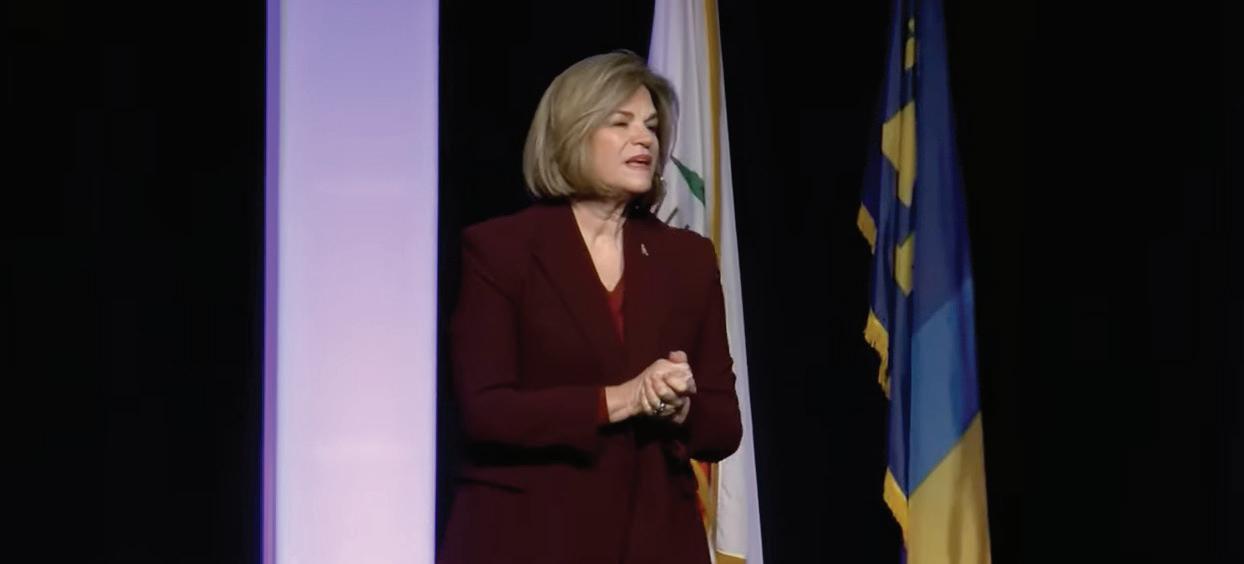
In the annual State of the City address Wednesday evening, Mayor Patricia Lock Dawson highlighted five key indicators that Riverside is “leveling up” and “rising” with strength and resilience, with its best days still ahead.
Proclaiming that “every metric is going in the right direction,” Lock Dawson told the audience at the Riverside Convention Center that crime and unemployment are down, city revenues and local job creation are increasing, while existing businesses are expanding and new businesses are starting up.
“Riverside is a city that achieves and strives for more,” the mayor since 2020 said. “It is a city that believes progress is a responsibility
According to Lock Dawson, Riverside has successfully focused on improving key quality-of-life indicators — safety and stability, economic opportunities, health and the environment, identity and creating a city that “works for businesses today, residents right now and generations to come.”
Overall crime has decreased 35% since 2023, Lock Dawson reported, citing smarter police work, strong partnerships and adding 88 police officers, allowing the Riverside Police Department to attain full staffing for the first time in 25 years.
“I am proud to report that Riverside is an incredibly safe city and becoming safer every day,” the mayor said.
Riverside’s economy not only growing but is in the midst of transforming, Lock Dawson observed. Roughly 96% of Riverside office space is occupied, giving the city one of the lowest vacancy rates in the United States.
“Companies are not just looking at Riverside,” Lock Dawson said. “They’re choosing us.”
Set in a region that is among the nation’s fastest-
growing economies, Riverside drew $4.3 billion in new construction last year and created 18,000 new jobs. Lock Dawson also noted that Riverside Public Utilities offers some of the lowest electricity and water rates in California, and six international companies have set up shop in the city in the last two years, adding to the city’s innovation economy.
“When innovation clusters, jobs follow,” Lock Dawson told the audience at her annual speech. “And leveling up our economy means making City Hall move at the speed of business.”
She spoke about a new selfcertification pilot program that aims to help businesses receive building permits quicker. New regulations will make it easier for entrepreneurs to turn underutilized spaces into new businesses, and a new app is encouraging more people to shop locally, the mayor said.
Riverside is improving the local environment while closing gaps in health care, according the mayor reported.
The UC Riverside School of Medicine graduated its largest class of doctors and is building a new teaching hospital, while California Baptist University has doubled its cohort of physician assis-
tants. Additionally, La Sierra University offers an online MBA in Health Care Management.
A nearly $1 billion expansion of Riverside Community Hospital is underway, and an expansion of Kaiser Permanente’s hospital in La Sierra is expected to open in 2027.
Riverside ranks as one of the top 11 cities in the U.S. for installed solar capacity per capita and has launched the world’s only Clean Air Carshare Program with 12 hydrogen fuel-cell vehicles. The city also broke ground at the Northside Agriculture Innovation Center.
“But we must do more,” Lock Dawson said. “By 2027, 70 percent of Riverside’s energy will come from renewable sources, it’s not just good for the planet but good for business”
Riverside also is leveling up the city’s identity, both with residents and visitors, the mayor said.
“People feel connected here,” she told address attendees. “They love where they live. And they’re proud to call Riverside home.
The mayor also touted the city’s Arts and Culture District for its designation as a Cali-
fornia Cultural District by the state Arts Council.
The city’s Visit Riverside initiative has reached 20 million people and a new initiative, Preserving Riverside’s Treasures, aims to improve many of the city’s 153 landmarks.
“Through this initiative, we’re committing to protecting and celebrating these places as living parts of Riverside’s future,” Lock Dawson said.
Neighborhood improvements are changing the face of Riverside, where community centers served more than 1.5 million people last year, according to the mayor. Parks and playgrounds were enhanced, with more upgrades planned for Orange Terrace Community Center, Hole Lake and Fairmount Park.
In the Eastside neighborhood, $300 million in state funding will support a new Jesus Duran Library, the renovation of the Cesar Chavez Community Center and the construction of the new Dell Roberts Bordwell Park Gym.
Riverside’s senior centers now serve more than 75,000 seniors and deliver over 31,000 meals annually, Lock Dawson reported. The
Report: More than 170 US citizens have been held by immigration agents. They’ve been kicked, dragged and detained for days.
By Nicole Foy, ProPublica
This story was originally published by ProPublica. ProPublica is a nonprofit newsroom that investigates abuses of power. Sign up to receive their biggest stories as soon as they’re published.
WhentheSupreme Courtrecently allowedimmigration agents in the Los Angeles area to take race into consideration during sweeps, Justice Brett Kavanaugh said that citizens shouldn’t be concerned.
“If the officers learn that the individual they stopped is a U.S. citizen or otherwise lawfully in the United States,” Kavanaugh wrote, “they promptly let the individual go.”
But that is far from the reality many citizens have experienced.Americans have been dragged, tackled, beaten, tased and shot by immigration agents. They’ve had their necks kneeled on. They’ve been held outside in the rain while in their underwear. At least three citizens were pregnant when agents detained them. One of those women had already had the door of her home blown off while Department of Homeland Security Secretary Kristi Noem watched.
About two dozen Americans have said they were held for more than a day without being able to phone lawyers or loved ones.
Videos of U.S. citizens being mistreated by immigration agents have filled social media feeds, but there is little clarity on the overall picture. The government does not track how often immigration agents hold Americans.
So ProPublica created its own count.
We compiled and reviewed every case we could find of agents holding citizens
against their will, whether during immigration raids or protests. While the tally is almost certainly incomplete, we found more than 170 such incidents during the first nine months of President Donald Trump’s second administration.
Amongthecitizens detained are nearly 20 children, including two with cancer. That includes four who were held for weeks with their undocumented mother and without access to the family’s attorney until a congresswoman intervened.
Immigration agents do have authority to detain Americans in limited circumstances. Agents can hold people whom they reasonably suspect are in the country illegally. We found more than 50 Americans who were held after agents questioned their citizenship. They were almost all Latino.
Immigration agents also can arrest citizens who allegedly interfered with or assaulted officers. We compiled cases of about 130 Americans, including a dozen elected officials, accused of assaulting or impeding officers.
These cases have often wilted under scrutiny. In nearly 50 instances that we have identified so far, charges have never been filed or the cases were dismissed. Our count found a handful of citizens have pleaded guilty, mostly to misdemeanors.
Among the detentions in which allegations have not stuck, masked agents pointed a gun at, pepper sprayed and punched a young man who
By Sta
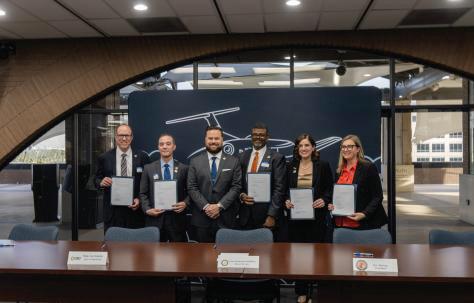
The City of Riverside is working with two local school districts and several local colleges to explore ways to create additional jobs and longterm growth in the aviation, aerospace, and related technology sectors through the Learning Institute for Flight Technology (LIFT).
“This will ensure Riverside remains proactive, not reactive, about aerospace and advanced manufacturing jobs,” said City Councilmember Steven Robillard, who proposed the idea. “This is an opportunity to explore partnerships and have a dialogue about what we can bring to our city.”
The cooperative effort includes the city, Riverside Unified School District, Alvord Unified School District, Riverside City College, California Baptist University and UC Riverside. It will allow the organizations to work together to evaluate how
existing educational offerings, industry needs, and regional assets could be improved over time to generate more career awareness, improve skills development, and build a more skilled workforce.
“We are excited to be working with each other and with industry to keep talent in the Inland Empire,” said Eric Bishop, interim president, Riverside City College.
Theorganizations recently memorialized in a memorandum of understanding the intention to combine their shared assets to examine the role of technology within aviation, aerospace, and related fields. The effort will create a shared awareness of emerging trends and potential applications, and how career readiness can be enhanced through focused education, training, and workforce development.
One option includes examining how Riverside Airport can be leveraged
as part of this effort. The Airport is the busiest FAA Federal Contract Tower airport in California, ranking 116th nationwide in operations, including emergency services,airambulance flights,andfirefighting missions.
The airport is part of Southern California’s rich aviation legacy, providing training and general aviation opportunities for current and future aviators.
The airport already is home to flight schools and FAA STEM initiatives.
“We are laying the foundation tonight,” Robillard said. “This positions Riverside to compete and keep our job pipelines local.”
The effort to enhance the skills and educational opportunities of local students comes amid employment opportunities in several aviation fields. For example, the Federal Aviation Administration projects a need for
By City News Service

Desert Regional Medical Centerannounced
Thursday it will host an open house to celebrate the opening of its new outpatient cardiology center next month in Palm Springs.
The free open house titled “Affairs of the Heart” will be held from 3 to 5 p.m. Feb. 18 in the Stergios Building, at 1140 N. Indian Canyon Drive. A ribbon-cutting cutting ceremony will be held at 4 p.m.
Attendees will be able to talk with professionals regarding the hospitals numerous programs including the Cardiac Rehab program, Congestive Heart Failure program and the Comprehensive Stroke Center. It will also feature exhibits, demonstrations, tours and free refresh-
ments and giveaways.
“Our goal is to make highquality cardiac care more accessible and coordinated for our patients,” Medical Director of the cardiology center Dr. Kaustubh Patankar said in a statement. “We hear our patients in our communities that it can take months to seek general cardiovascular care. By bringing interventional, diagnostic and follow-up services together in one location, we can streamline care, reduce delays and support better outcomes for patients at every stage of their heart health journey.”
Services provided at the center include general cardiology, nuclear medicine, atherectomy and stent placement, percutaneous coronary
8,900 new air traffic controllers and a 10 to 20 percent shortage of aviation technicians and mechanics by 2028, and a shortage of
pilots by 2026.
“Providing opportunities like this for our students is really what makes a difference in our
educational services
Aprogramaimed toprovideuniversity students with fieldbased geospatial research that prepares them for diverse career opportunities has expanded to Cal State San Bernardino’s Palm Desert campus, it was announced Thursday.
intervention, echocardiography, stress testing and advanced diagnostic services.
The center will be part of two other heart programs inside the Stergios Building — the Congestive Heart Failure Clinic and the Cardiac Rehabilitation program.
“With the opening of the Desert Regional Cardiology Center, patients can now be seen for cardiology-related services and have immediate access to specialized physicians and coordinated followup care right here on the campus of Desert Regional Medical Center,” Patankar said.
Prospective patients can make an appointment by calling 760-424-7345, or at DesertCareNetwork.com/ Cardio.
Field-basedLearning, OutreachandWorkforce Scholarship program has reached Palm Desert campus students to expand community-drivenenvironmental workforce training across Southern California.
The program provides research and service learning opportunities to students by connecting them with local, regional and state natural resourcepractitioners, community members and Tribal leadership .
Housed at CSUSB’s Institute for Watershed Resiliency, the partnership with Palm Desert campus means students can explore and learn about the Coachella Valley’s desert regions through desert-based environmental learning.
Officials said this year’s FLOWS cohort includes eight students from CSUSB and Cal State Northridge.
This month, fellows partnered with Agua Caliente Band
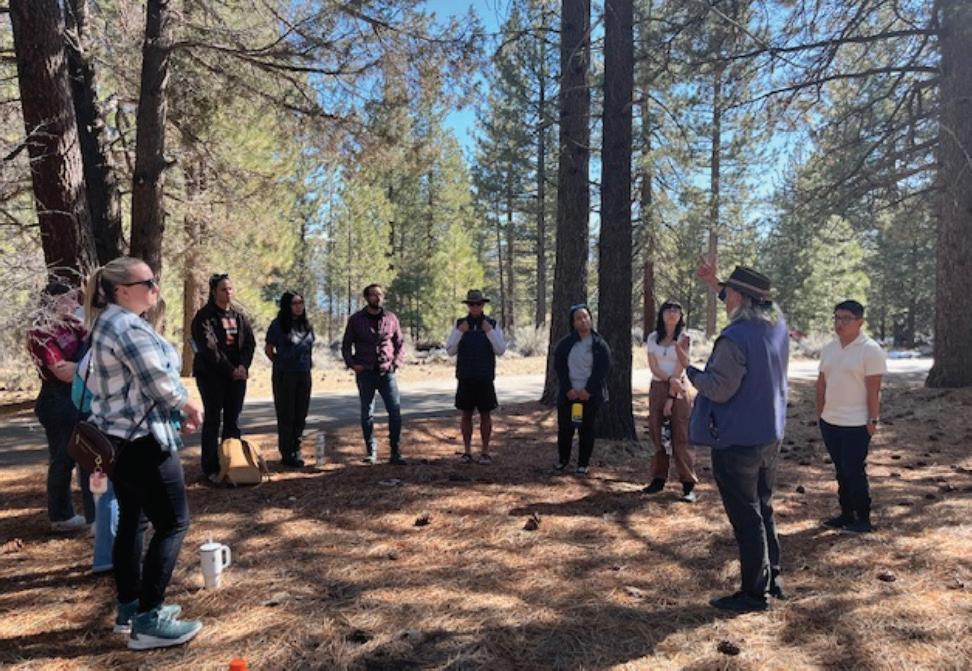
of Cahuilla Indians, Native American Land of Conservancy and the Audubon Society to study regional water systems, restoration efforts and Indigenous governance.
“The FLOWS program that took place in the Coachella Valley was a wonderful experience for students that gave us practical knowledge and skills essential for careers in the environmental field,” Matthew Scully, an environmental studies major and FLOWS fellow, said in a statement.
A number of activities and applications during the
program includes engaging with Tribal communities or organizations to explore Tribal perspectives of water issues, data collection and analysis and meeting resource practitioners to learn about programs, projects and career opportunities.
“By expanding collaboration with the Palm Desert campus, FLOWS continues to demonstrate how universities can address real-world environmental challenges while strengtheningregional partnerships and workforce pathways,” officials said.
Editorial editorial@beaconmedianews.com
editor@hlrmedia.com
Graphics/Production production@beaconmedianews.com production@hlrmedia.com
Advertising advertising@beaconmedianews.com advertising@hlrmedia.com
Legal Advertising legals@beaconmedianews.com legals@hlrmedia.com
Business accounting@beaconmedianews.com accounting@hlrmedia.com
BEACON MEDIA ADDRESS: 820 S. Myrtle Ave. Monrovia, CA 91016
PHONE: (626) 301-1010
WEBSITE www.beaconmedianews.com
HLR MEDIA ADDRESS: 820 S. Myrtle Ave. Monrovia, CA 91016
PHONE: (626) 301-1010 www.HLRmedia.com
PRESS
editor@beaconmedianews.com editor@hlrmedia.com












By Jackie Dowling for Sunsweet Growers via Stacker
he phrase “gut health” is coming up a lot lately online and in the wellness world. Digestive health has gone from being a niche topic to a critical element to feeling good overall: from energy levels and mood to comfort and balance.
At the same time, fiber has stepped out of the background. It’s no longer just something nutrition experts talk about; it’s something people actively say they try to eat more of. The catch? 90% of women and 97% of men in the U.S. are not meeting their daily fiber requirements. They lack clarity on how much they need, how it affects their body beyond digestion, and how to realistically incorporate it into their daily routine.
A new national survey commissioned by Sunsweet Growers explores how Americans think about gut health, fiber, and feeling good. The data shows gut health is a priority, but people still aren’t sure how to get the fiber they need.


whole grains and dark leafy greens. Many whole foods, like prunes, contain both forms of fiber.
Survey finds Americans think gut health is a core part of wellness
What is fiber and why do we need it?
Fiber is a type of carbohydrate found in plant foods that your body can’t fully digest — but that’s actually a good thing. Instead of being broken down, fiber moves through the body undigested, helping things run smoothly and keeping your hunger and blood sugar levels stabilized. Fiber can help you feel fuller longer, support healthy blood sugar levels, and even lower cholesterol.










There are two kinds of fiber — soluble and insoluble — and both are essential to overall health. Soluble fiber slows digestion and can help lower cholesterol, and it can be found in foods like oats, beans and apples. Insoluble fiber helps move foods through the digestive tract and promote regularity, and it can be found in foods like
According to the Nutrition and Digestive Health Survey, an online survey of 1,249 nationally representative American adults fielded by YouGov on behalf of Sunsweet conducted December 18-19, 2025, most Americans see gut health as a core part of everyday wellness.
Findings include:
- Good digestion is rated as important by 95% of U.S. adults and sits on par with hydration (97%), vitamin intake (92%), and energy levels (91%).
- 84% of U.S. adults believe that gut health is at least somewhat associated with feeling good day to day.
- Parents are more likely than non-parents to say having good digestion is very important to their overall well-being (71% vs. 61%).
Malina Malkani, MS, RD, who has worked with
Sunsweet, explains, “As both a pediatric dietitian and mom of three, I know too well how disruptive digestive discomfort can be for families. Supporting digestive health through adequate fiber intake isn’t just about optimizing their gut health; it’s about helping the whole family feel good so that family life runs more smoothly.”
According to the survey:
- Nearly half of U.S. adults (44%) wish it were easier to get more fiber day to day, yet a majority either don’t know how much fiber they should consume (37%) or underestimate the recommended amount (20% select fewer than 20 grams).
- When asked, “About how many grams of fiber do you think the average adult needs per day?” respondents answered: Under 10 grams (4%); 10–19 grams (16%); 20–29 grams (26%); 30 grams or more (17%); Don’t know (37%).
Simple habits are the way to wellness
As Americans increasingly define wellness by how they feel, fiber sits at the
center of that shift. If you’re ready to embrace a fiberrich diet, set yourself up for success with small, manageable nutrition habits that fit into real life rather than big, restrictive overhauls.
“Small, simple shifts, made gradually and paired with plenty of fluids to help keep things moving, can make a meaningful difference in fiber intake,” Malkani explains. “Choosing foods like prunes is an easy way to increase your fiber intake by adding three grams per serving. You can also swap to whole grains over refined, add beans and vegetables to soups, stews, or dips, incorporate fruit into yogurt parfaits or oatmeal, and add ground nuts or seeds into smoothies, pancakes, or muffins.”
With a little intention and a few smart swaps, getting enough fiber can move from a challenge to a habit that supports long-term health. This story was produced by Sunsweet Growers and reviewed and distributed by Stacker.
Republished with Creative Commons License (CC BY-NC 4.0).
IBy Suzanne Potter, Public News Service
magine if your insurance company raised your rates because your car has been spying on you, sending information which ends up with data brokers every time you brake too hard, drive at night, or go over the speed limit. It is what the Federal Trade Commission said happened to drivers of General Motors vehicles with the OnStar Smart Driver feature. Now the Commission has ordered the
data transfers be stopped.
Lena Cohen, staff technologist for the nonprofit Electronic Frontier Foundation, said some drivers had
no idea they had enrolled in the feature because car salespeople signed them up without telling them to get an enrollment bonus.
had filmed them searching for his relative. In another, agents knocked over and then tackled a 79-year-old car wash owner, pressing their knees into his neck and back. His lawyer said he was held for 12 hours and wasn’t given medical attention despite having broken ribs in the incident and having recently had heart surgery. In a third case, agents grabbed and handcuffed a woman on her way to work who was caught up in a chaotic raid on street vendors. In a complaint filed against the government, she described being held for more than two days, without being allowed to contact the outside world for much of that time. (The Supreme Court has ruled that two days is generally the longest federal officials can hold Americans without charges.)
In response to questions from ProPublica, the Department of Homeland Security said agents do not racially profile or target Americans. “We don’t arrest US citizens for immigration enforcement,” wrote spokesperson Tricia McLaughlin.
A top immigration official recently acknowledged agents do consider someone’s looks. “How do
they look compared to, say, you?” Border Patrol chief Gregory Bovino said to a white reporter in Chicago.
The White House told ProPublica that anyone who assaults federal immigration agents would be prosecuted. “Interfering with law enforcement and assaulting law enforcement is a crime and anyone, regardless of immigration status, will be held accountable,” said the Deputy Press Secretary Abigail Jackson. “Officers act heroically to enforce the law, arrest criminal illegal aliens, and protect American communities with the utmost professionalism.”
A spokesperson for Kavanaugh did not return an emailed request for comment.
Tallying the number of Americans detained by immigration agents is inherently messy and incomplete. The government has long ignored recommendations for it to track such cases, even as the U.S. has a history of detaining and even deporting citizens, including during the Obama administration and Trump’s first term.
We compiled cases by sifting through both English- and Spanish-
language social media, lawsuits, court records and local media reports. We did not include arrests of protesters by local police or the National Guard. Nor did we count cases in which arrests were made at a later date after a judicial process. That included cases of some people charged with serious crimes, like throwing rocks or tossing a flare to start a fire.
Experts say that Americans appear to be getting picked up more now as a result of the government doing something that it hasn’t for decades: largescale immigration sweeps across the country, often in communities that do not want them.
In earlier administrations, deportation agents used intelligence to target specific individuals, said Scott Shuchart, a top immigration official in the Biden, Obama and first Trump administrations. “The new idea is to use those resources unintelligently” — with officers targeting communities or workplaces where undocumented immigrants may be.
When federal officers roll through communities in the way the Supreme Court

permitted, the constitutional rights of both citizens and noncitizens are inevitably violated, argued David Bier, the director of immigration studies at the libertarian Cato Institute. He recently analyzed how sweeps in Los Angeles have led to racial profiling. “If the government can grab someone because he’s a certain demographic group that’s correlated with some offense category, then they can do that in any context.”
Cody Wofsy, an attorney at the American Civil Liberties Union, put it even more starkly. “Any one of us could be next.”
When Kavanaugh issued his opinion that immigration agents can consider race and other factors, the Supreme Court’s three liberal justices strongly dissented. They warned that citizens risked being “grabbed, thrown to the ground, and handcuffed simply because of their looks, their accents, and the fact they make a living by doing manual labor.”
Leonardo Garcia Venegas appears to have been just such a case. He was working at a construction site in coastal Alabama when he saw masked immigration agents from Homeland Security Investigations hop a fence and run by a “No trespassing” sign. Garcia Venegas recalled that they moved toward the Latino workers, ignoring the white and Black workers.
Garcia Venegas began filming after his undocumented brother asked agents for a warrant. In response, the footage shows, agents yanked his brother to the ground, shoving his face into wet concrete. Garcia Venegas kept filming until officers grabbed him too and knocked his phone to the ground.
Other co-workers filmed what happened next, as
immigration agents twisted the 25-year-old’s arms. They repeatedly tried to take him to the ground while he yelled, “I’m a citizen!”
Officers pulled out his REAL ID, which Alabama only issues to those legally in the U.S. But the agents dismissed it as fake. Officers held Garcia Venegas handcuffed for more than an hour. His brother was later deported.
Garcia Venegas was so shaken that he took two weeks off of work. Soon after he returned, he was working alone inside a nearly built house listening to music on his headphones when he sensed someone watching him. A masked immigration agent was standing in the bedroom doorway.
This time, agents didn’t tackle him. But they again dismissed his REAL ID. And then they held him to check his citizenship. Garcia Venegas says agents also held two other workers who had legal status.
DHS did not respond to ProPublica’s questions about Garcia Venegas’ detentions, or to a federal lawsuit he filed last month. The agency has previously defended the agents’ conduct, saying he “physically got in between agents and the subject” during the first incident. The footage does not show that, and Garcia Venegas was never charged with obstruction or any other crime.
Garcia Venegas’ lawyers at the nonprofit Institute for Justice hope others may join his suit. After all, the reverberations of the immigration sweeps are being felt widely. Garcia Venegas said he knows of 15 more raids on nearby construction sites, and the industry along his portion of the Gulf
See Immigration agents Page 05
Coast is struggling for lack of workers.
Kavanaugh’s assurances hold little weight for Garcia Venegas. He’s a U.S. citizen of Mexican descent, who speaks little English and works in construction. Even with his REAL ID and Social Security card in his wallet, Garcia Venegas worries that immigration agents will keep harassing him.
“If they decide they want to detain you,” he said. “You’re not going to get out of it.”
George Retes was among the citizens arrested despite immigration agents appearing to know his legal status. He also disappeared into the system for days without being able to contact anyone on the outside.
The only clue Retes’ family had at first was a brief call he managed to make on his Apple Watch with his hands handcuffed behind his back. He quickly told his wife that “ICE” had arrested him during a massive raid and protest on the marijuana farm where he worked as a security guard.
Still, Retes’ family couldn’t find him. They called every law enforcement agency they could think of. No one gave them any answers.
Eventually, they spotted a TikTok video showing Retes driving to work and slowly trying to back up as he’s caught between agents and protestors. Through the tear gas and dust, his family recognized Retes’ car and the veteran decal on his window. The full video shows a man — Retes — splayed on the ground surrounded by agents.
Retes’ family went to the farm, where local TV reporters were interviewing families who couldn’t find
their loved ones.
“They broke his window, they pepper sprayed him, they grabbed him, threw him on the floor,” his sister told a reporter between sobs. “We don’t know what to do. We’re just asking to let my brother go. He didn’t do anything wrong. He’s a veteran, disabled citizen. It says it on his car.”
Retes was held for three days without being given an opportunity to make a call. His family only learned where he had been after his release. His leg had been cut from the broken glass, Retes told ProPublica, and lingering pepper spray burned his hands. He tried to soothe them by filling sandwich bags with water.
Retes recalled that agents knew he was a citizen. “They didn’t care.” He said one DHS official laughed at him, saying he shouldn’t have come to work that day. “They still sent me away to jail.” He added that cases like his show Kavanaugh was “wrong completely.”
DHS did not answer our questions about Retes. It did respond on X after Retes wrote an op-ed last month in the San Francisco Chronicle. An agency post asserted he was arrested for assault after he “became violent and refused to comply with law enforcement.” Yet Retes had been released without any charges. Indeed, he says he was never told why he was arrested.
The Department of Justice has encouraged agents to arrest anyone interfering with immigration operations, twice ordering law enforcement to prioritize cases of those suspected of obstructing, interfering with or assaulting immigration officials. But the government’s
claims in those cases have often not been borne out.
Daniel Montenegro was filming a raid at a Van Nuys, California, Home Depot with other day-laborer advocates this summer when, he told ProPublica, he was tackled by several officers who injured his back.
Bovino, the Border Patrol chief who oversaw the LA raids and has since taken similar operations to cities like Sacramento and Chicago, tweeted out the names and photos of Montenegro and three others, accusing them of using homemade tire spikes to disable vehicles.
“I had no idea where that story came from,” Montenegro told ProPublica. “I didn’t find out until we were released. People were like, ‘We saw you on Twitter and the news and you guys are terrorists, you were planning to slash tires.’ I never saw those spike tire-popper things.”
Officials have not charged Montenegro or the others with any crimes. (Bovino did not respond to a request for comment, while DHS defended him in a statement to ProPublica: “Chief Bovino’s success in getting the worst of the worst out of the country speaks for itself.”)
The government’s cases are sometimes so muddied that it’s unclear why agents actually arrested a citizen.
Andrea Velez was charged with assaulting an officer after she was accidentally dropped off for work during a raid on street vendors in downtown Los Angeles. She said in a federal complaint that officers repeatedly assumed she did not speak English. Federal officers later requested access to her phone in an attempt to prove she was colluding with another citizen arrested that day,
who was charged with assault. She was one of the Americans held for more than two days.
DHS did not respond to our questions about Velez, but it has previously accused her of assaulting an officer. A federal judge has dismissed the charges.
Other citizens also said officers accused them of crimes and suddenly questioned their citizenship — including a man arrested after filming Border Patrol agents break a truck window, and a pregnant woman who tried to stop officers from taking her boyfriend.
The prospects for any significant reckoning over agents’ conduct, even against citizens, are dim. The paths for suing federal agents are even more limited than they are for local police. And that’s if agents can even be identified. What’s more, the administration has gutted the office that investigates allegations of abuse by agents.
“The often-inadequate guardrails that we have for state and local government — even those guardrails are nonexistent when you’re talking about federal overreach,” said Joanna Schwartz, a professor at UCLA School of Law.
More than 50 members of Congress have also written to the administration, demanding details about Americans who’ve been detained. One is Sen. Alex Padilla, a California Democrat. After trying to question Noem about detained citizens, federal agents grabbed Padilla, pulled him to the ground and handcuffed him. The department later defended the agents, saying they “acted appropriately.”
Republished with Creative Commons License (CC BY-NC-ND 3.0).

“But even drivers who did realize they’d signed up for these OnStar features didn’t realize the extent of the data they were sharing and what that data was being used for,” Cohen explained.
GM said in a statement the company has discontinued the Smart Driver program, unenrolled all customers, and ended relationships with data companies LexisNexis and Verisk. The commission imposed a five-year ban on GM and OnStar disclosing certain
data to consumer reporting agencies. For 20 years, the company must also get consent from consumers prior to collecting, using, or sharing connected vehicle data, create a way for people to request a copy of their data and get it deleted and allow consumers to opt out or disable data collection.
Cohen urged Congress to pass strong data privacy laws applying to all car companies.
“It’s too easy for companies to bury their data
collection and sharing practices in long terms of service that no one actually reads,” Cohen asserted. “All carmakers should be forced to get people’s explicit consent before engaging in invasive data-sharing practices like these.”
You can find out what data your car is set up to collect at VehiclePrivacyReport.com. It is also possible to request a report from Lexis Nexis and Verisk to see what information they have about you.

By Doug Bock Clark and Jen Fifield, ProPublica
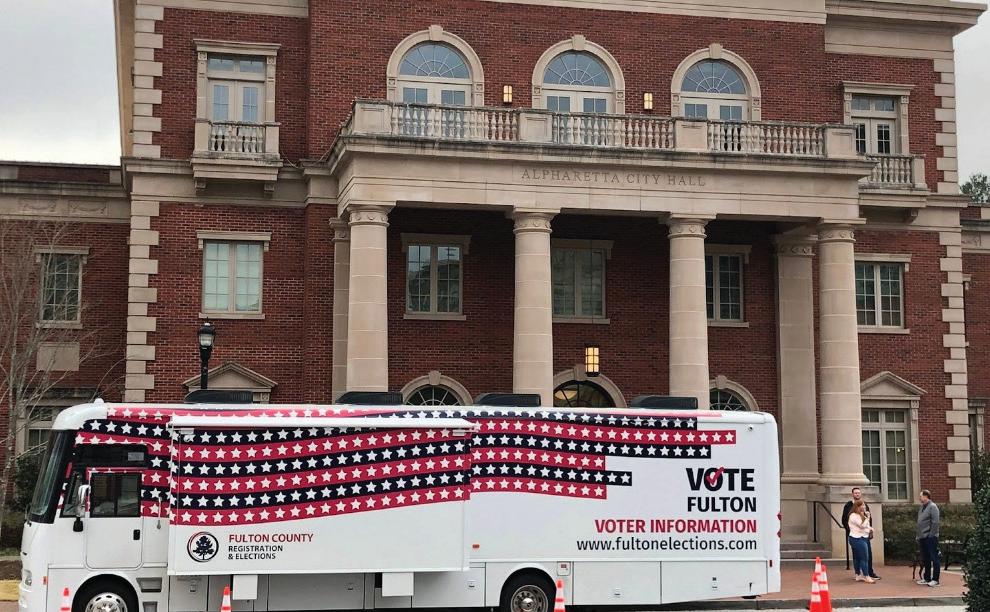
WhentheFBI executed a warrant on Wednesday to seize records from the 2020 presidential vote in Fulton County, Georgia, it marked both an extraordinary event in the history of American elections and a significant escalationinPresident Donald Trump’s breaking of democratic norms, several legal experts said.
Trump has long claimed, without evidence, that the 2020 election was stolen from him and blamed Georgia, in particular, for his loss to Joe Biden. After the election, he famously made a call pressuring the secretary of state to “find” him enough votes to win. About a week ago, in a speech at the World Economic Forum, Trump once again called the 2020 election “rigged” and promised, “People will soon be prosecuted for what they did.”
The warrant served on the Fulton County election center sought ballots, tabulator tapes, digital data and voter rolls, which it alleged might constitute “evidence of the commission of a criminal offense.” It cited stiff criminal penalties related to “the procurement, casting, or tabulation” of fraudulent ballots.
“I’m not aware of something like this happening ever before,” said Rick Hasen, a professor at the law school of the University of California, Los Angeles. “The idea that federal officials would seize ballots in an attempt to prove fraud is especially dangerous in this context when we know there is no fraud because the Georgia 2020 election has been extensively counted, recounted and investigated.”
Trump and his allies filed over 60 legal cases across the nation seeking to overturn the 2020 election results — all of which failed, even those before Trump-
appointed judges.
“This just looks like a way to use the might of the federal government to further Trump’s voter fraud narratives,” Hasen said.
An FBI spokesperson declined a request for comment except to say that the bureau “is conducting court-authorized law enforcement activity. No other information is available at this time.”
At a press conference, Fulton County Commission Chair Robb Pitts said that the ballots had been “safe” in the county’s custody and defended its handling of the election as fair and accurate. But now that the ballots had been seized, he said, the county “can no longer satisfy … that those ballots are still secure.”
Mo Ivory, a Democratic Fulton County commissioner, arrived on the scene shortly after the FBI agents and said that once
an error on the warrant was corrected, they backed up lines of trucks to the elections warehouse and spent hours carting away boxes of ballots and other materials. The search began in the morning and was still going well past nightfall.
“This is not legitimate. This is Donald Trump’s obsession with losing the 2020 election,” Ivory said. “This is his way to sow doubt that Fulton County doesn’t hold proper elections.”
Fulton County — which covers much of the Democratic-stronghold of Atlanta — has long been the target of attempts to call into question its election systems as a way to cast doubt on the legitimacy of the 2020 vote.
In the immediate aftermath of the election, Trump’s attorney Rudy Giuliani accused election workers of rigging the vote
with suitcases of ballots in his arguments to overturn the election — claims that were quickly debunked and for which he lost a nearly $150 million defamation lawsuit brought by two of the workers.
But this did not end the focus on the county by Trump’s allies, who inundated it with thousands of voter registration challenges and continued to make claims of voter fraud, as ProPublica has reported.
The Fulton County Board of Elections became a battleground, once the Republican Party appointed Julie Adams to it. Adams, ProPublica has reported, played a key role in trying to change rules around certifying elections in Georgia that could have allowed activists to dispute a Trump loss in 2024. (Adams didn’t respond to questions from ProPublica for these articles.)
In advance of the 2024 election, right-wing activists also forced out a moderate conservative on the Georgia State Election Board, tilting its balance of power. Its new MAGA majority — which Trump praised by name at a rally as “pit bulls fighting for honesty, transparency and victory” — began relitigating the 2020 election. In October 2024, the State Election Board voted to issue subpoenas for 2020 materials, including ballots.
Once Trump returned to the White House, state and federal officials combined to pressure Fulton County to hand over 2020 voting materials.
In the months after the State Election Board passed a resolution suggesting the Justice Department should intervene, Attorney General Pam Bondi sent letters to Fulton County officials demanding records
and citing “anomalies” in counting votes during the 2020 election, according to a court filing.
Fulton County Clerk Ché Alexander didn’t respond, and in December the U.S. Department of Justice sued her.
In a court filing, Alexander said that the federal government had no right to the ballots and documents, which were under seal because of ongoing cases related to the 2020 election.
Alexander said that if Bondi could “identify a legitimate basis” for accessing the 2020 election materials, then she should seek an order from a Fulton County Superior Court judge to unseal them.
On Wednesday, agents wearing tactical vests and jackets reading “FBI Evidence Response Team” arrived with a warrant. Shocked officials looked on as the boxes were paraded away.
Ivory, the Fulton County commissioner, said that while county officials had complied with the warrant, they expected to challenge the administration’s actions in court.
“We’ve assembled a team to fight back against this,” Ivory said. “We’ll see what happens. The legal maneuvers are happening right now.”
Experts said the action in Fulton County had triggered fears of federal interference in this year’s midterm elections.
“It’s a dramatic escalation in the Trump administration’s efforts to expand federal control over our country’s historically staterun election infrastructure,” said Derek Clinger, a senior counsel at the State Democracy Research Initiative, an institute at the University of Wisconsin Law School.
Republishedwith Creative Commons License (CC BY-NC-ND 3.0).
NOTICE is hereby given that the City of Glendale ("City") will receive sealed proposals, until the proposal deadline established below for the following work of improvement:
Substation Battery, Charger, and Rack System Replacement Project RFP No. 3998
Proposal Submission Deadline: Submit before noon, on Monday, March 16, 2026 Proposal Submission: Email Proposals to: iugwu@glendaleca.gov
NO LATE PROPOSALS WILL BE ACCEPTED
Proposal Documents Available: Monday, February 02, 2026, at noon via computer download only. See Item 1. Proposal Documents below, for further information on obtaining Proposal documents.
Mandatory Pre-Proposal Meeting: Date: Tuesday, February 17, 2026 Time: 10:30 a.m. Pacific Standard Time Communication Method: Video/Audio Conference via Microsoft Teams® using either:
Computer/smart phone: Meeting ID: 288 594 273 672 19, Passcode: Sq34Kr3C or by telephone only at Phone No.: 1-323-886-7427, use code: 247 041 595# to join. City of Glendale Contact Person: Innocent Ugwu, Project Manager Phone: (818) 548-3901 Cell: (818) 696-6621
Facsimile: (818) 240-4754
Email: iugwu@glendaleca.gov
Project Description:
The City, through Glendale Water and Power Department (“GWP”), is soliciting proposals for the Substation Battery, Charger, and Rack System Replacement Project, in accordance with RFP No. 3998 from interested Engineering, Procurement and Construction Entities (EPCE). An Engineering, Procurement and Construction contract will be awarded to the most qualified EPCE. The scope of work generally includes the design, Procurement and construction of substation batteries, chargers, rack systems and all necessary accessories at ten (10) substations in the City of Glendale.
Other Proposal Information:
1. Proposal Documents: Proposals must be made on the Proposal Forms contained herein. Proposal Documents will be made available for download at City of Glendale website: https://www.glendaleca.gov/government/departments/finance/purchasing/rfp-rfqbid-page
2. Acceptance or Rejection of Proposals: The City reserves the right to request additional information from any proposing Engineering, Procurement and Construction Entity (EPCE) and to consider information about a proposing EPCE other than that submitted in the Proposal. The City reserves the right to waive any informalities, irregularities, or technical defects in such Proposal as the best interests of the City may require. The City also reserves the right to reject any and all Proposals, to award all or any individual part/item of the Proposal and shall not be liable for any expenses or costs incurred by the proposing firms in preparing and submitting their Proposals. No late Proposals will be accepted, nor will any oral, or facsimile Proposals be accepted by the City.
3. Completion: This Work must be completed within One Hundred Eighty (180) calendar days from the Date of Commencement as established by the City’s written Notice to Proceed.
4. Liquidated Damages: Liquidated damages are to be $1000.00 per Calendar Day. See Section 4 of the Contract between City and Contractor for terms and conditions relating to contract time and liquidated damages.
5. Mandatory Pre-Proposal Meeting: A mandatory pre-proposal meeting will be held at the date and time specified above in the section titled “Mandatory Pre-Proposal Meeting” in this Notice Inviting Proposals. If one has access to a computer with microphone, camera, and speakers or if one possesses a smart phone, one may participate in the meeting with both video and audio interaction. If one only has access to a telephone, then one may participate in the meeting with audio interaction only. Meeting codes, passwords and phone numbers needed to join the meeting are provided on the first page of the Notice Inviting Proposals.
6. Contractor’s License: At the time of the Proposal Deadline and at all times during performance of the Work, including full completion of all corrective work during the Correction Period, the Contractor must possess a California Contractor’s License or licenses, current and active, of the classification required for the Work, in accordance with the provisions of Chapter 9, Division 3, Section 7000 et seq. of the Business and Professions Code. The successful Proposer will not receive a Contract award if the successful Proposer is unlicensed, does not have all of the required licenses, or one or more of the licenses are not current and active. If the City discovers after the Contract’s award that the Contractor is unlicensed, does not have all of the required licenses, or one or more of the licenses are not current and active, the City may cancel the award, reject the Proposal, declare the Proposal Bond as forfeited, keep the Proposal Bond’s proceeds, and exercise any one or more of the remedies in the Contract Documents.
7. Subcontractors’ Licenses and Listing: At the time of the Proposal Deadline and at all times during performance of the Work, each listed Subcontractor must possess a current and active California Contractor’s license or licenses appropriate for the portion of the Work listed for such Subcontractor and shall hold all specialty certifications required for such Work. When the Proposer submits its Proposal to the City, the Proposer must list each Subcontractor whom the Proposer must disclose under Public Contract Code Section 4104 (Subcontractor Listing Law), and the Proposer must provide all of the Subcontractor information that Section 4104 requires (name, the location (address) of the Subcontractor’s place of business, California Contractor license number, and portion of the Work). In addition, the City requires that the Proposer list the dollar value of each Subcontractor’s labor or services. The City’s disqualification of a Subcontractor does not disqualify a Proposer. However, prior to and as a condition to award of the Contract, the successful Proposershall substitute a properly licensed and qualified Subcontractor— without an adjustment of the Proposal Amount.
8. Proposal Forms and Security: Each proposal must be made on the proposal form obtainable through Planetbids website. Each proposal shall be accompanied by a cashier’s check or certified check drawn on a solvent bank, payable to “City of Glendale”, for an amount equal to ten percent (10%) of the total maximum amount of the Proposal. Alternatively, a satisfactory corporate surety bid bond for an amount equal to ten percent (10%) of the total maximum amount of the bid may accompany the Proposal. Said security shall serve as a guarantee that the successful proposer will, within fourteen (14) calendar days after the City’s Notice of Award of the Contract, will execute the Contract and furnish the bonds and insurance to the City for said Work in accordance with the Contract Documents.
9. Proposal Irrevocability: Proposals shall remain open and valid for ninety (90) calendar days after the Proposal Deadline.
10. Substitution of Securities: Pursuant to California Public Contract Code Section 22300, substitution of securities for withheld funds is permitted in accordance therewith.
11. Prevailing Wages: This Project is a “public work” subject to the provisions of California Labor Code Section 1720. The EPCE that is awarded this Contract and all Subcontractors of any
character in the locality in which the Work is performed and the general prevailing rate for legal holiday and overtime Work for each craft or type of worker needed in the execution of agreements with the City. Said resolution is on file in the Office of the City Clerk and is hereby incorporated and made a part hereof by the same as though fully set forth herein. Copies of said resolution may be obtained at the Office of the City Clerk. Additionally, the Director of Industrial Relations of the State of California, pursuant to the California Labor Code, has determined the general prevailing rates of wages in the locality in which the Work is to be performed. The rates determined by the California Director of Industrial Relations are available online at www.dir.ca.gov/DLSR/PWD/.
12. Evaluation of Engineering, Procurement and Construction Entity’s (EPCE’s)
Qualifications: The qualifications, which is required to be submitted by each Proposer, will be reviewed and evaluated by a review group comprised of GWP staff to determine if the Proposer’s qualifications meet the required criteria for experience and qualifications stated in the RFP. If the City determines that the Proposer does not meet these requirements, and/or if it is believed that the Proposer will not be able to competently do the work required for successfully completing the project, the Proposer will be disqualified and will not be given further consideration for continuing with the Proposal evaluation process and such Proposer will receive a “Fail” score. This is a Pass/Fail score evaluation.
13. Evaluation of Engineering, Procurement and Construction Entity’s (EPCE’s) Proposal: Those Proposers that successfully meet the required qualification’s criteria and that receive a “Pass” score, per Item No. 12 above, will continue with the Evaluation process of their submitted Proposals in conjunction with their submitted Qualifications. The Proposals and Qualifications will be reviewed and evaluated by the same review group of GWP staff discussed in Item No. 12 above, to determine the best qualified EPCE.
Each Qualifications/Proposal will be evaluated on the basis of the EPCE’s experience and qualifications as measured by:
45% Price and fees (hourly personnel rates and billing unit charges). While price and fees are important, they will not be used as the sole determinant in the selection process. Prices and fees for the project in its entirety– Base & All Alternate Proposal Items– will be included in the evaluation. It is the City’s preliminary assumption that the entire project will be built.
15% Description of project approach and schedule. Demonstrated understanding of the project’s nature and GWP’s needs. Provide detailed plans on how to deliver the project timely and efficiently.
30% EPCE’s response to the Request for Qualifications; demonstrated EPCE experience on similar (Scope & Dollar amount) substation battery replacement projects that include correctly sizing the batteries and chargers, correctly designing and constructing the rack systems, and installation of these and other necessary accessories. The Proposer must submit information and references for only three (3) of its most recently completed projects where the Proposer acted as an EPCE contractor. At least two previous EPC projects been with a Municipal or investor owned electric power provider is preferred.
10% Completeness and quality of the response.
14. California Department of Industrial Relations (DIR) – Public Works Contractor
Registration: Under the Public Works Contractor Registration Law (California Senate Bill No. 854 - See Labor Code Section 1725.5), contractors must register and meet requirements using the online application https://efiling.dir.ca.gov/PWCR/Act ionServlet?action=displayPWCRegistrationForm before proposing on public works contracts in California. The application also provides agencies that administer public works programs with a searchable database of qualified contractors. Application and renewal are completed online with a non-refundable fee of $300. More information is available at the following links: http://www.dir.ca.gov/Public-Works/PublicWorksSB854.html http://www.dir.ca.gov/Public-Works/PublicWorks.html
The City must award public works projects only to EPCE’s, contractors and subcontractors who comply with the Public Works Registration Law.
Notice to EPCE’s, Contractors, and Subcontractors:
a. No EPCE, Contractor or subcontractor may be listed on a Bid proposal for a public works project unless registered with the Department of Industrial Relations pursuant to Labor Code section 1725.5 [with limited exceptions from this requirement for bid purposes only under Labor Code section 1771.1(a)].
b. No EPCE, Contractor or subcontractor may be awarded a contract for public work on a public works project unless registered with the Department of Industrial Relations pursuant to Labor Code section 1725.5.
c. This Project is subject to compliance monitoring and enforcement by the Department of Industrial Relations.
d. The prime Contractor must post job site notices prescribed by regulation. (See 8 Calif. Code Reg. Section 16451(d) for the notice that previously was required for projects monitored by the DIR Compliance Monitoring Unit.)
Furnishing of Electronic Certified Payroll Records to Labor Commissioner. EPCE’s, Contractors and subcontractors must furnish electronic certified payroll records directly to the Labor Commissioner (aka Division of Labor Standards Enforcement).
Dated this ____________ day of ________________, 2026, City of Glendale, California.
Suzie Abajian, Ph.D. City Clerk of the City of Glendale
Publish February 2, 2026
GLENDALE INDEPENDENT
NOTICE OF PETITION TO ADMINISTER ESTATE OF:
THERESE O’MALLEY SEIDLER AKA TERRY O’MALLEY SEIDLER
CASE NO. 26STPB00507
To all heirs, beneficiaries, creditors, contingent creditors, and persons who may otherwise be interested in the WILL or estate, or both of
THERESE O’MALLEY SEIDLER
AKA TERRY O’MALLEY SEIDLER.
A PETITION FOR PROBATE has been filed by JOHN J. SEIDLER AND CAROL SEIDLER GOLBRANSON in the Superior Court of California, County of LOS ANGELES. THE PETITION FOR PROBATE requests that JOHN J. SEIDLER AND CAROL SEIDLER GOLBRANSON be appointed as personal representative to administer the estate of the decedent.
THE PETITION requests the decedent’s WILL and codicils, if any, be admitted to probate. The WILL and any codicils are available for examination in the file kept by the court. THE PETITION requests authority to administer the estate under the Independent Administration of Estates Act. (This authority will al-
in section 58(b) of the California Probate Code, or (2) 60 days from the date of mailing or personal delivery to you of a notice under section 9052 of the California Probate Code.
Other California statutes and legal authority may affect your rights as a creditor. You may want to consult with an attorney knowledgeable in California law. YOU MAY EXAMINE the file kept by the court. If you are a person interested in the estate, you may file with the court a Request for Special Notice (form DE-154) of the filing of an inventory and appraisal of estate assets or of any petition or account as provided in Probate Code section 1250. A Request for Special Notice form is available from the court clerk.
Attorney for Petitioner
LEAH M. BISHOP - SBN 097427 LOEB & LOEB 10100 SANTA MONICA BLVD., SUITE 2200 LOS ANGELES CA 90067
Telephone (310) 282-2000 1/26, 1/29, 2/2/26 CNS-4006188# PASADENA PRESS
NOTICE OF PETITION TO ADMINISTER ESTATE OF: JOSE A. VELAZQUEZ CASE NO. PROVA2500752
To all heirs, beneficiaries, creditors, contingent creditors, and persons who may otherwise be interested in the WILL or estate, or both of JOSE A. VELAZQUEZ. A PETITION FOR PROBATE has been filed by ALEJANDRA VIRIDIANA VELAZQUEZ in the Superior Court of California, County of SAN BERNARDINO. THE PETITION FOR PROBATE requests that ALEJANDRA VIRIDIANA VELAZQUEZ be appointed as personal representative to administer the estate of the decedent. THE PETITION requests authority to administer the estate under the Independent Administration of Estates Act. (This authority will allow the personal representative to take many actions without obtaining court approval. Before taking certain very important actions, however, the personal representative will be required to give notice to interested persons unless they have waived notice or consented to the proposed action.) The independent administration authority will be granted unless an interested person files an objection to the petition and shows good cause why the court should not grant the authority.
A HEARING on the petition will be held in this court as follows: 05/06/26 at 9:00AM in Dept. F2 located at 17780 ARROW BLVD., FONTANA, CA 92335
IF YOU OBJECT to the granting of the petition, you should appear at the hearing and state your objections or file written objections with the court before the hearing. Your appearance may be in person or by your attorney.
NOTICE OF PETITION TO ADMINISTER ESTATE OF BERNARD X. WOLFF
Case No. 26STPB00568
To all heirs, beneficiaries, creditors, contingent creditors, and persons who may otherwise be interested in the will or estate, or both, of BERNARD X. WOLFF A PETITION FOR PROBATE has been filed by Francis Joseph DiStefano in the Superior Court of California, County of LOS ANGELES.
THE PETITION FOR PROBATE requests that Francis Joseph DiStefano be appointed as personal representative to administer the estate of the decedent.
THE PETITION requests the decedent’s will and codicils, if any, be admitted to probate. The will and any codicils are available for examination in the file kept by the court.
THE PETITION requests authority to administer the estate under the Independent Administration of Estates Act. (This authority will allow the personal representative to take many actions without obtaining court approval. Before taking certain very important actions, however, the personal representative will be required to give notice to interested persons unless they have waived notice or consented to the proposed action.) The independent administration authority will be granted unless an interested person files an objection to the petition and shows good cause why the court should not grant the authority.
A HEARING on the petition will be held on Feb. 19, 2026 at 8:30 AM in Dept. No. 11 located at 111 N. Hill St., Los Angeles, CA 90012.
IF YOU OBJECT to the granting of the petition, you should appear at the hearing and state your objections or file written objections with the court before the hearing. Your appearance may be in person or by your attorney.
IF YOU ARE A CREDITOR or a contingent creditor of the decedent, you must file your claim with the court and mail a copy to the personal representative appointed by the court within the later of either (1) four months from the date of first issuance of letters to a general personal representative, as defined in section 58(b) of the California Probate Code, or (2) 60 days from the date of mailing or personal delivery to you of a notice under section 9052 of the California Probate Code.
low the personal representative to take many actions without obtaining court approval. Before taking certain very important actions, however, the personal representative will be required to give notice to interested persons unless they have waived notice or consented to the proposed action.) The independent administration authority will be granted unless an interested person files an objection to the petition and shows good cause why the court should not grant the authority.
A HEARING on the petition will be held in this court as follows: 02/19/26 at 8:30AM in Dept. 67 located at 111 N. HILL ST., LOS ANGELES, CA 90012
IF YOU OBJECT to the granting of the petition, you should appear at the hearing and state your objections or file written objections with the court before the hearing. Your appearance may be in person or by your attorney.
IF YOU ARE A CREDITOR or a contingent creditor of the decedent, you must file your claim with the court and mail a copy to the personal representative appointed by the court within the later of either (1) four months from the date of first issuance of letters to a general personal representative, as defined
IF YOU ARE A CREDITOR or a contingent creditor of the decedent, you must file your claim with the court and mail a copy to the personal representative appointed by the court within the later of either (1) four months from the date of first issuance of letters to a general personal representative, as defined in section 58(b) of the California Probate Code, or (2) 60 days from the date of mailing or personal delivery to you of a notice under section 9052 of the California Probate Code.
Other California statutes and legal authority may affect your rights as a creditor. You may want to consult with an attorney knowledgeable in California law.
YOU MAY EXAMINE the file kept by the court. If you are a person interested in the estate, you may file with the court a Request for Special Notice (form DE-154) of the filing of an inventory and appraisal of estate assets or of any petition or account as provided in Probate Code section 1250. A Request for Special Notice form is available from the court clerk.
Attorney for Petitioner
C. TRACY KAYSER - SBN 230022
KAYSER LAW GROUP, APC 1407 N. BATAVIA ST., SUITE 103 ORANGE CA 92867
Telephone (714) 984-2004
BSC 227962
1/26, 1/29, 2/2/26
CNS-4006690#
ONTARIO NEWS PRESS
Other California statutes and legal authority may affect your rights as a creditor. You may want to consult with an attorney knowledgeable in California law. YOU MAY EXAMINE the file kept by the court. If you are a person interested in the estate, you may file with the court a Request for Special Notice (form DE-154) of the filing of an inventory and appraisal of estate assets or of any petition or account as provided in Probate Code section 1250. A Request for Special Notice form is available from the court clerk.
Attorney for petitioner: MADISON B LANSON ESQ SBN 323701 LAW OFFICE OF MADISON LANSON 657 VIA VISTA THOUSAND OAKS CA 91320 CN123786 WOLFF Jan 29, Feb 2,5, 2026 BURBANK INDEPENDENT
NOTICE OF PETITION TO ADMINISTER ESTATE OF: STEVEN WILLIAM BOSWELL CASE NO. 26STPB00575
To all heirs, beneficiaries, creditors, contingent creditors, and persons who may otherwise be interested in the WILL or estate, or both of STEVEN WILLIAM BOSWELL. A PETITION FOR PROBATE has been filed by PETER BOSWELL in the Superior Court of California, County of LOS ANGELES. THE PETITION FOR PROBATE requests that PETER BOSWELL be appointed as personal representative to administer the estate of the decedent.
THE PETITION requests the decedent’s WILL and codicils, if any, be admitted to probate. The WILL and any codicils are available for examination in the file kept by the court. THE PETITION requests authority to administer the estate under
By City News Service
TheRiverside County Transportation Commissionhas awarded $80 million to HDR Engineering to conduct an environmental study for the planned Coachella Valley Rail Project, officials announced Thursday.
The Tier 2 study would include advancing the project towardsconstructionby preparing and delivering an environmental documents that needs to meet all state and federal regulatory requirements.
In partnership with the Federal Railroad Administration and the California Department of Transportation, the proposed daily passenger rail service will
travel from Los Angeles to the Coachella Valley.
It would connect riders for roughly 144 miles through nine proposed station stops, expand economic opportunities by traveling to restaurants and music festivals, and offer another means of transportation.
“CV Rail is a vital transportation investment that will connect Riverside County — particularly the San Gorgonio Pass and Coachella Valley — with the rest of Southern California through daily passenger rail service. This project delivers benefits that will positively impact our region for generations,” Cathedral City Mayor Raymond Gregory, chair of
the RCTC, said in a statement.
“While there is still work ahead, today’s decision brings us one important step closer to construction,” Gregory added.
The Tier 2 environmental review will proceed in two phases: complete CEQA review, preliminary engineering and station studies and then conducting NEPA review and 30% design.
Officials said station locations, funding and the timing for the start of construction and service will be identified during the Tier 2 project.
The rail service project will likely exceed $1.5 billion and service could begin by 2040 depending on funding, final design and construction.
By Sta
By City News Service
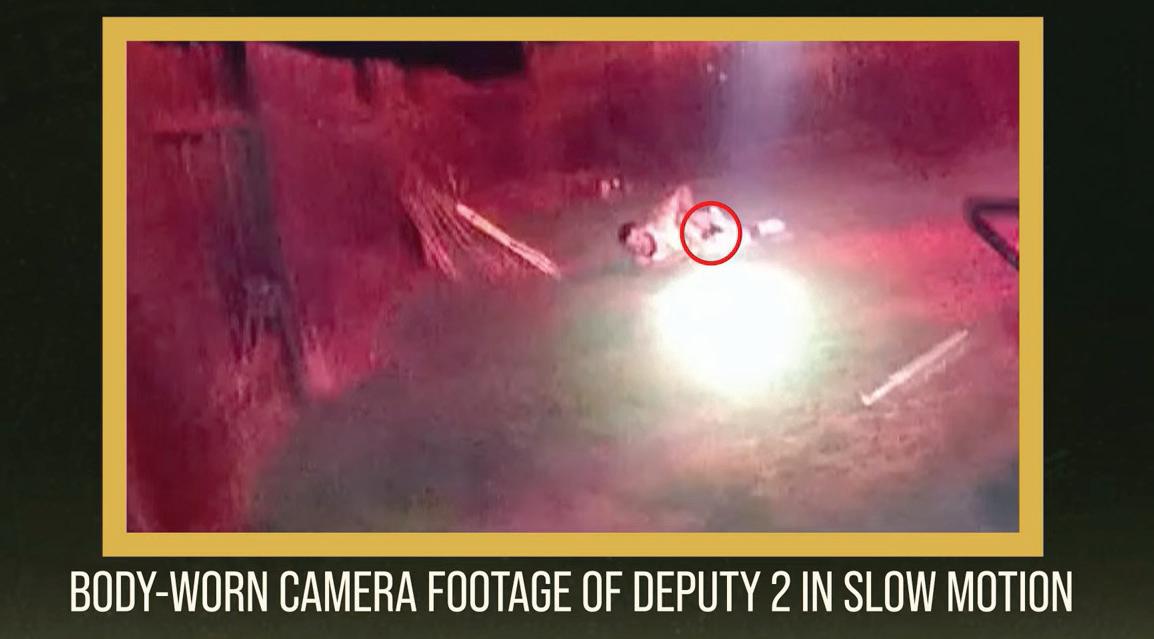
Authorities are investigatinganofficerinvolved shooting in Moreno Valley that led to the death of a 39-year-old man, Riverside County Sheriff Chad Bianco said Thursday.
Biancodescribedthe incident in a video posted on the department’s YouTube channel.Theshooting occurred shortly after deputies with the Moreno Valley Sheriff’s Station responded to a report of arson at 12:25 a.m. on Dec. 14 at a home in the 1600 block of Heather Glen Road.
The caller reported that a family member was acting erratically and attempting to set a fire inside the home, Bianco said. When deputies arrived, they found the home engulfed in flames and were told that the subject was at the rear of the residence. The deputies entered through the backyard and located a man lying on the ground.
The suspect failed to comply with orders, and instead, pointed a firearm at the deputies, prompting a deputy-involved shooting in which the man was struck, according to Bianco.
Deputies administered medical aid until paramedics arrived. He was transported to a local hospital in critical condition and was later pronounced deceased. Body camera footage of the incident was shown in the video.
The suspect was later identified as Marcus Lamoyne Martinez, 39, a resident of
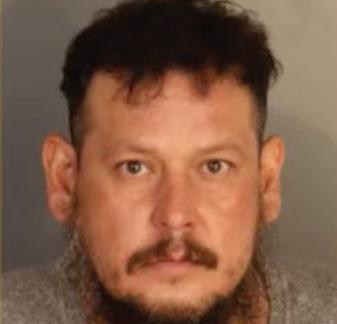

Moreno Valley. The weapon used by Martinez was a Glockstyle BB gun, according to Bianco.
“When we have a deputyinvolved shooting, multiple investigations are automatically launched,” Bianco said, adding that the Riverside County District Attorney’s Office will lead the investigation alongside the Riverside County Sheriff’s Office Force Investigations Detail.
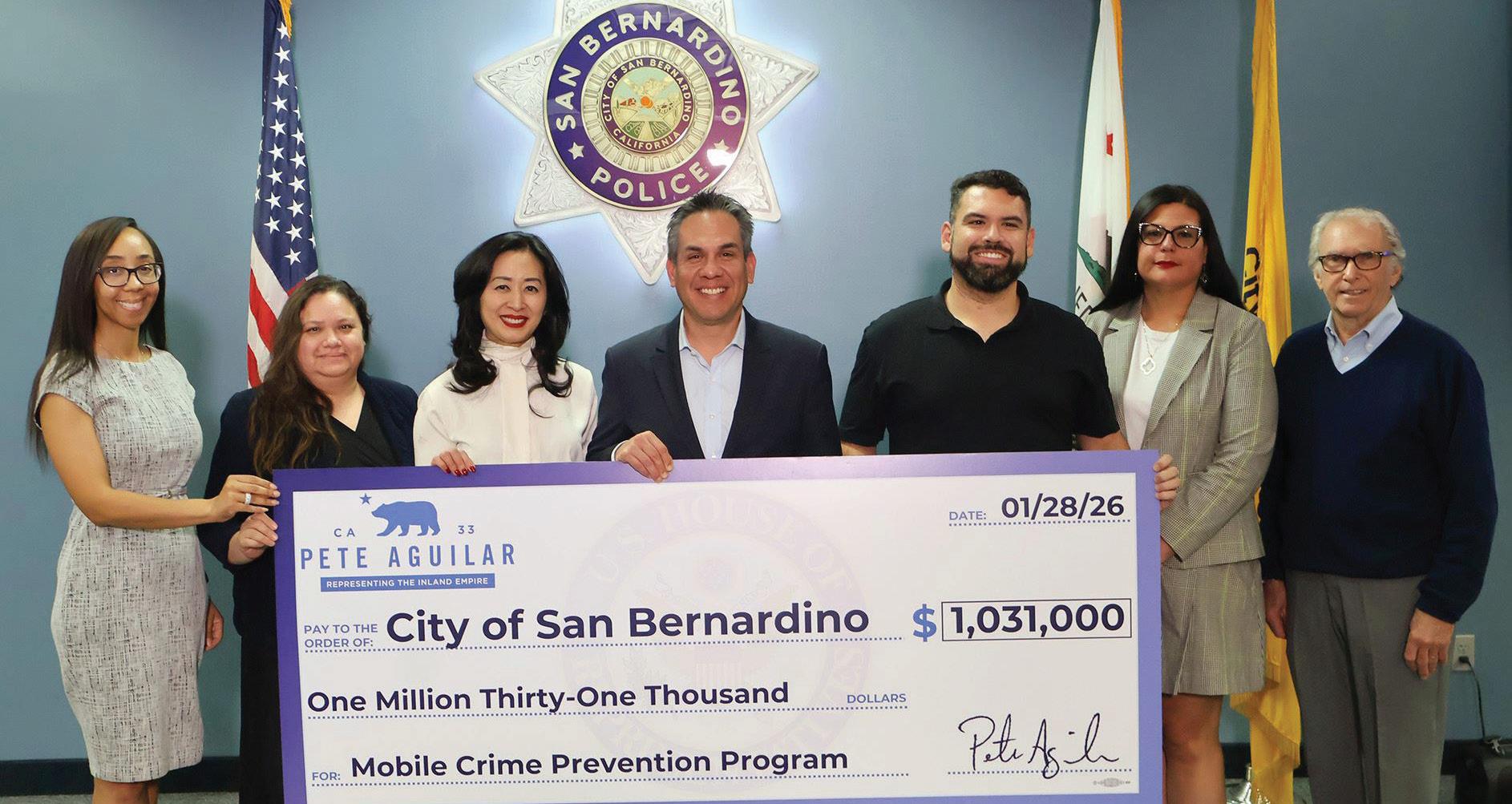
More than $1 million in federal funding will bring additional surveillance cameras and upgrades to the city’s public safety technology, officials
said. Rep. Pete Aguilar, D-San Bernardino, presented the city with a ceremonial $1.03 million check for the Police Department during a media
conference Wednesday. The federal funding will expand the SBPD’s use of technology to monitor and respond
mayor’s new Senior Forum connected seniors to resources and offered them a place to make their voices heard.
Riverside reached “functional zero” for youth
homelessness, ensuring young people ages 18 to 24 can access housing, services and support, according to Lock Dawson.
Riverside has 6,000 units of housing planned for seniors, students and families.
“This is Riverside’s moment. This is Riverside’s future. This is Riverside — leveling up,” Lock Dawson concluded.
By Sta
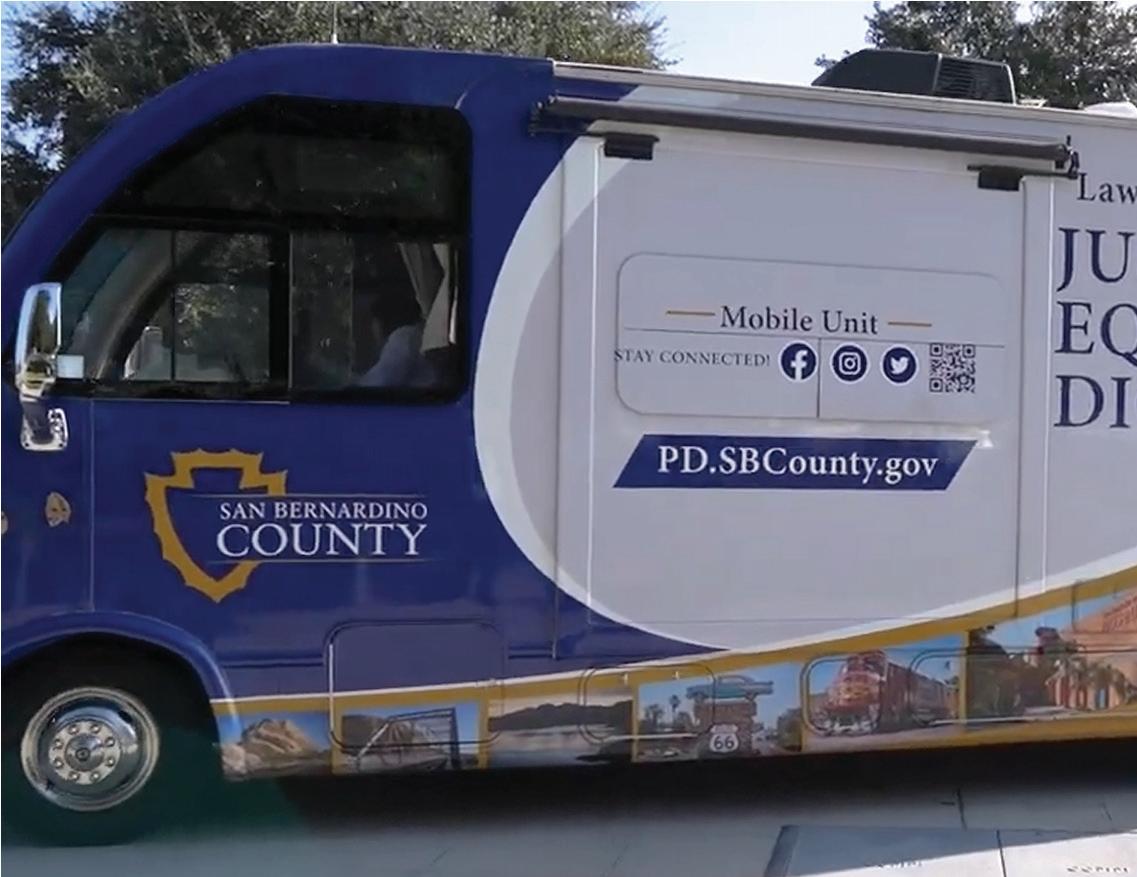
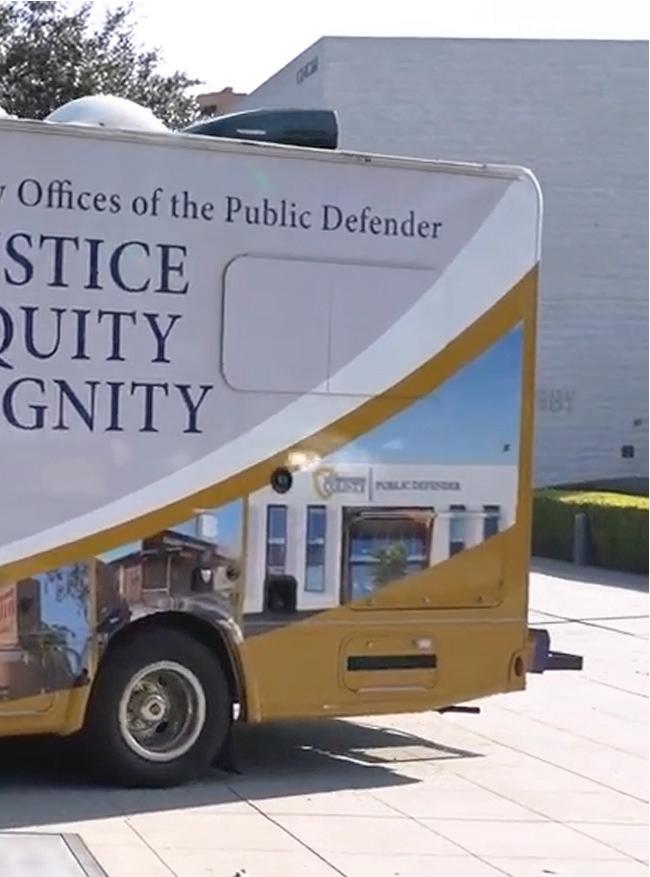
Communitymembers are invited to access free legal assistance and county services as the San Bernardino County Public Defender’s Office brings its Mobile Defense Program to the Joshua Tree Community Resource Fair on Wednesday, Feb. 11, from 12:30 to 4 p.m. at the Joshua Tree Community Center, 6171 Sunburst Ave.
The Mobile Defense Program expands access to free legal services to remote areas of San Bernardino County. At the Joshua Tree event, residents with San Bernardino County cases will have the opportunity to clear their records. Mobile court services will also be available to assist eligible participants with clearing bench warrants, modifying misdemeanor summary probation, re-enrolling in
court-required classes and resolving outstanding fines.
San Bernardino Superior Court Self-Help will be on site to answer questions related to family law, child support, guardianship,landlordtenant matters and small claims court procedures.
The Joshua Tree Community Resource Fair is hosted by San Bernardino County Special Districts in partnership with the Morongo Unified School District. Held on the second Wednesday of each month, the event connects residents of the Morongo Basin with local and county services and resources.
In addition to legal and court services, San Bernardino County departments will be present to connect residents with health care, employment support, family
services and public benefits, including:
- Arrowhead Regional Medical Center – health services and resources
- Assessor-RecorderCounty Clerk – vital records, document recording, business filings and property information
- Department of Behavioral Health – mental health and substance use resources
- Department of Child Support Services – assistance with cases and benefits
- Department of Public Health – dental care services and screenings
- Human Resources Department – county job opportunities and career counseling
- Transitional Assistance Department social service information, application assistance, document services
and case support
- Community-based organizations participating in the fair will also provide housing support, health and wellness services, reentry resources
Jand additional community outreach.
The Mobile Defense Program event is open to the public. Pre-registration is required for Mobile Court
services, and space is limited. For more information or to register for the Mobile Defense Program event, visit the Public Defender’s Office Eventbrite page or pd.sbcounty.gov.
oin the San Bernardino County Regional Parks along with Board of Supervisors Chairman and Third District Supervisor Dawn Rowe and Vice Chair and Fifth District Supervisor Joe Baca, Jr. on Thursday, Feb. 12, from noon to 1 p.m. to celebrate the completion of the Santa Ana River Trail (SART) Phase III with a ribbon-cutting ceremony and first official ride out onto the trail afterwards.
The project will eventually result in a complete path from the National Forest boundary in Mentone to the Pacific Ocean in Huntington Beach.
With the completion of Phase III, 11 miles of trail now makes it possible to walk or bicycle along the river from a spot north of California Street, through all of San Bernardino and Colton, and nearly to the western end of Riverside.
“Regional Parks is excited to complete this section of the Santa Ana River Trail bringing us 3.8 miles closer to the mountain crest. This will increase recreational opportunities for our users to bike, hike, walk or use as a means of alternate transportation that provides them a safe road of travel away from road traffic,” said Beahta Davis,
to incidents more effectively, help with solving crimes and deter criminal activity, according to city officials.
“Today we make a meaningful investment in the safety and security of the residents of the city of San Bernardino,” said Mayor Helen Tran, who was joined by City Council members Sandra Ibarra, Fred Shorett, Kim Knaus, Mario Flores and Treasure Ortiz.
The funds will expand
the Police Department’s Safety Camera Program and real-time information center, officials said. Additional security cameras will be installed in downtown San Bernardino and other strategic locations in an effort “to prevent, identify and assist” with criminal investigations leading to prosecutions.
Police will also use the funding for the department’s Mobile Crime
By Sta
director of Regional Parks. Regional Parks is responsible for the creation, operation and maintenance of the eventual 22 miles of trail within the county when Phase IV is completed.
Ceremony Details
- Location and parking: The ceremony will take place at the trail section behind the California Employment Development Department Tax Division Building, 658 E. Brier Drive, in San Bernardino. There is no public parking at the ribboncutting location. Parking and shuttles will be available at 268 W. Hospitality Lane in San Bernardino near the Hall
of Records building parking lot.
- Bike ride out: Trail enthusiasts are welcome to join us for the official bike ride after the ceremony. Riders who want to join us for the bike ride after the ceremony must ride out to the ceremony location on their bikes. We cannot transport any bikes on the shuttles.
- Arrive early: The ceremony location is about 10 minutes via shuttle from the parking lot at 268 W. Hospitality Lane. Allow travel time to the ceremony.
For more information on SART and Regional Parks, visit parks.sbcounty.gov.
Prevention Program to buy an unmarked surveillance van, unmarked vehicles that have surveillance equipment, surveillance cameras that can be relocated as needed and license-plate readers, according to the city.
“The utilization of security cameras and license plate readers are effective tools to decrease criminal activity,” Chief of Police Darren Goodman said.
“However, crime trends are often transient, and the city needs mobile surveillance solutions to continue successfully reducing crime and improving the community’s health and safety.”
Officials said the new surveillance gear will help continue the trend that has seen a significant crime reduction in recent years, including a drop in homicides by over 50%.
“Our department has

experienced a remarkable reduction in crime, thanks to the hard work of our officers, professional staff, and strong partnerships with our community,” said Goodman. “This funding allows us to build on that success by investing in technology that will further enhance public safety, improve our response capabilities, and help us continue driving crime down across San Bernardino.”
Community Project
Funding allows members of Congress to request targeted federal funds for specific local projects that benefit communities, including infrastructure, public services, public safety and economic development.
Officials said the process is very competitive, requires demonstrated community support and involves rigorous oversight by House and Senate committees.