Archbishop Gomez calls for limiting deportations, hearing for immigration bill

MONDAY, FEBRUARY 02-FEBRUARY 08, 2026
Archbishop Gomez calls for limiting deportations, hearing for immigration bill
MONDAY, FEBRUARY 02-FEBRUARY 08, 2026
By City News Service
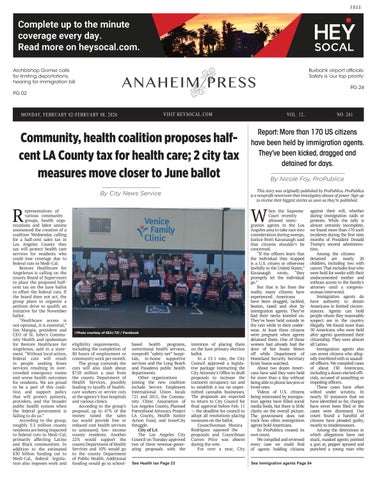
Representativesof variouscommunity groups, health organizations and labor unions announced the creation of a coalition Wednesday calling for a half-cent sales tax in Los Angeles County they say will protect health care services for residents who could lose coverage due to federal cuts to Medi-Cal. Restore Healthcare for Angelenos is calling on the county Board of Supervisors to place the proposed halfcent tax on the June ballot to offset the federal cuts. If the board does not act, the group plans to organize a petition drive to qualify an initiative for the November ballot.
“Healthcare access is not optional, it is essential,” Jim Mangia, president and CEO of St. John’s Community Health and spokesman for Restore Healthcare for Angelenos, said in a statement. “Without local action, federal cuts will result in people seeking fewer services resulting in overcrowded emergency rooms and worse health outcomes for residents. We are proud to be a part of this coalition and support policy that will protect patients, providers, and the broader public health system when the federal government is failing to do so.”
According to the group, roughly 3.3 million county residents are being impacted to federal cuts to Medi-Cal, primarily affecting Latino and Black communities. In addition to the estimated $30 billion funding cut to Medi-Cal, federal legislation also imposes work and
eligibilityrequirements, including the completion of 80 hours of employment or community work per month.
The group contends the cuts will also slash about $750 million a year from the county Department of Health Services, possibly leading to layoffs of healthcare workers or service cuts at the agency’s four hospitals and various clinics. According to the group’s proposal, up to 47% of the money raised the sales tax would provide free or reduced cost health services to uninsured, low- income county residents. Another 22% would support the county Department of Health Services and 10% would go to the county Department of Public Health. Additional funding would go to school-
based health programs, correctional health services, nonprofit “safety net” hospitals, in-home supportive services and the Long Beach and Pasadena public health departments.
Otherorganizations joining the new coalition include Service Employees International Union locals 721 and 2015, the Community Clinic Association of Los Angeles County, Planned Parenthood Advocacy Project LA County, Health Justice Action Fund, and InnerCity Struggle.
City of LA
The Los Angeles City Council on Tuesday approved two of three revenue-generating proposals with the
intention of placing them on the June primary election ballot.
In a 13-1 vote, the City Council approved a legislative package instructing the City Attorney’s Office to draft proposals to increase the transient occupancy tax and to establish a tax on unpermitted cannabis businesses. The proposals are expected to return to City Council for final approval before Feb. 11 — the deadline for council to adopt all resolutions placing measures on the ballot.
CouncilwomanMonica Rodriguezopposedthe proposals and Councilman Curren Price was absent during the vote.
For over a year, City
Burbank airport officials: Safety is ‘our top priority’
Report: More than 170 US citizens have been held by immigration agents. They’ve been kicked, dragged and detained for days.
By Nicole Foy, ProPublica
This story was originally published by ProPublica. ProPublica is a nonprofit newsroom that investigates abuses of power. Sign up to receive their biggest stories as soon as they’re published.
WhentheSupreme Courtrecently allowedimmigration agents in the Los Angeles area to take race into consideration during sweeps, Justice Brett Kavanaugh said that citizens shouldn’t be concerned.
“If the officers learn that the individual they stopped is a U.S. citizen or otherwise lawfully in the United States,” Kavanaugh wrote, “they promptly let the individual go.”
But that is far from the reality many citizens have experienced.Americans have been dragged, tackled, beaten, tased and shot by immigration agents. They’ve had their necks kneeled on. They’ve been held outside in the rain while in their underwear. At least three citizens were pregnant when agents detained them. One of those women had already had the door of her home blown off while Department of Homeland Security Secretary Kristi Noem watched.
About two dozen Americans have said they were held for more than a day without being able to phone lawyers or loved ones.
Videos of U.S. citizens being mistreated by immigration agents have filled social media feeds, but there is little clarity on the overall picture. The government does not track how often immigration agents hold Americans.
So ProPublica created its own count.
We compiled and reviewed every case we could find of agents holding citizens
against their will, whether during immigration raids or protests. While the tally is almost certainly incomplete, we found more than 170 such incidents during the first nine months of President Donald Trump’s second administration.
Amongthecitizens detained are nearly 20 children, including two with cancer. That includes four who were held for weeks with their undocumented mother and without access to the family’s attorney until a congresswoman intervened.
Immigration agents do have authority to detain Americans in limited circumstances. Agents can hold people whom they reasonably suspect are in the country illegally. We found more than 50 Americans who were held after agents questioned their citizenship. They were almost all Latino.
Immigration agents also can arrest citizens who allegedly interfered with or assaulted officers. We compiled cases of about 130 Americans, including a dozen elected officials, accused of assaulting or impeding officers.
These cases have often wilted under scrutiny. In nearly 50 instances that we have identified so far, charges have never been filed or the cases were dismissed. Our count found a handful of citizens have pleaded guilty, mostly to misdemeanors. Among the detentions in which allegations have not stuck, masked agents pointed a gun at, pepper sprayed and punched a young man who
By City News Service
ArchbishopJoséH. Gomezcontinued Wednesday to call for restoring “order and peace to our streets,” following violence stemming from immigration enforcement actions along with limiting “deportations to violent criminals or those guilty of other serious offenses” and hearings on a bill to change immigration laws.
“I am deeply troubled by the violence in Minneapolis and the ongoing climate of fear and uncertainty here in Los Angeles and in cities across the country, as federal immigrationenforcement actions continue,” Gomez wrote in his weekly column, which was published Tuesday in Angelusnews.com, the multimedia news platform of Archdiocese of Los Angeles.
“As a pastor, my heart aches for our people and
for our country. We pray for those who have lost their lives or been injured. We pray for the safety of our law enforcement officers, and for wisdom for our leaders. We pray especially for our immigrant brothers and sisters, who are powerless and caught in the middle of this struggle, living in fear for their futures. The country cannot go on like this.”
Gomez wrote that in responsetoSaturday’s shooting death of nurse Alex Pretti by federal officers who tried to take him into custody during a protest in Minneapolis “federal authorities, city and state officials, and those protesting the enforcement actions” take “a step back in the interests of the common good.”
“We are caught in a dangerous pattern of angry

rhetoric, provocations, and violence,” Gomez wrote. “It needs to stop. There is no question that the federal government has the duty to enforce immigration laws. But there must be a better
By City News Service
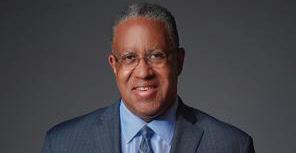
LorenBlanchard,a former California State Universityexecutive vice chancellor for Academic and Student Affairs, was announced Wednesday as the next president of Cal State Long Beach.
Blanchard, who currently serves as president of the UniversityofHoustonDowntown, will take over the position on May 1.
“I am deeply honored and profoundly humbled to be named Cal State Long Beach’s next president,” Blanchard said in a statement. “CSULB is renowned for being a student-centereduniversity that fosters a culture of holistic support, community engagement and inclusive
excellence. I look forward to joining The Beach community in the transformational work it does every day to turn dreams into reality for thousands of diverse and talented students.”
Blanchard will replace interim President Andrew Jones, who has been filling the role since August following the retirement of President Jane Close Conoley.
“The committee was impressed with Dr. Blanchard’s demonstrated strategic and inclusive leadership style and strong commitment to student success,” CSU Trustee Christopher Steinhauser, who chaired the president search committee, said in a statement. “We have every confi-
dence that he will lead Cal State Long Beach adeptly, collaboratively, and with integrity and vision.”
Blanchard has been leading University of Houston-Downtown for the past five years. He previously served as provost and senior vice president of Academic Affairs at Xavier University of Louisiana, associate vice chancellor for Academic and Multicultural Affairs at the Louisiana State University Health Sciences Center, and served as provost and senior vice president for Academic Affairs and associate vice president for Accreditation, Leadership & Accountability in the University of Louisiana system.
their parents. Surely, we can find another way to hold these men and women accountable for breaking our laws.”
Gomez called for a hearing on H.R. 4393, billed by its sponsors as the “Dignity for Immigrants while Guarding our Nation to Ignite and Deliver the American Dream Act of 2025.”
the 2.5 million Dreamers,” referring to a term for people who were brought to the United States illegally as children by family, based on never-passed proposals in Congress called the DREAM Act.
way than this.” Gomez said “it serves no national interest to deport undocumented men and women who are contributing to the good of our society, it only leaves children without
“The bill would reform the visa and asylum processes, tighten border security and enforcement measures, and establish a mandatory, nationwide electronic verification system for employers,” Gomez said. “It would provide a path to a legal status for the millions of undocumented people who have been living and working in the country for five years or more and also a path to citizenship for
“The bill holds undocumented immigrants accountable for breaking federal law, requiring them to undergo a criminal background check, pay back taxes they owe, and it imposes a stiff penalty fee. The bill would also sharply limit enforcement actions at `sensitive locations’ such as churches, hospitals, schools, and courthouses.”
Gomez said “there is much to improve in this legislation, but it is a genuine, good-faith starting point. And we need to start somewhere. And we need to start now.”
By Staff
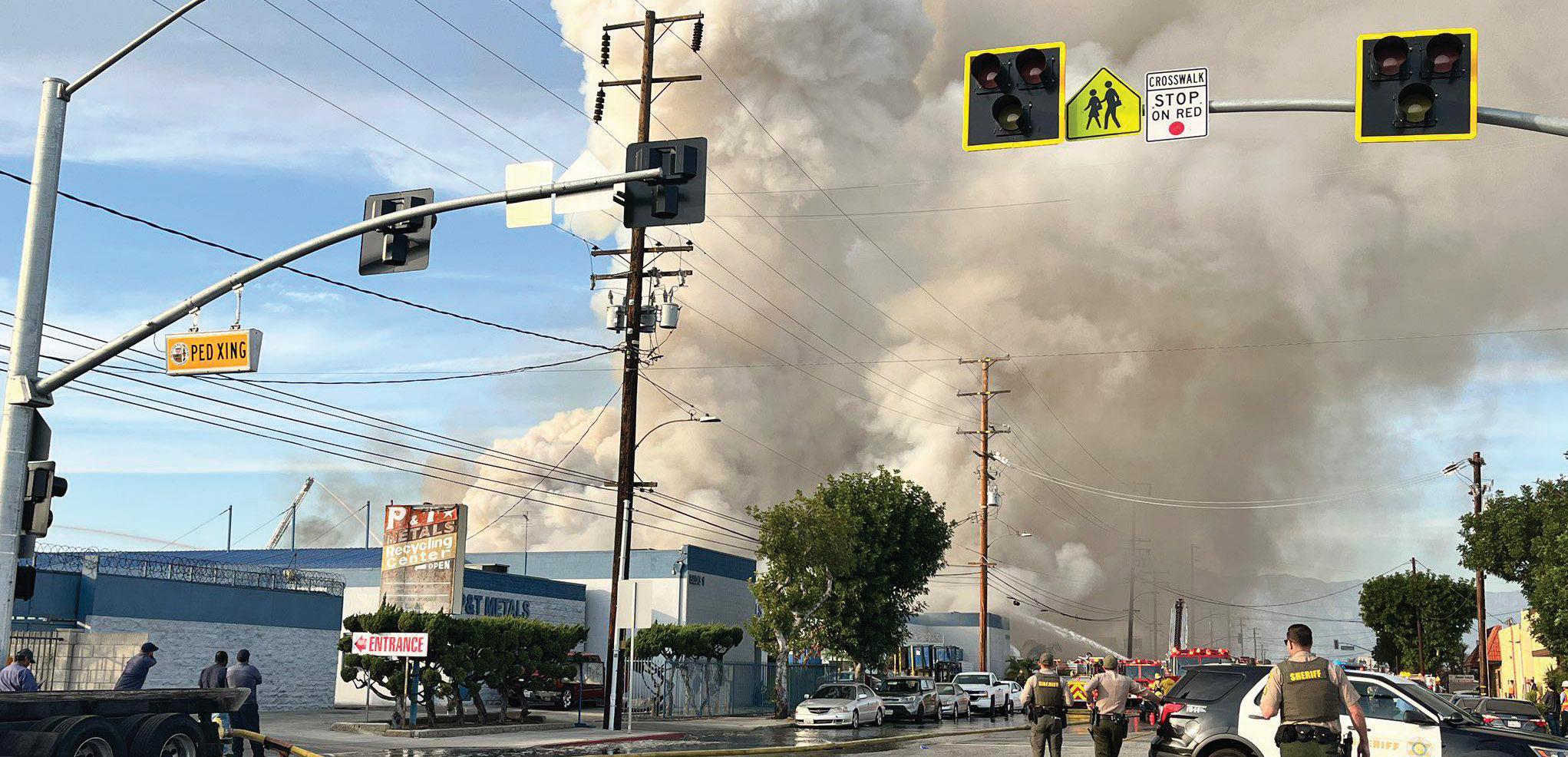
An investigation using heavy equipment was underway Thursday to comb through material at a metal recycling facility following a more than 15-hour firefight in South El Monte.
Firefightersinitially responded to the threealarm blaze, which sent up thick plumes and columns of smoke seen for miles, at 2:32 p.m. Wednesday at P&T Metals in the 2200 block of North Tyler Avenue, the Los Angeles County Fire Department reported.
The fire caused multiple explosions, but Fire Department Public Information Officer Keith Navarre could not confirm reports that propane tanks blew up or that
the blaze had been classified as a titanium fire.
There were multiple types of metal at the facility, he told City News Service, but no injuries were reported and searches for potential victims have concluded.
The Fire Department’s Health HazMat unit and Urban Search and Rescue teams were involved in the response, according to Navarre.
Concerns over possibly toxic smoke prompted a shelter in place order after the fire broke out. The order was lifted around 10 p.m. Wednesday, after continuous monitoring returned negative results of dangerous contaminants, Navarre said.
Los Angeles County
Board Chair and 1st District Supervisor Hilda Solis issued a statement Wednesday that said her “office is actively coordinating with state officials and city officials to address the fire” and advised residents to heed the shelterin-place order.
P&T Metals recycles industrial scrap metal, including aluminum, copper, brass, iron, steel, titanium, exotic and precious metals and high-temperature alloys, according to the company’s website. In business for nearly 60 years, the company’s South El Monte facility covers four acres. The cause of the fire was under investigation, but arson is not suspected, Navarre said.
Editorial editorial@beaconmedianews.com
editor@hlrmedia.com
Graphics/Production production@beaconmedianews.com production@hlrmedia.com
Advertising advertising@beaconmedianews.com advertising@hlrmedia.com
Legal Advertising legals@beaconmedianews.com legals@hlrmedia.com
Business accounting@beaconmedianews.com accounting@hlrmedia.com
BEACON MEDIA ADDRESS: 820 S. Myrtle Ave. Monrovia, CA 91016
PHONE: (626) 301-1010
WEBSITE www.beaconmedianews.com
HLR MEDIA ADDRESS: 820 S. Myrtle Ave. Monrovia, CA 91016
PHONE: (626) 301-1010 www.HLRmedia.com
PRESS
editor@beaconmedianews.com editor@hlrmedia.com














By Jackie Dowling for Sunsweet Growers via Stacker
he phrase “gut health” is coming up a lot lately online and in the wellness world. Digestive health has gone from being a niche topic to a critical element to feeling good overall: from energy levels and mood to comfort and balance.
At the same time, fiber has stepped out of the background. It’s no longer just something nutrition experts talk about; it’s something people actively say they try to eat more of. The catch? 90% of women and 97% of men in the U.S. are not meeting their daily fiber requirements. They lack clarity on how much they need, how it affects their body beyond digestion, and how to realistically incorporate it into their daily routine.
A new national survey commissioned by Sunsweet Growers explores how Americans think about gut health, fiber, and feeling good. The data shows gut health is a priority, but people still aren’t sure how to get the fiber they need.


whole grains and dark leafy greens. Many whole foods, like prunes, contain both forms of fiber.
Survey finds Americans think gut health is a core part of wellness
What is fiber and why do we need it?
Fiber is a type of carbohydrate found in plant foods that your body can’t fully digest — but that’s actually a good thing. Instead of being broken down, fiber moves through the body undigested, helping things run smoothly and keeping your hunger and blood sugar levels stabilized. Fiber can help you feel fuller longer, support healthy blood sugar levels, and even lower cholesterol.











There are two kinds of fiber — soluble and insoluble — and both are essential to overall health. Soluble fiber slows digestion and can help lower cholesterol, and it can be found in foods like oats, beans and apples. Insoluble fiber helps move foods through the digestive tract and promote regularity, and it can be found in foods like
According to the Nutrition and Digestive Health Survey, an online survey of 1,249 nationally representative American adults fielded by YouGov on behalf of Sunsweet conducted December 18-19, 2025, most Americans see gut health as a core part of everyday wellness.
Findings include:
- Good digestion is rated as important by 95% of U.S. adults and sits on par with hydration (97%), vitamin intake (92%), and energy levels (91%).
- 84% of U.S. adults believe that gut health is at least somewhat associated with feeling good day to day.
- Parents are more likely than non-parents to say having good digestion is very important to their overall well-being (71% vs. 61%).
Malina Malkani, MS, RD, who has worked with
Sunsweet, explains, “As both a pediatric dietitian and mom of three, I know too well how disruptive digestive discomfort can be for families. Supporting digestive health through adequate fiber intake isn’t just about optimizing their gut health; it’s about helping the whole family feel good so that family life runs more smoothly.”
According to the survey:
- Nearly half of U.S. adults (44%) wish it were easier to get more fiber day to day, yet a majority either don’t know how much fiber they should consume (37%) or underestimate the recommended amount (20% select fewer than 20 grams).
- When asked, “About how many grams of fiber do you think the average adult needs per day?” respondents answered: Under 10 grams (4%); 10–19 grams (16%); 20–29 grams (26%); 30 grams or more (17%); Don’t know (37%).
Simple habits are the way to wellness
As Americans increasingly define wellness by how they feel, fiber sits at the
center of that shift. If you’re ready to embrace a fiberrich diet, set yourself up for success with small, manageable nutrition habits that fit into real life rather than big, restrictive overhauls.
“Small, simple shifts, made gradually and paired with plenty of fluids to help keep things moving, can make a meaningful difference in fiber intake,” Malkani explains. “Choosing foods like prunes is an easy way to increase your fiber intake by adding three grams per serving. You can also swap to whole grains over refined, add beans and vegetables to soups, stews, or dips, incorporate fruit into yogurt parfaits or oatmeal, and add ground nuts or seeds into smoothies, pancakes, or muffins.”
With a little intention and a few smart swaps, getting enough fiber can move from a challenge to a habit that supports long-term health. This story was produced by Sunsweet Growers and reviewed and distributed by Stacker.
Republished with Creative Commons License (CC BY-NC 4.0).
IBy Suzanne Potter, Public News Service
magine if your insurance company raised your rates because your car has been spying on you, sending information which ends up with data brokers every time you brake too hard, drive at night, or go over the speed limit. It is what the Federal Trade Commission said happened to drivers of General Motors vehicles with the OnStar Smart Driver feature. Now the Commission has ordered the
data transfers be stopped.
Lena Cohen, staff technologist for the nonprofit Electronic Frontier Foundation, said some drivers had
no idea they had enrolled in the feature because car salespeople signed them up without telling them to get an enrollment bonus.
had filmed them searching for his relative. In another, agents knocked over and then tackled a 79-year-old car wash owner, pressing their knees into his neck and back. His lawyer said he was held for 12 hours and wasn’t given medical attention despite having broken ribs in the incident and having recently had heart surgery. In a third case, agents grabbed and handcuffed a woman on her way to work who was caught up in a chaotic raid on street vendors. In a complaint filed against the government, she described being held for more than two days, without being allowed to contact the outside world for much of that time. (The Supreme Court has ruled that two days is generally the longest federal officials can hold Americans without charges.)
In response to questions from ProPublica, the Department of Homeland Security said agents do not racially profile or target Americans. “We don’t arrest US citizens for immigration enforcement,” wrote spokesperson Tricia McLaughlin.
A top immigration official recently acknowledged agents do consider someone’s looks. “How do
they look compared to, say, you?” Border Patrol chief Gregory Bovino said to a white reporter in Chicago.
The White House told ProPublica that anyone who assaults federal immigration agents would be prosecuted. “Interfering with law enforcement and assaulting law enforcement is a crime and anyone, regardless of immigration status, will be held accountable,” said the Deputy Press Secretary Abigail Jackson. “Officers act heroically to enforce the law, arrest criminal illegal aliens, and protect American communities with the utmost professionalism.”
A spokesperson for Kavanaugh did not return an emailed request for comment.
Tallying the number of Americans detained by immigration agents is inherently messy and incomplete. The government has long ignored recommendations for it to track such cases, even as the U.S. has a history of detaining and even deporting citizens, including during the Obama administration and Trump’s first term.
We compiled cases by sifting through both English- and Spanish-
language social media, lawsuits, court records and local media reports. We did not include arrests of protesters by local police or the National Guard. Nor did we count cases in which arrests were made at a later date after a judicial process. That included cases of some people charged with serious crimes, like throwing rocks or tossing a flare to start a fire.
Experts say that Americans appear to be getting picked up more now as a result of the government doing something that it hasn’t for decades: largescale immigration sweeps across the country, often in communities that do not want them.
In earlier administrations, deportation agents used intelligence to target specific individuals, said Scott Shuchart, a top immigration official in the Biden, Obama and first Trump administrations. “The new idea is to use those resources unintelligently” — with officers targeting communities or workplaces where undocumented immigrants may be.
When federal officers roll through communities in the way the Supreme Court

permitted, the constitutional rights of both citizens and noncitizens are inevitably violated, argued David Bier, the director of immigration studies at the libertarian Cato Institute. He recently analyzed how sweeps in Los Angeles have led to racial profiling. “If the government can grab someone because he’s a certain demographic group that’s correlated with some offense category, then they can do that in any context.”
Cody Wofsy, an attorney at the American Civil Liberties Union, put it even more starkly. “Any one of us could be next.”
When Kavanaugh issued his opinion that immigration agents can consider race and other factors, the Supreme Court’s three liberal justices strongly dissented. They warned that citizens risked being “grabbed, thrown to the ground, and handcuffed simply because of their looks, their accents, and the fact they make a living by doing manual labor.”
Leonardo Garcia Venegas appears to have been just such a case. He was working at a construction site in coastal Alabama when he saw masked immigration agents from Homeland Security Investigations hop a fence and run by a “No trespassing” sign. Garcia Venegas recalled that they moved toward the Latino workers, ignoring the white and Black workers.
Garcia Venegas began filming after his undocumented brother asked agents for a warrant. In response, the footage shows, agents yanked his brother to the ground, shoving his face into wet concrete. Garcia Venegas kept filming until officers grabbed him too and knocked his phone to the ground.
Other co-workers filmed what happened next, as
immigration agents twisted the 25-year-old’s arms. They repeatedly tried to take him to the ground while he yelled, “I’m a citizen!”
Officers pulled out his REAL ID, which Alabama only issues to those legally in the U.S. But the agents dismissed it as fake. Officers held Garcia Venegas handcuffed for more than an hour. His brother was later deported.
Garcia Venegas was so shaken that he took two weeks off of work. Soon after he returned, he was working alone inside a nearly built house listening to music on his headphones when he sensed someone watching him. A masked immigration agent was standing in the bedroom doorway.
This time, agents didn’t tackle him. But they again dismissed his REAL ID. And then they held him to check his citizenship. Garcia Venegas says agents also held two other workers who had legal status.
DHS did not respond to ProPublica’s questions about Garcia Venegas’ detentions, or to a federal lawsuit he filed last month. The agency has previously defended the agents’ conduct, saying he “physically got in between agents and the subject” during the first incident. The footage does not show that, and Garcia Venegas was never charged with obstruction or any other crime.
Garcia Venegas’ lawyers at the nonprofit Institute for Justice hope others may join his suit. After all, the reverberations of the immigration sweeps are being felt widely. Garcia Venegas said he knows of 15 more raids on nearby construction sites, and the industry along his portion of the Gulf
See Immigration agents Page 05
Coast is struggling for lack of workers.
Kavanaugh’s assurances hold little weight for Garcia Venegas. He’s a U.S. citizen of Mexican descent, who speaks little English and works in construction. Even with his REAL ID and Social Security card in his wallet, Garcia Venegas worries that immigration agents will keep harassing him.
“If they decide they want to detain you,” he said. “You’re not going to get out of it.”
George Retes was among the citizens arrested despite immigration agents appearing to know his legal status. He also disappeared into the system for days without being able to contact anyone on the outside.
The only clue Retes’ family had at first was a brief call he managed to make on his Apple Watch with his hands handcuffed behind his back. He quickly told his wife that “ICE” had arrested him during a massive raid and protest on the marijuana farm where he worked as a security guard.
Still, Retes’ family couldn’t find him. They called every law enforcement agency they could think of. No one gave them any answers.
Eventually, they spotted a TikTok video showing Retes driving to work and slowly trying to back up as he’s caught between agents and protestors. Through the tear gas and dust, his family recognized Retes’ car and the veteran decal on his window. The full video shows a man — Retes — splayed on the ground surrounded by agents.
Retes’ family went to the farm, where local TV reporters were interviewing families who couldn’t find
their loved ones.
“They broke his window, they pepper sprayed him, they grabbed him, threw him on the floor,” his sister told a reporter between sobs. “We don’t know what to do. We’re just asking to let my brother go. He didn’t do anything wrong. He’s a veteran, disabled citizen. It says it on his car.”
Retes was held for three days without being given an opportunity to make a call. His family only learned where he had been after his release. His leg had been cut from the broken glass, Retes told ProPublica, and lingering pepper spray burned his hands. He tried to soothe them by filling sandwich bags with water.
Retes recalled that agents knew he was a citizen. “They didn’t care.” He said one DHS official laughed at him, saying he shouldn’t have come to work that day. “They still sent me away to jail.” He added that cases like his show Kavanaugh was “wrong completely.”
DHS did not answer our questions about Retes. It did respond on X after Retes wrote an op-ed last month in the San Francisco Chronicle. An agency post asserted he was arrested for assault after he “became violent and refused to comply with law enforcement.” Yet Retes had been released without any charges. Indeed, he says he was never told why he was arrested.
The Department of Justice has encouraged agents to arrest anyone interfering with immigration operations, twice ordering law enforcement to prioritize cases of those suspected of obstructing, interfering with or assaulting immigration officials. But the government’s
claims in those cases have often not been borne out.
Daniel Montenegro was filming a raid at a Van Nuys, California, Home Depot with other day-laborer advocates this summer when, he told ProPublica, he was tackled by several officers who injured his back.
Bovino, the Border Patrol chief who oversaw the LA raids and has since taken similar operations to cities like Sacramento and Chicago, tweeted out the names and photos of Montenegro and three others, accusing them of using homemade tire spikes to disable vehicles.
“I had no idea where that story came from,” Montenegro told ProPublica. “I didn’t find out until we were released. People were like, ‘We saw you on Twitter and the news and you guys are terrorists, you were planning to slash tires.’ I never saw those spike tire-popper things.”
Officials have not charged Montenegro or the others with any crimes. (Bovino did not respond to a request for comment, while DHS defended him in a statement to ProPublica: “Chief Bovino’s success in getting the worst of the worst out of the country speaks for itself.”)
The government’s cases are sometimes so muddied that it’s unclear why agents actually arrested a citizen.
Andrea Velez was charged with assaulting an officer after she was accidentally dropped off for work during a raid on street vendors in downtown Los Angeles. She said in a federal complaint that officers repeatedly assumed she did not speak English. Federal officers later requested access to her phone in an attempt to prove she was colluding with another citizen arrested that day,
who was charged with assault. She was one of the Americans held for more than two days.
DHS did not respond to our questions about Velez, but it has previously accused her of assaulting an officer. A federal judge has dismissed the charges.
Other citizens also said officers accused them of crimes and suddenly questioned their citizenship — including a man arrested after filming Border Patrol agents break a truck window, and a pregnant woman who tried to stop officers from taking her boyfriend.
The prospects for any significant reckoning over agents’ conduct, even against citizens, are dim. The paths for suing federal agents are even more limited than they are for local police. And that’s if agents can even be identified. What’s more, the administration has gutted the office that investigates allegations of abuse by agents.
“The often-inadequate guardrails that we have for state and local government — even those guardrails are nonexistent when you’re talking about federal overreach,” said Joanna Schwartz, a professor at UCLA School of Law.
More than 50 members of Congress have also written to the administration, demanding details about Americans who’ve been detained. One is Sen. Alex Padilla, a California Democrat. After trying to question Noem about detained citizens, federal agents grabbed Padilla, pulled him to the ground and handcuffed him. The department later defended the agents, saying they “acted appropriately.”
Republished with Creative Commons License (CC BY-NC-ND 3.0).


“But even drivers who did realize they’d signed up for these OnStar features didn’t realize the extent of the data they were sharing and what that data was being used for,” Cohen explained.
GM said in a statement the company has discontinued the Smart Driver program, unenrolled all customers, and ended relationships with data companies LexisNexis and Verisk. The commission imposed a five-year ban on GM and OnStar disclosing certain
data to consumer reporting agencies. For 20 years, the company must also get consent from consumers prior to collecting, using, or sharing connected vehicle data, create a way for people to request a copy of their data and get it deleted and allow consumers to opt out or disable data collection.
Cohen urged Congress to pass strong data privacy laws applying to all car companies.
“It’s too easy for companies to bury their data
collection and sharing practices in long terms of service that no one actually reads,” Cohen asserted. “All carmakers should be forced to get people’s explicit consent before engaging in invasive data-sharing practices like these.”
You can find out what data your car is set up to collect at VehiclePrivacyReport.com. It is also possible to request a report from Lexis Nexis and Verisk to see what information they have about you.

By Doug Bock Clark and Jen Fifield, ProPublica
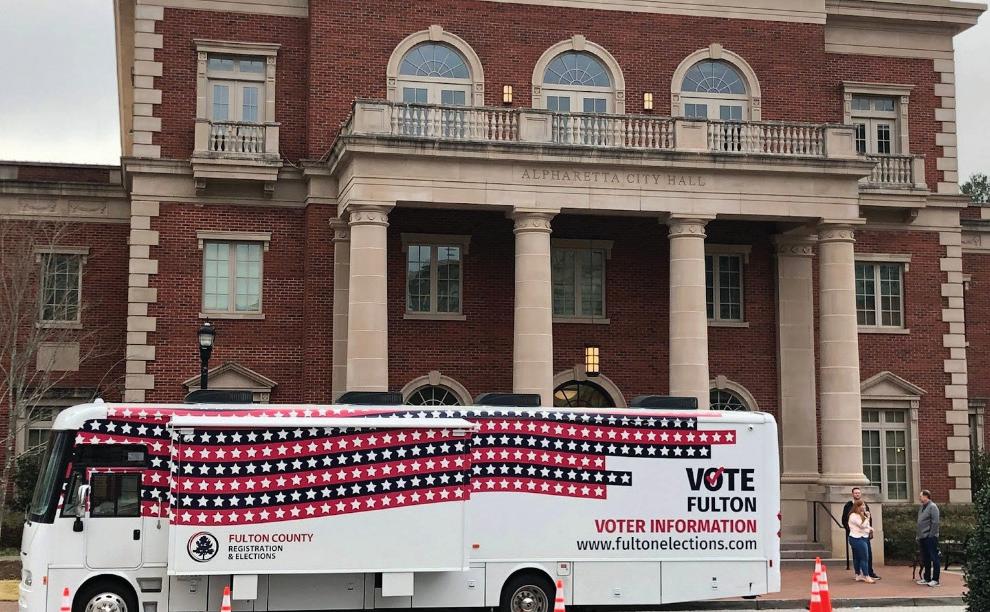
WhentheFBI executed a warrant on Wednesday to seize records from the 2020 presidential vote in Fulton County, Georgia, it marked both an extraordinary event in the history of American elections and a significant escalationinPresident Donald Trump’s breaking of democratic norms, several legal experts said.
Trump has long claimed, without evidence, that the 2020 election was stolen from him and blamed Georgia, in particular, for his loss to Joe Biden. After the election, he famously made a call pressuring the secretary of state to “find” him enough votes to win. About a week ago, in a speech at the World Economic Forum, Trump once again called the 2020 election “rigged” and promised, “People will soon be prosecuted for what they did.”
The warrant served on the Fulton County election center sought ballots, tabulator tapes, digital data and voter rolls, which it alleged might constitute “evidence of the commission of a criminal offense.” It cited stiff criminal penalties related to “the procurement, casting, or tabulation” of fraudulent ballots.
“I’m not aware of something like this happening ever before,” said Rick Hasen, a professor at the law school of the University of California, Los Angeles. “The idea that federal officials would seize ballots in an attempt to prove fraud is especially dangerous in this context when we know there is no fraud because the Georgia 2020 election has been extensively counted, recounted and investigated.”
Trump and his allies filed over 60 legal cases across the nation seeking to overturn the 2020 election results — all of which failed, even those before Trump-
appointed judges.
“This just looks like a way to use the might of the federal government to further Trump’s voter fraud narratives,” Hasen said.
An FBI spokesperson declined a request for comment except to say that the bureau “is conducting court-authorized law enforcement activity. No other information is available at this time.”
At a press conference, Fulton County Commission Chair Robb Pitts said that the ballots had been “safe” in the county’s custody and defended its handling of the election as fair and accurate. But now that the ballots had been seized, he said, the county “can no longer satisfy … that those ballots are still secure.”
Mo Ivory, a Democratic Fulton County commissioner, arrived on the scene shortly after the FBI agents and said that once
an error on the warrant was corrected, they backed up lines of trucks to the elections warehouse and spent hours carting away boxes of ballots and other materials. The search began in the morning and was still going well past nightfall.
“This is not legitimate. This is Donald Trump’s obsession with losing the 2020 election,” Ivory said. “This is his way to sow doubt that Fulton County doesn’t hold proper elections.”
Fulton County — which covers much of the Democratic-stronghold of Atlanta — has long been the target of attempts to call into question its election systems as a way to cast doubt on the legitimacy of the 2020 vote.
In the immediate aftermath of the election, Trump’s attorney Rudy Giuliani accused election workers of rigging the vote
with suitcases of ballots in his arguments to overturn the election — claims that were quickly debunked and for which he lost a nearly $150 million defamation lawsuit brought by two of the workers.
But this did not end the focus on the county by Trump’s allies, who inundated it with thousands of voter registration challenges and continued to make claims of voter fraud, as ProPublica has reported.
The Fulton County Board of Elections became a battleground, once the Republican Party appointed Julie Adams to it. Adams, ProPublica has reported, played a key role in trying to change rules around certifying elections in Georgia that could have allowed activists to dispute a Trump loss in 2024. (Adams didn’t respond to questions from ProPublica for these articles.)
In advance of the 2024 election, right-wing activists also forced out a moderate conservative on the Georgia State Election Board, tilting its balance of power. Its new MAGA majority — which Trump praised by name at a rally as “pit bulls fighting for honesty, transparency and victory” — began relitigating the 2020 election. In October 2024, the State Election Board voted to issue subpoenas for 2020 materials, including ballots.
Once Trump returned to the White House, state and federal officials combined to pressure Fulton County to hand over 2020 voting materials.
In the months after the State Election Board passed a resolution suggesting the Justice Department should intervene, Attorney General Pam Bondi sent letters to Fulton County officials demanding records
and citing “anomalies” in counting votes during the 2020 election, according to a court filing.
Fulton County Clerk Ché Alexander didn’t respond, and in December the U.S. Department of Justice sued her.
In a court filing, Alexander said that the federal government had no right to the ballots and documents, which were under seal because of ongoing cases related to the 2020 election.
Alexander said that if Bondi could “identify a legitimate basis” for accessing the 2020 election materials, then she should seek an order from a Fulton County Superior Court judge to unseal them.
On Wednesday, agents wearing tactical vests and jackets reading “FBI Evidence Response Team” arrived with a warrant. Shocked officials looked on as the boxes were paraded away.
Ivory, the Fulton County commissioner, said that while county officials had complied with the warrant, they expected to challenge the administration’s actions in court.
“We’ve assembled a team to fight back against this,” Ivory said. “We’ll see what happens. The legal maneuvers are happening right now.”
Experts said the action in Fulton County had triggered fears of federal interference in this year’s midterm elections.
“It’s a dramatic escalation in the Trump administration’s efforts to expand federal control over our country’s historically staterun election infrastructure,” said Derek Clinger, a senior counsel at the State Democracy Research Initiative, an institute at the University of Wisconsin Law School.
Republishedwith Creative Commons License (CC BY-NC-ND 3.0).
NOTICE is hereby given that the City of Glendale ("City") will receive sealed proposals, until the proposal deadline established below for the following work of improvement:
Substation Battery, Charger, and Rack System Replacement Project RFP No. 3998
Proposal Submission Deadline: Submit before noon, on Monday, March 16, 2026 Proposal Submission: Email Proposals to: iugwu@glendaleca.gov
NO LATE PROPOSALS WILL BE ACCEPTED
Proposal Documents Available: Monday, February 02, 2026, at noon via computer download only. See Item 1. Proposal Documents below, for further information on obtaining Proposal documents.
Mandatory Pre-Proposal Meeting: Date: Tuesday, February 17, 2026 Time: 10:30 a.m. Pacific Standard Time Communication Method: Video/Audio Conference via Microsoft Teams® using either:
Computer/smart phone: Meeting ID: 288 594 273 672 19, Passcode: Sq34Kr3C or by telephone only at Phone No.: 1-323-886-7427, use code: 247 041 595# to join. City of Glendale Contact Person: Innocent Ugwu, Project Manager Phone: (818) 548-3901 Cell: (818) 696-6621
Facsimile: (818) 240-4754
Email: iugwu@glendaleca.gov
Project Description:
The City, through Glendale Water and Power Department (“GWP”), is soliciting proposals for the Substation Battery, Charger, and Rack System Replacement Project, in accordance with RFP No. 3998 from interested Engineering, Procurement and Construction Entities (EPCE). An Engineering, Procurement and Construction contract will be awarded to the most qualified EPCE. The scope of work generally includes the design, Procurement and construction of substation batteries, chargers, rack systems and all necessary accessories at ten (10) substations in the City of Glendale.
Other Proposal Information:
1. Proposal Documents: Proposals must be made on the Proposal Forms contained herein. Proposal Documents will be made available for download at City of Glendale website: https://www.glendaleca.gov/government/departments/finance/purchasing/rfp-rfqbid-page
2. Acceptance or Rejection of Proposals: The City reserves the right to request additional information from any proposing Engineering, Procurement and Construction Entity (EPCE) and to consider information about a proposing EPCE other than that submitted in the Proposal. The City reserves the right to waive any informalities, irregularities, or technical defects in such Proposal as the best interests of the City may require. The City also reserves the right to reject any and all Proposals, to award all or any individual part/item of the Proposal and shall not be liable for any expenses or costs incurred by the proposing firms in preparing and submitting their Proposals. No late Proposals will be accepted, nor will any oral, or facsimile Proposals be accepted by the City.
3. Completion: This Work must be completed within One Hundred Eighty (180) calendar days from the Date of Commencement as established by the City’s written Notice to Proceed.
4. Liquidated Damages: Liquidated damages are to be $1000.00 per Calendar Day. See Section 4 of the Contract between City and Contractor for terms and conditions relating to contract time and liquidated damages.
5. Mandatory Pre-Proposal Meeting: A mandatory pre-proposal meeting will be held at the date and time specified above in the section titled “Mandatory Pre-Proposal Meeting” in this Notice Inviting Proposals. If one has access to a computer with microphone, camera, and speakers or if one possesses a smart phone, one may participate in the meeting with both video and audio interaction. If one only has access to a telephone, then one may participate in the meeting with audio interaction only. Meeting codes, passwords and phone numbers needed to join the meeting are provided on the first page of the Notice Inviting Proposals.
6. Contractor’s License: At the time of the Proposal Deadline and at all times during performance of the Work, including full completion of all corrective work during the Correction Period, the Contractor must possess a California Contractor’s License or licenses, current and active, of the classification required for the Work, in accordance with the provisions of Chapter 9, Division 3, Section 7000 et seq. of the Business and Professions Code. The successful Proposer will not receive a Contract award if the successful Proposer is unlicensed, does not have all of the required licenses, or one or more of the licenses are not current and active. If the City discovers after the Contract’s award that the Contractor is unlicensed, does not have all of the required licenses, or one or more of the licenses are not current and active, the City may cancel the award, reject the Proposal, declare the Proposal Bond as forfeited, keep the Proposal Bond’s proceeds, and exercise any one or more of the remedies in the Contract Documents.
7. Subcontractors’ Licenses and Listing: At the time of the Proposal Deadline and at all times during performance of the Work, each listed Subcontractor must possess a current and active California Contractor’s license or licenses appropriate for the portion of the Work listed for such Subcontractor and shall hold all specialty certifications required for such Work. When the Proposer submits its Proposal to the City, the Proposer must list each Subcontractor whom the Proposer must disclose under Public Contract Code Section 4104 (Subcontractor Listing Law), and the Proposer must provide all of the Subcontractor information that Section 4104 requires (name, the location (address) of the Subcontractor’s place of business, California Contractor license number, and portion of the Work). In addition, the City requires that the Proposer list the dollar value of each Subcontractor’s labor or services. The City’s disqualification of a Subcontractor does not disqualify a Proposer. However, prior to and as a condition to award of the Contract, the successful Proposershall substitute a properly licensed and qualified Subcontractor— without an adjustment of the Proposal Amount.
8. Proposal Forms and Security: Each proposal must be made on the proposal form obtainable through Planetbids website. Each proposal shall be accompanied by a cashier’s check or certified check drawn on a solvent bank, payable to “City of Glendale”, for an amount equal to ten percent (10%) of the total maximum amount of the Proposal. Alternatively, a satisfactory corporate surety bid bond for an amount equal to ten percent (10%) of the total maximum amount of the bid may accompany the Proposal. Said security shall serve as a guarantee that the successful proposer will, within fourteen (14) calendar days after the City’s Notice of Award of the Contract, will execute the Contract and furnish the bonds and insurance to the City for said Work in accordance with the Contract Documents.
9. Proposal Irrevocability: Proposals shall remain open and valid for ninety (90) calendar days after the Proposal Deadline.
10. Substitution of Securities: Pursuant to California Public Contract Code Section 22300, substitution of securities for withheld funds is permitted in accordance therewith.
11. Prevailing Wages: This Project is a “public work” subject to the provisions of California Labor Code Section 1720. The EPCE that is awarded this Contract and all Subcontractors of any
character in the locality in which the Work is performed and the general prevailing rate for legal holiday and overtime Work for each craft or type of worker needed in the execution of agreements with the City. Said resolution is on file in the Office of the City Clerk and is hereby incorporated and made a part hereof by the same as though fully set forth herein. Copies of said resolution may be obtained at the Office of the City Clerk. Additionally, the Director of Industrial Relations of the State of California, pursuant to the California Labor Code, has determined the general prevailing rates of wages in the locality in which the Work is to be performed. The rates determined by the California Director of Industrial Relations are available online at www.dir.ca.gov/DLSR/PWD/.
12. Evaluation of Engineering, Procurement and Construction Entity’s (EPCE’s)
Qualifications: The qualifications, which is required to be submitted by each Proposer, will be reviewed and evaluated by a review group comprised of GWP staff to determine if the Proposer’s qualifications meet the required criteria for experience and qualifications stated in the RFP. If the City determines that the Proposer does not meet these requirements, and/or if it is believed that the Proposer will not be able to competently do the work required for successfully completing the project, the Proposer will be disqualified and will not be given further consideration for continuing with the Proposal evaluation process and such Proposer will receive a “Fail” score. This is a Pass/Fail score evaluation.
13. Evaluation of Engineering, Procurement and Construction Entity’s (EPCE’s) Proposal: Those Proposers that successfully meet the required qualification’s criteria and that receive a “Pass” score, per Item No. 12 above, will continue with the Evaluation process of their submitted Proposals in conjunction with their submitted Qualifications. The Proposals and Qualifications will be reviewed and evaluated by the same review group of GWP staff discussed in Item No. 12 above, to determine the best qualified EPCE.
Each Qualifications/Proposal will be evaluated on the basis of the EPCE’s experience and qualifications as measured by:
45% Price and fees (hourly personnel rates and billing unit charges). While price and fees are important, they will not be used as the sole determinant in the selection process. Prices and fees for the project in its entirety– Base & All Alternate Proposal Items– will be included in the evaluation. It is the City’s preliminary assumption that the entire project will be built.
15% Description of project approach and schedule. Demonstrated understanding of the project’s nature and GWP’s needs. Provide detailed plans on how to deliver the project timely and efficiently.
30% EPCE’s response to the Request for Qualifications; demonstrated EPCE experience on similar (Scope & Dollar amount) substation battery replacement projects that include correctly sizing the batteries and chargers, correctly designing and constructing the rack systems, and installation of these and other necessary accessories. The Proposer must submit information and references for only three (3) of its most recently completed projects where the Proposer acted as an EPCE contractor. At least two previous EPC projects been with a Municipal or investor owned electric power provider is preferred.
10% Completeness and quality of the response.
14. California Department of Industrial Relations (DIR) – Public Works Contractor
Registration: Under the Public Works Contractor Registration Law (California Senate Bill No. 854 - See Labor Code Section 1725.5), contractors must register and meet requirements using the online application https://efiling.dir.ca.gov/PWCR/Act ionServlet?action=displayPWCRegistrationForm before proposing on public works contracts in California. The application also provides agencies that administer public works programs with a searchable database of qualified contractors. Application and renewal are completed online with a non-refundable fee of $300. More information is available at the following links: http://www.dir.ca.gov/Public-Works/PublicWorksSB854.html http://www.dir.ca.gov/Public-Works/PublicWorks.html
The City must award public works projects only to EPCE’s, contractors and subcontractors who comply with the Public Works Registration Law.
Notice to EPCE’s, Contractors, and Subcontractors:
a. No EPCE, Contractor or subcontractor may be listed on a Bid proposal for a public works project unless registered with the Department of Industrial Relations pursuant to Labor Code section 1725.5 [with limited exceptions from this requirement for bid purposes only under Labor Code section 1771.1(a)].
b. No EPCE, Contractor or subcontractor may be awarded a contract for public work on a public works project unless registered with the Department of Industrial Relations pursuant to Labor Code section 1725.5.
c. This Project is subject to compliance monitoring and enforcement by the Department of Industrial Relations.
d. The prime Contractor must post job site notices prescribed by regulation. (See 8 Calif. Code Reg. Section 16451(d) for the notice that previously was required for projects monitored by the DIR Compliance Monitoring Unit.)
Furnishing of Electronic Certified Payroll Records to Labor Commissioner. EPCE’s, Contractors and subcontractors must furnish electronic certified payroll records directly to the Labor Commissioner (aka Division of Labor Standards Enforcement).
Dated this ____________ day of ________________, 2026, City of Glendale, California.
Suzie Abajian, Ph.D. City Clerk of the City of Glendale
Publish February 2, 2026
GLENDALE INDEPENDENT
NOTICE OF PETITION TO ADMINISTER ESTATE OF:
THERESE O’MALLEY SEIDLER AKA TERRY O’MALLEY SEIDLER
CASE NO. 26STPB00507
To all heirs, beneficiaries, creditors, contingent creditors, and persons who may otherwise be interested in the WILL or estate, or both of
THERESE O’MALLEY SEIDLER
AKA TERRY O’MALLEY SEIDLER.
A PETITION FOR PROBATE has been filed by JOHN J. SEIDLER AND CAROL SEIDLER GOLBRANSON in the Superior Court of California, County of LOS ANGELES. THE PETITION FOR PROBATE requests that JOHN J. SEIDLER AND CAROL SEIDLER GOLBRANSON be appointed as personal representative to administer the estate of the decedent.
THE PETITION requests the decedent’s WILL and codicils, if any, be admitted to probate. The WILL and any codicils are available for examination in the file kept by the court. THE PETITION requests authority to administer the estate under the Independent Administration of Estates Act. (This authority will al-
in section 58(b) of the California Probate Code, or (2) 60 days from the date of mailing or personal delivery to you of a notice under section 9052 of the California Probate Code.
Other California statutes and legal authority may affect your rights as a creditor. You may want to consult with an attorney knowledgeable in California law. YOU MAY EXAMINE the file kept by the court. If you are a person interested in the estate, you may file with the court a Request for Special Notice (form DE-154) of the filing of an inventory and appraisal of estate assets or of any petition or account as provided in Probate Code section 1250. A Request for Special Notice form is available from the court clerk.
Attorney for Petitioner
LEAH M. BISHOP - SBN 097427 LOEB & LOEB 10100 SANTA MONICA BLVD., SUITE 2200 LOS ANGELES CA 90067
Telephone (310) 282-2000 1/26, 1/29, 2/2/26 CNS-4006188# PASADENA PRESS
NOTICE OF PETITION TO ADMINISTER ESTATE OF: JOSE A. VELAZQUEZ CASE NO. PROVA2500752
To all heirs, beneficiaries, creditors, contingent creditors, and persons who may otherwise be interested in the WILL or estate, or both of JOSE A. VELAZQUEZ. A PETITION FOR PROBATE has been filed by ALEJANDRA VIRIDIANA VELAZQUEZ in the Superior Court of California, County of SAN BERNARDINO. THE PETITION FOR PROBATE requests that ALEJANDRA VIRIDIANA VELAZQUEZ be appointed as personal representative to administer the estate of the decedent. THE PETITION requests authority to administer the estate under the Independent Administration of Estates Act. (This authority will allow the personal representative to take many actions without obtaining court approval. Before taking certain very important actions, however, the personal representative will be required to give notice to interested persons unless they have waived notice or consented to the proposed action.) The independent administration authority will be granted unless an interested person files an objection to the petition and shows good cause why the court should not grant the authority.
A HEARING on the petition will be held in this court as follows: 05/06/26 at 9:00AM in Dept. F2 located at 17780 ARROW BLVD., FONTANA, CA 92335
IF YOU OBJECT to the granting of the petition, you should appear at the hearing and state your objections or file written objections with the court before the hearing. Your appearance may be in person or by your attorney.
NOTICE OF PETITION TO ADMINISTER ESTATE OF BERNARD X. WOLFF
Case No. 26STPB00568
To all heirs, beneficiaries, creditors, contingent creditors, and persons who may otherwise be interested in the will or estate, or both, of BERNARD X. WOLFF A PETITION FOR PROBATE has been filed by Francis Joseph DiStefano in the Superior Court of California, County of LOS ANGELES.
THE PETITION FOR PROBATE requests that Francis Joseph DiStefano be appointed as personal representative to administer the estate of the decedent.
THE PETITION requests the decedent’s will and codicils, if any, be admitted to probate. The will and any codicils are available for examination in the file kept by the court.
THE PETITION requests authority to administer the estate under the Independent Administration of Estates Act. (This authority will allow the personal representative to take many actions without obtaining court approval. Before taking certain very important actions, however, the personal representative will be required to give notice to interested persons unless they have waived notice or consented to the proposed action.) The independent administration authority will be granted unless an interested person files an objection to the petition and shows good cause why the court should not grant the authority.
A HEARING on the petition will be held on Feb. 19, 2026 at 8:30 AM in Dept. No. 11 located at 111 N. Hill St., Los Angeles, CA 90012.
IF YOU OBJECT to the granting of the petition, you should appear at the hearing and state your objections or file written objections with the court before the hearing. Your appearance may be in person or by your attorney.
IF YOU ARE A CREDITOR or a contingent creditor of the decedent, you must file your claim with the court and mail a copy to the personal representative appointed by the court within the later of either (1) four months from the date of first issuance of letters to a general personal representative, as defined in section 58(b) of the California Probate Code, or (2) 60 days from the date of mailing or personal delivery to you of a notice under section 9052 of the California Probate Code.
low the personal representative to take many actions without obtaining court approval. Before taking certain very important actions, however, the personal representative will be required to give notice to interested persons unless they have waived notice or consented to the proposed action.) The independent administration authority will be granted unless an interested person files an objection to the petition and shows good cause why the court should not grant the authority.
A HEARING on the petition will be held in this court as follows: 02/19/26 at 8:30AM in Dept. 67 located at 111 N. HILL ST., LOS ANGELES, CA 90012
IF YOU OBJECT to the granting of the petition, you should appear at the hearing and state your objections or file written objections with the court before the hearing. Your appearance may be in person or by your attorney.
IF YOU ARE A CREDITOR or a contingent creditor of the decedent, you must file your claim with the court and mail a copy to the personal representative appointed by the court within the later of either (1) four months from the date of first issuance of letters to a general personal representative, as defined
IF YOU ARE A CREDITOR or a contingent creditor of the decedent, you must file your claim with the court and mail a copy to the personal representative appointed by the court within the later of either (1) four months from the date of first issuance of letters to a general personal representative, as defined in section 58(b) of the California Probate Code, or (2) 60 days from the date of mailing or personal delivery to you of a notice under section 9052 of the California Probate Code.
Other California statutes and legal authority may affect your rights as a creditor. You may want to consult with an attorney knowledgeable in California law.
YOU MAY EXAMINE the file kept by the court. If you are a person interested in the estate, you may file with the court a Request for Special Notice (form DE-154) of the filing of an inventory and appraisal of estate assets or of any petition or account as provided in Probate Code section 1250. A Request for Special Notice form is available from the court clerk.
Attorney for Petitioner
C. TRACY KAYSER - SBN 230022
KAYSER LAW GROUP, APC 1407 N. BATAVIA ST., SUITE 103 ORANGE CA 92867
Telephone (714) 984-2004
BSC 227962
1/26, 1/29, 2/2/26
CNS-4006690#
ONTARIO NEWS PRESS
Other California statutes and legal authority may affect your rights as a creditor. You may want to consult with an attorney knowledgeable in California law. YOU MAY EXAMINE the file kept by the court. If you are a person interested in the estate, you may file with the court a Request for Special Notice (form DE-154) of the filing of an inventory and appraisal of estate assets or of any petition or account as provided in Probate Code section 1250. A Request for Special Notice form is available from the court clerk.
Attorney for petitioner: MADISON B LANSON ESQ SBN 323701 LAW OFFICE OF MADISON LANSON 657 VIA VISTA THOUSAND OAKS CA 91320 CN123786 WOLFF Jan 29, Feb 2,5, 2026 BURBANK INDEPENDENT
NOTICE OF PETITION TO ADMINISTER ESTATE OF: STEVEN WILLIAM BOSWELL CASE NO. 26STPB00575
To all heirs, beneficiaries, creditors, contingent creditors, and persons who may otherwise be interested in the WILL or estate, or both of STEVEN WILLIAM BOSWELL. A PETITION FOR PROBATE has been filed by PETER BOSWELL in the Superior Court of California, County of LOS ANGELES. THE PETITION FOR PROBATE requests that PETER BOSWELL be appointed as personal representative to administer the estate of the decedent.
THE PETITION requests the decedent’s WILL and codicils, if any, be admitted to probate. The WILL and any codicils are available for examination in the file kept by the court. THE PETITION requests authority to administer the estate under
By City News Service
The Los Angeles City CouncilWednesday approved a proposal to explore a grant program to support so-called “vertical content” creators and incentivize local production.
Vertical content refers to videos on mobile devices, which have proliferated in recent years. These videos are usually set in a 9:16 ratio, tailored for viewing on phones.
In a 14-0 vote, council members approved a motion introduced by Councilman Bob Blumenfield in September 2025, and instructed the Economic and Workforce
Development Department to report on a framework for the program.
Councilman Curren Price was absent during the vote. City staff would analyze economic development tools to attract long- term industry investments,potential funding sources and review permit fees and tax rebate opportunities, among other things.
The aim is to establish an initial $5 million in public, private and philanthropic funding sources for a “40% launch and rebate program,” which would provide up-front funding to micro-drama
productions offering a 40% rebate on qualifying L.A. expenditures. An initial 20% up-front grant would be provided to small productions with the final 20% provided upon completion of the project.
The market for short-form content, or “micro-dramas,” is projected to hit $15 billion by 2028, according to the motion. Blumenfield seeks to position Los Angeles as “the national and global hub” for this form of storytelling.
Micro-dramaproductions typically have budgets less than $200,000, which fall below the threshold to qualify
for California’s tax credits. Some creators relocate to other cities that offer tax credits.
“The targeted support to micro-drama production will not only nurture a new generation of creative talent, but also help future-proof Los Angeles’ position at the center of the global entertainment industry,” according to Blumenfield’s motion.
Blumenfield said he got the inspiration for the program from his brother, who works in the film industry.
“Since I introduced this motion, we’ve heard from many emerging filmmakers

who voiced how micro dramas have given them opportunities that they wouldn’t have had with traditional productions,” Blumenfield said.
Administrative Officer Matt Szabo and Diana Mangioglu, the city treasurer and director of finance, have explored ways to increase general fund revenue. The two officials produced a report detailing seven potential ways to achieve that goal.
On Tuesday, council members discussed three proposals and advanced two.
The first proposal would increase the transient occupancy tax, also referred to as TOT, or the “hotel tax.” It is a tax on the right to occupy space for lodging. The tax covers hotel and motel rooms, short-term rentals and hostels.
TOT stands at 14% of the paid total, including all fees and charges that are associated with the occupancy of the space. Malibu, Santa Monica and Beverly Hills have a higher TOT at 15% than Los Angeles.
Szabo and Mangioglu recommended to increase the TOT from 14% to 16%, which would raise a projected $45.3 million in additional annual revenue.
The proposal would establish a temporary 2% supplementary charge, effective from January 2027 to December 2028, which aims to capitalize on the region’s anticipated tourism boom for the 2027 Super Bowl and 2028 Olympics. This additional charge would see the TOT at 18%, generating an additional $89.3 million.
Hotels with 50 rooms or more would be assessed an additional 2% by the Los Angeles Tourism Marketing District, which would place a 20% TOT on these hotels.
The proposal would also serve to codify the taxability of online travel companies’ markups, among other changes.
Councilman Tim McOsker, however, suggested the city establish an initial 4% TOT increase that would reduce to 2% after the 2028 Olympic Games, and or to establish a 2% TOT increase that would reduce to 1% after the Games.
The City Council approved McOsker’s amendment. The City Attorney’s Office is expected to draft two proposals based on the councilman’s suggestion — and council members will vote to approve one of two, or neither if they choose.
Szabo and Mangioglu also proposed a so-called cannabis business parity tax measure with the aim of amending the tax code to ensure unlicensed marijuana businesses are subject to the same liability as licensed operators.
The Office of Finance projected the tax would generate $60 million to $80 million annually, though revenue would likely diminish over time as enforcement and closure of illegal businesses occur.
While further details would need to be hashed out on how the city would enforce the tax, Matt Crawford, assistant director of finance, said it would focus on collections and taking businesses to court in order to pay the liability.
“In our experience, with the rest of the business community, those efforts are pretty successful. Businesses don’t like being in those situations, so it’s usually cost effective to resolve their tax liability,” Crawford said.
Los Angeles has had issues with enforcement of illegal cannabis businesses. Crawford reiterated the work to find these businesses would be “relatively easy” and then “quite difficult to
tie down.”
Crawford added the Office of Finance would track ownership, leases, and a lot of paperwork to sign up illegal cannabis businesses for tax compliance.
Councilman Bob Blumenfield supported the proposal, adding that it would give the city another tool to go after illegal shops.
Rodriguez criticized these tax-generating proposals. She expressed concerns about the Olympic Wage ordinance and how it might lead hotels to raise their prices to cover the anticipated $30-an-hour wage for employees by 2028, as well as how the raising TOT might impact the city as it contracts with hotels for temporary rooms as part of Mayor Karen Bass’ Inside Safe program.
She suggested the TOT increase should be placed on short-term rentals. The councilwoman raised concerns about their ability to address illegal cannabis businesses.
Rodriguez thanked her colleagues and city staff for exploring these measures, but emphasized that they have to look at how to tighten their belts.
“We still haven’t had a conversation about the cost of Inside Safe since the emergency order was lifted, the contracts that are still being awarded and honored,” Rodriguez said. She also noted the federal probe into Abundant Blessings.
Federal prosecutors charged Alexander Soofer, CEO of Abundant Blessings, with wire fraud and alleged he misused $23 million from a contract awarded to him through Inside Safe, and dollars generated from Measure H, the 2017 Los Angeles County sales
tax increase for homeless services.
“I really believe that before we can really have a serious conversation and present to the taxpayers this idea that they should be paying more that we do better with the money that they’ve entrusted us with,” Rodriguez said.
A third proposal to increase the parking occupancy tax was referred to the Budget and Finance Committee for further discussion.
The tax is a fee on the usage of space for parking vehicles, which is applied across all paid parking except for parking with a person’s residence and public parking meters. The rate stands at 10% of the total parking charge.
Szabo and Mangioglu proposed increasing the parking tax by 5% and said it would generate $67.3 million. Officials argued this increase would incentivize more people to use public transportation or other transportations options.
The 15% would be in a range of Burbank’s 12% and Santa Monica’s 18% parking occupancy tax. Pasadena, Glendale and Long Beach are among the cities which do not have a similar tax.
Council members also referred a proposed vacation rental ordinance to the Budget and Finance Committee, as well as the Planning and Land Use Management Committee. The proposed ordinance would provide options to increase the citywide cap on vacation rentals, and detail other regulations.
Szabo emphasized that exploring tax-generating revenues come in response to “some difficult financial challenges over the past two
years.”
Last April, the City Council and Mayor Karen Bass closed a nearly $1 billion deficit due to overspending, rising liability payouts, recovery from the Palisades Fire and other issues.
Szabo said the city is projected to have a $91 million gap that is likely to increase. The City Council approved a $30 million proposal to waive rebuilding fees for property owners in Pacific Palisades, as well as approved $25 million in ongoing costs for next year to support additional hiring for the Los Angeles Police Department.
On top of that figure, Szabo said the city faces a backlog for sidewalk repair — approximately 6,328 requests for repairs. The city must address 30,000 access ramps as well, at a cost of $1.5 billion, as mandated by the 2024 voter-approved Measure HLA, which requires the city implement its 2035 Mobility Plan, which includes adding bike lanes, bus lanes, and wider sidewalks whenever at least one-eighth mile of a street is repaved or repaired,
“I know there was some disagreement about my office’s cost estimates, but the fact of the matter is, we do not have the money today to even afford the street improvement that would trigger the additional HLA improvements,” Szabo said.
In the coming months, the City Council may also look to explore four other tax measures — major events, shared ride, vacancy and retail delivery — in the coming months to place on the November ballot.
The major event tax would impose a 6% tax on tickets for events with 5,000
“From students to seasoned professionals, this type of content is being made, and we need to step up to the plate.”
or more attendees.
The shared ride tax would place an additional fee on Uber, Lyft and taxi fares. A vacancy tax would impose tax on vacant properties with the intent to encourage owners to rent or sell.
The retail delivery fee would impose a $1 flat fee on delivered goods to offset road wear-and-tear, according to a report from Szabo.
Susan Shelley, vice president of communications for the Howard Jarvis Taxpayers Association, in an email to City News Service criticized the city’s attempts to raise taxes.
“The city government is guilty of reckless overspending. Before considering tax increases, the City Council and the mayor should take a hard look at their priorities. Why did they approve a Convention Center renovation plan that is so unaffordable even the controller wondered where the city would find the money to pay the financing costs?” Shelley said in her email.
“Why has the controller not been allowed to audit the mayor’s homelessness program, Inside Safe? Why is the fire department so dangerously underfunded that the firefighters’ union is sponsoring an initiative to raise the city’s sales tax from 9.75% to 10.25%? What has the city negotiated with LA28, if anything, to protect city taxpayers from being stuck with the bill for Olympics-related costs?”
“Raising hotel and parking taxes will likely lead to reduced city revenue as tourism and retail sales are hurt by escalating costs that burden visitors and lead them to visit nearby cities where costs are not as high,” Shelley said in her statement.
HollywoodBurbank Airportofficials insisted Wednesday the facility is safe for passengers, one day after the chair of the National Transportation Safety Board suggested the airport could be the next to experience a mid-air collision due to the combination of airline and helicopter traffic in the area.
“The safety of our guests, staff, tenants and all stakeholders while they are at Hollywood Burbank Airport is our top priority,” according to a statement released Wednesday by the airport. “Once our passengers are in planes that are taxiing and in flight (arriving or departing), safety is top priority for the Federal Aviation Administration.”
On Wednesday, NTSB Board Chair Jennifer Homendy delivered a blister-
ing rebuke of FAA failures relating to a January 2025 mid-air collision between an American Airlines jet and an Army Black Hawk helicopter near Ronald Reagan Washington National Airport that killed 67 people.
She pointed in part to concerns about the mixing of commercial airplane and helicopter traffic, noting that there was extensive data about the air traffic pointing to the danger of such a mid-air collision. She then noted in her remarks that she has heard from airline officials about similar concerns at other airports.
Homendy said airline officials have told her “the next mid-air (collision) is going to be at Burbank, and nobody at FAA is paying attention to us. So whether it is involving helicopters or not, people are raising red flags, and why
By City News Service
aren’t people listening? The FAA has to ensure safety. That is their job.”
The FAA issued a statement following the hearing insisting that it has taken steps to improve safety at the airport in Washington, and at other airfields -- such as Burbank and Van Nuys.
“In February 2025, we began using innovative AI tools to identify similar hotspots with high volumes of mixed helicopter and airplane traffic and implement appropriate mitigations,” according to the FAA. “One of our primary focus areas was Van Nuys Airport and nearby Hollywood Burbank Airport in the Los Angeles area. Based on our safety analysis, the FAA lowered the Van Nuys traffic pattern by 200 feet during an evaluation in 2025 to see if that would reduce conflicts

with aircraft landing at Burbank.Preliminary data indicated the change resulted in a reduction of Traffic Collision Avoidance System alerts for Burbank
Sarrivals and we permanently lowered the Van Nuys traffic pattern effective Jan. 5, 2026.”
Burbank airport officials added Wednesday: “Hollywood Burbank Airport values
its working partnership with the FAA and has great respect for the critical role they and other agencies have in ensuring a safe experience for all travelers.”
By City News Service
antaMonicapolice
Thursdaycontinued investigatingacrash involving a Waymo driverless vehicle and a student on his way to school.
The collision occurred about 7:40 a.m. Friday near 24th and Pearl streets, according to Santa Monica Police Department spokesman Lt. Lewis Gilmour.
The location is adjacent to Grant Elementary School, he said.
“Preliminary information indicates the student entered the roadway outside the available crosswalk and away from the on-duty crossing guard, and was involved in a low speed, non-injury collision
with the vehicle,” Gilmour said.
Santa Monica Fire Department personnel responded and evaluated the student, who was with his parents, and found them to be unharmed.
“Officers conducted an on-scene investigation, and the incident remains under review,” Gilmour said.
In a blog post, Waymo
By City News Service
Amidasurgeof measles cases nationally, Orange County Health Care Agency officials Wednesday reported a confirmed case in the county.
A young adult who had been traveling internationally was infected, officials said. Times and locations of possible exposure to the highly contagious virus occurred between 2 and 4 p.m. Friday at the EoS Gym in Ladera Ranch and the AFC Urgent Care in Ladera Ranch between 3:30 and 6 p.m.
Friday and again 5 to 7:30 p.m. Monday, officials said.
There have been 416 confirmed cases so far this year in the country, and 2,255 cases last year, which was the highest annual case count in more than three decades, officials said.
“Anyone planning domestic or international travel — or hosting visitors — should be fully vaccinated at least two weeks beforehand,”
Dr. Anissa Davis, deputy county health officer, said in a statement. “Adults and
others who are not immune remain at risk, especially as outbreaks continue across the country and worldwide. Vaccination is the best protection.”
Common symptoms of the virus are fever, cough, red-water eyes, and a rash that usually starts on the head and spread. The virus spreads through the air and by direct contact with someone who is infected. An infection can be spreading the virus four days before the rash is noticed.
stated that the robotaxi “performed exactly as planned.”
“The event occurred when the pedestrian suddenly entered the roadway from behind a tall SUV, moving directly into our vehicle’s path,” the post said, adding that the technology detected the child as soon as he emerged from
behind the stopped vehicle.
Waymo said the vehicle slowed from 17 mph to under 6 mph before contacting the child, and modeling showed a human driver would likely have struck the student at about 14 mph.
The crash occurred the same day a Los Angeles Fire Department rescue ambulance


transporting a patient to a hospital collided with a food delivery robot near Western and Fountain avenues in Hollywood.
No one was injured in that collision, and the patient, whose condition was not considered critical, was transferred to a second ambulance and taken to a hospital.