THE BRIDGE
News from the School of Ocean Sciences and the School of Ocean Sciences Alumni Association
OPEN DAYS
Saturday 4th July 2026,
Sunday 16th August 2026
Sunday 11th October 2026
Sunday 1st November 2026
Saturday 28th November 2026
Book your place:
@ bangor.ac.uk/openday

THE BRIDGE
The Bridge is the newsletter of the School of Ocean of Sciences and SOS alumni and is published twice a year. It is edited by Professor Tom Rippeth.
For contributions to the next edition of the Bridge:
t.p.rippeth@bangor.ac.uk
Remember you can catch up with previous editions of “The Bridge” online: https://www.bangor.ac.uk/oceansciences/ newsletter.php.en
Welcome to the 25/26 Winter Edition of the Bridge
Once again, the School of Ocean sciences recruited strongly welcoming over 300 new students to the school, bringing the total to 920! The continuing huge interest in our degree programmes is no doubt a reflection of the diversity and world leading nature of our work in the climate sciences and conservation evident in this edition of the Bridge.
We report on Dr Winnie Courtene-Jones’s attendance at the UN meeting in Switzerland which aimed to develop a Global Plastics Treaty. We were also part of a team representing the University at Westminster to celebrate the City of Bangor. We highlight the latest contributions to research including the importance of understanding physical oceanographic processes impacting on coral reefs; biodiversity timeseries; centimetre-scale turbulence in the Arctic; lake heatwaves; Avian flu in southern elephant seals; and misconceptions of the risks presented by tides.
Ocean; and presenting their work at conferences.
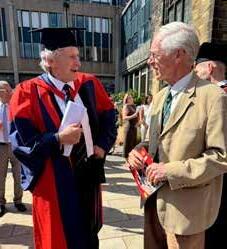
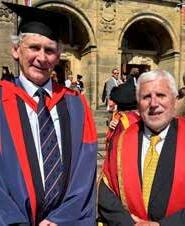
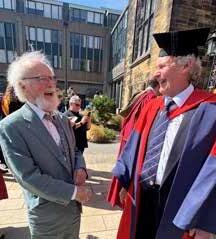
We are proud to profile the achievements of our alumni and to welcome back alumni Dr Keith Hiscock MBE. Keith returned to Bangor to receive an Honorary Doctorate and Fellowship at Summer Graduation for his pioneering work in marine conservation. We were also pleased to welcome back Professor Piers Chapman for a visit.
We were devastated to hear of the untimely loss of Josh Horn who graduated last year, and very sorry to hear of the loss of Ric Midgely (a PhD student in the 1990s) and of retired technical staff George Jones and Malcome Budd.
We hosted the Reef Conservation UK conference and a Summer School, which was funded by the International Association of Sedimentologists. Our seagrass researchers showcased their work at the UK Seagrass Symposium in Cardiff. We also took part in the Bangor University History Festival showcasing marine exhibits, and we were represented at the National Eisteddfod.
Our students have been putting their skills to good use participating in events such as the Ocean Generation’s Tide Turners panel at the Green Man Festival; undertaking internships including an ocean exploration expedition to map parts of the Pacific
We will miss David Roberts our Media Technician who retired after 41 years’ service (during which he transitioned from photography technician to drone pilot!), and Vallen Astley after 46 years’ service in security with Normal College, the University and then Ocean Sciences. We are missing too Professor Lewis LeVay, who retired in January after 30 years in applied marine research and teaching, (and many other roles!), at the school.
This letter to The Bridge will sadly be my last, because I too will retire at the end of January, following 40 terrific years here at Bangor University. Being Head of School has been an immensely rewarding time because of the fantastic community that is the School of Ocean Sciences and its Alumni. I am delighted to announce that the new Head of School will be Professor Stuart Jenkins, and I wish him every success. Professor John Turner, December 2025.
Professor John Turner
Editor: Professor Tom Rippeth Editor: Rachel Kurr
Editor: Eliana Caragia
Front and back cover image provided by Ben Powell
Welcome to our New Head of School
We are delighted to announce that Professor Stuart Jenkins will be taking over as Head of School following the retirement of Professor John Turner in January. Stuart first took up a position in the school as a lecturer in Marine Ecology in 2006, going on to become a Professor in Marine Biology in 2015. Prior to arriving in Bangor, Stuart graduated from Cambridge University with a BA in Zoology and completed a PhD at Liverpool University entitled “The ecology of sheltered, canopy dominated shores”. He then moved to a research post at the Marine Laboratory in Port Erin, Isle of Man, later becoming an Independent Research Fellow at the Marine Biological Association of the UK. Stuart brings vast experience to the job, having previously overseen student recruitment to the school and playing a
leading role in the preparation of both the 2014 and 2021 Research Excellence Framework submissions for Ocean Sciences. He was also programme director for the MSc in Marine Environmental Protection.
A letter from the Chair of the Ocean Sciences Alumni Association
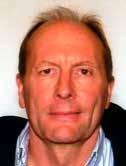
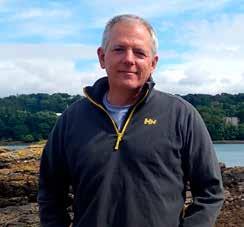
Mick Cook
They say, “a week is a long time in politics.” Well, it seems that “six months is a long time in the offshore industry.” Back in the summer edition of The Bridge, I was extolling the need for marine scientists in the development of offshore projects, particularly offshore wind. For the last few years, projections for installation of offshore wind farms have been exponential in their nature. And then, Donald Trump was elected for a
second term in the US and costs of most things, including offshore developments, soared post-COVID. This has led to a significant slump in offshore wind work which, in turn, has led to inevitable job losses.
It was only a small number of years ago that offshore wind farm developers were recruiting staff, including marine scientists, as if ‘there was no tomorrow.’
At the time, and despite exponential growth forecasts, I had a premonition that related to when I first joined the offshore industry in 1980. Oil and gas companies were, at that time, recruiting like ‘billy-o.’ Then, not many years later, the oil price slumped. This resulted in laying off many of those who had only been recruited a few years earlier. And
the birth of the ‘consultancy industry’ began. They say that history informs the present and that there is little that has not been seen before.
Now, this all seems a little negative, but fear not. If we are to affect the energy transition that we so clearly need to arrest climate change, the demand for marine scientists will increase significantly again. The only question is when? A lot has been written about the virtues of solar in effecting the transition, and I am sure that solar will increase in importance in its contribution to the energy transition. However, we will need a mix of renewable energy sources including offshore wind and, hopefully, tidal energy.
So, as I have mentioned before in previous Chairman’s reports, the need for marine scientists has never been greater. Therefore, as an Alumni
Association, we need to continue to support the School of Ocean Sciences in its development of future scientists. I do not profess to be an expert in any of the subjects that I have pontificated on above. But I am confident that the oceans will become increasingly important providing energy, amongst many other things, in the foreseeable future.
Finally, I was saddened to learn that John Turner, who has been the longest serving Head of School, is to retire in early 2026. I would just like to thank John for all his support to SOSA during his tenure. John has been great to work with, and we hope he will continue to support us during his retirement.
Mick Cook, Chair of the Bangor University School of Ocean Sciences Alumni Association (SOSA) mick@mickcook.com
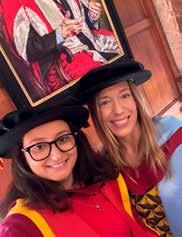
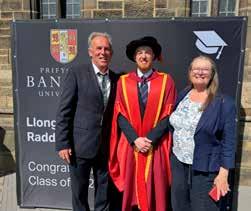
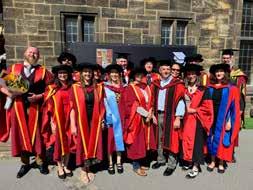
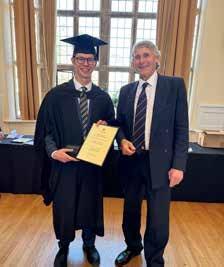
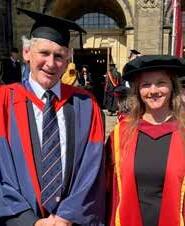
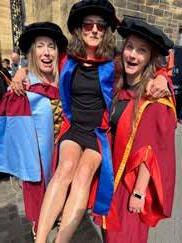
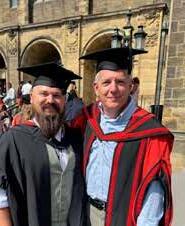
Summer Graduation
Congratulations
To all our graduating students and our prize winners:
The Darbyshire Prize for the highest scoring final-year oceanography student went to Dafydd Thomas (BSc Ocean and Geophysics, 2025). Dafydd is now a student on the MSc Applied Marine Geosciences course.
The John Robert Jones Prize for the most meritorious student went to Ruth Flynn (BSc Marine Biology, 2025). Ruth is now undertaking a PhD at Heriot-Watt University in Edinburgh.
The Ray Delahunty Prize for the highest scoring 1st year on the Marine Biology and Oceanography programme went to Bridget Kohn (BSc Marine Biology and Oceanography).
The Gavin Borthwick Prize for the highest scoring 1st year Marine Biology student went to Ben Phillips (BSc Marine Biology and Zoology).
The Sinclair Buchan Prize for the highest scoring 1st year Oceanography student went to Jacob Knock (BSc Ocean and Geophysics).
The thesis of Ruth Clarke (BSc Marine Biology and Oceanography with Placement Year) has been nominated for the British Sedimentological Research Group best undergraduate dissertation award. Ruth’s dissertation was on the “Reconstruction of Palaeo-Shorelines using Ichnology”.
The thesis of Felix Wagner (MSci Marine Biology, 2025) has been nominated for the UK Challenger Society Award for best final year research project in marine
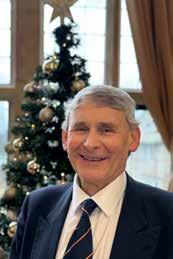
Professor Stuart Jenkins
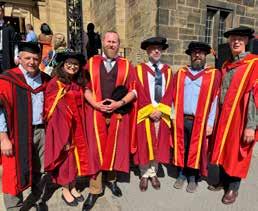
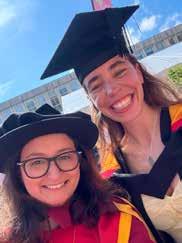
Summer Graduation
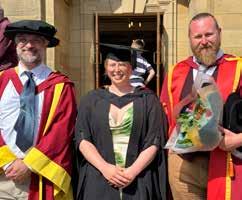
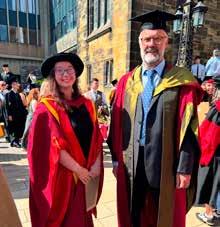
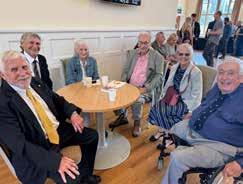
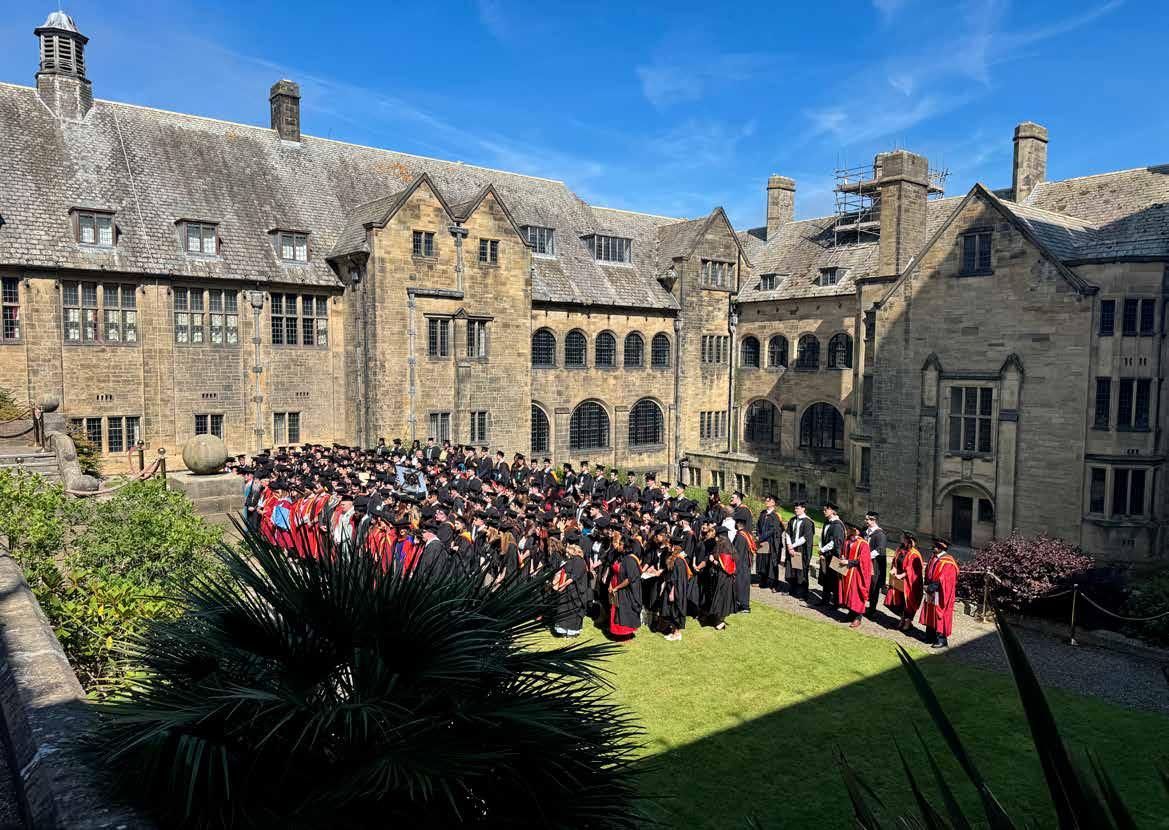
science. His thesis was on “Investigating the diet of data limited Pollachius pollachius to inform future fisheries management”.
Luke Lazenby (MSc Physical Oceanography, 2025) won the Darbyshire prize for being the highest scoring student on the Physical Oceanography, Applied Marine Geosciences and Marine Renewable Energy MSc courses.
Ellie Gallichan (MSc Marine Top Predictor Ecology, 2025) won the Jeremy Jones Prize for being the highest scoring student on the MSc Marine Biology, Marine Environmental Protection and Marine Top Predator Ecology courses.
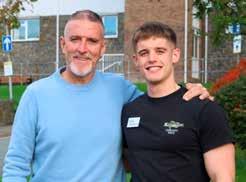
Thesis Prize
Congratulations to Fraser Masterson (MSc by research) on winning the 2025 Postgraduate Research Award of the Welsh Ornithological Society (WOS). His thesis title is “Using n-dimensional hypervolumes to understand coexistence between fundamentally similar diving seabirds”. The award was made by TV naturalist Iolo Williams.
Society for Underwater Technology Award Winners
The Society for Underwater Technology (SUT) supports talented students across marine science, underwater technology
and offshore engineering. This year’s round of applications was the highest on record, reflecting growing interest in pursuing careers in the underwater and offshore technology.
We are delighted to report that Bangor scooped 2 of the 5 awards on offer. The awards went to Jazmine Cowlin (BSc Ocean Science, and now an MSc Physical Oceanography student) and Jacob Knock (a BSc Ocean and Geophysics student).
Alumni honoured with an
Honorary Fellowship
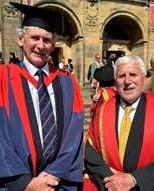
Alumni Dr Keith Hiscock MBE was awarded an Honorary Fellow DSc at the summer graduation ceremony. Keith has been a pioneer of marine conservation in the UK contributing to the development of Marine Protected Areas and new Marine Conservation Zones, as well as advancing the underwater survey methods and equipment needed to support them.
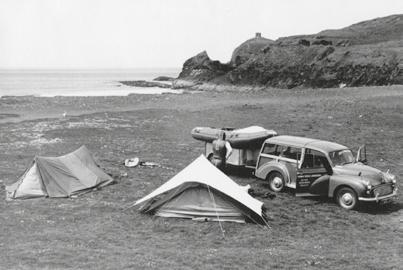
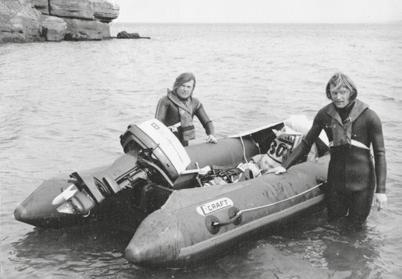
in the Bristol Channel, The Blue Lagoon of Abereiddi slate quarry in Pembrokeshire, and at Lough Hyne, a sea loch in southern Ireland (a PhD designed around some of the very best UK diving sites!). Alongside his dive partner, Richard Hoare, and under the watchful eye from the Marine Biology Department’s Diving Officer, Professor David Jones, he took the department’s classic ‘Moggie’ van, trailer and boat to explore the Anglesey coast.
During his time at Bangor Keith also developed a passion for underwater photography, which stood him in good stead for describing marine habitats and communities, and for illustrating future books and reports.
Spending his early years in Ilfracombe, Devon, Keith developed a fascination with the seashore. After completing an undergraduate degree in Zoology and Botany in London, he took up SCUBA diving and joined expeditions across Britain and Ireland. He came to Bangor (then the University College of North Wales) to work in the Unit of Coastal and Estuarine Surveillance, completing a PhD in Marine Biology in 1976 on “The effect of water movement on the ecology of sublittoral rocky areas”. His research took him to the Menai Strait, Lundy Island
In 1976, Keith became Deputy Director of the Field Studies Council at Orielton, and later, in 1987, he took on the role of Head of the Marine Nature Conservation Review of Great Britain with the Nature Conservancy Council. There, he managed a team of diving biologists who catalogued much of what we know about the marine biology of our shallow seas. He went on to serve as Marine Advisor to English Nature in the late 1990s, before becoming Programme Director of the Marine Life Information Network (MARLIN) at the Marine Biological Association in Plymouth. MARLIN has played a significant role in providing critical data on the status of marine life and marine habitats around the UK.
On retirement, in 2007, Keith became an Associate Fellow of the Marine Biological Association and was awarded the MBE for services to marine conservation in 2023. Keith has been instrumental in marine conservation in the UK for over 50 years and has inspired and encouraged many marine biologists through his lectures, education programmes, and expeditions. Keith’s books include: Protecting Lundy’s Marine Life: 40 Years of Science and Conservation; ‘Marine Biodiversity Conservation: A Practical Approach’ and the lavishly illustrated ‘Exploring Britain’s Hidden World: A Natural History of Seabed Habitats’.
Fraser Masterson prize
Keith Hiscock Camping_Abereiddy
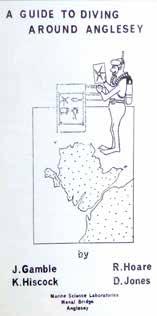
Keith Hiscock Anglesey dive guide
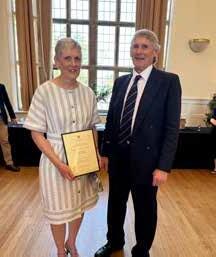
Dr Jenny Shepperson, a senior lecturer in the School of Ocean Sciences and senior fisheries researcher, has been awarded a Bangor University Education and Student Experience Award at the summer graduation this year. The award recognises staff for their outstanding contribution to teaching and/or the support of learning.
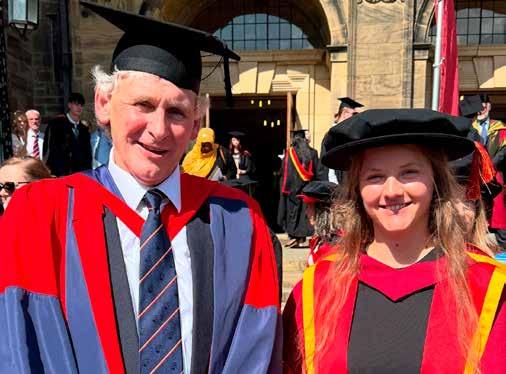
Commenting Jenny said: “I am honoured to receive this award, and grateful for its recognition of the ongoing effort involved in developing innovative approaches to teaching. I am lucky to be part of a supportive and collaborative Teaching & Scholarship team in the School of Ocean Sciences; their shared commitment to the student experience has shaped my work and made it more enjoyable! I look forward to continuing to support our students and finding new and exciting ways to teach.”
Professor John Turner, Head, School of Ocean Sciences, “Jenny is a critical lead in the School’s Teaching and Learning team, demonstrating exceptional innovation and impact across the University. Excellence in innovation is demonstrated by her novel redesign of statistics teaching through research-led code-based digital skills. Excellence of her impact is evidenced by the increasing use of code-based R statistical analysis across the College of Science and Engineering and disseminated at STEM conferences and through peer reviewed journal and textbook case studies. Jenny constantly refines our assessment to ensure effectiveness and efficiency, as exemplified by her leadership of the data-informed skills audit. Staff and students recognise her logical, clear, and reassuring approach.”
Global Plastic Pollution Treaty
In August, Dr Winnie Courtene-Jones, from the School of Ocean Science, attended the resumed fifth United Nations Intergovernmental Negotiating Committee meeting to develop a Global Plastics Treaty.
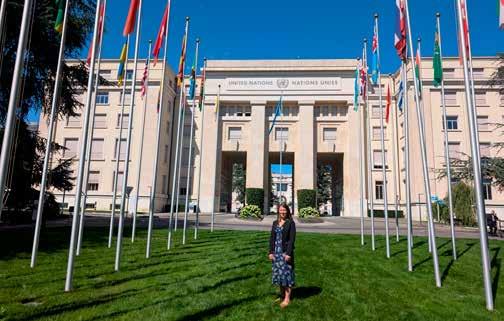
During this meeting, held in Switzerland, delegates from over 170 UN member states convened to continue discussions on a legally binding treaty that addresses the full plastics lifecycle, (from extraction of resources, through to disposal).
Throughout the negotiations, Winnie met with member state negotiators, ministers and scientists from around the world to contribute scientific evidence, and to discuss the most effective way for this to be translated into the global actions needed to address plastic pollution.
Plastic pollution is a global crisis, with growing evidence showing its harmful impact on both human and environmental health. More than 450 million tonnes of plastic are produced each year, a figure which is projected to triple by 2060, without significant intervention. The global plastics treaty therefore represents an unprecedented opportunity to drive meaningful, coordinated action worldwide.
For the last decade, Winnie has been studying the sources and effects of (micro) plastic pollution, and some of the solutions being proposed. She has participated in the international discussions around the development and delivery of the treaty since the outset.
Professor John Turner with Dr Jenny Shepperson
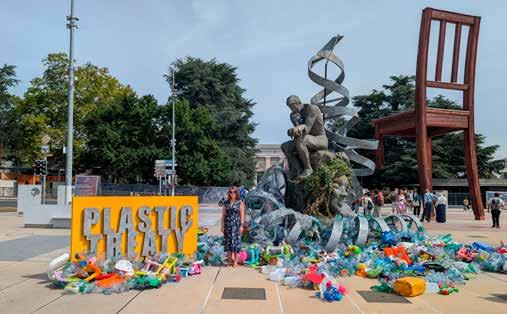
Returning from the meeting, Winnie said, “It is disappointing that an agreement was not reached; however, the willingness from negotiators, industry and civil society to reduce the global threats posed by plastic pollution is stronger than ever. Talks will continue at a future session, where I am hopeful that negotiators will work collaboratively to deliver an effective Treaty to protect our planet and future generations.”
Later in the Autumn Winnie travelled to Parliament as part of the ‘UK leadership in tackling Global Plastic Pollution’, sponsored by Rt. Hons. Alistair Carmichael, Chair of the Environment, Food, and Rural Affairs (EFRA) Committee.
The event brought together MPs, leading academics, businesses, and NGOs at the Houses of Parliament to discuss the UK’s leadership role in tackling global plastic pollution, and to explore how research and innovation can accelerate solutions to one of the world’s most pressing environmental challenges.
https://www.bangor.ac.uk/news/202508-13-were-witnessing-last-ditch-talksto-secure-a-global-plastic-pollutiontreaty
Ocean Sciences at the Eisteddfod
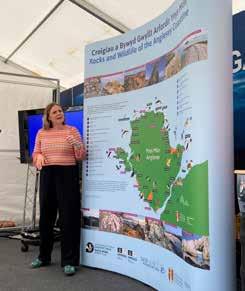
We were delighted to represent the University at the 2025 Eisteddfod Genedlaethol in Wrecsam. Activities included the unveiling of a new mega poster by Drs Mollie Duggan-Edwards and Dei Huws. The poster shows the unique wildlife and landscape of the Anglesey coastline and includes place and species names in both Welsh and English. The poster was funded by the Bangor fund.
Dr Tomos David represented the school in the Coleg Cymraeg Three Minute Research Competition, where he gave a brief overview of research into AI and the impact of climate change on lakes.
Welcome back to Piers Chapman
We were delighted to welcome back alumni Piers Chapman to the school. Having graduated in chemistry from Bangor, Pier’s then crossed the Menai Strait to undertake a PhD in Ocean Sciences between 1971 and 1974. He subsequently moved to the US becoming a Professor of Oceanography at Texas A&M, a leading US University, where he served as Head of the Department of Oceanography between 2007 and 2013.
Institute of Tibetan Plateau Studies Fellowship
Congratulations to Kirsty Forbes (an ENVISION PhD student) on being awarded a Chinese Academy of Science Fellowship to study at the Institute of Tibetan Plateau Research. Kirsty has also been elected as the new student co-chair of the Global Lake Ecological Observatory Network (GLEON) Student Association (GSA).
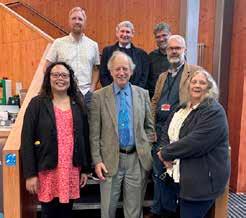
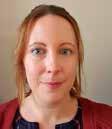
Dr Winnie Courtene-Jones
Photo: Piers Chapman visit
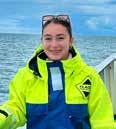
Kirsty Forbes
Piers also served as a director of the US WOCE (World Ocean Circulation Experiment) between 1990 and 2002, and has an ocean basin named in his honour, the Chapman Basin, which is in the Gulf of Mexico.
In recent years he has made generous donations to support our undergraduate internship scheme. Piers has also offered to write a piece on his time in Bangor and subsequent career which we look forward to including in the next edition of the Bridge!
Coral reefs’ fate tied to ocean forces hidden below the surface
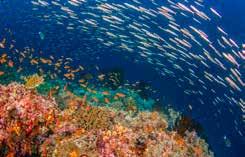
A new scientific paper reveals that many predictions about the future of coral reefs under climate change may be missing a crucial piece of the puzzle.
The study, published in Nature Ecology & Evolution, was led by marine biologists and physical oceanographers from Bangor University and the King Abdullah University of Science and Technology (KAUST). It warns that coral reef science must look beyond life on the reef, and better account for the physical oceanography in shaping reef environments.
Without integrating these factors into models, the authors say, we risk misunderstanding where and why coral reefs survive—or collapse—under climate stress. As a result of this policymakers and conservation managers are not targeting interventions for saving coral reefs where they are most likely to succeed.
“Coral reefs don’t exist in isolation of their surrounding ocean. They’re part of a dynamic seascape shaped by water movement, nutrient supply, and subsurface temperature patterns,” said lead author Dr Laura Richardson, a Research Fellow in the School of Ocean Sciences. “But our current models of coral reef futures and the impacts of large marine heatwaves often rely solely on satellite data of sea surface temperatures. That misses much of the story.”
Paper: Laura E. Richardson, Gareth J. Williams, Aislinn Dunne, Tim JacksonBué, J. A. Mattias Green, Tiffany H. Morrison & Michael D. Fox (2025).
Quantifying coral reef–ocean interactions is critical for predicting reef futures under climate change. Nature Ecology and Evolution, https://www.nature.com/articles/ s41559-025-02839-9
The largest biodiversity time-series database on the planet gives unprecedented insight into global biodiversity
Ocean Science scientists have contributed to the largest biodiversity time-series database on the planet – created by the University of St Andrews. The BioTIME database offers unprecedented insight into how biodiversity is changing through time across the globe, spanning nearly 150 years of ecological records from 18742023.
Published in the journal Global Ecology and Biogeography, the new version contains data from over 553,000 locations tracking species abundances from the Arctic to the Amazon, helping researchers, policymakers, and the public better understand the complex dynamics that species face in a rapidly changing world.
Prof Maria Dornelas from the University of St Andrews who leads the project said, “Because we cannot travel in time, biodiversity data from the past is precious to help us understand where and how biodiversity is changing.” She adds, “Human eyes and ears are the main instruments behind this massive data resource. This database is the collective work of hundreds of people, both scientists and citizen scientists, who systematically record species and their abundances over time.”
Ocean Science contributor Dr Laura Grange commented: “Addressing the most pressing questions about the state of global biodiversity requires access to vast, high-quality datasets. It has therefore been a privilege to contribute to the BioTIME 2.0 open-access database and the research that brings these data together, enabling the kind of largescale synthesis that modern ecological
science depends on. Your data becomes part of a powerful, free resource that helps scientists, educators and conservationists from around the world understand how life on Earth is changing and how it might be conserved – one species, one place, one moment at a time.”
Paper: M. Dornelas et al (2025). BioTIME 2.0: Expanding and Improving a Database of Biodiversity Time Series. Global Ecology and Biogeography, https://doi.org/10.1111/geb.70003
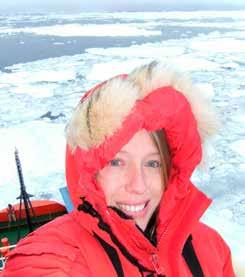
Tiny Whirls Mix the Arctic Ocean
Oceanographers Ben Lincoln, Mattias Green and Tom Rippeth are part of the team behind a major new study on Arctic Ocean dynamics published in the leading journal AGU Advances.
The new research shows that centimetrescale turbulence, tiny “whirls” mixing freshwater plays a critical role in driving the Arctic’s vertical circulation, while heat loss in the ice-free Barents Sea causes deeper waters to sink.
Corel Reef Image: Brian Zgliczynski.
Laura Grange
As warming and sea-ice loss continue, this delicate balance could shift potentially influencing larger currents like the Atlantic Meridional Overturning Circulation, which helps shape climate and weather across Europe and beyond.
New study emphasises that even the smallest ocean processes matter and underlines how vital the turbulence and mixing work carried out here at Bangor
University is in understanding our changing oceans.
Paper: Brown, N. J., Naveira Garabato, A. C., Bacon, S., Aksenov, Y., Tsubouchi, T., Green, M., Lincoln, B., Rippeth, T. & Feltham, D. L. (2025). The Arctic Ocean Double Estuary: Quantification and Forcing Mechanisms. AGU Advances. 6, 6, e2024AV001529.
Students from across the planet descended on Bangor this summer to study 800 million years of Earth History.
20 PhD students, from 16 countries across 5 continents, visited Bangor this summer to study 800 million years of regional sedimentary geology as part of the International Summer School of Sedimentology programme.
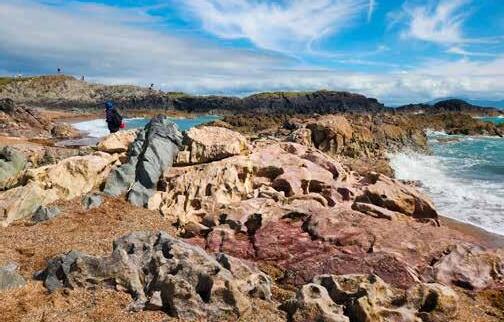
Entitled North West Wales: 800 Million Years of Earth History in 800 km2 and generously funded by the International Association of Sedimentologists (IAS), the participants spent eight long sunny days working at picturesque locations around Anglesey, Eryri (Snowdonia), on the Great Orme near Llandudno, and along the coast around Aberystwyth.
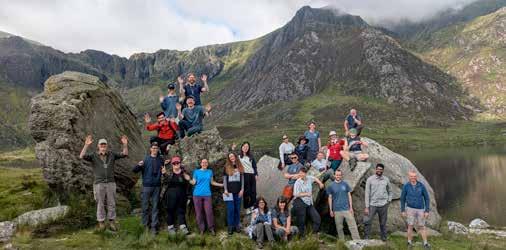
On Anglesey, focus was on the Neoproterozoic pillow lavas on Newborough beach; Neoproterozoic tectonically-induced mélanges on Ynys Llanddwyn and around Cemaes; Cambrian and Ordovician deep-marine sediment gravity flow deposits on South Stack and Rhosneigr beach; colourful Silurian
metalliferous hydrothermal deposits on Mynydd Parys; and Devonian paleodesert environments on Traeth Lligwy.
Late-Quaternary glacial deposits were examined in Cwm Idwal, before moving on to the Carboniferous carbonate reefs on the Great Orme, and finishing with the
dramatic Silurian “underwater landslide” deposits around Aberystwyth.
A principal aim of the Summer School was to share sedimentological expertise among participants, and for them to apply this knowledge to improve depositional
models for the various locations visited. The energy transition was a consistent theme during the Summer School, with field presentations on tidal and wind power, enhanced weathering techniques for carbon sequestration and critical minerals.
“Kind funding by the IAS allowed us to give the participants the chance to collaborate, network and work with experts on new and exciting topics in sedimentary geology and showcase the world-famous geology of NW Wales”, says lead organiser Ocean Science’s Dr Jaco H. Baas. He adds: “The Summer School was a great success, judging from the positive feedback of the PhD students”. According to the students: “We all agree that the 2025 IAS Summer School in NW Wales was an unforgettable experience, forging strong bonds that will be maintained throughout our future careers” and “[We] learned several new concepts (…) that we could directly apply to our understanding of [sedimentary systems]”.
New field data collected by the participants is being added to the Summer School
field guide, this is in preparation for an approved special publication in the book series of the International Association of Sedimentologists. This is further testament to the success of the Summer School and the importance of the geology found on our doorstep here in Bangor.
The Summer School was organised and led by Dr Jaco H. Baas (School of Ocean Sciences), Dr Dei Huws (School of Ocean Sciences, GeoMôn UNESCO Global Geopark), Dr Megan Baker (SOS alumni, and now Durham University) and Dr Stephen Lokier (University of Derby). Guest presentations in the field were given by Dr Lynda Yorke, Prof. Simon Neill and Prof. Katrien van Landeghem.
Bangor University Showcases Seagrass Research at UK Seagrass Symposium
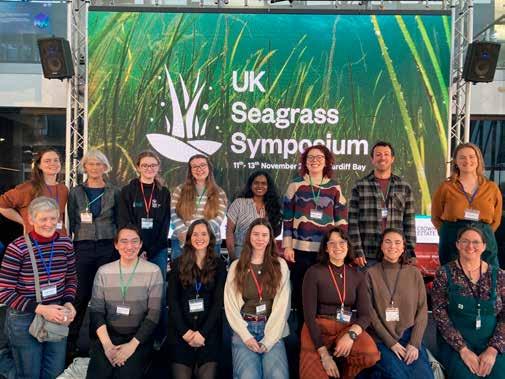
Back row L to R: Dr. Katie DuBois, Prof Hillary Kennedy, Anna Williams (undergraduate panellist for Youth Voices), Caitlyn Talyor-Robinson (PhD student), Ashithmal Jintin (MSc Marine Biology student), Bridget Patterson (MSc Marine Biology, 2025), Adrian McRae (MSc student), Dr. Emma Ward.
Front row L to R: Ruth Flynn (BSc Marine Biology, 2025), June Waddle (undergraduate Marine Biology student ), Georgia Kennedy (MSc program), Keira Castledine (undergraduate Marine Biology & Zoology student), Guilia Leanza (research support officer), Pilar Jarillo Serrano (MSc Marine Biology student), Jennie Richardson (MSc student)
Seagrass researchers from across the UK gathered in Cardiff for the 2nd UK Seagrass Symposium, held from 10th –13th November. The event brought together more than a dozen experts from the School of Ocean Sciences, who played a leading role through workshops, talks, poster presentations, and panel discussions. This dynamic symposium strengthens national collaboration and showcases advances in seagrass ecology and conservation, reinforcing the UK’s growing momentum in safeguarding this vital coastal ecosystem.
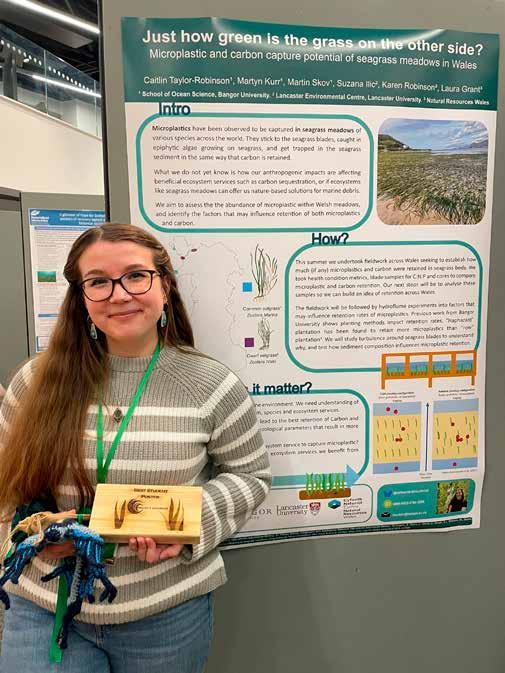
Highlights included PhD Student, Caitlyn Talyor-Robinson winning the best student poster award for her poster entitled: “Just how green is the grass on the other side? Microplastic and carbon capture potential of seagrass meadows in Wales”. Caitlyn Talyor-Robinson
UKSS Group photo
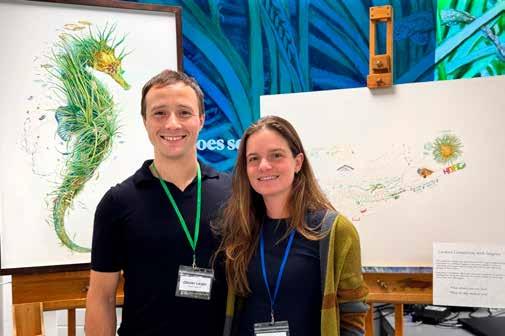
Professor Hilary Kennedy and Dr. Emma Ward led a workshop aimed at bringing the UK seagrass community together to begin appraising the journey for the UK to include seagrass meadows in their greenhouse gas inventory. Dr. Katie DuBois co-led a workshop with artist Olivier Leger title “Creative Connections with Seagrass: A hands-on workshop”, that gave participants the opportunity to express “What seagrass means to them” through creative visual arts projects.
Royal Geographic Society Monday Night Lecture
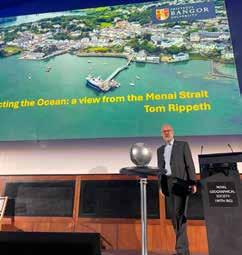
In November Tom Rippeth was invited to give a prestigious Monday night lecture by the Royal Geographic Society. For his talk Tom chose: “Predicting the Ocean: A view from the Menai Strait” where he highlighted the leading role of physical oceanographic research at Bangor University in furthering our understanding of how the ocean works.
Coral Reef Scientists descend on Bangor
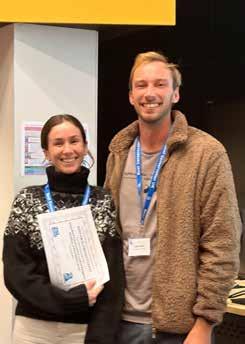
Tropical coral reefs are generally the last thing on anybody’s mind on a cold and gloomy December day in Bangor. However, on the 6th December, 120 coral reef scientists travelled to Bangor for the annual UK Reef Conservation conference. The conference is normally held in the Zoological Society of London, but this year went on the road and was hosted by the School of Ocean Sciences. The event was a great success, with three workshops, 21 speakers with Prof Chris Perry, University of Exeter, and Dr. Melita Samoilys, CORDIO East Africa delivering the plenary lectures. Speakers from Ocean Sciences included Dr. Laura Richardson, and Danielle Spring, who won the best student talk prize!
The retirement of our Head of School, Professor John Turner, who is also a leading UK Coral Reef researcher, was also marked by the conference with a presentation by SOS’s Professor Gareth Williams.
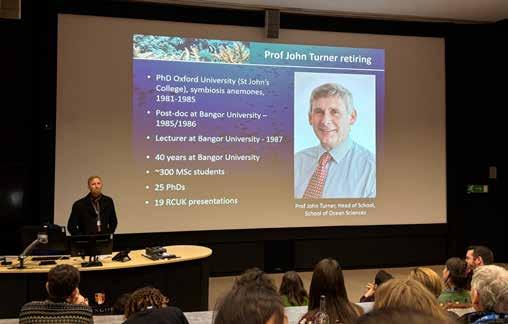
Coral conference turner presentation
Photo: Coral conference Spring prize
Strengthening Ties: OS Energy visits Bangor University to explore new opportunities
In October we welcomed representatives from OS Energy, the German offshore services company that co-owns and operates the Prince Madog in partnership with the University. The visit marked an important moment in an important collaboration that continues to offer Bangor students unique, handson experience in marine science and offshore research.
Commenting Professor John Turner said: “The discussions opened the door to exciting possibilities, including joint research projects and new opportunities for Bangor students to engage with OS Energy’s wider European operations. With OS Energy’s expertise in offshore services and Bangor’s academic strengths in marine science, the partnership is well-placed to deliver innovative work that benefits both industry and education.
This collaboration is a great example of how universities and industry can work together to create meaningful, careershaping experiences for students and we’re looking forward to seeing where it leads next.
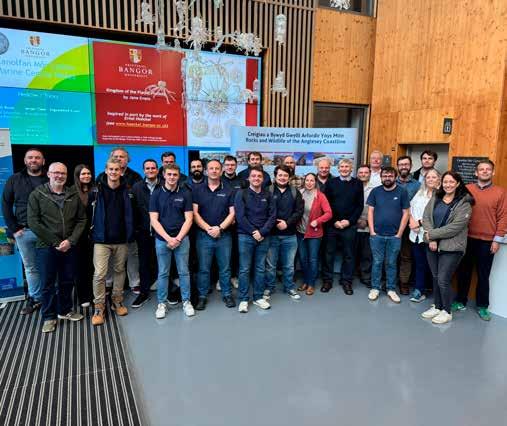
Green Man Festival: Wales’ young changemakers Student Activities
This summer, Jazmine Cowlin (BSc Ocean Sciences 2025 and a current MSc Physical Oceanography student) was one of three panellists on the Ocean Generation’s Tide Turners panel at the Green Man Festival in Abergavenny, South Wales.
Ocean Generation is a nonprofit organisation dedicated to communicating complex scientific research to young people in an accessible and engaging manner, transforming concern for the ocean into action. Here Jazmine tells us more about her experience and the panel:
“The aim of our panel was to explore how climate change is impacting our oceans, and to ask: what does this mean on a local and personal level? The discussion began with our individual journeys, how
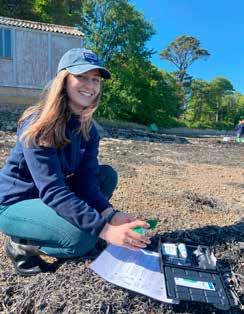
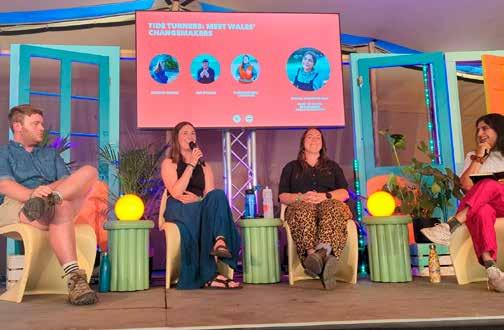
we each came to care deeply about the environment, what shaped our thinking, and what issues drive us today. From there, we discussed thought-provoking questions such as: What does being a wave-maker mean to you? What moment or discovery triggered a big change in your understanding of an environmental issue? Have you ever experienced eco-anxiety, and if so, what’s your top tip for overcoming it?
These questions sparked an open, honest and engaging conversation. It was an incredible opportunity to connect with the audience on topics that affect us all, whether or not we live near the coast. The final part of the session was open to questions from the audience, which led to a discussion around marine renewable energy, environmental policy, and what real-world action can look like, whether you’re a scientist, a policymaker, or simply someone who cares.
Having recently graduated with a BSc in Ocean Science from Bangor University, I was able to bring a scientific lens to the conversation. This was a chance not only to share what I’d learned academically, but also to see how that knowledge could be translated into public discourse. It was especially rewarding to engage with
Mapping the Pacific Ocean
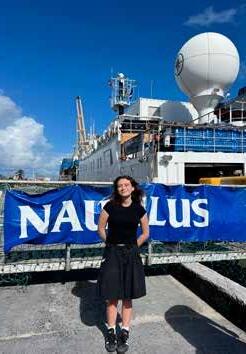
Following graduation in the Summer Ella Magrum-Stanley (Marine Biology and Oceanography, 2025) completed an internship as a Seafloor Mapping and Hydrography Intern during the NA175 expedition aboard The Ocean Exploration Trust (OET) Research vessel E/V Nautilus. Here she tells us more about the experience:
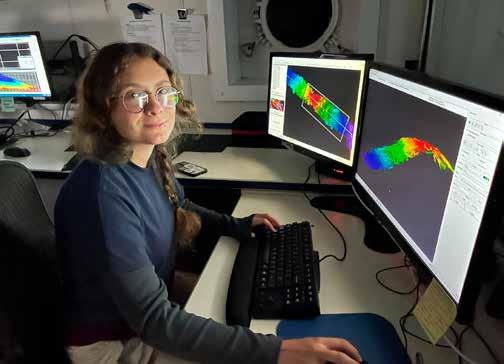
“My role consisted of 8-hour watches from 8pm-4am, and I was trained by two lead mappers. I monitored real-time data
the audience’s questions, offering insight into ocean processes, marine ecosystem change, and the development of the marine renewable energy industry. It was also interesting hearing from the other panellists, who work in international and local environmental policy and communications, adding another dimension, highlighting the practical challenges and opportunities in shaping large-scale change.
What stood out most was the shared sense of purpose in the room, despite approaching questions from different angles and perspectives, we all shared the belief that positive environmental change is both essential and achievable. Events like this provide an important platform for meaningful conversations, where science, policy, and public engagement intersect. Through stories, conversations, and moments of connection, there was a significant sense of empowerment and hope as the audience left the tent.
Being part of the Tide Turners panel was an incredible opportunity and a reminder that we all have a role to play in protecting our oceans. Whether it’s through science, policy, or public engagement, everyone can get involved and help to protect our oceans.”
and adjusted the multibeam sonar (and sub bottom sonar) parameter settings according to the depth. Cleaning the data consisted of loading the seabed cloudpoint files into Qimera, (a widely used seafloor editing software), and removing outliers so that the data accurately represented the seafloor. I also deployed Expendable Bathythermographs (XBTs). These XBTs determine the speed at which sound travels in the water column so that the multibeam software can accurately detect the seafloor.
Education outreach is a huge part of these expeditions. While on board, I participated
in ship-to-shore zoom calls with students of all ages educating on ocean exploration.
This experience aboard the E/V Nautilus was invaluable. I gained field working skills, discovered my flexibility in a constantly changing environment, fostered connections that I will continue to use throughout my career, and gained insight on research avenues that I want to pursue.
Finally, as a recent graduate hoping to pursue a Masters and PhD, I collected data that will be included in a global database (Seabed 2030) and contributed to the developing management plan for the Pacific Remote Islands Marine National Monument. This showed me that no matter what point you are in your career, you can contribute to the future of science.”
Welsh Ecology and Environment Network
In November, the 21st annual Welsh Ecology and Environment Network (WEEN) Conference took place, and Bangor University was well represented. Among the attendees was Ocean Sciences PhD student Kiran Bhandari, who presented his work on “The prevalence and potential impacts of disease in edible crabs from Wales”.
The Wales Ecology & Evolution Network is a student-run annual conference which aims to promote post-graduate
research and create a networking platform for early-career scientists at Welsh Universities. The conference was officially opened by Bangor alumni Dr William Parry.
Commenting Kiran said: “Overall, I had a really great experience at WEEN. It was good to meet others who share similar research interests and to see the wide range of innovative research being carried out in ecology and environmental areas at Welsh universities.” He also recommended the conference as an excellent first conference to attend and present at for early career scientists.
Internship News
Every summer our students get the opportunity to undertake paid internships and training courses. Here some tell us of their experiences.
Marina de Llobet (MScRes, Physical Oceanography) reports on her summer internship: “This summer, supported by the Dr. Robert Perrin Research Awards, I undertook an internship on Blue Carbon and the impacts of bottom trawling. During this time, I conducted preliminary environmental data analyses of the northwest Atlantic European shelf, examining bathymetry, currents, temperature, and stratification, and comparing these with trawling data. This experience strengthened my analytical and data visualisation skills while laying the groundwork for my master’s research.
Alongside the technical work, I gained valuable professional experience with guidance of Dr Sophie Ward, including preparing an abstract for the AGU Ocean Sciences Meeting and developing my academic CV. I also presented my findings to the CSS team and established collaborations for future research. Having now begun my MScRes on: “Disrupting the Blue Carbon Cycle? Assessing the impact of
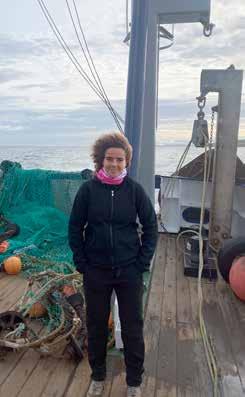
bottom trawling on carbon-rich sediments” under Dr Ward’s supervision, I am eager to deepen my understanding and answer new questions that will develop.
I would like to thank the School of Ocean Science and Dr Perrin’s Scholarship for
Jack Booth (a 2nd year Marine Biology with Zoology student): “As a Welsh student, I was thrilled to be sponsored by the Welsh Ornithological Society to attend Bardsey Bird Observatory’s Student Week. Despite poor weather and the initial uncertainty over the crossing, we eventually made it to the island and were immediately greeted by dozens of grey seals lounging on the shore! Once settled, we bid farewell to reliable phone signal—only a couple of spots allow for calls—and settled into the semi-remote island life.
While Bardsey Island (Ynys Enlli) is famous for its birds, the daily logs conducted by the staff and students included marine mammals and insects (mostly moths and butterflies) too! Phoebe, a marine biologist on staff, conducts essential marine mammal surveys, gathering research data and drone footage for the WDC (Whale and Dolphin Conservation). She always welcomed an extra pair of eyes. During the week, we enjoyed multiple sightings of Risso’s dolphins and short-beaked common dolphins. What made the trip even more special was witnessing the birth of the island’s first grey seal pup of the season. Despite the early arrival, its chances of survival looked hopeful throughout the week.
Returning to the avian side, when I wasn’t helping with marine mammal surveys, I was out with the observatory staff ringing birds or conducting general surveys across the island to add to the evening log. We spent the most time ringing Manx Shearwater chicks still tucked away in their burrows, and Storm Petrels caught at night using mist nets and call recordings.
their generous support and for giving me the chance to pursue this summer internship and start developing my future as a scientist. Their contribution made this internship possible and has been key in advancing my research experience.”
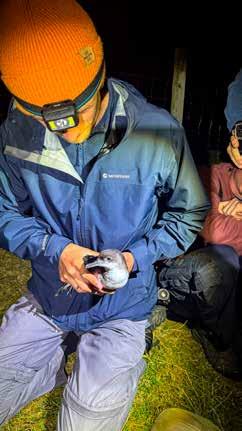
This provided invaluable experience in bird handling, ringing, and significantly improved my identification skills.
My week on Bardsey was truly unique—a pleasant blend of holiday and an incredible opportunity for skill development and learning. A typical day might start with a swim in the sea, followed by learning to ring my first Manx Shearwater chick in the morning, spotting Risso’s dolphins in the
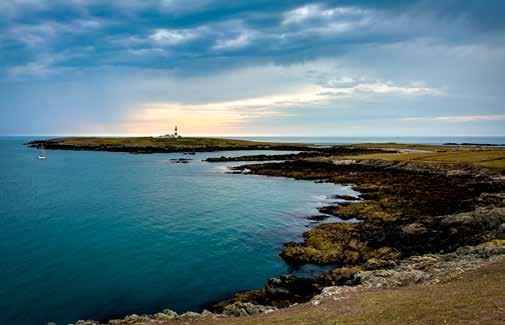
afternoon, and finishing over a meal with new friends from across the country. I must also give a huge thank you to Steve, Emma, Ewan, Greg, Phoebe, and Lauren for their tireless effort in planning activities like rock pooling, a boat trip with Gareth, the lively bird race, and interesting evening talks on their career paths.
Peggy Gordon (2nd year Marine Biology and Oceanography student) tells use about her Sea Watch Foundation Internship this summer: “Dolphin watching for six weeks is anyone’s dream and over the summer I was lucky enough to be able to make that dream a reality with the Sea Watch Foundation as one of their research interns. I had never seen a dolphin, let alone a pod of dolphins.
The Sea Watch Foundation is a charity which works across the UK, monitoring cetaceans through a combination of land and boat surveys. As an organisation, they rely on core workers, interns and citizen scientists to collect data on marine cetaceans in UK waters. I was lucky enough
I really hope to return to Bardsey someday. I would strongly recommend opportunities like this to my fellow ocean sciences students; even though the week isn’t purely focused on marine biology or oceanography, the marine element is prominent, and the experience offers lifelong memories.”
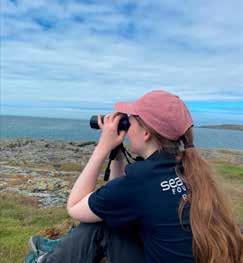
to be one of the interns where I spent six weeks of my summer on the coast conducting land watches, on the boat doing transect surveys and then getting back and analysing all the data collected by our team.
During this internship, I had the opportunity to participate in land watches, boat surveys, photo identification, QGIS mapping, social media posts, forming ID guides, water quality testing, community engagement, species identification and much more.
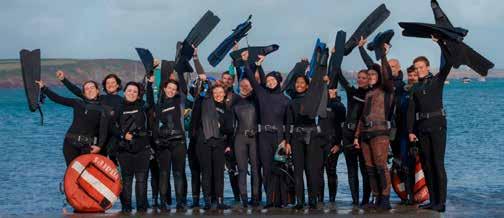
Maia Bishop (3rd year Marine Biology student) joined Mareco and Celtic Deep for their third Sharkademy training residency in Pembrokeshire, Wales this summer. It is a five-day fully funded programme designed to give early-career UK marine scientists hands-on research experience. The week brought together a small group of people from a range of backgrounds and included talks from experts, practical workshops, and lots of time on (and in) the water learning non-invasive shark research techniques.
Maia commented: “The highlight of the week was heading out into the Celtic Deep where I was lucky enough to snorkel alongside four female blue sharks – my firstever shark encounter. It was an unforgettable day, made even better by bow-riding
The thing I enjoyed the most was the QGIS mapping and looking at all the data we interns had collected gave me a great sense of achievement and purpose. The internship was a magical experience. I really enjoyed watching pods of dolphins bow riding and feeding with their calves, jumping out of the water and almost dancing in the waves. These are all memories that will stay with me forever. Our data collection also led to real-world outcomes and made us feel proud of our efforts in making a real difference.”
dolphins and the glimpse of bluefin tuna on the way out. We also visited Skomer Island to learn how to deploy BRUVs, (Baited Remote Underwater Video Systems), a widely used non-invasive survey method. Time in the lab helped develop our UK shark ID skills, including examining neonatal spiny dogfish still in utero that had been recovered at sea after its mother was discarded. Throughout the week we heard from shark researchers, filmmakers, and conservationists working across many areas in shark science. The experience provided me with practical skills, the opportunity to network with professionals in shark research, and a greater appreciation for the diversity of UK waters. I left with more confidence in my abilities and a clearer idea of the path I want to take in marine conservation.”
University Careers Fair
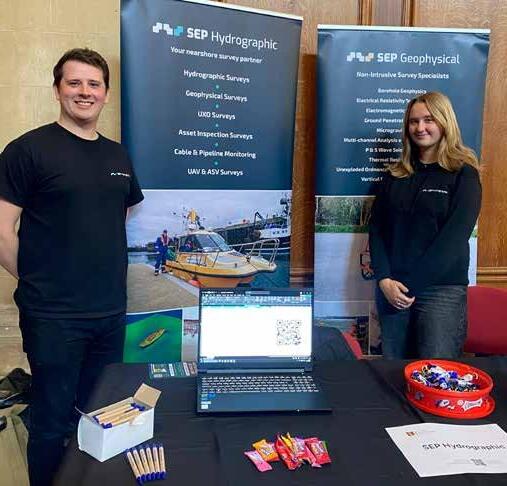
The annual University careers fair brought back many alumni highlighting employment opportunities in the offshore sector. Amongst them was Sean Goban (BSc Geological Oceanography), with SEP Hydrographic, who found time to tell us about his career to date:
“Since graduating from Bangor University in 2019 with a BSc in Geological Oceanography and then an MSc in Marine Renewable Energy, I have built a career rooted firmly in the marine and offshore sector. I first worked as an offshore
processor, developing hands-on experience with data acquisition, vessel operations, and offshore project workflows. Over time, this role has strengthened my technical understanding of marine environments and broadened my operational skill set. In the last 18 months since joining SEP Hydrographic, I have transitioned into nearshore survey operations, where I now focus on coastal data collection, equipment deployment, and supporting site investigations closer to shore, continuing to expand my knowledge across both offshore and nearshore survey environments.”
The Prince Madog has been busy in recent months with several major research cruises followed by our annual student field trips.
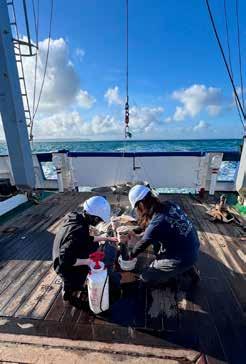
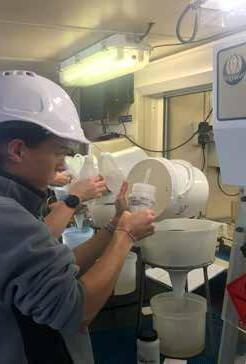
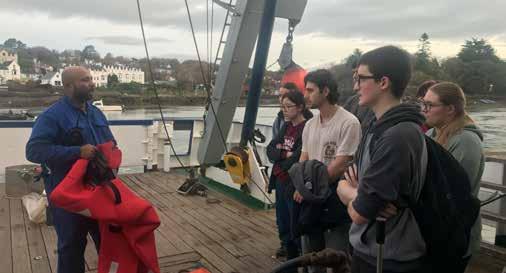
Marine Biology students Tara Ebrahimi, Ellie Gallichan, Fraser Masterson, Luke Welch, Sophie Crouch and Becks Gillmore took part in an ECOWindACCELERATE project. This four-day research cruise explored the ecological impacts of accelerated seabed mobility around windfarms. Students gained experience in performing a range of
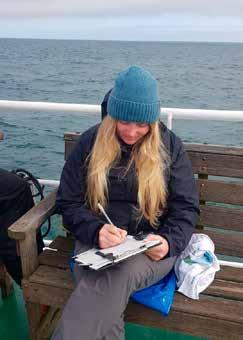
activities, including CTD deployments, rockhopper otter trawls, echosounder measurements, and European Seabirds at Sea (ESAS) observations. During the cruise, the students also received training in ESAS methods and contributed to sorting, weighing and measuring fish caught by trawls.
The £2 million project is run by Professor Katrien Van Landeghem, and involves Dr James J. Waggitt and Dr Olivia Hicks, together with Dr Jonathan Green from the University of Liverpool. It is funded by NERC, The Crown Estate, and Defra. The four-year study explores how offshore wind farms and climate change alter seabed processes and marine ecosystems. It will predict and quantify seabed changes, assess impacts on biodiversity and food webs, and identify opportunities to align conservation with mitigation, supporting biodiversity net gain and sustainable offshore wind development under the UK Government’s 25 Year Environment Plan.
Find out what our students had to say about the experience:
Tara Ebrahimi: “As a marine biologist with a strong background in fieldwork and species monitoring, I am currently pursuing an MSc in Marine Top Predator
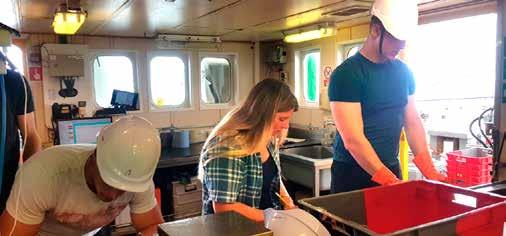
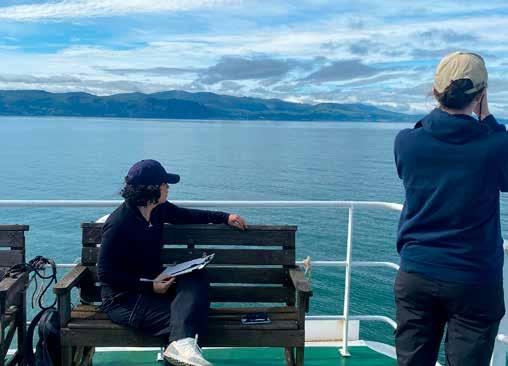
Ecology at Bangor University. I joined the ACCELERATE project cruise as a volunteer to gain hands-on experience in offshore ecological research and to strengthen my skills in seabird observation and broader marine survey methods.
During the cruise, I took part in seabird surveys and contributed to data recording and entry. We also observed several marine mammals, including dolphins, porpoises, and seals, and included these sightings in our logs. I gained a deeper understanding of the functions and processes of the echosounder and CTD systems, and I observed the demersal trawling operations while learning more about sample processing. Experiencing variable sea conditions provided valuable insight into offshore fieldwork. I learned a great deal from Dr. James Waggitt, especially about seabird identification, observation protocols, and the integration of different survey tools.
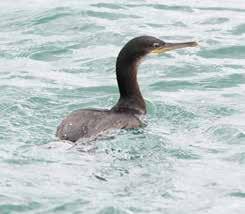
This was a truly rewarding experience, and I am grateful for the opportunity to learn from such a dedicated team and crew”.
Fraser Masterson: “As part of my MScRes programme based on diving seabirds, I was given the opportunity to join the ACCELERATE cruise, where I helped with data collection from trawl samples and seabird observation surveys. I thoroughly enjoyed the experience, and the three days out at sea helped develop my seabird ID skills whilst promoting collaboration with other students sharing the same passions and goals as myself.”
To find out more about the Accelerate project, please visit https://ecowind.uk/ projects/ecowind-accelerate/
A separate cruise in August saw the Prince Madog traversing the Caledonian Canal and heading to the northern North Sea. The cruise, led by Dr Ben Lincoln, aimed to make the first measurements of the turbulent wake, which is generated by tidal flow past giant next-generation floating wind farms.
The NERC funded cruise was joined by Physical Oceanography PhD student Meg O’Hara, who led the biogeochemical sampling, together with Huw Palmer (BSc Physical Oceanography and Geography and a current MSc Applied Marine Geosciences student), Ed Roome (BSc Physical Geography and Oceanography, now a Physical Oceanography PhD student), Luke Lazenby (MSc Physical Oceanography) and Gráinne Perryman (MSc Top Predator Ecology).
This work aims to quantify the positive impacts of the tidally generated wakes on the marine ecosystem by mixing up nutrients and preventing surface heat waves. It is hoped that the results will help guide the future design of turbine floats and the layout of wind farms. There are currently only 11 floating wind turbines in UK waters, (all off Aberdeen), compared to over 2,000 smaller bed-mounted turbines. Whilst the bed-mounted turbines are found in shallow well-mixed coastal waters, the floating turbines are much larger and are designed to operate in the deeper seasonally stratifying regions further from the shore.
Commenting Principal Scientist Ben Lincoln said: “As the shallow coastal waters are becoming crowded, the development of floating wind farms in the seasonally stratifying seas are seen as a major pathway forward in reaching NetZero by the UK Government, with up to 20,000 floating turbines planned. The work we are carrying out will help inform design and layout of future floating wind farms, helping ensure the new developments are sustainable.”
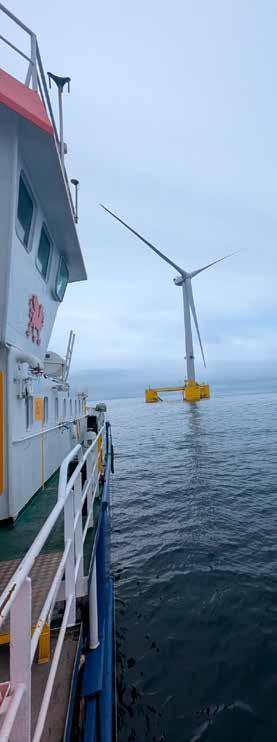
The team also took advantage of the passage through Loch Ness to collect data for Luke Lazenby’s PhD project, which aims to evaluate the influence of a Pumped Storage Hydropower plant on the loch hydro-environmental characteristics. His PhD is funded by Glen Earrach Energy Limited.
Retirements
Lewis Le Vay
Earlier this year, we bid a fond farewell to Professor Lewis Le Vay, who retired in January after a distinguished 30year career with the School of Ocean Sciences. He was the Director of the Centre for Applied Marine Sciences (CAMS) over the last 10 years, a role which afforded him the opportunity to be involved in a diverse range of applied research, building external relationships with industry and government. Under his leadership, CAMS thrived, delivering a broad portfolio of major projects and translating the School’s research into impactful collaborations with diverse local, national and global partners from across the marine sector. Lewis was a champion for development of cross-disciplinary projects, and as CAMS director he fostered a supportive and
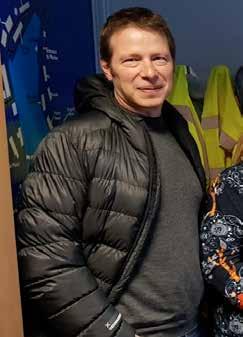
progressive working environment, where all ideas were welcome, and where academics, postdoctoral researchers, and PhD students could all come together to tackle complex research challenges. Those who worked closely with Lewis were proud to be part of the CAMS team and thrived.
In 2014, when funding was secured to build Marine Centre Wales at SOS, Lewis’ commitment to continual innovation, (or perhaps his renowned home DIY skills), made him the obvious choice for a key role in the project management of the build, representing the School in its design and construction. When MCW opened in 2016, it became the new hub for the Centre for Applied Marine Sciences, marking the end of an era on Ynys Faelog as Lewis and the CAMS team moved into their new base and to began a new chapter for marine research at the university.
Although Lewis was known by colleagues as the “aquaculture person”, he was a self-appointed ‘Jack of all trades’, with broad and far-reaching research interests; from mangrove ecosystems, coastal and offshore ecology, fisheries and aquaculture, offshore energy and the intersection of coastal environmental quality and human health. Lewis developed partnerships and forged academic and commercial links that took him across Europe, Southeast Asia, the Middle East and East Africa. His expertise has been sought internationally, leading to advisory roles in more than 25 countries worldwide, as well as with industry and government bodies here in Wales and throughout the UK. Looking back on his time with the School of Ocean Sciences,
Lewis recalled his arrival in North Wales in autumn 1987 having decided to leave the sunshine of California to undertake an MSc at Bangor. As he stepped off the train at Bangor Station, he was met with a deluge of rain so heavy he questioned the soundness of his decision, so much so that when it came to paying his fees, he wrote a dud cheque to buy himself a little time should he decide to turn around and go back!
Thankfully, the rain eased, his doubts passed, and he soon found his footing in Menai Bridge completing his MSc in Marine Biology, followed by a PhD under Professor David Jones on aquaculture hatchery nutrition. Lewis returned to the States to work in the private sector for a while, but the magnetic pull of Menai Bridge drew him back, first to lead research projects in Southeast Asia, and then as a lecturer in 2001, where he was appointed the task of securing EU funds for collaborative research with industry - a position that would define the rest of his career. His commitment to marine science and to the School’s community will be remembered fondly by generations of students, staff, and partners worldwide. We wish him all the best in his well-earned retirement –though he has not managed to detach completely, recently being awarded Emeritus Professor status.
David Roberts
After more than 40 years at Bangor, we said farewell to David Roberts, who retired this summer.
David joined the department in January 1984 as a darkroom technician, processing black-and-white and colour films, including images from electron microscopes, X-rays, and all the hand-mounted illustrations for PhD theses. In those early years, much of his time was spent behind the lens or in the darkroom, and he even carryied out time-lapse filming of estuarine flows from locations such as the Eagle Tower of Caernarfon Castle - where he once spent a whole day babysitting a camera.
As technology evolved, he quietly steered the transition from film to digital, embracing tools like Photoshop and becoming the go-to person for Desktop Publishing long before most of us knew what that was. This eventually led to him managing the website in the early days of the internet.
In the late 2010s, he helped bring in drone technology, keeping pace with changing regulations and ensuring everything was done by the book. Whatever the role, he brought a meticulous eye, deep technical knowledge, and an unflappable sense of calm.
Vallen Astley
This autumn also saw the retirement of our parcels and deliveries technicianVallen Astley. Vallen joined the Normal College in 1977 and became part of University in 1996, when the two institutions merged. For much of his time in the University Vallen worked in Ocean Sciences, where his father, Ken Astley, had been a technician in the Marine Biology department between 1968 and 1971.
Vallen was always a friendly face who
David also designed and produced The Bridge over many years, so it feels especially fitting that this issue features his retirement.
Alongside all this, he’s played a hugely supportive role as Chairman of the Unite Branch, representing and supporting colleagues through times of change and challenge.
His work has directly supported generations of students and researchers, helping them present and communicate their science with clarity and impact.
We’ll miss his thoughtful presence, quiet humour and the generous spirit he brought to his work every day. Thank you, Dave, and enjoy a very well-earned retirement.
always helped, he will be missed here at SOS. We wish Vallen all the best for his retirement.
Bangor takes centre stage in Parliament for 1500th anniversary celebration
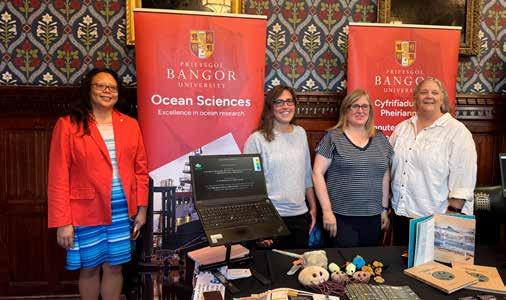
Staff from the School of Ocean Sciences joined colleagues from the School of Environmental Sciences, the North Wales Medical School, Treborth Botanic Garden, and the Vice-Chancellor to represent the University at Westminster as guests of Bangor MP Claire Hughes. They joined Môr Ni Gwynedd, BBC Bangor, FA Wales, Grŵp Llandrillo-Menai, and Bangor City Council to host stands, and showcase the innovative work and opportunities they are driving in their fields and for the local community.
The Mayor of Bangor, local business owners, University alumni, Friends of Bangor Garth Pier, and many more local organisations and cultural groups made the trip to London to celebrate the city, to connect with each other and to discuss what’s next for Bangor.
Claire Hughes, MP said, “I’m fighting hard to get Bangor the recognition – and funding – it deserves. This anniversary is a perfect opportunity to show what makes our city so special, from its deep historic roots to its vibrant community and institutions.
“We had a fantastic range of local voices in the room to tell the movers and shakers in Westminster what’s so great about Bangor. This isn’t just about looking back – it’s about unlocking its potential and building a better future for Bangor.”
Professor Edmund Burke, ViceChancellor, said, “Bangor University is and has always been integral to the city of Bangor’s story since the University was established over 140 years ago. Through world-class teaching and research, the
University has transformed lives, driven innovation, and made vital contributions to regional growth and national productivity. We’re proud, together with
University History Festival
In the Autumn the University held a two-day History Festival providing a rich programme of workshops, discussions, interactive exhibitions, and guest talks, all designed to bring Bangor’s extraordinary history to life. The festival included headline talks by best-selling author Professor Kate Williams and Greg Jenner, a British public historian, bestselling author and broadcaster..
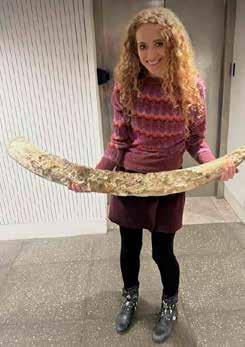
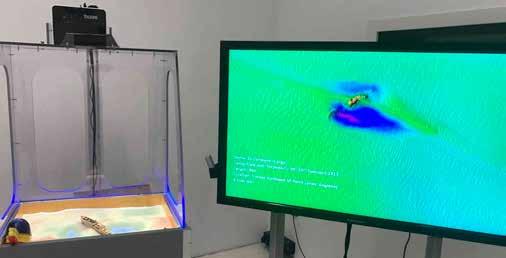
Dr Mike Roberts represented the School of Ocean Science with an exhibition on the rich heritage of the seas around Anglesey. One of the most popular exhibits was an Elephant tusk dredged up by a local scallop fisherman off Red Wharf Bay, which has been aged at somewhere between 1650-1750. Mike thinks it is highly likely that the tusk is connected to an undiscovered wreck from that period out there with more sinister connotations!
our stakeholders, to be part of this event which celebrates the City’s rich heritage, history, language and culture as it marks 1500 years.”
The rich heritage of the seas around Anglesey
Happy Anniversary to the Learned Society of Wales
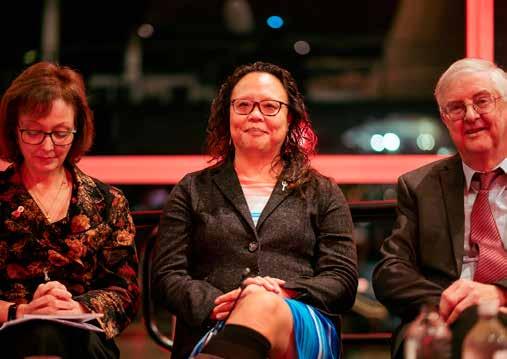
In November the Learned Society of Wales’ celebrated its 15th anniversary. The celebrations included some memorable singing by Sir Bryn Terfel, a giant of the opera world, who left the audience spellbound with two songs, “I Can Give You the Starlight” (Ivor Novello) and the traditional “Suo Gân”, accompanied by his wife, the internationally acclaimed harpist Hannah Stone.
The evening also featured a panel discussion, ‘The Future of Knowledge: 15 Years of LSW’ where Professor YuengDjern Lenn joined fellow panellists Dr
Manon Antoniazzi FLSW (Senedd Cymru), Mark Drakeford MS (former first minister of Wales), Baroness Finlay of Llandaff FLSW and Professor Karen Salt (Trustee of The Williamson Trust) in the debate.
The debate focused on the role national academies play and why Wales needs an academy of its own. It also mapped out a vision for the still youthful Learned Society of Wales. There was a wide range of opinions offered, including how to make Wales’ intellectual life as inclusive as possible, and the importance of combating disinformation and strengthening of trusted voices.
New Welsh herbal garden opened at Treborth to celebrate medicinal plant heritage
Treborth Botanic Garden unveiled its new Welsh Herbal Garden this July as part of the National Garden Scheme’s open gardens event. The Welsh Herbal Garden forms a central part of the 45acre Treborth Botanic Garden, which is owned by Bangor University, and is one of only seven accredited botanic gardens in the UK. It is located adjacent to a Conservation Area, is a Site of Special Scientific Interest and sits on the opposite side of the Menai Strait from the School of Ocean Sciences.
Celebrating the heritage and folklore of Welsh medicinal plants, the garden draws on the local landscape, using regional materials and a design centred on two circular seating areas linked by
University wins prestigious Fairtrade award
Bangor University has achieved a prestigious Fairtrade University and College Award for 2025.
The 2* Award is for the University’s continued commitment, over the past
University retains first-class award for sustainability for the seventh year running
Bangor University has once again been recognised for its exceptional commitment to sustainability, retaining its First-Class Award in the 2025/26
winding paths. Raised drystone planters provide seating and allow visitors to engage closely with the diverse planting.
The collection highlights centuries of Welsh healing traditions, including remedies recorded by the 12th-century Physicians of Myddfai, such as distilled red rose water for toothache, saffron for intoxication, and apples for wart removal.
Designed by Nicola Oakey and built by Kehoe Countryside Ltd, the garden will be a valuable teaching resource for students at the University’s North Wales Medical School, supporting the study of both historical and modern uses of medicinal plants. Professor Stephen Doughty, Head of the North Wales Medical School, said ‘the new space will enrich learning as the school launches its Pharmacy programme, giving students insight into the botanical origins of many medicines’.
two academic years, for championing ethical consumption and global justice across its campuses. This is especially significant given we are in a period that continues to challenge institutions due to shifting educational landscapes and growing global crises.
People and Planet University League. This marks the seventh consecutive year that the university has achieved this distinction.
Bangor is now ranked 25th out of 147 universities for its sustainability, in the UK-wide league table.
Temperate Rainforest Restoration and Regeneration Programme
Bangor University has launched a pioneering programme of research into the restoration and regeneration of the UK’s rare and ecologically rich temperate rainforests, in partnership with The Wildlife Trusts and funded by Aviva.
The work forms part of a landmark £38 million commitment by Aviva to help tackle the climate and nature emergencies by restoring rainforests
Major new funding for Anglesey Green Transition project
across the British Isles. As part of this, funding has been allocated to cuttingedge academic research at leading institutions with Bangor University at the forefront.
Temperate rainforests, sometimes called Atlantic rainforests, are among the most biodiverse habitats in the UK, but they have been reduced to a fraction of their former extent. Researchers at Bangor are now asking key questions about how we can restore these forests more effectively and inclusively, and the contribution that this will make to combatting climate change.
The University is playing a central role in a project to map and support the green transition on the Isle of Anglesey. The project, led by Cambridge University’s Department of Architecture, has secured a further £3.12 million Green Transition Ecosystem grant from the Arts and Humanities Research Council (AHRC), building on the £4.6 million awarded in 2023.
Challenger Returns to Bangor in September 2026
The biannual UK Challenger Society conference returns to Bangor on the 7th-11th September 2026. The Challenger Society for Marine Science is a learned society for marine scientists in the UK. It is named after the ship H.M.S. Challenger, which was used in one of the most important marine studies ever conducted.
The Challenger conference attracts around 300 leading UK marine scientists, science managers and early career scientists. As well as showcasing cutting-edge marine science and technology, the conference is noted for its training of young scientists and networking events. This conference is a great place to be if you are recruiting marine science graduates.
The first modern Challenger conference took place in Bangor 42 years ago, and was organised by John Simpson, with the assistance from Ed Hill and Bill Turrell.
As usual, the Challenger Society will be hosting a mini-expo alongside the conference where sponsors can set up shop for three days between the 8th and 10th. There are several opportunities for sponsorship. If you would like to preregister your interest in supporting the conference, please contact Terry Sloane (terry@planet-ocean.co.uk).
David Gray
Alumni News
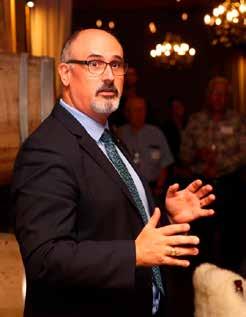
(BSc Marine Biology, 1993) has been appointed as President and ViceChancellor at the University of Niagara Falls Canada from September 2025.
With an illustrious and distinguished career in higher education leadership, and a proven track record of academic excellence, innovation, and student success, David will continue to charter UNF’s bold vision as an innovative, digitally oriented institution.
David joined UNF as Provost and Vice-President, Academic in 2023 where he has been overseeing academic programming, new program development, and the student experience. His exceptional leadership has been instrumental in the successful operation and growth of the university since inception.
“I am honoured with this new appointment,” said David. “UNF is uniquely positioned to prepare students for careers in the rapidly evolving digital landscape, and I look forward to working with our faculty, staff, students, and the broader Niagara community to build on this momentum.”
Under David’s leadership, UNF aims to expand its academic offerings in areas such as sustainability, computer science, health and veterinary management and sciences, and clean and innovative renewable energy. David added “UNF’s commitment to student-centric academic programs is at the core of our mission. We understand the imperative of ensuring that our graduates are not just academically strong but also digitally literate and proficient.”
This appointment concludes Cyndi McLeod’s tenure as the inaugural president of UNF. Originally intended
as an interim role, she provided outstanding leadership in guiding the university through its formative years. Cyndi will continue to play an important part in the institution’s growth as a member of the Board of Governors and in her capacity as Chief Executive Officer of GUS North America.
“We are very pleased to welcome David Gray as the President of UNF,” said Cyndi. “His vision, leadership, and dedication to academic excellence and student success make him perfectly equipped to lead our university into the future. I look forward to supporting David and the entire UNF community throughout this transition and on an ongoing basis as we continue to build a strong and thriving institution together.”
David, a native of Cornwall, England, came to UNF in the role of Provost and Vice-President, Academic from Dalhousie University in Nova Scotia. David holds
a degree in Marine Biology from the University College of North Wales in Bangor, United Kingdom and a Ph.D. in Zoology from Rhodes University in South Africa.
Throughout the last 20 years, David has served in several senior leadership roles at academic institutions in the United Kingdom and Canada, including Hartpury College, the University of the West of England, the University of Derby, and the University of the Highlands &
Islands. Most recently, he spent a decade as the inaugural Dean and Campus Principal of the Faculty of Agriculture at Dalhousie University, where he played a pivotal role in the development of its Agricultural Campus. In these positions, David has been responsible for overseeing extensive budgets, managing large staff contingents, and developing innovative educational programs.
In 2022, David was awarded the Queen Elizabeth II Platinum Jubilee medal for services to higher education in Canada.
Patrick Hale
(MSci Physical Oceanography, 2021)
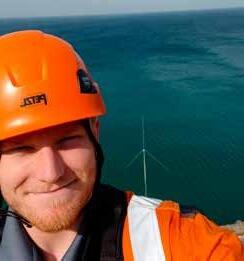
Having graduated from Bangor University with a MSci in Physical Oceanography, it took some time to get started in the MetOcean industry. Immediately after university, I began working at Weetabix in the Research and Development department, applying many of the data analysis skills I had developed during my studies.
I continued to look out for oceanographic opportunities and was
successful in securing a position as an Oceanographer at Fugro.
Within the MetOcean department, we deploy, manage, service and repair equipment that measures the physical properties of the sea, often within wind farms or oil and gas fields. Due to the hazardous nature of some of our working environments, my initial onboarding included several qualifications, such as climbing and sea survival courses.
I have had the opportunity to travel across the UK and internationally, joining both small and large vessels to service wave buoys, abseiling down sea walls and cliffs to maintain tide gauges and antennae, and installing meteorological stations along the coast. Most recently, I travelled to Namibia as part of a project working with deepwater moorings equipped with multiple acoustic doppler current profilers (ADCPs), which are instruments used to measure water current velocities over a range of depths.
I find my work extremely rewarding, as the data collected by this equipment is publicly available and has a direct impact on local communities, from surfers utilising wave height information to harbour masters ensuring sufficient depth for incoming vessels. In fact, I
used data collected by Fugro during my research projects at Bangor University!
The skills and lessons I learned at Bangor
University have been indispensable throughout my oceanographic career, both in fieldwork and in my role as a project manager.
Isabella
Brinning (BSc Physical Geography and Oceanography, 2021).
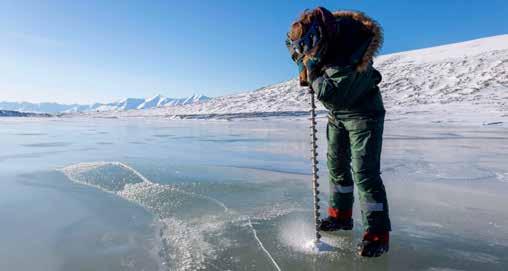
Following graduation Izzy spent two years working offshore for Shearwater Geoservices. She is studying for a
masters degree in the Dynamics of Glaciology and Geomorphology at Fribourg University in Switzerland. She has spent the last semester studying in the University Center in Svalbard. As part of her Arctic Studies she has being doing weekly field work on snow mobiles!
Philip Gillibrand (BSc Mathematics and Physical Oceanography, 1988; PhD Physical Oceanography, 1994).
I completed the final year of my joint honours BSc in 1987-88 (sharing lectures with a cohort of MSc students who have gone on to become very distinguished coastal and shelf seas oceanographers!). Halfway through a PhD (based on Ynys Faelog) studying the circulation and mixing in a Scottish sea loch, I started a job at what was the Fisheries Research Services Marine Laboratory in Aberdeen (now, after some name changes, the Scottish Government Marine Directorate), who were part-funding the project.
At the time, aquaculture in Scotland was transitioning from a cottage industry to fairly big business, and I worked on research projects exploring the environmental effects of the industry and developing regulatory models and tools to quantitatively assess applications for new fish farms. The work involved a combination of field work and computer modelling, with the latter gradually becoming a dominant aspect of my role. But other work included regular sea-going cruises to the North Sea and Northeast Atlantic to monitor circulation and water mass properties, always an enjoyable break from the office and sometimes, particularly in December and January in the Atlantic, quite awe-inspiring!
Feeling the need for a change after 13 years at FRS, I joined the Marine Physics group at the Scottish Association for Marine Science (SAMS) and enjoyed 4 years in Oban working on the links between marine mammal distributions and physical oceanography, and further work on sea loch dynamics.
Personal circumstances in 2007 led to a move to Christchurch, New Zealand,
and a job with the National Institute for Water and Atmospheric Research (NIWA). This was shortly after the Mw 9.2 – 9.3 earthquake in Indonesia in 2004 and the consequent “Boxing Day tsunami”. Regional authorities in NZ were on heightened alert regarding flooding risk to low-lying coastal communities from future tsunamis and were funding regional tsunami risk assessments and coastal flood modelling predictions. I worked with a team running a high resolution (finite element) hydrodynamic model to prediction potential coastal inundation from a range of possible tsunami sources, of which there are many around the Pacific Ring of Fire. By now, hydrodynamic modelling was the dominant aspect of my work, but field data of tsunami impacts were collected and calibration of the models, though challenging, was attempted.
After riding out the 7.1 MW Canterbury earthquake in September 2010, we moved again to Hobart, Tasmania where I joined a team at CSIRO, Australia’s national science agency, modelling water quality in estuaries and coastal waters including the Great Barrier Reef. But after 6½ years abroad, the lure of home took us to Thurso in Caithness in
2014, and the Environmental Research Institute of the University of the Highlands and Islands (UHI). There I led a research theme on marine renewable energy and the environment, focussed particularly on tidal turbine installations in the Pentland Firth. Among many research projects investigating diverse aspects of renewable energy development, we combined model predictions of the environmental effects of energy extraction with observations of circulation and sediment transport using X-band radar, drones and novel acoustic methods.
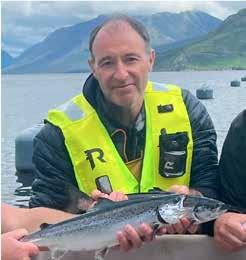
The Brexit referendum result in 2016 offered the prospect of a more challenging research funding environment for universities. Deciding it was a good time for a radical career change, in early 2017 I joined Mowi Scotland Ltd, a salmon farming company with offices in Fort William in the Scottish Highlands and fish farm sites in the Scottish sea lochs and inshore coastal waters. Better predictive modelling of
Robert Sarginson
(MSc Marine Biology, 2022)
Since graduating with a distinction in my MSc in marine biology in 2022, my career has taken me from renewable energy in the USA to underwater photography off the coast of Western Australia.
Whilst studying at Ocean Sciences, some of my favourite topics were learning about coral reef systems with Prof Gareth Williams. My thesis assessed how the reefs around the Cayman Islands had been affected following the out-break of Stony Coral Tissue Loss Disease supervised by Prof John Turner. I received the Thomas Dunkley award for my work on this project and was able to spend several months working with the Department of Environment Cayman Islands Government. During this time I
environmental concerns was needed, to ensure that farms operated within the assimilative capacity of the local marine environment and to meet increasing regulatory demands for predictions of environmental effects.
Here I lead a small team of four people, modellers and field scientists, within a larger Environment Team. Since 2017, we have collected over 10,000 days of ADCP data at farm sites, almost 1000 days of wave data, and developed hydrodynamic models of circulation and biophysical models of waste dispersion and sea lice larval dispersal. These models and data provide evidence to the regulator of compliance with Environmental Quality Standards and are used to demonstrate that our farms operate within sustainable limits. As a team, we continue to engage with academic partners through collaborative projects and publications to improve understanding and prediction of the environmental effects of salmon aquaculture.
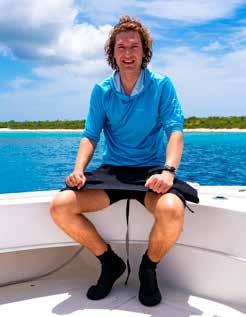
got to spend a lot of time in the waters surrounding the Cayman Islands. I had opportunity to use some big underwater cameras whilst there and produced a short documentary about shark research.
My passion for underwater photography actually started in 2019 when I was working in Myanmar with Boulder Bay Eco Resort. The owner, Bjorn Buchard,
was keen to better understand the reefs surrounding Nga Khin Nyo Gyee Island in the Mergui Archipelago. It was there I met Sirachai Arunrugstichai, an emerging National Geographic photographer using imagery to highlight conservation issues in the region. His approach to story-telling through science and photography inspired me to try and do something similar.
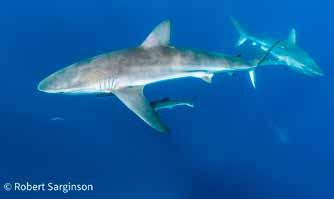
After my MSc I worked for a marine surveying company and was involved in an offshore wind development, off the coast of Rhode Island. However, after a few years I made the decision to leave that job and go and chase my dream of being an underwater photographer. I spent time developing my portfolio and diving skills
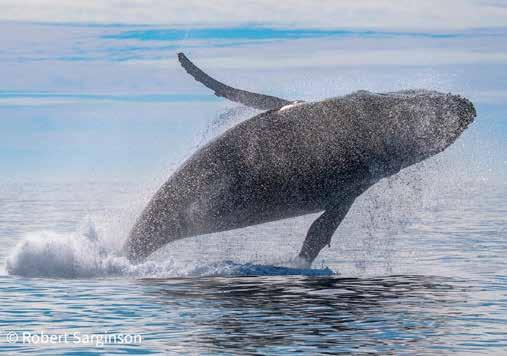
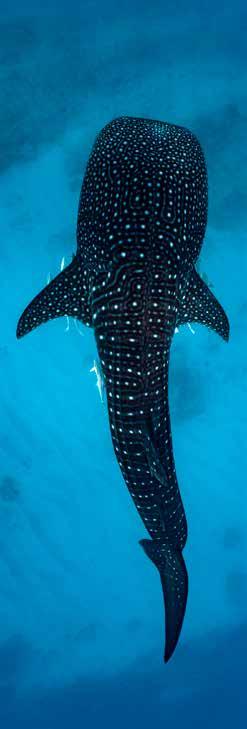
in Indonesia which eventually led me to a position on the Ningaloo Reef in Western Australia.
The diversity of mega-fauna along the Ningaloo Reef is world renowned including whale sharks, humpbacks, manta rays, turtles, dugongs, dolphins, orcas and other species of sharks! It’s common to encounter most of these marine animals all in one day! Throughout my university degree I was inspired by underwater photographers such as Brook Pyke and Ollie Clarke and now it’s a dream come true to work alongside them on the Ningaloo!
Working in the marine tourism industry allows me to share Ningaloo’s incredible biodiversity with visitors, while also helps educate them about its importance. The reef is most famous for its aggregation of whale sharks. I’m fortunate to spend nearly every day in the water, documenting these encounters. However, this only scratches the surface on what the Ningaloo can offer. More can be found on my portfolio: https:// robertsarginson.myportfolio.com/
Worldwide, coral reefs are under immense stress due to climate change. Unfortunately, in 2024 and 2025 the Ningaloo Reef saw an unprecedented bleaching event. As a photographer and marine biologist, I believe it is my responsibility to highlight such events through underwater photography. I aim to create a series of documentaries and images combining the decline in biodiversity and the people trying to preserve it.
Congratulations
Rhodri Irranca-Davies (Applied Marine Biology, 2019) on his new position as Marine Advice Assistant at Cyfioeth Naturiol Cymru/ Natural Resource Wales.
Jude Chisholm (BSc Marine Biology, 2023; MSc Renewable Energy, 2024) on his new position as Assistant Marine Consultant at Ocean Ecology Ltd.
Bradley McKay (BSc Marine Biology and Oceanography, 2019; MSc Marine Renewable Energy, 2021) on successfully defending his PhD thesis on “Optimising floating offshore wind arrays” here at Bangor.
Anthony Gaffney (BSc Maine Physics, 1987) on becoming Managing Director of Tetra Tech RPS Energy.
Liberty Telling (BSc Physical Geography and Oceanography, 2025) on her new role as a graduate flood and coastal consultant with Binnies.
Josephine Anselin (MSc Physical Oceanography, 2021) on successfully defending her PhD thesis at Cambridge University and on her new role as a Principle Coastal Engineer with WSP.
Ellie McQuair (MSc Marine Renewable Energy, 2024) on her new role as a graduate geophysical surveyor with SEP Hydrographic.
Meg O’Hara (BSc Geological Oceanography, 2019; MSc Physical Oceanography, 2021) on successfully defending her PhD on “What drives cold pulses at remote tropical reefs?” here at Bangor University.
Aaron Furnish (BSc Ocean and Geophysics, 2019; MSc Marine Renewable Energy, 2020) on successfully defending his PhD thesis on “Pathways to Realistic Impact Modelling in Estuarine Areas” here at Bangor University.
Alice Lawrence (MSc, Marine Environmental Protection, 2004) on successfully defending her PhD thesis titled “From global surveys to local dynamics; quantifying ecological variability in tropical coral reef fish and benthic communities”.
Lisa Goberdhan on successfully defending her PhD thesis on: “The functional ecology of coral rubble on tropical coral reefs?”.
Sophie Crouch (MSc Marine Environmental Protection, 2020) on successfully defending her PhD thesis on “Changes in the distribution of marine top predators in the North Sea associated with future offshore wind farm developments” here at Bangor University.
Mikołaj Jankowski
(MSci, Physical Oceanography, 2020) on successfully defending his PhD thesis on “Wave-Driven Sediment Transport along Eastern Baltic Sea Shores” at the Tallinn University of Technology, Estonia. {photo alumni Jankowski}
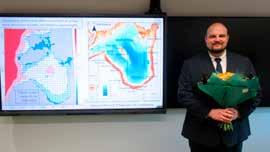
In Memorial
Josh Horn (Marine Biology and Zoology, 2024)
It is with great sadness that we report the passing of Josh Horn, a very recent Ocean Sciences graduate.
His friend Charlotte Maloney remembers: “I first met Josh Horn on a School of Ocean Science Open Day. It was my first time’s being a peer guide and showing people around and Josh was one of the first people to walk over, introduce himself and ask what degree I was on and did I need any help. Josh instantly made me feel like I belonged and that the day was going to go well as I had someone I could turn to for help. I came to quickly learn that this is how Josh approached everyone he met.
Josh enjoyed helping people, he never wanted anyone to feel left out, he cared deeply about his housemates, colleagues, his friends back in Chester and his friends he made at Bangor University. Josh spoke openly about all his various friend groups with the opinion that if they all had the opportunity to meet they would all get along instantly.
Josh realised that gaining experience could sometimes be hard so he took the time to offer other students a chance to gain academic skills by helping with data collection for his own MRes, he then messaged lecturers in SOS to say how impressed he was by these students and that he would not hesitate to enlist them to help on other projects. He always wanted to see people thrive.
In his spare time, he loved to be outside, even better if it was with friends, he loved to volunteer, further helping the environment he cared so much about, just this year he helped out with North Wales River Trust, Seasearch and participated in events on Bangor Garth Pier, teaching the
local community about the species on their doorstep. Josh also loved being part of the committee for the Endeavour Society and being able to offer students opportunities and another place of community.
I hope we can all continue to be as kind and as considerate of each other as Josh was, and continue to foster an environment in which we want to see each other thrive and never leave anyone feeling alone. You are missed”
Senior Lecturer Martyn Kurr remembers: “Josh did his Undergraduate at the School of Ocean Sciences and rapidly developed a large friendship group thanks to his wonderful character, quick wit, and ever-helpful nature. He joined The School of Natural and Environmental Sciences as a master’s by Research Student, where
Malcolm Budd
Malcolm Budd started in the NERC unit, in the then Department of Marine Biology in July 1971. He was an algologist, looking after the algal unit until his retirement from the University in 2006.
He was also well known in local folk music circles, playing a variety of string instruments in numerous bands and at regular folk session at the Auckland Arms, Menai Bridge. Malcolm was a member of the Rub-a-dub-Jug band and later joined the famous Welsh Language rock band, Y Moniars. He passed away on the 21 February 2025.
he was undertaking a fascinating study on hermit crabs. He stayed very close to his SOS friends, many of whom he’d not only studied with but also socialised with as part of the Endeavour Society and its wider community, worked with on open days, and volunteered with as an amazing peer guide for many years. Josh was extremely well loved, always appreciative of any support, and paid that support forwards ten-fold without hesitation. He was also exceptionally intelligent and had a particular knack for complex analysis –such a knack, in fact, that his third-year dissertation supervisor could not keep up with him. Josh will leave a big hole in the hearts of everyone who knew him, and he will be a sadly missed part of both our schools.”
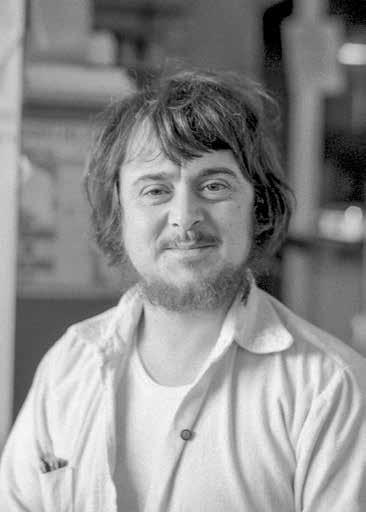
George Jones
George Jones served as Chief Technician for the Marine Biology Department— later merging into the School of Ocean Sciences—from the early 1970s to the late 1990s. His role was central to the department’s field and laboratory work, and he was known for his technical expertise, reliability, and steady support of staff and students.
Before joining the School of Ocean Sciences, George worked in Africa, an experience that added to the practical skills he brought to his role.
George sadly passed away on 27 March 2025, leaving a legacy within the School of Ocean Sciences and among all who worked with him.
Ric Midgley
(PhD Physical Oceanography)
We were saddened to hear of the untimely death of Rick Midgley in a road accident. Ric was a PhD student in the school in the early 1990s, and was supervised by John Simpson. Following his PhD on the seasonal cycle of circulation and mixing in the Clyde Sea, Ric went on to establish a reputation for his pottery which continues to be exhibited in many local galleries. He never moved away from the area, becoming an internationally certified trainer of Nonviolent Communication (NVC) and level 2 practitioner of Internal Family Systems (IFS).
Paying tribute his friends at Budderfield recount: “You may have known him for his beautiful pottery - he would always lay out his clay crockery for sale at the Festival and the Green Earth Awakening. Rik was often on the programme teaching Qigong and we also knew him as an NVC facilitator with a host of great facilitative and therapeutic skills.”
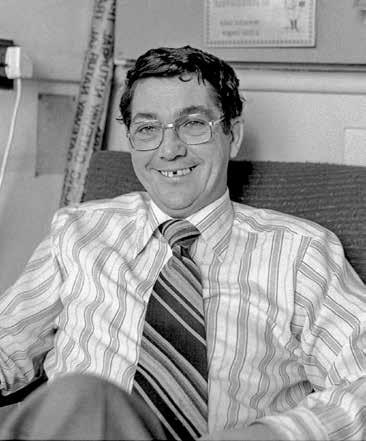
Research and Impact Highlights
Underwater lake heatwaves are on the rise, threatening aquatic life
A recent study by Iestyn Woolway and colleagues shows that lakes around the world are warming, not just at the surface, but deep below as well. Subsurface heatwaves in lakes, defined as extreme periods of high-water temperature below the surface, are increasing in frequency, duration and intensity.
These hidden extremes could have serious consequences for lake ecosystems. Despite that, the issue remains largely unmonitored and poorly understood.
Lake heatwaves are like those in the atmosphere or ocean. They are prolonged periods of excessive warmth. Most research to date has focused on surface temperatures, where climate change has already caused more frequent and intense heatwaves over recent decades.
These surface events can disrupt the chemical and physical balance of lakes, damage food webs and, in some cases, cause mass fish die-offs.
Aquatic species respond to surface heatwaves in different ways. Some benefit
if the warming expands their preferred temperature range. But many others, particularly those already living near their thermal limits, face significant stress.
In lakes that stratify during summer –where warm surface water sits above a cooler bottom layer – some species seek refuge from the heat by migrating to deeper water. But what happens when that deeper refuge is no longer cool?
To investigate, the study analysed temperature data from tens of thousands of lakes worldwide. These included onedimensional lake models, high-resolution simulations for the Great Lakes of North America, and local models calibrated to specific lake conditions.
The study showed that subsurface heatwaves are already common and they’re becoming more so. Since 1980, bottom heatwaves (those occurring at the deepest parts of lakes) have increased by an average of more than seven days per decade in frequency, more than two days per decade in duration and they have risen by around 0.2C per decade.
Paper: RI Woolway et al (2025). Subsurface heatwaves in lakes. Nature Climate Change, 15, 554–559.
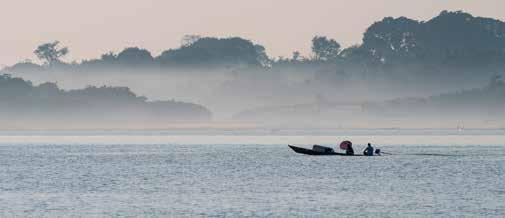
The 100th Anniversary of the flooding of Dolgarrog
When the dam broke: the 1925 disaster that reshaped a Welsh community and a country’s safety laws
Nestled between the Caerneddau mountains and the Afon (River) Conwy, the small village of Dolgarrog in north Wales looks peaceful. But the huge hydro-electric pipes that run down the hillside are a constant reminder of the village’s history, and of how the same source of power that once brought prosperity also unleashed disaster.
On November 2nd 1925, the dam at Llyn Eigiau burst. A torrent of water and boulders thundered down the valley, sweeping through the northern part of Dolgarrog and destroying the small
settlement of Porth Llŵyd. Sixteen people were killed.
One hundred years later, Dolgarrog has become what its residents call “a living memorial”. It’s a place where disaster is not only remembered, but woven into the landscape, the law and the community’s sense of itself.
A new article by Lynda Yorke, Associate Professor in Critical Physical Geography at Bangor University and Giuseppe Forino, Lecturer in Human Geography, University of Salford, is republished from The Conversation under a Creative Commons license. Read more here: https://theconversation.com/whenthe-dam-broke-the-1925-disaster-thatreshaped-a-welsh-community-and-acountrys-safety-laws-267701
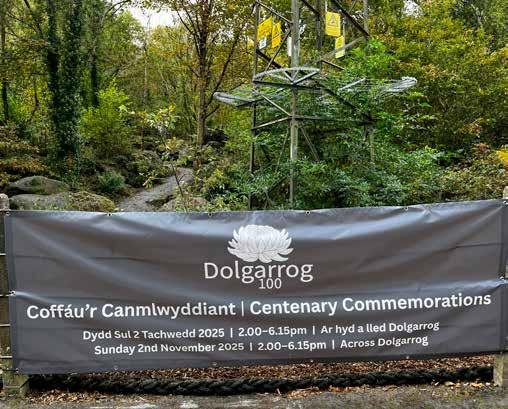
Misunderstanding the tide
is putting millions at risk on UK coast
Imagine you’re walking along a beach, talking to your friend, enjoying the sunshine. Time goes by and it’s time to head back. But as you approach the headland you had walked around previously, you realise that’s not possible anymore: the tide has come in and there is no path around it now. You’re trapped in a bay with the tide continuing to submerge the beach.
The scary, and sometimes lifethreatening, experience of being cut off by the tide is not as rare as you might think. Our survey found that millions of people – 15% of the UK public – have been cut off by the tide, (or nearly so), at least once.
Often there is a simple enough solution, such as climbing up a hill or getting your feet wet. But sometimes there is no easy way out, and the danger increases quickly as the water level rises fast.
That’s when it is essential to call for help. Since 2020, tidal cut-offs in the British Isles have resulted in around 3,600 Royal National Lifeboat Institution (RNLI) lifeboat and lifeguard rescues, with some 35,500 people being assisted.
This high frequency of tidal cut-offs tells
Severe impact of avian flu on southern elephant seals
New research reveals a 47% decline in breeding female elephant seals at sub-Antarctic island of South Georgia following a devastating avian influenza outbreak.
A team of scientists from the British Antarctic Survey (BAS), including Dr Phil
us that getting into danger is not down to exceptional misfortune or, as some might think, people’s own stupidity. It is much too common for that. Our survey shows there are systematic reasons – in particular, misconceptions about how the tide works – that regularly lead to people getting into difficulty.
By highlighting the extent of misconceptions around tides for the first time, the insights from our survey suggest that ocean literacy should include understanding of tides. This will enable safe and enjoyable access to coasts, nurturing positive relationships and behaviour that support the planet’s health.
From a new new article by Dr Martin Austin, Senior Lecturer in Coastal Dynamics, Dr Elisabeth S. MorrisWebb, Honorary Research Fellow in Marine Ecology and Professor of Linguistics Thora Tenbrink at Bangor University is republished from The Conversation under a Creative Commons license. Read the original article here: https://www.bangor.ac.uk/ news/2025-10-17-misunderstandingthe-tide-is-putting-millions-at-risk-onuk-coasts-heres-what-you
Morris-Webb, ES, M Austin et al (2025).
Based on Cut Off by the Tide: How Ocean Literacy Can Help Save Lives.
Ocean and Society 2025, Volume 2, Article 9793.
Hollyman from Bangor University, have documented the severe impact of avian influenza (HPAI) on southern elephant seals at South Georgia.
The new research shows that the world’s largest population of southern elephant seals – which accounts for over half of the global population of breeding age – has suffered unprecedented losses following the arrival of the HPAI H5N1
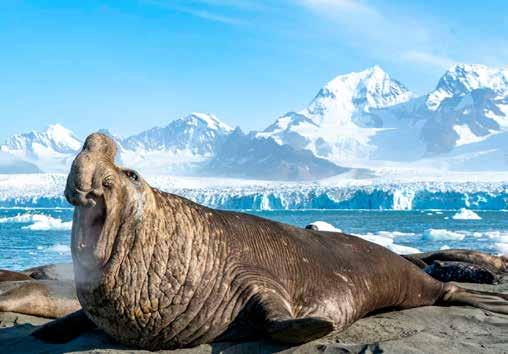
strain of avian influenza at the remote sub-Antarctic island in late 2023.
Using cutting-edge aerial survey technology, the research team monitored the three largest breeding colonies on South Georgia (representing 16% of the total female breeding population, based on census data from 1995), comparing breeding female numbers before and after the virus outbreak.
Their findings reveal an average reduction of 47% in females between 2022 and 2024, with some colonies experiencing declines of over 60%.
Dr Phil Hollyman Lecturer in Global Marine Fisheries at Bangor University’s School of Ocean Sciences said, “It is heartbreaking to report such severe declines in the world’s largest breeding population of Southern Elephant seals. They are the world’s largest seal species and an iconic fixture of the beaches
at South Georgia. Whether HPAI has resulted in direct mortality or shifts in behaviour, this population drop is extremely concerning. Continued monitoring efforts are needed to fully understand the long-term impact.
“When we undertook the early data collection included in this paper, we were simply trying to estimate the size of key colonies around the island. We were lucky that these counts were made shortly before the devastating impact of HPAI became clear, as they gave us a hugely valuable set of recent data points. It really underscores the value of longterm monitoring efforts.”
Southern elephant seals are one of the most iconic species in Antarctica, with adults capable of diving to depths of over 1,500 metres and travelling thousands of kilometres to feed, across the entire Southern Ocean. The remote islands of South Georgia have been home to a stable population for decades.
The virus first appeared at South Georgia in September 2023, initially detected in brown skuas before spreading to marine mammals including elephant seals and Antarctic fur seals.
The research team used fixed-wing UAVs to conduct precise aerial surveys, creating detailed maps of the breeding colonies and enabling accurate counts of individual seals. This technology allowed scientists to assess the impact of HPAI with unprecedented precision despite the remote and challenging conditions.
The findings mirror drastic declines observed in South American elephant seal populations, where HPAI caused mortality rates of over 70% in some areas. However, the South Georgia population had previously been considered stable and isolated from such threats.
The research highlights the critical importance of continuing the sustained, long-term monitoring led by British Antarctic Survey since 2015, which has integrated ground counts, drone surveys and satellite imagery to assess the full extent of the damage and track potential recovery. These baseline data enable researchers to distinguish short-term fluctuations from enduring populationlevel impacts.
Paper: Connor. C. G. Bamford, Nathan Fenney, Jamie Coleman, Cameron FoxClarke, John Dickens, Mike Fedak, Peter Fretwell, Luis Hückstädt & Phil Hollyman (2025). Highly Pathogenic Avian Influenza Viruses (HPAIV) Associated with Major Southern Elephant Seal Decline at South Georgia. Communications Biology, 8,1493.
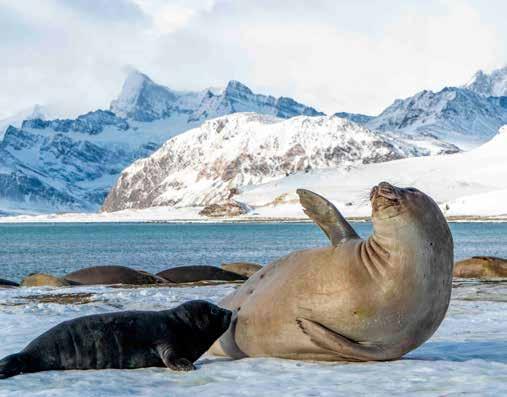
Synchronised breathing spreads diseases for Bottlenose dolphins and other cetaceans
A behaviour which reinforces social links for the enigmatic bottlenose dolphin could also lead to higher mortality and infection rates according to new research published in the Journal of Communications Biology this month. Paper: MA Collier et al (2025). Breathing synchrony shapes respiratory disease risk in bottlenose dolphins. Journal of Communication Biology, 8: 870.
How ‘supergenes’ help fish evolve into new species
One of biology’s big questions is how new species arise and how nature’s incredible diversity comes to be. A new study involving Bangor University zoologists of cichlid fish from Lake Malawi, in East Africa, offer a fascinating clue as to why there are so many different kinds of animals and plants on Earth.
Paper: LM Blumer et al (2025). Introgression dynamics of sex-linked chromosomal inversions shape the Malawi cichlid radiation. Science, 388(6752), DOI: 10.1126/science.adr99