
Beethoven’s Iconic Fifth Symphony at the Music Tent
BY EMMA KIRBY Marketing Manager
Dun dun dun duuuhnn
Even if you can’t place this famous fournote motif, you are likely familiar with it— you might already be humming it in your head.
Is there another piece of music in the Classical canon (or popular music for that matter) that is as instantaneously recognizable as Beethoven’s Fifth Symphony? More than 200 years after Beethoven penned this famous rhythmic sequence of notes, one wonders if he knew that the symphony—which he labored over so intensely in pursuit of perfection—would become a foundational pillar of Western classical music.
This Friday, July 11, experience this timeless and transformative work performed by the Aspen Chamber Symphony under the direction of the ever-beloved conduc-
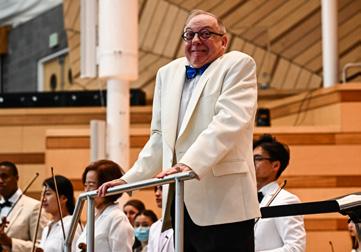
tor Nicholas McGegan, who returns for his 25th summer season at the Aspen Music Festival and School.
“Beethoven Five is probably the most iconic piece in the classical music repertoire,” says AMFS
Munroe President and CEO Alan Fletcher.
But what makes it so iconic? AMFS Vice President for Artistic Administration Patrick Chamberlain explains, “Beethoven’s Fifth is one of those pieces that lives up to the hype. It’s exhilarating, reflective, mysterious, and triumphant. In just over 30 minutes, the listener experiences the full range of human emotions and the full force of what music can do.”
“You can’t just listen to it—it’s too exciting, too gripping, too personal.”
Nicholas McGegan Longtime Aspen Music Festival and School guest conductor
The work, composed at the threshold between the Classic and Romantic eras, sparks an innate and profound emotional reaction, says McGegan, who thinks of the symphony as one large, overarching story rather than four separate movements.
It begins in “deep despair” and arrives at “the gates of heaven,” he says. “It’s a journey that the audience has to come along on, with Beethoven leading the way. You can’t just listen to it—it’s too exciting, too gripping, too personal.”
As quintessential as the piece may now seem, Beethoven’s original manuscripts give a glimpse into the composer’s har-
rowing creative process. Messy handwriting, scribbles that make the score nearly illegible, three different attempts to compose an ending he was satisfied with, and still, even after its premiere, he felt compelled to make edits. McGegan likens Beethoven’s artistic labors to climbing a musical Everest. If Beethoven was never quite satisfied with his work, Mozart was singularly confident in his. His manuscripts were pristine, as if he merely had to pen the music that was already fully formed in his head. He is, “of course, showing off,” says McGegan of the composer’s jubilant “Paris” Symphony No. 31, which opens Friday’s concert. “He’s showing what a brilliant composer he is every single moment of it.”
Mozart wrote the Symphony while in Paris and certainly knew how to appeal to the local crowd, crafting a witty melodic quip that garnered immediate applause from the Parisian audience (in the middle of the first movement, no less) in its debut performance. The composer also benefited from greater access to musicians in Paris, deviating from the typical mid-Classicalera orchestration by utilizing more than 30 violins and similarly robust sections across
See McGegan, Festival Focus page 3

2025 OPERA BENEFIT TUESDAY, JULY 8
Step into the romantic world of La bohème’s Café Momus with a magical evening at the Klein Music Tent.
Culinary and musical delights unite in an elegant, Parisian-inspired evening hosted by Renée Fleming and Patrick Summers, co-artistic directors of Aspen Opera Theater and VocalARTS. Joining them are Grammy Award–winning soprano Ana María Martínez* and the rising stars of Aspen’s opera program.
*Also appearing in recital with Andy Einhorn on July 10, and with the Aspen Festival Orchestra on July 20.
James Conlon Illuminates Lives of Bernstein, Shostakovich
BY DAVID HOYT Festival Focus writer
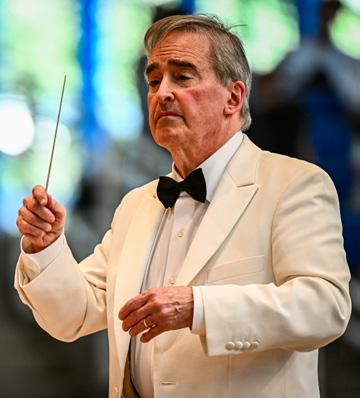
On Sunday, July 13, at 4 PM, the Aspen Festival Orchestra presents works by two great 20th-century composers, separated by an ocean and the Cold War but united by beautiful orchestral writing that masterfully tackles contemporary themes and challenges. Conductor James Conlon unpacks the narratives embedded in pivotal pieces by Bernstein and Shostakovich, helping the audience understand both composers’ sources of inspiration and how their music intertwines with the events of their own lives.
On the first half of the program, frequent Aspen Music Festival guest artist Inon Barnatan returns to the Klein Music
Tent to perform Bernstein’s Second Symphony, “The Age of Anxiety.” Featuring a prominent solo piano part more akin in some places to a concerto, Bernstein’s symphony is in two parts subdivided into a total of six sections, mirroring the structure of the epic, Pulitzer Prize-winning 1947 W. H. Auden poem from which the music draws inspiration. Although less frequently performed than some of Bernstein’s iconic theatrical music like West Side Story and Candide, audience members will find plenty to love in this emotional and energetic work.
“I think anybody who likes Bernstein absolutely should give this a try. It’s a powerful piece and fun, also,” Conlon said. “There’s a spiritual side because [Bernstein] always
somehow worked that in; if it’s not the essence of the piece, it’s a great, important part of the piece ‘The Age of Anxiety’ is a great title for then, and it’s a great title for now.”
Reading The Age of Anxiety just a few years after his sudden rise to fame, and before his marriage to Felicia Montealegre, one can imagine Bernstein relating to Auden’s search for substance, meaning, and identity in a harsh modern world. Fans of the recent biopic Maestro will enjoy the additional lens the symphony provides into the young composer’s hopes, dreams, and fears as he navigated his complex personal and professional life.
Nicholas McGegan has been a source of delight for AMFS musicians and patrons alike for 25 seasons. He conducts the Aspen Chamber Symphony on July 11, and presents A Baroque Evening on July 17.
DIEGO REDEL
Conductor James Conlon takes the stage with the Aspen Festival Orchestra on July 13.
DIEGO REDEL
Lark, Roman, and Meyer: Chamber Music Reimagined
BY SAMANTHA JOHNSTON
Festival Focus writer
Three trailblazing artists—violinist Tessa Lark, cellist Joshua Roman, and bassist/composer Edgar Meyer—join forces for a genre-blurring evening of music at 7:30 pm on July 7 in Harris Concert Hall. This extraordinary collaboration celebrates virtuosity, creativity, and connection across generations and musical traditions.
Anchored by Edgar Meyer, a longtime AMFS artist-faculty member and MacArthur “Genius” recipient, the performance features a newly composed trio—his first for violin, cello, and bass in decades—written specifically for this ensemble. AMFS alumnus Roman, who began collaborating with Lark after recovering from Long Covid, brings lyrical depth and an adventurous spirit. Lark, with her fusion of classical refinement and Appalachian fire, rounds out a trio that thrives on respect, curiosity, and bold artistic risk-taking.
Audiences can expect a program that includes Meyer’s early trios, a Bach arrangement, and his newest work—an arc that reflects Meyer’s evolving musical voice, shaped as much by bluegrass as by baroque. It’s chamber music reimagined: intimate, expressive, and unmistakably original.
“Everyone should have some device to just hold their jaws up to their faces,” says Lark. “Seeing Edgar play and Joshua’s elegant fluency on the cello is mind-blowing. It’s so intimate, but at the same time it’s incredibly virtuosic. We’re all our own sort of ham on stage, and we’ll all have our moment to show off and shine.”
The trio’s chemistry is grounded in seriousness of pur-
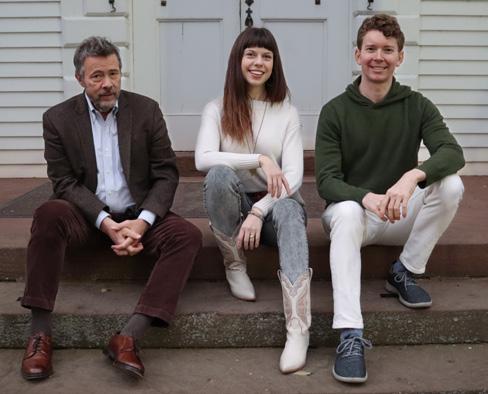
“Everyone should have some device to just hold their jaws up to their faces,” says violinist Tessa Lark about the recital she, Joshua Roman, and Edgar Meyer will give on Monday, July 7.
pose but fueled by joy.
“One of the things I adore most,” Lark says “is that each of us is so serious about what we do—without taking ourselves too seriously. That creates intense rehearsals that I hope the audience feels in performance.”
Describing the sound is difficult—because there’s nothing quite like it. Some moments feel like hoedown-ish violinand-cello exchanges, bluesy bass solos, or playful interludes, while others are more meditative, even hymn-like.
“There’s just no sound like Edgar’s,” Lark says. “He has shepherded in a new era of American compositional
sound. If he wasn’t a bassist, he’d be a mathematician. There’s a perfection and intelligence to what he does, but also so much heart and soul.”
Roman, who invited Lark to collaborate on his recent album Immunity, speaks with reverence about the connection they’ve developed.
“Tessa has become one of my favorite people to share the stage with. She has this intensity that includes a full spectrum of emotions—a lot of joy, sparkle, and curiosity. There’s just another gear when she’s on stage and she levels up in a way I didn’t even think existed,” Roman says.
Lark calls Roman “the most gifted cellist I’ve ever met,” praising his command of the instrument and his reverence for music across genres. “Playing with Joshua feels like a blessing and a long time coming—even though it wasn’t even on my radar.”
That mutual respect extends, perhaps most powerfully, to Edgar Meyer. “He’s been quietly responsible for so many musical projects that made careers like mine possible,” Lark says. “It’s a new era in music, and I love that Edgar is finally doing his thing. It’s the honor of a lifetime to be included.”
Roman adds, “For people who know Edgar’s work, it’s Edgar. It’s his temperament, his virtuosity, his bluegrass influence—but with a real classical sense of scope and form. It’s straightforward music. There’s no artifice. It just works.”
Both Roman and Lark independently decided to memorize the music, honoring Meyer’s own performance approach. “It’s just a choice,” Lark says. “It sends a message
NEARLY 300 EVENTS OVER 8 WEEKS, NOW THROUGH AUGUST 24.
Continued from Festival Focus page 1
COURTESY PHOTO
Enter the Sonic World of Pierre Boulez
BY DAVID HOYT Festival Focus Writer
The best concert experiences go beyond simply presenting music for an audience to enjoy—instead, they wrap the entire space in a sonic world, transfixing everyone in the room through fascinating and unexpected sound environments. That’s exactly what attendees at Harris Concert Hall can expect during “An Evening of Pierre Boulez” at 7:30 PM on Wednesday, July 9 when the Aspen Contemporary Ensemble (ACE) brings to life two pieces by one of the greatest French composers of the past century, explosante-fixe . and Sur Incises, under the baton of conductor David Robertson.
“One of the things that’s lovely about this program is that you get, within the two pieces, quite a variety of the sounds that [Boulez] is able to create,” Robertson said. “If you’ve never put your toe in the Boulezian waters before, this is a great way to get involved.”
Boulez’s contemporary music, with unique instrumentations and intellectual brilliance, can seem intimidating. But as the conductor who led the original premieres of both of these works, with a long history of involvement with the Ensemble intercontemporain that Boulez founded, Robertson is an expert guide for demystifying them.
“David is one of the great interpreters of Boulez,” said AMFS
Conlon: Literary
“Auden’s The Age of Anxiety is a mid-century masterpiece of poetry that inspired Bernstein, and Conlon was himself personally close to Bernstein. So, there’s [a] deep connection there,” said AMFS Munroe President and CEO Alan Fletcher. “[Conlon] is also a great thinker about American music, and a great champion of American composers himself.”
Shostakovich’s opera Lady Macbeth of Mtsensk is well known in music history for the effect it had on the Soviet composer’s career. Initially a critical and popular success when it premiered in 1934, everything changed after Joseph Stalin attended a performance.

Shocked by the opera’s musical depictions of sexuality and the sympathetic portrayal of its murderous and adulterous heroine, Stalin made his displeasure known and the influential party newspaper Pravda subsequently denounced the work in the editorial “Muddle Instead of Music.” Shostakovich’s rising career came to a sudden halt, leading to a period of official condemnation that only
Munroe President and CEO Alan Fletcher. “These pieces explode with color. If you open your mind and listen to the beauty of this, the marvelous invention of it, and the architecture of it, it’s like walking through a crystal palace.”
explosante-fixe . was originally conceived of as a tribute to the recently deceased Igor Stravinsky and presents a paradox, as its title suggests, of music that is both explosive and fixed, inspired by Boulez’s experience of hearing a lone flute echoing through a deserted castle. That version, which featured electronics, “...was a real breakthrough in real-time computer and human interaction to make the music, and so the sounds [were] all around you,” Robertson said. “It [had] an otherworldly quality, almost like a dreamscape.”
For the Aspen performance featuring ACE flautist Antonina Styczen, Robertson will guide audiences through an acoustic excerpt.
During intermission, the stage will be reset for an unusual instrumentation that highlights Boulez’s affinity for keyboard and percussive instruments: three pianos, three harps, and a large array of pitched percussion for three players. Based on his earlier short work Incises (“interpolations”), Sur Incises is based on pitches that form a musical cryptogram of the last name of Boulez’s friend, the Swiss conductor Paul Sacher.
“Coming to Aspen is already the most marvelous thing
Notes
abated with his regime-pleasing Fifth Symphony.
Many concertgoers, however, have never heard the music that led to this turn of events, unless they’ve had the opportunity to attend a performance of the lengthy four-act opera. Conlon, who in 1994 led the very first performances of Lady Macbeth of Mtsensk at the Metropolitan Opera since 1935, presents a suite of his own arrangement for Aspen audiences, condensing Shostakovich’s score into approximately 30 rollicking minutes.
“Aside from its extraordinary drama, it is extraordinary orchestra writing. Very daring, very bold, very avant garde,” Conlon says, continuing “this piece is as compelling and as historically important as any of the symphonies.”
“Productions of [Lady Macbeth of Mtsensk], especially in the United States, are very seldom,” Fletcher added. “But it was a pivotal work in [Shostakovich’s] life. It was a work he gave tremendous attention to, and then it got buried The idea of the arts telling truth to power is an important idea, as much today as ever.”
because of the gathering of talent that arrives there, and this program requires a good deal of talent and precision and virtuosity because those are hallmarks of the way that Boulez wrote music,” Robertson said. “There is this way in which we feel music almost transcends time, and both of these pieces have moments where that is absolutely palpable.”

McGegan: “Paris”
the orchestra.
Where Beethoven’s Fifth is brooding and emotional, Mozart’s “Paris” is characteristically festive and celebratory throughout. Not only does it make for a lighthearted and enjoyable beginning to Friday’s concert, it also lends an interesting historical counterpoint to Beethoven’s grand Fifth. Says Fletcher, “this is what people were hearing,” (Mozart’s “Paris”) “and this is what they heard for the first time” (Beethoven’s Fifth).
Also on the program is KINSFOLKNEM by Emmy Award–winning composer Jasmine Barnes. “Part of our DNA for all of our more than 75 seasons now is to be engaged in new music,” says Fletcher, and KINSFOLKNEM is one of six AMFS co-commissioned works programmed for this season. In Barnes’s words: “KINSFOLKNEM is a celebration of family and extended family gathering. The piece highlights the sound world of places and themes surrounding Black family gatherings.”
So this Friday, don’t miss your chance to embark on a musical journey at the Tent, although fair warning: you may be humming Beethoven’s Fifth for the rest of the summer.
Trio: Music without Words
Continued from Festival Focus page 2
about priorities in collaboration—about knowing the music so deeply it’s in your bones.”
Performing music by a living composer is rare. Performing it with the composer is something else entirely. “We all dream of calling Beethoven,” Lark says. “Here, we have Edgar in the room, which adds a whole new layer of meaning.”
For Lark, the audience experience is both personal and profound. “Music without words gives everyone a moment to just be correct about what they’re feeling,” she says. “We can all have separate experiences in the same room—and still connect.”
Learn more about David Robertson’s experiences working with Pierre Boulez on the AMFS website here:
David Robertson (left) with Pierre Boulez (right) as they prepare for a performance with the Orchestre National de Lyon in June 2002.
COURTESY OF DAVID ROBERTSON
Pianist Inon Barnatan performs the prominent solo part in Leonard Bernstein’s Symphony No. 2, “The Age of Anxiety,” on Sunday, July 13.
MARCO BORGGREVE
Continued from Festival Focus page 1
Continued from Festival Focus page 1