Arctic Yearbook 2025
Heininen, L., J. Barnes & H. Exner-Pirot, (eds.). (2025). Arctic Yearbook 2025 – War and Peace in the Arctic. Akureyri, Iceland: Arctic Portal. Available from https://arcticyearbook.com
ISSN 2298–2418
This is an open access volume distributed in accordance with the Creative Commons Attribution Non Commercial (CC BY NC-4.0) license, which permits others to distribute, remix, adapt, build upon this work non-commercially, and license their derivative works on different terms, provided the original work is properly cited and the use is non-commercial.
Editor
Lassi Heininen| lassi.heininen@ulapland.fi
Managing Editors
Justin Barnes | jbarnes@balsillieschool.ca
Heather Exner-Pirot | exnerpirot@gmail.com
Communications Manager
Tiia Manninen | tiiamanninenfin@gmail.com
Editorial Board
Dr. Daria Burnasheva (Senior Lecturer at Arctic State Institute of Culture and Arts, Sakha Republic)
Dr. Miya Christensen (Professor at University of Stockholm, Sweden)
Halldór Johannsson (Executive Director, Arctic Portal, Iceland)
Dr. Alexander Pelyasov (Russian Academy of Sciences; Director of the Center of Northern and Arctic Economics, Russia)
Dr. Ólafur Ragnar Grímsson (Former President of the Republic of Iceland, Chair of the Arctic Circle Assembly)
James Ross, (Gwich’in leader, Northwest Territories, Canada)
About Arctic Yearbook
The Arctic Yearbook is the outcome of the Northern Research Forum (NRF) and UArctic joint Thematic Network (TN) on Geopolitics and Security. The TN also organizes the annual Calotte Academy.
The Arctic Yearbook seeks to be the preeminent repository of critical analysis on the Arctic region, with a mandate to inform observers about the state of Arctic politics, governance and security. It is an international and interdisciplinary peer-reviewed publication, published online at [https://arcticyearbook.com] to ensure wide distribution and accessibility to a variety of stakeholders and observers
The authors of all articles, briefing notes and commentaries have worked independently. Publication does not imply endorsement by the Arctic Yearbook’s editorial team or its directors.
Cover artwork was created using Adobe Firefly with AI-assisted generation and edited by Tiia Manninen. No real persons, events, or military assets are depicted. The inclusion of this image reflects the transparent and responsible use of AI in visual publishing. Prompt and editing notes are documented and available upon request.
Arctic Yearbook material is obtained through a combination of invited contributions and an open call for papers. For more information on contributing to the Arctic Yearbook, or participating in the TN on Geopolitics and Security, contact the Editor, Lassi Heininen.
Acknowledgments
The Arctic Yearbook would like to acknowledge the Arctic Portal [https://arcticportal.org] for their generous technical and design support, especially Ævar Karl Karlsson. We would also like to thank our colleagues who provided peer review for the scholarly articles in this volume
Table of Contents
Introduction
War and Peace in the Arctic……………………………………………………………………1
Lassi Heininen, Heather Exner-Pirot & Justin Barnes
Commentary
Review of Tolstoy’s War and Peace 8
Hasan Akintug
I. Projecting Power in the Arctic
Kalaallit Nunaat as a Foreign and Security Policy Actor 12
Sara Olsvig & Ulrik Pram Gad
China, Russia, and the U.S. in the Bering Sea: Military Exercises and Great Power Politics……33
Erdem Lamazhapov & Andreas Østhagen
Balancing Alliance Commitments and Economic Dependence: Faroese-Russian Relations in an Era of Great Power Rivalry 53 Heini í Skorini & Tór Marni Weihe
Reassessing Arctic Security: Canada’s Policy Response to Geopolitical Shifts and Emerging Threats ...73
Karen Everett & Katharina Koch
The Evolution of Russia’s Arctic Strategy after the War in Ukraine 96 Angela Borozna
Russian Ambitions to Control Freedom of Navigation and Arctic Access: Refined Data Challenging Moscow’s Northern Sea Route Claims ..122
Troy Bouffard, Gennaro D’Angelo, Gabrielle F. Gundry, Travis R. Pitts, Stephen F. Price, & Andrew F. Roberts
Briefing Notes
Canada’s Arctic Foreign Policy: Somethings Old, Somethings New………………………….143 P. Whitney Lackenbauer
Impacts of Geopolitical Tensions: What Russia’s War in Ukraine Means for Cooperation and Scientific Programs in the Arctic 157
Margaret Williams & Loann Marquant
Feminist Peace for the Arctic: A Briefing on the Fourth Eurasian Women’s Forum, the BRICS Women’s Meeting, and “Peace, Nature and Cooperation in the Baltic and Arctic Seas” Conference in St. Petersburg, Russia in September 2024 164
Tamara Lorincz
II. NATO and Collective Defence in the Arctic
Changes in Sweden’s Security Policy Messaging in the Country’s Military and Civil Defense Publications During the Cold War Compared to Those After NATO Membership………….171
Robert Wheelersburg
NATO’s Arctic Narrative After 2022: Conferences as Promoters of Security or Drivers of Destabilization?……………………………………………………………………………....191
Marco Dordoni
Briefing Notes
NATO and the Arctic in the 2020s…………………………………………………………..217
Gabriella Gricius & Nicholas Glesby
The EU Mutual Defence Clause and Greenland: What Happens if Denmark asks for Help According to Article 42 (7) TEU?……………………………………………………………229
Stefan Brocza
The New Northern Flank in an Integrated Deterrence Concept……………………………...233
Paul Dickson
III. Resource Development and Geopolitics
Responsible Mining in The Arctic: Management, Monitoring and Mitigation of Dust Emissions 240
Christian Juncher Jørgensen, Christian Zdanowich, Pavla Dagsson-Waldhauserova, Alexander Baklanov, Tuija Mononen, Yu Jia, Christian Frigaard Rasmussen, Hilkka Timonen, James King, Patrick L. Hayes, Christian Maurice and Outi Meinander
Decolonization in Greenland and Nunavut and Resource Exploitation for a Decarbonized World: What does an Arctic Century Mean?
Anna Soer
257
Energy and Critical Minerals in the Arctic: Can the US-Russia Rivalry Continue through Cooperation?………………………………………………………………………………...284
Tiziana Melchiorre
IV. Human and Environmental Security
The Implications of Climate Change on Community Ontological Security in the Arctic: A Review……………………………………………………………………………………….296
Michaela Coote & Yulia Zaika
Environmental Restorative Justice and the Green Transition: Examining Intergenerational Equity for Sámi Rights under the Norwegian Constitution 310
Sara Fusco
Art Intermediaries as Catalysts for Added Exchange and Sustainability in the Arctic………....332
Krista Petäjäjärvi & Maria Huhmarniemi
Negotiating Ethics and Methods: Knowledge Co-Production in the Russian Arctic in Uncertain Times 357
Karolina Sikora
Briefing Notes
Recent Canadian Northern Indigenous Peoples’ Sovereignty, Security, and Defence Strategies……………………………………………………………………………………..370
P. Whitney Lackenbauer, Zachary Zimmermann & Samuel Pallaq Huyer
Health and Environmental Security in a Warming Arctic…………………………………….385
Douglas Causey & Eric Bortz
Symposium for Early Career Researchers Working with Indigenous Issues at Mid Sweden University, 26-27 August 2025 394
Ekaterina Zmyvalova
Shared Roads, Shared Realities: Insights from the Calotte Academy’s Journey 2025………….396
Tatiana Petrova
V. Emerging Voices
Introducing Emerging Voices…………………………………………………………………..400
Tiia Manninen
Ireland in Arctic Research: A Growing Scientific Presence…………………………………...402
Elena Kavanagh, Alina Kovalenko & Patrick Rigot-Muller
Getting Comfortable with Uncertainty: Lessons from an Arctic research station
Hanna Oosterveen
407
Compassion Resilience: A Perspective on War, Peace, and Community in the Arctic………...411
Charlene Miles
“It's Not Just About Economic Development”: Prioritising Climate-Vulnerable Regions in International Sustainable Development Policy The Arctic Case Study
Marta Koch
417
The (In)existence of a Portuguese Foreign Policy for the Arctic……………………………...425
Teresa Barros Cardoso
Economic and Political Arguments for NORAD Modernization in an Election Year 433
Vismay Buch
Introduction
War and Peace in the Arctic
Lassi Heininen, Heather Exner-Pirot,
and
Justin Barnes
In 1945, following the end of World War II, 49 sovereign nations declared their determination “to save succeeding generations from the scourge of war, which twice in our lifetime has brought untold sorrow to mankind”, by ratifying the United Nations Charter (see, Full text 2025; also Westing 1990). In 2025, despite the Charter and United Nations’ activities, whose ranks of member-states has swelled to 193, new generations have suffered from the scourge of wars and armed conflicts, as we are witnessing today in Gaza/Israel, Sudan, and Ukraine.
Whereas after the end of the Cold War international tensions and rivalries decreased for a while, armed conflicts and wars are “once again looking like an inescapable part of our future – though in changing forms that are confounding historians, military theorists and philosophers alike” (Mazower 2017), and in their wake, so are peace movements. “The recurrence of war is explained by the structure of the international system...War is normal” (Waltz 1989, 44).
In relations between different entities of a society, in relations between states, as well as in the entire international system, there is always cooperation and competition (indicating peace); sometimes tension, rivalry and conflicts (challenging peace); and every now and then armed conflicts and wars (breaking peace). If you consider international politics to be a spectrum, ‘peace’ would be on one end and ‘war’ on the other.
Competition, rivalry and conflict are interpreted as opposition, “contrasted with cooperation, the process by which social entities function in the service of one another”. While a society “can exist without violence and war... [but] cannot exist without competition and conflict”, it is questioned if conflict is naturally included alongside cooperation, and if it can ever be avoided as a disruptive manifestation of opposition. (Wright 1951, 321-323)
Yet it is worth asking if war is normal, or is this blunt explanation only determinism based on a structural, neorealist theory? As a matter of fact, isn’t peace more normal, or is that idealistic and wishful thinking?
Lassi Heininen, Heather Exner-Pirot, and Justin Barnes are the editors of the Arctic Yearbook
The Arctic Yearbook 2025, with the theme “War and Peace in the Arctic”, seeks to provide a collection of articles reflecting on this question, coming at a time when hot conflict, in the form of reflections of the war in Ukraine, has reached the Arctic region. The volume consists of 15 scholarly articles, 10 briefing notes and commentaries, and 6 emerging voices (as a new section), of timely and thoughtful analyses of Arctic military, security and diplomacy, as well as war and peace.
On war and peace
Discussions, discourses, debates on war and peace, as well as argumentation on behalf of war and peace, have been going on forever (see e.g. Akintug in this volume). Peace, even everlasting peace, is often stated by nations and leaders as an ultimate aim or objective to reach. Though still debated, modern anthropological research like for example, Douglas Fry criticizes the assumption that war is in our genes, and hence unavoidable based on human nature. Further, there are archaeological findings that warfare intensified when human beings transferred from hunting & gathering into agriculture (Virtanen 2007), based on anthropological studies on peaceful societies among Indigenous peoples from tropical rain forests to the Arctic tundra, such as the ‘Copper Eskimo’ in Northern Canada (Fabbro 1978); the implication is that war is not inherent, and it would be possible to prevent.
Sensible reasons and excuses for and against war, as well as various forms of knowledge about war, are constantly found. One of the most influential arguments is that “war as an instrument of national policy… is the continuation of politics by other means” by Carl von Clausewitz (Falk and Kim 1980, 7). Interestingly or strangely, in global politics of the 2020s, with the changing character of warfare and advanced studies on structural violence, the main idea of this early-1800s Prussian soldier and thinker - “that war is a form of social and political behavior” - is still vivid and quoted (e.g. Lamy et al. 2023, 256-258), and not widely debated.
Similarly accepted is the assumption that “The origins of hot war lie in cold wars, and the origins of cold wars are found in the anarchic ordering of the international arena… States continue to coexist in an anarchic order.” (Waltz 1989, 44, 48). By contrast, new realism argues that anarchy in the international system is much based on states, which also “recognize that the best path to peace is to accumulate more power than anyone else can make of it”, even if global hegemony is not possible (Lamy et al. 2023, 96-97). Indeed, “The chances of peace rise if states can achieve their most important ends without actively using force. War becomes less likely as the costs of war rise in relation to the possible gains.” (Waltz 1989, 48)
The roads to war are various, sometimes simple and sometimes complicated and complex, though seldom logical and never determinate. Furthermore, we seem to be experiencing less prevention of wars. An explanation for this trend is that war is a means to achieve power, emphasizing national interests. There are also other causes of war / armed conflicts, and behind them geographical and demographic factors followed by a claim of territory, for example to secure national security; economic factors followed by exploration of (natural) resources; political ones including a fight over values and ideologies; and the tendency of finding victims and / or those who are stated / manipulated to be guilty for something which is interpreted to be bad, even evil, for the society, as their religion, ideology, race or color is different.
Finally, there is misperception with many effects as a cause or road to war, including “inaccurate inferences, miscalculations of consequences, and misjudgments about how others will react to one’s policies” (Jervis 1989, 101), as well as mis- / disinformation spread and accelerated by the established and social media. Consequently, the binary nexus of war and peace deals with threat and enemy pictures – a psychological and sociological phenomenon – often based on misperceptions, and accelerated by religion, ideology or (established and social) media. These inferences could easily become interpreted as threats, i.e. requiring responses, and then real enemies, i.e. to defend from and fight against (e.g. Harle 1991).
There is always an alternative to war, starting with its absence. ‘Negative Peace’ provides the mainstream definition, focused on the absence of war but still structured in a society around military establishments and deterrence activities. ‘Positive Peace’, on the other hand, is centered around non-violent structures (in a society) and structured cooperation and confidence-building activities between nations as a precondition for peace.
Hence, it would be better to fulfill the comprehensive criteria of a ‘peaceful society’: “no wars fought on its territory… not involved in any [ones]… no international collective violence… or interpersonal physical [and] structural violence… [with] the capacity to undergo change peacefully; and … opportunity for idiosyncratic development” (Fabbro 1978).
If the above-mentioned are reasons enough for war, they might be prerequisites for peace. Models of / for peace, related with theories of international politics / relations, have been initiated, discussed and debated by thinkers and philosophers for centuries. These include Chinese Confucianism and Taoism; Socrates and Plato from the ancient Greek; European Dante and Pierre Dubois, as well as the Enlightenment philosophers Immanuel Kant and Jeremy Bentham; Gandhi in India, as well as Johan Galtung, a peace research theorist; and Nelson Mandela, a politician and practitioner who transferred civil war into peace. Not least, peace movements have been, though less so today, vocal and active, and peace research analytical.
In spite of the thesis of everlasting peace, that of democratic peace (based on liberal states), and other theories with their ultimate aims for peace, as well as the UN Charter aiming to end all wars, warfare and wars (or major / minor armed conflicts) proceed constantly. Consequently, people and the environment are suffering due to them, although historically less so in the Arctic region.
War and peace in the Arctic
To call the Arctic a “zone of peace”, as President Gorbachev (1987) did; or to describe the region as “peaceful, stable, prosperous, and cooperative” as the US National Strategy for the Arctic (T he White House 2022) does; or being ready to reaffirm “our commitment in maintaining peace, stability and cooperation in the Arctic”, as the eight Arctic states did in Arctic Council Ministerial in 2025 (Romssa – Tromsö Statement 2025), sound appealing in the world (in disorder, and with turbulence and ecological impacts) of 2025.
Nonetheless, these slogans / statements mean ‘negative peace’, ie. an absence of hot war; they imply neither ‘positive peace’, nor would they fulfill the criteria of a ‘peaceful society’.
This is in contrast to the Inuit Circumpolar Council’s Principles and Elements for Comprehensive Arctic Policy (ICC 1992, 25) explicitly includes a more holistic approach building and emphasizing relationships between human rights, peace and development (see, UN report on Relationship
between Disarmament and Development (1982), UN report on Common Security (1983)). It played an important foundation for further Arctic policies of ICC (e.g. Heininen et al. 2020, 169183).
The document states that “The Arctic policy should recognize that there is a profound relationship between human rights, peace, and development. None of these objectives are truly realizable in isolation from one another… In a global context, peace is much more than an absence of war. It is considered to entail a fair and democratic system of international relations, based on principles of mutual co-operation.”
The Arctic region was not among the pivots of the World War II, although hot warfare took place in a few spots in the European Arctic. In the Pacific North, fighting was focused on the southernmost islands of the Aleutian, which Japan occupied for a short time, in 1942-1943.
The Norwegian and Barents Seas, as parts of the Atlantic Ocean, were real battle fields for maritime war, in particular submarine and anti-submarine warfare. The Allies transported military assets, including equipment and ammunition, as well as other material assistance, for the Soviet Union, and German submarines hunted these civilian cargo ships like wolves. “Escorts to Murmansk”, so named after the final destination on the northernmost coast of the Kola Peninsula, became one of the metaphors of the Arctic war front.
Interestingly, due to its ice-free coast, and the railway to St. Petersburg, Murmansk faced for a while hot warfare already in World War I, when British and Finnish troops were fighting with Russian white generals against the Soviet Russia.
It was not only about naval forces and fighting at sea, since in the European Arctic there were also constant air battles and fighting on the ground between Germany and Soviet Union. This contrasts with the fighting of the Winter and Continuous Wars between Finnish and Soviet troops, which mostly took place in southern fronts, except fighting over Petsamo in the Winter War. The German bombers bombed Murmansk and its harbors, and Soviet ones Kirkenes and other locations in northernmost Norway. After occupying Denmark and Norway in spring 1940, Nazi Germany had quickly entered into the coast of Barents Sea and the Soviet border, and received (almost) total control of the Nordic part of the European Arctic, including the northernmost part (almost half) of Finland, by allying with Finland after Germany’s invasion of the Soviet Union in June 1941.
Nonetheless, German troops never managed to conquer Murmansk, the Allies’ aid to Soviet Union continued to run, and the front was stuck in the Western part of the Kola Peninsula. The real turn started after Finland entered into a ceasefire with the Soviet Union, in September 1944, and had to push German troops out of its territory, which meant Finland’s third war within World War II. Germany paid back this revanche by destroying and burning the infrastructure of the entire Lapland, from small houses to big bridges and main roads, which pushed Lapland’s residents to be evacuated to Sweden.
A minor episode of the war, though a serious act, was when Great Britain “invaded and occupied Iceland” in May 1940, which the Icelandic Prime Minister described “as a precaution against possible German action against Iceland” after the Nazi Germany had occupied Denmark. Although “an occupied country [Iceland] had no to say in presence of British troops… by inviting U.S. troops to Iceland the government of Iceland was making a sovereign decision to accept U.S. military protection” (Petursson 2020, 34).
All in all, the World War II meant severe fighting and moving fronts, in 1941-1945, between Germany and Soviet Union in the European Arctic, in real Arctic climate conditions. Important geopolitical factors started to emerge: Firstly, the experience of warfare in cold conditions, and the revolution in military technology, manifested by the explosion of the atomic bombs in Japan; and secondly, the strategic implications of the shortest distance between the (new) superpowers, the Soviet Union and the USA, being over the Arctic Ocean; and thirdly, that certain strategic minerals, at the time nickel, played a more important role in the superpowers’ arms race and geopolitics in general.
More relevant in the long run is the legacy of the World War II that since then, there has neither been wars nor armed conflicts, nor disputes on sovereignty, in the entire region. That is until the Ukrainian drone strikes on Russian airport on the Kola Peninsula destroyed two strategic nuclear bombers (parked in open air due to START Treaty), an attack that could be interpreted, as many did, as a breaking of the peaceful state of Arctic security. In fact, according to the data by professionals, in particular the SIPRI Yearbook, it did not qualify as an armed conflict per se1, but yet was a damaging hit against the Russian nuclear triad which could have long-term consequences militarily and potentially affect the US-Russian arms control negotiations.
Correspondingly, the legacy of the Cold War in the Arctic, partly based on the legacy of World War II, could be interpreted to include among other things: firstly, two powers of the Allies, the Soviet Union and the USA, later becoming enemies, started to deploy heavyweight military structures, in particular nuclear weapon systems, in the Arctic: nuclear submarines patrolling in Arctic waters, radar stations searching for attacks by a potential enemy, and nuclear bombers in alert to reach the targets on the other side if needed; secondly, the original nature of Arctic military was, and is still, global “nuclear deterrence” with the capability of carrying out a second strike in retaliation if attacked, as the main premise of the nuclear weapon system (Heininen 2024); thirdly, the strategic military importance of the nuclear weapon systems makes the Arctic geostrategically important for the major nuclear weapons powers, and forces them to negotiate on nuclear arms control, if not disarmament, including to agree to extend the New START after its expiration of February 2026. Ironically, all this has supported the high geopolitical stability and peace in the region - one more Arctic paradox if you wish.
Finally and interestingly, the Cold War period also showed, even manifested, small northern states’ influence, punching above their weight, in the post-World War international rule-based order world system, as well as an importance of soft-power based on negotiations (though assisted by the USA and NATO membership) in the case of Iceland. Iceland unilaterally extended its Exclusive Economic Zone, EEZ to 12 nautical miles (in 1961), 50 nautical miles (in 1973), and 200 nautical miles (in 1976), although this was heavily opposed by European great powers. It took three socalled Cod Wars, in 1958-1976, between Britain and Iceland before Britain gave up and the 200 nautical miles EEZ became part of UNCLOS (e.g. Petursson 2020, 50-78).
Conclusions
Hot war and warfare in the Arctic region is a rare thing, limited even during World War II and occurring mostly in the European Arctic (northernmost part of Norway, Finnish Lapland, eastern parts of the Kola Peninsula). Interestingly, warfare in the Arctic has not occurred between two or more Arctic states, but between an Arctic state and an invader / aggressor from outside (British troops in World War I, Nazi Germany in World War II, Britain in the Cod Wars).
Most important geopolitically, and from the point of view of people(s), is the legacies of the World War II and the Cold War that since them, there has neither been wars or armed conflicts, nor conflicts over sovereignty, in the entire Arctic region. Although not much discussed today, the fact that the previous wars have fundamentally shaped Arctic geopolitics and Arctic security could be interpreted as a lesson from the past.
T his mostly manifested as an absence of hot war. Ongoing Arctic cooperation, based on the Arctic diplomatic model, still lends itself to, and has built a foundation for, positive peace
Note
1. An armed conflict is “where more than 1000 battle-related deaths have been incurred during the course of the conflict”, and war is defined to cause more than 1000 deaths during a year (Wallersteen & Axell 1994, p. 333).
References
Fabbro, D. (1978). Peaceful societies: An introduction. Journal of Peace Research, 15(1), 67–83.
Falk, R. A., & Kim, S. S. (1980). General introduction. In R. A. Falk & S. S. Kim (Eds.), The war system: An interdisciplinary approach (pp. 1–12). Westview Press.
Gorbachev, M. (1987, October 2). The speech of President Mikhail Gorbachev on October 2, in Murmansk. Pravda.
Harle, V. (1991). Hyvä, paha, ystävä, vihollinen (Rauhankirjallisuuden edistämisseura ry, Rauhan ja konfliktintutkimuslaitos, tutkimuksia, No. 44). Jyväskylä.
Heininen, L. (2024). Geopolitical features, common interests and the climate crisis: The case of the Arctic. Geneva Paper, 35/24. GCSP. https://www.gcsp.ch
Heininen, L., Everett, K., Padrtova, B., & Reissell, A. (2020). Arctic policies and strategies – Analysis, synthesis, and trends. IIASA & Ministry for Foreign Affairs of Finland. https://doi.org/10.22022/AFI/11-2019.16175
ICC. (1992). Principles and elements for comprehensive Arctic policy. McGill University, Centre for Northern Studies and Research.
Jervis, R. (1989). War and misperception. In R. Rotberg & T. Rabb (Eds.), The origin and prevention of major wars (pp. 101–126). Cambridge University Press.
Lamy, S. L., Masker, J. S., Baylis, J., Smith, S., & Owens, P. (2023). Introduction to global politics. Oxford University Press.
Mazower, M. (2017, April 15–16). War or peace? Financial Times Weekend, p. 8.
Petursson, G. (2020). The defence relationship of Iceland and the United States and the closure of Keflavik Base (Acta electronica Universitatis Lapponiensis 285). University of Lapland.
Romssa – Tromsø Statement. (2025). On the occasion of the Fourteenth Ministerial Meeting of the Arctic Council, 12 May 2025.
United Nations. (2025). Charter of the United Nations (Full text). https://www.un.org/en/aboutus/un-charter/full-text
Virtanen, H. (2007). Onko sota geeneissämme? Tieteessä tapahtuu, 3, 56–58.
Wallensteen, P., & Axell, K. (1994). Conflict resolution and the end of the Cold War, 1989–93. Journal of Peace Research, 31(3), 333–349.
Waltz, K. N. (1989). The origin of war in neorealist theory. In R. Rotberg & T. Rabb (Eds.), The origin and prevention of major wars (pp. 39–52). Cambridge University Press.
Westing, A. H. (1990). Towards eliminating war as an instrument of foreign policy. Bulletin of Peace Proposals, 21(1), 29–35.
The White House. (2022). National strategy for the Arctic region https://bidenwhitehouse.archives.gov/wp-content/uploads/2022/10/National-Strategyfor-the-Arctic-Region.pdf
Wright, Q. (1951). The nature of conflict. Western Political Quarterly, 4(2). (Reprinted with permission of the University of Utah and the author.)
Commentary
War and Peace: A Classic for the Times
Hasan Akintug
War and Peace by Leo Tolstoy truly is a mammoth of not only Russian literature, but also a world classic in its own right. Spanning over a thousand pages in most versions, the book depicts the Napoleonic wars from a Russian perspective Tolstoy utilizes several characters that belong to the upper classes of 19th century Russian society. These characters in turn drive the plot and Tolstoy shifts between the personal lives of these upper-class representatives, narratives of the war between Russia and France, and his own philosophical interpretations regarding human ontology and individual agency.
By no means is War and Peace an easy read. Published serially between 1865 and 1869, the shift between narration, description, and philosophizing may make reading the book somewhat disorienting to the unassuming reader. The sheer volume of named characters also contributes to the intensity of the reading experience. While most main characters are from the Russian aristocracy, Tolstoy portrays the tensions between them and the Russian peasantry throughout the book.
The five main families (Bezukhovs, Bolkonskys, Rostovs, Kuragins, and Drubetskoys) are fictional but historical characters, not least Alexander II and Napoleon, also make appearances within the novel. Through the tripartite split between relationships, war narratives, and philosophical exposition, Tolstoy offers something for readers interested in different aspects of the human experience. However, none of these three elements are portrayed in a straightforwardly approving manner, and a clear skepticism of the human condition permeates the entire book.
From Tolstoy’s use of his characters, fictional or historical, it becomes apparent that he held a critical view on what many call the “great man theory” of histor y. Meaning that he is critical of explaining political phenomenon primarily through the agency of great leaders. While largely left behind in modern historiography and political science, the analysis of “great” men has all too often taken a disproportionate place in academic and media analyses. In War and Peace, leaders like Alexander I and Napoleon are portrayed as pretentious and arrogant, but ultimately subject to
Hasan Akintug is a PhD Candidate at the Centre for Nordic Studies, University of Helsinki.
the elements outside of their control. The aristocrats are subject to their own vices and the conditions of war as much as the peasantry.
Pierre Bezukhov serves as a protagonist through War and Peace. Many literary critics claim his journey was largely based off Tolstoy’s own experiences and serves as a conduit for Tolstoy’s own inner voice. Pierre inherits wealth from his aristocratic father and navigates his way through the ways of high society, war, and relationships, seeking the ultimate truth in life. Pierre seeks meaning in life by seeking novelties and glory. He seeks heroism on the battlefield with the aim of killing Napoleon and he also joins a Freemason lodge seeking community. However, Pierre ultimately finds happiness and meaning through his marriage to Natasha and not in the pursuit of grandeur. In other words, he finds peace internally and not in external acquisitions.
Does this masterpiece have anything to say about contemporary affairs? Absolutely. Par ticularly in an era of increased militarism and antagonistic relationships between different blocks of states, the absolute lack of glory in, and the absolute absurdity of war is a much-needed breath of fresh air. Tolstoy writes from a Russian perspective, in that he analyses the Napoleonic wars as it pertains to the experience of Russia and does not attempt to portray the Russian side as valiant heroes at all. He portrays the hopelessness and vanity of human beings at war above all else and their submission to external circumstances and structures with undertones of religious (in his case Orthodox Christian) mysticism.
The interaction between individual agency against the structure has been a core debate with the discipline of political science and other social sciences. Tolstoy’s perspective clearly lands on the structuralist side which downplays the role of individuals in the broader machinery of society and the state. Nevertheless, in this work, he does have a pessimistic interpretation of human agency and calls for an introspection to recognize the unconscious dependencies we are subject to. Tolstoy wrote roughly a century before social constructivism became a substantial school of thought in the political sciences, but it would have been fascinating if he could have had the chance to interact with that body of theoretical literature which stresses the contingency of human knowledge. The second epilogue of the book is essential reading for those interested in the structure-agent discussions in history and social sciences.
As a participant of the Calotte Academy 2025, I could not help but consider the links between this year’s theme Europe between “militarization” and “the green transition” and Tolstoy’s classic. We live in a time where climate policy ambitions are being scaled back in favour of military expenditure to “reassure” populations that war will not come to their people. The policy framing is almost always put forward as an “inevitable” decision that “needs” to be taken for the “survival” of the group in question. For example, Finland, a country with a strong tradition of peace work and innovative climate policy, stopped allocating grants to peace organizations in 2024, and is considerating taxing electric vehicles.
Instead of contingent interpretations, we seem to have entered an era of essentialism where predecided conceptualizations of the “good” and the “evil” are hardened concepts and the only choice is to side with the “good” with no questioning as to what “good” actually means. Similarly, an excessive focus on the personality of contemporary leaders as opposed to broader underlying political causes of military conflict seems to be a problem that we still carry today.
Perhaps Tolstoy was right in asking for an introspection of the unconscious dependencies that human beings are subject to. If we want peace across societies and states, and peace between humanity and the climate, maybe it is time to accept our limitations and prepare for peace.
I. Pr ojecting Power in the Arctic
Kalaallit Nunaat as a foreign and security policy actor1
Sara Olsvig and Ulrik Pram Gad
The management of foreign and security policy within the Kingdom of Denmark has continually undergone a series of changes in response to shifting great-power dynamics and structural conditions. Not least, Kalaallit Nunaat’s Home Rule Government and later Self-Government has attained increased formal and substantive authority over aspects of foreign policy, as well as a distinct influence on the Realm’s security policy in the Arctic. Both the evolving geopolitical environment and the internal reconfigurations of the Realm generate new strategic challenges for the Kingdom as a whole, for its individual constituent parts, and for external powers. In this context, understanding Kalaallit Nunaat as a security-policy actor becomes essential.
This chapter first outlines the formal frameworks that constitute the Self-Government as an actor, along with the historical developments that produced them. It then characterizes Kalaallit Nunaat’s foreign-policy identity and the central goals and interests pursued on that basis. Finally, it examines the information and decision-making structures between Denmark and Kalaallit Nunaat and within the Self-Government, shaping how these goals and interests are pursued both proactively and reactively in practice. The chapter concludes by discussing how the boundary between “security policy,” on the one hand, and “ordinary” foreign policy withing legislative areas taken home by Kalaallit Nunaat on the other, emerges as the central challenge for both the realization of Kalaallit Nunaat’s long-term ambition for further self-determination and for its internal decisionmaking structures.
Introduction: Kalaallit Nunaat in foreign and security policy2
Increased attention and activity in the Arctic due to climate change and shifting global great power dynamics have created new strategic challenges for both the Kingdom of Denmark (hereafter the Realm) and its constituents namely Denmark, Kalaallit Nunaat (Greenland) and the Faroe Islands These challenges have highlighted significant shifts in the handling of foreign and security policy in the Realm: The Danish state can no longer exercise the same level of authority over Kalaallit Nunaat in foreign and security policy as it did when Kalaallit Nunaat was a colony. In contrast to most other non-sovereign countries and regions, Kalaallit Nunaat's paradiplomacy (Kuznetsov, 2014; Kristensen & Rahbek-Clemmensen, 2018) extends to parts of security policy. Since interests are not always seen as overlapping, the major political challenges continuously give rise to tensions between Nuuk (Kalaallit Nunaat) and Copenhagen (Denmark).
Dr. Sara Olsvig, research affiliate, Ilisimatusarfik - The University of Greenland
Dr. Ulrik Pram Gad, senior researcher, Danish Institute for International Studies
From a strictly Realist perspective, Kalaallit Nunaat 'disappears' as a foreign and security policy actor on the international stage in an analysis that focuses on military capabilities and economic might - much like Denmark would be unable to make much of a difference in the event of a war between great powers. However, reality is more complex. The US maintains an agreement with Denmark that facilitates its military actions in Kalaallit Nunaat - and in parallel, Denmark no longer conducts foreign and security policy without Kalaallit Nunaat's consent. Understanding this dynamic requires, that one consider international politics as more than pure power politics. It highlights a need for analyses that consider how international politics unfolds in a manner that creates opportunities for the participation of even the smallest actors. The current challenges and tensions thus pose two questions for our understanding of the Realm’s relationship with the outside world: First, how has Kalaallit Nunaat, as a relatively small actor, carved out a role for itself in international politics? Second, what are the underlying tensions within the Realm related to foreign and security policy?
To address the first question, this article provides an analysis of Kalaallit Nunaat’s gradual emergence in the international society, through the application of well-established sociological concepts of norms, roles, and legitimacy. Moreover, this analytical approach is useful in the way it provides a conceptual apparatus that can be used to answer the article’s second question. Specifically, the article conceptualises the ‘Realm’ as a ‘society’ where Kalaallit Nunaat and Denmark produce legitimacy in relation to a set of norms and roles. Finally, the same concepts allow the analysis to narrow its focus to how specific actors in the parliamentary system responsible for Kalaallit Nunaat’s foreign and security policy in order to examine how they engage in the processes In doing so, the article thus offers a better understanding of the tensions that increased great power interest in the Arctic have created in the Realm.
The analysis focuses on Kalaallit Nunaat's relationship with the United States, as this relationship has been pivotal for significant shifts in the norms governing Kalaallit Nunaat's role in its foreign and security policy. This focus is particularly relevant because the relationship has been unambiguously defined as security policy – and thus belongs in the part of foreign policy where the formalized norms afford the most restricted role to Kalaallit Nunaat
The following section introduces the sociological framework that underpins the analysis. T he main body of the article examines three social spaces - or 'societies' - that structure the analysis: the international community, the Realm and the parliamentary system. These analyses lead to the broader conclusions about the challenges facing the Realm as a community
The concluding discussion argues that the delineation of 'security policy' from 'ordinary' foreign policy and from international dimensions of domestic affairs constitutes an independent challenge to the two key objectives: Denmark’s ambition to let the Realm speak with one voice, and Kalaallit Nunaat's long-term ambition for increased self-determination. Together with fundamental Kalaallit-Danish conflicts of interest on the one hand and various concrete parliamentary and bureaucratic procedures on the other, the impossibility of delineating security policy puts the Realm under pressure.
Analytical framework: Norms, roles and legitimacy – three social spaces
The aim of this article is to present an analytical narrative that explains how Kalaallit Nunaat, even though a very small actor, has been able to play its part in international relations and how the
difficulties of advancing into this field can be understood. The article argues that the history of Kalaallit Nunaat in international relations can be understood with the concepts of norms, roles and legitimacy.
T his analysis rests on the premise that relations between states are not just a question of how much power they have. Rather, states build a society that can be described using concepts developed by sociology to understand human relations within a society.3 Like a group of children in a schoolyard, states will have different roles in relation to each other; and there are norms for how children and states ‘should’ behave (Finnemore 1996: 15). Some norms are formalized in the form of international law, but unlike in the schoolyard there are no adults watching the international society If a state does something ‘illegal’ or ‘inappropriate’, the result is rarely a concrete punishment –rather, the other states will adjust their expectations of how to deal with the state in question in the future. Even if the teacher has gone for coffee, there are consequences if you smash a ball in the face of a classmate – but norms and sanctions are unevenly distributed, depending on your role in the social structure If you are a small child who has been bullied by a classmate, direct payback might be acceptable to your peers. If you are a big-time bully who could easily beat up the smaller kids, several strategies become available. You can continue fighting and cement a position based on fear – or you can show care, and in this way gain legitimacy within the community. In this way, you may not have to fight all the time and can avoid others ganging up on you in the long run. Formally, we can define ‘norms’ as the expected, socially accepted behaviour; ‘roles’ as a collection of norms linked to a specific position in a society; and ‘legitimacy’ as the ‘license to act’ that comes with adhering to roles and norms associated with one’s position (Finnemore & Sikkink 1998).
The article is grounded in an analytical distinction between three spaces or ‘societies’ as conceptualised here. (1) The international society of states, (2) The Realm consisting of Denmark, Kalaallit Nunaat and the Faroe Islands, and (3) the parliamentary system responsible for managing Kalaallit Nunaat’s foreign and security policy, including the Danish Government and Parliament (Folketinget) together with the Government of Kalaallit Nunaat (Naalakkersuisut) and parliament (Inatsisartut). The three ‘societies’ differ notably in levels of formalisation: when a norm is written down as legislation, deviations become more visible. If there is a formal authority at the head of the table, it is expected that violations will be sanctioned. However, a more fundamental distinction among the three societies lies in the criteria determining who qualifies as legitimate actors.
The international society is fundamentally composed of sovereign states (Watson 1992). However, the concept of ‘society’ has evolved (1992: 278), in large part due to the concept of popular sovereignty (1992: 294-5) Once a European monarch could no longer legitimately say ‘the state is me’ but had to act as a representative of ‘their’ people, it became even more difficult to exclude colonized peoples from demanding their own state or separate rights precisely because the state was not their own (Watson 1997). Collective identities – states and peoples – are, of course, represented by concrete individuals, but it is precisely as a collective that one becomes a meaningful actor in the international society (Manning 1962: 101-3).4 When the Realm does not merely act as a (Danish) unitary state but a more complex ‘society’, this is – as we shall see – linked to the development of a number of norms in the international society regarding how one can best be a state and a people. More generally, sovereign states are the typical actors in international society, but an increasing number of other types of collectives are attaining (partial) recognition as legitimate actors.
As a society, the Realm is clearly delineated, and everything except its three parts is positioned outside of it.5 For mally, ‘Kalaallit Nunaat’ and ‘Denmark’ emerge at intervals as distinct collective actors, for instance, when a minister or authorized official signs a document 'on behalf' of either polity. In less formal contexts, it may be less clear how much of a representative a given individual is, when speaking on behalf of ’his’ or ‘her’ country. Often, prejudices about and observations of how ordinary Kalaallit or Danes behave lead to expectations about how Kalaallit Nunaat or Denmark will act in relation to different norms.
To grasp these ambiguities surrounding the norms that determine who can assume different roles in relation to representing Kalaallit Nunaat, Denmark, and the Realm, we must examine norms, roles, and legitimacy in the third social space: the parliamentary arena. In this context, only individuals appear as actors T here are, of course, formalized procedures that govern how individuals can assume roles - or, in other words, where they can legitimately act as representatives. Entry into this 'society's' hierarchy of roles is secured through election to parliament by the population, appointment as a minister by parliament, or employment as a civil servant to act 'on behalf of the minister'.6 However, as will be demonstrated, the lack of formalization of parliamentary norms in Kalaallit Nunaat can create ambiguity about the scope of representativity and legitimacy, even when a Prime Minister of Naalakkersuisut speaks on behalf of 'Kalaallit Nunaat'.
First space: Global norms and Kalaallit Nunaat's political identity
Before we delve into the specific review of the norms that Kalaallit Nunaat and the Realm have developed, it is necessary to provide an introduction to Kalaallit Nunaat’s integration into the Western state-based international society from 1721.7 In real terms, it began with the meeting between the Inuit and Hans Egede and the subsequent colonization project that followed During their first meetings with Christian missionaries, Inuit had an identity that was fundamentally different from that of the Norse People, European whalers, and other explorers. A distinct political identity towards the colonizing power – a self-understanding as an acting collective based on the island of Kalaallit Nunaat – emerged when encountering the Danish colonial power. This process unfolded partly in opposition to the Qallunaat (the white people) (Sørensen 1994: 109), and partly through interaction with the shifting norms introduced by colonizers regarding what it meant to be a People – or in other words; the norms that would allow Kalaallit as a collective identity within the world order the colonizers brought with them (Sørensen 1994: 168-9; Petersen 1991: 20; Gad 2017a: 45). European notions of their own racial superiority were, however, distinctly challenged by Inuit's obvious technological superiority under Arctic conditions (cf. Hastrup 2000:4), and for extended periods, the colonial project relied on maintaining cultural difference. In fact, the economic viability of the Danish colonial project was dependent on Inuit maintaining the part of their material culture that made seal hunting possible (Graugaard 2018). Hence, Denmark could–both towards Kalaallit Nunaat and externally – legitimize its supremacy by contrasting the continuation of Kalaallit identity with the miserable fate of “native” people elsewhere (Rink 1817).
Formal decolonization
This division of roles was rendered impossible by the new norms established by the United Nations in the aftermath of the Second World War. On the one hand, overt racial hierarchies were now delegitimized (Watsson 1992). On the other hand, the right of peoples to self-determination was extended to previously ‘non-self-governing territories’ (1992: 294-5). The UN Charter articulated
Kalaallit Nunaat as a foreign and security policy actor
several principles relating to the development and advancement of self-government, the establishment of free political institutions among colonized peoples, and the fostering of interethnic harmony and security (UN, 1945). In response to these emerging norms, the Danish state formally integrated Kalaallit Nunaat as an equal part of its Realm by the constitutional amendment in 1953 (Beukel et al 2010). Whether Kalaallit politicians and decision-makers at the time were fully informed about the range of options for decolonization processes discussed in the UN remains a matter of debate (Kleist 2019; Beukel et al. 2010). Nonetheless, the Kalaallit Nunaat public initially embraced this approach as part of a broader narrative of Kalaallit Nunaat's rise from poverty (Heinrich 2012).
1721 Hans Egede’s landing
1941 Kauffmann’s agreement with the U.S. on the defence of Kalaallit Nunaat
1951 Renewed agreement between Denmark and the U.S. on the defence of Kalaallit Nunaat
1953 Kalaallit Nunaat is absorbed into the Danish Constitution
1973 Kalaallit Nunaat becomes member of the European Community together with Denmark
1979 Home Rule Government is introduced
1982 Kalaallit Nunaat by referendum decides to leave the European Community
1985 Inatsisartut - the Parliament of Kalaallit Nunaat establishes its Foreign and Security Policy Committee
1991 The Home Rule Government takes over Kangerlussuaq airport and joins the Permanent Committee that oversees US military activities in Greenland
2003 The Itilleq Declaration on Kalaallit Nunaat’s participation in foreign and security policy decision-making is signed
2004 The Igaliku Agreement on Kalaallit Nunaat as a party to the Defence Agreement and the relation to the U.S. is signed
2005 The Authorization Act formalises the Itilleq Agreement
2009 Self-Government is introduced
2014 The base maintenance contract at T hule Air Base (now Pituffik Space Base) is awarded to an American company rather than to Greenland Resources, part-owned by the Government of Greenland
2020 The U.S. announces an ’aid-package’ and a new framework agreement on the base maintenance issue is signed
Figure 1. Timeline of the changes in Kalaallit Nunaat’s status in relation to foreign and security policy.
During the 1960s and 1970s, however, an increasingly broad segment of the Kalaallit population reacted to the stark contrast between the ever-increasing inf lux of Danes tasked with building the welfare state in Kalaallit Nunaat and the population that was to be modernized. The acute cultural contrast gave rise to a distinct nationalism (Dahl 1986), which over the decades culminated in
aspirations to realize the prevailing international norm of peoplehood: having one’s own state (Gad 2017a). The result was a political identity grounded in the norm of the nation as a community of destiny – Kalaallit Nunaat understood as a culturally conditioned collective, responsible for its own development (Thuesen 1988; Gad 2017a).
Home rule
Kalaallit Nunaat achieved Home Rule in 1979. The Home Rule Act established a separate parliament, Inatsisartut8 and executive Naalakkersuisut (The Prime Minister’s Office 1979). At the same time, a number of Kalaallit actors participated in building international cooperation among peoples who had been left behind by the wave of decolonization following the Second World War (Dahl 2012). Legally, these efforts culminated in the UN Declaration that Indigenous Peoples are peoples equal to other peoples with the right to self-determination, the right to self-identification, and the right to determine their own development (UN 2007). Alongside this formalized legal norm, a more diffuse, informal norm exists that gives parts of the international public an expectation that Indigenous Peoples are positioned as a minority either in opposition to or with special rights in relation to a ‘foreign’ state (Jacobsen & Gad 2017). Kalaallit Nunaat’s geographical separation from Denmark, however, made it evident for Kalaallit politicians that the obvious way forward would be pragmatically merging their identity as an Indigenous People with the desire for self-determination and the national project of establishing a state of their own. This pragmatic fusion gives Kalaallit Nunaat more leeway in international politics in certain contexts (Jacobsen & Gad 2017; Petersen 2006), just as this ‘constructive ambiguity’ provides a certain flexibility in relation to which contexts and from which angle Kalaallit Nunaat can approach foreign and security policy matters. Conversely, it can also cause outsiders to misread Kalaallit Nunaat's course if underpinned by outdated notions that associate ‘Indigenous’ with something primitive or traditionalist (Dahl 2012).
Self-government
In 2009, home r ule, again at Kalaallit Nunaat’s initiative, was transformed into self-government. While the two arrangements are broadly similar in their institutional structure, they differ significantly in terms of their relation to international law Specifically, the Self-Government Act affirms the recognition of the Kalaallit people under international law. Politically, the Act is not only regarded as the framework for expanding the competencies that began under home rule but also as an explicit pathway towards enhanced self-determination, with the ultimate goal of achieving full independence.9 Throughout the period of Home Rule and Self-Government, the pursuit of increased self-determination and, ultimately, independence have been a central driver in both the development of the legal framework and in relation to the specific goals pursued within and on the margins of the legal framework. While there may be disagreement about the speed and choice of path, the direction for Kalaallit Nunaat is focused on increased self-government, increased economic self-reliance, increased political independence internationally and ultimately statehood. There is broad agreement (Isbosethsen 2018) that economic self-reliance is a prerequisite for actual secession from Denmark, but this does not mean that economic self-reliance is a prerequisite for an independent voice internationally. When the path towards independence and self-reliance intersects with foreign and security policy, a grey zone arises within the Realm
Kalaallit Nunaat as a foreign and security policy actor
Second space: Formal and informal frameworks for the Government of Kalaallit Nunaat as a foreign and security policy actor
In the international society, the prevailing norm is that a state speaks with a single, unified voice. As described, however, Kalaallit Nunaat has - by virtue of international norms on decolonization - gradually gained an unusually significant space to manoeuvre despite not being a sovereign state Specifically, this has occurred because the Realm has gradually developed a number of internal norms that establish a framework for how Kalaallit Nunaat can act in foreign and security policy. Consequently, the Realm contains a constitutional ambiguity that can be difficult for outside actors to grasp. This section examines these norms and how Kalaallit Nunaat has fought for them, based on concrete experiences and needs, particularly in relation to the American military installations.
Official interpretations of Danish constitutional law continue to assert that what we know as the Realm is legally a unitary state (Gad 2020b; Harhoff 1993: 73; Spiermann 2007: 11). From this perspective, the competences of the g overnment of Kalaallit Nunaat – including in the foreign affairs area – are delegated from the Danish government (Gad 2020b). By contrast, legal scholars argue that the home rule and self-government arrangements have become a constitutional custom (above or alongside the written constitution expressed in the theConstitutional Act of Denmark, so to speak) that cannot be unilaterally revoked (Harhoff 1993; Spiermann 2007). Moreover, Kalaallit Nunaat – most recently in the preamble to the Self-Government Act – is now recognized as a subject under international law Because the Self-Government Act is based on an agreement between two subjects under international law, it cannot be unilaterally revoked by one party. T his recognition entails the right to independence – and Spiermann (2007: 120-3) argues that when one can ‘take home’ all sovereignty through independence, taking home parts of sovereignty, including, e.g., over foreign and security policy competences, must also be possible. Successive Danish prime ministers have responded ambiguously when formally questioned on the matter in parliament T hey have nonetheless tended to conclude that the Home Rule and Self-Government Acts constitute practically and morally binding agreements that should not be changed unilaterally by Folketinget (the Danish Parliament) without the consent of the authorities in Kalaallit Nunaat (Rasmussen, 2018). T he development of these formal and informal norms within the Realm has, in practice, pushed the international community's norm of the unitary state's monopoly on security policy into the background. Ultimately, the relationship is more political than legal: Denmark cannot rely on an outdated colonial interpretation of how foreign and security policy competencies are distributed because such an interpretation would propel Kalaallit Nunaat toward declaring independence.
Over the past decade, Denmark has sought to communicate more consistently when, in foreign policy contexts, there is a 'unity of the Realm' acting and when there is a 'community of the Realm', or - as previously referred to in, e.g. the Arctic Council, "Denmark, Greenland and the Faroe Islands" (Jacobsen 2019a). When U S Secretary of State Mike Pompeo spoke about his meeting with "the three ministers" from Kalaallit Nunaat, the Faroe Islands and Denmark during his visit to Denmark in 2020, it was important for the Danish Foreign Minister and in particular the Danish press to refer to the meeting as a meeting between two foreign ministers - the Danish and the American - with the participation of "representatives from Kalaallit Nunaat and the Faroe Islands" (Krog 2020). Kalaallit Nunaat has formally insisted on equality by using the English terms Minister and Ministry of Foreign Affairs.
International aspects of devolved competencies
The practical implementation of Home Rule involved Kalaallit Nunaat taking over legislative and executive powers in a wide range of areas. The Self-Government Act expanded the scope of areas devolvable to encompass virtually all the powers required for a nation to be considered selfgoverning. However, official Danish interpretation of constitutional law lists a series of core competencies that cannot be devolved because they are deemed crucial for the formation of a state as such. These include foreign affairs, security and defence affairs, citizenship, the Supreme Court, as well as currency and monetary policy (Naalakkersuisut 2008).10
On the one hand, foreign, security, and defence policy remain the prerogative of Copenhagen, and the Self-Government Act explicitly states that none of the devolved powers of the SelfGovernment formally constrain the constitutional responsibilities and powers of the Danish authorities in international affairs. On the other hand, Chapter 4 of the Act describes Kalaallit Nunaat’s powers in foreign affairs. These powers are largely a formalization of practices that were developed by Kalaallit Nunaat’s parliament and government, who demanded and gained influence before being formally ‘allowed’ to do so (Spiermann 2007:126-7; Gad 2017a). Denmark’s preferred role as a Nordic-style benevolent good participant in the international community (Ren et al. 2020; Gad 2016; Thisted 2014) further necessitates flexibility in the application of the international norm of state unity. The result is that Kalaallit Nunaat’s creative paradiplomatic practices have been institutionalised over the years as norms of the Realm
From Thule over Itilleq to Igaliku
The relationship between Kalaallit Nunaat and the United States has been a key driver in the expansion of the competencies of Kalaallit Nunaat in foreign and security policy during both the Home Rule and the Self-Government era. Notably, the one US military base in Kalaallit Nunaat that remains active today, Pituffik Space Base, produced – when it was still known as Thule Air Base - a series of controversies that makes it hard for Denmark to deny Kalaallit Nunaat’s demands for transparency and participation in decision-making. This challenge is further compounded by the fact that the establishment of the Defence Agreement with the U.S. in 1951 occurred under evidently colonial conditions, which sharply contrast with current global discourses on the right to self-determination of all peoples. In the final months before the extension of constitutionally enshrined civil rights to Kalaallit Nunaat in 1953, several hundred Inughuit were forcibly relocated to facilitate an expansion of the base (Brøsted & Fægteborg 1985). Later, in 1968, a B-52 bomber crashed on the ice-covered fjord by the base, making it clear that the Danish policy of not accepting nuclear weapons on its territory was not being adhered to in Kalaallit Nunaat (Amstrup 1997). Since then, concerns have emerged regarding pollution from the base and abandoned defence installations, particularly the nuclear-powered Camp Century, located beneath the inland ice sheet (Nielsen & Nielsen 2016), as well as occasional complaints about how the management of the base has obstructed economic development in the district (Gad 2017b). Based on findings from Danish archives (Brøsted & Fægteborg 1985) and supported by the Indigenous Peoples’ Organization Inuit Circumpolar Council (ICC), a group called Hingitaq’53 [the displaced] obtained a court ruling affirming that the Inughuit’s relocation was indeed forced. In parallel, in 1995, a secret agreement from 1957 between Denmark and the U S was revealed This agreement allowed the U S to store nuclear weapons in Kalaallit Nunaat (Brink 1997), making Denmark more clearly responsible for the pollution from US defence activities. The revelations understandably spurred a distrust of
Denmark in Kalaallit Nunaat and became a clear incentive for Kalaallit Nunaat and Kalaallit to identify and show solidarity with the world's Indigenous and colonized Peoples. In particular, it was an incentive to insist on Kalaallit Nunaat’s involvement and full information Moreover, the revelations made Denmark vulnerable to being exposed as a hypocritical colonial power (Kristensen 2005).
Kalaallit Nunaat's involvement as a party in negotiations between the U.S. and Denmark was triggered by the U S government's plans to upgrade the base to incorporate it into its missile defence system (Kristensen 2004; Dragsdal 2005). Kalaallit Nunaat's primary concern was directed more towards participation and self-determination, rather than towards questions regarding what role it should play in relation to world peace and the militarization of the Arctic (Dragsdal 2005).
As an initial outcome of this process, a joint Kalaallit Nunaat-Danish declaration, named after the settlement Itilleq, formulated a number of basic norms in 2003, stating that it is "natural" that Kalaallit Nunaat is involved and has influence on foreign and security policy issues of importance to Kalaallit Nunaat, that "the natural starting point" is that the Government participates in international negotiations of special interest, just as it is "natural" that the Government can be a signatory to agreements binding under international law on behalf of the Realm (The Foreign Ministry of Denmark 2003).11
Building on the constitutional concession by the Danish state explicated in the Itilleq Declaration, tripartite negotiations were initiated with the Americans. These negotiations were held partly to modernize the 1951 defence agreement and partly to upgrade the radar at the base (Kristensen 2005; Jacobsen 2019b). The outcome was a series of agreements known as the Igaliku Agreement. Firstly, the defence agreement was supplemented with a new document, in which Kalaallit Nunaat, as a co-signatory, is recognized as a party. Central to the main text of the agreement are provisions on involvement which describe:
• How the U S is obligated to 'consult with and inform the Government of the Kingdom of Denmark, including the Greenland Home Rule Government, prior to the implementation of any significant changes to United States military operations or facilities in Greenland ' (The Foreign Ministry of Denmark 2004)
• How the parties ’shall consult without undue delay regarding any question which one of the Parties may raise concerning matters pertaining to the U.S. military presence in Greenland and Defense Agreement and [the Igaliku] Agreement' (The Foreign Ministry of Denmark 2004)
The agreement’s preamble also includes a provision oblig ating Denmark to “always consults and cooperates closely with the Home Rule Government of Greenland in affairs of state of particular importance to Greenland.”
A joint declaration on environmental protection further placed the mitigation of pollution from the base on the agenda of a new subcommittee of the Permanent Committee where the U S , Denmark, and - now also formally - Kalaallit Nunaat have been discussing practical matters regarding the base areas since 1991 (The Foreign Ministry of Denmark 1991). Moreover, a joint declaration on economic and technical cooperation established a so-called Joint Committee with the aim of creating a “broad technical and economic cooperation” between the U.S. and Kalaallit Nunaat Kalaallit politicians viewed the economic agreement between Kalaallit Nunaat and the
United States not only as a means to address and redress the historical subordination of Kalaallit Nunaat’s interests but also as an opportunity to secure revenue for the country - revenue that could, over time, reduce Kalaallit Nunaat's dependence on Danish subsidies. The entire agreement thus pointed both backward, toward the historical injustices committed against Indigenous Peoples under colonial conditions, and forward, toward greater independence of Kalaallit Nunaat, both politically and economically.
From Joint Committee over base maintenance contract to purchase offer
None of the forward-looking perspectives immediately fulfilled expectations, but the responsibility for this shortfall appears unevenly distributed In particular, the Joint Committee intended to foster economic and technical cooperation between Kalaallit Nunaat and the U.S. never clearly defined areas where American grants could address specific Kalaallit Nunaat’s needs beyond a scholarship here and a study tour there. Economically, the relationship with the U.S. reached a low point when, in 2014, the U S awarded the maintenance contract for the base to a U.S. company. This decision came about as the combined result of American bureaucratic sleep walking, the Danish Foreign Ministry's reluctance to engage, and bizarre mis-prioritizations on the part of the Government of Kalaallit Nunaat leadership (cf. Spiermann 2015), which deprived Kalaallit Nunaat of the threedigit million DKK income it had enjoyed for decades through co-ownership of the DanishKalaallit company that previously held the maintenance contract.
Soon, a renewed U.S. security policy focus on the Arctic took a more assertive stance, signalling a shift in the regional strategic environment. Trump’s 2019 offer to purchase was clearly out of step with the norms of the international community as well as those of the Realm but behind the scenes both the Pentagon and the U.S. State Department had been preparing concrete advances. However, Kalaallit Nunaat had “more birds on the roof than in its hand”: A U S Deputy Secretary of Defence stated that the U S was prepared to co-finance dual-use infrastructure in Kalaallit Nunaat (U.S. Embassy Denmark 2020b). T he situation was further complicated when Denmark effectively precluded Chinese involvement in Kalaallit Nunaat’s new airports by offering a lucrative financial package (Sørensen 2018), leaving the public uncertain about the specific contributions the U.S. intended to make. In October 2020, an agreement - acceptable to all parties - was reached concerning the terms for the next tender for the base maintenance contract which took effect in 2024. However, apart from the ‘aid package' of consultancy services announced by the Americans in April 2020 (U.S. Embassy Denmark 2020a), a direct benefit for the Kalaallit Nunaat’s treasury and society from the base maintenance contract itself was still uncertain (Rahbek-Clemmesen 2020b).
The Danish government has placed considerable emphasis on the inclusion of Kalaallit Nunaat, not least after Trump's first intervention. After the establishment of the U.S. consulate in Nuuk, some communication has bypassed Copenhagen. Even so, Copenhagen insists in principle on the right to decide when devolved issues are of such importance security-wise that they cannot be left to Nuuk – even though the Government of Denmark prefers dialogue and payment rather than pulling the constitutional handbrake. The Danish identification with the role of the benign (de)colonizer pushes the norm of the unitary state's monopoly on security policy into the background. However, as we shall now see, this shifts the pressure on the Realm to the practical bureaucratic and parliamentary norms in the daily management of foreign and security policy.
Third space: The information and decision-making structures between Denmark and Kalaallit Nunaat and internally within the Government of Kalaallit Nunaat
To recapitulate: international society is composed of collective actors, which are typically sovereign states. Similarly, the overall norms in the Realm describe the division of competencies between Denmark and Kalaallit Nunaat However, the Realm - formally involving the two collective subjects, namely Denmark and Kalaallit Nunaat - is in practice embodied in a number of specific individuals endowed with distinct authority, including particularly parliamentarians, government ministers, officials, and diplomats. Kalaallit Nunaat’s foreign and security policy is therefore conducted within a political system that includes individuals and institutions in both Copenhagen and Nuuk. T he following discussion is focused on the norms and roles that Kalaallit Nunaat has developed for conducting foreign policy, as well as on the implications of how Kalaallit Nunaat’s and Danish parliamentary and bureaucratic systems are linked.
Secure
communication
The need for meetings to take place and information to be exchanged and processed under strict confidentiality has grown substantially in recent years Secure rooms and communication channels in the Self-Government approved by the police intelligence service have only been established in recent years Prior to that, the usefulness of a phone call from a Danish minister to Kalaallit Nunaat’a minister (Kongstad and Maressa 2019) may have been severely limited. An increasing number of security-cleared Kalaallit officials therefore long commuted to the headquarters of the Danish Joint Arctic Command at the harbour in Nuuk, where meetings and conversations could take place in a secure room and where documents could be exchanged via secure email. These documents might include briefings from the Danish government, either intended exclusively for the Kalaallit Nunaat Government or to be read out to the Foreign and Security Policy Committee of Kalaallit Nunaat’s parliament
Parliamentary inequity and the Norm of Simultaneity
T he Danish Parliament has a constitutional guarantee that the Government ‘consults’ with its Foreign Policy Committee (Udenrigspolitisk Nævn, UPN) before making decisions regarding major foreign policy implications (Folketinget 1953; Krunke 2003). Naalakkersuisut’s obligations towards the Danish Foreign Policy Committee’s equivalent in Kalaallit Nunaat, the Foreign and Security Policy Committee (Nunanut Allanut Sillimaniarnermullu Ataatsimiititaliaq, NASA) of the Inatsisartut, is significantly looser: NASA is tasked with ‘dealing with foreign and security policy matters and presenting the questions and comments to which these matters give rise. It is the committee’s responsibility to keep itself closely abreast of developments within its field of expertise' (Inatsisartut 2010). The committee works under the same strict confidentiality as the Danish Foreign Policy Committee but does not have the same constitutionally guaranteed right to be consulted by the government. In practice, this inequality between UPN and NASA has demonstrably created an imbalance in the level of information given to members of the Danish Parliament vis-à-vis the parliament of Kalaallit Nunaat. Usually, bias is in UPN's favour. Nonetheless, when the initiative originates from Nuuk, the roles, as we shall see, may be reversed.
With respect to the obligations towards Inatsisartut on the part of the Government of Denmark and Naalakkersuisut, the Danish Minister of Foreign Affairs has stated that ‘according to mutual understanding between the Danish Government and Naalakkersuisut, [a] fixed practice has been
Olsvig & Gad
established that information on issues of particular importance for Kalaallit Nunaat is given simultaneously in the [Folketinget’s] Foreign Policy Committee and Inatsisartut’s Foreign and Security Policy Committee’ (The Foreign Ministry of Denmark 2018). NASA members often, nevertheless, experience learning first about crucial and important foreign and security policy developments through the press rather than by being informed about them in the committee (Inatsisartut, 2018, 2019, 2019a). For example, when considering Danish co-financing of airport expansions, NASA expressed concern about the lack of information regarding the security policy aspects of the airport facilities (Kristiansen, 2019; Inatsisartut, 2018, 2019). A key factor contributing to this inequity is that the lack of secure communication channels previously mentioned has a doubly negative impact at the parliamentary level. Parliamentarians of Kalaallit Nunaat meet only a few months a year, and committee meetings are therefore often held over the phone or online.
The Parallelism Norm and the South-to-North Norm
The official Kalaallit articulation of the ‘simultaneity principle’ states that ‘information to the Foreign Policy Committee of the Danish Parliament on matters of importance to Kalaallit Nunaat is communicated to the g overnment of Kalaallit Nunaat, so that to the greatest extent possible, the Foreign and Security Policy Committee can be informed simultaneously’ (Inatsisartut 2010). T his formulation highlights that, in addition to the norm of simultaneity, two further separate norms operate in parallel
First, the procedure is grounded in the norm that the Danish Parliament and Inatsisartut are two separate but parallel parliamentary systems: the Danish Government is responsible for involving the UPN, while Naalakkersuisut is responsible for involving the NASA. This norm implies that the Danish Government sends briefings to Naalakkersuisut, which are then read out loud to the NASA. This norm thus involves Naalakkersuisut members perhaps being compelled to read documents out loud, which they disagree with in terms of content.
Second, the workflows established were designed to secure northbound information from Copenhagen to Nuuk: Basically, these workflows were established when the norm was for foreign, and especially security policy initiatives and information to come from Copenhagen. The primary purpose of the simultaneity procedure was to facilitate Kalaallit Nunaat's efforts to gain insight into security policy, thereby aligning with international norms for decolonization.
The obsolescence of this South-to-North norm – and the practical procedures generated by it –became apparent in connection with the publication of the U S ’s so-called ‘aid package’ for Kalaallit Nunaat in the spring of 2020. The agreement was largely achieved through a bilateral process between Kalaallit Nunaat and the United States, with secondary involvement from the Danish government (Petersen & Synnestvedt, 2020). Kalaallit Nunaat took the opportunity afforded by its rights under the Self-Government Act to negotiate and conclude international ag reements ‘which fully concern devolved issues’ (The Prime Minister’s Office, 2009). As previously noted, the Igaliku Agreement stipulates that the parties “shall consult each other without undue delay” on all issues concerning the American military presence in Kalaallit Nunaat, as well as matters arising from other parts of the agreement, including technical and economic cooperation (The Foreign Ministry of Denmark, 2004). In practice, the 2020 agreement resulted in a briefing from Kalaallit Nunaat to Denmark, after which the receiving Danish minister briefed UPN in writing and not orally and not simultaneously. This may thus be a contributing factor to
several Danish parliamentarians appearing both surprised and duped by the agreement reached when they learned about it from the press (Krog 2020).
International aspects of devolved issues and/or security policy
T hese practical challenges and unclear or outdated parliamentary norms contribute to confusion in addressing an already complex issue A central norm within the Realm establishes three different divisions of responsibility and procedures: a) international aspects of issues devolved to Nuuk, b) “general” foreign policy, and c) security policy. Yet the boundaries for determining when a domestic policy matter becomes foreign or security policy, or when a foreign policy matter that falls within the scope of the Authorization Act assumes a security policy character or in other ways becomes an issue for Copenhagen, are unclear.12
This ambiguity was highlighted when the U S ambassador circumvented parliamentary norms by disclosing the “aid package” and its contents to the Danish press before the Government of Kalaallit Nunaat had the opportunity to publish the agreement itself. Moreover, in her launch and subsequent interviews, the ambassador chose to frame the U.S. priority as securitizing Chinese and Russian Arctic ambitions rather than as a bureaucratic follow-up to old commitments (Sands 2020) At first glance, the “aid package” could be interpreted as a delayed implementation of the Igaliku Agreement’s objective to increase technical and commercial cooperation between Kalaallit Nunaat and the U S. However, Kalaallit parliamentarians later complicated this reading by asserting that the package had nothing to do with what was agreed on in Igaliku in 2004, even though the content covered the same agenda quite precisely (Inatsisartut 2020). Instead, the committee began its story of the genesis of the new agreement with the Memoranda of Understanding that Kalaallit Nunaat entered into with the U S in 2019, which specifically included mineral exploration. This framing likely aimed to underscore Kalaallit Nunaat’s authority as enshrined in the Self-Government Act to deal also with international aspects of devolved legislative areas without the need to legitimize this with separate agreements with Copenhagen. Both the Danish Foreign Minister and the U.S. Embassy in Denmark issued assurances that the agreement on the “aid package” had been made in coordination with the Danish government.
Taken together, this episode illustrates how three things are intertwined: Outdated procedures and conflicting long-term goals muddy the grey area between foreign policy aspects of devolved issues and security policy. In this context the pursuit of transparency and coordinated decision-making faces significant structural and procedural challenges.
Conclusion: One voice is not possible – and outdated procedures are a hindrance
Kalaallit Nunaat has carved out a distinct role for itself in international politics by virtue of the need that both Denmark, which formally has sovereignty over Kalaallit Nunaat, and the United States, which has military sovereignty, have to legitimize their roles and actions in relation to international institutions and global discourses: It is no longer legitimate for European states to reduce previously colonized populations to chess pieces in geopolitics by making decisions over their heads. It is, even under an American administration with a confrontational approach to the Arctic, unnecessarily costly for the United States to take what it wants in Kalaallit Nunaat. It is far cheaper to 'buy' acceptance by having Kalaallit Nunaat serve as a co-signatory to the Defence Agreement and establish a consulate with an 'aid package' of consultancy services. This
international norm of self-determination of peoples is reflected in the norms of the Realm explicated in the Self-Government Act's in three ways. First, Kalaallit Nunaat can reclaim areas and thereby gain substantial self-determination. Second, Kalaallit Nunaat can declare itself independent. T hird, the norm of Kalaallit Nunaat’s participation and insight is also crucial for Denmark's foreign and security policy on behalf of Kalaallit Nunaat to be legitimate
Consequently, Kalaallit Nunaat occupies a place in international politics that the Self-Government can strategically use to work towards increased self-determination, also in areas that are reserved for Danish authorities under the Self-Government Act. In this context, the Danish desire for the Realm to present a unified voice in foreign policy is not always achievable
Conversely, a distinct genre has emerged among Danish opposition politicians, where they wake up in dismay and ‘discover’ that the Self-Government believes itself entitled to conduct foreign and security policy in relation to devolved issues (Mouritzen 2020). In other words, there is neither agreement on whether the formalized norms are legitimate nor whether there is compliance Behind the disagreements lies a more complicated reality. Specifically, Inatsisartut and Naalakkersuisut are empowered under the Self-Government Act to act internationally in a wide range of areas; however, the changed great power approach to the Arctic means that an increasing number of these areas have security policy dimensions. Several experts have called for clarification of the division of competencies as a prerequisite for the Realm as such and for Kalaallit Nunaat and Denmark as its constituent parties to maximize the benefits of great power attention (Rahbek-Clemmensen, 2020a). Yet, a codified delineation of competences that recognises that security overrides a broad portfolio of areas of competences will erode the autonomy embodied in the Self-Government Act Conversely, a line drawn the other way around so that issues administered by Kalaallit Nunaat are 'safeguarded' from Danish interference will be intolerable for a constitutional interpretation that insists on the Danish government's monopoly on conducting security policy. Consequently, future cases will have to be handled on an ad hoc basis, making it all the more important that procedures for coordination across the Realm are strengthened.
Several practical issues within the information and decision-making structures, both between Kalaallit Nunaat and Denmark and especially within Kalaallit Nunaat itself, constraints Kalaallit Nunaat's capacity to actively and proactively pursue its goals and interests. Paradoxically, these challenges also undermine the legitimacy that Denmark seeks by including Kalaallit Nunaat in the foreign and security policies that Copenhagen conducts on behalf of the Kalaallit Nunaat. Neither the decision-making processes between Denmark and Kalaallit Nunaat nor the internal Kalaallit ones are fully adapted to the new geopolitical and institutional reality. First, the volume and complexity of the caseload are increasing. Second, Nuuk's increased competencies mean more instances where devolved issues and security policy overlap. Third, Nuuk's increased ambitions mean that initiatives and information no longer originate only from Copenhagen, rather they may spring from Nuuk Moreover, it is unclear whether the Government of Kalaallit Nunaat has the same attention or willingness to let information about its initiatives flow south. Fourth, the fact that Denmark and Kalaallit Nunaat suddenly have an urgent need to discuss their relationship with the U.S. with some certainty that the subject of discussion is not listening in, stresses the need for secure lines of communication By clarifying and strengthening the procedures and dialogues that legitimize the Realm’s foreign and security policy in Kalaallit Nunaat, it may become possible to
discuss the real content of the relations to intrusive great powers – parallel to debating procedures and wrestling the injustices of the colonial era.
Notes
1. The article is an English translation of the chapter Olsvig, S., & Gad, U. P. (2021a). Grønland som udenrigs-og sikkerhedspolitisk aktør. In Rahbek-Clemmensen, J., & Sørensen, C. T. N. Sikkerhedspolitik i Arktis og Nordatlanten (pp. 168-93). Djøf Forlag. As such, the analysis presented here covers a period ending in 2020, and serves as a background for the events following the re-election of the current U.S. president. The original version of the book chapter was included in Sara Olsvig’s PhD dissertation, defended at Ilisimatusarfik – the University of Greenland (Kalaallit Nunaat), which also includes an epilogue on the current situation
2. The authors choose to use the Indigenous Kalaallisut language name of the country Kalaallit Nunaat rather than the colonial Greenland. Greenland is used when it appears in quotes. Kalaallit is used for Greenlanders and Kalaallisut for Greenlandic.
3. This approach to international relations was originally known as the English School; lately, various variants of the approach have been termed constructivism
4. It would not have had the same significance if Trump had offered to buy Greenland when he was still just a real estate developer and thus did not represent the US as a state.
5. A US president, diplomat, or soldier is a foreign element in relation to the Realm.
6. An actor whose loyalty lies with a foreign power or, for that matter, with a particular commercial interest is considered illegitimate.
7. Inuit live across Kalaallit Nunaat, Canada, Alaska (U.S.) and Chukotka (Russia) and were only divided by colonization and the emergence of state borders. Prior to colonization Inuit homelands and settlements spanned across the current state borders. Myths suggest that Inuit, before the arrival of Western colonizers, were part of what can be thought of as an Indigenous society of peoples considering themselves as distinct from each other.
8. The parliament replaced the National Council, an advisory body consisting of elected Greenlanders, which had existed in various configurations since 1911.
9. The Self-Government Act describes Greenland's access to independence and contains a financial agreement on a gradual reduction of the block grant that was frozen with the adoption of the Self-Government Act (The Prime Minister’s Office 2009). The legislative complex also contains a description of Greenland's right to prepare its own constitution. This is an opportunity that Inatsisartut took advantage of in 2016 when it decided to establish a constitutional commission. The commission presented a draft constitution in 2023, including the ambition of independent statehood.
10. Two appendices to the Self-Government Act list areas of competences that can be devolved - without (List I) or after negotiation (List II) with the Government of Denmark. The Self-Government Act itself does not list areas that cannot be devolved. Such a list, however, is found in the Self-Government Commission's report and is referenced from
there on the website of the Greenlandic Government. Nevertheless, repeated revisions of the home rule and self-government arrangements have demonstrated that the official Danish interpretation of the constitution regarding what cannot be devolved have changed over time.
11. The content of the Itilleq Declaration was formalized in 2005 in the so-called Authorisation Act in which Folketinget formally gave Greenland the right to “negotiate and conclude international agreements, including administrative agreements, which fully concern devolved areas” with foreign states and international organizations (The Prime Minister’s Office 2005). These formulations have since been incorporated into the Self-Government Act and similarly formalised for the Faroe Islands.
12. One can mention the decision-making process regarding the expansion of international airports (Rasmussen 2019), where Greenlandic politicians for a long period treated the matter as a domestic political issue related to the location of civilian airports and only late in the process began to include security policy aspects of the airports. The same applies to the decision to lift the zero tolerance towards radioactive minerals (Kristensen & RahbekClemmensen 2018) and investment opportunities in large-scale projects (Schriver 2013), where Chinese companies have shown interest. Here, security policy aspects have not played a major role in the local Greenlandic debate, while the focus of Danish Parliament politicians has largely been on the security policy implications of, for example, the possible extraction of critical minerals in Greenland (Andersson et al. 2018).
Refer ences
Amstrup, N. (1997). Grønland under den kolde krig. København, Dansk Udenrigspolitisk Institut
Andersen, A.N. (2017). Ingen undskyldning. København, Gyldendal.
Beukel, E., Jensen, F.P. & Rytter, J.E. (2010). Phasing out the Colonial Status of Greenland, 1945-54. Copenhagen, Museum Tusculanum Forlag.
Bianco N., Nielsen, R.L & Gad U.P. (2019, 8. september). Arktis er en vigtig brik i storpolitik. Stor udskiftning på centrale poster i Grønland Politiken Available on https://politiken.dk
Brink, P (1997) Thule-sagen – løgnens univers Lindhardt og Ringhof.
Brøsted, J & Fægteborg, M (1985) Thule. Fangerfolk og militæranlæg, 2 udg ave København, Juristog økonomforbundets forlag.
Dahl, J (1986) Arktisk Selvstyre København, Akademisk Forlag.
Dahl, J. (2012) Indigenous Space and Marginalized Peoples in the United Nations. New York, Palgrave Macmillan.
Dragsdal, J. (2005). A Few Dilemmas Bypassed in Denmark and Greenland. Peace Research Institute Frankfurt project on “Democratic Peace”. Available on https://dragsdahl.dk
Finnemore, M. (1996). National Interests in International Society. Ithaca, NY, Cornell University Press.
Finnemore, M. & Sikkinik, K. (1998). International Norm Dynamics and Political Change. International Organization, 52(4), 887-917.
Folketinget (1953). Danmarks Riges Grundlov §19, stk. 3 om indførelsen af Det Udenrigspolitisk Nævn. Available on https://www.retsinformation.dk
Gad, U.P. (2017). National Identity Politics and Postcolonial Sovereignty Games – Greenland, Denmark, and the European Union. Copenhagen Museum Tusculanum Press.
Gad, U P (2017a) Pituffik i Praksis: Nationale reskaleringer i Avanersuaq. Tidsskriftet Grønland, 65(2),149-167.
Gad, U.P. (2017b). Sex, Løgn og Landingsbaner: Thule set relationelt. Tidsskriftet Grønland, 65 (3), 216- 241.
Gad, U. P. (2020a, februar 19). Lektor: Lav et Udenrigspolitisk Nævn for Rigsfællesskabet. Altinget. Available on http://www.altinget.dk
Gad, U. P. (2020b). Greenland, the Faroe Islands, and Denmark. Unity or Community? In Christiansen, P.M., Elklit, J. & Nedergaard, P. (Eds.) The Oxford Handbook in Danish Politics (28-45). Oxford, Oxford University Press.
Gad, U.P., Graugaard, N.D., Holgersen, A., Jacobsen, M., Lave, N., Schriver, N. (2018). Imagining China on Greenland’s Road to Independence, Arctic Yearbook, 2018, 6 - 28.
Graugaard, N.D. (2018). Without seals, there are no Greenlanders. Colonial and postcolonial narratives of sustainability and Inuit seal hunting. In Gad, U.P & Strandsbjerg, J. (eds) The Politics of Sustainability in the Arctic. Reconfiguring Identity, Space and Time (pp. 74-93) London, Routledge.
Harhoff, F. (1993) Rigsfællesskabet Århus, Forlaget Klim
Hastrup, K. (2000). Menneskesyn: kultur, race og Knud Rasmussen. Paper præsenteret ved Konference: Humaniora og Naturvidenskab. Aarhus Universitet, Center for Kulturforskning
Heinrich, J. (2012). Eske Brun og det moderne Grønlands tilblivelse Nuuk, Atuagkat
Inatsisartut (2010) Inatsisartutlov nr. 26 §21 af 18. november 2010 om Inatsisartut og Naalakkersuisut. Available on http://lovgivning.gl.
Inatsisartut (2018) Udenrigs- og Sikkerhedspolitisk Udvalgs pressemeddelelse af 20.9.2018.
Available on https://ina.gl/dokumenter/nyheder/?year=2018&id=14336
Inatsisartut (2019) Udenrigs- og Sikkerhedspolitisk Udvalgs pressemeddelelse af 13.9.2019.
Available on https://ina.gl/dokumenter/nyheder/?year=2019&id=17856
Inatsisartut (2019a) Udenrigs- og Sikkerhedspolitisk Udvalgs pressemeddelelse af 24.10.2019.
Available on https://ina.gl/dokumenter/nyheder/?year=2019&id=18497
Inatsisartut (2020) Udenrigs- og Sikkerhedspolitisk Udvalgs pressemeddelelse af 24.04.2020.
Available on https://ina.gl/dokumenter/nyheder/?year=2020&id=19412
Isbosethsen, N. (2018, 18. marts) Selvstændighed bliver mærkesag for Parii Naleraq, KNR.
Available on https://knr.gl
Jacobsen, M & Gad, U.P. (2017) Setting the scene in Nuuk: Introducing the cast of characters in Greenlandic foreign policy narratives. In Kristensen K.S & Clemmensen J.D. (Eds.)
Greenland and the International Politics of a Changing Arctic – Postcolonial Paradiplomacy between High and Low Politics (pp. 11-27). London, Routledge.
Jacobsen, M. (2019a) Arctic identity interactions: Reconfiguring dependency in Greenland’s and Denmark’s foreign policies. København, Københavns Universitet
Jacobsen, M (2019b). Greenland’s Arctic advantage: Articulations, acts and appearances of sovereignty games Cooperation and Conflict, 55(2), 170-192.
Jørgensen, T. J. (2019, 18. august). Mette Frederiksen: Grønland er ikke til salg. Sermitsiaq. Available on http://www.sermitsiaq.ag
Kleist, M. (2019). Grønlands Udenrigspolitisk og internationale relationer: Nuværende rammer og mulig udvikling i et selvstændighedsperspektiv Politik. 22(1), 84-101.
Kommissionen om Hjemmestyre i Grønland (1978) Betænkning nr. 837 om hjemmestyre i Grønland, bind 2, bilag 2
Kongstad, J. & Maressa, J. E. (2019, 9. december). Risiko for aflytning i rigsfællesskabets mødes med forbløffelse. Jyllandsposten. Tilgængelig på http://www.jyllands-posten.dk
Kristensen, K.S. (2004). Greenland, Denmark and the Debate on Missile Defense: A Window of Opportunity for Increased Autonomy. København, Dansk Institut for Internationale Studier
Kristensen, K. S. (2005). Negotiating base rights for missile defence: the case of Thule Air Base in Greenland. In Heurlin, B. & Rynning, S. (Eds.), Missile Defence. International, Regional, and National Implications (pp. 183-208). Abingdon, Routledge Press
Kristensen, K. S. & Rahbek-Clemmensen, J. (Eds) (2018). Greenland and the international politics of a changing arctic: Postcolonial paradiplomacy between high and low politics. London, Routledge.
Kristiansen, K. (2019, 17. december). IA: Stop hemmelighedskræmmeri om US-investeringer. Sermitsiaq Available on http://www.sermitsiaq.ag
Krog, A. (2020, 22. april). Partier om USA-støtte til Grønland: Fornærmende og provokerende. . Available on https://www.altinget.dk
Krunke, H. (2003). Den udenrigspolitiske kompetence. København, DJØF Forlag.
Kuznetsov, A. S. (Ed.). (2014) Theory and Practice of Paradiplomacy: Subnational Governments in International Affairs London, Routledge.
Lindstrøm, M. (2020, 22. august) Steen Lynge: Sikkerhedspolitik må ikke trumfe Naalakkersuisuts kompetencer. Sermitsiaq. Tilgængelig på http://www.sermitsiaq.ag
Lynge, A. (1999). The Right to Return: Fifty Years of Struggle by Relocated Inughuit in Greenland - complete with an English translation of Denmark’s Eastern High Court Ruling Nuuk, Forlaget Atuagkat
Lynge, F. (2002). Den vanskelige tango – en indvending rundtur i Riget / Tango Nalunartoq. Naalagaaffifiup iluanut pulatt. Nuuk: Atuagkat.
Mouritzen, K. (2020, 26. april). Flere politikere stærkt utilfredse med forløbet om Grønland: »Jeg tvivler på, at regeringen tidligt nok har været inde over«. Berlingske. Available on http://www.berlingske.dk
Naalakkersuisut (2008). Grønlandsk-dansk selvstyrekommissions betænkning om selvstyre i Grønland.
Naalakkersuisut (2011). Udenrigspolitisk redegørelse 2011. Available on https://ina.gl/media/q5rp2zqt/pkt14_em2011_udenrigspolitisk_strategi_rg_dk.pdf
Naalakkersuisut (2012) Udenrigspolitisk redegørelse 2012. Available on https://inatsisartut.gl/media/jjxj5xob/pkt14_em2012_udenrigspolitisk_redeg_relse_201 2_rg_dk.pdf
Naalakkersuisut (2013) Udenrigspolitisk redegørelse 2013. Available on https://ina.gl/media/x1cd1ukg/pkt14_em2012_uspr_rg_dk.pdf
Naalakkersuisut (2014) Udenrigspolitisk redegørelse 2014. Tilgængelig på https://naalakkersuisut.gl/~/media/Nanoq/Files/Attached%20Files/Udenrigsdirektora tet/DK/Udenrigspolitiske%20redegorelser/Udenrigspolitisk%20Redegørelse%202014.p df
Naalakkersuisut (2020). Analyse af selvstyrets personaleudgifter 2016-2018. Available on https://naalakkersuisut.gl/~/media/Nanoq/Files/AttachedFiles/Finans/DK/Offentlig epraesentationer/daUdgiftsanalyseafpersonaleudgifter.pdf
Nielsen H.K. (2004). Den Danske Højesterets dom om tvangsforflytningen af Thules befolkning. Nordisk Tidsskrift for Menneskerettigheder, 22 (3), 315-329
Nielsen H., & Nielsen K.H. (2016) Camp Century Cold War City Under the Ice. In: Doel R., Harper K., Heymann M. (eds) Exploring Greenland. Palgrave Studies in the History of Science and Technology (pp. 195-2016). New York, Palgrave Macmillan.
Petersen, A. & Synnestvedt, A. M (2020, 24. april) Aleqa Hammond: Samarbejde med USA er et skridt i den rigtige retning. KNR Available on https://knr.gl/da Petersen, H. (2006) (red.), Grønland i Verdenssamfundet. Udvikling og forandring af normer og praksis. Nuuk, Atuagkat & Ilisimatusarfik
Petersen, R (1991) The Role of Research in the Construction of Greenlandic Identity. North Atlantic Studies. 1(2), 17-22.
Rahbek-Clemmensen, J. (2020a, 3. februar). Forsvarslektor: Vellykket arktisk strategi kræver militære investeringer i Grønland. Altinget. Available on på http://www.altinget.dk
Rahbek-Clemmesen, J. (2020b, 6. maj) Lektor: USA er ikke ved at købe Grønland, Altinget. Available on http://www.altinget.dk
Rasmussen, L.L. (2018) Statsministerens besvarelse af spørgsmål nr. S 227 stillet af Magni Arge (T). Statsministeriet. Available on https://www.ft.dk/samling/20181/spoergsmaal/s227/svar/1532938/1974139.pdf
Ramusssen, R.K. (2019). The desecuritization of Greenland’s security? How the Greenlandic selfgovernment envision post-independence national defense and security policy. Arctic Yearbook. 2019, 287-304.
Rebhan, C. (2016). North Atlantic Euroscepticism. Torshavn, Fróðskapur – Faroe University Press.
Ren, C., Gad, U. and Bjørst, L. (2020). Branding on the Nordic margins: Greenland brand configurations. In (eds) Lucarelli, A., Cassinger, C., Gyimóthy, S. The Nordic Wave in Place Branding (160-174). Northampton, MA, Edward Elgar Publishing.
Rink, H. J. (1877) Danish Greenland: Its peoples and its products. London, Henry S. King & Co. Runge, M O. (2017). Lightning rod: US, Greenlandic and Danish relations in the shadow of postcolonial reputations. In Kristensen, K S & Rahbek-Clemmensen, J (Eds) Greenland and the International Politics of a Changing Arctic: Postcolonial Paradiplomacy Between High and Low Politics (70-82). London, Routledge.
Sands, C. (2020, 20. april) Økonomisk hjælp til Grønland og hård kritik af Kina: Her er USA's mål for Arktis. Altinget. Available on http://www.altinget.dk
Schriver, N. (2013). Grønlands Råstofdebat – en komparativ diskursanalyse fra 1975-2012 København, Københavns Universitet.
Skydsbjerg, H. (2017) Stort flertal for selvstændighed. Sermitsiaq. pp. 8-9.
Spiermann, O. (2007). Danmarks Rige i forfatningsretlig belysning København, Jurist- og Økonomforbundet.
Spiermann, O. (2015). Redegørelse om Grønlands Selvstyres deltagelse i behandling af sagen om udbud af basekontrakten vedrørende Pituffik. København, Bruun & Hjejle.
Sørensen, B.W. (1994) Magt eller afmagt? Køn, følelser og vold i Grønland. København, Akademisk Forlag.
Sørensen, T.N.C. (2018). Kina som stormagt i Arktis – Potentielle implikationer for Grønland og for Rigsfællesskabet København, Forsvarsakademiet
Takahashi M. (2019) Greenland’s Quest for Autonomy and the Political Dynamics Surrounding the Thule Air Base. In: Takahashi M. (Ed.) The Influence of Sub-state Actors on National Security (25-50) Cham, Springer.
The Foreign Ministry of Denmark (2004). Igaliku-aftalen: Bekendtgørelse nr. 6 af 28. april 2005. Tilgængelig på retsinformation.dk https://www.retsinformation.dk/eli/ltc/2005/6
The Foreign Ministry of Denmark (1991). Aftalememorandum mellem Kongeriget Danmarks regering (inklusive Grønlands Landsstyre) og Amerikas Forenede Staters regering vedrørende brug af Søndre Strømfjord Luftfartsanlæg, Kulusuk Flyveplads og andre forhold i forbindelse med De Forenede Staters militære aktiviteter i Grønland af 13. marts 1991. Tilgængelig på retsinformation.dk https://www.retsinformation.dk/eli/retsinfo/1991/101
The Foreign Ministry of Denmark (2003). Itilleq-erklæringen: Fælles principerklæring mellem Regeringen og Grønlands Landsstyre om Grønlands inddragelse i udenrigs- og sikkerhedspolitikken af 14. maj 2003. Available on https://naalakkersuisut.gl//media/departementer/udenrigs_erhverv_handel/9_itilleq.pdf
The Foreign Ministry of Denmark (2018). Folketingets Grønlandsudvalg, svar på spørgsmål 22 d. 20. december 2018. Available on https://www.ft.dk/samling/20181/almdel/gru/spm/22/svar/1544307/1994420/index. htm
The Foreign Ministry of Denmark (2019). Udenrigs- og Sikkerhedspolitisk Strategi 2019-2020 Available on um.dk https://um.dk/da/udenrigspolitik/aktuelle-emner/udenrigs-ogsikkerhedspolitisk-strategi-2019-20/
The Prime Minister’s Office (1978). Lov om Grønlands hjemmestyre nr. 577 af 29. november 1978. Available on Retsinformation.dk. https://www.retsinformation.dk/eli/lta/1978/577
The Prime Minister’s Office (2005). Fuldmagtsloven vedrørende Grønland nr. 577 af 24. juni 2005. Available on Retsinformation.dk https://www.retsinformation.dk/eli/lta/2005/577
The Prime Minister’s Office (2009) Lov om Grønlands selvstyre nr. 473 af 12. juni 2009. Available on Retsinformation.dk https://www.retsinformation.dk/eli/lta/2009/473
Thisted, K. (2014) Gamle og nye fortællinger om Rigsfællesskabet mellem Danmark og Grønland Baggrund. Available on https://baggrund.com/2014/12/06/gamle - og - nyefortaellinger- om - rigsfaellesskabet - mellem - danmark - og - gronland/
Thuesen, S. (1988). Fremad, opad. København, Rhodos.
UN. (1945). The Charter of the United Nations. Available on United Nations http://www.un.org UN. (2007). United Nations Declaration on the Rigs of Indigenous Peoples. Available on United Nations http://www.un.org
U.S. Embassy Copenhagen (2020a, 27. oktober). Common Plan for U.S.-Greenland Cooperation in Support of Our Understanding for Pitufflk (Thule Air Base). Available on https://dk.usembassy.gov/wp-content/uploads/sites/95/Common-Plan-for-U.S.Greenland-Cooperation-in-Support-of-Our-Understanding-for-Thule-Air-Base-SignedVersion.pdf
U.S. Embassy Copenhagen (2020b, 28. oktober) Statement on Improved Cooperation in Greenland. Available on https://dk.usembassy.gov/statement-on-improved-cooperation-ingreenland/
Veirum, T. M. (2020, 21. august). Lynge varsler ny strategi for udenrigspolitikken. Sermitsiaq. Available on http://www.sermitsiaq.ag
Watsson, A. (1992). The Evolution of International Society: A Comparative Historical Analysis. London, Routledge.
Watsson, A. (1997). The Limits of Independence. London, Routledg e.
China, Russia, and the U.S. in the Bering Sea: Military Exercises and Great Power Politics
Erdem Lamazhapov and Andreas Østhagen
This article discusses the increase of military exercise activity in, and related statements and attention given to, the Bering Sea and Strait geographical spaces before and after the Russian invasion of Ukraine in 2022. Using Chinese, Russian, and U.S. sources, we will argue that growing militarization in the Pacific Arctic, including the proliferation of Russo-Chinese military and paramilitary activities, warrants a reevaluation of the strategic importance of Beringia within the context of great power politics in the Arctic and the Pacific. Theoretically, the article turns to signaling theories. The article uses a mix of official policies and statements, media reports, and expert analyses from Chinese, Russian, and U.S. sources to provide an overview of the increased activity in this space. In doing so, the article also discusses the evolving geopolitical dynamics in the North Pacific in light of great power competition between the U.S., China, and Russia. By examining key events such as the joint Russian Chinese bomber exercise off the coast of Alaska, the entry of the Chinese Co ast Guard into the Arctic Ocean via the Bering Strait, and joint Russo-Chinese naval exercises and patrols, we will discuss the motivations behind Russia and China’s military activities near Alaska. We hope to contribute to timely discussions about Arctic military, security, and diplomacy and provide insights into the strategic objectives of major powers, namely the U.S., China, and Russia, in the Arctic writ large.
Introduction
The Arctic is traditionally treated as a single and unified geopolitical region However, the question of whether the Arctic can be considered a distinct uniform region in terms of military security remains open among scholars and military experts, especially considering deliberate exclusion of military security concerns from the Arctic (Devyatkin, 2023; Østhagen, 2021). Scholars generally agree that security dynamics and risks are different in the North American and Nordic Arctic, and even increased militarization in the region is not driven by Arctic-specific conflicts (Regehr, 2020; Tunsjø, 2020). The security interests of non-Arctic states like China are also often understood in terms of global security dynamics, especially the relations between China and the United States (Deng, 2020, p. 233–234). For China, the polar regions, though marginal in China’s overall policy, play a significant role as a stage for demonstrating its global great power status (Lamazhapov, 2025).
Erdem Lamazhapov, PhD Research Fellow, Fridtjof Nansen Institute, Norway
Andreas Østhagen, Research Director Arctic and Ocean Politics, Fridtjof Nansen Institute, Norway
The Arctic is treated as a unified security region by policy-makers, despite the fact security concerns in different parts of the Arctic are driven by different regional security dynamics. As President Trump returned to the Oval Office in 2025, he pledged to be tough on the People’s Republic of China (PRC), the only great power in the world capable of matching the US’ naval power. In the Arctic, Trump claimed that the United States “need Greenland for our national security” because “you have China ships all over the place” (CNN, 2025). Russia, too, treats the Arctic as a security region where it seeks to counteract “the unfriendly states’ policy aimed at militarization of the region” by “establishing a mutually beneficial cooperation with the non-Arctic states pursuing a constructive policy toward Russia” (Ministry of Foreign Affairs of the Russian Federation, 2023)
In recent years, Russia and China have increased cooperation in the Arctic region, which has also included increased military and paramilitary cooperation (Hauksdóttir & Thorhallsson, 2025) For example, in 2024, Russian and Chinese bombers were identified off the coast of Alaska, the Russian and Chinese Coast Guards entered the Arctic Ocean via the Bering Strait, and the Russian and Chinese Navy conducted joint exercises in the Bering Sea. Still, this increase in military activity did not take place across the Arctic “region”, but it rather materialized in one specific Arctic subregion, the Bering Strait/Sea geographic space. How can the increased scope of Russo-Chinese activity in the Bering Sea region be understood?
This article argues that joint Russo-Chinese exercises in the Bering Sea region serve not only material but also symbolic goals. On the material side, they help to improve each military’s dependent combat proficiency and experience, enhance interoperability and joint planning, allow both sides to absorb operational lessons, create opportunities to showcase and sell weapons to each other and third parties, experiment with and integrate advanced capabilities (UAVs, EW, AI, cyber, space, hypersonic, missile-warning and possibly nuclear systems), and test and expand their shared logistics and global power-projection infrastructure (ports, bases, and long-range deployments) (Weitz, 2021). In addition, they serve symbolic goals, the chief of which is signaling. Signaling is the strategic act of conveying intentions, commitments, or warnings to influence the behavior of other states or actors, often through actions or communications designed to be intentional, public and costly (Plagemann, 2024) Military exercises are often considered foreign policy signals demonstrating a state’s credible commitment to the region. Signals are often understood as a piece of information that the signaler intentionally seeks to convey to the receiver (Quek, 2016). However, signals are often ambiguous, with unclear consequences and effectiveness (Plagemann, 2024) Sometimes, the signal intended by the sender is nothing more than a reminder of the existence of the sender’s navy (Cable, 1989) Indeed, naval power “has proven to be particularly suitable for subtle political signaling” (Åtland et al., 2022).
Drawing on official policies, statements, media reports, and expert analyses from Chinese, Russian, and U.S. sources, this article will briefly evaluate the costs, intent, and audiences of strategic signals. In doing so, the article will argue that these activities are not only one-off signaling maneuvers meant to irk Washington but instead represent that the Beringian Arctic is increasingly emerging as part of the security dynamics in the Pacific, in turn leading to the constitution of a North Pacific security subregion, or, if linked to the Arctic, an Arctic security subregion that must be better understood
Beringia
The Bering Sea is named after Vitus Jonassen Bering, a Danish explorer in the service of the Russian Navy, who set out to explore the maritime region towards the Bering Strait in 1728. It connects to the Arctic Ocean through the Bering Strait, a narrow passage that separates the Chukchi Peninsula of Russia from the Seward Peninsula of Alaska. The region is termed ‘Beringia’, (i.e. the areas off the coast of Alaska in the Bering Sea) and lies at the intersection of the Arctic region and the Northern parts of the Pacific
In 1990, the USSR and the USA agreed to settle the rather extensive maritime boundary in the Bering Sea/Strait; this was known as the Baker–Shevardnadze agreement (United States–Union of Soviet Socialist Republics, 1990; Verville, 1993). This agreement stretched through the Bering Strait between Alaska and Russia and extended into the Arctic Ocean to the north, and the Bering Sea to the south. The US Congress ratified the agreement in 1990; however, after the collapse of the USSR at the end of 1991, the new Russian Duma never ratified it. Although this boundary treaty is not in force, both sides have formally respected its terms consistent with an exchange of notes between them (Schofield, 2015; Smith, 1994; Verville, 1993, p. 454). At times, Russian politicians and fishermen have criticised the agreement, arguing that it disfavours Russian fishing interests in the Bering Sea and that Russia ceded more of the formerly disputed area than the USA (Kaczynski, 2007, p. 3).
Despite the political tensions between Russia and the USA – especially after 2014 – there is a history of collaboration over fisheries management, environmental protection, and maritime safety in this region. The Bering Sea is significant for both countries economically, especially in terms of fishing.1 In the period 2021–2023, total pollock catches were in the region of 1.7–1.8 million tonnes, making it the largest single-stock fishery in the world; 66–78 % was taken in the US EEZ, the rest in the Russian EEZ (NOAA, 2024). Consequently, there have been forms of cooperation between Russian and US authorities, especially on the practical level between the US Coast Guard and the FSB Border Guard, even after 2014 (Østhagen, 2016)
For example, from around the 2010s, the USA placed emphasis on developing a well-functioning cooperative relationship with the Russian Coast Guard, as traffic in the Arctic was, and is, on the rise. Most of the traffic increase in these waters derives from Arctic shipping, or shipping to destinations in the Arctic itself, as a means of resupplying isolated coastal communities or for bringing natural resources to markets further south. Based on the desire to implement the multilateral agreements signed under the auspices of the Arctic Council in 2011 and 2013, the regional US Coast Guard authority from District 17, Juneau, Alaska, regularly met with their Russian counterparts in Vladivostok. This continued despite Russia’s annexation of Crimea and initiating of conflict in Ukraine in 2014, but contact and interaction have been scaled back, and –after 2022 – limited to only ad hoc contact as needed.
Although both countries have continued operating emergency services in the Bering Strait, and emergency cooperation has continued, an increased Russian military presence and shifting stocks due to climate change have worried some US fishers. Alaska’s lucrative snow crab harvest was cancelled in 2023 for the first time ever due to stock collapse, which scientists warn will become increasingly common with climate change. As many species seek cooler, deeper waters, they are likely to migrate beyond historical boundaries, with Russia already exploiting new fishing locations
within its EEZ. This is likely to put further pressures on efforts to reduce overfishing, or even lead to poaching and IUU fisheries (Wenger, 2022).
In terms of security dynamics, the level of activity in this part of the Arctic (or subarctic, since the Arctic Circle crosses just north of the Bering Strait) has been lower than the security developments seen in the Barents Sea domain. Although the USA has maintained a force presence in Alaska, it is only in recent years that the state has attracted considerable attention related to security threats. The slither of the Pacific dividing Russia’s Kamchatka Peninsula and Alaskan houses is where Russia’s easternmost and closest permanent naval base to Arctic waters is located. It is home to the Pacific Fleet of nuclear-powered submarines, in addition to some surface ships. Tensions have been on the rise since 2020, when Russian military activity in this maritime domain increased, with American fishers being expelled from their fishing grounds in the U.S. exclusive economic zone, causing outcry and concern in Alaska. Russian military exercises interfering with Alaskan fishers have caused concern over the violation of US rights, as well as the fear of escalation between the fishers and the Russian Navy (Baker, 2020; The Associated Press, 2020)
Although you can walk across the ice between Russia and the U.S. in wintertime from Little Diomede Island (U.S.) to Big Diomede Island (Russia), it is not the geographic proximity between the two countries that is driving great power rivalry in recent years. Rather, it is Russia’s budding closeness to China that is fueling this rivalry. China sought to assert itself as a “near-Arctic state”, causing much resistance in the US (Lanteigne, 2021, p. 380) Increasingly, naval operations in the Bering Strait and the Chukchi Sea from the Pacific Fleet are becoming common, adding to Russia’s Arctic presence alongside the Northern Fleet located in the European Arctic. Both in 2021 and 2022, the U.S. Coast Guard encountered Chinese and Russian warships operating jointly off the coast of the Aleutian Islands (Bye, 2022; Mahadzir, 2023). After a 2023 Russian-Chinese naval exercise near Alaska, U.S. news outlets like NBC highlighted concern of the event, calling it an ‘aggressive maneuver’ and a ‘close call’ (Armbruster, 2023). Suddenly Alaskan security issues received countrywide attention.
Moreover, in the summer of 2024, Chinese and Russian bombers conducted joint operations in the Alaska Air Defense Identification Zone for the first time, albeit not violating US airspace (Williams et al., 2024). In September 2024, coast guard vessels from both countries conducted joint operations in the same region (J. Xiao, 2024). On 19 October 2024, the Chair of the NATO Military Committee, Admiral Rob Bauer remarked that “Sino-Russia [sic] mission underscores the growing and concerning cooperation between Beijing and Moscow, also in the Arctic” and “has a clear military aspect to it” (Bauer, 2024)
The question, however, is to what extent this increase in military activity highlights underlying shifts in the strategic importance of this geographical space? Or, is this increase a sign of other trends, like an increased emphasis placed on signaling operations by Chinese officials to counter U.S. presence close to China, and/or an increasing confluence of Russian and Chinese interests in this part of the world?
Russo-Chinese exercises in the North Pacific and the Arctic
Although China attaches strategic significance to the Bering, Okhotsk, and the Chukchi Seas, the level of Chinese activities has, until recently, remained modest. China’s Military Strategy, released in May 2015, focused on maritime warfare, and the People’s Liberation Army Navy’s “offshore
waters defense” (近海设计) was expanded to include “open seas protection” (远海防卫), expanding their areas of interest beyond near seas to include distant seas (State Council, 2015). It is therefore logical that Chinese military vessels appeared in the Arctic for the first time in 2015, following a joint exercise with Russia.
At the time, this was surprising given Russia’s skepticism to Chinese naval activities When four Chinese vessels passed the Tsugaru Strait and circled Japan for the first time in October 2008, Russia was concerned about China’s possible advance into the Arctic Ocean. In 2010, the Commander-in-Chief of the Russian Navy admiral Vysotsky warned that Russia should closely watch China, which is “advancing their interest very intensively, in every possible way” in the Arctic (Sun, 2018) In 2013, the Chinese research ship Xue Long attempted to enter the Sea of Okhotsk without the courtesy of notifying Russia beforehand, which resulted in a warning shot being fired at her (Kato, 2013).
Russia and China have held Joint Sea naval exercises yearly since 2012. In August 2015, Russia and China held the second phase of the Joint Sea 2015 exercise in the Sea of Japan (East Sea) off the coast of Vladivostok, which comprised more than 20 ships from the Russian Navy and the People’s Liberation Army Navy (PLAN). Following the naval exercise, five Chinese vessels appeared in the Bering Sea off the coast of Alaska. Some interpreted this as a signal, especially given that President Obama was visiting Alaska at the time (Kossa, 2024, p. 77). According to Chinese military commentator Du Wenlong, this was useful to test PLAN’s far sea operational capabilities (Hua, 2015). According to Chinese military commentator and Defense University professor Li Li, China’s goals with the operation were not reaching the United States or the Bering Strait, but rather to prepare for future navigational security and strategic presence in the Arctic, especially to familiarize with the unfamiliar sea conditions there (Hua, 2015).
It is significant that China’s first operation in the Arctic was done following a naval exercise with Russia. This indicated a tacit Russian acceptance of Chinese presence. Chinese ships in 2015 did not create waves in the Russian media. Russians also interpreted this as primarily a political symbol. As the Russian State Duma member observed, “Chinese ships visiting Alaska and US Pacific military bases” was meant to “send very specific political signals” to the US and to “demonstrate military might” (‘Parlamentskaya Gazeta’, 2015). Other Russian observers gloated that “the Americans” cannot claim that they “rule the Pacific Ocean… when the Chinese are demonstratively sailing near Alaska” and that “the Russian Federation [is] the only player capable of keeping China within China’s borders” (‘Strategiya Rossii’, 2015, p. 21)
The second Chinese operation in the Arctic also followed a joint Russo-Chinese naval exercise. Joint Sea 2017 was held in the sub-Arctic areas of the Sea of Okhotsk, where Russia again invited Chinese participation. This was the first time Russia invited China into the sub-Arctic and to a Sea that is almost exclusively Russian EEZ and strategically important for nuclear deterrence. During the exercise, PLAN docked their LR7 deep-submergence rescue vehicle to a Russian submarine, demonstrating their ability to perform a complex operation in a different operational environment (Wei, 2017)
It is not a coincidence that the scale of the Russo-Chinese exercises increased dramatically following the Russian full-scale invasion of Ukraine in February 2022. Typically, China engages in four types of activities in the North Pacific: Russian-led exercises with Chinese involvement, joint Russo-Chinese bilateral exercises, Chinese-led exercises with Russian participation, and Russo-
Chinese coast guard operations. The Chinese-led exercises and coast guard activities are the newest developments that have not been seen before.
Russian-led exercises with Chinese involvement
First, there are the exercises organized by Russia, where China is invited. For example, in September 2022, the Chinese Navy returned to the Sea of Okhotsk when it participated in the Russian exercise Vostok 2022 for the first time. Vostok 2022 was also the first exercise where China deployed its army, navy, and air force simultaneously in a foreign exercise (Mei et al., 2023). China used this opportunity to showcase its new Navy flagship, the Nanchang , which was constructed in January 2020, in the Sea of Okhotsk It was joined by the frigate Yancheng and the supply ship Dongpinghu
Another example is the recent “Ocean-2024” exercise conducted in early September 2024, which became the largest naval exercise in post-Soviet Russia. These exercises took place in the Pacific and Arctic Oceans, the Mediterranean Sea, the Caspian Sea, and the Baltic Sea. In the East, the exercise areas included the Sea of Japan (East Sea) and the Sea of Okhotsk. Russia sought to demonstrate its nuclear capabilities, including in the Arctic. China participated in the exercises, but the exercises were presented primarily as a Russian affair in Chinese media.
Joint Russo-Chinese bilateral exercises
The second type of activities is the joint exercises and patrols. Joint Patrols generally take place in the vicinity of Japan, but in recent years the scope has been extended to the North Pacific. These are often conducted after joint exercises. After the conclusion of the Vostok 2022 exercise in September that year, Russian and Chinese navies conducted the second joint patrol (联合巡航) in the Pacific Ocean (the first one being in the Sea of Japan in 2021), where Nanchang visited the Bering Sea and “sailed more than 100,000 nautical miles and crossed more than 40 degrees of latitude” (Yu & Sun, 2024). Chinese and Russian warships patrolled the North Pacific, which was monitored by the US Coast Guard (Kongtian liliang, 2023). During the Russian-China Joint Patrol in 2023, Russian and Chinese navy vessels passed the Sea of Japan (East Sea), La Pérouse Strait, the Sea of Okhotsk, and Kamchatka Strait, sailing by Alaska and the Aleutian Islands, which triggered US security concerns (Mahadzir, 2023; Murkowski, 2023).
In 2024, the Chinese and Russian navies participated in the “Joint Sea-2024” exercises in July 2024, which included joint anti-submarine, air defense, and anti-missile drills. The exercise mainly took place in the South China Sea, but far from disputed areas. After the exercises concluded, the naval fleets again conducted the fourth joint patrol in the Pacific Ocean, setting sail from the waters near the south of Jeju Island, crossed the Osumi Strait, sailed south through the western Pacific Ocean, and entered the South China Sea from the Balintang Strait.
In 2024, China and Russia conducted their eighth joint aerial strategic patrol, which for the first time took place over the Bering Sea on July 25, 2024. Previous joint aerial patrols took place around Japan. The patrol involved Russian Tu-95MS strategic bombers and Chinese H-6K bombers. The aerial patrol entered the Alaska Air Defense Identification Zone, triggering US sensitivities. The timing of the aerial patrol coincided with the publication of the 2024 Department of Defense Arctic Strategy, which Chinese military commentator and Defense University Prof. Li Li meant represented “a call for the US to militarize the Arctic” with the goal to “exclude more major powers and spheres of influence, aiming for dominance and monopolization of the region” (J. Sun, 2024,
04:53). According to her, a major message China wishes to send is that China does not wish to be excluded from the region.
Chinese-led exercises with Russian participation
A third and a completely new type of activity are China’s own exercises in the North Pacific. In July 2023, China held the first North/Joint-2023 (北部·联合-2023) exercise. Unlike the previous exercises organized jointly or by Russia, this was an exercise organized by the PLA Northern Theatre, where Russia was invited to participate The exercise was explicitly themed around “Maintaining the Security of Strategic Maritime Channels” (Ministry of National Defense of the People’s Republic of China, 2023) – traditionally a coast guard area of responsibility. For China, the emphasis was that it could demonstrate “actual combat capabilities in far seas and remote areas” (Qian & Ren, 2023)
In late September, China again organized the North/Joint-2024 (北部·联合-2024) exercise. This time, the exercise was much longer (nearly two weeks, in contrast to four days in 2023). In addition, the level was more ambitious, including formation air defense and joint anti-submarine drills. The exercise was much more advanced in terms of the composition of vessels, including a Type 055 destroyer Wuxi and aircraft carrier Liaoning. Russia, too, attached high importance to the exercise taking out elite warships and relatively new warships. According to military commentator Prof. Shao Yonglin, “a significant reason for this exercise is that it will be conducted in unfamiliar waters, such as the Sea of Okhotsk.” (Zhang & Huang, 2024, 10:50).
Russo-Chinese coast guard activities
In April 2023, Russian and Chinese Coast Guards signed a cooperation agreement in the city of Murmansk, which is the hub of Russia’s Northern Fleet, and China was invited to observe the Russian Arctic Patrol 2023 exercise (Shiryaev, 2023). For China, joint patrols in the Arctic were meant as a reciprocal response to increased US presence in the South China Sea and to demonstrate the resolve of the two countries “to prevent the West from using the Arctic to pose national defense threats to China and Russia, or from causing damage to Arctic shipping routes and natural ecology” (Kongtian liliang, 2023).
As a party to the Convention on the Conservation and Management of Fishery Resources in the High Seas of the North Pacific, China uses its Coast Guard in high seas law enforcement patrols in the North Pacific. Chinese and Russian coast guard ships conducted joint exercises and patrols in the North Pacific in September and October 2024, which was a direct consequence of the agreement signed in 2023 (TASS, 2024).
Notably, the Chinese coast guard ships entered the Arctic Ocean for the first time. This is a significant development, but the fact that it was the Coast Guard ships and not naval vessels that were chosen for this mission indicates that China sought to choose a softer tool to send a message. The Chinese Coast Guard is a paramilitary organ not formally integrated into the PLA. As such, China views the Coast Guard ships as a less strong signaling tool, albeit one that increasingly deploys in order to convey power and ability to operate. This is becoming evident in the South and East China Seas, where the Coast Guard upholds and reinforces disputed Chinese claims and positions over everything from reef-ownership to access to fisheries (Midford & Østhagen, 2024).
In the words of a Chinese military commentator Prof. Shao Yonglin, “the Coast Guard and the Navy are completely different” because “the Coast Guard patrols and enforces laws at sea” while “the navy plays a role from the perspective of national security” (Zhang & Huang, 2024) At the same time, Chinese media celebrated this as “not only break through your first island chain, but also sail thousands of nautical miles all the way to the Arctic Ocean after breaking through the island chain” (‘24 Xiaoshi’, 2024, p. 46). The last frame of that broadcast featured animation of two Chinese Coast Guard vessels with a modernized Chinese idiom, “if you can go [there], so can we go [there] as well” (你可往,我亦可往, Photo 1). This phrase references late 4th century BC history book Zuo Zhuan, where it is used to show that China’s “army possessed combat capabilities equals to those of the enemy” (‘Where the enemy can go, so can my army’, 2025) This also corroborates the conclusion that the exercise had a clear signaling value.
Central Television Channel 13 broadcast covering the first time
Guard entering the Arctic Ocean. The caption reads: “If you can go [there], so can we go [there] as well” (‘24 Xiaoshi’, 2024, 46:06) Image © CCTV.
Following the 2023 MoU, the Chinese Coast Guard also met with the Russian Coast Guard in a second high-level meeting on October 21, 2024, where they pledged to deepen cooperation, “enhance the joint operations capabilities of the two countries’ coast guards in the far seas” as well as “build a community of shared future for the ocean” (China Coast Guard, 2024). Notably, the Arctic region was not mentioned in the communique. This could be attributed to the fact that Russia and China failed to reach an agreement. Given that no other regions were explicitly named, it is also possible that “the far seas” mentioned include the Bering Sea and the Arctic Ocean.
Mixed signals: what are Russia and China trying to signal?
These events and this increased activity come at a time when Russia is involved in its war in Ukraine, when China-U.S. relations are at a historic low, and when Russia is growing increasingly dependent
Photo: Chinese
China Coast
on China. Joint military exercises have expanded in number, scale, and geographic scope since Russia’s full-scale invasion of Ukraine (von Essen, 2025). China is especially important for Russia as a market for its energy exports and a source of technology (von Essen, 2023), including sanctioned and dual-use items (Kalwasiński, 2025). Russia has grown more economically reliant on China, even in the Arctic region (Lamazhapov & Moe, 2024) Beyond that, China provides Russia with “political and diplomatic cover, if not always full-throated support, for its foreign policy moves” (Stallard & Rozman, 2024, p. 64) In the meantime, China, which used Russian arms for the modernization of the PLA, is increasingly self-sufficient in its military production and has decreased its dependence on Russian arms imports (von Essen, 2025) As a result, an increasingly “asymmetrical” relationship is taking shape (Lukonin, 2023; Rozman & Christoffersen, 2024). The increase in the scope of the Russo-Chinese activities in Beringia comes after the breakdown of cooperation between Russia and the rest of the Arctic countries following the invasion of Ukraine in 2022
For Russia, these exercises serve as public displays of military capability and cooperation Russia is an extremely status-sensitive state that seeks to demonstrate its great power status (Reshetnikov, 2024; Røren, 2023). Russia’s war against Ukraine has incurred significant reputational costs for the Russian state (Asadzade & Izadi, 2022). Russia failed to meet some of its own military objectives in the early stages of its invasion of Ukraine, revealing shortcomings previously unknown to Western military analysts (Renz, 2024). This has led to reassessments of the country’s military power, with some going so far as to question whether its armed forces were a “paper tiger” (Dalsjö et al., 2022). Even some Chinese experts perceived Russia’s global influence as weakening and its war performance as poor (Sagild & Hsiung, 2024) Military exercises provide Russia with an opportunity to assert its military power.
In the Arctic, cooperative activities involving Russia in the Arctic Council were put on a temporary pause, while Russia left cooperation in the Barents Euro-Arctic Council (Andreeva & Rottem, 2024) Russia increasingly relied on China and India to support its Arctic economy (Lamazhapov & Moe, 2024). The Russian foreign policy concept adopted in 2023 claims the goal to counteract “the unfriendly states’ policy” in the Arctic by pursuing “a mutually beneficial cooperation with the non-Arctic states pursuing a constructive policy toward Russia” (Ministry of Foreign Affairs of the Russian Federation, 2023). By increasing military activities and collaborating with China in the Arctic, Russia may signal its determination to be a central actor in the region’s security landscape. This assertion targets Western powers, primarily the United States, projecting the message that Russia is both vigilant and proactive in safeguarding its interests and countering foreign influences in its perceived sphere of influence in the Arctic.
Russia traditionally used military exercises as a response to NATO presence in the Arctic, especially in the Norwegian and the Barents Sea (Åtland et al., 2022). For example, when the United States Coast Guard dispatched its icebreaker Healy to conduct an operation near the Russian Arctic in September 2023, Russia responded by mobilizing the Pacific Fleet to conduct a military exercise (Ministry of Defense of the Russian Federation, 2023) Russia aims to remind Washington of its ability and willingness to protect its interests in the Arctic, such as discouraging the US from conducting Freedom of Navigation Operations on the Northern Sea Route. Since 2022, Russian exercises have taken place almost only in the Barents Sea and not in the Norwegian Sea, seemingly to bolster the Northern Fleet’s Bastion defense (Åtland et al., 2024). This change may be attributed
to a combination of rebalancing political priorities and diminished capacity due to military losses in Ukraine (Åtland et al., 2024). Joint exercises with China give an opportunity to maintain signaling.
For China, the sub-Arctic and Arctic seas are distant seas and unfamiliar operational environments. China relies on Russia to play a significant role in these drills. In addition to military training, the drills serve as a signaling tool, allowing Beijing to demonstrate its power-projection capabilities while also supporting Moscow. The PLA textbook Science of Military Strategy focuses explicitly on the signaling effect of joint military exercises, noting that “through exercises, we [China] can demonstrate our [Chinese] military’s combat capabilities to the opponent, but also cause the opponent to doubt our intentions, cause psychological panic and produce a deterrent effect” (T. Xiao, 2022). Additionally, China is interested in a reciprocal response regarding the South China Sea, where the US conducts regular FONOPs. For instance, the sighting of PLAN vessels in the Bering Sea in 2015 was intended to serve as a signal, providing a reciprocal response to the US involvement in the South China Sea. Although the US reaction was calm, somewhat damping the intended signaling effect, China sees its operations in the Bering region as a tit-for-tat
Chinese media military analysts continue to stress that areas like the Sea of Okhotsk are distant seas for China, and seas that China does not understand very well. As Weitz (2021) observes, Russia and China seem to take turns holding maritime exercises in regions where each of them seeks to project power, including the South China Sea, the Senkaku/Diaoyu Islands, and the Baltic. Following this logic, Beringia is a region where Russia is more interested in power projection. What is common between the Joint Sea exercises is that they were always conducted in several theatres. According to the China Power China-Russia Joint Military Exercises database (CSIS, 2025), Joint Sea exercises have been conducted since 2012, not shying away from the areas with maritime disputes. However, Russia has been careful not to participate in exercises in disputed areas, and both Joint Sea exercises held in the South China Sea in 2016 and 2024 took place far from actual disputed areas. China, which is sensitive to global status, seeks to support Russia which is significantly reduced following its invasion of Ukraine.
Simultaneously, China is expanding its interests in Beringia, which has traditionally been the main area of Chinese activities in the Arctic (Kossa, 2024, p. 55, 77) China seeks to signal its status as a great power in the region (Lamazhapov, 2025) and does not wish to be excluded. Chinese strategists see island chains as a serious challenge to China’s maritime power (Erickson & Wuthnow, 2016)
The US Island Chain strategy is a Cold War-era maritime containment plan that uses a series of allied island bases across the Western Pacific to restrict China’s ability to project power and secure US dominance in the region, though the exact scope of the island chains is extremely ambiguous both in Chinese and US strategic documents. China aims to demonstrate that the United States’ Island Chain strategy does not constrain it and can therefore extend its reach into the Bering Sea and even the Arctic Ocean. For example, the fact that Nanchang undertook voyages “beyond the island chain, sailed in the Bering Sea, and conducted combat patrols in the Pacific” is often brought up as a source of pride and a demonstration of China’s naval prowess (Liu et al., 2022; Song, 2023). Simply conducting exercises is not enough to break the US containment strategy, but the fact that Beijing has started organizing its own exercises in the region – the North/Joint exercises – is a significant change China continues its capacity building in the Arctic, including construction of polar-capable research vessels and icebreakers, cultivating domestic shipbuilding technologies, and expanding maritime capabilities, including construction of yet another civilian icebreaker, which is
about to start in 2025 (Eiterjord, 2025). China’s icebreaker fleet consists mainly of research icebreakers with limited military significance. The US concerns are about their dual-use purposes, but this is only an allegation. The PLA Navy also possesses several icebreakers, including 2 third generation type 272 icebreakers which were commissioned in 2016. PLAN needs these icebreakers for operations in the Yellow Sea, where there is thin first-year ice, and this generally has nothing to do with the Arctic.
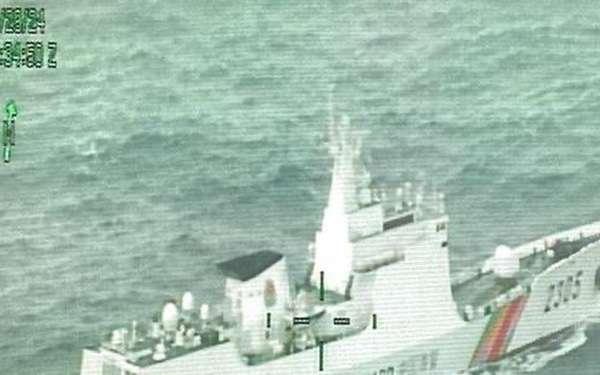
Photo: An HC-130J Super Hercules airplane crew from Coast Guard Air Station Kodiak observes two Russian Border Guard ships and two Chinese Coast Guard ships approximately 440 miles southwest of St. Lawrence Island Sept. 28, 2024. This marked the northernmost location where Chinese Coast Guard vessels have been observed by the U.S. Coast Guard. (U.S. Coast Guard courtesy photo)
While military exercises are signals, what cannot be discounted is that the increased alignment between Russia and China has tangible military advantages, which is also the case with joint military exercises (Mastro, 2024) By inviting China closer to areas considered important for its defense and by increasing interoperability with China, Moscow aims to strengthen its relations with Beijing, while also assessing China’s growing naval capabilities. China and Russia are continuing to make slow progress on increasing interoperability. Already in 2022, there were reports of Russian cadets learning Chinese in order to improve communication (Kimura, 2022). Furthermore, Russia and China understand that the two navies have “a win-win effect of making up for each other’s weaknesses” (Zhang & Huang, 2024). Only regular training and large-scale exercises can help China acquire necessary skills (Kirchberger, 2015, p. 247–248) For example, Russian support bolsters China’s air-maneuver capabilities, which some observers note are crucial in the case of a Taiwan contingency (Soong, 2025)
US response
In the summer of 2024, the Pentagon released its fourth Arctic strategy (the others came in 2013, 2016 and 2019), stating that the “Arctic serves as an avenue for power projection to Europe and is vital to the defense of Atlantic sea lines of communication between North America and Europe” (US Department of Defense, 2024, p. 2), and particularly focusing on the role of China and Russia
US Arctic officials have increasingly named China (as well as China’s confluence with Russia) as security risks to the US in the Arctic (Lackenbauer et al., 2022) It is apparent that a shift in the US federal government’s Arctic security interest and engagement occurred in the period 2017-2018. Statements from top politicians, new strategies launched by various branches of the Armed Forces, and investments – albeit modest – in Arctic capabilities in Alaska all materialized around this time. This is in stark contrast to the decade before, where there was much discussion about the Arctic from environmental and resource perspectives, but limited engagement in terms of security initiatives and investments. Ergo, the US was dubbed a ‘reluctant Arctic actor’ (Huebert, 2013), probably in no small part due to the physical and ‘mental’ distance between the lower-48s and the State of Alaska.
Others warn about China’s long-term geoeconomic interests and actions, calling for a different way of conceptualizing ‘threats’ from China in the Arctic (Brady, 2017, p. 254–267; Doshi et al., 2021, p. 10–13; Sun, 2020). At the same time, China is increasingly attempting to gain influence in various branches of Arctic economic activity. From a US perspective, scholars recommended several pathways to dealing with China in the Arctic: cooperation with Russia, increased involvement in Greenland, and fostering local awareness of the sensitive nature of investments and involvement (Pezard et al., 2022, p. 85–92).
China’s increased engagement in the Arctic, and specifically the North Pacific/Bering Sea, due to its heightened global prominence and cooperation with Russia, has arguably been a primary factor in the US’s increased attention to the Arctic. It is perhaps telling that in the Pentagon’s Arctic Strategy from 2024, the first actor it focuses on in a separate heading is China, not Russia (US Department of Defense, 2024, p. 3). The US views China as a long-term strategic challenge in the Arctic, as in other parts of the world. China’s presence remains limited, but its growing interest in the Arctic, as signaled through activities with Russia, seems to have been received in Washington, resulting not only in increased Arctic security interests during the Biden administration but also at the start of the second Trump Presidency. China’s emerging maritime power has changed the strategic significance of the North Pacific, which is the only area of China’s military interests in the Arctic and sub-Arctic seas, and it is also increasingly drawing the Arctic into the Indo-Pacific story.
Chinese presence facilitated by an isolated Russia might complicate the wider Arctic security landscape in the longer term. The fact that you can walk between Russia and the USA, or between Asia and North America, at certain times of year while not sharing a border on land speaks to the need to manage neighbourly relations linked to everything from fisheries to maritime traffic. In this geographic domain, the two primary actors are undoubtedly Russia and the USA, although the involvement of China has changed in the last decade. This, in turn, draws more attention to the subregion from US decision-makers who would not otherwise be concerned with Alaskan security issues.
Furthermore, with Donald Trump’s return as US President in 2025, several signals emerged from the White House regarding the possibility of increased collaboration between the USA and Russia in the Bering Sea/Strait domain. These hinted at resuming dialogue on, for example, enabling shipping through the Strait, or finding other joint ventures in the Arctic, as – presumably – a carrot in negotiations trying to bring some form of ceasefire in Ukraine. A few months later, in August 2025, Trump and Putin met in Anchorage, Alaska, to discuss the war in Ukraine and ways to enable Arctic-specific collaboration going forward. The meeting did not lead to anything, but again signals not only the relevance of geographic proximity in US–Russia relations, but also the distinctness of these dynamics in contrast to those in other parts of the Arctic. While the two Presidents met, Chinese vessels were sailing North of the Bering Strait and Alaska, conducting China’s largest Arctic Ocean expedition to date (Government of China, 2025).
Conclusion
The increased scope of Russo-Chinese military and coast guard cooperation in the Arctic underscores the two countries’ resolve to deepen security cooperation, as well as the use of these exercises as a signaling tool in international relations Regular training and military exercises are necessary to deepen military cooperation, given Sino-Russian cooperation in technology development, equipment production, and emerging technologies, including space and AI. Through these military exercises, both Russia and China seek to send deliberate, public signals to project power, deter adversaries, and assert their presence in the Arctic.
Using military exercises as signalling highlights the way actors utilize ambiguity in geopolitical communications. Though intentional and public, signals are not clear: they may carry implicit risks and unclear consequences, which is often the desired effect of military exercises. This ambiguity gives military exercises plausible deniability, which is necessary to avoid unwanted escalation. Indeed, China almost routinely emphasizes that the exercises “do not target third parties” (不针 对第三方), like, for example, the joint aerial patrol in 2024 (Li, 2024). This ambiguity is an analytical challenge for interpreting the political message behind military exercises (Åtland et al., 2022).
By inviting an outside power into the region that it considers important, Russia seeks to signal its readiness to challenge the US, solidify alliances with non-Western states like China, and reaffirm its status as an Arctic great power. In turn, China signals its willingness to support Russia through its war in Ukraine.2 Although the Arctic is considered a distant and unfamiliar operational environment for China, joint military exercises in the region underscore a strategic collaboration between China and Russia aimed at countering US influence in the Indo-Pacific. Beijing’s main intention is to signal its ability to overcome containment, breaking out of the island chains, and its willingness to counteract US activities in more familiar domains, such as the South China Sea
In a pan-Arctic context, the primary security drivers are still what happens between Russia and the Nordic countries in Northern Europe. However, given that the US views China as a long-term strategic challenge, China’s still-limited presence and growing interest in the Arctic were enough to elicit a reluctant-no-more US Arctic security strategy, at least when it comes to the Beringia-specific theatre of operations. China’s emerging maritime power has connected the Arctic to the North Pacific in terms of security as well, making Beringia an area where the US-China Indo-Pacific rivalry spills over into the Arctic and sub-Arctic seas.
This brief examination of recent developments in the Beringia spatial domain has highlighted some dimensions of Arctic security and geopolitical developments in 2025. There is still a need to move away from conceptualizing security dynamics in the Arctic as if they were taking place within a singular, discrete Arctic region or space. The emergence of the Beringian Arctic as part of the North Pacific security subregion marks a critical departure in Arctic security, necessitating a nuanced understanding beyond viewing the Arctic as a monolithic security domain.
The strategic use of military exercises as signals of non-verbal interstate communications will likely persist. Understanding the role of these signals for evolving politics of the Arctic demands continuous scholarly analysis.
Notes
1. The Bering Sea is home to a number of marine species of significant economic value, such as cod, pollock, salmon, king and snow crab, seal, and whale. In the Bering Sea at large, and in the Donut Hole in particular, many of the fish stocks have been subject to overfishing, in particular the Alaskan pollock. In the 1980s, the expansion of overfishing prompted negotiations between the former USSR and the USA, and in 1988 an agreement on mutual fisheries relations was signed between the two parties. The agreement established a consultative committee on fisheries in the Bering Sea. Constituting the most lucrative fisheries in North America, the pollock stock was severely decimated in the early 1990s, after a decade of overfishing in the Donut Hole. An agreement on a temporary moratorium with stringent enforcement measures on pollock was reached between the various national stakeholders in 1994, including Japan, China, Poland, and South Korea.
2. According to the Vice-President of the European Commission Kaja Kallas, China’s Foreign Minister Wang Yi said that it is not in China’s “interest that this war [in Ukraine] stops, because then America’s attention will turn to China” (Rennie, 2025)
Acknowledgements
The authors would like to thank two anonymous reviewers for their helpful comments and suggestions. Funding for this study was provided by the Norwegian Research Council (Arctic3d, project no. 343154) and the Norwegian Ministry of Defense, for which we are also grateful.
References
24 xiaoshi. (2024, October 4). [Broadcast]. In 24 xiaoshi [24 hours]. CCTV-13. https://tv.cctv.com/2024/10/05/VIDEqxXvnQKdlXb32bJ71wsA241005.shtml
Andreeva, S., & Rottem, S. V. (2024). How and why the Arctic Council survived until now – an analysis of the transition in chairship between Russia and Norway. The Polar Journal, 14(1), 229–246. https://doi.org/10.1080/2154896X.2024.2342111
Armbruster, B. (2023, August 11). How US media builds public support for confrontation with China. Responsible Statecraft https://responsiblestatecraft.org/2023/08/11/how-us-mediabuilds-public-support-for-confrontation-with-china/
Asadzade, P., & Izadi, R. (2022). The reputational cost of military aggression: Evidence from the 2022 Russian invasion of Ukraine. Research & Politics, 9(2), 20531680221098337. https://doi.org/10.1177/20531680221098337
Åtland, K., Nilsen, T., & Pedersen, T. (2022). Military Muscle-Flexing as Interstate Communication: Russian NOTAM Warnings off the Coast of Norway, 2015–2021. Scandinavian Journal of Military Studies, 5(1), 63–78. https://doi.org/10.31374/sjms.133
Åtland, K., Nilsen, T., & Pedersen, T. (2024). Bolstering the Bastion: The Changing Pattern of Russia’s Military Exercises in the High North. Scandinavian Journal of Military Studies, 7(1), 145–160. https://doi.org/10.31374/sjms.280
Baker, M. (2020, November 20). ‘Are We Getting Invaded?’ U.S. Boats Faced Russian Aggression Near Alaska. The New York Times
Bauer, R. (2024, October 19). Speech by the Chair of the NATO Military Committee, Admiral Rob Bauer at the 2024 Arctic Circle Assembly. NATO. https://www.nato.int/cps/en/natohq/opinions_229551.htm
Brady, A.-M. (2017). China as a Polar Great Power. Cambridge University Press.
Bye, H.-G. (2022, September 20). Russia With Military Exercises in Ocean Vis-à-Vis Alaska. High North News.
Cable, J. (1989). Showing the Flag. In J. Cable, Navies in Violent Peace (pp. 71–81). Palgrave Macmillan UK. https://doi.org/10.1007/978-1-349-20074-0_6
China Coast Guard. (2024, October 24). China Coast Guard and the Russian Federal Security Service held their second high-level meeting [Zhongguo haijingju yu E lianbang anquan zongju juxing di er ci gao jibie huiwu]. https://www.ccg.gov.cn/hjyw/202410/t20241024_2522.html
CSIS. (2025). China-Russia Joint Military Exercises (Version October 2025) [Data set]. ChinaPower. https://chinapower.csis.org/data/china-russia-joint-military-exercises/
Dalsjö, R., Jonsson, M., & Norberg, J. (2022). A Brutal Examination: Russian Military Capability in Light of the Ukraine War. Survival, 64(3), 7–28. https://doi.org/10.1080/00396338.2022.2078044
Deng, B. (2020). Arctic Security Studies (Beiji anquan yanjiu) (Di 1 ban). Haiyang Chubanshe.
Devyatkin, P. (2023). Arctic exceptionalism: A narrative of cooperation and conflict from Gorbachev to Medvedev and Putin. The Polar Journal, 13(2), 336–357. https://doi.org/10.1080/2154896X.2023.2258658
Doshi, R., Dale-Huang, A., & Gaoqi, Z. (2021). Northern Expedition: China’s Arctic Activities and Ambitions
Eiterjord, T. (2025, April 5). Taking Stock of China’s Polar Fleet. The Diplomat. https://thediplomat.com/2025/04/hold-taking-stock-of-chinas-polar-fleet/ Erickson, A. S., & Wuthnow, J. (2016). Barriers, Springboards and Benchmarks: China Conceptualizes the Pacific “Island Chains”. The China Quarterly, 225, 1–22. https://doi.org/10.1017/S0305741016000011
Government of China. (2025, September 26). The icebreaker ‘Xuelong 2’ returned to Shanghai smoothly, marking a significant achievement in our country’s largest Arctic Ocean scientific expedition [‘Xuelong 2’ hao shunli fan Hu woguo zuida guimo Beibingyang kekao qude zhongyao jinzhan]. The Central People’s Government of the People’s Republic of China. https://www.gov.cn/yaowen/tupian/202509/content_7042450.htm
China, Russia, and the U.S. in
Hauksdóttir, G. R. Th., & Thorhallsson, B. (2025). Sino-Russian Arctic cooperation: Systemic pressure and historical distrust. The Polar Journal, 1–21. https://doi.org/10.1080/2154896X.2025.2531718
Hua, D. (Producer). (2015, September 7). Jinri Guanzhu [Broadcast]. In Jinri Guanzhu [Today’s Focus]. CCTV-4. https://tv.cctv.com/2015/09/07/VIDE1441638589952236.shtml
Huebert, R. (2013). U.S. Arctic Policy: The Reluctant Arctic Power. In B. S. Zellen (Ed.), The fastchanging Arctic: Rethinking Arctic security for a warmer world (pp. 189–226). Calgary University Press.
Kaczynski, V. M. (2007). US-Russian Bering Sea Marine Border Dispute: Conflict over Strategic Assets, Fisheries and Energy Resources. Russian Analytical Digest, 20(May 1, 2007), 2–6.
Kalwasiński, M. (2025). China-Russia trade in early 2025: Fueling Moscow’s war despite headwinds Swedish Institute of International Affairs. https://kinacentrum.se/en/publications/china-russia-trade-in-early-2025-fuelingmoscows-war-despite-headwinds/
Kato, M. (2013). Japan and Russia at the Beginning of the Twenty-First Century: New Dimension to Maritime Security Surrounding the ‘Kuril Islands.’ Research Unit on International Security and Cooperation (UNISCI), UNISCI Discussion Paper, no. 32, May 2013.
Kimura, Y. (2022, October 13). Russia’s “Vostok 2022 Exercise” Denies Disadvantage in the Ukraine War, but is Counterproductive to Western Nations [Roshia “Bosutōku 2022 Enshū” Ukuraina sensō no ressei o hitei mo, Seigawa Shokoku ni wa gyōkōka]. Jitsugyō no Nihon Forum https://forum.j-n.co.jp/narrative/4320/
Kirchberger, S. (2015). The PLA Navy’s Capability Profile. In S. Kirchberger, Assessing China’s Naval Power (pp. 171–254). Springer Berlin Heidelberg. https://doi.org/10.1007/978-3662-47127-2_5
Kongtian liliang (2023, May 4) The Chinese and Russian Coast Guards Have Joined Forces and the Joint Patrol Has Been Carried Out on the Doorstep of the United States [Zhong E liang guo haijing he bingyichu, lianhe xunhang xuan zai Mei guojia menkou]. Zhonghuawang. https://military.china.com/news/13004177/20230504/44932127_all.html#page_2
Kossa, M. (2024). The Arctic in China’s National Strategy: Science, Security, and Governance (1st ed.). Routledge. https://doi.org/10.4324/9781003295112
Lackenbauer, W. P., Lajeunesse, A., & Dean, R. (2022). Why China Is Not a Peer Competitor in the Arctic. Journal of Indo Pacific Affairs https://media.defense.gov/2022/Sep/28/2003087089/-1/1/1/07%20LACKENBAUER_FEATURE.PDF
Lamazhapov, E. (2025). Polar regions for global status: China’s great power discourse and statusseeking practice in the Arctic and Antarctic. The British Journal of Politics and International Relations, Online First. https://doi.org/10.1177/13691481251378895
Lamazhapov, E., & Moe, A. (2024). Russia’s Geopolitical Position in the Arctic: What’s New? Strategic Analysis, 48(6), 604–618. https://doi.org/10.1080/09700161.2025.2459571
Lanteigne, M. (2021). Inside, Outside, Upside Down? Non-Arctic States in Emerging Security Discourses. In K. Spohr, D. S. Hamilton, & J. C. Moyer (Eds), The Arctic and World Order. Foreign Policy Institute, Henry A. Kissinger Center for Global Affair.
Li, J. (2024, July 26). Zhong E liang jun zuzhi shishi di 8 ci lianhe kongzhong zhanlüe xunhang [The Chinese and Russian militaries jointly conducted their 8th joint strategic air patrol]. Ministry of National
Defense of the People’s Republic of China. http://www.mod.gov.cn/gfbw/qwfb/16237316.html
Liu, B., Du, Y., & Han, C. (2022, August 18). Li jian shenlan yong zhengfeng [Sharpening the sword in the deep blue]. Jiefangjun Bao, 5. http://www.mod.gov.cn/gfbw/wzll/hj/4918600.html
Lukonin, S. (2023). Russia-China Relations: An Asymmetrical Partnership? MGIMO Review of International Relations, 16(2), 65–86. https://doi.org/10.24833/2071-8160-2023-2-89-65-86
Mahadzir, D. (2023, August 17). Russian, Chinese Warships in East China Sea After Sailing Near Alaska. USNI News. https://news.usni.org/2023/08/17/russian-chinese-warships-ineast-china-sea-after-sailing-near-alaska
Mastro, O. S. (2024). Sino-Russian Military Alignment and Its Implications for Global Security. Security Studies, 33(2), 254–290. https://doi.org/10.1080/09636412.2024.2319587
Mei, S., Liu, M., & Xu, Y. (2023, July 24). Chinese troops participating in the ‘Vostok-2022’ exercise have many highlights. Ministry of National Defense of the People’s Republic of China. http://www.mod.gov.cn/gfbw/qwfb/4920281.html
Midford, P., & Østhagen, A. (2024). The East China Sea: A Case of Ocean Geopolitics and Maritime Conflict. East Asia, 41(1). https://doi.org/10.1007/s12140-024-09426-y
Ministry of Defense of the Russian Federation. (2023, September 25). Finval 2023 exercise completed in North-Eastern Russia. https://eng.mil.ru/news/dc5a3ef3-e5fe-4569-9273dbaf041bd994
Ministry of Foreign Affairs of the Russian Federation. (2023). The Foreign Policy Concept of the Russian Federation (No. 229). https://www.mid.ru/ru/detail-materialpage/1860586/?lang=en
Ministry of National Defense of the People’s Republic of China. (2023, July 15). Russian troops to participate in China’s ‘Northern Joint 2023’ exercise [Eluosi jundui jiang canjia Zhongfang “Beibu Lianhe-2023” yanxi]. http://www.mod.gov.cn/gfbw/qwfb/16237316.html
Murkowski, L. (2023). Murkowski, Sullivan Statements on Chinese and Russian Vessels in U.S. Waters off Coast of Aleutians. Press Releases. https://www.murkowski.senate.gov/press/release/murkowski-sullivan-statements-onchinese-and-russian-vessels-in-us-waters-off-coast-of-aleutians
NOAA. (2024). Report of the 28th Annual Conference of the Parties to the Convention on the Conservation and Management of Pollock Resources in the Central Bering Sea https://www.fisheries.noaa.gov/s3/2024-07/report-28th-annual-conference-centralbeing-sea-pollock.pdf
Østhagen, A. (2016). High North, Low Politics: Maritime Cooperation with Russia in the Arctic. Arctic Review on Law and Politics, 7(1), 83–100.
Østhagen, A. (2021). The Arctic security region: Misconceptions and contradictions. Polar Geography, 44(1), 55–74. https://doi.org/10.1080/1088937X.2021.1881645
Pezard, S., Flanagan, S. J., Harold, S. W., Chindea, I. A., Sacks, B. J., Tingstad, A., Finazzo, T., & Kim, S. (2022). China’s Strategy and Activities in the Arctic: Implications for North American and Transatlantic Security https://www.rand.org/content/dam/rand/pubs/research_reports/RRA1200/RRA12821-v2/RAND_RRA1282-1-v2.pdf
Plagemann, J. (2024). Introduction to special issue: ‘Foreign policy signaling in the Indo-Pacific: Responses to the US-China rivalry in a multipolar world’. The British Journal of Politics and International Relations, 13691481241306387. https://doi.org/10.1177/13691481241306387
Qian, X., & Ren, X. (2023, July 24). The ‘Northern Joint-2023’ exercise concluded successfully. Ministry of National Defense of the People’s Republic of China. http://www.mod.gov.cn/gfbw/jsxd/16239088.html
Quek, K. (2016). Are Costly Signals More Credible? Evidence of Sender-Receiver Gaps. The Journal of Politics, 78(3), 925–940. https://doi.org/10.1086/685751
Regehr, E. (2020). Military Infrastructure and Strategic Capabilities: Russia’s Arctic Defense Posture. In K. Spohr, D. S. Hamilton, & J. C. Moyer (Eds), The Arctic and world order (pp. 187–217). Paul H. Nitze School of Advanced International Studies, Johns Hopkins University.
Rennie, D. (2025, October 28). China is backing Russia’s war to keep America distracted, says Kaja Kallas. Economist. https://www.economist.com/international/2025/10/28/china-isbacking-russias-war-to-keep-america-distracted-says-kaja-kallas
Renz, B. (2024). Western Estimates of Russian Military Capabilities and the Invasion of Ukraine. Problems of Post-Communism, 71(3), 219–231. https://doi.org/10.1080/10758216.2023.2253359
Reshetnikov, A. (2024). Chasing greatness: On Russia’s discursive interaction with the West over the past millennium. University of Michigan Press.
Røren, P. (2023). The Belligerent Bear: Russia, Status Orders, and War. International Security, 47(4), 7–49. https://doi.org/10.1162/isec_a_00458
Rozman, G., & Christoffersen, G. (2024). Introduction. In G. Rozman & G. Christoffersen (Eds), Putin’s ‘Turn to the East’ in the Xi Jinping era. Routledge. https://doi.org/10.4324/9781003386148
Sagild, R. Å., & Hsiung, C. W. (2024). Chinese Re-Examinations of Russia? The Strategic Partnership in the Wake of Russia’s War Against Ukraine. Journal of Contemporary China, 1–16. https://doi.org/10.1080/10670564.2024.2358876
Schofield, C. H. (2015). Dividing and Managing Increasingly International Waters: Delimiting the Bering Sea, Strait and Beyond. In J. Kraska & H. Scheiberg (Eds), Science, Technology and New Challenges to Ocean Law (pp. 313–344). Martinus Nijhoff Publishers.
Shiryaev, S. (Writer). (2023). Arctic Patrol exercises held in the Barents Sea [Ucheniya ‘Arkticheskiy patrul’’’ proshli v Barentsevom more] [Broadcast]. In Vesti. Rossiya 24. https://www.vesti.ru/article/3322395
Smith, R. W. (1994). United States–Russia Maritime Boundary. In G. H. Blake (Ed.), World Boundaries, Vol.5 (pp. 91–99). Routledge.
Song, X. (2023, March 8). Ruhong de zhengtu, zhuangli de pianzhang [Rainbow Journey, Magnificent Chapter]. Zhongguo Guofang Bao, 2. http://www.81.cn/gfbmap/content/21/2023-03/08/02/2023030802_pdf.pdf
Soong, C. (2025). China–Russia military cooperation targeting Taiwan could link the European and Asia–Pacific theaters. Swedish Institute of International Affairs. https://kinacentrum.se/en/publications/china-russia-military-cooperation-targetingtaiwan-could-link-the-european-and-asia-pacific-theaters/
Stallard, K., & Rozman, G. (2024). The Illusion that Realism is Driving Sino-Russian Relations. In G. Rozman & G. Christoffersen (Eds), Putin’s ‘Turn to the East’ in the Xi Jinping era Routledge. https://doi.org/10.4324/9781003386148
State Council. (2015). China’s Military Strategy. The Information Office of the State Council of the People’s Republic of China. https://english.www.gov.cn/archive/white_paper/2018/01/26/content_2814760266603 36.htm
Sun, J. (Producer). (2024, July 29). [Broadcast]. In Fangwu Xinguancha [Defense Review]. CCTV-7. https://tv.cctv.com/2024/07/29/VIDEPFG8HMzvoTyjIiLPqrsV240729.shtml
Sun, Y. (2018). The Northern Sea Route: The Myth of Sino–Russian Cooperation Stimson Center. https://www.stimson.org/wp-content/files/fileattachments/Stimson%20-%20The%20Northern%20Sea%20Route%20-%20The%20My th%20of%20Sino-Russian%20Cooperation.pdf
Sun, Y. (2020). Defining the Chinese Threat in the Arctic. The Arctic Institute. https://www.thearcticinstitute.org/defining-the-chinese-threat-in-the-arctic/ TASS. (2024). PRC Marine Police and FSB Discuss Expanding Maritime Cooperation. https://tass.ru/politika/22218327
The Associated Press. (2020, August 30). Over 50 warships were involved in Russian Navy exercises that surprised Alaska trawlers. Alaska Public Media.
Trump Speaks One Day After Congress Certifies Election Win; Trump: Russia-Ukraine War Could ‘Escalate’ And Get ‘Much More’; Trump Says He Encouraged Wayne Gretzky To Run For Canadian PM. (2025, July 1). CNN. https://transcripts.cnn.com/show/ip/date/2025-0107/segment/01
Tunsjø, Ø. (2020). The Great Hype: False Visions of Conflict and Opportunity in the Arctic. Survival, 62(5), 139–156. https://doi.org/10.1080/00396338.2020.1819649
United States–Union of Soviet Socialist Republics. (1990). Agreement between the United States of America and The Union of the Soviet Socialist Republics on the Maritime Boundary.
US Department of Defense. (2024). 2024 Arctic Strategy. https://media.defense.gov/2024/Jul/22/2003507411/-1/-1/0/DOD-ARCTICSTRATEGY-2024.PDF
Verville, E. G. (1993). United States–Soviet Union. In J. I. Charney & L. M. Alexander (Eds), International Maritime Boundaries, Vol. 1 (pp. 447–460). Martinus Nijhoff Publishers.
von Essen, H. (2023). Russia-China Economic Relations Since the Full-Scale Invasion of Ukraine (No. 2). Swedish Institute of International Affairs. https://kinacentrum.se/wpcontent/uploads/2023/07/russia-china-econ-relations.pdf
von Essen, H. (2025). Joint military exercises signal deepening Russia-China strategic alignment. Mercator Institute for China Studies. https://merics.org/en/comment/joint-military-exercisessignal-deepening-russia-china-strategic-alignment
Wei, J. (Producer). (2017, October 25). [Broadcast]. In Junshi Jishi [Today’s Focus]. CCTV-7. https://tv.cctv.com/2017/10/25/VIDEgHTDMK2lsiCY5cphXfGY171025.shtml
Weitz, R. (2021). Assessing Chinese-Russian Military Exercises: Past Progress and Future Trends. Center for Strategic and International Studies. https://www.csis.org/analysis/assessing-chineserussian-military-exercises-past-progress-and-future-trends
Wenger, M. (2022). Study points to responsibilities for IUU fishing in the Bering Sea. Polar Journal. https://polarjournal.ch/en/2022/11/14/study-points-to-responsibilities-for-iuu-fishingin-the-bering-sea/
Where the enemy can go, so can my army. (2025). In Baidu Baike https://baike.baidu.com/item/%E5%AF%87%E5%8F%AF%E5%BE%80%EF%BC% 8C%E6%88%91%E4%BA%A6%E5%8F%AF%E5%BE%80/63464129
Will September 7th become “Black Monday” for stock exchanges? [Stanet li 7 sentyabrya ‘chernym ponedelnikom’ dlya birzh]. (2015, September 3). Parlamentskaya Gazeta [Parliament Gazette]. https://www.pnp.ru/economics/2015/09/03/stanet-li-7-sentyabryachernym-ponedelnikom-dlyabirzh.html
Williams, H., Bingen, K. A., & MacKenzie, L. (2024, July 30). Why Did China and Russia Stage a Joint Bomber Exercise near Alaska? CSIS
Wings of Hope and Freedom [Kryl’ya Nadezhdy i Svobody]. (2015, November). Strategiya Rossii, 11(143), 17–22. https://istina.msu.ru/media/publications/article/97c/f33/11603539/Strategiya_Rossii_ _11143_noyabr_2015.pdf
Xiao, J. (2024, October 2). China’s Coast Guard Joined by Russians on First Patrol in Arctic. BNN Bloomberg. https://www.bloomberg.com/news/articles/2024-10-02/china-s-coastguard-joined-by-russians-on-first-patrol-in-arctic
Xiao, T. (Ed.). (2022). Science of Military Strategy 2020. China Aerospace Studies Institute. https://www.airuniversity.af.edu/Portals/10/CASI/documents/Translations/2022-0126%202020%20Science%20of%20Military%20Strategy.pdf
Yu, X., & Sun, L. (2024, January 6). Duanzao neng da shengzhang de banzi [Forging a team capable of winning battles]. Xinhua. http://www.81.cn/yw_208727/16278740.html
Zhang, W., & Huang, X. (Producers). (2024, September 21). Zhong E liangjun zai xieshou wei diqu heping zhuru xin dongneng [Chinese and Russian militaries join hands again to inject new impetus into regional peace] [Broadcast]. In Junqing Shijiandao [Military Time]. CCTV-13.
https://tv.cctv.com/2024/09/21/VIDEWDMkEngLsPT8iWiQyCFv240921.shtml
Balancing Alliance Commitments and Economic Dependence: Faroese-Russian Relations in an Era of Great Power Rivalry
Heini í Skorini and Tór Marni Weihe
Amid growing geopolitical instability and competition in the Arctic and North Atlantic region, this article investigates how the Faroe Islands – a self-governing territory within the Kingdom of Denmark – has pursued a sophisticated and opportunistic balancing act between economic cooperation with Russia and broader alliance commitments vis-à-vis Denmark, EU and NATO. Focusing on the period from 2014 to 2024, the article examines how the Faroe Islands deepened its cooperation with Russia in the field of trade and fishery in the wake of the Russian annexation of Crimea and subsequently benefited from Russian sanctions against EU products. This period illustrates how sub-sovereign entities with extensive self-governing authority can pursue their own national interests that might run against broader Western alliance interests. However, after the full-scale Russian invasion of Ukraine in February 2022, Faroese policies towards Russia drastically changed and aligned with broader Western alliance commitments. Drawing on alliance theory and the concept of hedging, the article examines the complexities facing small, autonomous entities within larger political unions when alliance commitments and domestic economic imperatives collide. Furthermore, the article exemplifies how small, self-governing regions can assert meaningful strategic autonomy in a polarised global order. However, as the period after the full-scale Russian invasion in February 2022 reveals, there are definite limits to such autonomy.
1. Introduction: The Danish Kingdom between Trump and Putin
Since January 2025, the Danish Kingdom1 has been under unprecedented geopolitical pressure due to Donald Trump’s repeated appetite for Greenland. Besides the approximately six million people living in Denmark, the Kingdom also consists of Greenland and the Faroe Islands, with around 50,000 inhabitants each, but these self-governing entities constitute more than 95% of the Kingdom’s maritime and land territory. Without Greenland, Denmark would lose its status as an Arctic state and would therefore not hold the current chairmanship in the Arctic Council. Given
Dr. Heini í Skorini is Associate Professor in International Politics at the Faculty of History and Social Sciences at the University of the Faroe Islands.
Tór Marni Weihe is a PhD candidate in International Politics at the Faculty of History and Social Sciences at the University of the Faroe Islands
Donald Trump’s repeated ambition to buy or ‘acquire’ Greenland, the Danish government is facing a direct threat to its sovereignty over Greenland from one of its closest allies, which also happens to be the world’s superpower. The current American president, who already made his desire to acquire Greenland known in 2019, has firmly reiterated this objective since January 2025, declaring in his March 2025 address to a joint session of Congress that ‘One way or the other, we’re going to get it’ (Transcript of President Donald Trump’s speech, 2025). As a special hearing on Greenland in the American Senate in February 2025 revealed, American ambitions to conquer Greenland cannot be reduced to mere political theatre; rather, they have been backed by visits in Greenland from both Donald Trump Jr in January and U.S. Vice President J. D. Vance in March 2025 (Nuuk and Cranny, 2025). The diplomatic crisis between Copenhagen and Washington leaves Denmark on a treacherous path between a rock and a hard place as the great-power competition in the Arctic and North Atlantic regions shifts character (Abrahamsen, 2025; Søndergaard, 2025).
Meanwhile, in another part of the Danish kingdom, the primary foreign policy question has revolved around Russia. Since 1977, the Faroe Islands and Russia have adopted bilateral fishery agreements, and in the last decade, Russia has been a key export market for Faroese fishery products. After the Russian annexation of Crimea in 2014, and in contrast to the rest of Europe, the Faroe Islands pursued closer trade cooperation with Russia while establishing a new diplomatic representation in Moscow in January 2015 – triggering both national and international criticism (Skorini et. al., 2024). When Russia launched its full-scale invasion of Ukraine in February 2022, the Faroese government faced a tough question: abandoning the close cooperation with Russia and aligning with the rest of Europe or continuing the Russia-friendly policy established after 2014. As this article will argue, the result has been somewhere in between.
This article examines the evolving relationship between the Faroe Islands and Russia in the context of great power rivalry, drawing on alliance theory and the concept of hedging 2 As a self-governing entity with extensive home rule over most policy areas, the Faroe Islands possess autonomy over trade and fishery policy, including full responsibility for all international negotiations on these policy areas. Faroese autonomy over international trade policy allows the Faroes to maintain significant economic ties and fisheries cooperation with Russia. Meanwhile, the jurisdictional power over security, defence and foreign policy remains in Copenhagen. The continued economic engagement between the Faroes and Russia has raised critical questions about the intersection of narrow economic interests, security concerns, and broader alliance commitments. There is little scholarly writing on the Faroese-Russian relationship (see e.g, Kobzeva, 2022, for an exception), and the paper also contributes to a sorely needed understanding of non-sovereign territories’ navigation of great power competition – especially in the North Atlantic.
Through an empirical analysis of Faroese-Russian economic and political relations from 2014-2024, this study explores how economic dependence on an adversarial state interacts with broader security dynamics. The Faroese government has faced increasing pressure from Denmark, NATO allies, and domestic political actors to align with Western policies towards Russia, yet economic imperatives and local business interests have driven a more pragmatic or opportunistic approach. This tension highlights the complexities faced by small autonomous jurisdictions operating within larger allied structures, where economic interests may not always align with security considerations. The Kingdom of Denmark is currently facing two contrasting developments. On the one hand, external threats from the White House in Washington could pave the way for internal unity and
stronger cooperation – a point repeatedly pointed out by the Danish government (Jørgensen, 2025). On the other hand, the independence movements in both Greenland and the Faroe Islands are strong and broadly embedded in party politics and public opinion (Justinussen, 2019; Skorini, 2024). While foreign policy, defence and security are policy areas under Danish control and jurisdiction, both the Faroes and Greenland pursue greater agency in international politics, constantly pushing constitutional boundaries and challenging the status quo. Hence, the quest for national self-determination includes the struggle for more autonomy on the international scene. While Denmark remains the primary security guarantor of the Faroe Islands as part of the NATO umbrella, the Faroese government’s independent relations with other states raises questions about the extent of its foreign policy autonomy. The tensions between economic security and military security have broader implications for the constitutional relationship between Denmark and the Faroe Islands, as shifting security dynamics prompt renewed debates about the limits of Faroese self-governance in matters affecting national and allied security
By combining insights from alliance theory3 with an examination of small-state behaviour, this article highlights the dilemmas faced by substate jurisdictions like the Faroe Islands when balancing economic dependencies with alliance obligations. The case illustrates how economic interdependence with adversarial states can create strategic vulnerabilities, particularly in regions of increasing geopolitical significance. The findings can contribute to broader discussions on the intersection of economics, security, and autonomy in substate jurisdictions amid shifting geopolitical dynamics, offering insights into how small states and autonomous regions navigate these challenges within the constraints of larger security alliances.
The rest of the article is divided into four sections. Following this introduction, section 2 will provide a brief overview of the relationship between Denmark and the Faroe Islands and how the Faroes are conducting their own “foreign policy”, especially in the field of international trade and fisheries. This section is intended as a precondition for understanding how a substate entity can conduct its own international diplomacy and pursue its own national interests without being a state. In section 3, we explain our theoretical point of departure, which is shaped by IR literature on alliance theory with a particular emphasis on the concept of hedging In Section 4, we analyse the evolving bilateral relationship between the Faroes and the Russian Federation, focusing on the period from 2014 to 2024. Finally, section 5 summarises the article’s main findings.
2. Political and Institutional Context: The Faroe Islands within the Danish Realm
While formally a unitary state, the Kingdom of Denmark is a multinational political unit with several federal characteristics (Justinussen, 2019). In addition to Denmark proper, the Kingdom includes Greenland and the Faroe Islands, two culturally (and in the case of Greenland, ethnically) distinct nations. Despite enormous differences, both nations enjoy expansive self-government systems and administer large parts of domestic affairs themselves (see e.g., Gad, 2020; West, 2024). According to both the 2009 Greenlandic Self-government Act and the 2005 Faroese Foreign Policy Act, however, the jurisdiction over security, defence and foreign policy lies solely in Copenhagen – unless it specifically regards policy areas that have been delegated to the regional governments in Nuuk and Tórshavn. Consequently, Faroese and Greenlandic foreign policy has primarily been conducted under the guise of trade and fisheries policy, which are competence areas that were
transferred to the two self-ruling entities in the 1970s (Act on Greenland Self Government, 2009; Foreign Policy Act of the Faroe Islands, 2005).
This neat division of competences – if it was ever neat – has come under pressure in recent years. One of the main reasons is the ‘securitisation’ (see e.g., Buzan et al., 1998) of civil policy areas under Faroese (or Greenlandic) jurisdiction, or what some scholars have referred to as ‘the weaponisation of everything’ (Galeotti, 2022). This is a process whereby a security dimension is being added to policy areas that used to fall outside the scope of security and defence. The DanishFaroese Home Rule Act of 1948 is based on the logic that defence, security policy, and foreign policy are Danish domains that can be separated from Faroese-controlled policy areas such as telecommunications, trade policy, and fisheries. However, contemporary international politics illustrates time and again that many Faroese-controlled “civil” policy areas contain an overt security dimension. One example is the current debate on the Faroe Islands and Russia and to what extent a NATO member can tolerate the free movement of Russian ships that are accused of espionage and sabotage of undersea cables (Skorini et. al., 2024) As late as September 2025, the Faroese government presented a new bill in Parliament on extended sanctions against specific Russian fisheries companies that are blacklisted by the EU and whose ships are allowed to enter Faroese waters (the outcome of this proposal was not known prior to this article’s deadline). Another example is a recent debate on whether the Chinese tech giant Huawei should supply the Faroes’ 5G network. The Faroe Islands have managed telecommunications for decades, yet the United States intervened and pressured the Faroe Islands (and Denmark) to choose Ericsson over Huawei for security reasons a few years ago (Satariano, 2019). The Faroes have long pursued a free-trade agreement with China similar to Iceland’s, but the decision to cease a decade-long cooperation with Huawei could potentially undermine this ambition.
These issues demonstrate that more and more Faroese-controlled policy domains contain a security dimension that can trigger new tensions within the Kingdom of Denmark. If the government in Copenhagen has the exclusive prerogative to decide matters of national security, but jurisdiction over the policy area in question lies in the Faroes or Greenland, who has the final say? This legal ambiguity potentially puts the metropole in Copenhagen and the self-ruling entities in Nuuk or Tórshavn on a collision course. We have seen several cases of this tension, and in recent years a considerable literature has developed on such renewed tensions between Greenland, Denmark and the great powers in the Arctic (see e.g., Jacobsen et al., 2024; Kristensen & Rahbek-Clemmensen, 2018; Rahbek-Clemmensen & Sørensen, 2021). Yet, similar research on the Faroe Islands remains very limited.
The changing geopolitical dynamics in the Arctic and North Atlantic regions – which have led the Kingdom of Denmark to position itself as an ‘Arctic superpower’ (see e.g., Breum, 2016; TaksøeJensen, 2016) – have also moved the Kingdom’s strategic centre of gravity northwards. When Denmark assumed the chairmanship of the Arctic Council in Tromsø this year, it was tellingly the Greenlandic foreign minister, Vivian Motzfeldt, who received the big gavel in the handover ceremony (Bryant, 2025). The Faroes assumed the Vice Chair position, which signals Danish recognition of the Faroes and Greenland in the wake of a decade-long conflict over roles in the Arctic Council (Jacobsen & Lindbjerg, 2025). Since Denmark proper is not normally considered neither an Arctic nor a North Atlantic state, its weight in international relations is highly dependent on its overseas territories, and the current Danish Government has taken steps to include the
Greenlandic and Faroese authorities in matters of security and foreign policy. One example is the establishment of a special ‘contact committee’ where representatives of all three nations discuss foreign, security and defence policy for the entire Kingdom (Danilov, 2021). Furthermore, the Danish government has also committed itself to strengthen its sharing of intelligence with the regional authorities in Tórshavn (Joensen, 2019). Other examples of new Greenlandic and Faroese engagement in the realm of security and defence includes participation in meetings with U.S. Secretaries of State Mike Pompeo and Anthony Blinken during their official visits in Copenhagen and participation in the annual Munich Security Conference in Germany. Hence, the Danish government has stepped up its endeavour to project the image of equal standing between the three constituent parts of the Kingdom.
It should be noted, however, that well before the adoption of the 2005 Foreign Policy Act which regulates Faroese agency in international affairs, the Faroese government was making high-impact foreign policy decisions. In the 1970s, the Faroes were allowed to decide for themselves whether to follow Denmark into the EU (then EEC) or not. In the end, the Faroes opted to stay outside the EEC – mainly due to concerns about EU’s common fishery policy and European vessels entering Faroese territorial waters. The 1972 Accession Treaty therefore made it clear that the Danish membership of the EEC did not include the Faroe Islands (Documents Concerning the Accession …, 1972). The Faroes have remained outside the EU ever since, and the main argument against EU membership remains the Common Fisheries Policy. According to recent surveys, the Faroese public remains sceptical of joining the EU (see e.g., Rehban, 2016; Skorini, 2024: 22).
In terms of security, the Faroes are part of the North Atlantic Treaty Organisation (NATO) via Danish membership. Denmark joined the alliance as a founding member with no territorial reservations in 1949, and today, as it has been historically, it is widely acknowledged that the Faroe Islands and Greenland are covered by the Danish membership. When the Faroes were occupied by the British army in April in 1940 – and Denmark was occupied by Nazi Germany – the Faroese parliament adopted the first out of many resolutions claiming ‘neutrality’ in international affairs (Skorini, 2022). This neutrality stance was repeated throughout the Cold War but had no practical effects. During the Cold War, and despite Faroese opposition, the islands hosted various NATO installations and American military engagement, such as a Loran C station vital for communication and a troposcatter radar station that was part of NATO’s Early Warning System against aerial or ballistic missile attacks from the Soviet Union (see e.g., Jensen, 2004; Johansen, 2014). While surveys reveal some NATO-scepticism in the Faroes, as in many other Western countries, the support for the alliance has increased after the 2022 Russian invasion of Ukraine (Skorini, 2024).
In 2024, the Faroes (as well as Greenland) adopted their first-ever national security policy (Government of the Faroe Islands, 2024c). The adoption of a national security policy without any jurisdictional authority over security, and without any defence budget, may sound odd. But this initiative could be perceived as a symbolic act in order to underline the Faroese/Greenlandic quest for autonomy and self-determination, which is neatly summed up in the slogan used for the title of the Greenlandic strategy: ‘Nothing about us without us’. Even though security is an exclusive Danish political competence, Faroese authorities demand inclusion in all decisions relating to the Faroes. While references to Denmark are conspicuously absent in the new security resolution from 2024, the security resolution consists of 10 principles that firmly place the Faroes under the NATO security umbrella. Furthermore, the Faroe Islands have also adopted official Arctic strategies, the
first in 2013 (The Prime Minister’s Office, 2013) and the most recent one in 2024 (Government of the Faroe Islands, 2024b). These strategies position the Faroes as a sub-Arctic country and emphasise Faroese rights to participate in the Arctic Council and other Arctic fora (Jacobsen & Lindbjerg, 2025).
3. Theoretical foundations: The Faroe Islands and hedging behaviour
When examining Faroese behaviour vis-à-vis Russia from 2014 to 2024, we find the concept of hedging in the IR literature on alliance behaviour rather useful. T he concept of hedging in IR theory can be defined in a variety of ways, but according to Ciorciari & Haacke, hedging “normally refers ( ) to a national security or alignment strategy, undertaken by one state toward another, featuring a mix of cooperative and confrontational elements” (Ciorciari & Haacke, 2019: 367). Hedging can be perceived as a pragmatic strategy for middle powers and small states that combines elements of both balancing and bandwagoning, where the purpose is to avoid over-commitment to any single great power while maintaining strategic flexibility between major powers. From a small state perspective, the ambition is to reduce risk by diversifying partnerships, which becomes more pressing in an uncertain, multipolar global order (Kuik, 2021). In the words of Korolev, “hedging” can be defined as “dual-track, proportional engagement with different great powers to avoid overreliance only on one power” (Korolev, 2019: 422). This behaviour is frequently associated with “counteracting policies” and an “engage-and-resist strategy” (ibid,) where states might cooperate and confront each other simultaneously. However, the risk of such opportunistic hedging strategies is to lose credibility among traditional allies and experience backlash or be subjected to outright punishment. In this sense, hedging is a balancing act that seeks to avoid the pitfalls of the so-called alliance dilemma: abandonment on the one hand, or entrapment on the other (Pedersen, 2023). Abandonment often refers to “the fear of being left behind, losing relevance or being marginalized in the international cooperation” (ibid., p. 443), while entrapment refers to unwanted overreliance or undesirable dependence on one larger power. As will be argued in the following analytical section, the Faroe Islands’ approach to Russia between 2014-2024 could very well be understood as a sophisticated and opportunistic hedging strategy that illustrates how small, sub-sovereign actors can navigate the constraints of great power competition while pursuing economic interests that might diverge from their metropolitan ally’s foreign policy objectives.
4. Analysing Faroese Strategy vis-à-vis Russia in the period 2014-2024
The Russian-Faroese bilateral relationship has a long history, going back to the 1950s, when the Faroes and the Soviet Union cooperated unofficially in fisheries In 1977, after national fishing zones were expanded due to the emergence of international maritime law, the Soviet Minister for Fisheries travelled to the Faroes to sign the first bilateral fisheries treaty between the Soviet Union and the Faroes. This bilateral agreement gave Faroese trawlers access to Russian waters and vice versa. Furthermore, the agreement established a long-lived fishery cooperation that controversially remains intact to this very day (Skorini et. al., 2024).
Besides the bilateral fishery agreement, another vital aspect in Faroese-Russian relations is the Faroese export to Russia. A defining moment in the Faroese-Russian relationship was a 2013-2014 dispute between the Faroe Islands and the European Union about pelagic fish stocks. The struggle revolved around quota allocation and escalated into a diplomatic crisis when the Faroes unilaterally tripled their quotas. The EU responded by imposing sanctions on the Faroes while banning
Faroese vessels from calling on EU ports in August 2013 (European Commission, 2013). Faroese companies were also banned from exporting goods to the EU market. Since Denmark is an EU member and the Faroes are not, Denmark was legally forced to implement the sanctions against an overseas territory within its own kingdom. Therefore, the dispute also triggered a crisis in Faroese-Danish relations. However, the dispute was eventually settled a year later, and the EU boycott was lifted in August 2014 (Ishikawa, 2014; Hartmann & Waibel, 2013). By then, FaroeseEU relations had reached a low point
The European boycott of Faroese products resulted in closer Faroese economic ties with Russia. Looking for alternative markets for their fish products (mainly herring, mackerel and salmon), the Faroese export to Eastern European countries such as Russia, Belarus and Ukraine drastically increased. As around 10% of Faroese exports were already shipped to Russia around this time, the country was a logical choice for expansion in the context of the EU boycott. The Russian market proved particularly attractive because of its substantial domestic demand for high-quality North Atlantic fish products and the relatively favourable exchange rates at the time.
In addition to the EU-boycott, another game-changer in Faroese-Russian relations was the Russian annexation of Crimea in March 2014. As the EU-boycott against the Faroes was still in effect, the Faroes abstained from joining the rest of the West in condemning the Russian annexation of Crimea and did not join the European sanctions against Russia. Thus, when Russia implemented counter-sanctions against European food products, the Faroes were not targeted and obtained a very favourable market position compared to European and Nordic competitors In August 2014, Faroese Public Broadcaster KVF wrote: ‘The phones of Faroese fish exporters are ringing off the hook now that news has circulated that Russia is not going to boycott the Faroe Islands’ (Djurhuus & Johannesen, 2014).
In September 2014, then Faroese Prime Minister Kaj Leo Holm Johannesen went to Moscow to discuss a variety of issues, amongst them the opening of a Faroese diplomatic representation office in Moscow and the establishment of stronger institutional ties between the two countries (Skorini et. al., 2024). Johannesen, who had already discussed trade relations with the Russian Foreign Minister Sergey Lavrov at a UN meeting in New York in 2012, also wanted to launch formal negotiations on Faroese accession to the newly created Eurasian Economic Union (EAEU). The Eurasian Economic Union, established in 2015, was proposed by the Russian leadership as a counterweight to European economic integration and offered potential members preferential trade arrangements and reduced tariffs. For the Faroes, an agreement with the EAEU could provide access to a large market of over 180 million consumers across Russia, Belarus, Kazakhstan, Armenia, and Kyrgyzstan. A few years later, in 2018, the Faroes also signed a Memorandum of Understanding with the EAEU (Memorandum of Understanding, 2018). Asked about the wisdom of this strategy back in 2014, the Faroese PM answered: “The Faroe Islands are not part of the EU and do not support the sanctions [against Russia]. We have to take care of the interests of the Faroese export industry and improve trade relations with Russia” (Mikkelsen, 2014). This statement by Johannesen suggests a broader Faroese strategy of leveraging the islands’ autonomous status in the field of trade and fishery to pursue economic opportunities that were not available to EU member states.
This approach triggered both national and international criticism (Skorini et. al., 2024). After the Faroese PM’s meeting in Moscow, Danish Foreign Minister Martin Lidegaard expressed clear
disapproval in a comment to Danish daily Berlingske: “I believe that the Faroese government understands that the European Union expects them not to take advantage of the situation that has arisen, now that Russia has introduced sanctions against the EU” (Gardel, 2014). This reaction from Copenhagen highlighted the growing tension within the Danish Kingdom on how to respond to the Ukraine crisis and the Russian annexation of Crimea. While Denmark, as an EU and NATO member, was bound by alliance solidarity and European sanctions policy, the Faroes operated under a different set of constraints and opportunities. The Danish government found itself in the awkward position of having to explain and potentially defend Faroese policies that ran counter to broader Western responses to Russian aggression
While there were critical voices in the Faroese public debate, the opposition as such was not a united, critical front against the prevalent Russia policy. Much of the criticism focused on the style and timing of the Prime Minister’s diplomacy in Moscow rather than the substance of maintaining economic ties with Russia. Høgni Hoydal, leader of the biggest opposition party at the time, wrote in 2014 that ‘Maybe we should say congratulations. Once again, Kaj Leo Johannesen managed –with a quick cup of coffee in Moscow – to put himself in the spotlight in a matter in which he played no role’ (Hoydal, 2014). His point was not that the visit to Moscow was problematic or a strategic miscalculation, but rather that the Prime Minister was being ‘opportunistic’ as well as taking undue credit for the Faroes avoiding Russian sanctions. This reaction reflected a broader pattern in Faroese politics where opposition parties often criticised the government’s diplomatic style and public appearance rather than challenging the underlying policy of maintaining economic relations with Russia. Another more critical voice of the Faroese pivot to Russia was Sjúrður Skaale, a social democratic Faroese Member of the Danish parliament. He wrote a scathing op-ed in September 2014, headlined: ‘Is [Faroese PM] Kaj Leo Putin’s Useful Idiot?’. His opening line was unusually sharp: ‘Kaj Leo sat in Moscow and stabbed the West and NATO in the back. This is a colossal provocation which may cost us dearly’ (Skaale, 2014). Notwithstanding the passionate domestic conflict, the Faroes maintained their close economic ties to Russia. Faroese-Russian trade, which had until the 2010s remained mostly negligible, grew substantially. When it peaked in 2017, 29% of all Faroese exports went to the Russian market (figure 1).
When Russia invaded the whole of Ukraine in February 2022, this seismic event also reverberated in the Faroes, where the favourable Russian market access now looked even more suspect. And contrary to the period after 2014, the Faroese government now aligned with Denmark and the EU to a larger extent The Faroese government quickly condemned the Russian invasion in public and initiated the process to adopt all EU sanctions, provide humanitarian aid to Ukraine and accept Ukrainian refugees (Government of the Faroe Islands, 2024a, 2024d). Importantly, EU sanctions did not include food products, and adopting EU sanctions was therefore a decision without any immediate economic consequences. When parliamentary elections in December 2022 swept the reigning conservative government out of office, a new centre-left coalition was formed on the back of anti-Russian rhetoric, including a promise by the Social Democratic party to cut all ties to Russia (Johannesen, 2022). However, the anti-Russian rhetoric proved difficult to implement after the election in December 2022. A few days before the elections, the party leadership of the secondlargest opposition party, Tjóðveldi, clarified that the party “would take no decisions that would threaten the everyday life of people. Business owners and fishermen who rely on the Barents Sea for their livelihood should be able to feel secure that their livelihood will still be there” (Floksskrivstovan [Party Office], 2022).
In the years following the full-scale Russian invasion of Ukraine, three main issues have dominated domestic discussions on Faroese-Russian relations: 1) the Faroese fisheries agreement with Russia, 2) port restrictions imposed on Russian vessels and 3) Faroese export of fish to Russia.
As noted, food products were not included in the EU’s sanctions regimes for humanitarian reasons. Therefore, the Faroese export of fish products to Russia after 2022 did not violate the EU’s sanctions. Despite this, the big Faroese salmon farming companies (Bakkafrost, Hiddenfjord and Mowi) unilaterally decided to halt all sales to Russia, citing the illegality of the Russian invasion as the main reason (FiskerForum, 2022). This private decision meant that export to Russia was reduced by 50%, a much larger reduction compared to other European states at the time.
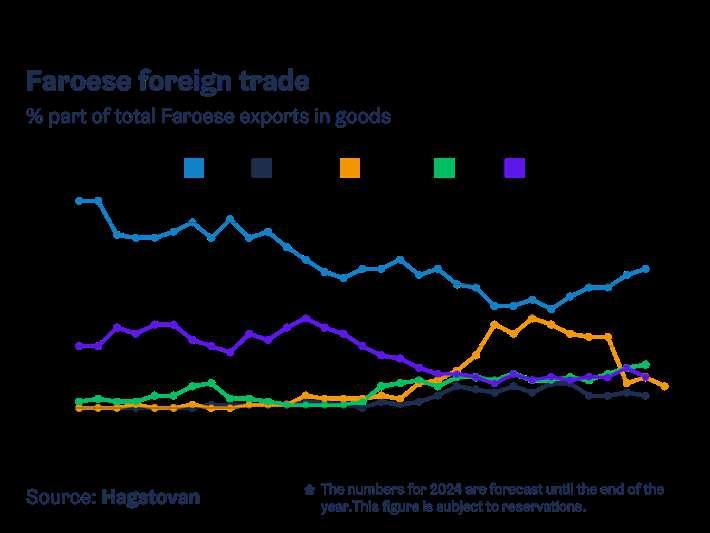
The bilateral treaty with Russia on fishing rights was more controversial. As noted, the Faroe Islands and Russia have been swapping fishing rights since 1977. This trade-off has generally worked well for the Faroes: the Faroes allow Russia to catch fish like blue whiting, mackerel, and herring in Faroese waters, while Faroese vessels get access to valuable cod, haddock, and other species in the Russian Barents Sea, usually exported to the UK and European market
After the Russian invasion of Ukraine in 2022, people naturally questioned the prudence of maintaining governmental treaty relations with a state in flagrant violation of international law while brutally invading and bombing a neighbouring European state. In the Faroes, voices also pointed out that the bilateral fisheries treaty was no longer economically sound. For decades, the arrangement had benefited the Faroes financially, but 2024 marked a turning point, as the deal, according to some economic calculations, showed either a neutral result or even a deficit for the Faroes (Skorini et al., 2024). Two main factors can explain this imbalance. First, mackerel prices skyrocketed due to international fishing disputes, leaving fish in Faroese waters caught by Russian trawlers much more valuable. Second, cod quotas in Russian waters dropped significantly, reducing what the Faroese fishing fleet could catch in return. In other words, the bilateral fishery agreement is not important for the Faroese economy as such. However, the agreement is still significant for
Figure 1. Faroese foreign trade in goods
local communities and business interests linked to fisheries in Russian waters, which might explain why the agreement has been renewed every year since 2022.
Internationally, the fisheries treaty and port restrictions were controversial for other reasons. In the Nordic countries and the United Kingdom, there has been marked concern about the fact that Russian ships are still allowed to call on Faroese ports. Furthermore, the agreement gives almost 30 Russian ships free access to Faroese waters, some of whom are accused of espionage and sabotage of undersea cables (Dall, 2025). In its 5th sanctions package, adopted in April 2022, the EU banned all vessels under Russian flag from calling on EU ports (Council Regulation 2022/576), but when the Faroese parliament adopted the EU sanctions packages, it deliberately removed the blanket ban on Russian vessels. The Faroese authorities have looked to Norway, which also maintains bilateral relations with Russia in fisheries and welcomes Russian vessels to selected Norwegian ports (Tromsø, Båtsfjord and Kirkenes) – although access has been severely curtailed after 2022 (Utenriksdepartementet, 2025).
Another national point of contestation was Russian access to Faroese harbours. In July 2022, the Faroese Government introduced comprehensive port access limitations for Russian vessels, initially excluding most Russian ships while maintaining exceptions for fishing operations. The Faroese Prime Minister pointed out that the Faroes should not be used as a hub for the Russian fleet in the North Atlantic. Under current regulations, only Russian fishing vessels engaged in legitimate activities within Faroese territorial waters may access local ports. Furthermore, Russian ships face strict service restrictions while docked, limited primarily to essential operations: crew rotations, basic provisioning, and cargo handling. These policy changes had a substantial effect. Estimates suggest a 70% decrease in Russian port activity compared to pre-restriction levels (see tables 1 and 2). These restrictions had negative consequences for local business. According to data collected from public authorities and private companies, local business generated over 400 million DKK annually from Russian vessel services before the restrictions. The restrictions have effectively eliminated most Russian-related revenue streams for Faroese companies (Skorini et al., 2024)
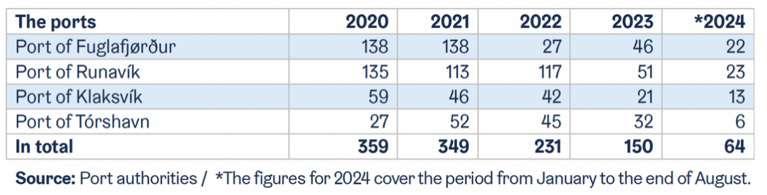
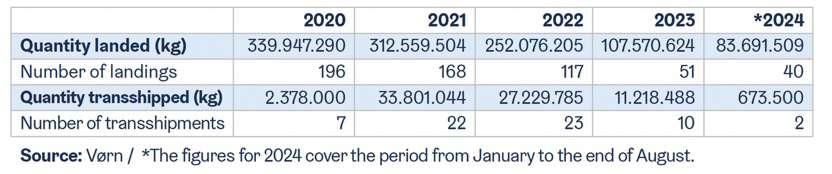
Table 1. Russian port calls in the Faroes
Table 2. Russian transshipments and landings in the Faroes
The Russian interest in the Faroe Islands is connected to Russian interests in the Arctic region and the North Atlantic Ocean, in particular freedom of navigation for Russia’s Northern Fleet via the so-called GIUK-gap. In the updated 2023 Russian Foreign Policy Concept, the Arctic region is the second-most important regional vector of Russian foreign policy after the post-Soviet space (Foreign Policy Concept, 2023). Russian officials have also repeatedly underlined the ‘good relationship’ between the Faroes and Russia, at times accusing Danish authorities of trying to undermine this relationship (Râbinina, 2023). More fringe voices in Russia have made the case that Russia could utilise the relationship with the Faroes to undermine the Danish Kingdom by pitting Faroese independence movements against the metropole, thereby destabilising a NATO member (but see also e.g., Solovyov, 2023). Already in 2010, the Russian scholar Artur Indzhiev wrote that “Russia could take advantage of [Faroese separatist aspirations] to gain access to Arctic resources and strike a blow to NATO’s unity” (Indžiev, 2010, p. 145).
For a self-governing entity with economic ties to Russia, Moscow’s economic ambitions and Arctic policy are of particular interest. One concern in the deglobalisation of the world economy has been Russian ambitions of ditching Western countries as trading partners. The integration of economic and strategic goals is explicitly outlined in Russia’s 2021 National Security Strategy, which states that its ambitions are based on “the inseparable link and mutual dependence between the national security of the Russian Federation and the socio-economic development of the country” (Strategy for National Security of the Russian Federation, 2021). The 2017 Economic Security Strategy further aims to enhance the country’s “economic sovereignty” and safeguard “economic security” from various risks (Strategy for Economic Security of the Russian Federation, 2017).
For food exporting nations, the 2020 Russian Food Security Doctrine is of particular relevance. This doctrine emphasises the Russian ambition to replace all food imports with domestic production (Food Security Doctrine, 2020). In fisheries, Russia has achieved significant selfsufficiency, with domestic production reaching 5.2 million tons in 2023. The Food Security Doctrine mandates that 85% of fish products should come from local sources, a goal successfully met according to the Russian Federal Agency for Fisheries, Rosrybolovstvo (Information and Analytical Department of the Federation Council Staff, 2022).
However, the quest for high-quality products maintains demand for Faroese fish. Russian fish importers acknowledge that eliminating Faroese imports would negatively impact pricing, particularly for mackerel and herring (Skorini et. al., 2024) – species which hold cultural significance in the Russian cuisine. However, a Rosselkhozbank analysis from February 2023 projected that domestic herring production could completely replace imports already by 2025. Russian herring imports already declined 25.5% between 2021 and 2022 (Rossel’hozBank, 2023). These numbers underscore that Western exporters cannot take the Russian market for granted in the future.
A particularly interesting case demonstrating how the bilateral fisheries agreement can be used to apply pressure on the Faroes is the so-called ‘import ban’ case. On October 23, 2023, the Russian Federal Agency for Fisheries announced plans for an import ban on certain Faroese fish products, citing Faroese “sanctions against Russian fishermen” as the reason (Federal Agency for Fiseries, 2023). In other words, Russia threatened to boycott Faroese products as a response to the partial closure of Faroese harbours for Russian ships. However, the import ban was never implemented, and Russian media offered competing explanations: either the proposal was merely a political signal to pressure the Faroe Islands ahead of upcoming fisheries negotiations, or domestic Russian fishing
industry actors successfully lobbied against it (Suhorukova & Zaharova, 2023; Suhorukova & Pashkova, 2023; ‘Ideâ zapreta importa...’, 2023). The episode clearly signalled to the Faroe Islands that Russian market access should not be taken for granted.
When examining the case in question in the context of IR theory on alliance behaviour, the Faroe Islands’ policy vis-à-vis Russia between 2014-2024 entails notable features of hedging behaviour as defined in the theoretical IR literature. The case illustrates how small, sub-sovereign actors can navigate between different greater powers and between different national interests that pull in different directions. On the one hand, the Faroes pledge allegiance to NATO and Europe while joining EU sanctions and imposing port restrictions on Russian trawlers. On the other hand, the Faroes have preserved a bilateral fishery agreement that might be a precondition for further export to Russia Hedging should not necessarily be considered a conscious and deliberate strategy but more as instinctive behaviour in the face of conflicting interests, and the Faroese hedging strategy emerged from a unique convergence of opportunity and necessity in 2014. The EU’s sanctions against the Faroes over a fishing dispute created an opening for closer Russian ties precisely when Russia’s annexation of Crimea had motivated Moscow to counter sanction exporters in Western countries. This coincidental timing shaped an opportunistic and business-oriented hedging behaviour – diversifying economic partnerships to reduce dependence on Western allies while avoiding direct confrontation with alliance commitments.
First, the Faroes pursued strategic ambiguity by not forcefully condemning nor in any way endorsing the Russian annexation of Crimea, instead focusing on economic opportunities. Second, the Faroes engaged in what some scholars have referred to as ‘sovereignty games’ whereby the islands leveraged their autonomous status within the Danish Kingdom (Adler-Nissen, 2014; AdlerNissen & Gammeltoft-Hansen, 2008). The Faroese government’s control over trade and fisheries policy provided legal cover for policies that would probably have been impossible for Denmark proper to pursue. The constitutional arrangements of the Danish Kingdom allowed the Faroes to exploit their autonomous status to avoid the constraints that Denmark proper’s alliance commitments imposed on economic policy. One interesting example of this is the Partnership Declaration that the Faroese government signed with the United States in 2020 (Government of the Faroe Islands, 2020) – only two years after signing the aforementioned Memorandum of Understanding with the Eurasian Economic Union (Memorandum of Understanding, 2018).
In economic terms, this Faroese hedging “strategy” proved initially successful. Russian exports grew from negligible levels to 29% of total Faroese exports by 2017 (see figure 2), representing a dramatic diversification of Faroese export away from the traditional EU market, which is still the biggest market for Faroese export. Furthermore, the bilateral fisheries agreement allowed the Faroes to maintain historical and economically beneficial relations with Russia while providing Moscow with much valued fishing access. This created mutual interdependence that theoretically should have protected the relationship from political turbulence.
However, the Faroese case also reveals the limitations of economic hedging for small, substate actors. The 2023 Russian ‘import ban’ threat demonstrated how asymmetric relationships can quickly transform economic interdependence into vulnerability and “entrapment”. While the ban was ultimately not implemented, it served as a clear signal that Russia viewed the relationship as transactional rather than strategic, consistent with alliance theory’s emphasis on power asymmetries in determining partnership durability. The post-2022 period shows the limits of Faroese
rapprochement towards Russia. The Faroes’ rapid alignment with EU sanctions following the Russian invasion demonstrates that hedging strategies for substate actors within larger alliance structures face inherent constraints. The best symbol of this ‘return to Europe’ was the Memorandum of Understanding signed by Faroese Prime Minister Aksel V. Johannesen and EU President Ursula von der Leyen in Tórshavn in March 2024 (Memorandum of Understanding, 2024). A visit from the EU’s highest official to a small, sub-sovereign island jurisdiction is certainly a rare event. The Faroese re-alignment reveals a critical insight from balance-of-threat theory: when core security interests are at stake, alliance commitments tend to override economic hedging strategies. The Faroes’ decision to condemn the Russian war in Ukraine, implement EU sanctions, provide Ukraine with economic aid and adopt a new security policy pledging allegiance to NATO is an interesting response to what Glenn Snyder termed the secondary alliance ‘security dilemma’: “how firmly to commit [oneself] to the proto-partner and how much support to give that partner in specific conflict interactions with the adversary” (Snyder, 1984).
But the post-2022 period also shows the Faroes attempting to maintain residual hedging through selective implementation of sanctions and maintaining limited ties with Russia. Their decision to allow limited Russian port access and maintain fisheries agreements while implementing broader sanctions represents what could be termed ‘constrained hedging’ – pursuing the minimum viable level of continued engagement while remaining within alliance bounds. This is also interesting for the future of Faroese foreign policy and security strategy in the context of the waning appeal of the 1990’s free market ideology and the more common pessimistic notions of ‘deglobalisation’, ‘friendshoring’ and other versions of economic nationalism that threaten to collapse the borders between trade and politics (Braw, 2024; Leonard, 2022)
The Faroese case offers important lessons for understanding hedging strategies among small, substate territories with extensive self-governing powers. First, it demonstrates that subnational actors can successfully pursue hedging strategies when constitutional arrangements provide legal cover and when geopolitical circumstances create opportunities for strategic ambiguity. Second, the case illustrates the temporal limitations of hedging strategies for alliance-embedded actors. As great power competition intensifies and security concerns dominate economic considerations, the space for strategic ambiguity narrows. Finally, the Faroese experience highlights the importance of economic fundamentals in hedging calculations. The deteriorating economic benefits of the Russian fisheries agreement by 2024, combined with growing political costs, certainly made the strategic pivot more palatable. At the time of writing, it remains unclear whether the Faroese parliament will adopt a new bill on further sanctions against specific Russian shipping companies. If the bill is adopted, it might trigger Russian countermeasures and put an end to Faroese-Russian cooperation in the field of fisheries and trade.
5. Conclusion: Small Territory Agency in an Age of Great Power Competition
Despite not being a state, small self-governing entities like the Faroe Islands are experiencing the effects of global tensions and the return of great power competition in the North Atlantic and Arctic region. As part of the NATO umbrella, the islands are part of a broader Western strategic framework that identifies Russia as its main adversary. The Faroese trade relationship with Russia is complicated by Russia’s anti-Western posture and ambitions for Arctic power, placing the Faroes
between NATO and Russia and illustrating the foreign policy challenges facing substate actors amid growing great power competition.
The relationship between the three constituent nations of the Kingdom of Denmark is evolving under new geopolitical conditions. The Russian invasion of Ukraine has redefined the geopolitical world (dis)order, and Donald Trump’s declared ambitions to conquer Greenland has shocked the Kingdom of Denmark. Besides external pressure from Washington, the quest for national selfdetermination in Greenland and the Faroes is also triggering tensions within the Kingdom. And the Faroese “Russia policy” in the years following 2014 illustrates the agency of substate entities.
The Faroese case demonstrates both opportunities and constraints facing small, self-governing territories in an era of great power competition. While the Faroe Islands successfully leveraged their strategic position to maintain beneficial economic relations with Russia between 2014-2022, their experience also reveals the limitations of hedging strategies for sub-sovereign actors within larger security frameworks. The islands extracted concessions from Copenhagen and Brussels through strategic ambiguity, but their alignment with Western sanctions following Russia’s 2022 invasion underscores that alliance pressures ultimately circumscribe autonomous foreign policy options.
As the Arctic becomes more militarised and economic nationalism supplants free trade, the space for strategic ambiguity and hedging strategies by substate actors may be narrowing. Yet the Faroese experience shows that even small, sub-sovereign actors can chart independent courses to pursue national interests. The Kingdom of Denmark’s evolving dynamics, accelerated by external pressures, point toward a future where boundaries between security and trade continue to blur, potentially forcing small territories to make starker strategic choices between competing great power blocs.
Notes
1. In this paper, we will use the term ‘Kingdom of Denmark’ to refer to the collective political unit (or “conglomerate state”) of Denmark proper, Greenland and the Faroe Islands (see e.g., Engelhardt, 2007).
2. A similar yet narrower analysis of the present topic is published in Danish in the article “Færøerne mellem Rusland og Vesten: En mikronations balancegang mellem økonomiske og sikkerhedspolitiske interesser” (Weihe & Skorini, 2025).
3. For some of the central works on alliance theory see e.g., Snyder, 1984, 1997; Walt, 1985, 1987, 2009; Weitsman, 2004, 2014. For writings on hedging in IR, see e.g., Ciorciari & Haacke, 2019; Jones & Jenne, 2022; Korolev, 2019; Kuik, 2021, 2024; Lim & Cooper, 2015; Stiles, 2018.
References
Abrahamsen, S. (2025, January 16). Danmark står i diplomatisk krise: »Vi har ikke særligt stærke kort på hånden«. Dagbladet Information. https://www.information.dk/indland/2025/01/danmark-staar-diplomatisk-krise-saerligtstaerke-kort-paa-haanden
Act No. 473 of 12 June 2009 on Greenland Self-Government (2009). https://english.stm.dk/media/4vgewyoh/gl-selvstyrelov-uk.pdf
Adler-Nissen, R. (2014). The Faroe Islands: Independence dreams, globalist separatism and the Europeanization of postcolonial home rule. Cooperation and Conflict, 49(1), 55–79.
Adler-Nissen, R., & Gammeltoft-Hansen, T. (2008). Sovereignty games: Instrumentalizing state sovereignty in Europe and beyond. Springer.
Braw, E. (2024). Goodbye Globalization: The Return of a Divided World. Yale University Press.
Breum, M. (2016). Danmark som arktisk stormagt. Udenrigs, 1, 9–16. https://doi.org/10.7146/udenrigs.v0i1.118205
Bryant, M. (2025, May 12). Norway hands over Arctic Council intact after ‘difficult’ term as chair. The Guardian. https://www.theguardian.com/world/2025/may/12/norway-arcticcouncil-leadership-ukraine-trump-greenland
Buzan, B., Wæver, O., & de Wilde, J. (1998). Security: A New Framework for Analysis. Lynne Rienner Publishers.
Ciorciari, J. D., & Haacke, J. (2019). Hedging in international relations: An introduction. International Relations of the Asia-Pacific, 19(3), 367–374. https://doi.org/10.1093/irap/lcz017
Council Regulation (EU) 2022/576 of 8 April 2022 Amending Regulation (EU) No 833/2014 Concerning Restrictive Measures in View of Russia’s Actions Destabilising the Situation in Ukraine, 111 OJ L (2022). http://data.europa.eu/eli/reg/2022/576/oj/eng
Dall, A. (2025, June 3). Mistænkt for spionagemissioner i Norge: Russisk trawler giver alvorlige panderynker DR. https://www.dr.dk/nyheder/udland/mistaenkt-spionagemissioner-i-norge-russisktrawler-giver-alvorlige-panderynker
Danilov, P. B. (2021, October 5) Greenland and Faroe Islands Take Step Towards More Autonomy on Foreign Affairs and Defense. High North News. https://www.highnorthnews.com/en/greenland-and-faroe-islands-take-step-towardsmore-autonomy-foreign-affairs-and-defense
Decree of the President of the Russian Federation from 02.07.2021 ‘On the Strategy for National Security of the Russian Federation’. [Ukaz Prezidenta Rossijskoj Federacii ot 02.07.2021 № 400 ‘O Strategii nacional’noj bezopasnosti Rossijskoj Federacii’] (2021, February 7). The Official Portal of Legal Information. http://publication.pravo.gov.ru/document/0001202107030001
Decree of the President of the Russian Federation from 13.05.2017 No. 208 ‘On the Strategy for Economic Security of the Russian Federation for the period until 2030’ [Ukaz Prezidenta Rossijskoj Federacii ot 13.05.2017 № 208 ‘O Strategii èkonomičeskoj bezopasnosti Rossijskoj Federacii na period do 2030 goda’] (2017, May 13). The Official Portal of Legal Information. http://publication.pravo.gov.ru/document/0001201705150001
Decree of the President of the Russian Federation from 21.01.2020 no. 20 ‘On the approval of the Food Security Doctrine of the Russian Federation’. [Ukaz Prezidenta Rossijskoj Federacii ot 21.01.2020 № 20 ‘Ob utverždenii Doktriny prodovol’stvennoj bezopasnosti Rossijskoj Federacii’] (2020, January 21). Official Portal of Legal Information. http://publication.pravo.gov.ru/Document/View/0001202001210021
Decree of the President of the Russian Federation from 31.03.2023 No. 208 “On approval of the Foreign Policy Concept of the Russian Federation” Ukaz Prezidenta Rossijskoj Federacii ot 31.03.2023 № 229 ‘Ob utverždenii Koncepcii vnešnej politiki Rossijskoj Federacii’ (2023, March 31). Official Portal of Legal Information. http://publication.pravo.gov.ru/Document/View/0001202303310007
Djurhuus, H., & Johannesen, J. (2014, August 21). Russar svangir eftir føroyskum fiskavørum. Kringvarp Føroya. https://kvf.fo/greinar/2014/08/21/russar-svangir-eftir-foroyskumfiskavorum
Documents Concerning the Accession to the European Communities of the Kingdom of Denmark, Ireland, the Kingdom of Norway and the United Kingdom of Great Britain and Northern Ireland, 073 OJ L (1972). http://data.europa.eu/eli/treaty/acc_1972/sign/eng
Engelhardt, J. (2007). Patriotism, nationalism and modernity: The patriotic societies in the Danish conglomerate state, 1769–1814. Nations and Nationalism, 13(2), 205–223. https://doi.org/10.1111/j.1469-8129.2007.00278.x
European Commission. (2013, August 20). Commission adopts trade measures against Faroe Islands to protect the Atlanto-Scandian herring stock [Text]. European Commission https://ec.europa.eu/commission/presscorner/detail/en/ip_13_785
Federal Agency for Fisheries of the Russian Federation [Rosrybolvstvo] (2023, October 23). Rosrybolovstvo predložilo vvesti zapret na vvoz rybnoj produkcii s Farerskih ostrovov https://fish.gov.ru/news/2023/10/23/rosrybolovstvo-predlozhilo-vvesti-zapret-navvoz-rybnoj-produkczii-s-farerskih-ostrovov/
FiskerForum. (2022, March 2). Færøske Bakkafrost standser lakse-eksporten til Rusland. https://fiskerforum.dk/faeroeske-bakkafrost-standser-lakse-eksporten-til-rusland/ Floksskrivstovan [Party Office]. (2022, November 21). Tjóðveldi tekur onga avgerð sum hóttir gerandisdagin hjá fólki. Tjóðveldi. https://www.tjodveldi.fo/?p=11977
Foreign Policy Act of the Faroe Islands (2005). https://www.government.fo/en/foreignrelations/constitutional-status/the-foreign-policy-act/
Gad, U. P. (2020). Greenland, the Faroe Islands, and Denmark: Unity or Community? In P. Munk Christiansen, J. Elklit, & P. Nedergaard (Eds.), The Oxford Handbook of Danish Politics (pp. 28–45). Oxford University Press. https://global.oup.com/academic/product/the-oxfordhandbook-of-danish-politics-9780198833598?cc=dk&lang=en&
Galeotti, M. (2022). The Weaponisation of Everything: A Field Guide to the New Way of War. Yale University Press.
Gardel, U. (2014, December 9). Færøsk hjælp til Putin. Berlingske https://web.archive.org/web/20190618234820/https://www.berlingske.dk/oekonomi/f aeroesk-hjaelp-til-putin
Government of the Faroe Islands. (2020). Partnership Declaration between the United States of America and the Faroe Islands concerning Increased Cooperation. Government of the Faroe Islands. https://landsstyri.cdn.fo/savn/14683/partnership-declaration-usa-faroe-islands2020.pdf?s=pQ7ixhwgHP4zmkn7VTkSG9pno74
Government of the Faroe Islands. (2024a, February 24). Support to children and youth in Ukraine. https://www.government.fo/en/news/news/support-to-children-and-youth-in-ukraine Government of the Faroe Islands. (2024b, May 13). Arctic Policy of the Faroe Islands 2024. Government of the Faroe Islands. https://landsstyri.cdn.fo/savn/rqspqfmm/arcticpolicy-of-the-faroe-islands-2024.pdf?s=QLOcrrCYmLEDuXePLfm16NTWxSA
Government of the Faroe Islands. (2024c, May 16). National Security Policy https://www.government.fo/en/foreign-relations/national-security-policy
Government of the Faroe Islands. (2024d, December 1). Number of temporary residence permits for Ukrainians in the Faroe Islands set to increase from 200 to 250
Skorini & Weihe
https://www.government.fo/en/news/news/number-of-temporary-residence-permitsfor-ukrainians-in-the-faroe-islands-set-to-increase-from-200-to-250
Hartmann, J., & Waibel, M. (2013, November 13). The ‘Mackerel War’ Goes to the WTO. EJIL: Talk! https://www.ejiltalk.org/the-mackerel-war-goes-to-the-wto/ Hoydal, H. (2014, September 12). Flikk-flakk í heimastýrinum: Fýra veruleikar um sonevndu russlandsvitjanina hjá Kaj Leo. Tjóðveldi. https://www.tjodveldi.fo/?p=3558
Ishikawa, Y. (2014). The EU-Faroe Islands Herring Stock Dispute at the WTO: The Environmental Justification. ASIL Insights, 18(4). https://www.asil.org/insights/volume/18/issue/4/eu-faroe-islands-herring-stockdispute-wto-environmental-justification
Ideâ zapreta importa ryboprodukcii s Farer okazalas’ blefom (2023, December 19). [Telegram]. Rybhoz. Vsë o rybe https://t.me/rybhoz_channel/1419
Indžiev, A. A. (2010). Bitva za Arktiku. Budet li Sever russkim? ÈSKMO
Information and Analytical Department of the Federation Council Staff [Informacionno-analitičeskoe upravlenie Apparata Soveta Federacii] (2022). On the realization of the Food Security Doctrine of the Russian Federation [O Realizacii Doktriny Prdovol’stvennoj Bezopasnosti Rossijskoj Federacii]. Analytical Bulletin [Analitičeskij vestnik], № 22(812). http://council.gov.ru/media/files/pzgbeWAHoKR918YkuYQvi8lW2e8Gs948.pdf
Jacobsen, M., Gad, U. P., & Wæver, O. (Eds.). (2024). Greenland in Arctic Security: (De)securitization Dynamics under Climatic Thaw and Geopolitical Freeze. University of Michigan Press. https://doi.org/10.3998/mpub.12676130
Jacobsen, M., & Lindbjerg, S. L. (2025). Rigsfællesskabets stoledans i Arktisk Råd: Repræsentationen af Danmark, Grønland og Færøerne, 1996–2024. Internasjonal Politikk, 83(1). https://doi.org/10.23865/intpol.v83.6756
Jensen, B. (2004). Færøerne under Den kolde Krig (1945-1991). Løgmansskrivstovan.
Joensen, K. (2019, November 8). Rigsfællesskabet får procedure for deling af hemmeligheder. FO nyhedsbureau. https://www.fonyhedsbureau.dk/rigsfaellesskabet-faar-procedure-for-delingaf-hemmeligheder/
Johannesen, A. V. (2022, January 12). Avtalan við stýrið hjá Putin. Javnaðarflokkurin. https://www.j.fo/ti%C3%B0indi-og-greinar/?id=1993
Johansen, S. T. (2003). Maneuvers of a ’Non-Power’ Faroese Security Policy. In K. Kleve (Ed.), The Cold War, Military Power and the Civilian Society. Norwegian Aviation Museum.
Johansen, S. T. F. (2014). Færøerne. In M. Stenak, T. T. Pedersen, P. H. H. Hansen, & M. Jespersen (Eds.), Kold Krig: 33 fortællinger om den Kolde krigs bygninger og anlæg i Danmark, Færøerne og Grønland (pp. 165–177). Kulturstyrelsen. https://slks.dk/fileadmin/publikationer/Kulturarv/Kold_Krig_2014.pdf
Jones, D. M., & Jenne, N. (2022). Hedging and grand strategy in Southeast Asian foreign policy. International Relations of the Asia-Pacific, 22(2), 205–235. https://doi.org/10.1093/irap/lcab003
Jørgensen, T. J. (2025, April 27). Grønland og Danmark rykker tættere sammen i bussen https://www.sermitsiaq.ag/samfund/gronland-og-danmark-rykker-taettere-sammen-ibussen/2226536
Justinussen, J. C. S. (2019). Rigsfællesskabet i et føderalt perspektiv. Politica, 51(4), Article 4. https://doi.org/10.7146/politica.v51i4.131171
Kobzeva, M. (2022) “Towards customised sovereignty: West Nordic societies in the new great power rivalry,” Polar Record, 58, e38. https://doi.org/10.1017/S003224742200033X
Korolev, A. (2019). Shrinking room for hedging: System-unit dynamics and behavior of smaller powers. International Relations of the Asia-Pacific, 19(3), 419–452. https://doi.org/10.1093/irap/lcz011
Kristensen, K. S., & Rahbek-Clemmensen, J. (2018). Greenland and the International Politics of a Changing Arctic: Postcolonial Paradiplomacy between High and Low Politics. Routledge.
Kuik, C.-C. (2021). Getting hedging right: A small-state perspective. China International Strategy Review, 3(2), 300–315. https://doi.org/10.1007/s42533-021-00089-5
Kuik, C.-C. (2024). Explaining Hedging: The Case of Malaysian Equidistance. Contemporary Southeast Asia, 46(1), 43–76.
Leonard, M. (2022). The Age of Unpeace: How Connectivity Causes Conflict. Penguin Books.
Lim, D. J., & Cooper, Z. (2015). Reassessing Hedging: The Logic of Alignment in East Asia. Security Studies, 24(4), 696–727. https://doi.org/10.1080/09636412.2015.1103130
Memorandum of Understanding between the Eurasian Economic Commission and the Government of the Faroe Islands. (2018, 24 August).
https://docs.eaeunion.org/upload/iblock/24d/mgoqzjucy8947z8bpyahox32fjmjih4y/ms _06092018_doc.pdf
Memorandum of Understanding on Enhanced Cooperation between the European Union and the Government of the Faroe Islands. (2024). European External Action Service. https://www.eeas.europa.eu/sites/default/files/documents/2024/20240321%20Signed %20MoU.pdf
Mikkelsen, L. (2014, June 9). Samráðingarnar við Russland neyðugar. Kringvarp Føroya. https://kvf.fo/netvarp/uv/2014/09/06/samringarnar-vi-russland-eru-neyugar
Ministry of Foreign Affairs, Industry and Trade. (n.d.). Information Note: Concerning access to ports of Russian fishing vessels. Ministry of Foreign Affairs, Industry and Trade. https://landsstyri.cdn.fo/savn/svel4khv/information-note-concerning-access-to-portsfor-fishing-vessels.pdf?s=bBJmAs0NiFHg6XcNFEdisGM5xnU
Nuuk and Cranny: Looking at the Arctic and Greenland’s Geostrategic Importance to U.S. Interests. (2025, February 12). U.S. Senate Committee on Commerce, Science, & Transportation. https://www.commerce.senate.gov/2025/2/nuuk-and-cranny-looking-at-the-arctic-andgreenland-s-geostrategic-importance-to-u-s-interests_2
Pedersen, R. (2023). Small states shelter diplomacy: Balancing costs of entrapment and abandonment in the alliance dilemma. Cooperation and Conflict, 58(4), 441–459. https://doi.org/10.1177/00108367231164497
Râbinina, Û. (2023, December 21). Zaharova: Vbrosy ob ugroze dlâ Danii ot rybakov RF rasprostranâûtsâ Zapadom. RG.RU. https://rg.ru/2023/12/21/zaharova-vbrosy-ob-ugrozedlia-danii-ot-rybakov-rf-rasprostraniaiutsia-zapadom.html
Rossel’hosBank (2023, February 14). Car’-ryba: K koncu 2025 goda sel’d’, proizvedennaâ v Rossii, polnost’û vytesnit importnye analogi. h https://www.rshb.ru/news/premiumultra/14022023-000001
Rahbek-Clemmensen, J. & Sørensen, C. T. N. (Eds.) (2021). Sikkerhedspolitik i Arktis og Nordatlanten. Djøf Forlag
Skorini & Weihe
Rehban, C. (2016) North Atlantic Euroscepticism: The Rejection of EU membership in the Faroe Islands and Greenland. Faroe University Press.
Satariano, A. (2019, December 20). At the Edge of the World, a New Battleground for the U.S. and China. The New York Times. https://www.nytimes.com/2019/12/20/technology/faroeislands-huawei-china-us.html
Skaale, S. (2014, September 9). Kaj Leo sum Putinsa henti idiotur?
https://www.jaf.fo/ti%C3%B0indi-og-greinar-jaf-fo/?id=1033
Skorini, H. í. (2024, October). Mapping Public Opinion in the Faroe Islands on Security and Foreign Affairs. Department of History and Social Sciences, University of the Faroe Islands.
Skorini, H. í, Ellefsen, H., Weihe, T. M., Hansen, F. S., & Johannesen, P. H. (2024). From Crimea to Kyiv: Mapping Faroese-Russian Relations. Department of History and Social Sciences, University of the Faroe Islands. https://gransking.cdn.fo/savn/doxl5agb/policy-brieffaroe-islands-and-russia.pdf?s=Ezjcxx5qB6dGg3w0GdiYAN5j2zU
Snyder, G. H. (1984). The security dilemma in alliance politics. World Politics, 36(4), 461–495.
Snyder, G. H. (1997). Alliance politics. Cornell University Press. Solovyov, V. (2023, January 23). [Telegram]. SOLOVЁV Live. https://t.me/SolovievLive/152879
Søndergaard, R. S. (2025, March). Danmark bør gå i offensiven mod Trumps grønlandsinteresse. Danish Institute for International Studies (DIIS). https://research.diis.dk/portal/en/publications/danmark-boer-gaa-i-offensiven-modtrumps-groenlandsinteresse(6ddc7822-7109-4851-a5a8-c67a25c60536).html
Stiles, K. W. (2018). Trust and Hedging in International Relations University of Michigan Press.
Suhorukova, E. & Zaharova, A. (2023, October 11). Rybopromyšlenniki vstupilis’ za import sel’di s Farerskih ostrovov. RBK. https://www.rbc.ru/business/10/11/2023/654cc06f9a7947719c89681e
Suhorukova, E. & Pashkova, L. (2023, December 18). Rybopromyšlenniki «otbilis’» ot zapreta importa ryby s Farerskih ostrovov. RBK.
https://www.rbc.ru/business/18/12/2023/658066979a7947e216d051f3
Taksøe-Jensen, P. (2016). Dansk diplomati og forsvar i en brydningstid: Vejen frem for Danmarks interesser og værdier mod 2030 Udenrigsministeriet.
The Prime Minister’s Office. (2013, October). The Faroes – A Nation in the Arctic: Opportunities and Challenges. The Prime Minister’s Office. https://www.europarl.europa.eu/meetdocs/2009_2014/documents/deea/dv/16_201311 20_faroe-islands-arctic-/16_20131120_faroe-islands-arctic-en.pdf
Transcript of President Donald Trump’s speech to a joint session of Congress. (2025, March 5). Associated Press. https://apnews.com/article/trump-speech-congress-transcript751b5891a3265ff1e5c1409c391fef7c
Utenriksdepartementet. (2025, January 8). Sanksjoner som svar på Russlands militære aggresjon mot Ukraina [Redaksjonellartikkel]. regjeringen.no. https://www.regjeringen.no/no/tema/utenrikssaker/Eksportkontroll/sanksjoner-ogtiltak1/sanksjoner_aggresjon/id2905102/
Walt, S. M. (1985). Alliance formation and the balance of world power. International Security, 9(4), 3–43.
Walt, S. M. (1987). The origins of alliance. Cornell University Press.
Walt, S. M. (2009). Alliances in a unipolar world. World Politics, 61(1), 86–120.
Weihe, T. M. & Skorini, H. í (2025): "Færøerne mellem Rusland og Vesten: En mikronations balancegang mellem økonomiske og sikkerhedspolitiske interesser". In Økonomi og politik, nr. 4, 2025.
Weitsman, P. A. (2003). Dangerous Alliances: Proponents of Peace, Weapons of War Stanford University Press.
Weitsman, P. A. (2014). Waging War: Alliances, Coalitions, and Institutions of Interstate Violence. Stanford University Press.
West, H. (2024). Faroese Self-Government: A Disputed But Evolved Model. In J. Sundberg & S. Sjöblom (Eds.), Governing Partially Independent Nation-Territories (pp. 177–223). Springer International Publishing. https://doi.org/10.1007/978-3-031-54176-6_6
Skorini & Weihe
Reassessing Arctic Security: Canada’s Policy Response to Geopolitical Shifts and Emerging Threats
Karen Everett and Katharina Koch
Before February 2022, there was a healthy academic debate about Arctic exceptionalism - whether the region was insulated from geopolitical tension, vulnerable to spillover effects, or situated somewhere in between. However, Russia’s invasion of Ukraine on February 24, 2022, demonstrated that political spillover is not only possible but also has tangible regional and global consequences. This was evident in the temporary suspension of Arctic Council activities and its working groups, as well as Finland’s and Sweden’s historic decision to join NATO. Moreover, security concerns are further confounded with the consequences of climate change, thus increasing the strategic relevance of the Arctic. National Arctic strategies and policies provide insights into how states perceive and position themselves in the region. Similarly, military strategies shape and reflect a country’s broader security priorities. In Canada’s case, key policy documents such as the Arctic and Northern Policy Framework (2019) (ANPF) and Strong, Secure, and Engaged (2017) (SSE) were formulated before the invasion of Ukraine, while the Arctic Foreign Policy (2024) and Our North, Strong and Free (2024) were developed and published afterwards. This temporal distinction raises important questions about how security discourses have evolved in response to the shifting geopolitical dynamics affecting relations within the Arctic and with near-Arctic states (e.g., China). To explore these changes, we examine the four policy documents through six key themes: 1) shifting perceptions of adversaries; 2) emerging new threats to the Arctic region; 3) the role of climate change; 4) energy security considerations; 5) investments in procurement and infrastructure; and 6) evolving relationships between Canada and its allies. In addition to analyzing the shifts revolving around these key themes, we also acknowledge a broader challenge inherent in policy-making - the above-cited strategic documents are designed to guide decision-making over multiple years. As a result, they do not account for rapidly changing geopolitical realities, thus raising critical questions about adaptability and effectiveness during times of uncertainty.
Introduction
Since Russia’s invasion of Ukraine in February 2022, scholars agree that the Arctic region has emerged as an arena of geopolitical tension (Bresnahan et al., 2022; Gricius & Fitz, 2022; Koch & Everett, 2024; Koivurova & Shibata, 2023). In addition, evaluations of current threats include
Karen Everett - Senior research associate, Chaire Louis-Edmond-Hamelin de recherche nordique en sciences sociales, Université Laval
Katharina Koch - Research associate, The School of Public Policy, University of Calgary
climate change and associated environmental transformation in the region, and potentially opening up new maritime routes in the Northwest Passage (NWP) due to melting sea ice (Cooley et al., 2020; Greaves, 2021; Guarino et al., 2020; Lackenbauer & Lajeunesse, 2014; Marten, 2023). Together, these factors have revived global interest in the Arctic as a region of strategic relevance. In response, Canada has adapted its security, defence, and foreign policy approaches to reflect shifting security dynamics, climate risks, and emerging economic opportunities in its northern and Arctic regions by investing into, for example, updated defence-related infrastructure.
Given these considerations, the analysis in this chapter addresses the question: How have Canadian federal discourses on Arctic state security changed in its official policy and strategy documents since 2017? To explore this question, we analyze four federal policy and strategy documents that span the period, including those before and after the 2022 Russian invasion of Ukraine: Strong, Secure, Engaged (SSE, 2017), the Arctic and Northern Policy Framework (ANPF, 2019), Our North, Strong and Free (ONSF, 2024), and the Canada’s Arctic Foreign Policy (AFP, 2024). These documents were selected because they outline Canada’s evolving defense, security, foreign policy, and northern development priorities, offering insight into how Arctic security has been framed across different geopolitical and environmental contexts. This approach allows for a comparative analysis of Canada’s tone, emphasis, and stated objectives and their transformations in response to shifting and emerging threats.
Our analysis highlights several findings: although themes such as northern and Arctic prosperity and environmental stewardship remain consistent across all four documents, there is a noticeable post-2022 shift toward more assertive language on defense, deterrence, and the strategic importance of Canada’s northern territories, particularly also in the maritime domain which is increasingly threatened by climate change. This change is the result of both external factors, most notably renewed geopolitical tensions and accelerating climate change, which have prompted a shift in Canada’s Arctic security approach. We find that amidst geopolitical shifts and state security threats being more clearly stated, Canada has placed increased emphasis on its Arctic region through increased investments in infrastructure, defense procurement, and surveillance capabilities aimed at asserting and enhancing security in the region.
Conceptual Framework and Methods
Conceptual Framework
Geopolitics can take more traditional forms focusing on the more geographical element of international relations or it can be more critical and focus on a variety of socially constructed issues that align more with governance and cooperation than traditional geopolitics (Bruun & Medby, 2014; Heininen, 2019; Offerdal, 2014; Wegge & Keil, 2018). It can also be a blend of the two. Within this space, there have been debates about whether the Arctic is an exceptional place, meaning that it is insulated from global geopolitical concerns, although possibly susceptible to geopolitical spillover, or if the region is part of the global geopolitical system.
The idea of exceptionalism emerged from cooperation on shared interests amongst regional actors, such as states and Indigenous Peoples, that followed Mikhail Gorbachev's 1987 speech which called for the Arctic to be a ‘zone of peace.’ Building on this moment, the notion of Arctic exceptionalism suggests that Arctic cooperation has persisted in isolation from political tensions elsewhere, although some argue this has been an active choice by regional actors rather than a
given preset (Exner-Pirot & Murray, 2017; Heininen, 2018, 2019). Other scholars argue, however, that the Arctic is not fully insulated from global events and that spillover is possible (Käpylä & Mikkola, 2019; Rahbek-Clemmensen, 2017). Nevertheless, exceptionalism was a popular narrative until the Russian invasion of Ukraine in 2022 and the subsequent, but temporary, pause of the Arctic Council. Indeed, various analyses suggested that Arctic exceptionalism was being challenged as spillover took place, for example in ‘soft’ organizations, such as the Arctic Council and the Barents Euro-Arctic Council, and also with the accession of Finland and Sweden to the North Atlantic Treaty Organization (NATO) (for example: Gricius & Fitz, 2022; Koch & Everett, 2024; Koivurova & Shibata, 2023) 1 However, since the onset of Russia’s invasion of Ukraine, some scholars have emphasized that Arctic exceptionalism is not solely about geopolitics, but rather how environmental issues are addressed, and how Indigenous Peoples and Indigenous Knowledge are included in decision-making, particularly in the Arctic Council (see, for example Medby, 2023; Spence et al., 2023)
In contrast to this, other scholars argue that the “Arctic order historically, currently, and in the future reflects the world order” (Bertelsen, 2025, p. 1) or is “a space within it” (Morrison & Bennett, 2024, p. 15). Here, we often see discourses about growing great power dynamics, particularly involving China, Russia, and the United States/West/NATO and the threats this may pose to the Arctic region (Bertelsen, 2020; Huebert, 2019; Østhagen, 2021, 2023). In addition to the strategic competition between these actors, concerns about Russia tend to be military in nature while concerns about China’s engagement in the region tend to be scientific and economic (Klimenko, 2019; Østhagen & Lackenbauer, 2023)
Whether one views the Arctic through the lens of exceptionalism and spillover or as a region fully embedded in global geopolitics, the geopolitical situation in the Arctic has shifted in the past few years. These considerations do not exist in a vacuum and work hand in hand with climate change to shape the security environment in the Arctic.
Despite the profound environmental transformations underway in the Arctic, Canada’s pre-2022 security strategies have largely overlooked integrating climate change as a core strategic security concern (Greaves, 2016, 2021; Purdy & Smythe, 2010; Smith, 2010). This is considered an oversight because climate change and the potential opening up of the Arctic carry significant security implications for Canada, especially in the context of the Northwest Passage (NWP) (Huebert, 2011; Lackenbauer & Lajeunesse, 2014; Lalonde, 2020). Furthermore, environmental degradation, including thawing permafrost, collapsing shorelines, and intensifying wildfires, poses immediate and long-term threats to both infrastructure and community well-being in the North and Arctic (Lede et al., 2021; S. MacDonald & Birchall, 2020) and can negatively affect different aspects of human security (for example: Greaves, 2012; United Nations Development Program, 1994). The compounding effects threaten not only Canada’s Arctic communities but also Canada’s strategic position as an Arctic geopolitical actor.
In response, Canada is advancing national strategies to enhance resilience to climate-related security threats in the Arctic. This includes modernizing both defense and civilian infrastructure, with a focus on northern communities that are disproportionately exposed to environmental hazards and supply chain disruptions (Delaunay & Landriault, 2020; Lackenbauer & Koch, 2021; MacDonald & Birchall, 2020). A central aspect of this effort is energy security, referring to the stable access and availability of energy and the reliability of its supply. This is an issue of strategic
and human security dimensions in remote Arctic regions where alternatives are limited, and northern communities particularly face a dependency on often outdated diesel-reliant power plants to generate energy (Pinto & Gates, 2022). Energy security is thus a serious challenge in Canada but also other regions of the circumpolar Arctic, particularly when it comes to “uninterrupted availability of energy, or the security of supply” (DeWitt et al., 2020, p. 91). Nevertheless, a socalled ‘race for resources’ in an effort to access energy and other natural resources is unlikely to happen (Østhagen & Lackenbauer, 2023)
Taken together, these developments challenge assumptions of Arctic exceptionalism. As the following analysis illustrates, Canada’s recent defence and Arctic strategies take a more direct approach to naming adversaries and threats. The documents further reveal a growing awareness that, for example, environmental vulnerabilities and resulting risks to reliable energy infrastructure, have moved beyond local development concerns to become national security and geostrategic issues. Canada’s policy responses in the form of infrastructure modernization, for example, includes energy related infrastructure, while strengthened relations with allies signal a shift from viewing the Arctic primarily as a region of cooperation and human development to one that is increasingly shaped by traditional security logics and international power dynamics.
Methods
To assess how Canadian federal discourses on Arctic state security changed in its official policy and strategy documents since 2017, we look at Canada’s Arctic and Northern Policy Framework (ANPF) and the Arctic Foreign Policy (AFP) as national Arctic strategies and policies that provide insights into how states perceive and position themselves in the region (see: Bailes & Heininen, 2012; Heininen et al., 2020) and Strong, Secure, Engaged (SSE) and Our North Strong and Free (ONSF) as military strategies that similarly reflect the country’s broader security priorities. Together, these documents span a period of seven years, capturing the period before and after the Russian invasion of Ukraine, offering insight into shifting narratives around security priorities, threat perception, and Canada’s role in the Arctic.
This comparison allows us to trace the discursive and policy-level adjustments Canada has made in articulating Arctic security partnerships in response to emerging geopolitical realities. The Government of Canada is the author for both the ANPF and the AFP (Government of Canada, 2019a, 2024a) while the Department of National Defence is the author of the SSE and ONSF (Department of National Defence, 2017, 2024). We recognize that the ANPF was co-developed with territorial and Indigenous partners and is inclusive of partner chapters representing multiple views and priorities. These chapters, however, are not included for analysis in this study because they are not integrated into the ANPF itself. Rather, the ANPF as presented in a PDF explains the importance of the strategies, yet the ANPF website explains that these chapters “do not necessarily reflect the views of either the federal government, or of the other partners” (Government of Canada, 2019b), which has been a critique of this document (Kikkert & Lackenbauer, 2019).
We also recognize that regional, foreign and defence policies may have different purposes and goals. However, the AFP states that “Canada’s foreign and defence policies are closely intertwined and complimentary” (AFP, 2024, p. 17), while the AFP and ONSF refer to the ANPF, and the ANPF refers to the SSE. Thus, the documents are analyzed together as they provide a broader understanding of Canada’s security and defence priorities in the Arctic. For ease of referencing,
we use abbreviations for the in-text citations (Table 1) while the full citation is found in the reference list.
Table 1: Document name abbreviations
Year Full title Abbreviation
2017 Strong, Secure, Engaged: Canada’s Defence Policy SSE
2019 Canada’s Arctic and Northern Policy Framework ANPF
2024 Our North, Strong and Free: A Renewed Vision for Canada’s Defence ONSF
2024 Canada’s Arctic Foreign Policy AFP
We used a modified abductive method (Bingham, 2023) and began with a skimming review of each policy document to get a sense of what the documents discuss, and combined with the literature reviewed above, we identified the following concepts as important to understanding if and how shifts in security discourses have taken place and how emerging threats are identified and discussed:
1) shifting perceptions of adversaries
2) emerging new threats to the Arctic region
3) the role of climate change
4) energy security considerations
5) investments in procurement and infrastructure
6) evolving relationships between Canada and its allies
Next, we did a more thorough reading, and we each independently coded the documents and identified quotes from each document that aligned with the different concepts for analysis. Given that the defence strategies address more than just the Arctic, we primarily focused on quotes that were Arctic-specific or quotes that indirectly related to the Arctic and our research topic. This was followed by a joint review of all coding, during which overlapping quotes were consolidated into the final data set. Remaining quotes were assessed for relevance, and detailed discussions were held to reach consensus on their inclusion. Select quotes are presented in the analysis to illustrate how the documents frame and communicate key themes.
We recognize that Arctic security and state sovereignty are often discussed together in the Canadian context, however, we chose not to discuss state sovereignty in our analysis even though it is a pervasive theme in the documents. In particular, we agree with Huebert and Lagassé’s (2025) position that these two concepts are not the same, are not interchangeable, and that state sovereignty is “an international law problem, and it deals with the determination and protection of the boundaries defining the Canadian Arctic” (Huebert & Lagassé, 2025, p. 14). Similarly, the political position on state sovereignty is “defending and demonstrating Canada’s claims to full ownership over the Northwest Passage and the waters of the Arctic Archipelago” (Lajeunesse, 2020, p. 53), a stance that Canada has long argued and speaks directly to long-standing legal
disputes over Arctic maritime jurisdiction. Given these distinctions, we focus on security and its implications in the Arctic, rather than the legal aspects of Canada’s Arctic jurisdiction.
Findings
Our findings are presented according to the six concepts. We have summarized the main themes, and quotes are used within each concept, where useful, to support the findings.
Shifting perceptions of adversaries
The ANPF does not address dealing with adversaries, thus we focus on the other documents. In terms of understanding who Canada’s adversaries are, the SSE explains more generally that adversaries may emerge as a result of “major power competition” (SSE, 2017, p. 50). While not explicitly naming any adversaries, the document states that Russia and China are putting stress on the international order through their actions in Crimea and the South China Sea, respectively (SSE, 2017, p. 50). The discussion around adversaries was, however, not linked to the Arctic.
The AFP brings this discussion to the Arctic and indicates that adversaries may want to have more of a role in the region (AFP, 2024, pp. 4, 5). Like the SSE, the AFP comes shy of explicitly naming adversaries, but it does, however, seem to suggest Russia and China may be adversarial. In particular, after identifying some concerning activities of both states, the document then explains some tactics employed by “adversaries and competitors” (AFP, 2024, p. 8), possibly making an implicit link to Russia and China. Moreover, the document indicates that adversaries may come from the North Pacific region, although no state or organization was named in this regard (AFP, 2024, p. 33). The ONSF, on the other hand, is explicit that Russia is an adversary (p. vii), although this was not mentioned in an Arctic context.
Adversaries can also pose a range of threats. The SSE explains that adversaries can operate “in all domains” (SSE, 2017, p. 50), posing military and non-military threats. Similarly, the AFP recognizes the breath of tactics used, including “economic coercion” (AFP, 2024, p. 5) and that “Adversaries and competitors also employ disinformation and influence campaigns, malicious cyber operations and espionage and foreign interference activities to target Canadians, including northerners” (AFP, 2024, p. 8). Both the SSE and ONSF recognize that diplomacy and military action are necessary when dealing with adversaries (SSE, 2017, p. 50; ONSF, 2024, p. vii), and the AFP and the ONSF are jointly addressing these matters (AFP, 2024, p. 47). Deterrence also contributes to these efforts. For example, the SSE explains that being a member of the North American Aerospace Defense Command (NORAD) and NATO helps with deterrence, seemingly in a defensive manner. The ONSF also stresses the importance of deterrence, and that “greater striking power” is needed (OSNF, 2024, p. 11), although it was not clear if this statement was about defensive or offensive action. These, however, are not the only threats identified in the documents.
Emerging new threats to the Arctic region
In this section, we focus on threats to the international order and threats that arise from growing interest in the Arctic. Climate change is identified but will be addressed as a distinct threat in the following subsection.
All four documents emphasize the importance of the ‘international, rules-based order’2 for security and stability. The ANPF recognizes that this order, including in the Arctic, is “not static” (ANPF, 2019, p. 49, 60), although it falls short of naming any direct or immediate threats. By
Everett & Koch
contrast, the SSE, which was released two years prior, identifies Russia and China as possible threats. For example, it explains that the annexation of Crimea by Russia has challenged the existing global order (SSE, 2017, p. 50). While not in the context of this rules-based order, the SSE also expresses that “Russia’s ability to project force from its Arctic territory into the North Atlantic, and its potential to challenge NATO’s collective defence posture” (SSE, 2017, p. 79) is also a concern. As for China, the SSE suggests that China has increased its “influence globally” due to its “economic power” (SSE, 2017, p. 50). The SSE also expresses concerns about “Activities in the South China Sea” (SSE, 2017, p. 50) without explicitly naming China in this case.
The message from the Minister of National Defence in the ONSF further states that Russia’s continued aggression against Ukraine and China’s actions in the Indo-Pacific region are actions that affect international order (OSNF, 2024, p. x). In the context of the Canadian North, the Minister continues to explain that “We are seeing greater Russian activity in our air approaches, and a growing number of Chinese vessels and surveillance platforms are mapping and collecting data about the region” (ONSF, 2024, p. iv). This is significant and signals a shift from the ANPF. The ANPF, for instance, mentions that Arctic research could have security implications (ANPF, 2019, p. 19, 50) without naming a cause for concern. Similar to the ONSF, the AFP states that “China is also active in Arctic research, much of which can be considered dual use” (AFP, 2024, p. 14). Thus, the concern about China is not only related to its economic interests and activities in the Arctic, which have emerged since the release of China’s Arctic Belt and Road Strategy in 2018.
The AFP further explains that Russia’s invasion of Ukraine has affected circumpolar cooperation (AFP, 2024, pp. 5, 7) and as a result, Russia is increasing its cooperation with China. To this end, the AFP explains that “Russia and China are aligned in their desire to undermine the liberal-rulesbased international system, but the power asymmetry between them often highlights the divergence in their interests. Russia is increasingly dependent on China and is reversing its historic posture by opening its Arctic to China” (AFP, 2024, p. 7). While Canada expresses concern about China’s actions and interest in the Arctic, it also states that “Canada will cooperate with China to address pressing global issues such as climate change that have impacts on the Arctic” (AFP, 2024, p. 15), indicating that political relations, including in the Arctic, are not black and white.
Another security consideration for Canada is the growing interest in the Arctic by non-Arctic states and actors. The SSE identifies both, increased economic activities (including tourism) and scientific research, as potential security concerns (SSE, 2017, p. 51). This sentiment is echoed in the ANPF, including concerns about “irregular movements of people and goods” (ANPF, 2019, p. 19) along with cross-border movements of drugs, crime, and human smuggling (ANPF, 2019, pp. 41, 84). Thus, situational awareness, accomplished through strategic investments in regional surveillance capabilities, is an important mechanism for addressing these concerns.
By contrast, the ONSF and the AFP shift away from cross-border crimes and focus on geopolitics. For instance, the ONSF explains that Canada is no longer isolated from competitors attempting to assert their presence in the Arctic. To be sure, the ONSF states that “our competitors adopt an increasingly assertive role on the world stage, including through increased investments in their militaries and in new military technologies” (ONSF, 2024, p. vi). Similarly, the AFP expresses concern that “As in other regions, strategic competition in the Arctic is growing, with non-Arctic states and actors increasingly expressing foreign policy or security aspirations, thereby pushing for greater roles in Arctic affairs” (AFP, 2024, p. 14), alluding to China’s role in the Arctic in particular.
The role of climate change
All four documents identify climate change as a major issue for the Arctic. The ANPF explains that “the Canadian North is warming at about three times the global average rate” (ANPF, 2024, p. 4) and by the time the ONSF and AFP are released, this number has increased to four times the rate (AFP, 2024, p. 4; ONSF, 2024, p. iv). While the documents recognize that there can be some economic benefits to a warming region, like access to natural resources (ANPF, 2019, p. 4; SSE, 2017, p. 79) and potential new shipping opportunities (SSE, 2017, p. 70; AFP, 2024, p. 7, 13; ONSF, 2024, p. iv), there are also many security threats and other risks.
The documents link climate change and security issues. For example, both the SSE and ANPF link increasing accessibility with the intersection of climate change and technology (ANPF, 2024, p. 4; SSE, 2017, p. 51), and particularly technologies that operate in cold weather (ANPF, 2024, p. 50).
The AFP continues along these lines and explains that “With retreating sea ice and new technologies improving navigation and accessibility, foreign activity in the Arctic will continue to increase, bringing with it related safety, security and environmental challenges” (AFP, 2024, p. 13). However, the ONSF also explains that “A rapidly changing climate, new challenges to global stability, and accelerating advances in technology are affecting the foundations of Canadian security and prosperity” (ONSF, 2024, p.1). This connection to global stability introduces an element of geopolitics to climate change which is distinct from the other documents that focus solely on security and safety.
The SSE also links climate change to military security by stating that environmental changes can result in “increased international attention and military activity” in the region (SSE, 2017, p. 52). There is also a military connection in the AFP, albeit from a different perspective, as Canada will: encourage all allies to join NATO’s Climate Change and Security Centre of Excellence, which is based in Montréal. Working with the Department of National Defence, we will also leverage the centre’s expertise to promote research and knowledge sharing on climate security threats in the Arctic and elsewhere (AFP, 2024, p. 37).
Indeed, climate change is both a security and defence concern. Climate change has implications for safety, both on the sea and on the land. For example, the ANPF, AFP, and the ONSF recognize that climate change is linked to wildfires (ANPF, 2024, p. 18; AFP, 2024, p. 13; ONSF, 2024, p. 24), something that has been a growing concern across the entire country, including in the North.
The ANPF, SSE, ONSF make the connection between climate change-related and nonenvironmental disasters as well as the need for bolstering search and rescue capabilities (ANPF, 2019, p. 4, 45; SSE, 2017, p. 51, 52; ONSF, 2024, p. 3, 12, 24).
Finally, the ANPF and the AFP also make a link between climate change and different aspects of human security. Both documents express that climate change is negatively affecting food security for many Indigenous Peoples and Indigenous communities (ANPF, 2019, p. 18, 42; AFP, 2024, p. 13). Climate change also has consequences for the built environment; the ANPF states that infrastructure and housing are being affected (ANPF, 2019, p. 32), while the AFP states that there is “the destabilization of critical and civilian infrastructure” (AFP, 2024, p. 13). All documents indicate that climate change in the Canadian North and Arctic has wide-ranging implications beyond traditional and geopolitical threats.
Energy security considerations
Energy security is a recurring theme across the ANPF and the AFP, although not directly emphasized in either the SEE or ONSF. The ONSF only mentions energy in the context of natural resource development, referring to the competition in the Arctic over Canada’s “natural resources” (ONSF, 2024, p. 4). However, within the ANPF, energy infrastructure is mentioned in the context of “longstanding inequalities” related to infrastructure that continue to disadvantage northern Indigenous communities which lack access to clean and reliable energy, alongside other infrastructure gaps related to transportation, communications, and health services (ANPF, 2019, p. 16).
Particularly in the ANPF, a pressing issue for northern Indigenous communities was identified as the continuous reliance on diesel; with “nearly two-thirds of Arctic and northern communities” (ANPF, 2019, p. 44) depending exclusively on diesel fuel, which is costly to transport, and a significant source of greenhouse gas (GHG) emissions. Climate change further exacerbates these challenges by threatening the resilience of infrastructure and increasing the complexity of “constructing new infrastructure” in the North (ANPF, 2019, p. 44).
To address these issues, the federal government has begun supporting the development of cleaner, more resilient energy infrastructure. For instance, funding was granted for the planning of the Taltson hydroelectricity expansion project3 in the Northwest Territories, which was identified as a “priority infrastructure project” (ANPF, 2019, p. 6). This expansion project represents a concrete step toward reducing diesel dependence and increasing access to clean energy in the region.
Additionally, energy security is framed in the AFP within the context of international cooperation, particularly with the United States. “Energy security” is listed as a key area for bilateral cooperation alongside climate change, supply chains, critical minerals and sustainable development (AFP, 2024, p. 26). Finally, a focus on critical minerals in the AFP intersects with energy security indirectly by pointing to the Arctic’s role as a potential source of critical minerals needed for the global lowcarbon transition. While not directly focused on energy infrastructure, the AFP’s focus on “critical minerals”, such as lithium and nickel, reinforces the idea that the region’s resource development must be pursued in partnership with territorial and provincial governments and aligned with broader goals of sustainability and diversification (AFP, 2024, p. 13).
Investments in procurement and infrastructure
All four documents recognize the strategic importance of Arctic infrastructure development for Canada’s national security, but especially the AFP and ONSF emphasize the vulnerability of Canadian critical infrastructure to the effects of climate change, including wildfires, flooding and permafrost degradation. Each document stresses the need for robust infrastructure to support security operations, economic activities, and environmental resilience in the North and Arctic. However, there are some important differences.
The ANPF emphasizes that during the public consultation phase, participants “noted that partnering with communities and investing in regional infrastructure will solidify Canada’s regional presence while exercising its sovereignty” (ANPF, 2019, p. 34). While referring in this case to civilian infrastructure, such as the “Hudson Bay Railway Line” (ANPF, 2019, p. 27) to improve community accessibility, the ANPF’s Safety, Security and Defense chapter focuses more on defence related infrastructure. In this chapter, the ANPF links directly to SSE, emphasizing the need for
defense infrastructure in the North and Arctic, again to “enforce Canada’s sovereignty” (ANPF, 2019, p. 82) 4 Both the ANPF and the SSE focus in this case on strengthening military presence and strategic defense installations in the North and Arctic5 .
The installation of modern and technology-driven surveillance systems are a common focus across all four policy documents, likely reflecting the remoteness of the Canadian North and Arctic. The ANPF draws on the SSE by reinforcing the need for investments in satellite-based surveillance and radar systems, aiming to improve Canada’s ability to track activity in the region from a distance (ANPF, 2019, p. 79). Similarly, the SSE proposes the adoption of advanced technologies like drones and satellites for more agile and responsive monitoring, including “space-based surveillance assets” (SSE, 2017, p. 15), ensuring rapid intervention if necessary.
In addition, the AFP advocates for enhanced cooperation with NATO and other allies to share surveillance responsibilities and bolster security through multilateral efforts, particularly through the procurement of new Arctic-capable infrastructure such as ice breakers through the “ICE Pact”6 (AFP, 2024, p. 18) between Canada, Finland and the United States. Meanwhile, the ONSF highlights the importance of “Over-the-Horizon-Radar systems” (ONSF, 2024, pp. 12–13), particularly in the context of NORAD modernization and the evolving geopolitical situation in the Arctic.
The AFP stresses the need for “multi-use infrastructure that also meets the needs of the territories, Indigenous Peoples and northern communities” (AFP, 2024, p. 18). Similarly, the ONSF references “multi-purpose infrastructure that serve the Canadian Armed Forces, other federal partners, territorial governments, Indigenous partners, and northern communities, wherever possible” (ONSF, 2024, pp. 25–26). T he ONSF also cites the ANPF by stating that throughout the design and implementation process for such multi-purpose infrastructure, “we will engage Indigenous Peoples and northern communities, in line with the principle of “nothing about us, without us”” (ONSF, 2024, pp. 25–26). Furthermore, the ONSF also aims to align northern and Arctic security needs with new defense capabilities, especially in the context of emerging threats such as those posed by Russia and China, discussed earlier, as well as climate change which increases the vulnerability of existing infrastructure to environmental disasters, such as wildfires and permafrost degradation (ONSF, 2024, p. 24).
Evolving relationships between Canada and its allies
Canada’s approach to alliances and partnerships has evolved across the four documents. While all four frameworks highlight the value of international cooperation, their emphasis and framing of allied relationships have grown more security-focused over time
The ANPF reflects a predominantly diplomatic and cooperative orientation. It promotes constructive engagement with the other Arctic states, including Russia, a commitment to a rulesbased international order, and the importance of multilateral governance through the Arctic Council. The ANPF furthermore highlights the importance of working with “Territorial and provincial governments and Indigenous partners” to ensure the North and Arctic remains peaceful and collaborative (ANPF, 2019, p. 20). It also states that Canada seeks “appropriate opportunities to resolve, peacefully and in accordance with international law, Canada’s three outstanding boundary disputes, one with the United States in the Beaufort Sea and two with the Kingdom of Denmark regarding the Lincoln Sea and Hans Island, as well as any continental shelf overlaps”
Everett & Koch
(ANPF, 2019, p. 64). This was resolved in 2022 (Global Affairs Canada, 2022) with the implementation to be finalized (AFP, 2024, p. 5)
In terms of cooperation between allies in the Arctic, the SSE recognizes the eight Arctic states as the primary actors but also “recognizes the increasing interest of non-Arctic states and organizations and will work cooperatively with all willing partners to advance shared interests on safety and security” (SSE, 2017, p. 90). The SSE thus situates allied relationships at the centre of Canada’s defence strategy. It prioritizes Canada’s contributions to NATO and NORAD, emphasizing in this context particularly the close cooperation with the United States as Canada’s “most important ally” which serves as the foundation for the continental defence of the North American continent (SSE, 2017, p. 60). SSE essentially frames peaceful alliances as cornerstones that enhance Canada’s ability to respond to global crises and conduct peace operations in other countries (SSE, 2017, p. 14).
The shift towards a security-centric interpretation of alliances in the Arctic becomes more explicit in the AFP which integrates Arctic security deliberately into Canada’s foreign and defence policy.
Similarly to the SSE, the AFP frames Arctic defence as an integral part of safeguarding NATO’s “Northern and Western flanks” (AFP, 2024, p. 4). It also emphasizes Canada’s shared responsibility with the United States and other Arctic allies, specifically the Nordic countries, Denmark, Finland, Norway and Sweden. Indeed, the AFP frequently refers to NATO’s strategic position in the “European High North” (AFP, 2024, p. 8) and emphasizes Canada’s connection with the European Nordic countries in the context of Russia’s actions in Ukraine (AFP, 2024, p. 26). In this sense, cooperation is no longer a possibility which differs from the framing in the ANPF prior to 2022 where Canada was starting to re-engage with Russia in areas of shared interest. The AFP also singles out investments in Arctic capability to Canada’s overall contributions to NATO and NORAD, especially in the context of deterrence (AFP, 2024, p. 4).
The ONSF reinforces the pivot towards the strategic positioning of Canada’s allies by describing them as central to Canadian deterrence and “prosperity at home” (ONSF, 2024, p. 13). The ONSF repeatedly affirms Canada’s commitment to NATO and NORAD, highlighting the importance of allied interoperability, joint exercises and defence modernization, particularly in the Arctic, together with the United States. Indeed, the United States is named as Canada’s “closest ally” (ONSF, p. 12). The ONSF positions Canada as a strategic partner and ally whose Arctic securityrelated investments bolster the broader security of the North American continent and the global rules-based order. It also links Arctic security to the Indo-Pacific region, reflecting a widened strategic lens that integrates the Arctic directly into Canada’s global defence strategy (ONSF, 2024, p. 5), which differs quite significantly from the SSE.
Discussion
The language in the documents around the role and potential threats faced in the Canadian North and Arctic tends to align with the literature reviewed earlier. Our six themes are also interconnected, showing that geopolitics, security, and environmental considerations do not occur in isolation from one another.
From a geopolitical perspective, the focus is on Russia and China’s role globally and in the Arctic, reflecting what we see in the literature. For example, the SSE mentions China’s economic power and Russia’s military capabilities, particularly in the Arctic (SSE, 2017, pp. 50, 79-80) which are
geopolitical considerations that may have implications for the Arctic affairs (Klimenko, 2019), seemingly indicating a risk of spillover.
With the ONSF and the AFP, however, the Arctic and global geopolitics takes a central role. For instance, the ONSF is concerned about competitors accessing the region (ONSF, 2024, p. vi) and the AFP identifies the growing cooperation between Russia and China in the Arctic (AFP, 2024, p. 7) following Russia’s invasion of Ukraine. This challenges the ‘rules-based international order’ that is likely predicated on the global system based on American unipolarity. Concerns about this have been identified by Huebert (2019), although Bertelsen (2025) cautions that the world order is becoming bipolar with NATO+ and BRICS++7 as powerful coalitions, with the United States and China as the main actors, respectively, in the Arctic via “Sino-American bipolarity” (p. 569). China, however, recently indicated it will scale back some of its regional activities amid changing relations between the United States and Russia (Sarkisian, 2025). How this global situation will thus develop in the Arctic remains to be seen.
The often-quoted potential “opening” up of the Arctic due to melting sea ice in the public discourse is recognized by Canada in the documents as both a threat and an opportunity (see for example ONSF, 2024, p. v). On the one hand, Canada assumes it enables expanded economic activity, such as through the NWP, which is emphasized across the documents (SSE, 2017, p. 79; ANPF, 2019, pp. 4, 60, 74; ONSF, 2024, p. 4). On the other hand, increased accessibility raises strategic concerns about Canada’s ability to monitor, control, and protect its Arctic territory. This has reignited debates over Arctic defence capabilities (Huebert, 2011; Lackenbauer & Lajeunesse, 2014; Lajeunesse, 2020), with researchers arguing that climate change intersects directly with national and international security concerns (Dean, 2022; Dean & Lackenbauer, 2019; Greaves, 2016, 2021; Lackenbauer & Koch, 2021; Lajeunesse & Lackenbauer, 2020) Huebert’s (2019) concept of the “New Arctic Security Triangle Environment” (NASTE) captures these dynamics by identifying the United States, Russia, and China as key actors shaping the region’s geopolitical future. This forces Canada to reconsider its strategic priorities in light of both environmental vulnerability and global power competition.
Given that geopolitical discussions in the Arctic revolve around relations between Russia, China, and the United States, where does that leave Canada? The four documents indicate that a combination of military deterrence and diplomacy are the best way to deal with adversaries and threats from other states seeking an Arctic presence, and possibly asserting their strategic position in the region. As previously shown, Canada recognizes emerging new actors in the SSE, ONSF, and AFP and situates itself as an ally among its Arctic partners. All documents reiterate the importance of Canada’s relationship with the United States and the post-2022 documents indicate the importance of Canada’s relationship with the Nordic countries. Certainly, this is the deterrence aspect of Canada’s Arctic security through membership and participation in NORAD and NATO. While the Canadian government has tended not to favour NATO activities in the Canadian Arctic, Charron (2017) notes that the SSE “opens the possibility for a NATO exercise in the future” (p. 1). Charon and Fergusson (2023), however, explain that NORAD should be the preferred deterrence mechanism in the Canadian Arctic as NATO’s interest “remains primarily limited to the approaches to the North Atlantic, especially the GIUK gap” (p. 21).
To this end, the ONSF emphasizes NORAD’s contribution to North American security, including in the Arctic (for example: ONSF, 2024, pp. 12-13). As for NATO, the ONSF reiterates NATOs
Everett & Koch
importance and indicates that Canada shares responsibility in contributing to security at “NATO’s northern and western flanks” (ONSF, 2024, p. 4) while the AFP states that “Canada will continue to be an active participant in NATO exercises and operations, including in the European High North” (AFP, 2024, p. 22). The AFP is thus “reinforcing that Canada accepts the relevance and importance of the Alliance in the region” (Lackenbauer, 2024, p. 11). The AFP and ONSF, however, fall short of directly stating that these operations and exercises will take place in the Canadian Arctic.
While there is consistency across the documents in identifying the United States as Canada’s main ally and security partner, there are differences in how other international Arctic countries are represented since the SSE was released. In particular, the ONSF and the AFP place greater emphasis on collaboration with the Nordic countries reflecting a post-2022 shift toward closer alignment with the other Arctic NATO partners. These countries are portrayed not only as “likeminded” states (for example: AFP, 2024, p. 48) but also as critical partners contributing to defence and security in the Arctic. This is evidenced in the sections AFP dedicated to Canada-Nordic cooperation (AFP, 2024, p. 27) and subsequently reinforced through Anita Anand’s (Canada MFA) visit to Helsinki in summer 2025 to further discuss Arctic and security issues (Global Affairs Canada, 2025). In addition, Canada has strengthened its security partnerships with the Nordic countries, pledging to collaborate more closely on Arctic surveillance, maritime security, and broader regional stability, which was also emphasized in the AFP.
As for the diplomatic aspect of Arctic security, international cooperation can play an important role for Canada in mitigating some of these threats. Indeed, Young et al (2021) note that the Arctic of the 2020s is now a “zone of peaceful competition” and is a “critical arena in the global climate emergency and as an area of increasing sensitivity in terms of great-power politics” (p. 20). Thus, Arctic states can continue to cooperate in a number of areas linked to the environment, shipping, and research (Young et al., 2021). Along similar lines, Bennett (2021) notes that the Arctic Council’s exclusion of traditional security has “arguably contributed to Arctic security and stability” (p. 45) even if there is disagreement amongst members. For example, Russia has never been framed as a close partner in Canada’s Arctic and defence frameworks. However, the ANPF adopted a more optimistic tone, suggesting the potential for functional cooperation with Russia in specific areas related to scientific research and environmental monitoring (ANPF, 2019, p. 63). This conveyed a vision of the Arctic as a zone of peaceful engagement and multilateral collaboration, even amidst broader geopolitical tensions that erupted since Russia’s annexation of Crimea in 2014.
However, this does not mean that Arctic cooperation is insulated from geopolitics and that “the Arctic’s "tripolarization" between the United States, Russia, and China is taking place atop deeply institutionalized cooperation” (Bennett, 2021, p. 49). To this end, the Arctic Council is mentioned in all documents, except for ONSF. There is consistency in the language used to describe the Arctic Council’s critical role in circumpolar cooperation 8 However, the AFP notes that due to Russia’s invasion of Ukraine, “there will be no business as usual with Russia” (AFP, 2024, p. 7), thus demonstrating that environmental security and geopolitical tensions are interconnected 9 Moreover, any remaining space for bilateral Arctic cooperation appears to have diminished, with the ONSF in particular highlighting Russia as a growing “adversary” (ONSF, 2024, p. viii) whose activities pose direct risks to Canada’s northern security environment. This reflects the idea of spillover (for example: Käpylä & Mikkola, 2019) or that ‘global geopolitics exists in the Arctic’
perspective (for example: Bertelsen, 2025) discussed earlier and reinforces the need for diplomatic solutions to challenges in the Arctic.
At the same time, Canadian defence and Arctic strategies have expanded their understanding of security beyond traditional military threats. Especially the AFP and the ONSF emphasize the role of environmental security, even if not naming it as such, by highlighting the security implications of climate change. While climate change is an area for international cooperation, it is increasingly central to both Canada’s domestic and international security considerations, particularly in the Arctic, where its effects are most pronounced. Although climate change is the underlying driver of increased access and shifting power dynamics, Canadian security documents have been slow to fully incorporate climate as a structuring factor in threat assessments and capability planning. As Greaves (2021) argues, SSE acknowledges the security implications of climate change only superficially and “fails to incorporate climate into its analysis” (p. 185). This might be changing.
Canada’s commitment to establishing the NATO Climate Change and Security Centre of Excellence (CCASCOE) in Montreal in 2024 exemplifies the Alliance’s newfound focus on the climate change-security nexus. The founding members claim that the centre will contribute to research and expertise in managing climate-linked security risks, particularly in the Arctic (Government of Canada, 2024c) Climate change is referenced in both the ONSF and AFP, and the AFP especially moves beyond earlier strategies such as the SSE by explicitly acknowledging the impacts of climate change “as threat multipliers” (AFP, 2024, p. 13). This language marks a departure from SSE and ANPF earlier approaches that have either downplayed or compartmentalized climate risks in defence planning (Greaves, 2021) From melting sea ice and thawing permafrost to more frequent wildfires and mudslides that threaten critical infrastructure, the consequences of a warming climate increasingly pose direct challenges to human security in Canada’s North and Arctic by threatening, for example, energy security (DeWitt et al., 2020; Lede et al., 2021; MacDonald & Birchall, 2020).
These disruptions not only endanger the livelihoods of northern inhabitants, but also have broader implications for Canada’s national defense and security in the Arctic. As climate change accelerates the loss of Arctic (summer) sea ice, the ONSF and AFP anticipate growing accessibility in the region, not only for northern communities but also for foreign states and commercial actors with strategic or economic interests in the Arctic. Indeed, the document explains that “... we will continue to support municipalities and economic development organizations in seeking and retaining FDI in the North while ensuring that Canada’s environmental and national security interests are protected” (AFP, 2024, p. 46). Moreover, in 2018, China declared itself a “near-Arctic state” and has increasingly sought to engage in Arctic resource development through acquisitions by state-owned enterprises (Barnes et al., 2021). A notable example was the proposed purchase of the Doris North gold mine near Hope Bay, Nunavut, by Shandong Gold, which is a Chinese stateowned company. However, this acquisition was blocked in 2020 by the federal government on national security grounds, illustrating the way in which foreign investment in critical northern infrastructure is increasingly viewed through a security lens, a perspective reflected in the AFP (Lackenbauer & Koch, 2021)
In response to these intersecting environmental and geopolitical developments, Canada’s defence strategy has prioritized security-related infrastructure development and procurement as core security measures. The ONSF outlines plans for enhanced “northern operational support hubs”
Everett & Koch
(ONSF, 2024, p. 25), including new airstrips, logistics facilities, satellite ground stations, modernized piers and runways, and carbon-neutral military bases. It also highlights procurement of Arctic-adapted all-terrain vehicles, strengthened submarine fleets, and expanded surveillance capabilities using specialized sensors and maritime patrol vessels (ONSF, 2024, pp. 25-26). Scholars such as Huebert (2016, 2022) argue that such investments are not merely logistical necessities but are vital to deterring foreign encroachment in the Arctic. Indeed, the ONSF emphasizes Canada’s need to respond to growing military competition in the region, noting the deployment of foreign “submarines, long-range aircraft and hypersonic missiles” (ONSF, 2024, p. iv). This evolving security landscape requires not only robust military assets, but also resilient infrastructure capable of withstanding both environmental change and geopolitical pressure.
The ANPF also highlights the need for improved data to support climate-related and environmental decision-making. For example, it notes that “the current lack of baseline data poses major challenges to evidence-based decision-making” (ANPF, 2019, p. 19). Given the need for circumpolar data, this is undercut by the absence of any clear strategy for engaging with Russia, which comprises nearly half of the Arctic, in the AFP. Instead, “Russia is committed to further developing its scientific cooperation with non-Western countries, especially Asian countries such as China and India” (Vidal & Saas, 2025, p. 2). As previously mentioned, Canada has some skepticism about China’s actions in the Arctic, but the AFP also notes that addressing climate change is a possible point for cooperation between Canada and China (AFP, 2024, p. 15), perhaps offsetting this geopolitical development and working towards more comprehensive data collection. In the post-2022 geopolitical environment, where relations with Russia have further deteriorated due to its invasion of Ukraine, the prospects for meaningful scientific collaboration on Arctic climate data remain limited.
Conclusion
This analysis has shown that there has been a shift in the Canadian federal language used to describe the state’s security-related global strategic environment as expressed in the SSE, ANPF, ONSF, and AFP. The SSE and ANPF, published in 2017 and 2019, respectively, reflect a period characterized by an emphasis on cooperation and stability in the Arctic. In contrast, the AFP and ONSF, both released in 2024, can provide insights into whether Canada is adapting its language and priorities in response to a deteriorating global security environment, increased great-power competition, and the resurgence of military threat perceptions linked to Russia.
First, regardless of whether one subscribes to the exceptionalism/spillover or the ‘global geopolitics is in the Arctic’ stance, the post-2022 documents position the broader geopolitical and security landscape in an Arctic context, particularly in the AFP which states that spillover has taken place (AFP, 2024, p. 7). That said, while some of the academic literature is suggesting that unipolarity is transitioning to multipolarity (for example: Bertelsen, 2025; Vidal & Saas, 2025), this is not specifically reflected in the language used in the documents. For example, the language used in the documents tends to focus on specific countries rather than naming BRICS+ or SinoAmerican bipolarity when talking about a global or rules-based order.
Second, and connected to the first point, the documents released post-2022 are more direct in how the actions of Russia and China in the Arctic may pose a security threat to Canada. At the same time, there are differences between the defence strategies (SSE and ONSF) and the foreign
policy focused documents (ANPF and AFP). The AFP, for example, is clear that Russia’s actions in Ukraine are unacceptable and that cooperation cannot take place at this time, but the AFP also remains somewhat diplomatic as it does not directly state that Russia is an adversary. This is also reflected in the ONSF. Moreover, it is noted in the AFP that China’s Arctic intentions should be met with skepticism, but the same element of diplomacy exists stating that cooperation is still possible in areas of shared interest.
Third, Canada’s Arctic security and defence strategies rely on stable alliances that underpin continental and regional Arctic stability. The effects on the bilateral security relationship between the United States and Canada from recent tariffs on trade of certain goods remain uncertain, as Canada navigates a new and unpredictable economic relationship with the United States. However, at the time of writing, institutional cooperation continues uninterrupted. Notably, NORAD remains a key joint organization responsible for protecting North American (and Arctic) airspace.
Finally, the post-2022 documents reflect a shift in how climate change is framed as a security threat. This is not to suggest that climate change was absent from the SSE and ANPF, which both acknowledged its potentially damaging impacts on northern infrastructure, ecosystems, and community health and well-being. However, in the most recent policy documents, particularly the ONSF, climate change is presented explicitly as a national and international security concern. Language such as ‘threat multiplier’ signals a discursive shift away from recognizing climate change purely as a human security threat. Instead, the ONSF and AFP position it as a traditional security issue by explaining that resulting environmental changes exacerbate geopolitical instability, complicate military readiness, and create vulnerabilities that require defense-sector responses, including a renewed policy focus on infrastructure and enhanced situational awareness.
This discursive shift is significant because it links environmental issues with national defense planning instead of treating it as a soft security concern contained within domestic borders. Climate change, as presented particularly in the ONSF, is a risk that can undermine Canada’s ability to operate in and protect its Arctic region, not only from environmental threats harming northern communities but also from strategic competitors. While our analysis found that Canada acknowledges climate change as a threat for northern and Indigenous communities, it is also being increasingly integrated into Canada's international and traditional security discourse in a changing geopolitical environment. This emphasis is driven by the content and tone of the ONSF and AFP, which link environmental threats with foreign interference and rising military competition. In this sense, climate change is not only a humanitarian crisis but also a driver of strategic adaptation that is reshaping Canada’s Arctic priorities in an increasingly contested and uncertain geopolitical environment (Welsh, 2024)
However, the challenge with policy and strategic documents, such as these, is that they are meant to guide policy decisions for a period of time (ex. ANPF is applicable until 2030) and cannot account for any sudden changes to the international order, geopolitics shifts, unexpected security threats or even changes in government. To account for this fluidity, new policies can be written as an addendum to existing policy frameworks, such as the AFP which is meant “to supplement the International chapter of the ANPF” (AFP, 2024, p. 5) in response to the fallout of Russia’s invasion of Ukraine and the changing security environment resulting from a growing outside interest in the Arctic. This allows the goals of the ANPF, domestically and internationally, to advance while reflecting the current and ongoing situation. Notably, the ONSF announces that
Canada will be getting a new National Security Strategy, updated “every four years” and that “Defence will undertake strategic policy reviews in the same four-year cycle” (ONSF, 2024, p. 15), indicating the need for flexible decision making to keep pace with geopolitical and security.
Notes
1. Lackenbauer and Dean (2020) provide a detailed review of different forms of exceptionalism and their critiques.
2. This phrase or a variation of it is used in the documents. In an Arctic context, the AFP defines it as “the sum of international rules, norms and institutions that govern international affairs there” (AFP, 2024, p. 5, footnote 2). The SSE refers to the “rulesbased international order” in a more global sense as the system that underpins Canadian security (SSE, 2017, p. 59) and global stability (SSE, 2017, p. 50) while the ONSF tends to use ‘international order’, although twice noting this system relies on the ‘rule of law’ (ONSF, 2024, pp. 11, 14). The SSE does not use this phrase in relation to the Arctic.
3. The Taltson Hydro Expansion Project expands the “existing Taltson generating station and integrate the Northwest Territories’ hydro capacity into one hydro grid”. The project contributes to a corridor designed to include infrastructure related to “transpor tation, energy and communications, that would provide clean hydro energy to the mineral-rich Slave Geological Province” (Government of Northwest Territories, n.d.).
4. This is an example of the conflation between state sovereignty and security as the addition of defence infrastructure actually contributes to Canada’s security, but in and of itself cannot contribute to sovereignty.
5. Investments include replacement or upgrading of Canada’s fighter CF-18 fighter aircraft fleet, establishing new communications technology, upgrading of existing transport vehicles, and investments in remotely-controlled technologies for the purpose of increasing domain awareness and surveillance capabilities in the Arctic (ANPF, 2019).
6. In July 2024, Canada, Finland and the United States formed the Icebreaker Collaboration Effort (ICE Pact) by signing a Memorandum of Understanding to collectively increase the “capacity to design, produce, and maintain arctic and polar icebreakers” by “enhancing information exchange and procompetitive industrial collaboration” (Government of Canada, 2024b).
7. Bertelsen (2025) notes that NATO+ is the “NATO countries and Australia, New Zealand, Japan, and South Korea, under clear US leadership” while BRICS++ is “the BRICS+ grouping and many other countries” (p. 7).
8. For example, the SSE calls it the “premier body for cooperation in the region” (SSE, 2017, p. 50) and the ANPF and AFP both call it the “pre-eminent forum for international Arctic cooperation” (ANPF, 2019, pp. 56, 58; AFP, 2024, p. 11).
9. For a more detailed discussion on this, see: Gricius and Fitz (2022) and Zellen (2023)
References
Bailes, A. J., & Heininen, L. (2012). Strategy Papers on the Arctic or High North: A Comparative Study and Analysis. Centre for Small State Studies Institute of International Affairs, University of Iceland.
Barnes, J., Exner-Pirot, H., Heininen, L., & Lackenbauer, P. W. (Eds.). (2021). China’s Arctic Engagement: Following the Polar Silk Road to Greenland and Russia. North American and Arctic Defence and Security Network (NAADSN).
Bennett, M. (2021). The future of the Arctic: Tripolar or three-dimensional chess? In J. D. Kim & C. E. Morrison (Eds.), Science, Technology and the Path Forward for a New Arctic (pp. 43–53). Korea Institute and East-West Center.
Bertelsen, R. G. (2020). Arctic security in international security. In G. Hoogensen Gjørv, M. Lanteigne, & H. Sam-Aggrey (Eds.), Routledge Handbook of Arctic Security (pp. 57–68). Routledge.
Bertelsen, R. G. (2025). Divided Arctic in a divided world order. Strategic Analysis, 1–10. https://doi.org/10.1080/09700161.2025.2453322
Bingham, A. J. (2023). From data management to actionable findings: A five-phase process of qualitative data analysis. International Journal of Qualitative Methods, 22, 16094069231183620. https://doi.org/10.1177/16094069231183620
Bresnahan, A., Lackenbauer, P. W., & Larocque, B. (2022). International Arctic responses to the further Russian invasion of Ukraine: Key sources. NAADSN - Strategic Perspectives. https://www.canada.ca/en/global-affairs/news/2022/03/joint-statement-on-arctic-councilcooperation-following-russias-invasion-of-ukraine.html
Bruun, J. M., & Medby, I. A. (2014). Theorising the thaw: Geopolitics in a changing Arctic. Geography Compass, 8(12), 915–929. https://doi.org/10.1111/gec3.12189
Charron, A. (2017). NATO, Canada and the Arctic (NATO Series). Canadian Global Affairs Institute.
https://d3n8a8pro7vhmx.cloudfront.net/cdfai/pages/3636/attachments/original/1524875 385/NATO_Canada_and_the_Arctic.pdf?1524875385
Charron, A., & Fergusson, J. (2023). NATO is not needed in the North American Arctic. In H. Larsen & Z. Paikin (Eds.), Europe, the Arctic and Asia: Balancing Competing Priorities in Canadian Foreign Policy (pp. 16–22). The Institute for Peace & Diplomacy. https://peacediplomacy.org/wp-content/uploads/2023/12/Balancing-CompetingPriorities-in-Canadian-Foreign-Policy.pdf
Cooley, S. W., Ryan, J. C., Smith, L. C., Horvat, C., Pearson, B., Dale, B., & Lynch, A. H. (2020). Coldest Canadian Arctic communities face greatest reductions in shorefast sea ice. Nature Climate Change, 10(6), 533–538. https://doi.org/10.1038/s41558-020-0757-5
Dean, R. (2022). Speaking security: Constructing Canada’s 2009 northern strategy. The Polar Journal, 12(2), 303–321. https://doi.org/10.1080/2154896X.2022.2137090
Everett & Koch
Dean, R., & Lackenbauer, W. (2019). Geostrategy and Canadian defence: From C.P. Stacey to a twenty-first century Arctic threat assessment. Journal of Military and Strategic Studies, 20(1), Article 1. https://jmss.org/article/view/69488
Delaunay, M., & Landriault, M. (2020). Connectivity and infrastructure The Arctic digital divide. In J. Weber (Ed.), Handbook on Geopolitics and Security in the Arctic: The High North Between Cooperation and Confrontation (pp. 231–248). Springer International Publishing. https://doi.org/10.1007/978-3-030-45005-2_14
Department of National Defence. (2017). Strong, Secure, Engaged: Canada’s Defence Policy Department of National Defence. http://dgpaapp.forces.gc.ca/en/canada-defencepolicy/docs/canada-defence-policy-report.pdf
Department of National Defence. (2024). Our North, Strong and Free: A Renewed Vision for Canada’s Defence. Department of National Defence. https://www.canada.ca/content/dam/dndmdn/documents/corporate/reports-publications/2024/north-strong-free-2024-v2.pdf
DeWitt, M., Stefánsson, H., & Valfells, Á. (2020). Energy security in the Arctic. In G. Hoogensen Gjørv, M. Lanteigne, & H. Sam-Aggrey (Eds.), Routledge Handbook of Arctic Security (pp. 91–101). Routledge.
Exner-Pirot, H., & Murray, R. W. (2017). Regional order in the Arctic: Negotiated exceptionalism. Politik, 20(3), 47–64.
Global Affairs Canada. (2022, June 14). Canada and the Kingdom of Denmark, Together with Greenland, Reach Historic Agreement on Long-Standing Boundary Disputes [News Release]. https://www.canada.ca/en/global-affairs/news/2022/06/canada-and-the-kingdom-ofdenmark-together-with-greenland-reach-historic-agreement-on-long-standing-boundarydisputes.html
Global Affairs Canada. (2025, August 18). Minister Anand to Travel to Finland to Advance Nordic Partnerships and Arctic Cooperation. https://www.canada.ca/en/globalaffairs/news/2025/08/minister-anand-to-travel-to-finland-to-advance-nordic-partnershipsand-arctic-cooperation.html
Government of Canada. (2019a). Canada’s Arctic and Northern Policy Framework. Government of Canada. https://www.rcaanccirnac.gc.ca/ForcePDFDownload?url=https%3a%2f%2fwww.rcaanccirnac.gc.ca%2fDAM%2fDAM-CIRNAC-RCAANC%2fDAMNTHAFF%2fSTAGING%2ftexte-text%2fntharctic_northern_policy_framework_1662642171557_eng.pdf
Government of Canada. (2019b, September 22). Arctic and Northern Policy Framework https://www.rcaanc-cirnac.gc.ca/eng/1560523306861/1560523330587
Government of Canada. (2024a). Canada’s Arctic Foreign Policy. Government of Canada. https://www.international.gc.ca/gac-amc/assets/pdfs/publications/arctic-arctique/arcticpolicy-politique-en.pdf
Government of Canada. (2024b). Memorandum of Understanding Among the Government of Canada, the Government of the Republic of Finland, and the Government of the United States of America
Regarding a Trilateral Framework for the Production of Arctic and Polar Icebreakers [International treaties]. https://www.canada.ca/en/public-servicesprocurement/services/acquisitions/defence-marine/icebreaker-collaboration-effortpact/memorandum-understanding.html
Government of Canada. (2024c). NATO Climate Change and Security Centre of Excellence. https://www.international.gc.ca/world-monde/international_relationsrelations_internationales/nato-otan/centre-excellence.aspx?lang=eng
Government of Northwest Territories. (n.d.). Taltson Hydro Expansion [Information]. Government of the Northwest Territories. Retrieved May 29, 2025, from https://www.inf.gov.nt.ca/en/projects/taltson-hydro-expansion
Greaves, W. (2012). Insecurities of non-dominance: Re-theorizing human security and environmental change in developed states. In M. A. Schnurr & L. A. Swatuk (Eds.), Natural Resources and Social Conflict: Towards Critical Environmental Security (pp. 63–82). Palgrave Macmillan.
Greaves, W. (2016). Securing sustainability: The case for critical environmental security in the Arctic. Polar Record, 52(6), 660–671. https://doi.org/10.1017/S0032247416000218
Greaves, W. (2021). Climate change and security in Canada. International Journal, 76(2), 183–203. https://doi.org/10.1177/00207020211019325
Gricius, G., & Fitz, E. B. (2022). Can exceptionalism withstand crises? An evaluation of the Arctic Council’s response to climate change and Russia’s war on Ukraine. Global Studies Quarterly, 2(3), ksac042. https://doi.org/10.1093/isagsq/ksac042
Guarino, M.-V., Sime, L. C., Schröeder, D., Malmierca-Vallet, I., Rosenblum, E., Ringer, M., Ridley, J., Feltham, D., Bitz, C., Steig, E. J., Wolff, E., Stroeve, J., & Sellar, A. (2020). Sea-icefree Arctic during the last interglacial supports fast future loss. Nature Climate Change, 10(10), 928–932. https://doi.org/10.1038/s41558-020-0865-2
Heininen, L. (2018). Arctic Geopolitics from classical to critical Approach Importance of immaterial factors. Geography, Environment, Sustainability, 11(1), 171–186.
Heininen, L. (2019). Special features of Arctic geopolitics A potential asset for world politics. In M. Finger & L. Heininen (Eds.), The GlobalArctic Handbook (pp. 215–234). Springer.
Heininen, L., Everett, K., Padrtova, B., & Reissell, A. (2020). Arctic Policies and Strategies-Analysis, Synthesis, and Trends. IIASA. DOI:10.22022/AFI/11-2019.16175
Huebert, R. (2011). Climate change and Canadian sovereignty in the Northwest Passage. The Calgary Papers in Military and Strategic Studies, 4, Article 4. https://journalhosting.ucalgary.ca/index.php/cpmss/article/view/36337
Huebert, R. (2016). Security challenges in the Arctic. In E. Conde & S. Iglesias Sánchez (Eds.), Global Challenges in the Arctic Region (pp. 364–384). Routledge.
Huebert, R. (2019). The new Arctic strategic triangle environment (NASTE). In P. W. Lackenbauer & S. Lalonde (Eds.), Breaking the Ice Curtain? Russia, Canada, and Arctic Security in a Changing Circumpolar World (pp. 75–92). Canadian Global Affairs Institute.
Everett & Koch
Huebert, R. (2022). Health security, environmental security, and hard security in the Arctic: A complex relationship. The Journal of Intelligence, Conflict, and Warfare, 5(1), Article 1. https://doi.org/10.21810/jicw.v5i1.4267
Huebert, R., & Lagassé, P. (2025). Strategic Outlook: Canada in Dangerous Times. Conference of Defence Associations Institute. https://cdainstitute.ca/wpcontent/uploads/2025/03/Strategic-Outlook-2025.pdf
Käpylä, J., & Mikkola, H. (2019). Contemporary Arctic meets world politics: Rethinking Arctic exceptionalism in the age of uncertainty. In M. Finger & L. Heininen (Eds.), The GlobalArctic Handbook (pp. 153–169). Springer.
Kikkert, P., & Lackenbauer, P. W. (2019). Canada’s Arctic and Northern Policy Framework: A roadmap for the future? In L. Heininen, H. Exner-Pirot, & J. Barnes (Eds.), Redefining Arctic Security Arctic Yearbook 2019 (pp. 322–331). Arctic Portal.
Klimenko, E. (2019, December). The Geopolitics of a Changing Arctic. SIPRI. https://www.sipri.org/sites/default/files/201912/sipribp1912_geopolitics_in_the_arctic.pdf
Koch, K., & Everett, K. (2024). Arctic border governance in a post- invasion era: How Russia’s invasion of Ukraine in 2022 shifts Arctic borders. In G. Rekvig & M. Finger (Eds.), Global Arctic: The New Dynamics of Arctic Governance (pp. 61–104). Palgrave Macmillan. https://doi.org/10.1007/978-981-96-4868-9_4
Koivurova, T., & Shibata, A. (2023). After Russia’s invasion of Ukraine in 2022: Can we still cooperate with Russia in the Arctic? Polar Record, 59(e12), 1–9. Cambridge Core. https://doi.org/10.1017/S0032247423000049
Lackenbauer, P. W. (2024). Canada’s Arctic Foreign Policy: Key Takeaways for Arctic Security Practitioners and Scholars (Policy Primer). North American and Arctic Defence Security Network. https://www.naadsn.ca/wp-content/uploads/2025/01/24dec-CAFP-LackenbauerNAADSN-Policy-Primer.pdf
Lackenbauer, P. W., & Dean, R. (2020). Arctic exceptionalisms. In K. Spohr, D. S. Hamilton, & J. C. Moyer (Eds.), The Arctic and World Order (pp. 327–355). Foreign Policy Institute/Henry A. Kissinger Center for Global Affairs, Johns Hopkins University SAIS.
Lackenbauer, P. W., & Koch, K. (2021). Northern and Arctic security and sovereignty: Challenges and opportunities for a northern corridor. The School of Public Policy Publications, 14(1), Article 1. https://doi.org/10.11575/sppp.v14i1.72084
Lackenbauer, P. W., & Lajeunesse, A. (2014). On Uncertain Ice: The Future of Arctic Shipping and the Northwest Passage (SSRN Scholarly Paper 3078889). Social Science Research Network. https://papers.ssrn.com/abstract=3078889
Lajeunesse, A. (2020). Arctic geopolitics and security from the Canadian perspective. In J. Weber (Ed.), Handbook on Geopolitics and Security in the Arctic: The High North Between Cooperation and Confrontation (pp. 41–55). Springer.
Lajeunesse, A., & Lackenbauer, P. W. (2020). Defence policy in the Canadian Arctic: From Jean Chrétien to Justin Trudeau. In T. Juneau, P. Lagassé, & S. Vucetic (Eds.), Canadian Defence Policy in Theory and Practice (pp. 365–382). Palgrave Macmillan.
Lalonde, S. (2020). The U.S.-Canada Northwest Passage disagreement: Why agreeing to disagree is more important than ever. In K. Spohr, D. S. Hamilton, & J. C. Moyer (Eds.), The Arctic and World Order. Foreign Policy Institute/ Henry A. Kissinger Center for Global Affairs.
Lede, E., Pearce, T., Furgal, C., Wolki, M., Ashford, G., & Ford, J. D. (2021). The role of multiple stressors in adaptation to climate change in the Canadian Arctic. Regional Environmental Change, 21(2), 50. https://doi.org/10.1007/s10113-021-01769-z
MacDonald, S., & Birchall, S. J. (2020). Climate change resilience in the Canadian Arctic: The need for collaboration in the face of a changing landscape. Canadian Geographies / Géographies Canadiennes, 64(3), 530–534. https://doi.org/10.1111/cag.12591
Marten, K. (2023). Geopolitics and security in the changing Arctic. In T. Clack, Z. Meral, & L. Selisny (Eds.), Climate Change, Conflict and (In)Security: Hot War (1st ed., pp. 55–76). Routledge. https://doi.org/10.4324/9781003377641
Medby, I. A. (2023). Arctic conflict and co-operation. Geography, 108(1), 38–43. https://doi.org/10.1080/00167487.2023.2167367
Morrison, C. E., & Bennett, M. (2024). 1: The fall and rise of global geopolitics in the Arctic. In North Pacific Perspectives On The Arctic (pp. 1–23). Edward Elgar Publishing. https://doi.org/10.4337/9781035344956.00007
Offerdal, K. (2014). Interstate relations: The complexities of Arctic politics. In K. Offerdal & R. Tamnes (Eds.), Geopolitics and security in the Arctic: Regional dynamics in a global world (pp. 73–96). Routledge.
Østhagen, A. (2021). The Arctic security region: Misconceptions and contradictions. Polar Geography, 44(1), 55–74. https://doi.org/DOI: 10.1080/1088937X.2021.1881645
Østhagen, A. (2023). Unboxing Arctic security relations and dynamics. In A. Mineev, A. Bourmistrov, & F. Mellemvik (Eds.), Global development in the Arctic: International cooperation for the future (pp. 47–61). Routledge.
Østhagen, A., & Lackenbauer, P. W. (2023). Security dynamics in, through, and over the Arctic “region.” In Towards a Sustainable Arctic (1–0, pp. 1–24). WORLD SCIENTIFIC (EUROPE). https://doi.org/10.1142/9781800613225_0001
Pinto, H., & Gates, I. D. (2022). Why is it so difficult to replace diesel in Nunavut, Canada? Renewable and Sustainable Energy Reviews, 157, 112030. https://doi.org/10.1016/j.rser.2021.112030
Purdy, M., & Smythe, L. (2010). From obscurity to action: Why Canada must tackle the security dimensions of climate change. International Journal, 65(2), 411–433.
Rahbek-Clemmensen, J. (2017). The Ukraine crisis moves north. Is Arctic conflict spill-over driven by material interests? Polar Record, 53(1), 1–15. Cambridge Core. https://doi.org/10.1017/S0032247416000735
Everett & Koch
Sarkisian, A. (2025, March 21). “Games within games:” China hits at withdrawing its Arctic claims. Nunatsiaq News. https://nunatsiaq.com/stories/article/games-within-games-chinahints-at-withdrawing-its-arctic-claims/
Smith, H. A. (2010). Choosing not to see: Canada, climate change, and the Arctic. International Journal, 65(4), 931–942.
Spence, J., Alexander, E., Rødven, R., & Harriger. (2023). What makes the Arctic exceptional? Stories of geopolitics, environments and homelands. In L. Heininen, H. Exner-Pirot, & J. Barnes (Eds.), Arctic Yearbook 2023: Arctic Indigenous Peoples: Climate, Science, Knowledge and Governance (pp. 387–403). Arctic Portal. https://issuu.com/arcticportal/docs/full_version_ay2023
United Nations Development Program. (1994). Human Development Report 1994. Oxford University Press. https://hdr.undp.org/system/files/documents/hdr1994encompletenostats.pdf
Vidal, F., & Saas, L. (2025). Fragmented Arctic science: Permafrost as a salient feature in the divergence between geopolitical and chronopolitical perspectives. Polar Science, 101207. https://doi.org/10.1016/j.polar.2025.101207
Wegge, N., & Keil, K. (2018). Between classical and critical geopolitics in a changing Arctic. Polar Geography, 41(2), 87–106. https://doi.org/10.1080/1088937X.2018.1455755
Welsh, J. M. (2024). Tough choices for Canada in a new g eopolitical environment. In N. Hillmer, P. Lagassé, & V. Rigby (Eds.), Canada Among Nations 2023: Twenty-First Century National Security (pp. 35–56). Springer Nature Switzerland. https://doi.org/10.1007/978-3-03167015-2_3
Young, O. R., Yang, J., & Zagorski, A. (2021). The ‘New Arctic’ as a zone of peaceful competition. In J. D. Kim & C. E. Morrison (Eds.), Science, Technology and the Path Forward for a New Arctic (pp. 20–42). Maritime Institute and East-West Center.
Zellen, B. S. (2023). As war in Ukraine upends a quarter century of enduring Arctic cooperation, the world needs the whole Arctic Council now more than ever. The Northern Review, 54, 137–160. https://doi.org/10.22584/nr54.2023.005 4.2023.005
T he Evolution of Russia’s Arctic Strategy after the War in Ukraine
Angela Borozna
Several recent studies view the Arctic as a focal point of a new Cold War, characterized by intense competition and confrontation. These studies tend to project Russia’s assertiveness elsewhere to Moscow’s future stance in the North. However, a competing narrative among some scholars suggests that, despite an increasingly assertive Russia, Moscow continued to cooperate and observe international agreements related to the Arctic. To assess these competing claims, this paper addresses the following question: How does geopolitical tension shape Russia’s strategic approach to the Arctic? How has the war in Ukraine and the imposition of international sanctions influenced Russia’s Arctic policy? Can Russia’s assertive posture in the Ukraine conflict coexist with its pursuit of peaceful cooperation in the Arctic region? To answer these questions, this article highlights the intersection of Russia’s state military security perspectives and its economic security. The paper examines the evolution of Russia’s Arctic strategy over time, tracing the country’s shifting perceptions of security threats and increasing assertiveness in the Arctic. By examining Russia’s posture in the region over time, its investment in regional projects, and its cooperation with China, the paper demonstrates that, in response to intensified competition, Russia has adopted a two-pronged Arctic strategy that combines economic and military security. The country is focused on modernizing and strengthening its Arctic-based armed forces, aiming to bolster its security posture and readiness to address potential regional threats. Meanwhile, Moscow uses its military security to protect its economic inter ests. A critical review of Russia’s strategy in the Arctic is essential, as much of the existing scholarship is shaped by Western interpretations of Russia’s actions. By neglecting Russia’s perspective, analyses of the Arctic risk misrepresenting its behavior and generate policy responses that are ineffective, short-sighted, and at times even dangerous. Russia’s policy in the Arctic cannot be viewed in isolation from the actions of the Western powers in the region. Furthermore, by overlooking Russia’s willingness to cooperate on specific issues while exaggerating security threats, some research on Russia’s Arctic policy reinforces the dynamics of the security dilemma and heightens the likelihood of escalation. This paper seeks to address this imbalance in research on the Arctic by analyzing Russia’s strategy over time and by trying to establish the true causes of Russia’s actions in the region.
Introduction
Since the 1990s, a dominant perspective has held that the Arctic represented a zone of peace, an exception from power dynamics in other parts of the world. The Arctic’s unique geography and
Dr. Angela Borozna, Adjunct Professor at
California State University, Fullerton
the post–Cold War environment reduced the likelihood of military or ‘hard power’ developments. Analysts generally believed that conflicts from other parts of the world were unlikely to extend into the Arctic. The political, environmental, and socio-economic dynamics of the region were seen as promoting cooperation over rivalry, even between major Arctic powers like the United States and Russia, due to the high costs and low benefits of conflict. Consequently, the Arctic was frequently perceived as a region where conventional security concerns were either minimal or largely irrelevant to local decision-makers. In the words of Wæver (1998), the Arctic was viewed for some time as a region of ‘asecurity,’ since Arctic security discourse centered more on humanlevel concerns, such as public health, education, gender equality, and particularly environmental challenges, including climate change and the shrinking polar ice cap.
Some analysts have maintained that the Arctic would continue to be a ‘zone of peace and cooperation,’ as it had been for many years – a perspective often described as ‘Arctic exceptionalism.’ ‘Arctic exceptionalism’ became possible due to several factors. First, the impossibility for any single state to develop the Arctic relying solely on its resources; the intensification of global problems, including climate change and environmental degradation; the need to preserve the traditional way of life of the Indigenous Peoples of the Far North; the remoteness of the Arctic from industrial centers and major communication routes; the absence of irreconcilable territorial disputes among the Arctic coastal states; and the difficulties of conducting large-scale military operations under harsh weather and geomagnetic conditions (Bertelsen, 2019; Borozna, 2024; Konyshev & Sergunin, 2024). However, academic and policy circles have long contested the durability of the concept of ‘Arctic exceptionalism’ (Exner-Perot & Murray, 2017; Huebert, 2019; Kornhuber et al., 2023).
Beginning in the mid-2000s, the perception of the Arctic as a unique zone of peace and cooperation began to shift. This change was driven by studies highlighting the region’s growing strategic significance. A 2007 NASA report predicting ice-free Arctic summers by 2030 sparked debates about the region’s potential as a new maritime corridor. The following year, research revealed that the Arctic may hold around 22% of the world’s untapped oil and gas reserves, further fueling concerns over emerging competition for access to resources and shipping routes, prompting comparisons to a new geopolitical “great game” (Bird et al., 2008; Borgerson, 2009). Although international cooperation in the Arctic – particularly through the Arctic Council – has deepened, a body of research has emerged portraying the region as a potential stage for a renewed Cold War, marked by rivalry and possible conflict. These analyses often extrapolate Russia’s assertive behavior in other regions to anticipate a similarly confrontational posture in the Arctic (Blunden, 2009; Emmerson, 2010; Kraska, 2011; Mière & Mazo, 2013; Mikkola et al, 2023).
Some analysts observed a growing assertiveness in the country’s foreign policy dating back to 2008 (Borozna, 2022). This shift to an independent and assertive foreign policy course had fueled a dominant Western interpretation of Russia as a revisionist and neo-imperial power (Herpen, 2015; Kolstø & Blakkisrud, 2016; Orban, 2008; Sagramoso, 2020). According to this view, Russia’s goal in the Arctic is to achieve regional hegemony (Mikkola et al, 2023). Russia’s “Special Military Operation” (SMO) – the countr y’s term for its full-scale invasion of Ukraine in 2022 – only intensified this discourse, warning of a ‘spillover effect’ in the Arctic. Some experts highlight several factors contributing the area's latent potential for conflict: intensifying competition for Arctic natural resources in the context of global resource scarcity; disparities in the legal standing
of actors involved in Arctic governance, particularly between Arctic and non-Arctic nations; geopolitical tensions among Arctic states, especially the division along NATO lines that places Russia in a position of strategic isolation; growing concerns over the region’s militarization; and the persistence of nuclear deterrence dynamics between Russia and the United States, a legacy of the Cold War era (Sinchuk & Zhuravel, 2017; Konyshev & Sergunin, 2018).
Other analysts argue that geopolitical tensions surrounding the Arctic region predate the 2014 coup in Ukraine and the Russian SMO in 2022 (Konyshev & Sergunin, 2024). These analysts argue that the tension is constructed through media and think tanks as part of the Western hybrid war against Russia, which consists of perpetuating a negative image of Russia as a “threatening” and “aggressive” state that has to be contained. In this view, the deterioration of cooperation with Russia in the Arctic became an inevitable consequence of the broader crisis in the international system, linked to the decline of U.S. influence. The reunification of Crimea with the Russian Federation in 2014 and the Special Military Operation in 2022 merely served as “accelerators” of a process of relationship degradation that the West had initiated as a response to Russia’s independent foreign policy course. In the language of security studies, the Arctic had been securitized by the Western elite through a discourse aimed at the Western public by perpetuating an image of “aggressive Russia” and “threat from Russia” long before Russia intervened in Georgia or Ukraine. Consistent with this perspective, following Russia’s intervention in Syria in 2011 and its annexation of Crimea in 2014, some Western analysts expected Moscow to intensify its military activities and presence in the Arctic (Lakshmi, 2015; Stratfor, 2015; Tayloe, 2015).
To bridge these contrasting viewpoints, this paper undertakes a comparative examination of Russia’s evolving security outlook regarding the Arctic, focusing on the period preceding and following the onset of the war in Ukraine. The analysis examines the strategic importance of the Arctic in Russia’s state policy, highlighting how Moscow perceives risks and challenges in the region both before and after the war in Ukraine. It situates Russia’s behavior within the context of broader geopolitical developments, taking into account Moscow’s interpretations of Western intentions and actions in the Arctic. It demonstrates the growing interlink between economic and military dimensions of Arctic policy, arguing that Russia’s approach to regional security is shaped by an inseparable fusion of these two areas. The interconnection between these two dimensions is evident in Russia’s evolving partnership with China, which serves as both a strategic response to Western pressure and a mechanism for advancing Moscow’s economic and military objectives in the Arctic
Russia’s view of threats to its security in the Arctic before 2022
Russia’s perception of the Arctic is influenced by several key factors, including its position as the largest Arctic nation – with roughly 40% of the region falling within its borders – as well as its longstanding presence in the region, dating back to the 12th century (Trenin, 2020). Additionally, the Arctic Zone of the Russian Federation (AZRF) comprises approximately 18% of the country’s total landmass (Lagutina, 2019, p. 21). Russia holds 53% of the Arctic Ocean’s coastline (over 24, 140 kilometers), which is home to 2.5 million people, including 40 Indigenous communities (Arctic Council, n.d.).
Russia’s increased military attention to the Arctic region began around 2007 and was closely tied to broader defense reforms initiated by Defense Minister Anatoliy Serdyukov The 2008 Arctic
Borozna
Strategy (“Arctic Strategy Until 2020”) emphasized asserting territorial claims and exploiting resources (Medvedev, 2008) In essence, the 2008 Arctic Strategy aimed to reassert Russia’s presence and sovereignty in the High North after a decade of post-Soviet neglect. It framed the Arctic as a “strategic resource base,” a national transport corridor, and a security frontier, reflecting the Kremlin’s intent to transform the Arctic into a pillar of Russia’s economic revival and greatpower status. Since the release of this document, one of Russia's primary objectives in its buildup in the Arctic Zone of the Russian Federation (AZRF) has been protecting the Kola Peninsula, a critical area for safeguarding the country’s second-strike nuclear capabilities. This strategy is embodied in the so-called ‘Bastion’ defense concept, which focuses on creating a layered system of sea denial and interdiction (Boulègue, 2019). Russia’s Unified Strategic Command “Sever” (Obedinonnoye Strategicheskoye Komandovaniye) became operational on December 1, 2014. Its establishment was intended to enhance the security of Russia’s extensive Arctic frontier and safeguard the country’s expanding strategic and economic interests in the region. Since the establishment of OSK Sever, Russia has gradually reorganized its Arctic military command structure (Wade, 2014). The emphasis has been on enhancing air and naval capabilities, with the broader goal of developing a unified, multi-branch military presence in the region. OSK Sever became a military district in 2021.1
Russia’s actions in the Arctic should be understood within the broader geopolitical context of evolving relations among other Arctic states and the expanding role of NATO in the region. From Moscow’s perspective, Western states began pursuing military advancement in the Arctic long before the onset of Russia’s SMO, as evidenced by a series of bilateral defense arrangements. In 2016, Sweden reestablished a military presence on Gotland, highlighting the island’s strategic importance in the context of the Baltic Sea region as a unified strategic zone. Sweden, before it joined NATO, was worried that if a conflict or crisis arose between Russia and NATO, Russia might seize control of Gotland (Gotkowska & Szymański, 2016). Partially due to the fears generated by these simulations, Sweden has initiated close cooperation with the US. In 2020, the Nordic states (Norway, Sweden, and Finland) embarked on “total defense” and “comprehensive security” strategies with a specific goal of strengthening resilience against Russian hybrid threats and supporting a broader regional deterrence approach (Saxi, Sundelius, & Swaney, 2020). Another prominent example is the ten-year Defense Cooperation Agreement signed between the United States and Norway in June 2021, with provisions for renewal (Defense Cooperation, 2021). The deal granted the U.S. access to Evenes, Sola, Rygge, and Ramsund bases and allowed broad discretion to develop military infrastructure, deploy personnel, and equipment. The agreement also enabled NATO training exercises, U.S. troop movements across Norwegian territory, aircraft refueling, and access to ports The deal expanded NATO’s operational reach along Russia’s northwest border and enhanced Western surveillance and rapid-response capabilities in the Barents Sea. The Russian Northern Fleet and its nuclear deterrent situated on the Kola Peninsula were directly threatened by this expansion, which Moscow views as part of a larger pattern of NATO encirclement. In response, Russia has increased military action in the High North, strengthened coastal defenses, and presented the SDCA as proof of NATO’s militarization of the region.
In 2013, Russia updated its Arctic strategy (from the 2008 version) to include infrastructure modernization, environmental protection, scientific research, and improved living conditions for Arctic residents, while maintaining security as a key pillar (the 2013 version is titled “Development
Strategy of the Arctic Zone of the Russian Federation and National Security until 2020”). This shift marked Russia’s transition from viewing the Arctic mainly as a strategic frontier to treating it as a multidimensional region of sustainable national development. T he strategy issued in 2020 (“Arctic Strategy Until 2035”) reflected a further shift toward balancing security with infrastructure development, climate adaptation, and improved living conditions for Arctic communities (Kremlin, 2020).
Table 1. Russia’s Arctic strategy before the war in Ukraine: 2008, 2013, and 2020
2008 – Foundations of State Policy
2013 – Development Strategy
Context
Core Goal
Post-Soviet recovery; energy boom; Russia reasserting global role.
Reestablish sovereignty, secure territory, and exploit Arctic resources.
Implementation of the 2008 goals; period of relative cooperation with the West.
Develop the Arctic economy and infrastructure; improve living standards.
2020 – Strategy to 2035
Post-Crimea sanctions: focus on resilience, modernization, and longterm planning.
Integrate economic, social, and defense priorities to ensure sustainable Arctic development.
Strategic Focus
Economy & NSR
Sovereignty, territorial control, and military restoration.
Arctic as “resource base of the 21st century”; Northern Sea Route (NSR) under national control.
Security & Defense
International Cooperation
Social & Environmental Policy
Restore Arctic bases and border defense; assert military presence.
Arctic as a “zone of peace and cooperation”; active in the Arctic Council.
Limited attention to social or environmental issues.
Economic development, infrastructure expansion, and regional integration.
Expand NSR, ports, and shipping; attract investment in energy and transport.
Maintain stability and readiness; develop dual-use (civil-military) infrastructure.
Emphasis on bilateral and regional partnerships (e.g., the Norway maritime agreement, 2010).
Introduced social development and indigenous welfare goals.
Comprehensive approach linking defense, economy, technology, and environment.
NSR as a global trade artery; promote innovation and privatesector participation.
Strengthen Arctic Command and Northern Fleet; focus on the security of Arctic energy assets.
Selective cooperation with non-Western partners (China, India) amid Western sanctions.
Integrated environmental protection, climate adaptation, and sustainable growth.
Borozna
Technology & Governance
Reliance on Western technology and investment.
Overall Stance Assertive and sovereignty-driven.
Start of domestic technological development and the establishment of Arctic innovation hubs.
Promote import substitution, technological independence, and digital infrastructure.
Developmental and cooperative. Integrated and resilient.
Russia’s view of threats to its security in the Arctic after 2022
Russia’s view of its security situation in the Arctic deteriorated shortly after Russia’s SMO in Ukraine began in February 2022. In response to Russia’s aggression, the seven Arctic Council members, excluding Russia, announced on March 3, 2022, that they would temporarily suspend their involvement in all Council activities (U.S. Department of State, 2022a). Later, on June 8, 2022, these countries issued a joint statement indicating that they would resume work on specific Arctic Council projects – those that do not involve Russian participation (U.S. Department of State, 2022b).
Despite Russia’s involvement in the military operation in Ukraine, only two months later, on April 13, 2022, President Vladimir Putin turned his attention away from the warfront to focus on the Arctic. He chaired a meeting dedicated to Arctic policy. During his opening remarks, Putin insisted that sanctions and external pressures should not slow down Arctic development and called for the rapid expansion of Russia’s economic and military activities in the region (Kremlin, 2022b). Over the following months, his statements about the Arctic became notably more forceful and nationalistic, underscoring the region’s growing importance in Russia’s strategic agenda.
Another key development was the release of the updated U.S. Arctic Strategy in October 2022, which underscored the expectation of a prolonged downturn in U.S.-Russia relations. The strategy outlines Washington’s intent to incrementally bring the Arctic under NATO’s strategic purview and establish a sustained military presence in the region. This ambition is reflected in several policy shifts, including the revived plan to construct six icebreakers – an initiative that had faced repeated delays; the adaptation of the 11th Airborne Division for Arctic-specific missions; a major restructuring of the North American Aerospace Defense Command (NORAD), which remains inadequately equipped to counter hypersonic and advanced cruise missile threats; and the modernization of the submarine detection network along the Greenland–Iceland–United Kingdom (GIUK) corridor, a route used by Russian submarines to access the North Atlantic. Additionally, the strategy identifies both Russia and China as the primary security challenges in the Arctic (Konyshev & Sergunin, 2023).
Furthermore, Sweden and Finland's accession to NATO marked a significant shift in the Arctic’s military and political landscape, prompting Russia to reassess its national security approach amid the altered strategic environment. With this round of NATO expansion, Russia’s northwestern flank transformed from a zone of relative neutrality to a potential militarized frontier associated with a military alliance that Moscow perceives as hostile. Following Finland’s accession to NATO, Russia now shares an additional 1,000 kilometers of direct border with the alliance, thereby heightening threats to Russia’s strategic nuclear forces, two-thirds of which are based on the Kola
Peninsula, as well as to critical industrial infrastructure in the Murmansk and Leningrad regions. This round of NATO expansion has contributed to greater operational integration between the United States and its allies, creating a unified strategic space that links the Arctic and Baltic regions through military planning and command structures. The development of rapid deployment forces or other joint NATO formations focused on the Arctic has become more feasible (Tarociński, 2024). One example is the announced establishment of a joint air group composed of Norway, Sweden, Finland, and Denmark, which could be directed toward both the Kola Peninsula and the Northern Sea Route. This group will include 250 fighter aircraft operating under NATO’s joint operations framework (Pohjanpalo & Rolander, 2023; Dangwal, 2024)
Among these states Norway plays a special role as NATO’s principal stronghold in the Arctic due to both its strategic location – bordering the Arctic Ocean, close to Russia’s nuclear assets on the Kola Peninsula, and offering logistical advantages for rapid force deployment – and its possession of well-equipped Arctic military units, such as the North brigade (Carberry, 2024). Since 2022, the United States has actively contributed to strengthening Norway’s Arctic capabilities by deploying personnel for joint training and operational experience in Arctic conditions. In 2024, the U.S.–Norway defense agreement was revised to expand American military access to an additional eight sites in Norway and to give U.S. forces and contractors unimpeded access to 12 designated Norwegian regions (Agreement to Amend, 2024; Nilsen, 2024).
The United States signed defense agreements with Finland, Sweden, and Denmark in 2023. T hese agreements grant the U.S. extensive access to a wide range of military facilities, including seventeen sites in Sweden and fifteen in Finland, as well as three air bases in Denmark. These facilities encompass storage depots, training areas, military airfields, ports, and exercise grounds (Tarociński, 2024). While the texts of the Danish and Norwegian agreements explicitly prohibit the deployment of nuclear weapons on their territory, the agreements with Sweden and Finland make no mention of this issue. Finnish President Alexander Stubb ruled out a deployment of nuclear weapons in Finland, but acknowledged the potential transit of nuclear weapons through Finnish territory (Dincer, 2024; Habtom, 2024). Finland's existing network of airfields is twice as extensive as the combined number in Russia’s Karelia, Leningrad, and Murmansk regions. The planned delivery of the F-35A aircraft (planned to be supplied to Finland by the US) is capable of carrying the B61 nuclear gravity bomb. This development lays the groundwork for a potential joint nuclear-sharing arrangement between Washington and Helsinki (Konyshev and Sergunin, 2024: 142). The U.S. and Finland further cemented Arctic cooperation by signing an agreement on building Arctic Security Cutters (ASCs) in Finland. In October 2025, to address U.S. national security concerns in the Arctic, President Trump signed a Presidential Memorandum authorizing the construction of up to 4 Arctic Security Cutters (ASCs) in Finland. This is a continuation of President Trump’s firstterm approach to the Arctic, which included initiating the U.S. icebreaker program. As a result, the U.S. Coast Guard added an ASC to its fleet in August 2025 for the first time in 25 years. Building several heavy, medium, and light ASCs will cost around $9 billion under President Trump’s “One Big Beautiful Bill” (The White House, 2025). Overall, the United States views the Arctic as “a strategic priority,” as evidenced by the 2025 Annual Threat Assessment, which mentions the region 14 times (2025 Annual Threat, 2025) Russian and Chinese actions and cooperation in the Arctic are highlighted as the main dangers to regional stability in official papers, such as the 2024 Pentagon Arctic Strategy (2024 Arctic Strategy, 2024)
Borozna
Despite the military’s primary focus on Ukraine in 2022 and the avalanche of Western sanctions imposed on Russia, Putin warned his generals not to overlook the Arctic, highlighting the region's strategic importance (Kremlin, 2022b). NATO’s latest round of expansion, which incorporated Finland and Sweden, has heightened Russia’s sense of military vulnerability in the region and reinforced Moscow’s determination to assert complete control over the Arctic Zone of the Russian Federation (AZRF). Russian military analysts acknowledge that, in the near to medium term, NATO’s conventional military power is not the primary threat to Russia in the Arctic. Instead, they emphasize the risks posed by NATO’s reliance on network-centric strategies. According to Russian military thinkers, NATO is expected to pursue a sophisticated, multidimensional campaign designed to undermine Russia’s control over the Arctic by targeting six key areas: political, military, economic, social, infrastructural, and informational spheres. This form of pressure, they argue, could lead to a “strategic paralysis” of Russia’s command and control systems. Importantly, Russian experts do not foresee these efforts as direct, tactical assaults but rather as part of a broader strategy carried out through three coordinated sets of measures (Lukin & Musienko, 2024).
The publication of the U.S. National Strategy for the Arctic Region (NSAR) in 2022, followed by the Department of Defense’s Arctic Strategy in 2024 (U.S. Department of Defense, 2024), has been criticized by some in Russia as attempts to shape the Arctic’s future through military means or to provoke conflict (Viahireva, 2024). The accession of Finland and Sweden to NATO reinforces Moscow’s view that the non-Russian Arctic is now effectively under NATO control. This perspective contributes to a “NATO 7 versus Russia” narrative in Russia, increasingly framing Arctic matters through a security lens. As a result, Russian policy is now more than ever focused on preparing for a range of scenarios, including the possibility of direct military confrontation in the region.
Even long before the onset of the SMO in Ukraine, NATO exercises in the Arctic were viewed in Russia as a shift toward preparations for offensive operations. The incorporation of Finland and Sweden into NATO, along with the increasing frequency of NATO military drills in the Arctic, only heightens Russia’s sense of vulnerability in the region. Russia’s response to a military buildup near its borders can heighten the risk of misjudgments and unintended escalation in the Arctic. These security concerns are reflected in the 2023 revision of Russia’s Foreign Policy Concept, which promoted the Arctic to second place on Moscow’s list of strategic priorities – surpassed only by its relations with other post-Soviet countries, including Ukraine (Foreign Policy Concept of the RF, 2023). This marks a significant shift: during the 1990s and early 2000s, Arctic issues were absent from Russia’s foreign policy priorities altogether. After 2022, despite the economic, military, and political strains caused by the war in Ukraine, the Arctic has become a central pillar of Putin’s long-term strategic outlook. Russia’s increased perceptions of vulnerability in the Arctic are also reflected in the updated nuclear doctrine (Fundamentals of State Policy, 2024). Furthermore, on February 27, 2023, President Vladimir Putin authorized changes to Russia’s 2020-adopted Strategy for the Development of the Arctic Zone and the Provision of National Security until 2035 (Kremlin, 2023). The revised version places greater emphasis on Arctic national security and sovereignty. It highlights the need for increased self-reliance through enhanced home manufacturing and technological independence in shipbuilding – a change prompted by Western sanctions. The reduction or removal of references to international cooperation frameworks, such
as the Arctic Council, the Arctic Five, and the Barents Euro-Arctic Council, in the Strategy's amendments could be interpreted as Russia's move away from multilateralism toward greater selfreliance. A comparison of the two strategies with the original version of the document reveals that Russia has shifted from a cooperative stance to a more strategic and defensive posture, signaling its intention to safeguard national interests amid rising geopolitical competition in the region. The summary of these threats is listed in Table 2.
Table 2. Russia’s view of military threats to Russia in the Arctic Category
Military Buildup Near Borders
Space-Based Threats
Nuclear Deployment in NonNuclear States
Expansion of Military Alliances
Isolation of Russian Territory
Attacks on Sensitive Infrastructure
Military Exercises Near Russia
Description of Threats in Russia’s Strategic Documents
Accumulation of general-purpose forces, including nuclear delivery systems, near Russia and its allies, or in nearby maritime zones, along with supporting infrastructure.
Development and deployment of missile defense, anti-satellite systems, and offensive space weapons by a potential adversary.
Stationing of nuclear weapons and their delivery systems in countries that are officially non-nuclear.
Creation or enlargement of military blocs that bring foreign military infrastructure closer to Russia’s borders.
Efforts to cut off parts of Russia, primarily by blocking access to vital transport corridors.
Attempts to damage ecologically or technologically hazardous sites in Russia, risking environmental or social disasters.
Conduct of large-scale military drills by a potential adversary close to Russian borders.
The Russian area of the Arctic encompasses a wide range of capabilities – from strategic nuclear forces deployed at sea to ground troops operating in Arctic conditions, including the use of snowmobiles for enhanced mobility. While the facilities outside the Kola Peninsula do not include major air bases, many are equipped to accommodate fighter jets and bombers temporarily deployed from Kola, and some are equipped with air defense systems (Regehr & Gallagher, 2024) Since traditional forms of warfare are not feasible in the Arctic, maintaining strategic capabilities is critically important for Russia. This includes developing the full infrastructure of the Northern Sea Route, including key facilities and ports, as well as ensuring their protection from aerial threats. Russia has developed air defense systems adapted explicitly for Arctic conditions, capable of operating in extreme cold and rugged terrain. One example is the Tor-M2DT surface-to-air missile system (Dahlg ren, 2019). Additionally, Russia is actively expanding and reinforcing the capabilities of its Northern Fleet, including the deployment of new multipurpose submarines and military icebreakers. The revival in 2024 of the Leningrad Military District, which absorbed the Northern Fleet, as a “military-technical measure,” signals that, based on assessments of the strategic and military-political landscape, Russian authorities anticipate the potential for a land-based conflict in the Northwestern direction beginning in the 2030s (On the Military-Administrative, 2024). The way
Borozna
the military districts are structured reveals Russia’s perception of security threats and its projections about the evolving nature of warfare.
After the war in Ukraine, the number of Russia’s ground forces in the region has decreased (Edwardsen, 2024; Limon & Limon, 2024). Some reports indicate that these units have been redeployed from the Arctic to Ukraine. Nevertheless, even with this shift, Russia’s military presence in the Arctic remains substantial (Kaushal et al, 2022). Around two-thirds of the country’s nuclearpowered naval vessels – including submarines armed with nuclear warheads and intercontinental ballistic missiles – are assigned to the Northern Fleet (a part of the Leningrad military district since 2024) and are based on the Kola Peninsula (On the Military-Administrative, 2024).
Russia’s assertiveness in the Arctic partly stems from a growing strategic vulnerability caused by melting sea ice, which reduces the natural concealment for its submarines. This loss of cover heightens their exposure to anti-submarine operations and satellite detection, threatening the survivability of Russia’s sea-based nuclear deterrent, particularly its ballistic missile submarines (SSBNs) (Boulègue, 2019). At the same time, in analyzing U.S. missile defense policy (2016), Konyshev et al (2016) concluded that while “none of the US BMD subsystems (Aegis, THAAD, GBI, Patriot-3) can intercept Russian missiles with separable warheads, capable of maneuvering[or] interfering with electronic equipment,” the “real threat to Russia’s military security lies in the interception of Russian ICBMs before the separation of warheads in the boost or ascent phase” (Konyshev, et al, 2016, p. 39).2 The report further stated that the US BMD’s information component, which includes radar, communication, and command systems, poses the biggest threat to Russia’s security. The highly developed US satellite communication system, which serves not only BMD but also other precision-guided bombs, poses a significant risk. The northern hemisphere is already fully covered by early warning radars in the United States. It implies that BMD’s information systems will be set up to intercept ballistic missiles that travel via the Arctic. Data on ballistic missiles launched on a territory extending from Plesetsk to Kamchatka can be obtained solely using the US Globus II radar. Other reports corroborated these findings even before worsening relations between Russia and the West in the wake of the 2014 coup in Ukraine (Arbatov, 2014; Lyovkin & Shatskaya, 2012; Hramchihin, 2011).
In response to its assessment of vulnerabilities, Russia has focused on strengthening its defenses by developing enhanced anti-access and area-denial systems, upgrading surveillance and reconnaissance capabilities, and conducting regular military drills (see Table 3), including bomber patrols and anti-submarine missions (Borozna, 2024). Ongoing efforts to modernize Arctic military infrastructure further support these initiatives. Russia’s strategic goal is to ensure that NATO does not hinder the Northern Fleet’s ability to move south (Regehr, 2025).
Table 3. Military exercises and drills in the Arctic region.
Sources: Calculated by the author based on the data from Arctic Military Activity Tracker, the Center for Strategic and International Studies (n.d.), https://arcticmilitarytracker.csis.org/. The table does not include bomber overflights, deployments, or missile tests.
In a crisis, Moscow would likely aim to secure a defensive presence in the GIUK Gap and near Norwegian waters to prevent U.S. submarines and naval forces from advancing north. Moscow has little motivation to escalate a European conflict into the Arctic; instead, it seeks to protect its Arctic territories from attack and to preserve its northern military and economic assets to support operations further south. This explains its significant investment in enhancing defensive infrastructure, such as the Nagurskoye base on Franz Josef Land, which extends Russia’s antiaccess and area denial capabilities from the Barents Sea into the Norwegian Sea and toward the broader North Atlantic region (Regehr, 2025).
Overall, Moscow’s position in the region is marked by significant vulnerabilities, particularly concerning the maintenance, safety, and modernization of its nuclear-powered naval fleet. Despite its extensive Arctic coastline and formidable icebreaker and submarine capabilities, Russia faces mounting challenges in sustaining these assets amid economic sanctions, aging infrastructure, and technological isolation. These weaknesses complicate Moscow’s ability to project consistent power in the Arctic and highlight that Russia’s actions in the region are driven as much by defensive concerns and strategic insecurity as by ambitions for dominance. The Ukrainian drone attack on one of the Russian bases in the Arctic in June 2025 (Humpert, 2025) demonstrated that these vulnerabilities are real.
Economic Security as an extension of military security
It is challenging to separate Russia’s economic security concerns from its military activities in the Arctic, as the region’s military assets and infrastructure often serve both defense-related and socioeconomic purposes for the state (Borozna, 2024). Russia's evolving perspective on the Arctic aligns with its broader shift toward a geoeconomic approach, leveraging key sectors such as energy and defense to exert geopolitical influence (Borozna, 2022). The Arctic plays a vital role in Russia’s economic and energy security, contributing 7.5% of national GDP (Humpert, 2025) and nearly one-fifth of its exports. It is particularly crucial for energy production, providing 80% of Russia’s natural gas and 17% of its oil (Anthony et al., 2021; Duncombe, 2021). The region is also believed to hold approximately 13% of the world’s oil and around 30% of global natural gas reserves, much of which lies within Russian territory (Perez, 2022). Moreover, around 65% of Russia's land area is situated within the permafrost zone (Staalesen, 2021).
T he 5,000-kilometer (3107 miles) Northern Sea Route (NSR), which r uns along the Russian Arctic coast and connects the Atlantic and Pacific Oceans, could become a faster alternative to the Suez Canal, potentially cutting shipping times between Europe and Asia by up to 15 days. Although it remains impassable to regular vessels for much of the year, climate change and melting Arctic ice are gradually increasing its accessibility and opening up new economic possibilities. The shipping volumes through NSR reached an all-time high of 37.9 million tons in 2024 (Moscow Times, 2025). However, this figure falls significantly short of previous goals. President Vladimir Putin had earlier projected that cargo volumes on the NSR would climb to 80 million tons by 2024 (Kremlin, 2018). Russia’s Arctic Strategy, introduced in 2020, sets an even more ambitious target of 130 million tons by 2035 (Kremlin, 2020). Although the 2024 target was not met, Rosatom – responsible for managing the NSR – emphasized other notable achievements, including a record-setting 92
Borozna
voyages and a 100% approval rate for all 1,312 shipping applications submitted in 2024 (Moscow Times, 2025)
Over the past decade, cargo traffic along the NSR – from the Kara Gates to the Bering Strait –has increased tenfold. In 2014, only 4 million tons of cargo were transported along this route; by 2024, that figure had reached nearly 38 million tons. That is five times more than the Soviet-era record. It is expected that by 2030, this volume will range from 70 to 100 million tons (Kremlin, 2025, March 27). Russia leverages its control of the NSR by imposing escort fees for its icebreaker services, effectively monetizing access to this strategic Arctic passage. These fees can range from approximately $300,000 to $700,000 per escort, depending on factors such as the vessel’s size, the route length, and the time of year (Humpert, 2025). In 2024, Atomflot facilitated escorts for 976 ships. A typical LNG shipment from the Yamal LNG terminal incurs icebreaking charges of around $400,000. Of the 287 shipments made in 2024, at least 120 required icebreaker support during the winter and spring months (December through May), likely generating over $50 million in revenue for Atomflot (Humpert, 2025).
Russia possesses the largest and most powerful fleet of icebreakers globally, comprising over 40 ships. The latest of them, produced in 2024, Chukotka. This class of icebreakers can independently guide vessels, including large cargo ships, throughout the year in the Western Arctic. Russia is the only state that has nuclear-powered icebreakers. Four of the newest Project 22220 nuclear icebreakers are already operating in the Arctic (Kremlin, 2025). Nuclear-powered icebreakers can operate continuously for years without requiring refueling. Since they do not need to store fuel onboard, more space is available for carrying essential supplies, which extends the vessel’s operational range and duration, often for more than a year without needing to dock. These ships can also break through ice as thick as 2.8 meters, far surpassing the performance limits of diesel-powered counterparts (Ministry of Transportation, 2024). Among Russian expert circles, economic dominance is viewed as a critical factor in shaping the outcome of any future Arctic confrontation (Sukhankin, 2024). This perspective underscores the strategic importance of icebreakers, which are regarded as vital tools for achieving both military and economic objectives in the region.
The Northern Sea Route (NSR): Military Security Meets Economic Security
Beginning in 2008, with the release of its Arctic strategy, which declared plans to assert control over the Northern Sea Route (NSR), Moscow adopted a more assertive and engaged stance toward the region. Russia, as the largest Arctic nation, has consistently asserted its sovereign claims over extensive portions of the Arctic Ocean seabed and emphasized its authority over the NSR. In contrast, the United States maintains that both the Northeast and Northwest Passages should be treated as international straits open to global transit. The European Union also expressed its preference for internationalizing the Arctic in its 2021 Arctic Policy, which stated in its opening that “The European Union (EU) is in the Arctic” (European Commission, 2021). While the EU’s Arctic Policy did not receive significant attention from Russia, Russia’s Naval Doctrine, issued in 2022, singled out the U.S.’s quest for global maritime dominance as a threat to Russia’s national interests. Specifically, the document mentioned U.S. economic and political pressure on Moscow to loosen its control over the NSR (Kremlin, 2022a). Following the deterioration of Russia–Western relations due to the war in Ukraine, legal tensions concerning the NSR have intensified. A heightened foreign military presence in the Arctic, particularly the growing frequency of NATO
exercises, is stated as a threat in the Arctic Doctrine, and calls for enhanced oversight and stricter regulations on the movement of foreign naval vessels within the NSR A further shift in Russia’s Arctic policy was reflected in the 2023 Foreign Policy Concept, which prioritizes the formal legal consolidation of Russia’s continental shelf boundaries, the defense of its sovereign rights over that shelf, and resistance to the region’s ongoing militarization (Ministry of Foreign Affairs, 2023). Although many countries comply with Russian domestic regulations governing navigation along the Northern Sea Route (NSR), the United States continues to reject their legitimacy. As a result, legal disputes over the NSR’s regulatory framework remain unresolved among international legal scholars (Todorov, 2023).
Russia perceives the conduct of overflights and naval transits by NATO countries through contested segments of the Northern Sea Route (the Kara Gate, Vilkitsky Strait, Shokalsky Strait, Sannikov Strait, and Laptev Strait) as provocative and destabilizing to the Arctic security environment. The tension stems from disagreement over the status of these straits. While Russia considers these straits to be internal waters, requiring prior authorization for passage, the United States regards them as international waters subject to the principle of freedom of navigation. To assert this legal stance, the United States employs its Freedom of Navigation Operations (FONOP) program (Department of Defense, 2024). At its core, a FONOP is a deliberate assertion of navigational rights intended to oppose what are deemed excessive maritime claims by coastal states. In practice, the U.S. conducts such operations through naval deployments that engage in activities (ranging from transits to exercises and surveys) that the coastal state prohibits under its domestic laws, thereby asserting a legal right supported by military presence. Some commentators in the United States have long advocated for the FONOP to challenge Russia’s maritime claims in the Arctic (Humpert, 2019; Eckstein, 2019). However, the legal logic of a FONOP relies on the existence of specific local laws that apply to warships. This legal foundation has historically been absent in the Russian Arctic context. Although Russia and the United States have long disagreed over the interpretation of international maritime law in the region, Russian regulations concerning the Northern Sea Route (NSR) – which spans from Novaya Zemlya to the Bering Strait – have never explicitly applied to foreign warships (Overfield, 2022). While the U.S. has raised diplomatic objections to Russian controls over the NSR, often citing ice coverage as a factor, Washington has not had grounds to challenge those rules through FONOPs, given the absence of legal restrictions on naval vessels in Russian legislation.
Russia-China Cooperation in the Arctic
Russia-China collaboration in the Arctic dates back to the 2008 financial crisis. When Russian energy companies Rosneft and Transneft faced difficulties funding the East Siberia–Pacific Ocean (ESPO) pipeline, they sought financial assistance from China. In response, the China Development Bank issued a $25 billion loan, but under specific conditions – most notably, the construction of a dedicated pipeline spur to China and a 20-year agreement to deliver 15 million tons of oil annually (Chabarovskaya, 2025) Later, Beijing used the threat of pulling its financial backing to negotiate further price reductions. In 2014, shortly after Western sanctions were imposed, Russia signed a $400 billion gas deal with China that required the construction of the “Power of Siberia” pipeline to supply the Chinese market. Although portrayed as a diplomatic win for Moscow, the deal revealed China’s stronger bargaining power. Unlike past deals with Central Asian states, Beijing refused to offer Russia favorable financing. By 2021, Gazprom was selling gas
Borozna
to China at just $150.20 per 1,000 cubic meters – the lowest price among all of China’s suppliers, highlighting the economic imbalance in the relationship (Yu, 2025) Following the imposition of Western sanctions after Russia’s 2014 annexation of Crimea and parts of eastern Ukraine – and even more so after the 2022 full-scale invasion – China replicated this strategy, positioning itself as an indispensable trade partner. In return, it gained favorable access to Russian energy, minerals, and agricultural goods at discounted rates, capitalizing on Moscow’s growing economic dependence.
Since Russia’s full-scale invasion of Ukraine in 2022 and amid sweeping Western sanctions, its partnership with China has grown stronger (Borozna & Kochtcheeva, 2024). Moscow’s strategic relationship with Beijing is rooted in over a decade of intentional economic and political rapprochement. Their complementary economies, shared geopolitical ambitions, and mutual skepticism toward Western influence drive this cooperation As Moscow’s global options have narrowed following sanctions, its reliance on China – both economically and strategically – has increased. While Beijing holds more leverage in these evolving relations, both sides continue to benefit: Russia gains an outlet for its energy exports and access to essential goods and technology At the same time, China enjoys favorable terms on Russian resources and the advantage of having a strategic ally that challenges the US-led global order.
While Russia and China increased their cooperation in the Arctic, their approaches to the region differ. Russia pursues a strategy focused on exploiting the Arctic’s economic resources and strengthening its military presence. Russia favors projects with limited foreign involvement, viewing key routes, such as the Northern Sea Route, as strictly domestic. While China promotes open access and sees the Arctic as part of its Polar Silk Road initiative, Russia resists internationalization, preferring strategic independence. This mismatch in approaches has limited Sino-Russian cooperation in the Arctic to the energy sector, where China has made significant investments. Attempts to expand collaboration into infrastructure – such as the failed deep-sea port project in Arkhangelsk – have faltered due to differing priorities. During the 2010s, the two nations collaborated extensively in this sector, with China providing significant financial backing, support that Russia especially appreciated following the imposition of Western sanctions in 2014. For instance, in 2016, China’s state-owned Poly Group signed a memorandum with the Arkhangelsk regional government to develop a deep-water port, and planned to link it to the proposed Belkomur railway (Nilsen, 2020). Despite initial enthusiasm, the project stalled.
China initially maintained its commitment to economic collaboration with Russia, particularly in energy and infrastructure projects, but this approach shifted once it became unsustainable. A telling example is the Arctic LNG 2 venture. In April 2019, two major Chinese oil firms secured a combined 20% ownership in the project, making China its largest investor (Soldatkin, 2023). However, by December 2023, both CNPC and CNOOC withdrew due to the escalation of U.S. sanctions. From 2022 to 2023, Novatek – the Russian company leading the Arctic LNG 2 project – sourced gas turbines and other technological components from China (Dagaev, 2025). Despite growing Western pressure, Beijing continued these deliveries until January 2025, when new sanctions enacted during the final days of President Biden’s term forced operations to stop.
One of the key obstacles to joint infrastructure efforts is the differing strategic perspectives: Russia approaches such projects from a national security standpoint, whereas China sees them as integral components of its broader Polar Silk Road strategy – a vision rooted in multilateral connectivity
that often provokes Russian suspicion. Despite growing economic ties and high-level commitments to Arctic cooperation, fundamental disagreements persist. Even after the war in Ukraine and Russia’s isolation from the Arctic Council, China has maintained a neutral position –neither supporting nor rejecting Russia – while suspending its participation as an Observer in the Council rather than excluding Moscow.
Besides economic cooperation, there has been an increase in Russia-China military cooperation, as evidenced by the growing number and scale of joint military exercises, including large-scale drills such as Vostok, Zapad, and Joint Sea. These operations serve distinct strategic purposes for both sides: for Russia, they demonstrate resilience against Western isolation, while for China, they strengthen military ties with a key partner and improve operational coordination. The exercises increasingly showcase the interoperability of Russian and Chinese forces, particularly in naval and air operations. These joint drills provide China with an opportunity to enhance its combat readiness, gain insights into Russian tactics and equipment, and rehearse military coordination in practical scenarios. Additionally, they serve as a geopolitical signal of growing military alignment, especially in contested or strategically significant regions like the South China Sea, the Pacific, and the Arctic – areas where both Moscow and Beijing aim to push back against Western influence. In the summer of 2023, Russian and Chinese forces held joint military exercises in the Bering Strait, a strategically significant passage between Russia and Alaska. These drills were complemented by coordinated air operations and coast guard patrols, underscoring the deepening security cooperation between Moscow and Beijing. In July 2024, China and Russia conducted their firstever joint air patrol near Alaska and over the northern Pacific, marking a significant development in their military cooperation. Notably, this was also the first instance in which Chinese and Russian bombers launched from the same Russian air base, highlighting the growing operational integration between the two countries. Although the aircraft remained in international airspace, they entered Alaska’s Air Defense Identification Zone (ADIZ), an area where foreign aircraft are required to report their identity for national security purposes. The patrol, which brought the bombers within 200 miles of Alaska’s coastline (Bingen, 2024), raised strategic concerns in Washington, signaling an increasingly assertive posture by the two powers in the U.S. sphere of influence.
Conclusion
Russia’s changing posture in the Arctic can be traced in the evolving character of its primary document related to the region, the Arctic Strategy, the Foreign Policy Concept, and several other strategic documents Between 2008 and 2020, Russia’s Arctic strategy evolved from a narrow focus on sovereignty and hydrocarbon extraction to a more comprehensive, long-term vision that integrates economic diversification, military and security concerns, environmental sustainability, and human development. The 2008 strategy (“Arctic Strategy Until 2020”) emphasized asserting territorial claims and exploiting resources (Medvedev, 2008), while the strategy issued in 2020 (“Arctic Strategy Until 2035”) reflects a shift toward balancing security with infrastructure development, climate adaptation, and improved living conditions for Arctic communities (Kremlin, 2020).
In the post-2022 environment, Russia’s strategic documents, combined with Russia’s actions in the Arctic, demonstrate movement toward a more strategic and defensive approach, underscored by increased emphasis on national security, sovereignty, and technological self-reliance, particularly in shipbuilding and industrial production – adjustments primarily driven by the constraints of
Borozna
Western sanctions. At the same time, the removal or downgrading of references to multilateral institutions in strategic documents such as the Arctic Council, the Arctic Five, and the Barents Euro-Arctic Council reflects Moscow’s growing departure from international collaboration toward self-sufficiency and unilateral control. Overall, these changes illustrate Russia’s increased sense of vulnerability in the region and an intent to fortify its position to safeguard national interests. The evolution of Russia’s Arctic strategy is summarized in Table 4.
Table 4. Comparing different phases of Russia’s posture in the Arctic
Period Context & Geopolitical Environment Key Policy Documents / Events
1991–2000 (Post-Soviet Transition)
2000–2008 (Putin’s First Terms & Economic Recovery)
Collapse of the USSR, economic crisis, weak state capacity, and neglect of Arctic bases and infrastructure.
Rising oil/gas prices, renewed state control, resurgence of “Great Power” identity.
– Concept of National Security (1997)
– Early Arctic policy drafts (non-binding)
2008–2013 (Resurgence and Territorial Ambition)
Renewed nationalism was symbolized by the 2007 flag-planting at the North Pole.
Increased oil/gas exploration.
– Russian Federation National Security Concept (2000)
– Marine Doctrine (2001)
– Energy Strategy to 2020
– Basic stabilization and survival.
– Reopening of northern ports.
– Maintaining minimal Arctic presence.
– Reassert sovereignty over the Arctic shelf and resources.
– Integrate Arctic into energy security strategy.
– Modernize Northern Fleet bases.
– Foundations of Russian Federation State Policy in the Arctic until 2020 (2008)
– National Security Strategy (2009)
Cooperative and lowprofile.
Focus on environmental and scientific cooperation (esp. via Arctic Council, est. 1996).
Selective cooperation. Russia reengages with the Arctic Council but prioritizes sovereignty.
2014–2020 (Post-Crimea Realignment)
Annexation of Crimea and Western sanctions; Arctic gains strategic value as Western ties collapse.
– Arctic Strategy / Development Strategy to 2020 (2013 update)
– Arctic Zone
Development Strategy to 2035 (approved 2020)
– State Commission on
– Define Arctic as a strategic resource base
– Expand energy production and transport (Northern Sea Route).
– Strengthen defense infrastructure.
– Combine economic development with militarization
– Build nuclear icebreakers and Arctic infrastructure.
– Expand NSR
Cooperative but assertive.
Works through the UN Commission on the Continental Shelf while expanding its military presence.
Limited cooperation. Dialogue with Western Arctic states continued via the Arctic Council until 2022. Increased partnership with China.
2021–2022 (Pre-Invasion Transition)
Putin’s 2020 constitutional reforms consolidate power.
The Arctic is central to Russia’s climate, energy, and security agendas.
Arctic Development established (2015) shipping and LNG exports (Yamal LNG, Arctic LNG2).
– 2035 Arctic Strategy implementation decrees (2021)
– 2022 Arctic development meetings chaired by Putin
2022–2023 (War and Strategic Pivot)
Russia’s full-scale invasion of Ukraine → rupture with the West.
Arctic Council suspends cooperation with Russia.
Severe sanctions impact Arctic projects.
– Amendments to Arctic Strategy 2035 (Feb 27, 2023)
– Foreign Policy Concept (2023)
– Deepen the Arctic as “territory of development and sovereignty.”
– Speed up energy and infrastructure projects.
– Arctic diplomacy framed as “peaceful cooperation.”
– Shift from development to security and sovereignty – Emphasize “import substitution” in shipbuilding and energy tech.
– Remove references to multilateral cooperation.
– Defend Arctic waters and NSR as internal jurisdiction.
Still publicly cooperative, but increasingly securitized.
Focus on controlling NSR and claiming seabed extensions.
Isolation from Western institutions.
Pivot toward Asia (esp. China and India).
2024–Present (PostRealignment Phase)
Continuing war, sanctions, and NATO’s enlargement (Finland & Sweden).
Russia’s Arctic role is increasingly inwardfocused.
Implementation of 2023 Arctic amendments
– Ongoing construction of “Leader-class” super icebreakers.
– Intensified Northern Fleet operations.
– Consolidate control over Arctic transport and resource zones.
– Sustain domestic shipbuilding and NSR traffic despite sanctions.
– Maintain military readiness and nuclear deterrence.
Minimal international engagement; bilateral cooperation limited to China and some Global South partners.
Overall, the evolving dynamics in the Arctic underscore the complex intersection of geopolitical competition, national interests, and strategic partnerships. Given that Russia’s northern territories make up roughly half of the entire Arctic region – and that its Arctic population and economy surpass those of all other Arctic Council members combined – Moscow’s behavior in the region reflects both the opportunities created by melting sea ice and the pressures stemming from NATO’s presence and broader geoeconomic shifts. Considering the size of Russia’s Arctic
Borozna
territory, it is not surprising that Russia views the Arctic region as a symbol of national sovereignty and a critical axis of its geoeconomic and military posture. In the wake of Western sanctions and growing isolation, Moscow has become increasingly reliant on its partnership with China. However, this alignment remains constrained by differing long-term visions for the region Russia’s desire for control and strategic autonomy contrasts with China’s emphasis on open access and multilateral connectivity. T he Arctic thus remains a zone of both opportunity and friction, shaped as much by environmental change as by the geopolitical realignments unfolding far beyond the polar circle.
While Russia’s increased activity in the Arctic is viewed in the West as a sign of aggressive militarization and foreboding potential conflict, such interpretations overlook Russia’s insecurities and do not accurately reflect Moscow’s intentions. The tendency to project Russia’s assertiveness in Ukraine to other regions can be misleading and contribute to the security dilemma. Russia’s actions in the region are best understood as defensive and sovereignty-oriented, rather than offensive or expansionist. Most of Russia’s Arctic military developments – such as the modernization of bases, expansion of icebreaker fleets, and reinforcement of border defenses –are consistent with efforts to protect economic infrastructure, secure national borders, and assert jurisdiction over its extensive Arctic coastline. These activities are rational responses to environmental change and the region’s economic importance to the country. At the same time, the increasing frequency and scale of Wester n military exercises in the Arctic have amplified Russia’s long-standing insecurities about NATO’s strategic intentions in the High North. These insecurities – rooted in Moscow’s perception of NATO’s encroachment on its borders – were a critical factor underlying the escalation of tensions that ultimately culminated in the war in Ukraine. If the same scenario plays out in the Arctic, where a defensive action by one party is misinterpreted by the other as a threat, the region could experience the same security dilemma, in which a tradition of cooperation that has characterized Arctic governance for generations gives way to mutual distrust and militarization. By interpreting Russia’s actions within its Arctic sovereign borders as aggressive, Western narratives risk creating the very security dilemma they claim to warn against – where mutual suspicion and alarmist rhetoric drive countermeasures and militarization on both sides. In this sense, the current Western narrative of Russia’s Arctic assertiveness exaggerates the threat. It highlights Russia’s willingness to continue institutional cooperation among Arctic states, which existed before the Arctic Council paused it. Rather than responding with escalation – manifested in intensified military exercises – the West should seek opportunities for pragmatic cooperation with Russia on shared regional interests and restart cooperation and dialogue within the Arctic Council.
Notes
1. In 2024, OSK Sever was dissolved, and the Leningrad and Moscow Military Districts were reinstated, with adjustments made to reflect the country’s current security landscape, and the Northern Fleet became a part of the Leningrad District.
2. A similar consensus is also reached in: Arbatov (2014); Lyovkin, I.M., & Shatskaya, V.I. (2012); Hramchihin, А. (2011).
3. As of October 10, 2025.
References
2024 Arctic Strategy. (2024). U.S. Department of Defense.
https://media.defense.gov/2024/Jul/22/2003507411/-1/-1/0/DOD-ARCTICSTRATEGY-2024.PDF
2025 Annual Threat Assessment of the U.S. Intelligence Community. (2025). Office of the Director of National Intelligence, March 25.
https://www.dni.gov/index.php/newsroom/reports-publications/reports-publications2025/4058-2025-annual-threat-assessment
Agreement to Amend Annex A of the Supplementary Defense Cooperation Agreement between the Government of the Kingdom of Norway and the Government of the United States of America. (2024). Lovdata.
https://lovdata.no/dokument/TRAKTATEN/traktat/2024-02-022/KAPITTEL_1?utm_source=chatgpt.com#KAPITTEL_1
Anthony, I., Klimenko, E., & Su, F. (2021). A strategic triangle in the Arctic? Implications of China-Russia-United States power dynamics for regional security. Stockholm International Peace Research Institute.
Arbatov, А. (2014). Protivoraketnye debaty: v poiskah soglasijaа [Missile debate: in search of consensus]. Voenno-promyshlennyj kurier [Military-Industrial Courier]. http://vpknews.ru/articles/8917
Arctic Council. (n.d.). The Russian Federation. (Last accessed October 14, 2025. https://arcticcouncil.org/about/states/russian-federation/
Bertelsen, R. (2019). The Arctic as a laboratory of global governance: The case of knowledgebased cooperation and science diplomacy. In: Finger M., Heininen L. (eds.). The global Arctic handbook (pp. 251–269). Springer
Bingen, K. A. (2024, July 30). Why Did China and Russia Stage a Joint Bomber Exercise near Alaska? CSIS. Aerospace Security. https://aerospace.csis.org/why-did-china-and-russiastage-a-joint-bomber-exercise-near-alaska/
Bird, K. J., Charpentier, R. R., Gautier, D. L., Houseknecht, D. W., Klett, T. R., Pitman, J. K., Moore, T. E., Schenk, C. J., Tennyson, M. E., & Wandrey, C. J. (2008). Circum-Arctic resource appraisal: Estimates of undiscovered oil and gas north of the Arctic Circle. U.S. Geological Survey. https://pubs.usgs.gov/fs/2008/3049
Blunden, M. (2009). The new problem of Arctic stability. Survival, 51(5), 121–141.
Borgerson, S. G. (2009, March 25). The great game moves north as the Arctic melts, countries vie for control. Foreign Affairs. https://www.foreignaffairs.com/articles/commons/200903-25/great-game-moves-north
Borozna, A. & Kochtcheeva, L. (2024). War by Other Means: Western Sanctions on Russia and Moscow’s Response. Palgrave Macmillan.
Borozna, A. (2022). The sources of Russian foreign policy assertiveness. Palgrave Macmillan.
Borozna, A. (2024). Russia’s Security Perceptions and Arctic Governance. Politics and Governance, 12. https://doi.org/10.17645/pag.7313
Boulègue, M. (2019, June). Russia’s Military Posture in the Arctic: Managing Hard Power in a ‘Low Tension’ Environment. Chatham House. https://www.chathamhouse.org/2019/06/russias-military-posture-arctic
Boulègue, M. (2024, October 31). Russia's Arctic Military Posture in the Context of the War against Ukraine. The Arctic Institute. https://www.thearcticinstitute.org/russias-arcticmilitary-posture-context-war-against-ukraine/
Carberry, S. (2024). U.S. Army Comes Ashore in NATO’s High North. National Training & Simulation Association. https://www.ntsa.org/news-and-archives/2024/7/3/us-armycomes-ashore-in-natos-high-north
Chabarovskaya, N. (2025, June 16). Going Steady: China and Russia’s Economic Ties are Deeper than Washington Thinks. CEPA. https://cepa.org/comprehensive-reports/goingsteady-china-and-russias-economic-ties-are-deeper-than-washington-thinks/
Dagaev, A. (2025, February 18). The Arctic Is Testing the Limits of the Sino-Russian Partnership: A fundamental disagreement on multilateral cooperation versus autarky in the Arctic continues to hamper Sino-Russian cooperation. Carnegie Endowment. https://carnegieendowment.org/russia-eurasia/politika/2025/02/russia-china-arcticviews?lang=en
Dahlgren, M. (2019, July22). Russia Tests Surface-To-Air Missile for Arctic. Missile Threat https://missilethreat.csis.org/russia-tests-surface-to-air-missile-for-arctic/
Dangwal, A. (2023). In A Historic First, Denmark, Finland, Norway & Sweden Join Forces to Operate A 250-Strong Fighter Jet Fleet. Eurasian Times. https://www.eurasiantimes.com/in-a-historic-first-denmark-finland-norway-swedenjoin/
Defense Cooperation Agreement between the United States of America and Norway. (2021). Treaties and Other International Acts Series 22–617. p. 10. U.S. Department of State. https://www.state.gov/wp-content/uploads/2022/08/22-617-Norway-Defense-SDCAReady-for-Review.pdf
Department of Defense. (2024, May 8). DOD Releases Fiscal Year 2023 Freedom of Navigation Report. https://www.defense.gov/News/Releases/Release/Article/3769479/dodreleases-fiscal-year-2023-freedom-of-navigation-report/
Dincer, S. D. (2024). President Alexander Stubb rules out the deployment of nuclear weapons in Finland. Anadolu Ajansi. https://www.aa.com.tr/en/europe/president-alexander-stubbrules-out-deployment-of-nuclear-weapons-in-finland/3348389
Duncombe, J. (2021, December 16). Projection: $110 billion in repairs for Russian pipelines on permafrost. EOS. https://eos.org/articles/projection-110-billion-in-repairs-for-russianpipelines-on-permafrost
Dyck, C. (2024). On thin ice: The Arctic Council’s uncertain future, Marine Policy, 163, https://doi.org/10.1016/j.marpol.2024.106060
Eckstein, M. (2019, January 8). Navy May Deploy Surface Ships to Arctic This Summer as Shipping Lanes Open Up. US Naval Institute. https://news.usni.org/2019/01/08/navymay-deploy-surface-ships-arctic-summer-shipping-lanes-open
Edwardsen, A. (2024, January 14). Russia’s Forces in the High North: Weakened by the War, Yet Still a Multidomain Threat. High North News. https://www.highnorthnews.com/en/russias-forces-high-north-weakened-war-yet-stillmultidomain-threat
Emmerson, C. (2010). The future history of the Arctic. Public Affairs.
Exner-Perot, H., and R. W. Murray. (2017). Regional Order in the Arctic: Negotiated Exceptionalism. Politik, 20(3), 47–64.
European Commission. (2021). Joint Communication on a stronger EU engagement for a peaceful, sustainable and prosperous Arctic https://www.eeas.europa.eu/eeas/jointcommunication-stronger-eu-engagement-peaceful-sustainable-and-prosperous-arctic_en
Fundamentals of State Policy of the Russian Federation on Nuclear Deterrence. (2024). Approved by the Executive Order of the President of the Russian Federation No. 991 of November 19, 2024. The Ministry of Foreign Affairs of the Russian. Federation. https://www.mid.ru/en/foreign_policy/international_safety/1434131/#:~:text=3.,6. Foreign Policy Concept of the Russian Federation. (2023). Kremlin. March 31. http://kremlin.ru/events/president/news/70811
Gotkowska, J., & Szymański, P. (2016). Gotland and Åland on the Baltic chessboard – Swedish and Finnish concerns. Centre for Eastern Studies, Poland. https://www.osw.waw.pl/en/publikacje/analyses/2016-10-26/gotland-and-aland-balticchessboard-swedish-and-finnish-concerns
Habtom, N. K-T. (2024). The rise and fall of Sweden’s nuclear disarmament advocacy. Bulletin of the Atomic Scientists. https://thebulletin.org/2024/12/the-rise-and-fall-of-swedensnuclear-disarmament-advocacy/
Hramchihin, А. (2011). Neprikrytyj morskoj rubezh. Kolichestvo korablej PRO u Rossii i SShA nesravnimo [Undisguised maritime boundary. The number of missile ships from Russia and the United States is incomparable], Flot XXI vek, http://blackseafleet21.com/news/1-12-2011_neprikrytyj-morskoj-rubezh-kolichestvo-korablej-pro-u-rossiii-ssha-nesravnimo.
Huebert, R. (2019). A New Cold War in the Arctic?! The Old One Never Ended! Arctic Yearbook. https://arcticyearbook.com/images/yearbook/2019/BriefingNotes/2_AY2019_COM_Huebert.pdf
Humpert, M. (2019, March 11). The United States Navy is drawing up plans to send multiple surface vessels through the Arctic Ocean this summer, signaling a potential change in US policy to more effectively counter and possibly contain Russia's influence in the region. High North News https://www.highnorthnews.com/en/us-navy-plans-send-surfacevessels-through-arctic
Humpert, M. (2025). Russia to Earn $160bn in Taxes from Northern Sea Route by 2035, Arctic Region Accounts for 7.5 Percent of GDP. High North News. https://www.highnorthnews.com/en/russia-earn-160bn-taxes-northern-sea-route-2035arctic-region-accounts-75-percent-gdp
Joint Declaration on the EU-NATO Cooperation. (2023, January 10). NATO. https://www.nato.int/nato_static_fl2014/assets/pdf/2023/1/pdf/230110-eu-natojoint-declaration.pdf
Kaushal, S., Byrne, J., Byrne, J., Pili, G., & Somerville, G. (2022, 12 April). The Balance of Power Between Russia and NATO in the Arctic and High North. RUSI. https://www.rusi.org/explore-our-research/publications/whitehall-papers/balancepower-between-russia-and-nato-arctic-and-high-north
Kolstø, P., & Blakkisrud. H. (Eds.). (2016). The New Russian Nationalism: Imperialism, Ethnicity and Authoritarianism 2000–2015 (1st ed.). Edinburg University Press.
Konyshev V.N., & Sergunin A.A. (2024). Military security in the Arctic: New threats to Russia. Lomonosov World Politics Journal, 16(3), 127-152. (In Russian) https://doi.org/10.48015/2076-7404-2024-16-3-127-152
Konyshev V.N., & Sergunin A.A. 2023. Novoe vino v starykh mekhakh? Ob arkticheskoi strategii Dzh. Baidena [New wine in old skins? On the Biden administration’s Arctic strategy]. World Economy and International Relations, 67(7), 77–87. DOI: 10.20542/01312227-2023-67-7-63-73. (In Russian)
Konyshev, V., Sergunin, A., & Subbotin, S. (2016). “US Missile Defence Policy in The Baltic and Nordic Regions,” Baltiс Region 8(1).
Kornhuber, K. et al. (2023, 8 February). The Disruption of Arctic Exceptionalism: Managing Environmental Change in Light of Russian Aggression. DGAP Report, German Council on Foreign Relations, https://dgap.org/en/research/publications/disruption-arcticexceptionalism
Kraska, J. (Ed.). (2011). Arctic security in an age of climate change. Cambridge University Press. Kremlin. (2018). O natsional'nykh tselyakh i strategicheskikh zadachakh razvitiya Rossiyskoy Federatsii na period do 2024 goda [Decree of the President of the Russian Federation dated May 7, 2018, No. 204 [On the national goals and strategic objectives of the development of the Russian Federation for the period up to 2024]. http://www.kremlin.ru/acts/bank/43027
Kremlin. (2020, March 5). Decree of the President of the Russian Federation on the Fundamentals of the State Policy of the Russian Federation in the Arctic until 2035. No. 164. http://static.kremlin.ru/media/events/files/ru/f8ZpjhpAaQ0WB1zjywN04OgKiI1mAv aM.pdf
Kremlin. (2022a). Utverzhdena Morskaya doktrina Rossiyskoy Federatsii. Prezident podpisal Ukaz ob utverzhdenii Morskoy doktriny Rossiyskoy Federatsii. http://www.kremlin.ru/events/president/news/69084
Kremlin. (2022b). Meeting on the Development of the Arctic Zone. http://kremlin.ru/events/president/news/68188
Kremlin. (2023, March 5). Decree of the President of the Russian Federation No. 112 of February 21, 2023, On Amendments to the Fundamentals of the State Policy of the Russian Federation in the Arctic for the Period Until 2035, Approved by Presidential Decree No. 164 of March 5, 2020. http://www.kremlin.ru/acts/bank/48947
Kremlin. (2025, March 27). Vladimir Putin’s speech at the plenary session of the 6th International Arctic Forum “Arctic – Territory of Dialogue.” http://kremlin.ru/events/president/news/76554
Lagutina, M. L. (2019). Russia’s Arctic policy in the twenty -first century. Lexington Books.
Lagutina, M., Leksyutina, Y., & Sergunin, A. (2024). Revisiting the Arctic Region’s Cooperative Network: The Role of China. Arctic Yearbook 2024. https://arcticyearbook.com/arcticyearbook/2024/2024-scholarly-papers/522-revisiting-the-arctic-region-s-cooperativenetwork-the-role-of-china
Lakshmi, A. (2015). Is Russia militarizing the Arctic? MarineLink.com. www.marinelink.com/news/militarizing-russia396525.aspx
Lazarev, V. M., Kruglov, A. A., & Khabirov, R. N. (2018). Arktika: voenno-strategicheskaia obstanovka, osnovnye ugrozy i puti ikh parirovaniia Rossiei.[The Arctic: MilitaryStrategic Situation, Main Threats, and Ways for Russia to Counter Them].
Limon, O., & Limon, E. G. (2024, September 3). The impact of the Ukraine war on Russian military capabilities in the Arctic. Polar Geography. DOI: 10.1080/1088937X.2024.2399003
Logacheva, E. (2024, November 19). Putin opredelil osnovnye voennye opasnosti dlya Rossii. [Putin identified the main military threats to Russia]. Parlametskaya Gazata https://www.pnp.ru/politics/putin-opredelil-osnovnye-voennye-opasnosti-dlyarossii.html
Lukin, V. N., & Musienko, T. V. (2024). Strategii upravleniia v Arktike v usloviiakh sovremennogo protivostoianiia anglosaksonskoi i slavianskoi tsivilizatsii. [Strategies of Governance in the Arctic under the Conditions of Modern Confrontation between Anglo-Saxon and Slavic Civilizations] Bulletin of the University of World Civilizations 15(42).
Lyovkin, I.M., & Shatskaya, V.I. (2012). Assessment of the efficiency of Russian response to the implementation of US missile defence deployment concept in Europe. Baltic Region, 11(1), 28 43.
Medvedev, D. (2008). Osnovy Gosudarstvennoi Politiki Rossiiskoi Federatsii v Arktike na Period do 2020 Goda i Dal’neishuiu Perspektivu [The Foundations of the State Policy of the Russian Federation in the Arctic Up to and Beyond 2020].
https://icr.arcticportal.org/index.php?option=com_content&view=article&id=1791%3
Mehr, A. A. (2025, February 11). Strategic Alliance or Uneasy Tango for Russia and China in the Arctic? The Moscow Times. https://www.themoscowtimes.com/2025/02/11/strategicalliance-or-uneasy-tango-for-russia-and-china-in-the-arctic-a87946
Borozna
Mière, C., & Mazo, J. (2013). Arctic opening: Insecurity and opportunity. Routledge.
Mikkola, H., Paukkunen, S., & Toveri, P. (2023). Russian aggression and the European Arctic: avoiding the trap of arctic exceptionalism (FIIA Briefing Paper No. 359). Finnish Institute of International Affairs https://www.fiia.fi/wp-content/uploads/2023/04/bp359_russianaggression-and-the-european-arctic_harri-mikkola-samu-paukkunen-pekka-toveri.pdf
Ministry of Foreign Affairs of the Russian Federation. (2023). The foreign policy concept of the Russian Federation.
https://mid.ru/en/foreign_policy/fundamental_documents/1860586
Ministry of Transportation of the Russian Federation. (2024, November 6). The nuclearpowered icebreaker Chukotka has been launched in St. Petersburg. https://mintrans.gov.ru/press-center/news/11542
Moscow Times. (2025, January 10). Northern Sea Route Shipping Falls Short of Russia’s 2024 Target. https://www.themoscowtimes.com/2025/01/10/northern-sea-route-shippingfalls-short-of-russias-2024-target-a87558
National Security Strategy of the Russian Federation. (2009). https://www.prlib.ru/en/node/353849.
Nilsen, T. (2020). New Barents Sea port and 500 km railway link could help connect Asia with the Arctic. The Barents Observer. https://www.thebarentsobserver.com/arctic/newbarents-sea-port-and-500-km-railway-link-could-help-connect-asia-with-thearctic/117314
Nilsen, T. (2024). Norway expands defense agreement with American troops. Barents Observer https://www.thebarentsobserver.com/security/norway-expands-defense-agreementwith-american-troops/164892
On the Military-Administrative Division of the Russian Federation. (2024). Decree of the President of the Russian Federation No. 141 of February 26, 2024. http://publication.pravo.gov.ru/document/0001202402260031?index=1
Orban, A. (2008). Power, energy, and the new Russian imperialism. Bloomsbury.
Overfield, C. (2022). Russia’s Arctic Claims Are on Thin Ice: Russia is making a freedom of navigation operation more likely. Foreign Policy. https://foreignpolicy.com/2022/12/20/russia-arctic-claims-territorial-internal-waters/
Perez, C. (2022). How Russia’s future with NATO will impact the Arctic. Foreign Policy. https://foreignpolicy.com/2022/02/25/arctic-ukraine-russia-china-eu-invasion-nato Pohjanpalo, K., & Rolander, N. (2023, March 24). Nordic Nations Agree to Jointly Operate Fighter Jet Fleet of 250. Bloomberg. https://www.yahoo.com/news/nordic-nations-agreejointly-operate-111012932.html
Pompeo, M. R. (2019). Statement by Secretary of State Michael R. Pompeo at the Arctic Council Ministerial Meeting May 7, 2019 Lappi Arena Rovaniemi, Finland. http://hdl.handle.net/11374/2409
Regehr, E & Gallagher, K. (2024, March). Military Footprints in the Arctic. https://uwaterloo.ca/centre-peace-
The Evolution of Russia’s Arctic Strategy after the War in Ukraine
advancement/sites/default/files/uploads/documents/militaryfootprintsinthearctic.marc h28.pdf
Regehr, E. (May 20, 2025). Arctic Security Briefing Papers. Greenland, the GIUK Gap, and Arctic Security.
Russia’s icebreaker fleet set to grow. (2025, April 1). World Nuclear News. https://www.worldnuclear-news.org/articles/russias-icebreaker-fleet-set-to-grow
Sagramoso, D. (2020). Russian imperialism revisited: From disengagement to hegemony. Routledge.
Saxi, H. L., Sundelius, B., & Swaney, B. (2020, January 31). Baltics Left of Bang: Nordic Total Defense and Implications for the Baltic Sea Region. Strategic Forum 304. Institute for National Strategic Studies National Defense University. https://inss.ndu.edu/Publications/View-Publications/Article/2074192/baltics-left-ofbang-nordic-total-defense-and-implications-for-the-baltic-sea-r/
Sinchuk Yu.V., and Zhuravel’, V.P. (2017). Arktika: NATO contra Rossiya [Arctic: NATO contra Russia]. Geopolitika i bezopasnost’, 3, 113–120. (In Russian)
Soldatkin, V. (2023, December 25). Foreign shareholders freeze participation in Russia's Arctic LNG 2 -Kommersant. Reuters. https://www.reuters.com/business/energy/foreignshareholders-suspend-participation-russias-arctic-lng-2-project-2023-12-25/
Staalesen, A. (2021, May 14). More than 60% of Russian territory is permafrost. Now it is melting. The Barents Observer. https://thebarentsobserver.com/en/climatecrisis/2021/05/more-60-russian-territory-permafrost-now-it-melting
Stratfor (2015, January 16). Russia’s plans for Arctic supremacy. www.stratfor.com/analysis/russiasplansarctic-supremacy
Sukhankin, S. (March 2025). The Fourth Battle for the Arctic: Russia’s Capabilities, Strategic Thinking, And Game Plan. CMSN Reports.
Sukhankin, S. (November 25, 2024). “Russia Prioritizes Icebreakers in Scramble for Arctic (Part One; Two),” The Jamestown Foundation, Eurasia Daily Monitor 21, no. 172, https://jamestown.org/program/russiaprioritizes-icebreakers-in-scramble-for-arcticpart-one/ and https://jamestown.org/program/russia-prioritizesicebreakers-inscramble-for-arctic-part-two/.
Supplementary Defense Cooperation Agreement. (2022, June 17). US Department of State. https://share.google/adzx8LSh0D5eKu38w
Tarociński, J. (2023). Finland, Sweden and Denmark: Defence Cooperation Agreements with the USA. Centre for Eastern Studies (OSW)
https://www.osw.waw.pl/en/publikacje/analyses/2023-12-27/finland-sweden-anddenmark-defence-cooperation-agreementsusa#:~:text=Sweden%2C%20Finland%20and%20Denmark%20signed,and%20Denmar k%20since%20February%202022.
Tayloe, S. C. (2015). Projecting power in the Arctic: The Russian scramble for energy, power, and prestige in the high North. Pepperdine Policy Review 8(4) (Spring), 1–19.
Borozna
The White House. (2025, October 9). “Fact Sheet: President Donald J. Trump Authorizes Construction of Arctic Security Cutters.” https://www.whitehouse.gov/factsheets/2025/10/fact-sheet-president-donald-j-trump-authorizes-construction-of-arcticsecurity-cutters/
Todorov, A. (2023, March 9). New Russian law on Northern Sea Route navigation: Gathering Arctic storm or tempest in a teapot? Belfer Center https://www.belfercenter.org/publication/new-russian-law-northern-sea-routenavigation-gathering-arctic-storm-or-tempest-teapot
Trenin, D. (2020, March 31). Russia and China in the Arctic: Cooperation, competition, and consequences. Carnegie Moscow. https://carnegiemoscow.org/commentary/81407
Arctic Council. (n.d.). The Russian Federation. https://arcticcouncil.org/about/states/russian-federation
U.S. Department of Defense. (2024). 2024 Arctic Strategy https://media.defense.gov/2024/Jul/22/2003507411/-1/-1/0/DOD-ARCTICSTRATEGY-2024.PDF
U.S. Department of State. (2022a). Joint statement on Arctic Council cooperation following Russia’s invasion of Ukraine. https://www.state.gov/joint-statement-on-arctic-councilcooperation-following-russiasinvasion-of-ukraine
U.S. Department of State. (2022b). Joint statement on limited resumption of Arctic Council cooperation. https://www.state.gov/joint-statement-on-limited-resumption-of-arcticcouncil-cooperation
Viahireva, N. (2024). The United States in the Arctic: Confronting Risks from Russia and Rising China. [In Russian]. Russian Council. https://russiancouncil.ru/analytics-andcomments/analytics/ssha-v-arktike-protiv-riskov-ot-rossii-i-nadvigayushchegosyakitaya/
Wade, J. (2014, December 21). Russia in the Arctic: OSK Sever and Arctic Security. SOFREP. https://sofrep.com/news/russia-arctic-osk-sever-arctic-security/ Wæver, O. (1998). Insecurity, Security, and Asecurity in the Western European Non-War Community. In Security Communities, ed. Emanuel Adler and Michael Barnett. Cambridge University Press.
Wall, C., & Wegge, N. (2023). The Russian Arctic Threat: Consequences of the Ukraine War. CSIS. https://www.csis.org/analysis/russian-arctic-threat-consequences-ukraine-war Yang, Z., Wang, Y., and Lian, F. (2025). Optimization of the Sino-Russian trade transportation network under geopolitical risks such as the Russia-Ukraine conflict. Transportation Research Part E: Logistics and Transportation Review, 198. https://doi.org/10.1016/j.tre.2025.104144
Yu, L. (2025). The Rise of China and the China-Russia Strategic Partnership. Springer.
Russian Ambitions to Control Freedom of Navigation and Arctic Access: Refined Data Challenging Moscow’s
Northern Sea Route Claims
Troy Bouffard, Gennaro D’Angelo, Gabrielle F. Gundry, Travis R. Pitts, Stephen F. Price, and Andrew F. Roberts
This article examines Russia’s efforts to regulate navigation along the Northern Sea Route (NSR) and tests the legal premise for those efforts under UNCLOS Article 234 (“ice-covered areas”). We present updated, model-based risk estimates derived from CMIP6 sea-ice projections and the IMO POLARIS framework. Results indicate steadily declining navigation risk for PC6 (and stronger) vessels for six months of the year through the 2030s, undermining Russia’s risk-based justification for expansive regulatory control out to the EEZ. We outline implications for freedom of navigation and the dangers of allowing these practices to calcify into customary international law, and we recommend how user states can incorporate refined risk evidence into legal, diplomatic, and operational responses.
Introduction
Russia’s current Northern Sea Route (NSR) regulatory posture rests on a risk-based reading of Article 234 that expands coastal-state control well beyond accepted practice. This article reassesses that risk premise with updated data and shows where Moscow’s reasoning – and the evidence it relies on – no longer supports expansive control inconsistent with international navigation norms. As a result, this work explores a segment of data to shed light on direct connections with Kremlin policy and practice. In particular, we show that the previous data-related contributions and reasoning of Moscow’s NSR policies require clarification and updates. Our findings indicate that Russia’s excessive maritime claims largely rest on outdated assumptions and faulty risk reasoning.
Troy Bouffard, Director – Center for Arctic Security and Resilience, University of Alaska Fairbanks. Gennaro D’Angelo, Scientist, Los Alamos National Laboratory, Gabrielle F. Gundry, Environmental Planner, Vanasse Hangen Brustlin, Inc, Travis R. Pitts, Science Program Manager, Los Alamos National Laboratory, Stephen F. Price, Scientist, Los Alamos National Laboratory, Andrew F. Roberts, Scientist, Los Alamos National Laboratory.
Article 234 of the 1982 United Nations Convention on the Law of the Sea (UNCLOS) establishes a special legal regime for “ice-covered areas” within a coastal State’s exclusive economic zone (EEZ). Under this provision, when particularly severe climatic conditions and ice coverage for most of the year create “obstructions or exceptional hazards to navigation,” the coastal State may adopt and enforce non-discriminatory laws and regulations, beyond those in Articles 192 and 194, for preventing, reducing and controlling marine pollution from vessels operating in those waters. These measures must give “due regard to navigation,” apply equally to domestic and foreign ships, and be justified by the environmental risks posed by sea ice. In practice, Arctic States have used Article 234 to regulate shipping through routes like the Northern Sea Route and Northwest Passage, though its vagueness about what qualifies as an ice-covered area has led to differing interpretations and occasional disputes over freedom of navigation (Postler, 2020).
The development and protection of the Russian NSR remains one of Moscow’s top national economic and security priorities (Moe, 2020; Bouffard, 2024). To that end, Kremlin goals in recent decades included efforts to control access to the surface waters of the NSR from the coast to the Exclusive Economic Zone (EEZ) boundary 200 nautical miles out from established and claimed straight baselines (Maritime Claims Reference Manual, 2024). Such a maritime claim represents an official conflict for the United States based on its positions on international and operational law. Operational law is the applied body of domestic and international law that governs how military and other government operations are planned and executed, combining treaty law (e.g., UNCLOS), customary law, rules of engagement, U.S. statutes/directives, and commander authorities like selfdefense. In this article’s context, it’s the framework the United States uses to design and conduct Freedom of Navigation operations and related assertions, (e.g., deciding whether to refuse coastalstate pilotage, fees, or pre-approval on the NSR), so that actions both advance navigation rights and remain legally compliant. Specifically, the United States does not recognize portions of Moscow’s claims where they conflict with freedom-of-navigation principles under UNCLOS (international law) and the U.S. Freedom of Navigation Program (operational law) (Cregge & O’Conner, 2023; Grimes et. al., 2006).
Other user states have objected as well. The EU and the UK have repeatedly signaled nonacceptance of Moscow’s NSR rules where they exceed UNCLOS authorities, and China, prior to recent commercial alignment with Russia on Arctic shipping, explicitly resisted Soviet/Russian claims that conditioned transit on coastal-state permission. While several of these actors have been quieter lately amid joint commercial interests, their earlier legal positions are part of the record and underscore that this is not a U.S.-only dispute. The issue has two dimensions. First, traditional sovereignty and delimitation disputes, most notably the use of straight baselines and other excessive maritime claims. Second, attempts to entrench an NSR regulatory regime (e.g., preapproval, mandatory pilotage/escort, routing) by treating it as general state practice supported by opinio juris, in effect seeking to crystallize it into customary international law. Maritime straight baselines are an official way to define a state’s boundary near and along a coast, which establish an essential status where waters landward of the baseline (known as “internal waters”) fall under total sovereign control, including the surface waters, water columns, seabed, and below. Regions zeroto-twelve nautical miles from the baseline are defined as territorial waters and regions twelve-totwenty-four nautical miles are known as the contiguous zone. Both require maritime “innocent passage” based on different requirements governed internationally by UNCLOS. States often attempt to “push out” their straight baselines to gain total control and avoid undesirable innocent
passage issues; this practice falls under traditional UNCLOS and dispute resolution processes. On the other hand, Moscow asserts authority to subject NSR transits, including in the EEZ, to domestic controls: advance notification and route approval, mandatory Russian pilotage and (feebased) icebreaker escort, designated traffic lanes and reporting, carriage of Russian ice advisors, and prior authorization for foreign state/warships with the option to deny passage. This package of measures diverges from common state practice and precedent under UNCLOS, effectively treating broad areas of international waters as if they were subject to coastal-state permission on a pollution-risk rationale. The remainder of this article evaluates these specific measures and the legal theory, principally reliance on Article 234, invoked to justify them.
To date, the Kremlin has invoked UNCLOS Article 234, to justify a regulatory regime controlling access to NSR surface waters. Article 234 allows for expanded control of areas that are ice-covered for most of the year under the premise of safety and risk assessments regarding the dangers of navigating and operating in sea-ice-covered waters. However, these claims presuppose that data and evidence regarding its “ice-covered waters” are accurate and legitimate. Article 234 itself does not mandate a risk-reporting protocol; it allows non-discriminatory pollution-prevention measures in ice-covered waters (with due regard to navigation), while UNCLOS Article 211 and IMO GAIRAS, operationalized via the Polar Code and POLARIS, supply the evidence-based standards against which such measures are judged. As a result of Moscow’s position, the research question for this article explores the extent to which Russia’s data- and risk-based assessments justify regulatory control of the NSR. Here, we offer updated data and evidence that counter Russia’s regulatory position in this regard, potentially strengthening the international legal position of the U.S. (unilaterally or otherwise) and adding value to its freedom of navigation-related dispute efforts.
The background section will provide the major components of necessary context regarding the legal definition of the NSR as well as the relevant international (Article 234) and operational law freedom of navigation). The next section presents updated data on NSR sea-ice concentrations as well as risk index outcomes, followed by discussion and conclusions.
Background
The Northern Sea Route
The origins of the NSR can be traced to 1932 when it was first defined (Østreng, 2010), followed by decades of minor developments leading to the next most substantial update with Russian Federal Law No. 132-FZ on July 28, 2012 (Кремль, 2012). This included the addition of Article 5.1 on “Navigation in the Waters of the NSR” and its definition extending from the Bering Strait to Novaya Zemlya (Figure 1), (Президент Путин, 2012). Russian Federal Law No. 132-FZ (28 July 2012) defines the waters of the Northern Sea Route as the water area adjoining the northern coast of the Russian Federation within its internal waters, territorial sea, contiguous zone, and EEZ, from the Kara Gate in the west to Cape Dezhnev/Bering Strait in the east, with specific boundary coordinates set by regulation. Of note, the Barents Sea is not part of the NSR under this legal definition. It is critical to understand that when Russia officially invokes the NSR for any purpose, the established definition is what they are referring to and nothing else. This is essential to understand and reference correctly because ever since Soviet times, Russian official reference of the NSR is specifically based on that fundamental definition.
Bouffard, D’Angelo, Gundry, Pitts, Price, & Roberts
The Kremlin’s objective to control access to the surface waters of the NSR has strongly influenced and guided the behavior of Russia in its maritime Arctic since the end of the Soviet Union. Discerning the importance of international law, specifically UNCLOS, Moscow is aware it must conform and appeal to the authorities and intent of UNCLOS to secure such control over access to the NSR. Although Russia could likely enforce its position through military intervention, the Kremlin has an opportunity to ultimately establish their goal as customary law – a far more enduring and enforceable outcome than episodic military enforcement, which would require more aggressive deterrence. Details concerning Russia’s soft-power (legal recourse among other options) vs. hard-power approach have been modestly researched and discussed (Pincus, 2020; Rumer et. al., 2021; Kjellén, 2022).
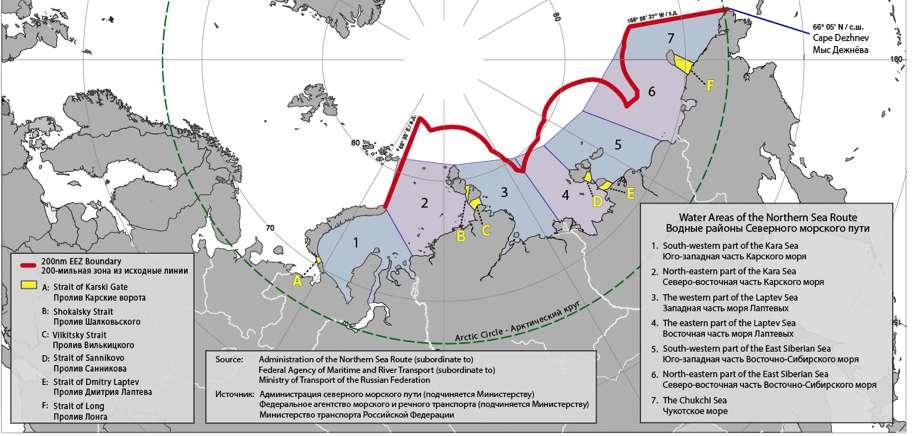
Figure 1: Northern Sea Route (NSR) legal extent from Kara Gate to Bering Strait, per Law No. 132-FZ (2012). Straits enclosed by straight baselines, Kara Gate, Vilkitskii Strait, Dmitry Laptev Strait, and baseline systems around the New Siberian Islands and Severnaya Zemlya are depicted as internal waters under Russian law. Source: Base map from Wikipedia adapted by authors
Article 234 of UNCLO
The UN Convention on the Law of the Sea states as followed:
Section 8: Ice-Covered Areas
Article 234
Coastal States have the right to adopt and enforce non-discriminatory laws and regulations for the prevention, reduction and control of marine pollution from vessels in ice-covered areas within the limits of the exclusive economic zone, where particularly severe climatic conditions and the presence of ice covering such areas for most of the year create obstructions or exceptional hazards to navigation, and pollution of the marine environment cause major harm to or irreversible disturbance of the ecological balance. Such laws and regulations shall have due
regard to navigation and the protection and preservation of the marine environment based on the best available scientific evidence.
Solski (2020, p. 388) provides a contemporary summary of the clause in its current understanding, stating that:
It suffices to underline that Article 234 is a unique clause, although not the only one in UNCLOS, which, owing to its ambiguous language, managed to satisfy multiple delegations with divergent interests. The provision leaves extensive discretion to the coastal State to balance opposing interests, subject to unclear limitations, primarily the requirement to have due regard to navigation. At the same time, Article 234 includes normative standards that, in the event of dispute settlement, may be subject to interpretation by an international court or tribunal. Within Article 234 the phrase “due regard” represents the main point of ambiguity and vagueness, allowing for the interpretive latitude and flexibility that is at the root of issues challenging international norms, specifically Russia’s claim for absolute control of NSR surface waters out to its EEZ boundary. As explained by Williams (2017, p. 405), “while Article 234 of UNCLOS does allow Coastal States to promulgate and enforce navigational laws in the EEZ, the language requiring ‘due regard for navigation’ implies that Coastal States must still allow ships some opportunity for navigation and that they may not bar ships from passing through either their own territorial waters or EEZs.” Yet “due regard” is not recognized by Russia when they require permission for passage, especially when such passage is also articulated as necessary by the legally binding IMO Polar Code (International Code for Ships Operating in Polar Waters, n.d.). Some consider that even Russian legal acts do not offer purposeful language for such a position, with the exception of one explanatory note introducing amendments to NSR regulations in 2012 (On Amending Certain Legislative Acts of Russian Federation in Terms of State Regulation of Merchant Shipping in the Northern Sea Route, 2012). Additionally, “some experts argue that Russia interprets UNCLOS too broadly and the Russian NSR legislation hardly meets the requirements of ‘due regard to navigation’ and ‘presence of ice covering such areas for most of the year’ set out in Article 234” (Todorov, 2022, p. 2). We return to and discuss this latter clause in detail below.
Regulatory Regime
Whereas Russian legislation might be deficient in legal articulation, the Kremlin’s regulatory regime continued to develop regardless. Under the assumption that Russia has the right to control access to passage, media outlet Independence reported in March 2019 that:
(f)rom now on warships and vessels of foreign countries have to inform Russia forty-five days in advance about their plans to pass through the NSR. Rules require specifying names of warships and [state] vessels, the purpose of their movements, routes, and sailing dates. In addition, the basic parameters of watercrafts must be reported, including displacement, length, width, draft and characteristics of the power plant. Military ranks and names of their captains are also required (Nezavisimaya Gazeta, 2019).
However, to date the regulation has not been established into power (i.e., legally codified), (Moe, 2020). Further increasing their requirements, the Russian government submitted a bill to the State
Bouffard, D’Angelo, Gundry, Pitts, Price, & Roberts
Duma in August 2022 requiring foreign warships to provide a ninety-day notice to transit the NSR (TASS, 2022). The following year, Moscow published a decree (Sep 18, 2020 - № 1487) involving extensive rules for navigation in the waters of the NSR (Northern Sea Route Administration, n.d.). Through geographic coordinates and feature names, the decree illustrates a breakdown of the NSR into twenty-eight districts (appendix 3 of the decree). Additionally, appendix 2 of the decree specifies criteria for admission of ships in the NSR, which includes ice class of the ship (twelve types), ice navigation method (independent or with icebreaker), four types of ice conditions (none, light, medium, heavy) with indications for prohibited (-) or permitted (+) navigation in each district. Of note, the decree also demonstrates two distinctly critical issues of legal and principal concern, including Russia’s excessive maritime claims involving internal waters through various straits (a more traditional territorial dispute situation) versus the enormously disparate intent to exercise control over NSR surface waters to the EEZ. A further complication is implementation. Russian authorities have at times allowed non-Polar-Class ships to operate along the NSR, reflecting capacity limits in screening and enforcement, thereby increasing operational risk and undercutting the premise that existing measures are calibrated to safety. Robust, nondiscriminatory enforcement of the IMO Polar Code would itself confer substantial regulatory control over commercial shipping in polar waters, potentially reducing Moscow’s incentive to lean on UNCLOS Article 234 for broader, EEZ-wide permission regimes.
Freedom of Navigation
Although Moscow does not claim the NSR waters beyond the contiguous zone as territorial or internal, their regulatory requirements and operational controls represent obviously similar circumstances. For the U.S. and others, this represents a textbook “excessive maritime claim”, which is detailed in the U.S. Navy Maritime Claims Manual. To prevent Russia’s claim from becoming customary law, the U.S. (and others) keep the issue active through a counter-position that officially does not recognize these claims. Usually, the competing position is communicated via official communique through diplomatic channels and high-level public pronouncements, articulating the principles, norms and values involving international law. At other times, when a counter-position needs to be emphasized – for effect or otherwise – surface vessels might pursue a Freedom of Navigation Operation (FONOP), conducted under operational law and within the authorities provided by National Security Directive 49 of October 1990 and managed through the U.S. Freedom of Navigation Program of 1979 (National Security Law Department, 2022). Other ways counter-positions might be delivered include strategically communicating an associated perspective for public and media consumption, such as remarks in 2019 from Secretary of State Pompeo and Secretary of the Navy Spencer (Auerswald, 2019)
For the U.S., freedom of navigation in the NSR remains an issue of principle first and foremost. Operationally, the need to navigate in the NSR is not currently as pressing a concern as is the desire to uphold international norms. Also, it remains unclear what the downstream effects of allowing Russia to maintain its claim might be. There are other contested Arctic waters: Canada claims the Northwest Passage and adjoining Arctic Archipelago waters as internal waters, a position the U.S and other states dispute, in some respects more restrictive than Russia’s NSR approach, so any NSR precedent could echo beyond Russia. However, Ottawa’s assertions are based on legal interpretation and conditions that are far more reasonable than Moscow’s. In the long term, a lack of sea ice altogether might render the issue moot; a lack of sea ice means a lack
of sea ice-related risk. This seems to be associated with the approach that China maintains for challenging Russia’s control over the NSR, where Beijing might be willing to wait for trans-Arctic shipping condition rather than compete with Moscow for open access especially given Russia’s growing dependance on Chinese NSR-related investments and hydrocarbon purchases (Mekhdiev et. al., 2021). Eventually, trans-Arctic shipping could be possible and Russia’s control over the NSR will become less concerning. However, the U.S. remains concerned that Russia’s efforts could result in their practice of controlling the NSR to eventually become customary law.
Data Updates and Refinements
The decline in Arctic sea ice concentration and thickness since the satellite period is well documented and quantified, with September sea ice volume having decreased by seventy-two percent over the period from 1979-2016 (National Snow and Ice Data Center, 2024; Fox-Kemper et. al., 2021). As a result of these ongoing declines, the ”severe climatic conditions and the presence of ice covering … for most of the year” and the related ”obstructions or exceptional hazards to navigation” have also been steadily declining. Based on the most recent set of internationally coordinated climate model projections (World Climate Research Programme, n.d.), the Arctic Ocean is projected to become “practically sea ice free” (Sea ice area below 1 million square km.) in summer before 2050 regardless of the greenhouse-gas emissions scenario under consideration (Notz & SIMIP Community, 2020). These same model projections contain detailed information on future sea ice concentration and thickness and can be combined with standard information on vessel characteristics to derive formal risk assessments for shipping in ice-covered waters, based on ‘IMO Guidance on Methodologies for Assessing Operational Capabilities and Limitations in Ice’. Here, we combine Arctic sea ice projections from a select subset of CMIP6 models that meet certain criteria (Appendix A) with information on vessel-type to estimate the multi-modelaveraged Risk Index Outcomes (RIO; Appendix B) for the six month period of the year (July through December) where sea ice concentration and thickness (and thus shipping risk) are likely to be at their lowest.
The RIO is an indexing system used by the International Maritime Organization to assess types and limitations of ship operations in ice-covered waters. Positive values of this index indicate normal operations. Some vessel types, e.g., the Finnish-Swedish ice classes, can also operate at negative values of the index greater than -10, albeit at a reduced speed. We calculate average values for the current (2020-2029) and next (2030-2039) decade for a Polar Class 6 (PC6) vessel, for which RIO>=0 implies normal operating conditions and -10<RIO<0 requires operating at reduced speeds.
Figures 2 and 3 below show the multi-model-mean, July-through-December monthly averaged sea ice concentration for these two decades in the context of Russia’s EEZ. The spread of the results around the mean values (route plots) is quantified as the "standard deviation" (the shaded area). The standard deviation (square root of the variance of the distribution) provides a measure of how value spread around the expected value. Figures 4 and 5 quantify and map the related Arcticwide, averaged RIO for a PC6 vessel for these same two decades and months of the year. Figures 6-9 show the multi-model-mean RIO and its spread (formally defined as one standard deviation from the mean at each point along the route) as a function of distance along two commonly used sections of the NSR, as defined by and consistent with Russia’s definition discussed above (that is,
Bouffard, D’Angelo, Gundry, Pitts, Price, & Roberts
the route passing through the four primary NSR straits, starting with the Kara strait in the west and proceeding (west-to-east) through the Vilkitsky, Sanikov, and Bearing straits)
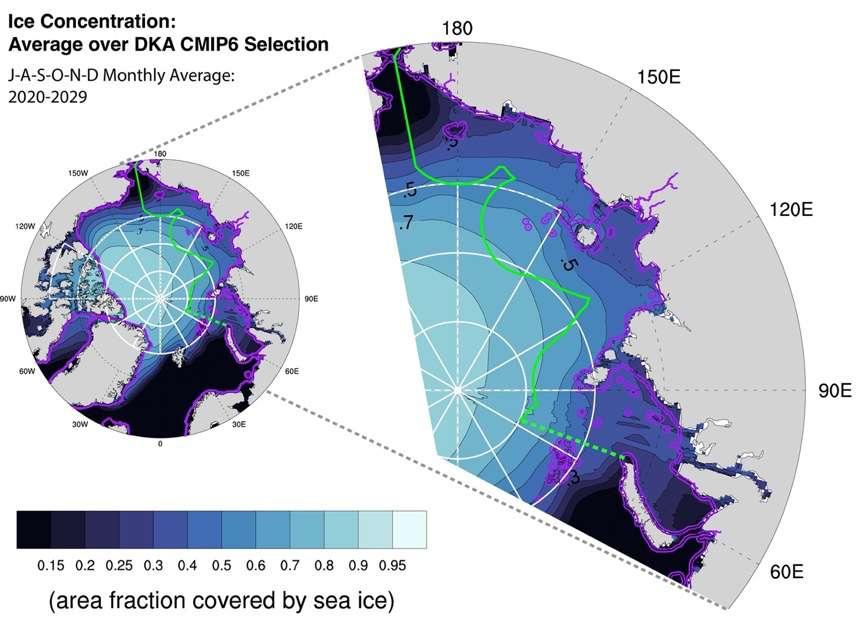
Projected sea-ice concentration (area fraction covered by sea ice) from an average of selected CMIP6 models (models 2 [above] and 3 [ below]). Mapped values are an average of the six-month period from July to December during the decade 2020-2029 and represent the most likely outcome of the CMIP6 model selection. Purple and pink contours indicate territorial and EEZ boundaries, respectively, with the neongreen colored contour denoting Russia’s EEZ boundary. White lines mark five degrees x thirty degrees latitude-longitude sectors in which the area-averaged sea-ice coverage is greater than 0.5 (or 50%). If the ice concentration of a sector is less than 0.5, its sea-surface area is mostly “ice-free”. Source: Authors, Appendix A
Figure 1: CMIP6 Model 1
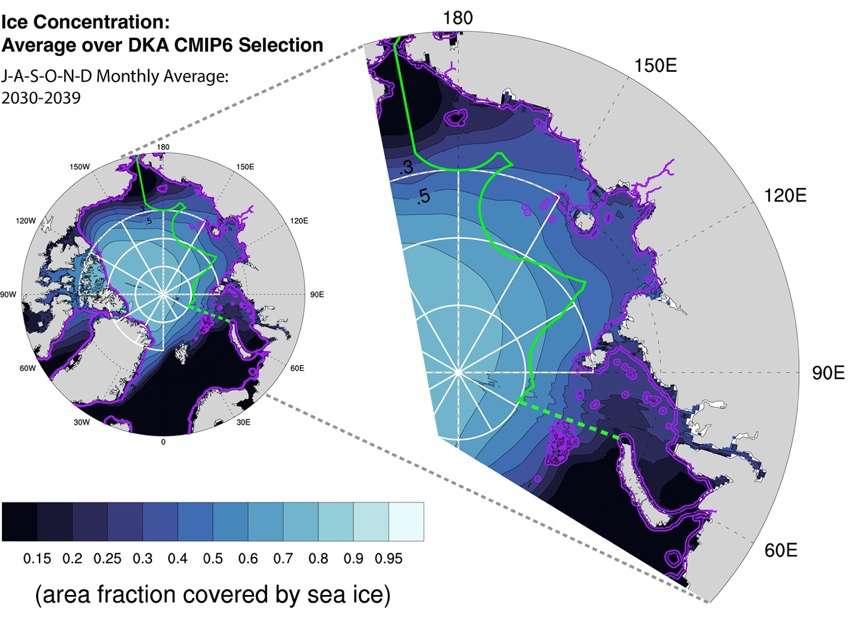
As in Figure 2 but for the decade 2030-2039. Source: Authors, Appendix A.
Bouffard, D’Angelo, Gundry, Pitts, Price, & Roberts
Figure 2: CMIP6 Model 2
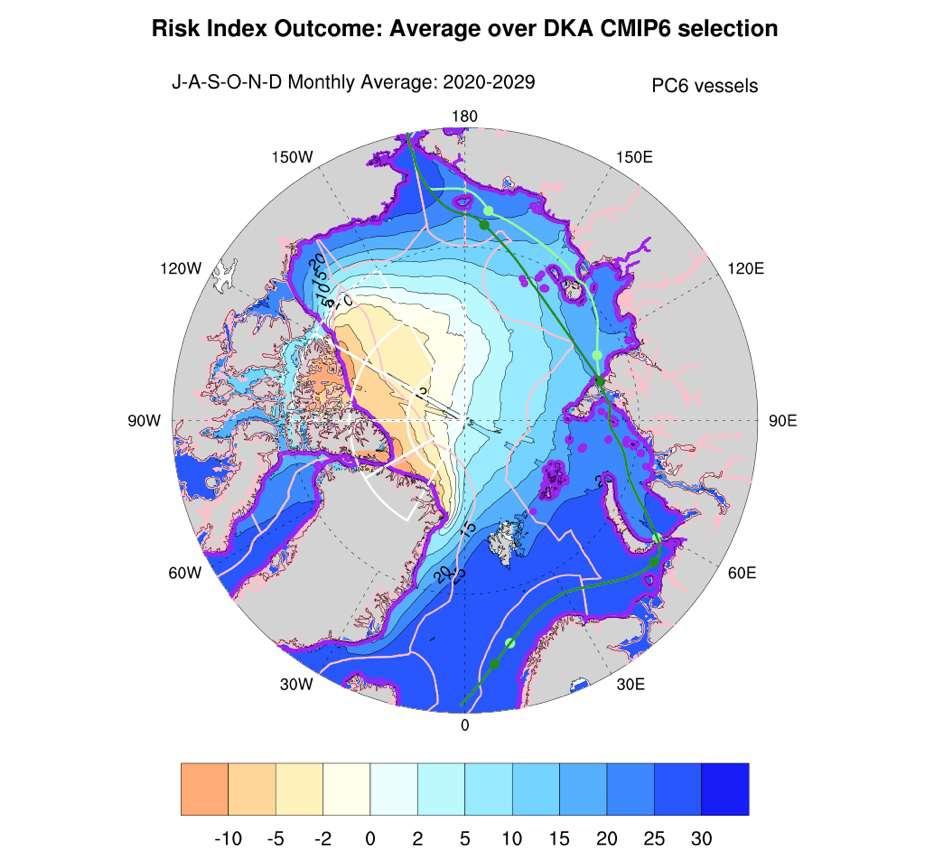
Figure 3: RIO Model 1
Risk Index Outcome (RIO) for a Polar Class 6 (PC6) vessel for the current decade during the six-month period from July to December. At each location, the RIO is a linear combination of the Risk Index Values (RIV) of the vessel and sea-ice concentrations. RIV values depend on sea-ice thickness, sea-ice age, and vessel type. PC6 vessels can operate under normal conditions when the RIO>=0 and at a reduced speeds when -10<RIO<0. As with the sea ice concentrations shown in Figures 2 and 3, mapped RIO values represent a multi-model average over the six-month period and provide the most likely outcome of the CMIP6 model selection. White lines on the map mark five degree x thirty degree latitude-longitude sectors in which the area-averaged RIO is negative. The Purple and pink contours are as in Figures 2 and 3. The green curves indicate two possible variations of near-coastal routes within the NSR corridor, one (light green) transiting both the Sannikov and Long straits and one (dark green) avoiding them by passing to the north. Purple, and pink colored lines are as described in Figure 2. Source: Authors, Appendix B.
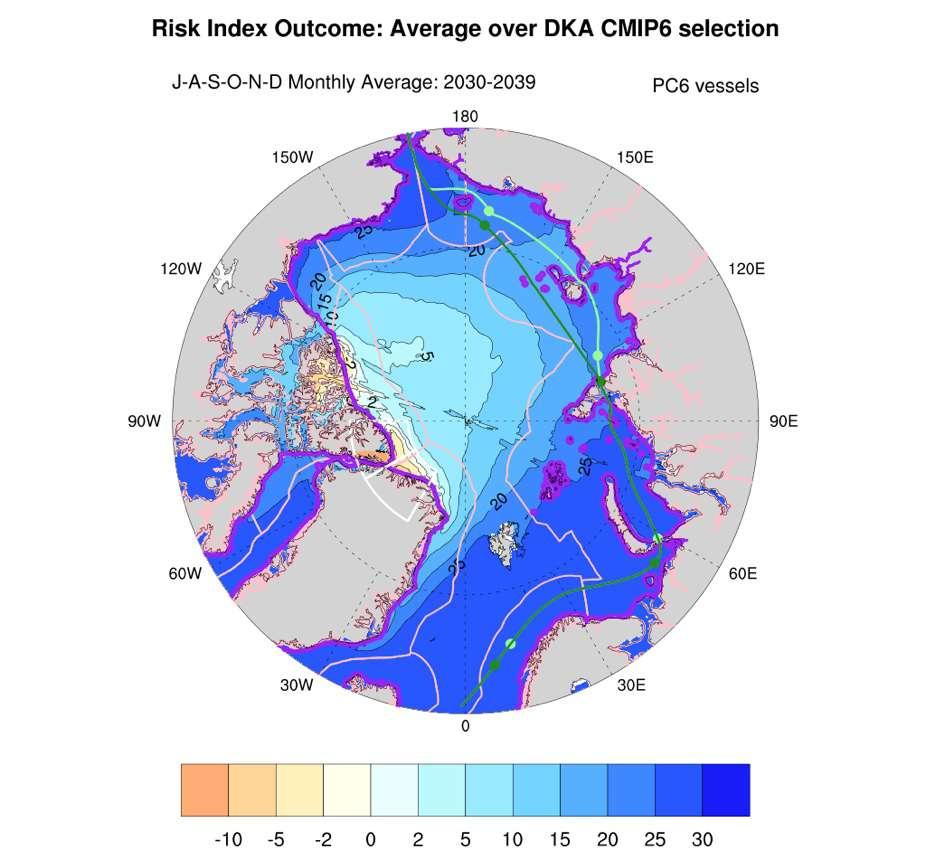
As in Figure 4 but for the decade 2030-2039. Source: Authors, Appendix B.
Bouffard, D’Angelo, Gundry, Pitts, Price, & Roberts
Figure 4: RIO Model 2
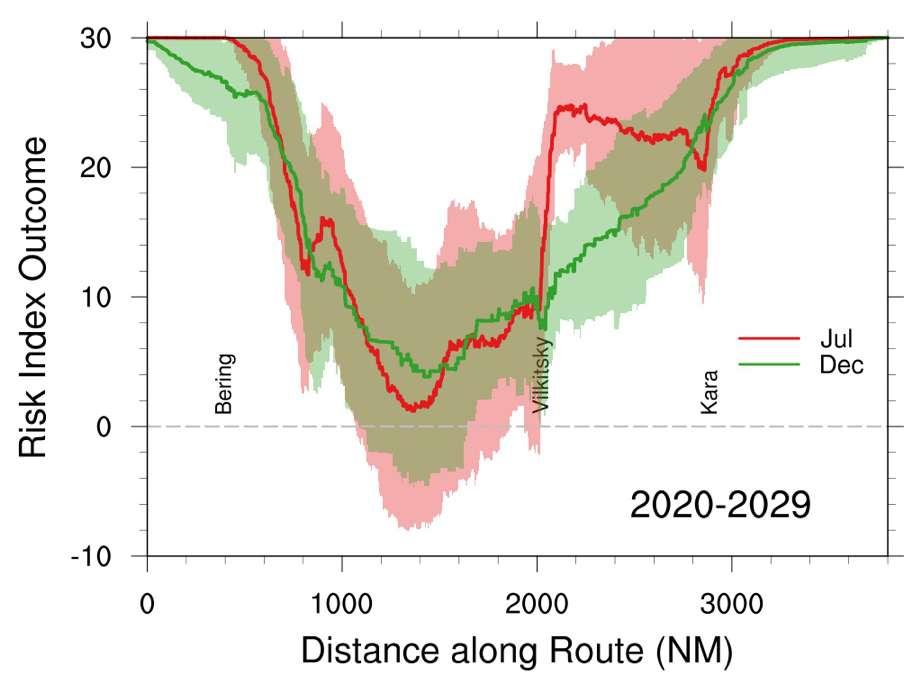
5: RIO Route Model 1
The solid lines in this plot indicate the RIO value computed along the NSR corridor, specifically the northernmost route (shown in dark green) in Figures 4 and 5. Values represent the multi-model, timeaverage RIO for the months of July and December (as indicated by legend) during the current decade and for a PC6 vessel. From July to December, such vessels would be able to navigate the route under normal conditions, according to the projections of CMIP6 models considered herein. The shading represents the uncertainty in RIO values resulting from the spread in model outcomes. For shading crossing into10<RIO<0, PC6 vessels can still navigate albeit at reduced speeds. Source: Authors, Appendix B.
Figure
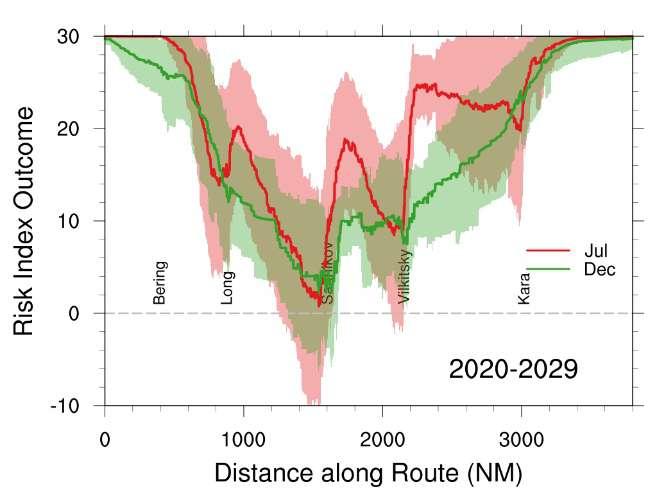
Figure 6: RIO Route Model 2
As in Figure 6 but for the light-green route in Figure4. Source: Authors, Appendix B
Bouffard, D’Angelo, Gundry, Pitts, Price, & Roberts
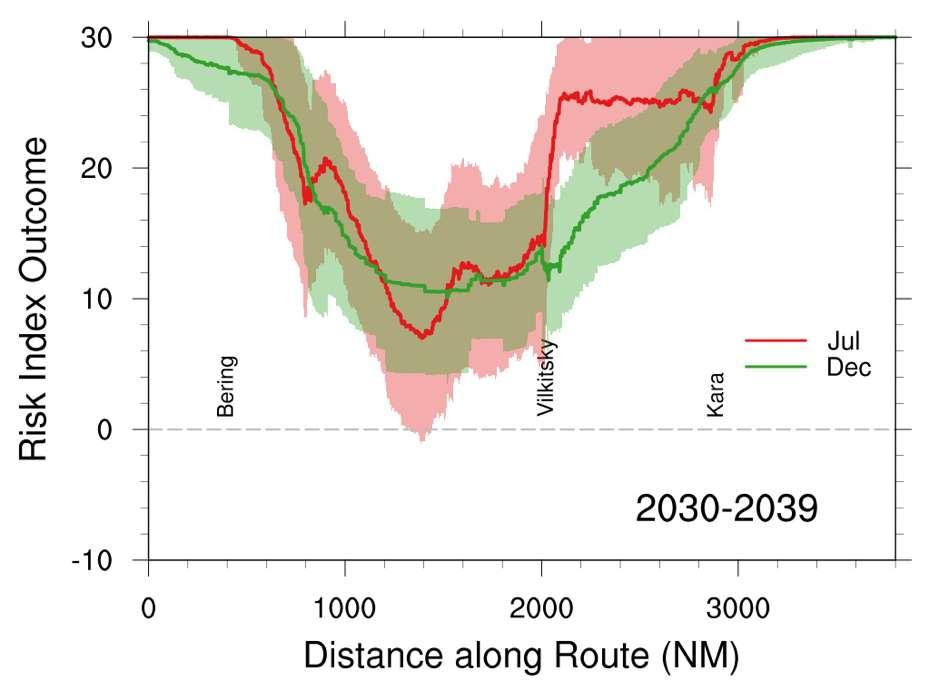
7: RIO Route Model 3
As in Figure 6 but for the decade 2030-2039. Source: Authors, Appendix B.
Figure
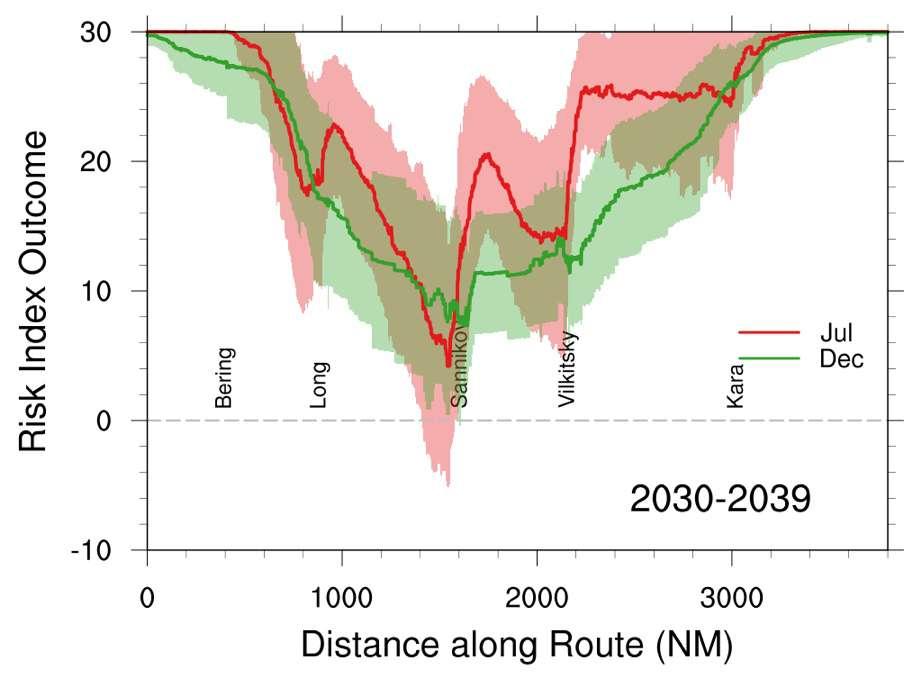
8: RIO Route Model 4
As in Figure 7 but for the decade 2030-2039. Source: Authors, Appendix B.
Discussion
Figures 4, 6, and 7 indicate that, during the current decade (2020 through 2029), the risk to a PC6 class vessel should be minimal (RIO>0) along the majority of the NSR. Detailed RIO values are given for two different routes, one remaining closer to the coast that includes the Sannikov and Long Straits (light-green route in Figure 4 and RIO values in Figure 6) and a second more optimal route that passes to the north of both straits (dark-green route in Figure 4 and RIO values in Figure 7). Some combination of these two routes provides a reasonable approximation for the majority of NSR transits in 2021 and 2022 (Arctic LIO, 2021; Arctic LIO, 2022). Within the range of uncertainty provided by the multi-model statistics (shaded coloring in Figures 6 and 7), operations at reduced speeds in the vicinity of Sannikov and Vilkitsky Straits may be required. For the next decade (2030-2039; Figures 5, 8, and 9), risk is further reduced, becoming essentially negligible even when considering the spread in projections. These statements are conservative with respect to vessels of a higher polar class than PC6; e.g., risks for a PC3 vessel will be significantly less than those implied by Figures 4-9. When accounting for vessel type and route, it can be argued that projected risks to the Arctic environment and ecosystems due to maritime operations in seaice-covered waters can be minimized. Hence, we argue that Russia’s legal argument for exerting excessive control over its EEZ surface waters to prevent “pollution of the marine environment caus[ing] major harm to or irreversible disturbance of the ecological balance” is unfounded. When
Bouffard, D’Angelo, Gundry, Pitts, Price, & Roberts
Figure
information regarding vessel type is combined with the best available, consensus-based projections of the future sea ice environment, risks are likely to become insignificant during the current decade and even more so in the following decades. The authors also acknowledge the works of Li and Lynch (Li et. al, 2023; Lynch et. al., 2022), which provide exceptional complimentary data and analysis to the topic. This work differs effectively and provides a distinct perspective, specifically regarding ambiguity and the recalibration of Article 234 of the UNCLOS under climate change using RIO versus projected routes, as well as PC6 versus OW. This work also highlights exactly where the risk profile may be significantly affected over seasons and decades.
The issue of what can and should be done with the models and analysis depends on two concerns: 1. principle, and 2. practicality. Russia will increasingly become more driven to establish their NSR regulatory regime as customary law as soon as possible. The revised data presented in the above models provides additional evidence that could be used in legal (international and operational) and/or diplomatic processes to facilitate compromise or full contestation between the coastal State (Russia) and user States. Whether Russia’s intent and potential for excessive control to access of the surface waters of the NSR could represent a legal precedent to elsewhere in the world, or not, has yet to be determined. It would seem reasonable to speculate that Western actors risking the latter without challenge is unwise at the very least, as new precedent could potential trigger maritime regulatory difficulties elsewhere in the world. Additionally, the Kremlin stands to gain many more benefits should the circumstances remain unchanged. For example, under the status quo, the Kremlin would be permitted to control a maritime defensive buffer zone with a boundary out to the EEZ, which is an operational advantage unlike any in the world. Russian control of access to the NSR surface waters directly impacts the fact that seaward of the territorial sea (12nm and out), States have the absolute right under international law to conduct intrusive ISR operations against another State (Pedrozo 2022). This means, among other things, that Russia could prevent otherwise normal maritime ISR activities. As part of global maritime shipping enterprise practices, the ability for user States or allies to escort and protect critical vessels could also be denied by Moscow (including icebreakers). Russia can also (continue to) impose administrative and operational burdens to scientific research opportunities of the NSR involving the surface waters and below. These reasons and more help to explain the importance of access to the NSR and U.S./Western concerns.
Conclusion
As the maritime Arctic becomes an increasing part of the globalizing world, developing security through management and safety systems will have to help adapt to such changes. Without doubt, the Arctic will require innovation and novel approaches not previously experienced. Yet, at the same time, implementation of aspects involving international laws to new regional regulatorybased applications offers Russia an opportunity to control an unprecedented amount of maritime surface territory. With time, Moscow hopes for their intent to control access to NSR surface waters to become permanent. In general, customary international law “offers few legal and institutional features – such as detailed obligations, flexibility clauses, and structured countermeasures [common in treaties for example], – to support reciprocity or retaliation” (Verdier & Voeten, 2014, p. 390). In particular to this case, the Kremlin also has the advantage of proximity to enforce and compel behaviors regardless of the conceptual and practical difficulties associated with customary law. To that end, should Russia establish control of the surface waters of the NSR out to the EEZ
as customary law, it could change precedent and affect access waters to other parts of the maritime world, thereby diminishing the critical importance of freedom of navigation.
Territorial disputes are still common enough worldwide and relatively well managed. The authors of this project hope that the presentation of new data, analysis, and discussion offers important information from which to support the efforts of U.S. authorities and policies, such as independent, scientific voyages of the U.S. Coast Guard Cutter ‘Healy’ through the East Siberian Sea onto northern Europe (United States Coast Guard, 2023). Our work has demonstrated that the foundation of the Russian NSR regulatory regime could be challenged based on the most upto-date sea ice risk projections from current best-in-class scientific models, whereas Moscow’s assessments of risk based on decades-old assumptions do not justify their “excessive maritime claims” as interpreted through international law (Ar ticle 234 of UNCLOS). Specifically, when the best available projections of Arctic sea ice concentration and thickness (see Appendix A) are combined with information on vessel type to derive formal metrics of shipping risk, we argue that shipping risk along the NSR is likely to be minimal for at least 6 months of the year during the current decade, and minimal to non-existent for 6 months of the year during the next decade, specifically applying to vessels rated at PC6 and above.
With time, environmental conditions will continue to change, and both scientific models and consensus will improve. While our projections come with typical levels of uncertainty, the results are nonetheless compelling and contribute to serious consideration involving the basis for Russia’s regulatory justification that impact critical maritime norms and principles. U.S. national interests abroad involving freedom of navigation are well established. The South China Sea territorial challenges highlight the importance of proactive and assertive measures during early competitive phases are critical to manage and prevent conflicts. Otherwise, a passive approach in this case generates the potential for a powder-keg once crisis-level reactive measures become necessary.
References
Arctic LIO. (2021, October 15). NSR shipping traffic activities in January 2021. Arctic LIO. https://arctic-lio.com/transit-voyages-on-the-nsr-in-2021-the-results-as-of-the-currentdate/
Arctic LIO. (2022, January). NSR shipping traffic activities in January 2022. Arctic LIO. https://arctic-lio.com/nsr-shipping-traffic-activities-in-january-2022
Auerswald, D. (2019, October 11). Now is not the time for a FONOP in the Arctic. Texas National Security Review. https://warontherocks.com/2019/10/now-is-not-the-time-for-a-fonopin-the-arctic/
Bureau Veritas. (2017). Ice reinforcement selection in different world navigation areas (NI543 R01). https://marine-offshore.bureauveritas.com/ni543-ice-reinforcement-selectiondifferent-world-navigation-areas
Bouffard, T. J. (2024). National security interests of Russia's Northern Sea Route: Additional elements of domestic and international importance. In L. Strauss & N. Wegge (Eds.), Defending NATO's northern flank: Power projection and military operations (Chapter 5). Routledge.
Bouffard, D’Angelo, Gundry, Pitts, Price, & Roberts
Cregge, K., & O'Conner, C. (2023). Build a coalition for Northern Sea Route security. Proceedings, 149(8). https://www.usni.org/magazines/proceedings/2023/august/build-coalitionnorthern-sea-route-security
Docquier, D., & Koenigk, T. (2021). A review of interactions between ocean heat transport and Arctic sea ice. Environmental Research Letters, 16(12), Article 123002.
Fox-Kemper, B., Hewitt, H. T., Xiao, C., Adalgeirsdottir, G., Drijfhout, S. S., Edwards, T. L., & Golledge, N. R. (2021). Ocean, cryosphere and sea level change. AGU Fall Meeting Abstracts, 2021
Grimes, D. I., Rawcliffe, J., Smith, J., Baime, L. E., Benjamin, L. M., Dorn, M. J., & Fredrikson, M. C. (2006). Operational law handbook. The Judge Advocate General's Legal Center and School.
International Maritime Organization. (n.d.). Polar Code. IMO. https://www.imo.org/en/OurWork/Safety/Pages/Polar-Code.aspx
International Maritime Organization. (2019). International code for ships operating in polar waters (Polar Code). https://www.imo.org/en/ourwork/safety/pages/polar-code.aspx
Kjellén, J. (2022). The Russian Northern Fleet and the (re) militarisation of the Arctic. Arctic Review on Law and Politics, 13, 34-52.
Li, X., & Lynch, A. H. (2023). New insights into projected Arctic sea road: operational risks, economic values, and policy implications. Climatic Change, 176(4), 30.
Lynch, A. H., Norchi, C. H., & Li, X. (2022). The interaction of ice and law in Arctic marine accessibility. Proceedings of the National Academy of Sciences, 119(26), e2202720119. Maritime claims reference manual. (2024). Navy JAG Corps. https://www.jag.navy.mil/nationalsecurity/mcrm/
Mekhdiev, E., Zakharevich, E., Mammadova, P., & Jumayev, F. (2021). Northern Sea RouteRussian and China: Competition or partnership. Journal of World Economy: Transformations & Transitions, 1(01).
Moe, A. (2020a). A new Russian policy for the Northern Sea Route? State interests, key stakeholders and economic opportunities in changing times. The Polar Journal, 1-19.
Moe, A. (2020b). A new Russian policy for the Northern Sea Route? State interests, key stakeholders and economic opportunities in changing times. The Polar Journal, 10(2), 209227.
National Security Law Department. (2022). Operational Law Handbook. The Judge Advocate General's Legal Center and School. https://tile.loc.gov/storageservices/service/ll/llmlp/2022_Operational_Law_Handbook/2022_Operational_Law_ Handbook.pdf
National Snow and Ice Data Center. (n.d.). Arctic sea ice seasonal change and melt/freeze climate indicators from satellite data, Version 1. https://nsidc.org/data/nsidc-0747/versions/1
Notz, D., & SIMIP Community. (2020). Arctic sea ice in CMIP6. Geophysical Research Letters, 47(10). https://doi.org/10.1029/2019GL086749
Northern Sea Route Administration. (2012). On amending certain legislative acts of Russian Federation in terms of state regulation of merchant shipping in the Northern Sea Route [Explanatory note to draft law]. http://www.nsra.ru/en/ofitsialnaya_informatsiya/zakon_o_smp.html
Østreng, W. (2010). The Northeast Passage and Northern Sea Route. Arctis. http://www.arctissearch.com/The+Northeast+Passage+and+Northern+Sea+Route+2
Pedrozo, R. P. (2022). The legal framework applicable to intrusive intelligence, surveillance, and reconnaissance operations in the air and maritime domains. International Law Studies, 99(1), 847-864.
Pincus, R. (2020). Three-way power dynamics in the Arctic. Strategic Studies Quarterly, 14(1), 40-63.
Postler, Ashley. (2020). UNCLOS in the Arctic: A Treaty for Warmer Waters. Georgetown Security Studies Review. https://georgetownsecuritystudiesreview.org/2020/02/24/unclos-inthe-arctic-a-treaty-for-warmer-waters/
Rumer, E., Sokolsky, R., & Stronski, P. (2021). Russia in the Arctic - a critical examination. Carnegie Endowment for International Peace. https://carnegieendowment.org/research/2021/03/russia-in-the-arctica-criticalexamination
Solski, J. J. (2020). The Northern Sea Route in the 2010s: Development and implementation of relevant law. Arctic Review on Law and Politics, 11(2020).
TASS. (2023, January 18). Russian defense ministry reports successful test of new missile. TASS. https://tass.com/defense/1563227
Todorov, A. (2022). Dire straits of the Russian Arctic: Options and challenges for a potential US FONOP in the Northern Sea Route. Marine Policy, 139.
United States Coast Guard. (2023, September 28). U.S. Coast Guard Cutter Healy completes mission with U.S. National Science Foundation in East Siberian Sea. https://www.news.uscg.mil/Press-Releases/Article/3538713/us-coast-guard-cutterhealy-completes-mission-with-us-national-science-foundati/
Verdier, P-H., & Voeten, E. (2014). Precedent, compliance, and change in customary international law: An explanatory theory. American Journal of International Law, 108(3), 389-434.
Williams, L. C. (2017). An ocean between us: The implications of inconsistencies between the navigational laws of coastal Arctic Council nations and the United Nations Convention on the Law of the Sea for Arctic navigation. Vanderbilt Law Review, 70(1), 379-412.
World Climate Research Programme. (n.d.). CMIP Phase 6 (CMIP6). https://wcrpcmip.org/cmip-phase-6-cmip6/ Кремль. (2012, July 28). Закон
[Law on the Northern Sea Route]. http://www.nsra.ru/ru/ofitsialnaya_informatsiya/zakon_o_smp.html
(2012).
Bouffard, D’Angelo, Gundry, Pitts, Price, & Roberts
legislative acts of the Russian Federation regarding the state regulation of merchant shipping in the waters of the Northern Sea Route] (№ 132-ФЗ). http://publication.pravo.gov.ru/Document/View/0001201207300027
Nezavisimaya Gazeta. (2019, March 11). Россия не
Арктику [Russia Does Not Intend to Surrender the Arctic]. http://www.ng.ru/armies/2019-0311/8_7527_regulations.html
Appendix A: CMIP6 Model Selection Criteria
Our projections of sea-ice-related maritime risk are based on the most recent suite of publicly available climate simulations, conducted by international climate modeling centers from across the world (CMIP6), (World Climate Research Programme, n.d.). Based primarily on the study carried out by Docquier and Koenigk (2021), but also on several of our own criteria, twenty-three models representing efforts from seventeen different countries were selected from the larger CMIP6 database. This selection includes models with relevant Arctic oceanographic properties, able to reproduce historical observations (1979–2014 or 2000–2014) of sea ice area or volume. Our focus here is on the relatively high-greenhouse-gas-emissions scenario, SSP5-8.5, which refers to an additional atmospheric radiative forcing of 8.5 W/m2 by the end of this century relative to 1850). The global-mean warming under this emission scenario is ≈4 degrees C for the period 2081–2100, relative to the period 1995–2014. Under this scenario, the multi-model mean of the selected models predicts that Arctic sea ice area and volume will reduce, respectively, by forty-five percent and seventy-eight percent in March (seasonal maximum extent) by the end of the century, compared to the period 2015–2019. For the same time periods, the multi-model means of Arctic sea ice area and volume in September (seasonal minimum extent) predict reductions by 90% and 98%, respectively. Although affected by a large uncertainty, the multi-model mean also suggests that the Arctic Ocean will become practically ice-free (defined as having a sea ice area of less than 106 km2) by September of 2061. Many models, however, predict an almost complete loss of sea ice by September by or before the year 2050 (Notz & SIMIP Community, 2020)
We note that overall sensitivity of CMIP6 Arctic sea ice projections to the particular choice of emissions scenario is relatively low prior to 2050. For example, Notz et al., (p. 7) show that the simulated sea ice area in March and September does not differ appreciably between SSP2-4.5 and SSP5-9.5 until after 2050 (their Figure 2). Prior to 2050, the distribution of model outputs under SSP2-4.5 and SSP5-8.5 overlap such that we expect our conclusions to hold under the more moderate SSP2-4.5 emissions scenario. Relative to observations, CMIP6 models (on average) underestimate the rate of sea ice area loss per degree of global mean temperature increase and per given increase in atmospheric CO2 emissions (Figures 1c and 1d in Notz & SIMIP Community, 2020) (p. 4). This suggests that CMIP6 modeled rates of Arctic sea ice area loss are conservative relative to historical observations.
Appendix B: Risk Index Outcome
POLARIS, the Polar Operational Limit Assessment Risk Indexing System, was developed by the International Maritime Organization (IMO) to assess the type of operations and operational
limitations of vessels navigating through sea ice. Within POLARIS, the evaluation of the risks posed to a ship by various ice conditions is related to the ship’s assigned ice class. POLARIS assigns a scale of Risk Index Values (RIVs) to a vessel based on its ice class and on different ice regimes. Ice classes in POLARIS include Polar Classes ranging from PC1 (year-round operation in all polar waters) to PC7 (summer and autumn operation in thin first-year ice with some old ice inclusions) as well as Finnish-Swedish ice classes (IA Super, IA, IB, and IC), primarily intended for merchant and cruise-ferry ships (International Maritime Organization, n.d.). POLARIS also defines RIVs for vessels without an assigned ice class (referred to as non-ice-strengthened ships). The ice classes ARC 9 to ARC 4, assigned by the Russian Maritime Register of Shipping, can be considered equivalent to the Polar Classes PC1 to PC7, with a one-to-one correspondence except for ARC 5, which corresponds to Polar Classes PC5-6 (Bureau Veritas, 2017) By convention, RIVs decrease (transitioning from positive to negative values) as risks increase within a given ice class. The RIV constitutes the basis for the definition of the Risk Index Outcome (RIO), which POLARIS uses to assess types and limitations of ship operations in sea ice. The determination of the RIO for navigation in an area with the presence of N different ice types, including open water, proceeds by associating a RIV to each ice type based on its thickness and age. The RIO value at any location is calculated as the sum over the N RIV values (ice types) at that location with each RIV first weighted (multiplied) by its respective concentration at that location. In this analysis, the RIO at each route point is calculated based on the mean of the sea ice concentration and thickness distribution from all model values. The calculated RIO value is used to determine the operational limitations of ships navigating without icebreaker escort according to the following criteria: RIO ≥ 0 defines “normal operation” for all ice classes; -10 ≤RIO<0 defines “elevated operational risk” for PC1–PC7 ice classes. In an “elevated operational risk” situation, vessels with an ice class PC3–PC5 are recommended to limit their speed to five knots (eleven hours of navigation per one hundred km). Ships with an ice class below PC5 are recommended to reduce their speed to three knots (eighteen hours of navigation per one hundred km). For non-Polar Class vessels, a negative RIO identifies “operations subject to special consideration”, which ought to be avoided for route planning purposes.
Bouffard, D’Angelo, Gundry, Pitts, Price, & Roberts
Briefing Note
Canada’s Arctic Foreign Policy: Somethings Old, Somethings New
P. Whitney Lackenbauer
Introduction
On 6 December 2024, Canada released its revised statement on Canada’s Arctic Foreign Policy (CAFP),1 which “supplements” its 2019 Arctic and Northern Policy Framework (ANFP) “international chapter”2 given profound geostrategic changes globally that have spilled over into Arctic affairs. Minister of Foreign Affairs Mélanie Joly’s foreword paints a dramatic picture lamenting how: for many years, Canada has aimed to manage the Arctic and northern regions cooperatively with other states as a zone of low tension that is free from military competition. … However, the guardrails that we have depended on to prevent and resolve conflict have weakened. Russia’s illegal war in Ukraine has made cooperation with it on Arctic issues exceedingly difficult for the foreseeable future. Uncertainty and unpredictability are creating economic consequences that Canadians are facing everyday.3
In this briefing note, I offer some reflections about what remains the same, what has changed, and what is new in the CAFP. Minister Joly was careful neither to cast the 2025 policy as the culmination of a new full-scale co-development process like the one that yielded the ANPF (see my brief note with Peter Kikkert in Arctic Yearbook 2019) nor as a full strategy like Canada’s Indo-Pacific Strategy released in 2022.4 Instead, the policy statement reiterates that Canada’s desired end state is “a stable, prosperous and secure Arctic” with “strong and resilient Arctic and Northern communities,” with Canada’s foreign policy serving to “advance the interests and priorities of Indigenous Peoples and northerners who call the Arctic home.” Similarly, the Conservatives’ 2010 Statement on Arctic Foreign Policy set its vision for the Arctic as “a stable, rules-based region with clearly defined boundaries, dynamic economic growth and trade, vibrant Northern communities, and healthy and productive ecosystems.”5 In this sense, rather than representing “a fundamental change in how we look at the
P. Whitney Lackenbauer is a Tier 1 Canada Research Chair in the Study of the Canadian North and a Professor at the School for the Study of Canada, Trent University, Ontario, Canada.
Arctic”6 one might see Canada’s 2024 statement as a logical continuation of Canada’s Arctic foreign policy since the late 1990s,7 albeit with a much stronger emphasis on defence and security.
Framing the 2024 CAFP
The CAFP focuses on three core areas: “asserting Canada’s sovereignty, advancing our interests in the region, and promoting a stable, prosperous, and secure North.” The policy asserts that emerging threats since the launch of the 2019 ANPF have “triggered a need for a recalibrated approach to advancing Canada’s national interests in the region” at present and in the future. Although the document proposes to follow Joly’s concept of “pragmatic diplomacy”8 – the idea that Canada must “be pragmatic and resist the temptation to divide the world into rigid ideological camps” of “democracies versus autocracies,”9 thus allowing it to serve as a broker for non-aligned countries – the overall tenor of the CAFP places Canada as firmly in the NATO-US-Western democratic camp. There is no question in this document who Canada considers its core Arctic allies: the United States, Greenland, and the Nordic countries (Denmark, Finland, Iceland, Norway and Sweden). Other partners include non-Arctic European and North Pacific states (with Japan and South Korea singled out for particular attention).
Prospects for truly circumpolar cooperation are also constrained by geopolitical realities. Russia, which was framed as a potential Arctic partner in Canada’s 2019 policy framework, is now clearly acknowledged as an adversary or competitor with whom there can be no “business as usual” given its brutal full-scale invasion of Ukraine and disregard for sovereignty, territorial integrity, and international law. The “guard rails” that prevent conflict are “increasingly under strain” when it comes to the Arctic, Joly proclaimed at the launch of the policy on 6 December 2024. “The Arctic is no longer a low-tension region,”10 suggesting that any lingering notions of “Arctic exceptionalism”11 – the idea that the region is insulated from global geopolitical dynamics – are now out of date. Furthermore, “threats to Canada’s security are no longer bound by geography; change is accelerating rapidly; and non-Arctic states, including China, are also seeking great influence in the governance of the Arctic,” Joly asserted in the foreword to the strategy.“ To respond, Canada must be strong in the North American Arctic, and it requires deeper collaboration with its greatest ally, the United States. Canada must also maintain strong ties with its 5 Nordic allies, which are now also all NATO members.”12
What is the same
CAFP reinforces that “Canada remains deeply committed to the full implementation of the ANPF, to Arctic state primacy and to upholding the rules-based international order in the Arctic.” The first part affirms that Canadian Arctic foreign policy remains linked to its domestic Arctic and Northern policy, thus ensuring that the CAFP cannot be misconstrued as trumping the federal government’s domestic agenda. The desire for “Arctic state primacy” is a longstanding priority, insisting that the Arctic states are best positioned and equipped to understand the region and its peoples. Reiterating that Canada remains committed to “ensuring that maritime claims are addressed in a manner that is consistent with international law” also gestures to the legality of Canada’s position on the Northwest Passage as historic internal waters as well as its submission to the UN Commission on the Limits of the Continental Shelf in support of its extended continental shelf in the Arctic.
The promise to “secure [Canada’s] national interests and ensure stability and prosperity for the Indigenous Peoples who live in the Arctic and the North” is also a longstanding staple of its domestic and foreign Arctic policies.13 While the Trudeau Government has prioritized reconciliation in its Arctic agenda,14 commentators should not overlook how previous governments (including the Martin Liberals and Harper Conservatives) expressed a similar strategic intent. Nonetheless, enhancing financial support for Canadian Indigenous organizations to participate fully in international Arctic fora15 and integrating traditional knowledge in research and policy development are key elements in the CAFP. The policy also reinforces the Government of Canada’s commitment to create opportunities for Northern and Indigenous youth and amplify their voices by funding youth initiatives in the Arctic Council and offering a paid internship program for Arctic and Nor thern Indigenous youth at Global Affairs Canada.
The summary of key Arctic and continental defence and security investments are largely a rehash of Our North, Strong and Free, but the narrative frames how promised investments will protect NATO’s “Northern and Western flanks” to ensure “that Canada can engage the world and deploy from a secure based in support of NATO allies.” How exactly Canada intends to deploy from the Arctic, given that it does not base expeditionary forces in its Arctic, is unspecified but may relate to defence against threats through the Arctic.
The United States is framed as Canada’s “greatest ally” and “closest partner and ally in the Arctic,” which resonates with previous descriptions of the US as Canada’s “premier partner” in the region.16 The CAFP reinforces how “close partnership with the United States is essential to the maintenance of a secure, strong and well-defended North American homeland, on which the 2 countries’ mutual prosperity depends.” The re-election of Donald Trump introduces uncertainty into the mix, however, as his criticisms of NATO and unpredictable behaviour with allies may disrupt our countries’ “unique relationship shaped by geography, history, shared values, common interests and strong people-to-people connections.”
The CAFP retains language designating the Arctic Council as the “pre-eminent forum for Arctic cooperation,” while explaining that the Minister and Senior Arctic Official (SAO) meetings remain on pause (and presumably will continue to do so until Russia finds a way to restore a trusted place in the international system). It commits to increasing contributions to the Council and to preparing for its third chairship of the forum from 2029-31.
Climate change remains a central theme in Canada’s policy, characterized as “both the most pressing and the most proximate threat to Canada’s security in the Arctic.” The linkages between climate change and security remain vague, however, apart from the common refrain that a reduction in sea ice in the Arctic Ocean opens new paths for encroachment on Canadian sovereignty (perpetuating an overgeneralized misconception about greater regional “accessibility” without attentiveness to domain or heightened uncertainty17). Unfortunately, the CAFP conflates climate change mitigation and adaptation, as well as threats amplified by climate change and those caused by it, leaving vague how the like-minded Arctic states might work together to address this “global problem.” Leveraging the expertise of NATO’s new Climate Change and Security Centre of Excellence (CCASCOE), based in Montreal and created “to promote research and knowledge sharing on climate security threats in the Arctic and elsewhere,” may help to articulate clearer, practical pathways forward.
The policy also continues to adopt a “whole of government” or “whole of society” framework, acknowledging that “to address the complex range of threats faced in the Arctic, Canada must conceptualize security not only in military terms.” The whole-of-government reference reflects language adopted during the Harper government, which also broadened the discussion across the defence-security-safety spectrum 18 The CAFP specifies that “security in the Arctic includes community security, research security, economic security, security against disinformation and any other form of interference and physical and digital infrastructure security.” This entails “work with Public Safety Canada to support efforts to strengthen Canadian national resilience to counter malign influence and activities of foreign powers,” and to strengthen defence of critical infrastructure to “protect northern communities against foreign interference.19
What has changed
Russia, which was framed as a potential partner in the ANPF, is now clearly identified as a competitor that seeks to fundamentally undermine the rules-based international order and does not respect sovereignty, territorial integrity, or international law. It is referenced 53 times in the policy. “It is clear that Russia has no red lines,” Joly insisted at the CAFP launch.20 While the document shows how Russia poses a threat to North America as a “geographic vector” for weapons systems that would pass through the Canadian Arctic to strike at strategic targets, it remains opaque about the threat that Russia poses to or in the region itself. What “vulnerabilities” is Russia seeking to exploit in the Canadian Arctic, and what exactly are the “increasingly sophisticated” threats that must be “kept in check”? It remains for commentators to imagine these threats, with some still spiralling into bizarre scenarios involving hoards of Russian land forces streaming through Alaska or over the melting polar ice cap in the Central Arctic Ocean to invade Canada, or pushing oil rigs into the Canadian Arctic to seize resources and usurp sovereignty.21 China, which is referenced 19 times in the CAFP, is clearly positioned as a non-Arctic state competitor.22 China’s ambitions to be a more influential regional actor are well documented, and the Canadian policy casts it as a challenger to Arctic state supremacy that “can be expected to use all the tools at its disposal to advance its geopolitical interests, including in the Arctic.” The policy raises concern about China’s “regular deployment of dual-use having both research and military application research vessels and surveillance platforms to collect data,” as well as malign economic influence. It also leaves space for “pragmatic diplomacy,” asserting that “Canada will challenge China when it ought to and cooperate when its interests align with China’s,” such as addressing “pressing global issues such as climate change that have impacts on the Arctic.” While these concerns are not new, their direct inclusion in a Canadian Arctic foreign policy statement is.23 In response, the Chinese Embassy in Ottawa wrote that it “firmly opposes” Canada’s “so-called ‘Arctic Foreign Policy’ which distorts and misinterprets China’s Arctic policy and discredits China’s normal Arctic activities in accordance with international law.”24
Sino-Russian relations in the Arctic also appear to be changing, with Minister Joly stating at the launch event on 6 December 2024 that Russia is “reversing its historic posture by facilitating Chinese access” to the region, and particularly the Arctic Zone of the Russian Federation.” The CAFP notes that the two countries conducted joint military exercises in July, their warships have also participated in joint patrols in the Bering Sea, and their military aircraft were detected, tracked and intercepted by the North American Aerospace Defence Command (NORAD) while flying into Alaska’s air defence identification zone (but not transgressing US sovereign airspace. “This
demonstrates the continued deepening of Chinese-Russian military cooperation, particularly in the North Pacific approaches to the Arctic,” the policy statement observes. While China’s desire to enter the Arctic and enhance its regional profile and prestige is well established, there is active debate on the Sino-Russian Arctic relationship in the region. Some call it a burgeoning “alliance” and others see as a circumscribed transactional relationship with deep-seated issues of mistrust remaining. The CAFP seems to treat the Sino-Russian partnership as a preordained conclusion at this point, rather than a precarious relationship with friction points that could be exploited.25
The statement notes that, “while the risk of military attack in the North American Arctic remains low, the region represents a geographic vector for traditional and emerging weapons systems that threaten broader North American and transatlantic security.” This is not new, although the document points to emerging threats such as “increased Russian activity in Canadian air approaches, China’s regular deployment of dual-use … research vessels and surveillance platforms to collect data, and a general increase in Arctic maritime activity.” The statement also emphasizes that “adversaries and competitors also employ disinformation and influence campaigns, malicious cyber operations and espionage and foreign interference activities to target Canadians, including nor therners.” Few details are presented, but these disconcerting revelations are a clear indication of fear about nuclear and conventional aerospace threats, as well as “gray zone” or hybrid threats that span the defence-security spectrum.26
NATO is referenced 22 times in the text, reinforcing that Canada accepts the relevance and importance of the Alliance in the region. With Finland and Sweden joining NATO, all five Nordic countries are now allies. The CAFP notes that “Canada remains committed to contributing to NATO and NORAD’s awareness of the threat environment across the Arctic region, including in the North American Arctic.” It explicitly connects “Arctic security and continental defence investments made in Our North, Strong and Free and NORAD Modernization” with support to “NATO’s deterrence and defence agenda by protecting the Alliance’s Northern and Western flanks.” This “ensures that Canada can engage in the world and deploy from a secure base in support of NATO allies, when needed.” After astutely noting that “the defence architecture and threat picture differ across the circumpolar north,” the Government of Canada commits to “continue to share information on threats in the Arctic with allies and to support NATO operations and presence in the European High North.” Details are not provided beyond reiterating that “Canada will continue to be an active participant in NATO exercises and operations.”
The CAFP also refreshingly identifies the Canadian Coast Guard (CCG) as a partner in defence and security, emphasizing its role in maritime domain awareness and assistance to Arctic scientific research expeditions. It promises to expand Canadian partnerships with coast guards from likeminded states (which the Canadian Coast Guard Arctic Strategy, released in August 2024, says includes non-Arctic states such as the United Kingdom and Germany27), but does not provide details. It also references but does not explain the role of the Arctic Coast Guard Forum, created in 2015, which aims to strengthen operational collaboration and coordination of activities between the eight member states. Is the latter an example of the “pragmatic diplomacy” where Canadian representatives can interact with their Russian counterparts? Whatever the case, the Canadian Coast Guard’s official integrated into the Canadian Defence Team in September 2025 does not change its status as a civilian Special Operating Agency, although it will mean tighter information sharing and operational coordination with the Canadian Armed Forces.28
While ONSF projected military spending to reach 1.76% of GDP by 2029-30, the CAFP updated this figure to reach NATO’s target of 2% of GDP spending by 2032. This reflected Minister of National Defence Bill Blair’s announcement at the Washington NATO Summit on 10 July 2024 that the Royal Canadian Navy would purchase of up to 12 conventionally powered, under-icecapable submarines.29 This commitment has grown even more since that time, propelled by the increasingly volatile international security environment (including the disruptive influence of the Trump Administration). In June 2025, Prime Minister Carney, announced that Canada and its NATO Allies agreed to a new Defence Investment Pledge of investing 5% of annual GDP by 2035 to ensure individual and collective security: 3.5% for core military capabilities, and an additional 1.5% in “critical defence and security-related expenditure, such as new airports, ports, telecommunication, emergency preparedness systems, and other dual-use investments which serve defence as well as civilian readiness.”30
What is “new”
Various elements of the CAFP are more novel, such as formally recognizing the North Pacific, through the Bering Strait, as a key approach to the North American Arctic. Canadian leaders have understood this reality since the Second World War, when Canadians joined their American counterparts in the Aleutian Campaign against the Japanese.31 Since the Cold War, Canada has traditionally focused on the North Atlantic-Arctic connection, including the Greenland-IcelandUnited Kingdon (GIUK) gap. By broadening the aperture to include North Pacific-Arctic interconnections, the CAFP connects to Canada’s Indo-Pacific Strategy and also clarifies the extent of NATO’s “Western approaches.”32
The foreign policy statement also announced that Canada would appoint an Arctic Ambassador, with an office in Canada’s North to help address the Northern mantra of “nothing about us, without us.” Canada first appointed a Circumpolar Ambassador in 1993, with Mary May Simon, now the Governor General of Canada, serving in the position from its inception until 2003. The position was abolished under the Harper Conservatives in 2006. Under this new plan, Canada’s Arctic ambassador will “work with Arctic allies and domestic partners including Indigenous Peoples and territorial and provincial governments to make linkages between Canada’s domestic and foreign policy agenda, advance Canada’s polar interests in multilateral forums, and raise awareness internationally of Indigenous rights in the Arctic context.” The ambassador will also work with Canada’s Chief Science Advisor33 on issues related to Arctic science and research. In July 2025, Prime Minister Mark Carney appointed Iqaluit resident Virginia Mearns, “a respected Inuit leader with a long-standing commitment to advancing Inuit self-determination and community well-being in Nunavut,” as Canada’s new Arctic Ambassador.34
The more general pledge to expand Canada’s diplomatic presence in the Arctic states also has novel elements – although this may also represent a reconsideration of recent decisions to contract that footprint.35 For example, Canada closed its consulate in Anchorage in 2012,36 after which time consular services have been provided by the Consul General in Seattle, Washington, and CAFP committed to re-establish “a new consulate” in Anchorage. The announcement open a Canadian consulate in Nuuk, Greenland, more accurately reflect the moniker of being “new.” The U.S. opened a consulate in Nuuk in 2010 (having closed its previous one in 1953)37 and Iceland has a consulate general there.38 Canada’s announcement to open a consulate there reciprocates the Government of Greenland’s announcement in its February 2024 Arctic strategy that it will establish
a diplomatic representation in Ottawa and further develop its cooperation with Canada,” when it encouraged Canada to do the same in Greenland.39
The CAFP also commits Canada to initiate an Arctic security dialogue with the ministers of foreign affairs of like-minded states in the Arctic. While Canada participates in the Arctic Chiefs of Heads of Defence meetings, the Arctic Security Forces Roundtable, and other bodies which discuss “hard” Arctic security issues, there is no established dialogue mechanism on Arctic security between the foreign ministers of the seven like-minded Arctic states, all of whom are NATO members. Presumably this group will adopt a broader definition of security than the defenceoriented fora, although the parameters remain unspecified.
Other novel elements of the policy are more domestic focused, including expanded information sharing with relevant territorial and provincial governments and Indigenous leaders on emerging and developing international Arctic security trends, including foreign interference threats. This may seem like an oddly placed announcement coming from Global Affairs Canada to include in a foreign policy document, given that it relates primarily to internal Canadian information sharing, but it points to calls from the Territorial Premiers and Northern Indigenous leaders to be more engaged in foreign and defence policy decisions.
The CAFP also contains new provisions related to strengthening research security in the Arctic The new focus on Arctic science, and particularly marine scientific research (MSR), through a security lens reveals a burgeoning awareness of how competitors use science as a vector for data collection, intelligence gathering, espionage, and foreign influence. ONSF also states that the Government of Canada is seeing “a growing number of Chinese dual-purpose research vessels and surveillance platforms collecting data about the Canadian North that is, by Chinese law, made available to China’s military.”40
Another significant change commits Canada to launch boundary negotiations with the United States regarding the Beaufort Sea and to finalize the implementation of the boundary agreement between Canada and the Kingdom of Denmark regarding Tartupaluk (Hans Island). Although the commitment to resolve longstanding boundary disputes peacefully, and in accordance with international law, is a staple of Canadian Arctic foreign policy statements, this one provides more specific timelines and parameters. On 24 September 2024, Global Affairs Canada and the U.S. State Department announced that they had created a joint task to negotiate the Beaufort Sea boundary, a significant unsettled bilateral maritime dispute. At issue is a 21,197 km2 wedge of ocean and seabed that both sides claim, as well as an overlapping continental shelf beyond the 200 NM Exclusive Economic Zone (EEZ). Resolving this longstanding dispute which will signal how “common interests in the region have served as the foundation of our bilateral Arctic relations for many decades and will continue to guide our Arctic cooperation in the future.”41 The likelihood of this being a priority given introduced into the Canada-US relationship by the Trump Administration, however, now seems very low. Implementing the Canada-Denmark agreement signed on 14 June 2022 seems comparatively straightforward, but provisions to ensure “continued access to and freedom of movement on the entire island for Inuit and local people living in Avanersuaq, Kalaallit Nunaat, and in Nunavut, Canada, including for hunting, fishing, and other related cultural, traditional, historic, and future activities” are complicated, given the Schenegen Agreement and other factors. Nonetheless, it may be a way to signal tighter Nunavut-Greenland relations, and may serve as a precedent for other transnational Indigenous mobility rights.42
Reflections
“Canada is an Arctic nation, and we are at a critical moment. We live in a tough world, and we need to be tougher in our response,” Joly said at a press conference on 6 December 2024. “I don’t think the Arctic will be the primary theatre of conflict. I see the Arctic as the result of what is happening elsewhere in the world.”43 Given the discussion about melting ice as a security threat, Russian militarization of its Arctic, and China’s ambitions in the region, this emphasis on the “spillover” of conflict from elsewhere might seem quite different than the way that Arctic dynamics are depicted in the policy itself. Unfortunately, the distinction between threats through, to, and in the Arctic remains rather opaque in Canada’s strategic messaging.44 Nevertheless, the CAFP provides helpful language parsing the North American Arctic and the European Arctic, linking NORAD and NATO, and articulating strategic challenges facing the region that require diplomatic, military, and whole-of-government responses.
A key challenge remains in trying to situate the CAFP into Canada’s broader foreign policy, given that Canada has not produced a comprehensive statement on the topic since issuing its International Policy Statement (IPS) under the Paul Martin government in 2005.45 There is a similar challenge with respect to national security issues that fall outside of the mandate of the Department of National Defence. Securing an Open Society: Canada’s National Security Policy, 46 which articulated Canada’s core national security interests and how the government intends to address these threats, was released in 2004. The world has changed a lot since then, as the CAFP highlights. This means that readers have to try to discern for themselves where the CAFP and its various commitments fit in Global Affairs Canada’s overall priorities.
As noted earlier, Canada’s Arctic Foreign Policy rests upon the longstanding assumption that “the United States is Canada’s closest partner and ally in the Arctic, and this collaboration extends across many shared interests” rooted in “a unique relationship shaped by geography, history, shared values, common interests and strong people-to-people connections.” This continues in deep collaboration on defence and security (including NORAD modernization, with various Arctic components), border management, energ y security, and critical minerals. However, by declaring his intent to make Canada the “51st state,” launching a “tariff war” and using “economic force” to seek this outcome, and threatening to take over Greenland (without ruling out the use of force to do so), President Trump has raised deep-seated concerns amongst Canadians about sovereignty and its relationship with the US more generally. Furthermore, the Trump Administration’s climate skepticism, moves to remove restrictions on oil and gas drilling in the Arctic National Wildlife Refuge and the National Petroleum Reserve-Alaska, antipathy or indifference towards Indigenous rights, and lack of interest in some issues (Indigenous cross-border mobility, marine and terrestrial conservation, and the protection of transboundary species such as salmon and the Porcupine caribou herd) all portend divergent paths. A May 2025 poll found that 37% of Northern Canadian respondents named the United States as the most serious threat to the Canadian Arctic, compared with 35% who said Russia, and 17% who said China. In response, most Northern Canadians favour a more assertive Arctic policy, with 62% agreed that Canada should pursue a firm line in defending its sections of the Arctic, with 26% preferring a more diplomatic approach.47 In these respects, the unabashed optimism about the Canada-US partnership in CAFP already seems outdated
Canada’s Arctic Foreign Policy suggests that “the diplomatic initiatives in the Arctic foreign policy will complement all of these [national defence] investments by better aligning Canada’s strategic
approaches and by strengthening its relationships with Arctic allies.” Providing foreign policy “top cover” or context for Canada’s 2024 defence policy update is timely and important. After the release of the CAFP on 5 December 2025, the Globe and Mail passed along information from a senior government official that the new policy would receive $34.7-million in initial funding and $7-million in continuing funding over five years.48 Presumably, most of this will go to the new ambassador position, consulates, and funding for youth, and Indigenous and Northern participation in various international forums and domestic engagement initiatives.
While circumpolar engagement and cooperation remain highly constrained and limited, Canada still envisages playing a leadership role in regional affairs – albeit in what it recognizes as a world of heightened geopolitical competition. The CAFP’s language around “pragmatic diplomacy” speaks to pursuing interests, while its aspirations around Arctic governance, the rules-based international order, and Indigenous rights speak to values. Perhaps Canada’s most distinctive feature remains its deliberate intent to include Indigenous rightsholders as full partners, and to ensure that Northern and Indigenous populations – which are disproportionately affected by changes in the Arctic – are the primary beneficiaries of Arctic policies. “By placing the invaluable perspectives, knowledge, and wisdom of Indigenous Peoples in the North, who have called the Arctic home since time immemorial, at the foreground this new policy and its implementation, we will ensure that the Arctic remains a vibrant, prosperous, and secure region now and for future generations,” Minister of Northern Affairs Dan Vandal promised.49 The real test, of course, is the action that a policy inspires – and whether this will be sufficient to maintain regional security and prosperity in a tumultuous world.
Note
An earlier version of this commentary was published as a NAADSN Policy Primer on 16 December 2024
References
1 Global Affairs Canada (GAC), Canada’s Arctic Foreign Policy (December 2024), https://www.international.gc.ca/gac-amc/publications/transparency-transparence/arcticarctique/arctic-policy-politique-arctique.aspx?Lang=eng. Please note that all quotes in this primer are to this document unless otherwise noted.
2 CIRNAC, “Arctic and Northern Policy Framework International chapter” (2019), https://www.rcaanc-cirnac.gc.ca/eng/1562867415721/1562867459588
3 Hon. Mélanie Joly, foreword to Canada’s Arctic Foreign Policy.
4 Dylan Robertson, “Joly crafting ‘Arctic foreign policy’ amid regional tensions, not a full strategy,” Globe and Mail, 12 June 2024, https://www.theglobeandmail.com/politics/article-joly-craftingarctic-foreign-policy-amid-regional-tensions-not-a-full/; GAC, Canada’s Indo-Pacific Strategy (2022), https://www.international.gc.ca/transparency-transparence/assets/pdfs/indo-pacific-indopacifique/indo-pacific-indo-pacifique-en.pdf.
5 GAC, “Canada’s Arctic Foreign Policy,” https://www.international.gc.ca/worldmonde/assets/pdfs/canada_ arctic_foreign_policy-eng.pdf
6 Melanie Joly, statement at the launch of Canada’s Arctic Foreign Policy, 6 December 2024.
7 For background, see P. Whitney Lackenbauer, From Polar Race to Polar Saga: An Integrated Strategy for Canada and the Circumpolar World (Toronto: Canadian International Council, 2009);; Ryan Dean, “Speaking Security: Constructing Canada’s 2009 Northern Strategy,” The Polar Journal 12, no. 2 (2022): 303-321; and P. Whitney Lackenbauer and Peter Kikkert, “A ‘Profound Change of Direction’? Canada’s Northern Strategy and the Co-Development of a ‘New’ Arctic and Northern Policy Framework,” in Arctic Fever: Political, Economic & Environmental Aspects, ed. Anastasia Likhacheva, 241-273 (Singapore: Springer Nature, 2022).
8 Economic Club of Canada, 30 October 2023, https://economicclub.ca/wpcontent/uploads/2023/11/Minister-Joly-Takeaways.pdf
9 Joly quoted in John Ivison, “Joly's 'pragmatic diplomacy' is just another Liberal foreign policy fantasy,” National Post, 31 October 2023, https://nationalpost.com/opinion/john-ivison-jolypragmatic-diplomacy-liberal-fantasy.
10 Global News, “Canada details new ‘Arctic Foreign Policy’ in effort to bolster northern presence, security,” Global News, 6 December 2024, https://globalnews.ca/video/10906479/canada-detailsnew-arctic-foreign-policy-in-effort-to-bolster-northern-presence-security/.
11 See, for example, P. Whitney Lackenbauer and Ryan Dean, “Arctic exceptionalisms,” in The Arctic and World Order, eds. Kristina Spohr, Daniel Hamilton, and Jason Moyer, 327-355 (Washington: Brooking Institution Press, 2020): 327-55; and Jennifer Spence, Edward Alexander, Rolf Rødven, and Sara Harriger, “What Makes the Arctic and its Governance Exceptional? Stories of Geopolitics, Environments and Homelands,” Arctic Yearbook (2023).
12 Hon. Mélanie Joly, foreword to Canada’s Arctic Foreign Policy
13 P. Whitney Lackenbauer, ed. Canada’s Northern Strategies: From Trudeau to Trudeau, 1970-2024, rev. Ed. Of Documents on Canadian Arctic Sovereignty and Security (DCASS) No. 17 (Calgary: Centre for Military, Security and Strategic Studies / Arctic Institute of North America, 2025), http://lackenbauer.ca/wp-content/uploads/2025/04/dcass17rev-Lackenbauer-CanadasNorthern-Strategies-1970-2024.pdf.
14 See, for example, P. Whitney Lackenbauer, “‘Global Arctic Leadership’ in an Era of Cooperation and Competition,” Canada’s Arctic Agenda: Into the Vortex, ed. John Higginbotham and Jennifer Spence, 67-73 (Waterloo: Centre for International Governance Innovation, 2019); Lackenbauer, “Canada’s Emerging Arctic and Northern Policy Framework”; Heather Exner-Pirot, “Friend or faux?: Trudeau, Indigenous issues and Canada’s brand,” in Canada, Nation Branding and Domestic Politics, ed. Richard Nimijean and David Carment, 46-62 (New York: Routledge, 2020); Laurence Cros, “A Comparison of Stephen Harper’s and Justin Trudeau’s Arctic Narratives: Toward a New Geography of the Canadian North,” International Journal of Canadian Studies 62 (2024): 5-38.
15 For example, the Global Arctic Leadership Initiative (GALI) funds Indigenous participation in international Arctic forums and supports community-led initiatives on issues such as climate resilience, sustainable economic development, and cultural preservation. GAC, “Canada and the Circumpolar Regions,” last updated 4 April 2025, https://www.international.gc.ca/worldmonde/international_relations-relations_internationales/arctic-arctique/index.aspx?Lang=eng.
16 P. Whitney Lackenbauer and Rob Huebert, “Premier Partners: Canada, the United States and Arctic Security,” Canadian Foreign Policy Journal 20, no. 3 (2014): 320-333. For a recent overview, see Thomas Hughes, James Fergusson, and Andrea Charron, “Nuanced futures: Canadian and US defence in the North American Arctic,” Canadian Foreign Policy Journal 30, no. 2 (2024): 176-191.
17 P. Whitney Lackenbauer, “Arctic Pan-Domain Effects Workshop (APDEW24) Concepts and Context,” report on a workshop held in Ottawa on 10 June 2024, https://www.naadsn.ca/wpcontent/uploads/2024/10/24jun-APDEW-PWL-summary.pdf.
18 See P. Whitney Lackenbauer, “Toward a Comprehensive Approach to Canadian Security and Safety in the Arctic,” in Understanding Sovereignty and Security in the Circumpolar Arctic, ed. Wilfrid Greaves and P. Whitney Lackenbauer, 137-167 (Toronto: University of Toronto Press, 2021).
19 Specific tools specified include the Investment Canada Act; by strengthening Canadian cyber security systems; and through new legislation to address foreign interference.
20 Quoted in Ian Austen, “Canada Moves to Protect Arctic From Threats by Russia and China,” New York Times, 6 December 2024, https://www.nytimes.com/2024/12/06/world/canada/canada-arctic-russia-china.html
21 For a critique of these narratives, see P. Whitney Lackenbauer, “‘We are undefended’? Andrew Leslie, Arctic Defence, and the need for more sophisticated framing,” NAADSN Quick Impact, 13 May 2024, https://www.naadsn.ca/wp-content/uploads/2024/05/24may13-Lackenbauerresponse-to-Leslie.pdf.
22 Chinese state media made no mention of this narrative in its overview of the CAFP. “Canadian Launches Arctic Foreign Policy,” Xinhua, 7 December 2024, https://english.news.cn/northamerica/20241207/a572ef5b80794994a80be27004e36a28/c.html
23 On China in Arctic through a Canadian lens, see P. Whitney Lackenbauer, Adam Lajeunesse, James Manicom, and Frédéric Lasserre, China's Arctic Ambitions and What They Mean for Canada (Calgary: University of Calgary Press, 2018); Standing Senate Committee on National Security, Defence and Veterans Affairs, Arctic Security Under Threat: Urgent Needs in a Changing Geopolitical and Environmental Landscape, June 2023, https://sencanada.ca/content/sen/committee/441/SECD/reports/2023-0628_SECD_arcticreport_e.pdf; Whitney Lackenbauer and Adam Lajeunesse, Selling the 'Near-Arctic' State: China’s Information and Influence Operations in the Arctic (Washington: Wilson Center, 2024), https://www.wilsoncenter.org/sites/default/files/media/uploads/documents/sellingneararctic4.pdf.
24 Steven Chase, “China criticizes Canada’s new Arctic policy which calls Beijing a potential threat,” The Globe and Mail, 9 December 2024, https://www.theglobeandmail.com/politics/article-chinapushes-back-against-canadas-updated-arctic-policy-which-calls/.
25 Adam Lajeunesse, P. Whitney Lackenbauer, Sergey Sukhankin, and Troy J. Bouffard, “Friction points in the Sino-Russian Arctic partnership,” Joint Force Quarterly 111, no. 4 (2023): 96-106, https://ndupress.ndu.edu/Portals/68/Documents/jfq/jfq-111/jfq-111_96-106_Lajeunesse-etal.pdf See also Adam macdonald, “China-Russian cooperation in the Arctic: A cause for concern for the Western Arctic States?,” Canadian Foreign Policy Journal 27, no. 2 (2021): 194-210; and Alex Dalziel, Force Multipliers: How Russia’s Governors Amplify Putin’s Polar Partnership with China (Ottawa: Macdonald-Laurier Institute, 2025), https://macdonaldlaurier.ca/wpcontent/uploads/2025/08/20250616_Force-Multipliers-Aug-Final.pdf.
26 See, for example, Christopher Coates, “North American Defence and the Canadian Arctic in the 21st Century,” Canadian Military Journal 23, no.1 (Winter 2023): 69-74, https://www.journal.forces.gc.ca/pdfs/CMJ231Ep69.pdf; Bryan Millard and P. Whitney Lackenbauer, “Trojan Dragons? Normalizing China’s Presence in the Arctic,” Canadian Global Affairs Institute, June 2021, https://www.cgai.ca/trojan_dragons_normalizing_chinas_presence_in_the_arctic; Bradley Sylvestre and Gaëlle Rivard Piché, Vulnerabilities and Hybrid Threats in the Canadian Arctic: Resilience as Defence, European Hybrid Centre of Excellence, 29 May 2023,
https://www.hybridcoe.fi/wp-content/uploads/2023/05/20230529-Hybrid-coe-WorkingPaper-24-Canadian-Arctic-WEB.pdf; and Mathieu Landriault and Aleksis Oreschnikoff, “Hybrid Threats and the New Arctic Security Landscape,” NAADSN Policy Brief, 2 September 2005, https://www.naadsn.ca/wp-content/uploads/2025/09/25sept-Hybrid-Threats-Arctic-SecurityLandscape-NAADSN-Policy-Brief_ML-AO.pdf.
27 Canadian Coast Guard, Canadian Coast Guard Arctic Strategy (August 2024), https://wavesvagues.dfo-mpo.gc.ca/library-bibliotheque/41247486.pdf.
28 Department of National Defence, “National Defence Welcomes the Canadian Coast Guard to the Defence Team,” 2 September 2025, https://www.canada.ca/en/department-nationaldefence/news/2025/09/national-defence-welcomes-the-canadian-coast-guard-to-the-defenceteam.html
29 Christopher Penney, “The Fiscal Implications of Meeting the NATO Military Spending Target,” Office of the Parliamentary Budget Officer, 30 October 2024, https://www.pbodpb.ca/en/publications/RP-2425-020-S fiscal-implications-meeting-nato-military-spendingtarget repercussions-financieres-atteinte-cible-depenses-militaires-fixeeotan#:~:text=This%20announcement%20followed%20the%20release,of%20GDP%20by%2020 29%2D30.
30 Prime Minister of Canada, “Canada joins new NATO Defence Investment Pledge,” 25 June 2025, https://www.pm.gc.ca/en/news/news-releases/2025/06/25/canada-joins-new-natodefence-investment-pledg
31 Galen Roger Perras, Stepping Stones to Nowhere. The Aleutian Islands, Alaska, and American Military Strategy, 1867-1945 (Vancouver: UBC Press, 2003
32 Global Affairs Canada, Canada’s Indo-Pacific Strategy, 3 September 2024, https://www.international.gc.ca/transparency-transparence/indo-pacific-indopacifique/index.aspx?Lang=eng.
33 Office of the Chief Science Advisor, https://science.gc.ca/site/science/en/office-chief-scienceadvisor.
34 Prime Minister of Canada, “Prime Minister Carney and Inuit leadership meet as the Inuit-Crown Partnership Committee,” 24 July 2025, https://www.pm.gc.ca/en/news/newsreleases/2025/07/24/prime-minister-carney-and-inuit-leadership-meet-inuit-crown
35 This could also could be construed as a reversal of its closing of the Canadian International Arctic Centre (CIAC) office in Oslo, Norway. GAC repatriating the chief of the CIAC to Canada in 2023, with a departmental spokesperson justifying that this move back to Ottawa would “allow the team to better cooperate with other government departments and agencies, enhance our capacity to deliver on the department’s international Arctic mandate, and strengthen implementation of the International Chapter of the Arctic and Northern Policy Framework.”Charlotte macleod quoted in Christopher Nardi, “Global Affairs moves Arctic centre from Norway to Ottawa after promising to increase foreign presence,” National Post, 27 June 2023, https://nationalpost.com/news/politics/global-affairs-moving-arctic-centre-office-from-norwayto-ottawa-weeks-after-promising-to-increase-foreign-presence. See also Artur Wilczynski, “Closing the Canadian International Arctic Centre is a mistake,” Ottawa Citizen, 5 July 2023, https://ottawacitizen.com/opinion/wilczynski-closing-the-canadian-international-arctic-centreis-a-mistake. The CAFP may suggest that, on sober second thought, having an “international centre” based in Ottawa is less effective than having expertise dispersed across the circumpolar Arctic.
36 Katie Medred, “Bye Bye to the Maple Leaf: Canada Consulate Closing,” Anchorage Daily News, 5 June 2012, https://www.adn.com/alaska-beat/article/bye-bye-maple-leaf-canada-consulateclosing/2012/06/05/.
37 U.S. Embassy & Consulate in the Kingdom of Denmark, “U.S. Consulate Nuuk,” https://dk.usembassy.gov/nuuk/.
38 Government of Iceland, “Consulate General of Iceland in Nuuk,” https://www.government.is/diplomatic-missions/consulate-general-of-iceland-in-nuuk/.
39 Naalakkersuisut / Government of Greenland, “Greenland in the World “Nothing about us without us”: Greenland’s Foreign, Security and Defense Policy 2024-2033 – an Arctic Strategy” (February 2024), 21, https://paartoq.gl/wp-content/uploads/2024/03/Greenlands_Foreign_Security_and_Defense_Policy_2024_2033.pdf
40 See, for example, P. Whitney Lackenbauer, Adam Lajeunesse, James Manicom, and Frédéric Lasserre, China's Arctic Ambitions and What They Mean for Canada (Calgary: University of Calgary Press, 2018); Bryan Millard and P. Whitney Lackenbauer, “Trojan dragons? Normalizing China’s presence in the Arctic," Canadian Global Affairs Institute Report, 1 June 2021, https://www.cgai.ca/trojan_dragons_normalizing_chinas_presence_in_the_arctic; and Trym Eiterjord, “Securitise the volume: epistemic territorialisation and the geopolitics of China’s Arctic research,” Territory, Politics, Governance 12, no. 1 (2024): 93-111.
41 P. Whitney Lackenbauer and Suzanne Lalonde, “Resolving the Beaufort Sea Dispute: The Timing is Right,” NAADSN Quick Impact, 24 September 2024, https://www.naadsn.ca/wpcontent/uploads/2024/09/24sep24-Beaufort-QI-PWL-SL.pdf; and Suzanne Lalonde and P. Whitney Lackenbauer, “Moving Beyond Benign Neglect: The Beaufort Sea Dispute and the Benefits of Compromise Solutions between Salt Water Neighbors,” Ocean Development & international Law 55 (2024): 422-433. For deeper background on the dispute, see P. Whitney Lackenbauer, “The Beaufort Boundary: An Historical Appraisal of a Maritime Boundary Dispute,” in Canada and the Maritime Arctic: Boundaries, Shelves, and Waters by P. Whitney Lackenbauer, Suzanne Lalonde and Elizabeth Riddell-Dixon (Peterborough: North American and Arctic Defence and Security Network), 1-62.
42 P. Whitney Lackenbauer and Rasmus Leander Nielsen. “‘Close, like-minded partners committed to democratic principles’: Settling the Hans Island/Tartupaluk Territorial Dispute,” Arctic Yearbook (2022), https://arcticyearbook.com/images/yearbook/2022/Briefing-Notes/3BN__AY2022_Lackenbauer_Nielsen.pdf; and Mathieu Landriault, Pauline Pic, and Frédéric Lasserre, “Beyond Hans Island: The Canada–Denmark agreement's possible impact on mobility and continental shelves,” International Journal 78, no. 1-2 (2023): 243-253;
43 Nick Murray, “Liberals' Arctic policy comes at 'a critical moment,' Joly says, but with no new defence spending,” National Post, 6 December 2024, https://nationalpost.com/news/politics/liberals-arctic-policy-comes-at-a-critical-moment-jolysays-but-with-no-new-defence-spending
44 P. Whitney Lackenbauer, “Threats Through, To, and In the Arctic: A Framework for Analysis,” NAADSN Policy Brief, 23 March 2021, https://www.naadsn.ca/wpcontent/uploads/2021/03/Lackenbauer_Threats-Through-To-and-In-the-Arctic.pdf; Andreas Østhagen and P. Whitney Lackenbauer, “Security Dynamics In, Through, and Over the Arctic ‘Region,’” in Towards a Sustainable Arctic: International Security, Climate Change and Green Shipping, ed. Michael Goodsite and Niklas Swanström, 1-24 (Singapore: World Scientific, 2023).
45 The Future of Diplomacy initiative discussion paper, which Minister Joly mentions in the foreword to CAFP, is no substitute. Global Affairs Canada, “Future of Diplomacy: Transforming Global Affairs Canada – Discussion paper” (June 2023),
https://www.international.gc.ca/transparency-transparence/future-diplomacy-avenirdiplomatie/06-2023-discussion-paper-document-travail.aspx?Lang=eng.
46 Privy Council Office, Securing an Open Society : Canada’s National Security Policy (2004), https://publications.gc.ca/collections/Collection/CP22-77-2004E.pdf.
47 “Canadians in North see U.S. as Arctic threat on par with Russia: survey,” Radio Canada International, 12 September 2025, https://ici.radio-canada.ca/rci/en/news/2192112/canadians-innorth-see-u-s-as-arctic-threat-on-par-with-russia-survey.
48 Robert Fife and Steven Chase, “Ottawa unveils new policy for what it now calls the ‘North American Arctic.’” Globe and Mail, 6 December 2024, https://www.theglobeandmail.com/politics/article-canada-unveils-new-policy-for-what-it-nowcalls-the-north-american/
49 Dan Vandal, “Message from the Minister of Northern Affairs,” in GAC, Canada’s Arctic Foreign Policy.
Briefing Note
Impacts of geopolitical tensions: What Russia’s War in Ukraine Means for Cooperation and Scientific Programs in the Arctic
Margaret Williams and Loann Marquant
Introduction
In August of this year, the greatly hyped summit in Anchorage, Alaska between President Trump and President Putin raised eyebrows around the world and prompted protests across America’s lone Arctic state Inviting a leader who is charged with war crimes and responsible for the illegal full-scale invasion of Ukraine to the United States for a peace-making mission seemed misguided and ill-conceived on many levels. At the same time, some Arctic experts viewed the selection of Alaska for this high-level meeting as an opportunity to highlight commonalities that the U.S. and Russia share in the region. Russia pundits pointed to the significance of Putin’s inclusion of Finance Minister Anton Siluanov and Kirill Dmitriev, Russia’s envoy on foreign investment, in his delegation to Alaska1 and wondered whether Alaska’s natural resources might be part of a future deal.2
In addition to discussions about potential deals to exploit Arctic resources, many observers wondered whether the summit would also signal a thawing of the U.S.-Russia relationship and lead to renewed cooperation in sectors beyond business and finance. Since Russia’s full-scale invasion of Ukraine, hundreds of international and bilateral projects in the Arctic have been suspended. Many of those were scientific in nature, involving Russian, American and European researchers in efforts to document the status of climate and oceanic conditions, wildlife populations, and numerous other aspects of the Arctic environment. Other programs were aimed at conserving shared ecosystems and species.
Margaret Williams is a Senior Fellow in the Arctic Initiative of the Belfer Center for Science and International Affairs, Harvard Kennedy School.
Loann Marquant received his Masters degree of Public Policy from the Harvard Kennedy School in May, 2025 and was a Belfer Young Leader Fellow.
Over a period of 18 months from 2023 to 2025, the authors of this Briefing Note interviewed dozens of American and Russian scientists and conservationists whose work had been impacted by the interruption of this cooperation. Interviewees included ornithologists, fisheries scientists, marine mammal biologists, environmentalists, climate experts, and other experts. Their responses consistently highlighted cooperation as an essential element of their professional successes for two main reasons: (1) working across the U.S.-Russia boundary gave them access to information that was central to understanding their particular topic or species in question; and (2) regular contact with their international partners built a foundation of trust and led to long-term friendships on which many successful projects depended, even thrived.
Cooperation in the Bering Strait: a history of milestones for biodiversity protection
The Bering Strait offers a perfect case study in how bilateral work advanced conservation and research. This narrow passageway, a 58-mile wide waterway that connects the North Pacific with the Arctic Ocean, in one sense separates Russia and Alaska. But natural processes such as currents, wildlife migrations, and weather patterns for millennia have actually served to unify North America and Eurasia for centuries. Indeed, in a previous geological era, a vast area known as the Bering Land Bridge allowed for the free movement of people and animals from Siberia to Alaska, serving as a crossroads of continents.
In more recent history, the Bering Strait has been a place that connected scientists and environmentalists in joint efforts to study and conserve the rich natural heritage of this region. In the late 1980’s and early 1990’s, as the Soviet Union was faltering, new agreements laid out plans and opportunities for scientists and citizens from each nation. As early as 1987, the USSR’s General Secretary of the Communist Party Mikhail Gorbachev pointed to the Arctic in his nowfamous “Murmansk speech”3 as a place where the “interrelationship of the interests of our entire world is felt […] perhaps more than anywhere else.” Gorbachev envisioned a joint approach to “scientific exploration of the Arctic” and the importance of “cooperation of the northern countries in environmental protection.” Three years later, at a summit between Gorbachev and U.S. President H. George Bush, the two leaders called for the establishment of a joint protected area in the Bering Strait, Beringian International Heritage Park.4
When the newly independent Russian Federation emerged from the USSR in 1991, researchers, Indigenous peoples and conservationists launched many new joint projects between Alaska and the Russian provinces of Chukotka and Kamchatka. A bilateral agreement on cooperation in environmental protection – initially signed between the USSR and the United States and renewed in 1994 between the new Russian Federation and the U.S. – supported these initiatives with funding and logistical support
For the next three decades, cooperation blossomed in these fields, particularly in the Arctic and Bering Sea regions, where the two nations share ecosystems, species and many cultural connections. U.S.-Russia cooperation enabled many “firsts” and milestones in scientific knowledge and biodiversity protection, which could not have been achieved without this scientific bridge. For example, bilateral programs made it possible for the first time to assess joint populations of seabirds, Pacific walruses, and the Alaska-Chukotka polar bear population.
In numerous interviews that we conducted, experts expressed how the skills, trainings and knowledge of their counterparts on the opposite side of the maritime boundary turned out to be essential to advance their own research. For example, an American ornithologist noted that Russian ornithologists were “really skilled naturalists,” and that “bringing in such people [could] cut years off the effort” for their activities. Similarly, a Russian biologist commented that “ we cannot effectively study and conserve our common populations of marine mammals without cooperating with American colleagues and Indigenous people of Chukotka and Alaska, who have a lifelong connection with local nature and [those marine mammals].”
Through these bilateral projects, important institutional relationships developed, forming a strong foundation for multi-year long efforts. Biologists from the Alaska branch of the U.S. Fish and Wildlife Service (USFWS) partnered with Russian counterparts from the Severtsov Institute of Ecology and Evolution and the Russian Ministry of Environmental Protection and Natural Resources on polar bear and walrus research The Marine Mammal Lab of the U.S. National Oceanic Atmospheric Administration (NOAA) conducted field work to study the movements and population status of Arctic ice seal populations. As one biologist noted, “without the exchange of information on wildlife that are moving across boundaries, we don’t know what is happening in those populations.” One interviewee, an ornithologist, also reflected that “through [the joint] project, we obtained the first-ever data on bird migration, timing of movements and breeding sites [in some regions of] the Bering Sea.”
As these institutional ties developed, personal connections between individual researchers also became a central factor in effective cooperation. Nearly all respondents from both nations in our interviews spoke of the trust that developed over years of cooperation as an essential ingredient to ensuring results. One expert involved in salmon conservation made the point that “four nations share the North Pacific salmon ecosystem” and felt strongly that “there’s no way you can sustain that ecosystem without trust.”
The outcomes of this joint approach to science and conservation were tangible and endure, even today For example, conservationists, fishermen, and biologists from Alaska and researchers from University of Washington teamed up with counterparts in the Kamchatka Institute of Geography to document the status of seabird populations such as the endangered Short-Tailed Albatross. Thought to be extinct after millions of these birds were harvested for their feathers, a small population was found in Japan, but the birds were vulnerable to active volcanoes in their nesting area and mortality from industrial-scale long line fishing. An international recovery initiative involving the U.S., Russia and Japan in the 1990’s and 2000s succeeded in implementing bycatch avoidance programs, leading to a turnaround for this oceanic traveler. As of 2020, the population of short-tailed albatross exceeds 7,000 5 – far from the millions that once soared across the North Pacific, but the number still signals a successful comeback
Another example can be found in the restoration of the Aleutian Cackling Goose in Alaska, which eventually inspired a similar recovery program in Russia. In the 18th-19th centuries, the introduction of foxes to many Bering Sea islands by Russian fur traders led to the near extirpation of this species that had once thrived in predator-free habitats Following the passage of the 1973 Endangered Species Act, the USFWS led a captive breeding and release program, building on a tiny remnant population they discovered in Alaska’s Aleutian Islands Bolstered by the eradication of foxes from over 40 islands, the program allowed the population of Aleutian Cackling Geese to rebound in the
North American part of their range. In the early 1990’s, as restrictions on communication and travel loosened for Russians, a Kamchatka-based ornithologist sought to replicate the effort in the Eurasian portion of the species’ range. With the support of the U.S. Fish and Wildlife Service, Japanese entities, WWF and Russian partners also, Dr. Nikolai Gerasimov developed a captive breeding program in Kamchatka that succeeded in returning the species to its former range. As of August 2025, the Eurasian Cackling Geese population had reached 14,000, a success partly credited to the cooperation with Americans.
Transboundary cooperation between civil society in the U.S. and Russia was also vibrant and central to several conservation successes in the Bering Strait. One non-governmental organization (NGO) initiative involved measures to decrease the environmental risks posed by increased vessel traffic in response to longer ice-free seasons in the Arctic. Throughout the 2000’s, conservation groups on both sides of the Bering Sea coordinated their advocacy to federal governments to implement management and conservation tools recognized by the International Maritime Organization (IMO). As a result of their strategic efforts, in 2018 the IMO established new shipping routes and “Areas To Be Avoided” in the Bering Strait with the official approval of both Russia and the United States. These regulatory areas are still in place today.
NGOs were also instrumental to expanding the scale of protected and managed areas in the transboundary region of the Bering Sea. One highly effective cooperative effort in this sphere was led by the Wild Salmon Center (WSC), which convened scientists from the U S , Russia, Mongolia, Japan, and Canada to identify the remaining “strongholds” of wild salmon habitat in their respective countries. Subsequently, in Russia, WSC and numerous Russian entities embarked on a multi-year process to conserve those outstanding ecosystems in designated protected areas, resulting in six million acres of new protected areas
Suspension of cooperation and the outlook for science and conservation
Today, however, three and one-half years after Russia’s full-scale invasion of Ukraine, most projects involving the exchange of experts have been terminated. Increasingly restrictive and repressive policies for Russian individuals and organizations working with Western partners or receiving international funds, coupled with an anti-western sentiment, have resulted in the expulsion and departure of many international environmental organizations from Russia and in the closure of many domestic NGOs.6 Moreover, in response to the full-scale invasion of Ukraine, Western governments, NGOs, and universities have also moved to isolate Russia diplomatically, including by restricting or completely severing communication with Russian scientists.7 Logistical challenges such as the freezing of western banking systems, the exodus of many international airlines out of Russia, the closing of consulates in Moscow, which had supported numerous bilateral conservation projects, and the withdrawal of most international donors and charities from Russia, among other factors, also limited international work.
Among the most poignant observations about the fall-out of the diplomatic rupture shared during our interviews was that of a Russian biologist who reflected on a sensation of living in an “iron bubble.” (The person made that comment after reassuring us that the kitchen where he was taking our interview had been soundproofed, which he had tested by blasting loud music and hearing no complaints from his apartment neighbors). This person, and others in Russia who greatly lamented
the loss of communication and cooperation with American counterparts spoke of their apprehension of being designated as “foreign agents.”
As we reflect on past forms of cooperation in the Bering Strait, today’s prospects for similar initiatives still seem very limited. The grip of the Putin administration on science and education in Russia clearly tightened as the country also withdrew from the European system of education.8 The so-called “Bologna process” 9 encouraged cohesion among universities, for example through comparable degree programs and transferable academic credits between Russian and European institutions. Now that the higher educational system has reverted to a Soviet-like system,10,11 Russian students will have new difficulties applying to western universities or to pursuing graduate work abroad.
Russian scientists face additional obstacles as scientific institutions now require staff to ensure their articles are cleared by a non-science official before submitting their work for publication, a Soviet-era practice. Individual experts who have been designated as “foreign agents” by the Russian Ministry of Justice are barred from making public presentations.12
This is not to say that all opportunities for joint publications between Russian scientists and their western colleagues have ceased. Such an approach might be one of the few viable paths for keeping ties alive within the academic community. Also, cases where trusting friendships still exist between colleagues, simply maintaining communication, even on non-professional topics, is a valuable option as a path for re-building future cooperation
What’s Next for Cooperation in the Bering Strait
For the Bering Strait, action to protect the marine environment is needed more than ever. But the opportunities for cooperation are more elusive than ever. Until Russia has ceased its illegal and lethal war on Ukraine and civil society is restored inside the Russian Federation, it is difficult to imagine any meaningful bilateral programs in conservation or science in this region. On the U.S. side, the current administration’s shifting priorities have created substantial uncertainty surrounding the legacy of programs built over three decades. In particular, funding for wildlife research and public lands has been cut significantly and staffing reduced in key agencies.13 Many American senior scientists in federal agencies have lost their positions or were given strong incentives to accept early retirement during the early stage of the Trump Administration’s “efficiency” measures. As a result, fewer people with years of experience working with Russia will be available to re-start joint programs with Russia or provide support to the next generation of scientists attempting to do the same.
NGOs and universities in the West can still play a valuable role in this sector, no longer by hosting exchanges of experts and information but instead by serving as repositories of what was accomplished. Preserving project databases and recording the history of cooperative programs may prove to be a valuable foundation for re-starting these efforts in the future. Where possible, individual researchers in the West could try to maintain unofficial communication with their Russian colleagues – of course, only if that is welcomed by those colleagues and will not jeopardize either individual’s personal safety.
One remaining forum for potential dialogue among scientists not only from the U.S. and Russia but from all Arctic countries is the Arctic Council. The fact that (virtual) meetings of Working Groups such as the Conservation of Arctic Flora and Fauna (CAFF) and the Protection of the
Arctic Marine Environment (PAME) are continuing and do allow for Russian participation, could offer a foundation upon which future efforts may be re-created. Occasional international conferences, such the International Symposium on Arctic Research, held in Japan in October of 2025, and the Asian Conference on Permafrost (ACOP) to be hosted in Mongolia in 2026 by Institute of Geography and Geoecology, also serve as useful but rare places for discussion of science.
Conclusion
As Arctic Yearbook goes to press in November 2025, three months since the August 15 TrumpPutin summit in Alaska, a few things are clear: peace and security for Ukraine – the stated goals of the Anchorage meeting – are far from settled. Far from thawing relations, tension remains high between the U.S. and Russia. Just days following the summit, Russian surveillance planes flew close to Alaska air space14, 15 in three separate incidents – as though to test the response of the U.S. military, and Trump announced that he was “disappointed” in Putin16 over the lack of progress on Ukraine. Additionally, despite the pre-summit rhetoric about potential business deals the nations might strike, it appears that no movement was made on that front.
Although it may be a while, when the time comes to rebuild ties between the U.S. and Russia, science and conservation can be a unifying theme, and there is no better opportunity for this work to be re-ignited than in the Bering Strait.
Notes
1. https://www.nytimes.com/2025/08/15/business/dealbook/trump-putin-talksbusiness.html
2. https://www.alaskasnewssource.com/2025/08/15/trumpputin-summit-sullivanresponds-report-alaska-rare-minerals-could-be-used-bargaining-chip/
3. https://theasiadialogue.com/wp-content/uploads/2019/11/Gorbachev_speech.pdf
4. Graham, Frank, Jr. US and Soviet Environmentalists Join Forces Across the Bering Strait. Audubon Magazine, July-August 1991. Pp 44-61
5. https://www.fws.gov/species/short-tailed-albatross-phoebastria-albatrus
6. https://www.themoscowtimes.com/2023/07/21/russias-war-on-environmental-ngosrobs-country-of-conservation-resources-a81636
7. https://bidenwhitehouse.archives.gov/ostp/news-updates/2022/06/11/guidance-onscientific-and-technological-cooperation-with-the-russian-federation-for-u-s-governmentand-u-s-government-affiliated-organizations/
8. https://www.themoscowtimes.com/2022/05/25/russia-to-quit-european-standardssystem-for-higher-education-a77796
9. https://education.ec.europa.eu/education-levels/higher-education/inclusive-andconnected-higher-education/bologna-process
10. https://russiapost.info/society/schools_after_2022
11. https://russiapost.info/politics/inwards_and_backwards
12. Personal communication with Russian scientist, October 22, 2025 (anonymous).
13. https://www.adn.com/politics/2025/02/17/impact-of-alaska-federal-job-cuts-comesinto-focus-but-questions-remain/
14. https://theaviationist.com/2025/08/25/three-russian-il-20-intercepts-in-a-week-offalaska-by-norad/
15. https://www.stripes.com/theaters/us/2025-08-25/norad-intercepts-russia-aircraftalaska-18871195.html
16. https://www.reuters.com/world/china/trump-says-he-is-disappointed-with-putin-notworried-about-china-russia-ties-2025-09-02/
Briefing Note
Feminist
Peace for the Arctic: A Briefing on the Fourth Eurasian Women’s Forum, the BRICS Women’s Meeting, and the “Peace, Nature and Cooperation in the Baltic and Arctic Seas” Conference in St. Petersburg, Russia in September 2024
Tamara Lorincz
In September 2024, three significant events took place in St. Petersburg, Russia that brought women from around the world together to discuss ways to build peace and cooperation in the Arctic and in other regions in these difficult, turbulent times. The events represented cross-cultural and transnational feminism in action.
The Fourth Eurasian Women’s Forum
From September 18 to 20, the Fourth Eurasian Women’s Forum (EWF) was held at the historic Tauride Palace, also known as the Tavrichesky Palace. The EWF was co-organized by the Interparliamentary Assembly of Member Nations of the Commonwealth of Independent States (CIS) and the Council of the Federal Assembly of the Russian Federation. The Palace currently serves as the headquarters of the CIS Interparliamentary Assembly. The forum's purpose was to bring women together to collaborate for peace, sustainability, and development.
Approximately 2,000 women from around the world attended the three-day forum. Delegates included foreign ministers, senior government officials, and academic, corporate, and civil society leaders from 126 countries, including South Africa, Tanzania, Pakistan, China, Malaysia, Afghanistan, Japan, Indonesia, the Philippines, Nicaragua, Finland, and France. There were also many Indigenous women from across Russia’s Arctic and sub-Arctic regions, including representatives from the Chukchi and Sakha peoples. Many delegates wore their country’s traditional dress, making the event colourful and vibrant. I attended as a representative of the Canadian Voice of Women for Peace (VOW) and the Women’s International League for Peace
Tamara Lorincz, PhD Candidate, Wilfrid Laurier University
and Freedom (WILPF) Canada, two national feminist organizations committed to peace, disarmament, and gender equality
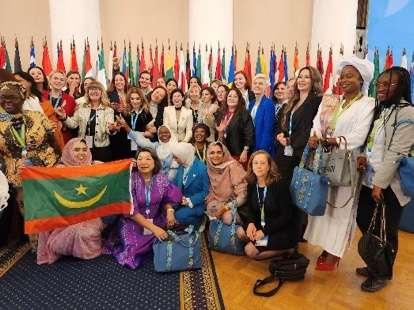
The first EWF was held in 2015 and has taken place every three years. The theme of the 2024 forum was “Women Strengthening Trust and Global Cooperation.” The Chairwoman of the Russian Federation Council, Valentina Matviyenko, opened the forum with welcoming remarks in the Palace’s Duma Hall. Matviyenko encouraged women to unite to create a better, more just, and equitable world. She asserted that “the era of domination of the ‘golden billion’ is leaving us” and expressed optimism for multipolarity. The Secretary-General of UN Trade and Development (UNCTAD), Rebeca Grynspan, explained that “Eurasia, a continental bridge between Europe and Asia, is a crucible of cultures, histories and aspirations. It is a region where languages intertwine, traditions intermingle, and ideas intersect.” She appealed to delegates not to fragment but to forge partnerships with other women worldwide.
During the morning plenary, top-ranking officials from different countries presented on the need for greater women’s leadership to achieve equality, protect the environment and climate, and develop sustainably. Many delegates appealed for an end to all war and armed conflict.
On the afternoon of the first day, Russian President Vladimir Putin gave a keynote address. He declared that “Humanity is in need of a robust foundation of trust, openness, mutual understanding, and contacts across various fields to address challenging social issues, ensure economic prosperity and technological development, and overcome poverty, inequality, and diseases.” President Putin added, “Most importantly, to be able to develop equitably, every country needs the indivisibility of security principles.” He explained that women play an essential role in bringing about the positive changes needed in global affairs. Putin also discussed Russia’s National Strategy of Action in the Interests of Women 2023-2030, which outlines new initiatives to improve gender equity and women’s rights across the country
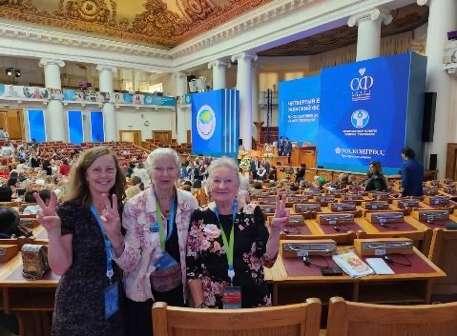
The EWF schedule was a packed program of over one hundred sessions on topics ranging from social and human welfare, healthcare and well-being, entrepreneurship and economic development, digitalization and technology, culture and tourism, human rights and multilateralism, to environmental protection and climate change. The EWF also included an incredible cultural program with musical and dance performances and an exhibition on Russia’s Indigenous
Figure 2: Fourth Eurasian Women's Forum with members of Women for Peace Finland, September 2024.
Figure 1: Fourth Eurasian Women's Forum, St. Petersburg, Russia, September 2024.
communities. The forum showcased a variety of products made by women-led businesses, with many sessions focusing on women and the Arctic, oceans, and climate change.
On the second day, a morning panel entitled “Women’s Initiatives Driving the Development of the Green Economy” was held. One speaker, a government official from Beijing, shared the remarkable rise of renewable energy technologies in China. Another speaker, an oncologist from Serbia, discussed the NATO bombing with depleted uranium munitions that devastated her country in 1999 and caused long-lasting harm to the environment and public health. She described how NATO bombed Serbia for 78 days with 20,000 bombs, an intervention that eventually led to the break-up of Yugoslavia. The doctor called for accountability and a public inquiry into the impacts of NATO’s intervention and emphasized that war and militarism impede the transition to a green economy
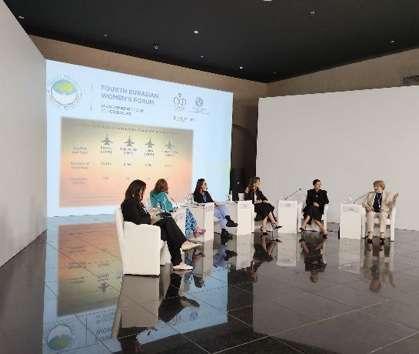
Figure 3: Fourth Eurasian Women's Forum, “Women’s Initiatives Driving the Development of the Green Economy” Panel, September 2024.
In the afternoon, a roundtable on “Cooperation in the Interests of the Arctic” featured several panellists, including a member of the Russian Coast Guard, an Inuit woman, and a Japanese academic, who talked about cross-cultural cooperation and scientific research in the Arctic.
At the roundtable, another Russian woman spoke about the progress in the major clean-up of the Arctic, launched by the Russian government in 2010. She explained that the Russian Geographical Society and the Ministry of Natural Resources and Environment have been leading initiatives to remediate environmental pollution from the Soviet era across the region. Over the past fifteen years, volunteers from Russia and worldwide have worked in the Arctic to collect and remove scrap metal, military debris, remnants of fuel and lubricants, and other waste. The session also shared information on the Russian government’s conservation measures to protect endangered species and expand the Russian Arctic National Park.
As part of the roundtable, I spoke about VOW’s and WILPF-Canada’s concerns that the Canadian government is militarizing the Arctic with the United States through the North American Aerospace Defense Command (NORAD) and NATO. I explained that Canada is investing $38.6 billion in NORAD modernization, which will lead to more fossil fuel-powered warplanes and warships in the Arctic, one of the fastest-warming regions on the planet. Canadian women’s groups worry that this militarization will harm Indigenous communities, degrade the environment, exacerbate climate change, and foment geopolitical conflict. I argued that Arctic countries should revitalize the Arctic Council and support the Inuit Circumpolar Council’s appeal for the region to be a zone of peace and cooperation, free from nuclear weapons.
The BRICS Women’s Meeting
On the third and final day of the EWF, a special strategic session entitled “The Future of BRICS: Prospects for Cooperation” was held. In the large auditorium, a box containing a lovely BRICS
scarf was placed on every seat for each delegate. The opening panel of the BRICS Women’s Meeting featured women leaders from Brazil, Russia, India, China, South Africa, Iran, and North Korea. They highlighted women’s crucial role in economic development and called for advancing women’s social and economic equality. The speaker from India also gave an impassioned speech urging BRICS to establish indicators to evaluate progress on implementing women’s equality programs in member states.
The BRICS Women’s Meeting was held on the sidelines of the EWF as part of Russia’s presidency of BRICS that year. Russian Deputy Minister of Foreign Affairs Sergey Ryabkov discussed the Russian presidency’s priorities for the multilateral organization, which included: politics and security; economics and finance; and human rights and development. Ryabkov explained that advancing women’s equality, empowerment, and entrepreneurship were integral to each priority. Among the women at the EWF, BRICS is seen as a hopeful initiative for the development of their countries and for fairness in the international system
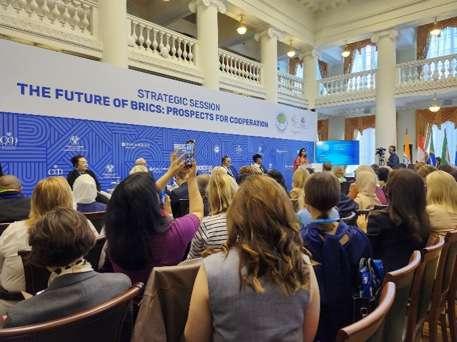
In the EWF's closing plenary, officials from several countries gave impassioned and inspiring speeches. The diplomat from Indonesia said that countries need to “lead with love and leave no one behind.” Representatives of Cuba and Bosnia and Herzegovina called for an end to illegal Western sanctions and economic injustice in the global economy. Many women leaders also appealed for greater cooperation and action to avert the climate crisis and alleviate poverty. A final Forum declaration was released, affirming the Convention on the Elimination of All Forms of Discrimination Against Women, the Beijing Declaration and Platform for Action, and the United Nations’ Sustainable Development Goals.
The “Peace, Nature and Cooperation in the Baltic and Arctic Regions” Conference
The “Peace, Nature and Cooperation in the Baltic and Arctic Regions” Conference was also held in St. Petersburg from September 21 to 22, coinciding with the annual International Day of Peace. There were approximately 100 participants in-person and online from across Russia, Europe, and North America. The conference was organized and endorsed by the Public Council of the Southern Coast of the Gulf of Finland, the International Peace Bureau, VOW, WILPF-Canada, World BEYOND War, and Global Women for Peace United Against NATO (GWUAN), among other groups. The participants were civil society activists and academics who discussed their concerns about the adverse social, climate, and environmental impacts of the increased militarization of the Arctic and Baltic Seas. Participants also discussed ways to cooperate on joint projects and build peace.
Figure 4: BRICS Women's Meeting, St. Petersburg, Russia, September 2024.
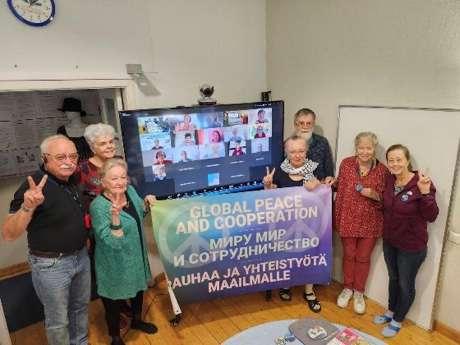
One key organizer was Oleg Bodrov, a retired Russian engineer-physicist, long-time environmentalist, and chairman of the Public Council of the South Coast of the Gulf of Finland. In his remarks, Bodrov discussed how the Arctic and Baltic Seas are our common natural heritage and must be protected for future generations. Lea Launokari and Ulla Klotzer of Women for Peace Finland, who were also co-organizers, spoke about the possibilities for improving relations between Finland and Russia, noting the many economic, cultural, and familial ties between the two countries. They also presented on the continued environmental damage from munitions and unexploded ordnance dumped in the Baltic Sea during the Second World War. Conference participants discussed the urgent need to clean up the Arctic and Baltic Seas, which are critical ecosystems that provide water, fish, and other resources to bordering countries. They also called for the Arctic and Baltic Seas to be demilitarized and designated zones of peace to facilitate and fund remediation efforts.
Participants also discussed Russia’s foreign policy concept, released the previous year. On the Arctic, The Concept of the Foreign Policy of the Russian Federation called for “peacefully resolving international issues related to the Arctic, proceeding from the premise of the special responsibility of the Arctic states for the sustainable development of the region and the sufficiency of the United Nations Convention on the Law of the Sea (UNCLOS) for regulating interstate relations in the Arctic Ocean.” Under UNCLOS, state parties, including Canada and Russia, have a legal commitment to maintain peace and security, promote international cooperation, and mutual understanding in the seas and oceans.
The conference ended with the drafting of the St. Petersburg Declaration, based on the principles of the UN Charter and the spirit of UNCLOS and the Helsinki Final Act of 1975. One article of the Declaration stated: “We believe in the indivisibility of security, which means that no one is secure until everyone is secure. Peace is achieved by diplomacy, cooperation, cross-border activities, active involvement of the diaspora and a feminist agenda counting on protection, meaningful participation and prevention in all phases of conflict.” The declaration was translated into several languages and received widespread support from civil society organizations. It was sent to governments in the Baltic and Arctic regions, the UN, the United Nations Educational, Scientific and Cultural Organization, the Organization for Security and Co-operation in Europe, the Arctic Council, the Inuit Circumpolar Council, and the Baltic Marine Environment Protection Commission (also known as the Helsinki Commission - HELCOM)
Mobilization for Feminist Peace and Cooperation in the Arctic
The EWF, the BRICS Women’s Meeting, and the “Peace, Nature and Cooperation in the Baltic and Arctic Regions” Conference exemplified women’s leadership in international peacebuilding
Figure 5: Peace, Nature and Cooperation in the Baltic and Arctic Regions Conference, St. Petersburg, Russia, Sept. 2024
and feminist diplomacy. These important events demonstrated how women are mobilizing for peace and cooperation in the Arctic and among all countries.
References
BRICS (2024). BRICS-Russia 2024 http://brics-russia2024.ru/en
Eurasian Women’s Forum (2024). Fourth Eurasian Women’s Forum “Women Strengthening Trust and Global Cooperation” https://2024.eawf.ru/en/
Eurasian Women’s Forum (2024). Fourth Eurasian Women’s Forum Final Declaration. https://2024.eawf.ru/upload/2024/Final_document_of_the_Fourth_Eurasian_Women s_Forum_ENG.pdf
GWUAN (2024). Global Women United for Peace Against NATO https://womenagainstnato.org/
GWUAN (2024). Peace, Nature and Cooperation in the Baltic and Arctic Regions Conference https://womenagainstnato.org/events/
Russian Federation (2022). National Strategy of Action in the Interests of Women 2023-2030. http://government.ru/docs/all/145532/
Russian Federation (2023). The Concept of the Foreign Policy of the Russian Federation: https://mid.ru/en/foreign_policy/fundamental_documents/1860586/
Russian Federation (2024). Text of President Putin’s Speech at the Fourth Eurasian Women’s Forum. http://en.kremlin.ru/events/president/news/75124
II. NATO and Collective Defence in the Arctic
Changes in Sweden’s Security Policy Messaging in the Country’s Military and
Civil Defense
Publications During the Cold War Compared to Those After NATO Membership
Robert P. Wheelersburg
Sweden joined NATO following Russia’s invasion of Ukraine to protect itself from its perpetual and primary enemy. To counter the current Russian threat following the invasion of Ukraine in 2022, Sweden evolved its security strategy of neutrality and territorial defense to one that supports alliance operations throughout the Nordic region. Some analysts suggest that to achieve that new strategy’s goals, Sweden needed to change public attitudes and traditions resulting from two centuries of military non-alignment to those that support the country’s role in multi-national operations This essay’s hypothesis is that Sweden evolved from its Cold War message encouraging the population to survive an invasion and conduct a guerilla war against Russian occupation to today’s message that an alliance-based conflict is winnable if the Swedish military and civilian population fight without surrendering. To test that hypothesis, the author translated and compared Cold War Swedish armed forces and civil defense publications to those produced following application for NATO membership in 2022 to determine if there is an observable difference in messaging between the two periods. The results indicate that while Sweden is clearly on its path to integration into the NATO alliance, its security publications directed at the populace remain committed to total defense, emphasizing each person’s individual and collective responsibility in ensuring the country’s territorial integrity and the subjects’ collective security.
Introduction
Recently, some analysts proposed that to achieve public acceptance of alliance-based defense, Sweden needed to change public attitudes and traditions resulting from two centuries of military non-alignment to those that supported the country’s membership in NATO (e.g., Aronsson et. Al. 2023). Even with that new messaging, Sundelius and Eldeblad (2023) believed that it will take a generational change for the Swedish public to accept alliance-based values like common defense (i.e., Article 5). Using those propositions, this paper’s thesis is that Sweden evolved from its Cold
Robert P. Wheelersburg, Ph.D. Military Historian, U.S. Army War College (retired)
War messaging, which encouraged the population to survive an invasion and conduct a guerilla war against Russian occupation, to today’s messaging that an alliance-based conflict is winnable if the Swedish military and civilian population fight without surrendering. An alternate thesis is that while Sweden is clearly on its path to integration within the NATO alliance, its security publications encourage the population to remain committed to a total defense stance, a holdover from the Cold War, emphasizing each person’s individual and collective responsibility in ensuring the country’s territorial defense. To test the study’s thesis, I translated and compared Cold Warperiod Swedish armed forces and civil defense publications to those produced following application for NATO membership in 2022 to determine if there is an observable difference in messaging between the two periods.
Sweden today views Russia as its number one enemy unequivocally, recently articulated by the security police (SÄPO) director Charlotte von Essen, who proclaimed that Russia is Sweden’s primary threat (Ringstrom & Jacobsen, 2024). Without question, following the 2022 Russian invasion of Ukraine, Sweden joined NATO to come under the protection of Article 5, although as a partner nation, Sweden was under the NATO nuclear umbrella for decades (Andrén, 2024).
Yet, the question can be asked – would the Swedish public support sending troops abroad or accept foreign troops to fight on its soil under the alliance’s Article 5 mutual defense pact? That question is particularly relevant, especially when it comes to the defense of NATO’s Arctic flank. Based on my forty years of ethnographic research, teaching, and extended residences in Sweden, I categorically state that regardless of what the government says, Swedes do not believe they are part of the Arctic. Rather, they view their own territory above the Arctic Circle as Norrland while “the Arctic” to Swedes generally consists of the circumpolar area bordering the Arctic Ocean including Alaska, Canada, Greenland, Iceland, and Norway [Svalbard]
Nevertheless, it is obvious that official government policy including joining the Arctic Council maintains that the kingdom is part of the Arctic. Regardless of being an independent member of the Arctic (along with Finland), Sweden’s 2020 Strategy for the Arctic Region made no mention of NATO. However, it is possible to detect a movement toward collective security in the region in that publication, given statements such as
The Government will continue to strengthen Sweden’s military capability to operate in the northern parts of Sweden and neighboring areas. The Government intends to work for the further development and deepening of Nordic and EuroAtlantic security and defense policy cooperation focusing on the European part of the Arctic, the Cap of the North and the North Atlantic region (Government Offices of Sweden, 2020, p. 21).
Since all members of the Arctic Council are members of NATO except Russia, now the country is obligated to respond to an attack on any part of the Arctic and not only the Nordic region, as a requirement of Article 5. Thus, an important part of the defense publication messaging after joining NATO must necessarily involve changes that allow foreign troops to help defend Swedish territory, but also to support the country’s armed forces participating in combat or deterrence operations abroad.
Sweden and NATO – the question that would not die
Before describing the study, its results, and some conclusions, we must ask - what does the Swedish public think about NATO membership? That has been a prime topic in my conversations with Swedes since I first arrived in that country during 1983 to conduct dissertation research My discussions on the topic even travelled overseas to America. At the 1991 Society for the Advancement of Scandinavian Studies annual meeting in Amherst, Massachusetts, I attended a forgettable session on Nordic security. One of the presenters was an arrogant public relations official from the Swedish Defense Ministry who gave a typical statement about the invincibility of the country’s military (remember Sweden had not been in a war for nearly 200 years). I asked him if there was a chance that Sweden would ever join NATO. The crowd of academics attending the conference who were somehow related to Scandinavia reacted loudly to my question with spontaneous comments like – “Ridiculous!” “What a foolish question ” “Who is that idiot?” The public relations official said simply, “No” and asked for another question. Three years later, I was standing in northern Sweden’s meter-deep snow as a U.S. Army exchange officer with the K-4 Norrland Dragoons (Jägare). My host unit was preparing for a simulated attack by “the enemy” who everyone knew was Russia with even live-fire exercises using Soviet T-54 tanks as targets. Even then, while military cooperation with NATO troops was increasing due to Swedish infantry battalions serving in Bosnia with NATO’s Stabilization Force (SFOR), it seemed to many observers a far stretch to imagine Sweden joining the alliance. But not to me.
My qualitative impressions suggested that Swedes resisted giving up their neutrality late into the 1990s, especially after the fall of the Soviet Union. But what did quantitative indicators suggest after the Cold War ended? The Society, Opinions, and Mass Media (SOM) survey conducted by the SOM Institute at the University of Gothenburg, which has tracked the Swedish public’s opinions on the country joining NATO since 1994, revealed that an “historic shift” occurred in those opinions sometime in the early 21st century. From its first survey year until 2012, Swedish opinion was consistently unfavorable toward joining NATO with roughly 40 to 50% of those surveyed believing that it was a bad idea. About 20% thought becoming an alliance member was a good idea. Those two strongly divergent opinions converged at approximately 35% each following Russia’s invasion of Crimea in 2014. During the 2022 SOM survey, the influence of Russia’s invasion of Ukraine caused a radical shift in both viewpoints, with approximately 65% believing that joining NATO was a good idea, and about 15% responding that it was a bad idea (Jansson & Lundin, 2024).
Those results were consistent with other polls conducted during the pre-NATO period illustrating that an historic shift had taken place In response to recent incursions of Swedish airspace by Russian military aircraft, a poll conducted in 2013 by the Swedish research company Novus revealed that only 6% of Swedes thought that the country could defend itself (Milne 2014). A second Novus poll conducted in 2014 for a Swedish television station following parliamentary elections revealed a small majority of respondents supported joining NATO compared to those opposed [37 to 36, respectively] (Scrutton, 2014). That poll helped elect a center-left government led by Prime Minister Stefan Loven who was adamant about not joining NATO.
In 2015, to increase public confidence in Sweden’s total defense capability, the Royal Swedish Academy of War Sciences commissioned a study to determine the issues and problems with security observed in public sentiment surveys. The study was conducted by a group of senior
military officers and scholars and summarized in a publication titled White Book. A New Total Defense – Important Conclusions ([Ett Nytt Totalförsvar. Viktigare Slutsatser] Rosenius, et. Al. 2017). In it was a proposal for improving the country’s total defense capability that they called “The military defense 2030 – target image,” which called for a complete overhaul of the civilian and military structure and capabilities. The study did not mention NATO at all. Instead in a few instances, the authors use the phrase “help from other countries” as in the following statement.
The expanded total defense places demands, above all, on a strengthened regional leadership for military and civilian cooperation. The military regions therefore should be developed to be able to lead territorial [defense] activities, [incorporating] single battalions along with asking for support from additional units, Swedish as well as from other countries [italics added] (Rosenius et. al., 2017).
Presumably the authors were referring to the Nordic countries as specified in the 2017 Nordic Defense Cooperation (NORDEFCO 2017) agreement.
During the early part of the study period, official Swedish policy was non-alignment. As described by Kunz (2015), non-alignment had evolved to the so-called “Hultqvist doctrine” advanced by the then defense minister to increase the country’s self-sufficient defense capability as part of Prime Minister Loven’s non-alliance policy. Hultqvist and the government addressed years of decreased military funding as part of the failed so-called “peace dividend.” As a result of the doctrine, the government began to restructure the armed forces away from larger units designed to prevent invasions toward smaller, more flexible units to reenforce sovereignty disputes or maintain border integrity by responding to small incursions or other emergencies (e.g., terrorism). At the same time, the defense ministry accelerated its engagement with other militaries to achieve common defense objectives short of joining an alliance. The new policy depended less upon universal conscription and relied more on a professional military cadre with limited draftee support to allow for participation in multi-national crises operations abroad (Kunz, 2015). The need to improve Sweden’s ability to support crises overseas was shown by real world events such as repatriating over 500 Swedes killed in the 2004 Pacific Ocean Tsunami and evacuating 6,000 Swedish during the Lebanon crises of 2006 (Sundelius & Eldeblad, 2023).
While public sentiment favoring joining the alliance increased slowly, the 2022 Russian invasion of Ukraine created a perceived urgency to move membership forward quickly. Preparation for NATO membership began with the Swedish government’s annual budgetary amendment of 2023. The budget increased defense appropriations by over half a billion Swedish Crowns (SEK; approximately $50,000,000) and increased armed forces expenditures 93 billion SEK ($8,500,000,000). The government proposed to make Sweden’s military capabilities more compatible with NATO’s systems including command and control, missile defense, and early warning. In addition, earlier versions of Sweden’s SAAB 39 Gripen were upgraded to be compatible with later JAS 39 models, so Sweden could integrate with NATO’s fifth generation aircraft like the F-35 Lightening II (Ministry of Defense 2023) In addition, for the first time, the budget also established funding for NATO contributions including for the Security Investment Program.
Aside from changing its military organization and weapons, joining NATO required major changes in Swedish organizational structures and thinking. Many government offices and entities, not to mention hundreds of civilian employees, needed to reorient their efforts to either focus on
NATO’s planning or execution activities. Sundelius and Eldeblad (2023) suggested that so much organizational transition was required that it could be decades before Sweden is fully integrated. In addition, the authors stated that a generational change was necessary before the ingrained nonaligned total defense perspective evolved to an active alliance membership perspective with all that requires (e.g., Article 5).
Sweden’s National Identity and Warfare
A major influence over whether Sweden’s population will accept the full NATO responsibilities that go with membership relate to the national identity that formed the basis for Sweden’s past neutrality. One of the most important parts of Swedish national identity is the kingdom’s military history. A short summary here reveals that since its formation in the 1550s under the country’s first absolute monarch, Gustav Vasa, until the early 19th century, Sweden was involved in almost continuous warfare. History Professor at the Swedish National War College, Gunnar Åselius, (2013) divides Swedish military history into four phases, starting from the creation of the country and ending in 1814 when Sweden fought its last war with Norway.
The first phase, from 1523 to 1560, began with Gustav Vasa establishing the country’s first professional army and navy. During that period, Vasa used the Swedish military to defeat groups of Swedish (and other ethnicities) minor kings or groups of knights fighting for power in the emerging kingdom, and to defeat Norway and Denmark to establish Sweden’s sovereignty Although outside of Åselius’ first period dates, continued interior feuding and warfare with foreign counties, especially Russia, until the 17th century forged the kingdom’s national identity as a military power (Figure 1)

Figure 1. Crypt of King John III (ruled 1569 to 1592) located in the cathedral at Uppsala, then Sweden’s capital. John killed his half-brother, Erik XIV, to claim the throne, then fought two wars with Russia. Photograph by the author.
Åselius’ second phase took place from 1600 to 1660 with the emergence of Sweden as a European superpower, whose rulers fought religious and territorial wars on the continent. Although the kingdom continued to engage in large scale wars in Europe and the Baltic region into the 18th century, the superpower period ended with Gustavus Adolphus (d. 1632), defender of Protestantism, being killed in battle. Although the regents continued the extensive warfare following his death, using over a hundred thousand foreign mercenaries to fight in Europe, once Adolphus’ daughter Christina ascended the throne in 1632 until her abdication in 1654, the kingdom suffered from her inability (and perhaps insanity) as she converted to Catholicism and essentially assumed a male identity (leading to her becoming an international queer icon that continues today). According to historian Michael Roberts (1995), these first two phases constituted a military revolution that saw widespread use of firearms, professional militaries, standardized uniforms and battle colors, and combined arms tactics. The latter was particularly important for shaping modern warfare. Now, instead of the tradition of fighting against their counterparts in separate battles (e.g., artillery duels), artillery and cavalry supported infantry in a combined arms attack just as they do in modern warfare today (plus aviation)
Åselius’ third phase, extending from 1660 until 1721, involved Sweden defending or attempting to reestablish its territorial gains obtained during its superpower time especially in the Baltic region However, without the extensive resources it once had (including the conscription allotment system where groups of villages provided soldiers), Sweden could not sustain its earlier combat power, especially when fighting larger states and emerging empires like Russia. The phase ended with Sweden’s defeat in the Great Northern War (1700 - 1721), during which King Charles XII (d. 1718) was killed in action
Sweden’s final phase, according to Åselius, stretched from its loss in the Great Northern War to the kingdom’s defeat as part of the northern reaches of the Napoleonic Wars. Russian decisively defeated Sweden during the Finnish War of 1808 to 1809, resulting in the loss of Finland, which became a semi-autonomous part of Imperial Russia (Figure 2) Although it could be considered a civil war, Sweden fought against Norwegian independence to form a union in 1814. Since then, the country has not experienced combat either at home or abroad. Since World War II, Sweden experienced sending and supporting troops abroad by fielding United Nations observers and specialists, and more recently, by participating in stability and security operations in places like Bosnia and Iceland (air policing of the Icelandic air defense zone). Yet, since its founding until 1814, Sweden was in an almost constant state of warfare, with much national pride in its military even in the modern period. Much of that conflict extending into the Cold War was with Russia, Sweden’s perpetual enemy.
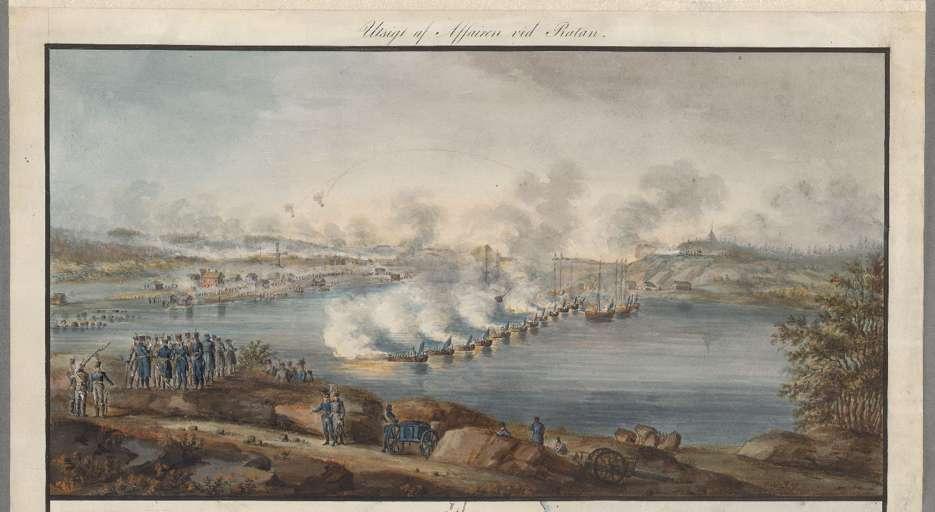
2. Sweden’s last combat with Russia in the early 19th century. Following Russia’s victory at the battle of Savar, where Sweden was pushed out of northwestern Finland on August 19, the next day a combined Swedish force of gun boats and infantry remnants fought Russia to a stalemate leading to peace negotiations that ended the Russian-Swedish War (1808 – 1809). In the lower left corner a group of Swedish officers directs the gunboat bombardment of Russian forces. From Utsigt af affairen vid Ratan by Carl-Gustaf Gillberg. From the collection of the National Museum of Sweden. Used with permission.
According to Lund University Historian Dick Harrison (2023), the farther back in the previous millennium one travels, the closer the Swedish and Russian cultures and peoples become intertwined Some believe that the heart of Russia was founded by the “Rus” or Varangian Vikings with the core of the Tsarist empire originating in the Kievan state their descendants established in the ninth century. During those early times, the Rus consolidated their territories by pacifying the Dnieper River watershed, developing and maintaining trade routes to the Black Sea, forcing the Germanic tribes’ conversion to Catholicism, and uniting the eastern Slavic peoples (Map Archive, 2025). While there is some debate in scholarly circles about Russia’s origins, Putin and many of his fellow countrymen believe that the Kievan Rus-founded country of Ukraine represents an integral part of Russian culture that must be reabsorbed into the home country; at the point of a gun if necessary
The relationship between the two countries was reciprocal since as Sweden had done earlier in helping shape Russia, in the 1700s Russian culture would help shape modern Sweden. In fact, the relationship led to a change in Sweden’s national identity. During the Great Northern War, Swedish prisoners of war in the Siberian Arctic converted to Pietism, and upon repatriation brought the tenets of the Lutheran reform movement home, especially pacifism. Prior to the conversion, the Swedish Church supported the crown’s warfare totally as part of the earlier century’s defense of Protestantism under Lutheran Orthodoxy that provided justification for the Thirty Years’ War (Roberts, 1984). Along with the general devastation and death caused in Europe by the war, Sweden saw a significant part of its male population forced into conscription, with
Figure
some villages almost completely depopulated as a result. Although the number of war deaths is debated, the depleted male Swedish population was fertile ground for accepting the pacifism offered by the Pietist movement, which helped shaped Sweden’s two centuries of non-alignment (Häggman, 2017). Ironically, given its national identity as a military superpower during the 16th through 18th centuries, Sweden developed a false sense of security that if tested (e.g., World War II), would have revealed the kingdom as a paper lion.
From its origin as a Viking territory to a European empire to an atomic superpower to today’s combatant trying to regain past glory, Russia has been intimately bound with Sweden even to the point of making the kingdom abandon two centuries of non-alignment and peace. According to Harrison (2023, p. 20),
Russia also played several roles in Swedish history – neighbor, friend, relative, enemy, villain. […] that has given us a wealth of experience to lean on. In a time when we once again have cause to be afraid, there is good reason to learn from those experiences. They may not be always be pleasant, but they rest on a solid foundation of reality, and they derive from a firm starting point as we look toward [Sweden’s] future – a future that, both from superpower politics and for purely geographical reasons, finds itself in Russia’s shadow
In sum, from its origins as a founder of Russia, to its last defeats in battle and the loss of Finland and Norway, to the Cold War, to joining NATO to prevent an invasion, conflict with Russia has defined Sweden’s military history (and part of its national identity) for nearly 500 years.
The country’s long history of warfare combined with its modern weapons industry and universal conscription created a belief that the country was strong enough to stand on its own. Until Russia’s aggression in Ukraine, that belief did not mean a uniform response by the Swedish population for NATO membership; quite the contrary. Like other countries such as Poland, despite its strong NATO commitment, the Swedish population’s views show much variability with both support and resistance for joining the alliance. Further demonstrating variability in the will to fight for freedom among a country’s population, even following the present Russian invasion, Ukraine had to create and enforce restrictions on adult males leaving the country. To overcome that variability in both support and will among its population, Swedish government messaging favoring alliance membership has to help obtain a clear majority in favor of it.
The Study – Content Analysis of Swedish Public Messaging
To test the study’s hypothesis, I compared Cold War era Swedish armed forces and civil defense publications with those produced following application for NATO membership in 2022, to determine if there was an observable difference in messaging between the two periods. There were two types of publications used in the analysis. The first type was the basic military manuals that talk about how to be a service member published since 1994 by the Defense Ministry (Försvarsmakten) titled “Swedish Soldier and Sailor” (Svensk soldat och sjöman). That type included earlier Swedish military manuals related specifically to the Arctic region, especially the 1968 publication by the Commander in Chief of the Army of “Winter Soldier” (Vintersoldat) and the 1988 publication “Handbook. Survival” (Handbook. Överlevnad).
Although military publications were directed at armed forces personnel specifically, they can be considered public messaging for two reasons. First, Sweden’s earlier universal conscription lasted
throughout the 20th century (from 1901 until 2010), which required that all men between 18 and 47 receive basic and refresher training. That meant virtually all adult males (and some females) in the country received the messaging through those military publications. Second, these military manuals are published today in Swedish, easy Swedish (lätt Svenska), and English, which makes them accessible to all members of the society including immigrants and others who reside in the country but may not have native language skills. Third, the manuals are available to anyone who wants them including non-Swedes (e.g., me) Thus, my assumption is that unlike America, where military manuals remain mostly esoteric to those not in the armed services, there is a general familiarity with such publications in Sweden.
The second type of publication I analyzed was the recurring civil defense publication titled “If the Crises or the War Comes” (Om krisen och kriget kommer), published most recently by The Swedish Civil Contingencies Agency or MSB (Myndigheten för samhälls- skydd och beredskap) in 2024. The brochure was also published from 1943 to 1991 by the Supreme Commander of the Swedish Armed Forces (Överbefälhavaren för den Svenska försvarsmakten). In addition, in past years when phone books were published, they contained the civil defense information
Study Results
Differences between Sweden’s pre- and post-NATO public messaging about fighting to retain sovereignty, freedom, and traditional values were obvious in the ongoing discussion of the country’s national security policy. In its 1983 publication The Swedish Army (repeating the 1977 version verbatim), the government’s national security policy approved by parliament in 1968, 1972, 1977, and 1983 clearly stated the intent to remain unaligned and neutral.
One of the principles of our security policy is our determination to defend ourselves without entering into alliances with other states. The aim is to avoid being drawn into a war. One of the means that we have to achieve this principle is military defense. […] If confidence in our ability to defend ourselves should weaken, our neighbors may be forced to reconsider their defense policies. This could lead to changes in the present stable situation in the Nordic area. In the event of war, both sides might try to prevent the other from gaining access to Swedish territory. […] The great powers can detach only parts of their armed forces against us, since the main forces already are engaged against each other. It would require such vast resources and take so long to attack Sweden that the advantages gained would not be enough to justify their operation. Thus, it can be said of the Swedish defense that it preserves the peace (Commander in Chief of the Army, 1983, p. 9).
Compare that statement about non-alignment with a similar one from the most recent version of Swedish Soldier and Sailor, a manual for armed forces members (especially conscripts) published in 2024, after NATO became the foundation of the country’s alliance-based defense Sweden has sought membership in NATO. The long tradition of military alliance freedom that has characterized our country has transitioned to a desire to enter into a defense alliance with mutual security guarantees. Our participation in all security policy forums derives from a solidarity security policy, i.e., that Sweden shall build security together with others and therefore can provide and receive
both civil and military support. With membership in NATO, Sweden will be able to even contribute to the defense alliance’s deterrence in our part of the world. By improving our ability to take part in international cooperation and crises management operations, peace and security is strengthened for Sweden, for the EU, and for the whole world (Ministry of Defense, 2023, p. 13).
The evolution in how Sweden defends its security with armed forces involves the transition from a non-aligned territorial defense to one that can participate in multi-national force structures within the country or abroad. Pre-NATO publications stressed how Sweden would use its territorial defense organization and capabilities
The principal task of our defense is to preserve peace. Yet, should Sweden be attacked, the Army together with the Naval Forces and the Air Force will meet this assault and, for as long as possible, prevent the aggressor from becoming established on Swedish soil [italics added]. This is the most important task of the Defense Forces as expressed in the defense policy objectives approved by the Swedish Parliament (Commander in Chief of the Army, 1983, p. 13).
An important part of the statement above is the phrase “for as long as possible, prevent the aggressor from becoming established on Swedish soil.” That means there were three implicit aspects to Sweden’s overall territorial defense – preserve peace by deterring aggression, prevent foreign military forces from invading, and after an invasion fight a guerilla-style conflict behind enemy lines together with conventional combat from unoccupied territory within the country.
It is not hard to see how such an approach might function given the current situation in Ukraine. As of this writing, Russia controls about 18% of Ukraine territory not including Crimea (BBC 2025). If Russia invaded and occupied nearly a fifth of Sweden as part of a wider war in the Nordic region, that would equate to all the Swedish territory above the Arctic Circle. Since previously there was no Article 5-type protection from an alliance, Sweden could be partially occupied (not conquered!), as part of a wider war between the two superpowers and their proxies. To prevent loss of Swedish territory to enemies for use in a larger conflict, if the country were prepared to fight back, it would be too costly for the invaders to consider. That strategy required Sweden to have post-occupation military tactics fought guerilla-style by Swedish units (and partisans) behind the lines and by regrouped armed forces in unoccupied areas attacking the invaders’ front lines (as we have seen in Ukraine during the current war).
Supported by a strong air force to establish and maintain air superiority over Swedish airspace, and a strong navy (including submarines specialized for operating in the coastal and shallow waters of the Baltic) to prevent mass landings by sea, there were three basic territorial sectors on land for the army to defend with different types of brigades. In the south, where there was open, relatively flat terrain, consisting of agricultural fields and population centers, the armored brigades had primary responsibility. Mechanized infantry brigades could respond to and defend against attacks in the central part of Sweden where forests dominated the landscape, although infantry had the ability to conduct operations throughout the country. In Sweden’s Arctic region, the Norrland Brigades were specially constructed for combat in the north regardless of season
Designated as the Norrland Brigade 85, the Norrland brigades have the same units as the infantry brigade 77 but have more tracked vehicles and the 55 TOW anti-
tank missile system. The Norrland brigade can carry out cross-country surprise movements over long distances both on snow-covered and snowless [bare] ground. It is therefore particularly suited for all kinds of combat in terrain with few or no roads (Commander in Chief of the Army, 1983, p. 14 – 16).
In addition, there were two specialized Arctic warfare units supporting the Norrland Brigades during the pre-NATO period. These were the I 22 Lapland’s Ranger Regiment in Kiruna and the K 4 Norrland Dragoon Regiment in Arvidsjaur, both referred to in Swedish as Jägare [dragoons or mounted infantry that dismount to fight] I 22 was created in 1975 and deactivated in 2000. K 4 is an old Swedish Army unit, created in 1646, deactivated in 2006, and reestablished in 2021 (Figure 3). There is much confusion about the nomenclature Jägare; however, with increasing multinational cooperation, the contemporary Swedish terminology is used as follows
“Rangers” leads us to be some sort of Swedish version of the US Rangers, that we are not. Hunter is the English translation of Jägare, which also isn´t right. We are a dragoon regiment so within the unit we call ourselves “dragoons” in different situations. The last years we started to use the Swedish word “Jägare” when we are in international contexts, just to make sure that we don´t get lost in different translations which givens the wrong impression of the unit’s capabilities (Gustafsson 2025: personal communication).
Although its 1990 publication, Infantry and Dragoon Regiment – Dragoon Company, Norrlands’ Dragoon Squadron [Jägarekompani Norrlandsjägarskvadron] was a manual for conducting operations like attacking an enemy convoy, one statement in the book clearly outlines the Dragoons’ operational environment and missions. “The Norrland’s Ranger squadron is primarily intended for combat and intelligence gathering deep inside the enemy’s territory” (Commander in Chief of the Army, 1990, p. 16). Since Swedish defense policy at the time was to conduct territorial combat within the nation’s borders, the implication in that statement is that enemy troops have occupied at least some of the country.
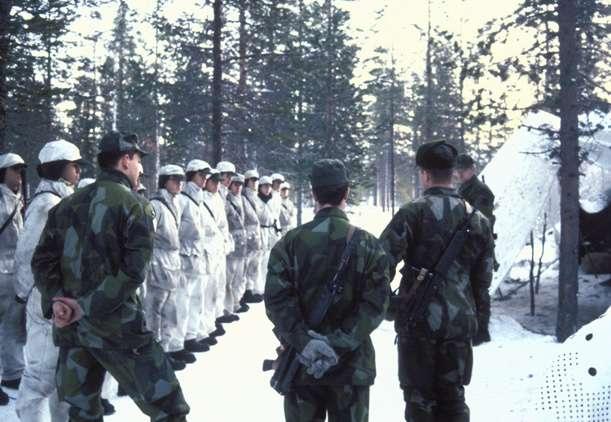
Figure 3. Pre-exercise briefing, K4 Norrland Dragoons, Arvidsjaur, Sweden, November 1994. Photograph by the author.
A similar publication, Handbook Survival (Handbook Överlevnad 1990) described the hardships that military operations in occupied territory might involve. Remember, the primary message both before and after joining NATO was “We offer resistance – never give up!” [Vi bjuder motstånd –aldrig ge upp!] (Ministry of Defense 2023: i). That means even if some parts of Sweden are occupied, neither soldiers nor civilians should stop resisting whether they are behind enemy lines or in unoccupied territory. For the common soldiers, survival was a matter of using any means to resist and defeat the enemy including foraging for food (Figure 4)
An extreme survival situation in war occurs when solders and units do not have access to their equipment or cannot utilize the combat support units. To overcome a survival situation requires knowledge about yourself and knowledge about how one uses your equipment, provisional material, the environment and its assets, etc. In addition, the will to survive is of extreme importance. … Generally, a survival situation is characterized as shortage of food and water, shortage of equipment, fatigue and hypothermia, isolation, and finding your way in difficult terrain, etc. (Commander in Chief of the Army, 1988, p. 5).
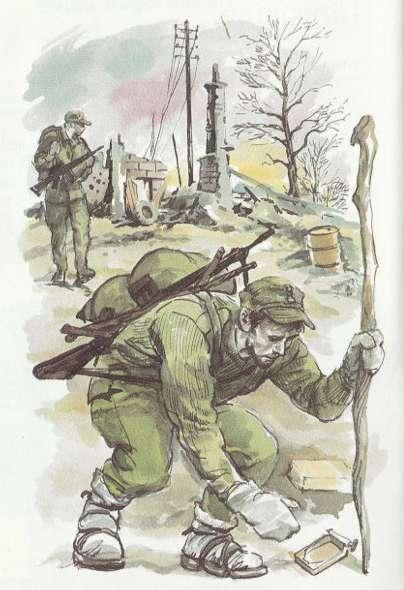
Figure 4. Life as a Swedish guerilla soldier in enemy-occupied territory. Illustration by Alf Lammerbäck, from Handbook Survival [Handbook Överlevnad] (Commander in Chief of the Army 1988). Used by permission.
As is necessary in partisan or guerrilla warfare, an occupied country’s troops must use their knowledge of and training in local areas to exploit the terrain and weather over the invaders. An example is from the pre-NATO publication, The Winter Soldier [Vintersoldat] (Figure 5).
The snow and the cold can cause difficulties, which you must master. But remember, that your difficulties are also the enemy’s. Those who best master them have the upper hand. Winter is a friend, if you are a more skilled winter soldier than the opposition [italics in original]. The conditions are good on your part. You receive good winter training and excellent winter equipment. But that is not enough. You must yourself contribute with a strong will to conquer all difficulties and accomplish your mission. You must be in good shape. Without good physical condition and knowledge about how your equipment should be used, you will never be a good winter soldier (Commander in Chief of the Army, 1968, p. 7).
Figure 5. The Swedish Army has prepared to fight in cold weather and in its Arctic region for over a century. This is the cover of Winter Soldier [Vintersoldat], showing light infantry troops on skis conducting combat operations/training. Illustration by Harry Holmström.
Conscription formed the basis for the pre-NATO Swedish Army, as part of the territorial defense along with the voluntary home guard. Instead of preparing for service in several theaters consisting of a variety of terrain and climate regimes, Swedish forces trained where they would fight. That was clear from the description of the way conscripts served.
To defend the whole country all able-bodied men and a great number of women are needed. Males between the age of 19 and 47 are required to perform military service through basis training and periodic refresher training. Conscripts make up field units, where officers and privates know one another […]. Mobilization orders are prepared in advance and every trained man knows where he will be posted if Sweden mobilizes (Commander in Chief of the Army, 1977, p. 3).
Universal conscription in which active and reserve troops mobilized to the area where they have trained and prepared ended with the application to NATO. The current conscription system expanded the age limit, included female troops, and requires those activated to be prepared for service anywhere. It is important to note that there are certain occupations such as airport firefighter or police officer, which are considered civilian defense services, and those who hold such positions would remain in them during wartime. The expectations for who can be called and for what type of service are outlined in the defense ministry’s 2023 publication, but the basic premise is described below.
Total defense conscription applies in Sweden. That means that all who are born here and are between 16 and 70 years old [47 for military duty] can be called up to help in different ways during conflict and war. All have a responsibility to contribute and all are needed Even activities that are carried out through participation in bi- and multi-lateral cooperation strengthens the total defense [capability] and activities within the military. Defense can therefore be conducted individually and together with international cooperative partners. [ ] For many years the preparations for conflict and war have been very limited in Sweden. Instead [of preparing for war] the authorities and municipalities concentrated on strengthening preparations for peacetime crises like floods and information cyberattacks. But in concert with a changed world the parliament and government have decided to strengthen the total defense. Therefore, the planning for Sweden’s total defense has been taken up again. There will come a time to develop all the parts again. At the same time, the preparations for peacetime crises are an important basis for our resistance power in war (Ministry of Defense, 2023, p. 23).
The Swedish Soldier and Sailor, directed at the country’s general population, provides information on such things as emergency callup, preparing for natural disasters like forest fires, and responding to human-made dangers like chemical release. They also include warnings for imminent air attack, which are divided into three parts; prepare for attack, attack, and danger over. It is not hard to see with current happenings in Ukraine and the Middle East how important it is to notify the population of air attacks by drones, rockets, bombs, and missiles.
Sweden’s civil defense publication, If the War Comes – guidance for the citizens of Sweden, [Om kriget kommer – vägledning för Sveriges medborgare], which has been released periodically since 1943 (later editions are called If the Crisis or the War Comes), contains information for individuals, families, and municipalities to prepare for and a execute total defense response including following the legitimate government even if it is in absentia
Sweden is governed in wartime as in peacetime according to basic law. Any government that comes about in another fashion is illegal. It is your duty to follow the legal government and obey its directives. The government’s leadership cannot in wartime remain in Stockholm. King, government, parliament, and officials will move from the capital city to smaller, predetermined places. The movement is not escape, even if the enemy’s propaganda portrays it so. It is a measure planned in advance to ensure the leadership of our total defense (Royal Civil Defense Agency, 1961, p. 4).
The remainder of the 1961 brochure consisted of general information about what a total defense mobilization means, which authorities have responsibility for specific parts of the mobilization, and even a statement that Sweden must be ready in case of blixtanfall or “lightening attack” that seems to be a holdover from WWII’s Nazi blitzkrieg. An important section was how people with a war assignment, whether military or civilian, would be notified through an audible alarm, a letter, on the radio, or verbally (e.g., at a defense industry plant). The notification itself served as a travel pass to one’s assigned location. Civilians were instructed to ignore broadcasts or other messages saying the mobilization has been cancelled or that the country has surrendered. Hypothetical evacuation plans were outlined, indicating where people should go and how they should travel there. Instructions specified what to pack for your family during an evacuation or how to prepare your home for a shelter-in-place order (e.g., fill bathtub with water). Arranging your eventual lodging, paying for it yourself, and registering where you are situated is important information that must be reported to the authorities. Given direct attacks on your position, people were ordered to take cover in civil defense shelters or to use alternate locations such as basements and subway stations. Sections followed on surviving air attacks, nuclear blasts, and obtaining noncontaminated food and water.
The section on vigilance prepared the population to be especially observant of their surroundings, since “fifth column” spies and saboteurs would already have been at work prior to the start of hostilities. The brochure also urged people not to talk about their assignments and to report suspicious activities. A Swedish television news program during my dissertation research showed how fifth column could lead to a defeat. At the time, it was required for all adult Swedes to list their occupation in the telephone directory, with the telephone system a government entity. The program showed how enemy operatives could look up important occupations like military pilot and then assassinate them leaving the country with sufficient air defense capabilities.
The 1987 version of If the War Comes was published by the Swedish Commission for Psychological Defense (Royal Swedish Civil Defense Agency, SPF), which was more extensive than earlier versions. The brochure stated that everyone who lived in Sweden must participate in the total defense, whether citizen or immigrant [italics added]. Several pages described the various alarm signals used for different attacks and illustrated how to prepare a shelter either by prepositioning supplies in a dedicated facility or by modifications to existing structures to reinforce them. Instructions on how to evacuate included what supplies and equipment (e.g., portable radio) to take, along with how people would receive gasmasks and other protective equipment from the government Defense against nuclear, biological, and chemical weapons made up separate sections of the brochure, along with advice on what might be sources of contamination from the weapons (e.g., insect bites carrying poison gas). Where to go for medical treatment discussed how hospitals and clinics would be used for the most important injuries such as operations or wounds, with those less seriously wounded directed to seek treatment for maladies at impromptu locations like converted schools. Unlike the 1961 version, the 1987 version contained rationing details with information on how to obtain and use ration coupons/books. The brochure also informed readers that during a wartime emergency the government could take your car or other possessions, and it outlined how citizens could be reimbursed for combat damage to personal property (SPF, 1987).
The 2024 post-NATO brochure version was published by the Authority for Society Protection and Preparation (MSB), which was formed in 2006 to build resilience across the society and
replacing earlier agencies including the National Board of Psychological Defense and the Swedish Emergency Management Agency (Sundelius & Eldeblad, 2023). While there is an increased focus on natural and human-made disasters, wartime preparation remains the document’s primary emphasis. The government restates that the total defense rests with both the military and the civilian organizations. In addition, the brochure also stated for the first time that
Sweden is also part of NATO’s collective defense. The military defense shall protect Sweden and allied NATO countries against armed attack, protect our borders, and manage conflict. … Sweden is included in the defense alliance NATO. The alliance’s goal is that the countries together will be so strong that it deters others from attacking us. If a NATO land still gets attacked, the other countries in the alliance will contribute to their defense – one for all, all for one (MSB 2024: 7).
Defense conscription, reinstituted for both men and women in 2017 (Sundelius and Eldeblad 2023) includes both military draftees (värnplikt) and civilian workers (civilplikt) from 16 to 70. PostNATO, the brochure notes the expansion of total defense service to Swedish citizens living at home and abroad, along with all people having Swedish residence. The remainder of the document continues earlier messaging with sections on the warning system, how to prepare for an air attack including by nuclear weapons, home, evacuation, shelter, psychological protection, terrorism or armed attackers, first aid, and for the first time, digital security (Figure 6) The brochure continues its instructions on crises such as extreme weather, pandemics, people who need assistance, pet care, and talking to friends, relatives, neighbors, and children (MSB 2024).

Figure 6. A new sign for civil defense shelter on a commercial building in downtown Umeå. Unlike the U.S. where Cold War signs for “fallout shelters” found in government buildings like post offices have fallen into disrepair, today Sweden takes the need for protection from air attack seriously. The increased urgency by the Swedish government probably relates to the extreme use of drone and missile attacks on Ukraine by Russia. Photograph by the author.
Conclusion
Cold War military manuals stressed Sweden’s non-alignment Having a strong air force, army, and navy, along with its own weapons industry, accompanied by an infrastructure and organization to mobilize forces quickly and at the right location, could not only defeat an enemy but it could deter aggression. Messaging to the public to fight a total defense on the country’s territory without surrender was the key. Pre-NATO military publications sought to convince the citizen army that it could defeat Russia or any other attacker attempting to use Swedish territory by capitalizing on the natural conditions and terrain in the country, especially cold weather. Fighting from Swedish free territory using conventional units and weapons would be supplemented by specially trained or remnant regular forces behind enemy lines to repel an invasion and regain lost territory. Should the country be overwhelmed, an unspecified (but probably Nordic) ally would come to Sweden’s aid if only the population resisted and did not give up.
Military manuals after NATO membership stressed alliance-based warfare to prevent attack on Sweden. While Article 5 supported Sweden, the new requirement for mutual defense required a complete change in the country’s military from a total (and territorial) defense to one requiring new values including for the first time, allowing foreign military allies to conduct combat operations inside Sweden. Another value change required was the possibility of sending Swedish troops to engage in combat to protect a NATO ally. While that is a change, Sweden has experience deploying troops abroad through its extensive UN participation since its formation in the 1940s. Currently, hundreds of Swedish troops are serving as UN observers in eight different countries, including Iraq, Korea, Kosovo, Somalia, and on the Pakistan – India border (Defense Ministry 2023). While experienced in planning, logistics, and service abroad is important for possible future NATO missions, it would be a different level of participation to have large Swedish units (e.g., brigades) conduct combat operations as part of its Article 5 commitment.
Additionally, by tracing the history of the If the War Comes publications in chronological order, one can see the changes in Swedish defense messaging through the post-WWII, Cold War, and NATO membership eras. The 1961 version was concerned with being prepared sufficiently to respond to a quick attack and with maintaining legitimate government control in absentia as many northern European countries were forced to do in the Second World War (e.g., Denmark and Norway). The Cold War version emphasized Sweden being able to protect itself or to deter attacks, through its own, unaligned military preparations and total defense that included protection against nuclear, biological, and chemical attack. The post-NATO version emphasizes the importance of being an alliance member, with Article 5 responsibilities to other members, but also stresses its protection to Sweden. Perhaps even more so than military publications, the civil defense brochures illustrate the changing nature of pre- and post-NATO messaging to the public.
While there are differences with its security publications over time, the contemporary versions continue to encourage the population to remain committed to a total defense stance, a holdover from the Cold War, emphasizing each person’s individual and collective responsibility in ensuring the country’s territorial defense.
References
Agency for Psychological Defense (1987). If the War Comes Stockholm. Andrén, Krister (2024). The Long Swedish Road Into NATO. Stratagem 07 November 2024. Eckbos Legat: Oslo. https://www.stratagem.no/the-long-swedish-road-into-nato/ Army Chief of Staff (1988). Handbook Survival. [Handbook Överlevnad] Almqvist & Wiksell Publishers: Uppsala.
Aronsson, Lisa, et. Al. 2023 Toward Integrated Deterrence. Sweden’s role on NATO’s northeastern flank. Journal of Arctic and Climate Studies, Vol. 1, No. 1, Summer, 2023. Ted Stevens Center for Arctic Security Studies. Accessed October 13, 2023, https://tedstevensarcticcenter.org/wp-content/uploads/2025/02/JACSS-Vol-1.-No.-120230906_revised_20230911_1936AKDT_V2.pdf
Åselius, Gunnar (2013) Swedish Armed Forces. Oxford Bibliographies, November 27, 2013. Oxford University Press. Accessed May 15, 2025, https://www.oxfordbibliographies.com/display/document/obo-9780199791279/obo9780199791279-0005.xml
MSB (2024). If the Crises or The War Comes. [Om krisen eller kriget kommer]. November 2024. Myndigheten för samhälls- skydd och beredskap (MSB) [Authority for Society Protection and Preparation]. Karlstad. Accessed May 3, 2025, https://www.msb.se/sv/publikationer/om-krisen-eller-kriget-kommer/
BBC (2025). Ukraine in maps: tracking the war with Russia. The Visual Journalism Team, British Broadcasting Company, 14 May 2025. London. Accessed May 3, 2025, https://www.bbc.com/news/articles/c0l0k4389g2o
Commander in Chief of the Army (1990). Jägarkompani Norrlands-jägarskvadron. [Dragoon Company. Norrland’s Dragoon Squadron]. Fösvarsmedia: Stockholm.
Commander in Chief of the Army (1988). Handbok. Överlevnad. Almqvist & Wiksell Tryckeri: Uppsala.
Commander in Chief of the Army (1983). The Swedish Army. Stockholm. Commander in Chief of the Army (1977). The Swedish Army. Stockholm.
Commander in Chief of the Army (1968). Vintersoldat. [The Winter Soldier]. Ivar Hæggström AB: Stockholm.
Defense Ministry (2023). Current International Missions. Försvarsmakten, April 2023. Accessed May 13, 2025, https://www.forsvarsmakten.se/en/activities/current-internationalmissions/ Government Offices of Sweden (2020). Sweden’s Strategy for the Arctic Region Elanders Sverige AB: Borås, Sweden. Accessed March 3, 2025, https://www.government.se/internationaldevelopment-cooperation-strategies/2011/10/swedens-strategy-for-the-arctic-region/ Gustafsson, Morgan (2025). K4 Jägare. Personnel communication (email), LTC Morgan Gustafsson, K4 Chief of Staff, May 27, 2025.
Häggman, Bertil (2017). Pietism in the Army of Sweden’s King Charles XII in Siberia from 1709 to 1761. Global Civil War December 2, 2017. Accessed May 3, 2025, https://varldsinbordeskriget.wordpress.com/2017/12/02/pietism-in-the-army-ofswedens-king-charles-in-siberia-from-1709-to-1722-and-swedish-siberian-explorers-1709to-1761/
Harrison, Dick (2023). The Enemy. Sweden’s relationship to Russia from Viking Times until Today. [In Swedish]. Ordfront förlag: Stockholm.
Jansson, Daniel and Ulrika Lundin (2024) Opinion on NATO: Record shift between 2021 and 2022. University of Gothenburg, News and Events/Find News, (7 March 2024). Accessed, May 12, 2025 https://www.gu.se/en/news/opinion-on-nato-record-shift-between-2021and-2022
Kunz, Barbara (2023). Sweden’s NATO workaround. Swedish security and defense policy against the backdrop of Russian revisionism. Focus stratégique nº, November 2015. ifri Security Studies Center. Paris. Accessed through ResearchGate, May 2, 2025.
Map Archive, The (2024). The Rise and Fall of Kievan Rus. The Map Archive, Norwich, England. Accessed September 21, 2024, https://www.themaparchive.com/the-rise-and-fall-ofkievan-rus/
Milne, Richard (2014). For First Time, More Swedes Favor Joining NATO Than Against. NATOSource. Atlantic Council, October 29, 2014. Accessed May 3, 2025, https://www.atlanticcouncil.org/blogs/natosource/for-first-time-more-swedes-favorjoining-nato-than-against/
Ministry of Defense (2023). Strengthening Sweden’s military defense and preparations for NATO membership. Press release, Ministry of Defense, April 5, 2023.
NORDEFCO (2017). NORDEFCO (Nordic Defense Cooperation) 2017. Finnish Ministry of Defense. Lönnberg Print: Helsinki. Accessed May 4, 2025, https://www.nordefco.org/Annual-Reports/2017
Ringstrom, Anna and Stine Jacobsen (2024). Russia is biggest security threat to NATO-hopeful Sweden, security service says. Reuters, February 21, 2024. Accessed May 23, 2025, https://www.reuters.com/world/europe/russia-is-biggest-security-threat-nato-hopefulsweden-security-service-says-2024-02-21/
Roberts, Michael (1995). The Military Revolution, 1560 – 1660. Taylor and Francis Group: London. Roberts, Michael (1984). The Swedish Imperial Experience, 1560 – 1718. Cambridge University Press.
Rosenius, Frank, et. Al. (2017). A New Total Defense. White Book. Important Conclusions [Ett Nytt Totalförsvar. Vitbok. Viktigare Slutsatser]. The Royal Swedish Academy of War Sciences. Stockholm. Accessed June 2, 2025, https://kkrva.se/bookstore/produkt/ett-nytttotalforsvarvitbok/#:~:text=Vitbok%20%E2%80%93%20Viktigare%20slutsatser,%3Aa%20%C3% A5rhundradet%E2%80%9D%2C%20KV21
Royal Swedish Civil Defense Agency (1961). If the War Comes – guidance for the citizens of Sweden. [Om kriget kommer – vägledning för Sveriges medborgare]. Kungliga Civilförsvarsstyrelsen. Willhelm Andersson’s Annonsbyrå: Stockholm.
Scrutton, Allstair (2014). Poll shows more Swedes in favor of NATO for first time Reuters, October 29, 2014. Stockholm. Accessed May 2, 2025. https://www.reuters.com/article/us-sweden-nato/poll-shows-more-swedes-in-favor-ofnato-forfirst-time-idUSKBN0II1XN20141029/
Sundelius, Bengt and Jan Eldelblad (2023). Societal Security and Total Defense: The Swedish Way. PRISM Vol. 10 No. 2, March 10, 2023. National Defense University Press: Washington, DC. Accessed June 5, 2025, https://ndupress.ndu.edu/Media/News/News-ArticleView/Article/3323928/societal-security-and-total-defense-the-swedish-way/
NATO’s
Arctic Narrative After 2022: Conferences as Promoters of Security or Drivers of Destabilization?
Marco Dordoni
This article contributes to understanding the strategic shift in NATO’s posture in the High North, denoting the European sector of the Arctic. Following the Cold War – during which the region held strategic relevance for the Alliance – NATO progressively deprioritized the area, redirecting its focus toward other geographic and thematic threats. This began to change during the 2010s, with Russia’s re-emergence as a central strategic concern from 2017 onward. The war in Ukraine in 2022 marked a watershed moment, making NATO’s increasingly securitized approach to the High North more explicit and subject to closer analysis (Østaghen, 2024; Bykova, 2024). Building on the argument that NATO has gradually re-positioned itself as a credible security actor in the region, this study investigates whether and how this shift has been accompanied by the development of a securitizing narrative disseminated through a particularly effective regional medium: Arctic conferences (Steinveg, 2023). By analyzing selected speeches delivered at these events and drawing on the theoretical frameworks of the Copenhagen School of Securitization (Buzan et al., 1998) and the Strategic Narrative approach (Miskimmon et al., 2013), the article examines the extent to which recurring terminology and framings have contributed to shaping and legitimizing NATO’s growing presence and activities in the region. The study explores the communicative effects of such discourse on policy outcomes, showing how NATO not only articulates threats in the Arctic but also actively shapes the conditions for strategic action through its persuasive and discursive practices. The article considers the broader implications of NATO’s expanding role and the spread of the securitizing narrative in the Arctic, questioning whether this increasingly confrontational dynamic, when combined with Russia’s assertive posture, has served to enhance stability or, conversely, to further destabilize the region (Boulègue, 2019). Furthermore, it raises questions about the scope of the conference space in fostering dialogue among Arctic states or enhancing division.
Introduction
The role of NATO in the Arctic region has long been a subject of debate (Heininen et al., 2019). According to Landriault (2019), this debate has developed between those who advocate for a stronger and more permanent NATO presence and strategy in the Arctic, arguing that a revanchist Russia, with its growing regional military capabilities, poses an increasingly legitimate threat to alliance members in the area (Gouré, 2017; Wither, 2018; Tamnes, 2018). On the other hand, more
Marco Dordoni is a PhD Student in Diplomacy and International Cooperation at Università per Stranieri di Perugia.
skeptical voices consider NATO itself a potential source of instability among Arctic states, especially regarding its relations with Russia (Byers, 2017; Flake, 2017).
Consistent with the academic debate, the Arctic states have lacked a unified position regarding NATO’s role in the High North. As a result, since the end of the Cold War, the Alliance has maintained a secondary role in the region, aiming primarily to avoid excessive interference in existing regional dynamics.
With the outbreak of the war in Ukraine on 24th February 2022, NATO’s role in the High North began to change fundamentally. Although the Ukrainian conflict is geographically distant from the Arctic, its strategic repercussions have significantly affected the region. In July 2022, only a few months after the outbreak of the war, the term “High North” was included for the first time as a security concern in NATO’s most authoritative policy document – the 2022 Strategic Concept, adopted at the Madrid Summit to articulate the Alliance’s medium-term strategic vision.
From that point onward, NATO’s presence in the Arctic – both political and operational –expanded significantly. This expansion involved an increased frequency of military exercises in the High North, the deployment of more advanced capabilities, and a strategic and infrastructural reorganization of the Alliance’s northern flank. The accession of Finland and Sweden between 2023-2024, which brought the number of Arctic states within NATO to seven (out of eight Arctic states), further signaled the Alliance’s reaffirmation in the region.
This article focuses on the less visible phase of this process, analyzing how NATO strategically repositioned itself as a credible security actor within the Arctic context. It examines the concept of the securitizing narrative and the communicative channels through which the Alliance has employed it to legitimize its gradual yet substantive expansion of presence and activities across the region, described above. The analysis also explores the communicative effects of this narrative on policy outcomes, thereby linking NATO’s discursive practices to their tangible impact on the regional security environment.
The securitizing narrative as a new conceptual framework
This article’s theoretical framework revolves around the concept of the securitizing narrative To analyze the communicative approach that NATO has promoted in the High North since 2022, it is necessary to establish some preliminary theoretical considerations.
As will become evident in the analysis, the communicative strategy developed by NATO in the High North – focusing here on speeches delivered at the Arctic Circle Assembly – falls short of what classical securitization theorists of the Copenhagen School, such as Buzan, Wæver, and de Wilde (1998), would define as a securitization process. Indeed, the analyzed speeches cannot be considered Speech Acts in the strict sense, as they lack the essential temporal dimension of urgency. For a securitizing move to be effective, it must evoke a sense of immediacy and imminent threat – what Wæver (1995) identifies as the necessary condition prompting an audience to accept exceptional measures. Despite their authoritative tone, these features are absent from the three speeches analyzed: there is no explicit call for urgent or extraordinary action to securitize the High North.
These speeches operate more as strategic narratives. As Miskimmon, O’Loughlin, and Roselle (2013) theorized, strategic narratives are communicative processes aimed at persuasion through which perceptions are gradually shaped and managed over time. They function by constructing a
Dordoni
coherent and recognizable storyline (Miskimmon et al., 2013). Through this repetition and institutional embedding, the strategic narrative gains credibility and resonance, enabling it to influence how audiences perceive issues and to legitimize subsequent policy actions (Zaffran, 2018).
These speeches, however, exhibit a further complexity: they are not mere strategic narratives but narratives built around the sustained reproduction of a grammar of security. Through recurring framings and lexical choices, these speeches circumscribe an existential threat and designate a referent object – thereby legitimizing NATO’s positioning as a credible securitizing actor in the region. Given this hybrid character, neither Securitization Theory nor the Strategic Narrative approach alone is fully adequate to capture the phenomenon at hand. Accordingly, I propose the concept of a securitizing narrative as an analytical synthesis.
I define a securitizing narrative as a long-term, hybrid communicative process that combines the Copenhagen School’s “grammar of security” (Buzan et al., 1998) with the forward-looking, persuasive mechanics of strategic narratives (Miskimmon et al., 2013). A securitizing narrative serves as a communicative process through which security perceptions are gradually shaped and managed over time. It operates through repeated security framings and institutional reinforcement to reshape the perceived status quo so that measures exceptional in scope or consequence become politically and institutionally feasible – even in the absence of the immediacy and temporal pressure characteristic of classical securitizing moves.
Conferences as a methodological tool
This article integrates securitization theory with a textual analysis grounded in the strategic narrative framework (Miskimmon et al., 2013; Zaffran, 2019). On the one hand, the Copenhagen School’s discourse-analytical methodology is adapted to reconstruct the rhetorical structure of securitization (Buzan et al., 1998, p. 177–191). Specifically, a keyword frequency analysis, combined with thematic coding, is employed to identify the construction of a grammar of security - including the articulation of the existential threat, the referent object, and NATO’s positioning as a security actor.
Furthermore, the textual-analytical approach employed by strategic narrative scholars will be used to trace the structure of a securitizing narrative, with particular attention to its sequencing and to the key stages of its development – namely, formation (the “beginning” in the Aristotelian sense), projection, and reception. The concepts of sequence and continuity – both in the language employed and in the actor articulating it – along with other key notions, play a crucial role in the construction of an effective narrative (Zaffran, 2019). Furthermore, underlying objectives and strategic purposes that these communicative tools serve within the broader context of international security discourse (Goldstein & Keohane, 1993).
Once this structure is identified, the analysis seeks to deepen understanding by examining “conferences” not merely as sites where securitizing narratives are articulated, but as methodological tools for tracing how such narratives are constructed, amplified, and legitimized. This approach goes beyond analyzing the content of the narrative itself to consider the conference format as a medium particularly effective in the Arctic context, where visibility, symbolic representation, and multilevel participation make it a powerful arena for shaping security discourse. In this sense, the article contributes to discourse-analytical methodology by treating conferences
not only as empirical cases but also as methodological entry points for exploring the performative dimension of securitizing narratives.
The medium of conferences across the Arctic region is particularly widespread, with numerous forums held annually throughout Arctic territories, from Western states to Russia. However, as noted by Steinveg (2023), the novelty and significance lie not in the frequency of these events but in the distinctive role they play within an atypical region such as the Arctic. Rather than isolated diplomatic or academic occasions, Arctic conferences have increasingly evolved into a recognized mechanism of regional governance (Steinveg, 2023).
Historically, the format and tradition of Arctic conferences emerged during the period of so-called Arctic Exceptionalism, primarily serving to strengthen dialogue, providing new platforms for cooperation, and facilitating the dissemination of knowledge among the eight Arctic states, while also including interested non-Arctic actors (Storholm, 2017). However, the outbreak of the war in Ukraine in 2022 has significantly reshaped the function of these forums. Several Arctic conferences, including the Arctic Circle Assembly, have adapted to the shifting international and regional geopolitical context, resulting in a clear pattern: most conferences within the European–North American Arctic are now predominantly attended by representatives from the so-called Arctic 7 (all Arctic states excluding Russia), with Russian participation largely absent (Lanteigne, 2022). Conversely, conferences held within Russia are increasingly oriented toward engagement with its strategic partners, such as members of the BRICS+ group.
This growing bifurcation, clearly observable since 2022, reinforces the argument that the role of Arctic conferences as instruments of inclusive regional governance, as originally emphasized by Steinveg, can now be complemented by a different perspective, one that highlights their potential to reshape, rather than merely sustain, regional governance. Steinveg saw the main potential of Arctic conferences in their ability to bring together all eight Arctic states within broad, multistakeholder formats, distinct from narrow, closed diplomatic or military meetings, and to foster dialogue among a diverse audience. However, with the fragmentation of these conferences following the outbreak of the war in Ukraine, this inclusive advantage has gradually eroded, giving way to a new function that was not originally envisioned in their design.
These forums are now increasingly serving as platforms for the dissemination of securitizing narratives. The relative absence of dissenting voices and the prevalence of ideational homogeneity in many of these settings create a favorable environment for actors seeking to construct and promote particular security discourses - especially those aimed at cultivating perceptions of imminent threat or existential insecurity. In doing so, they contribute to legitimizing an expanded presence and activity of the securitizing actor.
To assess whether it is indeed possible to speak of securitizing narratives in the High North, and to test whether conferences that were originally designed as cooperative platforms have become ideal venues for advancing such narratives, this article undertakes a case study of speeches delivered by Admiral Rob Bauer, former Chair of the NATO Military Committee, at the Arctic Circle Assembly between October 2022, identified here as a watershed moment in NATO’s role in the High North following the outbreak of the war in Ukraine, and October 2024, corresponding both to the latest edition of the Assembly examined and to Admiral Bauer’s final year in office.
These conferences were selected primarily due to the relative ease of obtaining data, which is not always guaranteed for other forums. Additionally, having personally attended these events allows for a more detailed and nuanced account compared to those followed remotely or analyzed through secondary sources.
Furthermore, the Arctic Circle Assembly is widely recognized as one of the most significant annual conferences on Arctic issues, making its capacity to reach thousands of stakeholders a factor of considerable importance in this analysis. This case study was selected as particularly appropriate because, as Kenneth Burke emphasizes in his classic Grammar of Motives (1969), a fundamental pillar of any narrative is the actor - the one who delivers it. The credibility of this actor is crucial, both for the audience and for the state or organization on whose behalf they speak. In the case examined here, the actor is Admiral Rob Bauer, who, from June 2021 to January 2025, served as Chair of the NATO Military Committee, the second-highest position within the organization after the Secretary General. This position renders him widely acknowledged, both within NATO and by external audiences, as a legitimate spokesperson for advancing the Alliance’s broader strategic narrative in the Arctic region.
Setting the stage: NATO, A New Security Actor in the High North?
Established in 1949, NATO aimed to foster stability and prosperity within the North Atlantic region, as stated in the preamble to the North Atlantic Treaty. Although the treaty does not specifically mention the Arctic or define a precise geographic scope, the region was profoundly impacted by its formation. Five of the twelve founding members – Canada, Denmark, Iceland, Norway, and the United States – are Arctic nations, underscoring the area's inherent geopolitical importance from the outset.
The Arctic region held strategic value during the Cold War rivalry between the United States and NATO on one side and the Soviet Union on the other. This region provided the shortest route for potential nuclear strikes between the superpowers and was a cornerstone of the Soviet naval “Bastion Strategy ” Soviet submarines based in the Arctic posed a significant threat to NATO’s maritime front by navigating through the Greenland-Iceland-United Kingdom (GIUK) Gap (Ollivant, 1984; Østreng, 1987).
Another key maritime corridor was, and still is, the Bear Gap, located between Bear Island (the southernmost point of the Svalbard archipelago) and the mainland of Norway. This passage serves as a vital gateway to the Atlantic Ocean and possesses oceanographic features - such as salinity, temperature, and density - that make it ideal for submarine stealth (Gilli et al., 2024). The Bear Gap's strategic importance was so significant to the Soviet Union that it prompted a challenge to the Svalbard Treaty. In 1944, Soviet Foreign Minister Vyacheslav Molotov proposed amending the treaty to transfer Bear Island to Soviet control (Øystein, 2020). Although this effort was unsuccessful, tensions escalated when Norway and NATO, in 1951, placed the Svalbard archipelago, including the Bear Island, under the operational authority of the Supreme Allied Commander Atlantic (SACLANT) and the jurisdiction of NATO's Allied Forces Northern Europe (AFNORTH). This significantly deteriorated Soviet-Norwegian relations.
Following the end of the Cold War and the dissolution of the Soviet Union, NATO's strategic focus on the Arctic significantly diminished. With the collapse of the Soviet naval presence and the gradual abandonment of Arctic military bases, Russia's capabilities were notably reduced, while the
United States emerged as the dominant global power. As Washington pursued a "reset" in its relations with Moscow and in the absence of direct threats from the Arctic region, NATO – heavily influenced by its leading member – adjusted its strategic priorities accordingly (Posen, 2003).
The Alliance progressively moved away from anti-submarine warfare and deterrence strategies in the Arctic and North Atlantic, shifting its attention to broader global security challenges, especially those emerging from the Middle East. This reorientation was largely shaped by the emergence of non-traditional threats, particularly after the September 11, 2001, attacks and the onset of the "War on Terror." NATO’s evolving threat perception increasingly emphasized asymmetric risks from terrorist organizations and other non-state actors, rather than conventional military threats. This change is reflected in NATO’s 2010 Strategic Concept, which omits any reference to the Arctic and describes the Euro-Atlantic area as largely peaceful (Landriault & MacDonald, 2019):
Today, the Euro-Atlantic area is at peace, and the threat of a conventional attack against NATO territory is low. [...] Terrorism poses a direct threat to the security of the citizens of NATO countries (NATO, 2010: Principle 1 & Principle 10).
As De Sitter notes, NATO remained largely disengaged from Arctic affairs even after Russia’s annexation of Crimea in 2014. The Alliance did not respond to Russia’s 2015 submission to the UN Commission on the Limits of the Continental Shelf (CLCS), which aimed to extend its continental shelf in the Arctic. As Sitter (2015) pointed out, “High North issues are (at that time) clearly not on NATO’s forefront” (Pettersen, 2016)
To better understand NATO’s restrained approach, it is essential to consider the stance of the United States - NATO’s largest contributor - during President Obama’s second term (2013-2017), a period that encompassed the annexation of Crimea and the Russian claim before the CLCS. During this time, the Arctic was not a top priority in U.S. foreign policy. Rather than emphasizing its strategic importance, the Obama administration prioritized sustainable development to promote regional stability. It was in this context that, for the first time, the Arctic was included in a National Security Strategy. The 2010 NSS, under the section “Sustain Broad Cooperation on Key Global Challenges,” described U.S. Arctic interests as follows:
The United States is an Arctic Nation with broad and fundamental interests in the Arctic region, where we seek to meet our national security needs, protect the environment, responsibly manage resources, account for indigenous communities, support scientific research, and strengthen international cooperation on a wide range of issues (US Department of Justice, 2010)
Later, the 2013 U.S. Arctic Strategy further emphasized a cooperative approach, focusing on building a strong Arctic economy, developing infrastructure, and enhancing collective security through non-confrontational means, such as investing in icebreaker capabilities and supporting future-oriented industries (The White House, 2016). This collaborative, rather than adversarial, posture from NATO’s most influential Arctic member, the US, helped shape the Alliance’s own cautious stance toward both Russia and the broader Arctic region.
A notable shift began to take shape between 2016 and 2017, as Russia’s military build-up in the Arctic showed no signs of abating, and signs of an increasing Chinese presence in the region began to emerge (Padrtova, 2017, p. 6). Compounding these developments was the inauguration of Donald Trump as the 45th President of the United States on January 20, 2017. Unlike his
predecessor, President Trump adopted a markedly different approach to both foreign policy and Arctic affairs (Ulja, 2017). The 2017 U.S. National Security Strategy emphasized the importance of American leadership in shaping international norms and institutions, explicitly recognizing the Arctic as a domain of strategic relevance. It stated:
The United States must lead and engage in the multinational arrangements that shape many of the rules that affect U.S. interests and values. A competition for influence exists in these institutions... A range of international institutions establishes the rules for how states, businesses, and individuals interact with each other, across land and sea, the Arctic, outer space, and the digital realm (U.S. National Security Strategy, 2017).
These evolving dynamics contributed to growing concerns that great power competition was increasingly extending into the High North. This raised critical questions about NATO’s ability to deter revisionist ambitions - most notably from Russia, and to a lesser extent, China - aimed at reshaping the regional order unilaterally (Gouré, 2017; Wither, 2018; Tamnes, 2018).
Such concerns were echoed in key NATO documents, including the 2016 Warsaw Summit Communiqué and the NATO Parliamentary Assembly’s report, NATO and Security in the Arctic. As Connolly (2017) observed:
[…] the need to ensure comprehensive situational awareness in the North Atlantic underscores the renewed strategic significance of NATO’s northern flank. […] As the Arctic re-emerges on the international agenda, the potential for tensions between Russia and NATO Allies to spill over combined with China’s increasing presence in the region could transform the Arctic into a theater of strategic rivalry (Connolly, 2017, p. 10)
The foundation for a more tangible and sustained NATO engagement in Arctic matters - initially marked by small steps, as Boulegue (2019, p. 32) observes - began to take shape around the time of Russia’s Zapad 2017 military exercise. This event laid important groundwork for what would later develop into a more pronounced strategic shift by 2022, particularly in the context of NATO’s enlargement. As highlighted in the NATO Review (2017), Zapad 2017 featured an unusually high concentration of military activity within the Northern Fleet’s (Arctic) Military District, including:
Exercise activity in the Northern Fleet (Arctic) Military District was particularly intense. It included a simulated intercontinental submarine-launched ballistic missile attack by a Northern Fleet ballistic missile submarine against the simulated enemy (NATO Review, 2017).
Beyond the scale of military deployments, two critical elements of Zapad 2017 drove NATO to reassess its High North posture:
1. State-on-State Conflict Scenario: Zapad 2017 clearly simulated a large-scale, conventional state-on-state conflict scenario. Although the Northern Fleet Joint Strategic Commandestablished in December 2014 - had not previously been a stand-alone focus of strategic exercises, it was now playing a central role, indicating Russia’s intent to normalize high-end military activity in the Arctic and integrate it more closely into broader strategic planning (Schmitt, 2017).
2. Violation of the Vienna Document: According to the NATO Review (2017), Russia failed to comply with the Vienna Document 2011 by underreporting the scale of its troop involvement during the exercise, marking the first time such a violation occurred in the Arctic context. This deliberate lack of transparency was seen as a significant breach of confidence and security-building measures (CSBMs) agreed upon under the OSCE framework (NATO Review, 2017).
This combination of assertive military behavior and the erosion of arms control norms posed a strategic dilemma for NATO: whether to continue promoting confidence- and security-building measures (CSBMs) – such as the Vienna Document – as a demonstration of its commitment to transparency and a rules-based order, or to adopt a more assertive posture as a securitizing actor vis-à-vis Russia (Goodman & Kertysova 2020, p. 7) While the former approach reflected normative restraint, the latter offered NATO the opportunity to reassert its role as a primary guarantor of European security - a role it had only partially exercised in European affairs since the early 2000s.
Early indications of NATO’s evolving posture in the High North emerged as early as 2017, with the establishment of Joint Force Command Norfolk (JFC-N). This reflected a more integrated and forward-leaning approach to Arctic-related challenges, particularly in recognition of the region’s growing operational complexity. The centrality of JFC-N was further reinforced by the adoption of NATO’s three Regional Defence Plans at the 2023 Vilnius Summit, which formally designated JFC-N as the operational headquarters for both the Atlantic and the European Arctic (Loorents, 2024, p. 1–2).
An even clearer signal of NATO’s strategic intent came in 2018 with the launch of Exercise Trident Juncture, the largest Allied military exercise since the end of the Cold War, underscoring NATO’s renewed emphasis on readiness and collective defense in the High North. Beyond its routine nature, the unprecedented scale of personnel and capabilities deployed highlighted NATO’s commitment to demonstrating its operational readiness and reinforcing collective defense in the High North, sending a strong strategic message to both allies and potential adversaries.
The exercise involved 50,000 troops from all 29 NATO member states, as well as Sweden and Finland, two Nordic partners whose participation foreshadowed their eventual accession to the Alliance. Sweden and Finland contributed 2,200 and 600 personnel, respectively, operating across land, sea, and air domains (Atlantic Forum, n.d.). While Trident Juncture was publicly framed by NATO leadership as a demonstration of readiness, unity, and credibility in the face of potential Article 5 scenarios, Admiral James G. Foggo, for instance, declared that:
Trident Juncture will show the world that NATO is relevant, united, and ready to defend itself in this Article 5 scenario, testing our collective defence” (NATO, 2018)
The exercise also had a more nuanced impact. In the eyes of many observers and media outlets, it symbolically anchored the Arctic within the broader geopolitical confrontation between the West and Russia. As a result, the cooperative frameworks that had previously dominated Arctic governance, such as the Arctic Council and the Euro-Barents Council, began to lose visibility, as security concerns started to eclipse the region’s traditional emphasis on dialogue and shared interests (Landriault & MacDonald, 2019).
Tensions in the Arctic continued to escalate, notably marked by U.S. Secretary of State Mike Pompeo’s speech at the 2019 Arctic Council Ministerial, also referred to as a “verbal thunderstorm”, which underscored a renewed American focus on the region’s growing geostrategic importance. In his remarks, Pompeo highlighted increasing concerns about Russia’s military buildup and China’s expanding presence and ambitions in the Arctic, signaling a clear departure from the previously cooperative tone that had characterized Arctic Council proceedings (Holm, 2019).
This strategic reassessment was further reinforced in 2021 by NATO’s Regional Perspectives Report on the Arctic, published by the Allied Command Transformation (ACT) in Norfolk. The report offered a comprehensive analysis of emerging security dynamics in the High North, warning of the potential for heightened tensions and escalation. It also outlined possible NATO countermeasures, recommending enhanced coordination with existing defense structures such as NORAD and the Joint Expeditionary Force (JEF) as part of a broader strategy to strengthen deterrence and maintain regional stability (Reynolds, 2019)
According to Østaghen and Bykova, the true watershed in NATO’s engagement with the Arctic occurred with the outbreak of the war in Ukraine in 2022 (Østaghen,2024; Bykova, 2024). While the conflict is geographically distant from the Arctic, its strategic ramifications have profoundly impacted the region.
NATO’s Post-2022 Arctic Discourse: From Dialogue to Division?
Although, as previously discussed, NATO had already been gradually increasing its activities in the High North in the years following Crimea’s annexation in 2014, primarily through military exercises and more tangible and sustained engagement in Arctic matters, its role remained secondary.
NATO continued to respect the post - Cold War regional governance model, which was centered on cooperation among Arctic states and upheld the principle of Arctic exceptionalism, wherein the region was largely insulated from broader geopolitical rivalries (Greaves & Pomerants, 2017). In this context, the Arctic Council remained the principal multilateral forum for Arctic governance, including Russia as a full and active member. The Council served not only as a platform for dialogue but also as a sort of mechanism for keeping the region low-tension and distant from traditional security agendas. Consequently, NATO retained a deliberately low profile, benefiting from the Arctic’s relative stability, which enabled the Alliance to concentrate on other pressing security priorities.
However, Russia’s invasion of Ukraine in 2022 profoundly disrupted the existing equilibrium, overturning many of the long-standing paradigms that had defined Arctic governance. On one hand, the war undermined the very foundations of Arctic exceptionalism, destabilizing what had previously been stable regional and multilateral dynamics, as well as well-established cooperative frameworks (Koivurova & Shibata, 2023; Mikkola et al., 2023). On the other hand, this extraordinary event reshaped NATO’s strategic calculations in the High North, triggering a profound re-evaluation of its policies and approaches toward Russia among all member states.
Before 2022, the Arctic had primarily been a matter of national interest for the five NATO members with Arctic territories. However, following Russia’s invasion of Ukraine, the region effectively evolved into a collective security issue for the Alliance as a whole. The outbreak of war transformed the High North into a critical area for maintaining European security (Østaghen & Dordoni, 2024). This transformation was largely due to its proximity to the Kola Peninsula - the
headquarters of Russia’s Northern Fleet and one of the main bases for its nuclear arsenal in the Arctic – as well as the extensive borders that Norway and Finland share with Russia. The growing presence of China in the broader strategic context further complicates this security landscape (Sheng, 2023).
Consequently, the international perception of the Arctic changed dramatically: it was no longer viewed as a peripheral or low-priority region but as a central hub for European security. This shift provided NATO with an opportunity to move beyond its previous stance as a passive observer, positioning itself instead as an active strategic actor increasingly engaged in the great-power politics shaping the region (Huebert, 2019; 2022).
While the outbreak of the war in Ukraine undeniably represented an extraordinary event that profoundly reshaped NATO’s strategic calculus, it would be reductive to interpret the Alliance’s increasing focus on the High North as a merely linear and inevitable reaction to Russia’s aggression. Rather, this article argues that the war also functioned as a strategic communicative device through which NATO legitimized long-standing objectives – specifically, expanding its presence in the Arctic and reasserting its role as a credible security actor in a region of growing geopolitical and geoeconomic significance.
The central question guiding this analysis is how NATO has justified and legitimized its gradual expansion in the High North. The article focuses on one of the key strategies employed by the Alliance to achieve this goal: the construction and dissemination of a securitizing narrative that frames the Arctic as a security space directly linked to Euro-Atlantic stability. In doing so, the study explores not only the content of this narrative – its underlying grammar of security composed of existential threats, referent objects, and legitimizing discourses – but also the channels through which such a narrative has been diffused and normalized.
Drawing on Nye’s (2014: 21) observation that, in contemporary international politics, “victory may sometimes depend not on whose army wins, but on whose story wins,” the article situates NATO’s communicative practices within the broader framework of securitizing narrative-building as an instrument of soft power and legitimacy production. While traditional media and digital platforms (such as television, radio, and social networks) have long served as the primary vehicles for the dissemination of security narratives, this study highlights a less explored communicative arena: the role of Arctic conferences – taking the example of the Arctic Circle Assembly – as spaces where such narratives are articulated, reinforced, and institutionalized.
Notably, following the outbreak of the war in Ukraine in February 2022, the Arctic Circle Assembly has undergone a significant transformation. Originally conceived as an inclusive forum for dialogue and cooperation among the eight Arctic states and a range of non-Arctic stakeholders, the Assembly has adapted to the rapidly shifting geopolitical landscape. As Lanteigne (2022) observes, a clear pattern has emerged: conferences within the European-North American Arctic are now predominantly attended by representatives from the so-called Arctic Seven (all Arctic states excluding Russia), with Russian participation largely absent.
This reconfiguration, while arguably detrimental to the Assembly’s original spirit of exchange and inclusivity, has simultaneously created a fertile environment for actors seeking to construct and propagate specific security narratives.
Analysis
As Aristotle posited, an effective narrative must possess a beginning, a middle, and an end - each contributing to a coherent sense of direction and purpose. In the context of this case study, the outbreak of the war in Ukraine can be understood as the “beginning” of NATO’s renewed narrative construction concerning the High North.
Only a few months after the onset of the conflict, in July 2022, NATO adopted a new Strategic Concept at the Madrid Summit, replacing the previous version issued in 2010. This document, widely regarded as the Alliance’s most authoritative policy text, articulates NATO’s medium-term strategic vision and is typically revised only in response to major geopolitical turning points. Although the 2022 Strategic Concept primarily focuses on the war in Ukraine, it is at Point 8 that the High North is explicitly mentioned for the first time as a potential theatre in which Russia could decide to expand the conflict.
In the High North, its [Russia’s] capability to disrupt Allied reinforcements and freedom of navigation across the North Atlantic is a strategic challenge to the Alliance (NATO, 2022b)
This passage produces a dual effect. First, it elevates the concept of “Arctic security” to a core dimension of Euro-Atlantic defense, amplifying perceptions of a Russian “threat” both in regional media and within the policymaking arenas of the Arctic Seven. Second, following the suspension of the Arctic Council’s activities in March 2022 and Russia’s subsequent exclusion, the fragmentation of the Arctic into two distinct spheres - one Western-led and one Russian - became increasingly pronounced.
A textual analysis of the NATO statement reveals the centrality of the verb “disrupt,” a term endowed with significant narrative power. Unlike “destroy,” “disrupt” suggests interference, destabilization, and subversion - concepts that resonate with the strategic vulnerability of the High North. Within this framing, Russia is portrayed not merely as a military adversary but as an actor capable of undermining the freedom of navigation, a value-laden metaphor for the principles of liberty and democracy that NATO has sought to defend since the end of the Cold War. In this sense, the 2022 Strategic Concept marks the beginning of NATO’s substantive re-engagement in the Arctic - no longer limited to symbolic or political gestures but characterized by a concrete strategic shift northward.
The core question then becomes how this narrative evolved – specifically, through which mechanisms and communicative arenas NATO developed and disseminated its discourse to reach the “end” of Aristotle’s triadic structure: the legitimation of the Alliance’s role as a credible security actor in the High North and the justification of its expanding presence and activities (Toolan, 2001).
One of the most illustrative channels through which this narrative has been projected is NATO’s progressive participation in major Arctic conferences, most notably the Arctic Circle Assembly. Beginning in 2022, NATO’s official presence at this forum – maintained in subsequent editions –represents a significant innovation in its communication strategy. The post-2022 Assemblies, characterized by the absence of dissenting voices and an emerging ideational homogeneity, have provided a particularly conducive environment for the circulation and normalization of Western security narratives.
The Arctic Circle Assemblies (2022-2024)
The Arctic Circle Assembly was established in 2013 by Ólafur Ragnar Grímsson, then President of Iceland (1996–2016), who continues to serve as its chairman. Since its inception, the Assembly has been held annually over three days each October at the Harpa Concert Hall and Conference Centre in Reykjavík. From the outset, the Assembly’s inclusive philosophy – particularly its engagement with China and other non-Arctic states - raised concerns among Arctic state politicians regarding its potential impact on the established Arctic governance framework. Mr. Grímsson, who has funded and continues to lead the organization, emphasized the importance of involving nonArctic states in regional dialogue, given that they too are affected by transformations occurring in the Arctic (Steinveg, 2023)
Despite Russia’s increasingly assertive posture in the northeastern part of the European continent during the early 2010s, NATO representatives were notably absent from the initial editions of the Arctic Circle Assembly, particularly from the “plenary speeches”- the central events where highlevel figures address the full assembly’s audience in the main hall. Security issues were addressed in thematic panels; however, these discussions were primarily led by academics and tended to focus on regional rather than global security dynamics. There appears to have been a deliberate effort to maintain continuity and to avoid introducing politically sensitive topics - such as the conflicts in Georgia or Crimea - into the Arctic context. This suggests an intentional framing of the region as distinct from broader geopolitical tensions.
Instead, the emphasis was placed on identifying common ground and fostering mutual understanding. This approach was reflected in the participation of high-level Russian and U.S. officials, who often shared the same panels, as well as the gradual inclusion of senior Chinese representatives, further affirming the Assembly’s international scope (Arctic Circle website, n.d)
Even in parallel with Russia’s 2017 ZAPAD military exercise - which, as discussed in the previous paragraph, marked an early but significant turning point in NATO’s approach to the Arctic - there was a shared intention during the 2017 Arctic Circle Assembly to avoid escalating tensions. This collective was captured in one of the most notable statements made at the conference by U.S. Senator from Alaska, Lisa Murkowski, who remarked, “Cooperation doesn’t make news; controversy makes news. I would like to keep the Arctic away from controversy” (Arctic Circle website, n.d.) Consistent with this cautious approach, no high-level NATO representatives were present as speakers in the plenary sessions of the 2017 edition.
This absence persisted until the 2022 Assembly, when, for the first time in the conference’s history, a senior NATO official - Admiral Rob Bauer, Chair of the NATO Military Committeeparticipated in a plenary session titled “NATO and the Arctic.” This event took place on October 15, 2022, about eight months after the outbreak of the war in Ukraine (February 24, 2022) and with the suspension of the Arctic Council's activities due to the temporary exclusion of Russia.
Beginning in 2022, the Arctic Circle Assembly adjusted to the changing international and regional geopolitical landscape. Attendance became dominated by the “Arctic Seven” (the Arctic states excluding Russia), with Russian participation largely absent (Lanteigne, 2022). That narrowing of representation increased ideological homogeneity: with fewer dissenting voices, the Assembly grew more receptive to particular framings.
In the opening section of his address, Admiral Bauer explicitly characterized Russia as “the most significant and direct threat to our [Alliance’s] security”, initially anchoring this assessment to the situation in Ukraine. Within the first two minutes of his speech, he referred to the war in Ukraine nine times, employing phrases such as “war in Ukraine,” “unprovoked war in Ukraine,” and “Putin’s war in Ukraine.”
According to second-generation securitization scholars, the reference to Ukraine provides the necessary contextual frame for the speech - one that facilitates the deployment and reception of the security grammar (Balzacq, 2005; Huysmans, 2006; Stritzel, 2007; McDonald, 2008). Through this framing, the discourse mobilizes a shared sense of fear, thereby legitimizing potential subsequent securitizing actions if deemed necessary (Huysmans, 2006).
Beyond invoking fear, the key strategic objective behind NATO’s decision to participate in ACA22 – represented by its second-highest official – was to establish a discursive linkage between the conflict in Ukraine and the Arctic region, particularly the High North. At that time, the High North remained a peaceful area where Russia had not yet shown any intention of extending the conflict.
The strategic term employed in NATO’s speech during ACA22 to connect these two distinct theatres - one of active warfare and the other of relative peace – was “close proximity to Russia.” This expression constitutes the central narrative device of Bauer’s speech and represents a pivotal element in NATO’s evolving role in the High North. It serves as the principal rationale for a greater NATO presence in the Arctic, grounded in the perceived geographical and strategic immediacy of the Russian threat, fundamental part in constructing the “threat”
Drawing on Nye’s concept of “power of language as a soft power”, this expression became, from that moment onward, a “powerful language tool” used to shape security perceptions in the region, particularly among Norway, Finland, and Sweden. The latter two countries – at that time in the process of joining the Alliance and abandoning their long-standing policies of military nonalignment - were especially receptive to this framing (Kyllönen, 2025). It is also important to note that Norwegian, Finnish, and Swedish participants typically make up the majority of the Arctic Circle Assembly audience. Consequently, the use of a concept capable of resonating with the audience’s own geopolitical context and self-perception represents a highly effective communicative strategy, one aimed at fostering identification, persuasion, and ultimately, support for NATO’s securitizing agenda in the High North.
The subsequent sections of Admiral Bauer’s speech further develop and reinforce the discursive linkage between the Ukrainian and Arctic theatres by providing concrete details about Russia’s “militarization in the region.” Bauer explicitly refers to the “Bastion Defence” posture of Russia’s Northern Fleet - both naval and submarine components - as well as to “hypersonic missiles” and “new strategic ballistic submarine missiles.” These references, articulated in the central part of the speech, serve to consolidate the narrative of Russia as an existential threat not only in the context of the war in Ukraine but also within the ostensibly “peaceful” Arctic region.
Several passages in the speech also delineate what, in securitization theory, is termed the referent object - that is, what is being defended and what is perceived as under threat. Admiral Bauer employs expressions such as “rules-based international order,” “allied soil,” and “freedom and independence” to demarcate, both physically and normatively, what is at stake and what Russia is portrayed as seeking to disrupt.
Equally significant is Bauer’s instrumental use of China’s growing presence in the region in the closing part of his address. He refers to China as “another authoritarian regime,” a label that implicitly aligns Beijing with Moscow - the other authoritarian regime - and, by contrast, sets both in opposition to NATO. This implicit association becomes explicit when he states: “Beijing and Moscow pledged to intensify practical cooperation in the Arctic” (Arctic Circle, 2022)
Bauer’s invocation of China - both as a rhetorical device and as a geopolitical actor – serves to broaden the perceived scope of the threat. By linking Russia and China within a shared authoritarian frame, the Admiral projects Arctic dynamics beyond the confines of regional security, suggesting that developments in the High North could have repercussions for the entire Alliance, including non-Arctic member states. In this way, the increased Chinese presence and the deepening Sino-Russian cooperation operate as discursive tools to engage segments of the audience less directly affected by the “close proximity” argument, thereby expanding the resonance and inclusiveness of NATO’s securitizing narrative.
Finally, in the concluding section of his ACA22 speech, Admiral Bauer explicitly positions NATO as the most legitimate and capable actor in the High North to address the previously mentioned threats, thereby effectively self-positioning the Alliance as a securitizing actor.
NATO must fulfill its inherent pledge of collective defense, one for all, all for one, and increase its presence in the high North. […] NATO has set up Joint Force Command Norfolk in the US to ensure that sea lines across the Atlantic remain free. NATO and allies are conducting more and more Arctic exercises (Arctic Circle, 2022)
These closing lines, as analyzed above, consolidate NATO’s self-representation as the most credible and eligible security actor in the Arctic region - the institution uniquely endowed with the authority, legitimacy, and operational capability to protect both the territorial and normative integrity of the Alliance in the High North.
To connect discourse with policy outcomes, it is important to note that following Admiral Bauer’s speech – delivered from one of the most prominent platforms in the Arctic region – significant developments took place in the dialogue concerning the admission of Finland and Sweden into NATO. At that time, in October 2022, their accession remained blocked by the vetoes of Hungary and Turkey. Although these two states were not the primary target audience of Bauer’s ACA22 speech, they arguably constituted an indirect audience to whom the message could function as an additional persuasive signal aimed at encouraging the removal of their opposition.
In April 2023, Finland’s accession to NATO was officially announced – arguably the most significant shift in the Arctic security architecture in recent history - admitting into the Alliance the state that possesses the longest border with Russia. This accession reshaped the strategic geography of the Arctic: for decades, Finland had functioned as a geopolitical buffer between NATO and Russia. With Finland’s border now incorporated into NATO’s eastern flank, the security dynamics of the region have been fundamentally transformed, effectively marking the end of Nordic neutrality (Hanhimäki, 2024). Furthermore, unlike earlier NATO enlargements – such as Montenegro (2017) and North Macedonia (2020), which required nearly a decade to completeFinland’s integration occurred with unprecedented speed (Skaluba & Wieslander, 2022).
From NATO’s perspective, the accession of Finland as the Alliance’s thirty-first member was celebrated as the successful outcome of both discursive and policy-negotiation efforts – the
Dordoni
culmination of a strategic narrative such as that conveyed by Bauer in his 2022 speech. However, this “unprecedented speed” of enlargement was also driven by the intensification of threat perceptions, thereby reactivating the dynamics of the security dilemma.
From the Russian standpoint, the accession of Finland – and the potential inclusion of Sweden –was perceived as a direct strategic threat. Historically opposed to any north-eastward expansion of NATO, Russia responded by consolidating its partnership with China through the signing of major economic agreements and by inviting other partners, particularly those within the BRICS framework, to increase investment and participation in Arctic affairs. In parallel, Russia announced its withdrawal from the Barents Euro-Arctic Council and suspended its financial contributions to the Arctic Council, further deepening the paralysis of institutional cooperation and halting the exchange of scientific data (Nilsen, 2023). These dynamics have contributed to the escalation of competition in the Arctic, leading to regional destabilization instead of reviving the spirit of dialogue and cooperation that had defined the area for over two decades.
At the regional level, the speech also contributed to revitalizing public and political attention on NATO and within Arctic states - particularly Norway, Finland, and Sweden - toward the renewed strategic centrality of their northern territories (Kyllönen, 2025). Moreover, certain key terms and expressions employed by Bauer began to circulate widely across mass media and academic discourse, shaping the emerging vocabulary of Arctic security (Gricius, 2024)
Finally, this period also marked the reinvigoration of Nordic defence cooperation, characterized by closer coordination among the Arctic states and a growing commitment to a more structured and collective regional presence - increasingly supported and guided by NATO (Edvardsen, 2022).
A distinctive feature of a securitizing narrative, as opposed to a single securitizing move, is that it is designed to serve long-term goals and can be disseminated gradually over time. Whereas the effectiveness of a securitizing move depends on the immediacy and urgency of its communication, a securitizing narrative evolves through sustained repetition, continuity, and adaptation
In this sense, the 2023 edition of the Arctic Circle Assembly (ACA23) – held from 19 to 21 October 2023 – represents a significant moment in the ongoing dissemination of NATO’s narrative on the High North. For the second consecutive year, the Alliance was represented by its second-highestranking official, the Chair of the NATO Military Committee, Admiral Rob Bauer, who, as in 2022, delivered a plenary address to the full conference audience.
Even prior to conducting a textual analysis of the key concepts in Bauer’s 2023 speech, this recurrence itself is analytically relevant. It highlights another essential component in the construction of a securitizing narrative: “continuity” – both in the language employed and in the actor who conveys it. In this specific case, the element of continuity assumes particular importance, as it strengthens the credibility and persuasive power of the speaker. By maintaining a consistent communicative presence, Admiral Bauer consolidates his role as a security actor, endowed with both the authoritative tone and the forward-looking posture that characterize his interventions across multiple editions of the Arctic Circle Assembly.
At the level of textual analysis, Admiral Bauer’s 2023 speech presents the same framing and sequence as his 2022 address, reiterating several key concepts to further consolidate the formation of a shared security grammar. The speech opens by providing a contextualization of
the Russian threat, again referring to the war in Ukraine and characterizing it as an “unjust and brutal invasion of Ukraine.”
Bauer then connects the war in Ukraine to the Arctic region through the geographical and military bridge represented by Russia, introducing the concept of “military stronghold.” Conceptually, this term provides an operational and military connotation to the earlier notion of “close proximity” used in 2022, expanding it from geographical immediacy to concrete militarization. This concept appears in a passage that elaborates on Russia’s military posture in the region:
The Arctic is still a Russian military stronghold. Onto the Northern Fleet’s nuclear submarines, missile facilities, airfields, radar stations and troop concentrations. Russia's largest force is stationed on the Kola Peninsula, which shares a border with Norway and Finland, NATO's newest member (Arctic Circle, 2023)
As in 2022, Bauer directly references Norway and Finland. Although the primary objective of Alliance enlargement had already been achieved with the unprecedentedly rapid accession of Finland, this reference serves to lay the groundwork for short- and medium-term goals - namely, increasing NATO’s military presence in both countries, expanding troop deployments, and intensifying the frequency of exercises in their territories.
The framing continues with the introduction of China and the perceived threat posed by its growing cooperation with Russia. Bauer underscores this link by citing examples such as the “cooperation agreement between the Russian and Chinese Coast Guards,” “Chinese investment in the Power of Siberia pipeline - the largest gas project in post-Soviet Russian history,” and “Chinese investments in Arctic energy and mineral projects, primarily in Russia.” He summarizes this evolving dynamic as follows:
Therefore, on the 30th of June, when Russian Foreign Minister Sergei Lavrov called China the priority partner to Russia in the Arctic He was right! (Arctic Circle, 2023)
He then adds a crucial qualification:
And this is concerning to us because while Russia's intentions in the Arctic have become clearer in recent years, China's intentions for the region remain opaque (Arctic Circle, 2023).
Through these statements, Bauer continues to portray China as an emerging challenge – not only because of its deepening ties with Russia, but also due to its unilateral initiatives in the Arctic, characterized by a lack of transparency and strategic ambiguity.
In the concluding section of his speech, Admiral Bauer once again reinforces NATO’s role in the Arctic as the most legitimate and capable security actor. He consolidates this position by justifying the Alliance’s increased military activities, operational preparedness, and allocation of resourcesboth among Arctic stakeholders and within non-Arctic member states. This is captured in the following assertion:
NATO has had no choice but to prepare for the unexpected. NATO is more prepared, secure, and united than ever before. We have to prepare for the fact that conflict can present itself at any point, in any domain, including in the Arctic (Arctic Circle, 2023)
These concluding remarks reaffirm NATO’s self-perception as a cohesive and proactive security actor, indirectly legitimizing the discursive and operational intensification of its presence in the High North. They also illustrate how continuity in discourse – across time, contexts, and audiences
Dordoni
– serves as a crucial mechanism in transforming a series of securitizing moves into a coherent and enduring securitizing narrative.
The increasingly assertive tone of Admiral Bauer’s 2023 speech effectively laid the groundwork for broader legitimacy and formal authorization from the participating states for “Nordic Response 2024” – part of the large-scale Steadfast Defender 2024 exercise – which became the largest NATO mobilization in the Arctic since the Cold War. The exercise involved areas that had, until then, remained largely untouched, including territories inhabited by Indigenous populations, particularly in Finnish Lapland. It thus marked the beginning of a gradual militarization and expansion of NATO’s presence across key strategic zones such as Finnish Lapland, Norway’s Troms region, and the area surrounding Kiruna in northern Sweden (YLE, 2024).
Particularly noteworthy was also Dynamic Mongoose 2024 in May 2024, which focused on enhancing NATO’s anti-submarine warfare capabilities in the Arctic-Atlantic theater. These maneuvers concentrated on strategic maritime chokepoints such as the GIUK Gap (linking the North Atlantic to the Arctic Ocean) and the Bear Gap along Norway’s northern coast, both of which are critical to NATO–Russia naval balance.
Building on the foundation laid by Admiral Bauer’s 2022 and 2023 speeches, NATO facilitated a significant boost in bilateral defense relations by signing historic agreements within arctic region that effectively made operational conditions previously reserved for wartime applicable in peacetime.
Between December 2023 and February 2024, within NATO’s Arctic member states, several significant bilateral Defense Cooperation Agreements (DCAs) were signed. These agreements strengthened the defense relationships between the United States and the four European Arctic members of NATO – Norway, Finland, Sweden, and Denmark (Nilsen, 2024). Despite the region’s continued state of peace, and in the absence of any direct escalation or explicit threat from Russia, the DCAs delineated potential wartime scenarios, granting the United States access to military facilities and bases located in Lapland, Sweden, Greenland, and the Norwegian Arctic – all situated within the High North (YLE, 2024).
Beyond their substantive content – provisions typically associated with wartime rather than peacetime arrangements – the speed and manner of approval of these measures appeared disproportionate to the actual security conditions in the High North, accelerating and streamlining the traditional democratic procedures that usually govern such decisions. Although the region had once again become a contested space, it remained free from open conflict.
The discursive confrontation, followed by an expanded military presence and the negotiation of bilateral agreements – preparing the Alliance and its Arctic members for a potential direct confrontation with Russia – has, in turn, prompted a further consolidation of the Russo-Chinese partnership. This cooperation now extends well beyond the economic sphere, encompassing technological research, naval construction, and even China’s direct participation in Russia’s naval and air exercise “OCEAN-24.” In parallel, Russia has continued to strengthen and modernize its Arctic facilities and capabilities, citing NATO enlargement and the increasing militarization of the High North as a pretext signaling its determination to maintain strategic parity and to counterbalance NATO’s expanding footprint in the region (Exner-Pirot, 2020; Piechowicz, 2025)
These dynamics further fueled the security dilemma and destabilized the region, effectively deepening the divide in the Arctic between NATO and its allies on one side, and Russia and its emerging partners on the other (Bertelsen, 2024). This growing polarization extended beyond the military and strategic dimensions, evolving into a broader confrontation between two distinct “ways of life” and value systems – the Western and the Eastern – thereby reviving discursive and ideological logics reminiscent of the Cold War era.
At the Arctic Circle Assembly 2024, Admiral Rob Bauer took the stage for the third consecutive year, reaffirming the key dynamics highlighted in this analysis: the importance of continuity, sequencing, and the crystallization of a shared security vocabulary disseminated during the previous two editions. His speech celebrated the achievements reached thus far while simultaneously setting new political and strategic objectives for the Alliance in the High North.
The framing of Bauer’s address remained consistent with earlier iterations, once again employing the war in Ukraine as a credible contextual backdrop and linking it directly to the Arctic region. As he stated:
And my message remains unchanged: major geopolitical changes drive home the need to ensure security and stability in the Arctic, as we see more strategic competition in the region. Russia’s war on Ukraine has global implications, including in the Arctic, where Russia has even used its military facilities on the Kola Peninsula to attack Ukraine. After almost 1000 days of full-scale war, Ukraine continues to bravely and successfully fight back against the Russian aggression […] For many years, constructive cooperation and peaceful dialogue benefited the Arctic and the nations in the region, including Russia. This has accurately been described as High North, low tension. Unfortunately, this is no longer the case (Arctic Circle, 2024).
In these lines lies the core of Bauer’s ACA24 speech, which aimed primarily at reinforcing previously introduced concepts and consolidating the discursive linkage between the Arctic and Ukraine. In doing so, the speech arguably portrayed a distorted representation of the regional reality, depicting the Arctic as a zone on the brink of escalation, despite the absence of concrete indications supporting this scenario. This selective framing, however, appears strategically oriented – serving broader objectives such as justifying the continued militarization of the European Arctic and encouraging Arctic states to significantly increase their defense expenditures, a message encapsulated in the passage:
The High North is important for all the Alliance. New structure reinforces requirements […] There are positive developments, but we need to do more (Arctic Circle, 2024)
Following this address, in March 2024, Sweden’s official admission into NATO was announced –an event that marked the definitive end of Nordic military non-alignment. Several Russian highlevel officials attributed this accelerated enlargement to what they described as a wave of “hysterical Russophobia” sweeping across Europe, which, in their view, played a catalytic role in accelerating the political momentum behind both Sweden’s and Finland’s accession to the Alliance (Sukhankin et al., 2023).
Since 2022, NATO’s presence in Arctic-related conferences – and specifically those concerning the High North – has grown, extending beyond the Arctic Circle Assembly to other significant forums, such as the 2024 Arctic Security Conference in Oslo. Although this conference is a relatively recent addition to the regional landscape, it stands out as one of the few venues to include
Dordoni
NATO experts. Unlike Admiral Bauer’s formal plenary addresses at the Arctic Circle Assembly, the Oslo conference emphasized informal dialogue and exchanges among panelists, making it more challenging to identify a consistent securitization narrative through recurring key phrases. Nonetheless, the event remains analytically significant, as it illustrates NATO’s expanding engagement and visibility in Arctic discussions and contributes to the development of a broader narrative trend previously advanced by the Alliance. In doing so, it further consolidates the “grammar of security,” linking threat perceptions with the defined referent object and consolidating NATO’s role as a credible security actor in the High North.
Concluding remarks
Based on an analysis of three speeches by NATO Admiral Bauer during the Arctic Circle Assembly 2022 to 2024, this article proposes securitizing narratives as an alternative conceptual frame to the Copenhagen School’s securitization process (Buzan et al., 1998). Instead of emphasizing urgency or the need for imminent extraordinary measures, both core elements of securitization, NATO’s communicative strategy is grounded in a longer-term temporal perspective. This is largely because there is no immediate existential threat, despite communications framing the Arctic as a zone of heightened risk. As such, classic securitization, in the strict Copenhagen School sense, cannot be fully observed (Floyd, 2016). NATO’s communicative practices in the High North can be better understood as a strategic narrative with an implicit securitizing intent.
This interpretation captures the essence of a securitizing narrative: a form of communication that, through repetition and diffusion across multiple venues, normalizes security-oriented reasoning and legitimizes actions that, over time, may culminate in significant policy shifts.
The ultimate purpose of this narrative is to prepare the ground for securitizing measures. Its aim is to facilitate and persuade authoritative audiences, primarily Arctic states, to undertake actions that are “exceptional” not because of their urgency in suspending democratic procedures, but because of their historical and strategic significance, contributing to an incremental transformation of the regional status quo. This capacity to shape long-term strategic environments is precisely what a single Speech Act cannot achieve, whereas a sustained narrative can (Miskimmon et al., 2013).
In the case analyzed here, NATO’s recurrent discursive patterns in the High North appear designed to facilitate historically consequential measures – such as the accession of Finland and Sweden to the Alliance – thereby advancing its broader strategic agenda.
In sum, while NATO’s strategic narrative in the High North does not amount to full securitization, it constitutes a deliberate and effective communicative strategy. By leveraging well-established regional forums, the Alliance has succeeded in embedding its security logic, shaping perceptions of threat and stability, and consolidating its position as a credible and legitimate security actor in the Arctic region (Hossain, 2015).
Although this article examines only a portion of the broader puzzle, it provides insight into the evolution of NATO’s role in the High North. While these narratives are not the sole drivers of NATO’s decisions, they have proven particularly effective in sensitizing audiences, shaping perceptions of “fear” and “insecurity,” and legitimizing the Alliance’s activities in the region.
Importantly, the securitizing narratives propagated through Arctic conferences have produced divisive effects. As demonstrated throughout this study, NATO’s discursive strategy has not opened new avenues for dialogue with Russia; rather, it has intensified regional fragmentation, a trend further reinforced by mirror narratives emanating from Moscow following the outbreak of the war in Ukraine.
This mutual reinforcement of securitized discourses has fueled a security dilemma that, while yielding certain strategic and operational advantages for both sides, has come at a considerable cost to scientific cooperation and data exchange within the Arctic’s inherently fragile ecosystem (Heininen, 2022). The erosion of collaborative mechanisms that once underpinned Arctic governance not only undermines decades of trust-building but also jeopardizes the management of shared environmental and security challenges in one of the world’s most sensitive regions.
The article further highlights the fragmentation of Arctic conferences as a factor that reinforces this divisive trend. The case study of the Arctic Circle Assembly – the largest and most representative Arctic conference and the only one to host high-level NATO participants on a repeated basis – demonstrates how the conference space, originally designed to foster dialogue, exchange, and criticism, has been transformed. Post-2022, the exclusion of Russian participants reflects a broader geopolitical realignment following the Ukraine conflict. This paradoxically undermines the original cooperative purposes of the conferences, which historically served as pillars of inclusive regional governance (Steinveg, 2023) and instead fosters discursive dynamics that exacerbate division rather than promote dialogue and consensus. The absence of Russia has not only reshaped the discursive dynamics of these gatherings but also enhanced their function as platforms for the legitimation of Western strategic visions for the Arctic, allowing NATO to subtly but effectively consolidate its discursive and political presence in the High North.
References
Arctic Circle. (2022, October 19). NATO and the Arctic [Video recording]. https://www.youtube.com/watch?v=6n6GEuO0_dM
Arctic Circle. (2023, October 26). The NATO Perspective on the Arctic [Video recording]. https://www.youtube.com/watch?v=R5KmhabOXic
Arctic Circle. (2024, October 24). Admiral Rob Bauer, Chair of the Military Committee (NATO) [Video recording]. https://www.youtube.com/watch?v=AlJj0Lnkr-4
Åtland, K. (2014). Interstate Relations in the Arctic: An Emerging Security Dilemma? Comparative Strategy, 33(2), 145–166. https://doi.org/10.1080/01495933.2014.897121
Åtland, K. (2020). Security perspectives from Norway. In H. Sam-Aggrey, G. H. Gjørv, & M. Lanteigne (Eds.), Routledge Handbook of Arctic Security (1st ed., pp. 165–175). Routledge. https://doi.org/10.4324/9781315265797-14
Atlantic Forum (n.d.). Sweden and Finland’s special relationship with NATO. Atlantic Forum Retrieved October 31, 2025, from https://www.atlantic-forum.com/atlantica/swedenand-finlands-special-relationship-with-nato
Balzacq, T. (2005). The Three Faces of Securitization: Political Agency, Audience and Context. European Journal of International Relations, 11(2), 171–201. https://doi.org/10.1177/1354066105052960
Bertelsen, R. G. (2020). Arctic security in international security. In H. Sam-Aggrey, G. H. Gjørv, & M. Lanteigne (Eds.), Routledge Handbook of Arctic Security (1st ed., pp. 57–68). Routledge. https://doi.org/10.4324/9781315265797-5
Bertelsen, R. G. (2024). Divided Arctic in a Divided World Order. Strategic Analysis, 48(6), 568–577. https://doi.org/10.1080/09700161.2025.2453322
Boulègue, M. (2019). Russia’s military posture in the Arctic: Managing hard power in a ‘low tension’ environment. Chatham House, Russia and Eurasia Programme. https://www.chathamhouse.org/sites/default/files/2019-06-28-Russia-MilitaryArctic_0.pdf
Buzan, B. (1983). People, states, and fear: The national security problem in international relations. Wheatsheaf Books.
Buzan, B., Wæver, O., & Wilde, J. de. (1998). Security : a new framework for analysis (1st ed.). Lynne Rienner.
Byers, M. (2017). Crises and international cooperation: An Arctic case study. International Relations, 31(4), 375–402. https://doi.org/10.1177/0047117817735680
Bykova, A. (2024, June 11). NATO has always been an Arctic Alliance (Part II). The Arctic Institute - Center for Circumpolar Security Studies https://www.thearcticinstitute.org/nato-arcticalliance-part-ii/
Connolly, G. E. (2017, September 06) 2017 NATO AND SECURITY IN THE ARCTICCONNOLLY REPORT -172 PCTR 17 E rev1 fin. (2025, October 16). NATO PA. https://www.nato-pa.int/document/2017-nato-and-security-arctic-connolly-report-172pctr-17-e-rev1-fin
Edvardsen, A. (2022, November 23). Nordic Defense Cooperation: New Cap of the North Agreement (n.d.). Retrieved June 7, 2025, https://www.highnorthnews.com/en/nordic-defensecooperation-new-cap-north-agreement
Exner-Pirot, H. (2020). Between Militarization and Disarmament: Challenges for Arctic Security in the Twenty-First Century. In L. Heininen & H. Exner-Pirot (Eds.), Climate Change and Arctic Security: Searching for a Paradigm Shift (pp. 91–106). Springer International Publishing. https://doi.org/10.1007/978-3-030-20230-9_6
Flake, L. E. (2017). Contextualizing and Disarming Russia’s Arctic Security Posture. The Journal of Slavic Military Studies, 30(1), 17–29. https://doi.org/10.1080/13518046.2017.1271647
Floyd, R. (2016). Extraordinary or ordinary emergency measures: what, and who, defines the “success” of securitization? Cambridge Review of International Affairs, 29(2), 677–694. https://doi.org/10.1080/09557571.2015.1077651
Gilli, A., Gilli, M., Ricchi, A., Russo, A., & Carniel, S. (2024). Climate Change and Military Power: Hunting for Submarines in the Warming Ocean. Texas National Security Review 7(2), 1641. https://muse.jhu.edu/article/966306
Global Affairs of Canada (2022, 3 March) Joint statement on Arctic Council cooperation following Russia’s invasion of Ukraine [Statement]. https://www.canada.ca/en/globalaffairs/news/2022/03/joint-statement-on-arctic-council-cooperation-following-russiasinvasion-of-ukraine.html
Goldstein, J., Keohane, R. O. (Robert O., & Social Science Research Council (U.S.). Committee on Foreign Policy Studies. (1993). Ideas and foreign policy : beliefs, institutions, and political change (J. Goldstein & R. O. Keohane, Eds.; 1st ed.). Cornell University Press. https://doi.org/10.7591/9781501724992
Goodman, S. & Kertysova, K. (2020). The nuclearisation of the Russian Arctic: New reactors, new risks. (n.d.). Retrieved October 30, 2025, https://europeanleadershipnetwork.org/policybrief/the-nuclearisation-of-the-russian-arctic-new-reactors-new-risks/
Gouré D. (2017, November 08) U.S. & NATO Need an Arctic Strategy to Counter Russia | RealClearDefense. (n.d.). Retrieved October 30, 2025, https://www.realcleardefense.com/articles/2017/11/08/us__nato_need_an_arctic_strat egy_to_counter_russia_112602.html
Government of Finland & Government of the United States of America. (2023). Agreement on Defense Cooperation between the Republic of Finland and the United States of America [PDF]. https://um.fi/documents/35732/0/Finland_US_DCA_-_Finland_Prime__English_(3).pdf/af829477-8402-70d5-e354-5e4f571bca03?t=1702627105816
Greaves, W. (2020). Indigenous peoples. In H. Sam-Aggrey, G. H. Gjørv, & M. Lanteigne (Eds.), Routledge Handbook of Arctic Security (1st ed., pp. 363–376). Routledge. https://doi.org/10.4324/9781315265797-30
Greaves, W., & Pomerants, D. (2017). ‘Soft Securitization’: Unconventional Security Issues and the Arctic Council. Politik, 20(3). https://doi.org/10.7146/politik.v20i3.97152
Gricius, G. (2024). The Shortest Nuclear Route to Climate Change to Great Power Competition: Tracing Arctic Security. Ocean and Society, 2, 8846, 1-20. https://doi.org/10.17645/oas.8846
Hanhimäki, J. M. (2024, May 22). The end of Nordic neutrality: What Finland and Sweden bring to NATO. Foreign Affairs https://www.foreignaffairs.com/finland/end-nordic-neutralitysweden-russia
Heininen, L. (2022). Climate Change and the Great Power Rivalry in the Arctic. Insight (Turkey), 24(2), 25–38. https://doi.org/10.25253/99.2022242.2
Heininen, L., Exner-Pirot H. & Barnes J. (2019). Redefining Arctic security: Military, environmental, human or societal? Cooperation or conflict? Arctic Yearbook, 7-15. Retrieved from https://arcticyearbook.com/images/yearbook/2019/Introduction.pdf
Holm, A. (2019) Verbal Thunderstorm From Mike Pompeo. Retrieved from https://www.highnorthnews.com/en/verbal-thunderstorm-mike-pompeo
Hossain, K. (2015). EU Engagement in the Arctic: Do the Policy Responses from the Arctic States Recognise the EU as a Legitimate Stakeholder? Arctic Review on Law and Politics, 6(2), 89–110. https://doi.org/10.17585/arctic.v6.97
https://www.highnorthnews.com/nb/trumps-national-security-strategy-mentionsarctic-not-climate-change
Huebert, R. (2019). A new Cold War in the Arctic?! The old one never ended! Arctic Yearbook, 7579. https://arcticyearbook.com/arctic-yearbook/2019/2019-commentaries/325-a-newcold-war-in-the-arctic-the-old-one-never-ended
Huebert, R. (2022, June 30). Rethinking Arctic security following the Ukrainian-Russian war. Inside Policy. Macdonald-Laurier Institute. https://macdonaldlaurier.ca/rethinking-arcticsecurity-following-the-ukrainian-russian-war-rob-huebert-for-inside-policy/
Huysmans, J. (2006). The Politics of Insecurity: Fear, migration and asylum in the EU (1st ed.). Routledge. https://doi.org/10.4324/9780203008690
Jensen, Ø. (2020). The Svalbard Treaty and Norwegian Sovereignty. Arctic Review on Law and Politics, 11, 82–107. https://doi.org/10.23865/arctic.v11.2348
Jensen, Ø. (2020). The Svalbard Treaty and Norwegian Sovereignty. Arctic Review on Law and Politics, 11, 82–107. https://doi.org/10.23865/arctic.v11.2348
Journal of Military and Slavic Military Studies, 30, 117-29.
Koivurova, T., & Shibata, A. (2023). After Russia’s invasion of Ukraine in 2022: Can we still cooperate with Russia in the Arctic? Polar Record, 59, 1-9. https://doi.org/10.1017/S0032247423000049
Kyllönen, K.-M. (2025). Redefining national identity through security discourse: Finland’s transition from military non-alignment to active defence cooperation. Cooperation and Conflict. https://doi.org/10.1177/00108367251377603
Landriault, M., & MacDonald, A. (2019). Debating Arctic security through a media lens – The case of NATO’s Trident Juncture operation. Arctic Yearbook, 58-72. Retrieved from https://arcticyearbook.com/images/yearbook/2019/ScholarlyPapers/4_AY2019_ Landriault_MacDonald.pdf
Lanteigne, M. (2022, October 23). Arctic Circle 2022: The Outside World Keeps Walking In. Over the Circle. https://overthecircle.com/2022/10/23/arctic-circle-2022-the-world-keepssneaking-in/
Loorents, N. (2024). NATO’s regional defence plans. International Centre for Defence and Security, Washington Summit No. 5, 1–3.
McDonald, M. (2008). Securitization and the Construction of Security. European Journal of International Relations, 14(4), 563–587. https://doi.org/10.1177/1354066108097553
Mikkola H, Paukkunen S and Toveri P (2023). Russian aggression and the European Arctic: Avoiding the trap of Arctic exceptionalism - FIIA - Finnish Institute of International Affairs https://fiia.fi/en/publication/russian-aggression-and-the-european-arctic
Miskimmon, A., O’Loughlin, B., & Roselle, L. (2013). Strategic Narratives: Communication Power and the New World Order (1st ed., Vol. 3). Routledge. https://doi.org/10.4324/9781315871264
NATO (2017). Zapad 2017 and Euro-Atlantic security. NATO Review. Retrieved August 25, 2025, from https://www.nato.int/docu/review/articles/2017/12/14/zapad-2017-and-euroatlantic security/index.html
NATO (2022)a. Opening remarks by the Chair of the NATO Military Committee. NATO. Retrieved July 11, 2025, from https://www.nato.int/cps/en/natohq/opinions_207334.htm?selectedLocale=en
NATO (2022)b. NATO 2022 Strategic Concept. Retrieved July 11, 2025, from https://www.nato.int/cps/en/natohq/topics_210907.htm
NATO Review (2017, December 14). ZAPAD 2017 and Euro-Atlantic security. NATO Review. https://www.nato.int/docu/review/articles/2017/12/14/zapad-2017-and-euro-atlanticsecurity/index.html
NATO. (1949). The North Atlantic Treaty. NATO. Retrieved August 11 from https://www.nato.int/cps/en/natohq/official_texts_17120.htm
NATO. (2010). Strategic Concept 2010. NATO. Retrieved August 11, 2025, from https://www.nato.int/cps/en/natohq/topics_82705.htm
NATO. (2018). Exercise Trident Juncture 2018. NATO. Retrieved October 30, 2025, from https://www.nato.int/cps/en/natohq/157833.htm
Nilsen, T. (2023, September 18). Lavrov formally withdraws Russia from Barents cooperation https://www.thebarentsobserver.com/life-and-public/lavrov-formally-withdraws-russiafrom-barents-cooperation/150334
Nilsen, T. (2024, February 2). Norway expands defense agreement with American troops. https://www.thebarentsobserver.com/security/norway-expands-defense-agreementwith-american-troops/164892
Nord University (n.d.) “Why NATO Isn’t as Powerful as We Imagine.” Retrieved June 27, 2025, from https://www.nord.no/en/news/why-nato-isnt-as-powerful-as-we-imagine
Nye, J. S. (2004). Soft power : the means to success in world politics (1st ed.). PublicAffairs.
Odgaard, L. (2024). NATO Needs an Arctic Strategy to Deter Russian Threat. Retrieved June 30, 2025, from https://foreignpolicy.com/2024/04/01/nato-russia-arctic-steadfast-defender-2024/
Ollivant, S. (1984). Arctic challenge to NATO. London: Institute for the Study of Conflict.
Østhagen, A. (2024). Great Power Competition and Conflict Potential in the Arctic. Nação e Defesa, 167, 9-27. https://revistas.rcaap.pt/nacao/article/view/37266
Østhagen, A., & Dordoni, M. (2024). Security and defence in the Mediterranean and in the Arctic. In Arctic connections: Arctic and Mediterranean New assets for energy security and strategic balances. The Italian and Norwegian perspectives (pp. 41–62). Napoli: Editoriale Scientifica.
Østreng, W. (1987). The Soviet Union in Arctic waters: Security implications for the northern flank of NATO (Occasional Paper No. 36). Law of the Sea Institute
Padrtova, B. (2017) Regional Security Patterns In The Arctic. In Nord University FoU Report 3 (pp. 1-9)
Pettersen, T. (2016, January 25). Russia to present territorial claims to UN next month. https://www.thebarentsobserver.com/arctic/russia-to-present-territorial-claims-to-unnext-month/112759
Piechowicz, M. (2025). NATO and Russia's actions in the Arctic as an example of symmetry in international security. Defense & Security Analysis, p. 1-17.
Posen, B. R. (2003). Command of the commons: The military foundation of U.S. hegemony. International Security, 28(1), 5–46. https://doi.org/10.1162/016228803322427965 Relations, 31(4), 171-189.
Reynolds, D. (2019, February 27). Shaping the future: The UK’s Joint Expeditionary Force. Jane’s DefenceWeekly. Retrieved June 30, 2025, from https://www.janes.com/images/assets/806/86806/Shaping_the_future_The_UKs_Joint _Expeditionary_Force.pdf
Schmitt, E. (2017) Vast Exercise Demonstrated Russia’s Growing Military Prowess The New York Times (n.d.). Retrieved October 30, 2025, from https://www.nytimes.com/2017/10/01/us/politics/zapad-russia-military-exercise.html
Sheng, E. L. (2023). China’s belt and road initiative and the triangle great game of contemporary international politics (1st ed.). Palgrave Macmillan. https://doi.org/10.1007/978-981-99-7865-6
Sitter, M. de (2015). NATO & the Arctic. Retrieved July 30, 2025, from https://arcticyearbook.com/arctic-yearbook/2015/2015-commentaries/155-nato-thearctic
Skaluba, C., & Wieslander, A. (2022). Why Finland and Sweden can join NATO with unprecedented speed Atlantic Council. Retrieved October 30, 2025, from https://www.atlanticcouncil.org/blogs/new-atlanticist/why-finland-and-sweden-canjoin-nato-with-unprecedented-speed/
Steinveg, B. (2023). Arctic Governance Through Conferencing: Actors, Agendas and Arenas. Springer International Publishing. https://doi.org/10.1007/978-3-031-23332-6
Storholm, L. (2017) Conferences About the Arctic – Do They Really Matter? (n.d.). Retrieved October 30, 2025, https://www.highnorthnews.com/en/conferences-about-arctic-do-they-reallymatter
Stritzel, H. (2007). Towards a Theory of Securitization: Copenhagen and Beyond. European Journal of International Relations, 13(3), 357–383. https://doi.org/10.1177/1354066107080128
Sukhankin, S., Lackenbauer, P. W., & Lajeunesse, A. (2023). Russian Reactions to NATO’s “Nordic Expansion.” North American and Arctic Defence and Security Network.
Tamnes, R. (2018). The High North: A call for a competitive strategy. Whitehall Papers, 93(1), 8-22. Tamnes, R. (2024). NATO and the Northern Flank, 1949–2024. In J. A. Olsen, Routledge Handbook of NATO (1st ed., pp. 275–288). Routledge. https://doi.org/10.4324/9781003364108-27
The White House (2016) Statement by the President on Actions in the Arctic and Atlantic Oceans | whitehouse.gov. (n.d.). Retrieved August 30, 2025, from https://obamawhitehouse.archives.gov/the-press-office/2016/12/20/statementpresident-actions-arctic-and-atlantic-oceans
Toolan, M. (2001). Narrative: A critical linguistic introduction (2nd Edition). Routledge. https://doi.org/10.4324/9780203714706
Ulja, R (2017, December 22) Trump’s National Security Strategy mentions the Arctic, but not climate change. Waever, O. (1995). Identity, Integration and Security: Solving the Sovereignty Puzzle in E.U. Studies. Journal of International Affairs (New York), 48(2), 389–431.
Williams, M.C. (2003). Words, Images, Enemies: Securitization and International Politics. International Studies Quarterly, vol. 47(4), pp. 511-531.
Wither, J. K. (2018). Svalbard. The RUSI Journal, 163(5), p. 28-37.
YLE (2024, August 26). Finland in talks to host NATO Troops in Lapland to strengthen northern defense. https://www.thebarentsobserver.com/security/finland-in-talks-to-host-nato-troops-inlapland-to-strengthen-northern-defense/164819
Zaffran, R. (2019). Strategic Narrative and Security. In H. Bean & B. C. Taylor (Eds.), The Handbook of Communication and Security (1st ed., pp. 354–367). Routledge. https://doi.org/10.4324/9781351180962-21
Briefing Note
NATO and the Arctic in the 2020s
Gabriella Gricius and Nicholas Glesby
NATO’s role in the Arctic has become increasingly salient in the wake of Russia’s full-scale invasion of Ukraine and the accession of Finland and Sweden to the Alliance. While debates continue over whether NATO should take on a more serious role in the European Arctic or risk heightened militarization, our briefing note highlights that NATO has always been active in Arctic security. We instead ask how NATO operates across “different Arctics” (Greaves, 2019). The North American and European Arctics present vastly different operating environments, constraints, and opportunities. We outline NATO’s presence in these sub-regions, showing that while NATO is playing an increasingly central role in European Arctic security, it remains limited in the North American Arctic due to NORAD’s presence. Our briefing note argues that this approach has served NATO well, enabling the Alliance to respond strategically to security threats while avoiding escalation. We conclude by assessing whether such an approach can hold in the more tense geopolitical environment of the 2020s, marked by intensified great power competition.
Introduction
The North Atlantic Treaty Organization (NATO) now includes 7 of the 8 Arctic states. The collective defence alliance has gradually taken on a larger role in the defence and deterrence posture in the European Arctic following Russia’s full-scale invasion of Ukraine in February 2022 and accession of Sweden and Finland to NATO in 2023 and 2024. In the North American Arctic, generational investments in the defence of North America through the binational Canada-United States North American Aerospace Defense Command (NORAD) reflect the threat environment and necessity to modernize early-warning systems. These developments are underpinned by Russian actions and behaviour, which analysts understand as Moscow’s desire to challenge the post-Second World War international order and American hegemony, and to elevate Russia as a revanchist Great Power. The Arctic is critical to Russia’s maritime economy and transportation, representing 20% of Moscow’s GDP. Importantly, the Kola Peninsula is viewed as vital to Russian state security and is therefore home to a large concentration of military capabilities and assets – three major air bases, the Northern Fleet which
Gabriella Gricius, Postdoctoral Fellow, University of Konstanz
Nicholas Glesby, PhD Candidate, Trent University
includes nuclear-capable submarines, and the Arctic brigade land forces (which have been deployed to and suffered heavy losses in Ukraine). Perceptions of Russia’s military facilities have taken on a more concerning role since Russia has made its intent clear to change the status quo of the security landscape in Europe (Regehr and Gallagher, 2024). Russia’s illegal and unjustified fullscale invasion of Ukraine in 2022, development of advanced weapons technology, and increasing use of below-the-threshold, disruptive grey zone activity has made the European and North American Arctics potential theatres of tension and disruption within broader, global great power competition (DND, 2024a). The European Arctic sees routine jamming of GPS systems and Russian fighters have conducted provocative and unprofessional buzzes of the Alaska Air Defence Identification Zone (AADIZ) (Staalesen, 2025; Reuters, 2024).
The re-emergence of global competition across domains and sectors, along with war in Ukraine, has created a tense and fragile European continental security reality (The Norwegian Ministries, 2025). North American strategists have declared “the homeland is no longer a sanctuary” (O’Shaughnessy, 2020, p. 2). Alongside great power competition, climate change “is reshaping our interactions with the natural environment, presenting both immediate and long-term risks to defence, safety and security” (Rivière, 2024, p. i). NATO Allies “have collectively recognised the increasing interaction between climate change and traditional security risks, and the scale and pace at which climate-related challenges affect NATO’s operating environment” (NATO 2024b, p. 2).
Maintaining “it is vital that NATO maintains a strong Allied presence in a strategically important region,” (NATO, 2023), few references have been made in official NATO literature to the European and North American Arctics as centres of geopolitical gravity. For example, the 2022 Strategic Concept cogently highlighted the critical linkage between the Norwegian Sea and North Atlantic as a strategic vulnerability for Russia to disrupt reinforcements and freedom of navigation, but did not expand further on the connections between the Arctic and Euro-Atlantic (NATO, 2022, p. 3-4).
Instead, former Chair of the NATO Military Committee Admiral Rob Bauer has repeatedly stated at Arctic Circle Assemblies from 2022-2024 that “the High North is important for the whole Alliance” and that “Arctic Allies are crucial to ensure the Alliance has the situational awareness and the capabilities to defend the High North and deter any potential aggressors.” (Bauer, 2024). Other mentions of the Arctic as a NATO focus include coordinated deterrence in the maritime domain in the 2023 Vilnius communique (NATO, 2023b), and Finland and Sweden’s accession in the 2024 Washington communique which “makes them safer and our Alliance stronger, including in the High North and the Baltic Sea” (NATO, 2024).
In 2022, then-Secretary General Jens Stoltenberg, while on a visit to the Canadian Arctic, offered that the North America Arctic is strategically important for Euro-Atlantic security, stating that “the shortest path to North America for Russian missiles or bombers would be over the North Pole. This makes NORAD’s role vital for North America and for NATO.” Stoltenberg also declared “the Arctic is the gateway to the North Atlantic, hosting vital trade, transport and communication links between North America and Europe” (Stoltenberg, 2022). By making these links explicit, Stoltenberg built on a pre-Ukraine invasion NATO Parliamentary Assembly Report which warned of increased activity which created demand for greater awareness in the Arctic (NATO Parliamentary Assembly, 2021).
High-level statements on NATO’s role in the North American and European Arctics, and their linkages, are slowly becoming more prevalent, reflective of the degradation of the broader international security environment due to Russia’s behaviour in Ukraine. These statements continue to strike cautious undertones, emphasizing NATO presence and vigilance alongside investments in new capabilities and readiness. Some commentators have advocated for a singular NATO strategy for the Arctic; however, this fails to account for the risk of fragmenting the alliance into regional blocs with unique national interests overtaking whole-of-alliance deterrence efforts. Additionally, a singular Arctic strategy would not recognize the unique threat perceptions, distinct histories, and strategic conditions of the different Arctics within NATO’s area of responsibility (Østhagen, Sharp, and Hilde, 2018). Instead, the alliance continues to act as a conduit for deeper operational cooperation and coordination bilaterally and multilaterally, with the classified regional plan from the 2023 Vilnius Summit covering forward defences for the North Atlantic and High North overseen by Joint Forces Command (JFC) Norfolk (Bauer, 2023). The inherent flexibility this approach provides allows NATO states to respond timely and efficiently to evolving security dynamics, reflecting the inherently different security needs amongst the seven Arctic member states (Østhagen, Sharp, and Hilde, 2018).
Debate on NATO’s role in the Arctic
An expanded presence for NATO in the European and North American Arctic has long been under debate (Connolly, 2017). While some allies have called for increased NATO presence in their Arctic, some analysts have raised concerns that this might be perceived as an escalation of NATO-Russia tensions (Charron, 2020; Foxall, 2021; Gricius, 2024). For example, and attributable to geography and capabilities, Canada and the United States have historically been against a NATO role in their Arctic, while others such as Norway have long called for increased Allied engagement (Haftendorn, 2011; Charron and Fergusson, 2023). These debates have only become more relevant since the accession of Finland and Sweden to the Alliance in 2023, making all Arctic states except for Russia NATO members (Elgin & Lanoszka, 2023). Yet much of the debate as outlined below in academic literature is largely pre-2022 in nature and its contours have been radically changed since Russia’s full-scale invasion of Ukraine. NATO’s current practice and presence in both the European and North American Arctics illustrates the changed security reality.
In a world before February 2022, debates traditionally centered upon whether NATO was the best actor suited to respond to differing types of threats in the Arctic, the most central of these being climate change (NATO, 2024a), and how some stressors could trigger a stronger role for NATO (Charron, 2020a). In other words, how would NATO’s role in the Arctic enhance its core fundamental purpose of collective defense if it took a stronger role regarding the environment? Further, what would be a role for NATO in the region at all (Conley, 2013)? The Arctic Council, “the leading intergovernmental forum promoting cooperation, coordination, and interaction among the Arctic states” explicitly does not discuss military or security matters (Arctic Council, 2025). Others argued that increasing NATO involvement could provoke Russia and that a role for NATO in the Arctic could lead to militarization (Auerswald, 2020). However, Russia’s full-scale invasion of Ukraine shows the Kremlin’s willingness to use NATO expansion as a source of tension to justify their illegal actions as a rhetorical narrative (Lackenbauer, Bouffard, and Lajeunesse, 2022). Russia’s annexation of Crimea in 2014 quickly led to changes in NATO’s role in the Arctic, with a returned focus on European continental security. Some analysts suggested it
was time for a reconceptualization of NATO’s role in the Arctic (Depledge, 2020; Danoy & Maddox, 2020). On the flip side, others said that an increased NATO presence would deter Russian militarization and that engagement would lead to a stronger collective defence against regional threats (Kaushal et al., 2022). As above, much of these debates have become irrelevant in the wake of February 2022.
Some scholarship acknowledges that the historical continuity of NATO’s presence in the Arctic has been overlooked (Tammes & Holtsmark, 2014; Bykova, 2024). Throughout the Cold War, the Soviet Union placed central importance on its Arctic as it was the shortest route of attack from the USSR to North America. To provide a credible deterrence in the European Arctic, NATO stood up the Northern Command of Allied Command Europe, with responsibilities over Norway, Denmark, and northern Germany until 1994 (Dean and Lackenbauer, 2024). In the North Atlantic, NATO conducted intelligence operations for anti-submarine warfare and monitored the Greenland-Iceland-UK gap as an essential part of its maritime strategy (Pincus, 2020).
In the unipolar world after 1991, NATO’s presence in Europe was marginalized to bilateral/multilateral cooperation within the broader collective defence framework, with the organization bringing in newly independent Warsaw Pact states. The restoration of NATO-Russia relations occurred through Moscow’s participation in fora such as the Arctic Security Forces Roundtable (ASFR), the Arctic Chiefs of Defence (ACHODs), the Arctic Coast Guard Forum (ACGF), and the Russia-NATO Council. In the wake of the Ukraine War, these forums continue to meet without Russian participation or not at all (Edvardsen, 2025). The few Arctic links that do remain include technocratic cooperation in the Arctic Council working groups and limited discussions with the US Coast Guard 17th District in Alaska (Rosen, 2022).
Below, we turn to a brief overview of NATO’s current presence in the European Arctic and North American Arctic.
NATO’s Presence in the European Arctic
As one of NATO’s founding members, Norway hosts the majority of NATO’s military footprint on the Northern Flank, including the newly permanent Combined Air Operations Centre (CAOC) in Bodo and exercises such as Trident Juncture and Nordic (formerly Cold) Response (Bye, 2025). During peacetime, the CAOC will primarily observe the airspace of the region for unknown threats, conduct intercept missions, and take part in exercises. Moreover, there is a significant amount of Norwegian infrastructure that is often used for NATO exercises such as the Orland Air Base and Evenes Air Station, hosts rotational NATO aircraft, and radar sites that are part of the Integrated NATO Air Defense System (NATINAMDS). So too are there NATO-readiness bases in Finland, Sweden, and other NATO allies given Finland and Sweden’s long history with NATO as close partners (Graeger, 2025)
Within Norway and across other northern European states, NATO holds regular military exercises, member nations conduct rotational deployments, and there are several Centers of Excellence (CoE) across the region. For example, the Norwegian-sponsored NATO Cold Weather Operations CoE has been hosted in Elverum since 2007. NATO also established a Maritime Centre for Security of Critical Undersea Infrastructure and a Critical Undersea Infrastructure Coordination Cell in 2024. While the new cell is not exclusively Arctic, it is certainly Arctic adjacent as they deal with intelligence sharing and incident response in the Baltic Sea and concern threats
Gricius & Glesby
shared by northern European allies (Maciata, 2025). NATO has also conducted its Icelandic Air Policing mission since 2008 to patrol Iceland’s airspace (NATO, 2025a)
Outside of specific initiatives, NATO has also had presence in the European Arctic that has been increasing in frequency and scale. In July 2025, the ‘Standing NATO Maritime Group 1’ (SNMG1) was reportedly operating in waters within the Arctic to conduct routine and resilient maritime presence operations (Public Affairs Office at MARCOM, 2025). NATO also hosts multilateral exercises across the region. To list just a few: the biennial Nordic (previously Cold) Response exercise hosted by Norway, Trident Juncture – hosted in 2015 and 2018 – that exercised an Article 5 scenario in Norway; Northern Viking, an annual exercise held in Iceland; Joint Viking, a winter biennial exercise held in northern Norway; Arctic Forge, a US-led biennial exercise in Finland and Norway; and, Formidable Shield, a UK-led exercise in Northern Norway. The 2018 Trident Juncture is often cited as the largest exercise held in Norway since the Cold War, with over 50,000 participants from 31 member nations. Recently, Danish-led Arctic Light exercised high-intensity training in and around Greenland (NATO, 2025b).
This physical presence and the regular pace of exercising is due, in part, to the operating challenges that include harsh weather, limited infrastructure, and dependence on the infrastructure of its member nations. However, so too does the strategic importance of much of the European Arctic play an important role in NATO’s growing presence as the European Arctic. This includes a presence in the Greenland-Iceland-UK (GIUK) gap and the Kola Peninsula, both key spaces for early-warning and deterrence. That said, there are also constraints to a heightened presence for NATO in the European Arctic including Norway’s long-standing basing and rotational presence policy, and escalation concerns with Russia. However, with the recent Swedish and Finnish accessions to the Alliance, there may be changes to how NATO conducts itself in the European Arctic and in how Nordic security and defense cooperation operates inside the Alliance (Graeger, 2025)
NATO’s Presence in the North American Arctic
The defence of North America is the responsibility of the binational North American Aerospace Defense Command (NORAD), tasked with the aerospace warning, aerospace control, and maritime warning of Canada and the continental US. Since 1957, NORAD has been situated to look north for threats to continental North America through the northern avenue of approach as the fastest route of attack to vital targets in Southern Canada and the US. NORAD is twinned with the US Northern Command (USNORTHCOM), the US combatant command with a North America area of responsibility and the Arctic capabilities advocate within the Pentagon (Van Herck, 2022). Canada and the United States share a long history of cooperation and shared interests in the defence of North America and Arctic security (Lackenbauer and Huebert, 2014).
Recent NORAD commanders have raised the alarm of the changing North American threat environment. Since 2006, Russia has increased the frequency of long-range aviation patrols in the Alaska (ANR) and Canadian NORAD Regions (CANR), with recent occurrences alongside Chinese PLA bombers and with unprofessional and provocative maneuverers (Charron and Fergusson, 2022; Reuters, 2024). In 2010, the development of long-range air (ALCMs) and sealaunched cruise missiles (SLCMs) made NORAD’s early-warning radar system, the North Warning System (NWS), obsolete. The NWS, based on 1970s technology and built between 1986-1992,
does not have in-flight tracking capabilities and, therefore, provides suboptimal situational awareness for the northern approaches. Additionally, in 2017, Russia began testing of hypersonic missiles and glide vehicles (HGVs) in sub-orbital space, which meant both the NWS and US Ballistic Missile Early Warning Network (BMEWS) could not track these new delivery systems (Fergusson, 2023). North America’s vulnerability to new aerospace threats was further highlighted by successive NORAD Commanders.
Commander O’Shaughnessy (2018-2020) notably described the perilous nature of these weapons platforms to the defence of the continent as “the homeland is no longer a sanctuary” and “our adversaries’ capability to directly attack the homeland has leapt forward […]” (O’Shaughnessy, 2020). To address these domain-awareness gaps and protect most critical assets, O’Shaughnessy suggested an integrated ecosystem of sensor data from traditional and non-traditional sources into a Joint All-Domain Command and Control (JADC2) system so that “decision-makers will have more sophisticated insight into complex problems and make decisions with much clearer understanding of the ramifications on future operations” (O’Shaughnessy and Fessler, 2020).
Commander Van Herck (2020-2023) further built on this thinking His mandate of All-Domain Awareness, Information Dominance, and Decision Superiority sought to provide Commanders with targeted information and flexible responses at the speed of relevance. This provides more decision-space and non-kinetic options to decision-makers (also referred to as “left of bang”), to deter, de-escalate, and defeat threats to North America (Van Herck, 2021).
Responding to these challenges, Canada announced $38.6 billion of upgrades over 20 years to modernize NORAD in July 2022, the largest investment in such capabilities since 1985. Projects, of which many are currently in the definition stage, include: Arctic and Polar Over-the-Horizon Radars, the former to be built in Southern Ontario and based on the Australia Jindalee Network; up to 88 F-35 5th generation fighters; new air-to-air refueling tankers; development of a joint Canada-US layered sensor network across Northern Canada named Crossbow; upgrades to Forward Operating Locations throughout the territories; a cloud-based Command and Control software for informed, rapid decision-making; enhanced satellite communications in the Arctic; and, advanced multirange air-to-air missiles; amongst others (DND, 2024b). In July 2025, Canada announced it “would explore air and missile defence capabilities” which opens the pathway for Canada-US discussions on Integrated Air and Missile Defence and reverses a longstanding “no” policy of Canadian participation in continental missile defence (DND, 2025; Charron, 2025).
While NORAD is an exclusively binational arrangement, NATO allies play an important role in the defence of North America, emphasized by Stoltenberg in his 2022 visit to Canada. For example, the US Space Base at Pituffik in Greenland provides space sensor data to NORAD, houses a US BMEWS radar site, provides in-air refueling to for NORAD’s Operation NOBLE DEFENDER, and resupplies Canadian Forces Station Alert through Operation BOXTOP (Pickenpaugh and Peplinski, 2025; DND, 2018). NATO allies regularly participate in the Canadian Armed Forces’ annual Operation NANOOK exercises throughout the Canadian North (DND, 2025b). Additionally, US Naval Air Station Keflavik in Iceland provides critical anti-submarine warfare monitoring and defence of the sea lanes of communication (SLOCs) for shipping and resupply through the deployment of sub-hunting Poseidon P-8 aircraft. NATO has emphasized the importance of this geographic link from the North Atlantic to North America through the GIUK Gap, strategically invaluable during the Cold War, as “it’s what ties the transatlantic bonds
Gricius & Glesby
together” (NATO, 2023). Indeed, the establishment of JFC Norfolk in 2018 alongside the US 2nd Fleet and re-establishment of NATO Atlantic Command enables NATO to better project force into the increasingly contested region where Russia has the technological ability to hold North America at risk (NATO, 2020; Dean, 2023).
Discussion
NATO’s lack of a comprehensive Arctic policy is purposeful. It offers member nations flexibility to have individual Arctic policies and create defence orientations that better suit different Arctics, such as NORAD in the North American Arctic and Nordic security and defence cooperation through bilateral and trilateral arrangements in the European Arctic. Further, NATO’s presence in the Arctic is not a new phenomenon, but rather a long-standing reality of the region. Its presence is clearly different across the Arctic, with most of its history and activity being in the European Arctic. This is in no small part due to the heightened threat perceptions of Russia as a proximate threat in the region. The enduring commitment of NORAD to the defence of North America, as well as domestic political considerations, explains why both Canada and the US limit NATO allies’ presence in their Arctic. That said, these differences across the Arctic have served the Alliance well since 2014. Rather than one comprehensive Arctic strategy, flexibility allows NATO to respond and act timely in the European Arctic (where it has the most exercises and presence), while NORAD is the primary security arrangement in the North American Arctic. Although many NATO members cooperate bilaterally on security, the lack of a singular NATO Arctic strategy is status quo for the alliance (Østhagen, 2024) as there are no regional policies for any hotspots, which only risks fragmentation of internal alliance politics.
The geopolitical environment has drastically evolved in the recent three years since Russia’s 2022 full scale invasion of Ukraine. Heightened threat perceptions of what US strategists describe as the persistent and proximate threat have caused many to ask whether NATO should play a more serious role in the region (DoD, 2022). The increased pace of military exercises, particularly the 2018 Trident Juncture exercise with 51,000 personnel, 2022 Cold Response with 35,000 personnel, and 2024 Steadfast Defender with 90,000 troops, shows an increased tempo to NATO’s battle rhythm. The re-establishment of JFC Norfolk. twinned with the U.S. 2nd Fleet, emphatically highlights the maritime connection of the Atlantic to the European Arctic (Matthiasson, 2023) to protect the sea lanes of communication (SLOCs) and reinforcement from North America to resupply the European theatre. NATO’s Standing Maritime Group One has also been patrolling the Norwegian and Barents Seas to protect critical sea lines of communication, all together showing that NATO’s presence is on the rise (Nilsen, 2025)
A sub-regional approach that links, but does not combine the European and North American Arctics as one, is what NATO is likely to continue pursuing in an increasingly tense geopolitical environment. The flexibility in doing so allows for NATO to discursively call for a strong Allied presence but not be spread too thin across the vast spectrum of the entire NATO Arctic. Persistent presence “will ensure a more credible deterrence posture” (Conley and Arts, 2023). A changing geostrategic environment, in other words, does not change that “for NATO and its Allies, maintaining a strong presence [in the Arctic] is vital to protect trade, transport, and communication links between North America and Europe” (NATO, 2023).
References
Arctic Council. (2025). About the Arctic Council. Last accessed 16 September 2025. https://arcticcouncil.org/about/.
Auerswald, A. (2020). NATO in the Arctic: Keep its role limited, for now. War on the Rocks. 12 October 2020. https://warontherocks.com/2020/10/nato-in-the-arctic-keep-its-rolelimited-for-now/
Bauer, R. (2023). Media briefing with Chair of the NATO Military Committee, Admiral Rob Bauer and SHAPE Deputy Chief of Staff Operations, Major General Matthew Van Wagenen. NATO. 3 July 2023. https://www.nato.int/cps/en/natohq/opinions_216728.htm?selectedLocale=en#:%7E: text=Chair%20of%20the%20Military%20Committee%20Admiral%20Rob%20Bauer%3 A%20The%20regional,the%20defence%20of%20our%20Alliance
Bykova, A. (2024). NATO has always been an Arctic Alliance (Part II). The Arctic Institute. 11 June 2024. https://www.thearcticinstitute.org/nato-arctic-alliance-part-ii/
Bye, H-G. (2025). NATO Air Operations Centre to be Located in Bodo: Emphasis on the Importance of the High North. High North News. 2 June 2025. https://www.highnorthnews.com/en/nato-air-operations-centre-be-located-bodoemphasis-importance-high-north
Charron, A. (2020). NATO and the Geopolitical Future of the Arctic. Arctic Yearbook 2020.
Charron, A. (2020a). Arctic security: NATO and the future of transatlantic relations. In Turning the Tide, (eds.) Soare, S. (Paris: European Union Institute for Security Studies). 137-154.
Charron, A. (2025). Golden Dome and Canada: The “New” Age of Integrated Air and Missile Defence. Canadian Defence Associations Institute. 25 August 2025. https://cdainstitute.ca/golden-dome-and-canada-the-new-age-of-integrated-air-andmissile-defence/.
Charron, A. & Fergusson, J. (2022). NORAD: In Perpetuity and Beyond. Montreal/Kingston: McGill-Queen’s University Press. 2022.
Charron, A. & Fergusson, J. (2023). NATO is Not Needed in the North American Arctic. The Institute for Peace & Diplomacy. 28 December 2023. https://peacediplomacy.org/2023/12/28/nato-is-not-needed-in-the-north-americanarctic/.
Conley, H. (2013). A role for NATO in the Arctic? In Northern Security and Global Politics. (eds). Dahl, A-S., & Jarvenpaa, P. (London: Routledge): 51-61.
Conley, H. & Arts, S. (2023). NATO’s Policy and Posture in the Arctic: Revisiting Allied Capabilities and Command Plans.” German Marshall Fund of the United States. 5 July 2023. https://www.gmfus.org/news/natos-policy-and-posture-arctic-revisiting-alliedcapabilities-and-command-plans
Connolly, G. (2017). NATO and Security in the Arctic. NATO Parliamentary Assembly Political Committee. 7 October 2017. https://www.nato-pa.int/download-
Gricius & Glesby
file?filename=/sites/default/files/2017-11/2017%20%20172%20PCTR%2017%20E%20rev.1%20fin%20%20NATO%20AND%20SECURITY%20IN%20THE%20ARCTIC.pdf.
Dean, R. (2023). Military Threats In, To, and Through the Arctic East of Greenland and Implications for Canada. North American and Arctic Defence and Security Network. August 2023. https://www.naadsn.ca/wp-content/uploads/2023/09/East-of-Greenland-reportRD.pdf.
Dean, R., & P.W. Lackenbauer. (2024). The Defence Policy Update and NATO’s Northern Flank: Insights from Prime Minister Louis St. Laurent’s 1947 Gray Lecture. North American and Arctic Defence and Security Network 8 July 2024 2024. https://www.naadsn.ca/wpcontent/uploads/2024/07/StrategicPerspective-Dean-Lackenbauer-DPU-NATO-GrayLecture.pdf
Department of Defense. (2022). National Defense Strategy of The United States of America. Government of the United States. 27 October 2022. https://media.defense.gov/2022/Oct/27/2003103845/-1/-1/1/2022-NATIONALDEFENSE-STRATEGY-NPR-MDR.pdf.
Department of National Defence. (2018). Operation BOXTOP. Government of Canada. 10 October 2018. https://www.canada.ca/en/department-nationaldefence/services/operations/military-operations/current-operations/operationboxtop.html.
Department of National Defence. (2024a). Our North, Strong and Free: A Renewed Vision for Canada’s Defence. Government of Canada. April 2024. https://www.canada.ca/content/dam/dnd-mdn/documents/corporate/reportspublications/2024/north-strong-free-2024-v2.pdf
Department of National Defence. (2024b). NORAD Modernization project timelines. Government of Canada. 22 November 2024. https://www.canada.ca/en/department-nationaldefence/services/operations/allies-partners/norad/norad-modernization-projecttimelines.html
Department of National Defence. (2025). Minister McGuinty visits NORAD. 16 July 2025. Government of Canada. https://www.canada.ca/en/department-nationaldefence/news/2025/07/minister-mcguinty-visits-norad.html.
Department of National Defence. (2025b). Operation NANOOK. Government of Canada. 22 August 2025. https://www.canada.ca/en/department-nationaldefence/services/operations/military-operations/current-operations/operationnanook.html
Depledge, D. (2020). NATO and the Arctic: The Need for a New Approach. The RUSI Journal. 165 (5-6). https://www.rusi.org/explore-our-research/publications/rusi-journal/natoand-arctic-need-new-approach.
Danoy, J., & Maddox, M. (2020). Set NATO’s sights on the High North. Atlantic Council. 14 October 2020. https://www.atlanticcouncil.org/content-series/nato20-2020/set-natossights-on-the-high-north/
Edvardsen, Astri. (2025). Arctic Military Leaders Met Near the Norway-Russia Border: Discussed Hybrid Threats. High North News. 2 April 2025. https://www.highnorthnews.com/en/arctic-military-leaders-met-near-norway-russiaborder-discussed-hybrid-threats
Elgin, K. K., & Lanoszka, A. (2023). Sweden, Finland, and the Meaning of Alliance Membership. Texas National Security Review. 6(2): 33-56.
Fergusson, J. (2023). Command and Control (C2) Seams and Iceland. In: The Changing Arctic: Canadian and Icelandic perspectives. Glesby, N. North American and Arctic Defence and Security Network. 7 June 2023. https://www.naadsn.ca/wpcontent/uploads/2023/09/The-Changing-Arctic-Event-Report-Final.pdf
Foxall, M. (2021). Is the Arctic Still a Forgotten Flank? Examining NATO Engagement in the Arctic. 3 August 2021. North American and Arctic Defence Security Network https://www.naadsn.ca/wp-content/uploads/2021/08/Foxall-policy-primer-August2021.pdf
Graeger, N. (2025). The Nordic region and NATO: security relations in change. In Handbook of Nordic Cooperation. (eds.) Graeger N., Hemstad, R., Nedergaard, P. & Stadius, P. (Northampton: Edward Elgar), 307-322.
Greaves, W. (2019). Arctic break up: Climate change, geopolitics, and the fragmenting Arctic security region. Arctic Yearbook. 2019. https://arcticyearbook.com/images/yearbook/2019/ScholarlyPapers/9_AY2019_Greaves.pdf.
Gricius, G. (2024). NATO in the Arctic. North American and Arctic Defence Security Network 7 June 2024. https://www.naadsn.ca/wp-content/uploads/2024/10/24_Jun_Gricius_PolicyPrimer-NATO-Arctic.pdf
Haftendorn, H. (2011). NATO and the Arctic: Is the Atlantic alliance a Cold War relic in a peaceful region now faced with non-military challenges? European Security 20(3): 337-361.
Kaushal, S., Byrne, J., Byrne, J., Pili, G., & Somerville, G. (2022). The Balance of Power Between Russia and NATO in the Arctic and High North. RUSI. https://www.rusi.org/exploreour-research/publications/whitehall-papers/balance-power-between-russia-and-natoarctic-and-high-north
Lackenbauer, P.W., & Huebert, R. (2014). Premier Partners: Canada, the United States and Arctic security. Canadian Foreign Policy Journal 20(3): 320-333. https://www.tandfonline.com/doi/abs/10.1080/11926422.2014.977313.
Lackenbauer, P.W., Bouffard, T., & Lajeunesse, A. (2022). Russian Information Operations: The Kremlin’s Competitive Narratives and Arctic Influence Objectives. Journal of War and Peace Studies 4. October 2022. https://archives.norwich.edu/digital/collection/jpws/id/56/ Maciata, K. (2025). Fortifying the Baltic Sea – NATO’s defence and deterrence strategy for hybrid threats. NATO Review. 5 May 2025. https://www.nato.int/docu/review/articles/2025/05/05/fortifying-the-baltic-sea-natosdefence-and-deterrence-strategy-for-hybrid-threats/index.html
Gricius & Glesby
Matthiasson, S. (2023). NATO in the North. The Concordiam. 20 June 2023. https://perconcordiam.com/nato-in-the-north-2/
NATO. (2022). NATO 2022 Strategic Concept. NATO. 29 June 2022. https://www.nato.int/nato_static_fl2014/assets/pdf/2025/4/pdf/sgar24en.pdf#page=1.
NATO. (2023). Arctic Security: Patrolling NATO’s High North. YouTube. 27 June 2023. https://www.youtube.com/watch?v=mid_jNgq6kg
NATO. (2024). NATO will defend Allied interests in the Arctic says Chair of NATO Military Committee. NATO. 19 October 2024. https://www.nato.int/cps/fr/natohq/news_229940.htm?selectedLocale=en#:~:text=% E2%80%9CIceland%20continues%20to%20be%20strategically,at%20the%20Arctic%20 Circle%20Assembly
NATO. (2024b). The Secretary General’s Report: NATO Climate Change and Security Impact Assessment. https://www.nato.int/nato_static_fl2014/assets/pdf/2024/7/pdf/240709Climate-Security-Impact.pdf.
NATO. (2025a). NATO Air Policing. 8 August 2025. https://www.nato.int/cps/en/natohq/topics_132685.htm.
NATO. (2025b). Danish-Led Arctic Light 2025 Strengthens Allied Readiness in High North. 18 September 2025. https://ac.nato.int/archive/2025-2/danishled-arctic-light-2025strengthens-allied-readiness-in-high-north-
NATO Parliamentary Assembly. (2021). Defence and Security Committee (DSC). Sub-Committee on Transatlantic Defence and Security Cooperation. Security Challenges in the High North.
Nilsen, T. (2025). NATO group sailed the Barents Sea as Russia launched multiple missiles in exercise. Eye on the Arctic. 1 August 2025. https://www.rcinet.ca/eye-on-thearctic/2025/08/01/nato-group-sailed-the-barents-sea-as-russia-launched-multiplemissiles-in-exercise/,
Østhagen, A. (2024). Why NATO Isn’t as Powerful as We Imagine. Nord University. 16 October 2024. https://www.nord.no/en/news/why-nato-isnt-as-powerful-as-we-imagine.
O’Shaughnessy, T.J. 2020. Statement of General Terrence J. O’Shaughnessy, United States Air Force, Commander, United States Northern Command and North American Aerospace Defense Command, before the Senate Armed Service Committee. US Senate Armed Services Committee. 13 February 2020. https://www.armedservices.senate.gov/imo/media/doc/OShaughnessy_02-13-20.pdf
O’Shaughnessy, T.J. & Fesler, P.M. (2020). Hardening the Shield: A Credible Deterrent & Capable Defense for North America. Wilson Center | The Canada Institute. 11 September 2020. https://www.wilsoncenter.org/publication/hardening-shield-credible-deterrent-capabledefense-north-america
Pickenpaugh, J. & Peplinski, L. (2025). Pituffik Space Base: strengthening U.S. defense capabilities in the Arctic. The Watch. 4 March 2025. https://thewatch-
journal.com/2025/03/04/pituffik-space-base-strengthening-u-s-defense-capabilities-inthe-arctic/
Pincus, R. (2020). Towards a New Arctic: Changing Strategic Geography in the GIUK Gap. The Rusi Journal 165, 3:52.
Public Affairs Office at MARCOM. (2025). NATO strengthens maritime presence in Arctic and High North. NATO. 28 July 2025. https://mc.nato.int/media-centre/news/2025/natostrengthens-maritime-presence-in-the-arctic-and-high-north.
Rivière, D. (2024). Foreword. In NAADSN Canadian Arctic Climate Change and Security Impact Assessment. Lackenbauer, P.W. & Barnes, J. North American and Arctic Defence and Security Network. 2024. https://www.naadsn.ca/wp-content/uploads/2024/11/2024-CanadianArctic-Climate-Change-and-Security-Impact-Assessment.pdf.
Regehr, E. & Gallagher, K. (2024). Military Footprints in the Arctic. The Simons Foundation Canada March 2024. https://www.thesimonsfoundation.ca/sites/default/files/MilitaryFootprintsintheArctic_ Final%2C%20March%202024_0.pdf.
Reuters. (2024). US military slams ‘unsafe’ Russia fighter jet maneuver near Alaska. Reuters. 30 September 2024. https://www.reuters.com/world/us/us-military-slams-unsafe-russiafighter-jet-maneuver-near-alaska-2024-09-30/
Rosen, Yereth. (2022). Despite Ukraine war, US and Russia continue emergency cooperation in the Bering Strait. 11 April 2022. https://www.arctictoday.com/despite-ukraine-war-usand-russia-continue-emergency-cooperation-in-the-bering-strait/.
Staalsen, A. (2025). Spoofing and jamming from Kola Peninsula jeopardies safety in Norway. The Barents Observer. 18 February 2025. https://www.thebarentsobserver.com/news/spoofingand-jamming-from-kola-peninsula-jeopardise-safety-in-norway/425012
Tamnes, R., & Holtsmark, S. G. (2014). The geopolitics of the Arctic in historical perspective. In Geopolitics and Security in the Arctic: Regional dynamics in a Global World. (eds.) Tannes, R., & Offerdal, K. (New York: Routledge), 12-49.
The Norwegian Ministries. (2025). The Norwegian Ministries: A High North policy in a new era. September 2025. https://www.regjeringen.no/contentassets/ce4ca6a943494c1da569f45ae2d8dfb9/engb/pdfs/h-2569-e-norway-in-the-north.pdf.
Van Herck, G.D. (2021). Deter in Competition, Deescalate in Crisis, and Defeat in Conflict. Joint Forces Quarterly 101(3), 4-10. https://www.norad.mil/Portals/68/Documents/jfq/jfq101/jfq-101_4-10_VanHerck.pdf?ver=vVI2vBwL4HZBV9Sh91ar4w%3d%3d
Van Herck, G.D. (2022). Campaigning at the Top of the World: Arctic Security and Homeland Defense. Journal of Indo-Pacific Affairs 5(6), 3-5. https://media.defense.gov/2022/Sep/28/2003087095/-1/1/1/13%20VANHERCK_SR.%20LDR%20PERSPECTIVE.PDF
Gricius & Glesby
Briefing Note
The EU
Mutual Defence Clause
and Greenland: What happens if Denmark asks for help according to Article 42 (7) TEU?
Stefan Brocza
The mutual defence clause was introduced in 2009 under Article 42 (7) of the Treaty of the European Union. It says that EU countries are obliged to assist a fellow member state that has become “a victim of armed aggression on its territory” and that this support should be consistent with potential NATO commitments. No formal procedure has been set out and the article does not say that the assistance should be military in nature, so countries such as Austria or Ireland that have a policy of neutrality, can still cooperate. Greenland is not EU territory, but it is listed in Article 349 of the Treaty on the Functioning of the European Union as “overseas countries and territories.” It is therefore closely associated with the EU – and it is of course part of the Danish Kingdom, a EU Member State. Therefore, the Mutual Defence Clause of the EU would be applicable for Greenland.
Introduction
The Treaty of Lisbon introduced Article 42(7) TEU in the Section on the Common Security and Defence Policy of the EU:
If a Member State is the victim of armed aggression on its territory, the other Member States shall have towards it an obligation of aid and assistance by all the means in their power, in accordance with Article 51 of the United Nations Charter. This shall not prejudice the specific character of the security and defence policy of certain Member States. Commitments and cooperation in this area shall be consistent with commitments under the North Atlantic Treaty Organisation, which, for those States which are members of it, remains the foundation of their collective defence and the forum for its implementation.
Stefan Brocza, EU Policy Advisor and Of Counsel in the field of EU law and international relations
The criteria for application of Article 42(7) TEU are (I) an armed aggression (II) on the territory of a Member State. In accordance with EU and international law, it is for the attacked Member State to take a political decision whether to invoke this Article in a given situation.
Once activated, this Article creates a legally binding obligation on all the Member States to provide aid and assistance to the attacked Member State(s) by all means in their power. While leaving a certain discretion as to the form of this aid and assistance, this obligation means that the assistance provided by each Member State should address the requirements and needs of the attacked Member State, which can go beyond the direct implications of the attack on its territory. The nature of this aid and assistance is therefore determined on a case-by-case basis.
Article 42(7) TEU contains two qualifications on the obligation to provide aid and assistance, namely that (I) it shall not prejudice the specific character of the security and defence policy of certain Member States; and (II) that it shall be consistent with commitments under NATO, which remains the foundation of the collective defence for those States that are members of it.
The Article does not define any procedure for its implementation.
Finally, Article 42(7) TEU does not explicitly require or provide for any role of EU institutions for its implementation. The decision whether to request assistance by invoking Article 42(7) TEU is a political decision of the Member State that experiences the armed aggression on its territory.
While the Article itself does not foresee a procedure in this regard, the invocation must be clear, unambiguous and addressed to all other Member States.
Scope of application of Article 42(7) TEU
The scope of Article 42(7) TEU is circumscribed by the abovementioned applicable criteria: an armed aggression on the territory of a Member State. Such armed aggression must be launched or directed from abroad, and may comprise armed aggressions by non-State actors, as well as an armed aggression as part of a hybrid campaign and/or in the form of a cyberattack, consistent with the relevant principles of international law.
Implementation of Article 42(7) TEU
The Article does not specify the procedure for implementing the assistance. Considering the armed aggression in question and the overall situation, it is for the concerned Member State to decide on the implementation. It can do so, for example, through direct contacts with the other Member States, but also through an organ or institution of the European Union – though this is not explicit in the Article. This gives the attacked Member State a high degree of flexibility as regards the implementation, allowing it to take into consideration the scale of the armed aggression, the required assistance, and the existing capacities of the Member States providing assistance.
Nature of the aid and assistance under Article 42(7) TEU
Although it creates a legal obligation for the Member States to provide “aid and assistance by all the means in their power” to the attacked Member State, Article 42(7) TEU does not define the nature of this aid and assistance. This leaves a certain amount of discretion. The attacked Member State is responsible for communicating the type of assistance it would require in the given situation. The aid and assistance can be military or civilian, but it should be meaningful and respond to the requirements specified by the attacked Member State.
The Article furthermore states that the obligation to provide aid and assistance must be consistent with commitments under NATO, for those Member States who are also NATO Allies, and that it should not be contrary to the specific character of Member States’ security and defence policy.
Understanding of ‘Territory’
Although Greenland, as part of the Kingdom of Denmark, has been a NATO member since 1949, its relationship with the EU is of a different character. While Denmark is an EU Member State, its two autonomous territories – Greenland and the Faroe Islands – hold distinct statuses: Greenland is classified as an ‘overseas country and territory’ (OCT), and the Faroe Islands as a ‘third country’.
Greenland maintained formal ties with the EU from Denmark’s accession in 1973 but transitioned to OCT status in 1985. Consequently, the legal relationship between the EU and Greenland is complex, reflecting a shift from full integration within a Member State to a looser, associated status with more limited obligations and rights.
For the mutual assistance clause to be triggered, a Member State must be the victim of armed aggression ‘on its territory’. However, the provision offers no further clarification regarding the geographical scope of this term. This raises the question of whether Greenland, as an overseas country and territory (OCT), should be considered part of a Member State’s ‘territory’ for the purposes of Article 42(7) TEU.
In simplified terms, OCTs are associated with the EU but are not, in a strict legal sense, part of it; EU law generally does not apply to them, except in limited areas. Nonetheless, foreign, security, and defence policy matters typically remain under the jurisdiction of the EU Member State with which the OCT is associated. This is also the case, in principle, for Greenland in relation to Denmark. Moreover, Greenland is subject to the same constitutional framework of the Kingdom of Denmark as Denmark and the Faroe Islands.
The literature reveals a certain degree of uncertainty. Fazio argues that ambiguity prevails, suggesting that Denmark may not be able to invoke Article 42(7) in the event of an attack on Greenland by a NATO ally such as the U.S., given Greenland’s status as an OCT.
In contrast, Perot contends that the clause’s territorial scope is implicitly anchored in how Member States define their own territory. He argues that the clause may be interpreted to extend beyond the European continent to include non-European territories of Member States. According to this view, the fact that EU treaties do not generally apply to OCTs does not necessarily preclude the application of Article 42(7) TEU in such territories.
If correct, this would mean that armed aggression occurring in an OCT could still trigger the mutual assistance obligation.
Kochenov and Geursen take an even firmer stance, asserting that a literal reading of Article 42(7) supports the inclusion of OCTs within its territorial scope. They argue that this is reinforced by the fact that OCTs are integral parts of their respective Member States, and that the obligation of mutual assistance applies to the Member State as a whole.
Summary
Despite ongoing interpretative uncertainties, it is likely that Greenland falls within the understanding of the ‘territory’ of the EU Member State of Denmark. Accordingly, at least in
principle, an OCT such as Greenland – although geographically situated outside Europe – should be considered within the scope of Article 42(7) TEU. Given the nature of the provision, it would then be the responsibility of the Danish government, in coordination with the Greenlandic government, to invoke the clause and ensure that assistance is provided to the relevant parts of the Kingdom in the event of armed aggression.
References
Council of the European Union: Strengthening EU mutual assistance in case of an armed aggression upon a Member State - Overview on the implementation of Article 42(7) TEU, Document 5502/22, 20 January 2022
Kochenov, Dimitry and Geursen, Wessel: EU Law of the Overseas: Essential Principles (December 18, 2024). Available at SSRN: https://ssrn.com/abstract=5062902 or http://dx.doi.org/10.2139/ssrn.5062902
Neergaard, U.; “In the Hour of the Predator: A Clause Without Claws? The EU’s Mutual Assistance Clause (Article 42(7) TEU) and Greenland”, EU Law Live, 10/09/2025, https://eulawlive.com/op-ed-in-the-hour-of-the-predator-a-clause-withoutclaws-the-eus-mutual-assistance-clause-article-427-teu-and-greenland
Perot, E. (2019). The art of commitments: NATO, the EU, and the interplay between law and politics within Europe’s collective defence architecture. European Security, 28(1), 40–65. https://doi.org/10.1080/09662839.2019.1587746
Briefing Note
The new northern flank in an Integrated Deterrence Concept
Paul Dickson
Introduction
Deterrence as the desired outcome of affecting an adversary’s real and potential choices through defence and security activities. It is premised on communicating credibility and will, where a significant proportion of the credibility and will is capability Deterrence is the elemental defence policy objective of NATO and NORAD. Deterrence must also be a deliberate choice, informing other decisions, not an assumption or incidental.
The current threat environment warrants a more deliberate and integrated approach to deterrence planning. Conventional threats to sovereignty and security are increasingly direct, as states openly disregard international law and border inviolability. Coercive kinetic threats are compounded by state-directed actions that undermine national interests without crossing the threshold of war, gradually eroding trust in democratic and civil society institutions and norms. These below the threshold-of-war or hybrid threats are also designed to exploit government responses constrained by authorities and divisions of responsibility as well as institutional weaknesses (Wang & Zakheim, 2025)
Integrated deterrence is a concept advanced by the US as the “intellectual paradigm shift” needed to enable the integration and synchronization of all the instruments of state, and indeed of society, allies and partners, for defence and security to maintain a campaign in an ongoing strategic competition. Integrated deterrence as an aspiration should enable governments to integrate planning to cooperate and collaborate across domains and theatres, using all instruments of national and allied power against a spectrum of threats deliberately targeting across boundaries to avoid aligning with institutional, national or alliance boundaries. It is premised the need to bolster and expand deterrent activities to address the concern that hybrid techniques can win the
Paul Dickson, MSM, PhD is a Principle Defence Scientist with Canada’s Department of National Defence (DBD).
Disclaimer: The briefing note does not reflect the policy or views of DND or the Government of Canada
competition without resort to open conflict. A fundamental feature of integrated deterrence campaigning is that it will be continuous and dynamic In short, it is an attempt to promote integrated planning across governments, societies and allies to deter threats. (United States Government, JCC, 2023)
Horizontal and vertical integration
In an era of strategic competition, the circumpolar Arctic, Arctic Ocean and high north environs are no longer excluded from geo-political maneuvering for economic and military advantage. The Arctic is not immune from the requirement to be integrated into a more holistic global defence and security posture. However, the Arctic both demonstrates the challenges of integrating deterrence and provides examples of some new solutions and ways to navigate integrated deterrence planning.
The defence and security challenges of the Arctic are parsed and operationalized through multiple discrete national, regional and international organizations and sovereignties, some with reasonably clear divisions along traditional domains of responsibility and authorities, with others overlapping and blurring boundaries. The number and nature of these challenges are also changing, in some cases dramatically New technologies and traditional divisions have been weaponized against states, institutions and individuals. The new threats must be understood on their own terms but how they interact and shape each other is equally important to create integrated and synchronized planning that can properly frame and deliver actionable policy and strategy responses. These are necessary to respond to actions that seek to take advantage of vulnerabilities and seams between the national, regional and international organizations and sovereignties.
The starting point for creating a global perspective on integrating the Arctic into an effective deterrence campaign is to address seams at the highest levels. The Arctic’s North American and European northern defence continental division between, respectively, the North American Aerospace Defence (NORAD), North Atlantic Treaty Organization (NATO) as well as European Command (EUCOM) must evolve to sort command and control and synchronize activities to combat gray zone activities as well as kinetic threats New missile technologies and dependencies of space and cyber create vulnerabilities and gaps that could be exploited by adversaries. The renewed focus on Greenland’s importance to the defence of North America is only one example of the inter-relationship between deterrence and vulnerabilities on both sides of the Atlantic. Having North American and trans-Atlantic lines of communication be held at risk could constrain or slow responses to threats in and against Europe. Canada’s re-conception of the defence of the Canadian Arctic as an Alliance responsibility is an example of the evolution required. In 2023, Canada declared that “contributions to securing the Arctic are an important component in the defence of NATO’s western and northern flanks and directly support broader NATO deterrence efforts” (Department of National Defence, 2024, p. 4-5).
Similarly, the air, maritime and littoral focus of NATOs northern flank as an operational theatre has received increasing attention since 2014; with the accession of Finland and Sweden in 2023, NATO’s northern flanks has changed dramatically, incorporating a significant land component and the need to renew cold weather capabilities (Thankey & Dickson, 2022). Finland and Sweden joining NATO and the relatively greater access through the Arctic Ocean also expanded NATO’s view of the maritime, surface and sub-surface Arctic as a circumpolar operational theatre and
underscores integration with the Baltic (Lajeunesse, 2022, p. 3; Surwillo & Slakaityte, 2025). The Arctic is also increasingly drawn into Indo-Pacific issues and concerns as a western flank is faced with China’s “near-Arctic” challenges (GAC, 2024).
Technology has further expanded the northern flank to include new domains of competition, notably cyber, space and information operations as well as social and cognitive domains. These domains create new targets of opportunity from states and institutions to local authorities and individuals. Adversaries are increasing the volume and ubiquity of progressively integrated campaigns directed against NATO and Europe allies (Edwards & Seidenstein, 2025, p. 3-4). Since 2014, following its invasion of Ukraine, Russia has also sought to exploit continental and regional divisions over the “remilitarization” of the Arctic, compartmentalizing its actions while promoting the Arctic as a region to continue cooperation. While Russia’s 2022 expansion of its invasion largely destroyed that effort, it continues to seek wedge issues, including threatening to expand the traditional norms of which states are considered Arctic stakeholders to underline its increasing cooperation with China in the region as elsewhere.
Globalizing responses
A global defence and security perspective on the Arctic is slowly evolving, building on regional efforts. For example, the United Kingdoms’ Joint Expeditionary Force and the Nordic Defence Cooperation (NORDEFCO) are also dynamic actors in the region establishing joint efforts in the air, land and maritime domains that should be coordinated (Strauss et al., 2024). As noted, the Canadian government’s narrative on NATO’s role in the North has become more welcoming of collaboration. Finland, the United States and Canada signing of the Icebreaker Collaboration Effort – the ICE Pact – in 2024 has the objective of collaborating to accelerate icebreaker production capacity and contributing to efforts that counter the influence of Russia and China. Denmark is also open to increased allied cooperation, both in the size of allied deployments to Greenlandic water and the surrounding areas, as well as their frequency. Clearly communicating intentions and capabilities, including military exercises and deployments, can help deter potential aggressors by demonstrating resolve and the willingness to respond along with enhanced maritime domain awareness capability. The standup in 2018 of Joint Force Command (JFC) Norfolk as the successor to Allied Command Atlantic – which was disbanded in 2002 - was a further signal that NATO's force posture had to support Arctic operations and provide greater Arctic defence coherence (Gosnell, et al., 2024).
However, in a region where collaboration between civil and military stakeholders is critical to maintaining national security and societal stability, an integrated approach to cooperation and planning is more pervasive. A deliberate approach to deterrence like emergency management and crisis response requires citizen education and engagement to enhance resilience and safeguard institutions. In Arctic regions, local communities and individuals are particularly vulnerable to state actors with malign intentions that masquerade as investment or disinformation that exacerbates potentially fragile trust in distant national institutions.
To address this, Arctic nations have established citizen resilience education as a policy priority by committing resources to supporting its development. These activities further integrated deterrence by incorporating deterrence by denial – societal and individual resilience – with deterrence by punishment, where resilience is a necessary but not a sufficient means of responding to the multi-
domain threats. For example, Finland’s comprehensive security approach, which is the foundation of resilience in Finnish society, requires everyone to be a security actor in a national resilience framework. All actors – government, businesses, and citizens – collaborate to safeguard the vital functions of society, for example electricity, and healthcare, coordinated and driven by the national government - a comprehensive whole of society approach
The Yukon, like the Nordic and Baltic states, has taken similar steps. In 2023, the Yukon territorial government established the Yukon Arctic Security Advisory “to provide expert advice on the Yukon’s security infrastructure and strategic direction for meeting the Yukon’s security goals.” Its goals included, among others, identifying opportunities for collaboration, enhancing the well-being of its citizens and contributing to an integrated national effort. An educated, prepared and resilient public and further integrated planning were cornerstones of its recommendations. A Canadian Institute for Yukon Security was subsequently established to continue to lead and promote Arctic security dialogue and education (Yukon, 2023, p. 6-7).
Transnational efforts, old and new also promote resilience. Arctic Indigenous cooperation is facilitated through the Arctic Council, an intergovernmental forum where Indigenous Permanent Participants are integral members, alongside Arctic states. Arctic actors are demonstrating a level of cooperation and synchronization across what one author describes as “inter-subnational” bodies such as the new Arctic Mayors Forum (AMF) that can create an agency and influence through “paradiplomacy”. The new political influence of the local level can also further integrate with the regional and global levels to facilitate resilience and thus deterrence (Winther, 2024).
Similarly, Canada's Arctic Foreign Policy aims to promote links between levels, the federal, territorial and local, with Indigenous and other communities to enhance prosperity and defense. The federal government also promotes dialogue and integration with other actors from the public and private sphere to enhance security and resilience. For example, the Northern Responsible Energy Approach for Community Heat and Electricity (Northern REACHE) is an example of collaboration between local and Indigenous energy leaders, utilities, regulators, and provincial and territorial governments to support clean energy solutions for communities and regions (Couves, 2025).
A formal representation of this has been the long-standing Arctic Security Working Group (ASWG), a Canadian federal and territorial government forum created in 1999 to discuss Arctic security and safety issues, enhance inter-agency cooperation, and share information. To foster a unified and collaborative approach to security challenges in the vast and harsh Arctic environment. Co-chaired by the Commander of Canada’s northern theatre Joint Task Force North but attended by representatives from a wide range of government departments and agencies, it highlights an approach that recognizes that that while defence does not lead on many of the files, in an austere environment of scarce resources, where much infrastructure is dual use, defence will have the most robust capabilities and can lead from behind. It's role in tying together security and defence was underlined by a recent meeting focusing on “All Domain Awareness,” to discuss malign hybrid activities currently or potentially targeting the Arctic region and identifying the vulnerabilities that are being targeted. It is an example of efforts to integrate public and private, as well as federal, local and individual stakeholders to further integration> However, it also demonstrates that dialogue, and the forums for it, can be effective in mitigating the potential constraints of jurisdiction, authorities, and responsibility (Dickson, et al., 2021, p. 18).
Conclusion
The northern flank in its broadest sense – in its maritime, air, land, cyber, information and space domains, along with societal and cultural domains – requires both horizontal and vertical integration of these domains across government, cultures, nations and alliances to ensure a holistic and global approach to deterring adversary activities. The unique challenges of Arctic defence and security have forced responses that can provide some lessons for improving integrated planning and restore the credibility of deterrence. A renewed focus on resilience as an element of deterrence by denial, the inclusion of all five Nordic countries in NATO and North America’s more international view of Arctic defence enhances NATO and NORADs thinking around Arctic strategy and wider resilience. The Arctic remains essential to NATO's deterrence and defence posture.
A more accessible Arctic is also essential to a successful strategic deterrence posture Integrating and tailoring deterrence planning requires, first, agreement on the nature of the threat to prompt synchronized action. Among the NATO member states, the primary threats have crystalized as have the vulnerabilities posed to all regions, institutions and citizens. Integrated deterrence is particularly important for the north and Arctic – a regional focus that requires the use of multiple instruments, allies and government departments is necessary as part of a more holistic approach to deterrence, and if it fails, defence. As plans and policy materialize for a greater presence and increased military posture, they will require more Arctic based infrastructure, increasing risks and vulnerabilities.
Both as a concept and as a planning tool, integrated deterrence remains underdeveloped. However, even as its operationalization remains challenging, the concept continues to shape approaches to the very real requirement to address an ever-evolving hybrid threat environment where adversaries instrumentalize, to borrow a movie title, everything, everywhere, all at once. The Arctic as a defence and security region bifurcated along multiple lines, with its economically vulnerable populations and limited infrastructure is a tempting target. Focusing only on armed conflict and developing the weapons systems and concepts to deter strategic adversaries like China and Russia from their pursuit of strategic objectives cedes too much ground across domains like space, cyber and information. And a limited focus risks allowing adversaries to undermine the institutions, societies and trust required to compete and prevail. Horizontal and vertically – multi-national to local - coordination and collaboration is developing, driven at all levels by the demands of an evolving threat environment. The final integration synchronization across and down these levels now require integrated planning at the national strategic level by key states in order to create a truly integrated – and successful – deterrence posture.
References
Couves, L. (2025, February 3). Local progress on energy, Arctic security must survive federal cuts. The Hill Times.
Department of National Defence. (2024). Our North, strong and free: A renewed vision for Canada’s defence. Government of Canada.
Dickson, P., & Lappalainen, E. (2021). Introduction: Scoping the Arctic region and its vulnerability to hybrid threats. In P. Dickson & A.-K. Hiltunen (Eds.), Security and hybrid threats in the Arctic: Challenges and vulnerabilities of securing the transatlantic Arctic (pp. 7–19). Hybrid CoE.
Edwards, C., & Seidenstein, N. (2025). The scale of Russian sabotage operations against Europe’s critical infrastructure. The International Institute for Strategic Studies.
Global Affairs Canada. (2024). Canada’s Arctic foreign policy: Forward Message from the Minister of National Defence. Government of Canada.
Gosnell, R., & Saunes, L. (2024). Report No. 2: Integrated naval deterrence in the Arctic region Strategic options for enhancing regional naval cooperation. Newport Arctic Scholars Initiative, 2. https://digitalcommons.usnwc.edu/nasi/2
Lajeunesse, A., Belbin, C., Wallace, R., Jakubec, R., & Kroker, J. (2022). Conference report: Arctic maritime partnerships Options and opportunities for cooperation in the North American Arctic. Naval Association of Canada.
Strauss, L., & Wegge, N. (2024). The strategic challenge of expeditionary warfare and the defense of NATO’s northern flank. In L. Strauss & N. Wegge (Eds.), Defending NATO’s northern flank: Power projection and military operations (pp. 1–11). Routledge. https://doi.org/10.4324/9781003343905
Surwillo, I., & Slakaityte, V. (2025). Northern horizon: Strengthening security in the Baltic Sea region. Danish Institute for International Studies. (DIIS Report Vol. 2025 No. 05).
Thankey, H., & Dickson, P. (2022). NATO’s new northern? Assessing the Northern Flank after 2014. In D. P. Jankowski & T. Stepniewski (Eds.), NATO’s Northern Flank in the era of strategic competition (pp. 27–44). Institute of Central Europe Policy Papers. https://ies.lublin.pl/en/policy-papers/natos-northern-flank-in-the-era-of-strategiccompetition-2/
United States Department of Defense. (2025, February). Joint concept for competing (JCC). U.S. Joint Chiefs of Staff.
Wang, H., & Zakheim, B. (2025). China’s lessons from the Russia-Ukraine war: Perceived new strategic opportunities and an emerging model of hybrid warfare. RAND Corporation.
Winther, I. N. (2025). Situating the local level in Arctic politics: How can it engage in Arctic governance, and how is it affected by Arctic geopolitics? Strategic Analysis, 48(6), 588–603. https://doi.org/10.1080/09700161.2025.2459576
Yukon Arctic Security Advisory Council. (2024). Report of the Yukon Arctic Security Advisory Council. https://yukon.ca/sites/default/files/eco/eco-arctic-security-advisory-councilreport_0.pdf
III. Resource Development and Geopolitics
Responsible Mining in The Arctic: Management, Monitoring and Mitigation of Dust Emissions
Christian Juncher Jørgensen, Christian Zdanowich, Pavla Dagsson-Waldhauserova, Alexander Baklanov, Tuija Mononen, Yu Jia, Christian Frigaard Rasmussen, Hilkka Timonen, James King, Patrick L. Hayes, Christian Maurice and Outi Meinander.
Significant reserves of base metals and critical minerals such as rare earth elements vital for renewable energy, electronics and defense are present across the Arctic. As global demand rises, the region has become strategically important, exemplified by U.S. interest in Greenland. However, mining in the Arctic poses serious environmental risks, including erosion, biodiversity loss and contamination of soil and water. Emissions of mineral dust from open-pit mining is one of the major concerns as they have adverse effects on local communities and surrounding environments. Despite the potential impacts, dust emissions from Arctic mines remain poorly quantified and effective international guidelines for dust monitoring and dust mitigation are currently lacking. Addressing these shortcomings will be essential for responsible expansion of mining in the Arctic to minimize impacts on the environment. This paper reviews mining dust sources, potential adverse environmental effects, as well as relevant legislation and dust management practicesin Arctic mines and highlights key issues for future research to further improve the mitigation of negative environmental impacts by mineral dust caused by mining in the Arctic.
Introduction
The Arctic holds vast resources of critical minerals including rare earth elements, base metals, uranium and many other elements which are essential for renewable energy systems, electronics and military equipment. As global demand for these raw materials surges, the Arctic has become a strategic battleground for major powers. This was recently illustrated when the U.S. administration, citing national security and economic reasons, expressed interest in acquiring Greenland, causing diplomatic frictions with its national government, Denmark and the European Union.
Responsible future expansion of mining in the Arctic will require that best practices for environmental protection be developed and enacted. Fugitive dust emissions from surface mining operations are a commonly reported source of annoyance with nearby communities during the
Corresponding author Christian Juncher Jørgensen, cjj(at)ecos.au.dk
(author affiliations in notes section)
exploration, operational and post-operational stages of mining. However, the emitted dust from mining may also be a respiratory hazard and can carry toxic metals that may contaminate soils, surface waters and biota (Csavina et al., 2011, 2012). Given that surface (open-pit) mineral extraction is a common practice in northern regions (partly due to low population density), improving dust control and monitoring methods is essential for any ongoing and future Arctic mine development. Currently, consistent, socially relevant and effective tools and internationally accepted guidelines to control, monitor and mitigate mining dust emissions are still lacking.
Dust emissions from both natural and mining related sources within the Arctic are poorly quantified but may have local to regional significance to climate and the environment. Depending on the source and characteristics of dust, it may function as short-lived climate forcers (acting on surface and cloud albedo), as pollutants and/or sources of marine nutrients such as phosphorous or iron (Meinander et al., 2022) local impacts from mining dust are likely to be exacerbated if the future Arctic seasonal snow cover extent declines, as many climate models project, thus enabling more dust entrainment by wind (Khani et al., 2025). Hence, characterizing and quantifying current mining dust emissions and transport in the Arctic as well as their sensitivities to climate related factors (i.e., wind, soil moisture and snow cover) is an important goal. In this paper, we provide a brief overview of current practices for dust management and governmental regulation of mines in the Arctic, and we identify key environmental issue for future research to support responsible and efficient use of mineral resources while minimizing impacts on the environment
Sources and impacts of dust from Arctic mines
Definitions
and scope
We adopt the Arctic Monitoring and Assessment Programme (AMAP)'s definition of the Arctic region, encompassing many land areas as far south as 58° N which include vast mineral-rich regions of Russa, Greenland, Canada, Alaska, and Iceland Mining activity refers to the excavation of minerals at and/or below the surface, the transport and hoisting of aggregates, ore dressing, and other processing of raw materials occurring on site. Dust emissions are most commonly associated with open-pit mines (bedrock-hosted or placer deposits) but can also occur when ore extracted underground is processed at the surface or transported overland. At present, approximately 35 mines with the potential to produce large dust emissions are either operating or in an advanced planning stage within the AMAP Arctic boundaries, excluding Russia (Table 1). The number of active mines across the Russian Arctic that are likely to generate large dust emissions is not presently known.
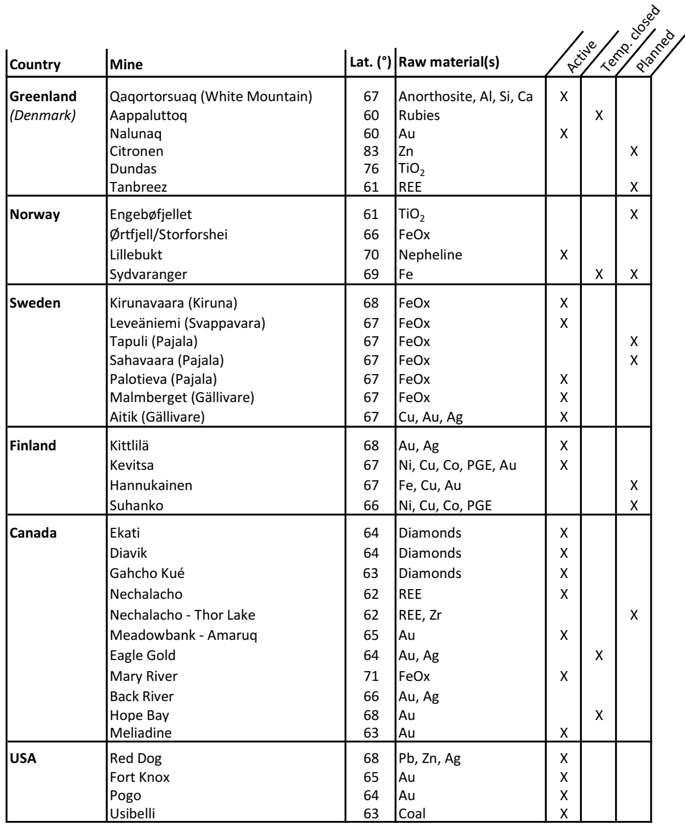
Table 1: Recension of Arctic mines susceptible to generating large dust emissions, based on data gathered from the internet web pages of operating companies or publicly available governmental sources, as of June 2025. Russia is excluded due to incomplete data. Only operating mines, or planned mines in advanced stages of development, are included.
Sources of dust emissions at Arctic mine sites
Dust emissions during mining and mineral processing may be produced by a range of activities including blasting to extract the ore from the ground, hauling the material, crushing it, and extracting the desired components (Fig. 1). All these processes produce dust with different elemental composition and particle size distribution (Csavina et al , 2011, 2012; Saarikoski et al., 2019; Saarikoski et al., 2017). Blasting, crushing and grinding (milling) of ores for mineral liberation commonly produces concentrates of minerals or metals, waste rock and tailings that contain large amounts of particles <150 µm. If improperly stored and managed, these fine-grained materials are prone to wind deflation and dispersion of fugitive dust over distances of tens of kilometers or more. This is especially concerning for open-pit mines operating in treeless, windswept subarctic and Arctic landscapes, as dust storms in these regions are known to transport sediments over much
longer distances, and even over open seas (e.g., Ranjbar et al. 2021, Baddock et al. 2025). Heavy vehicle operations over unpaved roads (e.g., for hauling ore, site construction, maintenance) further contribute to mobilize and disperse dust (Noble et al., 2017). In mines that operate smelters to refine ores, the impacts of dust emissions on the local environment are further compounded with those of stack emissions, which can emit greenhouse gases, acidifying gases (when processing sulfide ores) and fine aerosols enriched in toxic compounds, such as arsenic trioxide dust released when processing some gold ores (Ettler 2016, Csavina et al., 2011, 2012)
Fugitive dust arising from mining operations in the Arctic can be a serious concern to surrounding communities. This was recently illustrated by the Mary River iron oxide mine, Baffin Island, Canada, where local concerns about the impacts of dust dispersion from the mine brought a temporary halt to expansion plans (He et al., 2023)
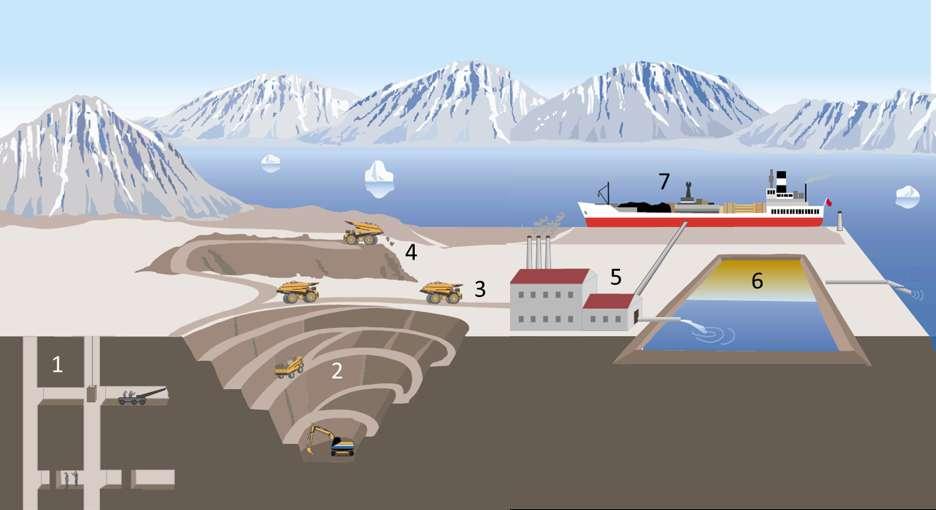
emissions from blasting, crushing, conveying, stockpiling, loading and hauling of host rock and ore in open pits; 3) fugitive emissions from unpaved haul road transportation; 4) fugitive emissions from waste rock deposition; 5) point source and fugitive emissions from processing plants and smelters; 6) fugitive emissions from tailings storage facilities including tailings beaches for slurry deposition and uncovered dry stacks; 7) ports and unloading facilities (Modified from (Johansen et al., 2001))
Potential impacts of mining dust on human health and environment
Emissions of mineral dust from mining operations can have negative impacts on surrounding environments and local communities (Cleaver et al., 2021). Mineral dust may contain metals, metalloids or sulfide minerals that are harmful to the environment and cause an increase in toxic metal concentrations or acidity in soils, which may in turn reduce water quality in water bodies (Cleaver et al., 2021) To quantify and mitigate the hazards posed by dust from mining operations it is crucial to understand both the mineralogy and geochemistry of the dust generated from all possible sources of emissions (Noble et al., 2017) Characterization of country rock native to the area, as well as ore, waste rock and tailings, both before and after physical and chemical treatment
Figure 1. Common sources of dust emissions in Arctic mines. 1) Underground operations and ventilation; 2) fugitive
of the mineral fractions, is essential for predicting the potential toxicity of dust in the terrestrial and aquatic environment
Direct health risks commonly associated with mining are deterioration of air quality and inhalation of dust particles. Depending on the size, shape and composition of the dust particles these can penetrate into the respiratory system causing lung cancer, silicosis and other adverse impacts to the respiratory system (Noble et al., 2017). In the Arctic, the remoteness of mining projects and low population density often limit exposure risks for local communities, as the majority of coarse mode particles most likely have settled out of the atmosphere before reaching local communities. In Greenland, Canada and Alaska the majority of active and/or approved mining operations are generally located far from local communities (PAME, 2025) creating isolated and local hotspots of industrial activity in otherwise pristine environments At these locations, the potential impacts on human health are mostly limited to the mine
Wind dispersal of mineral dust from the various emission sources in the mining project (Fig. 1) is a common pathway for the spread of both inert and reactive material into terrestrial and aquatic environments (Cleaver et al., 2021). Depending on the type of mining operation and geochemical composition of the dust, the dispersal can lead to bioaccumulation of heavy metals in soils, sediment, water bodies and vegetation. While field evidence on mining-related bioaccumulation of heavy metals is limited in the Arctic, studies from other regions show that elements such as cadmium, zinc and lead have the highest potential impact on soil contamination and risk to fauna and flora (Brumbaugh et al., 2011; Krasavtseva et al., 2023; Wieczorek et al., 2023)(Wieczorek et al., 2023)
Tundra ecosystems are sensitive to disturbance and slow to recover. To account for environmental costs of Arctic developments including mining, the cumulative impacts of dust emissions and dust deposition from all identified sources should be quantified (Myers-Smith et al., 2006). In the Arctic, significant increases of mineral dust deposition on vegetation in grazing areas for sheep, reindeer and musk oxen could potentially have negative impacts on animals via increased tooth wear and stunted plant growth (Glaze et al., 1982) Studies have shown that both dust and silica phytoliths contribute to reducing tooth volume during chewing. However, the way and the extent to which they individually contribute to tooth wear in natural conditions is unresolved and there is still debate as to whether dental microwear represents a dietary or an environmental signal (Merceron et al., 2016). Despite the uncertainties on factors that may influence tooth wear on animals, two factors are most often mentioned: (1) the endogenous physical properties of ingested foods and (2) the exogenous grit adhering to them (Spradley et al., 2016). Other studies have documented that increased anthropogenic dust inputs can have a direct impact on both substrate properties and changes in plant community composition over time (Myers-Smith et al., 2006; Walker & Everett, 1987)
In large parts of the ice-free areas of Greenland, the vegetation cover is impacted by elevated dust deposition from natural sources such as proglacial outwash plains (Anderson et al., 2017). An important knowledge gap exists regarding the natural resilience of current vegetation to the cumulative effects of increased dust inputs from expanded mining in these areas, and how the large grazers such as musk oxen and reindeer may be impacted. Similarly, additional dust emissions and depositions from proposed mining operations have raised significant concern amongst sheep farmers and non-governmental organizations (NGO’s) in South Greenland (Andersen, 2018).
The perceptions of local reindeer herders in Finland and Sweden on the impacts of the mining industry on their environment and reindeer herding and how herders cope with the impacts of mining were investigated through interviews by Turunen et al. (pers. comm., 2025). They found a perceived increasing impact of mineral dust deposition on terrestrial tundra and boreal forest ecosystems, which provide the foundation for the ecosystem services for the Indigenous and local people in the Arctic. While the Turunen et al. study assessed that long-term dust deposition predominantly affects plant communities via impacts on soil, others have reported different and indirect routes of action through which mineral dust from mines can affect the physiological responses of plants and induce secondary stresses such as drought, insects, pathogens or allow penetration of toxic elements and/or phytotoxic gaseous pollutants (Farmer, 1993).
Another consequence of windborne dust dispersion in cold environments is to lower the albedo (reflectance) of snow and ice-covered surfaces on which the dust is deposited which in turn promotes accelerated thaw and melt (Painter et al., 2018; Réveillet et al., 2022; He et al., 2023) This occurs because many types of dust, and especially those containing iron oxides, strongly absorb sunlight at visible to near-infrared wavelengths (e.g., Reynolds et al., 2014) This albedo-lowering effect was one of the concerns raised by Baffin Island Inuit residing near the Mary River iron oxide mine, where dust dispersion caused local changes to the characteristics the coastal sea ice surface (CBC, 2019; Nunatsiaq News, 2022), an important consideration for people who seasonally travel, fish and hunt on the sea ice
Regulatory framework and current practices for Arctic mines
All eight Arctic states (Canada, Finland, Iceland, the Kingdom of Denmark/Greenland, Norway, the Russian Federation, Sweden and the United States) have national legislation on Environmental Impact Assessments (EIA), which include the following general steps and requirements (Arctic Council, 2019):
1. Screening phase to determine if EIA is needed for the proposed mining project
2. Scoping phase where the content and extent of the EIA are defined.
3. Gathering of baseline data of pre-mining conditions.
4. Assessments and predictions of potential environmental impacts including the magnitude, probability of occurrence and extent of the identified potential impacts and their significance.
5. Definition of ways to mitigate impacts via mitigation plan or similar.
6. Summary EIA report compiles analysis of assessed impacts and forms the basis for public participation.
7. Plans for environmental monitoring are developed during the EIA.
8. Public display and quality control of EIA report after public participation.
9. The outcome of EIA is considered in decision-making and permitting.
The Environmental Law Alliance Worldwide (ELAW, 2010) and Global Reporting Initiative (GRI-Standards, 2024) both recommend that assessments and monitoring of fugitive dust dispersal and deposition be included in EIAs for mining projects. Such requirements are included
in EIA-guidelines and/or in regulations for mining projects in the USA (Alaska), Canada, Greenland, Finland and Sweden, as described below. These regulations cover assessments of potential impacts from dust (step 4) and plans for mitigation (step 5) and monitoring (step 7). Direct involvement of local communities and local knowledge during the EIA process is an important step to ensure transparency in decisions and appropriate protection of traditional landuses and rights of indigenous people.
In Alaska (USA), the General Mining Law is the primary legislation governing minerals on federal land, while the National Environmental Policy Act mandates environmental impact statements to evaluate the potential environmental effects of mining activities. In Alaska, the Department of Natural Resources oversees the exploration, development, and mining of the state’s mineral resources and the Department of Environmental Conservation provides Alaska Pollutant Discharge Elimination System permits (PAME, 2025). However, the permitting and regulatory compliance processes are complex and can involve many other agencies (Adams et al., 2025) For example, at the Red Dog gold mine, compliance with evolving regulations led to the gradual development of a comprehensive dust management plan by the mining company covering emissions from mine waste and haulage roads, accompanied by extensive monitoring of both airborne dust levels and deposition (Exponent, 2011)
In Canada, mining is regulated by frameworks designed to balance resource development with environmental protection and Indigenous rights. The Canadian Mineral and Metals Plan (2019) (Natural Resources Canada, 2019) sets directions to guide industry, government and stakeholder activities in the minerals and metals sector, along with approaches for environmental protection and responsible management. The federal government has gradually transferred responsibilities and powers over land and resources to provincial and territorial governments through devolution agreements (PAME, 2025). An example of this can be found in Yukon Territory's guidelines for mine waste management facilities (Hamilton et al., 2023), which specify operational and active closure monitoring requirements for dust. These guidelines specify the frequency at which airborne dust (or dust fallout) should be sampled, depending on the proximity to the mine, and of the type of dust-borne contaminants to be monitored, including particulates with aerodynamic diameters smaller than 2.5 or 10 µm (PM2.5 and PM10) and toxic metals. Results from dust monitoring should be used to interpret the contaminant loading and dust transport, to inform an adaptive management response of mine waste, and to identify environmental effects or trends ((Hamilton et al., 2023); see Table G-1).
In Finland, mining is regulated through the updated Mining Act (2023) (Finnish Ministry of Employment and the Economy, 2023). Provisions under this act are to be further adapted for mining activities in the Sámi Homeland, to secure the rights of the Sámi as an indigenous people to maintain and develop their language, culture and traditional livelihood. Dust monitoring is typically mandated through environmental permits issued under the Environmental Protection Act (Finnish Ministry of the Environment, 2021). These permits are tailored to each site, and air pollution dispersion monitoring is specified in each case. For example, in the Kevitsa open-pit nickel mine in Sodankylä, the granted mining permit specifies that ambient air concentrations of PM10 are to be measured at a minimum of two sites using continuous analyzers, over a period of at least 8 months, and subsequently at 3 year intervals, one such measurement period to coincide with the phase of maximum quarrying activity.
In Greenland, specific limit values for airborne dust concentrations are set to match international standards for air quality criteria for inhalable particulates (Mineral Resources Authority, 2015), which are typically in the range of 30-50 µg m-3 on a daily basis for PM2.5 and PM10 in most Arctic nations. An upper limit of 4 g m-2 is set for the monthly mean dust deposition rate at the border of a 500 m buffer zone around sources of dust emissions, which must be monitored for compliance by mining companies. In some cases, separate monitoring of background airborne dust concentrations at selected locations away from the mine may be required to evaluate the extent of dust dispersion. General environmental impacts by dust in the areas surrounding the mine are evaluated by the Environmental Agency for Mineral Resources Activities at the Government of Greenland and its scientific advisors.
In Norway, the Norwegian Government has the overarching ambition to develop the world’s most sustainable industry as formulated in the Norwegian Mineral Strategy (Norwegian Ministry of Trade, 2023). In March 2025, the Ministry of Trade, Industry and Fisheries published a new Minerals Act to replace the current 2009 legislation (Nærings- og fiskeridepartementet, 2025). The proposal aims to modernize both the legal framework for mineral activities in Norway and emphasize the protection of Sámi interests and rights in all traditional Sámi areas (Sápmi).
In Sweden, mining is regulated via The Minerals Act and the Minerals Ordinance and administered by the Mining Inspectorate of Sweden. Dust and dust management are regulated at different steps of the mine life. While the main focus is on dust generated during the mine's operational phase, restrictions may also be defined during the permitting process under the Minerals Act regarding dust dispersion during exploration and trial mining. Occupational exposure to inhalable silica dust is also regulated by the Swedish Work Environment Authority. During operation, a mining company must monitor dust emissions from the site and, if limit values are exceeded, take measures to protect the surrounding environment and settlements. The maximum permissible dust fallout rate is defined in the mine permit. For example, at the Aitik copper mine, this limit is set at 200 g 100 m-2 per month, and the dust collected is also analyzed for metal content (Boliden, 2018) Enforcement is done by municipalities and county administrative boards who are responsible for ensuring that environmental quality standards are met in planning, decision-making and permitting (EQS, 2010).
Dust mitigation and management methods
Dust management at mining projects is crucial for both the protection of workers (occupational health) and the surrounding environment. Especially for occupational health, The Hierarchy of Controls is a method of identifying and ranking safeguards to protect workers from hazards (NIOSH, 2021). They are arranged from the most to least effective and include elimination, substitution, engineering controls, administrative controls and personal protective equipment.
Hazard controls should be applied in the following order.
1. Elimination remove the hazard or the need to perform the hazardous activity.
2. Substitution substitute a safer alternative.
3. Engineering controls redesign or modify tools or equipment.
4. Administrative controls use training, rules, procedures to reduce the risk of the hazard.
5. Personal protective equipment provide fit-for-purpose protective equipment.
More than one control may be needed to adequately control the hazard. The controls used must be maintained to ensure they continue to remain effective, taking its feasibility into consideration. With mining dust, elimination and substitution of the dust hazard is often not possible due to the nature of operations and the protection of workers is commonly ensured by lower-level controls such as filtration and pressurization systems on enclosed cabs on mobile equipment to reduce dust exposure to operators, dry dust collection systems on drills etc. (NIOSH, 2021).
Best general practices for mitigating fugitive dust emissions from mining operations to the surrounding environment generally include (Barthe et al., 2018).
1. Spraying of extractive waste and roads used to transport the extractive waste with water, chemical dust suppressants and/or hygroscopic salts.
2. Capping of extractive waste with temporary or permanent covers
3. Covering of trucks or other machinery such as conveyors used for the transport of extractive waste
4. Construction design of haul road surfaces using coarse-grain materials
5. Use of pipelines to transport extractive waste resulting from mineral processing
6. Use of wind barriers or fences
7. Implementation of speed limits for trucks.
8. Implementation of wind speed restrictions for the handling of waste (no extractive waste handling in the case of strong winds).
9. Placement of ore crushing facilities in an enclosed environment with air filtration and dust collection.
10. Water sprays on material conveyors and water curtains on openings to the ambient atmosphere.
11. Landscaping and revegetation of dust prone surfaces.
12. Application of soil amendments to improve soil structure and promote plant growth. Spraying of water on dust prone materials is often the preferred option at mine sites as it often provides a low-cost and readily available solution. However, the frigid climate at Arctic mines limits the use of water-based solutions to dust suppression as spraying of water can lead to build up of ice on surfaces causing both operational and safety hazards. An alternative is to employ socalled chemical "dust suppressants" such as calcium chloride, hydrocarbon-based fluids or antifreeze emulsions that can be used in sub-freezing temperatures (Agnico Eagle, 2020; Dominion Diamond Mines 2020; Xia et al., 2024). However, the toxicity of commercially available dust suppressants is often unknown or poorly documented and efforts are now being directed at developing more innocuous and biodegradable versions of such products (Kunz et al., 2022). Finding workable alternatives to water application for efficient suppression of fugitive dust at Arctic mines thus remains a challenge and a topic for future research and development.
Dust monitoring methods
At most mine sites, monitoring of dust emissions is an essential part of the dust management strategy and control of environmental compliance (Noble et al., 2017). Dust management plans for mines in the Arctic typically include a combination of approaches including identification of potential sources of dust emission and control and technological ways to reduce emissions to mitigate dust dispersal, defining dust criteria for environmental compliance and systematic monitoring of deposition rates and geochemical properties of deposited dust, if the dust contains heavy metals or other deleterious substances.
Depending on the location of the mine, the operational procedures and the geochemical properties of the dust, a number of standardized monitoring methods can be applied varying both in sophistication (e.g., passive vs. active samplers) and adequacy for a given purpose (e.g., determination of different size fractions or collection of airborne particulates). The specific locations of monitoring stations and instrumentation should be planned to cover all potential sources of dust emissions as identified in the EIA and/or operational plans for the mine site and include control stations outside the area of potential impact by dust dispersal (Noble et al., 2017)
Passive samplers include various types of dust deposition gauges, such as the Bergerhoff sampler, dry foam frisbee samplers, directional samplers and more recently dry deposition samplers (Cleaver et al., 2022). The fundamental principle for all samplers is that they generally monitor total suspended particulates (TSP), do not require electrical power, are generally inexpensive to purchase and deploy and do not require extensive training or specialized skills to operate. In this way, passive samplers provide a cost-effective means to monitor dust in remote areas but can be prone to noncontrolled sample loss by turbulent resuspension of collected dust from the receptacles and/or over-icing under sub-zero weather conditions frequently present in the Arctic. For example at the Malmberget and Kiruna iron oxide mines in Sweden, dust fallout over the nearby populated areas is monitored using passive samplers and the data are publicly reported for specific elements of concern, such as trace metals (LKAB 2025)
Active samplers such as high and/or medium volume air samplers can be fitted with size selective inlets and thereby also sample particles in the PM2.5 and/or PM10 size range. The flow rate of air is controlled and recorded using flow regulators and microcontrollers by which known volumes of air can be passed through a filter media onto which the particles in the air stream are deposited for gravimetric determination and/or chemical analysis. Medium volume samplers can be operated also by batteries for possible measurements at off grid monitoring stations with operations extended by solar panels during the part of the year where sufficient incoming solar radiation is available.
While active and passive samplers provide measurements of average dust deposition and concentrations over the sampling period, real-time dust monitors can provide time-series on the variations of dust concentrations in the air based on measurement principles such as light scattering in optical particle counter and tapered element oscillating microbalances.
Qualitative monitoring of dust deposition in the Arctic can also be achieved using biota such as lichens (Riget et al., 2000; Cleaver et al., 2022; Pouillé et al., 2024) and is now included in most monitoring programs at Greenland mine sites as well as in other mines in subarctic Scandinavia such as the Aitik copper mine, Sweden (Boliden, 2018). Since lichens have no roots, all metals
accumulated in the tissue comes from atmospheric deposition. Hence, metal accumulation by lichens is a qualitative indicator of dust dispersion and deposition in areas surrounding mine site However, the direct correlation between metal accumulation rates in lichens and the corresponding dust deposition remains poorly quantified, especially in the Arctic where snowcovered periods may shorten dust exposure periods for ground-based lichens.
Summary and priorities for future research
The area of impact of fugitive dust emissions from Arctic mining operations is potentially farreaching. This is exemplified in the dust monitoring at the Mary River iron mine where dust impacts on snow albedo were observed more than 60 km away from the site, exceeding the distance between the mine and ground-based dust sampler reference sites installed for monitoring (He et al., 2023). Similar long-reaching impacts has been observed at Maarmorilik mine in Greenland where elevated metal concentrations in sediment and lichens where detectable up to 35 km from the mine (Søndergaard et al., 2011). These examples demonstrate that the monitoring of environmental impacts from dust has to be considered at not only the local but also regional scale. The particles size distribution of particulate matter originating from open pit mining area is typically dominated by submicron particles (PM1) resulting from vehicular emissions and super micron particles (PM1–PM10) for general mining activities, including re-suspended road dust (Timonen et al., 2018). For submicron particles, the particles can have a high contribution of black carbon and organics as is typical for engine emissions, whereas the coarse particles more directly reflect the mineralogical sources materials. Fine particulates such as those resulting from smelting operations may also disperse more readily into the environment and become more bioavailable due to their high specific surface area (Csavina et al., 2011). Appointment of various sources of dust emitted within a mine project has successfully been achieved using portable X-ray fluorescence spectroscopy and multivariate statistics to establish the geochemical fingerprint of emitted dust (Søndergaard & Jørgensen, 2021). Results indicate that this analytical approach may be an appropriate tool for quick and cost-effective dust source characterization for efficient identification of unexpected dust emissions at mine sites.
Sources of particles and dust due to mining activities remain poorly characterized in the scientific literature. This complicates the evaluation of environmental impacts of mining and health impact assessments. Important environmental knowledge gaps have been identified for the future improvement of dust management in Arctic mines (Huntsman et al., 2025). A strengthened focus on effective dust management strategies and techniques will improve the development of responsible mining in the Arctic, including reduction of emissions of dust and contaminants to air, water and soil encouraging both regulators and mining companies to adopt sustainable practices
In our review, the following main topics for future research have been identified:
1. Better characterization of dust monitoring techniques suitable for cold and remote Arctic conditions, including passive, active and biological samplers.
2. Improved understanding on the dust sampling efficiency of site-specific species of lichens for long-term qualitative dust monitoring.
3. More focus on the cumulative ecological impacts of mining dust on flora and fauna, including expanded investigations over space and time.
4. New methods for dust source apportionment – both within mining operations and in the surrounding environment
5. Expanded geochemical and mineralogical characterization of site-specific mining dust.
6. Better understanding on the fate of dust in the environment in both the terrestrial and aquatic environment, including potential for bioaccumulation and immobilization of heavy metals.
7. Better understanding on the impacts of mining dust on wildlife in surrounding areas, including feedback between feedstock quality and quantity.
8. Better understanding of the impacts of mining dust on the cryosphere (e.g., snow, glaciers and sea-ice) and feedback to climate change.
9. Targeted methods and techniques for minimizing dust emissions at mining operations in the Arctic, including fugitive emissions from unpaved roads and tailings facilities.
10. Definition of Best Available Technologies (BAT) and Best Environmental Practices (BEP) for dust management at Arctic mines.
11. More focus on testing procedures to predict the chemical and mineralogical properties of mineral dust from mining operations.
12. More focus on bridging the information gap between regulators, mining companies and local communities, including safeguarding the quality of habitats in respect and traditional, cultural and spiritual values of Indigenous communities.
Notes
1. Christian Juncher Jørgensen, Senior Researcher, Department of Ecoscience – Arctic environment, Aarhus University; Christian Zdanowich, Associate Professor, Department of Earth Sciences, Uppsala University; Pavla Dagsson-Waldhauserov, Lecturer, Agricultural University of Iceland & Czech University of Life Sciences Prague; Alexander Baklanov, Professor, Niels Bohr Institute, University of Copenhagen; Tuija Mononen, Senior Researcher, Department of Geographical and Historical Studies, CEMMS/Research Center for Mining, Minerals and Society, University of Eastern Finland; Yu Jia, Senior Advisor, Department of Environment and Minerals, Greenland Institute of Natural Resources; Christian Frigaard Rasmussen, PhD-fellow, Department of Ecoscience – Arctic environment, Aarhus University; Hilkka Timonen, Head of Aerosol Composition research group, Principal Scientist, Finnish Meteorological Institute; James King, Associate Professor, Department of Geography, University of Montreal; Patrick L. Hayes, Professor, Department of Chemistry, University of Montreal; Christian Maurice, Associate Professor, Luleå University of Technology; Outi Meinander, Senior Research Scientist, Finnish Meteorological Institute.
References
Adams, E., Hoffman, N., Lechtenberg, J., Plummer, K. A., Winterhalter, J., Sergeant, C. J., & Beaudreau, A. H. (2025). Excavating the regulatory process and risks posed by Alaska hardrock mine expansions. FACETS, 10, 1-19. https://doi.org/https://doi.org/doi/10.1139/facets-2024-0175
Agnico Eagle (2025) Meliadine Gold Project Dust Management Plan, 18 p., retrieved from https://www.nirb.ca/portal/dms/script/dms_download.php?fileid=354014&application id=125 515&sessionid=cei9egstruln50b0q6tfkdt8n0
Andersen, M. K. (2018). Chefredaktøren anbefaler: Kan dæmningen holde? Sermitsiaq. https://www.sermitsiaq.ag/erhverv/chefredaktoren-anbefaler-kan-daemningenholde/620358
Anderson, N. J., Saros, J. E., Bullard, J. E., Cahoon, S. M. P., McGowan, S., Bagshaw, E. A., Barry, C. D., Bindler, R., Burpee, B. T., Carrivick, J. L., Fowler, R. A., Fox, A. D., Fritz, S. C., Giles, M. E., Hamerlik, L., Ingeman-Nielsen, T., Law, A. C., Mernild, S. H., Northington, R. M.,…Yde, J. C. (2017). The Arctic in the Twenty-First Century: Changing Biogeochemical Linkages across a Paraglacial Landscape of Greenland. Bioscience, 67(2), 118-133. https://doi.org/10.1093/biosci/biw158
Arctic Council. (2019). Good Practices for Environmental impact Assessment and Meaningful Engagement in the Arctic. A. Council. http://hdl.handle.net/11374/2377
Baddock, M., Hall, A., Rideout, J., Bryant, R., Bullard, J. and Gassó, S. (2025), Satellite observations of Arctic blowing dust events >82°N. Weather, 80: 61-66. https://doi org.ezproxy.its.uu.se/10.1002/wea.7617
Barthe, P., Eder, P., Saveyn, H. G. M., Orveillon, G., & Garbarino, E. (2018). Best available techniques (BAT) reference document for the management of waste from extractive industries – In accordance with Directive 2006/21/EC. Publications Office. https://doi.org/doi/10.2760/35297
Boliden. (2018). Damningssituationen i Aitik idag och i framtiden (1190480).
Boliden (2018) Damningssituationen i Aitik idag och i framtiden (Dust situation at Aitk at present and in the future), 50 pp. accessible at: https://gallivare.se/download/18.4e20a890188bda337d11eaf8/1687108944114/Damnin gsutredning%2020180507.pdf (last accessed 17 Oct 2025)
Brumbaugh, W.G., Morman, S.A. & May, T.W. Concentrations and bioaccessibility of metals in vegetation and dust near a mining haul road, Cape Krusenstern National Monument, Alaska. Environ Monit Assess 182, 325–340 (2011). https://doi.org/10.1007/s10661-0111879-zCanadian Broadcasting Corporation (CBC) (2019) "Baffinland must reduce ore dust blowing onto ice: report". CBC News, 2 Sept. 2019. https://www.cbc.ca/news/canada/north/mary-river-winter-report-1.5264916
Cleaver, A. E., Jamieson, H. E., Rickwood, C. J., & Huntsman, P. (2021). Tailings dust characterization and impacts on surface water chemistry at an abandoned Zn-Pb-Cu-AuAg deposit. Applied Geochemistry, 128. https://doi.org/10.1016/j.apgeochem.2021.104927
Cleaver, A. E., White, H. P., Rickwood, C. J., Jamieson, H. E., & Huntsman, P. (2022). Field comparison of fugitive tailings dust sampling and monitoring methods. Sci Total Environ, 823, 153409. https://doi.org/10.1016/j.scitotenv.2022.153409
Csavina, J., Field, J., Taylor, M. P., Gao, S., Landazuri, A., Betterton, E. A., & Saez, A. E. (2012). A review on the importance of metals and metalloids in atmospheric dust and aerosol from mining operations. Sci Total Environ, 433, 58-73. https://doi.org/10.1016/j.scitotenv.2012.06.013
Csavina, J., Landazuri, A., Wonaschutz, A., Rine, K., Rheinheimer, P., Barbaris, B., Conant, W., Saez, A. E., & Betterton, E. A. (2011). Metal and Metalloid Contaminants in Atmospheric Aerosols from Mining Operations. Water Air Soil Pollut, 221(1-4), 145-157. https://doi.org/10.1007/s11270-011-0777-x
Dominion Diamond Mines (2020) Ekati Diamond Mine Dust Suppression Pilot Study Report, 2018/2019, 38 p. retrieved from https://reviewboard.ca/upload/project_document/B.1_Dust%20Suppression%20Pilot %20Stud y%20Report%202018%20-%202019_FINAL.pdf
ELAW. (2010). Guidebook for Evaluating Mining Project EIAs. E. L. A. Worldwide. https://elaw.org/wpcontent/uploads/archive/attachments/publicresource/guidebook_for_evaluating_minin g_project_eias_english.pdf
Ettler, V. (2016) Soil contamination near non-ferrous metal smelters: A review. Applied Geochemistry, 64, 56-74. https://doi.org/10.1016/j.apgeochem.2015.09.020
EQS. (2010). Förordning med miljökvalitetsnormer (MKN) för utomhusluft, luftkvalitetsförordningen. (2010:477).
Exponent. (2011). Red Dog Operations Alaska 2011 - Fugitive Dist Risk ManagementMonitoring Plan. Summary of the Red Dog fugitive dust management workshop, Kotzebue, AK.
Farmer, A.M (1993) The effects of dust on vegetation - a review. Environmental Pollution, Vol. 79 Pages 63-75. https://doi.org/10.1016/0269-7491(93)90179-R
Finnish Ministry of Employment and the Economy. (2023). Mining Act. (621). Ministry of Employment and the Economy Retrieved from https://finlex.fi/api/media/statuteforeign-language-translation/124987/mainPdf/main.pdf?timestamp=2011-0610T00%3A00%3A00.000Z
Finnish Ministry of the Environment. (2021). Environmental Protection Act. (2014-527). Finnish Ministry of the Environment
Glaze, R. L., Hoefs, M., & Bunch, T. D. (1982). Aberrations of the tooth arcade and mandible in dall's sheep from southwestern Yukon. Journal of Wildlife Diseases, 18(3), 305-309. https://doi.org/10.7589/0090-3558-18.3.305
GRI-Standards. (2024). GRI 14: Mining Sector 2024. In: Hamilton, C., Hutchison, I., Trimble, R., Slater, B., & Van Zyl, D. (2023). Guidelines for Mine Waste Management Facilities. G. o. Yukon. https://yukon.ca/sites/default/files/emr/emr-guidelines-mine-waste-managementfacilities.pdf
He, L., White, H. P., & Chen, W. (2023). Compounded Impacts of Global Warming and Anthropogenic Disturbances on Snowmelt in Northern Baffin Island. Remote Sensing, 15(2), 313. https://doi.org/10.3390/rs15020313
Huntsman, P., Cleaver, A., Berryman, C., Rickwood, C., Zargrtdenov, N., Jamieson, H., Martineau, C., Fenton, N., & White, H. (2025). Fugitive mine dust: evaluation of innovative monitoring and characterization techniques. Geomatics Canada, Open File, 94 https://doi.org/https://doi.org/10.4095/paevmnxvz
Johansen, P., Asmund, G., Glahder, C. M., Aastrup, P., & Secher, K. (2001). Minedrift og miljø i Grønland (TEMA-rapport fra DMU,, Issue.
Krasavtseva, E.; Maksimova, V.; Slukovskaya, M.; Ivanova, T.; Mosendz, I.; Elizarova, I. Accumulation and Translocation of Rare Trace Elements in Plants near the Rare Metal Enterprise in the Subarctic. Toxics 2023, 11, 898. https://doi.org/10.3390/toxics11110898Khani, H.M., Kinnard, C. and Lévesque, E. (2022) Historical Trends and Projections of Snow Cover over the High Arctic: A Review. Water 14 (587). https://doi.org/10.3390/w14040587
LKAB (2025) https://lkab.mediaflowportal.com/documents/folder/215461/ (last accessed 17 Oct 2025)
Meinander, O., Dagsson-Waldhauserova, P., Amosov, P. et al. (2022) Newly identified climatically and environmentally significant high-latitude dust sources, Atmospheric Chemistry and Physics, 22, 11889–11930, https://doi.org/10.5194/acp-22-11889-2022.
Merceron, G., Ramdarshan, A., Blondel, C., Boisserie, J.-R., Brunetiere, N., Francisco, A., Gautier, D., Milhet, X., Novello, A., & Pret, D. (2016). Untangling the environmental from the dietary: dust does not matter. Proceedings of the Royal Society B: Biological Sciences, 283(1838), 20161032. https://doi.org/10.1098/rspb.2016.1032
Mineral Resources Authority (2015) Guidelines for preparing an Environmental Impact Assessment (EIA) report for mineral activities in Greenland. Government of Greenland. https://govmin.gl/wp-content/uploads/2022/05/VVMEIA_UK.pdf
Myers-Smith, I. H., Arnesen, B. K., Thompson, R. M., & Chapin, F. S. (2006). Cumulative impacts on Alaskan arctic tundra of a quarter century of road dust. Ecoscience, 13(4), 503-510. https://doi.org/10.2980/1195-6860(2006)13[503:CIOAAT]2.0.CO;2
Natural Resources Canada. (2019). The Canadian mineral and metals plan. (M4-175/2019E-PDF).
Natural Resources Canada Retrieved from https://publications.gc.ca/site/eng/9.867510/publication.html
Neitlich, P.N., Berryman, S., Geiser, L.H., Mines, A., Shiel, A.E. (2022) Impacts on tundra vegetation from heavy metal-enriched fugitive dust on National Park Service lands along
the Red Dog Mine haul road, Alaska. PLoS ONE 17(6): e0269801. https://doi.org/10.1371/journal.pone.0269801
Neitlich, P.N., Wright, W., Di Meglio, E., Shiel, A.E., Hampton-Miller, C.J. & Hooten, M.B. (2024) Mixed trends in heavy metal-enriched fugitive dust on National Park Service lands along the Red Dog Mine haul road, Alaska, 2006–2017. PLoS ONE 19(2): e0297777. https://doi.org/10.1371/journal.pone.0297777
NIOSH. (2021). Best practices for dust control in coal mining (2021-119). https://www.cdc.gov/niosh/docs/2021-119/2021119.pdf?id=10.26616/NIOSHPUB2021119
Noble, T. L., Parbhakar-Fox, A., Berry, R. F., & Lottermoser, B. (2017). Mineral Dust Emissions at Metalliferous Mine Sites. In (pp. 281-306). Springer International Publishing. https://doi.org/10.1007/978-3-319-42731-7_16
Norwegian Ministry of Trade, I. a. F. (2023). Norwegian Mineral Strategy. Government of Norway Retrieved from https://www.regjeringen.no/contentassets/1614eb7b10cd4a7cb58fa6245159a547/norge s-mineralstrategi_engelsk_uu.pdf
Nunatsiaq News (2022) "Baffinland exceeded dust impact projections for 3 straight years: QIA" Nunatsiaq News, 14 Oct 2022, https://nunatsiaq.com/stories/article/baffinland-exceededdust-impact-projections-for-3-straight-years-qia/
Nærings- og fiskeridepartementet. (2025). Lov om mineralvirksomhet og forvaltning av mineralressurser (mineralloven). (Prop. 71 L (2024–2025)). Government of Norway Retrieved from https://www.regjeringen.no/no/dokumenter/prop.-71-l-20242025/id3093558/?ch=1
Painter, T.H., Skiles, S.M., Deems, J.S. et al. (2018) Variation in rising limb of Colorado River snowmelt runoff hydrograph controlled by dust radiative forcing in snow. Geophys. Res. Lett. 45, 797–808. https://doi.org/10.1016/j.asr.2011.12.021
PAME. (2025). Arctic Mining - Environmental issues, mitigation and pollution control for marine and coastal mining. AMAP. https://oaarchive.arctic-council.org/bitstreams/b4c5976c-3b25-42db8c8e-93dd9ae23fbc/download
S. Pouillé, J. Talbot, A. E. Tamalavage, M. É. Kessler-Nadeau and J. King (2024) Impacts of Mineral Dust on Trace Element Concentrations (As, Cd, Cu, Ni and Pb) in Lichens and Soils at Lhù’ààn Mân’ (Yukon Territory, Canada). Journal of Geophysical Research: Biogeosciences. Vol. 129 Issue 6, https://dx.doi.org/10.1029/2023jg007927
Ranjbar, K., O'Neill, N., Ivanescu, L., King, J. & Hayes, P.L. (2021) Remote sensing of a highArctic, local dust event over Lake Hazen (Ellesmere Island, Nunavut, Canada), Atmospheric Environment, 246, 118102, https://doi.org/10.1016/j.atmosenv.2020.118102.
Réveillet, M., Dumont, M., Gascoin, S. et al. (2022) Black carbon and dust alter the response of mountain snow cover under climate change. Nat. Commun. 2022, 13, 5279. https://doi.org/10.1038/s41467-022-32501-y
Reynolds, R.L., Goldstein, H.L., Moskowitz, B.M. et al. (2014) Composition of dust deposited to snow cover in the Wasatch Range (Utah, USA): Controls on radiative properties of snow cover
and comparison to some dust-source sediments. Aeolian Res. 15, 73-90, https://doi.org/10.1016/j.aeolia.2013.08.001.
F. Riget, G. Asmund and P. Aastrup (2000) The use of lichen (Cetrarianivalis) and moss (Rhacomitriumlanuginosum)as monitors for atmospheric deposition in Greenland. Science of the Total Environment, Vol. 245 Issue 1-3 Pages 137-148, https://doi.org/10.1016/S00489697(99)00439-8
Spradley, J. P., Glander, K. E., & Kay, R. F. (2016). Dust in the wind: How climate variables and volcanic dust affect rates of tooth wear in central american howling monkeys. American Journal of Physical Anthropology, 159(2), 210-222. https://doi.org/https://doi.org/10.1002/ajpa.22877
Søndergaard, J., Johansen, P., Asmund, G., & Riget, F. (2011). Trends of lead and zinc in resident and transplanted Flavocetraria nivalis lichens near a former lead-zinc mine in West Greenland. Sci Total Environ, 409(19), 4063-4071. https://doi.org/10.1016/j.scitotenv.2011.06.054
Søndergaard, J., & Jørgensen, C. J. (2021). Field Portable X-Ray Fluorescence (pXRF) Spectrometry for Chemical Dust Source Characterization: Investigations of Natural and Mining-Related Dust Sources in Greenland (Kangerlussuaq Area). Water Air and Soil Pollution, 232(4), Article 144. https://doi.org/10.1007/s11270-021-05095-2
Saarikoski, S., Salo, L., Bloss, M., Alanen, J., Teinilä, K., Reyes, F., Vázquezuez, Y., Keskinen, J., Oyola, P., Rönkkö, T., & Timonen, H. (2019). Sources and Characteristics of Particulate Matter at Five Locations in an Underground Mine. Aerosol and Air Quality Research, 9(12), 2613-2624. https://doi.org/10.4209/aaqr.2019.03.0118
Saarikoski, S., Teinilä, K., Timonen, H., Aurela, M., Laaksovirta, T., Reyes, F., Vásques, Y., Oyola, P., Artaxo, P., Pennanen, A., Junttila, S., Linnainmaa, M., Salonen, R., & Hillamo, R. (2017). Particulate matter characteristics, dynamics and sources in an underground mine. Aerosol Science and Technology, 52, 00-00. https://doi.org/10.1080/02786826.2017.1384788
Timonen, H., Teinilä, K., Aurela, M., Reyes, F., Vásquez, Y., Bloss, M., Oyola, P., Hillamo, R., Asmi, E., & Saarikoski, S. (2018). Sources and composition of particulate matter in boreal arctic environment next to an active mining area. Boreal Environment Research, 23, 105-125.
Walker, D. A., & Everett, K. R. (1987). Road Dust and its Environmental Impact on Alaskan Taiga and Tundra. Arctic and Alpine Research, 19(4), 479-489. https://doi.org/10.1080/00040851.1987.12002630
Wieczorek, J., Baran, A., & Bubak, A. (2023). Mobility, bioaccumulation in plants, and risk assessment of metals in soils. Sci Total Environ, 882, 163574. https://doi.org/10.1016/j.scitotenv.2023.163574
Xia, S., Song, Z., Zhao, X. et al. (2024) Study on preparation and properties of antifreeze compound road dust suppressant. Sci. Rep. 14, 16642, https://doi.org/10.1038/s41598-02467683-6
Jørgensen et. al.
Decolonization in Greenland and Nunavut and Resource Exploitation for a Decarbonized World: What does an Arctic Century mean?
Anna Soer
The Arctic is again at the crux of global attention. While several regions globally are facing intensified interest for their natural resources, Greenland has similarly faced recent rising attention from regional Arctic actors, such as the United States of America, and globally, such as China. Greenland is appearing to be referred to as the 21st Century Kingmaker by some policy commentators. What does this Arctic century mean and for whom? The mining of minerals is rising to support a global energy transition and industrial needs, sparking geopolitical battles of influence and interests where global powers such as the US and China are entering in competition to secure these resources. While global attention is veering towards the mineral-rich Arctic, especially Greenland and Nunavut, some dynamics – such as the purchase proposal of Greenland made by President Trump – clash with regional dynamics of self-determination from state colonial powers. As the Nunavut Lands and Resources Devolution Agreement came into effect in January 2024, and as Greenland is continuing its course to secure independence from Denmark, regional self-governance is confronted by strategic imperial maneuvering by global powers. Global energy transition goals, as supported by the United Nations SDGs, while under the banner of sustainable development, thereby spark foundational discussions pertaining to “glocal” governance and human security in a decarbonized world. Echoing Saami critiques of green colonialism, this study aims to question the notion of peace and security through resource exploitation in Greenland and Nunavut as global powers seek to secure their interests in the region, sparking the Arctic Century. This study is supported by qualitative content analysis of policy documents, media articles, and interviews with key Greenlandic and Nunavummiut stake- and rights- holders conducted in 2024. The study contributes to the study of Arctic security through the development of Arctic decolonial ecological security shaping natural resources development in Nunavut and Greenland.
Introduction
As U.S. Vice President J.D. Vance left Greenland after a whirlwind of statements late March and early April 2025, the threat of U.S. invasion – whether through military, economic, or political control, or a mixture of all of the above – rang alarm bells among Greenlanders and the Danish government (Edvardsen & Hansen, 2025; Livesay et al., 2025). President Trump has “to have
Anna Soer is a PhD candidate at the University of Ottawa in political science. She is also affiliated with the Observatoire de la politique et de la sécurité de l’Arctique (OPSA).
Greenland” and Vice President Vance warns that the world can’t “bury our heads in the sand – or in this case the snow” (ibidem).
These explicit threats confront how the Arctic was once referred to as Exceptional – a region framed within a paradigm of peace and cooperation separate from outside geopolitical tensions. Despite a media tendency to portray Arctic Peoples and governments as almost powerless against the titans of the global community – such as the U.S. and China – Arctic peoples and their governments have, over the past decades, built up their resilience and self-determination law-bylaw (Loukacheva, 2007a; Soer, 2025). The creation of the Territory of Nunavut in 1999 following the Nunavut Act of 1993, and the signing of Greenland’s Home Rule Act in 1978 and the SelfGovernment Act in 2008, forged into law a current of regional Inuit self-determination in response to colonial state violence. As Greenland and Nunavut continue to enact their governance and selfdetermination, international frameworks such as the United Nations Declaration for the Rights of Indigenous Peoples (UNDRIP) and the Sustainable Development Goals have shaped dynamics towards sustainable development and environmental justice within domestic legal frameworks. However, this dynamic is facing contestation from industry pressures and international state actors. As the Arctic Ocean may become ice-free in the summer by 2050, these prospects open economic speculations on the increase of the shipping industry in the region – including tourism and other commercial sectors such as fisheries (Dawson et al., 2014; Dawson, 2018; van Luijk et al., 2021) While offshore oil and gas drilling has been banned under Canadian law since 2019 under the Order Prohibiting Certain Activities in Arctic Offshore Waters, and similarly banned under Greenlandic law since 2021, the Trump presidency and the opening of Norwegian Arctic waters in the Barents Sea for exploration mark rising interests towards Arctic resources, where the region is estimated to hold 90 billion barrels of oil, 1,669 trillion cubic feet of gas, and 44 billion barrels of natural gas liquids. These estimates were drawn by the United States Geological Survey in 2008 (Bird et al., 2008). 84% of these undiscovered Arctic resources are estimated to be offshore.
Similar dynamics underpin the development of the mining industry. Greenland and Nunavut are estimated to hold significant mineral resources. While Canada has some of the largest reserves of Rare Earth Elements worldwide, Canada is not a commercial producer with all projects still in exploratory or processing phases (Natural Resources Canada, 2025). Greenland is seeking to further develop its resource exploitation sector as its Mineral Resources Strategy 2025-2029 indicates. Nunavut, while also considering the mining sector as an important vector for the territory’s economy and livelihood opportunities, has restricted its commercial and mining land use under its new 2025 Land Use Plan.
Against this rush towards resource exploitation, the reality is much more nuanced. Qualified highskilled labour is currently lacking in both Greenland and Nunavut, as well as infrastructures such as roads and overall connectivity just to name these two. Additionally, environmental impacts assessment regulations and local ecological epistemologies further frame the development of the sector. The Arctic century is thereby framed at the crux between resource exploitation and its global geopolitical repercussions within great power politics convening at the regional level. As such, this study seeks to question the framing of both peace (cooperation) and security (hard and human) amidst this crux between regional natural resources development and international relations. Oran Young, in his seminal work on the study of Arctic politics, links Arctic Exceptionalism to environmental management of common resources, with the addition of Indigenous self-
determination (1992, p.11-18). These linkages are here analyzed as well, amidst growing regional tensions, renewed interests in natural resource development, and Inuit self-governance. As such, while domestic and global pressures appear to be rising in the region to push towards intensified natural resource exploitation, the sector is nonetheless shaped by the confrontation of both domestic ecological concerns shaped by Inuit epistemologies (ecological security), local capacity constraints, and these international economic and political pressures – thereby inscribing Arctic environmental management within the analysis of regional security dynamics.
As resource exploitation in this context of global energy transition goals is reaching the realm of national critical security, and as the Arctic is gaining global momentum for this exploitation, governance becomes a balancing act of interests between state sovereignty, local decision-making powers of Arctic Peoples, global economic development, and foreign states’ Arctic investments. These interconnections between local and global dynamics form a glocal governance, where it is precisely these continuous interconnections that shape both local and global governance as applied to the Arctic region. The puzzle of Arctic environmental governance as seen through the two cases of Nunavut and Greenland is reaching a fracturing point. As some are claiming that the 21st century will be an Arctic Century with Greenland as its Kingmaker (Menenez, 2025), this study seeks to re-evaluate the notion of peace and security (Exceptionalism) through the lens of resource exploitation (environmental governance) in Greenland and Nunavut in juxtaposition with Indigenous self-determination as global powers aim to secure their interests in the region (regional security dynamics). The three key themes – environmental governance, exceptionalism, and security – are thereby shaped by a complex web of interconnected concepts – power and sustainability, the resource curse, and decolonial ecological security – seen here through structuration theory, which highlights the interconnectedness.
This article is divided in two sections. The first section is divided into three subsections: (i) a critical assessment of the notion of Arctic Exceptionalism; (ii) a re-evaluation of capacity constraints in Nunavut and Greenland; and (iii) an analysis of power dynamics under structuration theory. Using the analysis on power dynamics under the framework of structuration theory, the second section delves into the ideological crossroads of sustainable natural resource development. This section is supported by four phases: (i) an inquiry in Inuit development juxtaposed to colonial development frameworks, (ii) the juxtaposition of (human) rights and sovereignty in resource development, (iii) the confrontation of the resource curse with global energy transition, and (iv) a theoretical reflection on Arctic decolonial ecology as security. These areas of inquiry offer insights into what this Arctic Century might entail. The analysis of the two sections is supported by qualitative thematic content analysis of policy documents, legal Acts and Agreement, scientific publications, and interviews with key Greenlandic (3) and Nunavummiut (18) stake- and rights- holders conducted in 2024. The interviews conducted primarily in Nunavut (18), with the addition of key political and economic stakeholders in Greenland (3), are utilized under a thematic content analysis framework, from which the key themes extracted and juxtaposed to the wider scientific literature on the subject and to government public policies. The interviews, conducted with local inhabitants and representatives from the private energy sector and the public sector (both territorial government and municipal government), touched on several topics related to incorporation of Indigenous knowledge in public policy on energy development, and to the public-private collaborative potential in the Arctic region. The government policies and Acts and Agreements analyzed for this study, both Canadian and Greenlandic, relate directly to natural resources
development (such as devolution agreements, the Nunavut Wildlife Act, or the Critical Minerals Strategy), and to consultation (such as the Canadian Duty to Consult framework, and economic development frameworks such as the ESG Framework). Thematic content analysis serves to extract tendencies, operative frameworks, and epistemological conceptualizations surrounding how security and peace are shaped by environmental management of natural resources.
Arctic Exceptionalism: Between Myth and Hope for a Better World
Arctic Exceptionalism has been used repeatedly to describe Arctic relations by both experts of the region and by the media – first developed by Oran Young in his landmark seminal work on conflict and cooperation to describe a region unique in common resources management (1992). Amidst global tensions between states, the Arctic has been portrayed as an area of peace and scientific cooperation where animosity has been kept outside its borders (Devyatkin, 2023; Gerhardt, et al., 2010; Lackenbauer, Kikkert, 2009; Olesen, 2020; Volquardsen, 2025; Young, 1992). With the Arctic Council at its center, Arctic Exceptionalism remained viable with the Council standing as a model of cross-border scientific cooperation, bridging fields and languages. Governance in several areas, including environmental governance, has been spearheaded by the 8 Arctic member states, 6 Permanent Participants representing the Indigenous Peoples of the Arctic, and 38 observers, implementing work through the 6 working groups on contaminants, monitoring and assessment, conservation of flora and fauna, emergency prevention and preparedness and response, marine environment protection, and sustainable development. Since the creation of the Arctic Council in 1996, the organization has seen many Chairs and has provided an important venue for the negotiation of three international agreements on cooperation on aeronautical and marine search and rescue in 2011, cooperation on marine oil pollution preparedness and response in 2013, and enhancing international Arctic scientific cooperation in 2017. Anchored in the legacy of the Arctic Environmental Protection Strategy establised in 1991, the Arctic Council has been representative of what it means for the Arctic to be a “region of peace, stability and constructive cooperation, that is a vibrant, prosperous, sustainable and secure home for all its inhabitants, including Indigenous Peoples, and where their rights and wellbeing are respected. (Arctic Council, n.d.)”
Against the reality of scientific cooperation, the Arctic has also been central in military preparedness. Several U.S. military bases were constructed in Greenland during the Cold War, and the DEW Line – Distant Early Warning Line – established from 1957 until 1993, was set to detect an air attack from the Soviet Union. Iqaluit’s airport was first established as a military airport and is now also used as an operating base by the Royal Canadian Air Force (Gagnon, 2002). The fall of the USSR signaled a different era for the Arctic, but the underlying military preparedness never disappeared. This first section seeks to question this notion of Exceptionalism, confronting it with Indigenous voices and perspectives, debate about capacity, and through an inquiry into the theoretical framework supporting this confrontation using structuration theory. This section serves as a foundation for the second half of this study, which delves specifically into the sustainability debate – environmental protection and governance which as developed above supported Arctic exceptionalism and the creation of the Arctic Council.
Genesis of Exceptionalism in the Arctic: Indigenous Voices
While the Arctic Council was established in 1996, the Inuit Circumpolar Council was established in 1977 and represents the Inuit of Alaska, Canada, Greenland, and Chukotka. Canada’s attention towards the Arctic included the enforcement of colonial violence. From forced relocations, forced
sedentarisation, project surname, and residential schools, the Inuit of Canada have experienced the worst of the country’s colonial legacy as the federal government of Canada aimed to secure its sovereignty claims over its Arctic territory against competing interests from regional actors such as the U.S. (Dunning, 2013; Tassinari, 1995; F. Tester & Kulchyski, 2011). Danish involvement in Greenland has a longer history, but the colonial violence is similar with forced sterilisation of Inuit girls and women, theft of Inuit children put into Danish families, as well as forced sedentarisation (Bryant, 2024; Olsen, 2024). From either side of the Baffin Sea, the rush towards the Arctic during and after the Second World War meant the continuation and increase of colonial violence, disregard for Inuit life, and disregard for ecosystems as well. The creation of the ICC came about to strengthen Inuit resilience against this colonial wave. The ICC represents an adaptation to western legal and institutional frameworks in order to anchor self-determination strategies in Westphalian terms and is an act of cultural revival for Inuit governance (Ackrén, 2022; Soer, 2023; Tagalik et al., 2023)
Inuit self-determination was fought for by Inuit leaders and communities, aided by international (Indigenous) movements towards human rights and Indigenous rights. The Universal Declaration of the Human Rights in 1948, human security as defined by the UNDP’s Human Development Report of 1994, and the UN Declaration of the Rights of Indigenous Peoples in 2007, paved the way for the institutional and legal support of both Greenland’s and Nunavut’s rights against colonial violence and in favor of self-determination. Greenland and Nunavut, as well as the many other Indigenous nations worldwide, served as precursors for the adoption of some of these international frameworks (Assembly of First Nations, 2017; Cambou, 2020; Government of Canada, 2021; United Nations, 1948, 1994). The Nunavut Act of 1993 utilized the existing governance framework of Canada – federalism – to position themselves accordingly in negotiation strategies. Similarly, Greenland’s Home Rule Act of 1978 utilized the existing governance frameworks of Denmark – keen to be seen as the ‘good colonizer’ as well as using the political representation in parliament developments of the 1970s – to position themselves with the Danish state (Ackrén, 2022, 2024)
For Greenland, the Second World War meant an ambivalent status as a U.S. protectorate in 1941 during the Nazi invasion of Denmark – a protectorate status sparked by plans of other powers such as the UK and Canada to take control over certain parts of the island – and remained under Danish control after the war. The establishment of U.S. military bases and diplomatic relations during that time propelled Greenland into imperial circumpolar diplomacy by incorporating the island in global security concerns amidst the Second World War and Cold War (Ackrén, 2022)
Inuit leadership in Nunavut anchored their claims in the modern treaty process – also known as comprehensive land claims agreements – started by the James Bay and Northern Québec Agreement of 1975 led by the Cree, Inuit, and Naskapi. Leadership by the Kalaallit and Nunavummiut supported Inuit self-determination and self-government, enabled by both domestic frameworks and international frameworks, and supported the stabilization of the Arctic region and further contributes to global environmental management (Zellen, 2022; Osakada, 2022)
As such, the notion of exceptionalism – understood as a zone of institutionalized diplomacy and scientific collaboration in environmental management and governance – becomes more nuanced when Indigenous perspectives are included and foregrounded. Colonial violence and disregard of Inuit interests has shaped contemporary dynamics in Nunavut and Greenland, a violence also
enacted by the private sector (Bellehumeur, 2020; M. Hansen, 2025; Jørgensen, 2025; Pauktuutit, Inuit Women of Canada et al., 2014). Despite the devolution agreement signed in 1993, it required the passing of the Lands and Resources Devolution Agreement in 2024 for Nunavut to gain the ability to administer lands, development and resource management, receive royalties on public lands, and has the opportunity to “continue strengthening education, employment and other northern-led investments in land and resource development” (CIRNAC, 2024). It took 32 years after the signing of the 1993 Nunavut Agreement for the transfer of responsibilities over public lands, natural resources, and water rights – in other words, key areas of environmental governance - to be made from the Federal Government of Canada to the Government of Nunavut. On Greenland’s side, the Home Rule Act of 1978 and the Self-Government Act of 2008 came about as Greenlandic political representation in Danish parliament became possible in 1970s where greater Kalaallit autonomy could be put on the agenda also in retaliation of colonial social policies, once again through Kalaallit advocacy (Ackrén, 2022)
The Self-Government Act recognized Greenlanders as “a people according to international law with the right to self-determination” (Ackrén, 2022, p.5) and natural resources and their management were now under the jurisdiction of the Greenlandic government. Despite greater control, some mining activities, such as shown in the 2025 documentary “Greenland’s White Gold” [Grønlands Hvide Guld], have continued to undermine communities’ development and wellbeing through lack of environmental and workers’ rights oversight (Hansen, 2025; Hansen, Johnstone, 2019; Hubbard, 2013; Nuttall, 2012; Larsen, Ingimundarson, 2023; Larsen, Huskey, 2020; Stefánsdóttir, 2014). From the perspective of human security, therefore, intrinsically linked to environmental management, Arctic Exceptionalism did not extend to the rights of Indigenous Peoples in every capacity.
While Inuit leadership and Inuit rights have been carved into circumpolar institutional frameworks and international law, the reality on the ground remains a discrepancy in power and governance, albeit with different manifestations in Nunavut and Greenland In Nunavut, the Devolution over Lands and Resources Agreement was signed in 2024, while control over resources was devolved to Greenland following the Act on Greenland Self-Government, which came into force in 2009. The discrepancy in the timeline pertaining to the control over natural resources development between the territory and the autonomous region impacted the economic self-determination of the two Arctic regions, with conversation on mining development only just being part of the jurisdiction of the Government of Nunavut compared to Greenland. However, the greater control exercised by Greenland before Nunavut, and its overall jurisdiction over domestic matters, enabled the autonomous region to pursue an economic development path that the territory of Nunavut could not. On other justice matters, Canada implemented UNDRIP in 2021 and released its Action Plan in 2023. Denmark apologized in 2022 for the removal of Greenlandic children from their parents, and the forced sterilization campaign of the 1960s and 70s is still under investigation for compensation (Olsen, 2024). While indeed there was no active military conflict in the Arctic and states had open diplomatic channels, the emphasis on diplomatic and scientific activity and peaceful cooperation disregards the different ways colonial violence and (economic) paternalism affected the Inuit in Nunavut and Greenland in their ability to lead environmental management on their lands. Nonetheless, while the notion may have been imperfect, its institutional support by organizations like the Arctic Council pushed for greater circumpolar cooperation amidst the threats of climate change and anthropogenic pollution.
The Capacity Debate Revisited in Nunavut and Greenland
As the notion of Arctic Exceptionalism is now fading from mainstream discourse, whose future is uncertain since the Russian invasion of Ukraine in 2022 (Dyck, 2024; Lackenbauer, Dean, 2020; Smith, 2022) , the subsequent halt of Arctic Council activities (which have partially resumed) and the threats of U.S. imperialism on Canada and Greenland (Olesen, 2020), have led to a temptation in the media to frame Greenland as almost powerless against the superpowers (Soer, 2025).
While this realist perspective certainly allows for an understanding of Great Power competition, it erodes and eludes local powers as well as institutional powers. The capacity for smaller (territorial) governments to act on the regional and international political scene is complex and differs based on jurisdictional powers. Greenland and Nunavut do not have similar jurisdictional powers regarding international relations nor regional relations. The devolution agreement of Nunavut and the devolution agreement of Greenland are not comparable in terms of international relations where Greenland has a larger room of maneuver than Nunavut (Loukacheva, 2007b; Home Rule, 1978; Nunavut Land Claims Agreement Act, 1993). While Greenland does not have military power, it can establish international diplomatic relations and has its own Foreign, Security and Defence Policy “Nothing About Us Without Us” published in 2024. Greenland is represented by Denmark in Canada, but Canada does have an honorary consulate in Nuuk which opened in 2024. The U.S. also has a consulate in Nuuk which opened in 2020. The capacity debate to defend Greenland’s and Nunavut’s interests both domestically and internationally is anchored in multiple areas and deeply shape the ways both actors anchor their claims pertaining to their own economic development.
In resource exploitation, capacity limitations are often cited by both scientific analysis and by the interview respondents as the core difficulties behind the development of the sector in Nunavut and Greenland (Rosa et al., 2023; interview respondent - Greenlandic representative, economic development, private sector). The lack of local qualified personnel and the lack of connectivity, such as roads which participates in the difficulties faced by the remoteness of both locations, render the establishment of resource exploitation infrastructures costly and lengthy – relying on foreign labour and importation of materials via flight or shipping (AMAP, 2018; Holroyd, 2024; Thaarup et al., 2020). While these limited capacities in terms of labour and infrastructure add constrains on the development of the mining sector, its development has always been a long-term projection. The infrastructural and labour constrains add layer of difficulty, and as such, the political discourses of reaching economic independence in Greenland and enhanced economic health in Nunavut through the mining sector is a long-term investment rather than an immediate return investment (interview respondents – Nunavut and Greenland government representatives and private sector representatives). Therefore, while the Nunavut Lands and Resources Devolution Agreement of 2024 enables greater control by the government of Nunavut over its resources, it remains a longterm development strategy to invest in the mining sector.
The 2025 Greenlandic elections saw the management of natural resource development, the need for economic development, and securing independence from Denmark as central questions. The results of the March 2025 elections juxtaposes two conceptions and approaches to Greenlandic independence: the Demokraatit party leader Jens-Frederik Nielsen, takes a more progressive approach to independence, whereas the runner-up Naleraq seeks a much more rapid approach to independence from Denmark (Lukiv & Kirby, 2025) In terms of resource exploitation, while
Naleraq has historically opposed uranium mining, the Greenlandic parliament and government are debating the zero-tolerance policy on uranium mining (Berthelsen, 2025). The different approaches to economic self-determination relating to independence address a key issue in the development of the natural resource exploitation sector. Demokraatit, a social-liberal party, advocates for tax incentives, streamlined regulations and reduced state intervention while Naleraq remains “deeply skeptical to foreign investment” and “must retain full control over its resources” (Jouan, 2025). How environmental regulations are implemented is linked to how independence is envisioned. Similarly, how foreign investments are to be regulated is deeply tied to how independence is envisioned The new coalition and their subsequent economic policies are thereby central in understanding regional economic projections – giving substance or not to the remark that Greenland will be the Kingmaker of the Arctic Century (Menenez, 2025).
In Nunavut, this capacity debate also touches on institutional capacity in both the government and Inuit organisations. With chronic understaffing and frequent turnovers, as well as global and domestic attention towards the territory – including from the scientific research sector –engagement fatigue is an issue faced by public employees and employees from Inuit organisations (Greenlandic and Nunavummiut interview respondents, public sector and private sector). With the new 2024 Agreement, it remains to be seen how capacity reinforcement – for instance local labour force against Southern labour force, or attractiveness of skilled labour in government positions long-term – will take place to accompany the territory’s greater responsibilities in resource exploitation.
Under Canadian federation, the status of Nunavut as a territory and as a modern treaty complicates the debate on capacity and sparks foundational questions on Inuit governance under a western legal and government system. Certain critiques of development oversight frameworks, such as the Environment Social Governance Framework or public consultation laws, argue that these inhibit development as they impose regulations which further increase the lengthy development process and thereby increase costs associated with development in the North (Exner-Pirot, 2024; ExnerPirot & Gullo, 2025). The capacity debate therefore here, instead of touching directly on increasing labour capacity, touches on institutional capacity and its responsibilities in structuring development in the territory.
These areas of the capacity debate, in addition to the realist perspective described earlier, highlights a legal-institutional perspective which defines space to maneuver in environmental management and economic development for both Greenland and Nunavut. They frame both concerns and trajectories. Framing the capacity debate in terms of questioning development trajectories places emphasis on the potential of both Greenland and Nunavut in this growing attention towards Arctic resource exploitation. It frames the conditions of resource exploitation back into Inuit leadership instead of voiding it de-facto of agency and power. Capacity framed under these terms respond to the regional need for peace and security in order to advance development. Human security and Inuit self-determination supported both under domestic and international legal frameworks bring the conversation from Big Power Politics to a “glocal” perspective on regional politics – the multiscale interconnection between local and global governance in shaping regional leadership (Mihr, 2022; Roudometof, 2015) This glocal perspective allows for a more complex and nuanced conversation on the place of Inuit leadership in international politics which, as will be developed in the second section below, impacts environmental regulatory frameworks.
Agency vs Structure: Structuration Theory in Big Power Politics and Peace
The two previous sub-sections on capacity and on Arctic Exceptionalism both view in different ways the agency of the Inuit against the structure of western imperialism and global economy pertaining to environmental and economic governance. This tension between agency and structure has grappled social scientists and forms a fundamental piece of inquiry in what moves societies, what instills change (Giddens, 1984). Structuration theory bridges both agency and structure and recognizes the power of agency (individual and collective) in shaping the structure as well as the power of the structure to shape the individual and the collective. We are products of our society, of our times, as much as our times and our society are products of our making (ibidem). Placing this continuous dialogue between agency and structure gives a path in understanding this Arctic century as a mélange instead of an opposition between forces.
As this section will argue, reframing big power politics in structuration theory gives another voice to medium and small powers as well as nuances the role of states by incorporating regional governments such as Nunavut and Greenland. Reframing big power politics (BPP) as well as great power competition (GPC) through structuration theory opens up the conversation to the inclusion of Inuit governments and leadership in regional circumpolar dynamics, specifically in environmental and economic governance. From an institutionalist perspective, international frameworks supported by international bodies such as UNDRIP give Indigenous rights a legallybiding standing in international law for the signatories, which Denmark and Canada are Placing Greenland is a position of power is interesting from the viewpoint of structuration theory: Greenland becomes both the ‘structure’ and the ‘agency’ of the equation by being both the Kingmaker and on the receiving end of global imperialism thereby breaking the separated duality of structure vs agency - exemplifying the argument of structuration theory.
Arctic politics would thereby enter a form of governmentality: in response to global imperial rush towards itself, Arctic powers would frame their actions according to those global dynamics; in response to imperial pressure, it reacts by adopting the mainstream; in reaction to sovereignty threats, it reacts by adopting a sovereignty discourse. It is thereby argued here that entering global politics through established international frameworks and Great Power Competition would require a discursive negotiation strategy in the maintenance of sovereignty. It becomes a balancing act between self-determination with global forces – once again composed by both agency and structure, entering a governmentality dynamic in diplomacy. An independent Greenland relies however on the willingness of these Big Powers to respect the international status quo and international law. Should the U.S. choose to invade Greenland or Canada (and Nunavut by proxy), they would lose their agency.
Structuration theory thereby here touches on the abiding of international law by all actors. Should some lose agency in whatever capacity, then the balancing act becomes skewed. Today however, Nunavut continues the upholding of its 1993 Agreement and the devolution of powers, and Greenland remains focused on asserting independence from Denmark and on its own economic development path. In today’s context, the threats of an imbalance between agency and structure spark further energy towards ensuring Inuit sovereignty and self-determination as the recent Greenlandic elections show. The Arctic Century as a mélange instead of confrontational however shifts the conceptualization of peace towards effective long-term stability instead of only conceptualized against conflict. Structuration theory thereby here serves as a theoretical path to
understanding what peace and security entail for the Arctic: a peace and security which foregrounds human security - including Indigenous rights and international (imperial) actors in sustainable economic development.
Shaping Development through Natural Resources: An Ideological Crossroads
Structuration theory as shown previously enables a nuanced conversation about responsibility and power in circumpolar relations according to both domestic frameworks, regional frameworks, and international frameworks. It allows also for a conversation on the meaning behind policies and trajectories pertaining to development. It enables a conversation on power anchored in space –both physical and imagined. The development of natural resources in Nunavut and Greenland is strongly anchored in environmental and ecological considerations both through government policies (environmental impacts assessments and laws) and Inuit epistemologies. As such, natural resources development and sustainable development enter in political and economic discussion informing government trajectories on building local economic resilience (see the results of the recent Greenlandic elections discussed below). Hence, on natural resources management, Arctic Exceptionalism through Inuit perspectives both informs and is informed by environmental management.
“Nothing About Us Without Us”, as the Greenlandic government proclaims, echoes beyond the realm of defence and foreign affairs and evocates also the need to frame Arctic policies according to Inuit knowledge and Inuit perspectives. An Arctic by and for the Arctic Peoples. As such, sustainable development has been at the ideological crossroads between capitalist productivism, growth, environmental preservation and conservation, and local voices and conceptions of being in an ecosystem, being in a society.
The idea of development post-Industrial Revolution has evolved and is lived differently by peoples based on lived experiences both historically and contemporarily. The idea of development, while intrinsically linked to colonial expropriation under a global capitalist system (Ghosh, 2021; Good, 1976; Larrain, 2013), thereby requires nuance when applied to describe the relationship of peoples and their leadership with both local and global economies. Sustainable development as defined by the United Nations’ homonymous framework seeks to bridge economic imperatives with environmental concerns and human security concerns. The 17 Sustainable Development Goals seek to address the different realms of human security combined with environmental sustainability. As such, poverty, education, health, hunger, gender equality, reduced inequalities, peace and justice, strong institutions and industry, decent work and economic growth, are coupled with clean water, sustainable cities and communities, responsible consumption and production, climate action, the safeguarding of life below water and on land, affordable and clean energy, as well as the need for partnership to achieve the aforementioned goals (United Nations, n.d.). In such a framework, sustainable development does not negate the need for development – or for growth – but negates the equivalency placed between development and negative environmental impacts and seeks an alternative technocratic path (Adamowicz, 2022; Katz-Rosene, 2025; Morse, 2008; Ziai, 2016) This second section seeks to dive deeper into sustainability against a colonial framework, looking specifically into the idea of decolonial ecological security – seeking thereby to qualify Inuit development within this larger glocal questioning of peace and security amidst resource development and big power politics.
Inuit Development vs. Colonial Frameworks: Sustainable Development in Nunavut and Greenland
The operationalization of sustainability in Nunavut and Greenland is anchored in global discourses on sustainability as well as locally framed understandings of what sustainability entails (Amanor & Moyo, 2008; Escobar 1995, 2014; Ghosh, 2021; Morse, 2008; Ziai, 2016) However, analysis of power dynamics within the Global North, including in the Arctic, bring such critiques internally: these analyses as related to the climate crisis are often focused on environmental inequality – mainly environmental racism – where the effects of the climate crisis are shown to disproportionally impact marginalized communities (Gutschow et al., 2021; Sealey-Huggins, 2018; Whyte, 2018)
Sensitive to the lived realities in the Arctic, here focused on the North American Arctic, works by various scholars (Bellehumeur, 2020; Dowsley et al., 2010; Kafarowski, 2005, 2009; Krupnik et al., 2010; Kuokkanen, 2009; Pedersen, 2003; Quintal-Marineau, 2017; Somby, 2016) have highlighted the differentiated impact of climate change on Inuit women and other Arctic Indigenous women as well as the specific sets of environmental knowledge they possess, offering a comprehensive perspective on the effects of climate change (Dowsley et al., 2010). Tester and Irniq (2009) argue that the confrontation between the imperatives of sovereign control over the land by the state and the decolonial struggle for Inuit knowledge affirmation results in the subversion of sustainability and Inuit knowledge by the state to serve its own interest (F. J. Tester & Irniq, 2009, p.50). In an Arctic context, notions of sustainability are oftentimes developed through specific perspectives –hunting and cultural rights, (economic) self-determination rights, and quality of life rights such as housing and heating – thereby highlighting the difficulty in applying concepts such as sustainability to sub-regions such as the North American Arctic.
This newest phase of development – sustainable development – has thereby provided a new outlet for the reproduction of traditional colonial dynamics between the state and Indigenous peoples (Fjellheim, 2022, 2023; Normann, 2021). The asymmetrical power dynamics between the national governments and the Nunavut and Greenlandic governments are echoed in the economic and social realities of the territories. The Territory of Nunavut has the lowest life expectancy of Canada and is facing systemic food insecurity as well as lower educational levels Additionally, housing shortage, healthcare discrepancies, domestic violence, and alcoholism impact opportunities for livelihood opportunities development and overall social cohesion (Department of Family Services, 2024; ITK, 2019; Lee et al., 2022).
While the Canadian federal government continues to invest in the decarbonization of energy, this decarbonization parallels ongoing structural difficulties faced by Nunavummiut and hence, instead of creating a binary opposition between renewable energy development and development of basic infrastructures, the fundamental question of setting priorities and paths towards just and equitable development offers a realm of possibilities against what former Minister Aminata Dramante Traoré calls the “rape of the imaginary” (Traoré, 2002). An Inuit decolonial sustainable development is hence informed by complex structural needs (housing, economic opportunities, healthcare, education) in which sustainability plays a central role in ensuring cultural, identity, and resource priorities. These complex structural needs are embedded in a holistic, ecological, cultural and linguistic realm for which cultural revitalization – such as language revitalization – is fundamental (Kelly et al., 2024; Levesque, 2002; Peter et al., 2002; Watt-Cloutier, 2016; Whyte, 2017). Hence, Inuit decolonialism, while not necessarily unique in some respects, stands apart as a junction of
practical implementation of self-determination, structural needs, and cultural revitalization supporting Inuit knowledge. Sustainable development then, contrary to oppositional discourses between neoliberal capitalist development and post-growth, takes on a more nuanced and complex approach. As such, this sub-section argues that this specificity of Inuit decolonialism structures how regional and domestic development are framed by both actors - Nunavut and Greenlandwithin their respective jurisdiction. This structuring of economic development is deeply anchored in environmental considerations, themselves responding to global and regional political and economic dynamics - as detailed in the first section.
Rights and Sovereignty: Interests and Rights on Resource Development
While the environmental impacts of military development in the circumpolar Arctic is beyond the scope of this article, both hard and human security imperatives have incorporated resource development as a core element (Barnes, 2019; Exner-Pirot, 2023; Hoogensen Gjørv et al., 2020).
As the Canadian federal government released its Critical Minerals Strategy in 2022, the Environment-Social-Governance standards, Indigenous partnerships, and global security concerns are highlighted as key forces guiding the development of the sector (p.1, p.5, p.13, p.33). The Strategy holds six (6) focus areas and initiatives: exploration, research, development and innovation; accelerating responsible project development; building sustainable infrastructure; advancing reconciliation with Indigenous Peoples; growing a diverse workforce and prosperous communities; and strengthening global leadership and security (Government of Canada, 2022).
The Government of Canada thereby positions itself on two fronts. On one side, Canada is positioning itself as a global reserve of critical minerals, a country rich in resources that can be used for a sustainable global good foregrounding human rights and environmental imperatives. On the other side, Canada is also positioning itself in a strategic security chessboard, against the monopolization of these resources by a few key actors. China is not mentioned once in the document but holds the vast majority of global production of minerals (Weihuan, 2024). The federal government is thereby joining sustainable imperatives with human rights – in line with the SDGs – with security imperatives.
This combination of axis echoes the earlier critiques made by sustainable development critical authors of the cooptation of sustainability by imperial actors (Banerjee, 2003; Escobar, 2014; Normann, 2021; Ziai, 2016). While the Canadian government advocates for partnership with Indigenous peoples regarding mineral production and high environmental standards, tensions and violences such as for the TC Pipeline in Wet’suwet’en territory case or the Mount Polley disaster –and continued gold mining activities in the region - have showcased a different picture of the state of resource exploitation in the country. According to the Grid Arendal and UNEP report (2017), Canada was ranked second in worst mining record globally, just behind China. Abroad, 60% of the world’s mining companies are Canadian and with it comes a well-documented trail of environmental and human rights abuses and crimes, especially in South America and Africa (CBC, 2023; Coumans, 2023; Roche et al., 2017). Therefore, while the government advocates for the further domestic development of the sector, its international track-record shows discrepancies between the focus areas and initiatives of the Strategy and its implementation thereby questioning the effective implementation of sustainable development (also understood as including the advancement of reconciliation with Indigenous nations) as a framework.
Despite rampant abuse, modern treaties and domestic and international frameworks, such as UNDRIP or Free, Prior, and Informed Consent, give legal and jurisdictional support to Indigenous Nations in safeguarding their interests in the resource exploitation sector through mining royalties and other arrangements. The Nunavut Agreement and the Devolution agreement of 2024 thereby act as strong safeguarding measures for the interests of the Inuit of Nunavut. In Greenland, UNDRIP similarly applies and it remains to be seen how the new coalition enacts laws regarding the streamlining of natural resource development and environmental protection measures. Greenland recently published its Mineral Resources Strategy 2025-2029 and emphasizes four (4) target areas: sustainability and society; attractive investment frameworks; critical minerals; and geological mapping and geodata. The first focus areas foregrounds population census as well as the implementation of the ESG framework – it also includes gender equality campaigns and analysis. (table 1). These two strategic policy documents establish roadmaps in the partnerships between the several layers of local and international governance bodies. In the case of Canada, this refers to the partnerships between the federal government, the territorial government, and international “allies” (objective 5, table 1). In the case of Greenland, this refers to the government of Greenland and the international community including the government of Denmark. These two documents, understood as roadmaps, thereby anchor yet again the tension between agency and structure of the Arctic Century in glocal governance as they emphasize domestic agency in shaping the future of resource exploitation in the region in relation with the global community.
Table 1. Comparative overview of the focus and target areas, and objectives and initiatives of Greenland’s Mineral Resources Strategy and the Canadian Critical Minerals Strategy
Greenland Mineral Resources Strategy 2025-2029 The Canadian Critical Minerals Strategy 2022
Focus area 1: Sustainability and society
Societal benefits
Value creation in all parts of the lifecycle of a mine
Climate and environment
Education and workforce
The gender diversified industry
Digital presence
Focus area 2: Attractive investment frameworks
Investments
Permits and requirements
Administration and case management
Organizational structure
Local anchoring
Focus area 3: Critical Minerals
Target area 4: Geological mapping and geodata
Mapping
Objectives
Objective 1: Support economic growth and competitiveness.
Objective 2: Promote climate action and strong environmental management.
Objective 3: Advance reconciliation with Indigenous peoples.
Objective 4: Foster diverse and inclusive workforces and communities.
Objective 5: Enhance global security and partnership with allies.
Focus Area and Initiative 1: Driving Exploration, Research & Development, and Innovation
Focus Area and Initiative 2: Accelerating Responsible Project Development
Focus Area and Initiative 3: Building Sustainable Infrastructure
Geophysics and Remote Sensing
Landslides and surveillance
Data generation and sharing
Carbon Capture and Storage
Drill core storage
Focus Area and Initiative 4: Advancing Reconciliation with Indigenous Peoples
Focus Area and Initiative 5: Growing a Diverse Workforce and Prosperous Communities
Focus Area and Initiative 6: Strengthening Global Leadership and Security
Global Energy Transition: Confronting the Resource Curse
Arctic institutions and organizations such as the Arctic Council, Nunavut and Greenland’s governments, the Inuit Circumpolar Council, or even the Arctic Economic Council, have different levels of jurisdiction and enforcement powers but all seek to contribute in meaningful ways to the development and well-being of Arctic societies and peoples. They seek to advocate for the rights of local communities and for sustainable business practices (Arctic Council, n.d.; Arctic Council & Sustainable Development Working Group, 2021; Canadian Association of Native Development Officers et al., 2022; Naalakkersuisut, 2025). As respondents from both Greenland and Nunavut have emphasized, responsible relationship building is essential to conducting business in the Arctic (interview respondents). Public consultations, in Nunavut under the larger Duty to Consult law for instance, have become staples in the establishment of business relations in the region.
The cryolite mine in Greenland is an important example of both lack of public consultation and lack of due diligence in supporting regional and local development (M. Hansen, 2025). As the 2014 Pauktuutit report also highlights, the mining industry has shown elevated rates of sexual violence and gender-based discrimination specifically targeting Inuit women. The edited volume by Southcott et al. (2019) on Resources and Sustainable Development in the Arctic has sought to answer the most grappling questions of sustainable development: “How can resource extraction be best used to create successful societies? What are the best ways to avoid the staples trap/resource curse? How can resource extraction best contribute to the well-being of producing regions and communities? What institutions best ensure that producing regions and communities benefit from resource extraction?” (Huskey, Southcott, 2019, p.158) As the authors emphasize, this resource curse – where the large presence of natural resources paradoxically can result in decreased development possibilities for a community (p.3) – is not a doomed destiny but an outcome that can be avoided with effective and adequate institutions (p.3, p.145, p.167) – joining here the argument of Young on the importance of institutional arrangements or regimes to support sustainable development beyond domestic frameworks (Young, 1992, p.228). Recent developments in ensuring local consultations, local approval, and due diligence in economic returns for the local community have served as structural walls safeguarding from the pitfalls of resource development: as the aforementioned authors highlight, effective institutional structures are fundamental to avoid a resource curse (Ostrom, 2008)
On energy transition and its snowball effect on the mining industry, UNCLOS delineates responsibilities and rights over sovereign territories: both Nunavut and Greenland have legal frameworks in place which explicitly requires the safeguarding of the environment (biodiversity included) for mining projects to go forward, both on land and offshore. Despite the media attention towards a hypothetical rush towards Arctic resources, and despite potential political movements in favour of streamlining the development of natural resources exploitation, these legal frameworks offer a very different perspective on the structuring of Arctic resource exploitation. On the contrary, what these legal and institutional frameworks show is a circumpolar willingness towards safeguarding resources and willingness to avoid direct confrontation between states.
On renewable energy infrastructure, the new hydroelectric dam in Iqaluit has reached community consensus supporting its construction. This consensus was achieved after years of negotiation and community consultation where the community always retained the right to refuse (Sarkisian, 2025). The results of the recent elections in Greenland, while dominated by questions of independence, were also due to public dissatisfaction towards the new fishing laws restricting commercial fishing – one of the largest economic sectors of the country (Lukiv & Kirby, 2025).
These two contrasting cases exemplify the importance of community consultation and information on sustainability practices. To reflect on the words of Dr. Abele (2019), “thinking about healthy northern economic and social development in regional terms is intuitively appealing. It requires, though, that regions be identified purposefully, to make it possible to respect the reality of the communities in which people choose to live, while understanding change and formulating choices with appropriate territories and institutions in mind” (p.177). The institutional and legal framing of development along sustainability requires both cross-border collaboration and local consultation enabling local decision-making powers. This approach to “authoritative decision-making and political debate” (ibidem) on a range of scales from international collaborations to domestic laws offers a path forward outside of threats of conflicts in development. The approach thereby offers a different perspective from the realist concerns towards increased conflict in the Arctic and offers a vision anchored in the effectiveness of multi-scale (and glocal) environmental management, especially in Greenland and Nunavut.
Arctic Decolonial Ecology as Security
Development in Nunavut and Greenland is structured by a complex web of interconnected imperatives shaping how sustainability is operationalized by the two regions, and how sustainable thereby shapes the concepts of peace and security. As Peter et al. (2002) emphasize, the relational importance towards the non-human and the whole ecosystem – where each individual has a spirit (“tarniq”) which flows across species – guides understandings of what it means to be living sustainably in the Arctic. Inuit identity is deeply intertwined with the natural world and as such, the mainstreaming of sustainability as a development paradigm by states leads to a dynamical confrontation with Inuit self-determination and way of life both conceptually and in law.
Similarly, Mary Simon (2009) exposes the need to combine climate action with Inuit selfdetermination and reconciliation. Pitseolak Pfeifer (2020) highlights the need for Inuit leadership in climate change adaptation and mitigation research and policy, marking “a different way of investing research resources and of thinking through the complexity of the Arctic ecosystem: land, water, animals, and people. (p.268)”. In Greenland, Sara Olsvig confronts the irony and absurdity of political state tensions after Trump’s push towards purchasing Greenland by reminding that
Greenlandic people have agency and self-determination rights. As these authors and thinkers expose Inuit perspectives on what sustainability and ecology mean up in the Arctic, they expose deep contradictions between neo-liberal and capitalist needs for development and what development means for Inuit. As such, sustainable development becomes a linguistic confrontation between epistemological realms.
These epistemological realms, infused by vastly different living conditions, reflect the ongoing tensions present in what it means to govern Nunavut and Greenland. In the Wildlife Act (2003) and in the First Annual report of the Inuit Qaujimajatuqanginnut (IQ) Task Force (2002), Inuit epistemological worldviews are made explicit from the very first sentence of the Wildlife Act, where “comprehensive” management understands the interconnectedness of plants, animals, and humans, as well as explicitely calls for the implementation of the guiding principles of Inuit Qaujimajatunqangit (S.Nu. 2003, c.26, p.1). While the Nunavut Agreement of 1993 and Greenland Home Rule of 1978 were the foundational blocks for both Inuit homelands, these efforts were framed to remain readable and compose with state power in an acute understanding that without state support – and therefore the need to politically compromise from an Inuit standpoint – a devolution agreement would never have seen the light of day (Soer, 2023). This dynamic of political readability is not to undermine Inuit agency and resilience but to recognize asymmetrical power relations that continue to shape Inuit-state relations with for instance the Nunavut devolution on resources and revenues only having been signed in 2024, 31 years after the 1993 Agreement. Inuit ecological security is supported greatly by Inuit knowledge (Carter et al., 2025; Dawson et al., 2020; Pearce et al., 2015; Peter et al., 2002). From wildlife conservation to sea-ice knowledge, ecological security has served as a fundamental basis in the establishment of Nunavut’s and Greenland’s self-determination: self-determination through the management and development of resources according to ecological knowledge (Wildlife Act - c.26 | Legislation, 2003). Additionally, in a Canadian context, Inuit ecological knowledge supports the deployment of the military in the Arctic through the Canadian Rangers – of which the vast majority are Indigenous. Their deep knowledge of the land is essential in missions and thereby supports Canadian sovereignty over the North (Kikkert & Lackenbauer, 2021)
Greenlandic resource development has evolved through a juxtaposition of ecological imperatives and economic imperatives – a juxtaposition supporting independence. While the Nunavut Agreement talks about conservation and management, IQ talks about avatittinnik kamatsiarniq –respect and care for the land, animals, and the environment. While the Agreement frames human use of the land as “requirements”, “priorities”, “optimum protection”, IQ frames use of land within a relationship which brings about responsibilities and an ethics of care. Specifically, IQ anchors the conceptualization of ecological security outside of realist, state-centric understandings of security to incorporate critical constructivist perspectives. Such conceptual perspectives, thereby decenter the colonial from security towards instead a decolonial ecological conceptualization of security. Following thereby the decentering approaches of the critiques to development, decolonial ecology operates a similar push towards reframing power dynamics in shaping development discourses. Natural resource development under the premise of decolonial ecological security thereby serves both self-government and the re-evaluation of the substance of self-determination outside of colonial frames of extractivist economic development. Zacharias Kunuk’s documentary series on mining and its environmental impacts shared on IsumaTV, shows how relationality to both
environment and community underpins identity formation and underpins epistemological discursive creations (Kunuk, 2019).
As Inuit Qaujimajatuqangit is divided and explained in 8 principles, a worldview comes to light against which the administrative frameworks of sustainability, from the Environment Social Governance framework to the SDGs, seems to clash in both linguistics and substance. Ecology has thereby been a strong vector for Inuit self-determination and continues to be a guiding force in not only circumpolar development but in global advocacy and governance efforts as well – the President of Nunavut Tunngavik Inc. Aluki Kotierk is serving as Chair for the 2025 United Nations Permanent Forum of Indigenous Issues. Her opening speech highlights the importance of Indigenous leadership on “our lands, territories, cultures, and the future of our communities” which they are too often excluded from. In this vein, an Arctic century thereby foregrounds Inuit leadership in environmental governance through decolonial ecological security where “individual and collective rights are non-negotiable” (Kotierk, 2025). Decolonial ecological security thereby conceptually frames the shaping of (environmental) governance and development as applied to Nunavut and Greenland.
Conclusion
Arctic peace and security are deeply intertwined with Inuit environmental governance. As Greenland holds significant weight in the future of the circumpolar Arctic through its strategic geographical positioning and through its natural resource potential, cross-border Inuit leadership resonates regionally and internationally. While Nunavut and Greenland fall under different governance systems and enjoy different jurisdictional powers, under the framework of structuration theory, the two regions see the confrontation of several dynamics: Inuit epistemologies, modern economic development incentives, and great power competition and pressures. The re-evaluation undertaken of the notion of peace and security in the Arctic further develops the conceptual framework of Inuit decolonial ecological security to inform Arctic security studies. It reevaluates the triad Arctic exceptionalism – environmental governance – Inuit selfdetermination through the prism of both decolonial security and ecological security joined under a single conceptual framework. As such, Nunavut and Greenlandic environmental governance is adapting the global paradigm of sustainable development through its own decolonial economic and political agency. This adaptation thereby informs the development of natural resources exploitation, under increasing international and regional pressures and rising diplomatic tensions threatening regional institutional cooperation.
The 21st century is seeing the results of decades of self-determination advocacy by Inuit leaders and communities, leading to effective Inuit governance structures generating and in turn supported by international legal frameworks such as UNDRIP. While it remains unclear how this leadership will evolve in light of the recent tensions with the US. and Russia, the Inuit leadership footprint has shaped circumpolar dynamics. Against rising tensions and challenges to democratic rule of law, the Arctic century will thereby be shaped along this crux in between Inuit self-determination and imperial power coopting global sustainable development and decarbonization. Resource development forms the site of contestation in this crux. Inuit decolonial ecology has thereby grown its roots within resource development governance by shaping circumpolar cooperative dynamics through legally binding treaties.
References
Ackrén, M. (2022). Development of Autonomy in Greenland – From Home Rule to Self-Government. 18 pages. https://doi.org/10.57749/T2FH-FY42
Ackrén, M. (2024). The natural resource management in Nunavut and Greenland – a perspective through historical institutionalism. The Polar Journal, 14(1), 89–108. https://doi.org/10.1080/2154896X.2024.2342121
Adamowicz, M. (2022). Green Deal, Green Growth and Green Economy as a Means of Support for Attaining the Sustainable Development Goals. Sustainability, 14(10), Article 10. https://doi.org/10.3390/su14105901
Amanor, K. S., & Moyo, S. (Eds.). (2008). Land and Sustainable Development in Africa. Zed Books Ltd, Room 400.
AMAP. (2018). Adaptation Actions for a Changing Arctic: Perspectives from the Baffin Bay/Davis Strait Region (p. 27). AMAP.
Arctic Council. (n.d.). International cooperation in the Arctic. Arctic Council. Retrieved June 16, 2025, from https://arctic-council.org/explore/work/cooperation/
Arctic Council, & Sustainable Development Working Group. (2021). Pan-Arctic Report Gender Equality in the Arctic Phase 3 (p. 278).
Assembly of First Nations. (2017). Introduction to the United Nations Declaration on the Rights of Indigenous Peoples (p. 12). Assembly of First Nations. https://www.afn.ca/wpcontent/uploads/2018/02/17-11-27-Introduction-to-the-UN-Declaration-EN.pdf
Bacon, J. M. (2019). Settler colonialism as eco-social structure and the production of colonial ecological violence. Environmental Sociology, 5(1), 59–69. https://doi.org/10.1080/23251042.2018.1474725
Banerjee, S. B. (2003). Who Sustains Whose Development? Sustainable Development and the Reinvention of Nature. Organization Studies, 24(1), 143–180. https://doi.org/10.1177/0170840603024001341
Barnes, J. (2019). Sustainable development and notions of security. 13.
Bellehumeur, A. (2020). Before the Ice Disappears: Pursuing Climate Justice for Inuit Women in the Context of Mining in Nunavut [Master of Laws]. The University of Western Ontario.
Berthelsen, J. (2025, February 11). Olie- og gasudvinding ønskes af de fleste partier. Sermitsiaq. https://www.sermitsiaq.ag/samfund/olie-og-gasudvinding-onskes-af-de-flestepartier/2195102
Betasamosake Simpson, L. (2008). Lighting the eighth fire: The liberation, resurgence and protection of indigenous nations. ARP Books.
Bird, K. J., Charpentier, R. R., Gautier, D. L., Houseknecht, D. W., Klett, T. R., Pitman, J. K., ... & Wandrey, C. R. (2008). Circum-Arctic resource appraisal: Estimates of undiscovered oil and gas north of the Arctic Circle (No. 2008-3049). US Geological Survey.
Blanc, G. (2022). The Invention of Green Colonialism (H. Morrison, Trans.). Polity.
Bryant, M. (2024, March 29). ‘I was only a child’: Greenlandic women tell of trauma of forced contraception. The Guardian. https://www.theguardian.com/world/2024/mar/29/i-wasonly-a-child-greenlandic-women-tell-of-trauma-of-forced-contraception
Buhman, K., Bowles, P., Cambou, D. C., Hurup Skjervedal, A.-S., & Stoddart, M. (2021). Toward socially sustainable renewable energy projects through involvement of local communities Normative aspects and practices on the ground. In D. C. Natcher & Ti. Koivurova (Eds.), Renewable Economies in the Arctic (1st ed.). Routledge. https://doi.org/10.4324/9781003172406
Cambou, D. C. (2020). Disentangling the conundrum of self-determination and its implications in Greenland. Polar Record, 56, e3. https://doi.org/10.1017/S0032247420000169
Canadian Association of Native Development Officers, Canadian Council for Aboriginal Business, Indigenous Works, National Aboriginal Capital Corporations Association, & National Indigenous Economic Development Board. (2022). National Indigenous Economic Strategy For Canada 2022: Pathways to Socioeconomic Parity for Indigenous Peoples (p. 116). National Indigenous Economic Development. https://niestrategy.ca/wpcontent/uploads/2022/05/NIES_English_FullStrategy.pdf
Carter, N. A., Van Luijk, N., Dawson, J., Parker, C., Grey, K., Provencher, J., Emiktaut, C., Simonee, N., Song, G., & Wesche, S. (2025). Niqivut (our food) Dimensions of Inuit country food harvesting and significance in Arctic Canada: Bountiful, seasonal, “soul food.” Arctic Science, 11, 1–15. https://doi.org/10.1139/as-2024-0007
CBC. (2023, May 30). Extracting Justice: The human rights impact of Canadian mining around the world. CBC Radio. https://www.cbc.ca/radio/ideas/canadian-mining-abuses-1.6854852
Coumans, C. (2023). Canada’s Mining Dominance and Failure to Protect Environmental and Human Rights Abroad (p. 10). Mining Watch Canada. http://www.ssrn.com/abstract=2886584
Dawson, J. (2018). Arctic shipping: Future prospects and ocean governance. The future of ocean governance and capacity development: Essays in honor of Elisabeth Mann Borgese (1918–2002), 484-489.
Dawson, J., Carter, N., van Luijk, N., Parker, C., Weber, M., Cook, A., Grey, K., & Provencher, J. (2020). Infusing Inuit and local knowledge into the Low Impact Shipping Corridors: An adaptation to increased shipping activity and climate change in Arctic Canada. Environmental Science & Policy, 105, 19–36. https://doi.org/10.1016/j.envsci.2019.11.013
Dawson, J., Johnston, M. E., & Stewart, E. J. (2014). Governance of Arctic expedition cruise ships in a time of rapid environmental and economic change. Ocean & Coastal Management, 89, 88-99.
Department of Family Services. (2024). Minister’s 2023 2024 Report on Poverty Reduction (p. 45). Government of Nunavut.
Devyatkin, P. (2023). Arctic exceptionalism: A narrative of cooperation and conflict from Gorbachev to Medvedev and Putin. The Polar Journal, 13(2), 336–357. https://doi.org/10.1080/2154896X.2023.2258658
Decolonization in Greenland and Nunavut and Resource Exploitation for a Decarbonized World
Dowsley, M., Gearheard, S., Johnson, N., & Inksetter, J. (2010). Should we turn the tent? Inuit women and climate change. Études/Inuit/Studies, 34(1), 151–165. https://doi.org/10.7202/045409ar
Dunning, N. (2013). Reflections of a disk-less Inuk on Canada’s Eskimo identification system. Études/Inuit/Studies, 36(2), 209–226. https://doi.org/10.7202/1015985ar
Dyck, C. (2024). On thin ice: The Arctic Council’s uncertain future. Marine Policy, 163, 106060. https://doi.org/10.1016/j.marpol.2024.106060
Edvardsen, A., & Hansen, B. A. (2024, October 2). Canada and the US Move Forward With Negotiations on the Beaufort Sea Boundary. High North News. https://www.highnorthnews.com/en/canada-and-us-move-forward-negotiationsbeaufort-sea-boundary
Edvardsen, A., & Hansen, B. A. (2025, April 9). Denmark’s PM Stands Up to Trump’s USA and for Arctic Security. High North News. https://www.highnorthnews.com/en/denmarks-pmstands-trumps-usa-and-arctic-security
Escobar, A. (1995). Encountering development: The making and unmaking of the Third World. Princeton University Press.
Escobar, A. (2014). DEVELOPMENT, CRITIQUES OF. In G. D’Alisa, F. Demaria, & G. Kallis (Eds.), Degrowth (1st Edition, p. 4). Routledge. https://doi.org/10.4324/9780203796146
Exner-Pirot, H. (2023). Overcoming Remoteness: Innovation to support development, critical minerals, and security in the Arctic (p. 50). Macdonald Laurier Institute.
Exner-Pirot, H. (2024, October 11). The best climate policy? More Canadian commodities. The Hub. https://thehub.ca/2024/10/11/heather-exner-pirot-the-best-climate-policy-morecanadian-commodities/
Exner-Pirot, H., & Gullo, M. (2025, March 22). DeepDive: Time to move from talk to action on regulatory reform. The Hub. https://thehub.ca/2025/03/22/deepdive-time-to-movefrom-talk-to-action-on-regulatory-reform/
Fjellheim, E. M. (2022, November 12). Green colonialism, wind energy and climate justice in Sápmi IWGIA - International Work Group for Indigenous Affairs. IWGIA - DEBATES INDÍGENAS. https://www.iwgia.org/en/news/4956-green-colonialism,-wind-energyand-climate-justice-in-s%C3%A1pmi.html
Fjellheim, E. M. (2023). “You Can Kill Us with Dialogue:” Critical Perspectives on Wind Energy Development in a Nordic-Saami Green Colonial Context. Human Rights Review, 24(1), 25–51. https://doi.org/10.1007/s12142-023-00678-4
Gagnon, M. (2002). Inuit Recollections on the Military Presence in Iqaluit. Nunavut Arctic College Media. https://nacmedia.ca/product/inuit-recollections-on-the-military-presence-in-iqaluit
Gerhardt, H., Steinberg, P. E., Tasch, J., Fabiano, S. J., & Shields, R. (2010). Contested sovereignty in a changing Arctic. Annals of the Association of American Geographers, 100(4), 9921002.
Ghosh, A. (2021). The Nutmeg’s Curse: Parables for a Planet in Crisis. University of Chicago Press.
Giddens, A. (1984). The Constitution of Society: Outline of the Theory of Structuration. University of California Press.
Good, K. (1976). Settler Colonialism: Economic Development and Class Formation. The Journal of Modern African Studies, 14(4), 597–620. https://doi.org/10.1017/S0022278X00053726
Government of Canada, D. of J. (2021, April 12). Implementing the United Nations Declaration on the Rights of Indigenous People Act. https://www.justice.gc.ca/eng/declaration/index.html
Gutschow, B., Gray, B., Ragavan, M. I., Sheffield, P. E., Philipsborn, R. P., & Jee, S. H. (2021). The intersection of pediatrics, climate change, and structural racism: Ensuring health equity through climate justice. Current Problems in Pediatric and Adolescent Health Care, 51(6), 101028. https://doi.org/10.1016/j.cppeds.2021.101028
Hansen, B. A. (2025, April 30). Greenland Election: Demokraatit Emerges as the Island’s Largest Political Party. https://www.highnorthnews.com/en/greenland-election-demokraatit-emergesislands-largest-political-party
Hansen, M. (2025, February 14). Beboere i Arsuk om ”Grønlands hvide guld”: At høre og se det er både frustrerende og rørende. Sermitsiaq. https://kl.sermitsiaq.ag/inuiaqatigiit/arsummiinnuttaasut-gronlands-hvide-guld-pillugu-tusaallugu-takullugu-kamannaqaaqtussungunarlunilu/2195783
Hansen, A. M., & Johnstone, R. L. (2019). In the Shadow of the Mountain: Assessing early impacts on community development from two mining prospects in South Greenland. The Extractive Industries and Society, 6(2), 480-488.
Hardin, G. (1968). The tragedy of the commons: the population problem has no technical solution; it requires a fundamental extension in morality. science, 162(3859), 1243-1248.
Hubbard, Rutherford. (2013). Risk, rights and responsibility: navigating corporate responsibility and indigenous rights in greenlandic extractive industry development. Michigan State International Law Review, 22(1), 101-166.
Huskey, L., & Southcott, C. (2019). Resource revenue regimes around the circumpolar north. A gap analysis. In C. Southcott, F. Abele, D. C. Natcher, & B. Parlee (Eds.), Resources and Sustainable Development in the Arctic (pp. 156–174). Routledge Taylor & Francis Group. Holroyd, C. (2024). A Circumpolar Perspective on Northern Development: Is Canada Falling Behind? Northern Review, 55, Article 55. https://doi.org/10.22584/nr55.2024.002
Hoogensen Gjørv, G., Lanteigne, M., & Sam-Aggrey, H. (Eds.). (2020). Routledge handbook of Arctic security. Routledge/Taylor & Francis Group.
ITK. (2019). Inuit Nunangat Housing Strategy (p. 32). ITK. https://www.itk.ca/wpcontent/uploads/2019/04/2019-Inuit-Nunangat-Housing-Strategy-English.pdf
Jaaskelainen, T. (2020). The Sami reindeer herders’ conceptualizations of sustainability in the permitting of mineral extraction – contradictions related to sustainability criteria. Current Opinion in Environmental Sustainability, 43, 49–57.
Jørgensen, T. J. (2025, February 3). Vildledende tal i investorpræsentation. Sermitsiaq https://www.sermitsiaq.ag/erhverv/vildledende-tal-i-investorpraesentation/2189177
Jouan, N. (2025, March 24). There’s a global tug-of-war for Greenland’s resources – but the new government has its own plans. The Conversation. http://theconversation.com/theres-aglobal-tug-of-war-for-greenlands-resources-but-the-new-government-has-its-own-plans252396
Kafarowski, J. (2005). Gender, Decision-Making and Environmental Policy in the Canadian Arctic. Canadian Woman Studies / Les Cahiers de La Femme, 24(4), 6.
Kafarowski, J. (Ed.). (2009). Gender, culture, and northern fisheries. CCI Press. Kårtveit, B. (2023). Green colonialism. In R. Sørly, T. Ghaye, & B. Kårtveit (Eds.), Stories of Change and Sustainability in the Arctic Regions (1st ed., pp. 157–177). Routledge Taylor & Francis Group. https://doi.org/10.4324/9781003118633-10
Katz-Rosene, R. M. (2025). Chapter 1: Introduction to The Growth–Environment Debate. In The Growth-Environment Debate: An Introduction. Edward Elgar Publishing. https://www.elgaronline.com/monochap/book/9781035333523/book-part9781035333523-10.xml
Kelly, S., Heiret, Y. S., Guerra-Schleef, F., Fajardo Mazorra, A., Lorini Formiga, N., AcostaRodríguez, S., & Greenleaf, M. (2024). Epistemic justice as energy justice: Reflections from a transnational collaboration on hydropower and Indigenous rights. Climate and Development, 16(9), 784–797. https://doi.org/10.1080/17565529.2024.2369608
Kikkert, P., & Lackenbauer, P. W. (2021). The Canadian Rangers: Strengthening Community Disaster Resilience in Canada’s Remote and Isolated Communities. Northern Review, 51, Article 51. https://doi.org/10.22584/nr51.2021.003
Krupnik, I., Aporta, C., Gearheard, S., Laidler, G. J., Kielsen Holm, L., & Bravo, M. T. (Eds.). (2010). Epilogue: The Humanism of Sea Ice. In SIKU: Knowing Our Ice (pp. 445–452). Springer Netherlands. https://doi.org/10.1007/978-90-481-8587-0_20
Kunuk, Z. (Director). (2019). Episode 7 Impacts of Mining (7) [Broadcast]. In IsumaTV. https://www.isuma.tv/silakut-series/silakut-episode-7-h264
Kuokkanen, R. (2009). Indigenous Women in Traditional Economies: The Case of Sámi Reindeer Herding. Signs: Journal of Women in Culture and Society, 34(3), 499–504. https://doi.org/10.1086/593382
Lackenbauer, P. W., & Dean, R. (2020). Arctic Exceptionalisms. In K. Spohr & D. S. Hamilton (Eds.), The Arctic and World Order. Brookings Institution Press - John Hopkins University.
Lackenbauer, P. W., & Kikkert, P. (2010). The Canadian Forces and Arctic Sovereignty. Waterloo: Wilfrid Laurier Press.
Larrain, J. (2013). Theories of Development: Capitalism, Colonialism and Dependency. John Wiley & Sons.
Larsen, J. N., & Ingimundarson, J. H. (2023). Overarching issues of justice in the Arctic: Reflections from the case of South Greenland. Arctic Justice, 154.
Larsen, J.N., and L. Huskey (2020) ‘Sustainable economies in the Arctic’, in A. Petrov and J. Graybill (eds) Arctic Sustainability: A Synthesis of Knowledge.
Abingdon: Routledge, pp 23–42.
Lee, E., Gudmundson, B., & Lavoie, J. G. (2022). Returning childbirth to Inuit communities in the Canadian Arctic. International Journal of Circumpolar Health, 81(1), 2071410. https://doi.org/10.1080/22423982.2022.2071410
Levesque, F. (2002). “La culture Inuit n’est pas une cérémonie de thé japonaise”. Historique et enjeux de l’Inuit Qaujimajatuqangit (“les connaissances déjà acquises”) au Nunavut [Master of Arts]. Université Laval.
Liboiron, M. (2021). Pollution is colonialism. Duke University Press.
Livesay, B., Harding, with A., & Nuuk, M. M. reporting from. (2025, March 28). Vance scolds Denmark during Greenland trip as Trump says US must have island- updates. BBC News https://www.bbc.com/news/live/cwyd5zr20gdt
Loukacheva, N. (2007a). Chapter 1: The Inuit of Greenland and Nunavut: From Subjugation to Self-Government? In The Arctic Promise: Legal and Political Autonomy of Nunavut and Greenland (pp. 17–32). University of Toronto Press.
Loukacheva, N. (2007b). Chapter 2: The Constitutional Dimensions of the Governance of Nunavut and Greenland. In The Arctic Promise: Legal and Political Autonomy of Nunavut and Greenland (pp. 33–52). University of Toronto Press.
Lov Om Grønlands Hjemmestyre, Pub. L. No. 577 (1978).
van Luijk, N., Dawson, J., Carter, N. A., Song, G., Parker, C., Grey, K., & Provencher, J. (2021). At the front lines of increased shipping and climate change: Inuit perspectives on Canadian Arctic sovereignty and security. Arctic Yearbook, 1-19.
Lukiv, J., & Kirby, P. (2025, March 12). Greenland’s opposition wins election dominated by independence and Trump. BBC. https://www.bbc.com/news/articles/cx2r3d0r8z0o
Menezes, D. R. (2025, February 20). The Global Kingmaker: Greenland in The Arctic Century. The Polar Connection. https://polarconnection.org/greenland-kingmaker-arctic-century/
Morse, S. (2008). Post-sustainable development: Post-Sustainable Development. Sustainable Development, 16(5), 341–352. https://doi.org/10.1002/sd.354
Naalakkersuisut. (2025). GREENLAND MINERAL RESOURCES STRATEGY 2025-2029: A sustainable mineral resources sector (p. 46). Naalakkersuisut.
Natural Resources Canada (2025, September 19). Rare earth elements facts. Government of Canada. https://natural-resources.canada.ca/minerals-mining/mining-data-statisticsanalysis/minerals-metals-facts/rare-earth-elements-facts
Normann, S. (2021). Green colonialism in the Nordic context: Exploring Southern Saami representations of wind energy development. Journal of Community Psychology, 49(1), 77–94. https://doi.org/10.1002/jcop.22422
Nuttall, M. (2012) ‘Imagining and governing the Greenlandic resource frontier’, The Polar Journal, 2(1): 113–24.
Nunavut Land Claims Agreement Act, 29 SC (1993).
Decolonization in Greenland and Nunavut and Resource Exploitation for a Decarbonized
Mihr, A. (2022). Glocal Governance: How to Govern in the Anthropocene? (p. 135). Springer Nature.
Olesen, M. R. (2020). The end of Arctic exceptionalism? A review of the academic debates and what the Arctic prospects mean for the Kingdom of Denmark. Danish Foreign Policy Review, 103–122.
Olsen, J. M. (2024, March 4). Indigenous women in Greenland sue Denmark over involuntary contraception in the 1960s and 1970s. AP News. https://apnews.com/article/greenlandforced-contraception-lawsuit-compensation-denmark539ef9e1e4ecd007dd34b2a024ecb0fa
Osakada, Y. (2022). From victims to contributors: A human rights approach to climate change for the indigenous peoples of the Arctic. The Yearbook of Polar Law Online, 13(1), 16-38.
Ostrom, E. (2008). Tragedy of the commons. In The new palgrave dictionary of economics (pp. 1-5). Palgrave Macmillan, London.
Pauktuutit, Inuit Women of Canada, Czyzewski, K., Tester, F., Aaruaq, N., & Bangy, S. (2014). The Impact of Resource Extraction on Inuit Women and Families in Qamani’tuaq, Nunavut Territory (p. 188). Pauktuutit and School of Social Work, University of British Columbia.
Pearce, T., Ford, J., Willox, A. C., & Smit, B. (2015). Inuit Traditional Ecological Knowledge (TEK) Subsistence Hunting and Adaptation to Climate Change in the Canadian Arctic. ARCTIC, 68(2), 233. https://doi.org/10.14430/arctic4475
Pedersen, K. (2003). Discourses on nature and gender identities. In Nature and Identity (pp. 121–150).
Peter, A., Ishulutak, M., Shaimaiyuk, J., Shaimaiyuk, J., Kisa, N., Kootoo, B., & Enuaraq, S. (2002). The seal: An integral part of our culture. Études/Inuit/Studies, 26(1), 167. https://doi.org/10.7202/009276ar
Quintal-Marineau, M. (2017). The new work regime in Nunavut: A gender perspective: The new work regime in Nunavut. The Canadian Geographer / Le Géographe Canadien, 61(3), 334–345. https://doi.org/10.1111/cag.12387
Roche, C., Thygesen, K., & Baker, E. (2017). Mine Tailings Storage: Safety Is no Accident | GRIDArendal. GRID Arendal. https://www.grida.no/publications/383
Roudometof, V. (2015). The glocal and global studies. Globalizations, 12(5), 774-787.
Rosa, D., Kalvig, P., Stendal, H., & Keiding, J. K. (2023). Review of the critical raw material resource potential in Greenland (p. 124). Center for Minerals and Materials: Geological Survey of Denmark and Greenland.
Sarkisian, A. (2025, January 27). Qikiqtaaluk Corp.-owned company to canvass opinions on hydroelectric plan for Iqaluit. Nunatsiaq News. https://nunatsiaq.com/stories/article/qia-owned-companyto-canvass-opinions-on-hydroelectric-plan-for-iqaluit/ Sealey-Huggins. (2018). The climate crisis is a racist crisis: Structural racism, inequality and climate change. In A. Johnson, R. Joseph-Salisbury, & B. Kamunge (Eds.), The Fire Now: Anti-Racist Scholarship in Times of Explicit Racial Violence (pp. 99–113). Zed Books.
Smith, J. (2022, August 19). Melting the Myth of Arctic Exceptionalism Modern War Institute. https://mwi.westpoint.edu/melting-the-myth-of-arctic-exceptionalism/
Soer, A. (2023). Stratégies de mobilisation des principes de territorialité et d’identité: Gouvernance et indépendance au Nunavut et au Groenland. Potentia, 14, 83–115.
Soer, A. (2025). Ressources naturelles et indépendance du Groenland: Hors du chemin de l’extractivisme ? Hérodote, 197(2), 21–30. https://doi.org/10.3917/her.197.0021
Somby, L. I. (2016). Mus lea ollu muitalit, muhto dus lea nu unnán áigi: Life-stories told by elder Sami women A critical social analysis Sami University fo Applied Sciences.
Stefánsdóttir, M. M. (2014). Large Scale Projects in the Arctic: Socio-economic impacts of mining in Greenland (Doctoral dissertation).
Tagalik, S., Baker, K., Karetak, J., & Rahm, J. (2023). Rebuilding relations and countering erasure through community-driven and owned science: A key tool to Inuit self-determination and social transformations. Journal of Research in Science Teaching, 60(8), 1697–1722. https://doi.org/10.1002/tea.21881
Tassinari, P. (Director). (1995). Broken Promises The High Arctic Relocation [Video recording]. https://www.onf.ca/film/broken-promises-the-high-arctic-relocation-fr/
Tester, F. J., & Irniq, P. (2009). Inuit Qaujimajatuqangit: Social History, Politics and the Practice of Resistance. ARCTIC, 61(5), 48–61. https://doi.org/10.14430/arctic101
Tester, F., & Kulchyski, P. (2011). Tammarniit (mistakes): Inuit relocation in the Eastern Arctic, 1939-63 UBC press.
Thaarup, S. M., Poulsen, M. D., Thorsøe, K., & Keiding, J. K. (2020). Study on Arctic Mining in Greenland (p. 136). Ministry of Economic Affairs and Employment. https://julkaisut.valtioneuvosto.fi/bitstream/handle/10024/162528/TEM_2020_57_J.p df
Thomas, D. P., & Coburn, V. (2022). Capitalism and dispossession: Corporate Canada at home and abroad Fernwood Publishing.
Traoré, A. D. (2002). VIOL DE L’IMAGINAIRE. FAYARD.
United Nations. (n.d.). Sustainable Development Goals: 17 Goals to Transform our World United Nations. https://www.un.org/en/exhibits/page/sdgs-17-goals-transform-world
United Nations. (1948). Universal Declaration of Human Rights. United Nations; United Nations. https://www.un.org/en/about-us/universal-declaration-of-human-rights
United Nations (with UNDP). (1994). Human development report 1994. Oxford Univ. Pr.
Volquardsen, E. (2025, January 24). Can Trump’s bid for Greenland put an end to Denmark’s belief in colonial exceptionalism? » vifanord | FID Nordeuropa. Vifanord https://portal.vifanord.de/blog/can-trumps-bid-for-greenland-put-an-end-to-denmarksbelief-in-colonial-
exceptionalism/?fbclid=IwY2xjawIArIFleHRuA2FlbQIxMQABHUbLWqa85O6aRJoLI C_0HDiKL66i6FuV3vJ380rJxOscgrGZeWOG0jcrog_aem_HuCsVSdL_58JIbBdMx9oX
Watt-Cloutier, S. (2016). The Right to Be Cold: One Woman’s Story of Protecting Her Culture, the Arctic and the Whole Planet. Penguin Random House Canada.
Weihuan, Z. (2024, November 19). China’s strategy on critical minerals surpasses geopolitics. World Economic Forum. https://www.weforum.org/stories/2024/11/china-critical-mineralstrategy-beyond-geopolitics/
Whyte, K. (2017). Indigenous Climate Change Studies: Indigenizing Futures, Decolonizing the Anthropocene. English Language Notes, 55(1), 153–162.
Whyte, K. (2018). Settler Colonialism, Ecology, and Environmental Injustice. Environment and Society, 9(1), 125–144. https://doi.org/10.3167/ares.2018.090109
Wildlife Act - c.26 | Legislation, Pub. L. No. c. 26, 129 (2003). https://www.nunavutlegislation.ca/en/media/1924
Young, O. R. (1992). Arctic politics: Conflict and cooperation in the circumpolar north. Dartmouth College Press.
Zellen, B. S. (2022). Co-management as a Foundation of Arctic Exceptionalism: Strengthening the Bonds between the Indigenous and Westphalian Worlds. The Yearbook of Polar Law Online, 13(1), 65-92.
Ziai, A. (2016). Development Discourse and Global History: From colonialism to the sustainable development goals (1st ed.). Routledge. https://doi.org/10.4324/9781315753782
Energy and critical minerals in the Arctic: can the USRussia rivalry continue through cooperation?
Tiziana Melchiorre
This article is an attempt to contribute to the understanding of geopolitical changes occurring in the Arctic, which is a reflection of the international order. In doing so, another contribution of this article is to discuss the geopolitical and economic interests of the US and Russia in the region to add food for thought on the current changes occurring in the international order through the analysis of the strategies that the two great powers adopt to pursue their geopolitical goals with a focus on the energy and critical minerals sectors. The analysis shows that cooperation between the US and Russia is possible in both sectors because the two states act as ‘rational egoists’, according to the neoliberal institutionalist thought. By cooperating, although their historical rivalry would not come to an end, both states would increase their geopolitical and economic power both regionally and internationally.
Introduction
The return of Donald Trump to the centre of the United States (US) politics is bringing about deep changes on the international chessboard. President Trump, who began his second term on the 20th of January 20251 , has changed former President Joe Biden’s policy and strategy towards Russia and the war of aggression against Ukraine initiated in February 2022 Trump has been trying to act as an intermediary between Russia and Ukraine to stop the war although there are no concrete results at the time of writing. At the same time, he is trying to change the US approach to Russia passing from a historical rivalry based on ‘conflicting relations’ to one based on ‘cooperative relations’. An excellent example is the US-Russia meeting held in Riyadh (Saudi Arabia) on the 18th of February 2025 during which the two great powers agreed, inter alia, to “continue working toward achieving a durable and lasting peace” and discussed possible cooperation on energy projects in the Arctic (Jonassen, 2025; The White House, 2025). Energy is a crucial sector for both the US and Russia since it has geopolitical and economic implications at both the international and regional levels. This is why the Arctic (defined as comprising Canada, Denmark - Greenland, Finland, Iceland, Norway, Russia, Sweden, and United States - Alaska) has seen a resurgence of oil and gas operations in the past few years (Gaulin, 2025). For instance, in 2022 Russia’s Rosneft company discovered a
Tiziana Melchiorre is a Researcher with The Norwegian College of Fishery Science, The Arctic University of Norway
massive 82 million tons oil deposit in the southeastern Barents Sea while a year later Norway introduced a record number of Arctic oil and gas exploration blocks (Gaulin, 2025). Also, previous US President Biden’s administration approved the Willow Project in in Alaska’s North Slope, consisting in more than 250 new oil wells (Gaulin, 2025). In this context, critical minerals play a key role because they are vital to energy technology. Trump’s goal to exploit Greenland’s critical minerals is perhaps the most illuminating example of their increasing importance in geopolitics, both in the Arctic and internationally.
Given this background, this article will be divided into three sections. The first one shortly discusses the theoretical approach on which the analysis is based. The second section analyses the prospects of cooperation between the US and Russia in the energy sector in the context of their geopolitical and strategic interests in the Arctic. The third section investigates the geopolitical interests and strategies of the US and Russia in the critical minerals sector in the region and the possibilities of cooperation between them. Both sections link the regional and the international levels that are inextricably tied. The analysis will be conducted from a neoliberal institutionalist perspective, which assumes that the relations among states are defined in terms of power while also admitting the possibilities of states to cooperate.
Theoretical Approach
According to neoliberal institutionalism, ‘intergovernmental cooperation takes place when the policies actually followed by one government are regarded by its partners as facilitating realisation of their own objectives, as the result of a process of policy coordination’ (Keohane, 2005). Neoliberal institutionalist Robert Keohane explains that ‘cooperation takes place only in situations in which actors perceive that their policies are actually or potentially in conflict’ (Keohane, 2005). He also adds that ‘cooperation should not be viewed as the absence of conflict, but rather as a reaction to conflict or potential conflict. Without the specter of conflict, there is no need to cooperate’ (Keohane, 2005). Furthermore, neoliberal institutionalism argues that states, which define their interests in individualistic terms (Benczes, 2020), are ‘rational egoists’ (Keohane, 2005). Keohane (2005) explains that ‘egoism means that states’ utility functions are independent of one another: they do not gain or lose utility simply because of the gains or losses of others. Making these assumptions means that rationality and conceptions of self-interest are constants rather than variables in systemic theory’ (Keohane, 2005). In fact, states are concerned of absolute gains, not of relative gains, namely of their own gains and not about what their partners ‘achieve or do not achieve gains from the relationship, or whether those gains are large or small, or whether such gains are greater or less than the gains they themselves achieve’ (Benczes, 2020).
US-Russia relations in the energy sector: is establishing a partnership possible?
Energy is one of the most important sectors from a geopolitical and economic perspective for states in the Arctic. This is true especially for the US and Russia not only because they are major powers in the Arctic but also because both states have huge energy production in the region. For instance, in Alaska the North Slope region contains 6 of the 100 largest oil fields and 1 of the 100 largest natural gas fields, while the Prudhoe Bay field is among the 10 largest oil and natural gas fields in the US (US Energy Information Administration, 2025). According to State estimates, the North Slope has about 35 trillion cubic feet of proven oil and gas reserves (Watson, 2025). In
Russia, which ‘is by far the biggest oil and gas producer in the Arctic’ (Tracy, 2023), the richest territories in oil and gas are the Gydans and Yamal Peninsulas, both located in northwest Siberia (Ministry of Natural Resources and Ecology of the Russian Federation). In total, the Russian Arctic comprises over 35,700 billion cubic meters of natural gas and over 2,300 million metric tons of oil and condensate (McGee, 2020). Additionally, they are the states where it is more likely that energy resources (oil and gas) will be found.2
Furthermore, both the US and Russia are actively involved in energy projects in the region. The US is especially developing a number of renewable energy projects, which are at the basis of its strategy to achieve energy independence and increase energy security (US Department of Energy, no date-a). An example is the Energy Technology Initiative Partnership Project in Alaska (ETIPP) that aims at making the energy systems of coastal, remote, and island communities resilient, affordable and reliable. ETIPP explores the potential for wind, hydroelectric, and solar power; electrifying fishing vessels; and improving building energy efficiency (US Department of Energy, no date). Also, the US is developing a number of clean energy projects in Alaska like the Clean Energy in the Northwest Arctic project, which aims to install solar photovoltaic, battery storage systems, and heat pumps (US Department of Energy, no date). Furthermore, it is worth noting that US oil and gas companies are unlikely to expand their activities in Alaska and the Arctic more broadly in spite of President Donald Trump's executive order enabling them to do so (Dang, 2025). In January 2025, President Trump issued an order titled ‘Unleashing Alaska’s extraordinary resource potential’, which reopens vast areas for drilling and mining, and expedite permits for projects, part of Trump’s sweeping plan to maximize oil and gas production (Dang, 2025). Since Alaska’s oil and gas has been declining in the long term due to their diminished prices on the international markets (Paraskova, 2025), President Trump has decided to unlocking ‘this bounty of natural wealth’ (oil and gas) in order to ‘raise the prosperity of our [of the US] citizens while helping to enhance our Nation’s economic and national security for generations to come’ (The White House, 2025a).
Furthermore, energy is a vital sector for Russia as well since its huge energy wealth, for which it’s defined an energy superpower, is at the basis of the economic development not only of its Arctic territories (where most of oil and gas are located) but of the whole state. This is evident from the four documents adopted by Russia in 2019 and 2020. They are the Doctrine of energy security of the Russian Federation of 2019, the Strategy for the development of the Arctic zone of the Russian Federation and ensuring national security for the period up to 2035, the Foundations of the Russian Federation State Policy in the Arctic for the period up to 2035 of 2020, and the Energy Strategy 2035 of 2020 The first three documents stress that they have been adopted in order to ensure Russian national security, which can be ensured only through sustainable economic development (Garant, 2019; President of the Russian Federation, 2020). This latter can be achieved only through the exploitation of the Arctic energy resources. In this regard, the fourth document recognises the geopolitical relevance of the key role played by Russia internationally as a producer, consumer and exporter of energy (Government of the Russian Federation, 2020). This is the reason why the document underlines that one of the aims of Russia in the sector is to efficiently build infrastructure especially in areas like the Arctic but also in eastern Siberia and the Far East (Government of the Russian Federation, 2020). In this context, the Yamal and the Arctic LNG 2 (Liquefied Natural Gas) projects are of utmost importance to the geopolitical and economic aims of Russia. The Yamal project, located on the Yamal Peninsula, is one of the largest and complex LNG projects in the world and one of the most
competitive ones because it manages the immense onshore gas resources of the Yamal peninsula that is sold to Europe and Asia (Total, 2021). The Arctic LNG 2 project, which is the second largescale LNG project led by Novatek3 as well as the most advanced one and which is located on the Gydan Peninsula, is constituted of three trains (that are still to be completed) whose functioning has been recently interrupted because of ‘unprecedented sanctionary pressure’ due to the war in Ukraine (Yermakov, 2024). Indeed, the Arctic LNG 2 project ‘has become a focus point of the most recent rounds of the sanctions by the US and the EU’ (Yermakov, 2024). However, in April 2025 the Arctic LNG 2 plant resumed natural gas processing although at a low rate (Reuters, 2025). Nevertheless, as soon as its second term began at the end of January 2025, President Trump changed the US’ policy towards Russia leading to an attempt of rapprochement between the two states. In an article published on The Guardian in March 2025, Editor-in-Chief Katharine Viner argued that ‘Donald Trump has upended the US approach to the invasion of Ukraine and treated Russia increasingly not as an adversary, but an ally’ (Viner, 2025). Although a real alliance between the two historical enemies is quite difficult – if not impossible – to establish, it is possible to state that both states consider cooperation more useful and fruitful than conflict, thus following the neoliberal institutionalist thought. For instance, in another article published in June 2025, Reuters argues that Donald Trump is ‘not interested in adopting a more confrontational stance toward Moscow’, referring in particular to the fact that, according to three U.S. officials, the effort ‘to formulate strategies for pressuring Russia into speeding up peace talks with Ukraine (…), established earlier in the spring, lost steam in May as it became increasingly clear to participants that US President Donald Trump was not interested in adopting a more confrontational stance toward Moscow’ (Reuters, 2025a).
It is in this context that the US-Russia meeting held in Saudi Arabia on the 18th of February 2025 should be considered. As stated above, both states have immense energy resources in the Arctic that they obviously have strong interests in exploiting. In fact, the possibilities of joint exploitation of natural resources and trade routes were investigated in the context of ‘specific areas of cooperation’ discussions, as Russian negotiator Kirill Dmitriev, that heads the state-owned Russian Direct Investment Fund (RDIF), defined them after the meeting (Bloomberg, 2025). According to him, the US and Russia agreed to create working groups and to continue high-level contacts, but they did not draw any plan for further meetings (Tass, 2025). Also, Kirill Dmitriev argued that ‘there is an understanding that bad relations between Russia and the U.S. actually cost a lot to American business, and there are ways to have productive cooperation benefit both Russia and the US’ (Busvine, 2025). In fact, Dmitriev said that he had presented an estimate by the RDIF that ‘US businesses had lost around $300 billion as a result of leaving Russia following Putin’s full-scale invasion of Ukraine in February 2022’ (Busvine, 2025). Additionally, energy cooperation between the US and Russia would benefit both states since it would involve projects financing and knowhow technology sharing. The value of such a cooperation is evident when reading a 2012 archived document on the US Department of State website, stating that ‘the United States and Russia have an extensive dialogue on issues of energy and energy efficiency aimed at spurring innovation and stimulating the scientific development needed to address the global energy challenges of the 21st century’ (US Department of State, 2012).
In fact, the US and Russia have already experienced cooperation in the energy sector. For instance, US oil major ExxonMobil partnered with Russian state oil major Rosneft to explore for
hydrocarbons in the high Arctic, but it pulled out in 2018 due to the western sanctions imposed on Russia following its illegal annexation of Crimea (Busvine, 2025). Western sanctions had the effect to push Russia towards the East, namely towards China, which is the main antagonist of the US as it has emerged as one of the major great powers on the international scene especially for its economic power. This is why cooperating with Russia is seen by US officials as driving “a wedge between Moscow and Beijing” (Bloomberg, 2025a). Nevertheless, a source (that asked to remain unidentified) interviewed by Bloomberg argued that “this is unlikely to succeed, given how close Russia and China have become in recent years” (Bloomberg, 2025a).
Russia and China are partners, not allies. This is evident also from the wording of declarations made during official meetings. For instance, on the occasion of their 43rd visit in 2023 marking the 75-year anniversary of China-Russia diplomatic relations, the two states defined their relations as a “strategic comprehensive partnership in a new era” (Saxena, 2024; Ji, 2023).4 The word ‘partnership’ stresses that it is not an alliance while the expression ‘new era’ highlights the increasing confrontation between US and China on the one hand and between the US and Russia on the other one after that former American President Donald Trump had identified Russia and China as the main strategic US’ adversaries (Ji, 2023). At the same time, the very reason of the China-Russia partnership is their rivalry with the US as well as their economic interests. They agree that ‘the world is entering a new phase of fluidity and transformation’ and that it is going through an evolution phase (Saxena, 2024). In this context, the two partners’ cooperation aims at shaping the global governance by pursuing their mutual interests, ‘creating viable economic and military alternatives to the international “rules-based order” propagated by the US-led West’ (Saxena, 2024).
Given the evolution of the international relations, President Trump’s strategy towards Russia has changed since its first presidency. This is demonstrated not only by the talks in Saudi Arabia but also by President Trump’s attitude towards the war in Ukraine. Indeed, in February 2025 (just one month after his second term started) Trump seemed ‘bent on creating a new geopolitical alignment between Washington and Moscow’ as he held a direct call with Putin and rules out Nato membership for Ukraine on the same day, sided Russia against the US’s traditional European allies in a United Nations (UN) vote condemning Russia’s invasion and blamed Ukraine for the war, saying to President Volodimyr Zelensky ‘you should have never started it. You could have made a deal’ (Bland, 2025). This statement is emblematic since it contains one of the main ingredients of President Trump’s approach to US foreign relations, namely making agreements with its rivalries when (economic) interests coincide. The case of the US-Russia talks in Saudi Arabia is a case in point. By contrast, no agreement was reached during the meeting between President Trump and President Putin at the Joint Base Elmendorf–Richardson in Anchorage, Alaska, on the 15th of August, 2025, whose aim to discuss the war in Ukraine Although President Putin had brought his finance minister and the head of Russia's sovereign wealth fund to Alaska with a view to discussing potential deals on the Arctic, energy, space and the technology sector, before the meeting President Trump told reporters that no business would be done until the war in Ukraine was settled (Osborn, 2025). However, after the meeting President Trump said “he had agreed with Putin that negotiators should go straight to a peace settlement and not via a ceasefire as Ukraine and its European allies had been demanding - previously with US support” (Osborn, 2025). According to Olga Skabeyeva, one of Russian state TV’s most prominent talk-show hosts, “the U.S. president's position has changed after talks with Putin, and now the discussion will focus not on a truce, but on the end of the war. And a new world order. Just as Moscow wanted” (Osborn, 2025). In fact, the relations
between the two states remain quite fluid and unpredictable especially due to the continuous changes in President Trump’s attitude in the US foreign policy context. With particular reference to Russia, US (and western more broadly) sanctions imposed on Russia are an obstacle to cooperation. Kirill Dmitriev, in fact, argued at the end of the Saudi Arabia meeting that “cooperation between Russia and the US in the Arctic is possible in the energy sector - oil, liquefied natural gas, logistics along the Northern Sea Route and shipbuilding, but its implementation depends on mitigation of the political confrontation. With the remaining sanctions, large-scale initiatives such as joint offshore development or new transport corridors remain questionable” (Tass, 2025).
In short, it would be economically convenient both for the US and Russia to cooperate in the energy sector in the Arctic although cooperation is quite difficult given the fact that they remain historical enemies and that, consequently, their relations remain quite difficult on the international scene.
Critical materials
Like in the case of energy, also in the one of critical minerals it is difficult to get precise data of the amount of minerals available. However, according to estimates the region holds about 90 percent of the world’s reserves of nickel and cobalt, 60 percent of copper, and 96 percent of platinum, mainly in Russia and northern Canada, but also partly in Alaska (Laruelle, 2014, p. 152). Russia has been one of the world’s most important sources of metals and diamonds since the 20th century so that it is today the largest producer of diamonds (Statista, 2024). Russia is also one of the largest producers of steel and its company Norilsk Nickel is one of the world’s largest producers of nickel, platinum and palladium and is located in Moscow (Boyd et al., 2016, 9; Arctic Economic Council, 2024, 8). More generally, the most abundant mineral resources are located on the Kola Peninsula for geological peculiarities (Laruelle, 2014). Globally, Russia ranks as the world's fifthlargest holder of rare earth metal reserves, behind China, Vietnam, Brazil, and India (Zadeh, 2025a). Furthermore, according to the USGS, Russia holds an estimated 3.8 million metric tons of rare earth reserves while estimates of the Russian government suggest the actual figure could be closer to 12 million tons if the (unconfirmed) deposits in the Far East region are included. (Zadeh, 2025a).
Like Russia, Alaska as well has mining industries. For instance, the Red Dog group of mines in northwestern Alaska is one of the world’s largest zinc mines (Teck Alaska, 2024). Additionally, Alaska is a major producer of gold and also produces gemstones, construction sand and gravel, crushed stone, lead, and silver (USGS, 2024).
Therefore, both the US and Russia have huge interests in exploiting their enormous mineral reserves, which are essential for the clean energy transition, advanced manufacturing and defense applications (Zadeh, 2025; Zadeh, 2025a). Joint projects in the sector are in fact the second pillar of US-Russia potential cooperation (Zadeh, 2025). In this context, it is interesting to notice that the US are interested in investing in Russia’s Tomtor deposit in the northwest part of the Russian Republic of Yakutia, which is one of the world’s premier deposits of niobium and rare earths in terms of scale and grade (SRK Consulting; Bloomberg, 2025b). For example, this deposit contains approximately 19% of the world’s niobium reserves, critical for aerospace alloys and superconducting magnets (Zadeh, 2025). More specifically, the Tomtor deposit holds an estimated 11.4 million tonnes of ore containing 0.7 million tonnes of niobium oxide and 1.7 million tonnes
of rare earth oxides (Russia’s Pivot to Asia, 2025). The project to develop the Tomtor niobiumrare metal deposit is part of the state program called ‘Development of Industry and Enhancement of its Competitiveness’, aiming at increasing the production of rare earth metals with a global market share of up to 12% (Russia’s Pivot to Russia, 2025). In this way, Russia could reduce competition with China (Russia’s Pivot to Russia, 2025).
Therefore, investing in the Tomtor deposit represents an excellent opportunity for the US to secure its access to critical materials while also countering China’s control of the market given that it dominates it, accounting for 60% of global rare earth production (Zadeh, 2025). As Dr. Elena Petrov, mineral resources analyst at the Global Resources Institute in Washington, argues, “the geopolitical landscape is forcing a complete rethinking of critical mineral supply chains” (Zadeh, 2025a). She also adds that ‘American companies are now exploring previously untapped partnerships, including those with Russia, despite political tensions’ (Zadeh, 2025a).
Therefore, like in the case of energy, cooperation between the US and Russia is possible also in the critical mineral sector, following the precepts of the neoliberal institutionalist thought. However, it is necessary to stress here that while cooperation with Russia is possible in both the energy and critical minerals sectors, President Trump pursues a foreign policy that is also imperialist and expansionist, as it has been defined (Colvin and Gillies, 2025; Collinson, 2025). Indeed, according to some analyses, President Trump has dismantled “the foundations of US leadership in the world. President Trump has pushed away or deliberately threatened American allies and trade partners, leaving the United States more isolated on the world stage” (McManus et al., 2025). This is evident in the case of President Trump’s policy towards Greenland, which can be defined quite aggressive at least in terms of wording and intentions. Indeed, in May 2025 he “has refused to rule out the use of military force to assert control over Greenland” whose minerals (rare earth elements, gold, zinc, lead, copper, iron ore, and uranium) and geographical location are making the island vital for national security he’s very much interested in (Cook, 2025). However, whether Greenland’s critical and rare earth minerals are economically viable is still unclear not only because extracting them is very expensive but also because there is lack of infrastructure (Derouin, 2025). Also, President Trump has identified no specific investment plan for exploration and/or exploitation of such minerals. President Trump’s declaration has strained US’ relations with its North Atlantic Treaty Organisation (NATO) ally Denmark, which is going to invest more in Greenland as Denmark tries to fend off President Donald Trump’s bid to seize the Arctic island (Stasiuk, 2025). Greenland’s new Prime Minister Jens-Frederik Nielsen also reacted to President Trump’s move arguing that the island is not a ‘piece of property that can be bought’ and on a visit to Copenhagen said that “Greenland and Denmark must stand together in the face of ‘disrespectful’ US rhetoric’” (Aikman, 2025). On its part, Kremlin spokesman Dmitry Peskov said that Russia is “very closely monitoring this rather dramatic development of the situation, which is, thank God, at the level of statements so far” (The Moscow Times, 2025). He also added that Russia is “interested in preserving peace and stability in this zone and are ready to cooperate with any parties for this peace and stability” (The Moscow Times, 2025). Later on, speaking at a policy forum in the Artic port of Murmansk, President Putin made Russia’s position towards President Trump’s aims softer noticing that his push for control over Greenland wasn’t surprising because the US has been interested in the island’s mineral-rich territory since the 19th century when it first considered plans to win control over Greenland in the 19th century, and then offered to buy it from Denmark after World War II (Associated Press, 2025). He also said that “it can look surprising only at first glance and it would
be wrong to believe that this is some sort of extravagant talk by the current US administration. It’s obvious that the United States will continue to systematically advance its geostrategic, militarypolitical and economic interests in the Arctic” (Associated Press, 2025).
Therefore, since President Trump’s second term has begun, the US foreign policy has been characterized by cooperative attempts such as in the case of Russia but also by expansionist ambitions like in the case of Greenland.
Conclusion
Since President Trump has come back to power, US relations with Russia have changed since they have initiated cooperative attempts in two sectors, energy and critical minerals, that are vital for both states from a geopolitical and economic perspective. However, this does not mean that their historical rivalry has come to an end and is being replaced by a real partnership. Changes can be explained by a more pragmatic approach to their reciprocal relations from two perspectives Economically, both the US and Russia have strong interests in taking advantage of the technological capacities and resource wealth of the other. Geopolitically, cooperation would mean to reinforce their position on the energy and critical mineral markets not only regionally but also internationally as well as to increase political leverage at both levels. Additionally, this would also mean to counter China’s control of the critical minerals market and, for the US in particular, weaken the relations between Russia and China.
Furthermore, theoretically, this article has shown that neoliberal institutionalism explains the case of the US-Russia cooperative attempts in the two sectors taken into consideration in this research. The reason is that the US and Russia are ‘rational egoists’ that try to cooperate because they can obtain absolute gains that can increase their geopolitical and economic power both on the regional and international scene. At the same time, this study has stressed that neoliberal institutionalism is well suited to explain the ‘cooperative rivalry’ between the US and Russia but not expansionist foreign policy approach towards Greenland, which is another case that deserves to be analysed from another theoretical perspective (neorealism might be appropriate). In fact, a theory can explain only some aspects of reality, not all of them. Finally, the analysis highlights that the Arctic is a reflection of the international order. Indeed, the US-Russia rivalry in the Arctic has inevitably been studied in the broader international context.
Notes
1. Donald Trump, currently the 47th US President, was the 45th US President from the 20th of January 2017 to the 20th of January 2021 (Presidential Library, 2025).
2. According to the USGS, the bulk of natural gas is expected to be found in West Siberia in Russia while the bulk of oil is expected to be located in the Arctic part of Alaska, Canada and East Greenland. Also, 84% of these resources is estimated to be located offshore (USGS, 2008).
3. The project's other shareholders are Total (10%), Japan Arctic LNG (10%) and the Chinese companies CNOOC (10%) and CNPC (10%) (Yermakov, 2024).
4. The other word of the statement have a specific meaning as well. In particular, ‘strategic’ means large investments in the security and defense sector; ‘comprehensive’ defines the scope of cooperation
References
Aikman, I. (2025, April 27). Greenland not a piece of property, says PM after Trump threats. BBC. https://www.bbc.com/news/articles/cly1pjnpyjpo
Arctic Economic Council. (2024). Arctic Mining Report 2024. https://www.arctictoday.com/newreport-arctic-could-be-vital-supplier-of-critical-minerals-for-global-green-transition/
Associated Press. (2025, March 27). Putin says US push for Greenland rooted in history, vows to uphold Russian interest in the Arctic. https://www.politico.com/news/2025/03/27/putin-usgreenland-00255507
Benczes, I. (2020). Conflict and cooperation in international relations: the cohabitation of (neo)realism and neoliberal institutionalism. Köz-Gazdaság - Review of Economic Theory and Policy 15(1)
Bland, A. (2025, May 27). Tuesday briefing: Trump’s statements about Putin have changed. Will his actions catch up?. The Guardian. https://www.theguardian.com/world/2025/may/27/tuesdaybriefing-first-edition-trump-putin-relationship
Bloomberg. (2025, February 26). US, Russia Mull Cooperation on Arctic Trade Routes, Exploration. Bloomberg. https://www.bloomberg.com/news/articles/2025-02-26/us-russia-mullcooperation-on-arctic-trade-routes-exploration
Bloomberg. (2025a, February 27). U.S. and Russia discussing cooperation in Arctic, with Washington hoping to undermine Russia–China relations Bloomberg. Meduza. https://meduza.io/en/news/2025/02/27/u-s-and-russia-discussing-cooperation-inarctic-with-washington-hoping-to-undermine-russia-china-relations-bloomberg
Bloomberg. (2025b, April 25). US Eyes Post-War Joint Business With Russia in Energy, Metals. https://www.energyconnects.com/news/gas-lng/2025/april/us-eyes-post-war-jointbusiness-with-russia-in-energymetals/#:~:text=The%20Tomtor%20deposit%20in%20Yakutia,long%2Dterm%20inves tments%20in%20Russia
Boyd, R., Bjerkgård, T., Nordahl, B., Schiellerup, H. (2016). Mineral Resources in the Arctic. An Introduction. Geological Survey of Norway.
Busvine, D. (2025, February 18). Russia and US eye joint Arctic energy projects after Saudi talks. Politico. https://www.politico.eu/article/russia-us-saudi-arctic-energy-rdif-ukraine-russia-capital/ Collinson, S. (2025). Trump’s threats to Greenland, Canada and Panama explain everything about America First. CNN. https://edition.cnn.com/2025/01/08/politics/trump-greenland-canadapanama-analysis/index.html
Colvin, J., Gillies, R. (2025, January, 9). Trump, the ‘America First’ candidate, has a new preoccupation: Imperialism. https://apnews.com/article/trump-imperialism-canada-panama-greenlandb4b53445dee97398b498b79eab54d49b
Cook, E. (2025). Trump Doesn't Rule Out Military Force to Take Greenland. https://www.newsweek.com/donald-trump-military-force-greenland-denmark-jd-vance2052718
Dang, S. (2025). Oil industry unlikely to rush to Alaska despite Trump's call to drill. Reuters. https://www.reuters.com/business/energy/oil-industry-unlikely-rush-alaska-despitetrumps-call-drill-2025-01-23/
Derouin, S. (2025). Greenland is getting a lot of international attention for its mineral resources – but what is hiding under the ice?. BBC. https://www.bbc.com/future/article/20250121-the-enormouschallenge-of-mining-greenland
Gaulin, N. (2025). Arctic Governments and Fossil Fuels. WWF. https://www.arcticwwf.org/thecircle/stories/arctic-governments-and-fossil-fuels/ Government of the Russian Federation. (2020). Энергетической стратегия Российской Федерации на период до 2035 года [Energy Strategy of the Russian Federation until 2035].
https://policy.asiapacificenergy.org/sites/default/files/Energy%20Strategy%20of%20the %20Russian%20Federation%20until%202035%20%28Government%20Decree%20No. %201523-P%20of%202020%29%28RU%29.pdf
Garant (2019). Доктрина энергетической безопасности Российской Федерации [Doctrine of energy security of the Russian Federation].
https://www.garant.ru/products/ipo/prime/doc/72140884/ Ji, You. (2023). Alleanza militare? Non così in fretta. Limes, issue 11
Jonassen, T. (2025). Russia and US Talks Joint Arctic Energy Projects After Saudi Meeting. The High North News. https://www.highnorthnews.com/en/russia-and-us-talks-joint-arcticenergy-projects-after-saudi-meeting
Keohane, R. (2005). After Hegemony. Cooperation and Discord in the World Political Economy. Princeton University Press.
Laruelle, M. (2014). Russia’s Arctic Strategies and the Future of the Far North. Routledge: New York. McGee. (2020). Mapping Russia’s Arctic Hydrocarbon Development Scheme. The Arctic Institute. https://www.thearcticinstitute.org/mapping-russia-arctic-hydrocarbon-developmentscheme/
McManus, A., Mulholland, R., Miller, A. (2025). 100 Days of the Trump Administration’s Foreign Policy: Global Chaos, American Weakness, and Human Suffering. American Progress. https://www.americanprogress.org/article/100-days-of-the-trump-administrationsforeign-policy-global-chaos-american-weakness-and-human-suffering/
Ministry of Natural Resources and Ecology of the Russian Federation. (2018). State Report on the state and use of mineral raw materials of the Russian Federation in 2016 and 2017 https://bit.ly/37zaeht
Osborn, A. (2025, August 16). Putin wins Ukraine concessions in Alaska but did not get all he wanted. Reuters http://reuters.com/world/europe/putin-wins-ukraine-concessionsalaska-did-not-get-all-he-wanted-2025-08-16/
Paraskova, T. (2025). Alaska Sinks to Bottom of Business Rankings on Oil Price Woes. Oilprice. https://oilprice.com/Energy/Energy-General/Alaska-Sinks-to-Bottom-of-BusinessRankings-on-Oil-Price-Woes.html
President of the Russian Federation. (2020). Указ
[Decree on the Foundations of the Russian Federation State Policy in the Arctic for the period up to 2035]. Moscow: Government of the Russian Federation.
Presidential Library. (2025). President Donald J. Trump. National Archives. https://www.trumplibrary.gov/trumps/president-donald-j-trump
Reuters. (2025). Russia’s Arctic LNG 2 plant resumes operation ‘slowly’. https://www.reuters.com/business/energy/russias-arctic-lng-2-plant-resumes-operationslowly-2025-04-01/
Reuters. (2025a). Exclusive: Trump administration disbands group focused on pressuring Russia, sources say. https://www.reuters.com/world/asia-pacific/trump-administration-disbands-groupfocused-pressuring-russia-sources-say-2025-06-17/
Russia’s Pivot to Asia. (2025). World’s Third Largest Rare Earths Deposits Restructured Under Russia’s Rosneft. https://russiaspivottoasia.com/worlds-third-largest-rare-earths-deposits-restructured-underrussias-rosneft/
Saxena, A. (2024). 75 Years of China-Russia Relations: Indeed a ‘No Limits’ Partnership. Institute for Security and Development Policy. https://www.isdp.eu/75-years-of-china-russiarelations-indeed-a-no-limits-partnership/
SRK Consulting. Mineral Resource and Ore Reserve estimation. https://www.srk.com/en/projects/tomtor-resource-reserve-estimation
Stasiuk, Y. (2025). Denmark’s Frederiksen moves to keep Greenland out of Trump’s clutches. Politico. https://www.politico.eu/article/denmark-pm-mette-frederiksen-copenhagen-donaldtrump-military-greeland/
Statista. (2024). Production volume of diamonds worldwide in 2023, by country. https://www.statista.com/statistics/449683/global-mined-diamond-production-bycountry/
Tass. (2025, February 24). Russia, US may cooperate in Arctic in energy, shipbuilding expert. https://tass.com/economy/1917893
Teck Alaska. (2024). Red Dog. https://www.teck.com/operations/united-states/operations/reddog/
The Moscow Times. (2025, January 9). Kremlin Monitoring Trump Over Greenland Rhetoric https://www.themoscowtimes.com/2025/01/09/kremlin-monitoring-trump-overgreenland-rhetoric-a87542
The White House. (2025). Outcomes of the United States and Russia Expert Groups On the Black Sea. https://www.whitehouse.gov/briefings-statements/2025/03/outcomes-of-the-unitedstates-and-russia-expert-groups-on-the-black-sea/
The White House. (2025a). Unleashing Alaska’s Extraordinary Resource Potential. https://www.whitehouse.gov/presidential-actions/2025/01/unleashing-alaskasextraordinary-resource-potential/
Total (2021). A complex yet highly competitive project https://www.total.com/energyexpertise/projects/oil-gas/lng/yamal-lng-cold-environment-gas
US Department of Energy. (no date). Arctic Energy. https://www.energy.gov/topics/arctic-energy
US Energy Information Administration. (2025). Alaska. Profile Analysis. https://www.eia.gov/state/analysis.php?sid=AK#:~:text=In%202024%2C%20natural% 20gas%20fueled,about%203%25%20of%20Alaska's%20generation.
US Department of Energy. (no date-a). Energy Independence and Security. https://www.energy.gov/eere/energy-independence-and-security
USGS. (2024). The mineral industry of Alaska. https://www.usgs.gov/centers/national-mineralsinformation-center/mineral-industryalaska#:~:text=Alaska%20leads%20in%20zinc%20production,minerals%20mined%20in %20the%20State
US Department of State. (2012). U.S.-Russia Energy and Energy Efficiency Cooperation. https://20092017.state.gov/p/eur/rls/fs/193091.htm
Viner, K. (2025, March 9). How Trump is driving US towards Russia – a timeline of the president’s moves. The Guardian. https://www.theguardian.com/us-news/2025/mar/09/trump-ukrainerussia-explainer
Zadeh, J. (2025). US-Russia Joint Ventures in Energy and Metals: 2025 Outlook. https://discoveryalert.com.au/news/us-russia-business-cooperation-energy-minerals2025/
Zadeh, J. (2025a). US Companies Eye Russian Rare Earth Projects Amid Global Tensions. https://discoveryalert.com.au/news/us-interest-russian-rare-earth-projects-2025/
Watson. (2025). Alaska, rich in petroleum, faces an energy shortage. Alaska Beacon. https://alaskabeacon.com/2025/04/28/alaska-rich-in-petroleum-faces-an-energyshortage/#:~:text=In%20the%20state%20with%20the,the%20country%20and%20the% 20world
Tracy, E. (2023). For the Good of the Whole Planet, Stop Fossil Fuel Production in the Arctic. WWF. https://www.arcticwwf.org/newsroom/features/for-the-good-of-the-whole-planet-stopfossil-fuel-production-in-the-arctic/
Yermakov, V. (2024). Arctic LNG 2: The litmus test for sanctions against Russian LNG. The Oxford Institute for Energy Studies.
IV. Human and Environmental Security
The Implications of Climate Change on Community Ontological Security in the Arctic: A Review
Michaela Coote and Yulia Zaika
Climate change in the Arctic is impacting people’s way of life through increasing current and potential vulnerabilities including food security and environmental hazards. As routines and lifestyles change accordingly, self-identity and routines can be affected, impacting people’s ontological security. Ontological security (OS) refers to the links between identity, routines, and security to include identity factors such as gender, culture, and other forms of belonging which presuppose an individual's ability to both feel safe and actively engage in security paradigms. The role of human capital in the Arctic cannot be overestimated. Inhabited by more than 4 million people including Indigenous and local populations, the Arctic is being threatened by accelerating climate and climate-induced environmental changes. As a result, the Arctic region is a crucial arena for ontological security. This article provides a review of the impact of climate change on the ontological security from a broad Arctic community perspective with a specific focus on identity, attachment to place, and routines. The article highlights that ontological insecurity is not always the impact of climate change; rather, in some cases, ontological security may emerge. Further, communities such as Indigenous Peoples, who have historically relied on subsistence living, may be most susceptible to climate induced ontological insecurity. The authors of this paper propose that the ontological security of Arctic communities should be maintained through strong infrastructure, support of culture and the environment, and region building exercises highlighting the region as a “zone of peace”. These mechanisms promote ontological cohesion by allowing communities to maintain poly-paradigmatic and volumetric identities in a way that supports social harmony and collective stability
Introduction
Ontological security (OS) refers to a sense of a coherent identity that is sustained through a stable sense of self and routine. In this regard, ontology concerns the ability to understand oneself in relation to the world and the events surrounding the self (Giddens, 1991). This sense of self can be threatened by numerous factors, such as climate induced stochastic shocks, ultimately resulting in a ‘less secure’ psychological state (Laing, 1960; Giddens, 1991; Rumelili, 2015; Bolton, 2021). States and institutions play a role in producing a secure state of being through the construction of identity maintained through narratives and discourse (Rumelili, 2015). At a time of changing Arctic
Michaela Louise Coote is a Member of the UArctic Thematic Network on Geopolitics and Security
Yulia Zaika is Secretary of IASC's Advisory Group International Science Initiative of the Russian Arctic (ISIRA)
narratives due to the oscillations between the Arctic as a “zone of peace” and “zone of war,” it is of crucial significance to discuss how climate change may impact Arctic communities from a peace research perspective (Rumelili, 2015). Understanding that existential challenges are mediated within a state of ontological security or insecurity is an important contribution to this.
Without a unified definition of OS from a peace and wellbeing research perspective (due to the current theoretical background of OS containing multiple theoretical strands), we consider OS as the ability of a community to maintain coherent, poly-paradigmatic and volumetric identities despite multi-faceted threats. Poly-paradigmatic bases of identity reflect the different social roles and experiences that individuals obtain along their lifetime that can be traditional, authentic, cultural and adaptive (Shikova, 2008). Poly-paradigmatic bases of identity describe the application of several identity paradigms simultaneously, where the leading paradigm is complemented by others, rather than opposed to them, and working on the principle of synergy to achieve a holistic understanding of the identity – where one’s own paradigm enriches and fulfills others.
In the Arctic, the term “community” encompasses a broad group. The Arctic includes the eight Arctic States (Norway, Sweden, Finland, Denmark, Iceland, Canada, Russia and the United States) as well as the homelands of dozens of Indigenous communities, all of which encompass distinct sub-groups and communities in themselves (ACIA, 2004; AHDRII, 2015). Another important stipulation is that the population of the Arctic is diverse. Along with Indigenous groups there is a non-Indigenous population which have lived in the territory for several generations (Arctic Council, 2025). As communities are inherently unique, flexible, and connected to place, there are inevitable blind spots in using such a general perspective. This article should therefore be treated as a broad review to stimulate discussion on the principles of OS at an Arctic community level.
Fakhoury and Gricus (2024) examine the role of eco-anxiety in shaping the ontological security of Arctic communities, arguing that collective identities can form around shared environmental anxieties. These identity formations, in turn, have implications for international governance, as they may foster cooperative mechanisms rooted in a mutual recognition of climate-related threats (Rumelili, 2015; Lackenbauer and Depledge, 2021). This construction of identity paradigms also reflects the idea of ontological cohesion to community, territory, environment and their iterative transformations. Social cohesion in the Arctic is promoted in early region-building initiatives such as the Kirkenes Declaration (1993). The Kirkenes Declaration (1993) promotes pan-Arctic cooperation to enable regional economic growth and environmental safety through communitybased measures. This era of region building marked an early development of the creation of a postCold War Arctic identity tied to community level initiatives. From this regard, the OS of these communities was tied to a sense of cohesiveness encouraging improved transportation between Arctic communities and cultural exchanges, solidifying the peace building process tied to routines and place.
Climate change is dramatically reshaping the Arctic, where temperatures are rising at more than twice the global average. This rapid warming leads to the accelerated melting of sea ice, thawing permafrost, and shifts in ecosystems (AMAP, 2021). These environmental changes have profound impacts on Arctic biodiversity, traditional livelihoods, and local communities, especially Indigenous peoples who depend on stable ice and predictable seasons (Pearce et al., 2015). Additionally, the retreat of ice opens new maritime routes and access to natural resources, intensifying geopolitical interest and competition among Arctic and non-Arctic states (Dodds, 2019). The combination of
ecological disruption and emerging strategic tensions increases vulnerability on multiple levels and raises concerns about governance, security, and resilience (Keskitalo, 2019).
Climate change in the Arctic is framed as both a current threat and part of a cascading threat sequence. The communities that inhabit the region themselves are deemed most at risk. However, international attention surrounds Arctic climatic changes due to a climatic butterfly effect felt throughout the rest of the world (Grassl, 2022). Rapid environmental shifts and growing ecoanxiety undermine not only physical security but also the psychological foundations that communities depend on. However, the impact on Arctic communities is not uniform. For example, climate change has been found to disproportionately impact those engaged in subsistence living activities in climatically vulnerable regions due to the close relationship between people and the land. Vulnerabilities are further impacted by factors which aggravate inequality such as ethnicity, gender, income and class (Climate Change in Sápmi, 2023).
The concept of comprehensive security challenges traditional notions of security that focus primarily on military threats by encompassing a broader range of interrelated concerns, including civil, food, human, and environmental security. These dimensions extend beyond the interests of the nation-state to include the well-being of communities and individuals (Heininen, 2023; Kalliojärvi, 2019). In a broader sense, comprehensive security describes an integrated approach that encompasses physical environment, information, administrative, and human security that incorporates various security measures and strategies to holistically protect against a wide range of threats and vulnerabilities. As a result, no single disciplinary framework is sufficient to address the compounding and intersecting threats faced in the Arctic. Instead, holistic and interdisciplinary knowledge systems are required to meaningfully engage with these complexities. As Paci et al. (2004) emphasize, systematic research into climate change is relatively new, and its inherent complexity demands integrated approaches that combine scientific inquiry with Indigenous knowledge and community-based understandings.
This broader framing of security also intersects with the concept of OS, which refers to the need for individuals and communities to maintain a stable sense of identity, continuity, and meaning in the face of disruption. In the Arctic, climate change and other transformative forces not only threaten material conditions such as food or housing but also undermine cultural practices, traditional knowledge systems, and the narratives through which communities understand themselves. Thus, building on definitions of comprehensive security by Heininen (2023) and Kalliojärvi (2019), comprehensive security must account for both physical survival and existential resilience, recognizing that environmental change may destabilize the very foundations of identity and belonging.
Mechanisms to support Arctic communities in maintaining OS, defined as the sense of continuity, stability, and poly-paradigmatic place-based identity, can be broadly categorized into three interconnected elements: resilience, adaptability, and ontological cohesion. At the institutional level, the human dimensions of climate change in the Arctic have been explored through key projects and reports, notably the Arctic Climate Impact Assessment (ACIA) and the Arctic Human Development Report (2004, 2014), which highlight wide ranging social, cultural, and health related consequences. While many Arctic Council affiliated projects aimed at enhancing community resilience and adaptability may not explicitly reference OS, they nonetheless contribute to physical, economic, social, and emotional well being which reduces potential vulnerabilities (NCM, 2025).
By expanding the comprehensive security conversation to include ontological dimensions, this paper examines resilience and adaptability not only as material or institutional capacity, but also as the ability of communities to maintain core identities, routines, and worldviews cohesively. The fragmentation of these foundations, through climate change, impacts not just community wellbeing, but also impacts the broader security landscape.
As Sandvik (2025) recently noted, peace research is not defence research, a distinction that raises important questions about how academic inquiry is situated within an increasingly militarised Arctic context. From a peace research perspective, the goal of security is to protect individuals, communities, and nation states without relying on physical or psychological forms of violence. To support the distinction between OS for peace-building or war efforts, this article re-examines OS, adopting a comprehensive understanding of security, which includes not only military and regional dynamics but also the influence of climate change, energy, and environmental conditions (Heininen, 2023).
Based on understandings of OS which require a coherent sense of self – the ability of a community to hold a self-identity in a cohesive manner – we turn to scholarship on how poly-paradigmatic bases of identity reflects the different social roles and experiences that individuals obtain throughout their lifetime that can include traditional, authentic, cultural, adaptive and other levels (Shikova, 2008). We also turn to studies which reflect the ability of Arctic communities to adapt to the cascading impacts of climate change (e.g ACIA, 2004; Nutall, 2010; AHDR, 2015; Sellers, 2018; Perrin & Jolkowski, 2022; Climate Change in Sápmi, 2023). This article therefore provides a broad review of the impact of climate change on the OS of Arctic communities with a focus on identity, attachment to place, and routines. From this review, we argue that ontological cohesion, achieved through robust Arctic infrastructure, protection of culture and environment at the community level, and sustained international discourse framing the Arctic as a “zone of peace”, is essential for maintaining physically and ontologically secure Arctic communities.
Ontological Security
In an era marked by rising geopolitical tensions and cascading climatic threats, it is essential that communities build resilience to increasing militarisation and external pressure. Such existential threats compound existing vulnerabilities, impacting how individuals engage in the security paradigm. Identity must not be weaponized in these dynamics; rather, it should serve as a source of mutual understanding and cohesion. Ontological Security has become increasingly relevant within mainstream security discourse. It shapes not only individual perceptions of safety and continuity, but also the capacity of communities to participate meaningfully in broader security frameworks (Bolton, 2021).
Ontological security, a concept first developed at the intersection of psychology and sociology, refers to the sense of a coherent and continuous self (Laing, 1960) and; the stability of this self amid existential challenges (Giddens, 1991). In the context of climate change, ontological security becomes increasingly relevant, as environmental disruptions threaten not only material well-being but also the psychological and cultural continuity that individuals and communities rely on to maintain a stable sense of identity. For Arctic communities in particular, rapid ecological changes such as melting permafrost, loss of sea ice, and shifting ecosystems can undermine traditional ways
of life, creating a sense of dislocation and insecurity that extends beyond physical survival (Hovelsrud et al., 2012).
This ontological insecurity reflects not only a loss of environmental stability but also a deeper psychological challenge: the struggle to maintain identity and meaning in a world undergoing rapid and unpredictable change. This is well documented in the phenomenon of climate anxiety amongst children and young adults, and notions of eco-anxiety (Hickman et al., 2021; Fakhoury and Gricus, 2024).
From a peace research perspective, this has two key strands. Firstly, individuals and communities must be resilient to physiological manipulation from bad actors; and secondly, individuals and communities must be resilient against pressures to unnecessarily participate in conflict situations which may be detrimental to their peaceful way of life. This is particularly relevant when defensive mechanisms call for the integration of multiple actor sets in defensive strategies. For example, the Report of the Yukon Arctic Security Advisory Council (2024) highlights the need for Indigenous Peoples and local communities to be utilised as core actors in military tensions, highlighting their core role in defensive strategies in the Canadian Arctic.
Laing’s concept of ontological security (1960), centred on the experience of the “whole self,” is highly relevant to understanding the psychological impacts of climate change. Laing (1991) emphasized that ontological security involves maintaining a coherent, continuous, and authentic sense of self, which allows individuals to feel grounded and stable despite life’s uncertainties. Climate change, however, poses a significant threat to this coherence by disrupting the physical environment and social conditions that support identity and belonging. As landscapes transform, traditional ways of life become unstable, and existential threats increase, individuals may experience fragmentation of the “whole self,” leading to feelings of insecurity, alienation, and anxiety.
Giddens’ concept of ontological security (1991) focuses on the fundamental human need for a stable sense of self and continuity in everyday life, maintained through routines, identity, and the expectation of temporal continuity. Climate change disrupts these core elements by introducing rapid and unpredictable environmental transformations that undermine the familiar social and physical contexts people rely on. For communities, especially in vulnerable regions like the Arctic, these disruptions challenge established routines and social practices that provide predictability and a sense of control.
Rumelili (2015) advances OS theory by highlighting that both ontological security and insecurity are relational and socially produced rather than purely psychological conditions. Rumelili (2015) argues that states and institutions play a central role in constructing and sustaining the collective self-narratives that underpin ontological security. Through institutionalized routines, discourses, and practices, political actors reproduce stable understandings of identity and difference that provide continuity and predictability in social life. At the same time, Rumelili (2015) emphasizes that ontological insecurity can be a transformative force that causes the redefinition of identities and relationships.
Cognitive warfare builds from vulnerabilities in ontological insecurity to include strategic efforts to disrupt individuals’ perception of reality, identity, and trust in social institutions (Bolton, 2021). In an era of accelerating climate change, this form of warfare becomes increasingly relevant, as environmental disruption creates fertile ground for psychological and informational manipulation.
Destabilising discourse can be seen in the Arctic. For example, Trump’s stated desire to obtain Greenland led to noticeable fallout in the country including misinformation campaigns based on the political confusion taking place (Thorsson, 2025). This is particularly concerning for Arctic communities who may be at risk of their identities being weaponized to meet national defence parameters, or further, become targets of physiological disruption from bad actors.
The continued reliance on Artificial Intelligence and technology means that people may be less connected to material factors such as place and more vulnerable to strategic discourses and persuasion and other forms of immaterial detachment. Such increasing reliance on digital information systems risks moving communities from poly-paradigmatic, place-based identification towards communities attached to ideologically centred immaterial factors. The practice of creating insecurity through such technology can have direct impacts on community level decisions, as exemplified by the studied interference in Greenlandic political elections (Politiets Efterretningstjeneste, 2023). As Gricus (2023) writes, “if we embed insecurity in technologies, it also institutionalizes how we see the world and creates a certain vision of the political. This naturally dis-enfranchises some groups of people and empowers others ” (P.325). Therefore, the creation of insecurity risks transforming identity and belonging into tools of manipulation, effectively weaponizing the sense of self at both personal and societal levels (Rumelili, 2015).
Despite its growing relevance, OS still lacks a unified definition from a peace and wellbeing research perspective, due to its current theoretical contribution occurring through multiple strands. As global narratives shift and international security and insecurity complexifies, it is vital to critically examine how OS manifests in specific community contexts and how this impacts the Arctic region as a whole. When security discourse extends beyond the physical to encompass psychological, cultural, and existential dimensions, understanding how the community's ontological security might be impacted from climate change, potential manipulation, and additionally the ontological security seeking efforts by communities themselves becomes paramount. In the Arctic, where environmental and geopolitical transformations intersect, the challenge lies not only in preserving physical safety, but also in safeguarding the stability of identity, belonging, and meaning in the face of accelerating change. This is why, we propose, a novel addition to the scholarship on OS, is to extend the OS definition to a community level definition. This definition considers OS as the ability to maintain coherent, poly-paradigmatic and volumetric identities despite multi-faceted threats. This allows for multifaceted threats to be understood within the context of dynamic and holistic community structures.
Identities and Attachment to Place
Northern peoples obtain poly-paradigmatic and volumetric identities throughout their lives and experiences rich in cultures and surrounded by different contexts. Attachment to the place, to the Arctic, plays an essential role in self-reflections and development of an ‘own identity’ (Zaika, 2019). As mentioned above, OS plays an important role especially in the regional realm of the Arctic and its people. The territory and its loss in the region are the keystones introducing the maintenance of culture practices and ground for routines and routine attachment. Loss of the territory refers to the reduction of land and native environment due to economic (e.g. forcibly moved communities due to resource extraction), political (war, treaties, demarcation, etc.), environmental (e.g. permafrost thawing), and other factors. Tight human-environment connection in the Arctic is of most importance especially when discussing Arctic identities and self-identification. Territorial identity
and usage of land resources reveal personal identity on the basis of human-environment relations, which changes over time and with places during the consequent shift to other environments (Zaika, 2019). Territorial identity as a phenomenon is used by different disciplines within their own theoretical concepts and knowledge, and thus “impose various readings (spatial, regional, local identity, self-identification, and consciousness, etc.)” (Karlova, 2015, p. 5). The communications that occur within communities are based on emotional, cultural, historic, and social perceptions of the place and its population as a whole with a common identity. This identity is connected to informal local groups of people and their interpersonal and group interactions, which give way to the vernacular (mental) regions’ identity. Vernacular regions reflect a “sense of place”, but rarely coincide with established jurisdictional borders (Scheetz, 1991). Examples of such regions spread from a macroregional (e.g. Siberia), to microregional levels, such as the name of a particular district within a city. The Sampi Land can perfectly exemplify the vernacular region which spreads across the borders of Sweden, Norway, Finland and Russia.
Giuliani (2003) discusses the concept through the lens of environmental psychology and humannature interactions where individuals develop affective bonds with their physical environment. Giuliani argues that the “very variety of terms used to refer to affective bonds with places –rootedness, sense of place, belongingness, insideness, embeddedness, attachment, affiliation, appropriation, commitment, investment, dependence, identity, etc. – seem to indicate not so much a diversity of concepts and reference models, but as a vagueness in the identification of the phenomenon” (Giuliani, 2003, p. 138). Rubinstein et al., (1992) define "attachment to place" as a set of feelings about a location that emotionally binds a person to that place as a function of its role as a setting for experience (Rubinstein, 1992). In this light, the concept of topophilia, developed by humanist geographer Yi-Fu Tuan in the 1960's, might help to uncover roots of mental attachment to the place. The term topophilia is defined as the affective bond with one’s environment: a person’s mental, emotional, and cognitive ties to a place (Heimer, 2005). All these constructive theories of connection between the physical environment and the self-identity highlights the central role of the Arctic in the development of regional domains of OS.
Routines and Identity
This section reviews four key areas which impact communities OS (identity and heritage, social conflict, food security, and resource extraction) to understand how climatic changes may impact routines and identity (reflecting two key factors in the maintenance of OS). The review includes a literature review of key articles and reports relating to the impact of climate change to communities in Greenland, the Calotte Region of Finland, the Russian Arctic, and the Yukon (Canada) in order to provide a broad analysis of the impact of climate change on community ontological security and insecurity.
A. Infrastructure & Heritage
The impacts of climate change on infrastructure are well documented. Thawing permafrost and flooding are disrupting transportation networks, buildings, and infrastructure affecting access to traditionally used lands and activities. Lack of continuity of historic cold-zones means that communities need to adapt. For example, where a local community might have traditionally used the ice as a cold store for food, rising temperatures means this may no longer be possible. This
means that ways of life need to be adapted, challenging historic routines and creating the need for new processes (ACIA, 2004).
Further, the reduction in infrastructure security due to climatic changes including permafrost thaw and wildfires not only presents challenges to emergency preparedness but also raises the risk of issues concerning human health (Climate Change in Sápmi, 2023). Additionally, culturally based heritage sites, particularly those located near coastal areas are at threat from climatic changes including thawing permafrost and sea-level rise. This further challenges cultural identity presenting potential for fragmenting OS (Xiao, 2021).
Although not standardised throughout the Arctic, rapid depopulation of the Northern and Arctic territories (for example in the Russian Arctic regions) influences the social infrastructure of these territories (Heleniak, 2025). The unique legacy and experience of several generations of people to adapt and settle in these conditions have been tied to reciprocity, community, and adaptation. As knowledge is lost through out-migration and a lack of interest from young people in traditional activities may avail, local communities may become less resilient to stochastic shocks and environmental change due to a reduction in adaptable, local knowledge (Stockholm Environment Institute & Stockholm Resilience Centre, 2013; Heleniak, 2025). This concern has been discussed by several authors (e.g. Lazhentsev, 2010; Dregalo & Ulyanowskiy, 2011) as a permanent population is the crucial element for the sustainable development of the North and the Arctic (Zaika, 2019).
B. Social Conflict
Climate change may also exacerbate the risk of conflicts within communities or between the government and local communities. Studies have highlighted that there have been numerous disputes between the Canadian territorial government and the local population due to projects which aim to mediate climate needs such as watershed projects (The Arctic Institute, 2022). This tension can also extend within the local community. For example, in Greenland, tension can exist between those favoring resource extraction for economic growth and others prioritizing Green Justice (Bjørst, 2016).
Climate change in Greenland has been linked to a wide range of social problems such as alcoholism and suicide due to identity loss and routine change (Jones, 2020). Suicide and emotional stress in northern Indigenous communities are partly linked to disruptions in traditional lifestyle with males experiencing higher suicide mortality (Sellers, 2018). Further, climate change has been shown to exacerbate gender-based issues relating to anxiety, childbirth, and sexual assault (Sellers, 2018).
C. Food Security
Climate change has severe impacts on communities' food security. As temperatures rise, southern agriculture is expanding northwards, creating tensions between traditional land-use and new agricultural projects. The issue is further compounded by renewable energy projects seeking to address climate change that are conflicting with traditional land uses such as caribou herding zones (Climate Change in Sápmi, 2023).
Melting sea-ice and loss of multi-year ice have affected traditionally used sea-ice routes critical for cultural practices such as hunting and travel (Perrin & Jolkowski, 2022). Changes to species
Coote & Zaika
distribution, rising treelines, and increased invasive species threaten the availability of culturally significant flora and fauna (Perrin & Jolkowski, 2022).
There has been a loss of traditional healthcare among Greenlanders due to a reported difficulty in finding traditional plants (Derry, 2011). Disruption to food systems has resulted in reduced consumption of traditional foods, impacting not just nutrition but cultural and social identity (Perrin & Jolkowski, 2022). High costs of hunting/fishing due to economic inequality further restrict access to traditional foods, reinforcing cultural disconnection (Perrin & Jolkowski, 2022).
Studies have highlighted that changes to traditional food systems, such as reindeer husbandry, due to climatic changes have knock on effects for culture. Bolshakova (2024) highlights that in Siberia, the loss of reindeer husbandry as a core way of life has had repercussions for the survival of the local language and community interactions based on the shared way of life.
The impact of climate change in regards to food security and OS is not static. For example, sheep farmers have reported longer grazing seasons whilst fishermen are insecure about the future of the industry (Nutall, 2010). Uncertainty and anticipation are natural elements of a Greenlandic hunter's external and internal dialogue and; lack of fixed meaning in this regard has been found to result in a damaging reduction of OS (Nutall, 2010). This includes changing social roles challenging identity due changes in success and failure rates of hunters based upon climate uncertainties (Nutall, 2010). Men have been found to be disproportionately affected by climate change in Greenland due to the gender-based role of hunting (Nutall, 2010; Derry, 2011). Further, injury risks from thinning sea ice disproportionately affect men, particularly Indigenous hunters, due to increased exposure during subsistence activities (Sellers, 2018).
D. Resource Extraction
Long-term routines have been impacted by a changing Arctic climate through the development of new living patterns. This has been both due to resource extraction opportunities based upon a changing environment and the need to migrate to new hunting and fishing grounds (Nutall, 2010; AHDR, 2015). Rural to urban migration patterns create new social structures and routines. For example, in Greenland, new forms of employment and housing have emerged as people traditionally occupied in hunting and fishing roles seek new accommodation and roles in urban areas (Nuttal, 1992).
The impacts of climate change on OS does not always result in insecurity but can also lead to elements of security. For example, the abundance of natural resources such as rare earth elements, zinc, lead, copper, gold, uranium, iron ore, oil and gas poses a specific dimension to ontological security as a balance emerges between human health, economic gain and uncertain futures in these regards (Dale et al., 2019). For Greenlanders, studies have highlighted that climate change may produce more security than insecurity due to the potential for infrastructure and extraction opportunities that may ultimately facilitate independence (Nutall, 2010).
Conclusion
This review highlights that the Arctic presents a particularly valuable case study for the analysis of ontological security, given the mechanisms established before, during, and after the Cold War to cultivate community cohesion, or, at times, disruption, in the service of either war or peace. Climate change in the Arctic does not purely produce ontological insecurity – it may also produce
ontological security, promising better employment opportunities due to resource extraction opportunities; however this is variable across the region depending upon the local community. Current mechanisms to facilitate the strengthening of OS in the Arctic are maintained through approaches centred on community resilience and adaptability which have been orchestrated through key regional governance mechanisms such as the Kirkenes Declaration (1993) and institutions such as the Arctic Council.
Understanding ontological security in the Arctic requires recognising the relevance of both polyparadigmatic and volumetric identities as foundations of community resilience. Arctic identities are not singular but layered, shaped by knowledge systems, adaptive practices, cultural belonging, and lived experiences individually and across interconnected social and environmental spheres. These volumetric identities, grounded in place, routine, and multigenerational continuity, enable communities to navigate the existential pressures of climate change, geopolitical tension, and shifting security narratives. As the region continues to transform, safeguarding ontological security depends on supporting this multidimensional identity base: enabling communities to draw simultaneously on traditional, contemporary, and emerging paradigms of self-understanding which support both peace and well-being. In proposing a community-level definition of ontological security grounded in poly-paradigmatic and volumetric identities, this article offers a framework better suited to the realities of Arctic life. Such a definition recognises the holistic nature of Arctic identity systems, the importance of place-based knowledge and knowledge systems, and the need for continuity across social, cultural, and environmental dimensions of existence in order to maintain peaceful cohesion on both the community and regional level
Climatic changes that unsettle traditional routines, livelihoods, and cultural practices increase vulnerability to identity loss and routine disruption, which are core concerns for OS. Cascading psychological stressors linked to these losses may heighten risks of community violence, suicide, and internal fragmentation. Infrastructure instability and food insecurity further erode a coherent sense of self and place, while threats to cultural and linguistic heritage intensify existential uncertainty. While such stressors have detrimental impacts, these elements of insecurity also open pathways for the revitalisation and reinterpretation of existing narratives and practices. This is evident, for example, in the emergence of new opportunities for economic development in the Arctic. In times of both war and peace, the interplay of security and insecurity (particularly in relation to climatic change) becomes paramount. The blank canvas created by insecurity provides space for new narratives to take shape, ultimately contributing to either the militarisation or demilitarisation of the region.
This research highlights that OS is particularly at risk for Arctic Indigenous Peoples who have historically relied on subsistence living and have experienced historic fragmentation due to colonialism further compounded by climate change. When traditional ways of life are upended and future predictability erodes, individuals and communities become more vulnerable to narratives that exploit uncertainty and fear. This should be considered when highlighting the need for Indigenous Peoples to meaningfully engage within the security paradigm. These vulnerabilities also intersect with newer forms of informational and cognitive threats, given the increasing reliance on digital infrastructures and the demonstrated potential for identity manipulation, misinformation, and external influence campaigns in Arctic contexts. Strengthening OS therefore also means building resilience to these immaterial disruptions and ensuring that identities are not weaponised
Coote & Zaika
within shifting security paradigms.
The Kirkenes Declaration (1993) explicitly links expanded cross-border Arctic cooperation to stability, progress, and international peace and security, and establishes institutional frameworks for cooperation on environment, infrastructure, culture and education at the community level These forms of practical, cross-border collaboration help reinforce poly-paradigmatic and volumetric identities by anchoring local communities in meaningful projects, routines, and relationships that also extend across state boundaries. In doing so, they support ontological cohesion: the ability of Arctic communities to maintain a coherent sense of self, place, and future orientation despite climatic, geopolitical, and socio-economic disruptions on a pan-Arctic level
We therefore offer the following recommendations for strengthening the ontological security of Arctic communities. First, reliable and climate-resilient infrastructure is essential for sustaining daily routines and securing identity-related practices, including those linked to food, mobility, and health. Second, cultural and environmental heritage must be protected at local and regional levels to maintain the integrity of place-based identities. Third, international actors must exercise caution in framing the Arctic as a “zone of war,” as such narratives risk amplifying vulnerabilities, facilitating cognitive manipulation, and undermining the foundations of Arctic governance
References
Arctic Council website (Accessed 09/11/2025). Arctic Peoples. URL: https://arcticcouncil.org/explore/topics/arctic-peoples/
Arctic Climate Impact Assessment (2004). Impacts of a warming Arctic-Arctic climate impact assessment (p. 144).
AHDR, I. (2004). Arctic human development report. Akureyri, Iceland: Stefansson Arctic Institute
AHDR, II (Arctic Human Development Report: Regional Processes and Global Linkages). (2015). Copenhagen: Nordisk Ministerråd, 500 p.
AMAP. (2021). Arctic Climate Change Update 2021: Key Trends and Impacts. Arctic Monitoring and Assessment Programme, Tromsø, Norway. ISBN 978-82-7971-201-5
The Arctic Institute. (2022). Use It or Lose It: Conflicting land uses in the Arctic [Infographic]. The Arctic Institute – Center for Circumpolar Security Studies. https://www.thearcticinstitute.org/wp-content/uploads/2022/08/TAI-InfographicConflict-Land-Usage.pdf
Barents Euro-Arctic Council. (1993). Kirkenes Declaration. Retrieved from https://www.barentscouncil.org/document/Kirkenes_Declaration_1993.pdf
Barents Euro-Arctic Council. (2013). Kirkenes Declaration: 20th Anniversary Declaration. Retrieved from https://www.barents-council.org/document/Kirkenes_Declaration_2013.pdf
Bjørst, L. R. (2016). Saving or destroying the local community? Conflicting spatial storylines in the Greenlandic debate on uranium. The Extractive Industries and Society, 3(1), 34-40.
Bolton, D. (2021). Targeting ontological security: Information warfare in the modern age. Political psychology, 42(1), 127-142.
Bolshakova, K. (2024, December 2). How climate change is leading to a language shift in the Russian Arctic. Cultural Survival Quarterly. Retrieved from https://www.culturalsurvival.org/publications/cultural-survival-quarterly/how-climatechange-leading-language-shift-russian-arctic
Dale, B., Veland, S., & Hansen, A. M. (2019). Petroleum as a challenge to arctic societies: Ontological security and the oil-driven ‘push to the north’. The Extractive Industries and Society, 6(2), 367-377.
Derry, K. W. (2011). New Risks, New strategies: Greenlandic Inuit responses to climate change. Colorado State University.
Dodds, K. (2019). ‘Real interest’? Understanding the 2018 agreement to prevent unregulated high seas fisheries in the Central Arctic Ocean. Global Policy, 10(4), 542-553.
Dodds, K., & Nuttall, M. (2019). The Arctic: What everyone needs to know®. Oxford University Press.
European Parliamentary Research Service. (2025, March 7). Greenland: Caught in the Arctic geopolitical contest (EPRS Briefing No. BRI(2025)769527). European Parliament. https://www.europarl.europa.eu/thinktank/en/document/EPRS_BRI(2025)769527
Fondahl, G., & Larsen, J. N. The Arctic Human Development Report II: A Contribution to Arctic Policy Shaping. Arctic Yearbook 2015, 395.
Heininen, L. (2023). “Comprehensive Security” A Prerequisite for Sustainable Development. In Towards a Sustainable Arctic: International Security, Climate Change and Green Shipping (pp. 25-48).
Heleniak, T. (2025, April 10). From growth poles to ghost towns: Population change in the Arctic. Nordregio. https://nordregio.org/news/from-growth-poles-to-ghost-towns-population-change-inthe-arctic/
Hickman, C., Marks, E., Pihkala, P., Clayton, S., Lewandowski, R. E., Mayall, E. E., ... & Van Susteren, L. (2021). Climate anxiety in children and young people and their beliefs about government responses to climate change: a global survey. The Lancet Planetary Health, 5(12), e863-e873.
Hovelsrud, G. K., Poppel, B., Van Oort, B., & Reist, J. D. (2011). Arctic societies, cultures, and peoples in a changing cryosphere. Ambio, 40, 100-110.#
Kalliojärvi, S. (2019). Age of Changes: Threat of Climate Change and Its Meaning for Security. In L. Heininen & H. Exner-Pirot (Eds.), Climate Change and Arctic Security: Searching for a Paradigm Shift (pp. 9–32). Palgrave Pivot. https://doi.org/10.1007/978-3-030-20230-9_2
Karlova, E. V. (2015). The territorial identity of population of Central Russia. PhD thesis. Moscow: Lomonosov Moscow State University, Faculty of Geography [in Russian].
Fakhoury, R., & Gricius, G. (2024, November 25). Understanding ontologically insecure communities in the Arctic (NAADSN Policy Primer). North American and Arctic Defence and Security Network (NAADSN). https://www.naadsn.ca/wp-content/uploads/2025/01/24-novFakhoury-and-Gricius-Policy-PrimerUnderstanding_Ontologically_Insecure_Communities_in_the_Arctic.pdf
Coote & Zaika
Giddens, A. (1991). Modernity and self-identity: Self and society in the late modern age. Stanford University Press.
Grassl, T. (2022). Disrupting “Arctic Exceptionalism”? (Master’s thesis, Aalborg University). Retrieved from https://vbn.aau.dk/ws/files/472820096/Theresa_Grassl_Master_Thesis_final.pdf
Depledge, D., & Lackenbauer, P. W. (2021). On Thin Ice?. Perspectives on Arctic security.
Dregalo, A. A., & Ulyanowskiy, V. I. (2011). «Nordman»: Preconditions to social and cultural typology of Northern man. Arctic and the North, 1, 14–34 [in Russian].
Jade Z.A., Shikova R.Yu. (2008). Conceptual approaches to the study of the phenomenon of identity in Russian science // Theory and practice of social development.Vol. 2 [in Russian].
Jones, A. (2020). The Intersection of Mental Health and Climate Change: Policy Suggestions for Supporting Greenlandic Inuit. Henry M. Jackson School for International Studies, University of Washington.
Keskitalo, E. (Ed.). (2019). The politics of Arctic resources: change and continuity in the" Old North" of Northern Europe. Routledge.
Laing, R. D. (1960). The divided self: An existential study in sanity and madness. Tavistock Publications.
Lazhentsev, V. N. (2010). Spatial development (examples of the North and the Arctic). Izvestia Komi Science Center URO RAS, 1(1), 97–104 [in Russian].
Nordregio. (2025, April 10). From growth poles to ghost towns: Population change in the Arctic. https://nordregio.org/news/from-growth-poles-to-ghost-towns-population-change-inthe-arctic/
Perrin, A., & Jolkowski, B. (2022). Yukon Climate Change Indicators and Key Findings 2022. Yukon University Research Centre. https://www.yukonu.ca/sites/default/files/inlinefiles/Indicators2022_FinalReport_Oct2022.pdf
Pearce, T., Ford, J., Willox, A. C., & Smit, B. (2015). Inuit traditional ecological knowledge (TEK), subsistence hunting and adaptation to climate change in the Canadian Arctic. Arctic, 233245.
Politiets Efterretningstjeneste (PET) (2023) Vurdering af spionagetruslen mod Danmark, Færøerne og Grønland. Copenhagen: PET. Available at: https://pet.dk/en//media/mediefiler/pet/dokumenter/analyser-og-vurderinger/vurdering-afspionagetruslen-mod-danmark/vurdering-af-spionagetruslen-mod-danmark2023_uk_web.pdf (Accessed: [06.11.2025]).
Rubinstein, R. I., & Parmelee, P. A. (1992). Attachment to place and the representation of the life course by the elderly. In I. Altman & S. M. Low (Eds.), Place attachment. Human behavior and environment (Advances in theory and research) (Vol. 12, pp. 139–163). Boston: Springer.
Rumelili, B. (2015). Ontological (in)security and peace anxieties: A framework for conflict resolution. Contemporary Security Policy, 36(1), 1–17.
Saami Council & Sámediggi (Sámi Parliament). (2023, February 23). Climate change in Sápmi: An
Implications
overview and a path forward. Retrieved from https://www.saamicouncil.net
Sandvik, K. B. (2025). Peace research is not defense research: Time to insist on tougher questions. Peace Research Institute Oslo (PRIO). https://www.prio.org/comments/1780
Scheetz, G. H. (1991). Whence Siouxland? Book remarks. Sioux City Public Library.
Sellers, S. (2018). Climate Change and Gender in Canada: A Review. Women’s Environment and Development Organization (WEDO). https://wedo.org/wpcontent/uploads/2018/04/GGCA-CA-RP-07.pdf
Thorsson, E. (2025, February 19). Fake Arctic Today site used to spread misinformation in Greenland. Arctic Today. https://www.arctictoday.com/fake-arctic-today-site-used-tospread-misinformation-in-greenland/
Yukon Arctic Security Advisory Council. (2024). Report of the Yukon Arctic Security Advisory Council. North American and Arctic Defence and Security Network. https://www.naadsn.ca/wpcontent/uploads/2024/11/eco-arctic-security-advisory-council-report_0.pdf
Xiao (2021). Infrastructure and Community Resilience in the Changing Arctic: Status, Challenges, and Research Needs. The Arctic Institute. Available from: https://www.thearcticinstitute.org/infrastructure-community-resilience-changing-arcticstatus-challenges-research-needs/
Zaika, Y.V. (2019). Rehabilitation of the Northern Home: A Multigenerational Pathway. In: Sellheim, N., Zaika, Y., Kelman, I. (eds) Arctic Triumph. Springer Polar Sciences. Springer, Cham. https://doi.org/10.1007/978-3-030-05523-3_5
Environmental Restorative Justice and the Green Transition: Examining Intergenerational Equity for Sámi Rights under the Norwegian Constitution
Sara Fusco
This article applies the concept of Environmental Restorative Justice (ERJ) to examine how constitutional law can reconcile environmental protection with Sámi collective rights within Norway’s legal framework. It centres on intergenerational equity to show how land, culture, and development rights are deeply connected for Indigenous Peoples. Positioned within the context of the green transition, the article highlights how emerging environmental policies, while aimed at ecological restoration, can produce systemic tensions and cultural displacement when imposed without Indigenous participation. It argues that environmental justice requires recognizing Indigenous Peoples as rights-holders, whose customary norms and relationships with land must inform legal and environmental systems. In this context, environmental restorative justice offers a pathway to rebalancing legal systems in ways that honour Indigenous sovereignty and the continuity of their lifeways. The paper analyses the Fosen Vind dispute in Norway to illustrate the conflicts that may arise when environmental policies disregard Indigenous cultural survival. It proposes three evaluative criteria – distributed-management of natural resources, community engagement, and the inclusion of Indigenous perspectives in environmental impact assessments – to assess the enforcement of core international environmental principles into constitutional frameworks. The article demonstrates how constitutional law can serve as an interface between international obligations and the domestic protection of Indigenous rights, advocating for participatory governance models that align ecological sustainability with the preservation of Indigenous heritage.
Introduction: Green Transition and the need for Restorative Environmental Justice
The accelerating green transition presents a paradox for Indigenous Peoples. While it seeks to respond to urgent ecological challenges through renewable energy projects and environmental conservation, its implementation often disregards Indigenous rights and lifeways. Large-scale renewable initiatives, such as wind farms, hydroelectric facilities, and conservation zones, have increasingly affected ancestral territories without meaningful consultation or consent. For instance, in the Fosen case in Norway, the Supreme Court found that the construction of wind turbines on Sámi grazing land violated their rights under Article 27 of the ICCPR, emphasizing the lack of
Sara Fusco is a Doctoral Researcher, University of Lapland Faculty of Law and Adjunct, University of Akureyri, Iceland
adequate consultation and the disproportionate burden placed on reindeer herding practices (Mósesdóttir, 2024: 3–5). These developments, although environmentally motivated, risk reinforcing historical patterns of exclusion and cultural erosion. The UNFCCC’s Katowice Committee also notes that response measures can exacerbate vulnerability and inequality when Indigenous and local communities are excluded from planning processes (UNFCCC KCI, 2023: 6–7). Normann (2021: 78) discusses this phenomenon as a form of “green colonialism,” where environmental policy is leveraged to justify new waves of land dispossession in the Nordic Sámi context. Likewise, McGregor et al. (2020: 36-37) warns that sustainability transitions, if not grounded in justice and self-determination, may perpetuate settler colonial dynamics. As such, the green transition itself becomes a site of legal tension, raising important questions about how environmental goals can be pursued in a just and inclusive manner. At the same time, the present analysis reveals a dual contradiction within contemporary environmental governance. On one hand, there is growing recognition of the need to involve Indigenous Peoples through participatory mechanisms and rights-based approaches. On the other, these mechanisms are often undermined by policies that prioritize national environmental targets over Indigenous territorial and cultural rights. Similarly, conservation regimes grounded in restrictive moratoria frequently fail to acknowledge differentiated cultural responsibilities, reinforcing a one-size-fits-all model of environmental justice (Fitzmaurice, 2017: 199-200). These contradictions underscore the need for constitutional frameworks to recognize culture as a justiciable and enforceable category in environmental law.
This article advances Environmental Restorative Justice (ERJ) as an analytical framework for assessing how Norwegian constitutional system mediates these tensions between global environmental commitments and Indigenous rights (Forsyth et al., 2021: 19-20). As developed by Forsyth et al. (2022), ERJ is an emerging interdisciplinary framework that applies restorative principles to ecological harm. Grounded in restorative and social-ecological theory, ERJ provides normative guidance for legal and institutional systems to integrate environmental and social justice (pp.3-6) In this article, ERJ is used as a normative-analytical framework to evaluate how constitutional law can integrate principles of restoration, participation, and equity. Its procedural dimension guides the assessment of participatory rights, while its substantive dimension informs the analysis of how constitutional and legislative provisions distribute environmental benefits and burdens across peoples and generations. This study reinterprets Forsyth et al.’s ERJ’s structure in three criteria – distributed management, community engagement, and environmental impact assessment (EIA) –to examine how Norwegian constitutional law protects environmental and Indigenous rights through Articles 108 and 112. Drawing on intergenerational equity, ERJ reinterprets constitutional law as a reconciliatory framework linking ecological protection and Sámi cultural continuity. To structure this analysis, the article proceeds as follows. Section 1 introduces the methodological and analytical foundations of the study, including a detailed explanation of the ERJ framework and its relevance within the green transition. Section 2 explores international legal principles underpinning intergenerational equity and their application to Indigenous Peoples’ rights, particularly the right to development and collective interests. Section 3 examines the constitutional dimensions of Indigenous land claims in Norway, highlighting the role of the Sámi Parliament in environmental governance. Section 4 applies the ERJ framework to the Fosen case in Norway, assessing how domestic legal responses align with or depart from restorative environmental justice. Section 5 reflects on spiritual harm and epistemic injustice as unresolved challenges in
environmental jurisprudence, before concluding with a call for a constitutionally grounded, participatory model of ecological justice.
1. Methodology
1.1 Environmental Restorative Justice as Analytical Framework
This article adopts a qualitative doctrinal methodology, combining legal analysis of constitutional jurisprudence, international legal instruments, and Indigenous rights frameworks. The approach is grounded in the normative intersections between environmental constitutionalism (Boyd, 2012), intergenerational equity (Brown Weiss, 1989), and environmental restorative justice (ERJ) (Forsyth et al., 2021). Within this framework, ERJ is not treated as a legal doctrine but as a structured analytical lens for evaluating the cultural inclusivity of constitutional environmental law (Wessels, 2022:101–103). It serves to critically examine how constitutional law can strengthen the cultural dimensions of environmental protection, with a focus on Norway. The research addresses two central questions: (1) How does environmental protection intersect with the rights of Indigenous Peoples, particularly their right to development and intergenerational knowledge transmission? (2) How can constitutional law facilitate the domestic incorporation of international environmental obligations in a culturally inclusive and legally enforceable manner?
At broader levels, this article also aims to illustrates how Norwegian constitution either supports or constrains Indigenous Peoples’ ERJ and their rights to intergenerational equity within the framework of the Green Transition.
1.2 Evaluation Criteria: Distributed-management, Community Engagement, and EIA
To operationalize the ERJ framework, the article employs three interrelated evaluation criteria drawn from Forsyth’s conceptual formulation of environmental restorative justice:
• Distributed management of Natural Resources: Decentralisation of state control in environmental regulation through collaborative mechanisms involving government, industry, and Indigenous community actors (Forsyth et al., 2021, p. 20).
• Community Engagement: The recognition and protection of Indigenous Peoples’ participatory rights in environmental law-making and administrative procedures. This includes access to consultation, procedural justice, and culturally sensitive negotiation processes (Ibid.).
• Environmental Impact Assessment (EIA): The inclusion of Indigenous cultural knowledge and values in assessing the socio-environmental effects of state-led projects. This criterion evaluates whether EIAs are merely technical or also address cultural impacts (Ibid: 21).
ERJ evaluates justice through two complementary dimensions: procedurally, it examines whether institutions ensure inclusiveness, access to information, and meaningful consultation; substantively, it assesses whether constitutional or legislative frameworks redistribute power, protect collective rights, and recognise environmental degradation as a form of cultural harm. Applying these criteria to constitutional law serves a dual purpose: (1) it enables the reinterpretation of existing legal domestic instruments in light of restorative and intergenerational principles, and (2) it provides a normative guide to assess whether constitutional frameworks endorse or invalidate governance mechanisms that fail to achieve reconciliation. In this sense, constitutional law provides an adaptive structure through which legal and institutional mechanisms can respond to environmental
degradation and cultural loss. Comparative experiences reinforce this analytical approach. In South Africa, judicial review, rights interpretation, and structural judgments have been used to redress historical exclusion, particularly in cases involving customary land and environmental governance (Claassens & Budlender, 2014: 75–78). These judgments often recognise collective rights and integrate international legal principles such as sustainable development and the right to a healthy environment into domestic constitutional frameworks. Similarly, Ozoemena (2014: 105–108) highlights the role of living customary law as a conduit for procedural protection, notably through free, prior, and informed consent (FPIC), and as a foundation for constitutional reform that incorporates community knowledge systems. Within this restorative framework, constitutional justice becomes an anticipatory tool of interpretation, distinguishing between governance models that perpetuate harm and those that advance repair. ERJ thus foregrounds participatory rights, encourages culturally responsive legal processes, and promotes flexible mechanisms capable of addressing the enduring legacies of colonialism and land dispossession (Barra & Jessee, 2024: 212–219). Empirical evidence supports this view: conservation initiatives led or co-managed by Indigenous Peoples and Local Communities (IPLCs) yield better ecological and social outcomes than top-down models, while exclusion reproduces both environmental and cultural loss (Dawson et al., 2021: 19–22).
1.3 Green Transition as a Source of Legal Tension
The green transition introduces new dynamics of exclusion and cultural displacement for Indigenous Peoples. Although pursued in the name of climate mitigation and sustainability, green transition policies often replicate colonial patterns of land appropriation and legal marginalization (Sun et al., 2023: 5–7). Large-scale wind farms, conservation zones, and emissions trading schemes may encroach upon Indigenous lands without respecting consent protocols or participatory governance mechanisms (Loginova et al., 2025: 2–4). These conflicts are not merely political or economic they are legal. As documented in Arctic and sub-Arctic contexts, communities frequently report that consultation mechanisms remain extractive or symbolic, failing to substantively incorporate Indigenous legal traditions or decision-making frameworks (Loginova et al., 2025: 6–8). Then, the relationship between ERJ and the green transition lies in its shared objective to repair ecological harm while ensuring procedural and distributive fairness. For Indigenous Peoples, whose ties to land have long been marginalized, ERJ promotes recognition of their knowledge systems and legal traditions in environmental governance (Killean, 2022: 4–6). It reinforces intergenerational equity by safeguarding constitutional rights across generations (Pali, Forsyth, & Tepper, 2022: 12–14) and operationalizes these rights through procedural safeguards that shape judicial mechanisms (Hazrati & Heffron, 2021: 4–6).
2. International Legal Principles on Intergenerational Equity and Indigenous Rights
2.1 Reframing Intergenerational Equity for Indigenous Peoples
Intergenerational equity, when applied to Indigenous Peoples, must go beyond environmental preservation to account for collective rights and the right to development. By failing to fully recognize the central role of land in Indigenous identity and governance, historical legal systems have often narrowed the scope of self-determination, thereby constraining meaningful pathways to decolonization (McDonnell & Regenvanu, 2022: 237-8). In 1987, the Brundtland Report,
entitled “Our Common Future” finally emerged as first potentially transformative legal ground, emphasizing meeting present needs without compromising the ability of future generations to meet theirs (World Commission on Environment and Development [WCED], 1987:43). The current sustainable development framework, intended as interdependence of environmental protection, economic growth, and social equity, offers a set of guiding principles for balancing competing state priorities, while creating normative space for “responsive, inclusive, participatory and representative decision-making at all levels” (United Nations, 2015: SDGs 13,15–17). In this perspective, integrating sustainability with justice requires reorienting legal obligations to recognize historical harm and support culturally specific, future-oriented forms of governance, especially by shifting beyond state-centric models of intergenerational responsibility. (Yap & Watene, 2019: 1459). In this analysis, intergenerational equity is not treated as a purely temporal concept but rather emerges from the convergence of two foundational elements: the right to development and the principle of collective interest. When interpreted in tandem, these elements articulate a sophisticated vision of justice that is both forward-looking and relational, linking the temporal duties owed to future generations with the spatial justice claims of Indigenous Peoples whose identities and livelihoods are intimately tied to land (Farchakh, 2003: 3–4; Yap & Watene, 2019: 3–5). This approach reflects a dual shift: first, from individual to collective entitlement; and second, from instrumental resource access to a recognition of Indigenous Peoples as active agents of sustainability (Corntassel, 2008: 116–121; Daes, 2004: 4–5; UNPFII, 2007). Instruments such as the Faro Convention (2005) and the UN Declaration on the Rights of Indigenous Peoples (UN General Assembly, 2007: arts. 3, 23, 32(1)) reinforce this expanded understanding by affirming the right to shape development according to one’s cultural heritage and legal traditions, while international instruments like the Stockholm Declaration (Principle 21) the 1992 Rio Declaration (Principle 2), and UN Watercourses Convention provide supporting obligations to prevent significant harm.
2.2 International Environmental Law and Principles
International legal frameworks increasingly confirm how intergenerational equity for Indigenous Peoples must be founded in collective rights and the right to development. The United Nations Declaration on the Rights of Indigenous Peoples (UNDRIP) recognizes development as a fundamental right for Indigenous communities, with a strong focus on self-determination and responsibilities to future generations, as outlined in Articles 8, 9, and 26. Further, article 3 guarantees the right of Indigenous Peoples to determine their political status and pursue economic, social, and cultural development, free from external interference. Articles 20 and 23 also support this by ensuring that development aligns with Indigenous values and priorities and is based on Free, Prior, and Informed Consent (FPIC). The International Labour Organization (ILO) Convention No. 169 (1989) strengthens these protections by specifically addressing Indigenous Peoples' rights to development, requiring states to consult Indigenous communities on development projects affecting them and to protect their cultures and knowledge systems. The Convention on Biological Diversity (CBD, 1992: 8) further supports Indigenous development by recognizing the importance of traditional knowledge in biodiversity conservation, ensuring equitable benefit-sharing for Indigenous Peoples. Other international human rights instruments such as the International Covenant on Civil and Political Rights (ICCPR) and the International Covenant on Economic, Social, and Cultural Rights (ICESCR) affirm the right to selfdetermination, reinforcing that development must respect Indigenous identities and aspirations.
These treaties contribute to a broader understanding of the right to development, ensuring that Indigenous communities can engage in development processes that do not undermine their rights. The inclusion of Indigenous knowledge in environmental governance, reinforced by frameworks like the Ramsar Convention (Resolution XIII.15) and the Convention on International Trade in Endangered Species (CITES: Module 3),specifically its Module 3, further exemplifies the crucial role that Indigenous Peoples play in preserving ecosystems for the benefit of future generations (e.g. Guidance Document to Ramsar Convention, 2022).
2.3 Case Law Relevant to Intergenerational Equity
Intergenerational equity for Indigenous Peoples is recognized in international jurisprudence as a principle of distributive justice. The UN System “Common Principles on Future Generations” frame intergenerational equity as a legal duty of fairness across time, emphasizing equitable distribution of benefits and burdens, and the institutionalization of long-term stewardship in governance (UN HLCP, 2024: 4). This shift has moved intergenerational justice beyond environmental sustainability, integrating it into rights-based and development frameworks. Legal scholarship reflects this pluralization (Bertram,2023: 129–130). An example is Minor Oposa v. Factoran (1993), where the Philippine Supreme Court affirmed the standing of children representing future generations. The Court ruled that the constitutional right to a balanced and right to a healthy environment was enforceable across generations, marking a foundational articulation of intergenerational legal standing. In Saramaka People v. Suriname (2007), the InterAmerican Court of Human Rights held that the Saramaka’s right to collective land ownership could not be overridden without their free, prior, and informed consent. The Court grounded its reasoning in the principle of cultural survival across generations, recognizing that land and resources are integral to transmitting traditions, language, and identity (Ibid: paras. 82,86,121). The Court reaffirmed this logic in Kichwa Indigenous People of Sarayaku v. Ecuador (2012), where it found that unauthorized oil exploration on Sarayaku territory violated their collective rights. The intrusion into sacred sites disrupted ceremonial and ecological relationships that underpin intergenerational knowledge systems. By emphasizing the significance of FPIC and spiritual continuity, the ruling positioned procedural rights as essential mechanisms of intergenerational justice (para. 165, 167-8). Similarly, in Endorois Welfare Council v. Kenya (2010), the African Commission on Human and Peoples’ Rights found that the forced displacement of the Endorois people from ancestral lands violated rights to culture. It stressed that severing land ties disrupts the transmission of cultural identity and weakens intergenerational coherence (African Commission, 2010, para. 250).
3. Constitutional Dimensions of ERJ in Indigenous Land Claims
Before examining the Norwegian constitutional framework, Bixler et al. (2015: 169–170) explain why participatory governance should be analyzed across constitutional law with other two interconnected levels: collective choice, and operational. According to them, at the constitutional level, states must recognize substantive environmental rights that embed cultural and spiritual dimensions, providing the legal foundation for restorative claims (Ibid., 2015: 172). At the collective choice level, legislative frameworks must establish procedures, such as distributedmanagement agreements, culturally grounded environmental impact assessments, and Indigenous consultation mechanisms that enable affected communities to participate in governance and decision-making processes (Ibid., 2015: 174–175). Finally, at the operational level, community-led
initiatives must be empowered to manage, monitor, and restore their territories in ways that reflect traditional knowledge systems and relational worldviews. However, while some constitutions incorporate principles of environmental justice or intergenerational equity, Indigenous Peoples were often absent from early constitutional frameworks. Their inclusion has typically emerged through political negotiation or post-conflict reform, rather than as a foundational legal commitment (Holzinger et al., 2019: 1776–1779). Even when constitutional language exists, it may fall short in practice. Palmer (2006), using a framework of "constitutional realism," shows that the effectiveness of Indigenous rights protections depends not just on written provisions, but on how these are interpreted and implemented. In Canada, a judicialized constitution has enabled courts to advance Indigenous claims, whereas in New Zealand, political negotiation and public accountability have played a more central role (Palmer, 2006: 2–4, 14–15). Alaska thus serves as a further example of constitutional omission: despite the inclusion of references to ecological and intergenerational equity in Article VIII of the Alaska Constitution, judicial interpretation has not extended these provisions to Indigenous land claims (Fusco, 2024).
3.1 Constitutional Foundations of Environmental Rights in Norway
Environmental principles rooted in the 1814 Constitution reflect a deep commitment to popular sovereignty and democratic legitimacy. Unlike post-Napoleonic European models that framed constitutions as monarchical grants or elite contracts, Norway’s founding document was conceived as a delegation of authority from the people to state institutions (Holmøyvik, 2018: 275–278). This democratic foundation enabled Norway to pioneer judicial review in Europe, with the Supreme Court asserting constitutional supremacy over legislation and administrative acts (Holmøyvik, 2018: 295). While lacking a specialized constitutional court, Norwegian courts, especially the Supreme Court, exercise constitutional review within ordinary proceedings, and their decisions, though formally inter partes, are broadly respected and functionally binding. Through a dualist system, Norway incorporates international human rights treaties through domestic legislation, granting them precedence over conflicting national laws (Kierulf, 2011: 24; Human Rights Act 1999, § 3). This dualist approach is essential because it situates the Constitution as the link between international obligations and domestic implementation. Within this constitutional framework, Article 112 of the Constitution embody both substantive and procedural guarantees, affirming every person’s right to a healthy and productive environment and mandating state action to preserve it for future generations (May, 2020: 1). In practice, however, the interpretation of Article 112 has been tested The Supreme Court has recognised both positive and negative State obligations from article 112, while maintaining a high threshold for judicial intervention, particularly where Parliament has acted. As a result, Article 112 functions as a constitutional safeguard more than a directly enforceable right (Norwegian Human Rights Institution, 2021: ch.4) This tension emerged particularly in the Nature and Youth (Young friends of the Earth Norway) and Greenpeace Nordic v. Norway (hereinafter, “Arctic Oil” case), where environmental organizations challenged the government’s issuance of oil production licenses in sensitive Arctic regions, arguing that these licenses violated constitutional rights to a healthy environment. The courts ruled in favour of the state, concluding that existing regulations fulfilled the government’s obligations under Article 112 despite potential environmental harm (Ibid., 2020: 3–6). Norwegian courts demonstrate a jurisprudential preference for a flexible, principle-based approach that prioritizes balancing economic development with environmental and intergenerational concerns over strict, enforceable rights (Sjåfjell & Halvorssen, 2016: 58).
3.1.2 Judicial Reluctance
This interpretative stance reflects broader structural tensions within Norway’s transition strategy as well, as noted by Korsnes et al. (2023: 2–3, 9–10), which simultaneously promotes climate leadership and sustains oil and gas production. Such an approach has the potential to marginalize intergenerational and distributive justice in policy processes, revealing a judicial reluctance to enforce hard rights that would otherwise constrain extractive economic activities. In fact, as seen in the Arctic Oil case, courts have historically hesitated to enforce these rights robustly when they conflict with economic or development interests. This cautious approach has also characterized the judiciary's treatment of Sámi rights, constitutionally recognized in Article 108 since 1988. Although supporting legislation such as the Sámi Act (1987), Reindeer Husbandry Act (2007), and Finnmark Act (2005) provide a legal framework for Indigenous autonomy, jurisprudence has often constrained Sámi self-determination. In cases like HR-2018-456-P (Nesseby) and HR-2016-2030A (Stjernøya), the Supreme Court upheld administrative authority over Indigenous land claims and declined to interpret ILO 169 as an independent source of rights (Ravna, 2021:10–13). Even pivotal moments like the Alta case (1982), which acknowledged Article 27 of the ICCPR, resulted in deference to state interests in hydropower development (Henriksen, 2008: 104–106). Earlier cases like Selbu and Svartskogen recognized immemorial use as a basis for Sámi property rights, but these remained exceptions rather than the norm (Ravna, 2020). Before the 2021 Fosen judgment, which found a breach of Sámi cultural rights due to wind energy development, Norway's judiciary had largely refrained from enforcing FPIC or intergenerational equity. Consequently, the Arctic Oil litigation’s invocation of Article 112 not only tests the enforceability of environmental rights but also marks a critical juncture for aligning constitutional practice with international Indigenous and ecological norms (May, 2020: 6–8).
3.2 The Role of the Sámi Parliament in Green Transition
In the context of this article, it is important to note how Norway’s green transition now defines its economic and environmental policy, positioning it as a global sustainability leader. With approximately 98% of its electricity generated from renewable sources, primarily hydropower, Norway has long been at the forefront of clean energy (IEA, 2022). This commitment is further demonstrated by Statkraft, the state-owned utility and Europe’s largest producer of renewable energy, which plans to expand its capacity by 2.5–3 GW annually through 2025 and 4 GW by 2030 (Reuters, 2024). The Norwegian Climate Act enshrines the nation’s commitment to reducing greenhouse gas emissions by 55% by 2030, aiming for a low-emission society by 2050 (SGI, 2024). Economically, this transition aligns with a positive outlook. However, while these economic signals continued prosperity, it also raises critical questions about how economic development intersects with legal obligations and Indigenous rights. In Norway, the protection of Sámi rights and environmental governance is intertwined across diverse legislative frameworks. Article 108 of the Norwegian Constitution commits the state to facilitate conditions that enable the Sámi to preserve and develop their language, culture, and way of life (Constitution of Norway, 1814/2018: §108). While this symbolic commitment is foundational, its realization often depends on sector-specific legislation. For example, the Planning and Building Act (2008: § 4(2); 14(2)) includes provisions for Environmental Impact Assessments (EIA) but has been criticized for inadequately incorporating Sámi knowledge systems and failing to ensure early, meaningful consultation (EMRIP, 2025: 21–22). At the same time, the Sámi Parliament (hereafter, Sámediggi) has persistently
advocated for strengthened rights of participation, especially through the legal principle of FPIC (Joona, 2023: 10). Generally speaking, Sámediggi has taken a proactive role in Norway’s green transition as its approach has been described as “breaking in”, integrating Sámi perspectives into mainstream Norwegian policy and legislation (Josefsen & Saglie, 2024: 115–117). This includes influencing environmental laws and decisions, such as those related to land use, resource extraction, reindeer husbandry, and wind power development (Ibid.). A clear example is the Sámediggi’s influence on the Finnmark Act (2005: §5), which recognized Sámi land use as the basis for legal rights, and formalized distributed-management through shared governance of the Finnmark Estate (ibid: §120–121). Distributed-management models, such as those applied to reindeer husbandry and fisheries, have been heralded as promising, yet still face challenges regarding equitable powersharing (Kuokkanen, 2024: 159). The Norwegian Truth and Reconciliation Commission, established in 2018, highlighted the historical marginalization of Sámi voices in natural resource governance, recommending legal reforms to embed Indigenous perspectives across public decision-making (TRC, 2023: 111).
4. Applying ERJ in Norway: Environmental Law and Indigenous Cultural Preservation
This final section situates the evaluative criteria of Environmental Restorative Justice (ERJ) –distributed management of natural resources, community engagement, and environmental impact assessment – within Norwegian environmental law and constitutional justice. In a dualist system where constitutional law mediates between domestic and international norms, these criteria gain normative force through constitutional interpretation, proportionality review, and judicial mechanism (e.g. act annulment). Norwegian constitutional law can thus uphold ERJ’s substantive and procedural dimensions by ensuring that environmental governance aligns with international obligations, such as ILO Convention No. 169. Substantively, this entails safeguarding Sámi cultural survival and land-based practices through constitutional guarantees of equality (art.98), sustainability (art. 112(1)), and intergenerational equity (art. 112(2)). Procedurally, it requires meaningful participation and access to information, reflected in mechanisms such as environmental impact assessments and the recognition of free, prior, and informed consent. The following analysis of the Fosen case demonstrates how the failure to uphold these safeguards leads to systemic harm and how restorative justice mechanisms can support reparation and structural reform.
4.1.1
Distributed-management of Natural Resources
The Finnmark Act of 2005 represents Norway’s most significant attempt to recognize Sámi land rights and distributed-management within the territory of Finnmark County. Adopted following Norway’s ratification of ILO Convention No. 169 (1989), it transferred ownership of approximately 95% of Finnmark’s land to the Finnmarkseiendommen (FeFo), a land management body jointly governed by the Sámi Parliament and the Finnmark County Council. The Act acknowledges Sámi land rights through recognition of collective ownership and traditional usage (Government of Norway, 2005). It also created the Finnmark Commission to investigate land tenure and the Utmarksdomstol (Outland Court) to adjudicate disputes (Ibid.) Despite these intentions, the Act faces major limitations. Key criticisms include the delayed implementation of land clarification, FeFo’s conflicting roles as both trustee and developer, ethnic deadlock in board decisions, and the lack of guaranteed financial support from the state (Spitzer & Selle, 2023: 292295). The Karasjok Case (2023) illustrates these tensions: the Finnmark Commission affirmed local
Sámi ownership of land, but FeFo rejected this finding, escalating the matter to the Supreme Court (Spitzer & Selle, 2023: 300–304). In its 2024 ruling (HR-2024-982-S), the Supreme Court concluded by majority that the population of Karasjok does not collectively own the unregistered land in the municipality. While acknowledging that Sámi individuals and siidas1 possess traditional usage rights, the Court found insufficient evidence of collective land management over time to establish ownership through immemorial use. It also ruled that ILO Convention No. 169 does not compel recognition of collective ownership unless specific groups have exercised de facto control as owners. A dissenting minority of justices argued that Sámi customary practices did meet this threshold and warranted collective ownership (Supreme Court of Norway, 2024). Complementary provisions in the Norwegian Constitution (Article 108) and the Sámi Act (Act of 12 June 1987 No. 56) aim to support Sámi cultural preservation, particularly in relation to land-based practices. However, the UN Expert Mechanism on the Rights of Indigenous Peoples (EMRIP) has urged Norway to strengthen protections through improved legislation, such as the Minerals Act and Reindeer Husbandry Act (Act of 15 June 2007 No. 40), and to institutionalize Sámi FPIC in domestic governance structures (EMRIP, 2025: paras. 4–9).
4.1.2 Community Engagement
Established under the Sámi Act, the Sámediggi serves as the democratically elected representative body of the Sámi people, with a formal mandate to protect and promote Sámi linguistic, cultural, political, and economic interests. Following a major amendment to the Sámi Act in 2021, the Norwegian legal system now includes a dedicated consultation chapter, Chapter 4, which codifies the state’s obligation to consult with the Sámi Parliament and other relevant Sámi bodies in any matter that may directly affect Sámi interests (Norway, 1987: Ch. 4). Section 4(2) of the Act provides that consultation must occur at an early stage and be conducted in good faith to obtain FPIC. This provision builds on Norway’s obligations under ILO Convention No. 169 and UNDRIP, both of which affirm FPIC as a fundamental procedural and substantive right for Indigenous Peoples.
However, despite this progressive legal framework, the actual influence of Sámediggi in environmental and resource governance remains limited. While Sámediggi is consulted on broad legislative and regulatory issues, in project-specific contexts, such as wind power or mineral extraction, consultations are typically carried out with local reindeer herding siidas rather than with the Parliament itself (Ravna, 2023:169). However, these consultations are often limited in scope and duration, sidelining broader Sámi political structures and knowledge systems. In the case of Southern Sámi resistance to Fosen wind energy projects, affected communities have criticized stateled processes for their lack of meaningful dialogue and the exclusion of Indigenous perspectives. As Normann (2021: 88–89) notes, the Truth and Reconciliation Commission, established to address historical injustices, has also been critiqued for failing to sufficiently address ongoing land conflicts and environmental dispossession, thus undermining efforts toward genuine reconciliation. Even in this context, EMRIP has expressed concern that Norwegian authorities often treat consultation as a procedural formality rather than a pathway to meaningful consent. In particular, the use of "advance possession" rules, which allow for resource permits to be granted before consultations are concluded, has been identified as incompatible with FPIC principles (EMRIP, 2025: paras. 48–52, 66–67). Moreover, environmental legislation such as the Minerals Act (Act of 19 June 2009 No. 101) and Reindeer Husbandry Act does not incorporate binding consent
requirements, nor do recently revised instruments like the Energy Act (Act of 29 June 1990 No. 50) or Planning and Building Act (Act of 27 June 2008 No. 71), which have delegated some licensing powers to municipalities without ensuring a strengthened role for Sámi governance institutions (EMRIP, 2025, paras. 15, 84–85)
4.1.3 Environmental Impact Assessment (EIA)
Regarding EIAs, Norway’s domestic legal framework mandates their use primarily through the Planning and Building Act (2008). Under Section 4-2, an EIA is required for projects likely to have significant effects on the environment, natural resources, or society. Section 33-4 further stipulates that the project developer must bear the cost of preparing the EIA. This framework applies broadly to large-scale initiatives such as infrastructure, industrial activities, and energy development. Additionally, sector-specific legislation reinforces EIA obligations: the Energy Act (1990) mandates environmental assessments for energy facility licenses (Section 3-1); the Minerals Act (2009) requires EIAs for exploration and extraction projects under Sections 2-1 and 7-1; and the Reindeer Husbandry Act (2007) emphasizes the need to consider reindeer herding rights, especially under Sections 2 and 4, when evaluating land use proposals that may affect Sámi territories. Despite this legal foundation, Sámi participation in EIA processes remains insufficiently institutionalized. Research shows that Sámi perspectives are often marginalized, with public consultations occurring late in the process and rarely shaping core decisions (Eyþórsson & Thuestad, 2015: 134–138). From a Sámi standpoint, meaningful engagement requires not only early involvement but also sustained dialogue that respects seasonal rhythms such as reindeer migration, fishing, and berry gathering (Arctic Economic Council, 2020: 1–2). Moreover, conventional EIAs frequently fail to address cumulative impacts, the compounded effects of multiple projects across space and time, which is critical for safeguarding Sámi cultural landscapes and the ecological basis of traditional livelihoods (Blom, 2023: 6–7). To address these gaps, innovative Indigenous-led methods are emerging. The Indigenous-Led Participatory and Cumulative Impact Assessment (IPCIA) model developed by Protect Sápmi employs participatory mapping and Sámi community-defined criteria to analyse how industrial activities affect Sámi territories in cumulative and culturally relevant ways (Ibid.: 38–41). By centring Traditional Ecological Knowledge (TEK) within formal EIA processes, IPCIA offers a practical mechanism to align Norway’s legal duties, under instruments like ILO Convention No. 169 and the UN Declaration on the Rights of Indigenous Peoples, with Indigenous rights to land, culture, and self-determination (Eyþórsson & Thuestad, 2015:144–146; Larsen et al., 2019:16–18).
4.2 The Fosen Wind Case
Rather than representing an example of Environmental Restorative Justice (ERJ) in practice, Fosen offers a useful case through which ERJ’s evaluative criteria can be applied to assess the constitutional framework. Analysing the case through ERJ’s substantive and procedural dimensions reveals how constitutional law either enables or fails to ensure reparation, participation, and intergenerational protection. The case concerns the construction of wind farms on the Fosen Peninsula, a region traditionally used by the Sámi for reindeer herding and developed by the Norwegian state and private companies since the early 2000s. The largest project, the Fosen Vind project, includes multiple wind farms that span thousands of hectares of land. The case was brought by the South-Fosen sijte and North-Fosen siida, concerning the loss of winter grazing lands due to the Roan and Storheia wind farms. They argued that the construction and operation of these wind farms would severely disrupt their traditional livelihoods, particularly their ability to move their
herds across the land, as wind turbines and associated infrastructure occupy large areas that are critical for grazing (Ravna, 2022: 157). The Supreme Court found that this amounted to a “substantive negative impact” on reindeer herding under Article 27 ICCPR, even without a total denial of cultural practice (HR-2021-1975-S, paras. 83–84, 111, 119; Ravna, 2022: 168). Moreover, the Court emphasized cumulative impact and ruled that consultation never override a serious rights violation (HR-2021-1975-S, para. 121; Ravna, 2022: 169). In fact, the Supreme Court ruled that general benefits from the "green shift" cannot justify violations of Article 27 ICCPR, as the provision does not allow for a proportionality test (HR-2021-1975-S, para. 119; Ravna, 2022: 171).
It also emphasized that cultural sustainability depends on economic viability, making reindeer herding unfeasible may itself breach rights (Ravna, 2022: 172). Substituting traditional practices, like replacing natural grazing with winter feeding, could amount to cultural displacement (HR2021-1975-S, paras. 84–85; Ravna, 2022: 173). The Court affirmed the siidas' standing as collective rights-holders and stressed the need for direct engagement in decisions impacting their land (HR2021-1975-S, para. 110; Ravna, 2022: 170).
The Supreme Court articulated a multi-factor test for assessing violations of Article 27 ICCPR, focusing on:
1. The severity and cumulative impact of the interference;
2. The level of consultation and influence given to affected minorities;
3. Whether the practice remains economically viable;
4. Whether mitigation measures respect cultural integrity (Ravna, 2022: 174).
As a result, the Court invalidated the wind farm licenses due to non-compliance with Norway’s obligations under international human rights law (HR-2021-1975-S, para. 174). However, as of late 2023, the wind farms continue to operate, raising concerns about state compliance with the ruling (Ravna, 2022: 175).
4.3 Discussion: Where Fosen Failed A Missed Opportunity for ERJ?
When examined through the evaluative frame of Environmental Restorative Justice (ERJ), the Fosen wind farm case, despite affirming Sámi cultural rights, highlights persistent gaps in Norway’s green energy governance, especially concerning procedural Sámi inclusion and intergenerational safeguards. First, in terms of distributed management of natural resources, Sámi participation was largely symbolic. Despite formal consultations, the Sámi had no decisive influence over land-use outcomes, and key decisions were shaped by central authorities, who simultaneously acted as license grantor, project stakeholder, and rights arbiter (Mósesdóttir, 2024: 8). This concentration of power undermines the aims of ERJ, which require genuine engagement of affected communities rather than mere advisory participation. Second, the Environmental Impact Assessment (EIA) process was structurally deficient. Though mandated under the Planning and Building Act and implemented by the Norwegian Water Resources and Energy Directorate (NVE), the EIA for the Fosen project failed to account for cumulative impacts, ignored Sámi Traditional Ecological Knowledge (TEK), and was outsourced to private consultants with limited community input (Mósesdóttir, 2024: 4–5). The Supreme Court later found that these failures materially undermined the reindeer herding culture, affirming that Article 27 ICCPR had been breached notably due to inadequate recognition of the cultural and ecological dimensions of Sámi land use (Supreme Court of Norway, 2021: para 119). Third, the project illustrates how economic bias within the green transition can cause cultural
and spiritual harm. The Fosen wind farms were justified under the “green shift” narrative, prioritizing national climate goals and economic efficiency over Indigenous rights (Mósesdóttir, 2024: 6). The government’s dismissal of Sámi objections, and its framing of the project as environmentally progressive, masked deeper structural inequalities. The Court rejected this utilitarian logic, emphasizing that human rights violations cannot be legitimized by broader societal gains (HR-2021-1975-S: para. 119). Lastly, the case demonstrates a failure of intergenerational equity. The Finnmark Act’s limited territorial scope excluded areas such as Fosen, creating a legal and epistemic gap: while its co-management model embodies ERJ principles of co-governance and procedural equity, these safeguards were unavailable to the affected herders. Following the Supreme Court’s ruling, 2023 agreements granted compensation and temporary veto rights until 2043 and 2045, yet the turbines remain, and the cultural harm may be irreversible for the future Sámi generations in Fosen area (Mósesdóttir, 2024: 7).
Could the Fosen case have delivered a more transformative outcome, one that extended beyond the affirmation of Article 27 rights, if had ERJ been fully embraced through constitutional adjudication? Maybe. A genuinely transformative approach would have required the Court not only to recognize the rights violation, as it did, but also to mandate structural remedies, such as the dismantling of the wind farms, institutional reform of consultation procedures, and the integration of Sámi Traditional Ecological Knowledge (TEK) into all future Environmental Impact Assessments (EIAs). Such measures would have operationalized key ERJ criteria, which, as Forsyth et al. (2021: 21–22) note, depend on direct participation, distributed accountability, and responsive flexibility. Yet the Norwegian framework reveals a further structural paradox: the Finnmark Act (2005) introduced Sámi land co-management only in Finnmark region, leaving the Sámi communities in Fosen area outside its scope and thereby creating both spatial and intergenerational inequities in Sámi rights protection. The Supreme Court’s ruling not only failed to reinforce Article 112 of the Constitution but also deepened the paradox between Norway’s regionalized approach to Indigenous governance and its broader constitutional commitments to environmental and cultural sustainability.
This cautious constitutionalism mirrors earlier judicial tendencies, as earlier explained in chapter 4. For example, in HR-2018-456-P (Nesseby), the Supreme Court upheld the Finnmark Estate’s authority over lands claimed by the Sámi, despite evidence of immemorial use, limiting collective Sámi control. In HR-2016-2030-A (Stjernøya), the Court ruled that ILO Convention No. 169 could not be used independently to expand Sámi rights beyond the internal limits of the Finnmark Act. Even in the Alta case (1982), a turning point for Sámi political activism, the Court acknowledged Article 27 of the ICCPR but permitted a hydropower project to proceed, citing insufficient harm (Henriksen, 2008: 104–106). Only in Selbu and Svartskogen (2001) did the Court recognize immemorial Sámi land use as a basis for property rights, but even these were exceptional and limited in scope (Ravna, 2020). Taken together, these cases suggest that Norwegian courts have historically recognized Sámi rights only within the narrow confines of existing administrative frameworks. In this light, Fosen was not a failure of constitutional law per se, but rather a missed opportunity to use constitutional justice as a vehicle for embedding ERJ in Norway’s green transition. To fill this gap, Article 112 should be reinterpreted as an enforceable constitutional norm that not only ensures a healthy environment but also advances intergenerational equity within the green transition. A possible reinterpretation would apply Archibald’s (2023: 17–20) relational theory of rights, construing rights not merely as individual protections but as legal constructs
delineating relationships among the state and the Sámi future generations. This construction would enable Article 112 to function as a dynamic constitutional provision, facilitating the incorporation of Sámi perspectives and ensuring that Sámi can challenge environmental decisions that violate constitutional rights.
5. Conclusion: A Greener Future: But Will Justice Be Green Too?
This analysis begins by asking a fundamental question: how does environmental protection intersect with the rights of Indigenous Peoples, specifically in relation to their right to development and the continuity of intergenerational knowledge systems? While Environmental Restorative Justice conceptualises environmental protection and Indigenous rights as mutually reinforcing, the political aftermath of the Fosen case demonstrates that, in practice, the absence of restorative mechanisms can render these domains temporarily competing. For Indigenous Peoples, development is not merely economic; it is cultural, ecological, and spiritual. Their right to development encompasses the capacity to maintain traditional livelihoods but also to contribute and share to current scientific knowledge. These collective interests are explicitly recognized in international legal frameworks such as ILO Convention No. 169, the UN Declaration on the Rights of Indigenous Peoples (UNDRIP), and Article 27 of the ICCPR, which together articulate a normative commitment to intergenerational equity grounded in cultural survival and territorial integrity.
The Fosen case in Norway illustrates the profound consequences of failing to fully operationalize these norms. Despite a landmark ruling recognizing the violation of Sámi reindeer herders’ rights, the case ultimately fell short of achieving ERJ. Procedural inclusion did not equate to substantive empowerment, as the only establishment of institutional mechanisms for Indigenous participation doesn’t necessarily translate into genuine involvement or decision-making power. The consultation process lacked co-decision authority, the EIAs ignored cumulative cultural harm, and the project’s justification under the “green shift” masked a deeper economic bias that displaced traditional practices. Though the Court upheld Article 27 rights, its decision deferred practical enforcement to political negotiations, thereby reinforcing the very structural asymmetries that ERJ seeks to correct. Had constitutional justice in Fosen been mobilized to its full potential, it could have served as a model for introducing Indigenous legal orders into environmental governance.
This brings us to the second question: How can constitutional law serve as a bridge between international environmental standards and domestic implementation in a culturally inclusive and legally enforceable manner? The answer lies in reconceptualizing constitutional law not merely as a static repository of national values, but as a dynamic interface capable of integrating transnational obligations with local and Indigenous epistemologies. As shown in comparative contexts like Selbu, Svartskogen, and in the Fosen judgment, constitutional courts have the capacity, though not always the political will, to recognize Indigenous rights in relation to land, culture, and environmental integrity. When courts engage with international recognised principles like FPIC, intergenerational equity, and TEK, they do more than interpret law as they shape the normative infrastructure of environmental justice.
However, for this potential to be realized, several conditions must be met. Norwegian constitutional justice offers a partial foundation for ERJ in the green transition, particularly through Article 112, which obligates the state to protect the environment for future generations. This provision aligns conceptually with ERJ by recognizing ecological integrity and intergenerational
responsibility Still, its effectiveness is limited by lack of enforceability, as courts have been hesitant to interpret Article 112 as a basis for legal action against environmentally harmful state policies. Moreover, the constitution lacks specific procedural guarantees for reconciliatory processes, especially for Indigenous and local communities affected by such developments. As a result, while Norway’s constitutional framework expresses environmental and cultural concern, it provides insufficient legal mechanisms to implement restorative aims in a meaningful or binding way during the energy transition.
As the world moves toward a greener future, we must ask: will justice be green too? The answer depends on whether environmental transitions are grounded not only in carbon metrics but also in ethical frameworks that address historical and ongoing harms. Within this context, constitutional law is adaptive and sufficiently potent to operate through the framework of Environmental Restorative Justice (ERJ), reframing environmental harm as cultural harm and extending protection to culturally embedded forms of degradation
Notes
1. Siida (North Sámi, plural siiddat) and sijte (South Sámi) refers to a traditional Sámi social and economic unit based on collective use and management of land and resources. Historically, each siida comprised families cooperating in reindeer herding, fishing, or hunting within a defined territory. Today, the concept continues to inform Sámi governance structures.
References
Act relating to Norway's climate targets (Climate Change Act), LOV-2017-06-16-60. (2017, as amended 2021). https://lovdata.no/dokument/NLE/lov/2017-06-16-60
Act relating to the acquisition and extraction of mineral resources (Norwegian Minerals Act), Act of 19 June 2009 No. 101. (2009). https://lovdata.no/dokument/NL/lov/2009-06-19-101
Arctic Economic Council. (2020). Arctic environmental impact assessment: Discussing Saami perspective https://arcticeconomiccouncil.com/news/arctic-environmental-impact-assessmentdiscussing-saami-perspective/
Archibald, B. P. (2023). Restorative Justice and the Rule of Law: Rethinking Due Process through a Relational Theory of Rights. Dalhousie University Schulich School of Law Faculty Scholarship. https://digitalcommons.schulichlaw.dal.ca/scholarly_works/831/
Barra, M. P., & Jessee, N. (2024). Restoration as transformative reparative practice: Traditional knowledges, Indigenous and Black land stewardship, and solidarity. Environment and Society: Advances in Research, 15(1), 212–233. https://doi.org/10.3167/ares.2024.150111
Bertram, D. (2023). For you will (still) be here tomorrow: The many lives of intergenerational equity. Transnational Environmental Law 12(1), 121–149. https://doi.org/10.1017/S2047102522000395
Bixler, R. P., Dell'Angelo, J., Mfune, O., & Roba, H. (2015). The political ecology of participatory conservation: Institutions and discourse. Journal of Political Ecology, 22(1), 164–182. https://journals.librarypublishing.arizona.edu/jpe/article/id/1920/
Blom, A. (2023). Indigenous-led participatory and cumulative impact assessment on Indigenous cultural landscapes and traditional ecosystem services (IPCIA). Protect Sápmi Foundation. https://cdn.prod.websitefiles.com/679a136bdc1101fc630b01f7/685009de05096d833b52d39e_684dbd07551f87e5 5eac9be3_Indigenous-Led-Participatory-and-Cumulative-Impact-IPCIA.pdf
Boyd, D. R. (2012). The Environmental Rights Revolution: A Global Study of Constitutions, Human Rights, and the Environment. UBC Press. https://open.library.ubc.ca/soa/cIRcle/collections/ubctheses/24/items/1.0058239
Brown Weiss, E. (1989). In Fairness to Future Generations: International Law, Common Patrimony, and Intergenerational Equity. United Nations University Press. https://digitallibrary.un.org/record/196661
CITES Secretariat. Module 3: Incorporation of local and traditional knowledge. Convention on International Trade in Endangered Species of Wild Fauna and Flora. https://cites.org/sites/default/files/eng/prog/ndf/ndf_guidance/module_3.pdf
Claassens, A., & Budlender, G. (2014). Transformative constitutionalism and customary law. Constitutional Court Review, 6, 75–104. https://doi.org/10.2989/CCR.2014.0005
Corntassel, J. (2008). Toward Sustainable Self-Determination: Rethinking the Contemporary Indigenous-Rights Discourse. Alternatives, 33(1), 105132. https://doi.org/10.1177/030437540803300106
Council of Europe. (2005). Framework Convention on the Value of Cultural Heritage for Society (Faro Convention). Available at: https://www.coe.int/en/web/culture-and-heritage/faroconvention
Convention on International Trade in Endangered Species of Wild Fauna and Flora (CITES). (1973). Adopted at Washington, D.C., 3 March 1973, entered into force 1 July 1975. Accessed on the 17th April 2025 https://cites.org
Daes, E.-I. A. (2004). Indigenous peoples’ permanent sovereignty over natural resources: Final report of the Special Rapporteur, Erica-Irene Daes (E/CN.4/Sub.2/2004/30). United Nations Economic and Social Council. https://undocs.org/E/CN.4/Sub.2/2004/30
Dawson, N. M., et al. (2021). The role of Indigenous peoples and local communities in effective and equitable conservation. Ecology and Society, 26(3), Article 19. https://doi.org/10.5751/ES-12625-260319
Eyþórsson, E., & Thuestad, A. E. (2015). Incorporating traditional knowledge in environmental impact assessment How can it be done? Arctic Review on Law and Politics, 6(2), 132–150. https://doi.org/10.17585/arctic.v6.101
Energy Act (Norwegian Energy Act), Act of 29 June 1990 No. 50. (1990). https://lovdata.no/dokument/NL/lov/1990-06-29-50
EMRIP. (2025). Country engagement mission to Norway: Technical Advisory Note. United Nations Human Rights Council. https://www.ohchr.org/en/documents/country-reports/emriptechnical-advisory-note-norway-2025
EMRIP. (2025). Expert Mechanism on the Rights of Indigenous Peoples: Country engagement mission to Norway – Technical Advisory Note (19 March 2025). United Nations Office of the High Commissioner for Human Rights. Available at: https://www.ohchr.org/sites/default/files/documents/issues/indigenouspeoples/emrip /countryengagement/EMRIP-Norway-country-engagement-Advisory-note-19-032025.pdf
Endorois Welfare Council v. Kenya, Comm. No. 276/2003, African Commission on Human and Peoples’ Rights (2010).
Farchakh, L. (2003). The concept of intergenerational equity in international law (Master’s thesis, McGill University). Faculty of Graduate and Postdoctoral Studies, McGill University https://it.scribd.com/document/832376676/2003-The-Concept-of-IntergenerationalEquity-in-International-law
Finnmark Act, Act of 17 June 2005 No. 85. (2005). Relating to legal relations and management of land and natural resources in the county of Finnmark. https://lovdata.no/dokument/NLE/lov/2005-06-17-85/KAPITTEL_3#%C2%A727
Fitzmaurice, M. (2017). "CHAPTER 6 Indigenous Peoples and Intergenerational Equity as an Emerging Aspect of Ethno-Cultural Diversity in International Law". In Ethno-Cultural Diversity and Human Rights. Leiden, The Netherlands: Brill | Nijhoff. https://doi.org/10.1163/9789004328785_008
Forsyth, M., Cleland, D., Tepper, F., Hollingworth, D., Soares, M., Nairn, A., & Wilkinson, C. (2021). A future agenda for environmental restorative justice?. The International Journal of Restorative Justice, 4(1), 17-40. https://doi.org/10.5553/TIJRJ.000063
Fusco, S. (2023). In dubio pro natura: Environmental constitutionalism and the rights of Indigenous Peoples in the Arctic. Nordicum-Mediterraneum, 18(2). https://nome.unak.is/wordpress/volume-18-no-2-2023/in-dubio-pro-naturaenvironmental-constitutionalism-and-the-rights-of-indigenous-peoples-in-the-arctic/
Greenpeace Nordic Ass'n & Nature and Youth v. Ministry of Petroleum and Energy. (2018). Oslo District Court Judgment, Case No. 16-166674TVI-OTIR/06. Available at: http://climatecasechart.com/non-us-case/greenpeace-nordic-assn-and-nature-youth-vnorway-ministry-of-petroleum-and-energy
Hazrati, M., & Heffron, R. J. (2021). Conceptualising restorative justice in the energy transition: Changing the perspectives of fossil fuels. Energy Research & Social Science, 78, 102115. https://doi.org/10.1016/j.erss.2021.102115
Henriksen, J. B. (2008). Key principles in implementing ILO Convention No. 169: Case study 7. International Labour Organization. https://www.ilo.org/wcmsp5/groups/public/ ed_norm/ normes/documents/publication/wcms_118120.pdfaph.gov.au+2
Holmøyvik, E. (2018). Constituent power and constitutionalism in 19th century Norway. In U. Müßig (Ed.), Reconsidering constitutional formation II: Decisive constitutional normativity (pp. 275–305). Springer. https://doi.org/10.1007/978-3-319-73037-0_7
Holzinger, K., Haer, R., Bayer, A., Behr, D. M., & Neupert-Wentz, C. (2019). The constitutionalization of indigenous group rights, traditional political institutions, and customary law. Comparative Political Studies, 52(12), 1775–1809. https://doi.org/10.1177/0010414018774347
Human Rights Act, Act of 21 May 1999 No. 30. (1999). Relating to the strengthening of human rights in Norwegian law. https://lovdata.no/dokument/NL/lov/1999-05-21-30
International Energy Agency. (2022). Norway 2022: Energy policy review Executive summary International Energy Agency. https://www.iea.org/reports/norway-2022/executivesummary
International Labour Organization. (1989). Convention No. 169 concerning Indigenous and Tribal Peoples in Independent Countries. https://www.ilo.org/dyn/normlex/en/f?p=1000:12100:0::NO:12100:P12100_INSTRU MENT_ID:312314
Joona, T. (2023). Climate change adaptation stories: Co-creating climate services with reindeer herders in Finland Science of the Total Environment, 168520, 1–10. https://doi.org/10.1016/j.scitotenv.2023.168520
Josefsen, E., & Saglie, J. (2024). The Sámi Parliament in Norway: A “breaking in” perspective. The Polar Journal, 14(1), 109–128. https://doi.org/10.1080/2154896X.2024.2342122
Kierulf, A. (2011). International human rights in constitutional interpretation: The case of Norway (University of Oslo Faculty of Law Legal Studies Research Paper Series No. 2011-19). https://ssrn.com/abstract=1916874
Killean, R. (2022). Environmental restorative justice in transitional settings. In B. Pali, M. Forsyth, & F. Tepper (Eds.), The Palgrave Handbook of Environmental Restorative Justice (pp. 247–273). Palgrave Macmillan. https://doi.org/10.1007/978-3-031-04223-2_11
Kichwa Indigenous People of Sarayaku v. Ecuador, Merits and Reparations, Judgment, Inter-Am. Ct. H.R. (ser. C) No. 245 (June 27, 2012).
Korsnes, M., Loewen, B., Dale, R. F., Steen, M., & Skjølsvold, T. M. (2023). Paradoxes of Norway’s energy transition: Controversies and justice. Climate Policy, 23(6), 763–776. https://doi.org/10.1080/14693062.2023.2169238
Kuokkanen, R. (2024). The problem of culturalizing Indigenous self-determination: Sámi cultural autonomy in Finland. The Polar Journal, 14(1), 148–166. https://doi.org/10.1080/2154896X.2024.2342125
Larsen, S. V., Hansen, A. M., Dahl, P. E., & Huerta Morales, A. (2019). Guidance note on Indigenous and local community participation in environmental impact assessment in the European Arctic. European Investment Bank in collaboration with AAU Arctic & DCEA, Department of Planning, Aalborg University,
Denmark.https://da.uni.gl/media/3syl33az/guidance_note_on_indigenous_and_local_c ommunity_en.pdf
Loginova, J., Landauer, M., Joona, J., Datta, R., & Joona, T. (2025). Enabling Indigenous-centred decision-making for a just energy transition? Lessons from community consultation and consent in the circumpolar Arctic. Energy Research & Social Science, 120, 103928. https://doi.org/10.1016/j.erss.2025.103928
May, J. R. (2020). The Norwegian constitutional right to a healthy environment in global context. In O. K. Fauchald & E. Smith (Eds.), Where politics meet law – Art. 112 (pp. 1–14). Fagbokforlaget. https://papers.ssrn.com/sol3/papers.cfm?abstract_id=3589368
McDonnell, S., & Regenvanu, R. (2022). Decolonization as practice: Returning land to Indigenous control. AlterNative: An International Journal of Indigenous Peoples, 18(2), 235–244. https://doi.org/10.1177/11771801221100963
McGregor, D., Whitaker, S., & Sritharan, M. (2020). Indigenous environmental justice and sustainability. Current Opinion in Environmental Sustainability, 43, 35–40. https://doi.org/10.1016/j.cosust.2020.01.007
Minor Oposa v. Factoran, G.R. No. 101083, Supreme Court of the Philippines (July 30, 1993).
Mósesdóttir, L. (2024). Energy (in)justice in the green energy transition: The case of Fosen wind farms in Norway Technology in Society, 77, 102563. https://doi.org/10.1016/j.techsoc.2024.102563
Normann, S. (2021). Green colonialism in the Nordic context: Exploring Southern Saami representations of wind energy development. Journal of Community Psychology, 49(1), 77–94. https://doi.org/10.1002/jcop.22422
Norwegian National Human Rights Institution. (2021). Climate and human rights: Report 2021. https://www.nhri.no/en/report/climate-and-human-rights/?showall=true
Ozoemena, R. (2014). Living customary law: A truly transformative tool? Constitutional Court Review, 6, 105–124. https://www.saflii.org/za/journals/CCR/2016/8.pdf
Pali, B., Forsyth, M., & Tepper, F. (Eds.). (2022). The Palgrave handbook of environmental restorative justice. Springer International Publishing. https://doi.org/10.1007/978-3-03104223-2
Palmer, M. S. R. (2006). Constitutional realism about constitutional protection: Indigenous rights under a judicialized and a politicized constitution. Dalhousie Law Journal, 29(1), 1–29. https://digitalcommons.schulichlaw.dal.ca/cgi/viewcontent.cgi?article=1896&context=d lj
Planning and Building Act (Planning part), Act of 27 June 2008 No. 71. (2008). Relating to planning and the processing of building applications. https://www.regjeringen.no/en/dokumenter/planning-building-act/id570450/
Ramsar Convention on Wetlands of International Importance Especially as Waterfowl Habitat. (1971). Adopted at Ramsar, Iran, 2 February 1971, entered into force 21 December 1975. Accessed on the 17th April 2025 https://www.ramsar.org
Ramsar Convention Secretariat. (2022). The contributions of Indigenous peoples and local communities to wetland conservation: A guide to guidance. Ramsar Convention on Wetlands. https://www.ramsar.org/sites/default/files/documents/library/indigenous_peoples_loc al_communities_wetlands_e.pdf
Ravna Ø (2020). Sami law and rights in Norway – with a focus on recent developments. In: Koivurova T, Broderstad eg, Cambou, Dorough, Stammler F. Routledge Handbook of Indigenous Peoples in the Arctic, 2020. Routledge https://munin.uit.no/handle/10037/20112?show=full
Ravna, Ø. (2022). The Fosen Case and the Protection of Sámi Culture in Norway Pursuant to Article 27 ICCPR. International Journal on Minority and Group Rights, 30(1), 156–175. https://doi.org/10.1163/15718115-bja10085
Reindeer Husbandry Act, Act of 15 June 2007 No. 40. (2007). https://www.fao.org/faolex/results/details/en/c/LEX-FAOC077640/
Reuters. (2024, March 19). Green energy giant Statkraft looks beyond Norway for growth. https://www.reuters.com/business/energy/green-energy-giant-statkraft-looks-beyondnorway-growth-2024-03-19/
Saramaka People v. Suriname, Preliminary Objections, Merits, Reparations and Costs, Judgment, Inter-Am. Ct. H.R. (ser. C) No. 172 (Nov. 28, 2007).
Sámi Act, Act of 12 June 1987 No. 56. (1987). https://www.regjeringen.no/en/dokumenter/thesami-act-/id449701/
SGI Network. (2024). Norway: Environmental sustainability. https://www.sginetwork.org/2024/Norway/Environmental_Sustainability
Sjåfjell, B., & Halvorssen, A. (2016). The legal status of oil and gas exploitation in the Arctic: The case of Norway. Oil, Gas & Energy Law Intelligence, 14(2). https://ssrn.com/abstract=2636542
Spitzer, A. J., & Selle, P. (2023). A Sami land-claims settlement? Assessing Norway's Finnmark Act in a comparative perspective. Scandinavian Political Studies, 46(4), 288–308. https://doi.org/10.1111/1467-9477.12260
Sun, Z., Zhang, F., Wang, Y., & Shao, Z. (2023). Literature review and analysis of the social impact of a just energy transition. Frontiers in Sustainable Food Systems, 7, 1119877. https://doi.org/10.3389/fsufs.2023.1119877
Supreme Court of Norway. (2018). HR-2018-456-P: Nesseby case. Available at https://www.domstol.no/globalassets/upload/hret/translated-rulings/hr-2018-456p.pdf
Supreme Court of Norway. (2016). HR-2016-2030-A: Stjernøya case. Available at https://www.domstol.no/globalassets/upload/hret/translated-rulings/hr-2016-2030-astjernoyaeng.pdf
Supreme Court of Norway. (2024). The population of Karasjok is not collective owner of the land in the municipality (HR-2024-982-S).
https://www.domstol.no/en/supremecourt/rulings/rulings-2024/supreme-court civilcases/HR-2024-982-S/
Supreme Court of Norway. (2021). HR-2021-1975-S Judgment (Roan and Storheia Windfarms Case). Translated ruling. Available at: https://www.domstol.no/globalassets/upload/hret/translated-rulings/hr-2021-1975s.pdf
Supreme Court of Norway. (2021). HR-2021-1975-S: Judgment of 11 October 2021. Available at: https://www.domstol.no/globalassets/upload/hret/translated-rulings/hr-2021-1975s.pdf
The Constitution of the Kingdom of Norway (1814, with amendments through 2018). Stortinget. https://www.stortinget.no/globalassets/pdf/english/constitutionenglish.pdf
Truth and Reconciliation Commission [TRC]. (2023). Final Report of the Norwegian Truth and Reconciliation Commission. https://www.stortinget.no/globalassets/pdf/sannhets ogforsoningskommisjonen/rapport-til-stortinget-fra-sannhets ogforsoningskommisjonen.pdf
UN High-Level Committee on Programmes. (2024). FAQ on duties to the future through an intergenerational equity lens. United Nations System Chief Executives Board for Coordination. https://unsceb.org/topics/duties-future
UNFCCC Katowice Committee of Experts. (2023). Impacts of the implementation of response measures on intergenerational equity, gender, local communities, indigenous peoples, youth and people in other vulnerable situations Accessed on the 3rd June 2025: https://unfccc.int/documents/638245
United Nations. (2015). Transforming our world: The 2030 agenda for sustainable development https://sdgs.un.org/2030agenda
United Nations General Assembly. (2007). United Nations Declaration on the Rights of Indigenous Peoples (UNDRIP). Available at: https://www.un.org/development/desa/indigenouspeoples/declaration-on-the-rightsof-indigenous-peoples.html
United Nations. (1972). Declaration of the United Nations Conference on the Human Environment (Stockholm Declaration). Available at: https://www.un.org/en/conferences/environment/stockholm1972
United Nations. (1992). Rio Declaration on Environment and Development. Available at https://www.un.org/en/development/desa/population/migration/generalassembly/doc s/globalcompact/A_CONF.151_26_Vol.I_Declaration.pdf
United Nations. (1997). Convention on the Law of the Non-Navigational Uses of International Watercourses Available at https://treaties.un.org/Pages/ViewDetails.aspx?src=IND&mtdsg_no=XXVII12&chapter=27&clang=_en
United Nations. (1992). Convention on Biological Diversity https://www.cbd.int
United Nations. (1966). International Covenant on Civil and Political Rights. https://www.ohchr.org/en/professionalinterest/pages/ccpr.aspx
United Nations. (1966). International Covenant on Economic, Social and Cultural Rights. https://www.ohchr.org/en/professionalinterest/pages/cescr.aspx
Utmarksdomstolen for Finnmark. (2023). Karasjok case: Judgment on collective Sámi land ownership. Finnmark, Norway. https://www.domstol.no/globalassets/upload/hret/translatedrulings/hr-2024-982-s.pdf
Wessels, H. (2022). Nature’s rights & developing remedies: Enabling substantive and restorative relief in civil litigation. In B. Pali, M. Forsyth, & F. Tepper (Eds.), The Palgrave Handbook of Environmental Restorative Justice (pp. 101–125). Palgrave Macmillan. https://doi.org/10.1007/978-3-031-04223-2_5
World Commission on Environment and Development. (1987). Our common future. Oxford University Press
Yap, M. L. M., & Watene, K. (2019). The Sustainable Development Goals (SDGs) and Indigenous Peoples: Another Missed Opportunity? Journal of Human Development and Capabilities, 20(4), 451–467. https://doi.org/10.1080/19452829.2019.1574725
Art intermediaries as catalysts for added exchange and sustainability in the Arctic
Krista Petäjäjärvi and Maria Huhmarniemi
This study defines art intermediation as an emerging professional field that facilitates cross-sector collaboration and supports sustainability-driven artistic practices. Art intermediaries – such as agents, managers and art institutions – initiate and enable new modes of working for artists across different sectors. The research was conducted as arts-based action research at Boden Business Park, Sweden, located in a municipality undergoing rapid transformation due to several large-scale green industry developments. Drawing on a pilot adaptation of an artist residency model within this business environment, the study investigates the role of art intermediaries by analysing their practical function in a sustainability-focused collaboration between artists and a company. In this pilot, a public art institution acted as the intermediary organisation, seeking a cross-sector partnership to address sustainability challenges. The research data consists of survey responses and interviews with the artist, the intermediary and a representative of the business park. Also, the artworks exhibited in the residency are presented and discussed. The analysis shows that art intermediaries play a critical role in integrating artists into cross-sector collaborations. By acting as bridge builders, they support artists in navigating expanded professional landscapes and in the meaningful incorporation of artistic work into workplace communities. The findings highlight the essential role of art intermediaries in enabling artistic engagement that goes beyond traditional contexts, fostering innovation and community development through cross-sector synergies. The study calls for further research and development to further decolonise art and strengthen intermediary organisations, particularly in the Arctic context.
Introduction
Arts intermediaries (Brooks, 2003; Sandberg, 2017; Berthoin Antal, 2009, 2012) are potential catalysts for cross-sectoral collaboration that enhances the positive impact of the arts on societal development and sustainability goals. Arts intermediaries – such as agents, curators, coordinators and producers – may represent artists and support them in promoting their skills and contributions across various sectors of society, thereby fostering the arts, the creative sector and the creative economy. These intermediaries can negotiate with businesses and initiate innovative partnerships to pursue shared goals with potential collaborators. Moreover, the role of diverse art institutions
Krista Petäjäjärvi, MA, is a Doctoral Researcher at the University of Lapland
Maria Huhmarniemi, DA, is an Associate Professor at the University of Lapland
and artist associations as intermediaries calls for examination as they hold significant potential to facilitate and expand opportunities for artists to work in cross-sectoral contexts across society.
The creative economy is often assumed to only thrive in southern urban centres, where the number of creative industry companies increases as entrepreneurs and artists support one another and collaborate with other sectors. However, Petrov (2014) suggested that artists and cultural organisations can also have a positive influence on the economy of the Arctic region. The growth of creative capital could enhance the area’s attractiveness, sustainability and innovation capacity. The creative industries could help diversify the Arctic region’s economy, which is currently heavily reliant on the export of natural resources. From a sustainability perspective, there is a need to shift toward innovation-driven development and the value added processing of natural resources rather than primarily remaining a source of raw materials. Artists and art intermediaries are an essential part of the creative sector and creative capital.
While creative capital exists in the Arctic, Tennberg (2020), drawing on data from the Regional Council of Lapland (2014), noted that the province of Lapland in Finland has fewer jobs in the creative industries than other regions in Finland. Consequently, Tennberg (2020) argued that there is no significant concentration of creative capital in the province of Lapland. Petrov (2014) also observed that the entire circumpolar Arctic region demonstrates weak entrepreneurial readiness in the creative industries. Furthermore, financial support for the creative industries can be unevenly distributed, with a focus on southern cities, as is the case in Finland (Nokela et al., 2024). This underutilised potential for creative growth calls for a strengthened role for art intermediaries in the Arctic. In this article, we discuss the efforts to support artists’ roles in Lapland, a transboundary region in northern Fennoscandia that encompasses parts of both Finland and Sweden.
This study is motivated by the aim of enhancing art intermediaries in the Arctic, sustainability transitions and transformation through art. While the terms ‘sustainability transition’ and ‘sustainability transformation’ are often used interchangeably, they represent distinct conceptual approaches within the field of sustainability research and practice. A ‘sustainability transition’ typically refers to a long-term, multi-level process of systemic change within socio-technical systems – such as energy, food, or mobility systems – driven by technological development and institutional restructuring. Art plays a role in enabling sustainability transitions by fostering creativity and innovation capacity in cross-disciplinary settings (Jokela et al., 2022; Lehtimäki et al., 2024). In contrast, a ‘sustainability transformation’ denotes a deep, more radical shift that challenges Western social, cultural, political and economic structures, such as capitalism and the view of nature as a resource for human use. Sustainability transformations address the root causes of unsustainability, involve changes in values and worldviews, and imply a fundamental rethinking of the meaning of life and well-being (Meadows, 1999; Siivonen et al., 2024).
Art is seen as one potential lever for sustainability transformations. Especially valued are socially engaged art, pedagogical art projects and decolonial practices that initiate cultural changes through action research (Beer & Huhmarniemi, 2024; Huhmarniemi & Jokela, 2025a; Jokela & Huhmarniemi, 2025a). Art institutions operating in the Arctic region are increasingly recognising their role in addressing political environmental issues and questions of sustainability, as well as in serving their local communities by engaging with themes that are relevant and meaningful to them (Beer & Huhmarniemi, 2024; Decker, 2020).
As Jokela and Huhmarniemi (2025b) argued, a sustainable future for the Arctic region requires development and cultural policy directions that respect the fragility of Arctic nature, support ecocultural entanglements in arts, foster the diversity of local cultural expressions and enable communities’ self-determined engagement in art and cultural practices. However, tensions are growing due to industrial strategies associated with the green transition which increasingly position Lapland – like many other northern areas of Arctic states – as a site for raw material extraction (such as minerals and biomass extraction) and large-scale wind power production (Jokela & Huhmarniemi, 2025b). Such developments risk eroding the foundations of Northern ecocultures, and they have already occurred in many regions. In this article, we focus on exploring artists’ and art institutions’ roles in this kind of urban Arctic context, particularly through the expanded potential of cross-sectoral exchange.
The Creative Residency for Sustainability, piloted in Boden and reflected upon in this article, was a pilot adaptation of an artist residency model implemented within a non-cultural organisation, aiming to foster cross-sectoral exchange around sustainability (see Figure 1). The residency was an experiment within the Creative Cross-Innovations for Sustainability project, implemented by the Northern Dimension Partnership on Culture (NDPC), with funding provided by the Ministry of Foreign Affairs of Finland (via the funding instrument for the Baltic Sea, Barents and Arctic regions) with project partners being the Academy of Arts in Tromsø, Norway, Länskonsthall Havremagasinet, Sweden, and Business Oulu, Finland. The goals were to support cross-sectoral collaboration, promote sustainability through artistic dialogue and explore the art institution’s potential in enabling novel artistic crossovers. The residency took place in Boden, northern Sweden, in 2023 and involved a visual artist, a publicly owned business park and a public art institution acting as an intermediary party for the collaboration. The artist residency aimed to spark dialogue on sustainability in a company context and examined the role of the art intermediary in facilitating the exchange. Art institutions have traditionally focused on organising exhibitions and engaging audiences. However, it remains relatively rare for them to engage in or facilitate crosssectoral collaborations with the corporate sector that extend beyond the usual scope of exhibition programming. This type of activity represents a clear departure from their conventional roles, offering new opportunities for community engagement.
Boden presents a compelling context for advancing sustainability. The municipality is situated in a subarctic climate zone, which presents both challenges and opportunities for sustainable development, particularly in terms of energy efficiency, circular resource use and climate adaptation. As part of the Swedish Lapland region, in the county of Norrbotten, Boden benefits from access to renewable energy sources, such as hydropower and wind power, which support its ambition to become a hub for green industry and data-driven innovation (Bodenxt, 2024; Näsman, 2023).
The municipality of Boden has approximately 27,000 inhabitants and a long history as a northern military centre known for having one of the largest military garrisons in Sweden. In one of the old military buildings, an oat storage area was part of the garrison until 1971. However, since 2010, the building has served as a contemporary art space through an artists’ led initiative by the Kilen Art Group to establish a centre for contemporary art there. Today, the art hall Havremagasinet is the regional art gallery, with a regional mission and funding from the municipality of Boden, Norrbotten region and the Swedish Art Council. It is relatively uncommon for a municipality with
such a small number of inhabitants as Boden to have a regional art gallery of such impressive size – Havremagasinet has 3,600 square meters of space featuring high-quality contemporary art exhibitions.
This study examines the Creative Residency for Sustainability pilot activity, where Havremagasinet served as the intermediary between the collaboration of the Boden Business Park and visual artist Pilar de Burgos. We analyse the functions and relevance of an art institution acting as an intermediary in cross-sectoral collaborations, considering the perceived needs for such intermediary work, the importance of building partnerships between artists and organisations outside the cultural sector and the kinds of artistic and learning outcomes that can be achieved when intermediaries operate professionally. In addition, we consider how the evolving roles of art and art intermediaries intersect with broader themes of innovation, sustainability transitions and sustainability transformations in the Arctic.
The residency was part of the Creative Cross-Innovation for Sustainability project led by the NDPC. The first author served as the project manager and was responsible for the process framework and design, supporting the implementation of actions in the role of project manager and providing strategic backing to the intermediary party, Havremagasinet, throughout the process. The second author of the article has contributed to contextualising and discussing the project in the Arctic context.

Figure 1. The Creative Residency for Sustainability poster. NDPC, 2023.
The literature and key concepts
Artists’ work that goes beyond traditional art institutions has increasingly been analysed through the lens of hybridity as purely autonomous artistic motivations become interwoven with the goals and intentions of other collaborators (Abbing, 2002; van Winkel et al., 2012; Karttunen, 2017). This hybrid nature of artistic practice expands the role of the artist and transforms the expectations surrounding art itself. These developments are closely connected to established fields, such as community art and socially engaged art, where artistic practice extends into diverse societal settings with social and sustainability-related aims (Matarasso, 2019; Lin et al., 2023; Vella & Pavlou, 2024). The communities and stakeholders involved in such practices are highly varied, ranging from local neighbourhoods to institutional and cross-sectoral collaborations.
Within this evolving societal context for artists, art intermediaries who support and mediate artistic work play a key role in enabling the societal impact of the arts (Brooks, 2003; Berthoin Antal, 2009, 2012; Sandberg, 2017). They help create the conditions for collaboration, foster mutual understanding between artists and non-artistic sectors and negotiate complex terrains where art meets policy, public administration, diverse industries or civil society.
Art intermediaries serve as a bridge between artists and various stakeholders, including potential clients, organisations and institutions. Traditional art intermediaries include galleries and art dealers who represent artists, promote their work and facilitate sales. Their work plays a key role in translating cultural value into economic capital, which is essential for the sustainability of the arts sector (Campbell et al., 2022). In addition to galleries and dealers, art agents and managers support artists by handling the business aspects of their careers, such as negotiations, contracts, copyrights and marketing. Meanwhile, art consultants typically advise clients, helping them select and acquire artworks. Art curators, too, may be considered intermediaries, particularly when they act as interpreters or facilitators between artistic production and audience engagement.
When artists operate outside traditional art institutions, new kinds of intermediary roles emerge. In such contexts, intermediaries may act as collaborators, facilitators, experts, developers or coordinators for cross-sectoral projects. For example, Sandberg (2017) described how arts-based collaborations between artists and businesses foster innovation by introducing artistic practices into organisational contexts. These partnerships are prepared and facilitated by the intermediaries who act as kind of matchmakers and bridge cultural differences between the sectors.
The literature on this topic includes terms such as ‘intermediate organisations’ (Berthoin Antal, 2009), ‘intermediaries’ (Berthoin Antal, 2012), ‘mediators’, ‘process supporters’, ‘creative brokers’, ‘agents’ and ‘producers’ (Grzelec & Prata, 2013). While ‘intermediaries’ refers to individual actors or roles that facilitate collaboration, ‘intermediate organisations’ describes formal institutions or structures that support such processes. Grzelec and Prata (2013) described the producers of artistic interventions as organisations that specialise in connecting artists and partner organisations for mutual development. These producers support and coach both the artist and the collaborating organisation to ensure that the process is meaningful and beneficial for all involved stakeholders. A key competency of intermediaries lies in their ability to understand the needs of collaborating companies or organisations, recognise ongoing societal changes and grasp the driving forces behind artistic practices (Grzelec & Prata, 2013).
The positive impact of the arts on cross-sectoral collaboration has been studied, with arguments for added learning, organisational development, leadership and innovation skills (Liotas, 2014; Pässilä et al., 2016). These developments mark the emergence of an interdisciplinary field that connects art with working life, institutional innovation and broader societal challenges (Berthoin Antal, 2009, 2012) where intermediaries play a crucial role in facilitating sustainable and meaningful encounters. One notable area where the role of art intermediaries is particularly evident is in the growing field of arts, health and well-being. The arts and health discourse has gained substantial momentum in European arts and culture policies and in research in the 2020s (Fancourt et al., 2023; Jenkins et al., 2025). It is reflected in increased policy attention, targeted funding, changes in arts education curricula and the growing volume of both practice and scholarly work. While many well-being-related art initiatives focus on vulnerable groups (Kárpáti, 2023), a broader shift is also evident: artists are now collaborating with public and private sector organisations across diverse fields.
One key concept in art collaborations with business is artistic intervention, which represents processes in which people, products and/or practices from the art world enter organisations to support or trigger innovation and development (Berthoin Antal, 2009, 2012; Grzelec & Prata, 2013; Pulkki et al., 2016). In these activities, artistic and arts-based collaborations step out from the well-being and empowerment discourse to align with the various development needs of organisations with high functionality. For example, Berthoin Antal (2011) has explained how artistic interventions can help transform organisations when artists, artistic interventions or art products are introduced to various types of organisations, including those in the public and private sectors, across multiple industries. The potential benefits of applying arts in organisations are seen as diverse. Carlucci & Schiuma (2018) showed that business interactions with the arts can be used to enhance value-creation capacity and boost business performance. While ‘artistic interventions’ typically refer to short-term collaborations, the concept of artistic intervention residencies emphasises longer-term engagements, being clearly distinct from traditional artist-in-residence programmes that focus solely on artistic production (Berthoin Antal, 2012). The pilot residency discussed in this study aligns with this artistic intervention residencies category.
This expanding field also reflects a broader phenomenon within the Western professional arts and culture landscape: the growing expectations placed on artists and artistic work to contribute to societal development, innovation and the business sector (Berthoin Antal, 2009, 2012). An increasing number of contemporary artists work outside traditional art institutions, forming collaborations with various communities, organisations and sectors (Abbing, 2002; van Winkel et al., 2012; Karttunen, 2017). Artistic and arts-based collaborations, as well as cross-innovation initiatives, are seen as one of the prominent future directions for the arts. Nonetheless, the role of artists and art intermediaries in the business sector and industry has not developed to the extent that might have been expected, considering the findings of Berthoin Antal (2009, 2012) and Schiuma (2011).
In the Arctic region, art institutions and art education have traditionally operated within the frameworks of Western Euro-American conceptions and traditions of art – frameworks that can be regarded as inherently colonial in nature. The values, aims and meanings of art have often been defined externally, with little regard for the Indigenous or local cultural contexts of the region (Jokela & Huhmarniemi, 2025b; Ruotsalainen, 2024). As a result, the cultural forms and artistic
production of Arctic peoples have historically not been recognised or valued as art within dominant institutional definitions (Phillips, 1994, 2021). Art history and its institutions, such as art museums, are shaped by colonial legacies but are now called on to explore how the field can be reimagined in the pursuit of various forms of justice (Flores et al., 2023)
However, in recent decades the focus and discourse surrounding Arctic art have increasingly sought to decolonise both artistic practices and the institutional structures of the art world (Jokela & Huhmarniemi, 2021; Phillips, 2021; Ruotsalainen, 2024). These discussions aim to dismantle Western Euro-American modernist frameworks that separate art from everyday life. Current research on Arctic art highlights the diverse fusion of contemporary art and craft practices, as well as content rooted in Northern ecocultural ways of knowing and making. The concept of Arctic art is not defined by ethnicity but rather encompasses both Indigenous and non-Indigenous art (Huhmarniemi & Jokela, 2020a, 2020b; Jokela et al., 2022; Ruotsalainen, 2024). Cross-border collaboration in higher education among Arctic universities, facilitated by the Sustainable Art and Design network within the University of the Arctic, has positioned artists and educators in collaboration with art institutions, memory organisations and local communities to shape more just, inclusive and sustainable Arctic futures (Huhmarniemi & Jokela, 2025b; Jokela & Hiltunen, 2024). However, research on the role and impact of art intermediaries in the Arctic has so far remained limited in both practice and reflection.
Arts-based action research for developing art intermediary practices
This study is rooted in action research (Cohen et al., 2017; Avison et al., 1999). Action research is increasingly applied to future-oriented inquiries that aim to initiate sustainability transformations (Bradbury, 2022), including those facilitated through the arts (Jokela & Huhmarniemi, 2018, 2025a; Jokela et al., 2019). Among the various branches of action research, this study employs an artsbased action research (ABAR) approach to explore and develop the role of art intermediaries in cross-sectoral collaborations. As a methodological framework, ABAR is grounded in participatory and practice-based inquiry, integrating artistic processes with cycles of reflection and action (Leavy, 2009; Barone & Eisner, 2012). It is particularly suited to contexts where the aim is not only to understand a phenomenon but also to actively transform practices, roles and organisational structures through iterative engagement.
Action research is a well-established approach for developing professional practices in complex social settings (Kemmis et al., 2014). In this study, the research process is embedded in real-world contexts where an artist, an intermediary and organisational actors collaborate to develop more sustainable and impactful models of artistic practice. Through cycles of planning, action, observation and reflection, the development project aims to enhance the visibility, legitimacy and effectiveness of intermediary roles that support the societal relevance of the arts.
The arts-based dimension of ABAR emphasises the use of artistic methods, practices and ways of knowing as integral to both data generation and knowledge creation (Hiltunen, 2009; Jokela & Huhmarniemi, 2018, 2025a). Artistic processes are not only studied but also mobilised as tools of inquiry and transformation, making the arts themselves central to the research methodology. Artistic artefacts, performances and co-creative workshops serve both as outcomes and as reflective materials that deepen the analysis of emerging meanings and values.
The development of intermediary practices in this study took place within the larger Creative Cross-Innovations for Sustainability project. This project enabled situated experimentation with roles, collaboration models and support structures for intermediary actions to facilitate crosssectoral collaboration between artists and corporate stakeholders. Thus, the research contributes to theory, practice and policy dialogue regarding the changing role of the arts in society, which was thoroughly explored within the same project context in the policy brief ‘Arts & Design-Based Collaboration and Cross-Innovation’ (Kouzmine-Karavaïeff & Petäjäjärvi, 2023).
The research data in this study was collected from all three parties (the artist, intermediary and host company representative) in 2023, after a seven-week residency period, via both an online survey and semi-structured interviews conducted by the first author. The survey addressed the following six key themes and aimed at gathering insights into the pilot residency experience: (1) added value, (2) sustainability, (3) the potential of the residency model, (4) financial aspects, (5) intermediary support and (6) other reflections. Each theme included both seven-point Likert scale items and open-ended questions. The same survey format was used for all three parties. The semistructured interviews were conducted online and lasted 45 to 60 minutes. The interview structure was based on the survey, giving the possibility to further explore the answers given in the survey. Notably, the artist conducted the survey at the end of the residency with eight company employees, gathering anonymous responses to questions the artist had formulated for collecting feedback. This feedback contributed to the dataset. The research data also included a public presentation by the artist held at Havremagasinet on the 22nd of September 2023, during which she shared their residency experience with the audience. This was followed by a public discussion involving all three parties, focusing on shared reflections of the residency. Transcripts from these events form part of the research material. The research material also includes field notes and observations made by the first author from September 2022, when the preparatory phase of the residency was initiated, until June 2023, the end of residency period. The first author, in collaboration with the project team, analysed the evaluation and produced a summary, which is utilised as part of this study (NDPC, 2023).
The data were analysed paying particular attention to the experience and function of the intermediary role throughout the process, as well as the perceived value of the residency for the different stakeholders. The analysis was supported by the reflexive engagement of the researcherpractitioner (the first author) and the co-author. Knowledge production in this study is dialogical, relational and grounded in the shared experiences of those involved. The three parties whose experiences were analysed in this study – the artist, the intermediary and the representative of the host company – read the article before publication.
The Creative Residency for Sustainability
The Creative Residency for Sustainability is an adaptation of an artist residency, transferred into a non-cultural organisation context. The aim of the residency was to experiment with cross-sectoral exchange on the topic of sustainability and to explore, understand and identify the role and function of the intermediary within the process of an artistic intervention residency.
The seven-week residency period was implemented in Boden, Norrbotten, Sweden, from the 24th of April until the 9th of June 2023. The residency involved the following three parties: firstly, the publicly funded art institution Havremagasinet served as the intermediary, represented by its
director, Mariangela Mendez Prencke, who matched the artist and company that could participate in the residency. Secondly, the public business development organisation Boden Business Park served as the host company for the residency, represented by business developer Stina Matsson. Boden Business Park is a focal point for businesses and entrepreneurs, with a mission to support and further facilitate business development and opportunities in its area while serving as a hub with office spaces for various companies. Thirdly, the resident artist was the professional visual artist Pilar de Burgos, based in Luleå, Sweden, who primarily works in three-dimensional art, including sculpture, installations and performance.
The residency had the following four goals: (1) to support cross-sectoral exchange between the artist and professionals from other sectors, (2) to explore the artistic practice of fostering dialogue on the topic of sustainability in a corporate setting, (3) to identify the role of the intermediary and the potential of the art hall in enabling artistic crossovers and (4) to develop and pilot an art residency model for further implementation and inspiration. Within the Creative Residency for Sustainability, the artist had great freedom to interpret how she would explore and relate to the topic of sustainability during the residency. There was no expectation to produce new artworks; instead, the emphasis was on the process of encounters and the artist’s ability to engage in meaningful dialogues with the company’s employees. When the residency period began, none of the parties knew what kinds of practical activities would take place, and this open-endedness can be seen as a distinctive quality of this residency format. Another distinctive feature of the format was the absence of expectations for the artist to serve the company in a consultative role – such as contributing to team building or participating in organisational development. The researcher’s field notes (from the 11th of November 2022) reflect on these distinctive qualities of the residency set-up: ‘How can the residency be embedded into the company in a way that carries no expectations of facilitation, consultation, problem solving or community, socially engaged or participatory arts?’ The expectation was high for creating exchange and dialogue, yet this was not bound to happen through participatory methods.
The artistic process within the residency was highly demanding. At the beginning of the residency, the artist went through a period of exploration, seeking possible directions for her work within this new context. This phase of orientation or mapping was followed by a period of decisionmaking, where the artist considered the potential forms that the work might take (such as workshops or the creation of a new art piece) and whether it should be participatory (engaging employees, visitors and others at Boden Business Park). Through conversations and interactions during coffee breaks and lunches, the artist gained insight into the employees’ work, sparking new ideas and possibilities for the artist’s residency. The residency host, Stina Mattson, provided generous access to the Boden Business Park community, ensuring that the artist could become actively involved.
The artist gave a presentation about her work, enabling the Business Park community to gain a deeper understanding of her practice and skills. This led to numerous conversations and opportunities where the employees found ways for the artist to contribute to various ongoing projects – yet she also set boundaries regarding how she would not engage in ongoing development processes, defining her role as the residency artist with a focus on art.
Artistic products, skills and knowledge about the arts are uncommon, if not alien, in the organisational realm (Schnugg, 2014). This became evident during the residency and was actively
& Huhmarniemi
addressed by the artist through diverse pedagogical actions and approaches. In the interview, de Burgos refers to a space to foster understanding of what creativity is that emerged within the residency, as well as fostering understanding of what creative thinking and creative processes entail. Additionally, many of the activities during the residency related to a pedagogical dimension, providing an opportunity to educate staff about the nature of art. In the interview, de Burgos referred to actions with a pedagogic mission: firstly, in the form of lending books to the employees that could inspire the employees that had shown some interest in artistic approaches and art; secondly, displaying art-related phrases in public spaces within the company (see Figures 2–3); thirdly, underpinning the artworks that she exhibited with clear placards explaining the artworks and her ideas behind them (see Figure 4). For the host company, the residency served as an access point to contemporary art and increased awareness of why art matters.




Figure 2. Quotes attached on the residency host company’s toilet doors. Photos: Pilar de Burgos, 2023.
Figure 3. Quotes attached on the residency host company’s toilet doors. Photos: Pilar de Burgos, 2023.

The venue of Boden Business Park inspired the artist to exhibit her artworks. Boden Sustainability Week took place during the residency period, providing a suitable opportunity to exhibit the artwork Global Warming, a balloon made from plastic bags hanging from the ceiling (see Figure 5). The artwork was exhibited for one week. The intermediary party, Havremagasinet, provided technical support for the installation of the art pieces, which was also supported by the property manager of the host company.

Petäjäjärvi & Huhmarniemi
Figure 4. Placards displayed in connection with the art installation. Photos: Pilar de Burgos, 2023.
Figure 5. Pilar de Burgos, Global Warming, installation: plastic bags, 2023. Photos: Pilar de Burgos, 2023.
Pilar de Burgos described the intention behind her artistic actions as aiming to raise awareness about art, to offer new perspectives on ecological issues through her artworks and to convey information in a rather explicit manner (see Figure 4). She reflected on the artistic choices and motivations: ‘there could be alternative ways of thinking, and one person can see things in another way. ’ The art installation The Last Drop of Consciousness was installed at the entrance of the company premises (see Figures 6–7). The explanatory placards (see Figure 4) explaining the artwork were a choice made by the artist that aimed to build the understanding of the artwork in case many of the people encountering the artwork were not familiar with contemporary art.

Figures 6. Pilar de Burgos, The Last Drop of Consciousness, installation, 2023. Photo: Pilar de Burgos, 2023.

The residency period was highlighted by the live performance, Manipulation (see Figure 8). The artist decided to include the performance as part of the residency, which she said in the interview effectively addressed the many questions she received about what art is, leading to a decision to showcase a live artistic experience. The performance explored themes of manipulation and the cutting of strings alongside concepts of birth, death and rebirth. During the interview, de Burgos stated that she saw the performance as the ideal climax and conclusion to the collaboration. The performance was well received by the audience, sparking emotions and impressions that were stated in the feedback survey filled in by the employees after the residency, for example, ‘the performance that the artist did led me to question my role and responsibility – if I am just a puppet, how much responsibility can I take?’

Figure 7. Pilar de Burgos, The Last Drop of Consciousness, installation, 2023. Photo: Pilar de Burgos, 2023.
Figure 8. Pilar de Burgos, Manipulation, performance, 2023. Photo: Pilar de Burgos.

With an open-ended concept where the artist’s residency process remained fluid and unpredictable, the outcome – comprising diverse artistic actions, installations and performance, as described above – can be seen as both exceptional and demonstrating strong agency, a quality that is uncommon and challenging to achieve when artists work within organisational settings. In the interview, de Burgos elaborated on the matter of agency as follows:
At the very beginning, they couldn’t see my role. So, I think, for me, to show the art pieces gave me a role. It gave me my name, so to say. So, it was more like a need to position myself in this context, otherwise I was more like a ghost.
The tangible results of this residency process indicate that the intermediary function of the art institution may have a key role in supporting artistic agency and providing needed institutional legitimacy, which results in an enhanced sense of artistic agency, leading to an impactful encounter.
Analyses of the functions and relevance of an art institution acting as an intermediary in cross-sectoral collaboration
A key function performed by the art intermediary was to support the implementation of a clear and coherent process structure (provided by the Creative Cross-Innovations for Sustainability project), which all three parties regarded as fundamental. This process structure served as a valuable framework, offering a shared basis for collaboration, clarifying expectations and shaping a common understanding of the purpose of the exchange. This highlights the notion that when
Art intermediaries as catalysts for added exchange and sustainability in
Figure 9. Pilar de Burgos, Manipulation, performance, 2023. Photo: Pilar de Burgos.
collaboration is open-ended and allows ample space for artistic exploration, a strong need arises for process structures to ensure that all parties share a common understanding. Similar research findings have been made regarding co-designing art interventions in health care institutions (Oinas & Huhmarniemi, 2025). All three parties strongly affirmed the essential role of the intermediary, viewing it as indispensable to the success of the collaboration.
The intermediary role was critical before the residency period with the intermediary serving as the matchmaker, identifying a suitable company host organisation with an artist with relevant skills and capacities. Firstly, the intermediary defined the desired qualities of the host company: holding a significant role and influence within its community, having an acknowledged interest in issues of sustainability, and having the openness and curiosity to step into an exploratory artistic dialogue. The intermediary facilitated the engagement and commitment of the host company. Secondly, the intermediary defined the essential criteria for a preferable artist for the residency: a professional artist from the region (so the local environment provides common ground for both collaborators), prior experience in working under externally defined requirements (such as client relationships or commissioned projects with strict frameworks, demonstrating good social skills) and an interest in sustainability-related themes. Mariangela Mendez Prencke, serving as the intermediary on behalf of the art institution Havremagasinet, stated in the interview about the skills this matchmaking process requires:
it has to be a professional in the field, and they need to have a good network and local knowledge of the context and of artists in order to be able to do the best matchmaking possible. And they must have the capacity to support the company and/or the artist in the cases as needed. I guess they have to be perceived as a trusted partner so the artist and the company feel that it is a serious proposal and they feel they have back up if needed.
The art institution, functioning as an intermediate organisation, contributed to balancing the power dynamics within the collaboration. Rather than the company directly engaging with an individual artist (or a small cultural entity), the involvement of the art institution as a counterpart offered crucial institutional support and legitimacy to the artist, balancing the power structures of the collaboration. This set-up was preferable as it provides the credibility necessary to support the host company’s ability to take risks and enable open-ended exploration, as well as empowering the artist to have the agency to navigate a demanding corporate environment.
Of particular significance was the element of community access. Firstly, the intermediary facilitated access to the company, that is, they set up the collaboration introducing the parties to each other. However, another level of access was provided by the host company’s host person who facilitated the access of the artist to the community of the company employees. This access was highlighted as a key factor enabling the artist to foster dialogue and exchange with the community and can be seen as an enabler of artistic agency. In the interview, de Burgos reflects on the matter of access to the host organisation community:
Stina took me into their meetings, and that made me able to see the core of what they work with and how they work. She was very good at not letting me feel I was an outsider. It was more like, ‘You’re our guest. Come, and I will show you what we do.’
Petäjäjärvi & Huhmarniemi
In assessing the residency’s value and the host company’s motivations, the artist in residence offered employees a space for reflection, alternative perspectives and meaningful interruptions to their daily routines, such as the chance to ‘stop and think a bit, not just rush through everyday life’, as stated in the survey gathering feedback from the employees. This illustrates how art can reframe the pace and mindset of the workplace. The outcomes were related to the encouragement and enthusiasm to challenge established behaviour, experiment with diverse forms of creative collaborations and added interest in art (all the employees who gave feedback on the residency stated that the presence of the artist made them more interested in art). The success of the residency in its aim to foster new dialogues around the topic of sustainability and the overall relevance of the residency was rated highly.
The involvement of the art institution as an intermediary emerged as a valuable finding. An art institution can provide essential support for an artist’s work in what may otherwise be a challenging environment to navigate. When examining the relevance of the residency and the motivations behind it, the art institution evaluated the process as being of the highest importance. The motivation for the art institution to facilitate cross-sectorial exchange was related to the need to enforce the role of the institution as a part of the community in Boden. In addition, other motivations related to the priorities of establishing new connections and networks, and taking part in societal change. The residency bridged two diverse organisations together (Havremagasinet and Boden Business Park), which opened up new forms of exchange between the organisations and their individuals. At the end of the residency period, the Boden Business Park employees met at Havremagasinet and Stina Matsson stated that ‘we decided to go with the whole team to have our Monday meeting in Havremagasinet to build a bridge between our two organisations.’ The primary positive outcome of the collaboration for the art institution was the expansion of the art institution’s networks, alongside the enhancement of new skills. As a result of this intervention, many employees of the Business Park began visiting the exhibitions at Havremagasinet, thereby gaining experiences that contributed to their cultural well-being.
For the artist, the residency offered an opportunity to compare the company’s working culture with her creative practices, learning from both their similarities and differences. She also gained new perspectives on how the employees viewed art, which shaped her understanding of its role in society. This unusual setting – an artist’s residency in a corporate context – deepened her sense of professional identity. Here, ‘the mirror’ became a meaningful metaphor for what it means to be an artist, reflecting both personal growth and mutual value for the host company community and the artist herself.
Discussion
The pilot residency provides valuable insights into the potential of artistic interventions within companies and highlights the importance of addressing sustainability through cross-sectoral approaches that foster dialogue and exchange. Further questions emerge regarding the opportunities and requirements for art to serve as a catalyst for broadening perspectives and encouraging reflection within spaces and communities where art is not part of everyday life. Such opportunities are relevant across diverse community contexts; nevertheless, company settings entail the particular power to influence these communities more broadly, shaping their approaches and actions either in support of or in resistance to sustainability. Mariangela Mendez Prencke, serving as the intermediary representing the art institution Havremagasinet, elaborated on the
importance of what kind of company would benefit from such an exchange. Mendez Prencke chose to pursue the collaboration opportunity with Boden Business Park – a company holding a significant position in the local community, acting as a focal point for the entire business ecosystem in the area:
we, as the matchmaker, did see the potential in pairing Boden Business Park with an artist because we knew they [the business park] had that need; a need to understand better what is or can be the role of art in society, especially a society in transformation like that of Boden.
This study reveals two essential intermediary functions that support fruitful cross-sectoral collaboration in art. Firstly, the role of the art institution in providing strategic backing and helping to equalise the power balance between the artist and the host company organisation, leading to impactful artistic encounters. Secondly, the role of the host company’s key person, who acted as a bridge builder to the business park's community during the residency period, was crucial in facilitating the artist’s access to the community. Both these functions provided meaningful support for the artist’s work and agency during the residency and should be recognised as enablers of added value and impact. In addition, the matchmaking process carried out by the art institution prior to the residency was recognised as an essential intermediary function, laying the groundwork for a meaningful encounter.
The findings on the added value created by the residency align well with previous research on the effects of artistic interventions in corporate settings. As Berthoin Antal and Strauß (2016) stated in their comparative meta-analysis of case studies categorising the effects of value added, the findings of this study also indicate added value in terms of ‘personal level growth and seeing more and differently.’ According to Berthoin Antal and Strauß (2016), this is the most frequently mentioned effect of artistic interventions: the increased awareness of present conditions, enhanced reflection and broadened perspectives These outcomes were likewise recognised during this residency. These added values can be seen as highly relevant in the context of exploring the role of sustainability in corporate settings.
Companies often hold significant economic resources, social influence and decision-making authority, aspects which enable them to shape community priorities, values and practices related to sustainability. The study highlights the opportunity for artistic interventions in organisations to foster critical reflection, broaden perspectives and support transformative processes within communities undergoing change. The results of the study also resonate with what Decker (2020) calls for regarding the role of art institutions in more effectively addressing sustainability-related themes that affect the communities they serve. The artworks presented at Boden Business Park served to raise awareness of sustainability issues, acting as a platform for informal education on sustainability, as also discussed in studies on the educational impact of contemporary art exhibitions (Beer & Huhmarniemi, 2024; Clover et al., 2016).
This study was motivated by the aim of enhancing sustainable development. The pilot residency formed part of the Creative Cross-Innovations for Sustainability project in which the concept of sustainability was linked to the Agenda 2030 Sustainable Development Goals. Specifically, the project introduced the residency as a means of advancing SDG 17, Partnerships for the Goals (United Nations, 2015), with an emphasis on cross-sector cooperation. As a result, the pilot residency created a space for dialogue on sustainability themes. The artworks presented
encouraged reflection on the meanings of sustainability – ranging from contemporary views on development to the green transition and the transformation of life values. The works also raised questions concerning the use of fossil fuels, an essential issue for ecological sustainability. However, the impact of the artworks on members of the work community – particularly regarding their attitudes towards green energy, consumerism and life values – was not captured in the research data collected. Moreover, as the study focused on a single seven-week residency period and its immediate aftermath, longer-term transformations in organisational culture or in sustainability-related values and behaviour could not be fully observed within this timeframe.
In Europe, the role of art and culture in facilitating sustainability transitions by fostering creativity and innovation is widely recognised, though it remains a subject of ongoing debate (Culture Action Europe, 2024). The fields of art and design are more frequently called upon to strengthen their commitment to addressing ecological and societal challenges by reimagining their roles (Ciravegna et al., 2022). Artists increasingly facilitate creative participatory activities as means to strengthen innovation capacity. While artists’ work that goes beyond traditional art institutions has been increasingly analysed through the lens of hybridity (Abbing, 2002; van Winkel et al., 2012; Karttunen, 2017), in this pilot residency, autonomous artistic motivations became interwoven with the goals and intentions of other collaborators. The diversification of artists’ roles does not imply that the exhibition of artworks are regarded as less significant.
Discussion on Arctic art encompasses the work of intergenerational local communities, newcomers to the region and their mutual interactions, coexistence and collaborations (Huhmarniemi & Hiltunen, 2022). This has also been the case in the pilot implementation of the residency: both the artist and the representative of Havremagasinet have settled in Northern Sweden from abroad and are now engaged in contributing to regional cultural vitality and sustainability in Boden. By embracing multicultural perspectives and challenging dominant institutional conventions that have historically defined the value and role of art, the Arctic region holds the potential to become a particularly fertile ground for new forms of innovation. This includes artistic, cultural and cross-sectoral innovations grounded in local knowledge, cultural diversity and alternative worldviews. Furthermore, the hybridity of artwork seems to be natural for many artists in the Arctic who do not typically limit their expressions to just some specific forms of art, and the conception of Arctic art as inseparable from everyday environments and ways of life resonates with broader shifts in the societal role of artists as partners across various fields. Experimentation and development in the Arctic could also be considered potentially meaningful for artists’ role elsewhere. The North and the Arctic are considered as a kind of laboratory for new forms and contexts for sustainable art and design (Jokela & Coutts, 2018), a view that is affirmed by the results of this study.
Institutional support from the art world was essential in enabling and strengthening the artist’s successful intervention in the company, even though the work itself occurred beyond the art institution’s physical and traditional boundaries. In this context, ‘the decolonisation of art’ refers to working outside the walls of traditional art institutions and instead engaging with other kinds of spaces. In the Arctic region, there are relatively few art galleries and formal art venues. Rather than serving solely as spaces for exhibiting art within their walls, these institutions can take on the intermediary role to explore and support artists’ work in non-artistic, everyday environments. One limitation of this study is that publicly funded art institutions in the Arctic are typically located in
urban centres. However, art museums and similar institutions can also have a regional mission to serve surrounding villages and sparsely populated rural areas, extending their reach and impact beyond the cities.
Conclusions
This research examined the role of an art institution as the intermediary facilitating the integration of an artist into a cross-sectoral collaboration in the Arctic. By acting as bridge builders between artists and organisations in other sectors, art intermediaries enable creative exchange to foster dialogue and spaces for reflection. Their role extends beyond institutional art, supporting artists to navigate expanded professional landscapes in the Arctic while ensuring that artistic contributions are meaningfully integrated into broader societal needs. The findings highlight the art intermediary as a critical enabler of artistic engagement that goes beyond the institutional (Western) arts sector, promoting innovation, sustainability and community development through cross-sectoral partnerships. By fostering the potential of novel cross-sectoral synergies, art intermediaries enhance opportunities for artists by reinforcing the role of creative professionals and reinventing the practices involved in tackling contemporary local and regional challenges.
We argue that art intermediaries hold future potential in a form of their specialised expertise that can contribute to sustainability. Their role is emerging as a new professional field, capable of facilitating meaningful cross-sectoral exchange to support the long-term resilience of Arctic societies. Without these intermediating actors, the transformative potential of art within broader societal contexts may remain unrealised or underutilised.
This study employed a qualitative approach, focusing on an in-depth examination of a single pilot adaptation. Although the findings are not widely generalisable, they offer meaningful insights into the role of the intermediary in enabling cross-sectoral exchange and are transferable to comparable initiatives. Further research is needed to better understand the extent to which intermediary functions are transferable and to what degree they depend on the specific individuals involved in the research.
The study underscores the need for further research and development to enhance the recognition and effectiveness of art intermediaries in the Arctic context. Further research could be carried out on the art intermediaries’ role in decolonising conceptions of art by shifting the focus from Western ideals to the local and regional values and lived realities of the Arctic.
Acknowledgments
The pilot residency was funded by the Ministry of Foreign Affairs of Finland (via the funding instrument for the Baltic Sea, Barents, and Arctic regions) as part of the project Creative CrossInnovations for Sustainability (‘Pohjoisen ulottuvuuden kulttuurikumppanuuden toimeenpano: Luovien alojen ammattilaisten osallisuuden vahvistaminen kestävän kehityksen innovaatiotoiminnassa PU-alueella’), led by Northern Dimension Partnership on Culture from the 1st of September 2022 until the 31st of December 2023.
AI acknowledgments
The authors used OpenAI’s ChatGPT and Grammarly for assistance with English language editing, translation from Finnish to English and improving clarity and coherence in phrasing. The AI tool was not used to generate research content or analyse data. All intellectual and interpretive responsibility remains with the authors.
Data availability statement
The data generated during the study are available from the corresponding author upon reasonable request.
Keywords
Art Intermediary, Artistic Interventions, Cross-Sectorial and Cross-Disciplinary Collaborations, Cross-Innovations, Arctic Sustainability, Future
References
Avison, D., Lau, F., Myers, M., & Nielsen, P. (1999). Action research. Communications of the ACM, 42(1), 94–97. https://doi.org/10.1145/291469.291479
Barone, T., & Eisner E. (2012). Arts based research. Sage.
Beer, R. & Huhmarniemi, M. (2024). Shifting Ground: Art exhibition as informal pedagogy on changing Arctic. In T. Jokela, M. Huhmarniemi & K. Burnett (Eds.), Relate North: New genre Arctic art education beyond borders (pp. 38–60). InSEA publications.
Berthoin Antal, A. (2011). Managing artistic interventions in organisations: A comparative study of programmes in Europe (2nd ed.). TILLT Europe. https://www.ssoar.info/ssoar/bitstream/handle/document/26762/ssoar-2011berthoin_antalmanaging_artistic_interventions_in_organisations.pdf?sequence=1&isAllowed=y&lnkna me=ssoar-2011-berthoin_antal-managing_artistic_interventions_in_organisations.pdf
Berthoin Antal, A. (2009). Transforming organisations with the arts: A research framework for evaluating the effects of artistic interventions in organizations. TILLT Europe.
Berthoin Antal, A. (2012). Artistic intervention residencies and their intermediaries: Comparative analysis. Organisational Aesthetics 1(1), 44–67. https://oa.journals.publicknowledgeproject.org/index.php/oa/article/view/5
Berthoin Antal, A. & Strauβ, A. (2016). Multistakeholder perspectives on searching for evidence of values-added in artistic interventions in organizations. In U. Sköldberg, J. Woodilla, A. Berthoin Antal (Eds.), Artistic interventions in organisation: Research, theory and practice (pp. 37–59). Routledge.
Bodenxt, 2024. Boden’s unique ecosystem. https://bodenxt.se/en/bodens-unique-ecosystem/
Art intermediaries as catalysts for added exchange and sustainability in the Arctic
Bradbury, H. (2022). How to do action research for transformations: At a time of eco-social crisis. Edward Elgar Publishing. https://doi.org/10.4337/9781800373051
Brooks, A. (2003). Introduction: The changing role of arts intermediaries. The Journal of arts management, law, and society, 33(2), 83–84. https://doi.org/10.1080/10632920309596567
Campbell, M., Evans, C., & Wowk, L. (2022). Strategies for social engagement: Arts-service organizations as organizational intermediaries. Poetics (Amsterdam), 92, 101652. https://doi.org/10.1016/j.poetic.2022.101652
Carlucci, D., & Schiuma, G. (2018). The power of the arts in business. Journal of business research, 85, 342-347. https://doi.org/10.1016/j.jbusres.2017.10.012
Clover, D. E., Sanford, K., Bell, L., & Johnson, K. (Eds.) (2016). Adult education, museums and art galleries: Animating social, cultural and institutional change. SensePublishers. https://doi. org/10.1007/978-94-6300-687-3
Cohen, L., Manion, L., & Morrison, K. (2017). Action research. In L. Cohen, L. Manion, & K. Morrison (Eds.), Research methods in education (pp. 440–456). Routledge. https://doi.org/10.4324/9781315456539-22
Decker, J. (2020). Climate of change. Museum management and curatorship (1990), 35(6), 636–652. https://doi.org/10.1080/09647775.2020.1836999
Flores, T., San Martín, F., & Black, C. V. (Eds.). (2023). The Routledge companion to decolonizing art history. Routledge.
Fancourt, D., Bone, J. K., Bu, F., Mak, H. W., & Bradbury, A. (2023). The impact of arts and cultural engagement on population health: findings from major cohort studies in the UK and USA 2017–2022. University College London. https://www.artsandhealth.ie/research-evaluation/theimpact-of-arts-and-cultural-engagement-on-population-health/
Carlucci, D., & Schiuma, G. (2018). The power of the arts in business. Journal of business research, 85, 342-347. https://doi.org/10.1016/j.jbusres.2017.10.012
Ciravegna, E., Giardina, C., & Pletto, D. (2023). There's no Plan(et) B: Sustainable transitions to systemic planet-centric design. DIID, 1(Digital Special Issue 1), 30–39. https://doi.org/10.30682/diiddsi23t1a
Culture Action Europe. (2024). State of culture report: Full version. Culture Action Europe. https://cultureactioneurope.org/knowledge/state-of-culture-report/
Grzelec, A., & Prata, T. (2013). Artists in organisations - mapping of European producers of artistic interventions in organisations. Tillt.
Hiltunen, M. (2009). Yhteisöllinen taidekasvatus. Performatiivisesti pohjoisen sosiokulttuurisissa ympäristöissä [Community-based art education: Through performativity in Northern sociocultural environments]. [Doctoral dissertation, University of Lapland]. Lauda. https://urn.fi/URN:NBN:fi:ula-20111141039
Huhmarniemi, M., & Hiltunen, M. (2022). New genre Arctic art in the city of Rovaniemi: Promotion of de-Arctification and pluralism. In S. Miettinen, E. Mikkonen, M. C.
Loschiavo dos Santos & M. Sarantou (Eds.), Artistic cartography and design explorations towards the pluriverse (pp. 64–73). Routledge. https://doi.org/10.4324/9781003285175-7
Huhmarniemi, M., & Jokela, T. (2020a). Arctic art and material culture: Northern knowledge and cultural resilience in the Northernmost Europe. Arctic yearbook 2020: Climate change and the Arctic: global origins, regional responsibilities?, 1–18. https://arcticyearbook.com/arcticyearbook/2020/2020-scholarly-papers/350-arctic-art-and-material-culture-northernknowledge-and-cultural-resilience-in-northernmost-europe
Huhmarniemi, M., & Jokela T. (2020b). Arctic arts with pride: discourses on Arctic arts, culture and sustainability. Sustainability, 12(2), 604; https://doi.org/10.3390/su12020604
Huhmarniemi, M., & Jokela, T. (2025a). Kuvataidekasvatus kestävyyden vipuvoimana [Art education as a leverage point for sustainability]. Research in Arts and Education, 2025(1), 140–164. https://doi.org/10.54916/rae.145623
Huhmarniemi, M., & Jokela, T. (Eds.) (2025b). Living with Land and people: A handbook for artistic project and art-based action research in the Arctic Lapin yliopisto. https://urn.fi/URN:ISBN:978-952-337-505-5
Jenkins, C., Lambert, K., & Mackintosh, W. (2025). An introduction to creative health. InnovAiT, 18(3), 135-139. https://doi.org/10.1177/17557380241300966
Jokela, T., & Coutts, G. (2018). The North and the Arctic: A laboratory of art and design education for sustainability. In T. Jokela & G. Coutts (Eds.), Relate North: Art and design education for sustainability (pp. 98–117). Lapland University Press.
Jokela, T., Coutts, G., Beer, R., Din, H., Usenyuk-Kravchuk, S., & Huhmarniemi, M. (2022). The potential of art and design to renewable economies. In D. Natcher and T. Koivurova (Eds.), Renewable economies in the Arctic (pp. 62–80). Routledge.
Jokela, T., & Hiltunen, M. (2024). New genre Arctic art education as a way of knowing with the North. In T. Jokela, M. Huhmarniemi, & K. Burnett (Eds.), Relate North: New genre Arctic ert education beyond borders (pp. 12-37). InSEA Publications. https://doi.org/10.24981/2024RNNGAEB
Jokela, T., Hiltunen, M., & Huhmarniemi, M. (2019). Art-based action research: Participatory art education research for the North. In A. Sinner, R. Irwin, & J. Adams (Eds.), Provoking the field. PhDs in education: International perspectives on visual arts (pp. 45–56). Intellect.
Jokela, T. & Huhmarniemi, M. (2018). Art-based action research in the development work of arts and art education. In G. Coutts, E. Härkönen, M. Huhmarniemi & T. Jokela (Eds.), The lure of Lapland: A handbook of arctic art and design (pp. 9–23). Lapin yliopisto. https://urn.fi/URN:NBN:fi-fe201902074246
Jokela, T., & Huhmarniemi, M. (2021). Stories transmitted through art for the revitalization and decolonization of the Arctic. In R. Sørly, T. Ghaye & B. Kårtveit (Eds.), Stories of change and sustainability in the Arctic regions: The interdependence of local and global (pp. 57–71). Routledge.
Jokela, T., & Huhmarniemi, M. (2022). Arctic art education in changing nature and culture. Education in the North, 29(2), 4–27. https://doi.org/10.26203/55f2-1c04
Art intermediaries as catalysts for added exchange and sustainability in the Arctic
Jokela, T., & Huhmarniemi, M. (2025a). Taideperustainen toimintatutkimus kuvataidekasvatuksen käytäntöjen kehittämisen välineenä [Art-based action research as a tool for developing practices in art education]. Research in Arts and Education, 2025(2), 100–125. https://doi.org/10.54916/rae.145624
Jokela, T. & Huhmarniemi, M. (2025b). Arktinen taide avauksena kulttuuriseen kestävyysmurrokseen [Arctic art as an opening to cultural sustainability transition]. Kulttuuripolitiikan tutkimuksen vuosikirja, 8(1), 27–48. https://doi.org/10.17409/kpt.145550
Jokela, T., Huhmarniemi, M., Beer, R., & Soloviova, A. (2021). Mapping new genre Arctic art. Arctic Yearbook 2021: Defining and mapping sovereignties, policies and perceptions, 2021, 1–16. https://arcticyearbook.com/arctic-yearbook/2021/2021-scholarly-papers/400-mappingnew-genre-arctic-art
Kárpáti, A. (Eds.) (2023). Arts-based interventions and social change in Europe Routledge. https://doi.org/10.4324/9781003376927-15
Karttunen, S. (2017). Laajentuva taiteilijuus: yhteisötaiteilijoiden toiminta ja identiteetti hybridisaatio-käsitteen valossa [Expanding artistry: the work and identity of community artists in the light of the concept of hybridisation] Tahiti, 7(1). https://tahiti.journal.fi/article/view/85656
Kemmis, S., McTaggart, R., & Nixon, R. (2014). Introducing critical participatory action research. In S. Kemmis, R. McTaggart, & R. Nixon (Eds.), The action research planner: Doing critical participatory action research (pp. 1–31). Springer Link.
Kouzmine-Karavaïeff, J. & Petäjäjärvi, K. (2023). Arts & design-based collaboration and crossinnovation: Practices to be enabled, orchestrated and championed for systemic impact. (Policy Brief). Northern Dimension Partnership on Culture. https://ndpculture.org/studies/the-policy-brief-on-arts-design-based-collaboration-andcross-innovation/
Leavy, P. (2009). Method meets art. Arts-based research practice. Guilford Press.
Lehtimäki, H., Piironen, S., & Isaac, M. (2024). Art in fostering our capacity to re-imagine the sustainable future. In H. Lehtimäki, S. S. Taylor, & M. G. Lyra (Eds.), Art and sustainability transitions in business and society (pp. 31–53). Palgrave Macmillan. https://doi.org/10.1007/978-3-031-37998-5_2
Lin C.-C., Sinner, A., & Irwin, R.L. (Eds.). (2023). Community arts education: Transversal global perspectives. Intellect.
Liotas, N. (2014). Gestalt practice and arts-based training for leadership, innovation and change management skills. Industry and Higher Education, 28(3), 171–175. https://doi.org/10.5367/ihe.2014.0204
Matarasso, F. (2019), ‘A Restless Art’ – How Participation Won, and Why It Matters. Calouste Gulbenkian Foundation. https://arestlessart.files.wordpress.com/2019/03/2019-arestless-art.pdf
& Huhmarniemi
Meadows, D. (1999). Leverage points: laces to intervene in a system. Donella Meadows archives: Academy for systems change. http://donellameadows.org/archives/leverage-points-places-tointervene-in-a-system/
Näsman, M., Bergquist, A.K., Björling, N., Eriksson, M., Liliequist, E., Lindmark, M., Lundberg, J., Lundgren, A.S., Müller, D.K., Rataj, M. and Rönnblom, M., (2023). A promised land? First summary of the research program. CERUM Report Nr 78/2023. https://www.divaportal.org/smash/get/diva2:1824056/FULLTEXT01.pdf
Nokela, S., Jakonen, O., & Sokka, S. (2024). Business Finlandin luovien alojen yritystuet ovat keskittyneet Uudellemaalle – huomioita yritystukien alueellisesta jakautumisesta [Business Finland’s creative ondustries business subsidies are concentrated in Uusimaa – Notes on the regional distribution of business funding]. Cupore. https://www.cupore.fi/uutishuone/business-finland-yritystukien-alueellisestajakautumisesta/
NDPC (2023). Outcomes of the Creative Residency for Sustainability pilot. Northern Dimension Partnership on Culture. https://ndpculture.org/studies/results-of-the-creative-residencyfor-sustainability/
Pässilä, A., Owens, A. and Pulkki, M. (2016). Learning jam: An evaluation of the use of arts based initiatives to generate polyphonic understanding in workVel based learning. Higher Education, Skills and Work-Based Learning, 6(2), 178–192. https://doi.org/10.1108/HESWBL-01-2016-0006
Petrov, A. (2014). Creative Arctic: Towards measuring Arctic’s creative capital. In L. Heininen, H. Exner-Pirot & J. Plouffe (Eds.), Arctic yearbook 2014: human capital in the North (pp. 149–166). Northern Research Forum.
Phillips R.B., (1994). Fielding culture: Dialogues between art history and anthropology. Museum Anthropology, 18(1), 39–46.
Phillips R.B., (2021). The issue is moot: Decolonizing art/artifact. Journal of Material Culture, 27(1), 48–70.
Pulkki, M., Aho, E., Lehikoinen, K., Pässilä, A. & Martín, M. (Eds.) (2016). Taiteilija kehittäjänä: Taiteelliset interventiot työssä [Artist as developer: Artistic interventions at work]. Taideyliopiston Teatterikorkeakoulu https://urn.fi/URN:ISBN:978-952-6670-73-7
Ruotsalainen, J. (2024). Discursive frameworks of Arctic art. Arctic Yearbook 2024 - Arctic Relations: Transformations, Legacies and Futures. https://arcticyearbook.com/arcticyearbook/2024/2024-scholarly-papers/526-discursive-frameworks-of-arctic-art
Sandberg, B. (2017). Functions of intermediaries in arts-based cooperations. Arts and the market, 7(1), 13–31. https://doi.org/10.1108/AAM-06-2016-0007
Schiuma, G. (2011). The value of arts for business. Cambridge University Press. https://doi.org/10.1017/CBO9780511852015
Schnugg, C. (2014). The organisation as artist’s palette: arts-based interventions. In Artistic interventions in organisations: Research, theory and practice. Journal of Business Strategy (pp. 31–37). https://doi.org/10.1108/JBS-05-2014-0052
Art intermediaries as catalysts for added exchange and sustainability in the Arctic
Siivonen, K., Cantell, H., Ihanainen-Rokio, O., Kurenlahti, M., Laakso, S., Latvala-Harvilahti, P., Pietikäinen, J., & Salonen, A. O. (2024). The means of achieving the sustainability transformation. In T. Halonen, K. Korhonen-Kurki, J. Niemelä, & J. Pietikäinen (Eds.), The avenues to sustainability: Key lessons from sustainability science (pp. 215–254). Gaudeamus. https://doi.org/10.31885/9789523454903
Tennberg, M. (2020). Arctic expertise and its social dimensions in Lapland. In Resources, social and cultural sustainabilities in the Arctic (pp. 117–130). Routledge. United Nations. (2015). Transforming our world: The 2030 Agenda for Sustainable Development. United Nations. https://sdgs.un.org/2030agenda
Oinas, N. & Huhmarniemi, M. (2025). Co-designing with shared values: Designing art interventions to promote well-being of social and health care workers. The International Journal of the Arts in Society: Annual Review, 17(2), 59–77. https://doi.org/10.18848/18331866/CGP/v17i02/59-77.
Vella, R. & Pavlou, V. (Eds.). (2024). Art, sustainability and learning communities: Call to action. Intellect. Van Winkel, C., Gielen, P., & Zwaan, K. (2012). De hybride kunstenaar: De organisatie van de artistieke praktijk in het postindustriële tijdperk [The hybrid artist: The organisation of artistic practice in the postindustrial era]. Boom Lemniscaat.
& Huhmarniemi
Negotiating Ethics and Methods: Knowledge CoProduction in the Russian Arctic in Uncertain Times
Karolina Sikora
This article reflects on the ethical, and methodological complexities of conducting fieldwork in the Russian North in a period of heightened uncertainty While the prevailing assumption in Western academia is that field collaboration in Russia has become entirely impossible, this paper complicates that narrative by drawing on the author’s field experiences between 2022 and 2024 Rather than offering a generalisable model or prescriptive guidance, the article explores how fieldwork unfolds at a level of interpersonal interaction in unpredictable circumstances. Three assumptions are critically examined: that borders are closed; that academic exchange is no longer viable; and that local interlocutors need protection from engagement. These assumptions, while rooted in legitimate concern, risk oversimplifying the situated agency, strategic discretion, and ethical deliberation exercised by both researchers and field partners. Through narrative accounts and analytic reflection, the paper shows how trust, discretion, and flexibility can – under specific circumstances – make continued fieldwork possible, though not without emotional and ethical strain. The article contributes to current debates on research ethics, risk, and presence in sensitive contexts. It argues for a more relational understanding of ethical responsibility – one that acknowledges ambiguity, respects local agency, and resists binary frameworks of engagement versus disengagement. Ultimately, it calls for sustained reflection on how knowledge is produced, withheld, or silenced in times of uncertainty
Introduction
Periods of "opening and closure" in Russian social science research have been a recurring phenomenon since the 18th century (Schweitzer 2024) However, never before has the Russian field been as accessible to Western-origin researchers as in the past 30 years (Gray et al., 2003). Since the late 1980s, institutional cooperation in social science research between Russian and Western academic communities has steadily progressed, fostering the co-creation of knowledge, in which Russian scholars, Indigenous communities in the Russian North and Siberia, and Western researchers actively shaped research questions, methods, and interpretations together. In this context, long-term ethnographic research required Western scholars to develop not only proficiency in Russian and local languages but also to invest years in cultivating mutual trust with
Karolina Sikora, Visiting Postdoctoral researcher, Arctic Centre, Rovaniemi, Finland.
local communities. This trust was essential not only for gaining more nuanced insights into local dynamics but also for advancing an ethically responsible, decolonizing approach to research, particularly in anthropology (Toivanen, forthcoming).
In the wake of the Soviet Union's decline, international cooperation in Arctic research began to flourish following Mikhail Gorbachev’s pivotal 1987 speech, where he envisioned the Arctic as a 'zone of peace.' This concept framed the region not only as a space free from military conflict but also as fertile ground for academic, economic, and cross-border collaboration (Cambou & Heininen, 2018). Gorbachev’s rhetoric, notably his emphasis on "people's common sense" as a counterbalance to geopolitical strife, reinforced the belief in the resilience of scholarly and human connections across borders.
Recent geopolitical developments have thus become a critical test for the viability and future of that cooperation. Scholars working with partners in Russia – including Indigenous and minority populations – have been forced to reassess whether and how such cooperation can continue. The ethical, political, and practical implications of this reassessment remain unresolved and deeply contested.
Yet, the significance of the Russian North is not diminishing. On the contrary, it is becoming more geopolitically, culturally, and environmentally central to global conversations. At the same time, it is becoming one of the least accessible Arctic regions for researchers. Our understanding of the Russian Arctic is shrinking – not only because of geopolitical tensions, but because we are increasingly unable to spend time in the region and engage meaningfully with its people. As Mamontova (Kasten et al., 2025) reminds us: “It is our professional duty to examine, understand, and document the evolving landscape of Siberia, regardless of our own opinions or judgments.”
While most Western-based researchers lost access to the field, a few have managed to maintain personal and professional ties with individuals and communities in Russian North. Some chose not to publicly disclose their field plans or past visits, keeping details minimal when speaking in Western contexts. For those who did undertake fieldwork after February 2022, the decision was not taken lightly. Each had to weigh the potential risks and responsibilities for themselves and their Russian interlocutors. At the same time, articulating these dilemmas openly in Western academic environments can feel difficult, morally fraught, or even inappropriate.
This article revisits the widely held assumption that fieldwork collaboration in Russia has become “completely impossible.” Without dismissing the very real risks – especially for Russian partners – I aim to complicate this picture. Drawing primarily on my ethnographic research with Indigenous communities in the Russian North between 2022 and 2024, and informed by insights from three Western-based researchers who also conducted fieldwork during this period, I identify three common assumptions shaping academic and public discourse. Rather than comparing methodological approaches in the abstract, the paper examines how ethnographic methods –participant observation, informal conversations, and field-based engagement – are adapted and inseparable from ethical and relational considerations.
In doing so, the paper reflects on how fieldwork is shaped by unpredictable conditions, where ethical decision-making is intertwined with personal, relational, and situational factors. These dilemmas are rarely abstract or procedural; they are lived, negotiated, and deeply contextual. While these reflections focus on ethical and methodological practices, they do not suggest that systemic
risks are eliminated. I suggest that under particular alignments of conditions, such as careful topic framing, pre-existing trust, and low-profile strategies, some forms of engagement may remain possible. These cases are not generalisable, and the situation is highly dynamic: what was feasible last year may no longer be today. These reflections highlight what was practically possible in the specific contexts observed; they are not prescriptive, and do not imply that any form of engagement is risk-free or universally replicable.
Methodological Constraints and Risk assessment
To explore how researchers have navigated ethical and logistical challenges in post-2022 fieldwork, this study primarily draws on several months of my ethnographic fieldwork in the Russian North. Additionally, I conducted individual conversations with three Western-based colleagues who also maintained field engagement in Russia during this period. These discussions provided valuable comparative and contextual perspectives, helping situate my own experiences within a broader, though limited, frame. These perspectives are complemented by observations from conferences and informal discussions during this period.
To protect confidentiality, all identifying details such as field sites, affiliations, and risk assessments have been anonymized. Each person’s decision to travel and maintain collaborations with Russianbased field partners was deeply personal, shaped by private circumstances, values, research focus, and, in all cases, existing relationships with field partners. Importantly, none of us engaged in formal collaborations with Russian state institutions or universities during this time; interactions were personal, community-based, and without institutional ties or agreements. In my own fieldwork, I relied on participant observation and conversations, with local interlocutors facilitating access to sites, connecting me with people already expecting me, advising on where to go, and occasionally accompanying me in the field.
Thus, attempting to generalise about risk assessment standards, of what constitutes acceptable or excessive risk, or motivations to travel is unfeasible, as these factors are highly individual and would require disclosing and analysing sensitive personal details, and potentially even bordering on psychological analysis of individual researchers When risks cannot be clearly assessed or identified, preparation, both technical and mental, becomes challenging. Being hypervigilant throughout the high-risk fieldwork, is a feeling that was very well described already by Karaseva (Karaseva, 2024).
I largely share her feelings of anxiety and fear in response to perceived threats, often without knowing how realistic they truly were. Each field visit I had undertaken was different, yet one particular trip stood out. Before I even crossed the border, a series of delays made me wonder if maybe I was simply not meant to go this time. I thought, “Mozhet byt' ne sud'ba” – maybe it is not meant to be. Nevertheless, I decided to go
At the border, the guards asked me several detailed questions about my purpose, destination, affiliations, visas, and invitations – far more specific and thorough than earlier. The questions were posed in such a way that I began to doubt my answers, even though I had nothing to hide. Everything was in order, transparent, and legal, and I had all the required documents. Still, I became stressed, wondering if my responses sounded suspicious. I tried to calm down, thinking that the authorities knew where I had been before and what my interests were – why should anything be different this time?
After crossing the border, I stayed for a few nights in a mining town, as I could not find any accommodations in the village where I wanted to do the interviews. I booked a room in a large Soviet-era hotel located in the center of the main square. My car, with foreign plates, parked in the open parking lot in front of the hotel, immediately drew attention. The town was not that small, but locals quickly noticed that I am new to the area. At a local café where I went for dinner, the waiter commented on my accent, which sounded Slavic but was clearly not Russian. He asked, “You’re not from here, right? Is that your car in front of the hotel?” Suddenly, I started worrying about the car, thinking if it might get destroyed overnight. It was old and not particularly valuable, but being a foreign car, it attracted attention, since these days there are almost no foreigners around. I even considered moving it somewhere else, to a less visible place, but eventually that felt even more suspicious.
From my hotel room, feeling anxious, I called two close friends back home, to share my concerns – about the border questions, the car, and the general sense of anxiety I felt.
It was a heat wave in the North, and on the fifth floor of the Soviet hotel, the room was stuffy at night, even with the window open. I was struggling to sleep when, around two in the morning, I woke in a panic, hearing the word “Finlandiya” coming from the parking lot below. My first thought was that someone indeed was about to destroy my car. Looking discreetly out the window, I did not see anyone. Soon, however, two cars pulled up to the hotel entrance. Three people were talking outside – two men and, I assumed, the hotel receptionist. From the fifth floor, I could not hear everything, but I heard “Finlandiya” again, and then the woman asked, “Will you take her with you?” I could not hear the answer. I froze.
In my panic, I prepared fresh clothes and shoes, just in case. I had no computer with me, only a clean phone, some clothes, sweets, a notebook, and a few books – nothing extraordinary. But no one came to my room that night or even in the following days. I stayed a few more days before driving back towards the border, all the time thinking who were those people. Why would they come at two in the morning, why did they not approach me? Is it a coincidence that they appeared right after my phone calls with friends? I heard stories from colleagues who did research during the Soviet era about “special” hotel rooms, but initially I even did not consider that maybe I was placed in one?
After a couple of days, I shared the story with my Russian friends. They seemed far less terrified than I was. One of them, perfectly calm, told me, “You should have revealed that you heard them. Looked out the window. They would have disappeared in no time. Or if not, just tell them you have rights – it was the middle of the night, and they were bothering you! Tell them to come back in the morning if they have questions, or you will complain to their bosses.”
That night, I did not consider any rights I might have. It did not feel like I have any protection in that moment either. The idea of showing a sense of authority or threatening to complain never crossed my mind - it felt like I want to run away. My friend continued, “They rely on your fear and lack of knowledge. Study the regulations! They have rules too. If there are complaints about their work, they can lose benefits, and that is the last thing they want.”
During a panel in 2024, I was thinking a lot about this situation, when a speaker raised a thoughtprovoking question: “How risky is fieldwork when you assess the risk from outside Russia?” I still could not answer that. I did not know even how risky was that situation while assessing it from
within Russia, as in the end nothing had happened. One of the researchers with whom I spoke, told me “you cannot objectively assess the risk, you can only take it or not ” Indeed, I could not have agreed more. The skill we must cultivate, I believe, is not just risk assessment in the abstract – but the ability to pause, observe, and reinterpret a situation in real time, even when overwhelmed by uncertainty. Still, I wonder: if the same set of events had happened in another country, or region or under different circumstances, would I have interpreted them as threatening? Would I have simply brushed off the waiter’s questions as local curiosity? There is a real possibility that I misread the situation – amplified by the atmosphere of fear, and ambiguity. That is the paradox of fieldwork in high-risk environments: Risk is not always visible, measurable, or externally verifiable, you may never know whether something was truly dangerous – or whether it only felt that way. In such contexts, fieldwork becomes a negotiation not just with external conditions, but with one's own personal thresholds.
Assumption 1: “The Borders Are Closed”
One of the most persistent assumptions I have encountered – both among colleagues and members of the broader public – is the idea that the borders with Russia are closed. Even Russiabased researchers and colleagues familiar with cross-border mobility note that they are frequently asked, “How were you able to travel if the borders are closed?” This question reflects a widespread perception shared by both ordinary citizens and academics not closely involved in Russia-related research.
As of May 2025, only Finland has fully closed all its land border crossings with Russia. This measure, introduced in November 2023, was originally framed as temporary and aimed at curbing the movement of third-country nationals into the EU. However, the closure has since been extended indefinitely (YLE, 2024). The policy has sparked mixed reactions – some support it on security grounds, while others, including human rights organisations, have criticized it for potentially infringing on the rights of asylum seekers, including Indigenous individuals and those fleeing repression. Additionally, the European Court of Human Rights is currently reviewing a case filed by nine Russian nationals residing in Finland, who argue that the border closure violates their human rights by disrupting their ability to maintain familial and religious connections across the border. This case highlights the tensions between national security concerns and individual rights in the context of the border closure (ECHR, 2024).
In response to growing criticism, the Finnish government introduced exemptions for specific categories of Russian citizens, such as diplomats and humanitarian cases (RAJA, n.d.), though also they must enter Finland through third countries, typically Estonia, Norway, or Turkey. When I crossed the border between Norway and Russia at Storskog (Kirkenes), Norwegian officers asked Finnish customs officials to inspect my Finnish-registered vehicle. This was unexpected, as the crossing is located in Norway, and I had not encountered this arrangement before. When I inquired about the nature of this cooperation, the Finnish officer declined to comment. While such crossborder collaboration may reflect standard procedures in the current security climate, it also illustrates the degree of ambiguity and shifting enforcement norms along northern borders –further contributing to the perception that movement is more restricted than it actually is.
On the Russian side, visa and entry policies for foreign citizens have remained largely unchanged since 2022. The same documentation is required for tourist, business, study, or humanitarian visas
as before. Several of my colleagues confirmed that Estonian border crossings remain active and busy, with thousands crossing each month, including tourists, dual citizens, and international students. According to Estonia’s border authority (Kriis, 2024), between 45,000 and 120,000 people cross at Narva each month, depending on holidays and travel peaks.
This leads to an important clarification: while there are significant restrictions on Russian citizens entering the EU or Schengen area – particularly for tourism – there are no equivalent legal prohibitions enforced by Russia on Western citizens traveling into Russia. The absence of direct flights between Russia and most Western countries likely reinforces the perception that the borders are closed, even though land crossings remain open through Norway, Estonia, Georgia, Turkey, and other third countries.
Media headlines often further contribute to this confusion. Phrases like “Norway closes last land border with Russia” or “Poland-Belarus border to remain closed” are sometimes taken out of context, without explaining that these restrictions do not apply to all travelers, nor to all crossing points. In many cases, the actual closures apply only to Russian citizens, not to EU or Western passport holders.
In sum, the idea that “the borders are closed” is not entirely unfounded – especially given the complexity of new visa regimes and geopolitical tensions – but it is also not entirely accurate. This misconception may discourage researchers from even exploring the practical possibilities of entering Russia, when in fact, border crossings remain legally and logistically feasible for certain individuals, especially those holding EU or affiliated passports. For those of us who have conducted fieldwork in the past three years, crossing into Russia has not been easy – but it has been possible.
Assumption 2 – “Academic exchange is not possible”
In the months following February 2022, internal pressures in Western academic spaces to sever ties with Russian institutions – and, to avoid any engagement with Russian based scholars – were intense. These calls, often framed as moral imperatives, sometimes extended to discouraging or stigmatizing individual researchers who continued contact with Russian colleagues, regardless of the context or ethics of their work. While this “blackout” approach is still present, it appears to be softening. Increasingly, critical voices are emerging to question the unintended consequences of blanket disengagement. These concerns are now surfacing not only in informal discussions within conference corridors but also during formal presentations. “Without being there we are not able to understand what is happening in Russia. And so, we have no right to act as experts on Russian affairs” – said one of the panellists during an international conference in 2024. This sentiment, while powerful, left unanswered the complex question of how presence in Russia can or should be ethically and safely exercised under current conditions. A similar concern was articulated during a closed seminar in October 2023, where a small group of scholars convened to reflect on the future of research with Indigenous communities in Russia. Participants emphasized that the inability to maintain physical presence in the field not only restricts empirical access but also has epistemological consequences. As geopolitical distancing increases, so too does the difficulty of sustaining grounded, context-sensitive understandings of local realities (Morris, 2023). The absence of direct engagement risks producing knowledge that is increasingly speculative, secondhand, or shaped by external narratives rather than by lived experiences on the ground (Morris, 2025)
At the same time, there is growing mutual hesitation on both sides of the border. A colleague of mine, who has worked closely for years with an Indigenous community in the Russian North, told me they had refrained from contacting a long-time friend in Russia, fearing that doing so might place that person at risk. Eventually, the friend initiated contact and admitted they had also hesitated – concerned that reaching out might expose the colleague to scrutiny from Western state bodies. From their perspective, it had not occurred to them that being contacted by someone in the West might raise concerns on the Russian side; rather, they were more worried that their own outreach could become a liability for the person abroad. Doubts and fears of exposing the other party to potential risks is slowly raising on both sides of the border, steadily eroding the trust in relationships that both sides hoped would withstand geopolitical upheavals. What once felt like a bridge now increasingly resembles a point of tension and potential exposure on both sides.
At the same, in 2024, two panel sessions at a major international research conference were devoted to the future of academic cooperation with Russia. In the first, one convener stated firmly, “We would not have travelled to Russia, even if we could,” implying that such travel is now impossible – or, at the very least, inappropriate. Yet, two of the subsequent speakers in the same session described their recent fieldwork experiences in Russia. Both were affiliated with Western universities, and one was based in the same department as the panel organizer who made the earlier statement. This contrast did not go unnoticed. Audience members – including Russian scholars who had traveled to the Western city for that event – raised questions about the inconsistency of such declarations, and the tensions they create within research communities. The reality is not that academic exchange with Russia has become completely impossible, but that it is fragmented, unevenly accessible, and politically fraught. Public narratives of total rupture often obscure the quiet, careful, and sometimes cautious work that continues in the shadows of official policies
Assumption 3 – “They do not understand the risks, we need to protect them”
In Western academia, voices advocating for caution to avoid putting field partners at risk and emphasising the anthropological principle of “do no harm” are critical and should not be underestimated. These voices rightly emphasize the ethical obligation to avoid endangering research participants, especially in politically sensitive contexts. However, the assumption that Western scholars better understand the risks facing local people who engage with incoming researchers can unintentionally reflect a paternalistic attitude, casting community members as uninformed and in need of external protection. This logic risks reproducing the very colonial dynamics that contemporary research ethics seeks to undo.
Such a stance may obscure the situated knowledge and agency of local actors, who often possess a far more nuanced understanding of the sociopolitical landscape they inhabit – including the roles and routines of state enforcement bodies. All of the researchers I interviewed for this study emphasized that, to their knowledge, none of their collaborators had experienced interrogation or repercussions after their departure from the field. While this absence of evidence does not rule out the possibility of consequences, it suggests that local actors are generally well aware of potential risks and make informed decisions about whether and how to engage.
One presenter at a 2023 seminar offered a pointed reminder of this agency:
“People are not naive; if they agreed to talk with me, they knew what they were doing. We cannot deprive them of their agency. If there is unrest or tension in the
village because of my presence, someone will likely tell me before I realise it myself.”
This view underscores a key principle: that collaboration must be based on mutual awareness, not one-sided assumptions about danger or vulnerability.
Still in 2021, while staying with an elderly woman in a village, the police unexpectedly came to the house to check on me. She met them at the door and kept them in the corridor, speaking with them calmly but firmly. Then she let them in and gestured toward me, saying simply, “Look, she is just eating breakfast.” I was sitting at the table, surprised and unsure how to respond. The officers left without further questions. We never spoke about the incident afterward. When I tried to bring it up, she just waved her hand dismissively Yet her actions revealed deep contextual knowledge and strategic agency: she had assessed the situation, maintained control over the interaction, and re-framed my presence in a way that neutralized suspicion.
Her response was neither overt resistance nor passive compliance – it was a calibrated, relational manoeuvre, grounded in her lived familiarity in handling uncertainty. This moment illustrated how contextual intelligence is often embodied rather than articulated: enacted through the control of space, the pacing of interaction, and the performance of ordinariness. It also reminded me that the ethical conditions of fieldwork often rest not only on what researchers do, but on the quiet, deliberate acts of those who host, mediate, and absorb risk on their behalf.
This experience also shaped, in part, how I collected data in the field. I made a conscious choice not to record any conversations. Instead, I took notes by hand in a notebook, keeping two copies: a rough version written during the conversation with direct citations, and a clean, largely coded version written immediately afterward. This decision, made in early 2021, was personal and not driven by fieldwork risks or sensitivity. First, if I were in the position of an interviewee, I would not want to be recorded myself, and I did not feel comfortable recording others. Some field partners had previously been interviewed and recorded by visiting Russian students and found the experience unsettling, describing it as being ‘chased’ with the recorders. One remarked that they were glad I was writing things down instead. Second, after the officials’ visit, it became clear that having any data carrier that could be confiscated might pose a potential threat to my interlocutors, who sometimes shared personal opinions on sensitive topics.
Still, it is important to acknowledge that perceptions of monitoring and regulatory power differ significantly across contexts. In Russia, such interactions are often normalised, understood as a routine, if uncomfortable, part of public life. In contrast, for many Western scholars, such encounters signal exceptional threat. This divergence in perception may help explain why some academic institutions express deep concern over the potential targeting of Russian collaborators, even when local interlocutors themselves view the situation more pragmatically.
That said, the core uncertainty lies in the opacity of Russia’s legal framework, particularly laws concerning "foreign influence." For a rural resident with no political affiliation, the consequences of being associated with a foreign researcher remain difficult to predict. They may include administrative sanctions, reputational damage, or the intangible – but persistent – experience of being monitored without clear legal recourse.
It is also worth noting that Russia’s so-called “foreign agent” legislation has been in place since 2012. Scholars such as Kryazhkov (Kryazhkov, 2013) have long pointed to the vagueness of these laws
and the highly discretionary, sometimes inconsistent ways they are enforced. As with many aspects of Russian law, enforcement often depends not only on formal statutes but also on informal networks, local bureaucratic culture, and discretionary power.
In certain regions – especially those near international borders – monitoring tends to be more pronounced. Both Russian and foreign researchers may be approached by authorities and asked to explain their activities. As one panelist at a 2024 conference explained, routine visits from officials had long been part of their fieldwork experience in the Russian Far East. Interestingly, they noted that one of the state agents initially tasked with monitoring their work eventually became a key informant. Relationships with officials may be tense, but they can also be negotiated, repurposed, and embedded into the fieldwork process itself.
Sustainable fieldwork practices
While fieldwork in Russia is not formally prohibited for most Western researchers, choosing to engage there today carries a significant stigma. In the cases I am familiar with, ongoing research has not arisen from new institutional partnerships, but from long-standing relationships –particularly with Indigenous communities in the Russian North and Siberia. These connections have been shaped over time through mutual trust and slow, reciprocal engagement.
For many of us, fieldwork is not a short-term project but a sustained commitment. What might seem ethically responsible from one perspective, cutting ties can, from another, feel like abandonment especially when collaborations have been nurtured across years and shared histories. Absence, like presence, carries political meaning. It can signal protest, but it can also be experienced as silence, erasure, or a withdrawal of care. In some cases, continuing to engage –quietly and with sensitivity – can affirm the enduring value of human connection beyond official narratives.
What is often missing in polarised debates is the recognition that fieldwork is never ethically neutral – and rarely governed by fixed rules. It unfolds through ongoing negotiation, trust, and shared decision-making. Sustainable fieldwork demands not certainty, but humility, attentiveness, and the capacity to adapt to shifting conditions.
Today, when much field research is fast-paced, extractive, and driven by publication pressures, it is easy to “fly in and out” without fully considering the implications for those involved (Morris, 2024). The current moment should prompt us to pause and revisit foundational questions: how, why, and with whom do we conduct fieldwork?
This is not a call to defend or condemn research in Russia. Rather, the constraints of the present – geopolitical tensions, restricted access, and monitoring – expose broader issues in field-based research. As Russia becomes harder to reach, it reminds us how other, more accessible sites are often approached with far less ethical scrutiny. The challenge now is to reflect more carefully on our methods and responsibilities – not only in difficult contexts, but in all contexts where fieldwork takes place.
Trust and Personal Relationships
Trust is one of the most frequently invoked concepts in social science fieldwork – so often, in fact, that it risks becoming a cliché, a kind of box-ticking exercise rather than a deeply considered
element. Yet in high-risk settings, trust is no longer just a strategy for gaining access; it becomes the very condition that makes fieldwork ethically and practically possible.
In the Russian context, fieldwork has made visible what trust and relationship-building actually mean beyond rhetoric. Success in such environments does not hinge solely on permission or presence, but on the slow cultivation of mutual confidence – often through shared experience rather than formal roles or ideological alignment. This reflects a kind of phenomenological approach: trust is not declared, it is lived (Manen, 2016).
However, trust is not solely an enabling condition; it also constitutes a mutual and often complex burden shared between researcher and interlocutors (Dudeck, 2014). This relational trust demands from both parties a continuous commitment to protecting one another’s well-being, navigating ethical dilemmas, and exercising discretion amidst uncertainty. For researchers, this entails a heightened sense of responsibility to minimize potential risks to their partners, which may constrain their methodological freedom and introduce emotional labor. Simultaneously, interlocutors bear the vulnerability of exposing themselves to scrutiny and potential repercussions, investing their trust in contexts where the stakes can be profound.
In my own experience, one of my field partners in 2023 once asked quietly, “Aren’t you concerned there will be questions?” At the time, I took this as a general gesture of caution. Only later did I learn – through private conversations with two other trusted collaborators, both respected community members – that they had indeed been approached by officials with inquiries about me. This occurred in 2021, when such encounters were already part of the background landscape in some Russian regions.
They chose not to inform me then – not to conceal danger, but to avoid alarming me unnecessarily. In their judgment, no acute threat existed. Had there been, they assured me, they would have immediately advised my departure. Confident in their ability to respond to questions and diffuse tension, they carried this responsibility quietly.
This careful discretion – an act of care and trust – reminds us that trust in the field is not abstract. It lives in shared meals, casual warnings, small acts of protection, and in how others respond to uninvited attention on your behalf. These relational moments often go unmentioned in methodological accounts, yet they form the very terrain on which fieldwork in sensitive contexts depends (Manen, 2016).
While broader geopolitical constraints shape conditions of access, local dynamics remain complex and varied. In some places, longstanding relationships and community size still enable communication and cooperation. Existing trust may create space for ongoing exchange; at other times, contact fades without explanation, reflecting personal circumstances, heightened caution, or the unpredictable rhythms of life under pressure. These experiences highlight not only the precarity of fieldwork in tense environments, but also the enduring weight of mutual responsibility.
Such realities invite us to rethink fieldwork ethics beyond fixed rules or abstract ideals reminding us that ethical research is a continuous, relational process rooted in attentiveness, humility, and care.
Ethical Sensitivity and Flexibility
In high-risk environments, ethical sensitivity is not a procedural requirement but a relational and ongoing practice. Researchers must continuously assess how their presence might expose others to scrutiny, risk, or unintended consequences. The boundary between what is ethically responsible and what is practically possible is fluid, shaped by shifting local dynamics and political climates (Karaseva, 2024)
In such settings, flexibility is not merely methodological – it is ethical. It requires researchers to respond to changing conditions with attentiveness and humility, often letting go of preplanned agendas in favor of what the moment demands (Scheper-Hughes, 1995). This includes making decisions to delay, obscure, or even erase data; to prioritize silence over exposure; or to follow the lead of those more attuned to the local terrain. Flexibility, in this sense, reflects not a lack of rigor but an ethically grounded responsiveness to power, vulnerability, and relational accountability (Sharma & Gupta, 2009).
This paper itself is part of the post-fieldwork ethical process. Writing it has involved an ongoing negotiation over what can and should be rendered public. That negotiation includes not only the protection of individuals and communities, but also questions of timing: has enough time passed for emotions to settle, for the immediacy of threat to recede, for the intensity surrounding research in and on Russia to ease?
The events and conversations it draws on were embedded in fragile contexts, shaped by trust, discretion, and unspoken agreements about what remains off the record. Decisions about inclusion and omission were not merely editorial, but ethical acts in their own right. This required a form of retrospective flexibility: a continuous revisiting of earlier judgments in light of evolving risk, responsibility, and relationality.
In high-risk settings, ethics do not conclude with field departure. As Morris (2023, 2025) has emphasized, they persist in the aftermath, shaping not only how we analyse but what we allow ourselves to make visible. The question is not simply whether a particular detail is sensitive, but how its publication might reverberate across relationships, communities, and the researcher’s own accountability. The burden of trust does not dissolve with time.
Transparency (with limits)
In sensitive environments like those discussed earlier, transparency is not a straightforward or absolute value. Instead, it functions as a carefully calibrated strategy that depends heavily on local context and power dynamics.
Proactively informing local authorities about the research – explaining who you are and why you are there – can serve as an essential gesture of respect and professionalism. These steps also functioned as methodological checks: by clarifying my presence, I could safely conduct structured interviews and participant observation without compromising participants or the integrity of data collection. This openness is not about “hiding” anything but about building trust and reducing suspicion. Gatekeepers often prefer transparency over secrecy, and the absence of objections or warnings from them can act as an important informal signal of tacit approval. In practice, this creates a type of implicit local legitimacy, which is crucial in settings where official consent is rarely formalized but power structures strongly influence what is permissible.
This approach to transparency aligns closely with the cultural norms of bureaucratic institutions in many contexts. Politeness, deference to hierarchy, and requests for permission – even when not legally necessary – position the researcher as respectful and non-threatening. Such gestures can ease access and reduce the likelihood of administrative obstacles, framing the research as a neutral or even beneficial presence for local authorities.
However, transparency must be balanced carefully. Over-disclosure can raise suspicion or endanger both the researcher and local interlocutors (Scheper-Hughes, 1995). To manage this risk, it is important to consistently present a clear, simple, and rehearsed explanation of one’s identity and research goals – something akin to calmly saying, “I have nothing to hide.” This steady narrative helps maintain composure and project confidence, even when subtle social cues or questions suggest mistrust. Interestingly, in moments when the local social environment becomes difficult to read – when mimicry, questions, or tone feel ambiguous – the researcher’s status as a foreigner can paradoxically shield them from certain vulnerabilities, creating a cautious space of relative safety.
Still, transparency in these contexts is always incomplete and controlled. It requires ongoing, informed discretion to protect everyone involved. For example, sharing personal political opinions – especially about sensitive topics – or details about the views and actions of colleagues must be carefully avoided. Such restraint extends to everyday conversations, where questions about private political attitudes can be risky to discuss openly. The researcher must continuously negotiate what can be said, how, and to whom.
After all, transparency here is not about naive openness or total secrecy. It is an ethical and practical balancing act, a constant negotiation shaped by local norms, power relations, and the researcher’s evolving ethical responsibilities.
Conclusions
Predictions that field research in Russia would come to an end have proven premature. However, this should not downplay the very real and serious risks faced, particularly by research participants. My experiences, alongside those of other scholars working in similar contexts, represent specific cases rather than universal blueprints. Each field situation demands its own ethical reckoning and context-sensitive strategies.
In times of geopolitical crisis and heightened fear, it is crucial to revisit and reaffirm the ethical foundations that guide our work. These foundations center on building long-term trust, remaining attuned to shifting local dynamics, and embracing the deeply relational nature of risk and responsibility.
Under sensitive conditions, this co-creativity becomes even more crucial, as researchers rely on field partners to gain access but also navigate risks, define what can responsibly be pursued, and keep the work ethically and practically viable. Yet such reliance also highlights uneven power relations. In some situations, field partners may hold greater leverage than the researcher for instance, the circulation of a rumor can jeopardize field presence. At the same time, collaboration can expose interlocutors to risks, reminding us that power in the field is shifting and situational rather than one-directional.
In a research climate increasingly characterised by demands for rapid, and decontextualized knowledge production, we must remember that ethnographic fieldwork is far more than data gathering. It means embracing ambiguity and uncertainty, recognizing when withdrawal is necessary, and equally when staying – despite the risks – is ethically justified. Ultimately, navigating these complexities is a continuous process, demanding flexibility, transparency, and a profound respect for the people and places at the heart of our research.
References
Cambou, D., & Heininen, L. (2018). The Barents Region, a society with shared security concerns in the Arctic. In K. Hossain & D. Cambou (Eds.), Society, Environment and Human Security in the Arctic Barents Region (pp. 19–34). Routledge. https://doi.org/10.4324/9781351171243
Dudeck, S. (2014). Der Tag des Rentierzüchters: Repräsentation indigener Lebensstile zwischen Taigawohnplatz und Erdölstadt in Westsibirien. Verlag der Kulturstiftung Sibirien.
Gray, P., Vakhtin, N., & Schweitzer, P. (2003). Who owns Siberian ethnography? A critical assessment of a re-internationalized field. Sibirica, 3(2), 194–216.
Karaseva, A. (2024). Against “methodological soloism”: An account of vertiginous ethnography in Kolyma in 2022. A Fractured North: Facing Dilemmas, 1, 39.
Kasten, E., Mamontova, N., Oparin, D., Solovyeva, V., Zdor, L., & Zdor, M. (2025). Coproducing knowledge about western museum collections: An avenue for Siberian communities’ engagement. In E. Kasten, I. Krupnik, & G. Fondahl (Eds.), A Fractured North (Vol. 3, pp. 179–202). Verlag der Kulturstiftung Sibirien. https://dhnorth.org/publikationen/a-fractured-north-maintaining-connections/de
Kryazhkov, V. A. (2013). Development of Russian legislation on Northern Indigenous Peoples. Arctic Review, 4(2), 2. https://arcticreview.no/index.php/arctic/article/view/46
Manen, M. van. (2016). Researching Lived Experience, Second Edition: Human Science for an Action Sensitive Pedagogy. Routledge.
Morris, J. (2023). Political ethnography and Russian studies in a time of conflict. Post-Soviet Affairs, 39(1–2), 92–100. https://doi.org/10.1080/1060586X.2022.2151275
Morris, J. (2024). The Ethical Imperatives Deriving from War: Decolonization Begins at Home. Kritika: Explorations in Russian and Eurasian History, 25(1), 143–154.
Morris, J. (2025). Everyday Politics in Russia: From Resentment to Resistance. Bloomsbury Academic.
Scheper-Hughes, N. (1995). The Primacy of the Ethical: Propositions for a Militant Anthropology. Current Anthropology, 36(3), 409–440. https://doi.org/10.1086/204378
Sharma, A., & Gupta, A. (2009). The Anthropology of the State: A Reader. John Wiley & Sons.
Toivanen, R. (forthcoming). Between Anthropology and Indigenous Studies: Escaping the essentialization trap. In F. Stammler, T. Komu, N. Mazzullo & P. Vitebsky (Eds.) Routledge Handbook of Arctic Anthropology.
Briefing Note
Recent Canadian Northern Indigenous Peoples’ Sovereignty, Security, and Defence Strategies
P.
Whitney Lackenbauer, Zachary Zimmermann, and Samuel Pallaq Huyer
Several Canadian Indigenous organizations have released recent strategies and reports on Arctic sovereignty and security, all of which share a common theme: there can be no Canadian sovereignty in the Arctic without respect for Indigenous rightsholders and leadership in agenda setting and decision making. In June 2025, Inuit Tapiriit Kanatami (ITK) released An Inuit Vision for Arctic Sovereignty, Security and Defence, which highlights the need for Inuit perspectives to be central to Canada's national security efforts and calls on the Government of Canada to prioritize human security in its defence planning. In September 2025, Nunavut Tunngavik Inc. (NTI) and the Government of Nunavut (GN) released the Nunavut Arctic Sovereignty and Security Strategy, which outlines five pillars for a secure and sovereign Nunavut that also emphasize human security; the importance of nation-building infrastructure projects to reduce supply chain vulnerabilities, support national security, and unlock economic opportunities; and the need for sustained investment in community-based security The Assembly of First Nations (AFN) Yukon Region report on Yukon First Nations Defence and Security, released in August 2025, reiterates that Indigenous Peoples must be acknowledged and treated as essential decision-making partners in Arctic defence and security, offering specific recommendations to the federal government on how to improve information sharing, co-planning, and funding for defence and security initiatives. These documents advocate for a holistic view of security that includes community well-being, economic prosperity, and the environment, in addition to traditional military defence.
Introduction
As the Government of Canada has updated its defence and foreign policies related to the Arctic in the last two years,1 Indigenous rightsholders in that country have responded. Recent position papers or strategies released in 2025 by Inuit Tapiriit Kanatami (ITK), Nunavut Tunngavik Inc.
P. Whitney Lackenbauer is Tier 1 Canada Research Chair in the Study of the Canadian North and a Professor in the School for the Study of Canada, Trent University, Canada, and the network lead of the North American and Arctic Defence and Security Network (NAADSN).
Zachary Zimmermann, born in Inuvik, NWT, and raised in Whitehorse, Yukon, is a Master’s student in the Canadian Studies and Indigenous Studies program at Trent University and a research fellow with NAADSN.
Samuel Pallaq Huyer, a Netsilik Inuk from Gjoa Haven, Nunavut, is a Master’s student in the Canadian Studies and Indigenous Studies program at Trent University and a research fellow with NAADSN.
(NTI) in collaboration with the Government of Nunavut, and the Assembly of First Nations (AFN) Yukon Region share a core message: Canada's Arctic sovereignty is inseparable from the sovereignty, security, and well-being of the Indigenous peoples who inhabit the region. While generally compatible with state messaging, these documents challenge the Government of Canada to move beyond traditional national defence to embrace a more holistic, collaborative or Indigenous-led approach that respects and enables their roles as active partners in, and not passive subjects of, security.
The visions articulated in all three documents are grounded in Indigenous rights to traditional territories and activities therein. As the national Inuit advocacy organization based in Ottawa, ITK claims a voice on behalf of Inuit as the original peoples of Inuit Nunangat the Inuit homeland in Canada.2 Nunavut Tunngavik Incorporation (NTI), representing the Inuit beneficiaries of the Nunavut Agreement, coordinates and manages Inuit responsibilities set out in that Crown-Inuit treaty and ensures that the federal and territorial governments fulfill their obligations.3 The Assembly of First Nations (AFN) Yukon Region works with all fourteen Yukon First Nations (YFNs) to support advancing their priorities and interest on a national level.4
ITK: An Inuit Vision for Arctic Sovereignty, Security and Defence
Inuit Tapiriit Kanatami released its position paper An Inuit Vision for Arctic Sovereignty, Security and Defence in June 2025. Declaring that “Inuit are proud Canadians” (p. 3), the document chastizes the Government of Canada for what it characterizes as costly mistakes of the past, extols the strengths and knowledge that Inuit bring to this nation-building discussion, and highlights the need to recognize the “importance of human security to national security” (p. 3).
This call to action is rooted in the core thesis that “Inuit sovereignty is Canada’s sovereignty,” and that a secure and prosperous Arctic is impossible without a direct partnership with Inuit and significant investment in Inuit Nunangat (p. 3). The report states unreservedly that “Canada trails all other Arctic States in developing its Arctic territory, exposing our country to security threats, sovereignty violations, and foreign interference” (p. 3).
This paper reiterates a longstanding position articulated by ITK presidents, including nowGovernor General Mary May Simon,5 that Canada must adopt a broader and deeper vision of Arctic security than a narrow, militaristic or military-centric view. Instead, it posits that national security in the Arctic is inextricably linked to human security: the welfare and prosperity of the Inuit people and their communities (p. 3). By investing in essential infrastructure and services, and by empowering Inuit through direct partnerships and self-determination, ITK articulates a vision whereby Canada improve Arctic security by placing Inuit welfare first and enacting “a more ambitious vision” (p. 9).
ITK’s human security focus is rooted in its view that Inuit play a unique and vital role in the Canadian Arctic. Inuit Nunangat, which constitutes 40% of Canada’s land area and 72% of its coastline, is home to 51 Inuit communities that serve as hubs for monitoring vast terrestrial and marine areas, including the Northwest Passage (pp. 3, 5). Inuit hunters, harvesters, and researchers are described as the "eyes and ears" on the ground, providing invaluable, in-kind support to the “thin ranks of Canadian Coast Guard and Canadian Armed Forces personnel in the region (p. 3).
Ironically, ITK fails to even acknowledge the Canadian Rangers, a component of the Canadian Armed Forces Reserves that has a patrol in practically every Inuit community as is predominantly
comprised of Inuit in Inuit Nunangat. This is a remarkable omission given that they are mentioned in greater detail in ITK’s report on marine policy:
Inuit have a long-standing relationship with the Canadian Armed Forces through the Canadian Rangers, in place since the late 1940s. Inuit members of the Canadian Rangers routinely participate in the Operation NANOOK annual exercises of the Canadian Armed Forces, which recognize that with increasing vessel traffic comes the need to bolster Canada’s capacity to respond to Inuit Nunangat’s increasing marine safety and security needs. The expanding role of the CCGA [Canadian Coast Guard Auxiliary] in the Arctic should complement the maritime role of the Canadian Rangers, as well as local hunters and trappers organizations and associations or local ground [search and rescue (SAR)] teams in Inuit Nunangat along with Inuit communities whose pivotal role in local SAR and maritime domain awareness operations too often goes unrecognized. Given the long-standing contributions of the Canadian Rangers to Inuit Nunangat’s maritime domain awareness and the increasing role of the CCGA in Inuit communities, there is an increasing need to coordinate and improve their interoperability so that they can work together during emergencies.
Why ITK would choose to avoid any comparable discussion in a report specifically about security and defence is peculiar, marginalizing the proud service of more than a thousand Inuit in the Canadian Rangers, which means that Inuit living in small communities serve in the Canadian Armed Forces at a far higher average per capita than Canadians as a whole.6 Furthermore, the Rangers’ role in community resilience seems an ideal example of the comprehensive approach and human security-centric narrative promoted in An Inuit Vision for Arctic Sovereignty, Security and Defence. 7
The ITK report stresses that, despite their essential role, Inuit communities face significant social and economic inequities caused by a historic lack of infrastructure (p. 3). The report cites limited telecommunications and “ageing or non-existent transportation infrastructure, such as ports, harbors [sic], and paved runways” as prime examples of this chronic deficit (p. 3). This underdevelopment makes the region difficult and expensive to access and monitor, while also forcing communities to rely on foreign satellite technology for basic connectivity (pp. 3, 10). The document also expresses alarm at Canada’s "muted response" to increasing shipping traffic and a growing presence of foreign actors seeking to assert influence in the Inuit homeland (p. 3).
The report warns against repeating the mistakes of the past, specifically citing the militarization of the Arctic during the Second World War and its negative consequences for Inuit (p. 4). Peculiarly, the major infrastructure projects that it references – the Distant Early Warning (DEW) Line – was constructed in the 1950s, not the 1940s. Instead, the position paper might have pointed to the disruptive influence of the arrival of US Army Air Forces in the area around Frobisher Bay (now Iqaluit) during and immediately after the Second World War that Mélanie Gagnon described based on oral histories with thirty-three Inuit Elders.8 In any case, the narrative that ITK constructs stitches the Canadian military into a broader teleology of oppression, suggesting that it preceded destructive colonial policies such as forced relocations of Inuit families and the slaughter of sled dogs, which it alleges were both intended to bolster Canada’s sovereignty claims at the expense of its people (p. 4). While these narratives are now political mainstream, a recent systematic study
Lackenbauer, Zimmermann, & Huyer
suggests that the notion that the Government of Canada used Inuit as “human flagpoles” for sovereignty is not grounded in verifiable evidence from the time of actual High Arctic relocations but instead became an instrumental political narrative much later.9 The fact that this “human flagpole” idea factors so heavily into both the ITK and NTI/GN strategies speaks to its sedimentation in Canadian political discourse.
The document also points to specific geopolitical vulnerabilities that are exposed by Canada's underinvestment in the Arctic. First, it emphasizes how Russia has invested heavily in its Arctic territory and is partnering with China to increase shipping along its Northern Sea Route (NSR) at a level that already dwarfs the number of transits through the Canadian Northwest Passage (p. 7). It is doubtful, however, that Inuit leadership really wants Canada to emulate the Russians in their approach to building transportation arteries or in their treatment of their Indigenous Peoples.10 By holding up transit traffic in the NSR to suggest that Russia is ahead of Canada, ITK intimates that Inuit desire more international shipping in their waters – as long as Inuit stewardship is the foundation of adaptive and integrated marine management.11 This is a clearer position than Inuit leadership often presents, given deep-seated concerns about the impacts of shipping on ecosystems and communities.
ITK also calls out China’s exploitation of infrastructure deficits in the Arctic as “strategic footholds to exert influence” (p. 7). The report provides examples of Chinese state-owned companies attempting to acquire critical infrastructure in Greenland and an important gold mine complex in Nunavut, demonstrating a pattern of foreign interests seeking to exploit Canadian vulnerabilities (p. 7). The document, however, does not specifically reference the active Chinese-owned mine in Nunavik or the majority Chinese state-owned company MMG Resources’ possession of Nunavut’s Izok and High Lake zinc, lead and copper deposits.12 Instead, it prioritizes mentioning by name the failed bid by the Chinese state-owned Shandong Gold Group to purchase the Hope Bay mine in 2020. ITK also downplays the effectiveness of Canada and the other like-minded Arctic states in blocking pernicious Chinese acquisitions over the last decade, including the invocation of national security provisions to do so.13 Nevertheless, this position paper offers the clearest affirmation to date that Inuit in Canada are attentive to risks and threats posed by Chinese investment and research activities in Inuit Nunangat.
Given the timing of the position paper, the inclusion of the United States in the context of rising geopolitical uncertainty and risk should come as no surprise. The document highlights the longstanding sovereignty dispute between Canada and the US over the Northwest Passage, which the US does not recognize as Canada's historic internal waters (p. 7). “The Northwest Passage is part of Inuit Nunangat, our Arctic homeland,” Monica Ell-Kanayuk, the President of Inuit Circumpolar Canada, affirmed in 2019. “Canada’s sovereignty is based on treaties and constructive agreements which recognize both Inuit sovereignty and Canadian sovereignty over the Arctic, including the Northwest Passage.”14 ITK and other Inuit organizations’ position on the issue aligns with Canada's legal stance, which is grounded in the continuous Inuit use and occupation of the waters and sea ice for thousands of years.
An Inuit Vision for Arctic Sovereignty, Security and Defence also notes the US Government Accountability Office’s inquiry into how much it would cost to take over Greenland, citing the Kingdom of Denmark's “underinvestment in its economic and military security” as an example of “how vulnerable Inuit Nunangat and Canada may be to foreign interference and coercion if the
federal government does not invest more in Inuit and bring the region into the rest of the country” (p. 6). By not disavowing the Trump Administration’s narrative, this could be read as an unexpected foray by a Canadian Inuit organization into commenting on Greenlandic affairs –without highlighting Greenlanders’ insistence that they reject Trump’s overtures and threats and do not want to become part of the US. Nevertheless, ITK seeks to illustrate that Canada's historic neglect of Inuit Nunangat has created an environment where foreign actors can exploit inequities to assert their own interests, such as by prohibiting further development of the Arctic or using cyber-attacks to exploit vulnerabilities in the region’s technology infrastructure (p. 7).
To counter these threats and build a secure, prosperous Arctic, the document outlines six key priorities that must form the foundation of Canada’s national security policy in the Arctic:
1. Secure the region through Inuit-Crown Partnership: The position paper emphasizes that Canada's greatest asset is its unique, direct working relationship with an Arctic Indigenous people (p. 8). The Inuit-Crown Partnership Committee (ICPC), established in 2017, is identified as a pivotal mechanism for information sharing and developing effective policies based on Inuit expertise (p. 8). The document urges continued federal engagement in the ICPC to advance shared priorities and strengthen Canada's position as a powerful Arctic state (p. 8).
2. Invest in Inuit prosperity to improve Arctic security: The report challenges a security approach that is narrowly focused on increasing military presence. It argues that the most tangible threats to Arctic security are foreign influence and interference, economic sabotage, and the growing inequities between Inuit Nunangat and the rest of Canada. Therefore, Arctic security measures must prioritize closing gaps in health, education, and social services that compel many families to leave the region, alongside more effective policies to reduce hunger and the high cost of living (p. 9).
3. Bring Inuit Nunangat into Canada: The document advocates for a more ambitious vision for developing the region and integrating its infrastructure and economy into the rest of the country. It calls for an aggressive fiscal policy focused on regional development, rather than “one-off,” project-based development. This includes “preparing now for the new Arctic future, including by developing sea lanes and other supporting infrastructure throughout the Northwest Passage that willa be needed to meet increasing shipping demands” (p. 9).
4. Invest directly in Inuit: ITK insists that the federal government's long-standing practice of deferring to provincial and territorial jurisdictions, rather than investing more boldly in a distinctions-based approach with Inuit, has caused Canada to “fall behind all other Arctic States” (p. 9). To accelerate change and improve prosperity, the report proposes direct federal investments in Inuit Treaty Organizations and new legislative and policy approaches that support greater Inuit self-determination over areas like education, healthcare, and housing (p. 9) – longstanding priorities raised by ITK at the Inuit Crown Partnership Committee.
5. Ensure defence infrastructure investments benefit Inuit: This direct connects to the Government of Canada’s national defence and security agenda, referencing Canada’s April 2024 Defence Policy Update, Our North Strong and Free, which commits to modernizing NORAD and
Lackenbauer, Zimmermann, & Huyer
investing in dual-use infrastructure (p. 10). While welcoming this focus, the ITK report stresses that the concept of dual-use infrastructure must be expanded to genuinely benefit Inuit communities. Accordingly, ITK insists that defence spending priorities should be on closing the infrastructure gap in Inuit Nunangat by supporting projects that include housing, new ports, harbours, and docks, fibre connectivity, and climate change-resistant runways and sea lanes (p. 10). This vision resonates with the NATO Defence Investment Pledge in June 2025, in which Prime Minister Mark Carney agreed to dedicate an addition 1.5% of Canada’s GDP to investments in critical defence and security-related expenditure, such as new airports, ports, telecommunication, emergency preparedness systems, and other dual-use investments which serve defence as well as civilian readiness.15
6. Address vulnerabilities in foreign interference: The report concludes by highlighting the "vulnerable and awkward position" of Inuit leaders, who have been warned by the Canadian Security Intelligence Service (CSIS) about foreign adversaries offering to fill the infrastructure gaps, yet have not been provided a clear alternative or sufficient investment from Canada itself (p. 10). This leaves Inuit reliant on foreign technology, such as Space X’s Starlink, because Canada has failed to improve connectivity through domestic providers (p. 10). ITK ends with a poignant call on the federal government to work with Inuit to ensure, in the interests of national security, that they are not forced to shoulder the burden of having to decline partnerships with foreign actors that could otherwise support diversified economic development in Inuit Nunangat (p. 10).
While ITK’s short position paper is light on details about conventional security and defence issues, and offers less detail than its report on Inuit Nunangat marine policy priorities and recommendation, the national Inuit advocacy organization provides a framework to rationalize its participation in Arctic sovereignty, security, and defence agenda setting, and to promote its human security focus and the need for infrastructure. “We don’t have the essential infrastructure to interact with Canada in the way that just about every other Canadian community can interact with one another,” ITK President Natan Obed explained in an interview on CBC News in April 2025. “So, there’s this great opportunity to bolster Arctic sovereignty to show Canada’s commitment to the world for the Arctic by improving the lives and the infrastructure for Canadian Inuit.”16 This agenda is clear in An Inuit Vision for Arctic Sovereignty, Security and Defence, as well as a subsequent report released by Nunavut Tunngavik Inc. and the Government of Nunavut.
Nunavut Arctic Sovereignty and Security Strategy
In May 2025, the Nunavut Partnership Committee (NPC) – which consists of the Executive Council of the Government of Nunavut (GN) and the Board of Directors of Nunavut Tunngavik Inc. (NTI) – endorsed two new workplans with a strategic focus on Infrastructure and Arctic Sovereignty and Security pursuant to the two organizations’ 2022 Nunavut Partnership Declaration. “Our shared goal must remain the full and fair implementation of the Nunavut Agreement, which not only safeguards Inuit rights but also serves as a foundation for reconciliation, Arctic sovereignty, and security which is based on Inuit historical and continuous use and occupancy,” NTI President Jeremy Tunraluk explained. “These two new workplans are designed to enhance Arctic infrastructure that will improve Inuit livelihoods and also significantly advance Canada’s national interests by reinforcing Arctic sovereignty and unlocking economic potential in Nunavut.”17 Guided by the principle of Piliriqatigiinniq – working together for the common good
– the GN and NTI convened the Nunavut Arctic Sovereignty and Security Summit in Iqaluit in June 2025, which brought together a diverse group of leaders, experts, community members, and youth to explore and define a “unified vision for Nunavut’s Arctic sovereignty rooted in the values, priorities, and lived realities of Nunavummiut.”18
The ensuing Nunavut Arctic Sovereignty and Security Strategy, 19 released two months later, offers the central message that “there can be no Arctic sovereignty without Inuit security” (p. 2). It defines sovereignty not as an abstract military or state interest, but as the lived reality of Inuit, encompassing their well-being, culture, and self-determination (p. 10). “Inuit have always been the foundation of Canada’s presence in the Arctic. There is no Canadian sovereignty without Inuit security,” NTI President Jeremy Tunraluk emphasized. “This strategy is clear that sovereignty in the Arctic must be guided by Inuit-led priorities.”20 The strategy is presented as a "living" document, grounded in the principle of self-determination and Inuit-led governance (pp. 7, 20).
A set of core principles guide the Nunavummiut approach to sovereignty and security. The first is Inuit self-determination. Sovereignty is defined by the ability of Inuit to make decisions for their communities, in their homeland, and on their own terms. This is a right affirmed by international instruments like the United Nations Declaration on the Rights of Indigenous Peoples (UNDRIP) and protected under Canadian law (pp. 11, 26). Second is human security. For Nunavummiut, security is a lived reality tied to essential needs: safe homes, food security, clean water, healthcare, and economic opportunity (p. 10). It also includes the protection of the environment, cultural integrity, and language (pp. 3, 16). The third element is that Inuit represent presence with purpose. The GN/NTI strategy rejects a narrow definition of sovereignty that uses Inuit as “human flagpoles” to assert Canada's claims, as it alleges was the case with forced relocations of Inuit families in the 1940s and 1950s. Instead, it advocates for a sovereignty that is rooted in the lived experiences, knowledge, and leadership of Inuit who have lived in their Arctic homeland for millennia (p. 9). Last, but not least, the strategy emphasizes that the Nunavut Agreement is the only treaty between the Government of Canada and an Indigenous People that explicitly references sovereignty, recognizing Inuit as “essential” to establishing it (p. 10). Accordingly, Inuit are rightsholders, not passive participants or mere stakeholders, in the making of Arctic policy (pp. 20, 35).
The Nunavut Arctic Sovereignty and Security Strategy is organized around five interconnected pillars that form the basis for its understanding of Arctic sovereignty and security (pp. 6, 12):
1. Strong and Resilient Communities: This pillar calls for sustained investment to address chronic housing shortages, inadequate healthcare access, and food insecurity (pp. 15-17) in Nunavut. It also identifies reliable, Canadian-owned connectivity as a critical component of modern nation-building that enhances community well-being and security and reduces reliance on foreign technologies (p. 17). The strategy also calls for expanding communitybased programs that contribute to domain awareness, defence, and security, particularly the Inuit Guardians and Canadian Rangers, and for more investments in emergency preparedness (p. 18).
2. Nunavut Perspectives on Arctic Sovereignty and Security: This pillar focuses on Inuit-led governance and self-determination as the foundation of sovereignty, and stresses that a lack of infrastructure is the "single greatest barrier to achieving true local, territorial, and national security” (p. 20). The strategy calls for the Government of Canada to support Inuit self-
Lackenbauer, Zimmermann, & Huyer
determination as the "cornerstone of Arctic governance, ensuring that Inuit make decisions rather than simply agreeing to decisions made elsewhere," and for infrastructure development to be Inuit-led and Inuit-driven (p. 21). It also recommends expanding and strengthening the Canadian Rangers and other programs that “maintain operational readiness and integrate Inuit Qaujimajatuqangit and practices into training, operations, and local emergency preparedness efforts” (p. 21)
3. Nunavut in the Circumpolar World: The strategy highlights Nunavut's central role in the circumpolar world due to shared cultural, linguistic, and familial ties with Inuit in other countries, and positions Inuit as a "bridge between Canada and other Arctic nations," fostering cooperation and collaboration in international fora (p. 23). The document also emphasizes the need for defence infrastructure (such as airstrips, ports, harbours, roads, and communication and electrical networks) that is multi-use and designed to serve both military and community needs (p. 24).
4. Unlocking Nunavut's Economic Potential: This pillar states that economic inequality weakens communities, and that Arctic sovereignty cannot be achieved without sustainable economic self-determination for Inuit (p. 26). It advocates for a shift from a reliance on southern workforces and resource extraction to Inuit-led development that creates meaningful employment, local capacity, and ownership stakes in major projects (pp. 26-27).
5. Climate Change Adaptation and Environmental Impacts: This pillar addresses the profound implications of climate change for Inuit security and Canadian sovereignty, highlighting how melting ice is increasing geopolitical interest and foreign activities in the region (p. 29). The strategy calls for adaptation and resiliency rooted in Inuit self-determination, combining traditional knowledge (Inuit Qaujimajatuqangit) with modern approaches (p. 29). Once again, it advocates for greater investment in the Inuit Guardians and Canadian Rangers, who are described as “a potent force, and a model of how Inuit knowledge, skills and Inuit stewardship build true resilience in communities, strengthening Canada's sovereignty” (p. 29). It also pushes for a transition away from diesel dependency to clean, locally-produced alternative energy solutions (p. 30).
Like the ITK position paper, the Nunavut Arctic Sovereignty and Security Strategy intends to serve as a clarion call to action for Nunavummiut and their partners to take decisive steps to safeguard their well-being, strengthen Canada's claim to jurisdiction, and ensure that Inuit voices lead in the national and circumpolar dialogue (p. 34). Offering more specific detail than the ITK document, it articulates a human-centric (and Inuit-centric) approach to sovereignty and security. Although the lines between “security” and “well-being” are not always clear, the spirit of partnership, codevelopment, and resilience is readily apparent.
Yukon First Nations Defence and Security: Prioritizing Sovereignty, Preparedness, and Partnership
In February 2023, a high-altitude object (which later turned out to be a hobbyist balloon originating from the northern continental United States) was shot down by the North American Aerospace Defence Command (NORAD) over the Yukon. This action represented the first kinetic action that NORAD had taken in defence of North America, yet it also highlighted lapses in communication and engagement with the Yukon First Nations (YFN) upon whose traditional
territories the kinetic action and the ensuing ground search were conducted.21 This incident also served as the impetus for YFN leadership to task the AFN regional office with conducting an indepth study on defence and security in the Yukon.22 In partnership with the North American and Arctic Defence and Security Network (NAADSN), AFN Yukon Region hosted six “open house” sessions with YFN leaders, Elders, community members, and external subject matter experts on specific themes relating to the defence and security space in late 2024 and early 2025. Subsequently, AFN Yukon Region, in partnership with the Yukon First Nation Chamber of Commerce, hosted the Yukon First Nations Defence and Security Industries Conference in April 2025.23
These activities directly informed the Yukon First Nations Defence and Security report released in August 2025.24 Recognizing “the systemic exclusion of First Nations governments from decisions that directly affect their lands, people, and safety,” it resonates with the Inuit strategies in emphasizing that “Yukon First Nations are not passive stakeholders, but essential decisionmaking partners with the knowledge, jurisdiction, and the lived experience needed to guide security planning in their territories” (p. 8). The 72-page report is strategic in its presentation, emphasizing existing legal frameworks for meaningful collaboration in defence and security, identifying the primary gaps in military coordination in the Yukon, and offering twelve practical recommendations for federal partners and YFNs to move forward.
The report begins by emphasizing the history of defence in the Yukon and its effects on YFNs, namely the impacts of constructing the Alaska Highway, which displaced communities and damaged traditional livelihoods. “Mainstream histories often portray the Alaska Highway as an engineering triumph: an emblem of progress, northern development, and military cooperation between the U.S. and Canada,” it highlights. “But these accounts too often overlook or erase the experiences of Yukon First Nations, whose lands, families, and ways of life were profoundly impacted by the highway’s construction. While the public narrative celebrates speed, scale, and nation-building, many Yukon First Nations remember this moment as one of destruction, dispossession, and deep loss.” The report states that “to move forward together in genuine partnership, acknowledging this history and the enduring legacies of defence projects in the Yukon is vital” (p. 9).
Yukon First Nations Defence and Security highlights that legal frameworks for meaningful collaboration exist but are underutilized. Specifically, section 6.5 of the YFN Umbrella Final Agreement – a constitutionally-protected modern treaty – governs military access to YFN settlement land, stating that consent must be given by the affected First Nation (p. 10). Nonetheless, YFNs insist that “notification alone is no longer sufficient” and that “the next step must involve respectful Nationto-Nation collaboration in planning and decision-making” (p. 11). The report proposes that, through these existing legal frameworks, the roles of YFNs could be expanded and formalized to include approving military exercises occurring on their territories and creating joint planning tables (p. 11).
AFN Yukon highlights two main gaps in military coordination with YFNs in the Yukon: disaster and emergency management (DEM) and search and rescue (SAR). While funding and coordination mechanisms exist, they remain “fragmented, reactive, and insufficient to reflect the leadership roles Yukon First Nations already play and…have the authority to exercise.” YFN governments have the legal responsibility to declare emergencies and coordinate responses on
Lackenbauer, Zimmermann, & Huyer
their settlement lands, but “the DEM roles and responsibilities of Yukon First Nations outside the UFA framework remain relatively unclear” (p. 13). By extension, YFN governments are not being recognized as equal and essential partners, are excluded from key policies and funding programs, and still await reimbursement for past disaster responses that they have undertaken (p. 14). Similar patterns are raised in terms of SAR, with YFNs being “too often treated as informal participants in a system they regularly lead” (p. 15). The report states that YFN actions in SAR operations are often “unrecognized, uncompensated, and informal, despite being essential.”10 and that formalizing YFNs’ role in SAR will recognize pre-existing jurisdiction, honour experience, and display sovereignty in action.
Finally, the report presents twelve recommendations that address the priorities of YFNs in the defence and security space. Recommendation 1 relates to acknowledging the history of defence in the Yukon, recommending a “formal recognition of the history of defence in the Yukon and a joint commitment to move forward together, including support for community-led historical and environmental reclamation.” Recommendations 2-8 are targeted toward the federal and territorial governments and present specific policy proposals to address the gaps identified in the report, namely to “Establish Formal Information-Sharing and Co-Planning Protocols with Yukon First Nations” (Recommendation 2), “Establish a Yukon First Nation Emergency Management Function through Fiscal Transfer Agreements” (Recommendation 6), and “Formalize Yukon First Nations’ Role in Search and Rescue” (Recommendation 7).
Recommendations 9-12 encourage YFN governments to deepen participation in the defence and security space, namely to “Close Knowledge Gaps to Help Yukon First Nation Businesses Compete in Defence Procurement” (Recommendation 10), “Deepen Yukon First Nation Engagement with Intelligence and Security Agencies” (Recommendation 11), and “Support Yukon First Nation-Led Forums on Defence, Security, and Safety” (Recommendation 12) (pp. 3343).
While this report recognizes that security in the North must be viewed through a comprehensive and human-centred lens, it differs from the Inuit reports analyzed earlier in that it speaks primarily to matters within the mandates of “hard” security-oriented partners such as the Department of National Defence/Canadian Armed Forces, including where these intersect with SAR and disaster response and emergency management. Attentive to “soft security” and socio-economic considerations, Yukon First Nations Defence and Security does not fixate on the threat of foreign invasion and instead focuses on current challenges associated with climate change impacts, infrastructure vulnerabilities, and the need for preparedness and resilience (pp. 16, 27). “Yukon First Nations are already leading in emergency management, infrastructure development, and economic innovation,” AFN Yukon Regional Chief Kluane Adamek noted. “The report calls on all partners to recognize, support, and resource that leadership,” offering “a roadmap for how Canada can strengthen its northern security by working with, rather than around, Yukon First Nations.”25
Conclusions
The three reports that we have summarized offer important examples of how Indigenous Peoples in Northern Canada intend to position themselves at the forefront of security discussions in the Arctic. First and foremost, all of the strategies define security broadly. It is more than traditional
military threats and must include human security issues such as reliable and climate-resilient infrastructure, strong economies, food security, and cultural continuity. Climate change is highlighted as the most significant and immediate security threat, both as a driver of increased regional activity and as a cause of direct environmental insecurity for Northern Peoples. In terms of state-based threats, Russia and China are specifically identified as key competitors or adversaries who “are ramping up their activities in the Arctic as they compete for authority, influence and critical mineral wealth” (NTI/GN, p. 29), with the ITK report lumps in the United States as another actor “aggressively asserting their influence now” (ITK, p. 6). These dynamics demand stronger partnership between Inuit, First Nations, and the Government of Canada to protect Indigenous Peoples and advance shared priorities.
The documents reject any notion that Indigenous Peoples are passive stakeholders in defence and security deliberations, insisting that they are rightsholders whose government-to-government relationships with the Government of Canada necessitate a spirit of partnership to set priorities and co-develop solutions. The arguments by ITK, NTI, and AFN Yukon Region are rooted in the legal authority of Indigenous Peoples in modern treaties that stipulate a Nation-to-Nation approach. All three reports note that, to be effective partners, Indigenous organizations need dedicated, long-term funding to build internal capacity so that they can engage more fully on defence issues that affect them, lead emergency management efforts, and pursue economic opportunities. Along these lines, AFN Yukon Region called specifically for Canada “to begin considering formal, enduring roles for Indigenous experts in Arctic and defence planning and strategy, beyond the important contributions of the Canadian Rangers at the local, regional, and national levels” (p. 36).
Canadian Indigenous perspectives on sovereignty, security, and defence also highlight the centrality of Indigenous Knowledge and ways of knowing, being, and seeing. Each strategy emphasizes the tangible benefits of traditional knowledge and on-the-land expertise for effective security planning, emergency response, and environmental monitoring. The Nunavut and Yukon reports both place explicit emphasis on the Canadian Rangers, Indigenous Guardian programs, and other local community-based groups as valuable first responders in remote areas who deserve more support, resources, and recognition.
All three strategies see defence and security investments as opportunities for economic development, particularly through procurement and infrastructure projects. While historical examples that they reference serve as a reminder of how defence and security initiatives can cause dislocation and ongoing trauma, the Indigenous organizations all project optimism that new investments in Canadian Arctic security represent a way to address civilian infrastructure deficits and foster economic development. In advocating for Indigenous procurement targets and for local businesses and development corporations to be at the forefront of defence-related infrastructure and service contracts, they also see material ways for Indigenous companies to benefit. “Inuit have a vision of Inuit Nunangat as the primary driver of growth in the Canadian economy over the coming decades,” the ITK report describes. The Inuit-Crown partnership “is necessary for the ascendancy of Inuit Nunangat within Canada and the ascendancy of Canada as a powerful Arctic State within the international community” (p. 8). In this sense, Indigenous sovereignty and Canadian sovereignty, and Indigenous security and Canadian security, and inextricably intertwined.
Lackenbauer, Zimmermann, & Huyer
Notes
1. Department of National Defence (DND), Our North, Strong and Free: A Renewed Vision for Canada’s Defence (Ottawa: DND, 2024), https://www.canada.ca/en/department-nationaldefence/corporate/reports-publications/north-strong-free-2024.html; Global Affairs Canada, Canada’s Arctic Foreign Policy (Ottawa: Minister of Foreign Affairs, 2024), https://www.international.gc.ca/gac-amc/publications/transparencytransparence/arctic-arctique/arctic-policy-politique-arctique.aspx?lang=eng. See also P. Whitney Lackenbauer, “‘The most urgent and important task we face’: Framing the Arctic focus in Canada’s April 2024 defence policy update,” Arctic Yearbook 2024, eds. Lassi Heininen, Heather Exner-Pirot, and Justin Barnes, https://arcticyearbook.com/images/yearbook/2024/Briefing_Notes/BN5_Lackenbauer .pdf; P. Whitney Lackenbauer, ed. Canadian Arctic Defence and Foreign Policy: Recent Developments (Peterborough: North American and Arctic Defence and Security Network (NAADSN), 2025), https://www.naadsn.ca/wp-content/uploads/2025/03/Cdn-ArcticDef-For-Pol-Recent-Developments-PWL-mar2025.pdf; and P. Whitney Lackenbauer, “Canada’s Arctic Foreign Policy: Some Old, Some Changed, Some New” in Arctic Yearbook 2025, eds. Lassi Heininen, Heather Exner-Pirot, and Justin Barnes, forthcoming.
2. ITK, “Who We Are,” https://www.itk.ca/national-voice-for-communities-in-thecanadian-arctic/. For a detailed report produced by NAADSN in partnership with ITK, see P. Whitney Lackenbauer with Peter Kikkert, Canadian Inuit and North American Defence Modernization: Background Considerations (June 2023), https://www.naadsn.ca/wpcontent/uploads/2023/07/23jun-Inuit-NA-defence-modernization-report-PWLfinal.pdf.
3. NTI, “About,” https://www.tunngavik.com/about/
4. Assembly of First Nations (AFN) Yukon Region, https://afnyukon.ca/ Soon after they released the report summarized below, the YFNs collectively decided to amalgamate the AFN Yukon Regional Office with the Council of Yukon First Nations (CYFN), a political advocacy organization to protect the rights, titles and interests of YFNs holding traditional territories, effective 1 October 2025. Council of Yukon First Nations (CYFN), https://www.cyfn.ca/
5. For example, Mary Simon wrote in a 2007 article: “Rather than training military personnel from southern Canada to drive Ski-Doos up and down Ellesmere Island (usually with Inuit guides) to demonstrate our ‘control’ over the Arctic, would it not make more sense to invest in the economies of Nunavut, Nunavik, the Inuvialuit region, and Nunatsiavut to ensure that Inuit youth have meaningful opportunities in their communities?” Mary Simon, “Sovereignty From the North,” The Walrus, November 2007, republished November 2023, https://thewalrus.ca/sovereignty-from-the-north/. See also Mary Simon, “Militarization and the Aboriginal Peoples,” in Arctic Alternatives: Civility or Militarism in the Circumpolar North, ed. Franklyn Griffiths (Toronto: Science for Peace, 1992), 55-67; Harris MacLeod, “Arctic sovereignty is built on strong northern communities, says National Inuit Leader Simon,” The Hill Times, 25 August 2009, 10-11; Mary Simon, “Inuit and the Canadian Arctic: Sovereignty Begins at Home,” Journal of Canadian Studies/Revue d'études
canadiennes 43, no. 2 (2009): 250-260, https://muse.jhu.edu/article/384819; Scot Nickels, ed., Nilliajut: Inuit Perspectives on Security, Patriotism and Sovereignty (Ottawa: ITK, 2013); Dalee Dorough et al, Voices from the Arctic: Diverse Views on Canadian Arctic Security (Peterborough: NAADSN, 2021), https://www.naadsn.ca/wp-content/uploads/2021/01/20- novArcticVoicesProceedings-upload.pdf; and Meaghan Brackenbury, “Reframing Arctic Sovereignty,” Up Here (March/April 2022), https://uphere.ca/articles/reframing-arcticsovereignty
6. P. Whitney Lackenbauer, “Diversity Statistics, Self-Identification Data, and the Canadian Rangers: Underestimating Indigenous Peoples’ Participation Rates in the Canadian Army, NAADSN Policy Briefs (19 April 2021), 10 pp. https://www.naadsn.ca/wpcontent/uploads/2021/04/Lackenbauer_Rgr-Diversity-Statistics-final.pdf
7. See, for example, P. Whitney Lackenbauer and Peter Kikkert, Measuring the Success of the Canadian Rangers, report to the 1st Canadian Ranger Patrol Group (October 2020), https://www.naadsn.ca/wp-content/uploads/2020/10/Rangers-Success-MetricsLackenbauer-Kikkert-high-res.pdf; and Peter Kikkert and P. Whitney Lackenbauer, “‘A Great Investment in Our Communities’: Strengthening Nunavut’s Whole-of-Society Search and Rescue Capabilities,” Arctic 74/3 (September 2021): 258-75, https://journalhosting.ucalgary.ca/index.php/arctic/article/view/73099/55187.
8. Mélanie Gagnon and Inuit Elders, Inuit Recollections on the Military Presence in Iqaluit (Iqaluit: Nunavut Arctic College, 2002).
9. Sam Hossack, “A Broken History: Examining the Events, Experiences, and Narratives of the High Arctic Relocations, 1950-2010” (unpublished PhD dissertation, University of Waterloo, 2025), https://uwspace.uwaterloo.ca/items/fa944140-9ed8-4da5-99b5e1e9c0175eb4. On the debate, see Shelagh Grant, “Errors Exposed”: Inuit Relocations to the High Arctic 1953-1960, Documents on Canadian Arctic Sovereignty and Security (DCASS) no.6 (Calgary: Arctic Institute of North America, 2016), https://pubs.aina.ucalgary.ca/dcass/82785.pdf; and P. Whitney Lackenbauer, ed., Human Flagpoles or Humanitarian Action? Discerning Government Motives behind the Inuit Relocations to the High Arctic, 1953–1960, DCASS no. 16 (Calgary: Arctic Institute of North America, 2020), https://arts.ucalgary.ca/sites/default/files/teams/25/dcass16-human-flagpoles-pwl.pdf.
10. See, for example, Ekaterina Zmyvalova, “Indigenous peoples of Russia during the war time,” Arctic Yearbook 2023, https://arcticyearbook.com/images/yearbook/2023/Scholarly_Papers/18_Zmyvalova_ AY2023.pdf; P. Whitney Lackenbauer, Evgeniia Sidorova, and Sergey Sukhankin, “RAIPON, Russian Indigenous Peoples, and the War in Ukraine: Pro-Kremlin Narratives and Voices of Dissent,” NAADSN Policy Primer, 21 July 2023, https://www.naadsn.ca/wpcontent/uploads/2023/07/23jul-RAIPON-Russian-Indigenous-PWL-ES-SS-NAADSNpolicy-primer.pdf
11. See Inuit Tapiriit Kanatami, The Oceans That We Share: Inuit Nunangat Marine Policy Priorities and Recommendations (Ottawa: ITK, 2025), https://www.itk.ca/wpcontent/uploads/2023/03/20230322-Marine-Policy-Paper-FINAL-SIGNED.pdf.
Lackenbauer, Zimmermann, & Huyer
12. Jien International Investment, a Chinese company, operates the Nunavik Nickel Project in Nunavik through its wholly-owned subsidiary Canadian Royalties Inc. MMG Resources, also majority owned by the Chinese government, has been in possession of the Izok and High Lake deposits since 2009 when it took over the assets of Oz Minerals.
13. See Anders Edstrom, Guðbjörg Ríkey Th. Hauksdóttir, and P. Whitney Lackenbauer, “Cutting Through Narratives on Chinese Arctic Investments,” Harvard Kennedy Belfer Center for Science and International Affairs Policy Brief (June 2025), https://www.belfercenter.org/research-analysis/china-arctic-investments
14. Inuit Circumpolar Council (ICC) press release, “Inuit and Canada Share Northwest Passage Sovereignty – ICC Canada President,” 8 May 2019, https://www.inuitcircumpolar.com/press-releases/inuit-and-canada-share-northwestpassage-sovereignty-icc-canada-president/
15. Prime Minister of Canada, “Canada joins new NATO Defence Investment Pledge,” 25 June 2025, https://www.pm.gc.ca/en/news/news-releases/2025/06/25/canada-joinsnew-nato-defence-investmentpledg#:~:text=An%20additional%201.5%25%20of%20GDP,as%20well%20as%20civilia n%20readiness
16. CBC News, “Plans on Arctic sovereignty, defence must be done in partnership, says Inuit leader,” 9 April 2025, https://www.youtube.com/watch?v=vbxRQcY8SiI
17. Nunavut Tunngavik Inc. (NTI) and Government of Nunavut (GN), “NTI and GN leadership add Infrastructure and Arctic Sovereignty and Security to joint workplans,” 20 May 2025, https://www.gov.nu.ca/en/newsroom/nti-and-gn-leadership-addinfrastructure-and-arctic-sovereignty-and-security-joint
18. Nunavut Arctic Sovereignty and Security Summit, “Our Arctic, Our Strength,” https://www.arcticsecuritysummit.ca/
19. Nunavut Tunngavik Inc. and Government of Nunavut, Nunavut Arctic Sovereignty and Security Strategy (August 2025), https://www.assembly.nu.ca/sites/default/files/202509/TD-442-6%282%29-ENNunavut%20Arctic%20Sovereignty%20and%20Security%20Strategy.pdf
20. Government of Nunavut, “GN and NTI Release Nunavut Arctic Sovereignty and Security Strategy,” 12 September 2025, https://www.gov.nu.ca/en/newsroom/gn-and-nti-releasenunavut-arctic-sovereignty-and-security-strategy-2025-09-12.
21. See Nicholas Glesby and Whitney Lackenbauer. “Balloons, NORAD, and the Defence of North America: Reflections on the February 2023 Incidents Concerning High-Altitude Objects in North America.” NAADSN, 8 February 2024, https://www.naadsn.ca/wpcontent/uploads/2024/07/24feb-naadsn-Feb2023-NA-balloons-report.pdf
22. This incident also prompted the Yukon Government to establish a Yukon Arctic Security Advisory Council, which issued a November 2024 report highlighting the Yukon's role in Arctic security and offering recommendations to strengthen defence, infrastructure, and partnerships. See Yukon Arctic Security Advisory Council, Report of the Yukon Arctic Security Advisory Council (Whitehorse: Government of Yukon, 2024),
https://yukon.ca/sites/default/files/eco/eco-arctic-security-advisory-councilreport_0.pdf. For more details on Yukon and security, see P. Whitney Lackenbauer, Situating the Yukon in Canadian Defence and Security (Peterborough: NAADSN, 2024), https://www.naadsn.ca/wp-content/uploads/2024/07/2024apr-Lackenbauer-Yukondefence-security.pdf.
23. AFN Yukon Region, “Yukon First Nations Defence and Security Industries Conference,” https://afnyukon.ca/yukon-first-nations-defence-and-security-industry-conference/.
24. Arturo Calvo, Hannah Geiser, Peter Kikkert, and P. Whitney Lackenbauer, Yukon First Nations Defence and Security: Prioritizing Sovereignty, Preparedness, and Partnership (Whitehorse: AFN Yukon Region, August 2025), https://afnyukon.ca/wpcontent/uploads/2025/08/YAF2140-FN-Defence-and-Security-Report-02C-Final-Di gital-1.pdf
25. Assembly of First Nations Yukon Regional Chief Kluane Adamek, “First Nation Partnerships in Defence Strengthen Northern Security,” Canadian Institute for Arctic Security Commentaries, 13 August 2025, https://www.arcticsecurityinstitute.ca/commentary/first-nation-partnerships-in-defencestrengthen-northern-security
Lackenbauer, Zimmermann, & Huyer
Briefing Note
Health and Environmental Security in a Warming Arctic
Douglas Causey and Eric Bortz
Introduction – A Warming Arctic
The Arctic is warming faster than any other region on Earth, with the rate of warming being two to three times greater than the global average (AMAP, 2024). Warming is shifting habitats northward, disrupting wildlife and altering ecosystem dynamics. Rapid warming is dramatically transforming the Arctic environment, from vanishing sea ice to thawing permafrost to more extreme weather (Pecl et al., 2017). As the Arctic warms, permafrost (permanently frozen ground) is thawing, releasing greenhouse gases like methane and carbon dioxide, which further amplify warming. An unexplored vulnerability for the Arctic region now and in the immediate future is the rapid thawing of permafrost due to climate change, with concomitant emerging risks to human and animal health (Hedlund et al., 2014). Permafrost contains a vast microbial diversity, including bacteria, viruses, and fungi that have been frozen for millenia. As permafrost thaws, these microbes can become active again, potentially causing new or re-emerging infectious diseases in humans and animals (Caruso & Rizzo, 2025, Findlay, 2025). The risk is particularly high for zoonotic diseases, as thawing permafrost alters the habitats and migration patterns of wildlife that can serve as disease reservoirs (Parkinson & Evengård, 2009).
Recognizing permafrost thaw as one of the greatest vulnerabilities in the Arctic is crucial for mobilizing the resources and partnerships needed to address this urgent challenge (Ramage et al., 2021). By working across disciplines and knowledge systems, and by centering the voices of Arctic
Douglas Causey, PhD, is an Affiliate of the Arctic Initiative, Belfer Center for Science and International Affairs, Harvard Kennedy School, Harvard University and Professor, Department of Biological Sciences, University of Alaska Anchorage.
Eric Bortz , PhD, is an Associate Professor, Department of Biological Sciences, University of Alaska Anchorage; and an Affiliate, Department of Microbiology, University of Washington WWAMI School of Medicine.
communities, more effective strategies should be developed for monitoring, mitigating, and adapting to the far-reaching impacts of permafrost thaw in the rapidly changing North.
What Is Arctic Environmental Security?
Arctic Environmental Security comprises three realms: ecological security, human security, and defense security that interact within the larger framework of a Tripartite Environmental Security concept for the polar regions (Causey & Greaves, 2021; Causey et al., 2022; 2024). This has major implications for ecosystems, infrastructure, food security, and ways of life – especially for Indigenous communities. Due to varying definitions and perspectives, there have been multiple perspectives with a lack of a collective understanding of the components and their interactions (Bazeley et al., 2014; Heininen, 2021).
Environmental change in habitat and species distribution may directly affect food and water security, including changing distributions of traditional subsistence food items (Huntington et al., 2018; Medeiros et al., 2017; Natcher et al., 2016) that will challenge local adaptation to change. This weakening of the internal structure of environmental interconnections may be conceptualized as a weakening of “ecosystem health” or ecological complexity. Still, direct measurement of change has vexed environmental ecologists from the onset of focused study (Klubnikin & Causey, 2002; 2005).
Environmental security in the rapidly changing Arctic requires managing rising geopolitical tensions, understanding and adapting to climate change impacts, protecting ecosystems and biodiversity amidst natural resources exploration, extraction, and competition; ensuring sustainable industrial development, tackling industrial contaminants, bolstering food security, and building resilient infrastructure (Heininen, 2021). Improving scientific research, Indigenous knowledge co-production, and international cooperation will be critical in all of these areas. Human security is contextual, determined by local people and local communities. Thus, local knowledge and local contexts are informed a concept evident and important in the Arctic and polar regions (Huntington & Pungowiyi, 2009). Bazely et al. (2014) describe human security as providing “…a framework in which local peoples can identify issues and solutions that will increase their security, and many policies, pathways, and options become available.”
The analog and integral interacting component to Environmental Security is the One Health paradigm, where human public health, environmental health, and animal health are interdependent (Dudley et al., 2015; Ruscio et al., 2015). While it is a relatively new concept of how public health can be understood and directed, key aspects of One Health have already been encompassed and utilized by Indigenous people throughout the Arctic. A very concise review of how the intersection of these three components may affect the environmental security of the Arctic and its inhabitants is given by Berner et al. (2024):
Operationalising One Health requires application of the One Health paradigm to the issues to be addressed. It requires the development of metrics to monitor trends in recognised threats, to detect emerging ones, and evaluate the results of mitigation and adaptation strategies. The strategy should take advantage of Indigenous and local knowledge, as well as scientific application of technology, where appropriate. In the circumpolar north, where many community challenges are climate-sensitive, a One Health approach may help in developing an effective
Causey & Bortz
and sustainable response. In the European Union, the One Health approach has been the basic element of the new funding calls together with community-based participatory elements of including local and Indigenous populations. Communities benefit from a well-functioning system for systematically monitoring trends in environmental change and diseases or other threats to wildlife, such that residents and jurisdictional health systems can respond effectively. This may include physical monitoring, for example concerning shoreline erosion or permafrost temperature; as well as biomonitoring to collect evidence of subsistence animal exposure to zoonotic diseases and contaminants.
The Role of Climate in Disease Emergence in the Arctic
A changing Arctic environment is expected to have significant impacts on the emergence, transmission, and distribution of infectious diseases in the region. As permafrost thaws due to rising temperatures, ancient bacteria, fungi, and viruses that have been trapped for thousands of years could be released. Some of these microbes might be capable of infecting humans or animals, potentially causing new diseases or the re-emergence of previously eradicated ones (Parkinson & Evengård, 2009; Waits et al.,, 2018).
Further, as described in Berner et al. (2024):
Climate change is predicted to be one of the most influential factors in the emergence of infectious diseases and will have both direct and indirect impacts on human health, especially in relation to infectious diseases…Higher sea and land temperatures can increase growth rates of pathogens and animals, including insect vectors. Changes in climatic factors can expand or compress a disease vector’s geographic range, change the seasonality of vector-borne diseases, increase/decrease its population size, and alter vector species and individuals’ ability to survive the winter.
Specific examples of diseases that could be impacted include zoonotic diseases like rabies and tularemia can spillover to new species hosts, and to humans. Tularemia, a fatal infection caused by the bacteria Francisella tularensis, recently spilled over to beluga whales in Cook Inlet, Alaska, and to a human case in Anchorage, Alaska (Rouse et al., 2025). Other severe disease risks from ancient Arctic permafrost reservoirs include anthrax, caused by Bacillus anthracis, a fatal disease of herbivores that can spill over to humans. Indeed, an intense outbreak of anthrax occurred in reindeer (Rangifer tarandus) in the Yamal Peninsula of Siberia in 2016, with over 6% incidence in a herd population of 41,000 head, and 2,350 recorded animal deaths (case fatality rate, 89%) (Liskova et al., 2021). The cause and route of exposure in the 2016 Yamal reindeer outbreak is unclear; however, climatic factors including exposure to anthrax spores in thawing permafrost, and cessation of reindeer vaccination some years prior, may have contributed (Liskova et al., 2021). There were 36 human cases in reindeer herding communities, one of which was fatal.
Reindeer and their North American cousin the caribou, found in herds in Alaska and northern Canada in a total population of more than 500,000 head, exhibit a wide-ranging migratory behavior across a melting Arctic. Consequently, they are an important subsistence food source for Indigenous peoples, and can serve both as a sentinel species and potential hosts of anthrax and other exotic diseases – notably, brucellosis (Brucella spp.), Q fever (Coxiella), and erysipelas
(typically caused by Erysipelothrix rhusiopathiae; in some human cases by group A Streptococcus). Moreover, herbivores in Alaska (caribou, moose, musk ox, and buffalo) are potential hosts of novel Mycobacteria spp. found in the environment, including M. bovis., that can occasionally cross species barriers. Alaska already suffers from endemic M. tuberculosis, a Mycobacteria well-adapted to humans, and has noted M. bovis cases (Inman et al., 2025). The potential for ancient strains of these exotic bacterial infections to spread from carcasses (whether contemporary or thawed out of permafrost) to animals or humans is a serious challenge to biosecurity in the Arctic regions.
Changing climate is also altering bird migration patterns, which could introduce new avian-borne diseases to the Arctic. One severe disease that has spread to Alaska and the Arctic, and indeed to seven continents, by migratory birds is highly pathogenic avian influenza (HPAI). HPAI is fatal in some wild bird species, and can spillover to cause severe or fatal infections in poultry and mammals (Ahlstrom et al., 2024). Marine mammals (northern fur seals) in the Bering Sea have died from HPAI exposure; and terrestrial mammals in Alaska including foxes and bears are thought to have been exposed by predatory and scavenging behavior (Stimmelmayr et al., 2024; 2024; Sobolev et al., 2024; Beckmen et al., 2025).
Climate change is disrupting traditional food sources and water supplies in the Arctic, as ecosystems change and infrastructure is damaged by thawing permafrost (Cavicchioli et al., 2019). This could lead to malnutrition and waterborne diseases, especially given inadequate sanitation infrastructure often found in Arctic communities that are of higher vulnerability to infections (Eichelberger et al., 2021). Vector-borne diseases like Lyme, malaria, and West Nile virus also might emerge (Hueffer, 2015). For example, the range of the Ixodes tick, which can carry Lyme disease, is projected to expand as the Arctic warms (Berner et al., 2024;, Omazic et al., 2019).
Wildlife and Human Health Interactions in the Arctic
Migrating animals are expected to play a significant role in the spread and emergence of infectious diseases in the Arctic as the climate warms. As migratory birds and mammals alter their routes and timing in response to changing Arctic conditions, they could introduce novel pathogens from lower latitudes into the Arctic (Altizer et al., 2011) Warmer temperatures are allowing mosquitoes, ticks, and other disease-carrying arthropods to expand their ranges northward (Kutz et al., 2014). Migratory birds can transport these vectors long distances and introduce them to new areas in the Arctic. As noted above for HPAI, migratory birds are known to carry influenza viruses and could potentially spread new strains to Arctic bird populations and then to other wildlife or humans. Migratory animals can serve as reservoir hosts for zoonotic pathogens, amplifying them in the environment. As Arctic habitats change and migratory patterns shift, this could bring infected animals into closer contact with other wildlife species and humans, facilitating disease spillover events (Pecl et al., 2017). Diseases like HPAI and exotic bacterial infections (noted above) could potentially spread in this way (Descamps et al., 2017; Ahlstrom et al., 2024; Beckmen et al., 2025). Altered migration timing and routes could affect the dynamics of established host-pathogen systems in the Arctic. For example, changes in caribou migration in response to earlier spring snowmelt could affect their exposure to parasites and diseases (Pearce et al., 2015). Shifts in the population density and distribution of migratory species could also influence disease transmission dynamics.
Many Arctic communities, particularly Indigenous ones, have limited access to healthcare services. Damage to infrastructure from thawing permafrost and coastal erosion could further disrupt healthcare delivery and disease surveillance efforts. This could make it harder to detect and respond to infectious disease outbreaks. Enhanced surveillance, research into climate-disease relationships, and strengthening of public health systems will be critical to mitigating and adapting to these emerging infectious disease risks in a changing Arctic (Johnson et al., 2015).
Traditional Arctic Indigenous peoples, including the Inuit, Aleut, and other groups in Alaska, Canada, Greenland and Russia, have lived for centuries in close connection with the land and animals. Over time, they have developed a wealth of traditional knowledge about health and disease (Ford et al., 2020). A deep understanding of the Arctic environment, weather patterns, animal migrations and other ecological factors can provide insights relevant to the emergence and spread of infectious diseases (Kipp et al., 2019; Krawchuck & Tracz, 2021). However, much of this traditional knowledge has been eroded due to colonization, suppression of Indigenous practices, and loss of Elders who carry this knowledge. In recent years there has been growing research interest in better understanding and applying Indigenous knowledge to inform culturallygrounded approaches to infectious disease control in the Arctic (Latulippe & Klenk, 2020; Petrasek MacDonald et al., 2015; UNESCO 2019). Partnerships should focus on bringing together Indigenous traditional knowledge and Western scientific knowledge to develop a more holistic understanding of climate change impacts and potential solutions (Johnson et al. 2015, Pearce et al. 2015). This requires building trust, respect, and mutual understanding between Indigenous knowledge holders and researchers (Redvers et al., 2020).
The Arctic Council has emphasized the need for a "One Health" approach that integrates human, animal and environmental health surveillance to detect emerging disease risks in the Arctic. For example, they have highlighted the potential for pathogens to be released from thawing permafrost as the Arctic warms. Notably, new technologies for remote sensing such as drone-based data collection, and metagenomics for agnostic microbial detection from environmental, animal, human or food samples, can function as knowledge-multipliers to provide data-rich insights for identification of novel emerging pathogens across vast Arctic environments (Atkinson et al., 2021; Rouse et al., 2025). Arctic states maintain essential cooperation on biosecurity threats through informal channels and other international forums (Nicol & Heininen, 2014). For example, the Sustaining Arctic Observing Networks (SAON) initiative, which is not directly part of the Council, will continue to promote some coordination on public health surveillance. Longstanding scientific data sharing on issues like animal disease outbreaks must continue and expand. as the need becomes increasingly urgent.
References
Ahlstrom, C. A. et al. (2024). Genomic characterization of highly pathogenic H5 avian influenza viruses from Alaska during 2022 provides evidence for genotype-specific trends of spatiotemporal and interspecies dissemination. Emerg Microbes Infect. 2024 Dec;13(1):2406291. doi: 10.1080/22221751.2024.2406291
Altizer, S., R. Bartel, and B. A. Han. (2011). Animal Migration and Infectious Disease Risk. Science, 331(6015), 296–302. https://doi.org/10.1126/science.1194694
AMAP. (2024) AMAP Arctic Climate Change Update 2024: Key Trends and Impacts. Arctic Monitoring and Assessment Programme (AMAP). p. x+122
Atkinson, S. et al. (2021). Genetic, Endocrine, and Microbiological Assessments of Blue, Humpback and Killer Whale Health using Unoccupied Aerial Systems. Wildl. Soc. Bull., 45: 654-669. doi: 10.1002/wsb.1240
Beckmen, K. B., K. A. Burek Huntington, T. Spraker, J. Ellis. (2025). Pathologic Characterization of Highly Pathogenic H5N1 Avian Influenza Virus Infections in Wild Mammals in Alaska, USA. J Wildl Dis. 2025 Oct 1;61(4):1077-1083. doi: 10.7589/JWD-D-25-00023
Berner, J., S. Jore, K. Abass, and A. Rautio. (2024). One health in the Arctic – connections and actions. Int J Circumpolar Health 83: 2361544. https://doi.org/10.1080/22423982.2024.2361544
Caruso, G. and C. Rizzo. (2025). Cryosphere microbial communities as a reservoir of hidden risks to human and ecosystem’s health. Microbiological Research 299: 128261. https://doi.org:10.1016/j.micres.2025.12821
Causey, D., R. A. Kee, B. A. Dunkle. (2022). Polar Environmental Security: Challenges, Threats, and Realities. In: C. Leuprecht, D. Causey (eds)., “POLAR COUSINS: GEOSTRATEGIC FUTURES IN THE ARCTIC AND ANTARCTIC,” U Calgary Press, Canada.
Causey, D. and N. Filamonova. (2024). Arctic Environmental Security: Complex Dynamics in a Region of Change. In: THE AUGMENTATION OF THE SECURITY CONCEPT IN THE ARCTIC. G. Winther and I. Jonsson, eds. Routledge Press. ISBN: 978-1-023841-485-240697
Causey, D., A. Stanek, K. Sheehan, K. Burnham. (2019). Evidence for increasingly rapid destabilization of coastal Arctic foodwebs. In: L. A. Kyhn and A. Mosbech (eds.), WHITE PAPER: NORTH WATER POLYNYA CONFERENCE 2017, pp. 65 -70. Aarhus University, Denmark.
Causey, D. and W. Greaves. (2021). Climate Change: Reshaping the Face of the Canadian and Circumpolar Arctic. In: P. W. Lackenbauer, P. Mason (eds)., “BEYOND THE COOPERATION-CONFLICT CONDUNDRUM,” pp. 23-48. Réseau sur la Défense et la Sécurité Nord-Américanes et Arctiques, Trent University, Peterborough, Ontario, Canada. ISBN: 978-1-989811-07-8.
Cavicchioli, R. et al. (2019). Scientists' warning to humanity: Microorganisms and climate change. Nature Reviews Microbiology, 17(9), 569–586. https://doi.org/10.1038/s41579-0190222-5
Descamps, S. et al. (2017). Climate change impacts on wildlife in a High Arctic archipelago –Svalbard, Norway. Global Change Biology, 23(2), 490–502. https://doi.org/10.1111/gcb.13381
Dudley, J. P. et al. (2015). Climate Change in the North American Arctic: A One Health Perspective. EcoHealth, 12(4), 713–725. https://doi.org/10.1007/s10393-015-1036-1
Eichelberger, L. et al. (2021). Implications of inadequate water and sanitation infrastructure for community spread of COVID-19 in remote Alaskan communities. Sci Total Environ. 2021 Jul 1;776:145842
Causey & Bortz
Findlay, A. (2025). Permafrost carbon microbes wake up. Nature Climate Change 15: 1141.
Ford, J. D. et al. (2020). The resilience of Indigenous peoples to environmental change. One Earth, 2(6), 532-543. https://doi.org/10.1016/j.oneear.2020.05.014
Hedlund, C., Y. Blomstedt, & B. Schumann. (2014). Association of climatic factors with infectious diseases in the Arctic and subarctic region – a systematic review. Global Health Action, 7(1), 24161. https://doi.org/10.3402/gha.v7.24161
Heininen, L. (2021). "Environmental Security in the Arctic." In G. H. Gjørv et al. (Eds.), Routledge Handbook of Arctic Security (1st ed.). Routledge. https://doi.org/10.4324/9781315265797-10
Inman, B., et al. (2025). Application of FreezeTB, a targeted nanopore sequencing assay, for identification of drug resistance and lineages among pulmonary tuberculosis cases in Alaska. Microbiol Spectr. 2025 Nov 17:e0233525. doi: 10.1128/spectrum.02335-25
Johnson, N. et al. (2015). The contributions of community-based monitoring and traditional knowledge to Arctic observing networks: Reflections on the state of the field. Arctic, 68(5), 28-40. https://doi.org/10.14430/arctic4447
Kipp, A. et al. (2019). Climate change impacts on health and wellbeing in rural and remote regions across Canada: A synthesis of the literature. Health Promotion and Chronic Disease Prevention in Canada: Research, Policy and Practice, 39(4), 122-126. https://doi.org/10.24095/hpcdp.39.4.02
Klubnikin, K. and D. Causey. (2002). Environmental Security: Metaphor for the Millenium. Journal of Diplomacy and International Relations 3(2): 104-133.
Klubnikin, K. and D. Causey. (2005). Beyond Trees: Forests, War, and Uneasy Peace. European Tropical Forest Research 43: 27-28
Krawchuk, M. A., and B. V. Tracz. (2021). Indigenous knowledge can help solve the biodiversity crisis. The Conversation. https://theconversation.com/indigenous-knowledge-can-helpsolve-the-biodiversity-crisis-160050
Kutz, S. J. et al. (2014). A walk on the tundra: Host–parasite interactions in an extreme environment. International Journal for Parasitology: Parasites and Wildlife, 3(2), 198–208. https://doi.org/10.1016/j.ijppaw.2014.01.002
Latulippe, N and Klenk, N. (2020). Making room and moving over: Knowledge co-production, Indigenous knowledge sovereignty and the politics of global environmental change decision-making. Current Opinion in Environmental Sustainability, 42, 7-14. https://doi.org/10.1016/j.cosust.2019.10.010
Latulippe, N., and N, Klenk. (2020). Making room and moving over: Knowledge co-production, Indigenous knowledge sovereignty and the politics of global environmental change decision-making. Current Opinion in Environmental Sustainability, 42, 7-14. https://doi.org/10.1016/j.cosust.2019.10.010
Liskova, E. A. et al. (2021). Reindeer Anthrax in the Russian Arctic, 2016: Climatic Determinants of the Outbreak and Vaccination Effectiveness. Front Vet Sci. 2021 Jun 24;8:668420. doi: 10.3389/fvets.2021.668420
Nicol, H. N. and L. Heininen. (2014). Human security, the Arctic Council and climate change: Competition or co-existence? Polar Record, 50(1), 80-85. https://doi.org/10.1017/S0032247412000666
Omazic, A. et al. (2019). Identifying climate-sensitive infectious diseases in animals and humans in Northern regions. Acta Veterinaria Scandinavica, 61(1), 53. https://doi.org/10.1186/s13028-019-0490-0
Parkinson, A. J. and B. Evengård, B. (2009). Climate change, its impact on human health in the Arctic and the public health response to threats of emerging infectious diseases. Global Health Action, 2(1), 2075. https://doi.org/10.3402/gha.v2i0.2075
Pearce, T., J. Ford, A. Cunsolo Willox, and B. Smit. (2015). Inuit traditional ecological knowledge (TEK), subsistence hunting and adaptation to climate change in the Canadian Arctic. Arctic, 68(2), 233-245. https://doi.org/10.14430/arctic4475
Pecl, G. T. et al. (2017). Biodiversity redistribution under climate change: Impacts on ecosystems and human well-being. Science, 355(6332). https://doi.org/10.1126/science.aai9214
Petrasek MacDonald, J., A. et al. (2015). Protective factors for mental health and well-being in a changing climate: Perspectives from Inuit youth in Nunatsiavut, Labrador. Social Science & Medicine, 141, 133-141. https://doi.org/10.1016/j.socscimed.2015.07.017
Ramage J. et al. (2021). Population living on permafrost in the Arctic Population Environment 43: 22-38. Https://doi.org/10.1007/s11111-020-00370-6
Redvers, N. et al. (2020). Indigenous perspectives on education for sustainable healthcare. Medical Teacher, 42(10), 1085-1090. https://doi.org/10.1080/0142159X.2020.1791320
Rouse, N. et al. (2025). Francisella tularensis Subspecies holarctica in Stranded Beluga Whales, Cook Inlet, Alaska, USA. Emerg Infect Dis. 2025 Jun;31(6):1247-1250. doi: 10.3201/eid3106.250033
Ruscio, B. et al. (2015). "One Health – a strategy for resilience in a changing arctic." International Journal of Circumpolar Health, 74(1), 27913. https://doi.org/10.3402/ijch.v74.27913
Sobolev, I. et al. (2024). Highly Pathogenic Avian Influenza A(H5N1) Virus Clade 2.3.4.4b Infections in Seals, Russia, 2023. Emerg Infect Dis. 2024 Oct;30(10):2160-2164. doi: 10.3201/eid3010.231728
Stimmelmayr, R., D. Rotstein, M. K. Torchetti, R. Gerlach. (2024). Highly Pathogenic Avian Influenza Virus A(H5N1) Clade 2.3.4.4b Infection in Free-Ranging Polar Bear, Alaska, USA. Emerg Infect Dis. 2024 Aug;30(8):1660-1663. doi: 10.3201/eid3008.240481
UNESCO. (2019). UNESCO Climate Frontlines: Indigenous peoples' knowledge and climate change. https://en.unesco.org/news/unesco-climate-frontlines-indigenous-peoplesknowledge-and-climate-change
Waits, A. et al. (2018). Human infectious diseases and the changing climate in the Arctic. Environment International, 121, 703–713. https://doi.org/10.1016/j.envint.2018.09.042
Briefing Note
Symposium for Early Career Researchers Working with Indigenous Issues at Mid Sweden University, 26-27 August
2025
Ekaterina Zmyvalova
This note introduces the Symposium for Early Career Researchers Working with Indigenous Issues, held at Mid Sweden University on 26–27 August 2025. The event brought together Master’s, PhD, and postdoctoral researchers working on Indigenous topics from diverse disciplinary backgrounds. Organized by the Subject of Law and the Network for Research on and with the South Saami Society, the symposium aimed to facilitate academic exchange and interdisciplinary dialogue in a field where researchers often work in isolation. It is part of broader institutional efforts to strengthen Saami-related research and education, and it is planned to become an annual event integrated with a forthcoming summer course on Indigenous Peoples’ rights.
Researchers working on Indigenous issues are often spread across different departments and universities, with few colleagues who share their focus on Indigenous and minority matters. As a result, opportunities for regular discussion, collaboration, and joint work are rare. In this context, cooperation between universities and the creation of platforms for knowledge exchange, networking, and building professional relationships is of crucial importance.
In light of this, the Subject of Law (Mid Sweden University, 2025, “Law”) and the Network for Research on and with the South Saami Society (Mid Sweden University, 2025, “BÅSKOES”) at Gaskeuniversiteete (Mid Sweden University) organized and hosted the Symposium for Early Career Researchers Working with Indigenous Issues on 26–27 August 2025 at Campus Staare (Östersund) (Mid Sweden University, 2025, Symposium for Research on Indigenous Issues). The event was held as part of the university’s 20th anniversary celebrations and received financial support from Mid Sweden University and Riksbankens Jubileumsfond.
The university’s “commitment to Saami issues is a cornerstone” (Fällström, Ravna, & Zmyvalova, 2025, p. 177) of its mission. Saami-related research and education are key institutional priorities,
Ekaterina Zmyvalova is a postdoctoral fellow at the Department of Economics, Geography, Law and Tourism (EJT) (Mid Sweden University)
with the Subject of Law focusing in particular on Saami law. Courses within the Administrative Law program now include components on Indigenous and minority rights. Furthermore, a summer course on Indigenous Peoples’ rights in international and Swedish law is currently being developed and is planned to launch in summer 2026. The high priority given to this area, and the need to act as a driving force for collaboration, were among the main motivations for organizing the symposium.
The symposium gathered 16 early career researchers-at the Master’s, PhD, and postdoctoral levelsworking on Indigenous issues from disciplines such as law, linguistics, history, and related fields. Participants were affiliated with universities across Saepmie and beyond. The program included academic sessions at Gaskeuniversiteete as well as visits to Jamtli Museum and Gaaltije Saami Museum.
This was the first time the symposium was held. Given that Indigenous research remains a relatively small field, researchers often lack structured opportunities for collaboration. The symposium sought to address this gap by creating a dedicated space for academic exchange and network-building. It is planned as a recurring event and will be integrated into the new summer course being developed by the Subject of Law for launch in 2026.
In parallel, the Network for Research on and with the South Saami Society is applying for formal recognition as a university forum, which would strengthen its institutional position and support ongoing Saami-related research initiatives.
References
Fällström, A., Ravna, Ø., & Zmyvalova, E. The 17th Polar Law Symposium and the Opening Speech of Rector Anders Fällström]. Arctic Review on Law and Politics, Volume 15, 177-179.
Mid Sweden University. (2025, October 17). BÅSKOES – Network for research on and with the Sámi society. Mid Sweden University. Retrieved November 25, 2025, from https://www.miun.se/Forskning/forskargrupper/baskoes/
Mid Sweden University. (2025). Law. Mid Sweden University. Retrieved November 25, 2025, from https://www.miun.se/en/Research/subject-research/law/
Mid Sweden University. (2025, June 27). Symposium for Research on Indigenous Issues. Mid Sweden University. Retrieved November 25, 2025, from https://www.miun.se/en/Research/subject-research/law/Symposium-for-research-onindigenous-issues/
Briefing Note
Shared Roads, Shared Realities: Insights from the Calotte Academy’s Journey 2025
Tatiana Petrova
Calotte Academy 2025 unfolded as a shared journey across the European North. In 2025, the Calotte Academy gathered around the theme “The Future of Europe – A Northern Point of View”. Over six days, the Academy moved from Rovaniemi to Luleå and through Kautokeino, Hetta, Inari and Sodankylä, travelling across the borders of the European Arctic. During that week, the Academy held 28 presentations in nine sessions across seven locations. Over the week, students, scholars, Indigenous representatives and local actors spent long hours on the road and in discussions, sharing meals, landscapes and perspectives.
The travelling format shaped the atmosphere in meaningful ways. Instead of meeting in a single conference room, the group moved through the region it was analysing. Conversations that started in the sessions kept going on the bus, over dinner, and even during quick breaks outside in the cold northern air. The Academy’s mobility created a sense of continuity between places, people and ideas.
The journey began in Rovaniemi, where the first morning set an attentive, reflective tone. Snow drifted outside the windows as discussions opened with Europe’s shifting geopolitical environment. Participants explored how Russia’s war in Ukraine and China’s strategic positioning have reshaped the Arctic’s political landscape. These themes quickly connected to the impacts felt most immediately in Sápmi, where militarisation and climate change intersect with land use and reindeer herding. Hearing Sámi perspectives grounded global politics in the everyday realities of northern communities.
Energy policy brought a more personal dimension. Examples from Indigenous communities in North America and Greenland illustrated the long-lasting consequences of energy infrastructure and highlighted that the green transition, while necessary, does not automatically lead to fair
Tatiana Petrova, MBA, Project Manager, Kajaani University of Applied Sciences
outcomes. These reflections gained additional depth when considered in the Arctic context, surrounded by the landscapes that will be directly affected by future decisions.
At the end of the first day, we stopped by Santa Claus Village to relax after all the serious conversations. What was meant to be a quick visit turned into a funny and memorable moment: a real taste of the “serious snow business” in Lapland and a clear reminder of how big mass tourism is there. On the way back, our conversation shifted again when someone pointed out that Rovaniemi Airport, now Finland’s second busiest, handles both civil and military flights. It showed how the Arctic can be both a place of winter wonders and, at the same time, a region of real strategic importance.
The next phase of the journey took the group across the border to Luleå. The night sky offered us northern lights show, and a soft snowfall set the tone as we shifted our attention to the European Union’s Arctic role during the next session. Presenters described the EU as an influential but sometimes uncertain regional actor, navigating relationships with autonomous territories such as Greenland, the Faroe Islands and Åland. Discussions on fisheries, energy and research cooperation revealed the complexity of these interactions.
A presentation on autonomous vessels introduced questions about how emerging technologies will reshape the Arctic. If unmanned ships can navigate independently, what does that mean for responsibility, sovereignty or security? This theme resonated strongly as participants reflected on how technological change influences political dynamics.
Luleå also offered space to compare northern experiences globally, including North American borderlands and Indigenous perspectives on mobility and identity. These contributions broadened the sense that the Arctic is connected to, rather than separated from wider global patterns.
Travelling deeper into the North, the road to Kautokeino marked a shift into Sápmi. Here the Academy addressed Indigenous rights within the homeland of the Sámi people. Presentations detailed the pressures reindeer herders face from climate change, mining and competing land uses. Discussions also examined the legal and political constraints on Sámi governance in Finland, including the still-pending ratification of ILO 169. As EU interest in critical minerals grows, the gap between European ambitions and Indigenous land rights became increasingly clear.
Despite the challenges, speakers also emphasised resilience, cultural continuity and cross-regional solidarity. These reflections reminded the group that while pressures on Indigenous communities are real and cumulative, so is the capacity for adaptation and self-determination.
Moving south again, the Calotte Academy reached Hetta, where discussions focused on local industries and energy projects. During this stage of the journey, visits to both Enontekiö Airport and UTAC Ivalo, a company providing vehicle and tyre testing facilities in extreme Arctic conditions, offered clear examples of how tourism, infrastructure, and community identity intersect in the region. The airport visit reminded how even relatively small facilities can play an important role in maintaining connectivity across the Arctic.
In Inari, attention moved to Russia, considered both a key geopolitical actor and a former scientific partner. One presenter summed this shift in relations up by referring to it as “a Western–Russian strategic partnership with a bright future behind it.” Several presentations described the disruption of Arctic research networks since 2022 and the uncertainty surrounding future cooperation. The
topic prompted broader reflection on the role of science diplomacy and the difficulty of rebuilding trust in politically tense times.
The final academic stop, Sodankylä, brought the conversation back to local governance. The municipality’s Climate Roadmap 2035 illustrated how northern communities make practical decisions in the face of climate change, biodiversity concerns and mining proposals. These local strategies tied the week’s overarching themes to the realities of everyday life in Arctic towns.
Along the journey, a multi-round role-play simulation added another layer to the experience. Built around the theme “The Future of Europe between Green Transition and Militarization – Learned Lessons from Arctic Cooperation,” the role-play game was framed as negotiations under the UN Security Council. It invited participants to step into the roles of different actors. Taking on the perspectives of governments, NGOs, companies and Indigenous organisations made the complexity of Arctic decision-making feel tangible. Issues that looked simple on paper became far more emotional and political when experienced from the inside.
As the week went on, certain themes kept coming back. Arctic cooperation continues, even though global crises, climate pressures and geopolitical tensions increasingly affect the region. Indigenous rights remain central, as Sámi communities face overlapping pressures from land use, militarisation and environmental change. The green transition creates opportunities but also risks repeating extractive patterns unless communities themselves shape the process. Local and global dynamics intertwine constantly, and meaningful dialogue, particularly the kind made possible by the Academy’s travelling format, remains essential.
Each session of the Calotte Academy had its own rapporteur, who recorded the main ideas and key points from the presentations and discussions. This overview of the Academy’s journey builds on those participant-written summaries. The full programme, route and session abstracts are available at this link CA2025 programme
V. Emerging Voices
Introducing Emerging Voices
Tiia Manninen
Since 2012, the Arctic Yearbook has served as a platform for independent analysis of Circumpolar politics and governance. Over the past decade, the context in which Arctic knowledge is produced has changed rapidly. Climate change is accelerating, major powers are becoming more confrontational, people have less room to express dissent in some countries, and information is increasingly shaped by technology, reshaping not only the subjects we study, but also who is able to speak about them. In this environment, we must also challenge the exclusions and assumptions built into the academic systems that determine who is recognised as a credible contributor, and who is not.
For many emerging scholars, including myself, the experience of entering this space is shaped as much by informal thresholds as by formal ones. Networks, institutional affiliation, publication norms, internal language codes, and confidence often matter as much as the sophistication of insight. These dynamics are not unique to Arctic studies, but they carry particular weight here, where the people most affected by environmental and political change are often the least visible in expert forums. When knowledge flows only from established institutions back to each other, it risks becoming disconnected from the communities and lived realities it seeks to understand, neglecting other knowledge systems, too, in the process.
The Emerging Voices section is a new addition to the Arctic Yearbook, and was created as a deliberate intervention into this pattern. This year, it felt especially important to recognise and formalise something we have always believed: that research cultures are healthier when the door is open early, not only after accumulated scholarly credentials. We wanted to design a space where early-stage researchers, graduate students, practitioners, community-based authors, and earlycareer policymakers could contribute without feeling the need to perform authority. To support this goal, we reduced the procedural formality of the peer review process, foregrounded clarity over jargon, and prioritised contributions shaped by reflection, practice, and proximity to the issues at hand.
Tiia Manninen is the Communications Manager of the Arctic Yearbook
The inaugural collection is diverse, and its authors write from policy programmes, research stations, environmental institutes, and lived experience. Thematically, they explore Ireland’s rising presence in Arctic collaboration, Portugal’s uncertain policy identity, the political and economic framing of NORAD modernisation, the place of climate-vulnerable regions in global development systems, the emotional and ethical dimensions of security, and the discomfort and possibility of working in uncertainty. Although varied in content, these contributions re-examine familiar narratives in Arctic debate.
As an open-access, independent publication, Arctic Yearbook is well placed to hold space for these conversations. The Arctic today is a site of transboundary cooperation, strategic competition, and environmental crisis. It is also a site where knowledge production is increasingly shaped by economic asymmetries, international political agendas, technological systems that prioritise speed and volume over meaning, and importantly, by growing interdisciplinarity and interface between scientific and Indigenous knowledge. In this landscape, broadening participation is not a gesture of generosity for us, but a necessary step to ensure that Arctic scholarship remains grounded and intellectually alive. Emerging Voices is a way of nourishing our mission, and we hope these contributions speak to readers both as analyses of Arctic realities and also as an invitation to reimagine who gets to articulate them.
Manninen
Ireland in Arctic Research: A Growing Scientific Presence
Elena Kavanagh, Alina Kovalenko & Patrick Rigot-Muller
Introduction
Global interest in the Arctic is intensifying, and demand for interdisciplinary Arctic research has never been greater. The Republic of Ireland (Ireland) is strategically positioned in the global Arctic research landscape and may be referred to as a sub-Arctic state, offering unique geographic, infrastructural, and diplomatic advantages. Its Atlantic-facing location, historic ties to polar exploration, and significant contribution to Arctic science are positioning it as a strategic actor in Arctic studies.
This article examines Ireland's evolving scientific engagement with the region through three key lenses: its research output and collaborations, institutional frameworks supporting polar studies, and emerging Arctic policy dimensions. Bibliometric analysis shows Ireland's substantial and growing engagement in creating an Arctic research footprint, with over 460 Arctic-related publications since 2000 showing a strong international collaboration. The particular strengths are climate science, marine technology, and renewable energy. This scientific activity is supported by research networks, as well as infrastructure including the vessel for Arctic monitoring such as RV Celtic Explorer
The Ireland's scientific engagement connects with broader Arctic policy discourse, including its Arctic Council Observer application (Government of Ireland, 2020) and participation in major Arctic forums. These developments position Ireland as an important sub-Arctic research partner, yet the current absence of a consolidated national Arctic strategy reflects instability in the geopolitical sphere of Arctic governance.
Dr Elena Kavanagh is a Research Affiliate at the Centre for the Study of Existential Risk at University of Cambridge.
Dr Alina Kovalenko is a Researcher at the High North Centre for Business and Governance at Nord University Business School.
Dr Patrick Rigot-Muller is a lecturer in Operations and Supply Chain at Maynooth University School of Business. Emerging Voices
yet the current absence of a consolidated national Arctic strategy reflects instability in the geopolitical sphere of Arctic governance.
25 years of Arctic Research in Ireland
To assess Ireland’s contribution to Arctic research, we conducted a bibliometric analysis using Scopus data from 2000 to 2025. The dataset was filtered with the search term “Arctic”, either in title, abstract, or keywords, and was limited to at least one affiliation in Ireland. This section briefly presents an overview of key metrics, publication trends, international collaborations, and thematic focus areas.
The analysis showed that Ireland has contributed over 460 Arctic-related publications between 2000 and 2025, authored by nearly 5500 individuals. Irish Arctic publications' Compound Annual Growth Rate (CAGR) demonstrated in Figure 1 is at 7.5% over 24 years, indicating sustained growth. The peaks occurred in 2018 and recent years, reflecting increased research funding or collaborative Arctic initiatives.
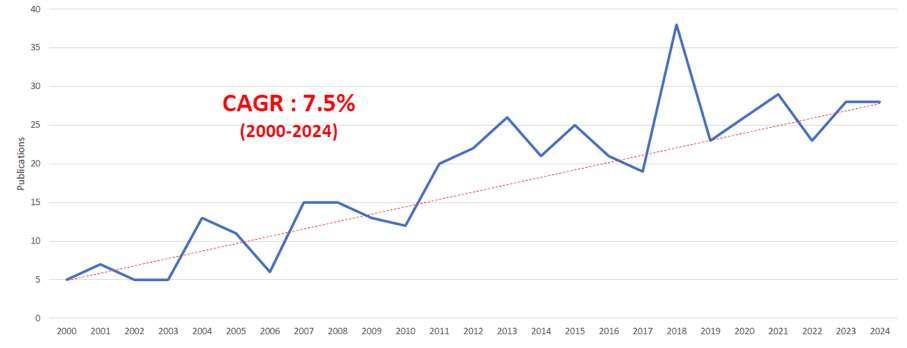
Figure 1: Annual scientific production. Made by authors
The bibliometric analysis also identified a high degree of international collaboration in Arctic research involving Ireland’s institutions, with an international co-authorship rate of 78.79% within Irish Arctic-affiliated publications. The cumulative co-authorship data shows Ireland’s strong collaboration, particularly with the United States, as shown in Figure 2, which leads as the top co-authoring country.
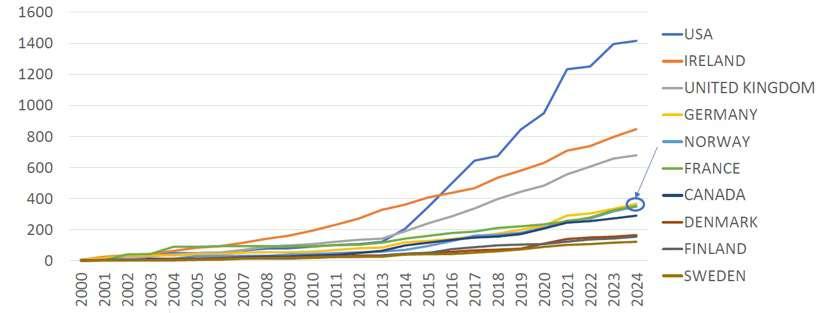
Figure 2: Cumulative number of co-authors in Ireland’s Arctic research by country of affiliation (2000–2024). Made by authors
This is followed by significant collaborations with researchers from the United Kingdom, Germany, Norway, and France. Notably, Ireland itself ranks second overall in cumulative contributions. It shows its central role not just in originating research but also in collaborative Arctic projects. The data also demonstrated a steady growth in partnerships with Canada, Denmark, Finland, and Sweden, highlighting the transatlantic and pan-European nature of Arctic science networks.
Key words analysis in Figure 3 demonstrated that Irish research focuses particularly on climate change, Arctic engineering, oceanography, and renewable energy, including wave energy conversion. Arctic studies associated with Greenland constitutes also a significant component of Ireland’s Arctic scientific output.
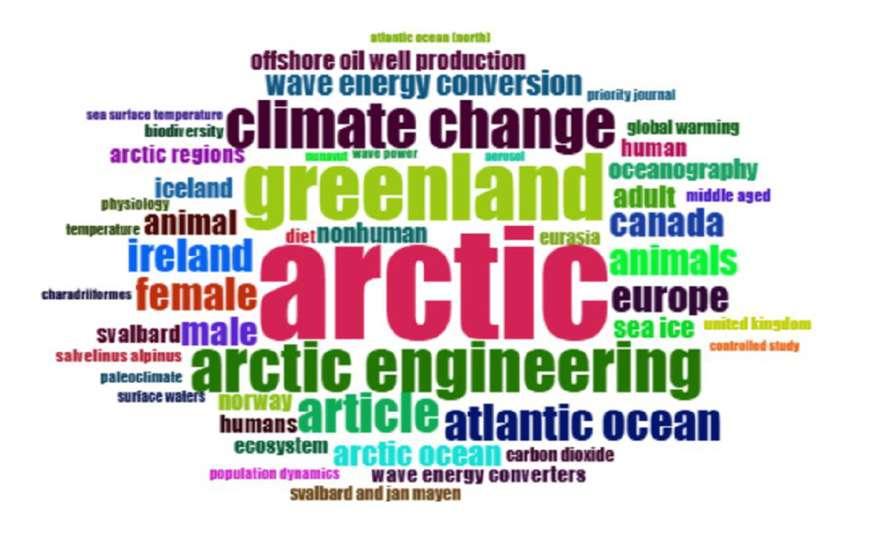
Kavanagh, Kovalenko & Rigot-Muller
Figure 3: Key words analysis of the main topics of Arctic research in Ireland. Made by authors
A significant amount of published Irish Arctic research appears in conference proceedings, particularly in engineering-related venues like Ocean, Offshore and Arctic Engineering Conference (more than 55 publications in the journal) and the International Offshore and Polar Engineering Conference (more than 10 publications), suggesting a strong engineering and ocean systems orientation.
This scientific activity is supported by research networks, as well as infrastructure including the RV Celtic Explorer, a 65.5-metre purpose-built (2003) ocean-going research vessel operated by the Marine Institute. This is the first Ireland’s vessel to receive Polar Code certification for Arctic operations and has been officially recognised as Ireland’s first Integrated Carbon Observation System (ICOS) Ocean station (Ocean focus, 2020, Afloat.ie, 2025). It has conducted multiple expeditions in the Nordic and Greenland Seas, reaching as far north as 79°N (Ocean focus, 2020).
An Irish-led team with researchers from Ireland from University of Galway, the UK, Germany, and Norway used the vessel in several expeditions to monitor ocean conditions, supporting Arctic climate research and strengthening Ireland’s role in global climate monitoring.
At the same time the emerging Indigenous Rights Cluster at University College Cork’s School of Law currently reflects a deliberate expansion into Arctic social sciences and humanities, diversifying Ireland’s traditionally STEM-focused Arctic research portfolio.
Ireland’s Strategic and Institutional Engagement with the Arctic Ireland’s engagement with the Arctic originates from deep historical connections to polar exploration (Smith, 2010; Larson, 2011; Smith, 2021). While geographically outside the Arctic Circle, Ireland has emerged as an active participant in contemporary Arctic affairs through policy engagement, research collaboration, and institutional support.
At the diplomatic level, Ireland has increased its visibility through the participation of Irish researchers in major Arctic forums such as the Arctic Circle Assembly, Arctic Frontiers, High North Dialogues, APECS events, and the International Arctic Science Committee’s (IASC) Arctic Science Summit Week and many more. Scientifically, Ireland has developed two active Arctic research networks: the Network of Arctic Researchers in Ireland (NARI) with its membership in the UArctic consortium, and the regional branch of the Association of Polar Early Career Scientists (APECS). Institutional sponsorships, including the Arctic Frontiers Emerging Leaders Programme, further support individual researchers and foster international connections. These mechanisms reflect a structured, if informal, framework for engagement, now ripe for strategic consolidation.
As the nation's scientific output in Arctic studies has expanded, policy discourse has emerged regarding Ireland's potential dedicated Arctic Strategy (Kavanagh, 2024). However, during the current geopolitical instability in the Arctic, the national Arctic strategy will likely remain split into separate streams without being consolidated. The future Arctic strategy for Ireland for the next term may continue to be represented by the Strategy for the Nordic Region and the Strategy for the US and Canada, similarly to the current dual-track model (Government of Ireland, 2019; Government of Ireland, 2021).
Conclusion
Ireland’s robust and growing contribution to Arctic research reflects both scientific ambition and alignment with global climate and oceanographic challenges. Through bibliometric analysis, we demonstrated how Ireland has developed a distinctive and increasingly influential role in Arctic research. The growing body of research is not occurring in a vacuum. The evidence presented in this article shows sustained growth in publications and robust international collaborations, growing influence of institutional networks like NARI and UArctic, demonstrating Ireland’s capacity to punch above its weight in Arctic science. These findings position Ireland as a reliable sub-Arctic research partner and raise the importance of consolidating within a clear national Arctic Strategy.
References
Afloat.ie. 2025. Ireland’s RV Celtic Explorer becomes first ICOS ocean station. Accessed June 25,2025. https://afloat.ie/marine-environment/marine-science/item/67410-ireland-s-rvceltic-explorer-becomes-first-icos-ocean-station
Government of Ireland. Global Ireland: Ireland’s Strategy for the US and Canada. Dublin, 2019. Accessed June 22, 2025. https://www.dfa.ie/media/dfa/ourrolepolicies/ourwork/USCanada-Strategy.pdf
Government of Ireland. Ireland’s Application for Arctic Council Observer Status. Dublin, 2020. Accessed June 22, 2025. https://www.dfa.ie/media/dfa/newsmedia/pressrelease/Irelands-Application-to-theArctic-Council Key-Messages.pdf
Government of Ireland. Global Ireland: A Strategy for the Nordic Region to 2025. Dublin, 2021. Accessed June 22, 2025. https://assets.ireland.ie/documents/21-011-NordicStrategy_Final_digital.pdf
Kavanagh, Elena. “Ireland's Arctic Strategy: Building Bridges to the North.” Arctic Yearbook 2024, Scholarly Paper SP10. Accessed June 22, 2025. https://arcticyearbook.com/images/yearbook/2024/Scholarly_Papers/SP10_Kavanagh. pdf
Larson, Edward J. An Empire of Ice: Scott, Shackleton, and the Heroic Age of Antarctic Science. New Haven: Yale University Press, 2011.
Ocean Focus. 2020. Irish team investigates past climate change in Arctic region. Accessed June 25, 2025. https://oceanfocus.ie/irish-team-investigates-past-climate-change-in-articregion/
Smith, Michael. Great Endeavour: Ireland's Antarctic Explorers. Dublin: Collins Press, 2010.
Smith, Michael. Icebound in the Arctic: The Mystery of Captain Francis Crozier and the Franklin Expedition. Dublin: The O’Brien Press, 2021.
Kavanagh, Kovalenko & Rigot-Muller
Getting Comfortable with Uncertainty: Lessons from an Arctic research station
Hanna Oosterveen
Before I started my year of ethnographic fieldwork here in Abisko (68.3495° N, 18.8312° E) at the scientific research station, my plan was to work with Arctic environmental scientists to see what collaboration means to them and how they practice collaborations. My hope was that this could give a picture of how expertise about Arctic climate change is developed and stabilized. Since arriving here, as often happens during a period of extended fieldwork, I have found that there are more reflective strands to follow if I am looking to get a picture of how Arctic climate science expertise is formed, especially if I am interested in also grasping the relationship between Arctic science and society.
Collaborations are everywhere in the production of environmental science in the Arctic, whether that be between scientists, with Sami partners, or even with cooperative or unpredictable weather conditions. With collaborations being so wide-reaching, what becomes interesting is what necessitates, drives, forms, and resists collaborations between those working to know how Arctic environmental systems work. My thinking on this subject is still in process as I emerge from the weeds of the halfway mark of my fieldwork. However, I’m beginning to see how following uncertainty brings my attention to the meat in between collaborations tethered to the production of expertise at the Abisko Scientific Research station. So, where is following uncertainty at an Arctic research station bringing me so far?
Uncertainty is arguably what drives environmental science forward. At a field station, uncertainty pushes scientists to get closer to the best possible understanding of environmental phenomena using the tools and methods known and available. While uncertainty drives scientific disciplines forward, it also highlights the limits of all knowledge systems. But rather than being a void, these limits can serve as fertile ground for collaboration not only across academic disciplines, but across approaches to knowing Arctic environments more broadly. There are signs of some initiatives in this direction, as discussions around what it means to collaborate ethically with Sámi and local
Hanna Oosterveen is a PhD candidate in Social Anthropology at the University of Manchester Emerging Voices
communities and come to the fore, but there is also an acknowledgment amongst many of the scientists I spoke to that there is a lot of work left to do to build relationships and reorient the environmental science.
In turn, uncertainty in science shapes scientists who must learn to form judgments, whether that is choosing which variables to include in a model, deciding where to take a soil core, or fostering diverse collaborations. Moreover, even the most basic decisions in the field, such as which day to go out, remain uncertain until the weather is known, and even then, it can change, requiring adaptability in research plans.
While evidently a condition of the practice of science, uncertainty is notoriously difficult to communicate. As one ecologist at the Abisko Scientific Research Station shared in an interview, “The public cannot handle the degree of uncertainty that exists in the science we do”. In the environmental sciences, a lot of work goes into the practice of assigning and managing uncertainty, which also requires training to do well. However, in public communications of science, findings are often presented as pure fact, and pass over the uncertainties or limitations of scientific findings, reflecting the sell-ability of attention-grabbing headlines and fears that uncertainty will make people doubt science. Arguably, this gap between environmental scientists and the public places the relationship between science and the public on fragile terrain, as uncertainty is an inherent part of science for those inside the scientific world and potentially an indicator of scientific incompetence for those of us on the outside.
While many scientists I interviewed equated good scientific practice with an ability to speak with uncertainty in scientific papers, seeing uncertainty as a constant companion rather than a failure to be eliminated, some shared that uncertainty is sometimes glossed over in scientific papers as well. At the same time, the rise of scientific meta-analyses points to a growing reflexivity within science. For example, Metcalfe et al.’s 2018 paper, “Patchy field sampling biases understanding of climate change impacts across the Arctic” which shows that thirty percent of citations on Arctic climate change come from just two locations, Abisko and Toolik Lake, highlights that there is a need for more diverse sampling locations across the Arctic for climate projections to represent the diversity of the Arctic. At the same time, the extensiveness of scientific research in Abisko has made it possible to understand mechanisms of Arctic ecosystems more deeply than would be possible in less accessible and equipped Arctic field science locations. Fundamentally, uncertainty is an inherent part of environmental science, and something that within and outside the scientific community, requires willing engagement.Moreover, in the career of an environmental scientist, access to funding is another type of uncertain terrain, leaving projects and the people behind them in sometimes precarious positions as funding applications become an ever-greater part of a scientific career. There are many approaches for increasing the chances of receiving funding, many of which lean on perceived uncertainties in society, be that the effects of climate change or more specifically how the Arctic tips the scales. The Arctic is often referred to as a “bellwether region” or “harbinger” of climate change, which in turn also attracts funding. As one interlocutor shared in a presentation, “In the funding world, Arctic is the new climate change”. The environmental scientists I spoke to often mentioned finding a way to speak to funders’ priorities while maintaining their scientific values.
While the buzz around the Arctic attracts funding to Abisko, some of my interlocutors were uncertain over whether Abisko is actually in the Arctic. Abisko is located at the border of tundra
and boreal ecozones, making it neither if looking for the pure forms of either. This is also why Abisko is such an interesting place for scientists. Within a few kilometres of Abisko, it is possible to be in so many diverse micro-climates, some resembling inland Siberia, while others reflect ecosystems typically found at much lower altitudes. In turn, in scientific papers, arctic, subarctic, boreal, alpine, high altitude, and tundra are all used, reflecting the focuses of various scientific disciplines (Hustich 1979). At the same time, Abisko sits above the Arctic Circle, but as a Norwegian scientist who works at the station said to me, “As a Norwegian, it is difficult to classify Abisko as Arctic”. The classification of Abisko as an Arctic place is much more uncertain than I knew and is tethered to political economic and scientific positionings of the place.
Finally, uncertainty describes not just scientific inquiry, but the broader socio-political and ecological conditions that characterize our world today. These uncertainties direct funding and inspire scientific projects, which transform the uncertain into the more predictable, despite retaining varying degrees of uncertainty. On the flip side, geopolitical uncertainty may also amplify scientific uncertainty. The loss of access to Russian permafrost data, for instance, has widened the margin of uncertainty in permafrost research (López-Blanco et al. 2024). As one interlocutor explained to me, “without Russian permafrost data, the margin of possibility is narrower than the margin of uncertainty” when predicting greenhouse gas release from the thawing ground. What this shows is that uncertainty in the world provides direction to scientific inquiry while geopolitical struggles also increase uncertainty in science.
Clearly, following uncertainty pulls our attention in many directions. Tracing uncertainty at the Abisko Scientific Research Station makes it possible to paint a grounded picture of what comes together to carry out the project of attempting to anticipate the future of Arctic environments and the far-reaching systems they impact. Hopefully, it can also tell an intimate and even relatable story of uncertainty that can make us all a little more comfortable with it, opening space for finding the generativity within it or what moments might require more critical attention.
Acknowledgements
This article is based on research funded by the European Research Council (ERC) under the European Union’s Horizon 2020 research and innovation program (Grant agreement No. 856543). This research has also benefitted from transnational access to the Abisko Scientific Research Station funded by the European Union HORIZON EUROPE through the EU Project POLARIN Grant Agreement ID: 101130949.
References
Efrén López-Blanco et al., ‘Towards an Increasingly Biased View on Arctic Change’, Nature Climate Change 14, no. 2 (February 2024): 152–55, https://doi.org/10.1038/s41558-023-01903-1.
Hustich, Ilmari. ‘Ecological Concepts and Biographical Zonation in the North: The Need for a Generally Accepted Terminology’. Ecography 2, no. 4 (1979): 208–17. https://doi.org/10.1111/j.1600-0587.1979.tb01291.x
Metcalfe, Daniel B., Thirze D. G. Hermans, Jenny Ahlstrand, et al. ‘Patchy Field Sampling Biases Understanding of Climate Change Impacts across the Arctic’. Nature Ecology & Evolution 2, no. 9 (2018): 1443–48. https://doi.org/10.1038/s41559-018-0612-5.
Emerging Voices
Compassion Resilience: A Perspective on War, Peace, and Community in the Arctic
Charlene Miles Introduction
The Arctic, long seen as a model of international cooperation, continues to experience mounting geopolitical tensions and militarization that threaten the region’s social fabric, woven from Indigenous knowledge, rural and urban realities, and the needs of vulnerable populations. Additionally, climate change profoundly shapes the Arctic, acting as both a security concern and a driver of ongoing challenges for communities. Compassion resilience, rooted in empathy and community strength, is not just a theoretical concept but a living necessity for ensuring the Arctic remains a zone of peace, justice, and sustainability. Importantly, the Arctic is not currently an active conflict zone, but rather a region at risk due to converging pressures, making prevention critical.
The Human Dimension: Why Compassion Resilience Matters
Discussions about Arctic security are often dominated by state interests, sidelining the voices and well-being of those who live there. Indigenous Peoples such as the Inuit and Sámi have historically suffered from decisions made far from their homelands, leading to environmental degradation and cultural loss (Simon, 2019; Cameron, 2012). Past military exercises and advanced technologies have deepened historical traumas and disrupted traditional ways of life (Konyshev & Sergunin, 2016). As a result, vulnerable groups within these Indigenous and Local Arctice communities are most affected.
Specifically, young people who are exposed to conflict and displacement face heightened risks of anxiety, depression, and PTSD. This is especially true for adolescents with disabilities, who experience even greater psychological distress when social networks and family stability are disrupted (Human Rights Watch, 2024; Nature, 2024; ICRC, 2024). Older adults, often depend on intergenerational support, however this support is undermined by migration, economic instability,
Charlene Miles is a Master’s degree Candidate in Strategic Leadership at Alaska Pacific University.
and caregiving burdens during crises (Forbes, 2019). Similarly, people with disabilities in conflict zones are at greater risk of neglect, trauma, and exclusion from emergency services, compounding their vulnerability (World Bank, 2024; PMC, 2013). These examples draw on documented evidence and Indigenous testimony, illustrating the real impacts of environmental and social stressors on Arctic populations.
Compassion resilience can address these human costs by fostering solidarity, supporting cultural continuity, and building adaptive capacity (Kirmayer et al., 2011). In moments of adversity, it becomes moral imperative as well as a strategic necessity that is often lost in times of conflict. This reflective grounding helps us avoid superficial generalizations and recognize diverse, evidence=based community experiences.
Compassion Resilience in Practice
Military activities in the Arctic generate deep anxiety, especially for Indigenous communities whose identities and livelihoods are intimately tied to the land (Forbes, 2019). To mitigate these impacts, community-led mental health initiatives that blend traditional knowledge with modern counseling are vital. For example, the Inuit-led Qaujigiartiit Health Research Centre integrates cultural practices into trauma care, helping communities heal collectively (ITK, 2021). Broader approaches have also made a difference as school-based programs have reduced PTSD symptoms among youth by up to 40% through peer support and trauma-informed curricula (Nature, 2024). Intergenerational storytelling projects led by Sámi elders preserve cultural knowledge and foster emotional resilience among youth (Einarsson et al., 2004) and accessible crisis hotlines and community care networks for people with disabilities have reduced isolation and suicide risks (PMC, 2013).
Dialogue and Leadership
Empathy-driven dialogue is vital in a region that spans eight Arctic states. Local leadership and grassroots diplomacy are powerful tools for peace. The Arctic Mayors’ Forum, for instance, brings together municipal leaders to bridge geopolitical divides through shared priorities like infrastructure and cultural preservation (Arctic Council, 2023). Likewise, the Pikialasorsuaq Commission has shown how Inuit-led discussions can manage shared resources and build trust across borders (ICC, 2017). Continuous, inclusive dialogue ensures that policies are grounded realities, not top-down assumptions.
Indigenous knowledge systems, which emphasize relationality and stewardship, offer ethical alternatives to militarized security paradigms (Whyte, 2018). A case in point is the Sámi Parliament’s involvement in co-managing Nordic defense projects is a model for aligning security strategies with community well-being (Koivurova & Heinämäki, 2020). Centering Indigenous leadership is both just and essential for building resilience. Such approaches counter the stereotypes that Indigenous communities are passive recipients; rather, they are active architects of resilience and security.
Community Adaptation
At the same time, compassion resilience enables communities to address the dual threats of climate change and militarization. The Alaska Native Science Commission, for example, combines traditional ecological knowledge with conflict resolution training to build adaptive capacity (ANSC, 2022). This integration of compassion and science is vital for community survival. The intersection
of environmental adaptation and security concerns underscores why climate change must be central to Arctic security discourse.
The Arctic’s Rural and Urban Realities
The Arctic’s diversity is reflected not only in its landscapes but also in the ways people live. About two-thirds of the Arctic’s nearly four million inhabitants now live in urban areas, with cities like Fairbanks, Yellowknife, Yakutsk, and Luleå serving as economic and cultural hubs. Yet, the story does not end in the cities; rural settlements remain vital, especially for Indigenous Peoples and those whose livelihoods depend on the land and sea.
Urbanization, however, brings both opportunities and challenges. Cities offer better access to healthcare, education, and employment, but also face housing shortages, infrastructure strain, and environmental contamination. Such challenges cha be seen in Yakutsk’s rapid population growth and deteriorating housing, while Yellowknife contends with land scarcity and contaminated sites. In contrast, rural communities are experiencing depopulation as residents move to cities, threatening the viability of small settlements and risking the loss of traditional knowledge and cultural practices.
It is a misconception to think of Indigenous Peoples as confined to rural areas. Many now live in Arctic cities where their cultural heritage and rights must be recognized in urban planning and governance. Urban Indigenous communities face unique challenges in maintaining cultural identity and access to traditional practices within rapidly changing environments. Recognizing this complexity is essential for informed policy.
Vulnerability comes in many forms in the Arctic, and the pressures differ between rural and urban areas. Urban residents may be more exposed to infrastructure disruptions and social fragmentation, especially as cities expand onto traditional indigenous lands or sensitive environments. Conversely, rural communities face isolation, limited access to services, and the ongoing risk of being overlooked in regional planning and emergency response. Whereas depopulation leaves the remaining residents often those who are vulnerable at greater risk during crises. This is an opportunity where policy can address these place based realities with tailored, inclusive approaches.
State Strategies: Preserving the Arctic as a Zone of Peace
To prevent the Arctic from becoming an arena for global power struggles, states must institutionalize compassion resilience at every level. Several specific policy measures stand out.
First, formalizing Peace Commitments: Revisiting agreements like the 2008 Ilulissat Declaration, which emphasized cooperation over territorial disputes, could modernize commitments to exclude offensive military activities. Regional arms control agreements would further reduce escalation risks (Kingdom of Denmark, 2008; UNODA, 2021).
Second, integrating Human Security: Expanding security to include human well-being, as outlined in the 1994 UNDP Human Development Report, aligns with Canada’s Arctic and Northern Policy Framework, which prioritizes Indigenous partnerships in defense planning.
Third, ensuring Inclusive Governance: Co-governance models, such as the Inuit-Crown Partnership Committee, show how power-sharing can produce equitable policies. Strengthening the Arctic Council’s mandate to address security issues, while retaining Indigenous Permanent
Participant status, would further institutionalize compassion resilience (Crown-Indigenous Relations, 2023; Exner-Pirot, 2020).
Each of these approaches is supported by evidence and reflects the evolving nature of Arctic governance and security challenges. Targeted measures for vulnerable groups remain critical. As a demonstration, youth benefit from funded trauma-informed education and vocational training to mitigate recruitment by armed groups (ICRC, 2019); Older adults need emergency evacuation protocols that prioritize mobility-impaired individuals (ZOiS, 2024); and people with disabilities require mandated accessibility in conflict preparedness plans, including sign-language interpreters in crisis communications (World Bank, 2024). An analytical focus on differentiated impact and tailored solutions is necessary to move the narrative beyond generalization and toward lasting security for all.
Conclusion: Compassion Resilience as a Path Forward
In conclusion compassion resilience is not a utopian ideal but a pragmatic strategy for Arctic peace. By centering Indigenous knowledge, human security, and cooperative governance with explicit protections for youth, the elderly, and people with disabilities the Arctic can resist being reduced to a geopolitical chessboard. The region’s future depends on recognizing and supporting both its rural and urban communities, ensuring that all residents are included in efforts to build resilience and preserve the Arctic as a zone of peace, justice, and sustainability for all who call it home.
References
Andreeva, S., Dodds, K., Douglas, N., Humrich, C., & Nawrath, T. (2024, March). New Arctic Realities Between Conflicting Interests and Avenues for Cooperation (ZOiS Report 1/2024). Centre for East European and International Studies (ZOiS). https://www.zoisberlin.de/fileadmin/media/Dateien/3Publikationen/ZOiS_Reports/2024/ZOiS_Report_1_2024.pdf
Cameron, E. (2012). Securing Indigenous politics: A critique of the vulnerability and adaptation approach to the human dimensions of climate change in the Canadian Arctic. Global Environmental Change, 22(1), 103-114. https://doi.org/10.1016/j.gloenvcha.2011.11.004
Crown-Indigenous Relations and Northern Affairs Canada. (2023). Inuit-Crown Partnership Committee. https://www.rcaanc-cirnac.gc.ca/eng/1503683005445/1537886544718
Einarsson, N., Larsen, J. N., Nilsson, A., & Young, O. R. (Eds.). (2004). Arctic Human Development Report. Stefansson Arctic Institute. https://oaarchive.arcticcouncil.org/handle/11374/51
Exner-Pirot, H. (2020). Canada’s Arctic and Northern Policy Framework: A New Direction for Human Security? Arctic Yearbook, 2020. https://arcticyearbook.com/arcticyearbook/2020
Forbes, B. C. (2019). State, Indigenous, and Local Governance in the Arctic: Implications for Resilience. In Arctic Resilience Report (pp. 123-144). Stockholm Environment Institute. https://www.sei.org/publications/arctic-resilience-report/
Miles
Human Rights Watch. (2024, February 24). Submission to the UN High Commissioner for Human Rights on Children with Disabilities in Armed Conflict. https://www.hrw.org/news/2025/02/24/submission-un-high-commissionerhuman-rights-children-armed-conflict
International Committee of the Red Cross (ICRC). (2019). Children associated with armed forces or armed groups. https://www.icrc.org/sites/default/files/external/doc/en/assets/files/publicati ons/icrc-002-0824.pdf
International Committee of the Red Cross (ICRC). (2024, August 1). At risk and overlooked: Children with disabilities and armed conflict. International Review of the Red Cross, 106(922), 1-22. https://international-review.icrc.org/articles/at-risk-and-overlookedchildren-with-disabilities-and-armed-conflict-922
ITK (Inuit Tapiriit Kanatami). (2021). Qaujigiartiit Health Research Centre. https://www.itk.ca/qaujigiartiit-health-research-centre/ Kirmayer, L. J., Dandeneau, S., Marshall, E., Phillips, M. K., & Williamson, K. J. (2011). Rethinking resilience from Indigenous perspectives. The Canadian Journal of Psychiatry, 56(2), 8491. https://journals.sagepub.com/doi/pdf/10.1177/070674371105600203
Kingdom of Denmark. (2008). The Ilulissat Declaration. https://arcticportal.org/arcticgovernance/international-agreements
Koivurova, T., & Heinämäki, L. (2020). The Participation of Indigenous Peoples in International Norm-Making in the Arctic. Polar Record, 56, e23. https://doi.org/10.1017/S0032247420000191
Konyshev, V., & Sergunin, A. (2016). Russia’s Arctic Strategies in the Context of the Ukrainian Crisis. Polar Journal, 6(1), 104-117. https://doi.org/10.1080/2154896X.2016.1171005
Nature. (2024). Youth mental health in conflict zones: A global crisis. Nature, 625, 123125. https://www.nature.com/articles/d41586-024-00000-0
PMC. (2013). The impact of armed conflict on children with disabilities. PubMed Central. https://www.ncbi.nlm.nih.gov/pmc/articles/PMC11133288/
Simon, M. (2019). The Arctic and Indigenous Peoples: The Human Dimension. Arctic Yearbook, 2019. https://arcticyearbook.com/arctic-yearbook/2019
United Nations Office for Disarmament Affairs (UNODA). (2021). Arms Control in the Arctic. https://www.un.org/disarmament/topics/arctic/
Whyte, K. (2018). Indigenous Climate Change Studies: Indigenizing Futures, Decolonizing the Anthropocene. English Language Notes, 56(1), 153162. https://doi.org/10.1215/00138282-56.1.153
World Bank. (2024). Disability Inclusion in Humanitarian Action. https://www.worldbank.org/en/topic/disability/brief/disability-inclusion-inhumanitarian-action
Alaska Native Science Commission (ANSC). (2022). Traditional Knowledge and Community Resilience. https://www.nativescience.org/
Arctic Council. (2023). Arctic Mayors’ Forum. https://arctic-council.org/news/arctic-mayorsforum/
Inuit Circumpolar Council (ICC). (2017). Pikialasorsuaq Commission: Inuit-led Management of the North Water Polynya. https://www.inuitcircumpolar.com/project/pikialasorsuaqcommission/
"It's Not Just About Economic Development":
Prioritising
Climate-Vulnerable Regions in International Sustainable Development Policy — The Arctic Case Study
Marta Koch Introduction
Multilateral climate policymaking and diplomacy has long prioritised countries classified as “developing” or “low-income” by the World Bank and United Nations, channeling climate finance and technical assistance accordingly (World Bank, 2022; UNDP, 2023; Farias, 2022). Yet this framework overlooks critical settings that, despite residing within high income and transition economy nations, are faced with severe environmental and climate related vulnerabilities.
Climate vulnerable settings, from low lying Small Island Developing States (SIDS) in the Pacific, cyclone prone coastal zones in South Asia and flooding-prone areas in Japan (IPCC, 2023), drought hit areas in the Sahel (OECD, 2024), to the melting permafrost and eroding shorelines of the Arctic (WWF, 2023), demand equal policy attention, investment and implementation focus. As the world approaches our final opportunity to limit global warming to 1.5°C, where greenhouse gas emissions must decline 43% by 2030 as per the Paris Agreement (UNFCCC, 2015) and the 2030 deadline for the UN Sustainable Development Goals (SDGs), a set of 17 interconnected global objectives adopted by all UN Member States in 2015 to ensure sustainable development for all by concurrently protecting the planet and ensuring prosperity by 2030 (UN, 2015), policymakers must broaden their lens beyond economic development categorisation to include environmental risk and adaptive capacity (Arctic Council, 2021; IPCC, 2022). This has recently become more pressing as a result of the latest research highlighting how progress across the 17 UN SDGs is fundamentally interconnected and positively correlated in climate vulnerable regions like the Arctic; delays or gaps in climate action often correlate with setbacks in economic, social and governance outcomes (Koch, 2024).
Marta Koch is a PhD Researcher and Teaching Facilitator at the Centre for Environmental Policy and Grantham Institute for Climate Change and the Environment at Imperial College London Emerging Voices
This article highlights the critical Arctic case study, but it is worth applying this globally to all climate-vulnerable settings: international organisations which hold multilateral capacity-building resources such as the United Nations and World Bank Group should update sustainable development frameworks to explicitly prioritise all climate vulnerable settings, in addition to accounting for their economic development classification, ensuring no community is neglected in terms of climate and sustainability action capacity-building and finance.
The Arctic as critical climate vulnerable setting
The Arctic, forming part of economically developed countries Canada, Denmark, Finland, Iceland, Norway, Russia, Sweden and the United States, remains one of the regions most affected by climate change globally, making it a key example of the policy gap where high national income classification can mask severe local climate vulnerability (IPCC, 2023; Arctic Council, 2016). The region is warming at twice the rate of the global average, a phenomenon known as Arctic amplification (IPCC, 2023). This accelerated warming leads to three key cascading impacts which even the developed countries the Arctic forms part of are finding it challenging to address. First, declining sea ice is profoundly altering marine food webs by reducing habitat for key species, thereby threatening wildlife such as polar bears, seals and Arctic char and undermining the subsistence activities of Indigenous communities, whose cultures and livelihoods are severely dependent on these ecosystems (IPCC, 2023; WWF, 2023). Second, thawing permafrost is destabilising critical infrastructure, damaging homes, roads and pipelines, while releasing large quantities of stored carbon dioxide and methane in combination with deposited black carbon-induced surface warming and melting which is altering weather patterns and ecosystem cycles, these both intensifying global warming through positive feedback loops (Arctic Council, 2016; Chen et al., 2025). Third, as ice cover diminishes, Arctic shorelines are losing their natural buffers against storms, resulting in rapid coastal erosion that has forced inhabitants in villages such as Shishmaref in Alaska, USA and Tuktoyaktuk in Canada to consider or undertake relocation to avoid life-threatening land loss (Arctic Council, 2023). These multidimensional climate and weather change vulnerabilities underscore the imperative for policymakers to address Arctic specific challenges as well as other climate vulnerable regions worldwide with urgency and scale commensurate to how developing country contexts are treated (IPCC, 2023).
Climate funding improvements
Key policy frameworks focused on establishing and maintaining international climate finance mechanisms continue to predominantly target economically developing countries to support mitigation and adaptation (World Bank, 2022). Examples include the financial mechanism used to channel climate finance to developing countries under the United Nations Framework Convention on Climate Change, the Kyoto Protocol and the Paris Agreement. This mechanism is operated primarily by the Global Environment Facility (GEF) and the Green Climate Fund (GCF), which receive guidance and oversight from the Conference of the Parties (COP) on policies, priorities and eligibility. Parties have also created additional funds such as the Special Climate Change Fund (SCCF), the Least Developed Countries Fund (LDCF) and the Adaptation Fund, to support adaptation and other climate actions for implementation of the Paris Agreement (UNFCCC, 2025). Similarly, the widely-used World Bank classifies economies into low, lower middle, upper middle and high income groups based primarily on gross national income (GNI) per capita thresholds,
adjusted annually and accounting for purchasing power parity and exchange rates (World Bank, 2024). Core World Bank-led lending windows such as the International Development Association now integrate climate co-benefits across mainstream development projects, and Climate Investment Funds (CIFs) provide dedicated, multi-donor concessional finance to scale up transformational low-carbon and climate-resilient investments, but eligibility assessment is still primarily focused on income level, and they are all designed first and foremost to channel finance from developed countries to developing countries (UNDP, 2025; World Bank, 2025).
Recent UN decisions, such as the COP27 2022 agreement to expand Loss and Damage funding modalities to include high vulnerability regions irrespective of their income status, underscore the growing demands from the international community to reassess eligibility criteria for climate finance (UNFCCC, 2025). Similarly, the UNDP’s 2023 Human Development Report highlighted the need to revisit the “developing” category, noting that climate risk indices often do not align with income-based classifications and urging a shift towards vulnerability-based criteria (UNDP, 2023). In this way, the Arctic, like other climate vulnerable contexts such as, for example, Small Island Developing States (SIDS), or sub-Saharan drought prone regions (UNDP, 2023), must be acknowledged as a case where per capita emissions reductions and adaptation efforts yield disproportionate global benefits; specifically, maintaining permafrost can avert the release of gigatonnes of carbon dioxide and methane, thus mitigating feedback loops that exacerbate planetary warming on a global scale (IPCC, 2023). Indigenous communities within the Arctic experience socio-economic marginalisation characterised by limited infrastructure, food insecurity and constrained livelihoods, while the geopolitical significance of the Arctic has intensified with the emergence of new maritime corridors and untapped resource deposits, social and economic conditions that co-exist and correlate positively with climate vulnerability in ways that closely resembles correlations in other recognised developing regions, and therefore also warrant additional support frameworks for effective climate governance of comparable scope and ambition (UNDP, 2023; OECD, 2024). Therefore, by reframing the Arctic region as a climate vulnerable setting requiring special attention like we treat economically developing countries, global policy instruments can more equitably allocate climate action resources and technical assistance where it is needed most (Arctic Council, 2016). Furthermore, country classifications and borders are often arbitrary and debatable, and may be liable to change over time, whereas climate risks and environmental changes transcend political boundaries, highlighting common challenges we can more easily agree on the need to address across climate vulnerable regions which cross borders (IPCC, 2022).
Moreover, technological innovation and technical capacity building, especially emerging areas such as digital innovation and artificial intelligence (Koch & UN CTCN, 2025), are a critical opportunity for accelerating climate action, but require significant financial investment and policy coherence to implement. Despite its strategic importance and the economic development of the states who claim its territories, the Arctic remains technologically underdeveloped, lacking robust digital infrastructure, advanced early warning systems for climate extremes and weather conditions and tailored renewable energy solutions, thereby additionally limiting its adaptive capacity relative to developing regions prioritised by innovation funding and development programmes (IPCC, 2022; Kasthala et al., 2024; Koch, 2024).
Therefore, a proposed solution can come in the form of dedicated vulnerability driven funding windows established within existing multilateral climate finance mechanisms to guarantee that proposals from developed, but climate-vulnerable settings like the Arctic and Japan, compete on equal footing. Similarly, grant mechanisms must be reworked to empower Indigenous and local community organisations with local know-how on urgent climate needs and impacts to co-lead the design and implementation of data sharing and adaptation plans, thus recognising traditional knowledge and self-determination as indispensable components of effective climate policy (IPCC, 2023) in such settings.
Developing a standardised global climate vulnerability classification and the integration of climate need prioritisation and capacity building frameworks
Effective climate need prioritisation requires integrating the needs of climate vulnerable settings into existing climate finance and policy frameworks, supported by robust capacity building and technical and financial assistance for the most effective implementation. Existing approaches to assessing climate vulnerability show considerable methodological variation and therefore limited implementation beyond local settings. For instance, Kasthala et al. (2024) systematically reviewed 84 indicator-based studies and found that while most existing frameworks used worldwide emphasise socioeconomic factors, fewer incorporate environmental and institutional dimensions, highlighting the need for standardised international composite indices that integrate exposure, sensitivity and adaptive capacity (IPCC, 2022). To ensure consistency and comparability across international organisation member states such as the UN, a universally agreed classification of climate vulnerable settings is needed. To this end, the proposed solution is for the standardisation of an international climate-vulnerability classification system to be layered on top of the economic development classifications currently used, inspired by Intergovernmental Panel on Climate Change (IPCC) frameworks for vulnerability which take into account exposure, sensitivity and adaptive capacity, and the Notre Dame Global Adaptation Initiative (ND-GAIN) (Das et al., 2020; Notre Dame Global Adaptation Initiative, 2023; IPCC, 2022). This system would be analogous to the World Bank’s four-tier income system (low, lower middle, upper middle, high income) and the UN’s country groupings based on development status (UN DESA, 2014) and would rank subnational and national entities by composite vulnerability metrics, combining exposure, sensitivity and adaptive capacity, in order to better guide the allocation of finance, technical assistance and capacity building support. In addition, global policy guidance should be updated to mandate the development of explicit action plans for climate-vulnerable areas, whether they are Sahelian zones, Japanese coastlines or Arctic territories, thereby embedding a standard requirement for targeted adaptation and resilience measures across all at risk contexts (OECD, 2024). Facilitated cross regional knowledge exchange can facilitate the sharing of best practices and co-development of innovation hubs, especially for emerging climate technologies, across climate vulnerable territories, thereby enhancing collective adaptive capacity. In parallel, localised climate risk assessments within identified climate-vulnerable zones using this proposed classification should be obligatory and integrated into UN and Nationally Determined Contributions (NDC) and Global Stocktake (GST) reporting processes to improve the granularity of our understanding of ecological feedback and local adaptation requirements (IPCC, 2023). Finally, prioritising climate-vulnerable settingdedicated capacity building through targeted training, institutional strengthening and technology transfer will ensure that these national and local governments, NGOs and community
organisations possess the essential skills and resources to plan, implement and monitor adaptation initiatives effectively (UNDP, 2023).
At national level, multilateral just transition policies must be encouraged to align local economic growth with net zero trajectories, mandating that, for example, industry-specific resource extraction activities and emerging shipping routes comply with stringent environmental protections and social safeguards (OECD, 2024). Moreover, infrastructure and connectivity investments should prioritise decentralised green energy solutions, including wind and solar microgrids, to reduce reliance on diesel, lower local emissions and enhance energy sovereignty in remote communities (World Bank, 2022).
Integrating climate-vulnerable setting consideration into broader sustainable development agendas
Although inherently aspirational, in line with the proposed changes, the UN SDGs, as a key sustainable development framework of action, must be adapted into actionable and measurable policy frameworks that afford climate action and environmental resilience parity with economic development objectives (UN, 2015; Nerini et al., 2019). By embedding these principles, international organisations and national actors active in the multilateral system can foster a genuinely holistic development paradigm in which climate vulnerable settings are central to the global sustainability agenda rather than peripheral considerations. Beyond the allocation of climate finance and capacity-building resources, such frameworks can be adapted to more holistically integrate the nuanced needs of climate vulnerable settings. Additional explicit indicators under SDG 13 (Climate Action) and SDG 15 (Life on Land) should be established to measure critical climate vulnerability metrics, such as climate technology readiness, coastal erosion rates, industrial emissions and food security risk, for instance, ensuring these dimensions are systematically tracked and addressed (UNDP, 2023).
Moreover, dedicated review mechanisms could be established within the UN High Level Political Forum on Sustainable Development to systematically evaluate and track progress in addressing domestic climate hotspots, providing accountability and enabling course corrections where necessary (UN Sustainable Development Group, 2025).
Implications for future sustainable development policy agendas
Elevating climate vulnerable settings in policy prioritisation and capacity building frameworks have the potential to significantly reshape global sustainable development discourse and the implementation of the Paris Agreement and UN SDGs. Firstly, this will allow the narrative of international development to transition from a focus on economic development to an emphasis on enhancing community and ecosystem climate resilience, reflecting a systems-based approach to sustainability emerging in the global climate discussions (WWF, 2023). Secondly, by acknowledging the varied and intersectional nature of vulnerability, policymakers can adopt an intersectional climate justice perspective (Koch, 2025) that recognises and addresses the complex interplay of social, economic, geopolitical and environmental challenges across diverse challenging settings (UNDP, 2023). Thirdly, channelling financial and technical support through established multilateral frameworks will strengthen global cooperation, reducing reliance on unilateral or ad hoc national and local initiatives and ensure more coherent and equitable climate and sustainable development outcomes (UNFCCC, 2025). As 2030 UN SDG and Paris Agreement
implementation become more urgent, the international policymaking community is currently faced with a pivotal opportunity for national and international policy decisionmakers to revise our outdated development frameworks. This should come in the form of the integration of clear, measurable and criteria for identifying and supporting subnational climate vulnerable hotspots within developed countries and the development of a multilateral standardised climate vulnerability classification taking into account climate risk and capacity-building needs.
Conclusion
Economic development classifications should not be the sole focus of policymakers and multilateral policymaking; it is becoming increasingly more evident that climate vulnerability and environmental risk must be recognised alongside poverty and underdevelopment when allocating resources and crafting sustainable development strategies (IPCC, 2023). International organisations, particularly the UN system, and national governments should begin integrating post2030 and Paris Agreement-aligned development frameworks that embed nuanced climate risk criteria at their core into existing climate capacity-building and finance mechanisms. By broadening the definition of international development vulnerability beyond economic status and strengthening capacity building support through targeted training, institutional strengthening and technology transfer, policymakers can ensure that every community facing acute environmental and sustainable development threats receives the attention, investment and policy implementation they require and demand. This strategic shift will not only serve to uphold the UN SDG and Paris Agreement commitment to ensure all communities are supported in reaching net-zero, safeguard the most climate-vulnerable and at risk settings globally, but also set the stage for a more resilient and equitable sustainable development and climate action agenda beyond 2030.
References
Arctic Council. (2016). Arctic Resilience Report. https://oaarchive.arcticcouncil.org/items/894931be-6903-4e89-a333-512851b64bc3
Arctic Council (2023). State of the Arctic: Socio Economic Perspectives, Arctic Council Secretariat. https://oaarchive.arctic-council.org/items/8d60142e-879a-45b7-ad16-6a9f8c1f466b
Barros Leal Farias, D. (2022). ‘Which countries are “developing”? Comparing how international organizations and treaties divide the world’, Political Geography Open Research, 1, p. 100001. https://doi.org/10.1016/j.jpgor.2022.100001
Chen, X.-T., Kang, S.-C., Shao, D.-H., Hu, Y.-L., Yang, J.-H. & Xu, M. (2025). Radiative effects of black carbon in the Arctic due to recent extreme summer fires, Advances in Climate Change Research, 16(3), pp. 460–472. https://doi.org/10.1016/j.accre.2025.04.003
Das, S., Ghosh, A., Hazra, S., Ghosh, T., Safra de Campos, R. & Samanta, S. (2020). Linking IPCC AR4 & AR5 frameworks for assessing vulnerability and risk to climate change in the Indian Bengal Delta, Progress in Disaster Science, 7, p. 100110. https://doi.org/10.1016/j.pdisas.2020.100110
Green Climate Fund. (2024). Annual Progress Report 2024, Green Climate Fund. https://www.greenclimate.fund/annual-progress-report-2024
Koch
Intergovernmental Panel on Climate Change (IPCC). (2022). Climate Change 2022: Impacts, Adaptation and Vulnerability, Cambridge University Press. https://www.ipcc.ch/report/ar6/wg2/
Intergovernmental Panel on Climate Change (IPCC). (2023). Sixth Assessment Report: The Physical Science Basis, Cambridge University Press. https://www.ipcc.ch/assessmentreport/ar6/
Kasthala, S., Parthasarathy, D., Narayanan, K. & Inamdar, Arun B. (2024). Classification and evaluation of current climate vulnerability assessment Methods, Social Indicators Research, 171, pp. 605–639. https://doi.org/10.1007/s11205-023-03271-x
Koch, M. (2024). COP29: Global Progress towards accelerating sustainable development & climate action with technological innovation, Imperial College London Centre for Environmental Policy. https://blogs.imperial.ac.uk/centre-for-environmentalpolicy/2024/11/29/cop29-global-progress-towards-accelerating-sustainabledevelopment-climate-action-with-technological-innovation
Koch, M. (2025). COP30: How to include those most affected by climate change, LSE International Inequalities Institute. https://blogs.lse.ac.uk/inequalities/2025/01/14/cop30-how-to-include-those-mostaffected-by-climate-change/
Koch, M. & United Nations Climate Technology Centre & Network (CTCN) (2025). Maximizing emerging trends in locally-led AI solutions for climate action, International Institute for Sustainable Development (IISD) SDG Knowledge Hub. https://sdg.iisd.org/commentary/guest-articles/maximizing-emerging-trends-in-locallyled-ai-solutions-for-climate-action/
Nerini, F., Sovacool, B., Hughes, N., Cozzi, L., Cosgrave, E., Howells, M., Tavoni, M., Tomei, J., Zerriffi, H. & Milligan, B. (2019). Connecting climate action with other Sustainable Development Goals’, Nature Sustainability, 2, pp. 674–680. https://doi.org/10.1038/s41893-019-0334-y
Organisation for Economic Co-operation and Development (OECD). (2024). The Climate Action Monitor 2024. Paris: OECD Publishing. https://doi.org/10.1787/787786f6-en
United Nations (UN). (2015). Transforming our world: the 2030 Agenda for Sustainable Development, United Nations. https://sdgs.un.org/2030agenda
United Nations Development Programme (UNDP). (2023). Human Development Report 2023: Breaking the gridlock. https://hdr.undp.org/content/human-development-report-202324
United Nations Department of Economic and Social Affairs (UN DESA). (2014). World Economic Situation and Prospects, United Nations. https://www.un.org/en/development/desa/policy/wesp/wesp_current/2014wesp_pr_g lobal_en.pdf
United Nations Framework Convention on Climate Change (UNFCCC). (2022). COP27 Reaches Breakthrough Agreement on New “Loss and Damage” Fund for Vulnerable Countries
(Press release). https://unfccc.int/news/cop27-reaches-breakthrough-agreement-on-newloss-and-damage-fund-for-vulnerable-countries
United Nations Framework Convention on Climate Change (UNFCCC). (2025). Introduction to Climate Finance. https://unfccc.int/topics/introduction-to-climate-finance
United Nations Sustainable Development Group (UNSDG). (2025). Introduction to the HighLevel Political Forum on Sustainable Development. https://sustainabledevelopment.un.org/content/documents/25372A_Introduction_to_t he_HLPF.pdf
World Wildlife Fund (WWF). (2023). Annual Report, WWF International. https://www.wwf.org.uk/annual-reports
World Bank. (2022). Rising to the Challenge: Success Stories and Strategies for Achieving Climate Adaptation and Resilience, World Bank Publications. https://www.worldbank.org/en/publication/rising-to-the-challenge-climate-adaptationresilience
World Bank. (2024). World Bank Country and Lending Groups. World Bank. https://datahelpdesk.worldbank.org/knowledgebase/articles/906519-world-bankcountry-and-lending-groups
Koch
The (In)existence of a Portuguese Foreign Policy for the Arctic
Teresa Barros Cardoso
It is unacceptable how a response from the Ministry of Foreign Affairs (MFA) has made it impossible to create a national action framework for the Arctic, under the terms of Assembly of the Republic Resolution 76/2023 of 29 June.
The Arctic is today of such global importance in terms of security, given the interests of various States in exploiting the region’s natural resources, and in terms of the environment and climate at a planetary scale that it demands the mobilisation of the international community as a whole (Azam & Iqbal, 2023).
Domestic political reflection on the Arctic in Portugal was largely triggered by advances in international science. The IPCC Special Report on the Ocean and Cryosphere in a Changing Climate (2019) highlighted the rapid retreat of the cryosphere, the loss of glacier mass, the decline in snow cover, the reduction of sea ice, and the warming of permafrost. Taken together, these developments confirm the process of Arctic amplification, whereby surface temperatures in the Arctic have increased at more than twice the rate of the global average, with particularly significant effects in the North-East Atlantic (IPCC, 2019). Building on this scientific and technical foundation, a series of parliamentary initiatives emerged from 2021 onwards, aiming to establish a political framework for Portugal’s position on the Arctic.
The first milestone was Draft Resolution No. 919/XIV/2, tabled on 29 January 2021, which proposed the development of a national framework for action on the Arctic. The text recognised the region’s growing geopolitical and economic relevance, highlighting the opening of new maritime routes resulting from ice melt, intensifying competition for energy and mineral resources, and increased military activity by Arctic States. It also emphasised the role of the Arctic Council, created in 1996 and expanded in 2013 with the admission of several Asian countries as Observers, signalling the region’s broad strategic scope.
Teresa Barros Cardoso is a PhD Candidate at the NOVA-FCSH at Jean Monnet Oceanid+ Centre of Excellence on ‘Sustainable Blue Europe’ Emerging Voices
For Portugal, the geostrategic position of the Azores reinforced the need to monitor these dynamics closely, both to ensure a safe and demilitarised Arctic and to anticipate potential changes in the relative importance of national ports. The 2021 draft centred on three guiding lines: the creation of a national framework for action on the Arctic; the strengthening of participation in the European Union’s integrated policy for the Arctic; and consideration of a Portuguese application for Observer status in the Arctic Council.
With this initial political groundwork laid, the debate advanced two years later. On 5 May 2023, Draft Resolution No. 675/XV resumed and expanded this trajectory. Maintaining the same scientific and geopolitical basis, the document placed greater emphasis on the security dimension, elevating it to the same level as environmental, economic, and social concerns. It also noted that several non-Arctic European States including Spain, Italy, and France had, in the meantime, developed their own Arctic strategies, underlining the need for Portugal not to fall behind. In parallel, the draft drew attention to the scientific and technological potential of the region, referring to the Research and Innovation Agenda for Polar Science and Technology and to national interests in infrastructures dedicated to ocean and space research. Despite these updates, the three orientations defined in 2021 remained intact: the creation of a national framework for action; articulation with the EU integrated policy for the Arctic; and consideration of an application for Observer status in the Arctic Council.
The consolidation of this evolution occurred shortly afterwards. The process culminated in the approval of Assembly of the Republic Resolution No. 76/2023 on 7 June 2023, published on 29 June of the same year. This resolution formalised the position of the Portuguese Parliament and officially recommended that the Government define a national framework for action on the Arctic. The text explicitly integrated environmental, economic, social, and security dimensions, stressing the need to guide the national fleet, reinforce the fight against climate change, promote environmental protection, strengthen scientific research, and develop strategic infrastructures. It further reaffirmed the relevance of Portugal’s participation in the European Union’s integrated Arctic policy and the importance of assessing a potential application for Observer status in the Arctic Council, thereby completing a political cycle initiated in 2021 and updated in 2023.
Taken together, these initiatives reveal a coherent evolution in Portugal’s strategic vision regarding the Arctic, grounded in robust scientific evidence and oriented towards European integration, maritime security, sustainable development, and the strengthening of the country’s international presence. However, this legislative trajectory has collided with the position of the MFA, which blocked implementation of the Resolution. In its response to the Assembly of the Republic, the MFA stated:
Within the framework of the Convention for the Protection of the Marine Environment of the North-East Atlantic (OSPAR), Portugal has been defending and working on initiatives aimed at protecting the Arctic marine environment, including through collaboration with other relevant organisations, namely the Arctic Council and the International Maritime Organization (CPCP, 2024, p. 147).
Firstly, it should be noted that the MFA’s argument is based on point 20 of the Cascais Ministerial Declaration:
We recognise the unique biodiversity of the Arctic, part of the OSPAR maritime area, and commit to protect the Arctic marine environment, including through collaboration with other relevant organisations, such as the Arctic Council and the International Maritime Organisation (2021, p. 4).
Secondly, the MFA reduces Portuguese action to the environmental dimension, downplaying the security, social, and economic dimensions that the Assembly of the Republic had explicitly incorporated into the Resolution. Thirdly, it suggests that Portugal collaborates directly with the Arctic Council, when in reality the country is not an Observer and participates only indirectly through OSPAR and the IMO organisations with specific mandates that cannot substitute for a national foreign policy or dedicated diplomatic engagement within the Arctic Council.
By adopting this logic, the MFA confuses participation in multilateral organisations with the assertion of a national strategy. To claim that membership of OSPAR is sufficient and makes other steps unnecessary is to accept that third parties represent Portuguese interests in a rapidly changing region. This lack of strategic foresight becomes even clearer when compared with the approach of other non-Arctic States.
In a context in which the Arctic has become a central theme on the international agenda, such a stance results in a loss of political, economic, and scientific opportunities. Portugal’s participation in bodies such as OSPAR and the IMO should, in fact, reinforce the legitimacy of a national Arctic strategy, not serve as an argument for inaction.
The experience of other non-Arctic States clearly illustrates this difference. Several European countries including Italy and Switzerland, the latter a landlocked State have secured Observer status in the Arctic Council, recognising that the region is relevant not only in environmental terms but also in economic, technological, and geopolitical ones. France, Germany, and Spain have invested in polar research and diplomatic presence, securing a more visible role in international debate on the Arctic’s future (Arctic Council, n.d.; Westgaard, 2025).
Despite this lack of political ambition, Portugal possesses resources that would allow it to adopt a far more assertive position. In research, “Portugal has a long history of research in the Arctic, through research centres distributed across the country and in scientific areas ranging from the social sciences to the cryospheric sciences. […] Since 2017, Portugal has, for the first time, led an international project implemented across the Arctic T-MOSAiC, Terrestrial Multidisciplinary Distributed Observatories for the Study of Arctic Connections” (FCT, 2021a, p. 2).
The FCT Polar Programme, created in 2011 and reorganised in 2016, coordinates and supports Portuguese scientific research in the Arctic and Antarctic, promotes annual campaigns, strengthens national and international collaboration, and ensures compliance with obligations arising from treaties and scientific bodies such as SCAR, IASC, and the European Polar Board (FCT, 2025).
This recognition is further reflected in international events and appointments. In 2021, Portugal hosted the Arctic Science Summit Week (ASSW 2021), under the theme “The Arctic: Regional Changes, Global Impacts” (ASSW, 2021; FCT, 2021b).
In 2022, Professor João Canário, of Instituto Superior Técnico, was elected Vice-President of the International Arctic Science Committee (IASC), representing an important recognition of Portuguese polar science, particularly in the Arctic domain (Técnico Lisboa, 2022; FCT, 2023).
These elements demonstrate that Portugal has the scientific critical mass necessary to sustain a more ambitious Arctic foreign policy.
Beyond research, Portugal has demonstrated leadership in international environmental processes. Notably, the country played a decisive role in creating the Emission Control Area for sulphur oxides (SOx) and nitrogen oxides (NOx) (ECA) in the North-East Atlantic (AtlECA). The process began at an IMO meeting in 2022, convened by Portugal, to discuss establishing AtlECA to connect the ECAs of the Baltic Sea, North Sea, and English Channel with the new SOx ECA in the Mediterranean. Studies underpinning the submission were prepared by the International Council on Clean Transportation (ICCT) and the Faculty of Engineering of the University of Porto (FEUP). Under Portugal’s coordination, the process involved Spain, France, Ireland, the United Kingdom, Denmark–Greenland–Faroe Islands, and Iceland. The proposal was submitted to the IMO in 2024 (IMO, 2024) and approved in April 2025 (IMO, 2025, p. 59).
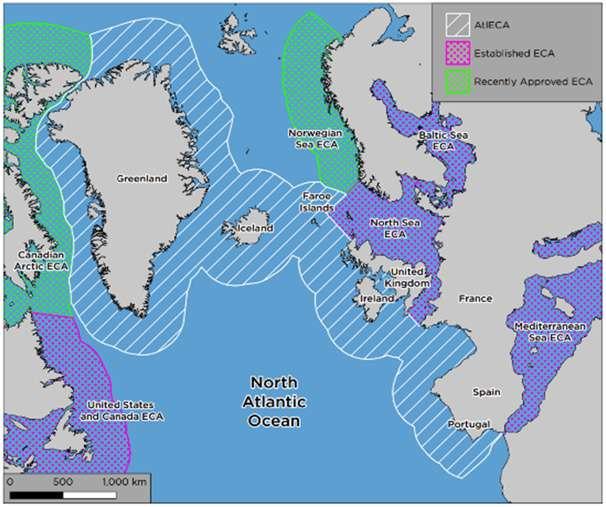
According to Part XII of the United Nations Convention on the Law of the Sea (UNCLOS), “States have the obligation to protect and preserve the marine environment” (United Nations, 1982, p. 100). Consequently, the Portuguese State has a duty to contribute to the protection and preservation of the Arctic Ocean.
Considering the presence of Portuguese-flagged vessels operating in Arctic waters, and bearing in mind international obligations to protect this particularly vulnerable ecosystem, Portugal should develop a Strategy for Portuguese-Flagged Vessels in the Arctic Ocean a strategy specifically designed for such operations.
According to Cardoso (2025), “this strategy must apply to all ship types and to the entire geographic region of the Arctic and not only to the restricted definition of Arctic waters used by the IMO and must include at least:
• The immediate prohibition of the use and carriage for use of heavy fuel oil (HFO);
Figure 1 North-East Atlantic Emission Control Area alongside the other established ECAs. Source: IMO, 2024
• The immediate prohibition of exhaust gas cleaning systems (scrubbers);
• The prevention of the operation in Arctic waters of ships that are 20 or more years old;
• The obligation for any company or ship to inform the Portuguese maritime administration directly, prior to departure from the port of origin and with documentary evidence, that it complies with these prohibitions;
• The non-granting of exemptions based on the fuel tank design rules laid down in Regulation 12A of Annex I of MARPOL or in the Polar Code;
• The removal from the Portuguese registers of ships that fail to comply with the prohibitions when such non-compliance is identified in Port State Control (PSC) or flag State inspections.”
These requirements further reinforce the relevance of the 2023 Resolution, demonstrating that Portuguese action could and should have a broader and more coherent scope.
Nothing presented here prevents the implementation of the content of the 2023 Resolution; on the contrary, it renders it even more pertinent. As a country with a vast maritime area in the Atlantic, Portugal has a direct interest in monitoring the evolution of Arctic maritime routes.
What only a few years ago seemed a remote possibility the viability of alternative routes to the Suez Canal is now accelerating, as illustrated by the growing number of vessels operating in the region (Westgaard, 2025).
In this context, it is legitimate to ask to what extent national port authorities have already considered the economic and social consequences that may arise from a possible partial shift of maritime traffic to Arctic routes.
The Jean Monnet OCEANID+ Centre of Excellence on “Sustainable Blue Europe” organised, in January 2025, the workshop “European Non-Arctic States Observers of the Arctic Council: Why?”, gathering experts and representatives from six non-Arctic States precisely to discuss the role of Observers in the Arctic Council and the need to better understand regional dynamics and their global relevance. Initiatives such as this reinforce the impression that other countries are seeking to secure a place in shaping the Arctic’s future, while Portugal risks falling behind in matters of Arctic governance.
The international context heightens this urgency. The new Donald Trump administration in the United States has insisted that European allies assume greater responsibility for their own security and international action, reducing their dependence on Washington (Martin & Sinkkonen, 2025). Simultaneously, statements by European leaders such as Emmanuel Macron have stressed that both Russia’s invasion of Ukraine and the United States’ strategic reorientation require Europe to strengthen its autonomy and strategic independence (Rose & Melander, 2024). In this context, European States are under pressure to reinforce their political, diplomatic, and security presence in the North, while also ensuring environmental protection, conservation of the Arctic, and the safeguarding of their maritime jurisdiction and sovereignty (Westgaard, 2025).
In summary, Assembly of the Republic Resolution No. 76/2023 proposes the creation of a framework for action that extends far beyond the mere protection of the Arctic marine environment. Its multidimensional approach would allow Portugal to assert itself in geopolitical,
The (In)existence of a Portuguese Foreign Policy for the Arctic
environmental, social, and economic terms, in line with its Atlantic interests and the evolution of European policy towards the North.
The MFA’s response, by failing to implement the parliamentary recommendations, neutralised the effects of this legislative initiative and left the country on the sidelines of decision-making processes that may directly affect its maritime and economic interests.
In March 2025, the tabling of a new parliamentary initiative Draft Resolution No. 727/XVI/1 on the Arctic shows that the issue remains unresolved and that the perception of a strategic gap in Portuguese foreign policy persists. It argues that Portugal has direct interests in following developments in the region from fisheries and the implications for commercial routes to the protection of its Exclusive Economic Zone and the geostrategic significance of the North Atlantic and the Azores. It advocates a more active role for Portugal and proposes that the country put forward an application to the Arctic Council. The outcome of this process remains pending.
The absence of a national foreign policy for the Arctic represents a serious failure in environmental, security, economic, and social terms.
Portugal cannot remain indifferent to Arctic issues, nor to their repercussions for the Atlantic and for its own area of responsibility.
Portugal must explicitly define its obligations and strategic vision for the Arctic because what happens in the Arctic does not remain in the Arctic.
References
Arctic Council. (n.d.). Arctic Council Observers. List of Arctic Council Observers. Non-Arctic States. https://arctic-council.org/about/observers/
ASSW - Arctic Science Summit Week 2021. (n.d.). The Arctic: Regional Changes, Global Impacts. https://www.cienciaviva.pt/assw2021/.
Azam, V., & Iqbal, S. (2023). Melting Ice, Rising Tensions: China’s Arctic Presence and Implications for the United States. Global Foreign Policies Review, VI(IV), 53-66. https://doi.org/10.31703/gfpr.2023(VI-IV).05
Cardoso, T. B. (2025, 27 Janeiro). Portuguese-flagged ships in the Arctic ocean. https://polarconnection.org/portuguese-flagged-ships-arctic-ocean/.
CPCP - Conferência dos Presidentes das Comissões Parlamentares. (2024). Relatório de progresso de escrutínio da atividade do Governo referente à 2.ª Sessão Legislativa da XV Legislatura: Sequência política dada pelo Governo às resoluções da Assembleia da República que contenham recomendações dirigidas àquele órgão de soberania (15 de setembro de 2023 a 25 de março de 2024). Assembleia da República.
https://www.parlamento.pt/ActividadeParlamentar/Documents/Relatorios_Progresso_ XVLeg/Relatorio_Progresso_Resolucoes_AR_XV_2SL.pdf
Cascais Declaration (2021).
https://www.ospar.org/site/assets/files/46205/cascaisdeclaration2021.pdf
FCT - Fundação para a Ciência e Tecnologia (2023, 12 January). João Canário elected Vice-President of the IASC. https://www.fct.pt/en/media/noticias/joao-canario-eleito-vice-presidente-doiasc/
FCT - Fundação para a Ciência e Tecnologia (2021a, 18 March). Future of the Arctic discussed in Portugal https://www.fct.pt/en/media/noticias/futuro-do-artico-discute-se-emportugal/.
FCT - Fundação para a Ciência e Tecnologia. Nota de Imprensa: Futuro do Ártico discute-se em Portugal com a participação de mais de 1000 cientistas. (2021b). https://www.fct.pt/wpcontent/uploads/2022/06/2021_03_15_Nota_de_Imprensa_ASSW2021_web.pdf
FCT - Fundação para a Ciência e Tecnologia (2025, 20 May). Polar Program. https://www.fct.pt/en/internacional/programas-tematicos/programa-polar/.
IMO. (2025). MEPC 83/17: Report of the Marine Environment Protection Committee on its eighty-third session. International Maritime Organization. https://www.imokorea.org/upfiles/board/107.%20MEPC%2083%C2%F7%20%B0%E 1%B0%FA%BA%B8%B0%ED%BC%AD%28%BF%B5%B9%AE%29.pdf.
IMO. (2024). MEPC 83/12: Proposal to designate the North-East Atlantic Ocean as an Emission Control Area for sulphur oxides, particulate matter and nitrogen oxides: Submitted by Austria, Belgium, Bulgaria, Croatia, Cyprus, Czechia, Denmark, Estonia, Finland, France, Germany, Greece, Hungary, Iceland, Ireland, Italy, Latvia, Lithuania, Luxembourg, Malta, Netherlands (Kingdom of the), Poland, Portugal, Romania, Slovakia, Slovenia, Spain, Sweden, United Kingdom and EC. Identification and protection of Special Areas, ECAs and PSSAs. International Maritime Organization. https://cleanarctic.org/wp-content/uploads/2025/03/MEPC-83-12-Proposal-todesignate-the-North-East-Atlantic-Ocean-as-an-Emission-Control-Area-for-sulphu.Austria-Belgium-Bulgari.pdf.
IPCC. (2019). IPCC special report on the ocean and cryosphere in a changing climate (H.-O. Pörtner, D. C. Roberts, V. Masson-Delmotte, P. Zhai, M. Tignor, E. Poloczanska, K. Mintenbeck, A. Alegría, M. Nicolai, A. Okem, J. Petzold, B. Rama, & N. M. Weyer, Eds.). Intergovernmental Panel on Climate Change. https://www.ipcc.ch/site/assets/uploads/sites/3/2019/12/SROCC_FullReport_FINA L.pdf
Martin, G., & Sinkkonen, V. (2025, Setembro). Four scenarios for the future of transatlantic relations. Finnish Institute of International Affairs. https://fiia.fi/wpcontent/uploads/2025/09/BP415_Four-scenarios-for-the-future-of-transatlanticrelations_v2.pdf
Projeto de Resolução 727/XVI/1 (2025). Recomenda ao Governo que Portugal adira ao Conselho do Ártico como Observador. https://www.parlamento.pt/ActividadeParlamentar/Paginas/DetalheIniciativa.aspx?BID =314844
Projeto de Resolução n.º 675/XV (2023). Recomenda ao Governo que defina um quadro de ação para o Ártico.
The (In)existence of a Portuguese Foreign Policy for
https://www.parlamento.pt/ActividadeParlamentar/Paginas/DetalheIniciativa.aspx?BID =172888
Projeto de Resolução n.º 919/XIV/2.ª (2021). Recomenda ao Governo que defina um quadro de ação para o Ártico.
https://www.parlamento.pt/ActividadeParlamentar/Paginas/DetalheIniciativa.aspx?BID =45731.
Resolução da Assembleia da República n.º 76/2023 da Assembleia da República. (2023). Diário da República: I Série, n.º 125. https://diariodarepublica.pt/dr/detalhe/resolucaoassembleia-republica/76-2023-214955098
Rose, M., & Melander, I. (2024, 25 Abril). ’Europe could die’: Macron urges stronger defences. Reuters. https://www.reuters.com/world/europe/macron-aims-cement-french-influence-eu-liftparty-fortunes-with-landmark-speech-2024-04-25/.
Técnico Lisboa (2022, 5 April). Professor João Canário elected Vice-President of the International Arctic Science Committee https://tecnico.ulisboa.pt/pt/noticias/professor-joao-canario-eleitovice-presidente-do-international-arctic-science-committee/.
United Nations. (1982). United Nations Convention on the Law of the Sea. Montego Bay: United Nations.
https://www.un.org/depts/los/convention_agreements/texts/unclos/unclos_e.pdf
Westgaard, K. (2025, 7 Março). “Glaciers and geopolitics: Why Iceland matters for European security.” European Council on Foreign Relations https://ecfr.eu/article/glaciers-andgeopolitics-why-iceland-matters-for-european-security/.
Emerging Voices
Economic and Political Arguments for NORAD Modernization in an Election Year
Vismay Buch Introduction
In 2021, The Minister of National Defence of Canada, the Honourable Harjit Sajjan and his American counterpart Llyod James Austin III issued a joint statement on efforts to modernize the Cold War era Arctic radar sites designed to provide early warning for Soviet bombers and Intercontinental Ballistic Missiles (ICBMs) called the North Warning System (NWS)i . As seen in Fig. 1, the northernmost chain of radar which were built in the late 1980s and early 1990s and formed the backbone of the North American Aerospace Defence Command (NORAD), an agreement between the US and Canada to defend the North American continent against our adversariesii .
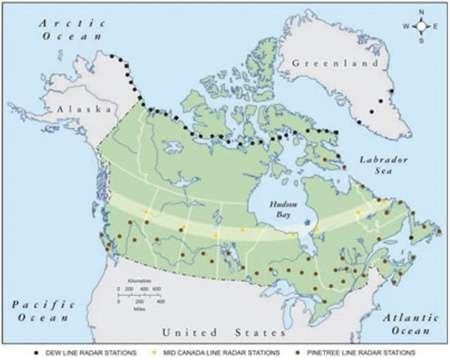
Figure 1. The DEW Line at 65: Future Unclear for North's ageing radar sites. CBC News. https://www.cbc.ca/news/canada/north/dew-line-65-years-norad-1.6446875
Vismay Buch is an MA Candidate at the Norman Paterson School of International Affairs at Carleton University
As weapons technology has advanced a lot since the radar sites were constructed, the government of Canada floated the idea to modernize the NWS radars. Hence, we must ask ourselves as responsible taxpayers, is it worth the investment? I would say absolutely.
My answer is supported by two arguments, economic and political. The economic argument for modernizing the NWS radars is skilfully presented by Dr. J Craig Stone from the Canadian Forces College, Torontoiii. In simple terms, he explained that the benefits from investing into a fully capable and modernized NWS radar chain are multiple fold. He used the input-output multipliers of the proposed investment using the data from Statistics Canada. Dr Craig Stone estimated that the entire project will generate about 6.8 billion dollars in total economic output for Canada and it is projected that the majority of that 6.8 billion will stay in the northern communities which could revitalize the Canadian Arcticiv
A full modernization will have many positive impacts on Canada’s economic state in general. More specifically, the economic impact can be subdivided into three categories, direct, indirect, and induced. Direct impacts include the construction of the facility itself and the local employment that the construction will generate. Indirect impacts of the modernization would be the supplier industries which would include logistics and manufacturing of components of the NWS. Finally, the induced impacts outline the positive economic boost that local businesses would receive from consumer spending by the workers working at the radar facilities. Overall, these impacts result in positive economic outcomes for Canada’s territories and provinces as the direct and induced impacts benefit the Arctic communities whereas the indirect impacts have a net positive economic impact on the entire country. All three impacts were emphasized by the Canadian government’s decision to contract an Inuit-owned and operated firm for 592 million dollars to manage the dayto-day maintenance and upkeep of the NORAD radar facilitiesv
Another aspect of the economic argument of modernizing NORAD is the direct economic benefit to Canada’s northern territories. As per a report by Canada’s Northern Economic Development Agency (CanNor), Canada’s 2024 Our North Strong and Free initiative in addition to the NWS modernization aims to invest about 58.4 million dollars in defence related spending with various Inuit business and labour related metrics being analyzed for fair participation in the economic growth of the community. The final goal of these investments and analysis is to achieve economic reconciliation for long neglected indigenous communities in Canada’s Arctic territoriesvi .
In addition to the economic impacts of NWS modernization, multiple spillover effects come from such major investment projects. Such spillover effects often complement the economic impacts mentioned above. Modernizing the NWS radars will create a positive technological spillover in terms of sensors, energy, and environmental monitoring in and around the radar sites. The construction itself will help build and/or strengthen the communications and logistics infrastructure in the Canadian Arctic with dual-use civilian and military benefits. It is also important to note that the modernization and construction of many of the defence related sites in the Canadian would lead to the region having better infrastructure notably, construction of Forward Operating Locations (FOL) in Inuit communities such as Inuvik, etc. The presence of CAF personnel in these facilities would lead to a positive spillover effect for the Arctic communities. All in all, these spillover effects have a net positive effect on enabling the Inuit communities to assert Canadian sovereignty and territorial integrity in the Arctic and beyond.
In terms of project timelines and development of specific components, the modernization of the ageing NWS sites and upgrading them to the Arctic Over the Horizon Radars (A-OTHR); Department of National Defence (DND) has already completed the options analysis phase and began to scout for locations to place the radar sites. The construction of the radars themselves will take place in Canada by a multitude of Canadian companies with technology partnership with Australiavii . As per the DND, A-OTHR will achieve initial operational capability by 2028 and full operational capability by 2031viii .
Politically speaking, Canadians’ willingness to spend more on defence has increased especially after Russia’s full-scale invasion of Ukraine in February 2022. As per a 2025 polling, 65% of Canadians agree with increasing Canada’s defenceix. Arctic has been at the forefront of growing geopolitical tensions with Russia as both Canada and the US are within striking distance of Russia. Souring relations trade relations and aggressive 51st state rhetoric by the US leadership along with repeated calls for Canada to spend more on defence has got Canadians worried about the defence of the continentx. Hence, Canada’s sovereignty in the Arctic has become a critical issue for Canada’s political leadershipxi . Conversely, It has been argued that modernizing the NWS radars might not be the best way to defend the Arctic, I would argue otherwise because knowing where our adversaries are, is better than not knowing and modernizing NORAD would give us metaphorical eyes in the Arctic.
In addition to the increased appetite for defence spending, Canadians have long been cognizant of the impacts of defence production and/or activities on climate change. NORAD modernization will not be fruitful if it does not improve the standard of living and reduce the impact on already fragile northern energy grids. The Government of Canada also announced the addition of Iqaluit hydroelectric project to the Major Projects Office (MPO) as a part of nation building projects. This indigenous led project will provide energy security to the biggest city and the capital of Nunavut, Iqaluit. This project along with NORAD modernization and modernization of the Port of Churchill in Manitoba form an integral part of Canada’s Arctic Economic and Security Corridorxii
Therefore, NWS modernization which will bring about economic reconciliation with Canada’s indigenous peoples should be the top priority. Modernizing the NWS would improve Canada’s steadfast commitment to North American security and might help to reduce tensions between Canada and the US.
Canada is incomplete without our Arctic and the Arctic region is incomplete without Canada.
Notes
i Government of Canada. (2021, August 14). Joint statement on NORAD Modernization. National Defence. https://www.canada.ca/en/department-national-defence/news/2021/08/jointstatement-on-norad-modernization.html
ii NORAD agreement. North American Aerospace Defense Command. (n.d.). https://www.norad.mil/About-NORAD/NORAD-Agreement/
iii Stone, J. C. (2024). The Economic Benefits of North Warning System Modernization. Defence and Peace Economics, 35(5), 557–576. https://doi.org/10.1080/10242694.2024.2328432
iv Ibid.
v Ibid.
vi Government of Canada (2025, June 17). Canadian Northern Economic Development Agency’s 2025-26 Departmental plan. Canada Northern Economic Development Agency. https://www.cannor.gc.ca/eng/1737488373810/1737488656798
vii Government of Canada (2025, July 17). National Defence signs technology partnership arrangement with Australia for Arctic Over-the-Horizon Radar. National Defence https://www.canada.ca/en/department-national-defence/news/2025/07/national-defencesigns-technology-partnership-arrangement-with-australia-for-arctic-over-the-horizon-radar.html
viii Government of Canada. (2025, November 22). Fact Sheet: NORAD modernization project timelines. National Defence. https://www.canada.ca/en/department-nationaldefence/services/operations/allies-partners/norad/norad-modernization-project-timelines.html
ix Coletto, D., & Ayrle, S. (2025, April 4). 64% of Canadians support an immediate stop to buying military equipment from the U.S. – majority support loosening budget restrictions and increasing defence spending. Abacus Data. https://abacusdata.ca/64-percent-of-canadians-support-an-immediate-stop-to-buyingmilitary-equipment-from-the-u-s/
x Ibbitson, J. (2025, February 3). Canada could cut a deal with the US – Increase defence spending, remove tariffs. Fraser Institute.https://www.fraserinstitute.org/commentary/canada-could-cut-deal-usincrease-defence-spending-remove-tariffs
xi Blake, E. (2025, April 10). What federal parties have promised for the north. Cabin Radio. https://cabinradio.ca/229675/news/politics/what-federal-parties-have-promised-for-the-north/ xii Government of Canada (2025, November 16). Iqaluit Nukkiksautiit Hydroelectric Project referred to the Major Projects Office. Crown-Indigenous Relations and Northern Affairs Canada. https://www.canada.ca/en/crown-indigenous-relations-northern-affairs/news/2025/11/iqaluitnukkiksautiit-hydroelectric-project-referred-to-the-major-projects-office.html