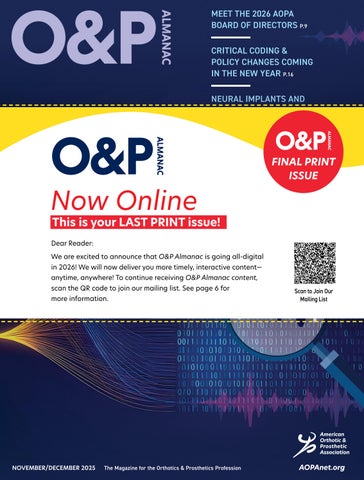
November December O&P Almanac 2025

Page 1


BOARD OF DIRECTORS P.9

CRITICAL CODING & POLICY CHANGES COMING IN THE NEW YEAR P.16

NEURAL IMPLANTS AND ADVANCED SENSORY-ENABLED PROSTHESES P.24

Now Online

This is your LAST PRINT issue!

Dear Reader:

AI: The Good, The Bad, The Possible

AI: The Good, The Bad, The Possible

Demystifying artificial intelligence use in O&P settings P.20

Demystifying artificial intelligence use in O&P settings P.20

We are excited to announce that O&P Almanac is going all-digital in 2026! We will now deliver you more timely, interactive content— anytime, anywhere! To continue receiving O&P Almanac content, scan the QR code to join our mailing list. See page 6 for more information.

MEET THE 2026 AOPA BOARD OF DIRECTORS

CRITICAL CODING & POLICY CHANGES COMING IN THE NEW YEAR P.16

NEURAL IMPLANTS AND ADVANCED SENSORY-ENABLED PROSTHESES P.24

AI: The Good, The Bad, The Possible

Demystifying artificial intelligence use in O&P settings P.20

THE PREMIER MEETING FOR ORTHOTIC, PROSTHETIC, AND PEDORTHIC PROFESSIONALS.

Save the Date

Save the date for AOPA’s 2026 National Assembly, September 9–12, 2026 in Las Vegas! Where O&P education meets the excitement of Vegas!

Submit a presentation by March 4 to present.

think outside the shoe.

Christopher Rains, a hiker, foot-drop patient and amputee participating in the Hanger Clinics Empowerfest in Phoenix, Arizona.

Across the country, O&P facilities both large and small are experimenting with artificial intelligence (AI) to streamline documentation, improve efficiencies during appointments, integrate device-generated data into patient care, and more. Early adopters share tips, success stories, and some words of caution.

24 THE SCIENCE OF TOUCH

A research collaboration leads clinical trials in which participants with paralyzed or missing limbs receive neural implants to enable a sense of touch through robotic hands. Find out how one study participant has progressed, read details of the current research, and hear predictions for the future of prosthetics.

Meet Cristalei Polk, MPO, CPO, LPO, an Atlanta-based clinician who co-led Georgia’s successful SEBCM campaign.

Knee Orthosis

CROSS™ is intended for mild to moderate knee hyperextension due to neuromuscular diseases or other injuries. The brace can also be used together with Allard AFOs when knee hyperextension is present together with foot drop.

ҋ One-hand donning and doffing.

ҋ Easy adjustment of hyperextension resistance, both through ROM stops and popliteal cross.

ҋ Smooth, low friction liner for comfort and easy application.

AOPA Contacts

A world where orthotic and prosthetic care transforms lives.

Board of Directors OFFICERS

President

Kimberly Hanson, CPRH Ottobock, Austin, TX

President-Elect

Matt Swiggum Proteor, Tempe, AZ

Vice President

Shane Wurdeman, PhD, CP, FAAOP(D) Hanger Clinic, Austin, TX

Treasurer

Chris Nolan

Immediate Past President

Rick Riley

O&P Boost, Bakersfield, CA

Executive Director

Teri Kuffel, JD

AOPA, Alexandria, VA

DIRECTORS

Matt Bulow, CP ForMotion Clinic Americas (Össur), Nashville, TN

Jeff Erenstone, CPO

Mountain Orthotic and Prosthetic Services, Lake Placid, NY

Deanna Fish, MS, CPO Orthomerica Products Inc., Orlando, FL

Clinician Director

Arlene Gillis, MEd, CP, LPO International Institute of Orthotics and Prosthetics, Tampa, FL

Adrienne Hill, MHA, CPO, LPO, FAAOP Kennesaw State University, Kennesaw, GA

Shane Kelly

Jim Kingsley

Hanger Clinic, Oak Brook Terrace, IL

Andrew L. Steele, MBA, CPO, LPO

Clark & Associates Prosthetics and Orthotics, Waterloo, IA

AMERICAN ORTHOTIC & PROSTHETIC ASSOCIATION (AOPA)

330 John Carlyle St., Ste. 200 Alexandria, VA 22314

Office: 571-431-0876

Fax: 571-431-0899 AOPAnet.org

AOPA Staff

EXECUTIVE OFFICES

Teri Kuffel, JD, executive director, 571-431-0876, tkuffel@AOPAnet.org

Akilah Williams, MBA, SHRM-CP, director of finance and strategic operations, 571-431-0819, awilliams@AOPAnet.org

HEALTH POLICY AND ADVOCACY

Ashlie White, MSHLS, MA, senior director of external affairs, 571-431-0836, awhite@AOPAnet.org

Joe McTernan, director of health policy and advocacy, 571-431-0811, jmcternan@AOPAnet.org

Devon Bernard, assistant director of coding and reimbursement services, education, and programming, 571-431-0854, dbernard@AOPAnet.org

Morgan Fabber, MPH, manager of state and federal advocacy, 571-431-0814, mfabber@AOPAnet.org

MEETINGS & EDUCATION

Ashley Vande Bunte, CMP, director, meetings and education, 571/431-0860, avandebunte@AOPAnet.org

Kelly O’Neill, CEM, assistant director, meetings and exhibitions, 571-431-0852, kelly.oneill@AOPAnet.org

Jules Gohng, meetings and education coordinator, 571-431-0843, jgohng@AOPAnet.org

MEMBERSHIP & COMMUNICATIONS

Joy Klapp, director of communications and membership, 571-431-0817, jklapp@AOPAnet.org

Madison McTernan, coordinator of membership and communications, 571-431-0852, mmcternan@AOPAnet.org

AOPA Bookstore: 571-431-0876

Reimbursement/Coding: 571-431-0833, LCodeSearch.com

O&P ALMANAC

AOPA, publisher

Josephine Rossi, editor, 703-662-5828, jrossi@contentcommunicators.com

Catherine Marinoff, art director, 786-252-1667, catherine@marinoffdesign.com

Bob Heiman, director of sales, 856-520-9632, bob.rhmedia@comcast.net

PUBLISHER AOPA

EDITORIAL MANAGEMENT CONTENT

COMMUNICATORS LLC

ADVERTISING SALES RH MEDIA LLC

DESIGN & PRODUCTION MARINOFF DESIGN LLC

PRINTING SHERIDAN

SUBSCRIBE

O&P Almanac (ISSN: 1061-4621) is published bimonthly by the American Orthotic & Prosthetic Association, 330 John Carlyle St., Ste. 200, Alexandria, VA 22314. To subscribe, contact 571-431-0876, fax 571-431-0899, or email info@ aopanet.org. Yearly subscription rates: $59 domestic, $99 foreign. All foreign subscriptions must be prepaid in U.S. currency, and payment should come from a U.S. affiliate bank. A $35 processing fee must be added for non-affiliate bank checks. O&P Almanac does not issue refunds. Periodical postage paid at Alexandria, VA, and additional mailing offices.

ADDRESS CHANGES

Postmaster: Send address changes to: O&P Almanac 330 John Carlyle St., Ste. 200, Alexandria, VA 22314.

Copyright © 2025 American Orthotic and Prosthetic Association. All rights reserved. This publication may not be copied in part or in whole without written permission from the publisher. The opinions expressed by authors do not necessarily reflect the official views of AOPA, nor does the association necessarily endorse products shown in the O&P Almanac. The O&P Almanac is not responsible for returning any unsolicited materials. All letters, press releases, announcements, and articles submitted to the O&P Almanac may be edited for space and content. The magazine is meant to provide accurate, authoritative information about the subject matter covered. It is provided and disseminated with the understanding that the publisher is not engaged in rendering legal or other professional services. If legal advice and/or expert assistance is required, a competent professional should be consulted.

ADVERTISE WITH US

Share your message with AOPA membership— approximately 9,000 orthotic and prosthetic professionals, facility owners, and industry personnel. Contact Bob Heiman at 856-520-9632 or email bob.rhmedia@comcast.net

Turning the Page: O&P Almanac's Digital Era Begins

At the end of 2025, we will say goodbye to the print version of O&P Almanac. But this is far from the end of our magazine. In fact, we're growing!

This transition has been part of AOPA’s strategic plan for years. We’re modernizing by moving to an all-digital format to better serve our audience, without the operational constraints of a print edition. Even with strong advertiser support, the process of producing, printing, and distributing a magazine gets in the way of delivering news where and how people consume it today. So, this issue, volume 74, number 6, will be our last in print.

Then, the real fun begins! This move enables a more sustainable future for O&P Almanac by eliminating print production costs and reinvesting those resources into our storytelling capabilities. Moving away from a traditional print schedule means we can deliver information faster, making better use of digital and social platforms. The shift also opens opportunities for expanded formats, including videos, infographics, and interactive content that bring stories to life in engaging ways. And for O&P businesses, we will offer new ways to get the word out about your business and services.

Perhaps most importantly, this change strengthens our engagement by allowing us to connect directly with you, our readers, and the broader O&P community, while amplifying more voices, experts, and perspectives to enrich important conversations in the profession.

It’s certainly the end of an era for the publication whose roots go back to The Journal of OALMA in the 1950s. But I could not be more excited for this incredible new chapter. Be sure to scan the QR code below to be on our mailing list when new content is available. And, as always, thank you for your continued support of AOPA and O&P Almanac

I look forward to engaging with you more in 2026!

Josephine
Almanac Scan to Join Our Mailing List

PRECISION TUNED STIFFNESS

Move beyond intuition. With Fabtech’s PDE™ spring system, stiffness becomes a quantifiable ingredient you prescribe, ensuring consistency across patients and confidence in results.

LEARN MORE

Happenings

Letter From the President

Dear AOPA Members,

As I step into the role of president of the American Orthotic and Prosthetic Association (AOPA), I am both deeply honored and truly energized. Serving this community is a privilege, and I am grateful for the trust you have placed in me.

AOPA’s strength has always come from the passion and dedication of the individuals who make up this profession. Every day, you advance patient care, strengthen your organizations, push innovation forward, and lift up the O&P community. Your work fuels our shared commitment to build an even stronger future.

If I had to choose one word that defines both our progress and our opportunity, it would be collaboration. It is the foundation of our profession—clinicians, manufacturers, educators, researchers, advocates, residents, students, and patients coming together to transform lives. And yet, I believe we have only begun to unlock the full potential of what collaboration can achieve.

In the year ahead, my vision is to bring our community together in new, deeper, and more impactful ways. By aligning our efforts, sharing insights, and speaking with a unified voice, we will continue strengthening the O&P profession while improving access and outcomes for the people we serve.

One essential area where collaboration is already creating momentum is our work with payors. Reimbursement policies and insurer relationships directly affect your businesses and access to care. While we’ve celebrated important Medicare progress this year, these wins are only the beginning. To sustain and expand this work, AOPA is launching a new Payor Relations Committee focused on strengthening commercial payor engagement, advocating for fair policies, and ensuring that O&P patients receive the essential devices and services they need.

But collaboration extends far beyond payor relations. We will also continue elevating innovation, expanding education, strengthening advocacy efforts, and fostering the next generation of leaders. These initiatives all reinforce the tangible value of your AOPA membership:

• You gain tools, resources, and insights that help your business thrive

• Your teams benefit from education that strengthens operations and improves patient care

• We advance policies that safeguard access and support the long-term sustainability of the profession.

As someone who has led business education initiatives for AOPA and served in various volunteer roles, I have seen firsthand how informed, engaged members elevate the entire profession. When we grow individually, we grow collectively.

This growth must also extend globally. O&P is an international profession, and our future will be shaped through global collaboration. This year, we will deepen our international partnerships,

ensuring AOPA members remain connected to global innovation, research, and best practices.

Education remains one of my passions, and I am thrilled that AOPA is launching a new administrative education track to support the essential staff who keep O&P organizations running. By strengthening operations, we are strengthening the entire profession.

As I look ahead to the coming year, my vision for AOPA is clear:

• Collaboration will be our cornerstone

• Education and engagement will empower our members

• Global partnerships will expand our reach and knowledge

• New initiatives will ensure every member of your team is equipped for success.

Together, we will elevate the O&P profession, strengthen our businesses, and—most importantly—improve the quality of life for the individuals and families we serve.

Thank you again for this incredible opportunity. I am excited for what we will accomplish together in 2026 and beyond.

Wishing you and your loved ones a warm, joyful, and healthy holiday season.

With gratitude,

WOMEN IN O&P

Together Again: Past and Present Female AOPA Presidents

Four of the five women who have served or are serving as president of AOPA reunited at AOPA’s 2025 National Assembly in Orlando: (from left) Traci Dralle, CFm (2020-2021); Anita Liberman-Lampear, MA (2013-2014); Teri Kuffel, JD (20222023); and Kimberly Hanson, CPRH (2025-2026). Mary S. Dorsch, CPO, served 1971-1972.

AOPA Board of Directors Prepares for a Productive 2026

With a new year on the horizon, the members of the 2025-2026 Board of Directors—who took office Dec. 1, 2025, and will serve through Nov. 30, 2026—are preparing for an industrious tenure. The Board members are strategically leveraging their experience and dedication to the profession to advocate for AOPA members and advance AOPA’s vision: a world where orthotic and prosthetic care transforms lives. Elected by the membership, the AOPA Board of Directors is representative of the membership and serves as the governing body, responsible for the supervision and direction of its mission.

Elected during the AOPA National Assembly in September, Kimberly Hanson, CPRH, will serve as president of AOPA for the coming year. Hanson, director of reimbursement for Otto Bock HealthCare, has been a member of the AOPA Board for the past several years and has spent much of her time advocating on behalf of AOPA and O&P patients and clinicians in both the state of Texas and on the federal level.

Serving as AOPA president-elect for the new term is Matt Swiggum, who has worked in the field of prosthetics since 1997. A dedicated O&P advocate, Swiggum believes that having access to care is critical for the long-term success of people with limb loss and limb differences. He brings decades of experience in executive leadership, sales, and marketing.

Shane Wurdeman, PhD, CP, FAAOP(D), was elected AOPA vice president for the coming year. Wurdeman is the chief clinical officer with the Hanger Institute and Hanger Clinic. He entered the field of O&P as a technician before transitioning to working as an orthotist/prosthetist and finally into his role as a principal investigator. He has co-authored more than 70 peer-reviewed manuscripts, published three book chapters, and presented more than 100 conference abstracts within the field of O&P rehabilitation.

Chris Nolan will continue to serve as treasurer for the upcoming year. He has worked in the O&P profession for more than 25 years, for some of the largest and most respected names in the industry. Currently, Nolan is vice president of upper-limb prosthetics at Össur for the company’s combined Naked Prosthetics, Touch Solutions, and Livingskin business.

Rounding out the 2025-2026 officer roster are Rick Riley, who serves as immediate past president, and Teri Kuffel, JD, who is AOPA’s executive director and serves as secretary (nonvoting).

Matt Bulow, CP, is new to the AOPA Board of Directors this year. He is national clinical director for ForMotion Clinic— Americas (Össur), where he leads clinical operations across multiple locations; a four-time Paralympic bronze medalist in track and field; and a former amputee long jump world record holder and NCAA Division I varsity tennis player. In addition, existing member Arlene Gillis, MEd, CP, LPO, founder of the International Institute of Orthotics and Prosthetics, has been voted clinician director. Gillis has a wealth of experience as a clinician, educator, and O&P program director at St. Petersburg College.

To the right is the full list of 2025-2026 AOPA Board of Directors members.

2026 AOPA Officers

2026 AOPA Board Members

Special Thanks To Departing Member

AOPA appreciates the significant work of the following individual, who concluded his term as an AOPA board member Nov. 30, 2025.

Kimberly Hanson, CPRH, President
Chris Nolan, Treasurer
Matt Swiggum, President-Elect
Rick Riley, Immediate Past President
Shane Wurdeman, PhD, CP, FAAOP(D) , Vice President
Teri Kuffel, JD, Secretary (Nonvoting)
Matt Bulow, CP
Adrienne Hill, MHA, CPO, LPO, FAAOP
Jeff Erenstone, CPO
Shane Kelly
Deanna Fish, MS, CPO
Jim Kingsley
Arlene Gillis, MEd, CP, LPO Clinician Director
Andrew L. Steele, MBA, CPO, LPO
Mitchell Dobson, CPO

RESEARCH ROUNDUP

Osseointegration: Study Points to Need for Standardized Eligibility Guidelines for Widespread U.S. Adoption

Researchers from the University of Wisconsin School of Medicine and Public Health, citing a lack of clear U.S. eligibility guidelines for osseointegration (OI), conducted a scoping review of 17 studies to synthesize the characteristics of current OI recipients in the United States and identify gaps in clinical practice with the goal of proposing evidence-based eligibility criteria for patient selection.

The researchers identified some key demographic characteristics of patients with OI, noting in their review an average age at implant among U.S. OI patients of 49 years; 68% of patients being

male; and trauma as the most common reason for amputation (64%), followed by tumor (19%), peripheral artery disease (11%), and sepsis (9%).

However, the review found no evidence of specialty-specific amputation guidelines, and the researchers noted the complexity involved in amputation decisions, influenced by varied surgical specialty perspectives, and the importance of strategic amputation site selection for optimal OI outcomes.

“Developing clear guidelines and a collaborative, multidisciplinary approach is crucial for consistent patient selection, improved access to OI, and enhanced long-term functional outcomes and quality of life for individuals after major limb amputation,” noted the researchers. The study was published in the Journal of Vascular SurgeryVascular Insights

European Study Finds Longer Brace Wear Time Reduces Need for Surgery in Scoliosis Patients

Researchers in Italy examined the dose-response curve for scoliosis patients in cases of brace wear time of greater than 18 hours per day. They conducted a retrospective analysis of consecutively collected data among patients with adolescent idiopathic scoliosis with curves less than 45 degrees, wearing different types of braces prescribed between 18 and 24 hours per day. Patients were a mean of 13 years old with a mean Cobb angle of 28 degrees.

Among participants with higher brace wear times, the researchers found larger scoliosis curves but also better final Cobb angle results. The dose-response curve reportedly showed statistically significant improvements, and the researchers concluded that “brace wear time of greater than 18 hours per day is associated with avoiding surgery (end curve of less than 50 degrees), reduced progression, and increased improvement rates, and achieving an end curve of less than 30 degrees, which is particularly relevant because it reduces the risk of problems in adulthood.” They suggested that decisions on brace wear time should be based on the desired outcomes and an honest conversation with the patients and parents.

The study was published in August in European Spine Journal

O&P HEALTHCARE DESERTS

WHERE IS IT DIFFICULT TO ACCESS PROSTHETIC CARE?

A nationwide analysis of prosthetic accessibility found that prosthetic healthcare deserts are more likely to be in western rural areas of the United States, with localized patterns influenced by socioeconomic factors. SOURCE:

PPOs Top List of Most Common EmployerSponsored Coverage Plans

Preferred provider organizations (PPOs) continue to be the most common plan type of employersponsored health care coverage in 2025: Forty-six percent of covered workers are enrolled in a PPO; 33% are enrolled in a high-deductible plan with a savings option; 12% are enrolled in a health maintenance organization; 9% are enrolled in a point-of-service plan; and less than 1% are enrolled in a conventional indemnity plan. SOURCE:

Our first priority is to bring you reliable and accurate foot orthotics. We embrace continuous improvement to deliver the latest advances in technology. Customer service is at the heart of every decision we make. We work endlessly to help you be effective and efficient in your practice.

AOPA Recognizes Young Professionals as FirstEver “O&P Rising Stars”

In October, AOPA introduced the inaugural class of “O&P Rising Stars”—three extraordinary young professionals who are already shaping the future of O&P through their innovation, leadership, and passion.

Janine Albrecht, MSOP, CPO, a product manager and clinical educator at WillowWood, blends engineering insight, clinical expertise, and a passion for patient care. She played a pivotal role in bringing the META Flow Foot to market (winner of the 2024 Hanger Innovation Award) and led the U.S. launch of the Intuy Knee, making powered microprocessor knee technology more accessible.

Cassandra Delgado, MSPO, CPO, is known for her infectious enthusiasm, creativity, and dedication to advancing O&P, and her work spans patient care, research, and advocacy. At Coyote and Prosthetic and Orthotic Associates, she empowers clinicians, residents, students, and patients—particularly Spanish-speaking communities—by breaking down barriers to care.

Graci Finco, PhD, CPO, an assistant professor at Texas Christian University (TCU), is a trailblazer in research and mentorship. Finco also serves as director of the Limb Loss and Difference Lab at TCU, where she focuses on fall risk, musculoskeletal health, and ethics in technology. Her work is already shaping national conversations on O&P care and research, while her integrity, empathy, and vision inspire both colleagues and students alike. These individuals represent the next generation of O&P leaders—clinicians, educators, innovators, and researchers whose work is advancing patient care and strengthening the entire profession.

O&P ATHLETICS

Elite Athletes Compete at 2025 Para Athletics World Championships

Team USA took third place at the 2025 World Para Athletics Championships in New Delhi, earning 28 total medals, including six gold medals. Brazil came in first and China came in second in the medal counts.

28

Among athletes on Team USA, five athletes took home two medals. Jaydin Blackwell earned two world titles in the men’s 100-meter T38 and 400-meter T38 competitions. Annie Carey clinched the world title in the women’s 200-meter T44 and took silver in the 100-meter T44, while Arelle Middleton (women’s shotput F44), Joel Gomez (men’s 1,500-meter T13), and Michael Brannigan (men’s 1,500-meter T20) each won a world title for Team USA.

Taylor Swanson finished with a silver medal in the women’s 100-meter T37 and a bronze medal in the women’s 200-meter T37. Alicia Guerrero won two bronze medals in the women’s discus throw F64 and shotput F64. Kym Crosby clinched bronze medals in the women’s 100-meter and 200-meter T13 events. Beatriz Hatz earned a bronze medal in the women’s long jump T64 category, while Noelle Lambert-Beirne took the bronze in the women’s long jump in the T63 category.

Beatriz Hatz Noelle Lambert-Beirne

Premium gel. Proven performance.

From liners to sleeves, the OptiGel product family delivers next-level comfort and control. It cushions impact, adapts to movement, and keeps users feeling secure—all day, every day.

MEDICARE MATTERS

MEDICARE REIMBURSEMENTS LAG BEHIND COST OF CARING

From 2022 to 2024, general inflation rose by 14.1%, while Medicare net inpatient payment rates increased by only 5.1%, amounting to an effective payment cut over the past three years.

SOURCE: “

THE NUMBERS

MEETING MASHUP

Amputee Coalition To Host 40th Anniversary National Conference in January

Amputee Coalition members and stakeholders will convene in the “Entertainment Capital of the World” next month for the organization’s 40th Anniversary National Conference, Jan. 13-15, 2026, at the Westgate Las Vegas Resort & Casino. The event, with a theme of “Honoring the Journey, Shaping the Future,” will feature interactive sessions, lively roundtables, and community-driven discussions. Participants can sign up for Certified Peer Visitor Training preceding the event, on Jan. 12. Visit 40years.amputee-coalition.org for details and to register.

AMPUTATION RATES ON THE RISE IN OKLAHOMA

Despite falling amputation rates in the United States overall, the statewide amputation rate in Oklahoma nearly doubled between 2008 and 2019, with both major and minor amputations spiking.

Business Trends at O&P Facilities

Lines/Services

Do you collect outcome measurements for at least some of your patients?

Orthotic patients:

Prosthetic patients:

BUSINESSES

Embla Medical has opened a new prosthetics clinic in Kyiv, Ukraine, specifically to provide advanced healthcare and high-tech prostheses free of charge to 1,000 people, including soldiers and civilians, who have suffered amputations due to war-related trauma. Embla Medical also announced a landmark partnership with the government of Iceland to launch the “Iceland Supports Mobility in Ukraine” initiative, a three-year program to support these patients.

“Through this partnership and our new clinic in Kyiv, we are taking concrete steps to improve access to advanced prosthetic care in Ukraine,” said Sveinn Sölvason, president and CEO of Embla Medical. “Together with our partners, we are building lasting capacity to deliver much-needed mobility solutions.”

The Hanger Foundation has awarded $150,000 in Empowerment Grants for the 2026 funding cycle to 36 nonprofit organizations focused on providing programs and support to military veterans across the country. The grants are part of the Foundation’s commitment to supporting veterans with limb loss, limb  “Since its founding, the Hanger Foundation has proudly awarded grants to organizations dedicated to serving veterans,” said Executive Director Rachel Kubicki. “Through our giving strategy, we’ve prioritized key areas within the O&P community where we can create meaningful, lasting change for individuals living with limb loss and limb difference. Supporting veteran-focused organizations remains a cornerstone of our work.” Visit hangerfoundation.org for details.

OPGA recently honored several O&P providers with a 2025 Freedom Award in recognition of their exceptional care of military personnel needing orthotic and prosthetic devices. “O&P professionals play a vital role not only in the lives of individual patients but also in the health and resilience of entire communities,” said Jeff Kessler, director of OPGA. “Their work with veterans often inspires broader awareness and appreciation for the O&P profession, and the OPGA Freedom Award helps shine a light on that ripple effect of care and commitment.”

Among the honorees were three AOPA member companies: NovaCare in Fond du Lac, Wisconsin, NovaCare in Oshkosh, Wisconsin, and Decker Integrated O&P in Overland Park, Kansas.

The Pedorthic Foundation voted to transfer its assets and mission to The O&P Foundation, ensuring the continuation of its decades-long mission to advance the profession of pedorthics. The O&P Foundation will assume stewardship of The Pedorthic Foundation’s legacy and funds, which will be dedicated exclusively to supporting pedorthic education, research, and professional development initiatives. The first O&P Foundation pedorthic funding programs for fiscal year 2026 will be announced soon.

PEOPLE

The Board of Certification/Accreditation (BOC) has recognized Dexter Moon, CDME, as the recipient of the organization’s 2025 Certificant of the Year Award. Moon is being honored for his exceptional leadership and commitment to service, innovation, and outreach in the field of durable medical equipment (DME). Moon is a member of the executive leadership team at Project MEND.

“I am humbled to receive BOC’s 2025 Certificant of the Year Award,” said Moon. “My BOC certification has equipped me with the knowledge and confidence to lead with purpose, but it’s our Project MEND team and partners who bring that purpose to life every day. Together, we’re breaking down barriers to care and helping people live with greater independence and improved quality of life.” In 2024, Project MEND distributed more than 5,700 pieces of refurbished durable medical equipment to more than 2,100 individuals in need across 46 counties in Texas, including veterans, surviving spouses, and their dependents.

Bill Powers, MBA, LFACHE, has been honored with the 2025 Jim Newberry Award for Extraordinary Service from the Board of Certification/Accreditation (BOC). Powers, a retired health care executive and former member of the BOC Board of Directors, is being recognized for his unwavering dedication and exceptional contributions to advancing BOC’s mission.

“Bill exemplifies the values of service and stewardship that the Newberry Award was created to honor,” said BOC Board Chair Cameron Stewart, BOCO, BOCP. “His leadership and governance insight helped elevate BOC’s operations and strengthen our commitment to certification and accreditation excellence.”

Powers served on the BOC Board from 2010 to 2018 and 2020 to 2023. Among his many contributions, Powers applied his extensive experience in governance, finance, and operations to support BOC’s long-term sustainability and mission-focused growth.

“For me, service has always been about ensuring businesses are positioned to meet the needs of the people they support, both now and in the future,” said Powers. “It’s an incredible honor to be recognized by BOC, and I’m proud to have contributed to the organization’s past, present and future health.”

AOPA Partners With IIOP for the Business Certificate Program

Beginning fall 2026, the International Institute of Orthotics & Prosthetics (IIOP) will become the new partner for AOPA's Business Certificate Program. Courses will continue to be offered both online and in person at select seminars around the country. Visit AOPA's website for details.

Dexter Moon, CDME

2025: The Year in Review

How recent coding, reimbursement, and policy changes will impact your business

As we approach the end of 2025, let’s take a moment to reflect on the significant coding, reimbursement, and policy changes that have and will impact O&P businesses as we move into 2026. Updated Local Coverage Determinations (LCDs) and Policy Articles; modifications to the Health Care Common Procedure Coding System (HCPCS) codes; tariffs; and the potential re-introduction of competitive bidding for durable medical equipment, prosthetics, orthotics, and supplies (DMEPOS) are just some of the significant changes that have occurred over the past 12 months.

This month’s Reimbursement Page examines some of these changes and explores how they may impact your business moving forward.

Medicare Expansion of Coverage of Knee Orthoses to Treat Osteoarthritis

For years, AOPA members shared their frustration regarding the lack of Medicare coverage for knee orthoses used to treat osteoarthritis. Longstanding Medicare policy required either a history of recent injury to, or surgical procedure on, the knee, or objective documentation of ligamentous joint instability.

Osteoarthritis is a chronic condition where the cartilage in the knee joint degenerates, resulting in bone-on-bone contact within the knee joint and often causing significant pain and swelling. Knee orthoses that treat this condition by physically separating the bones, also known as unloader braces, have proven to be a very effective means of treatment but do not meet the current policy requirements for Medicare coverage. In 2023, AOPA submitted a formal LCD reconsideration request to advocate for expansion of Medicare coverage for knee orthoses to include orthoses used to treat osteoarthritis without

a history of injury/surgery or presence of ligamentous joint instability. The LCD reconsideration request process is quite complex and must be supported by clinical studies that show the effectiveness of the treatment that is part of the LCD reconsideration request.

The DME MACs reviewed AOPA’s LCD reconsideration request and issued a proposed revision to the knee orthosis LCD and Policy Article that will include coverage of knee orthoses used to treat tibiofemoral osteoarthritis. As of the writing of this article, the revised policy has not been finalized, but AOPA is hopeful that the proposed policy will be finalized without significant changes. This would represent an important expansion of coverage that will allow access for Medicare beneficiaries

to effective, nonsurgical treatment options for osteoarthritis.

Recognition of Additive Manufacturing for Custom Fabrication

Additive manufacturing, especially 3D printing, has made its way to the forefront of innovation in O&P manufacturing. To facilitate productive discussion about the use of additive manufacturing to fabricate O&P devices, an industry consortium was formed and began meeting on a regular basis.

This consortium established open lines of communication with the Pricing, Data Analysis, and Coding contractor and Durable Medical Equipment Medicare Administrative Contractor, which resulted in the publication of correct coding bulletins that

indicate that additive manufacturing is an acceptable means of custom fabrication for both prostheses and orthoses. This represented acknowledgement of this technological advancement in O&P fabrication and provided much needed clarification for the O&P provider community.

Updates to the HCPCS Coding System

This past year saw significant updates to the HCPCS code set that is used to bill for O&P services for Medicare and other payors.

The Health Insurance Portability and Accountability Act requires the use of a common code set for billing purposes, so all payors are required to recognize the

L-code system for billing prostheses and orthoses. One of the areas of the existing L-code system that has long needed review and updating is the upper-extremity prosthetic codes.

The Upper-Limb Prosthetics Society of the American Academy of Orthotists and Prosthetists took on the task of identifying codes that needed to be updated or replaced and worked diligently to create a long-term strategy to facilitate this process. While still in the early stages, the efforts of this group have resulted in the replacement of several obsolete and outdated upperextremity prosthesis codes with new codes that better describe the technology that exists in today’s clinical environment.

Beyond the positive changes to the upper-extremity prosthetic code set, CMS has responded favorably to several other prosthetic and orthotic HCPCS code applications, which has resulted in the creation of new codes that describe innovative technologies that will continue to advance O&P clinical care.

Impact of Tariffs on O&P

Tariffs have been a topic of discussion far beyond the O&P arena in 2025. The impact of tariffs has been discussed, debated, and argued on TV, over the dinner table, and among friends.

While tariffs continue to be a fluid issue as they are continually adjusted based on negotiations with individual countries, there will continue to be real impact on O&P businesses in 2026.

AOPA has focused its efforts on ensuring that members have the best and most up-to-date resources available to help them negotiate the impact of tariffs. There is long-standing precedence in international trade practice that provides for limited exemption from tariffs for items and services that are intended for use by the handicapped. This provision, known as the Nairobi Protocol, is the most likely path for potential exemption of O&P devices and components from application of tariffs. Unfortunately, the applicability of the

Nairobi Protocol is not always clear and is often subject to interpretation.

AOPA understands the importance of the impact of tariffs on O&P businesses and will continue to develop and communicate resources as they become available.

Is Competitive Bidding Coming Back?

While the final regulatory rule that includes the creation of a new round of Medicare DMEPOS competitive bidding has not yet been published as of the writing of this article, the proposed rule that was published in July 2025 included provisions that would establish a new round of Medicare competitive bidding.

The last round of DMEPOS competitive bidding, which included several off-theshelf (OTS) knee and spinal orthoses, ended in December 2023. A new round would be less likely to rebid codes that have already been part of competitive bidding, but there are approximately 32 additional OTS orthosis codes that were not part of competitive bidding in the past that will most likely be included in any future rounds of competitive bidding.

AOPA continues to advocate for both legislative and policy-based exemptions from competitive bidding for orthotists and

prosthetists. This exemption has been in place for physicians and other allied health professionals (physical therapists, occupational therapists, etc.) and should be extended to orthotists and prosthetists in the interest of holistic treatment of their patients.

AOPA will continue to work with its champions on Capitol Hill and with CMS officials to ensure that any form of competitive bidding does not negatively impact the patients that you serve.

What’s in Store for 2026?

The coming year will hopefully continue to see improvements in policy, coding, and regulation. The past 12 months saw significant advancements in all of these areas as relationships with legislators and policymakers continued to pay dividends.

CMS’s recognition of new and innovative technologies has been a positive development in 2025, and AOPA looks forward to continuing to build momentum as we move into 2026.

Joe McTernan is director of health policy and advocacy at AOPA. Reach him at jmcternan@AOPAnet.org

THE GOOD, THE POSSIBLE AI:

O&P trendsetters share tips for leveraging artificial intelligence to optimize business and improve patient care

Artificial intelligence (AI) has moved past the early adoption phase. O&P professionals in large, nationwide networks and small, independent clinics alike are experimenting to find the best ways to incorporate AI efficiencies into their operations. From reading through medical records and completing documentation in record time to organizing clinical data to provide instantaneous feedback on fittings and advancing research, AI is changing the O&P landscape in meaningful ways.

Hanger began rolling out the ambient listening program, part of its Clinical Assistant for Records Automation (CARA) system, in 2023 to streamline documentation workflows and help clinicians find better balance in their administrative and patient-care duties.

CARA was designed not only to improve the accuracy and timeliness of clinical documentation, but also to enhance the patient-clinician relationship, according to the Hanger Institute for Clinical Research & Education’s “2024-2025 Annual Report.”

Curt Bertram, CPO, FAAOP, senior manager of clinical affairs at the consulting firm O&P Insight, first saw AI’s potential for making documentation and billing radically more efficient in a demonstration at a Hanger clinic. Bertram posed as a patient and Hanger staff interviewed him using ambient listening AI technology.

“Right in the middle of the interview, the clinician looked at me and said, ‘Curt, do you like rainbows and unicorns?’ and I said, ‘Who doesn’t?’”

After a brief chat touching on fun trends, from pet rocks to Squishmallows stuffed toys, the interviewer shifted the conversation back to prosthetics. Minutes after the meeting ended, Hanger staff showed Bertram an AI-generated note advocating for a prosthesis that would meet his needs, with zero mentions of extraneous rainbows.

The AI platform did more than transcribe their conversation; it synthesized who was talking and the different topics discussed, and it created a note focused solely on what was relevant for the patient to get a prosthesis. “And it was an extremely good note,” Bertram added.

NEED TO KNOW

f O&P facilities are adopting artificial intelligence (AI) to streamline documentation, reduce clinician burnout, and integrate devicegenerated data into patient care.

f Experts emphasize that AI used for note-taking purposes must be trained on high-quality, O&P-specific data to avoid hallucinations and ensure documentation accurately reflects each patient’s unique needs.

Ambient listening allows clinicians to fully engage in discussions with patients and creates more time for clinicians to spend in patient interactions, fostering closer, more collaborative relationships. “The AI ambient allowed us to look at the patient, listen, and be present, rather than [look] down at our laptop trying to self-capture and scribe everything going on,” a clinician said in the annual report.

After appointments, CARA transcribes visit conversations and summarizes the relevant portions. Then, generative AI specifically trained on O&P combines the summary with pertinent details from the electronic health record, including imaging, labs, and information from prior visits.

CARA drafts a clinical narrative for clinicians to review and refine. While created speedily, the resulting narrative also tends to be more complete, incorporating longitudinal data for a holistic understanding of the patient’s history, physical condition, lifestyle, and goals.

f AI-enhanced prosthetic devices and smartphone-based gait analysis tools are generating real-time data that support more precise fittings, earlier interventions, and improved patient safety and comfort.

f As AI facilitates large-scale data collection and research, O&P organizations are leveraging these insights—combined with clinical expertise—to challenge assumptions, improve clinical

decision-making, and design care plans that lead to better long-term outcomes.

f Clinicians taking a wait-and-see approach to AI risk losing business if they don’t start adopting the technology soon.

Documentation Without Hallucination

Founder of consulting firm OP Solutions, Jason T. Kahle, MSMS, CPO, LPO, FAAOP, agrees that using AI can help practitioners solve business problems and operate more efficiently. However, there’s a real learning curve in ensuring your AI system will curate the correct data, Kahle explained during a presentation at the AOPA National Assembly in September.

“AI changes unstructured data into meaningful real-world outcomes,” Kahle said. “But there’s no functionality outside that data. You have to be careful. AI hallucination is a real thing.”

AI hallucination occurs when artificial intelligence systems present false or misleading information as fact. AI hallucination typically is caused by inadequate training data and AI’s predictive nature. If there are gaps in data, AI will attempt to fill them, and flawed data can be incorporated into the AI output.

Clinicians should train AI to speak the languages of payors, patients, and physicians and tell a patient’s story based on the particular outcome measures the payor looks for, such as stumbles and falls, activities of daily living, and patient-specific functional-level scales.

"...If you do it properly and your input is good—meaning the questions that you ask are quality questions about that patient—the output is good.”

Quality In, Quality Out

Bertram advises independent practitioners to leverage AI to help them improve their documentation, so they earn more insurance preauthorizations and, eventually, payments for the devices they deem clinically necessary for patients.

“I think AI will save our profession, in the fact that burnout is at an all-time high and documentation is the bane of our existence,” he says.

Figuring out how to get the right information from AI into the patient’s chart is a learning process. But Bertram says establishing checklists of what to ask patients with various presentations can help ensure complete documentation. Knowing if patients are ambulatory, the medications they’re taking, and other health issues they’re facing can help clinicians and AI home in on the details needed get insurance approvals.

“The good thing about AI is, if you do it properly and your input is good—meaning the questions that you ask are quality questions about that patient—the output is good.”

Robust, secure, AI platforms (not Chat GPT) that are compliant with the Health Insurance Portability and Accountability Act have the potential to help clinicians avoid one of the biggest pitfalls Bertram sees: cloned documentation. Whether AI-generated or crafted by a clinician who then cuts and pastes wording from one chart to another to save time, insurance companies rebuff templated copy that lacks patient-specific detail.

“They want to pay for the patient to get better. One of the terms I use is ‘unmet needs.’ So, if I’m fitting you for a prosthesis, what can’t you do that you need to do? What are your unmet needs?”

Even patients with nearly identical demographics and amputations should have significantly different clinical narratives based on their lifestyles, jobs, recreation, and family demands, says Bertram. “You may be taking care of an elderly parent, but your doppelganger may have a vocational thing that they need a high mobility for.”

Pulling evidence of medical necessity for a device from visit summaries and scanning physician notes for corroborating information are tasks that AI can tackle to free independent practitioners for a multitude of other activities—from seeing more patients, to fabrication, to promoting their businesses.

And Bertram thinks clinicians taking a wait-and-see approach to AI risk losing business if they don’t start adopting the technology soon.

“Everybody else will be doing it faster, better, and more compliant, because AI will be helping them,” he says. “They’re going to see extra patients where you’re still banging on the keyboard.”

Big Data

Prosthetic technology increasingly incorporates AI into devices, yielding prostheses that can differentiate changes in terrain and analyze and respond to walking patterns.

Robotic knees with sensors that feed data into an AI processor make walking feel more natural through instantaneous adjustments to the knee’s resistance and positioning to provide optimal support through various activities. Smart devices also employ AI to record and transmit data that can be used to plan treatment.

“Smart devices can produce enormous amounts of information, but data only becomes meaningful when paired with clinical expertise, a patient’s own experience and priorities, long-term outcomes, and clear communication within the care team,” says Molly McCoy, CPO, director of clinical and scientific affairs for Hanger.

Hanger is exploring ways to use device-generated data in patient care while keeping the focus on what ultimately improves a person’s daily life. McCoy says CARA translates technical device data into useful, understandable insights for clinicians, prescribers, therapists, and patients, ensuring the technology enhances—not replaces—the conversations that drive care decisions.

The integration of real-time data into treatment settings can help infuse more science into the art and science of prosthetic care.

New York-based OneStep uses sensors in smartphones to collect critical information on patients’ gaits to inform clinical decisions on device selection and fitting while increasing patient comfort and device wear time.

Leveraging AI to Improve Athletic Performance—and Everyday Accessibility

Andrea Giovanni Cutti, MEng, PhD, CPO, a prosthetist and researcher with the Italian National Institute for Insurance Against Accidents at Work (INAIL), is using AI to make sophisticated technology unavailable to most people more accessible.

Since an INAIL physician helped launch the Paralympics in Rome in the 1960s, INAIL has supported the athletes and coaches of Italy’s Paralympic team. Cutti is accustomed to working with elite athletes at a high-tech training facility in Padova, Italy, where INAIL outfitted an indoor track with nine meters of force plates to collect extensive biomechanical data for athletes.

Now, he’s attempting to bring the assessments that help Paralympic athletes elevate their performance to the public by leveraging AI to extract biomechanical data from images of individuals running captured with a slow-motion camera.

Cutti’s team undertook the painstaking and slow process of manually marking key points on about 2,000 videos and photos of individuals running with prostheses and trained an AI program to

A full gait analysis can be achieved by a patient walking 20 steps with their phone in their pocket, yielding data on asymmetry, cadence, stride velocity, and step width, according to Patrick Tarnowski, PT, MBA, chief commercial officer of OneStep.

Those factors—which are not usually detectable by the naked eye—are predictors of fall risk and play key roles in improving comfort and mobility for patients who use prostheses. “Oftentimes, they’re very subtle changes and they’re missed,” Tarnowski said at the AOPA National Assembly, where he and Yuval Naveh, OneStep’s chief scientific officer, presented a session on smartphone AI gait analysis.

Collection of gait data via cell phone requires no additional equipment or effort from the patient, and data is available in real time, facilitating early detection and intervention for a variety of issues—improving outcomes. Detecting changes in key spatiotemporal metrics after prosthetic adjustment can help the clinician discern immediately whether the adjustment has corrected the issue.

Smartphone technology also provides an avenue to provide continuous, unobtrusive ongoing monitoring, and clinicians can be alerted to slight changes that indicate a patient is deteriorating, Naveh said.

Across the globe, more people have access to smartphones than to indoor plumbing, according to Tarnowski. That pervasive usage makes it easy to collect data and establish benchmarks.

“We’re building the largest database of gait for amputations in the world,” Naveh said. “We believe this tech has the potential to change the way care is delivered.”

search for and recognize those points on the running feet. They then developed an algorithm to automatically detect both the socket axis and the white lane markers on the athletic track to establish a horizontal reference.

The AI algorithm uses these various points to calculate the angle of the socket when a foot impacts the ground, the angle of push-off from the ground, and all the contact phases in between. It also can establish angles of deformation of the foot to determine its vertical compression and horizontal displacement and predict the center of pressure and forces on the foot.

Cutti said these measurements, used to help elite athletes improve their gait, have greater potential. INAIL hopes this AI technology can be used to film workers returning to their jobs following serious injuries to help employers find ways to help them adapt and rejoin the workforce. “We want to take the Paralympics as an example to then develop technologies for everyday living.”

As AI makes it easier to amass data, aggregated data has the potential to reveal trends and inform the design and delivery of care. For example, Hanger’s IMPACT 1 study, analyzing commercial claims data for more than 500 individuals, dispelled some common assumptions about age, sex, and diagnosis relative to cost of care while confirming benefits of early prosthetic fitting, including lower total healthcare costs, improved health trajectories, and less overall healthcare usage, beyond prosthetic-related care.

McCoy says Hanger’s CARA system now helps clinicians integrate patient goals, medical history, and relevant research directly into their documentation and device-design decisions for better alignment with physician care plans and more functional results that positively affect overall health.

Of course, not every practice has the resources to build a system like CARA. But that doesn't mean smaller clinics can't benefit from the AI revolution, according to McCoy. The key is starting with personal use—try AI tools at home for simple tasks to learn their strengths and limitations firsthand. Then choose one clinical or administrative problem to solve and match the tool to the task. “AI isn't plug-and-play,” she says, but “starting small and learning by doing has been the best way to unlock meaningful impact without overwhelming the team.”

Implementing AI is not without “real” challenges, says McCoy, but “the payoff is a clinical day with more presence, more clarity, and more time for the people we serve.”

Jennifer Davis is a contributing writer for O&P Almanac Reach her at jdavis@contentcommunicators.com

THE SCIENCE OF TOUCH

Inside the research of neuroprosthetic technology with 'feeling'

Scott Imbrie, 62, wanted to participate in research at the University of Chicago aimed at providing sensation for people who use prosthetic arms or are paralyzed. Being a part of the study feels meaningful to him.

NEED TO KNOW:

f Researchers are demonstrating that neural implants, wherein electrode arrays are implanted in the brains of volunteer participants with paralysis or limb loss, may restore the feeling of sensation through robotic or prosthetic hands.

f In some of these trials, sensations—from pineneedle pricks to handshakes—have been reliably localized to specific fingers even decades after injury, showing the brain’s tactile map remains intact.

f Current systems require invasive brain surgery and external ports, and users can only feel when physically connected to lab equipment.

f Wireless systems, prosthetic integration, and insurance approval remain major hurdles, but researchers expect functional touch-enabled prosthetics within five to 20 years.

After a car accident shattered his C4, C5, and C6 vertebrae in 1985, Scott Imbrie was first considered quadriplegic. Over the years, however, he has regained a great deal of function, including his ability to walk and some use of his right hand.

“I really broke the odds of being able to pick up a knife or a fork with my right hand,” the 62-year-old from the Chicago area says. “I figured out how to do it over time.”

But he couldn’t sense what he touched. A wooden table felt the same as a fleece blanket. “I have limitations in my fine motor skills,” he explains.

For years, Imbrie wanted to participate in a clinical trial because he thought it could help others. In 2020, he stumbled upon a study at the University of Chicago aiming to create feeling for individuals using prosthetic devices and those with paralyzed limbs by using neural implants. This research is a collaboration among the University of Chicago, the University of Pittsburgh, Northwestern University, Case Western Reserve University, and Blackrock Neurotech.

Immediately, Imbrie signed up to participate. He soon learned it was an intense commitment.

Imbrie underwent brain surgery in October 2020, where a doctor removed part of his skull to place the electrode arrays— what researchers call the “brain-computer interface”—into the areas of the brain responsible for touch in the hands. After he recovered, he visited the lab where researchers tested if he could feel when he was connected to the robotic arm placed on a nearby

table. The first sensation, he recalls, felt as if a pine needle jabbed his finger, a feeling Imbrie knew well from working as a landscaper. As he continued working with the arm, the sensations became more incredible.

“The first time I shook one of the scientists’ hands with the robotic hand, I was like, ‘Oh my God, I’m shaking [her hand]. I’m holding this hand in my hand,’” he says. “She was actually standing almost 10 feet away from me. It was this total out-of-body experience.”

The Importance of Touch

Research indicates that people often rely on their upper-limb prosthetic devices for cosmetic appearances more than for functionality.

“Even though there are these robot hands that look like they do some fairly impressive things, they don’t really operate or act like real hands from the [user’s] perspective” says Robert Gaunt, PhD, associate professor in the department of physical medicine and rehabilitation at the University of Pittsburgh. “Certainly, the lack of sensation is a well-recognized contributing factor to the overall rejection rates of upper-limb prosthetics, particularly.”

Gaunt heads the research being done at the University of Pittsburgh. His hope is that one day the brain-computer interface his team is researching could be used by anyone with a prosthetic limb, regardless of the device, to feel. “It doesn’t matter if you have the hand or not—whether it’s been physically lost because of amputation or practically lost because of the spinal cord injury,” he says. “We know that putting a device in the brain can allow people to feel things again.”

PHOTOS: CHARLES GREENSPON, UNIVERSITY OF CHICAGO

While osseointegration allows prosthetic limb users to regain proprioception and move their bodies in a more natural way, the implants and devices are not perfect. By connecting to the bone, people do not gain sensation from the skin on their limb, Gaunt says. And, it doesn’t restore feeling in the hands or fingers.

“Osseointegrated prosthetics give people a much more stable connection to their body, and that allows them to have a greater range of motion,” Gaunt says. “When you connect the devices straight to the skeleton, that sensation can be lost and people have to adapt or adjust to it.”

Providing touch to people using prosthetic devices could make people more likely to use them.

“We can make a robotic arm that can brush your teeth very easily. That’s not hard,” says Charles Greenspon, PhD, a neuroscientist and research assistant professor at the University of Chicago, who leads the research there. “But are you going to be satisfied? Are you going to enjoy that experience, or are you going to feel like you’re still entirely dependent on something else?”

A prosthetic arm that allows people to feel what it’s like to hold a toothbrush, to move it in circles around the teeth, bolsters people’s quality of life, says Greenspon. “Endowing prosthetic limbs with the sense of touch, with the sense of feedback, it will allow you to actually feel like you have some part of the body that’s involved,” he explains. “It’s emotional. A lot of it is how you are interacting with the world.”

Mapping the Brain

In the past, some believed that the areas of the brain responsible for controlling the arm and creating sensation would either shrink or dedicate themselves to other activities following a traumatic injury or loss of a limb. Greenspon’s lab and others found that “the degree to which that’s true is actually pretty minimal.” When people thought about touching something while in a functional magnetic resonance imaging (fMRI) machine, researchers could see the areas of the brain responsible for touch.

“Purely by asking people to imagine touching things, you can get enough activation in the brain with the fMRI that you can locate where to put the arrays so that you’re activating the right part of the hand,” Greenspon says.

The team mapped the areas of the brain that would stimulate feeling and movement in the hand. “That [research] isn’t about [ensuring] the touch feels right,” Greenspon says. “It’s so that the touch feels like it is in the right location. Obviously, if they see a robotic hand is grabbing something, they want to feel as if their hand is grabbing—not their elbow.”

The Neuroprosthetics Experience

People who participate in the research undergo brain surgery to have the electrode arrays placed. A neurosurgeon cuts a two-inch square piece from the skull, resects the dura mater in the brain, and places the arrays in the somatosensory cortex, “the part of the brain that allows you and me to feel things,” Gaunt says.

Even with the robotic arm on a table in front of him, Imbrie can feel sensation and control the arm like he would with his own arm. The sensation feels so realistic that shaking hands using the robotic hand feels as it did before he became paralyzed.
PHOTO: CHARLES GREENSPON, UNIVERSITY OF CHICAGO

The surgery can last four to eight hours, depending on the number of arrays. Most people report feeling a headache after surgery as they recover. While critics warn of the potential risks of undergoing brain surgery, Greenspon says he believes the risk is “very low.”

Gaunt says that some physicians and prosthetists also might be wary of neuroprosthetics because of the surgery.

“That’s not unprecedented,” he says. “From the first cardiac pacemakers, there’s been ethical concerns in history about physicians not thinking that it’s reasonable or worth the risk or justified … as the clinical benefit is demonstrated, as safety profiles at scale are established, then over time those barriers are reduced.”

Already, the team has received support from doctors interested in learning more about brain-computer interfaces and how they will be used in patient populations. “There’s a really robust research ethics community developing around brain-computer interfaces as well as quite a lot of physicians that are pushing hard right now to understand what those clinical pathways will look like,” Gaunt explains.

Another concern that arises with neuroprosthetics is that the electrode arrays are not discrete. “People end up with [something] like a USB port that’s sticking out of their head,” Greenspon says. “It’s a little cumbersome.”

The researchers hope that one day the electrode arrays will be wireless so people will not be able to see the ports on the skull. Commercial companies, such as Neuralink and Paradromics, offer wireless brain-computer interfaces, but they only record brain activity and do not stimulate touch—yet, Gaunt notes. “It is a tremendously difficult engineering problem to solve,” he says.

After participants recover from surgery, they’re connected to a prototype robotic arm and hand in the lab. “We use a very niche robotic arm, which is anthropomorphic, so it has the same joints as the limb,” Greenspon says. “It’s a little larger than what we would want for a final product at the moment.”

But, they can only feel while in the lab. “[When] they’re not plugged in, nothing is happening. They can’t feel anything,” Greenspon says. “We have to very specifically inject electricity into the brain carefully to evoke sensation.”

It can take several sessions before a person feels something. Even if it’s been decades since they experienced sensation in their hands, they accurately recognize the feeling.

“[We use] these tiny electrical pulses that we put into a part of the brain that allows us to feel our own hands. And if we electrically stimulate an electrode that’s in the index finger part of the brain, they will feel something and say, ‘Oh, I feel that thing coming from my index finger.’”

Imbrie recalls the first time researchers stimulated the nerves in his thumb: “I felt this [sensation] on the backside of my thumb,” he says. “I’m like, ‘Oh my God, I feel like I reached into an evergreen, and the pine needle is poking me.’”

While the ports don’t bother Imbrie anymore, sometimes strangers notice them. But he’s happy to share details about the study. “This is a badge of honor,” Imbrie says. “I love telling people about it.”

Currently, the researchers do not work with any prosthetists or prosthetic companies as they are refining the brain computer interface. Though, they have collaborated with robotic hand manufacturing companies. Greenspon says that he hopes when the brain

computer interface is ready to be paired with prosthetic devices, they will share “the best way to use the device” with manufacturers.

“They can take those principles [and] integrate it with their device,” he says. The plan is that neural implants will be “open source” and could be paired with any prosthetic arm.

Greenspon knows there will be challenges to creating devices that will work with the neural interface they’re fine-tuning, such as making prosthetic arms and hands that have sensors but are “small enough and strong enough” so they’re not cumbersome for people using these prosthetic limbs. But the hope is that one day the system will work seamlessly with prosthetic devices. They also know the project will likely face financial barriers.

“Insurance approval is the biggest thing. Until there is a mechanism for that, no one’s paying for this,” he says. “The field is a little too young for any companies to be involved at scale.”

Greenspon hopes that within 20 years, prosthetic hands that will move more naturally and sense touch will exist. Gaunt believes it could happen quicker, say within five years. He suspects full adoption by physicians, prosthetists, and people using prosthetic limbs could take longer, though.

The study continues to recruit participants, and study protocol allows researchers to keep people implanted for up to 15 years. So far, five people have participated in the research at the University of Chicago and the University of Pittsburgh, all of them participating for at least two years—with one person contributing to the research for 11 years. Participants visit the lab three times a week for sessions that can last up to four hours, making it burdensome for many.

“People really get involved in it largely out of the sense of contributing to science and the advancement of science, and contributing to future individuals,” Gaunt says.

“They really see the value in that,” Greenspon agrees. “If someone has the same kind of injury or accident as them in 10 years, then hopefully their quality of life will be improved because of the work [the participants] are doing today.”

Meghan Holohan is contributing writer to O&P Almanac.

When researchers ask Imbrie to move the steering wheel using the robotic arm, he does so simply by thinking about it. Participants' ability to "feel" the wheel makes the movements look natural.
PHOTO: CHARLES GREENSPON, UNIVERSITY OF CHICAGO

Inspired Advocate

Atlanta clinician played a key role in passing SEBCM legislation in Georgia

Cristalei Polk, MPO, CPO, LPO, after modifying transfemoral and transtibial plaster molds

The Fresh Faces column introduces readers to prominent O&P professionals who are making an impact with their contributions to the orthotics and prosthetics profession. This issue, we speak with Cristalei Polk, MPO, CPO, LPO, a clinician at ProCare Ottobock.Care’s Atlanta office and co-state lead of the So Every BODY Can Move campaign in Georgia.

In addition to her numerous clinical duties at ProCare Ottobock.Care in Atlanta, Cristalei Polk, MPO, CPO, LPO, is the state co-lead for the So Every BODY Can Move campaign in Georgia. Over the past two years, she spent many hours above and beyond traditional clinical hours to help successfully pass SB 101 in May to increase access to orthotic and prosthetic care for state residents.

O&P Almanac: How did you get involved in O&P?

Cristalei Polk, MPO, CPO, LPO: The summer of my junior year in high school, I was watching the 2012 Paralympic Games [held in London] and saw the track athletes running on prostheses. While thinking about career options, I asked the question, “I wonder who makes those devices and cares for these athletes?”

Once I confirmed it was a career path, the rest is history. I shadowed a few clinicians in the field and volunteered at Shriners Hospital for Children in Greenville, South Carolina, filling plaster models for three months after I graduated from college [at Georgia College and State University, where she earned a bachelor’s degree in physics].

The team from Georgia at the 2022 AOPA Policy Forum: Jenna Calomeris; Matthew Nelson, CPO, LPO; Melissa Whidby, CPO, LO; and Polk

After these experiences, I was really motivated to learn more and be part of the O&P field. I believe there will always be something so special about watching someone take their first steps in a device that you have made just for them.

O&P Almanac: How did you come to your current position at ProCare?

Polk: My O&P graduate program, UT Southwestern (UTSW), required a one-month clinical rotation, and one of my professors knew Shane Grubbs, CPO, LPO, FAAOP, in Atlanta, and suggested ProCare Prosthetics. I was excited for the opportunity and ultimately had an amazing experience shadowing the clinicians at ProCare, meeting the patients, and learning more about O&P.

I loved ProCare’s team, their focus on the whole patient, and how personable everyone was with their patients. I completed my orthotics residency at Dallas Scottish Rite for Children in Texas and then returned to ProCare as a prosthetic resident.

At ProCare, our focus is on both upperand lower-limb prosthetics and custom orthotics. It really does feel full circle now that I am a clinician in the ProCare Ottobock.Care Atlanta office—the same place I shadowed at as a student!

O&P Almanac: What do you enjoy about your clinical role and working with patients?

Polk: I love the diversity of my role as a clinician. Most days, I am seeing patients, establishing their care, working on the alignment of their prostheses, and ensuring they are comfortable and meeting their goals.

Modifying the plaster molds of our patients’ limbs is definitely one of my favorite parts. I really love using my hands, and I like to say the plaster is where the magic happens.

Another part of patient care that is very impactful and meaningful to me is

the opportunity to build lifelong relationships and establish trust with my patients. I sincerely enjoy getting to learn what their story is and how they want to use their devices to keep moving forward and reach their goals.

O&P Almanac: Why is advocating for O&P patients a priority?

Polk: My first exposure to advocacy was at the 2022 AOPA Policy Forum in Washington, DC, as a prosthetics resident. I honestly was very overwhelmed by advocacy and all that

it entailed but began to realize how it can directly impact our field and our patients.

As a clinician, I advocate for my patients daily when I see them, educate them, and communicate to both their healthcare team and their insurance companies through their clinical documentation. I ensure that I have a deep understanding of their story so that I can accurately communicate why their devices are medically necessary. It’s important to be a voice for my patients and provide them with the knowledge they need to be successful—because sometimes we don’t know what we don’t know.

Polk (second from right) at the 2023 meeting of the American Academy of Orthotists and Prosthetists
The GSOP Board and SEBCM Georgia teams at the SEBCM Activation Celebration in Atlanta at the 2025 AAOP Annual Meeting

O&P Almanac: How have you been involved in the So Every BODY Can Move (SEBCM) initiative?

Polk: It has been an honor to co-lead the SEBCM Georgia team. Never in a million years would I have dreamt about writing a bill and then witnessing Gov. Brian Kemp sign the bill—all within 20 months. Georgia became the 10th state to enact SEBCM legislation. The law will no longer allow government-funded insurances to use verbiage that state secondary prosthetic and orthotic devices are not medically necessary.

To get to this point, Rachael Auyer [co-owner and marketing director of Alliance Prosthetics & Orthotics and co-lead of the SEBCM Georgia team] and I held monthly meetings with our team, attended countless events, hosted multiple fundraisers, and lobbied any chance we had. We worked closely with our lobbyist and our bill sponsors to ensure the best possible chance for passage in the 2025 session.

We also hosted an amazing Activation Celebration at the 2025 Annual Academy Meeting in Atlanta, with the national SEBCM

team, to raise awareness and energy during the very short 40-day legislative session in Georgia.

I give credit to all the amazing patient advocates, clinicians, Kennesaw State University (KSU) MSPO students, and members of the SEBCM Georgia team and the Georgia Society of Orthotists and Prosthetists. The success we had would not have been possible without everyone’s willingness to volunteer their time and energy toward expanding access to prosthetic and orthotic devices.

O&P Almanac: What does the law mean for patients in Georgia?

Polk: SB 101, the SEBCM legislation in Georgia, became law on May 13, 2025, with an implementation date of Jan. 1, 2026.

Georgians with private state-funded health insurance plans will have access to no more than three medically necessary prosthetic/orthotic devices per affected limb in a three-year period to complete their activities of daily living, job-related duties, personal hygiene tasks, and/or physical activities.

This is just the beginning of our Georgia patients having the access to the orthoses and prostheses that they need to run, shower, and play. Our SEBCM Georgia team is still working tirelessly to expand the bill to include more insurance plans, including Georgia’s State Health Benefit Plan, in the 2026 Georgia legislative session. It is very exciting as a clinician in Georgia to be able to provide those who qualify an opportunity to have these additional devices covered by their insurance.

Rep. David Clark; Polk; Rachael Auyer; and Jarryd Wallace at the Georgia Capitol on May 13, 2025, when SB 101 was signed into law
Polk met with Georgia Rep. Kim Schofield at ProCare Ottobock.Care, sharing information on the O&P profession and explaining why SEBCM is important in Georgia.

O&P Almanac: Do you volunteer elsewhere?

Polk: I currently serve as a board member for the Georgia Society of Orthotists and Prosthetists (GSOP). This past year the GSOP has been the backbone of the SEBCM Georgia movement. The GSOP board is currently working to plan the April 2026 GSOP state meeting.

I also have passions for both adaptive sports and mentoring students in the O&P field. In the last few years, I have volunteered at Össur’s Running Clinics; Ottobock’s Mobility Clinic; the Amputee Golf Tournament in Milledgeville, Georgia; the Amputee Bowler Bash; Atlanta’s amputee soccer group; and a wheelchair tennis event. It’s hard for me to even choose a favorite event because it is so fun to see patients gain the confidence to attend these events and then realize that they can adapt and overcome.

I have also attended multiple patient fitting days at KSU’s MSPO program to assist with fitting both transfemoral and transtibial amputees. As a student at UTSW, I was very thankful to have had these opportunities to fit patient models, so I love having the opportunity to share knowledge and watch the students get to apply what they are learning.

presented at the 2024

O&P Almanac: What are the biggest challenges and opportunities for the future of O&P?

Polk: Some of the greatest challenges that O&P faces are great opportunities.

Some of our challenges in clinical care include coding and reimbursement. As products and technology evolve, it becomes challenging to use the same Healthcare Common Procedure Coding System (HCPCS) system that has been used since the 1970s and 1980s and apply the same codes to new technologies like 3D printing, running blades, specific microprocessor hands, specialized materials, etc.

Currently, it is difficult and laborious to create and submit for a new code; therefore, the alternative is to use a 99 code. In turn, this is limiting to our patients because not every insurance company is willing to consider a 99 code even if the item being coded is relevant and medically necessary.

Our field has grown a lot in the short time that I have been a clinician with the new partial hand HCPCS codes and the adjustable dial HCPCS code. These have been an awesome addition to my clinical care, and I am hopeful that our field can somehow open the door to a potential update to an outdated set of HCPCS codes.

I hope that all O&P stakeholders find a little motivation to keep doing your best in your journey, share your story, and advocate for what is right.

Polk (far right) at an Atlanta amputee soccer practice
Polk
GSOP Conference at Kennesaw State University, educating attendees about SEBCM Georgia.

Shaping Futures

Atlanta prosthetist guides infants’ growth and sets parents at ease during cranial remolding therapy

The Transformations column features the success story of an O&P clinician who has worked with an inspiring or challenging patient. This issue, we speak with Rebecca Urquhart, MSPO, CPO, LPO, who assists patients with orthoses for cranial remolding.

Little Jaxon Olson was extremely relaxed for his stage debut. Jaxon slept in his mother’s arms as he, his family, and his orthotist, Rebecca Urquhart, MSPO, CPO, LPO, shared his journey with cranial remolding therapy for positional plagiocephaly at AOPA’s 2025 National Assembly in Orlando.

The unpredictable nature of working with kids is part of the charm for Urquhart, who has provided orthotic care at Children’s Healthcare of Atlanta since 2023. She says you never know if your patient may need a nap, a bottle, or a spinning toy to keep them calm and happy as you navigate appointments and discuss treatment plans with parents.

“I love working with kids. They’re really resilient, and they don’t let anything hold them back,” Urquhart says. “What I love most about this profession is working with people—infants, kids, and adults alike. Using my mind and working with my hands to serve others is such a reward.”

Urquhart earned a degree in mechanical engineering from Auburn University in 2013 but soon felt the pull to look for a career that would combine her engineering background with her desire to work with people. A family friend introduced her to the late Rusty Walker, CP, LP, a prosthetist and COO of ProCare Prosthetics & Orthotics (now ProCare Ottobock.Care) in Buford, Georgia. After shadowing him on the job, she knew she wanted to pursue a career in O&P.

Rebecca Urquhart, MSPO, CPO, LPO
Rebecca Urquhart, MSPO, CPO, LPO, removing plaster from a cast of a transradial residual limb

In 2017, Urquhart earned her master’s degree in prosthetics and orthotics from the Georgia Institute of Technology, graduating with a 4.0 grade point average. First, she completed her orthotics residency at Children’s, focusing on treating adolescents with spinal issues. Then she returned to ProCare to finish her training with a prosthetics residency. She spent the next four years at ProCare, where she was selected to work with high-profile athletes and led the care and design processes for running, cycling, hip disarticulation, joint & corset, rotationplasty, and upper-body prostheses.

Returning to Children’s two years ago, Urquhart now provides orthotic care for a variety of conditions, from scoliosis, to club foot, to cerebral palsy. She also arranges cranial remolding services for families like Jaxon’s looking to benefit from Children’s research and expertise in treating plagiocephaly.

Urquhart guides infants under 3 months through therapy with increased tummy time and neck stretching exercises while helping parents learn ways to reposition their child for more uniform growth. Babies in the 4- to 6-month range proceed to helmet treatment if the parents and care team agree.

During her tenure at Children’s, Urquhart has seen the transition from vacuum, thermoformed helmets to digitally printed ones and watched patients thrive with the new customized devices. Digitally printed helmets target foam padding to specific areas for improved therapeutic results rather than padding the entire inner surface. They’re also designed for greater comfort.

“The printer can build in ventilation and air holes that keep kids cooler and allow more airflow through the helmet,” Urquhart adds.

At the National Assembly, Jaxon’s mom, Dixie Olson, said he adapted quickly to his helmet, staying active and happy while reaching important milestones. She said the helmet gives Jaxon the freedom to explore, play, and thrive while ensuring his head grows symmetrically.

“From the very beginning, Rebecca made us feel supported, informed, and truly heard,” Olson said during the presentation. “Her expertise in pediatric orthotics, especially in cranial remolding, gave us confidence and peace of mind. For Jaxon, this helmet is not only shaping his head, it’s shaping his future.”

Urquhart says she aims to design orthoses and prostheses that meet patients’ medical needs without limiting them and ensure patients can achieve functional goals.

“There is nothing better than seeing a person return to or grow into a new sense of independence and confidence,” Urquhart says.

“I find O&P really rewarding and unique as a profession because it combines skill sets from all different aspects. There’s an art to it. There’s working with your hands. There’s working with people and having good people skills, but there’s also the science. So, I love the culmination of all of those different fields of study in one.”

Urquhart; Rusty Walker, CP, LP; and Stephen Schulte, CP, studying film and assessing prosthetic alignment
Urquhart and the Olson family at the AOPA 2025 National Assembly

FACILITY: MH3 Prosthetics

Mac Hanger, CP, owner of MH3 Prosthetics, says it's an "extraordinary privilege" to help patients improve their mobility.

Why Am I an AOPA Member?

“AOPA is a great organization. They offer valuable business expertise like coding seminars; they’re incredibly responsive; they have great leadership; and I’m confident they’ll keep lobbying to keep O&P viable in an uncertain future.”

— Mac Hanger, CP

OWNER: Mac Hanger, CP

LOCATIONS:

New York City and Endwell, New York HISTORY: Seven years

Accelerating Ambulation

New York facility prioritizes helping patients achieve mobility quickly and comfortably

Mac Hanger, CP, the great-grandson of J.E. Hanger, continues a longstanding tradition of patient-focused care in prosthetics.

“My great-grandfather believed that making money should not be the mission of the prosthetics business,” Hanger says. “Instead, he focused on the well-being of both his patients and his employees.”

Hanger’s facility, MH3 Prosthetics, embodies that belief. Hanger launched the business in 2018 in New York City. In 2019, at the request of a vascular group in Binghamton, New York, he opened an office there. Hanger has a remote scheduler, and a tech assistant in Binghamton, Mike Otis, who is a bilateral amputee. Otis also serves as a patient advocate and is training to become a certified prosthetics assistant.

“We keep things small on purpose,” Hanger explains. “It’s easier to manage, it’s less stressful, and it allows us to focus on what matters—our patients.”

He says he is a great believer in small companies: “My dad, McCarthy Hanger Jr., was a brilliant guy, and he raised me to believe that small companies are the backbone of America.” Hanger’s father was president of the western branch of J.E. Hanger, the original Hanger family company, “and he gave a lot of people—including injured vets from World War II, the Korean War, and the Vietnam War—an opportunity to become part of this great field,” Hanger says. “He taught me that the most valuable asset in a prosthetics company isn’t the technology or the number of contracts you have, but the men and women who work with the patients every day. He also drove into my skull that clinicians should be regarded as artists; you shouldn’t just tell them what to do. They need to feel valued, respected, and heard.”

Mac Hanger’s practices have long served as a test site for emerging technologies, and he has frequently worked as a consultant with companies trying new socket and component technologies. “I love new technology, like the new powered knees and smart knee-ankle-foot orthoses, but I’ve been hanging around prosthetics shops since I was a kid, and I still think the best material we ever used for ‘adjustable’ sockets are wood and leather,” he says. “We would make an above-knee prosthesis in one day out of willow wood with an offset safety knee, a waist belt,

hip joint, and a Hanger foot that weighed less than 14 ounces with an ankle joint, a heel bumper, and toe joints. You wouldn’t see the patient again for years. If it broke, they’d fix it themselves.”

Moving patients from amputation to ambulation more quickly is a passion for Hanger. “Our belowknee amputees are walking 35 days after surgery,” he notes. “Faster ambulation means better outcomes— more confidence, fewer falls, and a renewed sense of independence.”Hanger is preparing a paper on these methods he hopes to publish soon.

Approximately 15% of MH3’s work is done at no cost, serving patients from underserved, lowerincome communities such as Harlem and the Bronx.

Hanger is passionate about prosthetics. “This is one of the only jobs where you bring your heart, your mind, your hands, your imagination, and, I believe, your soul to the work—and you see direct, dramatic results. We see people who come to us in despair, at probably one of the lowest points of their lives, and we give them a path lit by hope. … It’s an extraordinary privilege. It’s empowering and humbling at the same time.”

Nevertheless, Hanger is concerned about the future of prosthetics. “We’re seeing swaths of research wiped out overnight. If the federal government or the insurance industry decides prosthetics aren’t worth it, patients will be left with the cheapest option—and that scares me,” he says.

Looking ahead, Hanger would like to duplicate his current model, envisioning a network of small, self-sufficient prosthetic clinics run by clinicians who become part owners of the company.

“I would love to identify small to mid-size communities that need O&P services, [and] help a passionate patient-centric clinician get in there and build a business,” he says. “If they want to work hard, they would be paid higher, or if they want to find a work/life balance, they could work less and still have a gratifying career. It’s about giving people independence and control over their careers, and it’s a great model for future entrepreneurs in our field.”

Deborah Conn is a contributing writer to O&P Almanac. Reach her at deborahconn@verizon.net

LOCATION:

Oklahoma City, Oklahoma

SWhy Am I an AOPA Member?

“Why would we not be a member of AOPA? It’s only the best thing out there. It’s a great resource for practitioners, from education to advocacy. It offers so much of what keeps our industry ticking.”

HISTORY: Three years

Softer Sockets

Innovative devices feature an adjustable fabric structure

lingshot Bionics, a prosthetic socket company established in Oklahoma City about three years ago, has redesigned the traditional socket from the ground up, says its founder, Jay Martin, CP. Martin has nearly 25 years of experience designing conforming and adjustable prosthetic sockets.

While at his prior company, Martin Bionics, Martin created the Bikini Socket for hip disarticulation in the early 2000s, which has since become a standard of care for hip-level patients. He also created the Socket-less Socket for individuals with above-knee and below-knee limb loss. After exiting Martin Bionics, Martin set out to redesign socket technology from scratch, aiming for a socket that is more conforming, more comfortable, and more accessible for both U.S. and global patients.

Martin’s newest design departs from the traditional rigid carbon-fiber socket, using an adjustable fabric structure that wraps directly around the limb. “It’s somewhat counterintuitive,” Martin says. “Some may think that a soft all-fabric socket would not provide the support and biomechanical control of rigid materials. But if you think of shoes, a rigid dress shoe is far less comfortable and suitable for movement than a softer, more conforming athletic shoe.”

The device can be fit and worn comfortably regardless of weight fluctuations, with some patients reportedly able to gain or lose up to 50 pounds and still use the same device, according to Martin. Individuals with limb loss can easily adjust the fit throughout the day. “Our socket has a more intimate connection to the underlying body shape, and it provides incredible stability, control, and comfort,” he notes. “Most of our clinic patients articulate that the Slingshot Socket feels like an extension of their own limb and offers superior control and stability compared to their prior sockets.” He says the product can be configured to all limb types—above-knee or below-knee amputations, short to long limbs, large to small limbs, and geriatric to athletic patients.

Slingshot Bionics offers the socket directly to prosthetic facilities as well as through its company-owned clinic in Oklahoma City. Any prosthetist can order the product directly through the company’s website. The company’s team, which is growing rapidly, includes

sales, marketing, and practitioner staff, with plans to expand its own clinical network across the country. If a Slingshot clinic is not convenient for patients who are interested in the technology, the company will refer patients to other clinics closer to the patient. “Amputees want more comfort,” Martin notes. “They know the limitations that rigid carbon-fiber sockets cause, and they are hungry for a socket that is as comfortable as a sneaker.”

One of the company’s goals is to make its socket technology accessible to all amputees, regardless of geography, socioeconomic status, or insurance coverage. The socket can often be fitted in a single visit, enabling practitioners in any location to provide care without a lengthy fabrication process.

The company has provided lower-cost or free Slingshot Sockets to several international groups, including Centro de Prótesis in the Dominican Republic. “Many groups are limited in their capacity to provide charitable prosthetic care not only because of funding, but because it takes so long to produce a traditional prosthetic socket,” Martin notes. “Our socket can be fit and delivered in a single appointment.”

Although the prosthetic industry is experiencing rapid advancements in technology, Martin believes it is on an unsustainable path. “There’s a growing number of amputees and not enough prosthetists to serve them with conventional fitting methods,” he says. “Limits on how much time a prosthetist can spend with patients can limit the quality of patient care. Our product drastically reduces the time needed to fit and deliver a device, so the practitioner can serve a greater number of amputees.”

According to Martin, his newest product has attracted much attention. “It has been fascinating to see just how many amputees have engaged with us since we launched, ” he says. “I believe we’ve created a paradigm shift for what comfort looks like in prosthetics. We hear over and over again from that community that the Slingshot Socket has radically changed their quality of life.”

Deborah Conn is a contributing writer to O&P Almanac. Reach her at deborahconn@verizon.net

Slingshot Bionics
OWNER: Jay Martin, CP
—Jay Martin, CP
A patient wears a Slingshot Socket.
Below-knee (top) and above-knee sockets

Save the Date—Win Big in 2026

It’s never too early to begin planning for the next AOPA National Assembly!

The Call for Presentations for next year's Assembly is now open. Visit the Assembly website at aopaassembly26.eventscribe.net, and plan to submit your proposal by March 4, 2026.

Mark your calendars now for Sept. 9-12, 2026, when we’ll meet in exciting Las Vegas!

Visit the AOPA Job Board

Looking for a new position? Seeking new employees? Visit the AOPA Job Board on AOPA’s website to post an open position announcement or look for a new job. Visit jobs.aopanet.org.

Las Vegas got its name from Spanish explorers in the 1800s, who called the area “Las Vegas,” meaning “the meadows.” The name was given because a Spanish trading party, traveling on the Old Spanish Trail, found a desert oasis that contained natural springs and grassy meadows.

Take Advantage of All That AOPAversity Has To Offer

Visit AOPAversity, AOPA’s online training and learning management platform and your one-stop resource for quality O&P education.

AOPAversity offers a comprehensive array of content, whether it is presented by our partners and prestigious thought leaders, or by speakers at the National

Assembly. Topics span from patient administration to clinical practice and everywhere in between. It’s easy to find courses to take your patient care and business practices to the next level. And all on-demand online education is free to AOPA members. Visit aopanet.org.

Welcome New AOPA Members

The officers and directors of the American Orthotic & Prosthetic Association (AOPA) are pleased to present these applicants for membership. Each company will become an official member of AOPA if, within 30 days of publication, no objections are made regarding the company’s ability to meet the qualifications and requirements of membership.

Ekso Bionics Inc.

101 Glacier Point, Ste. A San Rafael, CA 94901

888-672-0538

eksobionics.com

Michael Glover Supplier Startup

Epic Prosthetics and Orthotics LLC

635 N. Main Street, Ste. 691 Richfield, UT, 84701

801-820-0087

epicpo.com

Erica Davis Patient-Care Facility

Everi Labs 251 Little Falls Drive Wilmington, DE 19808

628-900-3014

everilabs.com

Ludvig Fraenkel Supplier Startup

Firstcare Orthopaedics Inc.

493 Blackwell Road, Ste. 115 Warrenton, VA 20186 540-341-7758

firstcareortho.com

Bill Truskey, CFo Patient-Care Facility

Troppman Prosthetics Inc. 9170 34A Avenue NW Edmonton, AB T6E 5P4

Canada

780-438-5409

troppman.ca

Jason Lee, CP(c) International

Precision Fit With Mt Emey® Custom Shoes

Embrace the comfort of custom-fit with Mt Emey®’s Custom Shoe (Medical) Program.

Our precise 3D scanning captures your unique foot contours, promising a perfect fit without the wait or waste. From stylish athletics to roomy comfort designs, our handcrafted shoes adapt to your needs. Satisfaction guaranteed before payment. Plus, qualified wholesale accounts receive a free 3D scanner. Step into the Mt Emey difference— where every shoe is made for you.

Fillauer is now the primary U.S. distributor of the Zeus S hand!

Compact yet powerful, Zeus S delivers the full strength of the Zeus line in a smaller form, ideal for users with smaller hands. With 50% faster grip speed and touchscreen-compatible fingertips, it’s built for real life, from texting to grabbing essentials. Designed for quick, onsite repairs, Zeus S keeps you moving without interruption. Strength, speed, and reliability, all in one smart, compact solution.

Learn more: fillauer.com

Hersco Ortho App

Download the Hersco app on your iPhone and connect to the lab anytime. The Hersco app and order portal makes scanning and ordering seamless. Scan patients for foot orthotics, Richie braces, and ankle gauntlets, and submit at your convenience. Our digital workflow allows you to easily track jobs, re-order devices, and manage your account. Download the app and get your username and password.

Our 3D printers produce accurate and precise orthotics, reducing landfill waste by over 90%!

For more information, call 1-888-937-2747 or visit emeys.com

Email us today at fastorthotics@hersco.com or call 800- 301-8275 to get a free product sample. Visit hersco.com

Contact Bob Heiman at bob.rhmedia@comcast.net

2025

Monthly Events

ABC: Application Deadlines, Exams Dates, O&P Conferences, and More! Check out ABC’s Calendar of Events at abcop.org/calendar for the latest dates and event details, so you can plan ahead and be in the know. Questions? Contact us at info@abcop.org or visit abcop. org/contact-us

Live and Online/On-Demand CEs

The Pedorthic Footcare Association: The Active Foot—From 1st Step to Last! 10-session online education program series. Approved CEs by ABC and BOC, monthly classes are 2 hours each. For more information and to register, visit pedorthics.org.

2026

January 9–11

2026 Leadership Conference. Huntington Beach, CA. For more information, visit aopanet.org

March 4

AOPA National Assembly Call for Presentations Deadline. Visit aopanet.org for details.

March 6-15

2026 Paralympic Winter Games Milano and Cortina, Italy. Visit teamusa.com/ milano-cortina-2026/paralympic

September 9–12

AOPA National Assembly. Las Vegas, NV. For more information, visit aopanet.org

2027

September 22–25

AOPA National Assembly. Long Beach, CA. For more information, visit aopanet.org

Statement of Ownership, Management and Circulation (required by U.S.P.S. Form 3526)

1. Publication Title: O&P Almanac 2. Publication No.: 1061-4621 3. Filing Date: 10/1/25 Issue Frequency: Bimonthly 5. No. of Issues Published Annually: 6 6. Annual Subscription Price: $59 domestic/$99 foreign 7. Complete Mailing Address of Known Office of Publication (Not Printer): American Orthotic & Prosthetic Association, 330 John Carlyle St., Suite 200, Alexandria, VA 22314 8. Complete Mailing Address of Headquarters or General Business Office of Publisher (Not Printer): Same as #7 9. Full Names and Complete Mailing Addresses of Publisher, Editor, and Managing Editor: Publisher: AOPA, address same as #7. Editor: Josephine Rossi, Content Communicators LLC, PO Box 938, Purcellville, VA 20132. 10. Owner (Full Name and Complete Mailing Address): American Orthotic & Prosthetic Association, same as #7 11. Known Bondholders, Mortgagees, and Other Security Holders Owning 1 Percent or More of Total Amount of Bonds, Mortgages, or Other Securities: None. 12. The purpose, function, and nonprofit status of this organization and the exempt status for federal income tax purposes: Has Not Changed During the Preceding 12 Months. 13. Publication Name: O&P Almanac 14. Issue Date for Circulation Data Below: 8/21/25

Legislative Updates & More

News from Massachusetts, Michigan, Mississippi, New York, and Texas

Massachusetts

Earlier this year, Massachusetts’ Senate Bill (SB) 1508, “An Act Establishing an Amputation Prevention Task Force,” was introduced and referred to the Joint Committee on Public Health. On Nov. 13, it was reported favorably by this committee and is now referred to the state’s Senate Committee on Ways and Means.

Michigan

Priority Health Michigan, which has commercial, Managed Medicaid, and Medicare Advantage plans, has created a new policy around Therapeutic Shoes for Diabetes. The policy provides documentation requirements and reimbursement specifics. Visit AOPA’s Co-OP to view a copy of the new policy.

Mississippi

The revitalized Mississippi Prosthetic and Orthotic Association (MPOA) has announced new officers: Chuck Jakab, CPO, president; Reggie Kennedy, CO, vice president; Stephen Singleton, CP, treasurer; and Lori Verhage, CPO, secretary.

New York

Despite strong support in the Assembly and the Senate, New York Gov. Kathy Hochul vetoed New York’s Medicaid managed care organization parity bill (Assembly Bill 2520/S 1616). Advocates are working to determine the next best steps for pushing this legislation forward.

Texas

Texas House Bill (HB) 426, a cranial remolding orthosisrelated bill that requires Medicaid to provide cranial coverage for plagiocephaly, was signed into law in June, and enactment was supposed to start Sept. 1. However, Texas Medicaid’s September 2025 Manual did not reflect changes based on this bill.

The Limb Loss and Limb Difference Community Coalition of Texas and AOPA have both submitted letters to the Texas Health and Human Services Commission expressing serious concern and requesting clarification around the implementation of Texas HB 426.

The Latest From So Every BODY Can Move

• From December 4-6, Maryland SEBCM hosted a variety of events with education and training, culminating in a Mid-Atlantic Mobility Day at the University of Maryland on Saturday, December 6. This engaging event, organized by Sheryl Sachs, MSPO, CPO, drew in many participants and volunteers from multiple states including Maryland, Delaware, New Jersey, and Virginia.

• Massachusetts's So Every BODY Can Move bills, H 4549 and S 811, have both been recommended “ought to pass” by the Joint Committee on Health Care Financing and have been referred to the House Committee on Ways and Means and the Senate Committee on Ways and Means, respectively.

• Missouri's So Every BODY Can Move bill, HB 2034, has been prefiled in advance of the 2026 legislative session.

• Ohio’s So Every BODY Can Move bill, HB 564, has been introduced with bipartisan support and has been referred to the Ohio House Insurance Committee. Ohio residents can use this link, aopanet.quorum.us/ campaign/146431, to write to Ohio state representatives on this committee in support of the bill. Multiple states are gearing up for bill introduction in the 2026 legislative session.

Turn static files into dynamic content formats.

Create a flipbook
Issuu converts static files into: digital portfolios, online yearbooks, online catalogs, digital photo albums and more. Sign up and create your flipbook.