RAIC launches life cycle assessment training workshops.
DESIGN WITHOUT EGO
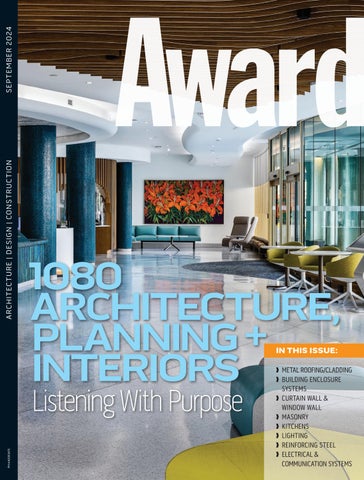
1080 Architecture, Planning + Interiors shapes spaces and communities.
9
STEEL-ING THE SPOTLIGHT
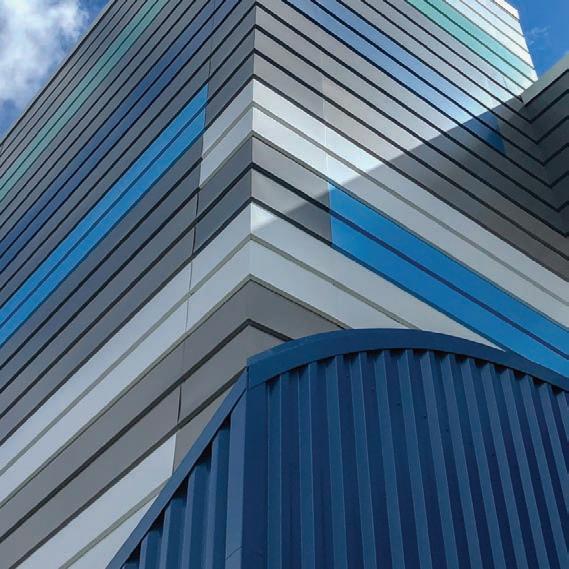
Metal roofing and cladding continue to redefine architectural aesthetics in Canada, offering durability and visual appeal.
WINDOWS OF OPPORTUNITY
Exploring the transformative trends reshaping curtain wall and window wall solutions. 23
CURRENT AFFAIRS
The role of electrical and communication systems in Canada’s emission reduction and innovation journey.
THE GREAT BARRIER BRIEF
As energy regulations tighten, attention turns to building enclosure systems.
DESIGNS TO SAVOUR
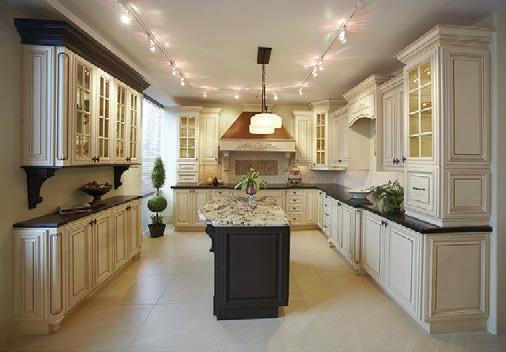
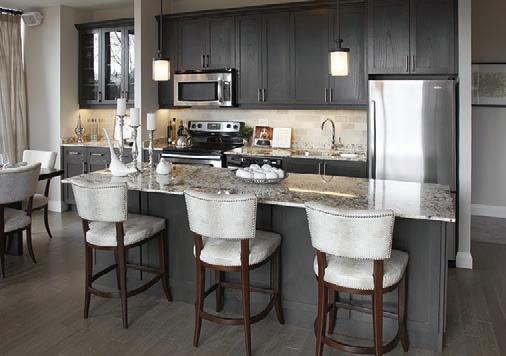
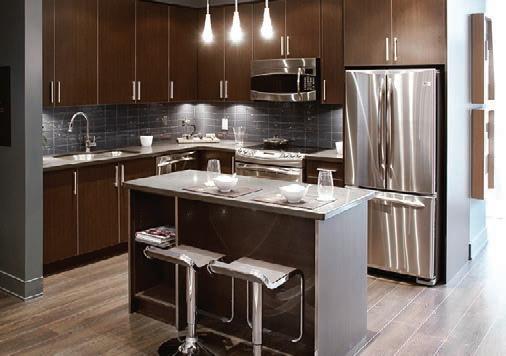
The latest in kitchen innovations and artisanal craftsmanship blend style with functionality. 38
ILLUMINATING INNOVATIONS
From smart LEDs to outdoor ambiance, discover the latest trends lighting up 2024.
43
BUILDING THE FUTURE, BRICK BY BRICK
Delving into the innovative technologies and trends redefining the masonry industry.
47
STEELY RESOLVE
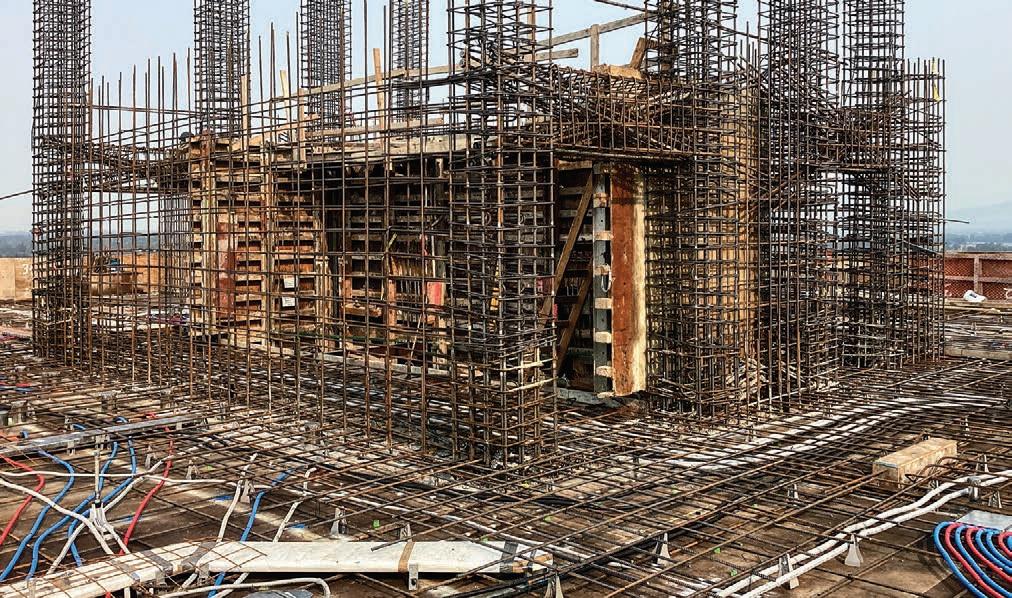
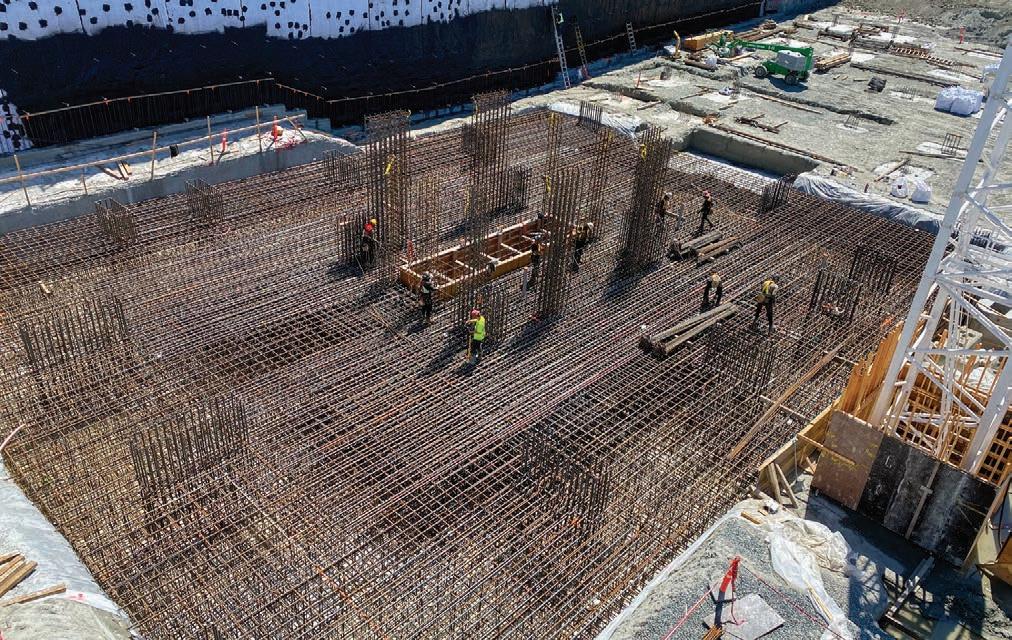
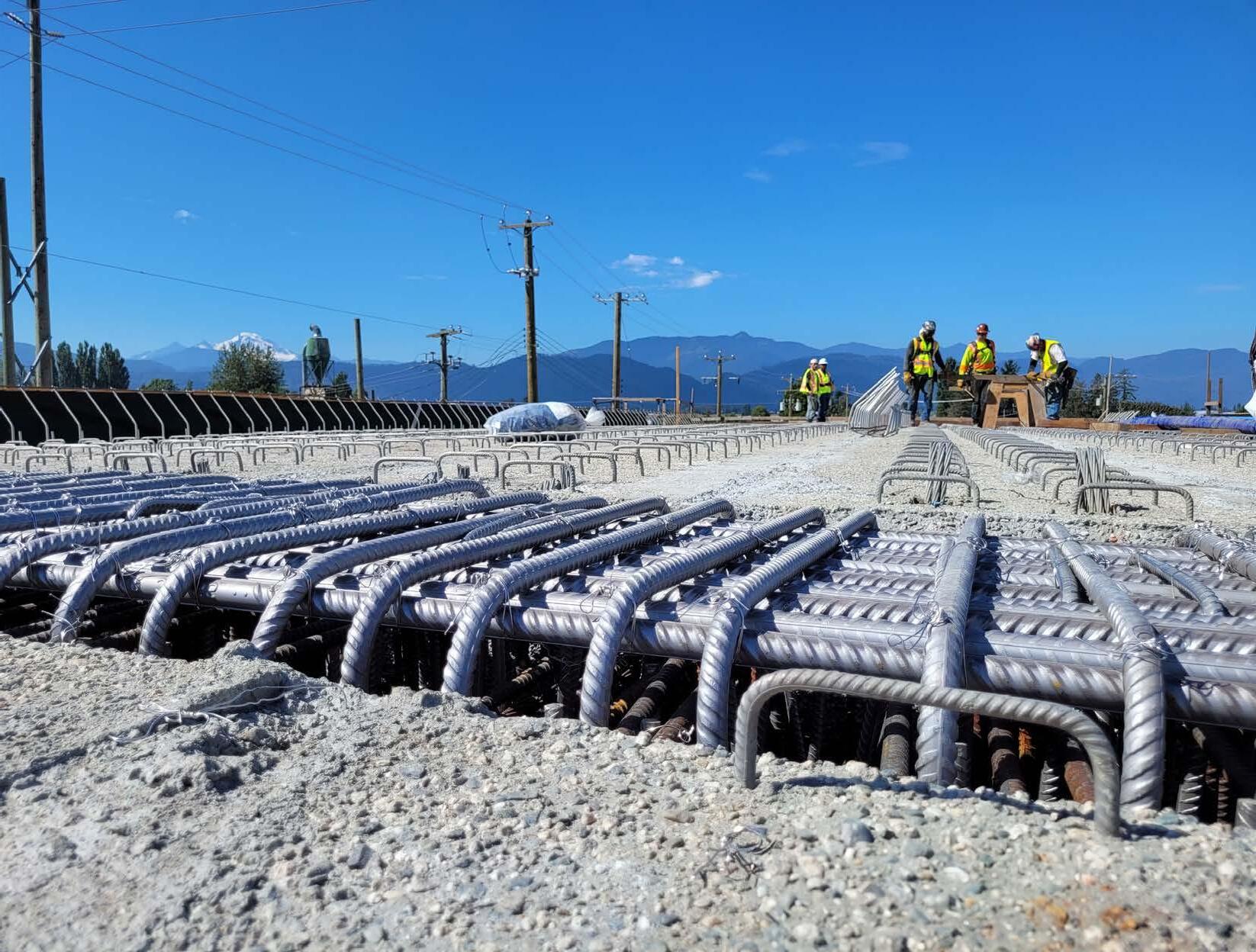
Despite inflation and delays, Canada’s reinforcing steel specialists forge ahead.
Dan
dchapman@canadawide.com
604.473.0316
EDITOR
Bruckner nbruckner@canadawide.com
SENIOR
slaurie@canadawide.com CONTRIBUTING
604.299.2116
RAIC Launches Life Cycle Assessment Training Workshops
Assessing embodied carbon impacts throughout a building’s life cycle is a necessary step in a shift towards regenerative and lower carbon design. The Canadian built environment is the third-highest source of greenhouse gas (GHG) emissions and there is an urgent and critical need to accelerate the knowledge, skills, and competencies of professionals who design Canada’s buildings.
To address this need, the RAIC is partnering with the National Research Council of Canada in a one-year rapid-deployment project to train members of the Canadian architectural community through a high-quality, hands-on case study-based Whole Building Life Cycle Assessment (LCA) curriculum.
Whole building LCA provides an estimate of the total GHG emissions associated with a building. This includes emissions due to operations and defined as the emissions associated with the extraction, manufacturing, transport, installation, replacement, and the end of service life for products and materials used in a building, which constitute a significant proportion of a building’s whole life carbon emissions.
The RAIC is proud to collaborate with Ha/f Climate Design to organize the in-person workshops, followed by an online option, on LCA sessions for practicing industry professionals. Following a theory-based lecture on LCA, embodied carbon, and related methodologies, participants will engage in a hands-on workshop, learning the basics of how to perform an assessment in small group. The workshops will be held between September 2024 and May 2025 in various locations across Canada including Ottawa, Toronto, Saint Andrews, Winnipeg, Regina, Vancouver, Calgary, Halifax, and Montreal.
“As architects, it is our responsibility to build and design with environmental leadership as an underpinning value and principle. Focused on our purpose to create a better world for all, this partnership with the National Research Council of Canada is one step in the right direction for the building sector to decarbonize at rapid scale and to accelerate the pace of climate action needed for Canada to achieve its 2030 and 2050 targets,” states Jason Robbins, FRAIC, past president of the RAIC.
This workshop, hosted by the RAIC and available to the larger community, is designed for architectural professionals (licensed architects, interns, technologists, students) who want to learn about LCA and how to reduce embodied carbon in real-life projects.
Participants will leave the session with knowledge of definitions, methods, targets, and standards, as well as having the opportunity to practice with LCA software to implement into practice.
Visit raic.org/LCAworkshop to learn more.
by GIOVANNA BONIFACE Chief Commercial Officer, RAIC
DESIGN WITHOUT EGO
1080 Architecture, Planning + Interiors shapes spaces and communities
by NATALIE BRUCKNER
In a world where the art of listening is becoming a lost art form, Saskatchewan-based firm 1080 Architecture, Planning + Interiors stands out by embedding this ethos into every facet of its practice. Centred on the platform of “Listen, Engage, Design, Deliver,” this celebrated Prairie team believes in design that reflects curiosity, respect, and empathy for the people and places they serve.
A self-described “work hard, play hard, team-focused, leave your ego at the door” group, 1080 Architecture exudes passion for their work. Speaking with principal LeeAnn Croft only reinforces this. “We believe in a relationship-based practice that prioritizes the experience of the end-user in thoughtful, intentional design that is beautiful, functional, and ultimately inspiring,” says Croft. The story of 1080 Architecture begins in 2018, but its roots run deep into the past. The firm was born from the union of CITE360 studio, a dynamic young design firm, and pmgm Architecture, originally established in 1954 by E. J. McCudden. Their portfolio included notable projects such as the Royal Saskatchewan Museum.
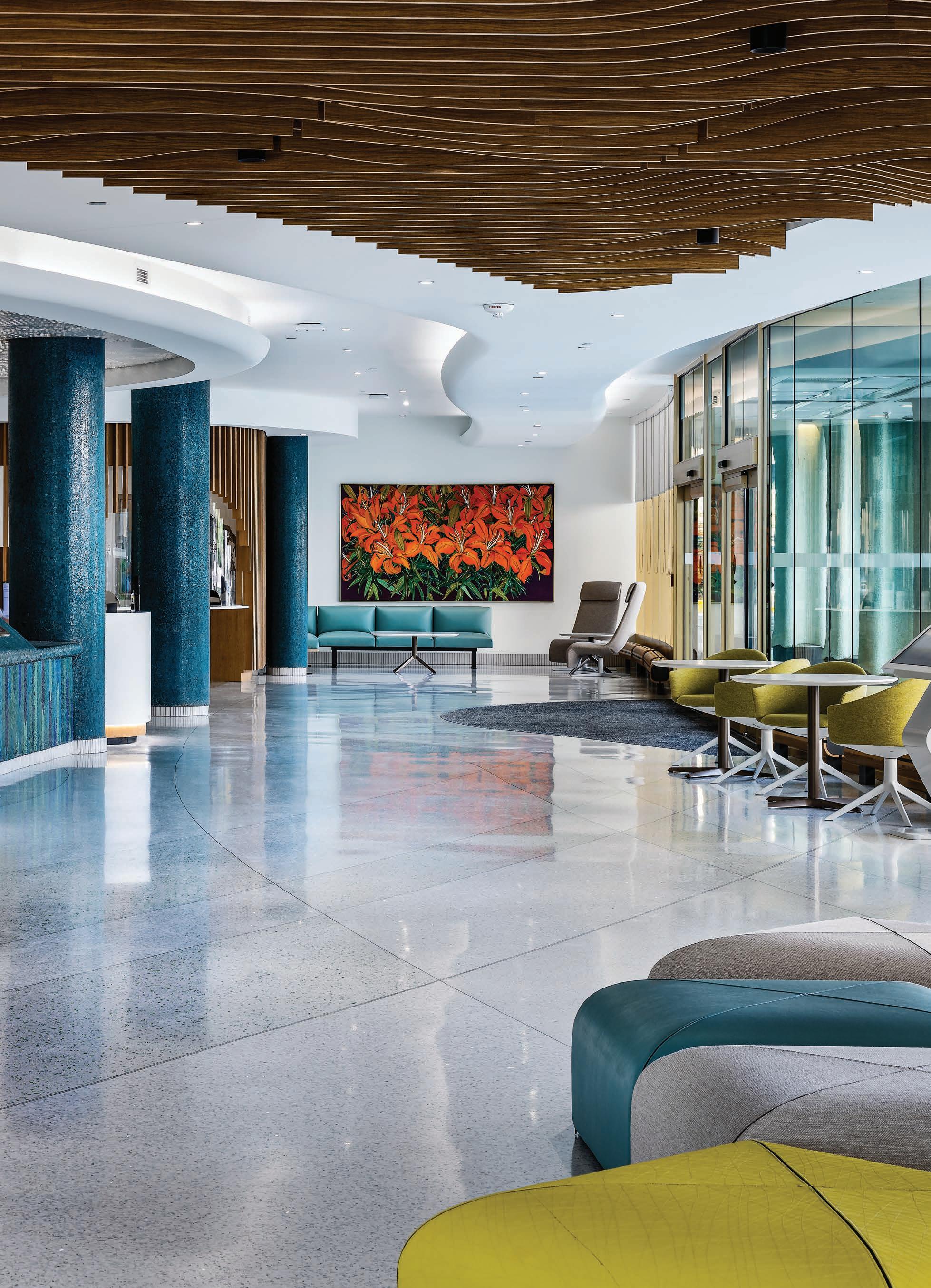
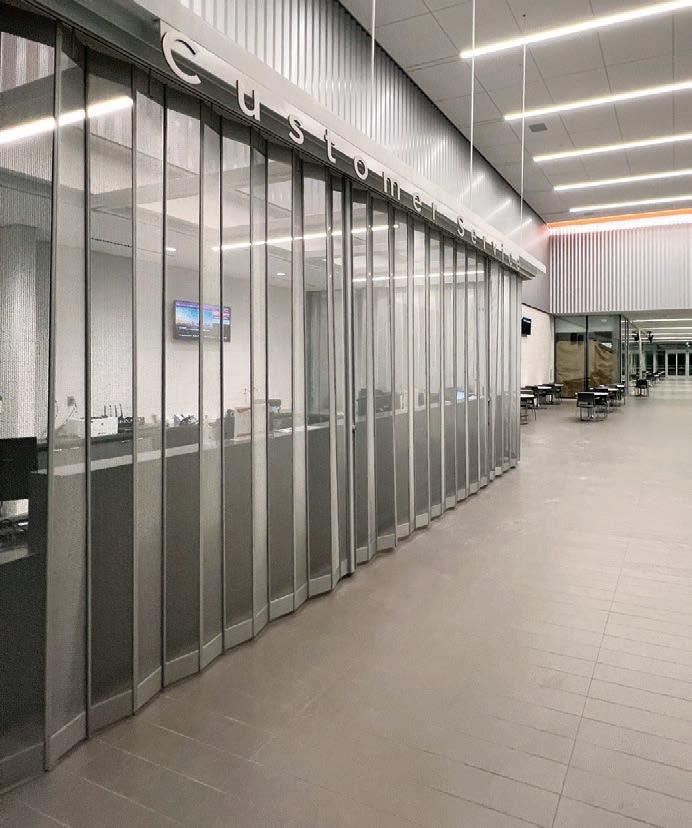
SaskPower Customer Experience Centre, Regina, SK
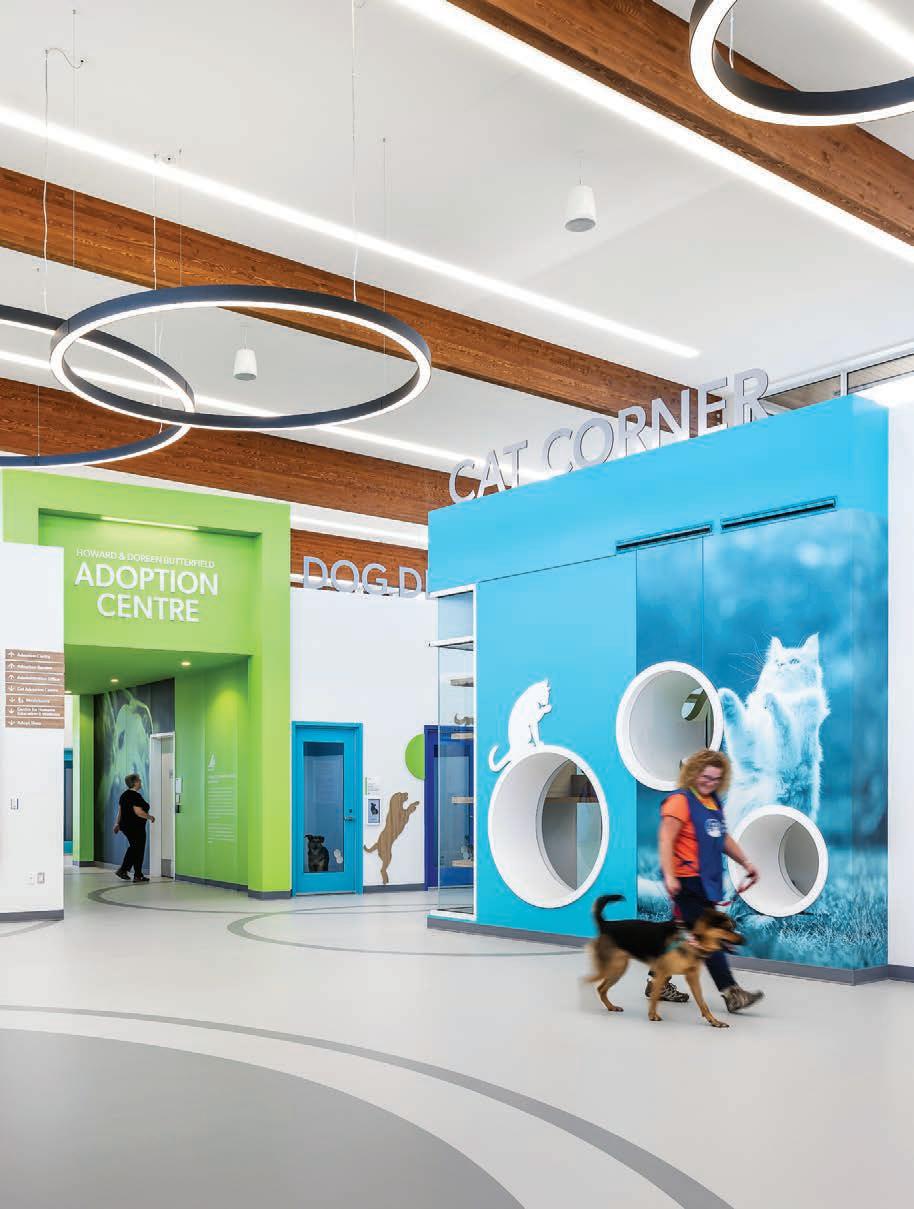
While there are a few sectors they don’t operate in, 1080 shines with projects that serve and build community. Notable projects such as the Regina Animal Community Centre, the YWCA Centre for Women and Families, and numerous schools and not-for-profit projects reflect the team’s desire to work together with stakeholders to build enriching spaces where life and community happen.
While their project portfolio spans education, healthcare, corporate, and community clients, the firm has also responded to the housing crisis we all know so well and delved into various housing projects, from luxury condos and mixed-use developments to transitional shelters. “We talk a lot about the experience and perception of the people we are designing for, always with the goal of creating space that not only anticipates needs but inspires and creates moments of delight,” Croft explains.
Inclusive design is another cornerstone of 1080’s practice, with a true prioritization of design for all abilities, embracing neurodivergent and traumainformed practices. Collaborations with Indigenous partners and insights from elders and knowledge keepers have also profoundly shaped their design approach and community engagement strategies.
“The YWCA Centre for Women and Families, one of our first projects after forming the new firm, has been particularly impactful, beginning the project ‘in a good way’ – with a sweat and pipe ceremony, along with much laughter and storytelling – with the matriarchs who have guided the project. We have since carried this collaboration and engagement through the project design and construction, guided by elders and knowledge keepers close to the organization to ensure the space is reflective of the community,” says Croft.
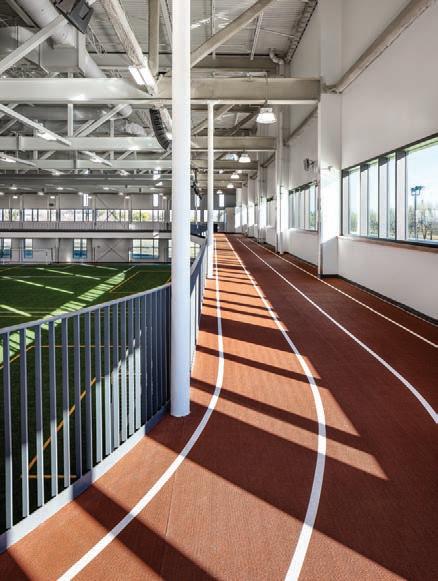
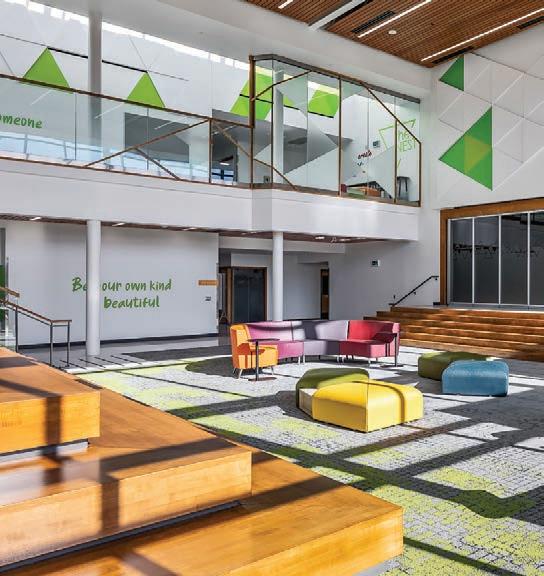
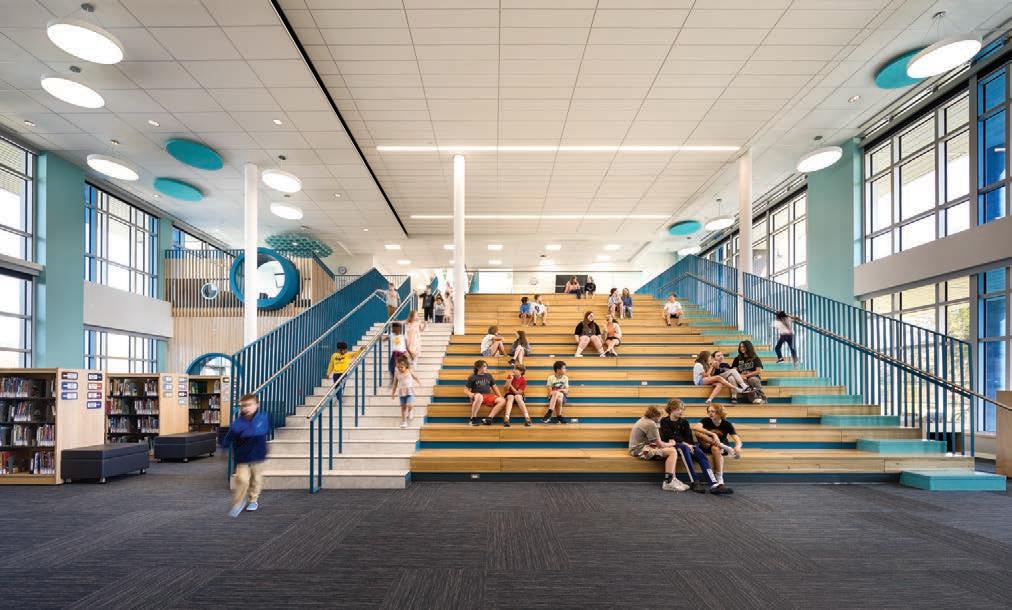
The projects undertaken by 1080 Architecture are a testament to their commitment to community-centric design. Highlights include the Legacy Park Elementary School and Credit Union Spark Centre (joint-use project), Argyle and École St. Pius X joint-use school, Regina Animal Community Centre, SaskPower Customer Experience Centre, and North Central Family Centre rapid housing project.
“These projects reflect our community focus and particular attention to creating spaces that spark joy and inspire wonder and engagement. We take an empathetic approach to design and focus on a deep understanding of the feeling
created in a space through design decisions around colour, form, texture, and light. With every project, we aim to have a positive impact on the mental health and well-being of users, playing a small part in the overall well-being of our community,” explains Croft.
But who exactly is behind 1080? At the helm of 1080 Architecture are principal architects Croft, Vanessa Keilback, and Nathan Orban, supported by Ward Peters, Donn Lay, and Brad Pegg. This diverse team brings a wealth of global and local experience, excelling in building envelope excellence, interior design, environmental graphics, and accessible and inclusive design.
Their open-minded attitude and people-first approach have resulted in a culture built on supporting the whole person. With flexible working hours and a kid- and baby-friendly space, the firm ensures its team members feel supported. “To bring your best self to work you need to feel supported in all aspects of your life,” says Croft. Despite growing to 24 members, the team retains the family feel of a small practice, regularly gathering for team days and prioritizing continuing education with a dedicated fund for advancing knowledge in areas of interest.
1080 Architecture’s core values (intentional, curious, collaborative, all in, do the right thing, and to have fun) define their team culture. Creativity and innovation are nurtured in a supportive environment that encourages learning and growth.
It’s fair to say that 1080 has come a long way in just six years. Yet, looking ahead, it’s clear they haven’t even scratched the surface of what they want to achieve. “We truly believe in the power of good design to positively impact our communities at all levels and take this responsibility to heart,” says Croft.
1080 Architecture is enthusiastic about the future of architecture and design, particularly in continuing their collaboration with Indigenous partners and translating traditional ways of knowing and working with the land into sustainable built forms.
1080 Architecture, Planning + Interiors continues to thrive on its foundational values, driven by a commitment to innovative and inclusive design, community engagement, and a deep understanding of user experience. Their journey reflects a blend of legacy and modernity, always aiming to enhance the spaces they create for a better community and future. And really, it’s only just begun… A
Regina Animal Community Centre, Regina, SK
Credit Union Spark Centre, Weyburn, SK Legacy Park Elementary School, Weyburn, SK
Argyle and École St. Pius X Joint-use School, Regina, SK
Steel-ing The Spotlight
Metal roofing and cladding continue to redefine architectural aesthetics, offering durability
and visual appeal
by ROBIN BRUNET
As has been the case in the past, 2024 has been a busy year for purveyors of metal roofing and cladding, with developers across Canada willing to pay a premium (despite these inflationary times) for building components that are more durable and in many cases more visually striking than other systems.
But the bustle is accompanied by the familiar concern of not enough people in the workforce in terms of fabricating and installing to meet demand. The issue has very much been a focus of attention for the Roofing Contractors Association of British Columbia (RCABC), which was formed in 1958 to bring together professional roofing contractors, manufacturers, and suppliers who are dedicated to the promotion and protection of the public interest in everything that relates to roofing.
Robert Scales, director, education and training at the RCABC, points out that the projects undertaken by professionally recognized architectural sheet metal workers encompass roofing and cladding, “unlike sheet metal workers who are more related to HVAC work. However, the sheet metal sector is recognized by the Red Seal designation, which not only highlights consistency of excellence but also harmonizes provincial training programs and thus facilitates mobility to new talent wanting to enter or advance in the trade.”
But Red Seal recognition may one day encompass the architectural sheet metal workers sector thanks to RCABC’s efforts. As a SkilledTradesBC-designated training provider, the RCABC Educational Foundation trains new blood under the Architectural Sheet Metal Worker (ASMW) program, and recently the
association hosted roofing contractor association VIPs from across the country to tour its custom-built training facility and share the value of the ASM trade and the technical training associated with it.
Scales says, “The point is, up until recently B.C. was the only jurisdiction to recognize sheet metal as an apprenticeable trade. But other provinces have started to take note, and Nova Scotia recently adopted this approach to skills development by approving ‘Architectural Cladder’ as a provincially recognized trade.
“So yes, the metal roofing and cladding sector needs more people. However, our program is growing, concurrent to the latest panel systems providing opportunities and requiring installers that are more skilled at their jobs than ever. The interest shown by the VIPs we hosted suggests other jurisdictions may follow our lead in the foreseeable future, and if architectural sheet metal workers in Canada were ultimately Red Seal-recognized, it would really be the magic formula for filling the labour shortages that currently exist.”
Scales’ remark of the technical complexity of metal roofing and cladding systems is evident throughout the sector, in the offerings of large and small companies alike. Kingspan is a prime example. The Kingspan Insulated Panels are exterior wall and roof panels with steel skins and an insulating foam core, known for their superior thermal properties, design flexibility, and fast installation time. Kingspan’s QuadCore technology involves a selfblended hybrid insulation core of distinctive grey microcells that provide R-values of R-8.0 per inch, making them the most thermally efficient insulation cores on the market, 11 percent better than high-quality PIR and 60 percent better than PUR.
Kingspan QuadCore KarrierPanels were among the cladding products used for the Center of Developing Entrepreneurs facility in Charlottesville, Virginia. When examining façade choices, architects Wolf Ackerman and EskewDumezRipple realized KarrierPanel universal barrier wall allowed them the freedom to attach a specific façade without compromise. KarrierPanel also helped meet AIA’s 2030 challenge for efficiency and thermal performance. KarrierPanel serves as the high-performing air and vapour barrier for the entire building by providing continuous insulation in an all-in-one product. Also, the ease of the KarrierPanel system allowed installers from Glass and Metals, Inc. to streamline construction in tight quarters. The allin-one insulated metal panels eliminated the work of several subcontractors, speeding up construction and allowing other crews more space to work.
Kingspan QuadCore KarrierPanels, Seattle Opera Center, Seattle, WA
EXPERIENCE THE NUCOR ADVANTAGE
As the construction industry has grown more sophisticated, so has the versatility of custom metal building systems. By adopting advanced tools, practices and products, Nucor Buildings Group actively evolves to meet industry demands. Metal building systems are flexible by design and can be tailored to fit the needs of any market, offering the ability to incorporate energy-efficient products like insulated metal panels and advanced insulation systems alongside architectural elements such as stone and glass.
Whether your building is architecturally complex or value engineered, from a 1-million square foot mega project to a small specialty building, we work together with our Authorized Builder Network to offer products and solutions that bring our customers’ dreams to life.
Another U.S. project showcases the advantages of Toronto-based Exterior Technologies Group’s provision (among a host of building solutions) of Alpolic Materials, which is marketed as the result of taking the art of aluminum and metal composite materials to a visionary level (Alpolic products look better and last longer, yet present a competitive alternative to traditional metal or other building panels).
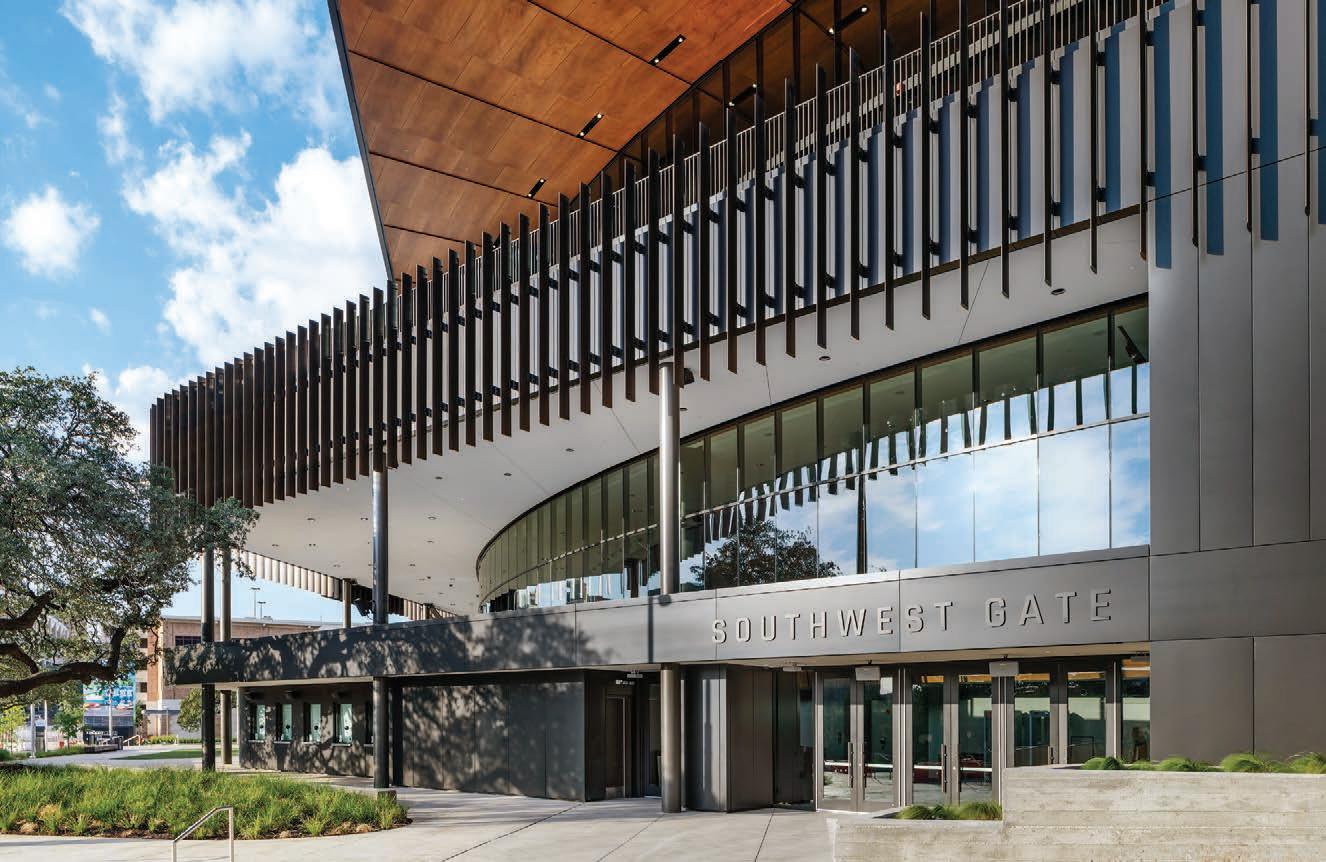
For Austin, Texas’s $375-million Moody Center (the new 540,000-square-foot home for University
of Texas Longhorns basketball and a versatile stage for live performances), Alpolic was selected to define the facility’s aesthetic and also manage solar exposure, contributing to LEED Gold certification.
Exterior Technologies Group is the official architectural representative of Alpolic materials in Canada, providing architects and subcontractors access to a trusted brand with exceptional attributes, fire-resistant properties, and a diverse colour palette.
PHOTOGRAPHY
Moody Center, Austin, TX
Honco Steel Buildings is celebrating its 50th anniversary in 2024; the Quebec-based company’s self-supporting steel buildings are renowned for their quality, durability, and highly competitive prices.
Honco’s structural steel panels are made by using bending techniques to give the metal that is otherwise lacking in rigidity considerable strength; applying corrugations to the steel sheet reinforces its resistance to bending. The panel is made from superior-grade steel, cold-formed on a fully automated production line at Honco’s Lévis plant. Smaller secondary corrugations ensure the local stability of each part of the panel, and profiled grooves on the sides reinforce the joints when the steel panels are connected longitudinally.
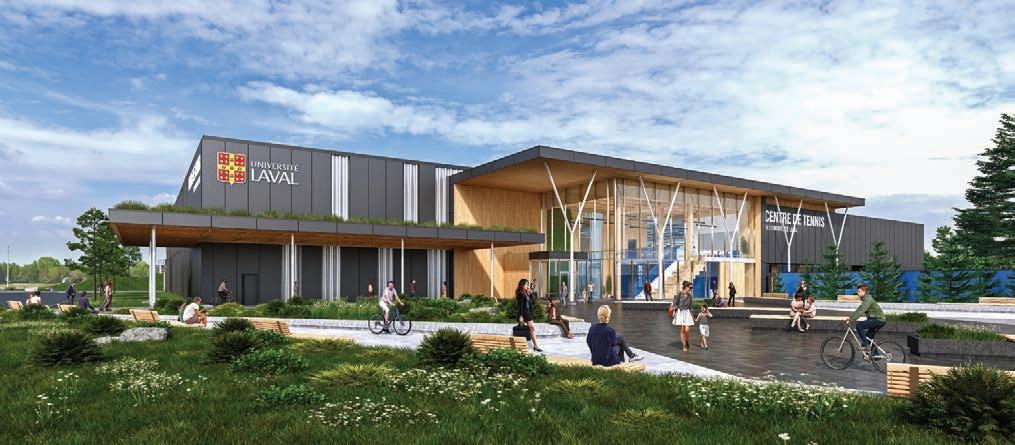
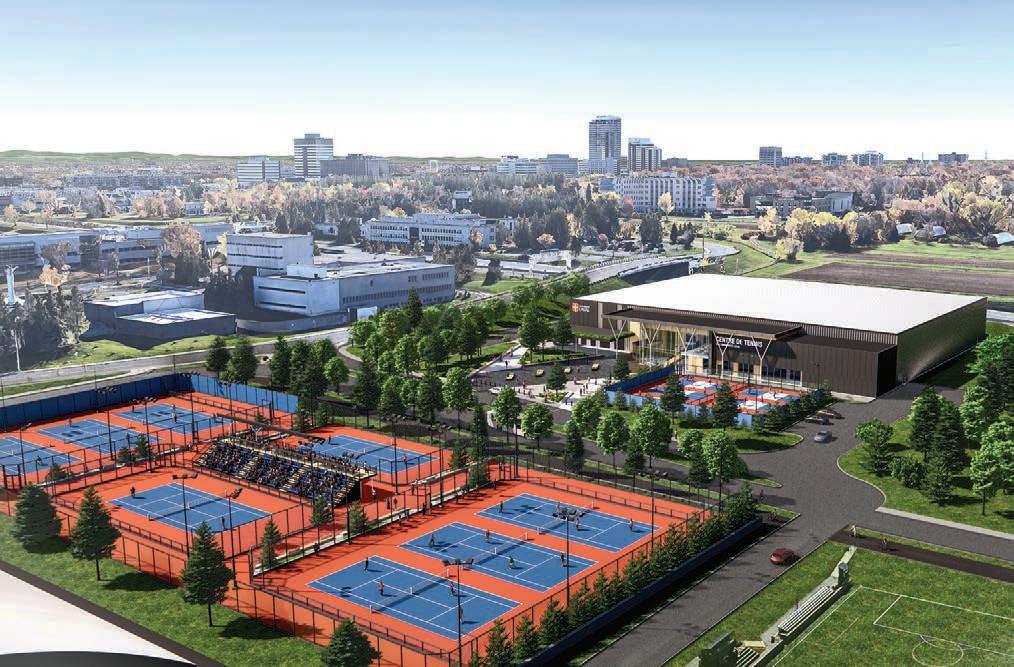
Geneviève Filteau, Honco’s director of marketing, says, “We are excited to announce the development of new sports facilities on our campus, featuring 16 tennis courts (eight outdoor and eight indoor), as well as six outdoor pickleball courts. This project, valued at $30 million, will commence construction in the fall of 2024. Additionally, a public square will be created on the southeast side of the campus to host various events.”
Filteau is referring to the Tennis Centre at Laval University in Quebec, a 65,000-square-foot facility made of Honco’s TP-4000 flat roof system. Like its smaller counterpart the TP-3000 system, the TP-4000 is also built from structural panels and has the addition of an intermediate support system combined with Honco roof trusses, which allows the TP-4000 to reach unlimited widths.
A recent minor-league ballpark project in Montana acted as a showcase for PAC-CLAD metal panels from Petersen (a Carlisle Company), which has supplied the commercial and residential markets with architectural wall panels and roofing systems since 1965.
PAC-CLAD wall panels are available in a broad palette of colours of Kynarbased 70 percent PVDF finishes, and standard colours include brilliant metallic, sophisticated wood grain, and rich ore finishes; also, many panels are made with recycled aluminum, and all of them are 100 percent recyclable.
For the Glacier Bank Park in Kalispell, Montana, designers opted for a simple materials palette recalling classic mountain lodges, with masonry, wood timbers, and architectural metal panels in a Corten-style finish that would help impart a sense of age, as though the park has been there for decades.
Tennis Centre at Laval University, Quebec City, QC
Tennis Centre at Laval University, Quebec City, QC
Several products from Petersen’s PAC-CLAD lineup were selected, including 25,000 square feet of 7⁄8-inch (”) Corrugated Panel finished in Weathered Steel (which would impart the Corten-style hue); 5,000 square feet of 1 ⁄2 ” Corrugated Panel in Matte Black; as well as shop-fabricated edge metals, all fabricated from 24-gauge steel. As for support, Petersen was credited for helping determine what panels and sizes, and from what plants, were achievable in the desired timelines – crucial considering the tight deadlines for the project.
Sean Lepper, VP and general manager at Behlen Industries, reports that “We’re busy with light industrial large warehouse projects as well as expansions of processing facilities, including a number of fruit processing plants in the Okanagan.”
Behlen over the past 50 years has grown to become Canada’s largest manufacturer of steel building systems and was the first North American steel building manufacturer registered to ISO 9001. Among its many product offerings are insulated metal panels and structural panels, the former from its sister company Artspan and available in a variety of configurations.
Behlen accompanies these products with in-depth information contained in its blog page, case in point: a tutorial about the importance of the proper placement of sealants, which allow these panels to achieve the intended air vapour barrier for air leakage rates and ensure proper building envelope performance: “IMP side joints are a modified tongue and groove assembly that must be filled with continuous, uninterrupted butyl tube sealant. This continuous and
uninterrupted sealant includes sealing all perimeters and openings using sheet steel, gun-grade butyl tube, and tape applied butyl sealants.”
The blog goes on to note that, “Even the smallest of gaps interrupting the continuous run can allow air to move from inside of a building; air can migrate into the joints, panel end laps, or around openings. It will condense on the colder side of the panels creating moisture that will accumulate on the interior surface, gravity can pool it onto other surfaces or create drips from the ceiling.”
Finally, Lepper summarizes the state of the metal roofing and cladding industry in Canada by noting, “This will be a good year but not as busy as the last several years, which were driven by pent-up demand post-COVID.
“A lot of the projects we work on are large and are substantially costly, and high interest rates have taken their toll in as much as heavy industrial work has slowed somewhat. That said, the market is returning to the way it looked prior to COVID, so we have no complaints.” A
SchellVac Equipment & Scheller Metal Fabrications Ltd. East St. Paul, MB
WEST COAST CONTEMPORARY LINE
A custom home build is quite often the single largest investment in one’s life. This is a tremendous responsibility to entrust to the construction community.
Understanding this concept and exceeding customers’ expectations are what Westeck strives for and is at the core of the Westeck culture.
BIG PRODUCTS FOR ALL SIZES EMBRACE THE PATIO EXPERIENCE INDOOR/ OUTDOOR LIVING VANCOUVER 1480 Kootenay St, 1‑877‑606‑1166 CHILLIWACK 8104 Evans Rd 1‑877‑606‑1166
westeckwindows.com sales@westeckwindows.com
Windows Of Opportunity
Exploring the transformative trends reshaping curtain wall and window wall solutions
by NATALIE BRUCKNER
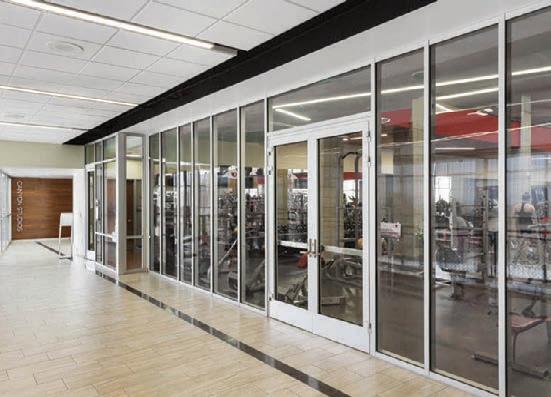
The curtain wall and window wall industry has undergone significant changes in recent years. Just a few years ago, these elements were criticized as the weak points of a building envelope. Today, thanks to innovations and the commitment of industry professionals, glass is back in favour.
Furthermore, the curtain wall market is estimated to expand at an unexpected CAGR from 2024 to 2032, reaching multimillion CAD by 2032 compared to 2022. Key experts in the industry are once again leading the way, providing solutions to meet increasingly stringent energy codes.
ONE PIECE OF THE ENERGY PUZZLE
In regions like Vancouver that have stringent energy codes, the focus on window performance has seen a massive shift, notes Michael Bousfield, technical director at Cascadia Windows: “Windows, especially their performance, is now a lever for code compliance and energy modelling, rather than a simple line item.”
Bousfield stresses the importance of considering glazing within the entire building envelope to meet energy targets effectively. “This way, a developer or
building owner ends up with a more cost-effective building, with all the glass they want,” says Bousfield. “They don’t have to sacrifice any more; the design team just needs to make the whole building work.”
Bousfield also highlights increasing trends in deep retrofits and embodied carbon reduction, noting the industry’s response to developing lifecycle assessments for windows. “At the beginning of this year, we welcomed the revised guideline for developing a lifecycle assessment for windows and we have our own window lifecycle assessment nearly complete, which may actually be the first one published under the new guidelines.”
These trends reflect a broader industry shift towards sustainability and energy efficiency, where windows play a crucial role in meeting regulatory requirements, while enhancing building performance and aesthetics.
Discussing recent projects, Bousfield mentions Cascadia’s involvement in the renovation of the multifamily tower Pacific Promenade in Vancouver. “The project used our Universal Series windows, contributing to high-performance window systems that positively impact property values,” he says. “Long-term, such investments increase property value significantly, offering owners a substantial return on investment.”
Providence Health Center – Reed’s Crossing, Hillsboro, OR
WHAT’S TRENDING
Trends in window wall systems continue to evolve due to regulations, tastes, and innovations, as Michael Wandschneider, director of product management at Marvin, explains: “We’re seeing a rise of large-sized windows with broad expanses of glass, which require advancements in innovation, performance, and energy efficiency.” Marvin addresses these needs with its high-density fibreglass material and Modern product line, offering strength, ease of maintenance, and climate suitability.
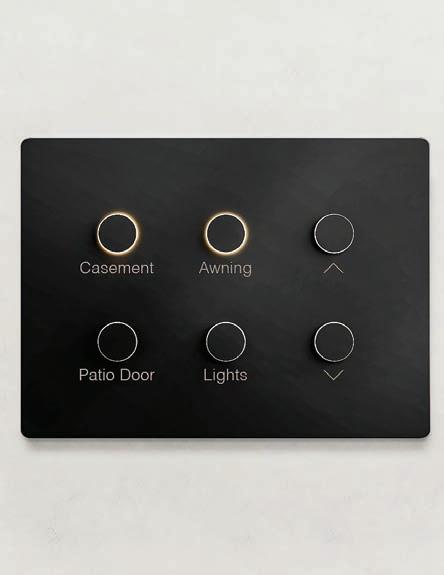
This trend is complemented by a growing desire for automation and smart home technology. “The rise in smart home technology offers convenience and increased productivity, both sought after by homeowners and architects,” Wandschneider explains. Marvin’s products can be operated through home automation systems, voice assistants, the Marvin Home app, wall switches, or
Building codes are indeed evolving, emphasizing energy efficiency. Marvin’s Modern line excels in this area with high-density fibreglass (HDF). “HDF provides a single-body frame, enhancing thermal efficiency and stability,” says Wandschneider. Marvin’s Modern line boasts low U-Values and triple-pane glass options, ensuring superior energy efficiency.
A recent project in Franconia, New Hampshire, designed by architect Paul Lewandowski, showcases Marvin’s Modern and Ultimate product lines. The home features large windows that frame breathtaking views of the White Mountains and integrate passive solar design principles.
Looking ahead, Marvin anticipates challenges in meeting the demand for larger glass expanses and smart technology integration. Wandschneider shares, “We recently brought the first fully integrated automated windows to the U.S. market with our Marvin Connected Home offering.” This innovation meets the growing demand for smart home technology, while maintaining modern design aesthetics.
Windows + Doors for Passive House Projects
Innotech Windows + Doors is a Canadian manufacturer of high-performance windows and doors. The Defender 88PH+ System combines decades of fenestration knowledge to deliver a robust window and door system that is not only Passive House Institute certi ed, but that also delivers the air, water and structural performance required for highly sustainable housing developments. innotech-windows.com
Marvin Connected Home
EVOLVE IN VANCOUVER, BC
Passive House Multi-Family Project by ZGF Architects and Peak Construction.
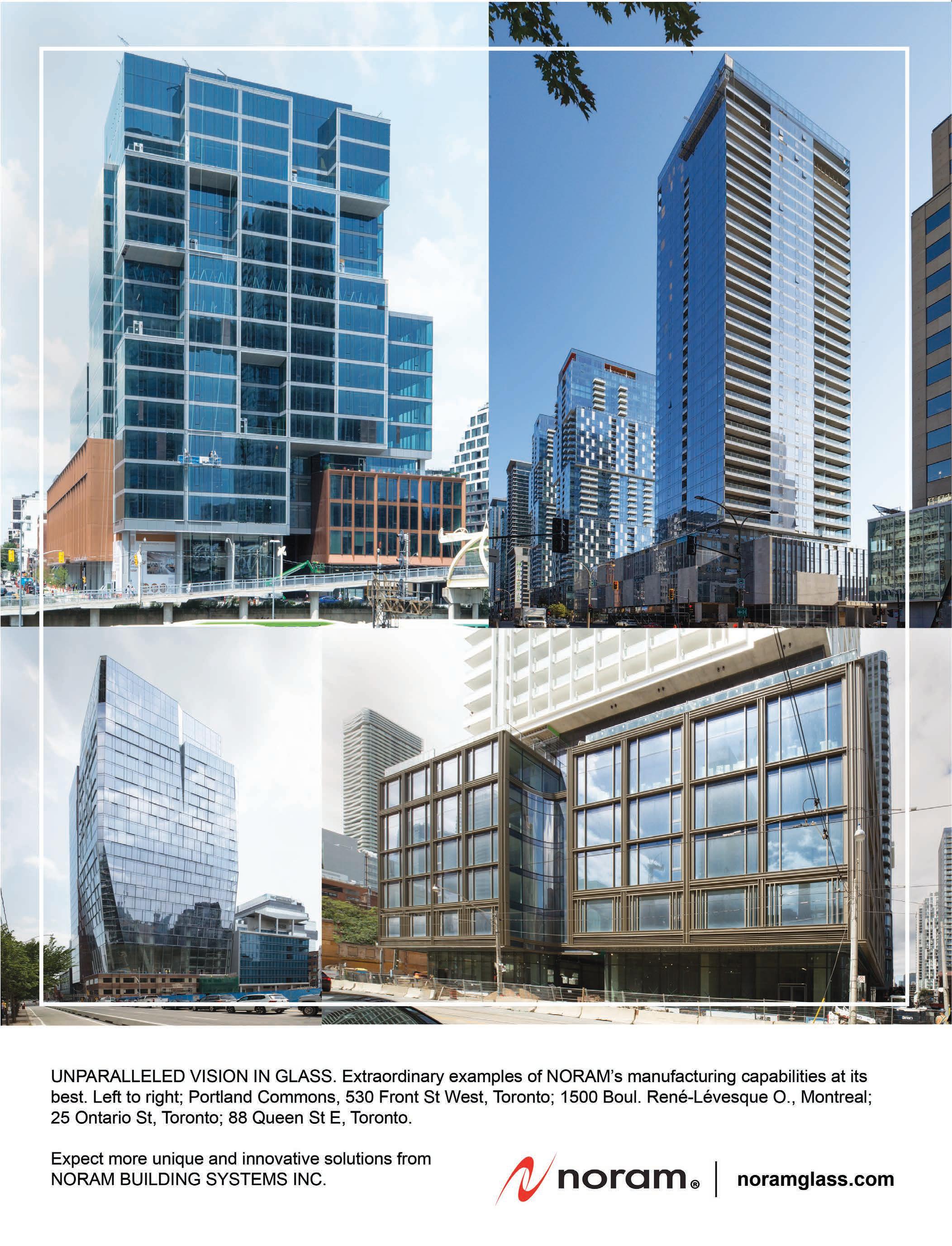
Noram Glass is also observing this notable trend towards larger panel sizes in current construction projects. This shift is driven by the panels’ enhanced performance and the potential for quicker installation.
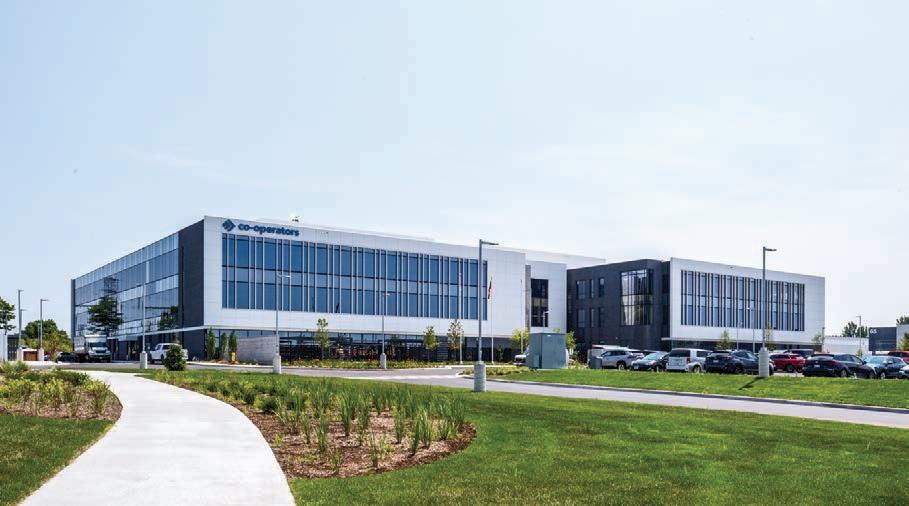
Among their standout projects, Noram is currently working on Crosstown in Toronto, which features a fully unitized curtain wall system incorporating vision glass, porcelain panels, and perforated aluminum panels. Another notable project is 980 Dufferin, which also employs a unitized curtain wall system. Additionally, The Cooperators in Guelph showcases a unitized curtain wall with large fins and electrochromic glass.
In terms of company developments, Noram is experiencing significant growth. They are further developing their mega panel system, investing in the automation of their fabrication process, and taking on larger and more complex projects.
Starline Windows, a leader in the design and manufacturing of architectural aluminum window systems, is experiencing a dynamic and productive year. By staying ahead of industry trends, their engineering and new product R&D Team is dedicated to the continuous enhancement of their window and door offerings. In response to escalating performance requirements for field water testing and energy efficiency, Starline Windows continues to address the demand for advanced aluminum window solutions.
The 9000 Series Double Glazed Aluminum Window Wall, their flagship product, has been a foundational design element for many years. This system, consistently tested and proven in the field, was recently installed in high-profile projects such as Bosa Developments’ Verina in Fairview, Vancouver, and The Beverly development in New Westminster. These installations underscore Starline Windows’ unwavering commitment to innovation and excellence, ensuring they meet the evolving needs of their clients and the industry.
ECO-SAVVY INNOVATIONS
All Weather Windows, a leader in energy-efficient windows and doors, has won the 2024 Energy Star Canada Special Recognition Award for the second consecutive year. This accolade highlights their commitment to sustainability and enhancing the energy performance of their products, with over 175,000 configurations achieving Energy Star certification. While it refers to residential construction, it demonstrates their commitment to the matter.
Co-CEOs Colin Wiebe and Jillene Lakevold expressed pride in their team’s efforts toward a sustainable future. The Honourable Jonathan Wilkinson praised their innovation in energy efficiency, noting its impact on reducing costs and fighting climate change. This is All Weather Windows’ ninth Energy Star Canada Award, reinforcing their role as a key promoter of energy-efficient solutions.
Silex Windows & Doors is at the forefront of the evolving window wall and curtain wall industry, adapting to and leading key trends that shape modern architectural landscapes. One of the most pressing trends is energy efficiency, with a growing demand for fenestration products that reduce energy consumption. Silex addresses this by integrating advanced Low-E coatings and vacuum-insulating glass technologies into their window and curtain wall systems, enhancing thermal performance and meeting stringent energy efficiency standards.
Another pivotal trend is sustainability, where Silex excels by utilizing pultruded fibreglass, a durable and environmentally friendly material. This commitment not only supports sustainable building practices but also extends the lifespan of their products while minimizing maintenance requirements. Customization remains paramount, with Silex offering a diverse range of design options, from finishes to impact-resistant glazing, catering to unique architectural specifications.
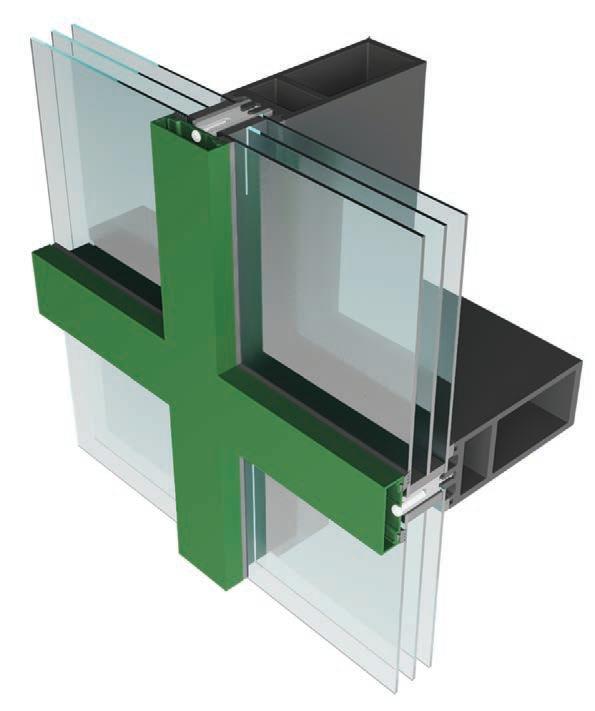
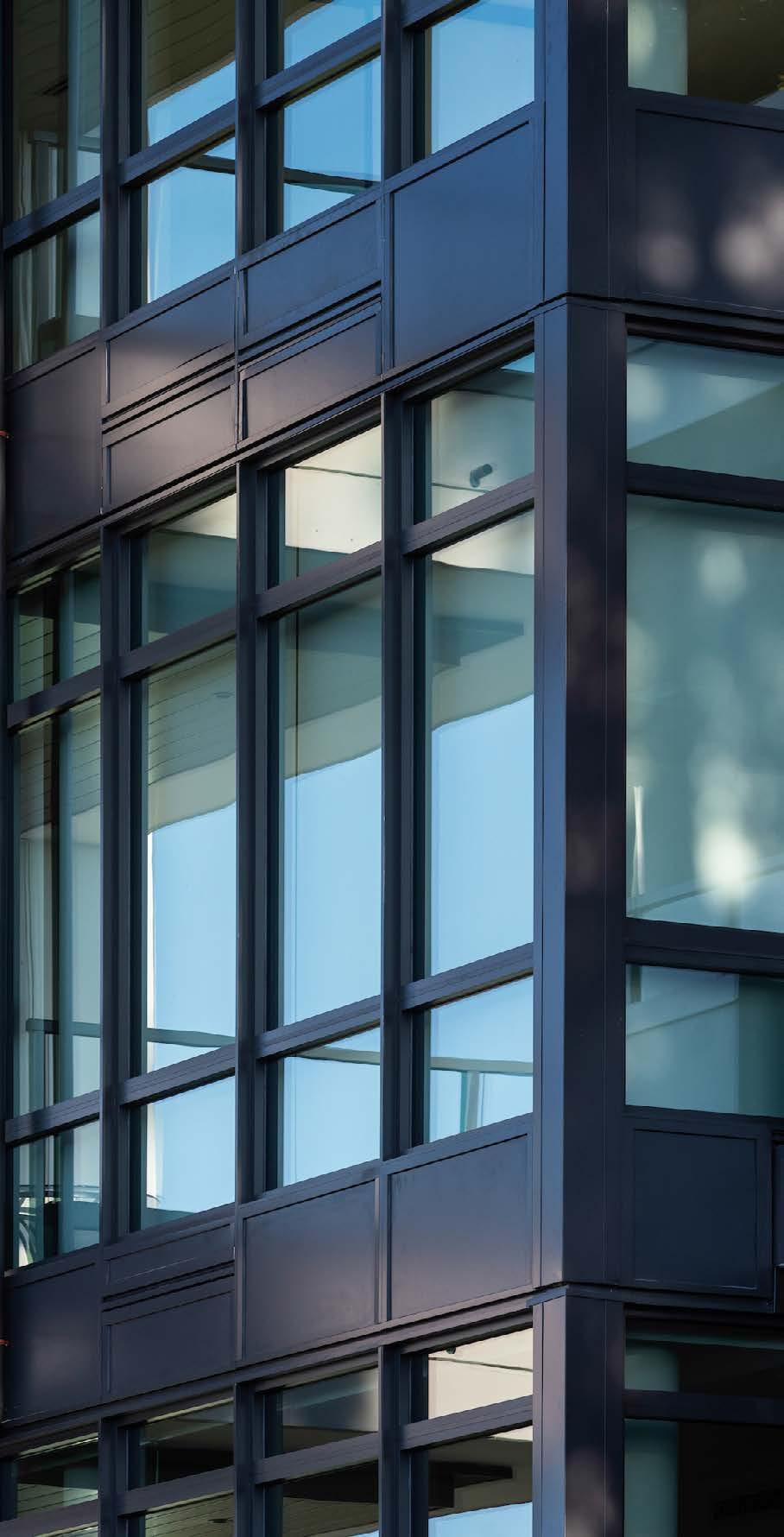
The Universal Series™ Window Wall offers a high-performance alternative to traditional aluminum window wall systems.
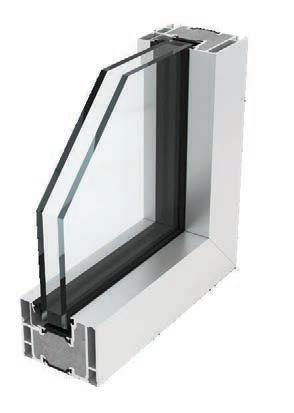
More than 500-times less conductive than aluminum—but with comparable strength and lifespan—the Universal Series™ Window Wall merges superior thermal and structural performance with durability and award-winning aesthetics.
The Cooperators headquarters, Guelph, ON
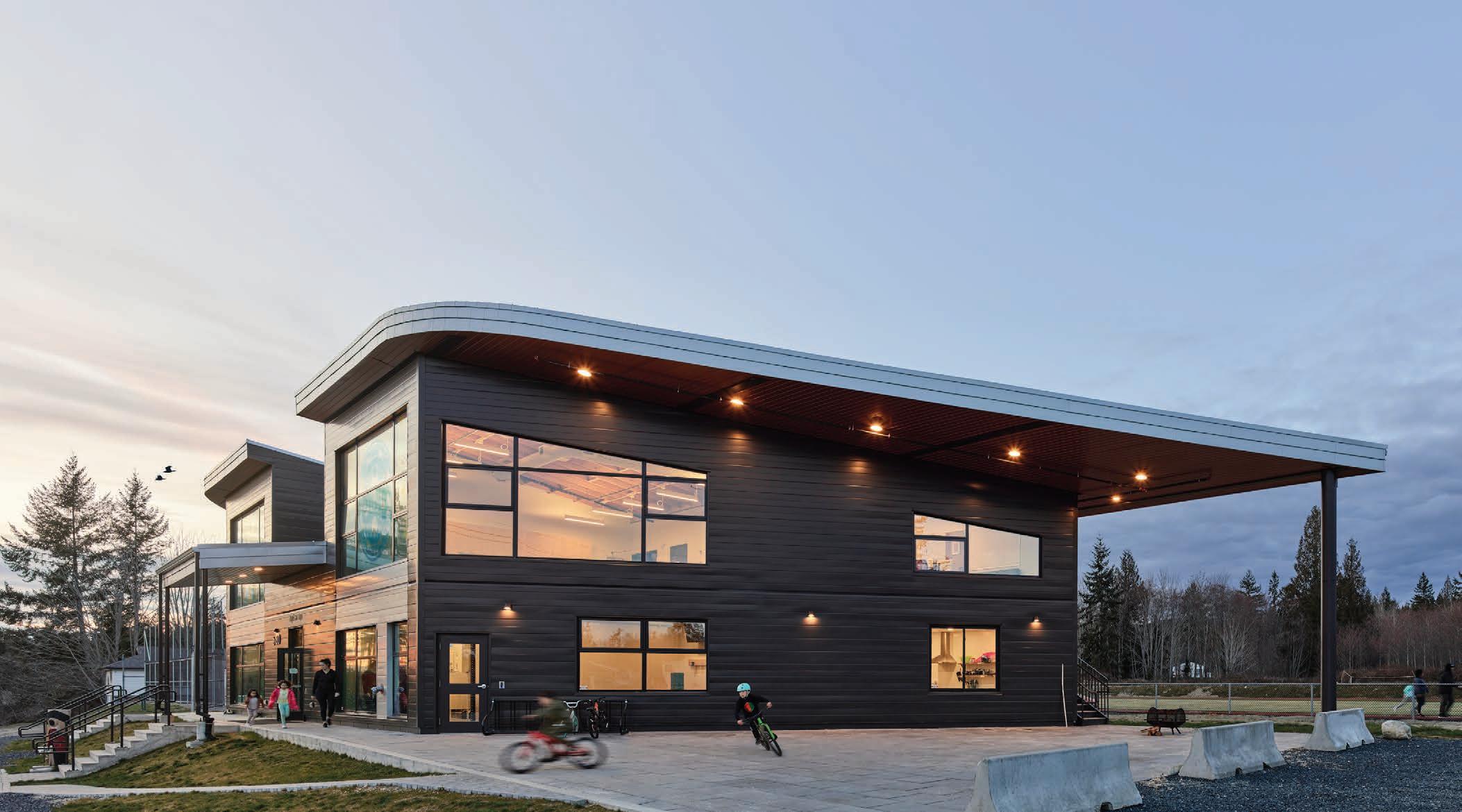
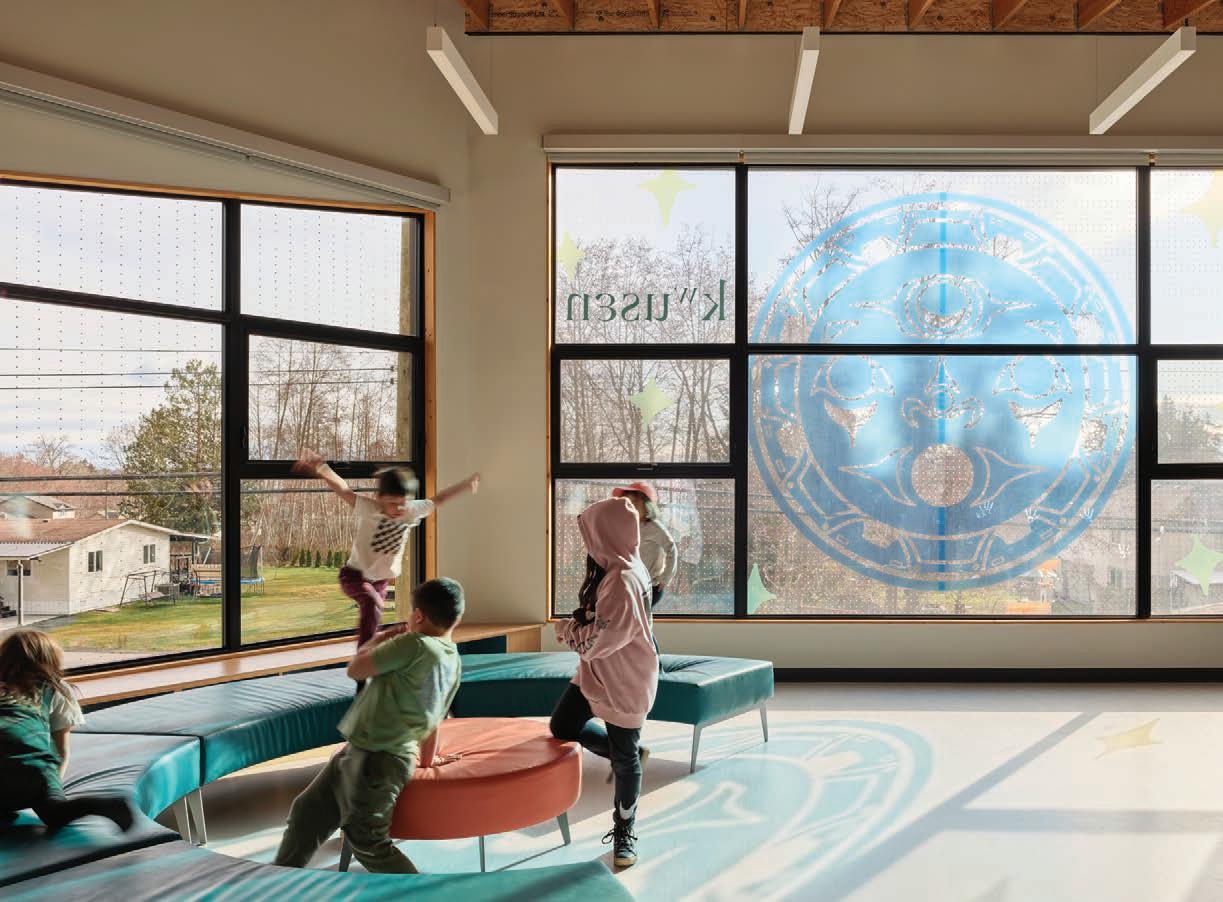
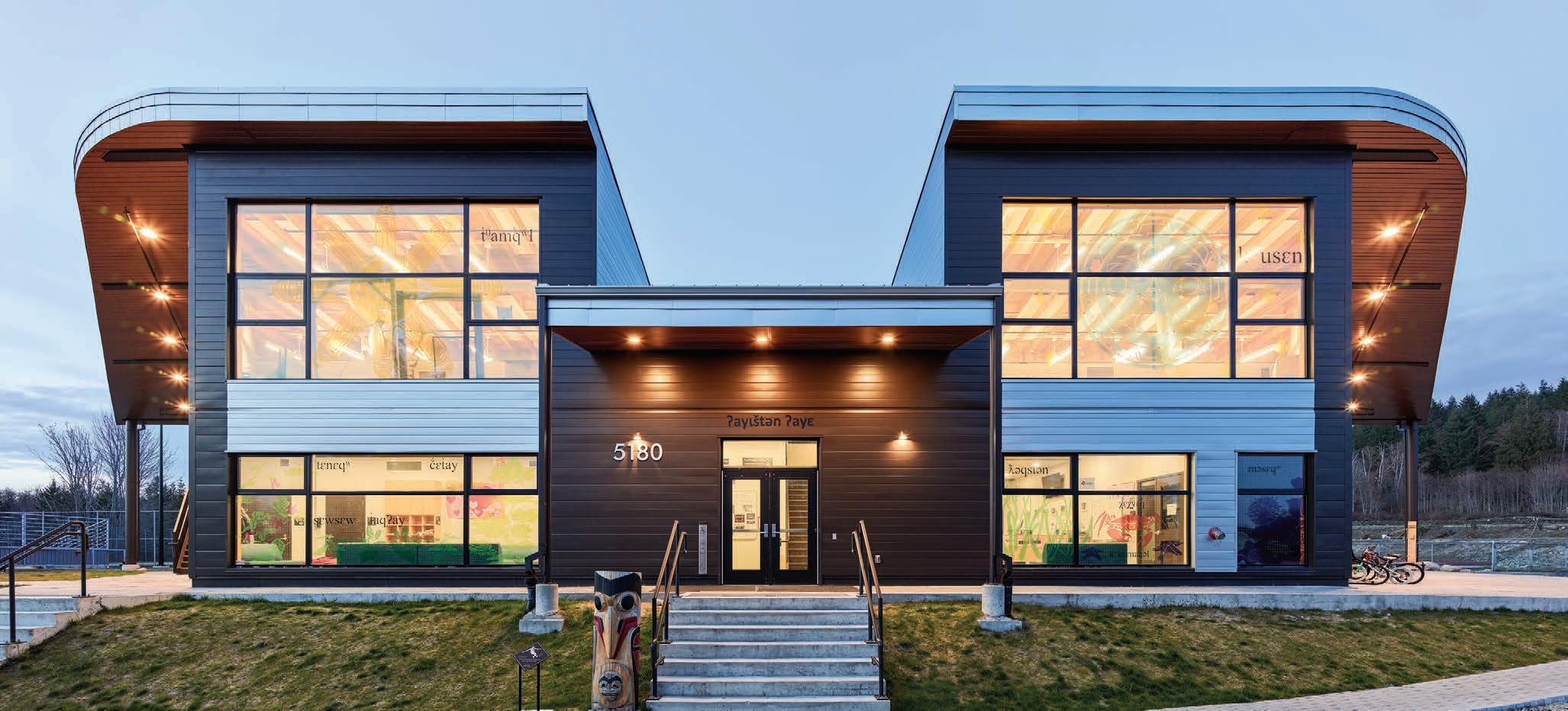
Technological advancements are integral to Silex’s product innovation. Their fibreglass window systems, rooted in decades of R&D, deliver superior durability and weather resistance, crucial for projects like the Tla’amin Youth Centre in Powell River. Here, Silex’s fibreglass window walls not only met the structural demands of large-scale installations but also provided exceptional thermal insulation and resistance to coastal elements like humidity and salt air. Looking ahead, Silex is excited about advancing sustainability initiatives and further reducing their environmental footprint. Their commitment
to transparency and innovation ensures they remain a trusted partner in creating sustainable, efficient, and aesthetically pleasing spaces for communities worldwide.
Innovation and sustainability are driving forces behind the resurgence of window wall and curtain wall technologies. From advanced materials enhancing energy efficiency to integrated smart technologies improving user experience, industry leaders are paving the way for future-proof architectural solutions. A
Tla’amin Youth Centre, Powell River, B.C.
Current Affairs
The role of electrical and communication systems in Canada’s emission reduction and innovation journey
by NATALIE BRUCKNER
In the world of Canada’s electrical and communications systems industry, a technological revolution is underway, supercharging the fight against climate change. As global emissions targets tighten, this industry isn’t just keeping pace, it’s leading the charge. With cutting-edge innovations and smart solutions, Canada’s electrical and communications sectors are rapidly transforming to meet the urgent demands of a greener future. From AI-driven grid management to next-gen renewable energy integrations, the industry is proving that when it comes to emission reduction, it’s not just about keeping the lights on, it’s about lighting the way to a sustainable tomorrow.
EMERGING TRENDS AND TECHNOLOGICAL ADVANCEMENTS
Over the past year, the team at Williams Engineering has observed significant shifts in the electrical and communication systems industry, driven by key trends and technological advancements. They have actively responded to these changes by focusing on renewable energy integration and adapting to postCOVID work environments.
“One major trend we’ve noticed is a strong emphasis on renewable energy, with more projects aiming for net zero energy buildings,” says Ben Rajewski, engineering manager, electrical, at Williams. “With that in mind, electrically we have had to look at unique ways to produce the energy load of the building sustainably. This includes solar panels, ground source heat pumps, and wind generation. With solar panels, roof space can be a limiting factor so we have evaluated systems mounted on the building facades as well as adding carports to new and existing parking lots that can then be covered with solar panels.”
Another important shift they’ve addressed is the adaptation to post-COVID work environments. With hybrid work models becoming prevalent, office designs require greater flexibility and amenities. They’ve been integrating features like workstation booking systems, standalone telephone booths, and ample power and data access throughout spaces to support flexible working arrangements.
However, these advancements come with challenges. Balancing the push for net zero buildings with the rising electrical demand from electric vehicles and heating equipment is one such challenge. Yet, it’s an opportunity for Williams Engineering to devise solutions that are both energy-efficient and electrically robust.
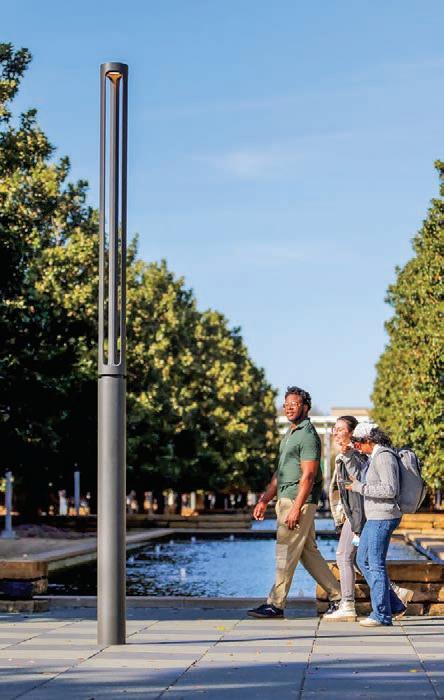
“One project that exemplifies our work is the Centennial Plaza Redevelopment project in
Edmonton,” says Rajewski. “The project took a flat and empty concrete pad outside the Stanley A. Milner Library and transformed it into an inviting gathering place with grassy hills, trees, and beautiful lighting. The electrical highlight is the lighting fixtures for the plaza. We were able to design custom poles that mimic the look of large flowers and integrated colour-changing lighting into the flowers so that they change colour over time.”
Quasar Consulting Group is also at the forefront of transformative trends shaping the field of electrical engineering. One significant trend is the integration of smart technologies, such as IoT (Internet of Things) with advanced building automation systems, which are revolutionizing the design and management of electrical systems. Additionally, there is a strong push for sustainability, focusing on energy-efficient designs and renewable energy sources, including solar power integration and energy storage solutions to enhance grid stability and resilience.
However, as Mark Piazzese, executive VP at Quasar says, the industry is moving toward exciting changes. Keeping up with the rapid pace of technological evolution and meeting the rising demand for sustainability and energy efficiency requires continuous learning and adaptation. With technology advancing so quickly and the increasing demand for sustainable and energy-efficient designs, there’s always something new to learn and adapt to. “In
the rapidly evolving field of electrical engineering, staying ahead means embracing change and constantly seeking new ways to improve our designs and services,” says Piazzese. “Innovation is not just a goal; it’s a continuous journey. We are constantly exploring new technologies to deliver smarter, more efficient electrical solutions.”
INDUSTRY INSIGHTS
Steve Nemetz, CEO of Nemetz (S/A) & Associates, provides insights into the significant trends and changes he has seen shaping the electrical systems industry over the past year. “BC Building Code requires air conditioning for at least one space inside all dwelling units as well as new adaptable requirements. Natural gas has been removed from most projects, which means everything is now electric,” he notes. Other trends include an increasing focus on net zero buildings compliant with step codes and ASHRAE standards, as well as the rise in electric vehicles that has spurred demand for EV chargers within buildings. “Strata corporations are looking into installing EV chargers within their buildings – where in the past rough-in for the future was enough,” he explains.
Amidst these transformations, both challenges and opportunities abound. “The increasing reliance on electric systems necessitates expanded power infrastructure,” Nemetz explains. He identifies the completion of BC Hydro’s Site C Dam as a pivotal opportunity to meet these challenges. However, delays in electrical distribution gear due to COVID-related disruptions and extended municipal permit review times pose significant hurdles to project timelines.
Nemetz highlights several groundbreaking projects, including Oakridge, Canada’s largest mixed-use development, and Senakw on Squamish First Nation land, notable for its collaboration between Westbank and the Squamish Nation. The Butterfly project, integrating with the heritage First Baptist Church, is another project that showcases innovative design and preservation efforts.
THE WORLD OF 3D PRINTING
According to Chris Brams, principal at Mac’s II Agencies, expert consultants representing power, electrical, lighting, and lighting control manufacturers in B.C. and the Yukon, the next big thing in electrical and lighting is 3D printed luminaires. “I recently visited one of our manufacturers, Cooper Lighting, and got to see their entire 3D printing facility. It was incredible to witness their innovative process firsthand,” says Brams. “This cutting-edge technology is already well-established in Europe and is just beginning to make waves in North America.
Plaza lighting, Stanley A. Milner Library, Edmonton, AB
PLAYING TOGETHER TO GIVE SUPPORT FOR BC’S KIDS
On behalf of the Building For Kids organizing committee consisting of volunteers from the Construction and Development industry, we would like to thank all participants and supporters of the 29th Annual Building for Kids Golf Classic benefiting BC Children’s Hospital, which took place on Thursday, July 18, 2024.
This sold-out event hosted 144 golfers from across the construction and development industry in BC for a fun-filled day at the new Morgan Creek Golf Course in Surrey, BC.
TOURNAMENT SPONSORS
This year’s tournament successfully raised over $265,000, adding to the tournament’s cumulative total of $4.165 million to date. Funds raised will support the Heart Centre at BC Children’s Hospital, ensuring kids with heart conditions have access to the best care possible.
Also thank you to Award Magazine for providing this ad each year to thank all participants and sponsors. For a full list of supporters and to learn more about the event, please contact golf committee chair: Gavin Yee at GYee@ventanaconstruction.com.
THEME SPONSORS
HOLE SPONSORS
Acera Insurance
Dominion Masonry
Escape Fire Protection
Inlet Mechanical Services
Midvalley Rebar
Mott Electric
New York Painting & Coating
Northern Building Supplies
Phoenix Truck & Crane
Thermo Design Insulation
Thinkspace
DONOR
LMS Reinforcing Steel
SUNSHINE SPONSORS
Aarc-West Mechanical Insulation
Acera Insurance Services Ltd.
Bell Consulting Engineers
BTY Group
Bush Bohlman & Partners LLP
Columbia Seal Ltd
Division 15 Mechanical
DNA Electric Ltd
Dominion Masonry
Enviro-Vac
Aarc-West Mechanical Insulation
Firestop Caulking Supply Ltd.
Homan Roofing
Power Drywall 2005 Ltd.
Richards Buell Sutton LLP
Ryan Wong @ Ryan ULC
Stonhard Canada
Trisura Guarantee Insurance
Company
Wesbridge Steelworks Limited
William Kelly & Sons Plumbing
BFK TEAM SPONSOR
Securiforce
Cooper Lighting, now part of Signify – the largest lighting manufacturer and 3D printer globally – is at the forefront of this exciting development.”
The potential of 3D printing in lighting design is vast. It allows for unprecedented flexibility and creativity, enabling the creation of everything from small decorative pendants to high bay shades. Unique designs, like 3D-printed jellyfish or pickleball fixtures, showcase the technology’s versatility. “The only limitation is the size of the printer, which can handle anything within a 22-inch cube, and of course your imagination. But within that space, the possibilities are virtually endless,” says Brams.
Sustainability is a key advantage of 3D printed luminaires. “Cooper Lighting is exploring the use of recycled materials, such as single-use water bottles, to create their products. This innovative approach reduces waste and supports environmental sustainability. The company’s Parental X line has even received a Declare label, making it one of the few lighting products with such certification, beneficial for clients pursuing LEED certification or other sustainability goals,” explains Brams.
EMBRACING AUTOMATION
The past year has marked significant transformations in the electrical and communication systems industry, something SMS excels in. “The electrical and technology design world is a challenging place, but SMS Engineering loves challenges! Whether we’re working on fast-paced complex projects or servicing an ever-growing portfolio of projects, there is never a dull moment,” says Chris Hewitt, senior electrical engineer and president of SMS Engineering. Hewitt adds, “We recognize that if we are to keep growing, we need to embrace change, driven primarily by the push towards automation of processes.”
SMS Engineering, a consulting and engineering firm based in Winnipeg, says they face a unique challenge: a small labour market serving a growing economy. To address this, SMS Engineering has been at the forefront of integrating advanced automation into its design projects and corporate support to enhance efficiency and quality. This initiative includes building an automation foundation from an AI policy, developing a list of tasks to automate, and implementing them into design and support tasks. SMS is particularly proud of its in-house training program, SMS University, which leverages AI tools like its training avatar, “Polly Process,” to streamline knowledge dissemination.
Recently, SMS Engineering has undertaken a number of significant projects, particularly in health care. Their involvement in six major hospital expansions (at Portage, Boundary Trails, Selkirk, Neepawa, Bethesda, and Brandon Hospitals) showcases their ability to manage large-scale projects efficiently, even amidst challenges like long equipment lead times post-COVID. These projects highlight SMS Engineering’s capability to deliver complex solutions while maintaining seamless operations for their clients.
AI & SMART TECHNOLOGY INTEGRATION
Les Koss, VP of technology at Houle, has observed several significant trends shaping the electrical and communications industry over the past 12 months. One notable trend is the rapid adoption of AI tools. “There are increasing concerns around data privacy and cybersecurity when it comes to the adoption of AI tools,” he says. This has led Houle to restrict access
to private AI systems and leverage reputable partners offering AI tools to ensure security. Additionally, the industry is seeing a continuing trend toward cloudhosted services, which present similar data privacy and cyber risk concerns. To mitigate these risks, Houle is partnering with mature service providers that have a strong focus on cyber hardening and hosting environments within Canada.
Koss highlights the biggest challenges facing the electrical and communications sector today: the rapid development of technology and innovation, often driven by startup organizations with limited historical success or attention to cyber vulnerabilities, which poses significant risks. The market must carefully weigh the risks and rewards of these innovations. Furthermore, technological advancements are outpacing the market and end-users’ ability to adopt them. Customers’ internal processes and compliance reviews often lag behind the emergence of new technology. To address this, Houle is committed to partnering closely with all areas in construction – general contractors, consultants, architects, end-users, manufacturers, and software providers – to educate and drive innovation into the construction channel.
PIONEERING GHG REDUCTION INITIATIVES
Highlighting the vital role of the electrical systems industry in today’s world and its future, earlier this year MCW Custom Energy Solutions announced it has become a delivery partner for the University of Toronto’s Project Leap. This landmark initiative aims to achieve Climate Positive operations on the St. George Campus by 2050.
Project Leap focuses on transitioning the campus’s central steam plant from natural gas to electricity and implementing deep energy retrofits in the most energy-intensive buildings. The $138-million project, supported by the Canada Infrastructure Bank’s Building Retrofits Initiative, will be executed by MCW CES and its partners under a Performance-based model.
This initiative is projected to reduce annual greenhouse gas emissions on the St. George Campus by over 50 percent through strategic heating electrification, thermal energy recovery and redistribution, and extensive conservation retrofits. Additionally, 35 buildings will have their lighting upgraded to energy-efficient LEDs. Overall, these measures are expected to cut the campus’s greenhouse gas emissions by more than half by the end of 2027.
SHOWCASING CUTTING-EDGE PROJECTS
Bridge Electric, with over three decades of experience in electrical construction, showcases its prowess with the completion of Vancouver Centre II, a landmark 34-storey office tower in downtown Vancouver. Serving as a design-assist subcontractor, Bridge Electric played a pivotal role in integrating this modern icon with the existing Vancouver Centre complex through a striking grand atrium featuring a suspended salmon sculpture.
The project boasts state-of-the-art electrical systems including DALI and DMX lighting controls, custom luminaires meeting LEED and WELL standards, and a sophisticated Giacomini radiant ceiling heating/cooling system. Innovatively designed, the tower incorporates a Smart Building app for tenant convenience and features amenities like expansive TV walls, a rooftop deck with panoramic views, and a fully equipped fitness centre.
Despite challenges such as demolishing a parkade and navigating construction within an occupied environment, Bridge Electric successfully delivered on complex requirements, including a dual-ended 2.5MVA unit substation, two 800kW generators, and Level 2 EV chargers. Notably, the exterior lighting, including a captivating “heartbeat” feature, exemplifies the project’s commitment to excellence and sustainability.
NEW DEVELOPMENTS IN RENEWABLE ENERGY
As a testament to the surging interest in renewable energy, OZZ Electric launched its new division, Enlightened Clean Energy, last year. This innovative branch focuses on design-build projects and renewable energy infrastructure, including solar photovoltaic (PV), battery energy storage systems (BESS), and electric vehicle charging (EV) facilities.
Formerly known as OZZ Solar Canada and OZZ Solar USA, Enlightened Clean Energy now partners exclusively with OZZ Group Inc., a key player in the Toronto, Vancouver, and Seattle markets. Steven Muzzo, CEO of OZZ Clean Energy, highlighted the urgent need for an energy transition, stating, “Energy transition has become one of the world’s greatest collective challenges. We have launched Enlightened Clean Energy [ECE] with the sole purpose of addressing these opportunities.”
Led by Chris Buligan, with over a decade of renewable energy experience, ECE aims to provide innovative solutions across North America and the Caribbean. A
3D printed luminaires from Cooper Lighting.
Total Precast Concrete Key Attributes to Passive House Development are:
· Manufactured in local precast facilities under controlled conditions
· The whole building envelope in one composite panel; air barrier, moisture control, insulation and the structure
· Hollowcore floor slabs allow for a much lower depth to span ratio
· Hollowcore provides the lowest GWP per m2 of concrete floor area
· Precast concrete dramatically reduces the construction schedule, site congestion, noise and environmental impacts
For more information and educational presentations check out Learn on Demand, a 24/7/365 Educational Platform. Visit: cpci-learnondemand.com/
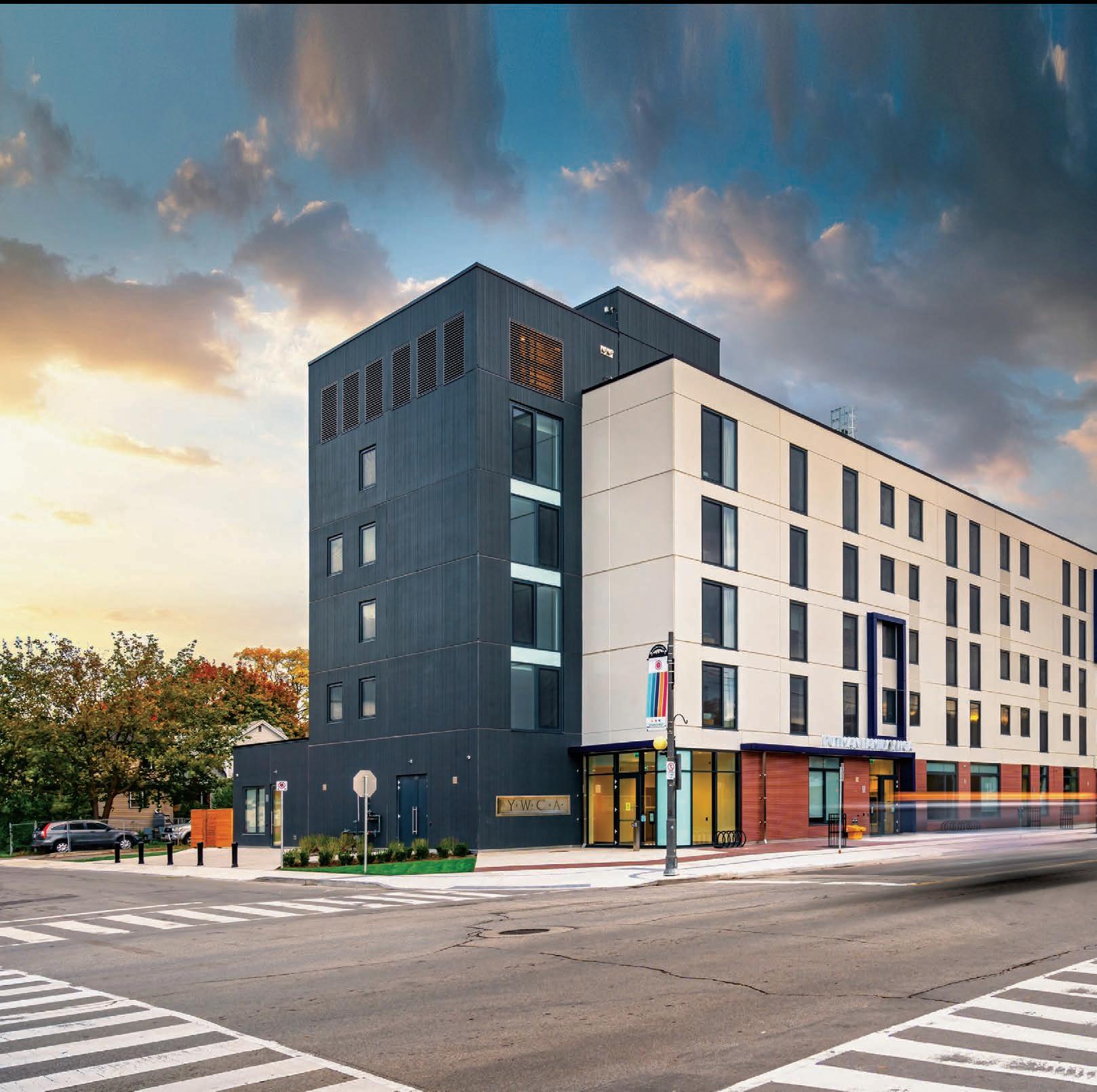
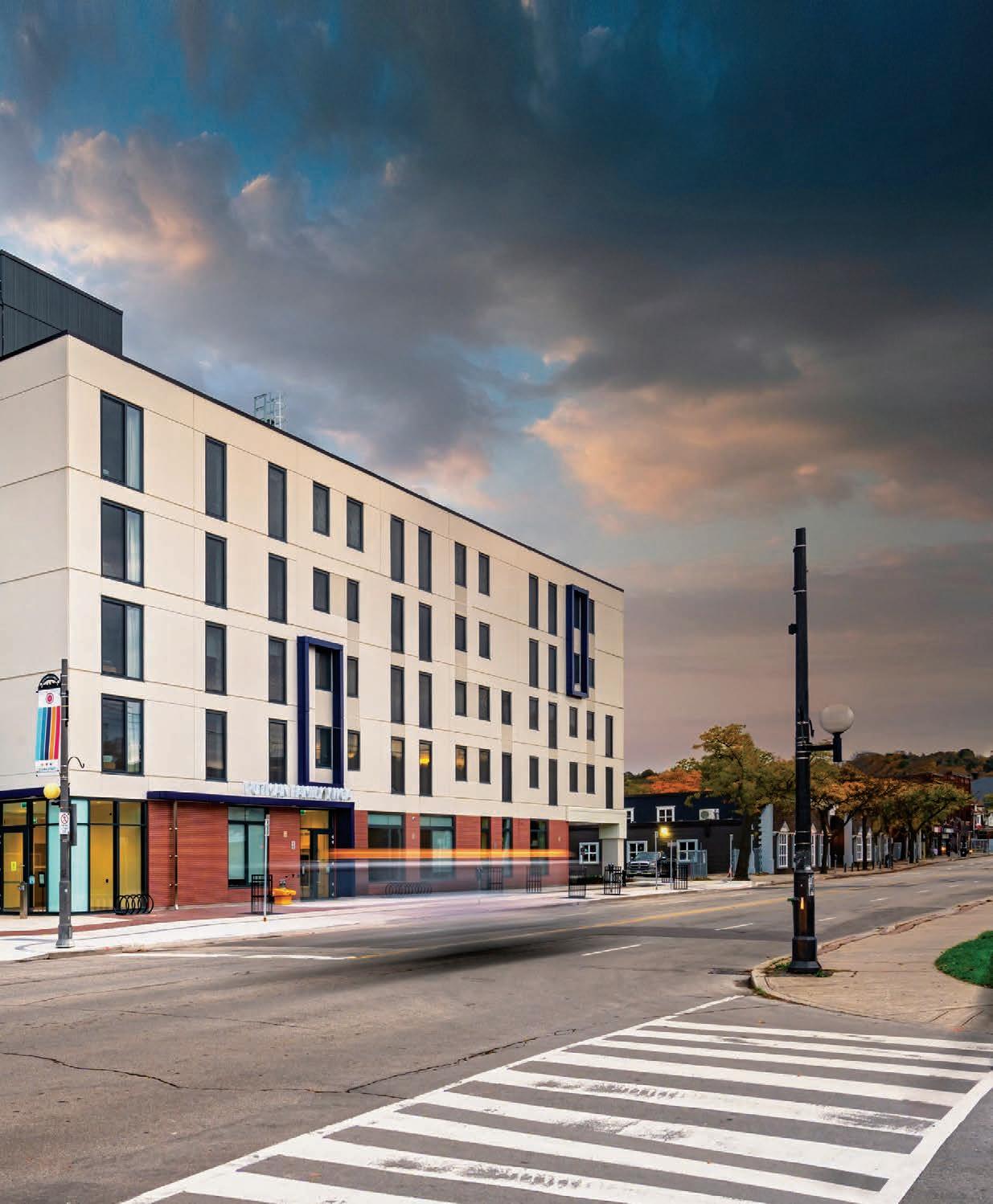
For more information on Passive House Total Precast Concrete, visit www.cpci.ca/publications to download your free copies of the Structural Solutions Guide and the Putman Family YWCA Total Precast Concrete Case Study.
Project: The Putman Family YWCA, Hamilton, ON Architect: Kearns Mancini Architects Inc., Toronto, ON
THE GREAT BARRIER BRIEF
As energy regulations tighten, attention turns to building enclosure systems
by ROBIN BRUNET
With energy efficiency in buildings regulated to everincreasing degrees, more focus than ever is being placed on the importance of building envelope systems (now sometimes referred to as building enclosure systems) in residential, commercial, and industrial design.
The question of what system is superior has morphed into a more nuanced discussion about what system is the most desirable for a specific circumstance, with materials and their performance studied in great depth. Such is the case of Brian Hall, managing director at the Canadian Precast/Prestressed Concrete Institute, who cites the new endorsement from Pro-Demnity Insurance Company of Toronto (a liability insurer for architects) on precast concrete enclosures.
“High-performance precast concrete enclosure systems stand apart from most rain screen walls in several key respects: controlling rain penetration, providing airtightness, and their construction sequence,” says Hall. “Precast concrete has been used successfully to provide durable building enclosures for decades.”
Hall goes on to note that precast drained enclosure systems assume some rainwater will penetrate the outer surface (hence, the cladding screens the rain). “Therefore, the assembly must be designed to remove this water by providing drainage, comprised of a capillary breaking drainage plane, a drainage gap, flashing, and weep hole/drain.”
One key advantage of prefabricated wall panels is their practicality. “Precast concrete architectural and doublewythe insulated wall panels are all examples of these practical, perfect barriers,” Hall explains. “When designed as drained joints in the form of two-stage sealant joints or similar, the joints between these elements further enhance their effectiveness, providing reassurance of their efficiency.”
Jeff Ker, senior technical advisor at Engineered Assemblies Inc., points out that the ambiguous definition of rain screen systems in recent history has hindered the performance of many facades at a time when developers can’t afford anything but great performance.
Engineered Assemblies supplies world-class facade materials backed by leading expertise in rear-ventilated rain screen sub-structure assemblies, and Ker says a key problem that led to criticism of rain screen systems were the numerous definitions of the systems. “In this regard, Engineered Assemblies has been working on the technical committee of
RAINA [Rainscreen Association in North America], which was founded in 2020 to establish a single definition,” he says. “Properly designed and installed, rain screens belong everywhere and live up to the standards of the building envelope being a building’s primary passive environmental control system, responsible for managing thermal and moisture control.”
Ker says RAINA is on the cusp of publishing a spec that will define a proper rain screen once and for all, thus helping to eliminate the numerous wrong ways such a system can be developed. “Ironically, the definition runs parallel to what we at Engineered Assemblies came up with 18 years ago, and it’s satisfying to see this finally coming to light at a time when Passive House and other building techniques are becoming more common. The fact is, ventilation is the only way to get rid of moisture in an interior environment, and the practice of sealing up a building is a nasty one because at some point the interior and exterior climates will meet, with bad results.”
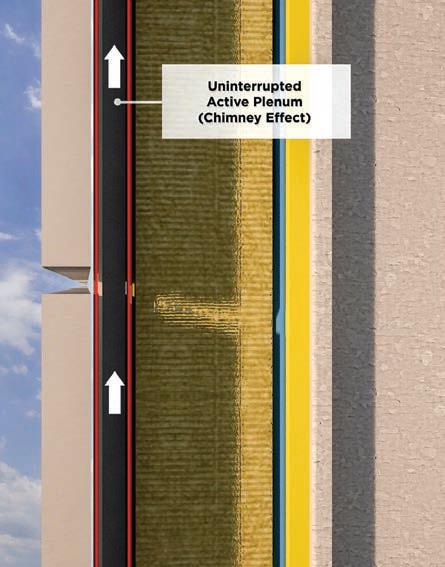
Ker offers some insight into what makes the Engineered Assemblies rear-ventilated rain screen so effective. “Having an active plenum ensures the circulation of air is constant in good times and bad. The plenum can only function best when unobstructed and with the combination of adequate intake and exhaust vents.
“Having adequate ventilation/air flow means the substructure supporting the façade material can see a longer lifespan and the insulation can function at its maximum potential in its dry state. Also, placing a secondary drainage plane in front of the insulation [behind the plenum] will further thwart the intrusion of precipitation, minimize wind washing, and provide a visually pleasing veil to hide substructure and insulation through open joints of facade panels.”
BCIT
Tall Timber Student
Housing project, Burnaby, B.C.
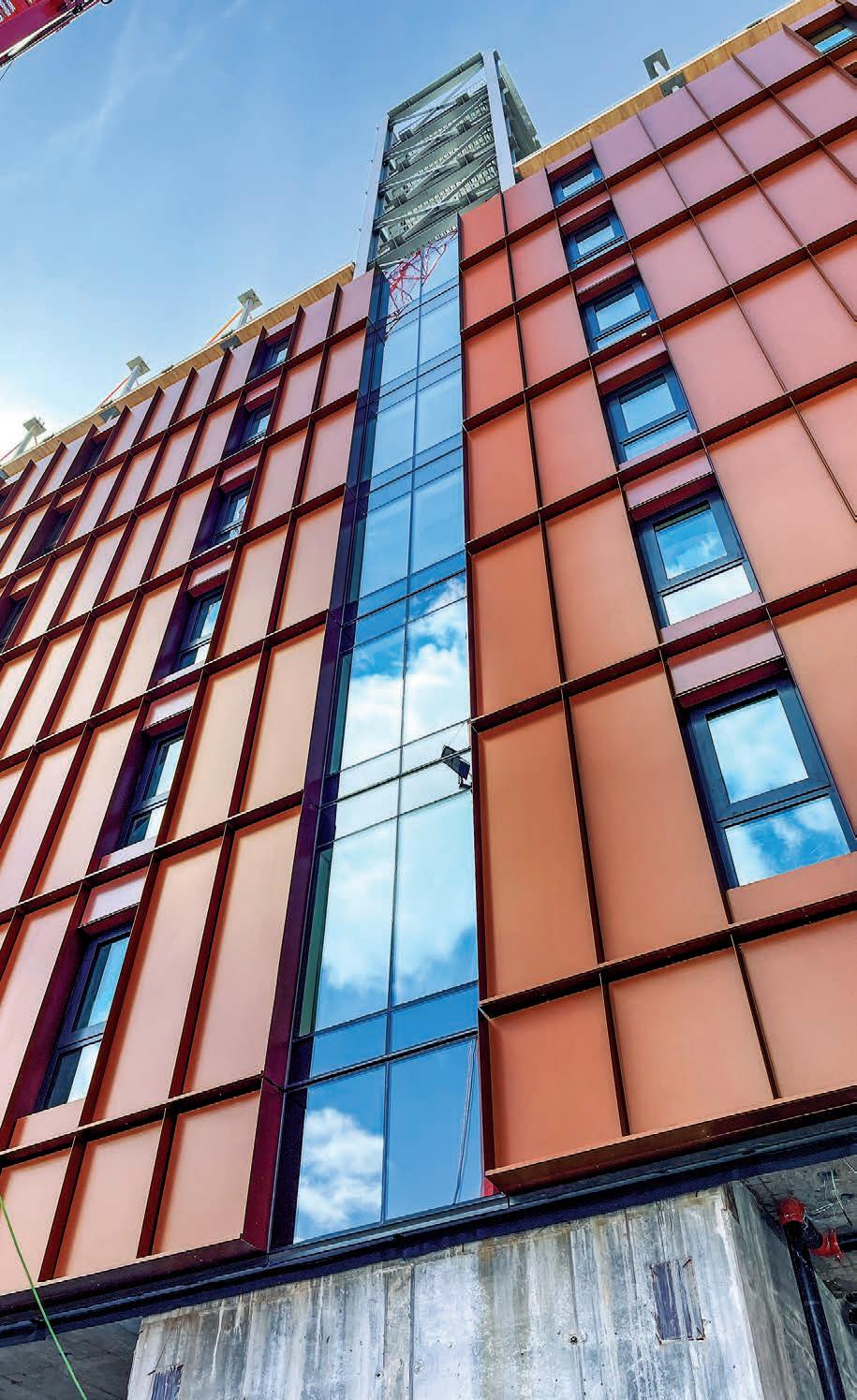
Engineered Assemblies rear-ventilated rain screen with an active plenum.
*(CPCQA) CERTIFICATION PROGRAM BY PROCESS OFFERS KEY BENEFITS TO ARCHITECTS, CONTRACTORS, ENGINEERS, GOVERNMENT AUTHORITIES AND OWNERS.
Project: Champagne Quarry Park, Calgary, AB Architect: Gibbs Gage Architects
The Flynn Group of Companies appreciates that the sheer number of interfaces between window and wall components in traditional building envelope construction, coupled with their installation and quality control in the construction site environment (often by multiple trades), leave the final product challenged to meet the latest regulatory codes. Also, while previous energy codes evaluated the system efficiency of building envelope components in isolation, emerging requirements take comprehensive thermal bridging calculations into account.
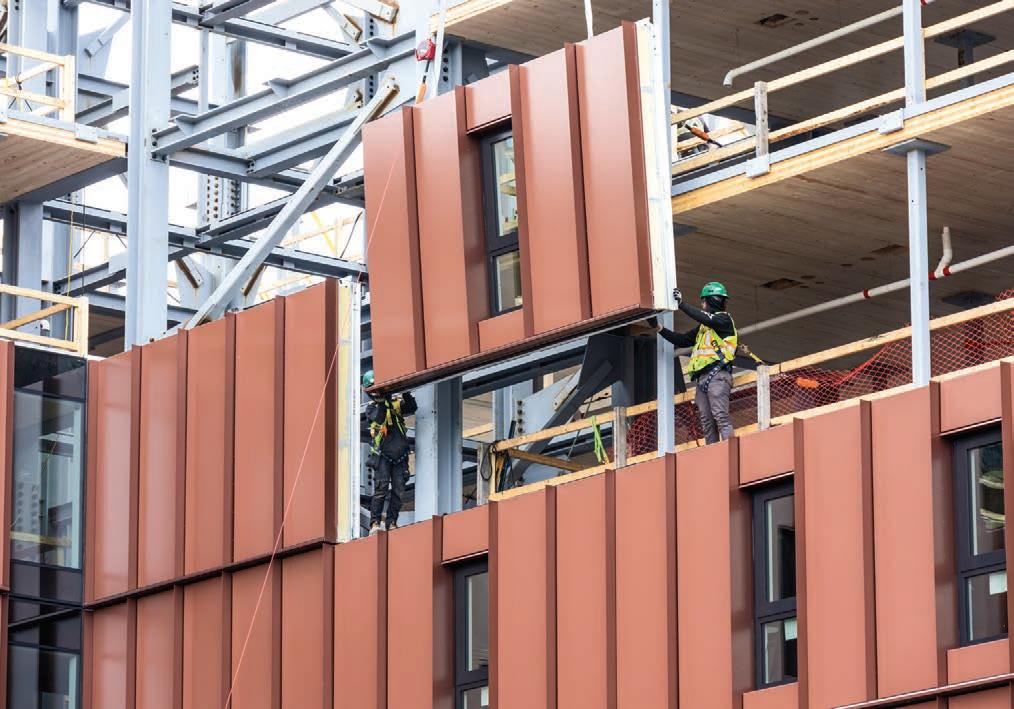
Therefore, Flynn’s approach to helping building owners achieve thermal performance is its Speedwall product, a factory-assembled exterior wall system whose modules lock together and deliver quality and performance levels far beyond what is possible with on-site construction.
Built on an aluminum chassis based on Flynn’s 6450 unitized curtain wall system, Speedwall modules are completely self-framed, sealed, and insulated in Flynn’s manufacturing facility, with all windows, doors, and exterior cladding pre-installed. The brand has many practical advantages in addition to delivering net-zero energy performance standards: it integrates seamlessly with Flynn 6450 HP Curtain Wall where full-height glass is desired; it is suitable for steel, concrete, and mass timber construction; and limitless colours and finishes can be chosen to meet design intent.
Mitrex offers rain screen systems, ready-for unitized stick or built cladding, prefabricated wall systems, ready-for window wall installation, slab-to-slab connections comparable to precast concrete systems, and insulated wall panels. All of the systems are solar, and all are made in Canada. Projects that have relied on Mitrex technology include the Scarborough Academy of Medicine and Integrated Health, which features a BIPV façade covering about 63,0000 square feet and whose solar power generation fulfills a portion of the facility’s energy needs.
In the realm of insulating foams and admixtures, Huntsman Building Solutions continues to rack up achievements for its polyurethane spray foams
Another approach to envelope design is offered by Greenstone Building Products of Richmond, B.C., which manufactures the Insulated Composite Envelope (ICE), an engineered combination of expanded polystyrene and galvanized steel. This combination results in a much lighter and stronger building envelope, with the panels providing substantial transverse and compression bearing capacities. The unique manufacturing process and connection details eliminate thermal bridging, allowing Greenstone to market the system as one of the most efficient envelopes available.
The envelope/building enclosure sector has seen its fair share of innovation in 2024, none more notable than the reinvention of the envelope from Mitrex. The company’s range of architectural solar products are intended to seamlessly replace building facades while harnessing the sun’s power, thanks to a robust aluminum honeycomb core and a layer of high-efficiency solar cells. Customizable facing makes these facades desirable for a wide variety of applications.
that outlast and outperform fibreglass as well as cut energy costs. “We recently received new Radon Protection System certification ULC ER-40477-02 for our Heatlok Soya HP, in addition to our radon diffusion results in accordance with ISO/TS 1665-13,” says Huntsman’s chief strategy officer Doug Brady. “This is in addition to CAN/UL S101 compliance for Heatlok Soya HP in both the X-Wall and D-Max wall systems for high-rise buildings, and new CAN/ULC S134 compliance for the D-Max Wall.”
The D-Max wall is a new type of assembly that allows the installation of spray foam insulation from the interior of the building, while managing the thermal bridging of the studs and the structure. The X-Wall system provides everything needed to ensure a solid and tightly sealed building envelope. With these wall assemblies, Huntsman Building Solutions provides the highest quality products and accessories, custom design assistance, engineering support, and approved installer network.
As for Heatlok Soya HP, this product leverages Honeywell’s latest Solstice hydrofluoro-olefin liquid blowing agent that has a zero Ozone Depletion Potential and a Global Warming Potential of 1. It has the best R-value of any HFO insulation product currently on the market, with a LTTR value at 50-millimetres of 2.06 RSI (R 11.68), and is an effective solution for both residential and commercial applications.
Speedwall factory-assembled exterior wall system installation.
D-Max wall assembly.
Finally, Bill Corradetti, division sales manager at Euclid Canada, reports that in addition to offering new products, “we’ve just received our Environmental Product Declaration for our admixture plants, which has been a long time in the making and a great achievement.”
Corradetti is referring to the communications document that provides transparent and third-party verified data about the environmental impact of products and services based on the results of a life cycle assessment (LCA) of a manufactured material. This enables comparisons between products fulfilling the same function.
Manufactured at Euclid Chemical’s LaFayette, Georgia, fibre production facility, PSI Fiberstrand Multi-Mix 80, PSI Fiberstrand 100, PSI Fiberstrand 150, and Tuf-Strand SF were analyzed for the report. The EPD helps quantify the environmental savings that can result when using or converting traditional steel reinforcement to Euclid Chemical’s fibres.
As for products that contribute to concrete strength and building integrity, Corradetti cites Eucon Eco-Strength as the latest offering from his company. “This product improves both early and late age strength development in concrete,” he says.
Based on a highly engineered admixture technology that facilitates cement hydration, Eucon Eco-Strength enhances strength development and allows for sustainable construction practices to be achieved through possible total cementitious content reduction. Maintaining compressive strength development equivalent to that of a reference mix containing more cementitious is important in all construction projects requiring CO2 emissions and total embodied energy reduction. Eucon Eco-Strength is particularly effective where heat is present while curing, allowing earlier stripping of forms or restoring the serviceability of concrete repairs. A
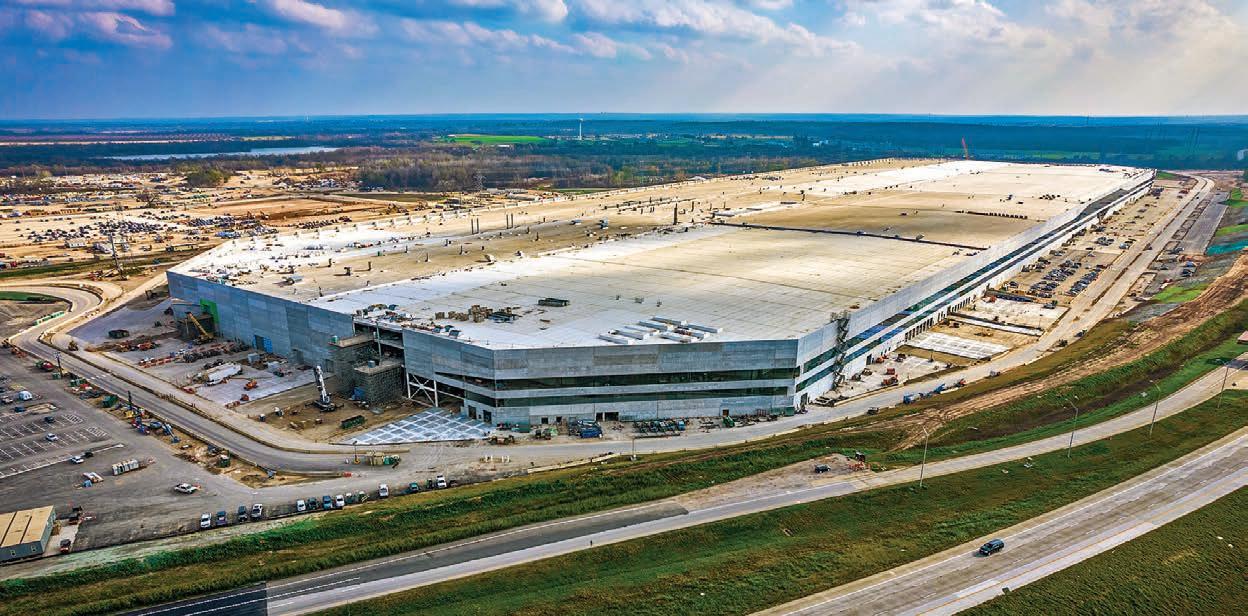
Tesla Plant, Austin, TX Tuf-Strand SF
Need Solutions to Help with
•
•
•
•
Sustainable to Abrasion and Erosion Resistance
Meet Architecture 2030 commitments as Hard-Cem concrete admixture for abrasion and erosion resistance, provides a threefold sustainability benefit:
Use less cement to achieve the same durability
Reduce the need for carbon-intensive and costly repairs and maintenance
Postpones demolition and the associated release of carbon
®
BRASS MEETS GLASS
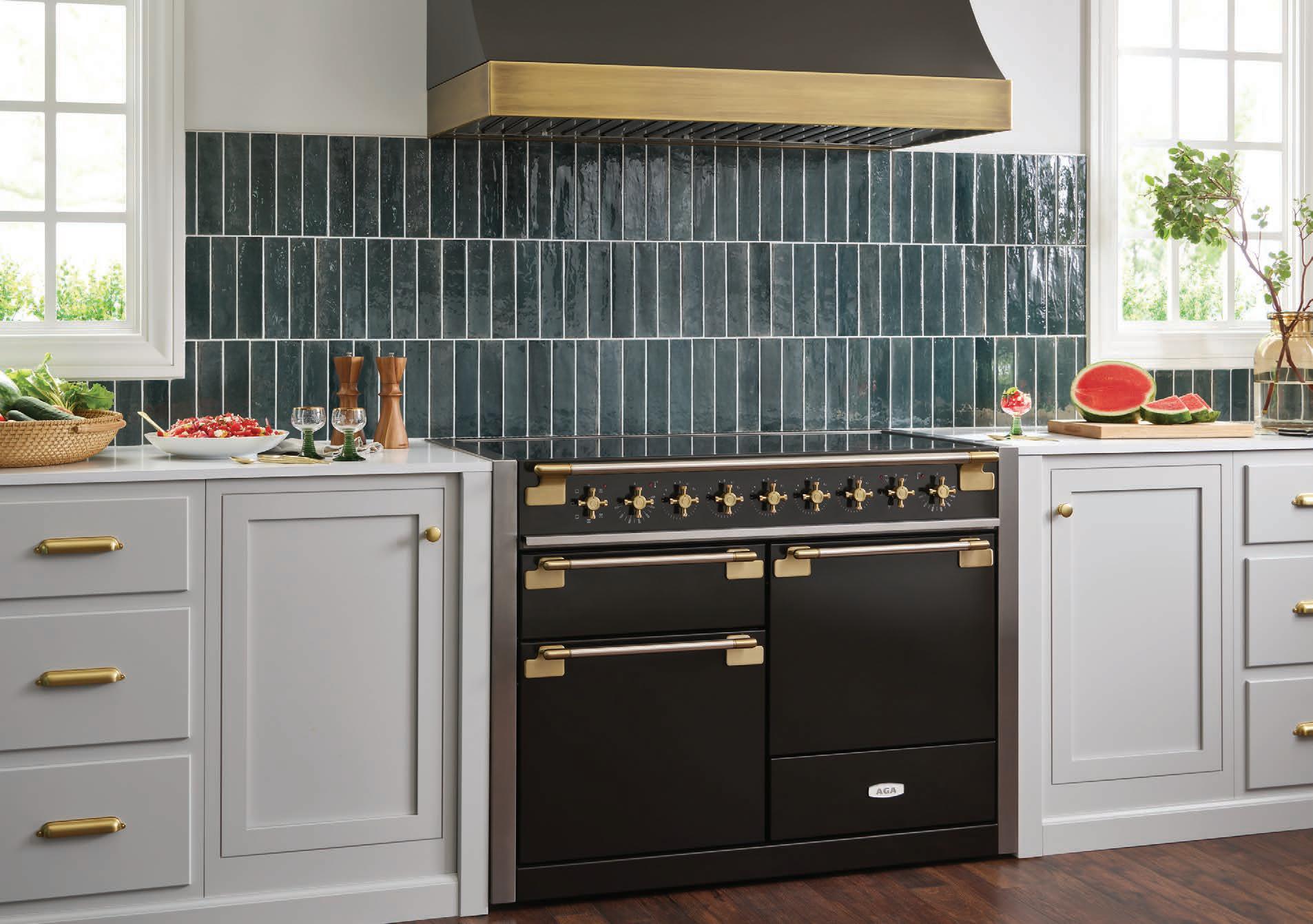
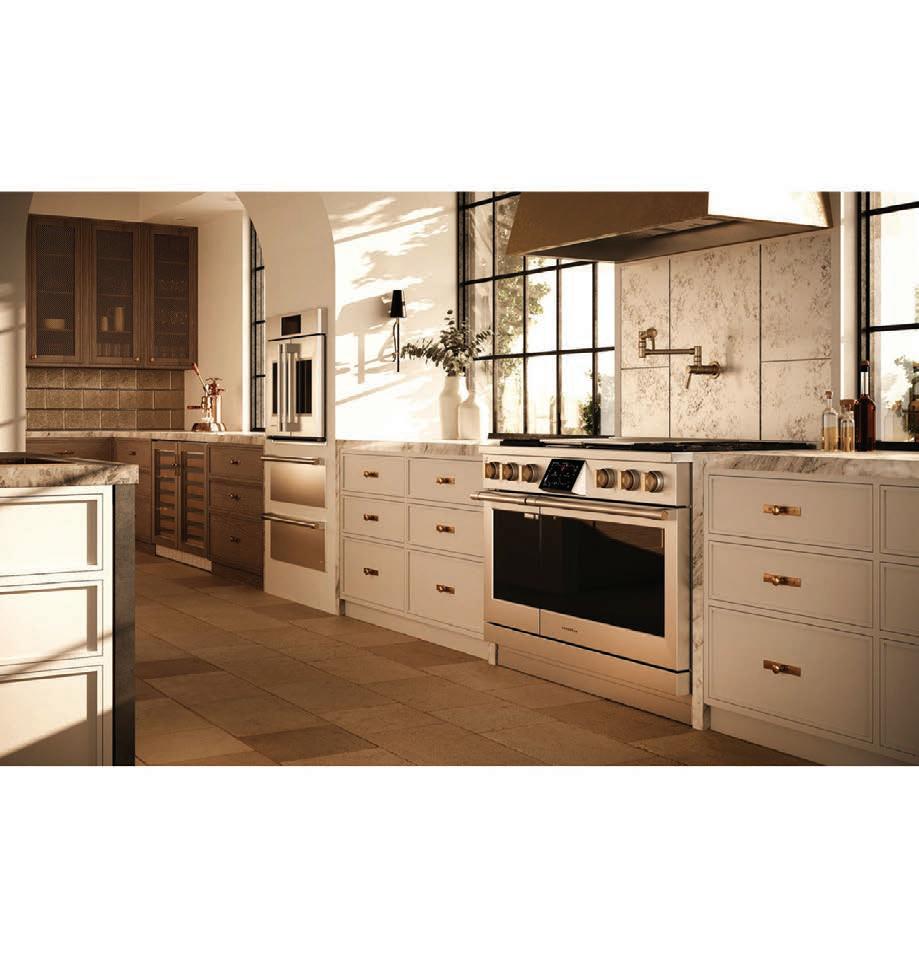
ELISE SHOWN PAIRED WITH AN AGA 48 " MARQUEE HOOD
Designs To Savour
As the 2024 design season continues, kitchen designers and suppliers have a wide range of products to create unique looks that either draw inspiration from the past or move headlong into the future.
INNOVATIVE WORKSPACES
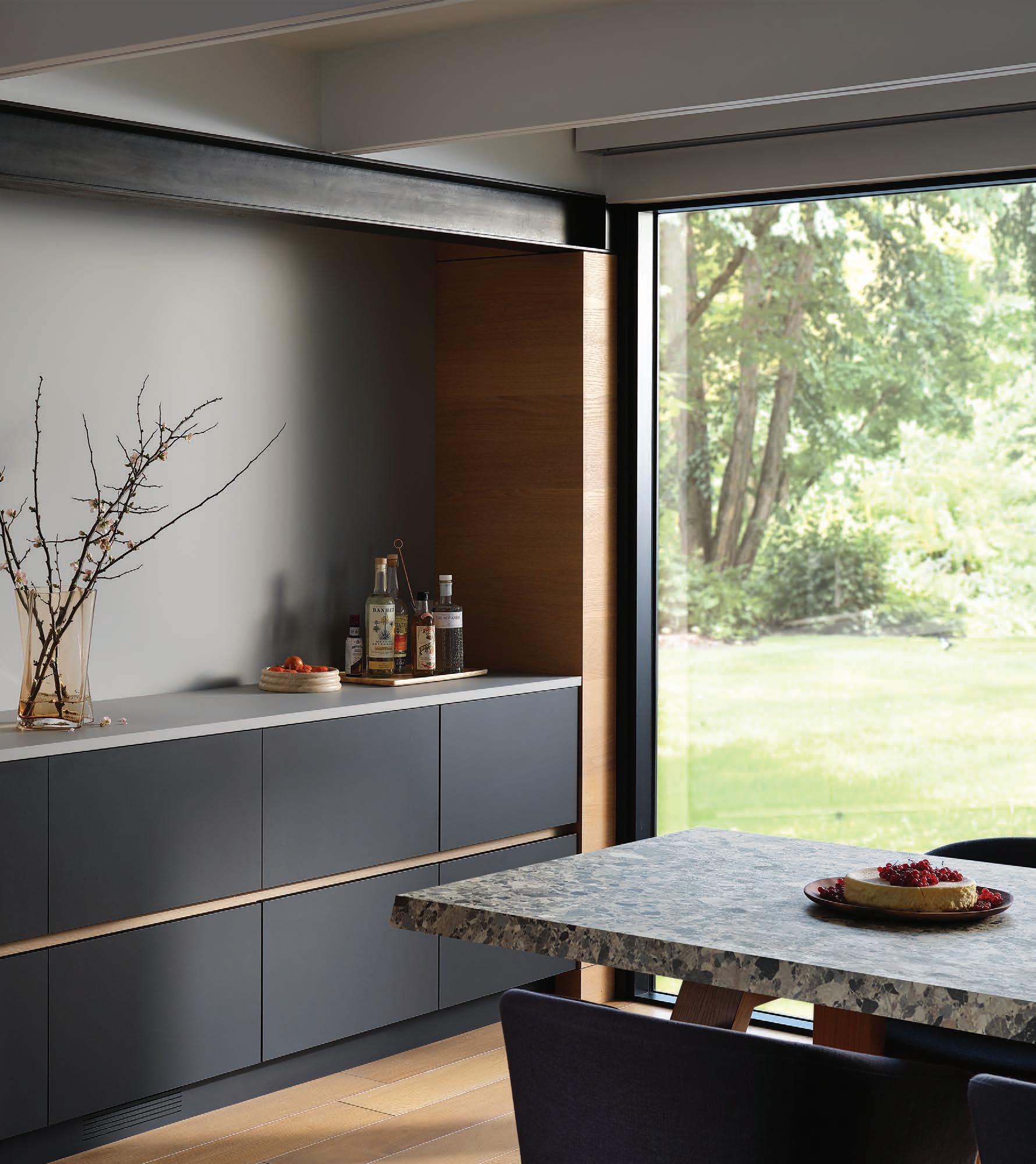
In 2024, Formica Canada launched its Living Impressions Collection featuring a harmonious blend of luxe pattern and colour. This rich array of sophisticated surfaces draws inspiration from three emerging design trends, resulting in seven elevated large-scale 180fx stone patterns and six Formica laminate patterns.
“We’re thrilled to introduce these cutting-edge designs that will give residential property owners and
designers a myriad of options for new, affordable, and attractive surfaces,” says Christelle Locat-Rainville, marketing director at Formica Canada. “After the pandemic, homeowners want soft, warm, and comforting colours, moving away from stark and cold whites and greys. A range of beiges are versatile, neutral, and inviting for a home environment.”
The new residential surface collection was created on a foundation of trends identified by the Formica design team. These trends include: Modern Minimalism – warm whites and minimal patterns that are understated and soft without losing their edge; Casually Biophilic – nature-inspired elements that emulate the healing of the outdoors for indoor spaces; and Contemporary Classic – classic stone patterns reimagined with a modern twist.
Locat-Rainville adds Formica Corporation is focusing on the classics but giving them a new
The latest in kitchen innovations and artisanal craftsmanship blend style with functionality
by LAURIE JONES
touch. “Our approach is to reimagine the familiar. We’re not recycling established concepts, but infusing classic patterns with a fresh perspective. We’re honouring tradition while pushing the boundaries of design, which creates patterns that feel both timeless and innovative.”
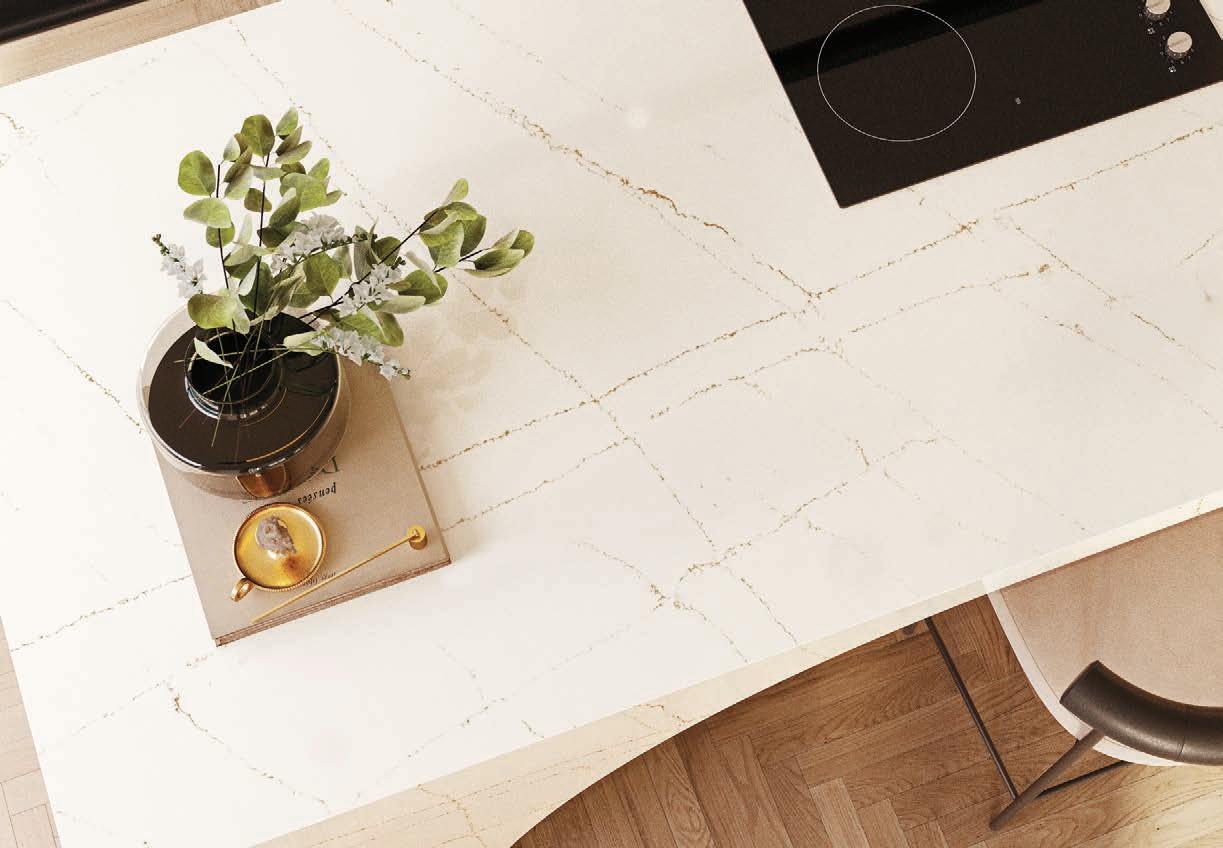
The One of a Kind (OOAK) collection from Caesarstone Canada invites designers and homeowners to create a unique kitchen space that is sure to be envied. The new OOAK Quartz & Porcelain Collection features natural veining options that showcase movement and depth.
From the classic black and white Calacatta Scoria to the pale rose of Celestial Sky, or the subdued taupe and veined Mosstone to the artistically gold-veined selections including Aterra Verity, Marenstone, Isobellia, and Goldfinch, the Caesarstone options are created to suit any design tastes.
Bianco Antico from the Living Impressions Collection.
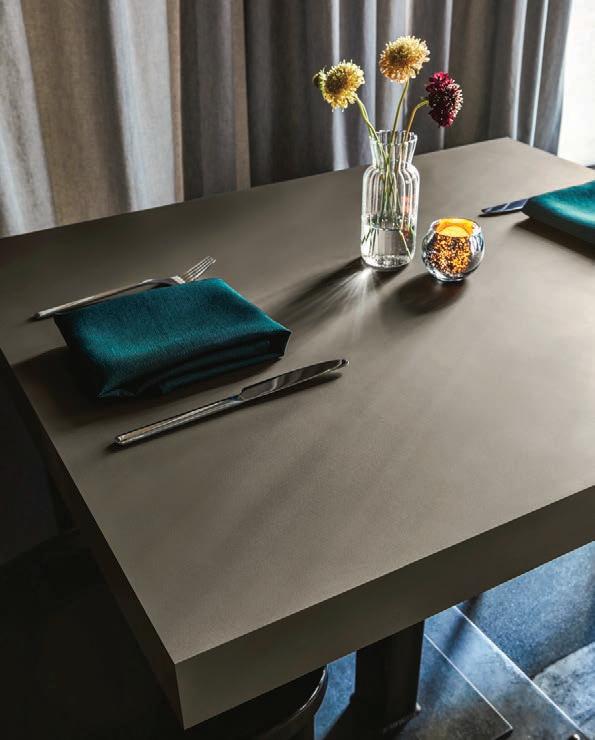
This innovative, ultra-matte, soft-touch surface makes an impact in any design.
“For those who want to step into a recent colour trend for kitchens, Caesarstone’s pink-hued quartz will definitely be a head turner, from vintage to modern design choices,” says Yael Goldschmid, director of marketing. “The romantic tone features a beige base with cream-coloured veining. Set against dark cabinets or flooring, or a blush-coloured wall, the scene can be set for a relaxing atmosphere.”
As with any quartz counter, this product is high quality, easy to clean, heat and stain resistant, and hygienic. Nearly unbreakable, it has a Mohs hardness rating of 7.
Cosentino has unveiled Earthic by Silestone XM, fusing together unconventional and reclaimed materials to create a sustainable surface concept that sets a new benchmark for the industry. Developed in collaboration with the iconic Italian studio Formafantasma, Earthic reinforces Cosentino’s long-term commitment in the effort to become a more sustainable company and continues to pave a path to tangibly minimize the impact of surfaces in the future.
“Earthic aims to raise awareness about the importance of design beyond aesthetics and prioritizes sustainable production processes,” says Andrea Trimarchi of Formafantasma. “Our collaboration with Cosentino is an attempt to design from the inside out - where the aesthetic choices correspond directly to ethical and sustainable choices,” adds Simone Farresin of Formafantasma.
Earthic by Silestone XM was introduced in April 2024. Representing the next generation of mineral hybrid surfaces, Silestone XM distinguishes colours and collections brought to the market by having a maximum crystalline silica content of 10 percent. And, thanks to Cosentino’s Hybriq+ technology, this collection is also produced with 100 percent renewable electrical energy and 99 percent recycled water.
Earthic is divided into two colour series: Earthic/ Ffrom X Formafantasma – three colour series that reflect the material’s origin and sourcing as well as the process of transforming recycled materials into something new; and Earthic/Raw X Cosentino Studio – patterns and colours that capture the
material essence in its most authentic state, combined with shapes that express a new aesthetic.
To commemorate the brand’s 10th anniversary, Fenix Innovative Materials is now available in six new colours inspired by natural and manmade sights from around the world. Designed in Italy and available in North America exclusively through Formica, the extremely matte and soft-to-the-touch surface has fast become a staple material in design portfolios.
“Designers value Fenix products for their unique ability to deliver both functionality and aesthetic appeal,” says Christelle Locat-Rainville, marketing manager at Formica Canada. “We’re pleased to introduce these additions that give the range new depth while maintaining a timeless elegance. These new colours will allow designers to get even more creative with Fenix products.”
Colour options include: Giallo Evora – a delicate yellow; Verde Kitami - a soft green with tones of grey; Blu Shaba – capturing the colours of Chrysocolla – a deep blue blend with nuanced
shades of green; Viola Orissa – a nod to the deep purple of eggplant; Grigio Aragona – a bridge between the collection’s existing browns and greys; and Rosso Namib – a warm brick red evoking imagery of the red desert of Namibia.
She adds Fenix is a designer favourite across both commercial and residential settings, including retail, education, office, kitchen and bath, and furniture design. The surface can be used for both vertical and horizontal applications, adding moments of sleek elegance to any space. Fenix also has anti-fingerprint properties and the ability to use thermal healing for superficial micro-scratches.
SMART SPENDING
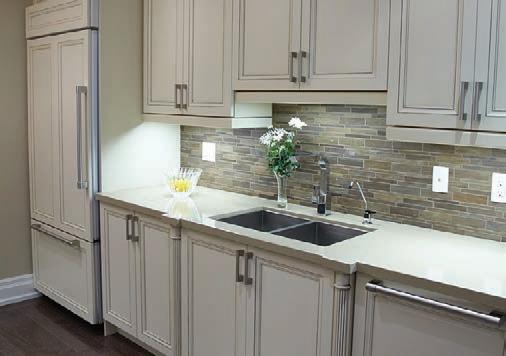
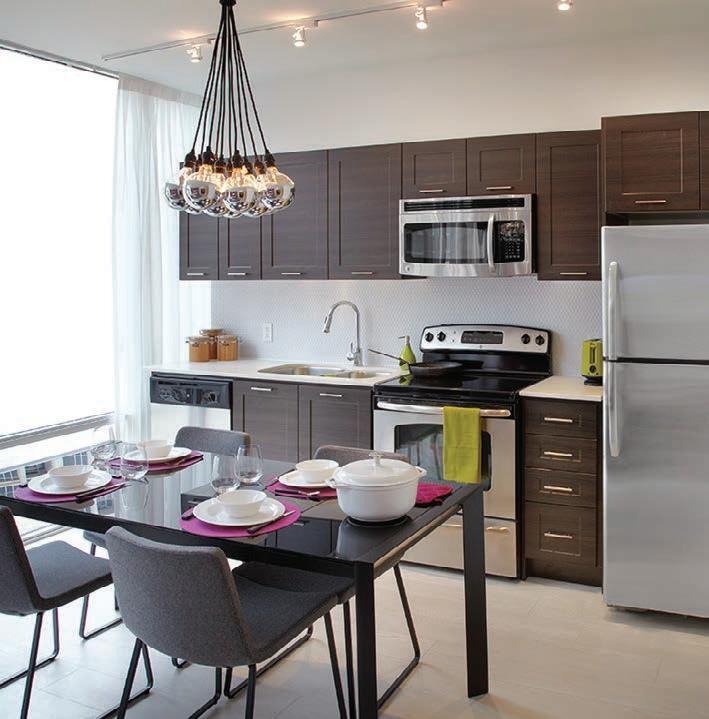
Cavupro Ltd. bridges the gap between Italian craftsmanship and Canadian practicality, offering a distinct kitchen solution tailored for multi-family units. Their cabinet lines, meticulously crafted in Italy and Canada, introduce a blend of affordability and elegance to the local market. Utilizing thermal-fused laminate, these cabinets emulate the rich texture of wood, while delivering enhanced durability at a competitive price point. Available in an array of solid colours and wood-grain finishes, they cater to diverse aesthetic preferences.
Highlighting their innovation, Cavupro champions handleless, finger-pull doors imported from Italy, which not only create a sleek, clutter-free appearance but also promote seamless room transitions. In urban settings where spaces often merge, these features foster a cohesive, fluid environment, making smaller condos feel more expansive and interconnected.
With the rise of remote work in cities, Cavupro recognizes the need for kitchens to serve multiple functions – from hosting gatherings to doubling as workspaces. Their designs prioritize versatility without compromising on comfort or style, offering a range of solutions that blend modern aesthetics with practical living.
CRAFTED CABINETRY
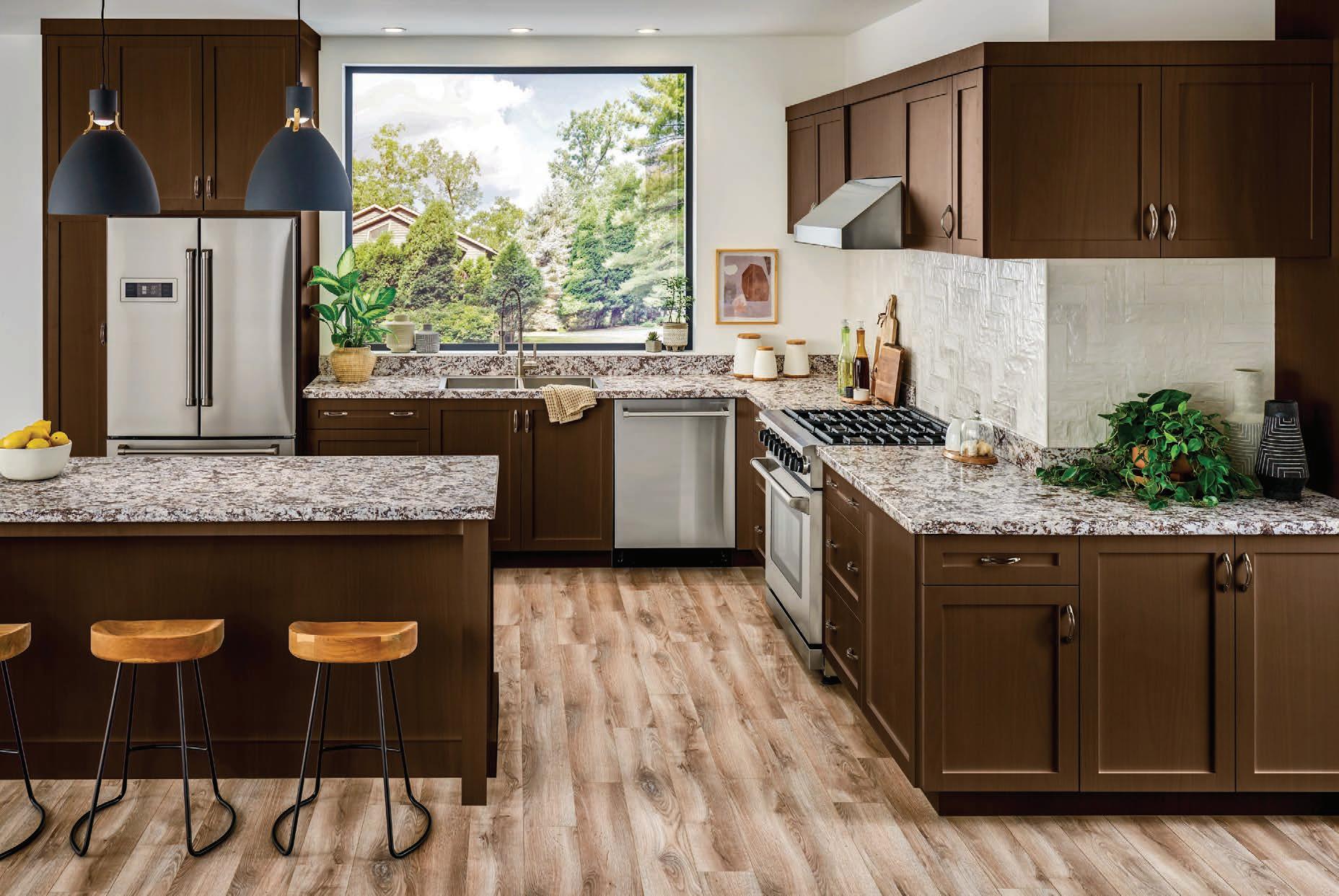
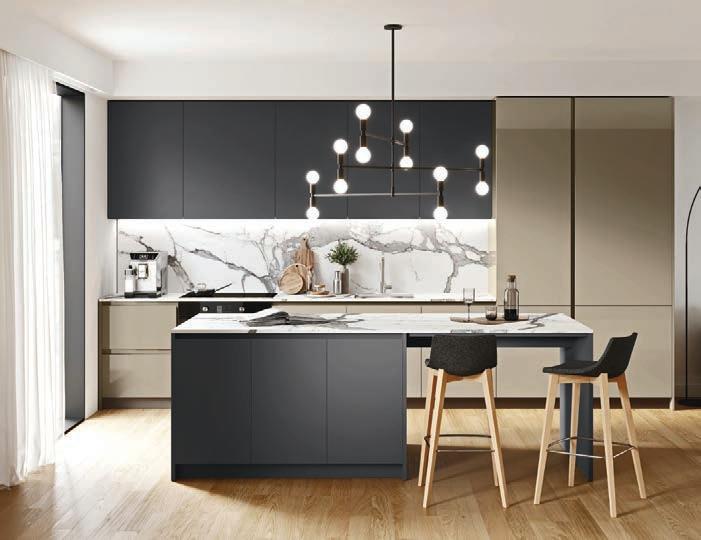
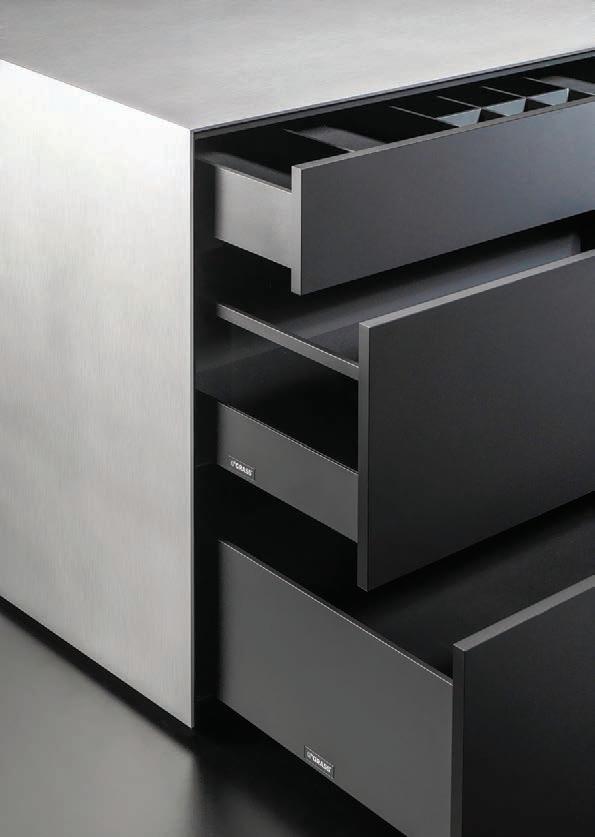
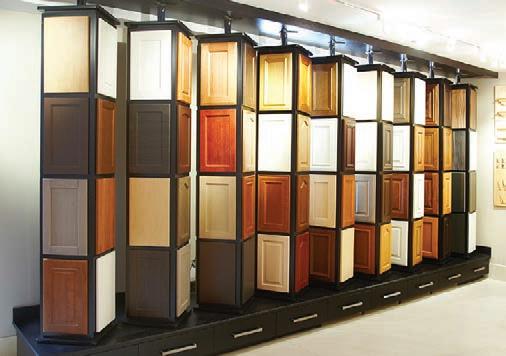
George Pavlov, senior sales manager at Grass Canada, explains the current trend for cabinetry in the majority of projects seems to gravitate towards darker colours, particularly for drawers. “Even though the white kitchen is still popular, we are seeing a lot of darker, richer colours – muted earth tones. The designs are also moving away from gloss finishes to ultra satin, or super flat, as it is called,” says Pavlov.
Aterra Verity from the The One of a Kind Quartz Collection.
Grigio Aragona from the FENIX Collection.
Vetta cabinet line.
To maintain the popular sleek look, and maximize space in downsized footprints, Grass Canada products offer thinner profiles in both cabinets and drawers, with soft close mechanics high on the list of must-haves. “While some builders still install regular cabinets, it costs more to bring those products in because they are no longer the standard. Soft close is,” he adds.
Pavlov also notes that having quality hardware pays off in the long run, avoiding costly replacements of failed units. “This is a topic I often discuss with manufacturers in that the overall cost of having someone replace a $3 hinge far exceeds the decision to install better quality hardware the first time.”
With a wide range of drawers, slides, hinges, flaps, and interior accessories, Grass Canada can outfit any kitchen with top-of-the-line products that create the success behind the grand designs.
The Revego system from Blum addresses the trend where more people are combining their kitchen, dining, living, and working areas into one contemporary open-plan space. With increasing urbanisation and more densely populated metropolitan areas, living spaces of the future are also likely to be smaller. “The pocket systems from Blum open up brand-new opportunities,” says Lucy Traetto, marketing representative. “The ability to quickly open up complete living areas when you need them, and simply close them off again, helps to create a homely atmosphere. This brings completely new design possibilities for rooms, both big and small.”
The kitchen workspace, home office, or laundry room is now easily accessible. To close off the space, the user simply presses the door to release it from the pocket and then presses it again to elegantly conceal the entire area. When they are closed, the fully opening doors conceal the furniture units, including their pockets, making Revego the ideal solution for the multifunctional use of space.
Traetto notes the smart fixed-width cabinet solution can also be easily incorporated into plans featuring standard cabinets: pocket widths are 100 millimetres (mm) for the single door Revego uno
and 150 mm for the double door Revego duo. “When it comes to design, the solution offers plenty of room for manoeuvre,” she says. “The single doors can be 450- to 900-mm wide, and the double doors can be 450- to 750-mm wide, as well as 1,800- to 2,500-mm high. The pocket systems can also be produced and pre-assembled by the manufacturer for delivery to the place of installation.”
FUNCTIONAL ACCESSORIES
The team at Häfele often sees trends that start in Europe make their way to North America, especially in the kitchen. With innovative kitchen customizations like lighting systems that enhance ambiance and usability, as well as cabinetry storage solutions that are just as functional as they are beautiful.
“Enjoying the outdoor living trend means people are looking for ways to expand their patios and decks, creating extended living spaces,” says Thelma Vigil, project, digital strategy and social media manager. “Remodellers, architects, and designers have many ways to expand clients’ outdoor lifestyle creating everything from a simple barbecue kitchen island to a fully functional outdoor kitchen area.”
With a variety of self-closing hinges, full extension ball bearing slides, folding brackets, and hooks, screws, and decorative hardware that will not rust, Richelieu offers everything needed to build the perfect outdoor kitchen. “Complementary products such as cabinet levellers are handy for adjusting cabinet heights for drainage and providing more structure and stability,” says Vigil. “Polymer kitchen
Answering the call for elevated aesthetics in beautiful kitchen spaces, the Vauth-Sagel by Häfele line of kitchen accessories and modular systems are now available in Canada in a Walnut finish. From pull-out pantry systems, clever corner cabinet solutions, and integrated storage, these solutions make the spaces in our kitchen that are usually the most cluttered and dysfunctional, more chic and wellorganized, all while maximizing the value of space.
“Häfele is thrilled to introduce these products to our Canadian customers,” says Victor Ayoub, director of marketing, Häfele Canada. “We continuously seek to innovate and provide customizable solutions and empower our customers to personalize their spaces according to their unique design preferences and functional needs. Our products are crafted to facilitate this customization to ensure every space reflects the lifestyle of the end-user.”
Häfele’s fifth generation Loox Lighting systems further enhance kitchen spaces by delineating areas, creating ambiance, and adding purposeful lighting for kitchen use. “There is also the customization element of Loox Lighting, as it allows users to adjust brightness, colour, and placement to perfectly suit their design vision and functionality needs.”
OUTDOOR LIVING
Richelieu offers products to create a fully functional outdoor kitchen, with stainless steel hardware and weatherproof, polymer panels and kitchen accessories.
accessories allow you to organize space and maximize storage according to each project’s needs. Not only are they cut to size to fit all types of drawers, but they are also sturdy and have a long-life span.”
SUPERIOR SUBSTRATES
Having quality substrates for kitchen tile installation is critical for a professional finish.
“Schluter-Ditra and Ditra -XL are specifically designed for ceramic and stone tile installations,” says Tod Valickis, global product manager, Schluter Systems (Canada) Inc. “These products provide uncoupling to prevent cracked tile and grout.”
He explains that as they are made of polyethylene, Ditra and Ditra -XL serve as a waterproofing layer that protects moisture-sensitive substrates, such as plywood/OSB. “Free-space on the underside of the matting provides a route for excess moisture and vapour to prevent damage to the tile layer above. Ditra and Ditra -XL perform all these functions, while still providing adequate support/load distribution for the tile covering.”
Additionally, Schluter-Deco-SG is a decorative profile featuring a ½-inch 9⁄ 16-inch-wide channel that provides a shadow gap between tile courses or other wall covering. “The profile may also be used as a support channel for glass walls. The ½-inch-wide channel accommodates glass walls up to a thickness of 3⁄8-inch, and the 9⁄ 16-inch-wide channel accommodates glass walls up to a thickness of ½-inch. A
Soft-close Vionaro drawer system.
Loox Lighting system.
Illuminating Innovations
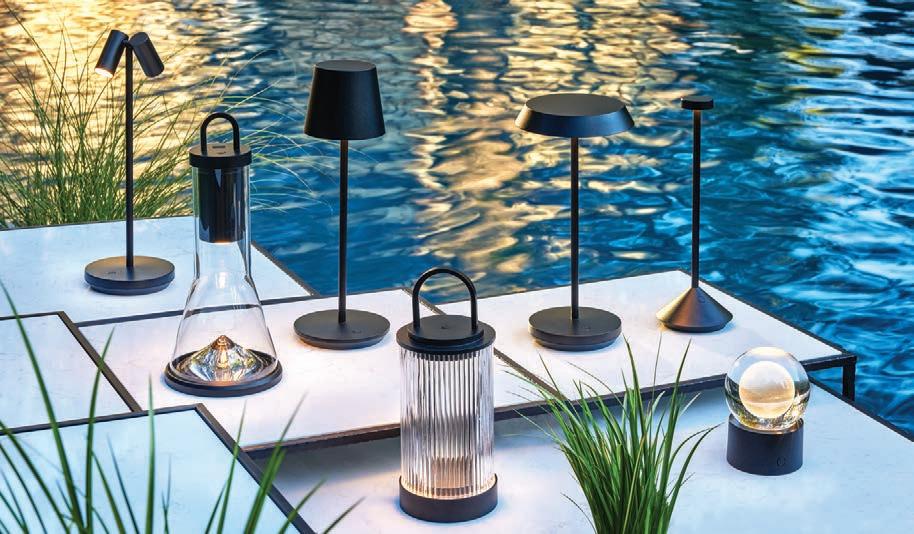
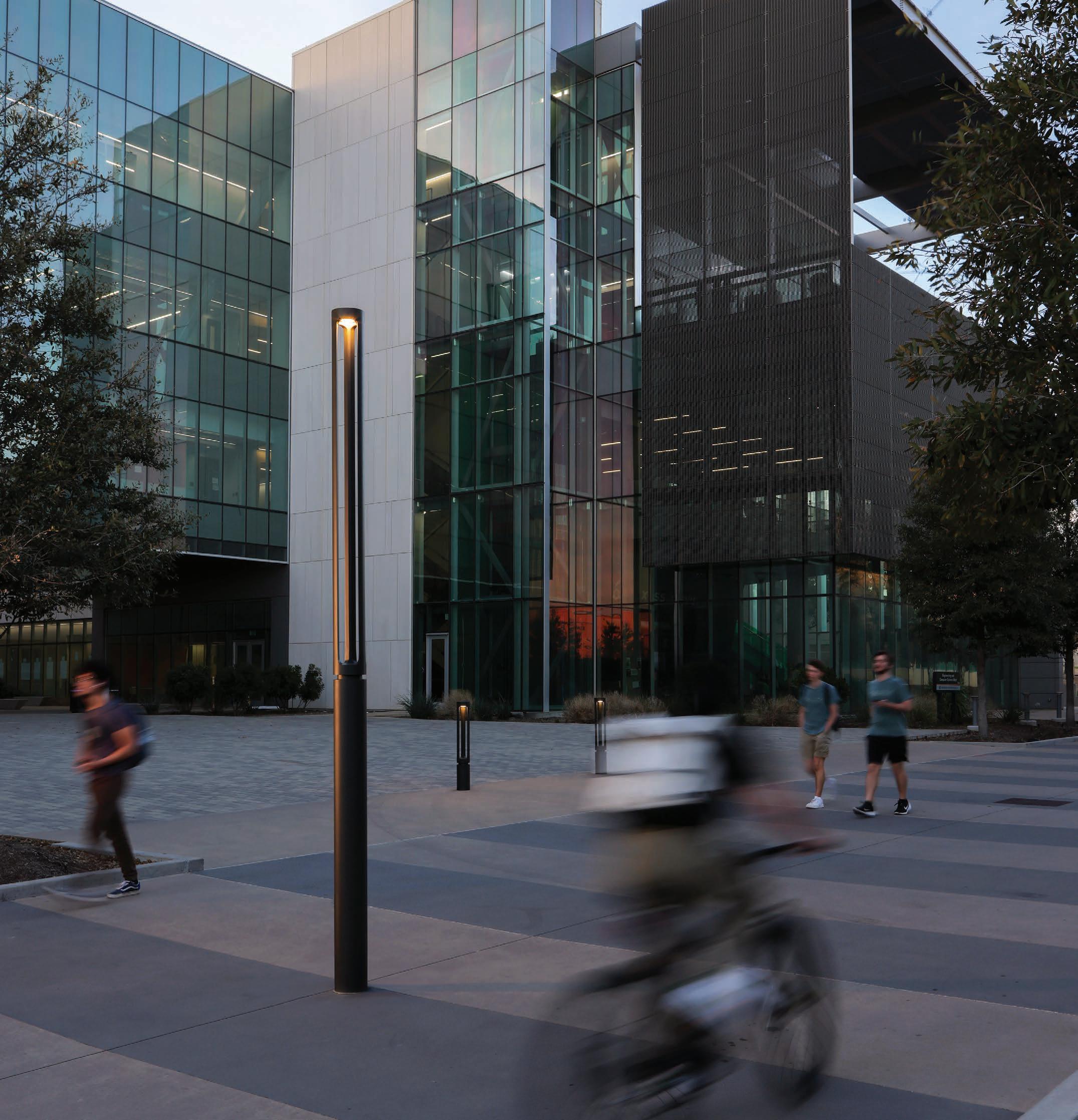
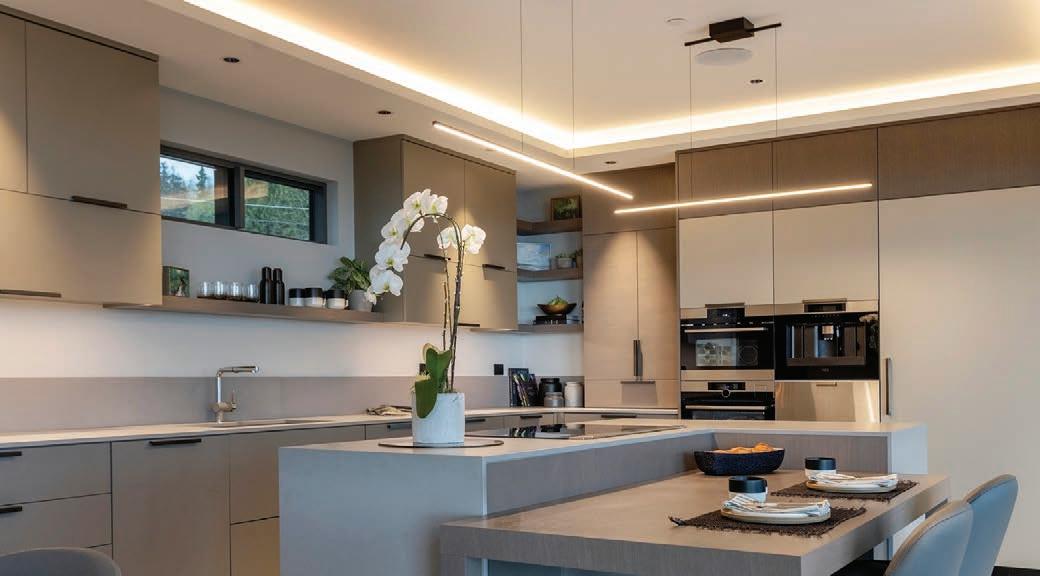
Lighting designs and distributors are focused on creating stunning indoor looks and guiding outdoor systems while embracing new technology. This combination is giving rise to unlimited options for every project.
One significant advancement in lighting technology is smart lighting, which Daveed Henriquez, client development manager for Williams Engineering, explains: “Not only is smart lighting more energy efficient, but it can also start collecting data on operations of buildings. This is beneficial for buildings such as shopping malls to identify where most of the clients are, enhancing the option of security cameras and cleaning services.”
Smart lighting enables facilities such as hospitals to collect data that benefits patients. For example, at SickKids Hospital, they use a control system on the wall to adjust lighting for a more comfortable atmosphere for children, offering options like different colours or warmer lights to support cardiac rhythms and aid sleep. When doctors enter the room, the lighting can be increased to around 6,000 Kelvin, helping staff locate veins more easily for procedures like needle insertions. On another note, Henriquez says smart lighting is used with projectors on buildings to make the architecture look alive.
Henriquez also highlights a new lighting system called LiFi, which boosts internet signal speed when the light is on, operating at the speed of light rather than radio frequencies.
“When the light is on, your internet signal or data transferring increases by almost 10 times what we are used to, coming on at the speed of light, not just the radio frequency speed. This technology is very secure as a luminaire fixture because it can only send the information from where the light hits. If the door to the room is closed, the information is not going past the wall.”
He adds this technology is used by highly secure spaces, and some European cities have even installed it on streetlights. “As always, the more advanced the technology gets and is used in more applications, the less expensive it becomes. Again, this is all being done through lighting.”
COMPACT POWERHOUSES
The team at Nemetz (SA) & Associates highlights the evolution of LED downlights, noting significant reductions in size while maintaining high performance and lumen output. “Two-inch downlights can now deliver up to 2,000 lumens with an integral driver,” says Jennifer Lifton, lighting designer at Nemetz. “These options include various optics and dimming protocols, ensuring minimal yet functional lighting solutions.”
Lifton explains that standard lighting control technologies such as dimto-warm, tunable white, and colour temperature selection provide lighting designers with ample flexibility for design and specification. “These features are not only architecturally appealing but also meet the diverse needs of interior designers and architects.”
OUTDOOR LIGHTING
Jim Ormshaw, lighting product specialist at Robinson Lighting & Bath, highlights the popularity of rechargeable lamps in today’s lighting market. Produced by Visual Comfort & Co., the Modern Collection features seven models of reading lamps. “These products are perfect for outdoor seating areas, patios, restaurants, and personal use at home,” he explains. “I personally use one when working late; this small two-watt fixture effectively lights up a 10-by-six table. Plus, with prices starting at $229, depending on the model, and a built-in USB charging base, they offer incredible value.”
Ormshaw says Robinson has already outfitted a couple of restaurants with 25 to 50 units in a couple of restaurants and is currently working on two contracts that could involve up to 300 lamps. “It’s a new trend that’s cost-effective because
From smart LEDs to outdoor ambiance, discover the latest trends lighting up 2024
by LAURIE JONES
there’s no need for wiring or candles for table lighting. They’re also suitable for outdoor seating – if the lamps get a little sprinkle of water, they will not be affected,” he explains. Ormshaw notes the lamps are available in various colours, including black, white, brass, and glass. He adds customers are also
LED downlights
The Modern Collection of rechargeable lamps.
Forms |
Outline. Redefine the Ordinary.
The modern light column, artfully designed and meticulously crafted.
Designed by Landscape Forms
Landscape
A Modern Craft Manufacturer
buying them for their kids’ rooms for when they are working on homework. “People have even used them while camping to enhance outdoor dining experiences. Given the rise in outdoor living, it’s easy for people to transition these lamps from indoor dining rooms to patio tables. Once fully charged, they last for about 12 hours.”
Landscape Forms, North America’s leading designer and manufacturer of high-design site furniture, structures, LED lighting, and accessories, has introduced the Outline family, featuring column lights, path lights, and bollards. A modern reinterpretation of the classic column luminaire, Outline enhances urban environments with enhanced visual interest, performance, and more versatility. ‘While other solutions offer quality illumination, Outline stands out with its exceptional design and manufacturing, featuring elegant curves and seamless transitions between surfaces.”
Serving as performance lights, wayfinding elements, or architectural details, Outline luminaires blend refinement and elegance with the durability needed for high-profile public spaces. “Outline embodies the essence of Landscape Forms,” explains Jordan Agustin, president of lighting at Landscape Forms. “It represents our focus on activating outdoor space within the context of urban settings, ensuring settings like plazas, parklets, and downtown corridors – places of respite in our busy lives – can be well lit in a human-focused, pedestrian-centric way.”
In the pedestrian-scale column lights, Outline eliminates high-angle glare (G-0), thereby enhancing the safety and visual experience of urban outdoor spaces. The path light’s directed optic design ensures superior visibility, extending the usability of outdoor areas with confidence. Each Outline element features a seamless transition between luminaire and ground plane, firmly anchored without any base cover or visible part lines.
FLEXIBLE SOLUTIONS
BL Lighting offers a diverse range of indoor and outdoor lighting fixtures. “LEDs continue to revolutionize how we illuminate interior and exterior spaces, playing a pivotal role in modern design as efficiency and sustainability remain key considerations in homes, offices, and commercial settings,” explains Jennifer Mattson. “The trend towards smaller and more efficient LEDs has led to the seamless integration of flexible LED linear lighting into architectural elements such as coves, columns, and staircases. This emphasizes lines and shapes within a space and is extensively used in homes for ambient lighting in living rooms,
kitchens, and bathrooms.” Mattson highlights that the variety of shapes, sizes, and colour options, combined with advancements in LED technology, are opening doors to new applications.
“This year, designers have enthusiastically embraced our BL neonVIEW Sauna, designed for temperatures exceeding 95°C and 100 percent humidity, as the go-to flexible lighting solution for sauna and spa applications, meeting both design demands and energy efficiency standards,” she says. “LEDs continue to drive trends towards human-centric lighting, which helps synchronize our circadian rhythms with light/dark cycles and promotes positive effects on human health, well-being, and productivity.”
Mattson says that the introduction of dim to warm capabilities in the BL neonVIEW and BL flexFORM lines are game changers. These flexible LED linear lights mimic daylight cycles, offering a natural, comforting glow akin to incandescent. “The light grows warmer in colour while being dimmed, and colour temperature and light output can be precisely controlled throughout the day, through cutting-edge controls that integrate sensors and smart systems.” This versatility allows lighting to be tailored effortlessly for any occasion or activity, while delivering significant energy savings and enhancing aesthetics in remarkably beneficial ways. “LEDs and control systems are certain to continue to enhance the way we perceive and experience our environments through our interaction with lighting.”
NAVIGATE WITH LIGHT
One of the most iconic structures in Winnipeg, Manitoba, is the Assiniboine Park Leaf Conservatory, or “The Leaf” as it is affectionately called. Using stateof-the-art lighting systems, the stunning biodome features remotely mounted narrow beams that reflect off custom panels implanted in each of the biome ceilings to indirectly light each unique environment. LED bollards illuminate the pedestrian pathways between the biodomes.
“Special ETFE [Ethylene Tetrafluoroethylene] transparent material makes up the ceiling to emulate a pillow effect, allowing natural light through to create a biosphere for plants within the building,” says Stephen Kaye, VP at Mulvey + Banani Lighting. “But as you can imagine, it’s very challenging to put lights on this ceiling material, so an alternative solution is needed to cast lighting throughout the space. The solution came by placing mirrors strategically in an array around the central structure column and reflecting the RGBW LED Stanley flood lights off of those mirrors. As the light hits the angled mirror panels it is thrown way into the biosphere mimicking the moonlight passing through the trees.”
Kaye explains the lighting scheme was designed to show the rhythm of the moon cycle. “You can actually have a sort of biophilic light, but in the evenings, you’d have a set of lighting schemes that mimic the full moon versus the waning moon cycle throughout the project.” During the programming session, the control system has the capability to create a light show tied to music and could allow visitors to use headphones or tie in using an app to have a light show that follows the set of cues. “Additionally, the controls have a light show that mimics a thunderstorm or a full array from morning to dusk, and then a nighttime scene. It’s a really incredible project that links the relationship that we have with our environmental surrounding and the lighting and plants that impact our moods and health,” adds Kaye. A
Outline luminaire
BL neonVIEW Sauna lighting
Assiniboine Park Leaf Conservatory, Winnipeg, MB
Building The Future, Brick By Brick
Delving into the innovative technologies and trends redefining the masonry industry
by ROBIN BRUNET
In terms of the global market, the masonry sector in 2024 continues to evolve with the increased use of new technologies. One example is digital fabrication and robotics, which precisely cut and place brick to create complex designs and structures.
Also, more projects are incorporating bricks made from recycled materials such as glass and plastic, and masonry composed of bio-based materials is more popular than ever.
Basalite Concrete Products is an example of a company that has made a number of advancements in the areas of moisture control, specified block strength, and carbon sequestration, in addition to specialty finishes. This has led to the creation of Basalite Sustainable, aimed at making the company the leader in sustainable concrete manufacturing processes and products.
But advanced technology aside, the masonry sector remains very familiar in 2024, especially when it comes to consumer preferences. “We continue to see strong demand for the juxtaposition of black and light products,” says Vito Lore, Canadian sales manager for Mutual Materials. “There doesn’t seem to be any slowdown in the popularity for this combination. As for the future, we see the prevalence of darker colours overall.”
Another perennially popular trend is thin brick, or Slimbrick as it is known at Mutual Materials, for both exterior and interior applications and available in tans and browns as well as Onyx Black Gloss and Parchment White Gloss (both glazed). Lore says, “We’re seeing more demand for Slimbrick every year from the commercial and multi-family residential sectors and are putting a lot of resources behind this product.”
And while one might lament that so many other masonry colour combinations and products are taking a back seat to current trends, Lore and his colleagues aren’t complaining. “Business is great,” he says. “Masonry for cladding is very robust, and we’ve been especially busy for the past several years fulfilling orders.”
Another supplier of Canadian-made product, Shouldice, offers the following with regards to eyecatching high-contrast materials: “One popular option is to pair light coloured or white masonry with dark elements used for other exterior features, such as roofing, doors, and window frames. Another variation is to use two different colours of masonry on the same home, such as a predominantly light shade with dark accent pieces. A third example is to use a mix of masonry and wood for the exterior.”
Marta Zonneveld, Arriscraft’s director of marketing, notes another tremendously popular product within the masonry realm: “Linear bricks are currently in high demand, and we’ve recently
expanded our product line to deliver on this trend,” she says. “Our offerings are unique to the category.”
Zonneveld is referring specifically to two new products for exterior and interior applications. Avanti is a slender full-bed exterior brick (only 1-5⁄8inch high) – an evolution of Arriscraft’s popular and award-winning Architectural Linear Series Brick - but even slimmer, for a more accentuated linear finish.
Similarly, Elevation (also launched in June of this year) is a linear thin brick designed for interior applications but can seamlessly transition to outdoor spaces. At only 2-¼” high and available in nine colours, Elevation provides a new look in the superhot interior brick category.
Decorative masonry cladding using Slimbrick.
WHAT’S YOUR Colour Narrative?
Urban or Rustic?
Neutral or Colourful?
Modern or Classic?
Find your Colour Narrative in our fullspectrum palette that captures more of the widely specified paint colours from across Canada, determined by our Customers and Colour Experts.
Zonneveld goes on to point out that, “Arriscraft brick is not clay brick, it’s calcium silicate – the same material as our other manufactured stone products. It is completely natural, made with only sand and lime, with colour pigments added. This unique material can be split/finished on site as needed. It also features a fine-grain texture that is distinct from clay brick.” Arriscraft calcium silicate brick lasts for generations and will stand up in any busy commercial setting.
Peter Thiessen, principal, director of marketing at Masonal Stone Inc. of Milverton, Ontario, expands on the discussion of the dark/light trend in the commercial and residential sectors. “In terms of texture, the tumbled appearance is very much in favour, primarily for residential projects, as tumbled products impart a rounder, weathered look,” he says, adding that his company recently supplied $500,000 worth of stone – including lighter, tumbled products – for a $30-million private residence project in his province.
Thiessen goes on to remark, “As for colour, yes, black and white patterns are huge, and you see evidence of this throughout the Greater Toronto Area, to the point that I’m confident the demand will endure throughout 2025 and beyond.”
Masonal Stone is uniquely positioned to live up to its reputation for providing the largest selection of thin stone veneers and full bed building stones quarried in Canada. “Here in Ontario, we have access to the most diverse geological species of stone in the world,” Thiessen explains. “We buy blocks from no less than 55 quarries across the province, and not only does this give us great versatility, it also allows us to capitalize on trends as they emerge.”
The Masonal Stone catalogue is huge and includes glacier marble, ledgestone, rubble, granite, rustic natural bed, stone panels, custom stone, and landscape products. Within the stone panels/ tiles category, Masonal offers a wide range of styles ranging from Mountain Mist and London panels to Dover and Sheridan panels. “We have a variety of boulders perfectly suited to make stone panels for virtually any residential project in many colours,” Thiessen says. “This is the process by which homes or commercial projects can be built on a genuine solid stone foundation.”
The best masonry suppliers augment their inventory with information about emerging trends and how associated products can be leveraged for maximum impact, and a good example is Stonearch, the largest natural stone wholesale supplier in North America. Recently, the company discussed gabion stone, commonly seen along riverbanks and mountainsides, which is gaining popularity for use in everything from building pillars to creative walls: “Other common uses include mass retaining walls, terrace walls, channel linings, dam protection, and architectural applications.”
Stonearch Stone Grid gabions are ideal for artistic accent walls and even water feature surrounds (however, Stonearch warns that gabions can be bulky and may not fit well in small spaces, plus the gaps in filler can attract insects): “Consider creative applications such as back-lit gabions filled with coloured glass, walls filled with shells and shelves for plants or lanterns, capped seating walls, bases for planters and outdoor furniture, fireplace surrounds, and water features.”
In a similar vein, Nawkaw, which provides architectural finishes “inspired by art and nature,” imparts advice on transforming spaces with black concrete stain: “A little goes a long way – and that is especially true when using something as visually striking as black concrete stain – but this transformation requires more than just a can of paint. Concrete staining is a specialized process that offers long-lasting and visually stunning results.”
Nawkaw explains why painting concrete (or brick) should be avoided (paint can trap moisture
within the surface and lead to issues like peeling, flaking, and even cracking) and recommends staining because it “penetrates the surface of concrete rather than covering it,” with acid-based stain being the product of choice for floors and acrylic or mineral stain better suited for walls and facades.
Meanwhile, Bradley Belden, president of Ohio’s The Belden Brick Company (which distributes its products extensively throughout the U.S. and Canada) reports that with regards to catering to the commercial sector, “Projects are still on the go and our pipeline is full, and despite rampant inflation that has affected industry so significantly this past year, all economic indicators moving forward seem positive.”
In terms of new products, Belden credits distributors in Quebec and Ontario for fuelling demand for his company’s Winter Mist Sanded Rustic brick. “They pretty much inspired the product based on architectural input, and sales have grown enormously since the line was introduced in 2022,” he says.
In April 2024, Belden expanded its soughtafter Sanded Rustic style with the introduction of two proprietary colours, Dusty Gray and Rustic Gray. Created to meet the growing demand for natural, neutral tones in architectural design, these additions are intended to effortlessly unite classic and contemporary styles; and an example of their use is 2100 Lombard, a four-storey residence in Philadelphia where the brick contributes to architect Lo Design’s strikingly modern yet pleasingly tactile ambiance.
With a characteristic white sand coating over a grey-bodied brick, Winter Mist’s sophisticated hue varies from brick to brick; all three colours underscore The Belden Brick Company’s dedication to meeting current design trends and anticipating new ones, and Belden says, “We’re still working on other Sanded Rustic colours, to be released in the foreseeable future.”
Sanded Rustic brick are ideal for projects that call for minimalism or a warm, earthy depth – and give designers a wide range of material choices they need to bring creative projects to life. A
Elevation linear thin brick.
Stonearch Stone Grid gabions.
2100 Lombard, Philadelphia, PA
STEELY RESOLVE
Despite inflation and delays, Canada’s reinforcing steel specialists forge ahead
by ROBIN BRUNET
Mike Kubes, general manager at Kit Steel of Welland, Ontario, explains one reason why reinforcing steel specialists take such pride in their work, even during high inflation when many projects have been put on hold.
“The projects that we’re most proud of are ones that contribute to the quality of life in our community,” he says. “Once it’s in the concrete, you don’t see the rebar that Kit Steel has cut and bent, but we know that our contribution matters. It ensures a strong foundation for years to come.”
Kubes cites as an example the Chestnut Park Affordable Housing Project, a five-storey apartment building in Port Colborne intended for seniors and singleparent families with children under 14. Working with Rankin Construction, Kit Steel supplied 47 tons of rebar for the facility.
Another recent project with Rankin saw Kit Steel supply 126 tons of rebar for the 30-condo Waterway project on the Welland Canal. The company also supplied 173 tons of steel on behalf of Percon Construction for the expansion of the Foyer Richelieu Welland long-term care facility in Fort Erie.
Kubes says, “It’s a privilege to work on projects such as these that allow people to live and learn in their own communities. It gives our staff a sense of purpose that their work matters, as the majority of our staff are local to the Niagara region.”
On the other side of the country in Langley, B.C., Steve Selig, branch manager at Heritage Steel, offers his thoughts on the state of the industry in 2024: “Overall we are fairly busy, and we foresee being fairly busy through to the end of this year,” he says. “We suspect 2025 will also continue to be brisk.”
Heritage Steel’s operations are central to B.C.’s Fraser Valley and Vancouver, with a shop that includes a rebar shipping and storage yard, shearing and fabricating facilities, and estimating, detailing, sales, and administrative offices.
A typical project that showcases Heritage’s abilities is the Latimer Heights twin tower in Langley, for which the company provided 5,200 tons of rebar on behalf of Vesta Properties.
While disclosing that this spring saw a slowdown in the amount of tenders, Selig is confident that consistent volumes will soon return. As for current work, “We are doing a significant amount of residential high-rise projects plus a significant
Core installation at Latimer Heights, Langley, B.C.
Chestnut Park Affordable Housing Project, Port Colborne, ON
Since 1985
Heritage Steel [heh·ruh·tuhj sti:l] noun
1 : Excellence in Reinforcing Steel Services;
2 : Where People really matter & Safety is priority;
3 : Teamwork & Dedicated Professionals; 4 : Supporting the Community
PRODUCTS
• Black, Stainless & Epoxy Coated
Rebar • Threaded Rebar • Welded
Wire Mesh • Reinforcing Steel
Accessories • Plain Round Bars
• Post Tensioning Systems
• Mechanical Couplers
SERVICES
• Consultation
• Budgeting • Estimating • Detailing
• Fabrication • Installation
MEMBERS OF:
amount of condo wood frame projects, so the impact of inflation and interest rates has not been fully seen yet, in my opinion,” he says. “With the interest rate drop, time will tell what happens with inflation. I was quite surprised to see that the market did not drop as quickly as I had suspected it would going back to last fall, when we were securing most of our work.”
Unfortunately, one issue that remains persistent is the recruitment and retention challenge. “With inflation and daily living costs continuing to be at the forefront of everybody’s mind, wages are the driving factor on the decisions as to where our workforce wants to work,” Selig says. “This obviously presents significant challenges as construction costs continue to rise, putting additional pressure on the market.
“Here at Heritage, we do our best to promote and train from within while trying to retain our employees through various means, such as flexible work hours, bonus structures, and excellent collaboration between the teams to help everybody grow individually within their respective departments. As our workforce gains experience and their performance improves, it’s a win-win for the workforce; their wages are reflective of this, and they feel a sense of accomplishment and self worth.”
Matthys van Emmenis, VP of operations for A&H Steel in Vancouver, says activity for his jurisdiction is somewhat slower due to persistent inflation, “But our tender estimation department is extremely busy, so there’s definitely pent-up demand that will hopefully lead to a tidal wave of work in the foreseeable future.”
A&H Steel Vancouver is a partnership between A&H Steel Edmonton, Whitewater Concrete, and Syber Concrete; Whitewater and Syber are leaders in the formwork concrete industry, each having 25 years of experience operating residential and commercial projects across the Lower Mainland.
Van Emmenis says, “Our Edmonton facility is busy with industrial work, but Vancouver is quieter for new work, which we had anticipated due to the economic circumstances. However, we’ve started detailing and are anticipating starting to ship products in August on behalf of the new Woodfibre LNG plant in Squamish, which is an 18-month-long project and the world’s first net zero liquefied natural gas export facility.
Core installation at Latimer Heights.
Core walls installation at Latimer Heights, Langley, B.C.
EXPRESS REBAR
“We look forward to several large projects coming to fruition in the near future, filling the backlog as some of our legacy projects near completion.”
Duane Kotun, director of administration at Sherwood Steel in Edmonton, reports that his company is as busy as it was in 2023, which is noteworthy considering last year was the best-ever year for work in Sherwood’s 51-year history. And to a degree, Kotun is pleasantly surprised by the circumstances.
“I really thought the high bank rates would have put a halt to all the activity we’re seeing, but obviously not,” he says. “Currently there’s lots of bidding on condo and multi-family facilities, school projects are on the rise, and we’re even working on three water treatment plants in Alberta, one of which requires 700 metric tons of rebar.” Also, Sherwood is busy serving the second phase of Edmonton’s The Mercury Block, which Kotun says is significant because “we’re starting to see more of the type of mixed-use residential buildings sharing a common podium in this city that are so prevalent in Vancouver and Toronto.”
When asked to explain why the residential market is bustling with opportunities despite Canada’s economic circumstances, Kotun replies, “I can only attribute it to our heavy immigration rates. More people than ever are settling in Canada, and it’s no secret there’s a nationwide housing shortage. So projects are moving ahead despite the high interest rates.”
Geraldine Raedemaeker, communications manager at Groupe AGF Inc. of Longueuil, Quebec, similarly reports that her company has been busy throughout the year, with demand for projects such as hospitals, infrastructure (bridges), and even wind farms compensating for a decline in new residential activity. “For example, as we speak we’re heavily involved in the new Île-auxTourtes bridge reconstruction on the western tip of Montreal Island,” she says of the $2.3-billion, multi-year project. “And even though residential has declined, we’re still supplying steel for high rise projects in Toronto.”
In fact, AGF is playing a key role in the Block 15 project, located in the North York district of Toronto. Designed by Dialog, the project is distinguished by three residential towers totalling 990 housing units requiring 7,000 metric tons of reinforcing steel, including 300 metric tons of grade 500W, and 1,500 stud rails. AGF is also playing a crucial role in the Le Sherbrooke condo project, located in the Mille Carré Doré in the heart of Montreal. This 25-storey tower, built in
collaboration with Broccolini, will feature a total of 515 prestigious condominiums. The bold design featuring cantilevered retaining walls requires some 4,000 metric tons of reinforcing steel.
Additionally, AGF’s focus on innovation as well as employee well-being has resulted in two pilot projects involving the use of exoskeletons in the workplace: four in Montreal, five in Ontario, and one in Ottawa, specifically. Biolift is a partner with AGF in the projects, which is aimed at the reduction of physical fatigue.
Selig offers some closing thoughts that echo the sentiments of many of his colleagues in the rebar sector. “As always our industry has a significant number of challenges and we’re quite a unique industry in this regard,” he says. “We are subject to so many variables such as the U.S. dollar, interest rates, import duties, and most notably the global steel market in general, that it makes for a very volatile industry and one that will continue to be volatile and challenging, I suspect.
“I would like to say that I think I’ve seen it all after over 30 years in this industry, but I know that statement is false: everyday presents new challenges, new ideas, and new people. It’s never boring.” A
Block 15 project, district of North York, Toronto, ON
BURNHAMTHORPE COMMUNITY CENTRE EXPANSION
by ROBIN BRUNET
The renovation of the Burnhamthorpe Community Centre in Mississauga illustrates the challenge facing most community centres when the need comes to upgrade. On one hand, it would be simpler to build anew, but on the other, such facilities are usually well regarded by users, so some semblance of familiarity has to be retained.
Preserving these components at Burnhamthorpe but adding new programs was what the City of Mississauga and CS&P Architects were faced with. “Many programs in the facility functioned just fine, including the arena, but the split-level building had no street presence on a key corner; everyone was using a side door instead of the main entrance, and there was no connectivity,” says Susan Lewin, principal at CS&P.
In 2014, the City expressed its intent to invest in a renovation, and in 2017 the Community Service Department retained Monteith Brown Planning Consultants in association with Perkins & Will Architects to undertake an Indoor Facility Infrastructure Strategy, to inform capital investments required for Mississauga’s supply of indoor recreation facilities.
Anna Cascioli, senior manager, capital design and construction, facilities and property management, for the City of Mississauga, says, “We identified three community centres requiring renewal in the next 10 years in order to address the growing
needs for aquatic programming in Mississauga and address the aging infrastructure.” In 2019, The City retained CS&P architects to validate and inform the proposed expansion of Burnhamthorpe Community Centre in addition to two other community centre facilities. Burnhamthorpe, built in 1974, was identified as the first facility to undergo renovations.
Arguably the most important aspect of CS&P’s work was something that solved connectivity and helped join the old and new elements. “We designed a long spine running from the west parking lot to a new community park to the east,” says Saeed Sadeghi, senior associate at CS&P.
Lewin adds, “This gave us two entrances, and in the middle of the spine we created a main lobby with access to all the new programs that also acted as a town square community hub, a beautiful gathering space with clerestory windows.” Essentially, the existing floor plan was south of the spine; the new components were to the north.
Chief among these new elements was an aquatic centre and equipmentbased fitness space. “The new indoor aquatic centre includes a 25-metre lane pool with therapeutic tank to enhance general aquatic programming and address the anticipated growth in the older adult population,” Cascioli says. “By integrating a club-format, equipment-based fitness centre, this addition has created a strong destination for community users.”
CS&P helped ensure this space would be unique compared to other aquatic facilities. “As part of the City of Mississauga Recreation Department’s program, we put in a climbing wall,” Sadeghi says, and Lewin notes that, “We took advantage of the split-level nature of Burnhamthorpe to create an amphitheatre looking onto the pool.” A universal change room was designed with cubbies for individual and family privacy.
Working under a construction management delivery system, Percon Construction Inc. benefitted substantially from the City closing Burnhamthorpe entirely. “Trying to construct this major addition while keeping the facility open would have been very challenging, specifically from a safety and operational perspective,” Cascioli explains. “Closing a facility is always difficult as it means redirecting users to other nearby community centres to access programming. Our recreation team was instrumental to find ways to minimize these inconveniences.”
A high-performance envelope consisting partly of metal siding with a ‘V’ profile plus extra insulation on the walls and roof were installed, as were solar panels on the fitness centre and pool roof. Contributing to the facility’s sustainability was a heat recovery system that used waste heat from the ice rink refrigeration system to heat the pool.
In January 2024, the multipurpose rooms and gymnasium reopened along with the new fitness centre, and the aquatic centre followed
LOCATION
1500 Gulledon Drive, Mississauga, Ontario
OWNER/DEVELOPER
City of Mississauga
ARCHITECT
CS&P Architects
GENERAL CONTRACTOR
Percon Construction Inc.
STRUCTURAL CONSULTANT
LEA Consulting Ltd.
MECHANICAL CONSULTANT
H.H. Angus & Associates Ltd.
CIVIL CONSULTANT
MTE
AQUATICS CONSULTANT
Aquatic Design & Engineering Services (a division of DEI Consulting Engineers)
TOTAL SIZE
32,000 square feet
TOTAL COST
$40 million
in February 2024. “The renovations took place during COVID, and Percon did an incredible job handling all the associated labour and supply challenges,” says Cascioli.
As for CS&P’s contribution, Cascioli says, “From a site perspective, CS&P’s placement of the addition seamlessly blends in with the neighbourhood fabric and creates a clear pedestrian connection to other City park amenities. On the interior, the transparent design solution allows for a very clear and simple way to navigate the various program options offered at the community centre. This improves the user experience making it a popular destination for families and individuals accessing our City programs.” A
We’ve all been there - student life can be messy and chaotic. In situations with communal bathrooms, high volume demands durability. For nearly 40 years, Bath Fitter has revolutionized bath renovation.
Bath Fitter supplies and installs new bath and shower units without removing the old ones- in as little as one day.
With over 200 locations across North America, we offer a one-stop, seamless service for your bathroom needs and provide affordable solutions for renovations or new dormitory construction.
HUMBER CULTURAL HUB –HUMBER COLLEGE
by ROBIN BRUNET
Adestination for arts and culture: that was the intent behind the development of the Humber Cultural Hub (HCH), a two-phase redevelopment of core elements of Humber Lakeshore Campus in South Etobicoke, Ontario.
The recently completed first phase consists of a 245,000-square-foot building featuring a 140-seat recital hall with specialty teaching spaces for arts and cultural programs, including two recording studios, music practice rooms, classrooms, cafeteria, and a 300-bed student residence addition. The second phase, scheduled for completion in 2026, will include a 500-seat flexible performance hall for music and immersive media, film program spaces, as well as a comedy cabaret theatre.
Equally important, the HCH is being developed under the Integrated Project Delivery process, which encourages deep collaboration between the client, contractor, consultants, and subtrades. Aiming for a host of sustainability achievements, HCH has already been
certified under the Zero Carbon Building – Design Standard v1 by the Canada Green Building Council and is also targeting LEED Platinum certification, as well as an energy use target below 75 kWh/m²/year.
From a user’s perspective, the HCH elevates Humber’s programming to a new level of quality. “Before the construction of the HCH, our world-class music program was conducted in an old teacher’s college built in 1958, which Humber acquired in 1972,” says Scott Valens, director, capital development at Humber. “This building had limitations ranging from poor acoustics to no accessibility challenges.”
The first phase of the redevelopment is located east of this structure.
“The phase one building includes four academic levels and four levels on top of that of urgently-needed student residence spaces,” Valens says.
David Dow, principal at Diamond Schmitt Architects, says, “Developing a facility that defines the future of Humber’s arts program involved a lot of analysis, consultations, reevaluations, and healthy debate. The
LOCATION
3199 Lakeshore Drive West, South Etobicoke, Ontario
OWNER/DEVELOPER
Humber College
IDP TEAM MANAGEMENT
Colliers Project Leaders / The Realignment Group
ARCHITECT
Diamond Schmitt Architects
GENERAL CONTRACTOR
EllisDon
STRUCTURAL CONSULTANT
Entuitive
MECHANICAL/ELECTRICAL CONSULTANT
Smith + Andersen
TOTAL SIZE
365,000 square feet (both phases)
TOTAL COST
$228 million
overall philosophy was to create social spaces for all the disciplines rather than segregating them, encouraging cross-disciplinary collaboration between the music and film students and faculty. Many examples of architectural expression evolved, including the student residences being a mass
timber structure sitting on top of the concrete academic podium.”
In addition to the music and film teaching environments, Diamond Schmitt designed the podium to include a new home for the Centre for Creative Business Innovation, student union spaces, study spaces,
a cafeteria, and a gym. The acoustics of the diverse performance venues were carefully worked out for optimal performance. As for the 300-bed residence, it was designed to include food service and student support spaces, positioned above – and linked to – Humber’s existing residence building via a bridge.
Within the residence, Humber students have access to 126 new showers, 26 of which are wheelchair accessible. Every unit features white Torino walls installed by Bath Fitter. “This was our first time working with EllisDon,” says Joseph Douglas, area development leader. “We really wanted to complement the elegance of the entire project. The Torino walls, along with the matching 68-inch corner shelf towers, add a nice touch to each shower.”
A highlight of the design is located at the heart of the Hub: the Exchange, which spans from grade level up to the third floor, within a light-filled atrium, and a super stair with amphitheatre seating physically connecting all three levels. It supports the owner and architect’s goal to promote casual performance, open talks, conversation, and interaction (the Exchange will be fully realized upon completion of phase two).
As for the sustainability goals, Valens says, “A geothermal system made up of 96 boreholes, each 800feet deep, storing the energy needed to heat and cool our building. Also, Diamond Schmitt developed an extremely efficient building envelope, and the strategic use of glazing and shading will reduce solar heat gain and loss throughout the year.”
Onsite solar panels will generate another 10 percent of the building’s power requirements, ensuring that 90 to 100 percent of energy used will be from renewable energy sources.
Construction was complicated by rising material costs during the COVID lockdowns, “which necessitated extensive value engineering between EllisDon, Diamond Schmitt Architects, the IPD team, and Humber,” says Valens. “Another big challenge was site constraints, which the entire team handled very well.”
The 120,000-square-foot extension that compromises the second phase of the project (and will house the college’s film program with film studios, editing suites, foley suites, screening room, and film program classrooms) will be built following the demolition of the existing teachers’ college. “The interior circulation
spine [the Exchange] of our new building is the area phase two will connect to,” Valens says, adding that the three-storey steel frame structure follows the same aesthetics as the first phase building and will tie into the central geothermal plant and other elements.
Valens is excited by how the Humber Cultural Hub is taking shape. “It will be a real showcase for our music and film programs, and invigorate our Lakeshore campus,” he says. “The intense collaboration between us, the architects, and the builders is resulting in a truly special facility.” A
FAIRMONT HOTEL MACDONALD RENOVATION
by ROBIN BRUNET
Adelicate touch: that’s how those involved in the renovation of the Fairmont Hotel Macdonald describe the design philosophy and execution of this 109-year-old Edmonton icon.
Cole Millen, general manager of the Fairmont Hotel Macdonald (which still awaits a refresh of its main lobby space), explains, “Although the work mainly entailed repainting, new plumbing in the guest rooms, and a rethinking of elements such as carpeting and other treatments rather than major structural work, the scope of the project was enormous and included guest rooms plus our seven communal spaces: virtually every corner of the hotel.
“At all times, the intent was to honour and preserve the heritage of this facility. And while we worked with professionals such as Hirsch Bedner Associates [HBA] that had extensive experience refreshing Fairmont properties, Fairmont doesn’t follow a template. We regard each of our hotels as unique, and therefore any refresh is developed organically.”
Edmontonians’ love of their hotel’s history became evident in 2019, when the initial proposal to renovate the Fairmont’s Confederation Lounge was released and immediately considered too contemporary. As the
design evolved further, management assured local media that the historical elements of the space – including the Fathers of Confederation painting above the fireplace, the ceiling mouldings, and the wood panelling – would remain, but that the heavy tables and chairs that made it hard for people to manoeuvre would be refreshed.
The Lounge renewal began in 2022. As for the famous Empire Ballroom (which, along with the Wedgewood Room, was a designated historical site), restoring the ceiling to its original splendour took over 1,000 hours of work, including hand-painting it in gold.
In terms of volume, refreshing 165 of the hotel’s 198 guest rooms was the biggest challenge. Meghann Day, principal interior designer at HBA, says, “We worked extensively with the operators, their interior design department, and studied local influences, the latter of which resulted in a considerable amount of archival photos for display that would reinforce the hotel’s heritage. Work on the guest rooms included adding stone countertops, ‘rain’ showers to replace the baths, new lighting, and beds.”
The refresh included opportunities to dazzle guests. “The corridors of the guest rooms are a real standout with rich blue vinyl, gold accents,
and the historic photos,” Millen says. Day adds, “Imparting elegance was an overarching goal, from floor patterns to furniture.”
Spencer Jones, construction manager at TRIP Contracting, explains the degree of delicacy that was required to preserve the Fairmont’s historic elements. “There were so many layers of paint and old plaster that could spall if you pressed too hard, so the painters had to be extremely careful.” In many cases, spalling had to be painstakingly scraped out and restored by plaster specialists.
Work began on the sixth floor and ended on the second, with each level requiring free access to the floor below to tie in the plumbing. “In some of the guest rooms the old cast iron tubs were recessed into the concrete slabs, so we had to cut them out and level the surface before the new showers could be installed,” Jones says, adding that new plumbing fixtures emphasized water usage efficiencies and conservation.
Peter J’s General Contracting Ltd. was retained to renovate the Confederation Lounge. The company states: “From review and protection of historic aspects of the space, replacement of the existing bar’s large granite surface, hanging of the 1,000-pound, 13-foot-wide
chandelier, levelling of the substrate to accommodate large 33-inch square wooden floor tiles, and restoration of small details, this project provided great challenges, and we accepted and overcame them as a team.”
Ownership anticipates working on the lobby as well as the Harvest Room mid- to late next year.
Millen says, “The lobby is still in the early design process but we’re hoping to open up the front desk a bit more. In the meantime, we’ll take a break so guests can appreciate what has already been accomplished –and the feedback has been nothing short of tremendous. We couldn’t be more happy that this historic hotel is attracting so much excitement.” A
DESIGNING WITH HEART, BUILDING FOR CHANGE
MCL ARCHITECTS
Orillia Affordable Housing Project
COUNTY OF SIMCOE’S SOCIAL AND COMMUNITY SERVICES HUB
by JESSICA KIRBY
The County of Simcoe’s Social and Community Services Hub in Orillia, Ontario, is a place designed for every resident. The multi-use project includes 130 mixed residential units designed for seniors, families, and individuals, attached to office and commercial space that houses several County of Simcoe services, including Ontario Works, Children and Community Services, and Social Housing offices. Most importantly, the Orillia Community Hub brings people together. It features purpose-built, accessible amenity spaces, such as a common room for gathering and an adjacent rooftop patio where residents can enjoy accessible planter box gardens.
The project’s design inspiration was rooted in the vision of creating a supportive and inclusive community hub for Orillia’s residents. “Well-designed housing such as the Orillia campus provides safety, health, and affordability,” says Basil Clarke, warden for the County of Simcoe. “It’s an investment in our community. This campus will increase the opportunity for lowto-moderate income households, and some of those most vulnerable individuals in the community, to access affordable housing with dignity.”
The design team at McKnight Charron Limited Architects, which acted as prime consultant and project manager at the Orillia Community Hub, engaged County of Simcoe to understand its strategic goals. Its 10-Year Affordable Housing and Homelessness Prevention Strategy emphasizes the creation of 2,685 new affordable housing units by 2024, with a focus on increasing rental housing stock to support vulnerable populations.
“Our integrative process began with a comprehensive site analysis, ensuring a responsive approach to the local context and urban fabric,” says Michael McKnight, principal with McKnight Charron Architects. “We aimed to create a communitycentric design and foster a sense of belonging and support. We achieved this by creating a hub that focuses not only on housing but also on providing the services individuals in vulnerable situations need to thrive.”
The Orillia Community Hub is distinguished by several unique architectural features that enhance the project’s functionality and inclusivity. The interiors feature durable, easy-to-maintain materials to ensure longevity and user comfort, including
non-slip flooring for added safety. The aesthetic is warm and inviting, made so with abundant natural light, soft and warm colour schemes, and inviting textures, intentionally selected to encourage longer visits and greater interaction among users.
The kitchens are a great example of this, ensuring universal accessibility for community members, regardless of mobility or ability. Lower countertops and accessible appliances leave plenty of space for wheelchair users to navigate the space effectively and the millwork is customized to provide ample storage while maintaining clear, open pathways that prevent crowding and accommodate assistive devices.
“One of the standout features is the use of wider corridors, which push the building in and out to create informal social spaces,” McKnight says. “This fosters community interaction by providing areas where residents can pause and engage with each other
without impeding traffic flow. This helps build social capital and a sense of belonging among residents.”
Similarly, the Hub’s program spaces are designed to be versatile and easily reconfigured to host a range of activities, including educational workshops to social events. Accessible outdoor play areas and decorative landscape elements are collectively designed to promote interaction and safety, and spaces that are functional and aesthetically pleasing. “This adaptability makes the
to have installed the drywall & acoustics for the
As a locally-based subcontractor, we congratulate the County of Simcoe, McKnight Charron Limited Architects and Melloul-Blamey Construction on the successful completion of this new multi-use affordable housing campus.
L4N 7R8 705-737-3606 | dan@tristarinterior.com
hub a perfect venue for community events that can vary in size and function, reflecting the dynamic nature of community needs,” McKnight says.
The design was focused on rigorous environmental standards, including a strategy and equipment based on Passive House principles and high sustainability standards similar to LEED. To meet these objectives, the project systems prioritize energy efficiency, indoor air quality, and overall environmental impact, while ensuring airtight construction and minimal thermal bridging.
“The mechanical system includes heat recovery ventilators, which provide continuous fresh air while recovering heat from exhaust air, thus conserving energy and maintaining a comfortable indoor environment,” McKnight says.
The exterior features brick, chosen for its thermal mass properties and longevity, aluminum composite panels to create visual interest, and high-performance windows to ensure minimal heat transfer. The building design also includes green roof sections and Dark Sky-compliant lighting. Water management systems feature low-flow fixtures and efficient
irrigation systems to ensure responsible water usage.
The Orillia Community Hub project was not without its challenges, but these were simple to solve, thanks to the team’s previous experience with affordable housing projects in Simcoe County. “Each project teaches us something new, and we make sure to document these lessons learned so we can handle similar issues better in the future,” McKnight says.
One major challenge was preserving the mature trees on-site, as they are vital for the local ecosystem and provide much-needed shade. After a thorough site analysis, the team engaged landscape architects to create grading plans that kept disruption to a minimum. “By carefully planning this, we managed to blend the
natural landscape into our design, which not only looked great but also boosted the project’s environmental sustainability,” McKnight says.
It was also challenging to blend the building’s scale with the existing neighbourhood without overwhelming the residential context. The solution was a two-wing design that created a six-storey wing facing West Street and a four-storey wing facing Borland Street. This design broke down the building’s mass, creating a smoother transition with the surrounding area.
“Keeping community support and minimizing disruption during construction was also crucial,” McKnight says. “The Orillia community was really supportive of the project, and we wanted to keep it that way.”
LOCATION
250 West Street N, Orillia, Ontario
OWNER
County of Simcoe
ARCHITECT
McKnight Charron Limited Architects
GENERAL CONTRACTOR
Melloul-Blamey Construction
STRUCTURAL CONSULTANT
SWS Engineering Inc.
ELECTRICAL/MECHANICAL CONSULTANT
Tri-Star Engineering
CIVIL ENGINEERING
Pearson Engineering
LANDSCAPE ARCHITECT
JDB Associates Ltd.
TOTAL SIZE
227,033 square feet
TOTAL COST
$79 million
The team co-ordinated construction schedules to limit noise and traffic disturbances and kept the community in the loop with regular updates and feedback sessions.
“By drawing on past experiences and tackling these challenges with careful planning and collaboration, we managed to deliver a project that is functional, respectful of its context, and valuable to the Orillia community,” McKnight says. A
For Distinctive Cladding
Consider Ontario Panelization
NORTH COWICHAN RCMP DETACHMENT
by JESSICA KIRBY
Anew North Cowichan RCMP Detachment marks a significant milestone for the region, bringing to the district a policing facility that has a strong emphasis on sustainability and efficiency.
Not long ago, the detachment was operating out of an aging and cramped building with a windowless basement that was never designed to be an occupied space but had been retrofitted with offices some time ago.
That’s one element that makes the new three-storey steel office building and one-storey detention facility, which integrate seamlessly into the surrounding environment, such a game-changer for the region. Another is the innovative, aesthetic design that sets a new standard for municipal facilities.
“RCMP buildings are extremely technical buildings with robust security requirements that are most easily met by creating bunker-like inflexible and austere buildings,” says Kate Lemon, principal with KMBR Architects Planners. “The RCMP is seeking to create a more friendly and open atmosphere for visitors and members working in the building, and the municipality also sought a building that would contribute to the urban environment and was environmentally responsible and inviting to the public. The challenge for our team was to create an open, bright, and inviting building that also met the functional and security needs of modern-day policing.”
The design team spent countless hours working closely with the client in space planning and the development of details to ensure that security and functionality were never compromised.
“We kept detailed spreadsheets of various design requirements and invested the necessary time researching products and solutions that allowed a higher degree of visibility and openness than you would see in older detachments,” Lemon says. “This was achieved by
gaining the trust from our client that their security needs would not be compromised in the process.”
Mark Frame, project consultant for North Cowichan, says the district required a functional space for a police building, containing multiple units each, with specific needs. “A space analysis was done based on the officers and civilians projected to be employed in the building and what the specific space and equipment requirements were for each section,” he says. “We also wanted to have a net zero building, which dictated the orientation of the building on the site and required three storeys to accommodate the square footage required in the space analysis.”
Nearly every aspect of the building’s design was chosen with sustainability in mind. This began with siting the three-storey building with optimal solar orientation.
From there, KMBR designed a robust building envelope with enhanced insulation. On the exterior, the facade comprises several components including glass curtain wall and two types of composite panels chosen for durability and weatherproofing.
On the interior, a three-storey atrium brings light deep into the centre of the building, increasing natural daylight and reducing reliance on electrical lighting systems. “This feature creates an elegant, light-filled space at the heart of the building, which serves the client’s desire to retain members and works toward their sustainability targets,” Lemon says. “A beautiful mass timber stair is the central feature in the atrium, creating a warm and inviting atmosphere.”
Wood slat ceilings are employed in the common circulation areas to bring warmth to the corridors, create a comfortable acoustic environment, and a connection to nature and West Coast architecture.
The wood slats are echoed in the lobby and the protective panels that
line the corridor walls. CLT mass timber structure is used for the entry canopy roof and is exposed on the exterior and interior vestibule soffit.
A high-performance glazing system and solar shades complement a 100kW solar panel system and allelectric heating and cooling systems, which reduce the need for cooling in the summer. A heat recovery system tempers the building, and additional solar panels make up for most of the remaining energy needs.
“The design team sought design solutions that would serve multiple functions or design goals, which ultimately led to an efficient and costeffective building design,” Lemon says. “The result is a building that is comfortable, functional, and elegant.”
Even the landscape fits into the local site with undulating hills, nearby watershed, and adjacent agricultural land. Retention ponds and swales retain stormwater run-off and allow it to naturally percolate into the ground, replenishing aquifers.
Wally Mansell, senior project manager for Unitech Construction Management Ltd., says the company was the construction manager on the project, which meant they acted as the owner’s builder and owner’s agent, looking after the process from estimating through to the tender period and throughout construction.
The building envelope, HVAC, and electrical systems help the building meet the owner’s net zero carbon goals. The building is constructed with a post-disaster design meant to withstand a significant seismic event. The foundation is built on micropiles, complete with the necessary concrete foundations, and the building is structural steel framed with a composite metal deck.
“The building is framed using a moment frame design, which means it uses full penetration welds on a brace bay design,” Mansell says. “This technique involved a three-storey
LOCATION
6430 Ford Road, Duncan, B.C.
OWNER
Municipality of North Cowichan
ARCHITECT
KMBR Architects Planners Inc.
CONSTRUCTION MANAGER
Unitech Construction Management Ltd.
STRUCTURAL CONSULTANT
Fast + Epp
MECHANICAL/ELECTRICAL CONSULTANT
Smith + Andersen
LANDSCAPE ARCHITECT
Maruyama & Associates
TOTAL SIZE
50,000 square feet
TOTAL COST
$50 million
erection of 22 brace bays, which comprise vertical columns plus horizontal and diagonal cross-bracing and floors between. There is composite concrete topping on each floor, plus the metal decking and concrete.”
Through an Integrated Project Delivery method, consultants and major trades were paired and included in the design team to facilitate accurate pricing and cost-effective decisions among the team as the design process progressed.
“It also led to a collaborative construction process with the architect, engineers, construction manager, and trades all working together toward creative solutions,” Lemon says. “Time that is normally spent arguing over the wording of contract documents in a traditional design-bid-build project was instead spent working on elegant collaborative design solutions.”
The project’s biggest challenge was COVID, which occurred just as the project was getting off the ground. This triggered a global supply chain issue, and some of the steel members had to be substituted. “The new components met the requirements, but some sizes were not available, so we did minor substitutions,” Mansell says. “There were also issues with the labour force, with workers falling ill and not showing up to work. We did drop a bit behind on the schedule, about a month or two due to labour and global supply chain issues, but all things considered, it turned out very well.” A
RIVERWORKS
by ROBIN BRUNET
In intent and execution, Riverworks on Southwest Vancouver’s waterfront is the spiritual sibling of Ironworks in East Vancouver, Canada’s first stacked mixed-use commercial industrial project. Both were developed by Conwest Developments, and both were designed by Taylor Kurtz Architecture + Design Inc. (TKA+D).
But although Riverworks is mixed-use commercial industrial, it retains its own distinct character. While Ironworks’ outward appearance reflected the no-nonsense early 20th century industrial elements of its surrounding neighbourhood, Riverworks’ two buildings are smaller, sleeker, and more elegant, reflecting its location beside the water.
Blending innovative and functional space with contemporary design, the buildings provide spacious decks and unobstructed water views, plenty of outdoor space, high clearance loading bays, and thoughtfully designed amenities (flexible industrial space ranges from 1,588 to 3,816 square feet).
Peter Matthews, senior VP, construction at Conwest Developments, says the property was discovered nearly 10 years ago when Conwest COO, Ben Taddei, spotted it while having dinner at a nearby marina. The property posed challenges including its proximity to the Fraser River. “During our design process we underwent numerous iterations for the optimal product and parking delivery relative to the site constraints,” he says, adding that retaining TKA+D founder and president Craig Taylor early on “was crucial, considering Ironworks’ success.”
TKA+D commenced design in 2017. “As with Ironworks, Riverworks’ aesthetic is completely driven by its purpose as well as surroundings, and our provision of balconies cantilevered over a setback requirement gave it its distinct identity,” Taylor says.
Kelly Riopelle, principal at TKA+D, adds, “It was important for the project that we create units of two full storeys as opposed to following the traditional mezzanine concept.”
Riopelle goes on to note that the project’s visual interest starts with a taller building to the south and a smaller one immediately north. “The balconies of the south building wrap around on both sides on levels two, three, and four, and due to the winding nature of the river there was lots of discussions about what our setbacks would be, which resulted in hanging the balconies from the roof and projecting onto the setback,” she says. The common areas were designed by Cristina Oberti Interior Design, including a fully-furnished lobby that sets a welcoming tone to the space.
Taylor says the strength of this straightforward design and the function of the facility “meant there was no arbitrary decoration. As for materials, we diverged from the tilt-up experience of Ironworks and opted for this structure to be pre-engineered, including precast panels and structural steel. Also, thanks to our proximity to the river, we were able to take advantage of passive cooling throughout the buildings.”
Matthews says, “The constraints of the site and the scale of the builtform predicated that we needed a
BEHIND THE SCENES, WE MAKE IT WORK
Infrastructure - the network of roads and underground services that enables the basic functions in a community - is usually out of sight and ‘out of mind’. At InterCAD, we take care of the details so that the infrastructure can remain ‘out of mind’ for everyone else.
We are proud to note that Conwest's Riverworks development is founded upon infrastructure engineered by InterCAD.
prefabricated construction solution. Concrete wall panels were shipped from Alberta and erected into place.” As for the size of the development, “the buildable area was 121,000 square feet; the zoning allowed us to build five times the density of our site area, but we needed to consider the market’s ability to absorb that volume of space and we landed on 1.0 FSR.”
Ventana Construction, which had built Ironworks, commenced construction in May of 2020. “It was a tight site and at peak we had about 110 people and three mobile cranes in operation, plus we shepherded trades we had never worked with before to ensure they adhered to our construction standards,” says Ventana project manager Houman Rounaghi.
Having anticipated the skyrocketing cost of materials due to the COVID lockdowns, Ventana pre-ordered materials and loaded them into no less than 10 containers that were stored on site. “That way we avoided any cost surprises and shortages and were able to undertake construction uninterrupted,” Rounaghi says.
As the completed Riverworks fills with clients, Taylor says he and his team are satisfied with the finished product and points out that the
Diamond Polished Concrete.
Strong & Beautiful Concrete Flooring Solution
LOCATION
West 75th Avenue & Bentley Street, Vancouver, B.C.
OWNER/DEVELOPER
Conwest Developments
ARCHITECT
Taylor Kurtz Architecture + Design Inc. (TKA+D)
GENERAL CONTRACTOR
Ventana Construction
STRUCTURAL CONSULTANT
Grubb Engineering
MECHANICAL CONSULTANT
Bycar Engineering Ltd.
ELECTRICAL CONSULTANT
Primary Engineering Corporation / SML Consultants Group
CIVIL CONSULTANT
InterCAD Services Ltd.
LANDSCAPE ARCHITECT
Durante Kreuk Ltd.
TOTAL SIZE
100,000 square feet
TOTAL COST
Undisclosed
Ironworks/Riverworks concept, aside from winning international acclaim, has been fully embraced by the City of Vancouver. “We’re currently involved in similar concepts for different clients,” he says. “This type of facility has become very much in demand.” A
Diamond Polished Concrete is a unique, advanced flooring system that brings out the natural beauty of concrete, helps reduce maintenance costs and enhances the natural durability of concrete surfaces. The Tri-Con Diamond Polish System employs an innovative 7-step grinding and polishing process that utilizes progressively finer diamond grinding heads. This system also uses the most advanced penetrating sealer technology.
Tri-Con Concrete Finishing is an industry leader with more than 30 years experience in the concrete industry. We are a one-stop supplier capable of pouring new floors to exact specifications as well as restoring existing concrete surfaces with endless versatility. We guarantee that we deliver on time, on budget and on spec every time.
WJ Construction is a premier specialty contractor and supplier with over 20 years of experience in waterproofing for commercial, industrial and institutional projects across Ontario.
We are an in-demand partner for both new developments and the restoration of aging infrastructure.
WJ Construction is proud to be an approved applicator for many major waterproofing systems.
WJ’s original mission of delivering high-quality service in a timely and cost efficient manner, remains the primary focus of our team.
Our processes are continuously updated to incorporate new technology and diversity of materials in order to deliver costeffective solutions. As the industry evolves, WJ Construction’s reputation as a leading player continues to grow in this sector of the construction industry.
MUSKOKA LUMBER COMMUNITY CENTRE
by ROBIN BRUNET
The successful completion of Muskoka Lumber Community Centre reflects the determination of Bracebridge, Ontario residents to have a facility that replaces its aging arena and library, as well as provides a sport field house.
Cindy O’Regan, director of recreation for the Town of Bracebridge, says, “We experienced several major setbacks in development, and the resolve and generosity of community members in addition to the skills of our architects and builders were crucial in keeping us on course.”
Almost 12 years ago the need was identified to replace Bracebridge’s 75-year-old arena, whose concrete elements were starting to deteriorate.
“A feasibility study was undertaken, and in 2015 we began searching for a site to accommodate a new arena,”
O’Regan says. “At the same time, our 100-plus year old Carnegie Library was outdated and needed to expand but couldn’t due to its site restrictions. It was eventually agreed that the best option was to locate it under one roof with the arena, along with a field house. This type of multi-use facility was unusual for Bracebridge, but the community embraced the concept.”
The project quickly evolved thanks to MJMA Architecture & Design.
“The one thing locals were adamant about was that they didn’t want a big box structure; rather, the facility should reflect the rustic aesthetics of the region, and Ted Watson and his team at MJMA certainly delivered,” O’Regan says.
An Investing in Canada Infrastructure grant application was submitted, and by 2020 the project was shovel ready. “And then we learned we weren’t going to receive any ICIP funding,” O’Regan recalls. “We were shocked, and our only alternative was to look at phasing the project and build an arena – and nothing else.”
Watson, who is partner and design leader at MJMA, recalls the pivot.
“It was a disappointment: we had decided on masonry and angling the faces of the facility to eliminate the big box impact. The library would be the first thing guests would see upon approach, and it would be clad in brick and wedge shaped. We had also included the retention of pine and fir trees on the site, and local suppliers had provided granite blocks for seating and climbing purposes.”
Watson says of the interior, “We specified shiplap cladding for the lobby and wayfinding inspired by the signs you see tacked to trees throughout Bracebridge. Our colour schemes drew upon regional lakes and topography, and we had created lots of intimate spaces. The design layers were very dense. However, when the funding issue arose we were obliged to divide our design into three phases: for the arena, library, and field house.”
Watson notes that much thought was expended on the arena’s seating and lighting: “We split the seating with 800 seats on one side of the arena and 200 on the other for a more vibrant spectator experience. We also developed a high-level polycarbonate lighting
LOCATION
56 Salmon Avenue, Bracebridge, Ontario
OWNER/DEVELOPER
Town of Bracebridge
PROJECT MANAGER
Colliers Project Leaders
ARCHITECT
MJMA Architecture & Design
GENERAL CONTRACTOR
Aquicon
STRUCTURAL CONSULTANT
Blackwell Structural Engineers
MECHANICAL/ELECTRICAL CONSULTANT
Smith + Andersen
CIVIL CONSULTANT
EMC Group Limited
TOTAL SIZE
10,500 square metres
TOTAL COST
$78.3 million
scheme augmented by clerestories to create a beautiful, translucent effect.”
Thanks to intensive lobbying efforts by the Bracebridge community, the provincial government eventually forked out over $17 million, enough to proceed with the original concept of the community centre. “So we pivoted again and combined the three different design packages into a single package,” Watson says.
The next big shock for the developers occurred when material prices skyrocketed due to the pandemic. “We were suddenly $10 million over budget,” O’Regan recalls. “Aquicon, the architects, Colliers Project Leaders, and staff immediately undertook value added engineering, and ultimately our efforts saved $8 million and enabled us to proceed.”
The changes were extensive but did not compromise the facility’s programming. “For example, the second level
of the field house was removed and administration space was reduced,” O’Regan says. Watson adds, “The library originally had a courtyard and was more independent of the main facility, but we made it part of the central unit and simplified its geometry.”
Ground broke in June of 2021, and O’Regan says construction proceeded smoothly until early 2024, when soils in an on-site stormwater retention pond had to be dealt with (she credits Aquicon and MJMA for deftly coping with the issue).
As the Town of Bracebridge prepares for the opening of the facility, O’Regan thinks the time and effort spent on the project was well worth it: “The community is excited, and jaws are going to drop when they see the finished product. Every last inch of space is functional – and beautiful. Best of all, it feels like it belongs here.” A
WHISTLE BEND ELEMENTARY SCHOOL
by ROBIN BRUNET
In addition to fulfilling programming requirements, the new K-7 Whistle Bend Elementary School in Whitehorse, Yukon, is a prime example of architectural expression achieving a distinct ambiance.
On the outside, the two-storey structure’s white metal cladding and fibre cement panels with black cladding on the gymnasium reflects the stark northern terrain of the surrounding region. Four main entrances highlighted with bright yellow invite people inside, where they are enveloped in the warmth of timber elements.
Steven Biersteker, associate and sustainability lead at Thinkspace Architecture Planning Interior Design Ltd., says, “All of this leads to a showcase at the core of the school: a double-height circular central gathering space with mass timber elements and Indigenous underpinnings.”
Jayme Curtis, director of operations at the Government of Yukon’s Department of Education, says, “Whistle Bend is one of Whitehorse’s newest neighbourhoods, and it’s growing rapidly. We needed a K-7 learning facility in the neighbourhood instead of bussing local children to other schools.”
Clarissa Wall, director of communications at the Department of Education, adds, “This is the first elementary school built in Whitehorse since 1996, so it was a significant and exciting undertaking.”
The journey that led to its creation was complex, with Thinkspace leading
the design process. Krysten Johnson, manager, communications and public relations for the Department of Highways and Public Works (which codeveloped the facility) explains, “The architects on the design-builder’s side are Northern Front Studio. The owner’s advisor is Colliers Project Leaders with Kobayashi + Zedda Architects [KZA] as part of Colliers’ team, which developed the school up to the schematic design stage. Northern Front Studio led the design’s completion and are the architect of record.”
All parties credit KZA for developing an indicative design package with 30 photo-realistic renderings that explicitly communicated the project team’s design intent and ambience while leaving room for the design builder and architectural team to innovate final construction means and methods.
“It was a useful tool in helping us understand what the client wanted, and we were able to use our extensive knowledge of school design to enhance what had already been proposed,” says Biersteker, who adds that his Vancouver-based firm collaborated smoothly with Whitehorse-based Northern Front Studio. “We did the front end design and they presided over the construction administration,” he says.
When asked how the final design differed from the indicative design, Biersteker replies, “We rearranged some spaces, refined the interior design, and expanded on the existing concepts. For example, to provide
LOCATION
33 Olive May Way, Whitehorse, Yukon
OWNER/DEVELOPER
Department of Education and Department of Highways / Public Works (Government of Yukon)
PROJECT MANAGER
Colliers Project Leaders
ARCHITECTS
Northern Front Studio (prime consultant and architect of record); Thinkspace Architecture Planning Interior Design Ltd. (design architect); Kobayashi + Zedda Architects (indicative compliance architect)
DESIGN/BUILD CONTRACTOR
Ketza Construction Corporation
STRUCTURAL CONSULTANT
BPTEC Engineering Ltd.
GEOTECHNICAL CONSULTANT
Tetra Tech Inc.
TOTAL SIZE
46,900 square feet
TOTAL COST
$42.8 million
better daylighting to several internalized classrooms, a raised central corridor was added to bring additional light into these critical spaces.”
The four colours that stand out against the stark exterior act as wayfinding elements. “Four colours were selected to help identify the different learning neighbourhoods in the school and are mixed together in the central gathering space,” Biersteker says.
Another architectural touch using colour was dark felt panels for the corridor ceiling augmented by tiny lights to resemble a northern night sky. “And just as we brought our school experience to the table, our partners in Whitehorse enabled us to refine some of our design ideas to fit within the northern environment.”
Gleb Krotkiy, project manager at Ketza Construction Corporation, says ground broke on the school in May of 2022. “The site was an empty lot with bad soil conditions, namely, sandy silt and blue clay. While plenty of fill had been specified for our project, we as the design builders added another metre of rock for added structural security.”
While Krotkiy reports that steel erection went smoothly, “we had to abide by unorthodox scheduling
due to the double-height central gathering space and its concrete feature staircase: everything up top in that area had to be finished first using a false floor; following that, we installed the stairs.”
As Whistle Bend Elementary School prepares for a fall opening, Curtis says, “This is a beautiful learning facility. We’re extremely excited by it, as well as for the opportunity facing students, many of whom have already toured the school and are eager to be part of it.” A
COALDALE PRAIRIE WINDS SECONDARY SCHOOL AND SHIFT RECREATION CENTRE
by NATALIE BRUCKNER
The construction of the new Coaldale Prairie Winds Secondary School and the Shift Recreation Centre represents a landmark development for the town of Coaldale, Alberta. This project addresses the town’s rapid population growth and serves as a testament to the power of collaboration between educational and municipal institutions. The 145,000-square-foot joint facility is a blend of functionality, modern design, and community-oriented features.
“This project was a collaboration between Palliser School Division and the Town of Coaldale,” explains Dave Driscoll, superintendent at Palliser School Division. “Both parties met early on to collaborate on how to address rapidly growing enrolment numbers. Those discussions led to some creative solutions and visions for how to serve the students and the residents of the community by sharing resources and ultimately creating a space that was more than just a school and a recreation centre; it is a community hub that is central to the cultural fabric of the community.”
The facility stands on a robust foundation of cast-in-place piles and grade beams, with a structural steel superstructure complemented by mass timber elements. The exterior finishes are a harmonious mix of aluminum and glass curtain walls, masonry, fibre cement panels, and metal cladding, designed to achieve LEED Silver Certification for energy efficiency and sustainability.
LOCATION
2112 21st Street, Coaldale, Alberta
OWNER/DEVELOPER
The Palliser School Division
ARCHITECT
FWBA Architects
CONSTRUCTION MANAGER
Ward Bros. Construction
STRUCTURAL/CIVIL CONSULTANT
ISL Engineering and Land Services
MECHANICAL CONSULTANT
The HIDI Group
ELECTRICAL CONSULTANT
SMP Engineering
TOTAL SIZE
145,000 square feet
TOTAL COST
$41.3 million
Jesse Potrie, architect at FWBA Architects, explains, “On the recreation centre, we used corrugated metal cladding, while on the school, we applied split-face block veneer with metal corrugated cladding to tie the two together.”
The primary structure of the school is a single-storey building, with a second-floor mezzanine dedicated to mechanical, electrical, and the control booth for the black box theatre. The school includes cuttingedge classrooms, learning commons, a gymnasium, library, and specialized Career and Technology Studies (CTS) spaces, all designed to foster an optimal learning environment.
Driscoll highlights the communitydriven design process: “Palliser School Division really listened to students and community members regarding the features they wanted to see in a school. Students said the arts were important and accordingly the school features the black box theatre, music, and art rooms. Career technology was also important, and the school will have state-of-the-art shop classrooms, a commercial kitchen, as well as a cosmetology lab. Collaboration spaces were also important, so the building features modular designs that can be used for breakout spaces for smaller groups to learn in.”
Jesse Potrie emphasizes the significance of the joint facility: “The highlight of the school is its interconnection with the rec centre. Combining the two provides numerous opportunities for
extracurricular activities, community events, and sports teams.” This integration also ensures that the school and recreation centre can operate independently while seamlessly supporting large-scale events and activities when needed.
The recreation centre in contrast is a multi-use facility designed again with the community’s diverse needs in mind. It features an indoor soccer/ lacrosse field, a multi-sport court, a squash court, a weight room, a daycare, and a food catering facility that serves both the school and community events. An elevated 200-metre running track is a standout feature, offering a year-round fitness option and the largest of its kind in the area.
The daycare is equipped with both indoor and outdoor play spaces, ensuring a safe and engaging environment for children. The indoor play structure is a massive two-storey structure. Additionally, the facility has a large community room for clubs and events, complete with change rooms and washrooms, as well as the aforementioned commercial kitchen that doubles as a teaching kitchen for students. Potrie explains, “Students might learn on the small appliances before moving onto commercial grade ones. We’ve achieved this in another project in Medicine Hat where students cooked the food for the event, led by staff, using real equipment they’d use in the workforce.”
One of the critical aspects of this project was the close collaboration between the Town of Coaldale, Palliser
School Division, and FWBA Architects. “We had worked with both owners previously and so when we came together it was a natural fit for us. We were familiar with both the town and the school division,” Potrie says.
Ward Bros. Construction, the construction manager, expressed their excitement to be part of this significant project. They highlighted the advanced construction methods and materials used, ensuring a durable and sustainable build. When it came to naming the school, Driscoll explains that Palliser School Division asked for help from the Coaldale School Community.
“The guidelines were that the school would not be named after a person, and respondents were encouraged to incorporate geographic features or natural elements in the name. We received over 40 great suggestions. A committee made up of school principals, school council chairs, Board Trustees, and a representative from the Town Council was tasked with choosing a finalist. The committee was unanimous that ‘Coaldale’ should appear in the name. The Board of Trustees reviewed the shortlisted names and chose Coaldale Prairie Winds Secondary School.” Coaldale Secondary School, set to open for the 2024/2025 school year, will now be able to accommodate 855 students from grades 7 to 12. It’s a project that not only addresses the immediate needs of the growing population, but also sets a benchmark for future developments in the region. A
Coaldale Prairie Winds Secondary School and Shift Recreation Centre
MOXY BANFF
by NATALIE BRUCKNER
The newly re-developed Moxy Hotel in Banff is truly exceptional. It’s rare to encounter a project that pushes the boundaries of creativity to quite this extent. A highly collaborative team has managed a significant undertaking and modernized Banff’s first commercial motor hotel, originally built in 1964, into a stunning tribute to both historical and playful architecture.
Today, the hotel boasts bold midcentury and ’70s-inspired ‘groovy’ design elements, meticulous attention to detail, and a vibrant atmosphere, making it a stylish and comfortable haven for today’s adventure traveller.
“As an Albertan-owned company, we’re thrilled with the opportunity to partner with Moxy Hotels, an industry-leading brand that brings both bold design and energetic atmosphere to the naturally beautiful and vibrant community of Banff,” says Brooke Christianson, VP, Canalta Hotels.
Creating something as unique as this required a team of highly creative thinkers, ready to adapt to the surprises of renovating a building of this age. The team included the owners, Canalta Hotels; architects, Metafor; interior designer, Workshop/ APD; and general contractor, Shurway Contracting Ltd.
“Before it became a Moxy Hotel, the Voyager Inn, or Voy, as it was known locally, was a precast building done in the Banff international style. It was tired, but it had this great history tying back to the jetset era of the 60s. The challenge was to come up with a design that would unify today’s travel crowd with the historical one and make it feel like it’s truly of the place of Banff,” says Chris Sparrow, principal at Metafor. A notable enhancement to the exterior was the addition of a welcoming front porch, seamlessly integrating the hotel with Banff’s pedestrian
environment. This architectural flourish not only enhances the building’s street presence but also fosters a more inviting dialogue between the interior spaces and the public realm.
Maintaining the original flat-roofed, mid-century modern silhouette was pivotal in preserving the hotel’s distinctive character. Strategic updates included modernizing façade elements with brighter finishes and energy-efficient windows, new elevators, and transforming the open-air stairwells into enjoyable exit stairs with fire-rated glass for transparency.
Stepping into the Moxy Hotel’s lobby, guests are instantly enveloped in its vibrant social hub. After a complete gutting, leaving only the original structure, the space was meticulously designed to foster a perpetual sense of activity and community. At its heart lies a striking centrepiece: a freefloating, pill-shaped bar that exudes energy from every angle.
“We wanted the lobby to be more than just a check-in area; it’s a dynamic space that evolves throughout the day,” explains Andrew Kline, associate principal at Workshop/APD. “The integration of ski gondolas for liquor storage and ski chairs hanging from beams resonates with the hotel’s retro theme.”
The lobby seamlessly integrates with the pool area, enhancing the guest experience with indoor-outdoor connectivity. Floor-to-ceiling doors open onto a spacious patio, blurring the boundaries between interior comfort and outdoor allure.
Rob Aitken, PMP, of Shurway Contracting Ltd., describes the lobby as one of “the favourite things I have ever built. It’s truly unique and stands out as something special. The walls and ceilings are adorned with walnut, a nod to Banff’s lodge aesthetic. Exposed concrete tees in the ceiling, sandblasted to their original finish
and sealed, showcase the space’s structural integrity. The main floor boasts polished concrete, formerly a mix of various finishes. Vibrant colours like burnt orange in the corridors and lobby, along with custom Danish carpets, create a distinctive atmosphere. The lighting design, especially the inverted polar bear fixture above the check-in area and the ski room lighting, add a touch of whimsy.”
Workshop/APD collaborated closely with the owners on all material choices. According to Kline, “The owner was deeply involved in every aspect, from selecting furniture to final finishes, ensuring everything aligned with the hotel’s vision. Their commitment to creating a memorable guest experience guided many of our design decisions.” Kline credits Christianson’s expertise and creativity for shaping the hotel’s stylish and comfortable ambiance, emphasizing his pivotal role in the design process.
For outdoor enthusiasts, the Moxy’s bike, board, and ski room serves as both a functional haven and a social hub. Adjacent to the lobby, this space transcends mere storage, becoming a community focal point where guests gather to gear up for their next adventure. Designed with the Legacy Trail in mind, the room fosters camaraderie among cyclists and skiers, perfectly reflecting Banff’s active lifestyle. Notably, the lighting here creates an infinity mirror effect, adding an irresistibly Instagrammable touch, as highlighted by Aitken.
Heading downstairs, the screening room provides a cozy retreat where guests can unwind with vinyl records or enjoy a classic film screening. Designed with ’60s motifs blended seamlessly with contemporary comforts, the décor creates an inviting atmosphere that resonates with the hotel’s retro-chic vibe.
LOCATION
5550 Banff Avenue, Banff, Alberta
OWNER/DEVELOPER
Canalta Hotels
ARCHITECT
METAFOR
INTERIOR DESIGN
Workshop/APD
GENERAL CONTRACTOR
Shurway Contracting Ltd.
STRUCTURAL CONSULTANT
ISL Engineering and Land Services
MECHANICAL CONSULTANT
Remedy Engineering
ELECTRICAL CONSULTANT
SMP Engineering
TOTAL COST
Undisclosed
Moving upstairs to the guest rooms, this blend of retro aesthetics and modern conveniences continues. The hotel features 109 rooms with smart layouts, from rooms set-up with toe-to-toe beds, double bunks, kitchenettes, or lock-off suites that turn two rooms into one. “We transformed the second-floor ballroom above the lobby into guest rooms,” explains Kline. “These rooms feature stunning skylights that are iconic from the exterior, resembling smokestacks.”
Beneath the now stylish façade of the Moxy Banff lies a sophisticated infrastructure engineered to optimize energy efficiency and operational reliability. Every wire and pipe in the building is newly installed, supporting a state-of-the-art HVAC system with a new boiler plant and cooling towers that ensure consistent climate control year-round. Energy recovery ventilators (ERVs) further minimize environmental impact by recycling indoor air.
The renovation encompassed every aspect of the building, from visible interiors to hidden mechanical systems, explains Aitken: “Our team executed upgrades to wiring, plumbing, and a robust HVAC setup, overcoming challenges posed by the original structure to ensure seamless functionality.”
The outcome is truly remarkable – a testament to the collaborative effort of the entire team and the vision of the owner’s group. “It was a rewarding journey from inception to completion,” reflects Kline. “Witnessing the transformation from initial concepts to the final result was incredibly fulfilling. Collaboration with the team, local community, and clients was pivotal in achieving our goals. We are proud of what we’ve accomplished and eager for guests to enjoy the experience.” A
NEW ACADEMIC BUILDING (NAB) AND THE STUDENT QUADRANGLE (QUAD) –CONCORDIA UNIVERSITY OF EDMONTON
by NATALIE BRUCKNER
Founded in 1921, Concordia University of Edmonton (CUE), one of Canada’s smaller universities, has long been a cornerstone of northeast Edmonton. Its picturesque Highlands Campus, perched on Ada Boulevard overlooking the North Saskatchewan River Valley, stands as a testament to both its history and ambition.
CUE aims to expand to a student body of 4,000, requiring new spaces for classrooms, labs, and social areas while preserving small class sizes and a close-knit community. This vision, part of the University’s 100-year Campus Master Plan developed in 2019 with Najfeldt Architect, includes the New Academic Building (NAB) and Student Quadrangle (Quad), set to open in September.
Having worked with the CUE for almost 40 years, Janusz Najfeldt, architect at Najfeldt Architect Inc., was tasked with guiding the projects from ideation to completion. Najfeldt engaged Reimagine Architects to design the NAB building, while personally managing both projects.
Collaboration was key in the development process. Vedran Škopac, principal at Reimagine and New Academic Building design author, explains that community engagement sessions at different design stages involved focus groups from the immediate neighbourhood. “We discussed the building’s location, massing, materials, and colours. These sessions helped us fine-tune the design to be sensitive to the surroundings. By integrating the feedback and ideas into the design, we were able to create a space that not only meets functional requirements but also inspires and supports learning and innovation.”
Innovation and interconnectivity were indeed core visions for this project, aligning with CUE’s goals of providing students and faculty with spaces that facilitate high-quality learning, while maintaining the close-knit environment for which the university has become known. To achieve this, the decision was made to move the university’s main entrance. “The campus character and how people arrive needed rethinking,” Najfeldt explains. “Concordia has an address on Ada Boulevard, but everyone arrives from 112th Avenue, so we decided to create a grand entryway from 112th. We also collaborated with the Edmonton Public School Board to landscape and add another sidewalk, creating a grand boulevard access point from the bus stop on 112th Avenue.”
When it came to the design of both the NAB and the Quad, careful consideration was given to their setting and context. “The building’s facade contrasts new with historic, showcasing how our campus has continued to evolve through its century of history,” explains Bob Thompson, director of plant operations at CUE.
For the exterior, sustainability and integration were top priorities, reflecting a core focus of the master plan. “The exterior is highly energy-efficient and features phenolic panels that harmonize with the rest of the campus,” explains Najfeldt. Škopac adds: “For NAB, we aimed for the building to be a beacon of sustainability and innovation. We prioritized materials with high recycled content and low environmental impact. For instance, the building envelope uses locally-sourced wood certified by the Forest Stewardship
LOCATION
7128 Ada Blvd NW, Edmonton, Alberta
OWNER/DEVELOPER
Concordia University of Edmonton
ARCHITECTS
Najfeldt Architect / Reimagine Architects
GENERAL CONTRACTOR
Chandos Construction
STRUCTURAL CONSULTANT
RJC Engineers
MECHANICAL CONSULTANT
D.A. Fox Engineering
ELECTRICAL CONSULTANT
Reimagine
CIVIL CONSULTANT
Al-Terra
LANDSCAPE ARCHITECT
KAFKA Landscapes
TOTAL SIZE
10,000 square metres
TOTAL COST
$40 million
Council [FSC] and recycled steel for structural elements. These choices highlight Concordia’s commitment to responsible building practices.”
A notable feature is the curtain wall. “It all started with improving the weakest component of the envelope – glazing. To improve the conventional aluminum framed triple-glazed curtain wall system, Reimagine raised additional funding for design innovation with the goal of reducing operational carbon –greenhouse gas emissions. The result was an adaptation of a fibreglass curtain wall framing and VIG [Vacuum Insulated Glass], which offered significantly better performance than conventional glazing,” says Škopac.
The main atrium serves as a focal point for student interaction and engagement, connecting different parts of the building and fostering collaboration and creativity. The design incorporates natural ventilation strategies, reducing reliance on mechanical systems and promoting a healthier indoor environment.
Inside the NAB, various-sized classrooms address different needs. The largest lecture theatres, located at the top of the building, stand about two-and-a-half storeys tall. “The sloped floor creates a landscape-like effect, gradually rising around the central gathering hub. Throughout the NAB design, we had student mental health in mind; therefore, social encounter was key for spatial organisation,” explains Škopac. One classroom uses the ramp slope to the parkade, creating a tiered layout. The two-storey section connects seamlessly with the three-storey section through ramps, stairs, skylights, and breakout areas for students.
The southern part of NAB features COVID-influenced wide corridors, classrooms, and offices. Labs are placed on the upper floors, benefiting from ample natural light through clerestories and windows. Breakout areas enhance student interaction, reflecting a commitment to sustainable and socially aware design that integrates practical and aesthetic considerations.
To minimize unnecessary finishes, especially in classrooms, instead of using suspended T-bar ceilings, radiant panels were utilized, and concrete was exposed for aesthetics and to enhance acoustics. Bulkheads were used to conceal mechanical equipment, improving lighting and sound quality, while selective carpeting enhanced acoustic performance. This approach combined aesthetic appeal with functional benefits, including increased ceiling heights for a spacious feel.
In total, the NAB features 27 workshop spaces and breakout rooms, 15 classrooms, three labs and prep rooms, two lecture theatres, an underground parking lot, and faculty offices, break rooms, study spaces, workstations, and exam spaces.
The Quad is accessible by pedway from the NAB and connected with CUE’s existing main campus structure. “It includes floor-toceiling windows as part of its three-storey atrium, allowing natural light into areas that can serve as studying, displaying art, and event hosting,” says Thompson.
Škopac concludes: “Overall, the project reflects a commitment to sustainable, socially aware design, integrating both practical and aesthetic considerations.” A
STUDENTQUADRANGLE
We are proud to be the PRIME CONSULTANTS for this project comprising of the STUDENT QUADRANGLE and the NEW ACADEMIC BUILDING. This project culminates 40 years of our continuing relationship with CONCORDIA.
We wish to recognize our staff members: Ronnie Manlapaz, Marcel Zitnansky, Helena Najfeldt, Janusz Najfeldt for playing a vital role in the process of turning this project into reality.