

SAFETY: 2025 A BAD YEAR FOR BIZAV ACCIDENTS
EVENTS: CHANGING TIDES FOR BIZAV SHOWS
REGIONS: IMPROVING PROSPECTS IN SOUTHEAST ASIA
ROTORCRAFT: THE 4TH AXIS FOR HELICOPTER AUTOPILOTS

SAFETY: 2025 A BAD YEAR FOR BIZAV ACCIDENTS
EVENTS: CHANGING TIDES FOR BIZAV SHOWS
REGIONS: IMPROVING PROSPECTS IN SOUTHEAST ASIA
ROTORCRAFT: THE 4TH AXIS FOR HELICOPTER AUTOPILOTS
Billions more dollars for a new air traffic control system promise to fix problems that NextGen neglected


Private jets o er lifeline to kids through AeroAngel
38 Delivery forecasts see growth ahead of GAMA report

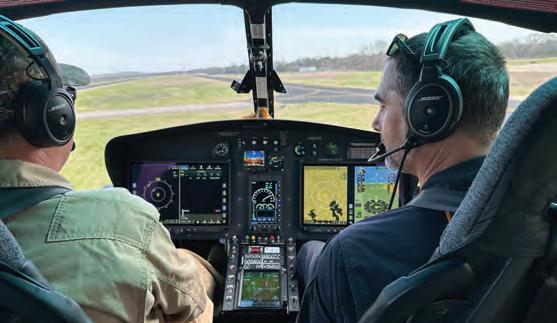
Thales/StandardAero StableLight four-axis autopilot targets AStar market
2 Textron Aviation brings three updated Citation models to market
4 Leonardo Next-gen civil tiltrotor makes first flight
6 Business aviation safety su ers worst year since 2011
8 Daher refreshes turboprop family with TBM 980
10 Special Report: Our once and future ATC System
17 Special Report: How LiveATC went live
20 Special Report: The next frontier for notams
The changing tides of bizav events
Legacy constraints, new opportunities in Southeast Asia aviation


BY KERRY LYNCH
Three of Textron Aviation’s latest Cessna Citation model updates have entered service, with the first Ascend delivered to an unnamed retail customer and a CJ3 Gen2 handed over to longtime Citation owners Dave Mecartney and Shannon Day. Also entering service was the M2 Gen2 with a Garmin Autothrottle system.
“The first Citation Ascend delivery underscores Textron Aviation’s commitment to redefining the midsize segment with an aircraft that blends innovation, efficiency, and unmatched comfort,” said senior v-p of sales and marketing Lannie O’Bannion.
While it did not disclose the first retail customer, Textron Aviation previously named NetJets as the Ascend launch customer under a potential $32 billion order placed in 2023 for up to 1,500 Citation Longitudes, Latitudes, and Ascends.
In an extensive update to Textron Aviation’s 560XL series, the Ascend brings a flat floor and 15% larger windows, along with Garmin G5000 avionics and improved performance. With three 14-inch, ultrahigh- resolution displays and dual flight management systems, the G5000 folds in
autothrottles, synthetic vision, advanced weather detection and avoidance, and a second Iridium data link, along with optional controller-pilot datalink communications.
The customizable cabin accommodates 12 passengers and features wireless controls for lighting, temperature, window shades, and entertainment. Gogo’s Avance L3 Max Wi-Fi is standard, but customers can upgrade to Avance L5 or Galileo HDX.
Two Pratt & Whitney Canada PW545Ds increase fuel efficiency and thrust, enabling a top speed of 441 ktas and a 1,940-nm range.
Meanwhile, in what Textron Aviation calls its “most comprehensive Gen2 investment,” the CJ3 Gen2 adds customer-driven upgrades including Garmin autothrottles, more pilot legroom, and a customizable cabin environment.
The CJ3 Gen2 features the latest Garmin G3000 avionics suite, including autothrottles and GDL 60 for aircraft connectivity. It can seat up to 10 occupants and has an externally serviceable lavatory.
Approved in October, the M2 Gen2 with Garmin Autothrottles provides greater control and precision to pilots. z
On December 20, a Beechcraft King Air B200, registered as N479BR, landed at Colorado’s Rocky Mountain Metropolitan Airport after the aircraft’s Garmin Autoland system activated, marking the system’s first in-service activation. The aircraft experienced rapid, uncommanded loss of pressurization, the pilots donned their oxygen masks, and Autoland automatically engaged when the cabin altitude exceeded prescribed safe levels. While the pilots remained conscious, they left Autoland engaged, citing “exercising conservative judgement under their emergency command authority (FAR 91.3).”
Gogo last month o cially activated its 5G air-to-ground connectivity network for customers in North America. This came after recently completing more than 30 hours of flight tests across nearly 20 routes to prove that its 5G tower network will deliver high-speed, low-latency connectivity. During testing, the network provided broadband speeds of more than 80 Mbps download and 20 Mbps upload, allowing streaming and internet browsing simultaneously.
Gulfstream’s G500 and G600 last month received EASA steep-approach certification, enabling the twinjets and their approved crews to access an extended range of airports. The approvals follow equivalent regulatory permissions already in place in the U.S.; the G500 received an FAA nod for steep approaches in October 2023, with the regulator awarding similar approval the G600 in May 2024. Gulfstream conducted G500 and G600 steep-approach landing demonstrations at London City Airport and Switzerland’s Lugano and Sion Airports.


BY CHARLOTTE BAILEY
Leonardo Helicopters has made the first flight of its Next Generation Civil Tiltrotor (NGCTR) demonstrator aircraft from its Costa di Samarate facility in Italy. Part of an EU-funded initiative, NGCTR was first launched in 2015 under the European Union’s Clean Aviation Clean Sky 2 program, which described the project’s aims to “design, install, and demonstrate, in flight, innovative civil tiltrotor technologies enabling future prototype development.” At the time, Clean Aviation envisaged a first flight in 2023.
Ground runs in June 2024 paved the way for the latest milestone, which “represents a fundamental step towards validating the five new technologies and performance improvements,” Leonardo said. To help achieve this, the
demonstrator includes “advanced wing architecture, innovative tail layout, non-tilting engine installation…[and] an advanced, modular, distributed and scalable flight control system.”
The Italian OEM intends for the NGCTR to “revolutionize civil vertical lift by combining helicopter versatility with fixed-wing aircraft performance.” Its prototype aircraft offers a cruise speed of 280 knots and a range of around 1,000 nm. According to Leonardo, this will open “new scenarios for mobility, freight transport, and search-and-rescue missions, enabling faster coverage of larger areas.”
More than 85 organizations from 15 countries are collaborating on the NGCTR project, which has received around € 116 million ($136 million) in EU funding. z
Bombardier in late December received FAA certification of the Global 8000, the company’s flagship ultra-long-range aircraft and the fastest business jet in production with an Mmo of Mach 0.95. The Global 8000 received Transport Canada approval on November 5. Meanwhile, the Global 8000’s GE Passport 20 engine obtained its nod from EASA around the same time, and European certification of the twinjet was imminent at press time.
The 2026 European Business Aviation Convention and Exhibition (EBACE) will be staged later than usual—June 2 to 4—with the venue remaining in Geneva. EBAA said it pushed back the event from the last week of May after “a detailed review of the broader events calendar” and is also promising more competitive pricing for exhibiting companies. Moving the dates from the earlier May 27 to 29 schedule means Europe’s largest business aviation show will resume its traditional pattern of running from Tuesday through Thursday.
Owners and operators of classic HondaJets and those upgraded to the Advanced Performance Modification Group (APMG) configuration can now add further enhancements with Honda Aircraft’s APMG S package. Already certified by the FAA, the APMG S upgrade adds software and hardware improvements to the HondaJet’s Garmin G3000 avionics; graphical weight and balance; the Advanced Steering Augmentation System; and a 300-pound mtow increase. Honda Aircraft’s 21 authorized service centers and its headquarters service center in Greensboro, North Carolina, are o ering the upgrade.

With 13,000+ member aircraft, CAA gives Part 91 operators unmatched access to top-rated FBOs and the best fuel prices in the industry.
• Exclusive member-only fuel rates
• Seamless consistent experiences at every stop
• 300+ trusted Preferred FBO partners
• 90 days FREE for new members
CAA membership pays for itself—fast. Join the CAA network today!



BY GORDON GILBERT
Last year was one of the worst on record for business aviation safety, as fatalities soared 53.8% year over year (YOY) to 143, only eclipsed by 156 fatalities in the sector in 2011, according to preliminary data tabulated by AIN. Fatalities from business jet accidents globally climbed 171.4% YOY, from 21 in
2024 to 57 last year, while turboprop fatalities rose 19.4%, from 72 to 86.
The 104 business aircraft accidents—32 involving business jets and 72 turboprops— last year represented a 15.6% increase over 2024. Worse, more accidents were fatal as these mishaps soared
Dassault appears to be getting closer to the start of flight testing for its ultra-long-range Falcon 10X, according to images of the first 10X prototype posted in mid-December by French aviation media group Actu Aero. The aircraft manufacturer declined to comment on reports that first flight could happen soon. Actu Aero’s photo shows what appears to be a 10X with power on during ground testing. Dassault is targeting service entry for its largest jet in 2027.
PlaneSense is collaborating with European charter broker CaptainJet to expand international private aviation options between the U.S., Europe, and other regions. Under the arrangement, the PlaneSense sourcing solution team will coordinate private aircraft charters across Europe and beyond, while PlaneSense will reciprocally support CaptainJet clients flying to the U.S. The collaboration builds on PlaneSense’s 2025 agreement with Jetfly, which allows PlaneSense fractional clients to use flight hours on Jetfly’s Pilatus PC-12 and PC-24 fleet in Europe and North Africa, with reciprocal access for Jetfly clients.
NBAA has rescheduled its 2026 White Plains Regional Forum due to pending runway construction at Westchester County Airport (KHPN). The annual Northeast business aviation showcase, originally slated to take place on June 3, has been moved to May 20. For the past several years, the regional show has been held in and around the 52,000-sq-ft hangar at the Million Air FBO at KHPN, but FAA o cials notified airport o cials of plans for upcoming runway construction work as part of an agency grant. The project will begin in the second quarter.






A proven predictive analytics system that forecasts the service you need—before you need it.






















BY CHARLES ALCOCK
Daher has refreshed its family of single turboprops, launching the TBM 980 model during an event on January 15 at its headquarters in Tarbes, France. The main change for the latest version of the aircraft is in the cockpit, now based on Garmin’s third-generation G3000 Prime avionics suite, while the cabin features enhancements for passenger comfort.
EASA has issued airworthiness certification for the new version of the TBM, and the FAA has validated this approval. First deliveries of the 980 started in January.
The TBM 980 is priced at $5.82 million. Daher said it will continue to offer the 960 model for operators who prefer this version, which carries a lower price tag of $5.62 million.
In the six-seat cabin, Daher is now offering the ability to install a Starlink Mini terminal for satellite-based internet connectivity, along with 100-watt USB-C ports for charging mobile devices. Passenger displays for the TBM 980 have also been
upgraded to show en-route flight data.
According to Daher, the latest Prime version of the G3000 avionics suite improves cockpit ergonomics for pilots with a highly intuitive and refined interface. Earlier members of the TBM 900 family use the G1000 technology, while the TBM 960 has the first iteration of the G3000.
The TBM 980’s flight deck has three 14-inch, edge-to-edge touchscreen displays, providing what Garmin says is improved image quality. Customizable presets and a streamlined user interface have been introduced to reduce pilot workload.
With an app-based interface, the G3000 Prime provides shortcuts intended to enable pilots to quickly access essential functions, such as radios, transponders, flight plans, and operating procedures, without scrolling through multiple menus. The checklist button on earlier versions of the avionics suite has been replaced by a four-position joystick for up/down scrolling, checks, and quick access. During a media
Bombardier received a $400 million order from the Canadian government for six Global 6500s to support the Royal Canadian Air Force in a range of missions throughout the world. The order builds on a long-time relationship with the Royal Canadian Air Force, which has operated Bombardier Challengers since 1983. Plans call for delivery of the Globals to begin by mid-2027 for use in missions including aeromedical, disaster relief, humanitarian aid, and national security.
About 800 aircraft—including 52 turboprops, business jets, and turbine helicopters—registered with the FAA under trustee Southern Aircraft Consultancy Inc. (SACI) were grounded last month because they no longer have valid registrations. According to the FAA, all of SACI’s aircraft registration certificates are invalid because the UK-based company violated U.S. citizenship requirements when it submitted the registration applications. A ected aircraft owners must re-register their aircraft, either through the U.S. or another country’s registry, and will then receive temporary authority to operate in the U.S. until a certificate of aircraft registration is issued or the FAA denies the application.
International Flight Center (IFC)—one of four service providers at Miami Executive Airport (KTMB)—opened its new FBO terminal last month. The 10,500-sq-ft facility, which took two years to build, replaced a small terminal attached to an old, since-demolished 10,000sq-ft hangar. It o ers guest lounges, a refreshment bar, a pilot lounge with private bed- and bath-equipped snooze rooms, a catering kitchen, a conference room, a business center, a concierge, crew cars, and an in-house café. IFC also has an FAA Part 145 repair station.
visit in Tarbes, Daher test pilot Guillaume Remigi demonstrated how crew can quickly action alert messages because each of these presents clear commands, avoiding the need to search through flight manuals.
“The app-based approach to the flight management and information system is far more tactile,” Daher Aircraft CEO Nicolas Chabbert explained to reporters. “The system shows each mode of operation and the pilot simply confirms actions from a menu and can change the [content shown on each] display, enlarging or reducing different features.”
According to Chabbert, the increased sophistication of the TBM 980’s cockpit technology combined with its speed bolsters its potential to compete with light jets as well as other turboprops. Daher estimates hourly operating costs at $1,100.
Also featured in the TBM 980 model is Garmin’s HomeSafe emergency autoland

capability. The avionics manufacturer’s GWX 8000 digital radar incorporates its StormOptrix technology, which automatically adjusts radar settings for more accurate 3D profiling of storm cells.
Daher’s new aircraft retains the fadec-controlled Pratt & Whitney Canada PT6E-66XT turboprop engine and
five-blade Hartzell composite propeller system.
In 2025, Daher delivered 76 TBM and Kodiak turboprops, with total deliveries 7% down on the 82 aircraft shipped in 2024. Last year’s total included 51 TBM 960s made in Tarbes and 25 Kodiak 100s and 900s from its factory in Sandpoint, Idaho. z

BY DAVID HUGHES
The DOT and the FAA forged ahead with plans to push forward on the $12.5 billion “down payment” part of a “brand-new” ATC system by 2029, even as a 43-day government shutdown harried the current system and forced air traffic controllers to work without pay.
This effort follows the FAA’s twodecade-long NextGen project, which made some improvements but didn’t create the modern system desired to supplant the legacy one controlling crewed aircraft traffic.
The aviation industry is obviously thrilled to have the government suddenly spending $12.5 billion to help the aging legacy ATC system get its legs under it again— Congress in July furnished the sum in the One Big Beautiful Bill following a series of
communications and notam outages, along with intense scrutiny on controller shortages in the wake of the January 29 midair collision by Ronald Reagan Washington National Airport (KDCA).
The industry is concerned about the effects of the government shutdown on National Airspace System (NAS) operations and whether the hiccup will happen again. The 2025 43-day shutdown broke the record at eight days more than the 35-day one in Trump’s first term, causing widespread outages as the FAA grappled with rolling controller shortages.
In announcing those rolling outages, DOT Secretary Sean Duffy maintained that the government was still pushing ahead on the modernization plans but conceded
that it was hampering controller recruitment efforts. At the end of the shutdown in November, he responded: “Now we can refocus our efforts on surging controller hiring and building the brand-new, stateof-the-art air traffic control system the American people deserve.”
However, at press time, another potential shutdown could happen—a stopgap measure passed in November only funded the federal government through January 30.
Aviation advocacy groups in Washington, D.C., can disagree on some issues, but they all seem to be in favor of spending $12.5 billion immediately to improve the NAS. The Modern Skies coalition of 60 aviation and aerospace organizations, including business and general aviation

groups, is backing DOT’s ATC upgrade plans. But at the same time, industry groups are adamant about the need to head off potential harms of any future government shutdown.
Legislation has been introduced in the House and the Senate aimed at funding the FAA should another shutdown occur. This is a problem that would be solved for the rest of the current fiscal year if Congress passes the Transportation and Housing and Urban Development appropriations bill covering the DOT, FAA, and other agencies. Ed Bolen, president and CEO of NBAA, sees passage as the highest priority.
Meanwhile, the need for modernizing the aging ATC systems comes at a critical time. Not only did the system show signs of wear over the past year, but new-entrant drones are being managed in a few places in U.S. low-altitude airspace with private Unmanned Aircraft Systems Tra ffi c Management (UTM) systems using new concepts of operation. This is without any directions from air traffic controllers. The UTM system for new-entrant air vehicles was developed from a clean sheet design over a decade. How it will merge with the brand-new ATC system is not yet defined, but is looming large as a challenge.
The legacy ATC system update is starting with equipment such as new radars and telecommunications links that will roll out over the remaining three years of this administration. The DOT wants another $20 billion from Congress to build out the new ATC system, but there is no certainty as to when this money might be appropriated.
In his first appearance before Congress as FAA administrator, Bryan Bedford reiterated that the initial $12.5 billion will fix what is necessary but not overhaul the system. The $12.5 billion would make the airspace more efficient, “but it would still be antiquated,” Bedford told the House

Transportation and Infrastructure Committee in December. “We need to make sure that modernization gets done, gets done on time, and achieves the results that we’ve set before this committee—which is to deploy new technology within the next three years.”
Plans are for use of off-the-shelf technology, “not some new technology that may or may not be created over the next several years,” he added. The FAA—in concert with the DOT—has “adopted a mantra of think slow, move fast, understanding what the end state of modernization needs to look like, and then determining how best to plot a course to get there as opposed to just let’s go out and spend money,” Bedford continued.
With that in mind, o ffi cials have spent the last several months plotting what the end state of the National Airspace System should look like. “It’s an exciting vision,” he said.
The new ATC system and the shutdown were hot topics at Honeywell’s Aviation
Leadership Summit on November 19 at the company’s offices in Washington, D.C., in the shadow of the Capitol Dome.
Airlines for America (A4A) senior v-p for legislative and regulatory policy Sharon Pinkerton hit the nail on the head when she said, “It doesn’t matter if we have a newer ATC system if it’s going to be shut down for 40 days.” She was speaking on a panel on airspace integration and ATC modernization with Bob Buddecke, president of Electronics Solutions at Honeywell.
She did marvel at the speed with which the DOT and the FAA are working on this new ATC system. Contracts had already been inked for radar services and voice switches, and agency officials in December selected Peraton—a spinoff from the Harris Corporation’s government IT services group—as the prime integrator to oversee the project. That selection was named just a few months after the request for solutions was released. “This is a different FAA; it has been remarkable,” Pinkerton said.
In his appearance before Congress, Bedford had provided insight into the selection of Peraton to act as a prime integrator. He
said the organization will guide the FAA on modernization execution, particularly on challenging issues such as shifting from analog systems to digital systems. “These are not competencies the FAA has internally. We need assistance from people who’ve done this before. Peraton brings us that experience.”
At the Honeywell conference, Duffy also said the $12.5 billion received so far is for replacing equipment, including radars and voice switches, and replacing copper wires with fiber-optic cables as the FAA moves from analog to digital systems.
The FAA says it has already converted one-third of ATC’s copper wire to fiber, satellite, and wireless, deployed 148 radios to facilities, and provided surface awareness systems to 44 towers. And by the end of 2025, the agency had already committed half of the $12.5 billion, according to Bedford.
In January, the agency announced contracts with RTX and Indra to work with
Peraton on radar replacement. Plans call to replace up to 612 radars by June 2028 with “modern, commercially available” surveillance radars. The work is to begin this quarter with replacements prioritizing high-traffic areas, the agency said.
“While our air travel system is the safest in the world, most of our radars date back to the 1980s. It’s unacceptable,” Duffy said in announcing the contract awards.
“Many of the units have exceeded their intended service life, making them increasingly expensive to maintain and difficult to support,” added Bedford. “We are buying radar systems that will bring production back to the U.S. and provide a vital surveillance backbone to the National Airspace System.”
Indra has also won a contract valued at up to $244.3 million to manufacture, test, and qualify up to 46,000 new radios, as well as provide support for 10 years. Under the contract, Indra is replacing legacy analog radio systems with next-generation
digital radio equipment capable of both analog and Voice over Internet Protocol (VoIP) operations.
However, at the Honeywell conference, Duffy explained that the $12.5 billion does not cover a new common automation platform (CAP) or new software—both considered critical for the brand-new ATC system. The new platform will allow the FAA to design ATC apps as the agency moves to an architecture not unlike the iPhone, which has access to new apps when they are developed.
In November, the FAA released a request for information on a CAP. Responses were due by December 19. The agency is eyeing replacements for systems including En Route Automation Modernization (ERAM) and Standard Terminal Automation Replacement System (STARS) with a unified, modern platform, the agency said. “The FAA is open to new ideas, new
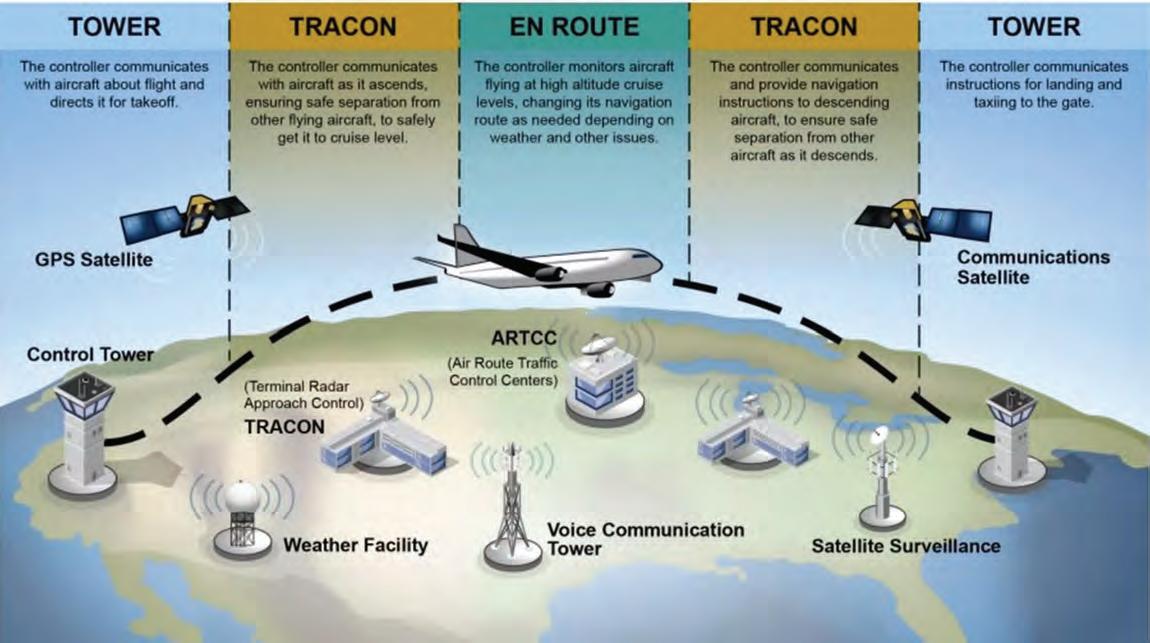
technologies, new procurement strategies, new implementation structures, and any other considerations that will enhance the common automation platform solution,” according to the agency.
Bedford said there will be four layers: one each for compute, the operating system, data, and applications. “This will unlock the pace of innovation that has been beyond the FAA’s grasp,” he said. The FAA wants to move siloed computing from 350 ATC facilities to the cloud to complete the move from an analog to a digital ATC system.
Once this platform is in, both en route and terminal facilities will be able to exchange digital data rather than being siloed, as is the case now with standalone automation systems. Only the local controllers can now see the data covering traffic in their area.
Honeywell’s Buddecke said that, in addition to ATC improvements, the company would like to see more avionics equipment in air transport aircraft to counter things like runway incursions. Honeywell is in favor of the Rotor Act, which he said would create an orderly transition to ADS-B In and leverage the aviation community’s investment in ADS-B Out. The Senate unanimously passed this bill, S.2503, on December 17, and it goes to the House now. The bill would require all aircraft in designated airspace to be equipped with ADS-B In over a period of years.
Bob Poole, who directs transportation policy at the Reason Foundation and edits an ATC newsletter, said he has not noticed any interest from Congress in coming up with the extra appropriation. Poole is an advocate of privatizing the ATC system and said in the interview he hasn’t seen any momentum on this lately, but recently, the Washington Post editorial board endorsed ATC privatization. AOPA and NBAA strongly opposed privatization the last time it came up. In an interview with AIN, NBAA’s Bolen
noted that Bedford has been unequivocal that the FAA is not going down the privatization path.
Bolen said a lot of people say the U.S. should not emulate the current Canadian ATC system. “Canada’s ICAO safety rating (now privatized under Nav Canada) has gone from the 90s in 2005 to 65 now, a significant drop,” he said. “There are significant delays at airports that are not that big or that complicated, and there isn’t a single airport in Canada in the top 15 in terms of the number of movements. They do not seem to have the ability to run it [the ATC system] without significant delays and enormous frustration for the airlines, pilots, and controllers.” Nav Canada was formed in 1995.
Rep Sharice Davids (D-Kansas), whose district includes Olathe (where Garmin is headquartered),said she and her colleagues are focused not only on how to bring the NAS up to date but to prepare it for the future and make sure it doesn’t fall further behind. Working group meetings with the aviation industry have been invaluable in coming up with solutions that will work, Davids said. “The meetings have been as pragmatic, substantive, and realistic as possible about the problems that are in front of us,” she said.
On a panel at the Honeywell gathering led by Bolen, House aviation subcommittee chairman Troy Nehls (R-Texas) from the Houston area questioned the request for additional funds, given the lack of significant progress in the past. “We do not have the answer on how to fix this problem and modernize the NAS,” Nehls said. “What the hell does that even mean?”
In the government/industry working group meetings, Nehls said he was floored on several occasions to learn that technology that has been around for decades, like fiber-optics, hasn’t been deployed. He asked industry members to explain why this happened, and they said it was because no one in the government was listening to them.
BY THE NUMBERS
5,170 — new high speed network connections on fiber, satellite, and wireless
27,625 — new radios
462 — new digital voice switches
612 — state of the art radars
44 — airports will have new replacement surface radars
200 — airports will have Surface Awareness Initiative surveillance technology
89 — airports will have new Terminal Flight Data Manager tools
435 — air tra c control towers will have new Enterprise Information Display Systems
113 — air tra c control towers will have new Tower Simulation Systems
1 — new consolidated Air Route Tra c Control Center (first new one since the 1960s)
110 — additional weather stations in Alaska
64 — more weather camera sites in Alaska
1 — new consolidated Terminal Radar Approach Control
Bolen asked Nehls if the $12.5 billion was a down payment on ATC modernization. Nehls answered, “$12.5 billion is a lot of money.” Now that the DOT has it, “it is incumbent on me and everyone in Congress to make sure that we know where it is going to go. I think the federal government’s response to most tragedies [like the one at National Airport] is to throw money at it as if that is going to solve the problem, but that doesn’t necessarily do it. I am just not going to throw another $20 billion in their [the FAA/DOT team’s] direction if we can’t hold them accountable for the $12.5 billion, but I think they will produce results.”
Nehls noted that an Inspector General report found that only about 16% of NextGen was deployed after expenditures in the billions. He said he and Davis will be working together to try to have Congress come up with the additional money. But he said the ambitious three-year timeline may be unrealistic, and success will require alignment between industry, Congress, and the FAA.
Bolen said in an interview that the first phase of work is a “comprehensive and aggressive plan to move the foundation from analog to digital. That is so fundamental.” This will provide the needed tools to move in the direction of a common automated platform.
William (Bill) Payne is the project manager for the Colorado Department of Transportation, who is working to get a remote (a.k.a. digital) tower implemented to serve multiple ski airports in the mountains from one location in the flatlands. He told AIN in an interview that the FAA NextGen office is suddenly quite keen to move ahead with digital tower initiatives. He firmly believes these systems should be an integral part of any future ATC system in the U.S. He added that the FAA’s Bedford has seen the RTX/Frequentis system being tested at the FAA Tech Center and has expressed support for the concept as part of the new
ATC system. In the meantime, remote/digital towers are making rapid advances in Europe and the rest of the world.
Colorado wants to employ the RTX/Frequentis system once it is approved, which may happen soon. Lack of FAA support canceled CDOT’s initial remote tower project with Canada-based Searidge Technologies in 2023 at Northern Colorado Regional Airport (KFNL). FAA also tested a Saab remote tower system at Leesburg Executive Airport (KJYO) from 2015 to 2023, which was also shut down. Frequentis has deployed 16 digital towers outside of the U.S., so its system has already been approved by other civil aviation safety agencies.
Payne leads a group of corporate pilots that meet regularly at Centennial Airport (KAPA) in Colorado. He hopes the FAA’s new ATC system doesn’t lead to negative side effects for business aviation, as air navigation improvements have at Denver International Airport. The FAA published RNAV STARS and RNP procedures used
primarily by airline aircraft. At times, controllers break business jets off STARS procedures and send them “way the hell out west” before bringing them back in, Payne said. This puts business jets over high terrain where mountain waves can create moderate to severe turbulence. An old pilot adage in business aviation is that passengers don’t like having white caps on the martinis. Payne thinks any ATC improvements will be good for business aviation, but he, for one, will be keeping an eye out for unwanted side effects.
He noted that business aviation also got unwanted attention during the government shutdown but business and general aviation access was restored after the FAA imposed more than a week of operational limits at 40 airports, including an unprecedented curtailment of Part 91 and Part 135 operations at 12 major hub airports.
On a panel on airspace integration and ATC modernization at the Honeywell


leadership summit, David Murphy of ANRA Technologies said there are two parallel ATC modernizations going on right now: one for crewed aircraft and one for uncrewed aircraft and drones.
Today, ANRA and other private providers of UTM systems and services are preclearing delivery drones in North Texas to then monitor and deconflict them in flight with digital data as they operate below 400 feet in the FAA’s UTM site. ANRA is one of the UTM providers working with Walmart. The retailer has ambitious plans to use drones to serve 1.5 million households in the DallasFort Worth metro area from 30 stores. Murphy said the drone community now must figure out how to integrate drone operations in the airspace without disrupting current crewed operations. “I see it all coming together very soon,” he said. ANRA is also working on many UTM projects worldwide.
Trajectory-based operations techniques (using time and constantly updated trajectories for planning) are used in UTM. It was the holy grail of the NextGen program, but it was not achieved. Alan Mulally, as a young engineer, experimented with the trajectory-based concept on a Boeing 737-200, so the idea has been around for a long time.
steps: concept and specification; procurement and development; integration, validation, and training; and operational deployment. This cycle routinely spans 10 to 15 years with an additional 3 to 5 years needed to refine software, correct integration issues, and achieve full operational maturity under high traffic loads. He said a four-year ATC modernization program timeline is unprecedented.
Deleau said regarding privatization in Europe that even when air navigation service providers are reorganized to be somewhat private, the government usually retains a controlling golden share. He added there was no documented signif-
Just because Congress can’t get its act together and members act like children at times, why should the American people su er as a result?
— Troy Nehls (R-Texas) House aviation subcommittee chairman
it caused a sharp divide in the controller workforce between those who left the ATC facilities and those who stayed, and he wonders what the effect of post-shutdown $10,000 government bonuses for controllers who stayed on the job will do to team morale now.
Nehls stressed to attendees at the Honeywell event that such a shutdown “can never happen again.” He has co-sponsored a bipartisan bill along with the chairman and ranking member of the Transportation and Infrastructure committee to ensure that controllers and others at the FAA managing airspace will be paid if there is another government shutdown.
This is the Aviation Funding and Solvency Act (H.R 6086). It would use funds in the Aviation Insurance Revolving Fund to cover critical services. The fund covers war risk insurance claims from airlines that were terminated in 2014 and now has $2.6 billion on account.
Things are different in some ways in Europe. A U.S.-style government shutdown cannot happen in Europe, according to Frédéric Deleau, executive v-p of Europe for the International Federation of Air Traffic Controllers’ Associations. However, air navigation services can and have been disrupted in Europe due to strikes and other events. Air navigation services are fragmented there, and controller salaries have been reduced during some funding disputes or low traffic periods during the pandemic.
Deleau said in a response to email questions that equipment is also diverse, and some systems are beyond typical desired life cycles of 15 to 20 years. A typical modernization project in Europe involves four
icant reduction in North Atlantic traffic during the U.S. government shutdown.
John Walker, who managed New York airspace at the FAA and is now a consultant who serves on U.S. and international standards committees, remembers the failed IBM Advanced Automation System (AAM) that was shuttered by the FAA in 1994 after a $100 million overrun.
He recalls that it also called for a layered system. IBM had little ATC experience, which is also true of Peraton, whose track record includes putting some Pentagon systems on the cloud.
Walker hopes the lessons have been learned from that AAM fiasco, so mistakes won’t be repeated this time. He was also at the FAA when PATCO controllers went out on sick leave the first time. He remembers
“Just because Congress can’t get its act together and members act like children at times, why should the American people suffer as a result?” Nehls asked. Later in November, Nehls said he will not run for reelection to Congress. His twin brother plans to run for the seat.
In a prepared statement for the Senate aviation subcommittee on November 19, Bolen wrote that the shutdown had a significant impact on all facets of the business aviation segment as it “delayed safety approvals, jeopardized investments, reduced safety margins, and restricted airspace capacity.”
Meanwhile, the Senate has a bill under consideration titled the Aviation Funding Stability Act of 2025 (S. 1045) introduced by Sen. Jerry Moran (R-Kansas) in March. It would tap the Airport and Airway Trust Fund to pay for FAA operations during a shutdown. z
Anyone who learned to fly in the last 10 or 15 years knows about it. Print, TV, and online journalists worldwide know it as a trusted aviation resource when there’s a mishap. Airplane geeks infatuated with listening to pilots and controllers jabbering at hundreds of airports around the globe can’t seem to turn it off
It’s LiveATC.net, a free link to air traffic control communications that’s available anywhere there’s a good Wi-Fi signal. I find LiveATC’s iPhone app a lifesaver when I neglect to bring my PJ2 portable com radio to the airport. Just as important as live audio, LiveATC includes an extensive archive of past transmissions from all the sites it monitors.
BY ROBERT P. MARK

“LiveATC captures air traffic control conversations at more than 1,500 different airports located on every continent except Antarctica,” said founder Dave Pascoe. “We’re live in 64 countries with over 3,400 channels and over 1,200 receiver sites. We have many customers interested in our audio capture service today, like the NTSB. One of the first things that, in talking with some of the investigators, they pull the ADS-B tracks. They pull the LiveATC audio because it’s expedient for them when they’re headed out the door to a crash site.”
An amateur radio operator (KM3T) since he was a teenager, Pascoe got the idea for LiveATC in 2002. “I was on a year-long sabbatical and had gotten my private pilot certificate about a year prior,” he said. After
earning his instrument rating, he became enamored with air traffic control communications. “I was also heavily involved with the virtual air traffic simulation network [Vatsim] and ATC simulator network/community and wanted to share real-world communications with my cohorts there.”
Pascoe decided the best solution was to put some receivers “on the air.” He said his background in communication systems and IT, as well as his heavy involvement in amateur radio, helped organize things. “My youngest brother lived near Boston and let me put some receivers at his house so we could monitor ATC there.” More than 15 years later, LiveATC became self-sufficient with the advent of smartphones, internet
advertising, B2B opportunities to run commercial ATC audio streaming systems, and the sale of audio data.
Shortly after the service was launched, Max Trescott, a well-known flight instructor, podcaster, and amateur radio operator (K3QM) based in California’s Silicon Valley, recognized the value of the LiveATC service. “When I worked with student pilots in particular, a lot of them had difficulty learning how to communicate with ATC at a busy airport like my base at Palo Alto, for example. Vehicle procedures here are very nonstandard, so it was helpful for students to listen to the Palo Alto tower via LiveATC. It helped them rapidly improve their radio communication skills. Instrument pilots who wanted to learn to handle IFR clearances and fly instrument approaches got pretty good at that, too, by listening to Norcal Approach.”
In addition to live air traffic control communications, LiveATC offers users easy access to an extensive archive of ATC audio from all locations monitored. “We started off retaining about 30 days of data, similar to what the FAA retains themselves,” Pascoe said. “As storage got cheaper and more widely available, we increased our storage capability to store one year. In January of this year, I upgraded our storage again to add an additional four years. So nominally, we can store pretty much everything that we take in for four to five years from all over the world.”
Using LiveATC is simple. Users visit the website and choose the ATC location they’re interested in hearing by typing the three or four-letter ICAO code for a Class B, C, D, or nontowered location. Alternatively, listeners can use the three-letter code for an FAA air route traffic control center (ARTCC) or type in the specific frequency they want to hear or the state in which the airport is located.
Never having searched by frequency before, I typed in 119.90, the frequency for our local tower at Chicago Executive Airport (KPWK). This is a VFR tower in Class D airspace just north of Chicago O’Hare International Airport (KORD). The frequency entry returned information for three dozen other ATC facilities in North America that share the same frequency. I didn’t find this method all that useful. Using the airport code returns information that’s much easier to deci pher, most of the time.
couple of paid employees. The soul of LiveATC—about 99% of it—is sta ff ed by dozens of volunteers who believe in the service they provide. “What we’re doing is such a niche that people find me rather than me looking for people,” Pascoe said. “I’ve got a guy whose full-time job is just building and shipping systems where they’re needed.”

From my travels, I knew the country code for England is E, so I added the airport code LHR for London Heathrow, but received this error message. “Sorry, ELHR is not currently covered by LiveATC.net.” Pascoe explained that there are countries such as the UK, Spain, and France that don’t allow third-party rebroadcasting of ATC frequencies, with controller privacy being one of the chief objections. The fact that ATC communications can be heard by anyone over an air band radio without any difficulty apparently never altered that objection.
The site offers listeners a variety of aviation resources in addition to the actual frequency feed, such as the Top 50 feeds in the LiveATC system at a given moment in time. “A lot of people seem to think that LiveATC.net is a service provided by the FAA,” Trescott explained, “but that’s the furthest thing from the truth.”
While LiveATC is 100% owned by Pascoe, the site’s backend is run by just a
The growing number of LiveATC feeds has evolved organically, according to Pascoe, hosted by “a large and increasing group of volunteers near airports around the world.”
New feeds are being added constantly. Feeds can also disappear for several reasons. “The volunteer who first established the connection may have moved, taking their radio equipment with them, or for some reason the volunteer is no longer able to provide service at that location.”
Pascoe said if a volunteer who’d like to establish a new feed can afford the equipment themselves, he’ll work with them. “We try very hard to recruit great volunteers who will take pride in maintaining high uptime and high-quality reception. LiveATC is truly a community where people pitch in and feed the network.”
He invited volunteers to get involved, especially “if you’re nearby an airport that’s not on the network.” He said that, unlike an ADS-B feed, setting up a new LiveATC feed is a little bit harder. “For good ADS-B signal reception, you just need to see the sky. VHF band ATC communications, however, are line of sight. It might not be something you’d put at your house, but maybe your flying club, or on top of a friend’s hangar, where they’d be willing to host the equipment. Again, we work with volunteers to find the best place for the receiver antenna so our listeners can hear both sides of the conversation. If the volunteer doesn’t have their own receiver or antenna and the airport’s high enough on our priority list, we’ll loan out the equipment more or less permanently, as long as someone’s there to host it.” Right now, Pascoe said LiveATC could really use a solid feed from George Bush Intercontinental Airport at Houston (KIAH).
There’s another link on the LiveATC website labeled “Interesting Recordings,” and these are interactions that are auto-populated from the site’s forums. I skimmed a few one afternoon and stumbled across one labeled, “Real Close Call at Logan.” Even though I had absolutely no idea of what led to the event, spending 30 seconds here told quite a story. A Delta heavy jet was sent around during an approach to Runway 4R at Boston, and on the go, the pilot working the radios remarked, “Man, that was close.” In another, I followed along with a Milwaukee departure controller’s assist in mid-September to a VFR Cirrus SR22 over Lake Michigan when the aircraft’s engine quit. Thanks to the close coordination between the pilot and the Milwaukee controller, the Coast Guard was on scene within minutes of the aircraft hitting the water. Everyone aboard was rescued safely. You’d never be able to hear this kind of drama anywhere else.
“We aren’t perfect, but we do strive for constant improvement,” Pascoe said. z









3-8 FEBRUARY 2026
3-8 FEBRUARY 2026










BY JULIE BOATMAN

The notices from the county planning commission went up first. I registered the white posters with bold lettering on my morning stroll just as my neighbor walked up to me to tell me what they meant.
“They wanted to put in a new cell tower,” she said as she gestured up the hill to the crest of a pasture that often held a passel of dairy cows. What she didn’t say: We hope everyone’s okay with all this new technology rising up in the midst of farm
fields held by Mennonite families for the past nine generations.
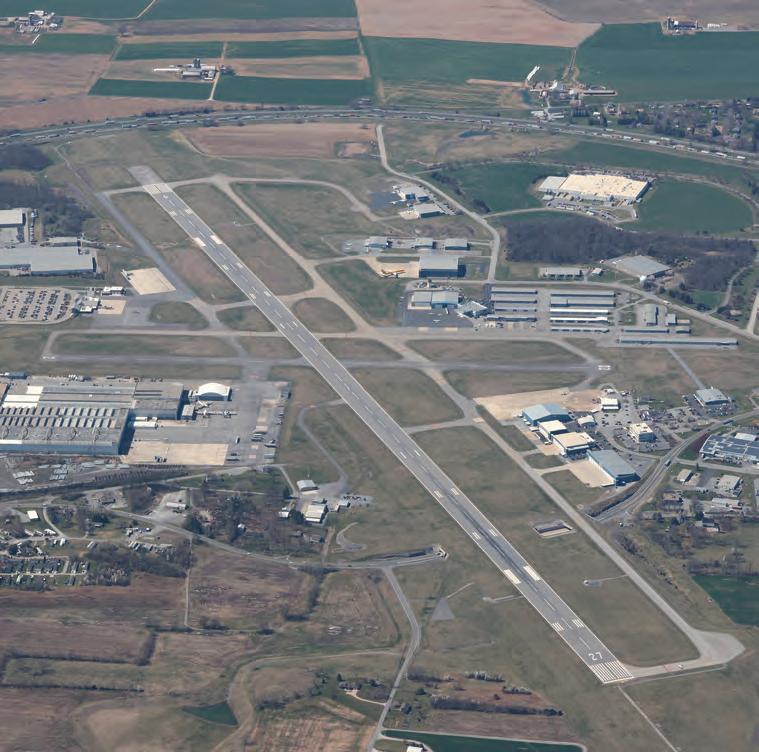
What she didn’t know was that I took one look at that tower site and thought, “Dang, that is right under the ILS approach course to 27. I wonder when the notam’s going to pop up?”
Pilots must access and understand the notams relevant to their planned flight per 14 CFR 91.103, covering
preflight action. That hasn’t changed in a long time.
But the system through which you obtain those notams is undergoing a serious overhaul—and for most pilots, it’s about time. We have collectively spent countless hours poring through textual piles of spurious entries to find the one needle in the haystack that could prick us sharply if we missed it. Runway and taxiway closures, lighting outages, and new towers spring up like mushrooms after the
rain—and change the instrument approach procedure or departure procedure we might file and follow, or the very airport to which we’ll fly.
The sheer volume of data is immense, and it continues to accelerate. Cracks in the existing distribution and dissemination architecture have shown in recent years, with the most top-of-mind one occurring on Jan. 10, 2023, when contract personnel unintentionally deleted files “while working to correct synchronization between the live primary database and a backup database,” according to an FAA statement nine days later. “The agency has so far found no evidence of a cyber-attack or malicious intent.” It appears to have been a simple error, relatively speaking.
For those who were working in ATC, in dispatch operations, and on the flight deck that day, the situation took just about everyone off guard. The underlying system had been deemed adequate but, in the wake of the coding problem, quickly became overwhelmed—like a 5-gallon bucket trying to capture Niagara Falls. Stakeholders such as FAA operations personnel had no trouble putting info into the system, but soon airlines, ARTCC facilities, and other ATC “customers” began calling in, reporting info going into the system but not coming out.
Anyone who flies or schedules aircraft using an ops spec understands immediately the problem: Aircraft by SOP are not allowed to fly if the crew doesn’t have current runway and other airport information delivered by the notam system. While there was a ground stop, those operators had, for the most part, already stopped dispatching flights in the absence of the notam information.
It was like “a rolling earthquake that would not end,” according to one operations person I spoke with off the record.
The notam system has been slated for upgrading for several years, and now we’re
beginning to see the fruit of that effort.
On Sept. 29, 2025, the new Notam Management Service went into an initial deployment, distributing notams to “early adopter stakeholders,” according to the FAA. “This initial deployment establishes the framework for the new service, enabling testing and validation with early user adopters. The full transition to the new single-source notam service is on track for late spring 2026.”
The new system hosts a modern, more streamlined interface, according to the agency, enabling near-real-time data exchange and active collaboration between stakeholders in the National Airspace System. It’s hosted in the cloud, and “has a scalable and resilient architecture designed for high availability.”
You can also quickly find the latest notams directly pertaining to your airport
or route using FAA.gov’s new NotamSearch functionality.
The FAA still has under development the Candidate Notam Contingency System, which is intended to kick in during a major outage of the notam system—such as that experienced in January 2023. It will work by allowing the “FAA and its stakeholders to maintain an accurate picture of the NAS while the primary notam system is returned to service by allowing authorized FAA and Flight Service personnel to issue ‘candidate’ notams—i.e., notams not yet entered into the o ffi cial notam system and thus missing notam numbers—and distribute them to the public using a standalone website,” according to the agency. When the system is operating normally, a message indicating this is displayed on Notambackup.faa.gov.
Understanding how a notam comes into being and how the system has changed can help you determine the best way to leverage those dynamics so that you minimize your search time and maximize time left for other preflight tasks—not to mention reducing the hazards instigated by not knowing a critical detail pertaining to your flight or operations.
The notam’s originator, who enters the notam data, “is respon sible for classifying, formatting, canceling, and informing the controlling facility and other facilities/offices affected by the aid, service, or hazard contained in the new notam.” The air route tra ffi c control centers (ARTCCs) are responsible for forwarding flight data center and special activity airspace (SAA) notam information to the affected ter minal facilities. In the case of our example cell-tower obsta cle, notam near KHGR in Hager stown, Maryland, the Washington ARTCC Flight Data Unit is the official coordinating entity.
Special rules also apply to TFRs that are presidential in nature, are special security instructions, invoke emergency air tra ffi c rules, or pertain to mil itary operations.
In general, “temporary changes anticipated to last less than three months are considered to be information of short duration, which is distributed by notam,” according to the FAA. In cases where notams cover a change expected to persist for longer than three months, that information should be submitted to the FAA to be published in chart or other format. When a notam is originated for a permanent change to published aeronautical information, “PERM” must be inserted in place of a 10-figure date-time group end of validity time.
To submit data for notam creation and distribution, or specifically for obstructions, you can go to the relevant page on FAA.gov. A good place to start—if your side hustle to piloting involves real estate development or tower construction—is the Obstruction Evaluation/Airport Airspace Analysis (OE3A) site, with its helpful introductory video: https://oeaaa.faa.gov/
nm of an airport (or otherwise of safety concern to the airport). And you must be brief: the text of a domestic U.S. notam cannot be longer than 20 lines.
As it turns out, prior notification to the FAA was required for the tower on our road, because it sits inside the airport’s airspace area and sticks up above the tree line, essentially, at all of 157 feet agl.

Garmin’s graphic notams overlay highlights airport problems in any easy to interpret format.
oeaaa/oe3a/main/#/home.
Plainly put, a developer generally needs to file 45 days before construction if the structure it plans to build is more than 200 feet agl, or penetrates the “trapezoid” of protected area approaching a runway—and it may need to be lit or marked even if not above the 200 feet benchmark, depending on the circumstances. Criteria also exist for lit versus unlit obstructions; those more than 400 feet agl, or those within 6
But it does not present undue hazard, so it was approved within the normal process, which goes like this: the airport receives notification during the planning process, though it does not approve projects, per se. Instead, it may make recommendations to the builder regarding mitigations and/or markings to incorporate into the design to reduce impact to the airport’s approach corridors and instrument procedures. The FAA can disapprove a project, but very rarely does. Instead, it would note any impact to the procedures and use of the full length of the runway—for example, if a developer wanted to build a 50-story hotel just outside the airport property. Any reduction in service puts the airport’s grant assurances in jeopardy and risks fines, normally leading to the changing of said developer’s plan. The obstruction must complete construction before the notam enters the system and the data goes to the various charting entities, such as Jeppesen, Garmin, and the FAA’s Aeronautical Information Services division.
Which makes sense, if you think about it. If all the projects submitted and under construction were entered into the system before completion, you could hardly see the ground on any given chart—it would resemble a garden of toothpicks carpeting the land. Not to mention the incredible
traffic jam of notam text delivered in a preflight briefing. So a delay of a few days between a tower’s apparent completion and the pop-up of the notam advising pilots of it in the system is typical—and considered a reasonable level of safety.
Obstructions take time to build—but the dynamic nature of airport runway and taxiway closures drives more immediate concern for pilots and other stakeholders in the system (as the January 2023 outage illuminated dramatically).
That’s why having new graphical tools available to flight crews and dispatchers makes a lot of our planning easier. And, this is especially important because while the FAA has improved the infrastructure of the notam system, it’s still up to the disseminators to organize how they are presented.
closures come in yellow and require the pilot to consult the notam for the details. A clock resident in the runway label will show the time period for any closure, if warranted.
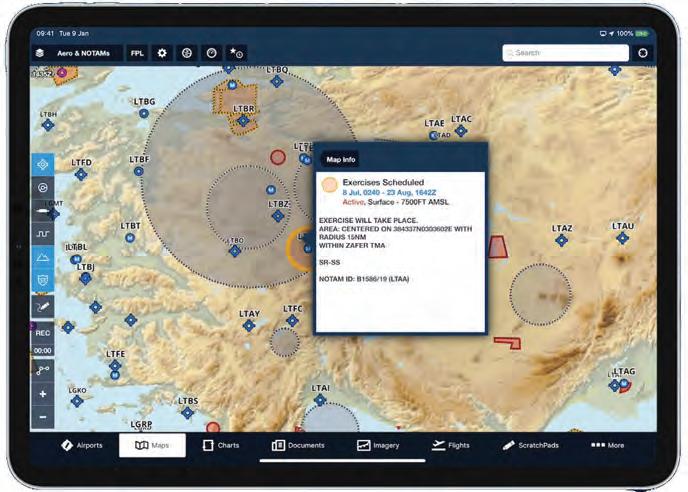
ForeFlight’s graphical notams in the map view help pilots view potential issues more easily than reading text.
Garmin’s SmartCharts within the Pilot app has helped pilots put this data into context since mid-2025, with its placement of notams at the top of the airport page, and on the map page in the lower right corner of the plan view. Now, Garmin’s new graphic notams overlay option—launched in November and available with a Premium subscription—makes visualizing the data that much easier. When selected, it depicts active runway, taxiway, and ramp closures, with added FICON (field condition) codes appearing on the runway label.
Closed runways and taxiways are color-coded red, while closed runways will show a yellow “X” at each end, just as you’d expect in real life. Conditional
ForeFlight’s graphical notams functionality got a serious expansion in August 2025, when its en-route notam depictions became supported globally. Color-coded based on type, severity, and active times, the notam warnings can also be filtered by type in the map settings. The marriage between Jeppesen and ForeFlight reached a new apex early this fall with
the acquisition and melding of the two former Boeing business units into Jeppesen ForeFlight. The relationship has been going on for some time—witness the evolution of Jeppesen’s FlightDeck Pro. Originally, the electronic flight bag application targeted for airlines and large flight departments was aimed as a digital chart viewer, but with the Pro X version, it has featured a display-notam tab since 2019, and more recently, a notam overlay option on a selected map—clear collaborations between the Jepp and ForeFlight teams now officially making a go of it together. With the confluence of an extreme volume of data, AI powering a slew of consumer and B2B apps to crunch it, and a more streamlined FAA pipeline to sluice it through, perhaps the days of wading through an ocean of notams—making so much white noise that it’s impossible to pick out the critical signals among them—will soon be as antiquated an operation as straining to listening to a Morse code dot-dash to identify a VOR station. z
HELPFUL SITES
Primary FAA notam site: https://www.faa.gov/air_tra c/flight_info/aeronav/Notams/
Notamresponsibilities guidance: https://www.faa.gov/air_tra c/ publications/atpubs/Notam_html/chap3_section_1.html
Obstruction Evaluation/Airport Airspace Analysis (OE3A): https://oeaaa.faa.gov/oeaaa/oe3a/main/#/home
Notam search: https://Notams.aim.faa.gov/NotamSearch/ Contingency notam site: Notambackup.faa.gov
BY AMY WILDER

AeroAngel founder Mark Pestal still remembers the flight that changed everything.
A young woman with terminal kidney disease, who’d been ill since childhood, had exhausted local treatment options in Denver. Her mother found a doctor at Johns Hopkins in Baltimore willing to help—but they couldn’t fly commercially, couldn’t afford a medevac flight, and couldn’t wait. Pestal, a private pilot and former volunteer with Angel Flight, called a friend with a jet. “He agreed to do the flight the next day,” Pestal recalled. “She was in very bad shape. But we got her to the hospital—and she walked out a month and a half later.”
That was more than a decade ago. Since then, AeroAngel has quietly grown into a vital link for children and young adults who need urgent, distant, and otherwise unreachable medical care.
Based in Denver and operating since 2010, AeroAngel is a 501(c)(3) nonprofit that arranges free private jet transportation for seriously ill children. Its patients may be immune-compromised, unable to tolerate long car trips, or too medically fragile to fly commercially. Unlike other aviation charities, AeroAngel’s flights are dedicated—they aren’t tied to airline schedules, donor availability, or open seats. “We don’t wait for a match,” Pestal said. “If I get a call this afternoon, I’ll try to get the flight filled, if we can.”
AeroAngel doesn’t operate its own aircraft. Instead, it relies on a growing network of private jet owners, corporate flight departments, and charter operators who donate flights, crew time, or charter hours. When
When 10-year-old Ava su ered a leukemia relapse in early 2024, she needed to get from Tampa, Florida, to Philadelphia for an evaluation and immediate CAR T-cell therapy. AeroAngel was able to arrange the trip within 48 hours, and she is now home and cancer-free.
no donated option is available, the organization taps an emergency flight fund to purchase time-critical charters.
These trips often come together within 48 hours. One such flight in 2024 brought 10-year-old Ava from a hospital in Tampa, Florida, to Philadelphia’s Children’s Hospital for evaluation in a leukemia relapse. It was too dangerous for her compromised immune system to fly commercially, and she was ineligible for an air ambulance. Ava’s doctors approved release from her local medical care, on condition that she could be flown privately to and from the hospital the same day. AeroAngel arranged the flight. Ava received cutting-edge CAR T-cell therapy. Today, she is home and cancer-free.
The average retail value of AeroAngel’s annual flight activity exceeds $2.5 million. “If [each] family had to get a charter flight, I mean, it’d be well over that,” said Pestal.
“We spend a million dollars a year on charter alone.”
In total, AeroAngel has completed close to 500 missions. “We’re probably north of 90% fulfillment on requests,” said Pestal, “but our goal is 100%.”
The landscape of aviation charity is broad—but most programs rely on donated flights in piston or turboprop aircraft, and many are limited by geography, schedule, or diagnosis. “The typical Angel Flight is under 1,000 miles,” Pestal said. “We’re doing flights across the country.”
Corporate Angel Network, for example, provides space-available seats for cancer patients on business jet flights. But complementary organization AeroAngel targets a di ff erent need—all kinds of
whose condition demands the safety and speed of pressurized jet transport.
“We do all medical issues,” Pestal said. “Surgery, chemotherapy, discharges. These kids just can’t wait—and they can’t go commercial.” He added that many children use wheelchairs, need reclining space, or require private environments to reduce infection risk.
One of AeroAngel’s aviation partners is FlyExclusive, which has operated more than 100 missions for the nonprofit since 2021.
“The little girl in their logo was actually on our first flight,” said Matt Lesmeister, COO of FlyExclusive. That inaugural mission launched the partnership, which now includes jet card hour donations, flight time from members, and direct operations
of the value of time—and what we provide.” Lesmeister, who joined FlyExclusive shortly after the AeroAngel partnership began, sees it as core to the company’s culture. “Private aviation is often seen as a luxury,” he said. “But it needs to go beyond just the high-net-worth individual. This provides access to children who need it— and likely can’t get it otherwise.”
AeroAngel’s team is lean: a flight coordinator, part-time contractors, a bookkeeper, and Pestal himself, serving as the full-time, unpaid executive director. “I pray a lot,” he joked about making the budget work.

“Some of our pilots have said their best flight ever was one of these,” Lesmeister added. “It leaves a mark. It reminds them
Requests come in through hospital social workers, Google searches, or word of mouth—often from families who have flown with AeroAngel before. A recent upgrade to the organization’s website added links for those interested in becoming a donor, an ambassador, or a corporate sponsor.
Looking ahead, Pestal hopes to secure funding for an aircraft: a light jet, like a Phenom 300, based in Denver, could allow AeroAngel to guarantee flights even more quickly. “We’d love to have a plane ready,” he said, “and then find a donor to back it up if needed.”
For the children who fly with AeroAngel, the flights are more than just transportation. “We’re not just getting someone from point A to point B,” said Lesmeister. “We’re giving back time—and access. And sometimes that access saves a life.”
He recalled a boy named Leo, who had no immune system and needed a cell transplant at Duke Health. “Without a private flight, there was no way to get him there safely,” he said.
Pestal hopes more industry members will recognize the potential impact of a single trip. “One donated flight can save a child’s life—and has,” he said. “That’s the power of business aviation.” z
BY KERRY LYNCH

When NBAA wrapped up its 78th annual Business Aviation Convention and Exhibition (BACE) in October in Las Vegas, much looked familiar. It had a static display with about 50 aircraft, a convention hall filled with a diverse set of exhibitors pushing their wares, an opening general session that featured famed country singer and aviator Dierks Bentley and honored aviation and business visionary Steuart Walton, and the wide range of receptions and celebrations.
Yet, for an association that is a veteran in the events business, the 2025 convention was also a time of “test and learn.”
“We were extremely enthusiastic about NBAA-BACE 2025 for several different reasons,” said NBAA president and CEO Ed Bolen. “I think there was an energy there that was palpable. We tried several new things,
and they seemed to be very well received and created opportunities for us to build upon.”
Jo Damato, senior v-p of events and professional engagement for NBAA, explained the changes, ranging from a “reimagined” set-up of the static display called “Aircraft Connection” to the addition of a “Military Connect” transition program.

“They were [developed] to meet the imperative of BACE as a community—a place where we wanted everyone to be able to find what was created for them; simply put, to help people find their people,” Damato continued. “That’s important for our exhibitors, our sponsors, our attendees, our volunteers, and our speakers. So, the test-and-learns that we created were done knowing that the feedback was going to be how we determined the path forward. We have done a lot of listening.”
Like so many other events, BACE, which has been an anchor for NBAA and the gathering place for the business aviation community, is facing the shifting tides of conventiongoers and, importantly, exhibitors.
Events such as BACE and its global counterparts—EBACE in Europe, ABACE
in Asia, and LABACE in Latin America— have not only connected people but have served as a central location to show off aircraft, parts, and services to potential customers, and to interact with vendors and the greater community within their respective regions. However, in recent years, they have faced challenges.
Long-time attendees and industry leaders, such as industry analyst and data specialist Rolland Vincent and aircraft broker Jay Mesinger, pointed out that many of the changes came as Covid reshaped how people interact. And, it sped up those changes with the manufacturers.
“This is an issue that has been front-andcenter with the big trade associations and, of course, the OEMs for several years,” said Vincent, president of Rolland Vincent Associates. “As with many other industry and societal trends, Covid has been the underlying great accelerator.”
Mesinger pointed out that several things happened during Covid: the industry grew—unpredictably—while the high-net-worth-individual population swelled. Yet the corporations weren’t flying. With the onset of Covid, many events were cancelled. The OEMs kept selling and making airplanes, but they needed to find a way to reach out to the buyers, Mesinger said. “We’ve created some new methods of getting in touch with these people.” OEMs and other companies instead stepped up their activities surrounding private events. And there, they found substantial success.
Aviation businesses already felt the strain of the expense of exhibiting at the major business aviation gatherings, as well as the other events—the Paris Air Show, Dubai Airshow, and Farnborough Airshow, among them. Private events enabled a contained audience and controlled costs. This altered strategies at companies, particularly the OEMs, which instead focused on their own events but also tried out new or

PRESIDENT,
different events to reach untapped or different markets.
Aero Friedrichshafen, for instance, long thought of as a light general aviation show rather than a business aviation convention, increasingly became more attractive as it opened a door to the Central European market. Dubai provided a gateway to a potentially lucrative Middle East market, as well as the growing defense markets where business aviation is finding increasing success.
Shows such as ABACE disappeared altogether, leading some manufacturers to find their way to Singapore before experimenting with newcomers Aero Asia in Zhuhai, China, which held its second edition last
year, and the inaugural Business Aviation Asia Forum & Expo in Singapore. And of course, Paris and Farnborough have always attracted defense businesses. In Latin America, shows such as the Catarina Aviation Show in Brazil began to gain steam.
And then came the May 2023 security breach, where anywhere between 80 and 100 protesters cut through the fence at Geneva Airport in Switzerland and entered the static display at EBACE. Seven protestors handcuffed themselves to a Gulfstream—three attached to the nose gear and four on the jet’s cabin entry door handrails. Others secured themselves to other aircraft.
Vincent pointed out the magnitude of the moment. “I was actually on the ramp just moments after the protester attack at EBACE, a moment when you-know-what hit the turbofan. It was shocking to witness, and in some ways a signal of the end of an era,” he said.
EBACE organizers increased the protections the following year, but neither Gulfstream nor Bombardier exhibited despite

stepped-up security. However, neither cited security as their reason for opting out, instead highlighting their strategic decision to focus on other events.
Then NBAA sold its stake in EBACE, leaving the European Business Aviation Association (EBAA) as the sole show manager. The parties never fully explained the split, but it came at a time when EBAA was increasing its voice in Europe, and the move enabled it to highlight this activity.
But aside from the protestor breach, EBACE was already facing complaints about it being staged only in Geneva, which many found an expensive show. European operator Luxaviation in 2019 publicly withdrew from EBACE, citing the high costs involved with the show.
All of this has been colliding with larger macro events. “The value of the Big Box trade shows is no doubt linked to economic and business cycles. With new business aircraft order backlogs at twoplus year levels—and inflationary events and travel pricing attracting management attention on marketing expenditures—it is difficult to say that there is much nearterm ROI to be had right now,” Vincent pointed out. “Elevated security and personal health and safety concerns (remember Covid?) are coinciding with the very high costs and risks of having aircraft demonstrators onsite at an event in which there can be too many uncontrollables.”
But for Vincent, this is not a fait accompli. “This feels like the pendulum has firmly swung in one direction, but things change, and this too shall pass. Change brings opportunity and pressure to innovate. We are already witnessing examples of this happening at EBACE and NBAA-BACE in particular.”
Once EBAA and NBAA ended their decades-long partnership in August 2024, EBAA recommitted that there would be an EBACE in 2025. The event, held in May 2025, was significantly scaled down with
no static display, no press conferences, and large networking “lounges” and topical stages strategically placed throughout a downsized footprint where exhibitors once occupied the space.

STEFAN BENZ CEO, EBAA
For EBACE 2026, our goal is to build on that foundation and ensure the city’s strengths, its accessibility, professionalism, and global outlook are used to their full potential.
The networking lounges proved a success, drawing the European business aviation community and beyond together, and the range of topical sessions often brought standing-room-only attendance to the three stages. The buzz of the show became where would EBACE be held next; EBAA officials were holding discussions about potentially moving the show, or at least rotating it.
However, after EBACE, EBAA went through a leadership change with the departures of secretary-general Holger Krahmer and COO Robert Baltus, and the appointment of Stefan Benz—a former Luxaviation executive—to lead the organization.
In the weeks following, EBAA made an announcement that surprised some— EBACE would return to Geneva. Further, it was bringing back the static display. But it would adopt an every-other-year approach for alternating locations.
Benz told AIN, “We’ve been pleasantly surprised by the positive and supportive reaction to EBACE remaining in Geneva with a static display. Switzerland remains the center of business aviation in Europe, and Geneva combines outstanding connections, a strong financial ecosystem, and a clear appeal to the industry’s end users.”
Benz further maintained that, in the past, the true value of Geneva was not fully realized. “For EBACE 2026, our goal is to build on that foundation and ensure the city’s strengths, its accessibility, professionalism, and global outlook are used to their full potential.”
But he recognized the importance of EBAA focusing on evolving the show. The organization wants to take a holistic view of the event, he said. “There was a wish for change.” He pointed to the slide over the past couple of years in visitors and the movement toward more of a classic B2B environment and networking-focused event, rather than also serving as a B2C, client-based event.
This movement, along with the shift of EBAA as the sole host of EBACE, prompted a review of “what do we want to do,” Benz said. While NBAA is no longer a part of hosting the event, Benz stressed the ongoing cooperative relationship the organizations maintain as they both advocate for the business aviation community.
In charting a path forward, EBAA gathered feedback from exhibitors and other stakeholders and found a desire to return more to an event that draws clients, whether high-net-worth individuals, family offices, or others involved in business aviation, he said.
Logically, he continued, that was a driver for OEMs to exhibit and, as a result, for a return of the static display. However, Benz



EBACE26 marks a decisive step forward, bringing fresh energy and opportunity to the global Business Aviation community. The static display returns in a new dedicated location at Geneva Airport, designed to deliver the most secure, fexible and customer-focussed aircraft showcase in the event’s history.
Coupled with Geneva’s well-connected ecosystem, nowhere else in Europe brings together this calibre of key stakeholders, infuential customers and industry associations.
Be part of the new experience.
Find out more at ebace.aero

added, EBAA is considering only holding the static display when EBACE is held in Geneva every other year. This appears to be more in line with the preferences of OEMs, which are working to spread their activities among multiple shows in a given year, he maintained.
At the same time, Aero Friedrichshafen is leaning into the business aviation community. Aero Friedrichshafen had grown into Europe’s largest general aviation show, having attracted everything from experimental and novelty up to turbine aircraft. In 2025, however, the show opened a business aviation dome to extend the reach into the full scope of the sector and attracted interest from the largest business jet OEMs and their suppliers as they looked to tap into the Central European market. This helped fill a void left by the lack of a static display at the 2025 EBACE.
Speaking at the Irish Business and General Aviation Association’s fourth annual International Business Aviation Conference (another upstart event growing in popularity), Dennis Schulz—Aero Friedrichshafen’s project manager of international sales in EMEA, North America, and China—gave a glimpse of the plans for the 2026 show. He noted that organizers are paving the way to accommodate substantially more exhibitors and aircraft on static display next year.
He noted that in 2025, the organization had to turn away displays. “We simply just ran out of space…There were just so many inquiries.” The organization had set up a 2,000-sq-m (21,500-sq-ft) dome adjacent to the exhibition Hall A1 at Messe Friedrichshafen to host the business aviation activity. But organizers quickly discovered it was not big enough, so they are doubling the dome size for the 2026 event.
In addition, organizers are opening up Hall A1 to business aviation to provide even more space. “We realized that the dome alone will not accommodate the business aviation community,” Schulz added.

Business aviation exhibitors are already lining up for the space, with many returning from the 2025 show. They include most of the major business aircraft OEMs such as Bombardier, Textron Aviation, Gulfstream, Pilatus, Dassault Aviation, Daher, Piaggio, and Honda Aircraft. “As you can see, our show is growing,” Schulz concluded.
Aero Friedrichshafen organizers say the goal is not to replace EBACE, but rather to complement the pure-play business aviation convention. Whether this will have an effect on EBACE and its static display remains to be seen.
NBAA also mixed up its static display at Las Vegas Executive Airport in Henderson, Nevada, again hoping to make it more attractive for a steady stable of OEM exhibitors. As part of the test-and-learn mantra, it shortened the renamed Aircraft Connection availability to a day and a half, eliminating large chalets to provide views all around, and planning a “golden hour” celebration to draw attendees. Unfortunately, the golden hour was canceled for
high winds, but it was clearly embraced by attendees.
Not only were these changes designed to draw attendees to the static, but they also provided a little relief for the manufacturers with less time they would have to keep aircraft on the ground and out of operation. Additionally, NBAA tried something new: a family-office time to attract key buyers, again moving back to a B2C environment.
These were among the myriad changes with the association looking at the critical needs of the industry, including the workforce. To that end, it introduced a Military Connect day, to go in tandem with its Collegiate Connect and Career Zone, featuring multifaceted programming.
In addition to its traditional safety programming that not only bookends the convention but is threaded throughout, NBAA built on its educational programming and professional development courses, highlighting a range of topics from maintenance to legal, regulatory, and airports. These sessions provided learning opportunities for the gamut of industry professionals, from flight attendants and pilots to corporate flight department leaders.
April 22 – 25, 2026
Friedrichshafen, Germany
Halls A1 – A3, Dome, Static Display




These were among the many changes, some subtle and some substantial, made at the most recent BACE. “We’ve been looking at the survey results, and what we’re seeing as overarching themes are an imperative on education,” Damato noted.
But most of the changes have drawn positive reviews. “None of our test-andlearns came back with the results that you should throw that away,” she noted. Importantly for NBAA, which hosts an array of events throughout the year, it is seeing which efforts might be portable to its other gatherings.
Key to all of this in the future, Damato believes, is helping shape the experience for attendees. “We wanted to create energy, create a cohort opportunity, and a way for people to focus their journey so it didn’t feel like ‘Here’s the whole apple, figure out how to eat it,’” she said. “We wanted to try to curate for them how they could approach it. That is how we’re going to drive 2026 and beyond with the volunteers and the staff members.”
Damato added that the association has received strong feedback on increasing networking opportunities in addition to
educational sessions, and conversations for 2026 have already begun.
Early feedback also has been positive surrounding the Aircraft Connection—“that was a huge evolution for us,” she said. “There were so many benefits to everyone involved with this. It allowed the exhibitors to be more surgical with their time on the ground of the aircraft and with the staff needed to support it. It allowed us to drive some other activities like focusing on the food trucks, the shuttle buses, and experiences such as the Tribute to Flight pavilion, housing historic aircraft.”
The elimination of large chalets “created that community atmosphere that is so popular at our regional forums and brought some of that energy and that feeling to this event. So definitely we have feedback to continue to evolve this,” she said, but like the other new features, that has been “a good job...keep going.”
The changes may be critical for the associations. “For the OEMs and the trade association event organizers, the latter who depend on these events to fund a significant portion of their operating budgets, the $64 million-plus question around

the table is: How do we attract real customers to these events?” Vincent asked. “With bizav continuing to spread its wings internationally, emerging customers will expect to experience firsthand the latest technologies on offer. In this environment, no OEM will want to be conspicuous by their absence.”
Mesinger is seeing signs that the pendulum may be ready to shift. “We are just now getting back to a place where the OEMs are saying, ‘You know what? It is important to stand on a tarmac next to our competitors and let our customers come and go from one to the other,’” he said. “I think the manufacturers are starting to say, ‘We need to get this going again.’ And this last show in Vegas was sort of the beginning of that in a small but important way.”
The key question is how to accomplish those goals, and he pointed to NBAA’s first effort to specifically host family offices. While a small start and new phenomenon, Mesinger noted how this presents a new opportunity. “Hopefully that’s going to grow every year.”
Perhaps what gets lost in the business of conventions and exhibitions is the networking that EBACE and NBAA are trying to grow. For many conventiongoers in the business aviation community, this has been a key attraction for them.
“There is a tremendous desire for networking opportunities, connection opportunities, and thought leadership, and I think what we have at NBAA is an ability to bring different cohorts together and to make a big event,” Bolen said. “We have the opportunity help people find ways to have a big event become small and intimate at times, but also feel the energy and the scope of the entire industry.”
For Mesinger, this is possibly the most important aspect of attending the convention. “I think magic occurs when we get together. And I’d hate to think of an industry without magic.”

AINalerts delivers the news and intelligence that directors of aviation, chief pilots, flight department leaders, OEMs, MROs, and industry executives need to stay ahead. Trusted reporting, exclusive analysis—delivered straight to your inbox Monday through Friday.



BY JENNIFER MESZAROS

Business jet operator Sino Jet plans to build vertiports at its FBO network to accommodate eVTOL aircraft such as the Aerofugia AE200.
As Southeast Asia’s commercial aviation sector charts an uneven recovery from the pandemic, its business aviation market is demonstrating robust, albeit constrained, growth. Driven by new wealth and corporate demand, the sector’s growth metrics highlight a market still in its formative stages relative to the region’s economic weight.
The numbers reveal both the momentum and the scale of the opportunity. Speaking to AIN, Adam Cowburn, managing director at Alton Aviation Consultancy in Singapore, said regional business jet departures have grown at a compound annual rate of 7.8% since 2019. He identified Thailand and Vietnam as the leaders of this expansion,though from different starting points.
“The number of business jet departures in Thailand has more than doubled since 2019. Don Mueang International Airport in Bangkok remains the second-busiest business aviation airport in Southeast Asia with approximately 2,700 departures per year,

ADAM COWBURN MANAGING DIRECTOR AT ALTON AVIATION CONSULTANCY IN SINGAPORE
behind only Singapore’s Seletar Airport with approximately 4,000. Vietnam has also experienced low double-digit growth— an 11% CAGR—since 2019, though off a much lower base.”
According to Cowburn, the larger, established country markets—Singapore, Indonesia, Malaysia, and the Philippines—have seen steadier, mid-single-digit growth since 2019, with a recent modest pull-back from peak post-Covid levels. Each records more than 2,000 annual departures. The concentrated activity, however, represents only a fraction of global demand.
Cowburn noted that despite being home to about 8% of the world’s population, Southeast Asia accounts for a mere 0.6% of global business jet departures.
On the commercial side, he noted that the recovery from the pandemic is strikingly uneven across the region. While global commercial aviation capacity recovered to pre-Covid levels by 2024, Southeast Asia presents a mixed picture.
“Vietnam (24.0% above 2019 levels, as measured by available seat kilometers), Singapore (5.5% above), and Malaysia (1.2% above) have now recovered to their preCovid levels of commercial aviation capacity,” he said. However, several key markets continue to lag.
“Cambodia (40.4% below 2019 levels), Indonesia (8.3% below), Thailand (7.1% below), and the Philippines (2.1% below) have yet to fully realize a postCovid recovery.”
Cowburn attributes a significant portion of the shortfall in Cambodia and Thailand to a sharp drop in Chinese tourists, linked in part to personal security concerns in those destinations. A universal challenge across all segments, he adds, remains the production of new aircraft.
“Supply-chain constraints impacting the ability of aircraft manufacturers to deliver aircraft continue to hamper capacity expansion in Southeast Asia, as it does in the rest of the world.” The shortfall, according to the Association of Asia Pacific Airlines (AAPA), amounted to an estimated global deficit of more than 5,200 aircraft deliveries in 2025.
“While passenger and cargo demand remains strong, persistent supply challenges could restrict airlines’ ability to meet the expectations of travelers and businesses alike,” AAPA director general Subhas Menon said at the association’s Assembly of Presidents in Bangkok last November. He further warned that renewed trade tensions and tariffs threatened to increase costs and disrupt the fragile recovery of aviation supply chains.
Compounding the delivery shortfall, maintenance bottlenecks also persist, with component and labor shortages extending
turnaround times. Nevertheless, Menon struck an optimistic note for 2026, citing robust demand, strong economies, and favorable demographics underpinning Asia-Pacific commercial aviation’s positive outlook.
Still, in an environment of scarcity, business aviation in Southeast Asia is often viewed as a secondary consideration.
“In most locations around the region, business aircraft are frequently competing with commercial aircraft for space— runways, parking aprons, airspace, et cetera—while airport business models and infrastructure investments are typically focused on optimizing commercial airline passenger throughput,” Cowburn said.
For established operators, navigating these structural hurdles is a daily reality, said Jenny Lau, vice chair of the Hong Kongbased Sino Jet Group, who also serves as vice chair for the Asian Business Aviation Association. Among the most pressing issues, she said, are the twin challenges of a shrinking talent pool and intense competition for infrastructure access.

JENNY LAU VICE CHAIR OF HONG KONG-BASED SINO JET GROUP AND ASBAA
“First, the shortage of skilled professionals and rising labor costs have become core challenges to the industry’s sustainable development,” Lau told AIN . “This challenge is not only financial—it also concerns whether service quality and safety standards can be consistently maintained at a high level over the long term.”
“Additionally, capacity and access constraints at key infrastructure points are becoming increasingly pronounced. At peak times, access to business jet slots, premium parking, and fixed-base operations (FBO) services at major Southeast Asian airports is nearing saturation. Securing stable and prioritized infrastructure access has become essential for ensuring customer experience and operational efficiency—and represents a new dividing line between operators of varying scale and capability.”
Despite industry pressures, Lau points to Sino Jet’s scale and global operations network as key advantages. She said the group maintained its status as the AsiaPacific’s largest operator in 2025 for a sixth year, with a fleet of more than 40 aircraft, and is the sole Chinese leader with steady fleet growth. This scale is paired with a targeted fleet strategy where more than 95% of jets are large-cabin, including what the company describes as the world’s largest managed fleet of Gulfstream G650 aircraft—surpassing 20 units—alongside next-generation models like the Bombardier Global 7500.
According to Lau, this asset base supports a service model built for clients who prioritize cabin comfort, direct long-range travel, and full-life-cycle asset management. At the core of Sino Jet’s strategy is what the company calls the “Business Jet+” ecosystem—a shift from being a “flight service provider” to a “curator of lifestyle,” powered by data-driven insights that connect flights with bespoke luxury experiences.
“We are observing a new generation of entrepreneurs and high-net-worth individuals whose service expectations are distinctly di ff erent,” Lau said. “They prioritize the uniqueness of experiences, cultural depth, and emotional connection over traditional brand recognition. These clients are the core drivers of the demand for ‘personalized enrichment’ and are the most engaged participants
and beneficiaries of our Business Jet+ ecosystem.”
Looking ahead, Lau stated that 2026 priorities include advancing digital intelligence and deepening partnerships to ensure seamless alignment from sky to destination. Concurrently, the company is placing a strategic bet on future mobility, having recently signed a definitive agreement to purchase 50 AE200 eVTOL aircraft from Aerofugia, with the aim of evolving its FBO network into vertiports to integrate long-range jets with last-mile electric air travel.
The focus on digital integration, data, and next-generation assets signals a broader consolidation of strategic and financial leadership currently taking place in Singapore, a trend highlighted by Hui Ling Teo, founder of Beyond Horizons, a specialized legal service delivered by Bethel Chambers.
“Singapore is quietly emerging as an underrated nerve center for aviation leasing, driven by the structural reality that Asia-Pacific will absorb the bulk of new commercial aircraft deliveries over the next decade,” she said. “What is shifting is not just geography, but decision-making gravity.” Teo points to the city-state’s unique combination of lifestyle appeal, tax clarity, legal certainty, and a deepening talent pool across aviation finance, engineering, analytics, and law.
“That mix is increasingly resonating with senior executives who want their teams close to growth markets without sacrificing stability or quality of life.”
According to the Singapore-based lawyer, the sector is also attracting new forms of investment, while the definition of risk is rapidly evolving.
“At the same time, as concerns around an AI valuation bubble grow, aviation is benefiting from renewed interest as a datadriven real-asset play,” Teo observed. She explained that analytics first deployed

for sustainability—tracking fuel burn and emissions—are now being used to optimize yields, predict maintenance, and price risk more dynamically.
“Aviation is particularly compelling because it is a mobile infrastructure asset: consumables, repairs, engine health, and location tracking all feed into monetization models in real time. Investors are increasingly curious about adjacent parts of aviation—leasing, engines, maintenance, and data platforms—because the asset class behaves like infrastructure: long-dated cash flows, heavy capex, regulated interfaces, and strong links to sovereign and trade policy.”
The risk landscape is expanding into territory the industry has not historically mapped. While geopolitics and sanctions exposure are now factored in, Teo notes that “risks around airspace fragmentation, severe weather events—such as recent turbulence incidents—and even satellite interference and communications jamming are becoming material considerations.” Singapore’s strength, she suggests, lies in integrating legal, technical, and insurance responses into coherent operating frameworks.
Meanwhile, alternative fuels and propulsion technologies are reshaping who is investing in aviation. Sustainable aviation fuel (SAF) platforms, hydrogen concepts, and electrification initiatives are pulling in infrastructure funds, energy players, and climate-focused capital that previously sat outside the sector, she added.
Teo’s remarks come amid findings from a 2025 study that quantifies the region’s supply potential. The report, Promoting the Production of Sustainable Aviation Fuels from Agricultural Waste in the ASEAN Region, was led by the Association of Southeast Asian Nations with support from Global Affairs Canada, Boeing, and other partners. It projects Indonesia, the Philippines, Thailand, and Vietnam as net SAF exporters by 2040 using deforestation-free agricultural waste, and envisions a supply chain with Singapore’s Neste-operated refinery as a pivotal hub alongside facilities in Japan and South Korea. z





BY CURT EPSTEIN

Among the industry’s annual rites is the State of the Industry review, where the General Aviation Manufacturers Association (GAMA) reveals the prior year’s delivery numbers for the broad swath of the business and general aviation industry. Widely followed by analysts, this report is one of the key metrics of the general health of the industry.
Coming into the fourth quarter, business jet deliveries were already up 10% in 2025 to 554, and billings were up by more than $2 billion to $19.4 billion.
This is setting the stage for a solid finish, and if Embraer is a harbinger of what is to come, the Brazilian OEM finished 2025 in strong fashion with its executive jet division handing over 155 aircraft for the year, its
highest tally in 15 years and exceeding its previous year’s total by 25 deliveries.
Results such as this come as no surprise. In their 10-year business jet delivery prognostications released later last year, Honeywell Aerospace and JetNet both agreed on steady growth ahead for the industry, taking into account the latest economic data, buying trends, announced OEM backlogs, and new aircraft under development.
These prognostications are not an exact science, as the forecasters themselves would readily admit. Unexpected factors such as geopolitical unrest, economic downturns, or even global pandemics can impact those results in ways the analysts can only guess at.
In late 2023, Honeywell predicted that business jet deliveries for 2024 would surpass the 800-unit mark for the first time since 2019.
That proved overly optimistic; GAMA closed the book on 2024 with a total of 764 private jets delivered. Subtracting the single-engine “personal” Cirrus SF50 Vision Jet—which Honeywell does not count in its annual forecast—the number of deliveries dipped to 663 in 2024, indicating some bottlenecks lingering in the supply chain as a result of the global pandemic.
Honeywell’s latest forecast, presented on the eve of NBAA-BACE 2025 in October, predicted finishing 2025 with the OEMs handing over 740 business jets (again, excluding the personal jet category). If
borne out, it would represent the highest delivery tally for the segment since 2019.
The Honeywell forecast called for business aviation OEMs to deliver 8,500 business jets over the next decade.
While that volume remains unchanged for the past four years as OEMs wrestled with post-Covid supply-chain recovery, the report predicts an increase in value to $283 billion for those aircraft, the highest dollar amount in the history of the survey. Of that amount, two-thirds of the value is expected to be on the largecabin jet segment, according to Honeywell’s calculations.
“I would say starting in 2023 to 2024, and now this year, we’re seeing improvements across all supply chains, ourselves definitely, and you see this in the actual output of OEMs too, where they’re increasing [deliveries],” said Kevin Schwab, strategic planning manager for Honeywell Aerospace. “If you look at OEM guidance, and how we’re doing so far this year in terms of deliveries, I think we’re actually kind of climbing out of this period and starting to deliver the amount of jets the industry needs.”
For 2025, JetNet forecasted deliveries of approximately 820 business jets, up 8% from last year’s total. If that prognostication bears out, that would make it the first year since pre-pandemic 2019 where deliveries surpassed the 800-unit plateau, and only the second time since 2009 at the start of the global economic downturn. JetNet does include the diminutive Vision Jet in its calculations, and last year Cirrus delivered more than 100 of the single-engine jets.
Through 2034, JetNet’s forecast calls for deliveries of 9,700 private
jets—on track with Honeywell’s when the anticipated 1,000-plus Vision Jets are subtracted—worth $335 billion in 2025 dollars.
Despite the trend of rising deliveries, backlogs among the “Big Five” OEMs—Bombardier, Dassault, Embraer, Gulfstream, and Textron Aviation—have continued to rise over the past year.
“We’re seeing very persistent backlogs of over two years of production, which is a really nice place to be,” said industry consultant Rolland Vincent, “but frankly, from an OEM point of view, you want to start turning that backlog into more cash. We could probably easily be doing 1,000 airplanes this year as an industry, and even for a sustained period.”
We’re seeing very persistent backlogs of over two years of production, which is a really nice place to be...
— Rolland Vincent creator of the JetNet iQ survey
For 2026, Honeywell’s forecast calls for a 5% increase in deliveries over 2025. “In 2026, we’re expecting to be about 8% above [pre-pandemic] 2019 in terms of units, and because of the larger portion of large jets, now in 2026 we are expecting to be almost 25% up versus 2019 in terms of value of the aircraft that are being delivered,” Schwab told AIN
Since 2019, fractional operators have seen more than 65% growth, with their fleets now totaling roughly 1,300 aircraft. Demand for the segment has spurred the industry growth, led by the midsize and super-midsize business jet segments.
In the near-term of the forecast, the predicted mix of geographic locations for aircraft deliveries is 71% to North America, 14% to Europe, approximately 7% to Latin America, Asia-Pacific 5%, and 3% of jet deliveries will go to the Middle East and Africa. Schwab noted that North America will account for 69% of the aircraft value due to its more diverse fleet.
“There’s a higher portion of what I would call regional travel, so the value of the jets that are being delivered to North America is a bit lower than the units, and this is just because we’ve got more light jets, basically,” Schwab explained.
That contrasts with regions such as Asia-Pacific and the Middle East, which are expected to account for higher percentages of large jets in their mix due to geography and their distance to world financial centers.
For the 10-year forecast window, Honeywell anticipates an average 3% annual growth, with the market split fairly evenly between small, midsize, and large-cabin/ ultra-long-range jets.
It does not see a return to the heady pre-global financial meltdown era and its more than 1,300 aircraft deliveries in 2008, but it does see steady growth, particularly reaching into the 2030s. “What we are expecting to happen in the latter term of our forecast is to get closer to that number and then be sustained,” said Schwab. “While we may not get to the peak of where we were, we suspect we will get to about 900 aircraft a year, and that will be the new normal, and then you will have growth on top of that.”
“Over the next decade, we expect these record-setting levels of deliveries and usage to continue,” he concluded.
Volatility was the best word to describe the state of the business aviation market, according to Vincent. Speaking at NBAABACE in October, Vincent explained that while factors such as geopolitical risk and tariffs are driving some discomfort and uncertainty among aircraft buyers, the demand signals are still very strong.
To further illustrate that demand, Vincent examined the on-market inventory of many popular preowned aircraft models and found most with a handful available. “We’re in a strong demand market, tight supply,” he noted. “If you’ve got one of these for sale, you are in a very strong pricing position.”
According to Vincent, issues that have restrained the industry over the past several years still persist. “We continue to have, after all these years, supply-chain, supplier, talent experience, and talent pipeline issues,” he stated. “So, we have a really nice backlog, well-priced deals of course, if you are the seller, but we’re still not getting over the supply challenge.”
Financial analyst Jefferies—citing results from its most recent survey—reported that aircraft brokers are no longer citing geopolitical risks as a market driver, where 27% noted those concerns in the June survey. However, brokers (44%) are now worried about the possible economic slowdowns in key markets, as well as long lead times and supply-chain issues (22%). High-net-worth individuals are anticipated to lead the market this year, with the entertainment sector and government demand coming in weaker.
In December, 1,124 aircraft were available for sale, representing 4.4% of the total fleet. This is down 11% year over year and 5% from June.
The 4.5 million global business jet and turboprop flights through September of last year represented a 3.7% increase over 2024, with North America accounting for 67% of that activity, according to Christoph Kohler, founder and managing director of JetNet subsidiary WingX. That increase represents part of a larger overall
step-change in flight activity since the pandemic. Since 2019, flights have increased by 33%, rendering this past summer’s activity the busiest on record.
WingX examined the U.S. cities with the fastest-growing millionaire populations and found that they closely aligned with areas showing the largest increases in private jet activity. The Southeast experienced a rise of more than 46% since 2019, followed by the Southwest at 33%. While weekend leisure activity is growing, the company also found that weekday travel has seen a slight decrease compared with historical data.
Corporate flight department activity has declined, but according to WingX, it has not been eliminated; it has merely migrated to the fractional segment. The company has developed an algorithm that it says can predict flight-hour activity by business sector, based on stock market prices.
In Europe, it noted that many factors have combined to mute growth, including the war in Ukraine, economic stagnation, political instability, and environmental activism. z





JULY 15 - 17, 2026
“The AIN CALS event has been a refreshing experience for leaders within the corporate aviation community and the vendors that support their businesses. 100% engagement for 2.5 days. Truly a working event that leaves us all a bit tired but very enthused!”
– CALS FLIGHT DEPARTMENT ATTENDEE
“The AIN CALS event provides excellent opportunities for high level interaction between vendors and clients. The one-on-one time and small group sessions are very valuable settings.”
– CALS SPONSOR
BY MATT THURBER
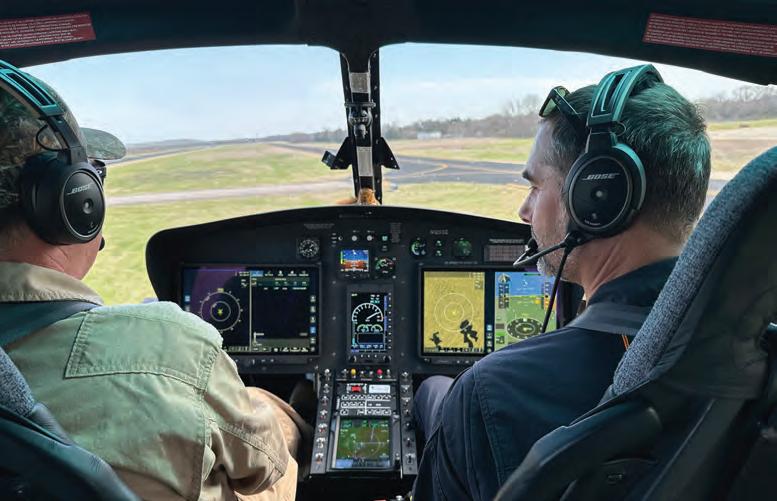
Introduced in 2021, the Thales/ StandardAero StableLight autopilot is the first four-axis autopilot for light helicopters, and the two companies have targeted the popular Airbus Helicopters AS350/H125 AStar as a large market opportunity for the upgrade. The autopilot received FAA supplemental type certificate (STC) approval in late 2023.
Heli Austria is the European launch customer and will install the autopilot once EASA validation of the U.S. STC is completed. StableLight is also approved by Transport Canada, Brazil’s ANAC, and Mexico’s AFAC.
Unlike helicopter autopilots that are adapted from fixed-wing products, the StableLight autopilot derives from fouraxis autopilots designed for larger IFR helicopters such as Sikorsky’s S-76 series.
The StableLight autopilot incorporates stability augmentation without feedback in the flight controls, according to StandardAero. Features include stabilized climb, flight attitude recovery, auto pull-up terrain avoidance, approach to hover, groundspeed hold, and other typical helicopter autopilot modes such as GPS nav and lateral and vertical approach. The autopilot also has protections such as coupled collective power limiting.
“There is a lot of interest,” said James Sleigh, Thales engineering test pilot, avionics systems. “The feedback has been excellent with everyone we’ve flown and engaged on it.”
Sleigh explained the development of the StableLight autopilot as a “descendant of our Part 29 IFR single-pilot autopilot,” which is installed in the S-76D.
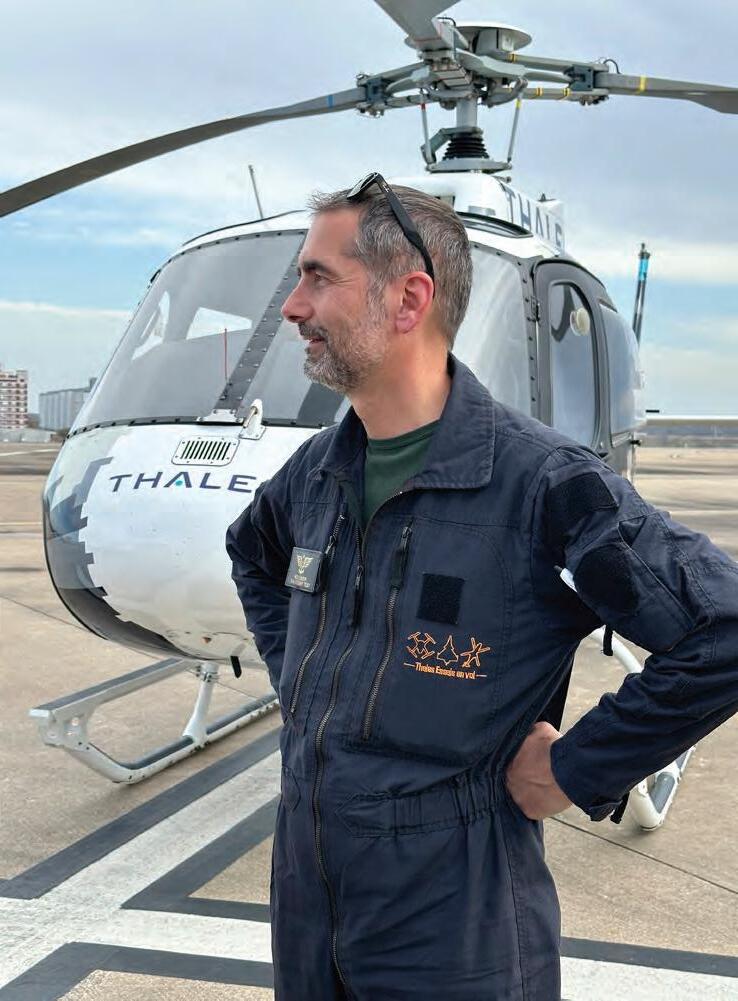
Light helicopter pilots who have flown with autopilots, but not a heavier machine such as the S-76, likely were exposed to what Sleigh refers to as “outer loop” autopilots, typically two-axis configurations. “By outer loop, I mean an autopilot that physically moves the flight controls in your hand, and it’s very simplistic,” he said. “You can engage heading hold, and you can engage an altitude or airspeed on pitch. And those are great; they obviously reduce workload, but their performance is limited to the actuation and the design that they have.”
Moving the cyclic with an actuator can be counterproductive in some cases, he explained. “How does an autopilot that has to move the stick truly help a pilot in a high-demand operation such as hovering, or in long lining, or in precision flying where the pilot is very attentive or is


very precisely controlling the aircraft?”
A two-axis autopilot controls pitch and bank, and the third axis adds yaw control. Four-axis autopilots in helicopters take on collective control, which manages power in a helicopter, enabling full control in a fairly wide operating envelope.
A goal of the Thales/StandardAero team was to develop a four-axis autopilot that could be installed in a variety of helicopters, no matter what kind of avionics are onboard. “We’re cockpit agnostic,” he said. “One of the design rules for the philosophy of our autopilot was we don’t want to demand a customer have a specific existing avionics configuration or that they install a glass display. For instance, you can buy a Garmin autopilot, but you’d better have a GTN [navigator] or a G500 [display]. Our mandate was that a [customer] may have a KCS 55 mechanical horizontal situation indicator (HSI) and an Aspen display and want to use our autopilot, or even have steam gauges. That was the design philosophy of making it standalone and cockpit agnostic, and divorced from relying on integration into an electronic display for things like targets, for mode annunciation, and that kind of thing.”
The StableLight autopilot includes a control panel and a Mid-Continent Instruments and Avionics Flex MD23 2-inch instrument as the mode annunciator.
The one control that StableLight retains for all installations is a heading select knob, which is a universal avionics convention, whether the HSI is mechanical or a glass display.
While the StableLight autopilot has a stability augmentation system (SAS) mode with rate damping, which is used for flying sling loads or other utility work, the normal mode pilots would use is ATT or attitude mode. In this mode, the pilot is still hand-flying but using movements of the beep trim button on the cyclic to make
small changes in pitch and roll, or the collective button for yaw and collective control. In ATT mode, the autopilot will hold the helicopter in whatever attitude it is in when the pilot lets go of the controls.
“The idea is that if I set the aircraft in a 5-degree left bank, 2 degrees nose up, and I let go, it’s going to hold that attitude,” Sleigh said. “If we get a gust or a disturbance, perturbation, it’s going to bring it back to that attitude.” To make a change using the flight controls, the pilot simply presses the force-trim release button, moves the control, then releases the button.

The flight director modes act similarly. Instead of setting a selectable altitude, target airspeed, or vertical speed as on a traditional autopilot, StableLight allows the pilot to fly to the desired altitude, airspeed, or vertical speed, then select a mode on the control panel and let go of the controls, and it will hold that target. This can be done with small changes using beep trim or large changes using the flight controls while pressing force-trim release.
“To pull into a climb, engage vertical speed, and it’s going to hold that vertical speed,” he said. “Then use the beeper to make fine adjustments. If the altitude isn’t exactly where you want it, the airspeed isn’t within a knot of where you want
it, you can use [beep trim] to make fine adjustments. That’s the way we’re teaching that, to use gross adjustments by hand, fine adjustments by beep.”
While this applies to the VFR version of StableLight, there is an IFR version that does have an altitude select and level-o ff feature, but that is easier to incorporate in a particular avionics suite for IFR operations. In any case, StableLight embodies the concept of pilot-in-the-loop during autopilot operations.
As a flight test engineer, Sleigh looks at autopilots as “outer loop” or “inner loop,” depending on how they work. An outer loop autopilot has actuators that directly move the controls, generally the cyclic and pedals (in a three-axis autopilot). “That’s a totally viable means of inputting autopilot commands to the system,” he said.
“However, what you’ll find on more complex IFR helicopters and our autopilot is we have a series actuator, an inner loop actuator, and this provides inputs between the pilot’s hand and the swashplate. In essence, it’s adding and subtracting control inputs from my hand position to the final input to the swashplate, thereby putting in—transparent to the pilot—high-rate, limited-authority autopilot inputs into the flight controls.
“So what does that do? It allows me to turn on SAS and fly a precision task—say, a precision hover task. And that autopilot is working in the background to bring a much higher degree of stability to the aircraft. From a pilot perspective, it feels like you’re just flying a more stable helicopter. Again, it’s transparent to the pilot. That’s why…if I’m doing a precision long line and I want to put in the control [movement] myself, but still benefit from that rate damping, SAS mode is good. For everyday, normal up and away flying, I want to be able to set an attitude, pick up my iPad, and know that if I get a perturbation of some kind, I’m
going to come back to my wings-level attitude or my 2-degrees nose-down attitude. That’s the basic flying mode.”
In the flight director mode, StableLight will hold a heading, altitude, airspeed, vertical speed, velocity (current groundspeed, heading, and track), or radar altimeter height. “Those go on top of that basic stability mode,” he said. “It’s an autopilot where you put the aircraft where you want it, and let the autopilot hold that. It’s far more pilot-in-the-loop than, say, just set an altitude preselect and let it climb and level o!.”
When selecting an airspeed and altitude upper mode, the collective (fourth axis) will also be engaged, and in this case, the beep trim on the collective is used to make small altitude changes. If altitude but not airspeed is engaged, then the cyclic beep trim can be used for altitude changes. The same is true with vertical speed: when coupled with pitch, the cyclic beep trim adjusts vertical speed, but when coupled on the collective (with airspeed), its beep trim is used.
“I do want to talk about the importance of the four-axis versus two- and three-axis autopilots,” Sleigh said. “In a helicopter, more so than in an airplane, we tend to fly… back side of the power curve. The collective is altitude, [that is] power is altitude, pitch is airspeed. In other [three-axis] autopilots, where they only have a pitchaxis controller and not the collective, you have to put vertical modes on the cyclic.
“Now what happens is, I put altitude on pitch, for instance, like on a Garmin or a [Genesys] HeliSAS, and all of a sudden things become backwards in the helicopter cockpit, because now my collective, in essence, becomes an airspeed controller. Because if I don’t have enough power, I’m going to start decelerating. That aircraft is going to pitch up to hold altitude and keep pitching up to hold altitude.
“Eventually, I fall out the back side of the airspeed, and [the autopilot] decouples. And the pilot is confused. ‘Why the heck did it decouple?’ Well, because it was incumbent on the pilot to put power

in to hold altitude, or vertical speed. By coupling up the fourth axis, we put the flight modes where a pilot would fly and then where his brain is used to having them flow.”
When it comes to learning how to use StableLight, Sleigh believes that pilots with any autopilot experience will have an advantage, even with an outer-loop system, “because they understand automation management and the basics of an autopilot.”
There is a learning curve flying a fouraxis autopilot using beep trim, he admitted, but “it’s pretty quick. Talking them through it, getting them to fly the beep trim…if you’re in attitude mode and you just need to make a small turn, just use the beeper. Roll yourself into a 10-degree turn, then beep it out. Once they do that a few times and the light goes on, they understand the value of it relatively quickly.
“The other one is getting people to take their feet off the pedals. You’ve hardcoded in your brain doing that, that correlation between power and yaw, you’re the human mixer. One of the favorite things we do in demos is [have you] put your feet on the floor, and we do a takeo!,
and whoa! How the heck do you do a takeo ! with your feet on the floor? And then we do a landing with our feet on the floor. Another StableLight feature that pilots will appreciate is the go-around button on the collective, which engages the auto pull-up feature. The pilot can engage auto pull-up by pushing the go-around button, or the helicopter’s terrain awareness and warning system will automatically trigger auto pull-up when necessary. This uses pitch and the collective axes to start climbing to a target of 65 knots and at 1,000 fpm, and roll and yaw axes to set zero bank or a selected heading in heading mode.
“We teach when in doubt, push that go-around button, and the same is true in loss of spatial orientation in hover,” Sleigh said. “White-out, brown-out, night- visiongoggle failure: push the button, get away from Mother Earth, and then sort it out.”
Sleigh admits that selling AStar owners and operators on StableLight is challenging. “[They say] ‘Your system is expensive and it’s heavy,’” he said, “but it’s not even comparable [with outer-loop autopilots].. Come fly ours. Come see the functions, features, and capabilities that it has, and you’ll see it’s really transformative for this level of helicopter.” z

Atlantic Aviation has acquired Cedar Aviation Services, the lone FBO at Bermuda’s L.F. Wade International Airport (TXKF). The 6,440-sq-ft FBO terminal at TXKF offers an 11-seat conference room; meeting space; concierge service; customs and immigration assistance; pilot lounge; and international trash disposal. Its leasehold features more than 16 acres of ramp for aircraft parking. This is Atlantic's 109th location in the U.S. and Caribbean. In December, the mega-chain acquired the former ExecuJet FBO at Saint Maarten’s Princess Juliana International Airport.
OK3 Air, the lone FBO at Utah’s Heber City Municipal Airport (KHCR), is now taking reservations for space in its newly completed hangar. The 31,500-sq-ft structure is capable of sheltering aircraft up to the latest ultra-long-range business jets.
Started in March, the $10 million project also included 20,000 sq ft of ramp, FAA-compliant drainage systems, and new pavement markings, all designed to support the airport’s ability to handle future growth. Located in the heart of the Intermountain West region, KHCR provides access to winter sports and leisure destinations, including Deer Valley, Sundance, and Park City.
London Biggin Hill Airport (EGKB) has completed a runway resurfacing project to provide a grooved landing surface and LED centerline lighting to improve visual cues and situational awareness for pilots. The privately owned airport said the improvements will make it more readily accessible
for business aircraft operators. In addition to the resurfacing, Biggin Hill has also introduced a 24/7 auto-metar service to provide continuous live weather data and an enhanced instrument runway visual range system to provide more precise visibility readings. The investment was backed by an eight-figure funding package from the HSBC bank.
California-based FBO and MRO services provider Desert Jet marked its first expansion and out-of-state location with the announcement that it has been tapped to manage and operate two new hangars at Yampa Valley Regional Airport (KHDN) in Hayden, Colorado, near the ski destination Steamboat Springs. It also won an RFP to develope an FBO at KHDN, with a lease now under negotiation with the airport and county commissioners.
The 28,800-sq-ft hangars—both capable of sheltering the latest ultra-long-range business jets—were developed by Wiens Real Estate Ventures and HDN Hangar Investment Group, which contracted Desert Jet to run them. According to Desert Jet, the Hayden facility “represents the foundation for a future world-class FBO.”
Million Air at Austin Bergstrom International Airport (KAUS) has taken its first load of what will be continuous supplies of sustainable aviation fuel (SAF). KAUS is its second FBO location to carry SAF, and the facility represents Avfuel’s first retail distribution location in Texas.
The SAF delivered by Avfuel is a 30% blend. While not yet approved for aircraft use, neat (100%) SAF can provide up to 80% emissions reduction versus fossil-based jet-A.

As FBO owners without succession plans increasingly sell to chains, Sky Harbor Aviation (not to be confused with the Sky Harbour chain of turnkey luxury hangar complexes), one of two service providers at Florida’s Jacksonville Executive at Craig Airport (KCRG), is steadfastly refusing to take that course.
The business has been under the control of the Edwards family—now in its third generation—for the past 48 years. In 1977, former naval aviator Spence Edwards purchased the company, which at the time o ered a wide variety of services, including maintenance and flight instruction.
Over the years, he spun o those ancillary businesses to concentrate on core FBO services.
At 90, Spence is still sharp and serves as Sky Harbor’s president. Along the way, he was joined by his son and company v-p David, an attorney, and his grandson Ethan, director of operations and a licensed pilot.
“I’m in between the grandpa and the grandson, and they have this family connection,” David told AIN. “It kind of skipped a generation. I never got my pilot’s license.”
KCRG started as an auxiliary U.S. Navy airfield, Craig Field, named after a local sailor who was killed in the attack on Pearl Harbor. It was the first home of the Blue Angels precision flight demonstration team.
The FBO’s 2,800-sq-ft terminal—built in the 1950s—housed the group’s ready room. Today, it features amenities such as a pilot lounge, snooze room, refreshment bar, business center, and eight-seat conference room. Within the next six months or so, the company will expand and refurbish the building. That will represent the first phase of a major redevelopment of the 39-acre facility, which is home to a dozen turbine-powered aircraft ranging from a Daher

TBM single-engine turboprop up to a Citation Excel, and even a rare Piper Cheyenne turboprop twin.
“Pursuant to our lease, we have the obligation to build some hangars, so we plan to spend at least $2 million on hangars within the next couple of years,” said David.
Despite o ering more than 200,000 sq ft of hangar space, which can accommodate up to midsize business jets, Sky Harbor still has a waiting list for space.
“We’re eyeballing two large corporate hangars right now for a certain parcel the aviation authority wants us to develop,” Ethan added. “We want to do a pretty extensive development on a few acres there to start, and it will be able to accommodate anything as large as a (Citation) Latitude or (Bombardier) Challenger 350.”
KCRG’s runways are only 4,000 feet long, effectively ruling out large cabin aircraft operations. “I believe that our field, which is the primary reliever airport for the city of Jacksonville, is the only reliever with a 4,000-foot runway in the United States,” explained Spence. “Every other reliever airport for a major city is at least 5,000 feet.”
With a sta of 13, the FBO is open every day from 6 a.m. until 10 p.m., with afterhours callout available. “If they buy a lot of gas, there’s no fee,” said David.
The Titan Fuels-branded facility has a 24,000-gallon tank farm, split evenly between jet-A and avgas. With both combined, Sky Harbor pumped 800,000 gallons of fuel last year.
Jacksonville is home to one of the two satellite facilities of the Mayo Clinic, and the FBO handles a sizable amount of aeromedical tra c. Likewise, Jaguar home games, key college football matchups, and PGA Tour events can also spike business.
In terms of customer service, David believes in going the extra mile (or two) if necessary. “Part of our approach here is it’s very family-oriented: someone needs a ride to a hotel, or whatever they need, we just bend over backwards and do it,” he said.
That spirit has kept the business in the family as it approaches the half-century mark. “It’s been wonderful for the three of us to spend time together working at the business and helping us grow,” David concluded.. C.E.

Germany-based aircraft sales, maintenance, management, and charter provider Atlas Air Service has been appointed by Textron Aviation as an authorized sales representative for special-mission aircraft.
One of Europe’s leading providers of business aviation services, Atlas brings decades of technical expertise in maintaining Beechcraft and Cessna aircraft, as well as a proven ability to perform special-mission conversions, which are done at its Bremen facility. It is now also approved to sell these customized special-mission aircraft, which serve a wide variety of roles including airborne intelligence, surveillance, and reconnaissance; maritime and border control; search and rescue; air ambulance; atmospheric research; aerial surveys; training; and governmental flights.
In addition to those conversions, the company is also authorized to install complex OEM kits such as extended nose, drop hatch, or extended range. Atlas and its subsidiaries hold factory maintenance authorizations from Embraer, Gulfstream, Cirrus, Honeywell, and Williams International, with Part 145 repair station approval from EASA, FAA, Transport Canada, India, Isle of Man, San Marino, and other jurisdictions.
Alpha Aircraft Services, an aircraft maintenance provider specializing in 24/7 AOG support in the New York, New Jersey, Pennsylvania, and Connecticut areas, has been sold and rebranded as Alpha MX. The company, which will continue to be led by founder Manny Malandrenias, was purchased by charter brokerage Principal Aviation and former Ventura Air Services CEO Sam Wolf. Founded in 2010, Alpha MX provides scheduled and unscheduled work on engines, airframes, and avionics.
Under its new ownership, Alpha has already tripled its rapid response team and doubled its ground fleet.
ExecuJet MRO Services has completed what it claims is the first installation of a Starlink communications system on a Dassault Falcon 8X. The work was completed at the company’s facility in Belgium. Installation was conducted under a STC developed by Dassault Falcon Jet (DFJ) for its maintenance, repair, and overhaul network. More Starlink retrofit projects are underway at Dassault Aviation Business Services in Geneva and at DFJ facilities in the U.S.
The Falcon 8X was fitted with Starlink hardware to give the undisclosed customer access to high-speed connectivity to support video conferences, large data transfers, and access to cloud-based networks. After fitting this equipment and an antenna doubler to minimize modification to the fuselage, ExecuJet MRO Services conducted test flights to ensure the system was functioning.
SpaceX has appointed ExecuJet MRO Services, which is a wholly owned subsidiary of Dassault, as a Starlink dealer.
The West Star Aviation Academy (WSAA)—an in-house airframe and powerplant (A&P) mechanic training school at it’s East Alton, Illinois facility—has achieved a 100% graduation rate for the latest cohort. The 25 graduates now qualify for testing for FAA A&P certification.
West Star Aviation and Southwestern Illinois College partnered to develop the WSAA program to help mitigate the ongoing shortage of aircraft maintenance technicians, and includes hands-on experience.
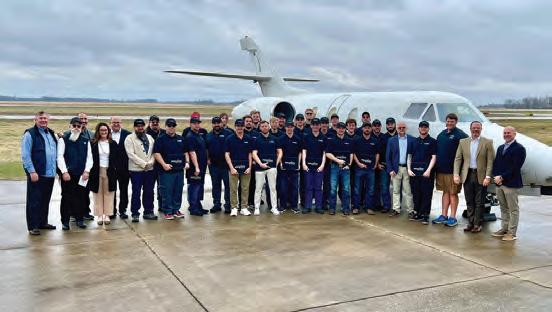
Wisconsin Aviation is celebrating its 45th anniversary this year. The company, which now operates MRO/FBOs at three airports in the Badger State, made its debut at Watertown Municipal Airport (KRYV). “I started this in 1981, when interest rates were 21%,” said company president and CEO Je! Baum. “The economy had fallen off the cliff—of course, we didn’t know that because we didn’t have CNN, let alone the internet—and two weeks later, President Reagan fired all the air tra c controllers. So, it was a great time to start an FBO!”
Despite that rocky beginning, Baum grew the business, which also provides aircraft management, charter, and flight instruction. The company became the lone service provider at Dodge County Airport in Juneau (KUNU) two years later, and added a facility at Dane County Regional Airport-Truax Field (KMSN)— serving the state capital of Madison—in 1994. Combined, the three facilities offer 170,000 sq ft of hangars. At KMSN, Wisconsin Aviation’s largest maintenance facility has 12,000 sq ft of dedicated maintenance space, an 8,000-sq-ft FAA Part 145 avionics shop, and 1,600 sq ft of o ces and labs. Watertown has an 8,000-sq-ft maintenance hangar, a 1,200-sq-ft interiors shop, and 1,600 sq ft of offices. Dodge County—the smallest of the three—has a 4,800-sq-ft maintenance shop. “These are just the maintenance facilities; we use spillover hangars also,” Baum told AIN
With a maintenance backlog extending out more than two months, he noted the shops are always full. At Madison and Watertown, that equates to about eight airplanes each, while at Juneau, there are usually three under maintenance at a time.
“There’s always others in the other hangars waiting for parts to come in or owner approvals or whatever the case might be,”

At Dane County Regional Airport, Wisconsin Aviation handles the full aviation spectrum— from commercial jets to private business aircraft and light pistons.
said Baum. “It’s just nonstop. Being the sole provider of services at three FBOs, you can imagine the number of AOG aircraft and aircraft that have problems.” At KMSN, the company also provides 24/7 on-call support for the airlines.
A high point in the year is the annual EAA AirVenture show in nearby Oshkosh. It provides a surge in activity, with as many as 1,000 aircraft stopping at its locations, some of them staying longer than expected due to mechanical problems.
The company is a Textron Aviation authorized service center for the OEM’s pistons and turboprops, as well as a large maintenance center for Cirrus Aircraft’s SR-series piston-engined airplanes. With a managed fleet of 14 airplanes ranging from a Piper Seneca up to a Cessna Citation 560, the company—which expects to receive its FAA Part 145 repair station authorization later this year—will work on anything up to midsize jets. Wisconsin Aviation has operated Citations in its fleet for nearly 30 years, and Paul Boucher, the company’s v-p of technical services/head of maintenance, was previously responsible for the operation of four Citation service centers. It can perform annual inspections or anything else, short of
engine overhauls, which it will farm out to a specialist.
Among its operations at the three locations, staff tallies around 180, with twothirds at Madison. The company runs one long maintenance shift, with work starting around 5 a.m. and running to late afternoon. Baum describes the technician labor market as extremely tight, but “improving slightly.” To bolster its talent pipeline, the company strives to have one or two apprentice trainees per location at all times. “In Madison, some of the people that we have started on our line have migrated into maintenance, much to the dismay of our line department,” he said.
While the work is steady year-round, Wisconsin’s harsh winters tend to place a damper on flight operations in the region. “You have to know that the airports are open, you have to know that the runways are not contaminated for jet aircraft, because it poses a significant safety issue,” Baum explained.
Wisconsin Aviation has had expansion plans for the Madison facility since before the Covid pandemic, and Baum is in negotiations with the airport on a lease renewal. “We have another very large hangar that’s under design right now, and the rehabilitation of another major hangar,” he said. C.E.
BY DAVID JACK KENNY
Robinson R66, Oct. 22, 2025, Ekalaka, Montana
The pilot, his wife, and two of their three children were killed when the helicopter crashed in the Chalk Buttes Range 12 minutes after taking off from a private ranch south of Ekalaka Airport (97M). Their third child was not on board. The helicopter was flying in trail with a Cessna 182 whose pilot lost the helicopter’s ADS-B track about a minute after the R66 flew through a gap in the southwest end of the buttes.
A witness three-quarters of a mile to the southeast saw the two aircraft flying low over the buttes. She reported that the helicopter began to climb; then “something came off it” and it descended out of sight. The wreckage was found in an open area of about 300 sq ft; the NTSB’s preliminary report lists debris including the two left doors, horizontal and vertical stabilizers, tail rotor driveshaft cover, and tail rotor; but does not mention the main rotor blades.
Beechcraft B100 King Air, Nov. 10, 2025, Coral Springs, Florida
A King Air packed with 1,000 pounds of emergency relief supplies slammed into a pond five minutes after taking off from Fort Lauderdale Executive Airport (KFXE), destroying the aircraft and killing the pilot and only passenger. The supplies were intended for Jamaican victims of Hurricane Melissa, which struck the island as a Category 5 storm on October 28. Volunteers who helped load the aircraft recalled that an unfueled generator was held down by a cargo net, but the remaining items were stowed unsecured in the cabin.
Preliminary ADS-B data showed that after taking off from Runway 27, the aircraft climbed at an average rate of 1,000 fpm and levelled off at 4,000 feet. The pilot complied with ATC vectors to turn right to headings of 120 and then 90 degrees, but by the time it reached 90 degrees the King Air had accelerated from 150 to 200 knots and began descending. “Heavy breathing and ‘grunting’ sounds” were heard on the radio as it passed through 1,500 feet at 270 knots. Home security cameras captured two frames of the airplane in a steep nose-down attitude before striking the water. Flighttrack data suggested that the airplane entered a band of cumulus clouds shown on GOES-19 satellite imagery, remaining in the clouds through the right turn and initial descent.
Cessna Citation III, Dec. 15, 2025, Toluca, Mexico
A Cessna Citation III crashed while on approach to Toluca International Airport (MMTO), killing all 10 people aboard, according to Mexico’s Ministry of Infrastructure, Communications, and Transportation. The twinjet, registered XA-PRO, had departed Acapulco for Toluca with eight passengers and two pilots.
The ministry said that “at approximately 12:31 p.m. local time, an air accident was registered south of the vicinity of the Toluca International Airport.” The crew had reportedly contacted the Toluca tower and received clearance to land shortly before the crash.
Surveillance footage showed the aircraft in a steep left bank about 1.5 nm from the runway threshold before it descended and impacted terrain. The wreckage came to rest in an area south of the airport.
Emergency services responded immediately, and the accident is under investigation by Mexico’s Federal Civil Aviation Agency, the Directorate of Aviation Accident and Incident Analysis, and the Directorate of Air Navigation Services in Mexican Airspace.
Cessna 208 amphibian Caravan, Jan. 7, 2025, Rottnest Island, Western Australia
The pilot and two of six passengers were unable to escape the flooded cabin after the impact of a sea wave caused the amphibious Caravan to became airborne prematurely, then roll left until the left wing struck the water. The nose of the fuselage sank rapidly, filling the forward section of the cabin with water. Two passengers escaped through the upper section of the right rear door; two more were rescued after the coxswain of the seaplane operator’s tender vessel broke through the left rear window.
The wreckage subsequently sank to the bottom of the bay. The bodies of the pilot and two remaining passengers were recovered later that evening; all were out of their restraints, and one passenger was found “partially outside the aircraft” through an overwing window that had broken during the accident.
The 1,908-hour commercial pilot had logged 708 hours in the Caravan amphibian, including 60 in the previous 90 days. The company’s head of flying operations reported that the pilot had not hesitated to cancel other flights for unsuitable winds or sea conditions. At the time of the accident, winds were reported at 25 knots with gusts to 34.
The pilot warned the passengers that the takeoff would be “rough” and altered the course of the takeoff run to take advantage
of smoother conditions closer to shore. He brought the airplane onto the step at an indicated 43 knots airspeed; at 57 knots, it became airborne after striking a swell, pitched up sharply, and rolled left.
Cessna Citation CJ4, Sept. 25, 2025, Baton Rouge, Louisiana
The collapse of a Cessna Citation CJ4’s right main landing gear during rollout at Baton Rouge Metropolitan Airport (KBTR) was caused by improper installation of the aft trunnion pin, according to the NTSB’s final report. Neither pilot was injured, but the resulting failure punctured the right wing and caused substantial structural damage.
Maintenance at a manufacturerauthorized service center had been completed just 2.9 flight hours before the accident. That work included removal and reinstallation of the right main gear’s aft trunnion pin. Investigators determined the pin “was not installed far enough [forward] to allow the retaining roll pin to engage and retain the trunnion pin,” leaving the gear assembly improperly secured.
At about 10,000 feet msl, the crew felt “a bump/thud in the back of the airplane,” initially believed to be something falling in the lavatory. Moments later, the landing gear’s unsafe light illuminated. The crew performed emergency procedures, including cycling the gear and resetting the landing gear circuit breaker. With three green lights indicating gear down, they continued the flight and landed at Baton Rouge. During rollout, after moderate braking, the right main gear collapsed.
Textron Aviation’s maintenance manual specifies that the trunnion pin must extend at least 2.0 inches (50.8 mm) forward of the aft spar fitting to ensure proper retention.
The NTSB cited as a contributing factor “the failure of maintenance personnel to follow the aircraft manufacturer’s maintenance procedures.” It also referenced a similar 2018 incident investigated by Spain’s CIAIAC, which led Textron Aviation to issue a mandatory service letter requiring inspection of the trunnion pin installation.
Hawker 900XP, Feb. 7, 2024, Westwater, Utah
The flight crew’s decision to conduct post-maintenance stall testing without specific training and their violation of several specified test conditions, including maximum altitude, minimum cloud clearance, and assuring that the wings were free of ice, were all found to have contributed to the airplane’s destruction following a flat spin. The accident was one of at least three that have occurred in Hawker jets during testing required after routine removal, inspection, and re-installation of the wing leading edges and deicing panels.
The Pilot’s Operating Manual (POM) cautions that pilots performing the test “SHOULD HAVE PRIOR EXPERIENCE IN PERFORMING STALLS IN THE HAWKER AND MUST BE PREPARED FOR UNACCEPTABLE STALL BEHAVIOR AT ANY POINT,” further warning that “there is no natural stall warning or aerodynamic buffet before the stall.”
Reconstruction of the accident flight showed that the jet may have picked up as much as 1 mm of ice climbing through IMC from 5,000 to 16,700 feet, finally levelling at 20,000, 2,000 feet above the maximum altitude specified for the stall test.
Performance calculations showed that the stick shaker activated at 117.5 knots airspeed and the stick pusher at 113.5 knots, both appropriate for the airplane’s weight and loading, but the stall began as the stick shaker activated. Ice accumulation was calculated to have reduced the wing’s critical angle of attack by as much as 6 degrees.
The crew responded to the stall with full left aileron, full power, and full aft elevator, aggravating the stall/spin. The NTSB found that their inappropriate response “suggested that they were insufficiently trained for the mission and the brief guidance from the POM provided no clear instructions for the possible consequences of ‘unacceptable stall characteristics’ or a proper recovery.”
Pilatus PC-12/47, May 7, 2024, Rankin Inlet Airport, Nunavut, Canada
A teardown inspection revealed that the blades of the engine’s first- and second-stage power turbines had fractured mid-span but was unable to identify any proximate cause of the damage. The single-engine turboprop was descending towards Rankin Inlet Airport (CYRT) when “the engine emitted a series of bangs with flames appearing from the exhaust ducts followed by a sharp reduction in power.”
The crew radioed a mayday call before making a gear-up landing on sea ice about 5 nm east of the airport, then manually activated the ELT. The two pilots and sole passenger were not injured. Responders from the local fire department and the Royal Canadian Mounted Police rescued them by snowmobile an hour and 20 minutes later. The aircraft sustained damage to the lower fuselage and two propeller blades.
The PT6A-67B turboprop engine was manufactured in 2006 and had been operated for 13,498.6 hours and 8,694 cycles since new. In a 2020 overhaul by a manufacturer-approved facility, the first-stage turbine was found serviceable and the second-stage turbine’s blades were replaced with a new set. The firststage turbine blades were reported to have been operated for 8,671 cycles and the second-stage blades for 2,395 cycles since new; the engine had accumulated 4,558.4 hours and 2,417 cycles since its last overhaul. z
—Amy Wilder contributed to this report.
BY GORDON GILBERT
March 9, 2026
The FAA has proposed regulations that would require all radio altimeters (RA) to withstand interference from wireless signals in neighboring spectrum bands and continue to provide accurate altitude readings to both pilots and integrated aircraft safety systems. A new industry/government committee will develop the required methodology and publish the recommended standards in June 2026 for public comment. A final publication is scheduled for March 2027. The FAA said the new regulations, to apply to all new and in-service aircraft that currently require RAs, anticipate the “initial RA performance deadline will be achievable between 2029 and 2032.” The agency estimated that some 58,579 new or upgraded RA systems will be required for “all aircraft currently equipped with RA operating under Part 121; the majority of aircraft operating under Parts 91 subpart K, 125, 129, 135, and 194; and a minority of general aviation aircraft operating under Part 91.” Comments on the proposal are due March 9, 2026.
Feb. 9, 2026
Nav Canada has initiated a study to evaluate the requirements for extending the use of ADS-B in Canadian airspace below 12,500 feet msl and above FL600. Included in the study’s scope: evaluate whether requiring ADS-B Out in low-level controlled airspace is operationally and technically justified; assess the impacts to airspace users, including the challenges for non-equipped aircraft to access ADS-B airspace; review options for targeted ADS-B requirement in selected Class D and E airspace; consider stakeholder perspectives—particularly those of smaller commercial and general aviation operators—with respect to the requirement for antenna diversity, technical feasibility, and operational impacts; and define implementation timelines for previously approved high-level airspace. Comments are due by Feb. 9, 2026.
Feb. 10, 2026
Under an EASA notice of proposed amendment (NPA), a set of detailed specifications would be established on artificial intelligence (AI) trustworthiness for the safe use of AI in aviation. Objectives of the rulemaking are to
support the deployment of AI in specific aviation domains and create a comprehensive AI-trustworthiness regulatory framework that will allow for the potential seamless deployment of AI in other aviation domains in the future. EASA said, “The proposed regulatory material is expected to maintain the current level of safety and provide benefits in terms of innovation and efficiency to the aviation sector.” The NPA also includes proposed associated acceptable means of compliance and guidance material for AI trustworthiness. Comments are due by Feb. 10, 2026.
Feb. 22, 2026
Several times a year, EASA releases a compendium of regulations that aim to update and clarify regulations, correct errors, consolidate previously issued standalone requirements and proposals, and make other minor changes. This group of implementing regulations includes: technical requirements and administrative procedures related to civil aviation aircrew; rules for airworthiness and environmental certification; administrative procedures related to airports and air traffic controllers; and continuing airworthiness of aircraft and aeronautical products, parts, and appliances. The revisions and updates go into effect on Feb. 22, 2026.
Feb. 27, 2026
The FAA is requesting federal approval to introduce a survey about the agency's designated pilot examiner (DPE) program. Pilots are invited to comment on: whether the proposed collection of information is necessary for the FAA’s performance; its accuracy potential; ways for the FAA to enhance the quality, utility, and clarity of the survey; and ways that the burden could be minimized without reducing the quality of the collected information. Congress mandated that the FAA enhance its oversight of DPEs by, among other things, disseminating a survey to track the performance and merit of such examiners. If the survey is approved, the FAA will ask pilots approximately 12 yes-or-no questions about the level of DPE professionalism, the suitability of the exam environment, and the duration of the ground portion and flight portion of the exam. Comments on the request are due by Feb. 27, 2026.
Feb. 27, 2026
This notice establishes the annual national deadline and requirements for airport sponsors to signal their intent to submit applications for FY 2026 Airport Improvement
Program (AIP) entitlement funds. By Feb. 27, 2026, each airport sponsor receiving apportioned funds must inform their FAA Regional Airports Division/Airports District Office of its intention to apply for these funds, including any unused funds from previous years. “This notification is essential for the efficient planning and management of the AIP,” said the FAA.
March 1, 2026
Argentina’s National Civil Aviation Administration has amended civil aviation regulations to include removing a ban on nighttime VFR flying and for all general aviation flights to file a flight plan. The new rules will also allow Part 135 operators to request approval for single-pilot operations in aircraft equipped with a three-axis autopilot and carrying fewer than 10 passengers. Provisions to eliminate the flight plan filing requirement and allow night VFR come into effect on March 1, 2026.
March 31, 2026
Starting March 31, 2026, Australianregistered aircraft operators will need to be equipped with radio altimeters that meet minimum performance levels to deter interference by mobile phone 5G service. Before this date, the country’s Civil Aviation Safety Authority (CASA) is working with the Australian Communications and Media Authority (ACMA) to prevent interference with radio altimeters. CASA is coordinating with ACMA so that the rollout of wireless broadband services, including 5G in the 3.7 to 4.0 GHz band, can be done in a way that ensures the safety of aircraft in Australia. Ongoing mitigations after March 31, 2026, will include a 200 MHz buffer between wireless broadband and radio altimeter frequencies as well as limits on power and unwanted emissions.

BY JESSICA REED

Adam Johnson , CEO of Berkshire Hathaway’s wholly owned subsidiary NetJets, took over as president of Berkshire’s consumer products, service, and retailing businesses, including FlightSafety International. Johnson is continuing in his role at NetJets, where he has served as CEO since June 2015. His tenure at NetJets spans nearly 30 years, including serving as president of global sales, marketing, and service; senior v-p of NetJets administrative services; senior v-p of logistics; and executive director of the NetJets Aviation Flight Center.
General Dynamics (GD) promoted executive v-p of global operations Danny Deep to president of the company. Deep’s more than 20 years with the company include roles such as executive v-p of combat systems, v-p of the company, and president of General Dynamics Land Systems. Phebe Novakovic was elevated to president and COO in 2012 and has served as chairman and CEO since 2013, and Deep’s promotion suggests he is set to succeed her when she retires. Meanwhile, William Moss, v-p and controller at GD, plans to retire at the end of March. Dana Maisano, staff v-p and controller overseeing financial planning and analysis at General Dynamics Information Technology since 2018, will take over as GD’s controller on April 1.
Andrea (Jauschneg) Lyons was named v-p and COO for Corporate Aircraft Association (CAA), succeeding P.J. Clark, who is retiring after nine years with the organization. Lyons has served at CAA for four years, beginning in special events and operations, and before that was general manager with Rectrix Commercial Aviation Services.

JSSI named Molly Hennessy chief product and technology officer. She previously worked at United Airlines for more than nine years, most recently as managing director of crew and catering technology.
Justin Salmans was tapped by Textron Aviation as senior v-p of supply chain. Salmans joined
Cessna Aircraft in 2011 and led its integration into Textron Aviation. He most recently was chief procurement officer for Bass Pro Shops.
Mike Moore was hired as Guardian Jet’s regional sales director for Florida. Moore’s more than three decades of experience in private aviation includes positions at Essex Aviation, PrivatAir, Infinity Aviation Group, FirstFlight, and Meridian Air Charter.
E3 Displays has a new CEO—Tim Tsai—following its acquisition by Ubiqconn, of which Tsai is also CEO.
Chuck Rahrig, co-founder and previous president of E3 Displays, shifted to the role of COO and now handles the company’s day-to-day operations.

EBAA announced a new sales and management team for EBACE: Carla Spiljard, EBACE program director; Kerry Lamont, outdoor account lead; Helen Nagle, indoor account lead; Marleen Weide, operations project manager; and Dewi Hazes, EBACE project manager.
Phebe Novakovic , chairman and CEO of General Dynamics , was elected as chair of the Aerospace Industries Association’s 2026 board of governors. Christopher T. Calio , RTX chairman and CEO, will serve as vice chair, and Eric Fanning was reelected as president and CEO of the association.

Nate Thuli was named president of Airhart Aeronautics, which is working on a next-generation avionics platform and a clean-sheet aircraft. Thuli’s 15-plus years of leadership experience in aerospace and defense modernization includes a recent term as president and COO of Alpha Omega Group (AOG); he also founded Nerion.
Spectrum Aeromed named Shannon Schell president. Schell, previously president and CEO of REVA, has extensive expertise in air ambulance services over his career, which spans more than three decades in aviation, healthcare, and logistics.
Private jet operator RoyalJet hired Alain Champonnois as v-p of commercial.
Champonnois previously served as commercial director with Royal Jet and most recently was president and CEO for India, the Middle East, and Africa at Chapman Freeborn.

Jennifer E. Pickerel, president of Aviation Personnel International (API), is now a member of the NBAA Advisory Council. Pickerel previously worked for MedAire in various leadership roles and has been on the API team since 2015.
Anthony Fountain, operational control center specialist at Metro Aviation, was promoted to operational control center manager after three years with the company. His previous experience includes serving in the U.S. Air Force for 22 years, where he worked in operational meteorology.
Lynlee Espeseth joined Fargo Jet Center as director of marketing, leading marketing strategy, brand development, and integrated communications. Espeseth has more than 10 years of experience in government, healthcare, tourism, and philanthropy.
Tim O’Keeffe is the new deputy director of operations and maintenance for San Luis Obispo County’s Department of Airports. Former deputy director Craig Piper is retiring in May after 25 years with the department. O’Keeffe will oversee the operations and maintenance division for both SLO County Airport and Oceano Airport and will support efforts to improve reliability and efficiency.

Private Flight named Lieff Fischer chief growth officer to support growth across all of its business lines. Fischer will lead global commercial strategy and will work to strengthen customer relationships and expand the air charter provider’s presence in key markets.
Duncan Aviation promoted Bryce Richie from team leader for its Global/Challenger team to Global/Challenger service sales representative. Richie joined Duncan’s flight control team in Lincoln, Nebraska, in 2016.
Law firm Williams Kastner tapped Brent Elswick as a member in the firm’s office in Seattle. Elswick’s almost 15 years of experience include advising clients on corporate, transactional, and general business law matters. z
Joseph “Joe E” Esmerado, 82, an employee of Leading Edge Aviation Solutions for many years, recently passed away. He began his career in aviation in the U.S. Navy as an aircraft maintenance trainee, going on to serve as v-p and general manager at Butler Aviation, owner and president of JetAm, v-p of aircraft maintenance for Jet Aviation, and general manager of Raytheon’s Atlantic City FBO. Esmerado also was recognized for his more than 50 years of service in aviation maintenance with the Charles M. Taylor Master Mechanic Award.
Heidi Ho Yuen-tung, an o cer at the Hong Kong Government Flying Service, was recognized with the IMRF award for Outstanding Individual Contribution to Maritime SAR Operations. She was selected for demonstrating “incredible courage and professionalism” in rescuing seven trapped seamen from a drifting barge during a risky nighttime searchand-rescue operation near Severe Typhoon Yinxing.
Paul Cremer was recognized with the Contribution to Industry Award 2025 from the British Business and General Aviation Association. Currently head of aviation delivery for Gama Aviation, Cremer has worked in air tra c, operations, aircraft management, air ambulance, and charter sales, among others. The British Business and General Aviation Association named Hugo Robotti-Guinamand, group charter executive at Victor, as the recipient of its 2025 Excellence in Aviation Next Generation Award. Robotti-Guinamand has been with Victor since 2022 and has managed some of the company’s most complex charter projects, including logistics for Olympic sports teams, international orchestras, and sports organizations.
In partnership with the IADA Foundation, JSSI awarded its first Aviation Innovation Grant to Tyler Kleinsasser, a student at the South Dakota School of Mines and Technology. Kleinsasser was recognized for his innovation and entrepreneurship in developing a performance analytics platform concept for smaller aviation businesses.
29.6% YOY—involving 13 business jets and 22 turboprops, up from eight and 19, respectively, in the previous year.
However, the number of U.S.-registered business jet fatal accidents dropped from five to four over the comparable years, but the fatality count remained flat at 15. Last year’s fatal accidents, with fatalities shown in parentheses, were February 10, Bombardier Learjet 35A during a landing excursion (1); March 13, Cessna Citation CJ2 while climbing out (1); May 22, Citation SII on approach (6); and December 18, Citation II on approach (7). All these crashes occurred under Part 91. Of the five fatal accidents in 2024, one was a Part 135 charter.
Looking at fatalities involving non-U.S.-registered business jets, the number of lives taken surged from six in three accidents in 2024 to 42 in nine crashes last year. Twenty-one fatalities, half of last year’s total, occurred in three charter accidents.
The nine fatal accidents of non-U.S.-registered business jets in 2025 were January 9, private Citation CJl, runway excursion (1); January 29, government-chartered Citation Sll, taking off (3); January 31, air ambulance Learjet 55, taking off (6); June 3, private Citation I on departure (5); August 7, air ambulance Citation 560, en route (4); September 24, government-operated Learjet 55 taking off (2); October 16, maintenance test Hawker 800X stalled (3); December 15, chartered Citation 650 on approach (10); and December 23, chartered Dassault Falcon 50 during initial climb (8).

JAMES HOLAHAN (1921-2015), FOUNDING EDITOR, WILSON S. LEACH, FOUNDER & CHAIR EMERITUS
EDITOR-IN-CHIEF – Matt Thurber
MANAGING EDITOR – Charles Alcock
DIGITAL EDITOR – Chad Trautvetter
EDITOR AIN MONTHLY MAGAZINE – Kerry Lynch
BUSINESS AVIATION SERVICES EDITOR – Curt Epstein
SENIOR EDITOR – Hanneke Weitering – Technology Editor
COPY EDITOR – Jessica Reed
NEWS REPORTERS – Charlotte Bailey – Europe, Amy Wilder
CONTRIBUTORS – Julie Boatman, David Donald – U.K., Jennifer Leach English, David Jack Kenny – Safety, Gordon Gilbert, David Hughes, Robert P. Mark, Jennifer Meszaros – Southeast Asia, Dale Smith, Richard Pedicini, James Wynbrandt
PRODUCTION MANAGER – Martha Jercinovich
GRAPHIC DESIGNER – Grzegorz Rzekos
DIRECTOR OF VIDEO – Ian Whelan
SENIOR DEVELOPER – Cameron MacPherson
FRONT END DEVELOPER – David Lohmeyer
EXECUTIVE CHAIR – Dave Leach
PRESIDENT – Ruben Kempeneer
HEAD OF PEOPLE & BRAND – Jennifer Leach English
SENIOR DIRECTOR, INDUSTRY AFFAIRS AND EVENTS – Nancy O’Brien
ADVERTISING SALES
DIRECTOR OF SALES - Henry Specht
Victoria Tod – Northeastern U.S./Eastern Canada/United Kingdom, +1 (203) 733-4184
Michelle James – Western U.S./Western Canada, +1 (520) 343-0236
Joe Rosone – Midwestern U.S., Southeastern U.S./Caribbean/Brazil, +1 (301) 693-4687
Diana Scogna – Europe/Middle East, +33 6 62 52 25 47
DIRECTOR OF MARKETING AND CLIENT SERVICES – Lisa Valladares
AUDIENCE DEVELOPMENT DIRECTOR – Eileen Silberfeld
EVENTS SPECIALIST – Brien O’Brien
SENIOR MARKETING SPECIALIST – Alyssa Barry
SOCIAL MEDIA MARKETING – Zach O’Brien
SALES ADMINISTRATOR – Cindy Nesline
FINANCE AND HR DIRECTOR – Tracy Britton
ACCOUNTS PAYABLE MANAGER – Mary Avella-Darlington
ACCOUNTS RECEIVABLE MANAGER – Bobbie Bing
U.S. HEADQUARTERS
214 Franklin Ave., Midland Park, NJ 07432, +1 (201) 444-5075
Advertising Inquiries: +1 (201) 345-0085, adsales@ainonline.com
Circulation Inquiries: +1 (201) 345-0085, subscriptions@ainonline.com
WASHINGTON, D.C. EDITORIAL OFFICE: Kerry Lynch: klynch@ainonline.com, Tel: +1 (703) 969-9195
EUROPEAN EDITORIAL OFFICE: Charles Alcock: calcock@ainonline.com, Tel: +44 7799 907595
For feedback, letters to the editor, or other editorial needs, please contact AIN’s Editors at ainedit@ainonline.com
Fatalities in accidents involving U.S.-registered business turboprops also recorded a significant spike year over year. Last year, 31 people died in 11 crashes versus 17 fatalities in seven accidents in 2024. One of the fatal accidents last year was a charter, and another occurred to a government public service aircraft. As for fatal accidents of non-U.S.-registered business turboprops, 55 people were killed in 11 accidents last year compared with the same number of fatalities in 12 accidents in 2024. z
Aviation International News (ISSN 0887-9877) is published twelve times per year (monthly). Periodicals postage paid at Midland Park, N.J., and additional mailing o ces. Postmaster: Send address changes to AIN Media Group, 214 Franklin Ave., Midland Park, NJ 07432. Allow at least eight weeks for processing. Include old address as well as new, and an address label from a recent issue if possible.
Subscription inquiries: +1 (201) 345-0085 or email: subscriptions@ainonline.com.
Aviation International News is a publication of AIN Media Group, 214 Franklin Ave., Midland Park, NJ 07432; Tel.: +1 (201) 444-5075. Copyright © 2026 All rights reserved. Reproduction in whole or in part without permission of AIN Media Group is strictly prohibited. AIN Media Group publishes Aviation International News, AINalerts, AINonline, Business Jet Traveler, BJTwaypoints, ABACE Convention News, Dubai Airshow News, EBACE Convention News, Farnborough Airshow News, FutureFlight.aero, VAI Convention News, LABACE Convention News, MEBAA Convention News, NBAA Convention News, Paris Airshow News, Singapore Airshow News, Mobile Apps: Aviation International News; AINonline. PUBLICATION MAIL AGREEMENT NO. 40649046 RETURN UNDELIVERABLE CANADIAN ADDRESSES TO: PITNEY BOWES INTERNATIONAL MAIL, STATION A, P.O. BOX 54, WINDSOR, ON, N9A 6J5, returns il@imex.pb.com.
Save time and money by monitoring the value of your aircraft in 'real-time'.

Subscribers can also:
– Generate a comprehensive list of all aircraft transactions in the last 12 months
– View a detailed photo gallery for your specific aircraft
– Receive a weekly report summarizing market fluctuations


With three market-leading businesses, world-class operations and investments in research and development, we ofer capabilities no one else can. Together, our global team pushes the boundaries of known science—and fnds new ways to connect and protect our world.
Learn more at rtx.com








With three market-leading businesses, world-class operations and investments in research and development, we ofer capabilities no one else can. Together, our global team pushes the boundaries of known science—and fnds new ways to connect and protect our world.
Learn more at rtx.com