Volume 30 Issue 52

Page 1


African-American News&Issues

AframNews.com

Our Community”

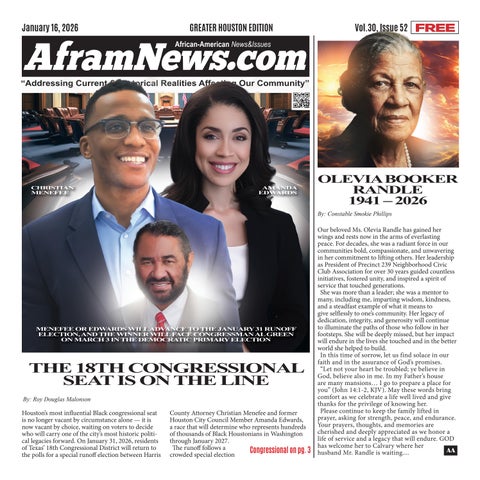
MENEFEE OR EDWARDS WILL ADVANCE TO THE JANUARY 31 RUNOFF ELECTION, AND THE WINNER WILL FACE CONGRESSMAN AL GREEN ON MARCH 3 IN THE DEMOCRATIC PRIMARY ELECTION

THE 18TH CONGRESSIONAL SEAT IS ON THE LINE

OLEVIA BOOKER RANDLE 1941 – 2026

Our beloved Ms. Olevia Randle has gained her wings and rests now in the arms of everlasting peace. For decades, she was a radiant force in our communities bold, compassionate, and unwavering in her commitment to li ing others. Her leadership as President of Precinct 239 Neighborhood Civic Club Association for over 30 years guided countless initiatives, fostered unity, and inspired a spirit of service that touched generations.

She was more than a leader; she was a mentor to many, including me, imparting wisdom, kindness, and a steadfast example of what it means to give sel essly to one’s community. Her legacy of dedication, integrity, and generosity will continue to illuminate the paths of those who follow in her footsteps. She will be deeply missed, but her impact will endure in the lives she touched and in the better world she helped to build.

In this time of sorrow, let us find solace in our faith and in the assurance of God’s promises.

“Let not your heart be troubled; ye believe in God, believe also in me. In my Father’s house are many mansions… I go to prepare a place for you” (John 14:1-2, KJV). May these words bring comfort as we celebrate a life well lived and give thanks for the privilege of knowing her.

Please continue to keep the family lifted in prayer, asking for strength, peace, and endurance. Your prayers, thoughts, and memories are cherished and deeply appreciated as we honor a life of service and a legacy that will endure. GOD has welcome her to Calvary where her husband Mr. Randle is waiting.... “Addressing Current & Historical Realities Affecting

Houston’s most in uential Black congressional seat is no longer vacant by circumstance alone — it is now vacant by choice, waiting on voters to decide who will carry one of the city’s most historic political legacies forward. On January 31, 2026, residents of Texas’ 18th Congressional District will return to the polls for a special runo election between Harris

County Attorney Christian Menefee and former Houston City Council Member Amanda Edwards, a race that will determine who represents hundreds of thousands of Black Houstonians in Washington through January 2027.

e runo follows a crowded special election

Congressional on pg. 3

AMANDA EDWARDS
CHRISTIAN MENEFEE

EDITORIAL

RED LINES, RIGGED MAPS, AND REMOVED LEADERS We Must Understand

What happened in Venezuela shocked much of the world. A sitting president was removed through U.S. action, and the people of that nation had no vote in the decision. For many Americans, this raised urgent questions about sovereignty, democracy, and power. For Black America, the moment felt familiar.

History teaches us that power rarely announces itself as oppression. It o en arrives dressed as policy, reform, or necessity. In the United States, Black communities have long lived under systems that reshape lives without consent, while maintaining a legal appearance. What the world is now seeing in Venezuela mirrors the same methods that have been used at home for generations. Redlining is one of the clearest examples. Banks and governments drew lines on maps that decided where Black families could live, borrow, or build wealth. No vote was taken. No public debate asked whether this was just. e damage was done quietly, and its e ects are still visible today in segregated neighborhoods and persistent wealth gaps. Gerrymandering followed a similar logic. Political districts were manipulated to weaken Black voting power while maintaining the illusion of democracy.

Elections still happened, but the outcomes were engineered long before ballots were cast. e process was legal. e result was exclusion.

Texas provides recent reminders of how this system works. State takeovers of local institutions, redrawn voting maps, and zoning decisions that concentrate pollution in Black neighborhoods all re ect the same pattern: authority acting rst, communities responding a erward. Consent becomes secondary. Control becomes permanent. What the world is witnessing in Venezuela is not simply foreign policy. It is the extension of a familiar playbook. Power identi es resistance, applies pressure, removes obstacles, and explains later. Sometimes that pressure comes through military force. Other times it comes through courts, laws, or economic levers.

e method changes, but the structure remains the same.

Removed leaders abroad echo silenced voices at home. When Black communities have challenged unfair systems, leaders have been targeted, movements disrupted, and progress delayed. COINTELPRO, voter suppression, and surveillance were not accidents; they were tools used to maintain control while preserving a public image of order.

e lesson is not that every situation is identical. e lesson is that the system is consistent. Democracy weakens when power operates without accountability. Rights erode when decisions are made without

A Revival of God Consciousness

HOW TO WRECK A UNIVERSITY

Historically Black Colleges and Universities (HBCUs) face a pivotal decision point. To avoid extinction, HBCUs must creatively maximize their mission and purpose. To achieve their mission, HBCUs should develop innovative spiritual leadership models, because leadership is about the future. e future is about children/students, because it is spiritually written: “Lo, children are a heritage of the Lord: and the fruit of the womb is his reward.” (Psalm 127: 3). erefore, without a vision for children, individuals perish. us, leadership is not about instant socio-economic grati cation. I joined the faculty of Texas Southern University (TSU) as a sociology professor in 1977, a er teaching at several predominantly white institutions (PWIs). My campus debut was eyeopening. Initially, I met with a senior level administrator. He expressed his appreciation for my academic quali cations and indicated that, should I choose to cooperate with him, there would be signi cant opportunities for advancement at TSU. Immediately, I was o ered an administrative job. I le that administrator’s o ce stunned by a sense of Administrative Ego-tripping that I had not experienced before in any previous academic setting. I refused to play ball. Two years later I was red. At

the previous PWI where I was an assistant dean and professor of sociology, the University President in a creative way at the Christmas break reminded everyone that the university’s mission was student development: teaching and learning.

My initial encounter with a senior level administrator at TSU was vastly di erent. Consequently, I was inspired to write a short blueprint on: “How To Wreck A University”. ere is an ole spiritual adage that is currently on full display in every facet of American society that was coined by Brinkman: “ ere is nothing like authoritative ignorance”. Ignorance destroys, it does not create and build. For example, on Friday, December 5th, 2025, TSU’s Board of Regents had an emergency Board meeting. During that meeting, the Board of Regents approved (5) new contracts. e State Auditor’s Report was published on December 8th. On December 9th, Governor Abbott ordered TSU to stop awarding new contracts. Obviously, a quorum of the TSU’s Board of Regents’ leadership has malnutrition of the brain and did not understand the consequences of “451 million dollars” that could not be “systematically” tracked and accounted for before issuing new contracts. e Taxpayers of the State of Texas are asking the Marvin Gaye question: “What’s Going On?” e answer undoubtedly is BOLD authoritative ignorance! In closing, here is the blueprint treatise I wrote a er my encounter with the seniorlevel TSU administrator in 1977 on “How to Wreck A

Congressional Cont.

that failed to produce a majority winner. Menefee nished rst with 28.9 percent of the vote, while Edwards followed closely with 25.6 percent, forcing the top two candidates into a head-to-head contest. e narrow margin underscored how divided — and how disengaged — parts of the electorate have become a er months of delays and uncertainty surrounding the seat. TX-18 has been vacant since the death of Congressman Sylvester Turner in March 2025, a loss that reverberated far beyond Houston. Turner was more than a lawmaker; he was a bridge between local struggles and national power, a former mayor who carried Houston’s Black neighborhoods into congressional debates on infrastructure, disaster recovery, healthcare, and voting rights. His absence has been felt acutely as federal decisions continue to a ect housing, immigration enforcement, environmental justice, and public safety in communities across the district.

e prolonged vacancy has also exposed a political vulnerability. While legislation moved forward in Congress, TX-18 had no direct vote, no voice on committees, and no advocate pressing Houston’s needs behind closed doors. For many residents, especially in historically Black

neighborhoods like the Fi h Ward, ird Ward, Acres Homes, and Kashmere Gardens, the silence felt dangerous.

Christian Menefee has campaigned on restoring that presence quickly and aggressively. As Harris County Attorney, he has built a pro le challenging state leadership in court on issues ranging from voting access to environmental enforcement. His supporters argue that his legal background and statewide visibility position him to immediately step into national ghts, particularly as federal policies increasingly intersect with local governance.

Amanda Edwards, who previously represented District D on Houston City Council, has leaned heavily on her experience inside city government and her connections to neighborhood-level concerns. She has emphasized economic development, small business access, and constituent services, framing the race as a choice between courtroom battles and community-based governance. Edwards’ supporters see her as a retail politician capable of reconnecting voters who have grown skeptical of political institutions. What makes this runo especially consequential is not just who wins, but who shows up. Runo elections historically draw far fewer voters than general elections, and early turnout

numbers suggest the same risk looms again. Early voting began January 21, and community leaders have warned that low participation could allow a fraction of the district to decide representation for nearly two years.

Churches, civic groups, and political organizers across Black Houston have sounded the alarm, urging voters not to treat the runo as an a erthought. e concern is not partisan — both candidates are Democrats — but structural. A district built through decades of Black political mobilization now faces the possibility of disengagement eroding its in uence.

e stakes extend beyond Houston. TX-18 has long been viewed nationally as a bellwether for Black urban districts in the South. How voters respond to this moment will signal whether historically reliable voting blocs remain mobilized or are retreating amid political fatigue.

is election also arrives as broader debates intensify around policing, immigration enforcement, environmental exposure in Black neighborhoods, and access to federal resources. Without strong representation, advocates fear Houston risks being sidelined as other districts compete aggressively for funding and attention.

At its core, the January 31 runo is a referendum on urgency. It asks AA

BYRON “TINY” JOHNSON 1933 - 2026 OBITUARY

Mr. Byron “Tiny”

Johnson was a man whose presence le a lasting impression on all who knew him. Known a ectionately by his nickname, “Tiny,” he carried a warmth, humility, and quiet strength that drew people to him. He lived his life with integrity and kindness, valuing honesty, hard work, and genuine connection. Whether in moments of laughter or re ection, Byron had a way of making others feel seen and appreciated. roughout his life, Mr. Johnson was devoted to the

University”:

people and responsibilities that mattered most to him. He approached each day with perseverance and a steady spirit, o ering support to family, friends, and community whenever it was needed. His actions spoke louder than words, and his generosity of time and heart will be remembered as one of his greatest gi s.

Mr. Byron “Tiny” Johnson leaves behind a legacy of love, respect, and cherished

Employ personnel who are not capable emotionally or intellectually of implementing the conceptual philosophy of the university: Excellence in Achievement.

Compete internally for resources both human and nonhuman, as though the university’s existence is not grounded in the same mandate, philosophy, and goals.

Be oblivious to the social fact that evaluation data impacts institutional/ social change.

Violate established systems, processes, and procedures that are designed to rationalize and make e cient university operations.

Do not create an inquiry design to involve di erent units and individuals in university decision-making. Alienate individuals from power

memories. ough his passing leaves a profound void, his spirit lives on in the stories shared, the lessons learned, and the lives he touched. He will be deeply missed and fondly remembered by all who had the privilege of knowing him.

resources within the university structure.

Encourage the concept “us” and “them” in intra/interpersonal relations, power and authority relationships, and sta and line positions.

Encourage arti cial and arbitrary distinctions that enhance racism, sexism, and general and speci c incompetence.

Encourage behaviors that violate human rights, civil rights, and human integrity; that is, encourage behaviors that are not related philosophically to and consistent with the university’s mission statement.

Establish goals on a “post hoc ergo proper hoc” or a er the fact basis, which encourages ine ciency and lack of accountability.

HBCU Cont.

1887 1896 1905 1916 1900 1909 1918

1887. e ibodaux massacre occurs in

1896. Plessy v. Ferguson legitimizes state laws reestablishing racial segregation in Southern states.

1900. A majority of Southern states pass laws that required African Americans to be separated from white citizens in railroad cars.

1905. W.E.B. Du Bois calls for social and political change for African Americans during the Niagara Movement.

1909. e National Association for the Advancement of Colored People (NAACP) is founded.

1916. e Great Migration begins, where more than six million African Americans move from the rural South to various urban

metropolitan areas

1918. e Dyer Antilynching Bill is rst introduced, intending to establish lynching as a federal crime.

HOUSTON

SAN ANTONIO

TEXAS TAKEAWAY

CORPUS CHRISTI

METRO police released the latest safety statistics for the transit system, following last week’s fatal shooting aboard a bus that claimed the life of an innocent passenger and wounded another. The suspect was located the following day, taken into custody, and formally charged.

The stadium is expected to cost approximately $160 million and is projected to be a major driver of economic development in San Antonio. Beyond the construction of the venue itself, city leaders anticipate the project will spur an estimated $1 billion in privately funded, mixed-use development through 2033.

The Texas Attorney General has compelled the City of Corpus Christi to permit individuals with a valid license to carry firearms at City Council meetings. The action follows a determination by the Attorney General’s Office that the city’s previous restrictions were inconsistent with state law. As a result, Corpus Christi has been required to revise its policies to ensure compliance, allowing licensed gun holders to carry firearms during council meetings while the city continues to emphasize public safety and order during governmental proceedings.

LUBBOCK

Christy Martinez Garcia Launches Reelection Campaign for Lubbock City Council

Bessie Coleman (1892–1926) was a pioneering aviator who became the first African American woman and first person of Native American descent to earn an international pilot’s license. Facing both racial and gender discrimination in the United States, Coleman was rejected by every American flight school she applied to. Following the advice of Chicago publisher Robert Abbott, she learned French and moved to France in 1920. On June 15, 1921, she earned her license from the Fédération Aéronautique Internationale, a year before Amelia Earhart.

BESSIE COLEMAN
Louisiana.

SHOULD THE CITY USE STORMWATER FUNDS TO DEMOLISH ABANDONED BUILDINGS? LOCAL

Over the last several weeks, a controversy has surfaced over a request from the Whitmire administration to award several demolition contracts using funds from the City’s Stormwater Fund. is is a very legitimate and important issue. However, so far, what I have seen is mostly an attempt to politicize the issue rather than have a meaningful discussion.

First, we should begin by acknowledging that the City has a serious problem with dilapidated, abandoned and dangerous buildings. Exactly how many there are is subject to some debate depending on de nitions and perspective. However, they certainly number in the thousands. It was one of the most common complaints I heard from communities in my two mayoral campaigns. E orts by previous administrations to address the problem have been limited, sporadic and, at least in some cases, theatrical. Demolishing buildings can be surprisingly costly, especially when environmental concerns, such as asbestos, are involved. Historically, the relatively small amounts the City spent on demolition came from the General Fund. But as that fund has come under increasing scal pressure, the amounts have trickled down to almost nothing.

In the current budget, the administration proposed that $25 million be spent from something called the Storm Water Fund for “the demolition of

dangerous buildings on behalf of the Department of Neighborhoods” (see the notes at the bottom of pg. XI10). at budget was approved by the City Council and certi ed by the Controller. It is important to understand that the Storm Water Fund (SWF) is a separate and distinct fund from the Dedicated Drainage and Street Renewal Fund (DDSRF) that voters added to the city charter some years ago. e DDSRF has several funding sources, including property taxes, a drainage fee and Metro transfers. e SWF, in contrast, has been funded primarily by the Combined Utility System (CUS). It has also received smaller amounts from the General Fund and the DDSRF, however, the current administration has increased the amount coming from the DDSRF the last two years.

e CUS is the City’s water and sewer system. Its funding comes exclusively from water and sewer fees, along with some grant money from the federal and state governments.

In 2004, the City established the SWF to pay for certain ood-mitigation projects due to interactions between the sanitary and storm sewer systems. e City has been in hot water (no pun intended) with the EPA for decades over oodwater intrusions into the sanitary sewer system. Over time, the amount has steadily increased due to the dire need for drainage infrastructure and the General Fund’s nancial straits.

Compared to the General Fund, the nancial condition of the CUS has been improving due to the dramatic increases in water and sewer rates during the Turner administration. According to the most recent audit, the fund’s net assets hit a historic high of over $4.4 billion.

e only restrictions on the City’s use of the CUS funds is a state law requiring that expenditures from the fund be reasonably related to the operation of the water and sewer system. Also, there are generally covenants with bondholders to the same e ect.

So, it seems to me there are three issues related to this proposed use of funds from CUS to demolish derelict buildings.

Is it legal?

Whether this use of the funds is legal depends on whether the demolition of buildings is reasonably related to the maintenance of the water and sewer system. e 2004 ordinance provides that SWF funds may be spent on “costs of developing, implementing, and enforcing a storm water management program to reduce the discharge of pollutants from the City’s storm sewer system and protect water quality . . .” e Director of Public Works has told Council that each building is being evaluated individually to determine whether there is a su cient nexus between any building to be demolished and the extent to which that

building impedes drainage of oodwater that might a ect the water and sewer system. Assuming that is actually done, it is hard to see how this use of funds is not legal. e City Attorney has opined that under these circumstances the expenditure is legal.

As a practical matter, there is a near-zero chance that either the Texas Attorney General or the bondholders, the only parties with standing to challenge this expenditure, would do so. Also, Texas courts have repeatedly expressed their reluctance to substitute their judgment on such issues for that of a local governing body. So, it does not appear to me there is any serious legal risk. Will it jeopardize funding for ood projects?

Of course, if Public Works can establish the nexus as the department says it will, then the answer is clearly no. But beyond that narrow question, it should be noted that in this administration’s rst two budgets, spending on ood control has been dramatically increased, nearly tripling the amount budgeted. So, the City is clearly spending much more

on ood control than the previous administration. Should the City be spending this much of the water & sewer fund on ooding? is is a harder question. Despite the CUS net position being the best in its history, it also faces massive challenges. e City has been under a consent decree with the EPA since the 1980s, because our sanitary sewer leaks so much raw sewage into the environment, including our bayous. Also, about twothirds of the City relies on a decrepit water plant in the East End that was built in the 1950s. Estimates to properly modernize that plant have been pegged at over $5 billion. is year, the City budgeted nearly 8% of the water and sewer revenues to the Storm Water Fund. Under the circumstances, I cannot say that is unjusti ed, but I would be leery about increasing it further.

Note: As I was getting ready to send this out, the City posted this presentation to be made at the Budget & Fiscal A airs Committee meeting tomorrow.

LOCAL

HARRIS COUNTY CRIMINAL AND CIVIL COURTS AT LAW ELECT JUDGES TO SERVE IN KEY LEADERSHIP ROLES

e Harris County Courts at Law have elected three judges to serve in key judicial leadership roles representing the county’s criminal and civil courts.

Judges Ashely Mayes Guice and Tonya Jones were selected to serve as Presiding Judge and Co-Presiding Judge, respectively, for the 16 county criminal courts, while Judge Jim Kovach was tapped to serve as Administrative Judge for the ve county civil courts.

Administrative and Presiding judges are tasked with providing judicial leadership and general administrative guidance, including convening and presiding over judicial meetings and serving as judicial representatives and liaisons for the courts when working with various county departments, ofcials, and projects. All positions took e ect on Jan. 1, 2026.

Presiding/Co-Presiding Judges, Harris County Criminal Courts at Law

Guice Judge Guice is serving her rst six-month term as Presiding Judge, taking over for Harris County Criminal Court at Law No. 8 Judge Erika Ramirez.

A Houston native, Judge Guice was appointed to the Harris County Criminal Court at Law No. 12 bench in June 2025. She is expected to serve the remainder of the unexpired term, which runs through 2026. e appointment marked the second time she was tapped by Harris County Commissioners to ll a vacancy in the criminal misdemeanor courts. In 2022, she was appointed to the vacant County Criminal Court at Law No. 3 bench and served the 11 months remaining in the unexpired term.

Since graduating from law school in 2011, Judge Guice has worked as a private criminal defense attorney and public defender for the Harris County Public Defender’s O ce, as well as a prosecutor and later misdemeanor division chief for the Harris County District Attorney’s O ce. She also served as the sta attorney for the 20 Harris County Courts at Law.

Judge Guice holds a bachelor’s degree from Tulane University and a law degree from Louisiana State University.

Judge Tonya Jones Headshot

Judge Jones is serving her second six-month term as Co-Presiding Judge. She previously served a two-year term as the local administrative judge representing the 20 Harris County Courts at Law.

administrative judge Judge Jones was rst County Criminal

A Houston native, Judge Jones was rst elected to Harris County Criminal Court at Law No. 15 in 2018 and re-elected in 2022. She also presided over one of Harris County’s four S.O.B.E.R. courts.

Judge Jones began her legal career in 2011, working primarily as a criminal defense attorney in Harris and Fort Bend counties. She also worked in family and personal injury law. She holds a bachelor’s degree from Baylor University and a law degree from Southern University Law Center in Baton Rouge, Louisiana. When she isn’t serving the citizens of Harris County, she enjoys traveling, reading, and

JUDGE GUICE

JUDGE JONES

playing pickleball with her husband, Jarvis Simon.

Administrative Judge, Harris County Civil Courts at Law

Judge Jim Kovach

Judge Kovach is serving his third one-year term as Administrative Judge, taking over for Harris County Civil Court at Law No. 1 Judge Audrie Lawton-Evans. He previously held the position in 2018 and 2019.

e rst openly gay judge to preside over a county civil court, Judge

JUDGE KOVACH

Kovach was rst elected to Harris County Civil Court at Law No. 2 in 2018 and then re-elected in 2022.

Judge Kovach has more than three decades of legal experience, including 26 years in Harris County, and has handled more than 10,000 cases. Before becoming a judge, he owned his own law rm, representing both plainti s and defendants.

He is licensed by the State Bar of Texas and the Federal Courts’

Southern, Eastern, and Western districts of Texas, as well as the Fi h Circuit Court of Appeals. He is a member of the Houston Bar Association and its Litigation Section and has worked with Houston Volunteer Lawyers. He holds a bachelor’s degree from the University of Texas and a law degree from the University of Houston Law Center.

CHANGE IS ROOTED IN ACTION Real

H-E-B was founded on the unwavering belief that Each and Every Person Counts.

H-E-B is committed to supporting education and inclusion across our great state.

Turn static files into dynamic content formats.

Create a flipbook
Issuu converts static files into: digital portfolios, online yearbooks, online catalogs, digital photo albums and more. Sign up and create your flipbook.
Volume 30 Issue 52 by AFRAMNEWS.COM - Issuu