January 30, 2026
GREATER HOUSTON EDITION
AframNews.com
Vol.30, Issue 54
FREE
African-American News&Issues
“Addressing Current & Historical Realities Affecting Our Community”
BLACK WORKERS HIT HARD By: Kevin Harris and Richard McDaniel
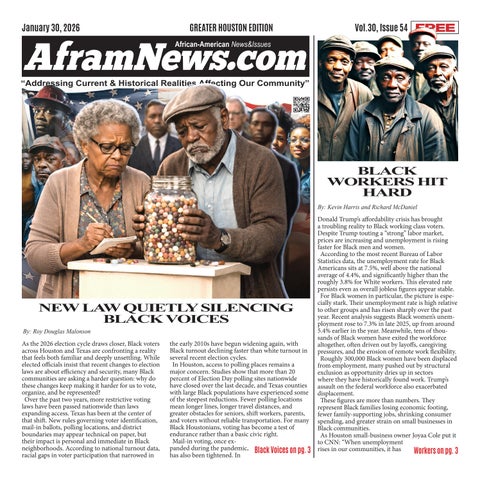
NEW LAW QUIETLY SILENCING BLACK VOICES By: Roy Douglas Malonson
As the 2026 election cycle draws closer, Black voters across Houston and Texas are confronting a reality that feels both familiar and deeply unsettling. While elected officials insist that recent changes to election laws are about efficiency and security, many Black communities are asking a harder question: why do these changes keep making it harder for us to vote, organize, and be represented? Over the past two years, more restrictive voting laws have been passed nationwide than laws expanding access. Texas has been at the center of that shift. New rules governing voter identification, mail-in ballots, polling locations, and district boundaries may appear technical on paper, but their impact is personal and immediate in Black neighborhoods. According to national turnout data, racial gaps in voter participation that narrowed in
the early 2010s have begun widening again, with Black turnout declining faster than white turnout in several recent election cycles. In Houston, access to polling places remains a major concern. Studies show that more than 20 percent of Election Day polling sites nationwide have closed over the last decade, and Texas counties with large Black populations have experienced some of the steepest reductions. Fewer polling locations mean longer lines, longer travel distances, and greater obstacles for seniors, shift workers, parents, and voters without reliable transportation. For many Black Houstonians, voting has become a test of endurance rather than a basic civic right. Mail-in voting, once expanded during the pandemic, Black Voices on pg. 3 has also been tightened. In
Donald Trump’s affordability crisis has brought a troubling reality to Black working class voters. Despite Trump touting a “strong” labor market, prices are increasing and unemployment is rising faster for Black men and women. According to the most recent Bureau of Labor Statistics data, the unemployment rate for Black Americans sits at 7.5%, well above the national average of 4.4%, and significantly higher than the roughly 3.8% for White workers. This elevated rate persists even as overall jobless figures appear stable. For Black women in particular, the picture is especially stark. Their unemployment rate is high relative to other groups and has risen sharply over the past year. Recent analysis suggests Black women’s unemployment rose to 7.3% in late 2025, up from around 5.4% earlier in the year. Meanwhile, tens of thousands of Black women have exited the workforce altogether, often driven out by layoffs, caregiving pressures, and the erosion of remote work flexibility. Roughly 300,000 Black women have been displaced from employment, many pushed out by structural exclusion as opportunity dries up in sectors where they have historically found work. Trump’s assault on the federal workforce also exacerbated displacement. These figures are more than numbers. They represent Black families losing economic footing, fewer family-supporting jobs, shrinking consumer spending, and greater strain on small businesses in Black communities. As Houston small-business owner Joyaa Cole put it to CNN: “When unemployment rises in our communities, it has Workers on pg. 3