111 Places in Northumberland

Page 1


Poison Garden

Not to be taken internally

The first garden at Alnwick Castle was created in 1750 by Capability Brown for Hugh Percy, First Duke of Northumberland. This garden was then dug over to grow much-needed fruit and veg during World War II. After the war, financial restrictions saw the garden slowly decay into disrepair.

The new Alnwick Garden was the brainchild of Jane Percy, Duchess of Northumberland. Work began on its development in 1997, with the first phase completed in October 2001. The garden was then opened to the public and proved to be a hit. There are many singular attractions at Alnwick Garden, including the largest wooden treehouse in the world. However, arguably the most interesting feature – definitely the most deadly – is the Poison Garden, found behind a locked gate in its own walled-off space.

The Poison Garden is filled with roughly 100 different plant species, all of which are either toxic, narcotic or both. To avoid unnecessary death, the Poison Garden can only be visited under supervision on a guided tour. Touching, eating or even smelling the plants is a no-no for obvious reasons. In fact, so toxic are some of the plants that the gardeners need to wear protective clothing when tending to them.

Surprisingly, not all of the plants are particularly exotic. Many can be found growing in gardens across the UK. Take aconitum for example. It’s an ornamental perennial with purple-blue flowers that resemble the cowls of monks, hence its common name of monkshood. Every part of the plant contains aconitine, an alkaloid that causes vomiting, diarrhoea or even cardiac arrest if swallowed. Agatha Christie used aconitum to despatch victims in two of her books: 4.50 from Paddington and They Do It with Mirrors. Which is why you shouldn’t argue with your nearest and dearest before making a visit to the Poison Garden…

Address Denwick Lane, Alnwick, Northumberland, NE66 1YU, +44 (0)1665 511350, www.alnwickgarden.com | Getting there Bus 418 or X 18 MAX to Allerburn Lea; paid parking at Alnwick Garden | Hours Apr – Oct daily 10am – 5pm during term time, Apr – Oct daily 9am – 6pm during Northumberland school holidays, reduced opening hours Nov – Mar (see website for details) | Tip Brizlee Tower is a wonderfully eccentric folly in Alnwick’s Hulne Park, built in 1781 for Hugh Percy.

Flock Sphere

Birds of feather…

The ‘Bord Waalk’ is a new £396,000 walking trail that starts at Hauxley Nature Reserve, curves around the coast to Amble, and from there takes you along the River Coquet to Warkworth. There are 12 sculptures dotted along the route, all inspired by the different types of bird that can be seen in the area. Not only that, there is a ‘Bord Waalk’ app with an augmented reality feature, related music, poetry, and information about the trail and the artists involved. The first three sculptures along the route were in place by the end of 2022: Tern Wings by Jon Voss, Bird Song by Aether and Hemera, and Flock Sphere by Rob Mulholland.

Flock Sphere is a stainless-steel globe – approximately eight feet in diameter – into which bird shapes have been laser cut. A doorway has been created in the base so that it’s possible to climb inside to view the sphere from within. From this perspective it’s easy to imagine yourself as a bird, flying as a member of a flock. As Mulholland stated in his original proposal for Flock Sphere, it ‘allows the viewer to consider their own relationship with natural world… specifically the relationship they have with the world of ornithology as they stand surrounded by the flock’.

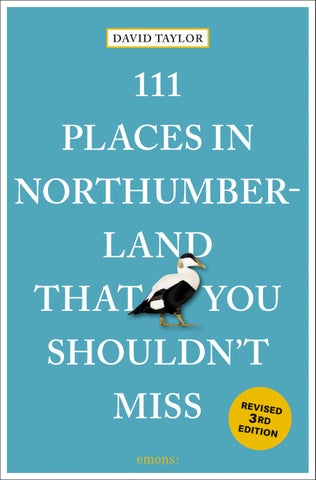
Bird life along Northumberland’s coast is varied, particularly during the summer months when migratory birds fly in to breed. The puffin is arguably the most charismatic of these migratory birds and can be seen nesting on the Farne Islands, as well as Coquet Island just off the coast at Amble. The eider duck is equally characterful, and can be seen on the coast throughout the year. The eider duck was a favourite of St Cuthbert and for that reason they are known locally as cuddy ducks. The saint loved the ducks so much that he placed them under his protection. Monks who later ate or harmed the ducks in any way were allegedly struck down by ‘Cuthbert’s Curse’, and one was even said to have died.

Address The Braid, Amble, Northumberland, NE65 0WU, www.theambler.co.uk | Getting there Bus X 20 to Fourways and then an 11-minute walk; free parking at Amble Braid Car Park | Tip Originally an open-cast mine, the thoroughly naturalised Hauxley Nature Reserve is a great place to see a wide variety of birds, as well as stoats, red squirrels and otters (www.nwt.org.uk).

The Lang Pack

Grave

error

In the grounds of St Cuthbert’s Church in Bellingham is a peculiar rectangular gravestone, known as The Lang Pack. Beneath it lies the body of a villain who was killed during an audacious robbery some 300 years ago. The tale as told goes something like this…

It is the end of a bitterly cold winter’s day in 1723. Colonel Ridley, the owner of Lee Hall on the banks of the River North Tyne near Redesmouth, is away in London. The house is in the care of three servants, Alice, Richard and Edward, who are under strict instructions not to allow anyone into the house. They are, therefore, thoroughly disconcerted when there is a knock at the door. The door is cautiously opened to reveal a pedlar. He begs to be allowed to come in and stay the night, but the three, mindful of their master’s instructions, refuse the request. The pedlar wheedles and whines to no avail. They do, however, agree to look after the pedlar’s large pack while he seeks lodgings elsewhere.

A few hours later all is quiet at Lee Hall and everyone is in bed except for Alice. Passing the pack in the hallway, she is startled to see it move. Terrified, she runs to fetch Richard and Edward. The latter, armed with his master’s blunderbuss, shoots at the pack. With a groan, out falls a man, fatally wounded and breathing his last. On a chain around the man’s neck hangs a silver whistle. The three quickly realise that the man is part of plot to rob the house, the whistle to summon his accomplices while they slept.

Help is sought from neighbours and, once a well-armed group is assembled at Lee Hall, the whistle blown. From the dark come a gang on horseback. Four are immediately shot and killed by the defenders; the rest flee in panic. Come daylight and the bodies have vanished, never to be found. The body of the man in the pack is eventually buried at St Cuthbert’s, his identity a mystery that may never be solved.

Address Bellingham, Northumberland, NE48 2JP | Getting there Bus 680 Tynedale Links to The Practice or to Parkside Place; limited free parking off B 6320 in Bellingham | Tip The neighbouring Town Hall is a delightful Victorian building built in the Gothic Revival style. In 1964, the Newcastle-based pop group The Animals debuted ‘The House of the Rising Sun’ during a performance at the town hall. The single version of the song was a huge hit for the band in both the UK and USA.

Royal Border Bridge

‘It’s deep water, that’s why a duck’

The approach to Berwick-upon-Tweed railway station is a particular highlight when travelling by train between Newcastle and Edinburgh. For that is when you cross over the River Tweed atop the splendid Royal Border Bridge. Look east from the bridge and you’ll see the attractive town of Berwick, the river and its road bridges, and the North Sea glittering in the far distance.

You can see so much because the train is 126 feet above the river. And that’s not the only impressive statistic, either. The bridge is 2,160 feet long in total, and 8 million cubic feet of stone and 2.5 million bricks were used in its construction. There are 28 arches along its length, 13 of which span the Tweed. Don’t worry though, there is absolutely no danger of the bridge sinking into the mud. The foundations are 40 feet deep and stand on solid bedrock.

The Royal Border Bridge was designed by Robert Stephenson, son of railway pioneer George Stephenson, and who was also responsible for the equally vertiginous (and contemporary) High Level Bridge in Newcastle. The foundation stone for the ‘Tweed Viaduct’ – as it was initially referred to – was laid on 15 May, 1847. Construction was remarkably speedy given the scale of the project. On 29 August, 1850, the Royal Border Bridge was officially opened by Queen Victoria and Prince Albert.

The bridge connected the Edinburgh to Berwick line, owned by North British Railway, to the Tweedmouth to Newcastle line, owned by Newcastle & Berwick Railway. The opening of the bridge must have been a huge relief for passengers travelling between England and Scotland (and vice versa). Before 1848 – when a temporary wooden railway bridge was built – a horse-drawn carriage was used to ferry passengers (and their luggage, presumably) between the stations at Tweedmouth and Berwick. All you have to do now is sit back, relax and enjoy the view.

Address Royal Border Bridge Viewpoint, Tweedmouth, Berwick-upon-Tweed, Northumberland, TD15 2HJ | Getting there Bus Berwick Hoppa to West End Place and then a short walk; train to Berwick Railway Station and then a 20-minute walk; free parking near the Royal Border Bridge Viewpoint | Tip Berwick’s Old Bridge – a road and pedestrian bridge – was completed in 1621 and is the oldest bridge over the river Tweed in Berwick.

Chillingham Cattle

Mooving experience

Northumberland has its own unique breed of cattle, one that is untamed and free from human interference (not even veterinary care). The Chillingham Cattle are truly wild and can only be seen in the company of an experienced guide. The animals are relatively small and lean compared with modern cattle breeds, because they’ve never been ‘improved’ by selective breeding over the centuries. They also have a wonderfully crisp and shaggy white coat, and sport long, curved horns on their head.

One – now abandoned – theory was that the cattle were aurochs, the ancestral animal from which domesticated cattle were bred. What is known is that the cattle have lived in splendid isolation on the Chillingham estate for nearly 800 years. Originally, they were game animals, hunted for sport with hounds and lances. Able to run at 30 miles per hour and ill-tempered, the cattle would have presented a formidable challenge to even the most experienced hunter.

There are approximately 130 cattle in the herd. However, natural pressures do have their effect on numbers. The herd dropped to a dangerously low 13 animals after the brutally hard winter of 1947. The Foot and Mouth outbreaks of 1967 and 2001 also presented a challenge. Strict biosecurity measures were established during the latter occurrence to keep the herd free of the disease. There is now a ‘backup’ herd in a secret location in Scotland just in case.

Because of the small size of the herd, the Chillingham Cattle are essentially clones of each other. This is not due to sinister scientific experimentation but because there is no outbreeding, the usual solution to widening a gene pool. Strangely, despite this lack of genetic diversity, there are very few birth defects. Calves born with physical abnormalities are quickly abandoned by their mothers and die. From a human perspective this may seem cruel but the Chillingham Cattle are nothing if not survivors.

Address Near St Peter’s Church, Chillingham, Northumberland, NE66 5NP, +44 (0)1668 215250, chillinghamwildcattle.com | Getting there Parking at the Chillingham Wild Cattle Park | Hours Regular daily tours from Easter – Oct | Tip Belford Museum is an ever-evolving museum run by enthusiastic volunteers that features information and exhibits that tell the history of the village (www.belfordmuseum.co.uk).

Northumberland Zoo

Animal magic

It all began with a tearoom. In the early noughties, Brian and Linda Bradley ran a farm and decided to offer visitors the option of refreshments. They obtained some rare-breed chickens. Followed by goats and donkeys. And then meerkats and raccoons. By 2015 the couple were running an officially licensed zoo. Since 2021, the zoo has been a full member of the British and Irish Association of Zoos and Aquariums, and, in 2025, became an accredited member of European Association of Zoos and Aquaria.

The Zoo isn’t a just a pet project for Linda and Brian. Both want want educate visitors on the need for conservation, as well as provide an ark for endangered species. Perhaps the most charismatic of the zoo’s animals are the snow leopards from the mountainous regions of central and south Asia. There are fewer than 6,000 of these creatures left in the wild, and they are categorised as ‘Vulnerable’ on the IUCN red list of endangered species. Unfortunately, snow leopard fur is prized by hunters, and the skin and bones are still used (illegally) in traditional medicines across Asia. Zoos, such as Northumberland Zoo, are therefore a small if necessary refuge that may ultimately save the snow leopard from extinction.

It’s hard to run a successful tourist attraction these days without a fun and engaging presence on social media. Northumberland Zoo managed the tricky feat of going viral for all the right reasons on TikTok and YouTube in 2024. More than six million people have watched Brian and Linda (who are both in their 60s) struggle to use a variety of Gen Z phrases and gestures in a promotional short for the zoo. Their deadpan (if slightly bewildered) delivery of expressions such as ‘Main Character Energy’, ‘Smol’ and ‘Lit’ captured the region’s heart and resulted in a number of glowing articles in the press both home and abroad. Does this mean that Linda, Brian and their wonderful zoo are the GOAT? IYKYK.

Address Eshottheugh Farm, Felton, Morpeth, Northumberland, NE65 9QH, www.northumberlandzoo.co.uk | Getting there Free parking at the zoo | Hours Winter daily 10am – 4pm (except Christmas Day, Boxing Day and New Year’s Day, though check website before paying a visit), Summer daily 10am – 5pm | Tip If you have a hankering for a sumptuous afternoon tea then head directly to The Running Fox in the nearby village of Felton (runningfoxbakery.co.uk).

The Forum Cinema

Sound and vision

Monday, 23 August, 1937 had its ups and downs. French neoclassical composer Albert Roussel unfortunately failed to see the day out. A more cheerful episode, however, was the opening of the Forum Cinema in Hexham, an Art Deco replacement for the Gem Picture Palace, which had occupied the site since 1910. A poster promoting the inaugural event proudly proclaimed that the cinema was ‘Hexham’s New Wonder Theatre’, with luxuries such as ’4-Colour Stage Lighting’ and a ‘Western Electric Mirrorphonic Sound System: the standard sound system of the world’.

Patrons paying their two shillings for a seat in the Grand Circle (or six pence to slum it in the Pit) were shown Keep Your Seats, Please, starring the irrepressible George Formby. Over the course of 82 fun-filled minutes, Formby sang a number of catchy ditties, one of which was the saucy ‘When I’m Cleaning Windows’. The song was promptly banned by a disapproving Lord Reith and the BBC until it was pointed out that Formby had performed it before an appreciative King George VI and Queen Elizabeth at a Royal Variety Performance. It didn’t hurt that Queen Mary was a fan too.

Like many cinemas, the Forum suffered when TV came along. Falling attendance resulted in closure between 1974 and 1982, with the auditorium put to use as a bingo hall (a common fate for failed cinemas at the time). It was closed again in the early 1990s after pub chain JD Wetherspoon bought the building. Fortunes improved in 2007 when Hexham Community Partnership acquired the lease. The Forum is now run as a community enterprise, with profits used to improve Hexham and the surrounding area. The cinema has been extensively refurbished in the intervening years too. Improvements include new seating and the installation of a thoroughly modern digital projection and sound system. As a certain cheeky mid-century film star once said, it’s turned out nice again.

Address Market Place, Hexham, Northumberland, NE46 1XF, +44 (0)1434 601144, www.forumhexham.com | Getting there Bus 680, 683 or 685 Tynedale Links and various others to Monument; train to Hexham and then a short walk; parking on Beaumont Street (requires parking disc available from shops in Hexham) | Hours Mon, Wed – Fri & Sun 1.30 – 9.30pm, Tue 11am – 9.30pm, Sat 12.30 – 9.30pm, check website for times of special events | Tip The Victorian Tap is a friendly and informal 19th-century pub that has recently been sensitively refurbished.

Catcleugh Blackhouse

Off to work we go

Kielder Water isn’t the only reservoir in Northumberland. Catcleugh Reservoir is one of a chain of reservoirs that includes, Hallington, Whittle Dene, Colt Crag and Little Swinburne, all fed by water from the River Rede and connected by a series of tunnels and aqueducts. Catcleugh was built by the Newcastle and Gateshead Water Company between 1893 and 1903. Industry on Tyneside boomed during this period and the urban population rapidly increased as a result. Catcleugh and its associated reservoirs were needed to supply fresh water to Newcastle and Gateshead to meet the ever-growing demand.

Building Catcleugh was a difficult undertaking. The proposed site was remote and there was no modern road nearby to transport men and materials to the area. The solution was a 16-mile narrow gauge railway, built to connect Catcleugh to West Woodburn Station and the main railway network. Temporary wooden housing was also built on-site for the 600 workers and their families. The singlestorey accommodation huts were built on both sides of the River Rede and – perhaps inevitably – the northern site was nicknamed ‘Newcastle’ and the southern site ‘Gateshead’. Life was tough for the men and their families. The huts had no running water or electricity supply. Each room had a coal fire, the only source of heat, and paraffin lamps provided the only lighting at night.

Only one hut – the Catcleugh Blackhouse – now remains. When the reservoir was finished the ‘towns’ were torn down. However, the Blackhouse was kept and used as a store until the 1960s, when it was finally abandoned. By the 1980s it was in a sorry state until a local campaign persuaded the Northumberland National Park and Northumbria Water to fully restore it. Now the building is filled with fascinating historical artefacts that tell the full story of the workers and the reservoir they built.

Address Near Cleugh Manor, Byrness, Northumberland, NE19 1TS, www.northumberlandnationalpark.org.uk | Getting there Parking at Catcleugh Blackhouse | Hours Only viewable on official tours run by the Northumberland National Park during the summer months – see the website for details | Tip The Percy Cross, found in a small plantation west of Otterburn, commemorates the Battle of Otterburn, fought in 1388 between the armies of England and Scotland.

Seahouses

Working hard at having fun

The coastal village of Seahouses is the closest Northumberland has to Blackpool. It’s where you can buy sticks of rocks, wall plaques with amusing aphorisms, beachwear, novelty postcards, buckets and spades, and cuddly toys. Admittedly, there are no rollercoasters or illuminations, no Madame Tussauds or a Sea Life Centre, but there is crazy golf, the best fish and chips in the county, welcoming pubs, and the nearby beach is long and sandy and golden.

Tourism is the main driver of Seahouses’ economy, but it wasn’t always thus. Seahouses isn’t even that old in the scheme of things either. It owes its origins to North Sunderland, just a short drive inland. North Sunderland was a fishing village, established at a time when Viking raids along the Northumbrian coast were all too common. Because North Sunderland was some way inland, villagers had time to prepare whenever an attack from the North Sea was likely.

In 1786, the natural harbour was improved by the building of a stone jetty, courtesy of the trustees of the Lord Crewe estate. The jetty meant that greater numbers of fish could be landed, and also made the exporting of coal and lime easier and more lucrative. Increasing wealth led to the building of homes along the sea front. These ‘sea houses’ eventually became Seahouses, the new village gradually but decisively eclipsing the older settlement.

Seahouses boomed during the Victorian period. At one point 50 herring boats regularly sailed from the harbour and, by 1855, there were six herring yards and associated smokehouses. So brisk was trade that in 1886 work began on the construction of Long Pier and New Harbour. However, during the second half of the 20th century, the importance of fishing declined. Fishing boats still sail into Seahouses, but increasingly they are filled not with herring but with happy day trippers loaded down with souvenirs.

Address Seahouses, Northumberland, NE68 7SJ, www.seahouses.org | Getting there

Bus 418 or X 18 to King Street; paid parking at Seafield Car Park or Harbour Parking Lot | Tip The wonderfully quaint Gunpowder House on the coast near Seahouses was built to store explosives used during the construction of Long Pier and New Harbour.

Whalton Baal

In the summertime

In Northumberland, come midsummer, the days are long and the nights vanishingly short. (The reverse is true at midwinter, but, at the height of summer, who wants to think about that?) The arrival of midsummer on 24 June is celebrated around the northern hemisphere in a variety of ways. Perhaps the most eccentric, however, is the Whalton Baal (or Bale), held in the village of Whalton.

The festival itself isn’t that out of the ordinary. There’s music, played on traditional instruments such as the Northumbrian pipes, as well as morris dancing, all of which is centred around a bonfire set up on the village green. (Baal is an ancient god, but the word is possibly derived from the Anglo-Saxon ‘bael’, meaning a great fire.) The village pub, The Beresford Arms, also gets in on the act, providing beer and barbecue food. What is charmingly odd about the whole thing is that Whalton’s midsummer celebrations take place on 4 July. This is also Independence Day in the USA, though there is absolutely no connection.

The Whalton Baal is an ancient festival and has always been held on 4 July, as this was once the date of Midsummer Eve. This changed in 1752, when Britain switched from the Julian calendar to the Gregorian, which resulted in dates being moved forwards by 11 days. This is why midsummer is now on 24 June and not 5 July. Allegedly, the villagers of Whalton, being traditionally minded countryfolk in the 18th century, just went on celebrating Midsummer Eve on the old date rather than the new.

Fire festivals at midsummer were once common in Britain and across Europe, and probably originated in pagan propitiation rites to guarantee a good harvest. They largely died out in the 19th century when science took over from superstition. The Whalton Baal carried cheerfully on and has continued uninterrupted since its origins in the dim and distant past.

Address Whalton, Northumberland, NE61 3UZ, www.whaltonvillage.org.uk | Getting there On-street parking during the year, with more limited parking in place during the Whalton Baal | Tip In Allendale, the New Year is rung in by a procession of ‘Guizers’ carrying blazing barrels of tar on their heads. The flames from the barrels are then used to light a bonfire in the village square on the stroke of midnight.

David Taylor is a professional freelance landscape photographer and writer who lives in Northumberland. His first camera was a Kodak Instamatic. Since then, he’s used every type of camera imaginable: from bulky 4x5 film cameras to pocket-sized digital compacts. David has written over 40 books, as well as supplying images and articles to both regional and national magazines. When David is not outdoors he can be found at home with his wife, a cat, and an increasingly large number of tripods. www.davidtaylorphotography.co.uk

The information in this book was accurate at the time of publication, but it may change at any time. Please confirm the details for the places you’re planning to visit before you head out on your adventures.

Turn static files into dynamic content formats.
Create a flipbook
Issuu converts static files into: digital portfolios, online yearbooks, online catalogs, digital photo albums and more. Sign up and create your flipbook.