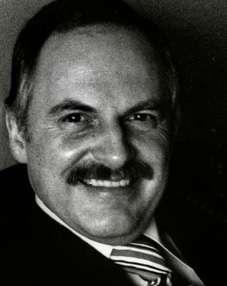
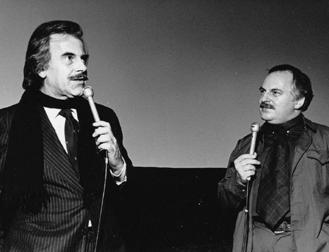
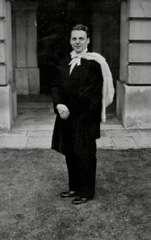
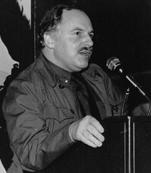
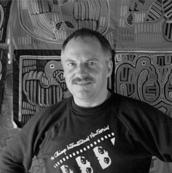
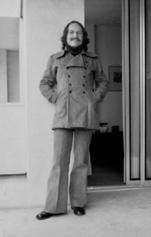
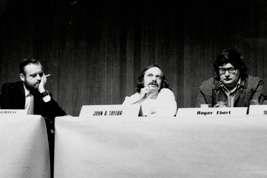
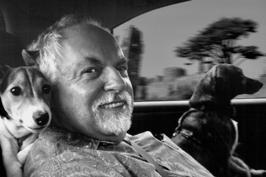
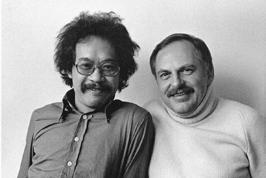
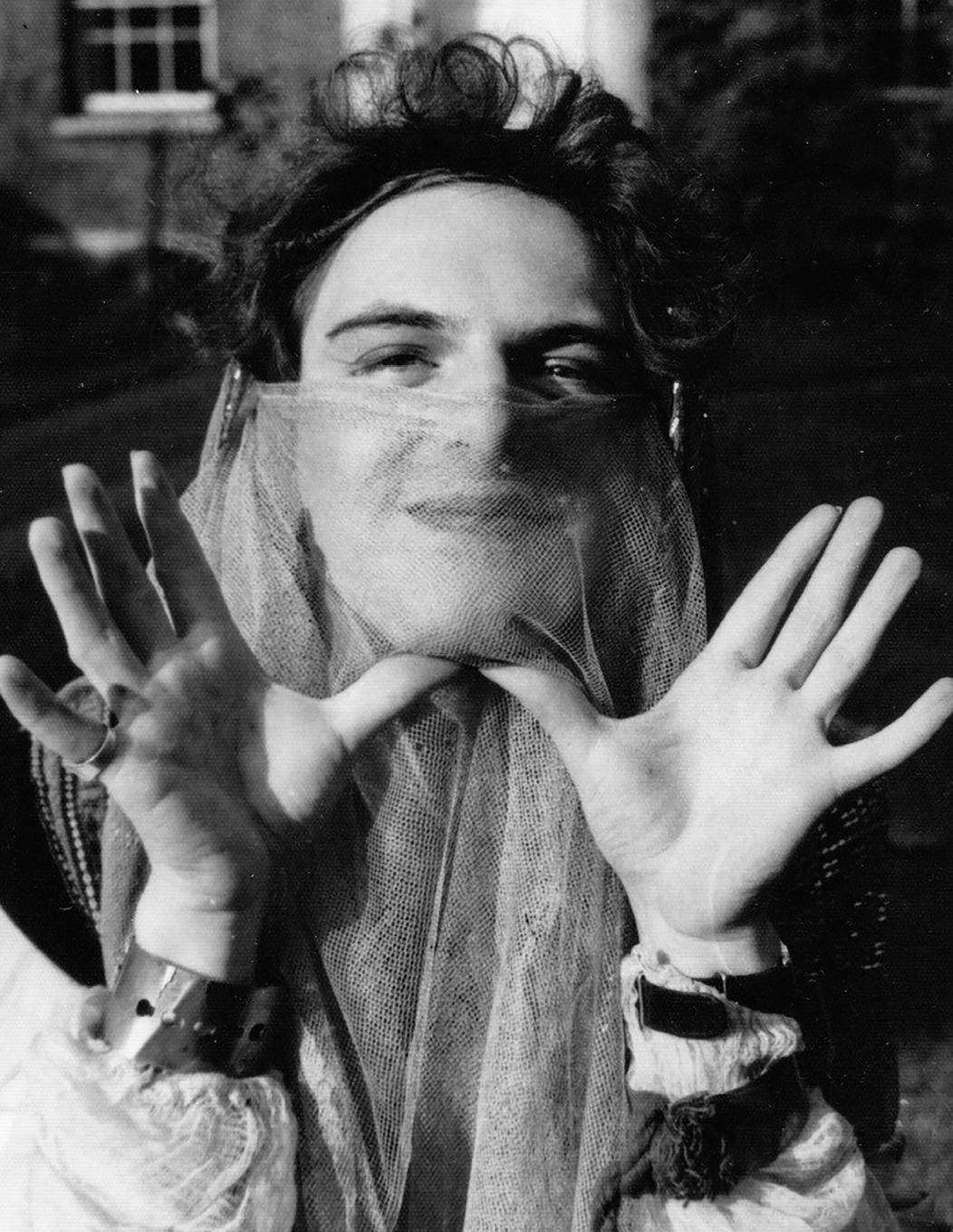
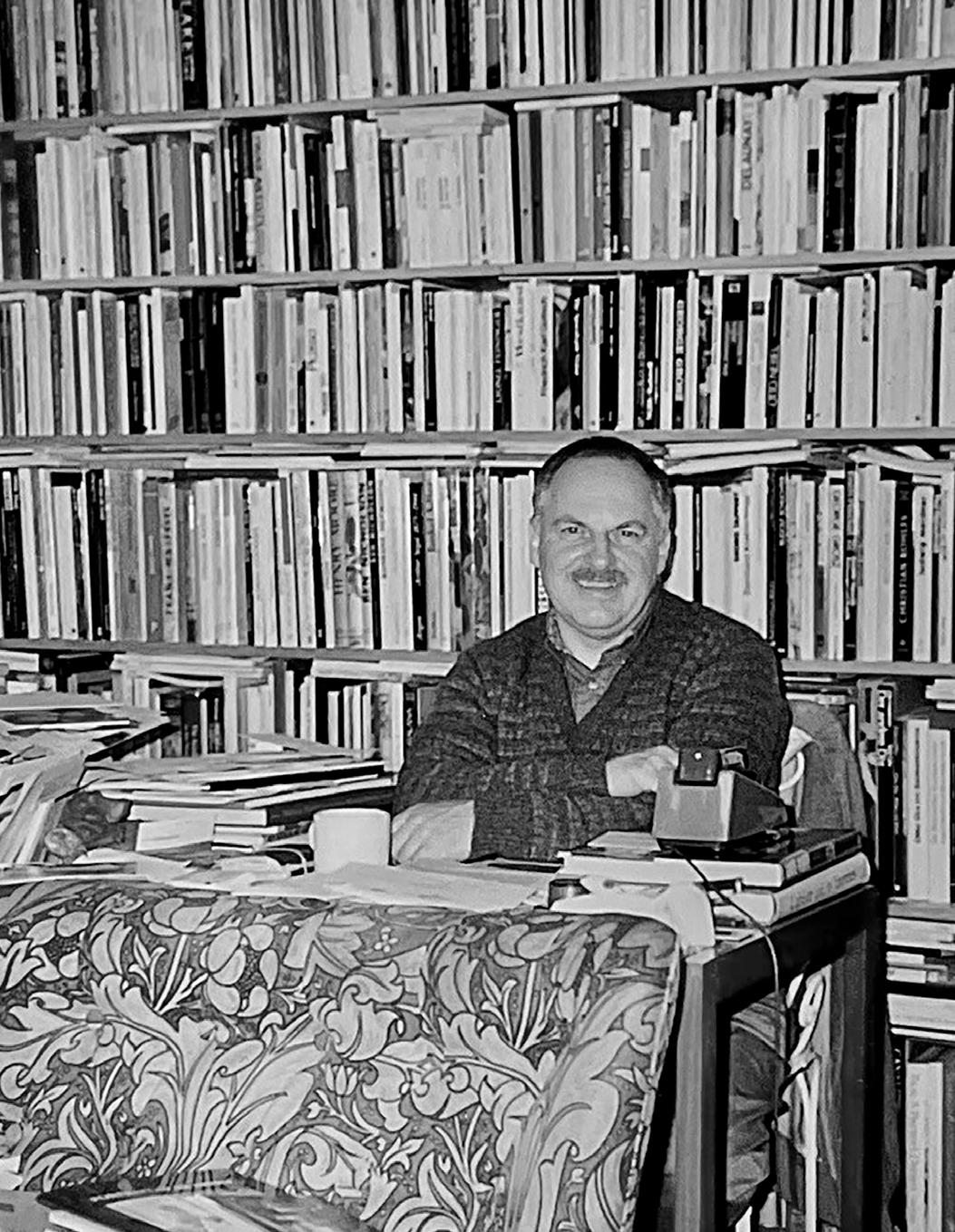
BIOGRAPHY
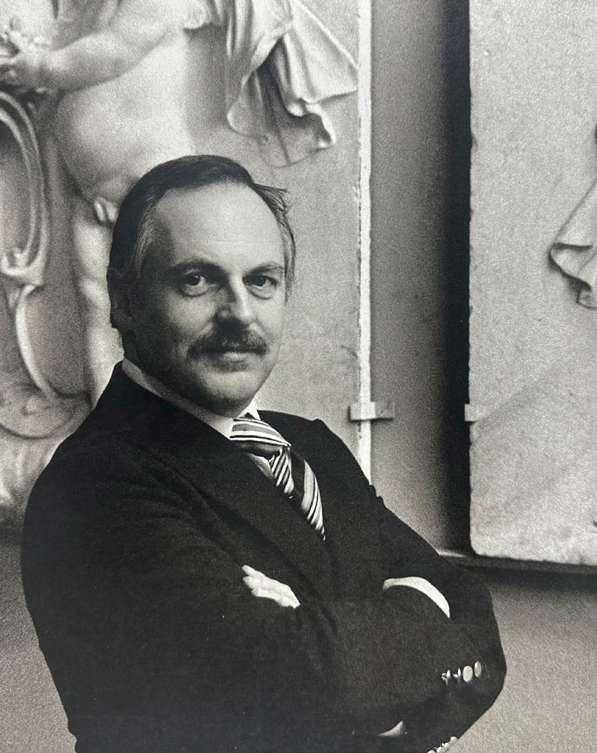
1937-45
Moves with his mother and father to Wales where his father takes up a new post
1951
Awarded scholarship to Cambridge when 16 years old with entry deferred until he is 18
19 June 1935
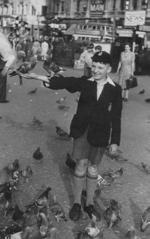
Born in Dover; son of Arthur Russell a Customs Officer and Kathleen Mary Taylor a teacher
1945
Returns to Dover with his parents and attends Dover Grammar School; enjoys weekly visits to the local cinema
1953-56
Goes up to Cambridge to study English at Jesus College; graduates with a starred First Class degree
1970s
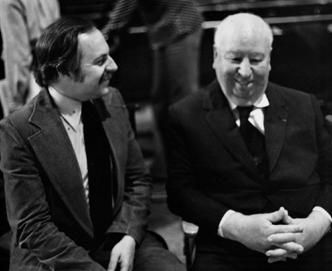
Starts writing television plays, including Dracula for which he was widely praised; meets Alfred Hitchcock
1969
Becomes a jury member at the 19th Berlin International Film Festival, and frequently on the jury of other festivals including Chicago, Cork, Delhi, Istanbul, Krakow, Montreal, Parnu, Rio de Janeiro and Venice
1970-71
Director of Film
Studies at Tufts University in London
1972
Moves to California to teach film; becomes Professor of film at the University of Southern California (until 1978); lunches regularly with Alfred Hitchcock
1972
American Cultural Correspondent for The Times (until 1978)
1972
Lives with artist Nick Cann in California (until 1978)
1958-59
Teacher at Harrow Grammar School
1960s
Writes on cinema in Sight and Sound and the Monthly Film Bulletin, on theatre in Plays and Players and on television in The Listener
1956-58
Post-graduate studies in Art Nouveau book illustration at the Courtauld Institute of Art
1959
Begins at The Times working in various departments reviewing television and theatre, and writing in The Times Educational Supplement and The Times Literary Supplement
1962
Appointed film critic for The Times and writes Anger and After on contemporary British theatre, his debut publication
1978
Returns to London after the publication of Hitch, his acclaimed biography of Alfred Hitchcock; works for The Times, London as art critic; meets Ying Yeung Li who would become his lifetime companion
1983
Editor of Films and Filming magazine (until 1990)
2005
Retires from The Times but frequently contributes to the newspaper’s arts pages and writes the obituaries of leading artists and film stars. He writes catalogues and monographs on the work of a wide range of younger artists as well as critical studies and travels widely to review exhibitions
2006
Enters a civil partnership with Ying Yeung Li
18 August 2025
Dies London
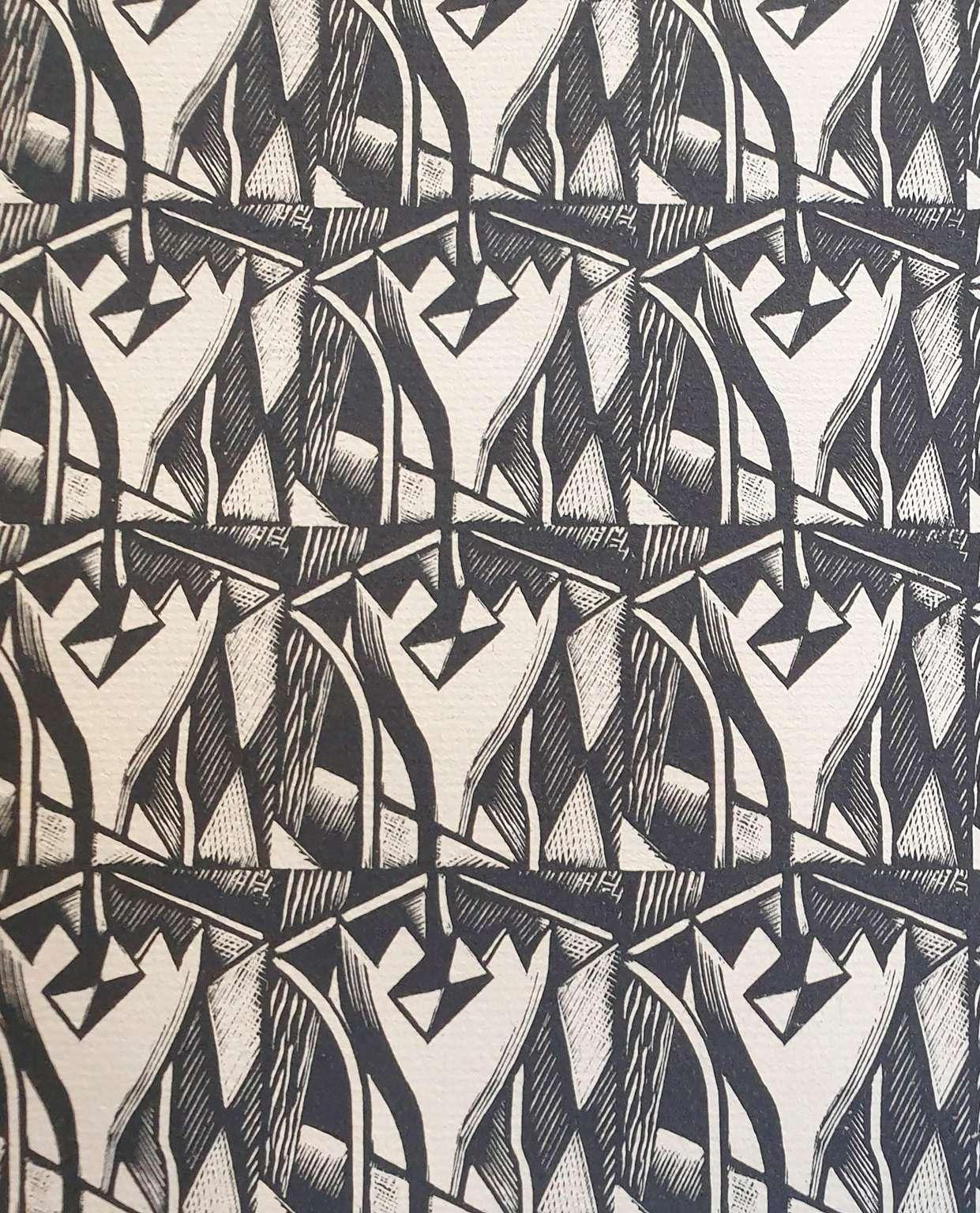
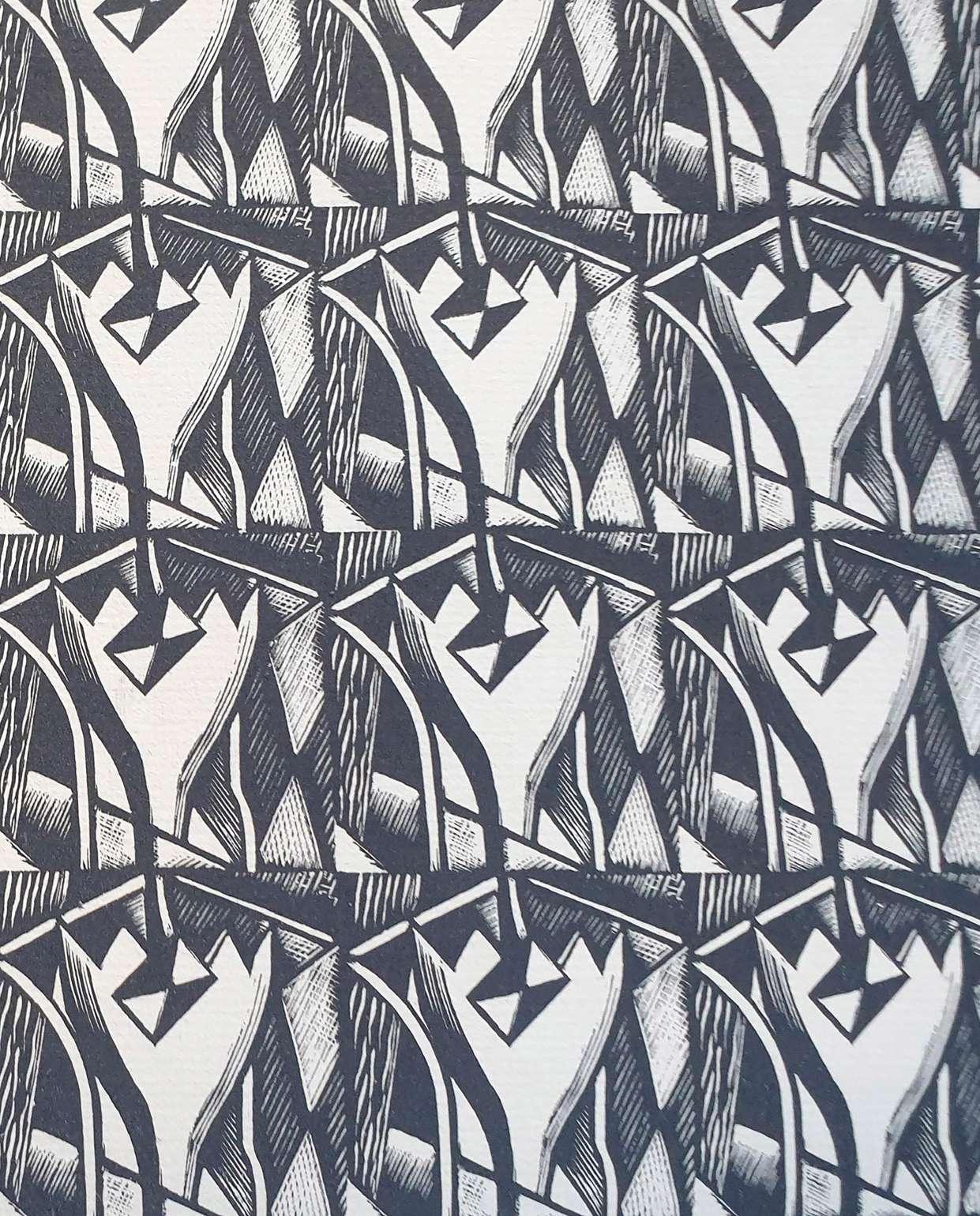
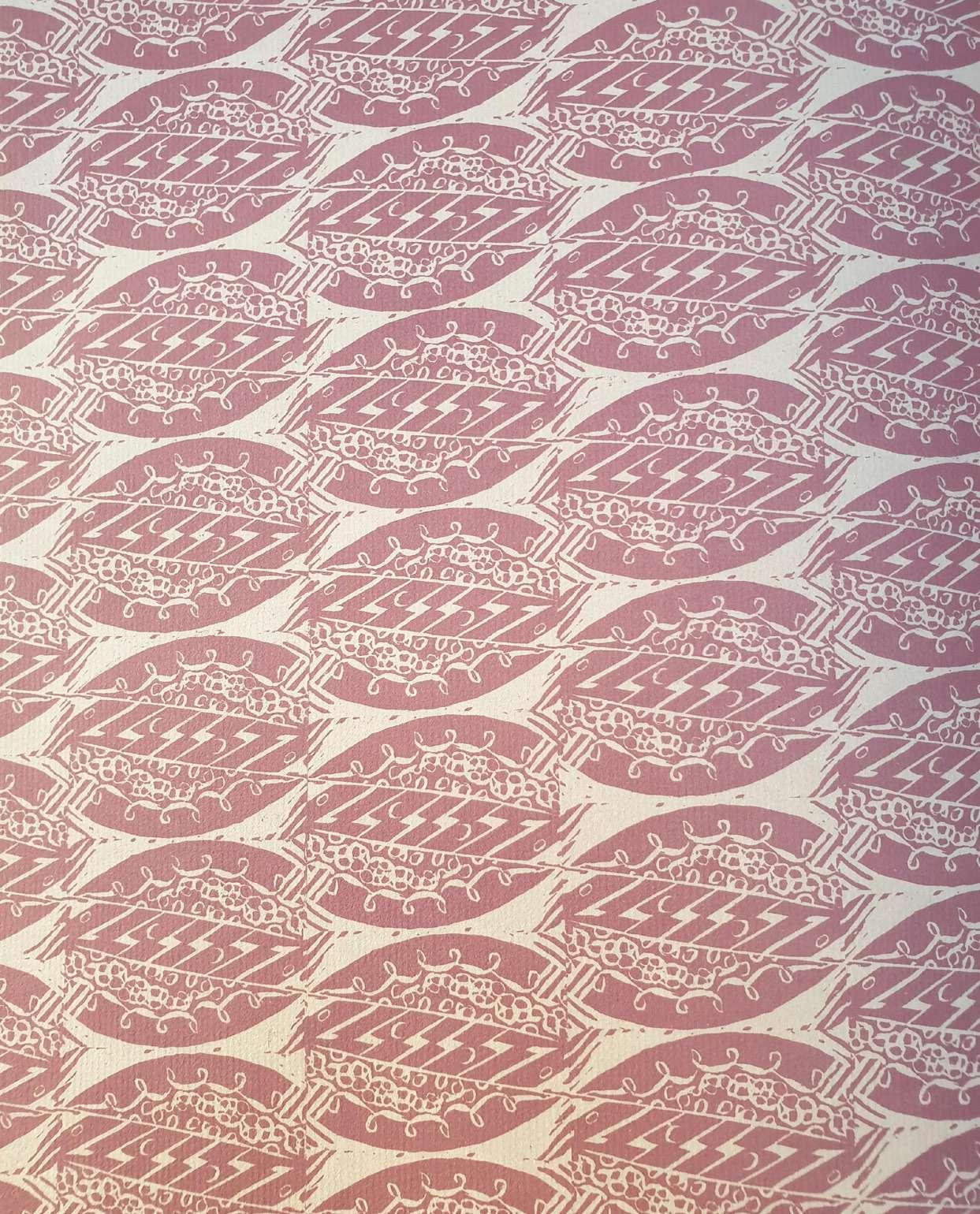
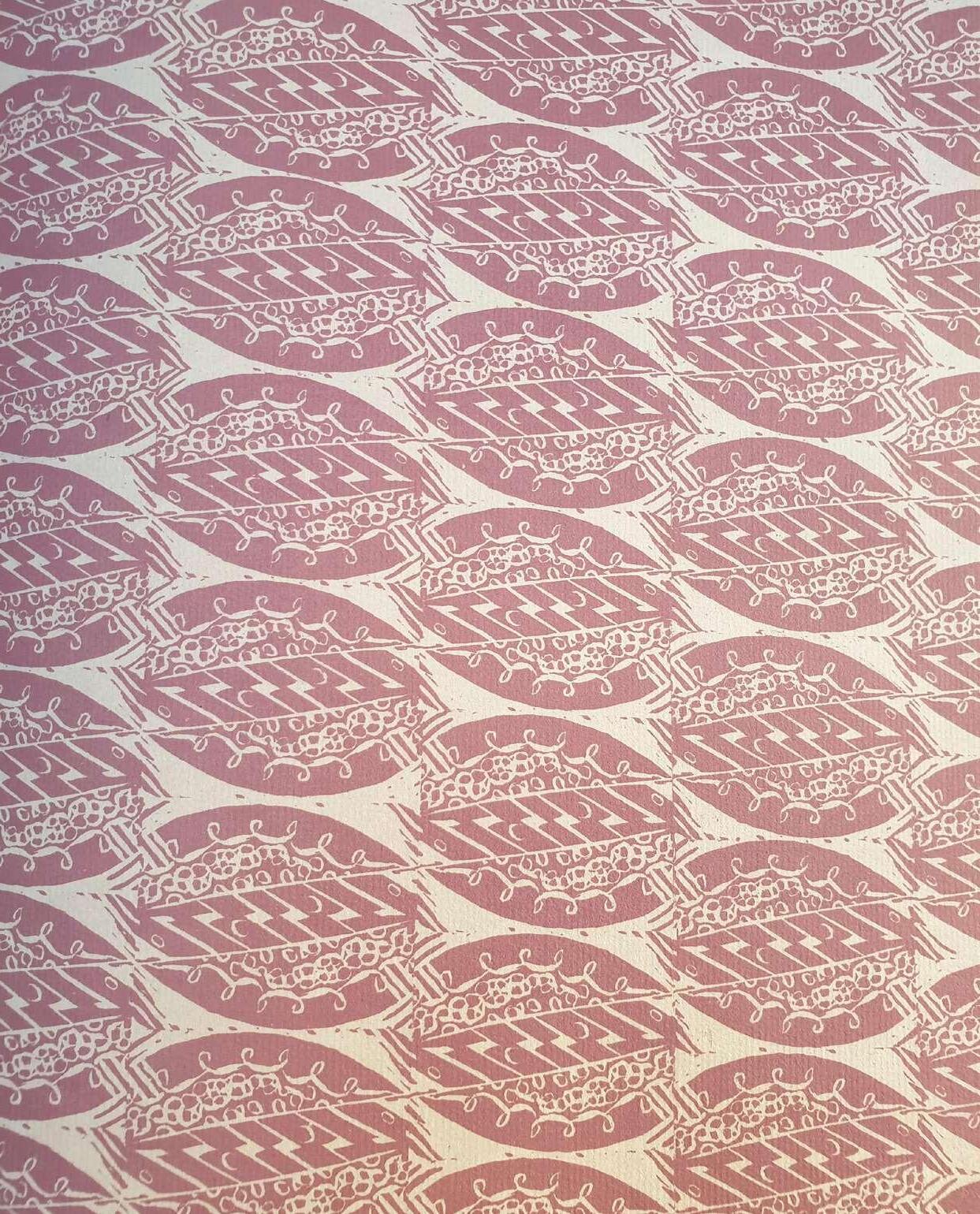
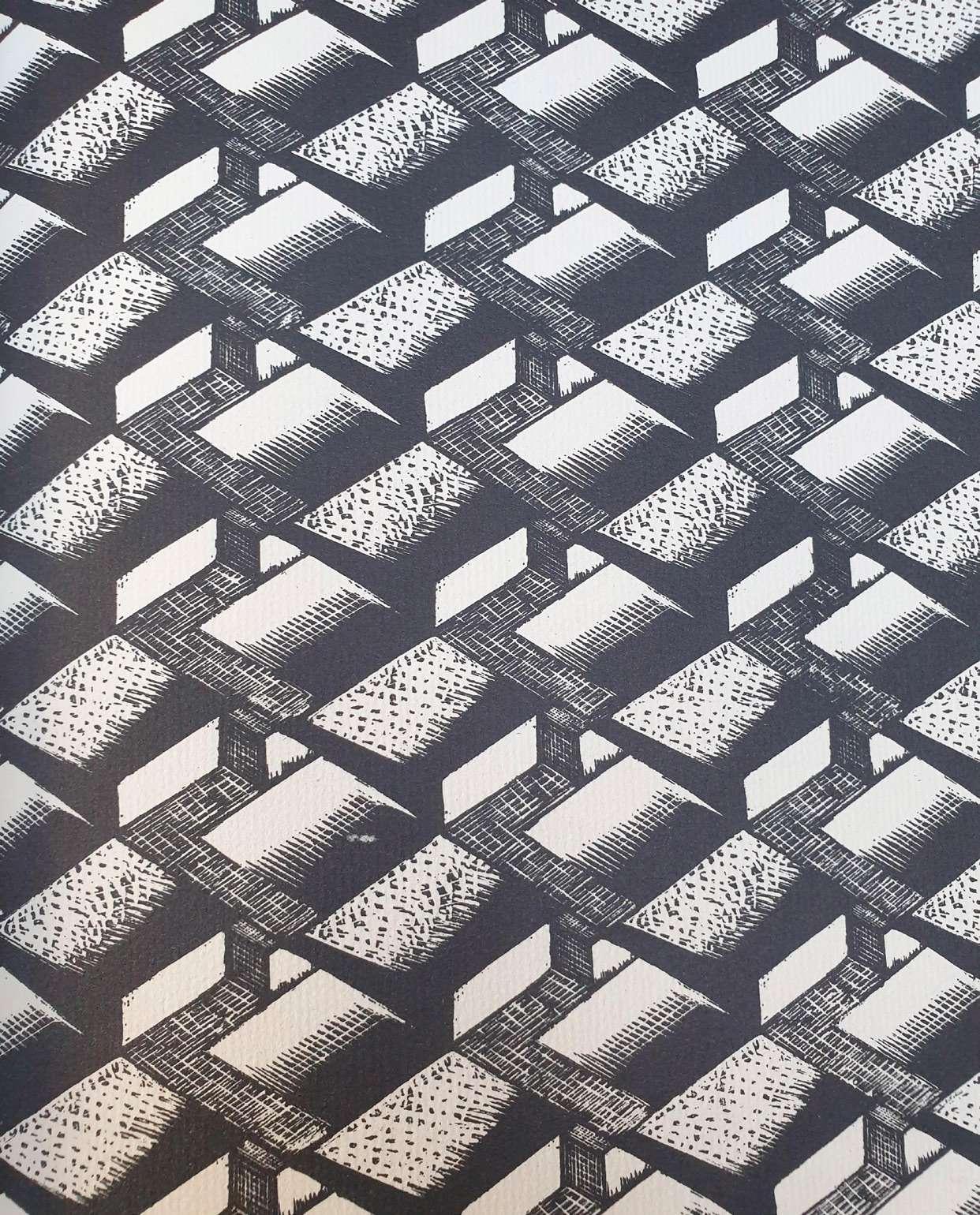
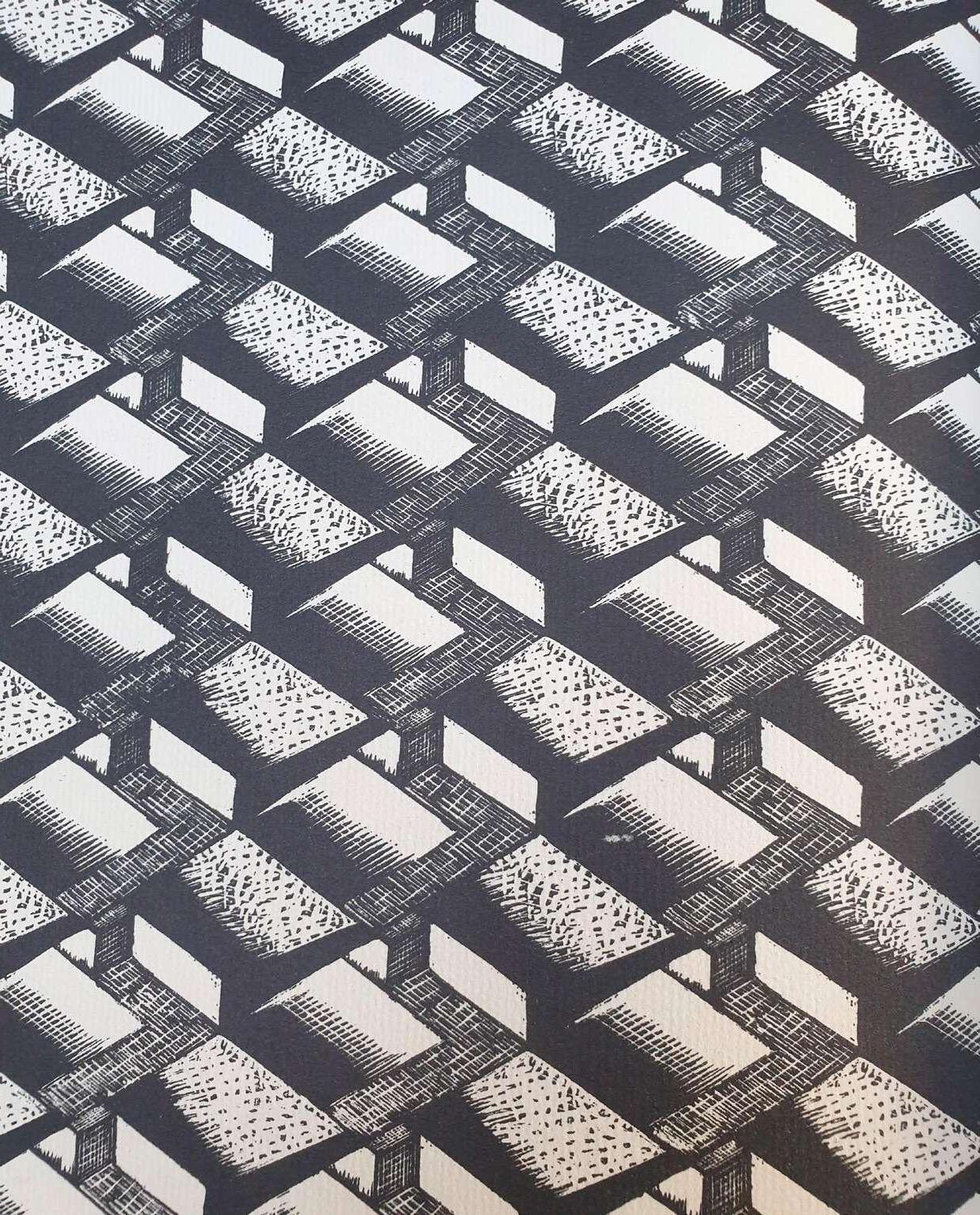
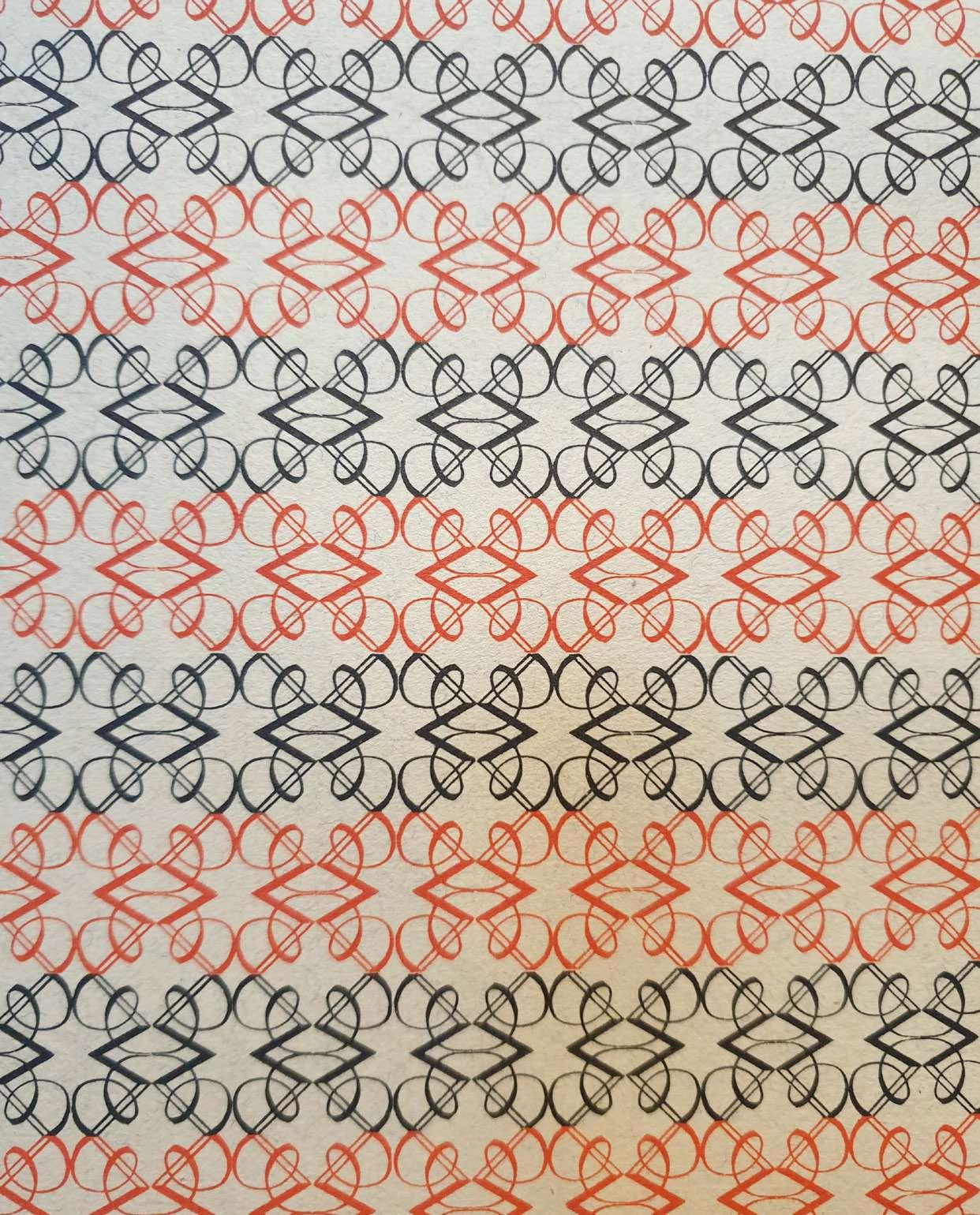
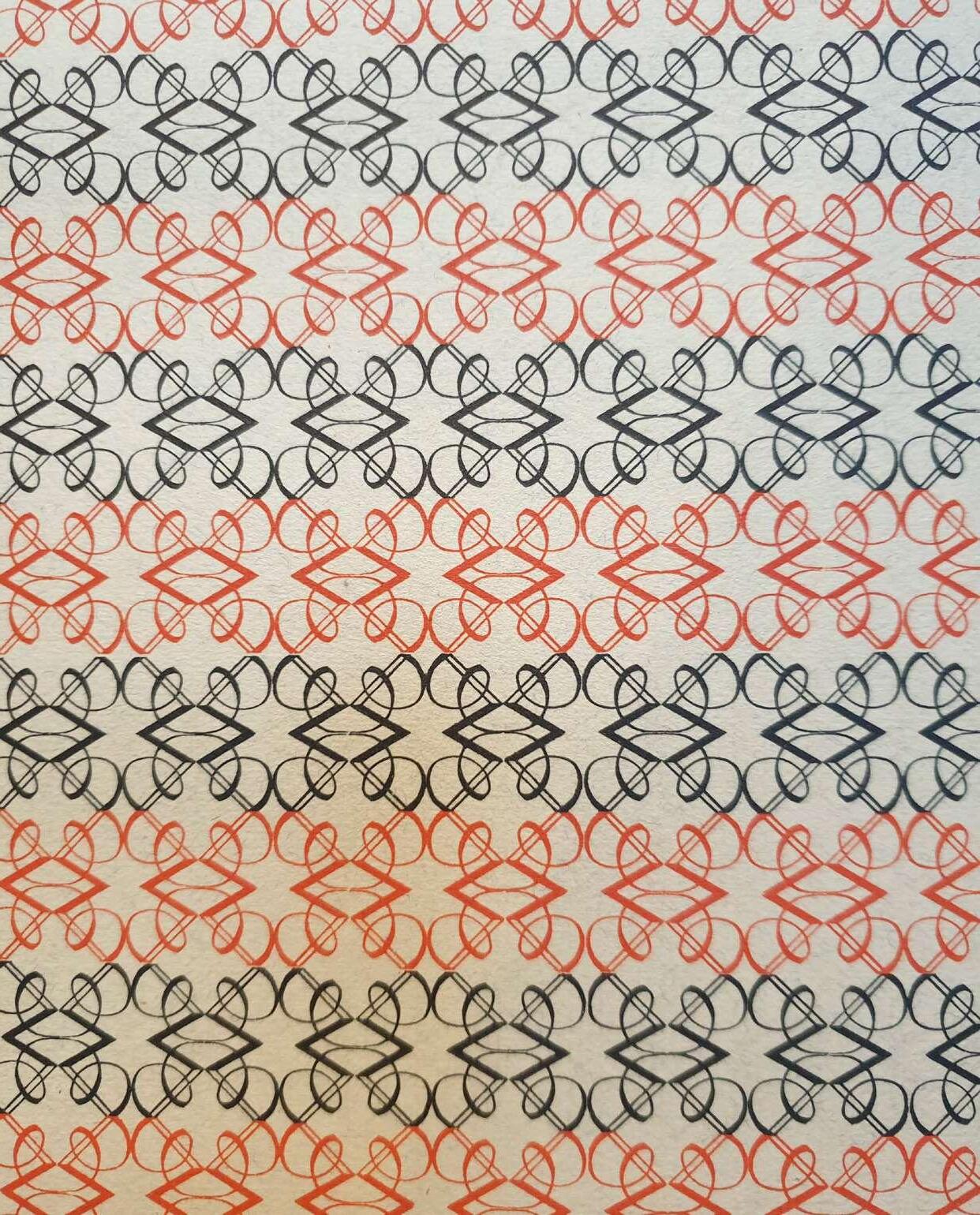
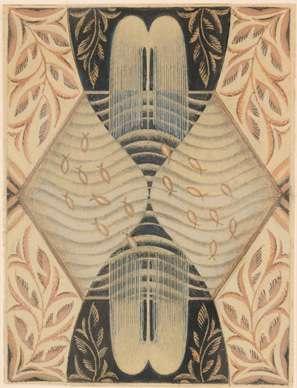
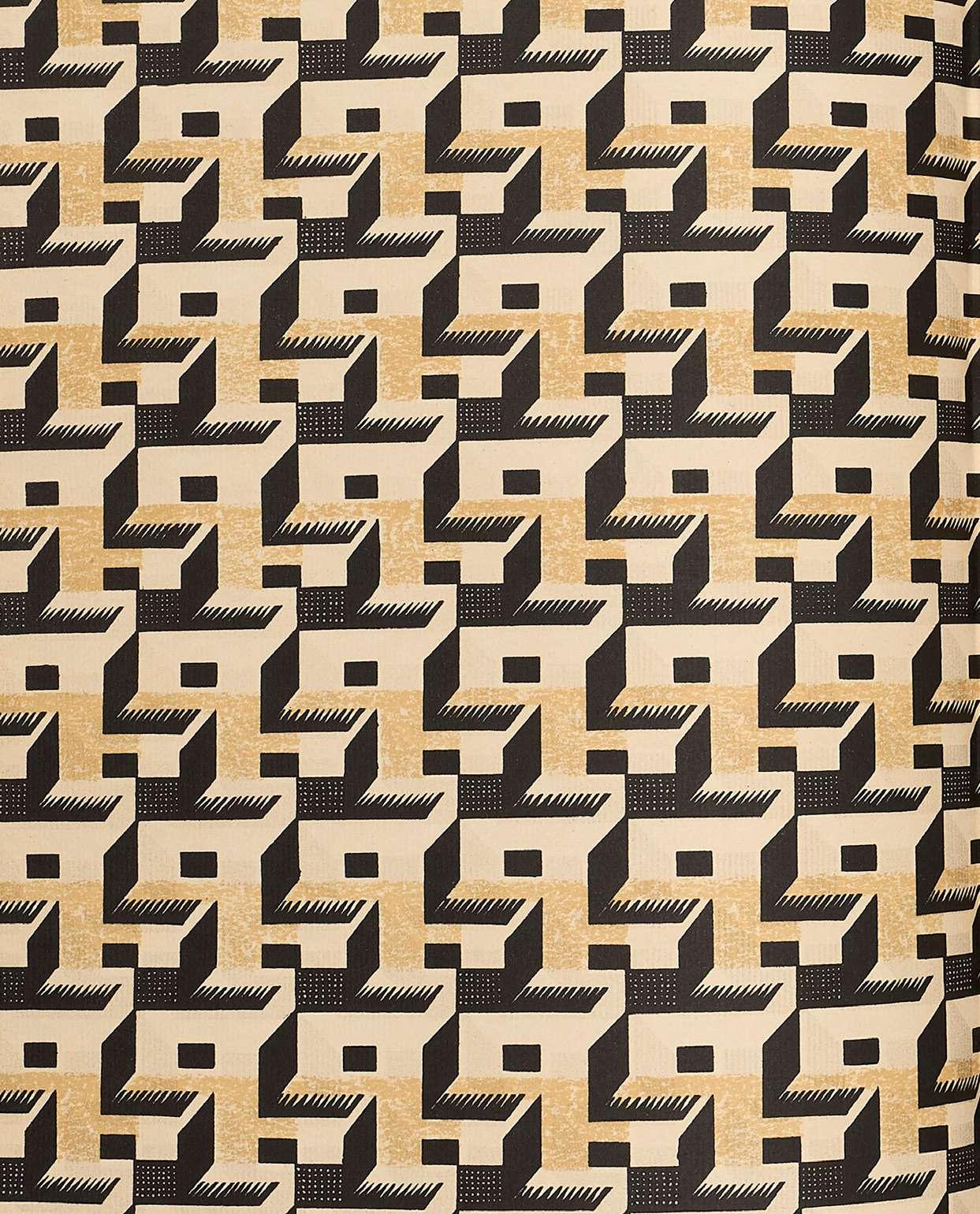
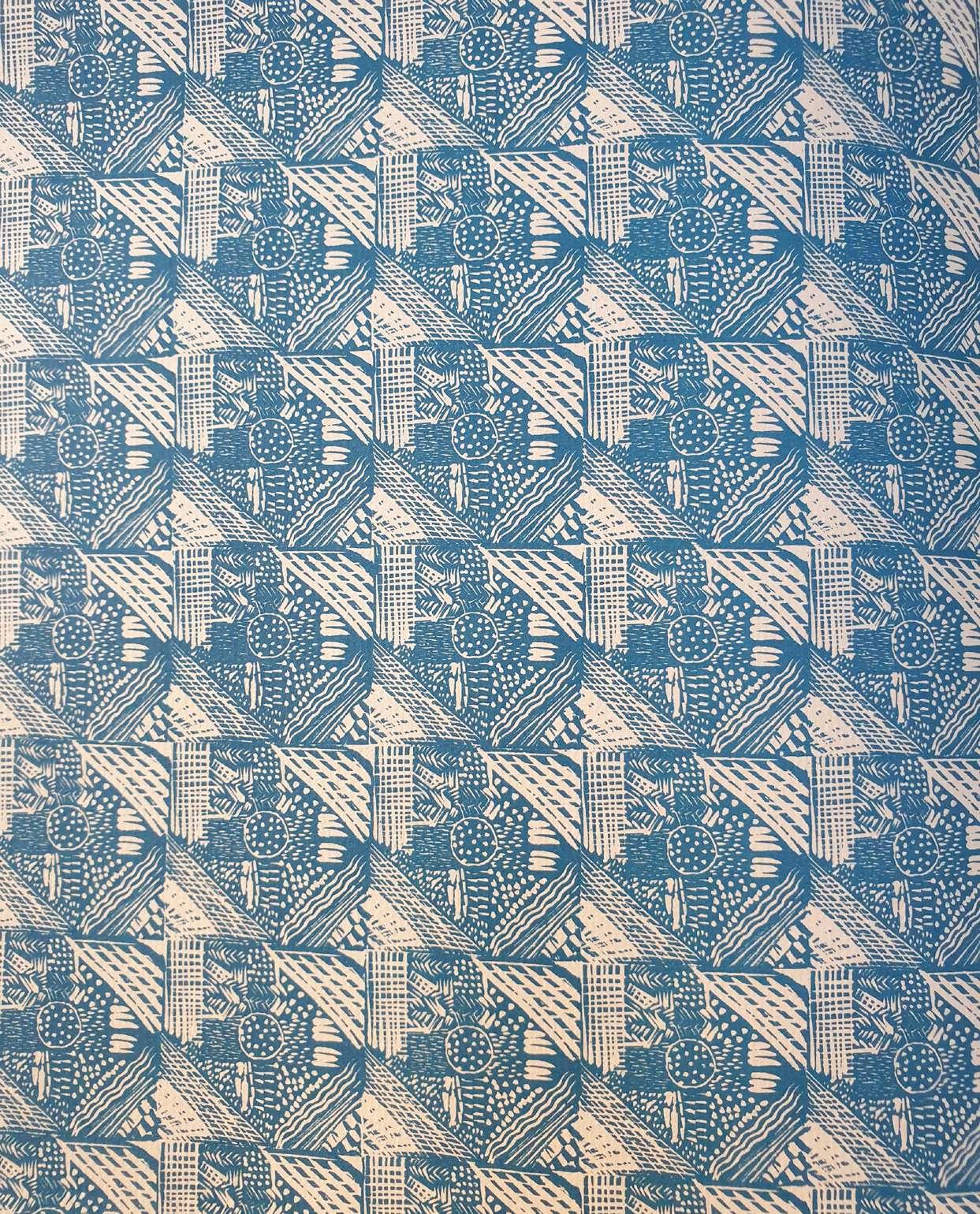
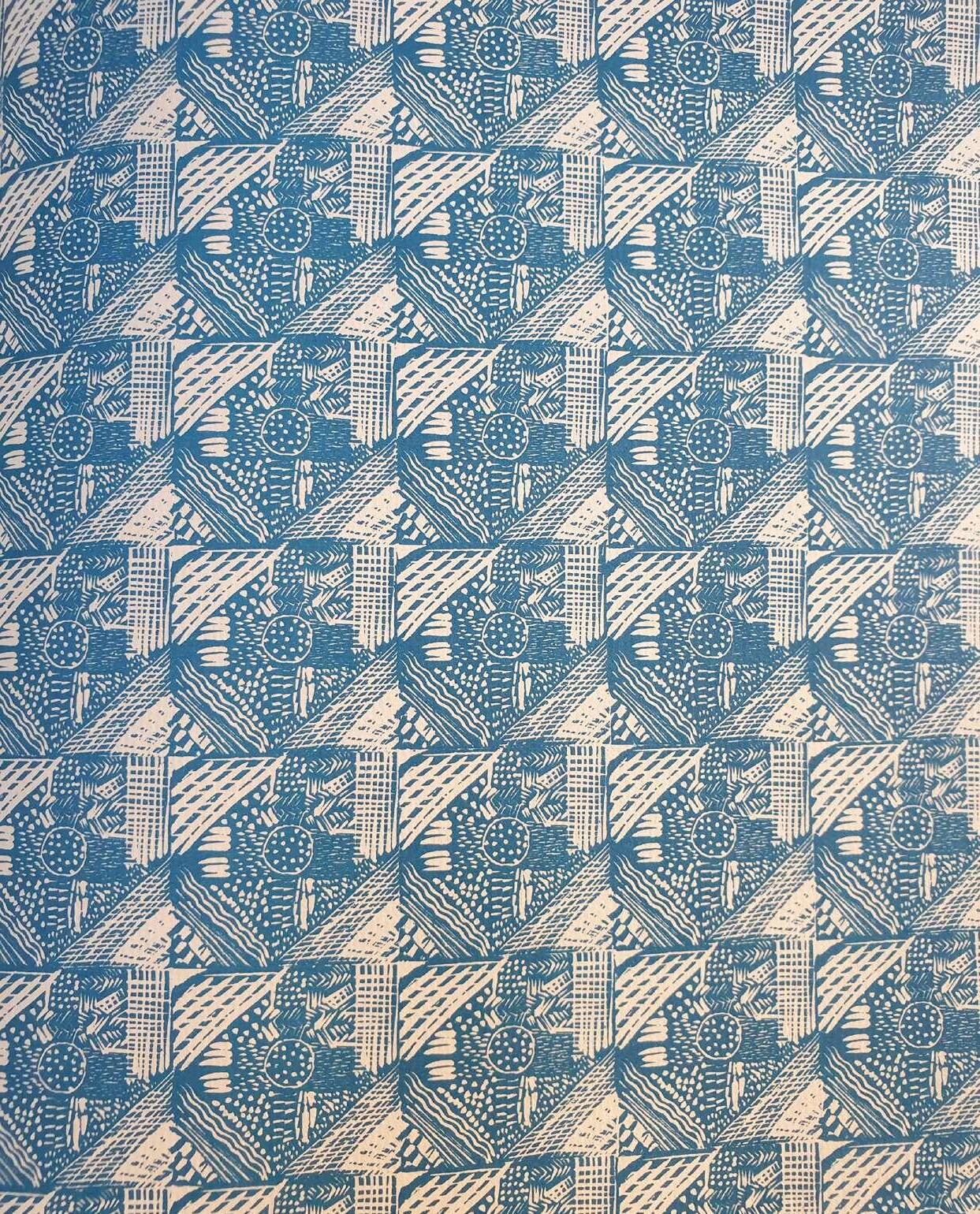
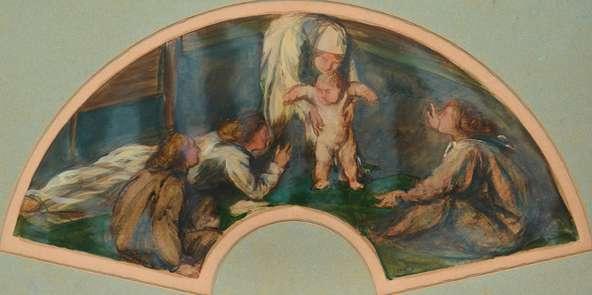
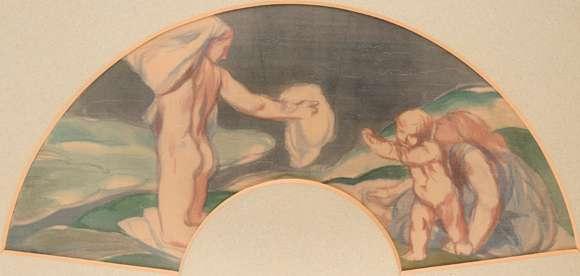
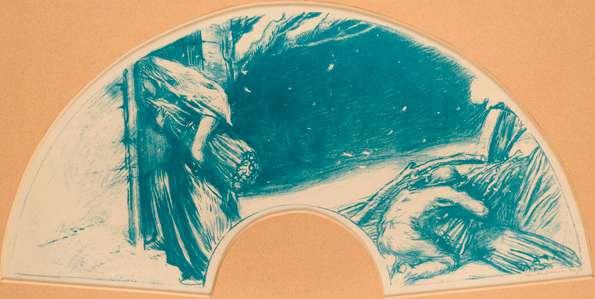
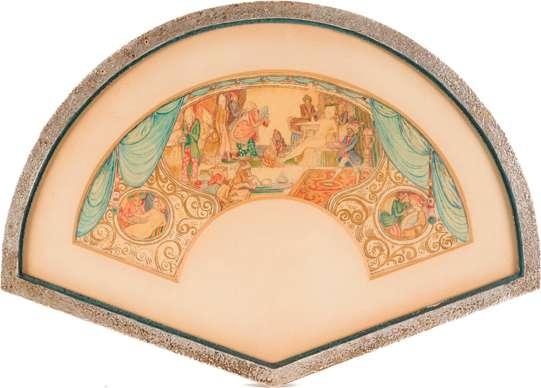
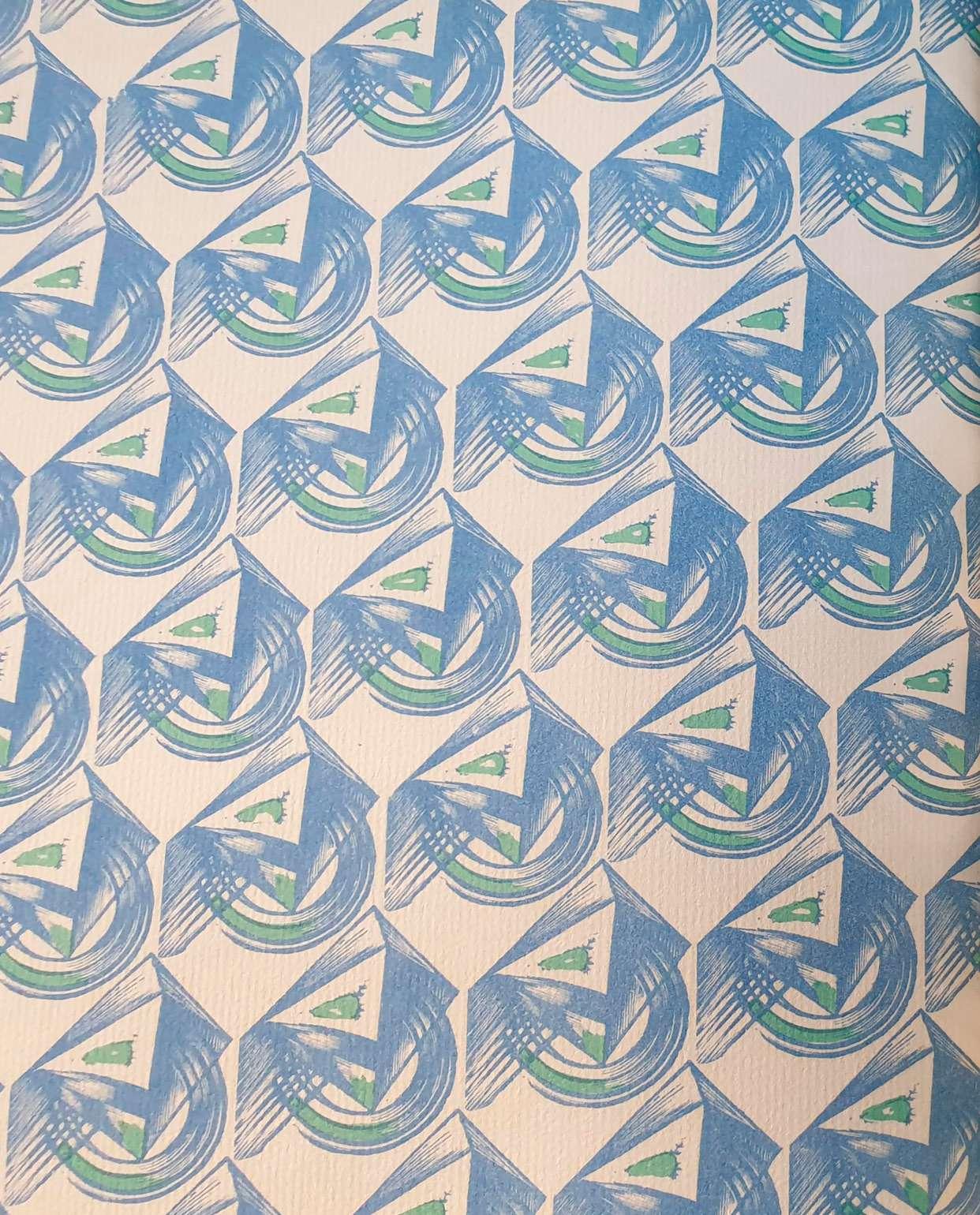
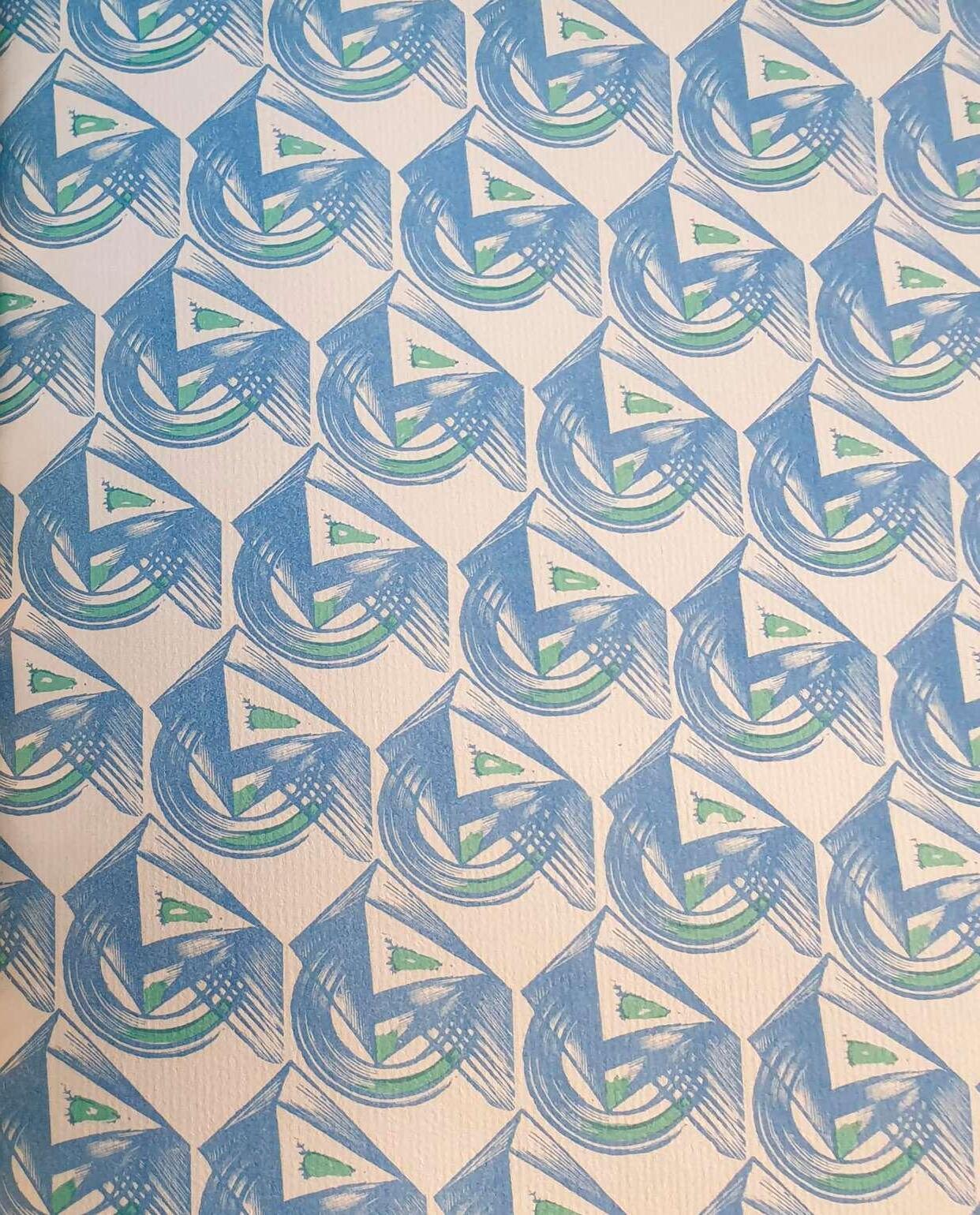
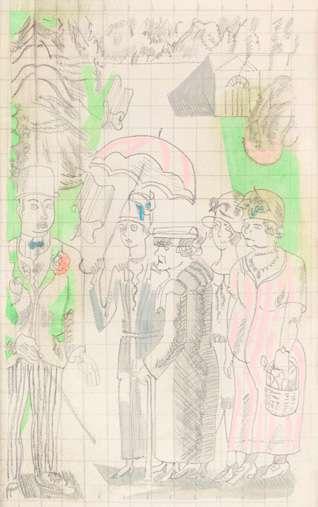
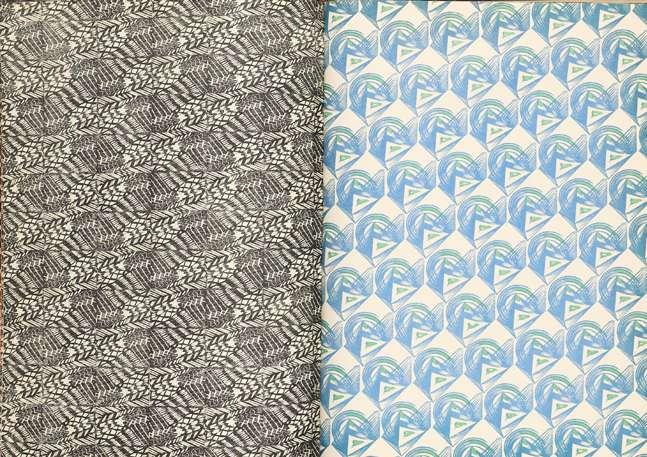
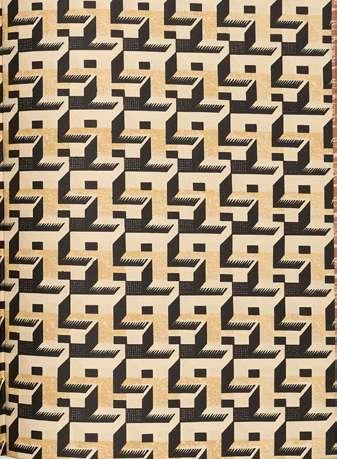
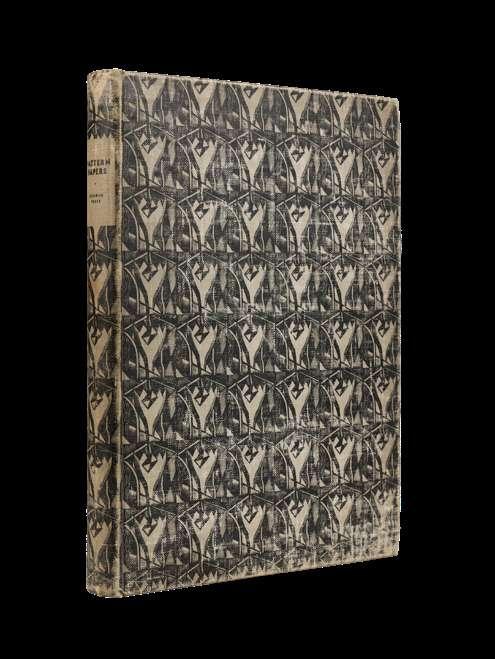
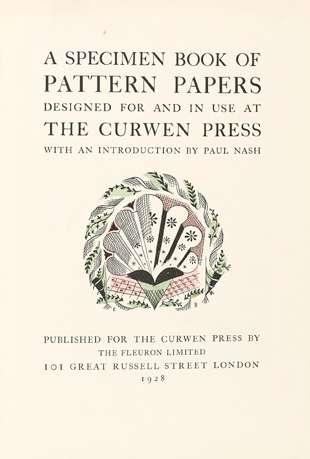
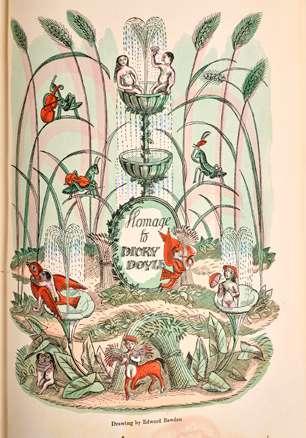
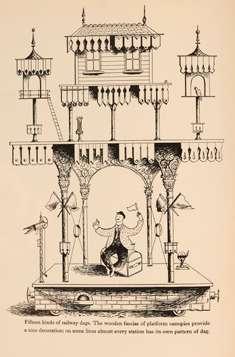
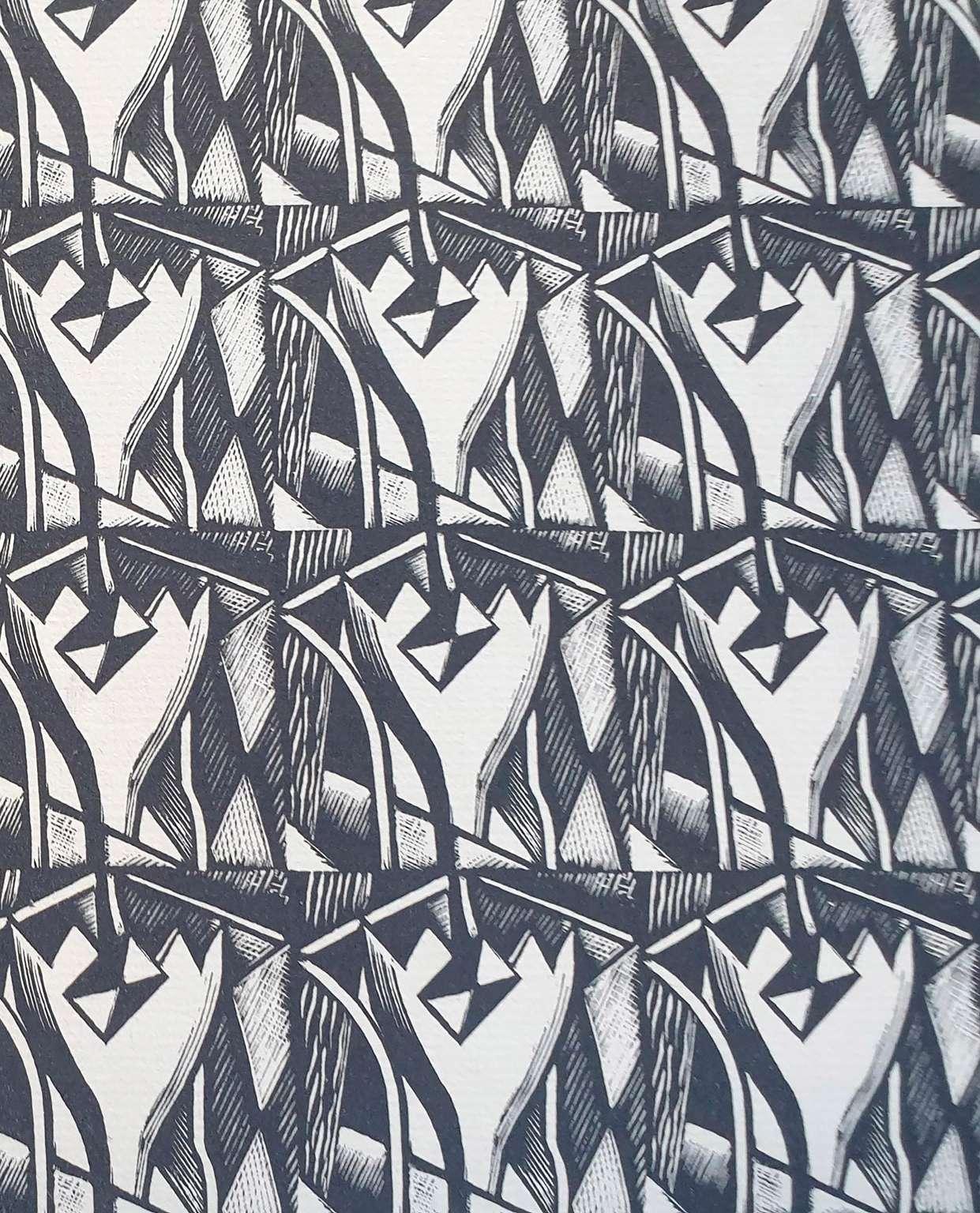
pattern by Edward Bawden (see lots 40, 240-242 & 270)
1
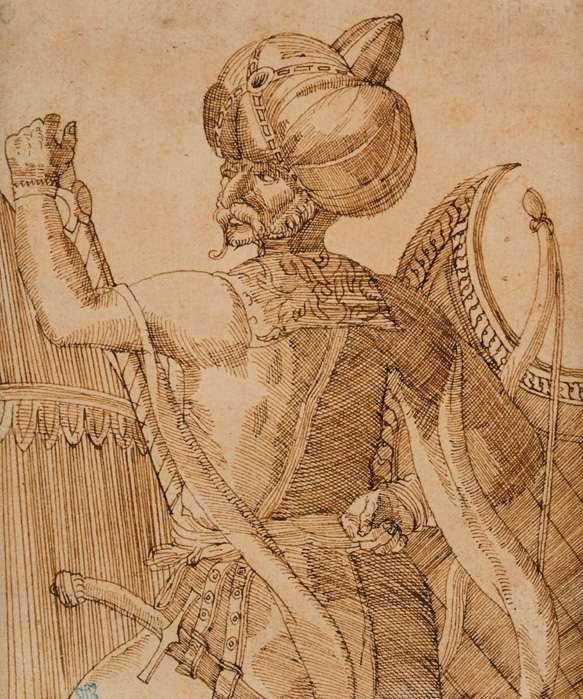
ATTRIBUTED TO MELCHIOR LORCK (GERMAN/DANISH 1527-C.1590)
A TURKISH SOLDIER
with the blue Carl Rolas du Rosey collection stamp (Lugt 2237) lower left; pen and brown ink on paper; 13 x 11cm; 5¼ x 4¼in (48 x 44cm; 19 x 17¼in framed)
Provenance: Carl Rolas du Rosey (died Dresden 1882)
£700-1,000
2
CONTINENTAL SCHOOL (19TH CENTURY)
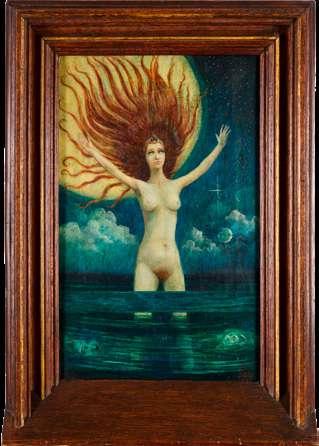
AD ASTRA (TO THE STARS)
signed with the artist’s monogram and dated 1897 lower right; oil on canvas; 44 x 27cm; 17¼ x 10¾in (59.5 x 41.5cm; 23½ x 16¼in framed)
This enigmatic painting centred on a naked girl standing in the sea with her hair on end and her hands outstretched, clearly derives from Ad Astra painted in 1894 by Finnish artist Akseli Gallen-Kallela (1865-1931). In the present riff on Gallen-Kallela’s composition the figure stands higher in the water, the sky is cloudy, and the artist has added the heads of a man and woman floating half submerged in the water, suggesting a more sombre message.
Gallen Kallela exhibited Ad Astra in Dresden and Gothenburg in 1895, thus whoever painted the present work may have seen Gallen-Kallela’s painting in one of these locations, suggesting the artist could indeed be Nordic or possibly German. Gallen-Kallela painted two versions of Ad Astra, one of which is in the Gyllenberg Museum, Helsinki, and the other in the Art Institute of Chicago. The present variation appears to be in its original Art Nouveau style frame. 1
JRT notes: Mystery Picture, signed with an indecipherable monogram and dated 1897. It is clearly some sort of parody of Gallen-Kallela’s Ad Astra and I suspect Finnish or at least Scandinavian.
£800-1,200
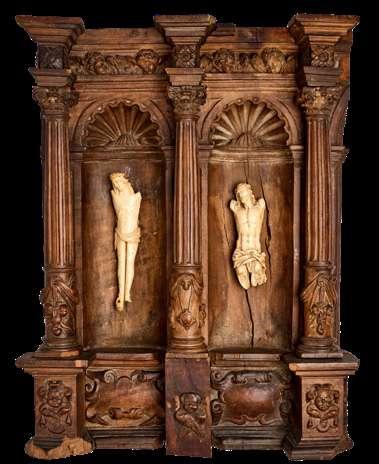
AN ECCLESIASTICAL FRAGMENT, PROBABLY FRANCO-FLEMISH, 17TH-CENTURY
carved walnut with two shell-headed niches between fluted columns and bands of winged cherub heads and cartouches, each niche later set with a corpus christi figure, one ivory, 17th/18th century, the other perhaps bone; overall height: 45.5cm; 18in; width: 36cm; 14in; depth: 12cm; 4¾in
Ivory Declaration Submission Reference: HAKV9RYR
£400-600
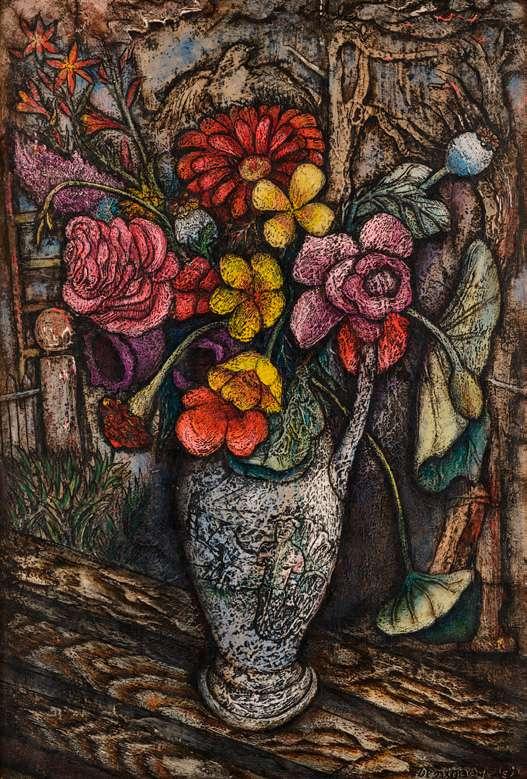
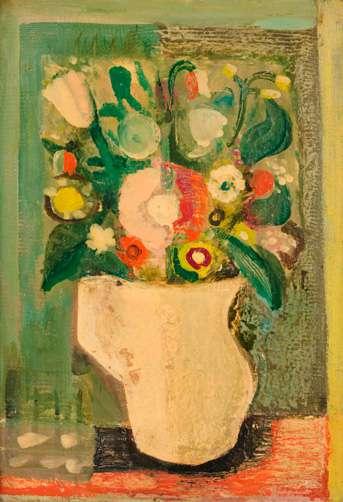
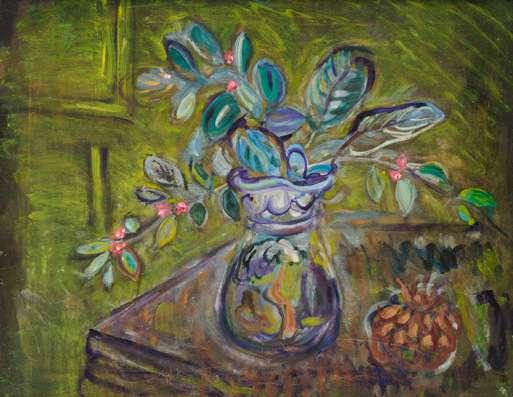
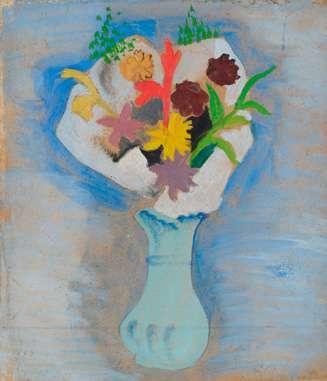
DENTON WELCH (BRITISH 1915-1948)
STILL-LIFE OF FLOWERS IN A VASE
signed Denton Welch lower right; oil on panel; 49.5 x 33.5cm; 19½ x 13¼in (56 x 40cm; 22 x 15¾in framed)
Exhibited: London, The Barbican Art Gallery, A Paradise Lost, 1987, no. 360
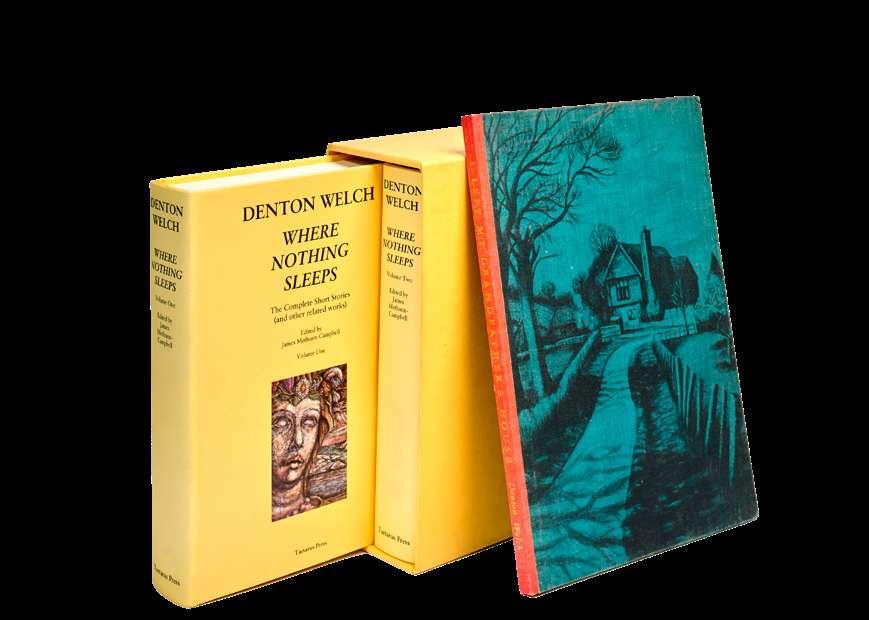
Executed circa 1943-44. Welch was educated at Repton in Derbyshire and studied painting at Goldsmiths’ School of Art but in his early twenties was injured in a cycling accident that left him an invalid. This life-changing event led him to write poems, short stories and three largely autobiographical novels composed with a painter’s eye for detail: Maiden Voyage (1943), In Youth is Pleasure (1945) and A Voice through a Cloud, the last, like his Journals, published posthumously (1950 & 52) and I Left My Grandfather’s House in 1958 (see lots 321 & 322). He exhibited his paintings regularly with the Leicester Galleries. His detailed and layered compositions tend to be decorative and Neo-romantic in spirit. The present still-life, painted with thick black impasto, and set in a surrealist, almost gothic landscape conjures a typically moody atmosphere.
£2,000-3,000
5
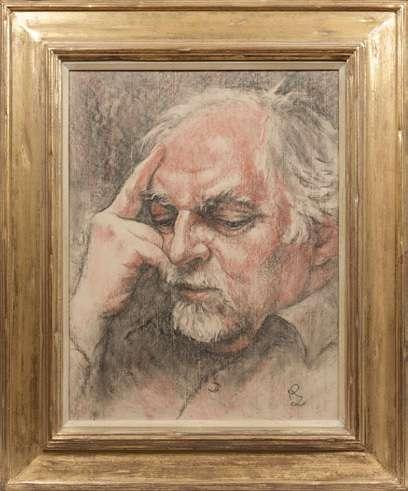
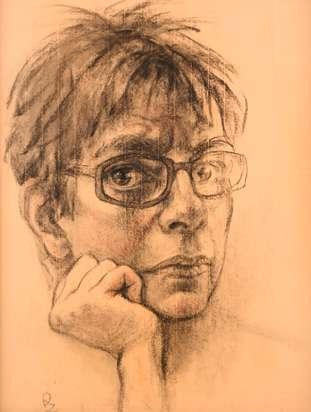
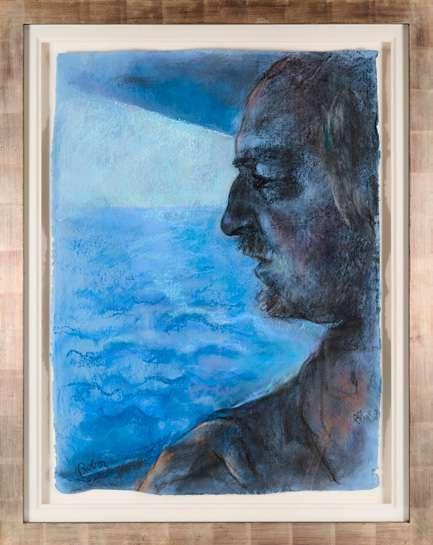
ZSUZSI ROBOZ (HUNGARIAN 1929-2012)
PORTRAIT OF JOHN RUSSELL TAYLOR
signed with initials RZ lower right; red, black and brown chalks on paper; 64 x 49cm; 25¼ x 19¼in (91 x 75.5cm; 35¾ x 29¾in framed)
Exhibited: London, Messum’s Fine Art, Zsuzsi Roboz, Face to Face, 2011, no. 1
Born in Budapest, during the Second World War Roboz fled Hungary to live first with her mother in France and after the War in England. In London she learnt shorthand and began working for the film director Alexander Korda while taking life drawing courses in the evening. She subsequently studied at the Regents Street Polytechnic before being accepted into the Royal Academy Schools, and working in the studio of Pietro Annigoni in Florence (1955-57). On her return from Italy Roboz was commissioned by Korda to complete a series of drawings of artists under contract to his film studio for publication. Her first sitter was the actress Mary Ure, the second was Claire Bloom, Roboz’s likenesses of each precipitating a stream of portrait commissions from the rich and famous.
In 1958 she had her first solo exhibition at the Walker Galleries, and in the early 1960s began a series of studies of dancers back stage at the charmingly disreputable Windmill theatre that closed shortly thereafter. The same decade Roboz was taken on by the dealer Jacques O’Hana and over the coming years she was commissioned to paint a varied and large cast of leading artists, actors, dancers and musicians, amongst them Elisabeth Frink, Laurence Olivier, Antoinette Sibley and Jacqueline du Pré. Her work was exhibited widely, her final exhibition being with Messums the year before her death.
Friends with Roboz for many years JRT described the extraordinary trajectory of her life and the elegant power of her art in his fascinating biography Roboz, A Painters Paradoz published in 2005. See also lots 126 & 129 ⊕ £700-1,000
6
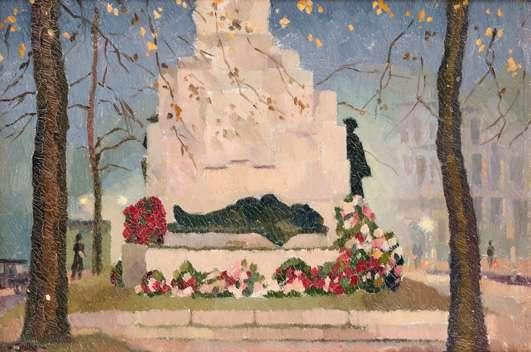
FRANK SULLY (BRITISH 1898-1992)
NOVEMBER NIGHT BETWEEN THE WARS
signed Sully lower left; oil on board; 22 x 32cm; 8½ x 12½in (27 x 36.5cm; 10½ x 14¼in framed)
The present work depicts wreaths laid at the base of the Royal Artillery Company Memorial, Hyde Park Corner after Remembrance Day. The memorial, to commemorate the 50,000 soldiers of the Company who lost their lives in the First World War, was designed by Charles Sargeant Jagger and unveiled in 1925. The son of a picture framer, Frank Sully studied at the Hammersmith School of Art and the Académie Julian, Paris. He moved with his family to Cornwall in 1920, but returned to work in London.
⊕ £300-400
7
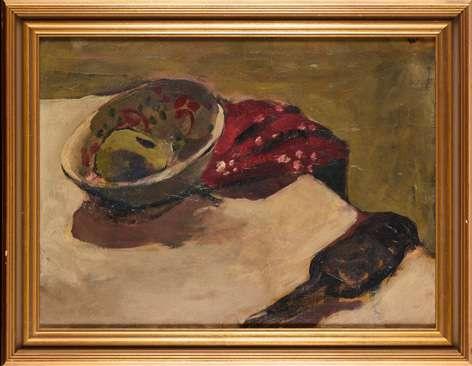
RODRIGO MOYNIHAN RA (BRITISH 1910-1990)
STILL LIFE WITH BOWL AND BOTTLE
oil on canvas; 29 x 39cm; 11½ x 18½in (36.5 x 47cm; 14¼ x 18½in framed)
Provenance: Olaf Barrett (from whom purchased)
Painted in the late 1930s. Moynihan enrolled at the Slade in 1928 and in the early 1930s explored abstraction before becoming interested in social realism and the work of Victor Passmore, William Coldstream and the Euston Road School. During the War he served first in the Royal Artillery, then with the Camouflage Unit before becoming an official War Artist.
After the War he was appointed Professor of Painting at the Royal College of Art (1948-57), relinquishing his position to turn once again to abstraction and live and work abroad. But in his work of the 1970s he turned back to figuration, painting still-lifes and completing a number of notable portrait commissions.
⊕ £600-800
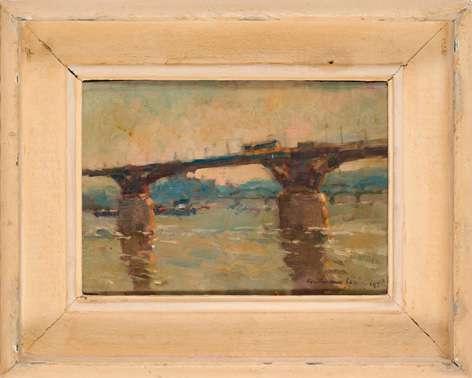
LOERINC CSALLOKOZI FARKAS (HUNGARIAN 1898-1973)
BRIDGE ACROSS THE DANUBE
signed and dated Cs.Farkas Loerinc ‘49 lower right; oil on panel; 15 x 18.5cm; 6 x 7¼in (26 x 32cm; 10¼ x 12½in framed)
The present work appears to be a view of Margaret Bridge in Budapest which crosses the Danube to link Buda and Pest and Margaret Island. The original bridge was accidentally destroyed in November 1944 by occupying German soldiers and rebuilt largely as before in 1948.
⊕
£200-300
9
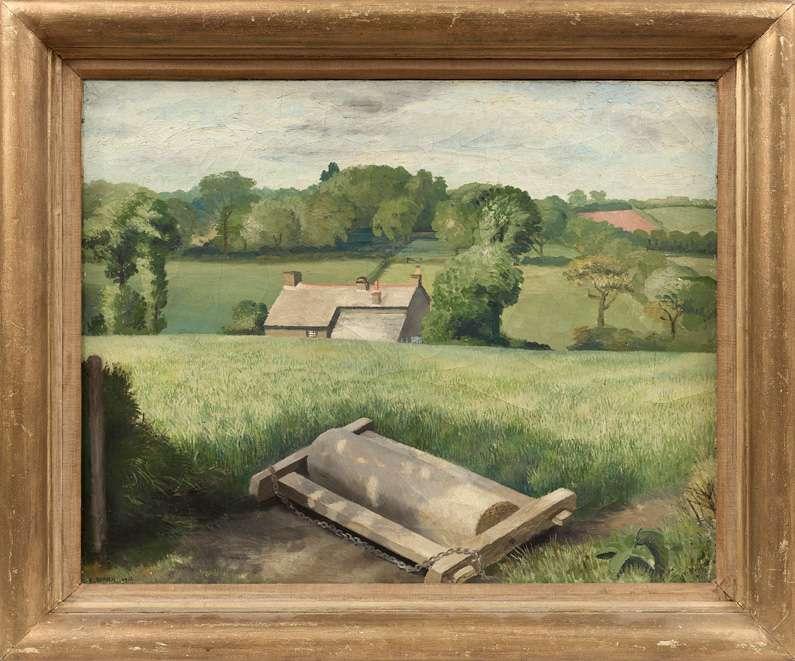
RICHARD EURICH RA (BRITISH 1903-1992)
CORNISH LANDSCAPE
signed and dated R.EURICH.1936 lower left; oil on canvas; 39.5 x 50cm; 15½ x 19¾in (52.5 x 63cm; 20¾ x 24¾in framed)
Provenance: Redfern Gallery, London; Goupil Gallery, London (purchased from the above by Cicely Marchant in 1937); Abbott & Holder, London (by 1969)
Exhibited: London, Goupil Gallery, Goupil Gallery Salon, 1937, no. 61; Bradford, Cartwright Hall, Art Galleries and Museums; Glasgow & London, The Fine Art Society & Southampton, City Art Gallery, Richard Eurich Retrospective Exhibition, 1980, no. 18
Born in Bradford, the son of the German-Jewish bacteriologist Friedrich Wilhelm Eurich, in 1922 Richard Eurich studied at Bradford School of Art followed by the Slade in London in 1926 under Henry Tonks. Introduced to Cicely Marchant at the Goupil Gallery by the influential political administrator, collector and patron Edward Marsh, Eurich had his first one-man exhibition at Goupil in 1929, followed by his first one-man show at the Redfern Gallery in 1933, after which Redfern offered him a contract to supply the gallery with paintings.
⊕ £3,000-5,000
10
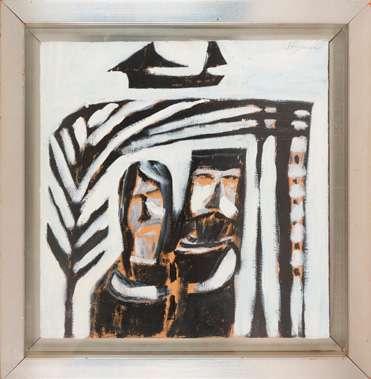
PATRICK HAYMAN (BRITISH 1915-1988)
FRIENDS AND WINTER SEA
signed Hayman top right; signed, titled and dated 1971 on the reverse; oil on wood; 30.5 x 29cm; 12 x 11½in (39 x 38cm; 15¼ x 15in framed)
Provenance: Abbott & Holder, London ⊕ £500-700
11
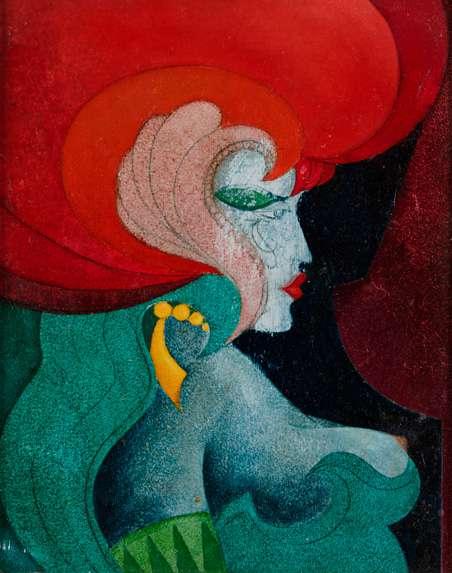
MANNER OF RICHARD LINDNER (GERMAN/AMERICAN 1901-1978)
WOMAN IN PROFILE WITH RED COIFFURE oil on board; 31.5 x 25cm; 12½ x 9¾in; (48 x 41.5cm; 18¾ x 16¼in framed)
Provenance: Bill Hopkins, London
£200-300
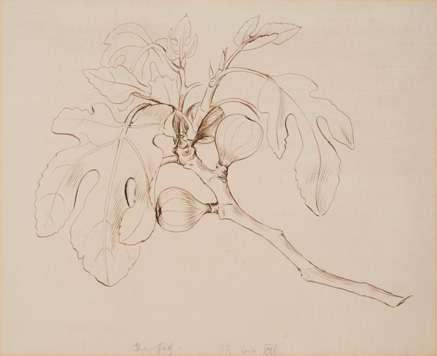
12
HELEN KAPP
(BRITISH 1901-1978)
THE FIG titled, dated and inscribed The Fig 3 / 31 / 37 wide CU lower centre; pen and brown ink on paper; 28 x 34cm; 11 x 13¼in (41 x 46cm; 16 x 18¼in framed)
Provenance: Gillian Drey Gallery Painter, watercolourist, illustrator and wood-engraver, Kapp grew up within a cultured émigré family in Hampstead and attended the Slade and the Central School of Art and Design. Later in life she became an influential arts administor, being appointed director of the Wakefield Art Gallery in 1951, and then the first director of the Abbot Hall Art Gallery in Kendal. Her elder brother was the portrait painter, draughtsman and caricaturist Edmond Xavier Kapp (1890-1978).
⊕ £100-150
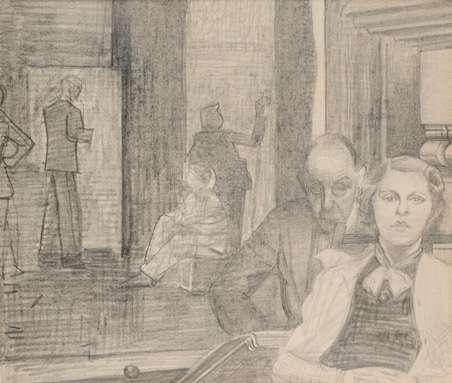
13
JAMES COWIE
(SCOTTISH 1886-1956)
VISITORS AT THE SUMMER SCHOOL OF PAINTING pencil on paper; 12.5 x 14.5cm; 5 x 5¾in (32 x 33cm; 12½ x 13in framed)
Exhibited: London, Bourne Fine Art, 1987
The present drawing may well date from Cowie’s time at the Patrick Allan School of Art at Hospitalfield, Arbroath. He moved to be warden there in 1937, ran the annual summer school and completed some of his best work, in particular portraits and group portraits of other artists and students. The latter included Robert Colquhoun, Robert MacBryde, Waistel Cooper and Joan Eardley. The son of a farmer, Cowie trained at the Glasgow School of Art. During the First World War he registered as a conscientious objector and served in the Non-Combatant Corp. After the War he taught for a number of years at Belshill Academy near Glasgow, and then as Head of Painting at Gray’s School of Art, Aberdeen before moving to Hospitafield.
⊕ £200-300
14
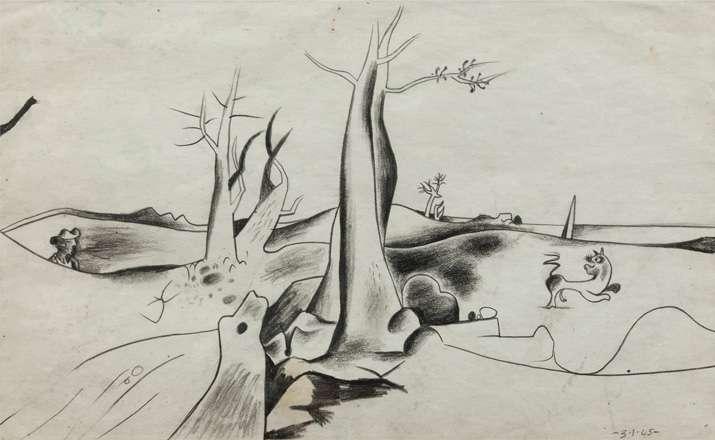
JOHN CRAXTON RA (BRITISH 1922-2009)
LANDSCAPE WITH FIGURE
dated 3.1.45 lower right; pencil and black chalk on paper; 20 x 32cm; 8 x 12½in (33.5 x 45cm; 13¼ x 17¾in framed)
Provenance: William Murray (from whom purchased)
The present work, a page from a sketchbook, bears the considerable influence of Craxton’s greatest inspirations, including Pablo Picasso, Joan Miro, Graham Sutherland and Samuel Palmer. The subject and composition is typical of John Craxton’s work from the mid-1940s. Both surreal and Neo-romantic it belongs to a series of paintings, prints and drawings he produced focused on solitary figures. Later in life he would describe them as, ‘my means of escape and a sort of self protection. A shepherd is a lone figure, and so is a poet.’ Hemmed in by the structures of British society and the realities of war Craxton was, for a great many years, a man unsure of his place in the world.
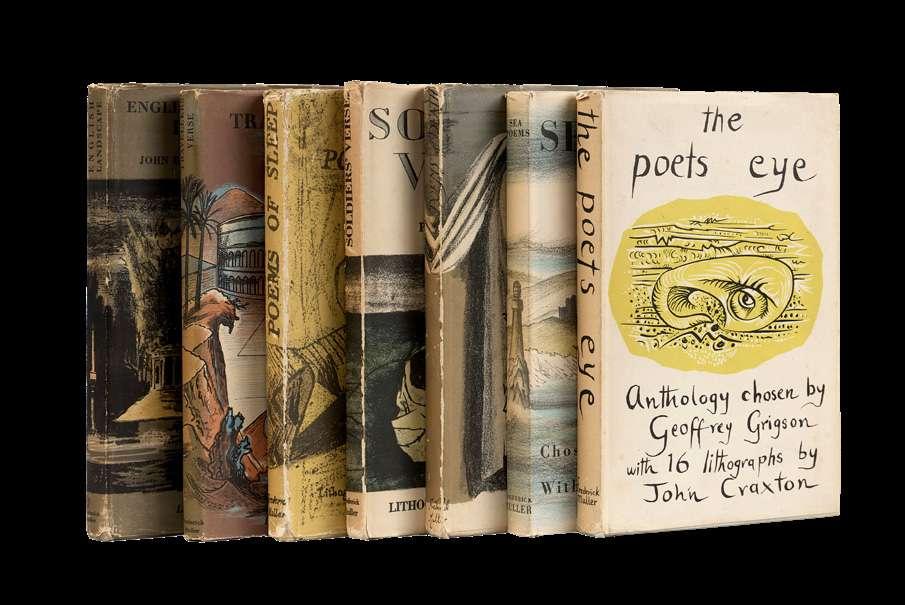
He drew the present landscape at the same time that he was working on the illustrations for A Poet’s Eye, an anthology of poetry selected by Geoffrey Grigson (see lot 286). Both the poetry and the art which decorates the book powerfully speaks to the escapist mood of wartime Britain. The somewhat menacing landscape of the work also finds inspiration from the time Craxton spent painting in Pembrokeshire, alongside his mentor, Graham Sutherland.
⊕ £1,000-1,500
15
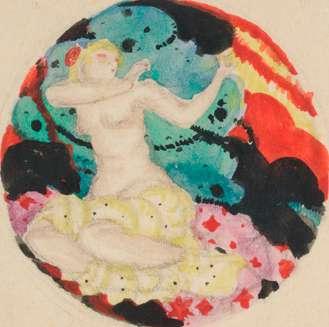
ARNOLD NECHANSKY (AUSTRIAN 1888-1938)
DESIGN FOR ENAMEL OF A SEATED NUDE watercolour over pencil on paper; 6.5cm; 2½in (image diameter) (32 x 25cm; 12½ x 10in framed)
Provenance: Fischer Fine Art Ltd, London (from whom purchased) Nechansky studied under Oskar Strnad, Adolf Boehm and Josef Hoffmann at the Vienna School of Applied Arts (1909-1913). From 1912 he worked regularly for the Wiener Werkstätte designing postcards, jewellery, wallpaper, textiles, ceramics and silverware, and also for the J & L Lobmeyr who specialised in glassware in Vienna. In 1914 he designed the Austrian pavilion for the Cologne Werkbund exhibition, and in 1919 he was appointed to the Berlin-Charlottenburg School of Applied Arts and Crafts, where he headed the class for metal and leather work and the preparatory class for general design. In 1923 he married the painter Marianne von Winter (1902-1985) and returned to Austria in 1934. His work is notable for its combination of vibrant colours and a sense of nostalgia as in the present example.
£100-150
16
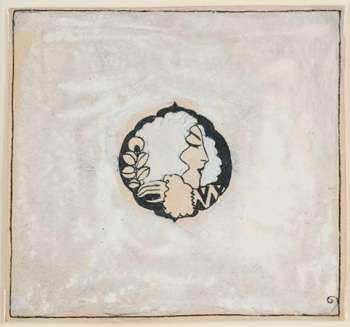
ARNOLD NECHANSKY
(AUSTRIAN 1888-1938)
DESIGN FOR SILVER WORK WITH HEAD OF A WOMAN pen and black ink heightened with white gouache over traces of pencil; 8 x 8.5cm; 3¼ x 3½in (31.5 x 25.5cm; 12¼ x 10in framed)
Provenance: Fischer Fine Art Ltd, London (from whom purchased) see note to lot 15
£200-300
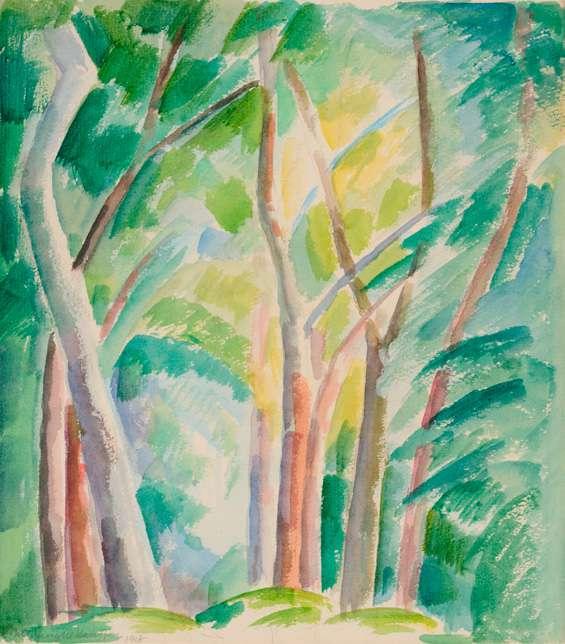
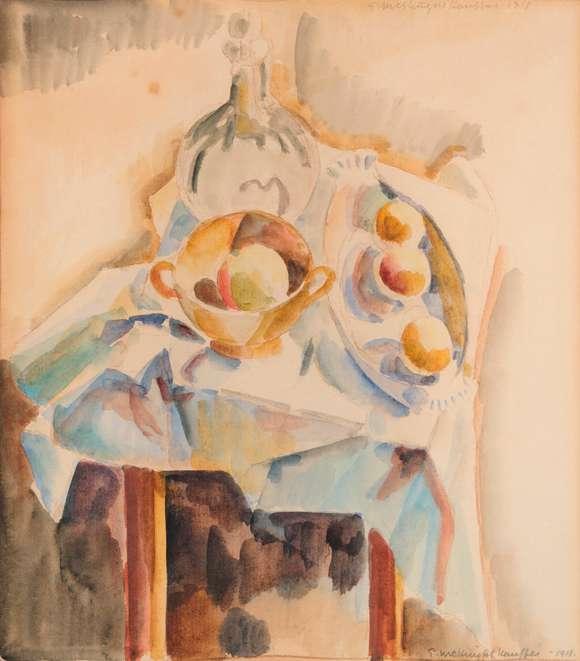
17
EDWARD MCKNIGHT KAUFFER (AMERICAN/BRITISH 1891-1954)
TREES
signed and dated E.McKnight Kauffer 1918 lower left; watercolour over traces of pencil on paper; 22.5 x 20cm; 8¾ x 8in (39 x 34.5cm; 15¼ x 13½in framed)
Provenance: Abbott & Holder, London
Literature: Mark Hamworth-Borth, E. McKnight Kauffer, a Designer and his Public, London, 1979, p. 28
In the present work McKnight Kauffer’s admiration for Cézanne and Cubism is tangible, anticipating his later bolder style and use of bright colours (see lot 160). Before leaving the USA for Europe McKnight Kauffer had visited the Armory Show of 1913 in Chicago, which introduced European avant-garde to an American audience. The work of Duchamp, Matisse, Braque, Brâncusi and Van Gogh thrilled him. He recalled: ‘I didn’t understand it, but I certainly couldn’t dismiss it’. Thereafter McKnight Kauffer travelled to Munich and Paris before arriving in London at the outbreak of the First World War.
Settling in Hampstead he befriended the painters Robert Bevan (lot 70), Charles Ginner and Harold Gilman, all members of the London Group, a pivotal forum for new painting and sculpture. From 1915 McKnight Kauffer worked in advertising, collaborating with Frank Pick, publicity manager of the London Underground, designing posters of sparkling originality for the tube for the next twenty-five years. His partnership with Pick established his reputation as one of the twentieth century’s stand-out figures in poster and graphic design.
Born Edward Kauffer in Montana, he had left school early to work as a theatre set painter before studying art in San Francisco where he subsidised his income working in a bookshop. There in 1912 he met university professor Joseph McKnight who was so impressed by Kauffer’s paintings that he offered to sponsor his study trip to Europe. Kauffer added McKnight to his name as a mark of gratitude.
£800-1,200
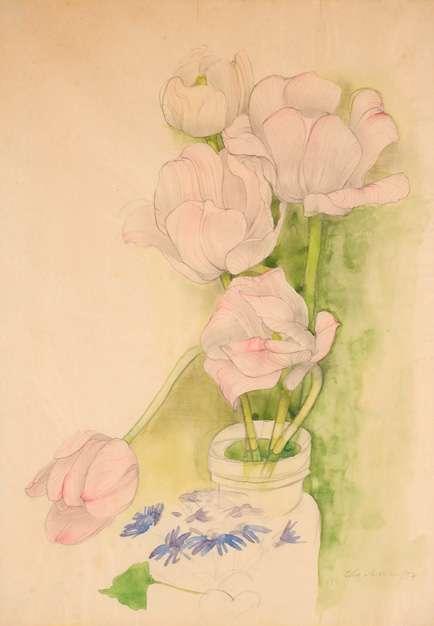
ITHELL COLQUHOUN (BRITISH 1906-1988)
STUDY OF TULIPS IN A VASE
signed and dated Colquhoun / 37 lower right: pencil and watercolour on paper; 34 x 24cm; 13¼ x 9½in (51 x 40cm; 20 x 15¾in framed)
With the recent 2025 retrospective on Colquhoun at Tate Britain there has been a timely renewal of interest in the artist’s extraordinary body of work and writing (see lots 299-300). Following her studies at the Slade, Colquhoun travelled to Paris where in 1931 she enrolled at the Académie Colorassi and met Surrealists Salvador Dali and André Breton. Her return to London coincided with the 1936 International Exhibition of Surrealism organised by Roland Penrose, and her solo exhibition Exotic Plant Decorations at the Fine Art Society the same year focused on her botanical paintings clearly reflected the influence of Surrealism. The present work dates from these early years when she painted plants and flowers in exaggerated size and detail and explored their organic forms.
⊕
£700-900
19
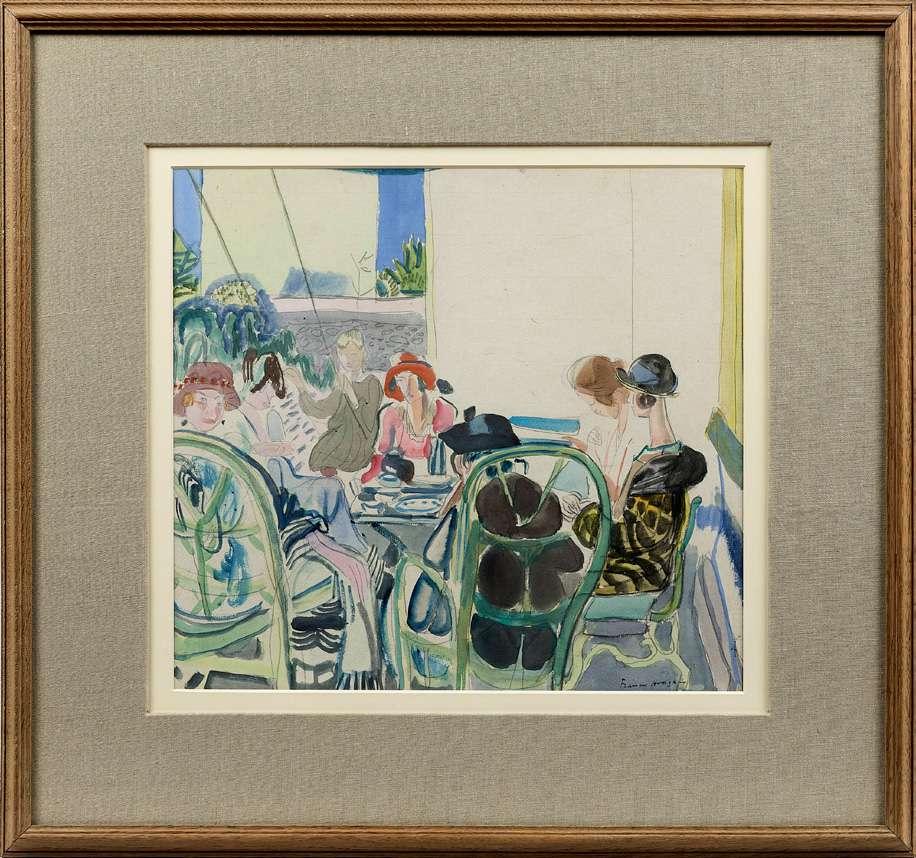
FRANCES HODGKINS (NEW ZEALAND 1869-1947)
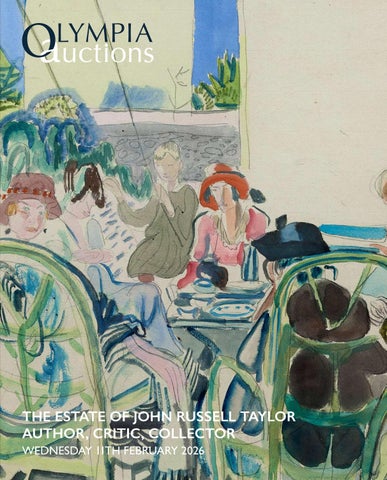
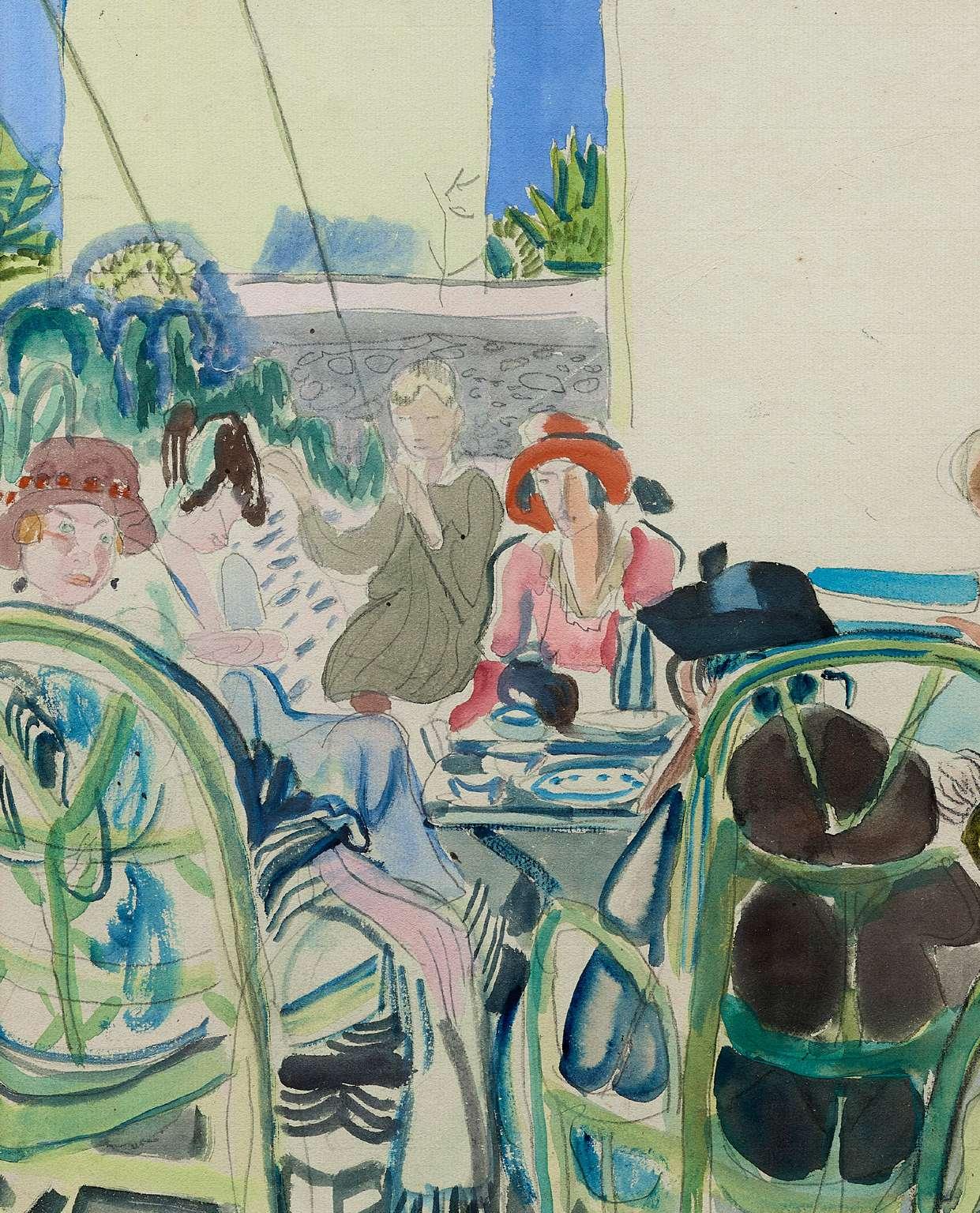
THE TEA PARTY
signed Frances Hodgkins lower right; pencil and watercolour on paper; 34 x 37cm; 13½ x 14½in (56 x 59.5cm; 22 x 23½in framed)
Exhibited: London, Gillian Jason Gallery, A Tribute to Frances Hodgkins, 1987, no. 6
Executed circa 1910, the setting of the present early watercolour suggests the south of France and, in the vibrant palette and fluid brushstrokes, the influence of Henri Matisse and Raoul Dufy. Hodgkin invariably preferred painting in watercolour and the white surface of the paper adds a sense of freedom and luminosity to the elegant gathering of ladies amidst whom a child is incongruously enjoying a swing, a somewhat arbitrary juxtaposition of compositional elements typical of the artist.
Hodgkins first left her home town of Dunedin in New Zealand for Europe in 1901, moving between England and France and visiting Spain, Morocco, Italy and the Netherlands. She exhibited at the Royal Academy in London becoming the first New Zealander to have her work shown ‘on the line’. In Paris she taught at the Academie Colarossi, the first woman appointed to a teaching position there, and founded a school for watercolours in Concarneau, Brittany.
With the outbreak of the First World War she moved to St Ives in Cornwall where she worked with Cedric Morris and others in his circle of friends including John Piper. After the Armistice Hodgkins began showing with the London Group and in 1929 joined the Seven and Five Society, becoming a key figure in the development of British Modernism between the Wars.
£3,000-4,000
21
ITHELL COLQUHOUN (BRITISH 1906-1988)
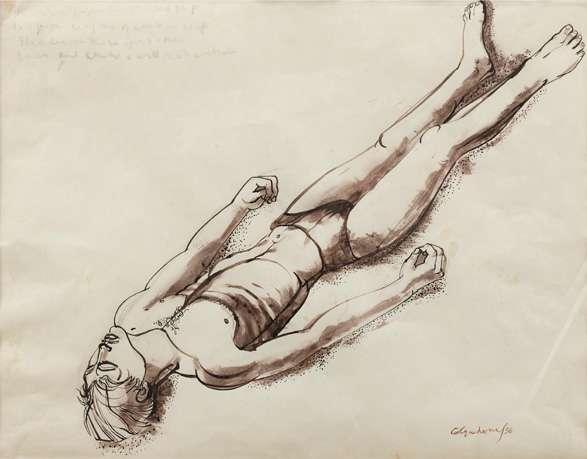
DROWNED SAILOR
signed and dated Colquhoun / 36 lower right; pen and brown ink and brown wash on paper; 35 x 44cm; 13¾ x 17¼in (56 x 63cm; 22 x 24¾in framed)
see note to lot 18
⊕ £1,000-1,500
20
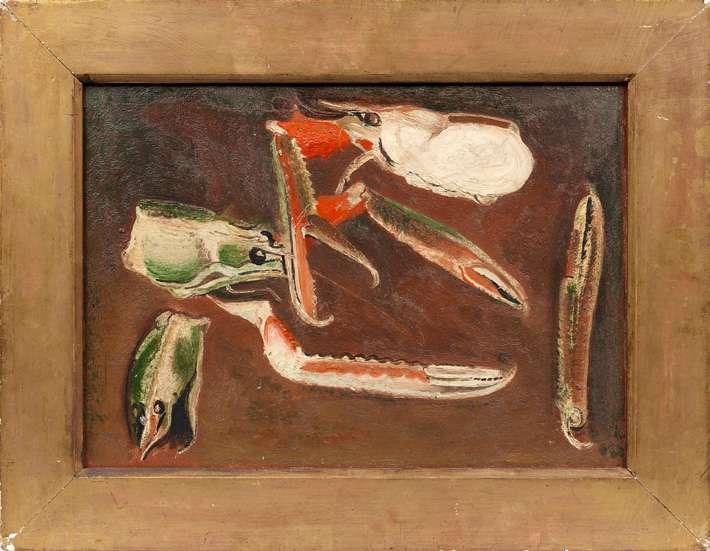
ROBERT COLQUHOUN (BRITISH 1914-1962)
LOBSTERS
signed R. Colquhoun upper right; oil on panel; 24 x 33.5cm; 9½ x 13¼in (34 x 44cm; 13 x 17¼in framed)
Provenance: Abbott & Holder, London
Colquhoun studied at the Glasgow School of Art (1933-38) where he met Robert MacBryde, his life partner to be. Invalided out of the War in 1941 he moved to London, where he gained the support of the collector Peter Watson and worked as an ambulance driver. Working alongside MacBryde and with a studio in the same building as Jankel Adler and John Minton, his work was included in Six Scottish Painters at the Lefevre Gallery, followed by further shows at the gallery in 1944 and 1946. He also started teaching and exhibiting at the newly established Anglo-French Art School in St Johns Wood.
⊕ £4,000-6,000
22
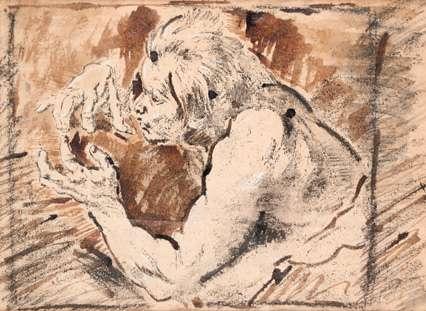
MERVYN PEAKE (BRITISH 1911-1968)
SKETCH OF A MAN CREATURE
black chalk and ink, brown wash on paper; 20 x 28cm; 8 x 11in (36 x 43.5cm; 14¼ x 17in framed)
This work on paper may well be a sketch for one of Peake’s book illustrations
see note to lot 24
⊕ £200-300
23
JOHN CRAXTON RA (BRITISH
1922-2009)
SLEEPING BOY
pencil on paper laid down; 28 x 20cm; 11 x 8in (49.5 x 40.5cm; 19½ x 16in framed)
Exhibited: London, Christopher Hull Gallery, Freud and Craxton, 1983, no. 74
Executed in 1942. There appears to be a sketch of two birds with long necks, possibly swans, on the verso, just visible through the paper.
On a label on the reverse JRT notes his conversation with Craxton at the time of the 1983 exhibition: ‘this drawing comes from a sketchbook which was used turn-and turn-about by John Craxton and Lucien Freud in 1942, when they were sharing a studio and socially inseparable. In the 1983 Christopher Hull show it was classified as a Craxton, but Craxton himself told me that he really could not remember for sure and thought it was more likely to be by Freud - something I think one might guess anyway from comparing it with the known contemporary works of the two artists’. Catherine Lampert, however, disputes this interpretation of the drawing considering it technically and stylisticaly to be by Craxton alone, a view also shared by Ian Collins, author of John Craxton, A Life of Gifts.
⊕ £6,000-8,000
24
MERVYN PEAKE (BRITISH 1911-1968)
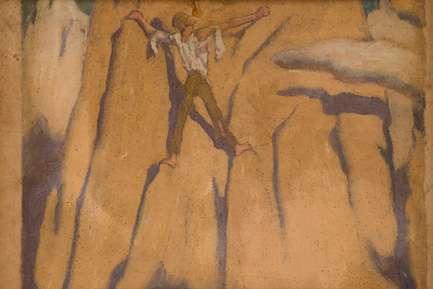
TITUS ON THE CLIFF
gouache on card; 23 x 33cm; 9 x 13in
(44 x 54cm; 17¼ x 21¼in framed)
A celebrated writer of fantasy novels and a painter-illustrator, Peake’s trilogy Titus Groan(1946), Gormenghast (1950), and Titus Alone (1959) were all illustrated by him. This striking work has an unsettling angle and a claustrophobic perspective in which the hero, possibly Titus, climbs the cliff of his castle. The cliffs are reminiscent of the Chinese landscape in which Peake grew up and which is often included in his fantastic imagery.
From his early twenties onwards Peake produced illustrations for a range of magazines and publications, the decade following the end of the Second World War being his greatest period of output. Living on Sark in the Channel Islands from 1946 until 1949 he produced a stream of illustrations to many of the classics, including Treasure Island, The Hunting of the Snark, The Ancient Mariner, Grimm’s Household Tales (see lot 314), Alice’s Adventures in Wonderland and Through the Looking Glass. He was married to the painter Maeve Gilmore (1917-1983).
⊕ £600-800
25
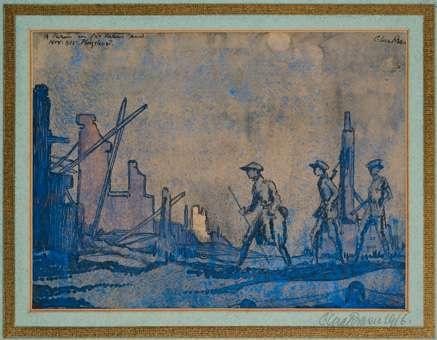
CLAUD LOVAT FRASER (BRITISH 1890-1921)
A FARM IN NO MAN’S LAND
signed C. Lovat Fraser upper right; titled A Farm in No Man’s Land and dated Nov: 1915. Ploegsteert upper left; signed and dated C Lovat Fraser 1916 on the mount lower right; pen and black ink and blue wash on paper; 11 x 15cm; 4¼ x 6in (29 x 29cm; 11½ x 11½in framed)
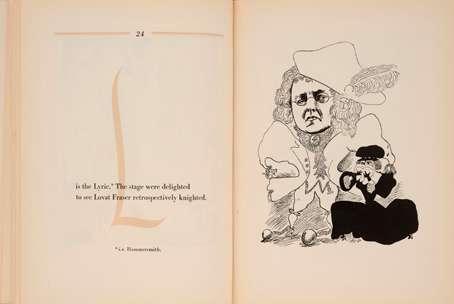
Lovat drew the present work at Ploegsteert in Wallonia in the autumn of 1915 following front line action in the the battle of Loos that raged between 25th September and 8th October 1915. The battle was the major Franco-British engagement with German forces that year and the first time British forces had used gas, but it ended with no consequential gains and considerable loss of life. Lovat Fraser served with the 14th Battalion of the Durham Light Infantry, but after shell shock and a further gas attack that December was invalided back to England in early 1916. After the War he collaborated with the Curwen Press on paper patterns (see lot 270), book illustrations, book plates and advertisements, and produced set and costume designs for the theatre and ballet including for productions at Stratford-on-Avon, the Lyric Hammersmith and the Coliseum. He married the American actress Grace Inez Cranford in 1917 with whom he had a daughter. He died suddenly on a family holiday in Dymchurch, Kent.
£100-150
26
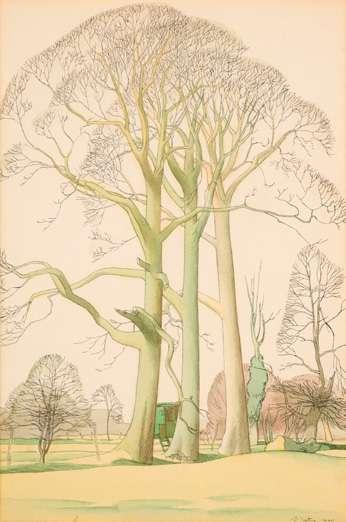
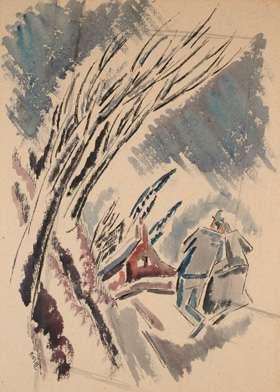
HAROLD YATES (BRITISH
1916-2001)
SHEPHERD’S HUT BELOW WINTER TREES
signed and dated Yates 1940 lower right; pen and ink and watercolour; 36 x 24cm; 14¼ x 9½in (54 x 40.5cm; 21¼ x 16in framed)
Exhibited: London, The Belgrave Gallery, Harold Yates, London, 1989 (from whom purchased)
The son of a cartoonist, Yates studied at Portsmouth School of Art and worked as a commercial artist before having his first solo exhibition at Foyles Gallery. During the Second World War he served in the 5th Batallion of the Duke of Cornwall’s Light Infantry and completed a number of watercolours recording everyday life in the ranks, some bought by the War Artist’s Advisory Committee and now in the Imperial War Museum.
⊕ £200-300
27
EDMUND DULAC (FRENCH-BRITISH 1882-1953)
DESIGN FOR A RUG
pencil and gouache on paper; 12.5 x 9cm; 5 x 3½in (26 x 21cm; 10¼ x 8¼in framed)
Provenance: Hartnoll & Eyre, London (purchased in 1970)
Exhibited: London, Hartnoll & Eyre, Edmund Dulac 1882-1953, 1970, no. 34
see note to lot 62
£400-600
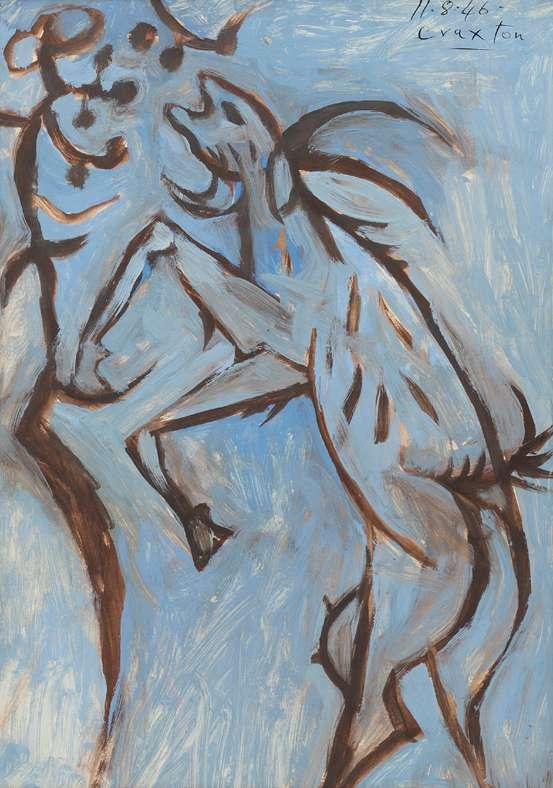
JOHN CRAXTON RA (BRITISH 1922-2009)
GOAT REACHING FOR THORN FRUIT
signed and dated 1.8.46. / Craxton upper right; oil on board; 41.5 x 29cm; 16¼ x 11½in (54 x 41.5cm; 21¼ x 16½in framed)
Provenance: (probably) Abbott & Holder, London
The present work was painted shortly after Craxton’s arrival on the island of Poros. Stymied by war Craxton had been desperate to leave the claustrophobic darkness of Britain, and yearned for more exotic climes. His arrival in Greece proved to be utterly transformational and he remained there, on-and-off, for the next 60 years. He said of his new homeland, ‘It’s possible to be a real person – real people, real elements, real windows – real sun above all. In a life of reality my imagination really works. I feel like an émigré in London and squashed flat.’
Goats played an important role within daily life among the shepherds on Poros and become incorporated into many of Craxton’s most important paintings from the period, including Pastoral for P.W., 1948 (Tate Britain). Iconographically the goat plays a crucial role in Craxton’s depiction of the Arcadian idyll which was Greece. These creatures, much like he, were free to roam, living a ‘real’ life.
⊕ £3,000-4,000
28
29
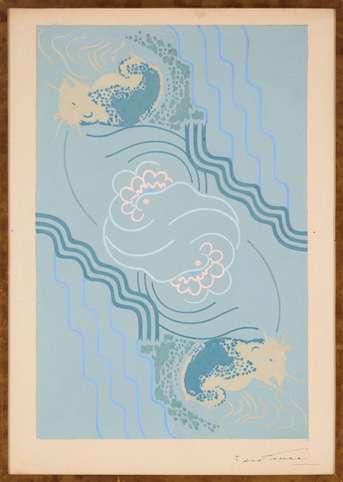
GEORGES DE FEURE (BELGIAN 1868-1943)
DESIGN FOR A RUG WITH RATS AND HENS signed G de Feure on the margin lower right; pochoir on paper; 33.5 x 23.5cm; 13¼ x 9¼in (35 x 25cm; 13¾ x 10in framed)
Raised in Holland, de Feure moved to Paris in 1889 finding work as an artist and illustrator. Influenced by the decorative designs of Jules Cheret (1836-1932) he instinctively tended towards symbolism (see lot 130). His work was included in the Exposition des Peintres Impressionistes et Symbolistes at the Galerie Le Barc de Boutteville, alongside Gauguin and the Nabis, and in the Salons de la Rose + Croix in 1893 and 1894. In the mid-1890s De Feure began an association with Siegfried Bing and his landmark Galerie de l’Art Nouveau which opened in late 1895. De Feure worked closely with the gallerist on designs for furniture, lamps, stained glass, wallpaper and ceramics and received great acclaim for his design for Bing’s Pavillon de l’Art Nouveau at the Exposition Universelle of 1900. Parallel with working for Bing, de Feure established his own atelier. As with his work for Bing, De Feure’s designs were strongly influenced by Japanese prints. His work is synonymous with the fluidity of the Art Nouveau aesthetic much in the manner of Alphonse Mucha.
£150-250
30
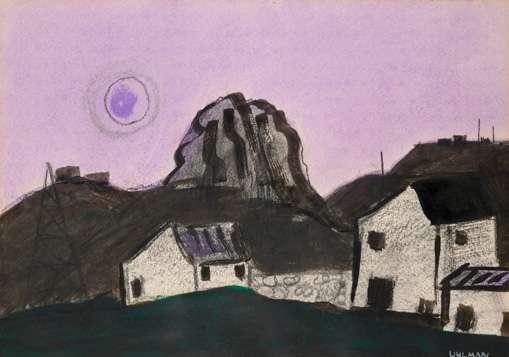
FRED UHLMAN (GERMAN 1901-1985)
WELSH
MINING VILLAGE
signed UHLMAN lower right; black and green watercolour over black chalks and pastel on paper; 24 x 34cm; 9½ x 13½in (39.5 x 48.5cm; 15½ x 19in framed)
Painted circa 1946.
Provenance: Abbott & Holder, London
Painter, book illustrator and writer, Uhlman fled Nazi Germany in 1933 to Paris, where he held his first one-man exhibition at the Galerie Le Niveau in 1935. Arriving in England in 1936, he settled in Hampstead where he mixed with a large group of refugees and exiles forced to flee their homelands. He exhibited with the Zwemmer Gallery in 1938, and co-founded the Free German League of Culture the following year. Other members included Oskar Kokoschka and Stefan Zweig.
A retrospective of his work was held at Leighton House Museum in London in 1968 and his novel Reunion, set in the 1930s was published in 1971 (see lot 290). Uhlman’s memoirs, The Making of an Englishman, were published in 1960.
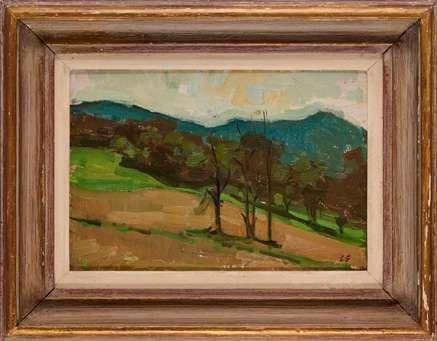
LAWRENCE GOWING RA (BRITISH 1918-1991) LANDSCAPE
signed with initials lower right; oil on board; 19 x 28cm; 7½ x 11in (32 x 40.5cm; 12½ x 16in framed)
Provenance: J.C.H. Templer, Stockwell, London
⊕ £250-350
⊕ £400-600 31
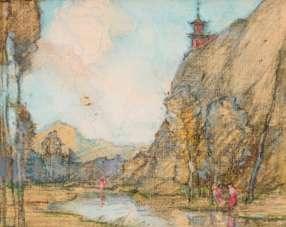
MONTAGUE SMYTH (BRITISH 1863-1965)
THE CLIFF
pencil, black chalk and watercolour on paper; 12 x 14.5cm; 4¾ x 5¾in (26.5 x 28.5cm; 10½ x 11¼in framed)
Painted circa 1905. Smyth studied in France and Italy and under Fred Brown at Westminster School of Art. In 1894 he joined the Royal Society of British Artists, started showing at the Royal Academy and had a one-man exhibition at Dowdeswell Galleries on Bond Street in 1899. He was a founder member of the London Sketch Club in 1898, and in 1904 joined the Royal Institiute of Oil Painters (he went on to become President of both organisations). Smyth travelled through China and Japan in 1905, the body of work he produced there (likely including the present work), forming the basis of a solo exhibition at Baillie Gallery the following year. With the outbreak of the First World War Smyth falsified his age and served with the Artists’ Rifles. His last one-man exhibition was at the Fine Art Society in 1921. Belgrave Gallery organised a touring show of his work in 1978.
⊕
£40-60
JRT notes that the present work is ‘from the same series as those reproduced in An artist in North Wales (London, 1946)’ by Clough Williams-Ellis (1883-1978). Uhlman captured in his illustrations ‘the barren ruggedness of North Wales, […] with the ability to impart a feeling of sunshine and impeding storm, a stony, hilly, loneliness’.
33
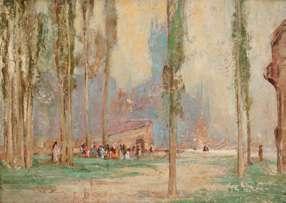
FRED HAYDEN (BRITISH EARLY 20TH CENTURY) THE VILLAGE GATHERING signed Fred Hayden on the reverse; oil on panel; 15 x 20cm; 6 x 8in (27.5 x 33cm; 10¾ x 13in framed)
£80-120
34
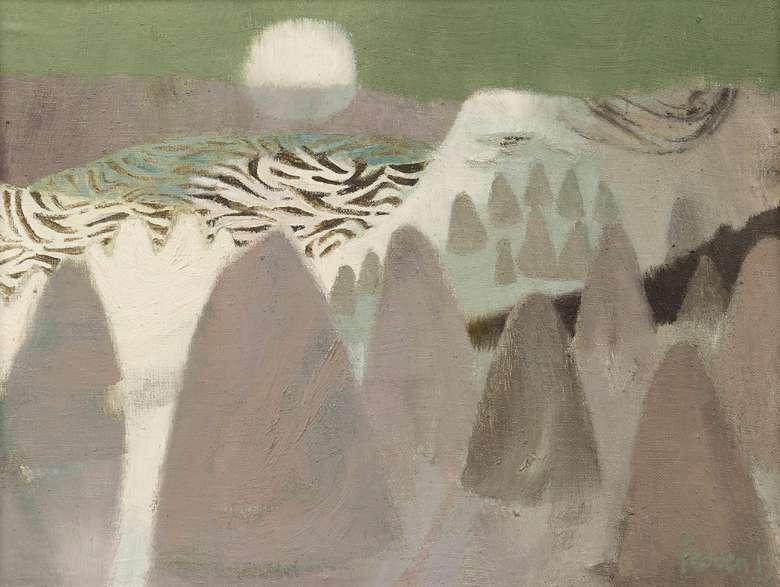
MARY FEDDEN RA (BRITISH 1915-2012) CAPPADOCIA
signed and dated Fedden 1971 lower right; signed, titled and numbered 17 on a label on the reverse; oil on canvas; 30 x 40.5cm; 11¾ x 16in (45 x 56cm; 17½ x 22in framed)
Exhibited: Farnham, Ashgate Gallery, 1971, no. 17
Fedden travelled widely with her husband Julian Trevleyan (1910-1988), including to Turkey where she painted several oils of the strange landscape of Cappadocia. The subtle colour variations and flattened perspective of the present work give the eroded volcanic features typical of the area the appearance of a mystical moonscape.
⊕ £4,000-6,000
35
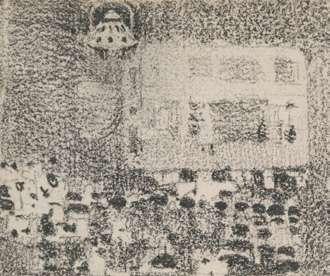
JAMES WATTERSTON HERALD (SCOTTISH
1859-1914)
THE CINEMA
pencil on paper; 6.5 x 7.5cm; 2½ x 3in; 25.5 x 27cm (10 x 10½in framed)
Exhibited: Edinburgh, The Fine Art Society, James Watterston Herald, 1988, no. 1139 L
The son of a shoe maker in Forfar, Watterston Herald moved to Edinburgh in 1884. Already a talented draughtsman, he was inspired by the streets and closes of Edinburgh’s Old Town. His work soon met with critical acclaim, with several accepted for exhibition by the Royal Scottish Academy. Returning to Angus circa 1890 Herald perfected the themes that would establish his signature style, including crowd scenes such as the present sketch of a film viewing in a cinema auditorium.
£60-80
36
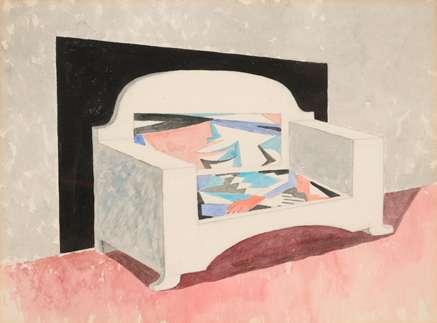
GEORGE BISSILL (BRITISH 1896-1973) DESIGN FOR HARLEQUIN ARMCHAIR
pencil and watercolour on paper; 31 x 41cm; 12¼ x 16in (52 x 62cm; 20½ x 24¼in framed)
Provenance: Abbott and Holder, London
According to JRT’s notes, the present work is one of the designs for a set of furniture made in 1926 for ballet critic and art collector Arnold Haskell (1903-1980) - father of the art historian Francis Haskell (1928-2000)who commissioned Bissill to design the interiors of his new Kensington home in the Art Deco style to compliment his art collection. All of was lost, however, when a bomb destroyed the house in 1941.
see note to lot 68
⊕ £200-300
39
38
37
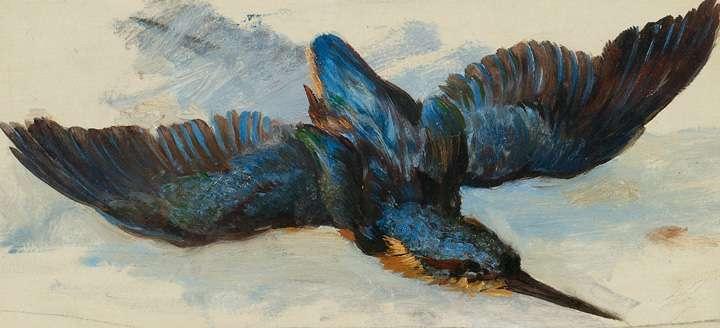
BRITISH SCHOOL (19TH CENTURY)
STUDY OF A KINGFISHER oil on paper laid down on board; 11 x 22.5cm; 4¼ x 8¾in (20 x 32cm; 8 x 12½in framed)
Provenance: (possibly) Gertrude Lushington (god-daughter of Edward Lear)
£600-800
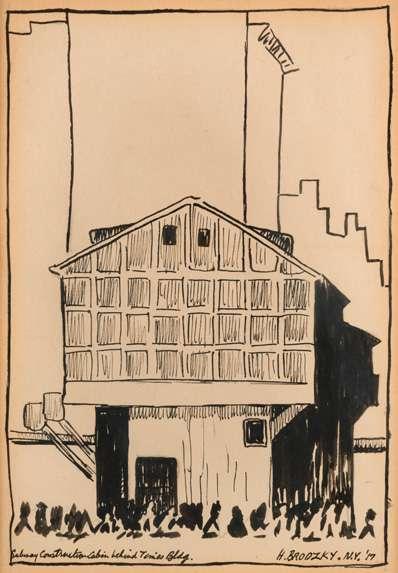
HORACE BRODZKY (AUSTRALIAN 1885-1969)
SUBWAY CONSTRUCTION, CABIN BEHIND THE TIMES
BUILDING, NEW YORK
signed and dated H.Brodsky.N.Y.’17 lower right; titled lower left; pen and black ink over traces of pencil on paper; 20 x 14cm; 8 x 5½in (35 x 28cm; 13¾ x 11in framed)
Brodzky was an Australian-born Jewish artist, critic and writer who worked mostly in London and New York. He moved to London in 1908 and studied at City and Guilds Art School where he held his first solo show. There he befriended artists Henri Gaudier-Brzeska, Jacob Epstein, David Bomberg and Mark Gertler. His biography of Gaudier-Brzeska was published in 1933 (see lot 280).
⊕ £300-400
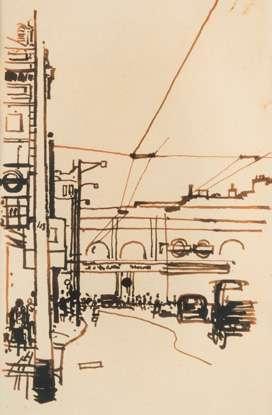
RUSKIN SPEAR RA (BRITISH 1911-1990)
HAMMERSMITH BROADWAY
pen and brown ink on paper; 21 x 14cm; 8¼ x 5½in (40.5 x 32cm; 16 x 12½in framed)
Provenance: Drey Gallery, London
The present work is a sketch for the painting Hammersmith Broadway (1950) in the collection of the Arts Council, London. Ruskin Spear lived in Hammersmith all his life, where he attended Hammersmith School of Art.
⊕ £180-250
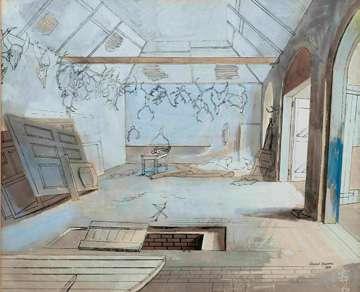
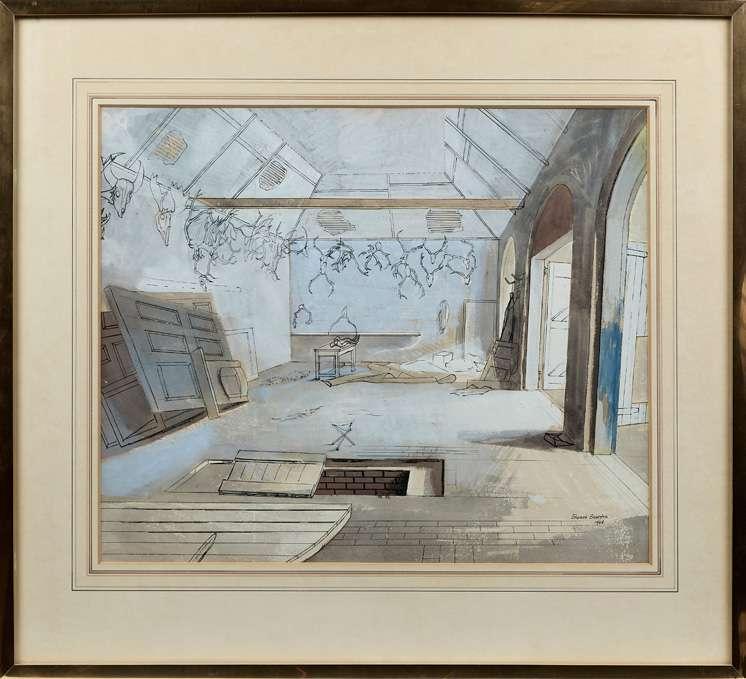
EDWARD BAWDEN RA (BRITISH 1903-1989)
HORNS AND ANTLERS
signed and dated Edward Bawden 1948 lower right: pen and ink and watercolour over traces of pencil on paper; 45 x 55cm; 17¾ x 21½in (68 x 75cm; 26¾ x 29in framed)
Provenance: Abbott & Holder, London
Exhibited: London, Leicester Galleries, Edward Bawden, 1949
Literature: Penguin, New Writers, n.d., illustrated
According to Tim Mainstone, publisher of The Lost Watercolours of Edward Bawden (Mainstone Press 2016), the present work was hung next to Pine trees at Scott’s Hall in the Leicester Galleries 1949 exhibition, and that in gallery notes the work is described as ‘Horns and Antlers in the Coach House; relics of the chase; antlers hung in the coach-house’. Mainstone posits that as the two paintings were adjacent the present work may be the interior of the coach house to Scotts’ Hall.
Bawden’s experience as a war artist was eventful; both before and after a period of time during which he was torpedoed on the RMS Laconia, spent five days at sea on a lifeboat, held in a prisoner of war camp, travelled across Libya, Sudan, Ethiopia, Saudi Arabia and Yugoslavia, he had spent time documenting the Marsh Arabs across Iraq and Kurdistan. It is perhaps unsurprising that with these broad and character building experiences behind him that after the war he turned his attention to more local matters.
A key figure within the group known as The Great Bardfield Artists (which included his great friend Eric Ravilious), he spent the next several decades documenting the more mundane and grounded components of British country life. Bawden’s remarkable skill at evoking mood through incidental details is beautifully expressed here.
A pared back palette, and delicate details exemplifying this as an exquisite and evocative example of this period.
⊕ £3,000-4,000 41
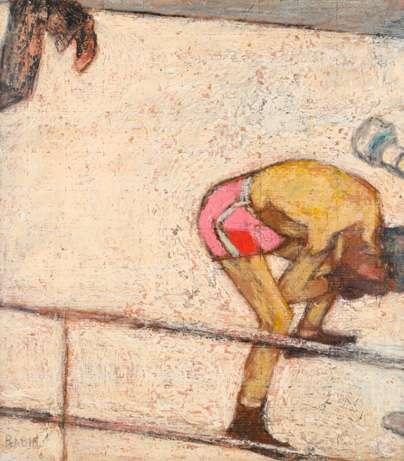
SAMUEL RABIN (BRITISH 1903-1991) A WORK OUT
signed RABIN lower left; pastel and wax crayons on paper; 20 x 16cm; 8 x 6½in (42 x 36.5cm; 16½ x 14¼in framed)
Provenance: R. Westerby Esq, Farringdon
Exhibited: London, Wildenstein & Co, Some Contemporary British Painters, 1951, no. 51; Dulwich Picture Gallery, Samuel Rabin Retrospective Exhibition, 1985-86, no. 58
see note to lot 113
⊕ £400-600
43
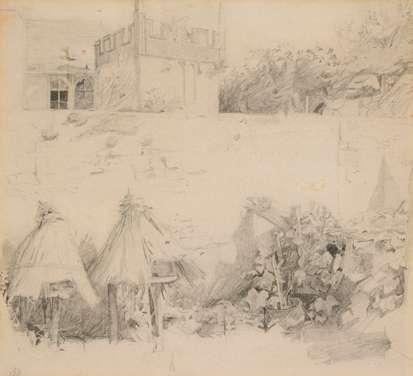
GEORGE PINWELL (BRITISH 1842-1875)
BEEHIVES AGAINST A GARDEN WALL
signed with initials lower left; pencil on paper; 18 x 19cm; 7 x 7½in; (34 x 34cm; 13½ x 13½in framed)
Provenance: (probably) Abbott & Holder, London
The son of a carpenter, Pinwell first worked for an embroiderer while attending night school at St Martin’s Lane Academy before becoming a full time student at Heatherley’s Academy. He worked regularly for the Brothers Dalziel as a wood engraver and was among the cohort of book illustrators and watercolourists who formed the Idyllic school
The school enjoyed an all too brief flowering. In 1871 The Times wrote of the group: ‘Mr. North and Mr Macbeth both belong to the school of which in this country Mason and F. Walker are the chiefs, and Mr. Pinwell the lieutenant – the school aims at making pictorial idylls out of the unpromising materials of lowly life in town and country’. But the premature deaths of its key members, in particular Pinwell and Frederick Walker in 1875, meant the school was largely defunct within a decade. Much admired in his day Pinwell exhibited with the Dudley Gallery and the Royal Watercolour Society of which he was elected a full member in 1871.
£200-300 42
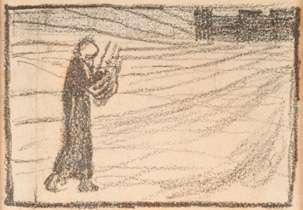
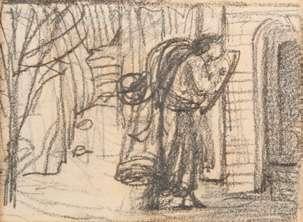
EDWARD BURNE-JONES
(BRITISH 1833-1898)
TWO STUDIES FOR THE ORPHEUS SERIES
both black chalk on paper; (i) 7 x 10cm; (ii) 8.5 x 10.5cm; (34 x 24cm; 13½ x 9½in framed as one)
Provenance: Margaret Burne-Jones (the artist’s daughter, who married John William Mackail); Olaf Barrett (from whom purchased)
£600-800
44
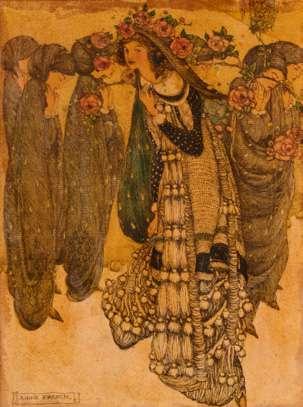
ANNIE FRENCH (BRITISH 1872-1965) ROSE MAIDENS
signed ANNIE FRENCH lower left; pen and black ink and watercolour with varnish on paper; 24.5 x 18.5cm; 9½ x 7¼in (48 x 42cm; 19 x 16½in framed)
Born in Glasgow, French studied at the Glasgow School of Art under Belgian Symbolist painter Jean Delville, and taught in the School’s department of Design until 1914 when she married the painter George Wooliscroft Rhead and they moved to London. French exhibited her watercolours regularly at the Royal Glasgow Institute and the Royal Academy. The illustrator Philippe Jullian (see lots 164 & 239) called her ‘a lace-maker’, reflecting her intricate and delicate style of figures as ‘spirits composed of cobwebs rather than creatures of flesh and blood’.
⊕ £100-200
45
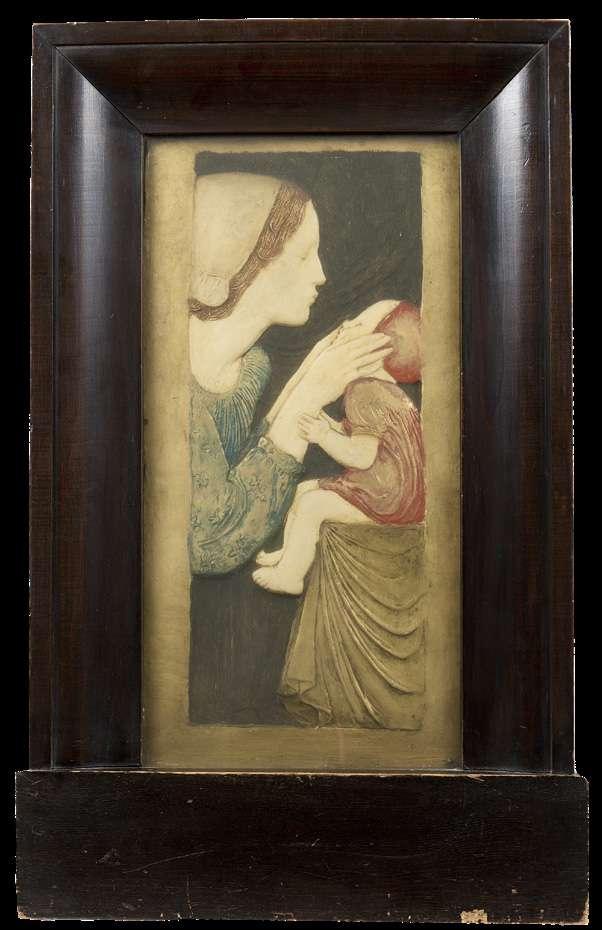
ROBERT ANNING BELL RA (BRITISH 1863-1933)
MOTHER AND CHILD
signed and dated .R.A.Bell.96 lower right; coloured and gold paint on plaster; 46 x 23cm; 18¼ x 9in (64.5 x 39cm; 25½ x 15½in framed)
Anning Bell completed the present work whilst teaching at the Liverpool School of Architecture from 1895-1896. There he became associated with the recently founded Della Robbia Pottery located nearby in Birkenhead, and developed a line in polychrome plaster reliefs inspired by the Italian Renaissance master.
Bell had first worked in his uncle’s architectural practice before studying at Westminster School of Art and the Royal Academy Schools. He subsequently spent a year in Paris in the studio of Aimé Morot, and on his return to England shared a studio with George Frampton before spending time in Italy. After his Liverpool posting he was appointed head of Design at Glasgow School of Art in 1911, and was Professor of Design at the Royal College of Art in London from 1918-24. In 1921 he was elected Master of the Art Worker’s Guild. As well as exhibiting regularly at the Royal Academy and the New English Art Club, he completed major mosaic commissions both for Westminster Cathedral and for the Palace of Westminster.
JRT notes on the reverse: ‘I have seen another treatment of this same relief, less rich, dated 1903.’
£800-1,200
46
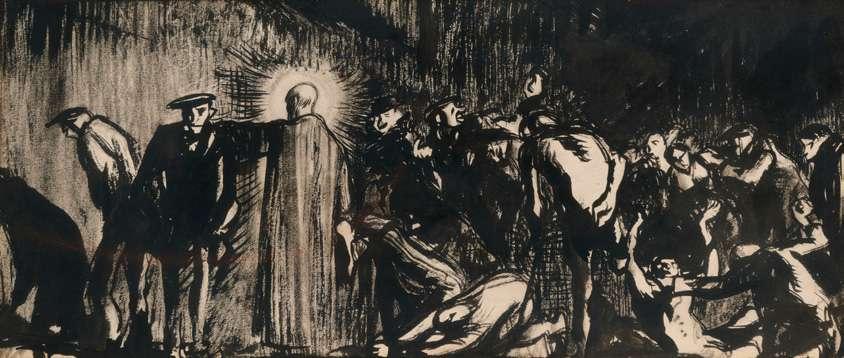
SIR FRANK BRANGWYN RA (BRITISH 1867-1965)
THE PEACEMAKER
pen and black indian ink on paper; 15 x 34cm; 6 x 13¼in (31 x 49.5cm; 12¼ x 19½in framed)
Provenance: The Fine Art Society, London (1970)
⊕ £200-300
47
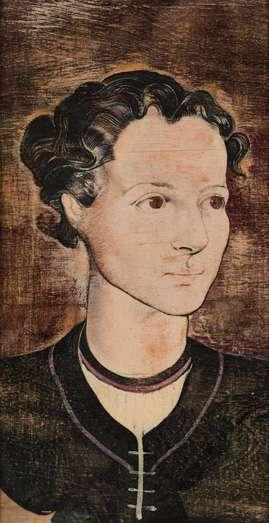
BRITISH SCHOOL, EARLY 20TH CENTURY
PORTRAIT OF A YOUNG WOMAN
pen and brown and black ink with sgraffito and tempera on panel; 32 x 17cm; 12½ x 6¾in (37 x 22cm; 14½ x 8¾in framed)
£300-400
48
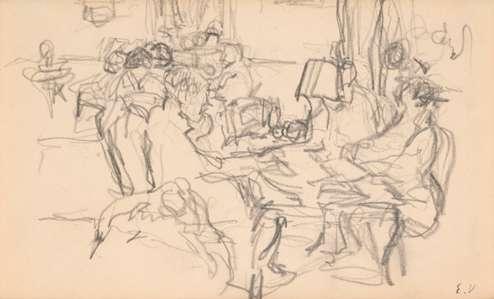
EDOUARD VUILLARD (FRENCH 1868-1940)
INTERIOR SCENE
stamped with initials (Lugt 909c) lower right; pencil on paper; 9.5 x 15cm; 3¾ x 6in (27 x 33cm; 10½ x 13in framed)
Executed circa 1910.
Provenance: J.P.L. Fine Arts, London
£400-600
49
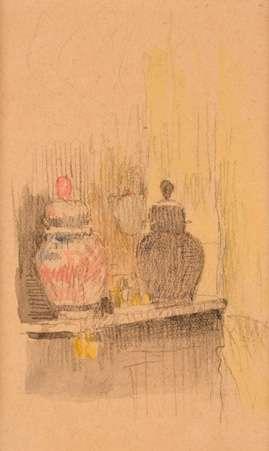
EDOUARD VUILLARD (FRENCH 1868-1940)
GINGER JARS ON A MANTELPIECE
pencil and watercolour on buff paper; 11 x 7cm; 4¼ x 2¾in
(34 x 27cm; 13½ x 10½in framed)
Exhibited: (possibly) Paris, Galerie de l’Institut, Croquis de Vuillard, 1963
JRT notes confusingly of the ginger jars: ‘they appear like this in, most famously, Mme Vuillard lighting her stove, 1924’. which in fact he may have mistaken for small sculptures.
£200-300 50
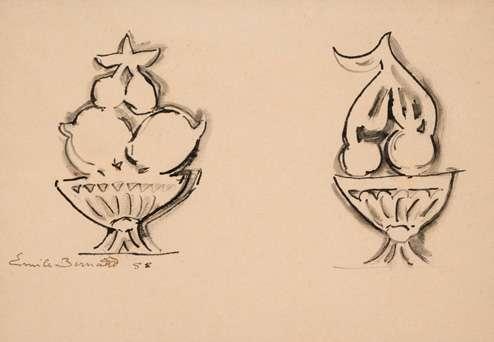
EMILE BERNARD (FRENCH 1868-1941)
TWO STUDIES OF FRUIT IN A BOWL
signed and dated Emile Bernard ‘88 lower left; pen and black ink and grey wash over traces of pencil on paper; 19.5 x 28cm; 7¾ x 11in (31 x 40cm; 12¼ x 15¾in framed)
JRT notes ‘…the year he and Gauguin took their stylistic leap at Pont Aven’.
£400-600
52
51
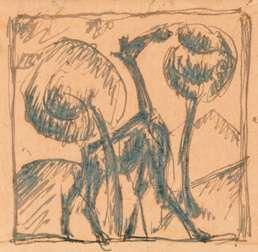
HENRYK GOTLIB (POLISH 1890-1966)
GIRAFFE
pen and brown ink on paper; 8 x 8cm; 3¼ x 3¼in (23 x 22cm; 9 x 8½in framed)
Provenance: Studio of the Artist; Janet Blanche Gotlib (née Mareham, the artist’s widow); by whom gifted
⊕ £50-70
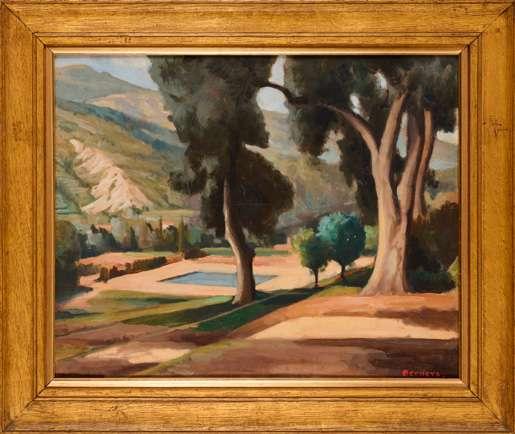
GERALD HUGH BERNERS (BRITISH 1883-1950)
VIEW OF ABERDOVEY, NORTH WALES
signed Berners. lower right; oil on canvasboard; 35 x 44cm; 13¾ x 17¼in (47 x 56cm; 18½ x 22in framed)
Gerald Hugh ‘Lord’ Berners (he inherited the title from an uncle in 1918) was a notorious eccentric. Multi-talented, especially as a music composer (William Walton dedicated Belshazzar’s Feast to him), he was also a skilled artist and writer, famously portrayed as Lord Merlin in Nancy Mitford’s The Pursuit of Love. He inherited Faringdon House in Oxfordshire where he lived with his partner Robert Heber-Percy. Leading artists, intellectuals and musicians were regular visitors, Patrick Leigh-Fermor, Stravinsly, Dali and H.G. Wells among them.
£600-800
53
PHILIP JONES (BRITISH 1933-2008)
LANDSCAPE, SARDINIA
signed and dated Philip Jones 1967 lower right; oil and black chalk on paper; 43 x 63cm; 17 x 24¾in (60 x 80cm; 23½ x 31½in framed)
Provenance: Mansard Gallery, London; The New Art Centre, London
Jones studied at the Slade School of Art under Tom Monnington and William Coldstream in the early 1950s. He first exhibited at the RBA Galleries in 1954, and subsequent showed with the Leicester Galleries, AIA Gallery, the London Group, Mansard Gallery, Heals, the Contemporary Art Society and the New Art Centre. He travelled widely, typically in the winter months, exploring India, Malta, Namibia and Gambia as well as Sardinia where he painted the present work.
⊕ £400-600
54
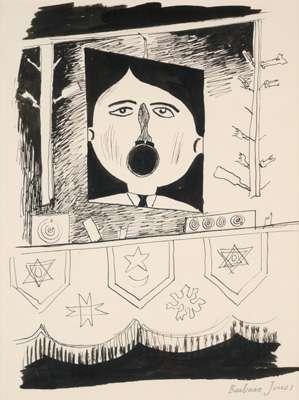
BARBARA JONES (BRITISH 1912-1978) HITLER SHY
signed Barbara Jones lower right; pen and black ink; 20 x 15cm; 8 x 6in (40 x 35cm; 15¾ x 13¾in framed)
Provenance: Christopher Gange; Sally Hunter Fine Art, London see note to lot 123 & also lot 311
⊕ £80-100
55
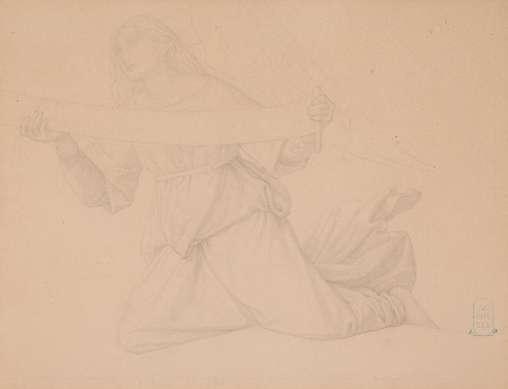
ANDRE JACQUES VICTOR ORSEL (FRENCH 1795-1850)
STUDY OF A KNEELING ANGEL
with the Alphonse Perrin studio stamp (Lugt 1999e) lower right; inscribed jeudi […] 3 heures de plus lower left; pencil on paper 14.5 x 18.5cm; 5¾ x 7¼in (32 x 36cm; 12½ x 14¼in framed)
Provenance: Estate of the Artist; Alphonse Perrin (1798-1974), Paris (by descent); Olaf Barnett (from whom purchased)
The present work is likely a preparatory sketch Orsel completed for the mural decorations in the church of Notre-Dame de Lorette, Lyon.
£100-150
56
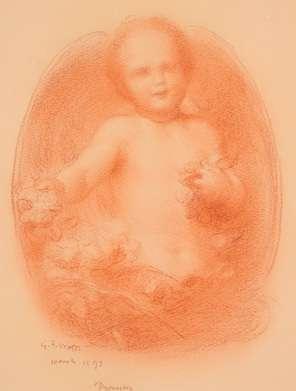
GEORGE FREDERIC WATTS RA (BRITISH 1817-1904) STUDY FOR PROMISES
signed, titled and dated G.F. Watts
March 1893 / Promises lower left; red chalk on paper; 22 x 16.5cm; 8¾ x 6½in (55 x 45cm; 21½ x 17¾in framed)
The present work is a sketch for Watts’ finished painting Promises of the same year in the collection of the Walker Art Gallery, Liverpool.
£150-200
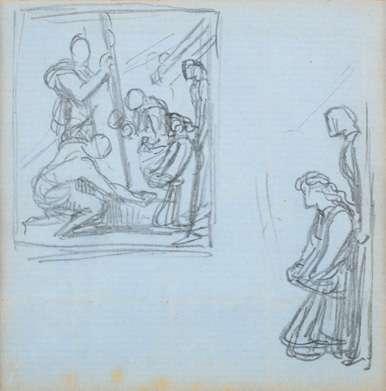
57
GEORGE FREDERIC WATTS RA (BRITISH 1817-1904)
STUDY FOR A CRUCIFIXION pencil on blue paper; 10 x 10cm; 4 x 4in (25 x 19.5cm; 9¾ x 7¾in framed)
£50-70
58
RUDOLPH IHLEE (BRITISH 1883-1968)
THREE BOYS BY A WALL pencil on brown paper; 36 x 25cm; 14¼ x 10in; 59 x 46.5cm (23¼ x 18¼in framed)
Provenance: Belgrave Gallery, London, no. 31
The present work is a study for Ihlee’s painting Gosses
⊕ £30-40
59
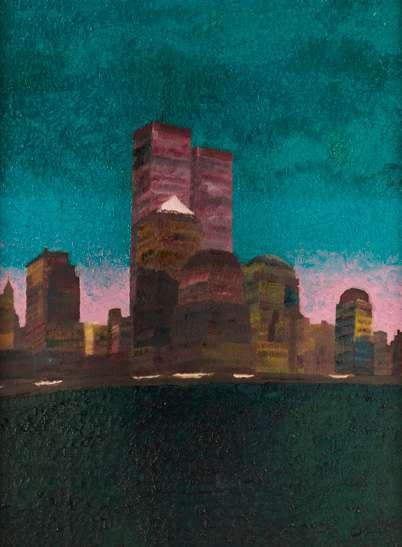
K.S. SHINMAR (20TH CENTURY)
THE TWIN TOWERS, MANHATTAN
oil on board; 39 x 29cm; 15¼ x 11½in (44 x 34cm; 17¼ x 13½in framed)
Exhibited: London, The Mall Galleries, The Discerning Eye, 1991, no. 2264.
JRT was one of the six selectors for the 1991 exhibition The Discerning Eye, an annual exhibition the purpose of which was to nurture new artistic talent at the Mall Galleries. The other selectors that year were Gillian Ayres RA, William Bowyer RA, Sir Brinsley Ford, Lord Gowrie and Tim Hilton.
£400-600
60
WILLIAM
LEE-HANKEY (BRITISH 1869-1952)
ITALIAN VILLAGE SCENE
pencil on paper; 28 x 19.5cm; 11 x 7¾in (47 x 37cm; 18½ x 14½in framed)
Provenance: Rich & Son, London
£30-40
61
MICHAEL
MURFIN (BRITISH B.1954)
STUDY FOR THE FARRIER
signed and dated Murfin ‘91 lower right; pencil on paper; 20 x 16cm; 8 x 6¼in (41.5 x 37cm; 16¼ x 14½in framed)
Provenance: The Piccadilly Gallery, London (from whom purchased in 1991)
⊕ £100-150
62
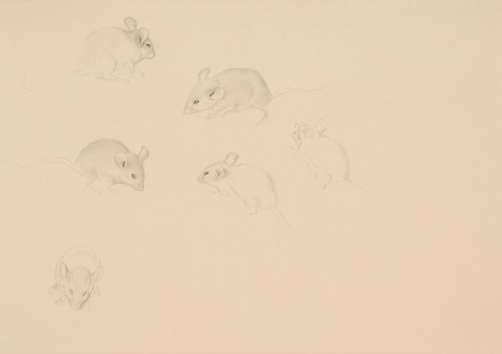
EDMUND DULAC (FRENCH-BRITISH 1882-1953) STUDY OF MICE
pencil on paper; 19 x 26cm; 7½ x 10¼in (36 x 42cm; 14¼ x 16½in framed)
Exhibited: London, Hartnoll and Eyre, Edmund Dulac, 1970, no. 47
Dulac studied at the Ecole des Beaux-Arts in Toulouse and the Académie Julian, Paris before moving to London in his early twenties. Commissioned by J.M. Dent soon after his arrival to illustrate Jane Eyre and nine further volumes by the Brontë sisters, Dulac became a prominent illustrator during a golden age of book Illustration in Britain. He subsequently worked for Hodder and Stoughton and the Leicester Galleries on a wide range of commissions He joined the London Sketch Club, and became a regular contributor to the Pall Mall Magazine. Although best known for his illustrations of classic stories, Dulac also produced newspaper caricatures, portraits, theatre costume and set designs, bookplates, chocolate box graphics, medals, and postage stamps. See also lot 27.
£100-150
63
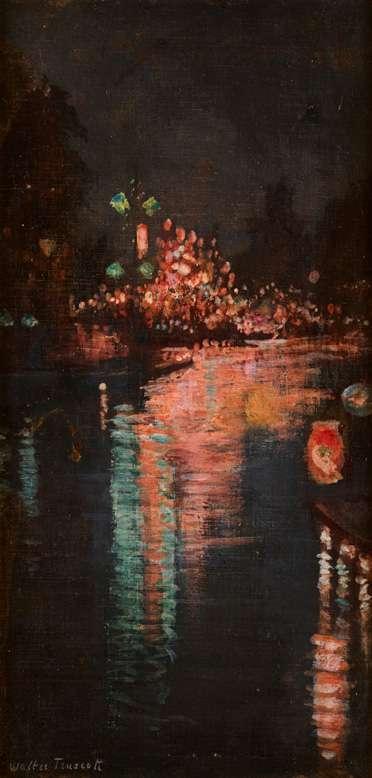
WALTER TRUSCOTT (BRITISH 1854-1890)
CARNIVAL ON THE THAMES, HENLEY
signed Walter Truscott lower left; oil on canvas laid on board; 37 x 18cm; 14½ x 7in (44.5 x 25cm; 17½ x 10in framed)
Provenance: Colin George Steer, London
£300-400
64
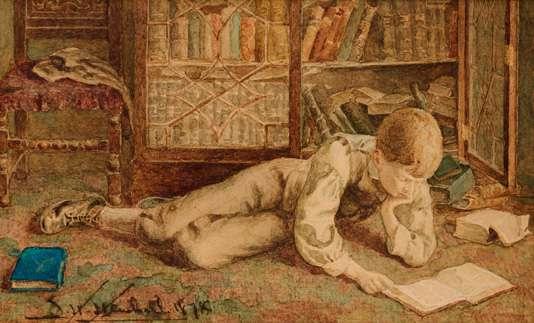
JOHN HENRY HENSHALL (BRITISH 1856-1928)
BOY READING
signed and dated J.H. Henshall 1878 lower left; signed indistictly on a label on the reverse; watercolour on paper; 13 x 22cm; 5 x 8½in (27 x 35.5cm; 10½ x 14in framed)
£100-200
65
MABEL ALLEYNE (BRITISH 1896-1961)
THE EXPULSION
tempera on board; 20 x 16.5cm; 8 x 6½in; 27 x 24cm (10½ x 9½in framed in the original frame)
Alleyne was a painter, illustrator, wood engraver and printmaker, born into a wealthy family she studied at Goldsmith’s College and the Royal Academy Schools shortly after the First World War. She exhibited at the Royal Academy, the Redfern Gallery the New English Art Club and the Society of Mural Painters of which she was a member. Among the books she illustrated were Shelley’s Adonais and Emily Bronte’s Wuthering Heights
⊕ £400-600
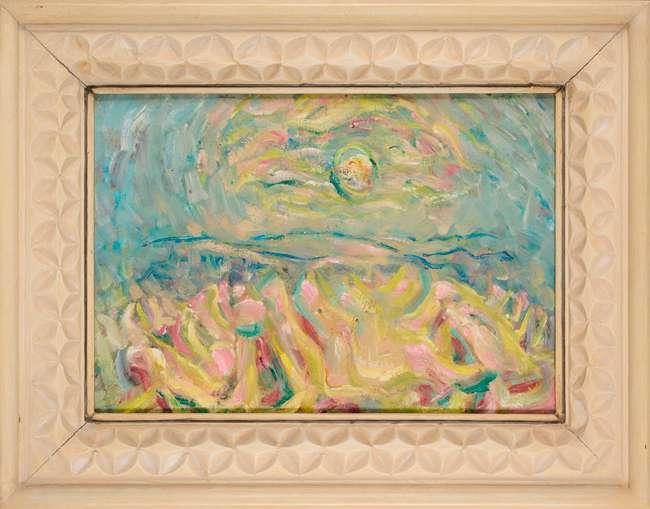
KAFF GERRARD (BRITISH 1894-1970)
MOONLIGHT
oil on board; 27.5 x 39cm; 10¾ x 15¼in (42 x 53.5cm; 16½ x 21in framed)
Provenance: Alfred Horace Gerrard (1889-1998), the artist’s husband (from whom gifted)
Exhibited: Canterbury, Royal Museum and Art Gallery, Kaff Gerrard, 1991
JRT notes that ‘the frame is designed and carved by the artist’s husband A.H. Gerrard for long professor of sculpture at the Slade. This is almost unique as the painting by her in private hands outside professor Gerrard’s who gave it to me.’
Painter and potter Kaff Gerrard (née Katherine Leigh-Pemberton) studied at the Slade where her tutor, Philip Wilson Steer, described her as ‘the most natural painter he had ever known’. She met her husband to be, Alfred Gerrard there in 1920 where he was appointed head of sculpture in 1925, and became Professor of Sculpture (1949-1968). Together they worked closely on New Millbank Stoneware which they exhibited to great acclaim at Colnaghi’s in 1931. It was the only exhibition Kaff held during her lifetime. The couple also collaborated on woodcuts for book illustrations. They married in 1933. JRT wrote ‘Her work once seen is never forgotten, …and never confused with that of anyone else. It combines technical mastery with personal vision in a way that only great art achieves.’
⊕ £300-400
67
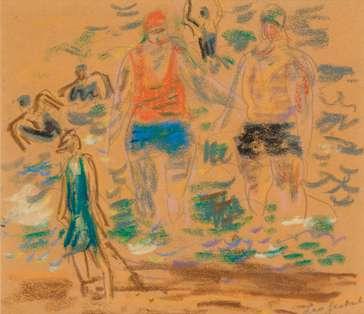
LEO GESTEL
(DUTCH 1881-1941)
BATHERS
signed Leo Gestel lower right; pencil and pastel on brown paper; 17 x 19cm; 6¾ x 7½in (34 x 34.5cm; 13½ x 13½in framed)
£200-300
68
GEORGE BISSILL (BRITISH 1896-1973)
FIGURES ON A COUNTRY ROAD
signed BISSILL lower left; pen and black ink and watercolour on buff paper; 39 x 28cm; 15¼ x 11in (59 x 46.5cm; 23¼ x 18¼in framed)
Provenance: Blond Fine Art Ltd, London (from whom purchased in 1979)
Executed in the 1930s. The son of a miner, after suffering a gas attack in the trenches in the First World War Bissill attended Nottingham School of Art before moving to London. There he worked for a time as a pavement artist outside Bush House, and had a solo show at the Redfern Gallery in 1924. He subsequently exhibited at the Royal Academy, with the New English Art Club and at Abbott and Holder. Although primarily a landscape painter, Bissill produced powerful images of miners at work. He moved to Hampshire with his wife in the early 1930s to be closer to nature and in 1941 contributed several watercolours to Kenneth Clark’s Recording Britain project. He also designed furniture (see lot 36).
⊕
£60-80
69
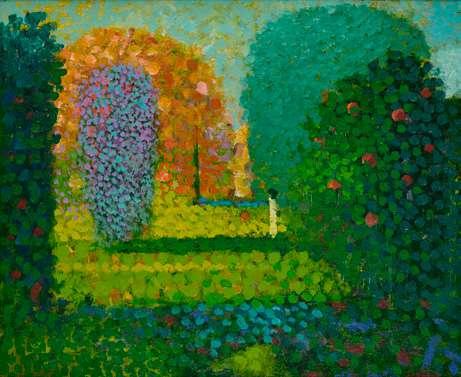
ALFRED STOCKHAM (BRITISH 1933-2020)
LITTLE GARDEN
oil on canvas laid on board; 24.5 x 29.5cm; 9¾ x 11½in (33.5 x 38.5cm; 13¼ x 15¼in framed)
Painted in 1981.
Provenance: Dominic Nevill, Bath
Exhibited: Bath, Contemporary Art Fair, June 1981
⊕ £300-400
70
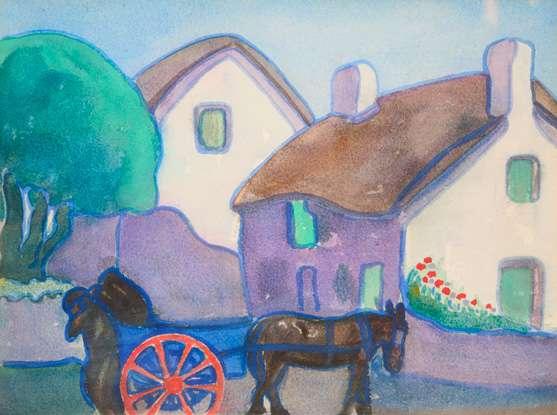
ROBERT BEVAN (BRITISH 1865-1925)
HORSE AND CART
watercolour on paper; 23 x 30cm; 9 x 11¾in (39 x 46.5cm; 15¼ x 18¼in framed)
Provenance: Carlos Peacock (from whom purchased in 1963)
Bevan met Gauguin at Pont-Aven in 1894. In 1900 he settled in London, where he became a member of Sickert’s circle (he was a founding member of the Camden Town Group in 1911 and of the London Group in 1913). His work was much influenced by Gauguin’s bold colour and flat patterning, and in his last years his style became increasingly simplified and schematic. He is best known for paintings featuring horses. His wife, the Polish-born Stanislava de Karlowska (1880-1952), whom he married in 1897, was also a painter. He made several visits to Poland with her, and as JRT’s note suggests on the reverse of the present work, this watercolour may have been painted during one of these trips.
£300-400
71
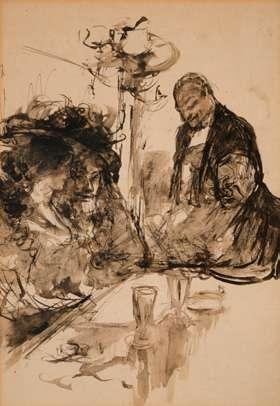
LOUIS LEGRAND (FRENCH 1863-1951) AT THE CAFÉ
pen and black ink and grey and brown wash; 24.5 x 17cm; 9¾ x 6¾in (38 x 28cm; 15 x 11in framed)
Provenance: Abbott & Holder, London (from whom purchased)
£80-120
72
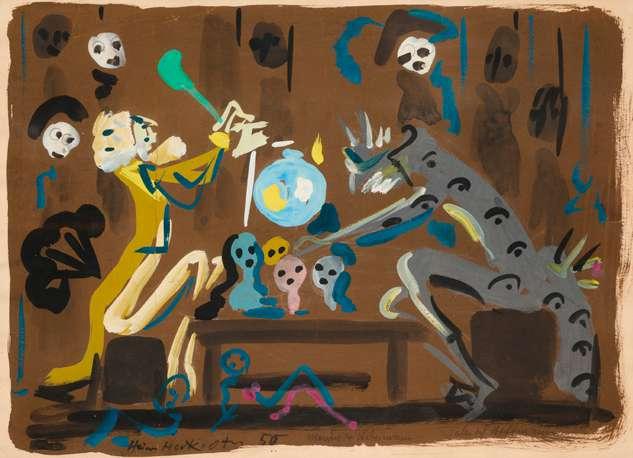
HEIN HECKROTH (GERMAN 1901-1970)
THE EYE-MAKER’S SHOP
signed, inscribed and dated Hein Heckroth ‘50 Massine & Helpmann Tales of Hoffmann lower edge; oil on paper; 27 x 37cm; 10½ x 14½in (45.5 x 55.5cm; 18 x 21¾in framed)
Provenance: William Murray
JRT notes this is ‘related to his designs for the Tales of Hoffmann (Powell and Pressburger 1951)’ on a label on the reverse.
The film The Tales of Hoffmann received two nominations at the 24th Academy Awards, both for Hein Heckroth for Best Art Direction-Set Decoration, Colour and Best Costume Design. In this adaptation of Offenbach’s 1881 opera, dancers Robert Helpmann and Leonine Massine performed. French critic André Bazin described it as a ‘legendary film’, adding that the ‘over-the-top Expressionism of the circular-studio production, the detail of Heckroth’s profoundly ravishing designs, the Ballets Russes homage of Massine’s tireless choreography, all come over with a vitality enhanced by the passing years’.
⊕ £250-350
73
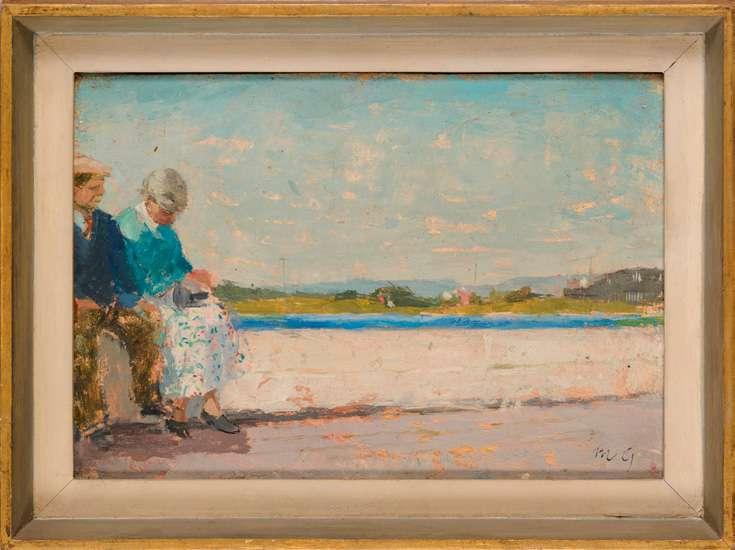
MARGARET GREEN (BRITISH 1925-2003)
A DAY BY THE SEA
signed with initials lower right; oil on the artist’s prepared canvasboard; 15 x 22cm; 6 x 8¾in (20 x 27cm; 8 x 10½in framed)
⊕ £300-400
74
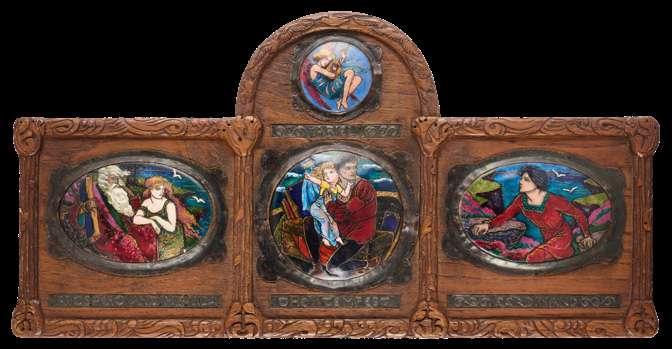
HELEN BRIGHTWELL (BRITISH 1876-1967)
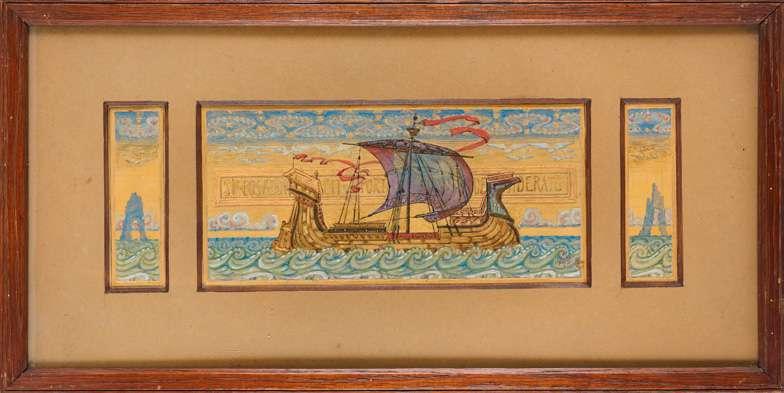
ARIEL; PROSPERO AND MIRANDA; THE TEMPEST; FERDINAND
four enamels set in individual metal Arts & Crafts mounts in a carved oak frame by Lillian Wells; 23 x 44cm; 9 x 17¼in (framed)
⊕ £300-400
75
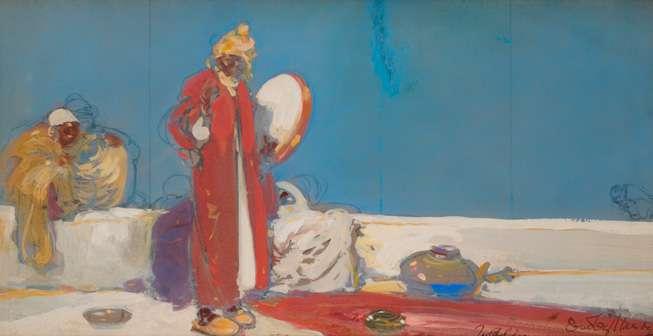
DUDLEY HARDY (BRITISH 1867-1922)
STREET MUSICIANS, MOROCCO
signed Dudley Hardy and indistinctly inscribed lower right; gouache on paper; 19.5 x 37cm; 7¾ x 14½in (27 x 44cm; 10¾ x 17¼in framed)
£200-300
75
76
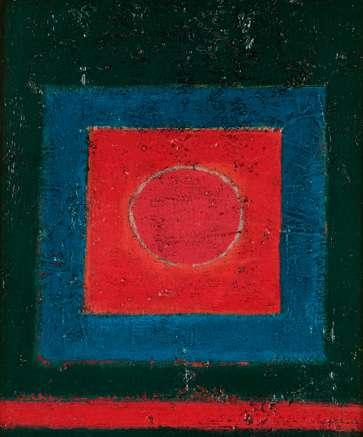
JOHN CHRISTOPHERSON (BRITISH 1921-1996)
CRIMSON SUN
signed and numbered 231 / CHRISTOPHERSON on the reverse; signed, titled, dated and numbered 231 / JOHN CHRISTOPHERSON / ‘CRIMSON SUN’ / completed 7th April 1964 on a label on the reverse; oil on board; 18 x 15cm; 7 x 6in (20.5 x 18cm; 8 x 7in framed)
Christopherson began painting seriously only when in his forties. Long fascinated by ancient stones, pavements, mosaics, archeological sites, walls and buildings - surfaces that exhibited the inexorable passing of time - he celebrated what he described as ‘the forlorn poetry of the unregarded’ in his work. Of Cornish ancestry, he regularly visited St Ives and admired the work of Ben Nicholson, William Scott and his friend Alan Reynolds. But his main influences were from the Continent, including Tàpies, Brancusi, Giacometti and Fautrier. He exhibited with the Leicester Galleries and Agnews and in 1979 George Melly acquired a number of his works for the Arts Council Collection.
⊕ £200-300
77
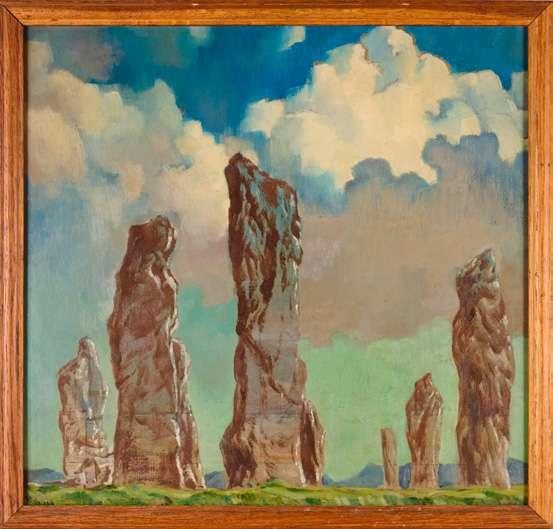
COLIN GIBSON (SCOTTISH 1907-1998)
ANCIENT STONES AT CALLERNISH, ISLE OF LEWIS oil on board over traces of pencil; 45 x 46.5cm; 17¾ x 18¼in (49 x 51.5cm; 19¼ x 20¼in framed)
Gibson grew up in Arbroath, attended Grays School of Art in Aberdeen and exhibited regularly with the Royal Scottish Academy. Fascinated by nature and the wilds of Scotland’s west coast, he enjoyed painting in the Hebrides, in this instance the late neolithic standing stones in Callanish on the Isle of Lewis.
⊕ £1,200-1,800
78
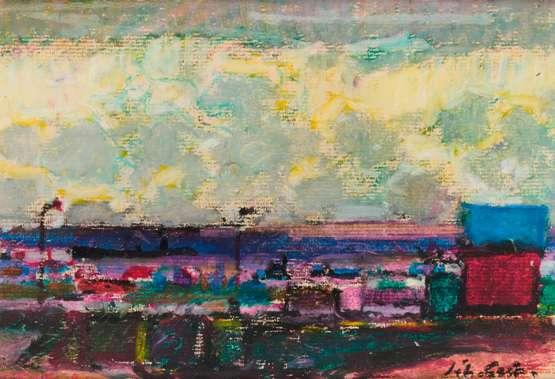
JOHANNES GEIR JONSSON (ICELANDIC 1927-2003)
THE OUTSKIRTS OF REYKJAVIK, ICELAND signed Joh.Geir lower right; gouache on paper; 14.5 x 21cm; 5¾ x 8¼in (36 x 41cm; 14¼ x 16in framed)
Painted in the 1960s.
⊕ £80-120
79
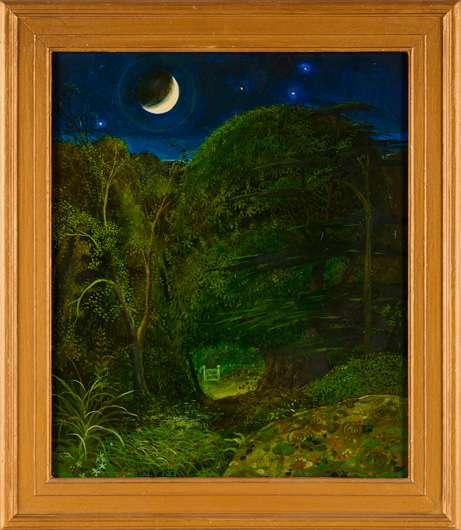
JOHN SHELLEY (BRITISH 1938-2020)
MOON AND CHESTNUTS
signed, titled and dated John Shelley / 1968 / Moon and Chestnuts on the reverse; oil on board; 31.5 x 26cm; 12½ x 10¼in; 40 x 35cm; 15¾ x 13¾in (framed)
Provenance: Foyles Gallery, London (purchased in 1969)
Exhibited: London, Foyles Gallery, John Shelley, 1969, no. 8
Born in Margate, Shelley studied at Wimbledon Art School in the early 1950s before going onto the Slade in 1958. Typically he painted rural idylls, cottage gardens set in lush surrealist landscapes, in a naive style.
⊕ £1,000-1,500
80
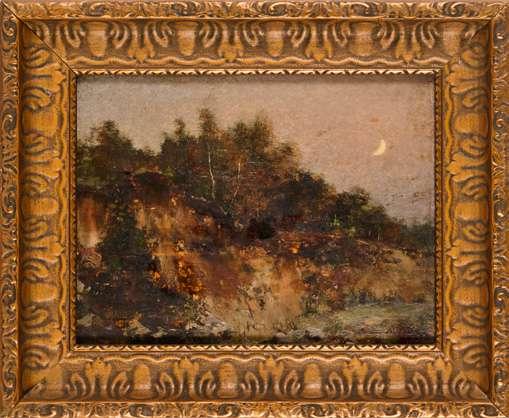
RENE BILLOTTE (FRENCH 1846-1915)
WOODLAND POND BY MOONLIGHT (CLAIR DE LUNE)
signed Rene Billotte lower right; oil on panel; 18 x 23.5cm; 7 x 9¼in (28 x 33.5cm; 11 x 13¼in framed)
£100-200
81
THEODORE ROUSSEL (FRENCH 1847-1926)
BEACH SCENE
signed Th.R lower right; oil on canvas; 16.5 x 21cm; 6½ x 8¼in (31 x 36cm; 12¼ x 14¼in framed)
Exhibited: London, Belgrave Gallery, 1980, no. 3
£400-600
82
COLIN SEALY (BRITISH 1891-1964)
THE GREEN SHAWL oil on canvasboard; 35 x 25cm; 13¾ x 10in; 50 x 39.5cm (19¾ x 15½in framed)
Provenance: (possibly) Olaf Barnett ⊕ £200-300
83
BERNARD MENINSKY RA (1891-1950)
NEAR CAGNES, FRANCE
partially signed and titled on an old torn label on the stretcher; oil on canvas; 26.5 x 49cm; 10½ x 19¼in (36.5 x 59cm; 14¼ x 23¼in framed)
Painted circa 1950.
Exhibited: London, Adams Gallery, 1958, no. 37 see note to lot 104
£1,000-1,500
84
REGINALD CHARLES WILKINSON (BRITISH 1881-1939)
ROOFS BEHIND TREES
oil on card laid down on board; 28 x 19.5cm; 11 x 7¾in (39 x 31cm; 15¼ x 12¼in framed)
Wilkinson attended Heatherly and the Slade schools of art. He married artist Kate Stanley Wilkinson and exhibited his work in London at the Royal Academy and the Royal Institute of Painters and the Walker Gallery, Liverpool.
£200-300
85
EKATERINA ZERNOVA (RUSSIAN 1900-1995)
EARLY MORNING, INDIA
signed in Russian lower right; signed with initials, titled in Russian and dated Septembre 1966 on the reverse; oil on board; 16 x 23.5cm; 6¼ x 9¼in (31 x 39cm; 12¼ x 15¼in framed)
Provenance: Studio of the Artist, Moscow; Roy Miles Gallery, London (from whom purchased)
£150-200
87
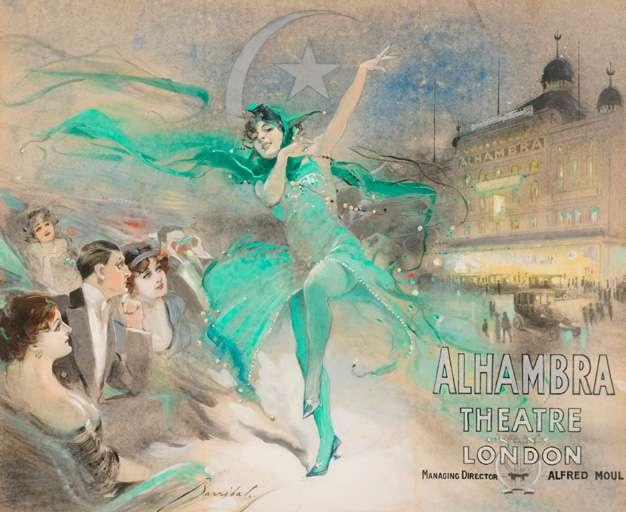
WILLIAM BARRIBAL (BRITISH 1873-1952)
DESIGN FOR THE PROGRAM COVER OF THE ALHAMBRA THEATRE, LONDON
signed Barribal lower left and inscribed Alhambra / Theatre London / Managing Director / Alfred Mould lower right; pencil, watercolour and wash on paper; 28 x 34cm; 11 x 13½in (42 x 48cm; 16½ x 19in framed)
The present work is a cover design for the programme at the Alhambra, Leicester Square for the week commencing 15th April 1912. Built in 1854, the Alhambra theatre and music hall was demolished in 1936 to make way for the Odeon Cinema Leicester Square.
Barribal started as a lithographer before studying at the Académie Julian in Paris. A successful commercial designer, his clients included Schweppes, the board games manufacturer Waddingtons and Vogue magazine. His flourished technique was hugely popular, was widely copied and known as ‘the Barribal style’.
£200-300
86
THOMAS ROBERT WAY (BRITISH 1861-1913)
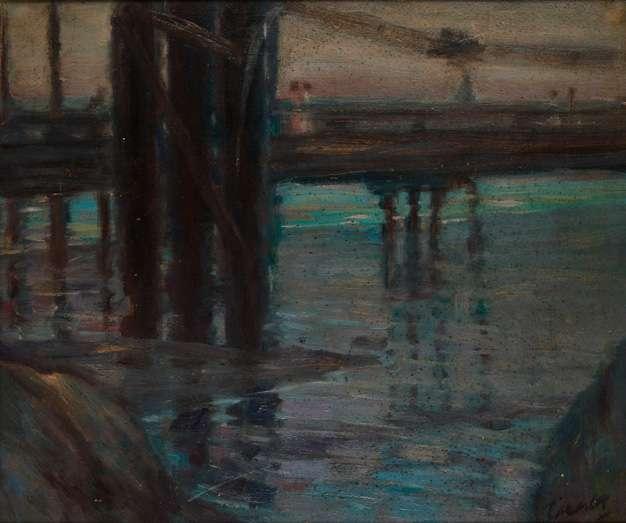
TWILIGHT ON THE WATER
signed T.R.Way lower right; oil on canvas; 32.5 x 39cm; 12¾ x 15¼in (43 x 49.5cm; 17 x 19½in framed)
Son of a lithographer, engraver and printer, Way trained at the South Kensington Art Schools and together with his father was instrumental in convincing Whistler to explore lithography, preparing the lithographic stones, publishing one hundered and thirty of his lithographs in 1896, and after Whistler’s death collating and publishing the artist’s entire lithographic output. Way went on to write a memoir as Whistler’s friend and confidant, Memories of James McNeill Whistler. He also designed posters for the London Underground and printed the work of Frank Brangwyn (see lot 46).
£600-800
88
GERALD FESTUS KELLY (BRITISH 1879-1972)
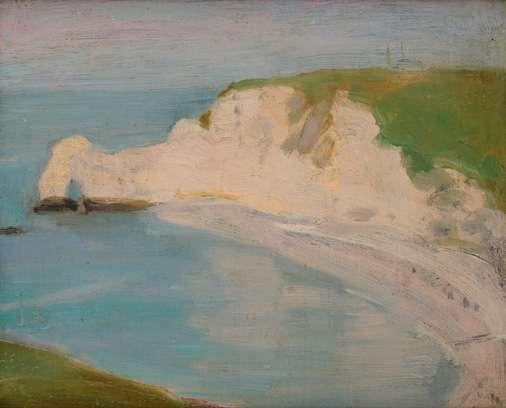
VIEW FROM THE FIRST TEE, ETRETAT, FRANCE
signed Kelly lower left; inscribed and dated Etretat / view from the first tee / 26th July 1908 on the reverse; oil on panel; 14.5 x 17cm; 5¾ x 6¾in (26.5 x 29.5cm; 10½ x 11½in framed)
Exhibited: London, Belgrave Gallery, 1978
Painted the summer the golf course at Etretat opened, the present work is one of a series of landscapes Kelly painted during his travels through France following his time at the Académie Julian in Paris and before he went on to establish himself as a leading society portraitist favoured by the Royal Family. Friends and sitters would later include Somerset Maugham, T.S. Eliot and Ralph Vaughan Williams. Bernard Forbes, the 8th Earl of Granard was first president of the Etretat course, one of a number of eminent British figures instrumental in its establishment.
⊕ £300-400
89
MARGARET GREEN (BRITISH 1925-2003)
THE BANK
signed M.Green lower left; oil on canvas laid on panel; 12 x 14.5cm; 4¾ x 5¾in (17 x 20cm; 6¾ x 8in framed)
⊕ £300-400
91
MARTIN FROY (BRITISH 1926-2017)
ABSTRACT INTERIOR
signed and dated Martin Froy 1951 on the reverse; oil on board; 14 x 29cm; 5½ x 11¼in (17.5 x 33cm; 7 x 13in framed)
Provenance: Abbott & Holder, London ⊕ £50-70
90
BRITISH SCHOOL
19TH/20TH CENTURY
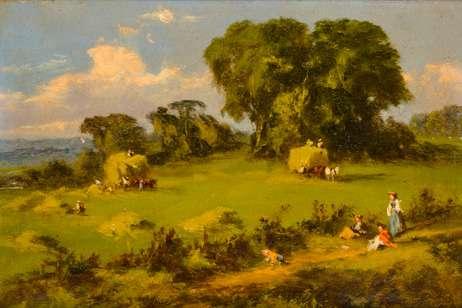
HARVESTING
oil on panel: 16 x 22cm; 6¼ x 8¾in (29 x 36cm; 11½ x 14¼in framed)
£100-150
92
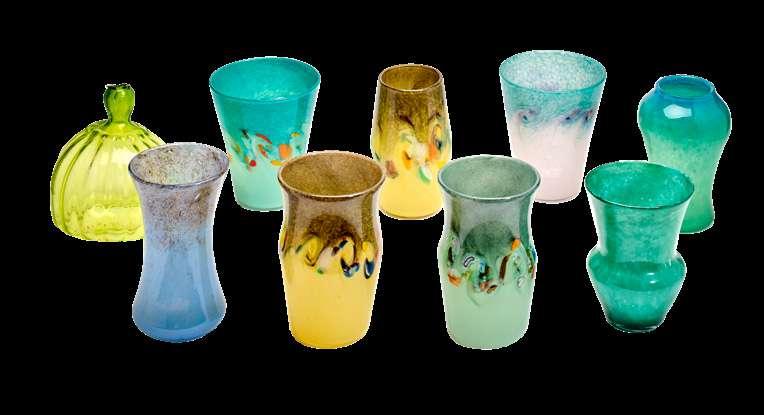
A COLLECTION OF GLASS VASES four Strathem glass vases, circa 1965-80, two with a bright swirl pattern on a grey/yellow ground, 21.5cm and 20cm high, a flowered vase with blue ground, 18.5cm high and a baluster vase with swirls on a grey/green ground, 20cm high; all with leaping salmon marks, also two unmarked Vasart style vases, together with three other glass items. (9)
£200-300
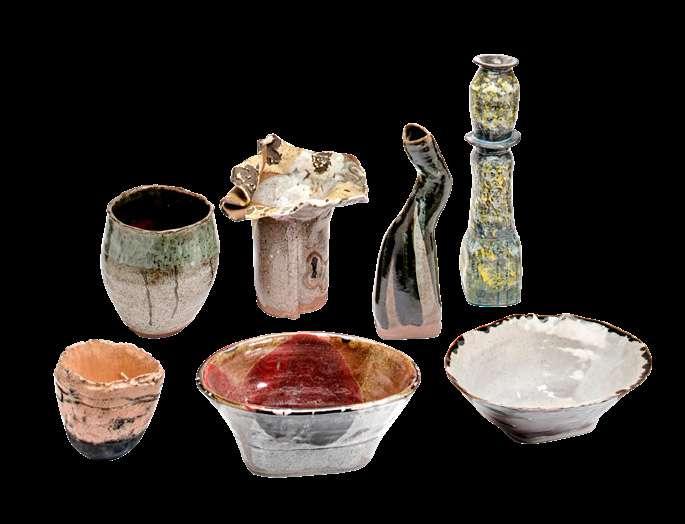
YING YEUNG LI (CHINESE B.1951)
A COLLECTION OF GLAZED STONEWARE POTS various sizes (7)
£100-150
94
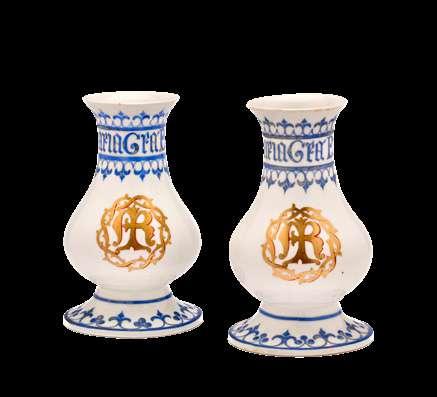
A PAIR OF PORCELAIN VASES probably designed by A.W.N Pugin (1812-1852), second half of 19th Century, of pear form with splayed foot, painted with a gilt monogram with thorns, between blue enamel gothic style borders and an inscription to the neck, unmarked, 14cm high (2)
£300-400
95
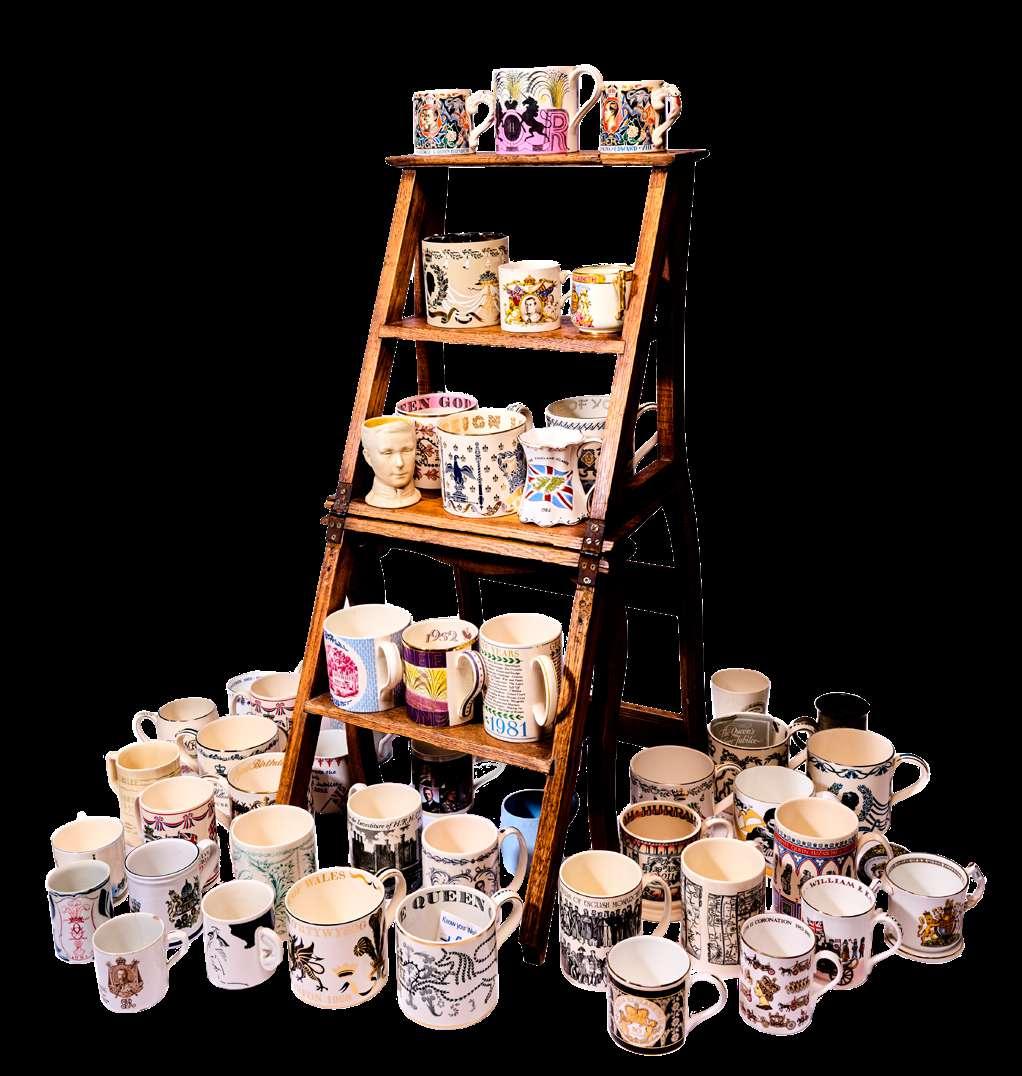
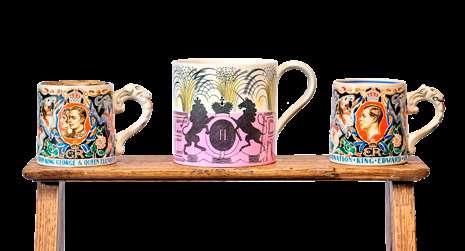
ERIC RAVILIOUS FOR WEDGWOOD WEDGWOOD COMMEMORATIVE WARE MUGS
including an earthenware cylindrical mug made to commemorate the coronation of HM Queen Elizabeth II, 1953, black painted mark, 10.5cm high; also two mugs designed by Dame Laura Knight, made to commemorate the coronation of George VI and King Edward VIII, 1937, 8.5cm high, with certificate, together with fifty further mugs, including designs by Richard Guyatt and Richard Gooden (53) £120-180
pattern by Paul Nash (see lots 162, 270 & 308)
97
PHILLIPPA CLAYDEN (BRITISH B.1955)
CHILLING OUT
gouache with varnish on paper; 28 x 41cm; 11 x 16in (40 x 51cm; 15¾ x 20in framed)
96
MICHAEL LEONARD (BRITISH 1933-2023)
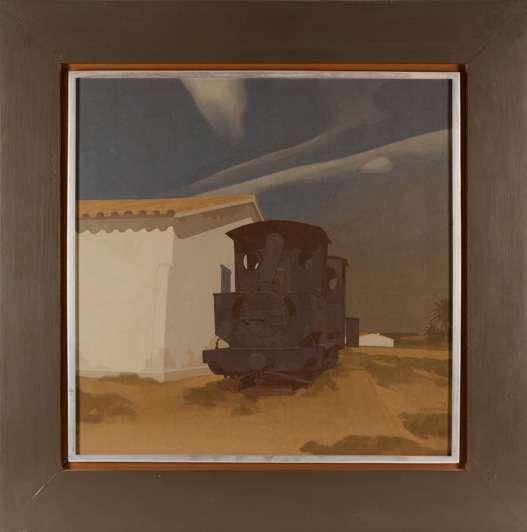
ABANDONED ENGINES, FORMENTERA II
signed and dated LEONARD ‘73 lower right; acrylic on board; 42 x 42cm; 16½ x 16½in (57 x 57cm; 22½ x 22½in framed)
Provenance: Fischer Fine Art Limited, London (from whom purchased) (probably) Exhibited: London, Fischer Fine Art, Michael Leonard, 1974 Born in India, Leonard studied illustration and commercial design at St Martin’s School of Art in London. A successful illustrator, he worked in a studio attached to the offices of Artists Partners, his agent in Soho, only starting to paint in the early 1970s. He held his first one man show at Fischer Fine Art in 1974. JRT was a close friend of Leonard’s for many years, and wrote the introduction for the catalogue of his show Verisimilitude, held in 1992 at Stiebel Modern Gallery, New York (see lots 169 & 324).
⊕ £400-600
Clayden studied at Central School of Art and Design and the Royal Academy Schools and life-drawing with Neo-romantic painter Cecil Collins (1908-1989). JRT noted the distinctive dreamlike quality of her work: ‘In every sense, literal and metaphysical, Clayden’s work is many layered. Its impact on the emotions and its instincts powerfully immediate, but one can come back to it again and again, and see new subtleties without losing at all the first amazing impact, the sense of the simplicity behind the subtlety.’
⊕ £100-200
98
GABRIEL WHITE (BRITISH 1902-1988)
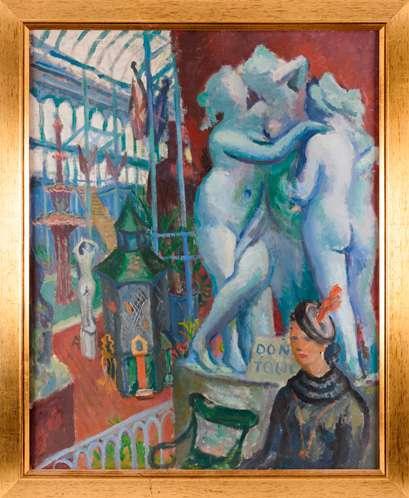
A VISITOR IN THE CRYSTAL PALACE
oil on canvas; 69.6 x 60cm; 27¼ x 23½in (79.5 x 65cm; 31 x 25½in framed)
⊕ £250-350
99
DORA HOLZHANDLER (BRITISH/FRENCH 1928-2015)
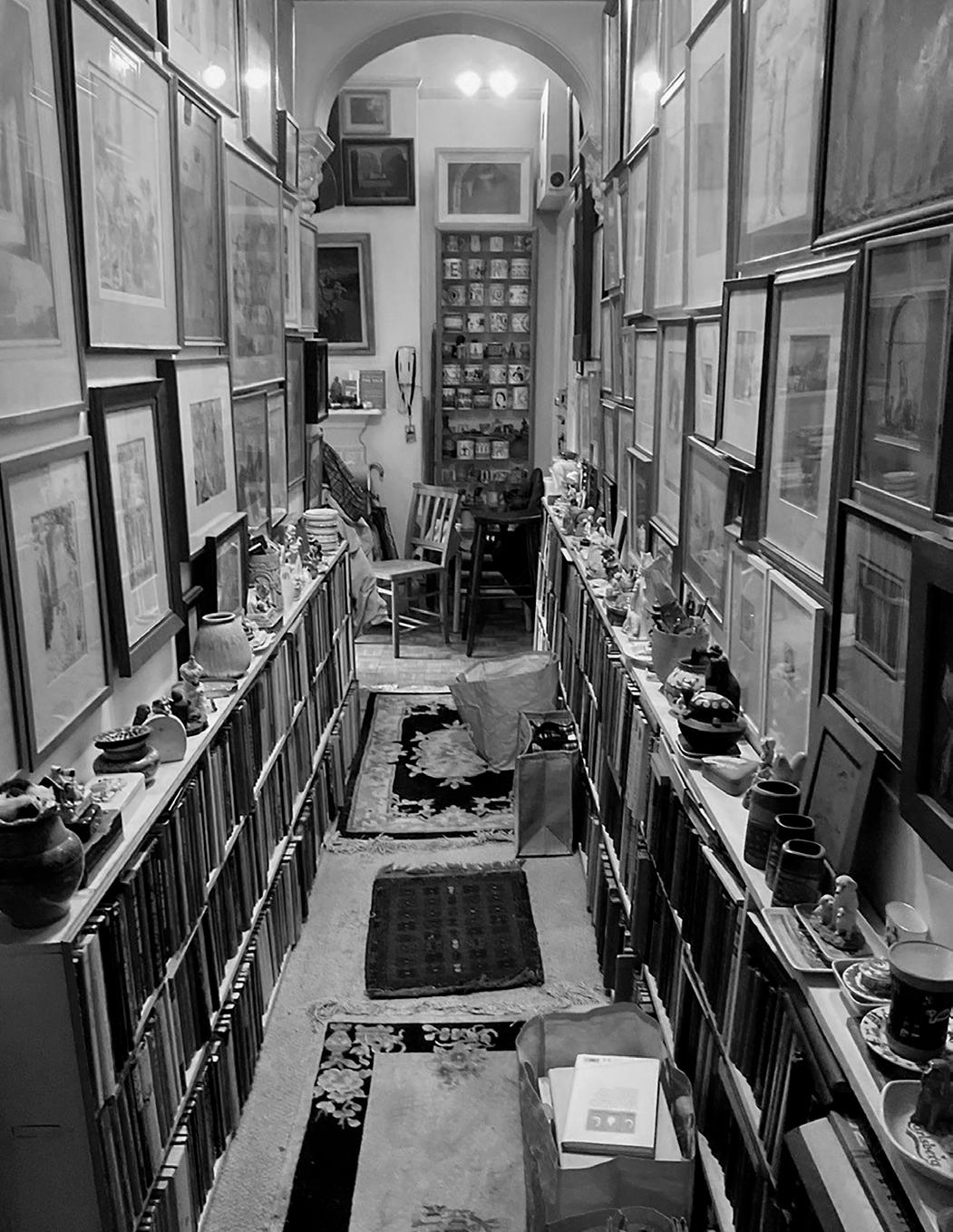
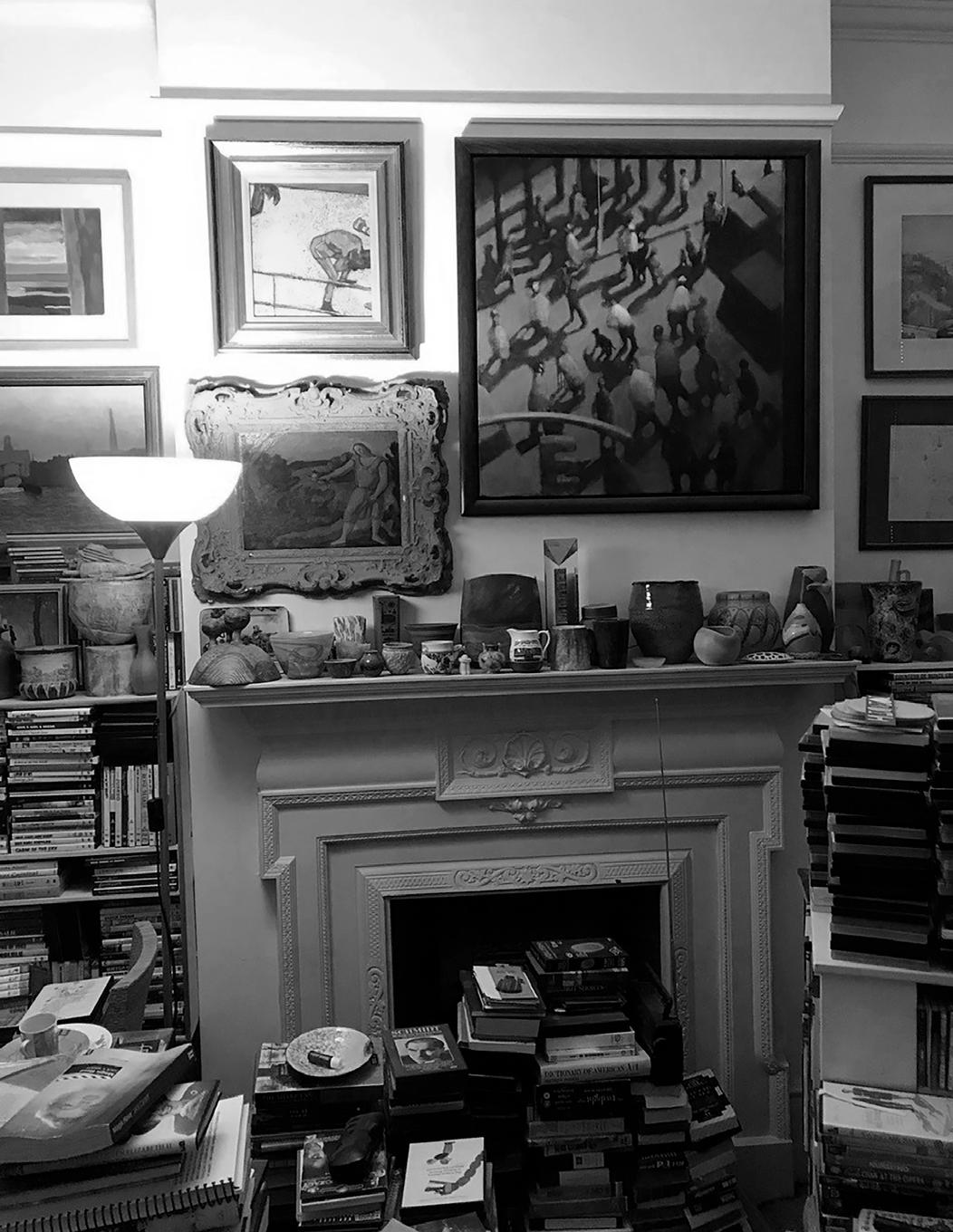
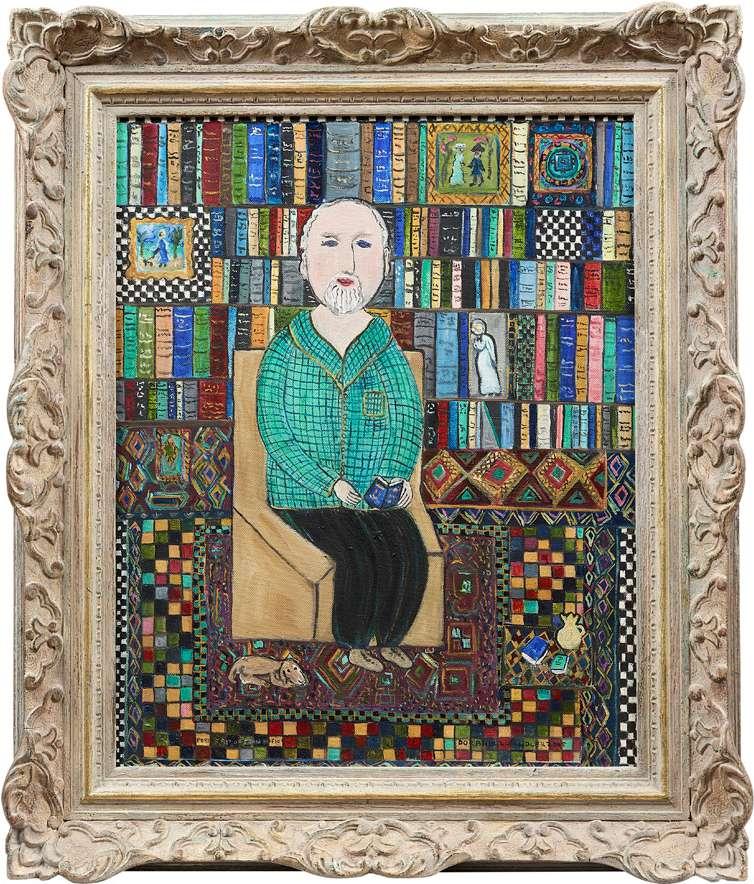
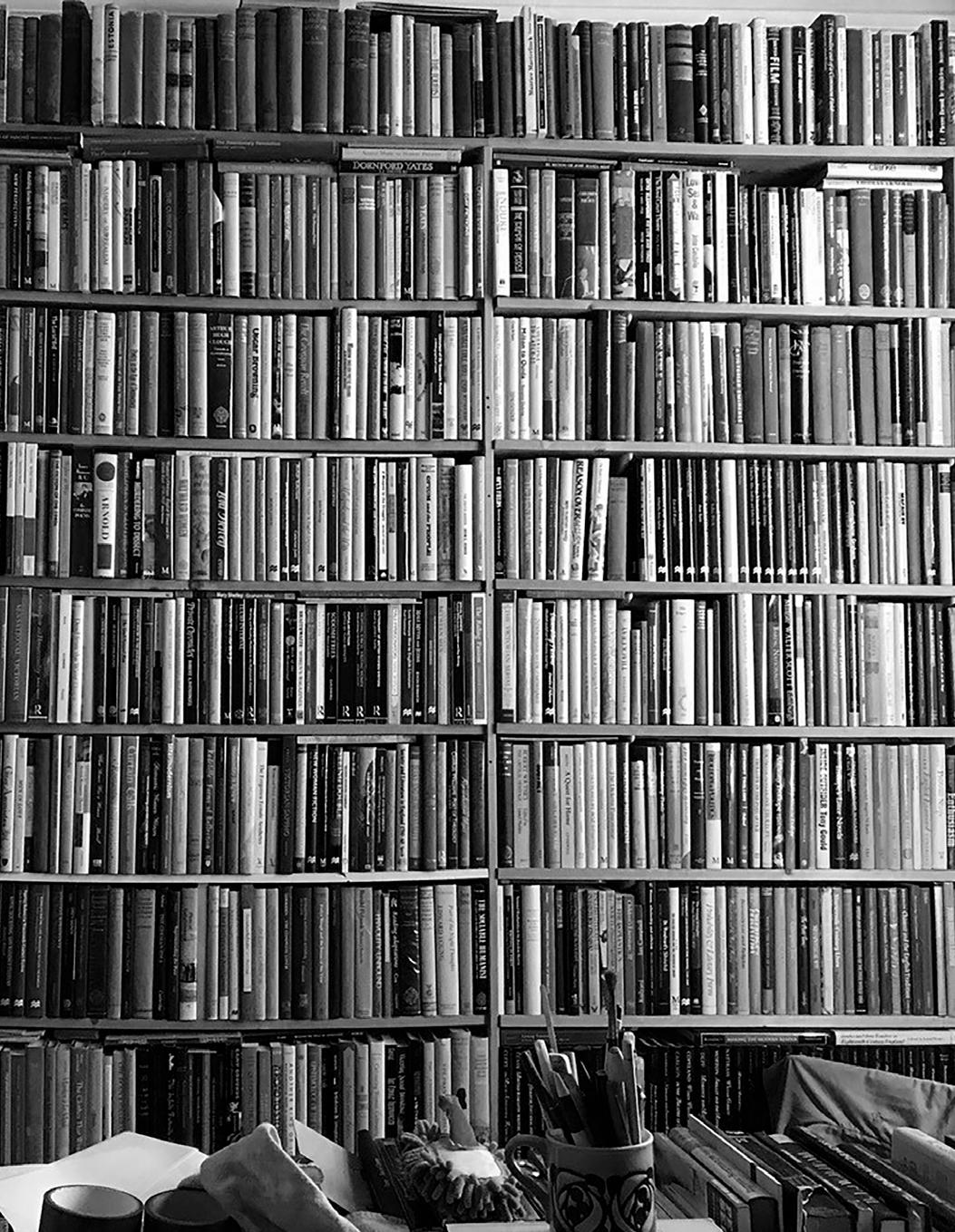
JRT AT HOME WITH HIS BOOKS
signed, inscribed and dated DORA HOLZHANDLER 2005 PORTRAIT OF JOHN RUSSELL TAYLOR lower edge; signed, titled and dated on the reverse; oil on canvas; 49.5 x 39.5cm; 19½ x 15½in (65 x 55.5cm; 25½ x 22in framed)
Provenance: Piano Nobile Gallery, London (where presented by the artist to JRT in 2005)
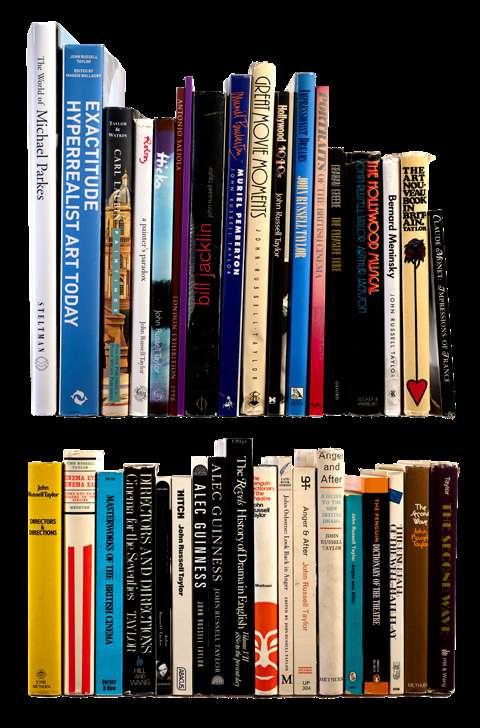
JRT and Dora Holzhandler were friends for many years. In the present work Holzhandler posed JRT seated on a richly woven rug, surrounded by his voluminous collection of books and his much loved Jack Russell Terrier ‘Fei’ at his feet, so named after one of the most famous concubines of the Tang period. ‘Innocent eye’ or ‘naïve style’ are terms used to describe the style of Holzhandler’s paintings, with their flat perspective, densely-patterned surfaces, graceful figures and pithy and unaturalistic compositions.
Born in Paris to Polish-Jewish refugees Holzhandler moved with her family to London in 1934. After the War Holzhandler studied French literature at the Sorbonne and attended the Académie de la Grande Chaumière in Paris. On her return to London she enrolled at the recently opened Anglo-French Art Centre in St John’s Wood which promoted a very active visiting artists programme. There she met Henry Moore, Graham Sutherland, Francis Bacon, Victor Pasmore and Jacob Epstein amongst many others. French artists also visited, including Fernand Léger, Andre Lhote and Germaine Richier. Holzhandler lived and worked in London for the next 50 years raising her family and producing a wealth of ‘enchanting, richly decorative paintings of everyday, often specifically Jewish life’.
⊕ £800-1,200
100
FRENCH SCHOOL (19TH CENTURY)
CHERUBS AT PLAY oil on canvas laid on board; 8.5 x 62cm; 3½ x 24¼in (12 x 65cm; 4¾ x 25½in framed)
£80-100
101
HANS FEIBUSCH (GERMAN/BRITISH 1898-1998)
MOUNTAIN SCENE
signed with initials and dated ‘42 lower right; pastel on paper; 34 x 49cm; 13¼ x 19¼in (51 x 66cm; 20 x 26in framed)
⊕ £150-200
102
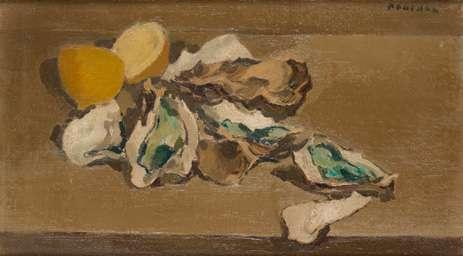
PAUL POUCHOL (FRENCH 1904-1963)
STILL LIFE WITH OYSTERS AND LEMONS signed POUCHOL upper right; oil on canvas; 19 x 33cm; 7½ x 13in (29.5 x 44cm; 11½ x 17¼in framed)
⊕ £100-150
103
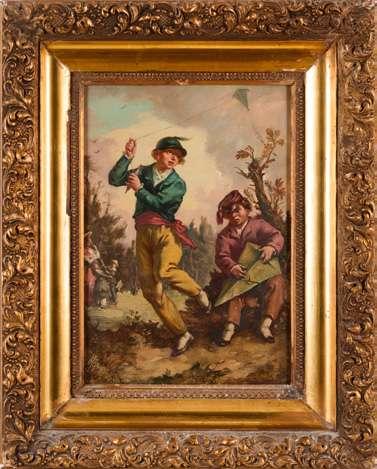
OTTO GRASSL (GERMAN 1891-1976)
KITE FLYERS
signed and dated OTTGrassl / 1939 lower left; oil on board; 33.5 x 24cm; 13¼ x 9½in (49 x 39cm; 19¼ x 15¼in framed)
Provenance: (possibly) inventory of the Berghof, Obersalzburg (with the Inventar Berghof stamp on the reverse)
⊕ £150-200
104
BERNARD MENINSKY RA (BRITISH 1891-1950)
LANDSCAPE WITH FIGURES
oil on canvas laid on board; 29 x 39cm; 11¼ x 15¼in (50 x 60cm; 19¾ x 23½in framed)
Provenance: Adam’s Gallery, London; Dr Sylvia M. Payne; Abbott & Holder, London
Exhibited: London, Adam’s Gallery, 1958; Oxford, Museum of Modern Art; Coventry, Herbert Art Gallery; London, Blond Fine Art (travelling exhib.), Bernard Meninsky, 1981; Liverpool, University of Liverpool Art Gallery, Leeds, University Gallery, Sheffield, Graves Art Gallery, London, Ben Uri Museum and Kingston-upon-Thames, Kingston Museum (travelling exhib.), A Singular Vision - Drawings and Paintings by Bernard Meninsky, 2000-2001
Literature: John Russell Taylor, Bernard Meninsky, London, 1990, p. 127, illustrated
Executed circa 1946, Meninsky was one of a talented generation of Anglo-Jewish painters in London during the first half of the last century, among his contemporaries were David Bomberg and Mark Gertler. Meninsky’s parents moved from Konotop in Ukraine to Liverpool soon after he was born. Later he attended the Liverpool School of Art, the Académie Julian in Paris and the Slade in London where he arrived in 1912 to study under Henry Tonks and Philip Wilson Steer. Among his Slade cohort were William Roberts and Paul Nash who became lifelong friends.
JRT wrote that ‘as a man and so as a teacher, Meninsky was moody and unpredictable’. He commented of the work of the post-War period when the present work was painted: ‘Meninsky’s rich-tone landscapes … were peopled with mothers and children, family groups travelling (several canvases … inspired by the New Testament story of the Flight into Egypt), pilgrims with staff in hand, shepherds without flocks and heavy-limbed women resting.’ (John Russell Taylor, 1990, p. 56)
£800-1,200
105
NAÏVE SCHOOL (BRITISH 20TH CENTURY) PAGAN FARMING
SCENE
oil on card; 38 x 47cm; 15 x 18½in (49 x 58cm; 19¼ x 22¾in framed)
£50-70
106
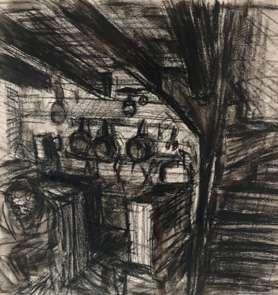
CYNTHIA PELL (BRITISH 1933-1977)
ROOM WITH STAIRS
charcoal on paper; 28 x 26cm; 11 x 10¼in (47 x 44cm; 18½ x 17¼in framed)
Exhibited: London, Boundary Gallery, Cynthia Pell, 2000
Pell studied at Bournemouth and Camberwell Art Colleges and had her first solo exhibition at the Beaux Arts Gallery in London in 1957, controversially burning any unsold work on the pavement outside afterwards. She suffered on-going mental health issues, attending both St Bernards Hospital, Southall in the 1960s and Bexley Hospital in the 1970s. A group of friends and family, including Paula Rego, organised a memorial show at Orleans House Gallery, Twickenham in 1999, followed by another retrospective at the Boundary Gallery in 2000 in which the present work was exhibited.
£60-80
107
LYNTON LAMB (BRITISH 1907-1977)
SUMMER GARDEN AND FIELD
signed with initials and dated ‘59 lower left; signed LYNTON LAMB on the reverse; oil on canvas; 36 x 51cm; 14 x 20in (49 x 65cm; 19¼ x 25½in framed)
108
REGINALD CHARLES
WILKINSON (BRITISH 1881-1939)
WOODLAND GLADE
signed Reginald C Wilkinson lower right; oil on canvas; 36 x 28cm; 14 x 11in (47 x 39.5cm; 18½ x 15½in framed)
see note to lot 84
£100-150
Lithographer, illustrator and author known for his book jacket and poster designs, Lamb studied painting under William Roberts and Bernard Meninsky (lot 104) at the Slade in the late 1920s. In 1930 he joined Oxford University Press as a bindings designer and studied under Sydney Cockerell at Central School of Art, subsequently succeeding Cockerell as instructor in the book production school.
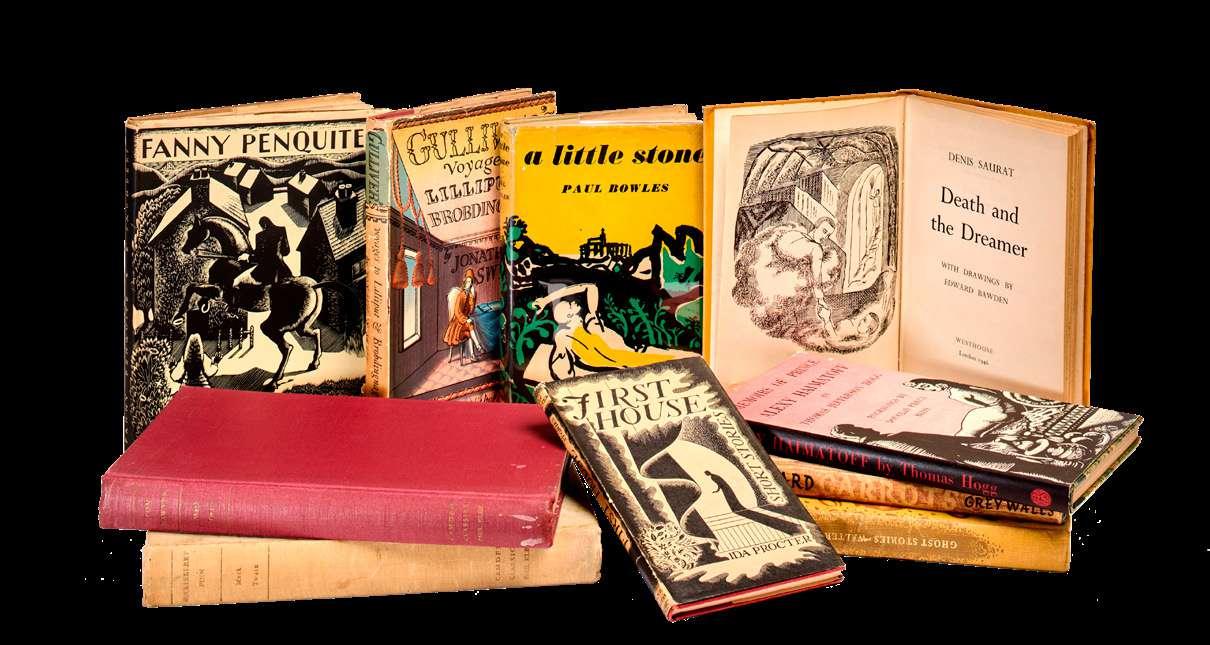
Lamb illustrated the first editions of A German Idyll by H.E. Bates (1932) and Flora Thompson’s novel Lark Rise (1939), and designed a stylish black and white dust jacket for the first edition of Fanny Penquite by Edith Saunders published by OUP (1932) (see lot 287). In London he shared a studio with Victor Pasmore and associated with the Euston Road School. The first one-man show of his paintings was held at the Storran Gallery in 1937. He worked for the Camouflage Unit during the War, after which he became head of lithography at the Royal College of Art and taught painting techniques and lithography at the Slade. He exhibited at the Royal Academy, with the London Group and with the Leicester and Redfern Galleries.
⊕ £600-800
109
JACQUES ZUCKER (POLISH/AMERICAN 1900-1981)
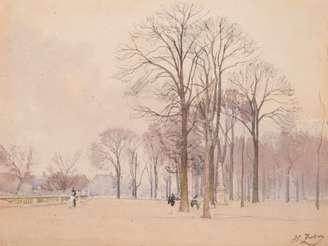
TEMPS GRIS AU LUXEMBOURG, PARIS
signed J Zucker lower right; watercolour and charcoal on paper; 26 x 33cm; 10¼ x 13in; unframed
⊕ £50-70
110
KENNETH BUSH (BRITISH 20TH CENTURY)
SUMMER SKY, LATE AFTERNOON
signed with initial lower right; oil on canvas laid on board; 20 x 23cm; 8 x 9in (26 x 29cm; 10¼ x 11½in framed)
⊕ £150-200
111
HANS FEIBUSCH (GERMAN/BRITISH 1898-1998)
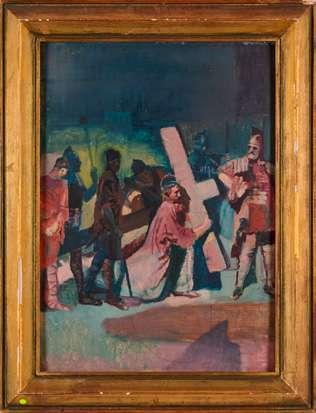
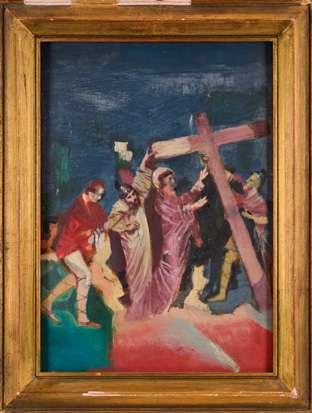
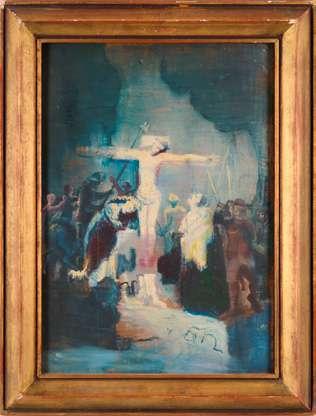
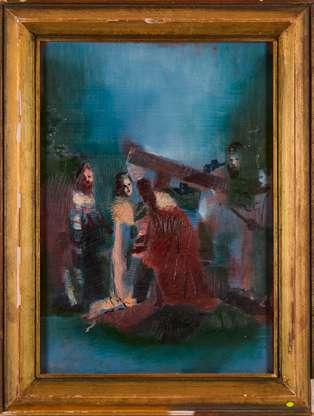
(i) CHRIST CARRYING THE CROSS (ii) THE RAISING OF THE CROSS (iii) THE CRUCIFIXION (iv) THE DEPOSITION
each: oil on board; each 42 x 30cm; 16½ x 11¾in (each 50 x 39cm; 19¾ x 15¼in framed) (4)
After training under Karl Hofer in Germany and under André Lhote and Emil Othon Friesz in France, Feibusch established himself in Berlin, but with the rise of the Third Reich was forced to emigrate to England in the early 1930s. In London he became a member of the London Group and exhibited with the Lefevre Gallery, before being taken up by George Bell, Bishop of Chichester. After the War, Bell was instrumental in getting Feibusch mural commissions to decorate the many churches and civic buildings that were being rebuilt. The present four works may well be a decorative scheme intended for one such project. Recognising Feibush’s remarkable and distinctive talent JRT came to enjoy his regular visits to the artist’s north London studio over many years, reviewing exhibitions of his work with characteristic insight and authority.
⊕ £800-1,200
112
RUTH COLLET (BRITISH 1909-2001)
STILL LIFE WITH HOLLY IN A VASE signed Ruth Collet on the reverse; oil on canvas; 39.5 x 49cm; 15½ x 19in (48.5 x 58.5cm; 19 x 22¾in framed)
⊕ £100-150
111 (i)
111 (ii)
111 (iii)
111 (iv)
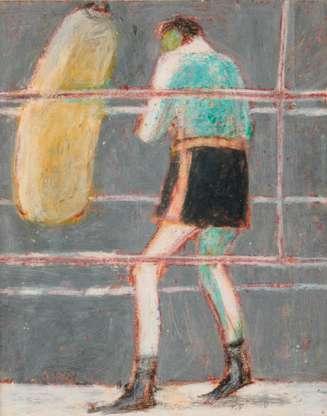
113
SAMUEL RABIN (BRITISH 1903-1991)
BOXING MATCH III
signed RABIN lower left; oil on panel; 30 x 27cm; 11¾ x 10½in (50.5 x 47cm; 20 x 18½in framed)
Exhibited: London, Dulwich Picture Gallery, no. 51
An amateur boxer, Rabin won a bronze medal for wrestling at the 1928 Amsterdam Olympics and funded his artistic career from then on by professional wrestling, with pugilism becoming a key theme in his work. Born in Manchester to Jewish-Russian exiles, he became the youngest student to attend Manchester School of Art at the age of eleven under French painter Adolphe Valette (1876-1942), and later studied at the Slade in London under Henry Tonks (1921-24). In Paris in 1925 Rabin was influenced by the work of sculptor Charles Despiau (1874-1946), assistant to Auguste Rodin, which informed his style when he returned to London to work on the Daily Telegraph building and the headquarters of London Transport. After the War he taught drawing at Goldsmiths, where Bridget Riley was one of his students.
⊕ £800-1,200
115
BILL JACKLIN RA (BRITISH
B. 1943)
114
ALEXANDER ALLAN (BRITISH 1914-1972)
OLD QUARRY, DUNOON (SCOTLAND) signed alexander allan lower right; pen and ink and black wash on paper; 29.5 x 44cm; 11½ x 17¼in (52 x 64.5cm; 20½ x 25¼in framed)
Provenance: The Fine Art Society, London
⊕ £60-80
STUDY
FOR CROSSING 6TH AVENUE
signed and dated ‘86 lower right; signed, titled and dated
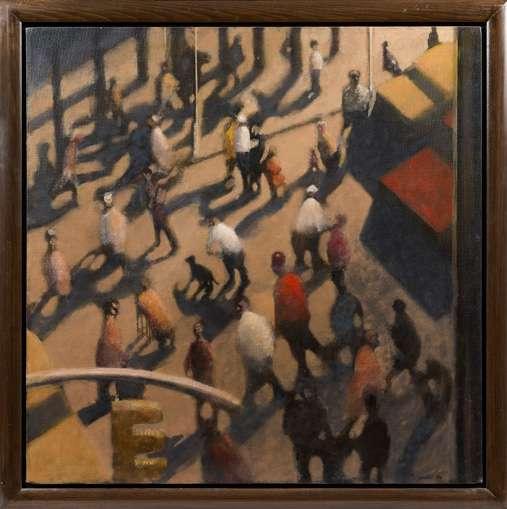
A study for crossing 6th Avenue, Jacklin ‘86 on the reverse; oil on canvas; 78.5 x 78.5cm; 31 x 31in (88 x 88cm; 34¾ x 34¾in framed)
Jacklin rented a flat over Sixth Avenue in New York where he moved in 1985. That same year, he held his first one-man show at the Marlborough Gallery where he exhibited regularly. Looking out of the window from his close-by studio on 14th Street situated overlooking a meat-packers depot, JRT writes ‘he could see the small, depersonalised figures in white overalls […]. Above the human part of the scene there were the plain, geometrical facades of the stores and the strong transverse lines of the metal supports […] making of themselves a powerful abstract pattern’. Part of a series, the present work shows a similar effect from the windows of his first apartment looking down at Sixth Avenue, holding ‘some of the same quality, but intensified. The extraordinary chasm of the avenue between the high-rises dwarfs the figures in the parades and surrounds them with abstract geometrical shapes’ (see John Russell Taylor, Bill Jacklin, London 1997, pp. 85 & 87-88).
⊕ £3,000-5,000
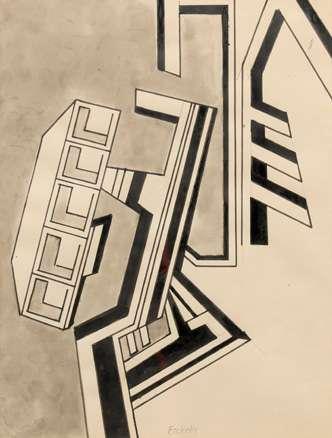
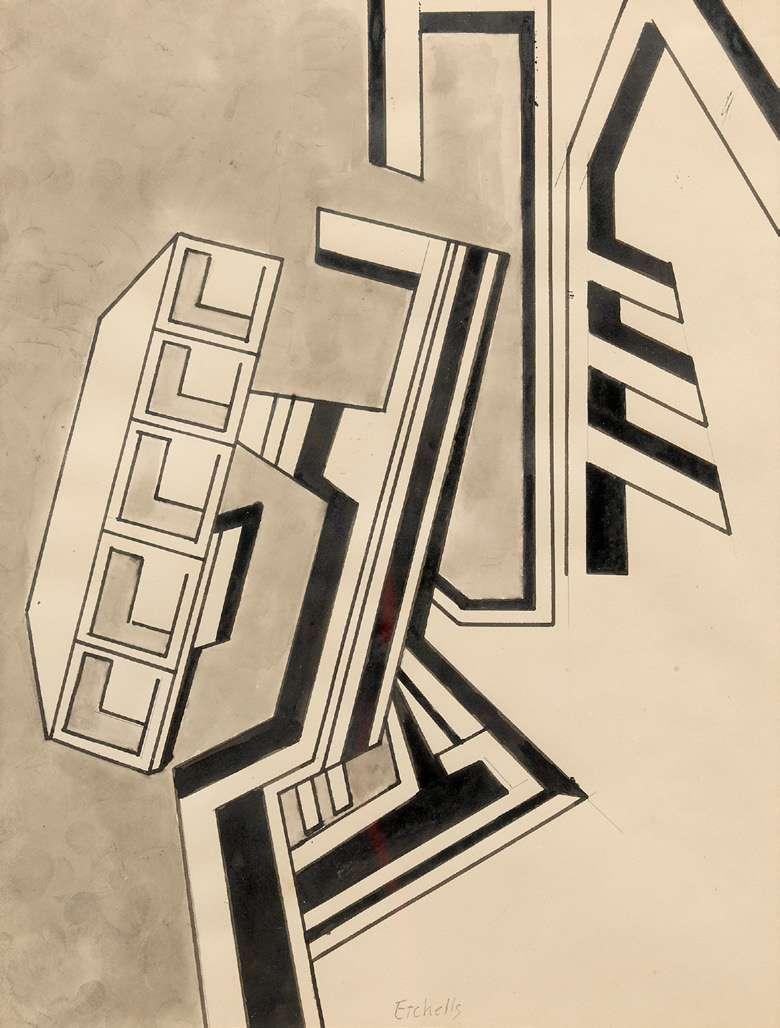
FREDERICK ETCHELLS (BRITISH 1886-1973)
VORTICIST COMPOSITION
signed Etchells lower centre in pencil; pen and indian ink and grey wash over traces of pencil on paper; 29 x 22cm; 11½ x 8¾in (52.5 x 44cm; 20¾ x 17¼in framed)
Executed circa 1915.
Following completion of his studies at the Royal College of Art, London, Etchells spent two, formative years in Paris, where he met Picasso, Braque, and Modigliani. He returned permanently to London in 1913 holding considerable influence in the city’s artistic circles for many years. It was around this time that Etchells developed a close friendship with the artists who were becoming crystallised as the Bloomsbury Group: Roger Fry, Duncan Grant, and Vanessa and Clive Bell.
He also developed a close friendship with Wyndham Lewis, future leader of the Vorticist Group, whilst working alongside him as part of Omega Workshops. In late 1913 Lewis left Omega, accusing Roger Fry of misappropriating his work, and Etchells departed with him to join the newly founded Rebel Art Centre. Although Etchells did not sign the Vorticist manifesto, he exhibited as a Vorticist in the group’s only British exhibition at the Doré Gallery in 1915. The break with Bloomsbury had enabled him to experiment through a range of artistic voices, such as expressionism and cubism, anathema to the group’s principles.
During Etchells’ time spent in Paris he played an important role as a go-between for
artists across the Channel, acting as conduit for the dissemination of Modernist principles and theory amongst London’s avant-garde. His most pervasive and long-lasting influence however stems from his architectural practice. He not only provided the English translation for Le Corbusier’s Towards a
New Architecture, but he was in fact responsible for London’s first ‘modern’ building at 233 High Holborn, known as the Crawford Building. More locally to Olympia Auctions he designed the new library at Godolphin and Latymer School, Hammersmith. ⊕ £20,000-30,000
117
WILLIAM BELCHER (BRITISH B.1923)
SURREALIST COMPOSITION WITH BOXED-OBJECTS
signed W.BELCHER lower right; oil on board; 49.5 x 58cm; 19½ x 22¾in (54.5 x 63cm; 21½ x 22¾in framed)
After military service in the Second World War, Belcher studied at Worthing School of Art and the Royal College of Art, where he trained as a textile designer and won a travelling Bursary. He married fellow art student Colleen Farr and together they ran a design studio during the 1950s and ‘60s producing fabrics, tapestries and other applied arts. He exhibited at the Royal Academy and with the Artists International Association. Later in life Belcher established a varied career as a freelance illustrator and cartoonist, contributing to a range of publications, including Punch, The Oldie and Radio Times. An exhibition of his work was held at England & Co. in 1991.
⊕ £600-800
£100-200 118 117
118
ISTVAN NAGY (HUNGARIAN 1873-1937)
LANDSCAPE
signed Nagy Istvan lower right; charcoal on paper; 27 x 41cm; 10½ x 16in (43 x 56cm; 17 x 22in framed)
119
VIVIAN FORBES
(BRITISH 1891-1937)
COMPOSITION WITH CLOCK signed with initials and dated 1935 lower left; pen and ink and watercolour on paper; 33 x 28cm; 13 x 11in (50 x 43.5cm; 19¾ x 17¼in framed)
Provenance: Abbott & Holder, London
The present watercolour exemplifies Forbes’ work of the 1930s when he spent time abroad and specialised in small, mystical, semi-surrealist watercolours. Forbes met his mentor and life-partner to be Glyn Philpot (1884-1937) serving in the Royal Fusiliers during the First World War. Philpot encouraged Forbes to paint, teaching him and advising him to study at Chelsea Polytechnic and in France. Forbes exhibited in Chicago and at the Royal Academy in the 1920s, and with Philpot’s help obtained leading commissions, including murals for the decoration of St Stephen’s Hall, Westminster in 1927 (completed alongside Philpot, George Clausen, Colin Gill, William Rothenstein and Sir Thomas Monnington), and a wall painting for the Viceroy’s House in New Delhi in 1930. Like Philpot, Forbes was influenced by the 19th Century Aesthetic movement including the work of Charles Ricketts (1866-1931) and Charles Haslewood Shannon (see lots 181 & 224-227). Emotionally unstable and professionally dependent on Philpot who died in December 1937, Forbes took a fatal overdose of sleeping pills the day after Philpot’s funeral. A memorial exhibition of his work was held at the Redfern Gallery in 1938. £400-600
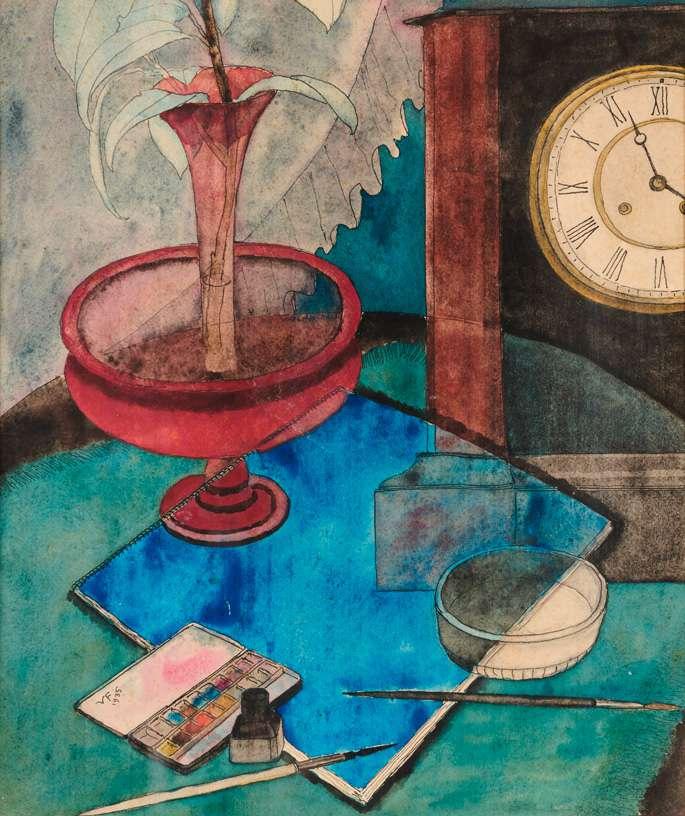
120
DEREK HYATT (BRITISH 1931-2015)
LANDSCAPE THROUGH CURTAINS
oil on board; 26 x 32cm; 10 x 12½in (27 x 42cm; 10½ x 16½in framed)
Exhibited: London, Austin Desmond, Derek Hyatt, 1989, no. 24
⊕ £300-500
123
121
FRANK
SULLY (BRITISH 1898-1992)
PUTNEY BRIDGE oil on board; 23 x 31.5cm; 9 x 12¼in (33.5 x 42cm; 13¼ x 16½in framed)
see note to lot 6
⊕ £200-300
122
ZSUZSI
ROBOZ (HUNGARIAN 1929-2012) SELF PORTRAIT
signed with initials lower left; charcoal on paper; 66 x 51cm; 26 x 20in (85 x 70.5cm; 33½ x 27¾in framed)
Exhibited: London, Messum’s Fine Art, Retrospective of the Artist, 2011
Literature: John Russell Taylor, Roboz, A Painter’s Paradox, Marlow, 2005, p. 117, illustrated see note to lot 5
⊕ £100-200
BARBARA JONES (BRITISH 1912-1978)
FIGURES IN A SURREALIST SEASCAPE
indistinctly signed and dated Barbara Jones… lower right; pen and black ink, watercolour over traces of pencil on paper; 25 x 34cm; 9¾ x 13¼in (41 x 53cm; 16 x 20¾in framed)
This light-hearted colourful work, possibly intended as an illustration for a children’s book, is typical of Jones’ varied and prolific output. Jones attended art school in Croydon (1931-33) before winning a scholarship to the Royal College of Art (1933-36). There she studied mural decoration under Eric Ravilious and Edward Bawden and became one of a fabled cohort of RCA students that included John Piper and Edward Ardizzone. During the Second World War Jones collaborated with the Pilgrim Trust on the Recording Britain series, making one of the largest contributions of the sixty-three participating artists.
A champion of the arts for the masses, after the end of the War she created striking murals for a succession of leading regenerative exhibitions including Britain
Can Make It (V&A, London, 1946) Enterprise Scotland (Edinburgh, 1947) and the Festival of Britain (South Bank, London, 1951). She also worked for the P&O shipping company creating murals for their passenger liners as well as for hotels, restaurants, exhibitions and schools. As well as her mural designs, Jones wrote and illustrated a succession of influential books on design history, including The Unsophisticated Arts (1951), (see lot 311).
The same year she co-curated Black Eyes and Lemonade, an exhibition of craft, folk, and popular objects at the Whitechapel Gallery, which mixed consumer objects with folk art, a foretaste of Pop Art in Britain. In television she was instrumental in devising the 1960s popular children’s programme The Woodentops
⊕ £200-300
124
RODERICK BISSON (BRITISH 1910-1987)
CAMOUFLAGE
signed with initials lower right; oil on canvas; 43.5 x 39cm; 17 x 15¼in (56 x 50.5cm; 22 x 20in framed)
The son of a seaman, Bisson was born and raised in Liverpool. Educated at the Liverpool Institute he joined the local architectural practice of Hinchliffe Davies. An admirer of the work of Wyndham Lewis, early on he developed a keen interest in Cubism and Surrealism, and was noted for a surrealist work exhibited at the Sandon Studios in 1932, the leading platform for the promotion of contemporary art in Liverpool. A fluent French speaker, he made regular visits to Paris where he discovered the Purism of Amédée Ozenfant, Fernand Léger and Le Corbusier.
During the 1930s he acted as secretary of the Liverpool Young Communist League, becoming a conscientious objector early in World War II, but joined up when Germany invaded the Soviet Union. After the War Bisson worked as a design consultant and upon being appointed art critic for the Liverpool Daily Post ceased to paint, over worries about a conflict of interests. A longstanding member of the Sandon Studios Society, he wrote the society’s history in 1965. A number of his works are in the Walker Art Gallery, Liverpool, where a retrospective of his work was held in 1987.
⊕ £500-700
125
ZSUZSI ROBOZ (HUNGARIAN 1929-2012)
PORTRAIT OF JOHN RUSSELL TAYLOR
signed Roboz lower left; black and coloured chalks on blue paper; 76 x 56cm; 29¾ x 22in (93.5 x 74cm; 36¾ x 29in framed)
see note to lot 5
⊕ £300-400
126
BRITISH SCHOOL (19TH/20TH CENTURY)
STILL LIFE WITH FLOWERS
indistinctly signed with initials lower centre; oil on panel; 26.5 x 28.5cm; 10½ x 11¼in (45 x 49cm; 17¾ x 19¼in framed)
£60-80 127
VALENTIN PECHATIN (RUSSIAN 1920-2006)
SAILORS DANCING, VE DAY oil on cardboard; 17 x 19cm; 6¾ x 7½in (24 x 27cm; 9½ x 10½in framed)
Provenance: The Artist’s Studio, St Petersburg; Roy Miles Gallery, London (from whom purchased)
Painted in 1945. Pechatin painted mostly naval themes, joining the Russian fleet during the Second World War and depicting life as a mariner. His work is in the collection of the Central Naval Museum, St Petersburg, Russia.
£150-200
128
MORRIS KESTELMAN (BRITISH 1905-1998)
GIRL WITH A HORSE, AT THE CIRCUS
signed and dated M. Kestelman ‘37 lower left; pen and black ink and grey wash on paper; 15 x 15cm; 6 x 6in (32 x 31cm; 12½ x 12¼in framed)
see note to lot 214
⊕ £100-150
129
HANNA WEIL (GERMAN 1921-2011)
ROLLING HILLS WITH WILD FLOWERS
signed H Weil lower right; oil on board; 49 x 74cm; 19¼ x 29in (64 x 89cm; 25 x 35in framed)
Born in Munich, Weil moved with her family to England in 1932 where she attended North London Collegiate School. During the Second World War she studied at St Martin’s School of Art and taught at Hammersmith School of Art (1945-1948). At Hammersmith Weil also began teaching at St Martin’s continuing in that role for the next forty years. Typically painting landscapes and cityscapes in a naïve style, she exhibited at the Royal Academy, the Leicester Galleries and the Trafford Gallery. Between 1962-64 Weil created a number of posters for London Transport, including designs to promote Hampton Court Palace and the Festival of the City of London.
⊕ £200-400
130
GEORGES DE FEURE (FRENCH 1868-1943)
THE NORTH SEA signed de Feure lower left; oil on canvas; 39 x 55.5cm; 15¼ x 22in (50 x 67cm; 19¾ x 26¼in framed)
see note to lot 29
£2,000-3,000
129
CONTINENTAL SCHOOL (19TH CENTURY)
BATTLE SCENE - AMERICAN CIVIL WAR oil on panel; 20 x 25cm; 8 x 9¾in (30 x 35cm; 12 x 13¾in framed)
£150-200
132
JOAN SOUTER-ROBERTSON (BRITISH 1903-1994)
LILLIES OF THE VALLEY
signed with initials lower left; oil on canvas; 22 x 29.5cm; 8¾ x 11½in (31 x 39cm; 12¼ x 15¼in framed)
Exhibited: London, Addison-Ross Gallery, 1993
⊕ £200-300
133
BRYAN ROBB (BRITISH 1913-1979)
CITYSCAPE WITH REFLECTIONS
signed and dated 1966 lower right; oil on canvas; 50.5 x 66cm; 19¾ x 26in (60 x 76cm; 23½ x 30in framed)
There is an abstract sketch in oil on the reverse.
⊕ £300-400
134
LIAM HANLEY (BRITISH 1933-2019)
RED SEAHORSE
signed Hanley L. lower right; oil and collage on card; 16 x 21cm; 6¼ x 8¼in (27 x 29.5cm; 10½ x 11½in framed)
⊕ £100-150
PHILIP DOUGLAS MACLAGAN
(BRITISH 1901-1972)
COASTAL CLIFFS
signed with initials lower left; oil on canvas; 36 x 46cm; 14 x 18in (39.5 x 50cm; 15½ x 19¾in framed)
Exhibited: York, 1978, no.18
Provenance: Mrs Dorothy Frances Maclagan (1895-1982, the artists widow); Helen Smeed; Galerie Harounoff
The present work may well be a view of the cliffs by Mevagissey, Cornwall. Maclagan was born in Swatow, China, the son of a missionary. Educated at the City of London School where he later returned to teach, he was awarded a prize for his drawing from the Worshipful Company of Painters.
Following a year at St John’s Wood School of Art he attended the Royal Academy Schools (1920-1925), where his teachers included Charles Sims, Ernest Jackson, George Clausen and Glyn Philpot, Philpot remaining a life-long friend. He subsequently studied under Bernard Meninsky (see lots 83 & 104) at Westminster School of Art.
⊕ £200-300
136
REGINALD CHARLES WILKINSON
(BRITISH 1881-1939)
MORNING ON THE AMSTEL, NETHERLANDS
signed Reginald C Wilkinson lower right; signed and titled on a label on the reverse; oil on panel; 39 x 49cm; 15¼ x 19¼in (45 x 56cm; 17¾ x 22in framed)
see note to lot 84
£400-600
137
GARDNER HALE (AMERICAN 1894-1931)
HOUSE ON A HILL
signed and dated Gardner Hale ‘19 lower left; oil on canvas; 31.5 x 40cm; 12 x 15¾in (41 x 49cm; 16 x 19¼in framed)
Gardner Hale employed traditional fresco painting methods when decorating the houses of his wealthy American clients. He died in a car crash in 1931 when holidaying in California. His wife, Dorothy Hale, took her own life a few years later. Dorothy’s suicide was hauntingly memorialized on canvas by her friend Frida Kahlo (1907-1954).
£300-400
138
JAMES DICKSON INNES (BRITISH 1887-1914)
BOZOULS, FRANCE
signed and dated J D Innes ‘09 lower right; pen and sepia wash on paper; 32 x 50cm; 12½ x 19¾in (53 x 70cm; 20¾ x 27½in framed)
Provenance: Lady Beatrice Thynne; Major P.E.C. Harris (1948); Thomas Agnew & Sons, London; Entwistle, London
139
AFTER GIOVANNI BATTISTA TIEPOLO (ITALIAN 1696-1770)
PUNCHINELLO AS THE TAILOR’S ASSISTANT pen and brown ink and grey wash on paper; 13 x 18.5cm; 5 x 7¼in (35 x 40cm; 13¾ x 15¾in framed)
£50-70
Executed in Bozouls in the Occitanie to the north west of Montpellier in France on one of Innes’ regular excursions south. As Innes describes, Bozouls sits on the edge of an impressive canyon carved out of the rock over millenia by the river Dordou de Conques that snakes around the church of Saint Fauste. Born in Wales, Innes was educated at Christ College, Brecon and then Camarthen School of Art from where he was awarded a scholarship to the Slade, London. Diagnosed with consumption, he sought out drier, warmer climes. Between 1908 and 1913 he spent time in Collioure and Spain with Derwent Lees and in Marseille with fellow Welshman Augustus John (see lot 152), before settling in Morocco with Trelawnay Dayrell-Reed, but found no respite for his failing health and died a year later.
£200-300
140
EMILE GALLE (FRENCH 1846-1904)
VITRINE, CIRCA 1900
signed in the floral marquetry on the left side height: 130cm; 51¼in; width: 53cm; 20¾in; depth: 35cm; 13¾in circa 1900
£800-1,200
141
JOSEPH CZAKY (HUNGARIAN 1888-1971)
WOMAN IN YELLOW
signed CZAKY lower left; pencil and watercolour; 32 x 25cm; 12½ x 9¾in (45 x 36cm; 17½ x 14in framed)
Provenance: Montgomery Gallery, San Francisco
The present work is possibly a study for a costume design.
⊕ £300-400
142
142
GRAHAM SUTHERLAND (BRITISH 1903-1980)
JUNGLE RHYTHM NO.2
signed with initials G.S. lower right; pencil on paper; 25 x 36.5cm; 9¾ x 14¼in (39.5 x 49.5cm; 15½ x 19½in framed)
offered together with the reproduction Les blés also by Sutherland; 32 x 50cm; 12½ x 19¾in (39 x 57cm; 15¼ x 22½in framed), illustrated online
(Jungle Rhythm) Exhibited: London, Olympia, The Fine Art and Antiques Fair, Graham Sutherland, 25 Feb-2 March 2003
143
TONY NG (CHINESE B.1964)
COMPOSITION IV
signed with the artist’s red stamp lower right; chinese ink and grey and brown washes; 30 x 27.5cm; 11¾ x 10¾in (59 x 48cm; 23 x 19in framed)
£300-400
141
⊕ £500-700 143
144
DENZIL FORRESTER (BRITISH B.1956)
EAGLE ON THE GATE OF THE BRITISH SCHOOL OF ROME coloured chalks, pastel over traces of pencil on paper; 38.5 x 53cm; 15¼ x 21in (56 x 69.5cm; 22 x 27¼in framed)
Provenance: A gift from the artist.
⊕ £100-150
145
BRITISH SCHOOL (19TH CENTURY)
WOUNDED SOLDIER watercolour and gouache over traces of pencil on panel; 15.5 x 10.5cm; 6 x 4in (25.5 x 20.5cm; 10 x 8in framed)
£80-100
146
BRITISH SCHOOL (LATE 19TH CENTURY) FORTITUDE AND JUSTICE - A PAIR
both oil on panel; each 22.5 x 12cm; 8¾ x 4¾in (each 37 x 26cm; 14½ x 10¼in framed) (2)
£200-300
147
CHARLES CHARTIER (FRENCH 1894-1957)
VASE OF FLOWERS oil on board; 22 x 19cm; 8½ x 7½in (36.5 x 33.5cm; 14¼ x 13¼in framed)
Provenance: William Murray (purchased from the artist)
⊕ £60-80
148
GERALD FESTUS KELLY (BRITISH 1879-1972)
LES HALLES CENTRALES, PARIS
oil on panel; 28 x 34.5cm; 11 x 13½in (39 x 46cm; 15½ x 18¼in framed)
Exhibited: London, The Fine Art Society, April 1997, no. 75
see note to lot 88
⊕ £600-800
150
149
CONTINENTAL SCHOOL (EARLY 20TH CENTURY)
FOLKLORIC MOUNTAIN SCENE BY MOONLIGHT
watercolour on paper; 17.5 x 22cm; 7 x 8¾in (36 x 40cm; 14¼ x 15¾in framed)
£80-120
KATIE SOWTER (BRITISH 1944-2003)
CLIMBING CLEMATIS
signed with initials K.L lower right; oil on board; 43 x 14cm; 17 x 5½in (47.5 x 18cm; 18¾ x 7in framed)
The initials K.L stand for Katie Littlewood, the artist’s maiden name.
⊕ £40-60
151
GEORGINA DEWHURST (BRITISH 20TH CENTURY) RÊVERIE
pen and purple ink and watercolour on paper; 24 x 17cm; 9½ x 6¾in (40 x 32cm; 15¾ x 12½in framed)
£40-60
pattern by Enid Marx (see lots 189 & 270)
154
CHARLES ROBINSON (BRITISH 1870-1937)
LOVE IN THE MIST
signed Robinson lower left; watercolour over traces of pencil on paper; 35 x 28cm; 13¾ x 11in (51 x 43cm; 20 x 17in framed)
See note to previous lot
£400-600
155
INGLIS SHELDON-WILLIAMS (BRITISH 1870-1940) AFTER THE FLOOD oil on canvas; 34 x 39cm; 13½ x 15¼in (45.5 x 51cm; 18 x 20in framed)
£200-300
152
AUGUSTUS JOHN RA (BRITISH 1878-1961) MOUNTAINSCAPE, LES ALPILLES, NEAR ST REMY IN PROVENCE
bears signature and date (John 1933) lower right; oil on canvas; 31 x 53cm; 12¼ x 21in (45 x 67cm; 17¾ x 26¼in framed)
Exhibited: London Olympia, Augustus John, 23-28 February 1999, no. 95
According to Rebecca John, the artist’s granddaughter, the painting appears to be a view of ‘Les Alpilles, Provence’, painted by the artist in the 1930s when the family rented a farmhouse in the area, but the signature and date may be by another hand.
⊕
£4,000-6,000
153
CHARLES ROBINSON (BRITISH 1870-1937) THE PEACOCK
signed Charles Robinson lower left; watercolour over traces of pencil on paper; 26 x 37.5cm; 10 x 14¾in (42 x 53cm; 16½ x 20¾in framed)
Charles Robinson, was part of a very succesful family of British illustrators, brother of William Heath Robinson (see lot 247) and Thomas Robinson (1869-1954). Their father and grandfather, both called Thomas Heath Robinson were all artist illustrators from Stroud Green, Finsbury Park in North London.
£400-600
156
CHARLES CONDER
(BRITISH/AUSTRALIAN 1868-1909)
ON THE TERRACE
oil on canvas laid on board; 24 x 32cm; 9½ x 12½in (38.5 x 47cm; 15 x 18½in framed)
Provenance: J.M.Wilson, London
Exhibited: London, Leicester Galleries, 1913
£1,500-2,000
157
CHARLES CONDER
(BRITISH/AUSTRALIAN 1868-1909)
THE WAGON PASSES
signed C.Conder lower right; pencil and black chalk on paper; 21 x 34cm; 8¼ x 13½in (36 x 49cm; 14¼ x 19¼in framed)
£250-350
158
SIR WILLIAM ORPEN RA (BRITISH 1878-1931)
STUDY FOR THE PLAY SCENE FROM HAMLET pen and ink on paper; 28 x 21.5cm; 11 x 8½in (54 x 44cm; 21¼ x 17¼in framed)
Executed circa 1898-1899, the present work is a preparatory sketch for Orpen’s painting The Play Scene From Hamlet (act 3, scene 2 from Shakespeare’s play) in which King Claudius’s murder of Hamlet’s father is re-enacted. As Hamlet predicts: ‘The play’s the thing wherein I’ll catch the conscience of the King’. In 1899 the finished painting, now in the collection of Houghton Hall, Norfolk, won the prize for best composition at the Slade where Orpen was a student.
JRT notes ‘Sketch for the figure of the left side of his 1899 painting ‘The Play Scene in Hamlet’, modelled by Augustus John, who is seen wearing the exaggerated Breton peg-top trousers he had made for himself by a fisherman’s taylor in Yport when he, Orpen and others were staying in Vatetot in the summer of 1899.’
£200-300
159
SIR WILLIAM ROTHENSTEIN (BRITISH 1872-1945)
PORTRAIT OF RABINSDRANATH TAGORE
signed, dated and dedicated W. Rothenstein 1912 / To my friend H.Anson in memory of Oakridge / July 25 / 1917 / W.R. lower right lithographic reproduction on paper; 38 x 27cm; 15 x 10½in (41 x 30cm; 16 x 11¾in framed)
Provenance: H. Anson (acquired from the artist in July 1917; for many years Rothenstein kept a cottage at Oakridge in the Cotswolds)
£100-150
160
161
JOHN ARMSTRONG (BRITISH 1893-1973)
PICNIC
SCENE
signed with initials and dated 1924 lower right; watercolour and pencil on paper; 19 x 22.5cm; 7½ x 9in (39.5 x 42.5cm; 15½ x 16¾in framed)
Through his friendship with the actors Elsa Lanchester and Charles Laughton, Armstrong attracted a number of influential patrons, notably Lillian Courtauld, the wife of philanthropist Samuel Courtauld, who commissioned him to decorate a room in their home at 20 Portman Square. The present work from 1924 belongs to this early period, and shows his nascent predeliction for Surrealism that would later come to define his style.
A painter, designer of film and stage sets, muralist and book illustrator, Armstrong was born in Hastings, Sussex, attended St Paul’s School, London, and studied law at St John’s College, Oxford, before enrolling at St John’s Wood School of Art. During the First World War he served in the Royal Field Artillery. His first solo exhibition was at the Leicester Galleries in 1928, where he was introduced to members of the Unit One group, exhibiting with them in 1933. The same year he was commissioned to paint murals in tempera for the dining room of Shell Mex House (the designs for which are now in the National Motor Museum, Beaulieu), and the ceiling of Bristol City Hall’s Council Chamber in 1956.
⊕ £200-300
160
EDWARD MCKNIGHT KAUFFER (AMERICAN 1890-1954)
CUBIST STILL LIFE
signed and dated E McKnight Kauffer 1918 top right and lower right margin; watercolour over traces of brown pencil; 23 x 20cm; 9 x 8in (41.5 x 38cm; 16¼ x 15in framed)
Provenance: Abbott & Holder, London
see note to lot 17
£600-800
161
162
162
PAUL NASH (BRITISH 1889-1946)
A SKETCH STUDY FOR NIGHT PIECE, TOULON pencil and grey wash on squared-up paper; 17 x 13cm; 6¾ x 5¼in; 31.5 x 27cm (12½ x 10½in framed)
Executed in Toulon in 1930. Nash’s sketchbook pages show how rich an inspiration Toulon was for him, in particular his interest in quirky details as depicted in the present pencil and wash. The work is part of a series of café drawings exploring the effect of the mirror image, and a prime example of Nash blending the interior and exterior, which became a recurring compositional device in his work. In a letter to Percy Whithers, Nash talks of ‘a real discovery’ made in these café studies. French cafés had tall mirrors on their walls which clearly fascinated him. According to Margot Eates it ‘enabled him to explore the possibilities of the double image, since they served as both a background to objects in a room and a means of looking to the street outside with one’s back to it’ (Margot Eates, Paul Nash, The Master of the Image, London, 1973, p. 45). For a related larger near-identical study in watercolour see Eates, pl. 62; for a related drawing known as Day Piece, Toulon see Eates, pl. 63.
£600-800
164
163
JOHN COPLEY (BRITISH 1875-1950)
FRIEDA IN THE GARDEN
signed COPLEY lower right; pencil and watercolour on paper; 34.5 x 24.5cm; 13½ x 9¾in (57 x 46cm; 22½ x 18¼in framed)
Provenance: Colnaghi & Co Gallery, London
Exhibited: London, The Art Exhibitions Bureau, Drawings and Watercolours, no. 4
£300-400
PHILIPPE JULLIAN (FRENCH 1919-1977)
THE PAST
signed lower right; watercolour and oil over traces of pencil on board; 34 x 26cm; 13½ x 10¼in (41 x 33.5cm; 16 x 13¼in framed)
Provenance: Abbott & Holder, London
⊕ £200-300
165
KEITH VAUGHAN (BRITISH 1912-1977)
EROTIC FANTASY
pen and ink and grey wash on paper; 22 x 30.5cm; 8½ x 12in (41 x 49cm; 16 x 19¼in framed)
Provenance: Estate of the Artist; The Belgrave Gallery, London
Executed circa 1942-3 at a time when Vaughan was serving in the Non-Combatant Corps as a conscientious objector and fell in love with Bill Greest, a young married conscript. Based first in Wiltshire then Yorkshire and billeted in crowded Nissen huts, army life was communal and spartan, and Vaughan had only ‘basic materials of pencil, pen and ink, diluted gouache and crayon’. He sketched the daily routine of his fellow soldier, capturing the monotony of ordinary activities led by the conscripts far away from the field of battle. When on leave, however, he had greater opportunity to draw on his imagination and explore semi-automatic homo-erotic drawings to express his frustrated psychological state when homosexuality was illegal (his friend the artist John Minton was discharged from the army after his homosexuality came to light). Later he made a series of expressive gouaches that he would use to illustrate John Lehmann’s 1949 edition of Rimbaud’s poems on unrequited male love (see lot 285).
⊕ £800-1,200
166
166
ALFRED GEORGE STEVENS
(BRITISH 1817-1875)
STUDY FOR A SCULPTURE
red chalk on paper; 29 x 17cm; 11½ x 6¾in; 51.5 x 37.5cm; 20¼ x 14¾in (framed)
Provenance: Marina Henderson (from whom purchased)
JRT notes: ‘Connected with the Wellington Memorial, supposedly, but I think more likely Dorchester House’
£100-150
167
CHARLES CONDER
(BRITISH/AUSTRALIAN 1868-1909) ROMAN HEADS
signed with initials lower left; black and red chalks; 15 x 10.5cm; 6 x 4in (33 x 27cm; 13 x 10½in framed)
Provenance: Mervyn Peake
£200-300
169
167 168
168
VIVIAN FORBES (BRITISH 1891-1937)
ROCOCCO INTERIOR WITH RECLINING PAGE
signed with initials and dated VF 1934 lower left; pencil and watercolour on paper; 26.5 x 19cm; 10½ x 7½in (43.5 x 35.5cm; 17 x 14in framed)
Provenance: Abbott & Holder, London
see note to lot 119
£100-150
MICHAEL LEONARD (BRITISH 1933-2023)
(I) FIGURE DRESSING; (II) FIGURE UNDRESSING; (i) signed and dated July 80; (ii) signed and dated Leonard May ‘80 and dedicated for John lower right; each pencil on paper; (ii) 34 x 18cm; 13¼ x 7in (49.5 x 32cm; 19½ x 12½in framed) (2)
see note to lot 96
£700-900
169
170
ALAN WOOD (BRITISH 1935-2017) BUILDINGS
signed with initials and dated ‘64 lower right; oil on paper; 38 x 55cm; 15 x 21½in (59.5 x 76cm; 23½ x 30in framed)
Provenance: The New Art Centre, London ⊕ £400-600
171
JOHN PIPER (BRITISH 1903-1992)
STUDY FOR THE NORTH THAMES GAS BOARD MURALS
watercolour and oil on prepared paper; 20 x 15cm; 8 x 6in (40 x 36cm; 15¾ x 14¼in framed)
Executed in 1962, the present work is one of the studies Piper executed for the series of murals on the theme of the ‘Spirit of Energy’ to decorate North Thames Gas Board’s new laboratory at Watson House in Fulham. The resulting fibre glass panels are still in situ today although the offices have been converted for residential use, and are now known as the Piper Building.
⊕ £300-400
172
GAUDRAY D’ANJOU (FRENCH 20TH CENTURY)
PINE FOREST
signed Gaudray d’Anjou lower right; oil on panel; 34 x 25cm; 13¼ x 9¾in (50 x 41cm; 19¾ x 16in framed)
£100-150
173
MAREK ZULAWSKI (POLISH 1908-1986)
RESTING BY THE RIVER
signed with initials and dated 1946 lower right; oil on board; 34 x 26cm; 13½ x 10¼in (44 x 36cm; 17¼ x 14¼in framed)
⊕ £200-300
174
JOHN HENRY NORMAN (BRITISH 1896-1980)
COUNTRY LANE
oil on canvasboard; 49 x 59cm; 19¼ x 23¼in
(63.5 x 74cm; 25 x 29in framed)
⊕ £400-600
175
BRITISH SCHOOL (20TH CENTURY) WATERMILL OAST
indistinctly signed lower right; oil on board; 34.5 x 44cm; 13½ x 17in (40 x 50cm; 15¾ x 19¾in framed)
£40-60
176
FRANCK MORSE-RUMMEL (BRITISH 1884-1960)
RED HOUSES IN NORWAY
signed and dated Frank Morse-Rummel […] 1922 lower right; oil on panel; 33 x 38cm; 13 x 15in (47 x 52cm; 18½ x 20½in framed)
⊕
£300-400
177
EDWARD STOTT (BRITISH 1859-1918)
PASTORAL SCENE AT SUNSET, A SKETCH
signed with initials lower right; oil on panel; 20.5 x 26cm; 8¼ x 10in (29 x 34.5cm; 11¼ x 13½in framed)
£500-700
178
MILDRED ELDRIDGE (BRITISH 1909-1991) WILDFLOWERS
signed and dated M.E. Eldridge 1941 lower right; watercolour over traces of pencil on paper; 14.5 x 9cm; 5¾ x 3½in (25 x 19.5cm; 9¾ x 7¾in framed)
⊕ £100-200
180
GERALD JUDAH OSOSKI (BRITISH 1903-1981) A WALK IN THE WOODS
179
CLAUDE MUNCASTER (BRITISH 1903-1974) IN THE ORCHARD
signed C.G. Muncaster lower right; signed and titled on the reverse; oil on canvas; 17 x 23.5cm; 6¾ x 9¼in (33 x 41cm; 13 x 16in framed)
The present work may be set in Ibiza, Spain.
⊕ £150-200
signed and dated Gerald J. Ososki 1929 lower left; oil on board; 28 x 38cm; 11 x 15in (43 x 54cm; 17 x 21¼in framed)
⊕ £150-200
181
AFTER CHARLES HASLEWOOD SHANNON (BRITISH 19TH CENTURY)
THE FISHERMAN AND THE MERMAID oil on canvas; 42 x 52cm; 16½ x 20½in (60.5 x 71cm; 23¾ x 28in framed)
Shannon first sketched the Fisherman and the Mermaid as an illustration for Oscar Wilde’s fairy tale The Fisherman and his Soul one of four short stories by Wilde published as The House of Pomegranates in 1891. Shannon returned to the subject a decade later when he painted the same subject in oil. The present work is a copy after Shannon’s second version of The Fisherman and the Mermaid painted in 1904. Wilde’s story is of a young fisherman who one night catches a sleeping mermaid in his net. Shannon’s painting illustrates the beginning of the yarn where the fisherman is so entranced by the lovely mermaid that he cannot bear to let her return to the sea without first making her promise always to return if he called for her.
£200-300
182
GRAHAM
MURRAY (BRITISH 1907-1987)
LILIES
signed Graham Murray lower left; oil on board; 29 x 21cm; 11½ x 8¼in (44 x 36cm; 17¼ x 14in framed)
⊕ £200-300
183
184
181
182
183
ANTHONY EYTON RA (BRITISH B.1923)
PINE TREES
oil on canvas laid on board; 29.5 x 32cm; 11½ x 12½in (34 x 37.5cm; 13½ x 14¾in framed)
⊕ £350-450
G. FRANKER (GERMAN 20TH CENTURY)
BATHERS
signed and dated ‘30 lower left; oil on canvas laid on board; 33 x 27cm; 13 x 10½in (47.5 x 40.5cm; 18½ x 16in framed)
⊕ £100-150
185
185
HENRY WALLIS (BRITISH 1830-1916)
YOUNG ATHENIAN PLACING FLOWERS AT THE DOOR OF HIS BELOVED watercolour with traces of pencil on paper; 24.5 x 16.5cm; 9¾ x 6½in (58 x 46cm; 22¾ x 18in framed)
Provenance: Abbott and Holder, London
Henry Wallis is best known as a Pre-Raphaelite painter, famous for his painting The Death of Chatterton (1856, Tate Britain) but in the 1890s, his focus turned towards watercolours. Inspired by the decoration of ancient Greek vases on which he was extremely knowledgeable in 1896 he published Pictures from Greek vases, The White Athenian Lekythi: A series of twelve polychrome plates representing the paintings on typical examples of the white Athenian lekythi
£300-400
186
HENRI-EDMOND CROSS (FRENCH 1856-1910)
SKETCHES OF HORSES
stamped with the atelier sale lower right; pencil on paper; 27 x 24cm; 10½ x 9½in (46 x 44cm; 18 x 17¼in framed)
Provenance: Piccadilly Gallery, London
£100-150
187
186
EDWARD CALVERT (BRITISH 1799-1883) MOTHER AND CHILD
signed with initials lower left, pencil on paper, 9 x 15cm; 3½ x 6in (33 x 37cm; 13 x 14½in framed)
In all his exquisite miniature works, especially in his wood engravings, Calvert pursued a similar intensity and visionary quality found in the work of William Blake. ‘The results, somewhere between the prophetic art of Blake and the mysticism of Palmer, are among the purest visual expressions of the Ancients’ desire for a lost golden age’. Calvert moved to London in 1824 to study at the Royal Academy. He was introduced to Blake and became one of his group of followers known as the Ancients. (see lot 261).
£200-300
188
CHARLES S HIGGINS (BRITISH B.1893)
BANGKOK NO.33
signed Pic lower right; oil on panel; 13.5 x 19cm; 5¼ x 7½in (18 x 23.5cm; 7 x 9¼in framed)
Higgins painted under his pseudonym Pic ⊕
£60-80
189
191
CARTON MOORE PARK (BRITISH 1877-1956)
VOYAGE OF THE GALLEON
signed with the monogram and dated 1900 lower right centre; pen and ink and gouache heightened with gold paint on paper; centre panel: 11.5 x 24.5cm; 4½ x 9¾in; each side panel: 11.5 x 3cm; 4½ x 1¼in (25.5 x 50cm; 10 x 19¾in framed as one)
Literature: (possibly) The Venture: an Annual of Art and Literature, vol. 2, 1905, p. 115, illustration of the lithograph opposite (according to JRT’s note)
⊕
£60-80
189
ENID MARX (BRITISH 1902-1998)
MINERVA
signed Enid Marx lower right; pencil, watercolour and gouache on paper; 29 x 14.5cm; 11½ x 5¾in (52 x 40cm; 20½ x 15¾in framed)
Provenance: Laurie Tubman Esq (1992)
Exhibited: London, Sally Hunter Fine Art, Enid Marx and her Circle, 1992, no. 104
Enid Marx was a British painter and designer, best known for her industrial textile designs for the London Transport Board and the Utility Furniture Scheme during the Second World War. Marx was the first female engraver to be designated as a Royal Designer for Industry (see lot 270).
⊕
£100-150
190
MORTIMER MENPES (BRITISH 1860-1938)
INTERIOR SCENE, NORTH AFRICA
oil on panel, 10 x 20cm; 4 x 8in (21 x 31cm; 8¼ x 12¼in framed)
Provenance: Charles Keyser Fine Paintings, London (no. 24)
£800-1,200
190
191
192
CLEMENT COWLES (BRITISH 1894-1981)
BATHERS AFTER THE SWIM
signed Cowles lower left; pencil and watercolour on paper; 28 x 37.5cm; 11 x 14¾in (37.5 x 47cm; 14¾ x 18½in framed)
Born in Lambourne, Berkshire, Cowles was a painter and commercial artist. In the 1930s he designed a poster for BP Ethyl entitled ‘Stop Knocking Use BP Ethyl’. Between 1916 and 1979 Cowles exhibited at Chenil Gallery, the International Society of Sculptors, Painters and Gravers, the New English Art Club, and the Royal Academy.
⊕ £100-200
193
HABLOT KNIGHT BROWNE (BRITISH 1815-1882)
SEA ALLEGORY
signed with initials lower left; watercolour heightened with white on paper; 24 x 34cm; 9½ x 13½in (46.5 x 56cm; 18¼ x 22in framed)
The fourteenth of fifteen offspring, early on Browne was apprenticed to an engraver, and in his ‘twenties met Charles Dickens. After he and Thackeray (see lot 231) submitted work to the author, Dickens selected Browne to illustrate later installments of Pickwick Papers. Author and illustrator became close friends, often travelling together including to Yorkshire to research the background to Nicholas Nickleby. Working under the pseudonym ‘Phiz’, Browne illustrated ten of Dickens’ books, others included David Copperfield, Dombey and Son, Martin Chuzzlewit, and Bleak House. Browne also supplied illustrations to Punch magazine.
£40-60
192
193 194
194
FRANK EASTWOOD (BRITISH 20TH CENTURY)
STUDY FOR CAMOUFLAGE
watercolour over traces of pencil on paper; 14 x 31cm; 5½ x 12in (33 x 50.5cm; 13 x 19¾in framed)
Provenance: The Alton Gallery (1987)
£80-120
195
KATERINA WILCZINSKI (POLISH 1894-1978)
PORTRAIT OF A YOUNG LADY
signed and dated ‘46 lower left; pen and ink and watercolour on paper; 31.5 x 24cm; 12 x 9½in (50 x 39cm; 19¾ x 15¼in framed)
⊕ £150-200
196
WILLIAM ARTHUR WATKINS (BRITISH 1885-1975) SKYSCAPE
signed Wil.A. Watkins lower left; oil on canvas; 39 x 49cm; 15½ x 19¼in (56.5 x 66.5cm; 22¼ x 26in framed)
⊕ £150-200
196
197
ANNE SPALDING (BRITISH 1911-2013)
THE RED LIGHTS AT DUSK
signed and dated Anne Spalding 1948 lower right; oil on canvas laid on board; 24 x 27cm; 9½ x 10½in (39 x 42cm; 15¼ x 16½in framed)
⊕ £100-150
198
PETER MOFFAT LINDNER (BRITISH 1852-1949) GLIMMERING
oil on panel; 23.5 x 37cm; 9¼ x 14½in (33 x 47cm; 13 x 18½in framed)
£300-400
199
NICHOLAOS OTHONEOS (GREEK 1877-1949)
SAILING OFF OTHONOI
signed with initials lower right; oil on panel; 12 x 15cm; 4¾ x 6in (27 x 31.5cm; 10½ x 12½in framed)
The Greek island of Othnoi is in the Ionian Sea to the north west of Corfu.
£400-600
201
200
EUSTON ROAD SCHOOL (20TH CENTURY)
ST GILES CRIPPLEGATE, LONDON oil on canvas; 40 x 50cm; 15¾ x 19¾in (44 x 54cm; 17¼ x 21in framed)
Executed in late 1940s. William Coldstream painted views of church ruins in the City of London after the Blitz, including St Giles Cripplegate. The present work shows similar concerns to Coldstream and others belonging to the Euston Road School, such as Graham Bell and Claude Rogers.
£300-500
BEATRICE LANGDON (BRITISH 1898-1968)
WINTER SCENE
signed B. Langdon lower left; pastel on paper; 28 x 36cm; 11 x 14in (42 x 51cm; 16½ x 20in framed)
⊕
£80-120
202
JOSEPH SEGERS (1898-1961)
WINTER RIVER SCENE WITH FACTORY
signed JOS.SEGERS lower left; oil on canvas; 26 x 36cm; 10 x 14in (37 x 47.5cm; 14½ x 18¾in framed)
£100-150
203
DOROTHY KING (BRITISH 1907-1990)
FINSBURY PAVEMENT (THE ROYAL LONDON INSURANCE CO.)
signed Dorothy King lower right; inscribed Finsbury Pavement (The / Royal London Insurance Co.) / from the ruins of the City / of London on a label on the stretcher; oil on canvas; 38.5 x 43cm; 15 x 16¾in (51 x 56cm; 20 x 22in framed)
⊕
£300-400
205
204
LORENZO VIANI (ITALIAN 1882-1936) FIDDLER
signed L.Viani lower right; pen and black ink with sepia wash on paper; 15.5 x 21cm; 6 x 8¼in (35 x 40cm; 13¾ x 15¾in framed)
Provenance: Chimera Gallery, Rome
£200-300
SIR FRANK SHORT RA (BRITISH 1857-1945)
HIGH TIDE ON THE SOLWAY
signed Frank Short lower right; signed, titled and inscribed Hightide on the Solway / aquatint / Sir Frank Short / 56 Brook Green W6 on a label on the reverse; aquatint on paper; 22.5 x 30cm; 9 x 12in (39 x 46cm; 15¼ x 18in framed)
£70-100
206
BARBARA HESELTINE (BRITISH 20TH CENTURY) STUDY OF CONVOLVULUS PLANTS
signed B.Heseltine lower right; oil on canvas; 24.5 x 34cm; 9¾ x 13¼in (32 x 42cm; 12½ x 16½in framed)
£200-300
207
HENRY HILES (BRITISH 1857-1948)
VIEW OF A CASTLE RUIN OVERLOOKING A RIVER, FRANCE
signed Henry Hiles lower right; oil on canvas; 37 x 45cm; 14½ x 17½in (44 x 52cm; 17¼ x 20½in framed)
£300-400
208
YING YEUNG LI (CHINESE B.1951)
FIGURES IN LANDSCAPE signed, dated and titled Figures in Landscape, Ying Yeung Li, ‘84 on the reverse; oil on canvas; 91 x 91cm; 35¾ x 35¾in (100 x 100cm; 39¼ x 39¼in framed)
£150-250
211
CLIVE WILLIAMS (BRITISH 1944-2015)
MORNING LANDSCAPE signed and titled CLIVE WILLIAMS / MORNING LANDSCAPE on the reverse; oil on panel; 5.5 x 12.5cm; 2¼ x 5 in (14 x 26cm; 5½ x 10in framed)
⊕
£50-100
209
YING YEUNG LI (CHINESE B.1951) LONDON
pencil, ink, watercolour and collage on squared paper; 48 x 72cm; 19 x 28¼in (69 x 96cm; 27¼ x 37¾in framed)
Exhibited: Turin, Europa Painting Prize, Youth in today’s world, 1973
£80-120
210
No lot
212
AFTER NICHOLAS DE STAEL (FRENCH 1914-1955)
LE PHARE (1952)
bears stamped signature lower right; lithograph in colours on wove paper; 36 x 47cm; 14¼ x 18½in
(61.5 x 65cm; 24¼ x 25½in framed)
Provenance: The Redfern Gallery, London (from whom purchased in 1961)
£200-300
213
RUSSIAN
SCHOOL (20TH CENTURY) TWO GIRLS
oil with traces of charcoal on board; 29 x 24cm; 11½ x 9½in (38.5 x 33.5cm; 15¼ x 13¼in framed)
£300-500
214
MORRIS KESTELMAN RA (BRITISH 1905-1998)
CIRCUS SCENE
signed Kestelman lower left; pen and black ink and pastel on paper; 16.5 x 20cm; 6½ x 8in (32 x 37cm; 12½ x 14½in framed)
Provenance: A gift from the artist
JRT notes on ‘Circus scene, one of a series drawn circa 1938 as a basis for a projected series of lithographs, never executed’. His note may be referring to the publisher Noel Carrington who commissioned Kestelman to produce a large series of pastel drawings for a book on the Bertram Mills Circus. The book was never published due to the outbreak of the Second World War.
⊕ £200-300
pattern by Enid Marx (see lots 189 & 270
215
SIR OSBERT LANCASTER (BRITISH 1908-1986)
SET DESIGN FOR THE DUNGEON IN THE RAKE’S PROGRESS signed, titled and inscribed “Rakes Progress” / by Osbert Lancaster Dungeon Set Design on labels on the reverse; pen and black ink, black wash heightened with white on card with gold sprayed dryed grass; 26 x 40cm; 10¼ x 15¾in (40.5 x 54cm; 16 x 21¼in framed,12cm; 4¾in deep)
The present work is a three dimensional model of the dungeon set design for Stravinsky’s opera The Rake’s Progress for which W.H.Auden was the librettist and Lancaster the set and costume designer. Performed between 1953 and 1955, the production alternated between the King’s Theatre in Edinburgh and Glyndebourne in Sussex. The commission followed the success of Lancaster’s set and costume designs for Pineapple Poll a new work by John Cranko for Sadler’s Wells Ballet in conjunction with the Festival of Britain. Cranko had asked John Piper to collaborate on the project, but unable to take it on Piper recommended his friend and contemporary Lancaster.
The opportunity to design for the ballet heralded a new and long awaited departure in Lancaster’s career. As a boy he had seen Diaghilev’s production of Sleeping Beauty and recalled ‘…the dazzling beauty of the Bakst sets and the intensity of my own response … There and then I formed an ambition that was not destined to be fulfilled for more than thirty years’. Lancaster’s designs for Cranko were an immediate success and turned him into a highly sought-after theatre designer. During the rest of the 1950s and 1960s his costumes and scenery were seen in new productions at Covent Garden, Glyndbourne, the Old Vic, Aldeburgh and the West End.
⊕ £800-1,200 215
216
ROBERT HUSKISSON (BRITISH 1820-1861)
A SKETCH FOR COME UNTO THESE YELLOW SANDS oil on canvas; 21.5 x 31.5cm; 8½ x 12¼in (30 x 40.5cm; 11¾ x 16in framed)
Painted in 1847, the present work is a preparatory oil for Huskisson’s painting with the same title and composition that he exhibited at the Royal Academy later that year. It is one of Huskisson’s very early fairy paintings, a distinctive Victorian genre that he was one of the first to develop and for which he became well known. The artist typically borrowed his titles from Shakespeare, in this case a line spoken by Ariel in act I, scene II of The Tempest. The other-worldly theatricality of the composition is underlined by Huskisson’s use of the proscenium arch to frame the scene.
£1,000-1,500
217
ALEXANDRE BENOIS (RUSSIAN/FRENCH 1870-1960)
TWO COSTUME DESIGNS FOR THE BALLET LE BOURGEOIS GENTILHOMME
(i) signed with initials and dated 1932 lower right; (ii) signed, annotated and dated Alexandre Benois 1932 lower right; both pencil, watercolour, with silver and gold bodycolour on paper; each 31.5 x 24cm; 12¼ x 9½in (48 x 72.5cm; 19 x 28½in framed as one) (2)
The present two costume designs were sketched by Benois for the Ballets Russes de Monte Carlo (1932) who performed Le Bourgeois Gentilhomme at the Monte-Carlo Opera on May 3rd 1932. Choreographed by George Balanchine (1904-1983), the libretto was after Molière’s 17th Century comedy and set to the music of Richard Strauss.
As a designer for the Ballets Russes under Sergei Diaghilev (1872-1929), Benois had a seminal influence on modern ballet and stage design. Art director, painter, and ballet librettist, he co-founded with Léon Bakst and Diaghilev the influential magazine Mir iskusstva (‘World of Art’), from which sprang Diaghilev’s Ballets Russes in 1909. Surviving the upheaval of the Russian Revolution of 1917 and recognised for his scholarship, Benois was selected as curator of the Old Masters in the Hermitage Museum in Leningrad (now St Petersburg) where he served from 1918 to 1926. In 1927 he left Russia and settled in Paris where he continued to design for the stage.
⊕ £800-1,200 217
218
CLAUD LOVAT FRASER (BRITISH 1890-1921)
SKETCH FOR A SET DESIGN WITH BOATS
signed and dated C.Lovat Fraser fec.1917 lower right; pen and black ink, grey and blue wash heightened with white over traces of pencil on paper; 18.5 x 14.5cm; 7¼ x 5¾in (31.5 x 27cm; 12¼ x 10½in framed)
After his time at the Front during the First World War where he suffered shell-shock and was badly gassed (see note to lot 25), Fraser met the American-born actress Grace Crawford in August 1916, it was love at first sight and they were married in February 1917. Grace’s career contributed to Fraser’s increased involvement in theatre and costume designs.
£150-200
220 MICHAEL AYRTON (BRITISH 1921-1975)
TWO COSTUME STUDIES
both titled Attendant upon Autumn lower right; (i) inscribed roman berries etc / and bunch of ripe corn / poppies, sorrel etc. in pencil upper left and right; (ii) inscribed russet apples / blackberries etc. / wool jersey or what can we get in pencil upper left and right; both pen, pencil and black ink and gouache on paper; each 27.5 x 22cm; 10¾ x 8½in (48 x 67cm; 19 x 26¼in framed as one)
Provenance: Redfern Gallery, London; F.C. Hooper Esq (acquired in 1947)
One of a generation of British artists that fall loosely under the umbrella term Neo-romantics including John Piper, John Minton and John Craxton, Ayrton was a polymath, hugely inventive, and recognised for his sense of the macabre and his obsession with the Greek myth of Daedalus and Icarus. He studied art in London before visiting Paris in 1938 with John Minton, where they worked alongside the French Neo-romantic painter Eugène Berman (1899-1972).
Succeeding John Piper as art critic of The Spectator (1944-46), Ayrton also began broadcasting on the radio, becoming an influential voice for Neo-romanticism. Besides painting and designing for the stage he was also an illustrator, his striking and hauntingly gothic style exemplified in Poems of Death, 1945 (see lot 286) and The Human Age by Wyndham Lewis (1955).
⊕ £600-800
219
PATRICK PROCKTOR RA (BRITISH 1936-2003)
A SET DESIGN FOR THE BALLET ‘PARADE’
signed and dated Patrick Procktor ‘66 lower right; pencil and watercolour on paper; 54.5 x 74cm; 21½ x 29in (68 x 86cm; 26¾ x 34in framed)
Provenance: Michael Duff
JRT notes ‘Patrick Procktor tells me (June 1982) that this painting originally belonged to the late Michael Duff, and began life as a design for an unrealised production of the ballet Parade, which fell by the wayside when the copyright-holder of the music insisted it could be done only if the original Picasso designs were used’.
Proctor painted it just three years after his hugely succesful one-man show at the Redfern Gallery in 1963, which cemented his burgeoning reputation including within the theatre and music industries, for which he designed sets and record sleeves. In 1964 his work was featured in Bryan Robertson’s seminal New Generation exhibition at the Whitechapel Gallery together with other nascent talents, including David Hockney, Bridget Riley and John Hoyland.
⊕ £400-600
221
MANUEL DE LAMBARRI (SPANISH 1891-1973)
SALIDA OPERA (EL COCHE)
signed in a rectangle and dated 925 / LAM / BA / RRI upper right; painted enamel panel with touches of gold; 15 x 15cm; 6 x 6in (30 x 30cm; 11¾ x 11¾in framed)
Literature: Ramon Torres Martin, La Pintura de Lambarri, Bogota, 1974, p. 27
Born in Burgos, de Lambarri became a successful commercial artist working for Vogue in Paris after the First World War, where he attended classes at La Grande Chaumière, began exploring working in enamel and painted the present work. Back in Spain he worked for ABC and the magazine Blanco y Negro settling in Cala Mayor in Palma de Mallorca in 1932. He held his first one-man exhibition in Barcelona in 1946, and later in Madrid broadcast with Radio Nacional de España whilst continuing to paint and write.
⊕
£600-800
222
ADOLF HIREMY HIRSCHL (HUNGARIAN 1860-1933)
LADY MACBETH SLEEPWALKING
watercolour over traces of pencil on paper; 18.5 x 27cm; 7¼ x 10½in (42 x 52cm; 16½ x 20½in framed)
Exhibited: London, Matthieson Fine Art, Hiremy Hirschl, 1987, no. 41
£200-300
222
223
CYRIL FRADAN (SOUTH-AFRICAN 1928-1997)
GEOMETRIC COSTUME DESIGN
signed and dated Cyril Fradan 1975 lower left; coloured pastels on black paper; 30 x 22cm; 12 x 8¾in (42 x 42cm; 16½ x 16½in framed)
Provenance: A gift from the artist
Born in Johannesburg, Fradan studied at Witwatersrand University, the Scuola Graffica, Rome (1951-52) and the Academie Julian, Paris (1952-53) before moving to London in 1960 where he exhibited at the Woodstock Galery, Tib Lane Gallery and Mercury Gallery. As well as painting he was a set and costume designer.
£150-200
225
CHARLES HASLEWOOD SHANNON (BRITISH 1863-1937)
FAN DESIGN, FIRST STEPS
signed Chars.Shannon lower right; watercolour on paper; 16.5 x 47cm; 6½ x 18½in (fan-shaped) (43 x 65cm; 17 x 25½in framed)
Provenance: Abbott & Holder, London
see note to previous lot
£300-400
224
CHARLES HASLEWOOD SHANNON (BRITISH 1863-1937)
FAN DESIGN, TWO FEMALE NUDES signed Chars.Shannon lower right; watercolour on silk; 15 x 37.5cm; 6 x 14¾in (fan-shaped) (47 x 69.5cm; 18½ x 27¼in framed)
Provenance: Abbott & Holder, London
Shannon became a master lithographer, portraitist and painter in the Venetian style, heavily influenced by Titian. After schooling at St John’s Leatherhead he enrolled at Lambeth School of Art where he met his life-partner to be Charles Ricketts (1866-1931). Together they travelled across Europe collecting antiquities, paintings and prints as they went. They co-founded The Dial, a magazine dedicated to art and literature, established the Vale Press in Chiswick (named after the house they shared in Chelsea that had previously been owned by Whistler), and opened a shop in Regents Street from which to sell their books. Their cultured circle of fellow aesthetes included Aubrey Beardsley, Lucien Pissaro and Oscar Wilde. Steeped in the classical tradition, Shannon rejected the influences of modern life, preferring to depict beauty in its most unassuming manner. Interest in japonisme in the second half of the 19th century led to artists to exploring the fan as a compositional device, others who adopted the format included Camille and Lucien Pissarro, Edgar Degas and Paul Gauguin in France and James Whistler in England.
£150-200
226
CHARLES HASLEWOOD SHANNON (BRITISH 1863-1937)
FAN DESIGN, WOMEN AND CHILD
watercolour on silk; 14 x 46cm; 5½ x 18¼in (fan-shaped)(42 x 66.5cm; 16½ x 26¼in framed)
Provenance: Abbott & Holder, London
The child and the kneeling female figure stretching backwards on the left bear comparison to Shannon’s watercolour Nymphs punishing Cupid and the similar figure and child in his woodcut August of 1904, both in the collection of the Victoria & Albert Museum, London.
see note to lot 224
£350-450
227
CHARLES HASLEWOOD SHANNON (BRITISH 1863-1937)
FAN DESIGN, THE SNOW, WINTER (1907)
signed in pencil and numbered Charles Shannon no.73 lower right on the margin; lithograph on paper; 16 x 44.5cm; 6¼ x 17½in (fan-shaped) (34 x 55.5cm; 13¼ x 21¾in framed)
Another example of the present lithograph is in the collection of the National Gallery of Australia, Canberra. see note to lot 230
£30-40
228
229
GEORGE SHERINGHAM (BRITISH 1884-1937)
TWO DESIGNS FOR FANS
(ii) signed lower left and dated Jan […] 1913; (i) red chalk (ii) black and red chalk and pencil on paper; (i) 9 x17cm; 3½ x 6¾in; (ii) 10 x 17.5cm; 4 x 7in; (38.5 x 32cm; 15 x 12½in framed as one) (2)
Sheringham was educated at the Slade in London and the Sorbonne in Paris (1899-1906). Best known as a stage designer, especially for the D’Oyly Carte Opera he was a prolific illustrator of books and a decorator, designing interiors for the houses of the Duke of Devonshire and the 8th Baron Howard de Walden and Claridge’s ballroom. He also became known for his fan designs. There is fan design in watercolour on silk in a similar 18th century style by Sheringham in the collection of the Fan Museum, Greenwich, London, and another fan-shaped watercolour of figures on stage by him in the collection of the Victoria & Albert Museum.
£60-80
228
ALAN ODLE (BRITISH 1888-1948)
HAREM SCENES
watercolour on silk; 8 x 26cm; 3¼ x 10¼in (fan-shaped) (26 x 36cm; 10¼ x 14¼in (framed fan-shaped)
Odle studied at St John’s Wood School of Art, and in 1915-16 worked as the editor of the short-lived periodical The Gypsy He lived a bohemian life, with Augustus John, Jacob Epstein and Wyndham Lewis among his circle of friends. Suffering the effects of both alcoholism and tuberculosis, his survival was due in large part to the novelist Dorothy Richardson (1873-1957), whom he married in 1917. Thin and ‘over six feet tall with waist-length hair wound around the outside of his head’, which he never cut (he apparently also rarely cut his fingernails), he exhibited at the Bruton Galleries in 1919 and began working on illustrations for an edition of Voltaire’s Candide (see lot 274) published in 1922. He exhibited with Harry Clarke, Austin Osman Spare and John Austen at the St George’s Gallery in 1925. He illustrated various books and magazines but never completed his magnum opus, an edition of Rabelais’ Gargantua £150-200
pattern by Eric Ravilious (see lot 270)
230
231
WILLIAM MAKEPEACE THACKERAY (BRITISH 1811-1863)
ILLUSTRATION FOR THE VIRGINIANS TOGETHER WITH THE ENGRAVING
the drawing inscribed make 13 stars, not quite so near the moon but so as to be easily counted lower centre; (i) pencil over blue wash on paper; (ii) engraving on paper
each 12 x 9cm; 4¾ x 3½in (27 x 36cm; 10½ x 14¼in framed as one) (2)
Drawn circa 1857, Thackeray’s The Virginians was published in 24 monthly parts, the first part appearing on November 1, 1857 and illustrated by the author himself. The story is a sequel to his novel Henry Esmond and revolves around adventures of Esmond’s twin grandsons. Thackeray is best known for writing Vanity Fair published in the mid-1840s. JRT notes that ‘this is an initial letter for The Virginians with instructions to the engraver. It is framed with the engraving as it appeared in the first edition of 1857’.
Provenance: Cecil Court (circa 1959)
£100-150
230
SIR JOHN TENNIEL (BRITISH 1820-1914)
CROSSING THE BAR
signed with the artist’s monogram and dated 1892 lower left; signed John Tenniel on the mount lower left; titled and inscribed Crossing the Bar / Twilight and Evening Bell / and after that the dark! / And may there be no sadness of farewell / when I embarkTennyson / Punch, Oct.15.1892 on the mount lower right; pen and ink and grey wash with touches of white on paper; 20 x 16cm; 8 x 6¼in (45 x 35cm; 17¾ x 13¾in framed)
Exhibited: London, The Fine Art Society, March 1895, no. 88; London, Franco-British Exhibition, 1908; The Leicester Galleries, London
Executed by Tenniel after the death of the Poet Laureate, Alfred, Lord Tennyson (1909-1892) and published in Punch magazine on 15th October 1892. As chief cartoonist and illustrator for Punch for over fifty years, Tenniel was a much admired and hugely influential cartoonist, the first ever to receive a knighthood.
£80-120
231
232
PATTEN WILSON (BRITISH 1868-1928)
QUEEN ON A NORSE SHIP
signed and dated PATTEN / WILSON / 96 lower right; pen and black ink with touches of white on brown paper; 27.5 x 21cm; 10¾ x 8¼in (46 x 38.5cm; 18 x 15¼in framed)
This is possibly an Arthurian illustration for The Builder Magazine in 1896. The son of a Shropshire clergyman, Wilson briefly attended Kidderminster School of Art to then self-teach at home, focusing on studying the graphic work of Dürer. He shared his talent for design with his brother, the architect and designer Henry Wilson (1864-1934) who taught metalwork at the Royal College of Art and at the Central School of Arts and Crafts in London. From 1894, Wilson contributed llustrations for the Yellow Book, and a range of publishers including The Bodley Head, John Lane and J.M. Dent.
£200-300
233
ATTRIBUTED TO RICHARD DOYLE (BRITISH 1824-1883)
THE GREAT FORTUNE; MILTON’S MAY MORNING - AFTER WILLIAM BLAKE pen and wash on paper; each 4.5 x 4cm; 1¾ x 1½in (17 x 11cm; 6½ x 4½in framed, in one mount)
£50-70
234
LINLEY SAMBOURNE (BRITISH 1844-1910)
LEGISLATURE
signed Linley Sambourne, titled Legislature and indistinctly dated Nov.[…] lower centre; pen and black ink on paper heightened with white; 14.5cm; 5¾in (diameter) (21.5 x 21.5cm; 8½ x 8½in framed)
Sambourne was a cartoonist for Punch and its precursor The London Charivari, a weekly magazine of humour and satire established in 1841 by Henry Mayhew and Ebenezer Landells.
£100-150
235
ROBERT STEWART SHERRIFFS (BRITISH 1906-1960)
FOR SHE IS DEAD! THE WORDS DO PIERCE MY SOUL! DEATH AND THE VIRGINS - A PAIR
(i) signed and dated Sherriffs Fecit / Tamburlaine / Edinburgh ‘30 lower left, and titled ‘For She is dead? The words do pierce my soul!’ lower right; (ii) signed and inscribed Sherriffs / Tamburlaine lower left, and titled Death and the Virgins lower right; each reproduction; each 38 x 26cm; 15 x 10¼in (each 58 x 43cm; 23 x 17in framed) (2)
A caricaturist and cartoonist, Sherriffs studied at Edinburgh College of Art and became known for his depictions of high and literary society of the 1920s and ‘30s, many examples of which are in the National Portrait Gallery. From 1927 he contributed drawings to the Radio Times and illustrated a number of books, beginning in 1930 with Christopher Marlowe’s The Life and Death of Tamberlaine the Great (see lot 273)
⊕ £60-80
236
FRANZ VON BAYROS (AUSTRIAN 1866-1924)
STUDY FOR ILLUSTRATION FOR EINGELANGT signed Bayros lower right; pencil and watercolour with touches of white on paper; 31.5 x 27cm; 12½ x 10½in (45.5 x 40cm; 18 x 15¾in framed)
Executed circa 1922. JRT notes: ‘illustration for Eingelangt no. 38 November 21 1922’. A commercial artist and illustrator, Von Bayros became best known for his erotic work, in particular his controversial portfolio Tales at the Dressing Table.
£500-700
237
WILLIAM THOMAS HORTON (BRITISH 1864-1919)
I AM A CRITIC WHOSE SHARP PEN…
signed William.T. Horton lower right; inscribed I am a critic whose sharp pen / I dip in a gall off my foul tongue / Men listen dumb ‘till I’ve spoken / And all the changes swiftly rung / On different ways of picking spots / Upon the Sun for I am blind / And only see great big black blots / As ‘tis the way with all my kind / Who what they know not how to do / Delight to scoff at, gibe and boo. in pencil on the margin; pen and black ink on paper; 26 x 18cm; 10¼ x 7in (39.5 x 28.5cm; 15½ x 11¼in framed)
Provenance: Potter Books, Godalming
Largely forgotten today, Horton was championed during his life by his friends W.B. Yeats (1865-1939), a fellow mystic, and Roger Ingpen who wrote his biography in 1929. Some of Horton’s work was illustrated in the arts and literary magazine the Savoy, launched in 1896 by Leonard Smithers (1861-1907) who nurtured and published the work of a number of budding writers and illustrators, including Aubrey Beardsley, Oscar Wilde and Max Beerbohm. Horton took a keen interest in the occult scene that flourished in London at the turn of the century, several of his illustrations featuring in the September 1905 issue of The Studio, the foremost journal of design and illustration of the day. Horton was perhaps the most unusual and mystic of them all, working in black and white and inhabiting his illustrations with strangely sinister figures within empty landscapes. This present work and the following lot are rare examples of his work.
£250-350
238
WILLIAM THOMAS HORTON (BRITISH 1864-1919) SLANDER
signed William.T. Horton lower right and titled lower centre in pencil in the margin; pen and black ink on paper; 24.5 x 17cm; 9½ x 6¾in
(39.5 x 29cm; 15½ x 11½in framed)
Provenance: Potter Books, Godalming see note to previous lot
£250-350
239
239
PHILIPPE JULLIAN (FRENCH 1919-1977) BERMA
signed Philippe Jullian lower right; pen and black ink on paper; 22.5 x 14cm; 8¾ x 5½in (31 x 23cm; 12¼ x 9in framed)
Provenance: The Trafford Gallery, London
⊕ £120-180
240
EDWARD BAWDEN RA (BRITISH 1903-1989)
KEW PALACE
signed with initials lower left; pen and black ink, watercolour over traces of pencil on paper; 26 x 16cm; 10¼ x 6¼in (46 x 35.5cm; 18 x 13¾in framed)
Exhibited: London, Morley Gallery, 2014
Literature: Peyton Skipwith & Brian Webb, Edward Bawden’s Kew Gardens, London, 2014, p.86, illustrated in colour
The present work is a preparatory study for Kew Palace, one of Bawden’s illustrations for Robert Herring’s book, Adam and Evelyn at Kew or Revolt in the Gardens, published in 1930. ‘For if there was a gardener in Eden, Kew is not without Adams’
Bawden’s lifetime fascination for Kew Royal Botanic Gardens started in the 1920s when he was a student at the Royal College of Art and visited Kew regularly. His first book, A General Guide to the Royal Botanic Gardens Kew, Spring & Easter 1923 is filled with inventive and delightful illustrations of the gardens and its people, with precise drawings of its buildings, and precise history of the place. This beguiling visual guide shows Bawden’s precocious ability for book illustration. Many of the illustrations served as templates for Robert Herring’s 1930 limited edition published by Elkin Mathews & Marrot.
Robert Herring (1903-1975) was a poet, known for being the editor of The London Mercury, and Life and Letters Today. Some of his other works include The President’s Hat, Cactus Coast, and Westward Look Poems Adam and Evelyn at Kew is in part a history of Kew Gardens, and a curious retelling of Adam and Eve, Kew Gardens being their Eden. Herring’s 1930 edition had thirteen coloured pochoir plates and six coloured in text-illustrations, with Bawden’s striking end-paper designs with aerial views of Kew Gardens and Kew Green.
⊕ £1,000-1,500
240
241
EDWARD BAWDEN RA (BRITISH 1903-1989)
KING WILLIAM’S TEMPLE, KEW GARDENS
signed with initials lower left; pen and Indian ink, watercolour over traces of pencil on paper; 26 x 18cm; 10 x 7in (45 x 37cm; 17½ x 14½in framed)
Exhibited: London, Morley Gallery 2014
Literature: Peyton Skipwith & Brian Webb, Edward Bawden’s Kew Gardens, London, 2014, p. 82, illustrated
This is a preparatory study for the illustration ‘King William’s Temple’ for Adam and Evelyn at Kew or Revolt in the Gardens by Robert Herring, published in 1930.
see note to previous lot
⊕
£1,000-1,500
242
EDWARD BAWDEN RA (BRITISH 1903-1989)
THE ORANGERY, KEW GARDENS
pencil and watercolour on the artist’s squared up paper; 27.5 x 18cm; 10¾ x 7in (52 x 39cm; 20½ x 15¼in framed)
Literature: Peyton Skipwith & Brian Webb, Edward Bawden’s Kew Gardens, London, 2014, p. 88, illustrated
In Herring’s book Bawden’s illustration is accompanied by the inscription ‘There was a group of people by the Orangery wondering whether to turn back or go on…’
see note to lot 240
⊕ £600-800
243
GEORGE BUSSON DU MAURIER (FRENCH/ENGLISH 1834-1896)
AT THE BAY HOTEL
signed, dedicated and dated du maurier / a son ami A.K. Hichens / souvenir d’eau fraiche / dimanche 23 aout; pen and black ink; 19 x 16cm; 7½ x 6¼in (34 x 30cm; 13¼ x 12in framed)
Provenance: Andrew and May Hichens (a gift from the artist in 1874, the year they were married)
Inscribed on the backboard by May Prinsep Drawn by du Maurier at Freshwater 1874 / Andrew was staying at the Bay Hotel and I was with my uncle and aunt […] Prinsep at the Priory / This picture was in Punch / a very good likeness of Andrew / May Prinsep / ––˝–– Hitchens / ––˝–– Tennyson
Andrew Hichens (1833-1906), seated in the present work, was a stockbroker and patron of the arts. He married Mary Emily ‘May’ Prinseps (1853-1931) in 1874 at Freshwater on the Isle of Wight. The couple sat on various occasions for the photographer Julia Margaret Cameron including in the year they were married as Gareth and Lynette to illustrate Idylls of the King one of the series of narrative poems Lord Alfred Tennyson wrote on the legends of King Arthur. Both Cameron and Tennyson were neighbours of the Hichens in Freshwater. After the death of Andrew Hichens, May married Hallam Tennyson (1852-1928) in 1918, son of Lord Alfred Tennyson and former Governor General of Australia.
George Busson du Maurier was a prolific illustrator, satirist and author, working for a wide range of publications including Punch and the Cornhill, and writing three popular novels: Peter Ibbetson (1889), Trilby (1894) his best-seller, and The Martian (1897). He was grandfather of the novelist Daphne du Maurier (1907-89).
£80-100
245
HUGH THOMSON (BRITISH 1860-1920) THE LETTER
244
HUGH THOMSON (BRITISH 1860-1920) SO SHY BEFORE COMPANY
signed and dated H J Thomson ‘95 lower left; pen and ink and watercolour over pencil on paper; 22 x 17cm; 8¾ x 6¾in (40 x 35cm; 15¾ x 13¾in framed)
According to a typed label on the backboard this is an ‘original illustration by the artist for Sense and Sensibility by Jane Austen’.
£200-300
signed with initials and dated 97 lower left; pen and ink on paper; 29 x 24cm; 11¼ x 9½in (47 x 42cm; 18½ x 16½in framed)
£20-30
246
RICHARD WINNINGTON (BRITISH 1903-1953)
LOOK BEFORE YOU LOVE
signed with initials RW lower right; pen and Indian ink with touches of white, collage on paper; 26 x 22cm; 10¼ x 8¾in (47.5 x 41cm; 18¾ x 16¼in framed)
Provenance: Keith Mackenzie, London
Executed in 1948, the present sketch for the newspaper The News Chronicle features Griffith Jones, Norman Wooland and Margaret Blackwood who starred in the film Look Before You Love that year.
£200-300
248
ETHELBERT WHITE (BRITISH 1891-1972)
MEN IN ROWING BOATS
signed with initials lower left; black chalk on paper; 39.5 x 52cm; 15½ x 20½in (44 x 56.5cm; 17¼ x 22¼in framed)
Exhibited: Chichester, Pallant House, Ethelbert White Centenary Exhibition, 1991, no. 29
Born in Isleworth and of independent means, Ethelbert ‘Bertie’ White attended St John’s Wood Art School (1911-12) where he befriended Mark Gertler and C.R.W. Nevinson (see lot 258), collaborating with the latter on a Futurist version of ‘Hampstead Heath on Fair Day’ for the 1913 Allied Artists Exhibition. He exhibited with both the London Group and the New English Art Club during the War, and held his first one-man show at the Carfax Gallery in 1921. In 1919 he married Elizabeth ‘Betty’ Crofton Dodwell. Both lovers of the bohemian, the couple acquired a horse drawn caravan in which to live and travel around London and the South of England, entertaining as they went, Bertie playing guitar and Betty singing. White’s artistic vision was rooted in his genuine delight in nature and he purchased a studio in Amberley, Sussex. Besides painting White became a celebrated wood engraver known for his strong sense of design. One of his first and most important series of wood cuts was to illustrate the Story of my Heart by Richard Jeffries. His last series of illustrations was for a new edition of Henry Thoreau’s Walden published in 1938.
⊕ £200-300
247
WILLIAM HEATH ROBINSON (1872-1944)
KING OF TROY
signed with initials W.H.R. lower right; pen and black ink and watercolour on paper; 24 x 10cm; 9½ x 4in (36.5 x 22cm; 14¼ x 8¾in framed)
‘The King of Troy’ is the central character in ‘Bill The Minder’, written and illustrated by Heath Robinson, published in 1912. see note to lot 266
£400-600
250
GEORGE HEYWOOD SUMNER (BRITISH 1853-1940)
ASLAUGA’S KNIGHT
signed with initials lower left; pen and black ink with white body colour on paper; 14 x 26cm; 5½ x 10¼in (26 x 38cm; 10¼ x 15in framed)
The present drawing illustrates the lines ‘Then in the darkness of night / arose a wild unequal fight’, on p. 179 of Aslauga’s Knight published in 1889 by Trishler & Co, London. The tale, by the German romantic author Friedrich Heinrich Karl La Motte-Fouqué (1777-1843), was first published in 1810.
Folk tales from medieval chivalry were popular within the Arts and Crafts Movement led by William Morris. Heywood Sumner, illustrator and craftsman, was introduced to Morris by his close friend William A.S. Benson, an eminent arts and crafts metalwork designer. Sumner illustrated many adult and children’s books, and was considered by John Russell Taylor as one of the precursors of the Art Nouveau style. (see John Russell Taylor, The Art Nouveau Book in Britain, London, 1966, p. 66).
£200-300
249
AUSTIN OSMAN SPARE (BRITISH 1886-1956)
AN ILLUSTRATION FOR ‘EARTH INFERNO’
signed with initials and dated 1904 lower left; pen and indian ink and grey wash on paper; 20.5 x 12.5cm; 8 x 5in (40 x 23cm; 15¾ x 9in framed)
Provenance: Abbott & Holder, London
A compilation of poems and aphorisms inspired by Dante’s Inferno and the Rubaiyat of Omar Khayyam made the core of Osman Spare’s ‘Earth Inferno’ conceived during 1904 and self-published in 1905, for which this drawing must have been intended. It was designed in an aesthetic style influenced by one of Spare’s early supporters Charles Ricketts. 265 signed copies were published. The dark menacing tone of the drawing leaps out of the page.
⊕
£800-1,200
£100-150 249
250
251
CHARLES DE SOUZY RICKETTS RA (BRITISH 1866-1931)
APOLLO AND MARSYAS
signed, titled and dedicated Apollo and Marsyas / Charles Ricketts / A Madame Mascabesi upper left; signed Charles Ricketts lower centre on the edge of the mount; lithograph with watercolour additions; 28 x 20cm; 11 x 8in (48 x 39cm; 19 x 15¼in framed)
Ricketts initially made his mark in book production, first as an illustrator, then as the driving force behind the Vale Press (1896-1904), that he founded together with his lifelong partner Charles Hazelwood Shannon (see lots 181 & 224-227). This early composition is still close to the contemplative and dreamlike work of French Symbolist artists Gustave Moreau (1826-1898) and Pierre Puvis de Chavannes (1824-1898) who Ricketts greatly admired.
251
252
FREDERICK CAYLEY ROBINSON (BRITISH 1862-1927)
DRAWING FOR THE FAREWELL OF THE LOVERS IN BLUE BIRD
signed F. CAYLEY-ROBINSON lower left; titled on a label on the reverse; pencil heightened with white on blue paper; 15 x 15cm; 6 x 6in (37 x 32cm; 14½ x 12½in framed)
Provenance: Duncan Grant, London (purchased in 1911)
Exhibited: London, Leicester Galleries (Ernest Brown & Phillips), Water-colour drawings illustrating Maeterlinck’s ‘The blue bird’ by F. Cayley Robinson, A.R.W.S., 1911
Written by Belgian playwright Maurice Maeterlinck (1862-1949) in 1908, Blue Bird was first performed in Moscow the same year. It was translated into English by Alexander Teixeira de Mattos with illustrations by Cayley Robinson and published by Methuen in 1911, the year Maeterlinck was awarded the Nobel Prize for literature.
A mystical tale of two children’s quest for happiness, Cayley Robinson’s illustrations are full of Pre-Raphaelite detail and Art Nouveau stylisation with a muted palette dominated by twilight blues creating a dreamlike atmosphere. The influence from Renaissance frescoes and the Symbolist art of Pierre Puvis de Chavannes (1824-1898) suffuse his work. While best remembered for his monumental mural series Acts of Mercy (1916-20), commissioned for the Middlesex Hospital (now in the Wellcome Library, London), his book illustrations, particularly the 1911 Blue Bird, showcase his gift for visual storytelling.
£1,000-1,500
253
ERIC FRASER (BRITISH 1902-1983)
I WILL ARISE
signed Eric Fraser upper right; pen and black ink on paper; 14 x 11cm; 5½ x 4¼in (27 x 22cm; 10½ x 8½in framed)
Literature: The Radio Times, 12th December 1947, illustrated; Sylvia Beckemeyer, Eric Fraser, Designer and Illustrator, London, 1998, pp. 106-107
Fraser began to draw for The Radio Times in 1926, a collaboration that lasted for the rest of his life and gave the magazine its visual identity. Fraser’s style was founded upon a thorough knowledge of the history of printing methods, which he mainly reproduced in pen and ink; traditional images were combined with mechanistic and scientific motifs to create a Modernist view of the past. He produced drawings for a number of other magazines and his wide-ranging work for advertising is epitomised by his invention, in 1931, of ‘Mr Therm’ for the Gas, Light and Coke Company. Fraser trained at Goldsmiths’ School of Art where he won a scholarship and taught lithography thereafter.
Executed in the 1940s, the present work is part of a series of remarkable works including his Victory illustration of 1945. Many of his drawings from that period contained surreal or symbolised elements. Fraser’s reputation for excellent book illustration stands on a handful of books, including English Legends by Henry Bett (1950), The Castle of Fratta by Ippolito Nievo (1954) and The Saga of Gisli by George Johnson (1963) (see lot 313).
⊕ £150-200
254
JOAN WARBURTON (BRITISH 1920-1996)
BOOK JACKET DESIGN FOR EIGHTEENTH CENTURY CHINA BY STELLA HAMILTON
signed J. Warbuton upper centre and inscribed with title Eighteenth Century China by Stella Hamilton Illustrated by J. Warbuton top centre; pen and ink and watercolour on paper; 25.5 x 24cm; 10 x 9½in (52 x 49cm; 20½ x 19¼in framed)
Executed c.1939.
Provenance: Estate of the Artist; Sally Hunter Fine Art, London ⊕ £80-120
255
STEVEN SPURRIER RA (BRITISH 1878-1961)
COME TO THE FAIR LAUGH AND LIVE signed and dedicated Mr Bertrand Mills from Steven Spurrier lower right on the margin; pen and black ink heightened with white gouache over traces of pencil with newspaper cutting; 32 x 27cm; 12½ x 10½in (51 x 46cm; 20 x 18in framed)
Provenance: Bertram Mills (acquired from the artist) ⊕ £100-150
256
ERIC GILL (BRITISH 1882-1940)
WHO WERE THE FIRST TO CRY NOWELL signed Eric Gill in pencil lower centre; woodblock print on paper; 17 x 12cm; 6½ x 4¾in (19 x 14cm; 7½ x 5½in framed)
Executed in 1914, the present work was intended as a Christmas card; another example is in the collection of the Victoria & Albert Museum, London.
£60-80
257
257
THOMAS SIMPSON (BRITISH 1847-1929)
A SKETCHBOOK OF SEASIDE SCENES, FISHING BOATS, FARMING SCENES AND LONDON inscribed with the artist’s name and various addresses on the back of the front cover Beckingham Hall, Great Witham, / Thomas Simpson, from 48 Nightingale Lane, Clapham Common, S.W., [crossed out] / or / Arundel House, South Terrace, Little Hampton, 29 pp, 1 loose page; pencil and watercolour on paper, hardback with original beige cloth boards with cloth pencil holder on the side; 13.5 x 18.5cm; 5¼ x 7¼in (hardcover)
Executed circa 1900, this sketchbook depicts a variety of scenes, largely in watercolour in Kent, Suffolk, and around Clapham and Wandsworth Commons. Born in London, Simpson studied at the Slade under Alphonse Legros. He visited Walberswick 1890-93 where he may have met fellow visitors Philip Wilson Steer and Frederick Brown with whom he exhibited at the New English Art Club at this time. He first exhibited at the Royal Academy in 1887 and showed his work frequently at the Royal Society of British Artists, the New English Art Club, the Walker Art Gallery, Liverpool and other venues. In 1926, a large exhibition of his work was held at Walker’s Gallery in New Bond Street, London. The Bartley Drey Gallery in London held an exhibition of his work in 1997.
£100-150
pattern by Paul Nash (see lot 162)
CHRISTOPHER RICHARD WYNNE NEVINSON (BRITISH 1889-1946)
RETURNING TO THE TRENCHES, drypoint, 1916, a good impression with rich burr and tone, on laid paper watermarked, signed and dated in pencil lower right, from the edition of 75, with full margins, in good condition, loose in the original copy of the book Modern War Paintings (1917), the etching contained in a side sleeve inside the back cover. This copy numbered 63 out of an edition of seventy-five copies of the book that included the etching.
Measurements: 15 x 20cm; 6 x 8in (plate); 22 x 28cm; 8½ x 11in (sheet); unframed
Unable to enlist in the British army for health reasons, Christopher Nevinson volunteered to serve in autumn 1914 with a Red Cross ambulance unit serving northern France and Belgium. The experience left a damaging impression upon him. The suffering and dehumanisation of soldiers which he encountered is powerfully expressed in the present work.
Here the mass of marching troops, which the Futurists celebrated as glorifying the means of liberating the world from the moribund past, were for Nevinson a damning indictment of the real human cost of conflict. It was this viciousness that ultimately engendered his break with Futurism in 1919. Nevinson incorporates the technical properties of the medium to remarkable effect. The sharp, incised lines express a mechnical violence and vigour. The larger, swooshing elements of the lower half of the composition blend the soldiers’ legs in to a turbulent sea, driven onwards by some inexorable force; mechanised war’s total eradication of autonomy and humanity. Powerfully however he retains the last vestiges of individuality through the profiles of the figures’ faces, briefly, as they pass through the central passage of the work, and then once more into the anonymous mass.
£20,000-30,000
259
FRANK GIBSON, CHARLES CONDER, HIS LIFE AND WORKS, published by John Lane, The Bodley Head, London, First Edition, MCMXIV (1914), with a catalogue of lithographs and etchings by Campbell Dodgson, MA (Keeper of Prints and Drawings, British Museum) with one hundred & Twenty-one illustrations, Hardcover, This wonderful copy has a distinctive cream gilt decorative cloth, decorated endpapers, with 121 illustrations including 12 tissue-guarded colour plates, 2 tissue-guarded b/w plates, 1 tissue-guarded sepia photograph frontispiece of the author, 118pp. This is the first serious biography on the work of Conder (1868-1909), written four years after his death.
See lots 156, 157 & 167.
£60-80
260
WILLIAM MICHAEL ROSSETTI, RUSKIN: ROSSETTI: PRE-RAPHAELISTISM, PAPERS 1854
TO 1862, published by George Allen, First Edition, 1899, arranged and edited by William Michael Rossetti (1829-1919), Limited Edition, no. 50/250, printed on handmade paper for England & America, 327pp, with an Arts and Crafts Movement cover with green and beige cloth boards ornamented with naturalistic decoration and gilt monograms, and lettering and decoration to the spine, fifteen full page black and white lithographs.
A significant book featuring correspondence and writings by John Ruskin, Ford Maddox Brown, Christina Rossetti, Julia Margaret Cameron, Dante Gabriel Rossetti, and other key figures of the Pre-Raphaelite Brotherhood, offering insights into the art movement.
£60-80
261
EDWARD CALVERT, ELEVEN ENGRAVINGS, published by The Golden Head Press, Cambridge, First Edition, 1966, Hardcover, 11 plates printed by Cotswold Collotype Co. Ltd, Limited Edition of 225 impressions, cream boards with red cloth spine and white bordered title label pasted to front cover on the upper board. Encased in original glacine wrapper, with a prefatory note by Raymond Lister. Calvert (1799-1883) was a leading member of ‘The Ancients’ strongly influenced by William Blake and Samuel Palmer. Calvert’s entire published work on wood is reproduced in this volume, all executed between 1827 & 1831.
£40-50
263
262
SAMUEL PALMER, SKETCHBOOK, 1824 (FACSIMILE), 2 volumes, published by The Trianon Press for the William Blake Trust, 1962, Hardback, with slip case, Limited to 586 copies. Small sketchbook format, with beige cloth boards, introduction and commentary by Martin Butlin. Filled with collotype facsimile illustrations of Palmer’s only surviving sketchbook (now at the V&A). Volume two brings the artist’s ‘visionary years’ to vivid life and gives a wonderful insight on Palmer’s early work when he first met William Blake.
The artist’s son, A.H. Palmer, later destroyed more than twenty similar sketchbooks, making this surviving volume even more important (It survived because Palmer donated it to his friend, artist George Richmond). Approx 150pp. (2)
£60-80
263
REGINALD HALLWARD, THE RELIGION OF ART, published by Heath Cranton Ltd, London, First Edition, 1899, Hardcover, green cloth covered boards richly decorated with the author’s naturalistic design including his monogram lower left and dated ‘99 lower right on the cover, titled on cover and spine, illustrated throughout with black and white scratchwork by the author.
A rare first edition, Hallward (1858-1948) was a British artist, stained-glass designer and poet within the Arts and Crafts movement who is best known for his church windows. Hallward wrote and designed the illustrations for this book which was originally printed in 1899 at the Woodlands Press which he founded and ran from his own house at Shorne near Gravesend in Kent. He was a fine illustrator in the Arts and Crafts style, especially with his black and white ‘scratchwork’ which he reintroduced and seen in this rare edition. Well regarded in his day, he formed friendships with the avant-garde including Oscar Wilde and James Guthrie (of the Pear Tree) who was at one time his studio assistant and became a lifelong friend and promoter of his work. In 1913, a major exhibition of his work was held at the Dowdeswell Gallery (see letter insert in the book).
£60-80
264
KELMSCOTT. DOVES AND ASHENDENE, THE PRIVATE PRESS CREDOS, published by The Book Club of California (Printed in the USA), First Edition, 1952, Hardcover, with an Introduction by William Ransom, original beige cloth boards, titles printed in black to paper spine and front cover labels, frontispiece with red and black ink with engraving of Kelmscott House for Dove Press, title page illustration with red/black lettering and red margin subtitles for each section, limited print run of 300 for members, small format, 197pp, contributors include William Morris, Emery Walker, S.C.Cockerell, T.J. Cobden-Sanderson, Edward Johnston, Alfred Pollard, C.H. Hornby.
£40-60
265
WILLIAM NICHOLSON, THE BOOK OF BLOKES, published by Faber & Faber, London, First Edition, 1929, Hardcover, small format, unpaginated, 60pp, publisher’s original bl/w pictorial boards, colour illustrations throughout by the author.
William Nicholson’s most eccentric book and a wonderful edition, it consists of 30 crayon drawings of men’s faces, often with hats. There is no text, but the virtuosity of the drawing and the wit and economy with which Nicholson imbues each face with unmistakable personality, remain compelling. It was a favourite book of Nicholson’s, who often gave copies to his friends.
£80-120
266
WILLIAM HEATH ROBINSON AND K.R.G. BROWNE, HOW TO LIVE IN A FLAT, published by Hutchinson & Co London, First Edition (1st impression) 1936, Hardcover, 128pp, with a dedication to E.A.W.Milroy, Christmas 1936, with many cartoons illustrations from Heath Robinson including the end papers, orange cloth with black lettering and pictorial cover, illustrated throughout by Heath Robinson with entertaining illustrations of absurd and futuristic inventions and situations. During 1932 and 1933 Heath Robinson had drawn a series of cartoons for The Sketch entitled ‘Flat Life’, which depicted various gadgets designed to make the most of the limited space available in the contemporary flat. It was this series of drawings that provided British writer K.R.G. Browne with the inspiration for their first book together.
£20-30
267
DAVID LOCKART, WARBLIN’ WEANS OR CHILDREN’S CHANTS, published by Edinburgh College of Art Press, 1944 (small format), Softcover, ‘Remembered and Engraved’ by David Lockart including the front cover, 15pp.
£15-20
268
ALFRED CROWQUILL, A GUIDE TO WATERING PLACES, with illustrations by Alfred Crowquill, published by J&F Harwood London, First Edition, 1839, Hardcover. A volume with caricatures and views of well-known British watering holes including a satirical series of eight illustrations depicting a family outing to the seaside, as well as views of Ramsgate, Dover cliffs, Hastings, St. Leonards, Brighton, Worthing, and Southampton. Alfred Henry Forrester (1804-1872) was an English author, illustrator and artist, known under the pseudonym of Alfred Crowquill.
£40-60
264-270
269
MARTIN ARMSTRONG, 54 CONCEITS, A COLLECTION OF EPIGRAMS AND EPITAPHS SERIOUS AND COMIC, the first and only UK printing published by Martin Secker, First Edition, 1933, a scarce copy, Hardcover, with 55 delightful wood-engraved vignettes by Eric Ravilious, most of the epigrams and epitaphs are of four lines each though several of the designs are repeated, 72pp, no dustjacket, blue-mauve paper covered boards with black cloth to spine and gilt title.
£60-80
270
CURWEN PRESS 1928, A SPECIMEN BOOK OF PATTERN PAPERS designed for and in use at the Curwen Press with an introduction by Paul Nash, Curwen Press, London, First Edition, 1928, no.49/145 copies, Hardcover, with a striking original monochrome patterned cloth designed by Eric Ravilious, hand-coloured woodcut headpiece, thirty-one specimens of pattern paper, all with vivid fresh colours and uncut at folds, a wonderful selection of pattern papers by the foremost designers of the period, including Edward Bawden, Harry Carter, Enid Marx, Paul Nash, Eric Ravilious, Albert Rutherston, Lovat Fraser and others.
£500-700
270
ARTHUR WRAGG, JESUS WEPT, A COMMENTARY IN BLACK AND WHITE ON OURSELVES AND THE WORLD TODAY, published by Selwyn & Blount Ltd, London, 1934, Hardcover, in its original black cloth, lettered in white, with an introduction by Vernon Bartlett (1894-1983).
Arthur Wragg (1903-1976) and his distinct black and white artwork had tremendous social impact between the 1920s and 1940s. His commitment to highlighting poverty and demonstrating the futility of war was unique in the time between the two world wars. His books were published when Poor Law Hospitals still existed, and the Socialist Medical Association began its campaigns that eventually evolved into the NHS. In Jesus Wept,
271
CURWEN PRESS
MISCELLANY 1928-1930, With a “Catalogue Raisonné of Books printed at the Curwen Press, 1928-1930.”, edited by Oliver Simon and published for The Curwen Press, Plaistow, by The Soncino Press publishers, London, 1931, no.169 /275 copies, printed in red and black on mould-made paper and decorated throughout with printers’ ornaments. Buff cloth (damaged in lower part of some pages and cover), printed and ruled in red and blue, plain endpapers. Initials designed by J. Van Krimpen; decorations by Edward Bawden, Claudia Guercio and Celia Fiennes; headpiece engraving by Barnett Freedman; wood engravings by Eric Gill, John Nash, Rene Ben Sussan; colour stencil illustrations by E. McKnight Kauffer, Edward Bawden and Barnett Freedman. The Miscellany is a supplement to the typographical material assembled in the ‘Specimen Book of Types’ (1928). It includes essays by Paul Nash (The Stencil), Harold Curwen (On Printing from the Wood) and Harry Carter (Sans Serif Types), illustrations of work printed by Curwen and a record of the Curwen Sans and other faces, vignettes and borders, the famous ‘Homage to Dicky Doyle’ by Edward Bawden, specially done to show the use of colour applied by the stencil process at the Curwen Press.
£150-200
Wragg designed disturbing, almost apocalyptic illustrations with scarce text making this book an extraordinary example of a political book of its time.
Wragg illustrated other books including Moll Flanders and Oscar Wilde’s The Ballad of Reading Gaol (see lot 275). He also published cartoons, designed book jackets and many record sleeves until his death in 1976.
£80-120
273-275, 272
273
CHRISTOPHER MARLOWE, THE LIFE AND DEATH OF TAMBURLAINE, A PLAY IN TWO TRAGICAL DISCOURSES (1590), published by The Hesperides Press, London, First Edition, 1930, Hardcover, in a black leather binding, with gilt lettering to the spine, illustrated in black and white drawings by British caricaturist Robert Stewart Sherriffs (1906-1960), Limited print run to 400 copies, unpaginated.
This is a rare illustrated copy of Marlowe’s masterpiece. Born in Arbroath, Scotland, Sherriffs was a popular caricaturist of celebrities, but in this edition, his illustrations are taking a different direction and are more indebted to illustrators Audrey Beardsley and Edmund Dulac in their extravagance and surrealism and highly stylised images.
£40-60
274
VOLTAIRE, CANDIDE OR THE OPTIMIST, published by George Routledge and Sons Ltd, London, First Edition, 1922, Hardcover, translated into English with an introduction by the late Henry Morley LL.D., it contains nine full-page pencil-drawings, forty line-drawings and decorative title-page by Alan Odle, 223pp, with the original publisher’s brown and green half-cloth with original spine-label.
Alan Elsden Odle (1888-1948) was an English illustrator who led an eccentric and bohemian life. Odle exhibited at the Bruton Galleries in 1919 just before working on the English edition of Voltaire’s Candide, though this was not published until 1922. His ilustrations in this edition are flamboyant and surreal, a feast of imagination.
£70-90
275
OSCAR WILDE, THE BALLAD OF READING GAOL, published by Castle Press, London, First Edition (First Impression) 1948, Hardcover, no dust jacket, in mustard-yellow boards and gilt lettering title on blue on the spine, with 32 black and white illustrations throughout by illustrator Arthur Wragg (some are full-page), with illustrated end papers and frontispiece, with an introduction by Arthur Wragg, 63pp. In his grim woodcut-engraving illustrations, Wragg (1903-1976) reflects Wilde’s poem’s themes of social injustice and alienation during the poet’s two years imprisonment at ‘Reading Goal’ in 1895. Wragg was informed by his own experience of time spent in prison as a consciencious objector during the Second World War, making this book visually exceptional.
£30-40
276
EDWARD ARDIZZONE, BAGGAGE TO THE ENEMY, published by John Murray, First Edition, 1941, Hardcover with red wrapper-dust jacket designed by the author, original publishers blue boards, illustrated with line drawings by the author throughout, 121pp. Sent pre-publication to George Whitelaw (1887-1957), British illustrator of satirical scenes of the Second World War. As a War artist, Ardizzone captures life with troops in Flanders with exquisite illustrations.
£40-60
277
BELINDA BLINDERS, THE NOUVEAU POOR, (A Romance of real life in West London after the late War), published by Chapman & Hall, London, First Edition, 1921, Edited by Desmond Coke, ‘copiously illustrated from life’ by John Nash (1893-1977), with the original buff dust jacket, signed by the author on the front page with an amusing dedication from Blinders, dated Royal Albion, New Year 1925 to the owner of the book, the distinguished cricketer Harry J. Preston (1883-1964), with book-plate, 165pp.
Belinda Blinders was a pseudonym for Desmond Coke (1879-1931), who was a British poet and author.
£40-60
278
NINA HAMNETT, LAUGHING TORSO, REMINISCENCES OF NINA HAMNETT, published by Constable & Co, London, First Edition, 1932, with 23 illustrations, without dust jacket, original red cloth, backstrip blocked in blue on the spine, 326pp, a scarce first volume of memoirs from when Hamnett was 32, where she recalls her youth, her beginnings as an artist and model, and her travels between London and Paris during the 1920s. Hamnett’s recollections are peopled with artist and celebrities from the bohemian world in which she moved.
£30-40
279
WYNDHAM LEWIS, WYNDHAM LEWIS THE ARTIST, FROM ‘BLAST’ TO BURLINGTON HOUSE, published by Laidlaw & Laidlaw, First Edition, 1939, Hardcover in the publishers’ original green cloth binding, no dust jacket. A series of essays on art from British writer, painter and critic, Wyndham Lewis (1882-1957), including material from ‘Blast’, the literary magazine of the Vorticist movement which he co-founded, and ‘The Tyro’. Illustrated with Wyndham’s pieces, including three colour plates, six half tone plates, and three plates of line drawings, 379pp. A rare book.
£40-60
280
HORACE BRODZKY, HENRI GAUDIER BRZESKA, published by Faber & Faber, First English Edition, 1933, Hardcover, red dust-wrapper with black and blue lettering, original red cloth-boards with gilt lettering to spine, 69 reproductions that are line and collotype drawings. 182pp. A combination of memoir and monograph of the sculptor killed in the First World War at 23, and written by the Australian born artist. see note for lot 38
£40-60
281
DAVID JONES, IN PARENTHESIS, published by Faber & Faber, London, First Edition, 1937, Hardcover, original dust grey jacket with red and yellow lettering, beige cloth-covered boards, with a gilt-bordered panel to the spine. Epic poem about the First World War, praised by Yeats, Eliot, and Auden in its time, and one of the great works of modernism, with two illustrations and a map by the author. One of 1500 copies printed, 226pp.
In Parenthesis narrated the First World War from the perspective of John Ball, a private in an English-Welsh regiment, from his departure from Britain through the Battle of the Somme. Told in verse and prose and employing a number of modes of speech ranging from British dialects to military jargon, In Parenthesis captures the war as Jones saw it during his own experience as an infantryman.
£100-200
281-284
282
JOYCE KILMER, TREES, First edition, published by George H. Doran Company, New York,1925, Hardcover, with charming illustrations in colour and black and white by Elizabeth MacKinstry (1878-1956), in a quarter orange cloth and decorated paper covered boards with a printed title on the front board, 15pp, small format.
“Trees” is a twelve-line poem written by American poet and journalist Joyce Kilmer (1886-1918), first published in August 1913 in the Chicago-based magazine Poetry. The poem gained immediate popularity upon its magazine publication. Kilmer converted into Catholicism in 1913, portraying trees here as symbols of God’s enduring creation amid a transient world. “Trees” contributed to his posthumous fame after he was killed in action during World War I at the age 31.
£40-60
283
DAVID GASCOINE, POEMS
1937-1942, published by Poetry London PL (Nicholson and Watson), First Edition 1943, Hardcover, illustrated by Graham Sutherland (1903-1980), 6 full-page plates, Sutherland’s pictorial paper covered boards with a red cloth spine and gilt lettering, without dust jacket, 62pp.
Gascoine (1916-2001) was a British poet who associated with Surrealism in Paris in the 1930s. This series of poems, published during the Second World War, won him widespread critical acclaim in which an agonized Christian desperately seeking a transcendent realm beyond the mortal world is perfectly encapsulated in Sutherland’s abstract and contorted illustrations.
£30-40
284
GEOFFREY GRIGSON, THE ISLES OF SCILLY, published by Routledge London, first Edition, 1946, Hardcover, ilustrated by John Craxton on the delightful wrapper-jacket of Scilly’s flora, with black cloth boards and gilt lettering on the spine, 45pp, small format. The Isles of Scilly forms Grigson’s third published anthology of poetry and features several poems that dwell on subjects taken from nature and places in Britain in this scarce first edition.
See lot 14.
£80-100
ARTHUR RIMBAUD, A SEASON IN HELL, published by John Lehmann, First Edition, 1949, Hardcover, it contains eight colour lithographs by Keith Vaughan. With a very good dust jacket by the artist. Parallel text in original French and new translation to English by Norman Cameron.
A Season in Hell is a powerful and haunting collection of poems by the French poet Arthur Rimbaud (1854-1891), first published in 1873, as Une Saison en Enfer. Keith Vaughan’s visceral lithographs are encapsulating the manic and hellish entrapment Rimbaud must have suffered in his tempestuous relationship with the poet Paul Verlaine (1844-1896).
Vaughan (1912-1977) read the work of Arthur Rimbaud from an early age and made dozens of paintings, gouaches and pencil drawings inspired by his poetry. Over the course of 1942/3 he fell in love with Bill Greest, a young, married conscript, who was unable to return his feelings. His journal echoes the inextinguishable longings of Rimbaud’s poem. Feeling the need to give the visual expression to poetry which reflected his own troubled circumstances, Vaughan made a series of gouaches. Five years later he showed them to publisher John Lehman who suggested they should illustrate a new edition of Rimbaud’s poems. The artist was responsible for the layout and general design of the book
See note to lot 165.
£300-400
286
A COMPLETE 7-VOLUME SET OF NEW EXCURSIONS INTO ENGLISH POETRY (1944-1947)
(I) THE POET’S EYE, Anthology chosen by Geoffrey Grigson, 16 lithographs by John Craxton (II) POEMS OF DEATH, Verses chosen by Phoebe Pool, lithographs by Michael Ayrton (III) SEA POEMS, Chosen by Myfanwy Piper, lithographs by Mona Moore (IV) POEMS OF SLEEP AND DREAM, Chosen by Carol Stewart, lithographs by Robert Colquhoun (V) ENGLISH SCOTTISH & WELSH LANDSCAPE, Verses chosen by John Betjelman and Geoffrey Taylor, lithographs by John Piper (VI) TRAVELLERS’ VERSE, Chosen by M.G.Lloyd Thomas, lithographs by Edward Bawden (VII) SOLDIERS’ VERSE, Chosen by Patrick Dickinson, lithographs by William Scott
This series of poetry books was published by Frederick Müller Ltd between 1944 and 1947. A superb collection of important poetry anthologies, all in hardback and in their original unclipped dust-jackets, illustrated by leading Neo-romantic artists of the period, John Craxton, Michael Ayrton, Mona Moore, Robert Colquhoun, John Piper, Edward Bawden and William Scott who have worked in collaboration with the anthologers, each of the books are lavishly illustrated.
£400-600
287
EDITH SAUNDERS, FANNY PENQUITE, published by Oxford University Press, London, First Edition,1932, Hardcover, with a striking black and white wrapper design by Lynton Lamb (1907-1977), 7 plates illustrated in colour by the author, 43pp.
See lot 107 for a note on Lynton Lamb.
£30-40
288
DENIS SAURAT, DEATH AND THE DREAMER, published by John Westhouse Ltd, First Edition, 1946, Hardcover, no dust jacket, original mustard yellow cloth, black line drawings illustrations to front, illustrated throughout with eleven full page black and white drawings by Edward Bawden including the frontispiece, 150pp.
Denis Saurat was an Anglo-French writer (1890-1958).
£20-30
287-293, 295, 296
289
THOMAS JEFFERSON HOGG, MEMOIRS OF PRINCE ALEXY
HAIMATOFF, published by The Folio Society, London, 1952, with eight full page engravings by Douglas Percy Bliss (1900-1984) and an introduction by Sidney Scott, Quarter bound in dark green buckram with marbled paper boards, dust-jacket printed in pink and black designed by Douglas Percy Bliss, 155pp.
Hogg (1792-1862) wrote this novel in 1811, basing Haimatoff on the poet Percy Shelley.
£30-40
290
JULES RENARD, CARROTS, translated by G.W. Stonier (the first translation in English of this French classic known through the film, ‘Poil de Carotte’ and shown in England before the war), published by The Grey Walls Press Ltd, London, First Edition, 1946, Hardcover, b/w and colour illustrations throughout by Fred Uhlman (see lot 30) including the dust jacket, original publisher’s blue cloth-boards with title in gilt lettering to spine, 147 pp. Jules Renard (1864-1910) wrote Poil de Carottes in 1894.
£20-30
291
PAUL BOWLES, A LITTLE STONE, published by John Lehmann, First Edition, 1950, Hardcover, green cloth binding with original unclipped dustwrapper designed by Keith Vaughan. A collection of short stories from Paul Bowles (1910-1999), including The Echo, The Scorpion, The Circular Valley and more. Paul Bowles was an American composer, author and translator.
£80-120
292
IDA PROCTER, FIRST HOUSE, Dennis Dobson Ltd, London, First Edition, 1946, with the original publisher’s cloth binding in cherry red, lettered gilt to spine, dust jacket in black and beige, lettered black with a dramatic stylised woodcut illustration by the author in black on the front cover, black and white in-text illustrations by the author heading each of the eleven chapters, small format, 127pp. A collection of short stories.
£20-30
293
WALTER DE LA MARE, GHOST STORIES, published by The Folio Society, 1956, Hardcover, no dust jacket, original decorated brown and yellow cloth with title in gilt lettering to spine and pictorial endpapers designed by Barnett Freedman (1901-1958). His colour lithographs, including the frontispiece, illustrate each chapter opening. An anthology of the supernatural tales of Walter de la Mare (1873-1956), including ‘Out of the Deep’, ‘The House’, ‘Revenant’, ‘The Green Room’, ‘Bad Company’, ‘The Quincunx’, and ‘An Anniversary’, 234pp.
£30-40
294
JONATHAN SWIFT, GULLIVER’S VOYAGES TO LILLIPUT AND BROBDINGNAG, published by The Folio Society, First Edition, 1943, Hardcover, with full-page colour lithographs by Edward Bawden, with burgundy cloth spine with marbled boards and a gilt-lettered black title label, in original, unclipped dustjacket designed by Bawden, 152pp.
£30-40
295
MARK TWAIN, THE ADVENTURE OF TOM SAWYER, published by Paul Elek, London (Camden Classics Series), First Edition, 1947, without dust jacket, red cloth-bound boards with gilt lettering to spine and exceptional black and white drawings by Keith Vaughan, some full-page, with an introduction by Graham Hutton, 232pp.
£30-40
296
MARK TWAIN, THE ADVENTURES OF HUCKLEBERRY FINN, published By Paul Elek, London (Camden Classics Series), First Edition, 1948, without dust jacket, grey cloth-bound boards with gilt-lettered title to spine, exceptional full-pages black and white illustrations by Edward Burra (1905-1976) including dramatic pictorial end papers, with an introduction by Walter Allen, 307pp. This is the first UK printing of this wonderful illustrated edition.
£40-60
297
WILLIAM SANSOM, THE EQUILIBRIAD, published by The Hogarth Press, First Edition, 1948, Hardcover, limited edition 48/750, with full-page black and white illustrations by Lucien Freud, marbled boards and leather spine with gilt lettering. A rare copy, signed by the author.
William Sansom (1912-1976) was a British novelist and short story writer. ‘The Equilibriad’ is an unusual ‘Kafkaesque’ novella about a man who wakes up one morning to discover he had lost his body’s equilibrium, only able to walk at a 45-degree angle. It is illustrated with five full-page plates after drawings by British artist Lucian Freud (1922-2011). In 1944, as a young artist, Freud was already showing his exceptional draghtmanship in the illustrations for Nicholas Moore’s poetry collection, ‘The Glass Tower’ (PL Poetry London Edition).
£600-800
297 (iii)
297 (i)
297 (ii)
298
ITHELL COLQUHOUN, GOOSE OF HERMOGENES, published by Peter Owen, First Edition (1st impression),1961, Hardcover, 115pp with a dust wrapper designed by the author, original white paper-covered boards with titles in gilt to the spine. This is her only novel which lurks somewhere between the territory of Beardsley and Mervyn Peake’s Gormenghast… shudderingly enjoyable (The Guardian). A rare copy. The British author Muriel Spark began working as an editor for Peter Owen in the mid-1950s while waiting for her first novel to be published. She found this title ‘almost impenetrable’ to edit, but it has since been hailed as a key work in Surrealist and esoteric fiction and considered a ‘Gothic’ novel which took over twenty years to write. It tells the story of a girl lured to an island by her uncle to help him in his search for the Philosopher’s Stone.
£200-300
299
ITHELL COLQUHOUN, THE CRYING OF THE WIND, IRELAND, published by Peter Owen, First Edition, 1955, Hardcover, with a dust jacket designed by the author, red cloth-bound boards with title in black lettering on spine, with many illustrations and black and white photographs and some in-text illustrations by the author, 169pp. A poetic travelogue exploring Ireland’s Celtic landscape and modern life. A scarce edition published by the legendary Peter Owen, now reprinted by Pushkin Press (2025).
£100-150
300
ITHELL COLQUHOUN, THE LIVING STONES, CORNWALL, published by Peter Owen, First Edition, 1957, Hardcover, with the original dust jacket designed by the author, blue cloth-bound boards and title in gilt lettering on spine, it contains four black and white photographs and twenty-four line drawings by the author at the end of each chapter, and on the frontispiece (204pp).
Ithell Colquhoun evokes the scenery of Cornwall, its people and mythology through her senses. After the War, much of her writing was done in Cornwall and much of it reflects its atmosphere. As a Surrealist artist interested in the occult, she drew much interest from the Celtic legends and brings to the fore the almost vanished past of Cornwall. A rare edition published by the legendary Peter Owen, now reprinted by Pushkin Press (2025).
£100-200
301
CHARLES A. PIPER, SIXTY-THREE: NOT OUT, A BOOK OF RECOLLECTIONS published by The Curwen Press, First Edition, 1925, Hardcover, with small 18 head and tail-pieces decorations by John Piper, without dust jacket, original green cloth-backed boards, title label on front and spine on beige linen cloth, 128pp. A solicitor, Charles Piper (1866-1927) was John Piper’s father, this autobiography was printed in a small number, and the illustrations are early work by John Piper prior to his time at Richmond College of Art.
£20-30
302
JOHN BETJEMAN, POEMS IN THE PORCH, published by S.P.C.K. London, First Edition, 1954, Softcover (pamphlet format), illustrations by John Piper are in teal and black, beige cover with illustration and lettering in blue, bright red title of the book overlays the illustration, 27pp, unpaginated. ‘Poems in the Porch’ is a selection of six poems that Betjeman read on ‘The Faith in the West’ program on the BBC’s West of England Home Service.They were so popular that he received constant requests to publish them.
£20-30
303
JOHN PIPER, ROMNEY MARSH, published by Penguin Books, First Edition, 1950, Hardcover, bound in the original blue and white marbled boards, in matching unclipped dust-wrapper, this small gem is no.55 in the King Penguin series. All illustrated and described by John Piper, 16 colour plates and 16 black and white illustrations, 35pp.
£20-30
304
ADRIAN BELL (I); ROBERT GATHORNE-HARDY (II)
(I) MEN AND THE FIELDS published by B.T. Batsford Ltd, London, First Edition 1939, Hardcover, with dust jacket designed by British artist John Nash (1893-1977) and his wonderful colour and B&W drawings and lithographs, brown boards with gilt lettering to spine; Adrian Bell’s travels through East Anglia and lowland Britain reflect a world on the brink of change. Published on the eve of the Second World War, his down-to-earth descriptions of the countryside were shaped by his own life working the land, 155pp.
(II) WILD FLOWERS OF BRITAIN - The British Nature Library- published by B.T. Batsford Ltd, London, First Edition 1938, Hardcover, with dust jacket designed by John Nash, pale green boards and gilt lettering on spine, photographic pictorial end papers, illustrated throughout from drawings and colour lithographs by John Nash and from photographs, 120pp. (2)
£60-80
305
JOHN BETJEMAN, FIRST AND LAST LOVES published by John Murray, First Edition, 1952, Hardcover, with the original unclipped dust wrapper designed by John Piper, original embossed white boards with blue heart motifs and title on spine, fully illustrated with drawings and photographs by John Piper, with a folding plate of the streets and monuments of Cheltenham, 244pp. A collection of Betjeman’s essays on architecture, including essays on Victorian architecture, London railway stations, coastal architecture, and architecture in Cheltenham, Bournemouth, Leeds and more.
£50-70
301-307
306
JAMES MAUDE RICHARDS, THE CASTLES ON THE GROUND, published by The Architectural Press, First Edition, 1946, Hardcover, with original dust jacket designed by John Piper and his illustration of British suburban housing, including eight colour lithographs, with brown boards with gilt lettering to spine, 86pp.
J.M. Richards (1907-1992) was editor of The Architectural Review in 1946 when it published The Castles on the Ground which he had written while working for the Ministry of Information in Cairo during the war. It is a study of British suburban architecture and contained long, romantic descriptions of the suburban house and garden.
£30-40
307
BRENDA CHAMBERLAIN, TIDE-RACE, published by Hodder and Stoughton, London, First Edition, 1962, Hardcover, with paintings and drawings by the author, it contains four colour plates and numerous other wonderful illustrations, original black cloth, dustjacket printed in black and green by the author, 221pp.
Tide-race is a remarkable account of life on Bardsey (known as Ynys Enlli), where the author lived and worked, a remote and mysterious island off the coast of North Wales.
Chamberlain (1912-1971) was a Welsh artist, poet and writer.
£40-60
308
PAUL NASH, SHELL GUIDES, DORSET, published by The Architectural Press (the first UK printing), First Edition, 1936, Softcover (gazetteer format), compiled and written by Paul Nash, illustrated by Paul Nash and Edward Bawden. Like all of the early Shell guides, this copy has the original Spiro Wire Binding and photographic card covers, 46pp.
Paul Nash’s 1936 Shell Guide to Dorset is one of the most scarce and desirable titles from The Shell Guides to Britain series. The seventh guide in the iconic series edited initially by John Betjeman, Nash’s Dorset guide includes the artist’s written response to the history, architecture and geology of Dorset, his black & white photographs of the landscape reproduced on peach coloured paper, as well as reproductions of images by other artists, including a photograph by John Piper, a single page Shell advert designed by Edward Bawden and 2 colour maps.
£120-180
309
JOHN PIPER, SHELL GUIDES, OXON, published by B.T. Batsford, London, First Edition, 1938, written and illustrated by John Piper, Softcover (gazetteer format) with original yellow plastic comb binding and photographic card covers, iIllustrated throughout with 58 photographic illustrations and two reproductions of white line illustrations by John Piper and Maurice Beck, two colour maps and illustrated black endpapers, 45pp. Faber & Faber took over the series in 1939, reissuing the earlier edition unaltered but under their imprint. One of the most celebrated of the pre-war Guides. The City of Oxford was not included because that had been covered by John Betjeman’s in ‘An Oxford University Chest’ (1938).
£80-120
310
HUMBERT WOLFE, ABC OF THE THEATRE, published by The Cresset Press, London, First Edition, 1932, Hardcover, black and white dust-wrapper, with twenty-five line-blocks after drawings by Edward Burra of theatrical characters, actors and scenes associated with the theatre, with initial letters designed by Kathryn Hamill, 51pp.
This rare book by British poet Humbert Wolfe (1885-1940) is a humorous ABC of the British theatre scene, featuring men of letters like George du Maurier, John Galsworthy, George Bernard Shaw, Somerset Maugham, Noel Coward, Eugene O’Neill, Gordon Craig and gives an entertaining snapshot of early 20th century stage life, especially with the wonderful eccentric black and white illustrations by Edward Burra (1905-1976).
£80-120
311
BARBARA JONES, THE UNSOPHISTICATED ARTS, published by The Architectural Press, First Edition, 1951, Hardcover, drawn and described by Barbara Jones, with 184 colour plates and black and white illustrations throughout, with a fabulous blue and red dust jacket designed by the author representing a tatooed ventriloquist, black boards with title in gilt lettering to spine, 192pp.
The illustrations throughout cover everything from tombstones to circus painters to stuffed animals. An important book in the history of popular art, creating a vibrant snapshot of culture in postwar Britain which has influenced generations of artists and designers ever since.
see lot 123 for note on the artist.
£80-120
312
WILLIAM BECKFORD, VATHEK, published by The Nonsuch Press, London, First Edition, 1929, a new translation by Herbert B. Grimsditch, Hardcover, smart quarter vellum with gilt decorated boards, marbling end papers, with ten colour illustrations by Marion V. Dorn, no.64 of 1050 copies for sale in England. An American fabric designer and illustrator, Marion Dorn (1896-1964) was Edward McKnight Kauffer’s second wife after they met in 1923. She made significant contributions to British Modern interiors and collaborated with architects such as Oliver Hill, Lutyens, Chermayeff and Mendelsohn.
£40-60
313
SAMUEL JOHNSON (I); WILLIAM BECKFORD (II)
(I) THE HISTORY OF RASSELAS, Prince of Abyssinia, published by the Folio Society, 1975, Hardcover, with an introduction by Gilbert Phelps and lithographs by Edward Bawden, with slipcase, 130pp. (II) VATHEK, published by the Folio Society, London, 1958, translated with an introduction by Herbert B. Grimsditch, Hardcover, illustrations and lithographs by Edward Bawden, with Bawden’s pictorial boards for the end papers and cover boards, 128pp.
The Folio Society has republished these two classic tales with the colourful and inventive illustrations of Edward Bawden. (2)
£20-30
314
THE BROTHERS GRIMM, GRIMM’S HOUSEHOLD TALES, published by Eyre & Spottiswoode, London, First Edition, 1946, Hardcover, without dust jacket, bound in yellow cloth with blue navy lettering to borders of front board and spine, 303pp, with 56 b/w illustrations and 5 coloured plates including double-spread title pages, by Mervyn Peake (1911-1968) in his distinctive gothic style, featuring both classic and lesser-known fairy tales from the Brothers Grimm.
see lots 22 and 24.
£20-30
315 A GROUP OF FIRST EDITIONS ILLUSTRATED BY ERIC FRASER
(I) JOHN HAMPDEN, SIR WILLIAM AND THE WOLF, published by J.M. Dent, London 1960, without dust jacket, decorated cloth-covered boards with wolf and child motif and same on end papers, 4 pages of colour plates and line drawings in the text by EF
(II) THE SAGA OF GISLI, translated by George Johnston, published by J.M. Dent & Sons Ltd, University of Toronto Press, 1963, with wrapper jacket designed by EF, this copy is dedicated ‘For David and Assia Wevill from George Johnston’ on the title page. Assia Wevill was a British poet who became Ted Hughes’ mistress when he was married to the poet Sylvia Plath. Obsessed by Plath’s suicide, Wevill tragically killed her daughter and herself in 1969.
(III) IPPOLITO NIEVO, THE CASTLE OF TRATTA, In a translation by Lovett Edwards, Edition Folio Society, First Edition,1954, printed by the Chiswick Press, with dust jacket designed by EF and with 8 wonderful b/w illustrations throughout the book.
(IV) HENRY BETT, ENGLISH LEGENDS, published by B.T. Batsford Ltd, London, First Edition, 1950, brown cloth-boards with gilt lettering to spine in a dustjacket designed by EF, including his coloured lithograph on the frontispiece, black and white illustrations throughout. First edition, 150 pp. (4) see lot 253 for note on Eric Fraser.
£80-100
316
316-320, 323
PAUL NASH: A MEMORIAL VOLUME EDITED BY MARGO EATES, published by Lund Humphries, First Edition (first printing), 1948, printed at the Chiswick Press, Hardcover, 80pp, with 132 plates, including twenty in colour pasted to blue sheets, full blue buckram lettered in white at the spine, with dust-wrapper and blue/green cloth.
With essays by Herbert Read (‘Paul Nash as Artist’), John Rothenstein (‘Paul Nash as War Artist’), E.H.Ramsden (‘Paul Nash as Landscape Painter’) and Philip James (‘Paul Nash as Book Illustrator and Designer’).
£60-80
317
PAUL NASH, OUTLINE, AN AUTOBIOGRAPHY AND OTHER WRITINGS, published by Faber & Faber, London, 1949, Hardcover, with a preface by Herbert Read, extracts from the Letters of Paul Nash to his wife, 1917-1918, with an introductory note by Margaret Nash, with a dust-wrapper designed by John Nash (1893-1977), younger brother of Paul, blue cloth hardback with white and gilt titles to spine and white titles to upper board, with colour frontispiece, one colour plate and b/w plates, 271pp.
£30-40
318
DOUGLAS COOPER, LETTERS OF JUAN GRIS (1913-1927), collected by Daniel-Henry Kahnweiler, translated and edited by Douglas Cooper, privately printed in 1956, 300 copies only for sale, all numbered. This is number 50, signed in blue by Douglas Cooper on the frontispiece, with dust jacket, beige boards with white title on brown label to spine, 221pp. very rare, as other copies are in institutions’ libraries.
Cooper (1911-1984) had a long history with Juan Gris, translating Daniel-Henry Kahnweiler’s monograph on the artist in 1947, publishing an exhibition catalogue in 1955, and producing a catalogue raisonné that remains the standard point of reference.
£60-80
319
JEAN COCTEAU, LE MYSTERE LAÏC, an essay on Giorgio de Chirico, featuring five etchings by Cocteau, published by Editions des Quatre Chemins, First Edition, 1928, Softcover, original-wrappers. Edited in a small numbered edition. The book is a collaboration between the two artists, exploring Cocteau’s interpretation of de Chirico’s work.
Cocteau (1889-1963) was a French poet, novelist and artist.
£30-40
320
321-322
WALTER SICKERT, A FREE HOUSE! OR THE ARTIST AS CRAFTSMAN, BEING THE WRITINGS OF WALTER RICHARD SICKERT, published by Macmillan & Co, London 1947, First Edition, Edited by Osbert Sitwell, Hardcover, with dust jacket, green boards and gilt lettering to spine, frontispiece colour plate of a self-portrait and black and white illustrations, 361pp. In this collection of Sickert’s essays and art criticism ‘occur a thousand reflections of a wide panorama of life in a civilised epoch, memories of great painters, of actors and music-hall comedians, of esthetes and charwomen’.
£20-30
321
DENTON WELCH, I LEFT MY GRANDFATHER’S HOUSE, privately printed by the Lion and Unicorn Press for James Campbell, 1958, Hardcover, this is no.28 /150, with an introduction by Helen Roeder, and illustrated by Leslie Jones (b.1934), printed black motif of a house and country lane on green cloth-boards and red cloth spine with gilt lettering.
Written in 1943, this is a fictionalised account of Welch’s first walking tour in the summer of 1933 when he was 18. It was left incomplete at the time of his death in 1948. His travels took him from his grandfather’s house in Henfield in West Sussex through Hampshire, Wiltshire, Somerset and Devon.
Leslie Jones is a landscape painter, printmaker and designer. He studied at Manchester and the Royal College of Art. Taught at the latter as well as at Hornsey, Kingston and St Martin’s Schools of Art. In 1967 he was appointed HM Inspector (Art and Design) Wales.
£30-40
322
DENTON WELCH, WHERE NOTHING SLEEPS: THE COMPLETE SHORT STORIES (limited copies to 500), Hardcover, Vol I & II, in a slip case, First Edition. Published by Tartarus Press, 2005. Edited and Preface by James Methuen-Campbell.
£60-80
323
ARTHUR R. HOWELL, FRANCES HODGKINS, FOUR VITAL YEARS, with a foreword by John Piper, Rockliff Publishing 1951, Hardcover in red cloth boards, without dust jacket, illustrated, with many letters from the artist and a list of works and brief chronology compiled by Mary Chamot, 133pp. Arthur Howell (1881-1956) was the director of the St George’s Gallery in London until 1943 and the author of The Meaning and Purpose of Art (1945). He was for some years the agent of Frances Hodgkins (1869-1947).
See note to lot 19.
£20-30
324
JOHN RUSSELL TAYLOR
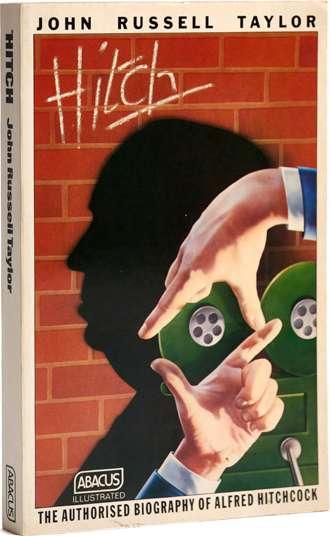
A SELECTION OF BOOKS written or edited between 1962 and recent years, including Artists’ monographs: Bernard Meninsky (1990), Michael Leonard: Verisimilitude (1992), Muriel Pemberton: Art and Fashion (1993), Michael Parks: Stone Lithographs - Bronze Sculptures 1982-1996 (1996), Claude Monet (1997), Bill Jacklin (1997), Antonio Saliola: Catalogue of the New York Exhibition (1998), Adrian George: Carnival of Desire (2005), Roboz: A Painter’s Paradox (2006), Carl Laubin Paintings (2007), Philip Hicks: Studio Publications (2013) / Essays, Anthologies and Criticism on Hollywood and Cinema: Cinema Eye, Cinema Ear: Some key Film-Makers or the Sixties (1964), The Hollywood Musical (1971), Masterworks of the British Cinema (1974), Directors and Directions: Cinema for the Seventies (1975), The Pleasure Dome: Graham Greene, The Collected Film Criticism 1935-40 (1980), Strangers in Paradise: The Hollywood Emigrés, 1933-1950 (1983), Hollywood 1940s (1985), Portrait of the British Cinema: 60 Glorious Years 1925-85 (1985), Great movie moments: Photographs from the Kobal Collection, 1988) / Essays and Anthologies on Theatre: Anger and After: A guide to the New British Drama (1962), The Penguin Dictionary of the Theatre (1966), The Rise and Fall of the Well-Made Play (1967), The Second Wave: British Drama of the Sixties (1978), The Revels: History of Drama in English, vol.VII (1978) / Art Movements: Impressionism (1981), Impressionist Dreams (1993), Exactitude: Hyperrealist Art Today (2009) / Book Illustration: The Art Nouveau Book in Britain (1966) / Biographies: Hitch: The Life and Times of Alfred HItchcock (1978), Alec Guinness: A Celebration (1984), Orson Welles: A Celebration (1984) Various formats and editions (36) Provenance: The Estate of John Russell Taylor £100-150