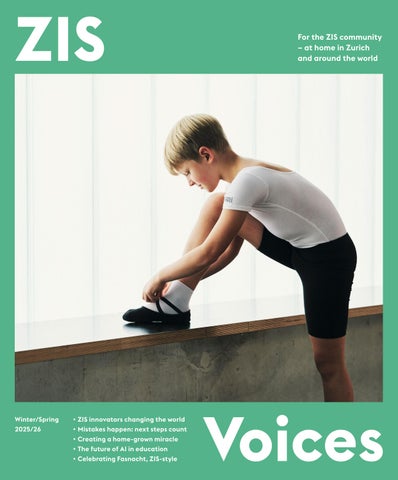
Voices Winter 2025/26

Page 1


For the ZIS community – at home in Zurich and around the world

• ZIS innovators changing the world

• Mistakes happen: next steps count

• Creating a home-grown miracle

• The future of AI in education

• Celebrating Fasnacht, ZIS-style Winter/Spring 2025/26

Vo

New structure and Principal for Secondary School

To reflect the school’s commitment to a seamless, learning-centered journey, the current Middle School and Upper School will come together from August, under the leadership of a single Secondary School Principal.

Among the benefits to students and parents, the new structure will ensure a greater coherence across grades, establish a coherent curiculum and pedadogy, and embed learning cultures. It’s expected that this will provide clarity, consistency and confidence through a shared language of learning, with simplified communication and clear leadership. “This new structure aligns directly with our strategic vision,” says Director Elsa Hernández-Donohue, “nurturing global citizenship and courageous, joyful learning.”

Heading up the leadership team will be Maggie Wollner, who joins as the new Secondary School Principal in August. Maggie brings a powerful combination of qualities essential for future-ready leadership. Her experience leading diverse learning communities and working with students and families from around the world aligns strongly with a commitment to prepare every learner for what comes next.

Alongside five Assistant Principals, the new structure will support the school’s mission to inspire curiosity, critical thinking and high expectations in every learner. “It is a privilege to join such a forward-looking school,” says Maggie, “and I’m eager to help advance our shared purpose and values as we embark on this exciting new chapter together.”

Join the community globalcommunity.zis.ch

A dedicated and safe networking platform

#ZISExperience

#ZISLearns

#ZISCares

#ZISAlumni

#GoZISLions

Facebook zurichintschool

Instagram zurich-international-school

LinkedIn zurich-international-school

YouTube ZurichIntS

of students took part in the Athletic and Activities (ATAC) programme in 2024/25

With a balanced participation of boys and girls across the entire school.

Co-curriculum

We are proud to have successfully completed our New England Association of Schools and Colleges (NEASC) re-accreditation, the established mark of quality for schools across the world.

The NEASC team recognised that ZIS is a vibrant, caring and academically rigorous school, where families, students and staff are working together to strengthen teaching, learning and wellbeing. The report highlighted in particular the school’s strong academic programs and ongoing commitment to growth and excellence, and commended its Bilingual Pathway and excellent facilities.

Learners shine at Villars Symposium 2025

Four Upper School students represented ZIS at the 2025 Villars Symposium in Villars-sur-Ollon, which this year focussed on accelerating the transition to a net-zero, nature positive future while embracing the rapid developments in science and technology.

Elizabeth, Laia, Anouchka and Leo (above) were selected for their outstanding motivation and commitment, and joined youth leaders and global experts to tackle challenges in climate, biodiversity and equity.

The Villars Symposium is an annual gathering hosted by the Villars Institute, bringing together intergenerational participants to accelerate systems leadership for a sustainable future.

Michaela retires

After more than 23 extraordinary years of service to the ZIS community, Michaela Seeger has announced her retirement from her role as Director of Community Relations.

For more than two decades, Michaela has excelled in multiple roles, from parent and trusted colleague to development specialist and ZIS Board member. Her deep commitment to building relationships and cultivating our alumni community has made an enduring mark, and she leaves behind a legacy of generosity, connection and unwavering commitment to the school’s mission.

“ZIS is more than a school – it’s a community that spans generations and continents,” says Michaela. “I’ve loved being part of that journey with you, and I’m excited to see what the future holds for us all. Thank you for the connection, memories, and continued support over the years.”

Her presence will be felt for years to come.

Kia ora Emma!

We are delighted to welcome Emma Zigan as the school’s new Chief Advancement Officer. Emma brings more than 25 years of international experience in educational advancement, having worked in Germany, Vietnam, the United States, Brazil, Belgium and, most recently New Zealand. She will lead the Advancement Team (a combination of our current Community Relations and Admissions teams), drawing on her expertise in building strong, inclusive school communities. With her global perspective and exceptional ability to connect across cultures, Emma brings insight and a collaborative spirit that aligns perfectly with the ZIS mission and values.

Says Emma: “Kia ora koutou! I’m passionate about fostering a culture of connection, generosity and shared purpose, and I’m excited to contribute to ZIS’s mission and community in meaningful ways.”

Investing in the future

The Annual Fund could be your chance to invest in students – by empowering teachers. All donations help accelerate the school’s ability to deliver on strategic school initiatives, priorities that benefit all students and the overall learning experience at ZIS.

The priorities for this year focus on: AI preparedness; adaptive teaching that delivers on students’ needs; developing confidence in language learning; and providing safer, more supportive classrooms.

To find out how you can make a difference and help students and teachers thrive in future-ready classrooms, go to: zis.ch/support/annual-fund

Sustainability
Appointments

From the Director

Elsa Hernández-Donohue

My

term in culture

I have been reading... Strong Ground, a playbook of courageous leadership from New York Times bestselling author Brené Brown.

I have been listening to... Peter Gregson’s 2018 recompositions of JS Bach’s Cello Suites, which he describes as a “sculpture” rather than a “two-dimensional painting”. A real treat!

I have been spending time... listening to members of our community about topics that matter to them.

I have been cooking... not much! But my husband, Terry, is being very creative in the kitchen – his soups are incredible!

I have been experimenting with... how to better communicate through different channels.

ZIS 2030: Forward together. What happens when a school truly listens to its community – then dares to boldly dream together?

The year 2007 was a big one. At ZIS, we launched our first mission statement, and Apple launched the iPhone. Technology, of course, has continued to evolve rapidly – almost two decades later, the iPhone is on its 17th iteration. And likewise, teaching, education and learning has evolved at an incredible pace. So when I arrived at ZIS, it felt like the right time to re-examine our mission – and think about what version 2.0 might look like. We’ve embarked on a thoughtful process with parents, students, faculty, alumni and consultants. We asked ourselves: what elements of our mission should we preserve? Who do we want to be? And how can we make sure we reflect that in our mission as we go forward?

It soon became clear that our original mission no longer served us, as so much has changed about the way our students learn, and that any new mission must reflect that sense of clarity on who we are, what we want to become, and why. Thinking, together, has drawn these strands into our new mission: ‘We surface and inspire each learner’s curiosity, critical thinking and high expectations for their learning so that they positively impact their family, community and the world.’

All these ideas – curiosity, critical thinking, positive impact at a local and global level, high expectations – resonated deeply with you, our community. The new mission also honours those aspects of ZIS that have always been in our DNA. I’ve heard from so many of our alumni that they feel they were part of a true community of learners, and became better critical thinkers as a result of their time at ZIS, whether that time was five or 15 years ago.

We must understand the incredible potential of every child, and bring out the very best version of who they are

The mission is already critical to the strategic work that comes next, and that’s guided by two non-negotiables: to be a hub of exceptional teaching, leading and learning so that we can inspire others to learn from our approach, and to make sure that our arc of learning is coherent and is cohesive, recognising each individual student journey.

Finally, for me perhaps the most important word in the mission is ‘surface’. What does that mean? We are a very inclusive community at ZIS, which means our learners approach learning differently. But they all come to us with innate skills and talents. Great teachers bring those to the surface – and it is only then that students can engage in curiosity and use critical thinking for positive impact.

It is vital that all of us understand the incredible potential of every child, and that our teaching brings out the very best version of who they are. We hope that this mission will help us to engage with parents and teachers to see what needs to change, not just in terms of what we teach, but also how we teach it – whatever the future might look like. Z

• Photography Maren Kindler

Community

MaryAnn receives John Mattern Award

Members of the school community gathered to celebrate this year’s recipient of the John Mattern Alumni Award, MaryAnn Canzanella Picone.

MaryAnn, who began teaching at AISZ in 1992, inspired generations of students with her profound passion for language, literature and learning over more than three decades. Receiving the award, she spoke about the importance of being a lifelong learner, and shared memorable stories from her time at ZIS.

Alumni return to inspire students

We’re grateful to two alumni who returned to school recently to pass on their advice and guidance.

Joel Rosen, Class of 2009 (2003-09), shared insights from his role in the UK Civil Service. Now at the UK Department for Business and Trade, Joel talked about his work and encouraged students to take the harder path, challenge themselves and stay curious. He also met with Director Elsa Hernández-Donohue and spoke about the lasting impact sport had on his time at ZIS.

Meanwhile, filmmaker Freddy Macdonald, Class of 2019 (2015-19), encouraged students to take risks, follow their interests and share their work boldly, and reflected on his journey from making short films at ZIS to directing seasoned actors and premiering on major industry stages. His visit coincided with the Swiss premiere of Sew Torn, his first full-length featuire film, which began as a Grade 12 independent study project at ZIS.

• Multi-year reunion

Over one remarkable weekend last summer, more than 125 alumni, teachers and guests from Classes of 1975, 1985, 2005, 2013 and 2015 came together on the Secondary Campus rooftop to celebrate a ZIS Reunion. A heartfelt thank you to the reunion planning committees for their efforts.

On 20 June, ZIS is hosting an event for all classes with milestone reunions – 1966, 1976, 1986, 1996, 2006 and 2016 – at the Secondary Campus.

To register, visit bit.ly/2026ReunionWeekend

• University panels

We are always pleased to welcome back members of our alumni community. In August, several recent graduates returned to campus to share valuable insights with Grade 12 students during post-graduation planning panel sessions. They shared their diverse experiences, offering real-world perspectives on the possibilities beyond graduation. Interested in joining a future panel or student learning initiative? Email alumni@zis.ch to get involved.

• Career forum

More than 50 professionals, including members of our alumni and parent community, were at ZIS recently for the annual Grade 10 Career Forum.

A powerful keynote speech from Carlo Valsecchi, Class of 2011 (2004-11), helped launch the event. Carlo’s story set the tone for students to think about their futures, encouraging them to see resilience not only as a response to adversity, but as a mindset essential for learning, leadership and growth.

Got something to share? Tell us your news by emailing alumni@zis.ch⁠

Inspiring graduates

Eva Respini, Class of 1994 (1989-94), delivered an inspiring message to 147 members of the Class of 2025 when she returned to Zurich to deliver graduation remarks. She encouraged students to follow their instincts, embrace the unexpected and stay connected to the school community.

AISZ reunions

Alumni who graduated from the AISZ between 1964 and 1989 gathered in Los Angeles for a reunion hosted at the home of Bev Meyer. With special thanks to Bev, who taught at AISZ from 1974 to 1989, along with Rodrick Safarian, Class of 1982 (1980–82), and Matthew Weiss, Class of 1982 (1980–82), alumni enjoyed two days of laughter, shared memories and meaningful reconnection. Get in touch to learn more. Reunions and alumni gatherings can be organised by contacting Alumni Relations at alumni@zis.ch

Connections: A love of adventure that bonded friends together

Patrick Wieghardt and Matthew Eaton’s 30 years of global friendship began in the skateparks of downtown Zurich.
• Words Frances Hedges

Fakies, alley-oops, tic-tacs and slides. As school friends at AISZ in the 90s, Patrick Wieghardt and Matthew Eaton could do them all, spending most of their spare time on the skateboard halfpipes at Parkhaus Globus in downtown Zurich, perfecting their technique and pushing themselves to new heights – literally.

Matthew, Class of 1992 (1988–92), was a year younger than Patrick, Class of 1991 (1986–91), but despite this, and despite having moved from Detroit in the US, he found his people at AISZ. “There are about 10 of us who have stayed in touch over the years, but even back then I found them friendly, welcoming and keen to take the new person under their wing.” As part of this large and multicultural group – Patrick is from Peru – they regularly came together to socialise, play rugby or go skiing. “We’d travel up into the mountains most weekends in ski season,” says Matthew.

An adventurous spirit has created an enduring bond across the whole group, but Patrick and Matthew have remained especially close, partly thanks to the memories made while travelling through South

America after university (Matthew was at Boston University and Patrick at ETH in Zurich).

“Matt was working in Uruguay and I was back in Peru, so we decided to meet in Chile, drive down and cross over into Argentina,” explains Patrick. “The idea was to go fly-fishing – but we’d often stay up past midnight drinking, so when we woke in the morning, the fishing time was already gone!” On another occasion, they met in Peru to go surfing and camping – “very down-to-earth stuff,” as Patrick puts it.

Their youthful misadventures were numerous, from Matthew being pulled over after accidentally turning onto the driveway up to Chile’s presidential palace, La Moneda, to Patrick nearly losing his licence for speeding. “Then there was the time we went whitewater rafting,” adds Matthew. “We pretended we had experience so we could hire the more dangerous type of raft… I don’t know how many times we fell out of that thing, but we survived.”

The pair have continued to meet around the world, including Bermuda, Prague, London and Tokyo. Like everyone, the group had to resort to Zoom during the Covid lockdowns, but earlier this

Patrick Wieghardt, Class of 1991 (1986–91), and Matthew Eaton, Class of 1992 (1988–92).
“We pretended we had experience so we could hire the more dangerous type of raft… I don’t know how many times we fell out of that thing, but we survived”

year, they made up for lost time with a skiing trip in Davos. “Everyone came with their families, and the nicest thing was that our kids became really good friends,” says Patrick.

Plans are already afoot for their next meeting: both are sailing enthusiasts and hope to charter a boat for a holiday, while there is already talk of arranging another ski expedition in a couple of years’ time. “But we don’t have to do anything special,” adds Patrick. “There’s always something to talk about.” Z

↑ The friends outside Patrick’s parents’ house in Zurich, just before the prom party of 1990. Matthew is second from the left, Patrick fifth from right.

24 hours... in Istanbul

Forget NYC, Istanbul is the real city that never sleeps, says Ceyda Avunduk, Class of 2001 (1987-2001). Here’s how to max your time.

09.00

A coffee with a view

Get a snapshot of contemporary Istanbul with a flat white at Petra in Bebek. Right by the bridge looking out onto the Asian side of the city, not only is it the best coffee in town, but they really care.

10.00

Take to the water

Istanbul traffic is terrible, so grab one of the city’s water taxis, the best – and a beautiful – way to travel. Plus, you get a waterside view of Ottoman palaces like the Kempinski.

11.00

Dip into Istanbul’s rich history

Get out at Karaköy for the Istanbul Museum of Modern Art, then jump on the metro to the spice market (Pandeli is a hidden gem). Then explore the first mall in history, Istanbul’s Grand Bazaar.

18.00

Refuel before hitting the dance floor

Metro back to Karaköy for dinner at Karaköy Lokantasi, where the local mezze and raki is the best. Then Frankhan is right next door. It’s the place to be for drinks, house music and dancing.

02.00

Still hungry?

If you want to eat on the way home, you can –everything is open. There’s even a guy who sells fruit and vegetables in Bebek in the middle of the night. Need an apple at 2am? He’ll be there.

#ZIStravels

My working day

Neven Kissenpfennig, Class of 2000 (1994–2000), Founder and Creative at Design-o-mat, says getting back to his creative roots was the start of an exciting new chapter.

It all started with daydreams and doodles. As a child, I wanted to be an illustrator for Disney – I’d doodle cartoons day in, day out – but then life took over. So starting a design consultancy a few years ago was an overdue dream come true And it has meant that I’ve been able to reconnect with ZIS to work on their Electric Vehicle in Education (EViE) project, something that I wouldn’t have thought possible while I was deep in the corporate scene. At that point, however, the pandemic proved to be the perfect opportunity to go my own way and get back to my creative roots.

I can trace that passion back to my NYU freshman year and time spent in Florence, where I immersed myself in art, culture, history and beauty, before continuing my degree in Manhattan – another eye-opening source of inspiration. I toyed with the idea of becoming an architect, but by the time I enrolled in a postgraduate course at Parsons School of Design, it was clear that I wanted to be a designer.

Establishing a career in New York City – where designers like me are a dime a dozen – wasn’t easy, but I took an unpaid internship at a studio run by the renowned illustrator Mirko Ilić to get my foot in the door. He collaborated regularly with Milton Glaser – the graphic-design ‘godfather’ known for the iconic ‘I Love NY’ logo – who worked in the same brownstone, so I seized the chance to learn from the pros.

EViE

After a decade or so of gathering experience across various roles and specialisations, the multinational FMCG company Amcor came calling, and by 32 I was promoted to Global Head of Design for the Specialty Cartons division, working on consumer products and brands from the likes of Nestlé, Colgate, P&G, Mondelez and many more.

But then came the time to venture out on my own. I started up a design consultancy – Design-o-mat, a one-stop-shop design vending automat – leveraging design and innovation to elevate products, brands, packaging, marketing strategies and ad campaigns. It’s that variety and endless drive for creativity that keeps me going, even more so when it’s for a good cause. Recently I was commissioned to develop the brand ID for ZIS’s newly launched EViE programme, where the students build and assemble an electric car to race against other Swiss schools in a circuit. The scope also included rolling out designs for the race cars and race gear – not my exact area of expertise, but I’m a firm believer that a true creative with a little courage, bold ideas and a keen eye for aesthetics can ultimately design anything imaginable.

It was great to be involved with ZIS again. Studying at AISZ meant a lot to me – it was there that I forged many life-long friendships, and where I met my wife Jocelyn. The sense of community was very strong. The teachers were exceptional as well, and truly cared about our education: they definitely set me up to take on any challenge. When I think back to my first year at university, I remember feeling better prepared than most of my peers, which says it all. It has been a privilege to reconnect with the school again and I look forward to many collaborations in the future! Z

ZIS EViE team

Build time 200 hrs

Students 60

Staff 2

Power — 1000 W

Top speed 34 km/h

Starts in 2025 — 4

Podiums in 2025 3

ZIS’s Electric Vehicle in Education (EViE) initiative places Grade 8–12 students at the centre of a real engineering workflow: designing, building, optimising and ultimately racing a student-constructed electric vehicle against other international schools in Switzerland. Now in its third year, EViE has evolved into a flagship STEM program, providing opportunities to integrate physics, engineering design, automation, data science, sustainability studies and the arts into a single coherent learning experience. It exemplifies the purpose of progressive STEM education – to transform learners from knowledge consumers into innovators capable of addressing complex technological and environmental challenges.

Best finish 2nd

• Words Clare Thorp • Photography Kate Peters

Sometimes – just sometimes – your child’s day at school just doesn’t quite go according to plan. Incidents occasionally happen, but whichever side of that event your child is on, all parents want the same things: an open hearing, fairness – and kindness. But is that really achievable for everyone concerned? What does a system that puts accountability first really look like? And does it work?

For ZIS’s restorative practice programme, now implemented after a two-year pilot, the answer is a resounding yes. Of course there are still rules and consequences in place, but alongside these boundaries, there is the option to solve problems by sharing experiences, learning about the impact of actions and – crucially – ensuring students face up to the harm they’ve caused and can take responsibility for their choices.

“The general hypothesis behind restorative practice, as set out by Ted Wachtel, the founder of the International Institute for Restorative Practices, is that human beings are happier, more cooperative and productive, and more likely to make positive change in their behaviour, when those in

positions of influence do things with them rather than , Assistant Principal in the Upper School. “Imagine if somebody says: ‘You’ve made a mistake, but we’re going to figure this out together. You’re not a bad person.’ Instead of: ‘You messed up. You’re suspended.’ It’s how I’d want my kids to be treated.”

And that sense of inclusion is particularly keenly felt by the person harmed in any situation, who has the chance to be involved in the outcomes.

“With restorative practices, what matters most

You get better attendance, higher academic performance, fewer behavioural problems and greater teacher satisfaction

isn’t who’s to blame, but the impact of what happened and what’s needed to make things right,” says Laura Mooiman, an expert in restorative practices and PBIS (Positive Behavioural Interventions and Supports). “When a student harmed takes part in a restorative process and is included in decisions that affect them, they feel empowered. They have the space to share how they were affected, what support they need, and what will help them move forward.”

Of course, compassion, fairness and open mindedness – alongside respect, humility, courage and joy – have long been key values at ZIS, but the step towards a more formal programme of restorative practice began two years ago when Laura was invited to advise. “Really what I’m advocating is a gentler and more child-centred approach,” she says. “You can’t punish a kid into being good. It just doesn’t work. You can only really change behaviour with support, listening and giving people the tools that they need.”

Restorative practice has its roots in indigenous communities, with Laura’s model based on the Maori people of New Zealand. “It’s really founded on these more traditional ways of handling conflict, when problems were solved within the community,” she says.

“The idea is that when harm occurs, whether in criminal justice or in discipline in schools, we need to bring together the people that did the harm with the people that were harmed. It’s about involving the community and talking about what happened with honesty. The response becomes the consequence – one rooted in repair, accountability and support, rather than punishment.”

environment, they’re more likely to own up to wrongdoing.

Tanya has worked with ZIS for more than a decade, and also has a child at the school. To her, compassion and restorative practices go hand in hand. “It’s how I’d like to be treated, and it’s the way I’d hope my children would be treated when they’ve made a mistake. I wish for them to repair and restore and understand the person they may have harmed, rather than just defend themselves and go into self-protective mode. It’s about how do we set our children up so that they would want to do better tomorrow?”

So how does that play out in school situations? Take an instance of bullying – instead of punishing the person who did harm, perhaps by suspension, the school now holds what is known as a “circle,” which might involve the person harmed, those who did harm, a school counsellor, teachers and the Principal – sometimes parents, too. Together they work through a list of questions, such as: “What happened? What were you thinking about at the time? Who’s been impacted and how? What do you think needs to happen to make things right?”

“In a restorative school, accountability means that someone takes responsibility for their actions,” says Laura. “They understand the impact of it. They see: ‘Oh, I really hurt you. I really upset you’, and then they take active steps to make it right.”

Alison, who is studying for a graduate certificate in restorative practices, says that when someone hears directly from the person who has been harmed it can have a powerful effect. “What I really notice is that the level of empathy increases,” she says. “It’s also a way for those who have been

ZIS has worked from the top down to implement restorative practices in the school, to make sure policies and practices were in place before rolling it out to the greater community and leaders and counsellors were clear on best practice. Getting parents on board has also been an important step. The school has held parent training sessions where they talk them through the questions used in circles and even encourage them to use them at home.

“These practices really ask us as adults to first regulate ourselves before we can hear different points of view,” says Tanya. “So much of our training as parents is deep listening: how do we keep an open mind and an open heart, and still hold what hurts, with compassion?”

Alison says that sometimes people can think restorative practice is an easy way out compared to traditional modes of discipline. “I’ve had a few people who were on the fence about it, and then they’ve sat through a circle and realised it’s way harder.” It also doesn’t mean other disciplinary practices are completely obsolete. “We might do the restorative process

The evidence is clear, where you see the best in someone, they will act better for it

that students will be punished for breaking and more like clear expectations for behaviour. It’s a vote of confidence in students’ ability to do the right thing. “The evidence and data are very clear on this point: when you see the best in someone, they will act better for it,” says Tanya. “The culture is setting that tone.”

Alison hopes the skills students are developing won’t just help them in school but set them up for navigating conflict and challenging situations throughout their lives. The plan is to train students so that they can facilitate their own circles. “I would love to get to a stage where students are asking for a circle themselves, or even for it to happen without an adult.”

The more students are invested in their community, the more likely they are to want to repair any damage to it. “When you do the proactive work of building relationships and empathy, you really care when harm is done,” says Alison. “It’s the idea that this is our community and we’re going to uphold these standards – but we’re going to help you stay a part of it, even when someone’s messed up.” Z

40 % r eduction in problematic behaviour in the first month of implementation

96 % st udents without a discipline referral of any kind in the last academic year

Innovation:

what does it mean to a curious, dynamic and global ZIS community? Since John Mattern’s earliest vision of a truly modern education, our alumni have used their skills to change the world many times over. We asked entrepreneurs, activists and artists to tell us what innovation means to them.

who are willing to help raise funds

a major motivation was her love of animals. But she soon discovered there were few experiences more painful than having to send a customer home with a poorly pooch because their owner did not have any insurance or the funds to pay for the treatment.

After experiencing this heartbreaking problem once too often, Patricia decided to do something about it. She created Swiss Vets For Pets, a charity that offers funding to those in need of financial support, and now runs the charity while working as a vet and studying for her doctorate at the University of Zurich.

“The job of a vet is very romanticised, but it is a lot tougher than I thought,” she says. “In my last year of study, we did a practical where you rotate to different clinics, and in every country – Switzerland, Germany, Austria and Ecuador – I saw a recurring theme: that people did not have the money to spend on the treatment they wanted for their pet. People wanted the full diagnostic report or the surgery but had to choose something more conservative, like antibiotics or steroids, without knowing if these would work. That was really sad.”

Patricia got Swiss Vets For Pets up and running in 2024. Applicants approach the charity via the website where they are asked to provide proof of ownership, a veterinarian report and evidence of their financial situation. Patricia will then use the information to decide whether Swiss Vets For Pets can help. “I can read the report and help the owner to make a choice, as sometimes the conservative therapy might be the right thing to try,” she explains. “At the moment, vets have to turn away animals if the owner cannot afford the treatment. But I have developed a network who are willing to help raise funds, and Switzerland in general is a very animal-friendly country.”

Swiss Vets For Pets has already helped dozens of owners with their pets’ problems, and Patricia is constantly refining and improving the service – with help from interns recruited from ZIS. The school has helped in other ways too. “At school, I learnt that it was good to give back and not to be afraid to fail,” she says. “And the school is very supportive of what I am doing, even now. When I started the charity, we had so much encouragement from ZIS and its alumni, including students I had never known.”

There was no way I had the time to do three jobs

Emma Rytoft

All the time Emma Rytoft, Class of 2001 (1996-2001), was studying to become an architect, she dreamed of putting aside her laptop and

Ben Sinnott

Why settle for one career when you can have three? Ben Sinnott, Class of 1990 (1985-90), went from university to Goldman Sachs, where he spent almost 20 years before deciding it was time for a change. During the financial crisis of 2008, he took his skills into property, before selling much of his portfolio and beginning career number three: managing investments in tech and real estate and other areas. “It’s almost like a private equity firm on a smaller scale,” explains Ben, an American who was raised in Europe and now lives in New York.

His personal experience has allowed Ben to reflect on what makes a successful innovator. The key ingredient, he believes, is confidence. “You need to have the confidence to open up, be yourself, take risks and try new things – and I think that’s the key to innovating in whatever you do,” he says.

“You have to be able to get out there and fail with enough confidence that it’s not going to be a complete disaster. The majority of any innovations are unsuccessful, because if it was easy somebody would already have done it. So it’s about having the confidence to try new things and be willing for them to be completely disastrous.”

You have to be able to get out there and fail with enough confidence that it’s not going to be a complete disaster. The majority of any innovations are unsuccessful, because if it was easy, somebody would already have done it

That only works, of course, if you are prepared to learn from your mistakes. It also helps if you have a good idea of what is at stake. This was something Ben learnt at AISZ, where he could see a direct relationship between the work he put in and the results he received. And he is quick to credit the inspiring staff for setting him on the path to success. “Volleyball was the big sport when I was there and Mr Stillman coached us like it was the Olympics,” says Ben.

“The teachers had made a big a commitment and they were very generous with their time. Because of the size of the school, they could treat us more like adults or almost as colleagues. One year, Mr Stillman spent his summer teaching us advanced biology. That was inspirational and it was good preparation for a business career because the risk-reward profile was very clear.”

But ultimately it all comes back to confidence; the confidence to trust your technical skills but also your personal skills – qualities sometimes undervalued in innovation and leadership but which Ben thinks are essential. “Confidence and having an open nature are what you need to make changes,” he says. “You need to know that what you are going to try has a solid foundation based on reasoning and process, and then you need to be able to explain that to other people so you can bring them with you. Nobody really likes doing things differently. Even the smallest thing like changing the coffee in a coffee machine can cause a revolution in an office. So you need to be able to persuade people of the benefits of that change.”

With beetroot and rhubarb and

rosemary and thyme, the leeks are delicious, the turnips divine, with imperfect potatoes and oddly-shaped fruits, our Edible Food Forest is spreading its roots.

The Edible Food Forest is a miracle of growth, nurture –and community. And its impact is felt right across the school.

What does it take to make the Edible Food Forest grow? Time, patience, rain and sunshine, of course. But also, crucially, people: the designers determined to make sustainability a reality; the volunteers who greet every downpour with a smile; the teachers who use it to make their lessons come alive; the donors to the Annual Fund; and the students who learn from it. That’s why the Edible Food Forest isn’t just a miracle of abundance. It’s a miracle of community, too.

“In a city where many children live in apartments without outside space, it’s crucial for them to have a place to explore, get dirty, pick wild strawberries and prod snails,” says current parent Susan Martin, who volunteers in the Edible Food Forest and runs the Gardening Club which meets on Tuesdays and Thursdays at the Lower School. “But a garden is also a place where you don’t have to impress anyone or get an answer right. You can just be.”

The Edible Food Forest is a beautiful, unique space, its tiny pathways wandering between different areas bursting with colour, abundance

• Words Lucy Jolin • Photography Kate Peters

and all manner of life – from bugs to butterflies to birds. Here, more than 1,000 plants and 100 different, mostly edible, trees, bushes, ground cover plants and vines all flourish together. There are wild varieties of familiar foods here, such as kale, garlic, onion and mint. And because it mimics a natural forest ecosystem, every plant has a reason for being there – if it’s not edible, it’s got another job to do, such as fixing nitrogen in the soil, or acting as a pollinator.

There is no such thing as ‘just a garden’. But the Food Forest takes this philosophy to the max. “It’s an outdoor classroom that supports eco-literacy and hands-on learning,” says Deputy Director Catherine Jolly. “It’s an ecological space that students can take care of and sustain. And it’s embedded in the curriculum, connecting to science and social studies all the way from Preschool to

Grade 5, and helping us develop the nature-based component of our STEM programme.”

The Edible Food Forest’s roots stretch all the way back to 2008, when space was carved out for the first ZIS garden, mostly used as part of the Grade 1 science curriculum. While both students and teachers loved using real plants in a real garden, it was felt that the garden could be so much more – a place that could mimic nature so that children could learn about sustainability outside of traditional gardening. “I want to give huge credit to Kristie Lear, our previous curriculum coordinator, whose brainchild this was,” says Catherine. “She is no longer at the school but dedicated many years to the Edible Food Forest’s creation and realisation.”

In 2015, Kristie suggested that the space would make a perfect Food Forest and living

↑ Susan Hinebauch, current parent and Kindergarten assistant teacher, and Izabela Miga, teacher

← Leonardo Garcia Consolini (Grade 1)

classroom. The school agreed. So Kristie set about making it happen, funded entirely by generous donations to the Annual Fund. The ZIS team worked with specialist external consultant Matthias Brück, a Zurich-based landscape architect and gardener who follows the philosophy of permaculture: combining the needs of people and nature. He designed the extraordinary, self-sustaining Food Forest containing more than a thousand plants – but which is also a place to play, dream and create.

Susan was already a regular garden volunteer, and was eager to get involved with this exciting new project… even when she heard just how many plants were arriving. “Our team –me, along with Kristie, the school’s gardener, the designer Matthias Brück and a fellow

parent – had about a thousand plants to plant in a week!” remembers Susan. “We spent all day at it. But we also arranged for every child in the school to plant their own plant. That was so important, because we wanted them to feel that it was their garden. That was back in 2021 and, even now, students love to come back to the garden and run around finding their plant.”

When they realised they weren’t going to be ready to open the Food Forest in the time they’d planned, the team appealed for help from the Parent Association – and 15 parents rushed down to lend a hand, too. “It felt like a real community occasion with everyone pulling together. It was quite something to see how quickly we had gone from bare soil to a beautifully laid out garden in such a short space of time.”

It’s an outdoor classroom that supports eco-literacy and handson learning, helping us develop the nature-based component of our STEM programme

Four years later, the garden is looking more beautiful than ever, thanks to the dedicated work that Susan and her fellow volunteers – Silvia Rocas-Albas, Ros Chatfield, Nancy Chen and Sabina Stobierska-Bela – put in every week. And the next generation are beginning to get involved, too: Sabina’s daughter Lucja (Grade 8) loves helping her mother out in the Edible Food Forest in the summer holidays.

“It’s so nice to water the plants and help my mother,” says Lucja. “We have a country house 120 km from Cracow where we have a beautiful old orchard with varieties of apples dating back to pre-war times. I used to spend my summers there, picking berries and helping with the apples, and I have great memories from that. It’s so great that we have this place in school where we can raise awareness about the environment and how the

planet needs more plants. And I love how it helps get our parents out of the house!”

When current parent Agnes Pasztor heard about the Food Forest’s opening, she went along, eager to see what the school community working together had achieved. “It was very inspiring, and I’m very happy that we have a school that thinks about green issues,” she says. “The school director at the time made a speech, discussing how important it is that we have this resource. I was born in a very tiny village in Hungary and I spent many years working outside on the fields.

I think it’s amazing that kids who come from the city can see all these different foods and plants and find out where they come from and what they do, to touch them, smell them and eat them. They need to know that tomatoes don’t grow on the supermarket shelf.”

↑ Marigona Buqa, teacher
↖ Leyla Thies (Grade 4)
← Victoria Kinder (Grade 3)

She was also happy to see first-hand how her contribution to the Annual Fund had been used.

“One of the school’s strengths is that everyone can play a part – whether that’s donating, volunteering or coming along to a school event to show your kids that you’re interested, and that you care,” she says.

Now, the Edible Food Forest is an integral part of the Lower School curriculum, starting in Early Childhood and Kindergarten, where students develop their understanding of the concept of relationships, and plant and harvest their own plants, through Grades 1, 2 and 3, where the Food Forest is used as part of research into Biomimicry, social studies and science units addressing cycles and habitats, and to Grades 4 and 5, where students take on important leadership roles in Lower School and have

opportunities to join Student Council and Eco-Schools. The school is continuing to develop curriculum links in each grade level –and students have proved eager to sign up for the bilingual garden club.

And as the Edible Food Forest grows, so does its potential. “For example, we hope it can be more fully integrated into service opportunities for our students across campuses, and used by our local community and other local schools and organisations, allowing us to foster connections and be a good neighbour,” says Catherine. “With the launch of our new Mission and our new Director of Teaching and Learning, Doline Ndorimana, we are excited about the chance to really make this place something special –an authentic space for learning and ‘growing’, in every meaning of that word.” Z

↑ Susan Martin, current parent
↗ Ros Chatfield, current parent

The future of...

...artificial intelligence

Helping your children navigate the world of AI

Face the future

Don’t be afraid of AI, and don’t ignore it. It’s essential you allow your kids access to AI –but carefully supervise what they do with it.

Rote learning is dead

If your kids are at a school that emphasises rote learning, you need to challenge that. Students need to learn critical thinking, to ask questions and dissect what people tell them.

Core learning is alive

Some subjects may become less important, but understanding the founding principles about how the world works will remain essential.

Put soft skills first

Remember that soft skills – empathy, leadership, creativity and curiosity – will be vital in the future.

Former head of Google Research Europe and current parent Emmanuel Mogenet, now a board member of Daedalean AI, says education is

vital to fully embracing AI.

Of all the important technology-based disruptions in society over the past few decades, I believe one stands out as the most fundamental of them all: artificial intelligence. Using AI can sometimes feel like we’re dealing in magic, so it’s crucial that everyone has an understanding of what it is and how it works – and education has a central part to play in that.

In my last five years at Google I ran the AI research lab in Zurich, and in my opinion the major innovation happened in 2014. That was when AI was able to understand human language and therefore access pretty much the whole of human knowledge, and then use reasoning to fill in the gaps.

The big worry everybody has is the impact on society and the workplace, and we need to educate our children to prepare for this. Creativity remains valuable because AI is not creative; it cannot change the rules and evoke profound emotion. Coming up with new ideas is a human-only skill for now.

The rise of AI also prompts a meta-question about education: is your goal for your child to be economically successful or for them to be happy? My bet is the pendulum will swing hard in favour of education that produces rounded human beings who can master life in all its aspects. What will matter in an AI-powered world are soft skills derived from a humanistic education.

The most important thing for humans is happiness – either their own or the group’s. My strong bet is that the goal of tech will always be to solve human-centric problems. People need happiness, health, wellbeing, fulfilment, curiosity, surprise and love. And people also want to contribute to society. They want to be useful. This is how they find fulfilment. We should see AI as a tool to further these goals.

So how do you ensure a child is fulfilled? Soft skills will be hugely important – those things that enhance human-to-human interaction. Above all, we need to teach critical thinking. Propaganda was traditionally a very blunt tool, but the modern AI-powered version is more like a scalpel. Users will need super-sharp critical thinking skills to be able to navigate its output.

People want to contribute, to be useful. This is how they find fulfilment. We should see AI as a tool to further these goals

What about teachers? Well, if a student has a strong and empathic connection to the teacher, then learning improves. Machines can’t do this very well yet. The teacher who engages a student at an emotional level is irreplaceable. If you have a student who has the desire to learn a new subject then AI is an amazing tool, but you need to stoke their curiosity. That will become the teacher’s role. There’s an often-used quote that says: “Education is not the filling of a bucket, it is the lighting of a fire.” With AI, that is truer than ever. Once the fire is lit, AI can keep it burning. Light the fire, grow your human skills and let AI help you reach heights you cannot reach on your own. Z

Interview Peter Watts • Illustration Elena Pancorbo

Fasnacht

Get ready for carnival fever! To understand the Swiss love of loud music and merriment, you have to experience Fasnacht season.

When Early Childhood Teacher Marigona Buqa arrived in Switzerland from Kosovo aged just seven, everything around her was strange and wonderful. So how did she choose to ease herself in? By dressing as a silver robot and parading through the streets to loud music.

Marigona’s first cultural experience in Switzerland was Fasnacht – literally ‘fasting night’ – the carnival tradition of elaborate costumes, scary masks to ward off evil spirits and noisy parades that sweeps across Switzerland, Germany and Austria each year in the run up to Lent. Encouraged by her teacher – “She was really great, and said I could do whatever I wanted to join in” – Marigona took the plunge, dressed head to toe in robotic silver.

“With my family, we walked through the whole town –there was lots of music, and people waited alongside the road to cheer you on, throwing confetti and being very loud.” It was an experience like nothing she had seen or heard before.

The memory of that first Fasnacht still makes her smile, and has become a regular fixture in her calendar. So much so, that when she started teaching the early years group at ZIS, she knew it was going to be part of their education too. “Each year, we celebrate the carnival in class. We make all the costumes and parade through the streets.”

Loud and spirited music – known as Guggenmusik – is very much part of the Swiss carnival tradition, with its echoes of a high school brass marching band. Tunes are usually very traditional but sometimes discordant, and occasionally contemporary influences do slip in.

So how does Marigona explain Guggenmusik to the children? “With difficulty!” she says smiling. I use words like ‘rousing’, ‘high energy’ and ‘infectious’. When I was younger, I thought all the brass big band instruments didn’t sound right. But now I realise it’s just fun loud music.”

There are costumes too – and masks. “Yes, the masks can be scary,” she says, “but you can always steer away from those and concentrate on the fun ones. Although I actually think seeing Sponge Bob at Fasnacht is weirder!”

The tradition has been linked to pre-Christian festivals that celebrated the end of winter and the coming of spring, and was adopted by Christian traditions as a way to use up rich foods before the austerity of Lent.

And Marigona understands the importance of teaching the tradition to the next generation of ZIS children. “It’s so good for them to have that connection with the local culture,” she says. “We celebrate a lot of different things at school, from Diwali to Chinese New Year, so for them to experience a celebration that is important to their local surroundings is really, really important.”

To this day, Marigona still honours her seven-year-old self and dresses up for the carnival season. Recent costumes have included a mouse and Wally of Where’s Wally (or Walter in the Swiss) fame. “There is something very special about the Fasnacht tradition,” she says. “It really captures the way of life here. The usually reserved Swiss throw off their inhibitions, say goodbye to the winter and welcome in spring – but it is very very loud!” Z

Marigona Buqa, Early Childhood teacher and carnival lover.

Dancing, says Marc Soldatenkov (Grade 4), is a kind of magic. “If I’m sick and I dance, I feel like I’m healing myself. I might feel nervous before I go on, but once I’m on stage, I feel so confident. I don’t feel shy or scared anymore.”

Marc found his passion aged just five, when his mother suggested that he might like to try ballroom dancing. After two glorious years of waltz, foxtrot and paso doble, he was eager to explore the world of dance further – and is now a keen ballet dancer with, he says, legendary Russian ballet dancer Mikhail Baryshnikov as his role model.

Driven by a desire to be the best, Marc has a challenging schedule. During the week, he trains for an hour a day, with competitions, castings and camps on weekends. Juggling schoolwork and dancing isn’t always easy, he says – but it’s worth it. “It’s a busy life but I do it because I love it.”

And his teachers at ZIS are eager to support him as much as they can. “When I win a competition, or I get to the final round in a casting, they’re always happy. If I lose, they encourage me never to give up – and if I never give up, then I’ll hopefully get to be in big musicals.”

My passion

Stepping up with two-time Swiss ballroom dancing champion Marc Soldatenkov.

• Words Lucy Jolin • Photography Kate Peters

Marc also gets to showcase his skills at school, too. He’s a regular at the famous ZIS talent show in the Lower School – so far he’s performed the cha-cha-cha, and the Bluebird Variation from Sleeping Beauty. It’s well established that participation in performing arts enables students to develop skills that benefit them throughout their lives, and Marc is already proof of that. “Performing has taught me to be confident and to be myself.”

And now, his natural talent and hard work are paying off. He’s recently been cast as Small Boy in the classic musical Billy Elliot at Zurich’s Maag Halle – following in the footsteps of movie star Tom Holland and musical theatre star Layton Williams, who both got their start in the stage musical. “I’m so happy that I get to play this role,” he says. “Now, my dream is to play the main character, Billy. But for that, I need to be a little bit older and keep improving my German!”

There’s no doubt that Marc’s determination will take him wherever he wants to go. Right now, that’s being on stage –but he’s open to other ideas. “I’d love to dance and be an actor. I love working with other actors. Or perhaps something else –as long as it’s something creative I’ll be really happy!” Z

Turn static files into dynamic content formats.

Create a flipbook
Voices Winter 2025/26 by Zurich International School - Issuu