THE EUROPEAN GAZETTE 3RD EDITION

Page 1

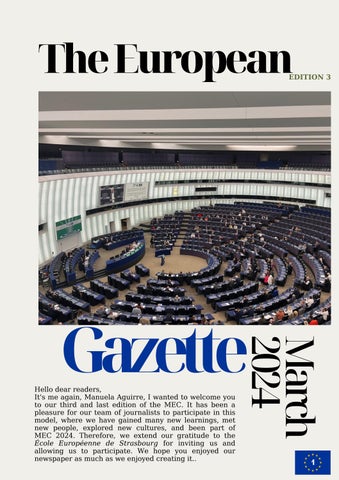
Hello dear readers, It's me again, Manuela Aguirre, I wanted to welcome you to our third and last edition of the MEC. It has been a pleasure for our team of journalists to participate in this model, where we have gained many new learnings, met new people, explored new cultures, and been part of MEC 2024 Therefore, we extend our gratitude to the École Européenne de Strasbourg for inviting us and allowing us to participate We hope you enjoyed our newspaper as much as we enjoyed creating it

TheEuropean M a r c h 2 0 2 4 Gazette

EDITION 3 1

Crisis, Decisions, and Debates

First and foremost, thank you for reading thus far. We are pleased to present the third and final edition of the European Gazette. In this last edition, we have pushed our journalists' abilities to their limits. But before delving into its contents, let us explore the urgent debate surrounding the cyber attack on the EU energy grid, resulting in damage to the Balticconnector pipeline and widespread blackouts across European capitals. Today, decisions will be made, multiple debates will unfold, and diverse topics will be discussed.

Moreover, not only has the crisis unfolded, but the councils this morning have also continued their debates and decision-making processes Migration, economy, and the environment have been among the most prevalent topics, not to mention the emerging impact of technology on our political discourse. As we conclude today, our newspaper will provide you with essential information regarding the recent crisis, including the measures being taken, of which we will keep you informed. In this final edition of The European Gazette, our journalists have dedicated themselves to delivering the most crucial updates to keep you informed.

FINAL EDITION
2
"Entre Sanctions et Coopération: Le Débat Européen sur les Entreprises Actives en Russie"

Au Conseil européen, les membres ont débattu sur la question de savoir s'il convient de punir les entreprises incorporées dans l'UE qui mènent des activités significatives en Russie. Les opinions divergeaient, avec certains plaidant en faveur de mesures punitives pour exprimer fermement leur désaccord avec les actions de la Russie, tandis que d'autres adoptaient une approche plus prudente, soulignant les implications économiques et les risques potentiels pour les entreprises européennes. Les partisans des sanctions estimaient que les entreprises qui tirent des bénéfices importants de leurs activités en Russie devraient être tenues responsables et que des mesures sévères étaient nécessaires pour maintenir la pression sur la Russie. Ils soulignaient également l'importance de défendre les valeurs et les intérêts de l'UE face aux défis posés par la Russie. En revanche, les opposants aux sanctions mettaient en avant les liens économiques étroits entre l'UE et la Russie, soulignant les risques de perturbation des chaînes d'approvisionnement et de hausse des coûts pour les entreprises européennes si des mesures punitives étaient mises en place. Certains soulignaient également la nécessité de maintenir le dialogue et l'engagement avec la Russie malgré les tensions politiques. La suite de l’article nous en dira plus pour mieux comprendre le sujet.

Tout d’abord la Bulgarie nous annonçait son opposition à cela, la Hongrie nous parlait de son inquiétude pour les pays (dont elle fait partie) qui sont indépendants de la “Grande Russie” et leur gaz tant convoité. La Hongrie qui attend depuis plus de 4 ans les 21 milliards d’euros promis par l’UE, propose d’aider les pays dépendants de la Russie au lieu de les sanctionner pour qu’il se détache de la “Mère Russie”, l'Autriche approuve. A son tour la Roumanie donne son avis et propose de punir la Russie et en sous-clause propose aux pays de l’UE les plus riches d’apporter d’importantes aides aux pays dépendants, qu’importe aux final ces mêmes pays “indépendants” à la Russie gagneront…

Le vote sera réalisé dans la confusion totale avec un résultat inconnu fait dans la précipitation qui laissera les délégations et la presse sur leur faim. On restera sans réponse et un peu déçu de la fin du débat pourtant si excitant, on s’attendait à un meilleur rendu !

3
Gabin De Meuleemester

CONTROVERSIAL WORDS OF PEACE

In the UE, security is one of the top priorities, that is why several policies exist in order to protect the UEA´s main matters and values. The policies intend to preserve peace, strengthen international security and cooperation, as well as consolidating democracy, the rule of law and the respect for human rights and fundamental freedoms were strongly emphasized yesterday in the speeches of the heads of state. During today's foreign affairs and security meeting, we explored the member states' concern about global security and how they can deepen their cooperation for European security and defense.

It all began very calmly, with most of the time being spent on voting However, it took an unexpected turn due to a topic that you have seen frequently in my previous articles.Each passing day further underscores the centrality of Ukraine and Russia in our discussions (I do not intend to fatigue you with repetition, but I assure you that no one in the debate grew weary). In this article I will not only translate what was said but I will also quote the ministers who kindly agreed to be interviewed.

It was heard that this ongoing conflict and the fear it provoques on the member states that border Russia is blinding the judgment on important matters like defense and security. These remarks were caused when it came to create an unified branch for Eu-defense called the DGSD and these countries voted against because of the fear of a bad reaction from Russia.

“Estonia obviously borders Russia, we are a former soviet country and simply out existance has always been questioned. We Receive multiple threats With the DGSD there would be threats but what Estonia is trying to do is bringing the best in this policy but also finding the minimizing the minimal consequences”- Minister of security and foreign affairs Estonia

After a speech delivered by the Minister of Malta, during which he explained his stance on military decisions and emphasized Malta's pursuit of peace, questions arose: 'How do you plan to achieve peace?' they asked. He responded by saying that he would achieve it by not participating in military discussions. One of the strongest responses was given by the minister of Poland. This is what he answered later when we interviewed him about the subject:

“We know the history and we know the stand of Russia on the western countries, especially Poland. And I think that for countries like Poland and the neighbors of Russia who have a history with it, it's obvious that Russia should be dealt with and we should not have the illusion that Russia actually wants to have peace because it's not true and it ’ll never be.

4

Controversialdayin CouncilOne

As stated by the Belgian presidency, "the atmosphere seemed a bit tense" throughout the entire debate regarding the categorized "impartial" and "neutral" proposal for expanding existing voting education campaigns. Some countries even called for calm as the debate became increasingly personal However, some other countries did not heed this call and continued to exacerbate the situation Tensions reached their peak when the head of state of Slovakia referred to this amendment as "propaganda" and "brainwashing" As a result, very few agreements were reached in terms of education. In fact, Luxembourg proposed a new discussion about education with a new amendment, but once again, the Slovakian head of state dismissed this as "a waste of time" and accused the discussion of "going in circles" However, the president of the Council emphasized the necessity for some countries to reopen discussions and question the aspect of education

Nevertheless, this was not the only controversy The proposal of the Belgian presidency to create a unique voting day in Europe was described as "unrealistic" and a "logistical nightmare" by some heads of states Despite all the chaos, some consensus was reached Proposals such as the establishment of a continent-wide voting week were passed.

Slovakia, again on the attack

Today, the head of state for Slovakia reiterated her arguments, referring to most of the proposals as "propaganda" The Belgian presidency raised concerns about the language used, as both the commission and other member states were taken aback Slovakia did not react to this and maintained her position Similarly, her voting approach hindered the progress of the debates

As expected, the use of the word "propaganda" led to various confrontations and prompted questioning, as noted by Poland, which initiated a debate about Slovakia's "rule of law" issues Despite evidence supporting these concerns, Slovakia's reaction was predictable: "This country's government is perfect, and we do not need help" In conclusion, Slovakia fulfilled its role in providing an engaging debate

5

La última crisis

Hoy es el fin de una era, el último día de toda esta travesía Nos levantamos temprano, nos arreglamos, desayunamos y nos dirigimos al parlamento europeo para nuestro segundo día de MEC-2024 El hecho de ser los únicos latinoamericanos y haber pasado estas últimas dos semanas juntos nos ha unido bastante, más estando en un evento en el inglés es nuestro tercer o cuarto idioma. Sin duda ser latino trae consigo un poco de protagonismo y drama, lo cual ya sé, es muy cliché, pero al final nosotros llevamos división donde vamos

Así que hoy volvimos de nuevo al Parlamento Europeo para enfrentarnos a nuevas decisiones, retos e inminentes ciber-crisis. Con un frío desconocido para nosotros, logramos sobrevivir y repartirnos en nuestros respectivos consejos Nuevos temas se discutieron: ¿Los países de la Unión Europea deberían designar parte de su presupuesto a mejorar la migración y así la estabilidad regional? ¿Qué tan útiles serían las inteligencias artificiales? ¿Se debería dar la misma educación en toda la Unión Europa? Todas estas preguntas y más fueron analizadas y debatidas Esperábamos que hoy fuera diferente a lo que fue ayer: largas conversaciones, bucles en las discusiones para llegar fácilmente a acuerdos, pero en efecto así lo fue

Nuevas decisiones fueron tomadas, disoluciones más intensas se sintieron y así, por fin, la hora de comer llegó.En medio de una variada propuesta gastronómica, los intercambios no se hicieron esperar Al finalizar el almuerzo, de nuevo todos los participantes nos encontramos Todos sentados en nuestros lugares cuando las luces se apagaron y sobre nosotros unos protectores se prendieron. Los presidentes nos informaron sobre una sorpresiva crisis: cometieron un ataque cibernético contra la Unión Europea Se sintió todo el estrés en la sala, las discusiones discutieron, las estrategias de defensa emergieron y las soluciones comenzaron a construirse. Comenzó el debate: cada país empezó a discutir sus puntos de vista y la tensión en la sala no cesaba. En estos momentos seguimos en crisis, acaba de empezar la rueda de prensa, los periodistas se están preparando para soltar sus preguntas y todo la ficción comenzó a fundirse con la realidad

Angélica Pardo

6

TheImpactofClimateChangeon EuropeanPolitics

Climate change is one of the main subjects discussed in the European Council and in the whole world: the third council discussed on the goal of carbon neutrality which means only emitting as much greenhouse gas into the atmosphere as it can be absorbed by nature: forests, ocean and soil That’s why on January 15th of 2020, the 27 EU countries created the Green Deal, with the goal of achieving climate neutrality by 2050. and now in the second debate.

In the second debate this is what the Belgian president proposed to the European Council members states. On the one hand, the Belgian presidency proposed an increase to the budget allocated to cap and decrease cap payments. Many ministers proposed different amendments according to their position in the debate: against or in favor, and some countries proposed to use the rational budget of the EU for skilled migration while some other ministers were in agreement with the originally proposed amendments At the beginning of the debate the ministers weren’t actively participating and they were voting repeatedly, however, as the debate was advancing and more ministers were participating constantly the debate became way more didactic and interesting.

Later on in the debate, the minister of Greece wanted to facilitate the entrance of immigrants to all the EU countries but a lot of ministers were in disagreement Greece ended up proposing an amendment that went through a voting protocol and ended up getting rejected After more discussion and voting for various amendments, Croatia was avoiding and was in disagreement with getting back into the EU as a country So, while it is true that some of the amendments that were proposed could help with the environment and the challenges that immigrants bring, other amendments were not considered as good and as helpful.

7

DISCOVERING EUROPEAN UNITY: INSPIRATION FROM THE PARLIAMENT WITH DITA CHARANZOVÁ

As a last experience at MEC, we had the honor of receiving the Vice President of the European Parliament Dita Charanzová. Beyond having the honor of sharing a space with a person like her, several parts and forms of her speech and her message caught my attention.

Firstly, this is something that has been omnipresent over the last 3 days surrounded by different students from all over the world. And it's the great sense of belonging to a European collective, which maybe, as Colombians, we were unaware existed. As the lady stated, there is a larger element that unites all members of the parliament, and that is the desire to keep Europe as I see it, something hidden between the air.

18

Diciembre

We have been able to notice this not only through the speech but also through the different dynamics that have been developed during the debates, in which each participant has reiterated through their speeches but also through their actions their belonging to this small European family.

Personally, as an external observer who may not fully understand the intricacies of European politics, this experience has been eye-opening

8

Game Section

LFB

Horizontal

3.Economicalliancebetween Brazil,Russia...

6 Boundaryordividingline betweencountriesorregions

Vertical

1 Legalmodificationoralterationtoa documentoralaw

2.Europeanagencysafeguardingborders

3.Planthatshowshowmuchmoneyyou expecttoearnandspend

5.Logicbasednumbergameplayerby slovenia

9

Game Section

Some of the images in this newspaper were generated by Canva!
LFB 10

Turn static files into dynamic content formats.

Create a flipbook