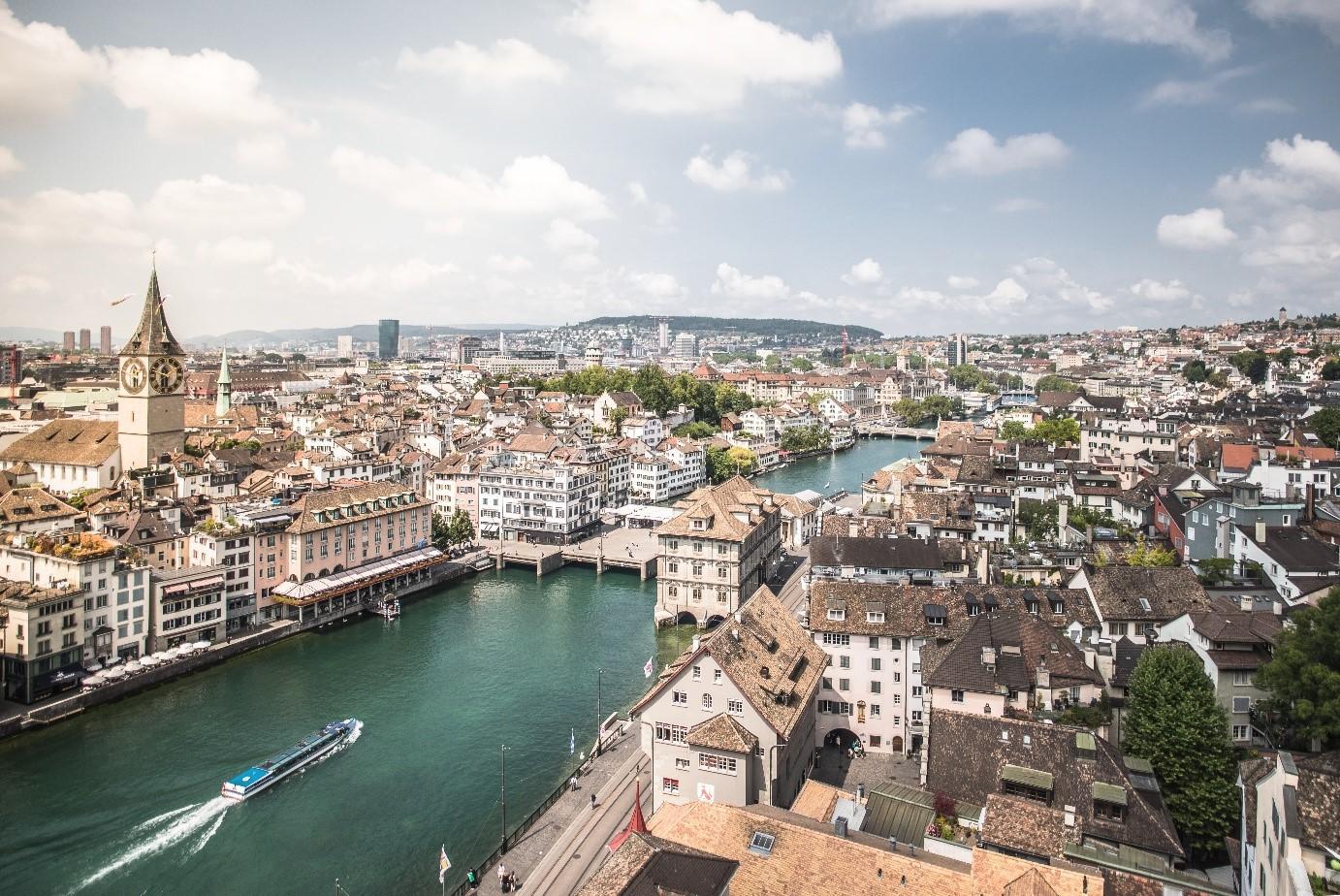
Nowadays, Zurich is a vibrant hub of culture and business. Over the centuries, the region has developed from a small Roman customs post into a worldrenowned tourist destination. Traces of the past invite visitors to explore the over 2,000 -year-old history of the Old Town, encompassing, among other things, the Romans, the guilds , Zwingli and the Dada movement .
➡ zuerich.com
History, Zürich, Switzerland.
From Roman Customs Post to European Metropolis
The Oldest Door in the World (5000 – 1000 BC)
Zurich has been permanently inhabited for around 7,000 years. This is evidenced by findings along the shores of Lake Zurich. Parts of houses, food remnants, wooden tools, and even clothing have been excellently preserved, shedding light on the economy and environment from the 5th to the 1st millennium BC. One of the oldest doors in the world was discovered near the Opera House. A portion of these treasures can be viewed at the Archaeological Window in the Opéra parking garage.
➡ Archaelogical Window
Zurich in Roman Times: Turicum (15 BC – 405 AD)
Zurich has been permanently settled for around 7,000 years. The Romans arrived in Zurich in 15 BC in the course of an Alpine military campaign and founded the customs post known as Turicum here. They brought numerous innovations across the Alps to Zurich, which at that time was inhabited by Celts, including the secrets of using mortar to construct stone buildings and of cultivating vines. The Roman settlement of the time numbered between 250 and 300 people. The River Limmat did not just serve as a lifeline, but also a major traffic route, as it was easier to transport heavy goods by water than on the roughly made roads. Besides constructing a toll bridge, a harbor and thermal baths, in 4 AD the Romans built a fortress at the highest point above the Old Town on the left bank of the river, the Lindenhof. The Romans withdrew from Zurich in 401 AD. Roman remains can still be seen at the excavation site of the ancient thermal baths in Thermengasse, near St. Peter’s Church. This discovery in 1983 shed new light on the Roman era in Zurich’s history, for the continual structural expansion of the thermal baths indicates that the civilian settlement ar ound the customs post at Lindenhof must have flourished.
➡ Thermengasse
➡ Lindenhof
Zurich on the Road to Political Independence (400 – 1200)
After the Romans, Zurich was inhabited by the Franks and the Alemans. Not being city people, they lacked the knowledge necessary to maintain the Roman infrastructure. As a result, it was no longer possible to engage in trade, and Roman money became worthle ss. A castle -style palace complex was built on the Lindenhof, in which many emperors and kings held court. After the death of the last feudal lord in 1218, Zurich was granted the right to be a free imperial city and was placed under the direct authority of the Holy Roman Emperor. Filled with a new sense of self -importance, the people of Zurich razed the castle on the Lindenhof to the ground, and built the city’s first Town Hall next to the River Limmat. Nowadays, the third Town Hall (Rathaus) building stand s on this site, drawing a link between present -day politics and age -old history. The Cantonal Council meets here on Mondays and the Municipal Council on Wednesdays; the parliamentary sessions are open to the public. The façade is decorated with shapes of fruit and vegetables, pointing to the fact that fruit and vegetable markets were held on the Rathausbrücke, the bridge next to the Town Hall. The bridge is still commonly known as the “Gemüsebrücke” (Vegetable Bridge) .
History, Zürich, Switzerland.
➡ Rathaus
Zurich’s Patron Saints: The Legend of Felix and Regula
The first city wall was completed in around 1300. Monasteries filled the empty rooms and contributed greatly towards keeping the wall in good repair. The place in the Old Town where today the twin towers of the Grossmünster Church rise up towards the sky i s considered to be overflowing with power and energy. It is said to be the site where Zurich’s patron saints, Felix and Regula, are buried. The siblings were persecuted because of their Christian faith and beheaded in Zurich. According to legend, after the execution near where the Wasserkirche (Water Church) stands today, they miraculously got to their feet, picked up their heads and walked 40 paces up the hill to the place where they wished to be buried. Five hundred years later, while out hunting a stag, Charlemagne heard this story and immediately had the Grossmünster Church – today one of Zurich's most famous landmarks – built on the spot where Felix and Regula were buried. One of the two towers, the Karlsturm, is named after the ruler; visitors can clim b the stairs to the top, from where they can enjoy a magnificent view of the city, the surrounding area and the snow -capped mountains on the horizon. Thanks to the relics of the martyrs, Felix and Regula, Zurich was an important place of pilgrimage from th e 14th century right up to the Reformation in the 16th century.
➡ Grossmünster
Brun’s Constitution of the Guilds
In 1336, around 1,000 years after the deaths of the martyrs, Felix and Regula, the young nobleman, Rudolf Brun, accompanied by a group of craftsmen, stormed the Town Hall, overthrew the city council, and drew up a new Constitution of the Guilds. According to the new constitution, the council was now composed of 26 members, of whom 13 were the guild masters of each of the city's guilds and 13 were noblemen. Brun gave himself the all -deciding casting vote and also appointed himself mayor for life. By the end of the 14th century, the guilds had become very politically influential. Nowadays, they no longer have any political power, but continue to exist in the form of guild societies. Each spring, they celebrate their traditional spring festival, known as Sechse läuten. For this event, they dress up in historical costumes and set fire to the Böögg, an effigy of a snowman packed with firecrackers and perched on top of a huge pyre on Sechseläutenplatz, in front of the Opera House. The saying goes that the faster the head catches fire and explodes, the finer the summer will be. Sechseläuten is regarded the most traditional of Zurich’s festivals. However, anyone wanting to follow the trail of the Zurich guilds can do so at other times, too; many guild houses, such as t he Zunfthaus zur Waag, are now high -class restaurants serving typical Zurich specialties, such as Zürcher Geschnetzeltes, in magnificent historical surroundings.
➡ Guild House Restaurants
➡ Sechseläuten
History, Zürich, Switzerland.
Birthplace and Center of the Reformation in German -Speaking Switzerland
In 1519, Huldrych Zwingli came to Zurich as the first lay preacher at the Grossmünster Church. The fervent lay preacher broke with Catholic tradition and began to preach a whole new interpretation of the Word of God. He was of the opinion that everything t hat was not mentioned in the original version of the Bible and that distracted people from following its teachings should be banned from religious life. Together with the City Council, which was interested in the new, more stringent rules and the increased power that came with them, Zwingli introduced his reforms within both the Church and society. From 1530, the citizens of Zurich were subjected to a whole series of strict moral mandates, dictating, among other things, that inns and taverns should close at 9.00pm. Huldrych Zwingli retained his fighting spirit to the end of his life. He was killed in 1531 during the Battle of Kappel, Europe’s first religiou s war between the Reformed cantons under Zurich leadership and the cantons in Central Switzerland, which are still predominantly Catholic today. A monument was erected to him in front of the Wasserkirche, which shows him looking defiantly southwards toward s the Vatican and the Catholic inhabitants of Central Switzerland. His successor, Heinrich Bullinger, the quiet thinker, ensured that the Reformist ideas were carried through. It is to him that we owed the Second Helvetic Confession, setting down the Refor mist beliefs, and he also actively sought an exchange of views with fellow reformers, Calvin and Luther. A statue of Heinrich Bullinger can be seen on the façade of the Grossmünster Church.
➡
More about the Reformation
Economic Upswing thanks to the Reformation and Alfred Escher (1819 – 1882)
After the Reformation, many people fled to Zurich, as they were not welcome in the south due to their Reformist beliefs. They brought with them extensive knowledge and business connections with the textile trade, and settled in the Schipfe quarter. This le d to Zurich being transformed into an important textile center. However, the economic upswing experienced by Zurich was not just due to its flourishing textile industry; the establishment of the railway also played a significant role. During the Industrial Revolution, the railway revolutionized both travel and the transportation of goods. Zurich’s newly built Main Train Station became the railway hub of Switzerland. It is thanks to the great Swiss statesman, Alfred Escher, who built the Main Train Station, that the railway does not run outside and around Zurich and Switzerland, but through them. Escher devoted half his life to developing a countrywide railroad network, and was also the driving force behind the construction of the Gotthard Tunnel, linking the German -speaking area of Switzerland with the Italian -speaking region. In order to secure both the financial resources and a sufficient supply of trained engineers for his highly ambitious projects, he founded the Schweizerische Kreditanstalt (now known as Credit Suisse), the Schweizerische Lebensversicherungs - und Rentenanstalt (Swiss Life) and, together with his friend, the architect Gottfried Semper, the Eidgenössisches Polytechnikum (the present -day Swiss Federal Institute of Technology, ETH). At the sa me time, factories were established in the Zurich -West district, which built ships, brewed beer and produced soap, among many other things.
➡ Zurich around 1800
History, Zürich, Switzerland.
The Zurich art movement. Dada? Dada!
Established in 1916 by Hugo Ball and Emmy Hennings, the Cabaret Voltaire in Zurich’s Niederdorf quarter became the birthplace of the Dada art movement, which was founded as a “protest against the madness of the times”. Artists, musicians, dancers and lite rati met here and called all existing forms of art into question. Meanwhile, living very close by was one the most important figures of the 20th century, Vladimir Lenin, who made his preparations for the Russian Revolution from his house in Spiegelgasse. N owadays, a plaque over the door identifies the building as Lenin's former residence.
➡ More about Dada
The City With a Top Quality of Living
When in the 1980s industry began to dwindle, many factories closed down or moved away. They left behind them vast expanses of space, which creative minds have put to good use. Many have set up their businesses amidst the ancient factory walls and put their innovative ideas into practice. Nowadays, the former industrial quarter of Zürich -West is home to art galleries, trendy culinary establishments, bars, clubs and theater stages. As a multilingual country situated in the heart of Europe, Switzerland has alw ays been a cultural melting pot. Influences from the most varied of countries have long since converged here – artists, writers and lateral thinkers find themselves drawn to Zurich. The many diverse lifestyles and cultural expressions leave their mark on t he region. Trends are quickly created, adopted and developed further. The cultural affinity of the population is high, as is also the importance it attaches to quality – for Zurich offers a top quality of life. From 2001 to 2008, Mercer Human Resource Cons ulting named Zurich the city with the highest quality of living in the world seven times in succession. The analysis was based on such criteria as safety, cleanliness, cultural activities, cuisine, and nearby recreation areas. From 2009 to 2013, Zurich ran ked in second place. While Zurich is considered to be the cultural center of Switzerland, the numerous research centers, universities and colleges, and international corporations in both the city and surrounding region mean that Zurich is also at the very pulse of Swiss science and business.
Guided City Walks
Stories of the Old Town – Rediscover Zürich's Historic Center
During this guided walk, visitors and locals alike can rediscover Zurich's past and present through a fascinating array of historical buildings, stories and anecdotes.
➡ zuerich.com/tours
Zürich & Its Guilds – Stories and Traditions
Since the 14th century, Zurich's history has been greatly influenced by its guilds. This guided walk follows the trail of the historic guild houses and ancient customs and traditions.
➡ zuerich.com/tours
History, Zürich, Switzerland.
C ity tour Zürich -West
The once industrial and working -class neighborhood, which is now very popular, has undergone continuous transformation up to the present day. This city tour delves into the history of Zürich -West ➡ zuerich.com/tours
Cabaret Voltaire – Birthplace of Dada
The Cabaret Voltaire is the birthplace of the Dada art movement, which emerged in Zurich in 1916. Even today, Cabaret Voltaire remains a platform for contemporary art and debate.
➡ cabaretvoltaire.ch
Contact
Zürich Tourismus Media Relations
Gessnerallee 3
CH -8001 Zürich
T +41 44 215 40 96
➡ media@zuerich.com
➡ zuerich.com/media
Images & Text
In our media database, you have access to our multifaceted world of images.