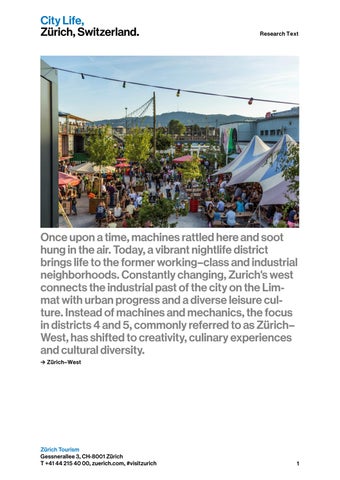
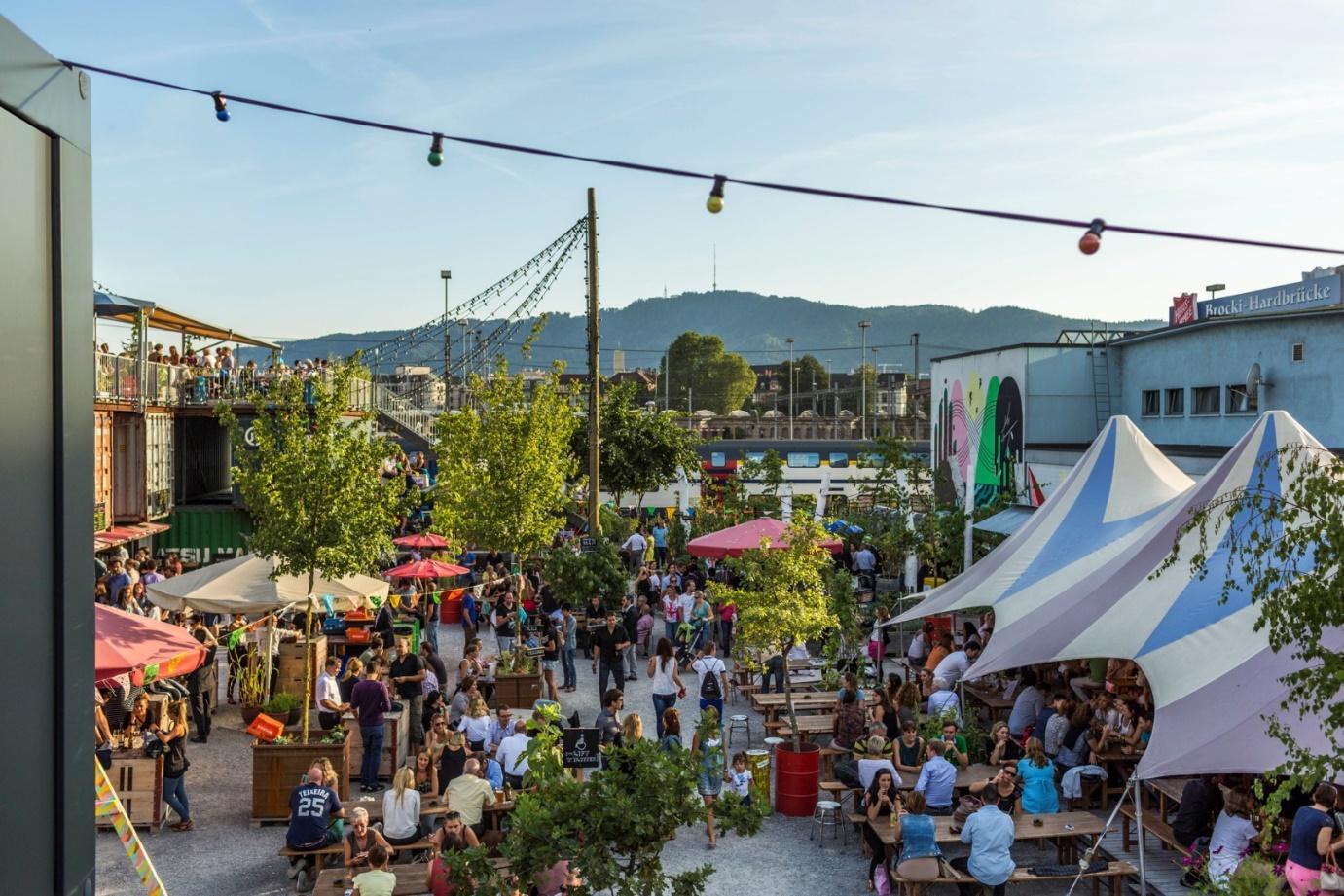
Once upon a time, machines rattled here and soot hung in the air. Today, a vibrant nightlife district brings life to the former working –class and industrial neighborhoods. Constantly changing, Zurich's west connects the industrial past of the city on the Limmat with urban progress and a diverse leisure culture. Instead of machines and mechanics, the focus in districts 4 and 5 , commonly referred to as Zürich –West, has shifted to creativity, culinary experiences and cultural diversity
➡ Zürich –West
Zürich –West: From Industrial District to Trendy Quarter
When Zurich residents talk about “Z ürich –West” today, they usually mean the area west of Langstrasse that stretches almost to Altstetten and is bordered by the railway tracks leading away from the main station to the south and the Limmat River to the north. T hanks in large part to its eventful past , today, the district is one of Zurich’s liveliest and most popular neighborhoods : For over 100 years, Zurich's west was known as the industrial district of Zurich, even though it only covered an area half a kilometer long. The most famous companies in Swiss industrial history were located here. The halls of the Schoeller textile facto ry were next to the machine and turbine factory of Escher Wyss AG, and the Maag gear factory was also based here. But industry and the economy were constantly changing, and not always for the better: when the soap and household goods manufacturer Steinfels had to relocate to Wetzikon outside the city in 1986 for cost reasons, it marked the beginning of a new era in Zürich –West
“Not a Place for Visitors to Zurich”
In a television program in 1992, the presenter said that Z ürich –West was “not a destination for visitors to Zurich, but a way to leave the city as quickly as possible.” Further business closures led to deserted streets and empty halls, which had a somewhat ghostly feel to them. But not for long: in the 1990s, Z ürich –West became a playground for creative interim uses , that breathed new life into the district. And when the Technopark – a place for knowledge and technology transfer with 250 companies and 1,800 jobs – was established on the former Sulzer site in 1993, a new chapter in the history of Zürich –West had definitely begun. In 1994, leisure facilities, restaurants, bars, and clubs sprang up on the industrial sites, as did the Cinemaxx multiplex cinema, now known as the Abaton cinema. Zürich –West was then called the “West End” and was a trendy district, especially for night owls and partygoers. In 2000, the Schauspielhaus theater opened a large theater stage with a bar and restaurant in the disused shipbuilding hall, and new residents moved into 102 condominiums in the Puls 5 building complex, including many artists, creative professionals, communications experts, and families with children. A new tram line was built, and with the relocation of Zurich University of the Arts (ZHdK) to this gradually revitalized district, the neighborhood once again became a hotspot. Since 2014 around 1,650 lecturers and staff, as well as 3,100 students, bring life to the site of the former Toni dairy, which was once the largest milk processing plant in Europe.
The Party District Then and Now
In the 1990s, Zürich –West was the hottest party district in Zurich. It was home to countless clubs that –sadly, as many Zurich residents would wistfully say – no longer exist today. They were called Dachkantine, Labyrinth, Luv, Rohstofflager, and Toni –Molkerei (this club was actually located in the disused halls of what was then the largest milk processing plant in Europe). Intellectuals, members of the LGBTQ+ community, ravers, and those on the margins of society all found a home here and celebrated night after night w ith veritable techno parties . For various reasons, such as a lack of safety regulations, drug dealing, illegal activities, and the departure of regular customers, many of these clubs had to
City Life, Zürich, Switzerland.
close, although some managed to survive into the 2000s. Nevertheless, the neighborhood has retained its party image to this day, and the techno stronghold has now become an electro mecca that is not only popular with locals but also enjoys a great reputati on far beyond the country's borders. Opened around 2000, the Supermarket and Hive clubs celebrate electronic music with excellent DJs and sound systems, but hip –hop lovers also feel at home in the district. For example, at the Gonzo or Exil clubs, where ro ck, pop, reggae, dancehall, and baile funk concerts are regularly held. For jazz and world music lovers, there is the Moods club at the Schiffbau, Labor5, or Aubrey, where a mixed crowd feels right at home. And those who enjoy salsa, bachata, or C ha C ha C ha will get their money's worth at the Bananenreiferei, where bananas used to be ripened.
Langstrasse: From Sin to Fun
Langstrasse and “Chreis Cheib”
Strictly speaking, only half of Langstrasse belongs to Zürich –West . Namely, the northern side of the tracks leading away from Zurich Central Station. This is district 5. District 4 – also known as Aussersihl – which stretches south of the tracks along Langstrasse towards the lake, is known to many Zurich residents as “Ch reis Cheib.” It is often mistakenly considered part of Z ürich –West. The word “Cheib” once referred to carrion, but today it is more commonly used as a swear word for a mean guy, a scoundrel. However, the term “Chreis Cheib” refers to the original meaning of the word: Aussersihl was once home to the city's pits for animal carcasses, mainly horses and small animals, which were referred to as “Cheib.”
From Independent Municipality to Den of Iniquity
From 1787 to 1891, Aussersihl was an independent municipality on the outskirts of the city of Zurich. A sharp increase in population in the 1860s and financial difficulties forced the municipality to ask the city of Zurich to incorporate it. The influx of Italian construction workers and brisk building activity further transformed the neighborhood rapidly. The cantonal police barracks, the Volkshaus, and the SBB main workshop boosted the neighborhood, which until the 1970s was mainly inhabited by foreign workers. Simple “Beizen” (pubs), inns, and restaurants for workers sprang up. However, Aussersihl soon became the city's red –light district, and marginalized people and those involved in the drug scene increasingly settled here, leading to an increase in drug dealing and crime. This led to massive problems in the 1990s, when the drug scene in Zurich degenerated, particularly in Platzspitz Park behind the National Museum and later at Letten railway station. In 2001, the “Langstrasse PLUS” project was launched, which achieved an improvement in public order and safety during its 10 –year run.
The Locals’ Choice
Since then, the neighborhood around Langstrasse has become much quieter. Countless takeaway restaurants, hip restaurant chains, studios, and design boutiques have set up shop here and enjoy a cheerful, multicultural coexistence. The clubs “Klaus,” “Gonzo,” “Heile Welt,” “Plaza,” and “Kanzlei,” as well as popular bars such as “Dante,” “Olé Olé Bar,” “Longstreet,” and “Stubä,” ensure lively evenings, especially on weekends, and enjoy great popularity. The long opening hours, so –called after –hour parties, and the possibility of getting a snack almost 24 hours a day create the perfect conditions for some
Zürich, Switzerland.
partygoers to be tempted to spend the night partying on the streets of Zurich or on one street in particular, namely Langstrasse.
Art, Design , and Music in Zürich –West
The transformation from a former industrial site to today’s creative district has been driven in part by a variety of museums and cultural institutions. At the Löwenbräu complex, a unique blend of the international art scene, local businesses, and city res idents comes together. Housed in a historic building dating back to 1897 – which originally served as a brewery – are numerous galleries , an art hall, the Migros Museum of Contemporary Art, and, since 2025, the Museum Haus Konstruktiv. Right on the banks o f the Limmat River, the 1990s saw the rise of a true pilgrimage site for art enthusiasts. Both the Kunsthalle Zürich and the Migros Museum host regular exhibitions that go beyond the conventional , working closely with artists based in the building or from around the world. Prominent names such as Francesca Pia, Gregor Staiger, and Hauser & Wirth are also located here, alongside the Luma Foundation, which supports artists and pioneers alike. With the most recent addition of the Museum Haus Konstruktiv, which relocated to the Löwenbräu site in 2025, the district has gained yet another valuable artistic institution. A little further west, the Museum of Design located within the Zurich University of the Arts features an impressive collection of 20th –century design classics, alongside fascinating exhibitions that explore the past and future of art, design, and graphic work. Belonging to the University of the Arts, m usic lovers will find club and bar “Mehrspur,” the performance venue for the Jazz and Pop Department of the Zurich University of the Arts. Public concerts feature internationally successful bands across genres like jazz, electro, indie, soul, and more. A similar vibe can be found at the “Moods” club. Known and loved as a jazz club, it also frequently hosts concerts under the “world music” label that enjoy great popularity. Located in the same building the Schiffbau are three performance spaces of the Zur ich Schauspielhaus, each one reimagined for every new theater production. Music also takes center stage at the Maag Music Hall. Situated near the Hardbrücke train station, this concert venue hosts shows, concerts, and events of all kinds.
Shopping in Zürich –West
Zurich’s creative economy is booming – especially visible in the trendsetting district of Zürich –West Textile and furniture designers, jewelry and fashion makers, architects, and graphic designers have set up studios and shops around the Zurich University of the Arts (ZHdK). Since 1999, The Gloss has been supplying urban, style –savvy city dwellers with a curated selection of brands like Wood Wood, Kitsuné, and Adidas. At Walter Vintage Möbel & Accessoires and the charming shop Bogen 33, everything revolves around designer furniture and vintage interiors.
Over at the Gerold site, near the well –known Frau Gerolds Garten, around 50 local designers showcase their work at an open –air design market at a seasonal open –air design market. Various sections of Frau Gerolds Garten are regularly transformed by different artists , each piece reflecting the season a specific theme, or a custom commission by Frau Gerold herself. At the back of the 2,500 –square –meter Gerold site lies the heart of Frau Gerold: her garden. There, she grows hand –picked vegetables
City Life, Zürich, Switzerland.
and delicious fruits without any chemical or synthetic additives. Right next door, inside a unique tower made of shipping containers, visitors will find 1,600 bags and accessories from the Zurich label Freitag , the world’s largest selection of “Individual Recycled Freeway Bags.” Under the arches of the viaduct, fashion –conscious shoppers and style hunters will discover a mix of Swiss brands like Kitchener and Tarzan, alongside international names such as Arc’teryx, Nudie Jeans, and Quicksilver. On the south ern side of the tracks, in the Triangel near the Kasernen area (Tribeka), which includes the still –young Europaallee, shopping enthusiasts will find locally crafted goods and Zurich –based makers. Trendsetters feel right at home here, drawn to the emerging Zurich design shops that offer something truly unique.
The Culinary West
Many creative restaurateurs in Zurich are transforming old brick buildings and former industrial halls into innovative dining experiences. The glass façade of the restaurant LaSalle, located in the city’s former industrial district, offers a view into the spacious Schiffbau hall – once used for welding and shipbuilding for international clients well into the 20th century. Just around the corner, a large warehouse has been converted into a cozy yet nostalgic hybrid of restaurant, bar, market hall, specialty shop, and social hangout: Les Halles is filled with collector’s items, from vintage racing bikes and quirky tin advertising signs to designer furniture. The restaurant has long been known for its house specialty : mussels served in a variety of styles. Not far from there, a culinary and shopping promenade was established in 2010 beneath the arches of the historic viaduct. At Restaurant Viadukt, diners enjoy light, seasonal dishes between massive stone walls. At Gerold Chuchi, the chef personally visits y our table to offer pasta advice . In the evening, tables are cleared to the side to make space for dancing guests at the adjacent Hive club. At Restaurant Steinfels, colorful 1970s –inspired decor sets the tone, with only a few design elements hinting at the building’s past. Where it once smelled of detergent and fragrances, today the air is filled with the aroma of grilled meats, melted cheese, and house –brewed beer. Next door, you can digest your hearty dinner in comfort at one of the twelve theaters in the Aba ton cinema complex. At the heart of the district rises the 126 –meter Prime Tower. On its 35th floor, Restaurant Clouds lives up to its name: with award –winning cuisine and a phenomenal panoramic view of Zurich and the Swiss Alps, diners truly feel like they’re on cloud nine. In the adjacent bar, guests can enjoy a glass of wine or a refreshing cocktail while taking in sweeping views of Zurich’s rooftops. A bit more secluded from city noise – yet visually striking thanks to its unique architecture – Nude caf é–bar sits directly on the Limmat River, boasting a spacious terrace that stays sunny late into the evening. With an extensive menu that delights both coffee and cocktail lovers, plus plenty of snacks for smaller appetites, Nude makes a lasting impression.
City Life, Zürich, Switzerland.
Events in Zürich –West
Among the many creative offerings in Z ürich –West are the design event Kreislauf 345 and the wild raves at Frau Gerolds Garten. Just next door, visitors can catch an urban surf vibe at a man –made Citywave that brings the ocean spirit to the urban city vibe . The energy is especially high during Urban Surf events, but surf sessions for all skill levels can be booked on regular days as well. When it comes to food, District 5 doesn’t fall short on events either: the annual Street Food Festival on the ”Hardturmbrache ” invites both locals and tourists to sample a diverse range of dishes from around the world. Right next to the Prime Tower, another culinary highlight seems to rise out of the ground, the Street Food Park Festival, an outstanding food event in its own right
Guided City Tour: Z ürich–West
The days when machines clattered and soot filled the air are long gone: Z ürich –West has transformed into a hotspot for night owls and trendsetters. On a guided tour led by Z ürich Tourism, visitors explore this former industrial district, discovering striking architectural contrasts between old and new, learning about successful redevelopment projects, and gaining insight into the fascinating history of this up–and –coming neighborhood. Today, foodies can indulge in one of the many international restaurants, fashion lovers will find what they’re looking for in the stylish boutiques under the Viaduct Arches, and architecture enthusiasts are captivated by the contrasting structures that make this area so unique.
Contact
Zürich Tourismus
Media Relations
Gessnerallee 3
CH -8001 Zürich
T +41 44 215 40 96
➡ media@zuerich.com
➡ zuerich.com/media
Images & Text
In our media database, you have access to our multifaceted world of images.