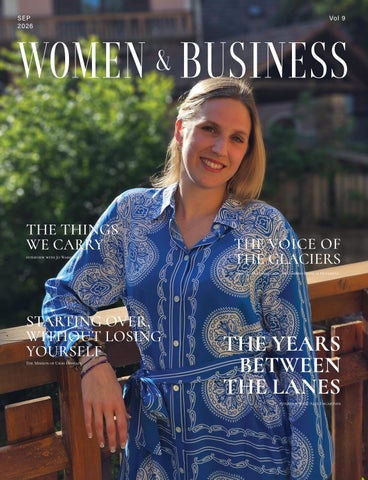
SEP 2026
THE THINGS WE CARRY interview with Jo Wareham
Vol 9
THE VOICE OF THE GLACIERS Marcela Fernández and the Cumbres Blancas Movement
STARTING OVER, WITHOUT LOSING YOURSELF
The Mission of Urmi Hossain
THE YEARS BETWEEN THE LANES interview with Alex Ehgartner
Editor’ Dear Readers, In 2026, more than one-third of recently published web pages already show signs of AI-generated or AI-edited content. We live in a world where artificial intelligence can write, design, brainstorm, translate, and create alongside us. And I believe this makes finding our own voice more important than ever. The problem is not that we use new technologies. Quite the opposite. We should use them. Especially as women, when so many of us are balancing businesses, careers, families, dreams, and a thousand responsibilities at once, these tools can make our lives easier and give us something incredibly valuable: time. So let’s use AI, embrace innovation, and make it work for us. But let’s not remove ourselves from the equation. Use your own photos. Keep the expressions and little phrases that sound unmistakably like you. Share your own experiences, your failures, your lessons, and the stories only you can tell. In a world where creating content has never been easier, being truly yourself might just become your greatest advantage.
’s
Letter In this issue of Women & Business Magazine, we bring you the stories of women who dared to dream big and, more importantly, decided to do something about it. You’ll meet multiple swimming champion Alex Ehgartner and discover her inspiring journey. You’ll read the unique story of Urmi Hossain, who built a life on the other side of the world as a woman from a third country and now supports other women with similar backgrounds. And you’ll meet Marcela Fernandez, who is leading an extraordinary movement to help protect the world’s glaciers. These are just a few of the many inspiring women waiting for you in this issue. So turn the page and meet them. Let their stories inspire you, but don’t forget that you have your own story to write, too. Technology can help us move faster, create more, and open doors we could hardly imagine a few years ago. But what we dream about, what we stand for, and what we choose to do with our opportunities is still entirely ours. Whatever your dream is, do something for it today.
BEYOND BALANCE
When and why did a healthy lifestyle become a central part of your personal brand? I went on my first diet at 12. That’s where this started. Not in a gym, not with a certification, but with a 12-year-old girl who thought something was wrong with her body. For years I chased a version of health that was really just about being smaller. It took me a long time to realize that movement could feel like something other than punishment. When that finally clicked, I couldn’t stop talking about it. That’s really when my personal brand was born. Not when I got my Pilates certification, but the moment I understood the difference between exercising to fix yourself and moving because you actually love your body.
How did your career in social media begin? For a long time I had this quiet voice in my head saying: “Who are you to talk about this?” I was studying Marketing, working in social media for other brands, and building entire content strategies for other people – while telling myself I had nothing worth saying. At some point that became embarrassing enough to act on. I started @pilateswithmagda almost as a private experiment. No big launch, no strategy. Just me, a camera, and the things I actually knew. Within months a supplement brand reached out to collaborate. That was the proof I needed: the right message finds the right people, but only if you actually send it.
4
You do something for yourself almost every day, and movement is clearly part of your routine. Why did Pilates become one of your favorite forms of exercise? I came to Pilates completely burnt out. I was working, studying, and training hard at a crossfit gym and I was exhausted in a way that more HIIT classes were making worse, not better. Pilates was the first movement practice that asked me to slow down and actually feel what my body was doing. Not just push through it. I remember the first time I properly activated my deep core. Not the superficial crunch muscles, but the real stabilizers underneath. It was such a small thing physically, but it changed how I understood my own body. That’s when I knew I wanted to teach it. Not the aesthetic version of Pilates. The actual science of it.
What is the one habit that truly changed your life? Treating my training like a non-negotiable appointment, not a reward for when everything else is done. For most of my life I put movement last. After work, after studying, after helping everyone else. And of course it was always the first thing to fall away when life got busy. Now my training days are in my calendar and my environment knows it. Not because I’m disciplined in some extreme way, but because I finally understood: I function better in every area of my life when I move. It’s not selfish. It’s actually the most productive thing I do.
5
Photos: Jacqueline Zsifkovits
In your opinion, how can a busy woman realistically and sustainably incorporate movement into her daily routine?
"Most women don’t need more
First, stop trying to copy the routine of your favorite fitness
motivation.
influencer. She works out for a living. You have a nine-to-
They need permission to stop
five, kids, a relationship, a life you actually want to live.
punishing themselves."
And that influencer’s 6am two-hour training split was never designed for you. Beyond that, most fitness advice is built around male physiology anyway. As women, our energy, recovery
secret behind a successful online presence today?
capacity, and motivation naturally shift throughout our cycle, and fighting that is exhausting.
Having an actual point of view and being willing to stand behind it even when it’s uncomfortable.
The women I work with who build the most consistent habits
The wellness space on social media is full of people
are the ones who stop asking “how do I find motivation?”
saying the same things in slightly different fonts.
and start asking “what does my body actually need this week?”
What cuts through is when someone says something true that most people are thinking but no one is saying out loud.
Sometimes that’s a gym session. Sometimes it’s a walk or Pilates. Both count.
For me that’s things like: the fitness industry has a financial interest in making you feel broken.
As a conscious content creator, what do you think is the real
6
Or: more is not always better, especially for women.
And honestly: I try to stay true to that even when it comes to
It’s not.
my own content. Showing up consistently for your followers is something I genuinely struggle with. I’d love to share
Health is something you build by actually listening to
more, but a day only has 24 hours and I refuse to post
your body, by moving in ways that feel good, by fueling
something just to fill a slot.
yourself properly, and by stopping the war.
When I show up, I want it to mean something.
Every body is a Pilates body. Not because Pilates is magic, but because every body deserves to be understood, not just pushed.
What is the biggest mistake you see people making on social media? Copying other people’s content without making it their own. I get it! You see something that works, you want to try it. But your followers follow you because of you, not because of the format. I’ve been guilty of this myself: scrolling, getting inspired, and then wondering if I should just recreate what someone else did. But every time I’ve shown up as myself, spoken from my own experience, shared something I actually know, that’s when it lands. The mistake isn’t lack of strategy. It’s lack of courage to just be specific about who you are.
If you could share one message with the readers of Women & Business, what would it be? I started my first diet at 12, convinced something was wrong with me. 17 years later I work with women who are still carrying that same belief: that health is something you earn by being smaller, stricter, more controlled.
"Your body is not a project to be fixed."
7
8
THE VOICE OF THE GLACIERS Marcela Fernández and the Cumbres Blancas Movement
Today, many people know you as a glacier advocate, but
You
let’s start at the beginning. What kind of child were you
disappearing
once
said
that
glaciers
reading
about
completely
Colombia’s
changed
the
growing up in Medellín? What have you carried with
direction of your life. What happened inside you at
you from Colombia that still shapes who you are today?
that moment? Why couldn’t you simply turn the page?
I was a very active child and often took the lead in
What shocked me most was discovering that eight
different sports. I even started the football team at my
glaciers had already disappeared during the previous
school. When I was fourteen, I travelled to Norway to
century, yet we had never learned anything about them.
represent my school’s environmental project. It was my
Our grandparents had never told us what it was like
first time in Europe. I attended a youth event focused on
to realise that a glacier had disappeared. I feel that, at that
climate and sustainability. Our project centred on a native plant growing in
moment, the ignorance and frustration inside me turned into a loud whisper.
the forest surrounding our school. We also worked on
It became clear that our next step had to be the
recycling and water-related issues. One of the initiative’s
creation of a multidisciplinary team. We wanted to produce
most important messages was the protection of water —
documentaries and a book that would serve as a tribute to
and after all these years, that holds particular meaning
our glaciers. We also needed to find the people who truly
for me today.
understood what was happening. Science became the backbone of our work, but we also understood that dialogue between different forms of knowledge could bring this movement to life in Colombia. What we never expected was for it to become global so quickly.
9
While many people follow a traditional career path,
I believe my journey towards leadership
you shaped your own learning journey through
began during childhood. However, my
working with scientists, Indigenous communities,
education was truly shaped by my decision
and mountaineers. What has this unconventional
to leave university. I chose an alternative
path taught you about leadership?
educational path in which I treated my own life as an experiment. I discovered the cause of glaciers only seven years ago, and suddenly everything made sense. Before founding the NGO, I had explored many different roles and created several businesses. Entrepreneurship connected all those experiences. Eventually, I realised that environmental protection was the path I needed to follow. It became my cause, my calling, and my life’s purpose. It was important to bring people with different perspectives to the same table and recognise that glaciers are like abandoned orphans. Less than three per cent of all the water on Earth is freshwater, and seventy per cent of that freshwater is stored in glaciers. Glaciers are reservoirs, water towers, and the refrigerators of our planet. They are the martyrs of climate change, yet they do not have truly powerful representation. When I read that newspaper article, I realised how little we knew about them. Today, I see the same lack of awareness in more than forty glacier countries around the world. This is why we created the Glacier Nation Global Challenge. I believe that leading a grassroots movement means giving other people the opportunity to recognise that they also have a path through which they can become leaders. This is not my organisation, my project, or my vision. It is a shared vision and a form of collective wisdom. That is what we are working towards.
10
In your work, you combine science
These places invite us into deep
with storytelling, photography, and
contemplation. When you stand on a
filmmaking. Why do you believe that
glacier, you can hear yourself, and you
a powerful story can sometimes create
experience solitude in a profoundly
more change than scientific data alone?
reflective way. You enter a kind of meditative state in which everything speaks
The essence of our work is reaching
to you — especially when you witness a
people’s hearts. Science can speak to our
glacier disappearing before your own eyes.
heads, our brains, and our minds, but that
It teaches us so much about resilience.
information can sometimes be paralysing. It can increase climate anxiety and does not necessarily show us how we can work
As a TEDx speaker, you have shared
together or contribute to change.
your message with audiences around the
Our movement gives people the
world. How is speaking on a TEDx stage
opportunity to place their time, abilities,
different from leading people on a glacier
and talents at the service of a cause. You
expedition?
do not need to be an expert. You only need the desire to help and an interest
When I spoke on the TEDx stage, I did
in a reality that may be new to you—or
not yet know that one day I would work
one that you have seen for a long time
with glaciers or take part in expeditions. At
without believing that you could do
the time, I spoke about leaving university
anything about it.
and choosing an alternative path of
This
is
why
teamwork
is
so
important. It is how we become a family and how people gain a sense of belonging. Some people’s stories are similar to mine. They discover this cause through a
learning. I was at a completely different stage of my life. I encouraged people to find their own path and rhythm. I also spoke about one of my projects, a venture that used the entire world as a classroom.
Reel, a presentation, or one of the other
When I stood on that TEDx stage,
formats we use, and it can change their
I never imagined that I would one day
lives too. It gives them a sense of purpose
travel to the highest mountain peaks or
to know that they can contribute to
work with Colombia’s tropical glaciers.
something and that we are working with
Life has its own way of showing
sacred ice, the origin of life, and water.
us where we belong. For me, glaciers
Working with glaciers is also a
became my true north and my point of
deeply spiritual journey. Many religions
orientation. Everything I had done before
regard them as sacred. In the Andes, for
dedicating my life to them suddenly
example, they are honoured as beings in
made sense: the skills I had gained, the
their own right, as apus and spirits. The
relationships and networks I had built,
same is true in the Himalayas, where
and the feeling of waking up each day
tradition says that Shiva resides.
knowing that every action has meaning.
11
We work with one of the most vulnerable ecosystems on our
For someone who has never seen a glacier, why
planet. Despite the urgency of the situation, we do not want to
should they care? What do glaciers represent beyond
communicate a nostalgic, melancholic, or apocalyptic message.
their environmental importance?
Ours is a message of hope: this generation truly has the power to change the direction of humanity’s future if we listen to what the glaciers are telling us before it is too late.
Glaciers are the thermometers of our planet. They reveal what is happening to the Earth. They are the only ecosystem in the world that cannot be restored or recreated. As I said earlier, glaciers are the martyrs
The BBC named you one of the world’s 100 most influential
of climate change.
women. What did this recognition mean to you personally?
The evidence is undeniable when we compare a
Did it change the way you viewed your responsibility as a
photograph of a glacier today with one taken fifty years
leader?
ago. Glaciers do not lie. They have witnessed global warming. Snow is made of crystals, and glaciers are
The recognition was completely unexpected. I received the news from the BBC six months after my mother passed away, while I was still grieving. There is a saying: “No one is a prophet
nourished by snow. When you stand before one, it can communicate more to you than any book or film. You are standing before a majestic being that is
in their own land.” That was exactly what this recognition meant
giving its life for us, drop by drop. This is why it is
for us. It was the moment when people in Colombia began to
important to connect with glaciers emotionally, rather
notice the previously almost invisible work of Cumbres Blancas.
than approaching them solely through logic and
It naturally gave us enormous credibility, and the BBC recognition
reason.
opened new doors for us. The following year was declared the first International
Glaciers are humanity’s cathedrals and temples. For many ancient communities, they represent God.
Year of Glaciers’ Preservation by UNESCO. This gave
In a spiritual sense, therefore, we are losing God.
tremendous momentum to the cause. Everything pointed
What happens then? Humanity loses its compass.
towards the need to carry forward and amplify the message that had begun in Colombia.
According to the Kogi people, glaciers are melting seven thousand years before their appointed
By then, we had already started working in Peru, Ecuador,
time because we, as human beings, need to melt the
and Mexico. Through Glacier Nation, it became a truly global
emotions within ourselves. We need to feel things we
mission. I do not believe this is about holding the microphone
have never felt before.
or standing on the stage. Of course, these opportunities are
I believe this is closely connected to grief, but
important, and the BBC recognition opened many doors for us.
also to impermanence. Glaciers are teachers of
Above all, however, they call on us to keep humility at the heart
impermanence and constant change. They invite us to
of our work.
melt those emotions within ourselves, to awaken, and
This has never been about ego or accumulating more and more recognition. It is about doing the work that needs to be done.
to expand our awareness. We still have time, and the moment to pay attention has arrived.
Marcela Fernández instagram.com/marceglaciar/ linkedin.com/in/marcela-fernandez-55067426/
12
The expeditions you organise are about much more than visiting glaciers. They are about connection, reflection, and transformation. What do you hope women will take away from sharing this experience with you? I believe this gives us an opportunity to co-create expeditions designed especially for women. I would truly love to bring this project to life. At the glaciers, we hold ceremonies of gratitude rather than funerals. For a time, it became common for people to hold funerals for glaciers as a way of saying goodbye to them. We prefer to focus on expressing gratitude. We also organise water ceremonies using water collected from different sources around the world. When I visit a glacier, I carry water from other landscapes with me, and then I take some of the glacier’s water onwards to another place. Through the water ceremonies we hold at different events, we encourage people to discover and learn about the body of water closest to their own homes. When we enter sacred places such as glaciers, we arrive with reverence and walk through them with devotion. After experiencing such a sacred space, we cannot return as exactly the same people we were before. There is a clear “before” and “after.” We shape these expeditions like pilgrimages so that they can touch and transform us. I would love to create more of these experiences together with you and other women. The deeper purpose is greater than visiting glaciers simply because they may disappear and we want to see them before it is too late. That may be one form of motivation, but the true purpose is to speak with a wise elder—one of the most ancient voices still among us. We still have time to listen to its teachings before it is too late.
13
THE YEARS BETWEEN THE LANES Alex, at first glance, your career seems to span two very different worlds. On the one hand, you are a pharmacist and a member of the Medical Department at Institut AllergoSan; on the other, you compete internationally as a swimmer. How do these two passions come together in your life, and in what ways do they complement each other? I would say they complement each other very well. I have always had a keen interest in the human body—how it works and how different substances affect it.
— for whatever reason — and jumped straight into the pool. Naturally, I sank
The same curiosity plays an important role in sport, where understanding how
like a stone, and my father immediately
the body functions is equally essential. Dealing with the occasional injury has
jumped in after me.
naturally encouraged me to explore the subject even more deeply. Everyone
thought
I
would
never
go near the water again, but they Swimming has been part of your life since childhood. What first drew
were wrong. I was determined to
you to the sport, and was there a defining moment when you realised
learn how to swim, so my parents
it would become much more than just a hobby?
signed
me
up
for
lessons.
That
was the beginning of everything. The story of how I started swimming is actually quite funny. It all began in my great-aunt’s swimming pool.
I competed for the first time in 1999, when I was eight years old, and I
I was around five years old and could not yet swim on my own. One day, my parents
have been swimming and competing
had just come home from work. I greeted them, pulled off my swimming wings
ever since.
14
Elite sport and scientific work both
demand
perseverance,
and
discipline, curiosity.
Looking back on your journey, what
lessons
has
swimming
taught you that have shaped the professional you are today? And has your scientific career changed the way you approach sport? Competing at an elite level teaches you
discipline,
organisation,
teamwork, ambition, and, above all, how to deal with defeat. In short, there is no success without hard work. These
lessons
have
helped
me
immensely, first at school and later throughout my professional career. One thing is certain: without these skills, I would never be able to combine my career with competitive sport. At the same time, my professional work has shown me just how important it is to take care of my body—and to Through your work at Institut AllergoSan, you contribute to improving
listen to my gut instinct.
people’s health. Could you tell us more about your role, what your work involves, and what inspires you most about your profession? At Institut AllergoSan, I work in the medical and scientific department, where I provide professional consultation and advice. My responsibilities include responding to enquiries by email and telephone, as well as giving presentations on gut health. What I enjoy most is working with people. My role is highly varied, and there is always something new to learn. Health—and disease prevention in particular—is extremely important to me. The gut plays a central role in both, yet its significance is still often overlooked. Raising awareness is therefore essential, and I am very proud to contribute to
Interview with Alex Ehgartner
this work.
15
Together with your husband, you share not only a life but also a passion for coaching the next generation of swimmers. What is it like to experience this journey together, and which values do you hope to pass on to the young athletes
you
mentor
beyond
athletic performance? I have always wanted to be a role model for young people and to share both my experience and my passion with them. I understood very early on that I would not be able to make a living from swimming, as this is extremely difficult in Austria. I also knew that balancing competitive sport with a professional career would not be easy. Many people reacted dismissively when I told them that I wanted to become a Masters
© Arvid Auner
swimmer and follow a different path.
"
"
I am deeply grateful to everyone who supported me and helped make this journey possible.
A great deal has changed in the world
Behind every success lie dedication,
Many of my friends from the swimming
of sport since then. Opportunities such
sacrifice,
as
and
resilience.
Have
team had already left the sport, and my
moments
when
own performance was no longer what it
the
there
been
justice system or the police force, along
you
questioned
with
professional
training
within
your
path
or
had once been.
programmes,
faced setbacks that tested your
now make it much easier for athletes
determination? What helped you
During that time, I often went swimming
to
distance-learning
move forward, and what continues
alone. It was then that I found something in
professional education.
to motivate you to set new goals?
the water beyond training: a place of peace
My husband and I share a deep love
Of course. I believe every athlete
myself to drift. After graduating, I moved
of swimming. For both of us, the most
experiences moments like these and
to Graz and joined a new training group.
important thing is that the children enjoy
knows that feeling.
Gradually, my motivation, passion, and
combine
elite-level
sport
with
and quiet. Sometimes, I would simply allow
performance all returned.
what they are doing while developing skills that will benefit them throughout
My motto is simple: fall down, get back up,
their lives.
adjust your crown, and carry on.
There were further ups and downs along the way, particularly because of injuries,
When you find joy in what you do, success
One
periods
but every setback made me stronger and
follows naturally.
came during my final year at school.
taught me something new about myself.
16
of
the
most
difficult
When you look back on
Things can often seem impossible. The most important step is the first one: beginning
everything
you
have
the journey and fighting for what you love.
achieved
far—in
both
professional
and
your
so
athletic
career—which
It is equally important not to lose yourself along the way. Even if you stray from your path, there is always a way back, no matter how difficult or uneven the road may be.
accomplishment makes you most proud? It does not
I wish every reader great success on her own journey.
necessarily have to be a medal or a title, but perhaps
I would also like to take this opportunity to thank everyone who has made my
a moment that holds the
journey possible. My deepest gratitude goes to my parents, my brother, and my
greatest personal meaning
coaches—especially Mario, Doris, Stefan, and Martin. I would also like to thank my
for you.
friends, supporters, and sponsors, particularly Institut AllergoSan.
I
am
incredibly
grateful
to
everyone who has accompanied me on my journey and to those who continue to support me today. None of this would have been
possible
without
them,
especially my family and my coaches. There are many moments that make me proud, including, of course, the medals and sporting successes. Above all, however, I am proud that I have managed to come this far without allowing myself to be discouraged by those who said it could not be done.
Many Women & Business readers demanding
are
balancing
careers
while
trying to make space for the passions that truly fulfil them. Based on your own journey,
what
message
Alexandra Ehgartner (Raus)
would you like to share
instagram.com/swim_peak_performance_/
with them? What do you
linkedin.com/in/alexandra-raus-a6933a333/
believe it is never too late to pursue?
17
Starting Over Without Losing Yourself The Mission of Urmi Hossain
18
Urmi,
story
spans
cultures,
I believe it is important to adapt and
Eventually, it was a friend of mine
countries,
your
and
careers.
With
integrate into new places while staying
who helped me realize that we can
Bangladeshi
roots,
up
true to your roots and where you
create change in people’s lives even
in Italy and building your life in
come from. Whenever I travel or visit
within our own local communities,
Canada, you've experienced what it
a new country, I remind myself that I
and that perhaps the best place to
means to belong to different worlds.
am a guest at someone else's home. It
start is right where we are. That shift
How has this multicultural journey
is important to respect local traditions,
in perspective encouraged me to start
shaped the person — and the leader —
appreciate
taking action on some of my passions.
you are today?
places as we find them. I believe that
There were moments when I
embracing another culture also means
struggled to put myself out there. For
experience
respecting the people who call it home.
instance, I was shy about sharing
of traveling the world, growing up
Overall, my multicultural journey
my story or even posting a picture
Unexpectedly,
growing
my
the
culture,
and
leave
across different countries, and being
has shaped me into someone who
of myself online. But over time, as I
immersed in different cultures, people,
is
empathetic,
became more comfortable with the
and languages has given me a different
adaptable, and willing to embrace
different initiatives and actions I was
perspective on life in general.
opportunities with confidence.
taking, I started to feel more confident
First, I learned to live outside my comfort zone. I am not afraid to try
more
I
open-minded,
into
in the online presence I was building.
opportunity — and even more proud
turned
uncertainty
I realized that even the smallest
different things or embark on new
that I can now create spaces where
actions
personal and professional adventures
others can pause, celebrate, and feel
connections and reach people far
because my past experiences have
special, too.
taught me to live life more audaciously.
create
meaningful
beyond my immediate community. What started as small steps eventually
Second, I learned to be more empathetic, both as a person and as a
could
allowed me to touch lives on a much By day, you work in corporate finance,
broader, even global, level.
leader. In the world we live in, we are
while outside the office you are an
surrounded by people from different
author, speaker, podcast host and
In
your
book,
Discovering
Your
cultures, traditions, and customs, which
advocate for women in leadership.
Identity: A Rebirth from Interracial
has made me much more mindful of
Was there a defining moment when
Struggle,
the words I use, my communication
you realized you wanted your career
personal journey of identity and
style, and how I approach others. For
to be more than professional success
belonging. What inspired you to tell
instance, as someone who doesn't
— that you wanted to create a broader
this story, and what did you discover
eat pork or drink alcohol like me, I
impact?
about yourself in the process?
you
openly
share
your
appreciate it when those preferences are taken into consideration at events.
Wanting to create an impact was
To me, that's what being mindful
always something that stayed in my
another self-published author named
of diversity means. I apply the same
mind from an early age. A part of me
Saleha
Mirza,
mindset
events
wanted to change the world, make
reached
out
through my involvement with Women
people’s lives better, and become a
book, Confessions of a Brown Girl.
when
organizing
I was inspired to write my book by whom to
after
I
personally
reading
her
in Leadership. Inclusion is never one-
changemaker myself. However, I often
As a brown girl myself, I deeply related
size-fits-all.
doubted myself because I felt like my
to her story, and I thought that if she
I
learned
to
be
actions needed to reach the moon, and
managed to create such a strong connection
adaptable.
Lastly,
They
say,
"When
in
I wanted to create a massive impact
with her readers, maybe I could do the
Rome,
as
Romans
do."
right away.
same. That’s how my book came to life.
do
the
19
During the same period, I was also
In terms of home, I learned that
You're
passionate
about
personal
making several podcast appearances,
for many people, it is not always a
branding and often encourage others
and the topic of conversation was
physical place, but rather a feeling
to build their own voice. In a world
always my experience of being a
attached to memories, people, food,
where everyone is trying to stand out,
Third Culture Kid (TCK). Podcasters
sounds, and the connections they
what do you believe makes a personal
were very intrigued by my cultural
make along the way. The concept of
brand truly authentic—and what are
background and what it felt like being
home is something many people reflect
the biggest mistakes people make when
in-betweenish. It felt like the perfect
on, especially when they choose to
trying to build one?
opportunity to transform my story into
leave their physical home in search
a written format.
Through
your
podcast,
Stories
Beyond Borders, you've had countless
of a better lifestyle or when they are
I think what makes personal
unexpectedly separated from it. Often,
branding truly authentic is honesty,
home
transparency, and humanity.
is
connected
to
childhood
memories and the moments that create a sense of nostalgia.
conversations with people who have
We live in a world where we often want to imitate others, become
The concept of resilience is
someone we are not, and that is one
started over in new countries and
deeply
and
of the biggest mistakes we can make.
cultures.
bravery. Many people I have spoken
We forget that for people to connect
personal stories, what has been the
with
most powerful lesson you've learned
to
about identity, resilience and finding a
That courage comes from leaving
the values we carry. When you are
place to call home?
behind familiarity and moving to
not genuine, people can sense it;
a completely foreign land with no
authenticity cannot be manufactured.
existing connections and, sometimes,
With personal branding, it is
After
hearing
so
many
In terms of identity, I learned that it is not something fixed, but something
linked leave
build
to
courage
their
home
country
with us, we need to show up as who
new
life
elsewhere.
we truly are, what we stand for, and
a
no knowledge of the language.
important to remember that you
that is constantly evolving. Many of
The resilience of many of these
should be yourself, regardless of the
my podcast guests come from very
individuals is discovered through the
setting, situation, or circumstance. It
diverse and multicultural backgrounds.
challenges they face along the way—
is about carrying yourself with dignity,
Some have parents who come from one
whether it is finding a job, learning how
respect, and authenticity.
country, while they themselves grew up
to drive, adapting to a new language, or
Personal branding is also about
somewhere else and studied in another
figuring out everyday tasks like opening
continuous reinvention, pivoting, and
place. When it comes to identity, the
a bank account. They work hard not
patience.
definition can often feel blurry, with
only to survive but eventually to thrive,
Building a personal brand takes
added layers of complexity because of
driven by determination, perseverance,
time. It requires discovering what
their experiences.
and motivation.
you are good at, understanding what
Many have learned to become
Starting from scratch takes courage,
makes you unique, and reminding
comfortable with the idea of being in-
but rebuilding yourself along the way
yourself that just because someone else
between — not belonging entirely to
takes an even greater level of bravery.
is doing something similar, it does not
one place or another — but instead
of
mean you should offer the same thing.
embracing their in-betweenness as a
reinvention. Behind every move is a
No one else can do what you do in the
strength and a unique part of their story.
reason, a sacrifice, and a dream.
exact way that you do it.
20
Everyone
carries
a
story
Personal branding is personal to you—your history, your experiences, and your personality. People do not connect with you only because of your product or service; they connect with you because of who you are and how you make them feel after an interaction. As Co-Chair of Women in Leadership Montreal, you help create opportunities for women to grow, connect and lead. In your experience, what holds talented women back most often, and how can they overcome those barriers? They all have a special meaning in my life. They all give me the validation that “I can do things.” Being able to build a career while also writing a book, launching a podcast, and serving a community of women is not something that everyone can say. I have turned my words into Urmi Hossain
actions, and that is what I feel most
linkedin.com/in/urmihossain/
proud of. It is a reminder that when
instagram.com/storiesbeyondborderspodcast/
you put your mind on something and are willing to put it in work, you can achieve your dreams. For me, it is about turning ambition into action.
Many of our Women & Business readers are currently navigating change—whether it's a new career, a new country, a new business or simply a new chapter in life. If you could leave them with one piece of advice about staying true to themselves while embracing new opportunities, what would it be? • Never lower your standards to be complacent to an environment that requires you to shrink yourself to fit in. • Your diversity is part of your storytelling; use it to build your personal brand and make it your unique competitive advantage. • Be visible in places where opportunities exist, conversations are happening, and your presence can make a difference.
21
the things
we carry
interview with Jo Wareham
I first met Jo in New Zealand in 2014. I arrived at her home as a Couchsurfer, essentially a stranger knocking on her door. Yet she welcomed me with warmth, curiosity, and a rare openness, as if trusting someone she had never met was the most natural thing in the world. Perhaps it is no coincidence that this same openness, empathy, and belief in people have shaped Jo’s entire professional journey.
22
What led you to psychotherapy and working with people
You have worked with people experiencing homelessness,
affected by family violence? How much of your values
survivors of abuse and people in prison. What does it
come from your family and roots?
mean to give someone a genuine second chance when others may have given up on them?
I grew up in a home with a violent father, and as the first born child, I was the target of much of his anger because I was the 'wrong' gender.
I am very aware that there are both victims and perpetrators. In my experience, many perpetrators have themselves experienced horrific incidents during childhood.
Initially, my motivation for studying psychotherapy was to look more deeply into myself following the death
Having said that, I have also met offenders who have come from wonderful,secure, loving homes.
of my Mum, with whom I had a very close relationship.
I believe that we need to give people genuine second
Her loss had a profound impact on my life. It was my
chances, without expectation or judgment. Research
Mum who instilled a sense of compassion, caring and
shows that patterns of offending can be difficult to
empathy.
break, but when people are willing to engage with
She lived by the belief, “There, but for the grace of
support, they can develop greater insight and awareness.
God go I’. Her faith guided her, and she became as an
Knowlege is power, and sometimes that knowledge is
example to our family of campassion and acceptance.
the beginning of change.
My great-grandmother was also a suffragette here in
Yes, at times it can be frustrating to sit back and watch
New Zealand. In many ways, I have followed the path of
someone repeat the same patterns. But I believe that if we
my female forebears, woman who believed that being a
continue to support, encourage and motivate people, there
female was not a limitation but a strength.
is alwaus the possibility that the outcome will change.
2. You have dedicated much of your career to supporting
Throughout your career, you have encountered many
women and families. How do you see women’s rights
difficult and traumatic stories. How did you learn not to
and position in society today? Where is change still most
take these cases home with you?
needed? I have always had an ability to compartmentalise, We are definitely not there yet.
although learning to leave difficult cases at work is something I have developed over time.
It distresses me to see that women in New Zealand
On my way home, I make a conscious effort to shift
are still fighting for pay equity in 2026. That is shocking!
focus away from the working day and towards home and
Women are truly remarkable. They carry and nurture
the things I am looking forward to.
children while very often working full time as well. When
Some stories inevitably stay with you, particularly
a child struggles with identity, sexuality, or life more
when you feel a strong connection with a client. I have
generally, it is often the mother who carries an enormous
learned that acknowledging and processing those
amount of guilt and responsibility. I find that heartbreaking, because every idividual
experiences is important. It allows me to reflect on what has happened, recognise the impact it may have on me,
has their own journey, and we cannot always protect our
and then move forward without carrying the emotional
children from the challenges they will face.
weight of the work into my personal life.
23
From frontline support work to leadership positions,
Welcoming a stranger into my home felt natural
which role felt closest to you? And what does a successful
to me because I believe that trust, kindness and human
career mean to you today?
connection are incredibly important. I would also like to add Orsi, that you were so lovely, kind and thoughtful.
At heart, I have always loved working with people, and that has remained important to me throughout my
You were incredibly easy to accommodate, and welcoming you into my home felt completely natural.
career. Today, I enjoy contracting my services because it gives me the freedom to choose work where I feel I can make a meaningful contribution, especially in the prison environment. For me, leadership has also been about recognising that people have lives and responsibilities beyond the workplace and finding ways to support them. One example that has always stayed with me was encouraging a pregnant staff member to return to work with her baby rather than feeling she had to immediately place him in a creche. It meant she could continue doing the work she valued without the anxiety of being separated from her baby, and his presence brought something positive to the workplace. Experiences like that have shaped what success means to me. A successful career is not simply about the positions you have held; it is about the difference you have made to people along the way.
When I arrived at your home as a Couchsurfer in 2014, you welcomed me, a complete stranger, with incredible warmth and trust. Where does this openness and trust in people come from? I believe much of this comes from my Nana and my Mum. They were both incredibly kind, caring, compassionate and non-judgmental women, and I strongly believe that their influence shaped who I am and contributed to my openness and genuine care for others. As the mother of eight children, I also developed a strong maternal instinct and an affinity with younger generations. I naturally feel protective and supportive towards them. While I may not form a strong attachment to everyone I meet, when I do develop a connection with someone, I am extremely loyal and committed to that relationship. I think these experiences have taught me to approach people with an open heart, to look for the good in them,
Jo Wareham
and to give people the benefit of the doubt.
https://www.linkedin.com/in/jo-wareham-0537b049?
24
Family has always played an important role in your life. How did you balance it with such an emotionally demanding career? There were times when I feel I let my family down. I put my career first, and to be totally transparent, I still carry some guilt about that. I worked very long hours, and that inevitably took time away from my children. If I could travel back in time, I would find a better balance between work and home. Of all the incredible experiences I have had in my life my children would be the most wonderful gifts. They have travelled this journey with me, and I am incredibly grateful for their love, their understanding and for allowing me to be who I am.
What values would you most like to pass on to the next generation, particularly to women and girls? Girls can do anything. I strongly believe that women need to support one another. I find it deeply disappointing to hear women demean, criticise or belittle other women. I would simply remind them that, while aiming for the stars, we should never lose sight of who we fundamentally are. Success is important, but so are the people who journey alongside us. I feel incredibly fortunate to have had such a varied and meaningful career. I have met some extraordinary people and been privileged to share in parts of their lives that have often been incredibly difficult. If there is one thing my career has taught me, it is that people are far more complex than the circumstances we sometimes see on the surface. Everyone has a story, and sometimes what makes the greatest difference is simply having someone who is willing to listen, believe in you and give you the opportunity to do things differently Take the time to check in with those around you your partners, your children, your family and your friends. Make sure that while you are pursuing your own goals and ambitions, you are also nurturing the relationships that matter most.
25
2026
In , We’re Finally Learning to Stop Fighting Our Skin
If I had to sum up where skincare and wellness are
The biggest direction for 2026 is surprisingly
heading in 2026 according to the leaders of the
sensible: long-term skin health. We are no
industry, I would say that we are finally beginning
longer asking only what will make our face look
to sober up after years of collective madness,
smoother tomorrow morning, but what will keep
during which every week brought us a new
our skin healthy, hydrated and resilient ten or
miracle ingredient, a new mandatory routine and
twenty years from now.
another TikTok video explaining that everything we had been doing was completely wrong.
We are also accepting that skincare does not end at the jawline. Sleep, stress, hormones, nutrition,
For years, we treated our skin like a permanently
movement and recovery all show up on the skin
unfinished project that needed to be exfoliated,
because our face is not a separate decorative
tightened, brightened and preferably made to look
surface. I realise it is mildly inconvenient news
ten years younger within three business days. If that
that four hours of sleep and constant stress
failed, we simply added another acid, another active
cannot be erased with a generous layer of cream,
ingredient and two extra steps whose names we could
but the human body is unfortunately a little more
not pronounce but apparently could not live without.
complicated.
26
The era of ten- and twenty-step routines is also fading as we realise that more products do not automatically create better skin. Sometimes they simply create more irritation and a small logistical operation every evening. The goal is not to solve our entire life with one jar, but to give every step a purpose and build a routine we can genuinely follow. The skin barrier is finally receiving the attention it deserves, because if we repeatedly strip, overexfoliate and dehydrate it, the rest of our carefully chosen routine cannot perform miracles. Especially when we try to repair the damage caused by too many active ingredients by applying even more active ingredients.
The homemade beauty laboratory is losing some of its magic as well. Just because something is natural — or edible — does not mean it belongs on our face. Our skin does not need romantic stories, viral miracle remedies or half of our breakfast. It needs safe, thoughtful and consistent care. Perhaps that will be the real luxury of 2026: we no longer expect to see an entirely different woman in the mirror every morning. We simply want to keep seeing ourselves — healthy, radiant and well — for a very long time.
Yours: Barbara 27