CURRICULUM
2027 Curriculum Handbook CURRICULUM HANDBOOK | 1
Useful contacts YEAR 7 DEAN TBC YEAR 8 DEAN Ashleigh Ward a.ward@rangiruru.school.nz YEAR 9 DEAN Jon Kimber j.kimber@rangiruru.school.nz YEAR 10 DEAN Julie Watkins j.watkins@rangiruru.school.nz YEAR 11 DEAN Debbie Robertson d.robertson@rangiruru.school.nz YEAR 12 DEAN Leigh Allan l.allan@rangiruru.school.nz YEAR 13 DEAN Alex Priest a.priest@rangiruru.school.nz INTERNATIONAL STUDENTS Louise Stanton l.stanton@rangiruru.school.nz CAREERS AND PATHWAYS ADVISOR Victoria Gray v.gray@rangiruru.school.nz
Useful links RANGI SCHOOLBOX https://rangi.schoolbox.cloud/ NEW ZEALAND MINISTRY OF EDUCATION www.minedu.govt.nz NEW ZEALAND QUALIFICATIONS AUTHORITY www.nzqa.govt.nz TE KETE IPURANGI www.tki.org.nz CAREERS NEW ZEALAND www.careers.govt.nz
Contents Rangi Ruru Subjects and Pathways
4
The Curriculum Handbook
6
The New Zealand Curriculum
7
New Zealand Qualifications
8
Reports, Assessments and Examinations
11
Rangi Ruru Special Programmes
12
Specialist Support Programmes
13
Pathways and Careers
14
Years 7 and 8
15
Years 7 & 8 Subjects
16
Year 9
20
Year 9 Subjects
21
Year 10
26
Year 10 Compulsory Subjects
27
Year 10 Subject Options - Full Year
29
Year 10 Subject Options - Half Year
30
Choosing your Course Years 11 to 13
34
Year 11 - NCEA Level 1
35
Year 11 (Level 1) Compulsory Subjects
36
Year 11 (Level 1) Subject Options
38
Year 12 - NCEA Level 2
46
Year 12 (Level 2) Compulsory Subjects
47
Year 12 (Level 2) Subject Options
48
Some Academic Goals for Year 13 Students
59
Year 13 - NCEA Level 3
60
Year 13 (Level 3) Subject Options
61
NCEA for Year 13
73
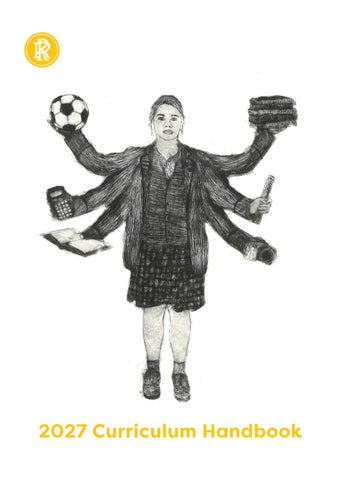
Cover artwork: Amelie Mogridge, Year 13
SUBJECT PATHWAYS
Rangi Ruru Subjects and Pathways KEY
YEARS 7 & 8
YEAR 9
Choose either two full year options, one full and two half years, or four half years
Option full year Option half year only Option for select students Subject starts at this level
»
Subject continues (prior study required)
YEAR 11
YEAR 12
YEAR 13
In addition to compulsory subjects
Compulsory at this level
›
YEAR 10
Choose three options
Choose four or five options
Choose five options (it may also be possible to begin some Level 2 subjects)
ENGLISH »
English ESOL (English for Speakers of Other Languages)
›
›
›
›
(EAS) English for Academic Studies
›
Literacy/Learning Centre
›
›
›
›
›
EQUINE STUDIES Equine Studies
HEALTH AND PHYSICAL EDUCATION Sport Physical Education & Health
Applied
Physical Education (NCEA)
›
›
›
Health (NCEA)
›
›
›
›
›
›
›
Food and Nutrition
LANGUAGES French
›
›
»
»
»1
»1
Spanish
›
›
»
»
»1
»1
Te Reo
›
›
»
»
»1
»1
MATHEMATICS »
Mathematics
»
Calculus
»
Mathematics with Statistics
»
Statistics
PERFORMING ARTS Theatre Arts Dance Drama Music
›
›
›
»
»
»
»
1. At Year 11 the compulsory Science programme consists of either Year 11 Science (one course), Biology (one course), Health Studies (one course) or Physical and Biological Science (two courses).
CURRICULUM | 4
YEARS 7 & 8
Compulsory at this level Option full year Option half year only Option for select students
›
Subject starts at this level
»
Subject continues (prior study required)
YEAR 9
YEAR 10
YEAR 11
YEAR 12
YEAR 13
In addition to compulsory subjects Choose either two full year options, one full and two half years, or four half years
Choose three options
Choose four or five options
Choose five options (it may also be possible to begin some Level 2 subjects)
SCIENCE 1
Science
›
›
›
»
Chemistry
›
»
Physics
›
»
›
›
Science for Citizenship Physical & Biological Science (2 subjects at Y11)
›
Biology
›1
1
SOCIAL SCIENCES AND COMMERCE Social Studies Classical Studies Geography
›
›
›
History
›
›
›
Accounting
›
›
»
Economics
›
›
›
Business Awareness
›
Primary Industries
TECHNOLOGY (DIGITAL AND MATERIAL) Creative Technology
This course leads to Digital Technology in Years 11-13
Digital Technology
›
›
»
Product and Spatial Design
›
›
›
›
Textile Technology
›
›
›
›
›
›
Media Studies
VISUAL ARTS »
Art Art - Paint/Print
›
Design/Photography
›
Paint/Print
»
Design
»
»
Painting Photography Printmaking
»
»
» »
Classes at Years 12 and 13 are dependent on sufficient numbers of students. Classes may be combined or girls may study Levels 2 and 3 by correspondence with extra assistance from the school. Note: There is a significant fee for study by correspondence (with Te Kura Pounamu).
CURRICULUM HANDBOOK | 5
SUBJECT PATHWAYS
KEY
CURRICULUM
The Curriculum Handbook The Curriculum Handbook is a guide to subjects and options available in Years 7 to 13 at Rangi Ruru. On pages 1 and 2 you will find the Subjects and Pathways Chart which is a quick reference tool listing all subjects and options for each year level. Course selection is an important time of the year. It is particularly important for students in Years 10 to 12 as subject selection should also take into consideration pathways for future studies and career choices. For students in Years 7 to 9, courses give the opportunity to experience a wide variety of subjects and options without choosing a particular area of focus. Consultation and advice on courses will be given to all students as they make their decisions. At each year level the course selection is made up of compulsory subjects such as Te Ara and physical education and elective options. Every effort will be made to provide a course of study that meets the needs of each student. There is no choice in Years 7 and 8. Please read this handbook carefully and use it as a reference. It is reviewed annually and updated in line with curricular and regulatory changes.
Notes on subject choice at Rangi Ruru At Years 12 and 13, students wishing to study six subjects should consult teaching staff such as the Pathways and Careers Strategist, Deans and Heads of Subjects on the advisability of this. Such a course requires ability, motivation and commitment. Option classes will be carried on only if they maintain a suitable class size. To encourage an optimum learning environment, the school has a class size policy. Once a class reaches the maximum number we may not be able to include additional students. If there are sufficient numbers of additional students, another class will be offered in a relevant subject area, providing the timetable structure permits. If a student changes their mind about their options after the completion of the timetable, it may not be possible to accommodate those changes. Care should be taken with selection of subjects as changing subjects once courses are underway is discouraged. The majority of Years 12 and 13 students will study five subjects. It is better to work towards a Merit or Excellence endorsement with five subjects rather than jeopardise this by studying six subjects. Criteria for studying six subjects at Years 12 or 13: • Minimum of an overall Merit endorsement from the previous year of study • High motivation and very good time management skills • Sufficient time out of school hours to commit to study. Studying six subjects at Years 12 or 13 is not recommended for students who have a heavy co-curricular commitment.
Bring Your Own Device (BYOD) The preferred device to cover learning requirements across all levels is a laptop running either Windows 11 or the latest version of Mac OS. Please refer to individual subject descriptions throughout this book for more specific guidance. Please consider the lifespan of a device and be aware that older devices may not operate as needed. As we embrace innovative approaches to assessment, it is essential for students to be equipped with the right tools. Each student may be required to purchase a pair of noise-cancelling, wired (non-Bluetooth) headphones with a built-in microphone. These headphones are crucial for supporting various assistive technologies, including voice-to-text and text-to-speech applications, ensuring a focused and accessible assessment environment. Please note that Mac users may require an appropriate adapter to connect these headphones to their devices. Our recommended models can be found on the Cyclone website.
CURRICULUM | 6
OUR OFFER
The New Zealand Curriculum Important for a broad, general education Rangi Ruru follows the general framework of the New Zealand Curriculum. The New Zealand Curriculum specifies eight learning areas: English, the Arts, Health and Physical Education, Learning Languages, Mathematics and Statistics, Science, Social Sciences and Technology. The learning associated with each area is part of a broad, general education and lays a foundation for later specialisation. This learning is both end and means: valuable in itself and valuable for the pathways it opens to other learning. While the learning areas are presented as distinct, this does not limit the ways in which we structure the learning experiences offered to students. All learning makes use of the natural connections that exist between learning areas and links to the values and key competencies.
Learning areas Each learning area has its own language or languages. As students discover how to use them, they find they can think in different ways, access new areas of knowledge, and see their world from new perspectives. For each area, students need specific help from their teachers as they learn: • The specialist vocabulary associated with that area • How to read and understand its texts • How to communicate knowledge and ideas in appropriate ways • How to listen and read critically, assessing the value of what they hear and read. In addition to such help, students who are learning English or coming into an English-speaking environment for the first time need explicit and extensive teaching of English vocabulary and word forms. As language is central to learning and English is the medium for most learning in the New Zealand Curriculum, the importance of literacy cannot be overstated. Literacy skills are evident and emphasised in all learning areas. In English, students study, use and enjoy language and literature communicated orally, visually or in writing. In the Arts, students explore, refine and communicate ideas as they connect thinking, imagination, senses and feelings to create works and respond to the works of others. In Health and Physical Education, students learn about their own well-being and that of others and society, in health-related and movement contexts. In Learning Languages, students learn to communicate in an additional language, develop their capacity to learn further languages, and explore different world views in relation to their own. In Mathematics and Statistics, students explore relationships in quantities, space and data and learn to express these relationships in ways that help them to make sense of the world around them. In Science, students explore how both the natural physical world and science itself work so they can participate as critical, informed, and responsible citizens in a society in which science plays a significant role. In the Social Sciences, students explore how societies work and how they themselves can participate and take action as critical, informed and responsible citizens. In Technology, students learn to be innovative developers of products and systems, and discerning consumers who will make a difference in the world.
CURRICULUM HANDBOOK | 7
CURRICULUM
New Zealand Qualifications The National Certificate of Educational Achievement in 2027 (NCEA) The National Certificate of Educational Achievement (NCEA) is New Zealand’s national qualification for senior secondary students. NCEA is part of the National Qualifications Framework.
NCEA Assessment is based on standards NCEA uses standards to describe the level of work students have produced and how well they have done. The standards have been set to challenge and reward students. Every standard is worth a set number of credits. These are like points towards a qualification.
Literacy and Numeracy co-requisites To gain an NCEA qualification, students must gain the 20 credit co-requisite. This is in the form of three Common Assessment Activities (CAAs). • Literacy – writing 5 credits • Literacy – reading 5 credits • Numeracy – 10 credits All learners will need to achieve the co-requisite in order to be awarded their NCEA qualification at any level. It can be achieved at any time from Year 10 – we will help learners to know when they are ready to be assessed against the standards. This will remain available for 2027
Level 1 NCEA To be awarded Level 1 NCEA students need 60 credits at Level 1 or higher. Although most students study for Level 1 in Year 11, some Year 10 students gain credits in one or more subjects and these can be included in their Level 1 Certificate the following year.
Level 2 NCEA In Year 12 most students study Level 2 subjects. To be awarded Level 2 NCEA students need 60 credits at Level 2 or higher. They should also plan to gain 10 literacy credits (five in reading and five in writing) in Level 2 English for their University Entrance the following year.
CURRICULUM | 8
Level 3 NCEA To be awarded Level 3 NCEA students need 60 credits at Level 3.
Endorsement of NCEA certificates Students’ NCEA results can be endorsed at Merit or Excellence level, depending on the number of credits they have gained at these levels. Their Record of Achievement will show them if they have been awarded an Endorsement. If students gain 50 credits at Excellence, their NCEA will be endorsed with Excellence. Likewise, if they gain 50 credits at Merit (or Merit and Excellence) their NCEA will be endorsed with Merit. Students can earn credits counting towards endorsement over more than one year and more than one level. However, these credits must be gained at the level of the certificate or above. For example, Level 2 credits will count towards endorsement of a Level 1 NCEA, but Level 1 credits will not count towards endorsement of a Level 2 NCEA.
Endorsement of NCEA courses Students will have their strengths in individual courses (subjects) recognised with a course endorsement at Merit or Excellence. Courses at all levels of NCEA are eligible. A course endorsement is awarded where students achieve: • 14 or more credits at Merit or Excellence at the lower level that supports the endorsement • At least three credits from externally assessed standards and three credits from internally assessed standards • (except Physical Education and Level 3 Visual Arts) • Sufficient credits in a single school year
CURRICULUM HANDBOOK | 9
CURRICULUM
In Year 13 most students study Level 3 subjects but they may also study some subjects at Levels 1 or 2 if they wish.
CURRICULUM
University Entrance Most students aim to achieve University Entrance in Year 13. University Entrance (UE) will continue to be the minimum requirement to go to a New Zealand university. To be awarded UE you will need: NCEA Level 3 Three subjects at Level 3 or above, made up of: • 14 credits each, in three approved subjects • Literacy - 10 credits at Level 2 or above, made up of 5 credits in reading, 5 credits in writing • Numeracy - 10 credits at Level 1 or above Once you have met the requirements for University Entrance it will appear on your Record of Achievement. Good grades such as Excellence or Merit in achievement standards will be advantageous, particularly in selection for limited entry courses. To qualify for university admission, students should have: • Been awarded University Entrance • Achieved the Guaranteed Entry Ranked Score (based on best 80 credits at Level 3 from all Level three • subjects, and rank score calculated by Excellence = 4, Merit = 3, Achieved = 2) • Fulfilled any other degree specific requirements such as portfolio or audition. Furthermore, to be assured of university admission, students should aim to gain good NCEA grades, 18 credits or more in their top subjects and more than 80 Level 3 credits.
New Zealand Scholarship The top students in the country are identified and acknowledged through additional Scholarship examinations. Scholarship neither attract credits nor contributes towards a qualification but the fact that a student has gained a Scholarship or Outstanding Scholarship will appear on the Record of Achievement. There is also a monetary reward associated with attaining a Scholarship. The content assessed for New Zealand Scholarship is based on that covered for Level 3 achievement standards.
NCEA and admission to tertiary courses overseas Internationally, universities require foreign students applying for admission to have achieved the university entrance standard set by their own countries. The same principle generally applies to other tertiary providers overseas. • NCEA Level 1 is broadly equivalent to the English General Certificate of Education (GCE) • Level 3 is equivalent to English A Levels and Australia’s Higher School Certificate • Entry to most Australian universities requires 18 credits in Level 3 English. See also ‘Can NCEA be used for tertiary courses overseas?’ on page 73 or visit the NZQA website at www.nzqa.govt.nz.
CURRICULUM | 10
Reports Students and their parents receive both written and oral reports during the year. Reports are available to parents through Schoolbox. • We provide updates on learning which highlight progress with understanding, skill development, character development and identify areas for improvement by providing key feedback for learners and whānau. NCEA internal assessment and school exam results will be available in Term 3 for students studying at Levels 1, 2 and 3. Internal assessment is finalised in Term 4. Parents and students will be able to access the attainment information online via the parent portal on Schoolbox. NCEA students can use their Learner Login to check their internal results on the NZQA site from the end of Term 2 using their NSN (National Student Number). Their NSN is unique to them and they should note the number as it allows them access to useful information from NZQA as they continue their learning pathways in the future.
Interviews Early in Term 1, tutors meet with students and their parents to discuss the student’s individual educational and co-curricular needs, develop and refine their Tōku Ara: My Pathway and set goals for the year for each student from Years 7 to 13. Tōku Ara: My Pathway is a document formulated in a three-way discussion involving the student, their parent(s) and their tutor. For more information on Tōku Ara: My Pathway see the Family Handbook or contact your daughter’s tutor. During the year the goals are regularly reviewed by the students and their tutors. Parents are welcome to attend a review if they wish. All interviews are appropriate to students’ year levels. In addition, parents of students new to the school in Years 7 and 8 are welcome to request starter interviews with the tutors. Years 7 to 13 Learning Progress Interview evenings are held at points throughout the year to enable parents to discuss aspects of their daughter’s academic progress with subject teachers. Students are encouraged to attend these interviews. A course information session is held in Term 3 to enable parents and students to consult staff over the following year’s subject choices and to gain advice on courses.
Assessments and examinations Years 7, 8 and 9 have class assessments, common assessments across the year group, and other forms of assessment regularly throughout the year. Year 10 have class assessments and common assessments regularly throughout the year, and examinations in some subjects in November. Years 11, 12 and 13 (and other students studying for NCEA1) have internal assessments in Terms 1, 2 and 3. External standards are practiced throughout the year and the results are used to provide indicative feedback for students and derived grade data for NZQA. Some subjects have longer school practice exams early in September, and external examinations for NCEA Levels 1 to 3 and Scholarship in November. All the derived grade data is used as evidence if students need to apply for Derived or Emergency Grades at the time of the NCEA externals.
CURRICULUM HANDBOOK | 11
CURRICULUM
Reports, Interviews, Assessments and Examinations
CURRICULUM
Rangi Ruru Special Programmes These subjects are fundamental to learning at Rangi Ruru and all students participate in these every year.
Te Ara (The Pathway/The Journey) Mā te kimi ka kite, Mā te kite ka mōhio, Mā te mōhio ka mārama Seek & discover, discover & know, know & become enlightened Our Te Ara programme is underpinned by four strands: hauora, citizenship, te ao Māori and pathways. Te Ara forms part of the students’ weekly timetable, and evolves with them through Years 7 to 13. Te Ara aims to provide a pathway for students which will enable them to participate fully in their life at Rangi Ruru, and in the world beyond. From Years 7 to 13 students will develop our 4 Pillars of the Rangi Graduate Profile: Belong, Be You, Be Your Best and Be the Change. They will become people who know themselves and their place in the world, locally, nationally and globally. Te Ara is an aspirational area of learning where the focus is to enable our ākonga to develop the Rangi Graduate skills and dispositions in order to feel equipped for their future. The Te Ara programme provides a range of courses from Years 7 to 13 • Citizenship
• Leadership
• Christian Education
• Sustainability
• Cultural responsiveness
• Life Skills
• Self-awareness
• Te Ao Māori
• Health and wellbeing
• Beyond the gates
• Service
Outdoor Education Outdoor Education in an important aspect of the Rangi Ruru programme. All students in Years 7 to 10 are involved in this programme which includes overnight camps. This programme provides meaningful learning experiences beyond the classroom. These programmes foster resilience, independence, teamwork, and leadership by immersing students in nature-based challenges and collaborative activities. Students develop whanaungatanga and connection with the outdoor environment. At Year 12, all students participate in a three-day camp based at Hanmer Springs. Professional instructors lead a range of adventure-based activities, environmental projects and discussions to develop cooperative solutions to challenges. All of year 12 attend camp at the same time and work collaboratively in their clans.
CURRICULUM | 12
At Rangi Ruru we help students achieve their learning goals in a range of ways. These include:
The Learning Centre The Learning Centre (LC) supports students to access the curriculum, develop effective learning skills, and achieve success. Students are identified through: • Information from previous schools • Learning Support history • Educational psychologist reports
• Parent and whānau information • Beginning-of-year literacy assessments
We follow inclusive practices and, wherever possible, support students in their regular classes alongside their peers. Teacher Aides provide targeted support for literacy and learning needs, and alternative programmes may be offered in consultation with whānau. For Years 11-13, Supported Study provides regular timetabled access to teacher or Teacher Aide support for planning, organisation, and assessment completion.
Literacy Support • Literacy support in Years 7 and 8 is determined by assessment data. Interventions are delivered by a specialist teacher on a rotational timetable, while spelling support is provided during English classes. • Year 9 Literacy can be chosen as a language option or, for some students, on a rotational basis. • Year 10 Literacy support can be chosen as a half or full year option. Consultation with the Dean and Leader of the Learning Centre is advised. Students requiring additional Numeracy Support are referred to the Head of Mathematics.
Rangi Assessment Conditions (RAC) and Special Assessment Conditions (SAC) The Learning Centre believes every student should be able to demonstrate their knowledge and skills without being unfairly disadvantaged. RAC (junior assessments) and SAC (NCEA & Scholarship assessments) provide approved supports to help students access and complete assessments. The school also uses DigiExam to provide reader and keyboard access where appropriate. Assessment, intervention, and record-keeping processes ensure support is provided to eligible students. We work closely with Deans, whānau, educational psychologists, and external agencies to identify and support student needs.
ESOL (English for Speakers of Other Languages) ESOL is a flexible language programme, structured according to individual needs. It focuses on helping students gain confidence and competence in English and also provides subject support, in close cooperation with subject teachers. Classes may be on an individual or small group basis. Students who do not have English as their first language, and who need to improve their language skills for mainstream classes, should choose a full year ESOL or EAS (English for Academic Studies) course. A half year ESOL option is also available in Year 10. The senior EAS course works on the skills needed to achieve in the senior school, and prepares students for the academic English required to succeed in tertiary study.
CURRICULUM HANDBOOK | 13
CURRICULUM
Specialist Support and Enrichment Programmes
CURRICULUM
Enrichment Strategies (High Performance Learning) This HPL Mentoring and Support Service offers a personalised approach to provide continued support for our most highly able students as they develop. The school accepts that some students have different learning needs and that as a school and as teachers, we must respond to these needs. Areas where particular help is available include: • Personal Development Plans (PDPs) with the Enrichment Strategies who works closely with Deans • Workshops / field trips / lectures, community activities such as Model United Nations and Ethics Olympiad • Clubs – chess, creative writing, robotics and Future Problem Solving, debating, coding, art club • Acceleration / multi-levelling • Subject choice assistance • Mentoring / Pastoral Care / Acting as an advocate for students • This service offering is relaxed, supportive and inclusive.
Pathways and Careers Pathways and career planning is vital for students and their parents. There is a vast amount of information available about tertiary education, job opportunities, training courses, gap year options and more. As the sources of information rapidly change and become increasingly complex, knowing what is best suited to individual needs can be challenging. Pathways and careers education and strategies, along with individual interviews (including practice interviews, CV workshops, tertiary information and other training sessions) provide students with the necessary information and confidence to face the multitude of options and decisions they will encounter in the future. An overview of the career development journey for a Rangi Ruru students is outlined below; • At Years 7 & 8 students explore self-awareness and curiosity and begin to develop an understanding that people have different jobs and pathways. • At Year 9 students begin to explore those possibilities further by linking school subjects to potential future opportunities. • At Year 10 students begin to connect self awareness to pathways and start the basics of informed decision making skills. • At Year 11 students start to gain a clear understanding of tertiary options including study, training, and employment. • Year 12 is all about deeper exploration and preparation, investigating specific careers through work experience opportunities, university and polytechnic visits, scholarship awareness, CV, and interview workshops. • At Year 13 students move to final decision making and transition. They are provided application support, scholarship applications guidance, open days experiences and graduate with an informed plan for the years ahead. The Careers Centre is open to all students and their parents, of any year level. Appointments with the Careers and Pathways Advisor can be made by emailing v.gray@rangiruru.school.nz. Times are available during the day as well as before and after school.
Rangi Graduate skills and dispositions; • Written and oral communication skills
• Emotional intelligence
• Coordinating with others (teamwork)
• Critical thinking
• Cultural awareness and sensitivity
• Creativity
• Ability to learn, unlearn and relearn
• Negotiations
• Understanding and leveraging technology
• People Management and leadership
• Complex problem solving
• Active life-long learning with a growth mindset
CURRICULUM | 14
Years 7 and 8
In Years 7 and 8 learning is personalised. This is achieved through differentiated learning in the classroom and beyond according to student readiness, interest and learning profile. The curriculum is delivered within subjects by specialist teachers. The tutor takes pride in establishing a safe, respectful and nurturing environment for all students focusing on wellbeing, the key competencies and inquiry-based learning. Periodically, the timetable is collapsed for a week giving the girls a unique opportunity to experience challenge-based learning in an authentic context with support and guidance from specialist mentors.
Curriculum • Art • Dance • Digital Technology
• English • Food and Nutrition • Health & Physical Education
• Languages • Mathematics • Music
• Science • Social Studies • Sport
• Te Ara • Textile Technology • Theatre Arts
Outdoor Education The three day programme encourages students to work co-operatively with others, develop their self-confidence and learn to try new challenges in an outdoor environment. Activities are run by professional instructors and the form tutor accompanies their class. A major focus of the camp is for students to strengthen their relationships/ whanaungatanga across their year level and to have fun in a series of different activities.
Enhancement, Extension, Enrichment Including Learning Support Each student is encouraged to develop and extend their own abilities in all areas - academic, sporting and cultural. For example, selected Year 7 and 8 Music students may be offered extension through being auditioned members of Rangi Sinfonia, Jazz Band or smaller ensembles such as percussion, rock band and chamber music, or through the Artist in Residence Programmes in Music and Art. Students can also participate in Future Problem Solving and have other opportunities provided during the year through our HPL service. Others may be offered roles in drama and dance productions, where appropriate. Participation is encouraged in Science Badges, regional and national competitions as well as Cantamath activities. It is optional for students to perform at the Primary Schools’ Music Festival. All students participate in the annual Cultural Festival and a Stage Art Performance. ICAS science, digital technology, writing, spelling, English and mathematics are offered to all students. Many enhancement groups are offered to the students including Future Problem Solving and Creative Writing. Students are encouraged to follow specific and compelling interests to further their knowledge, understanding and creativity. Tōku Ara: My Pathway provides an opportunity for each student to establish learning goals. Support and guidance structures including the Psychologist and Careers Strategist are also available to all students. Individual and small group learning support is arranged and given as required either within the class programme or supplementary to it. Financial Literacy is taught to Years 7 and 8 students for one hour a week for a term.
CURRICULUM HANDBOOK | 15
YEARS 7 & 8
It is our goal to empower our students to identify their individual strengths and to challenge them to develop a growth mindset whilst working towards being the best that they can be. We strive to inspire, challenge and empower them through a variety of mediums and learning experiences.
Years 7 & 8 Specialist Intervention
YEARS 7 & 8
Literacy intervention is offered to students in a 1:1 or small group setting at Years 7 & 8. These weekly tutorial sessions follow a structured literacy approach, occur during the school day, and are run by trained specialists. Limited before or after school sessions are available depending on teacher availability. There is a small charge for resources needed, which remain with the student at the conclusion of tutoring.
ESOL (English for Speakers of Other Languages) ESOL is available as appropriate for students from other language backgrounds.
Years 7 and 8 Subjects Art • Toi Strong observational drawing skills are developed and applied to a series of works in a range of disciplines. These may include painting, printmaking, design, photography and sculpture. Ākonga develop a body of work exploring practical and conceptual ideas. Students will learn to discuss their work and that of others through critiques, creating an environment where students learn from each other. They will become independent thinkers and confident in their own decision making.
Dance • Kanikani Dance in Year 8 encourages ākonga to explore movement in a range of ways, including choreography, cultural dance, ensemble work and performance. As part of the course, the Year 8 cohort works together on a performance for the annual competition, Showquest. This allows students to practise whakawhanaungatanga, as they are a part of the whole creative process, from concept to performance, meaning ākonga get to build upon the foundations of whakawhanaungatanga and manaakitanga which they are introduced to in Year 7 Drama.
Digital Technology • Hangarau Matihiko The focus of this course is to keep developing students’ practical-based computer skills, sparking students’ creative talents through digital illustration, and expanding their horizons in confidently selecting and using a range of Adobe Creative Cloud applications to develop digital solutions. Students continue to build their logical thinking skills through learning key programming concepts and coding simple computer games. In addition, students will be involved in project-based learning in which collaboration and teamwork are encouraged. The problem-solving skills and creativity ignited will provide a foundation for further use and study.
YEARS 7 & 8 | 16
English • Te Reo Pakeha Year 7 & 8 English provides an evidence-based programme of teaching and learning with a focus on structured literacy. Students are provided with a differentiated support system where they gain and develop both phonemic and morphological awareness along with their knowledge of complex spelling patterns in the English language. The students are encouraged to develop their learning pathway in all aspects of English and are encouraged to build their reading stamina through personal reading, in-depth study of novels, and regular use of the library.
Oral language skills are developed through a dramatic monologue presentation in Year 7 and the Ted Talk conference in Year 8.
Food and Nutrition • Kai Tōtika Through the processes of selecting, preparing, cooking and serving food, students develop their creativity and experience a sense of accomplishment. They explore food choices that can improve the well-being of themselves and others. The charge for class materials will be gold sheeted.
Languages Students will study two terms of Te Reo Māori in Year 7 and two terms each of Spanish and French in Year 8.
Spanish, French • Pāniora, Wīwī These are introductory language courses. Students learn greetings and how to introduce themselves and exchange personal information. All the skills (listening, speaking, reading and writing) are practised but there is a strong emphasis on spoken interactions and role plays with partners in the class. Students will begin to build up their vocabulary using online programmes. For all aspects of these courses, language and culture will be intertwined.
Te Reo Māori • Te Reo “Whaowhia te kete mātauranga” • Fill the basket of knowledge This half year course looks into the fundamentals of Te Reo Māori starting with pronunciation and ensuring students feel successful as they learn to navigate double vowel blends. Building confidence and being champions of Te Reo Māori is embraced. Students will practise a variety of Māori karakia and waiata. Opportunities to regularly welcome and greet classroom or school visitors with their mihi or pepeha will be encouraged. Language activities will aid in the learning of basic vocabulary, sentences and questions. With mana wāhine at the core each student will select a Māori wahine to research, presenting their findings to the class. There will be a balance between written, spoken, listening and practical learning.
Mathematics • Pangarau The New Zealand Curriculum is followed with teaching sequences organised into six strands: Number, Algebra, Measurement, Geometry, Statistics, and Probability. Explicit teaching and retrieval techniques are used to equip students with conceptual and procedural knowledge that they can use in Y9 and beyond. Classes are organised to ensure that each student is in a learning group that is appropriate for their learning needs. A mathematics support teacher works with the classroom teacher in some classes. Further extension opportunities are available for highly able students. Students may participate in local and international competitions such as ICAS, Cantamath and Otago Problem Solving.
CURRICULUM HANDBOOK | 17
YEARS 7 & 8
The teaching of writing involves the analysis of a variety of text types and the production of different forms of writing, such as descriptive, narrative, and persuasive writing.
Music • Puoro
YEARS 7 & 8
Year 7 Music is a performance-based course, with all students learning either the clarinet or trumpet during their weekly Music class. Students will also develop listening skills, musical literacy, and contextual understanding of music, as well as having opportunities to create their own original music. There are enrichment and extension opportunities for students with significant prior musical experience. Each student will be issued with an instrument for the year, along with a tutor book. There is no additional charge for this, but small charges for reeds (clarinet) and valve oil (trumpet) will be goldsheeted. Further information will be available from Music staff at the Year 7 Ready, Set, Rangi day. Students can also extend themselves outside of the classroom programme. A wide range of co-curricular Music groups are offered. Junior instrumentalists are encouraged to join Rangi Players or a Rock Band when they are ready, and singers can join the Rangi Voices choir. More advanced instrumentalists can audition for senior groups, such as Rangi Sinfonia. In addition, individual or small-group lessons on all instruments (including voice) are available through the Itinerant Teachers of Music (ITM) programme. Further information about the opportunities in curriculum and co-curricular Music is available from Music staff.
Physical Education & Health • Te Ao Kori/Hauora The Year 7 Physical Education and Health programme provides students with a foundation in movement, wellbeing, and key physical education concepts. The programme focuses on participation, enjoyment, and co-operative learning, while helping students develop a range of movement skills and confidence in physical activity. Students also explore aspects of personal identity and how this influences the way they participate and interact with others. Throughout the year, students learn through three key areas of Health: personal health and physical development, relationships and healthy communities, and keeping themselves safe online and in their environment. The Year 8 Physical Education and Health programme provides students with opportunities to develop confidence, competence, and a positive sense of self through movement and health learning. By participating in a variety of physical activities, students will strengthen foundational skills, build meaningful relationships, and learn to make informed decisions that support their wellbeing. The programme promotes enjoyment, inclusion, and active participation while developing social responsibility and interpersonal skills.
Science • Pūtaiao Science is a way of investigating and understanding the universe we live in. Students are encouraged to ask questions about the world around them. They carry out practical experiments to collect data, support their understanding with research and share their learning with their peers using presentations and practical demonstrations. Students are taught by science teachers in specialist laboratories, and during the year the lessons are enhanced with field trips and visits from guest scientists. During the science course students gain knowledge of the world, how science is important to society, and how the scientific process works. Keen science students have the opportunity to gain science badges and complete ICAS assessments. Year 7 extend their understanding of the scientific concepts covered with trips to the Antarctic Centre, Wigram Airforce Museum and Willowbank the cost of which is gold sheeted (approximately $55). Year 8 students support their studies into marine biodiversity using virtual reality googles provided by Blake-NZ educators, the cost (approximately $9) is gold sheeted.
Sport • Hākinakina The Years 7 and 8 sports programme is facilitated by a specialist Sport Co-ordinator with support from PE staff, the sports department, and external coaches. In Term 1, our programme is an internal skill-based programme and for the remainder of the year the students go off-site and participate in Tuesday afternoon sport as part of the CAIMS – the Canterbury Association of Intermediate and Middle Schools. Opportunities to compete in events organised by Primary Sports Canterbury are also available and include athletics, cross country, duathlon, gymnastics, swimming and triathlon. Throughout the year, students will work with experienced coaches across a range of sports including, basketball, cricket, football, hockey, netball, volleyball & water polo. In addition to the weekly sports, students have the opportunity to play water polo, basketball or touch competitions after school. Strength and conditioning is also offered and is facilitated by an experienced conditioning coach.
YEARS 7 & 8 | 18
Social Studies • Akoranga Hapori Junior Social Studies helps students understand the world around them through the study of History, Civics and Society, Geography, and Economic Activity. Learning is structured to build connected knowledge and understanding of the political, economic, cultural, and social forces that shape societies over time. Students will learn through a variety of teaching approaches that develop and foster perspectives, knowledge, critical thinking, understanding, future-focused thinking, and effective communication skills. Key Areas of Learning: • Economic Activity – Learn how financial and economic systems operate, including personal finance, business, government, and New Zealand’s place in the global economy.
• History – Explore New Zealand and global history, examining significant people, events, and developments that have shaped societies across time.
• Geography – Investigate how physical environments and human activities interact, and how places and communities change over time and space.
Through these four strands, students develop the knowledge and skills to become informed, thoughtful, and active members of society.
Theatre Arts • Whakaari Year 7/8 Theatre Arts is a semester-long course that combines dance and drama to develop creativity, confidence, communication, and collaboration. Through movement, storytelling, improvisation, choreography, and performance, ākonga explore a range of Theatre Arts experiences while building strong relationships through teamwork and shared creative processes. The programme brings Year 7 and Year 8 students together, creating opportunities to learn from one another, develop leadership skills, and discover individual strengths across the Theatre Arts disciplines. Manaakitanga is central to the course, encouraging ākonga to take creative risks, contribute ideas, reflect on their learning, and give constructive feedback to others. At the end of the semester, ākonga share and perform their learning for peers and whānau, building confidence, communication skills, and a strong sense of belonging within the Theatre Arts community at Rangi Ruru.
Textiles Technology • Kakano In the first term of this one semester course, students will have opportunities to learn and practice a variety of hand sewing and fabric embellishment techniques to complete a small bag using these new skills. In the second term, students will learn how to safely and confidently use the domestic sewing machines to create a small project using a combination of machine and hand sewing techniques. This two-term course allows students to experiment with hand and machine sewing techniques, along with learning the basics of the technological process of planning, testing, evaluating and revising. These key skills lay the foundation for future work in this subject, including fashion design and wearable art.
Te Ara • The Pathway/The Journey At Years 7 and 8 the focus is on the ‘Belong; Be You; Be Your Best’ pillars. All students complete cycles of citizenship, hauora (KIVA anti-bullying programme), service and leadership, and Christian Education.
CURRICULUM HANDBOOK | 19
YEARS 7 & 8
• Civics and Society – Understand democracy, citizenship, rights and responsibilities, Te Tiriti o Waitangi, and how people participate in civic life.
Year 9 All students follow the same course at Year 9 with the exception of their language choice. This allows each student to experience the widest possible range of subjects.
Subject Options Students are offered the choice of a language studied all year.
YEAR 9
An information sheet on making a choice of Year 9 language will be sent home prior to the Entrance Testing Day. Classes are dependent on sufficient numbers of students choosing to take particular languages. Students choose ONE subject from the list of subjects below. • French
• Spanish
• Te Reo Māori
OR
• Literacy
This is structured literacy intervention that supports literacy acquisition, decoding and phonics. If you would like to be considered for this class, please contact the Head of the Learning Centre. At the end of Term 2, students in this class will be considered for a specified language class. This would provide them with the opportunity to understand how a language is learned and participate as global citizens.
Outdoor Education Year 9 camp is held early in Term 1 with the intention of building relationships/whanaungatanga. The two day camp gives ākonga the opportunity to grow their independence and connections with other students outside their tutor group. Complementing our desire for students to Belong. Activities are designed to encourage ākonga to communicate and support each other, as they take on challenges in an outdoor environment. The camp provides an excellent opportunity for tutors and the year level dean to work with the students outside of the classroom and get a greater understanding of them as individuals – encouraging them to embrace the pillar of Be You.
ESOL (English for Speakers of Other Languages) ESOL is available as appropriate for students from other language backgrounds.
Sports and Clubs In addition to prescribed courses, each Year 9 student is expected to participate in at least one of the varied sports and clubs offered during the year.
YEAR 9 | 20
Year 9 Subjects Art • Toi Students will develop observational drawing skills and apply these to a series of works in a range of disciplines based on their individual stylistic strengths. Art making will be viewed in a wider context and will consider conceptual ideas. Students will learn to discuss their work and that of others through critiques in a collaborative environment where they learn from each other and from established artists. Throughout the course they will work individually and collaboratively to achieve their outcomes. Ākonga will examine the work of contemporary artists from Aotearoa. The purpose is for ākonga to develop skills in a range of media and to become independent thinkers, confident in their own decision making. YEAR 9
A charge for workbooks will be gold sheeted.
Dance • Kanikani Year 9 Dance builds on the creativity and curiosity of dance practice. Students are introduced to safe dance practice to ensure they can self-manage their technique and recognise their own abilities. Guided by the values of Tikanga, Manaakitanga, Whanaungatanga, and Akoranga, students learn to work collaboratively, value diverse perspectives, and support the success of others. Ākonga explore how identity, culture, and personal experiences can be expressed through movement while building confidence, developing dance knowledge, and strengthening their ability to think creatively. Aligned with the New Zealand Curriculum, the course fosters an appreciation of dance as a meaningful art form that communicates ideas, stories, and cultural perspectives.
Digital Technology • Hangarau Matihiko This 9-week Digital Technology course provides a comprehensive introduction to various aspects of digital technology, including 3D modelling and printing, graphic design, and Python programming. Students learn and apply digital design and development tools, as well as computational thinking techniques, to produce a range of digital products and create simple visual computer programs. The course emphasises foundational programming concepts and fosters the continuous development of digital technology awareness through collaborative, solution-based projects. Students will enjoy a dynamic and interactive learning experience that encourages creativity, innovation, and practical application of digital skills
Drama • Whakaari Year 9 Drama introduces students to the creative and collaborative world of performance through improvisation, storytelling, character development, and group work. Students build confidence, communication skills, and creativity while exploring the values of Tikanga, Manaakitanga, and Whanaungatanga, learning to support one another, contribute positively to the class environment, and reflect on their personal growth as performers and learners. Aligned with the New Zealand Curriculum, students develop practical drama skills, creative thinking, and an understanding of how drama reflects culture, identity, and community.
CURRICULUM HANDBOOK | 21
English • Te Reo Pakeha Our Year 9 English programme is designed to develop curious, confident readers, writers, speakers, and thinkers. Through the study of literature, drama, poetry, short stories, and visual language, students explore how language is used to communicate ideas, shape perspectives, and reflect the world around us. They are encouraged to think critically, respond thoughtfully to texts, and make meaningful connections between what they read, view, and experience. Alongside the study of texts, students build a strong foundation in writing through explicit instruction in vocabulary, sentence construction, grammar, and writing craft. They experiment with a range of genres, develop confidence in oral communication, and strengthen their close reading skills by analysing how language and visual techniques create meaning.
YEAR 9
Independent reading is an important part of the programme, fostering both reading stamina and a lifelong appreciation of literature. Throughout the year, students receive regular formative feedback and complete a range of assessment tasks that support their growth as effective communicators and engaged learners.
Food and Nutrition • Kai Tōtika The aim of this course is to equip students with sound nutritional knowledge about healthy adolescent eating patterns. Through the processes of selecting, preparing, cooking and serving food, students develop their creativity and experience a sense of accomplishment. The charge for class materials will be gold sheeted.
French • Wīwī This is a course designed for complete beginners as well as those who have some basic knowledge of French. The emphasis is on developing authentic communication skills and learning how to listen, speak, read, write and interact in meaningful, real-life situations. Students with previous knowledge are appropriately supported and challenged to build on their existing language skills. Online resources will be used to provide regular practice, immediate feedback and opportunities for students to revisit their learning and monitor their progress. All students also have opportunities to interact with French speakers and engage with authentic language and cultural experiences. Using carefully paced and differentiated tasks, the main topics studied include introductions, families, school, hobbies, and the places and communities in which students live. Through these contexts, students develop their vocabulary, pronunciation, grammar and communication strategies. Language learning is closely connected to exploring the diverse cultures, identities and perspectives of French-speaking communities around the world.
Health & Physical Education • Hauora/Te Ao Kori The Year 9 Health and Physical Education programme lays the foundation for students to develop the knowledge, skills, and dispositions that support lifelong wellbeing and active participation. Through a range of practical and classroom-based learning experiences, students develop movement competence, confidence, resilience, and positive relationships. They explore the factors that influence health and wellbeing, learn to communicate effectively, think critically, make informed decisions, and contribute positively to the wellbeing of themselves and others. Students are encouraged to embrace challenge, reflect on their experiences, and develop the confidence and capability to participate actively in a range of physical and health-related contexts.
YEAR 9 | 22
Literacy • Matatini This course lays the foundation for your academic success at Rangi Ruru. Based on current evidence, it takes a Structured Literacy approach to help support students accelerate their spelling, reading fluency and enhance their writing. Students will gain a clear understanding of how word patterns work together in a range of complex situations and spend time reading and writing about diverse topics and texts. This is a full year or half-year course available to selected students and is offered instead of a second language. Students who complete the course over two terms will be put into a small group language option for the remainder of the year.
Mathematics • Pangarau
Classes are organised to ensure that each student is in a learning group that is appropriate for their learning needs. A mathematics support teacher works with the classroom teacher in some classes. Further extension opportunities are available for highly able students. Students may participate in local and international competitions such as ICAS, Cantamath and Otago Problem Solving.
Music • Puoro Year 9 Music offers students opportunities to perform, create, and understand music. Through playing instruments, composing original music, and analysing existing music, the course builds on previous student experiences to develop musicality and musical appreciation. There are enrichment and extension opportunities for students with significant prior musical experience. Students can also extend themselves outside of the classroom programme. A wide range of co-curricular Music groups are offered. Junior instrumentalists are encouraged to join Rangi Players or a Rock Band when they are ready, and singers can join the Rangi Voices choir. More advanced instrumentalists can audition for senior groups, such as Rangi Sinfonia or the Jazz Band. In addition, individual or small-group lessons on all instruments (including voice) are available through the Itinerant Teachers of Music (ITM) programme. Further information about the opportunities in curriculum and co-curricular Music is available from Music staff.
Product and Spatial Design • Whakairoiro The Year 9 Product and Spatial Design course spans a term and is designed to introduce students to the essential skills of spatial design. This course will engage students in ideation, physical and digital modelling, 2D floor planning, and 3D perspective sketching. The program emphaises creativity, problem solving and visual communication. Students will compile a portfolio showcasing their understanding of the design process and their proficiency in visual communication techniques. A charge for materials will be gold sheeted.
CURRICULUM HANDBOOK | 23
YEAR 9
The New Zealand Curriculum is followed with teaching sequences organised into six strands: Number, Algebra, Measurement, Geometry, Statistics, and Probability. Explicit teaching and retrieval techniques are used to equip students with conceptual and procedural knowledge that they can use in Y10 and beyond.
Science • Pūtaiao The focus is to enjoy and be interested in science and learn ‘what science is’ and ‘how scientists work’. As well as developing a broad knowledge of scientific theory and practical skills, students will develop ‘scientific literacy’ with the aim of becoming creative and open minded in their thinking. This will allow them to appreciate that understanding of science is essential to decision making in our daily lives. The units of learning cover Biology, Chemistry, Physics, and Earth and Space Science. Assessment involves class and common investigations, practical tests and projects. Knowledge and understanding will be assessed, as well as the ability to process, interpret and report on scientific information. We encourage students to participate in science competitions and in the wide variety of activities offered in the HPL programme.
YEAR 9
A charge for materials (workbook and online education platform) will be gold sheeted.
Social Studies • Akoranga Hapori Junior Social Studies helps students understand the world around them through the study of History, Civics and Society, Geography, and Economic Activity. Learning is structured to build connected knowledge and understanding of the political, economic, cultural, and social forces that shape societies over time. Students will learn through a variety of teaching approaches that develop and foster perspectives, knowledge, critical thinking, understanding, future-focused thinking, and effective communication skills. Key Areas of Learning: • Civics and Society – Understand democracy, citizenship, rights and responsibilities, Te Tiriti o Waitangi, and how people participate in civic life.
• Economic Activity – Learn how financial and economic systems operate, including personal finance, business, government, and New Zealand’s place in the global economy.
• History – Explore New Zealand and global history, examining significant people, events, and developments that have shaped societies across time.
• Geography – Investigate how physical environments and human activities interact, and how places and communities change over time and space.
Through these four strands, students develop the knowledge and skills to become informed, thoughtful, and active members of society.
Spanish • Paniora This is a course designed for complete beginners as well as those who have some basic knowledge of Spanish. The emphasis is on developing authentic communication skills and learning how to listen, speak, read, write and interact in meaningful, real-life situations. Students with previous knowledge are appropriately supported and challenged to build on their existing language skills. Online resources will be used to provide regular practice, immediate feedback and opportunities for students to revisit their learning and monitor their progress. All students also have opportunities to interact with Spanish speakers and engage with authentic language and cultural experiences. Using carefully paced and differentiated tasks, the main topics studied include introductions, talking about likes and dislikes, hobbies, family, school and homes. Through these contexts, students develop their vocabulary, pronunciation, grammar and communication strategies. Language learning is closely connected to exploring the diverse cultures, identities and perspectives of Spanish-speaking communities around the world.
YEAR 9 | 24
Textiles Technology • Kakano “Style is a way to say who you are without having to speak,” says American fashion designer and businesswoman, Rachel Zoe. A growing sense of identity and individuality is encouraged through this one term course, including exploring the elements and principles of fashion design. Students will begin to make connections between materials, form and function by learning to follow basic pattern instructions to create a pair of shorts or pants in their size. Through this project they will use a variety of sewing techniques and explore fabric embellishments to personalise this garment to reflect their growing sense of unique identity. Students will begin to explore concepts of sustainability within the context of fashion, creating a small upcycled/ repurposed project of their own design. This course lays the foundation for Year 10 Textiles and builds student confidence in their sense of self and in their ability to see a project through from vision to prototype. YEAR 9
Te Ara • The Pathway/The Journey At Year 9 the focus is on the ‘Belong’ pillar. All students might complete cycles of citizenship, Christian Education, leadership, service and Te Ao Māori.
Te Reo Māori • Te Reo “Ko taku reo taku ohooho, ko taku reo taku mapihi mauria” My language is my awakening, my language is the window to my soul This course builds a foundation for all students in Te Reo Māori. Opportunities to learn and reinforce pronunciation and practice reading will be evident in the daily routine of karakia, waiata and mihi or pepeha. The continued encouragement to greet and mihi to classroom visitors will be supported and expected. By the end of the course students will have used Education Perfect to practice and learn vocabulary, ‘Māori to go’ is the exercise book for written practice. Ākonga will have completed a variety of speaking and reading tasks. By the end of the course ākonga/students will have established a clear vocabulary for each topic and be able to answer or ask questions related to each topic. Topics covered may include greetings and introductions, mihimihi, my home, my family, my birthday, my school, personal descriptions and weather. Additional topics include the marae and Matariki. At this level whakatauaki/proverbs and whakatauāki/quotes will be introduced as well as kīwaha/expressions. The a/o categories will also be discussed. A marae trip may be arranged.
CURRICULUM HANDBOOK | 25
Year 10 All Year 10 students will study the following:
Compulsory subjects • Digital Technology • English
• Mathematics • Health and Physical Education
• Science • Social Studies
• Te Ara
Subject options
YEAR 10
In addition, students choose from the list of subjects below. All are three periods per week but some are full year courses (of which they may choose a maximum of two) and some are half year courses. Students may choose: either two full year subjects or one full year subject and two half year subjects or four half year subjects
The full year subjects are: • ESOL
• French
• Spanish
• Te Reo Māori
Please note: 1. 2.
Students studying a full year subject are generally not permitted to change to a half year subject during the year. Either French or Spanish may be picked up for the first time in a course that will lead to Level 1 NCEA in consultation with the Head of Languages.
The half year subjects are: • • • •
Art - Painting and Printmaking Art - Photography and Design Business Awareness Creative Technology
• • • •
Dance Drama ESOL Food and Nutrition
• • • •
Literacy Music Product and Spatial Design Textile Technology
To take certain subjects at Year 11, you need to study them at Year 10 level. These subjects are: • Art - Painting and Printmaking and/or Art - Photography and Design
• French
• Spanish
• Music (consult Head of Curriculum Music)
• Te Reo Māori
It must be remembered that not all combinations of these choices are possible, but the groupings will be arranged to satisfy the request of the majority.
ESOL (English for Speakers of Other Languages) ESOL is available as appropriate for students from other language backgrounds.
YEAR 10 | 26
Outdoor Education Ākonga will participate in a four day Outdoor Education Course based at the unique and beautiful setting of the Castle Hill Outdoor Centre. The course is run by an experienced Outdoor Education team who expose students' to a variety of activities, enabling them to build skills, strengthen whanaungatanga/relationships with their peers and grow as individuals. Due to its challenging and enriching nature, the time spent at this camp is often a highlight of their time at Rangi Ruru. This camp takes place early to mid Term 2, meaning that weather conditions can be variable.
Looking to the future Students should consider which Year 10 options they would most like to study and also where these subjects will lead in following years. By Year 11 students are starting to specialise in subject areas and it is essential that they have considered the pathway they are taking and that this provides them with the future options they require. By Term 3 in Year 10, students are asked to consider their subject choices for Years 11 to 13 and select their subjects for NCEA Level 1 at Year 11.
YEAR 10
Year 10 Compulsory Subjects Digital Technology • Hangarau Matihiko COMPULSORY HALF YEAR Digital Technology expands on the previous year’s focus on multi-disciplinary learning opportunities for students. Students further develop their computational thinking skills and digital toolbox through projects with programming and multiple digital media forms. Students develop a basic understanding of algorithms and programming, taking them beyond the realm of blockprogramming into a text-based programming language, Python. Students design and develop suitable digital solutions for end users by working with a range of software in the Adobe Creative Cloud suite, to produce vector graphics, raster images, edited videos, and creative projects of their choice. Students learn the practical tools and the design thinking process to identify opportunities and solve real-world problems. Artificial Intelligence will be an integral part of this course, where students explore its applications, ethical implications, and how AI can be leveraged to enhance digital solutions. They will engage in hands-on projects that incorporate machine learning concepts, gaining insight into how AI is shaping the future of technology and society.
English • Te Reo Pakeha COMPULSORY FULL YEAR Our Year 10 English programme challenges ākonga to deepen their understanding of how language, literature, and ideas shape the way we see the world. Through the study of drama, fiction, non-fiction, and short texts, ākonga explore increasingly complex themes and perspectives, developing the confidence to think critically, communicate clearly, and engage thoughtfully with a wide range of texts. They also investigate archetypes and close-view visual texts, considering how authors and creators use language and craft to influence audiences. Alongside the study of texts, ākonga continue to strengthen their writing by crafting a variety of text types for different purposes and audiences, while refining their vocabulary, sentence construction, and control of language. Opportunities for speaking, discussion, and independent thinking are embedded throughout the programme, enabling students to articulate and justify their ideas with increasing confidence. Regular feedback and reflection support students to recognise their progress, while dedicated preparation for the Reading and Writing Common Assessment Activities helps them build the literacy skills and resilience needed for future success.
CURRICULUM HANDBOOK | 27
Health & Physical Education • Hauora/Te Ao Kori COMPULSORY FULL YEAR The Year 10 Health and Physical Education programme provides students with opportunities to develop the knowledge, skills, and understanding needed to support all aspects of their wellbeing while participating confidently in a range of activities. In Physical Education, students refine movement skills, apply tactical and strategic thinking, and participate in a variety of individual and team activities, outdoor education experiences, and fitness-related contexts. Students are encouraged to think critically, make informed choices, and develop habits that support lifelong wellbeing and active participation. Through learning experiences in Health Education, students explore topics such as relationships, identity, decision-making, resilience, nutrition and media influences.
Mathematics • Pangarau YEAR 10
COMPULSORY FULL YEAR The New Zealand Curriculum is followed with teaching sequences organised into six strands: Number, Algebra, Measurement, Geometry, Statistics, and Probability. Explicit teaching and retrieval techniques are used to equip students with conceptual and procedural knowledge that they can use in Y11 and beyond. Classes are organised to ensure that each student is in a learning group that is appropriate for their learning needs. A mathematics support teacher works with the classroom teacher in some classes. Further extension opportunities are available for highly able students. Students may participate in local and international competitions such as ICAS, Cantamath and Otago Problem Solving.
Science • Pūtaiao COMPULSORY FULL YEAR Year 10 Science continues to develop students’ broad knowledge of scientific theory and practical skills. Topics are based around socio-scientific issues, allowing students to appreciate that understanding of science is essential to decision making in their daily lives. In addition we aim to build a sound foundation for future learning in the Senior Sciences. Assessment involves class and common tests, practical investigations and projects. Knowledge and understanding will be assessed, as well as the ability to process, interpret and report on scientific information. We encourage students to participate in science competitions and in the wide variety of activities offered in the HPL programme. A charge for materials (workbook and online education platform) will be gold sheeted.
Te Ara • The Pathway/The Journey COMPULSORY FULL YEAR At Year 10 the focus is on the ‘Be You’ pillar. All students complete cycles of leadership, service & Te Ao Māori and hauora (mental health and body image). In addition, rotations of Christian Education, pathways and learning skills will be undertaken by specialist teachers.
YEAR 10 | 28
Social Studies • Akoranga Hapori COMPULSORY FULL YEAR Junior Social Studies helps students understand the world around them through the study of History, Civics and Society, Geography, and Economic Activity. Learning is structured to build connected knowledge and understanding of the political, economic, cultural, and social forces that shape societies over time. Students will learn through a variety of teaching approaches that develop and foster perspectives, knowledge, critical thinking, understanding, future-focused thinking, and effective communication skills. Key Areas of Learning: • Civics and Society – Understand democracy, citizenship, rights and responsibilities, Te Tiriti o Waitangi, and how people participate in civic life.
• Economic Activity – Learn how financial and economic systems operate, including personal finance, business, government, and New Zealand’s place in the global economy.
• History – Explore New Zealand and global history, examining significant people, events, and developments that have shaped societies across time.
• Geography – Investigate how physical environments and human activities interact, and how places and communities change over time and space.
Year 10 Subject Options – Full Year ESOL • English for Speakers of Other Languages OPTION FULL YEAR There is also a half year option. Students may choose either a full year or half year ESOL course. Each course is carefully structured according to individual student needs and there is a strong emphasis on subject support and preparation for NCEA Level 1 English. Classes are on an individual or small group basis.
French • Wīwī OPTION FULL YEAR The French course builds on the work and topics covered in Year 9. This is the second year of a three year course which practises skills leading to NCEA Level 1 French. Substantial time is spent guiding students to a level of confidence so that they can use authentic French, which will be useful in a variety of real situations. Substantial online material, which includes tracking software to record progress, is also available. All students have the opportunity to practise their oral skills with a native speaker of French. Topics this year include routines, entertainment and sport, ordering in a restaurant, shopping, fashion, travel and holidays. Students work collaboratively to produce writing and speaking portfolios. Emphasis is placed on creating a growing awareness of the huge diversity of the French language and the impact it has had on the world. A trip to Europe is generally offered every three years for French students in their senior years.
CURRICULUM HANDBOOK | 29
YEAR 10
Through these four strands, students develop the knowledge and skills to become informed, thoughtful, and active members of society.
Spanish • Pāniora OPTION FULL YEAR The Spanish course builds on the work and topics covered in Year 9. This is the second year of a three year course which practises skills leading to NCEA Level 1 Spanish. Substantial time is spent guiding students to a level of confidence so that they can use authentic Spanish, which will be useful in a variety of real situations. Online material, which includes tracking software to record progress will be used. Topics this year include routines, travel and holidays, entertainment, ordering in a restaurant, healthy food, shopping and fashion. Students work collaboratively to produce writing and speaking portfolios. All students have the opportunity to practise their oral skills with a native speaker of Spanish. Emphasis is placed on creating a growing awareness of the huge diversity of the Spanish language and the impact it has had on the world. Extension work is available for those who wish to build on their previous knowledge of the language.
YEAR 10
A trip to Europe is generally offered every three years for Spanish students in their senior years.
Te Reo Māori • Te Reo OPTION FULL YEAR Prerequisite: Year 9 Te Reo Māori or at the discretion of Head of Subject. “He aha te kai a te rangatira? He kōrero, he kōrero, he kōrero. What is the food of the leader? It is knowledge. It is communication. The Te Reo Māori course in Year 10 builds on the work covered in Year 9. Time is spent guiding and encouraging each ākonga to speak Te Reo as much as possible, providing opportunities for students to communicate information for use in a variety of real situations. Grammar and sentence structures will form a large part of the content within each topic. Kōrero/speaking and tuhi/written tasks will give ākonga the opportunity to create, edit, and proofread before submitting each task. ‘Māori to go’ will be the exercise book used, the units within cover going to town, sports and leisure activities, daily routines, my class, planning a holiday and hospitality. The online tool of Education Perfect will assist the revision of vocabulary and new words or phrases. An overnight trip to a local marae may occur.
Year 10 Subject Options – Half Year Art - Painting & Printmaking • Toi - Pikitia & Mahi-ta OPTION HALF YEAR Students will develop a body of learning based on concepts around identity, whakapapa or turangawaewae. They will learn the fundamental principles of observational drawing, printmaking and painting. Ākogna will develop independent thinking skills and confidence in their own decision making. Students have the option to apply their learning to a personalised artist’s book assessed under NCEA Level 1. Students will learn to discuss their work and that of others through critiques in a collaborative environment where students learn from each other and from established artists. Throughout the course they will work individually and collaboratively to achieve their outcomes. Ākonga will examine the work of contemporary artists from Aotearoa. Charges for materials will be gold sheeted. Students must take Art - Painting and Printmaking or Art - Photography and Design or both of these Year 10 Art options. This course is a prerequisite to all senior art courses
YEAR 10 | 30
Art - Photography & Design • Hopu Whakaahua & Hoahoa OPTION HALF YEAR Students will develop a body of learning based on a strong foundation of thinking and practical skills, building on drawing skills into a digital context, in relation to photography and design. Students have the option to apply their learning to zine publication that will be assessed under NCEA Level 1 Ākonga will develop independence and confidence in their own decision making. Students have the option to apply their learning to a graphic novel and animation that assessed under NCEA Level 1. Students will learn to discuss their work and that of others through critiques in a collaborative environment where students learn from each other and from established artists. Throughout the course they will work individually and collaboratively to achieve their outcomes. Ākonga will examine the work of contemporary artists from Aotearoa. Charges for materials will be gold sheeted. Students must take Art - Photography and Design or Art - Painting and Printmaking or both of these Year 10 Art options. This course is a prerequisite to all senior art courses.
YEAR 10
Business Awareness • Pakihi OPTION HALF YEAR This course will grow learners’ understanding of business principles and motivation in Aotearoa. This will include financial and non-financial decision making. Learners will develop skills in using accounting and economic models to analyse and interpret business performance. Learners will understand how a business fits within an industry, its place in the economy and the interdependence of economic sectors. Learners will prepare and present financial reports to measure business viability. Case studies will be explored and allow learners to apply their understanding in varied contexts.
Creative Technology • Hangarau Auaha OPTION HALF YEAR A course for the future! This Year 10 two-term optional course provides students with a distinctive and unique digital learning experience. It is 100% tailored to students’ interests, updates frequently, and is set completely apart from the compulsory course. It offers opportunities to explore and embrace a broad range of modern technologies. A full-day field trip allows students to work with more emerging technologies and tools that are available in the wider educational community. The course aims to broaden students’ horizons in the fast-changing digital and technological world. Students will be exposed and introduced to numerous different areas of digital technology and this course will be tailored to students’ interests. Learning areas may include: • Game design • Website creation
• App development • Digital marketing/merchandising
• Digital animation • 3D modelling and printing
• Robotics
This course is not only about bringing out the creativity of the students but also keeps strengthening and combining their problem-solving and digital design skills by developing fit-for-purpose solutions for real-world context. The knowledge of current controversial topics in the digital world will also be discussed, topics may include: • Artificial intelligence
• Virtual reality
• The power of algorithms and big data
It is a practical, hands-on subject and it will open many doors for future pathways.
CURRICULUM HANDBOOK | 31
Dance • Kanikani OPTION HALF YEAR Year 10 Dance builds on the foundations developed in Year 9, with a focus on the Samoan concept of Vā: the relationships and connections between people, groups, and spaces. Students learn and perform dances from a variety of genres and cultures while developing their choreographic skills through creating original movement works inspired by concepts such as connection and raranga (weaving). Through collaborative creation and performance, students strengthen their technical skills, creativity, and understanding of dance as a powerful form of cultural and personal expression. Aligned with the New Zealand Curriculum, students develop practical dance skills, choreographic understanding, and an appreciation of how movement communicates ideas, stories, and cultural perspectives.
Drama • Whakaari YEAR 10
OPTION HALF YEAR Year 10 Drama encourages students to extend their understanding of drama through performance, collaboration, and creative exploration. Guided by the value of Kotahitanga, students work together to build confidence, strengthen communication skills, and develop supportive relationships where every contribution is valued. Students explore a range of theatre forms, practitioners, dramatic conventions, and performance styles, developing an appreciation of the diverse ways stories can be told on stage. Learning includes improvisation, character development, script work, and devising original drama, providing a strong foundation for senior Drama and introducing the knowledge and skills explored in NCEA Drama courses. Aligned with the New Zealand Curriculum, students develop practical performance skills, creative expression, critical thinking, and an understanding of how drama reflects culture, identity, and society.
Food and Nutrition • Kai Tōtika OPTION HALF YEAR Practical experiences are designed to help develop health enhancing attitudes towards selecting, preparing, cooking and serving food. Students will increase their range of skills and display greater independence when preparing food for themselves and others. They will investigate food products and analyse how to use the packaging information to make good food choices. They will investigate the diverse cultures that contribute to New Zealand’s unique food heritage. The charge for class materials will be gold sheeted.
Literacy • Matatini OPTION HALF YEAR This course helps support you as you work towards the NCEA Literacy Common Assessment Activity (CAA). It is designed to complement the foundation built at Year 9 for your academic success at Rangi Ruru and is divided into two components (reading and writing). It follows on from the Literacy courses offered at Year 9 but is also appropriate for any student hoping to develop their reading and writing skills. It is recommended that students discuss this course with their dean and teachers before selecting
YEAR 10 | 32
Music • Puoro OPTION HALF YEAR The Year 10 Music course provides opportunities for students to perform, create and understand music while also preparing them to study it at a higher level. This is done through a variety of contexts, with opportunities to focus on their own musical interests, background, and experience, while also gaining a broad understanding of music as a whole. Students who take music will further develop skills in self-expression, creative thinking, problem solving and self-management. There are three main strands that run through the music course: 1. Performing music: preparing, presenting, recording and reflecting upon solo and group performances. 2. Creating music: developing compositional techniques through creating original instrumental and vocal music, using appropriate software. 3. Studying music: continuing to develop skills in musical literacy, as well as enhancing and deepening understanding of music from a wide range of genres. Aspects of all three strands will be drawn upon in a class performance during Term 4. Students who elect to take Year 10 Music must have tuition on an instrument(s)/voice for the entire year, either through the school ITM programme or privately. They must also be working at the equivalent of Grade 1 theory by the time the course starts (usually in the middle of the year), and support with this is available for those who require it. Students should also be involved in a school co-curricular Music group for the full year.
Product and Spatial Design • Whakairoiro OPTION HALF YEAR The Year 10 course builds on the foundations established in Year 9, introducing students to both Product and Spatial Design. The program emphasizes creativity, problem-solving, and the development of visual communication skills through two- and three-dimensional sketching techniques. Students will refine and advance their 2D and 3D sketching abilities, explore design concepts in greater depth, and learn to present their ideas effectively. This course is designed to boost students’ confidence in a range of visual communication methods, providing a strong foundation for future design studies. Please note that specialist software applications will need to be downloaded, and there will be a materials charge, which will be gold-sheeted.
Textile Technology • Kakano OPTION HALF YEAR “Don’t be into trends. Don’t make fashion own you, but you decide what you are, what you want to express by the way you dress and the way you live,” - Iconic fashion designer Gianni Versace. Students will develop their sense of identity and explore creative ways to communicate their values and world view through exploring the elements and principles of basic fashion design. Students will explore pattern drafting, begin to gain experience on industrial machinery used within the fashion industry, experiment with cutting edge technology, increase their knowledge of embellishment techniques and build confidence in their own sewing ability. Students will design and create a hoodie of their own choice, using pattern alterations and a variety of embellishment techniques including screen printing and machine embroidery. Students will also begin to explore the existing problems as well as the exciting opportunities to solve these problems around sustainability in the fashion industry, making their own contribution through upcycling/repurposing an old garment into something new. Students will use Te Tukanga Hoahoa Whakaaro, the Design Thinking Process to create and prototype their designs. Please note: If you are considering taking textile technology at a senior level it is strongly recommended that you take this course as it provides a solid grounding in the technological process of creative design in materials processing.
CURRICULUM HANDBOOK | 33
YEAR 10
Students will need to purchase a music theory workbook, which will be goldsheeted. Students are strongly encouraged to take Music as an option in Year 10 if they are considering studying Music at Year 11. For further details, please consult the Head of Learning Area – Music.
Choosing Your Course Years 11 to 13 Interest + Ability + Future Career Pathway = Subject Choice
General Guidelines In selecting subjects at each level, we recommend that students keep in mind the following guidelines: • Avoid specialising too early – maintain a broad range of subjects for as long as possible throughout your school career • Carefully assess your interests, skills and areas of expertise – choose subjects that build on these • Plan your possible option choices, not just for the next year, but for the years following • If you have a future career in mind, you may need to study some specified subjects • Look closely at your present subjects – avoid dropping a subject that you may need in later years
YEAR 11
• Think about a portfolio of subjects completed across your senior years. If the subject does not require a prerequisite you could do a range of subjects across the three years • Seek advice. There are many people at Rangi Ruru who are able to provide advice on subjects and career planning. In addition to subject teachers, these include the Leaders of Faculties and Careers and Pathways Strategist. Visit the Careers and Pathways Centre in Mana Wahine.
YEAR 11 | 34
Year 11 • NCEA Level 1 All Year 11 students study the following subjects:
Compulsory subjects • Applied Physical Education and Health • English • Te Ara • Mathematics and Statistics • At least one Science subject or Health Studies is compulsory. Students may choose from: Either General Science (one subject) plus three additional subject options from the list below or Biology (one subject) plus three additional subject options from the list below or Physical and Biological Science (two subjects) plus two additional subject options from the list below (information about these science courses is on page 38) or Health Studies (one subject) plus three additional subject options from the list below.
YEAR 11
Subject options • Accounting
• History
• ESOL
• Geography
• Drama
• Physical Education (NCEA)
• Art
• Economics
• Spanish4
• Product and Spatial Design
• Equine Studies
• French4
• Digital Technology
• Food and Nutrition
• Te Reo Māori4
• Health Studies
• Music
• Textile Technology
4
Subjects have a maximum of three Achievement Standards available. Learning in each subject will be expected to encompass more than is assessed in the Achievement Standards. Students should see the learning in Level 1 subjects as preparation for Level 2 both in terms of content and learning attributes. Use this handbook to find out which Year 11 options you would most like to study and also where these subjects will lead in following years. All subjects and their time allocations are described on pages 36 to 45. The majority of Year 11 students study six subjects, except as otherwise negotiated for study of ESOL or Learning Support Programmes. Not all combinations of subjects are possible, but the groupings will be arranged to satisfy the request of the majority. Please note that in some subjects, class outings to enhance curriculum study may incur small additional charges (e.g. visits to art galleries or field trips).
4 Subjects must have been studied previously, usually in Years 9 and 10
CURRICULUM HANDBOOK | 35
Year 11 (Level 1) Compulsory Subjects Applied Physical Education • Te Ao Kori COMPULSORY Ākonga will participate in two periods a week of compulsory Physical Education. This course focuses on movement and wellbeing and offers ākonga the opportunity to experience and participate in a wide range of physical activities in a variety of contexts, in and out of their comfort zone. Ākonga will explore the Te Whare Tapa Whā model of health and understand how movement can influence this.
English • Te Reo Pakeha
YEAR 11
COMPULSORY Year 11 English builds the foundation for confident, capable communication across written, visual, and oral forms. Through a range of creative and critical tasks, ākonga explore how language shapes identity, expresses ideas, and connects us to others. Students will read and respond to texts from a variety of contexts, develop their own voice in writing, and learn to communicate ideas with increasing clarity and effect. At the heart of the course is a focus on interpreting meaning, crafting purposeful language, and reflecting on different perspectives. With guided feedback and opportunities for revision, students grow as writers, speakers, and thinkers—ready to participate thoughtfully in their communities and beyond.
Mathematics and Statistics • Pangarau & Tauanga COMPULSORY Students are placed into one of two courses which complete Level 1 achievement standards in mathematics and statistics. These are a mixture of internally and externally assessed standards. One course has a large focus on algebra and functions and leads onto further study in mathematics and/or statistics. The other course is more general and leads into further study in statistics. Students need a graphics calculator (fx 9860G II or similar).
Te Ara • The Pathway/The Journey COMPULSORY Every student participates in this programme. At Year 11 the focus is on the ‘Be Your Best’ pillar and getting equipped for the future. Students rotate through the four strands: citizenship, Te Ao Māori, pathways (learning to learn), hauora (health programme).
YEAR 11 | 36
Science / Health Studies • Pūtaiao/Hauora COMPULSORY Students choose one of the following Science courses: • General Science • Biology • Physical AND Biological Science (two complementary courses which count as two subjects) • OR Health Studies If Biology is chosen, students can only continue with Biology or Science for Citizenship in Years 12 and 13, not Chemistry or Physics. If Health Studies is chosen, students can only continue with Science for Citizenship in Years 12 and 13, not Biology, Chemistry or Physics. Both the General Science course and the Physical and Biological double Science course will permit the study of Biology, Chemistry and Physics in Years 12 and 13.
General Science • Pūtaiao This science course will give students the knowledge they need for Year 12 Physics, Chemistry and Biology. The three main topics are:
2. Chemistry - the arrangement and bonding of atoms in different materials will be explored. Students will link structure and bonding in different materials to their physical properties and their uses. 3. Phenomenon in Physics – the concepts of motion, forces and energy will be used to explain real world physical phenomenon. Resources required to support this course are Scipad workbooks and a subscription to an online learning programme. Costs are expected to be approximately $60 and will be goldsheeted.
Biology • Koiora This course is designed for those who are interested in Biology and will NOT be continuing with Physics and Chemistry in Year 12. The three main topics are: 1. Genetics – genes control the inheritance of characteristics. How genes are tracked from generation to generation will be explored. 2. Micro-organisms – the life processes and environmental factors that effect micro-organisms will be explored and the impact they have on humans examined. 3. Science investigations - Using the four dimensions of hauroa as a health model, students will carry out 3 different types of experiments that look at some of the aspects of physical and mental wellbeing in teenagers. Resources required to support this course are Scipad workbooks and a subscription to an online learning programme. Costs are expected to be approximately $60 and will be goldsheeted.
CURRICULUM HANDBOOK | 37
YEAR 11
1. Genetics – genes control the inheritance of characteristics. How genes are tracked from generation to generation will be explored.
Physical & Biological Sciences • Pūtaiao & Koiora (Two complementary courses) If a student chooses these two courses, they may only choose an additional two option subjects (instead of the usual three options). This course will provide a wider breadth and greater depth of knowledge than the General Science course. It is designed for students who intend taking the sciences at senior secondary and tertiary levels. The main topics are: 1. Genetics – genes control the inheritance of characteristics. How genes are tracked from generation to generation will be explored. 2. Chemistry - the arrangement and bonding of atoms in different materials will be explored. Students will link structure and bonding in different materials to their physical properties and their uses. 3. Phenomenon in Physics – the concepts of motion, forces and energy will be used to explain real world physical phenomenon. 4. Micro-organisms – the life processes and environmental factors that affect micro-organisms will be explored and the impact they have on humans examined. 5. Perspectives on a social issue – The high rates of diabetes, cardiovascular disease and tooth decay are significant issues in NZ. The biology of these diseases and their treatments will be explored. Students will investigate why it is important to analyse different viewpoints before decisions are made to address issues.
YEAR 11
6. Energy and Heat – concepts such as energy transfer, conservation of energy and energy transformation will be explored. Resources required to support this course are Scipad workbooks and a subscription to an online learning programme. Costs are expected to be approximately $70 and will be gold sheeted. Physical Science is recommended for students wishing to continue studying Physics at Level 2.
Health Studies • Hauora For course information please refer to Health Studies on 37.
Year 11 (Level 1) Subject Options Accounting • Kaikaute OPTION In Accounting, we focus on making well-informed decisions for the future viability of an organisation. We consider financial and non-financial information and a variety of contexts. In addition, students will develop their skills to present and analyse financial information for business and individual use. Students will investigate strategies that businesses use to manage and safeguard their assets. This course provides an excellent foundation for further study in either accounting or economics.
YEAR 11 | 38
Art • Toi OPTION PREREQUISITE: YEAR 10 ART Ākonga will develop an individual body of learning based on a personalised programme. They will be taught the practical and thinking skills needed to produce a workbook of research and a portfolio of artwork that sequentially develops. Students will learn to critique their own work to generate and extend their ideas. They will become independent thinkers and confident in their own decision making. Charges for materials will be gold sheeted. As thorough investigative drawing is the basis for all art making processes, this subject is a prerequisite for Level 2 Photography, Painting, Printmaking or Design. In 2028, as a Year 12 student, we are offering a trip to the prestigious Sydney Art Biennale at an approximate cost of $1300.
Digital Technology • Hangarau Matihiko OPTION Level 1 Digital Technology introduces students to two key components: designing and developing digital technology outcomes. This course provides a broad platform for students to explore their interests within the digital realm, encouraging deep engagement with the design thinking process before applying technical skills to bring their ideas to life. Students can choose from a diverse range of digital outcomes, including: • Audio-Visual Production • Database Development
• Design for Manufacture • Game Development
• Graphic Design • Website Creation
Through these projects, students gain hands-on experience with visual design and user experience (UX) principles, learning how to create digital products that are both functional and engaging. These are essential skills for becoming creators, innovators, and future leaders in technology. The course blends visual design, technical development, and theoretical understanding of UX, offering a comprehensive foundation that supports further study across multiple disciplines at the tertiary level.
Drama • Whakaari OPTION PREREQUISITE: YEAR 10 DRAMA (ADVANTAGEOUS BUT NOT COMPULSORY) In Drama/Whakaari at Level 1, ākonga continue to develop their learning across the four strands of the subject: developing practical knowledge, developing ideas, communicating and interpreting, and understanding drama in context. In Year 11 we focus on: • Understanding the rich social and historical context of Theatre Aotearoa in order to perform authentically. • Rehearsing, devising original work, and performing in groups and as a class. • Developing their skills and understanding of performing to an audience. Whakawhanaungatanga and Manaakitanga continue to be core values in whakaari/drama, helping ākonga develop empathy, collaboration, negotiation skills, and an appreciation of diverse perspectives. Students are encouraged to participate in co-curricular performance opportunities and engage with live theatre to further develop their performance, presentation, and public speaking skills while broadening their understanding of theatre forms and performance approaches.
CURRICULUM HANDBOOK | 39
YEAR 11
• 3D Modelling • Animation
Economics • Ōhanga OPTION This course focuses on two strands of financial understanding. Students will study how price is determined in an organisation and recognize the impact on internal and external stakeholders of the entity .The other major focus will be the interdependent financial relationships of an entity and how they are impacted by different events. The course will extend students for the demands of Year 12 economics and also provides some foundation for Year 12 accounting.
Equine Studies • Mātai Hōiho OPTION See Years 12 and 13. Assessed via unit standards. Contact the Director of Equestrian for further information.
YEAR 11
ESOL • English for Speakers of Other Languages OPTION ESOL is offered on an individual or small group basis for students who do not have English as their first language and who need to develop their language skills. English standards and/or ESOL standards, which complement the mainstream English course, are also part of the programme. Special attention is given to helping ESOL students achieve the literacy requirement of NCEA Level 1.
Food and Nutrition • Kai Tōtika OPTION This course will improve food literacy (proficiency in food knowledge and skills) to enable informed decisions about food to be made, which contribute to enhanced wellbeing. The aim of the course is to develop the ability to: • Make connections between food choices and the physical, mental, emotional, social, and spiritual dimensions of people’s lives, by exploring current food issues such as energy drinks and portion distortion. • Investigate aspects of food culture in New Zealand that have significant cultural meaning and show understanding of their impacts on personal and family wellbeing. • Think critically by investigating questions such as ‘Whose nutritional advice can you trust? • Explore Māori values, demonstrating how food can create connections (whanaungatanga) between people, and is used to show hospitality and generosity (manaakitanga). • Manage and evaluate practical activities that involve planning, selecting, preparing, and presenting nutritious and appetising meals. The charge for class materials will be gold sheeted.
YEAR 11 | 40
French • Wīwī OPTION PREREQUISITE: YEAR 10 FRENCH ‘Ko tōu reo, ko tōku reo, te tuakiri tangata. Tīhei uriuri, tīhei nakonako’ ‘Your language and my language are expressions of identity. May our descendants live on and our hopes be fulfilled.’ Learning French is about connecting to and communicating within and across cultures and communities. This course will encourage diverse ways of thinking, doing, and believing and will require ākonga to take risks and develop resilience and perseverance. The course builds upon prior learning from Year 10 and prepares ākonga for a visit to a French speaking country. Ākonga will learn to engage with and explore written and spoken language. They will delve deeply into the culture and values of the people who connect with the language and consider similarities to and differences from their own culture and that of Aotearoa. They will share information, ideas and opinions in French and explore linguistic building blocks and patterns. They will use a wide range of resources to advance language learning and embrace online technologies. All ākonga have the opportunity to practise their oral skills with a native speaker of French. When possible, ākonga may be invited to participate in film screenings, restaurant visits and language immersion experiences, for which a small cost may be added to the school account. A trip to Europe is generally offered every three years for Senior students. For Level 1 NCEA, the internally assessed component is based on written and/or oral communication (five credits). Listening and reading are assessed externally (10 credits in total).
In 2019, Rangi Ruru established an exchange programme with an independent, co-educational school in Guérande, France, alongside Christchurch Boys’ High School (CBHS). Two students from Rangi Ruru and two students from CBHS host their exchange partners for approximately seven weeks during September/October of Year 11 and then travel to France for approximately seven weeks in January/ February in Year 12. Students stay with their exchange partners’ families. Costs include airfares, insurance, and spending money. Applications open in Term 1 of Year 11.
Geography • Mātai Matawhenua OPTION Geography is a multidisciplinary subject that aims to develop an understanding of the environment as the home of people. Students will take an in-depth look at the world which they live in to discover new places, new cultures, and new ideas. Students will learn about connections between people and places at local, regional, national, and global scales. They will develop an understanding of how natural processes can shape the natural environment and investigate how environments have evolved spatially and over time. Students will learn how the environment can be protected and regenerated through different approaches. They will study geographic issues and will consider different solutions that can be used to solve them. Geography students will understand how differences in perspectives and power influence decision making, which has consequences within the natural and cultural environment. The Level 1 Geography course will explore local and global geographic issues such as climate change, hazard management, demographics, development, and inequality. Students will need to purchase a geography skills workbook, which costs approximately $30 and will be gold sheeted. There will also be a field trip, the cost of which is TBC.
CURRICULUM HANDBOOK | 41
YEAR 11
The French exchange programme
Health Studies • Hauora OPTION This course encourages students to develop the knowledge, skills, and attitudes needed to take responsibility for their own well-being and to positively influence the well-being of others. Through a variety of health-related contexts, students will explore models of health and well-being and learn to apply these frameworks to everyday life. Key areas of study include: • Understanding and applying health models to promote personal and community well-being • Exploring topics such as mental health, relationships and sexuality, drugs and alcohol, and physical safety • Developing critical thinking skills to evaluate social, cultural, economic, and environmental factors affecting health and well-being • Engaging in practical activities that support well-being This course aims to provide a solid foundation in health education that supports students’ well-being now and prepares them for further study or careers in health-related fields. It offers an interactive and supportive learning environment where students can explore important health issues relevant to themselves, their whānau, and the wider community.
YEAR 11
This course includes trips/activities that are charged to the student’s account.
History • Hītōria OPTION The Level 1 History course focuses on the concepts of ‘protest and power’. It aims to introduce and develop skills of research, analysis, evaluation and communication, while recognising that history is interpreted by people in a variety of different ways. Students will develop an understanding of the causes, consequences and perspectives of events of significance to New Zealanders through a study of the following possible contexts: Protest: • The ongoing struggle for black civil rights in the USA • Issues of race and politics in New Zealand Power: • World War II: the origins and nature of the war in Europe and the Pacific, and its impact on people There will be a local field trip for History students, the cost of which is TBC
YEAR 11 | 42
Music • Hītōria OPTION YEAR 10 MUSIC PREFERRED This course is designed to prepare students, regardless of their musical background, to be a musician of Aotearoa in 2027. Students who take Music will further develop skills in self-expression, creative thinking, problem solving and self-management through using a range of current music technologies and devices. They will continue to develop their skills and competencies in the three main Music strands: 1. Performing music: preparing, presenting, recording and reflecting upon solo and group performances. 2. Creating music: developing compositional techniques through manipulating existing music, creating original instrumental and vocal music, and producing it using appropriate software. 3. Studying music: continuing to develop skills in musical literacy, as well as drawing on understandings of a range of musical styles to analyse music in depth. This course is not suitable for beginners on an instrument or voice. Whilst the Year 10 Music course is a valuable and preferred preparation for NCEA Level 1 Music, students who are very competent on an instrument or in voice, and who have developed a high level of general musicianship and musical literacy, may elect to make a direct entry into the Level 1 course after consultation with the Head of Learning Area - Music. Students who elect to study NCEA Level 1 Music must commit to continued tuition on their chosen instrument/voice for the entire year, either through the school ITM programme or privately. An equivalent level of Grade 2 theory must be reached by the start of the NCEA Level 1 year. Students should also be involved in a school co-curricular Music group for the full year. Students may need to purchase a music theory workbook, which will be goldsheeted. Assessment: up to 15 credits, made up of two compulsory standards (Music Skills - internal; Music Performance external) and one optional standard (Composition - external).
Physical Education (NCEA) • Te Ao Kori OPTION Ākonga will explore the importance of how physical education makes a significant contribution to well-being (Hauora). They will learn in and through movement by developing physical skills and experiencing enjoyment. By looking at different perspectives through their participation in movement, they will develop a range of capabilities. By learning about how and why people move, ākonga come to understand what influences their own and others’ movement. Ākonga will explore what movement means to them through engaging in Māori, individual, team and sports activities. They will develop a range of movement strategies that will help them to achieve a movement outcome or goal. Ākonga will focus on improving their ability to work collaboratively in movement, and explore how te ao Māori, biophysical and sociocultural aspects influence movement. Through movement ākonga will investigate how the human body works to produce movement including anatomy, the biomechanics of movement an exercise physiology. This course may include trips/activities that are charged to the ākonga’s account.
Product and Spatial Design • Whakairoiro OPTION PREREQUISITE: YEAR 10 PRODUCT AND SPATIAL DESIGN ADVANTAGEOUS BUT NOT COMPULSORY ‘Kaua e rangiruatia te hāpai o te hoe; E kore tō tātou waka e ū ki uta’ Don’t paddle out of unison; our canoe will never reach the shore This course focuses on three key aspects: design thinking, visual communication, and design heritage. It encompasses product design, which involves creating tangible items for everyday use, and spatial design, which involves designing three-dimensional spaces. Students will develop skills and techniques to bring their ideas to life, while being mindful of their ethical responsibilities towards the people and places they design for. Specialist computer applications will be required for some design work. Completion of this course is strongly recommended for those wishing to pursue product and spatial design at higher levels. A charge for materials will be gold sheeted.
CURRICULUM HANDBOOK | 43
YEAR 11
It is a requirement that students who wish to take Music at Level 2 or Level 3 take Music for Level 1 NCEA. For further details, please consult the Head of Learning Area - Music.
Spanish • Pāniora OPTION PREREQUISITE: YEAR 10 SPANISH ‘Ko tōu reo, ko tōku reo, te tuakiri tangata. Tīhei uriuri, tīhei nakonako’ ‘Your language and my language are expressions of identity. May our descendants live on and our hopes be fulfilled.’ Learning Spanish is about connecting to and communicating within and across cultures and communities. This course will encourage diverse ways of thinking, doing, and believing and will require ākonga to take risks and develop resilience and perseverance. The course builds upon prior learning from Year 10 and prepares ākonga for a visit to a Spanish speaking country. Ākonga will learn to engage with and explore written and spoken language. They will delve deeply into the culture and values of the people who connect with the language and consider similarities to and differences from their own culture and that of Aotearoa. They will share information, ideas and opinions in Spanish and explore linguistic building blocks and patterns. They will use a wide range of resources to advance language learning and embrace online technologies. All ākonga have the opportunity to practise their oral skills with a native speaker of Spanish. When possible, ākonga may be invited to participate in film screenings, restaurant visits and language immersion experiences, for which a small cost may be added to the school account. A trip to Europe is generally offered every three years for senior students. For Level 1 NCEA, the internally assessed component is based on written and/or oral communication.
YEAR 11
Listening and reading are assessed externally.
Te Reo Māori • Te Reo OPTION PREREQUISITE: YEAR 10 ADVANTAGEOUS ‘Ko te reo te taikura o te whakaao mārama’ ‘Language is the key to understanding’ - Te Wharehuia Milroy Ākonga will submit two pieces of mahi/work. One is a conversation interaction in filmed in real time focusing on two experiences past and present. The other a written task. The assessments will each require one piece of work to be submitted either written or spoken. The external options consist of either a Common Assessment Activity or a portfolio of 1 piece of written or spoken work to be submitted to NZQA for assessment. Key Competencies: • Students will apply a range of communicative skills in a variety of contexts that will enable them to express their thoughts in te reo Māori with accuracy, fluency, cultural integrity and gain an understanding of language revitalisation. • The ideas, values and attitudes developed from a Māori worldview expressed through te reo Māori will enable students of Te Reo Māori to be culturally confident and competent to participate in and contribute to Māori language and culture revitalisation within their communities. • Students of Te Reo Māori, in tandem with learning tikanga Māori, will strengthen their own identity, therefore, providing a strong foundation. Possible day trips or overnight to local marae and walks discovering the stories of our inner city are possible.
YEAR 11 | 44
Textile Technology - Materials and Processing Technology OPTION “What’s my style is not your style, and I don’t see how you can define it. It’s something that expresses who you are in your own way,” - American businesswoman, interior designer, and fashion icon Iris Apfel. A deepening understanding of who they are and where they fit in the world will drive student learning in this course. Through developing their ability to follow the technological process to test the physical and functional properties of a variety of materials, students will learn to make justified choices and evaluate their end products for fitness for purpose. Gathering and synthesising crucial stakeholder feedback in order to refine their design concepts forms a critical part of their learning this year. What impact do our fashion choices have on the world? Crucial concepts of sustainability through kaitiakitanga underpin this course as students explore mātauranga Māori principles in their research and exploration of upcycling and repurposing techniques, zero waste patterns and processing techniques using natural and renewable resources native to Aotearoa such as harakeke and tī kouka. Students will gain an understanding of the impact of the fashion industry on the natural world, the ability to design and create their own sustainable clothing and the confidence to problem solve that is transferable across all learning areas. Field trips will allow students to gain awareness and understanding of both the history of fashion design and future career pathways in the fashion industry. Field trips will include visits to The Spinners and Weavers Guild, op shops for sustainability research and potentially Dunedin for the Hokonui Fashion Design Awards. The costs for these trips will be gold sheeted. YEAR 11
CURRICULUM HANDBOOK | 45
Year 12 • NCEA Level 2 All Year 12 students study the following subjects:
Compulsory subjects • English
• Te Ara
YEAR 12
Subject options • Accounting
• Food and Nutrition
• Paint/Print
• Biology
• French
• Photography
• Chemistry
• Geography
• Physical Education (NCEA)
• Classical Studies
• Product and Spatial Design
• Physics
• Design
• Health
• Science for Citizenship
• Digital Technology
• History
• Spanish
• Drama
• Mathematics with Statistics
• Te Reo Māori
• EAS (English for Academic Study)
• Mathematics
• Textile Technology
• Economics
• Media Studies
• Equine Studies
• Music
The courses operating in any one year are determined by the availability of teaching staff and the numbers of students selecting the various courses. It must be remembered that not all combinations of subjects are possible, but the groupings are arranged to satisfy the request of the majority.
Outdoor Education Year 12 ākonga participate in a three day camp at Hanmer Springs. The purpose of this experience is to enhance whanaungatanga/relationships and team skills. Various activities are carried out in clan groups with the intention of developing co-operative solutions to challenges. A focus on manaakitanga to support the collective wellbeing of the group is threaded throughout the camp. Time to reflect and look for future opportunities are built into the programme. This is a unique opportunity for the whole year level and pastoral team to be at camp together.
Looking to the future Students should consider the following points when deciding on their course for Year 12: • The need to build up the basic knowledge and skills required by all people • Consider not only your good subjects and the subjects you enjoy but also those necessary to fulfil your possible career intentions • If you wish to gain University Entrance in Year 13 you must ensure you gain the relevant literacy standards. These may be gained over one or two years, in Years 12 and 13 English • If you choose six subjects you must take them all for the whole year • If you are interested in sitting Scholarship refer to New Zealand Scholarship information on page 73.
YEAR 12 | 46
Each subject has recommended prerequisites (see specific subject information in the following pages). Please read these carefully and consult the Head of Subject if in doubt. Most Years 12 and 13 students will study five subjects. It is better to work towards a Merit or Excellence endorsement with five subjects rather than jeopardise this by studying six subjects. Criteria for studying six subjects at Years 12 or 13: • Minimum of an overall Merit endorsement from the previous year of study • High motivation and very good time management skills • Sufficient time out of school hours to commit to study. Studying six subjects at Years 12 or 13 is not recommended for students who have a heavy co-curricular commitment. Students studying five subjects have four periods of study a week. The intention is for students to be selfmanaging in their learning and study time. Initially, study time will be supervised but students are expected to take responsibility for using this time wisely.
Year 12 (Level 2) Compulsory Subjects English • Te Reo Pakeha COMPULSORY
As a university entrance pathway, Level 2 English supports students in gaining the five Reading and five Writing credits required for UE, which is why it is compulsory. Learning experiences are both analytical and creative, helping students grow as thoughtful readers, skilful writers, and active participants in their communities and the wider world. Assessment: A total of 21 credits are available. This includes 13 internal credits and 8 external credits.
Te Ara • The Pathway/The Journey COMPULSORY At Year 12 the focus is on the ‘Be The Change’ pillar. Students rotate throught the strands in Terms 1, 2, 3: citizenship and Te Ao Māori, pathways, sustainability, leadership and hauora (health & wellbeing).
CURRICULUM HANDBOOK | 47
YEAR 12
Level 2 English invites ākonga to explore the power of language through reading, writing, viewing, and presenting. Students engage with increasingly complex texts that challenge them to consider diverse perspectives, think critically and respond creatively. This course fosters clear, confident communication and a deeper appreciation of storytelling across oral, written, and visual forms.
Year 12 (Level 2) Subject Options Accounting • Kaikaute OPTION Accounting at Level 2 gives students a greater understanding of business decision making based on financial and non-financial information. Students develop a deep understanding of how to prepare, present and analyse financial information for a sole proprietor. It also gives students the opportunity to understand how important subsystems for managing resources are within a business. They investigate the importance of internal control over accounts receivable or inventory. Students will gain experience in using a common accounting software package, Xero, for a small business. Total credits = 15 (ten internal and five external) Students must study Level 2 Accounting for entry to Level 3 Accounting (or at the discretion of the Head of Accounting).
Biology • Koiora Pathway A OPTION YEAR 12
This course is designed to develop students’ knowledge, skills, and understanding of biology by: • • • •
Examining structures and processes at the cellular level. Conducting and evaluating practical investigations to apply biological concepts in real-world contexts. Analysing biological information presented in the media to develop scientific literacy and critical thinking. Studying molecular biology, including how DNA encodes proteins and how mutations and environmental factors influence gene expression.
The course provides ākonga with the core fundamental knowledge for a biology pathway in further tertiary studies at university. It is recommended that students taking this course have achieved at least a Merit in the Genetics standard in the Level 1 Science course. Students will require a workbook and subscription to an online platform to supplement their learning. The cost for this will be gold sheeted.
Pathway B OPTION This course offers ākonga the opportunity to explore a range of biological concepts and skills by: • Analysing the adaptations of plants and animals and understanding how these support their way of life, including in extreme environments. • Examining life at the microscopic level, gaining insights into cellular structures and processes. • Conducting and evaluating practical investigations to apply biological concepts in real-world contexts. This course is scaffolded to support the development of key skills and knowledge required for success at Level 2. It is designed for students who have an interest in biology and allows for continuation into Year 13 Biology. The course includes one external standard, which allows for a slower pace and less content to memorise. In one internal standard, it is only possible to achieve up to a Merit. This is because it is a technical standard that does not require the analysis of information that is a national requirement for Excellence. Students may require a workbook and subscription to an online platform to supplement their learning. The cost for this will be gold sheeted.
YEAR 12 | 48
Chemistry • Matū OPTION PREREQUISITE: A PASS IN THE FOUNDATION CHEMISTRY TEST & AT LEAST ACHIEVED IN CB1.4 (OR EQUIVALENT FOR NEW STUDENTS) The course aims to provide students with knowledge of the structure and chemical behaviour of many common substances. Theories and concepts are supported by suitable laboratory work. Students learn practical skills in handling equipment and chemicals correctly and how to observe and make logical deductions from their experiments. Mathematical calculations are often required. Internal assessments focus on linking practical work with writing chemical equations and carrying out an investigation to determine the concentration of a household substance using appropriate calculations. The external standards focus on the key concepts concerning structure and reactivity of a variety of compounds. The NCEA assessment programme includes credits gained from two internal assessments involving practical work and three external assessments at the end of the year. Students will require a workbook and a subscription to an online platform to supplement their learning. The cost for this will be gold sheeted.
Classical Studies • Whakaakoranga Puāwaitanga OPTION Classical Studies is the study of the civilisation of classical Greece and Rome without the study of the classical languages. Why Study Classics? • Classical studies provides you with a unique opportunity to study a number of different disciplines – art history, history and literature • It will equip you with a variety of transferable skills including research, critical thinking, systematic analysis and communication of ideas • It will give you experience in dealing with different types of subject matter and evidence • It will acquaint you with the cultural sources of western civilisation Four of the following topics are investigated and will be the basis of the content for both internal and external assessments: Greek topics:
Roman topics:
• Mythology • Homer’s Odyssey • Athenian art & architecture
• Roman social life • Art and architecture of Pompeii and Herculaneum
Assessment: 18 credits, 10 internal and 8 external
CURRICULUM HANDBOOK | 49
YEAR 12
• It will provide you with knowledge and an appreciation for Greek and Roman civilisation
Design • Hoahoa OPTION
PREREQUISITE: LEVEL 1 ART
Students will learn about the purpose, motivations and context of design as a form of everyday visual communication. They are required to think and work independently, selecting their own subject matter based on research. Ākonga will learn how to generate and develop ideas through practical application, using a range of media as appropriate to their investigation (for example Photoshop, Pro Create, Illustrator, drawing, printmaking, sculpture, painting). These students will gain confidence in establishing a personalised learning programme. Students will: • Research and apply information, methods and ideas relating to Design • Develop ideas through drawing • Produce a body of work to show an understanding of art-making methods. Students require a laptop or iPad Charges for materials will be gold sheeted. Assessment: 16 credits at NCEA Level 2. This is a prerequisite for Level 3 Design. In 2028, we are offering a trip to the prestigious Sydney Art Biennale at an approximate cost of $1300.
Digital Technology • Hangarau Matihiko
YEAR 12
OPTION PREREQUISITE: LEVEL 1 DIGITAL TECHNOLOGY Level 2 Digital Technology is an open-entry course designed for students with a passion for digital creation, problemsolving, and innovation—no prior experience is required. Whether you’re building on existing skills or starting fresh, this course provides a supportive environment to explore the exciting world of digital technologies. Students will learn to design and develop sophisticated websites and applications using modern programming techniques and design principles. The course introduces key concepts in web development and programming, with a focus on practical, hands-on learning. Throughout the course, students tackle real-world problems and identify opportunities where digital solutions can make a difference. They engage in the full development cycle—from ideation and design to technical development, testing, and refinement—ultimately delivering fit-for-purpose digital outcomes. Students take on a variety of roles such as: Business Consultant, UX Designer, Software Developer, Tester and Project Manager. This approach builds confidence in project management, collaboration, and creative problem-solving. This course lays a strong foundation for further study in areas such as: App Design, Software Engineering, Computer Science, Information Systems and Digital Media. Whether you’re aiming for tertiary study or a future career in tech, this course equips you with the skills, mindset, and experience to thrive in a rapidly evolving digital landscape.
YEAR 12 | 50
Drama • Whakaari OPTION PREREQUISITE: LEVEL 1 DRAMA IS RECOMMENDED The course aims to build on students’ skills across the four strands of Drama: developing practical knowledge, developing ideas, communicating and interpreting, and understanding drama in context. Guided by the values of Whakawhanaungatanga, Manaakitanga, and Māramatanga, students deepen their understanding of theatre while developing their skills as collaborative, reflective, and creative practitioners. In Year 12 we focus on: • The performance style and the social and historical context of Elizabethan drama. • Rehearsing and performing a published play as a class. • Devising and performing drama in groups. • Detailed analysis of short text with a focus on developing context and character creation. Drama/Whakaari values of Whakawhanaungatanga and Manaakitanga enable students to develop empathy by encouraging them to see the world through the eyes of characters who have experiences and backgrounds different from their own. The skills developed through drama, including collaboration, communication, critical thinking, creativity, and perspective-taking, support students in a wide range of future pathways. Students work both individually and in groups and are expected to undertake some out-of-class rehearsal time. NCEA Level 2 Drama/Whakaari has up to four practical assessments and one external examination. Students are able to gain a maximum of 22 credits. Students are encouraged to view live theatre regularly and to participate in cocurricular performance opportunities to further develop their performance, presentation, and communication skills. For further details, please consult the Head of Curriculum Whakaari/Drama in the first instance. Please note; If you take Senior Drama, students will need to purchase performance blacks – a plain long-sleeved black top and full-length black leggings that they feel confident moving in. There is also a fee of $40 per student. This fee is to cover the cost of seeing a show during the school year.
YEAR 12
EAS • English for Academic Study OPTION This is for Year 12 students who do not have English as their first language, and who wish to prepare for university study. Students work towards achieving the literacy requirements for New Zealand University Entrance, often over a two-year period, and can begin preparing for international examinations, such as TOEFL, SAT and IELTS.
Economics • Ōhanga OPTION This level of economics will enable students to examine how and why the New Zealand economy operates as it does, and the major economic issues arising from it. The course is focused on macroeconomics. It is a valuable course for students who are considering taking economics at Year 13. The major topics covered are: • Inflation (external) - four credits • Unemployment (internal) - four credits
• Trade (external) - four credits • Government policies (internal) - six credits
Students will use macro-economic models to compare and contrast the impacts on our everyday lives of interest rates, exchange rates, employment opportunities, Gross Domestic Product and the balance of payments. Through the study of inflation and economic growth, students will understand how monetary and fiscal policy impact on the various sectors of the economy. Students will be offered 10 credits internally and 8 credits externally.
CURRICULUM HANDBOOK | 51
Equine Studies • Mātai Hōiho OPTION This course aims to provide knowledge and understanding of equine matters through horse physiology, anatomy, care of the horse when transporting by air and of the racing industry (11 credits). This is complemented by general agricultural papers (up to 14 credits) for those who ride, own their own horses, or intend to find a career in the equine industry. Experience in horse-riding is preferable, but not essential. This course is made up of Unit Standards. Study is by correspondence supported by the school. Proficiency in literacy and numeracy is expected. Students will require effective self-management.
Food and Nutrition • Kai Tōtika OPTION This course will further improve food literacy (proficiency in food knowledge and skills) to enable informed decisions about food to be made, which contribute to enhanced wellbeing. The aim of the course is to develop the ability to:
YEAR 12
• Survey and analyse people’s values, beliefs, and practices related to healthy eating. • Think critically by investigating the food system, from its origins to the market. • Make connections between food choices and the physical, mental, emotional, social, and spiritual dimensions of people’s lives by exploring current food issues such as food poverty and sustainable food practices. • Manage and evaluate practical activities that involve planning, selecting, preparing, and presenting nutritious and appetising meals. The charge for class materials will be gold sheeted. Students undertaking this course have the opportunity to achieve up to 19 Level 2 credits from achievement standards. Fifteen credits are internally assessed.
French • Wīwī OPTION PREREQUISITE: LEVEL 1 FRENCH ACHIEVEMENT STANDARDS A task-based approach is continued at this level and will allow students to reach a new level of sophistication in their four major skill areas. Students are encouraged to read widely and will be challenged to produce creative language both orally and on paper. Contemporary materials, which are taken from a variety of sources, are used. A major feature of the course is the use of up to date online resources to consolidate classroom work. Some of the topics covered will include: • • • •
Media (television, advertising, new technology) Popular culture (cinema, music, fashion) Healthy lifestyles (sport, health and wellbeing, holidays) Family and personal relationships (family, friendship, marriage)
All students have the opportunity to practise their oral skills with a native speaker of French. For Level 2 NCEA, the internally assessed components are based on a writing portfolio (five credits) and a spoken presentation (four credits). For the writing portfolio students collect evidence of their work over the course of the year and submit their best samples of work for assessment at the end of the year. Listening and reading are assessed externally (10 credits in total). A trip to Europe is generally offered every three years for senior students.
YEAR 12 | 52
Geography • Mātai Matawhenua OPTION This is a course designed for students who have an interest in exploring the interaction between humans and te taio (the natural world). Students will build on and expand their personal experiences of natural and cultural environments, look at the processes that shape our world and undertake fieldwork investigations in different locations outside the classroom. There are no prerequisites, although it would be an advantage to have taken Level 1 Geography. Topics include: • Conducting an advanced geographical Inquiry e.g. climatic variation or zonation patterns in the Mount Cook Basin (three day field trip to Aoraki / Mt Cook) • Identifying the urban pattern of house prices in Christchurch and understanding the reasons for the patterns that exist • Understanding the differences in development that exist between countries and within them, what has caused these differences and strategies that have been used to reduce inequality • Identifying a global pattern that exists with malaria and the impacts this has on people • Exploring geographic concepts with the use of geographic skills in a national or international context Assessment: A total of 19 credits are offered. Two externally assessed geography achievement standards - eight credits. Three internally assessed geography achievement standards – 11 credits. Students will need to purchase a geography skills workbook, which costs approximately $30 and will be gold sheeted. There will also be a field trip, the cost of which is TBC.
Health • Hauora Health Education at Level 2 encourages students to understand health issues related to both themselves and at a wider societal level. The learning is based upon contemporary topics such as gender, resilience, stereotypes, the impact of media and a range of adolescent health issues. Students will gain an understanding of key health concepts around social justice, health promotion, attitudes and values and wellbeing, and apply them to contexts of their choice. The course gives students the opportunity to carry out a health promotion action that enhances the well-being of the school community.
History • Hītōria OPTION PREREQUISITE: WHILST IT IS AN ADVANTAGE, IT IS NOT NECESSARY TO HAVE STUDIED THE SUBJECT AT LEVEL 1. There are two key themes explored at Level 2 course is Great Power Rivalry in the 20th Century and Protest. Students will assess the major forces that have shaped the modern world, the significance of these developments, and how they have been interpreted over time. It aims to develop the skills of independent inquiry, analysis, critical thinking and communication. The causes, consequences and perspectives of events of significance to New Zealanders will be examined through a study of the following contexts: • The Cold War • The Springbok Tour Students will also investigate an event of significance to New Zealand for the research-based internal assessments, choosing a topic by negotiation with the teacher. 18 credits are offered, of which nine are assessed internally and nine externally
CURRICULUM HANDBOOK | 53
YEAR 12
OPTION
Mathematics • Pangarau OPTION PREREQUISITE: 16 CREDITS AT LEVEL 1 MATHEMATICS, MERIT IN ALGEBRA This course covers five achievement standards at Level 2 with a total of 20 credits available. Mathematics at this level becomes more abstract with an emphasis on the application of algebraic methods to geometry and calculus. Students need a graphics calculator (fx 9860G II or similar). Three standards covering algebra, calculus and probability are assessed externally. The two internal standards are graphs and trigonometry. This course provides a suitable foundation to continue with either calculus or statistics at Level 3.
Mathematics with Statistics • Pangarau & Tauanga OPTION PREREQUISITE: 14 CREDITS AT LEVEL 1 MATHEMATICS To be adequately prepared for this course a student should have achieved at least 14 credits in Level 1 Mathematics.This course offers five achievement standards, with a total of 16 credits available. There is only one externally assessed standard in Probability. The internals cover Inference, Networks, Experiments and Simulations. Students need a graphics calculator (fx 9860G II or similar).
YEAR 12
This course provides a suitable foundation to continue with Statistics at Level 3.
Media Studies • Rangahau Pāpāho OPTION Media studies encourages students to consider how and why the media shapes their understanding of the world and their place in it. Level 2 Media Studies offers students experience to analyse, critique and produce media texts. They are challenged and empowered to investigate all forms of media to understand and evaluate how messages, meanings and responses are created. Students develop the skills to become informed, discriminating citizens in a constantly changing, interconnected world; able to critically recognise and understand how misinformation and disinformation transmits and spreads. The course focuses on a range of contexts across film, television and print to develop an understanding and appreciation of media language, engagement and construction of meaning, but more importantly urges students to critique the wider implications of these as well as use them to inform their own production. The course seeks to encourage a critical and creative voice delivered across verbal, written and visual communication. Robust discussion, written analysis, script writing, journalism and media production are integral to the course, providing students with an understanding of how to communicate to a specific audience such as marketing, science communication and media ethics. This course provides pathways to tertiary study and creative industries such as film (eg, cinematography, design, screen writing, film editing), animation (game design, computer animation), journalism (broadcast media, marketing and communications). A charge for materials will be gold sheeted. Students are offered internal and external standards to a maximum of 24 credits.
YEAR 12 | 54
Music • Puoro OPTION PREREQUISITE: NCEA LEVEL 1 MUSIC Students who take Music at Level 2 will start to explore their musical voice through a more specialised, personalised, and self-managed course of study. There are three main strands that run through the Music course: 1. Performing music: preparing, presenting, recording and reflecting upon solo and group performances. 2. Creating music: creating original instrumental and vocal music, using appropriate software. 3. Studying music: continuing to develop skills in musical literacy, as well as enhancing and deepening understanding of specific pieces of music from a range of genres. Students who elect to study NCEA Level 2 Music must commit to continued tuition on their chosen instrument/ voice for the entire year, either through the school ITM programme or privately. Students should also be involved in a co-curricular music group for the full year. Assessment: 20 credits, made up of three internal standards (Solo and Group Performance, Composition, total 16 credits), and one external standard (Music Works, four credits). Course endorsement is possible with these standards, and a range of additional standards are available to support the learning programme. For further details, please consult the Head of Learning Area - Music.
Paint/Print • Pikitia/Mahi-ta OPTION
PREREQUISITE: LEVEL 1 ART
Charges for materials will be gold sheeted throughout the year. Assessment is for a maximum total of 16-32 credits at NCEA Level 2. This is a prerequisite for Level 3 Painting and Level 3 Printmaking courses. In 2028, we are offering a trip to the prestigious Sydney Art Biennale at an approximate cost of $1300.
Photography • Hopu Whakaahua OPTION
PREREQUISITE: LEVEL 1 ART
Students will learn about the principles of analogue, darkroom, digital photography and moving image. This will include studio and field work, as well as elements of post-production. Students will be required to think and work independently, including selecting their own subject matter based on research. They will learn how to generate and develop ideas through practical application, using a range of media as appropriate to their investigation (including 2D and 3D). Students will gain confidence in establishing a personalised learning programme. All students will require their own digital camera and tripod for this course. Charges for materials will be gold sheeted throughout the year. Assessment is for 20 credits at NCEA Level 2. This is a prerequisite for Level 3 Photography. In 2028 we are offering a trip to the prestigious Sydney Art Biennale at an approximate cost of $1300.
CURRICULUM HANDBOOK | 55
YEAR 12
This course is structured as half a year painting and half a year printmaking. Students will undertake a course of study within each discipline. They are required to think and work independently, selecting their own subject matter based on research. They will learn how to generate and develop ideas through practical application, using a range of media in each discipline. Students will gain confidence in establishing a personalised learning programme.
Physical Education (NCEA) • Te Ao Kori OPTION Ākonga will develop an understanding of how skills are acquired and how the human body functions in relation tophysical activity. They will also learn about the methods and principles of training required for an effective training programme. In addition, they will learn how to plan, facilitate and evaluate a physical activity programme for ākonga from Ferndale School. As part of the practical component, ākonga will participate in three physical activities aligned with nationally developed performance standards. One of these practicals involves surfing; ākonga will then have a choice for the remaining practicals. They will also take part in an outdoor activity where they will analyse the application of risk management strategies. This course will include a trip as a part of the Risk Management learning, the approximate price for this will be between $50-$200 depending on the practical choice by students. There may also be other trips and activities that will be charged to the students account.
Physics • Ahupūngao OPTION RECOMMENDED: PHYSICAL SCIENCE COURSE AT LEVEL 1 This course is a study of motion, energy, and the fundamental nature of matter. It illustrates how physics is involved in everyday life and serves as a basis for other sciences and technologies.
YEAR 12
The aim of the course is to develop the ability to: • Explain everyday situations using the basic theories of physics. • Conduct experimental investigations and analyse data. • Analyse and solve physical problems using mathematics. Topics covered include - mechanics (force, motion, and energy), electricity and electromagnetism, atomic and nuclear physics and practical investigations. Students will require a workbook and subscription to an online platform to supplement their learning. There is a trip to the Radioactive Labs at the University of Canterbury as part of the course (approx. $15). The costs for this will be gold sheeted. It is recommended that students taking this course achieved credits in the Physics investigation internal and/or the Energy external at Level 1. Confidence in mathematics is also recommended. If in doubt, please consult the Head of Subject.
Product and Spatial Design • Whakairoiro OPTION PREREQUISITE: WHILST IT IS AN ADVANTAGE, IT IS NOT NECESSARY TO HAVE STUDIED THE SUBJECT AT LEVEL 1. The Product and Spatial Design programme fosters higher-order thinking and encourages students to engage in sketching, model making, ideation, exploration, and the presentation of design concepts. Students will explore, develop, and translate their ideas into practical outcomes that serve specific purposes, offer innovative solutions, and are informed by design heritage. By developing practical skills, students learn to give shape and expression to their ideas. Creating purposeful and forward-thinking designs requires a willingness to experiment, receive feedback, and reflect on their design thinking and processes. This iterative approach supports the refinement of their proposed products and spatial experiences, while also building confidence and cultivating qualities such as resilience, resourcefulness, and ethical responsibility towards the communities they design for. Specialist computer software will be required to complete some design work. Assessment: 3 credits are externally assessed through a portfolio of project work, and 19 credits are internally assessed through achievement standards. A charge for materials will be gold sheeted
YEAR 12 | 56
Science for Citizenship • Pūtaiao Mō Te Kirirarau OPTION This course is designed for students who want to develop their critical thinking skills through a scientific lens, equipping them to navigate an ever-changing world. It also builds a strong understanding of science that is relevant to their lives as citizens of Aotearoa New Zealand, with a focus on local geological and biological contexts and events. This course is ideal for students interested in fields such as journalism, tourism, geology, law, biology, or environmental science. Through one external and four internal achievement standards, students will explore a wide range of contemporary scientific concepts, issues, and skills, including: Critically evaluating the reliability and bias of media coverage on topics like climate change, vaccinations, water fluoridation, and cannabis. Conducting practical field investigations to examine New Zealand’s unique ecological and geological features. Developing a deeper understanding of genetic variation and inheritance, and how evolutionary processes such as natural selection shape populations over time. Students who take this course will be able to progress to Level 3 Science for Citizenship. Students will require a workbook and subscription to an online platform to supplement their learning. The cost for this will be gold sheeted. There is an annual Level 2 Science for Citizenship and Geography Field Trip to the Mt. Cook National Park across three days and two nights. Here, the students will engage in a range of activities and gather data to support their learning in the classroom. There is an approximate cost of $480.
Spanish • Pāniora OPTION PREREQUISITE: LEVEL 1 SPANISH ACHIEVEMENT STANDARDS
Students are encouraged to read widely and will be challenged to produce creative language both orally and on paper. Contemporary materials, which are taken from a variety of sources are used. A major feature of the course is the use of up-to-date online resources to consolidate classroom work. Some of the topics covered will include: • • • •
Family and personal relationships The future world Machismo Media (television, advertising)
• Popular culture (cinema, music) • Health and wellbeing • Spanish identity and cultural ritage.
All students have the opportunity to practise their oral skills with a native speaker of Spanish. For NCEA Level 2, the internally assessed components are based on a writing portfolio (five credits) and a spoken presentation (four credits). For the writing portfolio, students collect evidence of their work over the course of the year and submit their best samples of work for assessment at the end of the year. Listening and reading are assessed externally (ten credits in total). A trip to Europe is generally offered every three years for senior students.
The Buenos Aires Exchange Programme For several years, Rangi Ruru has been running a very successful exchange programme with a private co-educational school in Buenos Aires, Argentina. Up to four students from Rangi Ruru travel to Argentina in September/October to live with families and attend lessons for four weeks. As this is a reciprocal exchange, our students will host their exchange partners during February of the following year. Costs include airfares, insurance, and spending money. Applications open early in Term 1 of the year of students travelling to Argentina.
CURRICULUM HANDBOOK | 57
YEAR 12
A task-based approach is continued at this level and will allow students to reach a new level of sophistication in their four major skill areas.
Te Reo Māori • Te Reo OPTION PREREQUISITE: LEVEL 1 TE REO MĀORI “Ko te kai a te rangatira, he kōrero” The food of chiefs is talk -Te tohu tauākī Ākonga can take part in general conversation with speakers of te reo Māori, understand most of what is said, and contribute relevant comments. They can explain and discuss many of their own ideas and opinions and may use te reo Māori creatively. They can read a variety of authentic te reo Māori materials and write expressively for a range of purposes. Students use a range of strategies to help them learn te reo Māori effectively, and they continue to develop their fluency for a learner of te reo Māori as a second language. • • • • •
Communicate about future plans Offer and respond to advice, warnings, and suggestions Express and respond to approval and disapproval, agreement and disagreement Offer and respond to information and opinions, giving reasons Read about and recount actual or imagined events in the past
Textile Technology • Kakano OPTION
YEAR 12
“Fashion you can buy, but style you possess. The key to style is learning who you are, which takes years. There’s no how-to road map to style. It’s about self-expression and, above all, attitude.” - American businesswoman, interior designer, and fashion icon Iris Apfel. How can I make a positive difference in the world? A deepening exploration of self-identity and world view expressed through conscious choices is the goal of this course. Students will be encouraged to design and create garments using alternative fibers and materials, taking into account the life cycle of the garment and its impact on the world’s climate as they continue to research global issues around sustainability within the context of the fashion industry. A growing sense of independence and the courage to take risks with design, is also a focus in this course as students explore 3D structural applied design techniques that manipulate form and function as well as developing advanced skills in pattern drafting and manipulation and advanced techniques using industrial machine equipment. Field trips will allow students to gain awareness and understanding of both the history of fashion design and future career pathways in the fashion industry. Field trips will include visits to The Spinners and Weavers Guild, op shops for sustainability research and potentially Dunedin for the Hokonui Fashion Design Awards or Wellington for the WoW show. The costs for these trips will be gold sheeted. This course offers approximately 20 credits at NCEA Level 2.
YEAR 12 | 58
Some Academic Goals for Year 13 Students Students have a range of choices academically. It is anticipated that all will aim for Level 3 and University Entrance qualifications.
1. Level 3 NCEA Most students will study five subjects at Level 3, aiming for a Level 3 Certificate. This requires 60 credits at Level 3 aquired from any year. There are no additional Literacy or Numeracy requirements for a Level 3 NCEA but there are special requirements for University Entrance (see below). Every student gaining credits on the National Qualifications Framework receives a Record of Achievement that lists all unit standard and achievement standard credits achieved in the previous year. It can also be accessed on the ‘For Learners’ section of the NZQA website when students login in with their unique National Student Number (NSN) and password.
2. New Zealand Scholarship Scholarship is a monetary reward to extend our best secondary students and enable top students to be identified and acknowledged. It will not attract credits nor contribute towards a qualification but the fact that a student has gained a scholarship will appear on the Record of Achievement. The content assessed for New Zealand Scholarship is the same as that covered for Level 3 Achievement Standards. Scholarship is demanding for the most able students in each subject. Students are expected to demonstrate high-level critical thinking, abstraction and generalisation, and to integrate, synthesise and apply knowledge, skills, understanding and ideas to complex situations. Refer to page 73 for further details.
3. University Entrance
• NCEA Level 3 • Three subjects - at Level 3 or above, made up of: - 14 credits each, in three approved subjects • Literacy - 10 credits at Level 2 or above, made up of: - 5 credits in reading - 5 credits in writing • Common Assessment - Literacy and Numeracy Once you have met the requirements for UE it will appear on your Record of Achievement. It is likely that the minimum UE requirement will not be adequate for admission to some universities.
CURRICULUM HANDBOOK | 59
YEAR 13
University Entrance (UE) will continue to be the minimum requirement to go to a New Zealand university. To be awarded UE you will need:
Year 13 • NCEA Level 3 In choosing a Level 3 course, students are partly bound by what they have taken in the previous year. Beyond that, they should make sure that their choice of subjects: • Allows for future flexibility • Is relevant to their possible career needs (consult the Careers and Pathways Strategist for advice) • All students study Te Ara
Subject options Students must choose FIVE subjects from the following: • Accounting
• Equine Studies
• Physical Education
• Biology
• Food and Nutrition
• Physics
• Calculus
• French
• Chemistry
• Printmaking
• Geography
• Classical Studies
• Product and Spatial Design
• Primary Industries
• Design
• Health
• Digital Technology
• History
• Drama
• Media Studies
• EAS (English for Academic Study)
• Music
• Economics
• Painting
• English
• Photography
• Science for Citizenship • Spanish • Statistics • Te Reo Māori • Textile Technology
YEAR 13
There are no prescribed national courses for Year 13. The flexibility offered by NCEA means the school can develop a variety of learning programmes to suit the individual needs of students. It may be possible to take some subjects from the Level 2 options. Costs incurred by students studying courses outside the school curriculum are funded on a user pays basis. Not all the courses will necessarily operate in any one year. This will be determined by the numbers of students selecting the various courses. It must also be remembered that not all combinations of subjects are possible, but the groupings will be arranged to satisfy the request of the majority. In some subjects it may be necessary to offer composite level courses. Students wanting to study more than two portfolio subjects must have the approval of the Deputy Principal – Curriculum. The University of Auckland has an Academic English Language Requirement from. For those applying on the basis of NCEA results you must have a minimum of 17 credits in English at Level 2 or 3. Study at an Australian university requires Level 3 English.
Te Ara • The Pathway/The Journey COMPULSORY At Year 13, the focus is on ‘Being’. Students rotate through a course each term: • Ara Projects • Beyond the Gates • Te Ao Māori
YEAR 13 | 60
Year 13 (Level 3) Subject Options Accounting • Kaikaute OPTION PREREQUISITE: ACCOUNTING LEVEL 2 STRONGLY RECOMMENDED The course at Level 3 develops the learning of accountancy theory to a higher level, including the International Financial Reporting Standards. It also examines practical accounting in partnerships and companies and the financial tools management uses to analyse the success of a business. This course encourages students to extract information on business position and performance and introduces terminology which is commonplace in business. Students are required to evaluate business practice and provide advice on improvements. Management accounting is introduced at this level where students investigate the need for cost accounting in manufacturing businesses. A scholarship course is offered to students who wish to be challenged at a higher level with respect to company analysis, reporting and contemporary accounting issues. Total Credits = Maximum of 22 (13 internal and nine external).
Biology • Koiora Pathway A OPTION
PREREQUISITE: LEVEL 2 BIOLOGY
This course offers ākonga the opportunity to deepen their understanding of biological concepts and skills by:
• Exploring a socio-scientific issue, developing the ability to make informed decisions at both personal and societal levels. • Examining human physiological regulation, specifically how blood glucose levels are maintained and the consequences of disruptions to this system. • Understanding biological and cultural trends in human evolution, and how these have shaped modern humans. • Understanding the evolutionary processes that have resulted in the diversity of life on Earth Students will require a workbook and subscription to an online platform to supplement their learning. The cost for this will be gold sheeted. A reasonable level of achievement in Level 2 Biology is necessary for students who wish to take this subject. If in doubt, please consult the Head of Subject. A total of 18 credits at Level 3 are offered. This includes 10 internal credits and 8 external credits.
CURRICULUM HANDBOOK | 61
YEAR 13
• Planning, conducting, and evaluating practical investigations, with a focus on understanding the relationship between scientific theory and experimental evidence.
Pathway B OPTION
PREREQUISITE: LEVEL 2 BIOLOGY
This course is designed to develop students’ knowledge, skills, and understanding of biology through: • Planning, conducting, and evaluating practical investigations, with a focus on understanding the relationship between scientific theory and experimental evidence. • Exploring a socio-scientific issue, developing the ability to make informed decisions at both personal and societal levels. • Examining human physiological regulation, specifically how blood glucose levels are maintained and the consequences of disruptions to this system. • Understanding biological and cultural trends in human evolution and how these have shaped modern humans. This course offers one fewer Achievement Standard than Biology Pathway A, allowing students to develop a strong understanding of key biological concepts while working at a reduced pace. The lighter assessment load provides additional opportunities for supported learning, skill development, and success in Level 3 Biology. Students may require a workbook and subscription to an online platform to supplement their learning. The cost for this will be gold sheeted. A total of 14 credits are offered. This includes 10 internal credits and 4 external credits.
Calculus • Tatau OPTION PREREQUISITE: A HIGH LEVEL OF ACHIEVEMENT IN LEVEL 2 MATHEMETICS This course may be taken in conjunction with statistics as there is no overlap in content. It is appropriate for students with a major interest in the continued study of mathematics, the physical sciences, engineering, medicine, and any field where calculus is an important tool.
YEAR 13
The course offers 21 credits. Trigonometry is internally assessed and the other three standards are externally assessed. Students need a graphics calculator (fx 9860G II or similar).
Chemistry • Matū OPTION PREREQUISITE: 16 CREDITS IN LEVEL 2 CHEMISTRY Chemistry is considered an essential subject for almost any career involving a science. Competitive entry courses often require the three external standards in Chemistry. These develop concepts studied at Level 2 and prepare students for further studies in chemistry. The credits achieved at Level Two should include at least two of the three externals. Level 3 Chemistry external standards include thermochemical principles and particle properties, organic chemistry, equilibrium processes in aqueous systems. One internal develops further understanding of redox processes and the other will allow students to apply their knowledge of organic chemistry and use spectroscopic data to solve problems involving the identity of organic compounds. It will also be possible for students to choose to carry out a practical investigation as an option replacing one of the external standards. Students will require a workbook and a subscription to an online platform to supplement their learning. The cost for this will be gold sheeted.
YEAR 13 | 62
Classical Studies • Whakaakoranga Puāwaitanga OPTION Classical studies provides a unique opportunity to study several different subject areas. An interdisciplinary approach is adopted that provides students with an introduction to history, art history, literature and philosophy. The course is designed to provide an understanding of aspects of the ancient world. It also provides students with the opportunity to develop a range of transferable skills including the ability to think analytically, communicate ideas effectively, and to research independently. It is not a requirement for students to have studied Level 2 Classics in order to gain success at Level 3. The following topics could be investigated include both Greek and Roman content: • Historical: Alexander the Great • Literature: Virgil’s Aenied • Art History: Roman art and architecture and Greek vase painting Assessment: 20 credits total, 12 internal and 8 external. Fieldtrip to the Canterbury Teece Museum, cost TBC
Design • Hoahoa OPTION PREREQUISITE: LEVEL 2 DESIGN Students will work independently to establish a situation within a design context. They will explore and investigate this in relation to their audience and target market, then develop, extend, and resolve these ideas through a range of briefs. A folio showing sequential development is submitted for assessment. Working through design procedures and processes including drawing and wet media, computer generation, multi-media and three-dimensional outcomes, students develop an understanding of design and apply this to the production of a body of work. They are required to look at a range of art works from established design practice (including contemporary and traditional) to inform, challenge and influence their own artmaking.
Charges for materials will be gold sheeted throughout the year. Assessment is up to 26 credits (12 internal, 14 external) at NCEA Level 3 and Scholarship Design is offered.
Digital Technology • Hangarau Matihiko OPTION PREREQUISITE: LEVEL 2 DIGITAL TECHNOLOGY The Level 3 Digital Technology course extends and enhances digital skills by integrating project management and user experience methodologies. Students learn to develop larger and more complex websites and applications using industry-standard design, development, management, and evaluation tools. In this course, students apply advanced digital media and programming techniques to design and build authentic solutions for real-world problems. They continue to strengthen their project management, independent learning, and critical thinking skills through individualised projects and in-depth analysis. The course is designed to prepare students for tertiary study in a variety of academic disciplines, including but not limited to engineering, computer science, design, and business. By combining practical experience with theoretical knowledge, students build a robust foundation for pursuing higher education and careers in these diverse and dynamic fields.
CURRICULUM HANDBOOK | 63
YEAR 13
We may also visit local Art exhibitions.
Drama • Whakaari OPTION This course aims to deepen students’ practical, creative, and analytical drama skills while encouraging increasing independence and artistic leadership. Guided by the values of Whakawhanaungatanga, Manaakitanga, and Kaitiakitanga, students refine their ability to create meaningful theatre, collaborate effectively, and contribute positively to the wider arts community. In Year 13 we focus on: • Rehearsing and performing a published play as a class. • Exploring the performance styles, conventions, and contexts of a range of theatre forms, including American Realism and Feminist/Political Theatre. • Investigating a range of theatre practitioners and their influence on contemporary performance. • Devising and performing drama individually or in groups. • Detailed analysis of short excerpts with a focus on systems for developing performance through a deeper understanding of character motivation. Drama/Whakaari values of Whakawhanaungatanga and Manaakitanga enable students to develop empathy by encouraging them to see the world through the eyes of characters who have experiences and backgrounds different from their own. The skills developed through drama, including collaboration, communication, critical thinking, creativity, and perspective-taking, support students in a wide range of future pathways. Students work both individually and in groups and are expected to undertake some out-of-class rehearsal time. NCEA Level 3 Drama/Whakaari has up to four internal and one externally assessed standard. Students can gain a maximum of 22 credits. Students are encouraged to view live theatre regularly and to participate in co-curricular performance opportunities to further develop their performance, presentation, and communication skills. Scholarship Drama is also available to students interested. For further details, please consult the Head of Curriculum Whakaari/Drama in the first instance. Please note; If you take Senior Drama, students will need to purchase performance blacks – a plain long-sleeved black top and full-length black leggings that they feel confident moving in. There is also a fee of $40 per student. This fee is to cover the cost of seeing a show during the school year.
YEAR 13
EAS • English for Academic Study OPTION This course is for Year 13 students who do not have English as their first language, and who wish to prepare for university study. Students work towards achieving the literacy requirements for New Zealand University Entrance, and can prepare for international examinations, such as TOEFL, SAT and IELTS.
Economics • Ōhanga OPTION PREREQUISITE: LEVEL 2 ECONOMICS ADVISED Scholarship candidates will benefit from greater understanding of macro-economic literacy and understanding covered in Year 12. This will allow them to develop a continuing and critical interest in contemporary macroeconomic issues required to achieve Scholarship. All students will develop an understanding of micro-economics. This course covers the use of economic models to identify the efficiency of markets and the equity issues that arise. The course also covers market failure and the need for government intervention. In addition, micro-economic concepts are analysed. Major topics covered are: • Marginal analysis of firms - (external) four credits • Government intervention to correct market failure - (internal) five credits
• Micro economic concepts - (internal) five credits • Market efficiency - (external) four credits
This course is an excellent preparation for students considering taking Micro-economics at university. There are 18 Level 3 credits offered, 10 of which are assessed internally.
YEAR 13 | 64
English • Te Reo Pakeha English is automatically selected as an option for Year 13, with three tailored pathways designed to suit your learning interests and future goals. Across all courses, you’ll engage with powerful language—written, visual, and oral—to explore how texts shape our understanding of the world and ourselves. You’ll interpret ideas, communicate with clarity, and grow as a critical and creative thinker. Each course offers some flexibility, including an optional internal standard that allows you to personalise your assessment pathway in line with your strengths and university entrance plans. If you are considering studying in Australia, we recommend selecting an English course and checking the specific entry requirements of your intended university. If you do not wish to take Level 3 English, please speak with Mark Cotham - Head of English.
1. General English OPTION In a world full of complexity and competing ideas, this English course will challenge you to think critically, make meaningful connections, and express yourself with clarity and insight. You’ll explore a mix of contemporary and classic texts—including film and literature—developing stronger essay writing and analytical skills along the way. This course is about more than studying texts; it’s about seeing how stories comment on our world and how your voice can shape a response. Assessment: A total of 24 credits are available. This includes 13 internal credits and 8 external credits. With the option of an additional 3 internal credits.
2. English with a study of a Shakespearean text OPTION
Assessment: A total of 24 credits are available. This includes 13 internal credits and 8 external credits. With the option of an additional 3 internal credits
3. Visual English OPTION This course invites you to immerse yourself in the world of modern film and visual storytelling. You’ll learn to uncover deeper meanings in visual texts, appreciate how film is carefully constructed, and form thoughtful responses to what you see. Along the way, you’ll strengthen your writing, sharpen your communication skills, and develop your own voice—both in spoken and visual formats. It’s not just about watching; it’s about seeing with insight and speaking with purpose. Assessment: A total of 23 credits are available. This includes 16 internal credits and 4 external credits. With the option of an additional 3 internal credits
CURRICULUM HANDBOOK | 65
YEAR 13
In a world full of complexity and competing ideas, this English course will challenge you to think critically, make meaningful connections, and express yourself with clarity and insight. You’ll explore a mix of contemporary and classic texts—including film and literature—developing stronger essay writing and analytical skills along the way. This course is about more than studying texts; it’s about seeing how stories comment on our world and how your voice can shape a response.
Equine Studies • Mātai Hōiho OPTION This course aims to provide knowledge and understanding of equine matters through horse physiology and anatomy of the leg and hoof, care of the horse when returning to or leaving work, the identification and management of hazardous flora and knowledge of stable design; for those who ride, compete, own their own horse, or intend to find a career in the equine industry. Experience in horse riding is preferable, but not essential. Study by correspondence is supported by the school and 20 credits of Unit Standards are available. Proficiency in literacy and numeracy is expected. Students will require effective self-management.
Food and Nutrition • Kai Tōtika OPTION PREREQUISITE: LEVEL 1 OR 2 FOOD AND NUTRITION IS DESIRABLE This course will further improve food literacy (proficiency in food knowledge and skills) to enable informed decisions about food to be made, which contribute to enhanced wellbeing. The aim of the course is to develop the ability to: • Evaluate current issues and theories of nutrition to identify and reflect on factors that influence people’s food choices and eating patterns. • Make connections between food choices and the physical, mental, emotional, social, and spiritual dimensions of people’s lives, by exploring current food issues such as food advertising and ethical food issues such as multinational food production and food fortification. • Evaluate evidence using data, surveys and statistics to make informed decisions about food choices based on factors such as nutrition, economics, culture, ethics and sustainability.
YEAR 13
• Manage and evaluate practical activities that involve planning, selecting, preparing, and presenting nutritious and appetising meals. The charge for class materials will be gold sheeted. Students undertaking this course have the opportunity to achieve 19 Level 3 credits from achievement standards. Fifteen credits are internally assessed.
French • Wīwī OPTION
PREREQUISITE: LEVEL 2 FRENCH ACHIEVEMENT STANDARDS
A task-based approach is continued at this level and will allow students to reach a new level of sophistication in their four major skill areas. Students are encouraged to read independently using up to date articles from a variety of sources and short stories. By the end of the course students should be able to express themselves in a variety of registers orally an on paper. A major feature of the course is the use of up-to-date online resources to consolidate classroom work. Some of the topics covered will include: • The environment: pollution, energy, pressure groups • Multicultural society: Immigration, integration, racism • Social contemporary issues: Wealth and poverty, crime and punishment, science and technology All students have the opportunity to practise their oral skills with a native speaker of French. For Level 3 NCEA, the internally assessed components are based on a writing portfolio (five credits) and a spoken presentation (three credits). For the writing portfolio students collect evidence of their work over the course of the year and submit their best samples of work for assessment at the end of the year. Listening and reading are assessed externally (10 credits in total).
YEAR 13 | 66
Geography • Mātai Matawhenua OPTION PREREQUISITE: LEVEL 1 OR LEVEL 2 GEOGRAPHY ADVISED This course encourages students to think critically as they investigate contemporary geographic issues and consider possible solutions. At this level, students develop skills and apply geographic concepts and understanding to a variety of contemporary issues. Because geography is such a broad subject, it provides a wide range of skills to enhance your potential in any future you choose. The topics that may be offered include: • Cultural Processes: A study of the geographic environment of the Queenstown Lakes District, focusing on tourism development as the cultural process. This topic examines the spatial and temporal pattern of tourism and the impacts tourism has had on the environment, economy and society • Geographic research focusing on fluvial processes in the Waimakariri River • A global study - the patterns and impacts of a topic of the students’ choosing • An investigation into a contemporary local or global geographic issue • Geographic skills and concepts are selected and applied to a national or international context. There will be a field trip to Queenstown to enhance learning for the cultural processes paper. Assessment: A total of 19 credits are offered. Two externally assessed achievement standards worth 8 credits, and three internally assessed standards worth 11 credits. Students will need to purchase a geography skills workbook, which costs approximately $30 and will be gold sheeted. There will also be two field trips, the cost of which is TBC.
Health • Mātai Matawhenua OPTION PREREQUISITE: LEVEL 1 OR LEVEL 2 GEOGRAPHY ADVISED This course will help students develop knowledge and critical thinking skills around the ‘big ideas’ in health and how they impact themselves, others and society. Issues are posed that impact the youth of today and students devise strategies for change.
Students will help choose the contexts for their learning and complete 14 credits with three internal assessments and a maximum of 19 credits with external credits. The course can be used towards University Entrance and Level 3 NCEA. Should guest speakers and/or out of school experiences be included in this course, the cost will be communicated and charged to the students account.
History • Hītōria OPTION PREREQUISITE: LEVEL 1 OR 2 HISTORY ADVANTAGEOUS, NOT COMPULSORY The theme of the Level 3 course is imperialism and conflict. The Level 3 History course is designed to foster a sophisticated set of skills including independent inquiry, analysis, critical thinking, effective communication and historiography. Students will develop an understanding of the causes, consequences, and perspectives and changing interpretations of events of significance to New Zealanders through a study of the following possible contexts: • The origins and impact of the outbreak of the First World War • The Warsaw Ghetto Uprising • Ti Tiriti o Waitangi, including key concepts in today’s society such as partnership, co-governance, and tino rangatiratanga A local one-day field trip to Akaroa will be included in this course. Key places of historical significance are explored. Costs are TBC and will be gold sheeted. Assessment: A total of 20 credits are offered. Two externally assessed achievement standards worth 10 credits, and two internally assessed standards worth 10 credits.
CURRICULUM HANDBOOK | 67
YEAR 13
It will support personal growth and challenge students’ thinking about what is fair and just. Students will explore attitudes and values and develop understanding of behaviours that encourage equity, respect, care and concern for others and social justice.
Media Studies • Rangahau Pāpāho OPTION Media Studies examines the dynamic role of the media in society, how the media constructs messages about individuals, communities and cultures and how media products are produced, controlled and distributed. Level 3 Media Studies aims to give students the skills essential for communicating and understanding communication in an increasingly complex and technological world. Students are challenged to enjoy the cinematic art and craft of moving image at the same time as considering the complexities of the commercial agenda of the entertainment, news and print industry. Students are challenged to navigate their ‘information age’ and question and create to take part in the global media community. Students apply media concepts across a range of contexts to develop their understanding of media language. They explore the relationship between society and a media genre, explore variant readings of a film and develop a concept and treatment in the pre and post-production of a media product. Their study requires an understanding of the way society and media work in a dynamic relationship. Students are prompted to consider what role they play in accepting or changing the nature of that relationship, providing students with an understanding of how communication to specific audiences through marketing, social media, science communication and media ethics can change/impact public and political discourse. This course provides pathways to tertiary study and creative industries such as film (eg, cinematography, design, screen writing, film editing), animation (game design, computer animation), journalism (broadcast media, marketing and communications). A charge for materials will be gold sheeted. This is not a portfolio course. Students are offered internal and external standards to a maximum of 24 credits.
Music • Puoro
YEAR 13
OPTION PREREQUISITE: LEVEL 2 MUSIC Students who take Music at Level 3 will explore their musical voice through a personalised course of study. In consultation with their teacher, students construct their own learning programme that allows them to focus on their specific needs and interests. Standards may be selected from the following: • Solo Performance (including optional Solo Performance on a Second Instrument). • Group Performance Students who wish to be assessed for any of the Performance standards must commit to continued tuition on their chosen instrument/voice for the entire year, either through either through the school ITM programme or privately. Students should also be involved in a co-curricular music group for the full year. • Composition • Songwriting • Arranging • Music Work Contextual Studies and Analysis • Harmonic Techniques and Analysis • Research Assessment: A mix of internal and external standards is on offer, and it is recommended that students select standards totaling 16-24 credits. Course endorsement is possible through sitting a combination of internal and external standards. Scholarship Music (in one of Solo Performance, Composition/Songwriting, or Musicology) is offered to challenge and extend more able students. To support the written aspects of the Scholarship submission, students should also study Music Work Contexts/Analysis, and/or Harmonic Techniques, as part of their programme of learning. For further details, please consult the Head of Learning Area - Music.
YEAR 13 | 68
Painting • Pikitia OPTION PREREQUISITE: LEVEL 2 PAINT/PRINT Students will work independently to establish a proposition, explore and investigate this visually, then develop, extend and resolve this. A folio showing sequential development of their work is submitted for assessment. Working through art-making procedures and processes including drawing and wet media, students develop an understanding of painting and apply this to the production of a body of work. They are required to look at a range of art works from established painting practice (including contemporary and traditional) to inform, challenge and influence their own ideas and artmaking. We may also visit local Art exhibitions. Charges for materials will be gold sheeted during the year. Assessment is up to 26 credits (12 internal, 14 external) at NCEA Level 3 and Scholarship Painting
Photography • Hopu Whakaahua OPTION PREREQUISITE: YEAR 12 PHOTOGRAPHY Working through art-making procedures and processes including methods that generate ideas, students develop an understanding of photographic conventions and apply this learning in the production of a body of work. Students are required to look at a range of art works including contemporary practice that can challenge and influence their own artmaking. A folio showing the sequential development of their work is submitted for assessment. We may also visit local Art exhibitions. Charges for materials will be gold sheeted during the year. Assessment is up to 26 credits (12 internal, 14 external) at NCEA Level 3 and Scholarship Photography.
Physical Education • Te Ao Kori Ākonga will develop their understanding around socio-cultural influences on issues relating to physical education and examine different perspectives by questioning and challenging assumptions. They will gain an understanding of issues relating to physical activity, explore leadership principles, evaluate physical activities in their life to devise strategies for life-long wellbeing and analyse a physical skill. The practical component requires ākonga to perform activities to nationally developed performance standards and students will have the choice of 2-3 contexts. This course may include trips/activities that are charged to the ākonga’s account.
Printmaking • Mahi-ta OPTION PREREQUISITE: LEVEL 2 PAINT/PRINT Students will work independently to establish a proposition, explore, and investigate this visually, then develop, extend, and resolve this. Working through art-making procedures and processes (including drawing, monoprint, intaglio, relief and screenprint), students develop an understanding of printmaking and apply this to the production of a body of work. Students are required to look at a range of art works including contemporary and traditional practice to inform, challenge and influence their own ideas and artmaking. A folio showing the sequential development is submitted for assessment. We may also visit local Art exhibitions. Charges for materials will be gold sheeted throughout the year. Assessment is up to 26 credits (12 internal and 14 external) at NCEA Level 3 and Printmaking Scholarship.
CURRICULUM HANDBOOK | 69
YEAR 13
OPTION
Physics • Ahupūngao OPTION PREREQUISITE: ACHIEVED BOTH EXTERNALS FOR LEVEL 2 PHYSICS This course is an in-depth study of mechanical systems, wave systems and modern physics. In Term 3, students can choose to study Astronomy or electrical systems. The course illustrates how physics is involved in everyday life and serves as a basis for other sciences and technologies. The aims of the course are to develop the ability to: • Explain complex situations using the advanced theories of physics. • Conduct experiments and analyse data. • Analyse and solve physical problems using mathematics. It is required that students taking this course have achieved in both externals at Level 2. If in doubt, please consult the Head of Subject. It is strongly recommended that students should take Year 13 Mathematics with calculus if they wish to continue to university-level physics or engineering. Students will require a workbook and subscription to an online platform to supplement their learning. The cost for this will be gold sheeted.
Primary Industries • Rāngai Ahu Matua OPTION
YEAR 13
Primary industries invites students to bring their existing knowledge of agriculture, horticulture, viticulture or any other primary industry and integrate with business concepts and skills. This course is of interest to any student who may pursue a career in primary industry businesses. This includes companies that are involved along the whole value chain including the manufacture, production operations, storage, processing, distribution of product and supplies, marketing of primary products and items made from them, along with support industries. There will be a particular focus on businesses who export their products and those who are innovative in their field. This course is stand alone, but an interest in economics, accounting, geography or science would be beneficial. This course will establish links with Lincoln University and any other tertiary providers of relevance to students, allowing them to explore primary industries they are not yet familiar with. Students will require a workbook to supplement their learning. The cost for this will be gold sheeted. Fieldtrips to relevant local businesses may also be organised, cost TBC. Minimum of 15 internal credits offered.
Product and Spatial Design • Rāngai Ahu Matua OPTION PREREQUISITE: LEVEL 2 PRODUCT AND SPATIAL DESIGN At Level 3, students choose either product design or spatial design as their primary focus. At this stage, they are expected to work independently to tackle more complex design challenges. The activities include research, conceptual designing, sketching, refining, and presenting design concepts. As students progress through these tasks, they enhance their ability to analyse, synthesise, and evaluate, leading to higher levels of detail and sophistication intheir work. Assessment: 4 credits are externally assessed through a portfolio of project work, and 12 credits are internally assessed through achievement standards. A scholarship option is available to students who express an interest. Specialist computer software will be required to complete some design work. A charge for materials will be gold sheeted
YEAR 13 | 70
Science for Citizenship • Pūtaiao Mō Te Kirirarau OPTION This course is designed for students who are curious about the science behind global change—examining how past developments have shaped today’s world, the challenges we currently face, and the opportunities that lie ahead. It offers valuable knowledge and skills that support a wide range of future pathways, including health, journalism, tourism, law, biology, environmental science, and political science. Students who did not take a science course in Year 12 are welcome to enrol. Through one external and four internal achievement standards, students will investigate a broad range of contemporary scientific concepts, issues, and skills, including: • Evaluating the consequences of, and societal responses to, major Earth issues such as climate change, ocean acidification and growing the risks of space junk. • Investigating the geology of Ōtautahi Christchurch in partnership with the University of Canterbury to understand its relationship to the Christchurch earthquakes. • Investigating how climate change affects biological processes and the impacts these changes have on vulnerable communities. • Exploring an astronomy topic of their own interest—ranging from the role of astronomy in everyday technologies to the possibilities of space exploration. • Understanding key biological and cultural developments in human evolution. • Examining contemporary biological issues and proposing informed actions to promote positive societal change. Students cannot select this course if they have chosen biology as a subject. Students will require a workbook and subscription to an online platform to supplement their learning. The cost for this will be gold sheeted.
Spanish • Pāniora OPTION PREREQUISITE: LEVEL 2 SPANISH
Students are encouraged to read more independently using up to date articles from a variety of sources and short stories. By the end of the course students should be able to express themselves in a variety of registers both orally and on paper. A major feature of the course is the use of up to date online resources to consolidate classroom work. Some of the topics covered will include: • Social contemporary issues (science and technology, ethical issues, politics, education, religion) • The environment (pollution, environmental campaigns and initiatives) • Multicultural society (immigration, refugees, racism) All students have the opportunity to practise their oral skills with a native speaker of Spanish. For NCEA Level 3, the internally assessed components are based on a writing portfolio (five credits) and a spoken presentation (three credits). For the writing portfolio students collect evidence of their work over the course of the year and submit their best samples of work for assessment at the end of the year. Listening and reading are assessed externally (10 credits in total).
CURRICULUM HANDBOOK | 71
YEAR 13
A task-based approach is continued at this level and will allow students to reach a new level of sophistication in their four major skill areas.
Statistics • Tauanga OPTION PREREQUISITE: 10 CREDITS IN LEVEL 2 MATHEMATICS OR MATHEMATICS WITH STATISTICS This course may be taken in conjunction with Calculus as there is no overlap in content. This course is appropriate for students interested in quantitative aspects of the biological and social sciences, medicine, commerce and administration, and any field where the collection, analysis and interpretation of quantitative data is important. The course offers five achievement standards at Level 3, three internally assessed and two externally assessed. The internally assessed standards involve practical work with statistical software packages. The total number of credits available is 20. Students need a graphics calculator (fx 9860G II or similar).
Te Reo Māori • Te Reo OPTION PREREQUISITE: LEVEL 2 TE REO “Mā te whakarongo, ka mōhio mā te mōhio, ka mārama, mā te mārama, ka matau, mā te matau, ka ora” Through listening, comes awareness and knowledge. Through knowledge, comes understanding. Through understanding, comes proficiency and expertise. Through proficiency, comes wellbeing and flourishing. Students will be encouraged to: • Analyse and respond to complex Māori texts and ideas. • Research topics relevant to Māori communities and issues. • Engage with language in authentic contexts and audiences.
• Create original spoken and written work. • Express informed opinions in te reo Māori. • Demonstrate leadership as speakers and advocates of te reo.
Featured assessment requirements: 2 written tasks (internal) 600 word minimum across both, 2 spoken tasks (internal) 5min minimum across both, and 1 external exam
YEAR 13
That may include opportunities to: • Read and analyse unfamiliar Māori texts. • Listen to and interpret spoken Māori.
• Deliver a formal oral presentation or speech in te reo Māori. • Conduct research and present findings in te reo Māori. • Produce extended writing for a purpose and audience.
Textile Technology • Kakano OPTION PREREQUISITE: 10 CREDITS IN LEVEL 2 MATHEMATICS OR MATHEMATICS WITH STATISTICS “As a woman gets older, it’s more about style than fashion. A woman knowing herself more and more, and looking for new things, is getting into her own personal style, being more than just a fashion addict. I’m interested in that.” - French fashion designer, Nicolas Ghesquière How can I truly be the change through my conscious choices? Continuing to grow a world view that expresses their unique identity, fulfills their set of values and encourages a sense of confidence in their own independence, students will explore an authentic issue relating to the fashion industry in today’s world in an attempt to find a workable and sustainable solution. Students will create their own garment of choice through following the technological design process of concept designing, pattern drafting and using complex procedures to make a product that is fit-for-purpose. Students will further develop their skills in applied design through complex procedures involving digital print, laser cutting, 3D printing technologies and most importantly sustainable design strategies. Field trips will allow students to gain awareness and understanding of both the history of fashion design and future career pathways in the fashion industry. Field trips might include visits to The Spinners and Weavers Guild, op shops for sustainability research and potentially and potentially Wellington for the World of Wearable Art show. These trips will be confirmed at the beginning of the 2027 school year.. The costs for these trips will be gold sheeted. It is strongly recommended that students have completed Level 2 Textiles before registering for this course. This course offers up to 20 credits towards NCEA Level 3 which can include one external Technology Achievement Standard. This will be necessary to gain Merit or Excellence endorsement certificate in textiles technology.
YEAR 13 | 72
NCEA for Year 13 How is student achievement reported? 1. School results showing students’ internal assessment results are available on Schoolbox for parents and students in Term 3. Achieved and Not Achieved results for internal assessment are reported by the school. 2. The NZQA website reports Achieved and Not Achieved results for both external and internal assessment. All results are available on candidates individual website login pages which they access via their NSN (national student number). 3. NZQA interim results notices, published online in January, will show Not Achieved as well as Achieved results for both internally and externally assessed standards. Students know how well they have achieved in external assessment because NZQA sends back the marked answer booklets. 4. NCEA and UE certificates can be ordered from NZQA online. Students are entitled to one free NCEA or UE certificate. Any more copies will cost $15.30 each and can be ordered online. 5. A School Results Summary will be issued to all school leavers in May the following year, and will be a complete record of their performance while at secondary school. It will record all achieved and not achieved results for internally and externally assessed standards. One free copy can be ordered from NZQA online. Additional copies cost $15.30. 6. The Record of Achievement records all credits attained towards any national qualification throughout a person’s life i.e.. credits gained at school, through tertiary education providers and from workplace learning through Industry Training Organisations. One free Record of Achievement is issued each year. Copies are ordered from NZQA online.
New Zealand Scholarship Scholarship is an external examination for top secondary students. Candidates usually enter in Year 13, which is their last year of schooling. Scholarship examines course material related to Level 3 standards derived from up to Level 8 of the New Zealand Curriculum that students study in Year 13. However, the skills and understanding required to meet Scholarship criteria are considerably more advanced.
For further information about these awards see: www.nzqa.govt.nz/scholarship/awards.
Can NCEA be used for tertiary courses overseas? To get into many tertiary courses, it is important to do more than just achieve the standard and accumulate credits. Students should investigate the tertiary courses, both in New Zealand and overseas, in which they wish to enrol, to see what mix of Achieved, Merit and Excellence grades is required for enrolment. International Comparisons • NCEA Level 1 is broadly equivalent to the English General Certificate of Education (GCE) • NCEA Level 3 is equivalent to English A Levels and Australia’s Higher School Certificate • Internationally, universities require foreign students applying for admission to have achieved the university entrance standard set by their own countries. The same principle generally applies to other tertiary providers overseas. New Zealand qualifications are generally accepted in the United States, Australia and the United Kingdom.
CURRICULUM HANDBOOK | 73
YEAR 13
Scholarship requires high-level abstract and critical thinking and the application of knowledge and ideas to complex situations. It is for the most able students in each of the 27 Scholarship subjects. New Zealand students who do well in Scholarship gain substantial monetary awards.
Australia New Zealand has traditionally had a formal agreement for mutual recognition of university entrance only with Australia. NCEA is accepted by the Australasian Conference of Tertiary Admission Centres (ACTAC), which ensures that all states/territories in Australia use a common approach for tertiary entrance ranking. Students must have completed 18 credits in Level 3 English. Each year in early January, NCEA Level 3 results for students seeking entry to Australian universities are aggregated and converted to a percentile scale called the Interstate Transfer Index. This information is then provided to the Tertiary Admissions Centres and allows New Zealand students to be treated equitably with Australian students for tertiary entry and selection purposes.
United Kingdom In the United Kingdom, both the National Academic Recognition Information Centre (NARIC) and the Universities and Colleges Admissions Services (UCAS) recognise NCEA Level 3. The UCAS publication ‘International Qualifications for Entry into Higher Education’ is a reference guide used by UK tertiary providers when they are evaluating school leaving qualifications of students applying for admission to UK tertiary institutions. The UCAS publication is also used more widely internationally as an authoritative guide. Information about NCEA is included in the annual UCAS publication, and aggregate results are provided for some subjects so that admissions officers can determine the relative achievement levels of applicants from New Zealand. NARIC provide recognition service and comparability information of international qualifications from countries worldwide with those in the UK. NARIC recognises that students with University Entrance and NCEA Level 3, with some Merits/Excellences in subjects to be studied at higher education institutions, are considered comparable to those with the overall GCE Advanced standard. Source: New Zealand Qualifications Authority
YEAR 13
www.nzqa.govt.nz
YEAR 13 | 74
CURRICULUM
CURRICULUM HANDBOOK | 75