Ecosystem-BasedAdaptation–FromRiskAssessmenttoManagementAction
PublicationInformation Title
ClimateRiskAnalysisforTransboundaryMountainProtectedAreasoftheWesternBalkans: Ecosystem-BasedAdaptation-FromRiskAssessmenttoManagementAction
EditorialandProductionteam:
ForestryandEnvironmentalAction-FEA ZoiEnvironmentNetwork
Coreteam
AjlaDorfer
BelmaNahić
SamirHusić
ViktorNovikov
OttoSimonett
Supervision
UnitedNationsEnvironmentProgramme(UNEP)
SonjaGebert
IskraStojanova
Dateofpublication
March2026
ProjectContext Thisassessmenthasbeencarriedoutunderabroaderinitiativeaimedatintegratingclimate considerationsintobiodiversityconservation,withaparticularfocusonthreeselected transboundaryprotectedareasintheWesternBalkans.
TheprojectisfundedbytheGermanFederalMinistryfortheEnvironment,NatureConservation, NuclearSafetyandConsumerProtection(BMUV)andimplementedbytheUnitedNations EnvironmentProgramme,withthesupportoflocalpartners,whileclimatemodelsandindicators wereprovidedbyaproject“, ClimateproofingforSustainableDevelopmentintheWesternBalkans” fundedbyAustrianDevelopmentCooperation.
Acknowledgements Theauthorswouldliketoexpresstheirsincereappreciationtothemanagementauthoritiesand staffofallparticipatingprotectedareasfortheircollaboration,provisionofdata,accessto documentation,andsupportduringfieldconsultationsandstakeholderengagementprocesses.This analysisdrawsonexpertinputsfromeightprotectedareasacrosssixeconomies:
•AnelaStavrevskaPanajotova–SharMountainNationalPark,NorthMacedonia
•ArlindaGashi–SharriNationalPark;BjeshkëteNemunaNationalPark,Kosovo*
•DejanRadošević–DrinaNationalPark,BosniaandHerzegovina
•JelenaDragović–ProkletijeNationalPark,Montenegro
•RankoMilanović–TaraNationalPark,Serbia
•ValmiraBozgo–Korab–KoritnikNaturePark;AlbanianAlpsNationalPark,Albania
ThereportalsobenefitedfromcontributionsbyexpertsfromtheUniversityofNaturalResources andLifeSciencesVienna(BOKU),whosupportedthedevelopmentofclimateinfosheetsand ensuredscientificrobustnessandmethodologicalconsistency,inparticular:
- mBOKUUniversity,InstituteofMeteorologyandClimatology,DepartmentofEcosyste Management,ClimateandBiodiversity
•BenediktBecsi
•MimiAmaichigh
•HerbertFormayer
-GeoSphereAustria
•FabianLehner
Theauthorsalsoacknowledgeallstakeholderswhoparticipatedinconsultationsandcontributed valuablelocalknowledgeandperspectives.
ListofAbbreviations ADA
BOKU
CBD
EbA
EU
FEA
FGD
FWI
GBF
GCF
GEF
GWL
IBA
IPA
ISRBC
IUCN
KII
KEPA
MESPI
NAP
NAPA
NbS
NDVI
NTFP
NP
PA
RAPA
RCP
SPEI
SSP
TBPA
UNDP
UNEP
WB-CPP
WFD
WWF
AustrianDevelopmentAgency
UniversityofNaturalResourcesandLifeSciencesVienna
ConventiononBiologicalDiversity
Ecosystem-BasedAdaptation
EuropeanUnion
ForestryandEnvironmentalAction
FocusGroupDiscussion
FireWeatherIndex
Kunming-MontrealGlobalBiodiversityFramework
GreenClimateFund
GlobalEnvironmentFacility
GlobalWarmingLevel
ImportantBirdArea
InstrumentforPre-AccessionAssistance(EuropeanUnionfundinginstrumentfor candidateandpotentialcandidatecountries)
InternationalSavaRiverBasinCommission
InternationalUnionforConservationofNature
KeyInformantInterview
Kosovo*EnvironmentalProtectionAgency
MinistryofEnvironment,SpatialPlanningandInfrastructure(Kosovo*)
NationalAdaptationPlan
NationalAgencyofProtectedAreas(Albania)
Nature-BasedSolutions
NormalisedDifferenceVegetationIndex
Non-TimberForestProducts
NationalPark
ProtectedArea
RegionalAgencyofProtectedAreas(Albania)
RepresentativeConcentrationPathway
StandardisedPrecipitation-EvapotranspirationIndex(indicatorofdroughtseverity)
SharedSocioeconomicPathway
TransboundaryProtectedArea
UnitedNationsDevelopmentProgramme
UnitedNationsEnvironmentProgramme
WesternBalkansClimateChangeProofingPlatform
WaterFrameworkDirective
WorldWideFundforNature
Introduction
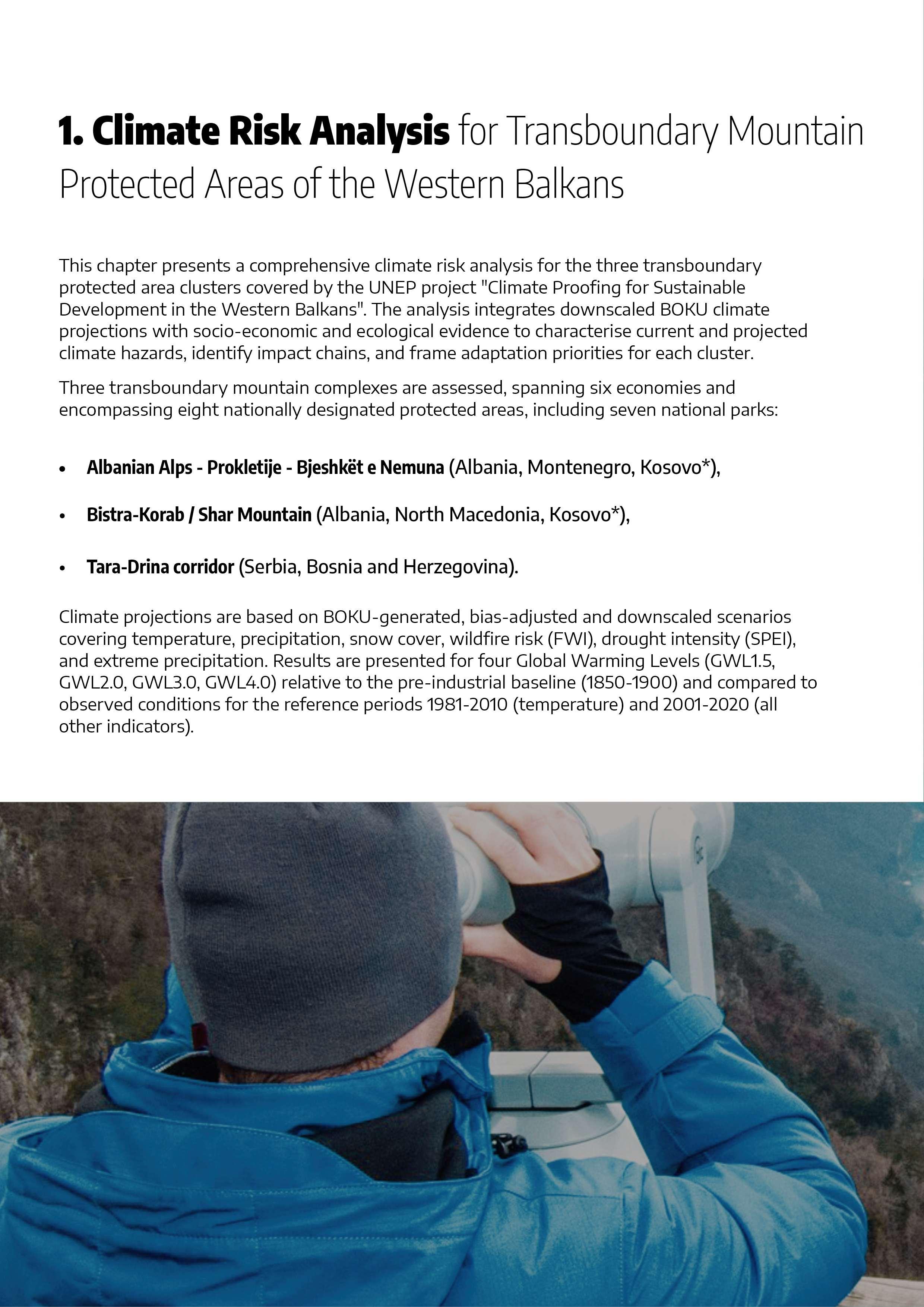
1.ClimateRiskAnalysisforTransboundaryMountain ProtectedAreasoftheWesternBalkans
I.Tara-DrinaCorridor(Serbia&BosniaandHerzegovina)
II.Bistra-Korab/SharMountain(Albania,NorthMacedonia,Kosovo*)
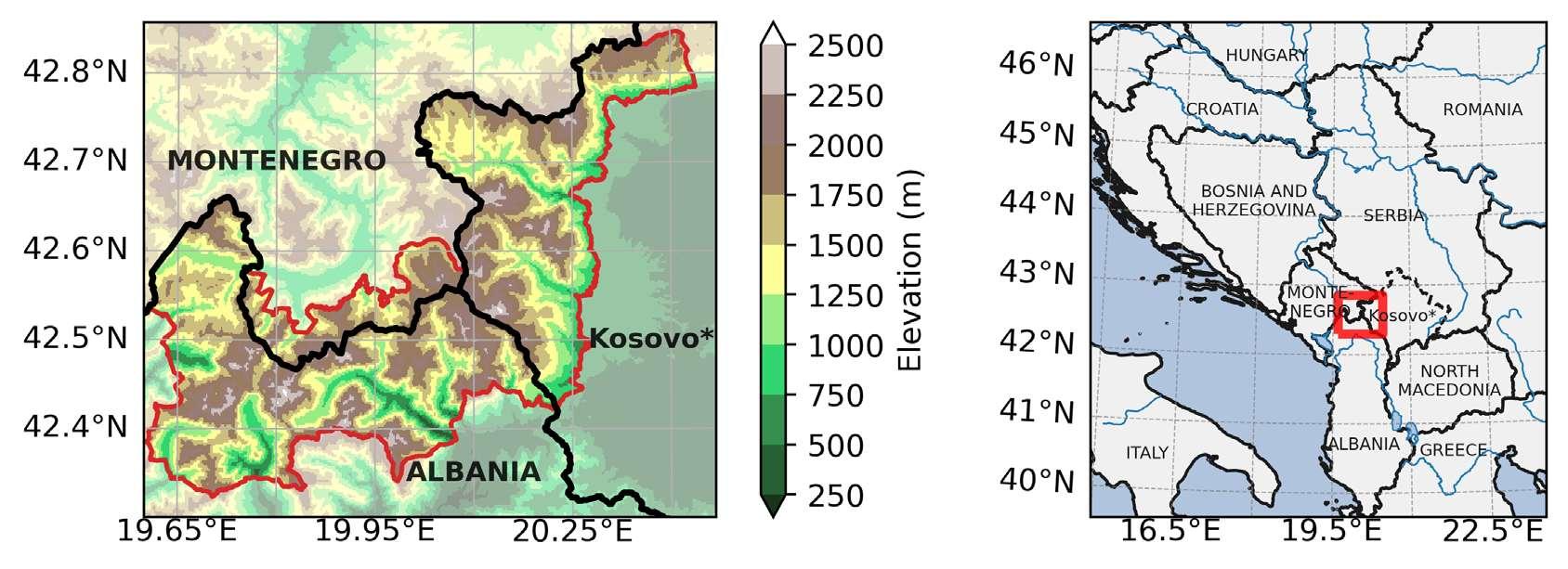
III.AlbanianAlps-Prokletije-BjeshkëteNemuna (Albania,Montenegro,Kosovo*)
IV.ComparativeSynthesis
2.ProtectedAreaProfiles
NationalParkAlbanianAlps(Albania)
NationalParkProkletije(Montenegro)
NationalParkBjeshkëteNemuna(Kosovo*)
Korab-KoritnikNaturePark(Albania)
NationalParkSharMountain(NorthMacedonia)
NationalParkSharri(Kosovo*)
NationalParkTara(Serbia)
NationalParkDrina(BosniaandHerzegovina)
3.Recommendations:IntegratingEcosystem-BasedAdaptation(EbA)and Nature-BasedSolutions(NbS)intoProtectedAreaManagement
Tara-DrinaCorridor
Bistra-Korab/SharMountain
AlbanianAlps-Prokletije-BjeshkëteNemuna
GeneralandEconomy-SpecificRecommendations
3.Annexes
UsingtheWB-CPPPlatformtoPrepareNationalParks forClimateImpacts ClimateProjectionsandKeyIndicators (ClimateFactsheets)
Introduction BackgroundandContext ThemountainecosystemsoftheWesternBalkansrankamongthemost biodiverseandecologicallysignificantlandscapesinEurope.Stretchingacross theDinaricArcfromtheJulianAlpsinthenorthwesttotheSharPlaninaand Prokletijemassifsinthesoutheast,thesehighlandssupportspeciesand habitatsthathavesurvivedEurope'sPleistoceneglaciations,harbour extraordinarylevelsofendemism,andprovidecriticalwater,food,andclimate regulationservicesformillionsofpeople.Eightnationalparksandnature parksacrossthe6economies-Albania,BosniaandHerzegovina,Kosovo, *₁ Montenegro,NorthMacedonia,andSerbia-protectthecoreofthisnatural heritage.
Theseprotectedareasarenowconfrontingoneofthemostformidable challengesintheirhistory:arapidlychangingclimatethatissimultaneously reshapingtheirecologicalfoundationsandthesocio-economicconditionsof thecommunitiesthatdependonthem.Temperatureincreasesof1.5-4°Care projectedbytheendofthiscenturydependingonglobalemission trajectories.Summerdroughtsthatcurrentlyoccuronceevery15yearsare projectedtobecometwo-yearevents.Aprilsnowpack-thefreshwater reservoirthatfeedsmountainspringsandriversthroughthesummer-isat riskoftotaldisappearanceatmid-elevationsbythetimethecurrent generationofparkmanagementplansexpires.Wildfireriskisexpanding upslopeintohigher-elevationhabitatsthathaveneverhistoricallyburned.
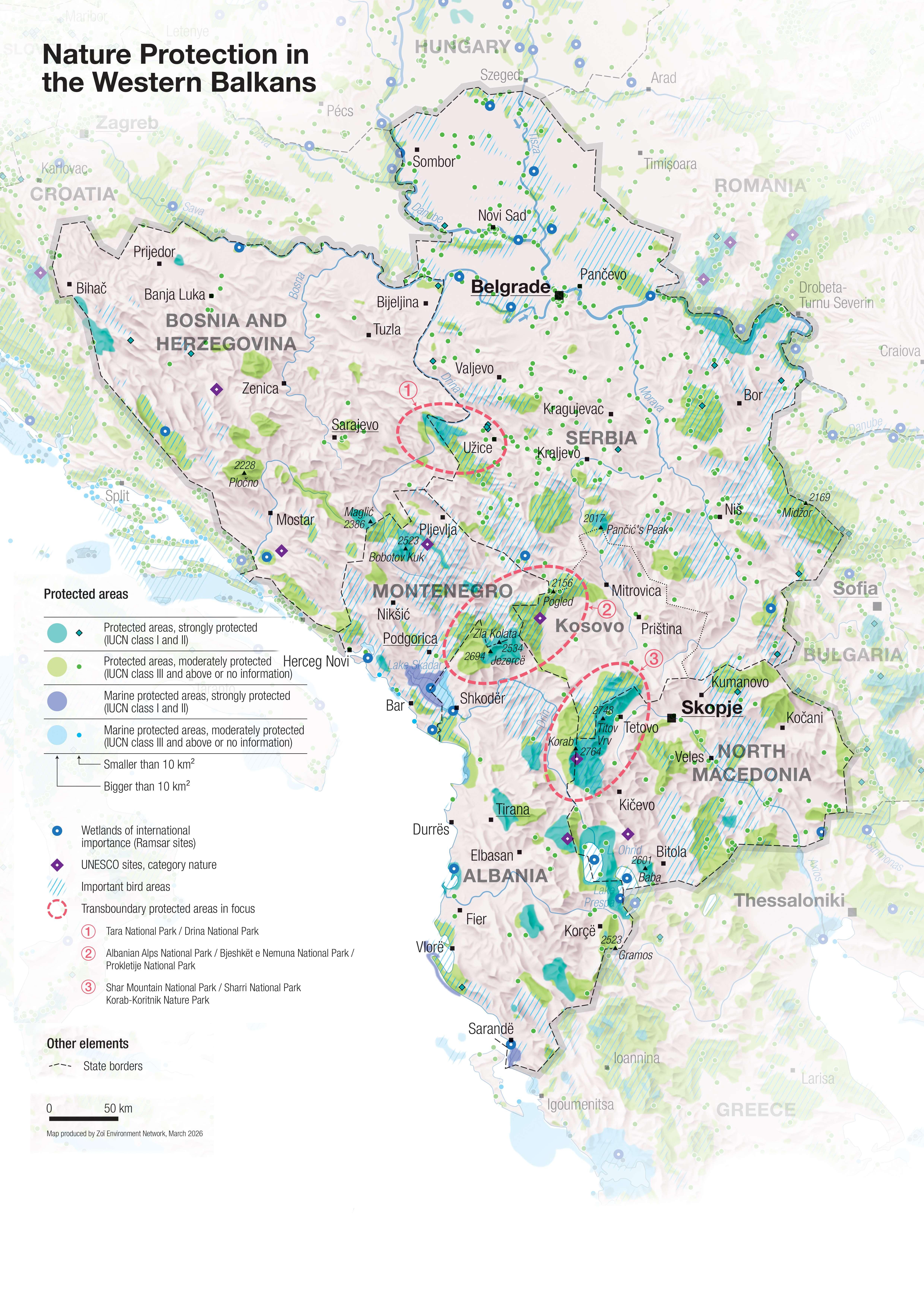
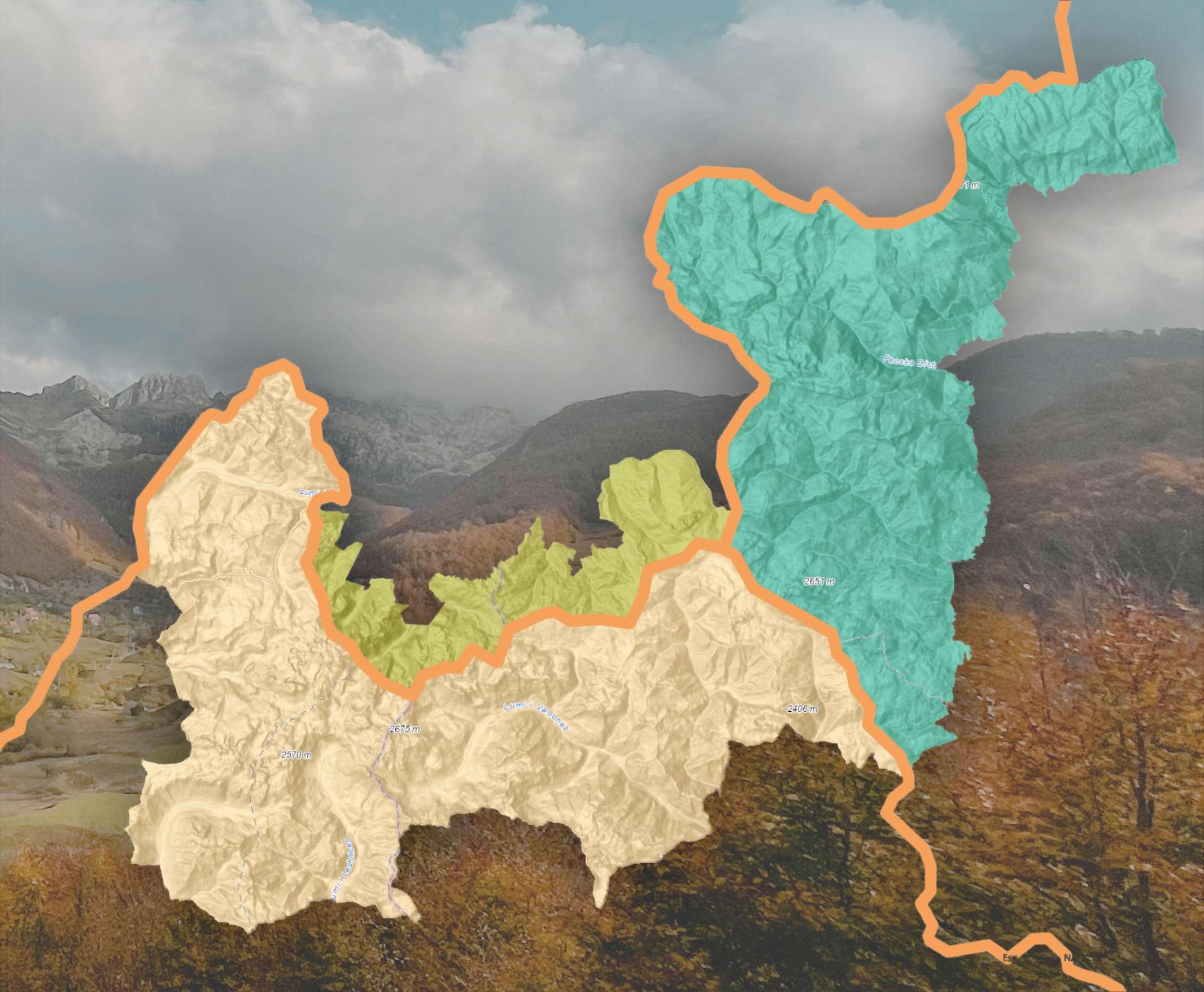
GeographicandInstitutionalScope Theanalysiscoversthreetransboundaryprotectedareaclustersencompassingatotalof approximately365,300hectaresofprotectedmountainlandscapeacrosssixeconomies:
Tara-DrinaCorridor
Bistra-Korab/SharMountain
AlbanianAlps-ProkletijeBjeshkëteNemuna
NPTara(Serbia);NPDrina (BosniaandHerzegovina)
NPSharMountain(North Macedonia);NPSharri (Kosovo*);Korab-Koritnik NaturePark(Albania)
NPAlbanianAlps(Albania);NP Prokletije(Montenegro);NP BjeshkëteNemuna(Kosovo*)
Serbia,Bosniaand Herzegovina
N.Macedonia,Kosovo*, Albania Albania,Montenegro, Kosovo*
Together,theparksareembeddedinabroaderlandscapesupportingapproximately 650,000-700,000peopleinsurroundingmunicipalities-fromtheAdriaticlowlandsof AlbaniatotheKosovo*Plain,fromtheDrinavalleyineasternBosniatoVojvodina'splains. Theirecologicalfunctions-carbonsequestration,waterregulation,biodiversitycorridors, naturalhazardbuffering-extendfarbeyondtheirboundaries.Thisiswhyclimatechange intheseprotectedareasisnotonlyaconservationconcern,butadevelopmentand humansecurityissue.
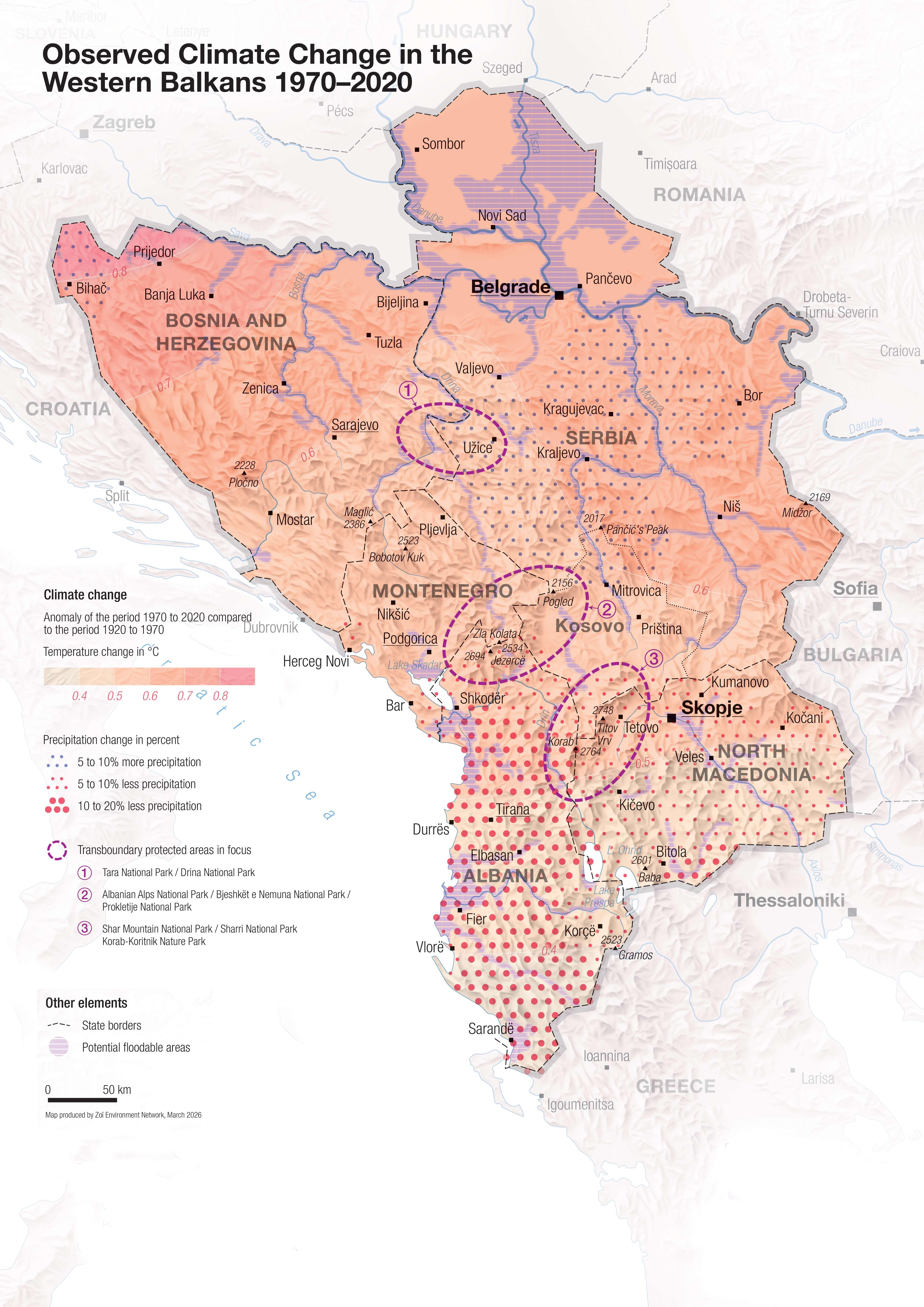
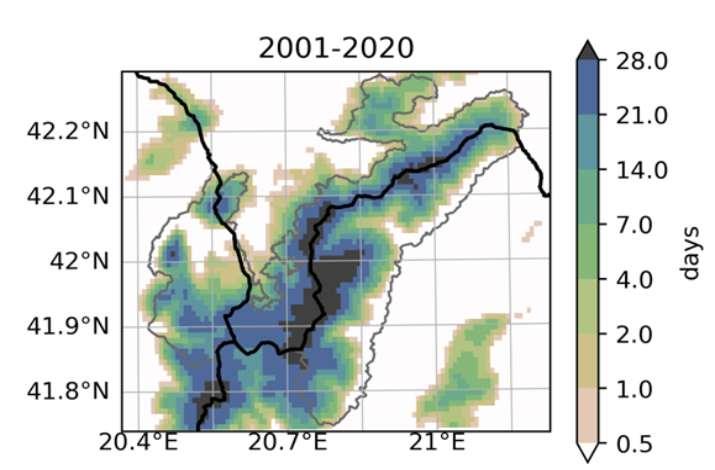
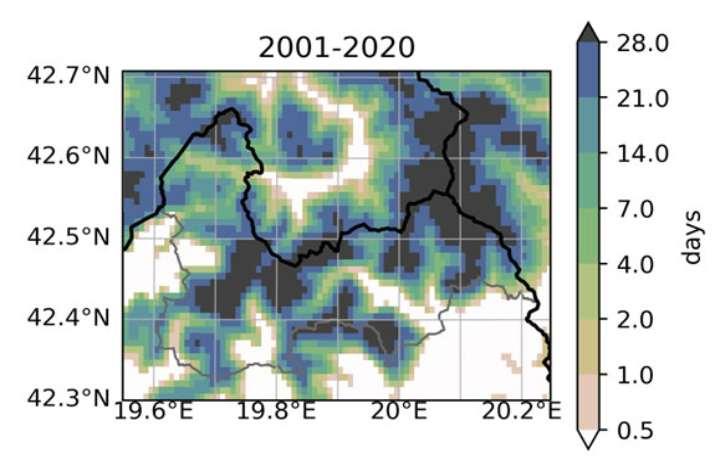
Note:Theclimatechangemaponthispagepresentslong-termhistoricaltrendsusingaggregatedperiods (1920–1970and1970–2020)toillustratebroadertemporalshifts.Theseperiodsdifferfromthestandard observationbaselinesusedinthefactsheetsandtheWB-CAPplatform,whichrelyonmorerecentand methodologicallyharmonizedreferenceperiods.Therefore,themapservesanillustrativepurposeandshouldbe interpretedascomplementarycontextratherthandirectlycomparabledata.
MethodologicalApproach ThisanalysiswascommissionedbyUNEPandsynthesisesBOKUViennadownscaledclimate projections,fieldevidence,stakeholderconsultations,andthemanagementrealityofeight protectedareastoproducefindingsthatarebothscientificallygroundedandoperationally relevant.
Theanalysisintegratesfourevidencestreams:
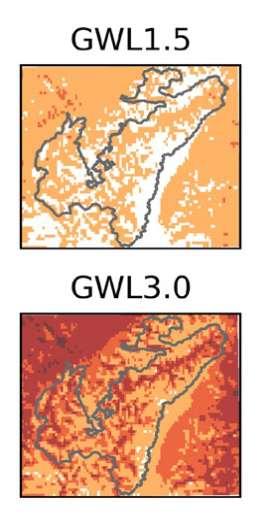
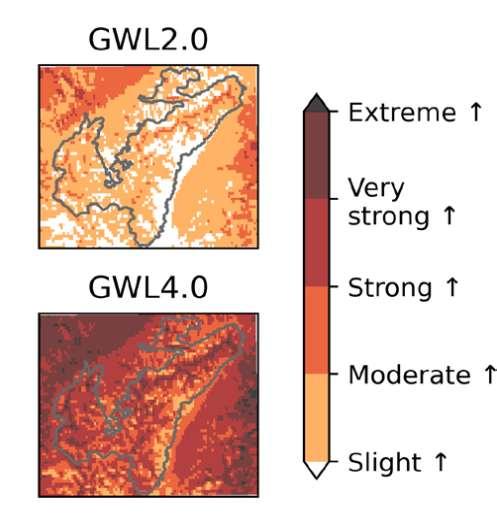
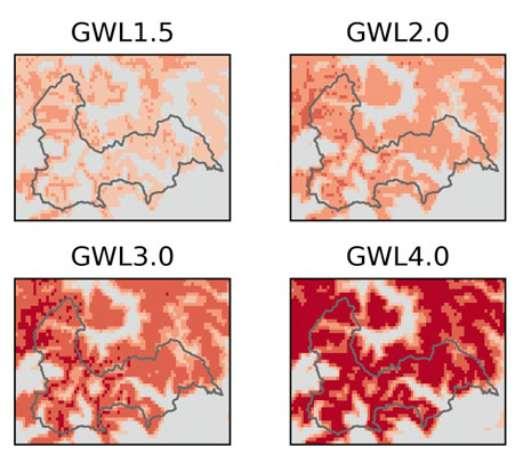
•BOKUdownscaledclimateprojections:High-resolutionregionalclimatemodel simulationsdownscaledspecificallyfortheWesternBalkansdomain,presentedat fourGlobalWarmingLevels(GWL1.5,2.0,3.0,and4.0°Cabovepre-industrial baseline)andaccessiblethroughtheWB-CPPplatform(wbcpp.neopix.dev).These projectionscovertemperature,precipitation,drought,snow,wildfireweather,and extremeeventindicators.
•Deskresearch:Reviewofmanagementplans,biodiversityassessments,socioeconomicstudies,floodriskreports,anddevelopmentstrategiesforalleight protectedareasandtheirsurroundingmunicipalities,drawingonavailable documentationfrom2020-2025.
•Focusgroupdiscussions:174participantsacrosssixfocusgroupsinallthree clusters,engagingfarmers,herders,tourismoperators,guesthouseowners,NTFP collectors,andcommunitymemberstodocumentobservedclimatechangeimpacts andcommunity-levelvulnerabilities.
•Keyinformantinterviews:interviewswithparkmanagers,rangers,municipal officials,energyoperators,hunters,fishers,andcivilsocietyrepresentatives, capturinginstitutionalperspectivesongovernancechallenges,managementplan limitations,andadaptationpriorities.
Whattheclimateprojectionsshow TheBOKUclimateprojections,downscaledspecificallyfortheWesternBalkansdomainand presentedacross4GlobalWarmingLevels(GWL),showaconsistentandalarmingpattern acrossallthreetransboundaryclusters.Thesearenotmodelartefacts-theyarerobustsignals thatappearunderallscenariosexamined:
ClimateHazard&TrendKeyImpactsonProtectedAreasandTheirCommunities
Temperaturerise
Droughtintensification
Snowcovercollapse
Wildfireriskexplosion
Extremeprecipitation intensification
Veryhotdays increasing
+1.8-1.9°CalreadylockedinunderGWL2.0;+4.1-4.4°C possiblebyendofcenturyunderGWL4.0.TheSharrand Prokletijemassifsfacethestrongestwarmingsignal(+4.4 °C).ThisisfasterthantheEuropeanaverage.
Themostseveresignal.Droughteventsthatcurrently occuronceevery15yearsareprojectedtooccurevery2 yearsbyGWL4.0.IntheTara-Drinacorridor,drought intensityincreasesupto5×.IntheSharr/Korabcluster,up to4×.Springsaredrying,riversrecordingextremelow flowsinsummer,andreservoirlevelsapproaching biologicalminimums.
TotallossofAprilsnowpackispossibleatmid-elevations (below2,000m)underGWL4.0.Snowcoverdurationis alreadydecliningat14+daysperdecade.Thisisnotonlya tourismissue-snowmeltistheprimarysourceofsummer riverflowandspringrechargeforover350,000urban residentsinTetovo,Gostivar,Prizren,andKukës.
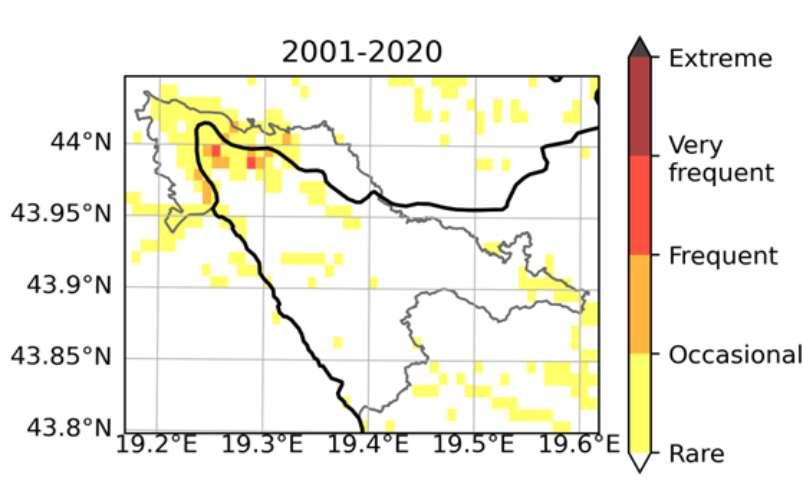
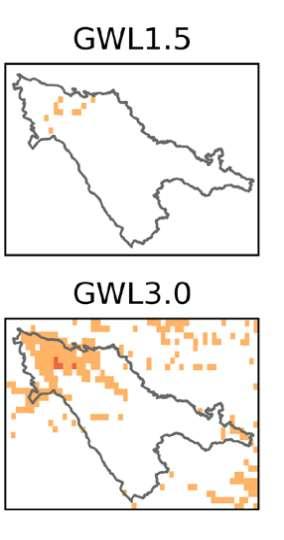
Verystrongincreaseinfireweatherindex(FWI)high-risk daysregion-wide.Fireriskisexpandingabove2,000mhabitatsthathaveneverhistoricallyburned.AJanuary wildfirehasalreadybeendocumentedinAlbanianAlps.No tri-nationalfiremanagementprotocolcurrentlyexists.
Paradoxically,whileaveragesummerprecipitationdeclines, dailyextremeeventsintensify:+8%inTara-Drina,+13%in Sharr/Korab,+14%inAlbanianAlps-Prokletije.Onsteep, degradedterrainthismeansmoredestructiveflashfloods andlandslides-asdemonstratedbythe2015Tetovoevent (6fatalities,21milliondamage)and2014Sava/Drina $ floods($2billiondamageacrossSerbiaandBiH).
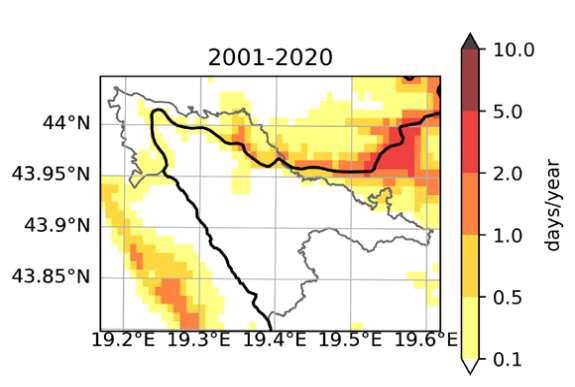
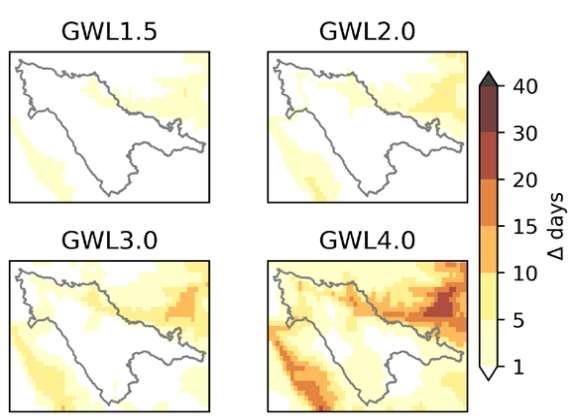
Inlower-elevationareas,veryhotdays(>35°C)increaseby upto20peryearatGWL4.0.Thisaffectsvisitorcomfort andsafety,outdoorlabour,andlowlandagriculturein municipalitiessurroundingtheparks.
Structureofthisreport Thisreportisorganisedinthreechapters.Togethertheyformaprogressionfromevidence toprofilestoaction-designedtobeusedbothasareferencedocumentandasapractical toolforprotectedareamanagers,planners,andnationalauthorities.
Chapter1-ClimateRiskAnalysis Chapter1constitutesthescientificfoundationofthereport.Foreachofthethree transboundaryprotectedareaclusters,itpresentstheBOKUclimateprojections acrosskeyindicators(temperatureincrease,veryhotdays,droughtintensityand frequency,snowcoverchange,extremeprecipitation,andwildfirerisk),synthesises observedanddocumentedclimateimpactsfromfieldresearchandtheliterature, constructsimpactchainslinkingclimatedriverstoecologicalandsocio-economic consequences,andidentifiesthemostclimate-vulnerablepointsineachlandscape. Thechapterconcludeswithacomparativesynthesisofrisklevelsacrossclusters andidentifiespriorityentrypointsforecosystem-basedadaptationinvestment.
Chapter2-ProtectedAreaProfiles Chapter2providesdetailedprofilesofeachoftheeightnationalparksandnature parks,organisedbycluster.Eachprofilecovers:thepark'sbasiccharacteristicsand legal/institutionalstatus;IUCNcategory;managementplanstatusandperiodof validity;ecologicalandbiodiversityvalues;climatecharacteristicsandobservedor projectedclimatechangeimpacts;accessibilityandpopulationcontext;keyrisksand pressures;existingandplannedinfrastructure,particularlytourism-related;anda summarytableofthemainstakeholdergroupsengagedinconsultations,including theirconcernsandperspectives.Theprofilesaredesignedtoserveasreference documentsforpark-specificplanningwhileremainingcomparable.
Chapter3-EbAandNbSRecommendations Foreachcluster,thischapterproposesasetofecosystem-basedadaptationand nature-basedsolutionmeasuresforintegrationintoprotectedareamanagement plans,pairedwithastakeholderengagementtableidentifyingspecificrolesfor communities,parkadministrations,authorities,internationalorganisations,andthe privatesector-withparticularattentiontotourismoperators.Thechapterthen providescross-cuttingandeconomy-specificrecommendations.
SummaryforDecision-Makers ClimatechangeisnotafutureriskforthemountainprotectedareasoftheWestern Balkans-itisapresentandacceleratingrealitythatisalreadyalteringecosystems, threateningwaterandfoodsecurity,shorteningwintertourismseasons,andamplifying naturalhazards.Theeightnationalparkscoveredbythisanalysisarelocatedatthe frontlineofclimateimpactsinEurope.
Thedecisionsmadeinthenextfive years-onmanagementplanrevisions, infrastructure,institutionalcoordination, andecosystemrestoration-will determinewhethertheselandscapes remainfunctionalasbiodiversity refugia,watertowers,andeconomic assetsfortheircommunitiesbymidcentury.
Ecosystem-based adaptationisthemost cost-effectivestrategy available: itsimultaneouslyprotects biodiversity reducesdisasterrisk, secureswatersupplies, andsupportscommunity livelihoods.
Whatthismeansforprotectedareas Climatechangeisnotaffectingallpartsoftheseprotectedlandscapesequally.Sixspecific impactsstandoutasdecision-criticalpriorities:
1.Forestecosystemcollapserisk:Pančićspruce()-thegloballyrareconifer Piceaomorika protectedbyNationalParkTaraandfoundalmostnowhereelse-isexperiencingbark beetleoutbreaksamplifiedbydrought.ChestnutgrovesinKosovo*arefailing.Spruceand firstandsacrosstheSharmassifareunderthermalandmoisturestress.Ifcurrenttrends continue,forestdiebackwillaccelerateirreversibly.Proactivemixed-speciesenrichment plantingandrefugiadesignationareneedednow,beforestressedtreesbecome monoculturevictims.
2.Freshwatersystemsandbiodiversityunderacutestress:Riversthatformtheecological backboneofallthreeclusters-theDrina,Lumbardhi,Jadar,Leshnica,andtheirtributariesarerecordingextremelowflows,disappearinginsummer,orbeingdivertedbysmall hydropowerschemes.TheDrina'sflagshipspecies,thehuchen(),isindecline. Huchohucho GlaciallakesinNationalParkSharMountainshowdecliningsurfaceareas.Alpinepeatbogs atCrveniPotok(NPandelsewherearedesiccating.Thesetrendsrequireflow Tara) restorationandhydrologicalprotectionmeasures.
3.Tourismeconomyisbuiltonstrandedassets:Allthreeclusterscontainskiinfrastructure operatingontheassumptionofreliablewintersnowpack.BOKUprojectionsmakeclear thatreliablenaturalsnowbelow2,000mwillbeincreasinglyrareorabsentbymidcentury.Tourismstrategiesthatrelyonwintersportsarestrandedassetswithinone managementplancycle.Decision-makersmustbeginthetransitiontoclimate-resilient, four-seasontourismmodelsnow,beforeinvestmentisfurtherlockedintoclimateincompatibleinfrastructure.
4.Overtourismisdestroyingtheassetitdependson:NationalParkAlbanianAlpsreceived 558,000visitorsin2023-atenfoldincreaseinadecade-withnowastewatertreatment, insufficientwasteinfrastructure,andhundredsofunpermittedguesthouses.Thistrajectory degradestheveryecosystemthattourismdependson.The2025demolitioncontroversy demonstratedthepoliticalfragilityofunregulatedtourismgovernance.Carryingcapacity frameworksandgreentourismstandardsarenotoptional-theyareexistentialforthe tourismeconomy.
5.Communitywatersecurityisatstake:Over350,000urbanresidentsinTetovo,Gostivar, Prizren,andKukësdependonmountainspringandriversystemsthatareunderdualstress fromclimatechangeandhydropowerdiversion.InSrebrenica,municipalwaterrestrictions alreadyoccurdailyinsummer.Water-towerprotection-throughspringrestoration,microretention,andcatchmentmanagementwithintheparks-directlyservesnational developmentgoalsandEUwaterpolicyobligations.
6.Cross-bordergovernancegapsarecreatingdangerousvulnerabilities:NotasingletrinationalwildfireprotocolexistsfortheProkletijemassif.Nojointearlywarningsystem coversthetrilateralmountainmassif.FloatingwastefromBosniaandHerzegovina accumulatesinPerućacLakeinSerbiawithnobilateralmanagementmechanism.Bark beetledoesnotrespectnationalborders,andneitherdoesfloodwater.Climateadaptation intheselandscapescannotsucceedwithinsingle-countrygovernanceframeworks.
FivePriorityActions forDecision-Makers: 1.Integrateclimateriskintoallmanagementplanrevisions:everymanagementplanrevision shouldincludeclimateprojectionsandatleast1-5EbAprioritymeasures.
2.Establishmulti-nationalcoordinationmechanismsforallthreeclusters:Createjointfire managementprotocols,sharedsnowandwatermonitoringnetworks,coordinatedearly warningsystems,andharmonisedtourismstandards.Theinstitutionalarchitectureforthis exists(DrinaTaskForce,DrinCoordinatedAction,PeaksofBalkansConsortium)-itneedsto beresourcedforclimatefunctions.
3.InvestinEbApilotswiththehighestco-benefits:springrestoration,riparianrevegetation, peatbogrehabilitation,andmixed-speciesforestenrichment.Estimatedcost:€70,000230,000perpilot,withbenefit-costratiosof5:1orhigher.
4.ApplytheWB-CPPplatformasthestandardclimatetoolinPAplanning.Theplatformis free,accessible,andcoversallsixeconomiesonaconsistentbasis.
5.Stopapprovingclimate-incompatibleinfrastructureinandaroundtheparks:skiresort expansionwithoutindependentclimateassessment,smallhydropowerthatfurtherdepletes riversystems.
TurningClimateRisksintoAction: Ecosystem-basedAdaptation(EbA) CLIMATEDRIVERS RAPID WARMING upto4.4°C
FREQUENT DROUGHTS from1-in-15years every2years
SNOWPACK COLLAPSE <2000mdisappearing
EXTREMEDAILY RAINFALL 8-14%increase
WILDFIRE EXPANSION toaltitudes2000+m
ECOSYSTEMIMPACTS
FORESTDIEBACK& PESTOUTBREAK
e.gPančićspruceendangered bybarkbeetleoutbreak
DRYINGSPRINGS& WATERSCARCITY 350.000+peopleaffected
FLOODS& LANDSLIDES fatalitiesandeconomicloss
LOSSOFENDEMIC SPECIES&HABITATS e.gPančićspruce
COLLAPSEOF SNOW-DEPENDENT SYSTEMS wintertourismaffected
Integrateclimate projectionsintoALL PAsmanagementplans
Establishmulti-national cross-borderPAs governance
A.FOREST-BASED EbA
EbAMEASURES B.WATER& WETLANDEbA
C.LANDSCAPE& BIODIVERSITYEbA
mixed-species forestrestoration reducingbark beetlevulnerability maintainingcarbon storageand ensuringhabitatfor endemicspecies
restoringspringsand waterretention
constructingsmall water-retention basins
peatbogandwetland rehabilitation
Stopclimate-incompatible investments(ski-centers, hydropowerprojects)
riparian(riverbank) vegetationrestoration
pasturerehabilitation andinvasivespecies control
maintainecological corridorsandtraditional land-usesystems
CO-BENEFITS
REDUCESDISASTER RISK floods,wildfires,landslides
SECURESDRINKING WATER for>350,000people
SUPPORTSRURAL LIVELIHOODS &traditionallanduse (€1→~€5avoideddamage)
MAINTAINS BIODIVERSITY HOTSPOTS &ecosystemintegrity
PROTECTSTOURISM ASSETS &avoidshigh-riskinvestments
ApplytheWB-CPPclimate platformsasthestandard planningtool
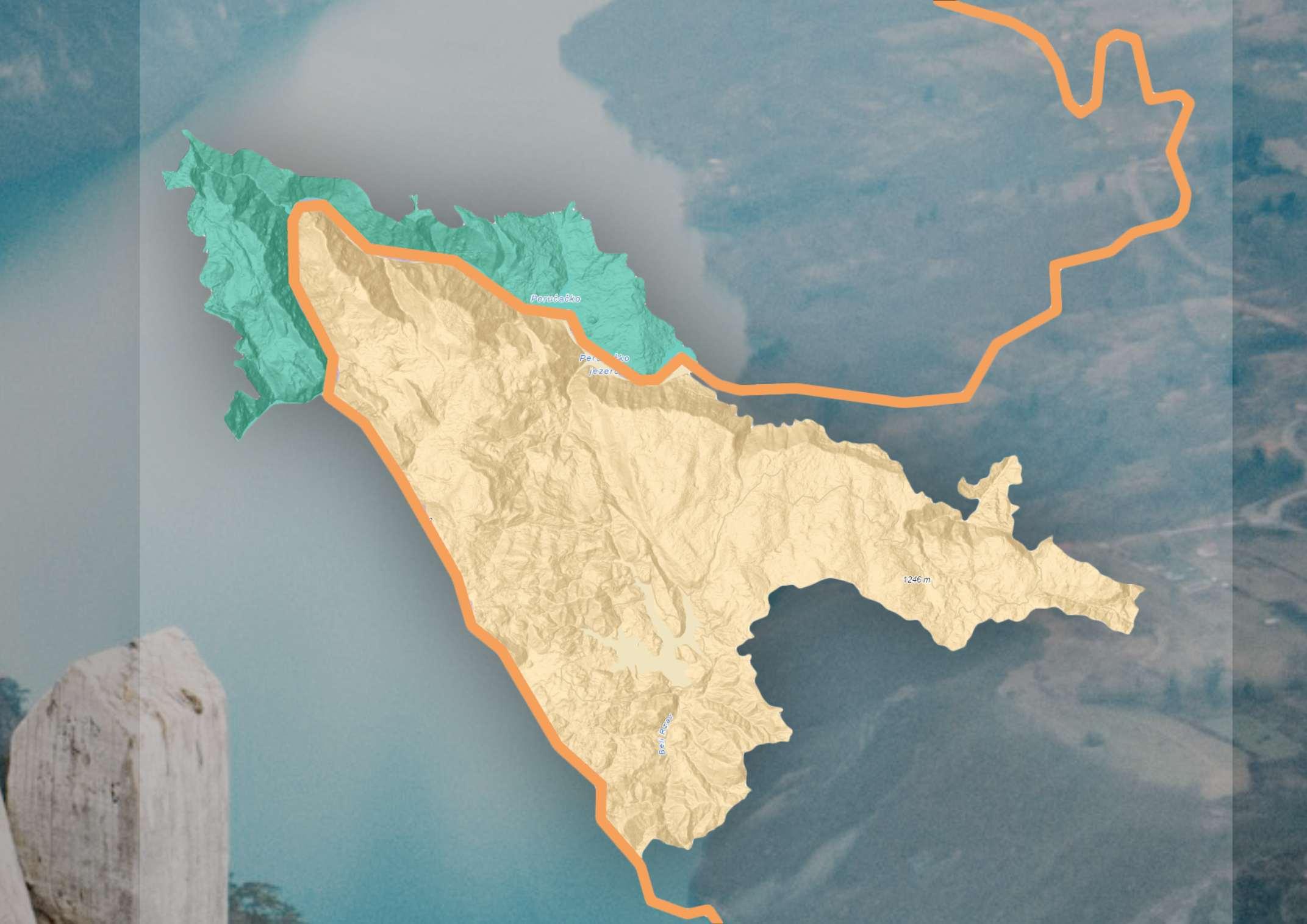
Tara-DrinaCorridor (Serbia&BosniaandHerzegovina) 1.1GeographicandEcologicalContext TheTara-DrinacorridorlinksNationalParkTara(Serbia)andNationalParkDrina (BosniaandHerzegovina)alongoneofEurope'slastwildriversystems.National ParkTaracovers24,992haintheDinaricAlps(elevation291-1,591m),dominatedby 80%forestcoverincludingthecriticallyrarePančićspruce().National Piceaomorika ParkDrina(6,315ha,elevation290-1,265m)protectsthemiddleDrinacanyonin RepublikaSrpska,notableforitslimestonehabitatsandendemicspeciesincluding theDerventaknapweed.Together,theseparkssitwithinawiderlandscapethat alsocontainstheBajinaBaštahydropowersystem-Serbia'ssecondlargest-andis proposedasthetransboundaryDrinaUNESCOBiosphereReserve.
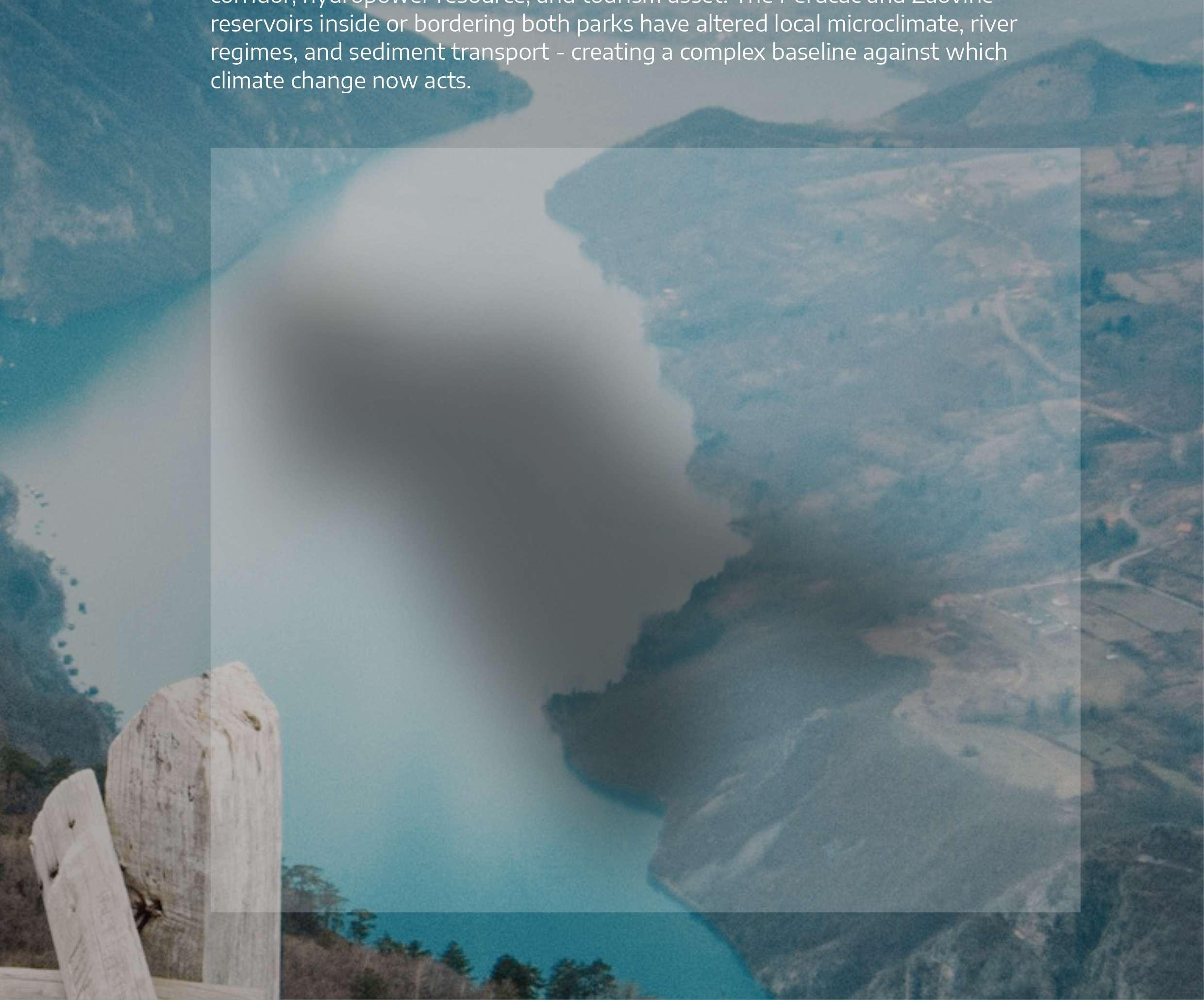
TheDrinaRiverservessimultaneouslyasinternationalboundary,ecological corridor,hydropowerresource,andtourismasset.ThePerućacandZaovine
SERBIA
NPDrina
NPTara
BOSNIAANDHERZEGOVINA
1.2ObservedClimateandRecentTrends MeteorologicalmonitoringatNationalParkTarawasinterruptedforseveraldecades(stations closedmid-1980s,recentlyre-established).AvailabledatafromZlatibordistrict(1961-1990) characterisesthebaseline:meanJanuarytemperature2°C,July/August~18°C,annualprecipitationinaMediterranean-influencedregimewithmaximuminNovember-Januaryand minimuminAugust.SnowcovertypicallypersistsNovember-March,extendingtoAprilat elevationsabove1,000m.Tropicaldays(30°C)averageonly1.3peryear,concentratedinJuly≥ August.
Stakeholderconsultationsandkeyinformantinterviewsacrossthe2024-2025fieldcampaign documentthefollowingobservedshiftsalreadyperceptibletoparkmanagersandlocal communities:
•Snowywintershavebecomerare:participants acrossallfocusgroupsdescribedconsistent shorteningandthinningofsnowcoveroverthe pastdecade.
•Thenumberofdaysabove30°Cisrising,with heatepisodesnowextendingintoearlyautumn.
•Springfloodinghasintensified:documentedmajor floodeventsincludethecatastrophic2014floods thatcausedsevereroadandinfrastructure damage,andrecurringlandslideepisodesin Sućeska,Luka,andsurroundingareas.
•Foreststresssignalsareaccelerating:barkbeetle outbreaks(primarily inNorwayIpstypographus spruce),patchesofPančićsprucedieback,and peatbogdesiccationatCrveniPotokare documentedinparkmanagementrecords.
•Aquaticecosystemsaredegrading:summer minimumflowsintheJadar,Drinatributaries,and Štedrićhavefallensharply;huchen() Huchohucho populationsaredecliningwhileinvasive pumpkinseed()isspreading. Lepomisgibbosus
•TheZaovinereservoirapproachedbiological minimumlevelsinrecentsummers,threatening downstreamflowandaquaticbiodiversity.
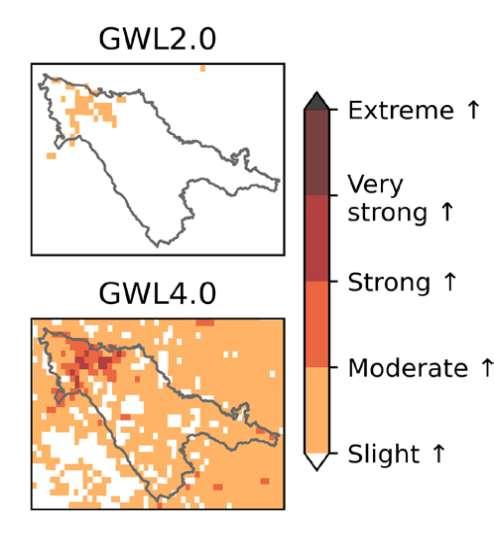
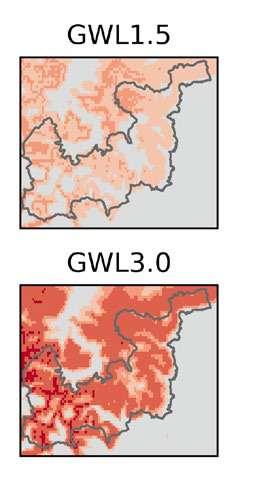
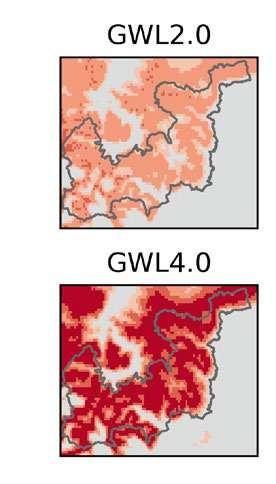
1.3ClimateProjections BOKUprovidedbias-corrected,downscaledprojectionsfortheTara-DrinaareaunderfourGlobal WarmingLevels(GWLs),drawingonamulti-modelensemble.Keyfindingsaresummarisedbelow.
Climateindicator
Airtemperatureincrease(vs1981-2010)
Veryhotdays>35°C/year
Growingseasonduration
Snowcoverdays(>10cminApril)
Meteorologicaldroughtintensity(SPEI)
Extremedailyprecipitationchange
Wildfirerisk(FWIhigh-riskdays)
GWL1.5
+1.2°C
Marginal
+7days
Marginalreduction
Moderateincrease
Nocleartrend
Lowincrease
+1.8°C
Marginal
+15days 2to5days
2×moreintense
+3%
Moderateincrease
+2.8°C
Upto+10days
+35days 7to12days
3-4×moreintense
+5%
Moderate-strong
+4.1°C
Upto+20days(northernslopes)
+55days
Totaldisappearancepossible
Upto5×moreintense; 15-yreventevery2yrs
+8%(flashflood/landsliderisk)
Mostnotableonsouthern&NWslopes
Severalprojectiondetailsareparticularlysignificantformanagement planning:
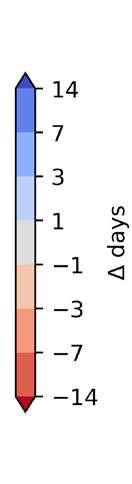
•Snowcover:TheTaraplateaucurrentlyhostsmoderatebut reliablewintersnowpack.UnderGWL4.0,snowcoverinAprilis projectedtovirtuallydisappear,endingtheviabilityofwinter sportsinfrastructureandeliminatingthespringwaterbufferthat currentlysustainslowlandcommunitiesthroughsummer.
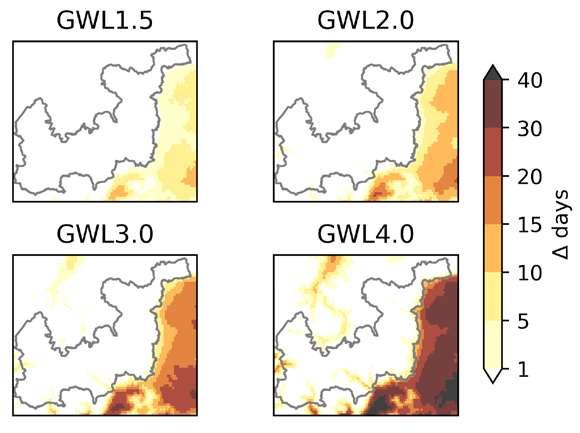
•Heatextremes:Whilebaselinetropicaldaysarerare,theincrease toupto20additionalveryhotdaysperyearunderGWL4.0concentratedinthenorthernpartofthecomplex-will fundamentallyaltervisitorcomfortinsummerandaccelerate forestmoisturestress.
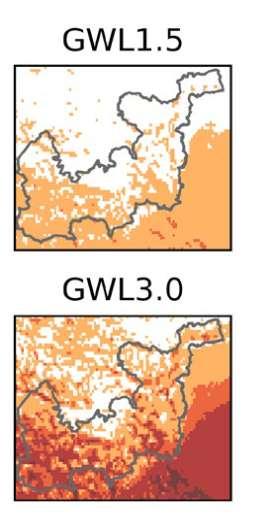
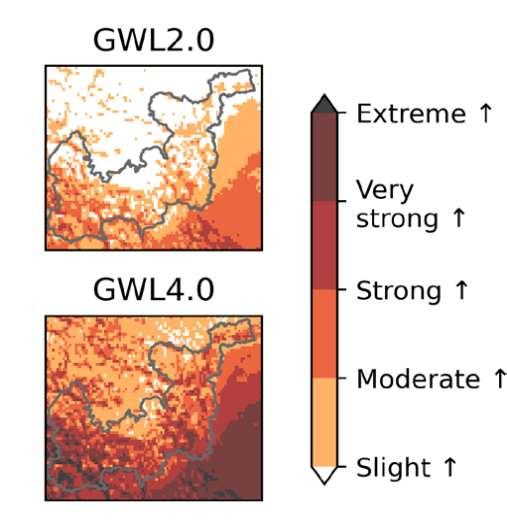
•Drought:Climateprojectionsindicateastrongincreasein meteorologicaldroughtintensity(SPEI)underhigherwarming scenarios.UnderGWL4.0,droughtintensitycouldbecomeupto fivetimesstronger,witheventsthathistoricallyoccurredroughly onceevery15yearspotentiallyoccurringasoftenaseverytwo years.Thisrepresentsthemostsevereprojectedhazardforboth ecosystemsandlivelihoodsintheTara-Drinacorridor.Springs servingsmallsettlementsarealreadyreportingsummerfailures.
•Flashfloods:The8%intensificationofextremedaily precipitation,whilemoderateinabsoluteterms,actsonsteep karstanddegradedslopeterraintoincreaselandslideandflashfloodrisk-asthe2014Sućeskaeventdemonstrated.
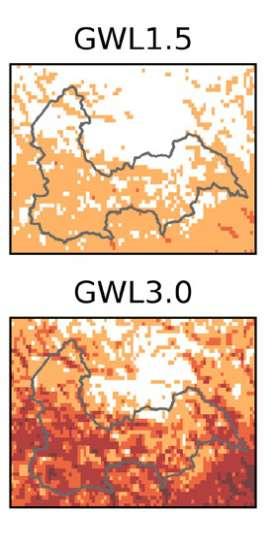
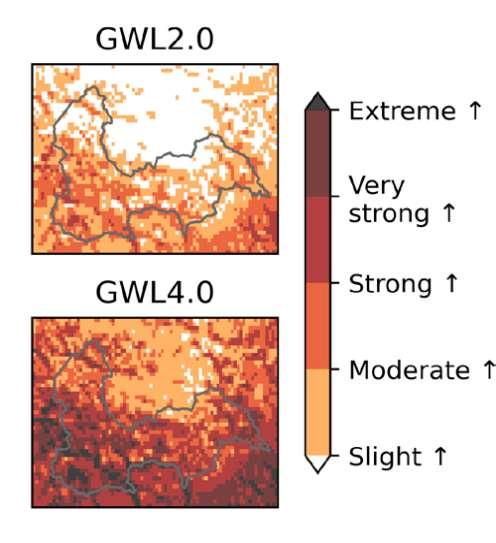
GWL2.0GWL3.0GWL4.0
1.4ClimateImpactChains BasedontheBOKUprojections,deskresearch,andstakeholderevidence,thefollowingimpact chainsweresynthesisedfortheTara-Drinacorridor.
ClimateDrivers
Environmental Impacts
Socio-Economic Pressures
Warming+1.8°C(GWL2.0)?+4.1°C(GWL4.0); snowloss;prolongedsummerdrought(upto 5×moreintense);risingfire-weatherdayson southern&northwesternslopes.
RiskoftotalAprilsnowloss(GWL4.0);bark beetleoutbreaksinspruce;Pančićspruce ()dieback;peatbogdesiccation Piceaomorika (CrveniPotok);reducedspringwaterbuffer; ecosystemshifttowardthermophilousspecies.
Shorterwintertourismseason;visitor concentrationinsummer(~100,000annual visitors);post-COVIDsurgeinillegal construction;ATVdamagetoforestroads; weakwastewatermanagement.
Sametemperaturetrend;upto20extraveryhot days/year;warmerwintersreducesnowpack retention;irregularprecipitationwithdrier summers.
RiverflowvariabilityinDrina,Jadar,Sućeska;more frequentflashfloodsanderosion;reducedfish spawning;deterioratingcanyonaquatichabitats; lossofendemicriparianflora.
Emergingtourismunderpressurefromillegal shorelinestructures;cross-borderfloatingwaste (PerućacLake);hydropoweroperationsaltering flow;waterrestrictionsinSrebrenicasummer (3pm-6amdaily).
Consequences
Adaptation EntryPoints
Decliningwintertourismrevenue;increased wildfiredamagetoforests;barkbeetle expansionthreateningirreplaceableendemic sprucepopulations;reducedwatersecurityfor BajinaBaštamunicipality.
Mixed-speciesreforestationreplacing monoculturespruce;barkbeetlebiocontroland pheromonemonitoring;peatbogprotectionand hydrologicalrestoration;seasonalvisitor management.
1.5PriorityEbAPilotZones Incomeinstabilityforfishersandguides;water scarcityinsmallsettlements;degradedaquatic ecosystems;infrastructuredamagefrom floods/landslides(roadsblockedinSućeskafor extendedperiods).
Riverbankandmicro-wetlandrestoration;small water-retentionstructures;improvedwasteand wastewatermanagementintourismzones; regulationoflakeshorelineconstruction.
Theimpactchainanalysisidentifiessixpriorityecosystem-basedadaptationpilotlocationsacross theTara-Drinacorridor,withindicativecostrangesbasedonregionalbenchmarks:
PilotLocationParkInterventionCostEstimate
OpengrasslandhabitatsTaraplateau
DrinaCanyonslopes
VisitorflowmanagementTaracorezone
JadarRivermicro-wetlands
Žlijebac-Sućeskaslopes
Klotjevac-Lukazone
Mechanisedpasturemanagementand restorationtomaintainsemi-natural meadowbiodiversityandprevent forestencroachment
Slopestabilisationandtargetedhabitat restorationforendemicSerbianbittercress () Cardamineserbica
Ecosystem-sensitivezoningandcarrying capacityenforcementtoreducesummer pressure
Smallwater-retentionbasinsand riparianvegetationrestorationfor erosionandfloodcontrol
Reforestationwithmixedspecieson landslide-proneslopes
Wildfirepreventioninfrastructureand riparianforestrecoveryalongfireproneridgelines
€90-120k
€80-100k
€70-90k
€90-110k
€80-100k
€100-130k
1.6TransboundaryClimateVulnerabilitiesand CoordinationPriorities TheTara-Drinacorridorsharesacommonriversystemandcontiguousforestlandscape,yet managementremainsnationallysiloed.Thefollowingtransboundaryrisksandcoordinationgaps wereconsistentlyraisedacrossstakeholderconsultations:
•Cross-borderfloatingwaste:SeasonalwasteaccumulationinthePerućacreservoirarrivingfromupstreaminBiHandfromSerbianbankcommunities-isamajorecologicaland reputationalthreatwithnobilateralmanagementmechanism.
•Sharedwildfirerisk:ThenorthernfacesoftheDrinawatershedcrossintobothcountries; fireignitionandspreadfollowsnoadministrativeboundary.Nojointearly-warningor responseprotocolexists.
•Hydropowerimpacts:TheBajinaBaštaHPPsystem(PerućacandZaovinereservoirs)is managedbySerbia'sEPSbutdirectlyimpactstheNationalParkDrinainBiHthroughaltered flow,thermalstratification,andfloatingdebris.TheproposedDrinjačaHPPandother plannedBiHprojectsaddfurthercumulativerisk.
•Fishpassage:Huchen()populationsaredecliningacrosstheDrinacatchment Huchohucho duetobarriersfromexistingandplannedhydropower.Notransboundaryrestoration protocolexists.
•Tourismstandards:Divergentnationalregulationsallowfacilitiesbannedononesideofthe bordertoproliferateontheother,underminingconservationobjectivesinbothparks.
RecommendationsforTara-DrinaCorridor EstablishajointTara-DrinaTransboundaryRiver ManagementGroupwithrepresentationfrombothpark authorities,nationalwateragencies,andmunicipal governments.
Developasharedearly-warningsystemforwildfires, floods,andbarkbeetleoutbreaks,buildingonBOKU climate-riskprojectionsandexistingmeteorological stations.
Negotiateabilateralfloatingwasteinterceptionprotocol andharmonisedecotourismstandardsalignedwiththe proposedDrinaBiosphereReservemanagement framework.
IntegrateBOKUdroughtandsnowprojectionsintoboth parks'nextmanagementplanrevisions,establishing climate-biodiversityindicatorsasmandatorymonitoring outputs.
Bistra-Korab/SharMountain () Albania,NorthMacedonia,Kosovo* 2.1GeographicandEcologicalContext ThistransboundarycomplexspanstheSharr-Korabmassifacrossthreeeconomies,encompassing threeprotectedareas:NationalParkSharMountain(NorthMacedonia,62,705ha,elevation4502,748m),NationalParkSharri(Kosovo*,53,271ha),andKorab-KoritnikNaturePark(Albania, 55,550ha,elevation410-2,350m,includingAlbania'shighestpeak,Korabat2,751m).
Thecomplexformsabiodiversityhotspotwith1,260+vascularplantsinNationalParkShar Mountainalone,128birdspecies,40glaciallakes,andextensivealpinepasturesandpeatbog systems.Theareaisalsothebackboneofregionalwatersupply:theSharskiVodisystemdiverts morethan50%oftheSharmountainriversintotheMavrovoreservoir,generatingapproximately 12%ofNorthMacedonia'selectricity.Thispre-existinghydrologicalmodificationcreatesacomplex
NORTHMACEDONIA
NPSharri
KOSOVO*
NPKorab-Koritnik
NPSharMountain
ALBANIA
2.2ObservedClimateandRecentTrends BaselineclimatedatafromPopovaŠapka(1,780m)showsanannualmeantemperatureof4.8°C, annualprecipitationapproximately700-1,250mm,andamaximumrecordedtemperatureof30.6 °C.SnowcoveratBrezovica(Kosovo*side)canreach3matpeakseason,withupto117snowy daysrecorded;theDragashsubalpinezoneaverages120snow-coverdaysatlowerelevationsand upto280daysinhighalpinezones.
Observedchangesreportedacrossallthreeeconomiesinthisclusterinclude:
•Shortenedanddelayedwinterskiseasons:focusgroupsfromallthreeeconomies consistentlydescribeunreliablesnowconditionsatPopovaŠapkaandBrezovica,with yearsofnear-zeronaturalsnow.
•Glaciallakesurfacereduction:long-termobservationsatthe40glaciallakesofShar Mountaindocumentdecliningsurfaceareaandwatervolume.
•PasturedegradationfromATVandsnowcatuse:asnaturalsnowthins,motorisedwinter transportscarsalpinemeadows,acceleratingerosionandhabitatdegradation.
•Springsandriversdrying:LumaRiversprings(Korab-Koritnik),theZhupa-LepencLumbardhibasin(Sharri),andriversinShipkovica-Brodechighlandsarereported intermittentlydryinsummer.
•Flashflooddamage:theAugust2015flashfloodinTetovo(triggeredbylessthantwo hoursoftorrentialrain)causedsixfatalities,anestimated21.5millionindamage,and $ buriedsectionsofShipkovicavillageinboulders,illustratingextremefloodvulnerability.
•Forestpestexpansion:chestnutandsprucestandsinKorab-KoritnikNatureParkand NationalParkSharMountainshowstress-relateddiebackandpestpressure.
•Abandonmentoftraditionalgrazingpracticesleadingtopastureundergrazingand progressiveencroachmentofwoodyvegetation(includingjuniperandothershrub species),resultinginthelossofopenhabitatsandincreasedwildfirerisk.
2.3ClimateProjections BOKUprojectionsfortheBistra-Korab/SharMountaincomplexreflecttheexposedhigh-elevation characterofthismassif,withsomeofthestrongestdroughtintensificationsignalsacrosstheentire WesternBalkansstudyarea.
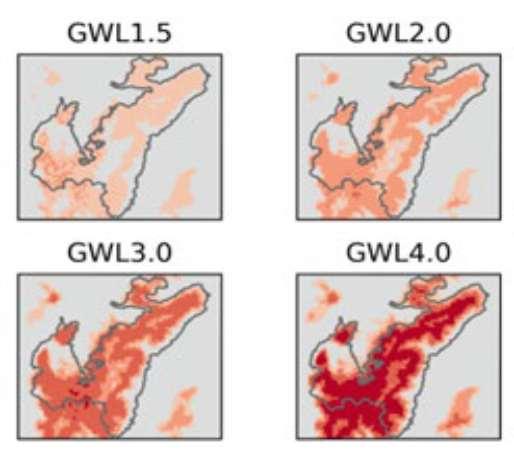
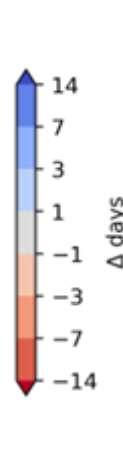
Climateindicator GWL1.5GWL2.0GWL3.0GWL4.0
Airtemperatureincrease(vs1981-2010)
Veryhotdays>35°C/year
Growingseasonduration
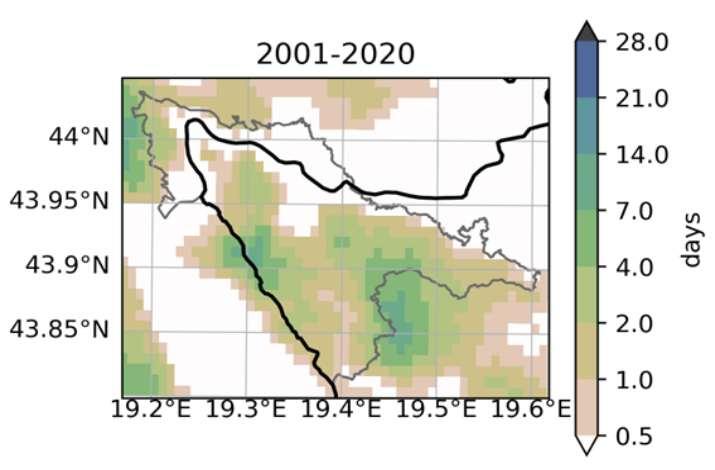
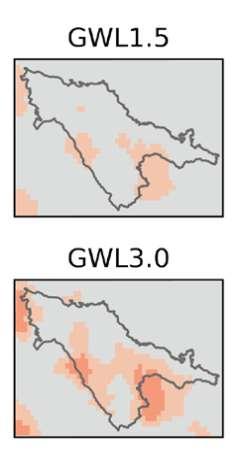
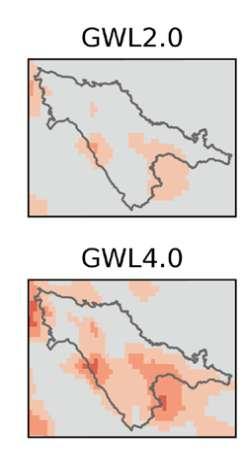
Snowcoverdays(>10cminApril)
Meteorologicaldroughtintensity(SPEI)
Extremedailyprecipitationchange
Wildfirerisk(FWIhigh-riskdays)
+1.2°C 5
Marginal
+days 10 -1to-3days
Moderateincrease Nocleartrend
Low-moderate increase
+1.8°C
Marginal
+days 20 -3-7todays
2×moreintense -3
+% 4
Moderateincrease
+.°C 31
Low-moderate increase +days 40 7to12days
3-4×moreintense +% 8
Strongincrease
Source:BOKUdownscaledprojections.GWLsvspre-industrialbaseline;indicatorsvs2001-2020reference.
Criticalprojectionfindingsforthiscluster: +4.°C 4
Moderateincreaseacrossarea +55days -14daysormore
Upto×moreintense; 4 15-yreventevery2yrs
+%(flashfloodlandsliderisk) 13 &
Strongincrease;region-wideelevation expansion
•Drought-regionalpeakhazard:Withupto4×droughtintensificationandfrequencyrising froma15-yeartoa2-yearreturnperiodunderGWL4.0,theSharrcomplexfacesthemost severeprojecteddroughtsignalinthestudyarea.Thisisespeciallycriticalgiventhat mountainspringssupplydrinkingwatertoTetovo(218,920inhabitantsinsurrounding municipalities)andGostivar.
•Snowlossandskiviability:Theprojectedlossofmorethan14snow-coverdaysinAprilby GWL4.0directlythreatenstheeconomicmodelofPopovaŠapkaandBrezovicaskiresorts, bothofwhichareexpandingratherthanadapting.Skiinfrastructureinvestmentunder currentplanswilllikelybestrandedbymid-century.
•Wildfireexpansion:Theverystrongincrease inwildfireriskdaysatGWL4.0,combinedwith landabandonmentandfernovergrowth, createsextremefirehazardconditions.Postfireerosiononsteepslopesgenerates secondaryfloodandlandsliderisks.
•Extremeprecipitation:The+13% intensificationofdailyprecipitationextremesat GWL4.0isthehighestamongthethree clusters.Giventhe19documentedcritical torrentsintheUpperVardarbasin(flood damagemodelledat€74millionfora100-year returnevent),thisprojectionimpliessharply risinginfrastructureandlivelihoodlosses.
24ClimateImpactChains . BasedontheBOKUprojections,deskresearch,andstakeholderevidence,thefollowingimpact chainsweresynthesisedfortheTara-Drinacorridor.
Element
ClimateDrivers
NPSharMountain (N.Macedonia)
Temperature+1.8°C(GWL2.0)→ +4.4°C(GWL4.0);heatwavesand dryspells;snowloss;strongest extremeprecipitationintensification ofthestudyarea(+13%atGWL4.0).
Environmental Impacts
Socio-Economic Pressures
Glaciallakesurfacereduction;highaltitudepasturedegradation; chestnutandsprucestress; torrentialflooddamage;rivervalleys rundrydownstreamofSharskiVodi diversions.
DecliningwintertourismatPopova Šapka;skiexpansionplans conflictingwithclimatereality; ATV/snowcatdamagetoalpine pastures;weakparkingandcablecarinfrastructureconcentrating visitors.
Consequences
Reducedwintertourismrevenue; waterrationinginTetovoduring summer;infrastructuredamagefrom flashfloods(modelled€74Mfor100yrevent);strandedskiinvestment.
2.5PriorityEbAPilotZones PilotLocationParkIntervention
LesnicaRiver h rehabilitation
PopovaŠapka alpinepastures
High-ridgezone abovePopovaŠapka
Brezovicaskizoneeco-drainage
Zhupa-Restelica corridor
LumbardhiiBroditriparianrestoration
LumaRiverspringsKorabslopes
Agriculturalterraces aboveZapod
NPSharri (Kosovo*)
Summerdroughts4×more intenseand8×morefrequent (GWL4.0);shortenedand unreliablewintersnowseason; risingwildfirerisk,region-wide.
Foreststressandpestspreadin oakandbeechzones;pasture degradationbyATVs;dryingof springs(Zhupa–Lepenc–Lumbardhibasin);invasive commonjuniper(Juniperus communis)spread.
Uncontrolledconstruction aroundBrezovicaskizone; waterandwastestressin villages;communitypressures fromDragash,Prizren,and Shtërpcemunicipalities.
Increasedwildfireriskand pastureproductivityloss;soil erosion;decliningyields; migrationfrommountain communities;lossof ecosystemservicevalue.
CostEstimate
NPShar Mountain Riverrenaturalisation,bankvegetation, micro-retentionforlow-flow augmentation
NPShar Mountain
NPShar Mountain
NPSharri
NPSharri
NPSharri KorabKoritnik KorabKoritnik
RehabilitationofATV/snowcat-damaged pastures;nativespeciesrevegetation
Foresthealthrestorationandfire-risk reductionintransitionzone
Water-savingandeco-drainagesystemsto reduceecosystemstressfromresort operations
Pasturerehabilitationanderosion controlondegradedalpineslopes
Riparianvegetationrecoveryandstream channelstabilisation
Springrevitalisation,buffervegetation, reforestationandslopestabilisation
Soilretentionterracingandclimatesmartirrigationforerodedslopes
Korab–Koritnik NaturePark(Albania)
Longerdryseason;10–25%less summerprecipitation;increased erosionrisk;risingwildfire frequency.
DryingofspringsalongLuma Riverslopes;lossofvegetation buffer;erosion;reduced groundwaterrecharge;wildfire damageinlow-altitudescrub zones.
Traditionalgrazingdeclining;youth outmigrationandlabourshortages inagriculture;limitedtourism services;weakinstitutional capacityofprotectedarea managementauthorities.
Decliningrurallivelihoods;youth outmigrationacrossmountain communitiesintheSharmassif (Kosovo*,AlbaniaandNorth Macedonia);deterioratingspring wateraccess;ecosystem degradationaccelerating depopulationspiral.
€0-0k 2023
€-10k 1205
€0-0k 810
€90-10k 1
€80-100k
€-10k 902
€0-130k 8
€0-10k 91
NationalSharr Park (ManagementAuthority)
2.6TransboundaryClimateVulnerabilities andCoordinationPriorities •Sharedwatertower:TheSharmassiffunctionsastheprimaryfreshwatersourcefor Tetovo,Gostivar,Prizren,andKukës-collectivelyover350,000people.Decliningsnow coverandincreasedsummerdroughtdirectlytranslatetourbanwaterinsecuritywithno currenttransboundarymonitoringprotocol.
•Divergentskiinvestmentstrategies:NorthMacedoniaisplanningcable-car reconstructionatPopovaŠapka;Kosovo*hassignificantuncontrolleddevelopmentaround Brezovica;OntheAlbanianside,developmentpressuresrelatemoretobroadertourismand land-usechangethantomajorskiinfrastructure.Noneoftheseplansincorporateany climateprojectionsonsnowreliabilityloss,riskingcoordinatedstrandedinvestment.
•Transboundarywildfire:TheforestandscrublandscapesconnectingNationalParkShar Mountain,NationalParkSharri,andKorab-Koritnikcreatecontiguousfirecorridors.Nojoint fire-monitoringorearly-responsecoordinationexists.
•Invasivespeciesspread:commonjuniper(Juniperuscommunis)andotherscrubinvasives areexpandingacrossallthreeparksduetopastureabandonmentandclimatestress. Controlrequirescoordinatedmanagementatthelandscapescale.
RecommendationsforSharr/KorabCluster EstablishajointsnowandwatermonitoringnetworkacrosstheShar massif,connectingexistingstationsinallthreeeconomiesandsharing datainrealtime-criticalforbothhydropowermanagementand municipalwatersecurity.
Commissionanindependentclimate-viabilityassessmentofallplanned skiinfrastructureinvestment(PopovaŠapkacablecar,Brezovica expansion)againstBOKUGWL2.0andGWL4.0snowprojectionsbefore anyfurthercapitaliscommitted.
Developaregionalfiremanagementcoordinationmechanism encompassingallthreenationalparkauthorities,supportedbyashared early-warningplatformusingFWIprojections.
Createacross-borderpasturerestorationandinvasivespeciescontrol programme,linkedtoNTFPcertificationschemesthatcansustainlocal livelihoodswhilereducingecosystempressure.
Promoteclimate-resilienttourismdevelopmentacrosstheSharmassif, includingstrongercontrolsonunsustainableconstruction(especiallyin skizones)andsupportfordiversified,low-impacttourismmodels.
AlbanianAlps-ProkletijeBjeshkëteNemuna () Albania,Montenegro,Kosovo* 3.1GeographicandEcologicalContext TheProkletije-AlbanianAlpscomplexisthelargestandmostecologicallydiverseofthethree transboundaryclusters,spanningthetri-borderzoneofAlbania,Montenegro,andKosovo*across fourprotectedareas:NationalParkAlbanianAlps(Albania,82,845ha,elevation350-2,694m), NationalParkProkletije(Montenegro,16,630ha,elevation1,100-2,534m),NationalParkBjeshkëte Nemuna(Kosovo*,63,028ha,elevation750-2,656m).
TheAlbanianAlpsaloneharbourapproximately1,650vascularplantspecies,46mammals,and137 birds,with44habitattypes.ThecomplexprotectsEurope'slaststandsofBalkanpineandhosts apexpredatorsincludingthebrownbearandBalkanlynx.TheiconicPeaksoftheBalkanstrail(192 km)crossesallthreeeconomiesandhasdrivena10-foldincreaseintouristarrivalstotheAlbanian Alpswithinadecade-reaching558,000visitorsin2023-generatingbotheconomicopportunity andintenseecologicalpressure.
KOSOVO*
NPProkletije
MONTENEGRO
3.2ObservedClimateandRecentTrends TheNationalParkAlbanianAlpssitsinanorthernMediterraneanmountainclimatewithannual precipitationupto1,760mm,heavysnowfall(upto3–4minsomebasins),and110–140 precipitationdaysperyear.BjeshkëteNemunareceivessimilarprecipitation,withsnowpersisting 60–210daysdependingonelevation.Prokletije'shighestsectionsexceed2,500mandare characterisedbyanAlpineclimateregime.
Stakeholderobservationsandscientificmonitoringdocumentthefollowingtrendsalreadyvisible acrossthecluster:
•Significantlyreducedsnowcoveracrossallthreeparks,withtraditionalwinterstarting laterandendingearlier—wintermonthsdescribedbyherdersas'almostgone.'
•Morefrequentandseveresummerdroughts:springsinValbona,Theth,andKelmend valleysshowperiodicdrying;theLumbardhiandDeçanitriversshowreducedsummer flow.
•Risingwildfirefrequency:upto35additionalhigh-riskwildfiredaysperyearare projectedforthisclusterunderGWL4.0;recentJanuarywildfiresindicatethefirewindow isexpanding.
•Forestpestemergence:processionarycaterpillarsaremorefrequentlyreportedinpine standsintheAlbanianAlps;barkbeetleoutbreaksareintensifyinginsprucestandsin Prokletije.
•Commonjuniper()encroachment:invasiveshrubexpansioninto Juniperuscommunis degradedhigh-altitudepasturesdocumentedinBjeshkëteNemuna,particularlyRugova Gorgeslopes.
•Tourismpressurecompoundingecologicalstress:2025demolitionofnearly100 unpermittedguesthousesinThethitriggeredcivilunrest,illustratingtheacutetension betweenrapidtourismgrowthandgovernancecapacity.
•20,000seasonalNTFPcollectorsactiveinBjeshkëteNemuna:thelargestofanyparkin thestudy,creatingintenseseasonalpressureonmedicinalplants,berries,andwater resources.
3.3ClimateProjections Climateindicator
Airtemperatureincrease(vs1981-2010)
Veryhotdays>35°C/year
Growingseasonduration
Snowcoverdays(>10cminApril)
Meteorologicaldroughtintensity(SPEI)
Extremedailyprecipitationchange
Wildfirerisk(FWIhigh-riskdays)
+1.°C 3
Marginal increase +days 10
-1to-3days
Moderateincrease
Nocleartrend
Low-moderate increase
+1.°C 9
+days 22
-3-7todays
upto2×more intense
+% 4
Moderateincrease
+.°C 31
Low-moderate increaseinlowerzone
+days 42
-10-4to1days
3×moreintense
+% 9
Strongincrease
Source:BOKUdownscaledprojections.GWLsvspre-industrialbaseline;indicatorsvs2001-2020reference.
+4.°C 4
Moderateexpansioninfoothills
+days 60
>-14days;below2,000msnowmay vanishentirely
Upto×moreintense; 3 15-yreventevery2yrs
+%() 14landslide&floodrisk
Verystrong;highriskzonesexpand above2,000m
Thisclustershowsthehighestextremeprecipitationintensificationin thestudy(+14%atGWL4.0),actingonsteeplimestoneand unconsolidatedslopeterraintogeneratethegreatestflashfloodand landsliderisk.
Keyprojectionfindings:
•Snowcover:Below2,000m,AprilsnowcovermayvanishentirelyunderGWL4.0.Giventhat mosttourisminfrastructure,trails,andsettlementsliebelowthisthreshold,thisprojectionhas directimplicationsforbothwintertourismandyear-roundwateravailabilityfromsnowmelt.
•Wildfire:Extremewildfireriskzonesexpandingabove2,000munderGWL4.0areparticularly alarminggiventheconcentrationofrareandendemicbiodiversityathighelevations.ThefirsteverrecordedJanuarywildfireintheAlbanianAlpssignalsthatfireseasonalityisalready shifting.
•Extremeprecipitation:At+14% intensificationthestrongestsignalacrossallthreeclustersthealready-documentedriskofflashfloodsandlandslidesintheTheth, Valbona,andGrebajavalleyswillintensify. Existingtrailandroadinfrastructurelacksthe drainagetohandleextremes.
•Drought:Whiledroughtintensificationis moderate(upto3×)relativetotheSharr complex,thecombinationwithhighsummer visitornumberscreatesacutewatersecurity risk,particularlyfordispersedmountain communitiesthatdependonspringswithout backupsupply.
Marginal increase
34ClimateImpactChains Element
ClimateDrivers
NPAlbanianAlps (Albania)
Strongwarming(+1.9°Cat GWL2.0,+4.4°CatGWL4.0); longestgrowingseason extensionincluster(+60days); highestextremeprecipitation intensification(+14%);wildfire riskexpandingabove2,000m.
Environmental Impacts
Socio-Economic Pressures
Snowcoverlossatlower elevations;disruptionof snowmelthydrology;flashflood andlandslideriskonsteeptrails; invasivespeciesestablishmentin degradedbilberrybeltzones.
Overtourism(10×decade growth,558,000visitorsin 2023);unregulatedconstruction; wasteandwastewateroverload; 2025demolitioncontroversy; infrastructureinadequatefor visitorloads.
Consequences
Waterstressandsummer shortages;flashflooddamageto trailsandinfrastructure;tourism qualitydegradationfrom overcrowdingandwaste;social conflictovergovernance.
NPProkletije (Montenegro)
Similarwarmingtrajectory;upto 35additionalhigh-riskwildfire daysperyearatGWL4.0; reducedsummerprecipitation; snowcoverlossacceleratingin the1,100–2,000mrange.
Spruceandfirdiebackfrom barkbeetleoutbreaks;wetland andbogdrying;shiftsin speciescompositiontoward drought-tolerantscrub;forest firedamage.
Growinghikingand mountaineeringtourism; inadequatesewageinGrebaja Valley;limitedinstitutional staffandbudget;skiresort proposalsconflictingwith adaptationpriorities.
Forestfiresandhabitatloss; tourismseasonshift;declining ecosystemservices;limited institutionalcapacityto respondtoemergingclimate risks.
3.5PriorityEbAPilotZones PilotLocationParkIntervention
SubalpineslopesThethandValbona valleys
SpringrestorationThethandValbona
TourismzoneThethcorridor waste&sewage
GrebajaValleyecosystem-based planning
Prokletijemountainareaforestfire&pest
High-userecreationareassolidwaste
NBAlbanian Alps
NBAlbanian Alps
NBAlbanian Alps
LumbardhiandDeçanit riparianrestoration
Deçanvalleygrazingzonerehabilitation
RugovaGorgeslopesjuniper&NTFPzones
NPProkletije
NPProkletije
NPProkletije
NPBjeshkët eNemuna
NPBjeshkët eNemuna
NPBjeshkët eNemuna
NPBjeshkëteNemuna (Kosovo*)
Summerdroughtsupto3× morefrequentunderGWL4.0; 10–30%lesssummer precipitation;extremerain eventselevatingerosionand flash-floodrisk.
ReducedsummerflowsinLumbardhi andDeçanitrivers;erosionand juniperencroachmentonhighaltitudeslopes;declineinaquatic faunafromcombinedHPPand droughtimpacts.
20,000seasonalNTFP collectors;waterdiversionby residentsalteringriverflow; weakregulationof constructionandtourism; minimalparkbudget (€240,000in2023).
IncomeinstabilityforNTFP collectorsandherders;lossof ecosystemservices;biodiversity declinefromcombinedclimate andhumanpressures;water securityrisk.
CostEstimate
Revegetationanderosioncontrolindegraded subalpineshrubandbilberryhabitats (400–800m)
Springrevitalisationandsmallwaterretentionstructuresforvillagewatersecurity Pilot-scalenature-basedwastewater treatment(constructedwetlands)combined withimprovedwastecollectionand compostingtoreducepollutionpressure duringpeakvisitorseason.
Regulationoftemporarystructures; ecosystem-sensitivezoningenforcement Wildfireriskreductionandbark beetlemonitoringnetwork
Wasteinfrastructureandmanagement upgradeinhigh-userecreationareasofNP Prokletije(e.g.GrabajaValley),withlessons applicabletoothertourismhotspotsacross theProkletije/BjeshkëteNemunamassif.
Riparianvegetationrecoveryandriverbank stabilisation
Grazingzonerestorationanderosion preventionfordegradedslopes
Junipercontrol,NTFPmanagementzones, andcommunitybenefitsharingframeworks
€0-0k 1215
€-10k 1002
€0-0k 810
€90-10k 1
€0-0k 79
€-10k 901
€0-10k 92
€0-10k 80
€0-0k 79
3.6TransboundaryClimateVulnerabilities andCoordinationPriorities •Wildfirecoordination:Thisclusterhasthemostsevereprojectedwildfireexpansioninthe entirestudy,withriskextendingabove2,000m.Forestfirescrossnationalboundariesby definition,yetnotri-nationalearly-warning,monitoring,orresponseprotocolexistsforthe Prokletije-AlbanianAlpsarea.
•Watermanagement:TheValbona,Shala,Cem,andWhiteDrinriversystemsoriginatein thisclusterandcrossmultiplenationalboundariesbeforereachingtheAdriaticandAegean. Climate-drivenreductionsinsnowpackandsummerflowswillcascadethroughall downstreamusers;harmonisedbasinmanagementiscurrentlyabsent.
•Tourismgovernancedivergence:Albania'srapidtourismgrowth(558,000visitorsin 2023)contrastssharplywithMontenegroandKosovo's*muchsmallervisitornumbers.The resultingpressureasymmetry-withmostenvironmentalimpactconcentratedonthe Albaniansideofthesamemountainsystem-demandsjointlydevelopedcarrying-capacity frameworks.
•NTFPoverharvesting:20,000seasonalcollectorsinBjeshkëteNemunamaycrossinto AlbanianAlpsterritory,yetthereisnoharmonisedregulationofcollectionzones,species quotas,orcertificationstandards.
•PeaksoftheBalkanstrail:The192kmcross-bordertrailisaflagshiptourismproduct sharedbyallthreeeconomies.Climate-driventraildamage(floods,landslides,erosion)and visitorpressurerequireajointlyfundedtrailmaintenanceandclimate-proofingprogramme.
Recommendations forProkletije/AlbanianAlpsCluster Establishatri-nationalwildfiremonitoringandearly-warning systemfortheProkletijemassif,incorporatingtheBOKUFWI projectionsandconnectingnationalfire-fightingauthorities.
Developaharmonisedcarrying-capacityandvisitormanagement frameworkforthePeaksoftheBalkanstrail,incorporatingclimate riskzonesandadaptivetrailmaintenancestandards.
Createajointspringandwatershedmonitoringnetworktotrack snowpack,springflow,andriverdischargetrends—providing earlywarningforwatersecurityrisksindownstreamcommunities.
Negotiateatri-nationalNTFPcertificationandcollectionquota frameworkthatprotectsmedicinalplantandbilberrypopulations fromcombinedclimateandharvestingpressure,whilesustaining communitylivelihoods.
Aligneconomies'protectedareamanagementplanrevisionswith climateprojections,establishingsharedclimate-biodiversity monitoringindicatorstrackedthroughajointannualreporting.
Comparative Synthesis Thethreetransboundaryclustersshareacommonbroadtrajectoryofwarming andincreasinghydro-climaticvariability,yettherelativeseverityandnatureof hazardsdiffersignificantlyacrosstheWesternBalkansmountainlandscape.The tablebelowcomparesprojectedclimaterisksatGWL2.0andGWL4.0across clusters.
Climatehazard
Temperatureincrease(GWL4.0)
Snowcoverloss(April,GWL4.0)
Droughtintensification(GWL4.0)
Extremeprecipitation(GWL4.0)
Wildfirerisktrend
Watersecurityrisk
Tourismpressure
Totaldisappearance possible
Upto5×
Sharr/KorabProkletije/AlbanianAlps
+°C 4.4
-14daysormore
Upto4x +13%
Verystrongincrease
Veryhigh (urbansupply)
High(skiconflict)
Acrossallthreeclusters,thefollowingcross-cuttingprioritiesemerge:
>−14days;lossbelow2,000m
Upto3x +14%
3×moreintense
High(springs,dispersed settlements)
Veryhigh(overtourism)
•Snowlossandhydroeconomicrisk:Alleightprotectedareaswillexperiencesignificant reductionsinAprilsnowcoverunderGWL2.0-4.0.Wintertourismcurrentlyunderpinslocal economiesinallthreeclusters;withoutproactivediversification,economiccontractionis inevitablebymid-century.
•Droughtfrequencyshift:Theshiftfrom15-yearto2-yeardroughtreturnperiodsacrossall clustersbyGWL4.0representsafundamentalchangeinclimateregime,notmerelyan incrementalincreaseinaridity.Managementplansandinfrastructuredesignedforcurrent conditionswillbemaladapted.
•Flashfloodandlandslideamplification:Extremeprecipitationintensification(8-14%)acting onsteep,degradedmountainterrainwillincreasehazardexposuresubstantially.Investmentin ecosystem-basederosioncontrolandearly-warningsystemsisbothcost-effectiveandurgently needed.
•Wildfireseasonexpansion:Theexpansionofhigh-riskwildfiredays-includingabove2,000m intheProkletije-Sharrcomplex-demandsastep-changeintransboundaryfiregovernancethat currentlydoesnotexistinanyofthethreeclusters.
TherecommendedEbApilotinvestmentsacross3clusterstotalapproximately€2.3-.million 1269 fortheidentifiedpilotactions.Embeddingclimate-biodiversityindicatorsintoexisting 23 protectedareamanagementmonitoringsystems-includingminimumtemperatureand precipitationthresholds,snow-coverduration,NDVIvegetationhealth,bark-beetleincidence, andspringflowrates-willenableadaptivemanagementtorespondsystematicallytothe climatetrajectoriesdocumentedinthisanalysis.
1.ProtectedAreaProfiles Thischapterprovidesdetailedprofilesoftheeightprotectedareas coveredbytheassessment,drawingondeskresearch,stakeholder mapping,andfieldevidencefromfocusgroupdiscussionsandkey informantinterviews.
Eachprofiledescribesthepark'sbasiccharacteristics,ecologicaland biodiversityvalues,climatecharacteristicsandobservedorprojected impacts,accessibilityandpopulationcontext,keyrisksandpressures, existingandplannedinfrastructurewithafocusontourism,anda summaryofthemainstakeholdergroupsandconsultationinsights.
NationalParkAlbanianAlps(Albania) Economy
IUCNCategory
Area
ElevationRange
Established ManagementAuthority
ManagementPlan
2023Budget
Albania
II-NationalPark
82,844.65ha
350-2,694masl
2022(officialdesignation)
NationalAgencyofProtectedAreas(NAPA)/RAPAShkodër&Kukës Inpreparation
BudgetmanagedcentrallybyNAPA;notpubliclydisaggregatedperpark
EcologicalandBiodiversityValues TheAlbanianAlpsNationalParkisoneofthe mostbiodiversemountainprotectedareasin Europe,harbouringapproximately1,650 vascularplantspeciesofwhich65areIUCNthreatened(9CriticallyEndangered,32 Endangered,24Vulnerable).Itcontains21 endemicand72sub-endemicplanttaxa, representingoneofthehighestlevelsof floristicendemismintheDinaricArc.
Thefaunaisequallyimpressive:46mammal species(includingbrownbear,Balkanlynx, wolf,andchamois),137birdspecies,45 amphibiansandreptiles,and7fishspecies. Theparkencompasses44distincthabitat typesprovidingrefugesforancient,endemic andrelictspecies.Pančićspruce(Picea omorika)andBalkanpinerepresentglobally significantforestrefugia.
ALBANIA
©NationalAlbanianAlps Park (ManagementAuthority)
©SonjaGebert
TheparksitsattheheartofthePeaksoftheBalkanslandscape-across-bordernaturalcorridor connectingAlbanian,Montenegrin,andKosovar*mountainecosystems.Thistransboundary connectivityiscriticalforapexpredatorpopulationsandforecologicalresilienceunderclimate change.
ClimateCharacteristicsand ClimateChangeImpacts TheAlbanianAlpsexperienceanorthern Mediterraneanmountainclimate,characterisedby annualprecipitationupto1,760mm(dominatedby autumn-winterrainsandsnow),110-140precipitation daysannually,andsnowfallaccumulationof3-4min somebasins.MeanJanuarytemperaturesathigher altitudesreach?8°C;summertemperaturesrange1521°Cdependingonelevation.
BOKUprojectionsindicateatemperatureriseof+1.3 °C(GWL1.5)to+4.4°C(GWL4.0)relativetothe19812010baseline-thehighestwarmingprojectedamong thethreeclusters.Snowcoverdurationisprojected todeclinebymorethan14daysinAprilbyGWL4.0, withtotalsnowdisappearancebelow2,000m possible.Meteorologicaldroughtisprojectedto intensifyupto3×andincreaseinfrequencyfrom once-in-15-yearstoonce-in-2-yearsbyGWL4.0.
Wildfireriskisamongthemostalarmingsignalsextremeriskzonesexpandingabove2,000m,anda documentedJanuarywildfirealreadysignalsthatthe fireseasonislengthening.Extremedailyprecipitation isprojectedtointensifyby+14%,thehighestinthe studyarea,actingonsteepkarstterraintoamplify flashfloodandlandsliderisk.
Stakeholdersandcommunitiesinfocusgroupsdescribedlesssnowandmorehotdays,drier summers,periodicspringdrying,morefrequentforestfires,andexpansionofpineprocessionary caterpillars-withchestnutandbilberrystandsnoticeablystressed.The2025fieldseason documentedrecurringtraildamagefromintensesummerrainstorms.
AccessibilityandPopulation Theparkisaccessedthroughthreemainroadcorridors:SH20(HaniiHotit-Vermosh)serving theKelmendarea;SH21(Koplik-Bogë-Theth)servingtheThethValley;andSH22(Bajram Curri-Valbona)servingtheValbonaValley.Keysegmentsarepavedandhighlyscenic,but high-altitudesections(e.g.QafëThore-Theth)arefrequentlyblockedinwinter,whileroadsto moreremotevalleysremainunpavedandofpoorquality.TheplannedLotaj-Lekbibajroad linkwouldsignificantlyreducetraveltimebetweentheThethandValbonaregions.
©SonjaGebert
Corepopulationwithinthefiveadministrativeunitsdirectlylinkedtotheparktotalsapproximately 9,166inhabitants(2023census).Surroundingmunicipalities-Shkodër(102,434),Tropoja(14,189),and MalësieMadhe(21,684)-exerttheprimarydemographicpressure.Between2011and2023,Shkodër lostover28%andTropojaover30%ofresidents,withagingpopulationsandsevereyouth outmigration.Insummer,diasporareturnsfromItaly,Germany,theUK,andtheUScantemporarily doublevillagepopulations.Theparkreceived558,000visitorsin2023.
KeyRisksandPressures •Overtourismandunregulatedconstruction:ThethandValbonavalleysfaceacute overcrowding;2025demolitionofnearly100unpermittedguesthousesinThethitriggered civilunrest
•Wasteandwastewater:Sewagesystemslargelyabsent;wastewaterdischargeduntreated intoValbonë,Shala,Cem,Vermoshrivers;solidwastecollectioninsufficientduringtourism peaks
•Hydropowerpressure:9smallHPPsconstructedwithinthepark,someshutbycourtorder; disruptionofecologicalflowsandfishmigration
•Climate-drivenflashfloodsandlandslides:+14%extremeprecipitationintensificationby GWL4.0;steeplimestoneandunconsolidatedterrain;documentedtrailandroaddamage
•Wildfire:Expandingfireseason(Januaryfires);riskexpandingabove2,000munderGWL4.0
•Forestpestsandbiodiversitydecline:Chestnutgrovesstressed;bilberrybeltshrinking; processionarycaterpillarmoreprevalent;springwatersourcesintermittentlydry
•Weakgovernance:LandtenureuncertaintyunderKanuncustomarylawdelaysinvestment; limitedRAPAstaffingandbudget;inconsistentregulationenforcement
©SonjaGebert
ExistingandPlanned Infrastructure-Tourism Tourisminfrastructureisdominatedbyfamily-run guesthousesinTheth,Valbona,Vermosh-Lepushë, andTropoja.VisitorcentresexistinValbona(not RAPA-managed)andThethi(RAPAShkodërmanaged),butservicesandfacilitiesremain underdevelopedrelativetovisitorvolumes.The192 kmPeaksoftheBalkanscross-bordertrailisthe primarytourismdraw.
Nomajorenergyorlarge-scaletourisminfrastructure isplannedwithintheparkduetoprotectedstatus. ThestrategicpriorityistheLotaj-Lekbibajroadlink.A 2025'mountainpackage'lawaimstoformaliseland ownershipandresolveKanun-relatedtenure uncertainty.Albania'sNationalTourismStrategy20252030classifiestheAlbanianAlpsunderthe'Northern Cluster'prioritisingnaturetourism(mountainclimbing, rafting,cycling,agro-tourism).
KeyStakeholders-ConsultationsandInterviewInsights Stakeholder group Key Representatives
NationalAuthorities LocalGovernment
TourismOperators
CivilSociety/NGOs
FGDParticipants
KIIInterviewees
NAPA(parkmanager),RAPA Shkodër/Kukës,NationalForestry Agency,NationalEnvironmental Agency
MunicipalitiesofTropoja,Shkodër, MalësieMadhe
Gegest,Margjeka,Alpet guesthouses;PeaksofBalkans guides
VisAlbania,PONT,CNVP
Farmers,herders,guesthouse owners(174participantsacross2 FGDs)
Parkstaff,herders,villaowners
Budgettransparency,HPPcontrols, enforcementofdemolitionorders
Infrastructureinvestment,land regularisation,tourismrevenue Trailmaintenance,permitsystem,visitor management
EbApilots,communitylivelihoods, sustainabletourismcertification
Lesssnow,wildfirerisk, chestnut/bilberrydecline,water shortages,waste
Tourismplanninginstability,water scarcityshapingsettlementuse, guesthouseinvestmentrisk
©SonjaGebert
NationalParkProkletije(Montenegro) Economy
IUCNCategory
Area
ElevationRange
Established
ManagementAuthority
ManagementPlan
2023Budget Montenegro II—NationalPark 16,630ha 1,100–2,534masl 2009
PublicEnterpriseforNationalParksofMontenegro(JPNPCG) 2021–2025(underrevision;climatechangemitigationtobeincludedinnewversion)
ConsolidatedwithinJPNPCGbudgetacrossall5NPs;notdisaggregated
EcologicalandBiodiversityValues NationalParkProkletijeisdesignatedasan ImportantPlantArea(IPA),ImportantBirdArea(IBA), andanEmeraldNetworksite.Ithostsmorethan 1,700plantspecies—almosthalfofMontenegro's entireflora—includingnumerousendemicandrelict taxa.Habitatsincludealpinegrasslands,limestone screes,glaciallakes,bogs,high-altitudeconiferous forests,andtherareWesternBalkanalpinefens. PriorityspeciesincludetheBalkanbutterwort (),Blečić'swulfenia( PinguiculabalcanicaWulfenia bleciciiPseudorchisfrivaldii ),andFrivald'sorchid(). TheparkprotectsMontenegro'smostrugged mountainmassifandhashighgeopolitical significanceasatri-borderarea (Albania–Kosovo*–Montenegro).Wildlifeincludes brownbear,wolf,Balkanlynx,eagle,capercaillie,and falcon,alongsidefreshwaterfishofconservation importance.Severalhabitatsremainunderresearchedandrequirepriorityconservation attention.
©NationalProkletije Park (ManagementAuthority)
MONTENEGRO
©NationalProkletije Park (ManagementAuthority)
©
EuroPlanHD-Studio/ NationalParkProkletije (ManagementAuthority)
TheProkletijemassifhasanalpineclimate characterisedbyheavyprecipitation,prolonged snowcover,andfrequentavalancherisk.No disaggregatedclimatedataisavailableatparklevel, buttheBOKUprojectionsforthebroaderAlbanian Alps–Prokletije–BjeshkëteNemunaclusterproject warmingof+1.9°C(GWL2.0)to+4.4°C(GWL4.0). Wildfireriskisamongthestrongestsignals,with upto35additionalhigh-riskfiredaysperyear projectedatGWL4.0.
Stakeholdersinfocusgroupsdescribedheatwaves anddroughts,wildfires,andshortenedsnow seasons.Thepark'sspruceandfirstandsareunder increasingpressurefrombarkbeetleoutbreaks intensifiedbyprolongeddroughtstress.Wetlands andbogsarereportedlydrying.TheGrebajaValley, thepark'smaintourismfocalpoint,isexperiencing moreintensestormeventscausingtraildamage.
AccessibilityandPopulation TheparkisaccessibleprimarilythroughPlavandGusinjemunicipalities.Roadstohighland valleys(Grebaja,Ropojana,HridskoLake)aremostlyunpavedandseasonallydifficult.The Plav–Bogićevica–Dečaniroadreconstructionisplannedtoimprovetouristconnectionswith AlbaniaandKosovo*.Cross-borderaccessibilityisimprovingthroughthe Montenegro–Kosovo*borderlinknearČakorandtheAlbania–Kosovo*highwayenhancing Valbona–Prizrenconnections.
Nodensesettlementsarelocatedintheparkcore;traditionalsummerpastoralsettlements (katuns)andsmallvillagesexistonthemarginsinPlavandGusinjemunicipalities(combined population~13,700).Populationshowsmodestgrowth(+14–16%since2011)butis characterizedbyagingdemographics,youthemigration,andlimitedeconomicopportunities. Summerdiasporavisitstemporarilyincreaselocaldensity.
NationalProkletije Park (ManagementAuthority) KeyRisksandPressures •Barkbeetleoutbreaksandspruce/firdieback,intensifiedbydroughtandwarming temperatures
•Wetlandandbogdesiccationthreateningendemicandrareflora(e.g.Wulfenia, blecicii Pinguiculabalcanica)
•UnregulatedtourismfacilitiesinGrebajaValley:illegalchalets,solidwaste,sewagegaps
•Hydropowerdiversionsoutsidethepark(BabinoPolje)capturingwaterfromwithinpark
•Limitedstaff,insufficientmonitoringcapacity,anddelaysinsanitationinfrastructure
•Proposedskiresortdevelopment(ProkletijeValbona)conflictingwithclimateadaptation needs
•Avalancheandlandslideriskonruggedterrain,increasingwithalteredprecipitationpatterns
©
ExistingandPlanned Infrastructure-Tourism Tourismreliesonmarkedhikingtrails(Grebaja, Ropojana,Vusanje,HridskoLake),private guesthouses,andrenovatedkatuns.Avisitorcentreis locatedinGusinje.TheparkispartofthePeaksofthe Balkans192kmtrail.Themainplannedinvestmentis reconstructionofthePlav–Bogićevica–Dečaniroad.No majorenergyprojectsareforeseenwithinthepark. Visitorinfrastructureisbasicandhasnotkeptpace withincreasingsummertourismdemand.
KeyStakeholders-ConsultationsandInterviewInsights Stakeholder group Key Representatives Climate/ Biodiversity InfluenceEngagementMainConcernsRaised
ProtectedArea
Authority
Environmental Agency
LocalGovernment
TourismOperators
Farmers/Herders
NpProkletijeDirector, rangers
EnvironmentalProtection AgencyofMontenegro
MunicipalityofPlav (secretary)
5accommodation/guiding operators(hiking,agrotourism, wintertourism)
Localpastoralists,beekeepers
FishingSociety
SportsFishingSociety PlavskoJezero
FGD/KIIInsights Tourismoperators,parkstaff, herders
Staffcapacityconstraints,bark beetlemonitoring,illegalconstruction
Natureprotectionmonitoring, regulatorycompliance
Roadinfrastructure,agrotourism support,boundarygovernance
Infrastructureconstraints,illegal construction,PeaksofBalkans trailmaintenance
Supportfortraditionalpastoral systemsandtraditional“katun”(seasonal pastoralsettlement),climatestresson livestock,ensuringherdernumbers
Tourismplanninginstability,water scarcityshapingsettlementuse, guesthouseinvestmentrisk
MediumMedium-HighShorterwinters,increasedsummer visits,coldernights2025,institutional coordinationgaps
©NationalProkletije Park (ManagementAuthority)
NationalParkBjeshkëteNemuna(Kosovo*) Economy
IUCNCategory
Area
ElevationRange
Established ManagementAuthority
ManagementPlan
2023Budget Kosovo* II—NationalPark 63,028ha 750656–2,masl 2012
DirectorateforManagementofNP'BjeshkëteNemuna', underKosovo*EnvironmentalProtectionAgency(KEPA) 2024-2033 €240,000
EcologicalandBiodiversityValues BjeshkëteNemunaencompassesfertilevalleys,forests, andmountainecosystemsrichinbiodiversityofscientific andculturalvalue.Approximately1,000endemic,relict, andendemorelictplantspeciesarerecorded,withdiverse faunafeaturingnumerousBalkanendemics.Thepark protectshigh-altitudelandscapesoftheProkletijemassif —consideredoneofthewildestmountainareasin Europe—includingtheheadwatersoftheLumbardhiand Deçanitrivers.
Biodiversityvaluesincludebrownbear,wolf,Balkanlynx, chamois,eagle,capercaillie,andrarefreshwaterfish.The acaciaforestsuniquetotheDeçanvalley,traditional chestnutgroves,andhigh-altitudejuniperscrubare amongthemostdistinctiveecologicalcommunities.The park's44habitattypesincludeinternationallyimportant peatbogs,springs,andlimestonekarstformations.
KOSOVO*
©BekimBytyqi
©BekimBytyqi
AccessibilityandPopulation Theparkhasamountainclimatewithhigh precipitationexceeding130daysperyearandsnow persistenceof60–210daysdependingonelevation. Annualprecipitationrangesfrom1,000mmin foothillsto1,500mmathigherelevations;average annualtemperaturerangesfrom10°Cinlowerareas to5°Cabove2,000m.
BOKUprojectionsforthisclusterindicatesummer droughtsbecomingupto3×morefrequentby GWL4.0,with10–30%lesssummerprecipitation. Wildfireriskisprojectedtoexpandsignificantly, includingintohigh-altitudezones.Focusgroup participantsdescribedmildwinters,hotsummers, lackofsnow,rainfallsshiftinginpattern,andthe spreadofwillows()andblackpoplar Salixspp. ()speciesalongrivers.Documented Populusnigra recentimpactsincludedryingoftheLumbardhiriver (combinedeffectsofHPPdiversionsanddrought), near-disappearanceoffishpopulationsinBjeshkëte Deçanit,andaJanuarywildfireevent.Acaciatreesin Deçanhavestoppedfloweringduetoclimatechange, andchestnutdiseasethreatensthespecies'regional survival.
KeyaccessisprovidedbytheM9road(Peja–Kuqishtë–Montenegroborder,21.5km,paved),R106 (Peja–Rožaje),whileR108(Deçan–Montenegroborder)isunpavedandinpoorcondition.Thepark coversmunicipalitiesofIstog,Peja,Deçan,Junik,andGjakova.Settlementpopulationswithinthepark declinednearlyeightfoldbetween1948(4,046inhabitants)and2011(476inhabitants);villagesare largelyabandoned,withentiresettlementsbecominguninhabited.Around20,000seasonalNTFP collectorsgeneratethelargestseasonalpopulationinfluxofanyparkinthestudy.
©BekimBytyqi
KeyRisksandPressures •NTFPover-harvesting:20,000seasonalworkerscollectingmedicinalplants,blueberries,gentian, sage,andwildfruits—thehighestcollectorpressureinthestudyarea
•Hydropowerimpacts:SmallHPPs(Kozhnjer8.3MW;Radac1MW)reduceriverflows,destroying aquatichabitats;waterdiversionbyresidentsfurtherdegradesLumbardhiDeçanit and
•Forestfires:Expandingseasonandriskelevation;Januaryfiresnowdocumented
•Illegalloggingandconstruction:Wastedumping,roadbuilding,unregulatedtourismfacilities
•Uncontrolledexpansionofriparianvegetation:commonjuniper()encroachment Juniperuscommunis onpastures;willows()andblackpoplar alongriversSalixspp.Populusnigra
•Limitedbudget(€240,000)andgovernancecapacityrelativetothepark'sscale
•Erosionandjuniperencroachmentondegradedslopes
•ChestnutdiseasethreateningtheDeçanvalleygroves
ExistingandPlanned Infrastructure-Tourism Tourismisdiverse,encompassingskiing, mountaineering,caveexploration,camping,and culturaltourism,withPejaasthemainhub.Theparkis partofthePeaksoftheBalkanstrail.Visitor infrastructureexistsbutvariesinquality;the managementplan(2024–2033)emphasises sustainablepastoralism,traditionalcrafts,eco-tourism, andNTFPmanagement.Investmentprioritiesfocuson infrastructureimprovements,sustainabletourism,and implementationofsustainablepractices.Nolargescaleinfrastructureprojectsareplannedwithinthe parkcore.The192kmcross-borderPeaksofthe BalkanstrailisaflagshipinitiativelinkingKosovo*, Montenegro,andAlbania.
KeyStakeholders-ConsultationsandInterviewInsights Stakeholder group Key Representatives
ParkManagement
ForestryAgency
Hunters/Fishing
Agriculture/Beekeepers
TourismOperators
CivilSociety
FGD/KIIInsights
NPDirectorate;KEPA;rangers; natureconservationexpert
Kosovo*ForestAgency(Pejamanagementandrangers)
HuntingAssociation'Rugova' (Peja)
SHBAldi,Associationof Beekeepers,Agricultureand beekeepersPalma VillaStina,localeco-tourism operators
PONT,CNVP(development partners)
Farmers,NTFPcollectors, tourismoperators
Climate/ Biodiversity InfluenceEngagementMainConcernsRaised
RiverdegradationfromHPPs,invasive species,NTFPmanagement,budget constraints
Forestfirerisk,illegallogging, biodiversitymonitoring
Wildlifepopulationmanagement, huntingquotas
Climateimpactsonbees,chestnut disease,NTFPcertification
Sustainableparkdevelopment, agrotourismincome,PeaksofBalkans trail
EbAimplementation,livelihoods support,cross-bordercooperation
Acacia/chestnutdecline,dryingrivers, reportsofunseasonalwinterwildfires, invasiveshrubs
©BekimBytyqi
Bistra–Korab/SharMountain Economy
IUCNCategory
Area
ElevationRange
Established ManagementAuthority ManagementPlan
2023Budget
Albania
IV—Habitat/SpeciesManagementArea 55,550ha
410–2,350masl(Korabpeak2,751m)
2011
NAPA/RAPADibërandKukës
Inpreparation(existingdraftfrom2014–2018) ManagedcentrallybyNAPA;notpubliclydisaggregated
EcologicalandBiodiversityValues Korab–KoritnikcoverstheKorab–Koritnik–Gjallica mountainchaininnortheastAlbania,forming partoftheAlbanid–Hellenidrange.Thepark preservesextensiveforests,alpinegrasslands, glaciallakes,andhighpeaksincludingMount Korab(2,751m)—Albania'shighestpoint.Over 22,000haofpasturesand19,000haofforests supportmajorbiodiversity,includinglarge carnivores(brownbear,wolf,lynx),diverse birdlife(eagle,capercaillie,falcon),and freshwaterfish. GeologyincludesPaleozoicandMesozoic formations.Theparkhashighfloristicdiversity withendemicandrelictspecies,andconnects theDinaricmountainsystemtoNorth Macedonia.Thermo-mineralspringsinPeshkopi (Dibërside)representauniquegeo-hydrological asset.TheareaisrecognisedundertheOSCE RegionalAssessmentasaclimate-vulnerable biodiversityzone.
ALBANIA
©LefterGjana
©LefterGjana
AccessibilityandPopulation Nodetaileddisaggregatedclimatestatisticsare availableatparklevel.BOKUprojectionsforthe broaderclusterindicatetemperatureincreasesof +1.25°C(GWL1.5)to+4.4°C(GWL4.0),with droughtintensificationupto4×andsummer precipitationdecliningby10–25%.TheLumaRiver systemandspringsareparticularlyvulnerable,with focusgroupsreportingreducedrainfallandsnow, endangeredsprings,andflashfloodsanderosionin severalvillages(Zapod,Shishtavec,Çajë,Shtiqen— Kukës;Cerjan,Rabdisht—Dibër).Forestfiresand erosion/landslidesareincreasingrisk.
Stakeholdersdescribedashiftincropcomposition (potatoesdeclining,grapes,corn,tomatoes, peppersemerging),unstableyields,andhigher irrigationrequirements.TheLumaRivershows periodsofextremelowflowcombinedwith episodicflashfloods.KIIparticipantshighlighted dryingspringsdrivingvillagemigrationand reducedwateravailabilityforlivestock.
TheparkisreachedfromPeshkopi(viaSH6toRadomirë,gatewaytoMountKorab)orfrom Kukës(viaRrugaeKombittowardtheShishtavecplateau).Roadconditionsvaryfrompaved togravel,withmostmountainaccessroutesinpoorshape.Twostrategiccorridors—'Rruga eKombit'(Kosovo*toTirana)and'RrugaeDibres'(NorthMacedoniatoTirana)—improve regionalconnectivity.Kukësairportwasrecentlyrefurbishedasaninternationalfacilitybutis notyetfullyoperational.
TheparkterritoryextendsthroughDibërandKukësmunicipalities(combined2023 population86,900),bothofwhichrecordedmajordeclinesbetween2011and2023(−11,860 and−10,844respectively).Totalparkareaadministrativeunitshostapproximately42,498 inhabitantsacross14villages/units.Outmigrationispronounced,withanagingpopulation andheavyconcentrationofresidentsaged50+.
©LefterGjana
©LefterGjana
KeyRisksandPressures •Illegalloggingandoverharvestingofmedicinalplants(),with Gentianalutea,Vacciniummyrtillus destructivefishingpracticesunderminingbiodiversity
•Quarryinginsidetheparkandhydropowerdevelopment(8smallHPPsincludingLurëcascade, Bele,Prellë,Shoshan,Bistricë)alteringriverflowsandsedimentation
•Large-scaleSkavicaHPP(250MW)plannedupstreaminKukës—expectedtoreshape hydrologyoftheentireDrincascade
•Wildfires:increasingfrequencyandseasonlength;Januaryfiresdocumented
•Erosionandlandslidesthreateningsettlements,especiallyZapod,Shishtavec,andÇajë
•Absentmanagementplan(preparationongoing)limitinggovernancecapacity
•Ruraldepopulationerodingtraditionalland-usepracticesthathistoricallysustainedecological balance
ExistingandPlanned Infrastructure-Tourism Tourisminfrastructureislimited:small-scalefamily accommodation,somevillas,andunderusedcamping sites.VisitorcentresinKukësandShishtavec,with plannedfacilitiesinPeshkopia,Radomira,and Maqellara.TrailassetsincludetheHighScardusTrail (495km),theTrailofColors(13km,ShishtavectoÇajë), androutestoBeleWaterfall.Healthandspatourism aroundPeshkopithermo-mineralspringsisa developmentpriority.TheAlbaniaNationalTourism Strategy2025–2030identifiesKorab–Koritnikfor healthandwellnesstourismdevelopment.
©LefterGjana
KeyStakeholders-ConsultationsandInterviewInsights Stakeholder group Key Representatives
NationalAuthorities
LocalGovernment
TourismOperators
CivilSociety
Hunters
FGD/KIIInsights
NAPA/RAPADibërandKukës, NationalForestryAgency
MunicipalitiesofKukësandDibër
GuesthouseKorabiCeren; trailtourismoperators
VisAlbania,PONT,CNVP
HuntingAssociationKukës
Farmers,springusers,herders
MainConcernsRaised Influence
Climate/ Biodiversity Engagement
Absenceofmanagementplan,illegal logging,HPPproliferation,SkavicaHPP risk
Ruraldevelopment,outmigration, agriculturalsupport
Traildevelopment,visitorservices,agrotourismpotential
EbApotential,springrestoration, communitylivelihoods
Wildlifemanagement,sustainable huntingpractices
Springdrying,cropcompositionshift, irrigationneeds,erosion/landsliderisk
NationalParkSharMountain(NorthMacedonia) Economy
IUCNCategory
Area
ElevationRange
Established ManagementAuthority
ManagementPlan
2023Budget
NorthMacedonia
II-NationalPark
62,705ha
450–2,748masl
2021
PublicInstitution'SharMountainNationalPark'underMinistryofEnvironmentandPhysicalPlanning 2022–2032;METT-basedperformancetracking
€400,000
EcologicalandBiodiversityValues NationalParkNationalParkSharMountainisa biodiversityhotspotwith1,260vascularplants,128 birdspecies,51mammals,11amphibians,17reptiles, and5freshwaterfish.Italsohosts662diatoms,260 mosses,500fungi,and160lichens.Thepark contains40glaciallakes,anenormousriver network,andalpinelandscapes—withhalfthe territoryunderforest(dominatedbybeech,oak,fir, andpine)andhalfunderhighmountainpastures.
TheSharmassifformstheborderbetweenNorth MacedoniaandKosovo*,extendingover60kmfrom Lubotenpeak(2,498m)totheMavrovoNational Park.Medicinalandaromaticplants(22specieswith pharmaceuticalandfoodindustrypotential) representakeyeconomicasset.TheSharskiVodi hydropowersystemdivertsmorethan50%of mountainriversintotheMavrovoreservoir, providing~12%ofNorthMacedonia'snational electricitysupply—creatingafoundationaltension betweenconservationandenergyproduction.
NORTHMACEDONIA
©NationalPark (Management SharMountainAuthority)
©NationalParkSharMountain (ManagementAuthority)
AccessibilityandPopulation ClimateCharacteristicsand ClimateChangeImpacts PopovaŠapka(1,780m)recordsameanannual temperatureof4.8°C,annualprecipitation ~700–1,250mm,andmaximumrecorded temperature30.6°C.Theparkfaces19critical torrentsystemsontheSharrhillsides,andmajor rivers(Pena36.8km,Mazdracha,Bistrica19.2km) presentsignificantfloodrisk.TheAugust2015 Tetovoflashflood(lessthan2hoursofrain triggeredflashfloods,torrents,andlandslides, causing6fatalitiesandUSD21.5Mindamage)isthe park'sdefiningrecentclimateevent.
BOKUprojectionsindicatetemperatureriseof+1.8 °C(GWL2.0)to+4.4°C(GWL4.0),thestrongest droughtintensificationinthecluster(upto4×by GWL4.0,15-yeareventsbecoming2-yearby GWL4.0),averystrongincreaseinwildfirerisk daysregion-wide,and+13%extremeprecipitation intensificationatGWL4.0(secondhighestinthe studyarea).
Focusgroupsreportedshortenedwinters,glacial lakesurfacedecline,waterscarcityinTetovoand Gostivar(municipaldrinkingwatersourcedfrom mountainsprings),hailandfrostdamagetofruit andblueberries,anderosionofforestroads.Key informantsnotedherdingcommunitiesin ShipkovicaandBrodecfacesignificantchallenges fromlessreliablesnowandhigherwatervariability.
TetovoandGostivarserveasmaingateways,connectedbytheA27highway.Regionalroads (R12068,R12039,R2234)linksurroundingmunicipalities,whilelocalmountainroadsremainunpaved andseasonallyblocked.PopovaŠapkaskiresortiswell-connectedbutlacksacablecarandhasweak parkinginfrastructure.Thebroadermunicipalareatotals~218,920inhabitantsacross8municipalities (2021census).Theparkareaitselflost42%ofitspopulationbetween2002and2021(from16,612to 9,598in27villages);however,someperi-urbanareasnearTetovoshowsignificantgrowth.
©NationalParkSharMountain (ManagementAuthority)
KeyRisksandPressures •Declineinwintertourismviability(PopovaŠapka):Shorteningskiseasonsreducewinter pressureonecosystemsbutunderminesnow-dependenttourismmodels,creatinga transitionchallengeandrequiringashifttowardsclimate-resilient,year-roundtourism
•Motorisedvehicledamage:ATVandsnowcatuseonalpinepasturesinsnow-poorwintersis causingseveresoilerosionandhabitatdegradation
•Uncontrolledlogging,hunting,forestfires,andunsustainableharvestingofplantsandfungi
•Flashfloodrisk:19criticaltorrentsystems;theAugust2015floodcausedUSD21millionin damageandsixfatalities
•Wildfire:Increasingfrequencydrivenbylandabandonment,vegetationovergrowth (includingferns),drought,andwarmwinds
•SharskiVodihydropowerdiversionreducingdownstreamriverflowstonear-zerolevelsin summer
•14smallhydropowerplants(HPPs)operatingwithintheparkterritory
•Weakwastewatertreatmentacrosssettlements;septicsystemspoorlymaintained
•Uncontrolledurbanisationandillegalconstructionlinkedtotourismdevelopment(weekend houses,touristfacilities,androadexpansion),combinedwithhighvisitorconcentrations— particularlyinwinter—areplacingincreasingpressureonecosystems,waterresources,and wastemanagementsystems,resultinginsolidwasteaccumulation,illegaldumpsites,and inadequatewastewaterandwater-supplyinfrastructure
•Ruraloutmigrationanddecliningtraditionalland-usepracticescontributingtolandscape change,reducedecosystemmanagement,andincreasedvulnerabilitytofireanderosion
©NationalPark (Management SharMountainAuthority)
ExistingandPlanned Infrastructure-Tourism TourismisanchoredbyPopovaŠapkaskiresort(7 hotels,scatteredhuts,hostels,private accommodation),with24hikingtrails(303km)and plannednewroutes.Nofunctioningcablecar currently;itsreconstructionistheflagshipplanned investment.Tourismdevelopmentisstrictlyregulated throughparkzonation—acomprehensivebanapplies tonewlarge-scaleinfrastructure(hydropower,mines, roads,hotels)exceptinthebufferzonearoundtheski resort(~2%oftotalparkarea).TheManagementPlan 2022–2031explicitlybansHPPconcessions;two additionalplantcontractswerepausedandareina terminationprocess.
©NationalParkSharMountain (ManagementAuthority)
KeyStakeholders-ConsultationsandInterviewInsights Stakeholder group Key Representatives
ParkAuthority
Ministry/Agencies
EnergyUtility
SkiCenter
HuntingFederations
Tourism/Hospitality
CivilSociety
FGD/KIIInsights
PublicInstitutionSharMountain
MinistryofEnvironment;Spatial PlanningAgency;StateInspectorates
ADESM(ELEM)-SharskiVodi operator
SkiCenter'PopovaŠapka’ 4localhuntingsocieties 9hotels;Eskimofreeride;Shar Outdoors;VisitBozovca
MES,Cesard,Eco-Sharr,women farmers
Herders,municipalstaff,hiking guides
glaciallakedecline,skiviability,flood risk
Regulatoryenforcement,HPP concessions
Hydropowerdiversionconflictswith waterflowsandbiodiversity
Snowreliability,cable-carinvestment
Wildlifepopulation,huntingregulation
Seasonlength,diversification, ecotourism
Weakcommunityengagementinpark governance;barrierstodevelopinglocal sustainable/organicproduction
Glaciallakeloss,waterscarcity
Tetovo/Gostivar
NationalParkSharri(Kosovo*) Economy
IUCNCategory
Area
ElevationRange
Established
ManagementAuthority
ManagementPlan
2023Budget
Kosovo*
II-NationalPark
53,271ha
900–2,660masl
1986(SAPKosovo*);reaffirmed2008underLaw03/L-153 DirectorateforAdministrationofNP'Sharri',underKEPAandMESPI
Expired(2013–2023);newplaninpreparation
€,000 348
EcologicalandBiodiversityValues TheSharMountainmassifisrecognisedasoneof themostspecies-richmountainsoftheBalkans, combiningpreservedforests,endemicandrelict flora,anddiversefaunaadaptedtospecifichighaltitudehabitats.Theparkfeaturesecological, geomorphological,andhydrologicalvalues alongsideculturalandrecreationalimportance. Priorityfaunainclude11mammalspecies(including bear,wolf,lynx),3reptilespecies,3amphibian species,13birdspecies,and7butterflyspecies requiringspecialprotection.
Brezovicaskiresort(900–2,500maltitude)and Prevallahealth/mountaintourismzone(1,500–1,800 m)sitwithinthepark'sinfluencezone.High-altitude peatbogs,springs,andalpinemeadowsare ecologicallycritical.TheparksharestheSharmassif withNationalParkSharMountain(North Macedonia)andbordersKorab–KoritnikNaturePark (Albania).
KOSOVO*
©NationalParkKosovo(Management Sharri Authority)
©NationalParkKosovo Sharri (ManagementAuthority)
©NationalParkKosovo Sharri (ManagementAuthority)
ClimateCharacteristicsand ClimateChangeImpacts NationalParkSharrihasanalpine-continental climatewithoccasionalmoderatecontinental influence.Averageannualtemperatureis~8.4°C; Januarycanreach−33°C;summeraverages18–20 °C.Annualprecipitationrangesfrom670–1,200mm; 220–280sunnydaysperyear.Snowcovercan reach3mdepthwithupto117snowydays recorded;theDragashsubalpinezoneaverages ~807mmprecipitationwithsnowcoverupto280 daysataltitude.
AccessibilityandPopulation BOKUprojectionsindicatesummerdroughts becomingupto4×moreintenseandupto8×more frequentbyGWL4.0—thestrongestdrought frequencysignalinthestudy.Riverbasins Zhupa–Lepenc–Lumbardhi–Brodarereported dryinginfocusgroups.KIIparticipantsdescribed latewintersandcoldsprings,withtouristsshifting timingaccordingly.Invasivecommonjuniper ()isspreadingacrossdegraded Juniperuscommunis pastures.Brezovica'suncontrolleddevelopmentis identifiedasbothacurrentandfuturerisk.
TheparkisintersectedbyregionalroadsR115(Kaçanik–Shtërpcë–Prizren)andR116(Kaçanik–North Macedonia),alongsideadditionalsecondaryroads.BordercrossingsexistatVërmica (Albania–Kosovo*)andJazhincë(Kosovo*–NorthMacedonia).Seasonalroadclosures,limited infrastructureinDragashmunicipality,andunregulatedcrossingscreateaccessibilitychallenges.Park spansmunicipalitiesofDragash(22villages),Prizren(13villages),Suhareka(4),Shtërpce(9),and Kaçanik(3),withacombinedpopulationofapproximately61,426inhabitants.
©BekimBytyqi
KeyRisksandPressures •UncontrolledandunplannedconstructionatBrezovicaandPrevallaskizones:habitatloss, waste,watersupplydegradation,andconflictwithlegal/spatialframeworks
•Summerdroughtintensification(4×)threateningsprings,pastures,andmountainagriculture
•Increasingwildfirerisk:fireseasonlengthening,riskexpandingupslope
•Invasivecommonjuniper()encroachmentonalpinepastures Juniperuscommunis
•Expiredmanagementplancreatinggovernancevacuum
•Beecolonydecline
•Riverflowvariabilityanddrying:Zhupa,LumiiBrodit,Restelicë
•Fragmentedmanagementacross5municipalitieswithdivergentplanningpriorities
ExistingandPlanned Infrastructure-Tourism TourismcentresonBrezovicaskiresort(Kosovo's* largest,900–2,500maltitude)andPrevalla (1,500–1,800m),offeringwintersports,summer hiking,cycling,andhealthtourism.Infrastructure requiresmodernisationtoreachinternational standards.Nonewlarge-scalehydropowerprojects areplanned.Fixedbroadbandcoverstheentirepark includinghotelsandtouristfacilities.Themanagement frameworkisbasedontheLawonNatureProtection (2010).MunicipalitiesofPrizren,Shtërpce,Dragash, Suhareka,andKaçanikoverseeongoingandplanned investmentsundernationallegislationandspatial plans.
KeyStakeholders-ConsultationsandInterviewInsights Stakeholder group Key Representatives
ParkManagement
ForestryAgency
HuntingAssociations
PrivateForestOwners
Tourism/Eco-Tourism
CivilSociety
FGD/KIIInsights
SharriNPDirectorate(Prizren), supervisor,KEPA
Kosovo*ForestAgency(Prizrenmanagementandrangers)
HuntingFederationKosovo*; HuntingAssociationDragash Association'GuriiZi’
SharriEcoTour;agri-tourismand beekeepingoperators
SharriWildLife;LocalAction Group'Sharri’
FAO-engagedforestry researchers
Guides,beekeepers,women farmers,municipalstaff
Managementplanrenewal,Brezovica regulation,droughtimpacts,beedecline
Loggingprevention,firerisk,forest healthmonitoring
Wildlifemanagement,enforcementinPA
Privateforestmanagement, sustainableharvesting
Sustainabletourism,beecolonyhealth, communityincome
Eco-tourcoordination,community awareness,biodiversitymonitoring
Datacollection,forestecosystem assessment
Latewinters,beelosses,riverdrying, Brezovicaconstructionpressure, tourismshift
©BekimBytyqi
NationalParkTara(Serbia) Economy
IUCNCategory
Area
ElevationRange
Established ManagementAuthority
ManagementPlan
2023Budget
Serbia II-NationalPark 24,991ha
291-1,591masl
1981
PublicEnterprise'TaraNationalPark'underGovernmentofSerbia; verseenbyMinistryofEnvironmentalProtection 2020-2030
EcologicalandBiodiversityValues NationalParkTaraisoneofthemostsignificantrefuges ofBalkanandEuropeanfloraandfauna.Itishometothe globallyrarePančićspruce(Piceaomorika),foundalmost nowhereelseintheworld,alongsideover1,200plant species,68mammals,and150birdspecies.Notablefauna includesbrownbear,wolf,chamois,andvariousraptors. Theparkis~80%forested,withmixedstandsoffir, beech,andspruceasthedominantcommunities.
TheDrinaRivercanyonformsthepark'snaturalwestern boundaryandservesastheinternationalborderwith BosniaandHerzegovina.TheZaovineandPerućac reservoirs(partoftheBajinaBaštaHPPsystem— Serbia'ssecond-largest)arelocatedwithinorbordering thepark,creatingacomplexhydrology.Thesereservoirs havealteredthemicroclimate,submergedentirevillages duringconstruction,andchangedriverregimes—apreexistingecologicalmodificationnowcompoundedby climatechange.
€4,105,389—despitethisbudgetlevel,parkauthoritiesreportlimitedfinancialcapacityfor long-termconservationandecosystemmanagement
SERBIA
AccessibilityandPopulation HistoricaldatafromZlatibordistrict(1961–1990) recordsmeanJanuarytemperaturesof−2°C, July/Augustaveragesof~18°C,andannual precipitationinaMediterraneanregime(maximum November–January,minimumAugust).Snowcover normallypersistsNovember–March,extendingto Aprilabove1,000m.Tropicaldays(≥30°C)average only1.3peryear—butthisbaselineisshifting.
BOKUprojectionsfortheTara–Drinacorridor indicatewarmingof+1.8°C(GWL2.0)to+4.1°C (GWL4.0);totaldisappearanceofAprilsnowcover possibleatGWL4.0;droughtintensificationupto 5×byGWL4.0(thestrongestinthestudy);veryhot daysincreasingbyupto20/yearinthenorthern areaatGWL4.0;and+8%extremeprecipitation intensification.Focusgroupparticipantsdescribed snowywintersas'almostgone',risingfirerisk, Pančićsprucedieback,newjackalpresence,and Zaovinereservoirapproachingbiologicalminimum inrecentdrysummers.Barkbeetleoutbreaksin spruceandpeatbogdesiccationatCrveniPotokare documentedmanagementconcerns.
AccessismainlyviaBajinaBaštaandUžice,withbordercrossingsatSkelaniandVardište.Tourist centreswithinthepark(KaluđerskeBare,Mitrovac,Zaovine,Perućac)areconnectedbypoor-quality asphaltroads.Publictransportisminimal.Theparkhasadenseforestroadnetwork(alegacyof Yugoslavforestry),300kmofhikingtrails(30markedroutes),3cyclingroutes(75km),5educational trails,and12equippedlookouts.PerućacLakesupportsboatconnectionstoVišegrad(BiH).
BajinaBaštamunicipalityhas23,533inhabitants(2022);approximately740peoplelivewithinthepark itself.Thebroadermunicipalitypopulationfacesgradualdeclineandaging.Tourismgeneratesupto 5,000dailyvisitorsduringpeaksummerandwinterseasons,with~7,000bedsavailable(mostly privateandunregistered).Around100,000annualvisitorsarerecorded.
©RankoMilanović
©NationalParkTara(ManagementAuthority)
KeyRisksandPressures •Barkbeetleoutbreaks()threateningPančićspruceandforestintegrity Ipstypographus
•PeatbogdesiccationatCrveniPotok:auniqueandgloballyrarehabitattype
•Zaovinereservoirapproachingbiologicalminimumindrysummers,threateningaquatic ecosystems
•Jackal()expansionasanewspecies:indicatorofhabitatchange Canisaureus
•Post-COVIDsurgeinillegalconstruction,ATVuse,overcrowding,andforestroadexpansion
•Inadequatewastewatermanagement:nosewagesysteminmostareas;septictanksleakon limestoneterrain;fecalcontaminationdetectedinwatertests
•Wildfireriskrising,notablyonsouthernandnorthwesternslopes
•DryingspringsaffectingdrinkingwaterforBajinaBaštamunicipality
•Shorterwintertourismseasonreducinglocalincome;concentrationofsummervisitors straininginfrastructure
ExistingandPlanned Infrastructure-Tourism Plannedinvestmentsincludeinstallationofnewtrail andtouristsignage,reconstructionofvisitorcentresin BajinaBaštaandMitrovac,asphaltingofthe Mitrovac–BanjskaStenaroad,andpreparatoryworks foratouristcablecar(Perućac–Mitrovac).
Revitalisationofcamps,ethno-villages,andviewpoints isforeseen.NationalParkTarabenefitsfromthe highestbudgetofthe8parks(€4.1M),enabling relativelystrongermanagementcapacity.Asignificant shareofthepark'sownrevenueisgeneratedthrough forestmanagementactivities,alongsidetourism servicesandstatesupport.TheBajinaBašta MunicipalityDevelopmentPlan(2024–2031)identifies Taraasanationaleco-tourismhub.
KeyStakeholders-ConsultationsandInterviewInsights Stakeholder group Key Representatives
ParkEnterprise
NationalOversight
EnergyUtility
LocalGovernment
HuntingAssociations
FishingSociety
Tourism/Adventure
CivilSociety
Church/Cultural
FGD/KIIInsights
PE'TaraNationalPark'(4 sectors:planning,landuse, legal,economic-financial;ranger service)
InstituteforNature
ConservationSerbia;Directorate forForests;Ministryof EnvironmentalProtection
EPSADBelgrade-Division 'Drinsko-LimskeHE'Bajina Bašta
MunicipalityofBajinaBašta; TourismOrganisationTaraDrina
Huntingassocs.'Soko'and'Tara’
OSR'Mladica’ GreenBear,MapleAdventures, Taratours;VU'Tara'military hotels
MountaineeringClub'Tara'; BIOS;TaraUltra;YouthOffice BajinaBašta
EparchyofŽiča-Rača Monastery(1,000haforest)
Farmers,tourismoperators, parkstaff
Climate/ Biodiversity InfluenceEngagementMainConcernsRaised
Barkbeetle,Pančićspruceconservation,ATV regulation,visitormanagement
Biodiversitymonitoring,forestmanagement, climateadaptationmainstreaming
Reservoirmanagement,hydropower operations,downstreamflowimpact
Infrastructureinvestment,tourismpromotion, emergencyplanning
Gamemanagement,wildlifepopulation
Sportfishing,sustainablewateruse
Trailmaintenance,sustainableadventure tourism
Trailstewardship,biodiversityeducation,youth engagement
Culturalheritage,forestmanagement
Shorterwinters,tubingreplacingsledding,bark beetle,springfailures,'fireroads'debate
©DimitriSharamov
NationalParkDrina(BosniaandHerzegovina) Economy
IUCNCategory
Area
ElevationRange
Established ManagementAuthority
ManagementPlan
2023Budget
BosniaandHerzegovina(RepublikaSrpska)
II-NationalPark 6,315ha 290–1,265masl
2017
PublicInstitution'DrinaNP',GovernmentofRepublikaSrpska; 12permanentstaff+seasonal 2022-2031
€190,000
EcologicalandBiodiversityValues NationalParkDrinaprotectsthemiddlecourseoftheDrina RivercanyonineasternRepublikaSrpska(Srebrenica municipality).Atonly6,315ha—thesmallestoftheeight parksinthestudy—itnonethelessprotectslimestone canyonhabitatswithexceptionalrichness,includingover 635vascularplantsandtheendemicDerventaknapweed. Faunaincludesbrownbear,chamois,andgoldeneagle.
TheparksitsattheboundarybetweenNationalParkTara (Serbia)—sharingtheDrinaRiverasatransboundary corridor—andtheproposedcross-borderDrinaUNESCO BiosphereReserve(jointBiH–SerbiainitiativeunderMAB Programme).Conservationimportanceiselevatedbythe canyon'suniquemicroclimate,relictflora,andendemic riparianspeciesincludingthecriticallyrestrictedSerbian bittercress().ThePerućacreservoir(Bajina Cardamineserbica BaštaHPP,Serbia)spansthepark'snorthernboundary.
©NationalParkDrina(ManagementAuthority)
©NationalParkDrina (ManagementAuthority)
AccessibilityandPopulation TheManagementPlan(2022–2031)incorporates climateprojectionsindicatingwarmingtrendswith hottersummers,milderwinters,andmoreirregular precipitation—wetterwinters/autumnsanddrier summers/springs,increasingfloodanddrought risks.BOKUprojectionsfortheTara–Drinacorridor indicateupto20extraveryhotdaysperyearat GWL4.0;totalsnowlossinAprilpossibleby GWL4.0;droughtintensificationupto5×;and+8% extremeprecipitationintensification.
Focusgroupparticipantsreportedsummerwater restrictionsinSrebrenica(3pm–6amdaily, June–September),intermittentstreamdrying(Jadar, Drinatributaries,upto70%lowerflow),recurring landslides,frequentfiresinLuka,Klotjevac,Krušev Do,andŠarenaBukva,anddecliningriverfish populationsincludinghuchen(Huchohucho)from combinedHPPandclimateimpacts.Participants notedthatlocallivelihoodsforfishersandguides areincreasinglyunstable.
Roadtransportdominates.AccessreliesonregionalroadsR452(Milići–Skelani)andR453 (Bratunac–ZeleniJadar),supplementedby28localroadsandnumerousunclassifiedroutes.The nearestrailwayisinZvornik(45km).Poorregionalconnectivityandruggedreliefrestrictmobility. Settlementswithinthepark(Klotjevac,Prohići,Osatica,Radjenovići,andothers)aresmall;average densityis14inhabitants/km²,belowtheSrebrenicamunicipalaverage(22/km²).Srebrenica municipalityreceives~150,000visitorsannually,primarilydiasporareturningJuly–August,creating intensebutbriefseasonalpressure.
©NationalParkDrina (ManagementAuthority)
©NationalParkDrina(ManagementAuthority)
KeyRisksandPressures •Cross-borderfloatingwasteinPerućacLake:seasonalaccumulationarrivingfromupstream withnobilateralmanagementmechanism
•Illegalshorelinestructuresandfloatinghousesonthelakeandriver,degradinghabitats
•OpenbauxiteminingnearMilići(Podravno,Palež):airandsoilpollution,landscapealteration
•Frequentforestfires:Luka,Klotjevac,KruševDo,ŠarenaBukvazones
•Severe2014floodsandrecurringSućeskalandslidesblockingaccessroutes
•Declininghuchen()populationfrombarriers,HPPoperations,andclimate-driven Huchohucho flowvariability
•Invasivepumpkinseed()spreading Lepomisgibbosus
•Limitedbudget(€190,000)and12permanentstaff—insufficientforthepark'smanagement needs
•Noorganisedwastewatertreatment;sewagedischargeddirectlyintorivers
ExistingandPlanned Infrastructure-Tourism Tourismisatanearlystage,withlimitedguesthouses, ruralaccommodation,andnolargeeco-lodges.Hiking andriveractivities(raftingonDrina,culturalheritage tours)arepossiblebuttrailnetworksandsignageare underdeveloped.TheManagementPlan(2022–2031) prioritisesamainvisitorcentre,thematictrails,and improvedriveraccesspoints.Broaderstrategies (SrebrenicaDevelopmentStrategy2023–2030,crossborderBiosphereReserveDrina)prioritiseeco-friendly accommodation,heritagepromotion,and transboundaryecotourismproducts.Cross-border cooperationwithNationalParkTara(Serbia)andMokra Goraaimstodevelopajointdestination.
©NationalParkDrina (ManagementAuthority)
KeyStakeholders-ConsultationsandInterviewInsights Stakeholder group Key Representatives
PublicInstitutionDrinaNP (ManagementBoard,Director, 4sectors)
PublicForestryCompany 'ForestsofRS';FMU'Drina' Srebrenica
MayorSrebrenica;Deptsof Economy,SpatialPlanning, SocialAffairs
SrebrenicaTouristOrganisation
Huntingground'Javor';Sports FishingSocieties
NGO‘Sara';Beekeepers Association'Osat'
FGD/KIIInsights
Fishers,guides,localresidents, municipalstaff
Biodiversity Engagement
Floatingwaste,illegalconstruction,fire management,understaffing
Sustainableforestuse,illegallogging prevention,firerisk
Tourisminvestment,roadinfrastructure, environmentalcompliance
Tourismpromotion,DrinaNPevents,crossborderecotourism
Fishstockmanagement,wildlifehabitat, huchenprotection
Communityheritage,meadowconservation, honey/organictourism
Waterrestrictions,flooddamage,firerisk, waste,fishdecline,diasporatourism
3.Recommendations IntegratingEcosystem-BasedAdaptation(EbA) andNature-BasedSolutions(NbS) intoProtectedAreaManagement Thischaptertranslatesthefindingsfromtheclimateriskanalysisandthe protectedareaprofilesintoactionablerecommendationsforintegrating ecosystem-basedadaptation(EbA)andnature-basedsolutions(NbS)intothe managementplansofthethreetransboundaryprotectedareaclustersand theireightnationalparks.Thechapteralsoidentifiestheactorsand institutionsneededtodeliverthesemeasures,proposesspecificrolesforthe privatesectorandtourismoperators,andprovidesguidanceonusingthe WesternBalkansClimateChangeProofingPlatform(WB-CPP)asadecisionsupporttoolforparkmanagers,municipalities,andnationalauthorities.
TheTara–Drinacorridorfacesthestrongestprojecteddroughtintensificationinthestudy(upto 5×byGWL4.0),combinedwithtotalAprilsnowlossandrisingbarkbeetleandwildfirerisk. Managementplansinbothparksalreadyacknowledgeclimatechangeasathreat,butlack operationalEbAmeasuresandcoordinatedtransboundaryresponses.Therecommendations belowaredesignedtobeintegrateddirectlyintotheNationalParkTaraManagementPlan (2020–2030,nextrevision)andtheNationalParkDrinaManagementPlan(2022–2031),andinto theactionframeworkoftheproposedDrinaBiosphereReserve.
PriorityMeasuresforIntegrationintoManagementPlans EbA •Pančićspruce()refugemanagement: Piceaomorika Designateclimaterefugiazonesathigh elevationandmoistravinesasstrictlyprotectedcoreareas.Buffersprucestandsagainstbark beetlethroughmixed-speciesenrichmentplanting(fir,beech,maple)indegradedzones, reducingmonoculturevulnerability.Integratepheromonetrapmonitoringnetworksintothe annualmanagementprogramme.
•Peatbogandspringhydrologicalrestoration:RehabilitateCrveniPotokpeatbogthrough ditch-blocking,watertablerestoration,andexclusionoflivestock.Restorespringsinsmallpark settlementsthroughmicro-retentionworksandbuffervegetationplanting-providingboth biodiversitybenefitandcommunitywatersecurity.
•RiparianandwetlandrestorationalongDrinatributaries:Createmicro-wetlandretention basinsalongtheJadarRiverandotherDrinatributaries(Štedrić,Sućeska).Restoreriparian forestgalleriesusingnativespecies(willows ,alder ,andblackpoplarSalixspp.Alnusspp. Populusnigra)toreduceflash-floodimpacts,stabiliseriverbanks,enhancelow-flowconditions, andprotecthabitatsoftheendemicSerbianbittercress()inthecanyon. Cardamineserbica
•Slopestabilisationandlandslideriskreduction:Implementmixed-speciesreforestationon Žlijebac-Sućeskaslopesandotheridentifiedlandslide-pronezones,usingdeep-rootednative species.Combinewithgabionandcheck-damstructuresinthemostactivetorrentchannels. LinkdirectlytodisasterriskreductionplanninginSrebrenicamunicipality.
•Wildfirepreventionandfirebreakmanagement:EstablishajointTara-Drinafire managementzonecoveringthenorthwesternTaraslopesandBiH-sideforestridgelines. Maintainstrategicfirebreaksthroughprescribedgrazingandselectivevegetation managementratherthanmachinerywhereterrainpermits.Investinsharedearly-warning infrastructure(automatedweatherstations,cameramonitoring).
•Opengrasslandandsemi-naturalhabitatmaintenance:Maintainopengrasslandhabitats inNationalParkTarathroughtargetedmechanisedmanagement-preventingforest encroachmentintobiodiversity-richmeadows.Linktoagri-environmentpaymentschemesfor localfarmerswhoprovidegrazingservices.
•Cross-borderfloatingwasteinterceptiononPerućacLake:Designandinstallfloating debrisboomsatstrategicpointsontheDrinaandatthePerućacreservoirinlet.Establisha jointwastecollectionprotocolwithEPS(Serbia)andNationalParkDrina,includingseasonal clean-upoperationscoordinatedwithupstreammunicipalitiesinBiH.
•Climate-resilientvisitormanagement:Implementseasonalandspatialvisitorflow managementusingcarryingcapacitythresholdsderivedfromecosystemsensitivitymapping. Developgreeninfrastructurestandardsfortouristfacilities(eco-drainage,composting, rainwaterharvesting)-mandatoryforanynewdevelopmentpermissionsinbothparks.
StakeholderEngagementOptions Actor/Stakeholder Type
PETaraNationalPark/Public InstitutionDrinaNP
MinistryofEnvironmentalProtection (Serbia)/RSMinistryofPhysical Planning(BiH)
InstituteforNatureConservationof Serbia
EPS/Division'Drinsko-LimskeHE' BajinaBašta
InternationalSavaRiverBasin Commission(ISRBC);DrinaTaskForce
SrebrenicaMunicipality/BajinaBašta Municipality
SrebrenicaTouristOrganisation; TourismOrganisationTara-Drina UNDP,UNEP,GEF,GCF
EUIPAIIIcross-borderprogramme (Serbia-BiH)
IUCNDinaricArcProgramme;WWF Adria
Localfarmers,fishers,beekeepers(Osat Association)
ProtectedAreaAuthorities
NationalAuthorities
Scientific/Technical
EnergyUtility
International/Regional Mechanisms
LocalGovernment
TourismSector
InternationalFinance
EUFundingMechanism
ConservationNGOs
CommunityActors
Role/Actions
Leadmanagementplanrevision;implementEbApilots; coordinatejointfiremanagement;operatemonitoring networks
Provideregulatoryframeworkandfinancing;align managementplanswithnationalclimateadaptationplans; approvecross-bordercooperationprotocols
Providespeciesmonitoringdata;adviseonPančićspruce conservationgenetics;evaluateEbApiloteffectiveness
NegotiateminimumenvironmentalflowreleasesfromZaovine andPerućac;participateinfloatingwastemanagement protocol;sharehydrometeorologicaldata
Facilitatecross-borderwaterdatasharing;coordinatefloodand droughtmanagementprotocols;providetechnicalsupportfor biospherereservenomination
Mainstreamclimateriskintospatialplans;enforceconstruction standards;co-financevisitorinfrastructure;coordinatedisaster preparedness
DevelopjointTara-Drinatourismbrand;applycarryingcapacity standards;promoteoff-peakandshoulder-seasonproducts
FinanceEbApilotprojects;providetechnicalassistancefor managementplanclimateintegration
Financetransboundarywatermanagement,floodrisk reduction,tourisminfrastructure,andsharedearly-warning systems
Technicaladvisorysupport;speciesmonitoring;advocacyfor BiosphereReservedesignation,huchenrecovery
Provideagri-environmentandfisherymanagementservices; participateincommunity-basedmonitoring;benefitfromNTFP andecotourismincomeschemes
TourismoperatorsintheTara-Drinacorridorshouldberequiredtoadoptanddisplayclimateresilienttourismstandardsasaconditionoflicensing.Specificrequirementsshouldinclude: wastewatertreatmentatallfacilities;prohibitionofATVuseoutsidedesignatedtracks; contributiontoavisitorinfrastructuremaintenancefund;andseasonalpricingthatdeterspeakseasonovercrowding.
Eco-adventuretourismoperators(rafting,kayaking,hiking,trailrunning)shouldpartnerwith NationalParkTaraandNationalParkDrinatodevelopjointlycertified'DrinaWild'experience packagesthatfinanciallysupportconservationthroughdirectvisitorlevies.Thisbuildsonthe existingmodelofsuccessfuleco-tourismproductsalongtheDrinaandtheTaraCanyon.
HospitalitybusinessesinBajinaBaštaandSrebrenicashouldbesupportedtotransitionfrom seasonalwinter-onlytoyear-rounddiversifiedofferings.Climateprojectionsclearlyindicatethat reliablewintersnowpackwillbeabsentatmid-elevationbymid-century;businessmodelsbuilt exclusivelyonskitourismarestrandedassets.Thetourismdevelopmentplansofboth municipalitiesshouldreflectthistrajectoryandincentiviseinvestmentinspring,autumn,cultural, andslow-adventuretourismproducts.
Bistra-Korab/SharMountain Thisclusterhoststhemostseverecombineddrought-wildfireriskinthestudyarea,withBOKU projectionsshowingdroughteventsbecomingupto4×moreintenseandthewatertower functionoftheSharmassif(supplyingTetovo,Gostivar,Prizren,andKukës—collectively 350,000+people)underacutethreat.Thethreeparksrequirebothindividualmanagementplan revisionsandatri-nationalcoordinationmechanism.NationalParkSharMountain'sManagement Plan(2022–2031)providesthestrongestexistingframework;NationalParkSharri'splanisexpired andneedsurgentrenewal;Korab–Koritnikhasnocurrentplan.
PriorityMeasuresforIntegrationintoManagementPlans EbA •Snowandwatermonitoringnetwork:Establishatri-nationalautomatedmonitoring networkforsnowdepth,soilmoisture,springflowrates,andstreamdischargeacrosstheShar massif.Connectexistingstationsinallthreeeconomiesthroughasharedreal-timedata platform.Thisissimultaneouslyaconservationtool(trackingglaciallakedecline,peatbog desiccation)andawatersecuritytool(earlywarningforurbanwaterdeficitinTetovoand Gostivar).
•Glaciallakeandpeatbogprotection:Designatethe40glaciallakesandassociatedpeatbog systemsinNationalParkSharMountainasstrictlyprotectedclimaterefugia.Implement hydrologicalisolationfromATVdamage.Developalong-termsurfaceareaandwaterlevel monitoringprogrammeasaclimatechangeindicator.Excludelivestockfrombufferzones aroundallpeatbogsystems.
•Pasturerehabilitationandinvasivespeciescontrol:RehabilitateATV/snowcat-damaged pasturesatPopovaŠapkaandadjacentzonesthroughexclusion,overseedingwithnative species,andseasonalpatrolenforcement.Implementatri-nationalcommonjuniper(Juniperus communis)controlprogrammeonBjeshkëteNemunaslopesandSharrimeadowsusing targetedmechanicalremovalandfollow-upgrazingmanagement.
•Springrevitalisationandwaterretention:RehabilitatedryingspringsalongtheLumaRiver (Korab-Koritnik),intheZhupa-Lepenc-Lumbardhibasin(Sharri),andinTetovo-adjacent catchments.Constructmicro-retentionpondsandinfiltrationtrenchesindegradedupper catchmentareastoimprovegroundwaterrecharge.Linktomunicipalwatersecurityplanning inTetovo,Gostivar,Prizren,andKukës.
•Wildfireriskreductionandfirebreakmanagement:Developacross-borderfire managementplancoveringallthreeparksandtheconnectinglandscapecorridors.Establish strategicfirebreaksusingprescribedgrazing(avoidingmechanicalmethodsinecologically sensitiveareas).Installsharedautomatedfire-weathermonitoringstationsdrawingonBOKU FWIprojections.Conductjointannualtabletopexerciseswithfireservicesfromallthree economies.
•LesnicaRiverrehabilitation: h Implementcomprehensiveriverrenaturalisationofthe LesnicaRiverastheprimarywaterretentionandbiodiversityrestorationinvestmentin h NationalParkSharMountain.Thisincludesbankrevegetation,removalofartificialchannelling, andconstructionofsmallcheckdams-providingfloodmitigation,groundwaterrecharge,and aquatichabitatbenefits.
•Climate-resilientskiresorttransitionplanning:Commissionindependentclimatescenario assessments(usingBOKUGWL2.0andGWL4.0snowprojections)forallskiinfrastructure investmentproposals(PopovaŠapkacablecar,Brezovicaexpansion).Resultsshouldbe formallyincorporatedintoenvironmentalimpactassessments.Reorientresortinvestment towardelevation-appropriateinfrastructure,year-roundmountainsportfacilities,andfourseasonculturalandwellnesstourism.
•NTFPcertificationandsustainableharvestingzones:Designandimplementatri-national NTFPcertificationframeworkformedicinalplants,blueberries,andotherforestproductsestablishingspecies-specificcollectionquotas,seasonalcalendars,andbenefit-sharing mechanismsforlocalcommunitycollectors.LinktoEUorganiccertificationstandardstoaccess premiummarkets.
StakeholderEngagementOptions Actor/Stakeholder Type
NPSharMountainPublicInstitution/ NPSharriDirectorate/ NAPAAlbania(Korab–Koritnik)
MinistryofEnvironmentandPhysical Planning(N.Macedonia)/MESPI/KEPA (Kosovo*)/MinistryofTourismand Environment(Albania)
ADESM(ELEM)—SharskiVodisystem operator
Tetovo,Gostivar,Prizren,Kukës municipalities
DrinCoordinatedAction(DCA)
InternationalRiverBasin Mechanism
Role/Actions
LeadmanagementplanrevisionandEbApilotimplementation; co-developtri-nationalmonitoringprotocols; enforceATVandconstructionregulations
Establishtri-nationalcoordinationmechanism;alignnational adaptationplanswithparkmanagement;fundshared monitoringinfrastructure
NegotiateminimumenvironmentalflowreleasesfromSharskiVodi diversions;participateinwatermonitoringdatasharing;terminateHPP concessioncontractsinpark(asperManagementPlancommitment) Mainstreamwatersecurityriskintolocaldevelopmentplans; co-financespringrestoration;supportcarryingcapacity enforcementforskiresorts
CoordinatetransboundarywatermanagementintheDrinbasin; acilitatecross-borderdatasharing;supportclimate-proofed hydropowergovernance
EUIPAIII(Albania–Kosovo*; N.Macedonia–Kosovo*cross-border)
SkiCenters(PopovaŠapka,Brezovica)
MunicipalitiesofDragash,Shtërpce, Prizren;Tetovo;Gostivar
Localhuntingandfishingassociations (all3economies)
Womenfarmersassociations; organicproducers(Eco-Sharr);CNVP
EUFundingMechanism PrivateSector—SkiTourism
LocalGovernment
CommunityActors
CivilSociety/NGOs
Financesharedmonitoringinfrastructure,pasturerehabilitation, springrestoration,andtri-nationalfiremanagementplan
Conductandpublishindependentclimateviabilityassessments; transitioninvestmenttowardfour-seasonproducts; contributetovisitormanagementfunds
EnforcezoningandconstructionlawatBrezovicaandPopovaŠapka; implementSpatialPlanforNPSharMountainbufferzone
Participateinwildlifemonitoring;supportpasturemanagement throughsustainablehuntingpractices;advocateforinvasive speciescontrol
DevelopNTFPcertificationscheme;supportcommunity-based monitoring;promoteorganicandclimate-resilientagri-foodproducts
PrivateSectorandTourismOperatorRoles SkiresortoperatorsatPopovaŠapkaandBrezovicamustbeurgentlyengagedaspartnersin climateadaptationratherthantreatedpurelyascommercialconcessionaires.The2022-2031 NationalParkSharMountainManagementPlanalreadyprohibitsfurtherlarge-scaleski infrastructurewithintheparkproper.ThisframeworkshouldbereplicatedintheNationalPark SharrimanagementplanrenewalandinKorab-Koritnik'sforthcomingplan.
Tourismoperatorsacrossallthreeparksshouldbeincentivisedthroughlicensingconditionsand taxconcessionstodevelopyear-roundecotourismproducts:wildlifewatching(bears,lynx, raptors),medicinalplantandgastronomytrails,culturaltourisminmountainvillages,mountain biking,andhigh-altitudehiking.Theseproductsaremoreresilienttoclimatevariabilitythanskidependentwintertourism.
TouroperatorsofferingtheHighScardusTrail(495km)andrelatedcross-borderroutesshould contributetoasharedtrailmaintenanceandclimate-proofingfund-maintainingpathdrainage, slopestabilisation,andsignageinacontextofincreasingextremerainfallintensity.Thiscreatesa directfinanciallinkbetweentourismrevenueandecosystemresilience.
AlbanianAlps–Prokletije–BjeshkëteNemuna Thisclustershowsthehighestextremeprecipitationintensification(+14%)andwildfirerisk expandingabove2,000m—acombinationthatthreatensthemostbiodiverseofthethree clusterswhilesimultaneouslyexperiencingthemostintensetourismpressure(558,000visitorsto AlbanianAlpsin2023).ThePeaksoftheBalkanstrailservesastheprimarycross-bordertourism andconservationthread.Managementplansareatdifferentstages:NationalParkAlbanianAlps isinrevision,NationalParkProkletije(2021–2025)isdueforrenewal,andNationalParkBjeshkëte Nemuna(2024–2033)iscurrent.AllthreeplansrequireEbAintegrationasanexplicitmanagement objective.
PriorityMeasuresforIntegrationintoManagementPlans EbA •Multi-lateralwildfiremonitoringandresponse:Establishajointautomatedfireweather monitoringsystemcoveringtheentireProkletijemassif-aminimumof8stationsdistributed acrossthethreeeconomiesatkeyelevationbands.UseBOKUFWIprojectionstodefine seasonalfiredangerlevelsandtriggerpre-positionedresponseresources.Developjointannual firemanagementdrillswithnationalfireservices.Thisisthesinglehighest-priority transboundarymeasureforthiscluster.
•Springrestorationandmicro-retention:RestoredryingspringsinTheth,Valbona,and Vermoshvalleys(AlbanianAlps)andalongtheRugovaGorge(BjeshkëteNemuna)through spring-cappingprotectionworks,micro-retentionbasins(50-200m?),andbuffervegetation planting.Springsarebothecologicalassetsandtheprimarydrinkingwatersourcefor dispersedmountaincommunities-theirrestorationdeliversimmediatesocialco-benefits.
•Bilberrybeltandvegetationrestoration:Implementrevegetationanderosioncontrolinthe degraded400-800melevationbilberrybeltaboveThethandValbonavalleys,using indigenousshrubandgrassspecies.Thiszoneactsastheprimarysurfacewaterbuffer betweenhigh-altitudesnowmeltandvalleycommunities-itsdegradationamplifiesflashfloodrisk.
•JunipercontrolandNTFPmanagementzones:EstablishformallydemarcatedNTFP collectionandmanagementzonesinRugovaGorgeandotherdesignatedareasofNational ParkBjeshkëteNemuna,incorporatingquotasfor20,000seasonalcollectors.Introduce communityrangersystemswithNTFP-relatedduties.Implementcommonjuniper(Juniperus communis)controlthroughtargetedmechanicalremovalandreseedingwithpalatablenative species.
•Grazingzonerehabilitationanderosionprevention:Rehabilitatedegradedgrazingzones intheDeçanvalley(BjeshkëteNemuna)andonProkletijeslopesthroughrotationalgrazing management,slopestabilisationplanting,andcheckdamsinactiveerosiongullies.Integrate traditionalherdingknowledgeintomanagementplanadaptivemeasures.
•Wasteandwastewaterinfrastructure-PeaksofBalkanstrail:Designandimplement minimumwastewatertreatmentandsolidwastecollectionsystemsatthe12-15keytrailnodes onthePeaksoftheBalkansroutewhereovernightaccommodationandvisitorconcentration occurs.Applyaconsistenttri-national'greentrail'standard.Financethroughvisitorfees(€25/nightataccommodation),nationalparkentrancefees,andEUIPAcross-bordersupport.
•Landslideandflashfloodriskreduction:Conductsystematicterrainassessmentofthe highest-risktrailandroadcorridorsintheAlbanianAlps(Theth-Valbonaroute,GrebajaValley road).Installsmall-scaleengineeringmeasures(slopenetting,gabions,drainageimprovement) atthemostcriticalfailurepoints.Developanearly-warningSMSsystemforextremerainfall eventsaffectingtrailaccess.
•RiparianrestorationalongLumbardhiandDeçanitrivers:Restoreriparianvegetation galleryalongtheLumbardhiDeçanitandDeçanitrivercorridors,whichhavebeen and degradedbyHPPdiversionsandchannelmodification.Restorenaturalchannelmorphology wherefeasible,re-establishnativegalleryspecies,andcreatebufferzonesexcludingharmful activitiesforatleast50mfromtheriverbank.
StakeholderEngagementOptions Actor/Stakeholder Type
NPAlbanianAlps(NAPA/RAPA
Shkodër)/NPProkletije(JPNPCG)/NP BjeshkëteNemuna(Directorate,KEPA)
MinistryofTourismandEnvironment (Albania)/MinistryofEcology, SustainableDevelopment(Montenegro) /MESPI/KEPA(Kosovo*)
MinistryofInfrastructureandEnergy (Albania)/nationalenergyregulators (Montenegro,Kosovo*)
MunicipalitiesofTropoja,Malësie Madhe,Shkodër(Albania);Plav,Gusinje (Montenegro);Peja,Deçan,Junik, Gjakova(Kosovo*)
PeaksoftheBalkansTrailConsortium
UNDP,UNEP,GEF,Zo?Environment Network,FEA
EUIPAIIICross-BorderProgrammes (Albania-Kosovo*;Albania-Montenegro; Montenegro-Kosovo*)
PONT(PrespaOhridNatureTrust); CNVP;VisAlbania
Localherders,farmers,beekeepers, NTFPcollectors
Nationalcivilprotectionagencies(all3 economies)
ProtectedAreaAuthorities
NationalEnvironmentMinistries Energy/InfrastructureMinistries
LocalGovernment
RegionalTourismInitiative
InternationalDevelopment Partners
EUFunding
ConservationNGOs/ DevelopmentPartners
CommunityActors
DisasterRiskReduction
Role/Actions
LeadEbApilotimplementation;revise/alignmanagementplans withclimateprojections;jointlyoperatefiremonitoringnetwork; coordinatePeaksofBalkanstrailstandards
Establishtri-nationalcoordinationforum;alignHPPregulatory frameworkwithconservationlaw;co-financemonitoring infrastructure;submitcoordinatedreportingunderKunmingMontrealGBF
Imposeandenforceminimumecologicalflowrequirementson smallHPPswithin/nearallthreeparks;applyenvironmental impactre-assessmenttoSkavicaHPPproposal(Albania)
Co-fundwasteandwastewaterinfrastructure;enforce constructionpermits;integratecarryingcapacitystandardsinto localspatialplans;co-managetourismpressure
Establishandimplementtri-national'greentrail'standard;collect anddistributevisitormaintenancelevy;commissionannualtrail conditionandclimateriskreport
FinanceEbApilots;supportmanagementplanrevision;facilitate tri-nationalcoordination;monitorandevaluateEbAoutcomes
Financesharedfireinfrastructure,NTFPcertification,spring restoration,ecotourismproductdevelopment,andinstitutional capacitybuilding
Implementcommunity-basedEbAmeasures;NTFPcertification andmarketlinkages;communityrangertraining;womenand youthengagementineco-tourism
Providegrazingmanagementservices;participateincommunitybasedmonitoring;benefitfromNTFPcertificationandfairvalue chains;custodiansoftraditionalecologicalknowledge
Integrateparkfireandflash-floodriskintonationalearlywarning systems;developtri-nationaldisasterresponseprotocolfor Prokletijemassif
PrivateSectorandTourismOperatorRoles TheAlbanianAlpsisexperiencingthemostacutetourismgovernancecrisisinthestudy-558,000 visitorsin2023,uncontrolledconstruction,andademolitioncontroversyin2025thatgenerated communityconflict.Tourismoperatorscannotcontinuetofunctioninthecurrentunregulated environment,whichissimultaneouslyeconomicallyunsustainableandecologicallydestructive.A tieredlicensingsystem-withdifferentrequirementsfordifferentaccommodationtypesand activities-shouldbedevelopedjointlybyNAPA,therelevantmunicipalities,andthenational tourismministry.
GuesthouseoperatorsandtrailguidesintheTheth-Valbona-Vermoshareashouldbeorganised intoaformalEcotourismOperatorsAssociationwithbindingcommitmentsto:wastedisposal standards;minimumwastewatertreatment;maximumoccupancyregistration;andcontributionto aparkprotectionlevy.Inexchange,theassociationshouldreceiveofficialrecognition,marketing supportthroughAlbania'snationaltourismplatform,andaccesstopublicinfrastructure(water points,wastecollectionservices).
Adventureandeco-tourismoperatorsacrossthePeaksofBalkanstrail-fromValbonatoGrebajato Rugova-shouldjointlydevelopandmarketa'ProkletijeWild'certifiedexperiencepackage.This productwouldbundleaccommodation,guiding,andculturalexperiencesunderasinglequalityand sustainabilitystandard,directingrevenuespartlytoajointtrailandspringmaintenancefund.
InMontenegroandKosovo*,wheretourismvolumesarelowerbutgrowing,operatorsshouldbe proactivelyincentivisedtodevelopshoulder-season(April-June,September-October)offerings ratherthanconcentratingdemandinJuly-August.Thisrequiresmarketingsupport,seasonalpricing incentives,andinvestmentinspringandautumntrailinfrastructure.
3.GeneralandEconomy-Specific Recommendations Cross-CuttingStrategicRecommendations Thefollowingrecommendationsapplyacrossallthreetransboundaryclustersandalleight protectedareas.TheyaddressthesystemicconditionsneededforEbAintegrationtosucceedat thelandscapescale:
•InstitutionaliseclimateriskassessmentsinPAplanning:Allprotectedareamanagementplans shouldsystematicallyincludeclimatevulnerabilityassessmentsandEbAresponsemeasures basedonpark-specificclimateprojections.
•AlignnationalclimateadaptationplanswithPAmanagement:NationalAdaptationPlans (NAPs)inallsixeconomiesshouldexplicitlycross-referenceprotectedareamanagement plansaskeydeliverymechanismsforecosystem-basedadaptationcommitments-andvice versa.Currently,theseplanningprocessesoperateininstitutionalsilos.
•EstablishaWesternBalkansTransboundaryProtectedAreasClimateMonitoringNetwork: Createasharedenvironmentalmonitoringframeworkcoveringallthreeclusters,tracking: meanandextremetemperature;precipitationanddroughtindices;snowcoverdurationand extent;wildfireriskdays(FWI);foresthealthindicators(barkbeetle,NDVI,mortality);spring flowrates;andbiodiversitysentinelspecies.Annualreportingagainstthisindicatorset shouldbeinstitutionalisedthroughajointregionalplatform,buildingonUNEP'sexisting WesternBalkansengagement.
•StrengthenPAbudgetsandstaffingforclimatefunctions:ThedisparitybetweenNational ParkTara'sbudget(€4.1M)andNationalParkDrina's(€190,000)illustratesamajorinequity inmanagementcapacity.Internationalclimatefinance(GEF,GCF,EUIPA)shouldbetargeted attheunder-resourcedparks-particularlyNationalParkAlbanianAlps,NationalPark Prokletije,Korab-Koritnik,andNationalParkDrina-tobuildtheinstitutionalcapacityneeded forEbAimplementation.
•DeveloparegionalEbAlearningandexchangeprogramme:Buildingonthesuccessful workshopsinAlbania(May2025)andKyrgyzstan(July2025),institutionaliseanannual WesternBalkansEbAExchangebringingtogetherparkmanagers,municipalplanners, nationalclimatefocalpoints,andcommunityrepresentativesfromallsixeconomies.This createsthepeer-learninginfrastructurethatiscurrentlyabsent.
•Aligntourismandinfrastructuredevelopmentwithclimateandbiodiversityobjectives: Nationalandmunicipalauthoritiesshouldintroducestricterscreeningoftourismand infrastructureinvestmentswithinandaroundprotectedareas.Climate-incompatibleprojects -suchasskiexpansionwithoutsnowreliabilityassessments,uncontrolledresort construction,orriver-alteringinfrastructure-shouldbeavoided.Instead,investmentsshould prioritisegreentourismandnature-basedeconomies,includinglow-impactvisitor infrastructure,sustainablemountainagriculture,andecosystemrestorationinitiativesthat strengthenlocallivelihoods.
•Tourismplanningshouldalsobeguidedbyecosystemcarrying-capacityassessments, definingsustainablevisitorthresholds,infrastructuredensitylimits,andserviceprovision levelsforsensitivemountainlandscapes.Theseassessmentsshouldinformspatialplanning, parkmanagementplans,andtourismdevelopmentstrategies.
AdoptEbAasanexplicitobjectiveintherevisedAlbanianAlpsNP DraftManagementPlanandtheforthcomingKorab-Koritnik managementplan.RestrictfurtherHPPdevelopmentwithinor adjacenttoprotectedareas.
IntegrateBOKUclimateprojectionsintotheforthcomingNPProkletije ManagementPlanrevision.Developawildfireandearlyresponseplan fortheProkletijemassif.Applyclimateviabilitycriteriatoproposedski resortdevelopmentintheparkarea.
RenewtheexpiredNPSharrimanagementplan(2013-2023)withEbA integration.Strengthenenforcementofconstructionregulationsat Brezovica.DevelopanNTFPcertification.
Enforcetheexistingprohibitiononnewlarge-scaleinfrastructure (includingHPPs)withinNPSharMountain.Commissionan independentclimateviabilityassessmentforthePopovaŠapkacablecarinvestmentbeforefundingiscommitted.EstablishtheLesnica RiverrestorationpilotastheflagshipnationalEbAinvestment.
IntegratepeatboghydrologicalrestorationandPančićsprucerefugia managementasprioritymeasuresintheNPTaraManagementPlan nextrevision.Negotiateminimumenvironmentalflowreleasesfrom BajinaBaštaHPP.ActivelyparticipateintheDrinaBiosphereReserve nominationprocessasagovernancemechanismforcross-borderEbA.
Acceleratedevelopmentofastate-levelNationalAdaptationPlanthat explicitlyreferencesNPDrinaasanEbAdeliverymechanism.Resolve thefloatingwastegovernancegapontheDrinaandPerućacLake throughabilateralagreementwithSerbia.SignificantlyincreaseNP Drina'sbudget(currentlyonly€190,000)toaminimumoperationally adequatelevel.
ManagementplansupportbyUNEP;Law 81/2017zoningenforcement;National TourismStrategy2025-2030northern clusterimplementation
NPProkletije2026managementplan;Law onNatureProtection;EUIPAcross-border withAlbaniaandKosovo*
Kosovo*ClimateChangeStrategy20192028;EUIPAIII;UNDPsupporttoKEPA; LawonNatureProtection(2010)
NPSharMountainManagementPlan20222031;ClimateChangeLaw(2021);EU Chapter27obligations;FloodRisk ManagementPlanforUpperVardar
NPTaraManagementPlan2020-2030;Law onClimateChange(2021);ISRBCandDrina TaskForceframeworks;EUChapter27
NPDrinaManagementPlan2022-2031; SrebrenicaDevelopmentStrategy20232030;UNESCOMABBiosphereReserve process;EUIPAIII(BiH-Serbiacross-border)
UsingtheWB-CPPPlatformto PrepareNationalParksforClimateImpacts ANNEXI TheWesternBalkansClimateChangeProofingPlatform(WB-CPP),accessibleat https://wbcpp.neopix.dev,isafree,open-accessdigitaltooldevelopedundertheAustrian DevelopmentAgency-UNEPprojectonClimateProofingforSustainableDevelopmentinthe WesternBalkans.Itprovidescentralisedaccesstodownscaledclimatechangeprojections, interactivemaps,andscenario-baseddataforallsixWesternBalkaneconomies.Theplatform requiresnoregistrationandoperatesthroughanymodernwebbrowser.Thissectionprovides practical,step-by-stepguidancefornationalparkmanagers,municipalplanners,andnational authoritiesonhowtouseWB-CPPtosupportclimate-resilientprotectedareamanagementfrommanagementplanrevisiontoday-to-dayoperationaldecisions.
WB-CPPPlatform:KeyFeaturesRelevantto ProtectedAreaManagement ClimateVariablesAvailableonthePlatform TheWB-CPPprovides16climatevariablesacrossthreecategories.Thevariablesmostdirectly relevanttomountainprotectedareamanagementare:
Variable Category
DrySpells(5days)and DrySpells(7days)
HotDaysinDrySpells (5and7days)
CriticalRainfallfor Landslides
PrecipitationExtremes
Snowfall/Heavy Snowfall
PrecipitationAmount
Precipitation
Compound
Precipitation
Precipitation
Precipitation
Precipitation
Mean/Maximum/ MinimumTemperature
HotDays(30°C)and VeryHotDays(40°C)
Freeze-ThawCycles
DaysExceedingWind SpeedExtremes
Compound
Definition
Numberofperiodswith?5or?7 consecutivedrydaysperyear
DayswithTmax>30°Cduringadryspell -simultaneousheatanddrought
Rainfallintensityexceedinglandslide triggeringthresholds(days/year)
Frequencyandintensityofextremedaily rainfallevents
Totalsnowwaterequivalentordaysof heavysnowfall
Totalaccumulatedprecipitation (seasonal/annual)
Baselinetemperatureindicesbyseason
Numberofdaysperyearexceeding30°C or40°C
Dayscyclingaboveandbelow0°Cwithin aperiod
Futurefrequencyofextremewindevents
PrimaryPARelevance
Wildfiredangerseason;droughtimpactson springs,pastures,andforesthealth
Compoundstressonbiodiversity,barkbeetle risk,soildegradationinsemi-aridparkzones
Flashfloodandlandslideriskonsteepterrain; trailcorridorsafetyassessment
Floodriskmanagement;torrentsystemdesign; trailandroaddamagerisk
Wintertourismviability;springsnowmelt timing;drinkingwatersupplyfromsnowpack
Riverflowandspringrecharge;watersecurity forparksettlementsanddownstream municipalities
Habitatshifttracking;growingseasonchange; biodiversityimpactassessment
Visitorsafety;heatstressonendemicspecies; tourismseasonshifting
Trailandroadinfrastructuredamage assessment;waterpiperisk
Wildfirespreadriskincombinationwithdry spellprojections
TimePeriodsandScenarios Allprojectionsareavailableforthreetimeperiodsandthreeclimatescenarios,enablingusersto understandbothnear-termcommittedchangeandlonger-termtrajectoryunderdifferent emissionpathways:
TimePeriod Description
HistoricalBaseline(1981-2010)
NearFuture(2021-2050)
FarFuture(2071-2100)
Referenceperiodrepresentingobservedclimate
Reflectsalreadycommittedclimatechange
Long-termprojection;mostsensitiveto emissionsscenariochoice
Scenario WarmingLevel
RCP2.6/SSP1-2.6
RCP4.5/SSP2-4.5
RCP8.5/SSP5-8.5
~1.5–2°Cby2100(strongmitigation)
~2–3°Cby2100(intermediatemitigation)
~3.5–5°Cby2100(businessasusual)
Step-by-StepGuideforParkManagers RecommendeduseforPAPlanning
Understandcurrentclimateofthepark;compareto projectedchanges
Managementplanrevisionhorizon;infrastructure investmentdecisions;EbApilotdesign
Long-termbiodiversityandecosystemstrategy;climate refugiadesignation;stress-testingtouristinfrastructure investments
Recommendeduse
Best-caseplanning;ParisAgreementalignment; minimum-riskscenariofornature-basedsolutionsdesign
Centralscenariofornationaladaptationplansand managementplanrevision;mostcommonlyusedforPAplanning
Worst-casestresstesting;infrastructuredesignstandards; identifynon-linearriskthresholds
ParkmanagerswithnospecialistclimatebackgroundcanusetheWB-CPPplatforminsix straightforwardsteps.Thefollowingworkflowisrecommendedforproducingaclimateevidence baseformanagementplanrevisionsorEbApilotdesign:
1AccessthePlatform
2SelectYourParkArea
3ChooseaClimateVariable
Openhttps://wbcpp.neopix.dev Noregistrationneeded
Clickonthemaptoselecttheeconomyor sub-nationalregion;toggleboundarylayers (economy/administrative/riverbasin)to frametheparkarea.
OpentheVariablesorIndicatorspanel; browsebycategory(Temperature, Precipitation,etc);selectyourvariable.A legendshowsthecolourscaleandunits.
Theinteractivemaploadsaregionalviewofallsix economies.Usezoomcontrolstolocateyour protectedarea.
Useriverbasinboundarylayertocapturethefull catchmentrelevanttoyourpark'swatersecurity context.
StartwithDrySpells(7days)andPrecipitation Amounttounderstandtheoveralldrought/water signalbeforeaddingcompoundvariables.
4
SelectTimePeriod andScenario
5
Visualise,Click andCompare
6 ExportandCiteData
IntheScenariopanel,chooseHistorical,Near Future(2021–2050),orFarFuture (2071–2100).SelectRCP2.6,4.5,or8.5.
Themapupdatestoshowthespatial distributionasacolouredrasterlayer.Click anypointtoseetheexactvalue.Usethe Comparefunctiontodisplaytwoscenarios sidebyside.
UsetheDownload/Exportbuttontoretrieve dataasCSV,GeoTIFF,ormapimageforuse inreportsandplanningdocuments.
FirstviewtheHistoricalbaseline,thenswitchtoNear FutureunderRCP4.5(centralscenario).Compareto RCP8.5FarFutureforstresstesting.
Focusonchangesthatappearrobustlyunderboth RCP4.5andRCP8.5—thesearemostreliablefor planning.Seasonalbreakdowns(summervs.winter) oftentelldifferentstories.
Notethedatasource,variable,timeperiod,and scenarioinallcitations.IncludebothNearFutureand FarFutureprojectionsinmanagementplanclimate sections.
PriorityWB-CPPApplicationsfortheProtectedAreas Basedontheclimateriskprofileofthethreetransboundaryclusters,thefollowingWB-CPP applicationsaretop5prioritiesforparkmanagers:
Wildfirerisk seasonplanning
DrySpells(7days); HotDaysinDrySpells (5and7days); DaysExceedingWind SpeedExtremes
Watersecurity: springs,rivers, snowmelt
PrecipitationAmount (seasonal);Snowfall; DrySpells(5days)
Selectthepark;compareDrySpells(7days) Historicalvs.NearFuturevs.FarFutureunder RCP4.5and8.5.OverlaywithHotDaysinDry Spellstoidentifycompoundheat-droughtrisk months.
Selecttherelevantsub-catchment;compare seasonalPrecipitationAmountunderRCP4.5vs. baseline;overlaySnowfallprojectionstoassess changeinspringsnowmelttiming.Usesummerseasonbreakdown.
Usetodefineaclimate-adjustedfiredanger season;updatefirepreventionstaffingandprepositioningplans;shareprojectionswithnational fireservicesforjointplanningacrosscluster boundaries.
Identifyspringsandriversub-basinswithgreatest projecteddecline;prioritisemicro-retentionand springrestorationpilots;provideevidencebasefor municipalwatersecurityplanninginTetovo, Gostivar,Prizren,BajinaBašta,Kukës.
Flashfloodand landslideriskon trailsandroads
CriticalRainfallfor Landslides;Precipitation Extremes
Wintertourism andskiresort viability
Snowfall;HeavySnowfall; MeanTemperature; MinimumTemperature
Selectthemountainpark;chooseCriticalRainfall forLandslides;comparefrequencyofexceedance eventsbetweenHistorical,NearFuture,andFar FutureunderRCP8.5.Identifyhighest-riskterrain zones.
Selecttheskiresortelevationzone(e.g.,Popova Šapka1,780m;Brezovica900-2,500m);compare snowfalldurationandamountunderRCP2.6 (bestcase)andRCP8.5(worstcase)for20212050and2071-2100.
Overlayoutputswithslopestabilitymaps;trigger engineeringriskassessments;updatedisaster preparednessprotocols;notifycivilprotection authorities;informtrailinfrastructureinvestment prioritisation.
Provideclimateevidenceformanagementplan tourismsections;assesslong-termski infrastructureviability;triggerskiresortoperator engagement;supportfour-seasontourism diversificationplanningandbusinesscase development.
Biodiversityand habitatshift tracking
MeanTemperature (seasonal);Maximum Temperature; PrecipitationAmount (summer)
Selectthearea;compareMeanTemperature changebyseasonunderRCP4.5tomapthermal shiftmagnitudeacrosselevationbands.Combine withsummerPrecipitationdeclinetoidentify thermal-moisturestresszones.
Defineclimate-sensitivemonitoringzones (peatbogs,glaciallakes,subalpinetreeline);link projectionstospeciesdistributionmodels;identify andmapclimaterefugiaforspruce,endemicflora, peatboghabitats.
HowLocalMunicipalitiesCanUseWB-CPP Municipalitiessurroundingtheeightprotectedareas-particularlyTetovo,Gostivar,Prizren,Kukës, BajinaBašta,Srebrenica,Plav,Gusinje,Tropoja,andPeja-faceclimaterisksthataredirectlylinkedto theparks'ecofunctions.WB-CPPcanbeusedbymunicipalplannerswithoutspecialisttraining acrossfourkeyareas:
•Watersupplysecurity:Municipalutilitiesdrawingdrinkingwaterfrommountainspringsor riverscanuseWB-CPPPrecipitationAmountandSnowfallprojectionstoquantifythemagnitude andtimingoffuturewaterdeficits.Theplatform'sseasonalbreakdown(summervs.winter)is particularlyimportant:decliningsummerprecipitationandsnowmeltadvancewillaffectsource waterreliabilityevenbeforetotalannualprecipitationshowssignificantdecline.Thisevidence shouldtrigger:investmentinalternativeorsupplementarywatersources;reservoirstorage capacityupgrades;andmunicipaldemand-managementframeworkslinkedtoparkmanagement plans.
•Disasterriskreductionandspatialplanning:MunicipalcivilprotectionofficesshoulduseWBCPP'sCriticalRainfallforLandslidesandPrecipitationExtremesvariablestomapfloodand landslidehotspotsacrosstheirjurisdiction.Theplatformallowsuserstocomparecurrent-period exceedancefrequencyto2021-2050projections,providingadirectinputforupdatinghazard zones,evacuationrouteplanning,andspatialplanningrestrictions.Municipalitiesshouldshare theseoutputswithnationalparkmanagerstoensurethattrail,road,andvisitorinfrastructure withinparksisconsistentwithupdatedriskmaps.
•Tourismanddestinationinvestmentplanning:Tourism-dependentmunicipalitiesshoulduse WB-CPPHotDays(30°Cand40°C)projectionstounderstandshiftingvisitorcomfort thresholds,andSnowfallprojectionstoassessthelong-termviabilityofwintertourism investment(skiresorts,hutrefurbishment).TheWB-CPPguidancerecommendsRCP4.5asthe centralscenarioforinvestmentplanningandRCP8.5forstresstestinginfrastructureproposals withlongdesignlifetimes.Thisevidencebaseisdirectlyapplicabletomunicipaldevelopment strategyrevisions.
•Agriculturalsupportforpark-adjacentcommunities:Municipalagriculturalextensionservices canuseDrySpells(5and7days)andHotDaysinDrySpellsprojectionstoadviselocalfarmerson cropvarietyadaptation,irrigationscheduling,andclimateinsuranceproductdesign.The compoundindicator(HotDaysinDrySpells)isparticularlyvaluableherebecauseitcaptures simultaneousheatanddroughtstress-thecombinationmostdamagingtomountainagriculturewhichsingle-variabletemperatureorprecipitationindicatorswouldmiss.
HowNationalAuthoritiesCanUseWB-CPP Nationalenvironmentministries,protectedareaagencies,andclimatefocalpointsinallsix economieshavefourstrategicusesfortheWB-CPPplatform:
•NationalAdaptationPlandevelopmentandupdates:Environmentministriesdeveloping orupdatingNAPscanusetheWB-CPPplatformtogenerateconsistent,spatiallyexplicit climateprojectiondataforprioritysectors(water,biodiversity,agriculture,disasterrisk).The platform'scoverageofallsixeconomiesonaharmonisedtechnicalbasisenablescross-border comparison,whichisessentialfortransboundaryprotectedareamanagementandsupports reportingundertheUnitedNationsFrameworkConventiononClimateChange(UNFCCC), includingNationallyDeterminedContributions(NDCs).
•Protectedareamanagementplanclimatescreening:Nationalparkagencies-NAPAin Albania,JPNPCGinMontenegro,KEPA/DirectoratesinKosovo*,ParkPublicInstitutionsin NorthMacedonia,Serbia,andBiH-shouldformallyadoptWB-CPPasthestandardevidence platformfortheclimatechangesectionofallmanagementplanrevisions.Usingashared platformensurescross-parkcomparability,reducesthedatagapcurrentlyimpeding systematicclimateintegration,andprovidesadefensibleevidencebaseforEbAinvestment prioritisation.Theplatform'sabilitytopresentprojectionsasspatialmapsdirectlysupports thespatialzoningcomponentsofmanagementplans.
•EUenvironmentalacquisalignment:CountriesinEUaccessionnegotiationsarerequired toalignwiththeEUFloodsDirective,WaterFrameworkDirective,HabitatsDirective,andEU ClimateAdaptationStrategy.WB-CPPprojectionsforPrecipitationExtremes,CriticalRainfall forLandslides,andPrecipitationAmountdirectlysupporttheevidencerequirementsofFlood RiskManagementPlans(FloodsDirective),RiverBasinManagementPlans(WFD),and Natura2000/EmeraldNetworksitemanagementundertheHabitatsDirective.Environment ministriesshouldembedWB-CPPintotheirEUacquisalignmentroadmapsasapracticaltool thataddressesmultipledirectiverequirementssimultaneously.
•Climate-proofingEUIPAandpublicinvestmentportfolios:NationalandregionalIPA implementingagenciesshouldrequireWB-CPPscenarioanalysisasastandardcomponentof feasibilityassessmentsforEU-fundedinfrastructureprojects,tourisminvestments,and watermanagementschemes.TheWB-CPPguidancerecommendsthatallinfrastructure designedforlifetimesof20+yearsshouldbestress-testedunderRCP8.5FarFuture(20712100)conditions.Thisrequirementdirectlyaddressesthecurrentgapinclimate-proofingof publicinvestmentintheWesternBalkansprotectedareasector.
ClimateProjectionsandKeyIndicators (ClimateFactsheets) TECLHNICABACKGROUND |OBSERVEDCLIMATEDATA Toevaluatetheimpactsofclimatechangeinaregion,it isimportanttoknowtheclimateofthepastforalonger term,preferablyseveraldeds.caeObsrevationsare mainlybasedonweahterstationsandsatellites.Forthe obsrveedclimatedataset,wecombineddatafrom WodClimrlv2.1,CHELSAv2.1,andCHELSA-W5E5with thereanalysisdatasetERA5tofillingapsandimprove
RCPDescription
RPC2.6
RCP4.5
RCP8.5
InternationalcoordinationundertheParis Agreementenablesstrongclimateactionto lg imitlobalwarmingto2°Cavebopreindustriallevels.
Anintermediatescenariopresumingmedium climateaction.Greenhousegasemissions statrtodeclineslowlyafter2040.
Ahigh-emissions,lowclimateactions scenario.Emissionscontinuetorise throughoutthe21stcentury.
|GLOBALWARMINGLEVELS Cleimatchangeimpactsinaregioncanberedelattothe globalclimateviaglobalwarmignlevels(GWLs).GWLs refertohowmuchtheEarth’sglobalaverage temperaturehasincreasedcomparedtopre-industrial times(1850-1900).Weuse20-yearperiodstoevaluate thetimingofGWLsineachclimatemol.deBysampling molderesultsbasedonGWLperiods,moldeswith deirentcharacteristicscanbecompared. Theglobaltemperatureincreasereached1°Cinthe period2001-2020(GWL1.0).Aglobalwarmignof1.5°C willlikelybereachedwitinhthe2020s(GWL1.5).Under highemissionscenarios,GWL3.0andGWL4.0could occurinthesecondhalfofthe21stcentury.TheParis Agreementof2015isaglobalpacttolimitglobalwarmig n towellbelow2°C.
DataSources
WorldClim:https://www.worldclim.org/data/worldclim21.html
CHELSA:https://chelsa-climate.org/ ERA5:https://cds.climate.copernicus.eu/datasets/derived-era5single-levels-daily-statistics?tab=overview
accuracy.Theresultingdataprovidesobsevrationsof importantclimateparametersinthetimeframe1981–2020.Basedonthoseobsevrations,wecancharacterise thepastclimateofaregion,whichalsoservesasa rc efereneforfuturechangessadimultebyclimate mol. des
|CLIMATEMODELS Futureclimatescenariosarebasedondeirentclimate moldesthatsaimultetheEarth’sclimatesystem.These moldesusescenarioscalled“Rpreesentative ConcentrationPathways”(RCPs),whichdecribe s possiblefuturesbasedonhowmuchclimate-eective greenhousegasesareemitted.RCPsrangefromstrong climateaction(likeRCP2.6)tohigh-emission,low-action pathways(likeRCP8.5).Sinceclimatemoldesare siftimplicaionsofthereal-worldclimatesystem,they havedeirentstrengthsandlaioimittns.Therefore,itis highlyrecommendedtoalwaysuseanensembleof deirentmoldesforevaluatingclimatechanges
GWL Time periodDescription
GWL0.01850-1900
Thebasestateoftheclimate beforemajorhumaninfluence.
GWL1.02001-2020 Uesdasthereferenceforthe recentclimate.
GWL1.5 MidLate / 2020s GWLise. 1.5inevitabl
GWL2.0 Around 2040
GWL3.0 Lly ikeyb 2ndhalfof 21st century
GWL4.0 Llikey towards theendof 21st century
Ambitiousclimateaction leadstoglobalwarming stoppingalotorbew2.0°C
Ifwecontinuewithcurrent greenhousegasemissions, the3-dergeewarmerworldis reachedwithinthe21st century.
Iefmissionscontinuetorise forthecomingdecades, GWL4.0couldstilloccurthis century.
Tara-Drinarridr coo |RegionalInformation LocatedalongtheborderofSrbiaeandBosniaand Herzegovina,thetransboundaryprotectedareaTara-Drina corridorrangesfrom300mtoalmost1,600minelevation. Itspansapproximately310km²,includingstretchesofthe
DrinariverandZaovinelake.Theclimateischaracterizedby mordeateseasonaltemperaturevariantioandabundant preiancpittiothroughouttheyear,withsnowoccurringinthe wintermonths(DJF)athigherelevations
Aclimatediagram(alsoWalter/Liethdiagram)showsthe mostimportantcimalticpropertiesofalocation:Sealevel, annualandmonthlymeantemperaturesandpreicpitation sumsThisinformationindicateswhetheralocationisdry orwet,andwhethersnowoccursovertheseasonsMonths
Figure1: Left:Bordersand topographyofthe region.
Right:Locationof teon hregi(red) withintheWestern Balkans.
withover100mmpreiacpittionaremarkedasespecially wet,weahersmonthswherethepreicpitationcurvelies belowthetemperaturecurvearedry.Monthswithmean temperaturebelow0°Cindicatetheoccurrenceofsnowor ice.
Figure2:Climatediagramsfor tehperiod1991-2020oftwo locationsintheregion:avalley (lt eft)andapeak(righ).The diagramsshowtheelevation, meanannualtemperatureand precipitationsumofthe locationonthetop.Inthe graph,monthlyaverage terempatures(redliefty ne,laxis)andmonthlyaverage precipitationsums(bluearea, righty-axis)areplotted.
Tara-Drinarridr coo |Observedandfuturetemperature Firstandforemost,climatechangeconcernsaverage yearlyorseasonaltemperatures.Wereathobsevrations showasignificanttemperatureincreaseintheregionover thepast40years,bothinsummerandwinter.Climate moldessaimultefurtherdeloevpmentofaverage temperaturesupto2100Figure1showsthatthis deloevpmentstronglydependsontheemissionsscenario (RCP).Withlow-endemissions,temperaturerisestops aboutmid-century,whilemediumandhighscenarios showfurtherincreasingtemperatures.Itdeepndsonour aimbtionsforclimateactionwhethertemperatures continuerisingatall,riseby2°Corbymorethan4°C locallyuntiltheendofthecentury,comparedtotheped rio 1981-2010
leadingtoheatstressonhumans,ans,imalplants,and iampctingwaterresources.Inwinter,thiscouldmeanthe totaldisapperancaeofsnowonlowerelevations,with wide-rangingimpactsforwateravailabilityinsnprig. Seasonalwarmignalsomeansanalteerdgrowingseason, whichimpactsthecompositionoftheecosystemand biositdivery.Althoughthepreicpitationregimeoftheregion iswet,icnreasedevaporationcouldleadtodrierperiodsin srummeandautumn,threebyincreasingwildfirehds azar. Thefollowingsectionsdecribesafewcentralindicatorsfor theseimpactsofclimatechange |erVyhotdays(above35°C)
Figure1:Temperaturechangesinthisregioncompared ttheaerfte ovageohperiod1981–2010.
Left:WinterfromDecembertoFebruary.
Right:SummerfromJunetoAugust.
Blacklinesrepresentweatherobservations:Thethin blacklineshowsindividualyears;thethickblacklineis smoothedtohighlightthetrend.Datafromclimate modelsisshownindierentcoloursfordierent emissionsscenarios:low(blue),medium(orange)and high(red)emissions.Theshadedareasshowarangeof differentclimatemodels.
Risingtemperatureshaveclearindicationsfortheregion. Insraumme,relativelysmalltemperatureincreaseleads toasharpriseofhotdaysandeenxtdedheatepisodes,
Thenumberofveryhotdaysindicateeenxtdedperiodsof heat,impactingthehealthofhumansandwildlifeand wateravailabilityduetohigherevaporation.Withsrummes warmignfasterthantheotherseasons,thefrequencyof veryhotdayswillincrease.Figure2showstheaverage numberofdaysperyearfortheregionLikewithaverage regionaltauempertres,theriseinveryhotdaysstrongly denpedsontheintensityofglobalclimatechange.Thisis indicatedbytheglobalwarmignlevels(GWLs).
Figure2:Average numberofveryhot daysperyearinthe region.
Top:Re ecentclimat (2001-2020).
Bottom:Changes fortheGWLs1.5°C to4.0°C.E.g.light yellowindicatesan increaseofmore thanonedayper year.
|Growingseason |Wildfires Increasingtemperaturesleadtoshorterwintersandthus allowforalongergrowingseason.Thismeansthatplants canstartgrowingearlierintheyear,increasingseasonal waterdemandforbothnaturalvegetationandagre icultur andthreebyintensifyingpressureonregionalwater resources.Throughthefoodchain,theshiftedavaillity abi ofnutritionalsoatsecbiositdivery
Figure3showschangesinthedurationofthegrowing seasonintheregion,dependentontheintensityofglobal warming(GWLs).
Wilfdiresposeathreattoinrfastructureandecosystems. Vegetationisoftenselyeveralteredfordecadesaftera wildfire.Asbothasafetyriskandalossofattraction,this alsoruedceslocaltouristactivity
Thedangerforwildfiresincreasesinhot,dryandwindy weahterconditionsandcanbeapproximatedbytheFire WereathIndex(FWI).Figure4showsthenumberofdaysin theregionwithhighFWI,representinghighwildfirerisk,for therecentclimateandtheGWLs1.5°C,2°C,3°Cand4 °C.
Figure3:Changeofgrowingseasondurationindays comparedtotherecentclimate(2001-2020)atfour GWLs:1.5°C,2°C,3°Cand4°C.Browncolours indicatehowmanydaysthegrowingseasonextends intoautumn(positivenumbers),greencoloursshow howmanydaysearlieritstartsinspring(negative numbers).
Thegrowingseasonindicatorstartsonthedayoftheyear whentheaveragetemperaturefirstesxceed5°Cfor5 consecutivedaysandendsonthedaywhenthe temperatureisbelow5°Cfor5ceutiveonscday.sThebars inthefigureindicatebothearlierstartinsnprigandlater endinautumn.Thetotalincreaseofthegrowingseasonis thesumofbothearlierstartinsnprigandlaterendin autumn.Itrangesbetween1.5additionalweeksatGWL1.5 andalmost8additionalweeksatGWL4.0.
Figure4:FrequencyofdayswithahighFWI(defined ainds>38),icatingfavourableweatherconditionsfor wildfires.
Top:Recentconditions(2001–2020).‘Rare’indicates fan ithgh ewerth1dayperyearwahiFWI.‘Extreme’ referstomorethan30daysperyearwithahighFWI.
Bottom:Changesinthenumberofdayswithahigh FWIrangingfromslight(lessthan1additional day/year)toextreme(morethan30additional days/year).
Highertemperaturesfavourwildfiretriggerconditionsinall climatescenarios.Theincreaseismostpronouncedinthe Drinavalleyinthenorthwestoftheregion,where evaporationishigheronsteeper,south-facinghlides ils thanonflatland.TheFWIshowsoptimalweahter conditionsforwildfiresbutdoesnotconsiderwhether actualfuel(matelriaforigitio)nnisavaillabe.Italsodoes notconsiderthesapredoffirestootherareas.Toherefre, evenareaswithlowfiredangercaneerxpiencewildfires whentheyarecarriedinfromotherregionsbystrong winds
Tara-Drinarridr coo |Changesinaverageprecipitation Whetheraregionischaracterisedaswetordrydeepnds ontheaverageannualandseasonalamountof preiancpittio(rainandsnow)andthecorresponding amountofwaterremovalthroughevaporationor abstraction.Theresultingwaterbalanceindicatesifwater resourcesareabundantorscarce.
Figure1showsthechangeinaveragepreiancpittioofthe regionforsrummeandwinter.Thegenleratrendisaslight increaseofpreicpitationinwinter(leftpanel).Duetorisg in temperatures,morepreincpitatiowillfallasraininsteadof snow,especiallyinthelowlands.
|Snow Intermsofseasonalwateravty,ailabilisnowworksasa beurthatsaveswaterinthecoldmonthsandraseleesit intotheecosystemswhenitgetswarmer.Snowmeltin snprigiscrucialtomeetwaterdedmanofnaturaland agriculturalvegetation,andtofillupriversforhydropower generation. Withrisgintemperatures,snowcoverdecreasesinall elevationsandseasons.Figure2showsthenumberof dayswithasnowcoverofmorethan10cminApril.Under recentclimate,theregionstilleerxpiencesuptoaweekof snowcoverinlargeareas.Underfuturescenarios,snow coverinAprilmightdisappearcompletely.
Figure1:Seasonalprecipitationchangesintheregion. Changesareshowninpercentcomparedtothe averageof1981–2010.
LftWint e:ter(DecemberoFebruary).
Right:Summer(JunetoAugust). Differentemissionsscenariosareshownincolours (blue,orange,red),withtheshadedareaindicatinga rangeofdierentclimatemodels.
Srummeprtioecipitan(rightpanel)showsadecline, dependingmorestronglyontheemissionsscenario.Low emissionsresultinnodefitivinechange,mediumtohigh emissionscouldleadtoa5%tomorethan20%decrease inpreicpitation.Combinedwithrisingtauempertres,this couldintensifydryspellsinsrummeandautumn
Figure2: Numberof dayswitha snowcover ofmorethan 10cmin April.
Top:Recent climate (2001-2020).
Bottom: Changesin thenumber ofdaysfrom GWL1.5°C uptoGWL 4.0°C.
Shorterdurationofsnowcoverreducesthebuerfunction onowfsandtherebywateravailabilityatacriticalperiodin spring,whenthegrowingseasonstarts.Togetherwith reductionsinseasonalprecipitationinsummer,thiscan leadtomoreintenseperiodsofdroughts.
|Meteorologicaldroughts Meteorologicaldroughtsarecausedbyalackof preiancpittioincombinationwithhighevaporation. Evaporationicnreaseswithrisingtauempertres,solar radiationandwindspeed.
TheStandardizedPnrecipitatioEvapotranspirationIndex (SPEI)takesallthesefactorsintoaccount.Figure3shows monthlychangesinSPEIoftheregionfordeirentclimate scenarios(GWLs).Negativenumbersindicatedrier conditionscomparedtotherecentclimate.AnSPEIvalue of–1.5isconsideredaseeverdrought.Dryspellsin srummeandautumnwillbecomeslightlytomordeately moreintenseunderallclimatescenarios,dependingon theintensityofglobalwarmign.
highertemperaturesmorewaterisavaillabefor preicpitation.
Thiseectisalsovilsibe,atleastinpart,inclimate mol.desFigure5showsthechangeineremxtedaily preiancpittioamountsforthewettestdayoftheyearinthe region.Thehigherthetemperature(indicatedbytheGWL), themoreintensethehighestdailypreicpitationinayear
Figure3:ChangeofStandardizedPrecipitation EvapotranspirationIndex(SPEI)comparedtothe recentclimate(2001-2020).Negativevaluesrepresent droughtconditions.ColouredlinesshowtheSPEI derivedfromclimatemodelsforte1.5hGWLs°C,2°C, 3°Cand4°C.
|Extremesinn dailyprecipitatio Risingtemperaturesleadtoireasnceddroughtconditions andmoreintenseheavypreicpitation.Bothcanbetrueat thesametime,evenwitouthmajorchangesinaverage preiancpittio.Theprocessreponissbleforicnreasedheavy preiancpittioisoutlinedinFigure4.Theatmosphere's moeistur-holdingcapacityicnreaseswithtemperature, typllicayatarateofabout7%per1°C.Toherefre,with
Figure5:Relativechangeofprecipitationonthe wettestdayoftheyearcomparedto2001-2020.hTe errorbarsshowtherangewithintheregion.
Moreheavydailypreicpitationincreasesfloodhds azar, especiallyinlargercatchments.Also,thehighwater contentinthesoilduringsucheventsicnreasestheriskof ldslie. ands
|Extremesinshort-termpreciption ita Theeectofrisgintauempertresonheavypreicpitationis evenstrongerforshort-termpreiancpittioeventslasting minsutetoafewhours.Theincreaseinshort-term preiancpittioeremxtescanbemuchstrongerthanthe increaseindailypreincpitatioeremxtesshowninFigure5, butclimatemoldodesnotyetproviderobustdataon preicpitationeremxtesbelowthedailytimescale. Givenarliseaticallypossibleaveragewarmignof4°Cin theWnesterBkalans,thisrelationsuggestsanincreasein short-termeremxtepreiacpittionineitiestnsbyalmosta third,meaningashort-termeventwith60mmof preicpitationcanincreasetonearly80mm.
Figure4:Illustrationoftheprocessthatlinksrisingtemperaturestoincreasedheavyprecipitation.
Tara-Drinarridr coo TheelevationoftheTara-Drinacorridorrangesfromaround 300mtoalmost1,600m.Theclimateischaracterizedby mordeateseasonaltemperaturevariationandabundant preiancpittiothroughouttheyear,withsnowfalloccurringin thewintermonths(DJF)athigherelevationsThegenl era trendwithpreicpitationisaslightincreaseinwinter.Dueto risingtauempertres,moreprecipitationwillfallasrain insteadofsnow,especiallyinthelonwlads.Smallchanges inaveragetemperatureleveragelargengaetiveimpacts.
Localobservations:
“Seasonalityhasalmostdisappearedhere— wintersarenowshorterandmilderwithlittleor nosnow,whilesummersareincreasinglyhot anddry.SpringsonTaraandtributariesaound r theDrinaoftendryupinsummer,and temperaturesabove30°Carenowcommon evenathigheraltitudes.Thesecnoditions hghteientheriskofforestfiresandcontributeto thedryingoficonicspeciessuchasPančić’s spruce(Piceaomoraik)andthelossofrare plantslikeCardamineserbica.“
TheexampleisZaovineLkaethathasraeminednearthe biologicalminimuminrecentyearsduetoruedcedsnowfall andrainfall
Highsrummetemperaturesandprolongeddryperiodshave significantlyicnreasedforestfirerisk,withrepeatedfires recordedinLuka,Kltjeovac,andBjeilg,includingalargefire inLukain2024thatrequiredhelicopterintervention.In2022,
Imprint
BOKUUniversity,2025
IttMetorog nsitueofeoly&Climatology
Authors&Layout:AjlaDorfer,BelmaNahić,Fr abianLehne,
around6,000hectaresburnedinNPDrina,causginmajor forestdergadationandbiositdiveryloss
Theseenvironmentalchangeshaveseeverconsequences forbiositdivery.Earlydeloevpmentofcropsfollowedbyfrost damagehasbeenrertpoed,whilechangesinfloweringtimes andlongervegetationperiodshavecontributedtoruedced yieldsandlowerprivityoduct.Brownbearsareentering hibernationlaterornotatallduetowarmerearlywinters, andjackalsarenowexpandingintowolfhabitats
|Keymessages Untiltheendofthcueentry,averagetemperaturesinthe regionincreaseby1-4°Cinsummerandby1-6°Cinwinter comparedto1981-21cudepends 00.Theataldevelopment stronglyonhumanclimateaction.
Ina4°Cawrmerworld,theregionexperienceslessthanhalf ofthecurrentperiodofsnowcoverinhighelevations.In spring,thisleadstolesswatersupplyfromsnowmelt.Itis alreadynoticedthatsnowcoverlastswellshorter,and prolongedperiodswithsnowarerareevenatthehighest altitudes.
Droughtswillbemorefrequentinallseasonsbutwinterdue tolessprecipitationandhigherevaporation.Whatisnowa droughtthatoccursevery15yearsinsummercouldoccur eecd verysonyearina4°Crld.woSpringsandtributariesin theTaraandDrinacanyonoftendryupduringsummer,while ZaovineLkaehasremainednearthebiologicalminimumin recentyearsduetoreducedsnowfallandrainfall.
Thegrowingseasonisextendedbyuptoeightweeksina4°C warmerworld.Theshiftsinthegrowingseasonaectsmany organismsthroughthefoodchain.
Severewildfiredangerincreasesduetoextendeddryperiods andhighertemperatures,withrepeatedfiresrecordedin Luka,KljotevacandBiljeg.
Extemeprnevtsrecipitatioenintensifybyapprox.7%per1°C ofwarming,increasingtheriskofflashfloodsandlandslides. Afterlongdryperiods,heavyrainfallnowoccursinshort, intensebursts,triggeringflashfloodsandlandslides.In 2014,floodscausedmassivelandslidesinSućeskathat blockedroadsfortwoyears,whiletorrentsinŽlijebac destroyedwatersupplyinfrastructure.
Therecordedandrisingsocio-economicrisksinclude increasingforest-firedanger,springsandpeatlandsdyirng up,waterscarcity,anddecliningaquaticecosystems.
Sharr/haSrri/KorabKoritnik |RegionalInformation LocatedinthesouthernWnesterBkalansalongtheborder ofAlbania,NorthMacedoniaandKosovo*,the transboundaryprotectedareaofSharrMountainranges from400mupto2,700minelevationatitshighestpseak.It spansapproximately1,500km²,inlgcudinstretchesofthe PrizrenBistricaandMazdracariversandtheBrezovicaski
reorts.Theclimateiscarhacterizedbyabundant preiancpittioathigherelevations,especiallyinOctoberand November,withsnowontheps,eakandwithadrierperiod insr.ummeInthosemonths,valleysaresusceptibleto droughts
Aclimatediagram(alsoWalter/Liethdiagram)showsthe mostimportantcimalticpropertiesofalocation:Sealevel, annualandmonthlymeantemperaturesandpreicpitation sumsThisinformationindicateswhetheralocationisdry orwet,andwhethersnowoccursovertheseasons.Months
Figure1: Left:Bordersand topographyofthe region.
Right:Locationof teon hregi(red) withintheWestern Balkans.
withover100mmpreiacpittionaremarkedasespecially wet,weahersmonthswherethepreicpitationcurvelies belowthetemperaturecurvearedry.Monthswithmean temperaturebelow0°Cindicatetheoccurrenceofsnowor ice.
Figure2:Climatediagramsfor tehperiod1991-2020oftwo locationsintheregion:a valley(left)andapeak(right). Thediagramsshowthe elevation,meanannual temperatureandprecipitation sumofthelocationonthetop. Inthegraph,monthlyaverage terempatures(redliefty ne,laxis)andmonthlyaverage precipitationsums(bluearea, righty-axis)areplotted.
|Observedandfuturetemperature Firstandforemost,climatechangeconcernsaverage yearlyorseasonaltemperatures.Wereathobsevrations showasignificanttemperatureincreaseintheregionover thepast40years,bothinsummerandwinter.Climate moldessaimultefurtherdeloevpmentofaverage temperaturesupto2100Figure1showsthatthis deloevpmentstronglydependsontheemissionsscenario (RCP).Withlow-endemissions,temperaturerisestops aboutmid-century,whilemediumandhighscenarios showfurtherincreasingtemperatures.Itdeepndsonour aimbtionsforclimateactionwhethertemperatures continuerisingatall,riseby2°Corbymorethan4°C locallyuntiltheendofthecentury,comparedtotheped rio 1981-2010
leadingtoheatstressonhumans,ans,imalplants,and iampctingwaterresources.Inwinter,thiscouldmeanthe totaldisapperancaeofsnowonlowerelevations,with wide-rangingimpactsforwateravailabilityinsnprig. Seasonalwarmignalsomeansanalteerdgrowingseason, whichimpactsthecompositionoftheecosystemand biositdivery.Missginsnowandearliervegetationcould leadtoeenxtdedperiodsofdroughtinsnprigandsrumme, threebyincreasingwildfirehazards.Thefollowingsections decribesafewcentralindicatorsfortheseimpactsof climatechange
|erVyhotdays(above35°C) Figure1:Temperaturechangesinthisregioncompared ttheaerfte ovageohperiod1981–2010.
Left:WinterfromDecembertoFebruary.
Right:SummerfromJunetoAugust.
Blacklinesrepresentweatherobservations:Thethin blacklineshowsindividualyears;thethickblacklineis smoothedtohighlightthetrend.Datafromclimate modelsisshownindierentcoloursfordierent emissionsscenarios:low(blue),medium(orange)and high(red)emissions.Theshadedareasshowarangeof differentclimatemodels.
Risingtemperatureshaveclearindicationsfortheregion. Insraumme,relativelysmalltemperatureincreaseleads toasharpriseofhotdaysandeenxtdedheatepisodes,
Thenumberofveryhotdaysindicateeenxtdedperiodsof heat,impactingthehealthofhumansandwildlifeand wateravailabilityduetohigherevaporation.Withsrummes warmignfasterthantheotherseasons,thefrequencyof veryhotdayswillincrease.Figure2showstheaverage numberofdaysperyearfortheregionLikewithaverage regionaltauempertres,theriseinveryhotdaysstrongly denpedsontheintensityofglobalclimatechange.Thisis indicatedbytheglobalwarmignlevels(GWLs).
Figure2:Average numberofveryhot daysperyearinthe region.
Top:Re ecentclimat (2001-2020).
Bottom:Changes fortheGWLs1.5°C to4.0°C.E.g.light yellowindicatesan increaseofmore thanonedayper year.
Sharr/haSrri/KorabKoritnik
|Growingseason |Wildfires Increasingtemperaturesleadtoshorterwintersandthus allowforalongergrowingseason.Thismeansthatplants canstartgrowingearlierintheyear,increasingseasonal waterdemandforbothnaturalvegetationandagre icultur andthreebyintensifyingpressureonregionalwater resources.Throughthefoodchain,theshiftedavaillity abi ofnutritionalsoatsecbiositdivery
Figure3showschangesinthedurationofthegrowing seasonintheregion,dependentontheintensityofglobal warming(GWLs).
Figure3:Changeofgrowingseasondurationindays comparedtotherecentclimate(2001-2020)atfour GWLs:1.5°C,2°C,3°Cand4°C.Browncolours indicatehowmanydaysthegrowingseasonextends intoautumn(positivenumbers),greencoloursshow howmanydaysearlieritstartsinspring(negative numbers).
Thegrowingseasonindicatorstartsonthedayoftheyear whentheaveragetemperaturefirstesxceed5°Cfor5 consecutivedaysandendsonthedaywhenthe temperatureisbelow5°Cfor5ceutiveonscday.sThebars inthefigureindicatebothearlierstartinsnprigandlater endinautumn.Thetotalincreaseofthegrowingseasonis thesumofbothearlierstartinsnprigandlaterendin autumn.Itrangesbetweennearly1.5additionalweeksat GWL1.5andalmost8additionalweeksatGWL4.0.
Wilfdiresposeathreattoinrfastructureandecosystems. Vegetationisoftenselyeveralteredfordecadesaftera wildfire.Asbothasafetyriskandalossofattraction,this alsoruedceslocaltouristactivity
Thedangerforwildfiresincreasesinhot,dryandwindy weahterconditionsandcanbeapproximatedbytheFire WereathIndex(FWI).Figure4showsthenumberofdaysin theregionwithhighFWI,representinghighwildfirerisk,for therecentclimateandtheGWLs1.5°C,2°C,3°Cand4 °C.
Figure4:FrequencyofdayswithahighFWI(defined ainds>38),icatingfavourableweatherconditionsfor wildfires.
Top:Recentconditions(2001–2020).‘Rare’indicates fan ithgh ewerth1dayperyearwahiFWI.‘Extreme’ referstomorethan30daysperyearwithahighFWI.
Bottom:Changesinthenumberofdayswithahigh FWIrangingfromslight(lessthan1additional day/year)toextreme(morethan30additional days/year).
Highertemperaturesfavourwildfiretriggerconditionsinall climatescenarios.Theincreaseatsectheentireregion. TheFWIshowsoptimalweatherconditionsforwildfiresbut doesnotconsiderwhetheracualtfuel(materialforignition) isavaillabe.Italsodoesnotconsiderthesapredoffiresto otherareas.Therefore,evenareaswithlowfiredangercan eerxpiencewildfireswhentheyarecarriedinfromother regionsbystrongwindsorburnuphliltohigherelevations
|Changesinaverageprecipitation Whetheraregionischaracterisedaswetordrydeepnds ontheaverageannualandseasonalamountof preiancpittio(rainandsnow)andthecorresponding amountofwaterremovalthroughevaporationor abstraction.Theresultingwaterbalanceindicatesifwater resourcesareabundantorscarce.
Figure1showsthechangeinaveragepreiancpittioofthe regionforsrummeandwinter.Thegenleratrendisaslight increaseofpreicpitationinwinter(leftpanel).Duetorisg in temperatures,morepreincpitatiowillfallasraininsteadof snow,especiallyinthelowlands.
|Snow Thestartanddurationofthesnowcoverplaysacrucial roleforwintertourismintheregion.Intermsofseasonal wateravailbilaity,snowworksasabeurthatsaveswater inthecoldmonthsandraseleesitintotheecosystems whenitgetswarmer.Snowmeltinsnprigiscrucialtomeet waterdemandofnaturalandagriculturalvegetation,and tofillupriversforhydropowergeneration Withrisgintemperatures,snowcoverdecreasesinall elevationsandseasons.Figure2showsthenumberof dayswithasnowcoverofmorethan10cminApril.Under recentclimate,themountainridgesarecoveredwithsnow fortheentiremonth.Underfuturescenarios,dayswith snowcoverwilldecreaseconsiderably
Figure1:Seasonalprecipitationchangesintheregion. Changesareshowninpercentcomparedtothe averageof1981–2010. LftWint e:ter(DecemberoFebruary). Right:Summer(JunetoAugust). Differentemissionsscenariosareshownincolours (blue,orange,red),withtheshadedareaindicatinga rangeofdierentclimatemodels.
Srummepreiancpittio(rightpanel)generallyshowsa decline,dependingmorestronglyontheemissions scenario.Lowemissionsresultinaslightincrease, mediumtohighemissionscouldleadtoa15%to30% decreaseinpreiancpittio.Combinedwithrisg in temperatures,thisposesamajorchallengeforwater availabilityinthesrummemonths
Figure2: Numberof dayswitha snowcover ofmorethan 10cmin April.
Top:Recent climate (2001-2020).
Bottom: Changesin thenumber ofdaysfrom GWL1.5°C uptoGWL 4.0°C
Shorterdurationofsnowcoverwillaecttheactive seasonforwintertourism.Italsoimpactsthebuer functionofsnowandtherebywateravailabilityatacritical peisririodnpng,whenthegrowingseasonstarts.Together withreductionsinseasonalprecipitationinsummer,this canleadtoextendedperiodsofdrought.
|Meteorologicaldroughts Meteorologicaldroughtsarecausedbyalackof preiancpittioincombinationwithhighevaporation. Evaporationicnreaseswithrisingtauempertres,solar radiationandwindspeed.
TheStandardizedPnrecipitatioEvapotranspirationIndex (SPEI)takesallthesefactorsintoaccount.Figure3shows monthlychangesinSPEIoftheregionfordeirentclimate scenarios(GWLs).Negativenumbersindicatedrier conditionscomparedtotherecentclimate.AnSPEIvalue of–1.5isconsideredaseeverdrought.Seasonaldroughts inthesrummemonthswillbecomemorefrequentunder allclimatescenarios,althoughtheintensityofthedrought conditionsdeepndsstronglyontheintensityofglobal warmign.
highertemperaturesmorewaterisavaillabefor preicpitation.
Thiseectisalsovilsibe,atleastinpart,inclimate mol.desFigure5showsthechangeineremxtedaily preiancpittioamountsforthewettestdayoftheyearinthe region.Thehigherthetemperature(indicatedbytheGWL), themoreintensethehighestdailypreicpitationinayear.
Figure3:ChangeofStandardizedPrecipitation EvapotranspirationIndex(SPEI)comparedtothe recentclimate(2001-2020).Negativevaluesrepresent droughtconditions.ColouredlinesshowtheSPEI derivedfromclimatemodelsforte1.5hGWLs°C,2°C, 3°Cand4°C
|Extremesinn dailyprecipitatio Risingtemperaturesleadtoireasnceddroughtconditions andmoreintenseheavypreicpitation.Bothcanbetrueat thesametime,evenwitouthmajorchangesinaverage preiancpittio.Theprocessreponissbleforicnreasedheavy preiancpittioisoutlinedinFigure4.Theatmosphere's moeistur-holdingcapacityicnreaseswithtemperature, typllicayatarateofabout7%per1°C.Toherefre,with
Figure5:Relativechangeofprecipitationonthe wettestdayoftheyearcomparedto2001-2020.hTe errorbarsshowtherangewithintheregion.
Moreheavydailypreicpitationincreasesfloodhds azar, especiallyinlargercatchments.Also,thehighwater contentinthesoilduringsucheventsicnreasestheriskof ldslie. ands
|Extremesinshort-termpreciption ita Theeectofrisgintauempertresonheavypreicpitationis evenstrongerforshort-termpreiancpittioeventslasting minsutetoafewhours.Theincreaseinshort-term preiancpittioeremxtescanbemuchstrongerthanthe increaseindailypreincpitatioeremxtesshowninFigure5, butclimatemoldodesnotyetproviderobustdataon preicpitationeremxtesbelowthedailytimescale. Givenarliseaticallypossibleaveragewarmignof4°Cin theWnesterBkalans,thisrelationsuggestsanincreasein short-termeremxtepreiacpittionineitiestnsbyalmosta third,meaningashort-termeventwith60mmof preicpitationcanincreasetonearly80mm.
Figure4:Illustrationoftheprocessthatlinksrisingtemperaturestoincreasedheavyprecipitation.
Sharr/haSrri/KorabKoritnik TheelevationofthisTransboundaryProtectedArea(TBPA) rangesfrom400mto2,700matitshighestpseak.The climateiscarhacterizedbyabundantpreicpitationathigher elevations,particularlyinOctoberandNovember,withsnow coveringtheps,eakwhilesrummesaregenerallydrier.The averageteeurempratdeloevpmentdeepndsstronglyonthe emissionsscenario,meaningthatthelevelofambitionfor climateactionhasdirectconsequencesfortheregion. Underrecentclimate,themountainridgesarecoveredwith snowfortheentiremonth.Underfuturescenarios,dayswith snowcoverwilldecreaseconsiderably.Forthetourism
Localobservations:
“Thereisnoticeablylesssnowinwinter,and theskiseasonhasbshorecometer,which driectlyimpactslocalcomnities.Plmuaces likePopovaShapka,Brod,andBrezovica dependonwintertourism,fromhotelsand restaurantstoskicenters,solesssw no meansfewervisitors,rincome,educedand fewerjobsforlocalpeople.“
sectoritwasnotedthatwiththelatearrivalofwinter,the seasonforactvitieissuchasskiingisshortened,leadingtoa decreaseintoursalesandincome.Also,thesr umme seasonnowbeginsearlier,whichshortensthemaintourist periodasmanyvisitorsavoidtravelingduringperiodsofhigh temperatures.Withrisgintauempertres,droughtsandheavy preiancpittiomayincreaseatthesametime,leadingto additionfloodandldslieandrisk.
Theseenvironmentalchangeshavealsoconsequencesfor biositdiveryItwasrertpoedthatwildboarsareincreasingly sfuferingfromheat-relateddiseases,certaintreespeciesare dyingduetolackofrainfall,andflowersarebloomingat deenirttimesoftheyear.Itwasalsonotedthatbrown bearsenterhibernationlateraswintersbecomewarmer, whilebeecoloniesarecollapsingandhoneyproductionhas halved
|Keymessages Untiltheendofthcueentry,averagetemperaturesinthe regionincreaseby1-4°Cinsummerandby1-6°Cinwinter comparedto1981-21cudepends 00.Theataldevelopment stronglyonhumanclimateaction.
Ina4°Cwarmerworld,theregionexperienceslessthan hlhecperiva afofturrentodofsnowcoverinhigheletions. Inspring,thisleadstolesswatersupplyfromsnowmelt. Communitiesconfirmthatsnowlastsforamuchshorter periodthanbefore,andtheskiseasoninareassuchas Brod,Brezovica,andPopovaShapkaisnowsignificantly shorter,threateningwintertourismandreducinglocal income.
Droughtswillbemorefrequentallseasonsbutwinterdue tolessprecipitationandhigherevaporation.Whatisnowa droughtthatoccursevery15yearsinsummercouldoccur eecd verysonyearina4°Cwarmerworld.
Thegrowingseasonisextendedbyuptoeightweeksina4 degreeswarmerworld.Theshiftsinthegrowingseason aectsmanyorganismsthroughthefoodchain.
Severewildfiredangerincreasesduetoextendeddry periodsandhighertemperatures.Forestfiresmayreach intohigherregions.Migrationandlandabandonmenthave alsoledtotheconversionofformerfarmlandinto unmanagedforest,furtherincreasingfirerisk.
Extemeprnevtsrecipitatioenintensifybyapprox.7%per1 °Cofwarming,increasingtheriskofflashfloodsand landslides.Landslidesarealsointensifiedbydeforestation hvaebeenreportedinseveraladminaivistrteunitsin Kukes,inudinclgZapod,Shishtavec,GrykëÇajeand others.
Socio-enomicocriskssuchasreducedtourismrevenue, summerwaterrationinginTetovoarea,anddeclining yieds,areinreaslcingaluermigrationrurvlnability.
BasicInformation AlbaninaAlps |RegionalInformation LocatedinAlbania,borderignKosovo*andMontenegro,the transboundaryprotectedareaTara-Drinarangesfrom500 mtoover2,500minelevationatitshighestpseak.Itspans approximately830km²,includingstretchesoftherivers Cem,Lim/Vermosh,ValbonaandGashi.Theclimateis
characterizedbyabundantpreiancpittioattheps, eak especiallyinNovember,withsnowathigherelevations,and withadrierperiodinsr.ummeInthosemonths,valleysare susceptibletodroughts
Aclimatediagram(alsoWalter/Liethdiagram)showsthe mostimportantcimalticpropertiesofalocation:Sealevel, annualandmonthlymeantemperaturesandpreicpitation sums.Thisinformationindicateswhetheralocationisdry orwet,andwhethersnowoccursovertheseasonsMonths
Figure1: Left:Bordersand topographyofthe region.
Right:Locationof teon hregi(red) withintheWestern Balkans.
withover100mmpreicpitationaremedarkasespecially wet,weahersmonthswherethepreicpitationcurvelies belowthetemperaturecurvearedry.Monthswithmean temperaturebelow0°Cindicatetheoccurrenceofsnowor ice.
Figure2:Climatediagramsfor tehperiod1991-2020oftwo locationsintheregion:avalley (lt eft)andapeak(righ).The diagramsshowtheelevation, meanannualtemperatureand precipitationsumofthe locationonthetop.Inthe graph,monthlyaverage terempatures(redliefty ne,laxis)andmonthlyaverage precipitationsums(bluearea, righty-axis)areplotted.
AlbaninaAlps |Observedandfuturetemperature Firstandforemost,climatechangeconcernsaverage yearlyorseasonaltemperatures.Wereathobsevrations showasignificanttemperatureincreaseintheregionover thepast40years,bothinsummerandwinter.Climate moldessaimultefurtherdeloevpmentofaverage temperaturesupto2100Figure1showsthatthis deloevpmentstronglydependsontheemissionsscenario (RCP).Withlow-endemissions,temperaturerisestops aboutmid-century,whilemediumandhighscenarios showfurtherincreasingtemperatures.Itdeepndsonour aimbtionsforclimateactionwhethertemperatures continuerisingatall,riseby2°Corbymorethan4°C locallyuntiltheendofthecentury,comparedtotheped rio 1981-2010
Figure1:Temperaturechangesinthisregioncompared ttheaerfte ovageohperiod1981–2010.
Left:WinterfromDecembertoFebruary.
Right:SummerfromJunetoAugust.
Blacklinesrepresentweatherobservations:Thethin blacklineshowsindividualyears;thethickblacklineis smoothedtohighlightthetrend.Datafromclimate modelsisshownindierentcoloursfordierent emissionsscenarios:low(blue),medium(orange)and high(red)emissions.Theshadedareasshowarangeof differentclimatemodels.
Risingtemperatureshaveclearindicationsfortheregion. Insraumme,relativelysmalltemperatureincreaseleads toasharpriseofhotdaysandeenxtdedheatepisodes,
leadingtoheatstressonhumans,ans,imalplants,and iampctingwaterresources.Inwinter,thiscouldmeanthe totaldisapperancaeofsnowonlowerelevations,with wide-rangingimpactsforwateravailabilityinsnprig. Seasonalwarmignalsomeansanalteerdgrowingseason, whichimpactsthecompositionoftheecosystemand biositdivery.Missginsnowandearliervegetationcould leadtoeenxtdedperiodsofdroughtinsnprigandsrumme, threebyincreasingwildfirehazards.Thefollowingsections decribesafewcentralindicatorsfortheseimpactsof climatechange
|erVyhotdays(above35°C) Thenumberofveryhotdaysindicateeenxtdedperiodsof heat,impactingthehealthofhumansandwildlifeand wateravailabilityduetohigherevaporation.Withsrummes warmignfasterthantheotherseasons,thefrequencyof veryhotdayswillincrease.Figure2showstheaverage numberofdaysperyearfortheregionLikewithaverage regionaltauempertres,theriseinveryhotdaysstrongly denpedsontheintensityofglobalclimatechange.Thisis indicatedbytheglobalwarmignlevels(GWLs).
Figure2:Average numberofveryhot daysperyearinthe region.
Top:Re ecentclimat (2001-2020).
Bottom:Changes fortheGWLs1.5°C to4.0°C.E.g.light yellowindicatesan increaseofmore thanonedayper year.
|Growingseason |Wildfires Increasingtemperaturesleadtoshorterwintersandthus allowforalongergrowingseason.Thismeansthatplants canstartgrowingearlierintheyear,increasingseasonal waterdemandforbothnaturalvegetationandagre icultur andthreebyintensifyingpressureonregionalwater resources.Throughthefoodchain,theshiftedavaillity abi ofnutritionalsoatsecbiositdivery
Figure3showschangesinthedurationofthegrowing seasonintheregion,dependentontheintensityofglobal warming(GWLs).
Wilfdiresposeathreattoinrfastructureandecosystems. Vegetationisoftenselyeveralteredfordecadesaftera wildfire.Asbothasafetyriskandalossofattraction,this alsoruedceslocaltouristactivity
Thedangerforwildfiresincreasesinhot,dryandwindy weahterconditionsandcanbeapproximatedbytheFire WereathIndex(FWI).Figure4showsthenumberofdaysin theregionwithhighFWI,representinghighwildfirerisk,for therecentclimateandtheGWLs1.5°C,2°C,3°Cand4 °C.
Figure3:Changeofgrowingseasondurationindays comparedtotherecentclimate(2001-2020)atfour GWLs:1.5°C,2°C,3°Cand4°C.Browncolours indicatehowmanydaysthegrowingseasonextends intoautumn(positivenumbers),greencoloursshow howmanydaysearlieritstartsinspring(negative numbers).
Thegrowingseasonindicatorstartsonthedayoftheyear whentheaveragetemperaturefirstesxceed5°Cfor5 consecutivedaysandendsonthedaywhenthe temperatureisbelow5°Cfor5ceutiveonscday.sThebars inthefigureindicatebothearlierstartinsnprigandlater endinautumn.Thetotalincreaseofthegrowingseasonis thesumofbothearlierstartinsnprigandlaterendin autumn.Itrangesbetween1.5additionalweeksatGWL1.5 andmorethan8additionalweeksatGWL4.0.
Figure4:FrequencyofdayswithahighFWI(defined ainds>38),icatingfavourableweatherconditionsfor wildfires.
Top:Recentconditions(2001–2020).‘Rare’indicates fan ithgh ewerth1dayperyearwahiFWI.‘Extreme’ referstomorethan30daysperyearwithahighFWI. Bottom:Changesinthenumberofdayswithahigh FWIrangingfromslight(lessthan1additional day/year)toextreme(morethan30additional days/year).
Highertemperaturesfavourwildfiretriggerconditionsinall climatescenarios.Theincreaseisaectingtheentire region.TheFWIshowsoptimalweatherconditionsfor wildfiresbutdoesnotconsiderwhetheractualfuel (materialforignition)isavailable.Italsodoesnotconsider thesapredoffirestootherareas.Toherefre,evenareas withlowfiredangercaneerxpiencewildfireswhentheyare carriedinfromotherregionsbystrongwindsorburnuphl il tohigherelevations
AlbaninaAlps |Changesinaverageprecipitation
Whetheraregionischaracterisedaswetordrydeepnds ontheaverageannualandseasonalamountof preiancpittio(rainandsnow)andthecorresponding amountofwaterremovalthroughevaporationor abstraction.Theresultingwaterbalanceindicatesifwater resourcesareabundantorscarce.
Figure1showsthechangeinaveragepreiancpittioofthe regionforsrummeandwinter.Thegenleratrendisaslight increaseofpreicpitationinwinter(leftpanel).Duetorisg in temperatures,morepreincpitatiowillfallasraininsteadof snow,especiallyinthelowlands.
|Snow Intermsofseasonalwateravty,ailabilisnowworksasa beurthatsaveswaterinthecoldmonthsandraseleesit intotheecosystemswhenitgetswarmer.Snowmeltin snprigiscrucialtomeetwaterdedmanofnaturaland agriculturalvegetation,andtofillupriversforhydropower generation. Withrisgintemperatures,snowcoverdecreasesinall elevationsandseasons.Figure2showsthenumberof dayswithasnowcoverofmorethan10cminApril.Under recentclimate,themountainridgesarecoveredwithsnow fortheentiremonth.Underfuturescenarios,dayswith snowcoverwilldecreaseconsiderably.
Figure1:Seasonalprecipitationchangesintheregion. Changesareshowninpercentcomparedtothe averageof1981–2010. LftWint e:ter(DecemberoFebruary). Right:Summer(JunetoAugust). Differentemissionsscenariosareshownincolours (blue,orange,red),withtheshadedareaindicatinga rangeofdierentclimatemodels.
Srummeprtioecipitan(rightpanel)showsadecline, dependingmorestronglyontheemissionsscenario.Low emissionsresultinnodefitivinechange,mediumtohigh emissionscouldleadtoa10%to30%decreasein preiancpittio.Combinedwithrisingtauempertres,this posesamajorchallengeforwateravailbiliatyinthe srummemonths
Figure2: Numberof dayswitha snowcover ofmorethan 10cmin April.
Top:Recent climate (2001-2020).
Bottom: Changesin thenumber ofdaysfrom GWL1.5°C uptoGWL 4.0°C.
Shorterdurationofsnowcoverreducesthebuerfunction onowfsandtherebywateravailabilityatacriticalperiodin spring,whenthegrowingseasonstarts.Togetherwith reductionsinseasonalprecipitationinsummer,thiscan leadtoextendedperiodsofdrought.
|Meteorologicaldroughts Meteorologicaldroughtsarecausedbyalackof preiancpittioincombinationwithhighevaporation. Evaporationicnreaseswithrisingtauempertres,solar radiationandwindspeed.
TheStandardizedPnrecipitatioEvapotranspirationIndex (SPEI)takesallthesefactorsintoaccount.Figure3shows monthlychangesinSPEIoftheregionfordeirentclimate scenarios(GWLs).Negativenumbersindicatedrier conditionscomparedtotherecentclimate.AnSPEIvalue of–1.5isconsideredaseeverdrought.Seasonaldroughts inthesrummemonthswillbecomemorefrequentunder allclimatescenarios,althoughtheintensityofthedrought conditionsdeepndsstronglyontheintensityofglobal warmign.
highertemperaturesmorewaterisavaillabefor preicpitation.
Thiseectisalsovilsibe,atleastinpart,inclimate mol.desFigure5showsthechangeineremxtedaily preiancpittioamountsforthewettestdayoftheyearinthe region.Thehigherthetemperature(indicatedbytheGWL), themoreintensethehighestdailypreicpitationinayear.
Figure3:ChangeofStandardizedPrecipitation EvapotranspirationIndex(SPEI)comparedtothe recentclimate(2001-2020).Negativevaluesrepresent droughtconditions.ColouredlinesshowtheSPEI derivedfromclimatemodelsforte1.5hGWLs°C,2°C, 3°Cand4°C
|Extremesinn dailyprecipitatio Risingtemperaturesleadtoireasnceddroughtconditions andmoreintenseheavypreicpitation.Bothcanbetrueat thesametime,evenwitouthmajorchangesinaverage preiancpittio.Theprocessreponissbleforicnreasedheavy preiancpittioisoutlinedinFigure4.Theatmosphere's moeistur-holdingcapacityicnreaseswithtemperature, typllicayatarateofabout7%per1°C.Toherefre,with
Figure5:Relativechangeofprecipitationonthe wettestdayoftheyearcomparedto2001-2020.hTe errorbarsshowtherangewithintheregion.
Moreheavydailypreicpitationincreasesfloodhds azar, especiallyinlargercatchments.Also,thehighwater contentinthesoilduringsucheventsicnreasestheriskof ldslie. ands
|Extremesinshort-termpreciption ita Theeectofrisgintauempertresonheavypreicpitationis evenstrongerforshort-termpreiancpittioeventslasting minsutetoafewhours.Theincreaseinshort-term preiancpittioeremxtescanbemuchstrongerthanthe increaseindailypreincpitatioeremxtesshowninFigure5, butclimatemoldodesnotyetproviderobustdataon preicpitationeremxtesbelowthedailytimescale. Givenarliseaticallypossibleaveragewarmignof4°Cin theWnesterBkalans,thisrelationsuggestsanincreasein short-termeremxtepreiacpittionineitiestnsbyalmosta third,meaningashort-termeventwith60mmof preicpitationcanincreasetonearly80mm.
Figure4:Illustrationoftheprocessthatlinksrisingtemperaturestoincreasedheavyprecipitation.
Keymessages AlbaninaAlps TheclimateoftheAlbanianAlpsiscarhacterizedby abundantpreiancpittioattheps,eakespeciallyinNovember, withsnowathigherelevations,andwithadrierperiodin sr.ummeInthosemonths,valleysaresusceptibleto droughts.Wereathobsevrationsshowasignificant temperatureincreaseintheregionoverthepast40years, bothinsrummeandwinter.Itdenpedsontheambitionsfor climateactionwhethertemperaturescontinuerisginatall, riseby2°Corbymorethan4°Clocaylluntiltheendofthe century,comparedtotheperiod1981-2010Changesin averagetemperaturecanexacerbateexistingdryspellsin
Localobservations:
“Thereisadrasticdeclineinchestnut harvests,fromabout250kgperfamilyjusta fewyearsagotoonlyaround50kgtoday,and almostnobilberryyield,drivenmainylby frostduringfloweringandsometimesrapid tempincr.“ eratureeases
srumme,leadingtoeenxtdedheatanddroughtperiodswith stressonhuman,animalandplanthealthaswellaswater resources.Thedangerofforestfiresincreases,evenin higheraltitudesbecauseofspreadthroughwindoruphl il burning.Withrisgintemperatures,droughtsandheavy preiancpittiomayincreaseatthesametime,leadingto additionfloodandldslieandrisk
Theseenvironmentalchangeshaveseeverconsequences forbiositdiverySeveralendangeredspeciesdependonthe
Authors&Layout:AjlaDorfer,BelmaNahić,Fr abianLehne,
watercycleandvegetationintheregion.Theyaremainly atedecbytemporalshiftsinthegrowingseasonand upwardsspatialshiftsofthehabitatsduetorisg in temperatures.Newpestsanddiseasesareappearingat higherelevations.Forinstance,vinesthatoncerequiredno fertilizationnowfacepestpressures,andplumvirusseand appleandchestnutdiseaseshavebeenobsrveedsince 2018
|Keymessages Untiltheendoftheycentur,averagetemperaturesin theregionincreaseby1-4°Cinsummerandby1-6°C inwintercomparedto1981-2010.Theactual deevlopmentdependsstronglyonhumanclimate action.
In4a°Cwarmerworld,theregionexperiencesless thanhalfofthecurrentperiodofsnowcoverinhigh eatio.Inspri levnsng,thisleadstolesswatersupply fosnowmelt.p rmImactonthewaterresourcesis alryneadevidetinvillagessuchasGashi.
Dofe rughtswillbemorerquentallseasonsbutwinter dtolessprcip ueeitationandhigherevaporation.What isnowadothatos15ne rughtccureveryyearsisummr couldoccureverysecondyearina4°Caewrmrworld.
Thegrowingseasonisextendedbyuptoeightweeksin a4°Cwarmerworld.Thisshiftisalreadyreflectedin lnogervegetationperiods,blurredseasonal transitions,andalteredfloweringpatternsthatreduce yiooeldsfprductslikechestnutsandbilberries.
Severewildfiredangerincreasesduetoextendeddry periodsandhighertemperatures.Forestfiresmay rchinto eahigherregions.
Extremeprecipitationeventsintensifybyapprox.7% per1°Cofwarming,increasingtheriskofflashfloods andlandslides.
Socio-economicpressureisseenthroughrapid tourismexpansion(overtenfoldgrowth),togetherwith unrgutensnandeladcotructiounmanagedwaste.
ProBjeshkletije/këteNemnua |RegionalInformation LocatedinthesouthwesternBkalansatthebordersof Montenegro,AlbaniaandKosovo*,thetransboundary protectedareaProkletijerangesfrom500mtoover2,500m inelevationatitshighestpseak.Itspansapproximately1,600 km²,includingstretchesoftheriversCemand
Vermosh/Lim.Theclimateischaracterizedbyabundant precipitation,especiallyinwinter,withsnowathigher elevations,andwithadrierperiodinsr.ummeInthose months,valleysaresusceptibletodroughts. *underUNSCR1244/99
Aclimatediagram(alsoWalter/Liethdiagram)showsthe mostimportantcimalticpropertiesofalocation:Sealevel, annualandmonthlymeantemperaturesandpreicpitation sumsThisinformationindicateswhetheralocationisdry orwet,andwhethersnowoccursovertheseasons.Months
Figure1: Left:Bordersand topographyofthe region.
Right:Locationof teon hregi(red) withintheWestern Balkans.
withover100mmpreicpitationaremedarkasespecially wet,weahersmonthswherethepreicpitationcurvelies belowthetemperaturecurvearedry.Monthswithmean temperaturebelow0°Cindicatetheoccurrenceofsnowor ice
A&ian uthorsLayout:FabLehner,MimiAmaichigh, BenediktBecsi,HerbertFormayer Phota)o(Heder:©ErmalHsaimja,2014
Figure2:Climatediagramsfor tehperiod1991-2020oftwo locationsintheregion:avalley (lt eft)andapeak(righ).The diagramsshowtheelevation, meanannualtemperatureand precipitationsumofthe locationonthetop.Inthe graph,monthlyaverage terempatures(redliefty ne,laxis)andmonthlyaverage precipitationsums(bluearea, righty-axis)areplotted.
ProBjeshkletije/këteNemnua |Observedandfuturetemperature
Firstandforemost,climatechangeconcernsaverage yearlyorseasonaltemperatures.Wereathobsevrations showasignificanttemperatureincreaseintheregionover thepast40years,bothinsummerandwinter.Climate moldessaimultefurtherdeloevpmentofaverage temperaturesupto2100Figure1showsthatthis deloevpmentstronglydependsontheemissionsscenario (RCP).Withlow-endemissions,temperaturerisestops aboutmid-century,whilemediumandhighscenarios showfurtherincreasingtemperatures.Itdeepndsonour aimbtionsforclimateactionwhethertemperatures continuerisingatall,riseby2°Corbymorethan4°C locallyuntiltheendofthecentury,comparedtotheped rio 1981-2010
Figure1:Temperaturechangesintheregioncompared ttheaerfte ovageohperiod1981–2010.
Left:WinterfromDecembertoFebruary.
Right:SummerfromJunetoAugust.
Blacklinesrepresentweatherobservations:Thethin blacklineshowsindividualyears;thethickblacklineis smoothedtohighlightthetrend.Datafromclimate modelsisshownindierentcoloursfordierent emissionsscenarios:low(blue),medium(orange)and high(red)emissions.Theshadedareasshowarangeof differentclimatemodels.
Risingtemperatureshaveclearindicationsfortheregion. Insraumme,relativelysmalltemperatureincreaseleads toasharpriseofhotdaysandeenxtdedheatepisodes,
leadingtoheatstressonhumans,ans,imalplants,and iampctingwaterresources.Inwinter,thiscouldmeanthe totaldisapperancaeofsnowonlowerelevations,with wide-rangingimpactsforwateravailabilityinsnprig. Seasonalwarmignalsomeansanalteerdgrowingseason, whichimpactsthecompositionoftheecosystemand biositdivery.Missginsnowandearliervegetationcould leadtoeenxtdedperiodsofdroughtinsnprigandsrumme, threebyincreasingwildfirehazards.Thefollowingsections decribesafewcentralindicatorsfortheseimpactsof climatechange
|erVyhotdays(above35°C) Thenumberofveryhotdaysindicateeenxtdedperiodsof heat,impactingthehealthofhumansandwildlifeand wateravailabilityduetohigherevaporation.Withsrummes warmignfasterthantheotherseasons,thefrequencyof veryhotdayswillincrease.Figure2showstheaverage numberofdaysperyearfortheregionLikewithaverage regionaltauempertres,theriseinveryhotdaysstrongly denpedsontheintensityofglobalclimatechange.Thisis indicatedbytheglobalwarmignlevels(GWLs).
Figure2:Average numberofveryhot daysperyearinthe region.
Top:Re ecentclimat (2001-2020).
Bottom:Changes fortheGWLs1.5°C to4.0°C.E.g.light yellowindicatesan increaseofmore thanonedayper year.
|Growingseason Increasingtemperaturesleadtoshorterwintersandthus allowforalongergrowingseason.Thismeansthatplants canstartgrowingearlierintheyear,increasingseasonal waterdemandforbothnaturalvegetationandagre icultur andthreebyintensifyingpressureonregionalwater resources.Throughthefoodchain,theshiftedavaillity abi ofnutritionalsoatsecbiositdivery
Figure3showschangesinthedurationofthegrowing seasonintheregion,dependentontheintensityofglobal warming(GWLs).
|Wildfires Wilfdiresposeathreattoinrfastructureandecosystems. Vegetationisoftenselyeveralteredfordecadesaftera wildfire.Asbothasafetyriskandalossofattraction,this alsoruedceslocaltouristactivity
Thedangerforwildfiresincreasesinhot,dryandwindy weahterconditionsandcanbeapproximatedbytheFire WereathIndex(FWI).Figure4showsthenumberofdaysin theregionwithhighFWI,representinghighwildfirerisk,for therecentclimateandtheGWLs1.5°C,2°C,3°Cand4 °C.
Figure3:Changeofgrowingseasondurationindays comparedtotherecentclimate(2001-2020)atfour GWLs:1.5°C,2°C,3°Cand4°C.Browncolours indicatehowmanydaysthegrowingseasonextends intoautumn(positivenumbers),greencoloursshow howmanydaysearlieritstartsinspring(negative numbers).
Thegrowingseasonindicatorstartsonthedayoftheyear whentheaveragetemperaturefirstesxceed5°Cfor5 consecutivedaysandendsonthedaywhenthe temperatureisbelow5°Cfor5ceutiveonscday.sThebars inthefigureindicatebothearlierstartinsnprigandlater endinautumn.Thetotalincreaseofthegrowingseasonis thesumofbothearlierstartinsnprigandlaterendin autumn.Itrangesbetween1.5additionalweeksatGWL1.5 andmorethan8additionalweeksatGWL4.0.
Figure4:FrequencyofdayswithahighFWI(defined ainds>38),icatingfavourableweatherconditionsfor wildfires.
Top:Recentconditions(2001–2020).‘Rare’indicates fan ithgh ewerth1dayperyearwahiFWI.‘Extreme’ referstomorethan30daysperyearwithahighFWI.
Bottom:Changesinthenumberofdayswithahigh FWIrangingfromslight(lessthan1additional day/year)toextreme(morethan30additional days/year).
Highertemperaturesfavourwildfiretriggerconditionsinall climatescenarios.Theincreaseismostpronouncedinthe southernregion.TheFWIshowsoptimalweahter conditionsforwildfiresbutdoesnotconsiderwhether actualfuel(matelriaforigitio)nnisavaillabe.Italsodoes notconsiderthesapredoffirestootherareas.Toherefre, evenareaswithlowfiredangercaneerxpiencewildfires whentheyarecarriedinfromotherregionsbystrongwinds orburnuphliltohigherelevations
ProBjeshkletije/këteNemnua |Changesinaverageprecipitation
Whetheraregionischaracterisedaswetordrydeepnds ontheaverageannualandseasonalamountof preiancpittio(rainandsnow)andthecorresponding amountofwaterremovalthroughevaporationor abstraction.Theresultingwaterbalanceindicatesifwater resourcesareabundantorscarce.
Figure1showsthechangeinaveragepreiancpittioofthe regionforsrummeandwinter.Thegenleratrendisaslight increaseofpreicpitationinwinter(leftpanel).Duetorisg in temperatures,morepreincpitatiowillfallasraininsteadof snow,especiallyinthelowlands.
|Snow Intermsofseasonalwateravty,ailabilisnowworksasa beurthatsaveswaterinthecoldmonthsandraseleesit intotheecosystemswhenitgetswarmer.Snowmeltin snprigiscrucialtomeetwaterdedmanofnaturaland agriculturalvegetation,andtofillupriversforhydropower generation. Withrisgintemperatures,snowcoverdecreasesinall elevationsandseasons.Figure2showsthenumberof dayswithasnowcoverofmorethan10cminApril.Under recentclimate,themountainridgesarecoveredwithsnow fortheentiremonth.Underfuturescenarios,dayswith snowcoverwilldecreaseconsiderably.
Figure1:Seasonalprecipitationchangesintheregion. Changesareshowninpercentcomparedtothe averageof1981–2010. LftWint e:ter(DecemberoFebruary). Right:Summer(JunetoAugust). Differentemissionsscenariosareshownincolours (blue,orange,red),withtheshadedareaindicatinga rangeofdierentclimatemodels.
Srummeprtioecipitan(rightpanel)showsadecline, dependingmorestronglyontheemissionsscenario.Low emissionsresultinnodefitivinechange,mediumtohigh emissionscouldleadtoa10%to30%decreasein preiancpittio.Combinedwithrisingtauempertres,this posesamajorchallengeforwateravailbiliatyinthe srummemonths
Figure2: Numberof dayswitha snowcover ofmorethan 10cmin April.
Top:Recent climate (2001-2020).
Bottom: Changesin thenumber ofdaysfrom GWL1.5°C uptoGWL 4.0°C.
Shorterdurationofsnowcoverreducesthebuerfunction onowfsandtherebywateravailabilityatacriticalperiodin spring,whenthegrowingseasonstarts.Togetherwith reductionsinseasonalprecipitationinsummer,thiscan leadtoextendedperiodsofdrought.
|Meteorologicaldroughts Meteorologicaldroughtsarecausedbyalackof preiancpittioincombinationwithhighevaporation. Evaporationicnreaseswithrisingtauempertres,solar radiationandwindspeed.
TheStandardizedPnrecipitatioEvapotranspirationIndex (SPEI)takesallthesefactorsintoaccount.Figure3shows monthlychangesinSPEIoftheregionfordeirentclimate scenarios(GWLs).Negativenumbersindicatedrier conditionscomparedtotherecentclimate.AnSPEIvalue of–1.5isconsideredaseeverdrought.Seasonaldroughts inthesrummemonthswillbecomemorefrequentunder allclimatescenarios,althoughtheintensityofthedrought conditionsdeepndsstronglyontheintensityofglobal warmign.
highertemperaturesmorewaterisavaillabefor preicpitation.
Thiseectisalsovilsibe,atleastinpart,inclimate mol.desFigure5showsthechangeineremxtedaily preiancpittioamountsforthewettestdayoftheyearinthe region.Thehigherthetemperature(indicatedbytheGWL), themoreintensethehighestdailypreicpitationinayear.
Figure3:ChangeofStandardizedPrecipitation EvapotranspirationIndex(SPEI)comparedtothe recentclimate(2001-2020).Negativevaluesrepresent droughtconditions.ColouredlinesshowtheSPEI derivedfromclimatemodelsforte1.5hGWLs°C,2°C, 3°Cand4°C
|Extremesinn dailyprecipitatio Risingtemperaturesleadtoireasnceddroughtconditions andmoreintenseheavypreicpitation.Bothcanbetrueat thesametime,evenwitouthmajorchangesinaverage preiancpittio.Theprocessreponissbleforicnreasedheavy preiancpittioisoutlinedinFigure4.Theatmosphere's moeistur-holdingcapacityicnreaseswithtemperature, typllicayatarateofabout7%per1°C.Toherefre,with
Figure5:Relativechangeofprecipitationonthe wettestdayoftheyearcomparedto2001-2020.hTe errorbarsshowtherangewithintheregion.
Moreheavydailypreicpitationincreasesfloodhds azar, especiallyinlargercatchments.Also,thehighwater contentinthesoilduringsucheventsicnreasestheriskof ldslie. ands
|Extremesinshort-termpreciption ita Theeectofrisgintauempertresonheavypreicpitationis evenstrongerforshort-termpreiancpittioeventslasting minsutetoafewhours.Theincreaseinshort-term preiancpittioeremxtescanbemuchstrongerthanthe increaseindailypreincpitatioeremxtesshowninFigure5, butclimatemoldodesnotyetproviderobustdataon preicpitationeremxtesbelowthedailytimescale. Givenarliseaticallypossibleaveragewarmignof4°Cin theWnesterBkalans,thisrelationsuggestsanincreasein short-termeremxtepreiacpittionineitiestnsbyalmosta third,meaningashort-termeventwith60mmof preicpitationcanincreasetonearly80mm.
Figure4:Illustrationoftheprocessthatlinksrisingtemperaturestoincreasedheavyprecipitation.
ProBjeshkletije/këteNemuna TheclimateofthisTransboundaryProtectedArea(TBPA)is characterizedbyabundantprecipitation,especiallyin winter,andbyaconsistentsnowcoverfromNvboemeruntil Aprilinelevationsabove2.000m.Wereathobsevrations showasignificanttemperatureincreaseintheregionover thepast40years,bothinsrummeandwinter.Itdeepndson theambitionsforclimateactionwhethertauempertres continuerisingatall,riseby2°Corbymorethan4°Clocally untiltheendofthecentury,comparedtotheperiod19812010.Smallchangesinaverageteeurempratlevereaglarge ngaetiveimpacts.Theycanexacerbateexistingdryspellsin srumme,leadingtoeenxtdedheatanddroughtperiodswith
Localobservations:
“Wintersaremilderwithlittlesnow,while summersarehotter,drier,andmarkedby intensebutbriefrainfall.Extendedsummerdry spellshavedegradedpasturesandlowered croprodtivpucity,whileseveralonc-ereliable wtearsourcenoshoswwreducedflowordryup completelyduringthesummer.Local comunitiesmareincreasinglyvoicingtheir concernsaoutbhowtheseshiftsttehrean traditionallivelihoodsandtheregion’s ecosystems.“
altitudesbecauseofsapredthroughwindoruphlilburning Withrisingtemperatures,droughtsandheavypreicpitation mayincreaseatthesametime,leadingtoadditionfloodand ldslie andrisk.
Theseenvironmentalchangeshaveseeverconsequences forbiositdivery.Severalendangeredspeciesdependonthe watercycleandvegetationintheregion.Theyaremainly atedecbytemporalshiftsinthegrowingseasonand upwardsspatialshiftsofthehabitatsduetorisg in temperatures stressonhuman,animalandplanthealthaswellaswater resources.Invasivespeciessuchasbarkb,eetleprolonged droughtsandthelackoftimelysanitationinterventionshas resultedinwidepresadtreedryinginsomeforestareas, representingasignificantecologicalandmanagement challenge.Thedangerofforestfiresincreases,eveninhigher
Imprint BOKUUniversity,2025
IttMetorog nsitueofeoly&Climatology
Authors&Layout:AjlaDorfer,BelmaNahić,Fr abianLehne,
|Keymessages Untiltheendofthcueentry,averagetemperaturesinthe regionincreaseby1-4°Cinsummerandby1-6°Cinwinter comparedto1981-21cudepends 00.Theataldevelopment stronglyonhumanclimateambitions.
Ina4°Cwarmerworld,theregionexperienceslessthan hlhecperiva afofturrentodofsnowcoverinhigheletions. Inspring,thisleadstolesswatersupplyfromsnowmelt.
Droughtswillbemorefrequentallseasonsbutwinterdue tolessprecipitationandhigherevaporation.Whatisnowa droughtthatoccursevery15yearsinsummercouldoccur evyecdersonyearina4degreeswarmerworld.Extended dryspellsinsummerhavealreadybeenobserved, degloingropyields. radingpasturesandwerc
Thegrowingseasonisextendedbyuptoeightweeksina 4°Cwarmerworld.Theshiftsinthegrowingseasonaects manyorganismsthroughthefoodchain.Chestnut productioninDeçanhasdroppedsignificantly,and beekrreeepeseportreducedhonyyieldsduetoless floweringandlimitedforageforbees.
Severewildfiredangerincreasesduetoextendeddry periodsandhighertemperatures.Forestfiresmayreach intohigherregions.
Extemeprnevtsrecipitatioenintensifybyapprox.7%per1 °Cofwarming,increasingtheriskofflashfloodsand landslides.
Thesocio-erconomicisksalreadyobservedinthearea includeincreasingforestfireswithassociatedhabitatloss, shiftingtourismseasonsandincomeinstability.
Whenmountainecosystemsfail,the systemsthatdependonthem—water, forests,andlivelihoods—failaswell.