![]()


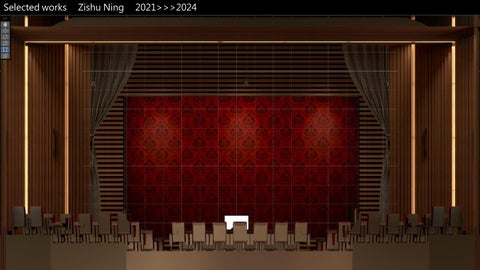
The project is based on the Showreel requirements for the REPLAY program that I applied to in 2024. It explores the relationships between applicant-reviewer, game-theater, real-time interactionplot, and private-public by allowing the reviewer to voyeuristically observe a fictional applicant’s (me) personal computer within a theater setting.
In the game, the fictional personal computer on stage contains a mix of my work, chat logs, private notes, and letters, making the reviewer feel as if they’ve hacked into my computer to view personal information. Simultaneously, it feels as if I’ve hacked them back, forcing them to view disorganized, inappropriate content that shouldn’t be part of an application.
Moreover, the theater in the game serves as a metaphor for modern life and Foucault’s Panopticon. The applause at the beginning, the occasional coughs during the performance, and the act of performing with your back to the audience... These elements contribute to a space devoid of actual people, where the sounds of the "audience" are merely sound effects. In fact, when you step onto the stage, the audience seats, as 3D models, have already been erased by a C# program.

https://www.youtube.com/watch?v=MAgrTq1Ta9Q
Download Link: https://drive.google.com/file/d/1gaI3m3i_TdIXhrNSBxY8A_Px_v-
HI5NB/view?usp=drive_link


A story-driven 2D top-down horror maze game that my friends and I spent a year and a half developing. The game is now available on Steam and has received over 13,000 downloads. It is based on Chinese folklore specifically TongZiMing (referring to the reincarnation of a divine child, who typically has a short lifespan or endures many hardships and illnesses). The protagonist, born with TongZiMing, is trapped in a realm of nightmarish mazes with a cat and mysterious corpses. Her only hope of survival is to find a way to escape. Watch a YouTuber play Childish Life: Prologue: https://www.youtube.com/watch?v=KgyatVNHhLg
Steam: https://store.steampowered.com/app/2529590/_/


The scene/character design is inspired by the indoor design style of Northeast China in the millennium.


Similar to Pac-Man , players must collect "spirits" on the map while being chased by monsters. After collecting enough "spirits," they can open the door to the next level. However, unlike Pac-Man, we attempt to apply platforming game design logic to create a topdown game.
Monster Mechanics:
Chasing the player along the shortest route


Suddenly dashing / flying towards the player


Player Skills:
Dash in a specified direction
Release a copy that can illuminate the map / attract monsters


Map Mechanics:
Force players to move a certain distance in a fixed direction
Make certain walls near the map disappear and illuminate the area


The project uses a personal framework called CastleFramework, which is an event-driven, data-driven MVC framework that follows SOLID principles
Developed monster AI using behavior trees and finite state machines
Developed core systems or features such as sound effects, UI, and map mechanisms
Optimized game performance using object pooling, asynchronous map loading, sprite atlases, and other methods


An interactive experience based on tarot cards, African divination, clay animation, game engines, and computergenerated randomness. We aim to express the psychedelic and bizarre aspects of life through a variety of shaders and clay animation, allowing fate to wander between the cards.
Will be exhibited at Feinaki Beijing Animation Week on November 15, 2024. https://youtu.be/qrLIuFVU2C4


A Gamejam project. We attempted to recreate the childhood game experiences of Where‘s My Water? and Cut the Rope with a dark humor art style. Players need to use various organs as tools, each with distinct functions, to successfully deliver food to the stomach.
https://youtu.be/A9rlGoFqYAw


The heart can make the apple bounce like ping pong balls

The gallbladder can produce liquid to push or hinder the apple’s movement


The intestines can serve as pathways or obstacles. players can connect or disconnect the intestines.


The liver is just an obstacle

A Gamejam project. A tower defense game with a rubber hose art style. Players need to follow changes in track and place various weapons at the right time to prevent different enemies from reaching the center.
https://youtu.be/DnVvtF9KrRc


Carnivorous Flower Tower: Shoots bullets to attack enemies
Fly: Executes melee attacks on buildings


Vine: Defends against enemies and inflicts minor damage

Bee: Shoots bullets to attack buildings.

Mushroom Mine:Deals heavy damage to enemies that step on it


Can fly over vines


This work is a text flow generation machine, where all text flows are composed of three initial text segments: a poem by Haizi titled Blindness To Wittgenstein, an excerpt from Edward Said's Orientalism, and a discussion about Chinese cultural traditions generated by ChatGPT 3 5 As the system operates, parts of the text from these three initial segments will shift based on their encoding in the computer, meaning their content and semantics will become increasingly chaotic over time. The style and color of the text flow will also inherit and change according to its content.
These text flows aim to simulate the inevitable semantic shifts that occur in a symbolic system due to changes in time and space, as well as the randomness and violence of such shifts. Each flowing symbol segments space and claims territory, and in every blank area where they are absent, there lies the potential for their next position. This represents a form of aggression, but also a manifestation of freedom.


https://youtu.be/MuapwTZBSE0


This work is based on an e-book reading software that I use daily, with content drawn from Italo Calvino's Invisible Cities, while the name is inspired by Jorge Luis Borges' The Book of Sand. It discusses computer coding, cultural interaction interfaces, and more.
As the viewer flips through the pages, the content gradually becomes bizarre, trembling, and constantly changing. The range of character changes includes all characters encoded in Unicode. Finally, once all characters have been traversed, the e-book will display a blank interface, serving as a monument to characters that have not been encoded by computers.
https://youtu.be/KciOwWXHATM


One Chinese character representing 'I' runs on top of another Chinese character that represents 'I.’
https://youtu.be/imauiE7IpuE