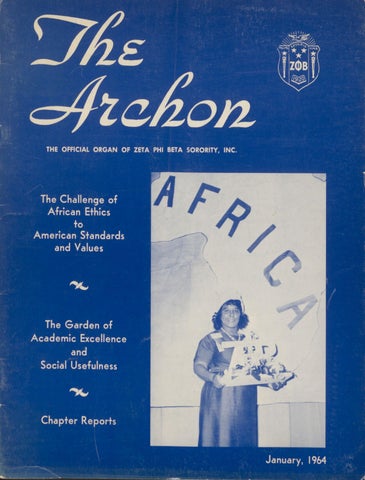
THE OFFICIAL ORGAN OF ZETA PHI BETA SORORITY, INC.
The Challenge of African Ethics to American Standards and Values
The Garden of Academic Excellence and Social Usefulness
Chapter Reports
January, 1964 -
-······
·- •·
.. .:..
Zeta t}bi 1§eta ~ororitp, Jf nc. DEBORAH PARTRIDGE WOLFE, Ph.D. Grand Bosileus 62 South Union Ave., Cranford, New Jersey ARIZONA C. STEMONS Founder-President Grand Bosileus Emeritus 1 91 5 Fed era I Street Ph ilodelph ia, Penn sy Ivon ia
NATIONAL OFFICERS MILDRED CATER BOONE First An ti-Bo si leus Central State Hospital Box 39 Petersburg, Virginia BARBARA MINOR JAMES Second Anti-Basileus 3830 Golden Hills Drive Dallas, Texas LAWANNA H. IVEY Third An ti Basi leus l 315 Page Street Oklo ho mo City, Oldohoma ISABELL M. HERSON Grammateus 805 North 27th Street Baton Rouge, Louisiana
NORA E. LOCKHART Tomias 11 5 S. Tarboro Road Ro leig h, North Caroli no STEPHANY ADDISON Phy I act er 2020 West 70th Street Los Angeles, California MARY T. WILLIAMS Antopokritis 8717 Seneca Street Oakland 5, California IDA B. KING Choirman, Executive Boord 2 3 2 4 Mon roe Street Gory, Indiana EMMA J. DEWBERRY Executive Secretary Notiono I H ea dq uartcrs 1734 New Hampshire Ave. N.W. Washington, D.C.
S. GLADYS BUTLER Chairman, Trustee Boord 4 15 W. 28th Street Indianapolis 8, Indiana ETHEL HALL Trustee 5817 Chestnut Street Ph ilodelph io , Pen nsy Ivan ia
MARION SHANNON Trustee 2191 N.W. 58th St. Miami, Florida LUCINDA ROBEY Trustee 309 Beto Street Birmingham, Alabama ELLA STRAWBRIDGE Trustee 4724 Farlin St. Louis, Missouri
REGIONAL DIRECTORS AND ASSOCIATES Atlantic Region PANSY L BORDERS Chairman, Regional Directors 1 0 N. Clinton Street East Orange, New Jersey ALBERTA ALSTON Associate Director 177-21 Sayres Ave. St. Albans, New York EVELYN CANTY Associate Director 4213 19th Place, N.E. Washington, D.C. ARTHALIA LOTT Associate Director 529 Orchard Avenue Philadelphia, Pennsylvania Eastern Region AUGUSTA WHITE Director 704 W. Cemetry Street, N.W. Salisbury, North Carolina AUDREY ROBINSON Associate Director 2200 Seminary Avenue Richmond, Virginia
THERESA THORNTON Associate Director Box 11 Page, West Virginia SARAH NEWTON Associate Director 1118 Columbia Rood, N.W. Washington, D.C. Southeastern Region ELLA W. FISHER Director 1917 Mills B. Lane Blvd. Savannah, Georgia ALBERTA STEVENSON Associate Director 904 Oak Street Columbia, South Carolina HA TT1E SHAVERS BARBER Associate Director 152 2 N.W. 5th Avenue Pompano, Florida South Central Region JUllA POLK Director 1703 Dalton Street Jackson, Mississippi
VIVIAN R. STEWART Associate Di rector 3117 Ringo Little Rock, Arko nsos LOIS GUERINGER Associate Director 1908 Me Horry Boulevard Nosh vi lie, Tennessee RUTH P. POWELL Associate Director 304 Cuba Street Mobile, Alabama Great Lakes Region IONE GIBSON Director 1 05 Massachusetts Avenue Detroit, Michigan WILLIE MAE JOHNSON Associate Director 602 W. 29th Street Indianapolis, Indiana ERNESTINE CURRY Associate Director 6740 S. Indiana Ave. Chicago, Illinois
EDITOR
Mary Theriot Williams 8 71 7 Seneca Street Oakland 5, California ASSOCIATE EDITORS Louise Batson J 40 McDonough Street Brooklyn, New York Loura Irvin State Teachers College Elizabeth City, North Carolina Ola Adams 70 J State Street Waycross, Georgia
THE OFFICIAL ORGAN OF ZETA PHI BETA SORORITY, INC. VOL. XXVIX-No. l
OAKLAND, CALIFORNIA
JANUARY, 1964
REGIONAL REPORTERS Eastern Mil lie Liston J 441 Waddel I Street Charlotte, North Carolina South Eastern Madeline G. Dixon, Ph.D. Savannah State College Savannah, Georgia
Tragedy-Triumph
Page 2
A Tribute to the Late John Fitzgerald Kennedy, President of the United States of America
South Central Mildred Horn 3178 Gilmore Memphis, Tennessee Great Lakes Ressye B. Scott 4535 S. Prairie Street Chicago 53, Illinois Mid-Western Lucille Long 4853 Farlin 4853-A Farlin Avenue St. Louis, Missouri
Prose and ARCHON
Page 3
The ARC HON Editor Scans the Zeta Scene The Challenge of African Ethics to American Standards and Values
Page 4
The Grand Basileus Weaves a Pattern of Social Progress With Threads of Cultural Awareness and Understanding The Garden of Academic Excellence and Social Usefulness
Page 7
A Guide to a Life of Service Outlined By Soror Ruth Miller Gore
Southern E. Marie Gilbert Peoples Business College l 120 East 12th Street Austin, Texas
Official Boule Photographs Chapter News
Page 16 •
Personalities
Regional News •
Projects
Pacific LoVerne Washington 4245 Degnan Street Los Angeles, California
Tm, ARCIION is published four times each year by Zeta Phi Beta Sorority, Inc., from editorial offices located at 8717 Seneca Street, Oakland, California 94605. All corrcsponclenco, manuscripts and photographs should be addressed to Mary T. Williams, Editor, at this address. THE ARCHON-JANUARY, 1964
PAGE ONE
TRAGEDY-TRIUMPH On November twenty-second, nineteen sixty-three, Standard time, afternoon, about two; News flashed, in haste, 'round the universe: Our President had met death, askew! The world, truly shocked and disdained, Felt the impact of a treacherous deed. The concerned reacted sympathetically, As if their sad hearts would bleed. The high and mighty, meek and low, Went humbly to pay deep respect. Thousands mournfully passed his bier, In silence and awe did reflect On his youth and esteemed great wisdom; His regard for real freedom for all; That an assassin's swift bullet halted Plans implemented to extend the call. Dignitaries appeared from near and far, Comprising affected Heads of State. They assembled to pay their true homage, To a man whose import was great. The sun shone brightly, continuously, That memorable cold, brisk day; As the cortege, moving with sovereignty, Bore his body, so solemnly, away; To eternal rest 'midst felled warriors, Who served their dear country with zest; In Arlington Virginia's necropolis, Where various patriots rest. A perpetual flame will keep burning. 'Twill remind us of one who lies there; The inspiration of a courageous leader, Who championed his motives with care. John Fitzgerald Kennedy reposes, America's thirty-fifth President; Beloved by millions, the world over, Cut down ere his young life was spent. Written November 25, 1963
by Althea S. Cornish Morgan State College Alpha Zeta Chapter Zeta Phi Beta Sorority
PAGE TWO
JANUARY, 1964 - THE ARCHON
The Editor's Page
Prose and---
ARCHON By MARY T. WILLIAMS
THE ARC HON - JANUARY, 1964
For Zetas throughout the world, the year of 1964 is one of promise and resolution, generated by the activities of the Boule at Miami. The prevalence of "Zeta Spirit" was an inspiration in itself, but the detennination to make significant contributions to the cultural, social and political emergence of our world wide community was overwhelming. Tho 4,3rd Anniversary Boule has given us a slate of qualified and capable leaders who are already busy directing am bitious national and regional policies which will guide Zeta programs in the new year. One of the busiest of the new national officers must be Soror Mary B. Hurt of Baltimore, Maryland. Soror Hurt was appointed Director of the African Project. I know that we are all anxious to hoar the results of Soror TIurt's activities, especially now that the Grand Busileus, Soror Wolfe, has announced that Zeta is planning to step up its African program by utilizing the facilities of CARE, the non-profit agency for voluntary assistance to needy people in other lands. CARE is currently operating in Algeria, Liberia, Nigeria, Egypt-Gaza, Libya, Sierra Leone and Tunisia as well as other non-African nations, distributing food and other essentials for immediate relief, the tools of health, education and self support, and, CARE also sends MEDICO teams to practice and teach modern medicine. More information will be forthcoming as Soror Hurt and her co-director, Soror Thelma Burnette of St. Louis, Missouri, have completed arrangements for Zeta participation in this project. Both Soror Hurt and Soror Burnette were among the 35 persons who traveled to Africa this summer with Zeta's Hrst international tour, and thus were able to gather first hand facts regarding the needs of the new nations which arc developing on that continent. The Ancrrox has not yet completed its list of Zetas who have been cited in the 1964-65 edition of "Who's Who of American Women." We are planning to include this feature in our next Anc110N, giving mention to all of our Zeta sisters who were accorded this
honor. We are soliciting the cooperation of all chapter editors in compiling our list. If you've been reading the monthly bulletin which the Grand Basileus publishes then you already know that the 1965 Boule will be held in New York City. The theme for this meeting is "Women and Youth Unite for Freedom." In discussing the theme, Soror Wolfe stated, quite appropriately, "I feel that all Americans know as never before that freedom is a complex social achievement and that the freedom of one is bound up with the freedom of another. We, as Zeta women, know that our future is greatly affected by our relation to our youth. Thus our emphasis must be on youth. However, we rc ilize full well that joint effort is necessary. Our theme, then, unites women and youth in this great cause." One need only to reflect upon the experiences and results of our national project in order to realize the true value of Soror Wolfe's comments. Our own due considerations in this matter will serve us well as inspiration for working with youth of our separate communities and the nation as a whole. Soror Wolfe also calls for a renewed emphasis on the development and support of Zeta's undergraduate program in order to perpetuate the tremendous contributions which the undergrads make to the total Zeta image. She calls for a concentration of energy in the establishment of now chapters on every worthy campus and the discovery of student leaders who represent the principles of Zeta and offering to them the encouragement of sorority membership. Working with undergrads can be a hectic and trying experience, but the rewards for this effort are many and this endeavor is of signal importance to the perpetuation of Zeta's work. I know ( and so do you) many of our Zeta sisters who have made careers for themselves in Zeta through their interest in the undergraduate program. We must not leave to these sorors, alone, that extra special pride in personal accomplishment which they must feel as they watch and work in the maturing process of young Zeta minds and talents. There is much work to be done in the area of undergrad activities. Each soror who recalls her own undergrad days will be anxious to make some contributions to this program. PAGE THREE
HIGHLIGHTING the program of the South Carolina State meeting was a panel discussion on the theme: "Zeta Image in New Horizons Through Active Undergraduates." These young sorors presented challenging information and suggestions on the present image of Zeta among undergraduates and the projection of this image into the future. Serving as members of the panel were: Soror Thelma Fisher, instructor and undergrad-
uate advisor at Allen University, coordinator; Sorors Elizabeth Capers, Benedict College, Columbia, South Carolina; Bobbie Myers and Huline Goodman, Allen University; Mary T. King and Laura Schuler, Claflin College, Orangeburg, South Carolina. These sorors brought to the graduate Zetas problems and evaluations that stimulated a lively and productive exchange of ideas. Sixty-two sorors were in attendance at the meeting.
WAVERLY SCHOOL in Columbia, South Carolina, was the setting for the annual State Meeting of the South Carolina chapters of Zeta Phi Beta Sorority. The meeting was highlighted by a panel discussion on undergraduate activities and the Zeta image. Zeta dignitaries pictured in the front row are: !left to
right) Sorors Verona Middleton, Marie Y. Bates, N. G. Blassengale, Annice Harrell, Laura Samuel, Magnolia Lewis, Annie E. Hanberry, Rebecca McDaniel, Alberta Stevenson, State Director; Beatrice Sanders and Pearl Jenkins. Soror Stevenson presided over the meeting which was opened on May 4, 1963.
PAGE FOUR
JANUARY, 1964 - THE ARCHON
THE CHALLENGE -of African Ethics To American Standards and Values Dr. Deborah Partridge Wolfe, Grand Basileus
The challenge of African ethics to American standards and values ... the topic sounds a bit strange to an American. Could the moral principles of the African possibly challenge American values? Could we-sophisticated Westerners, educated Americans - really learn something from the "dark continent"? Such questions are not surprising, for it is not unusual for a society to think that it is living in the best of all possible worlds. It is particularly easy for an American to fall into this trap; our pride in turning a country which began as thirteen fledgling colonies into a major world power in a little over a century and a half is not unwarranted. But our complacency toward our standards is another issue. No one will quarrel with the ideals our forefathers expressed in the Declaration of Independence-all men arc created equal; every man has the right to life, liberty, and the pursuit of happiness. Our record of translating these ideals into reality, however, could stand some improvement. The cultural impact of the black slavery system of the American South is still reverberating through our society 100 years after Lincoln's Emancipation Proclamation-in verbal and physical violence toward James Meredith at the University of Mississippi, in discriminatory housing laws in our large cities, in school systems only tokenly integrated, in unfair job practices. The slums of our cities are hardly fruitful soil for cultivating the spirit and intellect of our youth; it is no wonder that they have become breeding grounds for juvenile delinquency and adult crime. We arc told that America has witnessed a religious revival in the y ars since World War II, but we need only once me 't the compartmentalized THE ARCHON - JANUARY,
1964
a good world, but it is not the best of all possible worlds. "'e must remember this whenever we come into contact, physically or intellectually, with other societies, and particularly when we meet the African, for in many ways his world is quite different from ours. Yet, the African whom we are most likely to come into contact with-the student, the teacher, the government representative, the businessman-will be in part the product of Western culture, of the African colonial experience. His education will be European or American inspired. His political institutions will be fashioned after ours. He will be deeply committed to utilizing Western technology to transform the revolution of rising expectations in his continent into a full tide of higher living standards. Superficially, he may seem so Western to us that we will be shocked when he says or does something unfamiliar or we may be surprised to discover that the meeting of minds we anticipated seems rather to be a running of two minds along two parallel tracks, not far apart but destined never to meet as one. The disappointment of this discovery feeds our condescending attitude. We have offered the African the fully ripened fruits of our civilization: our parliaments, our educational system, hostility of the narrow sectarian to our scientific discoveries, our material question the depth of such a religious comforts. He has tasted of them, but revival. Equality of opportunity? Our he has not really digested them. Politisociety is certainly more fluid than that cally his countries are hardly demoof most of our forebears in other lands, cratic as we understand democracy. but let's not kid ourselves into thinking No sooner do we turn our backs than that class distinction don't exist. The he reverts to the magic cures of the son of the janitor and the son of the cor- witch doctor. This attitude-with graded variaporation president may both go to college, but chances are it will be more tions I admit-is fairly typical of all of difficult for the son of the janitor to get us, even of those of us who say we a good education than for the son of would like to understand Africa and individual Africans better. We forget the corporation executive. My point is simply that our society that the African is African, that his valis not perfect, that there are still things ues are not the same as ours. We comwe can learn from others. Ours may be prehend only that part of him which The Grand Basileus, Soror Deborah P. Wolfe, after a great deal of organizational effort on her part, was unable to join the Zeta International Tour which climaxed the 43rd Anniversary Boule. Soror Wolfe wrote in her recent bulletin: "For four years I have been planning the Zeta tour to Africa. I have talked about it written about it and sent you many folders. You were kind enough to vote in 1961 to send me. Everything was set up in line with our theme and the trip was scheduled for July 21 thru August 20, 1963. Thirtyfive persons were enrolled and interest was high. But alas, 1963 had become the "Civil Rights Year." As Education Chief nnd the first Negro woman to be on the floor of the House of Representatives, I felt that my highest contribution to the Civil Rights struggle would be to remain in Washington, D.C. and help in the legislative fiqht. Hence, I did not go to Africa with the group as planned ... " On October 8, 1963, Soror Wolfe left Washington, D.C. on a 20 day tour of Europe and Africa. She enjoyed sightseeing trips in Lisbon, Rome, Cairo. Kuwait, before proceecling on to Accra, Ghana; Monrovia, Liberia and Dakar, Senegal. Soror Wolfe scheduled visits to historic landmarks and important attractions in these African cities.
PAGE FIVE
more seriously on the cultural difference between Africa and the West: "For the African Negro the problem lies in the struggle to express the larger irony which is the meeting point between acceptance and rejection, once he has felt the impact of Western civilization ... there are certain things they (Africans) reject from the West, which have to do with a sense of values in such areas as patterns of behaviour and human relationships." Africa has become a meeting place of two streams of culture and tradition, of two systems of morality and government, of two divergent approaches to life. The African has incorporated GRAND BASILEUS Soror Deborah P. Wolfe included in her recent African tour, a much of Western technology and visit to Accra, Ghana, where she talked with members of the family of Soror Priscilla Western ideas into his value system, Amparbin who is now a Zeta scholarship student in the United States of America. but beneath and around this remains Soror Wolfe presented the Amparbin family with a photograph which was taken at the framework of pre-colonial values, the 43rd Anniversary Boule in Miami, where Soror Amparbin was a featured speaker. among them: the idea of the responsibility of the community toward all its resembles us. As soon as we see somegreat shock to an African to hear a members, of the limitation of authority thing new and "foreign" we withdraw child say, 'Don't be silly, Daddy!'" and government by discussion, of the in puzzlement into our splendid con- -about English women: enjoyment of living as an end in itself. descension. We refuse to admit that Herein lies the first challenge to "The women ... may appear to be we might learn something from him. American standards: the responsibility chattering like birds all the time. We conceive of our relationship with of the community toward all its memTheir remarks are not to be taken Africa and Africans as a donor-recipiliterally and seriously. They some- bers. The basic unit of African soent arrangement; we are the teachers, times talk about 'milions' when they ciety is still the tribe, and the family they are the learners. We challenge mean 'a dozen or so,' and use such is the center of the social organism. our pupils to use to the best what we words as 'frightfully' and 'awfully' in The individual African considers himgive them - materially, intellectually, connection with things and events self an integral member of a larger soethically. But perhaps it is time for us which should not cause any excite- cial group-of an extended family emto examine the challenge which Afriment at all. These colloquialims are bracing several generations, of a larger can standards present to us. not meant to be taken literally. It is lineage, a tribe, of a unified cluster of The first step toward meeting this sometimes said that they must make lineages, a community. The group is challenge is to develop an awareness conversation when they have visi- responsible for him and he is responof the differences between our values tors, and so they talk about all sorts sible to it. The individual is brought up and those of the African and a realizaof things, which may sometimes to behave in a manner which will bring tion that although an individual Afriprove a bit boring or irritating to a honor and not disgrace to the group. can may have adopted many Western He is taught mutual helpfulness and stranger." values, he is still basically African in cooperation: that each member should thought and action. The second step is -and about English men: help the other, in health or sickness, in to recognize that Africans visiting "The men appear even more mys- success or failure, in plenty or poverty. Western societies have been honestly terious. It may seem to us that they No relative, no matter how distant, can shocked by some of our standards. A really play the role of children in the be refused hospitality for as long as he pamphlet prepared by the British Cohouse. They are looked after very may request it. And relatives are often lonial Office offering suggestions to carefully and told what they are sup- given other types of aid also, such as Africans and Europeans visiting one posed to like, to eat, and to wear, money to educate children or to pay another's countries illustrates this point and to do. They hardly ever talk. the bride-price for a son's marriage. rather humorously but nonetheless Often when the mother and the chil- Among some tribes, in fact, custom pointedly. The pamphlet warns Afridren are continuing an argument, obliges every man to give any relative cans about English children: one notices that the father has al- whatever he might ask for. Each famready withdrawn from it. Perhaps it ily is in effect a miniature welfare state. "In conversation, children do not is correct to say that the English- The sick and the old are assured of hesitate to contradict the views of man's home is a castle in which his care. The young and the able are early their elders. Not only do they not wife offers him shelter." understand the principle that 'Chiltaught their responsibilities toward the A South African in exile in Nigeria, group. dren should be seen and not heard,' but they allow children to talk even Ezekiel Mphahlele, in a book called This tradition of African community more than the parents. It comes as a The African Image has commented (Continued on Page 20) PAGE SIX
JANUARY, 1964 - THE ARCHON
The Garden of Academic Excellence and Social Usefulness By Soror Ruth Miller Gore Today, we stand in the midst of the greatest period of world history. The 1960 to 1970 decade is destined not only lo change the map of the world, hut tho hearts of the universe, as well. l n this age of space, with the introduction of bullistic missiles, satellites, space flights; with men training lo go lo the moon, and striving to speak the language thereof, thereby setting up a means of communication between the earth and those heavenly bodies, who knows what the future has in store for us? As these technological and social advances are made throughout the world, women are contributing significantly to these changes. So let us re-examine our customs, goals ancl system of val ucs, and concentrate for a few moments on
"A Garden of Academic Excellence and Social Usefulness." A large number of you, no doubt, have toiled in the garden al home and arc thcr for familiar with many kinds of vegetables. There ar vegetables which provide us with proper amounts of vitamins, iron, minerals, and other important materials. But tonight we arc not concerned with these; WC' arc concerned with character building vegeta blcs, thos dealing with academic, moral, spiritual, and social values. Ladies and gcntlcm '11, this character building vegetable garcl ·n will consist of sixteen rows. First, plant five rows of P's there are' numerous kinds of p as: black-eyed peas, sweet peas, june peas, etcetera, but the P's in this first row will he Purpose. It has often be 'n said that lie who aims at nothing is apt lo hit il. The sportsman who shoots at random may make' a loud noise, hut he will never hag the game; and the ship that has no definite port wi11 waste and lose its THE ARCHON
JANUARY, 1964
energy. In your pursuit of academic excellence and social usefulness you must have a definite purpose, and you must pursue it however alluring other things may be. Having a definite goal not only means the application of energy directed to one point; it also means dropping off superfluous encumbrances that interfere with its accomplishment. The second row of P's is Preparation. Once you have selected your goal, prepare for it. There is no such thing in life as luck There is opportunity, and he who is ready and prepared to seize the opportunity is the one who will be considered. Large organizations are hunting frantically for men and women who arc prepared, and who can, and will perform the tasks assigned to them with fidelity. Capital is abundant, but efficient men and women are not. As college women, in your pursuit to academic excellence and social usefulness, may you be ever mindful of the following poem: "The man who wins is an average man, Not built on any particular plan. He is one who never depends on luck, Just steady and earnest and full of pluck. So he works and waits till one fine day There's a hotter job with bigger pay; And the men who shirked wherever they couldArc bossed by the men whose work made good." As we continue to plant our garden of Academic Excellence and Social Usefulness, we find that the third row of P's is Perseverance. Thalherg, the great pianist, always practiced a new piece fifteen hundred times before playing in public. "It's always a matter of perseverance," he would say when questioned as to the cause of his success. Darwin labored seventeen years gathering material for his "Origin of Species." Edison's storage battery invention was the result of 9,000 experiments covering a period of three years. It is a great thing in life for one to realize that there is no short cut to academic excellence. The easy way seldom leads far, and never to greatness. We can climb the ladder of academic excellence by meeting, fighting, and conquering the forces that beset us. Perseverance and persistence are sharp-edged words that cut their way through rocks and stones that hide the goal. The fourth row of P's is Potential, and here we are concerned with the developing of this potential to the fullest extent. We arc told that an individual uses less than 10% of his potential. Young ladies and gentlemen, why not try to release another small percentage? A release of even 1% is a large gain. Frequently, we find that a talented student will "breeze" through courses or "cram" for examinations and leave college without ever having to submit himself to the discipline of hard intellectual work His ultimate goal is just "to get by." It is important to view one's potential in relation to today's crisis. It is only by looking at yourself objectively, admitting your weaknesses and strong points, and laying out a blueprint, or a master plan for future performance that you may successfully climb the ladder of academic excellence and social usefulness. Hannah Lees, in the article "Women Should Not Play Dumb," ( Saturday Evening Post), contends that there is no need for females to conceal their intelligence in order to preserve their charm for men. This article brought several responses: said one reader, "Any man who wants the company of someone who simply stares up at him should be taking out a cocker spaniel, not a woman ... "; another said, PAGE SEVEN
"I don't think any boy in his right mind wants to go out with an Encyclopedia Britannica for a date"; another commented, "Any American man who swallows the sweet-molasses line of a yes-woman can't be classed as either intelligent or superior. Any woman who needs the interest and admiration of such a gullible egoist must be either spineless or desperate!", and still another asserts, "On the west coast, women have so many strong opinions that the poor male has a chance only to nod his head." Surveys taken on college campuses reveal that almost half of the women students play dumb when they want the interest of a man. Does it have to be this way? Millions of women today have gone to college. At least one wife out of every three is a wage earner. To make a deliberate effort to conceal all the information, ideas, and experiences that we have acquired seems a terrible waste. I am not suggesting that women should be above wanting to be attractive to men, hut is this really the best way to do it? How can you charm anyone when you arc not genuinely real? Naturalness is the key to charm. True beauty is not "showing off," nor is it artificiality in actions or appearance; rather, it is a hum hie display or a pleasing personality and intelligence. The fifth row of P's is Purity. According to the sixth Beatitude, the most radiant of them all, "Blessed arc the pure in heart, for they shall sec Goel." This requirement may not be· imperative in making a living, hut it is extremely essential in the higher and more glorious task of making a life. The pure individual has clean thoughts, clean desires, clean habits, as well as a clean body, and he is an artist in the task of character building. The world honors, trusts, and loves the pure, upright individual. That person who goes around <listrib tting falsehoods, and
stroy all injurious growth. To clean the land is to ri<l it of everything dead or alive that is enemy of fruitful growth. So it is with our hearts-to purify our hearts is to uproot the evil thoughts and desires, and to create a pure condition which will reflect the Christian characteristics of the purified state. Often in our hearts arc beasts of prey: there is the lion of passion; the serpent of envy; the bear of uncouthness; and the fox of deceit. To purify the heart is to uproot all the evil things that inhabit it. There are dead things that must be removed, and there arc poisonous things which must be given no mercy. All must be uprooted before Soror Ruth Miller Gore is an Associate Professor of Education at A. and T. College, Greensboro, North Carolina. She was asked, recently, to deliver the keynote address at the college's First Annual Women's Weekend Banquet. Her unique treatment of a vital theme provided an inspirational focal point for the observance which was initiated by the A. and T. Women's Council. Her message to the women of this outstanding school is reproduced here, in part, for sharing with her Zeta sisters.
the heart c.m lx- purified. Impurity impairs the mind, dulls alertness, clogs dRcicncy, ancl places one at a discount in the chumcls where accuracy and clcir judgment arc imperative. In our garden of "Acnde111ic ExcelLenee ant! Social Usefulness," you will find five rows of Lettuce. First LET US spend our time wisely. Time is tho.most valuable gift to man. ft is so valunblc that Cod gives only a moment ut n lime. It is always on the move-never static. When we pass a given point in time's never ending moment, we never pass tl is point again. So with the past, it reminds us all, that we will n .ver pass this way again. When we fall short or
primary function of calculators, encyclopedeas, dictionaries, and other instruments of reference. The purpose of the mind is not only to assimilate objective facts, but to understand how this knowledge affects man and his total environment. Facts arc only a preparation for nndcrstancling. The mind must be disciplined, enlarged, enriched, perfected, and made to rest upon the vision of truth. The third row of Lettuce deals with human relations, Let 11s try to get along with others. The college today addresscs itself to an amazingly large assortmcnt of women: single and married, talented and less talented, young women and younger women, those who work industriously and some who scarcely work at all; women of different interests, intentions, ambitions, and degrees of preparation. With this large assortment of women living together and working together, it is necessary for each to do what she can to maintain good human relations. Our girls and women must be fair in all of their dealings with others. There arc many opportunities through011t life to take advantage of others, to seize opportunities for advancement that are dctrimcnta l to individuals and to groups. But in our garden of Aca-
demic Excellence and Social Useful-
society. A dramatic illustration which will
neglect to take advantage of the many opportunities that pass our way, we fail our parents, our teachers, our friends, and our school. Ladies and gc•ntl('ntcn, the second row of Lettuce consists of true knowl-
ness, it is of utmost importance that we cultivate good human relations. When we cultivate good human relations there is no place for unfairness. The obj ctives of good human relationship are as follows: respect for humanity, friendships, cooperation, courtesy, and an appreciation of our institution. And now, ladies and gentlemen, we approach the fourth row of Lell!lceT,et 11s prove lo others that we can be a credit to A. and T. College. Orgurizutions may b large in number, hut th' average person usually forms his judgment of it through his contact with a few persons and sometimes only one individual. This is not wise hut it is frequently done. Every member or an organization becomes a salesman for the organization when he comes into
clarify the attribute of purity is described in connection with planting the vegetable garden. Before W(' plant the vegetable garden we clean the area. We remove from the fields all stones, rocks, dead roots, and fil)('rs, and de-
edge. Let us search for knowledge and understanding. True knowledge is the kind of knowledge which brings understanding. Facts arc important, but their retention is not the primary f u net ion of the mind. Their retention is the
contact with the public, and the impression he makes is an advertisement good or had. Arc you a good salesman for our institution, for your clormitory, or any group with which you arc (Co11/ii111C'd 011 J)a!.!,e 2R)
whose very breath is foul with profanity, is dishonoring his or her manhood or womanhood, and is a menace lo
PAGE EIGHT
JANUARY, 1964
THE ARCHON
l
Zeta Zeta chapter in Chicago, Illinois sponsored its first annual Cinderella Ball in October of 1962 at the world famous Sheraton-Blackstone Hotel in the windy city. Comely Miss Edith Payne was crowned Miss Cinderella 1962 fright) by Soror Effie McKerson as escort Walter Thompson beamed his approval of the selection. Miss Payne was sponsored in the ball by Dr. Lucie E. Thompson, basileus of Zeta Zeta chapter. The Cinderella Ball was also highlighted by the debut of ten Chicago area debutantes. They are pictured below, front row !left to right) Christina Jackson, Edith Payne, Mary Colyer and Tameria Gray. Standing are: (left to right) Tedoria Snow, Margaret Russell, Estella Taylor, Prudence Woodford, Edgarjean Thornton and Bernadette Odom. Soror M. Ann Prendergast was chairman of the Cinderella Ball committee. All activities were coordinated by former Zeta Zeta basileus Mildred Butler.
THE ARCHON- JANUARY, 1964
PAGE NINE
Kappa Zeta Chapter Texans Dramatize Youth Report, Dallas Community Hails Project
A warm representative cross section of Dallas, Texas citizens from the vari-
DALLAS COMMUNITY members who joined with Kappa Zeta Chapter in the recent dramatization of the Dallas County Youth Study included (pictured above): Mr. George Allen, Rev. I. 8. Loud, Mr. R. G. McCord and Mr. Carl Flaxman. Pictured below are: Mr. Pierce Allman, Mrs. Philip Vogal, Mrs. Harry Ungerman and Mrs. Julia Scott. Seated at the table are Soror Minnie H. Page, Mr. Charles Redding and Soror Lillean Burns, chairman of Kappa Zeta's project committee.
PAGE TEN
ous organizations, agencies, clubs, schools, parent - teacher associations, and the surrounding urban towns, crowded into the Mt. Horeb Baptist Church recently to witness a superb dramatization of the Dallas County Youth Study which was produced by an inter-racial cast. The characters gave a superb performance whi ·h appealed to the vast audience. The setting was artistic and of theatrical mood. Kappa Zeta Chapter of Dallas was one of the 111,1jor sponsoring organizations for the presentation. Soror Lillian Burns was general chairman of the Zeta committee which helped prepare the program. Tl1e Reverend W. S. Brent, pastor of Mt, Horeb Baptist Church, praised tlw sponsoring organizations for the oxccllcnt program. Tl was evident that the information imparted by the chaructrrs reached the hearts and souls of the communitv leaders. Gt'orge J ,. J\ lien, the first speaker, introduced the slucly eloquently, followed by the first scone, "vliruclo on St. Louis Stred." This was narrated hv vlrs. Lucille lcCa11ghcy and interprctccl hy \lrs. i\lar Lois Sweatt. The "Voice or Y;>11th Study" was portrayed by Pk rec Allman. Another scent' was entitled "These Are' Our Children." The narration was handled by vlrs. [ulin Scott, who muck: dlt·cthe
JANUARY, 1964 - THE ARCHON
use of photographic slides to support her presentation. Charles Hedding portrayed "Quicksand," a skit which was clramatizcd hy Mrs. Bnrbara Jam es, Fay, Hoskins, Fcli\ F. Cole and cdra James. The dramatization reached a climax
with Mrs, Ziona B'ilsman's portrayal of "\Vhat ls the Answer?" Dr. 1. B. Loud gave the closing. The program director was Mrs. Phillip Vogul, staging director was Mrs. Harry Ungerman, and forum co-ordinator was Mrs. Maurice B. Fieser. Among those witnessing the presentation of the ehnllenging youth study were sludr-nts from Bishop College, all 01· t lw Da lbs high schools, scveru 1 P-TA groups, county and city elementary schools, representatives from the Lighthouse for the Blind and ,t cross section of Dallas church congregations. Also noted in the audience were representatives of Hope Cottage for Children's Bureau, Housing and Home Finnncc Agency, League of Women Voters, [nck and Jill, Texas and Pacific Ladies Safety Council, Council of Jewish \\'omen, Dallas Division; Dallas \Vomrn's Council, Cedar Crest Civic Club, Flon•ncc' Allen Holmes Cl11h, 5011th Dallas Business uncl Professional \\'omen's Cl11 b, Oak Cliff Oar and Socia I C!11h, the Greek Letter Sororities and Fratoruit ics, the Dullus Brancl: of the AACP Youth Council and the Great Liberty Life Insurance Company.
A VIGNETTE, The Miracle of St. Louis Street, was narrated by Mrs. Lucille McGaughey, Dean at Madison High School, and characterized through the interpretive dance of Mrs. Mary Lois Sweat.
---
THIS SCENE is from a "Portrayal of Family Problems", which was presented as a part of the Dallas County Youth Study dramatization, co-sponsored by the Jewish Women, Dallas Division, and Kappa Zeta chapter of Zeta Phi Beta Sorority. The characters who appear here are Edna Faye Hoskins, Nedra James, Soror Barbara M. James and Felix F. Cole. THE ARCHON - JANUARY, 1964
PAGE ELEVEN
PSI BETA CHAPTER at Grambling College points with pride to Soror Shirley Ann Harris who was chosen Sweetheart of Xi chapter of Phi Beta Sigma Fraternity.
Psi Beta Goes Great At Grambling College Humbly accepting our Boule accolade for having the ]argest undergraduate enrollment for the 196:2-63 school year, Psi Beta members reflect upon the achievements that made the chapter an accomplishing as we11 as a populous body. Shirley Ann and Emma Rose
Sorors Shirley Ann Harris and Emma Rose Fenceroy earned our congrntulations as Merit Scholarship holders. Remember, merit scholars must maintain cumulative averages of at least 3.5. Thought you would like to know that Shirley Ann presented us with a 4.0 ( Straight A) average for the Fall semester. Oh yes, Xi Chapter of Phi Beta Sigma selected Shirley Ann as Sigma Sweetheart. We know they couldn't have made a better choice. he Other "Egg Heads"
Really the Grambling College honor roll would have been much shorter had not Zeta brainpower been so much in evidence. In addition to the merit scholars, Sorors Peggy nn Thomas, Lula M. White, Marie Banks, Shirl y White, Mary A. Calhoun, Bobbie J. Lawrence, Juanita West, Marva Osborne, Willette Johnson, and Lola Mae Roberts made the honor roll. Joanne
We went into mourning ( in secret) PAGE TWELVE
when Soror Joanne V. Rhone left during her junior year for a stint in the Domestic Peace Corps, but were we proud of her when she completed her training at the head of the class. How do you think we felt when we picked up the July issue of Ebony and saw her picture "in action on the job"? The Who's Whoers
We had a chapter full of smiles as Sorors Marva L. Osborne, Juanita West and Joanne V. Rhone received their certificates of membership in the exclusive "Who's Who in American Universities and Colleges". Of course, Bobbie J. Lawrence was a Who's Who r of long standing. Wedding Bells for the Basileus
Basileus Marva L. Osborne, under whose leadership the chapter really got into action, was married during the year to Mr. Cleo F. Harrison of Gretna, Louisiana. Of course Psi Beta hop s for them th best of everything. Hazel and Willette
Sorors Hazel Jefferson and Willette Johnson were off to Atlanta in June to attend the Southern Regional Conf renc for the YWCA. Haz I is president of the local chapt r of the Y and Will ttc is treasurer. Th ir account of the
meeting made us all wish we could have attended. Susa, Minnie, and Carolyn
Psi Beta was represented at the San Antonio Regional Meet by Sorors Susa Mac Nesby, Minnie Mac Osborne, and Carolyn M. All n. They traveled with the representatives of Epsilon Alpha Zeta Chapter, Sorors Clara B. Carr, btsileus, and Iary E. Emanuel. We are proud to inform you that Soror Emanuel is co-sponsor of Psi Beta Chapter, and to be completely truthful we must say she is our "Oki Reliable." Psi Beta's Sponsor
W haven't decid d yet whether our sponsor was jealous of our accomplishm nts or stimulated by them. At any rat , Soror Arlynn L. Ch crs, a m mber of Epsilon Alpha Z ita Cha pt rand our sponsor, gave a good a count of herself during the year. In November, whil att nding th Washington, D.C., m ting of the Southern Coll go Personnel Assa iation, Soror Ch rs was ] t d se retary of the association. During Novemb r she also attended th Invitational Conferen con T sting JANUARY, 1964 - THE ARCHON
held by Educational Testing Services at Roosevelt Hotel, New York City. Soror Cheers is the author of the lead article in the March, 1963, issue of the Personnel and Guidance Journal. The article is based upon her doctoral dissertation. In April, at the 1963 Convention of the American Personnel and Guidance Association, Soror Cheers was chairman of a presentation group. This meeting was held at Hotel Statler, Boston, Massachusetts. You see, even our sponsor got in the act this year. Those Bachelor Degrees
Graduation did indeed take its toll. Proudly and misty eyed we saw President R. W. E. Jones (he is our Sigma Brother, remember!) confer degrees upon Margaret Jackson, Vivian J. Woods, Betty J. Harold, Bobbie J. Lawrence, Juanita West, Mary A. Calhoun, Rebecca B. Anderson, Marva 0. Harrison, Mary E. Sweet, Minnie M. Osborne, and Carolyn Allen. Oh, well, "as these depart, let others come." Where are those Archonians? The Archonians will come around. Soror Gladys P. Brown of Epsilon Alpha Zeta Chapter will help us see to that. We have come to depend upon her for that and do we appreciate her h lp. We'll report on the Archonians in the next issue.
PSI BETA SORORS Hazel Jefferson and Willette Johnson took time out from their studies to attend the southern regional YWCA conference which was held in Atlanta.
SUMMER COKETAIL PARTY, a pleasant innovation in the Grambling College routine, was sponsored by Psi Beta Chapter at the College Student Union hall. Soror Lula Jones, on English major from Ruston, Louisiana, was hostess for the affair. THE ARCHON - JANUARY, 1964
PAGE THIRTEEN
A Day To Remember By Soror Althea S. Cornish
The setting at Wilson's for Founders' Day was one of warmth and appeal. 'Twas dinner at six and over a hundred feasted on a crab imperial meal. In shades of floral finery and added touches of mink, Were ladies dressed in blue, white, red, brown, green, gold and pink. Musical moments by Hazel Phillips on the piano were softly played, As we gathered and chatted together, 'ere placement of persons were made By ten Founders' Day hostesses who guided guests to their places; Gave programs and seated them with friends or those of familiar faces. Ethel Hodges officiated, with poise and dignity As Alpha Zeta's M.C. with marked efficiency. Edith Saunders neared the lectern in a very reverent way; With humility and sincereness as she began to pray To God for the preservation of our great sisterhood; For blessings on conditions of mankind and the delectable food. Ruth Cleaver acquainted all with "The Significance of the Day"; Laurels to our founders-to them a tribute she did pay. Mary Adams rendered musical arrang ment while Mary Graves gave a recitation, "The House By the Side of the Road" for this occasiona dedication. Greetings then were brought by brother Ernest W. Lee, From Zeta Sigma Chapter of Phi Beta Sigma Fraternity. Alpha Zeta's "Woman of the Year", '61, expressive Mary Frazier Introduced our speaker, noting achievements, for which we duly praise her; 1958 "Woman of the Year", Lena K. Lee, Now a progressive principal of School No. 103. Mrs. Lee spoke with emphasis on "The Challenge to Negro Women"; To be aware of current problems and be willing to help solve them, Take a stand, know the issues-How can we play a part To change the political climate? We11 use dollars and mind and heart. Apathy-be gone! Concerned for more progress w 'll be;
PAGE FOURTEEN
A challenge for interested members of Zeta Phi Beta Sorority. We could not pay Lena Lee for her message and inspiration, But Beatrice Mayo gifted her with a token of our appreciation. A pre ·entation of plaques by Co-Chairman Elizabeth Demby, From Alpha Zeta, to Anti Basili, for service, surprised them happily. Katharine Johnson and Catherine Neal were as grat fol as they could be, Absentees Thelma Ashe, Carrie Scott and Lillie Hoss received theirs personally. Mary Graves likened Zeta's growth to that of a buckling tree, Presenting historical data and using originality, Noting the vision of Arizona Cleaver, that many did receive; Young Alpha Zetas followed singing the song "I Believe". Basilcus Mary Hurt, in her sincere and humble way, Made r~,marks to include Ruth Cl aver on her "Recognition Day; This part of the program, certainly, was one of great event, To former Basileus Ruth Cl aver she said, "This is your Momcnt"Arizona Stcmmons s nt a telegram, read by Alice Hall; Representing Zeta's Youth, Carrie Bristow answered the call; From Gamma Chapter, Elaine Murphy brought warm and heartfelt greetings, Alpha Zeta's Althea Cornish presented a tribute she wrote for Deccm bcr m ting. Katharine Johnson, a tel gram from Regional Dir ctor Pansy Borders read; Congratulations for services rendered, by our basil us, from Dr. D. P. Wolfe, our National Head; Presented by Basileus Hurt, as she neared the end of the day's celebration, Was "A Beautiful Woman" trophy, to Ruth who r ccived it with much elation. Overwhelmed and delighted was Ruth and tears of joy were shed; She pledged further loyalty to Z ta, no matter by whom it'll be led. After we sang the Z ta Song with zeal, happiness filled the air; Expressions of many w re voicc<l-"It was great to havebeen there".
JANUARY, 1964
THE ARCHON
ZETA MU ZETA chapter, a new beginning for the Zeta sisterhood, was chartered this year at Palatka, Florida. The chapter's nine organizing members are pictured at the top. They are: I left to right) Soror Doris Harris, Soror Gwendolyn Harmon, Soror Carolyn Baker, Soror Flossie Mann, Soror Dora Brown, Soror Evelyn Alston, Soror Rosa Ragsdale, Soror Omera Taylor and Soror Earnestine Baker. The second picture shows
the fourteen new members who were recently initiated into the fledgling chapter. They are: ( left to right) Soror Edna K. Pinkney, Soror Lee Ella Asia, Soror Jean Florence, Carolyn Taylor, Soror Leala R. Collins, Soror Mary Singleton, Soror Thelma G. Wright, Soror Earnestine Humphrey, Soror Flossie W. Dixon, Soror Jennie Harris, Soror Carolyn T. Atkins, Soror Kynette Henderson, Soror Sallie Deere and Soror Alzie Bostic.
It's Zeta Mu Zeta •1n Palataka The idea of organizing a graduate chapter has been discussed for three or four years by Zeta sorors in the Palatka, Florida, area. In 1963, when the number of floating Zetas in Palatka increas xl to nine, plans were made to organize the chapter. Chapter officers were elected at a preliminary meeting with Soror Rosa K. Ragsdale chosen to serve as basileus. The Palatka Z tas obtained their charter on February 8, 1963, and the establishment of Zeta Mu Zeta Chapter was completed. The roster included THE ARCHON- JANUARY, 1964
Soror Ragsdale as basileus, Soror Eve1 yn S. Alston, anti-basrleus, Soror Gwendolyn C. Harmon, grammateus, Soror Doris A. Harris, tarnais; Soror Catherine Gibson, tamais-grammateus, Soror Dora Brown, antapokritis, and Soror Flossie H. Mann, phylacter, Soror Ernestine Baker and Soror Omera Taylor. At the same time, fifteen Archonians were inducted into the Pledge Club. After an extended period of probation, members of the Archonian Club were initiated into the chapter. The initia-
tion ceremonies were held on May 18 at the Central Academy Elementary School. Assisting in the official ceremony was Soror Marion Shannon, Associate Director of the Southern Region. Other representatives from Iota Alpha Chapter in St. Augustine, Florida; Delta Sigma Zeta Chapter •n Gainesville, Florida; Epsilon Epsilon Zeta Chapter, Orlando, Florida; Beta Alpha Zeta Chapter, Jacksonville, Florida; and Beta Tau Zeta Chapter, Miami, Florida, were present. The initiation ceremony was fol( C ontin ued on Page 21) PAGE FIFTEEN
' I
Miami, Florida
43rd ANNIVE We have just concluded our most successful Boule-both in numbers and in program. Never have so many Zetas gathered for a Boule! Never have the words of praise regarding Zeta's image been so complimentary! From beginning to end, the theme of the Boule year was emphasized and dramatized. Truly, Africa became a challenge for the women of Zeta. The two African sorors, Sorors Eliza beth Collins of Liberia and Priscilla Amparbin of Ghana, who attended and participated, brought a PAGE SIXTEEN
sense of commitment to all in attendance. The speeches made by both, the $1000 scholarship awarded to Soror Amparbin and the climaxing trip to Africa made by 35 Zetas and friends contributed to the "Gestalt." The opportunity to have a school of instruction conducted by our founder, Soror Arizona Stemons, gave every Zeta an opportunity to have her questions r garding Zeta ritual answered. All of thcs activities w r accomplish d in
addition to our cxce sions, panel discul me tings, officer and and a wide and vari. Moro than J 00 Zct. for program respon the Zeta spirit was small minority whi had to fall in line ti th "Spirit of Zeta" is er than any one p 1·~
JANUARY, 1964 - THE ARCHON
••••• • 11111 ,,,, .. •n.u•••1m".I .1IT!m~l!r.Jr!l~£I
•
11, 1
I Iii
I
·u D liTORIU
I p
RSARY BOULE
lent workshop ses.ions, two public committee reports •d social calendar. s were scheduled ;ibility. All in all, :roly present. Th -h lacked it soon nd r cognizc that btggor and strongon or group.
One of the most gratifying aspects of the Boule was our living accommodations. Never before had Negroes invaded the halls and rooms of the downtown hotels on Biscayne Boulevard in Miami in such large numbers. We had struggled over a period of months to achieve this goal. Even though Miami Beach has been "op n" for sometime, the hot l managers of Miami had been appr hcnsivc, Thanks to our excellent Bou! Marshal, Soror Marian Shannon,
THE AR CHON - JANUARY, 1964
our hostess Basileus, Soror Junita Pickney and members of Beta Tau Zeta chapter, we not only broke the color line, but we received compliments in doing so. This means that others will be welcome because of the impression which we made. Thanks to all for this fine effort. Next year we are expecting more chapters to be represented at the Boules and regional meetings. Our official Boule picture is crowded, as you can see, but there is always room for more Zetas. PAGE SEVENTEEN
GRAND BASILEUS Deborah P. Wolfe, 1st Anti-Basileus Mildred Boone and Phylacter Stephanny Addison join Founders Soror Fannie Pettie Watts and Grand Basileus Emeritus Arizona Stemons for this 43rd Anniversary Boule photograph.
\ "AFRICAS CHALLENGE TO i THE WOMEN OF AMERICA" =
BOULE THEME was reflected in this group of sorors, left to right, Soror Lullelia W. Harrison, Director of the Southern Region, Soror Priscilla Amparbin, Ghana, 1963 graduate of Benedict College and recipient of $1000 Zeta scholarship to attend the Hospital of St. Raphael in New Haven, Conn., Soror Deborah P. Wolfe, Grand Basileus and Soror Elizabeth Collins of Monrovia, Uberia, Director of Adult Education in Monrovia.
PAGE EIGHTEEN
JANUARY, 1964 - THE ARCHON
t Al
/
/
AU ---
BOARD MEMBERS at the Boule included Sorors Emma Dewberry, Ida King, Pansy Borders, Mildred Boone, Madge Perry
Harper, Ethel Hall, Mary T. Williams, Ella Strawbridge, Vivian Lawrence, Barbara James, Josephine Smith, Julia Polk and Gladys Butler.
ON HAND for the 43rd Anniversary Boule was this group of Zeta leaders who lent their talents to a searching study of the meeting's theme. Standing, left to right, are: Sorors Lucinda Robey, Trustee; Ella Strawbridge, Trustee; Lawanna H. Ivey, 3rd Anti-Basileus; Barbara M. James, 2nd Anti-Basileus; Ethel Hall, Trustee; Mary T. Williams, Antapokritis; Stephany Addi-
son, Phylacter and Nora Lockhart, Tamias. Seated are Sorors Gladys Butler, Chairman of Trustees; Ida King, Chairman of Executive Board; Arizona Stemons, Grand Basileus Emeritus; Deborah P. Wolfe, Grand Basileus; Fannie Pettie Watts, past Grand Basileus; Isabelle Herson, Grammateus and Mildred C. Boone, 1st Anti-Basileus.
THE ARCHON - JANUARY, 1964
PAGE NINETEEN
THE CHALLENGE OF AFRICAN ETHICS TO AMERICAN STANDARDS AND VALUES
(Co11ti1111ed from Page 6) responsibility puts to shame our faltering steps towards social welfare. One is tempted to question whether our juvenile delinquency problem would not have been less acute if our youth had been inculcated from childhood with a sense of responsibility toward family and community rather than left to themselves to wander aimlessly through city streets. How many of our sick and aged are without proper aid because neither family nor community will assume the responsibility of caring for them? How many a poorer nephew or cousin goes without an adequate education because it never occurs to his wealthier relatives to help finance his education? African tribal life conjures in our minds the pulsating rhythm of the drum beat and the frenzied dancing of masked natives. Our vision is fogged by its captivating primitivism, and we fail to see that in the sphere of community responsibility the African tribe has gone far beyond the modern social welfare state. A second challenge to American standards is the African principle of the limitation of authority and government by discussion. Pre-colonial African political systems usually contained safeguards against the capricious exercise of power by one person. Chiefs seldom made important decisions without consulting their people, usually through elders qualified to speak for them by age and position as heads of families. Any elder could speak openly in council or assembly, and the chief was bound to respect the elders' advice. There were severe penalties if a chief exceeded his powers. Among the Yoruba in Nigeria, for example, if a chief did not listen to the advice of the elders, his council might present him with a parrot's egg; he was then obliged to retreat into the bush and commit suicide. The lessons for us here are two. First, the African principle of the limitation of authority and government by discussion is a reminder, lest we become dogmatic, that there are other means of reaching democratic concensus than through the two-party elective system. We are so enticed by our own special brand of democracy that we often fail to understand how the single political PAGE TWENTY
party and the authoritarian leader in the contemporary African political scene may represent an adaptation of \ \I es tern democracy to the pre-colonial African political tradition. Secondly, this African principle emphasizes discussion at every stage of the decisionmaking process. Heaven knows there is plenty of discussion in our legislatures, but I suspect that a goodly portion of our electorate is far less well inform cl about issues crucial to their welfare than were African tribal families. A third African challenge to American values is the African enjoyment of living as an end in itself. African music with its vibrant rhythms, African sculpture representing human figures and life symbols, show the complete involvement of the African in the act of living. The African is less concerned with efficiency and the mere accomplishment of a task than the American; working conditions, human camaraderie are more important to him. African hedonism presents a refreshing challenge of contrasts to our goal-oriented society. It is not only the traditional African values which are today challenging American standards; it is also the African adaptation of certain Western values. For the African has modified and integrated into his over-all image of life whatever he has learned of the Western ethic. The ethical presuppositions of modem Africa arc the standards of Rousseauian revolutionary democracy. The point of departure is African independence; the purpose of liberation is to recover the dignity, or assert the moral worth, of African man. Kofi A. Busia, Ghanian university teacher and politician, quotes an aphorism of the Akan peoples of Ghana in his book, The Challenge of Common Humanity and Morality, to illustrate this ethics: Honam 11w nni nhanao, "in human B.esh there is no edge of civilization-no boundary." The saying is derived from the Akan experience of farming, the main livelihood of the Akan people. When a farmer makes a new farm he clears a plot in the middl of a forest. Where the cultivated plot touches the uncultivated forest is the nhanao, the edge of civilization. Thus, honam mu nni nhanao is the Akan way of saying that all human flesh is of one kind. Africans, having experienced in-
equality in the colonial period, have come to insist on human equality. Jl nya pas de surhommes, "there are no supermen," as Sekou Toure, the President of Guinea, once put it. Or, getting down to the grass roots, in the words of a proverb of the Ashanti people of Ghana: "Hunger is felt by a slave and hunger is felt by a king." African egalitarianism demands not only that the privileged position of a European minority be broken down but also that all other special privileges and claims to authority-those of chiefs, of the elitebe subordinated to the egalitarian assumptions of the new African society. African devotion to the egalitarian ethic is indeed a challenge to Americans to pursue more determinedly the dictum of our own declaration of independence: all men arc created equal. A second aspect of the African egalitarian ethic is its emphasis on man's common humanity. Ethnic, linguistic, territorial, cultural, racial and religious barriers are artificial, undesirable, and impermanent in terms of the African ethic. Segregation, religious prejudice, even international tensions arc essentially moral problems. This value finds its expression in the pan-African movement, in coalitions and federations of small states such as the Conseil de l'Entente through which the West African states of Dahomey, Ivory Coast, Niger, and Upper Volta have pledged to coordinate their political and economic policies. The several African Conferences of Independent States held in the last five years, the recent creation by 17 African countries of the Inter-African and Malagasy Organization for cooperative action in the political, economic, and defense spheres are further expressions of this ideal. Its high st form is African dedication to the United Nations. There is surely another lesson for us here-amid great power hostility and competition to drive neutrals into one camp or the other, amid increasing tensions within our own alliance system. In the words of Kofi Busia: "The contemporary technology, the int rnational, interd pendent economic life, and the threat of annihilation that hangs over the human species-all compel nations to find ways of coming closer together. There is a search going on to find a common moral language to bind them into a world community." Busia might have added that the key JANUARY, 1964 - THE ARCHON
.....
...
to that common moral language is the African ethic of man's common humanity. Would that we applied that ethic more assiduously both within our own American society and in the international society of nations,
There is a further aspect of the African egalitarian ethic-the personal side of it-that holds a valuable lesson for our competitive and acquisitive society. It is the lesson of man's personal relationships. When the Ewe of West Africa want to characterize someone as friendly and kind, they say of him: enye ame, "he is a man." The Ewe phras , menye mne o, "he is not a man," on the other hand, means he is selfish and cruel. The African emphasis is on man's mutual understanding, his capacity for establishing rapport with other men, his respect for and interest in th m, his ability to work together with others. Our fetish of individualism unfortunately has oft-times obscured the importance of man's rclations with other men and has repressed his h11ma11 warmth until he has become a self-seeking island of lonely prejudice indifferent to the human personalities around him. Perhaps we need to rclearn from the Africans the fundamenta ls of human relationships. For the African has a directness and a simplicity that the sophisticated Westerner often lacks. He will tell you what he thinks and fo ls rather than obscure his reactions in tactful hyprocrisy, The most important challenge of all to American standards and values is the unswerving dedication of the African to his ideals and goals. It is the dedication of the African patriot who works sing] mindedly for the liberation of his peopl . Albert Luthuli, the prototype of the devoted African lead r, concludes his moving narrative of the freedom struggle of the South African natives, Let My People Go: "The shT1ggle will go on. I speak humbly and without levity when I say that, Goel giving me strength and com-age enough, I shall die, if n cl be, for this cause." Yes, we have taught Africa something, hut we have much lo learn from her. Just how much, an old Kenyan proverb sums up helter, and in far f<'wcr words, than l could: "He who does not know one thing knows another." THE ARCHON - JANUARY, 1964
"DIMES" CHILD
Winsome Mary Lou Graves, S, Flint, Mich., is the 1964 National March of Dimes Girl, symbolizing the tens of thousands in the U. S. crippled by birtl! defects or arthritis. Mary Lou was born with an open spine, since repaired, and here she's learning to walk with the help of Mrs. Ernestine Collins Smith, physical therapist, who won a March of Dimes scholarship in 1954,
Zeta Mu Zeta Chapter continued
lowed by a reception given in the cafetoriu m of the Central Academy High School. Members of Beta Gamma Sigma Chapter of Phi Beta Sigma Fraternity and their Shadows were invited to share in the entertainment. At the present time, the newly accepted members have increased the number in the chapter from nine to twenty-four, Thus, Zeta is born in Palatka. The neophytes include Sorors Edna K. Pinkney, Lee Ella G. Asia, Joan
Florence, Carolyn Taylor, Leala R. Collins, Mary Singleton, Thelma G. Wright, Earnestine Humphrey, Flossie W. Dixon, Jennie Hanis, Carolyn T. Atkins, Kynette Henderson, Sallie Deere, Alzie Bostic, and Gwendolyn Green. The objectives of Finer Womanhood, Sisterly Love and Scholarship have brought together women from all parts of the United States and some parts of Africa, who have similar tastes and aspirations for higher attainment. PAGE TWENTY-ONE
Alpha Mu Zeta Hosts South Central Regional
Soror Rosa T. Winchester
Soror Rosa Taylor Winchester, Guilford County Home Economics E,Lcnsion Agent, has been named Woman of the Year by Beta Nu Zeta Chapter in recognition of her achievements in working with youth. She was recently presented a plaque at the Sorority's Finer Womanhood Weck Observance at A. and T. College, Greensboro, .C. The national project of the sorority is Prevention of Juvenile Delinquency. Soror Winchester's fundamental objective is to help youth develop themselves through an educational program by using human and material resources in ways that will contribute to better community and family living. During her 25 years of service she has worked with more than ll0O youth in and out of school. She has trained leaders in 4-H clubs in Guilford County. A native of orth Carolina, Soror Winchester graduated from Virginia State College and has done further study at Cornell University, Ithica, N.Y., and North Carolina State College. She is a member of St. Iatthew's Methodist Church, where she has served as president of the Women's Society of Christian Service and the Wesleyan Service Guild; treasurer of the District Women's Society of Christian Service of Greensboro District of the Methodist Church. Soror Winchester has served as president and vice president of the Agc-nts' Associalion in North Carolina and work cl on many state cornmitte s in mapping plans for adjusting to changes in the Extension Program of orth Carolina. PAGE TWENTY - TWO
Southern hospitality was at its finest when Alpha Mu Zeta was host to the South Central Regional Conference held on the modern and picturesque campus of Philander-Smith College, April 12-13, 1963. From the time of arrival nnrl the service of courtesy cars to departure, there was evidence of a well-planned meeting. Soror Vivian Stewart, chapter basilcus, served as regional marshal. The registration of 4J sorors, excluding the 4,5-mcmhcr hostess chapter, included four undergraduates and eight Arnicac. Tennessee had the largest state attendance. Alpha Eta Zeta of Memphis, Tennessee, had the largest chapter attendance. The Memphis chapter also won the first place award for the third consecutive year for its chapter activities, as well as tho newly established Rc-gional Dues award. Pi Alpha Chapter of Le loyne College, Memphis, Tennessee, won first place among undergraduate chapters. Alpha Mu Zeta and Tau chapters were in second place. Both are located in Little Hock, Arkansas. The regional contribution for "Violet Anderson Day" lo benefit Birch Haven was collected by Soror Loretta II. Katco, Director of Arnicac Affairs. The "Zeta School of Instruction Know Zctawas n conference l1ighlight which explored techniques for improvement in the areas of Membership What asks our Father of His cliil-
clrcn, Save justice and mercy and humility, A rcasona hie service or good deeds, Pure living, tenderness to humm: needs. Reverence and trust, prayer for l ig111 to sec The (aster's footprints in our daily
way? o knotted scourge, nor sacrificial knife, But the calm beauty of an ordered life Whose every breathing is unworclcd praise.
J. G. Wnrrrrrs Eastern Regionol Bulleu»
Regulations and Undergraduate Relations. Chapter reports revealed that numerous activities arc contributing to the betterment of communities within the region. Programs, projects, aspects of the ational Project, "The Prevention and Control of J uvcnilc Delinquency," and scholarship grants of various amounts, were reported. All chapters were urged to conduct "Youth Conferences" this year. Regional Director Julius S. Polk was eloquent and dynamic in her address on the conference theme "Africa's Challenge to the Women of Arncri ·a." Al the public program, it was ovidcnt that much research had been clone by her and the panelists who also discussed the theme very adequately during thC' session. Courtesies by Ihc Greeks included a lovely und delectable luncheon by the Deltas, the AKA Coke Bar, Sigma Gamma Hho Coffee Hour, and the Phi Beta Sigma Breakfast. The bus journey lo the ational Baptist Bath House at Hot Springs for the joinl dance with the Omegas there and the Sigma Gamma Hhos who were in session in Pine Bluff, uflorclcd a fine fellowship. The .losccl banquet Icauur-d very cnjoynbk- music: and a very timely adclrrss hy charming Senor Eva Y. Wooclwarcl, who ca1)tivalccl her n11cliencc with her version of Lhc "Average Z(•tn" and the "Champion ZC'ta". Gifts wcr<' presented lo the rc-l'kclccl officers, the regional clirrclor and tmdergraclllatcs. Chapter awards were also m,Hk. Excc'pl for the weariness or some sorors, all would have rct11rnecl lo Jlot Springs for the Kappa and Alpha cocktail party preceding the clos ·d Ornq~a
Dance. Delegates were' enthusiastic over the nc'ws of the Tri-lkgional Lo he' hclcl next yc•ar at t-.larshall, Texas. A "Boul<'" atmosplwrC' is expected wlicn South Central joins lit(' Southern and \lid Western Hcgions thne. Ancl thus ended another challenging and inspiring rc-gional c:onfcrcncc as reported by Bcrniee A. E. Callaway, a11t·1pokritis. JANUARY, 1964 - THE ARCHON
SOUTH CENTRAL Regional Conference delegates held a busy two day session at Philander Smith College in Little Rock, Arkansas, April 11-12, with Alpha Mu Zeta chapter serving as hostess. Included among the delegates were: ( seated, left to right) Sorors Loretta H. Kateo, Director of Amicae Affairs;
Dr. Zelia S. Evans, Ph.D.; Rowena Cleveland, Tamias; Lula B. Gray, Associate Director of Arkansas; Julia S. Polk, Regional Director; Sadie C. Hill, Grammateus; Luddie Dowell, Associate Director of Alabama; Bernice A. E. Callaway, Antapokritis; Vivian Stewart, Regional Marshal; and Estell Young.
,L ·
I ___ J
•••• ~-··
■■■■ ■■■ I■■■ I■■■ I■■■ W I■■■ I I■■■' I I
•••• ■■ ■
I
'1., ■■■■I
·~■■■■I I■■■ I
"-'
ZETA AMICAE of the South Central Region who joined sorors at the 1963 conference are pictured seated left to right with the Regional Director Julia S. Polk: Mrs. Laura McGinnis, president; Mrs. Clara Summerour, Mrs. Hilda Helm, Mrs. Lula
THE ARCHON - JANUARY, 1964
1
r .
Askewand. Standing, left to right are: Mrs. Mary L. Taylor, vice president, Mrs. Juanita Allen, secretary, Mrs. H. E. Williams, Mrs. Carrie Hill, treasurer and Soror Loretta H. Kateo, of Memphis, the National Director of Amicae Affairs.
PAGE TWENTY-THREE
HARVEST TEA
ZETA ZETA ZETA basileus Mary Black !left) and Associate Mid-Western Regional Director Edythe Bryant (right) are pictured above with four outstanding women from the Denver area who were honored by the chapter during the 1963 Finer Womanhood Week celebration. Mrs. Odessa Penn was selected as woman of the year for her outstanding work in the field of social service, while high school seniors Terri Osuga, Dorothy Hayden and Arnetta Conway were cited for high scholastic attainment.
Zeta Zeta Zeta
Honors Denver Civic Leader Zeta Zeta Zeta Chapter in Denver, Colorado, opened its Finer Womanhood Week activities with a breakfast which was hosted by Soror Reh cca \Ii lier and Sorer Celestine James at the lovely home of Soror Miller. After a delicious breakfast was served, the sorors went immediately into the repledge service as every soror present was eager to re-pledge her loyalty to the sorority. The service was very impressively led by the basileus, Soror Mary L. Black. Another activity that the group will never forget was the lovely party given in honor of the members by one of the pledgees. The sorors were very appreciative of this courtesy and feel proud to have the young woman coming into Zeta Zeta Zeta Chapter. The week ended with a lovely musical tea at the American Woodmen Building, during which time four persons were presented to the community and honored for their outstanding leadership. Zeta Phi Beta Sorority has b en dediPAGE TWENTY-FOUR
cated to the development of finer womanhood throughout its entire history. Finer Womanhood Week has become a national obligatory service period designated .to call the attention of the public to the ideals of our sorority. During this time every local chapter must bring before the local community some expression of its emphasis upon the national ideal. The honoree presented to the public by Zeta Zeta Chapter this year was Mrs. W. R. Penn, who was selected as the outstanding woman of the year in recognition of her great contributions, in the field of social service, to the community and the State of Colorado. Her dynamic leadership in the community is worthy of great praise. Also, thr senior high school girls from Manuel High School were presented and honored h caus of their high rank in scholarship and dynamic lead rship at their school and in the community. The girls were Terri Osuga, Dorothy Hayden and Arnetta Conway.
Beta Zeta Chapter in Washington, D.C., began the year's activities with beautifully decorated tables, soft-sweet music and well-dressed guests moving about in a true fall setting at its Third Annual Harvest Tea on Sunday, October 27, 1963, at the National Headquarters in Washington, D.C. The chairmen for the six tables were Sorors Eva B. Covington and Dorothy F. Alexander. Co-chairmen were Sorors Geneva Holly, Inez Lattimore, Hallie Middleton, Johnie P. Murphy and Regina Stewart. Three prizes were awarded to the tihlcs for their originality, attractiveness and appropriateness. Table number one, Sorors Covington and Alexander, chairmen, won th first prize. Table number two, Soror Holly, chairman, won the second prize and table number six, Soror Stewart, chairman, won the third award. The judges were Dr. Fl mmic Kittrell, Director of Home Economics at Howard University; Mrs. Mercedes S. Wilson, Food Specialist, Martha Washington Vocational School; and Mrs. Mildred J. Brooks, Food Superintendent, Afro-American cwspapcr. The aim of the Harvest Tea is to raise funds for scholarships which ar given each year to deserving students, at the Annual Awards Luncheon. Last year's r cipients were Soror Patricia Yvonn Smith of Alpha Chapter and Soror Barbara Thalls of Kappa Alpha Chapter. A contribution was also given to the R volving Loan Fund of D.C. Teachers College. Soror Audrey B. Lowery was the general chairman for the tea. Soror Sarah P. Newton is basilcus of Z ta Zeta Chapter. Mr. Samuel F. orris, organist, furnish cl music for the occasion. WHAT A GOOD SORORITY DOES
Thinks of the kind of sorority it wants to b . Evaluates its present program. Makes specific plans for improvem nt. Gets all to support agreed upon plans. Exccut 'S the plans. Evaluates th dfc•ctiv<'n ss of th revised program. JANUARY, 1964
THE ARCHON
Zeta-Sigma Conference in Southern Region The jointly held Southern Regional Conference of Zeta Phi Beta Sorority and the Lone Star Regional Conference of Phi Beta Sigma Fraternity convening at St. Phillip's College in San Antonio, Texas, terminated after an action packed two-day session which was presided over by Zeta's Lullelia W. Harrison and Sigma's C. Y. Thomas. Hosting the regional conferences were Alpha Pi Zeta Chapter of Zeta Phi Beta and Beta Beta Sigma Chapter of Phi Beta Sigma Fraternity. Soror Ouida Rainge and Frater V. W. Walker, chairmen of registration, reported that over 150 sorors and £raters were in attendance. Respective board meetings on Friday morning, April 12, were followed by a joint session of the organizations that afternoon. At the joint session, the convening organizations were welcomed by fellow Greek groups. A public program was held Friday night, at which time the visitors were formally we1comed by Mayor W. W. McAllister, the San Antonio Chamber of Commerce and Alamo City Chamber of Commerce. The Zeta "Love Feast" honoring Theta Chapter at Wiley College was held at Billy Mitchell Village, with Dr. Maggie Daniels of Marshall, Texas, as the principal speaker. Theta Chapter was honored on the 40th anniversary of its founding as the first Zeta Chapter in Texas and the southern region. Soror Vera T. Parker, former basileus of Alphi Pi Zeta Chapter, who died in February, was memorialized with the unveiling of a portrait which was presented later to Phyllis Wheatly High School where Soror Parker served as Counselor and Dean of Girls. Soror Viola Helson Inman was presented a plaque for her loyalty to Zeta. Soror Hazel C. Hays was chairman of this splendid affair. High1ighting the social activities was the Blue and White Ball at the La Villi ta Assembly Building, Friday night, at which the Sigma Sweetheart, THE ARCHON - JANUARY, 1964
Miss Carolyn Ann Kelly, was crowned. Soror Dorothy Collins was chairman of the Blue and White Ball arrangements committee. Among social courtesies extended to the visitors was a coffee bar provided by Sigma Gamma Rho Sorority throughout the conference; a Mexican luncheon at El jarro's and a cocktail hour hosted by Omega· Psi Phi Fraternity at La Villita Assembly Building. The auditorium at St. Phillip's was beautifully decorated with flowers, compliments of Delta Sigma Theta Sorority and Zeta Amicae. Responsible for this never-to-be-forgotten occasion were: Soror Velma L. Blair, regional marshal, and Frater Sylvester T. Johnson, Jr., general chairman and president of Beta Beta Chapter of Sigma; Soror Hazel G. Hays, basileus of Alpha Pi Zeta, and Frater Bryant C. Walker, program; Soror Lucille I. Boyd, first anti-basileus of Alpha Pi Zeta, and Frater T. R. WilJiams, courtesies; Soror Mabel Booker and Frater 0. Davis, housing; and Soror Velma Butler and Frater L. Askey, souvenir program.
Harrison Addresses College Group Soror Lullelia W. Harrison, Southern Regional Director, was guest speaker at Huston-Tillotson College on Mother's Day at the evening vesper service. Soror H arrison chose as he subject, "Women - God's Gift to Mankind." Soror Harrison's advice to the student body was to strive toward loveliness and admirable qualities. Others appearing on the program were: Frank Rhode, Ladonia Brown, Linda McGowan and Cornelia Blakey. The College Women's Ensemble furnished music for the occasion. Mrs. Lottie C. Jones, Dean of Women, was in charge of the program.
Soror Vera T. Parker Final respects were paid to Soror Vera Thompson Parker of Alpha Pi Zeta Chapter when an overflow crowd came to St. Phillip's Episcopal Church in San Antonio, Texas, to attend funeral services for her on Saturday morning, February 16, 1963. Following the services, the body was taken to Harrison Switch, Texas, for interment. The Reverend H. B. Morris, former pastor at St. Phillip's, officiated. He was assisted by Reverend Dillard Robinson. Soror Parker was the daughter of the late Mr. and Mrs. J. T. Thompson. She attended the public schools at Fort Worth. She received a bachelor of arts degree, magna cum laude, from Wiley College and did graduate work at Atlanta University in Georgia. She was awarded a master of arts degree by the University of Denver and had done further study at North Texas State Teachers College. In 1942 she became associated with the USO division of the national YWCA when she joined the staff of a USO club in New Orleans. Two years later she was transferred to Ogden, Utah, and served as director of the USO club there until she was assigned to the San Antonio Sycamore Street USO in 1946. Prior to joining the USO, Soror Parker had been associated with the St. Louis, Mo., branch YWCA and with the board of education in Fort Worth, Texas. In February of 1948 she became the bride of Nathaniel H. Parker. Soror Parker began teaching in the San Antonio independent school district in 1951, serving, first, at Booker T. Washington elementary school. She was later assigned to Phyllis Wheatley High School as an English teacher and was to become the dean of girls, a position she held at the time of her death. Soror Parker was active in civic, religious, social and fraternal circles. She served Zeta in many capacities and was Alpha Pi Zeta Chapter basileus at the time of her death. PAGE TWENTY-FIVE
*
25th YEAR Alpha Gamma Zeta Alpha Gamma Zeta Chapter celebrated its 25th anniversary on June 11, 1963, with a luncheon honoring the Grand Basileus, Dr. Deborah P. Wolfe, and a retired public school teacher, Soror Evelina J. Gardner. The luncheon was held in the beautiful dining room of the Two Sisters Restaurant. The tables were beautifully decorated with a centerpiece and a large cake with 25 candles displaying the colors of the sorority-blue and white. On exhibition were pictures of the various projects depicting the work of the chapter for the past 25 years. The pictures were artistically drawn by a neophyte, of Alpha Gamma Zeta Chapter, Soror Helen Badie. A very impressive and inspirational program was rendered with Soror Marion Baker as chairman, which included a candlelight ceremony conducted by Soror Juanita Smith. The honorees and Soror Gertrude Jimson, who is one of the founders of the chapter and a life member of the sorority, were recipients of lovely gifts presented by the basileus, Soror Leatrice Reed Rob-erts. Memoirs of the past were presented which included the recognition of the past basilei of Alpha Gamma Zeta Chapter, charter members and past national officers. Among the local Zetas and Sigmas present were: Sorors Verna Allen, Eola L. Baker, Emily Bickham, Edna Boyd, Marie Brown, Luella G. Cavalier, Julia Coffey, Anita Crump, Polyxene Dave, Berthera Gaine, Jacqueline Gray, Mildred Hambrick, Annette L. Harper, Doris V. Hooper, Margaret Houston, Lucille M. Hunter, Zenobia Johnson, Mary Julien, Alice F. Jupiter, Willie B. Morris, Osceola Nelson, Gladys Perrault, Grace Phillips, Audrey Seroile, Hilda D. Sills, Rosemary Smith, Betty Trudeaux. The Brothers were: Dr. Edward Jimson and J. L. Hunter.
* PAGE TWENTY-SIX
JANUARY, 1964
THE ARC HON
DEL TA ALPHA ZETA chapter held its annual Scholarship Dance, benefiting the Fannie Pettie Watts Fund, on April 26, 1963 at the Carlton Terrace in Brooklyn, New York. Members of the committee and those who served as hostesses were: I left to right) Sorors Wilhelmina Jefferson, Dorothy Gray, Lizzie Ne-
smith, Winifred Johnson, Naomi Chandler, Joanna Ransom, Basileus, Wilhelmina Gilchrist, Sallie Smith, Ramona Thompson, Yvonne Singleton, Pansy Borders, Mamie Smalls, Surlura Nivens and Frances Edmondson. Soror Gilchrist served as chairman of dance committee. The Fund makes yearly awards.
GRADUATION CEREMONIES for the Sixth Charm Workshop, sponsored by the Amicae of Delta Alpha Zeta chapter, were held at the Palace-Hotel St. George in Brooklyn, New York, on June 28, 1963. The Amicae also presented to Delta Alpha Zeta chapter a scholarship award for the Fannie Pettie Watts
Fund. Pictured above with the graduates, in the center of the front row, are: Amicae Thelma Holder, dean of the class, Miss Hazel Coulter, class instructor, Amicae Waple Newton, regional president of the Amicae and Amicae Thelma Moore, president of the Brooklyn Amicae. The Workshop is an important Brooklyn youth project.
THE ARC HON - JANUARY, 1964
PAGE TWENTY-SEVEN
THE GARDEN OF ACADEMIC EXCELLENCE AND SOCIAL USEFULNESS
(Continued from Page 8) affiliated? More than 90% of all species of Bowers in the world either have an unpleasant odor or none at all; and yet we remember the 10% of Bowers for their fragrance, and not the 90% which lack fragrance or which have an unpleasant odor. And now, we come to the fifth row of Lettuce-Let us hold our temper! It is wise to remember that if you keep your head, you can think your way out. If you lose your head, you lose everything including your dignity and your self-respect. You say things and do things that you would never do otherwise-things which you cannot retract no matter how much you may desire to do so. Next, ladies and gentlemen, we have three short rows of Squash in this garden of academic excellence and social usefulness. How many of you like squash? Even if you do not like squash, it is a good idea to plant some squash to give to your friends. First, we are going to Squash gossip. Many of you have played the game "Gossip" and you are quite familiar with the idea of telling an individual one thing and
later being informed that you said something entirely different. Second, we are going to Squash destructive criticism, and invite constructive criticism. Remember there is a time and a place for everything. When we criticize, it is good to have something better to suggest in the place of that which is being evaluated. Third, we are going to Squash the destruction of school property, such as books, magazines, journals, furniture, etcetera. How many of you have opened a reserved book in the library to find a whole page tom from the book? How many have searched for periodicals and found that the entire volume is missing? There is much that can be said about the destruction of school property, but it is time to consider other character building vegetables. Finally, we are going to plant three rows of Turnips. First, Turn 1qJ for all classes, vesper services, cultural programs, and other worthwhile activities on the campus. Second, Turn up in class with new ideas and make a contribution to the class discussions. Third, Turn up with a determination to make everything count for something good and outstanding. As time passes on, let us cultivate our garden of "Academic Excellence and Social Usefulness," and concern ourselves with the character building
ZETA SCHOLARSHIPS in the amount of $1200 were recently awarded to four outstanding young women students by Beta Nu Zeta chapter of Greensboro, North Carolina. Each of the recipients was awarded a $300 scholarship. The funds for the scholarships were raised through membership dues and the annual debutante ball which the chapter sponsors. The recipients are: I pictured left to right) Miss Bonita Aldrich who Is PAGE TWENTY-EIGHT
vegetables which deal with academic, moral, spiritual, and social values. Be sure to cultivate five rows of P's: purpose, preparation, perseverance, potential, and purity; five rows of Lettuce: let us spend our time wisely, search for knowledge and understanding, try to get along with people, prove that we are a credit to A. and T. College, and hold our temper; three rows of Squash: squash gossip, squash destructive criticism and invite constructive criticism, and squash the destruction of school property; and three rows of Turnips: turn up for all classes, tum up with new ideas, and turn up with a determination to make everything count for something good and worthwhile. May you continually be reminded of the student's creed: I will blot out of my life the failures that comes from wasted hours, and write into it the successes that come from time well-spent. I will keep life's page clean, and fill it with the record of knowledge gained. I will fix my eyes on the goal of my ambition and hold my hands to its task. I will work hard, hope high, and live up to the best that is in me; Then I can write at the endwell done.
attending Howard University, majoring in social work; Miss Delores Zachary, a student at Virginia State College who majors In library science and Miss Janice Raiford of Bennett College, a student in mathematics and chemistry. Miss Gracetta Williamson (not picture<:11 is a Livingstone College coed, studying elementary education. JANUARY, 1964 - THE ARCHON
AWARD CERTIFICATES were recently presented to three Cleve-
land, Ohio Zetas by the staff at the Forrest City Hospital.
Sorors Hestor Shoto, Margaret Bentley and Carleen Herron of Gamma Delta Zeta chapter were thus honored for their volunteer service.
,., WOMAN OF THE YEAR and Girl of the Year, as selected by Brooklyn, New York Zetas, are seen chatting with Delta Alpha Omicron basileus, Joanna Ranson and Soror Vivian Bright, basileus of Omicron Beta chapter. Mrs. Elaine Callender DeGrasse was cited by the graduate chapter as Woman of the Year because of her deep dedication to the improvement of
THE ARCHON - JANUARY, 1964
youth and the betterment of the community. Joann Jacobs, chosen Girl of the Year by Omicron Beta, is the charming, brilliant and versatile senior at Girls' High. Grace Shallowhorn, first anti-basileus of Delta Alpha Zeta chapter, served as luncheon chairman. The luncheon was held in the Grand Ballroom of New York City's world famous Waldorf-Astoria Hotel.
PAGE TWENTY-NINE
ZETA ALPHA chapter members enjoy a "sip" with Soror Lucy Thornton, School of Law, Howard University, Washington, D.C., following the close of their Finer Womanhood Week Observance. Zeta Alpha and Beta Nu Zeta chapters held a joint public program at the Richard B. Harrison Auditorium, A. and T. College, Greensboro, N.C. Soror Thornton, who was
the guest speaker, pointed out that women of today have a unique role in society and that they must assume responsibilities in the new frontier. Pictured are: Sorors Janice Coley, Shirley Carlton, Thelma Fryor, Ellamae Squires, Soror Thornton, Philistine Nesmith, Elaine Crawley, Willie Moe Pulley and Barbara Williams.
Alpha Gamma Zeta Fellowship Hour A fellowship hour for Alpha Gamma Zeta Chapter and Alpha Beta chapters was sponsored in June by Soror L. M. Hunter and her husband, Sigma Brother J. L. Hunter, at their home, 3436 South Robertson St., in New Orleans. The fellowship theme was: "Alpha Gamma Zeta Chapter's Place in the Community." Several sorors took part in leading the evening's discussions which were opened by Soror Hunter's explanation of "The Purpose of the Fellowship." Soror Annette L. Harper led the "get acquainted" songs and the official greetings were extended by Soror Emily Walmsley of Alpha Beta Chapter. Fellowship topics included "Alpha Gamma Zeta Chapter as a Greek OrPAGE THIRTY
ganization," Soror Leatrice R. Roberts, " ... As a Mcrnbcr of the Pan-Hellenic," Soror Osceola \V. Nelson; " ... Its Interest in Civic Affairs," Soror Alice F. Jupiter;" ... Its Interest in Social Agencies," Soror Julia E. Coffey; " ... Its Interest in Education," Soror Iarion P. Baker; and " ... Its Interest in Religion and Music," Soror Delores II. Pennington. Miss Patricia Gavin, a special guest at the aflair, was invited to discuss the fellowship theme from the standpoint of a potential Zeta. Soror Lillie Mac Green r ndercd a dramatic reading. A question and answer period, followed by the singing of the Zeta song, closed the meeting.
Rho Calendar Set for 64 1
Rho Chapter at Bishop College op ned its 1963-64 activities year with a Rush Party in September. The first organizational meeting of the Archonian Club was held in October. Sorer Mary U nice Smith was credited with a major effort in the production of "Autumn in Paris," a style show which the chapter sponsored in November. Under the direction of Soror Hatti A. Ramsire, basileus, Rho Chapter sorors ar now working on a variety of activities which include Christmas baskets for th ne sdy, Founders Day Tea, Finer Womanhood observance, Sweeth art Ball, "Flight '64 Breakfast," and the spring cl ctions. JANUARY, 1964
THE ARCH ON
PHI BETA SIGMA'S Fraternity House in Los Angeles, California was the recent scene of a "Kiddie Rush Party" sponsored by the Archonian Club and Xi Alpha chapter. The Sigma's recreation room was beautifully decorated in blue and white with multi-colored balloons strategically placed to add to the
tempo of the occasion. The guests enjoyed many "kiddie" games, sang old school songs and enjoyed the highlight of the evening, traditional "kiddie" lollipops and a "kiddie" menu of milk shake punch, cookies and other refreshments. The party was well attended and everyone had a fine time,
MY FAIR LADY Theatre party was one of the highlights of 1963 Zeta year in the Los Angeles area. Soror Laura P. Farwell and Soror Doris Allen, sponsor and co-sponsor of Xi Alpha chapter, chaperoned group of more than twenty-five undergrads who attended a showing of this record breaking play. Other members of Alpha Psi Zeta chapter's Committee on Undergraduate Affairs, parents and friends went along to share and enjoy this wonderful event. Prior to attending the theatre, the group was entertained at the home of Soror Earlene Wilkerson. During the summer season, Soror Wilkerson also
invited Zetas to a swim party at her pool. Members of Alpha Upsilon chapter of Phi Beta Sigma were Zeta's guests. Members of the theatre party pictured above include: ( left to right) Soror Annie D. Geer, Annett Johnson, Ruby Blue, Vertistine Johnson, Barbara Barnett, Miriam Singleton, Gwendolyn Higginson, Joyce Flowers and Joyce Williams. Standing are: Soror Gywn Y. Gorge, Gwendolyn Cooksey, Maxine Singleton, Dianne Pierson, Brenda Fields, Inez Moore, Mable Weaver, Rita Enge, Faye Williams, Soror Joynell S. Burgess, Soror Margaret Wilson and Jeanne Dalberg.
a
THE ARCHON - JANUARY, 1964
PAGE THIRTY-ONE
REGIONAL DIRECTORS AND ASSOCIATES LUCILE MADRY Associate Director 1 330 Cypress Street Louisville, Kentucky DORIS McADAMS Associate Director 6204 Plainfield Road Cincinnati, Ohio
CELESTINE JAMES Associate Director 3221 East 33rd Avenue Denver, Colorado VIVIAN LAWRENCE Associate Director 1 820 Overbrook Drive Oklahoma City, Oklahoma
Mid-Western Region
Southern Region
JEWEL LIVINGSTON Director 5523 Herbert Street St. Louis, Missouri RENA F. McWRIGHT Associate Director 1028 Ohio Wichita, Kansas
LULLELIA W. HARRISON Director 1721 Worms Street Houston, Texas THELMA THOMAS Associate Director 1505 Mill Lake Charles, Louisiana
Pacific Region
LENICIA WEEMS Director 5530 Carlin Los Angeles, California CATHERINE PRATER Associate Director 9 59 - 63 rd Street Oakland, California West African Region
A. DORIS BANKS HENRIES Director 31 Benson Street Monrovia, Liberia
NATIONAL APPOINTMENTS CATHRYNNE MITCHELL Boule Marshal 500 West 140th Street, # 5E New York, New York LOUISE BATSON Director of Public Relations 140 McDonough Street Brooklyn, New York LAURA IRVIN Co-Director of Public Relations State Teachers College Elizabeth City, North Carolina BARBARA J. LEWIS BLAKE Director of National Project 610 East 84th Street Chicago, Illinois EMILY TURNER Co-Director of National Project 1241 Farmer Street Petersburg, Virginia ANITA CRUMP Director of Blue Revue 7620 Zimple Street New Orleans, Louisiana ELOISE McTEER Co-Director of Blue Revue Dillon, South Carolina
SUSIE SIMMONS Director of Amicae Affairs 42 Carolina Street Charleston, South Carolina DOROTHY BROWN Co-Director of Amicae Affairs 1216 West 64th Street Chicago, Illinois OLA ADAMS Historian 701 State Street Waycross, Georgia E. MARIE GILBERT Director of Workshops 1120 East 12th Street Austin, Texas ANN PRENDERGAST Associate Director of Workshops 1946 South Hamlin Avenue Chicago, Illinois MARY B. HURT Director of African Project 2309 Riggs Avenue Baltimore, Maryland THELMA BURNETTE Co-Director of African Project 4725 Margareta Street St. Louis, Missouri
SUSIE HILLIARD Pan-Hellenic Representative 1 208 Cameron Street Winston-Salem, North Carolina ANNIE NAYLOR Pan-He I len ic Representative 13 20 Brown Avenue, # 4 Memphis, Tennessee LESLIE MEEKS Chief Liaison, NCNW 3815 South Dakota Avenue, N.E. Washington, D.C. THERESITA N. BRAXTON NCNW Representative 720 State Street Richmond, Virginia ALICE ROYE NAACP Representative 217 Marks Avenue Darby, Pennsylvania WILLIE WHITING Resident Agent 501 East 32nd Street, Apt. 1511 Chicago, Illinois ESTHER PEYTON Chairman of life Members 330 "T" Street, N.W. Washington, D.C.
Sing Along with Zeta
THE ZETA SONG BOOK Price $1
Order Your Copy Now
Zeta Song Book, National Headquarters, 1734 New Hampshire Ave., N.W., Washington, D.C. PAGE THIRTY-TWO
JANUARY, 1964 -THE ARCHON
CHAPTER DIRECTORY UNDERGRADUATE ALPHA-Virginia E. Odellas, 503 Twenty-first St., N.E., Washington, D.C. BET A-Doris Grant, Sarah Allen Quadrangle, Morris Brown College, Allanta, Georgia. GAMMA - A. W. Holl, Adviser, 2504 Rosalyn Ave., Baltimore, Maryland. DELTA-Patricia E. Rainey, 1 19 Earl St reel, San Anlonio1 Texas. EPSILON-Teresa Johnson, 68 East 117th St., New York31,N.Y. ZETA-E. R. Martin, Alcorn A & M College, l.ormen, Mississippi. ETA-Marian 8, Williams, 1606 W. Fountain St., Phi I adelph ia, Pa. THETA-Faye Wooten,-Box 148, Wiley College, Marshall, Texas. IOTA-Bonnie Rembert, Talladega College, Talladega College, Talladega, Ala. KAPPA-Almetto Alexander, 2218 Edison Street, Charlolle 6, N.C. LAMBDA-Huline Goodman, Allen University, Columbia 4, S.C. MU-laura E. Shuler, Claflin College, Orangeburg, S.C. NU-Mary J, Brown, Virginia Union University, Richmond 20, Va. XI-Wilberforce University, Wilberforce, Ohio. OMICRON-Anna Mozelle Davis, Shaw University, Raleigh, N.C. Pl-Ida M. Moore, Knoxville College, Knoxville 21,Tenn. RHO-Bishop College, Dallas, Texe s. SIGMA-Canella H. Harper, c/o Marion E. Poe, Livingston College, Salisbury, N.C. TAU-C. J. Jarrett, 2123 Pulaski {Philander Smith College), Little Rock, Ark. UPSILON-Jeanelle Palmer, Delaware Stale College, Dover, Delaware, PHI-Marjorie Henry, Virginia Slate College, Pcter~bu,g, Virginia. CHI-Shirley Taylor, 5903 N. 21 sl SI., Cheyney, Pa. PSI-Evelyn Andrews, 239 W. Lake Ave. N.W., (Clark College I, Allan la, Georgia. OMEGA-c/o Susie Hilliard, 1208 N. Cameron Ave, {State Teachers College), Winston-Salem, N.C. ALPHA ALPHA-Antonette Mahoney, 71 50 S. Vernon Ave,, Chicago, Ill. BETA ALPHA-Louise Wright, Progress Hall, Box 302, Southern University, Baton Rouge, La.
GAMMA ALPHA - Gwendolyn Marshall, 31 0 Cropper Hall, Florida A & M University, Tallahassee, Florida. DELTA AlPHA-Elvarie Menefee, Texas College, Tyler, Texas. EPSILON ALPHA-Margaret McCarver, Tennessee A & I Stole University, Nashville, Tenn. ZETA ALPHA-Philistine Nesmith, A & T College, Greensboro, N.C. ETA ALPHA-Kentucky State College, Frankfort, Ky. THETA ALPHA-Patricia Bell, 70 Harvard, West Medford, Ma,s. IOTA ALPHA-Lessie Reed, Florida N & I Memorial College, St. Augustine, Flo. KAPPA ALPHA-Inez Lattimore, 3518 - 10th St., N.W., Washington, D.C. LAMBDA ALPHA - Patricia McClosky, lang,ton University, Langston, Okla. MU ALPHA-Blue Field State Teachers College, Blue Field, W. Vo. NU ALPHA-Edith C. Moseley, 3446 Webster sr., Houston 4 1 Texas. XI ALPHA-Nancy C. Quishenberry, 2406 W. 73rd Street, Lo, Angeles, Calif. OMICRON ALPHA-Wichita, Kansas. Pl ALPHA-Mervelle Folsome, 700 Tote SI. I Lemoyne College I, Memphis, Tenn. RHO ALPHA-Mildred Johnson, Hampton Institute, Hamp1on, Virginia. SIGMA ALPHA-Cincinnati, Ohio. TAU ALPHA - Eleanor Colley, 2707 Bristol St., Omaha, Nebraska. UPSILON ALPHA-Joyce J, Smith, 1620 E. 7th St. I Tillotson-Huston I, Austin, Texas. PHI ALPHA-Yvonne Butcher, c/o Elece Mclean, 4 321 Ad line Ave., St. Louis, Mo. CHI ALPHA-Evelyn Ellerbe, 110 Witherspoon St., Princeton, N.J. PSI ALPHA-Orcan Cullom, P.O. Box 3, S.C. State College, Orangeburg, S.C. OMEGA ALPHA-Detroit, Michigan. ALPHA BETA-Ophelia Hodges, P.O. Box Dillard University, New Orleans, La.
112,
BETA BETA-Polly P. Johnson, Box 47, A.M. & N. College, Pine Bluff, Ark, GAMMA BETA-Violet S. Brock, 2505 McGhee Ave., Berkeley 3, Calif. DELTA BETA-Yvonne Holme,, Fort Valley State Coll ge, Fort Valley, Ga.
EPSILON BET A-Zelia Evans, Alabama State College, Montgomery, Alo, ET A BETA-Lauro Irvin, Box 397, Maryland State College, Princess Anne, Md. THETA BET A-Retia D. Scott, Tuskegee lnslilule, Tuskegee, Alabama. IOTA BETA-West Virginia State College, Institute, W. Va. KAPPA BET A-Anne I Phillips I Benedict College I. Columbia, S.C. LAMBDA BETA-Catherine Tale, Jackson State College, Jackson, Miss. MU BETA - Esther Baylor, Curtis Hall, =216, Bethune-Cookman College, Daytona Beach, Fla. NU BETA-Tougaloo College, Tougoloo, Miss. XI BETA-Donna Hughes, Lincoln University, Jefferson City, Mo. OMICRON BETA-Vivion Brighi, 57-2 Prospect Pl., Brooklyn, N.Y. Pl BETA-Barbara J, Butler, Albany Stale College, Albany, Ga. RHO BETA-Georgia While, Savannah Stale College, Savannah, Georgia. SIGMA BETA-Mary King, Alabama A & M College, Normal, Ala. TAU BETA-Octavia V. Bush, Poul Quinn College, Woco, Texas. UPSILON BETA-c/o Augusta P. Dennis, P.O. Box 34. Monrovia, Liberia, West Coast, Africa. PHI BETA-Geraldine Perry, St. Augustine College, Raleigh, N.C. CHI BETA-Inez Body, Sponsor, Beulah Harris, Hunter Hall, Central Slate College, Wilberforce, Ohio. PSI BETA-Arlynne l. Cheers, Box 533, Grambling, La. OMEGA BETA-Anna Fort, Fayetteville State College, fayelleville, N.C. ALPHA GAMMA - Ernestine Maye, 1 C Doles Hall, Slate Teachers College, Eli1obeth, N.C.
=
BETA GAMMA - Alma Washington, 2029 N.E. 14th, Oklahoma City, Okla, GAMMA GAMMA - Evelyn Pope, N.C. College, Durham, N.C. DEL TA GAMMA-Henrietta Robinson, 208 federal Street, Camden, N.J. EPSILON GAMMA - Elizabeth H. Rochell, 2313 Thirty-first Ave., TuS<aloosa, Ala. ZETA GAMMA-Norfolk, Va.
GRADUATE ALPHA ZETA - Mary B. Hurt, 2309 Riggs Ave., Baltimore 19, Md,
BETA ZETA-Sarah Newton, 118 Columbia Road, N.W., Washington, D.C. GAMMA ZETA-Ethel T. Cooper, 59 Nassau Chorloston, S.C. DELTA ZETA-C. C. Knox, Charlotte, N.C.
1901
sr.,
Oalebrook Dr.,
EPSILON ZETA-Arie Moreland, 1350 Gideon Dr., S.W., Atlanta, Go. ZETA ZETA-Lucia E. Thompson, 4723 S. State sr., Chicago 9, Ill. ETA ZETA-Maxine G. Bukey, 4301 loui,vllle, Kentucky.
Halo Ave.,
THETA ZETA-Annie L. Youngor, 1398 Hill Ave., Bluefield, W. Va. IOTA ZETA-Floro J. Bates, 3607 N. Capitol Ave., Indianapolis, Ind.
KAPPA ZETA-LIiiian Burns, 2803 Casey, Dallas 15, Texas. LAMBDA ZETA-Thelma S. Wells, 2622 Wichita, Houston, Texas. MU ZETA - Rebecca Nollervllle, 1870 Harding Blvd., Baton Rouge, la. NU ZETA-Jessie Glanton, P.O. Box 2214, Knoxville, Tenn. XI ZETA-Thelma Burnette, 4725 Margareta, St. Louis, Mluo1Jri.
OMICRON ZETA-Vivian T. Brown, 1014 S. Person St., Raleigh, N.C. Pl ZETA-Melba T. Lanier, 2504 Whites Creek Pike, Nashville, Tenn. RHO ZETA - Susie Hilliard, 1208 N. Cameron, Winston-Salem, N.C. SIGMA ZETA - Rena F. McWright, l 058 Ohio, Wichita, Kansas. TAU ZETA-Roberto P. Stephens, P.O. Box 228, Quincy, Florida. UPSILON ZETA-S. W. Sutton, 704 W. Grand Ave., Marshall, Texas. PHI ZETA-Bessie P. Tyler, P.O. Box 331, Oxford, N.C. CHI ZETA-Lelia Lovejoy, 1128 N.E. 16th, Oklahoma City, Okla. PSI ZETA-Alice W. Jacquet, 958 E. Terrell, Ft. Worth, Texas. OMEGA ZETA-Gladys Cox, 214 Gilmer Ave., N.W., Roanoke, Va. ALPHA ALPHA ZETA-Augusta White, 704 Cemetery, Salisbury, North Carolina. ALPHA BETA ZETA - Martha Dawson, Hampton ln,tltule, Hampton, Va. ALPHA GAMMA ZETA-L. J. R. Roberts, 3S10 Virgil Blvd., New Orleans, la. ALPHA DELTA ZETA - Margaret Jointer, 1121 Biloxi Street, Jackson 3, Miss. ALPHA EPSILON ZETA-Zephyr Johns, 2943 lock,ldge, Kansas City, Mo.
ALPHA ZETA ZETA-Alice Hyman, Box 155, Beckley, West Virginia. ALPHA ETA ZETA-Annie M. Naylor, 1320 Brown Ave., Memphis, Tenn. ALPHA THETA ZETA-~uby L. King, 210 E. Park Ave., Sevcrmcb , Ga. ALPHA IOTA ZETA-Velma Rose Barren,, 421 E. Marshall Pl., Tulsa, Okla. ALPHA KAPPA ZETA-Gertrude Britton, 1613 Elmira R oad1 Au stin1 Texas. ALPHA LAMBDA ZETA-Hattie R. Schools, 500 W. South Side Blvd., Muskogee, Okla. ALPHA MU ZETA-Vivian R. Stewart, 3117 Ringo, Little Rock, Ark. ALPHA NU ZETA-Warnette Summers, 1210 So. Florida, Okmulgee, Okla. ALPHA XI ZETA-Lula H. Glenn, P.O. Box 357, Tuskegee Institute, Ala. AlPHA OMICRON ZETA-Verona Middleton, 711 Golf Ave., N.E., Orangeburg, S.C, ALPHA Pl ZETA-Hazel C. Hays, 1035 S. Pine St., San Antonio, Texas. ALPHA RHO ZETA-Willie M. Stone, 1419 Cleveland Ave., Montgomery 8, Ala. ALPHA SIGMA ZETA-Mamie H. Grier, 100 - 10th Court West, Birmingham, Ala. ALPHA TAU ZETA - Theresa lewis, S108 "l" Street, Galveston, Texas. ALPHA UPSILON ZETA-H. Verdell Stevens, 743 E. Ninth Ave., Tallahassee, Fla.
BULK RATE U.S. POSTAGE
PAID
st.,~
n.c.
Perm it No. 571 Berkeley, Ca I iforn ia
..
ALPHA PHI ZET A-Calherine Ready, 2 819 Hanes A"tJe., Richmond, Va. ALPHA CHI ZETA-Lollie Hadnott, 2497 Pine SI., Beaumont, Texas. ALPHA PSI ZETA-Stephany B. Addison, 2020 W. 701h SI., Lo, Angeles, Calif. ALPHA OMEGA ZETA-Marion F. Spikes, Rt. 1, Box 9E, Colonial Heights, Va. 3ETA ALPHA ZETA-Ella L. Jones, 1449 Evergreen Ave., Jacksonville, Flo. BETA BETA ZETA-Annie Hanberry, 902 Oak SI., Columbia, S.C. BETA GAMMA ZETA-Henriella Floyd, Kimbetly, W. Vo. BETA DELTA ZETA-Arlholia Lott, 529 Orchid Ave., Philadelphia, Pa. BET A EPSILON ZETA-Effie T. Dougherty, 1935 Perrin SI., Shreveport, la. BETA ZETA ZETA-Estelle Kelly, 3825 Iona Ave., Cindnnati, Ohio. BETA ETA ZETA-Ida H. Johnson, 2918 - 16th St., Tuscaloosa, Ala. BETA THETA ZETA-N. Beverly Clark, 2423 Virginia Beach Blvd., Norfolk 1 2, Vo. BETA IOTA ZETA-Erne,tine Curry, 6740 S. Indiana Ave., Chicago, Ill. BETA KAPPA ZETA-Thelma Thomas, 1505 Mill, Lake Charles, la. SET A LAMBDA ZETA-Juanita H. Weaver, 23 Hamil Ion Street, Asheville, N.C, BETA MU ZETA-Groce E. Hill, 211 Todd St., Belmont, N.C. BETA NU ZETA-Mamie Turner, 1512 Dunbar St.,
Greensboro, N.C. BETA XI ZETA-Ruth Johnson, Box 296, Ocean
Springs, Miss. BETA OMICRON ZETA-Larnie J. Williams, 2496 N. la Salle Garden,, Detroit, Mich. BETA Pl ZETA-Helen C. Nelson, Rt. 3, Box 132, Sumter, S.C. BETA RHO ZETA-Alma Simmons, Ft. Valley State College, Fl. Valley, Georgia. BETA SIGMA ZETA-Hilda Smith, 2105 - 13th SI., Tempo, Fla. BETA TAU ZETA-Juanita Pickney, 16101 N.W. 17th Ct., Opa locko, Fla. BETA UPSILON ZETA-Gussie McMillion, 702 E. Newton St., Dothan, Alo. BETA PHI ZETA-Floro Mock, Box 56, Meridian, Okla. BET A CHI ZETA-Gloria Brown, 1136 Concord Ave., Chester, Pa. BETA PSI ZETA-Willie Mae Garnett, 4319 N. 33rd St., Omaha, Nebr. BETA OMEGA ZETA-Rubye S. Williams, 607 Corn Ave., Albany, Go. GAMMA ALPHA ZETA-Roxie D. Byrd, 1409 Peabody SI., Corpus Christi, Texas. GAMMA BETA ZETA - LoMildred Prater, 1201 Union SI., Brookhaven1 Miu. GAMMA GAMMA ZETA-Pauline 5. Allen, 1323 12th Ave., Columbus, Miss. GAMMA DELTA ZETA - Eloise Blocker, 10714 Navarre Ct., Cleveland, Ohio. GAMMA EPSILON ZETA-Janie M. Simpson, P.O. Box 1243, Concord, N C. GAMMA ZETA ZETA-Essie 8. Mcleon, 530 South Ohio, Columbus, Ohio. GAMMA ETA ZETA-Emma T. Sloter, 2206 Main St., Selma, Alo. GAMMA THETA ZETA - Tommie L. Harper, 500 South 4th St, Opelika, Alo. GAMMA IOTA ZETA - Lorene M. Hight, 2120 Blackford St., Chattanooga, Tenn. GAMMA KAPPA ZETA-Helen McNeal, 2224 W. 121h St., Texarkana, U S A GAMMA LAMBDA ZETA-Morlha A. Culler, 345 S Campbell St., Daytona Beach, Fla. GAMMA MU ZETA-laura Samuels, RI. 4, Box 6, Spo,tonburg, S.C.
Foynden Myrtle E. Faithful RFD ::::2 Flushing, Ohio Viola T. Goings RR. lt4 Spring fie ld-Ja meslown Road Ohio Pearl Neal 1423 Wallace Streel Winston-Solem, North Carolina
Arizona C. Stemons 1915 Federal Street Philadelphia, Pennsylvania Fannie P. Watts 396 Decatur Street Brook I yn, New York
GAMMA NU ZETA-Helen Shockly, 817 Kaighn Ave., Comden, N.J. GAMMA XI ZETA-Mary Ellen Thomas, 51 Plain Ave., New Rochelle, N.Y. GAMMA Pl ZETA - Corintha L. Carolhers, 515 Benne1t St., Madin, Te xns. GAMMA OMICRON ZETA-Juliette Byrd, 228 Elmwood Ave., East Orange, New Jersey. GAMMA RHO ZETA-Maggie E. Foster, P.O. Sox 472, Palmetto, Fla. GAMMA SIGMA ZETA - Willie Agnes Wilson, 1638 N. W. 16th St., Amarillo, Texas. GAMMA TAU ZETA-Emma Brooks, 2431 N. 14th Ave., Pensacola, Fla. GAMMA UPSILON ZETA-Moe R. Williams, 1847 Broadell Dr., Fayel!eville, N.C. GAMMA PHI ZETA-Pcachie Townes, 1712 Webster Ave., Lakeland, Fla. GAMMA CHI ZETA-Pauline Neblett, 1320 South Montgomery, Sherman, Texas. GAMMA PSI ZET A-G. B. Williams, 1309 South 4th St., Temple, Texas. GAMMA OMEGA ZETA-Doris K. Mosley, 2312 Bieker St., Houston, Texas. . DELTA ALPHA ZETA-Joanna Ransom, 396 Montgomery, Brooklyn 25, N.Y. DELTA BETA ZETA-Eleanor Cutlor, 501 Ruthland St., Westbury, l.l., New York. DELTA GAMMA ZETA-Morgarel Rieder, 2124 E. Parkway D,., Phoenix, Ari1. DELTA DELTA ZETA-Fannie D. Farrar, 971 Page SI., San Francisco, Calif. DEL TA EPSILON ZETA - Belfy S. Corbett, 1377 6th St., West Palm Beach, Fla. DELTA ZETA ZETA-Evelyn Canty, 4604 Easy Place, S.E., Washington, D.C. DELTA ETA ZETA-Virginia T. Hansberry, 2313 N. W. 14th Ct., fl. Lauderdale, Fla. DELTA THETA ZETA-Ruth P. Powell, 304 Cuba St., Mobile, Ala. DELTA IOTA ZETA-Augusta P. Dennis, P.O. Box 34, Monrovia, Liberia, West Coast, Africa. DELTA DAPPA ZETA-Mary P. Browne, 818 Fairview St., High Point, N.C. DEL TA LAMBDA ZETA-Margaret Yancy, 401 lnduslriol Drive, Tilton, Ga. DELTA MU ZETA-Cothrynne L. Mitchell, 500 West 140th SI., SE, Now York 31, N.Y. DELTA NU ZETA-Est II G. Young, 1412 - 34th St.,
Meridian, Miu. DELTA ZI ZETA-Rock Hill, S.C. DELTA OMICRON ZETA-Adelle Evans, 78 Monument St., West Medford, Mass. DELTA Pt ZETA-8 ssie S. Wilder, 230 E. 13th sr., Scotland Neck, N.C. DELTA RHO ZETA-Kingston, N.C. DELTA SIGMA ZETA-M. S. Johnson, Box 14, Hawthorne, Flo. DELTA TAU ZETA-Hettie Miller, RI. 3, Bo• 17A, Kingstree, S.C.
DELTA UPSILON ZETA - Bealrice Weaver, 1020 Pecan St., Waco 1 Texas. DELTA PHI ZETA-Rosemary B. Donaldson, 622 Kammer Ave., Dayton1 Ohio. DELTA CHI ZETA-Theresa M. Purnell, Alcorn College, Lcemcrt, Miss. DEL TA PSI ZETA-Nellie Williams; 1303 North 1st
St., Oron9e1 Texas. DELTA OMEGA ZETA-Hattie P. Woll, 2415 Moore Ave., Huntsville, Alabama. EPSILON ALPHA ZETA-Mary 0. Flourney, Box 492, Grambling, La. EPSILON BETA ZETA - Elirnbeth Barkley, 723 Lauro, Plant City, Fla. EPSILON GAMMA ZETA - Georgia Wiley, 122 Spaulding Dr., Rocky Mount, N.C. EPSILON DEL TA ZETA - Leona Williams, 1438 West 5th St., Port Arthur, Texas. EPSILON EPSILON ZETA-Clara V. Williams, 332 Washington Sheet, Orlando, Fla. EPSILON ZETA ZETA - Lulu B. Gray, 1117 W. Second St., Pine Bluff, Ark. EPSILON ETA ZETA-J. Sparks Laing, 636 Third Ave., Columbus, Ga. EPSILON THETA ZETA-Groce Horris, 120 Douglas Ave., Frankfort, Ky. EPSILON IOTA ZETA-Marie Y. Bates, 109 Wardlow St., Greenville, S.C. EPSILON KAPPA ZETA-Rebecca Turner, 518 Fillmore St., Lynchburg, Vo. EPSILON LAMBDA ZETA-K. Snell Gibson, P.O. Box 2 511, A & M College, Prairie View, Texas. EPSILON MU ZETA-Ruth Laramore, 527 - 3rd St. N.W., Moultrie, Ga. EPSILON NU ZETA-Rosa Simmons, 831 McDonald Ave., Eustis, Fla. EPSILON XI ZETA-Evelyn Ellerbe, 110 Witherspoon St., Princeton, N.J. EPSILON OMICRON ZETA-Seattle, Washington. EPSILON Pl ZETA-Hannah Mon, 2400 James St., Gadsen, Ala. EPSILON RHO ZETA-Katherine Ross, 1030 Bo•wood Rood, Wilmlng!on, Del. EPSILON SIGMA ZETA - Hattie Pearl Hunter, Bladen Central High School, Ellzobelhlown, N.C. EPSILON TAU ZETA-Kate J. Shakespeare, 937 Bartlett St., Macon, Ga. EPSILON UPSILON ZETA-Rose H. Johnson, SO 1 Bottle St., Talladega, Alo. EPSILON PHI ZETA-Thelma S. Dade, 747 - 43rd St., Oakland, California. EPSILON CHI ZETA-Anico Horrell, 425 Charles SI., l'lorence, S.C. EPSILON PSI ZETA-lzelta Holmes, Rt. 1, Box 408, Collison, S.C. EPSILON OMEGA ZETA-Anita T. Anderson, 431 Cedar St., Coatesville, Po. ZETA ALPHA ZETA-Ada C. Sowards, 324 Burbon SI., Georg town Ky. ZETA BETA ZETA-Precious Clark Pelross, 1708 Lapeer, Flint, Michigan. ZETA GAMMA ZETA-Elsie Mclaurin, 3162 - 81h Ave. So., S!. Petersburg, Flo. ZETA DEL TA ZETA-Cecelia Gray, 433 N. Church SI., Moorestown, N.J. ZETA EPSILON ZETA-Loyce Gilyard, 104 Arlington, Lawton, Okla. ZETA ZETA ZETA-Moryl. Black, 533 - 25th St., Denver, Colorado. ZETA ETA ZETA-Naomi S. Todd, 1408 G. Terrace, F. Pierce, Fla. ZETA THETA ZETA-Ida 8. King, 2324 Monroe St., Gary, Indiana. ZETA IOTA ZETA-Mildred Quarles, 1105 - 3rd 5.W ., Spring hill, La. ZETA KAPPA ZETA-1016 W. Morris St., Tyl r, Texas, ZETA LAMBDA ZETA - Lilli Cunningham, 105 Breeky Park, lour n,, 5.C. ZETA MU ZETA-Rosa K. Rag1dalo, 414 E. Elev nth St., Palatka, Fla.