AB SO LUT E LY B R I T I S H E D U C AT I ON | M I D D L E E A S T E D I T I O N
BRITISH MIDDLE EAST EDITION
AUTUM 2026
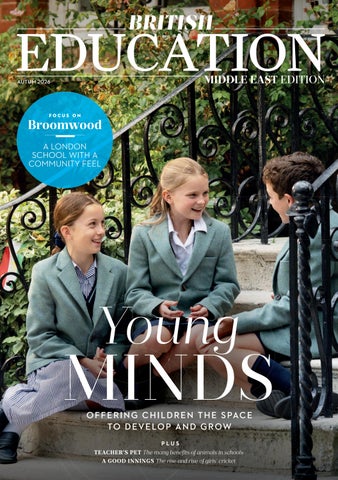
FOCUS ON
Broomwood A LONDON SCHOOL WITH A COMMUNITY FEEL
AUTUMN 2026
Young
MINDS O F F E R I N G C H I L D R E N T H E S PAC E TO D E V E LO P A N D G R OW
ZE ST.LONDON COVER WITH SPINE.indd All Pages
PLUS TEACHER’S PET The many benefits of animals in schools A GOOD INNINGS The rise and rise of girls’ cricket
28/10/2026 10:39:02
FILLER BERKHAMSTED GROUP OF SCHOOLS.indd 2
29/10/2026 11:09:47
Independent Independent Co-educational Co-educational DayDay & Boarding & Boarding school school
2026 2026
A Level A Level resultresult
2026 2026
GCSE GCSE resultresult
86% 86%
of students of students secured a place secured a place at at first-choice theirtheir first-choice university university 9 - 89grade - 8 grade
56.5% 58.9% 58.9% 56.5% A*- AA*grade A grade
30 mins 30 from mins London from London Euston Euston 40 mins 40 from mins London from London Heathrow Heathrow
CONTENTS AUTUMN 2026
EDITOR S
Libby Norman Pendle Harte
35
GROUP A DV ERTISING M A NAGER
Nicola Owens
MEDI A CONSULTA N TS
Anna Clarke
A RT DIR ECTOR
Pawel Kuba
UP FR O N T
13 THE EXPO
GR A PHIC DESIGNER S
Bruna Faccin Mari Suzuki Pamella Moreno
A welcome from Anderson Education
14 SCHOOLS NEWS What's going on in the world of education
M A R K ETING M A NAGER
Jessica Shaltout
FO CUS
DIR ECTOR
22 BROOMWOOD PREP
James Fuschillo Craig Davies
Life behind the scenes at this London school
PUBL ISHING DIR ECTOR
Sherif Shaltout
26 FUTURE READY Reframing GSCEs at JAGS
For advertising enquiries please call +44 (0) 20 7704 0588 or email: advertising@zest-media.com Subscriptions are available simply by emailing info@zest-media.com
22 PREP
30 ANIMAL MAGIC
70
ZEST MEDIA PUBLICATIONS LTD ZEST-MEDIA.COM
Zest Media Publications Ltd. cannot accept responsibility for unsolicited submissions, manuscripts and photographs. While every care is taken, prices and details are subject to change and Zest Media Publications Ltd. take no responsibility for omissions or errors. We reserve the right to publish and edit any letters.All rights reserved.
@AB SOLUTELYEDU
ABSOLUTELY-EDUCATION.CO.UK
Why creatures belong in classrooms
59
35 SUCCESS STORY Why building confidence starts early SENIOR
53 REVISION SKILLS
A no-pressure approach
59 END GOAL
Redefining university readiness
70 WHITE STRIPE
55
The rise of girls' cricket at Wellington College
F RO NT COVE R
BROOMWOOD PREP AND PRE -PREP London +44(0)20 8682 8830 broomwood.com
AUTUMN 2026 | B R I T I S H E D U C AT I O N | 7
We l c o m e
From the
EDITOR
A
t the beginning of the academic year, there’s a heightened sense of excitement around school life. New starters settle in, current pupils move into the year above and everyone embarks on a fresh start. And for international pupils starting a new education journey in the UK, it’s a heightened experience – which is why parents work so hard to find the right school for each child.
There’s pure joy in animals, especially when you put them together with children, and our Prep lead feature finds out more about their impact on four schools. We also head down to Milton Abbey in Dorset, where animals are ‘the heartbeat’ of school life, thanks to its busy farm and equine centre. Another focus of this issue is sport. Games brings elation and disappointment – hopefully not in equal measure – but matches can’t be won each and every time. In our Senior lead feature, we look at the changing
“WHERE ONCE IT WAS ABOUT STUFFING TROPHY CABINETS, THESE DAYS SCHOOLS OFFER A MENU OF BRILLIANT OPPORTUNITIES TO ENSURE CHILDREN FIND THE SPORTS THEY LOVE” As ever, we are looking beyond results and the academic curriculum in our approach to education. In this issue we are lucky to have an invaluable insight into school life at Broomwood, an award-winning prep and pre-prep school in the heart of London that offers pupils lots of space to develop and grow, proving that an urban childhood can can still include time outdoors, close friendships and a strong sense of belonging.
make-up of school games. Where once it was about stuffing trophy cabinets, these days schools offer a menu of brilliant opportunities to ensure children find the sports they love – and learn more about their own strengths and the power of play to unite us.
Libby Norman EDITOR
AUTUMN 2026 | B R I T I S H E D U C AT I O N | 9
• A B S O L U T E LY E D U C AT I O N •
CON T R IBU TOR S
Mark Wilson
Head of School, ACS Egham
A teacher and school leader for over 25 years, Mark Wilson worked in the UK before moving into international education by joining Nord Anglia in 2009. He headed The British International School Shanghai before becoming Head of School at The British International School of Houston. A Drama teacher by training, he has taught across different syllabuses – and still teaches Theory of Knowledge on the IB Programme. In this issue, he discusses ACS' Schools' recent survey revealing what university admissions officers really value in applicants.
Kristina Lewis
Deputy Head Academic, JAGS
Kristina Lewis joined JAGS in January 2026, having previously held the role of Deputy Head Academic at Blackheath High and, before that, Assistant Head at Francis Holland School. She read History at Cambridge before completing a Master's degree at UCL. Alongside her Deputy Head role, she teaches in the History and Politics Department. In this issue, she discusses the innovative JAGS Pathway, designed to support GCSE studies with a robust internally assessed programme of academic and creative challenges and future-ready skills.
Phillip Makhouli Headmaster, Aberdour School
Born and raised in the northern Highlands, Phillip Makhouli studied electrical engineering and originally worked in the nuclear power industry. After retraining as a teacher, he taught Years 5 and 6 in Elgin and London, before moving to Holmewood House Prep as Head of Maths and then Director of Teaching and Learning. This led on to his Headship, at Skippers Hill Manor, and he became Headmaster of Aberdour in 2025. In this issue, he discusses the importance of self-knowledge as the platform for success.
SUMMER SCHOOL
Discover our fantastic
SUMMER SCHOOL for students aged 8-17 years
summerschool@kings-school.co.uk www.thekingssummerschool.co.uk Follow our socials: @thekingssummer
Scan me for further information
UK Boarding School Exhibition Saturday 14 November 2026 11.00–16.00 at Grosvenor House, Dubai
REGISTER TODAY
Meet leading UK boarding schools and receive FREE help & advice from our education consultants
Email: slewis@andersoneducation.co.uk WhatsApp/mobile: Sarah +971 (0) 50 854 6956 andersoneducation.co.uk
We l c o m e
From
ANDERSON EDUCATION E D U C AT I O N I S A N I N V E S T M E N T IN YOUR CHILD’S FUTURE
T
he UK offers a gold standard in education and with over 70,000 boarders currently at UK boarding schools, demand for places remains strong. With their outstanding academic teaching, excellent facilities for music, sport and the arts, the popularity of boarding at schools in the UK is driven by the unique opportunities it offers young people from age 8 to18. A boarding education is all about learning to live with others, experiencing a shared space, working together, having extra time to try new things and learning to stand on your own two feet. Parents of new boarders often comment
resident teaching staff in school during evenings and weekends. Preparing young people for their future is not just about academic qualifications; they need strength of character and skills such as communication, teamwork and resilience to build happy, fulfilling, worthwhile lives. If you are considering the option of a UK boarding education for your son or daughter, there is no better place to start your research than a visit to the UK Boarding School Exhibition. You will be able to meet with Heads and representatives of up to 20 UK boarding schools, girls only schools, state boarding schools and independent colleges. Schools offering IGCSEs, A Levels, Btec and IB Diplomas, an option to suit the learning style and academic
PREPARING YOUNG PEOPLE FOR THEIR FUTURE IS NOT JUST ABOUT ACADEMIC QUALIFICATIONS; THEY NEED STRENGTH OF CHARACTER AND SKILLS SUCH AS COMMUNICATION, TEAMWORK AND RESILIENCE to us that after just one half term boarding, their child has become more independent and confident thanks to their boarding experience. Much of this independence and confidence comes from being with other young people – but it is also the highly trained, caring and professional boarding staff who help them to prosper and thrive on solid foundations. Academic results are often a major factor for parents choosing a boarding education, and valueadded analysis shows that boarders tend to do even better than day pupils as a result of the support and encouragement they receive from boarding staff and
strength of your son or daughter. Plus sporting academies offering a high level of competitive sport, performance training with excellent facilities.
UK Boarding School Exhibition Saturday 14 November 11 am to 4 pm at Grosvenor House Hotel, Dubai Marina Register to join us and view the schools: andersoneducation.co.uk enquiries@andersoneducation.co.uk
AUTUMN 2026 | B R I T I S H E D U C AT I O N | 13
G R E AT G A M E S Millfield athletes enjoyed outstanding success at the Commonwealth Games, which took place in Glasgow over the summer, with 22 selections and a total of 15 medals (two golds, seven silvers and six bronzes) across swimming, athletics, and cycling. Representing Jersey, Millfield student Filip led the way with a gold medal in the men’s 200m and silver in the 100m breaststroke.
“Millfield athletes enjoyed outstanding success at the Commonwealth Games in Glasgow”
Phone free The Girls’ Day School Trust (GDST) has announced that all 25 of its schools – including Notting Hill & Ealing High (pictured) will be mobile phone-free from September for pupils up to Year 11. This builds on current guidance and practices, with many GDST schools creating mobile phone-free environments with lockers or secure pouches.
INDIA OPENING Bedford School Mohali, the first British International girls’ school in Northern India, opened in April. Located on the outskirts of Chandigarh and developed in partnership with Doon International Education Society, it offers day and boarding options. The campus has extensive science, sports and creative arts facilities and a 1,000-seater auditorium.
“It was a great experience...to compete at a certain level. It teaches you discipline, focus, and certainly keeps you out of trouble” J A S O N S TAT H A M
14 | AUTUMN 2026 | B R I T I S H E D U C AT I O N
Lacrosse champs
NEW HEAD
Berkhamsted Schools lacrosse is celebrating an exceptional season of achievements. The school played 150 matches and fielded 15 teams, with strong participation across year groups and skill levels. Berko U14A and U15B teams were champions at National Schools Lacrosse, while U19A and U18B achieved top 8 and runner-up position respectively.
Worth School welcomes Ben Pennington as Head this September. He is current Head of Senior School at St Andrews, Turi in Kenya, and with experience encompassing leadership roles at King’s Ely, Ampleforth and Sherborne Prep. He says he looks forward to nurturing a community where young people are inspired to flourish.
UPFRON T / NEWS
DOUBLESUCCESS
Go pro
Ludgrove Prep in Berkshire has ‘done the double’, with pupils Adrian and Kai being awarded King’s Scholarships from Eton College. With a maximum of 14 KS awarded each year, it is a remarkable feat. The boys will join last year’s leaver Jacky, and Jaey who joined their ranks in 2022.
Charlie Taylor (16), a pupil at Malvern College is celebrating signing his first professional contract with Warwickshire Cricket Club. He has already been tipped as one of the most exciting young cricketers in the country, having been selected for the England U19 squad at the age of just 15.
R eading pr ior it y SPORTING CHAMPION
The Children’s Laureate Frank Cottrell-Boyce has called for urgent action to reverse the decline in parents reading to children. A BookTrust survey found that children aged up to 8 who reported liking or loving reading rose from 66 to 80% between 2021 and 2025, while daily shared reading dropped from 60 to 49%.
NEW LEAD Cobham Hall has welcomed Doug Brown as Headteacher. With more than a decade of experience leading Hertford Prep School, the new Head says he is excited to join the Cobham Hall community and help its students discover what they are capable of. The Cobham, Kent co-ed day and boarding school is part of the Mill Hill Group.
Cottesmore school swimmer Elliot Daruty has been crowned National Champion in the 13–14 years 100m freestyle at the 2026 Swim England National Summer Meet. Elliot delivered an outstanding swim in 56.18 seconds to take gold, claiming first place on one of the biggest stages in English swimming.
“It’s important for us to know that our worth isn’t defined by how well we do in our sport” COCO GAUFF
SOMETHING THEY SAID
“WE HUMAN BEINGS ARE STRANGE CREATURES AND STILL RESERVE THE RIGHT TO THINK FOR OURSELVES” M A R I LY N M O N R O E
AUTUMN 2026 | B R I T I S H E D U C AT I O N | 15
UPFRON T / NEWS
CAMBRIDGE MERGER
Head appointment
The Leys and St Faith’s will become The Leys School, Cambridge from September 2028, offering an all-through education. They have been part of the same foundation since 1938. Early Years to Year 8 will be educated at the current St Faith’s site, while Years 9 to 13 will be based at The Leys’ site.
Sophie Blewitt has been appointed Head of Hanford Prep. She was previously Director of Studies at Sherborne Girls, as well as Head of Languages and Assistant Head of Professional Development. Currently Hanford’s Interim Head, she says: “Hanford is an amazing school where a magical childhood and academic excellence go hand in hand”.
Cr icketer retur n Eve Jackson, who left Christ College in 2025, has presented a framed shirt to the school. The shirt, arranged by the Old Breconian Association, was in recognition of her selection for Glamorgan Women’s while she was still in Sixth Form. She also represented Wales in Year 12 on an international tour.
GAME I N N OVAT I O N St Clare’s Young Enterprise team, GlobU, enjoyed success at the regional competition in Reading, where they presented an educational board game promoting cultural understanding through interactive learning. The concept, which was inspired by the team’s diverse backgrounds, impressed judges with its originality and social relevance, earning the Oxfordshire Innovation Prize.
S C I E N C E S TA R St Catherine’s Prep, Bramley’s Maren Kelly has received the prestigious Primary Science Teaching Award. She joins a network of some 200 Primary Science Teacher College Fellows across the UK and has been selected to represent the UK in a two-year international STEM project led by Science on Stage Germany and supported by the GEA Foundation.
“Maren Kelly of St Catherine’s Prep, Bramley will represent the UK in a two-year STEM project”
A l ley n’s Ha mpstead MUSIC MAESTRO Talented composer and pianist Jacky Zhang, 17, has won the 2026 Sheepdrove Piano Competition at Newbury Spring Festival, the youngest winner in the competition’s history. A Royal College of Music student since the age of 7, he received the first prize of £3,000, donated by Sheepdrove Trust.
This September, Alleyn’s Hampstead welcomed its first pupils. Leading them is Founding Head Aidan Sproat-Clements, formerly Deputy Head at Alleyn’s School in Dulwich. Our founder, Edward Alleyn, watches from the wall, coffee in hand. Four hundred years of tradition, carried by people who know it best. All We Can Be.
SOMETHING THEY SAID
“Nothing is ever given in this game... It’s very humbling as well... The humility just goes hand in hand with the game” AARON RAI
AUTUMN 2026 | B R I T I S H E D U C AT I O N | 17
“Supportive, inclusive, ambitious” - ISI Report 2025
Where every pupil creates their own story BOARDING FROM AGE 7 TO 18
A WELCOMING HOME-FROM-
WE OFFER A SPRINGBOARD FOR
FULL, WEEKLY OR FLEXI
HOME FOR PUPILS TO GROW,
INDEPENDENCE, FRIENDSHIP
OPTIONS AVAILABLE
ASPIRE AND ACHIEVE
AND OPPORTUNITY
Boarding at Framlingham: Where Individual Stories Begin Boarding at Framlingham offers stability, continuity, and a welcoming home away-fromhome environment. We understand the unique challenges of being away from home life and provide tailored flexibility to suit your needs. From age 7 (Year 3) to 18 (Year 13), our boarding provision provides a vibrant, supportive environment where pupils can grow, thrive, achieve and aspire. START YOUR CHILD’S JOURNEY TODAY Contact our Admissions team to arrange an initial online meeting. Visit framlinghamcollege.co.uk, contact admissions@framlinghamcollege.co.uk or call +44 (0) 1728 727217.
UPFRON T / NEWS
French exchange
ICE CHALLENGE Wycliffe Prep pupils in Years 6-8 have been honing entrepreneurial thinking and teamwork through an employer-led challenge in partnership with Marshfield Farm. One tough challenge has been creating a new ice cream flavour, exploring every stage of product development. The project is part of the Gloucestershire through-school’s innovative Discovery Programme.
Taunton School is helping to revive the traditional pen pal programme through a partnership with Collège Joseph Kerbellec in Brittany, France (pictured), whose Year 8 students recently visited Taunton after exchanging letters, videos, photos, and gifts throughout the year. Both schools are excited to continue growing their relationship and are already looking forward to their next meet up.
Barclays Football Ambassador Ian Wright went back to school, visiting Elizabeth Garrett Anderson School in Islington to listen to what pupils and teachers had to say about sport – in particular, barriers to girls’ participation in PE at school and beyond. The visit was part of the FA and Barclays ‘Made for the Game: Breaking Barriers’ campaign.
F I L M I N V I TAT I O N
PROJ ECT S H OWC A S E The Sherborne Project Qualification (SPQ) exhibition took place in early June, with Year 8 Sherborne pupils showcasing their work to parents, staff, governors and senior schools. The SPQ is an extended independent project, with each pupil choosing a topic of personal interest. This year’s themes included gene editing and the science behind earworms.
Science explorers Felsted School Science week included a talk about how robotics support surgeons, a Faraday Institute workshop on our place in the universe, live experiments and fossil handling. Pupils from Years 3 to 8 collaborated on a series of engineering challenges – from designing structures to slow down ice thaw to designing space rovers.
B AC K TO SCHOOL
Wrekin Prep pupils attended a film premiere at BFI IMAX, London following a personal invitation from Henrietta Grainger, a former student now working with the charity Made By Dyslexia. What is Dyslexia? is an animation featuring voices from stars such as Jeremy Irons and Liv Tyler and aims to reshape how dyslexia is perceived.
Celebrating success Orchard House School in Chiswick, West London is celebrating a year of achievement. The school’s 2026 U11 Girls’ Netball Team were crowned IAPS National Runners-Up. In addition, Year 6 leavers secured 150 senior school offers and 42 scholarships and Orchard House staff received multiple Pearson National Teaching Awards honours.
SOMETHING THEY SAID
“THE MORE WE EXILE OURSELVES FROM NATURE, THE MORE WE CRAVE ITS MIRACLE WATERS” D IAN E ACKE R MAN
AUTUMN 2026 | B R I T I S H E D U C AT I O N | 19
Designed for
Family Life
Preferred by Parents Holland Park Gate by Lodha is Kensington’s favourite family development, preferred by parents for its proximity to many of London’s top schools as well as Holland Park’s 54 green acres. Enjoy a joyful, balanced and fulfilling family life with additional household amenities including: • Kids’ club for fun & education • Dedicated house car for school runs • Weekly school uniform laundry services • Partnership with leading educational consultancy
scan to expore:
@lodha_uk hollandparkgate.com
Focus A HAPPY LONDON CHILDHOOD AT BROOMWOOD P . 22
SPACE TO GROW A broad school life helps pupils find their feet at Broomwood. Page 22
AUTUMN 2026 | A B S O LU T E LY E D U C AT I O N | 21
TH E LON DON PREP SCHOOL P R E PA R I N G C H I L D R E N F O R
LIFE
For families considering a move to London, choosing a school means weighing academic ambition alongside a happy childhood. Broomwood’s record scholarship results, broad curriculum and emphasis on belonging offer a compelling introduction to British prep education
Sports help pupils become active members of the community
22 | A B S O LU T E LY E D U C AT I O N | AUTUMN 2026
FOCUS / FE ATUR E
F
or families living in the Middle East, planning a move to Britain brings questions that extend well beyond finding a school place. Will a child make friends? Will their strengths be recognised? How will they adjust to a different routine, and who will help the family understand the choices ahead? These questions go to the heart of what a good prep school can offer. The years before senior school are when children develop their attitudes to learning, discover interests and begin to understand what they can contribute. Academic foundations matter enormously, alongside the confidence to ask questions, try something unfamiliar and recover when things do not go to plan. Broomwood, an independent school in Clapham, south-west London, offers that combination to children from nursery to age 13. Academic success sits alongside close attention to each pupil, with a broad school life designed to help children find their feet and then stretch themselves. “At its best, a British education combines strong academic Broomwood’s foundations with a real emphasis Pre-Prep spaces on character, confidence and include areas curiosity,” says Michael Hodge, for storytelling, imaginative play Broomwood’s Principal. and exploration “During the pre-prep and prep years, children are not simply learning to read, write and work with numbers; they are also learning how to form friendships, contribute to a community, explore their interests and become increasingly independent.” For children arriving from overseas, the breadth of that experience can make a difference. A shared interest in football, music or drama offers a natural starting point for friendship. Taking part in a production, representing a house or working together on a project helps a new pupil become an active member of the community. Broomwood’s recent senior school results demonstrate the strength of this approach. Pupils secured a record 49 scholarships, spanning academics, sport, music, drama and art, with nearly half awarded for academic excellence. Scholarship offers have increased by more than 50 per cent over the last five years. Destinations include prestigious London day schools and boarding schools, among them Alleyn’s, James Allen’s Girls’ School, Whitgift and Brighton College. That range matters for families still exploring the British system: children have different interests and temperaments, and the next school should suit the individual. “We are committed to ensuring every child is known, encouraged and challenged to achieve their very best, and it is wonderful to see our pupils recognised in AUTUMN 2026 | A B S O LU T E LY E D U C AT I O N | 23
FOCUS / X X X X
Broomwood was named Best Independent Preparatory School in London at the Private Education Awards 2026
“A busy city childhood can still include time outdoors, close friendships and a strong sense of belonging” this way as they move on to the next stage of their educational journey,” says Louisa McCafferty, Head of Broomwood Girls. External recognition has followed. Broomwood was named Best Independent Preparatory School in London at the Private Education Awards 2026 for a second consecutive year. The school is also included in the Tatler Schools Guide 2027 and Talk Education’s Top 250. For parents, these offer useful points of reference alongside the more personal task of finding a school where their child will thrive. One distinctive part of the Broomwood journey is the opportunity to remain through Years 7 and 8. Children can take on greater responsibility in a familiar environment, becoming house captains, supporting younger pupils and developing the maturity to approach senior school with confidence. Broomwood’s Future Ready Curriculum gives those years a clear purpose. Alongside their academic studies, pupils in Years 7 and 8 take part in weekly co-educational sessions exploring the practical demands of growing up in a changing world. Digital Wisdom develops thoughtful, responsible use of technology, including online safety and critical thinking. Financial Literacy introduces budgeting, saving and informed decisions about money. Leadership and enterprise encourage pupils to work with others, take initiative and understand the impact of their choices. The programme makes room for deeper academic exploration, too. Through the Junior Project Qualification, pupils 24 | A B S O LU T E LY E D U C AT I O N | AUTUMN 2026
investigate a personal academic interest, developing research and presentation skills. In the Tooting Market Project, they interview traders and customers, explore sustainability and community impact, and present recommendations supported by evidence. These experiences give learning a practical setting. Pupils must listen carefully, decide which information is useful and explain their thinking clearly. For internationally mobile families, such habits can be valuable as children encounter new communities and unfamiliar situations. At the other end of the school, that same belief in learning through experience begins outdoors. Broomwood’s Pre-Prep spaces include areas for storytelling,
A real emphasis on character, confidence and curiosity
imaginative play and exploration, with outdoor learning woven into the day. Children might practise counting with objects found outside, negotiate roles in a game or work together in the mud kitchen. Caron Mackay, Head of Broomwood Pre-Prep, describes these spaces as a natural extension of the classroom, where children develop communication and independence through purposeful play. For families considering London, this combination has particular appeal: a school rooted in its local community, with space for children to explore and the opportunities of the capital around them. A busy city childhood can still include time outdoors, close friendships and a strong sense of belonging. Settling into that community begins with the relationship between home and school. Michael encourages parents to speak positively but realistically about a move, helping children become familiar with their new routines while allowing room for nerves. Feeling secure and ready to engage, he argues, matters more than trying to anticipate every lesson before term begins. A British prep education can give children time to grow into themselves while preparing for what follows. At Broomwood, the scholarship results sit within that wider story: children discovering their abilities, learning to contribute and leaving ready for the opportunities ahead. This November, Michael Hodge and Director of Marketing and Admissions Jordon-Lee Squibb will visit Dubai and Abu Dhabi to meet families considering Broomwood. To enquire about meeting the team or visiting the school in London, contact admissions@ broomwood.com or visitbroomwood.com. Broomwood operates a bus service across London, with routes serving areas including Pimlico, Wimbledon, Battersea and Tooting Bec, making the school accessible to families across the capital.
World of OPPORTUNITY Join a caring global community that combines exceptional academic ambition with the support students need to flourish. Scan the QR code to enquire now
oicbrighton.com
INDEPENDENT SCHOOL OF THE YEAR FOR ACADEMIC EXCELLENCE
A CO-EDUCATIONAL DAY AND BOARDING SCHOOL IN YORK, ENGLAND, WELCOMING CHILDREN FROM 3 MONTHS TO 19 YEARS. ENGLISH LANGUAGE PROGRAMME MEDICAL PATHWAY OXBRIDGE PROGRAMME NCUK FOUNDATION YEAR A LEVELS, BTECS, GCSES PERFORMANCE PATHWAYS FOR SPORT AND PERFORMING ARTS +44 (0)1423 333330 | ADMISSIONS@QE.ORG | VISIT QE.ORG
SCHOOL FEATURES OVER 150 CO-CURRICULAR ACTIVITIES & CLUBS WORLD CLASS GYM & SPORTS FACILITIES OVER 30 ACRES OF SPORTS PITCHES INTERNATIONAL LIAISON OFFICERS CAREER & UNIVERSITY SUPPORT PROGRAMME INTERNATIONAL SUMMER SCHOOL & HOLIDAY CAMPS
FOCUS / OPINION
“Employers and universities are signalling that exam performance alone is no longer the golden ticket” ABOVE JAGS students
Reframing GCSEs The Deputy Head Academic at James Allen’s Girls’ School (JAGS) on reframing GCSE provision to prioritise depth, rigour and student wellbeing.
F
or decades, approaches to Key Stage 4 (ages 14-16) in schools across the UK rested on the assumption that academic rigour is best demonstrated through the accumulation of GCSEs – the logic being that more qualifications naturally lead to better outcomes. Nationally, however, the grip of this thinking is loosening. The average number of GCSEs taken has declined steadily over the last decade – today, around 85 per cent of students sit nine GCSEs or fewer. Across the education sector, there is growing recognition that acquiring the greatest number of qualifications does not necessarily translate into deeper understanding, transferable skills or happier and healthier young people in our classrooms. As educators, we are increasingly asking a different question: what kind of education best prepares students for the world they are about to step into? This kind of purposeful questioning is not new. In 1741, when JAGS took the radical decision to teach girls to read,
it was driven by a belief that education should respond to the realities of the world beyond the classroom and our students should not remain bystanders, but active leaders shaping it. That same ethos continues to guide us today, prompting a deliberate rethinking of curriculum design at Key Stage 4. The result is JAGS Pathways – a new model that allows students to replace one GCSE with an internally assessed programme which broadens intellectual horizons and develops future-ready skills. Students are able to demonstrate their intelligence, analytic skill, and creativity outside the narrow confines of the GCSE exam series. The case for change is increasingly clear. Concerns about over-assessment of young people, excessive workload, and the narrowing of the curriculum are shared by students, parents and teachers alike. Employers and universities are also signalling that exam performance alone is no longer the golden ticket it once appeared to be. International frameworks reinforce this direction of travel. Both the OECD and the World Economic Forum point towards a future where success depends less on
the accumulation of qualifications and more on the ability to apply knowledge, communicate and collaborate with others, and adapt to uncertainty. These are attributes that traditional assessment models are not equipped to capture. The Pathways programme grew directly out of this thinking and was shaped by extensive discussions with both students and staff. The three courses – covering Psychology, Politics and Economics – introduce disciplines that often sit beyond GCSE specifications, despite being among the most popular degree choices nationally. Crucially, these courses are assessed differently. Instead of a single terminal exam, students encounter continual, multi-modal assessment via portfolios, presentations, research projects, collaborative tasks, reflective writing and structured discussion. For many students, this variety allows strengths to surface that traditional exams obscure, while maintaining a high level of academic challenge. With this approach, we are not diluting ambition, but redefining rigour. Pathways also reflects a broader commitment to the OECD’s concept of human flourishing. By retaining a strong GCSE core while creating space for curiosity, ethical reasoning and real-world problem-solving, the curriculum actively supports motivation, wellbeing and intellectual confidence. Reducing assessment volume in this way does not lower expectations, it sharpens them. If education is to prepare young people for an uncertain and complex future, then rigour must be measured not by how much we assess, but by how meaningfully students are asked to think.
KRISTINA LEWIS Deputy Head Academic James Allen’s Girls’ School AUTUMN 2026 | A B S O LU T E LY E D U C AT I O N | 27
Prep SELF-KNOWLEDGE P . 35 PREP POSITIVES P . 36
ANIMAL CRACKERS Carson, official Reading Dog at Queen Ethelburga's. See Page 30
AUTUMN 2026 | B R I T I S H E D U C AT I O N | 29
ABOVE Animal encounters at Francis Holland Prep
A N I M A L
MAGIC
From providing comfort and teaching valuable lessons about empathy and care for the world around to supporting shy young readers, animals add magic that brings learning to life. Three schools tell us more about the rich benefits they bring
30 | AUTUMN 2026 | B R I T I S H E D U C AT I O N
PR EP / FE ATUR E
Chapter House Prep School, Queen Ethelburga's At Chapter House Prep, part of QE in North Yorkshire, there's no doubt of the value animal encounters add to school life and learning. But the Head of Chapter House Karen Kilkenny says the arrival of reading dog Carson has been one of ABOVE the most successful and popular A great listener, initiatives of all time, especially Carson supports pupil progress at with the younger children Chapter House (Chapter House educates children Prep, QE from age 3 to 10). "It has increased the confidence of reluctant readers having a nonjudgemental audience. The children are purely reading for pleasure with no one pointing out mistakes or questioning them on the text," she says. Carson is a terrific listener, never interrupts or looks bored, and is more than happy to be read to. And the effect is profound. "We have seen their confidence increase and their reading
“Thanks to Carson, QE pupils’ reading has become more confident – and one Year 1 child’s reading age improved by two years over one term”
has become more animated, with more expression – one Year 1 child’s reading age has improved by two years over one term, and they are more curious about reading different texts." Carson does more than listen, playing an active part in school life by encouraging throwing practice – he gives his undivided attention if you throw a ball and will come back for more. He also encourages pupils to get outdoors in all weathers and enjoy a bit of exercise. Alongside his reading support, Carson helps to boost wellbeing for everyone. "Being around our calm, friendly Carson helps reduce children’s anxiety, boosts mood and gives the children a chance to talk about any worries in a nurturing, inclusive environment," adds Karen Kilkenny. She believes the friendship without judgement Carson provides helps children regulate their emotions. "His presence also encourages social interaction
and fosters empathy and responsibility among our children." While Carson is the undoubted star of Chapter House, the children have plenty of other opportunities to learn from animals, with visits to Yorkshire Wildlife Centre for the younger pupils and exciting trips to see the bigger wildlife of Chester Zoo for Year 5. Such visits reinforce classroom learning. KS1 children are learning about animals from Africa and Polar regions, as well as animals through time (including dinosaurs). Visits to see real species in their habitats builds curiosity and reinforces what they are learning about classification, food chains, diets, habitats and the differences between behaviours. As they move up the school, there is more scientific knowledge about rainforest habitats and animals, prey and predators, nutrition, and the way some animals have skeletons and muscles for support, protection and movement. AUTUMN 2026 | B R I T I S H E D U C AT I O N | 31
The Downs Malvern At The Downs Malvern, animals play a large and lively role in school life, particularly through the school's smallholding, where pupils are able to experience animal care, food provenance and the natural world at first hand. "Our resident animals include pedigree Oxford Sandy and Black pigs, with numbers fluctuating depending on piglets," says Andy Nuttall. There are also around 40 Japanese quail, plus guinea fowl, ducks, chickens – including Cream Legbars and Cuckoo Marans. "And Ayam Cemani chickens from Indonesia," adds Andy Nuttall who, it's worth noting, studied Zoology at Imperial College. "We also have three beehives on site. In addition, ABOVE Avian care at The sheep graze in our orchard, giving Downs Malvern and pupils the opportunity to learn from (below) quality time a local farmer, although the sheep are with the pedigree pigs not part of the school’s own animal collection." cradling a quail or rubbing This wonderful collection brings multiple a pig’s tummy, while others learning opportunities. Pupils interact are drawn to the practical side, such as with the animals through regular farming building shelters and improving animal activities, including Pre-Prep sessions on environments," adds Andy Nuttall. Fridays and Prep School farming activities The team at The Downs Malvern as part of the school's extensive Saturday find that its animals will often prompt Hobbies programme. There's also the value wider conversations around empathy, of just having animals around. "Children responsibility and looking beyond ourselves. from Nursery to Year 5 also pass the And caring for other living creatures helps animals on their way to Forest School, pupils understand that animals have needs, making these encounters a familiar and routines and sensitivities, which encourages joyful part of everyday school life." pupil patience, kindness and responsibility. While all the animals are of interest, The Andy Nuttall can see big educational pupils are enchanted by young animals – benefits. Children gain first-hand knowledge from the tiny quail chicks and ducklings of life cycles and the features of different to new piglets. "Different children vertebrate groups, while also developing naturally gravitate towards different an understanding of food provenance and aspects of animal husbandry. Some love hygiene. They grow supplementary food the direct contact, whether that is gently for the animals, learning more about plant
“The Downs Malvern pupils pass the animals on their way to Forest School, making encounters a familiar and joyful part of everyday school life” 32 | AUTUMN 2026 | B R I T I S H E D U C AT I O N
life cycles and the importance of ensuring a balanced diet. "These encounters also open up broader conversations about seasonality, sustainability and food miles, particularly when discussing the value of locally produced meat and vegetables." Across The Downs Malvern, there is huge excitement when the smallholding welcomes a new arrival large or small. The children are also very interested in the life of the school beehives, leading an assembly on the pollinators' vital role in our world. “They recently enjoyed marking World Bee Day with a honey-tasting experience and honey-themed cuisine."
PR EP / FE ATUR E
“At Francis Holland Prep, the annual Charity Dog Show is hotly contested, showcasing animal whisperer skills alongside creativity”
BELOW Francis Holland therapy dog Kanga
Francis Holland Prep School At Francis Holland Prep, school life is made joyful by Kanga, a Hungarian Vizsla Therapy Dog, who belongs to the school's Lead Counsellor and has been a resident for six years – ever since she was a puppy. Kanga is a key member of ContemPlace, the FHP counselling service, and works alongside five specialist human therapists. Pupils have the opportunity to drop in and visit Kanga whenever she is at the Prep – her time is split between Francis Holland Prep and the Senior School in Sloane Square. She comes into her own at the start of the academic year, especially for any new pupils finding it hard to settle, and she's also a huge support to Year 6 girls who are anxious about the 11+. Often, being with her for a few minutes is enough, say the team, and many friendships have been made between girls gathered in the Wellbeing Suite for a chat with Kanga. Children have lots of other opportunities to encounter the animal kingdom. Reception and KS1 pupils enjoy incubating, hatching and rearing a number of chicks at school each year as part of their work on life cycles. There have been similar projects with butterflies, which pupils loved. There are regular trips, including the annual Reception trip to Bocketts Farm – a firm Summer Term favourite – where children
meet chickens, rabbits, horses, goats, cows and even ‘racing pigs’. The bespoke Francis Holland Foresters programme is tailored for every year group and combines nature identification with shelter building activities, connecting children with both animals and bugs. Girls learn about the importance of mini beasts within an ecosystem. Their creative skills are seen in bug hotels equipped with lifts, swimming pools and even bowling alleys. They also learn 'detective skills' over the course of the school year scouting for different tracks left by bigger beasts – including foxes and badgers. All this fun outdoor learning also embeds knowledge, and FHP immerses pupils in hands-on science and geography from the outset. In the Early Years, pupils explore through play, and their natural capacity for experimentation lays foundations for deeper scientific thinking. As they move through the school, the curriculum becomes increasingly specialised, introducing key concepts in biology, chemistry and physics. There are enrichment sessions for every year group involving animals to help bring these subjects to life. For example, Zoo Labs recently visited, bringing an array of fascinating creatures to support pupils’
learning about adaptation. From desert lizards that detach their tails to escape predators to giant snails with retractable eyes, the girls were captivated by the unique survival and adaptation strategies animals employ in their natural habitats. Zoo Labs gave pupils the opportunity to get up close and handle some of the animals. The girls held the white snake, felt the texture of the giant snails and observed the intricate details of the tarantula. This hands-on experience not only deepened their understanding of science and nature but also helped many overcome initial fears of 'creepy crawlies', fostering curiosity and appreciation for the beauty of wild creatures. Another aspect of animals up close, and a highlight of the school year, the Francis Holland Prep Charity Dog Show is all about fun and community spirit – raising funds for a chosen charity. This year, just under £2,000 was raised for School in a Bag. The competition is hotly contested by parents and pupils across five categories – Obedience, Loveliest Lady, Most Fabulous Fella, Puppy Love and Best Dressed. It offers pupils the opportunity to showcase their animal whisperer techniques, alongside creative and fashion skills and communication with the animals that bring magic to their life. AUTUMN 2026 | B R I T I S H E D U C AT I O N | 33
Talking
PR EP / TA LK ING HE A D
HEAD
Confidence BUILDER The Head of Aberdour School Phillip Makhouli on why self-knowledge is a vital foundation for confidence, ambition and future success
“Self-knowledge gives confidence roots – developing something far more lasting than surfacelevel self-esteem”
W
hat gives a child the confidence to aim high? The ancient maxim ‘know thyself’ has endured for centuries, and it feels strikingly relevant to education today. Is confidence built through repeated success? Praise from adults? Academic ability? All of these things matter. But I increasingly believe that one of the deepest foundations of genuine confidence lies somewhere quieter: in a child’s ability to understand themselves. Self-knowledge is not always given the prominence it deserves in education. It is less visible than exam results, harder to quantify than a grade, and perhaps less easily celebrated than a scholarship or prize. Yet when children begin to recognise their strengths, understand how they learn, identify where they need support and reflect honestly on their progress, something powerful starts to happen. They become more secure. More willing to try and more able to respond to challenge without feeling defined by it. Their ambition becomes less about comparison with others and more about a developing sense
been central to our approach. During our recent inspection, our personalised learning programme was identified as a significant strength of the school. Inspectors observed that pupils develop ‘high levels of confidence and self-knowledge’. That ABOVE Aberdour connection is important. Success is not School presented as something separate from pupils confidence and self-understanding, but as something that flows from them. At Aberdour, this is given deliberate of what they themselves might achieve. structure through our Personalised Confidence without self-knowledge can Achievement Learning (P.A.L) programme be fragile. It may depend on always getting which sits at the heart of school life. Through things right, on adult reassurance, or on regular one-to-one conversations, reflection success arriving quickly. Self-knowledge and purposeful goal setting, pupils are gives confidence roots. A child who can say, encouraged to articulate what they have ‘This is difficult for me, but I know how to found challenging, recognise what has helped approach it’, is developing something far them make progress and think more deeply more lasting than surface-level self-esteem. about the learner, teammate, friend and Educational research points in a similar person they are becoming. Personalisation direction. The Education Endowment becomes more than differentiated work in a Foundation highlights the importance of classroom – it is a way of helping children take metacognition and self-regulation – helping increasing ownership of their development. pupils to think deliberately about how they Of course, academic outcomes matter, learn, and to plan, monitor and evaluate but the most meaningful success is not their progress. In that sense, self-knowledge produced by pressure alone. It emerges when is not an abstract ideal, it is a practical children combine knowledge educational strength. with curiosity, ambition with This matters deeply in resilience, and confidence with schools. We want children humility. The world our children to leave us not simply with are growing into will require knowledge, but with a sense them to adapt, collaborate, and of agency – the belief that they navigate uncertainty. Selfcan make progress, shape their knowledge will not be a soft future and pursue ambitious extra but a form of preparation. goals with purpose. To achieve When children understand that, they need adults who know PHILLIP MAKHOULI who they are, they are more them well, but also adults who Headmaster likely to believe in what help them know themselves. Aberdour School they might become. At Aberdour, this has long AUTUMN 2026 | B R I T I S H E D U C AT I O N | 35
PREP
POSITIVES As more parents weigh up options and budgets, Nathaniel McCullagh of Simply Learning Tuition considers the long-term value of a prep education and the areas in which it may be most value added
F
or many parents, paying for independent school for their child’s entire education is no longer an option. With the inclusion of VAT, average day fees are now around £19,000 a year or £50,000 for boarding, but this is an average. Many top schools charge far more – for example, Brighton College charges more than £19,000 a term for UK sixth-form boarders. In effect, this would mean spending somewhere between £350,000 and £700,000 on independent schooling through nursery, prep and senior school – for one child. Unsurprisingly, a significant minority of families are now considering independent school for a set period. For example, applications to sixth forms have remained strong despite fee increases, as parents choose to make financial sacrifices for two years. As more families mix-and-match state and independent, the question then becomes, what age to prioritise? Many parents might consider it sensible to focus on senior and sixth,
36 | AUTUMN 2026 | B R I T I S H E D U C AT I O N
particularly as this covers off public exam years. They may also believe that home environment and family support can have a bigger influence on children when they are younger, but as they become teenagers their peer group matters more. It would be an oversimplification to assume that independent education in the earlier years (to Year 6 or Year 8) is a luxury, with the greatest value added at senior level. If, say, you live in the catchment area of an academically rigorous senior grammar but a poor-performing primary, then the opposite may well be true. Local situation plays a key part in such decisions, but there are also general reasons why independent education through the formative prep years delivers long-term value and may be of particular benefit to some children.
EXPANDING HORIZONS Prep schools typically have smaller class sizes, more specialist teaching, excellent facilities, high expectations for academic achievement and behaviour, varied extracurricular activities and outstanding pastoral care – including
before and after school hours. Prep settings are often idyllic, too. For example, Sunningdale School, near Ascot is set within 25 acres and boys can go fishing, mountain biking, climbing and camping. More rural still, at Pinewood School in Wiltshire there are 84 acres and pupils can ride and go clay-pigeon shooting. Preps provide both breadth and depth of experience. Annie Gent, Head of Sherborne Prep in Dorset, notes that senior school Heads, “really value the children who come on to them from us – their willingness to get involved in school life, their excellent education grounding across all subjects, and their quiet confidence, sense of community and maturity”. At Sherborne Prep, pupils are offered more than 130 different enrichment opportunities each term. Children play sport every day of the week (by contrast, state primary schools may offer as little as one lesson of PE a week), and every day pupils have a co-curricular lesson – whether that be Art, DT, Music, Drama or project work. The children can also experience
PR EP / FE ATUR E
ABOVE Preps offer small class sizes and plenty of one-to-one support at an early stage
“An independent prep can really come into its own for both all-rounders and those who sit in the ‘middle’ of the academic spectrum” musical theatre, Dragon TV (their own TV show), podcasts, junk modelling, textiles and a range of other academicchallenge activities – all of which are simply not possible at most state primaries. “Children make remarkable progress here and develop a love of learning that will set them in good stead for the rest of their education, wherever that may be,” adds Annie Gent.
STRETCH AND SUPPORT State primary schools can work well for confident independent learners who find the three Rs relatively straightforward. At the other end of the scale, those with severe learning difficulties (critically,
children with an Education, Health and Care Plan – EHCP) get one-to-one help, and so can also be well-supported. However, an independent prep can really come into its own for both all-rounders and the many children who sit in the ‘middle’ of the academic spectrum. In a typical cash-strapped primary, it is easy for ‘middling’ or quieter children to be overlooked. An overstretched primary school teacher, trying to instruct a mixed-ability class of 30 with a range of educational and behavioural needs, may simply not be able to adequately support or stretch those students who are not obvious over- or under-achievers.
THE ‘PREPARATION’ FACTOR By design, an independent prep school can help your child get a place at a top secondary school. Most parents are already aware that prep schools are excellent at readying students for the demanding entrance tests to academically selective independent schools, but they can also give students the best possible chance of moving on to a non-fee-paying selective school. For example, Gayhurst Prep in Buckinghamshire sees about 40% of its leavers head to one of the popular local grammars, while Holmwood House in Essex loses half its pupils after Year 6 to Colchester Royal Grammar and Colchester County High. Preps such as these help to prepare students for the rigours of the 11+ exam and senior life, but in a way that is less pressured than the Standard Assessment Tests (SATS) of state primaries, which are invariably much more about teaching to the test. AUTUMN 2026 | B R I T I S H E D U C AT I O N | 37
PR EP / FE ATUR E
“Teachers at independent prep schools are specialists both in terms of subject and age group”
ABOVE & BELOW Specialist teachers and facilities help to stretch children’s interests and grow knowledge
EXTENDED CHILDHOOD A critical benefit of the classic prep school – educating children from 7 to 13 – is that it gives children an opportunity to stay in primary education, Those extra two years allow time to mature and enjoy a more carefree school existence for longer. Once children are in secondary school, immersed in the world of adolescence and surrounded by much older pupils, some innocence and confidence can be lost. Christine Cook, Head of Kitebrook
School in the Cotswolds, points out that Years 7 and 8 in a prep school are valuable for offering plenty of leadership opportunities. “Students here have lots of chances to be role models to the younger pupils – for example, being a prefect – and can also excel in lots of areas, such as being a Scholar in an academic subject,” she says. “As well as helping to extend their childhood and hold off the pressures of teenage life for a little longer, it can really build up their confidence. For some
students, moving to secondary school at Year 7 can make them feel like a very small fish in a very big pond, and force them to grow up very quickly.” It’s also worth noting that teachers at independent prep schools are specialists, both in terms of subject and age group. At secondary school, teachers are often incredibly busy prioritising A-level or GCSE classes, or spending time writing references or assisting with university personal statements, and so Year 7 and 8 classes can sometimes be a bit of an afterthought. At prep schools offering places up to 13, these year groups are the top of the school. In many respects, they are the priority. Despite prep schools’ many attributes, this may not be the right route for every child. Ultimately, it comes down to family circumstances, local options and your child’s interests, strengths and personality. There are opportunities outside school that help to add breadth and depth. In particular, working with a tutor can be invaluable for parents considering the independent school route for senior years but nervous about the academic leap required. Tutoring represents an accessible investment to help ensure that, wherever your child spends their senior years, they can thrive. * Nathaniel McCullagh is founder and director of Simply Learning Tuition. simplylearningtuition.co.uk
38 | AUTUMN 2026 | B R I T I S H E D U C AT I O N
6
“…for bright sparks with drive and determination, there’s nowhere quite like it” Good Schools Guide
53%
grade 9 at GCSE
(2024 - 2026)
www.concordcollegeuk.com
37
students achieved
A*A*A*
or better at A Level (2026)
enquiries@concordcollege.org.uk
42%
grade A* at A Level
(2024 - 2026)
+44 (0)1694 731 631
Senior SPORTING VARIETY P . 44 ASK THE EXPERTS P . 63 SCHOOLS SHOW P . 76
GREAT SPORTS Tonbridge School pupil on the pitch. See page 44
AUTUMN 2026 | B R I T I S H E D U C AT I O N | 41
ABOVE Tonbridge School cricketer
S P O R T I N G
VARIETY
Sport is intrinsic to school life. But where once it was trophy cabinets to be filled, now choice and inclusivity are key – so young people find games they are inspired to take further, including into adult life. Four schools tell us how they ensure sporting variety 42 | AUTUMN 2026 | B R I T I S H E D U C AT I O N
SENIOR / FE ATUR E
Tonbridge School At Tonbridge School, sport is central to school life and an important element of pupils’ wider education. “Our approach is built around a simple philosophy: sport should be inclusive, challenging and enjoyable, while helping boys develop the character and life skills that will serve them well beyond school,” says ABOVE Director of Sport, Chris Morgan. & BELOW Sport is fully timetabled three A cricket match in play at Tonbridge times each week, underlining and learning the value placed on physical how to sail activity and the lessons learned through participation. Across the academic year, boys can access more than 20 different activities, ranging from the traditional team games of rugby, hockey and cricket to athletics, basketball, swimming, tennis, fencing, badminton and cross-country. “The depth of our provision means pupils of all abilities have opportunities to represent the school and compete regularly,” adds Chris Morgan. “A distinctive the involvement of our academic staff feature of the Tonbridge programme is alongside specialist coaches, creating strong relationships between pupils and teachers both on and off the field.” Beyond the formal games programme, Tonbridge places significant emphasis on broadening participation and encouraging pupils to discover new interests. Thriving sports clubs operate throughout the year, many of them student-led, helping to create a culture where boys feel empowered to take ownership of physical activity. “Alongside established sports, we actively encourage ‘have a go’ opportunities and outdoor pursuits, ensuring pupils experience a wide variety of challenges and environments.” Chris Morgan notes that while some boys naturally gravitate towards traditional team sports, others prefer solo pursuits. “Our philosophy is to encourage pupils to try as many sports as possible for as long as possible. We appreciate that specialisation may eventually become necessary for some, particularly talented performers, but
“A distinctive feature of the Tonbridge programme is the involvement of academic staff alongside specialist coaches” we aim to delay that process to support broader athletic development, reduce burnout and minimise overuse injuries,” he says. This is assisted by a programme of education delivered through the school’s Sport, Health & Fitness curriculum. “Exposure to team sport remains important, whether through the games programme or our extensive House sport competitions, because of the teamwork, communication and resilience it fosters.” Creating an environment where pupils are willing to persevere, make mistakes and try again is considered vital. Tonbridge says that because sport sits within the timetable, boys understand that it is part of their education rather than simply an optional extra. “We continually reinforce the idea that sport provides opportunities to learn resilience, self-discipline and perspective. Success and failure are both valuable experiences, and pupils are encouraged to reflect, improve and support one another.” For those boys aiming higher in a particular sport, there is tailored guidance and careful monitoring via the Sport, AUTUMN 2026 | B R I T I S H E D U C AT I O N | 43
Health and Fitness programme. In the first two years, all pupils are taught key training principles, recovery, nutrition and injury prevention. Strength and conditioning coaches work closely with pupils and coaches to monitor workloads and promote sustainable athletic development. Sporting variety also includes introducing Tonbridge pupils to the broader benefits of games and activities that bring people together. “We believe sport has the power to connect communities,” says Chris Morgan. “Tonbridge regularly hosts community events, including walking cricket festivals, and runs weekly sporting activities with young unaccompanied child migrants. Recent initiatives have included a cricket festival bringing together police officers, migrants and Tonbridge pupils, using sport as a vehicle to foster understanding and shared experiences.”
Emanuel School Sport is a central part of life at Emanuel School in Battersea. “We are striving to deliver the very best sporting ABOVE experience in London, with the & BELOW aim being to provide every child, Girls and boys have a wealth of sports to try regardless of their starting point, at Emanuel, including with breadth of opportunity, games like hockey variety of experience, confidence and disciplines like rowing Sam Lavery says that the – and importantly the challenge team sports still have allure. – to find their long-lasting, personal “Naturally, many pupils develop pathway through sport,” says Director a passion for our traditional performance of Sport Sam Lavery. sports – rugby, football, cricket, hockey, One of the most visible ways in which netball and rowing. These sports foster this is achieved is through variety. “Pupils strong social communities that pupils and change sports each term throughout their parents alike become part of throughout early years, with at least one additional their journey at Emanuel. Importantly, sport introduced each year. This means that however, the flexibility within our if a pupil does not immediately connect with programme allows pupils to move between a particular sport, they are never compelled sports and even pursue rowing alongside to continue with it for more than a term,” other activities as they establish their own says Sam Lavery. sporting connection. As a result, when With broad exposure to different pupils do choose to commit more fully sports, Emanuel also looks beyond the to one or more sports, that decision is classic school games with a broad range of informed, meaningful and more likely to development sports, including basketball, remain with them into adult life.” table tennis, squash, swimming, water polo, Whatever sports ‘stick’, the emphasis girls’ football, girls’ rugby, boys’ hockey and at Emanuel is firmly on continual athletics. “These sports still retain their development, focusing on building own fixture programme, while providing aspiration, personal connection and pupils with the opportunity to discover empathy. The school ensures young activities they may never otherwise have people are aware that both victory and experienced – many of which they continue defeat make vital contributions within beyond school.”
“Emanuel pupils change sports each term throughout their early years, with at least one additional sport introduced each year” 44 | AUTUMN 2026 | B R I T I S H E D U C AT I O N
any sporting journey. “Pupils approach fixtures understanding that success can take many forms and that achievement is often shaped by the context and challenge presented on any given day,” adds Sam Lavery. One key part of Emanuel’s approach is the grounding in athletic development that all pupils receive in their early years at the school. This provides a strong foundation of physical literacy and athletic capability to support whichever sports they favour as they progress through the
SENIOR / FE ATUR E
school. There’s an in-house physiotherapist who works closely with both the athletic development and coaching teams, ensuring a proactive approach to prehabilitation and injury prevention. “Our staff know our pupils. With regular daily interactions both formally and informally, we strive to build strong relationships to ensure that our pupils continue to receive both challenge and support, in the manner they need to pursue their aspirations. “The sporting provision at Emanuel also extends well beyond our own pupils. As a school, we are proud to sit at the heart of the local community. Each week, local primary schools join us to experience the opportunities available here. We also host annual tournaments across a range of sports and deliver holiday coaching programmes for the wider community.”
Duke of York’s Royal Military School At Duke of York’s, sport is built around both breadth of opportunity and individual choice, so that every student can discover activities they enjoy while developing a lifelong appreciation for physical activity. All students enjoy plenty of games opportunities, with two timetabled games afternoons each week. In Years 7–10, the
ABOVE Duke of York’s offers both breadth and depth in sport
“Duke of York’s students explore new and emerging activities – such as mountain biking, rock climbing and girls’ rugby or football” programme centres on building a strong foundation in the school’s major sports – rugby, netball, hockey, athletics, cricket and tennis. There are regular fixtures and multiple teams across each age group. In the senior years, students are given greater autonomy, choosing from a range of options to suit their interests and strengths. Alongside this, a weekly PE lesson in Years 7–9 introduces a wider spectrum of activities, from swimming and gymnastics to trampolining, badminton and basketball. Sporting variety is further enriched through an extensive co-curricular programme of over 60 clubs each week. Duke of York’s students are encouraged to take part in at least two, with the flexibility to switch pursuits each term. This means they have the opportunity to explore new and emerging activities – such as mountain biking, rock climbing
and girls’ rugby or football – while also ensuring additional, small-group training sessions for those pupils who want to develop further in core sports. The school places a strong emphasis on mindset as well as performance. Students are encouraged to set realistic, individual goals and to see setbacks as part of the learning process. This approach is designed to foster perseverance and also maintain enjoyment, so that young people continue to see sport as a positive and motivating experience. For those with a particular passion, training is carefully structured to balance progression with wellbeing. Workloads are monitored across school and external commitments, and bespoke programmes come into play to help prevent overuse injuries. Students have access to one-to-one coaching, strength and conditioning and AUTUMN 2026 | B R I T I S H E D U C AT I O N | 45
r esu lt s 2 0 2 6
60%
A * / A GRADES
81%
A * / B GRADES
REGI
OUTSTANDING EDUCATION No exeat weekends Open in all holidays other than the Christmas break No visa services charge from the School
38.5 AV E I B S C O R E 600+
BOARDERS FROM AGE 7
FROM OVER 70 NATIONALITIES
No charge for international induction No charge for English as an Additional Language No charge for any learning support lessons
FLAIR
•
DISCIPLINE
•
ACADEMIC
www.bromsgrove-school.co.uk 720 pupils aged 2 - 13 • 1060 pupils aged 13 - 18
RIGOUR
SENIOR / FE ATUR E
ABOVE Malvern offers 17 competitive sports, including a student favourite, rugby
“At Malvern College, Inter-House competition is fierce, but it’s also where sport feels most accessible and fun” physiotherapy. An on-site medical centre ensures further holistic support. Budding athletes maintain a close collaboration with academic staff to ensure all is well. Beyond the school environment, sport is used to build community connections. Duke of York’s regularly hosts local fixtures, tournaments and inclusive events, while also opening its superb facilities to external clubs and organisations. This not only broadens participation but reinforces sport as a shared, lifelong pursuit. The school is proud of its sporting partnerships with professional clubs – including Rugby Scholarships with Saracens Rugby Club. The team at Duke of York’s say they are committed to variety and personal development, giving students the tools to find what they love and the confidence to pursue it in and beyond school.
Malvern College “After more than 160 years of history, almost every pupil leaves Malvern with a story that begins, ‘I played…’,” says Malvern College Director of Sport Mark Hardinges. “Whether that means representing the College, competing in House colours or simply trying something new for the first time, sport is a shared experience that defines a Malvern education.” The school works to ensure both depth and breadth to that experience. The traditional core of cricket, football, netball,
rugby and hockey remains central, with opportunities that stretch from first-time participation to representing school, county and even country. “It not just the strength of these pathways, but the variety that ensures every pupil finds something meaningful during their time here,” adds Mark Hardinges. There are 17 competitive sports offered, with 158 active teams representing the school. It is particularly proud that 72% of pupils have represented Malvern in one of its competitive teams. Alongside the team mainstays, activities such as golf, fives, rackets and dance – plus a rich co-curricular and outdoor pursuits programme to encourage exploration – reflect the College’s broader philosophy of education. This variety is intentional, says Mark Hardinges. The school sees the opportunity to try different sports as encouraging pupils not to specialise too early, but to experience a wide range of activities. It means a cricketer might discover an aptitude for tennis, while a footballer may find that cross-country sharpens their stamina. Breadth not only reduces the risk of injury but fosters a more sustainable relationship with sport – one built on enjoyment as well as achievement. “Crucially, it also prepares pupils for life beyond school, equipping them with the confidence and desire to remain active long after the structure of school sport has fallen away.”
At Malvern College, sport is not viewed in isolation, but as part of a wider approach that develops the whole child. The variety on offer is designed to build far more than physical ability, as students develop emotional intelligence, cultural awareness and intellectual curiosity. “Sport is one of the most powerful ways we develop character. It teaches pupils how to respond to challenge, support others and understand themselves, as well as each other,” says Director of Co-Curricular and Character Justin Major. The team at Malvern believe there is real value in ensuring pupils share common sporting experiences. “For many of our international students, this includes exposure to traditional British sports they may not have encountered before. Engaging with these games is not simply about learning new rules or skills, it is a way of building cultural empathy and understanding. Through shared participation, pupils gain insight into each other’s backgrounds while developing a collective sense of identity and belonging,” adds Justin Major. As a boarding school, House sport sits at the heart of this culture, he adds. “Inter-House competition is fierce, but it’s also where sport feels most accessible and fun. Playing alongside housemates builds confidence, sharpens commitment and forges a strong sense of unity and belonging that lasts well beyond the game.” AUTUMN 2026 | B R I T I S H E D U C AT I O N | 47
SENIOR / INSIDER
CHARACTER EDUCATION Mike Royds of Royal Grammar School, Guildford reflects on values inherent in the British model of education
M
any schools are seeking to market a British model of education overseas. What are they really offering? This question naturally hung in the air as we visited our partner school in Nanjing, as part of an annual student ambassador trip. Despite our strong history of academic success at the Royal Grammar School (RGS) in Guildford, the offer of access to the comprehensive Oxbridge preparation platform, developed by RGSG Nanjing staff, was highly valued. RGS in Guildford also enjoys considerable sporting success, but our gracious hosts clinically dispatched us 2-0 in a football match. With such evident expertise across the international market, what unique strength does a British model still offer? A possible answer emerged on the trip, as our students learned how to empathise, adapt and communicate in a new culture. Arriving at the campus in Nanjing, we attended an open morning for prospective parents. Unplanned, our student ambassadors began to mingle effortlessly. They began naturally with Bumblebee, one of the younger students who had presented a science project, congratulating him and warmly shaking his hand. They continued through the school, engaging everyone they met with interest and unselfconscious confidence, cheerful despite being in profoundly unfamiliar surroundings. This is not an homage to these students. They were brilliant, but this display of
“British education has been developed in a culture that has prioritised character and values-based education”
ABOVE RGS pupils
character – moving towards others and looking out for their interests, enthusiasm for personal growth – is something I have come to expect from students of RGS in Guildford. British education has been developed over a long period of time in a culture that has prioritised character and values-based education. The RGS has evolved over many years in keeping with this, so that our systems and structures align not just with academic success, but with character and the skills that express it. Throughout the trip, the student ambassadors demonstrated the global relevance of this character (knowing what a circumstance calls for) and skillset (knowing how to do it). Their humility and empathy generated rapport with everyone from a 6-year-old to a school principal and investor. Their leadership and adaptability enabled them to deliver impromptu speeches to anyone from astute parents to sceptical Grade 9 students. The study skills seminar, run by our student ambassadors, began with just a few boarders during ‘prep’. Before long, however, numbers grew as others came to join the workshop that centred around critical thinking. This proved powerfully motivating as the students developed
the idea of thinking for yourself and decision-making in the context of study. Networking, speechmaking and critical thinking all hold obvious currency in a global marketplace. British education, however, does not develop these valuable skills in isolated, performance-based education – they are deeply ingrained through our character-based education. The RGS in Guildford has had the benefit of time to build a school around this principal – and it is this model that holds value across cultures. We partner with schools in many different places. Each has its own system of values and expressions, but character education based on global shared purpose, personal growth and service resonates with everyone – and how could it not?
M I K E R OY D S International Education Director Royal Grammar School, Guildford AUTUMN 2026 | B R I T I S H E D U C AT I O N | 49
SENIOR / OPINION
“Belonging is built in the daily ordinary – and in those small rituals that make a place feel like a home away from home”
ABOVE Boarding life at Bishop’s Stortford College
Boarding
FAMILY Dr Peter O’Connor of Bishop’s Stortford College on how the family feel of boarding supports pupil wellbeing and underpins academic progress
W
hen parents consider boarding, the conversation often starts with the practicalities – timetable, facilities, activities. Yet when families choose boarding, it is rarely because of a brochure. It is because of atmosphere – the laughter in the common room, familiar faces and the certainty that their child is known, valued and understood. That ‘family feel’ can sound soft, but it is academically serious. At Bishop’s Stortford College, we see it daily. Learning is not a passive reception of information, but an active process shaped by environment, relationships and routine. When pupils feel anxious or isolated, they avoid challenge. When they feel safe and supported, they take the risks that real learning demands. Belonging is, therefore, not a pastoral extra but a condition for scholarship. In a strong boarding house, belonging is built
in the daily ordinary – shared meals, shared responsibility – and in those small rituals that make a place feel like a home away from home. Stability matters because genuine learning requires pupils to stumble. They need to offer a halfformed idea, risk the wrong answer, and revise their thinking in public. Where psychological safety is high, pupils engage in ‘productive struggle’ rather than retreating. Mistakes become information, paired with timely, specific feedback. Boarding also turns scholarship into something communal. In many schools, the bell rings and the learning community disperses. For boarders, it continues – a debate over dinner, an older pupil coaching a younger one, a group comparing approaches to an essay plan. Pupils deepen understanding when they explain, question and reconstruct knowledge with others. Routine strengthens this further by creating space for the practice that makes learning last. The advantage is not simply more hours. Adolescents need help
maintaining attention in a world of noise, and they learn best when effort is paced, not relentless. A boarding routine creates gentle guardrails, with a settled homework window and sensible boundaries around phones. There are adults who model calm focus, plus a clear end point so pupils can switch off and sleep. For many young people, that consistent rhythm is what makes independent study sustainable. It also makes it easier for schools to spot the quiet warning signs – avoidance, perfectionism, drifting routines – and respond early. The final boarding strand is character, and again the link to outcomes is direct. Boarders practise self-regulation in countless small decisions, from managing technology and starting work promptly to persisting through frustration. They also build metacognition – the habit of planning, monitoring and adjusting when a method isn’t working. This is particularly important in Year 9, when pupils are negotiating increased challenge alongside a growing desire for independence. A house community can offer an anchor, and support when confidence dips. When boarding feels like family, it doesn’t just care but engineers the conditions that allow progress to compound. Pupils attempt harder questions sooner, recover from mistakes faster, and practise more consistently. Routines protect attention and relationships protect confidence. Over time, those small advantages stack up. Misconceptions are corrected before they settle, feedback is acted on while it is still fresh, and perseverance becomes normal. In that kind of culture, progress strengthens, deepens and accelerates, until ambitious learning feels not risky, but natural.
D R P E T E R O ’ CO N N O R Senior School Deputy Head (Academic) Bishop’s Stortford College AUTUMN 2026 | B R I T I S H E D U C AT I O N | 51
Talking
SENIOR / TA LK ING HE A D
HEAD
TESTING TIMES The Principal of MPW Cambridge Anne Meisner on helping students navigate exam revision with success
“Parents can help by keeping conversations centred on effort, strategy and progress rather than outcomes alone”
A
s exam season approaches, many parents ask the same question: how can I support my child without adding pressure? Schools provide subject expertise, but it is the routines and attitudes established at home that often shape how successfully students manage revision. Wellbeing is the foundation. Students sometimes approach revision as an endurance test, staying up late and measuring productivity by hours spent at a desk. In reality, fatigue reduces concentration, memory and efficiency. Regular aerobic exercise improves attention, mood and stress regulation. Even 30 minutes of moderate movement can increase focus. Families can support this by encouraging consistent sleep routines and limiting late night screen use. Exam anxiety is common. A degree of nervousness can sharpen focus, but difficulties arise when students begin to equate performance with self-worth or catastrophise setbacks. Parents can help by keeping conversations centred on effort, strategy and progress rather than outcomes alone.
assessments. Topics should be broken into small sections and revisited regularly. New formats – mind maps, summary sheets or flashcards – can deepen understanding. Speaking answers aloud, teaching a topic ABOVE to someone else and completing timed past Students paper questions all support recall and exam at MPW Cambridge technique. Marking responses carefully using mark schemes helps students to understand how marks are awarded. After each assessment, Calm reassurance, perspective and practical it’s helpful to analyse where marks were guidance build resilience far more effectively lost and why. Adjusting revision strategies than repeated reminders about consequences. in response is what turns effort into Without structure, revision time can measurable progress. be wasted. Students should aim to begin At MPW, these principles are embedded structured preparation at least six weeks in daily practice. Regular invigilated before major exams. The first step is to list all assessments familiarise students with subjects and identify weaker topics. subject knowledge, exam technique and time A weekly timetable should be realistic and management. Weekly one-to-one meetings visible. Many students benefit from dividing with Personal Tutors provide structured the day into manageable study blocks, opportunities to reflect on performance, working productively during two sections of refine revision methods and set clear the day and reserving one period for rest. One targets. Our students are encouraged to full day off each week can prevent burnout, evaluate how effectively they revise and provided the remaining days are used well. to share these reflections with tutors and Plans should remain flexible. After each mock families. We recognise that or assessment, students should sometimes students need an review their performance additional boost as they head and adjust their timetable towards their exams – which accordingly. This strengthens is why we have been running independence and encourages Easter Revision courses for all ownership of learning. students, not just our own, for Finally, there’s revision. over 35 years. Rereading notes creates familiarity but not mastery, When wellbeing, structure so revision must be active and active learning come ANNE MEISNER and deliberate. Students together, exams become Principal can identify knowledge gaps MPW Cambridge manageable challenges rather using past papers and class than overwhelming obstacles. AUTUMN 2026 | B R I T I S H E D U C AT I O N | 53
Talking
SENIOR / TA LK ING HE A D
HEAD
TIMELESS EXCELLENCE
I
Nick Gregory of Ipswich School on why academic excellence remains at the heart of UK independent education
ndependent schools in the United Kingdom will only retain our renown as an internationally admired and in-demand ‘prestige brand’ (akin to a Savile Row suit or a Jaguar car) if we also retain our global reputation – enjoyed for far more than a century – of delivering genuine academic excellence. But what does academic excellence entail? Most obviously, this must continue to involve equipping pupils with the command of a suitable body of knowledge by the time their school careers end – either by way of A levels or via the International Baccalaureate – enabling them to achieve exam success and gain access to the world’s top universities Articles on education often cite the World Economic Forum and quote the latest view on the most-needed portfolio of skills for 21st-century employment and workplace success – creativity, problem-solving, critical thinking, effective use of technology, and so on. This is absolutely valid as being a part of what academic excellence must entail. However, I think we can also elevate what continues to drive us. We seek not only to educate but also to inspire. The values and qualities of an academically excellent education are timeless – they simply need reinterpreting and re-framing for each generation. The philosopher and political economist John Stuart Mill wrote in 1863 that the well-educated mind “finds sources of inexhaustible interest in all that surrounds it – the objects of nature, the achievements of art, the imagination of poetry, the incidents of history, the ways of mankind past and present and their prospects in the future”.
“Academic excellence must involve doing things that are hard – albeit ultimately satisfying and positive”
ABOVE Pupils at Ipswich School
Children must continue to be inspired to enormous amounts from the completion seek knowledge, and enjoy learning, for its of Extended Project Qualifications (EPQs) own sake, forming habits that last them a and then also contribute to our series lifetime. Independent schools must strive to of after-school Academic Excellence protect, preserve and promote curriculum Lectures, which are open to all. breadth through the study of Classics, These latter activities lead me to my final the creative arts (including music as an point, which is that academic excellence academic subject in its own right), modern must involve doing things that are hard – languages, computing, and the fullest range of albeit ultimately satisfying and positive. It humanities. And within all subjects taught, we might involve extended and challenging must seek out more challenging content from pieces of reading creating complex and which to explore in greater depth and range. multi-layered arguments and undertaking At Ipswich School, I love the opportunity detailed analysis of the perspectives and to celebrate such successes during our opinions of others. I come back to the assemblies, be it through international science word timeless. Rigorous and demanding Olympiads and thinking challenges, national academic work brings timeless benefits. maths challenge events, And perhaps the resultant debating and essay-writing personal qualities it develops competitions, competitive are going to be in shorter translation opportunities and and shorter supply among our own internally run contests. 21st-century human beings. Each year a group of If our independent schools our brightest Year 11 pupils are going to retain our place attend twilight ‘Thinking as being the best in the Skills’ classes, by the end of world then surely we must which they are equipped with aspire to cultivate, preserve NICK GREGORY an AS level qualification. A and protect these timeless Head Ipswich School significant number of our Sixth aspects of an academically Form pupils continue to gain excellent education? AUTUMN 2026 | B R I T I S H E D U C AT I O N | 55
Talking
SENIOR / TA LK ING HE A D
HEAD
PUPIL VOICE The Headmistress of Oxfordshire day and boarding school Tudor Hall on why giving pupils a voice is key to wellbeing, confidence and success
“When young people feel listened to, they are more likely to engage with their education”
P
arents understandably expect more from schools than academic results. They want to know their child is happy, supported, resilient and equipped to navigate life’s challenges with confidence. Good schools weave wellbeing into the fabric, ensuring pupils feel valued and are capable of thriving. Central to this approach is pupil voice. When young people feel listened to, they are more likely to engage with their education, develop positive relationships and seek support when needed. This philosophy sits at the heart of Tudor Hall’s bespoke Wellbeing Tracker, developed to ensure every girl’s voice is captured and acted upon. It enables pupils to reflect regularly on key aspects of their wellbeing, including physical, emotional, social, spiritual and intellectual health. Girls consider areas such as sleep, social connections, co-curricular involvement, workload management and personal goals. Responses are monitored, enabling staff to identify trends, provide early
that younger pupils are not competing against much older students within a traditional House hierarchy. This allows inclusion and mutual respect to flourish. Whatever a school’s pastoral structure, parents should look for evidence of spaces where diversity of opinion is embraced and where kindness, understanding and compromise are encouraged. ABOVE Tudor Hall With a new Head Girl team appointed pupils here each term, a variety of personalities, strengths and perspectives are represented throughout the year. Student leadership positions demonstrate that being a leader interventions and offer tailored support. can take many different forms. If pupils Wellbeing becomes an ongoing conversation can see themselves reflected in positions rather than something addressed only of responsibility, they are more likely to when difficulties emerge. For parents, this believe they can achieve similar success. offers an important takeaway: wellbeing programmes are most successful when Recognising the growing pressures they encourage regular self-reflection and facing young people, Tudor Hall has create mechanisms for early support. invested in developing Coaching Culture, Tudor Hall’s ROSES programme so that coaching approaches become part (standing for Resilience, Overcoming of everyday school interactions. Wellbeing obstacles, Sense of belonging, Education discussions have become open, honest and through the outdoors, Support) further normalised. The Wellbeing Tracker is an strengthens a culture of care. Through embedded habit, encouraging girls to take timetabled workshops, tutor sessions, ownership of their personal development wellbeing clinics, online while giving staff the insights resources and parent needed to provide support. talks, ROSES recognises Academic outcomes matter, that wellbeing is a but they are strongest when shared responsibility. built upon a foundation of wellbeing, belonging and A sense of belonging is partnership between school, another essential ingredient pupil and family. When pupils in supporting adolescent feel heard, supported and wellbeing, and this is often empowered, they are able developed through a school’s JULIE LODRICK not only to succeed at boarding or House structures. Headmistress school, but to flourish long Tudor Hall’s horizontal Tudor Hall School after they leave it. boarding model means AUTUMN 2026 | B R I T I S H E D U C AT I O N | 57
Talking
SENIOR / TA LK ING HE A D
HEAD
University readiness Liz Free, Principal of Oxford International College Brighton, on redefining university readiness in an age of AI and changing career pathways
F
or many years, university readiness has been relatively straightforward to define – achieve excellent grades, make a strong application and secure a place at a leading institution. Academic outcomes still matter enormously, and knowledge remains the foundation of a serious education. Indeed, I would argue that knowledge becomes more important in the age of artificial intelligence. Students now have access to tools that can generate ideas, analyse information and produce answers with extraordinary speed. But these AI tools are only as powerful as the judgement of the person using them. Young people need the knowledge to recognise errors, question assumptions, make connections and form ideas of their own. What has changed is what we mean when we describe a student as university ready. A student interested in medicine, engineering, AI, entrepreneurship or sustainability should have opportunities to explore their fields of interest before they leave school. They should encounter authentic problems, engage with experts and begin to understand how knowledge is applied beyond the classroom. This is where schools need to think more deliberately about pathways. At OIC, one example is Fusion, an internal internship programme connecting students with PhD researchers and industry experts. Students work on live projects in areas such as biomedical science, sustainable engineering, AI and clean energy. They engage with specialist research methods, advanced data and real academic and industry challenges. The important distinction here is that they are not simply observing but contributing. In the pilot programme, one student developed their work to the point of publication. Experiences such as this can fundamentally change how a young person understands both a subject and their own potential future within it. A student moves from thinking they are good at science to understanding what
research demands because they students, it can do something even ABOVE have worked alongside researchers more valuable by helping them see Students work on live projects and contributed to a genuine where their interests, abilities and question. That is a different kind of ambitions intersect. university preparation. I do not see academic excellence The same principle applies in other and career preparation as competing fields. Through our work with the Peter priorities. Schools should build deep Jones Foundation in business and foundations of knowledge while creating entrepreneurship, students can move opportunities for students to apply that beyond studying enterprise to developing knowledge in contexts that are challenging, ideas, testing them, pitching them and relevant and connected to the wider world. understanding the disciplines involved in Exceptional academic results may still open turning an idea into something viable. doors, but leading universities are increasingly Increasingly, these looking beyond grades. They experiences also contribute to want to understand how a what I think of as a personal student thinks, what genuinely portfolio. This is not about interests them, how they have accumulating certificates or pursued those interests and constructing an artificial profile what they might contribute to for admissions. It is the body of an academic community. work, experiences, questions, Great education gives projects and interests that young people the knowledge begins to show who a young to know which doors matter, LIZ FREE person is becoming. For the confidence to walk through Principal universities, this can provide them, and the ability to make Oxford International a richer picture of intellectual something meaningful of what College Brighton curiosity and motivation. For lies beyond. AUTUMN 2026 | B R I T I S H E D U C AT I O N | 59
Talking
SENIOR / TA LK ING HE A D
HEAD
Opening PATHWAYS
O
The Head of Frensham Heights School in Surrey on why the best education doesn’t force students to follow a single path
PHOTO: BINKY NIXON PHOTOGRAPHY
ne of the privileges of being a Head is that you get to ask families why they are considering your school. Recently, while filming a series of short ‘Meet the Head’ videos (which you can find on our website), I found myself reflecting on the questions that come up time and again. These questions are rarely about league tables. Parents want to know whether their child will be happy, known as an individual and encouraged to discover who they are. One of the dangers in education is the temptation to decide too early what success should look like. We create pathways, categories and expectations, often with the best of intentions. Yet young people rarely develop in predictable ways. At Frensham Heights, we see this every day. Students refuse to fit neatly into the boxes education can sometimes create. A student with ambitions to study engineering may
“Students need opportunities to create, perform, debate, lead and experiment – with the freedom to change their minds and surprise themselves”
ABOVE Frensham House creative class
also spend hours in the theatre, while a Alongside academic study, our Sixth Form budding scientist might continue with Arts Awards offer students in Fine Art, a photography or fine art A level. Photography, Graphic Communication, If young people do not all follow the same Dance, Drama, Music and Technical path, breadth matters. Academic rigour Theatre specialist mentoring and industry should sit at the heart of every good school, experiences. The aim is not simply to build but education should widen possibilities rather portfolios, but to help students understand than narrow them too soon. Students need where their interests might take them. opportunities to create, perform, debate, This year, our leavers progressed to lead and experiment, with the freedom to diverse destinations, including Cambridge, change their minds and surprise themselves. Cornell in the United States, LAMDA, Families choose Frensham Heights from Trinity Laban and Leeds Conservatoire. This the UK and overseas with different ambitions, reflects young people with the confidence interests and ideas of success. What they to pursue what genuinely interests them share is a belief that education should help and define success on their own terms. young people become more fully themselves. For me, that is one of the most important We often talk about helping measures of a successful students ‘find their thing’. That education – not that every might be a subject, a creative student follows the same route, passion, a future vocation or but that each moves on with a simply a greater understanding stronger sense of who they are of their own strengths. What and where they want to go next. matters is that students have If we want young people the opportunity to explore to thrive in an increasingly widely enough to discover it. complex world, our job is not By Sixth Form, many to create a particular type of BEN MCCAREY students have a clearer sense student at all but to create the Head of what excites them and conditions in which each student Frensham Heights School where to focus their energy. can become themselves. AUTUMN 2026 | A B S O LU T E LY E D U C AT I O N | 61
Ask the EXPERTS Our experts answer questions on volunteer roles, finding a tutor for a child who can't focus and tactics to inspire a flagging A-level student
DAVE STOTT Director of Volunteering, Royal Voluntary Service
My teenage daughter is keen to do some volunteering, both to add to her practical and social skills and do something useful. Can you advise on where to start?
Q
Teenagers and students can benefit hugely from volunteering, but unfortunately not knowing where to start has been a common barrier to entry for many years now. Last year, Royal Voluntary Service launched a digital volunteering platform, GoVo, to make volunteering more accessible for all. GoVo can connect young people with bite-sized opportunities that fit in easily with studies and social life, and so is a great place to start. There are currently more than 10,000 opportunities live from over 1,700 charities of all shapes and sizes – so there should be plenty for her to choose from. Roles include everything from remote tasks or flexible local volunteering to longer-term
A
62 | A B S O LU T E LY E D U C AT I O N | AUTUMN 2026
scheduled roles associated with more traditional volunteering. Your daughter can search for roles using a number of filters. There are 14 different cause areas, from animal welfare or environment and conservation to community and neighbourhood and sport and physical activity. Or she can simply put in her postcode to see what local opportunities there are within the community. There is so much to be gained from volunteering our time, especially for the younger generations. At Royal Voluntary Service we believe volunteers should get as much out of volunteering as they put into it. We have done considerable research into the benefits of volunteering, and consistent themes include improved mental health, wellbeing, social connections and – for those who choose a role that gets them out and about – improved movement levels and physical health too. Many of the wellbeing benefits come from the sense of fulfilment, achievement and purpose volunteers feel. It’s definitely a two-way street and it’s great to know you both recognise that and that your daughter is keen to reap the rewards of volunteering. For teenagers and students who are looking ahead and preparing for the competitive job market, volunteering can improve social mobility, life chances and
employment prospects. It can present opportunities to learn and hone both soft and hard skills that can strengthen applications. Volunteering itself demonstrates an ability to dedicate yourself beyond studies, which can also help make a CV stand out. Our research found that 34% of 16 to 19-year-olds reported that volunteering helped them get their first job. And almost 40% reported improved confidence and communication skills, which is unsurprising as volunteering is a brilliant way to meet new people and expand your social horizons. There are lots of fun, unique and even quirky roles available that I think many people would be surprised to hear of – from social media, vlogging or gaming volunteers to theatre, festival and sports event support, and even crafting, gardening and hairdressing. GoVo can be used by people aged 14 and above, and you can filter opportunities by age requirements, too. Of course, another great route into volunteering is to visit local volunteering centres to discover a range of opportunities within your area. I’m confident that, especially with your support, your daughter will find a volunteering role that enables her to give back, to develop her skills, and to enjoy. GoVo.org
“Our research found 34% of 16 to 19-year-olds reported that volunteering helped them get their first job”
SENIOR / A DV ICE
ALISON MELROSE Director of Client Engagement, Simply Learning Tuition
My son is academically able but has focus issues. I'm keen to get him extra support via a tutor, but I'm not sure how he'll take to it – especially if it's online. How do I go about finding the right match?
Q
I must have heard this a thousand times, and indeed, it rings true for one of my own teenagers. As a parent, it is incredibly frustrating when you can see that your child is bright and quick to catch on but can’t stay focused. The great news is that good tutoring will not only help prepare your son for key assessments but also boost his self-confidence and develop key executive functioning skills – the ability for him to maintain focus. Talk to him first, so he feels included – he may be relieved at the offer of external support. Then find a reputable private tutor to work with. I say reputable very purposefully. This means a professional who knows the curriculum, understands what your child needs, and has experience of working with young people who need the right approach to engage their brains. There are now many tutors who are skilled in teaching children for whom focus and executive functioning skills are an issue. Here is some guidance to help you find the right fit.
A
Let go of your preconceptions You might be surprised by what works for your child, so try to start the process of finding a tutor with an open mind. Many people believe inperson tutoring to be ‘superior’. This just isn’t the case.
Look for skills, not just knowledge Getting started and being overwhelmed by the thought of an assignment are often the main challenges for easily distracted students – it is not necessarily about the lesson content. Perhaps look for a tutor who has experience working with children who are easily distracted or have ADHD. The key is to break down the work into bite-sized chunks, with regular praise and brain breaks. Involve your child A good relationship between child and tutor is vital. If they like them, they will engage far more. Allow your child to be part of the interview process and meet the candidates online – even if just for a few minutes to say hello and then listen in. Embrace fun and games With the right tutor, sessions will be active, fun, and perfect for keeping an easily distracted mind engaged. Good online tutors use creative tools such as interactive whiteboards, educational games and quizzes,
short videos and pictures. All these elements add fun, embed knowledge in different ways and vary the pace. Consider lesson structure An hour sitting still can be counterproductive for a child with focus problems. Easily distracted children need shorter bursts with brain or movement breaks in between. Ideally, an hour’s lesson would be split into sections – say, two 20-minute lessons split by brain and movement breaks, then a final five minutes reviewing the lesson and follow-up work for the next one. It is important to be honest from the start about your child's issues – that way you will be more likely to find a good tutor match. Don't expect miracles – the relationship takes time to build. But by choosing the right tutor, you can turn lessons into something your child looks forward to, as they build self-confidence and make academic progress. simplylearningtuition.co.uk AUTUMN 2026 | A B S O LU T E LY E D U C AT I O N | 63
SENIOR / A DV ICE
LEO CARR Director, Study Dog
My daughter is going through a tricky patch with her A-level studies, so I’m looking for outside resources to re-enthuse her. What can you advise?
Q
For most students, a rocky patch at A level is far more common than it looks from the outside. The jump from GCSE is huge, with more content and independent work, and much less handholding. Plenty of capable students hit a wall at some point. It doesn’t mean your daughter can’t do this. I know how it feels personally. I felt disengaged from my studies. At times I felt I couldn’t do it, and reading through textbook pages didn’t help. Then the pandemic cancelled my exams, and it felt like all my effort had gone to waste. That’s why I started Study Dog. I went on to study at Exeter and become an A-level Politics teacher. In the classroom I saw the same pattern
A
64 | A B S O LU T E LY E D U C AT I O N | AUTUMN 2026
again and again: students rarely lose enthusiasm because they’re lazy, they lose it because they feel behind. My first piece of advice is to work out what kind of tricky patch it is. Ask her gently what’s going on. Is there a topic she genuinely doesn’t understand? Does she know the material but freeze in exam conditions or has she fallen far behind, so the pile now feels too big to start? Each needs a different fix, and whatever the answer, a few things work almost every time. Start by breaking the course down. 'Revise Paper 2'is too much, 'Do 20 minutes on topic X' is doable. Confidence comes from finishing things, so aim for small wins. Next is active testing rather than re-reading, which may feel productive but doesn’t stick. Pulling information out of your head does, which is why I built Study Dog around flashcards and quizzes. A quick quiz shows her what she knows, and that’s often more reassuring than she expects. Flashcards turn a mountain of content into bite-sized pieces she can do on the bus. Have a catch-up plan. If she’s behind, don’t try to recover
everything. List the topics and identify stronger and weaker ones. Alternate between stronger and weaker topics to build momentum gradually. Study Dog uses past quiz results to tell students what their stronger and weaker topics are. Finally, refresh how she thinks. Exam technique matters as much as content, and there are so many resources available – such as model exam answers – to show how a strong answer is built, which she can then try herself. Parents are there to ask, listen and notice effort rather than grades even though it can be hard to resist the urge to take over. If it’s more than a patch, for example she’s persistently low or anxious, speak to her teacher or school – it may be a pattern they haven’t noticed and can support inside the classroom. Many students I’ve worked with who felt stuck got moving again once the next step felt manageable. Help her find that first step, and the enthusiasm usually follows. studydog.co.uk
“Study Dog uses past quiz results to tell students what their stronger and weaker topics are”
Inspiring every child to love learning and realise their full potential, embracing life with confidence, passion, integrity and resilience.
Clifton College is an independent co-educational boarding and day school for 3-18 year olds nestled in the heart of Bristol, UK. We offer a comprehensive and holistic approach to education, nurturing personal growth, social responsibility, and a lifelong sense of belonging. cliftoncollege.com
SENIOR / OPINION
“Belonging is built in the daily ordinary – and in those small rituals that make a place feel like a home away from home”
ABOVE Boarding life at Bishop’s Stortford College
Boarding
FAMILY Dr Peter O’Connor of Bishop’s Stortford College on how the family feel of boarding supports pupil wellbeing and underpins academic progress
W
hen parents consider boarding, the conversation often starts with the practicalities – timetable, facilities, activities. Yet when families choose boarding, it is rarely because of a brochure. It is because of atmosphere – the laughter in the common room, familiar faces and the certainty that their child is known, valued and understood. That ‘family feel’ can sound soft, but it is academically serious. At Bishop’s Stortford College, we see it daily. Learning is not a passive reception of information, but an active process shaped by environment, relationships and routine. When pupils feel anxious or isolated, they avoid challenge. When they feel safe and supported, they take the risks that real learning demands. Belonging is, therefore, not a pastoral extra but a condition for scholarship. In a strong boarding house, belonging is built
in the daily ordinary – shared meals, shared responsibility – and in those small rituals that make a place feel like a home away from home. Stability matters because genuine learning requires pupils to stumble. They need to offer a halfformed idea, risk the wrong answer, and revise their thinking in public. Where psychological safety is high, pupils engage in ‘productive struggle’ rather than retreating. Mistakes become information, paired with timely, specific feedback. Boarding also turns scholarship into something communal. In many schools, the bell rings and the learning community disperses. For boarders, it continues – a debate over dinner, an older pupil coaching a younger one, a group comparing approaches to an essay plan. Pupils deepen understanding when they explain, question and reconstruct knowledge with others. Routine strengthens this further by creating space for the practice that makes learning last. The advantage is not simply more hours. Adolescents need help
maintaining attention in a world of noise, and they learn best when effort is paced, not relentless. A boarding routine creates gentle guardrails, with a settled homework window and sensible boundaries around phones. There are adults who model calm focus, plus a clear end point so pupils can switch off and sleep. For many young people, that consistent rhythm is what makes independent study sustainable. It also makes it easier for schools to spot the quiet warning signs – avoidance, perfectionism, drifting routines – and respond early. The final boarding strand is character, and again the link to outcomes is direct. Boarders practise self-regulation in countless small decisions, from managing technology and starting work promptly to persisting through frustration. They also build metacognition – the habit of planning, monitoring and adjusting when a method isn’t working. This is particularly important in Year 9, when pupils are negotiating increased challenge alongside a growing desire for independence. A house community can offer an anchor, and support when confidence dips. When boarding feels like family, it doesn’t just care but engineers the conditions that allow progress to compound. Pupils attempt harder questions sooner, recover from mistakes faster, and practise more consistently. Routines protect attention and relationships protect confidence. Over time, those small advantages stack up. Misconceptions are corrected before they settle, feedback is acted on while it is still fresh, and perseverance becomes normal. In that kind of culture, progress strengthens, deepens and accelerates, until ambitious learning feels not risky, but natural.
D R P E T E R O ’ CO N N O R Senior School Deputy Head (Academic) Bishop’s Stortford College AUTUMN 2026 | B R I T I S H E D U C AT I O N | 67
Distinctive British Education for a World of Opportunity Exceptional co-educational boarding and day school in London, renowned for its strong sense of community, pastoral care and commitment to the academic and personal development of every pupil. Set within 110 acres of beautiful parkland, just 30 minutes from Central London and conveniently located for international airports. royalrussell.co.uk
Talking
SENIOR / TA LK ING HE A D
HEAD
Collaborative COMMUNITY
Dr Michael Truss, Principal of Concord College, on how students with strong collaborative skills put technology to good use
L
earning to collaborate and solve problems creatively is one of the key goals of education in the modern world. Schools work hard to put in place opportunities to practise and develop these skills. At Concord, we use team competitions, regular outdoor education trips, music, drama productions and sports to provide fun and fulfilling opportunities to scaffold this kind of learning. For example, our youngest students in year 9 benefit from a special pre-GCSE curriculum designed to set them up with skills such as these. Their year culminates in a Shakespeare production for which they have created the set, costumes and music, with every single child involved in all aspects – including the final show. This is all exciting, fulfilling stuff, but what does success in developing these skills really look like? At Concord, we argue that it is much more than simply delivering the lessons or the activities and competitions. Rather, it is students collaborating and problem solving within their own community for the benefit of themselves, their friends and the world beyond. Crucially, very often this happens without the students themselves being asked. Concord is highly academic and many of our students could be described as competitive – they like to score highly; they like to win. They also form a uniquely positive community and some of our 2026 leavers – many of whom I
“The success of our young people should not be seen as a zerosum game – they can and will work together to make things better”
ABOVE am proud to say have been here since In particular, for A level History Concord College year 9 when they created a magical and Physics, members of the study students and memorable Romeo and Juliet – groups took using the available have really brought home to me the technology further – using computer power of that community to work together. coding and some AI tools to collate exam We have always had a formal network questions and categorise them in ways that of student volunteer subject mentors make tackling specific aspects of the syllabus who help other students. However, what or particular types of question simpler. has emerged this year is a far wider Another student harnessed the power of collaboration among our students to coding to develop a collection of resources for enhance the already impressive resources students choosing their university courses at their disposal, to share those widely and looking for activities they could take part among the community and, hopefully, to in that might support their applications. pass on a legacy for students to come. The students of 6.2 at Concord are a Beginning with small, informal demonstration that the success study groups in classrooms after of our young people should not prep, they expanded to meeting be seen as a zero-sum game. online when they were at home They can and will work together (wherever in the world that was). to make things better and they From there, shared folders of will think even bigger than that notes, links, ideas, questions if we equip them well. They are a appeared – each member of the positive note among the worries group adding what they had, around AI – demonstrating that all willingly discussing their technology can be mastered MICHAEL TRUSS thoughts, preparing work to by young minds equipped Principal Concord College talk through, willingly admitting with the very human skills to when they were unsure. use and not be used by it.
AUTUMN 2026 | B R I T I S H E D U C AT I O N | 69
T O P
C L A S S
CRICKET While Wellington College has a strong cricket heritage with star players past and present, it’s the momentum of the girls’ game that’s making waves right now
W
ellington has a proud cricketing heritage, playing a key role in the development of great players, including Old Wellingtonians Tom and Sam Curran. But in recent years, it has become an emerging force in the girls’ game with notable success stories among current and former pupils. The strength and momentum of girls’ cricket is led by Thea Brookes, who has been instrumental in shaping the game, drawing on her own experiences across domestic cricket. This includes spells with Birmingham Phoenix, Central Sparks, Southern Vipers, Warwickshire and now Surrey. With such training talent and playing experience on board, girls’ cricket is enjoying its highest ever levels of participation. Commitment to this priority school sport is reflected in the facilities available at the Berkshire school. There are nine grass cricket pitches, 14 grass cricket nets and a further 12 artificial nets. Four indoor cricket lanes (purpose built) mean rain doesn’t stop practice. It helps that Wellington is positioned in a powerful cricket county, closely aligned to Hampshire, and with Middlesex and Surrey nearby. “I am extremely proud of the rapid growth of girls’ cricket over the past four years,” says Thea Brookes. “When I first arrived at Wellington, the programme was very much in its infancy, with only a single XI in place. Since then, we have expanded from one team to six, growing participation from just 11 players to a thriving pathway of 60–70 girls – a significant and hugely rewarding development.”
70 | B R I T I S H E D U C AT I O N | AUTUMN 2026
BELOW Wellington girls joined a cricket tour to South Africa
ABOVE xxxx xxxx xxxx xxxx xxxx xxxxx xx xxx LEFT xxxx xxxx xxxx xxxx xxxx xxxxx xx xxx xxx xxx xxxxx xxxx
This year, the start of the season was made even more special as the College celebrated Old Wellingtonian Francesca ‘Cesca’ Sweet, who has signed a richly deserved twoyear deal with Hampshire Cricket. Cesca embraced every opportunity that came her way and her success is defined by resilience, determination and unwavering self-belief. Having never been part of a formal academy set-up, she forged her own route into the professional game – an achievement that the school believes speaks volumes about her character. Playing first as a young cricketer at Sussex, she continued with
Berkshire, Leicestershire and through the Challengers, where she competed against professional players and grew her confidence at a higher level. Wellington’s new Head Coach of the Girls’ 1st XI is Olly Tapp, also Assistant Coach to the Challengers 1XI where Cesca plays. Bringing his international coaching expertise to the College training programme, he works alongside Thea Brookes to ensure every player is supported and challenged to become the best they can be, both technically and tactically. Whereas in the past, girls who wished to play cricket often had to join boys’
SENIOR / FE ATUR E
BELOW Xxxxx xxxx xxxx xxx xxxxx xxxxxx xx
“We have expanded from one team to six, growing participation from just 11 players to a thriving pathway of 60–70 girls” teams, Wellington now offers a strong and competitive fixture programme, with the 1st XI playing up to 25 matches each season, plus involvement in four different cup competitions. To enhance opportunities and experiences for girls, the College is also part of the Girls’ BOWS Festival cricket tournament – the competitors are Brighton College, Oakham, Wellington and Sedbergh. Wellington celebrated another landmark moment this spring when Lower Sixth students Nishka and Zaara became the first females to join the Cricket Honours Boards at the school, setting the standard for other girls to follow. It is even more impressive that their stellar achievements happened on tour.
Wellington College Cricket Club embarked on a memorable and gruelling international tour to South Africa in February. And the girls’ team toured alongside the boys for the first time in the College’s history. In a match against Framesby, Nishka’s outstanding innings of 114, from just 63 balls, was a masterclass in controlled aggression and composure, guiding the team to a total of 186. Soon after, Zaara produced one of the most extraordinary bowling spells – five wickets in five consecutive balls. Finishing with remarkable figures of 6–22 from 3.5 overs, she also delivered an unbeaten 101 against Somerset College. It was an innings that secured her place on the Wellington Honours Board for scoring a century, as well as recognition on the bowling board during the same tour. The entire girls’ team played phenomenally well in South Africa with stand-out performances from several pupils. A fitting conclusion to the tour was climbing Table Mountain, where Wellington’s cricketers – both girls and boys – felt on top of the world of cricket. AUTUMN 2026 | B R I T I S H E D U C AT I O N | 71
Perspective
WHAT UNIVERSITIES WANT Universities have told us what they value in applicants, says ACS Egham Head Mark Wilson – and this should change the questions parents ask when choosing a sixth form
T
he question I’m asked most often by parents thinking about university is a simple one: ‘what grades will they need?’. It is a reasonable question. But after reading what 50 university admissions teams told us when we asked them directly what they look for in applicants, I think it may not be the most useful one. Last autumn, we commissioned FieldworkHub to survey admissions officers from UK universities – Cambridge, Edinburgh, Manchester, Birmingham, Bristol and many others – asking what they look for in applicants and how qualification systems compare. The results gave me pause. They were clear enough to make me really reconsider the conversation we typically have with families before their children start their sixth-form journey. The headline number that has attracted most attention is that just 5% of admissions officers identify A levels as the best overall preparation for university. But that figure, taken in isolation, misses what the research actually shows. The more telling finding is in the detail of how admissions
72 | B R I T I S H E D U C AT I O N | AUTUMN 2026
officers rate different competencies – and where they expect priorities to shift over the next five years. When we asked officers to rate the importance of three broad areas – knowledge, skills and attitudes – skills came out on top, rated 4.49 out of 5, and projected to rise further. Attitudes – intellectual curiosity, resilience, motivation – were rated 4.17 and also rising. Knowledge, rated 3.66, was the lowest of the three and expected to fall. A decade ago, this ordering would have looked very different. This is not universities saying that subject knowledge doesn’t matter. It does. Grades at sixth form remain the gatekeeper to admission, and no admissions officer we spoke to was suggesting otherwise. The point – and they were explicit about this – is that knowledge is increasingly seen as necessary rather than sufficient. In a world where AI
can retrieve facts and structure information instantly, what universities care about is what a student can do with what they know. Here is the part that often surprises parents when I share it. When admissions officers were asked to rate A levels and the IB Diploma specifically on developing in-depth subject knowledge, the two qualifications scored virtually identically – 3.97 and 3.98 respectively. Both are seen as rigorous, academically demanding routes to specialist degree study. The perceived gap in academic substance isn’t there. The differences, in my view, show up in the broader competencies – precisely the areas universities say are rising in importance. On independent enquiry, the IB scored 4.2 against A levels’ 3.52. On communication skills, 4.0 against 3.29. On global awareness, 4.24 against 3.17. Across all eleven competencies measured, the IB
“Knowledge is increasingly seen as necessary rather than sufficient – what universities care about is what a student can do with what they know”
SENIOR / PER SPECTI V E
PHOTOS: CHARLOTTE LEVY
ABOVE & BELOW A varied skillset and independent working are increasingly valued
Diploma scored on average 23% higher, and highest on nine of the eleven measures. Admissions officers were consistent in explaining why. The Extended Essay – a 4,000-word independent research project that all IB students complete – came up repeatedly. One university put it plainly: the programme invites students to work on projects that develop independent thinking and research skills that match what UK higher education actually expects. Another noted that IB students arrive already used to managing a heavier and more varied workload, meaning the transition to degree study is less of a shock. None of this means that students following A levels aren’t succeeding at university – clearly many are, and the subject depth data confirms why that route commands respect. But it does suggest that the questions families ask when choosing a sixth form might benefit from a different frame. The question, ‘what grades will they need?’, is really asking about the threshold. What this latest research points toward is a different question: ‘what kind of student does this qualification produce?’. Does it develop the ability to work independently,
to synthesise ideas across disciplines, to sustain motivation through a complex and varied workload? These are the qualities universities tell us they are depending on – not just to fill places, but to hold on to the students they admit. So what should parents ask at open evenings? I’d suggest something along these lines: ‘How does sixth form here prepare students to work independently?’; ‘What opportunities are there for research or project work beyond the examined syllabus?’; ‘How broad is the curriculum and
where does it push students to connect ideas across subjects and disciplines?’. These questions don’t have a neat numerical answer. But they are closer to what the people who read the applications and shape university cohorts say they are actually looking for. Grades open the door. What happens after that depends on the habits of mind a student brings with them.
MARK WILSON Head of School ACS Egham AUTUMN 2026 | B R I T I S H E D U C AT I O N | 73
UK Boarding School Exhibition A N D E R S O N E D U C AT I O N andersoneducation.co.uk If you are considering the option of a UK boarding education for your son or daughter, there is no better place to start your research than a visit to the UK Boarding School Exhibition. You will be able to meet with Heads and representatives of up to 20 UK boarding schools, girls only schools, state boarding schools and independent colleges. Schools offering IGCSEs, A Levels, Btec and IB Diplomas, an option to suit the learning style and academic strength of your son or daughter. Plus sporting academies offering a high level of competitive sport, performance training with excellent facilities. UK Boarding School Exhibition Saturday 14 November | Grosvenor House Hotel, Dubai Marina Register to join us: andersoneducation.co.uk enquiries@andersoneducation.co.uk
BISHOP'S STORTFORD COLLEGE
74 | B R I T I S H E D U C AT I O N | AUTUMN 2026
UK BOA R DING SCHOOL EXHIBITION / EXHIBITOR S
BROMSGROVE SCHOOL
Bishop's Stortford College
Bromsgrove School
Head: Jo Ogden Location: Hertfordshire School type: Co-ed, Prep, Senior, Sixth form Age range: 3-18 years The Modern Face of Independent Education is epitomised by Bishop’s Stortford College, a dynamic, forwardthinking, vibrant all-through school from 3 to 18 years, that drives global educational development and prepares pupils for the future in an everevolving world. bishopsstortfordcollege.org
Head: Michael Punt Location: Worcestershire School type: Co-ed, Prep, Senior, Sixth form Age range: 7-18 years Bromsgrove offers an all-round education, combining academic excellence with a richness of opportunity. Pupils engage enthusiastically with knowledge, embrace new ideas and are intellectually stimulated. Bromsgrove prides itself on being a happy school where children of all ages can thrive. bromsgrove-school.co.uk
Brentwood School
Clifton College
Head: Michael Bond Location: Essex School type: Prep, Co-Ed, Senior, Sixth Form Age range: 3-18 years Brentwood School is the only UK Top 10 IB school with boarding that is co-educational, close to London and has two other Sixth Form Pathways to choose from (A-Levels and BTEC). brentwoodschool.co.uk
Head: Dr Chris Stevens Location: Bristol School type: Co-ed, Prep, Senior, Sixth form Age range: 3-18 years Combining a rich tradition with modern innovation, Clifton College offers a vibrant, inclusive education rooted in exceptional house-based pastoral care. On a beautiful campus, pupils pursue diverse individual paths—
building confidence, achieving strong qualifications, and developing the skills and ambition. cliftoncollege.com
Dean Close School
Head: Ali Harber (Senior) Paddy Moss (Prep) Location: Gloucestershire School type: Co-ed, Prep, Senior, Sixth form Age range: 2-18 years Dean Close School is renowned for our strong focus on pastoral care which ensures that pupils thrive both academically and personally. All the boarding houses are within the school grounds and siblings can meet daily. deanclose.co.uk
Felsted School
Head: Lara Péchard Location: Essex School type: Co-ed, Prep, Senior, Sixth form Age range: 3-18 years Celebrating its 460th anniversary this year, Felsted continues to equip young people with an excellent all-round
AUTUMN 2026 | B R I T I S H E D U C A T I O N | 75
LANCING COLLEGE
BRENTWOOD SCHOOL
STRATHALLAN
education and the skills, confidence and determination to use it to make a positive difference in the world around them. felsted.org
Eastbourne College
Head: Tom Lawson Location: East Sussex School type: Co-ed, Senior, Sixth form Age range: 3-18 years Eastbourne College combines academic excellence with individual attention, enabling every pupil to achieve their full potential. Expert teaching, small class sizes, outstanding university preparation and a culture of intellectual curiosity deliver consistently strong outcomes, preparing young people to thrive at the world's leading universities and beyond. eastbourne-college.co.uk
Giggleswick School
Head: Sam Hart Location: North Yorkshire School type: Co-ed, Prep, Senior, Sixth form Age range: 4-18 years Small by design and big on opportunity,
76 | B R I T I S H E D U C AT I O N | AUTUMN 2026
Giggleswick is a school where every pupil is known, supported and encouraged to find their strengths. Set in the stunning Yorkshire Dales, academic ambition goes hand in hand with adventure, creating grounded, confident young people. giggleswick.org.uk
Glenalmond College
Head: Jenny Davey Location: Perthshire School type: Co-ed, Senior, Sixth form Age range: 12-18 years Glenalmond College offers an exceptional British boarding experience in the heart of Scotland, where every pupil is known, supported and encouraged to thrive. Combining academic ambition, heritage and a close-knit community with outstanding opportunities, including partnerships with Oxford and Chelsea FC. glenalmondcollege.co.uk
Kingswood School
Head: Andrew Gordon-Brown Location: Somerset
DEAN CLOSE
UK BOA R DING SCHOOL EXHIBITION / EXHIBITOR S
FELSTED SCHOOL
EASTBOURNE
School type: Co-ed, Prep, Senior, Sixth form Age range: 11-19 years Kingswood School is an independent co-educational school in Bath, one of the UK’s most beautiful and historic cities. Set within a 120-acre campus, the school combines strong academic results with an extensive programme of opportunities across sport, music, drama and the arts. kingswood.bath.sch.uk
Lancing College
Head: Dr Scott Crawford Location: West Sussex School type: Co-ed, Prep, Senior, Sixth form Age range: 3-18 years Harry Potter look; dynamic futurefacing education. Real boarding school (60% boarding; 50% of the school here across the weekend). Exceptional pastoral care; a place of scholarship. Pupils are cosmopolitan, outwardlooking, ethical, ambitious. Medical and engineering pathways; school farm and equestrian centre. lancingcollege.co.uk
AUTUMN 2026 | B R I T I S H E D U C A T I O N | 77
KINGSWOOD SENIOR
LVS ASCOT
Head: James Thomson Location: Berkshire School type: Co-ed, Prep, Senior, Sixth form Age range: 3-18 years Set within a secure 26-acre wooded campus in Ascot, LVS Ascot offers outstanding facilities include a Forest School, Discovery Den, indoor swimming pool, 250-seat theatre, astro pitch, fitness centre, wellbeing hub, Learning Resource Centre and newly developed e-sports suite. lvs.ascot.sch.uk
Merchiston Castle School Head: Huw Jones Location: Edinburgh School type: Co-ed, Prep, Senior, Sixth form Age range: 4-19 years Merchiston Castle School combines academic ambition and exceptional pastoral care with world-class Tennis and Golf Academies and an outstanding rugby tradition. Set in Edinburgh, Merchiston
78 | B R I T I S H E D U C AT I O N | AUTUMN 2026
enables boys to pursue sporting excellence alongside a first-class education, within a close-knit community that develops confident, grounded young men ready to thrive on the global stage. merchiston.co.uk
Mill Hill School
Head: David Benson Location: London School type: Co-ed, Senior, Sixth form Age range: 13-18 years London location with very strong academic results whilst offering a very broad range of co-curricular options (as noted in the latest ISI inspection as an area of significant strength). millhill.org.uk
Oxford International College Brighton
Head: Liz Free Location: East Sussex School type: Co-ed, Senior, Sixth form Age range: 13-19 years At Oxford International College
LVS ASCOT
UK BOA R DING SCHOOL EXHIBITION / EXHIBITOR S
GLENALMOND
GIGGLESWICK
MERCHISTON BOYS
Brighton, every student is known, seen and supported to achieve their ambitions. Small classes, expert personal guidance, and a strategic approach to university preparation deliver outstanding outcomes. Set within a beautiful green campus we provide a world-class pathway to leading global universities. oicbrighton.com
Roedean School
Head: Niamh Green Location: East Sussex School type: Girls only Senior, Sixth form Age range: 11-18 years Roedean offers an exceptional all-girls education where academic ambition is balanced by confidence, individuality and opportunity. Our unique coastal campus provides an inspiring setting in which girls are known, supported and encouraged to thrive. A vibrant boarding community and global outlook prepare. roedean.co.uk
The Royal School Wolverhampton
Head: Tom Macdonald Location: West Midlands School type: Co-ed, Senior, State, Sixth form Age range: 11-19 years The Royal School is part of the dynamic state boarding sector, combining the advantage of affordable fees, yet still holding on to its independent feel. Located in a leafy suburb of Wolverhampton, The Royal School is conveniently situated between countryside and the UK’s second largest city, Birmingham, allowing students to experience the rich contrasts of British life. theroyalschool.co.uk
St George's School, Ascot Head: Hannah Fox Location: Berkshire School type: Co-ed, Senior, Sixth form Age range: 11-18 years St George's Ascot is a leading independent day and boarding school for pupils aged 11–18, located
in Berkshire just 20 minutes from London Heathrow Airport. Combining academic excellence with exceptional pastoral care, an education tailored for every pupil and outstanding boarding, St George's prepares young people to thrive. The School begins its transition to co-education from September 2027. stgeorges-ascot.org.uk
Strathallan School
Head: Mark Lauder Location: Perth, Perthshire School type: Co-ed, Prep, Senior, Sixth form Age range: 3-18 years Strathallan gives pupils the freedom to choose between GCSEs, A Levels, Scottish Highers and Advanced Highers, with flexible programmes designed around individual strengths, interests and university ambitions. With a vast number of subjects on offer, pupils can build an academic programme that works for them rather than fitting into a one-size-fits-all model. strathallan.co.uk
AUTUMN 2026 | B R I T I S H E D U C A T I O N | 79
A place for boys to grow l l
Boys’ 100% boarding prep with fortnightly exeats Simon Barber, voted Best Head of a Prep School in the Tatler Schools Awards 2026 l Excellent pastoral and academic record l Only 35 minutes drive from Heathrow Airport l Bus to Fulham and Newbury on exeat weekends and start/end of Half Term l 130 acres of grounds l High tech Exploration Centre l Bursaries available Ludgrove, Wokingham, Berkshire RG40 3AB Telephone: 0118 978 9881 registrar@ludgrove.co.uk www.ludgrove.net Instagram: ludgrove_school
Mr Barber will present at the Independent Schools Show in Dubai on Saturday 21st November
Sixth Form Boarding The perfect introduction to living and studying away from home.
• A leading selective state grammar school • Co-ed Sixth Form with boarding for boys • Excellent A-level results – 71% A*/B • Extensive sport and extra-curricular activities • Comprehensive careers guidance and mentoring • Strong house-based pupil welfare system • Affordable boarding at £5,797 per term • Outstanding alternative to independent sector
adamsgs.uk
+44 1952 953810
60
L A ST WOR D
seconds with
Julie Keller
The Head of Nottingham Girls’ High School GDST on her background and educational philosophy
What is your background? I’m proudly Nottingham-born and have spent all of my career teaching in the Nottingham community. I went to the local comprehensive school, then on to University of Leicester to study Economic and Social History, and back to University of Nottingham for my PGCE. Following 11 years in the maintained sector, I joined Nottingham Girls’ High School as Deputy Head in 2011. I have just celebrated 10 years as Head of the school. What excites you most about your role? The girls always laugh as I say, often, that I have the best job in the world. Every day is exciting. Who wouldn’t want to work with 600 female leaders of the future? We are a progressive, creative school with an outstanding staff and brilliant students. Seeing just what girls can achieve, when they are taught in an environment built entirely around them is incredible. What is your academic philosophy? My mantra is that no girl is left behind – every girl makes progress and achieves outstanding results. My belief is that girls should go off to study what they want where they want and play to their strengths, whether that be the incredible numbers who go off to study medicine and law or those who pursue their passion for classics, acting, music or aviation. Can you tell us about one pivotal moment in your career? The most pivotal moment was becoming Deputy Head. Having never experienced a girls’ only environment before I was blown away by the ethos and opportunities that just aren’t there in a co-ed setting. Since 2011, I have become a passionate advocate for all girls’ schools and see it as my mission to ensure they survive long into the future. I want to demonstrate to people that far from the old-fashioned stereotype, schools like ours are the most progressive possible. 82 | AUTUMN 2026 | B R I T I S H E D U C AT I O N
our visitors comment on how welcoming the school feels. What makes a great student? Girls are naturally perfectionists, so students who are honest and brave – honest about their weaknesses, and brave enough to admit how they’re feeling – are the ones that thrive. We don’t need to add any further pressure – they do that enough to themselves.
A B OV E Julie Keller
What is your school’s approach and what sets it apart? I truly believe that Nottingham Girls’ is unlike any other school. We smash stereotypes. Every girl, whether an introvert or extrovert, goes on to become an outstanding leader. We are a family and a community, we know every single girl, and we never give up on anyone. Everyone is valued and respected and it’s genuinely the most happy place to be. In fact, all
From your experience, what makes a great school environment? A school that builds trust with staff and with parents. No school can turn out successful and well-rounded individuals if their teachers are working in a culture of pressure and micromanagement. I believe in leading with honesty and transparency, and my open-door policy is exactly that. The fact that in our most recent staff engagement survey, 92% of staff said they enjoyed their role means we are doing something right. A happy girl is a successful girl, but you need happy staff for students to succeed.
“I want to demonstrate to people that far from the old-fashioned stereotype, schools like ours are the most progressive possible”
AD LORETTO SCHOOL.indd 83
28/10/2026 12:14:38
OBC - MPW LONDON.indd 84
28/10/2026 11:25:39