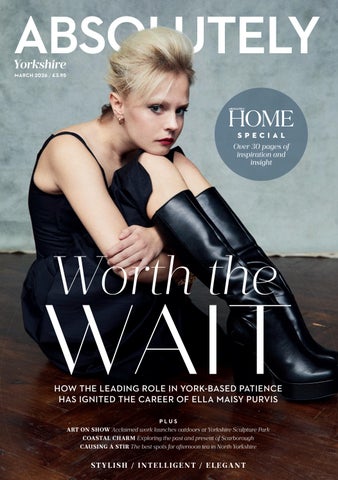


Over 30 pages of inspiration and insight


HOW THE LEADING ROLE IN YORK-BASED PATIENCE HAS IGNITED THE CAREER OF ELLA MAISY PURVIS


![]()


Over 30 pages of inspiration and insight


HOW THE LEADING ROLE IN YORK-BASED PATIENCE HAS IGNITED THE CAREER OF ELLA MAISY PURVIS


Inspired by our heritage, designed for the modern bedroom. The Iconic Collection features floating beds with unparalleled comfort and exclusive fabrics. Handmade in Sweden


EDITOR
MARK KEBBLE
ART DIRECTOR
PAWEL KUBA
MAGAZINE DESIGNER
MARIANA SUZUKI
DESIGNER
BRUNA FACCIN
PRODUCTION MANAGER
DANICA BRODIE
MAGAZINE MANAGER
MARTIN CUNNINGHAM
FINANCIAL DIRECTOR
JERRIE KOLECI
CREDIT CONTROL MANAGER
ALEXANDRA HVID
DIRECTORS
CRAIG DAVIES
JAMES FUSCHILLO
NON-EXECUTIVE DIRECTOR
ALEXANDRA HUNTER
MANAGING DIRECTOR
SHERIF SHALTOUT


Tried and tested, here’s Lisa Byrne’s round up of the beauty products that really do work, most with a county twist too
Do you ever find the constant noise over so-called ‘miraculous’ beauty and wellness products utterly deafening? Especially with the explosion of social media influencers. As a journalist and former editor of glossy weeklies, I’ve been lucky enough to be sent a vast array of beauty products –which all promised to transform me from a wizened old hack into a gorgeous glamour puss. However, unlike most social media ‘influencers’, because I’m an ‘old school’ reporter, I’m not paid by a brand, which makes an editorial review more honest. So here I bring you my top beauty products of the past year, many of which are created by our very own entrepreneurial Yorkshire folk.


Heavenly Health
LYMA supplement Post cancer and early menopause this miraculous tablet, which helps with stress, sleep and skin, has been a life saver. Plus, it was invented by Leeds lass Lucy Go .
Stress Stabiliser
Harrogate Organics Magnesium Spray
Yippy, another Yorkshire brand which I use every morning and night after showering. It’s a life saver for muscle recovery and boosts energy levels.
Miraculous Mascara
Sisley So Intense Mascara This is the Holy Grail of wonder wands, plus its formula of vitamin-rich peptides thicken your natural lashes.
Outrageous Oil
Bothy Botanicals Ultimate Face Oil
Amelia Redhead, owner of The Bothy, created this luxurious jasmine, rose and lemon oil which hydrates your lines away.
Miraculous Makeover
Sculpted by Amiee Prepare to glow with this Hydra tint serum and cream cushion foundation.
Bathing Beauty
Melograno Bath Salts by Santa Maria Novella A favourite way to relax by Oscar winner Emerald Fennell.

THIS MONTH I will be...
Reading Un:Stuck by Kate O’Brien – the Bible on supporting young adults.
Dining at Tasca Easingwold , part of the incredibly delicious Tasca Frango empire.
Celebrating ladies who give back to the community during International Women’s Day lunch at The Ivy York


Rouge Noir is back – if it ever went away – and the new incarnation is a collection of shades that combine red and black. chanel.com


Penelope Chilvers might be known for her boots, but her brogues and loafers are lovely too. We are loving the tan and white Morrell, from the Bloomsbury collection, £289. penelopechilvers.com


focuses of Daisy Duck, and her
Danish fashion brand Ganni has teamed up with American giant Disney in a slightly unlikely but auspicious collaboration that focuses mostly on the lesser-known character of Daisy Duck, and her adventures in Copenhagen. ganni.com


A modern twist on the elegant Art Deco style, the Nouveau diamond jewellery collection from Berry’s is a striking and versatile range that is perfect for both day and night. berrysjewellers.co.uk


EDITOR’S PICK


Iolla's stylish Bonnie frame channels the 1970s with its oversized, square shape and chocolate brown lenses. Add your prescription if you need to. iolla.com
Ferm Living's SS26 collection launches on 5th March, with a focus on creating homes that feel composed, relaxed, and shaped by everyday life. fermliving.co.uk


The Ember collection from Berry’s Jewellers, with its dynamic interplay of spark and fl ame, invites wearers to embrace jewellery as an experience and a statement. berrysjewellers.co.uk


Bella Freud's theme for SS26 is Miami Vice, featuring sleek lines and slick tailored trousers, alongside the iconic slogan knits. bellafreud.com


Addison Ross' new Scallop Lamp collection adds a small, portable light to the range of stylish and useful rechargeable lamps. We love the chocolate one, £125. addisonross.com


The Cartier Tank Louis Cartier 18ct Rose Gold Large Model Leather Strap Watch has a silvered dial with black roman numerals and blue steel hands. berrysjewellers.co.uk


7-14
MARCH, LEEDS GRAND THEATRE
The world premiere of Northern Ballet’s new full-length ballet, Gentleman Jack, is set to captivate Yorkshire audiences as part of a nationwide tour. Continuing Northern Ballet’s masterful canon of creating stories that connect, this groundbreaking ballet will bring to the stage the life of the 19th century Yorkshire icon, Anne Lister. leedsheritagetheatres.com

12 MARCH, BRUDENELL SOCIAL CLUB, LEEDS
The resurgent Chesney Hawkes is back with the recent release of his new album Living Arrows, finishing as a finalist in Celebrity Big Brother and completing a huge run of live shows: first touring arenas across Europe as special guest to James Blunt and then selling out his current UK headline run. Living Arrows shows Chesney at his most vulnerable, completely free of inhibitions or doubts.
brudenellsocialclub.co.uk

26-29 March
CARRIAGEWORKS THEATRE
The Snow Queen is a spellbinding theatrical experience that celebrates love, bravery, and the power of friendship. This enchanting stage adaptation of Hans Christian Andersen’s classic tale follows young Gerda on her courageous journey to rescue her best friend Kai from the icy clutches of the Snow Queen. With vivid characters, humour and heart, The Snow Queen is perfect for audiences of all ages. carriageworkstheatre.co.uk


13 March
THE STUDIO, BRADFORD
Josh Jones is hitting the road with I Haven’t Won The Lottery So Here’s Another Tour, a show packed full of laughs. He’s keeping it light – nothing super political, nothing controversial and it’s definitely not going to change your life, but you can be sure it’s definitely going to be a fab night out filled to the brim with jokes about history, cats, his love of wrestling and so much more. bradford-theatres.co.uk

7 March
BARBICAN YORK
Clinton Baptiste is preparing to embark on a brand-new tour for 2026 with show Spectral Intercourse. In a rudderless world, mankind needs an envoy to gather solutions from the all-knowing, all-seeing Afterlife. But who should it be? There’s only one man for the job – Clinton Baptiste. Receiving the audiences’ queries and earthbound dilemmas, Clinton will then reach out to the spirits for answers. Fear not. He will probe sensitively. yorkbarbican.co.uk

3-7 March
ALHAMBRA THEATRE
Shakespeare’s epic family drama of deceit and murder is directed by multi awardwinner Rupert Goold. Hamlet is the Prince of Denmark. After the death of Hamlet’s father, his uncle, Claudius, marries his mother and takes the throne for himself.
In one of the most famous scenes in Shakespeare, Hamlet’s father appears to the young prince as a ghost, telling his son that he was murdered by Claudius. Seeking vengeance, he wants Hamlet to kill Claudius, setting off a tragic chain of events. bradford-theatres.co.uk

There are few finer ways to begin a spring morning than within the far-reaching landscape of Swinton Estate, where open ground, woodland and moorland unfold across acres of unspoilt North Yorkshire countryside. Within the estate, E.J. Churchill brings its established approach to clay shooting to North Yorkshire, offering an introduction that feels welcoming and rooted in the landscape. It is an experience that sits comfortably alongside the estate’s wider appeal, combining country heritage with something hands-on and quietly exhilarating.
The Family Have-a-Go experience, at £100 per couple (kids shoot free), is created with beginners in mind. Experienced instructors guide each step in a calm, supportive way, making it straightforward for newcomers to get started. It is practical and absorbing from the outset, a shared activity that suits children from nine years old and teenagers just as well as parents. For families who value time together but want something more memorable than the usual outing, it strikes the right balance between challenge and enjoyment.
eople longing for the imminent return of the call of the curlew in the uplands are invited to enjoy a new art exhibition about the bird and its moorland habitat.
Richmond artist Sally Zaranko is exhibiting dozens of lino cut prints at Yoredale. Sally spent two years following curlews, with sketches made in the field worked up in the studio, to create the “More than Moors” exhibition. yorkshiredales.org.uk

The surroundings complete the experience. Wide skies and open views bring a sense of space that is increasingly rare, turning a lesson into something that feels restorative as well as engaging. A er time on the stands, families can head to the clubhouse for coffee or a light lunch. For those looking to do something a little different, it offers a refreshing alternative to familiar routines and a confident first step into a sport that may soon become a regular part of country life.
ejchurchill.com; 01765 357997

“People responded so positively to Patience and her journey”
A lot can happen in a year, as the career trajectory of Ella Maisy Purvis shows. Absolutely catches up with the actress in light of the success of York-based Patience
By MARK KEBBLE
At the start of 2025, I was drawn to the story of Ella Maisy Purvis and an upcoming starring role in a TV show called Patience. The actress had already garnered a lot of hype in acting circles thanks to a wonderful performance in A Kind of Spark, a show that explored everyday challenges faced by autistic young people, so when Ella – who herself in neurodivergent – was lined up to take the lead as an autistic police archivist set in York, my interest was well and truly piqued. When I first spoke to Ella, I hadn’t been shown any of Patience at all, so went in blind – and despite a lot of hope for the series, even my interviewee was a little downbeat about what may lie ahead. Some 15 months later, it’s a whole new world. “Better. Good. Busy. Tiring. Fruitful…” is how she sums up the time since. Although Ella was good value last time round, she is a lot more fun on this occasion, even if she does say waiting in for a new microwave tops our interview. “We have lived without a microwave for 15 months and I am sick and tired of heating things up in a pan,” she shrugs. “I just am.”
Aired in January 2025, Patience season one introduced us to Patience Evans, an autistic police archivist working in the criminal records o ce of York, whose exceptional memory and ability to spot patterns bring her to the attention of Detective Inspector Bea Metcalf [Laura Fraser] after Patience notices inconsistencies in a case initially ruled a suicide. Over the course of the season, Patience becomes an uno cial but vital part of the investigative team, helping to solve a series of complex crimes by uncovering links hidden in historical and contemporary records, while also navigating the sensory, social, and emotional challenges of working within a busy police environment. Alongside the procedural mysteries, the series explores Patience’s growing confidence, her evolving partnership with Bea, and the tension between her strengths and the rigid expectations of institutional policing. Ella received universally good reviews for her performance – “My dad didn’t like it,” Ella laughs, although I am pretty sure she is joking – so has she heard from many viewers? “I get so many lovely messages from people that are like, ‘oh my god, that’s me’ or ‘I do this’ or ‘where’s her backpack from?’ or ‘I love the jeans’,” Ella grins.
“People responded so positively to her and her journey. It’s hard because there are so few autistic women on screen or in books, you kind of suddenly speak universally for an experience that is so varied, so it’s tricky. It’s di cult because there is not one way of experiencing being autistic, or just being a person. Luckily people really responded to her and the situations she finds herself in.”
Have people started stopping her in the streets too? “Usually, in very Patience style, if I am out I have my massive noise cancelling earphones on and I usually do not notice anything else other than my feet in front of me,” she says. “I will get stares on public transport, but I wear red lipstick a lot and I am not very good at applying it, so I think I have smeared it across my face again… It’s weird. People are like ‘Are you Patience?’ and I am like, ‘No I am Ella’. One woman came up to me recently and said ‘Oh my god, are you Precious?’! I am very precious indeed…”
At the time of this interview, season two of Patience had just launched, which feels like a pretty quick turnaround. “There were whispers of it [a second season] when we were filming season one, then the show came out and did sooo well, so the executive producers got me and Nathan [Welsh, who

plays DS Jake Hunter] into the o ces and they got a little cake and said ‘we have got a season two!’... and ‘it’s filming in two months’! That was sweet. It’s the best feeling knowing you have got work coming up, and you can see everyone again, laugh, have fun, it’s such a lovely feeling. There was a really tight turnaround, but I am at the start of my career. Every time I step on a set, I learn things every day, new words, ways things are done, so I have got nothing to really base it on.”
This season also introduces us to a new character, DI Frankie Monroe, played by Jessica Hynes. “She is a comedy legend,” Ella gushes. “We did a chemistry read and

“Every time I step on a set I learn things every day, new words, ways things are done”

in my head it was ‘it’s Jessica Hynes, Jessica Hynes, Jessica Hynes… be cool, be cool’. She is fantastic. She is such a powerhouse of a person. She is so silly too, we did so much laughing and the big group scenes with Mark [Benton], Nathan, Ali [Ariaie], me and Jess were nigh on impossible to get through. Mark of course is comedy as well, so Jess and Mark are used to not laughing when things are funny. I’m not. I will laugh. Nathan is good at keeping a straight face, but me and Ali were the worst for it. But it was amazing.”
The new character also enables us to see a new side to Patience, too. “DI Monroe comes in and she’s a cow, but we see this bite and confidence in Patience that we haven’t maybe seen before. And she’s quite dry, she doesn’t take no for an answer, she doesn’t necessarily allow herself to be walked all over, which maybe in the first season she hadn’t had the confidence to do. She is spurred on with the experiences she had with Bea, so in that sense there is a real confidence and she doesn’t revert back to old ways.”
This season also saw Ella and the team film a
lot more on location in York. “In season two, episode two, we got to film in York Minster. We had it generally all day to ourselves. We were filming inside and outside, and people would be walking up asking ‘is the Minster open?’ and we were no… ‘We travelled all the way from Glasgow’. Sorry… I was horrifically ill when we shot in the Minster and I was lying on the cold floor looking up, I just felt this massive weight of a cloak being put on me by a priest or whoever, and I was like ‘thank you’ [in a very weak voice], ‘bless you’,” she laughs. Ella is very tight lipped about what comes next – “The only people I’d tell are my parents, but to be fair they would go ‘oh we told Sharon and Tamzin’. No, you can’t!” – but a couple of weeks after this interview it was announced that season three had been commissioned, due to start filming around now (so do plan your days out in York in advance). Patience? Things are quickening up for Ella Maisy Purvis.
Watch Patience season two on Channel 4 now


Yorkshire Sculpture Park has unveiled new outdoor sculptures for 2026. Absolutely takes a closer look

The Watchtower
Location: Outside the YSP Visitor Centre
Yorkshire Sculpture Park (YSP) has added three significant new outdoor sculptures to the landscape by Vanessa da Silva, Auke de Vries and Damien Hirst, each o ering thoughtprovoking encounters with contemporary art in the open air.
Set in 500 acres of historic landscape comprising parkland, woodland, formal gardens, heritage landmarks and lakes, these new additions join a display of over 90 outdoor works by some of the world’s leading artists, in Europe’s largest sculpture park. Here is what to expect and the stories behind the new works of art.
Auke de Vries, one of the Netherlands’ most esteemed sculptors, is celebrated for works that hover gracefully between drawing and architecture, translating memory, movement and environment into elegant spatial compositions.
YSP has a longstanding relationship with de Vries, and in 2000–2001 presented Living in Trees, an exhibition developed after the artist spent time immersed in the grounds. He became particularly captivated by the trees, observing their movement and shifting patterns of light and recording their forms in sketches that would later inform his sculpture.
The Watchtower emerged directly from these observations and was conceived in dialogue with YSP’s landscape. The
motif has long been part of de Vries’s imagination, rooted in his childhood in The Hague during World War II, when structures of surveillance punctuated daily life. With The Watchtower, however, he transforms a symbol of conflict into one of benevolence. Rather than being associated with control, this sculpture becomes an invitation to look outwards, to listen, and to experience the landscape with curiosity and empathy.
With its tall, slender stem The Watchtower mirrors the upward reach of a tree’s trunk and at its summit like a canopy a cluster of geometric boxes forms a treehouse-like structure. Windows frame views of the surrounding landscape, while its inaccessibility enhances its mystery and purpose. The artist invites visitors to shift the way they move through and perceive a place, inviting openness, alertness, and a new point of view.

The Martyr – Saint Bartholomew (2019)
Location: The Camellia House
The Martyr – Saint Bartholomew occupies the powerful intersection of scientific inquiry and religious devotion, a space of ambiguity and possibility that has shaped the artist’s practice for decades. “I like the confusion you get between science and religion,” says Hirst. “That’s where belief lies, and art as well.”
The work draws on a long lineage of Christian art depicting Saint Bartholomew, one of the Twelve Apostles, whose martyrdom became a testing ground for artists’ anatomical mastery. Hirst follows this tradition whilst reinventing its psychological and symbolic dimensions for a contemporary audience. YSP’s own Chapel, coincidentally, is also dedicated to St Bartholomew.
Inspired by Italian sculptor Marco d’Agrate’s 16th century sculpture in the Duomo di Milano, where the saint stands draped in his own flayed skin, Hirst shifts the narrative by placing scissors and a scalpel in the figure’s hands.
The suggestion of self-inflicted su ering complicates conventional portrayals of martyrdom, introducing a blend of agency, endurance, and complexity. The reference also extends into popular mythology when Hirst likens the figure to Edward Scissorhands, a character similarly caught between innocence and harm, tenderness and violence.
The Martyr – Saint Bartholomew also arises from Hirst’s formative visual memories

of woodcuts and etchings he observed. Raised in a Catholic household in Leeds, he grew up surrounded by sacred imagery where fear, beauty, and ritual intertwined. As a student, he sketched corpses in a mortuary to confront his own fear of death; early experiences that shaped the development of the artist’s visual language. Installed in the Camellia House, the latest addition joins three of Hirst’s works already on display at YSP: Charity (20022003), The Hat Makes the Man (2004-2007) and The Virgin Mother (2005-2006).
VANESSA DA SILVA
Muamba Posy (2025)
Location: Country Park
Commissioned by Bradford 2025, Vanessa da Silva’s Muamba Posy was first exhibited on the moors of Penistone Hill near Haworth, West Yorkshire, before continuing on its journey to YSP. Its large organic forms and vivid colours were inspired by the area’s ever-changing cycles of nature, where life has continuously adapted over time. Around 300 million years ago, in the Carboniferous period, Penistone Hill was part of a lush tropical forest with a climate similar to today’s Amazon. The sculptures draw on the flora and fauna of that ancient ecosystem while also reflecting the contemporary landscape, echoing indigenous plants such as heather and bilberry. Muamba Posy’s metallic tones evoke species adapted to mineral-rich soils, creating a visual bridge between deep geological time and the
living ecosystems that surround us today. Muamba Posy evolves ideas seen in da Silva’s earlier work Muamba Grove (2019), displayed in YSP’s Lower Park. They explore movement and transformation, bodies in flux shaped by the landscape and each other, inviting interaction between sculpture, the human body, and the environment.
“I see the sculptures as a space for people to gather, to pause and connect with the nature around them… I’d like visitors to leave with a sense of calm, connection, but also joy,” da Silva explains.
The work also reflects da Silva’s own identity as a Brazilian living in the UK, exploring the interplay of cultural migration and transformation. Its title is a combination of Brazilian Portuguese and English words; Muamba – a slang term for smuggling goods across borders – together with Posy, a small bouquet of flowers.
Commenting on the new works at YSP, Head of Programmes, Dr Alex Hodby, says: “These three exceptional works exemplify the ambition and international vision that define Yorkshire Sculpture Park. De Vries brings a profound sensitivity to place and memory; da Silva animates the landscape with vibrant reflections on time, ecology, and identity, and Hirst compels us to engage with questions of belief, su ering, and the human form. Together, these sculptures invite our audiences to wander, reflect, and rediscover the dynamic conversation between art and the natural world.”
Discover more at ysp.org.uk


There’s so many ways to


Take a stroll around the historic Yards and Wynds or shop till you drop in one of our many independent boutiques and department store. Catch a top show at the Hippodrome or learn more about the North East’s railway heritage at Hopetown. Dine in one of our many incredible restaurants and cafés or have fun at one of our free town centre events. Visit www.enjoydarlington.co.uk or scan here for more information

Absolutely takes the train to the Keighley & Worth Valley Railway to see how the heritage site has been transformed over the years


The Keighley & Worth Valley Railway (K&WVR) was recently named one of 2025’s standout winners at the Heritage Railway Association awards. The Railway received the Greater Anglia Volunteers Award for the transformation of the historic Water Tower on Platform 4 at Keighley Station into a new Heritage Centre.
In 2024, the ground floor of the Water Tower was completely remodelled into a modern visitor centre thanks to £100,000 from the Keighley Towns Fund and an additional £42,000 from The Railway Heritage Trust.
Reopened in 1968 after being closed for five years, a combination of paid and voluntary sta runs it. Absolutely spoke to one of those volunteers, Steve Daly, to dive a little deeper into the changes behind the scenes at the iconic Yorkshire landmark.
Q Can you briefly explain the history of the Keighley & Worth Valley Railway and why it matters locally and nationally?
A The branch line between Keighley and Oxenhope was conceived in the 1860s after a philanthropist visited Haworth around 1861 to pay his respects to the Brontë sisters. Having travelled from London by train, he was dismayed to discover that he could not complete his journey to Haworth by rail. On returning to London,
he set about raising the capital needed to build a railway into the Worth Valley.
Although the Brontë sisters had all died by the time the railway reached Haworth, their legacy remains closely entwined with it. Today, many visitors arrive in the village via the Keighley & Worth Valley Railway, and together the railway and the Brontës make a significant contribution to local tourism.
This appeal is further enhanced by the railway’s enduring association with The Railway Children. Both the 1970 film and a later BBC dramatisation were filmed on the line, forging a connection that remains strong even among generations born long after the original film’s release, often introduced to the story by parents and grandparents. In recent years this relationship has been renewed through the filming of The Railway Children Return, set in the 1940s, and in 2024 by the staging of a theatrical production at Oxenhope station itself, with audiences travelling to and from the performance aboard a steam-hauled train.
Q National recognition has followed both the Water Tower project and the wider Keighley Station restoration. What do these awards mean?
A The Greater Anglia Volunteers' Award recognises not only the success of the project itself, but – more importantly – the fact that all of the work was carried out entirely by the railway’s own volunteers.
The award received for the wider Keighley Station restoration is equally significant

to us, as it reflects the strong and positive working relationship developed with Network Rail. The teams involved in both projects are justifiably proud of these achievements.
Q How do projects like the Heritage Centre and station restoration improve the experience for today’s visitors?
A Before the restoration of Keighley station and the conversion of the water tower, Keighley – while an important transport hub linking West Yorkshire with destinations further afield – functioned largely as a point of connection rather than a destination in its own right. The restoration work has future-proofed the station buildings for many years to come and has delivered significant improvements for passengers.
One of the most important outcomes has been the reopening of the walkway from the station forecourt, providing step-free access between the national rail platforms and our services for the first time in many years.
Alongside this, the conversion of the water tower, together with the café-bar in the Old Parcels O ce, has transformed Keighley into a destination in its own right. Passengers can now choose to break their journey here, enjoying the facilities before continuing their trip up the valley on a later service.
Q What do you think the K&WVR does well compared with other heritage lines?
A One of the things our visitors most frequently comment on is how smart our sta and volunteers look in their uniforms, and how friendly and welcoming they are. Anyone working in the heritage sector
must remember that visitors choose to come to us – we are one attraction among thousands nationwide. People visit because they want to, and the fact that so many return time and again is something we take as a real measure of success.
At just five miles in length, we are one of the shorter heritage railways in the country, yet we pride ourselves on being as successful – if not more so in some cases – than lines twice our length or more. Throughout the year we host a wide range of special events, including steam and diesel galas, popular Christmas services, and our CAMRA award-winning Beer and Music Festival.
That success is reflected not only in strong visitor numbers, but also in the national recognition we receive. In 2023 we were proud to be one of the railways to host Flying Scotsman during her centenary year, and in 2024 we played a part in the celebrations marking 200 years of railways.
Q What exciting things are lined up in 2026?
A The year begins in March with our fourday Steam Gala, showcasing our home fleet alongside visiting locomotives from other heritage railways. Later in March, over Mother’s Day weekend, we will o er a journey full of charm, elegance, and the timeless romance of steam travel, with Prosecco and canapés served on board, followed by a freshly prepared twocourse lunch in the Old Parcels O ce.
In May, for the second year running, we will host our popular 1940s Weekend, with attractions and activities taking place
IT HAS TRANSFORMED KEIGHLEY INTO A DESTINATION IN ITS OWN RIGHT


along the entire length of the line. June then sees the return of our four-day Diesel Gala, once again featuring our resident fleet alongside visiting locomotives.
October brings the return of our muchloved four-day Beer and Music Festival – a steam-powered, five-mile “pub crawl” o ering beers and ciders from across the United Kingdom, accompanied by live music at stations along the line. Between these major events, we will continue to run our popular Haworth Haddock trains, featuring locally sourced fish and chips with live music at Keighley station, along with a variety of on-train dining experiences.
Full details of all events can be found by visiting kwvr.co.uk/events


Oh we do like to be beside the sea, especially if it means enjoying everything else this North Yorkshire town has to o er

Scarborough has always been a place that makes sense from the sea. A rocky headland pushes out into the North Sea like the prow of a ship, splitting the coastline into two sweeping bays. Long before the town became a holiday postcard, that headland was a natural stronghold: English Heritage notes the site has been intermittently occupied and fortified for nearly 3,000 years, with the medieval castle later crowning a location that had already been strategically valuable for centuries.
The great “headline” chapter of Scarborough’s story is Scarborough Castle itself: the 12th century great tower (the
keep) is the centrepiece of a royal fortress begun by Henry II. From up there you can read Scarborough’s history in the landscape: the working harbour below, the Victorian sweep of the seafront, and the long curve of beach that made the town famous.
That fame arrived early. In 1626, a local woman named Elizabeth Farrow discovered a stream of acidic mineral water running down the South Bay cli . Word spread that it eased ailments, and Scarborough Spa took o – helped along by a physician’s book published in 1660 that popularised the waters. The result, as the town’s visitor history puts it, was that Scarborough became Britain’s first seaside resort. The idea of travelling for sea air and “taking the waters” is so baked into British culture now that it’s easy to forget


how revolutionary it once was. Scarborough was part of inventing the habit.
The resort years rolled into the Georgian and Victorian periods, when Scarborough matured into the grand, day-tripping, promenade-strolling destination many people still picture. Yet the town’s story isn’t only bright parasols and brass bands. On 16th December 1914, Scarborough was bombarded by German warships – an attack that brought the First World War starkly to Britain’s east coast. English Heritage’s account of the shelling captures the shock of residents waking to mist and warships o shore. It’s a sobering counterpoint to the resort image – and one reason Scarborough’s buildings and streets can feel layered, as if the seaside fun has always co-existed with something tougher.
If you do one “big” Scarborough sight, make it the castle. The keep and curtain walls aren’t just historically significant; they’re also the best way to understand the town’s geography in one glance. English Heritage highlights the castle’s dramatic position above the North Sea, and the scale of Henry II’s great tower. Pair it with a walk along the headland paths for the classic Scarborough double-view – North Bay on one side, South Bay on the other – before dropping down towards the harbour.
Scarborough’s harbour is still a working place, not a theme set: boats, gulls, and the bustle of people drifting between amusements and fish and chips. It’s also the perfect link between the town’s two moods: one minute you’re watching the sea, the next you’re tucked into a backstreet that suddenly feels very local.
Scarborough Spa is where the “first seaside resort” story becomes tangible. The Spa is tied directly to the 1626 discovery that launched Scarborough’s reputation. Even if you’re not here for

a show, the South Cli area is made for slow wandering – sea views, gardens, and that sense of Scarborough being built in tiers. If your Scarborough trip overlaps with gig season, check what’s on at the Open Air Theatre. It is renowned for big summer nights under the sky. Scarborough has a secret softness for the theatrical, and Peasholm Park is one of its best set pieces: an “oriental themed” municipal park opened in 1912, with a lake, island, bridges, and a long tradition of summertime spectacles. It’s the kind of place where you can do very little (sit, watch boats, eat an ice cream) and still feel like you’ve properly been somewhere. For a change of pace from sea views, duck into one of Scarborough’s most quietly remarkable buildings: the Rotunda
Museum. It opened in 1829 and is described by Scarborough Museums & Galleries as one of the world’s first purpose-built museums, with the design suggested by William Smith. The Geological Society frames it within Smith’s bigger legacy –the “Father of English Geology” whose work on strata and fossils transformed how we read the Earth. In other words: Scarborough isn’t only about coastline scenery; it’s also a place that helped explain why the coastline looks the way it does. Scarborough does “nostalgic fun” extremely well, and the North Bay Railway is part of that: a miniature railway that’s been running since 1931 between Peasholm Park and Scalby Mills. It’s an easy win for families, but also for anyone who secretly wants a breezy, cheerful, seaside throwback.


from ITV 1 Dickinsons real deal invite you to sell your unwanted gold & silver antiques & jewellery


Tim Hogarth – Trusted Expert in Diamonds, Jewellery & Watches
Tim Hogarth, a well-known TV personality and trusted expert, specialises in valuing diamonds, precious stones, gold, silver, medals, and vintage watches.
“We’re looking for antique jewellery in any condition, especially quality diamond pieces. Amber, coral beads, and vintage watches (Rolex, Cartier, Omega, Patek Philippe) are in high demand. We offer top cash prices for valuable items.”
Visit Tim every Tuesday and Wednesday at The Red House.
1 Duncombe Place, York, YO1 7ED 07970 818866
timhogarth@me.com

Scarborough’s best eating leans into two strengths: the coast (fish, shellfish, saltair appetites) and a modern Yorkshire confidence that doesn’t need to shout about provenance to take it seriously.
Embers is a good place to start if you like seasonal cooking with a bit of drama: their own description leans into locally sourced Yorkshire produce and a menu that can run from woodfired dishes to indulgent desserts.
Lanterna Ristorante has long been one of Scarborough’s “book ahead” names – an Italian restaurant with a reputation strong enough to travel. Britain’s Finest describes it as an award-winning spot where chefproprietor Giorgio Alessio pairs Italian technique with seasonal local produce (plus excellent imported ingredients).
The Mayfield, The Plough and The Yew Tree Cafe & Bistro from Five Star Stays are all situated just outside of Scarborough, and are family-owned restaurants/pubs with accommodation which make up The Five Star Collection. The Collection is part of the Yorkshirebased Qdos Entertainment, owned by husband and wife entrepreneurs Nick and Sandra Thomas, who live in Scarborough.
The Five Star Stays Cottages, The Plough and The Mayfield, carry the distinctive Five

Star Collection trademark of award-winning dining, with each one o ering a varied and individually styled menu, and elegant accommodation, designed to make the guest feel pampered and cosseted, from luxurious rooms at The Plough and The Mayfield to the five star self-catering cottages. There are plenty of atmospheric pubs as well to enjoy “just one more”. The Stumble Inn is Scarborough’s original micropub, known for rotating handpulled ales and a proper craft-beer focus.
The Merchant Bar celebrates all things Ireland, with live music, good craic, and an attention-grabbing whisky list (they even boast of having one of the largest collections). North Riding Brew Pub is a local institution for real-ale fans: CAMRA describes it as Scarborough’s only brew pub, with continually changing beers and a track record as a multiple winner of the town’s Pub of the Year.
If you want a simple Scarborough food plan: do fish by the harbour in daylight, then a “serious” dinner tucked back from the promenade, then end in a small pub where the bar sta talk you into trying something you didn’t know you liked.
Scarborough's best eating leans into one particular strength: the coast with its fish, shellfish and salt-air appetites
Five things people may not know about Scarborough
1. Scarborough helped invent the British seaside holiday. The 1626 discovery of the spa waters didn’t just create a local attraction – it helped establish Scarborough as Britain’s first seaside resort.
2. The Rotunda isn’t just old – it’s historically significant in the museum world. Opened in 1829, it’s described as one of the world’s first purpose-built museums, tied to William Smith’s geological ideas.
3. Scarborough was bombarded in WWI, and civilians were killed. On 16th December 1914, over 500 shells hit the town in about half an hour, killing 17 inhabitants.
4. Europe’s “largest open air theatre” is here. Scarborough Open Air Theatre has become a major live-music venue rather than a minor seaside extra.
5. That “Scarborough Fair” you’re humming has deep regional roots. “Scarborough Fair” isn’t just a Simon & Garfunkel moment; it’s a traditional Northern English ballad associated with Yorkshire and Northumbria variants, and it has long been linked to Scarborough in folk tradition.


Want to know more about the The Plough, Scalby in Scarborough? Read on…
The Plough, located in the pretty village of Scalby, Scarborough, is rated a 5* Inn, has received a culinary excellence award and featured in The Good Food Guide and many other blogs and reviews. Serving classic British dishes with a modern twist, they change the menu seasonally to showcase the best local ingredients. There’s something for all dining styles, traditional Sunday lunch, casual tapas with cocktails, large party celebrations and destination dining. The specials board features delicious homemade pies and market fish of the day. Recently reviewed by food writer Jack Hughes, he described The Plough as a charming hamlet at the heart of Scalby village. He started his dining experience
with a trio of small plates: tempura squid, with a fiery sriracha mayonnaise, melting nuggets of battered cod cheek and excellently balanced smoky kedgeree croquettes with a sweet raisin purée and spiced curry mayonnaise. Jack goes on to describe his roasted wild halibut as demonstrating a masterful dedication to the best of fish cookery, all highlighting the exuberance of local produce and the centrality of seafood on the Yorkshire Coast. Their drinks o ering does not disappoint either, focusing on the finest drinks selection served in a stylish and sociable environment. Stocking an excellent choice of local hand-pulls and ciders, alongside a wide variety of spirits, wine list and cocktail menu filled with all those classic favourites and exciting new flavours. So, whether shaken, stirred or poured, there’s a tipple for everyone.
Where elegance meets comfort, the Garden Lounge is their newest space for customers to enjoy food, drinks or private dining. Recently renovated, the lighting and soft furnishings give it a stylish yet relaxing feel, flooded with natural light in the warmer evenings and elegantly lit when dark. The Plough also regularly uses this space to host ‘Garden Parties’, where the ambiance is as refreshing as the cocktails, customers can unwind while sipping on expertly crafted drinks, tapas and complimentary nibbles. Accompanied by an upbeat playlist and private bar featuring live cocktail demonstrations, these events guarantee vibrant party feels! With its traditional and contemporary style, it also continues its heritage as a place to stay, o ering eight boutique en-suite bedrooms. Designed by award-winning interior designer Rachael McLane, their overall design style is described as country comfort and a perfect blend of polar opposites – rustic at one end, with a slight London edge at the other. Featuring homemade four poster beds, roll top baths and exceptional quality furnishings and fittings, they attract guests from shooting, walking and cycling parties to romantic getaways all year round – a real hidden gem and retreat for anyone visiting the coast.
theploughscalby.co.uk fivestarcollection.com


Tim Hogarth, TV expert and owner of The Red House Antiques in York, on why you should take your time when doing a spring clean out
I’m often asked by people who have decided to do a spring clean or just a declutter or downsizing what they should be looking out for in terms of value and how they can sell these items. It’s easy to think ‘I will chuck that out’ or give it away to the charity shop, but you could be giving away thousands of pounds without realising. When I worked on the ITV show Secret Dealers we saw how many people, particularly from an older generation, became bogged down with items. My first tip is don’t chuck until you’ve checked it. With gold at an all time high even the most insignificant amount is potentially worth hundreds. Silver items are also doing well so check the cupboards. Look out for Hallmark’s local dealers, who are always the best place to sell gold and silver because you don’t have to factor in expensive auction fees, which can be in the excess of 30 per cent.
Vintage clothing is a huge market particularly for designer labels from YSL to vintage Burberry. The market is strong on internet selling platforms for pre-owned luxury bags, particularly Louis Vuitton, Dior and Mulberry – all command decent resale prices.

Watches don’t have to be the big brands, but that always helps. Saying that, the market for vintage watches from the 1940s to today are highly sought after. Vinyl records, old toys, medals… the market is strong for all these items that may be lurking in your loft, so do your research, check out your items before selling and you could be in for a tidy windfall.
We constantly see on David Dickinson’s Real Deal items where the seller says ‘I nearly thre it away!’, so get sorting and if you think you have some gems, get selling.
Discover more by visiting redhouseantiquesyork.com


Financial planning for women: why it matters more than ever
By DEB JACOBS
As women, our stories are wonderfully diverse. Some of us are building careers, some running households, some caring for children or ageing parents, and many of us are juggling all three. Wherever we find ourselves, feeling in control of our money is important for us all. And when we look at the financial picture for women in the UK today, it becomes clear why planning for the future really matters:
On average, women in the UK live longer than men. It’s a wonderful thing, but it does mean our retirement savings need to stretch further. Planning helps ensure longevity becomes a gift, not a financial worry.
Many women take time out of work for childcare, family care, or simply personal choice. While valuable, these breaks can reduce workplace pensions, limit earnings growth, and make it harder to “catch up”. Thinking ahead helps bridge those gaps.
Progress is happening, but slowly. In April 2025, the ONS reported a 6.9% gender pay gap among full time employees. Over a lifetime, that di erence compounds –a ecting pensions, savings, and financial security. Planning can help make sure every pound works as hard as we do.
ARE INCREASINGLY
More women control household finances, own

property, run businesses, and invest. With that comes the opportunity to build a future aligned with our values and ambitions.
Financial planning often sounds formal or intimidating, but it’s about understanding where you are and where you want to be. It can start with three simple steps:
1. GET CLEAR ON YOUR GOALS
It’s not just about pensions or investments, it’s about what you want. Travelling more? Starting a business? Supporting your children through university? Retiring early? Your financial plan should reflect your life, not the other way around.
2. UNDERSTAND YOUR NUMBERS
A quick look at your savings, pensions, and monthly spending can reveal a lot. It doesn’t need to be perfect, getting a picture is progress.
3. MAKE A PLAN THAT GROWS WITH YOU
Life changes. Your financial plan should be flexible. A good Financial Planner won’t hand you a static document, they’ll help create a plan that evolves with your circumstances.
If you’re not sure where to start, we’d love to help. Call 01904 661140, email enquiries@pen-life.co.uk or scan the QR code to book in a chat (Deb Jacobs is a Director at PenLife Associates).

Please note: A pension is a long-term investment not normally accessible until age 55 (57 from April 2028 unless the plan has a protected pension age). The value of your investments (and any income from them) can go down as well as up which would have an impact on the level of pension benefits available.

Miss Rebecca Rollet
Consultant Plastic Surgeon | MBChB | BSc (Hons) | MRCS (Eng) | FRCS (Plast) coppergateclinic.co.uk
Q In such a fast-evolving field, what does true leadership in Aesthetic Medicine look like to you?
A True leadership is about accountability. Aesthetic Medicine evolves rapidly, trends shift, technologies advance, but patient safety and ethics must remain constant. Leadership means having the confidence to challenge what isn’t appropriate, even when it’s popular. As a Council Member of BAAPS, I contribute to shaping national standards, regulation and patient protection. That responsibility extends beyond my own practice. It’s about safeguarding the integrity of our specialty and maintaining public trust. Leadership also means investing in the next generation, ensuring young surgeons understand that innovation must always sit alongside evidence, integrity and restraint.
Q What principles shape the way you care for your patients?
A Everything begins with respect. Choosing surgery is deeply personal, and I never take that trust lightly. Patients deserve honesty, time to ask questions, reflect and feel completely comfortable in their decisions. Listening is just as important as surgical skill. My role isn’t simply to perform a procedure; it’s to guide, support and advocate throughout the journey. Care should feel calm, considered and collaborative.
Q What do you feel sets your approach apart, beyond technical expertise?
A Technical excellence is fundamental, but what truly defines my approach is transparency and continuity. I see my patients from consultation through to final review, allowing trust to develop naturally. I focus on balanced, natural outcomes, results that feel authentic rather than obvious. The greatest reward is seeing someone move through the world with renewed confidence, knowing the change feels entirely their own.
Clinical Director | BDS | FDS | RCS (Eng) coppergateclinic.co.uk
Q How did your personal journey shape the Coppergate Clinic we see today?
A My path wasn’t linear. I stepped back from my career in dentistry to support my family when our youngest daughter became seriously unwell. In those vulnerable moments, I was reminded that what people need most is time, dignity and genuine compassion. That clarity shaped everything that followed. After experiencing the frustrations of the corporate patient journey, it became my dream to o er something more personal. That vision became reality during the pandemic. As our York clinic was already CQC-approved for local anaesthetic surgery, expanding into general anaesthetic felt like a natural progression.
Q You’ve also played a role in shaping standards beyond Coppergate. Why is
that important to you?
A As one of the first independent private plastic surgery hospitals in the UK, we’re proud to have played a role in evolving traditional plastic surgical practice. Through our involvement with BAAPS and the mentorship of aspiring surgeons, we remain committed to shaping the wider field. Technical skill is essential, but so too are integrity and compassion. We mentor not only to teach technique, but to share the values that built Coppergate, continually learning, refining and staying connected to developments around the world.
Q Coppergate is described as being built on values, not volume. What does that mean?
A It means we consciously choose depth over scale. Every patient receives time, attention and continuity, often seeing the same sta throughout their entire journey. That consistency builds trust, and trust is everything. When someone walks through our doors, they’re not a transaction. They’re a person, and we treat them accordingly.


Ms Ciara Bowers
Consultant Plastic Surgeon | MBChB | FRCS (Plast) | MBA coppergateclinic.co.uk
Q How do you ensure you remain at the forefront of industry developments and best practice?
A Plastic surgery is constantly evolving, and that’s something I genuinely enjoy. Being a BAAPS member keeps me connected to colleagues who share a commitment to the highest standards. I attend conferences and training not simply because it’s required, but because curiosity matters. Patients deserve a surgeon who remains engaged, reflective and open to learning.
Q What is your philosophy when it comes to patient care?
A For me, everything begins with listening. Every patient has their own story and motivations. My role is to understand those fully before discussing treatment. I focus on results that feel natural and harmonious, enhancements that allow someone to look refreshed
Marking International Women’s Day, we speak to leaders in their field - starting with a quartet from Coppergate Clinic
Consultant Plastic Surgeon | MBChB | FRCS (Plast) coppergateclinic.co.uk
Q You have a particular focus on female healthcare and post-pregnancy procedures. Why is this area of practice so important to you?
A Women’s health has historically been under-discussed, particularly when it comes to intimate concerns. Many of the patients I see have lived with discomfort or self-consciousness for years before seeking advice. Pregnancy, childbirth and hormonal changes can significantly a ect the body, yet women often feel they are expected to simply accept those changes without question. For me, this area of practice is about validation. It’s about creating a safe, respectful space where women can talk openly, without embarrassment, and receive clear, evidence-based guidance. Supporting women through di erent life stages, especially after childbirth, feels both meaningful and necessary.
Q What do you think is most misunderstood about intimate or post-pregnancy procedures?
A There’s often a misconception that these procedures are purely cosmetic. In reality, many women seek treatment for functional reasons, discomfort, physical changes that a ect exercise, clothing, or intimacy. Confidence and comfort are closely linked. Another misunderstanding is that discussing these concerns is somehow indulgent or unnecessary. It isn’t.
Q What responsibility comes with working so closely with women’s confidence and wellbeing?
A It requires sensitivity, discretion and honesty. These conversations are deeply personal. As a BAAPS member, I’m committed to upholding the highest standards of safety and ethics, particularly in areas that can feel vulnerable for patients. My role is not simply to o er a procedure, but to ensure the decision is informed, appropriate and in the patient’s best interests. When approached responsibly, this work can restore not just physical comfort, but a sense of ownership over one’s body.
and confident without appearing altered. When patients feel informed and genuinely heard, the impact extends beyond the physical.
Q What do you enjoy most about working at Coppergate Clinic?
A What I value most about working at Coppergate is that we are entirely dedicated to plastic surgery. Because it’s our sole focus, every member of the team, from front of house to theatre sta to surgeons, truly understands the procedures we o er and the journey our patients go through. Our theatre team are highly experienced and confident, able to prepare e ciently and calmly, which creates a seamless environment on the day of surgery. That calmness matters, patients can feel it. Likewise, our front of house team is knowledgeable and approachable, able to answer most queries quickly. It creates a joined-up experience where patients feel informed, reassured and supported at every stage. That shared expertise and teamwork makes the clinic not only a comfortable place to work, but a safe and reassuring place to be treated.


Assistant Head Co-curricular, Sheffield Girls’ sheffieldhighschool.org.uk
Q Before working at your current school, what was your working background?
A My academic path was quite traditional: A-levels followed by a BSc in Sports Science, and then straight into teaching. After starting as a gymnastic coach aged just 16, sports coaching has remained a passion for me and I would say I learnt many of my teaching skills through that area of my work. My career has always centred on young people and the belief that education should develop character as well as academic success. My co-curricular and pastoral roles have always had a strong focus on student leadership, enrichment and inclusion and over time I have become increasingly interested in how schools can
deliberately build confidence, resilience and a sense of purpose in young people.
Q What inspired you to work in your current position?
A She eld Girls’ immediately stood out to me as a school that truly lives its values. I was inspired by its commitment to educating the whole girl and by the ambition to ensure every pupil feels confident to take risks, lead and speak up. Having the opportunity to shape and develop our Girls of Steel character education programme was particularly compelling, as it aligns so closely with my own beliefs about empowering young women. My most cherished moments as a teacher are usually outside the classroom. Competitions, residentials, drama, music, even sleepovers in the school hall – these are the events vital for physical, mental and social well-being.
Q What do you do that makes you di erent and unique?
A I’m 53 but 15 at heart! I’ve never grown too old or too important to prioritise anything other than the basics of spending time doing activities with our students which have real impact. I also have fought throughout my 25 years at SHS to ensure all our co-curricular activities provide for both participation and personal excellence –you can do both if you have people with passion and who inspire passion in the students. I am passionate about creating opportunities that help girls discover who they are and what they are capable of beyond the classroom. Participation and personal excellence are not mutually exclusive and I love supporting pupils to achieve both. My work is about connecting experiences, leadership and reflection, so that girls can see and enjoy their own growth.
Q How was 2025 for you and what were the highlights?
A It was busy – but that’s how I like it! A particular highlight was seeing our Girls of Steel character education programme noted as a significant strength for the school. Another highlight was watching the children being children and seeing our amazing community flourish during another year of events and action. There’s so much negativity in the news around loss of childhood, with the threat posed by mobile phones and social media in particular but I get to see our pupils in their element, on the trampoline, singing with choir, playing with friends, and performing on stage.
Q On a personal level, what are your hopes and dreams for 2026?
A My hope is that every pupil leaves She eld Girls’ with a strong sense of self-belief and the confidence to navigate challenges. I look forward to seeing Girls of Steel continue to evolve as a defining part of the school’s identity and something our pupils carry with them long after they leave.
Q Outside of work, what are you looking forward to this year?
A That one is simple. More skiing, more travel and time with my husband. I look forward to the warmer mornings and early sunrises for the dawn walks with my beautiful dog Willow.

Anita Pace
Founder, Pace pacecomms.co.uk
Q Before launching your business, what was your working background?
A While studying for my business management degree, I discovered marketing and decided that’s what I wanted to do. I worked in various marketing and business management roles in the telecoms sector for over 20 years. I was lucky to be working in telecoms when the internet first appeared and I had the privilege of being asked to launch an internet service within the company I worked for. Very quickly, the ‘service’ became a business unit in its own right and I was tasked with setting up the business, recruiting a team, growing the service portfolio and acquiring customers. It was at the time of the dot.com boom – exciting times and a huge learning curve for me. I was only young but very keen, ambitious and not afraid of hard work. The company’s CEO gave me a fantastic opportunity and I’ll always be grateful to him.
Q What inspired you to launch Pace?
A As a marketing & communications director, I saw many marketing agencies during my corporate career and always knew
I’d have my own agency one day. It wasn’t until I’d had my two daughters and returned to work that I decided that the time was right to make the move. I don’t regret leaving it until my 40s to start my own company. I had over 20-years’ valuable business experience and I had also built some financial security which made the ‘jump’ easier. However, even with that experience, I quickly realised I still had a lot to learn. Founding and growing your own business is very di erent to working for someone else. I’m still learning new things every day, even though Pace is now 10-years old.
Q What do you think makes you di erent?
A I’ve always been competitive. I was a track athlete for many years and that will-to-win has been with me from a very young age. I always want to do the best I possibly can. I don’t know why, as my parents and siblings aren’t like that. I’m very driven and find it hard to enjoy the moment because I’m always striving for more. This has served me well in terms of my achievements, but I’m also wise enough now to realise that it has its downside – switching o and finding time for ‘me’ doesn’t come easily and is something I’m constantly working on.
Q How was 2025 for you?
A It was a challenging year at times.
At Pace, I had to make some tough decisions which I knew were right for the business, but that didn’t make it any easier at the time. We are much stronger as a result, but it reminds you that growing a successful business is not for the faint hearted and you need to have the strength of your convictions. I also had a family tragedy to navigate which was emotionally di cult. There were also many highlights in the year, notably Pace’s 10th anniversary, which was a milestone that we all enjoyed celebrating.
Q Are you introducing anything new for 2026?
A This year will be a transformational one for Pace – we are entering a new chapter for the agency which is incredibly exciting for us all. I’m going to be spending less time in the business and more time on the business – something I know all founders know they should do, but few of us have the time to do it.
Q On a personal level, what are your hopes and dreams for 2026?
A I want to be able to generously reward the Pace team at the end of 2026 because we’ve smashed our goals for the year and had a brilliant time doing it along the way!

Founder, Nourish Communications @nourishcommunications
Q How do you stay ahead of the curve in the PR world, while delivering meaningful results for clients?
A I’m always looking ahead and being proactive where possible, while staying reactive to emerging trends. Hospitality changes daily, so standing still isn’t an option. I work closely with clients to understand their challenges and opportunities, ensuring ideas evolve rather than launching everything at once. Sustainable growth matters more than noise. By layering activity, refining messaging and responding quickly to cultural shifts, we keep brands relevant and resilient.
Influencer culture, digital platforms and media habits will continue to change, but strong storytelling, clear objectives and trusted relationships remain constant.
Q Can you share a campaign or client success story that you’re particularly proud of?
A One campaign I’m particularly proud of is Saltmoore’s Wuthering Heights Moors & Moonlight
Clinic Director, R&R Aesthetics randraesthetics.com
Q What inspired you to launch your business?
A I have always had an interest in skin, I actually trained as a beauty therapist when I left school prior to going to university to complete my Nursing and Midwifery degrees. I could see that Aesthetics was starting to become popular and saw a gap in the market in my local area for a safe, high quality service so I decided to start my aesthetics training and R&R Aesthetics was born.
Q What do you think makes you di erent?
A I think my background as a beauty therapist, Nurse and Midwife has really helped me to build great relationships with my patients, I've become a great listener which is so important on an aesthetic journey. I continually invest in my own training and travel all over the UK and Europe to not only learn, but teach others, my patients are confident that they are receiving the latest, evidence based care.
Q How was 2025 for you?
A It was a great year for us, we welcomed three new team members: Nicola as a clinic coordinator, Jelena as a therapist and Liv as a Nurse Prescriber. We also secured our second clinic location at the beautiful Stables at Sedbury Hall just outside Richmond.
Q Is there anything new in 2026?
A January 2026 saw the opening of R&R at the stables, our brand new second clinic, just outside Richmond. We also introduced NeoGen Plasma into the clinic, which is a powerful non surgical skin rejuvenation device that uses plasma technology to stimulate collagen and tighten skindelivering natural, long lasting results with minimal downtime.
Q What are your hopes for 2026?
A In 2026 I'm looking forward to developing the new clinic in Richmond and seeing it grow. I'm currently coming to the end of a post graduate certificate in Trichology at university so I'm looking forward to finishing this course and developing some new hair loss treatments in both clinics.
package. It was a fully integrated, 360 campaign created in collaboration with Tesla and Hunter, bringing together brand partnerships, content, PR and experiential storytelling. The aim was to celebrate North Yorkshire’s landscape and heritage in a way that felt modern and globally relevant. The campaign achieved strong national and local coverage, elevating the region on a much wider stage.
Q What advice would you give to aspiring female entrepreneurs who are considering starting their own business in the PR or creative industries?
A My advice to aspiring female entrepreneurs is to believe in yourself and trust your instincts. Use your network, ask questions and don’t be afraid to lean on others for support. Focus your energy and take opportunities that align with your values and long-term goals. You don’t have to say yes to everything. Knowing your worth, setting boundaries and backing your experience are essential. If you have an idea and the drive to pursue it, go for it with confidence and clarity. Building a business takes courage, consistency and patience, but the rewards of independence and impact are genuinely worth it longterm.


An unforgettable journey of incredible food and drink at the heart of the Swinton Estate. Combining intimate fine dining with exceptional seasonal produce grown, reared or foraged across Swinton Estate, Yorkshire and the North-East. Each dish reflects a profound respect for provenance, seasonality and sustainability. Proudly featured in the MICHELIN Guide. Seating up to only twelve guests, book now for an intimate evening of gastronomy.


PIGNUT & THE HARE
Pignut & the Hare, located in the village of Scawton near Helmsley, has received a ‘Very Good’ overall rating in the Good Food Guide, just six months after opening. The rating marks a high level of ambition and individuality, and restaurants with this rating are considered among the best places to eat in a county or region. pignutandthehare.co.uk


Wine recommendations for the month
By THE WINE SOCIETY


A Fistful of Schist Chenin Blanc, Swartland 2025


Food news and the most exciting openings across Yorkshire
By MARK KEBBLE


This juicy stone-fruit and tropical-flavoured chenin blanc is a great value introduction to the Swartland. Riebeek produces a wide range of wines, often from older bush vines which deliver greater complexity at very modest prices.


Arbois Chardonnay, Fruitière Vinicole d'Arbois 2022
£14.50


This chardonnay from the Jura is the perfect balance of introducing lesserknown regions whilst playing it safe with a well-liked and well-known international grape variety. Expect attractive stone fruits and white flowers, supported by citrus notes and a juicy core.
Quinta da Alorna ‘Lutra’ Tinto, Tejo 2024
£8.75
A supple and generous red hailing from the Tejo region of central Portugal, blending indigenous Portuguese grape varieties showcasing a medium-bodied profile with soft tannins and vibrant red-berry notes, making it approachable and enjoyable for anyday drinking.
Since it was founded back in 1874, The Wine Society has dared to do business a little differently. Bringing together a community united by a shared love of wine, The Society is a co-operative and owned by its members. This means there is no requirement to pump profit into annual dividends or bonuses for shareholders – all profits go back into the business.
The Wine Society welcomes all wine lovers. Become a member today and receive £20 off toward your first order. thewinesociety.com

Roots, the Michelin-starred restaurant from chef Tommy Banks in York, has launched a New Year Sunday Feast Menu. Staying true to Tommy’s ethos, The New Year Sunday Feast Menu celebrates produce grown, reared and foraged from the Banks’ family farm, kitchen garden and the surrounding area, Oldstead.
rootsyork.com

The UK’s leading independent restaurant guide, SquareMeal, has revealed its Top 100 UK Restaurants for 2026. JÖRO, in She eld, was the highest ranking Yorkshire restaurant, placed in eighth. With its inspired blend of Nordic and Japanese influences, JÖRO’s tasting menus are a breath of fresh air. jororestaurant.co.uk


Found in the heart of Leeds Dock, Fearns is a popular brunch spot. The menu is filled with a mixture of brunch favourites including classic Fearns breakfast and eggs benedict, to more adventurous dishes including hot honey chicken flatbread and green chilli burger. fearnsuk.com
The ingredients spring is made for

Early strawberries are lighter and more aromatic than summer ones. Chefs showcase them beyond dessert, pairing strawberries with balsamic, black pepper, or herbs, and serving them alongside cheeses or cured meats.

Asparagus is one of the earliest spring vegetables, prized for its tender texture and fresh, grassy flavour. Chefs keep preparations simple, blanching or grilling it lightly to highlight its natural sweetness and seasonal delicacy.

Spring radishes are crisp, juicy, and mildly peppery compared to later harvests. Chefs celebrate them raw with butter and salt, thinly sliced in salads, or lightly roasted to mellow their bite while retaining freshness.

THE BOX BAR
The o cial Guinness kebab has launched at BOX Sports Bars across Yorkshire for the Six Nations. The limited edition beef kofta kebab is marinated in Guinness, giving the meat the deep, rich flavour of the black stu , before being wrapped in a handmade flatbread, drizzled with a sticky homemade Guinness chipotle glaze and topped with fresh mint yoghurt. Yes, it even comes with a creamy white head. theboxbar.co.uk

THE IVY ASIA
Launching as part of Dual Forces of Asia, a new culinary concept inspired by two enduring archetypes of Asian culture, The Ivy Asia Leeds presents the Dragon Lunch Menu and the Samurai Dinner Menu. Together, they define a seamless day-to-night dining experience that o ers real value. theivyasia.com

Exploring some of the finest places to enjoy that quintessential English treat in North Yorkshire

bettys.co.uk
If you want classic North Yorkshire afternoon tea with proper “occasion” energy, Bettys in Harrogate is the benchmark. Booking into the Imperial Room leans into the ceremony: starched linens, polished silverware, and that sense that you’re participating in a local ritual rather than simply grabbing cake. Tradition is honoured through immaculate finger sandwiches and scones done the right way, but what keeps it special is the calm precision – everything feels composed, not fussy. Spring in Harrogate pairs beautifully with this: do the tearoom first, then wander the nearby Valley Gardens or Stray while the town’s spa-heritage greenery wakes up again.
thegrandyork.co.uk
The Grand’s afternoon tea is rooted in the familiar structure – sandwiches, warm scones with jam and clotted cream, then patisserie – but gives it a modern hotel flourish that feels fitting for a special trip. They explicitly describe a “contemporary twist” while staying anchored to tradition, which translates into classics that look sharply tailored, plus a sweet selection designed to be a bit showstopping. In spring, York is at its loveliest when you build in a gentle stroll: arrive early for a loop of the city walls, or cross to the Museum Gardens for blossom and lawns, then settle into the plush calm of a five-star setting right by the station. It’s a great “city-and-gardens” combination – history outside, hush and teacups within.
grantleyhall.co.uk
For a version of afternoon tea that feels like you’ve stepped into a country house film set, Grantley Hall near Ripon delivers the decadent end of the spectrum. The

hotel frames its afternoon tea as seasonal, and that’s the key di erence here: you still get the reassuring rhythm of sandwiches to scones to sweets, but the details shift with the time of year, making a spring visit feel genuinely “of the moment”. The setting amplifies everything: soft light, elegant rooms, and an atmosphere that encourages lingering over the pot rather than rushing back to the car. To embrace spring, plan time to enjoy the grounds and nearby countryside around Ripon.
RUDDING PARK
ruddingpark.co.uk
Rudding Park’s twist is that it o ers the classic afternoon tea experience in a bright, garden-facing conservatory – the kind of place that makes early spring sunshine feel like an event. They centre the ritual on loose-leaf tea, layered stands, and patisserie craft, with the option to elevate it with Champagne if you’re in that mood. A standout spring detail is the conservatory itself: airy, green, and designed for lingering, which is exactly what you want when the season is changing outside. Pair it with a walk around the estate or a gentle wander into Harrogate’s parks afterwards, and you get the best of both worlds – traditional tea, then fresh air and budding colour.
SWINTON PARK
swintonestate.com
Swinton Park’s afternoon tea is practically a postcard of the tradition: a grand country
house setting near Masham, locally sourced touches, and the option to take tea outdoors on the South Terrace when the weather behaves. That outdoor possibility is what makes it particularly spring-friendly – if you catch a mild day, you can lean into the estate atmosphere with views across the deer park, then roam the grounds when you’re finished. Indoors, the Drawing Room/Sitting Room vibe keeps the ritual intact: it’s formal enough to feel special, but not sti . The menu description makes a point of local preserves and produce, which gives it a grounded “North Yorkshire larder” character beneath the elegance.
thedevonshirearms.co.uk
Afternoon tea at The Devonshire Arms is tradition with a built-in “make a day of it” plan. They serve it in spaces like the Garden Room, and the location on the Bolton Abbey Estate is the real di erentiator: you can do the full three-tier pleasure, then head straight out for a spring walk along the river path to the priory ruins. That pairing – delicate sandwiches and scones first, then fresh air and budding woodland – makes it one of the most satisfying spring options in North Yorkshire. The hotel positions the tea as “traditionally done”, which is exactly the appeal here: you’re not chasing novelty, you’re chasing the perfect version of the classic, followed by one of the county’s most beautiful short rambles.

castlehoward.co.uk
This is afternoon tea with a joyful twist: instead of being anchored to a lounge, Castle Howard o ers a “Picnic Afternoon Tea” you collect and enjoy anywhere in the grounds. That makes it tailor-made for spring – find a sheltered bench, a view of the lake, or a spot among the gardens as everything starts to bloom, and you’ve turned tea into an outdoor mini-adventure. The contents keep the tradition intact (sandwiches, scones with clotted cream and conserve, miniature cakes), but the format changes the whole feeling: it’s less hushed ceremony, more romantic roam-and-nibble.
HALL & SPA
middlethorpe.com
Middlethorpe Hall is the antidote to busy city tea rooms: a historic country house just outside York where afternoon tea is served in drawing rooms that naturally suit the ritual. They frame it as a long-standing tradition and pair it with a specialist tea partnership, which adds a subtle point of di erence without straying from the classics. Spring is where Middlethorpe really shines, because the house is set in extensive gardens and parkland – perfect for a pre-tea wander among early leaves and blossom, then a return indoors for silver stands and warm scones. It’s also a lovely option if you want “York access” without being in the thick of it.
handpickedhotels.co.uk
Crathorne Hall’s take on afternoon tea is all about the setting: a grand country house interior with tall windows and far-reaching estate views, so the whole experience feels light-filled and spacious – ideal when spring days start stretching out. The hotel near Yarm emphasises the traditional line-up (dainty sandwiches, scones, cakes and pastries) and spotlights Taylors of Harrogate tea, which gives it a satisfyingly Yorkshire backbone. It’s the sort of place where you

can dress up a little, slow down, and let the afternoon unfold at an unhurried pace.
crabandlobster.co.uk
The afternoon tea experience at this charming North Yorkshire venue o ers a delightful blend of traditional English indulgence and locally inspired flair. Set within the elegant surroundings of the Crab Manor Hotel and award-winning Crab & Lobster restaurant near Thirsk, guests can enjoy a generous tiered selection of freshly made finger sandwiches, including crab and lobster brioche, smoked salmon with cream cheese bagel, Wensleydale with walnut and date bread, and classic egg mayonnaise on white bloomer. Sweet treats feature homemade scones with clotted cream and raspberry and vanilla jam, seasonal fruit tartlets, macarons and creamy cheesecake verrines.


TEA IS AN ART SO CLEARLY DEAR TO THEIR HEARTS, CRAFTED TO BE ENJOYED TOGETHER
estled within 20 acres of private gardens and meadowland, in the heart of the Wild East Yorkshire triangle, is the Georgian hotel, Tickton Grange. Family owned for over 45 years, they have recently been recognised as serving one of the best Afternoon Teas in the country – an art so clearly dear to their hearts, crafted to be enjoyed together.
Served on breathtaking blue brush stroke bone china, delve into sumptuous savoury bites and classic fine finger sandwiches, devour a tier dedicated to true patisserie perfection, before unveiling the most perfect English scones beneath a dome brushed with blues. All paired, of course, with a pot of Buckingham Palace loose leaf tea. Champagne, Prosecco or a crisp G&T? At Tickton Grange, every Afternoon Tea is a certified celebration, so why not make it sublime… Their very special Mothering Sunday Afternoon Tea will be served on Sunday 15th March in the Rose Room at 2.30pm. Here is a taster of what you will find on the menu:

Cherry bakewell, Dark chocolate ‘Turkish delight’ Brown sugar tartlet, Blood orange cheesecake, Rhubarb & custard Homemade scones, strawberry jam & clotted cream.
Wild garlic sausage roll, Staal smoked salmon fishcake, dill mayonnaise, Mushroom filo tartlet, Tickton cheese straws.
Smoked salmon, lemon & black pepper, Ham & seed mustard, Smoked cheddar & house chutney, Egg mayonnaise, watercress.
A bottomless pot of loose leaf tea chosen from the Tickton Tea collection menu, which includes Buckingham Palace, York Earl Grey, fruit teas, herbal teas and others.
Tickton Grange have also introduced an Afternoon Tea gift box, perfect for someone special. Beautifully presented in a blue keepsake box, it includes: 2 Buttermilk scones with Clotted Cream & Strawberry Jam, 2 Blueberry Bakewells, 2 Yorkshire Rhubarb Cooked Cream Pots, 2 Caramelised Onion Sausage Rolls, 2 Swaledale Cheese Bites, 2 Smoked Trout Tartlets, 8 Sandwich fingers (East Yorkshire Ham & Mustard, Glasshouse Cucumber with Yorkshire cream cheese, Staals Smoked Salmon, Wensleydale cheese & caramelised onion), and a tin of their blend Assam pyramid tea bags. Available for delivery or collection. Afternoon Tea is served on Mon-Sat from 12 noon until 4pm and on Sundays from 2.30pm until 4.30pm. Traditional Afternoon Tea, £35 per person. Accompanied by a chilled glass of Prosecco £42, a glass of crisp Artisan Gin & Tonic £42, or by a glass of Gallimard Père & Fils Champagne £46. Prices for Mothering Sunday are the same. Afternoon Tea Gift Box £60.
01964 543666 / ticktongrange.co.uk In East Yorkshire and craving the finest Afternoon Tea going? Head to Tickton Grange


BERRY’S JEWELLERS At the heart of the VERVE Collection by Berry’s Jewellers lies wearable fine jewellery, effortlessly transitioning from day to night with timeless elegance. Flowing, simple designs adorned with highly-polished metals are strikingly complemented by the mesmerising allure of diamonds, making VERVE the perfect accessory to your spring wardrobe. Discover the collection at your nearest Berry’s showroom or at berrysjewellers.co.uk

Jigsaw Leeds has re-opened its doors following a refresh, and marks the occasion with its PS26 collection, an invitation to explore art as meaning and the quiet power of intention


Absolutely visits Lister Horsfall to find out more about its o ering as an O cial Rolex Retailer


For Rolex aficionados, Lister Horsfall in Halifax and Ilkley is a must visit. As an O cial Rolex Retailer, they are a fount of all knowledge when it comes to the servicing of the hugely popular watches. From the conception of a Rolex watch to the time it leaves the workshop, every step of its development and manufacture follows a single critical requirement: quality. As a result, there is no limit on how long a Rolex watch can keep working, being handed down from one generation to the next, and living several lives. Want to learn more? Lister Horsfall is home to a host of experts in Rolex watches, from advice and what to buy, to how you can maintain them. Here, Absolutely chats to three of their expert watchmakers, who o er a fascinating insight into the world of Rolex.
Q Did you develop an interest in watches from an early age?
A I’ve always been drawn to how things work – even as a child, I was the type to take things apart just to figure out how to put them back together. That natural curiosity evolved over time, but it was during a college work experience placement at a clock repair boutique that my fascination with watches truly began. It was a hands-on introduction to the fundamentals of mechanical timekeeping – a brilliant foundation – but I quickly realised I wanted to take things further. I was eager to work towards becoming a brand-accredited watchmaker and to immerse myself in artistry that fine watchmaking involves.
Q Have you had an interest in Rolex watches for some time before working at Lister Horsfall?
A From the moment I became interested in watchmaking, Rolex stood out to me. Long before I earned my Rolex accreditation – and had the privilege of working on their timepieces firsthand – I used to spend hours watching videos of watchmakers disassembling and assembling Rolex movements. There was something captivating about the care that went into every component. I think what drew me in most was the balance Rolex achieves: their movements aren’t just engineered to perform to incredibly tight tolerances, they’re also finished to an exceptional aesthetic standard. That harmony between technical mastery and visual perfection is what continues to inspire me every day at the bench.
Q Why were you keen to join Lister Horsfall and work at their Rolex showroom?
A What first drew me to Lister Horsfall was the exciting development of their new workshop – I’d heard about it through the manager at the British School of Watchmaking, where I trained. When I came for my interview, the refit of the showroom wasn’t yet complete, but it was immediately clear from speaking with CEO Nick Horsfall and Managing Director Gemma Moody that this was a place driven by real passion and a commitment to excellence. That stuck with me. Since then, the workshop has been fully transformed and fitted with state-ofthe-art Rolex tools and equipment. It is an inspiring place to work at.
Q Are you able to tackle all kinds of services for a Rolex watch?
A Yes, as an Authorised Rolex Service Centre, we carry out a full range of servicing for Rolex watches. Every job is done using o cial Rolex parts and tools, which means everything is completed to the exact standards set by the brand. It’s about doing things the right way – no shortcuts, just proper watchmaking.
Q Rolex is well-known for its top quality and longevity, so what kind of servicing is typically needed with the watches?
A Rolex watches are built to be tough and reliable, which means they don’t need constant attention. In most cases, they only require servicing around every 10 years – though that can vary depending on how the watch is worn and used.
Q How does the servicing journey start?
A When a watch arrives with us, the first thing we do is carry out a detailed inspection. This allows us to carefully assess the condition of the watch and identify any issues that need attention. Once we’ve completed this check,

IT IS ABOUT DOING THINGS THE RIGHT WAY. NO SHORTCUTS, JUST PROPER WATCHMAKING

we can provide the customer with a clear, honest report on what work is necessary to restore or maintain their timepiece before any repairs begin.
Q How long does it typically take to fully service a Rolex watch?
A The time a service takes really depends on what’s needed. That said, most of the watches we handle come in for a full service, which usually takes around 2 to 3 weeks. This timeframe covers everything – from the moment the watch arrives, through the full servicing, testing, and final quality checks, right up until it’s ready for collection.
Q You are an Authorised Rolex Service Centre – essentially what does this mean?
A Being an Authorised Rolex Service Centre isn’t just a title – it’s a responsibility we take seriously. Rolex trusts us to maintain their watches to the highest standards, and that means every service we complete comes with an o cial international warranty. So, wherever you are in the world, your watch’s service history is recognised and backed by Rolex’s global network. It’s peace of mind that your timepiece is in safe hands, no matter where life takes you.


Q How would you describe what we would find in the Rolex showroom?
A A visit to the Lister Horsfall showroom is a chance to explore a carefully curated collection of fine watches and jewellery in a welcoming, beautifully designed space. There are private areas where you can take your time discussing pieces with our team, surrounded by bespoke artwork and thoughtful details. We’ve even got a fully stocked bar, with a dedicated barman ready to o er you a drink while you visit.
Q What does your job entail?
A When you leave your watch with us, it begins with a thorough assessment to ensure everything is working as it should – from timekeeping and winding to overall condition and water proofness. Our specialists then carefully disassemble the watch, inspecting each component with precision and care. Any part showing signs of wear is replaced – we believe in doing things properly to preserve both performance and longevity. Once reassembled, your watch undergoes a series of checks over several days to confirm it’s running
perfectly. The result is a timepiece you can wear with complete confidence.
Q Do customers often bring in older Rolex watches that mean a lot to them?
A Many of the watches we service carry a deep sentimental value. Some have been lovingly passed down through generations, others were bought to celebrate a personal milestone, and many have spent years as a trusted companion on their owner’s wrist. It’s these stories and connections that remind us how much more than just a watch these timepieces truly are.
Q Has there been a recent service you have taken on that had a really nice story attached to it?
A We recently had a watch come through our workshop that held years of sentimental value for its owner. Unfortunately, it had taken a significant hit after being dropped. After a full service, we not only restored its functionality, but also refinished the case to bring back its original shine. With the watch looking and working like new again, the customer chose to pass it on to their daughter – giving the timepiece a fresh chapter to be enjoyed for years to come.
listerhorsfall.co.uk

EBERJEY
Tencel pyjama set, £170 eberjey.com


PIGLET IN BED M&Co Oak Cotton pyjamas, £90 pigletinbed.com


EBERJEY

Tencel Ski Chalet pyjama set, £170 eberjey.com


DEREK ROSE
Cotton Batiste pyjamas, £245 derek-rose.com


THE ETHICAL SILK COMPANY


Mulberry silk pyjamas, £280 theethicalsilkco.com


ASPIGA Organic cotton pyjama set, £90 aspiga.com


Cosy up in the best pyjamas right now


SOPHIE ALLPORT Bees pyjama set, £77 sophieallport.com


By PENDLE HARTE

LAURA ASHLEY Kelbrook stripe pyjamas, £52 next.co.uk


VERONICA BEARD Silk eye mask, £60 veronicabeard.com


teklafabrics.com


PIGLET IN BED Warm blue gingham pyjamas, £125 pigletinbed.com


WIGGY KIT Pyjama sets, £155 wiggykit.com


Available in Headingley and Roundhay.
Interested in independent living with care and support onsite?
Meet our friendly team, explore the wonderful surroundings of our retirement apartments and find out more about your options in later life.
You don’t have to come alone – bring a friend!
Contact Catherine to arrange your visit: please email creuben@ westwardcare.co.uk or call 07834 804 186
Headingley Hall
Shire Oak Road
Headingley Leeds LS6 2DD Southlands Retirement Apartments Wetherby Road Roundhay Leeds LS8 2JU Follow for our latest news and activities
NOTES
The latest in luxury makeup and skincare
By CARLY GLENDINNING


CHANEL
The new Rouge Noir collection is dark on the eyes and nude on the lips, featuring vibrant magentas, so pinks and grey, in a subtle nod to rock icons. chanel.com


EDITOR’S PICK


COLOR WOW
Color Wow’s products are designed to deliver instant volume, squeaky-clean strands, and frizz-free perfection in just a few steps. The 100% clean, sulphate-free shampoo and weightless hydrating conditioner deliver silkiest, glossiest, healthiest results, even for fine, thin hair. colorwowhair.com


EMMA LEWISHAM
The Emma Lewisham Essentials set contains seven luxury minis designed to deliver transformative results. Each formulation harnesses up to 25 actives that work in intelligent synergy to offer a complete ritual that hydrates, brightens, and renews. emmalewisham.co.uk


AKT’s aluminium-salts free formula transforms from a luxurious, skinnourishing balm into a dry, invisible powder, actively protecting and deodorising, £25. aktlondon.com


MAKE WAVES
Make Waves’ refi llable applicators contain a natural antiperspirant to keep you fresh and dry – and they smell great too. From £12. wearemakewaves.com


SALT AND STONE
This natural deodorant is aluminiumfree with probiotics, seaweed extracts and shea butter in a lovely Bergamot & Hinoki scent, £20. amazon.co.uk
Exploring a technique o ered by Dan Fagan at SpineArt to treat back discomfort quickly

Minimal access surgery is a modern approach that allows specialists such as Dan Fagan FRCS at SpineArt to treat spinal problems through small entry points rather than the larger openings used in traditional surgery. If you are in North Yorkshire or the North East and looking for treatments that reduce discomfort, shorten recovery and limit time away from work or family, this guide explains how the technique works, who it helps and what to expect if you are considering it.
Minimal access surgery uses small openings and slender instruments to reach the a ected area of the spine. Specialists use advanced technology to view the spine clearly while reducing disruption to muscles and soft tissues. The aim is to treat the root cause of your pain with as little disturbance as possible. This is usually a disc protrusion or slipped disc, or a painful osteoporotic compression fracture. This option is often considered when symptoms have not improved naturally with physiotherapy, medication or other non-surgical care.
During the procedure your surgeon creates one or more small openings in the skin. An image intensifier (X-ray device) is used which sends clear images to a screen. This allows the specialist to see in three dimensions inside the body and guide small instruments through the openings.
Tubular portals may be used to create a narrow tunnel that gently separates muscles rather than cutting them. Some procedures use endoscopes which allow the surgeon to work through very small openings. These techniques help reduce bleeding, discomfort and recovery time. Many people go home on the same day.
Minimal access surgery can help with a range of common spinal conditions including:
• Herniated or slipped discs
• Sciatica caused by nerve pressure
• Spinal stenosis
• Some cases of spondylolisthesis
• Nerve root compression
Your specialist will assess your symptoms, medical history and imaging to decide whether this approach is appropriate.

People in the region often choose minimal access surgery because it provides practical advantages. These include smaller openings which mean less disruption to muscles, reduced pain after the procedure, faster recovery compared with traditional open surgery and many more. These advantages are proven both in international research and Dan Fagan’s own audit figures and results.
Minimal access surgery requires very specific elite skills and experience. Many people choose Dan Fagan at SpineArt for information and assessment because they want reassurance that their condition is being reviewed by a specialist who understands the full range of spinal procedures and has those skills.
If you have ongoing back pain, leg pain, numbness or weakness that has not improved with conservative non operative treatment, contact Dan Fagan on 07539 330360 or visit spineart.org


the traditional sauna experience, upgraded


CLEVERLY COMPACT FOR THE CITY


LUXURIOUSLY LARGE IN THE WILD
classic design, best in class, built to last


WALTER DIX & CO
Walter Dix & Co are specialists in premium range cookers and refrigeration and have been supplying products across homes for over 90 years. They offer exclusive distribution of the best cooking and refrigeration brands from across the globe. The design and details of all their products can create the most stunning focal point to any new or existing kitchen. See what the latest trends have to offer with a large selection of products on display at their north-east showroom. Find your kitchen statement piece. wdix.co.uk


Absolutely discovers more about Yorkshire-based Hug Rug’s new spring/summer 2026 launches, adding colour to your home (and making pet owners’ lives easier too)


We predict nature-inspired design will be key for 2026

Hug Rug, the original creators of the washable rug, has launched its SS26 Collection, which includes additions across its offering of EcoWashable Rugs, Indoor and Outdoor Mats, and Runners, as well as two new Charity Mats in support of the Rainbow Trust.
Entirely manufactured at its mills in Huddersfield, Hug Rug epitomises authentic British craftsmanship and continues to champion local manufacturing expertise that has been refined over decades. Prioritising recycled materials and innovative manufacturing processes, Hug Rug combines practicality and style with environmentally-friendly credentials. Every product is crafted with care to provide everyday comfort for busy homes and modern lifestyles. Lizzie Mosely, Creative Director at Hug Rug, tells us a little more about what to expect with the SS26 collection.
Our Eco-Washable Rugs are designed as a stylish and practical solution and at an affordable price. Fully machine washable, they’re designed for everyday living and to provide every home – from busy family households to modern city apartments – with beautiful and lowmaintenance flooring. We engineered Hug Rug’s non-slip rubber backing to help reduce the impact of noise and, perhaps more importantly, to stop your rug from slipping and ensure energetic children or family pets don’t slip.


We predict nature-inspired design will be key for 2026, with earthy tones being embraced as the new neutrals and biophilic design taking centre stage. I love to take inspiration from the outdoors when designing interiors, and the great thing about rugs is that they are easy to store away and switch to make easy, seasonal decor upgrades. Our new Eco-Washable designs for SS26 encapsulate this, with timeless floral and leafy prints alongside more contemporary designs in seventiesinspired earthy colourways.
Unlike synthetic rugs, which can emit VOCs, or volatile organic compounds, our recycled Hug Rug doormats and runners are free from toxic treatments and this helps to contribute to healthier indoor air – making your home look better, and you feel better. As part of our mission to use less virgin materials, our Sense mats are made from recycled polyester, which offers a super soft finish as well as a low-VOC alternative to traditional plastics. There is definitely a growing demand for natural, nontoxic homeware, which shows that people want to create interiors that make them feel good, and our mats are ideal for curating restful spaces that are kind to the planet, too. Designed to add softness to entryways as well as extra protection in kitchens and hallways, our new collection of runners and doormats also take inspiration from nature, introducing timeless patterns to our collection and introducing a more modern interpretation of florals with our Retro Flower Doormat. Stripes have also grown in popularity in recent years, thanks to their enduring appeal and versatility, so we’re excited to launch new Timeless Stripe Doormats and Runners in pastel pink and green colourways to easily add character and flair to any room of the home.
Pet owners will all vouch that, no matter how much we love our furry friends, pet hair and muddy paws can make it more difficult to keep our homes tidy. Our washable doormats are designed to be the perfect solution, as they’re expertly designed to trap dirt, dust and moisture. Whether you live in the countryside where muddy paw-prints are inevitable, or in the city where rain and dirt easily find their way inside after a walk, washable doormats and rugs are a reliable solution. Unlike regular doormats and rugs, a washable Hug Rug can be chucked in your washing machine for a quick refresh, which is

why they’re becoming an increasingly popular option for households with pets.
We're equally inspired by cats and dogs when designing our Hug Rug Pet collection, perfect for petowners looking to introduce colour and playful animal motifs to interiors. Our Paw Print Moroccan Tile Mat is one of our favourite new launches for SS26, as it's a more contemporary interpretation of classic paw print designs, or look to our new Bone Stripe Mat in Rust and Teal for a subtle motif and a timeless nautical stripe.
Since our inception, Hug Rug has been dedicated to giving back and supporting a range of incredible charities, both locally and beyond. Through donations and our Charity Mats, we’re proud to help these organisations continue their vital work. We’re delighted to introduce two additions to Hug Rug’s range of Charity Mats as part of our SS26 collection, in support of the Rainbow Trust. Ten per cent of profits from every sale are donated directly to fund the charity’s vital support to families who have a child with a life threatening or terminal illness.
Our homes are our sanctuaries, and we want our charity collaboration with the Rainbow Trust to add a splash of colour to floors, inspired by the charity’s rainbow logo and commitment to bringing joy to the people it works with. Sustainability is at the heart of our brand, but so are people, which is why supporting causes we believe in through charity collaborations remains at the heart of what we do. We strive to ensure our products are planet friendly, protecting the environment and heritage that both Yorkshire and Britain have, whilst also supporting our community and the people who also support our brand.
Sustainability, style and accessibility are all at the heart of what we do at Hug Rug. We launched our new Outdoor Mats last October in some of our favourite designs, and we’re excited to introduce our new Retro Flower Outdoor Mat for this season. We’re proud to have crafted our new Outdoor Mats from ECONYL®, an incredible material that transforms nylon waste into new nylon fibre, saving it from landfill. As sustainability becomes increasingly ingrained into all consumers' daily lives, our product


Sustainability is at the heart of our brand, but so are people
teams are constantly researching and developing new products, so we can continue our sustainability journey. Indoor and outdoor mats are perfect for adding warmth and texture, and can be used to inject personality whilst also effortlessly protecting your floors from the wear and tear of hallway traffic. Perfect for extra protection when paired with our indoor mats and runners, we launched our Outdoor Mats to protect your interiors from the outside. Complete with innovative drainage holes and made from fully-recycled ECONYL yarn, our Outdoor Mats are durable and easy to hose down.
Find out more by visiting hugrug.co.uk


Fancy living in your own castle? Here’s a classic 13th century one available to buy with some of the best views of rural Yorkshire
Kirby Knowle Castle, featuring over 65.5 acres of formal gardens, parkland and woodland, has had a long history. Sir Roger de Lascelles sought permission from Edward I to build in the latter part of the 13th century. It was later owned by Sir John Constable, when part of the castle was destroyed by a fire in 1568. It was left in a dilapidated state until 1653 when it was bought by James Danby, who added the south and west wings using stone from neighbouring Upsall Castle. It had fallen into disrepair after being empty since the 1950s – it had been owned by a Chilean countess and her husband, but when he died in a car accident she left the area.
The striking architecture and prominent style have been retained, but following a significant overhaul by the present owners which includes the renovation or replacement of all damaged architectural stonework and window openings together with re-roofing, rewiring and installation of a commercial capacity biomass heating system, this is now comfortable and warm family home.
With guidance from English Heritage, the owners have reinvented the interior with exceptional design, beautiful decorations and the highest quality fitments, bespoke joinery and artisan plasterwork.
The internal accommodation has been completely reorganised. The original staircase has been removed and a three-story open staircase has been installed to allow natural light and take advantage of the exceptional views.
Absolutely had to see it with our own eyes, meeting up with Ed Stoyle, director and head of residential sales at Savills Yorkshire, to uncover a little more about this historic property.
Q If the walls could talk, what’s the first story you’d expect them to tell a visitor?
A They would almost certainly begin with the castle’s 13th century origins, when Sir Roger de Lascelles sought permission from Edward I to build on this extraordinary hillside site. From its earliest days, the castle has looked out across what are still some of the finest views in rural Yorkshire, watching centuries of history unfold.
Q Is there a moment in the castle’s history that people find especially fascinating or surprising?
A Most visitors are intrigued to learn that Mary Queen of Scots was a frequent visitor during the ownership of Sir Thomas Rokeby, one of the justices of the King’s Bench. It’s a detail that immediately brings the castle’s medieval and Tudor chapters vividly to life.
Q Are there rooms that feel especially charged with the past?
A Yes – the tower rooms carry a real sense of age, given their medieval origins. Even after the 19th century restoration and the recent reinvention of the interiors, the tower’s height, thickness of the walls and historic stonework give it a distinct atmosphere. The library and drawing room, with their proportions and deep stone-set windows, also feel steeped in history.


Q What details do people tend to miss on a first visit, but fall in love with later?
A Many don’t immediately notice the artisan plasterwork, bespoke joinery and the reinstated architectural stonework, all lovingly restored in the recent renovation. Guests often come back to admire the way the castle frames the landscape – particularly the way the large restored windows capture views towards Sutton Bank and the Vale of York.
Q Has anything ever been uncovered during renovations that made everyone stop and say “wow”?
A The castle’s transformation revealed the extent of the damaged stonework and historic window openings that were carefully restored or replaced. During the works, the removal of the original staircase and the creation of a threestorey open staircase was a genuinely dramatic architectural moment. Just as impressively, the owner poured equal care and craftsmanship into the separate detached cottage, fully refurbishing it to create beautifully finished guest accommodation. The estate also benefits from a newly constructed agricultural barn, a practical but high-quality addition that provides secure and substantial car storage – a thoughtful modern complement to the historic setting.
Q How does living with so much history feel day to day – grand, cosy, or a mix of both?
A It’s an effortless blend. From the outside, it’s undeniably grand – a classic Yorkshire castle with centuries of presence. But inside, thanks to the recent reinvention, it feels warm, welcoming and surprisingly cosy. The owners set out to create a comfortable, modern family home, and that’s exactly what it is.
Q How has the house been adapted for modern life without losing its character?
A The adaptation has been beautifully judged. With guidance from English Heritage, the owners carried out a complete interior reorganisation, introduced contemporary room layouts, restored the historic stonework and windows, and retained the castle’s architectural gravitas while giving it a lighter, more natural flow.
Q What modern comforts surprise people most when they walk in?
A Visitors are often astonished to find features like the cinema room, gym, steam room and games room tucked discreetly within such a historic building. The interiors feel elegant and timeless, yet completely equipped for modern living.

Q Are there contemporary additions that owners appreciate more over time?
A Absolutely – the commercial-capacity biomass heating system is a major one, giving the house impressive efficiency for its size and age. The open staircase, which floods the central levels with light, also becomes more appreciated the longer you live with it; it’s a modern intervention that enhances the castle’s drama.
Q How does the house cope with practicalities like heating, connectivity and day-to-day comfort?
A Far better than people expect of a medieval structure. After extensive rewiring, re-roofing and the installation of biomass heating, the castle now performs like a modern home behind its historic walls. The combination of robust architecture and high-spec systems means it remains warm, functional and comfortable year-round.
Q Do the modern elements fade into the background, or create an interesting contrast?
A They do both. The contemporary additions – from the staircase to the leisure spaces –are stylish yet subtle, so they never compete with the castle’s history. Instead, they create a compelling contrast: modern craftsmanship set against medieval stone, 17th century wings and Victorian interventions. It’s a meeting of eras that feels completely natural here.
Kirby Knowle in North Yorkshire has a guide price of £7m. Call Savills York on 01904 617800 or visit savills.co.uk


Today’s highend mod-cons
don’t merely improve function, they
choreograph comfort
Exploring how advancements in technology has made the bathroom a truly luxurious escape IT IN
athrooms have always been quietly technological spaces, even when they didn’t look it. Long before “smart” anything, the room where we wash and flush was shaped by engineering, materials science, and public health. What’s changed over the years isn’t just the kit we can buy, but what we expect a bathroom to do: from basic sanitation, to comfort, to wellness, to something bordering on a private spa. The Victorian era (and its equivalents elsewhere) turned sanitation into a domestic norm. The toilet evolved from an oddity to a standard fixture, and the trap became a crucial piece of everyday engineering: a simple water seal that blocks sewer gases. Indoor bathrooms spread slowly at first –

because they required infrastructure, cost, and often a cultural shift – but by the early 20th century they were a clear marker of modern living.
Mid-century bathrooms then benefited from mass production and new materials. Ceramic tiles became cheaper and more varied, making bathrooms easier to clean and more visually consistent. Hot water systems also improved: better boilers, more stable temperatures, and the growing availability of showers meant daily washing became faster. Bathrooms started to reflect convenience.

From the 1970s onwards, comfort and efficiency began to matter more. Thermostatic mixing valves reduced the risk of scalding by keeping shower temperatures steady. Ventilation fans became common, tackling condensation and mould. Accessibility standards also influenced design: safer surfaces, grab rails, and layouts that accommodated different bodies and needs. By the 1990s and 2000s, the bathroom had become a place where design and engineering met –minimalist fixtures, concealed cisterns, and frameless glass showers weren’t just style choices, but products of better manufacturing and installation techniques.
Today’s high-end “mod-cons” don’t merely improve function; they choreograph comfort, reduce friction, and blur the line between bathroom and wellness studio. The headline act in many luxury spaces is the advanced shower system. Digital and app-controlled showers let you set exact temperatures, flow rates, and even profiles for different people in the household. You can preheat the shower, pause it without losing your settings, or create routines –“morning energise” might mean a hotter start followed by a cooler finish. Rainfall heads, body jets, and hand showers can be combined with precision valves so the experience feels consistent rather than fiddly.
Baths have also become more than big tubs. Luxury models integrate air-jet or whirlpool systems with quieter pumps, improved filtration, and ergonomic shaping that actually supports the body. Some even include chromotherapy – coloured lighting designed to change the mood – and built-in speakers for a fully immersive soak.
Toilets in top-end bathrooms are where the most dramatic leap has happened. In many luxury homes (and especially in Japan-inspired designs), the “smart toilet”

or integrated bidet is now a centrepiece: heated seats, warm-water washing with adjustable pressure and position, air drying, automatic lids, deodorising filters, and self-cleaning nozzles.
Then there’s the sink area, which has become a small control centre. Touchless taps are now common in luxury settings, not just for hygiene but for sleekness and reduced cleaning. Temperature memory and precise flow control make daily routines smoother. Under-sink water filtration systems can provide cleaner water for brushing teeth or skincare routines. Mirrors have quietly become one of the most “techy” fixtures. Demisting pads keep them clear after a hot shower. Integrated LED lighting provides even illumination for shaving or makeup, with adjustable brightness and colour temperature so you can match daylight, evening light, or a softer spa ambience. In more futuristic setups, smart mirrors can display time, weather, calendars, or music controls.
Heating and comfort tech has also levelled up. Underfloor heating is a modern classic in luxury bathrooms, offering gentle, even warmth and quicker drying. Heated towel rails have become smarter too, with timers and thermostats that reduce energy waste. Some bathrooms add discreet, quiet space heating and humidity sensors that automatically ramp ventilation to prevent mould without blasting cold air through the room. Lighting, finally, is where luxury bathrooms often feel most theatrical. Layered lighting plans – task lighting at the mirror, ambient perimeter lighting, and low-level night lights – can be controlled via scenes. Motion sensors can bring on a dim pathway light at 2am without shocking you awake. What’s striking about all this is that bathroom technology has evolved from infrastructure to intimacy. The early breakthroughs were about survival and public health; today’s innovations are about ease, comfort, and the quiet pleasure of a room that anticipates what you want.
Exploring how the kitchen has evolved to become a space to eat and entertain TIME

For most of human history, “the kitchen” wasn’t a place you ate so much as a place you worked. Cooking happened near heat, smoke, and storage – often in a separate room, a lean-to, or outdoors – while eating took place where it was clean, communal, and warm. In medieval Europe, for example, large households gathered in halls where food arrived from a distant hearth; the separation was practical as much as social. Even in smaller homes, the boundary between cooking and eating was often drawn by the simplest of technologies: a table that could be moved, a bench near daylight, or a corner away from soot.
As homes industrialised and urbanised, kitchens moved inside and became more specialised. Cast-iron ranges, chimneys, gas lines, and later electricity made heat controllable, and with control came design.

The kitchen gradually shifted from a hidden service area to a domestic machine: efficient, wipeable, and organised. Eating still belonged elsewhere, even if it was only a small dining room or the best table in the main room. When breakfast nooks appeared, they were a compromise: a tidy corner that acknowledged everyday meals without fully collapsing the distinction between preparation and dining.
Smaller homes and new family routines made casual eating more common, and the kitchen became the stage for it. Built-in cabinetry and laminate surfaces suggested permanence and ease; refrigerators and freezers changed shopping patterns, which changed the rhythms of meals. The kitchen table – once the informal cousin of the dining room table – grew in importance as a place for homework, paperwork, conversation, and snacking as much as for meals. As more households embraced convenience foods
and quicker cooking, the kitchen became less a workshop and more a hub: a spot you passed through repeatedly, not just when it was time to cook.
Late 20th century open-plan living accelerated the transformation. When walls came down, the kitchen gained an audience. Cooking became performative – something you could do while talking to guests, keeping an eye on children, or watching TV. The “kitchen-diner” became an aspiration, a signal of modernity and togetherness, and eating in the kitchen shifted from necessity to preference.
That change sets up the latest looks today, where the question is no longer whether people eat in the kitchen, but how that eating space expresses style and supports real life. The dominant design move is zoning: kitchens are planned like mini landscapes with distinct areas for prep, cooking, serving, and dining.

The kitchen island is the emblem of the modern era, but its role has expanded
The kitchen island is the emblem of this era, but its role has expanded. It’s no longer just extra counter space; it’s a dining surface, a homework desk, a buffet line, and a conversation magnet. Many islands now have “waterfall” edges, furniture-like legs, or contrasting materials that signal they belong to the living space as much as the kitchen. Seating has become more considered too: rather than a row of identical stools, you’ll see mixed silhouettes,
softer upholstery, and heights chosen for comfort over bar-like perching.
Alongside islands, the return of the dining table inside or adjacent to the kitchen has taken on a distinctly contemporary feel. Instead of a tucked-away breakfast nook, today’s kitchen dining often uses a fullsize table – sometimes vintage, sometimes built-in as a banquette, sometimes a sleek rectangle that aligns with cabinetry lines. The table is treated as a piece of furniture with its own identity, not just an accessory. That might mean warmer woods against pale stone counters, or a bold, chunky pedestal base that makes the dining zone feel grounded. Banquettes, in particular, are having a moment because they solve modern constraints: they maximise seating, reduce chair clutter, and create a cozy “room within a room” even in open-plan layouts. Another defining look is the “invisible kitchen” approach: storage walls, integrated
appliances, and concealed pantries keep the mess out of sight so the eating area feels calmer. When the dining table and island share a line of sight, visual quiet matters. You’ll see fewer items left on counters, more dedicated zones for coffee stations and small appliances, and more emphasis on cabinetry that reads like furniture.
Finally, today’s kitchen eating spaces are designed for flexibility. Islands are sized for both prep and serving; tables are chosen with extension leaves or easy circulation; stools slide under overhangs; banquettes incorporate hidden storage. The overall aesthetic – warm, integrated, and social – reflects how eating has evolved: from a separate ritual performed away from the work of cooking, to a daily practice embedded in the home’s busiest, most connected room. The modern kitchen doesn’t just feed people; it hosts the whole life around the meal.

Even the smallest of gardens can be a wellbeing sanctuary
As we emerge from winter and yearn for spring sunshine, our thoughts turn to our gardens and how we can make better use of them. Landscape and garden designer
Melissa Morton is creating a feature garden for the Association of Professional Landscapers at the Harrogate Spring Show in April, featuring a small sauna from luxury sauna company Wildhut.
“I’m increasingly asked about garden saunas,” she says. “It’s a fabulous way to add value to gardens particularly in the colder, darker months, when gardens are underused. People are wanting to create places to nurture wellbeing and connect with nature, year-round. This small show garden at just 4m x 5m is centred around a small, beautifully crafted garden sauna for two – a place of warmth, ritual and quiet restoration.”
The sauna on show is Wildhut’s two-person OHK. Melissa was drawn to Wildhut for its timeless design and high-quality finish, with an outdoor shower that she felt added another dimension to the garden. It’s based on the traditional Nordic sauna, but designed and built to the highest standards using cutting-edge construction techniques.

There’s a plethora of saunas available, ranging from £4,000 for a DIY kit to over £100,000 for a premium sauna. So how do you decide what’s right for you? Founder and co-director of Wildhut, Lisa Deller, sets out the key considerations:
SET YOUR BUDGET ALONGSIDE YOUR LONG-TERM GOALS
“A sauna is an investment that can add value to your property and, in all honesty, you get what you pay for. Cheap saunas use low-cost materials that just won’t stand the test of time in our climate. We set out to create premium saunas that meet the highest standards in every aspect, from slow-grown thermotreated timber, using cross-laminated timber construction, to marine-grade fittings. We also created specialist supports for perfect installation and excellent stability, meaning you can relocate your sauna if you move.”
WILDHUT’S SAUNAS ARE ARCHITECT AND STRUCTURAL ENGINEER APPROVED
“But it’s not just about the build quality. It’s about how you feel in your sauna, so the ambience is really important. I’d recommend aromatic cedar for the best sauna experience and specialist sauna lighting to set the right mood.”
“Another aspect of our saunas that our clients love is the optional shower porch, where you can hang robes and shower in private, but if space is tight, the integrated external shower on the OHK (used in Melissa’s show garden) is perfect.”
TRADITIONAL OR INFRARED?
Infrared saunas offer a cost-effective route to the home sauna, but the heat method and experience is very different to the traditional Nordic sauna, as Lisa explains:
“Infrared saunas heat the body directly through infrared rays, resulting in a more targeted heat exposure, regardless of how close you sit to the heat lamps. This leads to a less intense sweat and a different sensation on the skin.”
“A traditional Nordic sauna uses an electric or wood-fired heater with sauna stones to heat the room. Traditional saunas are known for their high temperatures and humidity, created by steam when water is poured over the stones. This steam helps bathers sweat profusely, which cleanses, comforts and releases a range of health benefits, like boosting your cardiovascular health, lowering your blood pressure and improving your blood circulation.”
“At Wildhut we only build authentic outdoor saunas in the traditional Nordic style, because the experience is incomparable and the health benefits long-established.”
A large, purpose-built garden sauna may need planning permission, but most saunas fall within an ‘outbuilding’ category and are generally considered to be ‘permitted development’ subject to certain height restrictions.
“Groundworks for a Wildhut include a level and pre-prepared concrete surface alongside a power source, if you want an electric heater. For off grid locations, a wood-fired heater is ideal. Pipework for water too if you want a shower,” Lisa explains.
“Ventilation is vital: you need a flow of fresh air in and exhaust air out to ensure a relaxing, healthy sauna experience. Installation depends on the location. Vehicle access close to the sauna location is ideal, as our saunas are usually delivered fully assembled and lifted into position. Where access is an issue, we can deliver the sauna in modular form and assemble on site.”


“In terms of timing, that very much depends on whether or not you are designing a new garden, redesigning an existing one, or simply slotting your sauna into an existing space. We work closely with garden designers and homeowners to plan the sauna installation alongside other works. I’d recommend a four-to-sixmonth lead time for planning a high-end sauna in your garden.”
SLOW DOWN, TUNE IN AND RELAX
In a fast-moving world, time in a garden sauna is hugely beneficial. Just being situated in nature will lower stress and hormone levels, reduce blood pressure and calm our nervous systems. Add a traditional outdoor sauna and the outcomes can be even more powerful: enhanced stress reduction, relaxed muscles, improved skin health and sleep, reduced risk of cardiovascular disease, depression and dementia… the scientific evidence is building.
But above all, it offers quality downtime. A place to relax, recover and connect with friends and family.


Statement lighting is being used to transform design in our homes, as the founder of Gabriel Scott, Scott Richler, writes
Homes are increasingly treated as long-term sanctuaries rather than trend-led showcases, and that shift naturally elevates lighting to a more central role. Statement ceiling lights bring clarity and confidence to a space; lighting defines a room instantly, rather than quietly receding into the background. There’s also a renewed appetite for craftsmanship and architectural presence; people want to see how something is made and to feel its material weight. The ‘big light’ answers that desire by offering both function and identity, acting as an anchor that brings cohesion to the entire interior.
When we design large statement fixtures, scale is always our starting point. A light should respond to the architecture around it, the volume of the room, ceiling height, sightlines and how the space is actually lived in. Quite simply, the larger the room, the more confidently a light can occupy it. That said, scale isn’t just about size; it’s about proportion and balance. We often remind clients that small rooms can look extraordinary with oversized pieces too, as long as the design has refinement and clarity. A bold light in a compact space can create tension and drama, rather than overwhelm, when it’s thoughtfully placed.
Lighting creates emotional resonance because it directly influences how we feel in a space, not just how we see it. A subtle shift from bright, task-focused light to something dimmed and warmer can instantly signal calm, comfort or intimacy. Much like changing pace at the end of the day, lighting helps us transition emotionally between moments, from focus to relaxation, from energy to rest. When lighting is layered and adjustable, it allows a home to support different moods throughout the day.

Mood plays a fundamental role in our design philosophy. We believe lighting should respond to how people actually live, not just how a room looks in photographs. Dimmable systems and thoughtful combinations of ambient, task and accent lighting give homeowners control over their environment, allowing them to tune a space to how they want to feel in that moment. Ultimately, the most successful lighting doesn’t announce itself, it quietly enhances wellbeing, making a home feel intuitive, personal and emotionally supportive.
At Gabriel Scott, materials are never an afterthought, they are central to both the
visual language and the longevity of every piece. Our approach is rooted in the belief that lighting should feel substantial, tactile and enduring, with materials chosen not just for how they look on day one, but for how they age over time. Glass is one of our defining materials. Many of our collections use hand-blown or double-blown glass, which gives each piece a subtle individuality. The layered construction softens the light, creating a warm, atmospheric glow rather than a harsh source. This quality of light is crucial to emotional comfort, it’s what makes a sculptural fixture feel inviting and lived-in, rather than purely architectural.
Equally important are our metals. We work with finishes such as satin brass, satin bronze, satin nickel, satin copper and blackened steel, chosen for their depth and quiet refinement. These finishes are deliberately understated; they catch the light without dominating it, allowing the form and the glass to take centre stage. Over time, they develop character rather than wear, reinforcing the idea of lighting as a long-term investment rather than a seasonal purchase. Statement lighting has increasingly replaced traditional focal points because it offers both visual impact and flexibility. Feature walls, wallpapers or built-in joinery are fixed to a specific home; lighting, by contrast, is something you can take with you. That sense of portability has become incredibly important to homeowners who move more frequently or see their interiors as evolving rather than permanent.
We also see lighting being treated as a true investment. When clients fall in love with a piece, it becomes part of their personal design language. That light will move homes with them, adapting to new spaces and contexts, rather than being left behind. In that sense, statement lighting has become a modern heirloom, an object that holds meaning, delivers impact, and offers longevity in a way that many traditional focal points simply can’t.


Lighting has moved far beyond simply complementing architecture, it now actively shapes how a space is experienced. Rather than being applied at the end of a project, lighting is increasingly considered at the same moment as the architecture itself. It defines volume, guides movement and influences how we perceive scale, proportion and flow within a room.
As homes become more fluid and multifunctional, lighting is also taking on a greater role in shaping how spaces are used throughout the day. Architecture may remain fixed, but lighting allows the same room to shift in character, from energetic and open to calm and cocooning. Ultimately, the relationship has become collaborative. Architecture provides the framework, but lighting brings it to life. When designed together, lighting doesn’t just support a space – it defines its atmosphere, identity and emotional impact.
gabriel-scott.com


From bathrooms to kitchens, living spaces to outdoor areas – The Tile Company offers timeless solutions for every corner of the home
Tiles have long been associated with bathrooms and kitchens, valued for their practicality and durability. Today, they’ve become one of the most versatile design materials in the modern home. From spa-style bathrooms to open-plan kitchens, statement living rooms, calm bedrooms and even outdoor spaces, tiles now play a central role in creating cohesive, stylish interiors.
This belief in beautiful, practical materials for every room has guided The Tile
Company since it was founded in York in 1988. What began as a small, family-run tile shop has grown into a group of showrooms across Yorkshire, still run by the same family and still driven by the same values: quality, craftsmanship and honest advice. Today, the business is led by founder Mick O’Neill alongside James and Jordan, his sons. Together they continue the family tradition of sourcing tiles, natural stone, radiators and bathroom products from around the world – hand-selecting collections that balance design, durability and value.


Bathrooms remain at the heart of many home projects, and tiles are essential in creating spaces that feel calm, clean and luxurious. Large-format porcelain tiles can make smaller bathrooms feel more open, while natural stone adds warmth and texture to spa-inspired schemes.
From practical family bathrooms to boutique hotel en-suites, the right combination of tiles, fittings and heating can completely transform the feel of a space. Coordinated wall and floor tiles, feature niches and statement radiators help create bathrooms that are both functional and visually striking.

While bathrooms are a natural starting point, tiles are now being used throughout the house to create seamless, low-maintenance interiors.
In kitchens, porcelain tiles provide hardwearing floors and stylish splashbacks that stand up to everyday life. In living rooms, stone-effect or wood-look tiles bring warmth and texture while working beautifully with underfloor heating. Bedrooms benefit from the clean, calming look of neutral tiles paired with soft textiles and layered lighting.
Even outdoors, porcelain paving is increasingly popular for patios, terraces and garden rooms, helping to create smooth transitions between inside and out.
The result is a home that feels connected, practical and effortlessly stylish from room to room.
Modern radiators have also evolved far beyond purely functional heating. Today’s designs are created to complement interiors, acting as subtle statements within a room.
From sleek vertical radiators that save space in bathrooms and hallways, to sculptural designs that become focal points in living rooms or bedrooms, contemporary heating solutions combine form and function. Available in a wide range of finishes and colours, they can blend seamlessly into a scheme or provide a bold contrast.
Paired with tiled floors or feature walls, they help create spaces that feel both comfortable and visually considered.
Step into one of The Tile Company’s showrooms and you’ll find more than rows of products. Discover beautiful bathrooms, contemporary tiles, natural stone and designer radiators – all curated to inspire your next project, with products available to take away the same day.
The philosophy is simple: great design should be accessible. That’s why the collections span everything from affordable essentials to premium statement pieces, allowing homeowners to create spaces that reflect both their style and their budget.
Whether you’re drawn to warm natural stone, contemporary large-format porcelain or classic patterned tiles, the aim is the same – to create a home that feels calm, cohesive and inviting.
One of the company’s strengths is its direct relationships with quarries and manufacturers around the world. By working closely with trusted suppliers, the team can source high-quality materials while keeping up with the latest design trends.
But it’s the service that truly sets them apart. The showrooms offer expert, friendly guidance and free design advice, helping customers choose the right products and layouts for their homes. It’s a hands-on approach that reflects the company’s roots as a family business – practical, knowledgeable and focused on getting the details right.
Across the Yorkshire showrooms, customers can explore thousands of products from hundreds of global brands, all in one place. From tiles and natural stone to radiators and complete bathroom solutions, the displays are designed to spark ideas and help homeowners visualise their finished spaces.
More than 35 years after opening its first shop, The Tile Company remains proudly family-run. Whether you’re redesigning a bathroom, updating a kitchen, refreshing a living room or planning an outdoor entertaining area, the aim is the same – to help you build a home you love, one room at a time.
For more information call 01904 436085 or visit thetilecompany.co.uk


Agarden room should be more than additional space, it should feel like a seamless extension of your home. At Crown Pavilions, true luxury lies not only in appearance, but in craftsmanship, thoughtful design and enduring quality.
As garden rooms continue to grow in popularity across the UK, so too does the variation in finish and construction. While many may look appealing in photographs, the real difference lies in the details – in the materials selected, the care taken during construction and the overall standard of the build.
Comfort throughout the seasons is key. Crown Pavilions garden rooms are constructed with insulated walls, roof and flooring to support year-round use, creating a space that feels inviting whether used as a home office, gym or private retreat.
Equally important is the structure itself. Strong timber frameworks and high-quality roofing systems are chosen to provide durability and resilience in the British climate. Every stage of the build reflects a commitment to precision and longevity.
Glazing and door systems play a defining role in both performance and aesthetics. Contemporary aluminium doors and quality glazing maximise natural light while enhancing the connection between home and garden.
Experience the cra smanship firsthand and explore luxury garden buildings, gazebos, summerhouses and garden rooms with expert guidance throughout at these show sites:
• Chessington Garden Centre, London
• Longacres Garden Centre, Bagshot, Surrey
• Van Hage Garden Centre, Ware, Hertfordshire
• Alton Garden Centre, Essex
• Frosts Garden Centre, Woburn Sands, Milton Keynes
• Bridgemere Garden Centre, Cheshire
For a limited time, Absolutely readers will receive an exclusive 10% OFF, applicable to all installations completed before March 2026.
To invest in Crown Pavilions is to invest in a lifestyle, one defined by elegance, excellence and enduring luxury.
DISCOVER MORE
crownpavilions.com crown-equestrian.com Call: 01491 612 820


Inside, attention to detail is evident in the finishes and fittings. Clean internal lines, carefully considered lighting and refined design touches create a cohesive space that complements the main residence. With bespoke sizing and layout options available, each garden room is tailored to suit individual properties and lifestyles. When designed and built with care, a garden room becomes more than an addition – it becomes a considered investment in your home and the way you live


By PENDLE HARTE


SWOON
Chorley armchair, £1,019 swooneditions.com

OAK & MORE
Ferm green fabric armchair, £629 oakandmore.co.uk


CONRAN SHOP
Tamilla armchair, £1,595 theconranshop.com


SWOON
Linton armchair, £689 swooneditions.com


DARLINGS OF CHELSEA
Notting Hill armchair, from £1,619 darlingsofchelsea.co.uk


OKA

Coleridge Areca linen armchair, £1,495 oka.com


JOHN LEWIS
Suffolk Windemer chair, £1,199 johnlewis.com


By PENDLE HARTE

SOFA.COM
Hockney armchair, £1,050 sofa.com


FERM LIVING Rico armchair, £1,835 fermliving.co.uk


JULIETTES INTERIORS Leather occasional armchair, £6,846 juliettesinteriors.co.uk


A key highlight of the refreshed store is the fully integrated Design Hub
The Cotswold Company unveils refreshed Harrogate store for spring 2026
he Cotswold Company has unveiled a beautifully refreshed Harrogate store just in time for spring 2026, offering customers a welcoming and design-led space that enhances both inspiration and experience. The newly refitted store has been thoughtfully redesigned to showcase a wider product range, including cabinetry and upholstery, while also improving functionality and reflecting the style of the brand’s newest retail locations.
Spanning more than 8,200 sq ft across two generous floors, the Harrogate store is flooded with natural light thanks to its striking wall of windows and carefully considered layout. The bright and airy interior creates an inviting environment in which customers can explore The Cotswold Company’s bestselling and much-loved furniture collections, all presented in carefully curated room sets that bring each range to life.
Visitors will discover a selection of living room and bedroom displays showcasing the brand’s signature style and timeless designs. Highlights include the Chester range, with its classic shaker look available in a variety of colour finishes, and the Camille Limewash Oak collection, which blends antique French elegance with contemporary design details. Each area has been designed to encourage exploration and to help customers visualise how pieces can work within their own homes, whether they are seeking a statement sofa, a new dining table or practical storage solutions.

A key highlight of the refreshed store is the introduction of a fully integrated Design Hub. This dedicated space allows customers to personalise their furniture with confidence and ease. Featuring full-length fabric options, a private consultation area and a convenient take-home swatch and sample service, the Design Hub enables customers to view fabrics and furniture paint finishes in their own homes before making a final decision.
Here, customers can explore a wide variety of upholstery styles and materials, experienc-

ing fabrics and cushion fillings first-hand while receiving expert guidance from the brand’s highly trained in-store team. This bespoke approach ensures each piece is tailored to individual taste, lifestyle and space. A newly launched range of ready-made curtains, featuring eight distinct styles, will also be available to view in store.
In addition, a spacious accessories area provides a dedicated destination for discovering soft furnishings and decorative accents. From cushions and throws to lighting and home accessories, the collection offers an easy and affordable way to introduce seasonal updates and personality into any interior.
THE COTSWOLD COMPANY
49-57 Station Parade, Harrogate, HG1 1TT cotswoldco.com


RYDAL PENRHOS
Five minutes' walk to the beach. Half an hour to the mountains of Eryri. Rydal Penrhos launches Sixth Form Boarding in September 2026 from a setting few schools can match. Combine an enviable location with the strengths of an outstanding school – exceptional teaching, close-knit community, and extensive extra-curricular opportunities – and you have the perfect platform for young people to prepare for next steps. The option of weekly boarding offers families the best of both worlds. Register your interest at rydalpenrhos.com or call 01492 530155
With more firms hiring on a skills basis and the inexorable rise of AI, degrees are no longer the golden ticket, so graduates need to find their niche to stand out from the crowd
Let’s spare a thought for the graduates of 2025. They are facing the toughest job market in the UK for nearly a decade. Shifting hiring trends appear, at first glance, to be devaluing the degrees they’ve worked so hard for in the first place.
The number of roles advertised for recent graduates is down 33% on last year, according to recent data released by jobs search site Indeed. There are many reasons for this – a sluggish UK economy, rising National Insurance contributions for employers, and more graduates than ever with similar credentials. But the biggest cloud on the horizon is the rise of AI, which is drastically reshaping the world of work.
“AI is dissolving the bottom rung of the corporate ladder, especially in economies and industries where information work dominates,” said Ignacio Palomera, CEO of Web3 professional networking and jobs platform Bondex, speaking to The Times recently.
“This is not a binary story of jobs lost vs jobs gained, but rather an asymmetrical transformation where tasks are being obliterated faster than the market can absorb or reskill the displaced,” he added. “The first casualties are disproportionately early-career professionals and operational generalists.”
As if to illustrate this point, PWC UK, number one in ‘The Times Top 100 Graduate Employers’ list for nearly 30 years, announced in September it would be hiring 200 fewer graduates this year.
In addition, there is a fundamental shift taking place in the hiring practices of many firms. More are open to hiring nongraduates, sometimes prizing real-world skills and portfolios above grades and academic learning. Companies such as Accenture, Kellogg’s and Kurt Geiger have recently introduced new hiring rules where no degrees are necessary. Neil Cli ord, CEO of Kurt Geiger, has made no secret of the fact that he wants to rip apart the ‘paper ceiling’ – the longstanding requirement of recruiters for degrees over practical and real-world experience.
“On-the-job learning is often as good, or better than, uni,” he says. “Taking away the paper ceiling is helping bright people get great jobs.”
This doesn’t mean a degree isn’t still worthwhile – it’s just that it is rarely enough on its own. Of course, the upper echelons – Oxbridge, Imperial and the Ivy
League – still hold sway, as do vocational pathways such as Medicine, Dentistry and Veterinary. University also remains a must for experiencing life away from home and expanding intellectual horizons. Independence, a chance to learn for learning’s sake, and a space to make new friends and have fun will remain a rite of passage for many, understandably. What has shifted is the landscape graduates enter.
This means securing a degree should be viewed more as the starting point for your career than a guaranteed door opener. What employers now want is students who can show they have a passion which they have actively pursued – experiences showing they have gone above and beyond.
First, specialiseslightlymore than your peers. You don’t need a PhD-level niche (unless you wish to continue studying), but when graduating at an undergraduate level, you should be able to evidence passion in something specific. For instance, ‘I’m a PPE graduate who builds data dashboards on elections’ or ‘I’m a soil scientist and
“There is a fundamental shift taking place in the hiring practices of many firms –more are open to hiring non-graduates”

have completed a 10-week summer project with the Royal Horticultural Society’.
You need to show you have used your course as a springboard to convert academic learning into real experience. Choose a small, persistent problem in your field –data cleaning for a charity or cost overruns in student societies, for example – and become the person who solvesthatproblem. Evidence your passion with examples. Create a portfolio site or deck of slides to present the voluntary work or work experience undertaken. Create a case study of yourself – a problem, action, outcome (for example with the data cleaning for a charity) with numbers where possible as proof points. One excellent project with measurable results beats a dozen vague bullet points with no clear outcome. Use clubs, competitions and communities as a shortcut to build your experience and network. If you are doing a Politics degree, join the debating society, volunteer with the local branch of a political party and go canvassing during an election. Get to
know people in your field of interest and ask for their recommendations for your next step into work. If you impress them, don’t be afraid to ask for a testimonial. It should go without saying, but be sure to master the tools hiring managers expect along the way. There is no point applying for a job in a particular field and not being able to use the given technology. Gone are the days when you could expect to learn on the job. Finally, get working. Too many graduates leave university having never interacted with a real client or consumer. Take roles at university and o er your time to a local SME, startup, charity or campus department. Do all this pro bono, if necessary, but make sure you keep a record of your work, summarising your professional contributions and gathering results and testimonials where you can. If there isn’t available work in your field, bar or restaurant work is proof of the ability to work – and nothing prepares you for the working world like starting in the service industry in an entry role.
Working with an education consultancy that supports students through choices and the rigours of the UCAS or Common App application, I firmly believe that university provides an excellent foundation for your personal life, and a degree is an excellent foundation for professional life. But there is a growing body of evidence that it will no longer di erentiate you enough. That’s why you need to stand out by finding your niche and owning it. And the good news is that there’s a real renaissance in demand for skills that you will have developed during your education and activities beyond the classroom. Employers are looking to hire problem-solvers with a can-do attitude and great communication skills. So, if there’s a silver lining in the future landscape of work, it’s that AI may inspire us to reconsider, and value more highly, what makes us human.
Written by Jess Harris, who is Head of Quintessentially Education


James Barton of MPW Group on why AI is a powerful and positive force in education, but always in a supporting role
Would Shakespeare have been more or less powerful with an AI copilot? Would his output have multiplied, or would the poetry have thinned? To prompt or not to prompt is not the point – the question is whether the tool serves learning or takes over.
From the Jacquard loom to Babbage and Lovelace, from Mary Shelley’s laboratory to Turing’s conversational test, we’ve seen radical technologies since before the Bard. In education it feels novel because the AI rollout is happening now. The present twist is scale. Large language models can draft, summarise and simulate at speed.
The parental voice of concern is justifiable. If a machine performs the
heavy lifting, does our own intelligence slacken? Struggle is part of learning and the temptation to outsource that struggle is real. Institutions harbour their own fears. What if AI becomes so fluent that erroneous or inauthentic submissions slip past detection, eroding trust in assessment? These risks are not imaginary but call for design, not drama. Education is not the e cient production of tidy answers, but the formation of curiosity, integrity and judgement. Keep that in view and AI remains a tool, and even a co-pilot, but not the tutor. Ring-fence its use through transparent prompts, declared outputs and clear limits. Build assessments that prize process as well as end product – more in-class writing, viva-style orals, iterative portfolios and applied tasks that require students to show their working as well as their results. Good design makes
misuse harder and learning stickier. Used well, AI is genuine value-added. In secondary schools, it can generate retrieval practice, adapt reading levels and o er immediate, low-stakes feedback. For pupils learning in another language, it can clarify instructions without lowering the bar. In universities, it can annotate articles, propose code comments, draft lab pre-work and produce alternative explanations for stubborn concepts. Think of AI as a rehearsal room – a place to try an argument, hear it back and refine it before the performance that counts.
AI will certainly replace tasks. Marking routine quizzes, preparing di erentiated materials and providing first-pass feedback are jobs machines already handle well. But no model reads a room and spots the student who hides brilliance behind quietness or turns a near-miss into an ‘aha’ moment. This means the teacher role shifts from solo lecturer to conductor of attention and designer of practice – teacher-led, now tool-enabled. Prospero keeps command of the stage not because he owns the book, but because he understands the play.
In the workplace, large firms now deploy secure, white-labelled models to cut drudgery and raise quality. Graduates will meet such systems on day one. Failing to teach AI literacy would leave them under-prepared. If Shakespeare had an AI co-pilot, the task would still be his – he would choose the question, test the line and own the judgement.
At MPW we learned during the pandemic that technology can preserve momentum, but teachers sustain learning. That lesson now shapes a clear approach. We use AI where it demonstrably adds value –personalising practice, widening timely feedback and supporting EAL learners –while keeping authorship, fairness and the teacher-student relationship at the centre. Tools extend us, teachers transform us. Keep the craft in charge and Shakespeare’s co-pilot earns a seat but not the quill.


Attention to detail is at the heart of every Longden project. We specialise in bespoke doors, taking great pride in that every door is hand-made in the UK and finished by artisans devoted to their trade. A Longden door is a statement piece that elevates any space, using the finest quality solid timber to ensure exceptional durability and timeless beauty, an investment that will grace your home for generations. For more information call Longden on 01325 582583 or visit us at www.longdendoors.co.uk


truly stunning, contemporary home in Alwoodley
Set on Wigton Lane in Alwoodley, one of North Leeds’ most exclusive addresses, well placed for highly regarded schools and local walks, plus many local amenities.
An exceptional, individually designed newbuild detached home o ering 6 bedrooms, 7 bathrooms and 5 reception spaces, extending to 6,963 sq ft, set within approximately half an acre of private landscaped grounds.
A striking first impression begins in the grand reception hall with porcelain tiled flooring and a dramatic cathedral-style ceiling, complemented by a bespoke staircase rising to a galleried landing. The home o ers a superb mix of formal and lifestyle spaces including a formal lounge, dining room, study/ home o ce, and a dedicated cinema room, plus a stylish guest WC. At the heart of the property is a breathtaking open-plan kitchen and living area (customdesigned by Inspired Designs), featuring high-spec German cabinetry and Antique Calacatta worktops, alongside premium appliances including Bora, Studio Line ovens, and Liebherr refrigeration and wine cooling. Full-width bifold doors bring in abundant natural light and connect seamlessly to the rear terrace.
Beyond electronically operated double gates, a broad block-paved driveway provides extensive parking and leads to a triple garage. The rear of the home enjoys a southerly aspect, with an expansive full-width patio designed for outdoor entertaining and a private, landscaped setting.
PRICE
£3,250,000 (freehold)
SELLING AGENT
Leeds Fine & Country 0113 2034939


The Leeds-born star of Celebrity Traitors and Ted Lasso continues to be in hot demand
Nick Mohammed’s biggest live tour to date just got even bigger. The Ted Lasso and Celebrity Traitors star has announced a one-night-only performance of his Mr. Swallow show Show Pony at the world-famous London Palladium on 1st April 2026. The show has been described by Mr. Swallow as “payback for everyone who didn’t come to the last tour” and “my most personal/libelous show to date”, which will cover everything from not having his own sitcom to not having his own sitcom… and everything in between (critical race theory). As per, expect magic, music and a whole load of brand-new mistakes… balanced seamlessly with a story about Tim Henman.
Show Pony follows last year’s extremely successful run of Nick’s Christmas show A Christmas Carol (ish), which ran for six weeks at @Sohoplace in London’s West End. Last year was a busy one for Nick: he recently became somewhat of a national treasure and captured the heart of the nation during his terrific run on Celebrity Traitors, which broke viewing records. Nick also guest starred as Mayor Zafar Ja rey in Series 5 of the beloved Apple TV show Slow Horses, alongside Gary Oldman and Jack Lowden, and was also recently a lead in Prime Video’s huge hit Deep Cover, starring alongside Orlando Bloom and Bryce Dallas Howard.
The double Emmy award nominee is one of the UK’s most celebrated comedians, actors and writers. Nick has received critical acclaim for his previous Mr. Swallow


shows Dracula, Houdini and A Christmas Carol (ish) alongside his first UK tour The Very Best & Worst of Mr. Swallow, which also played a sold out performance in New York. Mr. Swallow has recently been seen making everyone laugh in Amazon Prime’s hit show Last One Laughing, as well as appearing on numerous episodes of Channel 4’s 8 Out of 10 Cats Does Countdown. He made his BBC debut at the 2024 BAFTA Film Awards with – frankly – terrifying results, a lot of which is discussed in Show Pony for therapeutic reasons. He will be returning to Yorkshire roots later this year with a gig at the York Grand Opera House in October.
nickmohammedlive.com


Step into stylish bathrooms, inspiring tiles, natural stone and designer radiators for every space, from bathrooms and living areas to outdoors. Visit our showrooms for inspiring displays, helpful advice, quality products, and designs you’ll love..
Monks Cross Tiles & Bathrooms
Malton Road, Monks Cross York YO32 9TE
Phone: 01904 415527
The Tile Company - Northallerton
Standard Way Industrial Estate,
Standard Way, Northallerton DL6 2XE
Phone: 01609 781166
The Tile & Bathroom Outlet
Clifton Moor Retail Park
4 Stirling Road, York YO30 4XZ
Phone: 01904 438682


